Cesar Barrioquinto, Editor
C4
SATURDAY, OCTOBER 15, 2016
Bermuda ready to pick up the pieces
World
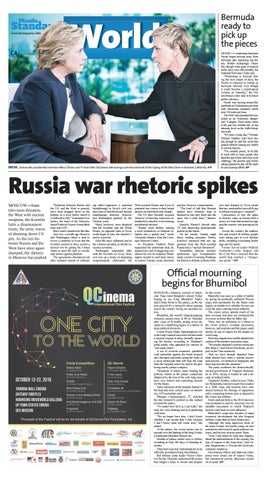
BREAK. Democratic presidential nominee Hillary Clinton and TV host Ellen DeGeneres talk during a commercial break of the taping of the Ellen Show in Burbank, California. AFP
MIAMI―A weakening hurricane Nicole began moving away from Bermuda after slamming into the tiny British archipelago Thursday, though wind gusts of tropical storm force were still possible, the National Hurricane Center said. “Weakening is forecast during the next couple of days, but Nicole is expected to remain at hurricane intensity even though it could become a post-tropical cyclone on Saturday,” the Miami-based center said in its latest public advisory. Nicole was moving toward the northeast at 33 kilometers per hour with maximum sustained winds near 110 miles per hour. The NHC had classified the hurricane as an “extremely dangerous” Category Three storm when it hit, just two notches shy of top intensity level on the Saffir-Simpson scale. “It’s been a long day,” Premier Michael Dunkley told local media, though he said the worst had passed without causing any deaths or serious injuries. “I’m certainly proud... to be able to work with so many people who stand the test of time and meet a real challenge,” the premier said, before asking islanders to stay off the roads to ease clean-up efforts. AFP
Russia war rhetoric spikes MOSCOW―State television threatens the West with nuclear weapons, the Kremlin halts a disarmament treaty, the army warns of shooting down US jets. As the ties between Russia and the West have once again slumped, the rhetoric in Moscow has peaked.
“Relations between Russia and the US, and the West in general, have been dragged down to the bottom, to a level below which it is difficult to fall,” Konstantin Kalachev, the head of the Moscowbased Political Expert Group think tank, told AFP. But it wasn’t meant to be like this. Just over a month ago Moscow and Washington inked a deal to revive a ceasefire in Syria and the Kremlin seemed to have scored a tactical win by getting the United States to open the door to coordinate strikes against jihadists. The agreement―hammered out after repeated rounds of exhaust-
ing talks―appeared a potential breakthrough in Syria’s civil war and years of bad blood and furious mudslinging between Moscow and Washington sparked by the Ukraine crisis. Many, however, were skeptical that the Kremlin and the White House, on opposite sides in Syria, could begin to bury the hatchet― and so it proved. Soon the truce collapsed and as the violence spiraled, so did the ferocious acrimony. Washington suspended talks with the Kremlin on Syria; Moscow tore up a treaty on disposing weapons-grade plutonium; the
West accused Russia and Syria of potential war crimes in their brutal attacks on rebel-held east Aleppo. The US then formally accused Moscow of hacking American institutions to interfere in its looming presidential election. “Russia went further, turning a local breakdown in bilateral relations into a global one,” wrote Alexander Baunov from the Carnegie Moscow Center. As President Vladimir Putin suspended the plutonium deal, he slapped on a raft of staggering conditions for it to be restarted: Washington needed to pull back forces in eastern Europe, scrap sanctions
and pay Moscow compensation. “The kind of talk that Russian leaders have formerly kept to themselves has now burst into the open, like a solar flare,” Baunov wrote. Quickly, Russia’s slavish state TV and attack-dog spokespeople picked up the baton. On his weekly Sunday night show, leading presenter Dmitry Kiselyov menaced that any aggression from the West towards Russia had a “nuclear dimension”. Meanwhile defense ministry spokesman Igor Konashenkov made a point of warning Washington that new defense systems Mos-
cow had shipped to Syria meant that any unidentified aircraft flying overhead would get a “surprise”. Coincidence or not, the spike in rhetoric came as Russia held a series of events that seemed to suggest the country was gearing up for war. Across the country the authorities said around 40 million people were taking part in civil defense drills, including evacuating buildings and fire alerts. Former Soviet leader Mikhail Gorbachev―who helped end the Cold War―warned that the world had reached a “dangerous point.” AFP
Official mourning begins for Bhumibol BANGKOK―Massive crowds of blackclad Thais lined Bangkok’s streets Friday hoping to see King Bhumibol Adulyadej’s body borne to his palace, as the nation grieved for a monarch whose passing leaves the country facing an uncertain future. Bhumibol, the world’s longest-reigning monarch, passed away at 88 on Thursday after years of ill health, ending seven decades as a stabilizing figure in a nation of deep political divisions. Crown Prince Maha Vajiralongkorn, 64, is the king’s named successor but has made a surprise request to delay formally assuming the throne, according to Thailand’s junta leader, who appealed for citizens to “not cause chaos”. A sea of reverent mourners, sprinkled with umbrellas against the harsh tropical sun, thronged sidewalks along the route of a royal motorcade that will bear the king from the hospital where he died to his glittering nearby palace complex. Thousands of others, many holding his portrait, waited at the palace compound, shattered by the loss of the only king most have ever known and expressing anxiety for the future. Some mourners at the hospital fainted in the heat and were carried away on stretchers, AFP journalists said. Phongsri Chompoonuch, 77, clutched the late monarch’s portrait as she walked towards the palace. “No matter how far it is, I can walk,” she said, her voice shaking and eyes glistening with tears. “We no longer have him. I don’t know whether I can accept that. I fear, because I don’t know what will come next,” she added. At the palace, the crown prince was to preside over the bathing of the king’s body, a traditional Buddhist funeral rite. Months of palace rituals were to follow, including at least 100 days of chanting by monks. Thais had expected Vajiralongkorn to be officially proclaimed king immediately. But military junta leader Prayut ChanO-Cha late Thursday announced the prince had sought a delay to mourn and prepare
for the crown. Bhumibol was seen as a pillar of stability during his politically turbulent 70-year reign, and uncertainty for the future rests largely on doubts over whether his son can exert the same calming moral authority. The crown prince spends much of his time overseas and does not command the reverence at home that his father did. There was no indication of a threat to the crown prince’s eventual succession, however, and analysts said the pause could merely be out of respect for the deeply revered king. Strict lese majeste laws muffle detailed discussion of the sensitive succession issue. “We maybe shouldn’t read too much into (the delay),” said David Streckfuss, an expert on the Thai monarchy. “But we have already departed from what should have been a normal succession process. An element of ambiguity has been injected into the situation.” The junta overthrew the democratically elected government of Yingluck Shinawatra in 2014, saying it wanted to end a decade of political strife. Yingluck’s brother, exiled tycoon Thaksin Shinawatra, had previously been ousted in a 2006 coup, and tensions have simmered between his throngs of supporters and a competing faction seen as aligned to the crown and military. Some analysts believe the 2014 takeover was prompted in part by concerns over an unstable succession in which Thaksin’s faction could seek to exert influence. Bhumibol’s reign saw decades of rapid economic development but also frequent military coups that set back democracy. Although the king approved most of the army’s many successful coups, he also sometimes intervened to quell political violence, and his loss worries some Thais. “Now I am afraid of what may happen, about the administration of the country, the type of regime in the long term,” said Arnon Sangwiman, a 54-year-old electricity company employee. Government offices and state-run enterprises were closed out of respect Friday, but commercial activity otherwise carried on as usual. AFP