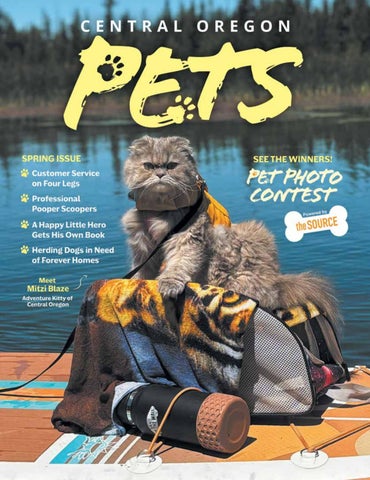
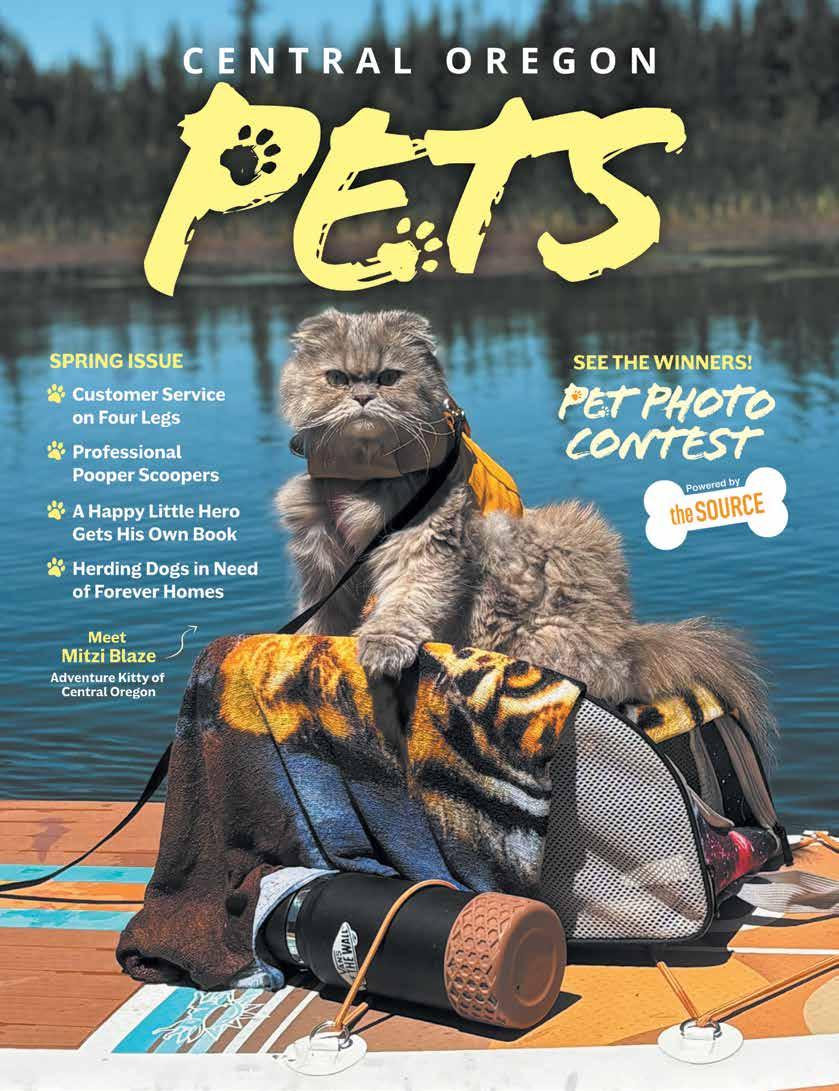
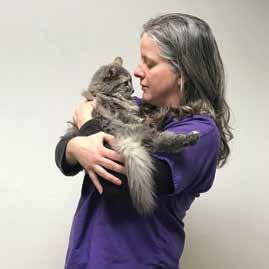
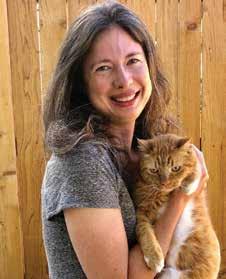
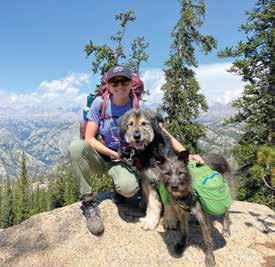
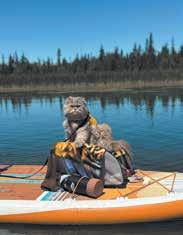
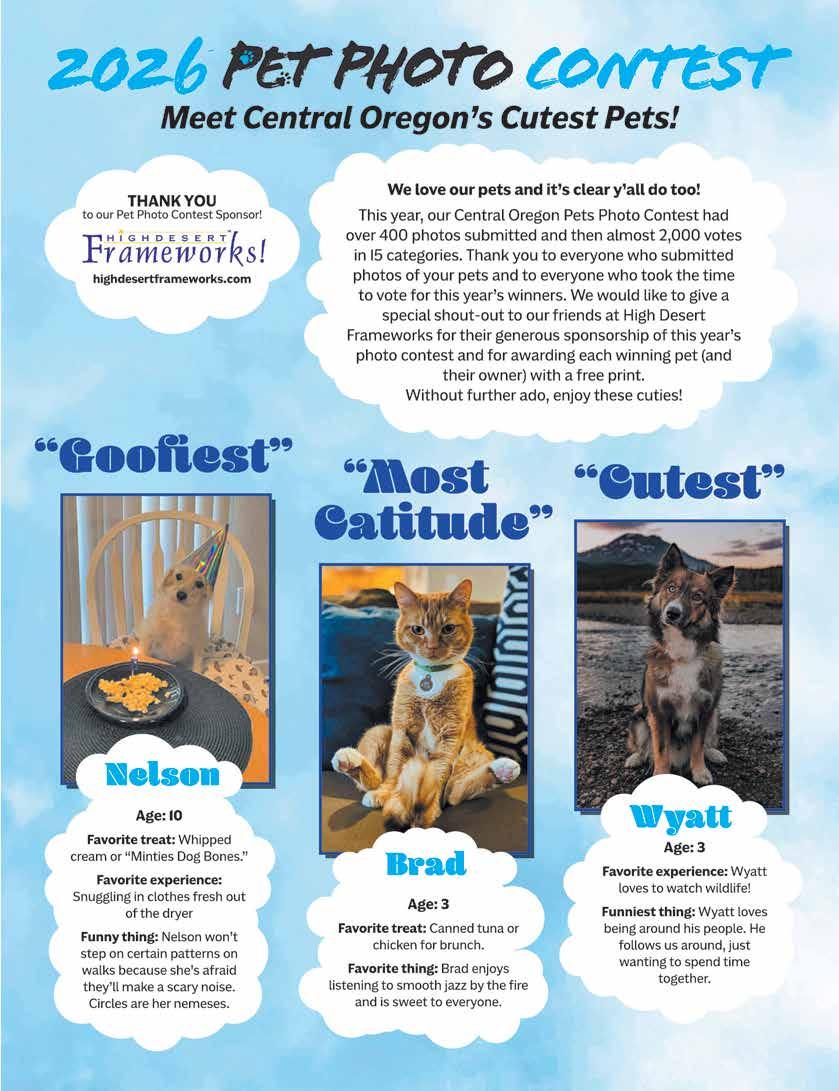
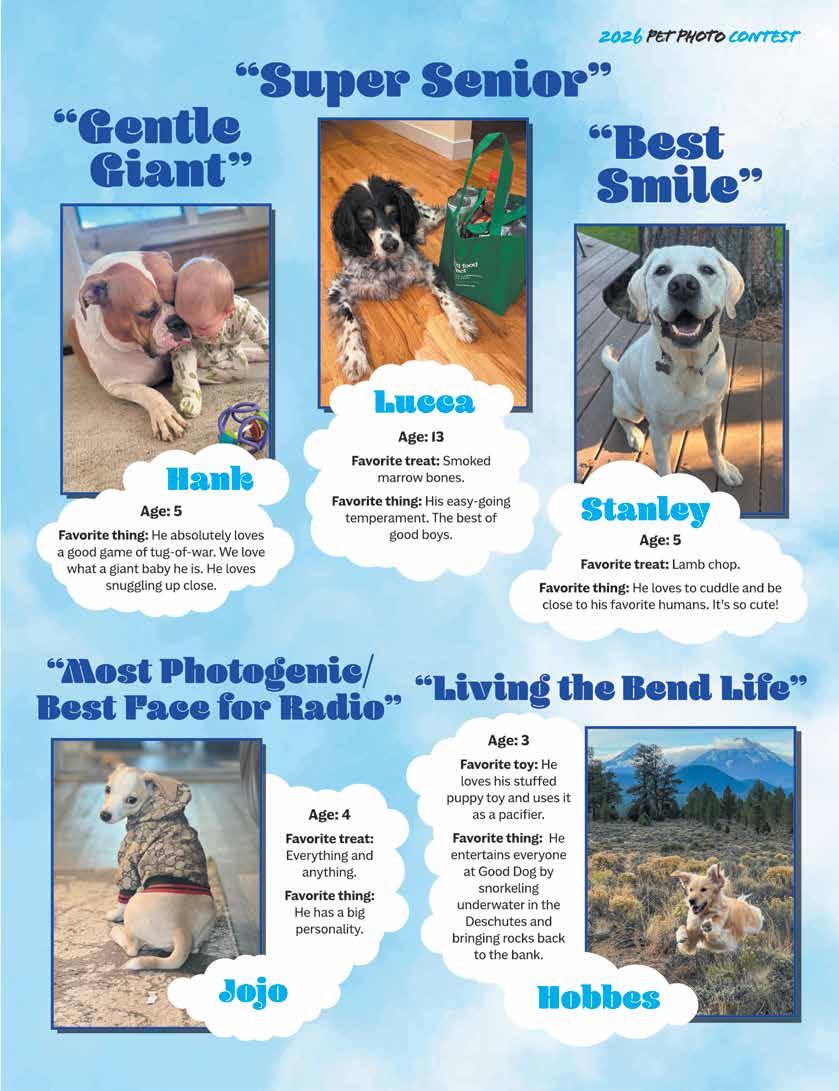
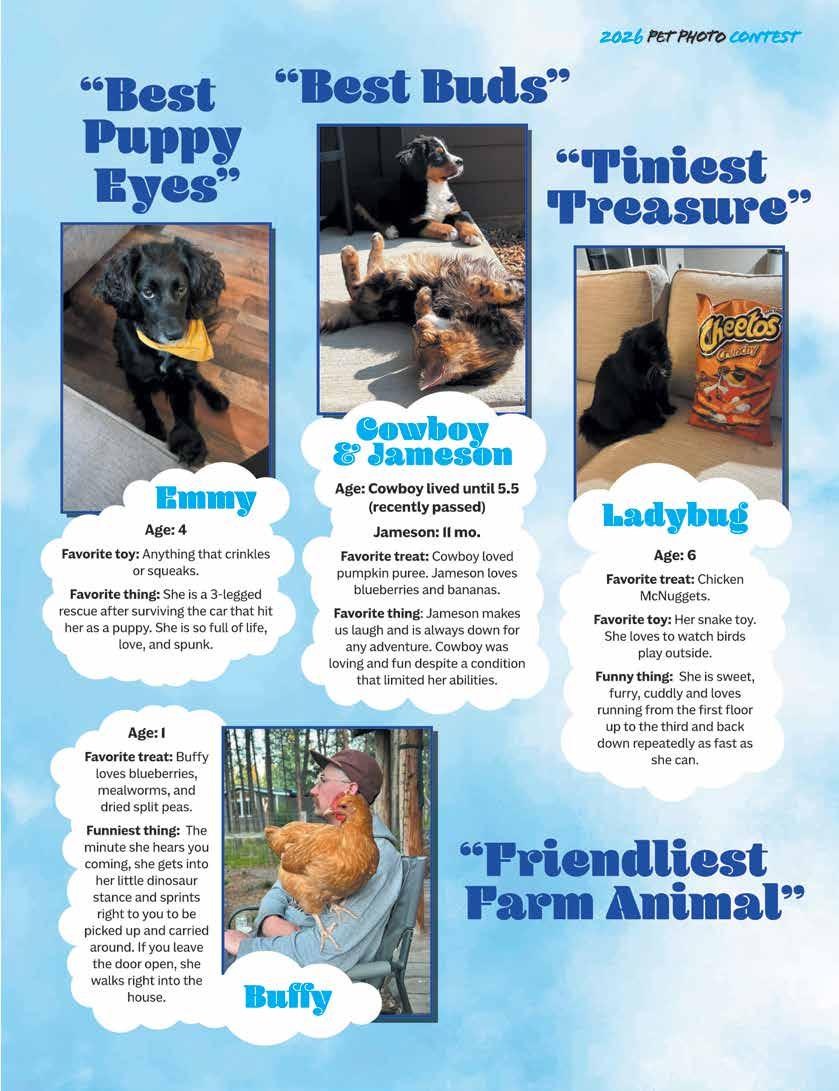
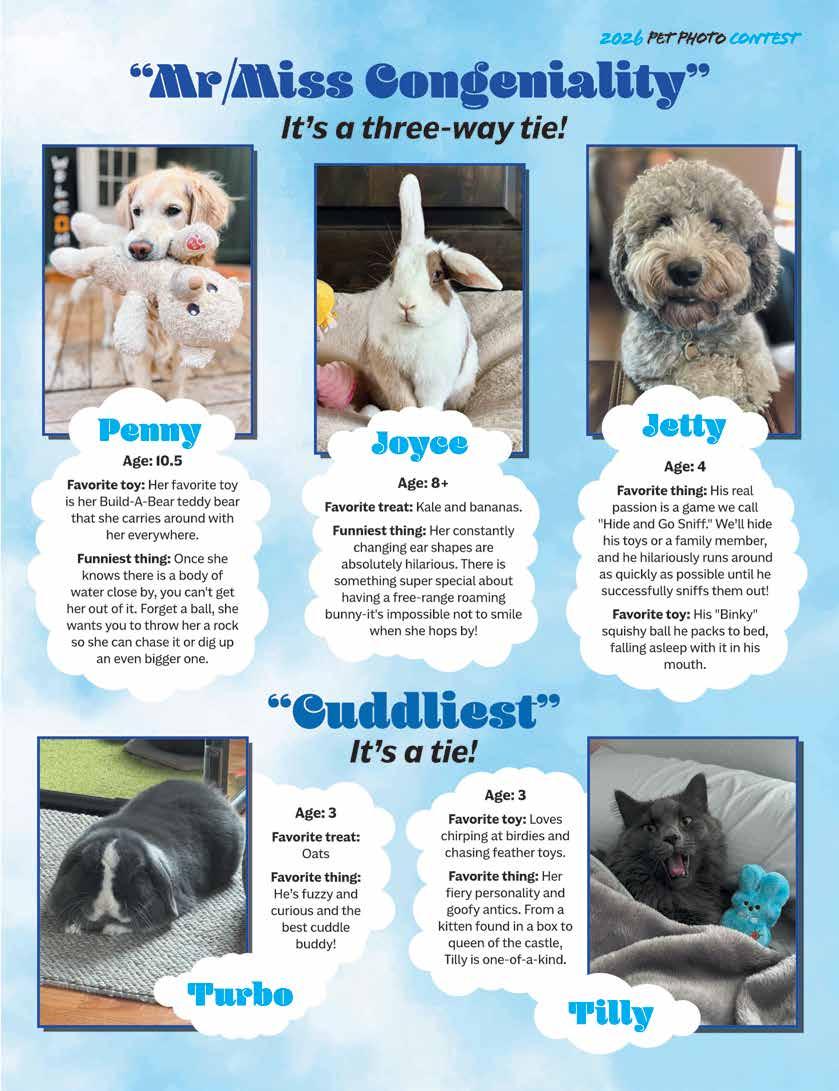
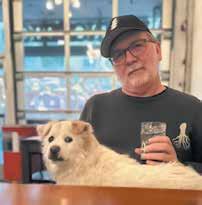
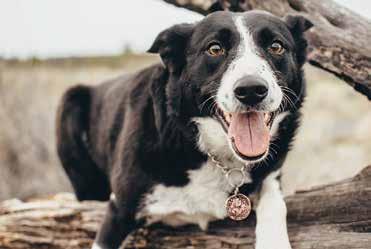
I’ve always held a strong belief that my two dogs and cat have unique personalities, but after reading all the entries for the pet contest, I must acquiesce that other people’s fur-babies — and even feathered ones — are just as special. The paddleboarding cat on the cover seems remarkable as does the chicken that uses people as La-Z-Boys and the teeny black kitty named Ladybug whose favorite treat is McNuggets!
Thank you to everyone who participated in this year’s contest. I enjoyed reading about and looking at all those sweet faces.
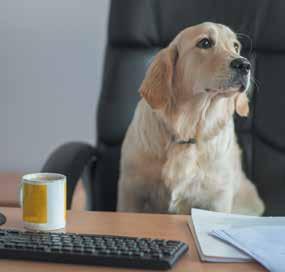
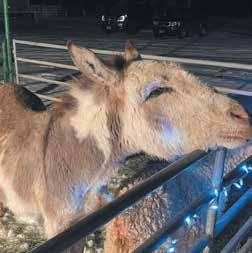
This issue also shares stories about a rescue group specializing in finding good homes for restless herding dogs and a business that takes pride in picking up the stink. We talk with the Pet Evacuation Team working miracles under terrifying circumstances and a man so heartbroken over losing his best bud that he immortalized him in a children’s book. There’s also a miniature donkey stealing hearts in Prineville and folks, so attached to their furbabies, they take them to work because, why wouldn’t you?
—Managing Editor Nic Moye
Blaze (aka Mitzi Blaze) is no ordinary cat.
This adventurous Persian–Scottish Fold started out as a kitten going for walks along the river in a cat backpack and quickly worked her way up to paddle boarding on the Cascade Lakes of Oregon. These days she confidently struts up and down a standup paddle board, sometimes even hopping from board to board like she’s supervising the whole operation. Safety first, of course—Blaze never hits the water without her Ruffwear life vest. She loves camping and the outdoors so much that people often think she’s a dog… until they realize she’s actually a cat, and the look on their faces is priceless. Around the lakes, she’s become a bit of a legend, an elusive feline known for mysteriously gliding across the water on a paddle board.
Off the water, Blaze is a little less majestic and a lot more mischievous. She spends her time chasing squirrels, attempting to hunt birds (with very limited success), taunting her cat sister Sheba and generally keeping life interesting for her proud parents, Emily and Justin. At home she rules the house, but she’s always ready for the next adventure...and with Blaze around, there’s always one coming.
It's not uncommon for a four-legged friend to greet customers in businesses
Story and business photos by Dallas Finn Calvert
With more than 40 restaurants that welcome dogs, nine offleash dog parks, miles upon miles of dog-friendly trails, and even dog-specific food carts and menus around town, it’s no wonder Bend is known as “Dog Town, USA.” The city of Bend has more than 12,000 licensed dogs, many of them on the go daily and intricately woven into the lives of their humans. Lots of them even go to work. We loved on a few such dogs while talking to their humans.
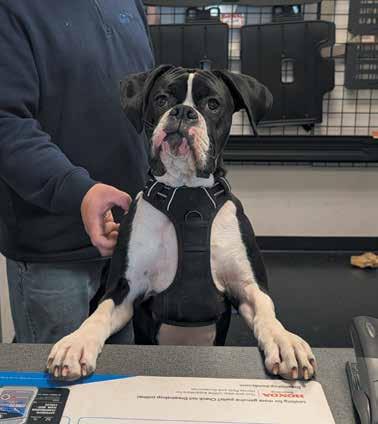
Rufus, an “assistant” in the parts department at Bend Honda
If you’ve ever stopped at the parts-department counter at Bend Honda, you’ve no doubt been greeted by Rufus, a handsome boxer who’s just over a year old. He regularly goes to work with his human, Jeff Smelser, 40, who works in the parts department. One of Smelser’s
coworker’s dog had a litter of puppies, and Smelser fell in love with Rufus. However, the puppy couldn’t stay home alone while Smelser worked all day, so he started hanging out behind the counter at Honda.
“I got the approval from everybody up top, and he’s been a good boy ever since,” Smelser says. “Customers love him. He hangs out here all day, and we go for walks and lunch, and he plays with everybody at work. He’s a good little stress reliever for everybody here.”
RUFUS
the front counter parts advisor, and Frank Wood, the manager of the parts department.
Rufus is a hit with both customers and staff alike, says Ian McGarigal,
“He’s just got this amazing energy to have around,” McGarigal says.
— Everyday!
“He’s always in a good mood, and if you’re stressed out or down in the dumps, you just have to spend a few minutes with Rufus, and you’ll feel better.”
Adds Wood: “He’s a very mild dog. He doesn’t bark. People love to come feed him. Sometimes, he’ll be out on the couch (in the waiting area), just hanging out with customers and watching TV. The GM loves to come hang out with him, and the sales managers always come and see him. He’s a very chill dog, and he’s so good for morale.”
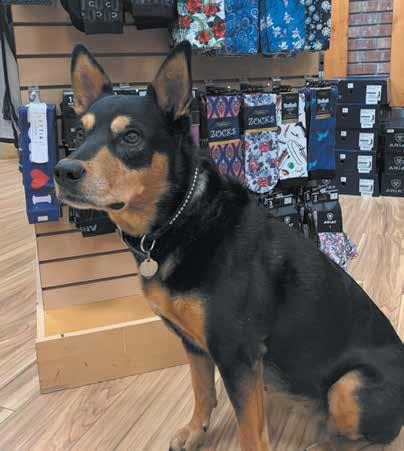
Polo, the unofficial “owner” at Absolute Horse
Years ago, Abbie Block was on her way to watch friends play in a polo match near Yakima when she spied a lonely little soul on the side of the road. The tiny Australian Kelpie was all alone, but found a forever friend in Block.
found her, and then found the polo match.”
“She was about five weeks old,” recalls Block, 43, owner of Absolute Horse in Bend. “She was next to a corn field, in the middle of nowhere. I
Polo, now 14 ½, spends her days lazing in the sun coming through the windows of the tack store, popping up to say hi to anyone who comes through the door. With a lustrous, soft coat, people always want to pet her, and she helps them as they shop around the store.
“She comes to work every day. We say that she owns the place,” Block says. “She’s at the store all day long. She loves greeting people. Most people either want to take her home or buy her. She’s a very big attraction here.”
Now that she’s getting older, she tends to eke out every last minute of sleep before she heads to the “office” for the day.
“When she was younger, she’d jump up and out the door she’d go,” Block recalls. “Now, she kind of sleeps in and waits until I’m really ready to go. But if she doesn’t come to work for a few days, she definitely mopes around the house because she knows she hasn’t been there.”
And Polo’s workday doesn’t end when the shop closes for the night and they head home to Tumalo.
“Since we have property and animals, we go out and do our chores, and she cruises around,” Block says.
Chipper Champ
Chipper Jones, official office dog at Arrowood Development
In the downtown Bend office at Arrowood Development, a firm that designs custom homes, Chipper Jones, a 13-year-old adorable “little terrier mutt,” peeks out from under Amy Oatman’s desk. Oatman, 53, controller at Arrowood, adopted Chipper as a puppy from the Humane Society of Central Oregon. While he used to stay at home while Oatman and her husband were at work, “he’s too old to hold his potty, so he’s a working dog now,” Oatman says with a laugh.
Buster Posey, 5 ½, the other dog in the Oatman family, which includes son Garrett, a senior at Mountain View High School, stays home during the day while Chipper goes to work. The Oatmans are avid baseball fans, hence their pups’ names. Larry Wayne “Chipper” Jones Jr. is a famous former third baseman for the Atlanta Braves, while Gerald “Buster” Posey III is a former San Francisco Giants catcher. Chipper spends his days snoozing under Oatman’s desk at Arrowood, with the occasional jaunt outside to do his business.
“Chipper is the only dog that gets to come all the time. He’s our full-time office dog,” Oatman says. “He’s super old, so he doesn’t care if he ever goes for a walk again, but we go outside a couple times a day and walk around, and he loves to pee on all of the bushes.”
Champ, salon ambassador and unofficial therapist
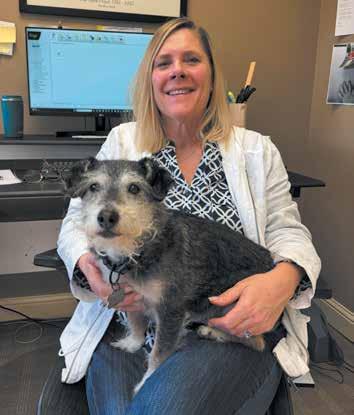
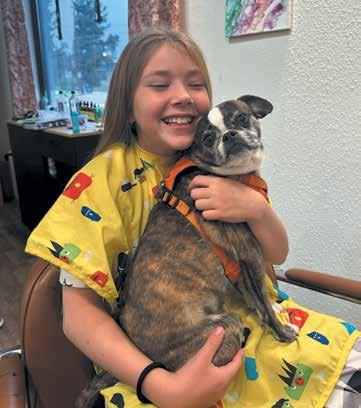
Jacquie Venable, 38, is a Bend hairstylist who specializes in weaving hair styling and color services with relaxation techniques to provide a holistic experience. She runs her business from a homey private suite. Champ, her cuddly 8-year-old Boston-Pekingese mix, has offered his unofficial therapy services to Venable’s customers at the various salons she worked at in Bend before settling into her own space.
“I think what prompted him coming to work with me is my pug, P-Town, who would go to the salon with me occasionally when I was in Portland. People were excited to have a dog at the salon, and it had a calming effect for them,” recalls Venable. “When I started bringing Champ with me, I just noticed a
change in clients when Champ arrived. You have a cute puppy in your lap, and it was just a good vibe. He has a kind of presence that also became calming for me, and that was a priority. He became like my emotional support animal and helped me be calmer in my own environment. I think Champ does a really great job of, well dogs in general do, but Champ especially, helping the nervous system regulate. And he’s pretty darn cute, too.
“People really love having a dog in their lap,” adds Venable. “Even yesterday, I had a client who was feeling really emotional and was struggling. She even commented, ‘I wish I could have Champ in my lap today. That would help.’ Having him around takes everybody’s nervous system down a couple notches, and that’s the exact vibe that I’m trying to create. It’s why I moved into a private space and what I’ve always been trying to provide, where people can show up as they are, like who they are, and in whatever outfit or mood or form they need because we all need to be able to be accepted just like we are.”
HERD MENTALITY
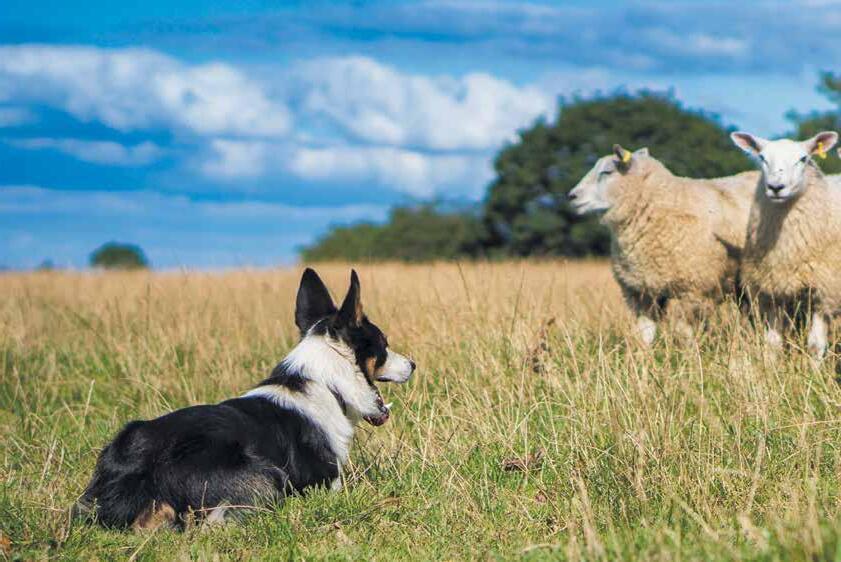
Every other Saturday, at various pet stores in Bend and Redmond, the nonprofit Herding Dog Rescue of Central Oregon hosts adoption events, inviting the public to come meet the herding dogs available for fostering or adoption.
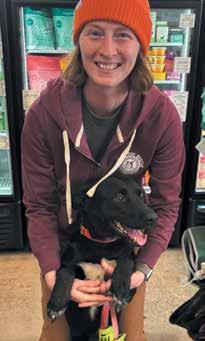
At a recent event at Local Paws in Redmond, HDRCO President Jessi Harrison was joined by dog trainer Ali Ramsey and volunteers Beth Gallup and Cat Addison, along with herding dogs Briar and Turbo.
“These dogs don’t do well in shelters; they’re too sensitive,” Harrison tells a visitor.
Ramsey said that helping rehome herding dogs was right up her alley. “I love to give back. Turbo is my foster.”
While packing up near the end of the three-hour event, Gallup talked about what she gets out of volunteering with the rescue. “Seeing the happy faces... both the adopters and the dogs,” she
Highly intelligent herding dogs require action and room to roam
By Richard Sitts
said, adding that the group is always recruiting more volunteers. “The reward I get is knowing that the dog is going to a good home,” she added.
Gallup then started to tear up, relating that it had been a “tough week.” Nine out of 10 puppies had succumbed to parvo after being taken away from their mother too soon.
Addison said she had lost a dog and then decided not to get another for a while. “So then I met Jessi and she suggested I foster. It gives me a lot of purpose. It’s hard because sometimes
you get really attached. I’d take five dogs if I could.” She said she’s been working with the group for a couple of years now.
One thing’s certain: Harrison and the other volunteers clearly enjoy and get satisfaction from their efforts.
Harrison co-founded HDRCO with Tammy Leicht in May of 2023. Leicht died from cancer about a year ago.
Dog trainer Ali Ramsey holds her foster herding dog, Turbo, who came from the Dirt
World homeless encampment north of Bend.
Richard Sitts
Harrison wrote a memorial to Leicht on the group’s website:
“Tammy and I shared a dream, a promise to save as many dogs, especially herding dogs, as we could. We started HDRCO with this vision, believing we could make a real difference in the lives of these animals and the families who would give them a home. We didn’t just want to find any home; we wanted the RIGHT homes. Tammy had an extraordinary gift for matching dogs with the people who needed them most. She wasn’t just good at this — she was brilliant, and her heart was as big as her impact. And through all
her tireless work, she helped to build something that I continue today with her by my side in spirit.”
The group’s goal is to get the dogs into foster homes and then eventually adopted to the right family or individual. “We really work hard on matching the dogs with a person,” Harrison says. “They need movement and exercise. They’re not going to do well if left home alone all day. They’re extremely intelligent.” There are 3040 different breeds of herding dogs, according to Harrison.
Harrison was raised in Tillamook, “growing up with any animal I was allowed to have,” according to her bio on the website. She found her first rescue on a 20-below-zero day near a dumpster in Anchorage, Alaska, where she lived the second part of her life. She started her first dog pack, all rescues, some from shelters and others from people who just didn’t want them anymore. Moving back to Oregon for the third part of her life, she’s found a few acres, “a place for
UPCOMING FOSTER/ADOPTION EVENTS
April 11
Local Paws in Redmond 1am-2pm
April 25
Mud Bay North in Bend 1am-2pm
May 9
Bend Pet Express East 1am-2pm
all kinds of animals.” With six dogs of her own, her pack can sometimes number up to 14, depending on how many fosters she has at the time. She has worked at Bend Veterinary Clinic for nearly 10 years.
Herding dogs do require special attention and room to roam. It’s preferable if prospective adopters own their own homes and have a fenced-in yard, she says.
To check them out, drop in on one of the foster/adoption events and meet the dogs in person. Or take a look at the dogs on the website: hdrescueoregon.com.
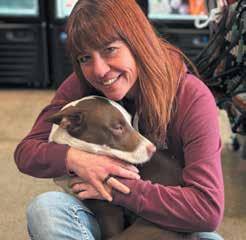
At a recent adoption event in Redmond, Herding Dog Rescue President Jessi Harrison cuddles with Briar, who came from a shelter in San Francisco.
Richard Sitts
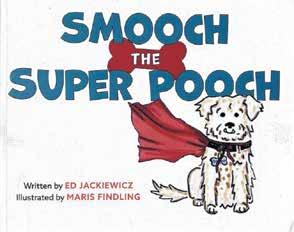
THE HAPPY LITTLE HERO
“Smooch the Super Pooch” by Ed Jackiewicz shares the sweet story of a small, deaf dog’s superpower of spreading joy.
By Ezra Oncken
As Roger Caras, an animal rights activist, once wrote in “A Celebration of Dogs,” “Dogs are not our whole life, but they make our lives whole.” This sentiment certainly captures how Ed Jackiewicz felt about his pup, Smooch.
When Ed’s daughter first expressed her desire for a dog, her mother was skeptical. After being turned down a few times, it took watching the 2009 comedy, “Hotel for Dogs,” for Ed’s daughter to persuade her. She was set on getting a dog named “Smooch” but there were still a few more hurdles to clear. Ed set conditions that the dog had to be house-trained, the right size, and adopted from a shelter. They lived in Los Angeles at the time, and by sheer chance, when they visited the Chatsworth Animal Shelter, they found the perfect match: a skittish yet friendly 25-pound mixed breed named Smooch. Ed recalls, “He was a little hyper, but my wife started calling us, saying, ‘I think our
dog is deaf.’ So, we tried everything — calling his name, banging pots — and sure enough, he was deaf.”
However, this didn’t hinder their connection with Smooch, even after they moved to Bend. He was great on long car rides and very friendly with people. Ed noted, “He was pretty unique in the world of dogs… since he was deaf, he really loved physical contact. He would jump up on strangers’ laps if they gave him the chance, and he sort of became known around town. He was always smiling and very distinctive looking… That’s sort of the punchline of the story: his superpower was making everyone happy.” Since Smooch couldn’t hear, Ed also didn’t have to worry about him fearing fireworks, loud sirens, or other dogs barking. He mused, “He had a very peaceful life.” There was one moment Ed now
recalls fondly when Smooch did get into trouble, “We came home one time to find he had gotten into the laundry detergent, so he was coated, and we had to wash him over and over to get it all out.” And during the COVID pandemic, when Ed worked from home, they became inseparable. Smooch would always be in Ed’s office or sitting on his lap throughout the day. Ed remarked, “He had a great personality and was the perfect companion.” He continued, “When my wife would come home, he would keep looking for me. Since he was deaf, he would be searching around
Photos submitted by Ed Jackiewicz
Family Owned And Operated
the house even when I was there.” Smooch experienced few problems as he aged, and he passed peacefully in their arms after 15 wonderful years.
Dealing with heartache, Ed took some advice from a friend to write a letter to his dog. He found it very therapeutic, “Since you have so many thoughts and emotions” As he reflected on their time together, he realized that it could make for a good children’s story. Initially, he didn’t have an illustrator, but through a
teacher he knew from his substitute work, he met Maris Findling, a local student interested in collaborating on the book. Ed made it clear from the start that he intended to make it a passion project rather than a moneymaking venture. After sending Maris a collection of photos, it took her about a month to create around 20 drawings for the book. Once they agreed to split any profits 50/50, he published it through BookBaby, a self-publishing company, and managed to sell a few
The many faces of Smooch, who led a good life bringing joy to others.
hundred copies. He stated, “It was a good form of closure, but it also keeps him alive.”
Ed recommends the experience, saying, “It helps. When they go, don’t focus on what you lost; focus on what you had. Everything is short; life is short, so you have to savor the moment. I feel very fortunate and happy that I had that much time with him… he was an incredible dog.”
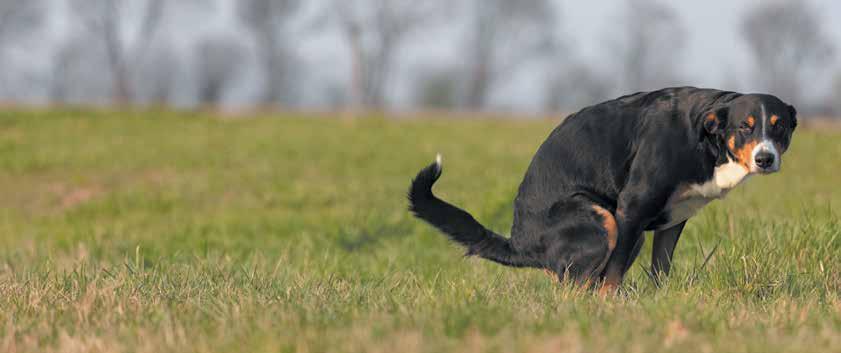
The Bomb Squad, which removes dog poop from yards throughout Central Oregon, lends punny charm to a “crappy” job
The
Most likely, The Bomb Squad, a local dog waste removal service, has already beaten you to any pun or turn of phrase you could possibly cook up related to their niche business.
After all, these are the folks who define “turdology” as “the joyful study and pursuit of professional dog waste removal.”
Their employees are, naturally, “turdologists.”
It’s this scatological charm that puts a playful spin on a job that would be too easy to deride as crappy.
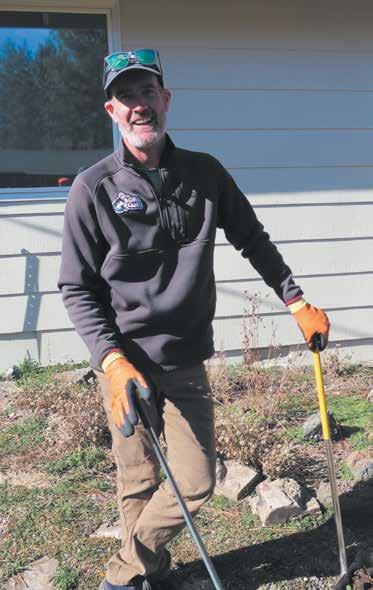
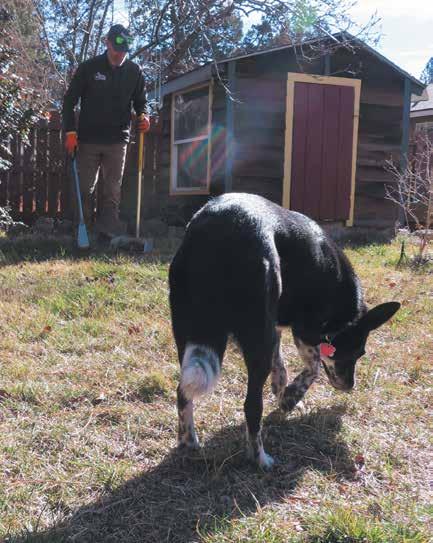
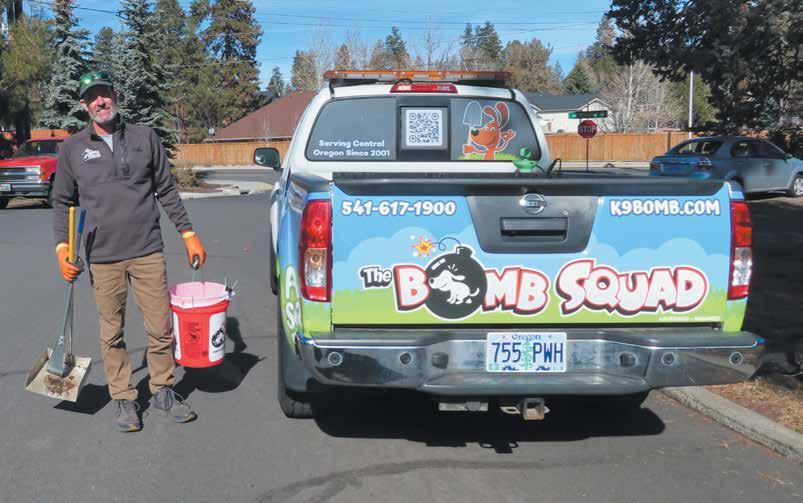
On a recent morning, owner Brian Frankle, 48, parked his cheerfully branded work truck in front of a client’s home in Bend. From the bed, he grabbed a lined, fivegallon bucket and a custom, metal pooper scooper setup (a scoop and a poo pan combo), both with handles the height of golf clubs, which prevents bending over. (Frankle is proud of his work, which he welds himself; yet he asked that photos not be taken close up, lest an opportunist copy his design.) Then he began methodically pacing the rectangular yard as if he were a forensics investigator combing a crime scene.
“Here we go — found some brown gold,” Frankle hollered, depositing the crap into the bucket with a thud.
In 2014, when Brian Frankle bought the company which was established in 2001, he considered a rebrand.
“I almost changed the name to Turd Burglar,” Frankle said with a grin. “You know, like we show up at your house when you’re away and we steal all your crap.”
Story and photos by Peter Madsen
Bomb Squad owner Brian Frankle, a Central Oregon dog waste-removal service, says he’s advanced the study of “turdology.”
Frankle kept “The Bomb Squad,” however, since its name recognition as the longest-running poop-scoop biz in Central Oregon is worth more than its weight in — well, never mind. After 12 years and many longterm clients (“I’ve seen dogs grow from puppies to seniors”), Frankle says he can count on one hand the times he’s accidently stepped in poop.
“You spend the whole time looking down for it, so it’s not really a hazard,” he explained. “You tend to know the popular spots in the yard where dogs like to go.”
After a fruitful visit to the client’s fenced-in backyard, Frankle deposited a couple more plunkplunks into the bucket. Despite careful steps, Frankle sprays down his equipment and the soles of his shoes with a non-toxic kennel disinfectant before servicing another client’s yard. This cuts down not just on transmittable disease but the general ickiness of his daily grind.
“All right, onto the next,” he said, tying up the bag of dung and storing it and his tools back in the truck bed. Then he piled into the cab to wind his way through southeast Bend.
Frankle, who picks up crap three or four days each week, employs a team of three people, including one who’s full-time. He prides himself on paying a living wage. He also gives employees autonomy to service yards while abiding a daily and weekly schedule.
“I try to keep it fun,” he says. “This is repetitive work, so respecting work-life balance is really key in keeping long-term employees.”
Over the years, Frankle estimates he’s seen about a dozen dog waste-removal companies come and go. His company stays above the fray by delivering a highquality attention not just to turds but to critical details like ensuring all gates are securely fastened when coming and going.
“When anyone with a pickup and shovel can be a competitor, you have to have standards of professionalism to distinguish yourself,” Frankle said. “Once you get us in your yard, you’re gonna love us.”
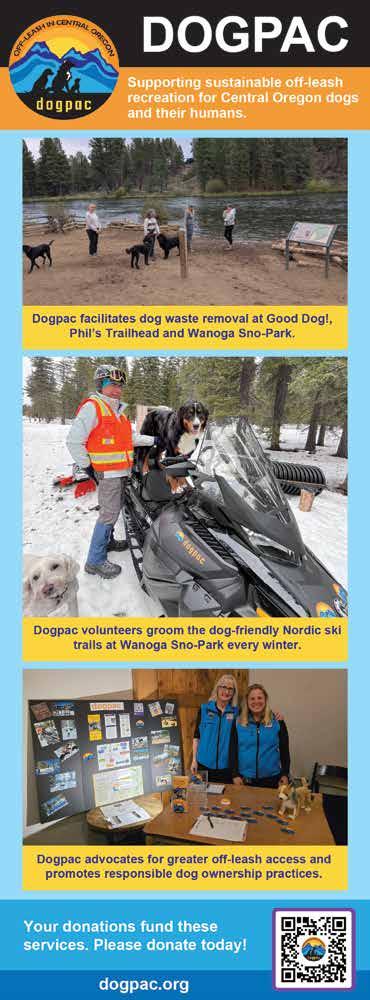
Frankle estimates that, since 2014, his company has removed 2.5 million pounds of crap. A centrally located dumpster facilitates Cascade Disposal weekly delivery to the Knott Landfill Recycling and Transfer Facility. Accordingly, Frankle distributes the waste he picks up in coordination with Dogpac-serviced locations such as Good Dog! Park, Phil’s Trailhead and Wanoga SnoPark in the Deschutes National Forest, replenishing about 3,000 cleanup bags each week as well. Similar dog-waste bag dispensers are also scattered through Bend parks, homeowner associations and multifamily complexes.
Above, Destiny Bole has worked full-time for The Bomb Squad for years. She says she enjoys the peacefulness of the job. “I’m way healthier,” she said.
The Bomb Squad also services Sisters, Redmond, Prineville, Tumalo and La Pine. They don’t work major holidays and weather events like wildfire smoke, ice or snow.
“The poo gets pasty in rain, that’s one of the biggest challenges,” he explained. “But with snow, the poop is there the next week, so sometimes our loads are heavier, week in, week out — depending on saturation levels.”
Frankle and his crew know not just each dog by name but by personality. We stopped at a client’s residence near Bear Creek Road. He took care closing a finnicky gate and warning a visitor that May, a Border Collie mix, is friendly but gets anxious if a new person pets her.
“Hey, May!” Frankle said as the tuxedo-coated pooch sniffed his pants and swished her tail.
“Sometimes she’ll pee on the bucket,” he said. “Just to assert dominance.”
While scooping, Frankle talked about his design background, which he launched in 2001 with his own
through-hiking bag company Ultra Light Adventure Equipment, which he sold in 2009. Later, he served as the design director during a five-year contract with Giant Loop, a Bendbased moto luggage company, while he also consulted for other outdoor equipment companies. Frankle’s placed a premium on being his own boss and working on his terms.
As evinced by his passions of through-hiking and backcountry moto-riding (he completed the PCT in 1999 and rode the Trans America Trail on a dual-sport motorbike in 2007), Frankle enjoys alone time outside. Buying and operating a dog wasteremoval business made sense.
“Initially, I just thought this this would be a fun side gig,” he said. “But then The Bomb Squad just began to grow. I enjoy logistics and problemsolving, so I just ran with it.”
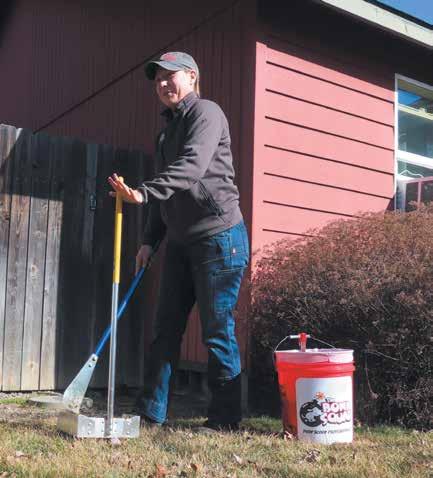
At another residence in southeast Bend, Destiny Bole, Frankle’s first hire, pulled up in a matching Bomb Squad truck. Bole’s worked three years until she took time off to start
a family. Then she picked back up with doo-doo duty. Bole, wearing a matching Bomb Squad-branded running cap and fleece, showed off the pooper-scooper that Frankle customed made for her, mindful of her grip size and height. Bole says she’s enjoyed the freedom the work gives her, noting that she typically logs about five miles walking each work shift, according to her fitness tracker. Audio books, which she pipes through ear pods, feed her intellect.
“It’s peaceful work,” she said.
Frankle says a persistent question folks ask is whether he intends to franchise. Imagine — The Bomb Squad, servicing America!
“Nope, I want to keep it sustainable,” he said. “Providing a quality service to customers for a more decade is more satisfying than growth for the sake of growth. I want to be able to control the standard of the work.”
Frankle cued up another stinker of a pun: “I like to think we’re numberone in number-two.”
There's no mistaking what Brian Frankle and his truck are all about.
Pet Evacuation Team Scrambles to Save Lives
The all-volunteer nonprofit ensures safe evacuations and care of animals during emergencies
By Dallas Finn Calvert
June 17, 2025, is a day Mick Phillips won’t soon forget.
The 51-year-old resident of Crooked River Ranch owns A2Z Security and was working for a client in Bend when he got an evacuation notification on his phone due to the Alder Springs fire that broke out on Crooked River National Grasslands.
“It went from a level one to a level two really quick, so I got back home as fast as I could,” said Phillips, who owns a two-acre hobby farm with his wife, Angie. “By the time I got back (to the farm) and had the animals loaded up, we’d already hit a level three. This was within an hour.”
It was their first time undergoing a mandatory evacuation, and the stress of the situation was compounded by having to get their eight animals, including alpacas, goats, dogs,
and cats. A saving grace, Phillips said, was the assistance of the Pet Evacuation Team.
“I can’t say enough good things about the Pet Evacuation Team. What they did for us was amazing,” Phillips said. “We loaded up, and we got out of there as fast as we could. But we didn’t have any water or hay. We didn’t have anything. When we got there, they had a whole procedure. They knew exactly what they were doing. They checked us in, they tagged the animals and tagged us, so they could keep the right animals with the right people. We got them all settled in, and everything was good. They handled everything. They would feed them and water them. They took care of it all. They were phenomenal in everything they did.”
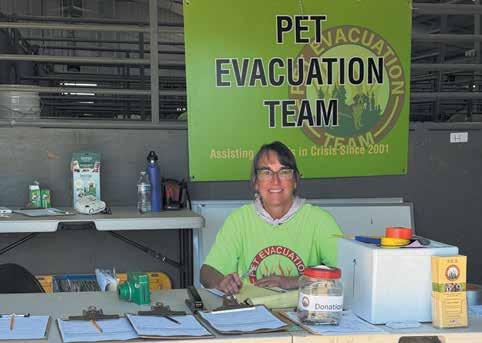
PET is an all-volunteer nonprofit
organization that works with the emergency-management units for Deschutes and Jefferson counties and the Red Cross to ensure safe haven for any animals forced out of their homes by a natural disaster. They also respond to animal-welfare situations when needed.
Phillips said he and his wife received the evacuation alert and then got a follow-up notification to take their animals to the Deschutes County Fairgrounds in Redmond. “Our alpacas are not your typical alpacas that you can go up and pet,” he said. “They’re rescues, so they’re never happy to be wrangled up and put somewhere else. But when they were with the Pet Evacuation Team, they handled them really well. There were no issues. They were very particular about asking questions and looking at the animals
to say, ‘This one looks sick. This one’s going over there.’ They were careful to make sure that, to the best of their abilities, they were preventing any type of disease spread or anything like that.”
The Phillips have an unaltered female goat, and volunteers from PET ensured she wasn’t inadvertently placed with other animals, to avoid any surprise pregnancies. “We were not required to stay. They had our information, and if there was an emergency or any questions, they contacted us,” he said.
Carolyn Gaubatz, 60, is the program director for PET, which formed in 2001 and received its nonprofit status in 2010. “What we do, and what we’ve always done, since our inception, is to partner with the emergency management services area
“We really want to encourage people that if you have animals that you can’t take with you, instead of just letting them free, if you have a way to get them to a location where we are deployed, we will care for your animals.”
—Carolyn Gaubatz
of Deschutes County and Jefferson County, and the Red Cross,” Gaubatz said. During level three evacuations, Gaubatz is contacted by one of those agencies, and PET deploys, typically to the Deschutes County Fairgrounds in Redmond or the Jefferson County Fairgrounds in Madras.
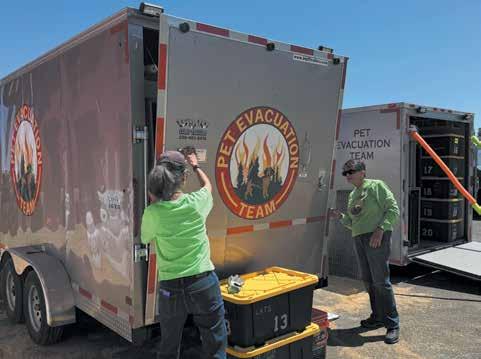
“We’re a mobile team, which means that we bring all of our equipment with us,” she said. “We’re able to care for all sorts of animals. Basically any type of animal that you have, if we have a place we can evacuate them to, we care for them.” The organization has about 75 regular volunteers.
“We’re always searching for new volunteers and looking for people
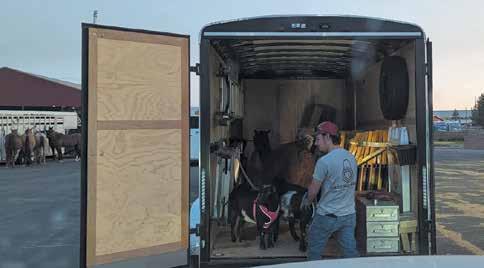
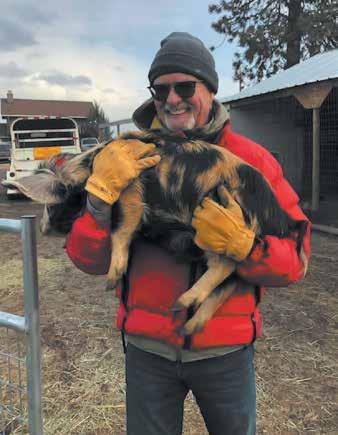
Wyatt Phillips unloads goats at the Deschutes County Fairgrounds after they were evacuated from his parent’s Crooked River Ranch farm during the Alder Springs fire last year.
PET provides animal care for owners during evacuation.
Nanda Giglio-Webb, left, and Vikki Sheerer unload the PET trailer during a deployment.
Angie Phillips
Photo courtesy PET
Photo courtesy PET
who have a really good comfort level with farm animals in particular, or ‘barn life’ as I call it,” said Gaubatz, who also volunteers with the U.S. Forest Service. She said that while they have two trailers fully stock with the necessary equipment to care for animals, they “don’t always have straw bedding materials for the stalls, or dog and cat food, or feed for the animals,” so they rely on contributions and donate unused supplies at the end of the fire season.
Last year, Gaubatz estimated that PET donated approximately three tons of straw hay at the end of fire season to Harmony Farm Sanctuary in Bend, about 800 pounds of dog food to Rockn EZ Rescue Ranch in Madras, and 500 pounds of cat food to the Central Oregon Humane Society.
One way in which the community can help is by signing up to fill special bags with cans and bottles that’ll then benefit PET through the Bottle Drop Oregon Redemption Center’s program for nonprofits. The group raised approximately $6,000 from the bottle-drop returns last year. Most of the organization’s money goes toward maintenance and gas for the PET truck and then ensuring the group’s two trailers are stocked with all the equipment needed to hit the road
life, I was a software consultant for almost 20 years, so for me, going digital will, I think, make us much more efficient in the way that we track the animals that we have in our care and making sure we have all of the proper documentation. It’s really hard to ensure that your paperwork doesn’t blow out barn doors or get moved somewhere, so we’re always extremely careful. But really, we need to move away from paper.”
pretty much 24 hours for the first couple of days of an evacuation.”
PET volunteers take part in annual training to ensure they all use proper animal-handling techniques. “There’s usually a bunch of different animals, of all shapes and sizes, that we’re trying to get checked in at the same time, so it can be very stressful for our volunteers,” Gaubatz said. PET volunteers also attend community events and wildfire fairs to help educate people about their services and how quickly a level-one “Be ready to evacuate” notification can escalate to a “Be set to evacuate” level-2 alert and then to a full-blown “Go now” level-three evacuation. Gaubatz said that escalation from level one to three can take as little as 30 minutes, so preparation is critical.
She said one priority is digitizing the intake process and animal-custody handoff that occurs when an owner brings their animal to PET during an evacuation. Currently, volunteers do much of the intake process manually.
“It’s very difficult when you’re trying to check in 20 animals at a time. It’s really hard to make sure that your paperwork stays organized, so we’re slowly trying to computerize and go digital,” she said. “In my former
Gaubatz always carries the PET phone with her, on which she’s notified by emergency services when a level three evacuation occurs. She then contacts volunteers, who spring into action. Last year, when the evacuation notices went out during the Flat Fire, she was at the top of Lava Butte in Bend, volunteering for the forest service. “We had probably 20 people on the ground in Madras within four hours, which is pretty phenomenal,” she said, adding that volunteers typically work four-hour shifts although “some of us work
“We really want to encourage people that if you have animals that you can’t take with you, instead of just letting them free, if you have a way to get them to a location where we are deployed, we will care for your animals,” she said.
“It’s a very stressful thing,” she added. “When you get people coming in to drop their animals off, they have no idea what they’re stepping into. They don’t know us. Most likely, they’ve never had to evacuate before, and we’re asking these folks to hand over their pride and joy. Last year during the Alder Springs fire, we had three stallions that were upwards of $50,000 or more. And we’re asking their owners to hand them over to strangers. The animals could be their livelihood, or they’re companion animals, like family. That’s how I consider my animals. So, we’re asking a lot, and it’s stressful.”
John Kailey is a Pet Evacuation Team board member and volunteer.
Photo courtesy PET
The Star of the Show
Miniature donkey Cimarron Kid attracts attention wherever he goes
By Ramona McCallister, photos by Kim Griffin
Aminiature donkey from Montana has become a celebrity in Central Oregon.
Cimarron Kid was relocated to Crook County in 2000, from Bart and Marion Barton’s donkey farm, Barton’s Brayin’ Assets. He found his Oregon home with their daughter, Kim Griffin, who also owns a variety of animals including a mustang, chickens and goats.
The name of her goat herd is Grizzly Mountain Goats, and she is part of Central Oregon Goat Association (COGA). Kid immediately fit in with her farm animals.
2000 before Griffin acquired Kid.
“They won and it was on the front cover, with all those fancy horses that pull wagons and carriages. That was kind of funny, because he is a spotted donkey, he is not gray — he is white with gray spots,” said Griffin.
“They raised and showed miniature donkeys,” Griffin said describing her father and step-mother’s farm. “They had multiple donkeys that would pull different types of wagons. They got Kid when he was just a little guy from Ohio.”
Kid was used for breeding with the Barton’s Jennies, resulting in many beautiful, miniature donkeys. The Barton’s had a miniature Meadow Brook Cart built for Kid to be used in competitions.
“One time, my dad thought, ‘I am going to take a picture of Marion and her turn-of-the-century clothing that would fit that cart,”’ Griffin explained. The photo was sent into Driving Digest for a competition. That was in
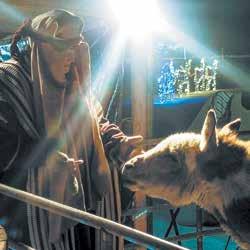
Kid also went with the Bartons to visit nursing homes, participated in parades and was part of a live nativity scene in Montana.
Eventually, the Bartons were looking for different breeding stock. Griffin loved Kid and offered to make a trade. She traded three goats and a wooden spool for Kid and his cart.
Griffin says Kid took care of her goats in the field, but he soon became a star in the yearly Nativity scene at Christmas in the Pines in Prineville, as well as slide shows in local churches.
Once again, Kid became the center of attention, and he would soon find an audience on Facebook.
“We have people who come to the live nativity just to see him, and he is 33 years old. He is in really good shape.” — Kim Griffin
She says Kid loves children and lots of attention. If she is late with his food, he makes sure the entire neighborhood knows.
“My dad used to say that he had a broken honker.”
“As she was taking the pictures and started sending them to me after she got them all together, I started putting them on Facebook,” said Griffin. “Then we had a following of people watching the Christmas story unfold with all these pictures as they were coming. It was so cool!” Kid has been doing the nativity scene for 12 years.
Griffin wanted a picture of her two grandkids with Kid, so a photographer came out and took pictures, which evolved into a book.
Cimarron Kid revels in his part in the live nativity scene at Christmas in the Pines.
“We have people who come to the live nativity just to see him, and he is 33 years old. He is in really good shape,” Griffin says.
It’s clear Kid is still, and always will be, a star wherever he goes.