The Voice of Skyline College, San Bruno, Calif. Volume XLI - Issue 6
April 20, 2017
www.theskylineview.com
Building one’s days numbered
Skyline campus to expect several new changes over the next few years
By Miguel Madrigal TSV Staff Writer
The approval of reconstructing building 1 has been finalized and Skyline will be gaining two new facilities. On March 31, “Skyline Shines,” the weekly newsletter for the college, unveiled its newest project: the construction of two facilities and the expansion of lot L. The first building is a Social Science and Creative Arts complex and the other will be an Environmental Science building. Renovating building 1 has been an idea in the making since 2015. Over the years, the theater has had an asbestos problem. In the past, The Skyline View has reported that the theater had already shown an asbestos problem. The Skyline Theater had an asbestos scare back in 2015 where the theater had to close for a few days. Reports showed that the theater equipment may have contained asbestos and it would have not been safe for the use of students and faculty. Luckily, the equipment tested negative. According to the article, the original plan was to use $100 million dollars in funds that Skyline received to remodel the theater and to build a Social Science/Creative Arts complex that includes Social Sciences and Technology. However, Skyline has decided to follow a different direction by completely destroying the old infrastructure and constructing two new buildings. The Social Science and Creative Arts complex will be a 150,000 square foot building. It will house music rooms, a ceramics facility, an art gallery, design studios, classrooms, and instructional and support spaces. The new theater will also be part of the Social Science and Creative Arts complex. It will include a 520-seat performing arts theater, a 220-seat recital hall and a black box theater. Dr. Regina Stanback Stroud, President of Skyline College and Richard Rojo, Interim Director of Marketing, Communication and Public Relations were enthusiastic about how the new facilities will serve students and faculty. “Skyline College is planning ahead for the educational needs of our students and the needs of employers in the Bay Area,” Stroud said. “That means we need modern facilities to offer the best education that we can possibly provide for students”
Continued on page 2
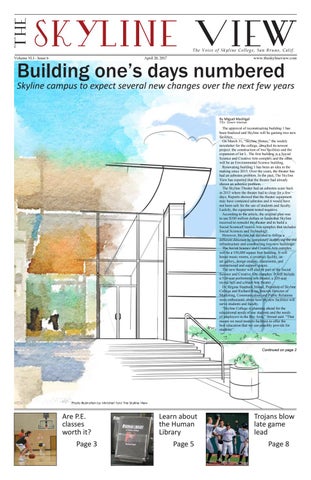
Photo Illustration by Mintzhet Tan/ The Skyline View
Are P.E. classes worth it? Page 3
Learn about the Human Library Page 5
Trojans blow late game lead Page 8
2
April 20, 2017
The Staff Editor In Chief Gregory Ragaza News Editor Laurel B. Lujan Opinions Editor Chris Christenson Focal Point Editor Adreana Estigoy Sports Editor Brian Silverman Digital Editor Kevin Perez Multimedia Editor Blynn Beltran Social Media Editor Marie Hom Chief Copy Editor Shamal Prasad Copy Editors Haley Holmes Carol High Senior Staff Writer Olivia Bowman Staff Writers Carolina Arouz Christina Seruge Judah Darwin Abigail Avalos Katrina Benedicto Lauren Gozon Miguel Madrigal Amanda Blanco Karmen Wilson Staff Photographer Mark Magat Staff Illustrator Mintzhet Tan Faculty Adviser Nancy Kaplan-Biegel
Want more news? www.theskylineview.com Or maybe you have news for us? (650) 738-4377 Want to yell at us? theskylineview@gmail.com Or use snail mail: The Skyline View c/o Language Arts Room 8-8110 Skyline College 3300 College Drive
News Reconstruction, Continued from page 1 The demolition of building 1 will commence in the Summer of 2018 and reconstruction is expected to begin in Fall of 2018. Meanwhile the new Social Science and Creative Arts complex is expected to be open to students by late 2021. The environmental science building will be the first building at Skyline that will overlook the the Pacific Coast. The building will hold two 56-seat classroom/ laboratories and two 119-seat lecture halls. It will also house academic offices, a catering kitchen and a lobby. Rojo mentioned why the new Environmental Science building is
vital to the college and what it can offer. “The new Environmental Science building will have modern lecture halls and classrooms taking advantage of the latest technology and allowing us to meet the growing interest in our environmental science and conservation programs,” Rojo said. “It will be an inspirational place to learn, with sweeping views of the Pacific and a spectacular deck for special events.” The construction of the Environmental Science building is scheduled to begin in the Summer of 2017 and is planned to be finished by the end of 2018.
According to “Skyline Shines,” the project will also expand lot L. The lot currently holds 110 paved and 200 dirt spaces. It will be expanded to 500 parking spaces for faculty and students. It is hoped that the expansion will improve parking issues and reduce traffic. Construction of lot L will commence next month and will be re-opened sometime in November. The funds for the project came from the San Mateo County voters. They voted yes on the two new facilities by passing two bond measures. Measure A passed in 2005
The Skyline View which provided $468 million dollars for new infrastructure at all the community colleges in the district. Measure H was passed in 2014 and provided the district with $388 million dollars to modernize the three colleges. This money has been divided among the three colleges in the district for innovation and construction. None of the money used to build these facilities came out of the students’ pockets. With these new facilities, Skyline hopes to move forward and put the needs of its students first.
Homicide behind campus goes unannounced to students
A murder near Pacific Heights was not officially known to the Skyline Community due to specifics over a school law By Katrina Benedicto
TSV Staff Writer
On April 6, a press release was given about a murder investigation near Skyline College in which the Skyline community was not informed due to not fitting the Clery Act. The incident began when San Bruno Police Department detectives investigated a missing person case at 3781 Pacific Heights Blvd. on April 6 at 10:51 a.m. They found dismembered human remains scattered throughout the inside of the house and backyard. David Stubblefield, a fifty-year-old San Bruno resident, was arrested as a suspect for homicide. According to the Daily Journal article by Samantha Weigel, the victim was identified as 77-year-old Benjamin Roybal. Roybal lived down the road from Stubblefield on Pacific Heights Boulevard. The homicide raised concern for some Skyline students since the crime took place in a home within a short walking distance behind the Pacific Heights building of the college. Dana Bartolome, a psychology
major at Skyline and lives close to the murder suspect’s home, was horrified when she read about the news online. “The thought of the body being dismembered made my stomach churn,” Bartolome said. “I felt terrified after I heard the details of the homicide that took place near my home.” Skyline did not release an official public announcement regarding the nearby murder because Skyline faculty and students were not in any danger. Clery Act timely warnings are triggered when there is an ongoing threat to the campus, according to Richard Rojo, the Interim Director of Marketing, Communications and Public Relations. The Clery Act is a federal statute that requires all colleges and universities that receive federal funding to keep and disclose information on or near their respective campuses. “The San Bruno Police Department determined there was no threat to the campus, so we did not issue a warning,” Rojo said. “San Bruno Police was in contact throughout the day with our department of
Public Safety and if any warnings had been necessary, we certainly would have done that.” Paul Elvina, a Skyline College student studying to be a radiology technician, thinks otherwise. "I think students should be informed about this crime since it’s so serious, especially since it happened right next door,” Elvina said. “Even though the school is not obligated to comment, I think everyone should be made aware of criminals like [Stubblefield] because so many Skyline students live near the area of the homicide.” Rojo noted that the school has procedures established in case a criminal incident poses a threat to people in campus. “Skyline College would definitely issue a timely warning through the AlertU system, emails, loudspeakers or other appropriate means,” Rojo said. Even if Skyline was deemed safe, students like Elvina and Bartolome were emotionally impacted since this is a rare occurrence in San Bruno. According to research done by City Data, San Bruno has had a relatively low crime rate for the past decade compared to surrounding cities in the Bay
Area, such as Colma and San Francisco. Data procured by the Neighborhood Scout website shows that the violent crime rate in San Bruno is 2.45 per 1,000 residents, which is around half of California's average at 4.26 per 1,000 residents. Neighborhood Scout also reveals that a person’s chance of becoming a victim to violent crime in San Bruno is a 1-in-407 chance, which is significantly lower than California’s average, which states that a person has a 1-in-235 chance. “I was shocked because murders are unusual in San Bruno,” Elvina said, who has lived in the Bay Area for 16 years. Bartolome shares the same sentiment but also mentioned that this homicide caused her to feel more insecure than ever. “I lived here for most of my life and nothing this gruesome has ever happened,” Bartolome said. “I always thought I lived in a safe neighborhood, but I’m starting to grow suspicious and confused... Now I should be even more cautious of my surroundings.”
• Buy your tickets to Skyline College’s Spring production “In the Heights” playing on Friday, April 21 at 7:30 p.m., Saturday April 22 at 7:30 p.m., and Sunday, April 23 at 2 p.m.
• ASSC are now accepting applications for Skyline Students to become part of the student organization. Application deadlineApril 21, 2017.
• The Local Crime Report will be back next issue due to zero San Bruno Press Releases being given.
San Bruno CA 94066
4
The Skyline View is a First Amendment Publication. The Skyline View is published bi-weekly during the spring and fall semesters by the journalism students at Skyline College. The Skyline View is a member of the Journalism Association of Community Colleges. Opinions expressed in the paper are those of the writers and should not be interpreted as the views of Skyline College, SMCCCD, the faculty, administrators or the newspaper adviser. Additionally, the paper does not endorse any of the products or services advertised. The Skyline View welcomes Letters to the Editors; letters must include full name, address, and phone number for verification. The Skyline View reserves the right to edit letters for length, libel, clarity, and taste.
• Come and sign up for the Job Priority Pool through the Career Center for possible internships and job placements.
3
Opinions
April 20, 2017
editorial
P.E. classes aren’t going to help me in the future
The health care crisis in Trump’s America
Creative Commons
By Lauren Gozon TSV Staff Writer
Chris Christenson/The Skyline View
Physical education classes give students the opportunity to try out different exercises.
Most college students want to get in and get out of school. They want to get into their fields of interest and start their careers to get their futures going as soon as possible. The only thing you have to do is complete your degree requirements. Seems simple enough right? Counselors tell you that you need to take this, that, and so on to graduate. So you sign up for classes without a second thought. But what if we took a second and actually did think about it? Why are these specific classes required for us to graduate? To obtain at least an Associate in Arts degree or Associate in Science degree, you need to complete a minimum of 60 units. Those units consist of the following: 19 units in General Education, 18 units in the major of your choice, three units in Ethnic and Cultural Diversity, six units in American History and Institutions, two activity courses in physical education and 12 units of general electives. As students near the end of their last semester at Skyline, they cannot help but think about all the time and money they have spent on classes here. Students cannot help but wonder, was it all worth it? Will the classes they were forced
to take truly help them later on? Will the physical education courses we are required to take actually be resourceful? Honestly, why are we required to take not one, but two PE classes? Why is it required for us to learn about badminton or archery or whatever to get a degree? How will this help us in our careers? Sure, it could be handy to know that the little feather thing they are hitting in badminton is called a shuttlecock. But how does this help me in the future? The bottom line is: it does not. Now do not get me wrong, it is great that Skyline offers so many different PE classes. From ballet to archery, to flag football, Skyline has it all. A student who is trying to get in shape has easy access to fitness classes and that is perfect. However, there is no point in having these classes be a requirement to obtain a degree. You are not only spending money to take these classes, but you are spending your time. We could be using this time to take a more beneficial class. For example, there should be a class that teaches you what a 401(k) is and when you should start getting one. Better yet, classes that teach you how to apply for a
loan, what the difference between a Roth IRA and a traditional IRA are and how to file your taxes would all beneficial classes to take instead of P.E. Are there any classes that could replace these P.E. requirements? Students need a class that aims to help you in the future. We are not talking about months or years from now, rather decades from now. Are you ready for that? What about a class that teaches you how to save for retirement? According to a 2015 study done by the Government Accountability Office, 29% of Americans 55-years-old and older do not have a retirement plan set up. The bottom line is we spend so much time, money and effort in the classes here in attempt to reach our goals. The classes we are required to take that have nothing to do with our general education or major should truly be helpful and beneficial to our futures. Otherwise, why are we taking them?
Days after Donald Trump was elected as president of the United States, significantly large groups of people began to anxiously question their health care status. They were not only worried about the course Donald Trump was taking in regards to the entire nation, but also about how they were going to manage under his presidency, considering their mental illnesses. Trump’s campaign was largely based on a promise to “repeal and replace” Obamacare, also known as the Affordable Care Act (ACA). Obamacare was signed into law on March 23, 2010 and provides an estimated 22 million Americans with medical coverage. The medical coverage includes mental health and substance abuse treatment specifically, which all private insurers and Medicaid have to insure. Approximately 43.8 million adults in the U.S. experience mental and psychiatric illness in a given year and nearly 17.6 million of those people suffer from alcoholism. So it’s not hard to see the anxious nature of our nation after Donald Trump was sworn into office. Prior to the ACA, people with mental illnesses and substance abuse problems were limited on coverage and sometimes received no coverage at all. But when the ACA came into effect, the law mandated that mental disorders be treated equal to non-psychiatric medical illnesses, such as cancer and other diseases. Even with Trump in office, there seemed to be a momentary glimmer of hope when he suggested that he was open about keeping some parts of Obamacare after repealing it, like coverage for pre-existing conditions. The biggest defeat of Trump’s
presidency so far was the failure to repeal Obamacare and replace it with Trump’s version of the ACA, which was widely criticized by both parties and created a broad division in the Republican party. Trump blamed Democrats for the bill’s failure, though they proudly accepted responsibility. The Republican bill would have repealed billions of dollars in taxes imposed by the ACA and would have cut off federal funds to Planned Parenthood. The bill would have also removed a mandate that requires Medicaid to cover basic mental health services. “Let’s just, for a moment, breathe a sigh of relief for the American people that the Affordable Care Act was not repealed,” House Democratic Leader Nancy Pelosi said. Now, there is no doubt that Obamacare has its flaws. However, if President Trump goes about his promise of repealing and replacing Obamacare, he will strip millions of Americans with mental and nonpsychiatric illnesses in no time. Individuals with mental illnesses who lose their coverage would be forced to seek treatment in emergency rooms or even be left untreated. Untreated mental disorders like bipolar disorder, schizophrenia, and depression would surely lead to an increase in suicide rates. The failure of the President Trump’s version of the ACA leaves Obamacare where it has been since it was signed, with all of the aspects that Republicans disagree on. Rather than repeal and replace Obamacare, Democrats, Republicans, and Independents could work together to make the Act better. Kenny Nguyen, a Skyline student, believes that the core solution right now is if “everyone set aside their party loyalty and ego just to come together to figure out a solution. It’s when we set aside out greediness for wealth is when we all move forward as a nation together.” Speaker of the House Paul Ryan said after pulling the bill, “it’s [Obamacare] going to remain the law of the land until it’s replaced.” There are several reasons to worry about health in Trump’s America, but America can’t be great if millions of citizens are left uninsured.
4
opinions Artistic License
April 20, 2017
the view from here With Editor in Chief Gregory Ragaza
Trump is not an ally of the L.G.B.T.
Being exposed to graphic images leads to feeling desensitized By Chris Christenson Opinions Editor
When it comes to ethics, we need to consider the fact that the exposure of violence and gore in the media desensitizes the public. For many years, we’ve been bombarded with graphic images of terrorists killing people, suicides, and other inhumane beatings streamed from the media. This not only desensitizes you, but it seriously stresses people out. And we can’t just point the blame at news agencies pumping out material, because they do what they can from an ethical standpoint — but it’s those who make these sort of things sensational. According to the Association for Psychological Science, “after taking pre-9/11 mental health, demographic characteristics, and lifetime trauma exposure into account, people who watched four or more hours of 9/11 or Iraq War-related television per day following each event were more likely to experience symptoms of acute stress.” Although these things are out of your control, this does not mean what you’re seeing doesn’t affect you. It ultimately does if what you see becomes tolerated and the problem is not dealt with and left to grow steadfast. Not only does being desensitized from graphic material retard your response to them but it also affects the way you would respond to the issue that the image is trying to portray. When you see these things going on, it doesn’t mean you should tolerate them, you should
Photo Illustration by Chris Christenson/The Skyline View
learn to understand what the image or video is about. If you’re left undecided and you’re constantly bombarded with more graphics, your response becomes neutralized or dampened. It’s a terrible thing to not be able to control what graphic material you may see, but you shouldn’t dwell on what’s going on. Instead you should understand it and see if you’re capable of being part of the solution instead of the problem. The media is a powerful thing and not only is it ever so growing but it’s extremely complex, by in which it is used to communicate ideas. Not only does the media desensitize people, it also illuminates bigger issues that might have as well gone unnoticed. From humanitarian issues to sharing beliefs across the globe to responding to crises more efficiently, the media has intertwined itself in our day to day lives. “The convergence of social networks and mobile has thrown the old response play book out the window,” Michael Beckerman, president and CEO of the Internet
Association said. Being desensitized by the media may not be the issue of the media itself but how we regulate this sort of material. You can put anything on the media and it might pick up like wildfire. And when it does, everybody will look at it even though it’s too late. For many, the video of the Syrian gas attack which took place in Northwestern Syria, which killed approximately 70 people, including children, was more graphic than expected. But if activists and residents were unable to send footage out, there might have been more havoc. And worst of all, this humanitarian issue would have completely gone unnoticed. Although the media can connect us with different parts of the globe, which not only helps us with communication but it allows a wider spread of information. The biggest issue we get from the media is desensitization. And although desensitization comes from being overexposed to graphic images, this graphic material’s regulation must be discussed.
The New York Times recently wrote an editorial on how President Donald Trump is not an ally of the LGBT community. They’re not wrong on this topic. In fact, they are pretty spot on. Although President Trump has said numerous times that he supports the LGBT community, the only action he has shown, in spite of his word, has been raising a rainbow flag with the words “LGBT for Trump” back in October 2016 during his campaign for presidency. As a president, his actions have shown the opposite of being our ally. Let’s start with our Vice President Mike Pence. To call Pence a homophobic would be an understatement. Seriously. There have been countless times that Pence supported bills and laws that would take away rights from the LGBT community. Time Magazine reported on Pence’s stance on certain key LGBT issues. He opposed the repeal of “Don’t Ask, Don’t Tell,” an intricate policy that essentially barred LGBT people from joining the military with other discriminatory caveats. He opposed transgender bathrooms and laws that would help stop discrimination against LGBT workers. It’s no surprise that he is also against LGBT couples, stating in a speech that we will signal “societal collapse” and that being gay is a choice. Lastly, he allegedly supports “conversion therapy”
according to one of his archived campaign websites. So how does appointing a vice president that publicly opposes LGBT rights make President Trump an ally of our community? Mind you, Pence is not the only person President Trump chose to be part of his administration that is anti-LGBT. Neil Gorsuch, Betsy DeVos, Steve Bannon and Jeff Sessions are only a few of President Trump’s picks that have shown an anti-LGBT sentiment. It’s not even the people he surrounds himself with that are anti-LGBT, but he has even revoked the transgender bathroom order that former President Obama signed; which was an order that protected transgender students to use the bathroom that aligns with their gender identity. This is clearly an act against transgender people, which means an act against LGBT. It is sad to see LGBT people who still think President Trump is an ally. He has not done anything to prove that he is. Raising a rainbow flag and saying he is our “friend” does not actually make him an ally if he does not show any actions in favor of our rights. I want President Trump to further the rights of the LGBT community rather than regress them. Only then will he be an ally to the LGBT community. Until then, his actions have shown he is more an enemy of the community than an ally.
April 20, 2017
Features
5
Focal Point
Skyline’s inaugural “Human Library” provides a blanket safe space By Adreana Estigoy TSV focal point editor
What you wouldn’t expect from having several different conversations with different people, is to run-over the same buzz words again and again when talking about different subjects. “The Human Library” is part of the Human Library Organization that started in Copenhagen in 2000 as part of the Roskilde Festival by Ronni Abergel, his brother Dany Abergel and Ronni’s colleagues, Asma Mouna and Christoffer Erichsen. Since its inception, more than 200 “Human Library” events have taken place all over the world in cities like Egypt, London, Paris and Tunisia. The purpose of the “Human Library” is not only to broaden people’s horizons but to challenge any prejudices people may have. Although Skyline applied to host the event last August, the application didn’t get approved until March. Due to Trump’s election in November, the Human Library Organization had been inundated with plenty of applications to host events which overwhelmed the organization. In March, 30 “Human Libraries” were held in the U.S. alone. The event allows people to act as “books” and have others check them out for a certain amount of time. Then the lenders have the opportunity to make the rounds, talking to as many people as they wish. Mary Torres Volken, a librarian at Skyline, helped organize the event. She was particularly pleased with what you can learn when you’re in a safe space and able to be completely transparent. “When you’re working with someone, it’s really not appropriate to ask certain questions about [their] background without being intrusive,” Volken said. “I spoke with someone who talked to me about how you can manage to get through a night class.” The first “book” I got to check out was Khoula Aissoui. Aissaoui is a Skyline student who hails from Algeria. Her mission in learning English and coming to America was to educate people about Muslim culture. “The media has wrong information... If my religion is what they say on the news, then yes, I can accept that but it’s not that so it’s painful for me,” Aissaoui said. “Not just me but for all the Muslim community.” She also wanted to see what was reflected in the other side of the mirror. “Since I got [to] a certain level in English, I was excited to talk to someone non-Muslim to see what he or she thinks about me as a girl or as a human or as a Muslim girl,” Assaoui said. “They give me the motivation to explain what’s my religion, the good things inside me, and why I am wearing a hijab.” My second “book” was Mustafa Popal. Popal was a refugee from Afghanistan and is now a Social Science and Creative Arts professor at Skyline. The struggle with identity is real and it is one that he knows personally. Therefore, he’s an expert at teaching his students and uses his struggle as a vehicle to explain the human experience. “I teach these topics but no
matter what subject I teach, the focus is always identity,” Popal said. “How we can teach this particular... class to explain identity, the development of identity, on one level and then about the human experience on another level.” My third “book” was Jim Poupis. Poupis is the Dean of Academic Support and Technologies at Skyline. Although he does specialize in library technologies, his background is working in the sciences and for the EPA for more than 30 years. “Stop teaching it the way we’re teaching it,” Houpis said about how he gets his students to become interested in science. “We teach too much content.” Pearl Ly, Director of Learning Commons, helped out with some coordination and assisted Khoula Aissaoui and a student with finding the “books.” But planning did not come without its challenges. “I really tried to find someone who was undocumented but it didn’t work out,” Ly said. The event was a success and Skyline has bigger and better plans for next year, as well as a different theme. “It really was a team effort... Pearl wrote the grant and got the funding for it,” Volken said. “Ryan did the graphics, Mitchell ordered the food and I was coordinating [the] training.” “We’re hoping that we can do it every year because it was very, very worthwhile,” Volken said. “For both our readers and our books.”
Photos courtesy of Will Nacouzi
A display of the “books” available.
The schedule of “books.”
Ray Hernandez explains a concept to a student.
Jeremy Evangelista engaged in conversation.
Mary Torres Volken checks out the display.
Stephanie DiBenedetto talking to a student.
6
Focal Point
Entertainment
April 20, 2017
Tripping out over finals? Try painting your stress away By Mintzhet Tan
illustration by Mintzhet Tan/The Skyline View
TSV illustrator
A lot of students tend to be under a lot of pressure when the semester comes to an end, so if you are in need of an activity to relieve the stress of finals approaching, you might want to try Paint Nite. The concept of Paint Nite is pretty simple: you attend painting class with a professional instructor at a local bar or restaurant while they serve you food and beverages. Prior to the start of the class, you can select the painting you would like to recreate from their official website with a plethora of options to choose from. Once you’ve decided the painting and location you’d like to attend, you can proceed to the payment page and attend the class you picked. Upon arrival, you should look for a seat that you are comfortable with. If you are attending the event with friends, make sure to be in class earlier so you guys can be seated together. Canvases, paint brushes, paint and aprons are provided so you don’t have to worry about bringing any materials. The class I attended was instructed by Elizabeth Patterson, who joined the company last December. “I really enjoyed watching people coming in and create the artworks based on their own interpretations,” Patterson said. “But most of all, I love seeing people having a good time and just [being] themselves.” As the class began, there were waitresses walking around the tables to take food and drinks orders from the painters. The majority of participants didn’t have any background in art or experience in painting but they
were able to follow the step-bystep instructions from Patterson as she was guiding us with very clear and straight-forward directions. There was a pre-made painting that the participants could refer to next to her canvas. “I love doing this,” Patterson’s assistant, Amanda Schiff said as she walked around the class while watching everyone’s progress. “I love to meet new people and talk to them and get to know all these interesting people that I would not have met elsewhere.” Schiff also mentioned that she alternates her role with Patterson and they teach three to four classes a week in the Bay Area. There was also a pop quiz in the middle of the lesson where the attendees get to win prizes such as vouchers and wines. At this point in the class, most of the paintings were close to completion and the quiz shifted the participants’ attentions from trying to perfect their paintings. “This is my first time in Paint Nite and I will definitely come back with more friends,” Julia Martinez, one of the fellow painters said. “I am not a painter but I am really proud of my work and I am now asking for a bidder.” The idea of Paint Nite is to create a space for people to be social with one another and create bonding moments in real time, which is something that seems to be missing in the digital era where we don’t connect like we used to before the rise of social networks. I found the experience extremely helpful to set my mind at ease and remove all the tension I was
experiencing by enjoying some good company and laughing with others. The goal of Paint Nite was never about creating the best artwork but rather building relationships. It is such a great alternative to going out to a club or having an average dining experience.
“13 Reasons Why” viewer discretion is advised By Lauren Gozon TSV staff writer
There has been a buzz around the release of Netflix’s new series, “13 Reasons Why,” which is based on Jay Asher’s novel of the same name and co-produced by Selena Gomez. “13 Reasons Why” brings the novel to life as it follows Clay Jensen, the show’s narrator, after Hannah Baker leaves behind 13 tapes which detail the reasons why she killed herself. “13 Reasons Why” stands out over other high school shows, not only because of the character development after the death of a peer but also due to the story addressing the reality of having a character having a mental illness and experiencing rape. Like any show, it has its flaws. For the most part, the show should’ve stayed more like the book, but the story went in-depth with the development of the characters instead of focusing solely on Clay and Hannah. Whether the novel is a distinct memory from high school or a favorite of yours, it is apparent that some details have changed. The first noticeable difference is the point of view. The novel is told in the first person, which gives off an intimate conversation between Clay and Hannah. The show is still focused on Clay and the events that led Hannah to her suicide. However, there are more plot lines that exclude Clay entirely which develop other characters and their personal relationships with one another. Another difference is the timeline of the show. Clay spends some number of days listening to the tapes in the show, Clay binge listens to the tapes and finishes them in one night in the novel. Because of Clay
Check Netflix for more great series. Here some of our picks: House of Cards Seasons: 5 Master of None Seasons: 2 Chef’s Table Seasons: 3 7 Deadly Sins Seasons: 1
Screenshot by Lauren Gozon/The Skyline View
“13 Reasons Why” is a series that hits close to home for many teenagers and it does not leave much to the imagination because of how graphic it is.
listening to the tapes over several days, it gives him time to confront the people on the tapes, which also didn’t happen in the book. The biggest change was Clay and Hannah’s relationship, or lack thereof. In the book, the two characters work together but they don’t have a real conversation until “the party.” In the show, the two are very romanticized. At one point, Clay even tells the school counselor, who is also on the tapes, “I cost a girl her life because I was too afraid to love her.” There was no indication of love at all between the two characters in the novel but viewers always enjoy a love story. There are several other major
changes from the book such as the addition of Jeff Atkins, the only real nice guy in this show and minor changes in certain characters like Courtney. The viewers spend 13 heartbreaking episodes listening to Hannah’s tapes. However, it’s important to understand that the trigger warnings in the latter episodes shouldn’t be taken lightly.
Here are some numbers you can call if you’re dealing with any that apply: Suicide Prevention Lifeline Number: 1-800-273-8255
Black Mirror Seasons: 3 Sherlock Seasons: 4 The People v. O.J. Simpson Seasons: 1 Daredevil
National Sexual Assault Number:
Seasons: 2
1-800-656-HOPE (4673)
Sense 8 Seasons: 2
Sports
April 20, 2017
Sports Opinion
Accessibility is esports’ key to success By Blynn Beltran TSV Multi Media
The popularity of esports is undeniable but what makes it so popular? Millions of people from around the world gather to their screens and watch these 20-something-year-olds battle in a virtual world. According to an article by USA Today from 2014, the third season of the “League of Legends World Championship” had 32 million viewers, doubling the World Series and the NCAA Final Four. On top of that, there was also an estimated 18,000 people that attended the event in a sold-out Staples Center in Los Angeles. To put that into perspective, an article by ESPN said that 18 million viewers tuned in to watch the fifth game of the 2014 NBA Finals and peaked at 22.4 million in the last half hour, over 40 percent less than the “League of Legends World Championship.” The success of esports series like “League of Legends World Championship” can be attributed to one main factor and that is accessibility. "League of Legends" can only be played on a computer but it can be viewed from any device that has a web browser or “Twitch.tv” streaming application. Esports fans everywhere can watch their favorite esports series on their phones, tablets and computers. Cable television now has “ELEAGUE” which is a televised esports show that features
Have concerns about Skyline College or our sister colleges?
7
Do you have concerns about the City of San Bruno and surrounding cities?
Creative Commons/Gabriel Gagne
North American League of Legends tournament on March 5, 2016.
professional tournaments from games like “Counter Strike” and “Street Fighter.” In conjunction, current generation gaming consoles recently embraced the “streaming” aspect of the gaming community which not only expands a console’s capability but also benefits the viewership of any esports that regularly streams their series. According to an article by GameSpot, 48 percent of 4,000 American households reported owning a dedicated game console. Considering the size of the United States, this is a huge portion of people owning a gaming console. Accessibility doesn’t just stop in esports’ viewership. With esports caliber games spread out through each and every gaming machine, the barrier of entry is nearly non-existent. If a gamer has a current generation console or a computer that can run a required
game and the quintessential internet connection, they can practice and compete in tournaments. One may think that this could be a costly endeavor to pursue but if you are already a gamer, chances are you already own the aforementioned equipment required. Not to mention that the most popular E-Sports game are free-to-play. Examples of freeto-play esports games are “League of Legends,” “Defense of the Ancients 2” and “Smite.” However, just like any sport, it is almost impossible to become successful. For one thing, an aspiring esports athlete would be competing at leader boards that consist of players from around the world. In conclusion, accessibility is a key part of success in esports. Whether you want to participate or watch, it is literally in the palm of your hand. Accessibility is undoubtedly the reason why esports has become prominent in the gaming world.
Considering writing a Letter to the Editor!
SUBMIT HERE: theskylineview.com/submit-a-letter/
Contact us: Email: theskylineview@gmail.com Twitter: @theskylineview Instagram: @theskylineview Facebook: @The Skyline View
Trojans Talk
The 4th Quarter With Kevin Perez
Will you be able to come back from this lossing streek and will you be ready for playoffs?
The dark side of the fight game
By Lauren Gozon
TSV staff Writter
Photos By Brian Silverman/The Skyline View
Chet Silveria #9 Outfield Yeah, it’s been a tough week. We’ve played some good teams but I think we can definitely get back on track especially in time for playoffs because we have two weeks left. No reason to panic, we’re still in good shape.
Joey Pledger #17 Left Field
Max Jenkins #28 Catcher
Phillip Anderson #7 Infield
These last few weeks have been tough but we’ve had success so I mean, we’re not gonna change much. We’ve just gone through a tough little skid but I feel like we can bounce back because we’re good enough.
As of late, we’ve been kinda flat. But I think we’re gonna bounce back and get more energy and get it back going and rolling right into playoffs.
I think we’re leading the state in homeruns, so I’m not worried about our squad at all. We’ve bounced back before and we can do it again, it’s just a rough patch.
The rise of mixed martial arts (MMA) has resurfaced the phenomenon humans have with hand-to-hand combat. Fans glorify the fighters for the 15 or so minutes spent in a cage, often being blind to the abuse the fighters put themselves through because of the fight promotion's weight regulations. Across all promotions in the United States, weight classes are present in order to comply with state sporting commissions, just like boxing. The problem MMA faces are the limited weight classes that they promote. The top promotions currently have eight men's weight classes and three women's weight classes. The difference between most weight classes range from 10-15 pounds, while 60 pounds separate the light heavyweight and heavyweight classes. The deception that this evens out the playing field by ensuring fighters are the same size is an illusion for the fans. In reality, fighters push their bodies and often dehydrate themselves last minute to make the weight. Skyline student Dupra Goodman has transitioned from college wrestling to MMA and notices that there is no way around fighters cutting weight. “No matter what fighters will always want the advantage of being bigger than their opponents,” Goodman said. “So they’ll risk cutting down to the lowest weight possible for their size.”
The problem here is how much water the fighters take out of their bodies. At the moment, the top promotions have done nothing to regulate or control the practice so fighters are free to dehydrate themselves to the last drop possible. Without limitations or regulations, we have fighters like UFC’s Khabib Nurmagomedov being hospitalized hours away from weigh-ins because “he wasn’t getting any blood to his liver and something went wrong with the weight cut,” fellow teammate Luke Rockhold said in an interview with Submission Radio. Fight promotions have been reluctant to change. One thing people have asked for is to implement more weight classes in between what we have now. This would reduce how much fighters would initially cut, but the promotions have been reluctant because they are discouraged that it will devalue their championship belts by having an influx of champions. We hear these stories often, a fight being pulled last minute because a fighter was hospitalized during a weight cut. However, fight promotions have yet to do anything about it. Fight promotions need to start regulating fighters' diets and weight cuts because fighters will choose to cut extreme amounts of weight, putting themselves in danger of life threatening injuries.
Upcoming Games: Badminton
Baseball April 20, Monterey Peninsula, 2:30 p.m.
April 25, @ Fresno College, 3 p.m.
April 22, Sacramento City , 1 p.m.
May 5, @ Coast Conference Championships , 5 p.m.
April 25, Cañada College, 2:30 p.m.
May 6, @ Coast Conference Championships , 5 p.m.
April 28, Cabrillo 2:30 p.m.
May 11 , @ Dual Team State Championships, 3 p.m.
Baseball
Trojans baseball lose after late rally
Cole Watts gets pulled after giving up six runs in the ninth inning against Cabrillo College on March 13, 2017.
By Kevin Perez TSV Digital Editor
Skyline’s men’s baseball team fell short after a late rally by Cabrillo College on April 13. Cabrillo was able to rally six runs in the top of the ninth inning to steal the game against the Trojans 9-5. With the loss, Skyline now sits at a 23-10 record which made them drop down to third place in the Coast Pacific division. Ray Falk started for Skyline, pitching six innings before being replaced by Austin Conour. Both pitchers held Cabrillo to seven hits and two runs. Cabrillo’s starting pitcher Alex Trautner was able to control the Trojans for most of the game. Trautner struck out 10 of the 33 batters he faced through eight innings. Skyline struggled at bat this game, only registering five hits through seven innings. Skyline was also shutout in three of those innings Ramon Enriquez was able to put Skyline on the board with a RBI to bring Kaimana Bartolome to home plate.
Momentum seemed to shift toward Skyline’s dugout in the eighth inning as they began to get people in scoring position. With one out, Felix Aberouette singled to bring Ryan McSwain home to score the second run for Skyline. With Alberouette and Aaron Albaum on base, Cole Watts was subbed in as a designated hitter and hit a home run to take a three run lead against Cabrillo. Watts, who has five saves for the season, was subbed in to pitch in the ninth inning but was unable to build off of his home run. Watts struggled on the mound and blew the save by giving up four runs in the closing inning, which proved to be too much to overcome. Skyline struggled on both sides of the plate this match-up and it was apparent that the team was drained from the 16 inning game they played against Cabrillo two days earlier. But like every other game, Skyline made a run to take the lead coming into the final inning. However, the pitching crew could not hold onto the win. “We battled back,” Head coach Dino Nomicos said. “Other than the ninth inning I thought it was a good game... Whenever you score
four runs and take the lead, your pitching staff needs to close the door in the bottom of the ninth and we failed to do that tonight.” With such a let down loss, Nomicos feared it would carry to the next game against an Ohlone team they have struggled against all season. “This was a tough emotional game,” Nomicos said. “I worry about the next one... We could be flat because of this game, losing the way we did.” Coach Nomicos worries were correct as Skyline proceeded to drop their next two games against Ohlone (7-1) and Hartnell (7-6). With the addition of these two loses the current losing streak for the team now sits at 3 games. With two weeks left in the season and a playoff spot on the ropes, Nomicos emphasized that the games still count, but the team has not responded. “We're still there but we have to keep playing, [we've] got to win,” Nomicos said. “We got five games left, so we’ll see... It’s a long two weeks.”
Photo By Kevin Perez/the skyline view
Is your major, Communications Public Relations Broadcasting Photography Digital Media Website Design? Then consider Journalism. It’s related.