Entertainment
Sports
Features
Out and about Skyline unity
Badminton
Baseball on a budget Gay straight alliance page 6 page 3
Badminton for the win on page 11
The
Skyline View The Voice of Skyline College, San Bruno, California
Volume XXX - Issue 6
www.theskylineview.com
April 19, 2012
Super student showdown Upcoming ASSC elections from April 30 to May 2
Middle class scholarship proposed for students Potential grants for working class scholars by Kimberly Murti TSV sports editor
Joe Barrack/The Skyline View
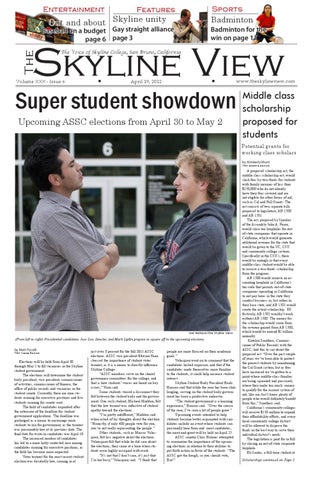
(From left to right) Presidential candidates Jose Luis Sanchez and Mark Lipkin prepare to square off in the upcoming elections. by Matt Pacelli
TSV News Editor
Elections will be held from April 30 through May 2 to fill vacancies in the Skyline student government. The elections will determine the student body president, vice president, commissioner of activities, commissioner of finance, the office of public records and vacancies in the student senate. Currently, there are nine students running for executive positions and five students running for senate seats. The field of candidates expanded after the extension of the deadline for student government applications. The deadline was prolonged as a means to encourage more students to run for government, as the turnout was presumably low at its previous date. The final date for write-in candidates was April 18. The increased number of candidates has led to a more hotly contested race among candidates running for executive positions, as the field has become more impacted. Voter turnout for the most recent student election was decidedly low, coming in at
just over 3 percent for the fall 2011 ASSC elections. ASSC vice president Edwina Yuan stressed the importance of student voter turnout, as it is a means to directly influence Skyline College. “ASSC members serve on the shared governance committees for the college, and that is how students’ voices are heard on key issues,” Yuan said. Some students voiced a disconnect they felt between the student body and the government. One such student, Micheal Madden, felt that the low turnout was reflective of student apathy toward the elections. “I’m pretty indifferent,” Madden said when asked of his thoughts about the election. “Honestly, if only 400 people vote for you, you’re not really representing the people.” Other students, such as Marcos Velasquez, felt less negative about the elections. Velazsquez felt that while he did care about the elections, they came at a time when students were highly occupied with work. “It’s not that I don’t care, it’s just that I’m too busy,” Velasquez said. “I think that
people are more focused on their academic goals.” Velasquez went on to comment that the candidates lacked exposure, and that if the candidates made themselves more familiar to the students, it could help increase student interest. Skyline Student Body President Heidi Hansen said that while the year has been challenging, serving on the student body government has been a productive endeavor. “The student government is a learning experience,” Hansen said. “Over the course of the year, I’ve seen a lot of people grow.” Upcoming events intended to help students become better acquainted with candidates include an event where students can personally hear from and meet candidates; the meet-and-greet will be held on April 25. ASSC senator Chris Holmes attempted to summarize the importance of the upcoming elections in relation to their abilities to put forth action in favor of the students: “The ASSC got the dough, so you should vote, Bro!”
A proposed scholarship act, the middle class scholarship act, would slash fees by two-thirds for students with family incomes of less than $150,000 who do not already have their fees covered and are not eligible for other forms of aid, such as Cal and Pell Grants. The act consists of two separate bills proposed to legislature, AB 1500 and AB 1501. The act, proposed by Speaker of the Assembly John A. Perez, would close tax loopholes for outof-state companies that operate in California, which would generate additional revenue for the state that would be given to the UC, CSU and community college systems. Specifically in the CSU’s, there would be enough so that every middle-class student would be able to receive a two-thirds scholarship from the program. AB 1500 would remove an accounting loophole in California’s tax code that permits out-of-state companies operating in California to not pay taxes in the state they conduct business in, but rather in their base state, and AB 1501 would create the actual scholarship. Effectively, AB 1501 wouldn’t work without AB 1500. The money for the scholarship would come from the revenue gained from AB 1500, which would be around $1 billion annually. Katelyn Smathers, Commissioner of Public Records with the ASSC, had this to say about the proposed act: “Over the past couple of years we’ve been able to protect the poorest students by maintaining the Cal Grant system, but as fees have increased we’ve gotten to a point where middle-class families are being squeezed and pressured, where they make too much money to qualify for the current system of aid, like me, but I know plenty of people who would definitely benefit from this,” Smathers said. California’s community colleges will receive $150 million to expand their affordability efforts, and every local community college district will be allowed to disperse the funds in the best way to serve their individual district’s needs. The legislation is paid for in full by closing an out-of-state corporate loophole. Eli Santos, a full-time student at Scholarships continued on Page 2