Community
Sports
“...in 1977, I watched the actual Frost/Nixon interviews..."
Arts
Pioneers have a swimmingly good start to the season
Dance Ensemble wants to know... would you harbor me?
page 7
page 3
the
page 8
Scarlet & Black Volume 134, Issue 12
December 01, 2017 • Grinnell, Iowa
Activism around gun violence opens dialogue
Director, producer of Newtown documentary to speak on campus with Newtown community activists By Alice Herman hermanal17@grinnell.edu For the past month, community members in the City of Grinnell and Grinnell College have grappled with the question of gun safety and regulation in the midst of a debate that has become deeply polarized. “26 Days of Action Against Gun Violence,” the resulting month-long series of talks, community meetings
shooting for a screening of the film in the Harris Center next Tuesday. The event follows last week’s Community Hour in which College professors discussed the political, constitutional and social nuances of the ongoing debate around gun violence in the U.S. Snyder sees the screening of the documentary as an opportunity to generate further dialogue about the issue of gun violence and legislation.
and not polarized,” Synder said. Professor Eliza Willis, political science, who has worked on the month of events in the community, also emphasized the role that dialogue — representing a range of perspectives — must play in the pursuit of gun reform. “[We are] really trying to attract the attention of gun owners who care about responsible gun ownership and responsible gun safety. … We’re
CONTRIBUTED
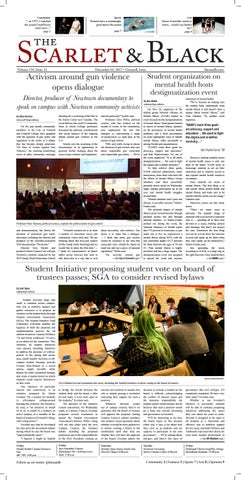
Professor Peter Hanson, political science, explains the politicization of gun control. and demonstrations, has drawn the attention of prominent gun safety advocates, including the director and producer of the critically-acclaimed 2016 documentary “Newtown.” Director Kim Snyder and producer Maria Cuomo Cole will join Newtown residents impacted by the 2012 Sandy Hook Elementary School
“Grinnell reached out to us from a number of concerned voices and community voices who said, ‘We are thinking about this five-year marker [of the Sandy Hook shooting] and we would like to show the film here.’ ... I think it’s representative of dinner tables across America that want to talk about this in a way that is civil
about pro-safety, anti-violence. Our desire is to make this a dialogue. ... I think that many gun owners would be receptive to the idea that concealed carry should be based on local law and not a piece of national legislation,” Willis said. The activism around gun >> See City of Grinnell page 2
thesandb.com
Student organization on mental health hosts destigmatization event
By Ben Mikek mikekben@grinnell.edu On Nov. 29, organizers of the student group National Alliance on Mental Illness (NAMI) hosted an event focused on the destigmatization of mental illness. Participants listened to stories of mental illness, statistics on the prevalence of mental health problems and a brief presentation on some appropriate ways to handle mental illness, either personally or among friends and acquaintances. “NAMI’s main three goals are advocacy, support and education,” said Rob Marko-Franks ’18, one of the event organizers. “It is all about destigmatization. … We want to fight the stigma and re-define normalcy.” To help achieve these goals, NAMI collected submissions, many anonymous, from those who have felt the effects of mental illness. Group members read these powerfully personal stories aloud on Wednesday night, waking participants up to the very real mental health struggles around them. “Mental disorders don’t pick and choose; it can affect anyone,” MarkoFranks said. The personal impact of mental illness can be viewed not only through personal stories, but also through national statistics. As Marko-Franks pointed out during the event, the National Institutes of Health report that 17.9 percent of Americans — just under one in five — experienced a mental illness during 2015, with the rate somewhat higher (21.7 percent) for those between the ages of 18 and 25. Thus mental illness is highly prevalent and has a large impact. The destigmatization event was designed to spread the word and increase
awareness of mental health. “We’re focused on making sure the student body understands what mental illness is and doesn’t have a stigma about mental illness,” said Nina Galanter ’18, another event organizer.
"NAMI's main three goals are advocacy, support and education ... We want to fight the stigma and re-define normalcy ..." Rob Marko-Franks '18 However, making students aware of mental health issues is only one third of the battle. NAMI seeks to encourage students to act on their awareness and to improve access to and expand mental health resources on campus. Once students are aware of mental illness, “the best thing is to talk openly about mental health and mental illness, and make sure to be careful with the words you are using,” Galanter said. Moreover, action can take many forms. “There are many ways to advocate. The popular image of someone who is an activist is someone who is … spending all of their time devoted to a cause, holding posters and shouting. But that’s not always the case. Sometimes the best thing you can do is to be there for someone in need and speak up for them when they can’t speak up for themselves,” Marko-Franks said. Just spreading the word, according to NAMI, is a large step in the right direction. Once students have >> See NAMI page 2
Student Initiative proposing student vote on board of trustees passes; SGA to consider revised bylaws By Seth Taylor taylorse@grinnell.edu Student activism large and small is common across campus. One way to mobilize support and gather resources is to propose an initiative to the student body through Student Government Association (SGA). The Student Initiative Fund Committee (StiFund) handles the logistics of both the proposal and implementation process for all student initiatives. Antonio DiMarco ’18 and Dylan Ambrosoli ’18 serve as co-chairs for the committee. This semester, all student initiatives were passed, including initiatives to address the presence of yellowjackets in the dining hall picnic area, install laundry facilities in offcampus student housing, provide Frosted Mini-Wheats as a cereal option, supply movable white boards for some residential lounges and create a student mural on which students could express themselves as they wish. One initiative of particular interest and controversy is an initiative proposed by Quinn Ercolani ’20, a senator for students in off-campus college-owned housing this semester. His initiative, he said, is “an initiative to install — or try to install — a student, an active student, as a member of the board of trustees of Grinnell College with voting power.” Ercolani says that he developed the idea amid the divestment debate during which he says the board was “unprecedentedly open.” “I figured it might be helpful Friday Mental Health Campus Resource Fair JRC 209, 4:00 p.m.
HELENA GRUENSTEIDL
SGA debated several resolutions this week, including the Student Initiative to allow voting on the board of trustees to bridge the divide between the student body and the board a little bit and make it even more open to the students,” Ercolani said. The specifics of the initiative remain unresolved. On Wednesday night, at Campus Council, Ercolani proposed several resolutions to amend the Student Government Association’s bylaws. While voting will not take place until the next Campus Council, the Senators debate including the proposed position as one of the responsibilities of the SGA President, creating an
entirely new position to assume this role or simply passing a resolution indicating their support for such a position. Whatever decision comes out of campus council, there’s no guarantee that the board of trustees will approve the proposal. During Campus Council, cabinet members and senators raised questions about whether it would be more productive to refrain creating a bylaw to the constitution until they find out whether they will have the approval of the board. Ercolani admits the
decision to include a student on the board is difficult, acknowledging the conflict of interest issues and the immense responsibility the student trustee would assume, but he believes that such a position would go a long way toward increasing self-governance at Grinnell. “It’ll be interesting to see how the board reacts to this because either way it says a lot about how they view us as students and our capacity to participate in our own governance. … We’re talking about self-gov, and there’s this layer of
governance that isn’t self-gov. It’s completely mandated. We have very little input,” Ercolani said. Whether or not Ercolani’s initiative is successful, students will be able to continue proposing initiatives addressing the issues they care about for years to come. StiFund is designed to be open to all students as a functional and effective way to mobilize support for any issue, and both DiMarco and Ambrosoli expressed their desire for even more student involvement in >> See All Student page 2
Friday Jazz Ensemble Concert Bucksbaum 104 - Sebring-Lewis Hall, 7:30 p.m.
Saturday Holiday Open House Studio Sale Herrick Chapel, 8:00 p.m.
Tuesday Newtown Screening Harris Cinema Center, 6:00 p.m.
Friday Hallelujah Chorus Sing/Play Alonge Bucksbaum Rotunda, 12:00 p.m.
Follow us on twitter @thesandb
Community 3 | Features 5 | Sports 7 | Arts 8 | Opinions 9
2
NAMI encourages the destigmatizes
News
City of Grinnell, the College, offer enviornment for anti-gun violence activism Continued from Front Page
REINA SHAHI
Robert Marko-Franks ’18 speaks in Loose Lounge on the ways in which mental illness becomes stigmatized by society. Continued from Front Page been made aware of and inspired to act on mental health issues, they must be empowered to do so. The third role NAMI hopes to play is in providing access to mental health resources, connecting sources of help to those in need. “A lot of what we want to do is reach out to different student groups and different resources, and kind of get an idea of the web of resources that are available on campus, and see what’s missing and what’s there, and how we can strengthen it,” MarkoFranks said, citing cooperation with Residence Life staff and with Grinnell’s Psi Chi Chapter as examples of outreach to other groups. “Because there are so many tight knight-groups [on campus], it would be really great to have the conversation going in more places.” NAMI organizers handed out resource cards, listing both confidential and reporting mental health resources on and off campus. Spreading awareness of these resources, even with continuous
repetition, noted organizers, may help save students who cannot take the time to find them anew during a crisis. As far as the prevalence of mental health resources on campus, there is reason to be cautiously optimistic. “The College has definitely improved with its mental health services, … but I think that there is still a long way to go, especially in getting access to psychiatrists, for example,” Galanter said. “The college environment is still not the best [environment for] mental health. … Faculty need to be aware of how to adequately support students who have mental illness.” Even though the college environment can be stressful by its very nature, mental health concerns, according to Galanter, should remain near the top of the list of priorities. By combining destigmatization with awareness-raising and advocacy, NAMI hopes that it is making strides in the right direction for mental health on campus. The group is cooperating with the Grinnell Psi Chi chapter and SHACS to host a Mental Health Resource Fair from 4 to 5 p.m. today.
Edited by hermanal17@grinnell.edu & mettleca@grinnell.edu
violence in the City of Grinnell represents a unique instance of sustained advocacy on the issue; typically, outrage fueled by mass shootings loses steam quickly after a national crisis such as the shooting in Las Vegas last month. “[Social regulation policies] tend to have a little bit of a pattern. ... They tend to have a crisis stage, outrage — there’s action on that, and then people who oppose it react just as strongly, or maybe more strongly. And then they tend to hit a stalling point, often because public attention moves on,” said Professor Doug Hess, political science, at the Community Hour last Tuesday.
"...it’s not about a threat to Second Amendment rights, but about trying to as fellow citizens that want to protect children, how to address this, that would be the greatest thing we can say the film has played a part in fostering..." Kim Synder, director, "Newtown" Grinnell is unique, too, in its proximity to National Rifle Association (NRA) president Pete Brownell, who lives in Grinnell and maintains strong social and economic ties to the city. The 26 Days of Action has followed community efforts to engage Brownell in a conversation about the NRA and his role in the organization. “Somebody wrote a letter that they thought could be delivered to [Brownell] asking him to meet with
members of the community. The way it was presented was as neighbors of his, wanting to talk about his role in the gun safety issue. … It ended up that we passed it around and 170 people signed it,” Willis said. Changing the discourse around gun control could potentially foster the kind of conversation that organizers in Grinnell are seeking. “If we could enlist gun owners to sit down and have civil conversations about the fact that we have a problem with gun violence in the country and that it’s not about a threat to Second Amendment rights, but about trying to as fellow citizens that want to protect children, how to address this, that would be the greatest thing we can say the film has played a part in fostering,” Snyder said. Last week’s Community Hour on the Second Amendment, sponsored by the Rosenfield Program and organized by faculty and community activists, was designed to prompt this kind of dialogue. The event featured talks by Professors Kesho Scott, sociology and American studies, Peter Hanson, political science and Doug Hess, political science. Hanson, who teaches constitutional law, spoke about the history of the Second Amendment, and concluded that the question of gun control will be determined politically. “The problem with gun control is not primarily a constitutional problem. It’s a political problem. According to the court’s most famous conservative justice, Antonin Scalia, the constitution and the Second Amendment permit reasonable gun regulations. Gun rights have become politically sacrosanct only because the NRA has the ability to successfully mobilize its members and put political
pressure on politicians,” Hanson said. Scott wrapped up the event with a personal and historical perspective on the issue of gun control, pointing out the racial politics of gun ownership in the United States. “The Black Panther Party explained to me why U.S. violence was against my race, my community and people of color. It also explained why U.S. violence was really an American norm. Therefore in my mind, it was necessary that Black people in America defend themselves. It is in that context that the Second Amendment was my right and from my family beliefs and community values, it was also my responsibility. ... On my 18th birthday I purchased an 8 gauge 12-pump shotgun that was then the deadliest legal self-defense weapon. Frankly my actions were dictated because I felt defenseless,” Scott said.
"And my gun purchase, and all of those gun purchases, contribute to the Sandy Hook massacre and other massacres" Professor Kesho Scott Scott has since reconsidered her position on gun sales and ownership. “We need to move forward. Because my only option to defend myself and maintain my civil rights, whether it’s freedom of association, speech or economic pursuits without government intervention, are impacted by technological gun innovations that allow for 500 people to be injured in 11 minutes. And my gun purchase, and all of those gun purchases, contribute to the Sandy Hook massacre and other massacres.”
All Student Initiatives pass; SGA discusses proposed student vote on College board of trustees
Continued from Front Page
the process. “I’d like to extend an invitation to everyone who’s kind of curious about gaining operational experience and how you actually get things done in a bureaucracy of sorts to show up to our meetings,” Ambrosoli said. According to DiMarco and Ambrosoli, StiFund provides students with a way to organize,
process and implement a proposed initiative, assuming it passes the student body’s vote. “The Student Initiative Fund is a platform for students to express their wants to make [college] the experience that they want it to be. They have the opportunity to get initiatives, find local support on campus, go through an electoral process, and then be really integrated in the implementation process of
their initiative,” DiMarco said. Student initiatives can be anything, ranging from the skateboard racks found across campus to a message to the administration, lent extra weight by the tangible support of the student body. If a student wishes to propose an initiative, they would have to apply to StiFund and outline their issue, plan and rationale. They then must
gather 100 student signatures in order to have the issue placed on the ballot for the student body to vote on. The voting is only final after at least half of the student body has voted. If a student’s initiative has passed this process, they must then work with StiFund and the relevant groups to implement their idea. The implementation process itself can be as simple as making the appropriate authorities aware
of a problem or as complicated as amending SGA’s bylaws. Either way, both Ambrosoli and DiMarco see their role as “facilitators” who work “to the best of [their] ability” to institute the wishes of the students. Whatever the issue, according to DiMarco, the Student Initiative Fund remains a “viable grounds for reform on campus,” and any student with a cause can advantage of this opportunity and resource.
What it takes to become a Grinnell College trustee By Lily Hamilton hamiltol@grinnell.edu
What does it take to become a trustee of Grinnell College? More than money, according to Grinnell College President Raynard Kington and Chair of the Board of Trustees’ Governance Committee Patricia Fitzgibbons Anderson ’80. While trustees are expected to make the College one of their top philanthropic priorities, the board considers a range of characteristics when determining who becomes a trustee. The road to becoming a trustee begins with a nomination process facilitated by the Trustee Governance Committee. According to Anderson, the chair of the committee, nominations for trustees come from a variety of sources including the Department of Alumni Relations, board members and alumni. The Governance Committee then uses a three-year plan to guide its initial consideration of potential new trustees. “This plan takes into consideration a range of characteristics, including skill sets, racial and ethnic diversity, gender and geographic location. These variables are prioritized each year based on the current Board composition and needs, and taking into consideration retiring Board members who are completing their service,” Anderson wrote in an email to The S&B. After the committee agrees on nominees, it presents the candidates in a formal nomination to the board at the winter meeting. The board then
votes on the nominees in the spring at its annual meeting. Students are not involved in the approval process for trustees. However, according to Anderson, students may bring potential candidates to the board’s attention if they wish. Kington suggested that limited student involvement may be best for the board. “Every student, even the one who doesn’t [receive] a dollar of aid, receives some free education,” Kington said, referencing discrepancies between actual College operating costs and the cost of tuition. Kington claimed that as a result, students may have a conflict of interest in determining the board’s membership because its decisions directly affect them financially. Kington has opted out of the process for appointing trustees due to a similar conflict of interest. “I made a decision not to be involved in choosing trustees. It’s controversial because they would be my boss,” Kington said. Both Kington and Anderson stressed the importance of cultivating a board with diverse characteristics, experiences, areas of expertise and financial backgrounds. “Having a diverse board is important to us, and as I
it
mentioned earlier is an
important consideration for us as we assess our needs and candidates,” Anderson said. Kington added that when considering nonprofit board membership in general, it is important to consider the unique contributions each member will make. He described a common understanding that members of nonprofit boards make unique contributions of “time, talent and treasure.” According to Kington, each factor should be valued equally when considering how the member will benefit the board of trustees. However, when asked whether someone’s ability to make significant financial contributions affects the likelihood they will be nominated to the board, Kington acknowledged the key role that philanthropy plays in supporting n o n p r o f i t organizations. “The fact of the matter is that institutions like Grinnell are increasingly dependent on philanthropy in a society where there is increasing economic inequality,” Kington said. However, Kington noted that board members come from diverse financial positions, a factor that he says is important to consider when considering how board members’ financial contributions will impact them personally. “All trustees are expected to make the College a top philanthropic
priority. There is a broad range of giving by individual members of the board,” Anderson wrote. Kington reinforced the expectation that the College is a primary philanthropic organization for members. “It’s a reflection of real interest in the organization,” he said. This financial priority does not manifest in a required contribution from members, however. In Kington’s eyes, selecting a specific number for financial contributions does not allow for flexible forms of giving to the College. He claimed that some board members make large contributions that are not significant parts of their wealth while others make smaller contributions that have larger personal impacts. “I know a couple of board members who have given until it hurt. It was clear they made Grinnell a priority in their estates. … There are people on the board who have given to the College a huge percentage of their wealth,” Kington said. Both Kington and Anderson stressed that members’ commitments of time, experience and expertise hold equal value to their monetary donations. Furthermore, Anderson takes the perception that members’ finances afford them more clout on the board very seriously. When asked how board members’ financial contributions impact the decisions the board makes, Anderson responded, “If you are asking whether an individual trustee’s financial contributions influence the board decision-making in any way, the answer is absolutely not.”
Community
Edited by braneckm@grinnell.edu
3
"Frost/Nixon" to debut Saints Rest opens new kiosk location at Loft Theatre By Amanda Weber weberama@grinnell.edu
SARA RUIZ
"Frost/Nixon," performed by the Grinnell Community Theatre, will open at the Loft Theatre tonight.
By Chloe Wray wraychlo@grinnell.edu “Frost/Nixon” will be opening this weekend at the Loft Theater in the Grinnell Arts Center. Put on by Grinnell Community Theatre, the play is directed by Sig Barber, a Grinnell resident and a professor emeritus of German at Grinnell College. It will run Dec. 1, 2, 8 and 9 at 7:30 p.m. and Dec. 3 at 2 p.m. Tickets are $15 for adults and only $5 for students, available at the Grinnell Arts Center, McNally’s, online at grinnellarts.org or at the door. The play follows the story of the interviews British journalist David Frost conducted with Nixon two years after Nixon’s resignation. The interviews, which totaled over 30 hours, were condensed into four 90-minute specials that aired in 1979. Nixon had agreed to being interviewed out of both a need for money and as an attempt to redeem himself in the eyes of the Republican Party. Frost and the team of other journalists whom he enlisted for the project hoped that the interviews would culminate with an apology from Nixon and a recognition of his misconduct, essentially acting as the trial he never faced. Barber breaks the play into three distinct sections, detailing that the play “begins with the president’s resignation, and then all the negotiations prior to the interviews, and then we have the actual interviews interspersed with strategy sessions and then the end of Nixon, what really ended his political life, with no chance of rehabilitation when he said, ‘when the president does it, that means it’s not illegal.’” The Loft Theater, where “Frost/ Nixon” will be performed is an intimate space, seating 58. There was no set built for the play, and the locale is
suggested only through a change in furniture pieces and an emphasis on different lightings. Three of the main characters of this production are played by lawyers, with a fourth a radio host and another a professor. All these professions require a degree of acting, presenting or showmanship on a daily basis, and these actors, along with much of the rest of the cast, have been highly involved in the Grinnell acting community for years. This will be Barber’s third directorial venture. “I knew I had some good actors, and I was looking for a vehicle to allow these actors to shine,” Barber said on how he chose the play. After coming across “Frost/Nixon,” Barber recounts that he was struck by its relevance to his own life. “In 1974 I watched the resignation, and in 1977, I watched the actual Frost/Nixon interviews, and so it resonated with me. This is part of my history, I demonstrated as a student against Richard Nixon,” he said. “The play allows me to use a lot of music from that time, which is still some of my favorite music.” “I’ve been asked many many times to what extent did I choose the play because I saw parallels between what’s happening currently in politics in Washington and themes that are prevalent in the play,” Barber continued, stating that although he chose it for other reasons, it is worth referencing the subliminal messages and citing their relevance today and at the time of the play’s debut during the Bush administration. “There are those comparisons to be made but I will leave it to the audience to discern.” Barber encourages students to attend the play, not only for its dramatic value but for “the insight it offers into a unique period.”
Frequent patrons of local coffee shop Saints Rest will be interested to learn of the upcoming expansion taking place within the business. A second location is being built in the form of a kiosk in Grinnell Mutual Reinsurance Company. Saints Rest owner Sam Cox was approached by the company in July, and the kiosk is projected to be finished by the end of the year. “I had been looking for the last, probably, two years for a way to grow the business … and so when they approached me it seemed like a good opportunity — a little risk with hopefully some reward in the end,” Cox said. “To be afforded the opportunity by a large corporation that thinks we can add something positive to their bottom-line — that’s fantastic.” According to Cox, the company is seeking to keep up with larger insurance companies in Des Moines who offer their employees similar kiosks within their headquarters. With the new partnership, Grinnell Mutual will be able to offer their employees this benefit, plus the addition of Saints Rest’s unique charm. “[Grinnell Mutual] felt like it was a nice benefit, a perk if you will, to offer that to their employees. A lot of their employees commute out of the Des Moines and Ankeny area and so not always timely for them to get their coffee on the way,” she explained.
“I'm just hoping to improve upon what we're doing." Sam Cox, owner of Saints Rest The kiosk will, of course, be an extension of Saints Rest, but will be a good deal smaller and more selective in its menu. Cox intends for the new location to be much more focused on convenience. “It’s obviously much smaller, so we won’t even have an in-house seating area,” Cox said. “I will, for example, not be offering baked goods in the beginning and not be offering ceramic cups of any kind. Everything is to-go, to take back with them to their desk. … [It’s] just a much more streamlined menu.” The kiosk represents progress to Cox, in line with her hopes for eventual growth of the business. She has brainstormed a number of ideas for ways Saints Rest could continue to expand, from a drive-through to a mobile unit to a location in a more
The S&B reviews Sunrise Bakery
MAHIRA FARAN
Saints Rest will be opening a new kiosk location at the Grinnell Mutual Reinsurance Company, but will be maintaining its current location, featured above.
distant community like Montezuma. “I would like to expand our business, even past a kiosk there, but at this point it’s baby steps,” she expressed. As for the current expansion, Cox is optimistic about its future impact on business. With any expansion comes the opportunity for a boost in name recognition and an increase in clientele, and Cox’s hope is that the new kiosk will be no exception. “You obviously just hope that your name is going to be more recognized, and possibly those people that are being introduced to me at the Grinnell Mutual location will come [to the original location] also,” she said. An increase in recognition and revenue isn’t Cox’s only goal, though. She sees the development as a chance for Saints Rest to grow and progress in general, and plans to make the most of the opportunity.
“You obviously hope that the name is going to be more recognized."
Sam Cox, owner of Saints Rest “I’m just hoping to improve upon what we’re already doing,” she said.
Despite preferring savory flavors over sweet, S&B writer Vera Kahn ’18 made the trip to test out Grinnell’s newest bake shop, Sunrise Bakery, at 934 Main St. Read about her hunt for croissants and experience at the bakery below. Maybe I was not the right person to write a review on a bakery. I don’t like sweets. My baked confections of choice include plain croissants, cake donuts and pumpernickel bread. That said, one thing that Grinnell is sorely missing is a reliable source of croissants. When I heard that a new establishment selling baked goods, Sunrise Bakery, was to
open soon, I thought my dreams had come true. However, my first look at the menu dashed those hopes — bagels, mini cupcakes, loaves of bread, mini pies and promises of breads for people with dietary restrictions were all there, but somewhere along the way to press, some typesetter had forgotten to mention the price and presence of croissants. I accepted this, and my desires shifted to the next best thing I saw on the menu: bagels. Unfortunately, the Friday opening was only featuring a limited assortment of sweet treats. Uninterested in sweets, I decided to return in the morning. I showed up on Saturday around 11:30 a.m., ready to down some coffee and try Grinnell’s only local bagels. When I walked in the door,
I was informed by the gregarious proprietor that they had sold out of everything but sliced white bread and chocolate chip muffins. In light of my lack of a sweet-tooth, I opted for the bread and a cup of coffee. The inside of the shop is Instagram-ready: white minimalist furniture, plates and mugs; friendly, verdant succulents await customers at every table. The bread was fluffy, toasted, buttered, fine. The coffee was some of the best drip coffee I’ve ever had in Grinnell. I have not returned since my Saturday morning outing. Perhaps Sunrise Bakery will return to my life stocked with all the things I desire. Perhaps I will make it there early enough to buy them. Photos by Sarah Ruiz.
“I'm just incredibly grateful for all of the customers and clientele that I already have." Sam Cox, owner of Saints Rest “Gosh, [I’m] excited or nervous, it’s a half and half thing,” Cox said. “I’m just excited to have the opportunity to grow. … But there’s also a lot of trepidation and nervousness and worry that goes into trying to operate another spot.” However, Cox is just as focused on Saints Rest’s present situation as she is on its future prospects. She remains attentive to the current functioning of the business, and conveyed gratitude for the shop’s present success and for the support system of her customers. “I’m just incredibly grateful for all of the customers and clientele that I already have,” Cox said. “We are so fortunate to be blessed with a lot of really loyal, lovely community business as well as college business.”
Drake Library to host Festival of Trees
By Carter Howe howethom@grinnell.edu
By Vera Kahn kahnvera@grinnell.edu
When asked how she personally feels about the expansion, she expressed a mixture of anticipation and apprehension.
Drake Community Library will hold its annual Festival of Trees on Dec. 1 from 5:30 to 7:30 p.m. at the library. The event allows families, businesses and community organizations to decorate Christmas trees that will be displayed in the library. Event-goers are encouraged to vote for the trees they like with dollar “ballots.” This money is then donated to the Friends of Drake Community Library organization and used to pay for things such as subscriptions to online databases and eBooks, guest speakers and special programming for children. According to Drake Community Library director Marilyn Kennet, the festival started back when the city’s library was still in the Stewart Library building, which it occupied until 2009. Then, it took place in the veterans’ memorial in Central Park. “It started that long ago — I don’t have an exact year … but since then it’s become a tradition, and so we’ve just carried on that tradition,” Kennet said.
“... people like to come to the library and see the trees and just kind of enjoy the festivity of the season." Marilyn Kennet, director of Drake Community Library Since the festival has been held in the Drake Library, it has featured performances from Grinnell school music groups. The event this year will feature performances from the middle school jazz band at 6 p.m. and the high school
choral ensemble at 6:30 p.m. Santa Claus will also be present for the duration of the event to hand out candy canes and listen to children’s wishes.
“... since then it's become a tradition, and so we've carried on that tradition." Marilyn Kennet, director of Drake Community Library This year’s festival will feature 20 trees, which might be a record, Kennet said. Notable trees to look for include ones from Family Dentistry and the Grinnell Area Arts Council. “Family Dentistry always comes up with a cute idea … to decorate their tree — it’s been different each year,” she said. “The Grinnell Area Arts Council has always come up with unique, creative, special trees, so it’s not necessarily just decorating a[n] artificial on-the-pole tree. They’ll come up with different ways to express a tree.” Members of the College community can also look for an origami-themed tree decorated by the Grinnell College Libraries. Though Kennet expects the library will raise around $200 through the dollar voting, she says that the event is ultimately about bringing the community together in addition to just raising money. “Just a festive time of year to allow individuals and groups to decorate a tree and decorate the library is what it turns out to be because it’s just really pretty, and people like to come to the library to see the trees and just kind of enjoy the festivity of the season,” Kennet said. “It’s kind of a give back to the community.”
4
Community Mobile clinic offers reproductive health care Local man
Edited by braneckm@grinnell.edu
Primary Health Care opens clinic after CIFP's sudden closure last year
dies in fire
By Lily Bohlke bohlkeli@grinnell.edu
By Chloe Wray wraychlo@grinnell.edu
Since Central Iowa Family Planning (CIFP) closed on Nov. 7, 2016, there has been a gap in reproductive health care resources for Grinnellians. However, last Monday, Nov. 20 from 3 to 7 p.m., Primary Health Care’s mobile clinic arrived in Grinnell for the first time. When CIFP closed suddenly, it came as a huge surprise to the community. The closing forced College staff and community members to think up ways to make sure Grinnellians would continue to have access to affordable and confidential reproductive health resources. CIFP approached the College’s Office of Community Enhancement before it closed. However, the College’s help could not keep the organization financially solvent. Having had these conversations before its closing, the Office of Community Enhancement and Engagement began to brainstorm. “We’ve understood that there is interest in access to a full range of reproductive health care services that are both affordable and confidential. Considering the range of patients in Grinnell — different age groups, different family situations, some on-campus, some off-campus, there might be some patients more in need of the affordable aspect, others the confidential aspect. Primary Health Care offers both,” wrote Monica Chavez-Silva, assistant vice president for community enhancement, in an email to The S&B. The first step was to find a clinic that either already held or could apply for a Title X grant. Primary Health Care (PHC), a health care provider out of Des Moines, fit this model. PHC “has been providing medical and dental care to underserved individuals and families living in Des Moines since 1981,” according to their website. PHC has offices in Des Moines, Ames and Marshalltown. Their office in Marshalltown stood out as the most accessible, confidential and affordable resource for Grinnellians immediately following CIFP’s close. The College began offering a shuttle to the Marshalltown clinic; however, not a single person has used it. “Again we started to think about how to make it easier for people in Poweshiek County because quite
KCRG-TV9 reported late Saturday, Nov. 25 that a fire had broken out between 20th Street and Highway 6. The fire, which burned 40 acres and 70 bales of hay, resulted in the death of Bernhard Wiltfang, 86 years old. In an email to The S&B, Fire Chief Dan Sicard explained the circumstances surrounding the fire, stating, “The deceased, Wiltfang, was driving his pick-up in the fields. His truck got stuck going over a terrace. The exhaust from the truck ignited the tall grass around him and the wind spread the flames through the fields to a pile of hay bales. … It is assumed he exited the truck to either escape the fire or attempt to extinguish it.” Arson is not suspected; the fire appeared to be completely accidental. According to Sicard, grass fires are quite common, with the Grinnell Fire Department responding to 15 to 30 such fires a year. Typically, around half of these fires damage over 10 acres of land. These cases are quite significant alone in terms of land loss. “Having a fatality, while not unheard of, is uncommon,” Sicard wrote on the severity of this accident. The Grinnell Fire Department received word of the fire after a witness called to report seeing a lot of smoke from the highway. Fire Chief Sicard estimates that the fire was burning up to 30 minutes before the department received a call. Within six minutes of receiving the report firefighters were at the scene, starting to extinguish at the head of the fire. “This is usually the furthest point from the origin, this is done to stop the spread of the fire. As more equipment arrived they then work their way back to the point of origin. The victim was found 31 minutes into the fire,” Sicard wrote. It is noted in his obituary published in the Des Moines Register and listed on the Smith Funeral Homes & Cremation Services website that Wiltfang was a life-long Iowa resident, save the time he spent attending medical school at Creighton University in Omaha, Neb. Born in Marshalltown, Wiltfang opened his medical practice in Grinnell in 1967. Known around town as “Doc,” Wiltfang’s medical practice served the community for 36 years until his retirement in 2003. Wiltfang raised his family on his farm in west Grinnell, and he is survived by a wife, four children and many grandchildren.
XIAOXUAN YANG
CIFP closed suddenly in November 2016, leaving Grinnell without access to affordable and confidential reproductive healthcare. honestly, that’s a good amount of your time — 45 minutes to Marshalltown, then maybe a 30-45 minute office appointment, and then 45 minutes back … especially if you are a full-time student, working, that’s a lot of time to take out of your day,” said Sarah Smith, program manager for the office of community enhancement and engagement. “The good news is that we’ve learned that more Grinnellians are using the Marshalltown clinic using their own transport, so there's reasonable indication that people are aware of this Marshalltown option and finding ways to get there,” Chavez-Silva said. The next step became figuring out how to bring reproductive health care resources to Poweshiek County. Originally, PHC had a Title X grant in Des Moines, which they expanded to their other offices. They have applied for grants as other reproductive health care facilities have closed down, like CIFP, which closed down in part as a result of the privatization of Medicaid in Iowa. PHC considered opening another Title X funded clinic in Grinnell; however, they found out that in order to do so they would need to offer their full range of services, which extend beyond reproductive health care. PHC decided that would be more than they are able to take on at this time. “Overall, the national uncertainty with regard to health care policy is making it difficult for an organization like Primary Health Care
to engage with new commitments. Because the outlook is uncertain in terms of rules, regulations and reimbursements, it's hard to predict the financial implications of new operations and services,” Chavez-Silva wrote. However, they purchased a mobile unit and converted it into a mobile clinic. It has two examination rooms and a waiting room as well as heat, air conditioning and water. When not being used as a reproductive health care clinic, it is used for mobile HIV testing in Des Moines. The mobile clinic is staffed with an advanced registered nurse practitioner and a licensed practical nurse. It will eventually be able to provide annual reproductive exams, contraceptive methods, reproductive life planning, STI testing and treatment, pregnancy testing and diagnosis and treatment related to sexual health, for example for yeast infections and urinary tract infections. They can also do cancer screenings, including breast exams and pap smears, according to Natalia Trimnell, marketing and community relations specialist for PHC. “Because it is a van, the space is pretty small and it will have to be adapted for our use. It is a work in process,” wrote Claudia Beckwith ’77, nurse practitioner specialist in Marshalltown, in an email to The S&B. Beckwith started working at CIFP in 1989, and worked there until it closed. The mobile clinic will be in
Grinnell on selected Mondays from 3 to 7 p.m. between now and the end of January. At that point, they will reevaluate hours of operation based on how frequently it is used by Grinnellians. “If the clinic is well-utilized, demonstrating a local need, Primary Health Care would consider adding additional hours here locally. On the other hand, if the clinic is not used, Primary Health Care will have no reason to continue the service,” Chavez-Silva wrote. The current dates for which it will be available are Dec. 4, Dec. 18, Jan. 8 and Jan. 22. The clinic is located behind the Light Center for Community Health at 306 4th Ave. “People will go into the light clinic waiting room, check in, and then when it’s time for their appointment, they’ll be taken in just like any other patient would be in the light clinic, except they’ll go all the way through the hallway and into the [reproductive health care] clinic. We just want to make sure people know that it’s still very private … so people should feel comfortable going,” Smith said. At the first occurrence of the mobile clinic in Grinnell, according to Trimnell, the clinic saw two patients. Although walk-ins are welcome, Smith suggests making an appointment with the Marshalltown PHC office, which manages the mobile clinic and can be reached at 641-753-4021 or www.phciowa.org/ family-planning-mt.
Features
Edited by mckechni@grinnell.edu
Let's debate: can we separate the art from the artist?
5
English SEPC: trivia and the digital future
By Zoe Fruchter fruchter@grinnell.edu
By Saiham Sharif sharifsa@grinnell.edu
In the past month, revelations surfaced surrounding comedian Louis C.K.’s pattern of sexual harassment towards women. Following this news, ethically-minded comedy lovers face a difficult question: can they reconcile their love of C.K.’s comedy with his transgressions, or must they swear the comic off forever? Thanks to the testimonies of courageous men and women, social media campaigns such as #metoo and journalism like the New York Times’ Harvey Weinstein exposé, our society has been confronted with the pervasive nature of sexual assault and harassment — particularly in the entertainment industry. Yet, as we stand at the cusp of this moment, the question remains: how will we as a society proceed? Can we separate the art from the disgraced artist? Is it ethical to consume art if its creator has been accused of sexual assault or harassment? These are some of the questions that Isaac Gold ’19, Mariyah Jahangiri ’20, Razmeet Samra ’20 and Thompson Teasdale ’20, members of Grinnell College’s Debate Union, planned to address in their public debate on Thursday. The event was held at 7:30 p.m. in Noyce 1023. The exact case statement reads: Is it ethical to consume art if its creator has been accused of sexual assault or harassment? Teasdale and Jahangiri will argue the affirmative, while Gold and Samra will argue against the resolution. The winner will be determined based on audience voting, which occurs both before and after the debate.
Acting as a bridge between faculty and students, the English SEPC helps coordinate events, get students interested in the English major and spread information about the English department. The members of the SEPC include Andrea Baumgartel ’19, Steven Duong ’19, Christian Clark ’18, Megan Tcheng ’19 and LilyRose Weiss ’18. However, only three members of the group are present on-campus as the other two are studying abroad. “This year it’s been a little tricky because we have five of us total, so we have three of us on-campus for the fall,” Baumgartel said. “We’ve mostly been involved with doing faculty review, interviewing students and putting together evaluations of faculty in the English department and preparing gift baskets for the intro English classes.” The English SEPC sponsored their first pub quiz of the year on Nov. 29 in Bob’s Underground Café, drawing a large crowd during a busy time in the semester. Some of the groups that attended had names that punned on notable works of literature and one group called themselves “Cliterary Analysis.” “We sponsored two rounds. They were English-related,” Weiss said. One of the questions asked about the infamous neologism “Frindle.” The group plans to host more events once all their members are on-campus. They will also continue to hold traditional events. Baumgartel said, “Every spring we have a department-wide picnic. Usually, a professor will host at their house and you have to be a declared English major to attend. It’s a nice end of the year thing.”
How will we as a society proceed? Can we separate the art from the disgraced artist? Is it ethical to consume art if its creator has been accused of sexual assault?
Debate Union, the oldest running club on campus according to Samra, has an on-campus debate every two weeks. The resolution for this week’s debate was decided af-
MAHIRA FARAN
Thompson Teasedale ’20, Mariyah Jahangiri ’20, Isaac Gold ’19 and Razmeet Samra ’20 answer questions during the cross-examination period. ter a club-member suggested a topic dealing with call-out culture. Samra explained that the club “started talking about artists who had committed sexual assault, specifically Louis C.K. [and] formed the resolution to be more general.” Jahangiri added that the two sides were initially both made up of men but that the club “wanted to make it equal” in terms of gender because “even from a feminist standpoint, it's possible to argue the other side.”
“The thing I really like about debate is that you get to choose to represent sides that you don't personally agree with, so you can't shut yourself out.” Thompson Teasdale '20 Teasdale also emphasized the importance of seeing both sides of an issue: “The thing I really like about debate is that you get to choose to represent sides that you don't personally agree with, so you [can’t] shut yourself out.” Jahangiri agreed, stating that the goal for the event was a “thoughtful exchange of ideas.” The club members expressed their hopes that this debate spark discussion on campus about issues of sexual assault and harassment. Samra stated that she hopes that “people are not afraid to share their ideas” and that “we love it when people interested come and watch the debate because
there’s an audience participation aspect where we take audience questions.” Adding to the participation of Grinnell community members, Thursday’s debate is co-sponsored by Monsoon United Asian Women of Iowa, a non-profit organization that works with victims and survivors of domestic violence and sexual assault in Iowa’s Asian and Pacific Islander communities. Samra explained that, through partnerships such as the one with Monsoon, the club aims to add to the dialogue surrounding issues that matter to the Grinnell community and beyond: “Debate is usually perceived to be boring, but the direction that debate club has taken at Grinnell [is to] do debates that are related to social justice issues [and] be a part of relevant conversations on campus.”
“This is a debate within the field of sexual assault, [which is] something we all have to think about.” Mariyah Jahangiri '20 Whatever your position on the debate’s resolution, the event on Thursday is sure to be relevant to conversations that are taking place across campus and across the United States. As Jahangiri stated: “This is a debate within the field of sexual assault, [which is] something we all have to think about.”
“Being able to use any new tools necessary to shed new meanings and importance on words … can be valuable.” Andrea Baumgartel '19 With the number of humanities majors declining nationwide and the rise of STEM majors, the English
SARINA LINCOLN
Andrea Baumgartel '19 and LilyRose Weiss '19 sponsored the English SEPC's first pub quiz. SEPC plays an important role in facilitating communication between faculty and students. “The faculty have been using us as a resource. Our faculty are aware of [the trend] and trying to bump back against that,” Weiss said. “We actually have a really strong English major here at Grinnell in terms of the numbers we’ve maintained.” Some believe that the Digital Humanities will be the saving grace of the humanities, making it more relevant, though it, in some ways, the field defies traditional methods. The emerging discipline has recently become a part of many departments nationwide and Grinnell’s English department has embraced the new mode of analysis. “I definitely see it popping up intensely at Grinnell right now. There are a couple of courses taught by Erik Simpson,” Weiss said. “I know next semester he’s a teaching a class that involves computer science, actually, and the way it can be used to analyze texts. I know, personally, I’m still getting used to the idea. I’m a little old fashioned — writing in notebooks and reading physical books. I know it’s important especially in critical theory. I took a class last year on Ulysses and we used a lot of digital humanities tools to analyze that text because it was such a dense text, it was really helpful.” “Being able to use any new tools necessary to shed new meanings and importance on words that we haven’t realized before can be valuable, not just in criticism,” Baumgartel added.
Students' unique holiday traditions From receiving nipple tassels for a white elephant gift exchange, to playing Yahtzee, to arranging and auctioneering flowers, to viewing neighborhood tours of Christmas lights, Grinnellians have many exceptional holiday traditions.
“Every Friday after Thanksgiving, now that my cousins from India go to school in the States, they come down to Sunnyvale in California (where I’m from) and we go to my mom’s friend’s house, where we have a meal, remember that we’re blessed and that we have a lot to be thankful for. It ends with my dad sleeping really early on the couch because he’s always working, and him wanting to drive home the morning after.” —A.T. Tambay ’20
"My group of family friends (made up entirely of middle-aged lesbians and their college kids) has a tradition in which we have a white elephant gift exchange, which in the past few years has evolved into an exchange of extraordinarily raunchy stuff — for example, the other year my mom got sugar cereal necklaces, which were actually nipple tassels." — Eli Calalang-Lacroix ’21
“My fairly large family plays Yahtzee when we all get together during the holidays. My mom and my grandma will play it until the wee hours of the morning, so it’s fun to watch them make a big deal out of it. Whenever someone gets over 400 in Yahtzee, they get to write their name and date on the lid of the box.” —Elise Bargman ’21
“We have a tradition on Christmas Eve, in which all the grandkids get together and pick an ornament located in the Christmas tree. Whoever finds it first gets to open their presents first.” —Emily Porter ’18
“During Thanksgiving every year, our family gets together with flower arrangements, craftwork or cookies and food that we’ve all made, and we put it all together in one big auction that our family participates in. It’s a fun time, and in the end all the profits go to a charity that we choose at the end of the holiday.” —Seth Taylor '21
“Sometime during Christmas break, the entire family [piles] up in a car to drive around for two or three hours looking at all the Christmas lights in the neighborhood. I love my family, but this tradition is always kind of a pain because I’m the kid who’s always tired by the end of the night and I want to go home — but that’s the holidays for you!” — Jackson Ferguson ’21
Features
6
Edited by mckechni@grinnell.edu
Teach-in: come learn how you're "raced"
By Caleb Forbes forbesca@grinnell.edu Activism requires two things, according to Professor Kesho Scott, sociology: first, being able to listen to someone and second, understanding where they are coming from. This will be the framework of Scott’s upcoming teach-in, in which both the student presenters and visitors will discuss race. The teach-in will take place in JRC 101 on Monday, Dec. 4 at 10 a.m. and will be open to the public. It will function as the final project for the students enrolled in SOC275: Race and Ethnicity in America. Students will present on an underrepresented and minoritized ethnic group in the U.S., as well as explain specific race theories learned in the class. For example, student Callum Scott ’18 will present on two topics, including a comprehensive look at Polynesian Americans and the question “where do white people come from?” “[This question] is a way to ease
someone into a conversation about whiteness and the construction of what it means to be white,” Callum Scott said. The event will serve as much more than just a showcase of everything the students have learned, however. The teach-in provides an opportunity for students to apply their knowledge of theory and facts on race by holding discussions with anyone who comes. “This is a point to educate people and get past the difficulty and awkwardness of conversations that revolve around race and ethnicity and oppression,” said Megan Christel ’20, one of the students enrolled in the course. Another student from the course, Carrie Stallings ’19, described the difficulty of exposing some of the truth about racism to someone who believes it is no longer an issue. “Through the journey of understanding race, they’ve come to a point where they’re ready to say racism is bad, but they have lines, and it’s about getting people to cross those lines and really become
vulnerable,” Stallings said. Although it is uncomfortable to talk about race, Stallings discussed why it’s important for everyone to be open about it. “It’s about owning the fact that you’re uncomfortable and your ability to remove yourself from the conversation is coming from a place of privilege, because I can’t, … and this is true for all people of color,” she said. A primary goal of the students will be addressing misinformation people may have about race. “I think we all knew there was misinformation, but not to the degree to which there is,” Scott said. “One of the reasons why racism and prejudice and bias persists today is … misinformation.” Challenging the internalized misinformation about racism that people harbor is a necessary step for students to take. “We need to really talk about the economic, social and political factors and systems and facts within our country that made their experience the way it is,” Stallings said.
CONTRIBUTED
The students will be challenged to not attack listeners when relating what they have learned. This is something they have been working on since the beginning of the course. “People can talk about differences in a civil and … respectful way if they realize they are talking about ideas and not people,” Kesho Scott said. “This is a necessary requirement, to be able to have contentious discussions with others about things as sensitive as race and racism.” “Once you start to involve feelings, some people want to check out
of the conversation,” Stallings said. “People don’t want to engage with someone they are viewing as emotional, unreasonable and irrational.” Kesho Scott has confidence in her students’ ability to discuss race in America. “[They will discuss] how we are all raced, how we all do an ethnic experience of one kind or another and how all of these things are framed within the context of capitalism,” she said, “and that means that is our family story, that it’s our personal story, and that is the story we are going to live in America.”
Advocates: a confidential resource here to support
CONTRIBUTED
By Kate Irwin iwrinkat@grinnell.edu Grinnell Advocates is a staff-supervised student organization that serves as support for individuals who have been victims of sexual assault, dating violence or sexual harassment. Additionally, the group raises awareness about sexual assault and dating violence on the College campus. The services of Grinnell Advocates are available to all students, such as people who may believe their friends are victims of such abuse. Advocates receive training through their umbrella organization, Crisis Intervention Services (CIS). CIS has a campus outreach coordinator who serves as the liaison between Grinnell Advocates and CIS. The advocates receive the same training as those at CIS and are certified by the
state as confidential resources. Advocates must be recertified every two years. Organization members go through 30 hours of intensive training that educates them about laws in Iowa to which advocates must adhere, resources available to Advocates and victims, how to respond to calls on the hotline and how to effectively communicate with someone who is in shock or upset. “It’s a really broad range, but basically [the training] prepares us for crisis intervention,” said Maddi Danks ’18, a member of Grinnell Advocates. The Grinnell Advocates have a hotline that is staffed 24/7. During the weekly meeting, Advocates voluntarily sign up for 48 hour shifts. In addition to weekly group meetings, there are three subcommittees that meet regularly. These committees are out-
reach, marketing and special events. The outreach committee makes connections with student groups to foster better relations and greater understanding of what the role of Grinnell Advocates is, and works to partner with existing student groups to create collaborative events. The marketing committee advertises the existence of this group, such as through posters or buttons. Special events works to highlight Sexual Assault Awareness Week, which takes place in February, and recently held events during Intimate Partner Violence Week. Intimate Partner Violence Week took place in the beginning of November. Events included a coffee talk and tabling to distribute resources. Special events also partnered with Student Athletes Leading Social Change to host a walk to raise awareness of sexual assault.
Additionally, Grinnell Advocates hosted an ice cream social earlier this semester to increase their visibility on campus. “I’m really hoping that we will be able to do more events with other groups. I think that it doesn’t necessarily have to look like a really serious sit-down talk. It’s very important that we have conversations and have the ability to connect with other people and to interest people in joining Advocates,” Danks said. One of the goals of Grinnell Advocates is to make the services of Grinnell Advocates more known to the student body and to become more visible on campus, not only as a resource but as peers. “One of things that we’ve been thinking about is trying to connect with the conversation that’s happening at a national level,” said Jane Jordan ’18, a member of Grinnell Advocates. “We are trying to do much more outreach than we have done in the past as a group,” said Rob Cabelli, associate chaplain and rabbi. Cabelli serves with the Rev. Deanna Shorb, chaplain and dean of religious life, as the two on-campus staff coordinators for Grinnell Advocates. Cabelli and Shorb serve to assist the advocates in planning events and informing the campus community about dynamics surrounding sexual assault to create a greater awareness about these issues. “The students who are advocates, by virtue of their confidentiality, their training that they have, they can be a links to greater understanding of how students really experience the challenges of being on this small college campus much more acutely in many ways than those of us who are faculty or staff may be able to,” Cabelli said. Danks became an advocate because of her experience before she came to Grinnell.
“Before I came to college, my mom made me take self-defense lessons and taught me ways to not get sexually assaulted and that was just very startling. I think it was because [sexual assault] is such a common narrative that it’s a coming of age thing, that you come to college and someone you know experiences sexual assault, or you experience sexual assault. It was really important to me to be a resource and be combating it as best I could,” Danks said. Like Danks, Jordan was shocked by the normality of sexual assault on college campuses and was determined to do what she could to end sexual assault. “They had a screening of ‘The Hunting Ground’ my first year, which is about sexual assault on college campuses. I remember coming out of that movie feeling pretty overwhelmed and not really knowing how I could constructively address the problem. And so Advocates felt like a really good way for me to start to understand the problem … and [have] some really concrete skills in terms of advocacy,” Jordan said. Both Danks and Jordan feel that Advocates have given them skills that they can apply to their own lives and the lives of others after their time at Grinnell. “It’s been really incredibly as far as the skills for dealing with crisis. … It's given me a lot more confidence in my ability to handle crisis, whether that’s in the situation or in my own life,” Danks said. “A large component of what we do when we have direct contact with people is listening. And I think that [listening] and asking open-ended questions is a really important piece of this week that I’ll take beyond [Grinnell College],” Jordan added. There is an application that will be available next spring for students interested in joining Advocates.
Grinnell Singers learn with Kareem Roustom, the musican himself Kate Irwin irwinkat@grinnell.edu Kareem Roustom, the composer of one of the pieces the Grinnell Singers will perform this spring, visited the College this week. The piece they’re working on, “Embroidered Verses,” is comprised of four pieces of Andalusian poetry. The Pew Trust wanted a cross-cultural project that blended Western and Eastern music, and Roustom was commissioned to create this composition for The Crossing, a professional chamber choir. “[The Pew Trust] suggested something with choir and using Arabic text, which was a little frightening for me because I know that generally choirs tend to be very conservative in their programming … so I was worried that this would be a piece that would be very difficult to have performed again,” Roustom said. Roustom’s visit is a result of the collaboration between Grinnell Singers and the Al-Bustan Takht ensemble. Al-Bustan is a musical group from Philadelphia who performs with a focus on Arab musical traditions. “I felt that this particular project was kind of a continuation of what had started in the 19th century. I thought a lot about the structure. …
I tried to find ways to blend really contemporary Western writing with traditional writing as well. When you approach something like this, it's really important to be aware of the tradition and history, which is very old and very deep," Roustom added. “Embroidered Verses” is a blend of traditional Arab music and Western music, making it incredibly unique and equally challenging. Additionally, the text of the piece contributes to the difficulty of performing it.
"It's just sort of an allencompassing educational experience." Professor John Rommereim “This was challenging because the text, the poems, are very old. And they're in classical Arabic. … Everywhere in the Arab world people either speak the local dialect or the modern standard Arabic,” Roustom said. “But these poems are in the classical Arabic, and they date back many hundreds of years to a time where Arabs were in Spain and the Andalusian period.” Not only is the piece in Arabic — the scale forms are different and traditional Arab instruments are used in the work. These differences make
the piece incredibly challenging to master. The challenges that accompany performing “Embroidered Verses” is why the Singers are rehearsing this piece now, despite the fact that their concert is not until February. “It's a very different genre of music than we are used to,” said Ahon Gooptu ’21, one of the Grinnell Singers. “We do the typical choir stuff, Latin, Italian, French, German. … But I think [our conductor] has been really making an effort to broaden the spectrum in the past few years," said Victoria Robinson ’18, another member of the Singers. Currently, the Singers are rehearsing with a piano and not the traditional instruments. “It's just half the picture,” Gooptu said. “We know that it's going to be very different when the soloists come in. It's going to give a different feeling to it all.” Despite the difficulties surrounding “Embroidered Verses,” the Grinnell Singers are making a statement by being the first choir to perform this piece following the performance for The Crossing. “It's such an incredible piece and the fact that we're the first to do it after The Crossing is kind of awesome,” said John Rommereim, Blanche Johnson Professor of Music
SARINA LINCOLN
With the help of musician Kareem Roustom, Grinnell Singers endeavors to learn a piece composed by Roustom, "Embroidered Verses." and conductor of the Grinnell Singers. The project of bringing Roustom to campus began at the start of this past summer. Rommereim contacted Al-Bustan to assess the feasibility of bringing Roustom to Grinnell College. He then began the task of fundraising efforts to bring Roustom to campus and to employ individuals skilled in playing the traditional Arab instruments featured in the composition. “It's just sort of an all-encompassing educational experience,” Rommereim said. “The students are
loving it, I can safely say. It's very melodic and memorable and beautiful music to sing, with some major challenges here and there.” “I enjoy change and different challenges, and this has definitely been a challenge,” Gooptu said. However, the Grinnell Singers will not be the only ones to learn from Roustom’s visit—Roustom believes he will too. “I learn from every performance of my piece and every rehearsal. I'm always a student, so it's helpful for me to see what's working, what's not working,” he said.
Sports
Edited by schultej@grinnell.edu
7
Curta and Morrissey's career day
Rueter's Digest: First quarter NBA awards By Sam Rueter ruetersa@grinnell.edu The 2017-2018 NBA season has been one of the most exciting to date, as numerous new players and teams stake claims to the top spots in the NBA pecking order. As this column is written, five teams who made the playoffs last year are currently out of the postseason hunt, including the Oklahoma City Thunder, whose roster boasts reigning-MVP Russell Westbrook, along with new additions and perennial All-Stars Carmelo Anthony and Paul George. With one of the strongest rookie classes in recent memory supplementing an already embarrassingly rich player talent pool, NBA fans should look forward to the continuation of a season featuring jaw-dropping individual performances as well as refreshingly intentional team play. Against this backdrop, we examine who deserves to win individual NBA “First Quarter” Awards.
Most Valuable Player
The notion of a “Most Valuable Player” in sports is widely misunderstood and hotly contested. Some would argue that “Most Valuable” denotes specific value to a team, in which case a superstar shouldn’t be penalized for playing with mediocre teammates. Others, however, would argue that the award should go to the best player on the best team, or that things like regular-season record and playoff performance should be taken into account. Rarely, however, does the award go to the most talented player in the league. With the sole exception of Russell Westbrook last year, all NBA MVP award winners of recent memory came from extremely successful teams. As such, some of the big names averaging big stats on bad or mediocre teams (Giannis Antetokounmpo, Demarcus Cousins, Kristaps Porzingis, Russell Westbrook) can be crossed off at this point in the season. Of the remaining superstars on good to very good teams, one stands out above the rest. James Harden, who finished in the top three for MVP in two of the last three years, is leading the league in both scoring (31.4) and assists (9.8) and is the best player on the best team in the Western Conference. Though still at best a net zero defender, Harden’s ability to facilitate an offense and score the basketball is nearly unparalleled in the NBA, and it deserves to be rewarded with an MVP trophy if his pace continues. Others in the Mix: Kyrie Irving (Boston Celtics), Kevin Durant (Golden State Warriors), LeBron James (Cleveland Cavaliers)
Defensive Player of the Year
This isn't the sexiest pick, but Marcus Smart of the Boston Celtics deserves to be recognized as the best defender in the league at this point in the season. Though the award often goes to a big man (Tyson Chandler, Marc Gasol, Dwight Howard) or a rangy wing defender (Kawhi Leonard, Draymond Green, Metta World Peace), Smart takes the top spot due to his superior lateral quickness (he draws charges at one of the highest rates in the league), ability to guard multiple positions (he can be switched onto point guards through power forwards) and sheer tenacity on the court. The Celtics are, by all conceivable defensive metrics, the
best defensive team in the NBA, and Marcus Smart is at the heart of their defense. Others in the Mix: Draymond Green (Golden State Warriors), Anthony Davis (New Orleans Pelicans), Andre Roberson (Oklahoma City Thunder)
Coach of the Year
Though not on the court, coaches play an incredibly important role in any successful team dynamic. Brad Stevens, in his fifth season with the Celtics, is the obvious choice for coach of the year. His team currently holds the best record in the NBA, and boasts the league's best defense. Furthermore, his group is doing all of this without their highest paid player Gordon Hayward, who is likely out for the season following a horrific broken ankle. This circumstance, combined with the fact that the Celtics returned only four players from last season and have the youngest team in the NBA, only adds to his stellar credentials. Long considered one of the best rising coaches in the game and, in particular, a wizard when calling plays out of timeouts, Stevens deserves to be recognized for his work so far at the quarter mark of the season. Others in the Mix: Stan Van Gundy (Detroit Pistons), Terry Stotts (Portland Trailblazers), Greg Popovich (San Antonio Spurs)
Rookie of the Year
Lonzo Ball ... will not be mentioned at all in the following paragraph. There have been many rookies putting up impressive stats and playing major minutes during the young season, but none have made more of an impact than the Magic Johnson-Lamar Odom-Hakeem Olajuwon hybrid known as Ben Simmons. Dragging a young Sixers team to a surprisingly successful start to the season, Simmons leads all rookies in points (18.5), rebounds (9.1) and assists (7.7). We might as well put Simmons’ name on the trophy right now — the more prescient question is whether or not he will make the allstar game. Others in the Mix: Jayson Tatum (Boston Celtics), Kyle Kuzma (Los Angeles Lakers), Dennis Smith Jr. (Dallas Mavericks)
6th Man of the Year
This award belongs to Eric Gordon of the Houston Rockets, who won the “Sixth Man of the Year” last year and is averaging over 20 points a game. However, due to injuries to Chris Paul and a disruption of the Rockets’ preferred back court partnership, Gordon has started most games this year (thereby disqualifying him for this award). As such, the award can go to Lou Williams, of the underwhelming Los Angeles Clippers. Although Williams, who finished second in the award voting last year, plays about as much defense as the Lincoln Christian University Men’s Basketball Team does, he is a skillful scorer who can fill up a stat sheet off the bench. Really though, he is just keeping this award warm for Gordon, much in the same way that Clippers coach Doc Rivers is keeping his golf swing warm in anticipation of his upcoming dismissal. Others in the Mix: Rudy Gay (San Antonio Spurs), Malcolm Brogdon (Milwaukee Bucks), James Johnson (Miami Heat)
CONTRIBUTED
The Boston Garden seems a likely host for the NBA Finals this season.
MAI PHUONG VU
Vinny Curta ’19 and Kayla Morrissey ’18 hit career milestones last weekend against Kansas Christian University. By Quan Tran tranminh2@grinnell.edu The crowd at last Saturday’s basketball games witnessed an incredible performance from both Vinny Curta ’19 and Kayla Morrissey ’18. In the final game against nonconference opponents of the season, Curta tallied a career-high 52 points with only 18 minutes played. Morrissey hit an even bigger career milestone: she scored her 1000th career point. Coincidentally, Curta had also reached his 1000th career point in his previous match against Central College. Curta, the recent Midwest Conference player of the week, didn’t even realize he’d broken his own scoring record until he talked about it with his team after the game. In an email to The S&B about his recent feat, Curta kept his response in a very humble tone, not forgetting to mention his teammates. “I’m honestly glad that we were able to play well and get the win — it would have been disappointing to score a high number individually but lose,” Curta wrote. Only five games into the season, this has already been Curta’s second 50-plus point game and the third one in which the Pioneers put up around 150 total points. One could say the “Grinnell system” — a run-and-gun and 3-point shooting-focused tactic introduced to the program by coach
Dave Arseneault nearly 30 years ago — has been taken to new heights this year. The apple never falls far from the tree, as his son Dave Arseneault Jr. was recently appointed head coach, and the Pioneers’ offensive prowess seems to be firing on all cylinders. “[T]here haven’t been monumental changes implemented [at all]. Coach Dave has done an exceptional job so far of putting shifts together that optimize our offensive and defensive potential. He has become a master of knowing exactly what position certain guys will excel at,” Curta wrote regarding the “system” this season. Minutes before Curta took the court, Darby Gymnasium commemorated Morrissey’s 1000th point. She is the ninth player in Grinnell women’s basketball history to score 1000 points. Morrissey expressed joy over her rare achievement: “I was pretty happy. It’s a cool thing to achieve. At the end of last season, I kind of knew [scoring 1000 career points] was possible. Back in high school, I didn’t get to achieve it, so it’s definitely a cool feeling.” Not only Morrissey herself, but head women’s basketball coach Dana Harrold, had great words for the senior captain’s feat. “This means a lot to me as a coach, [because] Kayla is the first player that I recruited to Grinnell and I knew she had the potential to be a
very special player in the recruiting process,” Harrold wrote in an email to The S&B. Coming off a season as the Midwest Conference leading scorer, Morrissey has had a dream start to her final campaign. Even though it’s still based on a small sample size, her field goal percentage and average rebounds have already exceeded previous years. Morrissey is undoubtedly a valuable asset to the team. “Kayla is an extremely important piece of our program. She embodies what it means to be a great student and a great athlete. … Good players don’t become great by accident and Kayla’s success are due to the work she has put in,” Harrold wrote. Even with all the hype around her achievement, Morrissey never loses track of the one and only goal — winning. “It’s a cool thing to have accomplished in my senior year, … but it doesn’t really matter much on the grand scheme of things because we haven’t played conference games. I’m obviously not satisfied right now so I want to continue to push myself and do what I can to help my team win games,” Morrissey said. With the first Midwest Conference match away at Beloit College this Friday, the stakes can only get higher for both men’s and women’s basketball. Fortunately for them, each team has a 1000-point-scorer to rely on.
Swim and dive ready for the Classic
CONTRIBUTED
The Pioneer men's and women's swim and dive teams will be competing in the Pioneer Classic this weekend. By Quan Tran tranminh2@grinnell.edu This Friday and Saturday, Grinnell will host its Pioneer Classic for the eighth time. First held in 2011, the Pioneer Classic is an annual swimming and diving invitational started after the team moved into the new natatorium. “With the new natatorium, we could host large meets with greater ease. Invitationals hosted by the Grinnell Swimming and Diving team are always exciting due to the level of competition and festive atmosphere,” Hammond wrote in an email to The S&B. To the Pioneers, the Classic — a two-day event with three different sections — has always been viewed as the biggest meet of the Fall semester, serving as a warm-up tournament for February’s Midwest Conference
(MWC) Championship. For team captains Haley O’Neill ’18 and Maria Venneri ’18, this year’s version is even more special. “I’m kind of excited. I’ve been doing this for three years. I always love swimming and competing. This is one of the chances for us to swim against more people from different backgrounds,” Venneri said. “As a senior and captain, this is a sentimental year of firsts and lasts; it's my first time being a captain … but it is also my last time competing in this meet. … It is really neat to be a part of all these different experiences and humbling to get to be a part of such a welcoming community,” O’Neill wrote in an email to The S&B. For Grinnell, the Classic is a chance to get to know their competition and reevaluate themselves. It also means using their home-pool advan-
tage in Russell K. Osgood pool, where next year’s MWC Championship will also be held. “This year Gustavus Adolphus will be replacing another team’s attendance. This will raise the level of competition significantly. We are swimming and diving very well and expect to only be more competitive going up against great competition, [especially when it’s] in our own pool with our supportive fans,” Hammond wrote. And for Grinnell student-athletes, the event plays an even bigger, emotional role. “[The] Classic is an opportunity for us all to demonstrate how much we really value each other. For me, it is so much bigger than defending a team title or winning. [The] Classic [also] gives me the opportunity to show up for this team that has never failed to show up for me.”
Arts
8
Edited by vitaioli@grinnell.edu
Dance Ensemble opens "wd u harbor me"
Jasper Cole-Kink By Lily Bohlke bohlkeli@grinnell.edu Walking into Art House on Wednesday night, one could already smell the makings of beet burgers with pretzel rolls and homemade fries. Drummer, visual artist and culinary artist Jasper Cole-Kink ’19 was making dinner. As a busy Grinnellian, they scheduled their semester around dinnertime, which is at approximately 6 p.m. each day. During high school, Cole-Kink made dinner four to five nights a week. They decided to attend a program in Western Massachusetts in which high school students worked in professional kitchens to learn what goes on in a restaurant kitchen, as well as help prepare food and eventually serve as a sous-chef at fundraising dinners. Cole-Kink worked in two different kitchens through this program: a farmhouse restaurant called John Andrews and a hotel restaurant called the Red Lion Inn. They then worked in more kitchens and at school fundraisers as a volunteer. “If I’m going to do something, I want to enjoy it. … So I didn’t want to see it as just another chore,” they said. “I work creatively, and I love food.” Through their extensive experience in the culinary arts, some areas they have become interested in include farmhouse-style cooking and spice theory. “My go-to spice blend if I’m looking to liven something up is cumin seed, coriander seed, black cardamom and cinnamon. Whenever I can, I use whole spices. I have a spice grinder, mortar and pestle, because it’s just better,” Cole-Kink said. “I don’t use recipes a lot, so at home I do more farmhouse style cooking, where I just get whatever is fresh or at the farmer’s market and then design a meal around it.” Culinary arts interest Cole-Kink in part because of the multi-sensory experience that can come with the creation of food. “It’s a different style of creativity,” they said. “Something can look beautiful and taste horrible or look horrible and taste beautiful, and horrible-tasting things are more consequential than horrible-looking things in art.” However, the kitchen is not Cole-
Kink’s only workspace. They also do visual art, primarily painting and mixed media. Recently they have gotten into drawing, specifically figure drawing. “At home, I work with plaster a lot, as a surface to paint on but also as a material to put on canvas. … I did a few plaster and enamel onto foam core things and twisting the foam core into different shapes because as the plaster dries, it works the material and it’s fun to mess around with things like that.” Coke-Kink is also a musician, primarily a drummer. They began their music career with the saxophone, adding the drums to their repertoire in their pre-teen years. They took a few drum lessons, but then decided that they would rather take a different route. “When I became an angsty preteen, I felt like I wanted to hit something so I started sitting down at the drumkit before band rehearsals,” Cole-Kink said. “[I] taught myself, basically just drumming along to tracks on my iPod, going to shows, watching people. … In retrospect, I’m sure I might be a better drummer if I had kept on taking lessons, but I also feel like I have developed a unique style out of that.” Some of the people that played important roles in their musical development were their parents and their high school jazz band conductor, who had toured with Steely Dan and the Temptations during his career. “I grew up listening to music all the time — my parents are both big music people. My dad raised me on some real good shit,” Cole-Kink said. When they first got to Grinnell, Cole-Kink did not find many opportunities to practice their drum skills. However, Cole-Kink then discovered FreeSound and got involved in numerous student projects when students interested in putting together a musical project and searching for a drummer began reaching out to them. In their second year, they helped start the student band TGIF. TGIF came together after playing a set during Showvember with the name Funk Trump, shortly after the 2016 presidential election. At first, they performed covers, and more recently have been writing their own songs. “J’remi Barnes [’19] has been really good with that — and he writes his own lyrics and everything. Ian
[Donaldson ’20]’s been a creative powerhouse as far as general song architecture goes, and Silas [Hammel ’19] and I are kind of used to being more accompanying musicians, but this has also given us a chance to delve into our own creative tendencies and build something with everybody rather than just accompanying,” Cole-Kink said. Cole-Kink’s artistry is not sin-
gle-faceted, as they devote much effort and creativity to music and drumming, visual art and cooking. Culinary arts, however, do play a specific role in some of their career aspirations. “I want to start a socialist commune where I just cook and that’s it. I want to open up a restaurant but I don’t want to have to deal with the business side.”
REINA SHAHI
Zoe Fruchter ’21 and Ben Nguyen ’19 rehearse "wd u harbor me" for this weekend's opening. By Mayo Sueta suetamay@grinnell.edu
HELENA GRUENSTEIDL
Cole-Kink's artistic endeavors include a plethora of mediums, from culinary arts, to drumming, to visual arts, including plaster manipulation.
Directing class to debut one-acts this weekend
HELENA GRUENSTEIDL
Erhaan Ahmad ’18 (left) at rehearsal for the weekend's performance. By Chloe Wray wraychlo@grinnell.edu After a semester of learning theory and technique, the nine students that comprise Craig Quintero’s 200-level theatre and dance class, “Directing,” will apply what they have learned in individually-directed one acts. The nine acts range from a story of a woman emerging from a 29-year-long catatonic state and interacting with her doctor and sister, to a comedy about a man teaching classes in a fake language he made up as a scam only to fall in love with a young woman who is able to learn the language, to an abstract piece on the different stages of relationships women have with their bodies. Whether it be in acting, tech or
film, most of the class has a background in theatre. However, the course provides a first chance at directing for all but one or two students.
“I’ve realized that the process is exciting and that’s where I input most of my time.” Molly Stone '20 “Acting, you walk in and someone is going to do the lights, and that’s really cool, and someone’s producing it, but when you’re the director you have to call who’s going to do the lights or find someone to do costumes,” said Molly Stone ’20, a member of the class. “With directing, you’re leading it, and if you
don’t take initiative with your own show, no one is going to.” Unsurprisingly, this new role also presented challenges for the directors. Class member Lukas Resch ’19 cited the biggest challenge as “with all the freedom you’re given, staying diligent to honoring the play and making sure you’re utilizing the actor’s time and balancing all those deadlines.” “The biggest challenge of being a director is knowing what you want. You can’t just go back and forth or else the actors are confused,” said Sooji Son ’18, who is also in the class. “We all come to class and sit in a circle like a support group and talk about what went well in our rehearsals, what didn’t go so well, and we’re all just there to support one another. The camaraderie we have is what I think is the best part of the class.” Stone did not feel as if the class presented a “right way” of directing. In the spirit of most things Grinnell, however, it prioritized collaboration and understanding for all involved in the process as opposed to dictatorial directing. Stone felt as if the directors sought to “field a space for emotion, which all of us wanted. We wanted the [actors] to grow,” adding that growth was an integral part of the process, and “sometimes you get wrapped up in the end goal, like we have to put on a play, but ultimately I’ve realized that the process is exciting and that’s where I input most of my time.” This class, like many offered by
the theatre and dance department, acts as an outlet for self-expression above all else, which is clearly demonstrated by the individuality of each play and its respective director.
“The teamwork and the group dynamics that it takes to be a director is what I love most about the process.” Lukas Resch '19 “Getting to be in charge of my own creative project is really, really fun. The teamwork and the group dynamics that it takes to be a director is what I love most about the process,” Resch said. A fondness for the collaborative process the class demands of its members is a sentiment Son seconded. “Creating something that’s ours with my actors, and the lighting designers and everyone, seeing how everything is put together, I think that’s the best part of directing,” she said. The one acts will be performed Dec. 1 through 3 in The Wall in the Bucksbaum Center for the Arts. On Friday from 8 to 10:30 p.m. and on Saturday from 2 to 4:30 p.m., half of the class’ pieces will be performed, and then on Saturday from 8 to 10 p.m. and Sunday from 2 to 4 p.m., the other half of the directors will be showcased. There will be no tickets available ahead of time, and seats will be first come, first served.
For their biannual performance, Dance Ensemble will be performing a piece called “wd u harbor me” this weekend. This semester, they have decided to use the set that was originally created for Craig Quintero’s “The First Time I Walked on the Moon” as their performance space. The dancers interact with projections throughout the piece, and the elevated seating of the set gives the show another layer of complexity, making the unique stage suitable for the performance. At the start of the semester, the ensemble began with the idea of “a stranger in a strange land,” but it evolved through the process as they connected it to the idea of belonging. “The dance is about … what is belonging, what is a group, what [does] it mean to be in isolation from a group or be with a group. And how does that interact with ideas of democracy and tribalism,” said Zoe Fruchter ’21, a member of the ensemble. Within the piece, the dancers play with the theme through different movements, sometimes all doing the same movements and other times dancing in different groups or individually. “I think there’s a motif of adherence versus speaking out. That, for me, evokes [feelings of] do I want to speak out or do I want to just be part of the group … going with the flow,” said Emily Gold ’19, another member of the ensemble. The process of creating the piece was a highly collaborative one between Celeste Miller, the choreographer, and the dancers. “In dance ensemble, it starts with our choreography,” Fruchter said. “Celeste [Miller] has the idea but she really built off of these pieces that we made as groups and also individually, and then made them into something greater.” Story Lesher ’19, another ensemble member, agreed. “The fall semester is very exploratory, and we all get to create a lot of our own movement. That’s something I really enjoy because everybody has really different backgrounds,” she said. “And it’s become this really cool cohesive thing.” Fruchter mentioned how different aspects of the show such as lights, sounds and overall staging go beyond just being visually pleasing and allow the audience to engage with the dance and connect with the theme. “These multi-dimensional aspects convey the complexity of what we’re working with and support the dance in a way that elevates it,” she said. Fruchter hopes that the show will create a conversation between the audience members. “I want people to talk about it. I want people to … walk out of the theatre and, well, first of all, to go ‘Wow, that was crazy.’ And then I want them to be like ‘What did that mean?’ ... I want people to start discussing these themes and how it interacts with their own experiences with belonging and not belonging.” The show will take place on Friday and Saturday at 7 p.m. in the Flanagan Studio Theatre.
Edited by fentonma@grinnell.edu
As Told by Aminata: The reconciliation of the Euro-Africana sphere
by Aminata Kinana Europe and Africa have had a complicated relationship to say the least. It is a relationship that has been ridden by slavery, colonization, corruption, brutality, collaboration, development and multiple exchanges. The history between the two is well known, but what about the present? For my last article of the semester, I seek to voice what the Euro-Africana relationship has been like, what it currently is and what it could be. First off, I am highly aware of the complexities within the African and European continents, let alone between them. I know that Euro-Africana encompasses a vast number of histories, identities and agendas. Throughout my life, I have had several conversations on the impact of European colonization on Africa. It is inescapable coming from a country that was controlled by two different European countries. In these conversations, I have come across two popular opinions. The first one generally comes from an individual who blames all of a particular African country or the African continent’s problems on European colonization. The second opinion usually comes from an individual who blames the problems of the African continent on inefficient and selfish leadership.
I know that Euro-Africana encompasses a vast number of histories, identities and agendas. Throughout my life, I have had several conversations on the impact of European colonization on Africa. It is inescapable coming from a country that was controlled by two different European countries. I think there is a third way. It is obvious that the death of millions of Congolese people under Leopold’s rule was atrocious, and it is evident that the establishment of Africans as second or even third class citizens in their own continent was abominable. With that said, the corruption and dictatorial ways of some African leaders has also been extremely disappointing. Growing up, I had a hard time coming to grips with what I now articulate as the betrayal of many by their own governments. The third way that I mentioned earlier entails admit-
ting the mistakes of both foreign and contemporary leaders and seeking an effective and honest way to move forward. As a result of the history between the two continents, modern collaborations have always been extraordinary. Aside from growing investment from China, Brazil and the rest of the BRICS nations, European governments are still a large part of the donor base that gives money for African development projects. European criticisms of African systems are at times not taken well due to this tumultuous history, even when the criticism is warranted, namely on questions of democracy and free speech. In the interconnected world we live in, we have seen the isolationist nature of the new world order in Brexit and the U.S. elections, but what has not been as well noted and discussed is the isolationist nature of African countries. In 2016, a movement erupted that sought to see African countries including Kenya, South Africa and the Gambia leave the International Criminal Court (ICC) in The Hague. These countries believed that the ICC unfairly fixated on African governments for the prosecution of crimes in the court. Despite this, the ICC prosecutor is Fatou Bensouda from the Gambia and the backlash the court receives from African countries is certainly revealing of continental tensions. The charges that led to the uproar are those against Uhuru Kenyatta for inciting violence in the 2007 Kenyan general elections, as well as those against Omar Al-Bashir of Sudan for the conflict in Darfur. In the events at the ICC, whatever critiques issued by European governments and the court itself were valid. Whether or not African countries are the focus is beside the point. Regardless of where the criticism is coming from, the inciting of violence and killing of civilians is a crime. After many years of tensions, I can understand why many do not want to listen to criticisms from outside the continent, but I believe that our strength will lie in being able to accept critiques, being aware of our own issues and working better in the future. I am aware of historical and contemporary geopolitical configurations and the position of the African continent as a whole. Our strength will never exist in dividing ourselves or separating ourselves from the rest of the world. It is clear to many across the globe that collaboration is the key to more effective economies and better standards of living in the local and global level. With that said, I hope Europe and Africa can find a way to look past years of prejudice and inequality to work together for the advancement of all individuals. Whether one likes it or not, our histories and present are intertwined.
The Scarlet & Black Staff Editors-in-Chief News Editors Features Editor Sports Editor Arts Editor Community Editor Opinions Editor Copy Editors Graphics Editor Photo Editor Video Editor Business Manager Staff Writer Honorary Editor
Opinions
Lily Bohlke Emma Friedlander Alice Herman Candace Mettle Caryn McKechnie Jackson Schulte Keli Vitaioli Mira Braneck Maxwell Fenton Mayo Sueta Carter Howe Lica Ishida Jeff Li Helena Gruensteidl Riley Murphy Kate Irwin Zarathustra
Film Perception: The (not so) lost movie of Atlantis
by Allison Isztok To date, Disney has released 56 animated feature films. Their plots range from beautiful princesses singing about their troubles to a chicken claiming the sky is falling, but my favorite is based on the works of Jules Verne and the myth of a lost underwater city. “Atlantis: The Lost Empire,” released in 2001, is not only interesting in its divergence from traditional storytelling, but in its unique production and art style as well. These elements earn it a rightful place among my list of films. First, I must describe the production elements of the film that make such an incredible experience. Directed by Gary Trousdale and Kirk Wise and written by a seven-person team that includes the legendary Joss Whedon, the movie is inspired by Jules Verne’s stories. Verne’s stories include “Journey to the Center of the Earth,” “Around the World in Eighty Days” and “Twenty Thousand Leagues Under the Sea.” This science-fiction adventure about the sunken city of Atlantis creates an engaging story with a message about the value of human life vs. wealth. “Atlantis” was produced in a 70mm format, the first Disney film to have been produced so since 1985. During this time, audience interest was shifting towards CGI, clearly seen in the evolution of Disney princess movies. The movie used more
CGI than any other of Disney’s hand drawn animations at the time, giving it a very unique style. The animation also adopted the art style of comic creator Mike Mignola, adding to Atlantis’ unmatched uniqueness. All of these artistic decisions resulted in visually astonishing animation. “ . . . In a single day and night of misfortune, the island of Atlantis disappeared into the depths of the sea.” This 360 B.C. quote by Plato opens the movie, accompanied by music that creates an overall eerie start that sharply contradicts that of most Disney movies. When this screen fades, we witness the Atlantian military attempting to outfly a massive tidal wave on high-tech hovercrafts. As the camera follows a few ships making it to the center of the city, a panicked evacuation has already begun. Suddenly, a mysterious blue beam takes the Queen into the “Heart of Atlantis,” a floating crystal that protects the people. Once absorbed, a force field is cast over the inner portion of the city as the massive wave swallows the rest of the empire and surrounding land, sinking the center city into the sea. We are then jumped forward to 1914, and are introduced to Smithsonian cartographer and linguist Milo Thatch. Thatch is determined to follow his late grandfather’s search for the lost city of Atlantis. After many failed attempts to obtain funding from the museum, millionaire Preston Whitmore, a friend of his grandfather, invites Thatch to go on an expedition to locate this civilization. Whitmore presents Thatch with an ancient book about Atlantis that his grandfather discovered before his death. Using this journal as a guide, he sets out with a group of oddball
9
specialists in a gigantic submarine appropriately named “Ulysses.” As this group has worked together for years, Milo remains the outsider for most of the film. After a deadly attack by a mechanical leviathan, Milo leads the survivors through a cave system, where they eventually encounter the Atlantians and their incredible yet crumbling civilization. Through their interaction with the defiant king, the Commander’s controversial motives begin to emerge. While exploring the island together, royal daughter Kida informs Thatch that he is the only person who can read the Atlantian written language. The rest of the fantastic story will be up to you to discover. Despite its engaging plot, the movie did not do as well at the box office as Disney hoped, resulting in the cancellation of a spin-off TV series and an amusement park ride. Personally, I would have loved both of these tie-ins. This was the first year for the Oscar category “Best Animated Feature,” and while “Atlantis” could have easily won in a different year, the competition from “Shrek,” “Final Fantasy” and “Monsters, Inc.” proved too much. I have only recently come to appreciate one of my favorite aspects of the movie, as I am working towards a Linguistics Concentration. The film hired a real Linguist, Mark Okrand, to create the written and spoken Atlantian language. How cool is that? If there is one lesser known animated movie I recommend to people, it is “Atlantis.” I believe everyone can find some intriguing aspect that captures their wraps them up in the story of this marvelous lost empire.
Letter to the editor: Advocates on continued outreach Hello readers of The S&B, Grinnell Advocates here. We wanted to take a minute to update the campus community on what we’ve been up to this semester. For those who might not know, Grinnell Advocates is a group of students trained by our sponsoring organization, Crisis Intervention Services, to provide trauma-informed, confidential support as well as advocacy for peers who have experienced sexual assault, intimate partner violence, stalking or any other related issue. Advocates are available through a 24/7 call or text crisis line, by email or in person. As Advocates, we are constantly looking for ways to enhance our visibility on campus and improve students’ awareness of the services we offer. This year we created three subcommittees within Advocates in hopes of becoming more effective in accomplishing these tasks.
The outreach committee started the semester off strong by meeting with a myriad of other student groups (e.g. the SRC, CBS, SOL, Access and others) to strengthen alliances between these groups and ourselves and to ensure that the leaders were aware of Advocates as a resource. We also hosted a meet-and-greet to get to know peers in a less formal setting and to reach students who are not in one of the student organizations we had the pleasure of meeting with earlier. Through these meetings, we learned that it is difficult for many people to identify who the Peer Advocates are on campus. We also found that there are many commonly held misconceptions about Advocates. In response to that feedback, our marketing subcommittee created posters with Advocates’ faces on them, and new stickers and buttons to distribute, as well as a series of did-you-know
posters that you should keep your eyes peeled for in January. Our special events team worked hard to provide and support a series of events during intimate partner violence awareness week, including hosting a campus conversation about supporting a friend and tabling for outreach and promoting awareness. They are now planning an event in February related to sexual assault and harassment. Advocates is looking forward to continuing our outreach efforts to improve accessibility and awareness of the services we provide to the campus community. If you have any feedback or if you want to meet with us, hold an event with us, etc., please don’t hesitate to reach out to us at [advocates]. Have a great last few weeks of the semester, and stay warm! Sincerely, Grinnell Advocates
SPARC Policy The Scarlet & Black is published on Fridays by students of Grinnell College and is printed by Times Republican of Marshalltown. The newspaper is funded in part by the Student Publications and Radio Committee (SPARC) and also relies on advertising revenue to cover operating costs. All publications funded by SPARC are copyright of SPARC and cannot be reproduced elsewhere without specific written consent from SPARC. Contributions The Scarlet & Black welcomes story ideas from students, faculty and other members of the town and college community. If there is any story that should be covered, please email newspapr@grinnell.edu or visit thesandb.com Send letters to the editor via email at newspapr@grinnell.edu or mail them to Box 5886. The author’s name must be included, but letters can be published anonymously in certain occasions. Letters will be printed at the discretion of the editor. The opinions expressed in this section do not necessarily reflect those of the editorial staff. The S&B reserves the right to edit any and all submissions. Advertising Advertising inquiries should be directed to the business manager, Riley Murphy, who can be reached at sandbads@ grinnell.edu or by mail at 1115 8th Avenue Grinnell College Box 5886, Grinnell, IA 50112.
the
Back Page Volume 134, Issue 12
thesandb.com
"The best thing since the front page!"
Photo of the Week
Got a backpage-worthy photo? Submit it to [newspapr] and earn $5 for contributing a winner!
"A newspaper is a circulating library with high blood pressure." — Arthur Baer
Arbitrary Analysis Social Calendar Friday
ANDREW TUCKER
Snedge
This week, Maxwell Fenton '19 and Keli Vitaioli '19 polled students asking: Ditch Witch or Diesel Weasel?
4:00 p.m. Mental Health Campus Resource Fair @ JRC 2nd 9:00 p.m. RTS Improv Show @ Loose Hall Lounge 10:00 p.m. Sweater Party @ Younker Hall Lounge
Aries: Fake Moon Landing Taurus: The Grassy Knoll
Gemini: Elvis faked his death Cancer: HAARP Leo: JFCMSB
Virgo: Water fluoridators
ARH
Libra: Black helicopters Scorpio: Area 51
Sagittarius: Flat Earthers
check us out:
Capricorn: We're living in a
@thesandb /thescarletandblack thesandb.com @newspapr
A comment from abroad I'm abroad. I don't find out where I'm living next semester until the first week of January. In the words of my host dad "Why? That's fucked up." Yes, Carsten. Yes it is. - Thomas Aldrich '19
1. Butt Juice 2. ee cummings all over the place 3. Velveteen Dream Team
The Signs as Conspiracy Theories
2:00 p.m. YGB Concert @ Herrick Chapel 10:00 p.m. Winter Waltz @ JRC
Rants & Raves:
Pub Quiz Winners
JRC
Saturday
Like what you see?
Love Shack
Private Idaho
Rock Lobster
computer simulation
Aquarius: Chemtrails Pisces: MKUltra
— Sister Aurora Impulse Students speak about what’s on their minds in 80 words or fewer, and you’re invited! If you have a rant or a rave, email it to [newspapr] or [fentonma]
My Sag Babe
My Aquari@$$ Soulmate
Dearest Keli Ravioli, Dear MirUH, Can you believe The S&B brought us such a The love of my S&B life. I am eternally wonderful, light-and-love-filled friendship? grateful for this windowless room for Cheers to your recent 21st birthday, cheers trapping you with me and tying us together to many more drinks and dances, and forever. I would walk 500 miles and I would cheers to us. Distance makes the heart grow walk like however many thousand more just fonder, and I already can't wait to be reunit- to reunite us during our time abroad (this is ed with you after our long months abroad. a joke based on how I think the Proclaimers The reunion will be oh-so-sweet. are maybe Irish). Here's to many more brown outs and a few tricked out black - Your Aquar@$$ Soulmate bean quesadillas along the way. -A Sag In Love
An astrological declaration I'm so glad it's finally Sagittarius season! Now I have an excuse to be back on my fire sign bullshit. - The Centaur '19