Opinions
Community
Arts
Aminata Kinana '18 encourages political engagement
"I think art is the most radical thing you can do in a capitalist society"
Professor Lee Running wins an art fellowship page 4
page 9
page 6
the
Scarlet & Black Volume 134, Issue 4
September 15, 2017 • Grinnell, Iowa
Incident raises questions about role of Campus Safety and Grinnell Police Department on campus
ANDREW TUCKER
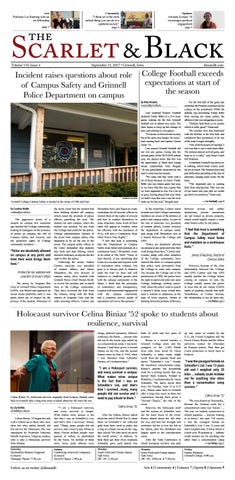
Grinnell College Campus Safety is located at the corner of 10th and East. By Candace Mettle mettleca@grinnell.edu The aggressive arrest of a student on campus two weekends ago startled the College community, leading to dialogues on the presence of police on campus, the role of Campus Safety and Security and the protected rights of College community members.
"Police are absolutely allowed on campus at any point and time their work brings them here." Andrea Conner, associate vice president of student affairs The arrest, by Sergeant Ben Gray of Grinnell Police Department (GPD), was filmed and appeared on social media platforms until it was taken down out of respect for the privacy of the student. Witnesses of
the arrest claim that the student had been holding alcohol off campus, which raised the attention of police officers patrolling the area. The student ran onto campus, where the student was arrested. No one from the College had called for the police. College administrators learned of the arrest from campus safety, who happened to be on the site of the arrest. The campus safety officer in the video demanded that students stay back and stop filming, which alarmed witnesses, as anyone has the right to film the police. Following the arrest, Andrea Conner, associate vice president of student affairs, and James Shropshire, the new director of campus safety, have worked with Grinnell Police Chief Dennis Reilly to review the incident and re-instill trust in the College community. They have reviewed the film from the witness, along with the body camera of Sergeant Gray and the other arresting officers. Conner and
Shropshire have also begun to create workshops for all security officers to remind them of the rights of citizens and how to conduct themselves in tense situations. Some fruits of their labor will appear in October, when the officials, with the assistance of SGA, will host a Community Hour titled “Know Your Rights.” “I feel that trust is something that the Department of Campus Safety must foster and maintain on a continuous basis,” Shropshire wrote in an email to The S&B. “Trust, or lack thereof, is not something that exists in a vacuum and requires work or restoration when violated. Our goal is to always seek to improve upon the trust we have and will endeavor to establish greater trust with the campus community in the future. I think that the principles of consistency and transparency, coupled with intentional engagement with the campus community and a customer service model of operations will serve this purpose.”
thesandb.com
College Football exceeds expectations at start of the season
By Riley Murphy murphyri@grinnell.edu Last weekend Pioneer Football defeated Trinity Bible in a 15-6 away game, making for the first Grinnell football win in almost two years. The team hopes to keep up this change of pace and continue to win games. “Everyone is relieved and excited, but at the same time hungry for more,” said running back and captain Carson Dunn ’18. Last season Grinnell football did not win any games. Going into the second game of the 2017-2018 school year, the players knew that this was the opportunity to break their losing streak. Quarterback Tony Bergida ’18 was particularly motivated by the team’s close loss last season. “We came into this week with a lot of focus because we know Trinity Bible was our closest game last year, so we knew that this was a game that we were supposed to win. For a lot of us guys, having played last year when we didn’t win, this was a way for us to make up for last year,” Bergida said. In the meantime, Conner wants to make sure that College community members are aware of the abilities of police and campus safety. As part of the role of associate vice president of student affairs, Conner oversees the department of campus safety and, along with Shropshire, acts as a liaison between the College and GPD. “Police are absolutely allowed on campus at any point and time their work brings them here,” Conner said. Conner, along with other members of the College community, have noticed that there is a misperception that police need permission from the College to come onto campus. Yet, because the College sits in the jurisdiction of GPD, the police have the right to patrol and enter any open College buildings without notice. Only when the police want to search a student’s dorm room would they need a warrant or subpoena, as the state of Iowa requires. Means of funding forms the primary difference
For the first half of the game last weekend, the Pioneers could not secure a place on the scoreboard. While the defense was preventing Trinity Bible from scoring too many points, the offensive line was struggling to score. “Defense held them to six points, which is really good,” Dunn said. The coaches were also impressed with the defense in the first half, and considered their persistence to be one of the team’s major strengths. “One of the best parts of Saturday’s win was that it was a total team effort. The defense played well all game, and kept us in it early,” said Head Coach Jeff Pedersen. At halftime Grinnell was down six to nothing, which made victory seem far out of reach. The Pioneers have had past difficulties persisting in the face of adversity, causing some worry for the team. “The important part is coming back from playing bad. That was one of our issues last year, that we would get down on ourselves,” Dunn said. >> See Football, page 8
between private and public institutions; private institutions are not treated as private property, which would legally require a court order before entry by the police.
"I feel that trust is something that the Department of Campus Safety must foster and maintain on a continuous basis." James Shropshire, Director of Campus Safety However, because of the close relationship between the College and GPD, Conner said that GPD usually notifies the College before coming on campus. In turn, the College readily assists the police in ways that do not violate FERPA rights of students, faculty and staff. Nonetheless, as Conner stresses, the relationship is not an open one. >> See Police page 3
Holocaust survivor Celina Biniaz '52 spoke to students about resilience, survival
Celina Biniaz ’52 began her talk with a tribute — to those who were there but who, unlike herself, did not survive the Holocaust. She was introduced by Professor Emeritus Harold Kasimow, religious studies, who is also a Holocaust survivor from Poland.
“I am a Holocaust survivor, and every survival is unique. What makes mine unique is the fact that I was on Schindler’s List, and that’s how I survived,” Biniaz said. “Many, many people did not survive, and I need to pay tribute to them. Eleven million people were gassed, or killed, or annihilated by the Nazis. Six million of them were Jews, [and others] were
After her tribute, Biniaz talked about the end of World War II, when those on Schindler’s list collected gold from their teeth to make into a ring as a thank you — on the ring, they carved “He who saves on saves the world entire,” in Hebrew. To help them get their lives restarted, Schindler gave each family two
bolts of cloth and five pairs of scissors. Biniaz is a retired teacher, a Grinnell College alum and the youngest of the 1,100 Polish Jews who were saved by Oscar Schindler, a name many might recall from the popular book and movie “Schindler’s List.” Nearby the Auschwitz concentration camp, Biniaz’s parents did accounting work for a sewing factory that was moved from Krakow, Poland to Brünnlitz, Czechoslovakia by Oscar Schindler. The move saved their lives. On Tuesday, Sept. 12 at 4:15 p.m., Biniaz came back to Grinnell after a long time away to share her experiences having been given a “Second Chance,” the title of the event. However, the Holocaust itself and the actions of Schindler were not the main focus of the event. Biniaz shared about her life after the war, and how her strength and resilience led her to live her life to the fullest, after her childhood was largely spent in the concentration camp. After the Yalta Conference in which European territory was split
Saturday Declassified Memory Fragment (Concert) Flanagan Theater, 7:30 a.m.
Sunday Celebrating American Composers (Concert) Herrick Chapel, 2:00 p.m.
Monday Fossil Fuels and Climate Impact Task Force JRC 101, 5:30 p.m.
Monday Fossil Fuels and Climate Impact Task Force JRC 101, 4:00 p.m. & 7:30 p.m.
clergy, political prisoners, Jehova's witnesses, the Roma … anyone who did not fit the Aryan type ended up in a concentration camp. I was lucky because I had been given a second chance on my life, and the second chance came on May 9, 1945, when I was liberated from Schindler Factory in Czechoslovakia.”
PAUL CHAN
Celina Biniaz '52, Holocaust survivor originally from Krakow, Poland, came back to Grinnell after a long time away to speak about her life since the war. By Lily Bohlke bohlkeli@grinnell.edu
Follow us on twitter @thesandb
"I am a Holocaust survivor, and every survival is unique. What makes mine unique is the fact that I was on Schindler's List, and that's how I survived...many, many people did not survive and I need to pay tribute to them." Celina Biniaz '52
up into zones of control by the U.S., the United Kingdom and the Soviet Union, Biniaz and her fellow survivors waited for liberation by Russian armies. They then got Czech protection to travel back to Krakow.
Friday Family Weekend Grinnell College, 8:00 a.m.
"I was the youngest female on Schindler's List. I was 13 years old and I weighed only 35 kilos ... nobody could mistake me for anything else other than a concentration camp survivor." Celina Biniaz '52 “We were known as ‘katzetniks,’ because the German word for a concentration camp was ‘katzet.’ ... The way we looked, scarecrows in striped pajamas, ... anyone looking at us knew,” she said. “Of course, I was the youngest female on Schindler’s List. I was 13 years old and I weighed only 35 kilos which is a little over 70 pounds so ... nobody could mistake me for anything else other than a concentration camp >> See Biniaz page 3
Arts 4 | Community 6 | Features 7 | Sports 8 | Opinions 9
News Climate Council hears from both UGSDW negotiates sides of the argument 2.7 percent pay raise 2
Edited by hermanal17@grinnell.edu & mettleca@grinnell.edu
“We met with Raynard Kington to ensure we had representation,” he said. Both the advisory committee and Task Force are in constant communication. The advisory committee meets every other week, and the Task Force sends daily emails, with a weekly call that includes Moyer. "We don't want to do a superficial or inadequate job on something that’s such an important issue,” Kahn said. The advisory committee has planned three open dialogues to discuss Grinnell’s role in climate action. These dialogues will feature various speakers, receptions and free food. To make the trustees accessible to students and other members of the Grinnell community, the Task Force will attend all the events surrounding the dialogues. Open dialogues are scheduled for the week of Sept. 18.
CONTRIBUTED
Michael Kahn '74 has high hopes for the Fossil Fuels and Climate Task Force. By Kate Irwin irwinkat@grinnell.edu Last spring, the student group Divest Grinnell demanded that Grinnell College take further action to lower the institution’s climate impact. In response, the Grinnell administration has formed the Fossil Fuels and Climate Impact Task Force, which recommends actions to the board of trustees. The task force is comprised of three alumni from of the board of trustees: task force leader Michael Kahn ’74, Ed Senn ’79 and Kathryn Mohrman ’67. While Kahn is the leader of the task force, he described the group as highly collaborative and nonhierarchical. “Everyone is being heard,” Kahn said. “Everyone is influencing how this [decision] is being shaped.” Kahn is a senior managing director at TIAA, a financial services organization that is the leading provider of retirement services in the academic, research, medical and cultural fields. An advisory committee has been created in conjunction with the Task Force to gather information for the
Task Force from both sides of the divestment argument, as well as about ways to lower the College’s climate impact. The committee also hosts speakers in areas that pertain to climate action. The advisory committee consists of faculty, students, staff and alumni. Professor Wayne Moyer, political science, acts as the liaison between the advisory committee and the Task Force. “Part of what we do is what a staff does — provide them with information,” Moyer said. “But part of what we do is kind of act as an intermediary between the campus community and [the Task Force] … My job is to get them the information that they need … and what is made available to them gives them a very good sense of the breadth of opinion that is out there.” “It’s a lot of reaching out to people,” said Sayles Kasten ’19, a member of the advisory committee. “And making sure things are going to get well publicized.” Kasten was part of the team that led the divestment movement last spring, which is how he got a position on the advisory committee.
"Everyone is being heard. Everyone is influencing how this [decision] is being shaped." Michael Kahn '74, Fossil Fuels and Climate Impact Task Force trustee member The Task Force will create a report following the last open dialogue, in which they will include all their findings regarding the College’s potential courses of action addressing climate impact. All findings will be available to the public. It is important to note that the Task Force and advisory committee are not only considering divestment.
"They'll also be looking for other things we can do to reduce the campus carbon footprint." Michael Kahn '74, Fossil Fuels and Climate Impact Task Force trustee member “They’ll also be looking for other things we can do to reduce the campus carbon footprint, and they’re >> See Task Force page 3
By Ben Mikek mikekben@grinnell.edu
After an extended labor dispute, the Union of Grinnell Student Dining Workers (UGSDW) has signed on to a new contract that raises the hourly wage for dining services employees to $9.50 per hour. The negotiations have gone on for several months. “The College initially thought that no raise was at all necessary, given that they had given us a substantial increase in the previous year, said Cory McCartan '19, president of the Union. "Our members didn’t buy that, and so three times we rejected their final offer, and finally after a little more public information campaign and a one-day slow down, we think that finally the message was clear enough to the College that they were willing to move significantly towards our end goal.” The Union unanimously voted to accept the college’s revised offer of $9.50 per hour, an increase of 2.7 percent over the previous wage of $9.25. “That’s substantially more than an inflation increase for last year,” McCartan said. “It’s not quite to tuition, but it’s more than inflation, and fundamentally it’s a paradigm shift in … the College’s approach to student labor.”
"The College was very pleased the student dining union members accepted our latest wage proposal at $9.50." Mary Greiner, associate vice president of human resources The settlement on a $9.50 wage also satisfied the College. “The College was very pleased the student dining union members accepted our latest wage proposal at $9.50, and look at this as a winwin agreement so that our students, faculty and staff will continue to receive a high-quality dining experience,” wrote Associate Vice Preisdent of Human Resources Mary Greiner in an email to The S&B. People on both sides of the negotiation table stressed the mutually beneficial nature of not
only the most recent negotiations, but the existence of the Union. “We should always be striving for a win-win whenever [possible],” McCartan said. “We’ve tried to work with the College from the beginning. I think we have a really positive relationship with administrators there and hope we can continue that.” Greiner expressed similar sentiments. “We look at the ratified contract as a win-win agreement and look forward to working with the students to continue to provide a great product,” she wrote. Student workers are, of course, not the only employees of Dining Services. The Dining Hall also employs non-student supervisors, as well as high school students. High school students were the subject of a minor disagreement with the administration following the last round of contract negotiations. “When we say UGSDW, that’s both college students and high
"In the six-week period following the ratification of the first contract, we saw unfilled shifts drop by 25 percent." Cory McCartan '19, UGSDW president school students,” McCartan said. “We fought hard last year to make sure the College followed up on its legal obligation to pay those high schoolers a fair wage and include them in the contract, as was intended all along. They finally did that, and we’re glad that happened.” The wage increase is the most significant part of the new contract, and the Union claims that increasing pay can help combat low staffing levels in the dining hall. “In the six-week period following the ratification of the first contract, we saw unfilled shifts drop by 25 percent,” McCartan said. “The College does keep statistics on filled and unfilled shifts,” Greiner said. “We agree there has been some progress in reducing open shifts, however, increased compensation >> See UGSDW page 3
The German embassy in Washington D.C. sponsors "German Campus Week" at Grinnell College By Sam Rueter ruetersa@grinnell.edu The fall 2017 semester marks the beginning of the College's inaugural "German Campus Week," headed by the German department. The program of events, which starts this week and runs through Sept. 26, is sponsored by the German embassy in Washington, D.C., and aims to cultivate a meaningful and friendly relationship between Germany and the United States on college campuses. Grinnell College is one of a select few colleges invited to partner with the German embassy. According to Professor Javier Samper-Vendrell, German, this invitation reflects positively on the overall strength of the German department. "It’s a great honor and recognition to have been included in this campaign," Samper-Vendrell wrote
in an email to The S&B. "We are part of a select group of colleges and universities, such as Johns Hopkins, Colby College or the University of Iowa, cooperating with the embassy." The theme of this year's Campus Week is "Germany Making Choices," which will be reflected in the classroom as well in a series of events and exhibitions hosted all across campus throughout the month of September. For students in 200 and 300 level German courses, there will be an opportunity to discuss Germany's elections in class, which SamperVendrell hopes will give important insight into ideas of "European integration, refugees, justice and equality, as well as the growth of a right-wing populist movement in Germany." For others interested in German culture and politics, there will be a host of other events to get
the Grinnell community thinking and talking about all things Germany.
"It's a great honor and recognition to have been included in this campaign... We are part of a select group of colleges and universities, such as Johns Hopkins, Colby College, or the University of Iowa, cooperating with the embassy." Javier Samper-Vendrell, assistant professor of German On Sept. 24, the German department will host a German election party at 1 p.m. in ARH 120. Students will be able to follow the election results live on TV, and there will also be an interactive quiz
VERONICA THOMAS
The German department conducted events to cultivate relationships between German and American campuses.
challenge at 2 p.m. The winners of the quiz challenge will receive a gift card from the Pioneer Bookstore. On Sept. 25, Herbert L. Quelle, German Consul General in Chicago, will speak on the German elections and the role of the consulate in the Midwest, in an event co-sponsored by the Rosenfield Program in Foreign Affairs, International Relations and Human Rights. Later in the fall semester, there will be a free screening of the film “We Are Young. We Are Strong” (Burhan Qurbany, Germany, 2014). According to Samper-Vendrell, the film is about "the RockstockLichtenhagen riots in 1992, [which] were attacks against asylum seekers in the newly reunified East Germany." A group discussion on the true story behind the movie and contemporary expressions of xenophobia in Germany will follow the show. Finally, a poster exhibition, titled “German Exhibition,” is currently installed on the second floor of ARH. The exhibition familiarizes visitors with the political history and structure of Germany. Aside from a foray into German language and culture, the German department hopes that Campus Week will allow students to think critically about the relationship between the U.S. and Germany as major world powers, both abroad and in Iowa. "I hope that the students will become familiar with German politics and the importance of transnational cooperation and dialogue," SamperVendrell wrote. "I also hope that the consul general’s visit will be a way for the entire campus and community to understand and ask questions about German investment and cooperation in Iowa and the larger Midwest." Although Campus Week looms on the horizon, the German department has more events to be on the lookout
for in the near future, according to Samper-Vendrell.
"Anything that brings awareness to what is going on outside of the US politically is a reminder that our political situation here is part of a global phenomenon." Daniel Reynolds, associate professor of German "On Oct. 11, Leslie Morris, associate professor of German at the University of Minnesota, will give a talk on post-Holocaust art and aesthetics based on her forthcoming book “The Translated Jew: Reimagining German-Jewish Writing Outside the Margins.” Next spring, the department will also welcome Barbara Yelin, a renowned graphic novelist, who will be the German department’s writer-in-residence." Samper-Vendrell hopes that these future events, coupled with German Campus Week, will intensify interest and excitement on campus around Germany and the German Department. Professor Reynolds also echoes Samper-Vendrell's assertion that he hopes students will learn more about the importance of global studies and transnational dialogue through German Campus Week. "Anything that brings awareness to what is going on outside of the US politically is a reminder that our political situation here is part of a global phenomenon," Reynolds said. "German-speaking Europe truly merits our study and attention." For additional information and a preliminary schedule of German Campus Week events, check out http:// www.grinnell.edu/news/germancampus-week-2017.
Edited by hermanal17@grinnell.edu & mettleca@grinnell.edu
News
The College works to instill trust of the police with students Continued from Front Page Information does not flow freely between the two parties and actions do not go unquestioned. “The Grinnell Police Department provides emergency response to Grinnell College and their assistance and presence on campus is necessary in a variety of ways,” Shropshire said. “The most noticeable interaction between GPD and the campus community is during emergency response. However, there are more passive functions and duties completed by the Grinnell Police Department. Most notably, serving as a presence and a deterrent to criminal activity on our campus, within the neighborhoods that our students, faculty and staff reside in, and the City of Grinnell as a whole.”
"He's got a lot of work to do but he's the right person for it." Andrea Conner, associate vice president of student affairs When interacting with the police, Conner said, “Compliance in the moment and expressing your concerns later” is the safest option. However, Conner also recognizes that it is much easier said than done and that the sentiment does not help people who feel powerless in front of officers, whether sworn or campus safety. Resources for students exist on campus if they find themselves a subject of interest for the police. Usually, a Residence
Life Coordinator (RLC) will come to the assistance of the student if the dean on-call fails to arrive. A friend or any trusted member of the community can stay nearby as the student interacts with the police, but that right is gone if the police require questioning of the student at the police station. In that situation, the GPD will only allow a lawyer or a crisis advocate to be with the student. Campus safety employs a model of “community policing,” which Conner describes as an arrangement in which officers engage with College community members in non-emergency settings to build trust and make delivering justice a promise. Campus safety officers have no weapons on the job and have no citation power. If an officer sees a student, faculty or staff member acting in a harmful manner or violating a College policy, their only power is to make a report of the College community member and alert the dean of students. Campus Security functions primarily to provide escorts for students that feel unsafe, make sure buildings remain locked during after hours and patrol campus. Yet all campus security officers are trained to respond to emergencies and frequently do so, from helping a student with a broken arm, to responding to alcohol poisoning, to assisting the police if they arrive on campus. Conner also hopes that community policing alleviates some fears of officers, especially at a time when police brutality and unfair sentencing are rampant issues that
target many marginalized identities that are a part of the College community. However, Conner feels certain that Shropshire will make a lasting difference on campus. “[The College is] an environment that’s conscious of social justice issues and we’re in an environment that cares a lot about people, but also don’t want to be obtrusive,” Conner said. “I think [Shropshire’s] presence in campus safety will be really stabilizing. There’s been a lot of transition and growth as we’ve tried to increase the number of dispatchers so there wouldn’t be as many student dispatchers. He’s got a lot of work to do but he’s the right person for it.” Conner oversaw and approved the hire of Shropshire, who stood out from the rest of the
alone doesn’t appear to be the only solution.” Disagreement, then, still exists on the margins. However, following the conclusion of this most recent round of negotiations, it seems that both administrators and Union members are looking to the future. “We do believe extending the contract from a one-year to a twoyear agreement is a good outcome
for both parties as discussions consume a considerable amount of time away from the students' core purpose of being here to focus on their class work,” Greiner said. “The extended timeframe of the contract will also allow additional time for both sides to evaluate and see trends that will help contribute positively to future discussions.” Leadership at the Union is also due for a shuffling as some of the founding members step aside to
Policy regarding name change for P-Cards causes administration to revisit their rules By Kelly Page pagekell@grinnell.edu All Grinnell College students wish we could change our P-card pictures. For some students, however, a much more serious issue is the ability to change the names on their P-cards, especially when they no longer identify with that name. “I decided, hey, I don’t like having my dead name on my P-Card, so I went into the office where they do P-Card stuff and said ‘Hey, can you help me out with this?’” said Warren Schweitzer ’20. “And they gave me some excuses about how it’s not my real name, when in fact my real name is Warren. … They basically said they can’t do it until it’s your legal name. It takes a lot of resources to be able to change your legal name.”
"[The College is] an environment that’s conscious of social justice issues and we’re in an environment that cares a lot about people, but also don’t want to be "It’s like a kick to the gut saying you’re not really there obtrusive" yet." Andrea Conner, associate vice Warren Schweitzer '20 president of student affairs candidates. Conner encourages students to reach out to the office of student affairs and/or Campus Security if they have any concerns or suggestions to improve the department. Campus Security works to keep the College safe, so it is paramount that the community has input in their operations.
UGSDW and College agree to wage increase for student employees Continued from page 2
3
bolster fresh talent. “My plan has from the beginning been to make this my last semester serving in a leadership capacity in the union,” McCartan said. “We have some people who are secondyears now who might want to run for leadership.” The newest contract is only one step along what McCartan hopes will be a long path for the first undergraduate student workers’ union in the country.
Schweitzer explained the importance of trans students being able to have their name-in-use on their P-Card. “It’s a big deal because when you’re trans and you’re called by the name that you were born with, at least for me, it’s sort of jarring. It’s like a kick to the gut saying you’re not really there yet.” According to Associate Dean of Students and Director of Intercultural Affairs Maure SmithBenanti, Schweizer should have been
HELENA GRUENSTEIDL
The College has clarified its policy on name-changes for Pioneer Cards.
Biniaz spoke this week at JRC 101 about her experience as a survivor of the Holocaust Continued from Front Page to a displaced persons camp in Landsberg, near Munich, but my mother decided she had enough camps, and so we opted on leaving the camp and going into a small German town,” Biniaz said. In Germany, Biniaz declared, she went “back to being stupid,” that is, she wasn’t in school yet again. She acquired a tutor named Mater Leontine, a semi-cloistered nun, and she learned from her for two years, until Biniaz’s family decided to move to Des Moines, where a member of their family lived. “[Leontine] didn’t know anything of Hitler’s propaganda or Hitler’s ideas as such. … She totally accepted me for what I was — a 14-year-old girl, traumatized by all kinds of camps and ghettos, and that I needed help. She was the first person who treated me as a human being. She gave me value, and by working with her and her gentle manner and everything, she taught me, first of all, that not all Germans are ogres, and second, she taught me that hatred is corrosive, it is corrosive to you because the person that you’re hating, they don’t know it. It’s you that experiences the hate,” Biniaz said. “She taught
"She taught me that hatred is corrosive, it is corrosive to you because the person that you're hating, they don't know it. It's you that experiences the hate." Celina Biniaz '52
me you have to work through your anger and your bitterness in order to move forward.” What she first noticed about the U.S. was its vastness. After testing into the 12th grade at North High School in Des Moines, Biniaz received a full academic scholarship from Grinnell, and attended. She loved Grinnell, beaming about its beauty, back before buildings like the Noyce Science Center and the John Crystal Center.
"I ended up majoring in philosophy. I was truly trying to find what it was in reasoning and in the world that created the kind of circumstances I experienced" Celina Biniaz '52 “I stepped out of the car, and I thought I had ended up in paradise. … I saw all these students, in such an academic atmosphere, that I felt truly enriched. You are so lucky to be here, really,” Biniaz said, eyeing the students in the audience. “Supposedly I was a pre-med student when I came in, but after dissecting the first pig and worm, I decided that was not for me. And I ended up majoring in philosophy. I was truly trying to find what it was in reasoning and in the world that created the kind of circumstances that I experienced. I’m still looking for it,” Biniaz said. After Grinnell, she moved to Long Island, New York where she pursued a master’s degree in teaching from Columbia University
and was eventually married with two kids. Throughout her life in Des Moines, Grinnell and New York, she never talked about the Holocaust or Schindler’s List. Her friends and family knew she was a displaced person from Europe after the war, but that was it. When Biniaz saw a copy of Schindler’s List in a bookstore, she said, “I practically jumped out of my seat… I started reading it, and in the book — I found the book very accurate — I kept wondering, how did Mr. Keneally ever figure out this book? He was an Australian — what did he know of Mr. Schindler?” “My community did not know anything of my Holocaust experience because I never talked about it. The word Holocaust did not come into the language until about 1967.” Biniaz explained that another person who had been on Schindler’s List, Leopold Page, was working in his leather shop when Thomas Keneally came in. Page told Keneally what had happened to him, and Keneally researched, contacted survivors and turned Page’s story, as well as Biniaz’s and numerous other people’s, into “Schindler’s List.”
"My mother lost everybody in her family, everybody. ... And yet, she was the most resilient person you'll ever meet. " Celina Biniaz '52 When Steven Spielberg turned Keneally’s book into a movie, he also initiated the project which is now the University of Southern
allowed to change his P-Card name all along. “I can guess why there’s a history of why that might be the case,” Smith-Benanti said. “In higher ed there has often been a misconception that student ID cards, especially at state institutions, are legal forms of ID documents. That’s not the case, but lots of people believe that it is. … Our policy is that people can use their namein-use. I think the problem is that people just got confused about what the policy was and in fact did turn students away, but that isn’t the policy anymore. ” Smith-Benanti says that there is an official written name change policy in works, which will hopefully soon be made available to students and administration. Until then, she asks that students who wish to change their name in official Grinnell systems and on their P-Cards reach out to her so she can assist them and advocate for them through the process. “Students in the process of a name change may notice that in some software systems, the names are not aligning the way they want them to, and should let me know so we can kind of track down where that’s happening and work with ITS to get aligned properly,” SmithBenanti said. “I want to make sure that in the future that’s taken care of.” Smith-Benanti wants to remind students that the Stonewall Resource Center (SRC) and the Trans Advocacy Group (TAG) exist on campus as additional resources for trans students.
California’s Shoah Foundation, the Institute for Visual History and Education. According to Biniaz, the Shoah Foundation has compiled over 56,000 video testimonies by survivors of genocide, recorded in over 30 different languages.
"You can read about the Holocaust, you can go to a museum and look at the artifacts, but nothing connects like the human voice." Celina Biniaz '52
“You can read about the Holocaust, you can go to a museum and look at the artifacts, but nothing connects like the human voice,” she said. Being welcomed and accepted as she was in the U.S. was surprising to Biniaz, as she was very young when the war began and she was persecuted for her religion. She closed her talk on a hopeful note. “Having been traumatized for all these years and told that you are a non-person, that you are vermin, to all of a sudden be accepted, to be welcomed, was amazing. … My mother lost everybody in her family, everybody. … And yet, she was the most resilient person you’ll ever meet. Her motto was, ‘The world does not owe you anything. Wherever you are, you do the best that you can.’ And that attitude meant a great deal. She did not dwell on things that had already happened; there was no point. They happened!"
Trustees work with students on climate change
Continued from Page 2
also looking for things we can do to strengthen the curriculum,” Moyer said. The Task Force will present this report and their recommendations to the board of trustees in April 2018, and the board will then vote on their course of action. “Whatever they decide is authoritative, that’s it,” Moyer said. Kahn commented on the College’s “Divestment Sub-Policy,” which was written in 2017, and stipulates, among others, that in the event of divestment, a proposal to divest “must relate to a specific company or companies, and not to an entire industry.” “The bar is set intentionally high for any divestment decision,” Kahn said. “That policy was meant to establish that divestment is possible, but we need to go through some real rigor to show that it is the appropriate thing to do. If we were to use our endowment primarily as a vehicle to express our shared values, rather than to be the principal source of funding to sustain the education mission of the College, we could have serious consequences in supporting many things that matter to us and would need to conclude that price is worth it. This doesn’t mean that our values have no place in how we invest, they certainly do, but the threshold for divesting needs to be a pretty high bar.”
Arts
4
Edited by vitaioli@grinnell.edu
Mohja Kahf discusses writing on crisis
Bea Herce-Hagiwara Jessica Kunzman kunzmanj@grinnell.edu “Figuring out how to get from Point A to Point B, having a goal of a final product but not knowing how to make it physically appear in the world and the process of getting there is so rewarding.” For Bea Herce-Hagiwara ’18, the “process of getting there” is what shapes her academic career. She is a double major, but the marriage of her disciplines, computer science and studio art, is not an obvious one. The products of the two subjects are different — code versus art — but in Herce-Hagiwara’s mind, they pose similar challenges. “I think the reason that both art and computer science feel very comfortable to me is because that’s the way I operate. I’ve always liked puzzles.” During her first semester, Herce-Hagiwara found that she “really missed taking art classes.” In her second semester, she took intro to studio art. Through that class, Herce-Hagiwara found a new path to explore: sculpture. After completing her first course, she knew this was an experience she would want to repeat each semester. With that, she decided she may as well major in it. One of Herce-Hagiwara’s primary media is sculpture. Her strongest connection to art comes from “seeing the process behind it.” She references many long nights spent in Bucksbaum, ending rewardingly in a creation. Herce-Hagiwara described her creative process, setting aside time on a task and worrying about nothing but that task, as meditative. “I think that attempting to make art gives you this whole new way of looking at and appreciating art,” Herce-Hagiwara said. “The how of things coming together and being made, not just the ideas, but the actual
ingenuity of the processes is really fascinating to me.” Her favorite sculpture project was inspired by historical costuming. She created large hoop skirts, welding the metal frame with spikes so that the spikes would pierce through the fabric. Described as, “Mad Max esque,” the sculpture came together as Herce-Hagiwara diligently completed the metalworking and sewing. “I’m a very methodical thinker when it comes to making things, so that to me is what gets me the most excited for art,” she said. Along with studio art, Herce-Hagiwara runs a small business centered around knitting and crochet crafts. She calls it a “teeny, tiny business.” Herce-Hagiwara rediscovered her passion for knitting, a skill she acquired long before she can remember, in her second year at Grinnell. “With an abundance of yarn and an abundance of free time, I just started making everything.” To keep her knitting engaging, Herce-Hagiwara began to create her own unique patterns. It occurred to Herce-Hagiwara that her hobby could become a small business, and Procraftinator was born. On her website, Herce-Hagiwara sells patterns and recruits experienced knitters to test new patterns. Procraftinator hosts some moderate success. Herce-Hagiwara sees it as a way to make some occasional money while finding a way to make her free time real and more active. For Herce-Hagiwara, her sculptures and her crafts belong in two different categories. Her knitting is not yet art. For it to become art, it needs “something really conceptual behind the knitting” or to be “more structural or sculptural.” She plans to explore these ideas this year. Her crafts belong more as an extension of computer science. She sees
knitting and crochet “as methodical, calculative processes.” She likes to have a final product, whether it’s computer code or craft. “If you’re thinking about taking an art class, take the intro art course. It is work, but it is rewarding and fascinating.” She is not the only computer science and studio art double major and encourages other students to consider combining the two. She endorses the upcoming crafts club on campus and plans to participate.
As a fourth year, Herce-Hagiwara is looking for opportunities to pursue her passions after Grinnell. She is applying for software engineering positions, with the hope of transitioning to a job that would use more of her creativity and art skills. Herce-Hagiwara’s ultimate goal is to merge art and computer science in her career. In the far future, Herce-Hagiwara plans to become an old artist. Ideally, she would be “knitting room sized things,” using arm-sized knitting needles.
The S&B: I noticed that in your work you show some problematic elements, like racism or classism, in people who are themselves victims of other people’s violence, in this case the Massacre of Hama. Why do you think that is important to show those facets of people? Mohja Kahf: In order to do dual critique and not be co-opted by either side. In order to do multi-faceted critique you have to acknowledge the complexity of people who are also themselves victims of external oppression while they are also committing oppression themselves in other ways.
HELENA GRUENSTEIDL
Herce-Hagiwara, a double major in studio art and computer science, enjoys working in both knitting and sculpture mediums.
Professor Lee Running awarded Iowa Arts Council Fellowship Candace Mettle mettleca@grinnell.edu Professor Lee Emma Running, studio art, has received a 10,000 dollar grant from the Iowa Arts Council for her artistry with deer bones. Running began her art career as a hand papermaker, but after an apprenticeship with famed artist Tim Barrett at the University of Iowa, Running began to recognize the historical and traditional importance of bone as material. Recently, Running has been using roadkill she finds within Poweshiek County to spark a conversation about public uses of land, and relationships between humans and land, humans and violence and humans and animals. “Iowa is farmed more than any other state in this union,” Running said. “There is farmed land within feet of our rivers, highways. … The physical dirt [in Iowa] is so valuable that there is almost no public land in the state. Part of what’s interesting to me in this project is that I started finding these bones because the only places that I can walk for miles are
waterways and roadsides and ditches. You start to realize how many deer are killed in these spaces.” As Running noticed the stark metaphor of the proximity of killed animals to cultivated and industrial lands, she kept the bones she found. She puts chicken wire over the bones to ensure that the bones will not be dragged away by scavengers such as insects and coyotes. After a sterilization process that includes hydrogen peroxide, Running sands the bones to a finish and polishes them. Then she carves out patterns, and within them, along with the interior chamber, Running applies 24 karat gold. Running has also established a relationship with Conrad Environmental Research Area (CERA) to notify her of newfound dead deer within the area to aid her in her art. Aside from the spatial closeness of animals, Running remarked on the physical similarities of deer to humans as further inspiration for her work. Starting this week, with Jack Meggers, another Iowa Arts Council Fellowship recipient, Running will put her fellowship to work with a film
MAI VU PHUONG
Professor Lee Running's work uses the skeletons of roadkill deer to explore relationships between human and "animal" form.
MAYU SAKAE
Professor of comparative literature and Middle Eastern studies at the University of Arkansas and award-winning author Mohja Kahf came to Grinnell to discuss belonging. Kahf sat down with The S&B's Kelly Page to talk about writing as both an emotional and political responsibility.
at CERA, where a new deer has been found. Preliminary film work has been done with help from students Lydia James and Phoebe Schreckinger, both ’19, over the summer. “Lee is an incredible artist and mentor — watching her collection come to life this summer in the clips that we made was super powerful,” Schreckinger said in an email to The S&B. Similarly, James found the experience to be worth the extensive hours in providing them with a larger lens with which to view art and creation. “I wouldn't trade all the ankle-deep mud-wading, the tick bites, mysterious other bug bites, lugging massive tripods through prairie grass or hours of filming clouds and dead animals in various states of decay for the world,” James said in an email to The S&B. “I think the greatest gift Lee has given me, especially from our work this summer, is a new lens through which to view the world. This is the power she possesses as an artist and a human. I have a completely different work ethic and attitude as an artist after working with Lee this past year.” Lee herself sees the film to be a means to explore the relationship between the human body and that of animals like the deer. “Part of what I’m interested with this film is comparing my own body to the body of a deer,” Running said. “A mature deer pelvis is about the size of a 125-pound woman’s pelvis... If you put a human vertebra next to [a deer] vertebrae, it will almost be identical. There’s something powerful to me in how we relate to wildness and thinking about these animals that are like us. When I started to figure that out, it really felt even more powerful.” The application process for the fellowship was extensive, beginning
with a preliminary proposal featuring work that they find representative of their artistry, a full proposal if the preliminary is received well and two additional rounds of vetting. Running had applied once before but got rejected. However, after receiving feedback from the board on her initial application, Running made sure to tailor her second proposal based on their remarks, which are public records. “I think it just serves as a reminder to always apply again,” Running said. “I think that’s a thing that many people forget to do with granting is that when you get rejected, write back and say if there is any feedback that you can give me that was super helpful because every grant is specific.” Running also praised the Iowa Arts Council and other organizations, such as the Des Moines Art Center and the College’s Faulconer Gallery, for making art accessible. Most places are free of charge, or at least offer discounts and special days for students, children and senior citizens. As a result, it helps establish and make it known that, as Running said, culture happens here in Iowa and not only in New York City. “Art has such an amazing impact in making a state livable, making it a state where people want to live, and Iowa has a deep problem of migration,” Running said. “People get a great education here and they leave. Art provides a place for people to be [and] continues to allow people to occupy public space. I think it’s really important that we have art for inspiration, but I think it’s really important to continue to have ways for the public to be connected to culture [and] to realize that culture happens here. There’s active life, live culture, in Iowa, and it’s really important to remember that Iowa is a viable place to live.”
As a writer, how do you think writers can change social problems, especially in the context of Syria and immigration? ... I don’t know if I can change anything, you know. People wrote and wrote and wrote. Syrians wrote and wrote and wrote the names of those who were imprisoned without charge, taken into the dark, killed in the dark and all we can do is keep saying their names and many, many, many times it did not help. It was futile, it was a wall, and then sometimes it did help, and you can’t not do it. You can’t not say their names, and you can’t not write about them, and you can’t not make the effort. “Though your promise count for nothing, you must keep it nonetheless.” ... Leonard Cohen. ...Yeah so that’s kinda my motto. I’d like to ask, just as an aspiring writer myself, do you have any advice for people who want to write? You know what really helped me? Books like “The Artist’s Way” by Julia Cameron. And other books, I mean there’s no one magic prescription. ... Do that self-care of the writer. Take care of the writer. Don’t put the writer in a corner and prioritize everything else, even though yes you have to pay the rent and you have to pay the groceries, but find time to cherish and honor the writer within. Give that writer a throne to sit on and a place to do her work — and the time — and your energy. And then, I guess, do you want to go back to the question of why you write? Writing became really central to my identity somewhere a few decades past. Then a few years ago, after about two and a half to three years of relentless killing in Syria, there were times when I was just writing about it 24/7 almost, between tweeting — I mean I don’t even remember eating and sleeping, but I guess I must have, and then I realized that I hit a wall, and to think that it’s efficacious in that way is not always the most productive thing. … I realized how foolish, sort of self-aggrandizing it is for writers to think that they can change anything, and yet you must keep the promise nonetheless. You must follow through on that promise. … I’m not saying everything has to be a quote unquote activist poem or a political rant, but if in some way the creation of that bit of beauty, that bit of communication that you are writing, in some way, however indirect, if it is not to improve life on this planet, what is it for? … I’m sorry if this seems old-fashioned, but it must be in the service of humanity, somehow, some way. I think there’s gotta be some intentionality behind it with the artist, in whatever little tiny minute way. That’s a giant canvas, right, and you could just be working on a tiny little brush stroke, and that’s okay.
Arts Renowned author Yvonne Owuor Spotlight on Burling basement's art spaces teaches "Literary Tourism" Edited by vitaioli@grinnell.edu
Clara Larson larsoncl@grinnell.edu Yvonne Owuor, a renowned author from Kenya and recipient of the Caine Prize for African Writing and Eve Magazine in Kenya’s “Woman of the Year” in 2004, has found herself teaching a course this semester at Grinnell entitled “Literary Tourism” through the international writing program and the University of Iowa. “I was asked to teach a course on writing, so I designed it around something I absolutely love,” Owuor said. “For the last four years, I’ve had this affair with maps and cartography. … You can create a map in order to understand a story. … My work, my art, has taken me to many places of the world.” It’s curious that someone so fascinated with maps, someone with the world at their fingertips, has found a temporary home in Grinnell, Iowa, arguably a jewel in the middle of the prairie. But for Owuor, home is “anywhere where magic happens.” In 2013, Owuor published her most recent novel, “Dust,” set in Nairobi, Kenya. Although it takes place in the second half of the twentieth century, it was inspired by Kenya’s current political climate. “What happened in about 2007/2008, was post-election violence, … and suddenly, for us who had grown up with a sense of an intact country, … we had all these myths about ourselves, how exceptional we were, we were an island of peace in a sea of violence, etc., etc., well suddenly, that falls apart” Owuor explained. “So suddenly as a citizen, I had to ask, what does it actually mean for me to be Kenyan and who do I become if I lose my country? What happens when the dream that our parents brought us up with is broken apart just like this, what do we do,” Owuor said. “And
when you look around and found the older generations themselves don’t have an answer, in a way it was my outlet to explore that bigger question, that was my inspiration.” Owuor drew on the themes she found to be most prevalent and troubling in present-day Kenya, such as loss of identity and loss of innocence, and she applied them to a Kenya of the past to craft a novel that “in the end becomes a story of a family coming to terms with the loss of that kind of innocence, within themselves, but also within their country.” Her novel “Dust” has taken her around the world and back, and Owuor said, laughing, that she’s “met as many readers from all over the world as probably the entire population of this beautiful town.” She’s found that no two people have the same reaction to her book, and said that “everyone seems to get something out of it, even things that I didn’t expect, so I’m learning things from them.” She recounted two memorable encounters with readers. The first: “A young girl I met in Nairobi, who came up to me and said, Yvonne, I had four men courting me, and I bought each one of them a copy of ‘Dust.’ The one who read it is the one I’m with now.” And the second: “A man in Ger-
many, recently, said, because the book has been translated into German as well, and he got so upset at the idea that the book had originally been written in English, he comes to me and says … you are German but you do not know it … I said oh how sweet, he said no, no, you are German but you do not know it yet.” This tale speaks to the ability of her novel, and the themes of a country and a people in turmoil, to transcend not only time, but space as well. Due to the United States’ current tumultuous political climate, Owuor wonders whether American readers would resonate with the novel as well. She relates that her “country was going through, and still is, going through a major crisis, quite similar … to some of the vibes that I’m hearing from this country." She said that she’d “love to have a discussion with students who have engaged with it [the novel]” to understand how “students themselves engage with conditions ... in their country … how do you express it, how do you sing it, write it, tell it or paint it. That’s the kind of conversation I’d be fascinated by”. This is part of the magic awaiting Owuor in Grinnell, Iowa. In that the fears, worries and uncertainty shared by Kenyans and Americans alike, could bring them together and inspire them to learn from each other.
GONVID BRAHMANYAPURA
Professor Owuor spoke with students about her work in JRC 209.
WHERE
FRESH & FAST
Bell's thesis encompassed the idea that all white people must take responsibility for racism and acknowledge their privilege
5
ANDREW TUCKER
Justin Gibbens's "Basilisk" on display in Burling basement. Amanda Weber weberama@grinnell.edu Across campus, artistic works can be found in study areas, lounges and bathrooms — pieces sketched out over months or spur of the moment doodles in Sharpie. Each work is unique, and so is each arrangement, yet there are few exhibitions so eclectic as the pieces in the basement of the Burling Library. There is a method to Burling basement’s creative madness, however. According to Kay Wilson, curator of the Grinnell Collection, the works on display in the basement were placed there for one of two reasons: they were too large to be stored in the Prints and Drawings Room, or they are currently being used for classes. That said, there is more than just their purpose connecting them — perhaps coincidentally, the works in the basement have a slightly edgier aesthetic than the works found, for instance, on the walls of Bucksbaum. Current artists on display include William Kentridge, Ligia Bouton, Justin Gibbons and Willie Cole. Kentridge, according to Wilson, is a perfect fit for the Grinnell campus as an artist who uses his work as a medium to express his views on human rights and social injustice. The son of two South African apartheid-era lawyers, Kentridge’s work is layered with meaning, much of it related to the injustices faced by South Africans during apartheid. In particular, Kentridge’s piece “Casspirs Full of Love” is a reference to the South African vehicles that were used for riot control. The title itself is an oxymoron — the idea of a Casspirs, a weapon for oppressing the natives, filled with an emotion of pure good — and the piece is just one example of a folio of work that can be found in one of the most unexplored areas of cam-
pus. “It was creepy and weird,” said Anna Bell Hines ’20 after exploring the art offerings in Burling basement. “I thought it was cool.” Kentridge’s art is not the only collection that expresses strong opinions and complex thought; there is an underlying theme to the basement exhibition of intellectual and philosophical exploration. Ligia Bouton’s piece “The Cage Went in Search of a Bird,” for instance, imagines a conversation between Franz Kafka and Charlotte Brontë in which the two authors, both of whom allegedly contracted tuberculosis, discuss how the body and soul communicate with and reflect the state of one another. There is another arrangement in the basement that falls outside that of the classic art variety. The bathroom walls of Burling basement have been covered with the thoughts and perspectives of Grinnell students dating as far back as 1983, or so the etchings on the bathroom walls testify. The discourse on the walls is questionable — and has been questioned, to say the least, by administrators who have painted over the graffiti in previous years — but the thoughts, doodles, declarations and poetry all provide insights into the minds of Grinnellians from all different times, backgrounds and perspectives. From “Vanitas vanitatum, omnia vanitas” to “Radical Empathy,” the fancies and conceits of Grinnell students have found their way to the Burling bathroom walls for years, and such art, so to speak, is not entirely out of place in the collection that has come together throughout the basement. Though it may be more off the beaten path than Faulconer or the halls of Bucksbaum, the contemplative art of the Burling Library basement has a charm all its own, and an odd, provocative wisdom to share with those willing to seek it out.
Smith Gallery displays Grinnellian collaboration
Bell's show delivered a dose ™ of comedy to the Grinnell community, that even if just for an hour, forced many Grinnellians to consider their privilege
MEET
SARAH RUIZ
The focal point of the exhibit was a push-up machine Lacina created. Hallela Hinton-Williams hintonwi@grinnell.edu
WE DELIVER! VISIT JIMMYJOHNS.COM TO FIND A LOCATION NEAR YOU
For the past two weeks, Grinnell’s Smith Gallery has been displaying the art of Joe Lacina, studio art technical assistant. With four pieces guiding the exhibit and providing a preview into his work, Lacina entertains many aesthetics through his art. “I’ve been toying with sports art — art that uses imagery from sports and pop culture as a way of leveraging a larger audience,” Lacina said. “I think mainstream movies, football, baseball, those things have larger audiences than niche, DIY art. Kind of bringing those two together, bringing kinetic sculpture and joining it with this sports aesthetic. I’m still trying to figure out what I’m trying to say with that.” This sports aesthetic is seen in one of his text pieces “Notes for Today’s Practice,” in collaboration with Erik Jarvis. “That was generated through us playing around-the-world and knock-out and spitballing about ‘coach quotes’ and the absurd things
that are said in sporting events or in practice, things said to motivate.” However, Lacina’s pieces vary from the sports aesthetic into areas such as the normcore and DIY aesthetics. His focal piece, a push-up machine made of plywood and bolts, as well as a found object piece of a ladder with a rotting carrot on top of it demonstrate the idea of degradation. “There’s a pointing happening in the exhibition to degradation and collapse and the state of nature sort of countering to a lot of our philosophies and dreams and goals,” Lacina said. “I’m interested in these things as monuments or ruins that the sculptures show degradation, the wear of the materials. Letting that happen and even accentuating that makes them seem as if they are pulled from this dystopian future apocalypse.” Lacina’s work not only can be seen showcased by the College, but in the Grinnell community as well. Raised on his family’s farm in Grinnell, Lacina works in collaboration with the Grinnell Area Arts Council and the Stew. You can also view his art on his website joelacina.com.
6
Community Public sector employees to vote Arts Council holds variety of classes on union recertification
Edited by braneckm@grinnell.edu
By Carter Howe howethom@grinnell.edu
Labor recertification votes for public-sector bargaining units began this Tuesday, with many more set to happen in October. These votes are part of the sweeping public sector collective bargaining law passed this past February. The voting will determine whether or not workers continue to be represented by their unions, and has the potential to cripple organized labor in the state of Iowa. Per the new collective bargaining law, recertification votes must happen every time a public-sector union local negotiates a new contract, usually every two to three years. There are currently 1,203 public bargaining units in Iowa, representing about 120,000 workers. The recertification elections are conducted on the individual bargaining unit level, meaning that two comparable bargaining units, such as local teachers’ unions in neighboring counties, could end up with different results. In order to be recertified, more than half the members of a bargaining unit, not just the members who voted, need to vote to recertify. The new recertification election requirements only apply to public-sector union locals, who represent workers such as teachers, county and municipal employees, police officers and employees of public works departments. Republicans praise the new recertification process, saying it keeps unions accountable to their members. “It’ll make the unions more answerable to their members. A lot of times they took it for granted that they had the support of their members. For a lot of members, they’re now going to see a union that’s a lot more responsive to their concerns,” said Rep. Dave Deyoe, chairman of the House Labor Committee, to The Des Moines Register. Democrats and labor leaders disagree, saying there was already an adequate process to decertify a public sector union, thus ending the union’s
representation of the bargaining unit. “It’s not necessary. There was already a process in the old law before it was changed for initial certification votes and then decertification votes,” said Coy Marquadt, associate executive director of the Iowa State Education Association, which represents teachers and educators across Iowa. The recertification process is just one part of the major collective bargaining overhaul passed last February by the Republican-controlled legislature. The controversial bill, approved along party lines with six House Republicans defecting, limits what can be bargained over in public sector union contract negotiations. The new law allows only base wages to be negotiated and excludes components such as health care and seniority benefits from the bargaining process. The package also changes the arbitration process for when contract talks reach an impasse. The changes include limiting the amount an arbitrator can raise wages, among other differences. Certain employees who work in public safety, including firefighters and police officers, are exempt from the restrictions limiting what they can bargain over, although university police and correctional officers are not included in this group. The collective bargaining law upends a 43-year-old law signed by Republican Gov. Robert Ray. Charlie Wishman, secretary and treasurer of the Iowa Federation of Labor, a part of the AFL-CIO, said the recertification process, and the collective bargaining overhaul in general, is an attempt to curb the power of organized labor and weaken the Democratic Party. “It’s probably one of the worst labor laws that has been passed in the state’s history, and in addition the part about these recertification votes is nothing short of union busting,” Wishman said. “This has nothing to do with the concerns of taxpayers or anything like that; this is about how
do we weaken labor unions and as a consequence of that … how do we weaken the Democratic Party?” For unions, getting not just a majority of members who voted to retain the union but a majority of all members in the bargaining unit can be difficult because, in a right-to-work state like Iowa, workers in the bargaining unit do not have to be a part of the union to receive the benefits of the union-negotiated contract. “I think it’s a whole lot of different methods that unions are taking right now to contact people who are members, and quite frankly people who are not members, and saying ‘I realize you don’t want to pay your fair share to belong to the union and get the benefits of the contract out of it, but will you vote yes at least to ensure that you still have that representation?’” Wishman said. Despite the difficulty of the recertification process, Marquadt is confident that ISEA members will vote to continue their union representation. “We have confidence that our members will be engaged and vote in it. Teachers vote in general elections at higher rates than the rest of the electorate,” Marquadt said. “You know while it’s absolutely onerous and ridiculous the threshold they made for the vote — because no other election is held to that same standard — we feel confident that our members will stand up for their voice and continue to have that voice in their local association.”
LEINA'ALA VOSS
The Arts Center hosts a variety of community-based creative events. By Zoe Fruchter fruchter@grinnell.edu Art abounds on Broad Street this fall as the Grinnell Arts Center gears up for another year of arts classes that range from black box theatre to drop-in ceramics. The Grinnell Area Arts Council is a nonprofit arts organization that aims to enrich and develop the creative community of Grinnell. "Offering classes in a variety of art forms furthers our mission because it enables community members of all ages to learn new skills and techniques for making things," wrote Katie In, the education and operations manager for the Council, in an email to The S&B. In order to support the creativity of all Grinnell community members, the Arts Council has launched a scholarship initiative for their Studio 6 interdisciplinary arts program. "We think it is important to make the arts financially accessible to all community members," In wrote. “This summer we launched a five dollar Stew class series with the intent to lower financial barriers for participating in arts classes." The classes were taught by volunteers and cover topics ranging from songwriting to computer-programmed embroidery. Other exciting opportunities
offered by the Council include a class for students ages 12 and up on Shibori, a Japanese cloth dyeing technique. Additionally, potters Tom and Wanda Clarke will return to Grinnell to run their annual Raku pottery workshop on Sept. 23 at 926 Broad Street. The Clarkes have been coming to Grinnell to teach Raku for over a decade, but this will be their final year running the workshop. If any of these options are of interest, In provides five specific ways Grinnell College students can get involved with the Arts Council. Students can volunteer in Studio 6 or at an event, for example the Raku Workshop on Sept. 23. They can attend one of the classes, music shows, gallery openings or Grinnell Community Theatre productions. Students may also rent the Stew and host their own creative class or event in town, stop by the Arts Center “to say hi” and check out the two different locations, visit the Art Council’s website and like them on social media. Students from any and all artistic backgrounds can contact info@ grinnellarts.org if they want to get involved with the Arts Council. "We want to support creativity in the community, and we hope to reach people whether they have a lot of experience and comfort with the arts or very little,” In wrote.
Every Thursday and Sunday between mid-May and mid-October, downtown Grinnell is host to what the Grinnell Area Chamber of Commerce calls "the best farmers market in central Iowa." It is a 100 percent producer market, which means that the vendors must grow or produce everything that they sell themselves. The S&B's Chloe Wray, along with photographer Helena Gruensteidl, went to the farmers market on Thursday, Sept. 14, to talk to vendors about their products, farms, and favorite part of the market. Meet the vendors below.
"The best apples we have now are honey crisp. Jonathan are good all around Iowa apples. Gala’s pretty popular. Wealthy and Macintosh, if you’re from out East, we got a lot of kids from out east. Macintosh is the apple they really like.” — Dave Hinegardner, Hinegardner Orchards
"We live in between Brooklyn and Taima and Malcolm and Chelsea, so we’re like 12 miles from nowhere. I have candles and melts, some odor eliminating sprays and air fresheners. I’ve been making them for about 15 years. They are made with soybean wax instead of paraffin, so it’s actually made with soybean oil, and they hydrogenate it, kind of like they do margarine."
"I’m transitioning to organic, so I’m not certified yet, so I say I’m chemical-free. I follow organic standards. That means I don’t use synthetic herbicides, pesticides or fertilizers." — Jordan Scheibel, Middle Way Farms
— Karen Kline, Center Point Farm
"[The brand] is named after my mom; she taught me how to garden and how to can. My husband and I came up with this recipe and so it was born seven years ago. I’m in grocery stores and farmers markets, the Cedar Rapids farmers market also. It’s all Iowa produce, I have my cousin growing for me over in Brooklyn, Iowa. I have an inspected kitchen in Montezuma and I also have my processing license. My processing license allows me to sell in grocery stores, farmers markets. Because of the tomatoes it has to be certified. Every batch is processed and I test the pH and it has to be a certain level." — Marilyn D’Aguanno, Momma Teresa’s Salsa
"To the market I bring the pork products, the chicken products, which are grass-fed heritage breeds, and baked goods, generally. … I’ve been the market manager for six years now, for the Thursday market. I’m the site manager, we’re sponsored through the Chamber of Commerce, so I work with the chamber people on setup and how we run things. We’re a 100 percent vendor produced market, so I verify vendors produce, what they bring." — Anne Brau, Compass Plant CSA
"I have salves, bug protection, body oils, natural deodorants and things for the bath. I make all of this and lip balms. I’ve been making them for five years. For years I used baby products because I have very sensitive skin, and I was reading what was even in the baby products, the chemicals and I just started doing lots of research and decided to start making my own. They don’t have chemicals, whatsoever. I won’t make anything that you have to have a chemical in, and I’m doing research right now on natural preservatives because I’d like to make body scrubs. " — Sandy Durr, Soaring Creations
Features
Edited by mckechni@grinnell.edu
7
Chemistry SEPC: Stronger than covalent bonds what the department can offer," Parrish added. "I know I feel like we have an all-star chemistry department."
"[Students] really seemed to enjoy the stickers." Michael Kolanowski '18
Chemistry SEPC strikes a quirky and approachable pose. By Kate Irwin irwinkat@grinnell.edu Believe it or not, the bond of the Chemistry Student Educational Policy Committee (SEPC) is stronger than a covalent bond. The members of this year's SEPC are Katie Parrish '18, Alitza Shutt '18, Micheal Kolanowski '19, Aidan Call '19 and Vivian Cheslack '19.
SARAH RUIZ
These students work to provide input for hiring potential Chemistry professors, work closely with faculty, act as a liaison between students and the department and build community within the Chemistry major. "We also just try to get people interested in chemistry," Call said. "We are also representatives for the department and try to show
Another role of the SEPC is to serve as a resource for students. "I just want to be a friendly face," Parrish said. "I want people to feel like they can come and talk to me." The SEPC also plans study breaks, a way to build community and take a break from strenuous homework. The chemistry SEPC takes this responsibility very seriously and tries to plan study breaks that stick out from the conventional food-based study break.
"I thought that I might as well use my time to do some good and host study breaks, and also try to get more students interested in the chemistry major and little things to help out the department and sort of give back." Michael Kolanowski '18
The Chemistry SEPC recently planned a study break that focused on decorating lab notebooks. "We bought a bunch of stickers, paints and glitter glue," Kolanowski said. This study break was a favorite among students.
"We are also representatives for the department and try to show what the department can offer ... I know I feel like we have an all-star chemistry department." Katie Parrish '18 "[Students] really seemed to enjoy the stickers," Kolanowski said. The SEPC can agree that their love of chemistry and desire to share the virtues of the major led them to their position on the SEPC. "I thought that I might as well use my time to do some good and host study breaks, and also try to get more students interested in the chemistry major and little things to help out the department and sort of give back," Kolanowski said. A goal of the SEPC is to reach out to underclassmen about the chemistry major. Already underclassmen have indicated interest
in the chemistry major by joining the email list or attending study breaks, something that the SEPC is very excited about. "I feel that we're a really great unit as the chemistry department, and trying to spread that more to first and second-years and get them excited about chemistry and not just about medicine," Cheslack added.
"I feel that we're a really great unit as the chemistry department, and trying to spread that more to first and second-years and get them excited about chemistry and not just medicine." Vivian Cheslack '19 The Chemistry SEPC recognizes their important role in helping underclassmen through not only the difficulties of the chemistry major, but through college as well. "We work really hard to be positive," Call said. "My first and second year as a chemistry major were not positive times, so you need to be a good role model for the underclassmen so they know it's ok and [you can get through] these tough times."
Passionate about education? You're invited to Ed Pros By Seth Taylor taylorse@grinnell.edu Students with an interest in education careers attended the first of many meetings of the Education Professions Career Community, commonly known as Ed Pros, this Monday. Those in attendance heard from Dan Covino, the new director of Ed Pros, on the general program for the year and upcoming events, and Covino heard from those attending on what they hoped to gain from Ed Pros this year.
"Education is a difficult one to pin down because so many positions can relate back to education ... It's amazing how many of our grads are in educational positions." Dan Covino'10 Ed Pros is a Career Community that predates the recently established ones by the Center for Careers, Life, and Service (CLS) this year. The six other communities are part of a new initiative by the CLS to provide students hoping to pursue a career with the necessary resources to explore and eventually become successful in that field. However, Ed Pros isn’t just a resource for students taking an education class. Grinnellians with an interest in teaching in the U.S. or abroad, for a few years or for their whole lives, can take advantage of the opportunities and advice Ed Pros can provide.
Covino graduated from Grinnell in 2010, teaching in the Grinnell-Newburg school district and in Boston before eventually returning to the college this school year. “In some ways I feel like I never left,” Covino said. Covino’s responsibilities are wideranging, from assisting students participating in the teaching licensure program, to organizing speaking events and symposia, to helping students learn what they can do with their skill set. “Education is a difficult one to pin down because so many positions can relate back to education,” Covino said, including librarians and museum curators as non-traditional educational careers. “It’s amazing how many of our grads are in educational positions.” Covino also works closely with the education department and the teaching licensure program to organize events throughout the year. “Ed Pros is the CLS branch, or the career oriented branch, of the three,” Covino said. Ed Pros will be helping to bring in speakers on education for the student body, including Mary Beth Tinker, of the court case Tinker vs. Des Moines, which defined the constitutional rights of public school students, and hosting a symposium on the future of urban education in the spring, as well as holding more individualized events for the members of Ed Pros. “I’m excited about a lot of things,” Covino laughed. “[But] the thing that excites me the most … is working with students.” In addition to all the work Ed Pros does in the Grinnell College
CHARUN OPARA
Dan Covino, the new director of the Education Professions Career Community, talks with students interested in pursuing a career in education, including and extending beyond teaching. community, Covino hopes to collaborate with the local school districts, sharing the resources the College can provide.
"I'm excited to try and think of new ways to forge collaborative bonds between the two institutions--the school district and the college-through education." Dan Covino '10 “I’m excited to try and think
of new ways to forge collaborative bonds between the two institutions — the school district and the College — through education,” Covino said. Covino lauded the CLS’ work and the benefit of dedicated career advisers. “I really want students to take advantage of [the work the CLS is doing]” Covino said. “At most institutions the size of Grinnell … students wouldn’t have access to career community directors or exploratory advisers … We have expert knowledge in STEM. We have expert knowledge in our pre-law commu-
Day in the life abroad in Morocco: Claire Eide '19
CONTRIBUTED
5:24 a.m.—Wake up to the Fajr, check Facebook, calculate how much more sleep I can get. Not a lot. Go back to bed. 7:45 a.m.—Get dressed and inhale the chocolate croissant Baba Mohammed set out for me. Throw back some chai and a lot of coffee. 8:02 a.m.—Eye the breakfast baguette. Resist the urge to play with the breakfast baguette like a sword. 8:15 a.m.—Head to the tram to get to class. 8:24 a.m.—Tram crowded af. There are hand rails, but I can’t reach them. I ponder my luck that the sheer amount of people keep me upright. Very glad I remembered deodorant. 8:26 a.m.—Shuffle my “chill” playlist, first 3 songs are by Lil Uzi vert, Playboi Carti, and…Enrique Iglesias. Question my ability to accurately name a playlist. 8:51 a.m.— Pretend to not be out of breath after walking two blocks and
up five flights of stairs. 9:00 a.m.—Arabic class. 10:01 a.m.—Head hurts. Why am I trying to learn this language? 10:02 a.m.—No time to contemplate further. Need to pay attention to Darija (Moroccan dialect) professor. 11:00 a.m.—History class. Geek out for a bit. Am generally intimidated by how smart my prof is. 11:34 a.m.—Mind wanders from the lecture. Book my plane tickets to visit [clarkjoh] ’19 and [fuchstul] ’19 in Madrid. 11:35 a.m.—Tune into class. Engage in some intellectual debate with the white man who said his reason for coming to Morocco was to ‘end’ the ‘war on terror’ (stares into camera). 2:20 p.m.—History class finally ends. 2:21 p.m.—Smashed the croissant I packed for a snack earlier. Am sad. Proceed to eat the smashed croissant, sadly.
nity. We have expert knowledge in finance.” Really, Covino pointed out, Grinnell’s campus is a wealth of expert knowledge, and he encouraged students to use their resources as much as possible. “Meet with and form relationships with your professors. … I have been incredibly well served by relationships I formed as a student,” he said. “My hope for all Grinnell students is that they feel prepared to enter the workforce, that they have a skill set that serves them well, and that they are willing to take on challenges that positively affect people.”
4:32 p.m.—Go to a café for three hours to do homework. Instead chat with the other students. Stare at passerby. Drink a lot of chai. 7:42 p.m.—Hop on the tram to get back to my homestay. 8:11 p.m.—Struggle trying to unlock the door. 8:13 p.m.—Succeed in unlocking the door. Am greeted by my Moroccan fam — Mama Karima, Baba Mohammed and host-sister Zupida — plus the delicious smells of dinner. 9:24 p.m.—Consume an unhealthy amount of tajine and bread. Lounge with the fam in an attempt to digest. Try to understand the Moroccan soap opera playing on the TV — fail. 9:56 p.m.—Actually start homework. 11:45 p.m.—Finish homework. Watch some Gilmore Girls in bed. 12:56 p.m.—Reflect on the day to the sounds of my snoring roommate. Fall asleep.
Sports
8
Edited by schultej@grinnell.edu
Football wins first game since 2015 in a defensive battle
Get to know what intramural sports are offered this fall By Quan Tran tranminh2@grinnell.edu
HELENA GRUENSTEIDL
Continued from front page But this Saturday the team did not lose hope, and instead worked together to turn the game around. Team captain Dunn encouraged the team to work harder in the second half, even when their work was not yet recognized on the scoreboard. “We were down at halftime. We were down six to nothing, the offense was not playing well, and at halftime Carson [Dunn] and some other guys sort of rallied the troops. We didn’t get on each other’s backs, we worked through it together and as a team unit. Our offensive line and Carson really did an awesome job,” Bergida explained. After halftime the team’s luck changed, particularly because of the team’s cooperation in concert with some individually encouraging plays. During the third quarter, linebacker Hassan Thompson ’19 secured an opportunity for the Pioneers. “Then Hassan Thompson blocked a punt and got it into the end zone, so we got a safety. Offense got pretty excited, and since they were getting us points we had to put something up. We scored pretty much right away. We marched down
the field and got a touchdown,” Dunn recounted. For Bergida, the safety was the most pivotal event in the game. “That to me was the turning point. We had built up some plays on offense leading up to that point. The defense played a phenomenal, stellar game the entire time. So it was that spark by the defense that really put us in the position offensively to take that lead and to take the game,” Bergida said. The Pioneers went on to score two more touchdowns, and with a fourth-quarter interception by defensive back Vinny Pavoni ’19, the victory was fully secured. The team celebrated their victory with a formation that many students hadn’t experienced before, an exciting moment for the coaches and players both. “It felt great. We went to victory formation, and that was the first time for me here in a Pioneer uniform. And it’s an incredible feeling, I will remember it for a long, long time,” Bergida said. “It’s really big — for more than half our team this is their first win,” Dunn said. For the team, this win removed a massive burden that players had
been carrying for almost two years. While the team is excited, they are still looking to improve. “To be honest, we made a lot of mistakes on Saturday. We had four turnovers, and turnover battle is usually one of the biggest battles in football, and we clearly lost it. But we still won the game, so there are a lot of mistakes we can fix and make better, and if we do those right, then we’ll have a good team for the rest of the year,” Dunn reflected. “We are looking to continue to improve throughout the season. We hope our best game of the season will be our last. We have a difficult three-game stretch coming up, but we’re going to attack it with all we’ve got,” Pedersen said. With eight games remaining in the season, the team is looking to move forward from this win and get even better, this time with even more hope for the future of the team. For Bergida, this win only proves what the team already knew, which is that they can win and they will win in the future. “This win gives us some confidence, it puts us in the right direction, it lets us know how we need to compete and that we’re capable of winning games.”
As varsity sports come into full swing, students who admire sports from the stands often forget a fun way they can get involved in athletics: intramurals. This school year’s intramural sports offerings are a fun collection of games for people with any level of athletic skill. “For students who enjoys sports but cannot afford the commitment of a varsity student-athlete or players who want to play another sport, [intramurals are] a place where students can meet new people, learn new sports and, most importantly, have fun,” said Maisie Lewis ’19, one of three student directors of intramurals this year. Together with Sam Galanek ’18 and Sophie Banegas ’19, the directors are bringing sand volleyball, golf and badminton to this fall season. All three sports are currently up and running, but are always open to any interested students. Games are held weekly. Sand volleyball is on south campus courts every Monday and Wednesday from 4:30 to 6 p.m. Golf matches new people up against each other, and lets them play and report back scores by themselves. Pingpong and badminton, on the other hand, are mainly one-day tournaments with advance notice. Even though intramurals are not without supervision, they are very autonomous. Lewis acknowledges that intramurals don’t have offi-
cial practice time, but rather, teams schedule it by themselves. Students can find out about teams and their schedules by logging on to IMLeague, the intramurals’ main software system. After fall break, the students will bring back one of the most popular intramurals: indoor soccer. It will be played in the auxiliary gym at the Bear Fitness Center every Tuesday and Thursday evening from 6 to 8 p.m. After that, for the spring season, the intramural directors are looking into volleyball and indoor basketball, another popular choice. Some concerns have been raised about current construction on Mac Field and its impact on intramurals this year, but according to Lewis it’s not much of an issue. “[The construction] doesn’t obstruct any league that we’re having. [None of] the sports are using Mac Field this fall,” Lewis said. She does, however, hope that the construction is over by spring so that outdoor soccer can be played. One of the main goals of intramurals this year is to increase femme participation. Additionally, the students are planning to advertise to groups who are not typically interested in sports, including creating a Facebook page. To sum up Lewis’s expectation for this year, “We really want to see more people coming to intramurals, and we hope that if people have suggestions they can pass it along to the student directors.”
HELENA GRUENSTEIDL
Intramural volleyball players on Cleve beach's sand volleyball courts on a warm September night.
How ethical is being an NFL fan in 2017?
As the NFL season gets into full swing, The S&B's Zoe Fruchter caught up with Grinnellians to talk about the league's weak punishments for domestic abuse and the troubles of recent Chronic Traumatic Encephalopathy (CTE) studies.
I have a cable subscription that I use to watch games online. [I watch football] because it's fun and I have a team that I like. I think the NFL should do a lot better job of punishing players for [sexual assault], acting like that." -Sean Cullinane '18
"[Chronic Traumatic Encephalopathy (CTE) Studies] don’t impact my practices. They definitely make me more aware. And since I haven't been a football fan, haven't watched football for a long time, I think I recognize that that's a problematic part of the sport, and I think football culture is problematic too. They remind me that there are problems that exist." -Lucy Bales '18
“Rugby, which is a less padded game, has less injuries than football does. I think less padding is the way to go. There will be people who are upset about it. ... I think those people are ridiculous."
“I watched football because my grandpa was a football fan and so we would go over to his house to watch football occasionally. And part of being from San Diego is that you are a Chargers fan. I think there should be obviously stricter punishment for anyone that commits domestic violence, and you should be kicked out of the NFL if that happens." -Ruby Lynn '20
"Part of the problem is that your brain doesn’t have pain receptors in the way that the rest of your body does. So in that way, if you have a really nice padded helmet you can hit somebody and you don’t feel your brain hitting your skull super hard." -Colin Greenman '18 and Zachary Spahr '18
“[Ezekiel Elliot and Ray Rice] aren't even the worst cases. There's John Brown who's a kicker who got off with basically nothing. There's totally instances of the NFL treating both [domestic] violence and assault in general in completely unregulated ways. And it's clear that all the NFL cares about as an organization and a company is money. And it's definitely disheartening and while it definitely affects how I view the NFL, I still watch football games.” -Henry Firestone '21
“I follow the Raiders. I just kind of grew up with it. I do think that the NFL needs to come down much harder on these players than just a two or six game suspension. I think there should be almost a full season and some sort of monetary punishment in there." -Ravi Levens '19
PHOTOS BY ANDREW TUCKER
he that y ave.
A Usually Unsuspected Plot Twist
Opinions
Edited by fentonma@grinnell.edu
As Told by Aminata: Engaging with the World Inside and Outside the Classroom
by Aminata Kinana I truly love my Grinnell experience. More than anything, I am grateful for the development in the way I think. I am able to look back and see growth in the way I see and interpret things, and there are few things in life that are better than that. I am able to be content and appreciative because many people on and off campus have taught me how to make the most of the opportunities that have been offered to me and how to always be intellectually hungry and evolve, as I constantly learn more
about myself and the world around me. The words above are necessary because they reveal who I am and why I think the way I do. I think it is important for Grinnellians to use what they learn in class in their everyday lives to be global citizens. Being a global citizen is not about travel, it is about being aware of what is going on around the world in different domains, caring about people, events and issues that are far away from one’s immediate experiences. Grinnellians pride themselves on being liberals but what does that even mean? According to the Oxford English Dictionary, the word “liberal” signifies one’s “willingness to accept behavior or opinions different from one’s own as well as being open to new ideas.” If Grinnell students are truly as liberal as they claim to be, then I believe that they must engage more with the world that we
live in. Be passionate about global ideas, look for connections between experiences, histories and countries even when they are not obvious. I think anybody who has spent more than five minutes talking to me will agree that there are a lot of things that I am constantly questioning and thinking about. I think the ability and opportunity I have as a student now to evaluate situations and learn from them is time I will never have again. I do not want to generalize and before I say anything else, I want to acknowledge that I appreciate being around wonderful intelligent students here at Grinnell, but Grinnellians need to take advantage of the resources available to them, which includes participating in academic conversations outside of the classroom. It is important to be curious and engaged. Students need to want to learn about things outside of their comfort zone. It is in my desire to
Letter to the editor: Vote to prevent environmental destruction Many Americans watched in horror as Donald Trump was elected the 45th President of the United States in November, especially those concerned with his anti-environment rhetoric. During his first nine months in office, Trump has already begun dismantling the EPA, backed out of the Paris Accord and reemphasized the coal energy sector. Democrats and Republicans alike, concerned with the pressing issue of global climate change, look on helplessly, like watching a car crash in slow motion. “One-in-a-hundred” storms like Harvey and Irma wreak havoc on our coastlines, while unprecedented wildfires scorch California and Oregon. The answer to our environmental woes in these troubling times is a simple one: civic participation. According to the Environmental Voter Project, only 4.2 million out of the 20.1 million identified environmentalists voted in the 2014 mid-term election. Those who do vote routinely list the environment as an issue of low importance, behind the economy, members of government and terrorism. Elected officials will only spend their valuable political capital on issues their constituents demand, and instead of attempting to sway hardline climate change deniers, it would be more
than enough to mobilize non-voting environmentalists nationwide in order to put pressure on lawmakers to pass environmental policy, or else elect someone who will. The power to change environmental policy rests squarely with the public and our decision to participate in elections. This claim seems to be too simple and naïve to be true. How can voting possibly make a difference in environmental policy? Nathaniel Stinnett and the Environmental Voter Project found that, in fact, it is that simple. By accessing public voting records and cross-referencing with corporate “Big Data,” they could accurately identify those who are interested in the environment and who have an inconsistent voting pattern. For example, if you subscribe to National Geographic, are a member of the Sierra Club, and drive a Prius, this information can be purchased by political groups and advertising companies and will indicate that you are interested in the environment. But are nonvoting environmentalists too insignificant a group to make a difference in an election? Nathaniel Stinnett of the Environmental Voter Project found that in the local Massachusetts 2014 gubernatorial election, in which a Republican candidate
won by only 40,000 votes, over 277,000 environmentalists didn’t vote. This trend has been increasingly substantiated by further data as a national trend. If environmentalists could mobilize and vote in force, lawmakers would be at the behest of their constituents to change environmental policy. This includes not only voting in presidential elections (of which the 2016 election was historically poor in terms of voter turnout and “did not vote” won 490 electoral votes) but also civic participation at the local level, where town governments decide on local issues such as solar panel installations and wildlife preservation funding. If you have ever tried to convince a staunch opponent that the environment is in danger and is worth saving, you will know a feeling of frustration. This effort may be futile, but if those who do recognize the dangers of anthropogenic climate change, and there are millions of us nationwide, get out to vote consistently and put pressure on policymakers, climate change deniers will be overruled. Voting is an easy, tangible method for the preservation of our planet, and one which not nearly enough of us take advantage of. - Gus King '18
The Grinnellian Experience by Amelia Darling
The Scarlet & Black Staff Editors-in-Chief News Editors Features Editor Sports Editor Arts Editor Community Editor Opinions Editor Copy Editors Graphics Editor Photo Editor Video Editor Business Manager Staff Writer Honorary Editor
Lily Bohlke Emma Friedlander Alice Herman Candace Mettle Caryn McKechnie Jackson Schulte Keli Vitaioli Mira Braneck Maxwell Fenton Carter Howe Mayo Sueta Lica Ishida Jeff Li Helena Gruensteidl Riley Murphy Kate Irwin Lana del Rey
see the student body more engaged with international affairs that I bring to you in my bi-weekly column, “As Told by Aminata: The Euro-Africana Sphere.” I want us to be able to talk and learn from one another in our efforts to understand the changes taking place globally. In this column, I will be discussing more than what are the biggest headlines. I will be reflecting on issues that many of you will be surprised to learn affect us more directly than we would like to think. Topics I will be examining include the recent meeting between French President Emmanuel Macron and his Ivorian counterpart, Alassane Ouattara on the CFA franc zone, the election of Tedros Adhanom Ghebreyesus as director of the World Health Organization and the legacy of Pan Africanism within Africa as well as abroad. As co-monitor of the Black Cultural Center (BCC), I plan on having events centered on current
9
events and academic discussions on Africa and the diaspora. I want to have all Grinnell students participate and learn as well as share their opinions. The BCC is a place of learning and growth. To be liberal is more than just to have a title that shows the world that you are better than those “others,” those who are deemed conservative and thus in many spaces as narrow-minded. To be liberal is to be engaged, to be hungry for knowledge and to find ways to not only develop as a person but to also consider your role in the world and how your actions can improve not only your life but the lives of those around you and the wider world as a whole. It is time to get rid of the shallowness of our opinions and begin to defend our principles in more concrete ways. Don’t just state your opinions but rather show them in the way you think critically and treat others.
Film Perception: A Usually Unsuspected Plot Twist by Allison Isztok by Allison Isztok When thinking of the greatest plot twists of all time, I can’t help but suggest “The Usual Suspects,” directed by Bryan Singer. This 1995 crime drama, featuring the one and only Kevin Spacey, revolves around his character Roger “Verbal” Kint retelling the tale of how he came to be associated with four other criminals. After they were taken in for a crime none of them committed, they formulated a plan to seek revenge on the corrupt police force. The film ends with a massive explosion at San Pedro Harbor, in which Kint is one of the only surviving witnesses. He is forced to describe the group’s schemes and operations for the police to release him from their custody. This ragtag band of criminals consists of Dean Keaton, a former corrupt police officer, Michael McManus and his partner Fred Fenster, car mechanic Todd Hockney and Kint himself, a con artist suffering from cerebral palsy. After the five men are taken through a lineup (which forms the unforgettable movie poster), McManus convinces them to join forces in a robbery to take down an illegal taxi service masterminded by the New York Police Department. This begins their partnership that quickly spirals into more than they bargained for. The scenes of the film switch between Kint’s interview with the police detective and a real-time account of the illegal endeavors of the criminal group. Kint, a reserved man with a knack for recounting details, attempts to convince the unwavering and skeptical investigators that Turkish mastermind Keyser Söze, a mystifying legend feared by every criminal, was the man who set the boat on fire. He describes how the group was blackmailed into working for Söze with the task of destroying a cargo ship landing at the harbor. Kint’s wisecracks to the detectives along with the intensity of the recounted chronicle keep the viewer engaged and push the film along until the culmination of the ending. Obviously, I can’t give much
more than that for fear of spoilers (I won’t be that guy). Now, I’m not saying it is a perfect movie — such a thing doesn’t exist. Although it is under two hours, the plot can drag a bit at certain points. You must make sure you are actively engaged — otherwise you will miss key details of the plot. You need to keep close track of the plot or else you may become confused with details or the timeline, as critic Roger Ebert describes happened to him. Some movies are good to watch when multitasking; they act as background noise because it is either a simple movie to understand or you’ve seen it a dozen times and can recite half the lines. Others are nostalgic and, though they may not truly be "good" pieces of film, they take us on a lovely nostalgia trip (“High School Musical” fans known what I’m talking about). “The Usual Suspects” is neither simple nor background noise, and can only be enjoyed if one commits to it and understands ahead of time that if you can’t entirely keep track of the plot the first time, it’s okay to rewatch. Besides the wonderful writing of this screenplay, Kevin Spacey does an incredible job, playing a character who is both an engaging smartass and a quiet observer, making him a fantastic narrator. Credit must be given as well to the other main actors, including Gabriel Byrne, Benicio del Toro, Stephen Baldwin, Chazz Palminteri and Kevin Pollack, each of whom completely embodies their unique character and plays off the others, creating intricate interpersonal dynamics. These characters play off each other very well, resulting in a cast of main characters who are fascinating enough to keep driving the plot forward. I will never tire of this movie. But if you don’t believe me on its quality, here are some of the film’s achievements: Christopher McQuarrie won an Academy Award for Best Writing (Original Screenplay), Kevin Spacey won an Academy Award for Best Supporting Actor and The Writers Guild of America ranked the film as having the 35th greatest screenplay of all time. If you started reading this article with no intention of ever taking my suggestion, I highly suggest you rethink your decision and watch this celebrated classic. With a film like this, you only have one chance to perfectly experience it in all its surprising glory.
SPARC Policy The Scarlet & Black is published on Fridays by students of Grinnell College and is printed by Times Republican of Marshalltown. The newspaper is funded in part by the Student Publications and Radio Committee (SPARC) and also relies on advertising revenue to cover operating costs. All publications funded by SPARC are copyright of SPARC and cannot be reproduced elsewhere without specific written consent from SPARC. Contributions The Scarlet & Black welcomes story ideas from students, faculty and other members of the town and college community. If there is any story that should be covered, please email newspapr@grinnell.edu or visit thesandb.com Send letters to the editor via email at newspapr@grinnell.edu or mail them to Box 5886. The author’s name must be included, but letters can be published anonymously in certain occasions. Letters will be printed at the discretion of the editor. The opinions expressed in this section do not necessarily reflect those of the editorial staff. The S&B reserves the right to edit any and all submissions. Advertising Advertising inquiries should be directed to the business manager, Riley Murphy, who can be reached at sandbads@ grinnell.edu or by mail at 1115 8th Avenue Grinnell College Box 5886, Grinnell, IA 50112.
the
Back Page Volume 134, Issue 4
thesandb.com
"The best thing since the front page!"
Photo of the Week
Got a backpage-worthy photo? Submit it to [newspapr] and earn $5 for contributing a winner!
"Pretty woman I couldn't help but see / Pretty woman that you look lovely as can be / Are you lonely just like me?" — Roy Orbison
Arbitrary Analysis Social Calendar
Stilettos
This week, Mira Berkson '20 and Ahon Gooptu '21 polled students asking: Bitchin' Ferrari or Razor Scooter?
8:00 p.m. Spiderman Homecoming @ Harris Cinema 9:30 p.m. SOL Karaoke @ JRC 209
Saturday
Pumps
Heels
Snedge
Friday
The Signs as 2000s Memes
JRC
Gemini: Shoes Cancer: Didn't have an internet connection in 2007 Leo: IDK my BFF Jill Virgo: Thriller prison dance Libra: I like turtles
ARH
Scorpio: What What (In the Butt)? Sagittarius: LEAVE BRITNEY
check us out:
ALONE!
@thesandb /thescarletandblack thesandb.com @newspapr
Rants & Raves:
Aries: Honey Badger Taurus: Chuck Norris jokes
1:00 p.m. Cowspiracy @ JRC 225 7:30 p.m. Declassified Memory Fragment @ Bucksbaum 191 - Flanagan Theatre 10:00 p.m. 80s Harris @ Harris Center Concert Hall
Like what you see?
MAXWELL FENTON
Capricorn: Lolcats Aquarius: Charlie bit my finger Pisces: Nyan Cat Students speak about what’s on their minds in 100 words or fewer, and you’re invited! If you have a rant or a rave, email it to [newspapr] or [fentonma]
Amazon Crime
Policy Changes
Worrying Already
Vending Machines
I have Amazon Prime, so I'm supposed to get free two-day shipping, but things keep taking three days! What the hell, Amazon? I may be addicted to the low prices and convenience that your company provides, but this is still not okay!
Much of the damage being done to society by the Trump Administration is the result of changes to often obscure and arcane policy. If you want to stay more informed and resist, it's important to educate yourself on the specifics of policy that are being damaged instead of general, broad topics that receive the most news coverage..
We're three weeks into the semester and I'm already nervous about finals, let alone midterms. Am I alone or should I just calm down?
Whoever owns the vending machines in South Campus and the mailroom NEEDS to get them fixed ASAP. They barely work, half of them won't take P-cards, and I've lost five dollars because they eat my money.
- Carter Howe '20
- Maxwell Fenton '19
- Nervous in Norris
- Sleepless in South Campus
-