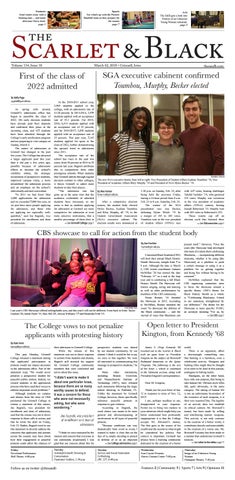
Sports See what's up with the Pioneer Baseball team as they prepare for the season page 7
Features Send winter away with a burning man ... and some delicious Slavic food. page 3
Arts The S&B gets a look into Portrait of an Unknown Young Woman rehearsal. page 9
the
Scarlet & Black Volume 134, Issue 18
March 02, 2018 • Grinnell, Iowa
First of the class of 2022 admitted
By Kelly Page pagekell@grinnell.edu As spring rolls around, Grinnell’s admissions office has begun to assemble the class of 2022. 184 early decision students have already paid their deposits and confirmed their place in the incoming class, and 427 students have been admitted through the College’s early notification program and are preparing to visit campus on Sunday, March 4. The nature of admissions at Grinnell has changed in the past few years. The College has attracted a larger applicant pool this year than it did just a few years ago, possibly because of admissions efforts to increase the school’s visibility online, the strategic recruitment of prospective students, improved campus visits, a more streamlined the admission process and an emphasis on the school’s individually-advised curriculum. “In 2011 we had fewer than 3,000 applications for admission and we exceeded 7,000 this year, so we just have more people applying for admission, and those who are applying are especially wellqualified,” said Joe Bagnoli, vice president for enrollment and dean of admission.
In the 2010-2011 school year, 2,969 students applied to the college, with an admissions rate of 43.20 percent. In 2013-2014, 3,979 students applied with an acceptance rate of 35.1 percent. For 20152016, 6,414 students applied with an acceptance rate of 25 percent, and for 2016-2017, 5,850 students applied with an acceptance rate of 29 percent. This past year, 7,345 students applied for spots in the class of 2022, further demonstrating the upward trend in admissions since 2011. The acceptance rate of the school has risen in the past two years, from 20 percent in 2016 to 29 percent last year. Bagnoli attributes this to competition from other prestigious schools. When students that Grinnell admits through regular decision commit to other colleges, it forces Grinnell to admit more students to take their places. “The admission rate has gone up at the same time that the academic credentials of admitted students have increased, so my sense is that as students applying for admission at Grinnell are more competitive for admission at even more selective institutions, that a smaller percentage of them elect to >> See Grinnell College page 2
thesandb.com
SGA executive cabinent confirmed Toumbou, Murphy, Becker elected
MAHIRA FARAN
The new SGA executive board, from left to right: Vice Prsesident of Student Affairs Kadiata Toumbou ’19, Vice President of Academic Affairs Riley Murphy ’19 and President of SGA Myles Becker ’19. By Max Fenton fentonma@grinnell.edu After a competitive election season, the student body elected Myles Becker, Kadiata Toumbou and Riley Murphy, all ’19, to the Student Government Association (SGA) executive cabinet. The election results were announced at
1:30 p.m. on Sunday, Feb. 25, after being held the previous Friday, lasting a 24-hour period from 8 a.m. Feb. 23 to 8 a.m. Saturday, Feb. 24. The winner of the SGA presidential race was Becker, defeating Dylan Welch ’19 by a margin of 395 to 305 votes. Toumbou won in the vice president of student affairs (VPSA) race
with 447 votes, beating challenger Takshil Sachdev ’19, who garnered 235 votes. Murphy was victorious in the vice president of academic affairs (VPAA) contest, besting Joseph Robertson ’19. Murphy won with 405 votes to Robertson’s 223. These results cap off an election cycle that featured three >> See SGA executive page 2
CBS showcase to call for action from the student body By Zoe Fruchter fruchter@grinnell.edu
CONTRIBUTED
Last year's CBS Showcase offered unforgettable acts, and this year's will not be different. From back to front: Taylor Gaskins '20, Jamal Poole '19, Max Hill 20', Alexus Williams '17 and Brianisha Frith '19.
The College vows to not penalize applicants with protesting history By Kate Irwin irwinkat@grinnell.edu This past Monday, Grinnell College released a statement stating that applicants’ participation in protests would not impact decisions in the admissions office. Part of the statement read, “We would never penalize a prospective student for peaceful public protest. Indeed, we reward students in the application process who have used their voices to address important social problems.” Although students on campus and alumni from the class of 1968 petitioned the Grinnell College to release a statement of this nature, Joe Bagnoli, vice president for enrollment and dean of admission, said that the release was not in direct response to these calls to action, and that he wrote the draft on Friday, Feb. 23. Rather, Bagnoli tried to use this statement to directly address the concerns that applicants and parents across the country may have about how their engagement in peaceful protests could affect the chances of Friday Neverland Performance Wall Theare, 6:00 p.m.
Concerned Black Students (CBS) will host their annual Black History Month Showcase, tonight from 7 to 9 p.m. Although the date is March 2, CBS events coordinator Autumn McMillan ’20 has termed the date “February 31” as a nod to the leap year and to celebrating a full Black History Month. The Showcase will feature singing, acting and dancing as well as other performances by members of the CBS community. Dixon Romeo ’16 founded the Showcase in 2015. According to McMillan, Romeo intended the event “to showcase the abilities of the Black community … and the myriad of ways that Blackness can
Open letter to President Kington, from Kennedy '68 James S. (Trip) Kennedy '68 reached out to the Scarlet & Black with an open letter to President Kington on the subject of Brownell/ Redmond donations to the Ignite Program. The following is the text of his letter -- which is continued in the Opinions section, along with President Kington's correspondence.
“I think we were reassured by the interest and concern that everyone in our community [expressed]. I was glad that our concern about this for
prospective students was shared by our student community, by our alumni. I think it would be fair to say we were in this together. We were all interested in communicating this message to prospective students,” he said. Many other institutions, including Boston University and Massachusetts Institute of Technology (MIT), have released such statements following the tragic school shooting in Parkland, FL. Unlike the statement by Grinnell College, however, theirs specifically reference peaceful protests in response to gun violence. According to Bagnoli, the word choice was meant to be more general and all-encompassing of involvement in all types of peaceful protests. “Because conditions can vary dramatically from event to event, I wanted to make it clear that on the face of it, simply deciding to protest in defense of or as an objection >> See College admissions page 2
Tuesday Artists@Grinnell: Drawing & Conversation Faulconer Gallery, 1:30 p.m.
Tuesday Service and Social Innovation CoWorking JRC 227, 6:00 p.m.
Wednesday Ivan Coyote Presents Harris Cinema Center 7:00 p.m.
their admission to Grinnell College. While the release of this statement was not in direct response to actions from students and alumni, Bagnoli still stressed his support for Grinnell College community members that were concerned and active about this issue.
"I didn't want to make it about one particular issue, because there are so many worthy causes to defend. It was a concern for those who were not necessarily asking, but who were wondering." Joe Bagnoli, vice president of enrollment and dean of admissions
Follow us on twitter @thesandb
present itself.” However, “Over the years [the Showcase has] developed into more of a talent show celebrating Blackness, … incorporating different elements, whether it be using [the Showcase] as a platform to push a certain message or using it as a platform for us getting together and being free without having to be censored.” McMillan explained that the CBS organizing committee aims to focus the showcase around a specific theme. CBS’s theme for Black History Month as a whole is “Celebrating Blackness: United in our sameness, strengthened by our difference.” The theme for the Showcase is more specific: FUBU, an acronym meaning “For us, by >> See CBS page 2
Dear Dr. Kington, Thank you for your letter of Jan. 12 in response to mine of Nov. 12, 2017. I am, perhaps needless to say, disappointed in your response. Permit me to bring two matters to your attention which might help you better understand how profoundly inappropriate it is that the College accepts Mr. Brownell’s money. The first goes to the source of his wealth and the second to what might be considered his politics. But context is important. Grinnell has always been a learning community dedicated to the creation of a better
world. There is an argument, albeit a decreasingly compelling one, that hunting is a harmless, even a wholesome activity. Shotguns and hunting rifles might thus be thought of as tools to be used in this pursuit, analogous to fishing tackle. Handguns, on the other hand, have only one purpose, that being to take human life. Military-style rifles fall, quite obviously, in the same category. The taking of human life is not an unfortunate by-product of the existence of such weapons, it is their very reason-d’être. The legality of an activity does not establish its ethical content. Mr. Brownell’s money has been made by selling and distributing murder weapons. This activity is not only contrary to the creation of a better world, it contributes directly and unavoidably to the creation of a worse one. Mr. Brownell’s money has been made in a manner that undermines Grinnell’s mission. >> See Letter to the editor page 11 Thursday Image of an Unknown Young Woman Flanagan Theatre, 7:30 p.m.
Features 3 | Community 5 | Sports 7 | Arts 9 | Opinions 11
2
News
Edited by hermanal17@grinnell.edu & mettleca@grinnell.edu
CBS hopes to engage wider campus in discussions about race
Continued from Front Page us,” referring to art created by Black people for Black people. “This year there’s been a big change as [CBS President] Simonne Carlton ’18 wanted [the Showcase] to have a complete storyline giving it a theme, giving it intentionality, giving it purpose, so that it’s not just ‘Oh look what we can do,’ but it’s actually sending a message from the Black community,” McMillan said. McMillan hopes that CBS can reach a wider audience of Grinnell students through the event, as she feels many of the struggles faced by Black students at Grinnell go unnoticed by the majority of the student body. “The goal of the showcase is to have a larger turnout for this year in hopes that we can reach more ears and [attract] a more diverse audience so that we can push the agenda of CBS which is that we want our spaces and we want to have control of those spaces and we want to be in the room with the administration when they are making decisions [about those spaces],” McMillan said. “The issues that are facing the CBS community are so insular. No one really knows about them unless they’re a part of
the community. It’s unfortunate that none of our peers know about the struggles we’re facing on campus.” In addition to more substantive struggles, McMillan noted that organizing the event proved to be challenging due to the busy schedules of the members of the planning committee. While the Student Government Association is funding the event in full, committee members faced “deadlines, applications, papers [which] created a lot of obstacles for us with the nuts and bolts,” McMillan said. “But at the end of the day I’ve been involved with theater for almost all my life and I know that if there’s a show to be had, the show will get done.”
featuring a mixture of step dance and spoken word performance. McMillan is excited about the combination of history, innovation and collaboration that the performance represents. “I’m starting a step team here and I was the captain of my step team in high school so [step is] near
to a particular social issue would not, in and of itself, dissuade us from offering someone admission,” Bagnoli said. By this logic, he concluded that the statement would be more representative of the College's values if it did not directly mention one type of protest but was broad enough to speak to a range of issues. “I didn't want to make it about
Autumn McMillan '20 McMillan’s theater background will come into play at the Showcase, as she organized her own performance
CONTRIBUTED
Concerned Black Students meet in the Grill in 2017 to discuss pertinent issues that affect the black community, which in turns affects the student body as a whole.
one particular issue, because there are so many worthy causes to defend,” Bagnoli said. “It was a concern for those who were not necessarily asking, but who were wondering. Even though the number of people inquiring about it was relatively small, we were concerned about those who might have questions and not ask.” Bagnoli argues that a value of Grinnell College is social engagement and activism, and this
is something that Bagnoli felt was important to make explicitly clear to prospective students. “We felt it was important to clarify our position on this. Our first reaction might have been, ‘of course we aren't going to penalize you on this, this is who we are as an institution,’ but we can't presume that everyone would understand what our position would be, so we felt it was important to make it more explicit,” Bagnoli reiterated.
The 2018-19 SGA Executive Cabinent has high hopes for upcoming projects Continued from Front Page separate head-to-head contests. Such an environment was naturally competitive between candidates, and its victors rose to the challenges of campaigning. In an email to The S&B, Toumbou wrote that she felt the election cycle was “really competitive and intimidating.” SGA President-elect Myles Becker acknowledged these difficulties as well, writing, “I think this election cycle was tough for all candidates, especially in the presidential race. … I think the whole election was stressful and exciting and nerve wracking all at once, but I think the most difficult part was knowing how competent and capable my opponent was.” However, turnout in this election was lower than previous years. For example, 2017’s election results showed 827 total votes for SGA president, in comparison to roughly 700 this year. Murphy chalks this up to the scheduling of the election. “I think I would have preferred the ballots to be open on a day other than Friday. A lot of people left campus for field trips, athletics, etc. and I think that may have contributed to the lower turnout we
Lee ’18. She added that she was extremely excited for an act by Errol Blackstone ’20, which will be a performance of the song “Sandcastles” from Beyoncé’s “Lemonade” album. “I’m so ready for it,” McMillan said.
"The goal of the showcase is to have a larger turnout for this year in hopes that we can reach more ears and [attract] a more diverse audience so that we can push the agenda of CBS.
College admissions welcomes activists Continued from Front Page
and dear to my heart. This year we are borrowing a step from one of the member’s old squads and layering spoken word on top of that. So it’s going to be a performance art piece.” McMillan noted other exciting acts such as a standup performance by Tyler Williams ’19 and Michael
saw this year,” Murphy wrote. Toumbou agreed with these concerns. “I talked to a lot of people who were not aware that SGA elections were happening, which is slightly concerning to me about outreach of events on campus,” she wrote.
"As I was walking around campus canvassing and getting out the vote, I met a lot of people with amazing ideas, fresh perspectives and positive attitudes, and it really made me feel proud to be a Grinnell student." Riley Murphy '19, vice president of academic affairs An important part of any functional election process is the seamless transition of power. Becker wrote that the elected executives have already planned to meet with those who currently hold their positions, in order to “learn as much about our respective jobs and their requirements as we can,” as well as “to carry forward as much institutional memory as possible.” As part of this transition of power, all three executives are already planning for cabinet
selection, according to emails to The S&B. “The first step is assembling a cabinet that brings a variety of experiences to the discussion. … After cabinet selection, the president, VPSA and I will work with them to establish an agenda for next year,” Murphy wrote. Toumbou put the cabinet selection process in ambitious terms, already looking toward the cabinet’s role in completing goals next year. “If we as executives are able to choose a supportive, visionary and diverse cabinet, we can get a lot of good things done for the student body,” she wrote. Regardless of the difficulties of the campaign or challenges to come, this year’s SGA executive elections were an example of the democratic process on the Grinnell campus. For example, Murphy was inspired by his fellow students during the campaign process. “As I was walking around campus canvassing and getting out the vote, I met a lot of people with amazing ideas, fresh perspectives and positive attitudes, and it really made me feel proud to be a Grinnell student.” Editor’s note: Riley Murphy ’19 is the business manager for The S&B.
Grinnell College credits new outreach efforts for increase in 2022 applicants Continued from Front Page attend Grinnell. Every year we end up competing against places like the University of Chicago or Brown or Williams or Amherst,” Bagnoli said. Bagnoli says he thinks an underlying reason that more students are applying to Grinnell than in previous years is the elimination of a necessary supplemental essay on the Common App four years ago. The College has begun to send email requests for optional supplemental essays well after the submission of the Common App, asking students about why they want to go to Grinnell, an attempt to assess their interest in the school. The early acceptance program that brings regular decision students to Grinnell’s campus before they receive admissions decisions from other colleges is part of the College’s efforts to convince their regular decision admits to choose Grinnell over other colleges that accept them. “We find that a visit to Grinnell is an important factor in their enrollment decision, so we like to give them the opportunity to visit us before they have committed to visit every place else. We go out early with a portion of our offers for regular decision in order to spread out the options for campus visits,” Bagnoli said. Bagnoli mentioned several other strategies to get students to apply to the College. “We have increased our investment in digital strategies. We have made improvements in admissions publications and to our website. We’ve made improvements to our campus visit program so we’ve seen an increased rate of students who visit campus who then apply for admission,” Bagnoli said. In conversations with The S&B about their decision to attend the College, several students who have already committed to the Grinnell class of 2022 said that their oncampus visits sealed the deal. “Once I was there, I fell in love with the amazingly supportive atmosphere and the freedom I’d be able to have with a small, liberal arts college like it. I decided to apply early decision that night because I knew that Grinnell is where I wanted to be,” said Ben Peppers ’22. Jax Seller ’22 also decided that they wanted to attend the College after a visit to campus. “When I went for a visit everyone was really welcoming and the whole tour and panel went really smoothly and it set the bar for other colleges. I don’t think there were any questions I had that I couldn’t get pointed to someone to answer,” they said. Other already-committed students were attracted mainly by the individually-advised
curriculum, coinciding with what Bagnoli says has been an increasing emphasis in admissions publications on Grinnell’s “boldly individualized approach to learning.” “I did more and more research and I found out about [Grinnell’s] dedication to social activism and its open curriculum and I fell in love with that and so I got into contact with some students and talked to them and applied ED2,” said Andy Kenly ’22. Claire Pollard ’22 was also excited about the individuallyadvised curriculum, saying, “I chose Grinnell because I wanted to go to a respected small liberal arts college with an open curriculum that had a good acceptance to medical school. I also really like the idea that I could double major in two disciplines that aren't commonly connected: biology
"Our goal is to provide students with a campus and community atmosphere that promotes the mission of Grinnell College." Joe Bagnoli, vice president of enrollment and dean of students and religion.” Bowen Mince ’22 echoed this excitement about being able to take a variety of classes at Grinnell, saying, “I chose Grinnell because I wanted a place where I could pursue hard sciences and still explore humanities classes. That’s why I really like the open course curriculum.” Several LGBTQ students were excited to be in an environment that accepts and affirms their identities. Many students were also attracted by the school’s tradition of social activism, while others cited Grinnell’s unpretentious atmosphere as a reason for attending. Kenley cited Grinnell students’ lack of emphasis on prestige as a reason for applying early decision. “At the East Coast liberal arts colleges like Williams or Swarthmore, everyone talks about prestige, and the pretentiousness comes along with prestige, and when I looked at Grinnell it didn’t seem like people were pretentious about going to Grinnell,” he said. Finally, many incoming students said they were impressed by the responsiveness of admissions staff. “Grace [Lloyd ’16, admission counselor] was one of the reasons [I applied]. Whenever I emailed her she responded to me and told me everything I wanted to know,” said Xindi Sun ’22. The Class of 2022 will be assembled within the next couple of months from the many students who applied, consolidating a new group of Grinnellians, diverse in their origins and reasons for attending the College.
Features Eco, Art and Food: Get to know your project houses
3
Edited by weberama@grinnell.edu
By Lily Seibert seibertl@grinnell.edu For students seeking a departure from traditional dorm life in the coming 2018 fall semester, Grinnell offers various college-owned project houses that each subscribe to common ideals and goals. Eco House, Art House and Food House reside just outside the campus borders and accommodate approximately 12 students each. The houses are now accepting applications for next semester, which can be submitted until March 2 for Eco House, March 9 for Food House and before spring break for Art House. Above all, members of each house expressed an emphasis on communal living and developing close relationships with their peers. “As a recent member of the house, I guess I was pleasantly surprised by how quickly it felt like home,” said Andrea Baumgartel ’19, a member of Eco House. “At first I was a little bit unsure whether it would be more like ‘Oh, I was technically in a house but it feels more like a dorm situation’ or if it would feel more like an actual like family-esque sort of situation. … It feels like the latter because people … are very intentional about what they do.” Despite their mission of being environmentally conscious, the members of Eco House feel no pressure or expectation to assume a certain persona. The students pride themselves on accepting a variety of
different beliefs and lifestyles into their home. “We do attract people with more of an intentionally environmental outlook on life, but you don't have to be that way,” said Natalie Seger ’18. “I think it's just like an openness and curiosity about it. No one's judging each other on how ‘eco’ they are.” Similar to the members of Eco House, those of Art House value the idea of sharing their lives with a tight-knit group of students. However, they also focus on routinely opening up their home for events and parties so that students who live elsewhere can benefit from the communal aspect of making and sharing art. “It’s my home, but it’s also a space to host,” said August ColeKink ’19 about Art House. “I feel like a lot of the people who live here are natural hosts — that results in some really good events.”
“It's my home, but it's also a space to host... I feel like a lot of the people who live here are natural hosts—that results in some really good events.”
August Cole-Kink '19
In addition to serving as a place for people to come together and enjoy each other’s company, Art House doubles as a studio conducive to productivity and inspiration. In several
cases, students have incorporated aspects of the house into their personal or class projects. For example, Cole-Kink plans on hosting shows for their band in the house’s living room this semester. “Having everybody live here be interested in art facilitates community building,” Cole-Kink said. The residents of Food House shared similar reasons for wanting to live in a project house. They spend most evenings cooking together and generally share an affinity for eating fresh and locally. “It’s really good to depend on other people,” said Isabella Kugel ’20, who lives in the house. “In the dorms you kind of depend on your roommate to be there for you, but here you can depend on people for mostly whatever kind of support that you need.” In addition to living in an encouraging communal space, members of each house underscored the benefits of an environment that blurs the boundaries between on- and off-campus. While members generally operate under their own rules and customs, the houses reside close to academic buildings and appreciate many of the same resources as those in dorms, such as access to meal plans and Facilities Management cleaning services.
“It's really good to depend on other people ... In the dorms you kind of depend on your roomate to be there for you, but here you can depend on people for mostly whatever kind of support that you need.” Isabella Kugel '20 “I think independence is a really defining characteristic,” said Jeremy Epstein ’19 of Food House. “We have a CA, but she’s just like one of our housemates. There’s a high level of accountability.” Amidst the bustle of academic and extracurricular life at Grinnell, the residents of each project house have found a way to take time from their busy schedules and unwind in a unique environment. Despite the specific goals and values of each house, the majority of residents agreed that their activities and events don’t matter too much so long as they do them together.
Algorithms and activism
SARAH RUIZ
Professor Micha Cárdenas delivered a talk on the use of technology and the digital humanities in activism. By Lauren Miller millerla@grinnell.edu Micha Cárdenas, assistant professor of interdisciplinary arts and sciences and interactive media design at the University of Washington Bothell, came to Grinnell this past week to discuss the intersection of art, activism and technology, with a primary focus on transgender activism. At the beginning of her talk on Tuesday, Cárdenas stated that she wanted to start with an experiment in post-apocalyptic democracy and posed a question to the audience. “Your planet is dying. Do you stay and help, or go to the ice planet?” she asked. After the audience collectively made the decision to stay and help, a volunteer went up to the computer and clicked on that option, which then brought up a poem Cárdenas wrote. This game, which provided a series of options that led into a new set of choices, is called “Redshift and Portalmetal” and was created by Cárdenas. It simulates an end-ofworld situation to probe players to consider questions they would not otherwise think about. As for her areas of study in particular, Cárdenas spoke about how art and activism have always been intertwined. “The new-fangled thing is to think why we would ever separate art and activism, or art and healing or art and society,” Cárdenas said. Surprisingly enough, Cárdenas states that most of today’s games are offensive and she would not play them. However, she said that, “games are a powerful medium for creating art,” and in turn, a good platform for activism. One project in particular that
brought together digital studies and transgender studies was “Becoming Dragon,” where Cárdenas spent 365 hours in a simulation as a dragon to mimic the process transgender people go through, who have to live full time in their preferred gender role for one year before they can begin medically transitioning. This project dealt with transgender realities, questioning and challenging the system that is currently in place for transgender people. Cárdenas said she began coding when she was in fourth grade and described how she has always thought in algorithms. These algorithms have been essential in helping Cárdenas to put her ideas into action. One such idea was to create a line of clothing with a device that could send signals to other people in the support network who could help in situations of possible violence.
“The new-fangled thing is to think why we would ever separate art and activism, or art and healing or art and society." Professor Micha Cárdenas Currently, Cárdenas is working on a game called “Sin Lluvia,” and she is collaborating with native Inuit people in Alaska about climate change. Cárdenas pushes for social change through art and technology on a wide range of topics. She employs a tactic of crafting early and crafting often, stressing that she does not have all the answers. However, Cárdenas explained how to start — we all simply “must be willing to change things.”
Community, culture and cuisine at Slavic Coffeehouse By Hallela Hinton-Williams hintonwi@grinnell.edu
connect cultures, everyone who attends this event can learn something about the Slavic tradition.
On Saturday, Feb. 24, Slavic Coffeehouse turned JRC 101 into a comfortable, warm room filled with new and exciting smells from Slavic cuisine. A long-standing tradition of spring semester, Slavic Coffeehouse brings students, faculty and community members together to experience Russian and Slavic cuisine and to celebrate with the Grinnell community. All the food is made by students taking Russian language or literature courses, as well as students who have backgrounds in Slavic countries. Slavic Coffeehouse is an event that celebrates the sharing of culture and food. It brings people a new understanding of Slavic culture and a way to connect with their home and history.
“If you want to know somebody, just share dinner with them. I think it is the best way of communication.” Visiting Professor Alexander Kubyshkin
“Having a Slavic background, it definitely has a homey feeling. Food has a strong connection to memory, so it's nice to be reminded of what my parents make.” Anna Tuchin '19 “Having a Slavic background, it definitely has a homey feeling. Food has a strong connection to memory, so it’s nice to be reminded of what my parents make,” said Anna Tuchin ’19. Food as a representation of culture is an important part of the mission of Slavic Coffeehouse. By using something as universal as food to
“If you want to know somebody, just share dinner with them. I think it is the best way of communication,” said Visiting Professor Alexander Kubyshkin, Russian. Slavic Coffeehouse is also tied to a traditional Russian holiday, Maslenitsa, which is observed at Grinnell with the burning of an effigy. “In recent years we combine the event with the Russian holiday, Maslenitsa, similar to a Russian Orthodox Mardi Gras. That involves Russian style pancakes, blini, which symbolize the sun, and it also involves the ritual burning of an effigy of a straw figure — Granny Winter. A way to chase winter away,” said Professor Todd Armstrong, Russian. Slavic Coffeehouse also provides a fun, intimate venue for Grinnell community members and students to connect. “It’s always been a wonderful experience. There is always good food, and the students are friendly and good cooks,” said Associate Professor Emerita Diane Robertson, biology. “It’s a fun event because students
are feeding the people and students are able to try Russian dishes,” Armstrong said. Furthermore, the proceeds from Slavic Coffeehouse go to the upkeep of Russian House. Altogether, the price is a great deal for the quality of food and company. “It’s crazy that you can get this amazing, home cooked food for four dollars a plate,” said attendee Vincent Benlloch ’18. “I was involved in Slavic Coffeehouse for every year of my college career. I’m always super impressed every year by how good the food is,” agreed Sam Burt ’17. “I think it is a really well-organized event. The food is delicious. I’m Russian, and I can tell that this is a really authentic Russian cuisine,” said Olga Baldwin, a Grinnell community member.
bit about Russian and Slavic culture, and meet students and faculty of the Russian department,” Armstrong said. “As well, I hope the students cooking get the satisfaction of feed-
ing others.” If you missed Slavic Coffeehouse this year, you will have another opportunity to enjoy the great food and good company next year.
“I hope people who come get something good to eat, learn a little bit about Russian and Slavic culture, and meet students and faculty of the Russian department ... As well, I hope the students cooking get the satisfaction of feeding others." Professor Todd Armstrong All in all, the fun, social environment of Slavic Coffeehouse can teach something to every student, faculty and community member. “I hope people who come get something good to eat, learn a little
MAHIRA FARAN
At the beginning of the event, students, faculty and community members lined up to receive food while Russian students, including Marysia Ciupka ’19 (pictured above) served.
Features
4
Edited by weberama@grinnell.edu
1132 Broad Street: all over the place — and all fun By Ahon Gooptu gooptuah@grinnell.edu A two-story teal house on the corner of Broad Street and Seventh Avenue, 1132 Broad St. is inhabited by Abdiel Lopez, Annette Mokua, Jessica Black, Rita Clark and Rodas Hailu, all ’18. Since the end of the previous academic year, they have each added their own charm to the quirky residence. Every room has a different shade of wallpaper, which should be enough to make anyone fall in love with the place. “It has a personality, kind of like all of us,” Lopez said. When deciding on the rooms that would eventually be their unique realms of the residence, Lopez and Black initially fought over what they deemed the “prime room” on the second floor. However, Lopez finally surrendered it when they realized that the room near the front door was in fact the biggest. Despite their differences in bedroom preference, the sunroom happens to be a mutual favorite of the residents. Mokua stayed in Grinnell over the summer and chose the room next to the sunroom to make the most of the Iowan sunlight.
"It has a personality, kind of like all of us."
Abdiel Lopez '18
“I want to say [that my favorite place is], hands down, the sunroom,” Mokua said. “Sometimes when we host parties, we have some pretty lights set up there and
is a topic of debate between the five living residents, it has been known for moving objects in the nifty kitchen and the expansive basement. It is safe to say that not all the residents know their basement too well, especially given that Mokua had no idea about Lopez’s plan to convert the hidden cave room into a bar in the future. Mokua argued that Grinnellians would never walk down to the basement to get their drink, but Lopez wished to use this article as an advertisement for the bar. The room already has a built-in rack for all the bottles; just a bit of refurbishing and the house should be ready to bring their parties to a new level.
SARINA LINCOLN
Abdiel Lopez, Annette Mokua, Rita Clark, Jessica Black, and Rodas Hailu ’18 pose on and around the house's signature sunroom beanbag. we have people walk out there, and they are drinking, smoking, talking, playing cards, whatever they do. It’s a chill spot.” The living room, as with most houses off campus, is the subject of many of the house’s stories, in which pre-games have taken place weekend after weekend. As for the iconic couch on the front porch, another favorite hangout space during pre-games, it has just always been there. “I wish I had some cool stories,” Mokua said, in regard to the origin of the couch.
Interestingly, the source of the
As for the iconic couch on the front porch, another favorite hangout space during pre-games, it has always just been there. beanbag in the sunroom has never been questioned either. Some of the décor, such as a few posters, was also handed down from previous residents. When it comes time to open the house up to others, Mokua and
Lopez, the self-proclaimed “head bitches in charge,” usually take it upon themselves to organize the house parties. Lopez especially enjoys arranging themed parties, such as “Linda,” which seems to have been the most memorable of them all. When asked what “Linda” was, they said that people had to come to the party to find out who Linda was at the end of the night. Mention must also be made of the unofficial resident of 1132 Broad St., the “neutral” ghost, “not negative, not positive!” Although the ghost’s usual hangout location
"We're all over the place, literally and metaphorically. It's a cute house, we're cute housemates."
Abdiel Lopez '18
During such a party, a guest walking around the house might notice several slogans against white supremacy — the residents don’t accept any shenanigans. While Lopez, Black and Hailu are Posse scholars, Mokua and Clark are international students from Kenya and Nicaragua respectively. “We’re all over the place, literally and metaphorically. It’s a cute house, we’re cute housemates,” Lopez said.
Poverty simulation reveals community struggle munity engaged work like volunteering, understanding issues like poverty and other elements at play are essential in becoming an effective part of the community,” Wilson wrote.
"It made me think how helpless you can be, even if you try your absolute best..." Vivienne Kerly-de la Cruz '20
CONTRIBUTED
Kiera Wilson, assistant director of service and social innovation, and Catherine Lents of the Iowa State University office of extension and outreach coordinated and attended Tuesday's Poverty Simulation. By Chloe Wray wraychlo@grinnell.edu On Tuesday, Feb. 27, the Center for Career, Life and Service’s service and social innovation team hosted a “poverty simulation.” This event, brought to the College by Iowa State University Office of Extension and Outreach, was held specifically for Grinnell College students in the Service Learning Work-Study program. The aim of the event was to “provide an introductory opportunity to expand dialogue, inspect personal biases and improve interactions [surrounding poverty],” wrote Keira Wilson, assistant director of service
and social innovation, in a follow-up email to the participants of the event.
"Poverty is the big elephant in the room that we operate around and with that we don't have the chance to talk about a lot." Kiera Wilson, assistant director of service and social innovation “As new or continuing members of the larger Grinnell and Poweshiek community, especially in the areas of service learning work-study and com-
T o simulate such issues, students and other community members, including employees of the CLS and College President Raynard Kington, were put into “family groups” within the fictional “State of Poverty” community. These family groups had members who were unemployed, working part-time or employed but struggling. Over the course of an hourlong simulated “month,” the families were asked to interact with community resources to keep their home groups secure — in other words, pay the utilities, rent and other bills, along with buying food and ensuring that their children went to school. Before beginning, the organizers from the Iowa Extension office stressed that the simulation should not be thought of as a game because as they put it, “no one wins at poverty.” Participants raced through their allotted hour in a frenzy to make ends meet. At the end of the month, out of
about eight family groups, only one or two groups had not been evicted. Following the simulation, Wilson called the participants together for a chance to reflect, opening the floor for discussion and encouraging people to share how they felt during the simulation. “Poverty is the big elephant in the room that we operate around and with that, we don’t have the chance to talk about a lot,” Wilson said. “It made me [think] how helpless you can be, even if you try your absolute best, if you can’t pay for something, or you can’t get to it, it crumbles and falls apart,” said Vivienne Kerly-de la Cruz ’20 of her experience in the simulation. “The hardest thing was organizing my priorities,” agreed Sara Castro ’21. Nai’ya Willis-Hogan ’20 observed the simulation, having had an idea of what she expected to see beforehand.
"When I first heard of a poverty simulation coming to campus, I was offended, so I came to observe." Nai'ya Willis-Hogan '20 “When I first heard of a poverty simulation coming to campus, I was offended, so I came to observe,” Willis-Hogan said. Already prepared to
speak, Willis-Hogan recited a short essay about her anger and dismay surrounding the idea of a poverty simulation, which included the lines, “don’t co-opt my struggle … don’t simulate my struggle.” The administering of the simulation presented poverty as something with which the greater Grinnell community faces, but some felt that it did not adequately acknowledge that for many college students, poverty is their reality. “The students are right, it can be damaging if we don’t take into account the limitations of a simulation,” said Susan Sanning, CLS director of service and social innovation. The discourse presented by Willis-Hogan began the type of dialogue that Wilson encouraged. “A single class or workshop cannot totally encompass the intersecting nature of poverty and that exists here in rural Iowa, let alone fully articulate the complexity of how multiple intersecting identities come into play. Without continued dialogue and discussion there is potential to essentialize an experience or over simplify systematic issues,” Wilson wrote, sharing that a student reached out to her by phone to share how uncomfortable they were to learn during the simulation of Grinnell’s lack of family shelters. Wilson wrote, “if is the only action that emerges, then it will be a conversation that has successfully extended beyond talking into practice.”
Innovative education: language learning and the digital humanities By Ahon Gooptu gooptuah@grinnell.edu The digital humanities have been gaining momentum in Grinnell as of late. This week in particular saw a handful of people associated with the field, including Rita Raley of University of California, Santa Barbara; Kathleen Fitzpatrick of Michigan State University; and Micha Cárdenas of University of Washington Bothell, as they came to share their respective experiences with Grinnell’s faculty, staff and students. The College hosted Felix Kronenberg, associate professor of modern languages and literatures and the director of the Language Learning Center at Rhodes College for a session on digital storytelling. His presentation, entitled, “From Digital Storytelling to Reflective Portfolios: Constructionism, Maker Spaces and the Liberal Arts,” threw light on several aspects of the digital liberal arts that he has “been interested in and
MAHIRA FARAN
Rhodes College's Professor Felix Kronenberg delivers a presentation on the involvement of the digital humanities in language learning. passionate about both theoretically and practically.” In a recent semester at Rhodes College, students in Kronenberg’s language pedagogy course creat-
ed projects using reflective digital portfolios, collaboratively devising a video game for language learning. These projects provided the opportunity for students “to apply the theo-
retical concepts they have learned to a real-world learning space-building scenario.” In his presentation, Kronenberg sought to define maker spaces, or
spaces in which humans can create things. From simply writing an essay to putting together Ikea furniture, maker spaces appear all around us. He emphasized how his courses have been designed to inculcate the practice of using digital tools to merge the gap between different spaces and different concentrations of study, primarily business, arts and science. Kronenberg also shared a couple of short first-person video-narratives created by his students. These narratives combined a recorded voice, still and moving images and music or other sounds. This tool carries immense power, due to the endless possibilities of creating something unique and sharing an exclusive perspective on an issue. In fact, this seems to reflect the scope of the tools available to someone engaging in digital humanities. The more scholars bridge the gaps in their studies, the more accessible their projects become to people in different academic fields.
Edited by mikekben@grinnell.edu
Community
5
Chamber of Commerce, Poweshiek Iowa Development, Early Childhood Iowa seek to improve child care availability in Poweshiek County
By Chloe Wray wraychlo@grinnell.edu
According to an August 2017 report by the Center for American Progress called “Mapping America’s Child Care Deserts,” large tracts of rural Poweshiek County constitute a child care desert, although Grinnell does not. Despite the fact that Grinnell itself is not a child care desert, employers and parents have long been expressing their concerns that Grinnell is lacking in child care options. According to the Center for American Progress’ definition, a child care desert is defined as an area in which there are more than three children per licensed child care slot. Child care deserts affect waiting lists for child care providers and parents’ employment decisions, as one-third of children under the age of five are cared for by non-relatives and rely on child care. Grinnell has 392 children under the age of five and 544 potential child care seats, and thus cannot statistically be designated as a child care desert. However, it is surrounded by “desert” in parts of Poweshiek, Tama and Jasper counties. Many of these areas rely on and benefit from Grinnell’s resources. Rachael Kinnick, Director of the Grinnell Chamber of Commerce, has been hearing from employers that child care has been a concern for as many as 20 years. About two years ago, concerns from Grinnell Mutual surfaced as they examined potential avenues to aid employees who were being affected by a demonstrated lack of child care. As a response, Kinnick and the Chamber of Commerce, along with Poweshiek Iowa Development (Pow
I-80) and Early Childhood Iowa, started meeting a year ago to clarify the issue. “The reason the Chamber and Pow I-80 are involved is because we were hearing it a lot from our employers that there was a need and a demand for child care in our community,” said Laura Manatt, Executive Director of Pow I-80. “When our group started
meeting we had all heard different reasons for why there was a need for daycare, but we didn’t really have any proof to back up our reasoning.” To understand the needs of the community, this collective will distribute a survey in collaboration with the First Children’s Finance’s Iowa branch. The survey will take three forms: one for employers, one for parents with children under 12 years old and one for people who think they may have or adopt children within the next five to ten years. As a third party group, First Childen’s hopes to fill in the gaps and identify the issues that that are facing parents and employers in Grinnell. The Chamber of Commerce began circulating the survey on Thursday, March 1, amongst its 270 member businesses. Kinnick wants to ensure that the survey makes its way to as many parents as possible. She encourages those who do not receive it
from their employers to seek it out on the Grinnell Chamber of Commerce’s website. The survey will be available through March 15. “By surveying Grinnell, it gives us a pretty good gauge of where we’re at in the rest of the county in terms of day care,” Manatt said in reference to the extended community dependent on Grinnell’s resources. “Even if you live in Brooklyn, but work in Grinnell, we want you to take that survey, we want to know what your needs are and how that kind of affects the broader needs,” Kinnick said. Grinnell currently has only one child care center, Grinnell Community Daycare & Preschool, along with a handful of in-home care providers. If the survey determines that there are not enough seats proportional to children in the extended community, solutions may include an expansion of the existing daycare, the addition of a second daycare center or more opportuni-
ties for educating in-home providers. From the employer’s perspective, “it’s hard to recruit people to a community when you don’t have enough day care,” said Manatt. If there is a lack of child care options, such as drop-in centers, people may have to take time off more frequently to care for their children, or if the options are very limited, they may not be able to work at all. The question to be addressed, said Kinnick, is whether “a lack of child care [is] preventing people from being in our work force, or preventing our workforce from being as productive as possible?” The survey will consider the incentives currently being offered by employers in the community, such as flex-spending accounts or scholarships for child care, and whether employers donate to local child care providers for general operating costs. The solution, whatever it may be, will involve a discussion between the Grinnell Chamber of Commerce, Pow I-80, Early Childhood Iowa and existing child care providers and employers. “I think collaboratively and collectively having the conversation will help us yield some different results than maybe we’ve had in the past,” Kinnick said, adding that there has been interest from entrepreneurs in opening a for-profit center. This may be aided by Pow I-80’s small community loan fund, which has helped child care providers in the past. Manatt feels strongly that the community will rally around whatever the cause of the child care issue is determined to be, especially because it is hard to identify an employer who has not expressed concerns. “From the Chamber’s perspective, this is a really important issue. It affects a lot of our businesses and it affects our community at large. One of the things that we’re hoping is that by addressing the issue we’ll figure out a way to get more potential employees to move to Grinnell, and also more importantly, keep the employees that we have in Grinnell,” Kinnick said, stressing the importance of appropriate child care resources to the community’s potential for economic growth. The survey will be available until March 15.
Hospital seeks new CEO after integration with UnityPoint By Gabriel Loewenson loewenso2@grinnell.edu On Jan. 1, the CEO of Grinnell Regional Medical Center (GRMC), Todd Linden, stepped down from his position, handing it over to interim CEO Doris Rindels. The transfer was made following an integration agreement with UnityPoint Health in Des Moines. Rindels will remain in the position until a permanent replacement for Linden is found.
“I'm a nurse by background, and the emergency room was my home before I changed to leadership, so the day to day operations are what I love doing." Doris Rindels, Interim GRMC CEO In the interim, Grinnell’s only hospital continues to operate as usual. “We remain focused on the day-to-day process of medical care,” Rindels said. “There’s [a] search on for a new CEO, so I can’t speak to what changes could potentially take place with the new CEO, but we have a local search committee in place. I anticipate that, with the community involvement and with local folks helping with that search, that we’ll have someone with the same types of values and leadership that we’ve been accustomed to here at the medical center.” Regarding the circumstances sur-
Movies at the Strand
rounding Linden’s departure, Rindels noted convenient timing as a major factor. “He’d been here for 24 years and he was contemplating stepping down. Then, with the timing of the integration with UnityPoint, he just felt the timing was right. It’s by his choice, and that’s what his aspirations were. That’s the only way to explain it.” Linden could not be reached for comment by press time. To ensure a smooth transition, according to Rindels, Linden continues to work one or two days per week. “He is working on the integration process as well as transitioning his previous CEO duties to me. 24 years, he was in the CEO position, and I’ve just been doing this interim position since Jan. 1, so there’s a lot of knowledge he’s trying to pass on to me in a very short time.” As the weeks roll by, the GRMC is looking forward to the new future in association with UnityPoint. One of the main priorities is finding a new permanent leader for the institution. “Hopefully by early to mid-summer we will have someone in place here: the new CEO,” Rindels said. “There’s been a process of screening applicants, but they haven’t even forwarded those names of those applications on to the local search committee yet. I can tell you that I don’t even know who the applicants are at this point.” For now, Rindels remains at the head of the institution. She noted that she has served in the hospital for many years.
WINCHESTER
“I’ve been on the administrative team as the vice president of operations for the last ten years, and have worked in the hospital for 39 years in one way, shape or form,” she said. “I’m a nurse by background, and the emergency room was my home before I changed to leadership, so the day to day operations are what I love doing.”
“With the community involvement and with local folks helping with that search ... we'll have someone with the same types of values and leadership that we've been accustomed to." Doris Rindels, Interim GRMC CEO That emergency room has seen an upgrade under Rindels’s leadership, as the newly-renovated Brownell Emergency Center held its open house on Feb. 26. The project, funded by donations from individual community members and significant support from Brownell’s, has been in the works for years. Beyond facilities upgrades, Rindels says that some of the responsibilities of her new position are different from those she held previously. “There’s some difference, but with [Linden] still doing the integration piece, that really allows the remaining administrative team to stay focused on the day-to-day operations and ensuring high care to our patients.”
Showtimes: 4 p.m., 7 p.m., 9 p.m. Guns, ghosts and earthquakes, oh my!
SOFIA MENDEZ
The GRMC hopes to appoint a new CEO by mid to early summer of 2018. Doris Rindels is serving in the interim.
FOREVER MY GIRL
Showtimes: 3:50 p.m., 6:45 p.m., 9 p.m. Because the point of film is to present scenarios which are utterly impossible in real life. Right?
BLACK PANTHER
Showtimes: 3:40 p.m., 6:30 p.m., 9:20 p.m. This film ranked as the third Fermat number among film releases in the United States.
6
Community Local historian gives talk on legacy and destruction of 1882 Grinnell tornado
Edited by mikekben@grinnell.edu
Byron’s house is one that I own that somebody else rents. It could be any of those three, and without having any cross reference, it’s rather difficult to figure it out. So you’ll see that that storm track is not as distinct as I’d like it to be.” Most people were left to fix the damages to their property themselves, without the aid of insurance.
“This is the first time I've gotten to show this map to anybody. This is based on about ten years of research trying to figure out where people lived." Byron Hueftle-Worley, Historian
SARAH RUIZ
Local historian and City Council member Byron Hueftle-Worley has researched the path of the tornado which devastated Grinnell in the summer of 1882. By Mayo Sueta suetamay@grinnell.edu On Feb. 27 at 7 p.m. at the Drake Community Library, local historian Byron Hueftle-Worley presented his research on the tornados that passed through Grinnell in 1882. These tornadoes infamously left destruction in their wake, demolishing a large number of College and residential buildings and taking human lives. The event was hosted by the Friends of Drake Library and was also accompanied by photographs and artifacts from the Grinnell Historical Museum.
“The sky started darkening, finally turned black, and a thunderstorm broke ... After quite a bit of that, it calmed down and left that horrible sickly greenish sky that nay long-term Iowan has learned to dread." Byron Hueftle-Worley, Historian Hueftle-Worley started by setting the scene, taking the audience back 136 years in history. “June 17th of 1882 was a typical
hot summer afternoon here in Iowa. … [T]he sky started darkening, finally turned black, and a thunderstorm broke a bit after 7:30 [p.m.] that was increasing in intensity until it got to the point where the thunder claps were overlapping, and there was an almost continuous flashing of lightening to the west side of the town. After quite a bit of that, it calmed down and left that horrible sickly greenish sky that any longterm Iowan has learned to dread.” Two tornados hit Grinnell at the same time. The historical record, “The Grinnell Cyclone of June 17 1882,” noted “the shorter one [struck] the town first and on its western borders, and the other [came] from the northwest and [entered] the town on its northern border about midway between its east and west boundaries.” According to the Tornado Project, the tornados killed 68 and 300 people, respectively, in Iowa, with 39 of those deaths occurring in Grinnell. In addition, the storm wreaked destruction on the town: 73 houses and two of the College’s buildings were destroyed. After giving some context on the tornado, Hueftle-Worley showed a map of the storm path that he had created. “This is the first time I’ve gotten to show this map to anybody,” Hue-
ftle-Worley said. “This is based on about ten years of research trying to figure out where people lived.” He faced significant challenges when creating the map because of a lack of resources. The best contemporary town directory showing where people lived dates from 1878, and in addition to being four years out of date, it was both inaccurate and incomplete. A directory was made 12 years after the tornado in 1894, but it had even less information on the state of Grinnell’s land in 1882. Furthermore, few people owned telephones, meaning no telephone directories exist from the period. The main source of information on damage from the tornado was a newspaper published four days after the storm. However, even many of those accounts were vague, making it necessary for Hueftle-Worley to try and patch together different information to pinpoint who lived where. “[When] the newspaper is talking about loss, they would use terms like ‘so-and-so’s house,’ but they would also say ‘so-and-so’s house where so-and-so else lived,’ or they would say ‘so-and-so’s house, Mr. so-and-so’s house,’” he said. “It becomes rather indistinct whether Byron’s house is where I live, Byron’s house is one I own, or
“It was relief from a disaster, not recouping your losses,” Hueftle-Worley said. The minimal financial compensation that was handed out come nowhere close to covering the cost of damages. Hueftle-Worley gave an example of 1126 Broad Street, a house which he bought when he moved to Grinnell, that had suffered over $2,000 of damage, but only received $750 of relief. In 2017 dollars, this equates to about $19,000 to
cover roughly $52,000 of damage. The presentation also featured photographs of obliterated houses, including buildings that once stood where Mears Cottage, the Harry Hopkins House and Burling Library parking are today. Crowds of people were photographed in many of these pictures, and Hueftle-Worley explained that, for a while, tourists came to Grinnell to view the damage of the tornadoes. These outsiders took pictures, and some even stole items from destroyed houses. Hueftle-Worley also showed photographs of two College buildings, Brick College and Stone College, before and after the tornado struck. The last picture he showed was of a bell from the destroyed Brick College lying on the ground. That was the very bell that is rung every year at the College’s commencement ceremony and currently sits in the Noyce Science Center. The informative talk ended with a Q&A and was followed by a meeting of the Friends of Drake Library, which was open to the public. The tornado talk served as a reminder of the importance of the history that has made Grinnell the town it is today, shaping our understanding of today’s streets, houses and College buildings.
SARAH RUIZ
The vague descriptions of damage and property ownership in newspapers from the time led to uncertainty regarding the path of the tornado.
Sports
Edited by schultej@grinnell.edu
7
Inside practice with the women's water polo team: studentled practices teach the basics but remain competitive
The S&B is going inside sports practices to get a glimpse of what Grinnell student-athletes are actually doing at the Bear in the afternoon. We sent writer Quan Tran ’21 and photographer Elena Copell ’21 to scope out women's water polo practice. It’s hot. It’s humid. It’s water polo practice at the natatorium. This week, I caught up with the women’s water polo team to see how practice is run. At first glance, it seems that the water polo team’s presence looms in the shadows of various swimming and diving records and championships. Alongside other pool-based programs with such a well-known history, it’s easy to think that water polo is just a club activity. That is, until you watch them play. The women’s water polo season is very short, having only two meets and a conference tournament. With practice only about a week in, today the team captains Shannon Ellery ’18 and Camille Hall ’19 spend the first half an hour of their practice, which lasts from 5 to 6:30 p.m. every Monday, Wednesday and Friday, going through basic rules and formation setups. The point is, as captain Ellery said, to familiarize them with the game.
"A lot of our players have never had water polo experience or seen water polo played before." Shannon Ellery '18 “A lot of our players have never had water polo experience or … seen water polo played before. So we had a little powerpoint to [help them] learn more about the game,” It is usually said that water polo is just like soccer, but underwater. And in many ways it is. At the far end of the natatorium, near the diving boards, lies a whiteboard on
ELENA COPELL
The Pioneer women's water polo team is entirely student-run, and they compete in three major competitions. Practice is an intense affair, with shootouts and game-like scrimmages creating a competitive environment. which the team draws out tactics and assigns match-ups. Finally, at 5:50 p.m., they go into the pool and warm up with a couple laps of freestyle and backstroke. The warm-up scene looks very much like a synchronized swimming practice. While everything was going on, the captains were taking the goals out and placing them in the water. After warm-ups ended, the players started shooting practice. Again, it’s quite similar to a soccer penalty shootout practice. Ellery gave out instructions to players on how to execute their finish better after every shot. After a while, as the clock was about to strike the 6:00 mark, the most exciting part of any practice began: scrimmages. As much as the team is about tactics, the scrimmage today was more about letting players find their
zone. Unlike soccer, water polo positions, except for the goalie, are more interchangeable and more involved on both ends of the pool. After a breathtaking swim-off for the first possession, everybody was locked in. Even though nobody was keeping score and there was only one referee, formations and match-ups were still intensely deployed. At one point, a goalie made one amazing save, beating a 3-on-1 counterattack in the process. At another point, tension was going so high that a player was ejected. The scrimmage was everything one could have asked for from a practice session. For a team that isn’t officially sanctioned as a varsity team by Grinnell’s athletic department, the women definitely made a strong case for why they should be. Throughout the practice, senses of discipline and
organization were crystal clear, from the players to the captains. Such a competitive culture definitely stems from Ellery, who was also the swimming team’s captain over last winter. Nevertheless, holding such a role on the water polo team does put her in unchartered waters. Without an actual coach, the team is responsible for traveling and accommodations by themselves.
Even though nobody was keeping score and there was only one referee, formations and matchups were still intensely deployed.
“In my second year, the athletic department absorbed the club sports, including water polo, into it. I think since then it’s been a lot easier to
organize hotel rooms and transportation. … Still, it’s a very different role compared to being a captain of a varsity team since it is a much more administrative role on the water polo side,” Ellery said. The scrimmage lasted until the near end, when they had to carry the goals out of the pool to make room for diving class afterwards. Even though the game was intense, the team didn’t forget to save an extra five minutes to discuss and encourage each other. Such practice, to Ellery, is very vital to team’s chemistry and individual performances. “We like to scrimmage a lot because it’s a good way to combine all the skills. It’s easier to just pick up [a] ball and shoot it, but it matters more when you have someone who’s guarding you and you have to swim around and make space,” Ellery said.
Senior-led track teams show promise for outdoors in their performance at the Midwest Conference Championships
CONTRIBUTED
Emma Zimmerman ’18 and Mikayla Fujiwara ’20 were key contributors on the women's team last weekend in Ripon. By Quan Tran tranminh2@grinnell.edu Last weekend, both women’s and men’s track and field competed in the annual Midwest Conference Indoor Championships at Ripon, Wisconsin. Despite finishing seventh and eighth in the team standings, respectively, both teams produced outstanding individual results which make their upcoming transition from indoor to outdoor much more promising. Particularly, Emma Zimmerman ’18 and Joel Baumann ’18 had career-best
times in the 5000-meter and 800-meter events, respectively. The women’s side enjoyed success on both days of competition. On Friday, the sprint medley relay team consisted of Lynn Nguyen ’20, Yolana Martin ’20, Rebecca Villa ’21 and Ally Cottrell ’21, and finished third with a time of 4:28.02. Even more impressively, on Saturday, in the distance medley relay event, Madeleine Breunig ’20, Gwen Holtzman ’19, Cottrell and Mikayla Fujiwara ’20 finished second at 13:02.12, only four seconds away from the win. Fujiwara
also added a third-place finish in the 3000-meter event at 10:47.45. Zimmerman finished second in the 5000-meter run field at 18:27.33. With this feat, the senior put herself in third place in the Grinnell women’s track program’s history. Women’s track Head Coach Evelyn Freeman doesn’t hide the astonishing fact of Zimmerman’s achievement, calling it a “gutsy performance.” Nevertheless, Zimmerman, in an email to The S&B, kept a very humble tone. “It’s definitely special … and [exciting] when I have a successful 5k
performance since [it’s] my favorite indoor event,” Zimmerman said. “At the same time, I realize there were parts of my race where I could have pushed harder or strategized better, which makes me excited to keep working on this event during outdoor.” On the men’s side, Joel Baumann ’18 had a breakout performance. He, along with teammates Sean O’Reilly ’19, Kevin Anderson ’18 and Matt Lieberman ’21, finished third in the distance medley relay with a time of 10:37.77. Later on that very same day, Baumann placed third in the 800-meter run at 1:59.31, despite having to race from a slower heat. Speaking of Baumann’s individual performance, men’s track Head Coach Will Freeman expected nothing less from Baumann. “He’s been showing in workouts that something big was going to happen … and [it did]. He’s going to be even better outdoors and could win it all,” Will Freeman said. Baumann, however, seems to be enjoying more from his team's holistic performance, putting more emphasis on team chemistry and contribution from his teammates. “My second year I was on a distance medley relay team that [actually] won the conference. But in terms
of how the team raced, [it] felt a lot more fun to be on [this team] because I felt like I contributed more. We were all kind of individually solid runners as opposed to [being] carried by one individual,” Baumann said. With such performances as the teams transition themselves to the outdoor season, Evelyn Freeman is very optimistic in spite of the early challenges. In her 38th season as a coach for the Pioneers, she is no stranger to the fact that Grinnell’s indoor season is shorter than other programs because the College starts its spring semesters later than most other places. “We were at a little disadvantage compared to the rest of the conference teams since practices start so late for us, but we were really surprised and excited with how well both teams did at conference,” Evelyn Freeman said. Will Freeman also commented on the shortness of indoor track season, saying, “We don’t trivialize the indoor conference meet, but we also recognized we’re not where we’ll be in May.” The track and field teams have about a month off from competition before outdoors is in full swing. This month of preparation for outdoors might just yield even more exciting performances come April and May.
Sports Athlete Spotlight: Baseball begins its regular season Shults's fast-paced spring this weekend in St. Louis 8
By Lily Seibert seibertl@grinnell.edu
For the past three years at Grinnell College, two-sport athlete Andrew Shults ’19 has participated in both indoor track and baseball, achieving highly at both and garnering the praise of his coaches, teammates and fans. In order to stay in shape for each sport, Shults must often attend two practices per day during the time period in which the seasons overlap, in addition to handling a challenging academic course load. Despite the difficulty, Shults’s identity as a two-sport athlete has been one of the most formative aspects of his Grinnell experience. “When I was thinking about colleges and thinking about schools, I really wanted to go to a school that allowed me to do as many extracurriculars that I was interested in,” Shults said. “I wouldn't be able to do that at a lot of other schools. I remember I spoke to [Head Baseball Coach] Hollibaugh about it when I first got here and he was totally on board.” Three years later, Shults has completed his third collegiate track season, placing second in the 60 and 400 meter dashes in the conference meet. With the track season over, Shults can look to the next chapter and focus on the baseball season. “It feels good to have that conference and then get right into baseball this week,” he said. “It's kind of like, having track first gives me the ability to have competition and to stay active. It keeps me doing something and is a good trajectory into baseball, which starts the weekend after.” In terms of the coming season, Shults and the rest of the team look to build on the success of their past couple of seasons. In addition to getting new talent from the first year class, the team retains several veteran leaders who hope to guide the next
Edited by schultej@grinnell.edu
generation. With the combination of experience and ability, Shults has full confidence that the team will be a force over the next few months of competition. “I feel like the team has the most depth that it’s had since I’ve been here,” he said. “And so I'm really excited to see how the lineup is going to shape up, see who steps up.” Although taking on two rigorous sports at one time seems physically and mentally taxing, Shults feels that each one helps feed into the other, allowing for maximum results. All of his hard work devoted to sprinting on the track has influenced his approach to baseball, making him a dangerous threat on the base-path and in the outfield. Rather than swinging for the fences, Shults contends that his role aligns more with getting on base and wreaking havoc on the pitchers by stealing bases and eventually coming around to score. “Doing track helps me get better at baseball, especially when you're in the middle of the season and everyone's wearing down,” Shults said. “Getting that extra fitness in at the beginning of the year really pays off.” He attributes his ability to manage several responsibilities to staying organized and keeping track of everything on his plate. In addition to planning his schedule for the semester out ahead of time and writing down each of his deadlines, Shults emphasizes the importance of prioritizing his activities and finishing tasks in a timely manner. Despite his individual success, Shults’s main goal remains team-oriented. “I know personally I really want to win the Midwest Conference Tournament,” he said. “We’ve come real close so many years. That’s my number one goal right now. We definitely can do it, we’ve just got to take it one game at a time.”
MAI PHUONG VU
Andrew Shults is transitioning to baseball season after posting impressive performances on the indoor track team during the first half of the semester. He travels to his first baseball tournament this weekend in St. Louis.
HUNG VUONG
The baseball team enters the season with high expectations. They starts their season this weekend in St. Louis. By Jackson Schulte schultej@grinnell.edu The Pioneer baseball season is underway, with the first tournament of the year coming up this weekend in St. Louis, MO. While baseball is a warm-weather game, the team has been practicing since the first week of the semester, utilizing the fieldhouse to escape frigid temperatures. Head Coach Tim Hollibaugh is in his 23rd season at Grinnell now. Hollibaugh is as tuned-in as ever as the team prepares for a tough schedule. “We’ve got one of the top ten toughest schedules in the country,” Hollibaugh said. “This group has really high expectations, but I’m trying to keep them focused on this first weekend. [This weekend] we play two really good teams, and we’ve got to win that tournament. If we take that approach, of trying to win the weekends that we do compete, I believe everything will take care of itself.” This weekend, the Pioneers take on the University of Chicago and Illinois Wesleyan, two teams that, it’s safe to say, are predicted to have good seasons. Luckily, Grinnell’s Pioneers have a lot of return talent from last season. Hollibaugh is particularly enthusiastic about the returning pitchers. “We have a majority of our pitching staff,” he said. “We’ve got an ample number of arms with experience,
some great first-years.” One of those returning arms belongs to Sam LaMotte ’20, last year’s Midwest Conference Newcomer of the Year. LaMotte thinks that his experience will be a big advantage this year. “I’d say the biggest difference between this year and last year is that I know what to expect when I get in the games,” LaMotte wrote in an email to The S&B. “Every hitter that we see in college baseball is one of the better hitters that we saw in high school baseball, so understanding that you do not get a hitter off was a big adjustment [last year].”
“This group has really high expectations, but I'm trying to keep them focused on this first weekend."
Tim Hollibaugh, head baseball coach
Ravi Levens ’19, an infielder on the team, echoed much of what Hollibaugh said regarding the quality of returning players this season. “Our biggest strength this year is our depth,” Levens wrote in an email to The S&B. “We have a lot of players this year which I think most people have noticed, but this means we have three even four really talented guys at each position, which is nice to see.”
Ideally, their tough out-of-conference schedule will result in them being fully prepared for their conference opponents. “These guys want to win a conference championship, and it’s just a matter of balancing academics and still being able to compete,” Hollibaugh said. The Pioneers have a tough schedule, certainly, but the team appears up for it. “I'm always excited to play home games, I really enjoy playing on our home field in front of friends and family,” Levens wrote. “I think our last home series against The University of Chicago stands out to me. We've never played them at home before and it will be a fun way to close out the regular season.” The coach and the returning players alike gave abundant praise to the team’s first years. “The best part of practices has been seeing the improvements that everybody has made from the fall, especially with our first-year players,” LaMotte wrote. “Being a college athlete is a big adjustment from being a high school athlete and seeing how the younger guys have adjusted and improved has been fun to watch.” With many returners, the entire Pioneer team should be fun to watch this season. Their first home game is on March 10 against the University of Wisconsin-Superior.
Rueter's Digest: The United States' gold medal in curling, like it or not, is one for the record books By Sam Rueter ruetersa@grinnell.edu Like many Americans, I watched exactly zero minutes of the 2018 Winter Olympic Games based in Pyeongchang, South Korea. However, last week, in between my frequent visits to ESPN and PioneerWeb, I couldn't help but notice the many headlines triumphantly touting America's “dominance on the ice.” After I remembered that NHL players weren't allowed to play in the Games and thus our U.S. Men’s hockey team couldn't be the object of this near-universal praise, it dawned on me that our great nation had finally conquered its final, unexplored athletic frontier: curling. Curling, for those like me whose cable packages don't include obscure winter sports, is something akin to “ice bocce.” Players take turns sliding stones along the ice towards a bullseye, while their teammates furiously sweep to give the object a direction and speed. The goal is to have your teams’ stones closest to the center, and this fact adds a layer of strategy to a competition that may quite possibly be conducted in a semi-inebriated state.
CONTRIBUTED
The United States’ men’s curling team won gold at the Olympic Games in Pyeongchang, South Korea recently. While it might seem funny on the surface, sports columnist Sam Rueter ’21 admits: gold is gold, no matter the sport. It only takes one look at our gold medal-winning men’s curling team, who defeated Sweden in the finals, to understand the atypical nature of America’s newest sports icons. Tyler George, Matt Hamilton, John Landsteiner, Joe Polo and John Shuster all look like they would be more comfortable starring in a Rogaine commercial than winning medals on the world stage, and
I will admit that I briefly mistook George for my sixty-something Uncle Chip. Despite this, these men are extraordinarily talented in their chosen profession. From the fifteen seconds or so of video that I have seen, their broom skills stick out as being particularly world-class. They display the same vigor and dexterity that my roommate Ryan Chang ’21 used
to sweep up Younker Lounge after Sweater Party. Although the American team defeated the Swedes in the final, a 5-3 defeat of Canada in the semifinals was arguably the biggest upset, as the Canadians had won gold in the last three Olympic Games. Following a lackluster overall performance in which many U.S. stars failed to medal, it felt good to
see our country finally stick it to our neighbors up north, whose progressive health care, high quality maple syrup and handsome prime minister consistently put us to shame. Despite a top finish, the curling team had their fair share of unsavory Olympic moments, with skipper John Shuster singled out for his mediocre performance and controversial leadership style. In the early rounds, his timing was off, producing tosses with no accuracy whatsoever. All jokes aside, these curling giants perfectly encapsulate one of the coolest things about the Olympic Games — that is, they give us the chance to witness and celebrate athletes whose hard work, dedication and talents are often underappreciated or largely ignored. For a country where four or five sports have a monopoly over most viewership and cultural capital, it is refreshing to see deserving athletes receive their fifteen minutes of fame. While in all likelihood these curlers will eventually fade into the background of public consciousness, their accomplishments shall stand the test of time, carved into the very same Olympic record books as the gold medalists in track and field.
Edited by suetamay@grinnell.edu
"Image of an Unknown Young Woman" to open next weekend
Arts
"Induction" opens in Smith Gallery
By Zoe Fruchter fruchter@grinnell.edu On Wednesday, Feb. 28, Bea Herce-Hagiwara ’18 opened her new show “Induction” in the Smith Gallery, located adjacent to the Dining Hall entrance. Composed of 72 light orange crocheted works stitched together and suspended on wire, in what Herce-Hagiwara described as a “round-ish, encompassing shape,” the exhibition shows how fiber objects demonstrate motion and geometry.
ELENA COPELL
Molly Stone ’20, Quinn Ercolani ’18 and Nai'ya Willis-Hogan ’20 rehearse for “The Image of an Unknown Young Woman” in Flanagan Theatre. By Nana Okamoto okamoton@grinnell.edu
Be sure to grab your tickets to “The Image of an Unknown Young Woman” from the Bucksbaum box office next week. Professor Lesley Delmenico, theater and dance, is directing this play by emerging playwright Elinor Cook, which tackles difficult issues about politically charged images and how various people respond to them. The play’s lack of setting creates a universal narrative and transcends a specific space or time, making it an unusual and interesting production. Delmenico describes the play as cinematic. It does not follow a linear progression and the dialogue is realistic and raw. Ahon Gooptu ’21, who will be playing the part of Ali, said that jumping from scene to scene makes it hard to keep the momentum going since there is so much energy in each scene.
"It's been a little challenging the pace of the show but it's also really exciting since it's an experience that probably a lot of people won't be familiar with." Nolan Boggess '19 Nolan Boggess ’19, the assistant director for the production, agreed. “It’s been a little challenging getting the pace of the show but it’s also really exciting since it’s an experience that probably a lot of people won’t be familiar with.” The play grapples with contemporary issues of how social media plays a role in disseminating images of oppression and revolution. Social media enables people to connect instantly, yet at times, “trends catch on just because you see it everywhere, without people really knowing what they’re fighting for,” said Vedika Haralalka ’18, who plays the part of Leyla.
“We’re so unsettled about what is truth at this moment, what we can believe, what images we can believe and how the same image can get used in different ways. And, ‘The Image of an Unknown Young Woman’ doesn't provide any easy answers about that,” Delmenico said. “There’s a lot of ambiguity but there’s also a hopefulness in the play.”
"Trends catch on just because you see it everywhere, without people really knowing what they're fighting for." Vedika Haralalka '18 This play is the third part of a series of productions titled “Embodying Self and Other.” This series came together over coffee at Saints Rest, when Delmenico, Professor Celeste Miller, theatre and dance, and Associate Chaplain and Rabbi Rob Cabelli discussed ways to reconcile views that are different from one’s own. The fourth and final production in the series will be Miller’s project, “Strangers in a Strange Land,” which will be performed in late April.
9
"Every piece starts with four stitches and ends with sixty four, and what happens in between is up to a random algorithm ..." Bea Herce-Hagiwara '18 Herce-Hagiwara, a computer science and studio art double major, used computer algorithms as a tool to construct the stitch patterns that she then crocheted for the exhibit. “Every piece starts with four stitches and ends with sixty four, and what happens in between is up to a random algorithm, so it’ll decide whether to increase stitches or to decrease stitches, and I just run it and whatever comes out I make,” she said. It was important to her to incorporate randomization into the creation of these crocheted pieces — by using algorithmically generated patterns, Herce-Hagiwara demonstrates how crocheting incorporates knowledge of geometry and mathematical concepts. “With a single click I can gen-
erate hundreds of patterns, each one individually containing a fraction of the geometric sensibility it took to design the algorithm itself. Each one containing even less, still, of the thoughtful geometry of countless other hand crocheted items that exist in the world today, some in your very own homes and lives,” she wrote in her statement for the show. The core of Herce-Hagiwara’s motivation for making a crocheted art installation was her own deep appreciation of fiber objects, something she hopes to pass on to viewers of the exhibit. “Knowing the thought that I’ve put into it and the thought that I put into fiber objects that I see and interact with I hope that people will get a different understanding of fiber objects after they read what I have to say about my own piece and what I have to say about fiber objects, not just as objects of nostalgia and memory but as evidence of motions that went into creating them.” Herce-Hagiwara sees crocheted works as more than just static objects. To her, they are a catalog of movements, a perspective she wishes to communicate in “Induction.”
"I hope that people will get a different understanding of fiber objects after they read what I have to say about my own piece ..." Bea Herce-Hagiwara '18 “Handmade objects serve a greater purpose than vehicles for nostalgia and memory; they are the physical evidence of actions that have been taken days, years, decades, even mil-
lennia before. As informative as any video footage, a handmade artifact tells us the motions of the hands and the methods of the mind that made them,” Herce-Hagiwara wrote.
"Handmade objects serve a greater purpose than vehicles for nostalgia and memory; they are the physical evidence of actions ..." Bea Herce-Hagiwara '18
Herce-Hagiwara’s focus as a studio art major is sculpture, and crocheting is interesting to her because, as she says, it “translates very well to sculpture and to 3D forms.” She has a website, Ravelry, where she sells patterns for knitted and crocheted works. It features everything from cardigan patterns to instructions for crocheting an avocado. The crocheted works for “Induction,” though more abstract, demonstrate the same attention to detail and expertise in creating and executing crochet patterns. Walking through “Induction,” among the individually crocheted circular sculptures suspended in the room as if floating above the ground, the viewer can recognize crochet as something intricate, mathematical and beautiful. Seeing crochet used to make shapes other than the hats and rugs that one might expect causes different forms of contemplation. The shapes look fluid, a reminder that even though they hang static in the room, they are a product of thousands of Herce-Hagiwara’s motions, compiled and displayed in the Smith Gallery.
"There's a lot of ambiguity but there's also a hopefulness in the play." Professor Lesley Delmenico , theatre and dance “The Image of an Unknown Young Woman” will take place in Flanagan Theatre from March 8 to 10 at 7:30 p.m. and March 11 at 2 p.m. On opening night, Cabelli, along with the director and cast members, will hold a post-show discussion about the issues that the play addresses.
ELENA COPELL
Bea Herce-Hagiwara ’18’s exhibition of crocheted pieces shows fiber as more than just a static object but rather as an object with movement and motion.
Circumventing the Gender Binary with Ivan Coyote al affairs event. Other events under this theme have included Qurrat Ann Kadwani’s one-woman show, “They Call Me Q” and poet Wilson Okello’s convocation speech and workshop.
"Intercultural affairs [is interested in] the power of stories to influence social change and also to have an impact on the larger ...collective story of the world currently." Katy Zart, Intercultural Affairs Program Adviser
SARAH RACE PHOTOGRAPHY
Ivan Coyote, a Canadian LGBTQ storyteller, filmmaker, author and musician, will share stories from their own experience of growing up as transgender. By Lily Böhlke bohlkel@grinnell.edu Ivan Coyote, storyteller, filmmaker, author and musician, will be coming to Grinnell on Wednesday, March 7 at 7 p.m. to give a performance titled “Neither/Nor: Circumventing the Gender Binary in 7,000 Easy Steps.” A friend of Director of Intercultural Affairs Maure
Smith-Benanti and the author of stories being read in a class taught by Professor Leah Allen, gender, women’s and sexuality studies, Coyote is expected to give an excellent performance. This year’s theme in the Office of Intercultural Affairs relates to stories and storytelling, and in this way, Coyote is a perfect fit for this academic year’s biggest intercultur-
“[Okello] does truth to power, so he helps people develop their stories in a way that is meaningful for them and just a meaningful story for the collective story of the world, and whether that’s through poetry, or prose or whatever it may be, helps people develop their stories,” said Katy Zart, Program Advisor for Intercultural Affairs. Some of the goals that intercultural affairs hopes to achieve through Coyote’s visit as well as the rest of the storytelling events held this year include representation and the breakdown of the gender binary. “Intercultural affairs [is inter-
ested in] the power of stories to influence social change and also to have an impact on the larger … collective story of the world currently. Ivan is a well-known Canadian storyteller who tackles LGBTQ issues, and so that was a perfect person to invite,” Zart said. Coyote, next week, will be reading mostly from their 2016 book, “Tomboy Survival Guide,” a memoir about their childhood, growing up a tomboy in Yukon, Candada and straying away from a gender “box,” according to an article on CBC News in British Columbia. “I think I'm going to read a letter I wrote to the mother of a trans son, and a story about coming to accept myself in this body, and one about the first time a girl tried to kiss me when I was a closeted kid and a few short … pieces, which I call literary doritos,” Coyote wrote in an email to The S&B. Coyote started out by telling stories in front of audiences, in settings like open mics and cabarets. They began performing on stage in 1992, and since then, they have published numerous books, including “Close to Spider Man,” “The Slow Fix,” “One Man’s Trash” and “Loose End,” collections of short stories, and a full-length novel, “Bow Grip,” which won both a ReLit Award for Best Fiction and the
Stonewall Honor Book Award in 2007. According to their website, ivancoyote.com, “Ivan often grapples with the complex and intensely personal issues of gender identity in their work, as well as topics such as family, class, social justice and queer liberation, but always with a generous heart, a quick wit, and the nuanced and finely-honed timing of a gifted raconteur. Ivan’s stories remind of us of our own fallible and imperfect humanity while at the same time inspiring us to change the world.” From just the title of their talk, “Neither/Nor: Circumventing the Binary in 7,000 Easy Steps,” Coyote’s sense of humor is already a part of the picture. “I think humour is the very best tool we have for learning to cross the divides we draw, or society draws, between us, and opening up ourselves to listen,” they wrote. By connecting with students through stories, Coyote hopes to motivate Grinnellians towards social justice, which has proven to be a strong value among the student body. “I hope they laugh, wonder, ask questions, and learn something, and then leave motivated to change the world for all of us,” Coyote wrote. “Pretty much in that order.”
Arts
10
Edited by suetamay@grinnell.edu
Dru Greenwood By Ahon Gooptu gooptuah@grinnell.edu
collaboratively, was great.”
When Dru Greenwood ’18 came to Grinnell, he had never been cast in an actual production. Now, however, he can boast of an unbroken streak of getting called back for every production he has auditioned for in college. “When I came to Grinnell, I had a track — I was going to major in English and go to law school when I had graduated. The most off-track thing I did was thinking, ‘Oh, maybe I’ll be a GWSS major!’” Greenwood said. As a sophomore, Greenwood wanted to direct web series and short films, but the only course offered by the College even remotely close to that focuses on directing a one-act play on stage. “I took that course and honestly, I knew that I [could not] do the things I said I would. [I told my] mom and dad that it’s not going to work, I’m not going to be happy,” Greenwood said. Prior to taking “Directing,” the intensive 200-level course taught by Professor Craig Quintero, theatre and dance, Greenwood had not taken any introductory courses in the theatre department. Even though he had not completed the prerequisites for the course, he managed to convince Quintero to let him be a part of the class in his second year. “Seriously, I was in his inbox like every other day about it, because he wasn’t responding to me at first,” Greenwood said. “But he finally did … and I met with him … and he said, ‘Okay cool. Go for it! It’s going to be rigorous and I’m going to have high expectations.’ And it was a lot of work and it was really challenging. … The process, the end result, having that moment of pride, creating something
"My drama teacher and director of the play said that he wasn't going to cast me in the part because he wanted to 'maintain the accuracy,' which was complete bullshit." Dru Greenwood '18 Besides acting and directing on stage, Greenwood has also been involved with developing and acting in a web series, “Velvet,” which will have its official opening on March 28 in the Chicago Cultural Center. This project originated from the short stories that he and his friend wrote about the funny things that they did in Grinnell. They had considered it a “fun thing to do” and had not thought much about it. However, later, thanks to connections with young filmmakers who thought the stories were hilarious, they evolved into a web series. Greenwood plays a character based on himself. “What came of the project was a story about Black friendships and the process of becoming friends, navigating white spaces and making new friends in your twenties, which is a little difficult as you’ve graduated and you’re out there in the world,” Greenwood said. Greenwood had tried to get involved in theatre in high school, but faced significant challenges in the casting process. Directors refused to cast people of color for characters that had originally been written as white. He auditioned for the part of John Proctor in Arthur Miller’s “The Crucible,” but the director wished to be “true to the character.”
“My drama teacher and director of the play said that he wasn’t going to cast me in the part because he wanted to ‘maintain the accuracy,’ which was complete bullshit. You don’t tell high school students something like that,” he said. Thus, much of Greenwood’s work as an artist stems from his longing to see more people like him represented on stage. Sterling K. Brown’s acceptance speech at the 2018 Golden Globes resonates with his beliefs. As the actor became the first Black man to win for his category, he spoke about being appreciated for playing a role actually written for a Black man, as “that makes it that much more difficult to dismiss me, or dismiss anybody who looks like me.”
ten years. … I think it’s really, really important for all students of color … to see ourselves and our identities portrayed on stage,” Greenwood said. So far, he has been grateful to have the support of the theatre department and his friends and classmates, “who were really excited to take part in it.” However, directing the play and making sure it turns out good, while still keeping up with other responsibilities,
comes with its fair share of challenges. “I’m crazy stressed out all the time about it,” Greenwood said. “It's really important to me that it’s done very well and that it looks professional and people come and see it and say, ‘Wow!’ This isn’t just, ‘I wanted to have Black people on the stage finally and I did it.’ … This is of the caliber of the mainstage plays that professors are directing — that’s my goal.”
"There hasn't been a play about Black identities, written by a plywright of color, staged in Grinnell in ten years. ... I think it's really, really important for all students of color ... to see ourselves and our identities portrayed on stage." Dru Greenwood '18 This provided Greenwood impetus to take on the project of directing “The Royale” in his last semester at Grinnell. He got hold of the script thanks to his friend Sophiyaa Nayar ’17, who he had collaborated artistically and had “opened [his] eyes to all the endless possibilities” of theatre. “There hasn’t been a play about Black identities, written by a playwright of color, staged in Grinnell in
TOP: CONTRIBUTED, BOTTOM: HELENA GRUENSTEIDL
Dru Greenwood ’18 has been heavily involved in theatre during his time at Grinnell and is directing “The Royale” in his last semester.
Uncovering the meaning behind student dorm art
TAKAHIRO OMURA
REINA SHAHI
Kosuke Yo ’20 likes to create a unique mood in his room with various art. By Kate Irwin irwinkat@grinnell.edu For many Grinnell students, their dorm room is a home away from home, and every year, they find unique ways to decorate their rooms with artwork that reflects who they are and where they come from. Posters and prints are the main staples for a college dorm room, so much so that the College has a poster fair every fall. With a poster or print available for almost everything, it is very easy to find something that speaks to each person. Mitsuki Fujio ’19 has recently bought into this decorating style. While at home over winter break, Fujio visited an art museum that housed works by a Japanese artist, Yoshimoto Nara. He was immediately taken with her work, and after returning to campus, he purchased prints of Nara’s posters of an angry child, a girl with the word “HOME” on her head and a girl with one sparkling eye and one eye with a bandage over it. For Fujio, these three extremely different prints of expressions serve as a comfort and a reminder to him that emotions are complex and acceptable. “I really like how a person has
multiple dimensions to themselves. Even if … certain people always look really happy to me, they are not necessarily always happy. … Having those three different emotional faces and characters [in my room], I feel sort of safe. Sometimes I feel like, ‘Oh I’m the only one who’s so emotionally unstable’ … but having that variety of emotion on my wall … reminds [me] that I’m not alone,” he said. For Julia Echikson ’20, prints of David Bowie and Jerry Seinfeld hang in her dorm. She finds posters appealing because of their convenience and simplicity. In addition to her posters, she also has a postcard with a picture of Frida Kahlo on it hanging near her bed. It serves as a reminder of the trip to Mexico that she took with her friend. “She wrote such a nice note [on the back], so I thought ‘why not hang it up?’ Whenever I get back [to my room], it reminds me of her and a really awesome trip we had together,” Echikson said. While some students search for art to hang, other students decorate their room with their own artwork. Having their own art on display in their room allows them to express themselves by way of something that is truly unique to their personality.
Mahira Faran ’20 has a passion for photography and has been taking pictures for seven years. She has scenic pictures that she took, mostly of the sky and ocean, along with pictures of her friends at the College and from home, displayed on her wall. She views them as representative of her photography journey. Faran has arranged her pictures on corkboards so that the scenic pictures surround the pictures of her friends. “The pictures that I took make me feel proud of myself and happy. … It reminds me of all the places I went to and all those memories. And the pictures of my friends … remind me that college is not that bad, or that I’ve had some good moments,” Faran said. Sanah Suri ’20 often creates art related to animals, specifically elephants. Suri’s focus on elephants started in an unconventional way, when she bought animal print cushion covers. “I realized I didn’t have that many cushions,” Suri said. “The elephants were the easiest to color [on the cushions], so I just colored them, and it looked really cool.” Suri also bought an elephant print tapestry and elephant-shaped lights to continue the theme of India, her home country. Her cushion covers are from India, along with two rickshaws and a painting she has hanging on her wall. Suri did not originally intend for the two themes to blend together, but it seemed to work. “There are elephants in India, and I guess it’s kind of associated with that, so they went together,” she said. For Kosuke Yo ’20, art is not defined as what is on the wall, but how it is arranged. Yo has a wide variety of art in his room, from his favorite record albums to pieces from different countries, to posters and even to political messages. He also incorporates the different senses with lights,
speakers and a diffuser to create a more holistic artistic experience. Yo’s art does not fall into a distinct category. Rather, he has a bit of everything. To Yo, art is not just about how each piece exists on its own, but also how different pieces work in conjunction. “I don’t think that each piece of art has [much value]. … You can just buy these for ten dollars, but how I coordinate it in the room is all about my sense [of art]. I think this room is pretty much how I want to express myself,” he said. For Amaris Bates ’18, the art in her room represents what is meaningful to her. She has a framed picture of her and Alfred Enoch, who she met while studying abroad in London, cards from her friends and family, mementos of Godspell and Next to Normal, plays she has worked on, and a cross stitching she made of a quote from The Princess Bride. Going into college, Bates tried to decorate her room in a Pinterest-esque fashion. However, during her time at Grinnell, she developed her room decoration from focusing on what she thought looked cool to displaying what is personal to her.
“I think, sort of as the years have progress[ed], it’s been less that I have tried so hard, and more that I sort of stick things up as they come along. Everything just sort of comes with time and I’ve put it up as I’ve gone,” she said. Like Bates, Esmé Rummelhart ’21 decorates her room with art that is meaningful to her. Her room is packed full of plants, pictures, paintings, lights and prints as well as art she made, bought from local Iowan artists or brought from home. She has a wide variety of art inside of her room, and each piece has its own value. Rather than trying to define the type of art she has into a category, she seeks art that makes her feel at home. “The art I have in my room is less about expressing myself to anyone else, and more about the comfort I feel when I’m in my room and how I enjoy the ways in which art makes me feel,” Rummelhart said. Like all of these stories, many students think about the art they incorporate into their rooms as more than just mere decoration for a pleasant look — their artwork is an essential factor in creating a comfortable and unique living space.
REINA SHAHI
Sanah Suri ’20 has an elephant theme that also adds to her theme of India.
Edited by fentonma@grinnell.edu
IoWhat is going on in politics? On sex and power
by Austin Wadle
This past weekend I visited the University of Iowa in Iowa City to take a look at their environmental engineering Ph.D. program. It was incredibly surreal in many ways. There’s the imposter syndrome that is common from these visits, that I tricked the admissions people into thinking that I am a competent and qualified candidate worthy of being admitted and funded by their program.
I had an amazing summer and learned the importance of voter engagement for positive change and prevent negative policies from getting enacted. But this visit was different. I lived in Iowa City during the summer of 2014, before I enrolled at Grinnell. I worked on the Iowa Democratic Party Coordinated Campaign. I spent most of my days talking to voters and organizing volunteers to help elect Democrats. I had an amazing summer and learned the importance of voter engagement for positive change and to prevent negative policies from getting enacted. I am forever grateful for that experience. If you’ve ever wondered where I got my obsession with voter registration and civic engagement, it was that summer. I got my scrappy sense of urgency when it came to politics. Over time, however, I have slowly realized that I received something more complex from that summer. This experience is less clearly positive, and this was all brought up by a tweet. On Feb. 19, 2018, a young gay kid in Iowa tweeted that Frank Scaglione, a popular weatherman who works at local news station KCCI, had sexual relations with him when he was underage. Other boys came forward saying that he had solicited photos of their genitals and had sent unsolicited ones of his own via Snapchat. When I saw this news I was horrified. I had been following this weatherman for some time. I found his humor about the weather engaging. I thought for a second about what it would have been like if I was one of those young boys. One of the tweets said that the disgraced weatherman had starved him and emotionally abused him. Extensive relationships with older men is a frustratingly common occurrence for young queer people, myself included. The summer I worked in Iowa
Dusty
City, I was still 17. I had multiple sexual encounters with many men who were decades older than me. Some of them knew how old I was, while others did not. I can’t do anything about it now. Legally, I was above the age of consent. At that time, I went in consenting, actively seeking out these encounters. Looking back, it is impossible to unsee the power imbalances, thinking that those experiences should not have happened, that something along the way should have prevented me. So much of my sense of self came from these expectations of romantic and sexual activity. When there are not a lot of out queer people around you, you turn to apps. Fortunately, my story is becoming less common. Many more people feel comfortable coming out earlier and we are building communities and spaces where those young people can thrive and find affirmation outside of dating apps. But that is only one half of the equation. We need to make sure that this kind of predation does not continue, no matter who performs it. Even in the case of Frank Scaglione, it took a public tweet that went viral through many circles in Iowa to take him down. This was even after the Waukee School District, his home school system, had privately banned him from entering campus property because of inappropriate behavior.
Many more people feel comfortable coming out earlier, we are building communities and spaces where those young people can thrive and find affirmation outside of dating apps. Like we have seen across the country, it is possible to execute justice in this relatively high profile local case. But the question turns to those perpetrators who do not have the same profile, as well as the victim-survivors that do not have the same clout either. We have to ensure that the type of accountability you hope would have existed at one of Iowa’s largest media organizations also exists in workplaces of all sizes. Politics is about power. The power dynamics of sexual relationships are consistently coming to the forefront and should be critically examined. Relationships like the ones described by Frank Scaglione’s victims are clearly out of line, but we should make sure we are all vigilant. At the end of the day, I am incredibly grateful for the experiences Iowa has given me, especially in the world of politics. But I know that at that point in my life I needed more self-assurance and that validation can come from so many different places and the power dynamics of relationships should always be examined. Luckily, I have that now.
by Phoebe Schreckinger
The Scarlet & Black Staff Editors-in-Chief News Editors Features Editor Sports Editor Arts Editor Community Editor Opinions Editor Copy Editors Graphics Editor Photo Editor Video Editor Business Manager Staff Writer Honorary Editor
Opinions
Lily Bohlke Emma Friedlander Alice Herman Candace Mettle Amanda Weber Jackson Schulte Mayo Sueta Ben Mikek Maxwell Fenton Kelly Page Chloe Wray Lica Ishida Andrew Tucker Helena Gruensteidl Riley Murphy Kate Irwin Lou Reed
Sexplanations: Monogamy and active bystanding
Sexplanations is an anonymous Q&A column about sex, sexual health, sexuality, gender, relationships and the promotion of respect at Grinnell College. Questions are answered collaboratively by the Sexual Health Information Center (SHIC), the Stonewall Resource Center (SRC) and the Office of Wellness and Prevention. If you have a question or comment, submit it anonymously at https://goo.gl/ forms/36C5fLe9DeRdi48k2 or email [howeemil]. I’m not sure if I want my next relationship to be monogamous. — Monogamous Conglomerous I feel this is almost a cliché for a lot of queers at Grinnell. I imagine it has to do with the fact that when forced to rethink relationships in terms of family, friends and lovers, we question and sometimes reject assumed standards like monogamy in relationships. Bigots will say it’s because queers are flitty sex-mongers who can’t do white middle-class family structures, to which I say, yes, thank you for seeing me! But that’s not everyone. Much work done when questioning monogamy is critiquing hierarchies of relationships. Why can’t friendships be just as intimate and interdependent as relationships we distinguish as romantic? It’s important to know that the process of questioning how monogamy does or does not function in one’s relationship is where the magic happens, not in whether one chooses to practice monogamy. Monogamy does not necessarily evince heteronormativity or assimilation, and non-monogamy is not a morally superior position — both are prone to toxicity and liberation. You may want to consider whether you feel non-monogamous or polyamorous, meaning one is open to hav-
ing multiple partners (NB: “poly” as shorthand for polyamorous has been critiqued by Polynesians for co-opting their identity term). And to get there, you’ll probably need to dig deep into what differences you draw between friendships and partners — time spent? sexual intimacy? romantic feelings? interdependency? And then there’s the other unpacking: what are sexual intimacy or romantic feelings to you? These questions are so hard. Why are they so hard?! How has being monogamous affected your relationships with people besides your partner? Are friendships at all devalued? Do you feel more willing to connect with people honestly and openly when there are preset limits on possible sexual intimacy with those people? It’s hard to be something other than monogamous. Particularly when one’s potential dating population seems small to begin with, bringing in non-normative relationship structures can elicit intense feelings of undesirability and loneliness. If that happens, remember that you are choosing non-monogamy/polyamory to be able to connect more deeply with people you care about — it’s worth it. It’s also hard to enter a relationship with monogamous folks hoping they’ll change their mind. I wouldn’t count on that happening, but questioning what monogamy means in monogamous relationships can be magical for learning how each partner thinks about intimacy, needs and ways of connecting. I hear a lot of people say that they’re too jealous to be non-monogamous. Okay, that’s fine, but jealousy happens in non-monogamous and polyamorous relationships too. In those cases, it’s about using the recognition of jealousy to explore its roots — unmet needs, uncomfortable power imbalances — and that’s something everyone can do. Last weekend at Harris, and someone came up and started dancing on my friend without their consent. I asked my friend to go to the bathroom with me so we could get away. How can I be an active bystander if that happens again?
11
— Bewildered Bystander
Hey Bewildered Bystander, Actually, you were an active bystander in that situation! Although we may think about active bystanderism as something that you have to be confrontational and loud about, the truth is that there are many ways you can “step up” and be an active bystander. In some cases, one might step up and say something to the person who came up and danced on your friend, but that option isn’t available to everyone. Identities, power dynamics, past experience and other factors can impact what actions feel available in the moment. So going to the bathroom with your friend? That was a great option for you in the moment. Someone else might have gotten help from an ACESS staff member or waved over a friend of the dancer. Walking between the dancers, having the DJ pause the music or change the song, or even spilling a drink may be other options, of many, one could take in order to be an active bystander. Part of the active bystander trainings offered on campus focus on brainstorming what different steps one could take in various situations to be an active bystander, and often, it’s a lot of identifying things that many of us already do — such as moving with our friends elsewhere, like you did. It’s also important to note that the role of being an active bystander doesn’t rest solely on the peers of the person in the uncomfortable position — peers of both parties should take action. Most students at Grinnell, regardless of relationship to one another, would prefer that someone step up, even if they are unsure of how the situation is actually playing out. Basically, you did the right thing for your friend, and you are an active bystander. As you look ahead towards future Harrises or even Sunday brunches, sit down and have a conversation with your friends about what options feel available to you and each other. If you’d like to learn more or have more structured conversations about it, reach out to Jen Jacbosen [jacobsen], a SAM, a Peer Educator or a CA.
Letters to the editor: Kennedy '68, Kington on gun politics Continued from Front Page On the question of Mr. Brownell’s politics, it is clear, although it may be less so from within the United States, that what might be called the gun lobby has one essential message, that being that society cannot defend its members from the forces of chaos. First, in advancing this line as the leader of the NRA, Mr. Brownell is disseminating both a lie and a self-fulfilling prophecy. Second, this line is fundamentally hostile to the very notion of community, which is also at Grinnell’s core. Anything that Mr. Brownell might do that would seem inconsistent with his rejection of both truth and the very idea of community can only be understood as profoundly disingenuous. Grinnell gains nothing by extending a fig leaf of respectability to such a purveyor of socially corrosive disinformation. I understand that Mr. Brownell’s money is being used by the College for a worthy purpose. However, there can be no doubt that the New England abolitionists who founded Grinnell would have refused money from slave traders, no matter the good use to which the money might have been put. They would have understood that the ends never justify the means. On the question of divisions that may exist within the College and in the broader community on questions related to firearms, I can only say that I never knew Grinnell to follow the path of least resistance. My Grinnell has al-
ways taken the principled stand. I look forward to being able to rejoin our community of donors when you advise me that the College has revisited and reversed its earlier decision to accept Mr. Brownell’s money. Sincerely, James S. (Trip) Kennedy ’68 Dear Mr. Kennedy, Thank you for taking the time to share your views with me on Grinnell College's relationship with the current president of the National Rifle Association, who is a member of our local community. Personally, I firmly believe that the political power of the NRA distorts American democracy and needs to be countered. However, many of my neighbors disagree with me. The proximity of such divergent political and social views in a town like Grinnell, while challenging, is fundamentally beneficial to our educational mission, as long as we can engage in civil conversations and refrain from dehumanizing those who do not agree with our own views. I know Mr. Brownell and his wife to be concerned parents, engaged citizens and active members of our local community. As much as l disagree with Mr. Brownell’s stands on gun policy, he and his wife have a genuine concern for our community that makes it possible for us to have constructive conversations, and even to work together for positive change in other policy areas.
The Ignite Program, which their gift initiated four years ago, is one of the ways they have helped to make the Grinnell community a better place to live and raise a family. The Ignite Program brings local preschool and elementary students to Grinnell College for a day of student-led learning. Participating students take courses in both conventional and unconventional subjects taught by Grinnell College students. The program helps to make the idea of higher education in general, and the academic resources and opportunities of Grinnell College in particular, better known and more accessible to members of our community. The Ignite Program does not advertise the NRA, nor is it funded by the NRA, either directly or indirectly. Regarding your concern about the possible use of handguns by faculty members, if any faculty member brought any kind of weapon to campus, we would take immediate disciplinary action. However, we have no way of knowing whether faculty members own or use firearms off-campus, and in any event the College would have no right to take any kind of official action regarding any legal off-campus gun use. Thanks again for reaching out. I appreciate your passion and engagement, even if we disagree on specific courses of action. Best regards, Raynard Kington
SPARC Policy The Scarlet & Black is published on Fridays by students of Grinnell College and is printed by Times Republican of Marshalltown. The newspaper is funded in part by the Student Publications and Radio Committee (SPARC) and also relies on advertising revenue to cover operating costs. All publications funded by SPARC are copyright of SPARC and cannot be reproduced elsewhere without specific written consent from SPARC. Contributions The Scarlet & Black welcomes story ideas from students, faculty and other members of the town and college community. If there is any story that should be covered, please email newspapr@grinnell.edu or visit thesandb.com Send letters to the editor via email at newspapr@grinnell.edu or mail them to Box 5886. The author’s name must be included, but letters can be published anonymously in certain occasions. Letters will be printed at the discretion of the editor. The opinions expressed in this section do not necessarily reflect those of the editorial staff. The S&B reserves the right to edit any and all submissions. Advertising Advertising inquiries should be directed to the business manager, Riley Murphy, who can be reached at sandbads@ grinnell.edu or by mail at 1115 8th Avenue Grinnell College Box 5886, Grinnell, IA 50112.
the
Back Page Volume 134, Issue 18
"The best thing since the front page!"
Photo of the Week
thesandb.com
Got a backpage-worthy photo? Submit it to [newspapr] and earn $5 for contributing a winner!
Fashion can be found in the strangest of places.
Arbitrary Analysis Social Calendar
Purple Rain
Purple Haze
Snedge
This week, Maxwell Fenton '19 and Emma Friedlander '18 polled students asking: Tainted Love or Loved Taint?
Friday
ARH
7:15/9:15 p.m. Jumanji @ Harris Cinema 10:00 p.m. Club Gardner @ Gardner Lounge
Saturday
6:00 p.m. Neverland @ Bucksbaum 154 9:00 p.m. Infinite Coincidence @ Main Lounge 10:00 p.m. ACSU Carnival Harris @ Harris Center
Pub Quiz 1. How many months until Henry Kissinger dies? 2. Beans of the Queen Age 3. Dunkin' Honuts
Like what you see?
JRC
check us out:
@thesandb /thescarletandblack thesandb.com @newspapr
Rants & Raves:
KOSUKE YO
Purple Nurple
The Signs as Talking Heads Songs
Aries: Houses in Motion Taurus: Love -> Building on Fire Gemini: Wild Wild Life Cancer: Take Me to the River Leo: Burning Down the House Virgo: Heaven Libra: Once in a Lifetime Scorpio: Making Flippy Floppy Sagittarius: Psycho Killer Capricorn: Found A Job Aquarius: This Must Be the Place (Naive Melody) Pisces: Life During Wartime — Sister Aurora Impulse
Students speak about what’s on their minds in 80 words or fewer, and you’re invited! If you have a rant or a rave, email it to [newspapr] or [fentonma]
Islamic Awareness Week
A neat note
Citation crazy
Staff shoutout
This may be petty, but two weeks ago, the Muslim Student Association has held an Islamic Awareness Week with very exciting relevant events, brought speakers of various disciplines from different states, and provided the campus an opportunity to engage in the conversations and issues that animate life in Muslim communities. However, the school's main student publication covered every other event that took place on campus, even the ones that didn't happen yet, except for the Islamic Awareness Week.
The word “neat” should make a comeback because it’s a versatile response to an assortment of situations. It's just old-school enough that when you say it while excited it sounds both cute and appreciative. However the word “neat” also acts as a double-edged sword it since it also sounds cut-throat if you use it sarcastically or in a monotone voice. Overall, “neat” is a good catch-all response for a lot of things, and I think that’s pretty neat.
My Citation Machine subscription is the best purchase I have made in ages.
Shoutout to people who help me do the Snedge each week. You're the real MVPs.
- Farah Omer '19
- Vivien Makos '19
- Chicago 4 Life
- Maxwell Fenton '19