Community
Arts
"Some people are knee-jerk anti-organic"
"Growing up in India, we were always surrounded by folk art"
page 4
page 9
the
Features
"I indeed had fun..." Anna Kozjek '17 discusses the Ironman page 8
Scarlet & Black September 29, 2017 • Grinnell, Iowa
Volume 134, Issue 6
thesandb.com
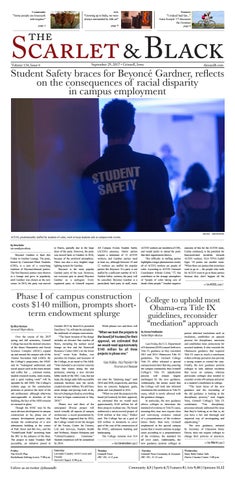
Student Safety braces for Beyoncé Gardner, reflects on the consequences of racial disparity in campus employment
HELENA
GRUENSTEIDL
ACESS, predominantly staffed by students of color, work to keep students safe at campus-wide events. By Vera Kahn kahnvera@grinnell.edu Beyoncé Gardner is back this Friday in Gardner Lounge. The party, hosted by Concerned Black Students (CBS), is a part of a years-long tradition of Beyoncé-themed parties. The first Beyoncé parties were thrown in a lounge and grew in popularity until Gardner was chosen as the new venue. In 2015, the party was moved
to Harris, partially due to the large draw of the party. However, the party was moved back to Gardner in 2016, because of the preferred atmosphere. There was also a new, brighter stage lighting system for Gardner. Beyoncé is the most popular Gardner party of the year. However, not everyone gets to attend Beyoncé Gardner as a partygoer. Every registered party in Grinnell requires
All Campus Events Student Safety (ACESS) presence. Harris parties require a minimum of 12 ACESS workers, and Gardner parties need at least six, although between 10 and 12 workers are staffed for popular parties like Beyoncé. If a party is not staffed by a sufficient number of ACE Student Saftey workers, the party will be cancelled. Beyoncé Gardner is a particularly hard party to staff; many
Phase I of campus construction costs $140 million, prompts shortterm endowment splurge By Alice Herman hermanal17@grinnell.edu Over the course of the 2017 spring and fall semesters, Grinnell College has seen the skeletal structure of the future Humanities and Social Sciences Complex (HSSC) expand up and around the campus side of the Alumni Recitation Hall (ARH). By the College’s projections, the HSSC and its “redesigned auditorium and social spaces such as the main atrium and coffee bar … common rooms, student research rooms, team rooms, and a quiet reading room” will be operable by fall 2020. The College’s website page on the construction promises to preserve the style of the old architecture: although otherwise unrecognizable in sketches of the building, the face of the ARH remains — encased in glass. Though the HSSC may be the most obvious development in campus construction so far, phase one of campus development projects also include the construction of a new admissions building at the corner of Park Street and 8th Ave., and the “North/South Walk” stretching from the JRC to the entrance of the Bear. The project to make Younker Hall accessible, an initiative posed in Friday The HAZE Play Bucksbaum Sebring-Lewis, 7:00 p.m.
October 2015 by then-SGA president Dan Davis ’16, will also be included in the multitude of campus renovations. “The latest iteration of the design includes an elevator that reaches all floors, including the sunken social lounge on first and the Stonewall Resource Center (SRC) on the lower level,” wrote Kate Walker, vice presiden for finance and treasurer of the College, in an email to The S&B. “Also included is an exterior concrete ramp that routes along the east perimeter, entering a new elevator lobby north of the SRC. Last, but not least, the design adds fully-accessible restroom facilities near the newly created elevator lobbies. We still have some design and pricing work to do, but we're hoping to finalize everything in time to begin construction in May 2018." Phases two and three of the anticipated 20-year project will touch virtually all aspects of campus architecture: a recent presentation by Kate Walker suggested that by 2024, the College would revisit the designs of the Forum, Center for Careers, Life and Services, Student Health and Wellness, Alumni Relations and “Library/Academic Commons.” Student residences will be considered by 2034. Saturday Lavender Country w/AJ Lewis and Friends Herrick Chapel, 8:00 p.m.
Follow us on twitter @thesandb
While phases two and three will
"When we took the projects to the board [of trustees] for their approval, we estimated that we would need approximately $140 million for all three projects in phase one." Kate Walker, Vice President for Finance and Treasure
not enter the “planning stage” until 2018 and 2020, respectively, and thus have no concrete budgetary goals, phase one was planned in 2014. “When we took the projects to the board [of trustees] for their approval, we estimated that we would need approximately $140 million for all three projects in phase one. The board authorized a not-to-exceed project of $140 million at that time,” Walker said. The College has set a goal of $20 million in donations to cover part of the cost of the construction of the HSSC, admissions building and landscaping. The College remains over $14 >> See Construction page 3
Monday Grinnell Prize JRC 101, 4:15 p.m.
ACESS workers are members of CBS, and would prefer to attend the party that their organization throws. This difficulty in staffing parties highlights a larger phenomenon: nearly all of ACESS workers are people of color. According to ACESS Outreach Coordinator Alfredo Colina ’17, this contributes to the strange atmosphere of “people of color taking care of drunk white people.” Another negative
outcome of this for the ACESS team, Colina continued, is the potential for bias-motivated incidents towards ACESS workers. SGA VPSA Kahlil Epps ’18 points out another issue: “When there are parties that minorities want to go to ... the people who work for ACESS want to go to those parties because they don’t happen all the >> See ACESS, page 2
College to uphold most Obama-era Title IX guidelines, reconsider "mediation" approach By Emma Friedlander friedland@grinnell.eduw Last Friday, the U.S. Department of Education (DOE) issued forth new Title IX guidance as they rescinded 2011 and 2014 Obama-era Title IX guidelines. The Grinnell College Title IX office released a special campus memo later that day, assuring the campus community that Grinnell College’s Title IX adjudication process will remain largely unchanged by the new guidance. Additionally, the memo noted that the College will look into informal resolutions like mediation in Title IX cases, which is newly allowed with the guidance changes. In particular, the new guidance allows colleges to determine the standard of evidence in Title IX cases, meaning they may now require clear and convincing evidence instead of a preponderance of the evidence (more likely than not). Grinnell emphasized in the special campus memo that it would continue to judge cases according to a preponderance of the evidence, the standard for all civil cases. Additionally, the new guidance permits colleges to .Tuesday Grinnell Prize Ceremony & Keynote JRC 101, 11:15 a.m.
pursue informal resolutions such as mediation, establishes an appeals process for disciplinary sanctions and establishes more protections for accused students. It also rescinds the Obama-era guidance that required Title IX cases to reach a conclusion within a 60-day period or else provide a strong reason to extend the case. Finally, the new guidance permits colleges to only address incidents that occur on campus, whereas previously colleges also needed to consider events off-campus and prior to a student’s enrollment in college. “The main focus of the new guidance and the rescinding of the old guidance is looking at the disciplinary process,” said Angela Voos, Grinnell College’s Title IX coordinator. “Our disciplinary processes already addressed the issue that they're looking at — that is, do you have a fair and thorough and impartial way of investigating and adjudicating.” The new guidance, initiated by Secretary of Education Betsy Devos, does not require colleges to change their policies or practices. >> See Title IX page 3
Wednesday Mary Beth Tinker Talk Harris Cinema Center, 5:00 p.m
Community 4,5 | Sports 6,7| Features 8 | Arts 9,10 | Opinions 11,12
2
News Poet Wilson Okello discusses introspection through prose
Edited by hermanal@grinnell.edu & mettleca@grinnell.edu
ACESS staffing reflects inequality among students on campus Continued from Front Page
HELENA GRUENSTEIDL
Wilson Okello discussed his poetry this week in JRC 101. By Gabe Loewenson loewenso2@grinnell.edu Wilson Okello, doctoral fellow and instructor at Miami University in Ohio, came to Grinnell on Thursday, Sept. 28 to give a convocation lecture about how to affect change in society and how to live in the wake of crisis. Okello specializes in using poetry to “generate critical selfreflection, inspire confidence and achieve agency.” A large portion of his speech consisted of poetry rather than prose, and he often switched from one to another in the midst of discussing a particular topic. He especially focused on the importance of learning from the past in order to avoid repeating its mistakes. “One of the things I appreciate the most about literary minds is their ability to … provide us with rich archives to trace and visit, so that our future and our present need not be out of touch with the currents of our past. … As the old adage goes
if you don’t learn from your history then you’re destined to repeat it.” Another primary talking point was the importance and the radical nature of defining oneself as one actually is, rather then what society expects one to be. “One of the most radical, one of the most profound things that we will ever do is to define ourselves in a world that has already determined who we are and what we’ll do.” This year, a theme of many events by the office of intercultural affairs is the individual in comparison with the collective. “I met Wilson I want to say two years ago — he came to another institution that I was working at, and he came at a time when our students were very much trying to figure out what is my voice. Because there were a lot of different things that were happening and they were trying to find their voice, and we actually brought him to campus. The power that he had on … the way in which I saw students move afterwards, I thought, ‘Grinnell
definitely needs that.” Wilson said that he first obtained the idea to use poetry to inspire change about twelve years ago. “Twelve years ago, when I went on the mic the first time, at an open mic, that was the moment when I realized, this isn’t just about me — that my public testimony could have a powerful influence on people who were here.” Although Wilson has not always written poetry, words have always been a valuable part of his life. “I’ve always been interested in the arrangement of words and ideas, and the way they might be able to stir people, … but I don’t know that I ever thought about what the oral tradition could do to evoke meaning for people. Thinking back, that time at open mic really brought close two ideas together for me: that writing didn’t just have to be creative writing, but that it could do something powerful in this world. So long before [that first open mic] but that moment still has really important meaning for me.”
time.” ACE co-chairs Selah Mystic ’19 and Claudia Handal ’18 agree that Beyoncé is incredibly popular for two reasons: One is the broad popular appeal of Beyoncé. The other is that CBS-hosted Beyoncé Gardner, like other parties thrown by Multicultural Leadership Council groups, are more inclusive to other members of MLCaffiliated groups, many of whom identify as people of color. Mystic says ACE is trying to encourage more people of color to host parties. However, “If this one subset of people are predominantly working ACESS,” Mystic asked, “how are we supposed to do that?” To put it another way, most parties at a predominantly white college are going to be understood as white parties. This is alienating to many people of color on campus. For some, working ACESS can be a way to go out on the weekend on a campus that does not always provide inclusive programming. Instead of attending a party that does not feel welcoming, some ACESS employees prefer to work the party.
"ACESS isn't going to get you into trouble ... [they are there to] make sure that self-gov is being upheld, that students are being safe." Claudia Handal, '18 The ACESS outreach coordinator position was created this year to help address these issues. The outreach program is working to destigmatize ACESS’ role at on campus events, as well as to recruit more white students. “If there was the same amount of diversity in ACESS as there is in the
college, there would never have been an issue of staffing any party,” Mystic said. She stressed that diversifying the racial makeup of ACESS is key to making sure that all “communities can enjoy the freedoms that other kinds of people enjoy.” As the situation stands, the freedom to socialize on weekends is compromised for many students of color. “ACESS isn’t going to get you into trouble,” Handal said. “[They are there to] make sure that self-gov is being upheld, that students are being safe, that there are sober people there watching” to help people who are too drunk, or to de-escalate potentially dangerous situations. While the alternative to student-run Student Safety is not explicitly stated, it would most likely entail at least a heightened presence of Campus Safety. Colina explains that he heard about the job “from a friend of a friend.” He also said that the ACESS directors being people of color was an encouragement to join the team. Instead of relying on word of mouth, new recruitment strategies include tabling outside of the Dining Hall. Colina says that this effort has been somewhat successful, especially with first-years. There are many appealing aspects of the ACESS jobs. ACESS offers flexible hours, a laidback work environment and an opportunity to participate in social nightlife without feeling a need to drink. Last year, Beyoncé Gardner was almost cancelled due to a lack of ACESS workers. However, the party went on, thanks to sacrifices made by leaders and members of CBS. Whether they know it or not, Grinnellians rely on ACESS for crucial campus events. Peers take a stand for self-governance in campus social life. It is a hope that students show some appreciation for fellow students who take the time and energy ensure student safety and work so others can party.
Alumnus returns to speak on international nuclear threats
By Clara Larson larsoncl@grinnell.edu
Greg Thielmann ’72 spent 30 years in foreign service for both the Senate Intelligence Committee and the Arms Control Association, serving in Brazil, Germany and Russia. His career gave him decades worth of experience in understanding and analyzing nuclear arms issues from the perspective of multiple branches of the U.S. government. On Monday, Thielmann returned to Grinnell to share his expertise, giving a talk called "Unleashing the Dogs of War: U.S. Policy Toward Iran and North Korea," in which he explored U.S. policy in response to countries with nuclear weapons. Professor Barb Trish, director of the Rosenfield Program in Public Affairs, International Relations and Human Rights, brought Thielmann to Grinnell, coordinating his visit to Grinnell with his visit to Newton, his hometown. “He has the kind of deep knowledge and intelligence and security from a career of working in government that even analysts from the outside don’t have,” Trish said. “The North Korea angle on [the nuclear threat] has been so present on peoples’ minds that we thought it was particularly timely.”
HELENA GRUESTEIDL
Wilson Okello discussed his poetry this week in JRC 101. Before addressing the imminent threat of North Korea, Thielmann explained how he observed the Bush administration’s mishandling of information that lead to the Iraq war. The Bush administration had been misinformed on the state of nuclear weapons in Iraq, while the State Department, where Thielmann worked, had the correct information. He noted Congress’s failure to acknowledge evidence that Iraq did not, at that time, have a nuclear weapons program. He juxtaposed the Bush
administration’s handling of Iraq’s nuclear threat by praising the Obama administration’s implementation of the Joint Comprehensive Plan of Action (JCPOA), more commonly known as the Iran nuclear deal, calling it an “extraordinary multilateral diplomatic effort.” The deal allows the International Atomic Energy Agency to monitor Iran and ensure that they reduce nuclear capabilities. It has thus far proven successful. Thielmann drew from his knowledge of both the Bush and Obama administrations to offer
recommendations for dealing with North Korea. He suggested that negotiations with Iran should set an example for the North Korea dealings in that the goal should not be a perfect deal, but a safe one. Thielmann outlined five possible solutions to avoid a potential nuclear war. First, the U.S. should cease threatening destruction to North Korea, which are actions he argues have been promoted by the Trump administration. Any threats by the U.S. against North Korea only bolster Kim Jong-un’s claims that North
Korea must continue its nuclear weapons program in order to protect itself from the U.S. Second, the U.S. should subtly remind Kim Jong-un that if North Korea attacks the U.S., there will be retaliation, which will mark the end of the Kim dynasty. Third, the U.S. should tighten international sanctions on North Korea. Fourth, the U.S. should make a public agreement that they will not strike North Korea first, a goal which Thielmann claims has been compromised by the “incoherence of the Trump administration.” Lastly, the U.S. negotiate with North Korea for a freeze of North Korean nuclear testing in exchange for an easing of sanctions and a lessening of South Korean and American military presence in South Korea. Thielmann addressed the moral dimension of using nuclear weapons by highlighting the unnecessary destruction caused by the Iraq war, a war caused by the threat of nuclear war. There is no “winnable nuclear war,” and due to the extreme implications of nuclear weapons, Thielmann argued that U.S. policymakers should completely stop the potential use of nuclear weapons, as it would alter the state of the world as we know it.
Edited by hermanal17@grinnell.edu & mettleca@grinnell.
News
Changes to Federal Title IX guidelines raises up concerns Continued from Front Page Instead, Voos emphasized, “most of this guidance is about choices. It's permitting some scaling back — we're not going to scale back.” Although the DOE largely decreases the accountability for colleges and protections for complainants with these new measures, Grinnell College affirmed that it will continue to operate under the Obama-era guidance. “I think colleges have to be accountable, and I think that was a very positive outcome of the Obama administration's guidances,” Voos said. “It put a spotlight on colleges and universities to make sure that the processes were fair and prompt, and that colleges understand their responsibility and accountability. … [The Trump] administration is focusing a lot on the adjudicative process, to make sure that due process is being served.” The new guidelines raise questions as to how the recommended practices might play out on college campuses. In particular, the provision for informal resolutions such as mediation, wherein a mediator assists the complainant and the respondent in reaching a mutual resolution in a case of sexual assault or sexual violence, has stumped college administrators and students alike. “The 2011 Dear Colleague Letter said [mediation] is not appropriate
even on a voluntary basis, and now they’re saying it could be used,” said Deputy Title IX coordinator Bailey Asberry. Although the College will be looking into the implications of mediation as a practice for Title IX cases, Voos assured that the College will not actively pursue mediation. A formal notice-and-comment period is expected to soon follow the new regulations, during which the College will hopefully clarify the significance of the mediation provision. “In our policy [mediation] is just not available, and we won't use it for sexual violence,” Voos said. “The guidance is saying you could. So we’ll think about that. At this point … we would still choose to not use mediation for allegations of sexual violence.” For student activists who have dedicated themselves to Title IX cases and survivors’ rights, the mediation provision is especially troubling. Leah Barr ’18, a previous co-leader of Dissenting Voices who has done extensive research on the handling of Title IX cases at Grinnell College and Carleton College, explained why mediation has typically been strongly discouraged. “The fear for me in mediation is that the respondent and the complainant will have to be face to face, and you were not allowed to do that under the guidance from the Obama era,” Barr said.
Although Barr was somewhat reassured by the College’s memo reaffirming their dedication to the Obama-era guidance, she expressed concern that the Grinnell Title IX office has not been following those measures in the first place. “I think they weren’t using that standard before,” Barr said about the preponderance of the evidence standard in particular. “I knew about specific cases where there was so much evidence and people were still not being found responsible. But at least the school is recognizing that the standard of evidence is important.” In addition to the standard of evidence, Barr listed Grinnell’s failure to issue timely Clery warnings and Voos’s additional position as Chief of Staff to the president’s office as examples of the College’s failure to conform exactly to Obama-era Title IX guidance. Should the DOE release mandatory new policy, the College will keep the campus community aware of any impacts to Title IX at Grinnell. In addition, the Grinnell Title IX office will soon be releasing an updated version of its Title IX policy, which does not make any policy changes but instead clarifies the adjudication and informal resolution process to the reader. This policy will be released as soon as an additional party has looked over and approved its contents.
College administrators at Nollen House promise to opt out of Secretary of Education DeVos' Title IX guidelines.
MAHIRA FARAN
3
Construction project taps into endowment
Construction is projected to continue until 2034. Continued front page million shy of the initial donations goal: in an email to The S&B, Mae Parker, Director of Annual Giving wrote that “as of June 30, 2017 we are at $5,286,447.26 raised towards the $20 million goal.” In what Walker described as a standard budgetary operation, the College will issue bonds to cover expenses of the project not covered by donations received for the buildings. “Within that budget, we talked about how we were going to pay for this, and there were two components — one is the $20 million gift target, and the other is that we were authorized to issue $120 million in bonds, that the College has to pay back,” Walker wrote. Less standard, however, is the means by which the school plans to pay off its debt: by increasing the payout on the endowment. “For this particular purpose … we are getting $5 million extra per year for six years. So a total of $30 million for that period where we have a spike,” Walker said. According to Interim Chief
HELENA GRUENSTEIDL
Investment Officer Andrew Choquette and Associate Director of Investments Angela Clement, as of June 2017, the endowment supported 53 percent of the College's operating budget. The endowment, which was discussed openly for the first time ever last Tuesday, Sept. 19 in a presentation held by the Divestment and Climate Impact Task Force, has reached an alltime high of $1.87 billion. Pervading conversations about the College’s $1.87 billion dollar endowment, however, is the sense of an urgent need to conserve: Choquette and Clement expressed that there exists concern over what trustees perceive to be a risky dependence on the endowment for the College’s operating budget. Despite this concern, which has prompted the College to take what Choquette, in his talk, called a “conservative” approach to the endowment, the endowment has actually grown at an average of eight percent in recent years, and took a 17 percent leap last year. The annual payout on the endowment, however, remains below 4.5 percent, a significantly smaller cut than most peer institutions take from their endowments annually.
Campus Climate Survey reveals demographically-dependent levels of "comfort on campus" By Ben Mikek mikekben@grinnell.edu Over the last few months, Grinnell’s Council on Diversity and Inclusion conducted and interpreted the results of the recent spring 2017 campus climate survey. It included 104 questions regarding opinions about diversity and feelings of inclusion on campus. With the results, the council is attempting to determine the extent to which different groups of Grinnellians feel welcome on campus and how some of these groups could be included better in the campus community. Of approximately 2300 members of the Grinnell community that include faculty, students and staff members, 597 responded to the survey, leaving many voices unheard. Notably, students were significantly underrepresented in the voluntary survey, accounting for about 40 percent of responses, even though they make up about 68 percent of the Grinnell community. Given these limitations, Assistant Vice President for Diversity and Inclusion Lakesia Johnson and Director of Intercultural Affairs Maure Smith-Benanti focused on additional qualitative measures of inclusion at Grinnell. “Not everyone has had an
opportunity to share their voice and opinions,” Benanti said. “Another way to collect data is to gather the lived experiences from the people.” The survey responses are, however, a useful metric of Grinnell’s campus climate. Roughly 68 percent of survey respondents stated that they were either “comfortable” or “very comfortable” with the campus climate, a slight increase from the 63 percent who said the same thing in 2009. The survey, which required that students choose between gender categories “man,” “woman,” “transgender” or “other,” revealed that while approximately 70 percents of respondents who identified as men, women or transgender reported feeling comfortable on campus, only 42 percent of those selecting “other” felt comfortable. Community members of color also reported lower feelings of comfort with the campus climate; almost 72 percent of white students reported feeling comfortable on campus, while 55.6 percent of African American and Black respondents, 58.3 percent of Hispanic and Latino respondents, 60 percent of Asian and Asian American respondents and 56.3 percent of students who selected the “two or more races” category
reported feeling comfortable on campus. Additionally, only 30 percent of self-identifying conservative community members reported feeling comfortable, compared to more than 70 percent for liberals and those who were “middle-of-theroad” or “non-committal.” “I was disturbed by the term ‘intolerance’ [in the comments section of the survey]. The idea that we are actually intolerant of conservative views is very different from saying, well, we don’t tend to see them represented as much,” Johnson said. Clearly, though Grinnell is generally considered an accepting place, there is still progress to be made. Johnson and SmithBenanti outlined five major issues to address in the next round of campus inclusion planning: the intolerance of conservative community members; disrespect or unfair treatment of staff; isolation from racial, ethnic, gender or other communities; accessibility and accessibility awareness; and transparency of the Council and its process.
While the response plan to the 2017 survey has yet to be completed, some steps have already been taken toward mitigating some of these problems. One of the success stories Johnson noted was the creation of the Ombuds Office. “One of the things that the 2009 survey task-force recommended was that we hire an ombudsperson — somebody who is truly independent and completely confidential that folks could meet with in order to sort out their options for dealing with difficult issues,” Johnson said. In the short-term, Johnson hopes that the council will publicize its findings from the Campus Climate Survey. The council plans to use the survey data to write a comprehensive plan of action on diversity and inclusion by the end of this semester and to enter the budgetary process for implementing the plan in January. Measurement of a problem does virtually no good if nothing is done to combat the issue, so taking action and allocating funds will be an important part of the College’s response to any findings of the Council on Diversity and Inclusion.
Johnson said that the budget planning process after diversity planning is an “opportunity for the institution to put its money where its mouth is.” Nevertheless, it is also possible that spending on diversity and inclusion can enhance some of the other goals of the ollege. “My hope is that prioritizing diversity initiatives would not be seen as competing with [other priorities], but in fact that it would be seen as enhancing those initiatives for which we would normally budget,” Johnson said. In the longer run, the Council plans to continue to administer surveys every few years, tinker with its methodology and observe the outcomes of implemented solutions. “The purpose of our presentation today is to spark conversation that will lead to practical suggestion and feedback overall from the campus community,” Smith-Benanti said. If the council lives up to its mission and the high hopes of its coconveners, diversity and inclusion may well become sites of positive change in the Grinnell Community.
Community
4
True Grinnellian: Monica St. Angelo
MAI VUO PHUOUNG
Monia St. Angelo is a devoted community member in Grinnell. By Kelly Page pagekell@grinnell.edu Sometimes it’s hard to find peace in your life, a reality that Grinnell students know all too well. But Grinnell resident Monica St. Angelo has found a powerful way to relieve stress in her everyday life that she hopes to share with Grinnellians: yoga. St. Angelo is in charge of Locally Grown Yoga in Grinnell, where she works as an instructor and administrator. She also teaches two free yoga classes every week in the Faulconer
Gallery, on Mondays and Thursdays from 12:15 to 12:50 p.m. The Faulconer Gallery classes provide a way to relax among art work, as St. Angelo encourages everyone practicing yoga to go at their own pace and do what makes them comfortable. Apart from being a good form of exercise, St. Angelo sees yoga as a way to connect with oneself on a deeper level. “The most basic philosophy of yoga,” she said, “is that when you quiet your mind you have a chance to see your own nature. I think in general it can just be a really good tool to relieve
stress and help you be centered and grounded in your life.” What sets yoga apart from other forms of exercise is that it is intended as a spiritual practice as well as a physical one. St. Angelo discovered the healing power of yoga almost by accident when she decided to try it out at her local gym and it quickly became an important part of her life, taking her from being a yoga student to owning a yoga studio. St. Angelo’s friend, Jenny Zink, started Locally Grown Yoga when she decided to put the then-vacant space
above Bikes to You in downtown Grinnell to good use. After talking Bikes to You owner Craig Cooper into allowing her to use the space, Zink began transforming it into a setting where people would enjoy doing yoga. St. Angelo became Zink’s partner, and when Zink moved away, St. Angelo took over the studio, which she has run and taught at ever since. “I hope it’s a place people can feel comfortable,” St. Angelo said of the studio. “It’s a happy space to be environmentally. It’s got high ceilings and brick walls and faces east. There’s also a really comfortable, supportive group of people, and I hope that it’s a positive addition to people’s lives if they choose to come.” Since becoming a yoga instructor, St. Angelo has also taught yoga to trauma survivors as a way to help them heal. “Oftentimes people who are survivors of trauma have a real separation from their body and yoga has been shown to be a good tool to kind of take back that aspect of yourself,” she said. St. Angelo guides trauma support group members through breathing and gentle movements, helping them connect to their bodies in a new way. Although the program has been dormant for a couple of years, St. Angelo hopes to revive it soon and bring it to more people. Apart from being a yoga instructor, St. Angelo is involved in other aspects of the Grinnell community, including volunteering for the Band Boosters for Grinnell High School,
Edited by braneckm@grinnell.edu
where her two children are students. The organization hosts fundraisers that allow the band program to replace uniforms and instruments as needed. She also helps with Local Foods Connection, which assists Grinnell residents in accessing local food. The organization saves money to purchase food from local farmers and then provides that food to locals in need. St. Angelo has been a resident of Grinnell for eighteen years, but she didn’t always think she would live in such a small town. She grew up moving a lot with a father in the army, and lived in New York City, Wisconsin and Rhode Island before moving here with her partner, who works for the College. “I love the people here, whether they’re connected with the College or with the town. They’re really thoughtful and interested in making a better place for everyone here,” she said. “I’ve never lived somewhere so small in my life and when you live in bigger places you always think, ‘They don’t have this there, they don’t have that there,’ but I feel like for the most part we’re all looking out for each other in this town.” If Grinnell’s community is what makes it special, St. Angelo should definitely be counted among those doing important work to make it better. Whether by teaching yoga at Locally Grown or in Faulconer Gallery, helping trauma survivors, volunteering for high school music or helping distribute local foods, St. Angelo is invested in helping Grinnell be as good as it can.
Drake Library to host weekly movie nights
Homecoming parade overtakes Grinnell streets
By Julia Kunzman kunzmanj@grinnell.edu During the month of October, Drake Library will continue its community movie program “Monday Night Movies.” Established in May of 2017, the movie screening program is a community favorite. “[T]here has been a demand for public showing of movies again this fall at Drake Community Library,” library employees Marilyn Kennett and Julie Owens wrote in a press release. The month of October will have five movie showings open to all people of the community eighteen years-of-age and older. Each movie starts at 6 p.m. in the Caulkins Community Room and will conclude within two-and-a-half hours. The showings are free and are open to the public. Snacks and water are provided, and attendees can also bring their own treats.
Every year, current students, alumni and the people of Grinnell celebrate its "Tiger Pride" with the annual homecoming parade. Fans crowd the street to show their pride for the Grinnell-Newburg Community High School. Children at the elementary school wore orange for their "Tiger Pride." The Thursday parade precedes Friday’s football game, when Grinnell hosts Norwalk. Fans are hosting a “Blackout,” and are encouraged to wear all black and black Grinnell gear. Photos by Sarah Ruiz.
“The Devil Wears Prada” (2006) will kick off the movie nights on October 2nd, followed by “The Uninvited” (2009), “Moonlight” (2016) and "Space Cowboys” (2000). Concluding the program will be “The Haunting of Molly Hartley” (2008) on Oct. 30. In the spirit of the Halloween Season, “The Uninvited” and “The Haunting of Molly Hartley” are horror films. However, the movies' themes vary, and dabble into comedy, drama and science fiction. “Moonlight,” a drama released in 2016, won the 2017 Academy Award for Best Picture. The program is accessible to those with disabilities “and equipped with an induction hearing loop system, which enables individuals with hearing aids set to T-Coil to hear the movie.” For more information, contact the library at (641) 236-2661 or visit www.grinnell.lib. ia.us.
MAHIRA FARAN
The Drake Library is host to a wade array of community events, including the upcoming movie nights
Welcome all Super Heroes Put on your favorite super hero costume and join other caped crusaders at this unique and family friendly event for serious runners, families, and everyone in between. The race starts at the GRMC Healing Garden, circles around Arbor Lake, and heads back to the medical center.
Sunday, October 8 8 a.m. – 5k Starts GRMC Healing Garden bit.ly/GRMCSuperHero
210 4th Ave. • Grinnell, IA 50112 641-236-7511 • www.grmc.us
RACE FOR QUALITY HEALTHCARE AT GRMC’S SUPER HERO RUN. HEADLINE SPONSOR Grinnell College
SUPERMAN SPONSOR Grinnell Chamber of Commerce
THE INCREDIBLES SPONSORS Pathology Associates of Central Iowa Poweshiek Mutual Insurance Association
MILE MARKER SPONSORS Grinnell Eye Care Julin Printing Company, Inc.
Proceeds from this event will help purchase medical and fitness equipment at GRMC.
WONDER WOMAN SPONSOR University of Iowa Community Credit Union
FINISH LINE SPONSORS Ahrens Park Foundation Todd and Angela Linden Poweshiek Publications
Community
Edited by braneckm@grinnell.edu
Grinnell Heritage Farm aims to unite Grinnell, build community
By Molly Nelson nelsonmo@grinnell.edu Beginning in August and continuing through October, Grinnell Heritage Farm has welcomed the Grinnell community to pizza nights every second and fourth Friday of the month. Andrew Dunham, who owns the farm with his wife Melissa, hopes to build community through the pizza nights. “With the latest round of elections, it has been relatively eye-opening to see the divide in a town like Grinnell and how polarized it is,” Dunham said. “For the most part, people who are liberal or conservative don’t even talk to people who they deem the opposite of them. So this a way to get people out and having conservations.” Communal seating promotes conversations between neighbors. Live music, delicious food and the idyllic backdrop of the farm create a comfortable and authentic environment. “I’ve had a lot of great conversations with people who I don’t think I would have met otherwise,” Dunham said. “We’re trying to do our small part.” The event attracts a wide variety of people, from college students and professors to town residents and farmers. The most recent pizza night coincided with parent’s weekend, leading the farm to prepare around 400 pizzas in anticipation of a larger crowd. Although the owners encourage community, the farm itself is a controversial topic among town residents.
“With the latest round of elections, it has been relatively eye-opening to see the divide in a town like Grinnell and how polarized it is." Andrew Dunham “Some people are knee jerk anti-organic,” Dunham explained. One individual in particular drives by the farm a few times a year and yells anti-organic expletives out the window. Dunham attributes this sort of response to people simply not having enough education surrounding organic farms. Over the years, however, the town’s view of the farm has
grown more positive. “I would say most of people that give us a chance and come out and see the farm are pretty impressed,” Dunham said. “When I first moved here, I could go into the implements store and they kind of looked like I was crazy. Now that we’ve actually been financially successful and purchased equipment there, they’ve gotten to know me. Now they’ll come out and say ‘hey, do you need anything this year?’ or ‘what can we help you with?’”
“My degree was in ecology and I just don't have any interest in conventional farming." Andrew Dunham In addition to changing perceptions of the farm, financial success allows Dunham to farm in the first place. “[There is no] economic incentive to farm corn and soy on 80 acres,” he said. “We would likely lose money every year and I wouldn’t be farming. I would just be hiring a neighbor to do all the work for me and that just doesn’t interest me.” Unlike most farms in Iowa that alternate between cultivating corn and soybeans, Grinnell Heritage Farm grows a variety of different crops, which are certified organic and therefore have higher market value. From an ethical standpoint, however, Dunham wouldn’t farm conventionally “even if it was more lucrative.” He described how pesticide and fertilizer runoff wreak havoc on the environment, causing a massive dead spot the size of New Jersey in the Gulf of Mexico. Additionally, the sustainability of the farm is important for future generations. Instead of using chemical pesticides, Dunham employs methods to attract beneficial bugs, natural enemies of pests. These bugs include certain beetles, parasitic wasps and praying mantises. After the harvest is over Dunham plants a cover crop, rather than leaving the field empty as in surrounding conventional farms. This crop nourishes the soil while also preventing erosion, keeping nutrients in the soil and not running off into wa-
HELENA GRUENSTEIDL
Scenes from the sprawling Grinnell Heritage Farm. Its owners hold events with the intent to build community. terways. “My degree was in ecology and I just don’t have any interest in conventional farming,” Dunham said. “I’m not interested in killing off microbial life in the soil in order to mine it for grain crops. And so, it’s kind of this or not [farming] at all.” In fact, Dunham had never considered farming until relatively late in
Women's self defense seminar
By Kate Irwin irwinkat@grinnell.edu This weekend, Grinnell local Kirby Ziesmer is holding a free self-defense seminar for women. This event will teach techniques that help defend against assault, with an emphasis on defense against sexual assault. The seminar will be held Saturday, Sept. 30 at 10:30 a.m., at the Masonic Lodge, 928 Main St.
“I know these things. Why am I not sharing them with a vast majority of people in Grinnell?." Kirby Ziesmer The self-defense moves that Ziesmer will be teaching are in the form of Brazilian Jiu Jitsu, a form of Jiu Jitsu that is purely groundwork. "It's all groundwork and ground technique and self-defense. That way it utilizes a smaller person's attributes against a person much larger, stronger or athletic by putting forth as little effort as possible," Ziesmer said.
“These techniques are proven to work, but nothing is guaranteed" Kirby Ziesmer Ziesmer first learned Jiu Jitsu during his time serving in the Marine Corps and has been practicing Jiu Jitsu for over 12 years. He currently teaches Jiu Jitsu in town, but wanted to take his work further and reach out to more residents of Grin-
Movies at the Strand
5
nell and hold a self-defense seminar. "I know these things," Ziesmer said. "Why am I not sharing them with a vast majority of people in Grinnell?"
“My goal for the seminar is to give one woman one technique that may help her if she is ever physically assaulted or sexually assaulted." Kirby Ziesmer The techniques that will be taught can be used by anyone, but are tailored towards women. The seminar will begin with information about sexual assault: where it is most likely to happen and who is most likely to perpetrate the assault. Ziesmer will then teach and explain techniques and allow participants to practice each move on another person. He hopes to be able to teach eight different techniques at this first seminar. Participants are encouraged to bring water or a sports drink, comfortable clothing and an additional person to help practice the techniques. "My goal for the seminar is to give one woman one technique that may help her if she is ever physically assaulted or sexually attacked,” Zeismer
IT
life, despite coming from a long line of Grinnell farmers. “I had no interest in farming all the way through high school and college. So, I didn’t really take agriculture classes,” Dunham said. While the farm has been in the family for over 150 years, Dunham was born in Northeast Iowa, not in Grinnell, after his father decided to
become a veterinarian rather than compete with the large-scale corporate farms of the 1970s. Dunham had to leave Iowa to find his love for farming — he realized his passion while in Tanzania, working for the Peace Corps. “I realized, ‘Hey, I really like this kind of work.’ And I’ve been doing it ever since.”
said. “And whether that's emotionally or physically, that's all I really hope to achieve.” If this seminar is successful, Ziesmer hopes to hold more seminars in the future. He wants to emphasize that one seminar is not promised to protect someone from assault, but knowing a few techniques can keep one safe in the instance of an assault. "These techniques are proven to work, but nothing is guaranteed," Ziesmer said. "I don't want to give them false hope, but give them confidence that if they are in that situation they can relax … and think about getting away."
"It's all groundwork and ground technique and self-defense." Kirby Ziesmer Additionally, Ziesmer teaches a self-defense class for Grinnell students on Saturdays from 5 to 6:30 p.m. at the Bear Athletic Center. He hopes to expand these classes to meet three times a week so that he is able to teach students on a more regular basis.
Showtimes: 3:50 p.m., 6:45 p.m., 9:30 p.m. The Community Editor and Business Manager thought the trailer was medicore but spooky.
THE LEGO NINJAGO MOVIE
Showtimes: 3:40 p.m., 6:30 p.m., 8:50 p.m. Abbi Jacobson voices a character in this, but watch Broad City.
KINGSMAN: THE GOLDEN CIRCLE
Showtimes: 4:00 p.m., 7:00 p.m., 9:50 p.m. So many (phallic) guns!
Sports
6
Edited by schultej@grinnell.edu
Important takeaways from Trump's comments on athletes
CONTRIBUTED
National anthem protests have led to contentious debates about patriotism, the military and social justice. By Sam Rueter ruetersa@grinnell.edu The National Football League (NFL) now operates as a highly visible forum for discussion about social change. This started last fall, when currently-unemployed quarterback Colin Kaepernick refused to stand during the national anthem before games. Kaepernick, who was joined by a handful of other players from various teams throughout the league, stated that his aim was to begin a dialogue surrounding the treatment of minorities in American society. The reaction to Kaepernick's protest was polarizing, with some praising him for his courage and sense of social responsibility and others labeling him "un-American"
and "anti-military." On Saturday night, President Donald Trump decided to join the conversation about Kaepernick and athletes like him who refuse to stand for the playing of the national anthem. In a series of tweets, Trump wrote that "if a player wants the privilege of making millions of dollars in the NFL," they "should stand for the national anthem. If not, YOU'RE FIRED." Unsurprisingly, Trump's comments had an opposite reaction from what he intended, with more players choosing to kneel or sit on Sunday than ever before. In fact, entire teams like the Seahawks, Titans and Steelers refused to even come out of their locker rooms for the playing of the national anthem.
Though repudiated in the sports world, Trump's comments are anything but a minority viewpoint, as they reflect the opinion of a sizable subset of the US population who see the American flag and national anthem as unassailable. A football field is often perceived as a literal or metaphorical battlefield, and this inherent connection to the military means that a protest of this nature in football is much more likely to provoke outrage than were it to be carried out in another of the major professional sports leagues. Furthermore, the NFL makes conscious attempts to quash the individualism of its players, either by penalizing them for celebrations, fining them for wearing unauthorized ap-
parel, or berating them for speaking out of turn with the media. This intentional censorship on behalf of the league and its corporate partners creates a delicate facade of collective identity that, when shattered by a player speaking up (or kneeling down, rather) in the name of social injustice, leads to feelings of anger and betrayal from the larger fan community. Trump's recent comments are problematic on multiple levels, partly because they prey on the lack of a personal connection between football players and fans, but also because of what they say about where his priorities lie. US tensions with North Korea are at an all-time high, and major US cities like Houston are still reeling from a series of devastating natural disasters. One would hope that the American president would spend more energy and effort focused on these issues, as opposed to involving themselves so intently with the American sports landscape. The NFL, for its part, has to be loving the attention that Trump's comments have gotten. For the past decade, the league has suffered an identity crisis, with issues of CTE and domestic violence dominating the headlines. For more and more Americans, watching professional football has become not simply a question of entertainment, but a test of morality. By focusing on Trump's incendiary tweets, the conversation has shifted, if only briefly, away from many of the problematic aspects of football and football culture. Perhaps lost in all the commotion, though, is the hypocrisy of Trump's comments. A cornerstone of his election
campaign was his pledge to "Make America Great Again," in large part by giving a voice to those who felt underrepresented and appreciated in a rapidly evolving political, social and technological space. Setting aside the irony of a millionaire claiming to work for the poor, Trump's rhetoric actually seemingly speaks to the very people who he is so fervently condemning: NFL players. In the major American male sports landscape, NFL players are pretty much bottom of the barrel. They have no protections, no guaranteed contracts, no clear pathway for success and fulfillment after football. They operate in large part at the whim of a small group of billionaires and big companies. In other words, NFL players are the forgotten casualties of the crusade to sell tickets, jerseys and TV rights deals. As such, not only do Trump's comments seem to reinforce notions that he is politically out of touch and serve as an impediment to positive social change, they also emphasize the ever-vacillating nature of his political agenda. In a nation that preaches unity but subsists on division, sports bring people together more than anything else. While our current president is seeing the bonds strengthen between athletes occur before his own eyes, it is most important that fans and non-athletes pay closest attention to the conversation that Kaepernick started and Trump attempted to finish. Only then can meaningful bipartisan dialogue occur that transcends sports and leads to richer definitions of equality. Alas, if only a society predicated on peace, kindness and empathy
How campus visits differ for prospective athletes
By Carter Howe howethom@grinnell.edu For prospective student-athletes, picking a college that is the right fit both athletically and academically can be daunting. Grinnell sports teams and coaches try to provide prospective student visitors an experience that builds community. While many students visit campus, for prospective student-athletes,
visiting campus can be especially helpful as it allows them to meet their potential coach and teammates and see the facilities where they will be potentially be training next year. Although per NCAA regulations prospective athletes are not allowed to attend a team practice supervised by a coach, as this would constitute a try-out, prospective student-athletes often get to hang out with team members and experience what it’s like to be part of
the team. For Lauren Edwards ’20, defender on the women’s soccer team, visiting campus was a valuable experience because it allowed her to see if she would get along with the other team members. “I ate lunch with the team and immediately thought that they were just a great group of people. A lot of the times people that I’ve played with haven’t been focused as much on academics as I have, so here are a
group of people who are as focused as academics but also love soccer like I did, and I felt like these were a great group of new people that I knew that I would feel like part of them,” Edwards said. Ali Hickey ’21, a member of the women’s tennis team, also said that having fun with the team when she visited was a key reason that she decided to come to Grinnell. “I think that was like a big selling point for me was just like how I got along really well with the team and how they were really welcoming to me, and also the coach getting along with her and seeing like how the program she’s running how successful it is,” Hickey said. Coaches like to take advantage of Discover Grinnell weekend because it gives prospective students a comprehensive look at the College and allows them to show multiple prospective students around their teams. “The Discover Grinnell program offers so much in a short amount of time and in the opportunity to do that with other prospective students many coaches take advantage of that and call that you know this is the recruiting weekend for us,” head women’s swimming and diving coach Erin Hurley said. Hurley said that coaches like to arrange for prospective student-ath-
letes to stay with members of the team so they can get a more authentic experience of the College with a member of the team. “We take an active role in finding them a host so it would be somebody on the team Since the Discover Grinnell programs are really heavy on Monday with a lot of options we try to provide opportunities to them on Sunday to one get to know the team but be engaged on campus with in a more relaxed environment,” Hurley said. Hurley said that on Discover Grinnell weekends, the swim team goes to Dari Barn and plays Cards Against Humanity with the prospective students to build community. “We do a trip to the Dari Barn. I think they play either celebrity of crimes against humanity — I’m not sure if I’m saying it correctly,” Hurley said. Ultimately, Hurley said that campus visits provide an experience to visit campus personally that cannot be replicated. “I meet these students and what are they interested in and that experience they have you can do a virtual tour you can see that information but until you have one on one relationships with people … that’s really important to I think the continuation of getting students that are a good match for Grinnell.”
Explore how "the cage" works with Ron Cooper issue equipment to all varsity athletic teams, and also to intramurals. Through the front window, students can always borrow equipment to play recreationally, regardless of whether they play a sport. In addition, it also does laundry for Grinnell Outdoor Recreation Program (GORP).
MAHIRA FARAN
The cage is responsible for hundreds of bags of laundry every night. The hours are odd, but it's always interesting. By Quan Tran tranminh2@grinnell.edu In the basement of the Bear Athletic Center lies the heart of Pioneer athletics — the equipment room, also known as the cage. This week, I ventured in to figure out what the cage is all about, and was welcomed by Ron Cooper, equipment manager. He has been working here for nearly 40 years and knows everything there is to know about the cage. The cage’s name is derived from its previous building.
“The cage originally was in the building across the street. There was no air conditioning, and we used chicken wires to lock it up from the outside. It was literally a cage,” Cooper said. At the center of the cage is a set of washing and dry cleaning machines. Their job is simple: to do laundry for all athletes every day, seven days a week. After that, Cooper and his student helpers fold the clean clothes and put them back in their designated lockers so athletes can wear them the next day. There
are two student helpers per shift. In total, there are two full time and four part time equipment managers, and various student helpers throughout the day. Every day, Cooper deals with fourteen to eighteen loads of laundry and usually stays until 10 p.m. to finish all of his necessary duties. “It takes about three to three and a half hours to do all the laundry,” he said. Apart from laundry, the cage is home to all varsity teams’ equipment. The equipment managers
“[What frustrates me the most] is when athletes don't bring the laundry to the cage in time. I'm on a time limit like everything else, so if it gets in here late it makes me late. Hassan Thompson '19 Like most jobs, being the cage’s manager has its frustrations. The source of it, surprisingly, comes not from the machinery but from student-athletes. “[What frustrates me the most] is when athletes don’t bring the laundry to the cage in time. I’m on a time limit like everything else, so if it gets in here late it makes me late.” Cooper sometimes can’t help but reminisce about the original cage, where he worked for thirty
years before moving to its new and current location back in 2010. “I feel sad that I outlived that building. [This new building] is better, but it’s also bigger and harder on me.” For better or for worse, Cooper’s journey here at the equipment room has been nothing short of a wonderful ride, and there’s no doubt he’s enjoying every bit of it. Outside the cage, though, Coop keeps a garage that's "like a record store."
“The original cage was in the building across the street. There was no air conditioning, and we used chicken wires to lock it up from the outside. It was literally a cage. Ron Cooper, Equipment Manager If students want to check out Coop's garage sale, in which he'll be selling records, vintage hi-fi equipment and "lots of cool retro stuff," they can head to 1214 Summer Street Friday, Sept. 29 10 a.m. to 5 p.m. and Saturday, Sept. 30, 10 a.m.
Sports
Edited by schultej@grinnell.edu
Family is MVP for Hassan Thompson '19 Athletic department and President Kington side with athlete protests
By Quan Tran tranminh2@grinnell.edu
Grinnell Football’s recent 15-6 win against Trinity Bible College made headlines for being the first win since 2015. However, what few people know is that the Pioneers were down by 0-6 at halftime, and the comeback didn’t start until Hassan Thompson ’19 made a game-changing block in the third quarter. From that point on, the Pioneers didn’t look back. “It was definitely a game changer. I’ve honestly felt like [the block] was the moment throughout the whole game,” Thompson said. Thompson’s crucial play subsequently earned him a spot on the D3football.com “Team of the Week.” Thompson admits that he enjoys the recognition but also doesn’t forget that football is a team sport.
“It's nice to be acknowledged. It has my name on it, but I think most importantly it represents our school and the progress we have [made] over the year and how this program is moving forward.” Hassan Thompson '19 “It’s nice to be acknowledged. It has my name on it, but I think most importantly it represents our school, the progresses we have [made] over the year and how this program is moving forward.” The win has created a very positive atmosphere in the locker room. “It’s [good] to know what it feels like to win and what the [necessary] preparations are. Right now, it’s a different culture. Guys are bonding very well, and we’re not just out there freelancing.” As deeply passionate about football and sports as he may be, Thompson is also very focused in academics, especially his major, economics. A personal goal of his is to keep his GPA above 3.2 for the rest of his time at the College. Many students shy away from varsity athletics because of the rigorous time commitment, but for Thompson, being on the football team actually motivates him to organize his schedule more efficiently. “It’s kind of easier to focus during the football season. … The less time available just makes me prioritize all the time I have to do my work.”
“Honestly, it's pretty cool being able to go home and see my motivation every day and not having to worry about other extra things.” Hassan Thompson '19 The pressure of being a student-athlete is already hard enough
7
for many students. Yet for Thompson, the responsibilities don’t stop there. He is one of a few student-parents at Grinnell, and is living off campus with his wife and his son. With his wife, Grace, closing in on getting a degree from Iowa Valley Community College and his son, Hassan Jr, turning two this September, Thompson’s little home is, as he said, “doing as lovely as ever.” Ever since Thompson’s wife and son moved to Grinnell with him at the end of his first year, he has lived every day feeling inspired and supported by his family.
“It’s kind of easier to focus during the football season. … The less time available just makes me prioritize all the time I have to do my work.” Hassan Thompson “Honestly, it’s pretty cool being able to go home and see my motivation every day and not having to worry about other extra things.” Grace and Hassan Jr. are rarely strangers in Grinnell. They are usually spotted with Thompson, studying together in Noyce Science Center. The Thompsons also have a very organized schedule, in which Grace attends classes on Tuesday and Thursday while her husband does so on Monday, Wednesday and Friday. They have rarely faced any scheduling conflicts, except when finals come around. Yet even in such cases, the Thompsons still have a great support system from back home. “Last year, [Grace’s] mom came and got the baby and [took care] of him for the finals week. So we were both able to focus on studying for our exams,” Thompson said.
“Honestly, it's pretty cool being able to go home and see my motivation every day and not having to worry about other extra things.” Hassan Thompson '19
Balancing three distinct roles simultaneously is never an easy task, and his peers marvel at how he does it, asking questions about how he manages everything. Still, Thompson never lets that stop him, instead embracing his duties as a student, athlete and father. “I love the fact these experiences [show me] that if I can overcome these obstacles now, then how much easier it would be when I’m in my career field. And I’m not going to expect [anybody] to have a pity on me just because of my situation.” Needless to say, Thompson always credits his family whenever he does anything. His opinions about various topics may change from one conversation to another, but the love for his family never does. When asked about his wife and son, Thompson says, “It’s a blessing.”
ANDREW TUCKER
President Kington and the athletic department support Grinnell student-athletes' rights to protest the national anthem. By Lily Bohlke bohlkeli@grinnell.edu Several Pioneer football team members took a knee during the national anthem this past Saturday, as well as in games throughout this season and last. This past Sunday, Sept. 24, after U.S. President Trump’s comments that players who protest during the anthem should be fired, over 200 NFL players protested. The week before, just six NFL players knelt during the anthem to protest police brutality.
“I believe strongly that the athletes have the right to express their opinions as citizens and should do so without fear of reprisal.” Raynard Kington, President At each home sports contest, student event supervisors coordinate the playing of the national anthem, a task which includes putting up the flag and handling it properly according to the U.S. Flag Code, the legislative guide for displaying the American flag, according to Melissa Anderson, one of the student supervisors. Over a year ago, NFL Quarterback Colin Kaepernick took a knee during the national anthem for the first time, which marked the beginning of this method of protest against racism and police brutality. Following this action, other players have begun to do the same. “[NFL protesters] are trying to get the awareness off the rich owners that always get … the fame and the fortune, while the Black people are just being their puppets and circus acts while they’re getting money. We’re waking up, so people are like, let me kneel and show that we’re not going to just keep being their puppets,” said Erik Henderson ’19, former member of the football team.
“Being a Black man in this country still, I am still held back even though we have been pushing for so long, so [for me, kneeling is] to bring awareness to this campus that I know this campus didn't have." Erik Henderson '19
HELENA GRUENSTEIDL
Hassan Thompson '19 has been a key player for the Pioneer football team. Recently, he earned national recognition for his play earlier this month.
Closely following Kaepernick’s initial protest, some members of Grinnell’s football team began following his example, including Henderson. “During the Civil War and the American Revolutionary War they had Black soldiers fight in the war, but once they returned, they weren’t allowed to get houses, they weren’t allowed to live in certain areas be-
cause of the fact they were still Black,” Henderson said. “Being a Black man in this country still, I am still held back even though we have been pushing for so long, so [for me, kneeling is] to bring awareness to this campus that I know this campus didn’t have.” Last year on Military Appreciation Day, the football team had a dialogue with veterans about their choices to kneel. Some of the people they spoke to were receptive to their rationales, while others claimed the players making this choice were still disrespecting the country. “My main point I was trying to get to was that I am still American," Henderson said. “Even though I am kneeling, I live here, some of my uncles fought in wars. I have shown the same patriotism as you but I’m just trying to let you know that there is still [injustices] in this country ... People have these views of athletes that they don’t care about social justice, so we’re acknowledging it here on this platform because we have a platform, we have people come to the stadiums and watch us play sports, so letting them know that we’re going to keep this conversation [going], even in athletics.”
“We are focused on the rationale and prompting of conversation and are welcome and receptive to dialogue." Holly Roepke, Assistant Athletic Director One of Trump’s tweets on the national protests read, “If NFL fans refuse to go to games until players stop disrespecting our Flag & Country, you will see change take place fast. Fire or suspend!” His Twitter thread echoes criticisms that kneeling during the anthem disrespects the flag. The huge increase in NFL players protesting was largely in response to Trump’s comments, with the rationale of standing in solidarity with those who do choose to protest regularly. The College and the athletic department support student-athletes’ rights to do the same. College President Raynard Kington as well as Athletic Director Andy Hamilton and Assistant Athletic Director/Coordinator for Diversity & Inclusion and Student Programming Roepke support students’ decisions to protest during the national anthem, citing freedom of expression and supporting dialogue as important factors. “I believe strongly that the athletes have the right to express their opinions as citizens and should do so without fear of reprisal,” Kington wrote in an email to The S&B. “Like so many other Americans, I continue to be disappointed and dismayed by
the often inflammatory and divisive comments made by our President. I would expect more from any of the presidents of the more than 4,000 colleges and universities in this country, let alone from the nation’s president.”
“If someone wants to protest, do something different, they have the right. Communication about it is super important so that we can learn from it. On our campus, we have a wonderful opportunity to discuss things..." Andy Hamilton '85, Director of Athletics “We are focused on the rationale and prompting of conversation and are welcome and receptive to dialogue,” Roepke wrote in an email to The S&B. Hamilton also stressed that Grinnell, as an educational institution, has the opportunity to create conversations to address the concerns of our own athletes as well as national concerns. “If someone wants to protest, do something different, they have the right. Communication about it is super important so that we can learn from it,” Hamilton said. “On our campus, we have a wonderful opportunity to discuss things and learn from each other and I don’t know that we have to come to a consensus, but a debate and deeper understanding of individual expression could be a byproduct about this.”
“Being a Black man in this country still, I am still held back even though we have been pushing for so long, so [for me, kneeling is] to bring awareness to this campus that I know this campus didn't have. Erik Henderson '19 In the tutorial course that Hamilton teaches, “The Black Athlete: Changing 20th Century Society,” the class had a discussion about the national anthem, anthem protesting, Trump’s comments and protest in general, attempting to contextualize recent anthem protests. “One [student] pulled up the original lyrics of the national anthem, and there’s a whole verse about slavery — I didn’t know that. Another student alluded to the protest that Rosa Parks made by sitting in the front of the bus, and that’s exactly what we’re trying to get out in this course — we’re looking at how we can connect historical events which happened in the 20th century to now.”
Features
8
Edited by mckechni@grinnell.edu
The new CRSSJ building debuts By Kate Irwin irwinkat@grinnell.edu This past year, the Center for Religion, Spirituality and Social Justice (CRSSJ) was moved to a new location. The CRSSJ used to be housed on Park Street, but now it is located at 913 8th Ave. The new location of the CRSSJ is a result of construction for a new admissions and financial aid building. The CRSSJ, along with the language houses, have been relocated to make space for the new structure./ Even with its new location, the CRSSJ is still relatively close to campus. A nearby location was something that the Rev. Deanna Shorb, chaplain and dean of religious life, felt was crucial to ensure that students would still be able to easily access this space and the resources it offers. "That was my primary request," Shorb said. The new location comes with a few perks. The old CRSSJ building did have a dedicated Muslim and Hindu prayer and cultural space, but these rooms were very small. The new CRSSJ building offers a larger, more usable space, which is twice the size of the previous location for Muslim and Hindu students to practice their faith. "They're equally sized," Shorb said. "There's an addition that was put on because President Kington agreed that there was a need to have dedicated space." The prayer spaces at the new CRSSJ building are duplicative, meaning that no prayer spaces were lost in the relocation process. In order to gain these spaces, some spaces had to diminish in size. The multi-religious library and smaller meditative space did reduce in size to accommodate these additions. The so-called prayer garage remained the same
size. "We worked with facilities management and through the President's office to make sure that those spaces were duplicated in some way," Shorb said. Another addition is the lending library, which can be found in the renovated basement. There are new bookshelves and furniture that will be housed in the space. The lending library was recently introduced in the old building, but it now has a permanent space in the new building and offers expanded use for students and the community.
"[The new building and old] are equally sized...There's an addition that was put on because President Kington agreed that there was a need to have dedicated space." Reverend Deanna Shorb The building is fully accessible, except during business hours. This is a potential proble because after business hours and on weekends, the two sides of the building do not connect with one another. A kitchen and office spaces are found in the middle of the building without an interior hallway that connects both sides of the building, meaning that when the kitchen and offices are locked after business hours, the other half of the building cannot be accessed. The person must enter through the door on the other half of the building. Additionally, the east side of the building, where prayer spaces, meditative spaces and the religious library are located, is accessed by steps, hindering its accessibility during non-business hours. After the building closes at 5 p.m. and during the
New Center for Religion, Spirituality, and Social Justice (CRSSJ) located at 913 8th Avenue. weekends, users must be ambulatory to be able to use this space. The west side of the building includes the student lounge, along with a ramp and accessible bathroom.
"It has a backyard in which we could potentially create things that will help serve our mission of serving students." Rabbi Rob Students have P-card access to the CRSSJ from 8 to 12 p.m. every night, seven days a week. Students are able to use this space as usual during non-business hours, but the accessibility issues present do make use of the space more difficult for
Cribs: The Tri-Delt Femmepire
GOVIND BRAHMANYAPURA
Anna Schierenbeck, Clare Nash and Hannah Boggess, all '18, pose in front of their abode. By Chloe Wray wraychlo@grinnell.edu Many Pub Quiz-goers may know Anna Schierenbeck, Clare Nash and Hannah Boggess, all ’18, as members of “The Femmepire Strikes Back.” They infamously hold a twoyear reigning champion title. They will be back running Pub Quiz the first Wednesday after fall break in Bob’s. In the meantime, they can be found residing at 1205 Broad Street, their home for the year.
"Our entire third year we were like 'yeah, we signed a lease, but we have no idea what it looks like.'" Hannah Boggess '18 The three were lucky to secure the second floor of 1205, a rare three-bedroom apartment. “Our entire third year we were like ‘yeah we signed a lease, but we have no idea what it looks like.’ We knew there were three bedrooms and the necessities, but that was it,” Boggess said. They signed the lease having barely seen the house’s front staircase, let alone the actual interior. While this is their first year as roommates, “we more or less have lived together,” Schierenbeck said. “We’ve spent the vast majority of our time together for the past three years,” Boggess added. Nash and Shierenbeck met prior to their first year through a mutual friend. “We thought that would be the end of our friendship because it was so intensely awkward, but lo and behold,” she laughed. Boggess and Schierenbeck met in their Gender, Women’s and Sexuality Studies
class first semester their first year, and by second semester, the three became five as they bonded with Lucia Tonachel and Madeleine Goldman, also ’18. The trio thinks that the name “Tri-Delt” best suits their home, pointing to the fact that there are three of them. The name also speaks to a fascination with both sororities and the hand carved wooden TriDelt sign that used to live outside 1008 High Street, which Anna once attempted to steal before returning it to its rightful owner, who graduated without passing it down. The group plans to adorn their staircase with both a Tri-Delt sign and a “Clear Eyes, Full Hearts, Can’t Lose” sign. Other ideas for the house name included “Barbie Scream House” and “Butter House.” “It’s funny we were between something about female empowerment, something about butter,” Nash said. “It’s disgusting how much butter we go through in this house,” Schierenbeck said, elaborating that they buy a pound a week for eggs, toast and buttered crackers.
"It's funny we were between something about female empowerment, something about butter!" Nash '18 In conversation, the trio bounces off one another, an element of comfort that is apparent in their home as well. The three agreed that their favorite communal room is the bathroom. If one is showering, it’s not unlikely that the other two are hanging out in the bathroom. The shelves are lined with makeup, face wash and serums
“and then the entire under the sink is like 150 tampons” Schierenbeck shared. “Somebody came in here and was like ‘this is the most aggressively femme space I’ve ever been in,’ and we were like, ‘yeah, that’s the point,’” Boggess said. If not in the bathroom, it is not uncommon to find all three in one bed, drinking coffee or chai, alternating sweet and salty snacks and watching “Friday Night Lights.” According to Boggess, “We just lay in somebody’s bed all the time, constantly touching.” The house is not without the quirks characteristic to many a college apartment. “The architecture of this house makes literally zero sense,” exclaimed Nash as she described the oddities of her room. For example, the carpet, “is not even like carpet material, I think it’s just like fabric that they glued down to the ground,” Nash theorized.
"Somebody came in here and was like, 'this is the most aggressively femme space I've ever been in,' and we were like 'yeah, that's the point." Hannah Boggess '18 “Also like all of the walls and floors are warped, especially in my room the walls are almost wobbly. It’s like the fake wood paneling coming off of the wall,” Boggess explained, adding that it can be agreed that the their “den,” a room furnished solely with a table and rather bare bookshelves, is “the strangest room and we kind of don’t talk about it.” Besides the “aggressively femme” bathroom, there are other hints of being “really team ladies,” quipped Boggess. These include Schierenbeck’s custom glitter banner, which reads “Dump Him,” and their “house-blend of glitter,” which is used for ritualistic dousing before going out. “Now we buy clothes with the intent of them being communal,” Boggess said. “We also almost exclusively call each other babe, honey, bitch. Only terms of endearment, all the time. Bitch is included in that list.” “A theme of this house is that we really enable each other to do to anything and everything,” Nash said fondly. “We love each other. We’re really happy here,” Schierenbeck added.
some than others. These accessibility issues are something that Shorb and Associate Chaplain Rabbi Rob Cabelli are working to address. There is no current plan in place to address these issues, but it is something that they both acknowledge and hope to resolve. The signature porch from the old CRSSJ building was also lost in the relocation process. The new building offers a backyard, however, something that was not found at the old building. "It [has] a backyard in which we could potentially create things that will help serve our mission of serving students," Cabelli said. Once the language houses are ready for student use, they will share a backyard with the CRSSJ. This proximity will hope-
SARAH RUIZ
fully encourage student use and improve awareness of the space. A drawback of the new location is that the CRSSJ feels farther away from campus than the old building did. "It's really not any further, but it's tucked behind a building, so it's not really visible," Cabelli said. Shorb and Cabelli are trying to do more outreach in order to inform students about the new location of the CRSSJ and overcome any confusion about the relocation process. There will be an open house on Oct. 30t from 3 to 6 p.m. to show students and the community the new CRSSJ space. "We just want people to come and visit and make it their place," Shorb said.
Grinnell's Iron Woman
Ana Kozjek '17 biking 100 miles for the Ironman in Italy. By Caleb Forbes forbesca@grinnell.edu This past Saturday, Grinnell graduate Ana Karin Kozjek ’17 swam 2.4 miles, biked 112 miles and ran a marathon back-to-backto-back. This impresive feat marks the completion of her first ever Ironman. Relatively close to Kozjek’s home in neighboring Slovenia, the strenuous day-long triathlon took place in Italy for the first time. Kozjek wrote about the experience as being for people who are “eager for adventures and like the challenge and the thrill of the journey into the unknown,” in an email to The S&B. In addition to training all summer, some of Kozjek’s athletic past helped prepare her for the Ironman. For instance, she finished a half Ironman during the summer of 2015. Back at Grinnell, she had been an athlete for the swimming and diving team, and spent a semester running for track and field team. “What truly helped me,” Kozjek wrote, “were the distractions in the form of my awesome training buddies and also taking the long workouts as adventures or journeys. Once, for example, I biked to the gas station in Kellogg just to buy my friend a Four Loco.” Having supported her mom in over twenty Ironman races all over the world, Kozjek decided to register one day during a Midwest Swimming Conference. Kozjek wrote that the decision was impulsive, “an example of how euphoria can profoundly obscure your rational decision-making abilities.” Kozjek, however, would live up to her decision. She arrived at the event as an “Ironman virgin,” as people who have never completed the race are commonly referred to. “The location was perfect,” Kozjek wrote. “We
CONTRIBUTED
swam in the Adriatic Sea, rode our bikes on the relatively flat terrains of beautiful Italian province of Emilia Romagna and ran through the historic city of Cervia.” A genuine Ironman, there was not a moment of the race when Kozjek thought about quitting. In regard to those dire moments of which anyone who has run a race knows about, Kozjek wrote, “If my morale started to deteriorate and I didn’t feel like pushing any more, I pushed some more for my people.” One of the hardest points of the race occurred when strong head winds blew at Kozjek during the bike ride. Another difficult moment occurred after she decided to run the marathon faster than as planned in order to finish the Ironman in under 12 hours. Her time was 11 hours and 54 minutes. “My body was not too pleased with that,” Kozjek wrote. “It is still being rather salty about it today, four days after the race, but I find it all worth it.” Besides being “both physically and mentally overwhelming,” Kozjek was fortunate to have not experienced the many things that can go dreadfully wrong during an Ironman. She credits this to her mom for giving her good advice. On the bright side, “such an atmosphere can be truly uplifting,” Kozjek wrote about her run through Cervia. “I indeed had fun … running through the crowds of supporters in the town and hearing all the cheering and loud music,” she said. Certainly then, the Ironman has moments of hardship as well as inspiration. “[It is] much more than just an athletic event — it is a journey, with athletes traveling to and from every part of the world just to participate, and a celebration of what is humanly possible and how far our grit and determination can take us."
Arts Herrick to host night of queer country music
Edited by vitaioli@grinnell.edu
Meklit's Wednesday night jazz set
Kelly Page pagekell@grinnell.edu
HELENA GRUENSTEIDL
This Wednesday, Meklit performed an Ethiopian jazz set in Gardner lounge. Before the show, the African-Caribbean Students Union hosted a party on Cleve beach.
This Saturday, Sept. 30 at 8 p.m., Herrick Chapel will experience a take on folk music it has probably never seen before. Gay country musicians Lavender Country and AJ Lewis & Friends will take the stage for a night of banjos, fiddles and LGBTQIA+ history. Lavender Country is often billed as the first ever gay country band. The group formed in 1972, when the gay rights movement as we know it was just beginning. In 1966, lead singer Patrick Haggerty was kicked out of the Peace Corps for being gay, which led him to move back to his hometown of Seattle. There he joined the Gay Liberation Front, an organization created by activists in the wake of the 1969 Stonewall Riots. Soon afterwards he formed Lavender Country, which originally only sold 1000 copies of its 1973 self-titled album, and performed at the first ever Seattle Pride Parade two years later. The band fell apart in 1976 as Haggerty began to pursue socialist politics and activism for the anti-racist and gay rights movements. He ran for office with a group of Nation of Islam members in the 1990s, and met his husband while working for the AIDS Coalition To Unleash Power (ACT UP). In 2014, the independent label Paradise of Bachelors re-released Lavender Country’s self-titled album. Since then, the band has played several shows around the country. The album explores gay experiences in the 1970s, singing about the joy of loving your preferred gender in “Come Out Singing” and telling the story of a man who is institutionalized for being gay in “Waltzing Will Trilogy.” Each song has beautifully layered piano, acoustic guitar, fiddle and harmonized vocals, sounding cheerful and mournful at the same time. For contemporary listeners at
What steps should Grinnell take to impact climate change? Join the conversation. TUESDAY, OCT. 3 4–6 p.m. What are energy companies’ visions for renewable energy? A presentation by Cathy Woollums, Senior Vice President, Environmental and Chief Environmental Counsel, Berkshire Hathaway Energy
Grinnell, the album serves as both a reminder of the LGBT activists of the 1970s and as a powerful portrayal of the love and community that we must foster today. In the song “Lavender Country,” Haggerty sings, “You all come out and make yourselves at home/It don't matter here/Who you love or what you wear/'Cause we don't care who's got what chromosomes,” a message that is beautiful and affirming to this day. Also playing on Saturday is AJ Lewis, a former Grinnell Gender, Women’s and Sexuality Studies visiting professor and current Northwestern University faculty member and banjo expert. According to his music Facebook page, “AJ’s old-timey banjo routine highlights themes of drugs, death, nonhuman animals, unusual kinship structures and critiques of capitalism, health and happiness.” He lists influences as diverse as
Emmylou Harris and Björk, and his band includes a fiddler and a percussionist who plays the washboard. Since he has to tune his banjo repeatedly between songs, Lewis will often fill the time by telling the crowd about the history of both folk music and LGBT activism, and the intersections of the two. In addition to being a musician, Lewis is an academic, having received the 2016 Gregory Sprague Prize from the American Historical Association’s Committee on LGBT history. According to his Northwestern University profile, he studies, “how experiments with madness, spells, psychic powers, psychedelics and otherworldly forces helped expand possibilities for thinking and acting during the early onset of neoliberalism.” An academic, musician and activist, Lewis is possibly one of the best fits to play banjo in Grinnell’s Herrick Chapel.
CONTRIBUTED
Lead singer Patrick Haggerty of Lavender Country at Hood Canal.
WHERE
FRESH & FAST MEET
™
7:30–8:15 p.m. What’s happening in the energy world? A presentation by Jeff Hanson, Director of Environmental Services, Alliant Energy 8:30–9:30 p.m. How will Iowa’s renewable energy legislation affect Mid-American Energy’s and Alliant Energy’s renewable energy plans? A discussion with Cathy Woollums and Jeff Hanson WEDNESDAY, OCT. 4 4–6 p.m. How does socially responsible investing impact climate change? A presentation via video by Amy O’Brien, Managing Director, Head of Responsible Investment, TIAA 7:30–9:30 p.m. Resolved: Should Grinnell divest its fossil fuel stocks? A student debate
All sessions will be livestreamed to: grinnell.edu/livestream Important: Minors under age 18 need to be accompanied by an adult. Grinnell College is not responsible for supervision of minors on campus. Grinnell College welcomes the participation of people with disabilities. For information, please contact Conference Operations at 641-269-3178.
9
WE DELIVER! VISIT JIMMYJOHNS.COM TO FIND A LOCATION NEAR YOU
10
Faulconer displays Gaur collection of indigenous Indian art
Caryn McKechnie mckechni@grinnell.edu
Last Friday Sept. 22 , Dr. Umesh Gaur presented a Faulconer Gallery talk titled “Many Visions, Many Versions: Art from Indigenous Communities in India.” Gaur and his wife, Dr. Sunanda Gaur, own what is reputably the largest collection of contemporary Indian art in the United States. During the talk, Gaur discussed the new Faulconer exhibit, which features indigenous art created in post-independence India. “Our rapidly growing collection of this genre focuses on the art of Gond and the Warli tribes, women artists in the Mithila region of Bihar and the narrative scroll painters of West Bengal,” Gaur wrote in an email to The S&B. “Our collection consists of more than 300 paintings, drawings, prints and photographs. My personal favorite painting in this exhibition is Jangarh Singh Shyam's ‘[(Untitled)] Tree and Panther.’” Some of the major artists in the exhibit include Jangarh Singh Shyam, Jivya Soma Mashe and Venkat Raman Shyam. Previously, the Gaurs did not think that indigenous or folk art could constitute high art and hold a place in a museum. However, in 2005, they encountered contemporary Indian art at an Asia Society exhibition called “Edge of Desire,” which had gained great renown. “The Grinnell exhibition reflects our relatively recent interest in collecting contemporary indigenous art from India,” Gaur wrote. “Growing up in India, we were always surrounded by folk arts and crafts. We grew up around hand-painted pottery, carved
furniture and hand-knitted rugs in our homes. On religious holidays, our mothers and aunts would draw ritualistic images on the walls and floors to prepare the house for festivities. While all these folk arts and crafts were vibrant and decorative, we never considered them as collectible fine art.” Umesh and Sunanda Gaur have collected art since 1995. He remembers the inception of his collecting vividly. “We walked into the preview of Sotheby’s inaugural auction of modern and contemporary Indian art in New York. The artworks on sale immediately appealed to us at a visceral level, and before we knew it, we were owners of a rapidly growing collection of modern Indian art.” As the partners continued to collect art, they discovered they enjoyed making it accessible to a larger viewership, especially, “working with museums in promoting modern Indian art in America,” Gaur wrote. In 2002, the two curated a multi-collector exhibit at Rutgers University, in their neighborhood of Newark, New Jersey. From there, the collections have traveled all over, from Fairfield University to the University of Pennsylvania and the Georgia Museum of Art. Over the years, the Gaur’s collecting has culminated in a gallery of their own, the BINDU Modern Gallery. This gallery presents exhibitions of their collected art on rotation. According to Gaur, BINDU “serves as a nucleus from which we promote modern Indian art with our engagement with museums, art scholars and the community.”
HELENA GRUENSTEIDL
From top to bottom: Dr. Umesh Gaur presenting “Many Visions, Many Versions: Art from Indigenous Communities in India," visitor admiring the collection the Gaur's brought to Faucloner
Arts
Edited by vitaioli@grinnell.edu
Emily Gold Zoe Fruchter fruchter@grinnell.edu “I’m a dancer,” Emily Gold ’19 states plainly on the floor of Bucksbaum 181, otherwise known as Grinnell’s dance studio. However, this straightforward statement does not convey the depth of Gold’s dedication to dance, and her range within the art form. A nationally competitive ballroom dancer, leader of Salseros de Grinnell and a senior member of Dance Ensemble, Gold embodies the identity “dancer” in all parts of her life. But this wasn’t always the case. Gold began dancing at age six, in what she describes as, “Dance Moms-type competitions.” Dance, however, took a backseat to music for most of Gold’s adolescence. “I was a musician before I was a dancer,” Gold said. “I played the cello and the piano ... chamber groups, orchestra, all kinds of stuff.” This dedication changed when her mother started to take ballroom lessons at a studio near Gold’s home in Long Island, New York. Gold quoted her mom as saying, “Emily, dancing will probably be good for you. All you do is sit all day and play music.”
"It’s a really collaborative process. It’s intimate in a way where you are artistically challenged." Emily Gold'19 Prodded by her mom, Gold decided to focus on dance more during her junior year of high school.. “[I thought] alright, maybe I’ll try one lesson, … and I completely fell in love. … Immediately, I started doing competitions, national competitions, training pretty heavily with some really awesome teachers at a local studio.” Gold has not stopped dancing since. She competes with her home studio in the Fred Astaire Dance Studio franchise national competitions and on the international level, attending competitions like the Blackpool Dance Festival in Blackpool, England. Recently Gold was ranked as Top Silver Level Female at the Fred Astaire National Dance Competition, dancing in Latin and rhythm styles. “I dance with pros and I compete with pros,” she said. For those uninformed on the world of competitive ballroom, Gold explained that professionals are those who teach ballroom as well as compete. “[Ballroom competitions are] a really interesting culture. It’s very glamorous.”
HELENA GRUENSTEIDL
Emily Gold uses her competitive dance background in both Dance Ensemble and Salseros de Grinnell, of which she is a leader. Gold then laughed, adding, “I’m not very glamorous. But there’s something really exciting about going with a team. We are the studio that brings maracas and tambourines, and are screaming and cheering each other on.” Underneath the glamour and excitement, Gold finds a deeper meaning in ballroom. “I really love how grounded ballroom is — the relationship of your feet to the floor, how to work with another person — it's all about tension and working to make your bodies look as aesthetically pleasing as possible, but also making your bodies work together. It’s a really collaborative process. It’s intimate in a way where you are artistically challenged.” Gold enjoys a challenge. Coming to Grinnell, her dance commitments radically shifted. “There was no outlet, no competitions,” she said. In her freshman year, she decided to join Grinnell’s Dance Ensemble. Dance Ensemble is a performing ensemble that produces contemporary dance pieces choreographed by both faculty and guest artists. Gold lights up when she describes how Ensemble changed her outlook on dance. “Ensemble is completely different from anything else I’ve done. It’s a collaborative process, having no set dogma of what we have to do. I’ve never created material the way I do in Ensemble. It’s been a giant learning process,” Gold said. Gold is also a leader of Salseros de Grinnell, a club that teaches Latin social dance, from the merengue to the mambo. She stresses that the club is open to students of all experience levels, including those “who don’t even know how to do a basic salsa
step.” Salseros meets every Tuesday and Sunday evening from 7 to 8 p.m. The club’s upcoming performances include appearances at the Grinnell College dance showcase, talent show and pop-up shows and workshops. Embarking on yet another challenge, Gold hopes to expand her teaching experience from Salseros to a professional level. This summer, she began taking lessons to become a certified ballroom instructor. Gold explains that many people take ballroom lessons as an escape from the demands of careers and school. When it comes to dancing and being a fulltime student, Gold is still trying to find the right balance.
"I’ve never created material the way I do in Ensemble. It’s been a giant learning process." Emily Gold '19 “The truth is I don’t [know how to balance it],” she said. “It’s a lot of juggling, but I love it dearly. [Dance is] part of who I am as a person. Making time for it is very important to me.” Gold somehow also makes time for her coursework as a double major in Gender, Women's and Sexuality Studies and Sociology. She plans to study abroad in Ghana, and hopes to work in non-profits post-graduation. Yet, rather than see her interests as disparate, Gold articulates a common thread of connection and communication. She’s working to merge her passions for dance and women’s empowerment work in the future. “Dance is a powerful art form,” she said. “It communicates a message.”
Heather Marlowe to perform one-woman show "The HAZE" on experience as a rape survivor Hallela Hinton-Williams hintonwi@grinnell.edu “The HAZE,” a one-woman show performed by Heather Marlowe about the aftermath of her rape and her interaction with the police, will be performed at Grinnell in Sebring Lewis Hall this Friday, Sept. 29 at 7:30 p.m. “The Haze” is a performance of humor, sadness and outrage in response to the systematic re-victimization of abuse victims in the legal system. The motivation behind the piece came from a need to draw attention to Marlowe’s case after she was dismissed by the police. “I felt that it was necessary to be public about this, and the skillset that I had in terms of being public was in theater and performance, because I had been studying it at the time,” Marlowe said. Marlowe’s show is a piece of performance art that informs and questions audiences. The myriad of emotions that an audience member experiences allows for a deeper connection, beyond the politics of the situation. “My first goal was to impact my audience, not on an educational level, but a visceral level. My audience should be provoked in ways that
might be uncomfortable,” Marlowe said. “I want them to feel a range of emotions and challenge themselves about their own ignorance and complacency in this issue. I want to create a dynamic piece of art in the hour you have with me on stage.” Marlowe has been touring her show since 2015 on college campuses. It allows her to connect her experience with the ones seen all over the nation on these campuses. “While I was working in a more activist role in my case, it occurred to me there is a whole movement of rape cases being ignored. There are a lot of barriers of getting any sort of process on campuses,” she said. “There were a lot of parallels between my experience and how rape often manifests itself in college culture.” By visiting college campuses where sexual assault is a major issue, Marlowe is able to meet a large group of people who have been victimized by either the legal system or the college administration. “The reactions on college campuses have been overwhelmingly supportive, in terms of students who have either experienced interpersonal sexual encounters, or domestic violence. There is a comradery, I suppose, in the feedback I get,” Marlowe said.
“That is also coupled with outrage and education in the issue of law enforcement mishandling and ignoring rape complaints. It’s a combination of supportiveness and ‘thank you so much for educating me’ that goes on.” Marlowe sought to develop a well-crafted play that made the audience reflect upon themselves and connect with her on stage; however, the play quickly became an effective avenue to educate and motivate a population on an issue that is deceptively political. “When I first started out, I wanted to get attention to my case and find out more information. I had no idea how political this issue is,” Marlowe said. “There are so many politics — I have become sort of overwhelmed with all of it. I would encourage people to come, if at all possible, with a mindset that is not political. I want people to come because it is a captivating compelling story that connects on a deeper level to our collective humanity. It’s why I do it over and over again — to connect with the audience.” Marlowe’s performance is a personal expression of her experience. Beyond that, however it is also a startling reflection of the experiences of thousands of other people.
CONTRIBUTED
Heather Marlowe has performed her show "The HAZE" at more than 20 other colleges before bringing the show to Grinnell this Friday.
Opinions
Edited by fentonma@grinnell.edu
Film Perception: Some much needed comedic blues quent destructive, high-speed chase through a busy shopping mall makes for a great movie opening and bodes well for the rest of their adventure, filled with music and hilarity. Along the way, the duo visits old friends, featuring such stars as Ray Charles and Aretha Franklin and their fabulous music.
by Allison Isztok If you’re from Chicago, there is roughly a 100 percent chance you have seen one of the greatest classic comedy movies of all time. When you’ve got a full tank of gas, sunglasses, four fried chickens and a Coke, you can do just about anything. That’s right, “The Blues Brothers” has made the list. And honestly, how could it not? As someone from the south suburbs of Chicago, this movie holds a very special place in my heart. For years I’ve loved Jake and Elwood, their jazzy music and their wild adventure through Illinois and Chicago. If you haven’t seen this glorious achievement in comedic cinematic genius, your life is severely lacking.
Elwood is driving an old police car appropriately dubbed the Bluesmobile, which has become infamous among movie buffs and Chicagoans and alike. Together they set out on a “mission from God” to save the orphanage in which they were raised, which requires $5,000. “The Blues Brothers” begins when Elwood Blues picks up his brother, Jake Blues, from Joliet Prison (a place I have actually driven by). Elwood is driving an old police car appropriately dubbed the Bluesmobile, which has become infamous among movie buffs and Chicagoans alike. Together they set out on a “mission from God” to save the orphanage in which they were raised, which requires $5,000. To accomplish this enormous task, they get their old band back together to tour around the Chicagoland area. Unfortunately, Elwood is immediately tracked down by state troopers due to 116 unpaid parking tickets and 56 moving violations. The subse-
Interestingly, Dan Aykroyd wrote the first incarnation of the screenplay. Unfortunately, this was his first attempt at writing a screenplay which resulted in a script 3 times the average screenplay length. Obviously, the movie did not result from this initial script, and John Landis stepped in to quickly and efficiently write a version that could realistically be filmed and watched. Third, 103 cars, most of them cop cars, were destroyed during the filming of the movie, setting a world record at the time. Some of the hilarious highlights of the film include a scene wherein the American Nazi Party blocks the brothers’ path, leading to the unforgettable line, “I hate Illinois Nazis.” In another scene, Jake’s crazy ex-fiancée, played by Carrie Fisher, chases the duo and destroys everything in her path in order to seek revenge. Later on, the brothers impersonate a country western band and take over their gig. Throughout the film the pair escapes numerous death-defying situations and remain some of the luckiest people in cine-
Throughout the film the pair escapes death-defying situations and remain some of the luckiest people in cinematic history. matic history. Instead of recounting the entirety of the plot for you, I’ll provide you with some interesting behindthe-scenes facts. The shopping mall they drive through and effectively annihilate was a real mall, called
the Dixie Square Mall, in Harvey, Illinois. This mall was scheduled to be demolished anyway, so it perfectly served the car chase scenes in the film. Interestingly, Dan Akroyd wrote the first incarnation of the screenplay. Unfortunately, this was his first attempt at writing a screenplay, which resulted in a script three times the length of the average screenplay. John Landis then stepped in to write a version that could realistically be filmed and watched. An astonishing 103 cars, most of them cop cars, were destroyed during the filming of the movie, setting a world record at the time. Some people in the proximity of these real-life car stunts called 911, unaware of the scenes that were continuously being filmed. Another reason to love this film: all real
Some of the hilarious highlights of the film include the American Nazi Party blocking the brothers’ path, leading to the unforgettable line, “I hate Illinois Nazis,” Jake’s crazy ex-fiancée, played by Carrie Fisher, chasing the duo and inevitably destroying anything in her path to seek revenge, and a country western band who they impersonate and take over their gig. stunts and no CGI or other editing. “The Blues Brothers” not only incorporates incredible comedy with a fantastic plot, but boasts an incredible cast full of famous actors. John Belushi, Dan Aykroyd, Carrie Fisher, Aretha Franklin, Ray Charles and Frank Oz work together extremely well for the final product, despite coming from very different musical and acting backgrounds. The slapstick comedy and extreme quotability will keep “The Blues Brothers” on a comedic pedestal for years to come, right up there with “Airplane!” “This Is Spinal Tap” and “Blazing Saddles.” So whether you’re the world’s biggest cinephile or you’re just looking for a wholesome film that’ll make you laugh every time, “The Blues Brothers” is the movie for you.
11
As Told By Aminata: Tedros offers experience at the WHO
by Aminata Kinana The election of a new director general for the World Health Organization (WHO) brings with it a set of expectations for a new era. This election is especially interesting because the chosen man is the first African to ever hold the position. Dr. Tedros Adhanom Ghebreyesus is both the former Ethiopian health minister and foreign minister. He has also served as the chair of the Global Fund to Fight AIDS, Tuberculosis and Malaria (GFATM). The WHO serves as a technical and normative leader in global health. Not only does the organization provide healthcare services all over the world in times of emergency, it also sets the global health agenda. The organization was formed after World War II as a replacement for the health organization that existed under the League of Nations. As the official UN health organization, the WHO has 194 member states and legitimacy unmatched by other health organization. For the first 50 years of its existence, the WHO’s legitimacy over the international health agenda was never challenged, at least not until the emergence of new global health organizations primarily funded by the Bill and Melinda Gates foundation (BMGF). These organizations include GFATM, GAVI, the Vaccine Alliance and the Joint United Nations Programme on HIV and AIDS (UNAIDS). Although the WHO is the most powerful and recognized international health organization, the new global health players have far more consistent funding. The strength of the WHO lies in its political power and international recognition, but its dependence on these factors is also its greatest weakness. Because 194 nations are members of the WHO, the member states must agree on the agenda set every year while also fulfilling their financial obligations, a task easier said than done. As Tedros steps into his new position, the global health arena is nearly unrecognizable from what existed in the formative years of the WHO. Regard-
less of the challenges ahead, Tedros’ impeccable background remains undeniable, making him well-suited for his new role. When I was abroad, I had the pleasure of watching the debate among the three final candidates for the director general position at the Graduate Institute of International and Development Studies. As a part of my global health course, all students in the class were required to watch the debate, which was followed by a class debrief. I must admit that when I first walked in, I had my own image of how a male African politician operates. I wasn’t sure how I would react to Tedros’ opinions. I decided to go in with an open mind, with a willingness to be swayed by whoever would emerge as the best candidate. I am very glad he proved me wrong. Out of the three candidates (the other two were Dr. David Nabarro and Dr. Sania Nishtar), Tedros ended up being the candidate who appeared most natural and approachable. He engaged well with the audience, offering several anecdotes about how he came to hold certain opinions on healthcare. Global health diplomacy ties health and diplomacy together to develop a more efficient global health system. Tedros had the rare privilege of being both health and foreign minister. In today’s world, where global health diplomacy is an actual emerging field, he truly appears to be the perfect fit. The WHO is continuously criti-
Although the WHO is the most powerful and recognized international health organization, the new global health players have far more consistent funding. cized for its bureaucratic weaknesses, but the necessity of its existence is not up for debate. It is the only health organization that can mandate countries to work for the production of global health structures, such as universal health coverage and the containment, prevention and cure of diseases. What does Tedros’ African identity mean for people’s expectations? He has had a phenomenal career in Ethiopia, but now he is in a whole other ball game. I don’t think his Ethiopian or African identity will cause him to work any differently in comparison to the efficient director generals of the past. We are all rooting for him.
The Grinnellian Experience by Amelia Darling
The Scarlet & Black Staff Editors-in-Chief News Editors Features Editor Sports Editor Arts Editor Community Editor Opinions Editor Copy Editors Graphics Editor Photo Editor Video Editor Business Manager Staff Writer Honorary Editor
Lily Bohlke Emma Friedlander Alice Herman Candace Mettle Caryn McKechnie Jackson Schulte Keli Vitaioli Mira Braneck Maxwell Fenton Carter Howe Mayo Sueta Lica Ishida Jeff Li Helena Gruensteidl Riley Murphy Kate Irwin Morrissey
SPARC Policy The Scarlet & Black is published on Fridays by students of Grinnell College and is printed by Times Republican of Marshalltown. The newspaper is funded in part by the Student Publications and Radio Committee (SPARC) and also relies on advertising revenue to cover operating costs. All publications funded by SPARC are copyright of SPARC and cannot be reproduced elsewhere without specific written consent from SPARC. Contributions The Scarlet & Black welcomes story ideas from students, faculty and other members of the town and college community. If there is any story that should be covered, please email newspapr@grinnell.edu or visit thesandb.com Send letters to the editor via email at newspapr@grinnell.edu or mail them to Box 5886. The author’s name must be included, but letters can be published anonymously in certain occasions. Letters will be printed at the discretion of the editor. The opinions expressed in this section do not necessarily reflect those of the editorial staff. The S&B reserves the right to edit any and all submissions. Advertising Advertising inquiries should be directed to the business manager, Riley Murphy, who can be reached at sandbads@ grinnell.edu or by mail at 1115 8th Avenue Grinnell College Box 5886, Grinnell, IA 50112.
the
Back Page Volume 134, Issue 5
Photo of the Week
Got a backpage-worthy photo? Submit it to [newspapr] and earn $5 for contributing a winner!
"What is a friend? A single soul dwelling in two bodies." — Aristotle
Arbitrary Analysis Social Calendar
Methuselah
Melchizedek
Snedge
This week, Mira Berkson '20 and Candace Mettle '19 polled students asking: Judge Judy or Pirate Booty?
Friday
JRC
5:30 p.m. Rohingya Fundraiser @ JRC 209 7:00 p.m. The HAZE Play @ Bucksbaum 104 - Sebring-Lewis Hall 10:30 p.m. Beyoncé Gardner @ Gardner Lounge
KOSUKE YO
Mahalalel
The Signs as Grinnell Facebook Groups
Aries: Ride Boardt Gemini: Grinnell Memes for SelfGoverning Teens Cancer: Hey Grinnell, did you know...
8:00 p.m. Lavender Country/AJ Lewis and Friends @ Herrick Chapel 10:00 p.m. ISO Rave @ Harris Center
Leo: Grinnell (main community group) Virgo: Grinnell Creatives Libra: Enneagram memes for sad introspective grinnell teens
ARH
Scorpio: Grinnellian Gays Group Sagittarius: Grinnell Thumbs Down
check us out:
Capricorn: Housing Aquarius: Grinnell Memes for Gooey,
@thesandb /thescarletandblack thesandb.com @newspapr
Rants & Raves:
Taurus: New Grinnell For Sale Group
Saturday
Like what you see?
thesandb.com
"The best thing since the front page!"
Buttery Teens Pisces: Grinnellians love music, everyone have a good time, ok?
Students speak about what’s on their minds in 100 words or fewer, and you’re invited! If you have a rant or a rave, email it to [newspapr] or [fentonma]
Exterminator AND Editor
Constantly Careening
Shoutout to Alice Herman '18, news editor for the S&B, for removing a deadly and ferocious wasp from the publications office. Lord only knows what would have happened if one of us had been stung.
Does anyone on this campus have a modicum of spatial awareness? It seems like I can't go a minute in the dining hall without bumping into someone who's stopped in the middle of everything to have a conversation.
- The Entire S&B Staff
- Maxwell Fenton '19
Soft Boy Stalin Collectivize the labor of all the soft boys.
- Heinous Anus '18
A Comment on Consent PSA: Stealthing (removing a condom durng a sexual encounter without your partner's consent) is r*pe. Don't do that shit.
- SHIC