Community
Players join national conversation on protests in sports page 4
Sports
Opinions
“We're so hungry this year after last year to really prove that we're one of the top teams."
What Grinnellians should know before going abroad page 7
page 5
the
Scarlet & Black Volume 133, Issue 8
thesandb.com
October 28, 2016 • Grinnell, Iowa
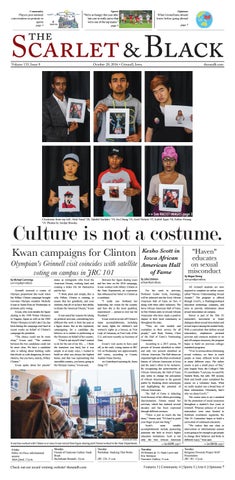
>> See RACIST IMAGES page 3 Clockwise from top left: Abdi Yusuf '20, Takshil Sachdev '19, Jin Chang '19, Ariel Nelson '17, Kahlil Epps '18, Esther Hwang '19. Photos by Jordan Brooks.
Culture is not a costume. Kwan campaigns for Clinton
Olympian's Grinnell visit coincides with satellite voting on campus in JRC 101
By Michael Cummings cummings@grinnell.edu
Grinnell received a visitor of Olympic proportions this week when the Hillary Clinton campaign brought two-time Olympic medalist Michelle Kwan to Saints Rest on Wednesday to promote early voting. Kwan, who won medals for figure skating in the 1998 Winter Olympics in Nagano, Japan as well as the 2002 Winter Olympics in Salt Lake City, has been hitting the campaign trail hard in recent weeks on behalf of Clinton’s campaign for president. “The choice could not be more clear,” Kwan said. “The contrast between the two candidates could not be more clear. We have a candidate who is talking about building walls that divide us with dangerous, divisive rhetoric, but you have, luckily, Hillary Clinton.” Kwan spoke about her parents’
status as immigrants who lived the American Dream, working hard and creating a better life for themselves and for her. “I think plain and simple, this is why Hillary Clinton is running, to ensure that her grandkids, and your children, that all of us have that ability to dream the American Dream,” Kwan said. Kwan noted her reasons for taking on political activism, considering how different this work is from her past as a figure skater. But as she explained, campaigning for a candidate she believes in is similar to performing at the Olympics on behalf of her country. “I had to ask myself what I wanted to do for the rest of my life. … I think the transition was hard, but it was simple in so many ways. I wanted to build on what was always the highest honor, and that was representing this incredible country, you know, going to the Olympic Games,” Kwan said.
Between her figure skating years and her time on the 2016 campaign, Kwan worked with Hillary Clinton in the State Department, an experience that influenced her belief in Clinton as a candidate. “I really saw firsthand her leadership, her vision for the country and how she is the most qualified, experienced … person to ever run for President.” Kwan went on to tick off Clinton’s many accomplishments, including her many fights for children’s and women’s rights as a lawyer, as First Lady of Arkansas, as First Lady of the U.S. and more recently as Secretary of State. Kwan’s visit seems to have paid off, as the early voting station at JRC 101 on Wednesday saw approximately 660 voters, according to County Auditor Diana Dawley. — Contributed reporting by Jenny Dong '17.
XIAOXUAN YANG
Kesho Scott in Iowa African American Hall of Fame By Julia Echikson echikson@grinnell.edu
Monday Friends of Faulconer Gallery Study Break Bucksbaum Rotunda , 8 p.m.
Check out our award winning website! thesandb.com
Tuesday Workshop: Studying That Works JRC 226, 11 a.m.
By Megan Tcheng tchengme@grinnell.edu
For her work in activism, Professor Kesho Scott, Sociology, will be inducted into the Iowa African American Hall of Fame on Nov. 4 along with three other inductees. The Iowa African American Hall of Fame in Des Moines aims to reward African Americans who have made a positive impact in their local community or throughout the state. “They are role models and exemplars in their service for all people,” said Rudy Simms, Chair of the Hall of Fame’s Nominating Committee. According to a 2015 census, 94 percent of Iowans identified as white and only two percent identified as African American. The Hall shines an important light on the often overlooked history of African Americans in Iowa and the state’s effort to be inclusive. By recognizing the achievements of African Americans, the Hall of Fame also seeks to change the perception of African Americans to the general public by breaking down stereotypes and highlighting the potential of African Americans. The Hall of Fame is inducting Scott because of her efforts preventing discrimination. Simms touted her activism, which has endured several decades and has been expressed through different avenues. “There is just so much she has done,” Simms said. “It’s hard to point your finger at just one thing.” Scott’s most notable accomplishments include pioneering positions she held in Iowa’s higher education institutions. Scott is not only the first African American
All Grinnell students are now required to complete an online course called “Haven: Understanding Sexual Assault.” The program is offered through EverFi, a Washington-based education technology company, and aims to provide information about sexual misconduct on campus. Haven is part of the Title IX committe's movement to foster dialogues about sexual misconduct and sexual respect among the student body. With a curriculum that defines sexual misconduct, emphasizes personal activism and connects students to on and off campus resources, the program hopes to build on previous collegemandated programs. “If we’re serious about eliminating sexual violence, we have to reach people at many different levels and in many different ways. The online course is just a small piece of this,” said Angela Voos, the College’s Title IX coordinator. “Last year, we used My Student Body, but only 300 second, third and fourth years completed the course on a voluntary basis. What we really needed was a broad base of basic information. Ultimately, that’s why we chose EverFi.” The course aims to set a standard for the promotion of social awareness throughout a student’s four years at Grinnell. Whereas policies of sexual misconduct were once limited to freshman orientation segments, the Title IX Committee hopes to build a curriculum of continued education. “We realize that one class or intervention or informational session is not going to be enough to get people to change their behavior and think in different ways,” Voos said.
>> See SCOTT, page 2
>> See SEX ED, page 2
Kwan has worked with Clinton ever since Kwan retired from figure skating and Clinton worked in the State Department. Friday Public Art Piece informational session Main Quad, 12 p.m.
"Haven" educates on sexual misconduct
Tuesday
20 Minutes @ 11: Mark Laver and Eric McIntyre Fauconer Gallery, 11 a.m.
Tuesday Religious Diversity Project MAP Presentation JRC 101, 12 p.m.
Features 3 | Community 4 | Sports 5 | Arts 6 | Opinions 7
News
2
Alum talks water sustainability
XIAOXUAN YANG
Swackhamer's first year tutorial at Grinnell in 1971 inspired her chemistry career. By Michael Cummings cummings@grinnell.edu Many Grinnell students have fond memories of their first-year tutorial, but for some, tutorial had an especially big impact. Deborah Swackhamer '76, who returned to campus this week to give the Danforth Lecture in Chemistry, was inspired by her tutorial on water 40 years ago to dedicate herself to the topic, becoming a professor of chemistry at the University of Minnesota. The lecture was introduced by Professor Luther Erickson, Chemistry, the professor of that same tutorial. Erickson related to the audience how Swackhamer had been placed into his course in the very first year that
tutorials were offered at Grinnell. “Among the 12 students assigned to that tutorial was Deb Swackhamer, and the rest is history,” Erickson said, speaking of Swackhamer’s decision to major in chemistry and pursue knowledge in water and environmental issues. “[The chemistry department] continued to encourage her interest in environmental issues.” Swackhamer spoke about her research at the confluence of chemistry and policy, examining the ways in which water is used, how it is polluted and how people can work to make water use more clean and efficient. In particular, Swackhamer sought to break down public perceptions about water usage. Posing a multiple
choice question to the audience, she asked whether domestic use, irrigation, livestock or thermoelectric cooling was the biggest source of water usage in Minnesota and Iowa. When the audience overwhelmingly voted for either irrigation or livestock, Swackhamer displayed some shocking statistics. “The biggest use of water in both [Minnesota and Iowa] is thermoelectric cooling. It’s to generate electricity,” she said. Thermoelectric cooling was the only one of the four options that made it above single digits in either state. Swackhamer also spoke about being conscious of how much water was used in products you may use every day. “It takes 300 gallons of water to make a gallon of beer,” Swackhamer said. “It takes almost a thousand gallons of water to make a gallon of wine. … A pair of blue jeans, to grow the cotton, to irrigate that cotton, 2,100 [gallons of water]. A chocolate bar, one regular chocolate bar, almost 4,000 gallons.” While Swackhamer stressed that she wasn’t asking us to give up these items cold turkey, it is extremely important to remain conscious of how much water you are actually using in your day to day life, and to be aware that water usage goes beyond what you use in the shower or at the sink.
Connelly Lecture examines Foucault and race
SARAH RUIZ
Rey Chow spoke about how Foucault can assist our understanding of race today. By Candace Mettle mettleca@grinnell.edu Postcolonial theorist Rey Chow presented the Connelly Lecture on Friday, Oct. 14. Named after late Grinnell English professor Peter Connelly, the annual lecture offers insight into the work of distinguished scholars. Chow presented her work “Foucault, Race and Racism,” which will be published in “After Foucault” by Cambridge University Press. “We live in a time of when race and racism are unavoidable topics,” Chow said. “We have currently some very good ways and some very powerful ways of addressing racism. Foucault offers a very unique entry into these problems. He may not give you exactly the answers that we expect right away, but if you follow his path of thinking and his path of research, I think we will arrive at a very interesting understanding of race as a problem in modern western society and how that then gets circulated around the world.” To justify her argument, Chow referenced Foucault’s famous concepts “biopower, biohistory and biopolitics,” while applying the works of other philosophers such as Fanon and Said. The lecture was broken up into
four distinctive parts: “Discourse and its Postcolonial Inflection,” “RaceStudies’ Repressive Hypothesis,” “Entry of Life into History” and “The Aftereffects of Pastoral Power,” or “How Society Must Be Defended.” “Discourse and its postcolonial inflection” speaks on the definition, made by the victors of postcolonialism, of race as skin color and racism as the process of oppression. The second section, “Race-Studies’ Repressive Hypothesis,” refers to the works of Fanon in his exploration of the tensions that racism brings to the individual and society. Consequently, the tensions involved lead to the normalization of race and racism by the state, which leads into the “Entry of Life into History.” Finally, the fourth section credits the nature of Christianity as a religion based on universally spreading the gospel to anyone, allowing the state to manage populations. Chow stresses in her lecture that the tendency to create race is neither a positive nor negative effect. What matters is what the state and groups choose to do when mobilizing race. “The state functions in such a way that it does not simply repress
the different groups of people [when] coming forward,” Chow said. “[The state] actually encourages and allows and sometimes facilitates the emergence of identity politics.” As a result, identity politics allow populations to rally their cause and change the landscape of how the state regards race. “Identity politics should be seen as a part of the history of this country,” Chow continued. “[When] you think of the state management of population in, for example, the context of the U.S., we had the civil rights movement if you think of that as at least of one origin for the one emergence of identity politics as we have it now, then identity politics is a part of a history. [Different group of people] come forward and demand that their rights be respected and honored.” Although descriptive terms such as African American and Asian American are examples of how the state controls populations, Chow believes that they can be used to effectively challenge the state. The work of movements like Black Lives Matter help citizens understand the implications of race, the state and what it means to refer to oneself as “I.” “I don’t think as individuals we should think of ourselves as completely outside the collective. … we are always a part of a population, a part of a collective.” To continue this dialogue, Chow suggests that students take advantage of the opportunities that the College provides through its Humanities department and extensive libraries. “[Grinnell students] are very lucky to be here — I would like to be one of them," Chow said. "I would like to get all this attention from my professors. They are doing well and they should continue to be obsessed with interesting ideas. It’s a very formative time of your lives.”
Edited by cummings@grinnell.edu & friedlan@grinnell.edu
FBI Agent: Cyber hackers threaten college security By Jon Sundby sundbyjo17@grinnell.edu For most of our online-savvy generation, an email from a foreign country asking for a bank account number would immediately end up in the trash bin. But what if the email was sent in your boss’s name and was asking you to send some money through the bank? Or maybe just to open an Excel spreadsheet. Would you click on it? In our increasingly sophisticated online world, it’s not uncommon for a hacker to use one of the above techniques to gain the trust of a victim. And once inside a network, a hacker with malicious intent could inflict untold monetary and security damage. It’s exactly these types of situations that Grinnell College is trying to avoid. That’s why the College brought in FBI Special Agent Jordan Loyd on Tuesday to talk cybercrime and the threats it poses to institutions of higher education. Agent Loyd is one of around 500 FBI agents in the nation that deal with cybersecurity and online crime, and the only one in Iowa to focus on these issues. While he now operates locally out of Des Moines, he has previously worked on cases in New York and as far away as Bulgaria. Throughout his career with the Bureau, Loyd has investigated a number of cases, including ones relating to the dark web marketplace Silk Road and the famous hacker “Little Sec.” He even once went undercover and ran the largest online forum for Englishspeaking hackers in the world. “We were going to lock up the most egregious online criminals from around the world. We executed operations in 18 countries, we arrested … 32 [hackers]. At the time it hadn’t been done before by the FBI. It was a first. … I was just a crazy guy on a mission to catch a bad guy,” Loyd recalled. Although Loyd still looks into high profile cases, he is primarily committed to educating businesses and institutions on the basics of cybersecurity so that his caseload doesn’t grow. Rob Buchwald, Grinnell’s assistant director of information security, had seen Loyd speak previously and thought his presentation might be useful for his fellow colleagues and students. “It’s national cybersecurity month. So we really hope to
develop this program to offer more presentations and opportunities for awareness and training,” Buchwald said. Cybersecurity became a focus for the College after the institution realized their decentralized approach to security left them with several vulnerable areas. Buchwald was hired in part to coordinate these efforts and also to raise awareness of security issues amongst the departments, reducing the likelihood that employees will inadvertently allow cyber criminals into Grinnell’s network. “With security the mindset has changed, in the sense that people no longer wonder ‘if’ it will happen, they just wonder ‘when.’ … If it is going to happen we would like a minimal amount of damage done,” Buchwald said. The College’s fears were recently realized when several members of Grinnell’s monetary staff were contacted by a targeted phishing scheme. Buchwald and others believe that these emails were constructed through detailed research. “Departments that handle money and are able to transfer funds are being targeted at the College. So far the departments have done a good job at recognizing it, understanding that the language being used and what is being asked of them is out of the ordinary,” Buchwald said.
"I was just a crazy guy on a mission to catch a bad guy." FBI Special Agent Jordan Loyd Despite concerns about these attempted attacks, Buchwald explained that the Department of Information Security is doing a lot to help protect Grinnell’s network, especially student data. He emphasized that “more than reasonable” steps are being taken to protect student’s information and that this is the College’s number one priority in terms of cybersecurity. As technology and hacking techniques develop, Buchwald hopes that he will be able to help Grinnell confront these new challenges. The College has recently approved the hiring of three more assistants to work in the department of Information Security, furthering its dedication to cybersecurity. As Agent Loyd said, “We won’t see cybercrimes going down. Frankly, it’s too easy.”
Sex ed course emphasizes inclusion
HELENA GRUENSTEIDL
Only 60 percent of the student body has completed part one of Haven so far. Continued from Front Page Initiated by Voos and Jen Jacobsen, Title IX Deputy for Prevention, completion of the 30-minute-long course is expected of all students before the end of the fall semester. Failure to complete the Haven course or contact Voos directly will hinder a student’s ability to register for spring semester courses. Currently, roughly 66 percent
of Grinnell students have completed the first portion of Haven. For many, the course calls attention to already familiar topics. Toby Baratta '17, SGA Diversity & Outreach Coordinator and a former Grinnell Advocate, reflected on the potential shortcomings of the course in an email to The S&B. “I like the idea of online education,” Baratta wrote. “However, I worry that folks aren’t getting what they need from [the course]. Many
students took it as a ‘how fast can I get through this’ contest, felt that it was too basic or made light of sexual assault on campus or that it did not meet the [current] needs of this campus.” Campus activist Maddie O’Meara '17 shared a different impression. “I do think that things like this show that administrators recognize that this is a problem," O'Meara said. "I don’t think this [course] is exactly what’s needed, but it is a step towards ensuring that more of our campus is aware, educated and engaged.” Altogether, the course stands as an important reminder of the reality of sexual misconduct at Grinnell. “What is missing [at Grinnell] is the same thing that’s missing on a lot of other campuses. … There are assumptions about what a rapist looks like and acts like, but that’s not a ‘one size fits all’ kind of thing. We need to continue to hold our friends, our neighbors and more importantly our community to a higher standard of understanding."
Scott awarded for lifelong career Continued from Front Page woman to get a Ph.D. in American Studies from the University of Iowa, but is also the first African American woman to earn tenure at Grinnell College. Her workshops, called “Unlearning Racism,” started in the early nineties and provided participants with mechanisms to combat discrimination. “[The workshop showed how those values were] reflected in how they lived their lives,” Scott said. Scott considers the induction one of the most meaningful awards she has received, not only because it rewards individuals who have made Iowa a better place, but also because she believes it establishes her work
as a continuation of abolitionist J.B. Grinnell’s work and the abolitionist tradition in Iowa. “[J.B. Grinnell] created a town in which slavery could be opposed. Fast forward that to my life in the 1980s, I’m just picking up another version of that work of greater equality,” Scott said. Ultimately, the induction will cement Scott’s legacy in Iowa. “My grandchildren and my great grandchildren will not only be able to point their finger at those years of service at Grinnell College in which I taught, but that I contributed to community and that community contributed is state that continues to be courageous to fight against all ‘ism,’ particularly racism,” Scott said.
4
Community
Edited by carhartl17@grinnell.edu
Gettin' spooky in Villisca: Stay in a haunted house this Halloween season
By Louise Carhart carhartl17@grinnell.edu June 10, 1912: eight people are found dead in a family home in Villisca, Iowa. Victims of a brutal crime, the dead included a family of six: parents Josiah and Sarah Moore and their four children Herman, Mary Katherine, Arthur and Paul. Two friends of the children, Ina Mae and Lena Gertrude Stillinger were staying the night and unfortunately lost their lives that night. For the people of 2016, the house where the Moore and Stillingers were murdered is now a haunted attraction where visitors can tour the house and stay the night. The murders remain unsolved, adding to the mystery of the site. “I think most people are curious about the crime, when you have an unsolved mystery/murder people like to become their own detective and solve the case in their own mind,” wrote Johnny Houser, media coordinator for the Villisca Axe Murder House in an email to The S&B. “Others are curious about life after death and the paranormal happenings.” Six men were accused of committing the murders, with George Kelly going to trial twice. He was acquitted both times. The nature of the house, as a place of great tragedy combined with mystery, has attracted a large amount of paranormal speculation and exploration. “I love the skeptics that look at me like I’m crazy for talking about ghosts, then end up running out the house
claiming something paranormal happened to them,” Houser wrote. “I had a group of seven cops from MN, … one of the cops didn’t believe and was sort of making fun of the fact that his fellow officers did believe. The non-believer went upstairs searching for the origin of the sound and heard a sigh and literally felt the breath from the sigh on his neck! He ran out to their vehicle and stayed there the entire night.” Memories like this one help draw more and more visitors to the house each year. The story’s prestige as one of the largest unsolved murder mysteries helps, especially as Halloween draws near. The house will unfortunately be closed on Halloween night, however. “In prior years there were far too many people for the house and property to handle. So we give the spirits their house back and let them rest several days throughout the year,” Houser wrote. The house has a good track record in terms of guests, as most nights someone stays over in hopes of connecting with the other side. After being featured on many paranormally focused TV shows, the house has achieved a degree of infamy in American popular culture. Along with Jeffrey Dahmer, Jonestown and the Charlie Manson murders, the house will live on as one of the most horrific events in American history. At the time, the death of six children in what seemed to be an unmotivated killing spree fascinated the country and drew large amounts of media attention. Most recently, the house was voted
one of the most haunted in America by the Travel Channel. Booked solid all year, the exploits of ghost hunters have certainly boosted the popularity of the house. For Houser, the house has a certain feel that is instantly distinguishable from a spiritually neutral space. “The overall feeling that you get as soon as you step foot on the property [is what gets people]. The house has a certain feeling that is indescribable and eerie,” Houser wrote.
While many of the visitors to the house are ghost hunters and thrill seekers, Houser notes that there is a spiritual aspect to the curiosity. The allure of getting close to a dead spirit attracts some visitors more interested in the afterlife and the fragility of life. The Villisca
Economic development in Grinnell
By Louise Carhart carhartl17@grinnell.edu
MY MEATS ATE
REAL VEGGIES
SERIOUS DELIVERY!
TM
TO FIND THE LOCATION NEAREST YOU VISIT JIMMYJOHNS.COM ©2014 JIMMY JOHN’S FRANCHISE, LLC ALL RIGHTS RESERVED.
Movies at the Strand
INFERNO
Showtimes: 1:20 p.m., 4:00 p.m., 7:00 p.m., 9:30 p.m. Tom Hanks thrills us with the latest da Vinci Code spinoff. Will he stop an ancient plague (McDonalds) from spreading in Rome?
House acts as a constant reminder of the brutality of humanity, especially now in a world that has normalized violence. For Grinnell students wishing to visit, the tour season runs from March 26 to Oct. 31 and is open Tuesday through Sunday from 1 p.m. to 4 p.m..
The Chamber of Commerce has established a steering committee to help drive revitalization efforts in the downtown area of Grinnell. The Committee is currently looking for members of the Chamber and other organizations to participate in focus groups and discussions on the best methods for approaching the continued development of downtown. “Developing a downtown improvement action plan is a joint priority for the Chamber of Commerce and the City of Grinnell,” according to a press release put out by the Chamber of Commerce. “We’ve recently begun working together to pull a plan together. We are working with a steering committee who will ultimately help assemble information gathered to develop a downtown action plan for recommendation to both the Chamber and City.” The Chamber has put out an open call for information, asking what has worked for business owners and Grinnellians in general in developing businesses, products or areas. “Staff from the Chamber and City have spent much of this week meeting with focus groups to ask a series of questions related to downtown vitality, and have received some invaluable feedback that will aid in creating our plan,” the press release details. “We have begun
JACK REACHER: NEVER GO BACK
Showtimes: 1:00 p.m. 3:40 p.m., 6:30 p.m., 9:00 p.m. I didn't watch the trailer for this because Tom Cruise scares me.
to hear some trends that could be ‘big ideas’ or potential issues that need to be addressed to move forward downtown.” Appeals to those willing to participate in focus groups are central to development planning as of now, but the Chamber and City hopes to put the information gleaned from these events to work as they move forward. The Iowa Reinvestment Act granted to the City of Grinnell by the State Government has provided a refund of all sales taxes within most of the downtown area. For students at Grinnell, one of the main focuses of downtown development is the so-called “zone of confluence” which connects the City and College. The Alumni Recitation Hall (ARH) renovations were included in the Reinvestment Act application and college students should expect to see a change in interaction with the community in the coming years. Both the College and City are hoping for a more integrated town, where both students and City residents feel a sense of shared community. The main concerns for focus groups relate to individual desires for the downtown while maintaining a larger picture focus. Those interested in attending should contact Rachael Kinnick at rachael@getintogrinnell.com or stop by the Community Input Session on Nov. 1 at 5:30 p.m. at Drake Community Library.
THE ACCOUNTANT
Showtimes: 1:10 p.m. 3:50 p.m., 6:45 p.m., 9:20 p.m. A man with OCD covers up his job at the Sinaloa Cartel by pretending to be very boring, but it all falls apart and Radiohead is involved.
Features
Edited by bohlkeli@grinnell.edu
3
Racist images still pervasive around campus
Continued from the front page
When Hameed Weaver ’17 was a first year, he dressed up as a Somali pirate for Halloween. “Some people thought it was funny [when I told them what I was],” Weaver said. “But then I realized I probably shouldn’t have done that.” Weaver shared this story at a community lunchtime discussion called “My Identity, Not Your Costume” on Wednesday, hosted by the Intercultural Affairs Office. The event was accompanied by a poster series of the same name which featured students from the Multicultural Leadership Council holding photos of culturally insensitive Halloween costumes. Intercultural Affairs thought the week before Halloween was an essential time to provide programming on racist or appropriative images. “This is a campaign that’s on a lot of college campuses,” said Jordan Brooks, assistant director of cultural affairs. “We brought [this issue] to our MLC group and were like ‘Look, we know this is Halloween time, we know this is typically when things go down. What’s the best way for us to get a message out to the student body?’”
Do Grinnellians really wear appropriative costumes?
At a progressive liberal arts institution like Grinnell, it’s easy to think that racist costumes or events simply don’t happen. However, student experience shows that these problematic portrayals do exist, although often in an implicit manner. “Dressing up as Pocahontas is a common one,” said Nomalanga Shields ’18. “Those people weren’t meaning to be racist, but they … had the headgear and the whole Native American getup. If you decide ‘Hey, I’m Mulan or Aladdin,’ and then you actually wear it, you are the character, but you’re also embracing this culture. That’s real people.” This issue extends beyond the night of Oct. 31. Some deep-rooted Grinnell traditions may contain semblances of cultural appropriation or insensitivity, especially when students assume certain identities without acknowledging the history behind them. “I’ve seen it on Cinco de Mayo, or ‘Drinko de Mayo,’” said Simone Downs ’17, who worked as an Intercultural Affairs intern last year. “I’ve seen people wear the sombreros, the mustaches, all that stuff. They’re very surface-level representations. … It’s taking a holiday and whittling down a person’s ancestry, ancestral ties and culture, and making it into an image.” Campus traditions that celebrate gender fluidity also run the risk of warping into parties lacking understanding of the history. Mary B. James, an annual party wherein students dress up outside of their normal gender identity, was mentioned as becoming particularly distorted in recent years. “I was talking to some seniors my first year about how Mary B James changed over the years,” said a student who wishes to remain anonymous at the “My Identity, Not Your Culture” event. “It used to be an appreciation of wearing different identities than you normally would during the day, and now it’s like ‘let’s get drunk and dress up like girls and dress up as guys and let’s go party.’ It’s without knowing the history behind the event and why they’re doing it.” Outside the realm of costumes
and images, recent events such as the appearance of anonymous racist messages on Yik Yak in February of 2015 demonstrate that the College is not immune from ongoing racism pervading the world outside the Grinnell bubble. “That, to me, was very shocking,” said Professor Raquel Greene, Russian, about the Yik Yak controversy. “Once I understood … that [Yik Yak] operates within a certain mile radius, that it was probably students from the College who were sending those messages, that really hurt me. If it’s people from the town as opposed to campus, you can rationalize that to a certain extent. But I think that you have to have a very different conversation when you realize that it’s one of your own, that it’s someone we’ve embraced by inviting them to join in this community.”
What's cultural appropriation?
“With cultural appropriation, you’re taking something that is not yours and then using it without acknowledging its origins or celebrating the culture from which it came,” said Lakesia Johnson, chief diversity officer, at the community discussion. As the “My Identity, Not Your Costume” poster series demonstrates, cultural appropriation creates caricatures not only of racial or ethnic groups, but also of genders, sexual orientations and religions. The question remains, however, of whether cultural appropriation is always a productive or accurate term in these conversations. “To put on blackface, to invoke a past that was intended to be hurtful, … I wouldn’t call that cultural appropriation, I would call that racism,” said Professor Katya Gibel Mevorach, Anthropology. “Putting it in the language of cultural appropriation presumes originality, and I don’t believe in that.” To illustrate this point, Gibel Mevorach brought up Elvis Presley and his music’s origins in southern sharecropper culture, a culture shared by blacks and whites alike. “What happens is the music industry then markets Elvis Presley as a white singer, and we get the separation of rhythm and blues and rock and roll. That’s not cultural appropriation, but it is one person pockets the money and the other person doesn’t. That’s racism.” Gibel Mevorach expressed her concern that if terms like cultural appropriation are so rigidly ingrained in students’ vocabulary, “Anything which contradicts that is absent. … The term culture won’t get examined.” Nonetheless, many Grinnell students feel like the discussions around cultural appropriation on campus have allowed them to analyze their own actions and better understand how they might impact others. “Before coming to Grinnell, I had no idea what cultural appropriation was,” Weaver said. “Then I learned about cultural appropriation. You learn so much coming here that I think it’s good to have these talks, especially for first-year students who might not have even heard the term before.”
What’s going on outside of Grinnell?
On Sept. 15, two white students from Kansas State University sent a Snapchat photo in black mud masks, and included a racial slur. A few days later on Sept. 21, similar racist photos emerged from the University of North Dakota. Such occurrences seem to follow similar racist traditions at large
universities, such as a Mexican-themed party at Princeton last month and a Kanye West-themed party at UCLA last year. However, Brooks cautions against associating racist caricatures solely with big institutions, Greek life or athletics. “When I was in college at a school with 2,100 students we had an incident where a student wore blackface as a costume," Brooks recalled. "I think your ability to hide is greater at larger institutions. You have the fraternities who have their houses, you have the bars and the off campus places that are in more abundance than they are here.” Moreover, Brooks thinks that the underlying issue is not uniquely linked to campuses. “College is nothing more than a reflection of our greater society. Because the greater society still doesn’t fully show respect for people’s identities, people come here and you see it happen on college campuses.” Americans are understandably shocked that racist caricatures still pop up in our culture. At the same time, sensitivity and political correctness around this issue is fairly unique to America in comparison with countries. “In other international contexts, and I’ll just use Russia as an example, we see these images and they’re not just confined to Halloween or certain times of the year. You see them in mass marketed objects,” Greene said. “As an American, when I see them, it’s just very shocking to me. There’s a level of political correctness that we practice or that we try to practice in the States that you just don’t see everywhere.” To illustrate this point, Greene pointed to examples in Russian media wherein President Obama’s blackness is used to advertise products ranging from tanning salons to chocolate ice cream. She expressed that although there are voices in Russia speaking against racist caricatures, “by and large, people would just say, ‘Well, it’s humorous. Don’t take it so seriously.’” Thus even though America still has a ways to go in its combat of racism, its larger racial diversity lends promise to its speed of progress.
How can Grinnell combat cultural appropriation?
This week’s programming provides one way to help start the conversations that students and faculty agree are important to improving campus culture around race. “Even if you hadn’t seen people on campus dressing in racialized costumes, I think it’s important just to talk about it,” Downs said. “The discussions are important both for one’s own reflection, but also to think as a community.” At the same time, Downs and other students feel as if efforts to combat racism and racist images must be taken up by all individuals and groups on campus, not just those organizations who hold social justice as their mission statement, like Intercultural Affairs. Gibel Mevorach agreed that faculty should further incorporate the culture of prejudice in the curricula. “I think our curriculum has to be more interconnected with certain themes,” Gibel Mevorach said. All of these efforts should ideally come together to increase students’ ability to question race and culture and how they interact on campus. As Downs said, “That’s the only way we can start to make connections and agitate change.”
GARRETT WANG
Students interested in finance discuss how to invest a 160,000 dollar portfolio.
Pioneer Capital Investments gives students alternative financial opportunities By Lily Bohlke bohlkeli@grinnell.edu Grinnell students may pursue finance in lower numbers than those at similar schools, but it is not for lack of opportunities. For example at Amherst College, an institution listed among Grinnell’s peers, as many of 30 percent of 2014 graduates pursued careers in finance compared to 2.3 percent of Grinnell students that year. But when Grinnell students handle the endowment, they work with greater amounts than their Amherst counterparts. Through Pioneer Capital Investment, Grinnell students have the opportunity to invest 160,000 dollars — more than three times Amherst’s 60,000 dollar student endowment fund.
"Grinnellians have this very cynical idea about what finance is. You're learning a skill that provides value to society — you have finance departments everywhere. Grinnell has one; any firm or corporation has one." Muhammad Sami '17 Pioneer Capital Investments (PCI) is a student organization that provides students an opportunity to learn about investing, which is something hard to find anywhere else on campus. In 2000, the group, then called the Student Endowment Investment Group, approached the College’s endowment and received 100,000 dollars. They began investing that year, and the fund has continued to grow ever since. “They had this idea for a student club where they’re able to actively manage money,” Dylan Ambrosoli ’18, one of the portfolio managers, said. “The fact that we have 160,000 dollars in this portfolio means we can actually invest and implement these ideas and learn by doing,” Muhammad Sami ’17, another portfolio manager, said. More than giving students experience with finance, PCI can guide students to their passions. Sami did not know what he wanted to major in when he first attended Grinnell. After taking and loving economics courses, he decided to delve into the world of finance, and he was able to find PCI. Grinnell, as a liberal arts school,
offers relatively few finance courses, and even then there is no finance or business major. This means that PCI is one of the few places these students can gather among others who are also interested in learning about finances and investing. PCI serves as a place to both practice essential skills and learn critical knowledge from these like-minded individuals. “The biggest resource is just having other people to talk to who actually know the right things to do in a situation. … The school doesn’t always provide a ton of resources to guide students into these specific roles and it ends up being that fellow students are the best resources,” Ambrosoli said. To many Grinnellians, according to Sami and Ambrosoli, there is a stigma surrounding the concept of finance. There are many distinct types of jobs within the discipline, some that have nothing to do with investment banking, which the two claim is what many people first think of when they think of finance. “Grinnellians have this very cynical idea about what finance is,” Sami said. “You’re learning a skill that provides value to society — you have finance departments everywhere. Grinnell has one; any firm or corporation has one.” Not only do finance departments exist in all sectors of society, but there are also many different positions, including ones that require skills learned at an institution like Grinnell. “The reason I’m interested in finance is more my liberal arts background than making a lot of money. As a liberal arts student, I have the opportunity to apply everything I’ve learned, especially when it comes to investing. I need to know how to think critically or understand politics,” Ambrosoli said. For students who want to apply some of the skills they learn through Grinnell’s liberal arts values to the world of finance, PCI invites students to come and participate, to see whether investing peaks their interest. “There are a lot of people who have this flashing image of Leonardo DiCaprio holding a 100 dollar bill at a wooden desk, and then aren’t actually interested in the concepts,” Ambrosoli said. “It’s the synthesis of different skills and an understanding of what’s going on in the world today.”
The Garden's friendship grows through wetting their plants
CONTRIBUTED
1018 East Street was passed down to these five by students from last year. By Philip Kiely kielyphi@grinnell.edu Affectionately known as “The Garden,” 1018 East St. is home to Emily Hines, Julia Dornbusch, Rachel Knak, Noah Holt and Ruth Isaac, all ’17. The five friends have been living together in various combinations for the past four years. “Our house is called ‘The Garden’ because we all lived together in Rose Hall first year and we’ve been friends ever since,” Knak said. Off campus houses are often
passed down from one generation of friends to the next, which is exactly how “The Garden” came to acquire 1018. “We had a group of friends who were seniors last year, … so we kind of took the house over from them just because that was our natural progression as friends,” Hines said. They have made the house their own with a variety of mottos. “Happy home” and “#teamchill” reflect the nature of the residents, while, “We’re so excited about the garden we wet our plants,” shows the group’s humor. All
five share a comfortable, easygoing nature that permeates the house. Perhaps this is why the house has done well so far, despite a clogged toilet and a seedy basement. “We had a small gathering of friends and they clogged our toilet with tampons and our basement flooded,” Hines said. Even when dry, the basement is a dingy contrast to the homey feel of the rest of the house: “[it’s] dark and gross,” according to Holt. The more positive defining features of the house are a well-lit porch and a popular guest bedroom. While Hines said they “could probably light this entire house with string lights,” they chose to make the porch shine like a lighthouse, which reflects the home’s inviting nature. “We have our guest bedroom upstairs. We’ve housed guests from all over the world, by which we mean one country other than the U.S.,” Hines said. Sometimes, the house faces weird challenges, including some in the kitchen. Holt one day decided to make banana bread, and it came out very
well. On his second try at the same undertaking, something a little different happened. “The people who lived here last year left a lot of confectioner’s sugar here, and so there was what I thought was flour in a Tupperware container. … I put it into the banana bread mix but it was confectioner’s sugar so the banana bread never rose, because there was no flour in it, so it just turned out to be gross banana-sugar liquid-goo,” Holt explained. Despite the various challenges that have arisen, the five all recommend off campus living. They enjoy eating meals at home, often even lunch during the week. “It is a good transition into independent life after college,” Dornbusch said. “It’s nice to have a space that’s actually yours,” Holt added. “It’s also nice to make your own coffee and not have to drink D-Hall coffee or Grill coffee.” The tenants of 1018 recommend shooting to live off campus even if you’re not sure who to move in with. “There is a tendency to think that
you can’t live off campus if you don’t have a friend group that’s living off campus, but I’d say that even living by yourself, like in a single off campus, … I would also encourage that,” Isaac said. That said, the distance from the college has created challenges. The physical distance tough, especially for making it to 8 a.m. classes, but the distance from campus culture also plays a role. “I think it’s hard to feel connected to the College, because a lot of the time I’d rather spend my time here than on campus,” Holt said. “The comforts of home draw us here more the dorm rooms do,” Dornbusch agreed. But these challenges for the five are easily outweighed by the clear benefits of constant connection with friends. The group has slightly overlapping extracurricular activities but no common majors, so they know their friendship has come out of a deeper connection. “That’s what brought us together — none of us really fit in on East Campus but we all fit in with each other,” Knak said.
Arts
6
Edited by coghlann17@grinnell.edu
Taffe Tang's "Unfolding" opens in Smith Gallery Teresa Fleming flemingt17@grinnell.edu
start drawing whenever I wanted.” Tang noted that although the show is a first point of contact be-
In the Smith Gallery show “Unfolding,” artistic evolution plays out over time through a series of ink and charcoal drawings. The detailed line work by Taffe Tang '17 suggests a significant time investment, but Tang explained that the creative process for her Smith show was surprisingly off the cuff. “I applied for having a Smith show last semester, and I didn’t hear back, so I thought, okay, I’ll just wait and maybe apply next year or something, and then I got the approval during the summer,” Tang said. “I was in China at the time … and then I started thinking about what to do because I had nothing, and I already had given up on my last set of projects.”
"When I was little, I was told, if you really have something important to say, draw it instead of writing it into words, because words will disappear." Taffe Tang '17 tween her work and the wider world, the pieces featured in "Unfolding" are distinctly personal. “For me, I know how long it took, what was going on at the time I was drawing. And so I think that part is very personal, and completely about the artist,” Tang said.
“When I was little, I was told, if you really have something important to say, draw it instead of writing it into words, because words will disappear. So when I was little, I used drawings as a way to express my feelings. Most of the time I don’t have a concept of my drawings. So for me, it’s like a visual diary, like written things, but written down in a different, abstract way. It’s like a timeline for me.” Despite the time crunch she faced in preparing her show, Tang’s pieces highlight the time investment required by detailed works. Her larger pieces, completed later in the semester, represent an effort to incorporate more abstract techniques into her body of work.
“I was in the studio for 16 hours, working on this one piece. I was trying to push more of myself, because of the larger scale, more details, more time and effort,” Tang said. “For most of the time, I measure my effort in terms of time, so I know how many hours I spent on each piece, and it was about time. I really enjoy sitting down and working without stopping.” For Tang, the labor and time in-
"Most of the time I don't have a concept of my drawings. So for me, it's like a visual diary, like written things, but written down in a different, abstract way. It's like a timeline for me." Taffe Tang '17
tensive aspects of her work are a uniquely rewarding return to more analog forms of creativity.
"I was in the studio for 16 hours, working on this one pieve. I was trying to push myself." Taffe Tang '17 “There are a lot of new technologies, printers, laser prints, vinyl cut prints and people are using those to create art. I’m a big fan of technology, but I didn’t want to use any of those for my show, because I wanted it to focus on the original state of art,” Tang said. “I think that’s how most people started with their art life: they started drawing, and they started with simple lines, points, shadows and textures.”
"What I enjoyed the most of this piece is that I could bring it with me over time, and I could, you know just start drawing whenever I wanted." Taffe Tang '17 Tang faced practical concerns as she developed her project: any work created over the summer had to be portable enough to carry from her home in Anhui back to Iowa. Inspired by her space constraints, she began working on a series of drawings in a codex, or folded rice paper notebook, that could travel with her compactly but unfold to showcase her collected works on a single long strip of paper. The result is a record of Tang’s summer that unfolds from left to right, featuring a series of images connected by a single black line that extends off the page. “I thought it was kind of interesting to work separately on each piece of paper without looking at what I did earlier,” Tang said. “What I enjoyed the most of this piece is that I could bring it with me over time, and I could, you know just
SARAH RUIZ
Taffe Tang's "Unfolding" opened in Smith Gallery this week.
SALES and Karen Meat pop out Herrick songs, slightly sad, but mostly funny. Karen Meat’s sound is a blend of catchy riffs and twinkling electronics. The electronic sound in their music is hard to pin down upon first listen, but it is actually created using an omnicord, an instrument created in the 80’s. Omnicord player, guitarist, and vocalist Brad Turk flawlessly incorporates this kitschy instrument into their bright musical style.
"What would a Grinnell club even look like? But the answer was clear. It looks like a group of students listening to music in a chapel on a Wednesday night."
HUNG VUONG
Florida-based SALES played an intimate show in Herrick on Wednesday, following an opening performance by Karen Meat. By Halley Freger fregerha17@grinnell.edu
"Grinnell concerts is our crusty punk club."
Grinnell Concerts hosted two pop-influenced acts on Wednesday, Karen Meat and SALES. Des Moines’s Karen Meat opened with a set of their high-energy trash pop. As they took the stage they looked
around them at the beautiful Herrick Chapel and joked, “Tonight the role of crusty punk club will be played by a beautiful cathedral.” Karen Meat’s lyrics are amusing because they are intensely blatant and
honest. They sing about pizza and love and getting too drunk. On their song “I Made You a Card,” guitarist, vocalist, and mastermind Arin Eatons sings, “I made you a card. Did you know I could draw with a beer in my hand? I spilled some on my pants.” The description of this small moment feels very real, and, like most of their
Although Karen Meat has only been around for a couple years, they are an Iowa band to watch out for. Next month, they are releasing “She’s Drunk Like The Rest Of Us,” a collaboration between Arin and producer Dana T. If you missed their set, the good news is you can watch it on their Facebook page, where they live streamed the concert. Isn’t living in 2016 great? SALES followed Karen Meat with an intimate set of their minimalist guitar-based pop. Orlando band SALES is the project of longtime friends guitarist/vocalist Lauren Mor-
gan and guitarist Jordan Shih. This tour they ditched their 404 drum machine sampler for their new drummer Joy Cyr, who added a distinct energy to their set. Grinnell was their last stop on this tour and we were lucky to catch them before they rest and head out on their West Coast tour. Overall, the band has incredible chemistry. Morgan and Jordan play intricate guitar parts that intertwine and reinforce each other in a dreamy blend. Morgan’s distinctive voice is soothing and soulful. At times it rings in a wistful whisper and the next moment it’s deep and powerful. SALES is known for combining their skillful guitar playing with electronic elements, such as the use of sampling. At one point during their set, Morgan sang using an auto-tune effect and commented on how that was probably the first time someone has used auto-tune in a church. She might be right. Before playing their song “Trapped in a Club” they asked the audience if we have any clubs in Grinnell. Everyone chuckled, thinking about how funny that would be. What would a Grinnell club even look like? But the answer was clear— it looks like a group of students listening to music in a chapel on a Wednesday night. Grinnell Concerts is our crusty punk club.
Professor Eiren Shea talks Archipenko for 20 minutes @ 11 By Reed Essex essexree@grinnell.edu The 20 Minutes @ 11 talk series recommenced this week, with a presentation by Professor Eiren Shea, Art History, in Faulconer Gallery. She focused on the largest sculpture from the Archipenko collection. The piece, titled “Queen of Sheba,” is a large, humanoid-shaped copper sculpture that was made in the few years before Archipenko died. Aside from the fact that that it was made in 1961, there is very little information known about the sculpture itself. Still, the piece is in keeping with Archipenko’s signature style, as most of his sculptures are based on female bodies. Yun Zhao '18 was excited about the return of the talk series, and was particularly interested in
the discussion of Archipenko’s larger sculpture. “I like the one on one engagement with a specific artwork in a gallery,” Zhao said. Shea discussed the art at length, as well as incorporating the painting of the "Queen of Sheba" that hangs on the wall behind the sculpture. The piece itself is made out of slightly thick, molded copper sheets throughout the entirety of the structure. It has three tiers, the base, the middle and the head, all with what look to be etchings in the metal itself. Though Zhao is regular attendee of the talk series, Shea’s talk was one of her favorites. “I’ve been to a lot of other Faulconer Gallery events, but I’ve always wanted to come to this exact 20 minutes @ 11 talk,” Zhao said.
MAYU SAKAE
Professor Eiren Shea, Art History, discusses the craft and history of Archipenko's work during a 20 Minutes @ 11 talk in Faulconer Gallery on Tuesday.
Sports
Edited by mettleca@grinnell.edu
5
Women's tennis wins Midwest Conference title By Zane Silk silkzane@grinnell.edu The College women’s team ended the fall season at the Midwest Conference (MWC) singles and doubles tournament in Madison Wisc. on Oct. 15 and 16, claiming the championship trophy along with two singles titles and one doubles title. On top of this success, Coach Paige Madara was named the MWC Coach of the Year at the tournament. The MWC championship title is awarded to the team that wins the most matches against the other teams in the conference. Since the tournament occurred after the end of the conference season, the team knew they had already won the championship trophy. However, rather than compete as a team, players had their first chance of the year to compete for singles and doubles titles.
"There’s a little bit of pressure riding on you to take first place if you’ve gone undefeated." Amelia Cogan '19 In the doubles tournament, Amelia Cogan and Judith Fan, both '19, won the No. 1 title, successfully defending the crown they won last year. However, Cogan and Fan were unable to clinch the victory in the singles tournament, with both players getting runner-up finishes:
Fan in first and Cogan and in second. Anushka Joshi ’18 also earned a runner up finish in the match for the fourth title. “I think this season, I probably played a little bit better during the dual games,” Fan said, who had been undefeated all season until the final match for the number one title. “Overall the season was good, but I think I sort of tanked at the end.” “There’s a little bit of pressure riding on you to take first place if you’ve gone undefeated,” Cogan said, who similarly had her first loss of the season in match for the second place singles title. Nonetheless, the singles tournament did provide two victories for the team, with Megan Jans ’19 winning the third place title and Lily Hamilton ’19 nabbing the fifth place title. According to Madara, Jans was one of the students who improved the most over the season through hard work. This year marks Madara's first as a Grinnell coach, and she says the move from Washington and Lee University in VA has gone well. “[The players have] really been incredible in helping me transition, in that they’re so open to my style of coaching, and they want to improve, which is really all that I can ask for. Every day they go out, they work hard,” Madara said. Looking back at the season, Madara is quick to identify her favorite moment.
CONTRIBUTED
The 2016-17 women's tennis team celebrates their conference championship win. “It [was] a really tough match to win the conference title against St. Norbert, that we won 5-4 thanks to a third set win by [Judith] Fan. … That was a special moment for me as a coach, [Fan] has come a long way since August, and our player-coach relationship has really developed each match. And so that was an exciting one for me … just to watch her be so successful and beat a player she had never beaten before.” Only Grinnell ended the season with zero losses among the participating schools. In winning the trophy, the women’s tennis team achieved a feat they had just narrow-
ly missed the past two years. Playing tennis as a team can be adjustment for students when arriving at Grinnell, since in high school tennis is much more of an individually focused sport. Building team spirit is something both players and the coach cited as integral to the team’s success.
"They want to improve, which is really all that I can ask for. Everyday they go out, they work hard." Coach Paige Madara
“We definitely have a group this year that wanted to become a team, wanted to come together, and we spent a lot of time talking about our team culture and how we support each other on and off the court. Which, I really think at the end of the season helped us, when it’s coming down to the last match and you know your teammates are behind you, it kind of gives you that extra push to succeed,” Madara said. With the fall season behind them, the team looks forward to the spring when they will face off against the other top Midwester teams in a chance to compete in nationals.
Women's soccer pursues Midwest conference spot By Candace Mettle mettleca@grinnell.edu Over fall break, the women’s soccer team improved their overall record with a streak of four wins against a variety of Midwestern teams. These achievements come before the team will play one more match to determine if they will compete in the Midwest Conference tournament in two weeks. However, after a slow start to the season, the team sees the recent wins as testaments to the hard work that they underwent to make this year count.
you see how invested everyone is. We’re all dying, but everyone is doing the best they can and everyone is supporting each other.” Head Coach Kirsten Koester has also credits the Pioneers’ success to their heartfelt dedication to the sport. The team victoriously went up against many strong teams such as St. Norbert and Ripon. Respectively, the Pioneers women’s team won 2-1 and 3-2 over the fall break weekend. “The [team members] are highly disciplined and never make excuses for themselves, and I think that this year it’s such a strong part of our
identity,” Koester said. “Every single game leading up to those four have been crucial, and it’s about how we’ve responded to the losses and even some of the wins and recognizing that even in a 3-1 victory, there are things that we need to improve. It’s that drive to not be just satisfied with our individual performance that has continued us to make us stronger and grow from game to game.” Along with Zarkin-Scott, Koester remarks that the seniors have been leaders in cultivating the team dynamic. Koester also believes that getting to play in the Midwest Con-
ference would set precedents for the younger players as well as pay tribute to Pioneer women’s soccer. “I think that this program is expected to be in the tournament, and the players recognize that, but I think that they take pride in that because of the history of success. We’re so hungry this year after last year to really prove that we’re one of the top teams,” Koester said. When speaking further on the importance of being in the Midwest Conference tournament, Zarkin-Scott alluded to the other Pioneer teams that have done well this fall season.
"We’re so hungry this year after last year to really prove that we’re one of the top teams." Coach Kirsten Koester Forward Shaina Zarkin-Scott ’18 believes that what sets apart this year from previous ones is that the team as a whole has grown more confident in their playing. On and off the field, the team culture has focused on staying positive in light of difficulties. “We’ve learned how each other’s instincts are, so you can kind of predict what they’re going to do, which makes the team play better if you know what your teammates are going to do,” Zarkin-Scott said. In addition, the team has focused heavily on conditioning in both the pre and regular seasons. “We’ve gotten in really good shape. If nothing else, we can outrun the other team, and that’s because everyone does their best all the time, so it’s definitely a team effort,” ZarkinScott said. “At the end of practice,
CONTRIBUTED
Midfielder Lauren Hurley '18 fights hard for the ball during a match over fall break.
“It’s really cool to have so much representation. The tennis team did really well and volleyball is doing really well and the men’s soccer team is probably going to make the tournament. A lot of the schools in the [Midwest] conference are known for sports, and Grinnell is known as a good sports school. … It’s obviously a great academic school, but nerds can do sports too!” First-year Valencia Alvarez '20 has responded well to the high standards of the team. Playing usually as a forward, her time as a division three student athlete has proven to be a great experience. “I just wanted to make any difference on the team in any way that I could on the field scoring goals, defending … just kind of really show myself to the team and the whole conference in general,” Alvarez said. Indeed, she has. In the match against Ripon, Alvarez made the first goal, setting the tone for the game. Alvarez sees great significance in entering the conference tournament for graduating seniors. “It doesn’t mean as much to me as it does to the seniors, because they have been here for four years, and it’s more for them,” Alvarez said. “But honestly, I came into this season thinking that it’s completely possible — which it is — but it would mean that we would accomplish, as a whole team, the goals we had prepared in the beginning of the season to put ourselves out there as a team not to look down upon.” The women’s team will battle Monmouth College. on Oct. 29 to see if they will make it to the Midwest conference tournament.
Students, it’s time to RELAX at SHACS This relaxation tranquility space includes a head-to-toe massage chair available at no charge. To schedule this free service go online thru open communicator, by calling SHACS to schedule, or stopping in to make an appointment.
SHACS 641.269.3230
The massage chair and space are amazing! Make this a wellness priority for yourself!
Opinions
Edited by sundbyjo17@grinnell.edu
Guns, Germs and Steel (Arrows)
Letter to the Editor
Steve Yang
The Future of Fishing Few hobbies are more attractive to idioms than fishing, with the possible exceptions of golf and baseball. No matter how much time you’ve spent on the water and how many fish you have caught in the past, there’s usually a pretty thin line between fishing intent-fully and just standing in a river waving a stick like an idiot. That’s not to say there are not better fishermen and worse fishermen: the good ones are usually the ones catching the fish, while the worse ones stand around cursing heaven and earth, their rods, their bait and their luck. But as it goes in life, sometimes, it’s better to be lucky than to be good. After all, there are a million intangibles on any given outing, and that’s what makes it fun: take the unpredictability out of fishing, and you’re left with a trip to the grocery store. Two fishermen standing next to each other throwing the same thing in the same river can have wildly different results, and there’s really no good reason why. But maybe we’re not meant to know the reason why, and even if we could learn that reason one day, maybe we’d choose not to. Now, due to mankind’s propensity for knowing things and beating them, especially when that “thing” is Mother Nature, you get all kinds of nifty creations that are upending fishing as we know it. Sometimes, you’ll hear the harshest criticism that one can describe fishing gear with: “meant to catch the fisherman, not the fish.” For example, you’ve got boats with engines that would make a racecar jealous, drones to scout out deep drop-offs and bank sides, lures that make wobbly-buzzy noises supposedly meant to drive fish crazy and fancy new poles that cost as much as a nice vacation to Argentina. There is a certain kind of madness with being the best fisherman, catching the most and biggest fish, thereby showing who can conquer nature the best. It’s driven by aggression, the competitive spirit and the unwavering belief in America that bigger is always better. I’m not sure that I agree wholeheartedly, but not many honest fish stories go, “Man, you should see this fish I caught! It’s so ... tiny. I can’t wait to catch one even smaller!” Some of those things are very good for the sport, which has its undertakers constantly worried about its proximity to death: A River Runs Through It jolted the fly-fishing industry back to life, and the increasing numbers of children and women who partake in the sport are encouraging. Numerous saltwater and freshwater fishing foundations are doing great work to conserve these resources for the future, and lobbyists representing environmental groups have done a great job of increasing accessibility for all. Other things are questionable, in my opinion, and will be for a few years to come. There are the oddities of recreational fishing that I can’t really understand, like professional bass fishing: a creature that has taken on a life of its own and is to fishing what NASCAR is to driving, rumored to be up for consideration as an Olympic sport (I’d rather not, personally). In other words, fishing as a hobby is at a crossroads, where modernists are desperately trying to tilt fishing in man’s favor and traditionalists work equally as hard to flip that balance of power. Is the modernization of fishing a good thing? I guess it depends on what you’re looking for, because pretty much everybody is looking for something different. Some look for peace, others for ocean giants, or for beautiful lakes, or just for dinner. To end with one last idiom, from none other than Henry David Thoreau, “Many men go fishing all of their lives, without knowing that it is not fish they are after.”
Jackie Stenson and Diana Jue Rajasingh (2016 Grinnell Prize winners) are the founders of Essmart, an American for-profit company operating in Bangalore, India. Their mission is to disseminate essential technologies to rural communities in South India. As Indians (Sapru was born in Bombay and spent most of her life in New Delhi, and Ravishankar was born in Hyderabad, but grew up in Bangalore), we applaud their work. Our concern, however, and motive for writing this article, is the manner in which they presented this work to our class. Stenson and Rajasingh talk about experiencing and understanding the hardships faced by people in rural communities during their backpacking experiences in Indian and African villages. They then proceeded to use these experiences to make broad, sweeping and, frankly, problematic statements about nuanced issues people, especially women, face in these villages. Working and middle-class woman in India struggle with very serious threats to their safety on a daily basis — even more so for women living in rural areas. Despite rising female literacy and education enrollment rates, India today has lower levels of female workforce participation than many countries in Sub-Saharan Africa and the Middle East. India ranks 127th on the gender inequality index and 108th on the global gender gap index. These figures demonstrate a very real problem that needs to be addressed. Given these concerns, Ravishankar questioned Stenson and Rajasingh in her class about gender dynamics within the organization, as well as the opportunities available to rural women. They responded with
Dear EM
Managing Editor News Editors Features Editor Sports Editor Arts Editor Community Editor Opinions Editor Copy Editors Photo Editor Graphics Editor Business Manager Honorary Editor
a statement on how arranged marriages and pregnancy forced women out of employment and pushed them towards “oppressive” familial obligations. This comment on the patriarchal structure of Indian society is not entirely inaccurate and presents a simplistic view of women in rural India. It assumes that women in these predicaments have the choice to reject the situations imposed upon them, without dealing with very real consequences (Indian women who push back against these structures stand to lose their agency, as well as social and economic capital). Though they addressed a desire for more female employees, and stated that they hoped to find more “brave women” in the future, there was no real action taken toward this end. We wished that instead of diminishing and simplifying a real and complex problem, they would have taken an extra step to understand and work with it. As Grinnellians, we are trained to be culturally sensitive and to be committed to social justice and diversity. We were caught off guard then by the surprising lack of these values in the talks that we heard. Through discussions with peers we
Maddie O'Meara and Emily Howe
Dear EM, I've had a lot of medical issues this semester and my professors keep asking me why. How can I ask them to stop invading my privacy? -Professor Problem Hey Professor Problem, We are very sorry that there is pressure on you to disclose things that you do not want to disclose. You should never be put in a position where you are obligated to share a diagnosis with a professor. It sounds like this might be a situation where it would be valuable to loop in Autumn Wilke (the Coordinator of Disability Resources) and have her help explain to professors what’s going on in a way that conveys the necessary information but respects your privacy. Autumn could help you brainstorm ways to approach your professors and help them understand your situation. She could help you with getting accommodations if you don’t already have them, and if you do, she could help you to use the framework of your accommodations to resolve the situation. Given the way accommodations work, the only thing that should be shared with professors regarding your health is functional impacts (i.e., a need for time and a half on exams because you have trouble concentrating, etc.), but never a specific diagnosis. Part of the reason we focus on functional impact as opposed to a diagnosis is that many people have different (and sometimes flat out wrong) ideas
The Scarlet & Black Staff Editors-in-Chief
7
Teresa Fleming Eva Lilienfeld Steve Yang Michael Cummings Emma Friedlander Lily Bohlke Candace Mettle Nora Coghlan Louise Carhart Jon Sundby Mira Braneck Keli Vitaioli Jeff Li Lica Ishida Jenny Dong J.B. Grinnell's Ghost
realized that there seemed to be a general consensus of uneasiness with the lack of cultural sympathy displayed. There were certainly elements of a “reductive seduction” of other people’s problems (the idea of dangerously oversimplifying problems in other parts of the world and assuming that they are easily solvable). It is easy to advocate for a group of less fortunate people, however, even well-intentioned activism can do more harm than good when it exists outside the realities of the cultural context. Many of these issues arise with the perennial problem of the insider-outsider debate. The debate has profound implications in the way each of us conducts ourselves in relationship with the people around us, and is something especially important to think about for all of us Grinnellians who want to address social justice issues in various parts of the world. There is a need to be socially conscious and aware in the manner in which we talk about the cultures we live and work in, and this need is especially prescient for all of our worldly Grinnellians. -Meghna Ravishankar '17 and Sarojini Sapru '17
Privacy and Professors
about what a specific diagnosis actually means. Additionally, the same diagnosis can manifest in two people through very different symptoms. Once again, we’re sorry that you were put in this position and hope that you can get connected with Autumn for help resolving the situation in a way that gives professors what they need while also protecting your privacy. -EM Dear EM, I'm a first year and the transition to college has been particularly rough for me. I haven't really found my "group" of people yet, and found it to be particularly devastating to be rejected by all of the groups on campus that I auditioned for. I've since joined a few clubs, but it feels like everyone already has their groups of friends that aren't really open to new people — what should I do? -Feeling Alone Hey Feeling Alone! I hear you. The first year transition is hard, and while your peers may not be showing it, the transition is hard for many of them too (it certainly was for us). To paraphrase Rabbi Rob, who we consulted with about this question, at this stage everything is a lot more plastic than it appears. Because the college transition is hard, people constantly try to attach themselves to others, making groups that look a lot more solid than they are. To quote Rob directly, “It’s all just an illusion.” And in terms of college development, there’s a big shift in friend groups and extracurric-
ular activities that happens between this upcoming spring semester and your second year, as you and your peers discover new passions and interests. Rob suggested that to spark this transformation, you should think really hard about what you want to be doing, what feeds you and let it radiate out of you. The people who have similar interests will find and support you, and if you start really thinking about what it is that makes you glow now, you’re ahead of the game. Okay, that’s an intimidating task, but there are lots of people on this campus who want to help you make it happen. You have us, but also Rabbi Rob, Deanna Shorb, the many student leaders on campus and even some of your professors! And all of us are great resources for talking about what you want to get out of Grinnell, both socially and extra-curricularly. There are also great resources like Peer Support [PSupp], an organization that meets in the CRSSJ on Saturdays at 5 p.m. that can provide a space for you to talk about things that are going on and meet people in a low-key setting. This campus is overflowing with people who want to help — to support you in all that you’re doing, they just might not be the people you’ve met so far. Your time at Grinnell will change you — your interests, passions and goals — and with these changes come new opportunities to find a sense of community and belonging with people who share those interests and goals. We’d love to chat about this more during our office hours or over a cup of tea in Bob’s. -EM
Tommy O'Donnell
Under the Radar
Danny Brown's Joyful Division On Atrocity Exhibition, Brown delivers a refreshing blend of experimental and hardcore hip-hop that both challenges and rewards the listener. Since his last full-length release Old, Brown has transitioned from underground party starter to progressive hip-hop pioneer, a side he had hinted on during his early career, but had seemingly dropped in search of greater commercial attention. However, it seems as though Brown has finally become satisfied with the size of his audience he gained through minor party anthems such as "25 Bucks" and "Grown Up". As a result, he has chosen to release the record he had always wanted to make, in a similar fashion to Kendrick Lamar’s To Pimp a Butterfly that followed the more commercially successful Good Kid Maad City. Brown, a Detroit native, uses hiphop as a means of coping with his personal struggles of addiction, depression and poverty. Before he became a rapper, Brown spent most of his early adulthood in and out of jail for drug-related felonies. He addresses these mishaps throughout his discography, perhaps in order to teach others about his experience. Atrocity Exhibition is no exception, with Brown’s lyrical content and presentation becoming even more heavy and traumatic, pushing the listener to become both introspective and self-critical. The album title encapsulates the ambience of the record — derived from a Joy Division song and J.G. Ballard’s surreal story collection. Brown continually draws the connection throughout the record between his own experiences of pain, and those of Joy Division’s singer Ian Curtis many years ago. Brown’s latest output is blatantly dark, just like any Joy Division cut would be, but he also finds interesting ways to explore a number of different genres, including jazz and even country. These music forms are especially prevalent on the first track “Downward Spiral,” which begins with a woozy bass line and a reverbed country guitar riff. The production finds a balance between Tom Waits-esque junkyard rock and Arca-style dystopian electronics, mostly thanks to Paul White, who produces 10 of Brown’s tracks. “Downward Spiral’” can be seen as a direct nod to his previous album XXX’s opening track, where he rapped: “It’s the downward spiral, got me suicidal/But too scared to do it.” Through his references to his past work, Brown makes Atrocity Exhibition a part of a larger whole, perhaps a bookend to an implied trilogy that starts with XXX and ends here. Brown also spits over and over again on “Downward Spiral” how he’s “gotta figure it out,” suggesting that this could be his final release, or certainly the final part of his present musical jigsaw. Capping off the record is the track “Really Doe,” produced by Black Milk. Full of vibrant and ferocious guest vocals from Ab Soul, Kendrick Lamar and Earl Sweatshirt, it is an unabashedly fun track and Sweatshirt’s unwavering delivery on the final verse gives the track a startling amount of intimacy. This track seems to succinctly define where Brown exists in the world of rap music today. Huge names like Lamar, Soul and Sweatshirt bring certain, powerful flows that contrast vividly alongside Brown’s unorthodox vocal delivery. However, this doesn’t intimidate Brown, in fact it elevates his delivery and signifies how he can truly role with rap’s finest. Atrocity Exhibition is out now via Warp Records.
SPARC Policy The Scarlet & Black is published on Fridays by students of Grinnell College and is printed by Times Republican of Marshalltown. The newspaper is funded in part by the Student Publications and Radio Committee (SPARC) and also relies on advertising revenue to cover operating costs. All publications funded by SPARC are copyright of SPARC and cannot be reproduced elsewhere without specific written consent from SPARC. Contributions The Scarlet & Black welcomes story ideas from students, faculty and other members of the town and college community. If there is any story that should be covered, please email newspapr@grinnell.edu or visit thesandb.com Send letters to the editor via email at newspapr@grinnell.edu or mail them to Box 5886. The author’s name must be included, but letters can be published anonymously in certain occasions. Letters will be printed at the discretion of the editor. The opinions expressed in this section do not necessarily reflect those of the editorial staff. The S&B reserves the right to edit any and all submissions. Advertising Advertising inquiries should be directed to the business manager, Jenny Dong, who can be reached at sandbads@ grinnell.edu or by mail at 1115 8th Avenue Grinnell College Box 5886, Grinnell, IA 50112.
the
Back Page
"The best thing since the front page!"
Volume 133, Issue 8
Photo of the Week
thesandb.com
Got a backpage-worthy photo? Submit it to [sundbyjo17] and earn $5 for contributing a winner!
Campus is transformed by the morning light into a Microsoft screensaver.
Arbitrary Analysis Pub Quiz Winners
KOSUKE YO
Pun-based Costumes
Dinosaur Costumes
Snedge
1. The Fempire Strikes Back 2. Gender? I Hardly Know Her! 3. Seperation of Church and Taint
This week, Mira Birkson '20 and Mira Braneck '19 polled students asking: Nasty Women or Bad Hombres
Like what you see?
JRC
7 p.m. Student Trick-or-Treat @ Norris Hall 7:15 p.m. The Conjuring 2 @ Harris Cinema 8:30 p.m. Infinite Coincidence @ Bucksbaum 154
Saturday
5 p.m. Men's Basketball v. Ellsworth @ Darby Gym 7 p.m. and 9 p.m. The Thing (1982) @ Harris Cinema 10 p.m. Halloween Harris @ Harris
ARH
Staff Shoutout
or
Shoutout to our Editors-in-Chief for redesigning our website (check it out!) and having it win SEVENTH place at the ACP journalism conference this weekend.
@thesandb /thescarletandblack thesandb.com @newspapr
An Obituary for the Loose Tree In this space Simone Downs '17 wrote a beautiful piece about the significance of the tree that used to stand in front of Loose Hall. The tree was wrongly chopped down, much like Simone's rant, which was lost to the computers in the pubs office. I'm sorry Simone for improperly honoring you and the beloved tree. "The bitch from upstairs" '17
Social Calendar
Friday
check us out:
Rants & Raves:
"I'm dressed as myself"
Students speak about what’s on their minds in 100 words or fewer, and you’re invited! If you have a rant or a rave, email it to [sundbyjo17]
Close the Goddamn Door dear fellow grill rats, it’s the time of the year when it is inappropriate to use the fire exit door of the grill. it’s cold and the wind blows paper everywhere. greatest good for the greatest number y’all #utilitarianism #selfgovisntdead warmly, jaded (and chilly) upperclassladiez '18
A Grill Coffee Improvement Am I the only one whose noticed a marked increase in the quality of Grill coffee lately? Throughout my under years at Grinnell, I would gulp through gritty cup after gritty cup just to get through my classes. But now, I get to the end of my morning drink and my mouth and head are both clear of grinds and fog. I don't know what they've changed, but I approve. -Jon Sundby '17
Self-Care Self care can be hard when you only have time to care for your grades or the rest of you. Today I cancelled an appointment with a SHACS counselor because I needed time to finish a paper. #thriving -Anonymous '18