Sports "It was very natural for me to get to do something that I already knew I enjoyed, but with the added water element." page 4
Features The women of Poop House reflect on four years of friendship. page 6
the
Arts
"I have relied on [art] for so many things my entire life." page 7
Scarlet & Black Volume 133, Issue 17
This year's student initiatives
thesandb.com
February 24, 2017 • Grinnell, Iowa
Gender-inclusive housing comittee Ready to Run Iowa works to improve housing
in Grinnell
By Kate Irwin irwinkat@grinnell.edu
By Andrea Baumgartel baumgart1@grinnell.edu
The Student Initiative Fund (STIFund) provides a way for students to use campus funds to reform or contribute to Grinnell's campus. Initiatives from the past have come to be staples of the Grinnell community, including campus bikes, the swing set outside Younker and to-go boxes. This semester, Max Hill '20, Emily Burgess '19 and Jasper ColeKink '19 are a few of the students who have expressed their desires and concerns by creating their own student initiative proposals to help to make Grinnell a better campus in various ways. Hill's initiative is to acquire a school-wide Grammarly subscription. Grammarly is a proof-reading platform that checks for mistakes in grammar, punctuation, and style. It also has a spell check feature and detects plagiarism. Grammarly costs $29.95 a month, making this a pricy expenditure for many individual students but not for a college community. Hill has been frustrated at how difficult it can be to get into the writing lab for an appointment and believes that Grammarly would help students by proofreading without the hassle of setting up an appointment or the challenge of there being few available appointment times. "It is really hard to get into the writing lab, and most of my errors came from proofreading," Hill said. "The school has a lot of money. Let's see if we can do this to help supplement the Writing Lab." Burgess has proposed two initiatives: putting an EZH20 water bottle filler in Noyce in the 1600 hallway and putting professor quotes back on PioneerWeb. There are already water fountains with water hookups present in the 1600 hallway in Noyce, making the EZH20 filler a relatively easy change to make. "Noyce is the only large, academic building without [this fountain], and a lot of the drinking fountains are really shallow. With the shallow drinking fountains, it's difficult to fill up your water bottle, and I think it would be >> See Student initiatives page 2
MAHIRA FARAN
Initiative to keep religious prayer space.
HELENA GRUENSTEIDL
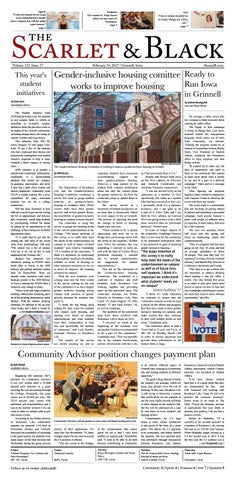
The Gender-Inclusive Housing Committee is working to improve gender-inclusive housing at Grinnell. By Mithila Iyer iyermith@grinnell.edu
The Department of Residence Life and the Gender-Inclusive Housing Committee conducted a survey last week to gauge student opinions on gender-inclusive housing in residence halls. While certain halls have both gender specific and mixed gender floors, the availability of gender-inclusive housing on campus remains limited. The committee is using this survey to gauge the housing needs of the current underclassmen at the College. “The major intention of this survey is to really help meet the needs of the underclassmen on campus as well of future Grinnell students” says Geneva Guadalupe ’17, a member of the committee. “I think it’s important we understand what students’ needs are on campus, whether in terms of housing or other personal situations as we try to move to improve the housing situation on campus”. With the new academic year coming soon and the final results of the survey coming in, the aim of the committee is to have largely gender inclusive housing across campus with pockets of gender specific housing for students who prefer it. “I think the big things [are] wiping the slate clean for students who require such housing, and starting over based on student representation and what students want their communities to look like and specifically the number of restrooms,” said Leah Reuber, Assistant Director of Residence Life. The results of the survey are slowly pouring in, and as
expected, students have expressed overwhelming support for more gender-inclusive housing. However, a large portion of the student body remains uninformed about not only the current plans for gender inclusivity, but how the committee plans to uphold these in the future. The survey served as a barometer of student perspective on an issue that is intrinsically linked to every aspect of life at Grinnell. The process of realizing the need for change in terms of housing began early last year. “There seemed to be a natural opportunity and need for us to bridge how our housing works with the needs of our students,” Reuber said. “Over the summer, this was something I realized to work on, and with the help of Lauren Myers [technical assistant] I reached out to several administrators for suggestions for student representatives.” This led to the formation of the Gender-Inclusive Housing Committee. The committee is a coalition of students and staff members from Residence Life working together and providing input on this particular issue. The committee includes Joe Rolón, Director of Residence Life, Mira Lamb ’17, Jamie Magyar ’17, Toby Baratta ’17 and Zach Steckel ’18, as well as Gudalupe. The members of the committee span from those involved with Residence Life to those on SGA. “I received an email at the beginning of the academic year saying that I had been recommended to be a part of this committee,” Guadalupe said. “This was partially due to my campus involvement, and my involvement with Res Life,
as I had previously been a CA.” Baratta and Steckel both serve on the SGA cabinet, as Diversity and Outreach Coordinator and Assistant Treasurer, respectively. “I was not invited to be on the committee as a member of SGA specifically, but rather as a student who had been involved in Res Life. I personally think it’s a fantastic initiative, and I am glad to be a part of it. Since Toby and I are both on SGA cabinet, we realized SGA was going to have to be a little more involved than we previously believed,” Steckel said. In terms of longer impacts of the committee, Guadalupe believes that it is not wise for the committee to be disbanded immediately after it has achieved its goal of attaining gender inclusive housing.
"The major intention of this survey is to really help meet the needs of the underclassmen on campus as well as of future Grinnell students. I think it's important we understand what students' needs are on campus" Geneva Gualalupe '17
“I think it’s really important we continue to ensure that the Committee remains in order to keep a check on the efforts and progress that they have made to have gender inclusive housing on campus, and make certain that they continue to deal with student needs on this issue,” Guadalupe said. The committee plans to hold a Town Hall at 12 p.m. and 7 p.m. in JRC 101 on Monday, March 13th in order to answer questions and provide more information to the student body at large.
On average, it takes seven asks for a woman to think seriously about running for public office. The Ready to Run campaign is trying to change that. Last week, Grinnell hosted the non-partisan program, which stems out of Iowa State University, via telecast. Thinking the program would be of interest to Grinnellian women, Bailey Dann, Vice President of Student Affairs, contacted the President’s office to fund, organize and host Ready to Run. “[I wanted to] to make sure the door of opportunity was open to those in our community who wanted to learn more about what it means to run and be a part of a political campaign,” Dann said in a message to the S&B. After figuring out technical logistics, Dann worked in conjunction with Campus Events to advertise the event with fliers and memos. The event itself is a series—this first one focusing on getting started in politics and launching a successful campaign. Each session featured a panel with people of different areas of expertise in these topics, followed by a Q&A session. The next two sessions, which will occur later this spring, will focus on fundraising, media and communications. “This is a program that has been going on for over 10 years and had an average attendance of about 40 people. This year they had 125 registered in Ames, plus the Grinnell telecast,” said Rachel Bly, Director of Conference Operations and Events. “The idea is to get women who are interested in politics thinking about making a run for office a reality. The idea behind this series is to make it real, give some solid pieces of advice on how to start and run a campaign, and help give women the tools they need to move forward successfully,” said Bly.
CONTRIBUTED
Community Advisor position changes payment plan By Keli Vitaioli vitaioli@grinnell.edu Beginning fall semester 2017, payment for Community Advisors (CAs) will switch from a $1,000 stipend each semester to a grant covering the cost of rooming through the College. Monetarily, this grant comes out to $5,856 per year. The 292.8 percent raise comes with additional job responsibilities and a cap on the number of hours CAs can work at other on campus jobs to just four hours a week. According to Joe Rolón, director of Residence Life, information sessions for potential CAs held in November, January and February discussed the possibility of switching to the grant system, but students were made aware of the final decision last Wednesday during the group process Friday "Global Diaspora: Art, Culture and Pan-Africanism" JRC 101, 6 p.m.
session of their application. For some like Tim Brennhofer ’19, these changes impact his decision to accept the CA position if offered. “The one caveat to the changes
in the compensation that causes alarm for me is that I can’t hold another on campus job,” Brennhofer said. “I want to be able to do both because contributing to community
is an entirely different aspect of Grinnell than working in a leadership role and leading students in different capacities.” The grant will go directly towards the student’s aid package, which for some, may already cover the cost of rooming. In this case, Residence Life is still trying to determine a system that would allow for the students to use the extra funds towards self-help or other charges on the student’s bill, but this will be addressed on a case by case basis as every student’s aid package differs. Compensation for CA type duties at many similar institutions is also given in the form of a room grant. This allows the CA payment to be nontaxable, and further benefit the students. The new payment plan was developed through discussions between Residence Life, Human
Friday Stand-up Comedy
Tuesday Bruce Blonigen: Gender and Trade Policy ARH 120, 4 p.m.
Tuesday The W. Kaman Bell Curve: Ending Racism in about an Hour Harris Cinema, 6 p.m.
CHUN CHUAN
Community Advisors will get grants to cover room and board starting next year.
Bob's, 8 p.m.
Follow us on twitter @thesandb
Resources, Financial Aid and Student Affairs, particularly Andrea Conner, associate vice president of Student Affairs. “CAs have always worked hard and it is a good thing that they are compensated for that. And with Financial Aid working with Residence Life, I hope for [it] to be positive for everyone involved,” Rolón wrote in an email to The S&B. “Given the dramatic increase in applications this year (both in quantity and quality), I do see this a positive switch.” Mollie Jo Blahunka ’17 is currently in her seventh semester as a member of Residence Life, serving this year as a CAM for East Campus. When Blahunka began serving as a CA her second year in 2014 it was the first year the CA position was a >> See CA payment page 2 Thursday Artist Talk: Ligia Bouton Falcouner, 4 p.m.
Community 3 | Sports 4 | Features 6 | Arts 7 | Opinions 9
Edited by bohlkeli@grinnell.edu & braneckm@grinnell.edu
News
2
SGA EXECUTIVE CANDIDATES President Graham Dodd
Summer White
Summer White '18 is a political science major and policy studies concentrator. She is also a DC Posse scholar; a "persistent first generation college student"; a diver; and a public health and social justice activist. She has been working for SGA since her first year in the positions of senator, assistant treasurer and treasurer. Her priorities include promoting comprehensive health, ensuring safety, ensuring accessibility, catering to diversity, maintaining self-gov and "encouraging meaningful academics." She hopes to reexamine Grinnell's values and how the College currently embodies them, making sure they cater to the needs of Grinnell students. "If elected, I will remain committed to representing the student body by advocating for our interests, maintaining open channels of communication and addressing existing and new concerns as they arise," White wrote in an email to The S&B.
Austin Wadle
Graham Dodd '19 is a political science major running for SGA President to strengthen self-gov and social activism, unify Grinnell's campus and listen to the student body. One of his main priorities is to maintain support by SGA for the College's divestment from fossil fuels. He is also committed to supporting mental health services for Grinnellians, both at the College and in the town of Grinnell. "I will immediately begin to organize an initiative to reach out to alumni and make them aware of the plight of so many students on campus and how alumni can help," Dodd said. "Another crucial piece of the mental health dilemma is the town of Grinnell, which is in much the same position we are. I've already reached out to Mayor Canfield and his office regarding the need for increased communication between town and campus. They are enthusiastic about hosting a discussion on the issue."
VPAA Misha Gelnarova
Austin Wadle '18 is a chemistry and political science major running to better the relationship between the College and the town. Wadle feels that there has been a lot of conflict between the town and College for much of Grinnell's history and they want to develop a relationship between SGA and Grinnell City Council. Some of their other priorities include raising student wages with inflation and focusing on health services. "I think [a nonelection year in national politics] will give students the opportunity to focus on the public service aspect and the civic engagement aspect ... there are going to be some big changes overall in terms of health on campus. [Central Iowa Family Planning] closing and [limits on what] people can receive from Grinnell Regional Medical Center and other healthcare providers. I'm looking forward to doing some more work to make healthcare accessible," Wadle said.
Abdiel Lopez
Zala Tomasic
n
e-i t i r
Misha Gelnarova '18 is an independent major in international relations and communications. She has experience with the Alternative Language Study program and Peace and Conflict Studies Committee. She won the Project for Peace grant to educate high school students about migration and combatting anti-refugee sentiments. To satisfy the needs of the entire student body, Gelnarova wants to foster student-professor relationships, particularly for first and second year students, limit stress at the end of the semester through events and proactive studying and encourage more alumni-student relationships. "My first actions as VPAA would be start working immediately with SEPCs and departments that have been voicing their needs for new faculty, additional course options and so on," Gelnarova wrote in an email to The S&B. She also emphasized advocating for film production resources, based on the needs that students express.
Zala Tomasic '18 is a political science and economics major, running because as an international student, she has worked hard to get to Grinnell to experience a competitive, rigorous and strong academic environment. She is a current Senator involved with the Committee on Academic Standing and SPARC Media Coordinator. Some of her priorities as VPAA would include convincing professors to return final exams and papers, making SEPCs more transparent and standardized and standardizing introductory classes, making sure the curriculum and level of difficulty in those classes are similar. "Right now we just see our final grades on PWeb and we don't get any feedback. But we work really hard on those papers and study for those tests so it would be useful to get feedback," Tomasic said. "I understand how hard some people work so I want to make sure academics at Grinnell are competitive and rigorous and we get what we came here for."
m
ca
gn
i pa
W
Abdiel Lopez '18 a sociology and art history double major with a concentration in american studies. As representative of the sociology SEPC, research tutor, ExCo coordinator, Undergraduate Research Journal editor as well as numerous other leadership positions on campus, Lopez has knowledge about many facets of student academic life. Some of their priorities include maximizing accessibility on campus, expanding Judicial Council hearing educational measures and working with tutorials to increase early success of students in various disciplines. "Being a first-generation queer college student opened my eyes to the difficulty of balancing a healthy work-life schedule," Lopez wrote in an email to The S&B. "By putting the minds and health of Grinnellians first, I hope to foster a safer environment for students to engage in self-care, social justice or anything they're passionate about and still expand their minds to build a brighter future for themselves and the rest of us."
VPSA Kahlil Epps
Dylan Welch
Election Details
in te-
Kahlil Epps '18 is an English major who ran for VPSA and lost last year, but he's back for another try. Epps is president of Concerned Black Students (CBS) and has been an SGA senator and multicultural intern in the past. Epps feels that he knows how to get things done, and some of his intended projects include retaining a culturally competent therapist, creating new dining plans, fixing student appliances such as washing machines and printers and stabilizing college traditions. "I believe that my past and current positions and opportunities have given me adequate knowledge and willpower to take on this role and move the student body forward to a better future. ... I am most thrilled about being able to have a hand in changing the Grinnell community for the better," Epps wrote in an email to The S&B.
ri W Dylan Welch ’19 is a political science major running to make sure that mental health is addressed on campus. Welch is currently a senator and coordinator for the Liberal Arts in Prison program. His priorities include pushing cultural competency at SHACS to make sure that all students feel comfortable taking care of their health, promoting student safety in part by retaining a reliable relationship between the Title IX department and the student body and pushing for adequate Muslim and Hindu prayer spaces on campus. Most immediately, he felt that the need mental health care was diminished in last night’s executive panel. “We need to not blame students for their drug and alcohol addiction, their physical dependencies. This is a mental health issue which needs to be combatted,” Welch said. “We need to not say that they are lacking in common sense. They need our full support.”
Student initiatives
Continued from Front Page
a lot more convenient for students to have one there," Burgess said. Professor quotes used to appear on PioneerWeb whenever the page was reloaded, providing the user with a funny or insightful quote from a professor on campus. "[They're] just enjoyable," Burgess said. "I really enjoyed it and I think a lot of other people did too." Lauren Schweitzer ’20 has begun to get signatures for an initiative to retain the Muslim Prayer Center that is currently in the CRSSJ as well as create a Hindu Prayer Center. The CRSSJ is going to be relocated to make way for a new admissions building, and the change in layout is planned to remove the Muslim Prayer Center. Students have created a Change.org petition to encourage administration to work to
a
p am
c
ign
keep it, and now Schweitzer is using a potential student initiative for that purpose. Cole-Kink has provided their own initiative to better Grinnell, specifically the dining hall. Cole-Kink advocates their distaste towards Scooper Hero ice cream with their initiative to replace this ice cream flavor with sorbet, or another non-dairy dessert. Their proposal would allow students with dietary restrictions who don't eat dairy to enjoy a frozen desert that they have been unable to in the past. "Removing Scooper Hero started as a joke. But then we realized people who are lactose intolerant, people who are vegan, need an option," Cole-Kink said. "I'd like to make it very clear ScooperHero is not an actual ice cream flavor," Cole-Kink added. "It's vanilla pretending to be something it's not."
Grinnell's SGA executive candidates for the 2017-2018 school year are now campaigning for votes. The election will begin Monday, Feb. 27 at 8 a.m. and end on Wednesday, March 1 at 8 a.m. There is a single round of voting in which voters rank candidates, write-in and no confidence votes included. If there is a tie, there will be runoff elections until a simple majority can be claimed, according to SGA's Election Guidelines. Six of these candidates (White, Dodd, Wadle, Gelnarova, Tomasic and Epps) will have their names on the ticket, and two candidates (Lopez and Welch) are running write-in campaigns. — Compiled by Lily Bohlke; photos contributed and by Mahira Faran and Sarah Ruiz
CA payment to change next year
Continued from Front Page
paid position. At the time the students received a $500 stipend, which increased in 2016 to $1000 to reflect the new on-call duties placed on CAs. As the duties for CAs continue to increase, next year potentially including weeknight on-call duties, Blahunka believes the switch to room grants, and therefore a large pay raise, reflects a necessary compensation. “I do [think it’s a good change]. I think it’s not going to please everyone, and we’re not going to find an option that is going to please everyone, ... what we have found time and time again is that we work way more than we’re paid for,” Blahunka said. Carrie Stallings ’19 was a CA during fall 2016 but ultimately had to step down from her position as she had to make the financial decision to
move off campus. Because she loved the job and her relationships amongst Residence Life staff, Stallings would have liked to return to a CA position next year, had she been made aware of the changes to the payment plan before the applications were due. “It definitely could’ve changed things for me. … I just wish I would’ve had time to consider it,” Stallings said. Stallings was also blindsided by the amount she was taxed on her stipend from last semester, claiming her taxes took out 350 dollars. She has yet to receive a clear explanation about stipend and tax policies from the College, having been told different reasons from the cashier, payroll and Residence Life. “I think Res Life needs to work on its transparency not only with its staff but with its students. … No one
ever disclosed any of [the amount of tax] to us and said, 'hey put away some of this money' so I’m feeling pretty screwed,” she said. Rolón stresses that with the change, Residence Life is willing to work with students and the financial aid office to determine how the grant affects their financial aid package or their ability to work other on campus jobs. Brennhofer hopes he can work with the two to develop a plan for maintaining his other on campus commitments after he finds out if he has been rehired. “They let us know [if we have been hired] before spring break,” Brennhofer said. “The issue with that is we only have I believe a week or a week and a half to either accept or refuse the offer which is a really short window to make really large financial decisions for the upcoming year.”
Edited by vitaioli@grinnell.edu
True Grinnellian:
Community
3
Voter ID bill proposed
By Mineta Suzuki suzukimi17@grinnell.edu
By Candace Mettle mettleca@grinnell.edu
If good coffee is a pleasure, Sam is a treasure. Sandra “Sam” Cox has been living in Grinnell for her entire life of 48 years. She has owned Saints Rest, the only coffee shop in town, since 2013. “My favorite part of the town is a sense of community. It’s really beautiful, safe and diverse because of the College,” Cox said. Though she has long put her roots down in the community, she was not always an expert in running a coffee shop. “I got a degree in fashion merchandising as I thought I would like to be in the fashion industry. I think I just thought really small, which is sometimes a problem with the smallsized town. You don’t always learn to dream big, … but the world is a pretty big place and you should think bigger,” Cox said. But she finds joy in her new life project, establishing Saints Rest as a communal space for everyone. And it has been successful so far. “I get to know a lot of people. Stemming from college students that are 18 years old through my retirees that are in their 70s, 80s and 90s to the new high school students. … I get to develop long-term relationships,” Cox said. Certainly there are challenges to maintain a local business. In such a small town like Grinnell, the fear of big chain competition is dire. “The rumor [that Starbucks might open in Grinnell] has circulated a couple times, and it is circulating again. I have heard that when Starbucks comes into communities like ours, the [local] coffee shop actually ends up doing a little better, simply because people tend to support that coffee shop even more. But to be honest, I am of the other opinion that it would only hurt my business,” Cox said. Indeed, neighboring towns such as
Iowa Republicans, led by Iowa Secretary of State Paul Pate, have introduced “The Election Integrity Act” (officially called House Study Bill 93) to combat voter fraud. However, many have expressed concerns about the intent of the law, including election auditors, civil rights lawyers and Iowans. According to the Des Moines Register, election auditors found only 10 cases of voter fraud out of the 1.6 million cast in Iowa in November. Out of the 10, most incidents occurred due to human error that officials quickly corrected. Considering the drastically low number of cases, voter fraud has not yet been found to change the outcome of any election conducted in Iowa. The Election Integrity Act states that voters must bring with them a driver’s license, state ID and other official forms of identification to be eligible to vote. Polling monitors will then scan the card to verify the eligibility of the voter, specifically if the voter’s name appears in an electronic voting list. Signature and absentee ballot verification will also measure the validity of a voter’s ballot. Iowans without any official identification will automatically receive a voter identification card in the mail. Currently, at least 85,000 Iowan residents would need to obtain a voter’s identification card. Political Science professor Peter Hanson echoed the same concerns that many have over the bill. “Studies suggest that the effects of voter ID laws can be significant; it can disfranchise thousands of people if they have to jump through all the hoops that are necessary to vote,” Hanson said. “If you think about the history of the United States, there are always laws that seem innocuous on the face that have been used to suppress the vote in the past.” Hanson cited the civil rights movement, and what led up to it, as an example of the implications of voter fraud provisions. As the results of the civil rights movement showed, designed measures to prevent certain groups of people from voting ceased. However, as more states move to adopt laws claiming to prevent voter fraud, it undoes all the progress made from the U.S's past. “I simply look at voter ID laws as an attempt to resurrect a new kind of barrier,” Hanson said. Hanson believes that HSB 93 has a real chance of passing successfully through the legislature. Currently the Republican party holds a near abso-
HELENA GRUENSTEIDL
Cox (right) serving coffee and smiles to the Saints Rest crowd. Newton and Marshalltown face similar problems. But for now, she aspires to improve things inside her own café. “I think dogs should be allowed. That’s my newest complaint. Sometimes I wish [Saints Rest] were bigger, simply because … it gets crowded in here and we don’t have enough space. I always think about what we can do to grow our business,” Cox said. That is why she keeps coming up with new baked goodies and supported the reopening of the 1854 Deli, which serves fresh salads and sandwiches, making Saints Rest an attractive venue for non-coffeeholics. Additionally, she strives to do more with the cafe, by hosting various events such as live concerts and art workshops, as well as political gatherings. Recently, for example, there was a community meeting at Saints Rest in response to the Trump administration’s executive order on the immigration. "I think part of it is because [Saints Rest] is considered more of a neutral area. … So anything that anybody reaches out to me on, I try to be very supportive and if I can donate my time and product, I will. … I just feel like that’s one way of giving back,” Cox
said. Through her intimate interactions with the customers, Cox keenly observes general demographic changes in students. “In my opinion, there are a lot more kids with discretionary income, who have more money to spend in my shop, so I’m very fortunate for that, and who don’t necessarily have to have those jobs outside of class. … The employee pool that I used to have is getting smaller and smaller, too,” Cox said. However, what remains the same, from her point of view, is the academic rigor of the College. “Do I think your workload is crazy? Yes. I’ve seen what you guys do. That takes a special person to put your nose to the grindstone and turn out that stuff,” Cox said. Whether as fuel political activism or a guilty escape from homework, Cox will continue to give students and community members a warm hug in a mug. “We are very community driven. We are very fortunate that all different kinds of people come in here and that it has become a hubbub for activity.”
Des Moines Water Works threatened by House Bill 316 By Carter Howe howethom@grinnell.edu House Bill 316, proposed to the Iowa state legislature on Feb. 14, would abolish Des Moines Water Works (DMWW), an independent authority that provides clean water to about 500,000 people in Des Moines and its suburbs, and replace it with regional water authorities controlled by local municipalities. Proponents of the bill say it gives more representation to suburban water customers and allows municipalities to have more control over water distribution. Opponents say it is nothing more than retribution against the lobby for a federal lawsuit DMWW leveled against three counties for excessive pollution of nitrates, common in fertilizer, in the water they send downstream on the Raccoon River to Des Moines. The lawsuit has not yet been settled and will be heard in court in late June, according to Bill Stowe ‘81, CEO of DMWW. DMWW distributes approximately 60 percent of its water to customers in the Des Moines suburbs, according to a report from the Iowa Partnership for Clean Water. House File 316 would place DMWW’s assets in control of municipalities and change the way the utility’s Board of Directors, whose members are currently appointed by the Mayor of Des Moines, is elected so that the suburbs have more direct representation. The sponsor of the bill, Republican representative Jared Klein from Keota, which is one hundred miles from Des Moines and whose residents are not served by DMWW, claims the bill is in response to concerns from ratepayers about prices going up and a lack of representation in how the utility makes decisions, KCCI reported. Stowe believes Klein’s sponsorship of the bill, as he is a farmer affected by proposed nitrate restrictions, shows that its main motives are not local control but protecting agricultural interests in the state. “We want to call it for what it is; it’s a power grab by Farm Bureau and its allies in the legislature to quiet our opposition to industrial agricultures pollution effect’s on
our surface waters,” Stowe said. “If it were about regionalization, it wouldn’t be coming from a hog farmer in southeastern Iowa. It would be coming from a suburban or urban legislator here in central Iowa.” According to Stowe, increased toxin pollution upstream has negative economic and public health effects for DMWW’s ratepayers and is part of an unsustainable model of agriculture. “People who produce livestock, or particularly corn, upstream from us are externalizing. They’re moving the costs from their production to our ratepayers,” Stowe said. “It’s a public health issue because it’s not only more expensive for us to have to clean up, … but also because the public health consequences of producing clean agro polluted water makes it very difficult and at some point we’ll fail at being able to do that…whether in Des Moines or whether in New Orleans, it’s part of the Mississippi River valley. And it’s pretty clear that water pollution issues continue to be a problem because of land practices upstream.” Stowe also said that suburban customers, whom the bill claims to be aiding, do not support it and that efforts have been made in the past at giving suburban communities more say in the governance of the utility but were unsuccessful because of the high cost of assuming a stake in the utility’s capital assets involved.
Opponents have also criticized the bill for potential harmful effects on economic development, particularly a provision that prohibits new construction of water infrastructure until July 1, 2018. This provision has put the development of a Microsoft data center in West Des Moines in jeopardy. Though the bill is expected to pass, Stowe remains confident that water issues are better dealt with at a federal level because water does not stay within specific political boundaries. He is prepared to do all in his power to ensure environmental protection. “We’re talking about a public health issue here, water and the strict environmental responsibilities, regulatory responsibilities is what [DMWW] does on a day to day basis. When that’s in danger, that’s a huge issue for public health, and it’s a huge issue for economic development in the area. It’s bad business and it’s bad policy.”
ALL PHOTOS CONTRIBUTED
(Top to bottom) Bill Stowe: head of DMWW; DMWW building in Des Moines
lute majority, and Hanson believes that the bill has clear partisan effects and goals. “People who are likely to be affected are disproportionally democrats, which has led most observers to conclude is what we’re seeing here is not about combating voter fraud, but it’s rather about partisan agenda,” Hanson said. “For that reason I’m skeptical of these laws.” “I think we need to make it easier for people to vote, we need to encourage people to vote and I think that any law which make it more difficult and in particular one that cuts disproportionally across the population and singles out vulnerable groups or those targeted in the past is really troubling.” Voting, according to Hanson, is the single most important means to ensure that citizens can effectively protect their interests. “[People] can mobilize and they can demonstrate and they can put pressure on members of congress, but [if] that pressure doesn’t translate in votes, [then] it doesn’t have a lot of meaning,” Hanson said.
“...[if] that pressure doesn’t translate in votes, [then] it doesn’t have a lot of meaning.” Professor Peter Hanson As Hanson said, the civil rights movement found success through reminding their congressmen, mainly ones from the Democratic Party which held pro-slavery and Jim Crow stances in the past, that they are constituents of their districts too. In turn, congressmen had no choice but to respond to their constituents. “it’s a puzzle to how Democrats became supportive of civil rights,” Hanson said. “A big part of the answer is that [they] responded to black voters so by and that’s the north of course so the most important thing you can do is to allow all citizens their rights is the right to vote.” Lawyers from the ACLU of Iowa and election auditors believe that HSB 93 will complicate and prolong voting. Iowa has one of the highest voting turnout numbers in the country due to its accessible polling stations and long period for ballot submission. “The consequences of these laws are real and we should be concerned,” Hanson said. Secretary Pate told the Des Moines Register that the bill will strengthen confidence in Iowan voters and maintain the fairness of elections within the state. However, Secretary Pate’s office could not be reached for further comment.
Veterans Commission Update By Andrea Baumgartel baumgart1@grinnell.edu To the excitement of many local Grinnellians, Mayor Gordon Canfield filled the two previously vacant seats in Veterans Memorial Commission this past Monday, Feb. 20. The two new appointees are Gwen Rieck, who assumes the role as Vice Chair and is a former U.S. Air Force nurse; and Marie Andrew, who will be the recording secretary and who served in both the U.S. Army as well as the Iowa Army National Guard. Before these positions were filled, the commission was left it in limbo and unable to consider the future of the vacant Veterans Memorial Building that holds a great deal of meaning in the hearts of community veterans and non-veterans alike. The one obstacle remaining is the resignation of Chad Rose — leaving yet another vacancy to be filled by the Mayor. However, with the reinstitution of two more gender-balancing seats, immediate decision-making was allowed to commence at the first meeting following the commission’s multimonth dormancy. Most notably: the decision to accept Tom Lacina’s proposal to transform the building into a nationally-recognized artist residency. Lacina, a local lawyer, farmer, art aficionado and former Grin City Artist Collective property owner drafted, in the words of Canfield, “the most fleshed-out plan we have.” In his proposal, Lacina outlines a specific vision for the building. Currently, Lacina proposes to use funds from a tax levy, set for November 2017, as well as grant-writing
to renovate the building into a space where around two to three dozen artists per year could set up their own working space, synthesize and collaborate with other artists, and let their creative processes flow for the benefit of the public. The residency will very much be grounded in honoring veterans, by encouraging and favoring all veteran applicants, although non-veteran applicants would still be accepted, as well as potentially forging more opportunities for local veterans to engage in art themselves. “The artists could meet and interact with the community and engage in Central Park, downtown and school activities and public events. The artists might provide shows at spaces downtown, participate and encourage art and music therapy, attend potlucks and other social events in Central Park, be involved in college activities, and work with youth programs at our schools and in our many youth organizations,” Lacina wrote in his now-accepted proposal. The attitude of freshly-minted commission member Andrew is positive, but practical. “The proposal seems like a viable one. I do know that art therapy and music work for veterans and other people,” she said. However, Andrew very much emphasized that this is a plan that will take a lot of money and a lot of work — from everyone. “If the community can raise the money, then yes,” Andrew said when asked of her overall approval of the plan. “But we need people to get involved. We still need more veterans, especially the younger ones, and other people in the community to participate. It has to be a combined effort.”
Sports
4
Edited by carhartl17@grinnell.edu
Swimmers & Divers wrap up season with a strong showing at Conference Championship
CONTRIBUTED
Beth Tsuha, '17, won the Midwest Conference Women's Swimming and Diving Performer of the Week for the fourth time. By Mithilia Iyer iyermith@grinnell.edu
’18 gained a NCAA “B” cut, and the team won three of six events on Sunday alone.
Grinnell College’s swimming and diving teams triumphed at the Midwest Conference this past weekend. The women’s team continued their impressive record, claiming the title for the fifth year in a row, and the men’s team successfully defended their championship as well. “As a women’s team, I knew we were going to be strong going into Conference, and we were going to have some good races. Personally, I think this was a great way to end my collegiate swimming career” said Beth Tsuha ‘17. This sentiment was definitely reflected in the results, as Maria Venneri
“Getting on top of the podium, getting first place was a goal of mine, and I hope to do it again. I think we’re set up well as a team to continue being on top of our Conference for next year as well” Will Lindell '19 Preparation for this event is key, as it is the biggest meet that both the teams compete at. Building off hard work and intensive training throughout the season, they then taper their practice off. “Personally, I expected to have
some good swims because I’d been training hard. Most of the season was building up in terms of how much we swam. Once we returned from our Florida trip, we decreased our training. Coach Erin [Hurley]’s taper definitely helps us” said Will Lindell ‘19. Hurley also won both the MWC’s Men’s and Women’s Coach of the Year awards. Conference is spread out over three days unlike other meets. “I thought we were pretty consistent, and scored a lot of points across both the men’s and women’s team, which was good,” Lindell said. Additionally, Tsuha added that there was not a discernable change in trajectory of the team across three days. “We had to outperform all the other teams and gain points in the preliminary rounds as well, which gave us a stronger momentum for the next couple of days”. This momentum definitely seems to have paid off. Tsuha won the MWC’s Women’s Swimmer of the Year title, as well as the 100-yard freestyle event, missing out on the school record by only .06 seconds. Lindell, who won the men’s MWC Swimmer of the Year, shattered both the Conference and school records of the 100- and 200-yard breaststroke events, comfortably ahead of a “B” cut standard time. “Getting on top of the podium, getting first place was a goal of mine, and I hope to do it again. I think we’re set up well as a team to continue being
on top of our Conference for next year as well,” Lindell said.
“As a women’s team, I knew we were going to be strong going into Conference, and we were going to have some good races. Personally, I think this was a great way to end my collegiate swimming career” Beth Tsuha '17
The Men’s and Women’s Diving team performed exceptionally as well, with Summer White ’18 winning MWC’s Diver of the Year, as well as qualifying for NCAA Regionals. The men’s team also put on a good show with Michael Lee ’18, Charlie Paquette ’19 and Jonathan Rebelsky ’20 taking third through fifth in one-meter diving.
“With diving, you have to be in an extremely neutral headspace, so the week before was calm. You can’t be focused on the dive itself, so you have to rely on muscle memory,” Lee said.
"You can’t be focused on the dive itself, so you have to rely on muscle memory” Michael Lee '18 Preparation for the team varies from that of the swimmers as well, and seems to have definitely contributed to a stellar meet. “The swimmers all mention the phrase ‘last one, fast one’ when talking about their senior goals, and though this obviously does not apply to diving, I want to do so as well as a rising senior. I want to work hard, and hope to see the team do so as well” Lee said.
CONTRIBUTED
Joshua Tibatemwa, '19, in a meet earlier this season.
Katie Parrish dives headfirst into the off season By Kate Irwin irwinkat@grinnell.edu Katie Parrish '18 never pictured that she would be a collegiate diver. Parrish did gymnastics throughout her childhood until high school. After her career as a gymnast ended, she took a few diving lessons because of the similarities between the two sports. "It's about knowing your body and space. And I really enjoy those things," Parrish said. It wasn't hard for Parrish to get into diving. "I've always loved water. It was very natural for me to get to do something that I already knew I enjoyed, but with the added water element." Parrish began diving her first year at Grinnell. There was no permanent diving coach at this time, which made learning difficult. People with limited experience in diving came during practice to help coach, but this inconsistency proved challenging. Parrish did not improve as much as she wanted during her first year, but this changed when Mike Retelsdorf came to the program the following year. Parrish first met Retelsdorf at the Swimming and Diving Alumni Weekend picnic. She was both taken aback and amazed by how much Retelsdorf had planned before the season had even started.
"I was intimidated [by Mike] because the year before I was diving for fun, and it was ok. But it wasn't part of my identity. I enjoyed it but it really wasn't that big of a deal for me. But my second year when Mike came, I said ‘ok, it's time to take this seriously,’” Parrish said.
“Last season was me learning how competition works, me looking at others and getting into the enjoyment of the competition” Katie Parrish '18 Parrish credits Retelsdorf for a lot of the improvements she has made. “Last season was me learning how competition works, me looking at others and getting into the enjoyment of the competition.” But this season was different for Parrish, she wanted to win and achieve a personal best. Parrish had never taken diving very seriously in the past. But something changed in Parrish this past fall, she had a drive to achieve new heights. “This season was a lot more difficult for me because I was really pushing myself,” Parrish said. But this season was far from easy for Parrish. Last season she suffered
from a concussion, and it still affects her diving today. She had to be cautious and strategic while diving so that she did not injure herself again. Parrish feared that if she attempted dives with too high a difficultly level she might open the door to injury. Parrish took a different path to improve this season to avoid potential injuries. There are two ways to view diving: the difficulty lens and the execution lens. The difficulty levels include things such as flips and rotations; additional components of the dive that makes it harder to complete successfully. Execution is how well one does the dive, from how they hold themselves after leaving the board to how they enter the water. “This season was all about execution,” Parrish said. Retelsdorf spent every day at practice working with Parrish on the execution of her dives. This proved an asset for Parrish, as she scored second in the Midwest Conference Championship this past weekend. At the Conference Championship meet Parrish struggled to get out of her head. “Seeing that those scores [of the other divers] were slightly higher than mine all throughout prelims was a little bit scary,” Parrish admits. Despite this uncertainty, Parrish’s training pulled through. “I really
HELENA GRUENSTEIDL
Katie Parrish '18 has been making huge strides in a sport she picked up only two years ago. owe it to Mike and his drilling us all the time,” Parrish said, “I’ve gotten so much better [at execution] thanks to Mike.” “Something else Mike drills into us is accepting and moving on,” Parrish recalls. This lesson from Retelsdorf helped get Parrish through the meet. Despite not scoring as well as she usually does for one of her dives, Parrish exceeded her own expectations. Parrish had been aiming for third place, but ended up coming in second at the competition. Parrish has already set new goals for herself next season. “I want to
bring in new dives and take what I've learned from the one meter dives and bring them to three meter dives,” Parrish said.
"It's about knowing your body and space. And I really enjoy those things" Katie Parrish '18 Parrish’s drive for success and her unwillingness to accept mediocrity is why she is as successful as she is. Her passion for diving is evident, as is the fact she will continue to achieve new heights next season with ease.
Men's Tennis almost aces first weekend, is optimistic going forward By Steve Yang yangstev17@grinnell.edu After three tough losses in Janesville, Wisc. over the past weekend at the University of Wisconsin-Whitewater Tournament, the men’s tennis team is reorganizing, resting and getting ready for another tough match against Gus-
tavus Adolphus College on Saturday, Feb. 25. Although they suffered close and disheartening defeats in their first two matches against Ohio Wesleyan and Wheaton College, the team finished strong in all its matches and demonstrated the resilience and fortitude they hope will carry them to a 15th consecu-
CONTRIBUTED
The Men's Tennis Team is looking forward to another successful season.
tive Midwestern Conference team title and reserve a spot at the Division III National Championships.
“The final match score doesn’t necessarily reflect the match; we were competing really hard” Tommy Pitcher '17 Currently ranked 14 in the Central Region, the Pioneers played back-to-back-to-back matches at the tournament in an effort that called for substantial mental and physical focus. “We had to play late Friday night and early Saturday morning, as well as later Saturday afternoon, so I would say that I was very tired by the end; however, every match was vitalizing and a lot of fun,” wrote co-captain Cole Miller ’17 in an email to The S&B. Co-captain Tommy Pitcher ’17 said that he was proud of the team for staying strong throughout the games, and for playing to a focused finish in every match. He added that the final score was not a reflection
of the overall closeness and competitiveness, pointing out that Grinnell lost its first two by a score of 4-5. If a few points had gone the other way, the Pioneers would have finished 2-1 overall for the weekend. “It took us a while to get into the swing of things. By the time we found our stride as a team, it was a little too late,” Pitcher said. “The final match score doesn’t necessarily reflect the match; we were competing really hard.” Against Whitewater Miller was the only Pioneer to defeat his opponent, which he did with a final score of 7-6, 3-6, 10-7 at number 2 singles. He credited the satisfaction and possibility of this victory to playing with an upbeat and optimistic attitude. “It was an incredible win for me personally. That’s the 2nd time I’ve beaten a fellow from Whitewater (all of them are top players),” he wrote. “I never got down on myself during that match and was surprisingly lively and happy throughout. I think that definitely helped me win.” Despite the setbacks, Pitcher and Miller said that they are hopeful these experiences will prepare the
team to execute future game plans, with an emphasis on the MWC championships. Miller explained that mental toughness is the key for both winning and team spirit. “I’m hoping the team will focus of the mental side of tennis a lot more. That’s one thing we all need to work on in order to foster greater cohesiveness as a team,” Miller wrote. “The team is young and still developing, but ... we’ll be able to shape these fresh players and instill in them a sense of greatness.” Next Saturday, the Pioneers will take the court against a team which Miller calls “the toughest team ... during the season,” a credit to Gustavus Adolphus College’s 9-0 sweeps in its last five matches. Gustavus Adolphus is currently ranked #5 in the Central Region. “[We’re] not expecting to win, but the team will give their best try and we’ll see what happens,” Miller said. “I think this weekend will be a great learning experience for our freshmen and sophomores, as they will get to play against top-level players and experience what it’s like at a level higher than our own.”
Edited by lilienfe17@grinnell.edu and flemingt17@grinnell.edu
Advertisements
got a rant? got a rave? we can publish that for you
[mettlca]
Come Join Our Team - Come get paid to report on weekly stories - Photographers and writers are needed - Meetings are every Sunday in JRC 220 - Writers meet at 3pm
[newspapr]
- Photographers meet at 3:30pm
7
Features
6
Across the world to East Street
Edited by kielyphi@grinnell.edu
AAA plans heritage events
“My best friends are still my best friends here, because they all went here, so that’s a big part. The kinds of places that I liked to go are still the kinds of places that I like to go,” Burt said.
In a lot of ways, I've always known that I would come here. Sam Burt '17
LIAM LI
Dhruv Bakshi '17 and Sam Burt '17 pose together outside the Spencer Grill. By Philip Kiely kielyphi@grinnell.edu Dhruv Bakshi ’17, who hails from Jakarta, Indonesia, came over 9,700 miles to get to Grinnell. Sam Burt ’17 traveled two blocks. Of everyone with publicly listed home addresses on the campus database, Burt came the shortest distance to what Google Maps defines as the center of campus and Bakshi came the furthest. From almost 10,000 miles apart, the two ended up living across the street from each other on East Street this year. Burt always knew that he wanted to come to Grinnell. “In a lot of ways, I’ve always known that I would come here. My first conscious recollection of this is in second grade [when] my best friend moved away and I wrote him a letter that was just ‘when it’s time to come to college, go to Grinnell College,’ … We did not reunite, but that was my first idea of what going to college meant,” Burt said. Bakshi took a while longer to hone in on the college. “I’m originally from Mumbai, India, which is a huge city and back home English is my first language and so everybody went to the same system in the eleventh, twelfth, which was IB … so there was no thought into where I would go to study, it was more like ‘I am going to go to the US and study,’ and after
I figured that out I was like ‘where do I want to go in the US.’ I had always lived in big cities … so I narrowed my focus to small liberal arts colleges in almost the middle of nowhere,” Bakshi said. After he came to Grinnell, his family moved to Jakarta, positioning him almost exactly across the globe from Grinnell. “Now I do live in Jakarta. I came to college when I was in Mumbai, but a year and a half in my family shifted to Jakarta, Indonesia. I guess I call that home now. In my heart, home will always be Mumbai, India, but when I go home, I go to Jakarta, Indonesia,” Bakshi said. Burt goes home regularly by foot. When Bakshi returns home, which he does every winter and summer break, he takes a series of flights across either the Atlantic or Pacific.
After my family moved to Jakarta my identity with Grinnell has become stronger ... Now I feel like [Grinnell] is the closest place I have to home. Dhruv Bakshi '17 “I usually take between three and four flights … usually it is about 36 hours,” Bakshi said. The two are both very connected to Grinnell, but in different ways.
“After my family moved to Jakarta my identity with Grinnell has become stronger. At least I can call this place home, at least I’m here for most of the year. When my family was in Mumbai I was always like ‘Mumbai, Mumbai, Mumbai.’ Now I feel like [Grinnell] is the closest place I have to home. I go back to Jakarta and it’s far, my family is there but I don’t feel to connected to the city,” Bakshi said.
In my heart, home will always be Mumbai, India, but when I go home, I go to Jakarta, Indonesia. Dhruv Bakshi '17 After graduation, Burt plans to stay in the area. “I’m planning on spending a bit time here just to save up some money before I move anywhere just because living is so cheap here. There are places in Iowa City and Des Moines that I’m looking at. I have some friends in Colorado, that’s a really good place … the kinds of jobs that are available there more match my interests,” Burt said. Bakshi will return to Indonesia and ultimately to Mumbai. “I really miss India, I love India. I do eventually plan on going back there, but not immediately. Immediately, I’m going to spend this summer traveling the US, because I don’t know when I’ll be back next. I plan to go back to Indonesia, but not Jakarta, because Indonesia is a really beautiful country,” Bakshi said.
Corner of Broad & 8th: poophouse like. When you live in dorms, you have no control over the people who live there as well. We’re all able to sit down together and resolve issues, whereas in dorms, you can’t do that,” Ryan added. Living off campus is often refreshingly isolating. “If you don’t want to go out, you don’t have to because no one can force you to anymore. You can be a hermit so much easier off-campus,” Crotteau said.
HUNG VUONG
The residents of "poophouse," Robin Crotteau, Oonagh Jordan, Caleigh Ryan, Marie Kolarik and Julia pose inside their brown-walled abode. By Tanvi Jindal jindalta@grinnell.edu A cozy house on the corner of Broad Street and 8th Street is home to Robin Crotteau, Oonagh Jordan, Caleigh Ryan, Marie Kolarik and Julia Broeker, all ‘17. They have known each other since their first year at Grinnell and decided to live together off campus for their last year together at Grinnell. “Caleigh and I were roommates our first year,” Kolarik said. “Yeah, we have been roommates every year, except our third year when we were abroad different semesters, when we switched the same room. Robin and Oonagh were in my Spanish class first year. We all lived in Main hall too,” Ryan said.
We are bonded for life at this point, like fish that stick to each other. When you live with a bunch of other people, you'll have tensions, but these are all people I like. Caleigh Ryan '17 “Julia was a later addition to our group,” Crotteau said. Living and eating on campus was cleaner and more convenient, but there are advantages to living off-campus as well. “Now that we all are off-campus, one of the main things I miss about living on campus is the dining hall. Having to make dinner is a huge pain, sometimes you just want
to gorge yourself … sit on the dining hall and eat,” Crotteau said. “But it’s nice to be able to walk into the bathroom with no pants on, but we also miss the FM cleaning the bathroom,” Ryan said. “The cleanliness on campus is significantly higher than that off-campus,” Crotteau said.
If you don't want to go out, you don't have to because no one can force you to anymore. You can be a hermit so much easier off-campus. Robin Crotteau '17 “I think it depends on where you live though. We lived in Main and it was disgusting. Also, we know everybody here- nobody’s sketchy,” Ryan said. The group saw moving off-campus as the natural conclusion to the four-year housing progression. “First you get to pick your roommate, then you get to have a single and then you get to live off-campus. It’s like the maturation of living situations,” Jordan said. “There’s definitely a distancing from campus though.” Living off campus has only served to strengthen the bonds within the group. “Caleigh and I are used to living together,” Kolarik said. “We are bonded for life at this point, like the kind of fish that stick to each other. When you live with a bunch of other people, you’ll have tensions, but these are all people I
Now that we are off-campus one of the main things I miss about living on campus is the dining hall. Having to make dinner is a huge pain, sometimes you just want to gorge yourself. Robin Crotteau '17 “I feel like we are a bunch of wine moms, who just bicker about their day around the kitchen table, but in a good way,” Ryan said. The friends are often at odds about the state of the kitchen and other contentious topics. “I think bickering makes you stronger friends,” Crotteau said. “It’s about cleanliness mostly. We fight about the kitchen,” Ryan said. The friends resolve their problems through group texts and house meetings. “We have house meetings to resolve them. Usually when I have a lot of grievances, I send a text on the group message- it’s called ‘binch’, which is like bitch but less meanand then we have a house meeting and then we’ll resolve the issues,” Crotteau said. Ryan thought that a house name was important, but the others decided on ‘poophouse’ as the name. “In the beginning of the year, we were thinking, ‘what should call this house?’ It’s important because you have to give yourself an identity. It was really important to Caleigh and I was in a bad mood that day so I said, ‘I’m going to call it poophouse because this house is brown’ and that stuck because we thought it was funny to antagonize Caleigh. We also alternatively like to call the house ‘bitch-haven’,” Crotteau said.
MAHIRA FARAN
AAA plans the AAPI Heritage month to raise awareness of marginalized Asian cultures and discuss intersectional identities. Apart from Kit Yan’s visit, docuBy Siyuan Du mentary screening and various workdusiyuan@grinnell.edu shops, the cabinet is also preparing for a food stall event that uses AAA’s Grinnell’s Asian American Asso- power to join all the other Asian stuciation (AAA) is planning the Asian dent groups together. “We are discussing [how] to use American Pacific Islander (AAPI) Heritage month at the end of the se- that event to raise awareness of Asian mester. AAA Cabinet members Esther cultures, not just Korean or Chinese Hwang ’19, Jin Chang ’19 and Ruth [cultures], but really working with othWu ’17 are excited to host a series of er student groups – South Asian Stuevents on campus to discuss intersec- dent Association, Philippine United tional identities and raise awareness of Students Association, etc. We want to bring visibility and bring all the groups marginalized Asian cultures. The AAPI Heritage month events together. And possibly [we will] diswill feature a one-man spoken word cuss raising money through selling performance entitled “Queer Heart- food to promote Asian non-profits and Asian groups [which are] not so visiache.” “We are bringing Kit Yan, who is ble,” Wu said. The motivation for setting these a queer, transgender Chinese American spoken word poet. He is nation- goals for AAPI Heritage month can be ally renowned, and we prioritized traced to the cabinet members’ underbringing him on campus for a string standing of Asian American identities. “There isn’t necessarily a comof events we are doing,” Hwang said. “And it is really because of Kit monality or a common experience that Yan that we are able to gain funding defines Asian American experience. from multiple organizations,” Wu The commonality is that we have all been racialized by a white America,” said. With support from the Stonewall Chang said. AAA works to avoid insularity and Resource Center, the English Department, the Gender, Women’s and Sexu- strives to build connections with other ality Studies Department, the Theatre identity-affiliated student groups. The Department and the Multicultural cabinet unanimously agreed on the Leadership Council, the events sur- importance of being conscious of the rounding AAPI Heritage month this AAA’s grounding as an identity-affilyear are going to be bigger than ever. iated association. “We cooperate with Concerned Bringing Yan on campus is an effort to foster conversations on the intersec- Black Students (CBS) and Student Ortionality of gender-related topics and ganization for Latinos/Latinas (SOL), Asian identities in the Grinnell com- and we want to remember that racism munity, but the scope of discussion is not the only thing, but that there is activism and institutional solidarity inextends far beyond this. “[We focus on] gender-based vi- volved,” Hwang said. “If we are going olence in AAPI communities, queer to fight for Asian American rights, we and transgender identity with an Asian need to also fight for rights of other American culture, biracial identities minority groups. We have common and the impact of colonization on interests and there is a multi-cultural solidarity going on.” Asian cultures,” Hwang said.
Day in the Life: Aaron Weerasinghe
SARAH RUIZ
??:?? a.m. – Have you ever had a dream that you, um, you had, you, your, you could, you’ll do, you, you wants, you could, you, you’ll do could you, you want him, you want him to do you so much you could do anything? 9:45 a.m. – It’s time to face the day: equip my aloha shirt and my Neat Dude hat 10:00 a.m. – Head to Saints Rest to workshop some Creative Essays and get free coffee (Thanks, Dean) 11:50 a.m. – Borrow a book from [downsjul17] so I can do a reading for my 1 p.m. class 1:10 p.m. - Interrupt class to return said book, @ me if you have beef 1:15 p.m. – Draw a Sweet Picture of myself in my notebook, Hell Yeah 2:00 p.m. – Run into [lepitoar17] after class, plants the following idea in my head: tequila 2:05 p.m. – But Alas, I Have No Money And I Must Work 2:15 p.m. – Not before I slap on a pair of shorts because the sun is shining and my frail bones crave the D 2:40 p.m. – OK so in the latest ARH Construction update, one of the things on the task list is “Investigate attic in Carnegie” and 2:41 p.m. - spooky spooky shit 3:00 p.m. – Think about how much I love Pokémon 3:01 p.m. – Nice 4:00 p.m. – Get out of work early so it’s time to work on Pub Quiz Rounds 4:05 p.m. – Recall all the embarrassing things I’ve done over the past 21
years of my entire life 4:20 p.m. – it’s fine 6:02 p.m. – Low on round ideas so I think about my favorite things 6:03 p.m. – Write a round on eggs, an “eggy round” if you will 8:30 p.m. – Head to the printers 30 minutes before pub quiz so I won’t be late as usual 8:55 p.m. – Hit up my favorite news site, www.crouton.net, to start writing the Current Events round 9:10 p.m. – p u b q u i z 9:40 p.m. - Tragedy: The Team With “Egg” In Their Name Leaves Before The Egg Round 10:10 p.m. – Pub Quiz is over, and next week’s Pity Pick round will be on Penguins 10:11 p.m. – [looks at the camera] I forgot to eat today 10:40 p.m. – Ponder some spicy text messages I got from an unknown number yesterday (“You’re beautiful. Where are you from? You have god energy in your pictures. Thank you for sharing your number it’s late you should be getting to bed.”) 11:00 p.m. – [engleman17] calls the number, no answer 11:01 p.m. – THEY CALL BACK and DENY sending the messages, so we send them a screenshot of the messages 11:30 p.m. – Engage in discourse about coconut oil, nectar, and recycling 2:00 a.m. – Still down to clown, but it’s time for bed.
Edited by coghlann17@grinnell.edu
Arts
Grinnell Artists: Lydia James "It's comforting and healing to create things."
Zane Silk silkzane@grinnell.edu When I walked into the Bucksbaum sculpture studio, Lydia James ’19 was sitting cross-legged on a table, her art spread out in a circle around her. As I looked at the bright watercolors and vivid prints, the textured sculptures and embroidered fabrics, I barely glanced at an unassuming pile of black sketchbooks that lay next to her knee. As James began to talk, the books took on more meaning: the humble sketchbooks are what brought her to art, and what sustains her creative process to this day.
"I have always made art for myself first, and then if I decide to share it ... it also becomes for other people, but most of the work that I've done has been in these journals that are very personal. " “I started keeping a sketchbook when I went to London and Amsterdam with my parents when I was four and a half … I would draw pictures of things we saw that day... and then I would dictate to my mom, and my mom would write my captions for me,” reminisced James. “I have two to three bookshelves full of just these journals I’ve kept my entire life.” Since that visit to Europe so many years ago, making art has been a process essential to James’ identity, and has nourished her soul in times of difficulty. “[Art has] always sort of felt natural … I have relied on it for so many things my entire life. It’s comforting and healing to create things … journaling or drawing, making collages, painting, especially watercolors recently … have really been something that’s kind of meditative.”
"I started keeping a sketchbook when I went to London and Amsterdam with my parents when I was four and a half." As we spoke, the sunlight filtered in through the large windows, illuminating James’ wavy brown hair. The tips, which rest on her shoulders, are dyed a mix of blues and purples. The cool colors mirrored James’ poise as she shared her experiences with depression and anxiety and the joy and resilience that has kept her creating. Soon, James will be sharing these moments, documented in her many sketchbooks, with a book of her work. Published by Press, the book will explore the progression of both her mental health and artistic abilities over time. “It’s really revealing to look back at old journals, from when I was super depressed, versus very happy and stable because … my art is so different at different points,” James said. “Being in a much better place right now, versus when I was really struggling in first year, it’s humbling and empowering to see how far I’ve come.” One can feel a strong drive to create in James, evidenced both by the intensity with which she speaks and by the art which surrounds her. Last year, as she struggled with depression, she filled three 300page sketchbooks full of art over the course of seven months. Though she is now preparing to present parts of those sketchbooks publicly, for James, art has always been an intensely personal endeavor.
"[Art has] always sort of felt natural ... I have relied on it for so many things my entire life." “I have always made art for myself first, and then if I decide to share it … it also becomes for other people, but most of the work that I’ve done has been in these journals, that are very personal” she said. And James has found power in the personal, using her work to connect personal experience with broader themes of marginalization and injustice. Using lace and fabric stiffener, she created a sculpture in the shape of a baseball bat and ball. Juxtaposing floral fabrics with a symbol of masculinity, it comments on the troubled relationship between art history and the marginalization of women. “I was thinking a lot about how textile arts- embroidery, knitting, weaving, sewing, all those sort of things that have been in the domestic sphere, have always been written off as crafts, because they were traditionally done by women. It wouldn’t be considered fine art, because it wasn’t being done by men and it wasn’t like, oil painting,” she said. As we spoke, I noticed a patch pinned to James’ backpack, a small “DIVEST” banner that James created herself, similar to the much larger version displayed over Gates Tower earlier this month. In fact, James co-created the banner as a part of Grinnell College Student Action’s ongoing campaign calling for the College to divest from fossil fuels. For her, the recent banner-making trend that has swept campus has not only allowed for large scale activism, but also large scale creative collaboration.
"It's really revealing to look back at old journals, from when I was super depressed, versus very happy and stable because ... my art is so different at different points. Being in a much better place right now, versus when I was really struggling in first year, it's humbling and empowering to see how far I've come." “It was right after the election, and I probably don’t have to mention the mood of this campus around the time, but it was not great … and [Professor] Lee Running, [Studio Art & Art History] organized this sew-in of this banner that was going to Standing Rock,” James recalls. “To just sit in the sun on the commencement stage… talking with friends, or just being really quiet and sewing- it was very meditative and it was very healing in that time when a lot of people were hurting… there was so much love sewn into that [banner], and then also I was one of the people that went to standing rock on that first trip and presented it at the sacred fire to the elders … that was just so powerful.” As we prepared to leave the sculpture studio, James put a tiny watercolor paint set into her backpack: four paintbrushes and 20 or so pencils that she carries to harness her creative drive in spare moments wherever she goes.
— Photos by Nora Coghlan
7
Arts
8
Edited by coghlann17@grinnell.edu
The Skins, Elysia Crampton and Rabit to grace Gardner this weekend Her expansive stylistic influences, which range from Southern hip hop to Latin metal, culminate in experimental electronic music that refuses traditional structure. Deconstructed synths and samples mix together to sonically address larger ideas, such as those surrounding Latinx and queer identities. And, somehow, Crampton accomplishes this all while still creating exhilarating, danceable beats. Her second album “Elysia
"Their sound is perhaps best exemplified on the EP's closing track "Go Off," which goes back and forth between bold rapped vocals and a top 40s sing-along chorus, all over an edgy dance pop beat." CONTRIBUTED
Brooklyn-based band The Skins will play in Gardner tonight at 9 p.m. Halley Freger fregerha17@grinnell.edu Grinnell Concerts is bringing us another music-packed weekend with the last two shows before spring break. On Friday, Brooklyn-based band The Skins will share their eclectic sound. On Saturday, Elysia Crampton and Rabit will switch things up with their experimental, electronic music. Both shows are at 9 p.m. in Gardner Lounge.
"Deconstructed synths and samples mix together to sonically address larger ideas, such as those surrounding Latinx and queer identities."
Last year The Skins were featured by Rolling Stone on a list of “10 New Artists You Need to Know.” And yet, the group is somewhat difficult to get to know. You can’t pin them down solely as rock or hip-hop, and even describing them as a combination of the genres seems too limited. The young band, consisting of five musicians all in their late teens to early 20s, continually defies expectations. The Skins have come a long way since their days as a teen rock band at the New York School of Rock. Their first in-studio music video was recorded by Wreckroom Records, the project of “Entourage” actor Adrian Grenier, and
received thousands of views in its first week on YouTube. Now, they’ve released their debut EP “Still Sleep” on Rick Ruben’s Republic Records. Their sound is more polished and pop-infused, but still full of interesting juxtapositions.
"On the other hand, Elysia Crampton's music refuses commercialized sounds as she builds futuristic landscapes to explore complex histories and cultures." Their song “Runaway” off of “Still Sleep” opens with gospel-influenced choral vocals, but then shifts to include 90s R&B record
scratches and 80s pop synths. On the EP single “Bury Me,” vocalist Bayli Mckeithan’s haunting voice belts over muted, fuzzed instrumentals. The song features the undeniably charming rapper, singer and songwriter D.R.A.M., who released his debut album last year to critical acclaim. Their sound is perhaps best exemplified on the EP’s closing track “Go Off,” which goes back and forth between bold rapped vocals and a top 40s sing-along chorus, all over an edgy dance pop beat. On the other hand, Elysia Crampton’s music refuses commercialized sounds as she builds futuristic landscapes to explore complex histories and cultures.
Crampton Presents: Demon City” was released last year and was written in the style of a musical epic poem inspired by the indigenous Aymaran revolutionary Bartolina Sisa. The album features numerous collaborators, including Houston producer Rabit, who will be performing with Crampton on Saturday.
"You can't pin them down solely as rock or hip-hop, and even describing them as a combination of the genres seems too limited." Head to Gardner this Friday and Saturday for two very different shows from boundary breaking artists.
Artist Walter Thompson brings soundpainting to campus Teresa Fleming flemingt17@grinnell.edu Over the past few weeks, Grinnell students from a broad range of disciplines have developed their fluency in Soundpainting, a system of gestures devised by visiting artist Walter Thompson. Thompson drew on his experience as a composer to create a system of signs that would allow him to direct more improvisational pieces. “I was conducting and we came to the point where a musician was supposed to improvise,” Thompson said. “The musician is supposed to connect their improvisation to the rest of the piece but they didn’t do that at all. So what was I going to do? ... I gestured at the rest of the group to play a long, low note. And it worked!” From that moment of improvisation, Thompson developed a system of gestures designed to guide musical groups through improvised performances by signaling pitch, tone, and duration of sound. His performances seek a middle point between pure improvisation and
controlled conducting, creating pieces that represent a combined collaborative effort by Thompson and the various musical groups he works with. But Soundpainting isn’t limited to musical groups. Thompson also believes his method can be used to guide improvised dance and even theatrical performances, where movements are guided by Thompson’s gestures. Nor is the movement limited to Thompson himself. Though he initially copyrighted the language, it is now available for all and has been used by a variety of international composers. “It’s kind of like life, in that way. You try to make a plan, but things fall apart, you can’t predict what’s going to happen tomorrow,” Thompson said. “So you need to improvise, to come up with new systems. That’s what it’s all about.” Thompson will perform with the Grinnell Jazz Ensemble and Dance Ensemble/ACTivate on Friday, Feb. 24 at 7:30 p.m. in Sebring-Lewis.
SOFIA MENDEZ
Walter Thompson has visited several classes to teach soundpainting this week.
Cinematic arts professor talks Latin American cinema Louise Carhart carhartl17@grinnell.edu Last Wednesday, Feb. 22, Professor Kathleen Newman, an associate professor of cinematic arts at the University of Iowa, gave a talk on cinema and the growing international participation in the creation of culture. Newman’s work examines the globalization of culture, as our world continues to export media across borders and oceans. Her talk focused on the Latin American perspective and responded to the increase of Latin American films in the global cinema scene. As a founding member of the Latino Caucus of the Society for Cinema and Media Studies (SCMS), Newman has worked on a variety of projects and books that examine the cultural implications of widespread media in the Latin American market. She has edited a number of books on Latin American cinema, world cinema and transnational practices associated with globalization. Her current project looks at Argentine silent cinema as one of these transnational practices and theorizes on the concept of peripheral modernity. Her talk focused on this kind of work; for Newman, the intersec-
tion of national culture and a global influence have implications for domestic and world culture. These implications are a result of the interconnected global economy and the exchange of culture is a relatively new study. Newman’s field is a developing one, but she is at the forefront of globalization media studies. In addition to the connections between globalization and film, Newman is interested in how politics manifest in cinematic fictional narratives. This work has led Newman to examine how directors and artists translate present-day situation into fictional accounts, especially in terms of movements and oppression. She has looked at the rise of democracy in Argentina and the corresponding cinematic movements that promoted feminist thought. Newman believes that the category of “national cinema” must be studied along with the “transnational” category when approaching films that were made for an audience larger than their home country. She has suggested that national cinema no longer exists, rather in our interconnected world all forms of art have influences and connections
to art made abroad. In addition, Newman looks at the uneven balance of exported films. The flows of art are often unequal, as certain countries and artists are prioritized over a more diverse selection of movies. At Grinnell, the Center for Humanities has made an effort to include more films from Latin Amer-
ica and other regions of the world. This past Tuesday, Feb. 21 the program sponsored a screening of “The Pearl Button,” a Chilean film by Patricio Guzmán. For students like Xena Fitzgerald ’17, the film depicted much of what Newman studies in terms of the intersection of film and politics. “The film considers the ocean
as a way to examine the genocide of the indigenous people who depended on the ocean for sustenance and canoe travel,” Fitzgerald wrote in an email to The S&B. “Layered on top of the narrative of the indigenous people, the film also addresses the murders under the [Pinochet] dictatorship and the bodies that were dumped into the ocean.”
SOFIA MENDEZ
Edouard Duval-Carrie's work is currently in Faulconer Gallery as part of Grinnell's selection.
Opinions
Edited by mettleca@grinnell.edu
9
The R(ead)sling List The Ocean at the End of the Lane Emma Soberano
Neil Gaiman is known for writing modern magical realism, and this week's novel, The Ocean at the End of the Lane, is no exception. Though the narrator is a middle-aged man returning home for a funeral, much of the book centers on a brief and incredible experience in his childhood. The unnamed narrator escapes from the droning milieu of middle age into a forgotten memory when he visits his old neighborhood and, finding his childhood home has been replaced by a housing development, wanders to the house at the end of the lane. He spent time there with
a girl, Lettie, when he was seven, and she eleven – though, we soon find, she had been eleven for a very long time already – after his parent's subletter committed suicide and set off a supernatural chain of events whose repercussions would haunt the narrator for the rest of his life. Though these memories return to the narrator as he sits contemplatively in front of his childhood friend Lettie's duck pond, which she called an ocean, the remembrances soon whisk both the narrator and reader off across years and, seemingly, worlds. The world we encounter through Gaiman's writing is one which bears a striking resemblance to a vivid childhood nightmare. In this reality, not only does a duck pond become an ocean and kittens grow out of the ground like carrots, such dream logic is often left unquestioned. Accepting Gaiman's world feels like slipping in and out of sleep, never knowing
whether the next encounter will be heartwarming or terrifying. More often than not, this story serves the latter. Here, childhood fears of evil babysitters, parental anger and the monsters which hide in the dark are all warped and made real. Despite the darkness which lingers like a shadow at the corner of every page, The Ocean at the End of the Lane is a beautiful story. This is a tale about childhood, friendship and the youthful struggle to understand the world when it does not seem to understand you. Though monsters do reside between the covers of this book, there are also friends: the narrator discovers Lettie, her mother and her grandmother’s deep wells of love, sacrifice and feminine strength. With them as his guide – and as ours – he is party to the adventure of a lifetime, secrets kept since the beginning of time and a family more welcoming than any he has ever known. Gaiman's writing is
beautiful – simple, yet delicate and descriptive – and it strikes the perfect balance between the joys and terrors of childhood and the reminiscence of middle age. I had a very hard time coming up with a wine to pair with this book. In part, I found the pairing difficult because I wanted to stay true to the essence of childhood captured so lovingly in Gaiman's novel. The other difficulty was in the availability of my strangely specific tastes at a college-friendly price point. Ideally, I would have picked a dry, sparkling rosé. I was looking for something moderately simple, though not too sugary and hoped for the fun of bubbles to counterbalance the novel's darkness and complement its ethereal beauty. However, it can be hard to find a properly dry rosé at a price which does not induce cringing. If you find one, please let me know. Instead, I chose LBD Vineyards's 2011 Pinot
Grigio, hoping for pear notes which signify the end of summer and thus the dim awareness of the closing of carefree months. Pinot Grigio is not usually my favorite white wine, but LBD makes it work. This wine complicates its seemingly simple nature with acidity; it smells like citrus rinds and fresh herbs and has a distinct mineral aftertaste. Yet in casual sipping, it simply tastes of pears, lemon and tangerine juices and perhaps green apple peel. Its acidity matches well with Gaimain's darker moments and the summery taste of pear, when combined with refreshing citrus, harken back to the more magical moments of youth.
Wine: LBD 2011 Pinot Grigio, $11 at McNally's Alcohol-Free Alternative: Half lemonade, half sparkling water. Add mint.
The New Brumaire Shining Hegemony Jenkin Benson
When left-leaning people reflect upon the isolationism of the United States in the years prior to the Holocaust, disbelief and disappointment are common reactions. How could the American government callously refuse to take in Jewish refugees at the onset of a genocidal World War? These same types must similarly be appalled by our current and past administrations’ cold consideration of Syrian refugees. Of course, the passive cruelty of the USA's meager acceptance of Syrians seems to be completely in opposition to the supposed value of the American Dream. But, a thorough reexamination of history shows that the American government has long favored the policy of rejecting over welcoming.
America is a nation born from European colonialism, Christian ascendency and slavery. The cosmopolitan civic nationalism, first proclaimed by its founders and parroted by their political descendants, is inarguably a humorless joke. While many are quick to reference the goodwill conveyed in Emma Lazarus' famous poem "The New Colossus” as an example of what it means to be American, I would bet a modest amount of money that no current American policy maker seriously regards poetry. At its foundation, The United States is a bourgeois republic with a structurally-ingrained hierarchy of whiteness. While the American capitalist class has nearly always characterized the immigrant as a ruinous figure bent on degrading the life of the domestic worker, the decades preceding World War II were an especially heinous period. Immigrants, particularly Jews, were described as communists, anarchists and general derelicts who intended to dismantle the American way through crime and
violence. While red scare rhetoric is now passé for most in Congress, the idea of an ominous, racialized other driven by a destructive ideology is not. The elites of the 1930’s had their Jewish communists; the elites of the 2010’s have their Arab Islamists.
Unfortunately, this racial witch hunting is not only employed to justify the turning down of immigrants, as it also has a domestic expression.
Conservatives and liberals alike seek to preserve capitalist structures at all costs. While liberals often propose symbolic concessions of reform and empathy, conservatives are distinctly more apt to adopt hardline beliefs and eschew the outward Amer-
ican values which they typically ground their whole conception of exceptionalism upon. In the early 20th century, the many nationalist factions of the GOP were not diffident with their utter contempt for Jewish refugees, declaring them to be agents of a preposterous globalist conspiracy of communist infiltration. These unhinged, but societally accepted, accusations sound dishearteningly similar to the unfounded drivel of many contemporary ideologues like Rep. Steve King, television personality Alex Jones and our current President. Unfortunately, this racial witch hunting is not only employed to justify the turning down of immigrants, as it also has a domestic expression. The Water Protectors of Standing Rock have spent numerous months advocating for their lands and fighting against the extractive hegemony of oil. This steadfast protest has perturbed the politicos of Washington D.C. who have recently begun to commission FBI task forces specialized in “domestic terrorism.” Donald
Trump’s condemnations of Latinx immigrants as hordes of uncivilized criminals is terrifyingly reminiscent of the nativist rhetoric uttered by the skull-shape obsessed eugenicists who helped formulate social policy in the late 19th and early 20th centuries. The American project has never meaningfully addressed the “huddled masses” of the world. When the system is more or less forced to include the foreign presence, either assimilation or repression are imposed upon those who have been forced to migrate. In 1630, America’s paramount puritan governor John Winthrop described America as a shining “City on a Hill,” a utopian depiction of The United States that has pervaded the rhetoric of many of its Presidents, including Ronald Reagan, John F. Kennedy and George W. Bush. America may posture itself as a bastion of liberal democracy, but at its core, it is a white supremacist nation, a shining city contentedly towering over the marginalized.
Letter to the Editor: "After graduation, where will you lead?" “You’ve always been interested in pursuing an MBA. Isn’t teaching high school math going to get you off track?”
... immigration, educational inequity, first-generation college students, income distribution, and Latinx cultural expectations — I’ve come to realize that there is no other place to tackle them headon than in the classroom.
When I have told people that I am planning on joining Teach For America to teach high school math in Los Angeles next year, I have re-
ceived many positive reactions. My high school teachers and college advisors are all very excited that I will be returning to my community to give back. My parents are beyond excited to have me back in LA after four years far from home. But, admittedly, they are also a bit confused because I never declared an education major or intended to become a teacher. I have grappled with how to best respond to these questions. Do I tell them that leading a classroom is the most challenging profession I could have chosen for next year? Do I tell them I cannot wait to be a role model for young men and women growing up in communities like mine? Do I tell them I don’t really know how business and teaching come together, but that I am certain that I need to give back to the community that gave so much to me? When it comes down to it, it’s all of those aforementioned reasons, plus one more. I believe that the classroom is a powerful place for social change, where all my identities and experiences can come together to help pave a different path for my future students. When I think about the issues that I am most passionate about — immigration, educational
The Scarlet & Black Staff Editors-in-Chief
Managing Editor News Editors Features Editor Sports Editor Arts Editor Community Editor Opinions Editor Copy Editors Photo Editor Business Manager Staff Writer Honorary Editor
Teresa Fleming Eva Lilienfeld Steve Yang Lily Bohlke Mira Braneck Philip Kiely Louise Carhart Nora Coghlan Keli Vitaioli Candace Mettle Michael Cummings Jon Sundby Sarah Ruiz Jenny Dong Andrea Baumgartel Zane Silk Anne Frank Center
inequity, first-generation college students, income distribution, and Latinx cultural expectations — I’ve come to realize that there is no other place to tackle them head-on than in the classroom.
I believe that the classroom is a powerful place for social change, where all my identities and experiences can come together to help pave a different path for my future students.
As an Economics and Spanish double major, I have narrowed my studies to public education funding and the effects on low-income communities. Nothing gets me angrier than seeing the marginalization or intimidation of our country’s poor class. I thought a lot about how I
could influence these issues after graduation, and came to realize that I needed to learn more about education management and policy. For this reason, committing to TFA made sense. Through teaching, I will be able to gain invaluable experience in our education system from the perspective of a teacher and a school leader. Furthermore, I will have the opportunity to pursue a master’s degree in Urban Education during my two-year commitment to further expand my knowledge on education and better prepare myself for an MBA program that may potentially drive me to a career in education management. I know I’ll face incredible obstacles as I tackle these complex and systemic challenges. But, I also know that my skills will grow to thrive in different settings and gain a strong network of innovators to lean on. But what’s more, I’ll continue to shape my values and beliefs, find my voice as a leader, and more clearly define the impact I want to make on the world. I’ve worn many hats during my time as a student— Treasurer of Student Organization of Latinx (SOL), Workshop Facilitator for Crecemos Unidos (CU) and Teach For Amer-
ica Campus Ambassador—and all of these experiences have helped to define who I am, my values, and what I’m most passionate about. But, through these different experiences, I’ve found a common thread: we must be the change we seek in this world. Whether it is education, law, technology, politics, or any other career path, it is important to discover what drives you. With the looming question about what to do after graduation, and the pesky questions from friends and family, I challenge you to find a platform. Let that guide you to create real change in whatever it is you are meant to do. So as you consider which path you’ll forge after graduation, I encourage you to listen to the voice that tells you to do what’s a little unexpected. Listen to the experiences that have defined your college career thus far. Step out of your comfort zone. I hope you’ll find that your path is richer for it. -Jose Esquivel ‘17 Economics | Spanish Teach For America Campus Campaign Coordinator
SPARC Policy The Scarlet & Black is published on Fridays by students of Grinnell College and is printed by Times Republican of Marshalltown. The newspaper is funded in part by the Student Publications and Radio Committee (SPARC) and also relies on advertising revenue to cover operating costs. All publications funded by SPARC are copyright of SPARC and cannot be reproduced elsewhere without specific written consent from SPARC. Contributions The Scarlet & Black welcomes story ideas from students, faculty and other members of the town and college community. If there is any story that should be covered, please email newspapr@grinnell.edu or visit thesandb.com Send letters to the editor via email at newspapr@grinnell.edu or mail them to Box 5886. The author’s name must be included, but letters can be published anonymously in certain occasions. Letters will be printed at the discretion of the editor. The opinions expressed in this section do not necessarily reflect those of the editorial staff. The S&B reserves the right to edit any and all submissions. Advertising Advertising inquiries should be directed to the business manager, Jenny Dong, who can be reached at sandbads@ grinnell.edu or by mail at 1115 8th Avenue Grinnell College Box 5886, Grinnell, IA 50112.
the
Back Page Volume 133, Issue 17
Photo of the Week
Got a backpage-worthy photo? Submit it to [mettleca] and earn $5 for contributing a winner!
Owls are sleepy creatures.
Arbitrary Analysis Social Calendar
Pineapple Pizza
This week, Mira Berkson '20 and Keli Viataoli '19 with Luke Jarzyna '17 polled students asking: Team Jacob or Team Edward
7:15 p.m. Moonlight @ Harris Cinema Center 7:30 p.m. Soundpainting @ Sebring-Lewis Hall 8:00 p.m. The Skins @ Main Hall Gardner Lounge 9:30 p.m. Moonlight @ Harris Cinema Center
JRC
Saturday
Teamrd Edwa% 50
12:00 p.m. Met Opera Live: Rusalka @ Harris Cinema Center 8:00 p.m. Concerts: Elysia Crampton/Rabit @ Main Hall Gardner Lounge 10:00 p.m. 90s Harris @ Harris Cinema Center
ARH
check us out:
dear grille overlords,
Seafood Pizza
Pub Quiz Winners
1. The Fempire Strikes Back
3. Mike Pence's Perfectly Bleached Asshole
Staff Shoutout
To Angela Voos, who reached out to us affirming how the College will continue to transgender people.
Tea Jacom 60% b
Students speak about what’s on their minds in 100 words or fewer, and you’re invited! If you have a rant or a rave, email it to [mettleca]
Time of the Month
Cupcakes and Cookies
. plz buy better straws. it makes me feel gross- Pay dispensers of pads/tampons that are al- Anyone else see the absurdity in the Equesly incompetent when i need more than one most always full are significantly better than triane Drill Team having a bake sale? straw to finish my iced coffee. i don't need free ones almost allways empty this at 7:58 in the morning.
yours truly, garg
KATIE ACKERMAN
2. Aaron Is Why I Have Daddy Issues
Team Jaco 50% b
or Teamrd Edwa% 40
@thesandb /thescarletandblack thesandb.com @newspapr
Rants & Raves:
Dhall Pizza
Snedge
Friday
Like what you see?
thesandb.com
"The best thing since the front page!"
-Bleeding and Sad
-#Irony
Doing Work Shoutout to GitHub for providing free hosting for static webpages for every GitHub account. This lowers the barrier to entry to an online presence for students, small organizations, and open source projects. -Philip Kiely '20