March 24, 2026

Page 1


US Headlines

Epstein files investigation, ICE in airports

AVERY ST. GEORGE FOR THE POST

16 Mon _________________

Judge temporarily blocks cuts to vaccine recommendations

A federal judge temporarily blocked U.S. Health Secretary Robert F. Kennedy Jr. from decreasing the number of vaccines recommended to children. The judge said Kennedy was violating federal procedure with his changes to the vaccine advisory committee, the Associated Press reported.

In January, Kennedy announced that he would end the federal recommendation of flu, rotavirus, hepatitis A, hepatitis B, RSV and some meningitis vaccines for all children. The new decision temporarily stops the measure from going into effect.

Additionally, the judge’s ruling also stopped the Kennedyappointed vaccine committee from meeting this week in Atlanta. According to the AP, federal health officials have indicated they plan to appeal this decision.

17 Tue __________________

Attorney General Pam Bondi subpoenaed by Congress

Congress issued a subpoena for Attorney General Pam Bondi to answer questions regarding the Epstein files. Bondi was ordered to appear before the Committee on Oversight and Government Reform on April 14 as a part of the Justice Department’s ongoing investigation of Jeffrey Epstein and his involvement in sex trafficking.

Earlier this month, the Oversight Committee held a vote to subpoena Bondi, in which Democrats were supported by five Republicans, according to the AP.

Republican chairman Rep. James Comer wrote in a letter to Bondi that the Oversight Committee has questions about how the Justice Department has handled the Epstein investigation and whether they are fully complying with the federal order to release the files.

The Justice Department said a subpoena was “completely unnecessary” and felt that Bondi has continuously complied with Congress regarding the Epstein files.

18 Wed

Democrats storm out of Justice Department briefing

Multiple Democrats furiously left a closed-door briefing about the Epstein files held by the Justice Department. Attorney General Pam Bondi and Deputy Attorney General Todd Blanche visited Capitol Hill to try to ease tensions over the Epstein sex trafficking investigation.

The Democrats were reportedly frustrated with what was said during the briefing by saying they would force Bondi to answer questions under oath next month about the Justice Department’s handling of the investigation.

“We want her under oath because we do not trust her,” Democratic Rep. Maxwell Frost said in a statement.

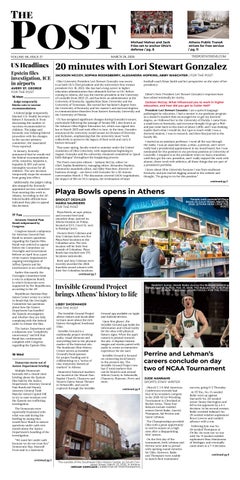
20 minutes with Lori Stewart Gonzalez

Ohio University President Lori Stewart Gonzalez was sworn in as both OU’s 23rd president and the university’s first woman president Oct. 18, 2023. She has had a long career in higher education administration that ultimately led her to OU. Before coming to Athens, she was the interim president at the University of Louisville from 2022-23, and has been an administrator at the University of Kentucky, Appalachian State University and the University of Tennessee. She earned her bachelor’s degree from the University of Kentucky and her master’s and doctoral degrees in communication disorders from Eastern Kentucky University and the University of Florida.

OU has navigated significant changes during Gonzalez’s tenure, particularly following the passage of Senate Bill 1, also known as the Advance Ohio Higher Education Act, which was signed into law in March 2025 and took effect in June. At the time, Gonzalez announced the university would sunset its Division of Diversity and Inclusion, emphasizing that the university must “work collectively to preserve the legacy of their work and carry it forever forward.”

That same spring, faculty voted to unionize under the United Academics of Ohio University, with negotiations beginning in August. Gonzalez said the university remained committed to “good faith dialogue” throughout the bargaining process.

The Post’s executive editors – Jackson McCoy, editor-inchief, Sophia Rooksberry, managing editor, Alexandra Hopkins, community standards editor, and Abby Waechter, director of business strategy – sat down with Gonzalez for a 20-minute conversation March 3. The discussion covered UAOU negotiations, the impact of SB1 on OU’s campus, the termination of head

football coach Brian Smith and her perspective on the state of her presidency.

Editor’s Note: President Lori Stewart Gonzalez’s responses have been edited minimally for clarity.

Jackson McCoy: What influenced you to work in higher education, and how did you get to Cutler Hall?

President Lori Stewart Gonzalez: I am a speech language pathologist by education. I had a mentor in my graduate program as a master’s student that encouraged me to get my doctoral degree, so I followed her to the University of Florida. I came from a small town in Kentucky, and everyone thought I’d go get a PhD and just come back to this town of about 2,000, and I was thinking maybe that’s what I would do, but I got to teach while I was a doctoral student. I was in research, and then that just led to the faculty life.

I started as an assistant professor. I went all the way through the ranks. I was an associate dean, a dean, a provost, and I never really had a presidential appointment in my mood board, but I was nominated for this position in my previous position at University of Louisville. I stepped in as the president when we had a transition until they got the new president, and I really enjoyed the work with alumni, closer work with athletics, all those things that are part of a president’s portfolio.

I knew about Ohio University because I was from southeast Kentucky and just started digging around in the website and thought, “I’m going to try for this position.”

Playa Bowls opens in Athens

BRIDGET DESHLER

MARIA SAUNDERS FOR THE POST

Playa Bowls, an açaí, pitaya, and coconut bowl and smoothie shop, opened its Athens location on Friday, located at 63 S. Court St. next to Raising Cane’s.

Owners Brett Coleman and Amy Coleman both own five Playa Bowl locations in the Columbus area. The new location will be their first outside of Columbus. Playa Bowls has reached over 375 locations nationwide.

Brett and Amy Coleman were recently awarded the 2026 franchise award winners with their five Columbus locations. continued pg 3

Invisible Ground Project brings Athens’ history to life

LIBBY SHOEMAKER FOR THE POST

The Invisible Ground Project allows visitors and locals alike to learn more about the rich history throughout Southeast Ohio.

Invisible Ground is a multimedia project involving audio, visual elements and storytelling tied to the physical marker of the historical site.

The Southeast Ohio History Center serves as Invisible Ground’s fiscal sponsor for project funding and is collaborating on a “series of nine immersive historical markers” in Athens.

Immersive historical markers are located at the Mount Zion Baptist Church, Chauncey and Stuart’s Opera House Theater in Nelsonville, and can be explored through the Invisible

Ground app available on Apple and Android devices.

Upon first glance, the Invisible Ground app holds the information and virtual reality for the sites with physical history signs. When the app’s camera is pointed towards the site, it displays historic images and stories paired with audio to create an immersive experience for the user.

Invisible Ground is focused on connecting local history to the present day. The Invisible Ground Project now has 17 total markers that can be found in and around Athens County in Nelsonville, Chauncey, Shawnee, Perry and more.

continued pg 9

Perrine and Lehman’s careers conclude on day two of NCAA Tournament

JUDE HANNAHS SPORTS STAFF WRITER

Ohio (4-7, 1-6 Mid-American Conference) recently had four of its wrestlers compete in the 2026 NCAA Wrestling Tournament in Cleveland at Rocket Arena. Those four Bobcats include redshirt seniors Derek Raike, Garrett Thompson, Sal Perrine and Zayne Lehman.

The Championships provided Ohio with a great opportunity to end its season on a high note after a disappointing MAC season.

On the first day of the tournament, both Lehman and Perrine were able to prevail with opening round victories for Ohio. However, Raike and Thompson were unable to match their teammates’

success, going 0-2 Thursday. At 157 lbs., No. 13-seeded Raike went up against Harvard’s No. 20-seeded senior Jimmy Harrington and fell to his opponent by a 4-1 decision. In his second session, Raike wrestled Indiana’s No. 29-seeded redshirt sophomore Bryce Lowery and couldn’t advance with a win.

Following him was No. 24-seeded Thompson at 174 lbs. He went toe-to-toe with No. 9-seeded redshirt sophomore Beau Mantanona

Michigan, and eventually came short in a 7-3 decision.

JACKSON MCCOY, SOPHIA ROOKSBERRY, ALEXANDRA HOPKINS, ABBY WAECHTER | FOR THE POST
of
People walk outside of Playa Bowls on Court Street, March 19, 2026. (ETHAN HERX | FOR THE POST)
The outside of the Southeast Ohio History Center on South Congress Street, March 23, 2026, in Athens. (MEGAN VANVLACK | DIRECTOR OF PHOTOGRAPHY)
Redshirt Junior, Derek Raike during the Bobcats wrestling match against Buffalo, Feb. 21, 2026. The Bobcats fall to Buffalo 22-16, in The Convo. (JOHN FOUSS | FOR THE POST).
Michael Molnar and Jack Fries set to anchor Ohio’s defense / pg. 8
Athens Public Transit strives for free service / pg. 11

As soon as I interviewed with the search committee … it was just such a wonderful experience, and sometimes you think that’s just going to be nerve wracking, right? But it was so positive and (there was) such pride of place at OHIO that really resonated a lot with me.

JM: You are from the Appalachian region – how has that shaped your goals in your presidency at OU?

LSG: My dad was a first generation student. He went to Berea College in Kentucky, and it’s a labor school, so students do a lot of the work and they don’t hire as many employees. He was the first in our family to go to college, and then after he graduated, I didn’t know that I could choose not to go to college. We would be around the dinner table and he’d say, “What do you want to be when you grow up?” My sister said she wanted to be a mommy, and my dad said, “Where are you going to study to do that?” It was just not even a decision, and I knew other students could choose not to go. Education was so important in my family, and then the other thing that was important to me as I was in my faculty role was opening doors of access.

In Appalachia, we have high rates of poverty, but a third of my students were from Appalachia. I could see they were going to go back home and work, and a lot of them in the schools because this was speech pathology. Seeing the pride of place in Appalachia – I don’t know if anyone here is from Appalachia – but whatever your small community is, people are so proud of their roots, and they all come together to work together to fix issues. Not saying that doesn’t happen in urban areas, but it’s really part of the history, the legacy of Appalachia. That was another advantage to

“students knew about the negotiation process?

LSG: Well, I’m not going to talk about the negotiation process because I’m not in it, and the way negotiations work is the faculty representatives and our representatives come together, so I think questions should go to representation. What I want people to know is that I’m a faculty member. I have tenure in the College of Health Sciences and Professions, and without the faculty, there is no OHIO. Even though maybe it seems like there is an adversarial relationship, for me, the goal is that faculty are well paid, that they can thrive here, because when they do that, you have a better experience.

SR: Was that a choice you had to make, whether or not you stepped into the negotiations?

LSG: No, the President is never involved in those negotiations.

SR: If the negotiations end up resulting in a faculty strike, how do you think students would be most directly affected by that?

LSG: If you read Senate Bill 1, which is the Advance Ohio Higher Education Act, the police, first responders and faculty are prohibited from striking. The police and first responders were in another law, and then in SB1 – which is what I’m calling it, but it’s the Advance Ohio Higher Education Act – (faculty striking) is prohibited.

Alexandra Hopkins: As student media members and people active on campus, we’ve heard quite a few students express concerns about safety and lack of acceptance following SB1. How do you reconcile with the closures of these safe spaces?

LSG: If you look at our world today, there’s a lot going on out there, things that we individuals

If I were allowed to give my personal opinion about everything – I have a lot of them – but in my role, I want to be careful so that you wouldn't feel like, if you had a difference of opinion, that the administration would devalue you.” - LSG

me for OHIO because I had moved away from Appalachia in my career, and then I had a chance to come back home to Appalachia at a school who is totally committed to the region, so that was kind of the cherry on top of the presidency.

Sophia Rooksberry: Regarding the UAOU negotiations, what is something you wish

may have problems with. Before SB1, we had a policy that’s based on the Kalven Report that came out of the University of Chicago, and it came out in about the ‘70s, I believe. It says that the president of a university should not take a position on social issues because if I’m for something and I come out for it and all of you are against it, then you believe, “I bet I don’t have a

voice because I shouldn’t speak out against the president,” so it can have a chilling effect on speech.

The Kalven Report was around for a long time. We accepted it as a policy, and there are so many issues that one group feels 100% passionate about, while the others are completely against it. I’m not talking about my own personal thing because the way I handle my personal opinion is I vote. I vote for people that share my values, share my belief in what I think our country ought to look like. We made decisions based on the law, and I didn’t make any comments about whether that was right or not because for every student that says, “I don’t feel safe,” another student would say, “I didn’t feel safe when we had those centers.”

We just met with students (Feb. 26), and I think you all covered it in The Post. What we’re doing is making sure that every student not only feels welcome, but valued. You can find your tribe, can find your people, can find the way that you thrive, not only in academics because the beauty of Ohio University is you get to become the person you’re meant to be. You don’t come to us as a blank slate. I’m not insulting you and saying, “You just come here as a blob and we make you into this.” Sometimes being away from home and being independent opens doors that you didn’t even know to find yourself in a way you couldn’t do (before). That’s what we have to protect, so we’re looking at those signature spaces. What can they be so that I could walk in as a student that needs guidance to find the right student organization or what kind of counseling services would they have for me? … If I were allowed to give my personal opinion about everything, I have a lot of them, but in my role, I want to be careful so that you wouldn’t feel like, if you had a difference of opinion, that the administration would devalue you.

JM: Do you feel that taking a neutral stance can upset students?

LSG: I know it upsets students. We get demand letters from student organizations all the time to take a stance on topic A, topic B, topic C. But … we’re a small city. We have 22,000 people around here. There’s not one voice. I mean, there

are all sorts of things where the majority of Americans feel this way, but we don’t have very many things that 100% of Americans (agree on), and that’s the same thing on our campus. Students are upset by that, but I want you to speak out. I want you to protest on the green. I want you to do the graffiti wall. I want you to rally around causes that are near and dear to your passion, your values and your beliefs, and that’s what university can give you. We have great policies on how to protest. Our students do it often, and we always welcome that.

AH: At the Martin Luther King Jr. Day Celebration, you referenced MLK’s belief that progress arises amid tension. What progress has been made following the tension caused by SB1?

LSG: I’m just going to talk about the spaces because the spaces are a living embodiment of what students are saying they’re missing. Our Student Affairs Office has been charged with talking to lots of students to say, “We put up new names on those centers, and they’re just temporary names.” We want students to tell us – what do you want in there? What kinds of offices? Some students say, “We want all the old centers back.” We’re not allowed to do that. But what can we do? What kinds of people would you like in there? We’re putting all those rooms on a reservation so small groups (and) large groups can meet in those spaces. What do we want the spaces to be, and what kind of furniture do we need, and what kind of technology do we need so that people know this is my space?

The Multicultural Center is the largest, with that beautiful room in the back, so what can we do that students would want to have there?

For me, progress is saying we no longer can do this, but let’s pivot to what we can do. I will tell you, when we were first talking about it, we were saying, “Well, we should have this in there,” and then we said, “No, it’s not our center. It’s the student’s center.” They had focus groups and individual conversations, and I’ve asked them to broaden that and have more of those conversations, so we get those centers to maybe not exactly what everybody wants, but in some way that they can go in and feel comfortable.

Abby Waechter: What does your relationship with Ohio’s athletics department look like?

LSG: Well, the thing that I love about OHIO is I think our athletes have a student-athlete experience. They raise our graduation rate, they raise our retention rate and they give us something to cheer about, right? I was at the game on Friday night, and it was full of students. I bet we won’t have as many at the Miami game because I think spring break starts on Friday, but it is the thing that brings our alumni back home. It’s the way we get in the press. When you win the (Mid-American Conference) championship or you win a bowl game and you’re on TV, students say, “I wonder what that Ohio University is about,” and they’ll check us out. I think that we are lucky in our coaches that we have on campus right now. I believe in helping people become more than just an athlete, so a leader, a leader of men, a leader of women. The Bobcats have been around a long time. We’ve been in the NCAA championship in basketball many, many years ago. I think it’s a good thing for our students because I don’t think people want to come and just have a mascot and nothing to cheer about. I really like the level that we’re in.

AW: In light of recent attention surrounding the football program and leadership following Brian Smith’s termination, how do you approach institutional oversight and communication?

LSG: Well, the thing about the communication about any kind of personnel issue, I know you wrote an article about it, chastising me for not saying much. I’m not going to say anything about anybody’s personnel issue. You wouldn’t want me to report on something where you might be involved in a personnel issue. We put things forward when we were at the right point. In this world of everybody wanting information right away, the expectation is that we owe everyone that information, and we don’t. I have to take into account all things about HR and all things about personnel. What we do to ensure that our coaches are sharing the values that we have is we have

President Lori Stewart Gonzalez stands for a portrait in Cutler Hall, March 3, 2025, in Athens. (ETHAN HERX | FOR THE POST).

contracts with clauses that say you have to perform a certain way. We don’t put in there that you have to win the MAC. It’s more like you have to be a leader of young people, so that’s how we handle that and monitor that, and that’s how we got to the point we have John Hauser now as our football coach.

JM: How do you know when you’re at the right point to share that information?

LSG: We have lawyers with us all the time, so we’re following the time and the place, and it’s only fair until a decision is made that we don’t say, “We think we’re going to do something.” It’s not fair to individuals, so that’s all I’m going to say about this because that’s a personnel issue, and anything that’s out there in the press is all that we’re going to comment.

AW: What do you think your greatest accomplishment has been during your tenure as President of OU?

LSG: I think it’s the greatest accomplishment for the university, but I was charged with making it happen, but there’s not one thing that the president does that doesn’t involve all sorts of other people. When I was hired, the Board of Trustees asked that I work with the campus to develop a plan – the Strategic Plan – and so we spent my first year working on what we call the Dynamic Strategy. I think it was great because we worked on it from a point of our strengths. If you look at appreciative inquiry, or if any of you have ever done StrengthFinder, they say, “Don’t work on the last five things that are in your strengths. Work on the first five because you might correct those a little bit,” so we didn’t look at our threats and we didn’t look at our weaknesses. We looked at our opportunities and strength, so we had four pillars. I hope you’ve seen the plan – if not, it’s on my website.

Under Learn, we really wanted to push experiential learning because we owe it to you. You all are all in experiential learning, so when you go to apply for a job, you’re not going to say, “I studied how to take pictures and tell a story with the photo.” You’re going to say, “Here’s my portfolio. Here’s my portfolio of articles that I wrote. Here’s the methodology that I use.” We want that for all students, so we put more money in it. We’re doing an inventory of all of that. To me, that can be a distinction of OHIO that other schools might not have, and we have to be purposeful about it because while you all have The Post here, an English major may not have the same opportunity to slot into an English internship, but there are many internships that would be of value to the student and the organization.

We’re R1, so the Discover pillar said we’re not going to spread all our money around research where we just have

small things. We’re going to put it in areas where we already have a lot of funding, and that was healthy aging, energy and the environment. But we also said OHIO is a diverse institution, so there may be emerging areas that we don’t know about yet, so we said that would be one of our goals. In Engage, we wanted mentoring from our alumni –Bobcats help Bobcats, right? We wanted to make sure that we brought some of those people back because hearing somebody’s journey, even if they started in journalism and then they ended up owning their own business in something else, it’s worth hearing about that journey.

When you see somebody that’s in a C-suite, you think they were born as a leader. You didn’t know they started in the mail room or those kinds of things … Then we opened our Center for Community Impact because when you all volunteer, we want to make sure you get something out of the volunteering and that the place you are volunteering benefits from having you there.

Finally, the last pillar was Work, and we want to make sure that we’re a destination employer because we want good people here so you have great experiences. That’s one thing that I think set us on the path where we’re getting ready to start year three, and after the end of that one, we will have years four, five and six in the hopper … I think it has been successful because we said we were going to do something, (and) we’ve done it and measured it. We’re doing it and measuring it, and we’re going to do it again one more year, and then some things may change, but it’s not like we’re throwing that plan out and getting a brand new one. Experiential learning should always be part of our portfolio. We should grow it and grow it.

JM: Is there anything you have for the future that you want to share?

LSG: I think the future is going to be decided by the campus, but I want to continue to identify those experiences that you can get at OHIO better than any place you can go and do a major. We have 14 public (universities in Ohio), right? What is it that makes people call this – and it’s been called this by hundreds of people – a special place? You have to make your way here. There’s not a lot of distractions like in a big city, but making your way is part of the beauty of this university. I think protecting that is really important, and then making sure that our students are prepared for what they’ll face out in the workforce because you may have a job and in two years another job and in two years another job. The days of 50 years in a company (and) getting the gold watch are kind of by the wayside now, so we want to make sure you have all the skills you need, and not just the skills for that job.

US Headlines/ continued from pg 1

19 Thur __________________

Education Department transfers student loans to Treasury

The Trump administration announced Thursday the U.S. Department of Education will transfer part of its responsibility over student loans to the Treasury Department. According to the AP, the transferring of duties is part of the president’s plans to officially dismantle the federal education agency.

The Treasury Department will now manage student loans with defaulted borrowers, or those who are behind on payments. In estimate, these loans add up to about $180 billion or 11% of all student loans. The Education Department has overseen the student loan process since it was created 40 years ago.

President Donald Trump plans to

/ continued from pg 1

They were just one of 50 franchise owners selected from many nominees across North America.

“Playa Bowls corporate nominated us for that,” Brett Coleman said. “To win it is a great honor. My wife and I have worked really hard. We’re super passionate about the brand and the things we stand for.”

The Colemans have expanded their locations all over Central Ohio, including Columbus, New Albany, Dublin, Quarry Trails and Polaris. They will open a seventh location in Clintonville this spring.

When asked about expanding beyond Columbus, Brett commented on why they opened an Athens location.

“My sister went to OU, and she just thinks it’s the greatest place on earth,” Brett Coleman said. “I’ve been there and visited, and it’s just an awesome college community … The college kids are just so much fun.”

Blotter: Arrests made, warrants of the week, 92 quarters

13 Fri ________________________

Arrest that kid

Deputies with the Athens County Sheriff’s Office were dispatched to Circle Drive in New Marshfield to respond to a juvenile complaint.

On the scene, the juvenile was taken into police custody for charges of domestic violence.

Might be a gunshot? Probably not.

Athens County Sheriff’s Office deputies responded to West Second Street in The Plains after receiving a call of gunshots in the area.

Deputies patrolled, but no more gunshots were heard. There was also no suspicious activity observed. Patrol resumed.

14 Sat ________________________

92 quarters is really specific

Deputies from the Athens County Sheriff’s Office took a report from a woman who said 92 quarters were stolen from the woman she takes care of.

A report was taken, and patrol resumed.

Animals at large Athens County Sheriff’s Office deputies were dispatched to Glazier Road in Guysville after receiving a report of animals on the loose. Deputies made contact with the owners of the animals and requested they keep the animals from leaving the property.

15 Sun ________________________ Caught ya!

Deputies of the Athens County Sheriff’s Office were on patrol near Converse Street in Chauncey when they located Alexander Davis being transported in a vehicle.

Davis had an active warrant of arrest out for him for burglary. The vehicle was stopped, and Davis was arrested and taken to the Southeastern Ohio Regional Jail.

No burglary here

Athens County Sheriff’s Office deputies responded to High Street in Glouster regarding a burglary alarm. Deputies checked the building. There were no signs of forced entry, and everything was secure. Deputies did not need to take any more action.

16 Mon ________________________ Warrants of the Week

The Athens County Sheriff’s Office posted warrants of arrest for Jason Queen and Colt Neiderhiser. Neiderhiser is wanted for possession of drugs, assault and non-support of

dependents. Queen is also wanted for non-support of dependents. Individuals with information on the whereabouts of the Queen are to contact the sheriff’s office immediately. Note: Prior to publishing, Neiderhiser was arrested.

Go. To. School.

Deputies with the Athens County Sheriff’s Office responded to The Plains after receiving a call from a mother saying her child refused to go to school.

Deputies made contact at the scene, and the juvenile went to school.

17 Tue ________________________

A lone trailer Athens County Sheriff’s Office deputies were dispatched to Kimberly Road in Nelsonville after a report of a trailer left on the roadside.

Deputies on the scene spoke with the trailer’s owner, who said he was parking it there while he fixed the area’s fiber optics.

Yeah, take that stuff back!

Deputies of the Athens County Sheriff’s Office spoke with a woman after calling and saying she wanted to gather her daughter’s belongings from her boyfriend’s house.

Deputies spoke with all involved parties, who said they would agree on their own.

18 Wed ________________________

Arrested

Deputies with the Athens County Sheriff’s Office were dispatched to Young Road in Guysville after receiving an anonymous tip on the location of Colt Neiderhiser.

Neiderhiser had an active warrant out for his arrest for possession of drugs. Neiderhiser was found and taken to the Southeastern Ohio Regional Jail.

19 Thur ________________________

This is why we don’t make U-Turns

Deputies of the Athens County Sheriff’s Office provided aid to the Ohio State Highway Patrol after a semi truck attempted and did not succeed in making an illegal U-Turn near the intersection of State Route 50 and Brimstone Road.

The truck that attempted the turn ended up in a ditch, but was successfully removed and the scene was cleared.

Wow, using your dog in a scam?! Athens County Sheriff’s Office deputies spoke with a woman regarding an online dog-for-sale scam. The woman told deputies that she had planned to meet with the man to purchase the dog, but he did not show up.

have the Treasury Department take over responsibility for all student loans, but there is no timeline for when this will happen. Trump reassured those with student loans that repayment and loan services will be handled the same way they have been.

20 Fri _________________________

Dangerous heatwave hits the Southwest

On Friday, the Southwest reached the highest March temperatures ever recorded. Two Arizona communities and two places in Southern California reached temperatures of 112 degrees Fahrenheit, according to the AP.

Climate scientists warn this heatwave and other weather extremes are the result of rapid climate change due to human activity. According to the

The first of the five locations the Colemans opened was their location at OSU in 2021. College campus locations are not something new to them. Rather, they consider them important.

“In Athens, I really haven’t found anything really healthy like what we do, so we’re just super excited to be here,” Brett Coleman said. “This location is the dream location.”

Regional manager Kristen Gregory has been with the company for four and a half years and conducts training for new employees. She discussed what it is like to work at the college locations and with young adults.

“The college campus locations are always the most fun,” Gregory said. “It’s a really cool group of people we get to see … It’s a bit of our vibe to have younger staff. They can run the shop as well as I can.”

She said she is excited to see students enjoy Playa Bowls around campus.

“I’m excited to see people grab a Playa

AP, temperatures this high in March wouldn’t be possible if it weren’t for human activity affecting the atmosphere. The Southwest heatwave is 30 degrees Fahrenheit above the usual average for March.

Since 2020, the U.S. has broken 77% more hot weather records than it did in the 1970s. Extreme heat waves, such as downpours and hurricanes, can be incredibly dangerous due to their unpredictability.

21 Sat _________________________

Trump threatens to put ICE agents in airports

Trump said Saturday that he would put Immigration and Customs Enforcement agents in airports starting Monday if Democrats did not pass a bill to fund the Department of Homeland Security.

Trump’s statement comes after

Bowl and head to the park and eat it in their hammock, so that sounds fun,” Gregory said.

The original opening date was scheduled for fall 2025. However, it was pushed back to early 2026, and in March, “It’s an old building that has lots of nuances, so we just had to work through some of that. But we feel like we’re in the clear now,” Brett Coleman said. “We feel pretty good that we’re good to go.”

Playa Bowls posted on Instagram on March 13 to announce its grand opening.

The grand opening was Friday. The first 100 people in line received a free bowl and Playa Bowls Athens t-shirt.

Many people lined up for the grand opening in hopes of being one of the 100 customers to receive a free bowl.

Students and Athens natives Calla Martino and Reese Rogers were two of the many in line.

“I saw the Instagram, and then I was like, I’ve never sat in line before, so I was

employees of the Transportation Security Administration went unpaid due to the partial government shutdown. Trump said ICE presence in airports would lead to more immigrant arrests.

According to the AP, the Democrats’ holdout over DHS funding is a result of their disagreement over the Trump administration’s tactics of immigration enforcement. The Democrats are hoping for better identification for federal law enforcement officers, a new code of conduct, and increased use of judicial warrants as a result of their holdout.

Since Saturday, ICE agents have been deployed at major U.S. airports across the country.

just like ‘I’ll just do it to do it,’” Martino said. “I’ve never had it before.” Rogers commented on her views on a chain business opening in Athens.

“It’s exciting getting new stuff, (Martino) was born here, and I’ve lived here since I was like 3 or 4,” Rogers said. “Some people like it more local, but I like the chains, that’s who I am, I like both.”

The typical pricing for their popular items, such as the Pura Vida Acai Bowl, is $12.99. Most bowls range from $12.99 to $13.99; however, custom Acai Bowls start at $10.99.

Playa Bowls’ smoothies, such as Strawberry Banana, are priced at $8.99. All smoothies are priced from $8.99 to $9.99.

They also offer a small selection of cold-pressed juices starting at $5.00, ranging up to $7.99.

Finally, they offer a range of iced coffees, such as a Playola Cold Brew at $4.50. The highest-priced coffee is the Dolce Latte Smoothie at $8.99.

Playa

Maggie Davis Market Express to open in Baker Center

Students will soon be able to enjoy a new shopping market on Ohio University’s campus.

The market is called the Maggie Davis Market Express and it’s being built into the Maggie Davis Room on the first floor of Baker Center. The location of the new market will be adjacent to West 82’s dining area.

“The Maggie Davis Market Express will offer a similar convenience-style retail experience, providing a variety of grab-and-go food and beverage options comparable to those available in the Boyd, Nelson and Jefferson Hall markets,” Chito Trinidad, the assistant director of retail operations, said in an email.

Trinidad also said to support the new operation, the area is undergoing a full remodel.

The construction for the project began in January, according to Trinidad. A soft launch is anticipated for mid to late April, with the market being officially open in time for the upcoming fall semester.

The intended hours at the start will be 6 a.m. to 2 a.m. Monday through Sunday.

Students will not be able to use their Flex Points in the new market, but they will be able to use Bobcat Cash as well as credit cards.

The self-checkout market will feature snacks, beverages, grab-and-go meals and more, with longer hours than other campus markets, according to the Keeping Bobcats Informed email.

The Maggie Davis Market will work in tandem with West 82, Trinidad said.

“The market is designed to complement West 82 by offering retail food items during the times when West 82 is closed,” Trinidad said. “This helps ensure ongoing food accessibility for students, employees, campus visitors and members of the off-campus community.”

In the Maggie Davis Market, there are five different areas, all beginning with the letter “S”. The check-out kiosk is called “Speedy,” the drink cooler is called “Sips” and the food to-go area is called “Snacks.”

There were two more areas in the market, labeled “Spirit” and “Salty.”

Although the market provides students

with another food option on campus, there are some concerns among students that the grab-and-go aspect will limit human interaction.

Noelle Baker, a senior studying music production and the recording industry, said the new market seems to be taking away student jobs.

“While I do think it’s a place where students can check out stuff without extra people being there, I think it takes away jobs from other people,” Baker said.

Baker also said she found it odd the market will not be taking Flex Points, since students often use Flex Points at other Baker Center food areas, such as West 82, Latitude 39 and Front Room Coffeehouse.

Baker also questioned putting the market in a room that used to be a meeting space.

“I was very curious as to why they are inserting it, because it was a room that was used for meetings and other events like that,” Baker said. “I don’t know, they took away an event space to generate more income.”

Hailey Frischstein, a freshman studying journalism, said she also did not understand why the market would be added to Baker Center when West 82 is right next to it.

However, Frischstein said she does not

often go to the dining halls, so a market

“is beneficial to me, but I don’t know how other people feel about it.”

Frischstein agreed with Baker about the market not accepting Flex Points.

“I do think it will be a problem just because I know so many students, especially toward the end of the semester, they just like to spend (Flex Points) as quickly as possible so the money doesn’t go to waste,” Frischstein said. “I feel like students will not benefit from that.”

Frischstein said she hopes to see some healthier options from the new market.

“I’d hope to see more healthier options because as a freshman, Nelson (Dining Hall) necessarily doesn’t have the healthiest options to eat,” Frischstein said.

Baker said that if she could provide any input to the new market, it would be human interaction.

“I think it would be cool, creating jobs if they’re going to make another market, then make more jobs within it, not just using machines,” Baker said.

Work is still being done on the market, and the grand opening will take place when students return for the fall semester.

The Post

Concerns grow as Iran-US conflict continues

The U.S. continues to engage in war, alongside Israel, against Iran. The Trump administration is aiming to neutralize any nuclear threat Iran could pose. Iran is striking back at Israel and U.S. military bases in the region.

The conflict between the U.S. and Iran continues to escalate as both Washington and Tehran volley consistent threats and attacks in the Middle East.

The war began Feb. 28 when Israeli and U.S. strikes, conducted under President Donald Trump’s Operation Epic Fury, killed Iranian Supreme Leader Ayatollah Ali Khamenei, according to The Associated Press.

Since the initial missile strikes, Iran retaliated, launching attacks on both U.S. and Israeli military bases, including Diego Garcia island, a U.K.-U.S. military base located in the Indian Ocean, according to the AP. Iranian strikes also hit Israel as well as Qatar energy facilities and the American Embassy in Saudi Arabia, the AP also reported.

The Strait of Hormuz, a waterway that connects the Persian Gulf with the Gulf of Oman and the Arabian Sea, has become an integral part of the current conflict. The strait is bordered by Iran and is used to transport around 20% of global petroleum, according to the U.S. Energy Information Administration.

Christopher Nichols, the Wayne Woodrow Hayes chair in national security studies and professor of history at Ohio State University, discussed the nature of the strait.

“If you look at the Strait of Hormuz on a map, it’s a very narrow channel which is pretty easily obstructed by military means … virtually any kind of vessel can lay mines in that area,” Nichols said. “And so it makes it a relatively simple military task to make the strait virtually impassable.”

Iran has practically closed the Strait, but threatened to shut it down completely after Trump mentioned the possibility of attacking Iran’s power plants. That would deal a significant blow to the U.S. and its allies, as the strait is integral to their energy supply.

The Trump administration promised a swift response.

“If Iran doesn’t FULLY OPEN,

WITHOUT THREAT, the Strait of Hormuz, within 48 HOURS from this exact point in time, the United States of America will hit and obliterate their various POWER PLANTS, STARTING WITH THE BIGGEST ONE FIRST!”

Trump posted on Truth Social on Saturday night.

Trump also hinted at invading or attacking Kharg Island, a stronghold near the Strait of Hormuz. Nichols described the island, and the political advantage of taking it over would give Trump.

“Kharg Island is where a lot of the oil exports coming out of Iran come from,” Nichols said. “It’s a refining area. It’s only like five miles of land, but that’s where Iran’s oil exports pass through, so the U.S. attacking it or taking it over, destroying it, and all of which are apparently on the table, are ways to stop Iran’s one major export from getting out, so it would put a sort of stranglehold on the Iranian economy.”

The Trump administration’s decision to engage in a military offensive against Iran came shortly after Trump expressed disappointment with the way nuclear talks were going with the nation, the AP reported. The issue of Iran’s nuclear capabilities has been a conflict for years, with the U.S. attacking Iranian nuclear sites in June.

Aiden Fox, president of the OU Republicans and a senior majoring in political science, agreed with the attacks on Iran.

“I think the United States essentially needs to stick to its stated goals so far,” Fox said. “I think at this point, that’s probably regime change … I really think the broader foreign strategy that Trump has been showing here has actually been China-focused. Believe it or not, Venezuela represented a large portion of China’s oil imports, same thing with Iran.”

U.S. relations with Iran span back to post-World War II, Nichols said, when the CIA intervened in 1954 to help stage a coup d’état.

“One thing that historians think about

a lot … is the sort of longer history of the way the US has meddled with Iranians in the country of Iran since World War II,” Nichols said. “And the most obvious and notable one that people who are knowledgeable about this know is the CIA intervention in 1954 to overthrow the lawfully elected leader, Mohammed Mosaddegh, and in helping institute the Shah after that.”

Nichols argued Trump’s intent to initiate regime change will be more difficult than he thinks. He said regime change typically occurs from within and requires a viable movement from the nation’s people, which is not present in Iran.

A majority of Americans do not favor the war with Iran. According to a Reuters/Ipsos poll conducted from Feb. 28-March 1, only 27% of 1,282 respondents approved of U.S. strikes on Iran, while 43% disapproved and 29% were not sure.

As of Fall 2024, Ohio University has a total of 40 Iranian students, with 38 being graduate students and two being undergraduate students, according to an international student enrollment chart.

The OU Iranian Students Society was unable to provide an interview with The Post.

Samantha Pelham, a university spokesperson, provided a statement of support for OU’s international students.

“OHIO’s Office of International

Editorial | Be a responsible bystander

THE POST EDITORIAL BOARD

The 2026 Fest season has started, and thousands of Ohio University students will flood from campus to the outer streets of Athens and celebrate the warm weather. For seniors, this marks the close of their final semester and the last moments for partying in Athens as a student. Due to the Fest season party culture, students might drink or use substances more heavily. While the season is meant to be spent outside, with friends, without a care in the world, the weekend’s festivities can also lead to unsafe behavior through excessive consumption.

Each year during the spring semester, OU students celebrate Fest season with each weekend welcoming parties on a designated street. When Fest season begins, students come out in mass quantities to Mill, High, Palmer and Congo streets. The weekend’s events give way to increased peer pressure, potentially dangerous social situations and excessive. Students also aren’t the only ones who partake. The notorious weekend typically

welcomes visitors from out of town, increasing the risk factor due to the population and visitors without the same ties or knowledge of campus property and places.

It’s vital to act as a responsible bystander to intervene, disrupting harm from occurring or deescalating a situation. Fest season gives an opportunity for risk due to the number of people and substances a part of the culture.

The WITH US Center for Bystander Intervention is a national research center established in honor of Carson Starkey, a California Polytechnic State University student who died his freshman year on campus as a result of his fraternity brothers’ negligence in getting him help as a result of acute alcohol poisoning.

Starkey’s story, unfortunately, isn’t the only one. Although accidents and tragic events can happen, there is no reason to leave someone alone if they are experiencing substance misuse. Many experiences can be helped or reversed with bystander intervention.

In a survey-based study by the NCSBIS with a national sample of public and private colleges and universities in the U.S., 69% of students said they witnessed unhealthy alcohol use and 54% said they witnessed prescription drug misuse in the past academic year.

With these findings, it’s clear the abuse of alcohol and drugs can occur in front of us, and not only on large weekends of celebration, but also in residential dorms and college homes. Intervening in a potentially harmful situation isn’t about getting someone in trouble, but about helping them get as far from a threatening situation as quickly as possible.

OU utilizes the Four D’s Model of Bystander Intervention: direct, delegate, distract and delay. This model is encouraged and taught on campus. The university also offers free Narcan training and fentanyl testing strips to provide resources for safety.

This intervention model is even taught to OU students in Learning Communities, typically a first-year seminar

with students in a majorrelated cohort, led by a faculty member and a student leader.

“We encourage bystanders to intervene early and often. It is important that we do not wait for the moment of escalation or crisis to intervene if we witness something,” the Office of Health Promotion said.

Not only does OU teach intervention, but federal laws also encourage it.

Good Samaritan Laws exist to encourage bystanders to provide emergency help without fear of legal consequences. These vary from state to state, and Ohio has two primary laws, one granting immunity for a minor drug possession for the person who overdoses, as well as the person who called 911 for help, according to the Ohio Department of Health. The law can only be used twice.

Reasons why people might fail to intervene as bystanders to a harmful or threatening situation might be the failure to notice, failure to diagnose the situation, failure to take responsibility or a lack of skills in not knowing what to say or do to de-escalate.

It is okay to be human and make mistakes. But when it comes to the livelihoods of each other, if you see something, you need to do something. Get involved, find someone to help, interrupt the situation and be there for the person in need.

During the Fest season, it’s important to enjoy the season and unwind as the school year comes to a close. How you partake in the festivities is up to you, but do so responsibly. If you think something is off, check on the situation. It is up to all of us to look out for one another and keep each other safe, no matter a stranger or a best friend. Be a good bystander, Bobcats.

The Post editorials are independent of the publication’s news coverage. Have thoughts? The Post can be reached via editor@thepostathens. com.

Join us Monday, March 30, in Baker Center Ballroom from 11 a.m. to 3 p.m. for amazing Scripps alumni speakers, networking and career readiness advice.

This event will feature a keynote address from 2008 journalism alumnus and NBC4 anchor Matt Barnes, BSJ '08, alumni panels, free pizza and

Emily’s Evidence Abby’s Angle

Airlines need to be held to a higher standard

EMILY STOKES FOR THE POST

As I sat next to a sleeping man on a hard plastic bench at the Chicago O’Hare airport this past week, I thought about how cattywampus a routine connection back to Columbus had turned out.

For an industry that had a net profit of $1.6 billion in the third quarter of 2025 alone, according to the U.S. Bureau of Transportation Statistics, we as consumers need to demand more from airline corporate powerhouses.

Air travel is a privilege in a world of rising costs and inflation, but increasingly, this privilege results in a bare minimum customer experience driven by over-efficiency and profit.

This past week, many flight cancellations were felt in the Midwest after more than one powerful storm system passed through, according to The Associated Press. Over 1,100 U.S. flights were canceled on March 17 alone, with around 7,300 delayed. I, alongside many other Bobcats, felt the effects of these storms, stuck in phone support queues, crowded airports and indefinite uncertainty as to when I could sleep on a mattress again.

Weather delays are common and out of the control of even larger corporate companies and carriers; however, the key difference between sheer luck and bad practice comes with how airlines adapt to such changes.

Although I am no expert on airline travel, as a consumer, I think the high ticket price comes at a premium and passenger comfort should be prioritized. Many passengers stuck in Chicago alone slept on floors, with no meals or hotel support.

Airlines have become so overly efficient that one wrench is thrown in and the whole schedule is thrown off. For how expensive it is to travel by air compared to other methods of transportation, passengers should be taken care of, able to rest, be fed and have a stable place to stay if displaced. By prioritizing profit over customers, efficiency is almost too efficient. Any small change or inevitable thing that does not go on schedule throws off a whole chain reaction of flights, connections and deadlines. Airlines should either provide more support for travellers or step away from rigorous schedules, which are doomed to fail.

In addition, with the increase in inflation and cost of living, travel processes overall are up compared to this time last year, according to NerdWallet. While general travel costs in the U.S. are up 3% in 2026 compared to 2025, airfare costs are up a whopping 7.1%.

For

The Record |

Consumers and customers alike should expect more from airlines who are charging a pretty penny for premium travel. Whether travelling with children or families, on the way to a spring break or heading to a work trip, the lack of support for stranded travellers is concerning.

Likewise, post-COVID-19, digital support through phone lines or remote support has become normal. For emergencies like weather cancellations and airport overcrowding, airlines need to implement more in-person options for support.

Although the increase in technological customer support saves money for airlines, passengers should be able to find a support agent in the airport they are passing through, as opposed to having to call into a phone line and be put on hold.

In my recent experience, by the time you were taken off hold, the problem was solved by yourself or it was too late to actually comfortably fix and the perilous fate of poor travel had already been realized.

For example, I called United Airlines specifically to request to pick up my delayed baggage from the airport rather than having it delivered. I originally called, hoping to let someone know not to put it on a delivery truck before I could get there in about 40 minutes. After being put on hold for the length of the drive to the airport, I found the bag just in time when an agent on the phone answered.

I explained to her that I had my hand on the bag in the airport and had originally called for support 40 minutes prior, but no longer needed help. This is the kind of wild goose chase air travellers nationally are facing, despite paying high costs for tickets, fees and more.

Although airline stocks are shifting with multiple government shutdowns, tariffs, overseas conflicts and more, passenger flights are also a large factor. Airline travel should be reliable, and in the event passengers get stuck, their carrier should be obligated to efficiently compensate them, making sure they are well-rested and have adequate lodging over the cost of merely getting flights in and out of the gate.

Emily Stokes is a junior studying journalism at Ohio University. Please note the views and opinions of the columnists do not reflect those of The Post. Have something to say? Email Emily at es542222@ohio.edu.

Marrying rich shouldn’t be your life goal

ABBY SHRIVER FOR THE POST

In college, it’s not uncommon to hear girls say the only reason they’re here is to find a rich husband, or if school doesn’t work out, they’ll just marry a rich man. Marrying for money isn’t a new revelation; it historically predates marrying for love.

In the 18th century in the colonial period of the U.S. , and across much of the world, marriage was seen as a transactional exchange, controlled by the parents of both the bride and the groom. Women, or young girls, were considered “assets” and married off to help build wealth and status. When the 19th century rolled around, marriage values shifted and women’s rights grew, emphasizing romantic love rather than transactional marriage.

However, somewhere along the way, women have started going backward in terms of marriage. Social media has popularized the idea of marrying wealthy and becoming a stay-at-home wife, selling a lifestyle centered on being a spoiled and ultra-feminine partner. Now, women shamelessly talk about obtaining an “M.R.S. degree,” an outdated stereotype from the 50s where women focus on finding a husband in college rather than their degree.

I understand the appeal of marrying a rich man, such as the security, comfort and life free from work stress that may come along with it – but it shouldn’t be a primary goal to satisfy. Education and independence should come before finding love, and personality and attraction should come before net worth. The phenomenon of marrying rich and abandoning ambitions for a “tradwife” lifestyle is setting women back and risks undoing years of progress.

The tradwife trend became popular in 2020 and is defined as “a married woman who embraces traditional gender roles and values.” While there is nothing inherently wrong with being a tradwife, the viewpoints are “fundamentally conservative,” as it implies women should “retreat not only into the home, but also into history.”

Tradwives are submissive, believing they serve their husbands and their place is in the home. This also implies women don’t belong in the workforce, reinforcing the saying that women should be “barefoot and pregnant.”

Tradwives believe women are “better” when they stay home, have kids and don’t involve themselves outside the home.

Stay-at-home wives or mothers are typically dependent on their husbands for money, which creates extreme financial vulnerability and loss of autonomy and independence.

On the Reddit thread “r/askwomen,”

one user asked: “For women that married the ‘rich one’ out of security, what has it been like?” Women told stories of being spoiled by their husbands’ riches, but money quickly became a method of control.

One user, YouMustDoEverything, said she left her husband due to his “controlling and mean” attitude about money, admitting she likely stayed too long out of fear of losing “income and stability.” When financial security is tied entirely to another person, leaving can feel nearly impossible.

If the relationship falls apart and you’re forced to start over, reentering the workforce is challenging. For stay-at-home mothers, 93% have faced challenges when reentering the workforce. Around 60% say their time spent at home is considered a gap by employers.

This may seem obvious, but it still needs to be said. A few months ago, stay-at-home mom Cortney, who has over 100k TikTok followers on her fitness account, posted an emotional TikTok sharing her struggles after her wealthy husband filed for divorce.

After Cortney’s husband cut off her credit cards and stopped paying bills, she realized she was left with nothing–no money of her own and minimal skills outside managing the home. Cortney quickly discovered she wasn’t alone, and in her follow-up video, said, “I thought these stories were rare. They’re not. Different women. Different states. Same words: ‘I have no money. I’m trapped.’” When men hold the financial power in a relationship, the imbalance can become dangerous if things fall apart. Wealthy men typically become affluent abusers instead of physical abusers, meaning they “hide their actions from outsiders, often choosing coercive control tactics without overt physical violence.”

Coercive control is “a range of behaviours that allow someone to gain or keep control of a partner, ex-partner or family member,” which can include threatening suicide, controlling finances and isolation.

The legislature hasn’t caught up to coercive control, believing it’s “less damaging” than physical abuse. In some states, coercive control has only been defined as domestic violence as recently as 2025. Women in these financial or emotional abuse situations aren’t safe at home and rarely find safety in the law, putting them and their children at extreme risk.

A traditional lifestyle and marriage can sound appealing, but please be realistic. A life built entirely on someone else’s successes is never truly secure. If things fall apart, the only person you have is yourself — your skills, drive and goals. Don’t make living in somebody else’s shadow your only life goal.

Chalamet isn’t just offensive, he’s uneducated

NYLA GILBERT | ASST. ENTERTAINMENT EDITOR

Dune actor Timothée Chalamet is under fire for comments about ballet and opera, made in a Feb. 24 video with Matthew McConaughey in the Variety & CNN Town Hall.

“I don’t want to be working in opera and ballet, or things where it’s like ‘keep this thing alive,” Chalamet said. “Even though it’s like, no one cares about this thing.”

Chalamet’s comments about the industry aren’t just offensive. His commentary is disrespectful to those who sacrificed their minds and bodies to create the foundation of the modern entertainment industry that Chalamet is privileged to be a part of.

According to the Lewis Foundation of Classical Ballet in India, ballet was created in the 15th century during the Italian Renaissance, in the form of a court dance to entertain noblemen and women.

Ballet made its way to Paris through the interest of Italian noblewoman Catherine de’ Medici, the wife of King Henry II of France. A patron of the arts, Medici invested largely in the world of architecture, performing arts and painting. She brought ballet to the French court, investing in what became ballet de cour,

also known as court ballet, which included elaborate productions.

In 1661, King Louis XIV founded the Paris Opéra Ballet, then known as Académie Royale de Danse, paving the way for stage performances.

While ballet started as a pastime, a creative outlet, it’s important to understand the history of exploitation that permeated the industry. Most famously, the French ballet was known for the exploitation and trafficking of young girls and women.

In the 19th century, the Paris Opera Ballet often recruited young, impoverished and vulnerable girls. Known as “petit rats,” these dancers were at the bottom of the ballet hierarchy and often were the subjects of sexual exploitation and abuse. They endured this abuse with hopes of eventually working their way into being “admitted with a good contract,” according to Sebrena Williamson, BFA in Dance and writer for the Collector.

Young women flocked to the Paris Ballet with hopes of a better life. Instead, these girls were taken advantage of by the “wealthy male subscribers of the Paris Opera—nicknamed abbonés.” An opportunity ended up being a brutal and unstable environment in which

dancers were socially and sexually exploited. The “foyer de la dense” was a lavish room in the Paris Opera Ballet where wealthy guests could pay to “socialize” with ballerinas, according to HISTORY.

Edgar Degas, nicknamed “The Painter of Dancers,” is known for capturing the everyday life of these girls, depicting them as angelic and vulnerable figures, often with dark silhouettes looming near them.

Now in the modern era, we have seen the offshoot of Paris Ballet becoming a systematic legitimized art form. However, this does mean that ballet faces systematic issues. Neha Chowdhury of The Lewis Foundation of Classical Ballet wrote about the current inclusion-based struggles the ballet industry has faced, and is still facing.

This includes the exclusion of Black, Indigenous and people of color from the industry. Due to the ideals surrounding Eurocentric standards of beauty, these dancers were often dismissed from dances, and were told they wouldn’t fit in with the ensemble due to their skin color and features. Ballet pieces set in places like India would often include racist depictions.

It was only in the 21st century that ballet shoes, tights and leotards, which are meant to

match the skin color of the dancer, started being massproduced in multiple skin colors.

Also emerging during the Italian Renaissance of the late 16th century was opera. In 16th-century Florence, a group of musicians gathered together to turn Greek dramas into musical stage productions.

Italian composer and singer Jacopo Peri composed Dafne in 1597, which is considered the first opera. This introduced the two types of opera: opera seria, or serious opera and opera buffa, comedies. Opera developed into a world of its own, with the help of the Medici family.

However, the sacrifices made by performers also add to the industry’s deserved respect.

Young boys often underwent “castrati” or castration before puberty to prevent their voices from deepening. Seen as a way out of poverty, the parents of these young boys would often encourage or force them to go through this procedure in hopes of them becoming operatic royalty.

Called “Castratos,” these male sopranos or contraltos took permanent and dangerous solutions to become “super stars.”

When controversial statements like Chalamet’s

rise, the immediate reaction is to defend these centuries-old artistic mediums because they have shaped culture globally. However, there needs to be a conversation on the fights that individuals in these mediums made to legitimize and reform them.

Ballet singers are no longer seen as sex workers, but as the pinnacle of respect in the dance community. The last known Castroto, Alessandro Moresichi, died April 21, 1922. Men in opera are no longer expected or forced to be castrated to rise in the industry, with several baritones who have defined the industry sense.

The idea that “no one cares” about an art form simply because it is a “slower” form of media, or because it doesn’t have box office premiere numbers, shows a weak capacity for understanding art. If you believe any art is “dying” and you don’t want to be in that industry, maybe you aren’t really an artist to begin with.

Nyla Gilbert is a junior studying journalism at Ohio University. Please note the opinions expressed in this column do not represent those of The Post. Want to talk to Nyla Gilbert about her column? Email her at ng972522@ohio.edu.

Ohio split doubleheader Saturday against Northern Illinois Huskies to win its home opening series 2-1

LONDON DEMARCO FOR THE POST

Prior to Saturday’s doubleheader, the two teams played the day before, and the Bobcats on 11-7 in a highscoring game.

Game One

Game one started very defensively with great pitching. There was only one hit recorded in the first inning, which came from junior catcher Kylie Gorsuch as she hit a single with two outs.

In the second inning, the Huskies came very close to scoring the first run of the game after they opened up the inning with a triple, but the runner was thrown out at home to keep the game scoreless.

Ohio would finally get some offense going in the third inning, and it would start with Ohio’s Rylee McDaniel getting on base after being hit by a pitch. That would immediately be followed up by a bunt from sophomore outfielder Alexis Book, which would advance McDaniels to second base. Book then safely beat the throw to first base.

The Bobcats now had a runner on first and second base with zero outs. Senior outfielder Belle Hummel would then hit a single to left field, which would bring in McDaniel from second base, and the Bobcats would get the first run of the game and take the lead 1-0.

Ohio then loaded the bases with zero outs, looking to really bust the game open, but three straight strikeouts ended the inning with three runners on base.

Northern Illinois would immediately strike back at the top of the fourth inning with a 3-run home run that would give the Huskies their first runs of the game and

first lead of the game, 3-1. Despite a bases-loaded opportunity in the fifth for the Bobcats, they wouldn’t score again in game one as the score would end 3-1 in Northern Illinois favor to tie the series at one win apiece.

Game Two

The Huskies would pick up right where they left off, as a hit by pitch followed by a double would bring in the first run of the game.

The Bobcats would strike back very quickly and completely break this game open. Hummel would open up the bottom of the first with a double to left center,

followed by a sacrifice bunt from senior infielder Colleen Bare to advance Hummel to third base. Gorsuch was then walked, followed by her stealing second base to put two runners into scoring position for the Bobcats with one out.

Senior infielder Shelby Westler then advanced the runners after an error from Northern Illinois’ catcher. This error would bring Hummel in, giving Ohio its first run of the day and tying it up at 1-1.

The Bobcats were far from done. Junior outfielder Izzie Wilson would come up to bat and blast a 3-run home run to give them their first home

run of the day and their first lead of the game, 4-1. Sophomore Jordyn Wycuff would then come up and hit another home run to give Ohio a 5-1 lead off back-toback home runs.

The Bobcats would continue their dominance in the third inning with four hits that brought in three runs to make this game 8-1.

After the Huskies’ firstinning run, they wouldn’t score another run for the rest of the game despite having four runners in scoring position throughout the final four innings as graduate student pitcher Skipp Miller shut down the Huskies’ offense.

Ohio would tag on an insurance run in the fourth inning to make it 9-1, which would be the final score of the game, as Northern Illinois would get mercy ruled.

After winning their home opening series 2-1, the Bobcats have four straight home games. Their next game is on Tuesday versus Pittsburgh, followed by a conference series next weekend against Central Michigan.

LD004224@OHIO.EDU@

Ohio gets its first series win of the year at Bowling Green

Ohio (5-19 overall, 3-6 MidAmerican Conference) went on the road and built some momentum with a series victory over Bowling Green (6-14 overall, 3-6 MAC). Ohio has started its first year under head coach Andrew See poorly, but the pair of wins this weekend might be a sign that this group is turning a corner.

The Bobcats opened play Friday evening with an effort that echoed the early-season struggles of this team, being shut out in a three-hit game. On the mound, Ohio ran out sophomore righty Luke Bryant for his sixth start of the season. Bryant fired four innings against the Falcons, allowing five runs on three hits.

Bowling Green scored all five of those runs in the second inning. The first run crossed on a hit by pitch, which left the bases loaded for a

grand slam from Sam Seidel. Bryant recovered for Ohio after this big inning, but was eventually replaced by senior left-handed pitcher Dillon Masters.

Trailing 5-0, Masters allowed a pair of runs in the sixth inning on an RBI triple by Andrew DiLodovico, who was then brought in from third on a groundout. Ohio now trailed by seven, but the bats never got rolling, being controlled all day by the Falcons Ethan Stade. He threw seven innings and struck out eight Bobcats.

Bowling Green went to the bullpen to close out Friday’s action and cap off a dominant 7-0 win to open the series, but the Ohio bats did not stay quiet as they headed into the rest of the weekend.

Saturday flipped the script for the Bobcats. Sophomore left-hander Hunter Winston threw 5.1 innings. He was incredibly efficient, only giving up three hits, as well as three walks. He found a

ton of success when he got the Falcons to hit the ball on the ground, as he collected 10 groundouts.

Ohio did not waste this stellar outing on the mound as the offense got to work early, scoring four in the second inning. The scoring got started on an RBI double from junior outfielder Taylor Harris. This was followed by another double, this one from junior catcher Tyler Stack.

The Bobcats kept hitting with an RBI triple from graduate student infielder Colton Shirley, and finally a sacrifice fly from senior outfielder Cam Hill.

The Bobcats added on another pair of runs in the fourth to give Winston some cushion on a double steal that scored Stack, and Shirley scored an unearned run on an error by Bowling Green to go up 6-0.

Ohio saw its hitters battle all day, and a couple of huge insurance runs were supplied in the seventh on a 2-run homerun by Harris to give three RBIs in the afternoon.

Freshman right-handed

pitcher Mason Gass replaced Winston in the sixth. Gass has had a solid start to his college career, but struggled Saturday, allowing four runs on four hits. The big shot was a 3-run homerun in the bottom of the seventh by former Bobcat Pauly Mancino to cut the Ohio lead, but the homerun by Harris left a big enough cushion for Ohio.

See handed the ball to Masters for the second consecutive day. The senior was composed and tossed 2.2 innings of scoreless baseball that included four strikeouts to help shut the door and close out an 8-5 win for Ohio and set up a rubber match on Sunday.

The series finale saw Ohio trot out junior righty AJ Dallmayer to the mound to try to close out the weekend with a win. Dallmayer started strong but was chased from the game after three innings. The Falcons scored on an RBI single to shortstop and a hit by pitch.

Bowling Green added on to go up 3-0 on a walk to Mancino in the fifth, but that was when the scoring stopped

for the Falcons, and the Bobcats’ bats came to life.

The Bobcats erupted for a six-run sixth inning. The big inning had been something that had hurt this group defensively this season. Senior infielder Dylan Shepherd got it started. He was followed by redshirt junior infielder Cam Bryant and junior outfielder Cameron Boyd. They all had an RBI single to make it 3-3. Ohio kept scoring with an RBI groundout from senior infielder Reese Harmon and a 2-RBI double from Harris. Ohio added one more run on another RBI single from Shepherd.

Senior left-handed pitcher Landon Price came in to start the seventh inning and kept the Bowling Green bats quiet over the final three innings to help Ohio win its first series of the season. This group has certainly had its stumbles so far in the 2026 session, but this win could help point them in the right direction to close out MAC play.

OL415422@OHIO.EDU

OWEN LIPSTREU
Players celebrate as senior outfielder Maddie Wilcox rounds the bases after hitting a home run in Ohio Softball Stadium, April 12, 2025. (JACKSON MCCOY | EDITOR-IN-CHIEF)

Michael Molnar and Jack Fries set to anchor Ohio’s defense

Production can come from anywhere in this era of college football. In the age of name, image and likeness and the transfer portal, rosters have never had less continuity.

But for Ohio in 2026, continuity comes in an unlikely form: two former walk-ons from Cincinnati – roommates who have endured injuries together and switched positions – now set to anchor the defense at linebacker.

For Ohio in 2026, two former walk-ons who switched positions are set to anchor Ohio’s defense at the linebacker position.

Both Cincinnati natives, Michael Molnar and Jack Fries are two redshirt seniors who arrived at Ohio University in 2022 and have spent every year of their careers with the Bobcats, an increasing rarity, especially for a school in the Mid-American Conference.

Molnar arrived as a tight end from Mason High School near Cincinnati, and Fries arrived as a safety from LaSalle High School, also near Cincinnati. Despite being from the same metro area, the two didn’t have a real relationship before coming to Athens.

“When we played each other, I guess (Molnar) stiff-armed me in our freshman football game, but I didn’t really know much about him, even when we got here,” Fries said. “Once we both moved to linebacker, we connected really well, we’ve just been real good buds ever since.”

With their moves to linebacker, the two Cincinnati natives didn’t see much playing time throughout their first three years at Ohio, as duos like Keye Thompson and Bryce Houston, and Shay Taylor and Blake Leake were starting over the last few years.

“I had guys like Keye Thompson and Bryce Houston, who were great in leading me and pulling me in the direction that I needed to. It helped me propel into the player that I am today,” Fries said.

In 2025, both Fries and Molnar were inserted into the starting lineup for the first time in their careers to open the season.

The offseason was filled with uncertainty, as veterans Taylor and Kadin Schmitz transferred out and a new linebacker coach, Chris Woods, was hired.

The season opener against Rutgers was certainly a fast start after the wild offseason, as the Scarlet Knights scored 31 first-half points, but the defense adjusted and allowed just three points in the second half as Ohio nearly pulled off an upset before losing 31-34.

Wrestling/ continued from pg 1

In the next round, Thompson faced Virginia Tech’s No. 25-seeded redshirt junior Sergio Desiante and came close to winning, but ultimately lost in a 5-2 decision.

Perrine, at 184 lb. weight division, squared off against North Carolina’s No. 18-seeded Jake Dailey in the first round. Perrine was both quick and strong to eventually secure his 9-3 decision victory over Dailey. Soon after, Perrine’s matchup against Missouri’s No. 2-seeded redshirt freshman Aeoden Sinclair resulted in a 4-0 decision.

Finishing off day one with a bang, Lehman recorded a tight but hard-fought 6-4 decision against Indiana’s No. 15-seeded redshirt junior Gabe Sollars. In the second round, Lehman couldn’t overcome No. 3-seeded redshirt junior Stephen Little of ArkansasLittle Rock.

On Friday, Perrine and

Lehman’s collegiate wrestling careers unfortunately came to a close in the consolation round. After taking a 4-2 decision win against No. 32-seeded redshirt junior Caleb Uhlenhopp of Utah Valley, Perrine was unable to defeat American’s No. 10-seeded redshirt junior Caleb Campos, losing in a 9-2 decision.

Lehman had an upset over Virginia Tech’s No. 4-seeded redshirt sophomore Sonny Sasso, winning 3-2. That victory earned Lehman a match with Ohio State’s No. 12-seeded redshirt sophomore Luke Geog, where the former lost in a 6-3 decision to the latter.

This concludes Ohio University’s 2025-26 season for its wrestling team and marks Ohio’s head coach Joel Greenlee’s 28th season at the helm.

That game to start the year in New Brunswick, New Jersey, was a bit of an omen for the entire year with the Ohio defense, as Molnar, Fries and the entire unit improved.

“It doesn’t matter who you are, your first time out on the field, everything’s gonna be moving quick,” Molnar said. “Doesn’t matter how many practice reps you get, game reps are different … having coaches that believe in us and believe in the fact that we’re gonna get better every week, and learn from our mistakes, everything starts to slow down, you get more comfortable, start trusting guys around you more and they start trusting me more.”

Indeed, the game slowed down the very next week for Molnar as he was named MAC Defensive Player of the Week

for a seven-tackle and oneand-a-half sack performance against West Virginia in week two.

Molnar finished his year with 62 total tackles and five tackles for loss in just eight games played, while Fries went for 54 total tackles with three tackles for loss to go with an interception and six passes defended in eight games played.

Both Fries and Molnar dealt with injuries last season, which is why they both played eight games. During that time in the season, their bond grew as they helped each other return to the field and rehab their injuries.

“Crazy enough, the injury I sustained this year, Mike had the same injury week two of last year, so he was the man to go,” Fries said. “Mike was really just there to help give me

confidence, because some days I felt like, ‘Man, I’m a long way away from getting back now,’ but he was like, ‘No, man, that’s normal, you’re on the right track. Just keep working your butt off.’”

Molnar also appreciated having Fries to help him out with his recovery as well.

“We’re roommates, best buds, around each other all the time. So if anyone is going to be going through the same thing I would be going through, I would not want it to be him, but it was great that we could kind of work off of each other,” Molnar said.

Even with an up-and-down season with injuries, the duo never had any thoughts about transferring away from a John Hauser-led Ohio team, especially with their history here in Athens.

“I wasn’t thinking about any type of transferring,” Fries said. “When Hauser got named head coach, man, that was the best-case scenario for me. He was the guy who gave me a walk-on chance at safety here. So, I mean, I owe everything to Hauser.”

Molnar had a similar experience as a walk-on, with Ohio being his offer out of high school.

“A lot of people think that there’s less loyalty now, with the NIL and portal and everything, but I mean, it’s definitely still around, especially here,” Molnar said. “I got a walk-on offer here to play tight end. I didn’t have an offer anywhere else. If I didn’t come here, I wouldn’t be playing college football. I have the utmost loyalty to this program, the logo and the school.”

That loyalty has led the two to their final season of college football in the green and white, the same colors that they began with over four years ago.

Join the Ohio University History Department for the 2026 Lazaroff Memorial Lecture. Guest Speaker, Dr. Joanna Sliwa is a historian of the Holocaust and modern Polish Jewish history. She works at the Conference on Jewish Material Claims Against Germany (Claims Conference). She is the author of the awardwinning book Jewish Childhood in Kraków: A Microhistory of the Holocaust (Rutgers University Press, 2021).

Linebacker Michael Molnar (25) during the Bobcats game against Ohio State, Sept. 13, 2025. The Bobcats lost to Ohio State 37-9 in Ohio Stadium. (JOHN FOUSS | FOR THE POST).
Redshirt Senior, Sal Perrine during the Bobcats wrestling match against Buffalo, Feb. 21, 2026. The Bobcats fall to Buffalo 22-16, in The Convo. (JOHN FOUSS | FOR THE POST)

BTS experiments in new era with ‘Arirang’

Korean pop group BTS released its fifth full album, “Arirang,” on Friday, bringing 14 new tracks to millions of fans across the globe. The group, which made its debut in 2013, has over 400 songs to its name, and many are eagerly anticipating more music.

The album marks the group’s return from a nearly 4-year hiatus. Each of the seven members, rappers RM, SUGA and J-hope, and singers Jin, Jimin, V and Jung Kook left for an 18-month military service required in South Korea. All members completed their service by 2025, and they have been working on “Arirang” ever since.

“Arirang,” named after a traditional Korean folk song, draws on the band’s previous hip-hop influences, adding in some electronic beats and including heavy, upbeat songs with more reflective ones. It explores the band’s identity moving into its new era. Six of the seven members have a composing credit on at least one song on the album, signifying the songwriting prowess of the group.

Track one, “Body to Body,” is an exciting song with a feel designed for live performances. It employs some autotune, creating a fun synthetic sound. The track was produced by Diplo,

among others, who has a producing credit on a few of the songs on the album. It opens with RM saying, “I need the whole stadium to jump,” and the energetic drums may make listeners want to do just that.

Track two, “Hooligan,” leans more experimental. With an instrumental mix of percussion, bass and synthesized orchestrals, the music is certainly wild and matches the song’s name. It illustrates the band members’ comfort level playing around with new sounds following the release of their vastly different solo works.

“Aliens,” the third song on the album, opens with rap lines from SUGA. It references the band’s unique identity within K-pop, discussing how they function as they want to, separate from typical rules and stereotypes.

Track four, “FYA,” opens with heavy breathing and a beat reminiscent of club classics.

In addition to Diplo having a hand in producing this song, JPEGMafia has a composing credit. It would be no surprise to hear this standout track on a dance floor soon.

The next song, “2.0,” is aptly named in honor of BTS’ new era. This rap track has a laid-back beat and lyrics like, “Yeah, we on that brand new, you know how we do.”

This leads into the interlude, “No. 29,” which opens with

the gong of the Sacred Bell of Great King Seongdeok, South Korea’s 29th national treasure.

“SWIM” feels like a mix of each member’s individual identity. It was released with an accompanying music video starring Lili Reinhart. The video has already amassed over 28 million views.

“SWIM” blends pop and R&B influences and is the lead single on the album.

Track eight, “Merry Go Round,” generated buzz before the album’s release as it was announced that Tame Impala’s Kevin Parker would lend his songwriting and production to one song on the album. The Tame Impala psychedelicrock influence is evident in this track. It deals with life’s repetitive cycles with lyrical sentiment, “I can’t get off this merry-go-round.”

“NORMAL” follows “Merry Go Round,” and is the only explicit track on the album. This is a mellow, pop-rock track that explores each member’s definition of “normal” outside of their fame. It discusses the struggles of gaining worldwide attention, asking the audience to “make me bulletproof.”

“Like Animals” is an interesting rock track. With a slow, grunge feel, this darker song is about the desire to break free of the animalistic treatment musical stars are sometimes subjected to. It is definitely a new exploration of

Timothee Chalamet undermines other art forms, communities respond

RUBY

Recently, in a broadcast and audience conversation on Variety with Timothée Chalamet and Matthew McConaughey, who played father and son in “Interstellar” (2014), fans picked out Chalamet’s undermining of certain art forms, specifically ballet and opera.

The comment stemmed from a part in the conversation when McConaughey brought up shortening attention spans, pointing out that stories are beginning to omit “act ones” due to audiences being bored with long story introductions.

However, Chalamet claimed movies like Guillermo del Toro’s “Frankenstein,” with slower pacing, still drew in a large audience.

“It does take you waving a flag of ‘Hey, this is a serious movie,’” Chalamet said. “And some people want to be entertained quickly. I’m really right in the middle.”

Chalamet reflected he admires and has been the type of person who has spoken about keeping movie theaters alive, but after this remark, he said his viral comment.

“I don’t wanna be working in ballet or opera,” Chalamet said. “Or, you know, things where it’s like, ‘Hey, keep this thing alive, even though it’s, like, nobody cares about this anymore.’”

After this comment, Chalamet made a joke about losing viewership money, which is perhaps why people

are taking this as insensitive.

The topic changes after this, McConaughey talks about the way Chalamet has branched out in his work, specifically about the marketing for “Marty Supreme.”

Since the comment was made, Chalamet has not come out to address it, but was shown laughing at a joke Conan O’Brien made about it during the Oscars ceremony.

“They’re just mad you left out jazz,” O’Brien said.

Chalamet’s first notable appearance in the industry was as a guest star on the 2009 episode “Pledge” of “Law and Order.” Since then, he’s become known for his roles as Elio in “Call Me By Your Name,” Laurie in “Little Women” and Paul Atriedes in the ongoing “Dune” franchise.

Notably, Chalamet’s mother, Nicole Flender-Chalamet, has a history in ballet from childhood. She’s been on Broadway, participating in shows like “Fiddler on the Roof,” and now works as a real estate salesperson in New York. Along with this, both Timothee and his sister, Pauline Chalamet, are alumni of LaGuardia High School, a school focused on art education, including ballet and musical theater.

Even though Chalamet’s take on “dying” art forms was sparse, the community’s reaction hasn’t been quiet. Not only are social media users dissecting Chalamet’s comment and putting him on blast, but satirical videos about the situation have been

made, and celebrities have begun speaking out.

Actor Nathan Lane commented on Chalamet’s take in an appearance on The View.

“It was … kaleidoscopic in its stupidity and sensitivity,” Lane says. “And yet, strangely telling of where we are in this country.” Lane goes on to joke about it, but alludes to the fact that the comment was unfunny and unnecessary.

Other celebrities seem to be put on the spot to comment on Chalamet’s remark. For example, ballet dancer Misty Copeland was pressed in a clip from Variety for a “message to (Chalamet).”

“(Chalamet) knows … He had the privilege of growing up and seeing (ballet) firsthand,” Copeland said. “To me it’s really about educating people about the importance of it in our society … it impacts so many other art forms.”

Singer-songwriter Josh Groban has a similar take to Copeland. As a supporter of arts education and a believer in art bringing people together, Groban remarks that Chalamet’s comment has had an “accidental positive effect” when it comes to celebrating these genres of art.

“We need the humanities,” Groban said. “We need the arts to remind us who we are as human beings when everything is trying to tell us how different we are … We should support those arts.”

genre and is done well.

Track 11, “they don’t know ‘bout us,” is about people asking BTS what the formula to the band’s success is. The members have not been shy about bolstering their achievements in previous tracks like “MIC Drop” on “Love Yourself: Answer,” and this song is no exception. This song has an addictive, hypnotizing beat.

“One More Night” is another fun, synth-heavy track. If this song gets played live, it will surely get audiences off their feet. “Please,” the penultimate track, follows the relaxed musical themes of the second half of the album. It

has almost lo-fi instrumentals, making for a comfortable listen.

The last track, “Into the Sun,” is a proper finale to the album. The singing vocals are treated with a vocoder, bringing more experimental sounds. Aside from the vocoder, this feels like a return to a more original BTS sound. The last minute picks up into an anthemic ending, with the members repeating the lyrics, “I’ll follow you into the sun.”

“Arirang” brings a fresh sound to BTS’ discography, and fans are excited to help usher in the band’s new sonic era.

The Invisible Ground Project/

continued from pg. 1

“When you have the app and go to one of the physical places … you can see through your camera view at the spot the actual historic event or building that was once there,” said Brain Koscho, founder of Invisible Ground and project director.

Koscho has lived in Athens since 2001 and earned his undergraduate degree from Ohio University in 2006. He returned to school in 2019 to acquire a master’s in fine arts in communication media arts, where the idea of this project came to life.

“We wrote an Ohio Humanities grant that was successful … this is a way to get history to people in a different way that is innovative and engaging,” Cyders said.

Cyders said after the grant was received and the technology worked, a second grant was written to expand the project.

*“(The grant) paid for three additional Invisible Ground markers, and it’s taken off,” Cyders said.

Cyders said she has

Koscho teaches podcasting with the university in the spring and summer semesters.

Invisible Ground also offers a documentary-style podcast series for historical landmarks available on Apple Podcasts, Spotify and the app.

“The idea is kind of like a funnel,” Koscho said.

“Hopefully, you can sort of involve yourself in it at your own pace and your interest.”

To create this immersive experience, Koscho learned more about the history of the area in close collaboration with the Southeast Ohio History Center.

One of Koscho’s closest collaborators is Jessica Cyders, executive director of the history center. Cyders said that the collaboration started with a grant to test the feasibility of the app technology.

enthusiasm for working with outside organizations.

“It’s very much a no-brainer, and absolutely a part of our mission,” Cyders said.

“We don’t have the capacity or technology to do this ourselves so why would we not work with somebody who can do that?”

Cyders said the project’s first marker was the Berry Hotel on 18 N. Court St.

As the project continues to expand, Koscho and collaborators hope it encourages people to look beyond the surface of the places they pass every day.

“I think the whole idea is to get people to look at history a little bit differently,” Cyders said. “History is personal. History is around you all the time … and those stories are important because we are also making history.”

Archival pictures of Mount Zion Black Cultural Center at Little Cities of Black Diamonds Day in Stuart’s Opera House, Sept. 6, 2025. (JACKSON MCCOY | EDITOR-IN-CHIEF)
“Arirang” album cover, BIGHIT Music, March 20, 2026.

HOROSCOPE

Aries season is upon us and the astrological new year has officially begun. When the sun leaves Pisces during the spring equinox, it returns to Aries, the first sign of the zodiac, and begins a new cycle.

The Aries season heats up the year of the horse; it also inspires each of us to re-examine our goals. A new astrological cycle is upon us, and it’s time to reset, breathe in and focus as we head toward the finish line of the school year.

Aries (March 21–April 19):

Your season is officially here, Aries, and you have a big week ahead. This is a great week for your own confidence, so expect new beginnings in your romantic life. Now is the time to pursue someone and pay extra attention to love. Use your confident week to start projects or focus energy on your to-do list. This is a productive week, with luck surrounding you.

Taurus (April 20–May 20):

Taurus, this week is a time to slow down. There is a strong emphasis on inner healing as Venus prepares to slip into your sign next week, which will bring new beginnings and romantic energy. Take the time to return to practices that ground you, and know that while this week may be slow

romantically or career-wise, there are big changes ahead.

Gemini (May 21–June 20):

You’ve been feeling extra foggy these past weeks, and finally, that feeling will be lifted. You will experience some much-needed mental clarity this week as communication will feel easier. This week, congratulate yourself for pushing through the hard times and pour energy into your social life; you deserve to unwind with your people.

Cancer (June 21–July 22):

Your career is the star of the show this week. You may experience some professional recognition, such as a raise or a much-needed “great job” from your boss. Remember that as your career grows further toward your ideal future this week, the best way to achieve your goals is by grounding yourself in your own power.

Leo (July 23–Aug. 22):

It’s time to step outside of your comfort zone this week, which begs you to explore and adventure, whether that be with a new friendship, position or relationship. When you give yourself room to explore, the universe will reward you with romantic opportunities and creative breakthroughs. Leap, Leo.

CROSSWORD

Virgo (Aug. 23–Sep. 22):

Eclipse season caused you, Virgo, to pay extra attention to perfectionism, and this week begs you to let go of that energy. You will only achieve goodness if you can let what will be, be. Expect deeper, intimate moments when you let go, whether that be confessions or heart-warming talks. There will also be some financial improvements this week.

Libra (Sep. 23–Oct. 22):

This week has some extra magic to it, because there will be nothing but harmony in your life, Libra. Communication will feel clear, your social and romantic relationships will be at ease and your mind will finally rest. Take this time to focus on finding balance and enjoy some much-needed peace.

Scorpio (Oct. 23–Nov. 21):

Scorpio, discipline is your key to success. If you set your mind to what you truly want this week, all that’s left to do is follow through. You have the power to achieve your goals this week; you just need to commit to them. Take a chance with a romantic interest, be bold in your career or have a conversation you’ve been avoiding. The universe rewards you for making a move.

Sagittarius (Nov. 22–Dec. 21):

According to People magazine, you are in one of the best weeks for romance, Sagittarius. If you are in the right mindset for it, love will come your way. Live in the moment this week and spend

time with that special someone. Expect extra excitement and luck around dating, hook-ups and crushes. Bold moves pay off and it’s time to embrace the palpable energy this week. You’re a magnet for romance.

Capricorn (Dec. 22–Jan. 19):

This is a great week for grounding, Capricorn. Take time to return to journaling or hanging out with your safe people. Stability is coming your way, but you need to make room in your space and heart for it. Now is a great time to do the dreaded spring cleaning and refresh your mind and heart for the rest of the school year.

Aquarius (Jan. 20–Feb. 18):

Adventurous energy is increasing this week, Aquarius. You may find yourself extra confrontational, overly emotional or filled with anticipation. While you want to jump at the opportunities coming to you, remember that energy is only grounded by your connections. Rely on your people, as social connection is big for you this week. Take the ride with your friend, now is not the time to isolate.

Pisces (Feb. 19-March 20):

You’re still on cloud nine from your birthday season, Pisces. This week, take that leftover confidence and put it to good use. You may experience extra gifts or income this week from those you care about. Focus on pouring valuable energy into your skills and work to home in on mistakes you may have made last week.

SUDOKU

Athens Public Transit strives for free service

FIONA PETTICREW

HUMAN INTEREST STAFF WRITER

A car is something some Athens residents have to do without.

According to GeoStat, 7% of people in Athens do not own a vehicle, with 28.8% having one vehicle and 36.1% having two. These residents can consist of students and families, leaving them to rely on Athens Public Transit.

Hocking, Athens and Perry Community Action is the private, nonprofit community action agency behind APT, and has served the city for more than 50 years, according to its website. Ben Ziff, the mobility coordinator at HAPCAP, said the nonprofit averaged 1,300 to 1,400 APT passengers daily in 2025.

APT buses run Monday through Friday, but have different pickup times depending on the route and line, according to the website. The buses close for major holidays, including but not limited to Christmas, New Year’s Day and Memorial Day. APT runs through Athens, The Plains, Albany, the Village of Chauncey and Nelsonville.

Ziff said he enjoys making a positive impact on people’s lives every day through his position. He also said the bus is an essential part of people’s lives, and should be utilized for whatever people need.

“People sometimes think the public transportation is to go to work and to go to the doctor,” Ziff said. “And if your whole life is going to work and going to the doctor, then that is not a particularly full life, unfortunately.”

Due to support from the AmeriHealth Caritas Ohio, Ohio University students and locals can take APT and Athens on Demand Transit for free until April 2027.

Ziff said he was excited for the locals to have the free services, especially due to the 40% of persons who live below the poverty line in Athens, according to 2024 Census data.

“There’s so many households that, despite having three or four or five drivers in them, have one or two cars or no cars,” Ziff said. “Public transit is there so that they still have the ability to access all the things that they need and want to be and deserve to access.”

AODT is a door-to-door service for anyone who needs a ride to a specific location and can be reached at (740) 597-2404. Priority goes to paratransit passengers, and rides must be booked at least 24 hours in advance.

Ziff said the Athens on Demand service is popular and recently changed how they provide the service to

accommodate more passengers dayto-day. They used to have drivers pick up one person at a time and drop them off at their destination.

“What we’re doing now is a little bit more of a ride share style,” Ziff said. “So if we have several individuals, up to three or four who are in the same geographic area, who need to go to roughly the same geographic area within an hour of each other, we’ll go pick up one, two, three, four people, take them all (and) drop them off.”

Mark Thatcher has been driving for APT for more than five years and said he greets about 140 passengers daily, with 260 people at most. He said the most enjoyable part of his job is talking to the many passengers he picks up.

“I give all the kids suckers, I love seeing their smiles,” Thatcher said. “That and just meeting people.”

Thatcher said construction in Athens is the biggest factor in late buses, but other factors, including traffic lights and the number of passengers, can impact pickup times.

Sarah Perkins, a resident of Nelsonville, said she rides the bus every other day and appreciates AmeriHealth for sponsoring another free fare year.

Despite her frequent usage, Perkins

had issues with her buses recently, and said she waited for them for almost two and a half hours.

“They never showed up, and then when we tried to call them, there was no answer,” Perkins said. “So it made it even harder.”

Perkins said this was stressful, as she needs the bus to go to the doctor, the gym and the store. Perkins also said the buses are often full and have to pass people, and APT could benefit from more buses and trips down Nelsonville streets.

Ziff said HAPCAP is receiving a 28-passenger bus to run on East State Street and Richland Avenue, their most crowded routes. He said the nonprofit is not sure when the new bus will be here, and it can take anywhere from three to 12 months.

“That’ll be really, really nice,” Ziff said. “We won’t have the capacity issues that people have been running into recently.”

For details on route pick-up times and locations, people interested can visit the APT rider guide. Passengers can also download the PassioGo app to track their bus in real time.

Fest season returns, residents prepare for crowds

Spring’s arrival in Athens marks the start of another fest season. Fest season, a term used to describe the six weeks of weekend day parties from mid-March to April, is a highly anticipated time when students flock to as many parties as they can, most times taking up entire streets.

Whether it’s Mill, Palmer, High or Congress, the streets of Athens fill with students ready to close out the school year in a fun way.

For many, fest season is about being carefree and having fun. It is a chance to let loose and celebrate being a student at Ohio University. For others, fest season can bring concerns. As fest season revolves around partying, awareness is a top priority for partygoers and hosts alike.

Mercedes Sustar, a senior studying political science, is looking forward to this year’s fest season. As a first-time Mill Street resident, Sustar and her roommates are excited to experience the heart of OU’s culture. Living in a prime location, she experiences the scene differently from most OU students.

“I kind of expected the crowd and the loudness that comes with living on Mill,” Sustar said. “Since it is my senior year and it is the majority of my roommates’ senior year, we’ve kind of learned to love the chaos.”

Although party weekends are the main attraction, activities rarely slow down on Mill Street. On nicer days, many residents are outside enjoying the weather or spending time with friends from the comfort of their front yards or porches. On busier weekends, guests from all over come to experience OU’s party culture. The constant activity may be fun, but it can easily become a disruption.

Sustar said for her, the commotion is what makes her experience at OU so special, despite the distraction.

“I do think that we all kind of

appreciate the noise for what it is, and know that we have very little time here, so we try to make the most of it while we can,” Sustar said.

Living on Mill Street looks different for everyone, and the environment diversifies even more when you add Greek life. There are fraternities on Mill known for hosting parties, and to some, they are what make fest season so special.

Troy Hornak, a junior studying marketing and the current social chair of Tau Kappa Epsilon, has had his share of rough situations with party culture on campus, and said the fraternity wants everyone to feel “safe and comfortable.”

“A lot of times there will be people that do stupid things, and a lot of times we have to kick them out because they’re a liability,” Hornak said. “Last year we had a lot of people climb on top of our roof and stuff like that.”

Hornak said the fraternity members do not dwell on these situations, as they understand people are there to have fun and expect some sort of mess after the parties are over. Even

with the effort, preparation and clean up afterward, he said it is all worth it. Seeing the community come together and have a good time is the goal.

“It’s a great scene,” Hornak said. “Just seeing how much fun people are having at your own place, it’s a great time.”

As Mill Fest kicked off the activities last weekend, Palmer Fest parties will close them out. With the semester coming to an end and summer being right around the corner, students and guests are ready to go all out one last time.

Ethan Patterson, a resident of Palmer Street, said he enjoys living amidst the chaos of fest season. With Palmer Street being close to many spots on campus, there is much to love about the popular party spot.

One attraction of Palmer Street, the Palmer Place Fest, faced changes in 2024 due to liability and insurance concerns of Cornwell Properties, according to a previous report by The Post. With this being the main attraction of the weekend, the decision brought disappointment from residents. Despite the changes,

Patterson said Palmer Street is even more crowded during its spotlight weekend.

“I think without Palmer Place, Palmer itself has gotten bigger,” said Patterson. For many residents, the aftermath of fest season is what they dread the most. From cleaning up trash to replacing stolen goods, cleaning up can be tedious. If not done in time, some residents may face fines.

From noise complaints to litter violations, fines starting at $20 and rising to $100 are a factor many hosts have to consider.

“A couple of friends I have have gotten multiple trash violations for things related to parties from clean up,” Patterson said.

Patterson said much like dealing with the noise and liveliness, this is just a part of living within the fest culture.

“There’s an opportunity cost of doing that, to living on Palmer, to throwing a fest on Palmer, and I think that’s worth the territory of being here,” Patterson said.

People walk by the houses on Mill Street during Mill Fest, March 21, 2026, in Athens. (MEGAN VANVLACK | DIRECTOR OF PHOTOGRAPHY)

HAMPTON CHARLOTTE

CHARLOTTE HAMPTON is a senior at Dartmouth College and the editor-in-chief of The Dartmouth, the oldest daily college newspaper in America. Hampton, along with Dartmouth photojournalist Alesandra Gonzalez, was arrested May 1, 2024, while covering a pro-Palestinian encampment on the college green. Hampton sits on the Student Press Law Center’s Board of Directors and is a 2024 recipient of the SPLC’s Reveille Seven Courage in Student Journalism Award.

Turn static files into dynamic content formats.

Create a flipbook