18
OPUS • Issue 3 • Autumn 2010
Portsmouth Grammar School • www.pgs.org.uk
Happy Ending from PGS’s
Master Storyteller James Clavell OP claimed that his novels – rarely under 1,000 pages in length – were never plotted in advance. He would start writing and follow the story wherever it went, often expressing surprise in interviews at twists in the plot which he said came as much of a surprise to him as to the reader. ‘Check or you’re dead’ was one of the rules at Changi, the jail where Clavell spent four years of the Second World War as a prisoner-of-war of the Japanese, which he applied in turn to his writing. He went to infinite pains, often doing 20 drafts of the same page and spending days checking the smallest detail. Although the critics were often sniffy, James Clavell was a master storyteller whose success was unique: he wrote long, literate adventures set in a time and a place that few people knew much about and they all became bestsellers. King Rat (1962), Taipan (1966), Shogun (1975), Noble House (1981), Whirlwind (1986) and Gai-Jin (1993) are some of the most widely-read works of fiction in the English language and in a 40year career his books have sold some 21 million copies.
Clavell’s character was formed by his wartime experiences at Changi. Born in Sydney, he was the son of Commander Richard Clavell RN, who was stationed in Australia to help establish the Royal Australian Navy. The family was posted back to England when James was nine months old. He was at Portsmouth Grammar School from 1931 – 1939 at the same time as Alan Bristow who remained a life-long friend. He is fondly recalled by a number of OPs including Reg Drew (1930 -1939) as an accomplished cricketer and the best opening bowler in the 2nd XI. He left at the outbreak of the war filled with notions of duty instilled by his family’s long tradition of military service, and notions of heroism from reading Rider Haggard and other Empire writers he had come across in his schooldays. The war changed all that. Clavell’s eyesight kept him out of the Navy and the Air Force so he joined the Royal Artillery as a young captain.
In 1941 the Japanese captured him in Java and he was shipped to the hellish Changi jail in Singapore, where he remained until the end of the war. He was 18 years old.
Sargeant Clavell (right) at PGS 1939.
Only one in 15 men survived the malnutrition, disease and torture at the infamous Changi. Clavell survived because, he said, he adopted an attitude in which he dominated the environment so that it could not destroy him. He never publicly discussed how his wartime experiences might have scarred him, but he was ruthless in ensuring that he kept total control of his extraordinary career.
At the end of the war Clavell became interested in the film business through his future wife April Stride, an aspiring actress and ballerina. He worked first as a distributor, then in 1953 moved to Hollywood as a scriptwriter. Early success with the cult sci-fi film The Fly (1958) and the Rider Haggard B-movie adventure Watusi (1958) was followed by mainstream popular writing about men at war including 633 Squadron (1963) and the legendary prisonerof-war drama The Great Escape (1966). In 1959 he produced and directed - as well as wrote - Five Gates To Hell, a frenzied tale of American doctors and nurses snatched by Communist mercenaries in Vietnam. A year later he did the same for Walk Like a Dragon, a curious liberal western
about a cowboy and a Chinese girl. His most successful film as a writer-directorproducer was the least likely: To Sir With Love (1966). Based on E R Braithwaite’s autobiography, it was set in an east London secondary school with Sidney Poitier as a schoolteacher from British Guiana, coping with the likes of Judy Geeson and Lulu. Clavell followed it three years later with an underrated meditation on men at war, The Last Valley, starring Michael Caine as a ruthless mercenary in the Thirty Years War occupying a peaceful Alpine village. By the time The Last Valley appeared, however, Clavell was already established as a best-selling novelist.
Clavell (highlighted) in the 1938 PGS cricket and football teams.
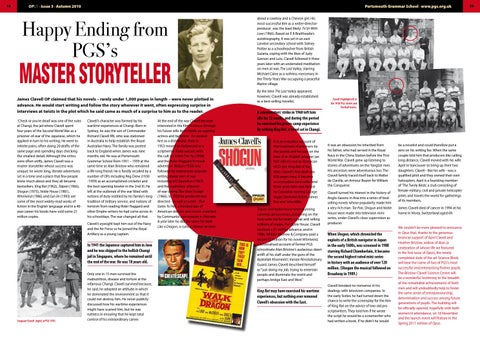
A screenwriters’ strike in 1960 left him idle for 12 weeks, and during this period he exorcised his prison-camp experience by writing King Rat, a novel set in Changi. It is an evocative account of the treatment of prisoners by the guards and focuses on the lives of an English prisoner (an RAF officer) and an American NCO (the King Rat of the title). Clavell’s first draft was 850 pages long. It became an immediate best-seller and three years later was filmed by Columbia starring George Segal, Denholm Elliott, James Fox and John Mills. Taipan and Noble House were stunning commercial successes, remaining on the best-seller list for nearly a year and selling millions of copies. For Noble House, Clavell received a $1 million advance, and in 1986, William Morrow & Company paid a record $5 million for his novel Whirlwind, a fictionalised account of former PGS schoolmate Alan Bristow’s audacious dawn airlift of his staff under the guns of the Ayatollah Khomeini’s Iranian Revolutionary Guard. James Clavell described himself as “just doing my job, trying to entertain people and illuminate the world and perhaps bridge East and West.”
King Rat may have exorcised his wartime experiences, but nothing ever removed Clavell’s obsession with the East.
It was an obsession he inherited from his father, who had served in the Royal Navy in the China Station before the First World War. Clavell grew up listening to stories of adventures on the Yangtze river. His ancestors were adventurous too. The Clavell family traced itself back to Walter de Claville, an Armour Bearer for William the Conqueror. Clavell turned his interest in the history of Anglo-Saxons in Asia into a series of bestselling novels whose popularity made him a very rich man. Tai-Pan, Shogun and Noble House were made into television miniseries, under Clavell’s close supervision as producer.
When Shogun, which chronicled the exploits of a British navigator in Japan in the early 1600s, was screened in 1980 starring Richard Chamberlain, it became the second highest rated mini-series in history with an audience of over 120 million. (Shogun the musical followed on Broadway in 1989.) Clavell brooked no nonsense in his dealings with television companies. In the early Sixties he had turned down the chance to write the screenplay for the film of King Rat on the advice of two old pro scriptwriters. They told him if he wrote the script he would be a screenwriter who had written a book. If he didn’t he would
be a novelist and could therefore put a zero on his writing fee. When the same couple told him that producers like calling long distance, Clavell moved with his wife April to Vancouver to bring up their two daughters. Clavell - like his wife - was a qualified pilot and they owned their own helicopters. April is a founding member of ‘The Twirly Birds’, a club consisting of female military, civil and private helicopter pilots and travels the world for gatherings of its members. James Clavell died of cancer in 1994 at his home in Vevey, Switzerland aged 69.
We couldn’t be more pleased to announce in Opus that, thanks to the generous financial support of April Clavell and Heather Bristow, widow of Alan (a celebration of whose life we featured in the first issue of Opus), the newlycompleted state of the art Science Block will bear the name of two of PGS’s most successful and enterprising former pupils. The Bristow-Clavell Science Centre will be a wonderful testimony to the breadth of the remarkable achievements of both men and will undoubtedly help to foster the same sense of entrepreneurship, determination and success among future generations of pupils. The building will be officially opened, hopefully with both women in attendance, on 18 November and the launch event will feature in the Spring 2011 edition of Opus.
19