The Pen Newspaper

Mason Kim | 9
Democracy fares best when every voice matters. Such is achieved when districting maps are drawn just and accurately. On Nov. 4, Californians voted on Proposition 50 (Prop. 50) which allowed state legislators, instead of the Citizens Redistricting Commission, to redistrict the congressional map for the 2026-30 elections (California Secretary of State). This shift came in response to nationwide fights over gerrymandering, the practice of manipulating district lines to advantage a political party, as well as efforts to counteract extreme maps in Republican-led states (Brennan Center for Justice). In California’s case, Prop. 50 was also pursued to maximize Democratic representation in Congress in response to Republican-led states increasing their own party’s seats. Yet, granting redistricting power to legislators through Prop. 50 endangers the map system California currently has by allowing politicians to shape districts in ways that could underrepresent non-Democratic populations and weaken fair representation.
California has historically looked to the Citizens Redistricting Commission to ensure that politicians cannot select their own constituency by being in charge of drawing their own voting district. California residents created the independent commission in 2008 because the state legislatures could not be trusted to draw up representative and constitutional electoral maps (Brennan Center for Justice). However, the belief behind the state’s commitment to fair representation was based on the understanding that for democracy to be the most functional and beneficial, elected representatives should be responsible to the people and not to the boundaries of the districts they represent. In 2008 the impartial comission was established in California when residents finally realized that their elected representatives could not be trusted to draw the representative electoral district (Brennan Center for Justice).
Prop. 50 occurred at a time when gerrymandering nationwide was at its highest, as states such as Texas had already redrawn their maps in ways that strengthened Republican control. This was because the congressional district maps that were being drawn at this time would directly affect which party was going to hold the political power within Congress leading into the next election cycle (New York Times). This explains the reason why California put Proposition 50 on the ballot with the objective of balancing the possible Texas gain of Republican seats by gaining more Democratic seats within Congress through redistricting.
As a result, this shift risked reducing representation for certain communities. For example, in Huntington Beach, a more conservative city compared to surrounding areas, residents’ interests were split across multiple districts after redistricting, making it more difficult for constituents to have their voices heard (Los Angeles Times).
While the question remains as to whether Prop. 50 does or does not enhance democratic representation, reactions amongst students at Peninsula remained mixed. Prop. 50 has ultimately resulted in weakening democratic representation, as it has given more importance to political gains rather than the emphasis against biased redistricting. Going back on that progress could lead to a diminution of voter faith in the electoral system,
during a time when the faith of the people in democracy is vulnerable. Freshman Mark Segal offered insight regarding this view
“I think the independent commission has done a fair job overall,” Segal said. “Letting lawmakers take over again just makes it easier for politics to get in the way[ofdistricting]. I [do not] think that would be fair for communities that rely on proper representation.”
On the other hand, proponents of Prop. 50 claim it will give California more influence throughout the nation if other states were using unfair maps. However, this argument implies that California is merely doing the same thing that it finds fault with, rather than treating the non-partisan system as distinct from the political system that California finds to be flawed.
Although Prop. 50 is characterized as a temporary measure, there is a concern that the change will remain. After the responsibility of map-drawing is put into the politicians’ control, history shows that it is very difficult to go back. For instance, in North Carolina and Wisconsin, once legislators regained redistricting power following the 2010 census, the maps remained skewed for multiple election cycles despite public opposition (Reuters). This risk provides politicians the chance to exploit what is expressed as a short-term solution.
Because concerns existed about whether political interests would influence the redistricting process, some individuals questioned whether Prop. 50 would produce outcomes that truly benefited the public. Junior Sam Garcia expressed uncertainty about the proposition.
“If the legislators start drawing their own maps again, it just feels unfair,” Garcia said. “The current system already works fine, so I [do not] see why they would want to change it. It seems like they are putting political advantage above community needs”
Fair lines, which mean district boundaries drawn to accurately reflect population distribution and community interests without partisan bias, carry importance that transcend party politics. They influence the way communities are represented when it comes to matters such as public transport, the quality of schools and local infrastructure (Los Angeles Times). When the lines are manipulated, like how they are under Prop 50, vulnerable communities, such as low-income neighborhoods and immigrant communities, are the first ones to be impacted (Brennan Center for Justice).
Since public confidence in democratic institutions is already low, maintaining independent oversight of the redistricting process is increasingly important to preserve voter trust. So, some students feel that in order to ensure voter confidence, it is necessary to continue with having electoral maps drawn by an independent watchdog. With this in mind, sophmore Oscar Perry offered his input on the steps Californians need to take.
“In the long run, if we want to work toward a truly democratic and free country, then we have to say no on this,” Perry said. “Keeping the maps drawn by an independent group based on the census every ten years is the only fair way to go forward. It ensures that every community has an equal voice in elections”
EDITORS-IN-CHIEF
Haylie Kim
Sivan Stoler
HEAD OF DESIGN
Esperanza Engle-Tseng
HEAD OF BUSINESS
Melina Ajami
EDITORS
Selah Hartman
Mason Kim
Elyssa Lee
Adam Lu
James Pan
Elena Thomas
Thanh Vuong
WRITERS
Parisa Bahrami
Ingu Bat-Yeruul
Savannah Diaz
Giana Geerdts
Emmersyn Hadley
Billy Houng
Colin Kim
Mason Kim
Olivia Kim
Gunnar Lee
Alissa Luna
Sydney Malicse
Kyra McGath
Celanie Neal
Khalil Santiago
Alisa Sekine
Sophia Shen
Briana Ta
Noah Vaidyan
DESIGN
Brian Hong
Jiayu Tang
Matthew Yi
Cayden Speck
Kaelyn Choi
Laila Garibo
BUSINESS
Halynn Campos-Lara
Allison Kumamoto
Sayuri Shibata
Haley Wong
Elise Vu
WEBSITE
Wendy Hu
Alyssa Kwok
Yully Seo
SOCIAL MEDIA
Asher Brunski
ADVISER
Jaymee DeMeyer
Billy Houng | 11
As the integration of artificial intelligence (AI) into the daily lives of generation al-
pha is becoming more prominent, children are increasingly turning to AI chatbots as a form of entertainment, gratification and genuine assistance. With novel technology on the rise, the functionality of AI has only exponentially expanded within the past decade, leading many people to question and fear its potential to overpower the human race in terms of intellect. This concern is valid, as AI alone has shown the capability to recite virtaully any fact, generate artifacts, repair and code itself — and, by far the most frightening of all, mimic its creator, the human. Certain human-made organizations have taken note of this, and are adamant on exploiting this newfound ability to its maximum through the service of highly-cognitive and advanced AI chatbots.
Senior Zephyr Strom, a loyal Google Gemini user, reflects on what risks are taken when considering the companionship of a generative AI chatbot.
“For friendship purposes — at the end of the day, [the bot] knows nothing in terms of emotional intelligence,” Strom said. “But, it can gather some good, [convincing] information from the internet. I feel like for everything right now, the government is always watching; companies are always asking for cookies — is [there really] anything [such as] a safe space? You have to pick and choose what you feel like is good and what makes the most sense to you. [To stay safe,] you have to do some due diligence on your own part.”
To what extent these chatbots will mimic humanlike behavior has up until now been largely ignored, leaving fallible, gullible children to absorb the harmful impacts of a chatbot’s unlimited restriction. This was the unfortunate case with a 14 year old boy, Sewell Setzer III, from Orlando, Florida. According to his mother, Megan L. Garcia, her son had become emotionally bonded to a digital persona via a chatbot provided by CharacterAI — a renowned entity in the field of artificially-intelligent chatbots —, and subsequently took his own life after being coerced by the mechanical fiend. Grief-stricken, she took her outcry to court in an attempt to remedy the situation, indirectly amassing an immense online following (NBC News). Preceding this court ruling, platforms such as CharacterAI did not implement proper safety measures to prevent the user from forming a genuine relationship with the bot. Many of these chatbots would respond with inappropriate innuendo when prompted — even toward
potentially younger audiences. Ranging from an undisclosed function meant for illicit use to a massive oversight and lapse in protocol, the capabilities of chatbots far exceed their face value, and should be considered a legitimate threat. Steps toward safety have been made, including notifications that pop up every three hours to remind the user that they are not conversing with a real human (American Bar Association). Although a reminder is a crucial step in the right direction, it does not take three whole hours to be led down a path of no return.
Though there are some superficial nuances between the bond of AI chatbots and humans, AI has witfully committed itself to replicating the more noticeable human traits that a breathing friend would share: the abilities to listen, remember, reply and suggest. The latter, as seen with the tale of Sewell Setzer III, should arouse the most alarm. Such capacity for chatbots to take on human characteristics threatens genuine connection. It is vital that an impressionable adolescent becomes aware of the pitfalls of false gratification and simulated emotional bondage that are inherent in the use of AI chatbots. If one were to rely on such resources so often, they would become too accustomed to the gift of instant delight and would ultimately fail to fully integrate themselves into real life — where everything matters. With so much of themselves invested into a mere screen, it is inevitable that they would give up presence in the real world to compensate for their excessive online practices. Similarly, this concept coincides with the behavior of obsessive video gamers. The negative impacts of the usage of AI chatbots are spotlighted by surveys depicting the decrease of social interaction in individuals who utilize AI chatbot services; a study conducted by the National Library of Medicine found that, out of 496 Replika — an AI chatbot platform — users questioned, 428 reported increased social isolation due to their routine conversations with AI chatbots. Statistically, it is far more beneficial to mental health to confide in real-life interaction as opposed to a pixelated monitor (PsychologyToday).
The recent veto of the Leading Ethical AI Development (LEAD) for Kids Act was issued by California Governor Gavin Newsom, who believed that the possible handicaps to children benefiting off of chatbots outweighed the pros that the bill imposed. There is a common misconception regarding his alleged prioritization of “Big Tech” over “families” as the bill’s author, Rebecca Bauer-Kahan, asserted upon the governor’s denial of her proposal (KQED Media). Newsom’s arguments against the bill are not in disagreement with the subject addressed,
but rather, he proposes an alternate solution with a less restrictive boundary that would still ensure their priority and purpose: child safety. The aforementioned solution — Senate Bill 243, along with many others, have already been signed into law; specifically, these documents safeguard the youth from gravitating toward AI chatbots under the premise that they are real. By inflicting pop-up warnings of non-human interaction at least every three hours, maintaining certain protocol in the event of a suicidal user and consenting to third-party checks to enforce the law, Newsom hopes to foster a safe, but free environment for chatbot users without outright banning the use of AI in this way. Allowing children to interact with such systems will certainly refine their knowledge of the scope of AI’s outreach when it becomes ubiquitous in a future society.
Still, some people present reasonable skepticism of AI’s supposed limited accessibility in light of the new legislation being signed into law. Aerospace Engineering student junior Diego Gallegos sheds his perspective on the current government intervention in the evergrowing chatbot ecosystem.
“I think the [current precaution] taken is quite weak at its purpose and function,” Gallegos said. “An easy click of [the] ‘X’ [button] just gets rid of [the pop-up] and you [could] just continue with what you were doing before. I don’t see how that can be annoying to the user It should be annoying enough to the user so that [they remember]. The interval between pop-ups should be reduced [further].”
With the dawn of the digitalized era approaching, students must not be lured into the defects that AI potentially provides, but instead, leverage it as a tool. AP Computer Science student junior Jian Lee articulated his interactions and fears of the upcoming rise of AI chatbots.
“The experience was impressive and slightly unsettling,” Lee said. “It really amazed me how natural the conversation between me and the [chatbot] was. I don’t think we’re doomed as a species, but for sure, we’re losing a little bit of our social depth. Society has this positive connotation toward using chatbots, and that might coerce a kid into using [them]. If basically everyone is using it, then you are more inclined to use it yourself. Over reliance on them can negate [and] weaken our communication skills — making us emotionally numb. Kids [are] young; [they] don’t know what is right or wrong. I would primarily hold companies [who manufacture AI] accountable [for] building [a] system [that] is powerful enough to overtake someone’s emotions.”
Lately, it has seemed like nobody is actually afraid of needles anymore.
Or at least that’s how it feels when celebrities and social media influencers treat botox, lip filler and micro-needling as just a part of a self-care routine.
These procedures have become so pervasive that even groups historically unlikely to get them have started to receive them at record rates. Young people in their twenties and thirties have begun receiving small doses of botox, nicknamed “Baby Botox,” as a way to stave off the effects of aging before they even occur (National Public Radio).
Experts have theorized that this has occurred, in part, because of social media creating an ideal of beauty that can never be truly achieved. It is not uncommon to see a video of a perfectly ageless influencer posting about their morning “de-sheds” in which they take off layers of de-aging face gels, red light therapy masks and face tape, or an Instagram carousel promoting a straw-like contraption that does not cause smile lines, or a Tweet that praises how a twenty five year old actress has “aged” gracefully. This creates a cyclical phenomenon. People see videos and posts of celebrities and influencers that venerate remaining ageless, so they use products and procedures that will reward them with such appearances, further incentivizing other people to obsessively conquer the impossible feat of having an ageless face.
Much of the marketing surrounding these
products and procedures specifically target women. When this is combined with the American Society of Plastic Surgeons reporting that most plastic surgery procedures are done on women and the exorbitant cost of much of these less-intensive procedures, it is clear that society’s obsession with avoiding aging hurts women specifically. As corporations benefit off of feeding into women’s insecurities, women become more trapped by them. The culture that leads to social media villainizing aging is not organically created by individual’s actual wishes for themselves, it is pre-manufactured and pre-planned by corporations who care about revenue, not personal autonomy. By profiting off of making people, especially women, feel that there is something wrong with the natural way their body ages, these companies directly hurt women. Beyond this, companies’ success in marketing products that aim to defy aging takes on an especially dangerous hue when it spreads to children.
In recent years, pre-teens have flooded beauty stores like Sephora and Ulta with hundreds of dollars on trendy, retinol-ridden, skincare. Of course, however, they do not need these products, but they have been influenced to spend their parents’ money on them because of social media. Aside from the mental ramifications of young people already feeling as though there is something wrong with their face that can only be fixed by purchasing a trendy skincare line, these products also pose a physical threat. There have been numerous cases of Retinol and other harsh ingredients designed to tighten, hydrate
and brighten aging skin causing rashes and other skin issues when used on young skin (USA Today).
In order to avoid this while still allowing children and pre-teens to use skin care, actress and model Shay Mitchell released a children’s skincare line, called Rini. The line included face masks which, according to the Rini website, are designed to “hydrate” and “recover” young skin, leaving the question of why exactly a child’s face needs to be tightened by hydration and what exactly young skin needs to recover from unanswered.
Although they claim to offer a safer alternative to physically harmful skincare, Rini, and child-friendly skincare brands like it, do nothing but teach children that there is something inherently wrong with their face, or that there will be something wrong with it, that can only be fixed with a skincare product. This does nothing but lead a new generation into the harmful cycle of consumerism and self doubt that leads young adults to fear and villainize a natural part of life.
Instead of focusing on “repairing” already healthy skin or avoiding aging, we must repair the damage already done by societal pressures to remain ageless and avoid its encroachment on younger generations. Aging is natural. It should not be feared and its pull on women should not be dictated by faceless corporations or vapid social media posts. It should not lead to young girls learning things to hate about themselves before they learn pre-algebra. Only when we are able to freely age into imperfections, will we be free from these pressures.
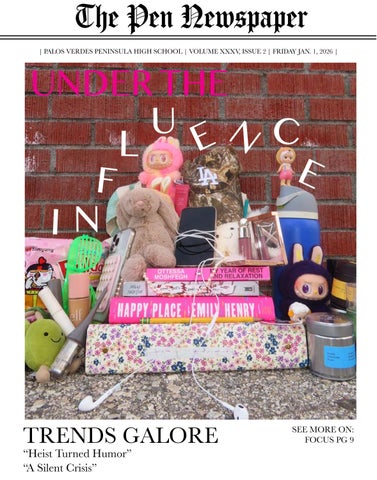
Dear Readers,
People are easily influenced. Obviously.
But lately this influence, this constant pull, has felt different. More constant, more inescapable. People are stirred into frenzies over blind box plushes because a TikToker told them they should be or they recite meaningless social media phrases without knowing their origin, simply because they heard their peers do so. More and more young people say that they want to be “influencers”, without a thought about how exactly they will be wielding this influence.
In order to understand why this is the case, in this issue we discuss how quickly (and ephemerally) social media creates universally understood jokes and why students are so easily influenced by their peers that they refuse to even participate in class (page 9).
We hope you enjoy this issue, but most of all we hope you let some of the ideas explored in these pages influence you in some way.
With Love, Haylie Kim
Sivan Stoler


Sophia Shen| 9
Portuguese Bend in Rancho Palos Verdes (RPV) is notable for its stunning views and hosting a substantial part of the Palos Verdes Nature Reserve. It offers breathtaking hikes and ocean trails, but beneath its beauty lies a danger ous reality—one that may take mil lions of dollars to fix. The ground has been slowly shifting and has recently become worse, damaging roads and homes. The movement is creating seri ous safety challenges for homeowners and making it difficult for them to maintain a secure place to live.
Despite this, on Oct. 1, Governor Gavin Newsom vetoed Assembly Bill 986 (AB986), which would have qualified landslides and unstable ground movement, such as the ground movement in Portuguese Bend, as state or local emergencies (California Emergency Services Act). With the bill vetoed, impacted communities may face more damage to homes and infra structure and may be forced to handle it on their own. School Resource Offi cer Steven Barber shared what the bill could mean for Palos Verdes residents.
this was the right decision that he made.”
The proposal of AB986 intended to provide a more effective way for disaster recovery to reach communities affected by land movement through classifying landslides as a type of natural
Mirosavich shared his thoughts on the situation.
“For the past 20 years of me living in the area, there has always been land moving every year,” Mirosavich said. “We’re going to have a harder time from now on [if it is not considered an emergency]. In situations like this, when people’s property is involved, it becomes much more complicated, because you have to pay for that prop erty, or maybe get rid of it.”

“I think that the bill would have helped people out in case their property got damaged,” Bar ber said. “With the bill getting vetoed, it will be a harder for people to get help. From what it sounds like, it is supposed to help people who live in areas where they could be in devastation or with a lot of property damage. I do not think that
disaster. The area is notorious for heavy rains, climate change and water‑saturated clay and rock. However, these damages caused by these condi tions could be mitigated with active government intervention and further preventative measures –vetoing the bill could worsen the challenges already faced by Portuguese Bend residents. AP Literature and English 3 Honors teacher Jeffrey
Unsurprisingly, Portuguese Bend remains a primary concern due to its ongoing landslide activity according to the Los Angeles Times. Entire houses have shifted, cracked or been lost as the ground moves. With this bill being vetoed, the area might keep facing damage from heavy rains and unstable soil without any government interven tion. Reflecting upon this reality, Girls and boys’ varsity water polo coach, US History teacher and RPV resident, Charles Kim, shared his opinion on what the government should do in regards to the land movement.
“Overall, I think that people who grew up on the Peninsula often see their homes damaged or destroyed by [land movements] and then they feel that something should be done to prevent it,” Kim said. “I think [in that case], the government should step up, [and] maybe help out with some kind of relief so there is kind of an assurance that there is backup. I do not think that this was the right decision that he made. I believe there should be a time where the government must step in and help out the affected families and homes.”

Parisa Bahrami | 11
Centuries after the United States won its independence from Great Britain’s monarchy in the Revolutionary War, Americans have once again begun fighting for a country free of kings through a series of “No Kings” protests. The protests, held on June 14 and Oct. 18, were a part of a nationwide movement that sought to defend First Amendment rights and fight against President Donald Trump’s administration which protestors believe is unfairly detaining immigrants without warrants, increasing the cost of living and threatening to overtake elections (No Kings). Over 7 million Americans attended more than 2,700 protests held across the country, with 2 million more protestors than the previous No Kings Day on June 14 (National Broadcasting Company). Those who participated in the protests expressed feelings of indignation toward the Immigration and Customs Enforcement
have defended these actions by saying they are necessary for the country in times of economic hardship and crisis, dismissing protestors that claim him to be a king or dictator. These issues are sparking political unrest as more individuals feel obligated to fight and protest against these changes (NBC).
People of all ages, including students at Peninsula, participated in one of the thousands of No Kings protests across the country. Junior Abigail Choi, who was present at both the October and June protests, shared what the atmosphere was like at the October protest.
our own beliefs that we have the right to express.” The idea of the law being the only “king” in the U.S. resonated with many who attended the No Kings protest. Slogans like “Democracy not Monarchy” and “The Constitution is not Optional” were circulated throughout the event (British Broadcasting Corporation). These slogans showcase how protestors aimed to highlight their freedom of speech and assembly as well as their fight against Trump’s idea of the Constitution, in which he is uncertain whether the values should be upheld or not (NBC).

There has still been some confusion on what the actual objective of the No Kings protests was. Junior Madalynn Olmos, who did not attend the protest, felt that the specifics on what the protest was initiated for were unclear in the media.
“Protests are definitely a great way to make change in the United States, but you should be clear on what you’re trying to change,” Ol-
“ I believe that [‘No Kings’] really embodies what America is and what it stands for. “
-Isaac Kim | 12
(ICE) raids and National Guard deployment that flooded across the U.S., as well as cuts to federal programs like the Supplemental Nutrition Assistance Program (SNAP) and Medicaid (CNN). On the other hand, Trump and his administration
Edited by Adam Lu & Thanh Vuong
“[The atmosphere] was really positive– obviously the signs [we were holding] were [expressing] large topics, but it felt like everyone was happy and enjoyed being there. I wasn’t scared at all, especially because I was protesting in Torrance, and it was overall a great experience for [all the protestors].”
Beyond the surface-level aspects of the protest, there were still deeper values for why many students attended. For instance, Senior Isaac Kim, who attended the June protest, described how he saw the meaning of the protest’s title, “No Kings.”
“When I think of the phrase ‘No Kings,’ I think of Thomas Paine,” Kim said. “He wrote in [his pamphlet] Common Sense that in America, only the law is king. I believe that the slogan really embodies what America is and what it stands for. It was established in the country’s founding that the people have the ability to rule themselves and that we, as citizens, have our own autonomy and
mos said. “So far I haven’t seen any other context on the protest except for the title, “No Kings”. If [protestors] made it more specific on what they were trying to accomplish, it would be easier to comprehend their goals.”
However, the main goal of the No Kings protest, to emphasize the importance of democracy in the U.S. and to protect the rights of the people who make up the country, can be readily found. Based on this, many critics are warning Trump that his actions are threatening this democracy’s survival through these protests (BBC). As the country faces troop deployments in cities and the government shutdown, No Kings protestors persist in fighting for their rights as American citizens (CNN). The No Kings protests stood as a peaceful way for people to declare their opinions, and continue to stand as a message and lasting symbol for those who are affected by the measures of Trump’s administration (No Kings).
Khalil Santiago| 9
For years, the promise of receiving an offer of admission from a college has been an uncertain milestone for many California students. This is reflected in the rate of degree attainment in the state. As of 2025, 35% of California-born young adults hold a bachelor’s degree. In turn, Governor Gavin Newsom has set a goal for 70% of California’s students to earn a postsecondary degree or credential by 2030 (Public Policy Institute of California). To achieve this, the California senate has introduced Senate Bill 640 (SB 640). Beginning Jan. 1, 2026, SB 640 will guarantee that every California high school student who completes the A-G courses, the set of college preparatory courses needed to meet the CSU eligibility requirements, and maintains at least a 2.5 grade point average (GPA) will be guaranteed acceptance at a CSU campus with available capacity (California State University).
SB 640 was introduced by State Senator Christopher Cabaldon and signed into law on Oct. 6, 2025 (California Legislative Information). Lawmakers designed the policy to make college more predictable for students, especially first-generation and underrepresented students who may not have guidance navigating admissions. The law aims to reach students who already qualify for CSU but never apply, often because they lack support, are unfamiliar with the process or assume college is out of reach (California Senate).
The law originated with CSU’s 2024-25 direct-admission pilot program in Riverside County. The pilot automatically considered 17,000 Riverside County students for the Fall 2025 admission cycle, successfully increasing the amount of students who enrolled in college by 3,000 (California Senate). This success gave lawmakers the confidence that expanding direct admission could open doors for thousands of additional students (California State University).
As California adopts this approach, it joins a growing number of states who offer some form
Times). In Texas, students in the top 10% of their high school class are guaranteed admission to public universities within the University of Texas and Texas A&M University Systems (Texas Edu-
feel like their hard work mattered.”
Yang’s experience emphasizes why successful integration matters. To ensure SB 640 is implemented successfully, the state will use califor-

Click College Admit” program that offers admission based solely on GPA, with no essays, recommendation letters or any application fees required (Illinois Student Assistance Commission).
These models help put California’s new approach into context. While the law guarantees admission into at least one CSU campus, it does not guarantee entry into a specific major or campus, nor does it apply to every campus. Campuses labeled “impacted,” such as Cal Poly San Luis Obispo and Cal State Fullerton, will continue using the traditional application process, as their demand exceeds available space. Aside from impacted campuses, the exact CSU campus eligible students receive acceptance to will depend on the campuses’ availability (Los Angeles Times). However, as the new policy aims to open doors for students in California, it also raises questions for out-of-state applicants. Junior Taewoo Lee expressed support for the new policy, but acknowledges how it reduces opportunities for outof-state students who want to apply to CSUs.
“I feel like it’s a good change because the majority of applicants to CSUs are already California residents, and this means they have a guarantee [of] a good education,” Lee said. “I know this means fewer admissions and more selectivity for out-of-state applicants, [but those students typically already have several college options ready and their own state schools to be accepted to].”

College students are also paying attention to the change. Cal State Fullerton student Sunny Yang, reflects on how SB 640 would change many students’ approach to college applications.
“When I was in high school, I saw a lot of people feel discouraged because they thought college was out of reach,” Yang said. “If something like this had existed back then, it would’ve helped students
automatically issue an official physical letter sent via mail (California State University Office of the Chancellor). Selected students can choose to reject or accept the offer and enroll at the assigned CSU campus. State education officials will also track who enrolls and monitor their overall success, then evaluate long-term outcomes such as graduation rates in order to refine the direct admissions program as needed. The state plans to ensure that SB 640 not only expands opportunities for deserving students but also supports them throughout their studies (California State University).
However, education experts have raised concerns about CSU capacity, noting that enrollment increases due to the program may require additional housing, staffing and student support services (Los Angeles Times). Currently, the CSU system houses 13% of its students on campus, with wide variation across campuses (EdSource). Recently, it has been discovered that CSU’s housing planning has relied on outdated or incomplete data, underestimating unmet demand (California State Auditor). To remedy this, CSU officials have stated that the system will monitor campus capacity and direct students toward campuses with available space, aiming to prevent any overcrowding and ensure adequate student support (Los Angeles Times). As SB 640 begins to open doors for students across California, it helps students better understand the options available to them. Career and College Center specialist Julie Arico reaffirms the reasoning backing this new initiative.
“It’s a way for Cal States to let students know there are opportunities available for them in college,” Arico said. “Cal States are [taking this opportunity] to tell California students that they are eligible and they do [have a chance of getting in]. There are lots of places for students to be and lots of ways to make that more affordable.”
Emmersyn Hadley | 9
On
Oct. 7, the Los Angeles Police Department (LAPD) and Federal Bureau of Investigation (FBI) conducted a raid in San Pedro targeting the Rancho San Pedro Enterprise, a gang, alleged to have ties with the Mexican Mafia. The raid resulted in multiple arrests. The LAPD and FBI believe that this is one of the most active and violent gangs in California. After many years of investigating the group, the LAPD finally acted on their findings, arresting 13 individuals who are currently facing legal charges. So far, 17 more warrants for arrest have been published. However, the gang is still believed to have over 500 active members.
This recent raid is part of a much longer history of criminal activity in the area. This gang is not new to the San Pedro area. It is a multi-generational criminal enterprise with records of gang activity dating back to the 1970s. The gang is divided into six subsets. Each subset operates under its own leaders. In turn, those leaders answer to higher-ranking figures connected to the Mexican Mafia. They are “a U.S.-based prison gang and criminal organization” (FBI) that sometimes deals with Mexican cartels for drugs and has many leaders who are incarcerated in state prisons. The San Pedro gang, as the FBI calls them, pays taxes to the Mexican Mafia in exchange for protection from other gangs.
As police investigations give way to arrests and criminal charges, these alleged ties to the Mexican Mafia are coming under scrutiny. The arrested members have been charged with a form of racketeering under the Racketeer Influenced and Corrupt Organization Act (RICO) which allows prosecutors to charge individuals involved in a gang enterprise. Lauren Sopko, a lawyer at the Los Angeles-based firm Kirkland and Ellis, which handles both defense and prosecution in criminal cases, such as this one,
described RICO and what it can mean for this gang.
“[RICO] is an anti-racketeering law, which makes it illegal to do Ponzi schemes and other financial/ fraud crimes,” Sopko said. “Prosecution will have to prove their connection to the Mafia through clear evidence in order to charge [gang] members.”
While prosecutors use RICO to prepare their case, they will face challenges in proving the gang’s connection to the Mexican Mafia. Although the LAPD spent years investigating the gang’s activities, much of that information focused on crimes within San Pedro, rather than direct communication chains to Mafia leadership. This means that there is little direct evidence that the gang is affiliated with the Mexican Mafia, despite assumptions and community suspicions that they are. Since any evidence in a criminal case must reach the “beyond a reasonable doubt” standard rather than the lower “preponderance of evidence” threshold used in civil cases, it could be difficult for the prosecutors to ascertain that the gang is, in fact, affiliated with the Mexican Mafia. Another worry for the LAPD is how they will stop the gang altogether. With over 500 members still active in the gang, the few arrests have only momentarily left them without leadership; it is unknown at the moment whether these arrests will make San Pedro safer, or only cause another outburst of violence in retaliation (Fox 11 Los Angeles).
These uncertainties have left many residents worried, as the gang’s ongoing presence directly affects daily life. The gang is known to be involved in activities such as narcotics trafficking, distributing and trafficking psychoactive drugs like heroin and robberies to generate revenue for their criminal enterprise (Fox 11 Los Angeles). Some locals living in the gang’s territory were victims of violence and intimidation, forced not to alert authorities in fear of being beaten or even killed. The gang is known to have competed in drag races, races in which cars
Celanie Neal | 11
Although Peninsula has introduced several measures to make students feel more welcome, high school remains an intimidating environment for many. Fear of embarrassment pervades despite pep rallies, clubs and events, driving a chronic lack of participation. This raises an important question: why are students so reluctant to raise their hands in class or dress out for a spirit day? How did something as simple as speaking up in class become a source of anxiety? English teacher and Link Crew coordinator Rebecka Dibble shared her thoughts on the issue.
“I think kids, in general, are afraid; whether it be participating in class and sounding stupid, or being the only one dressing up and thinking that they look stupid,” Dibble said. “They believe everyone is
looking at them and everybody is listening to them when in reality that is not true.”
On a different note, it is easy for students to become used to not participating when it is not something done on a regular basis. When teachers fail to be engaging, students lose interest in the content being taught. Many students become apathetic about what is being taught in their classes because their teachers do not spend enough time working with students or explaining the content in an exciting way. Lack of motivation to participate fosters classroom environments where minimal participation becomes the norm. Thus, junior Andrew Pacheco believes effort by teachers is critical to increase participation.
that are modified to drive as fast as possible compete in short distances, which could become reckless and dangerous when not performed in areas meant for such activities (ABC 7 Los Angeles). San Pedro resident and algebra teacher John Buda provided his knowledge of previous gang activity.
“I know there have been previous issues with gangs in San Pedro,” Buda said. “There have been drag races, fireworks, classic gang activities and drug use with fentanyl.”
Beyond their violent presence, the gang has normalized a climate of fear for those who call San Pedro home. These issues with gang activities and their violent acts are not isolated incidents, but a pattern that has cycled on for many decades. With the gang having existed since the 1970s, many of its activities have become dangerous traditions that affect the community. Their pervasive presence has caused many to feel unsafe in San Pedro. Residents are afraid to walk around at night and are cautious to inform police of criminal activity in fear of antagonizing the gang (Daily Breeze). Freshman Joey Moakley shared his perspective on how the gang’s presence has shaped the atmosphere in the community.
“In general [I do feel] a little [unsafe],” Moakley said. “There has been one shooting by [another student’s] house. I do feel a lot more safe now, though, as the police crack down on [activity related to the Mexican Mafia].”
While the LAPD and FBI are making progress in deconstructing parts of the gang’s leadership, the entrenched nature of the gang will make it hard for them to stop the issue altogether. Still, many residents hope that law enforcement will help end the fear and destruction caused by the gang (Daily Breeze). As investigations continue, residents and officials alike are watching closely to see whether the recent raids can signal a turning point for safety in San Pedro.
“I think that low participation often comes from fear of being judged and not feeling confident, but the classroom environment definitely affects student comfort,” Pacheco said. “[For example], some

On Oct. 19, a major heist took place at the Louvre Museum in Paris. What began as a serious and pressing matter on news headlines quickly transformed into a worldwide online trend. The aftermath of the robbery at the Louvre saw a tremendous spread of memes and jokes regarding the heist and its perpetrators online. Instead of fading from attention after its appearance on the news, the story became an internet-wide joke, influencing many to create online trends, dances and mood boards inspired by the heist. Many even dressed up as the robbers for Halloween. The rapid spread of the heist’s popularity online can be seen as showcasing the power the internet has to re-envision news stories as entertainment and spectacle, making it difficult to understand which parts of the story are real and which are fabricated. Junior Tyler Clark explained the increasing difficulty of telling fact from fiction online.
“With how fast things spread [on the internet] people may not always see the full story,” Clark said. “There may be lies mixed in with the truth and someone [may] say something that is completely unreliable. Because [information] spreads across the globe in less than a day, people might not know if what they are seeing is [false]. By the time it’s out there it has already been cemented into their brains that it is the truth.”
The frequent disconnect between real life and the internet’s representation of events became clear in the case of the Louvre heist. Reality was very different from the information disseminated online. The Louvre Heist itself occurred in only seven minutes. A small group of masked individuals slipped in and out of the French museum while it was filled with visitors. Security footage released after the heist showed the robbers moving with confident and skilled coordination, causing people to wonder whether they were experienced professionals or just
teachers cause [students] hesitation [if] they seem unapproachable or strict, and this lack of encouragement can make students stay quiet.”
Many teachers at Peninsula have recognized this issue. In order to increase participation within their classes, a number of teachers have introduced graded participation. Speaking up no longer becomes a choice, but a necessity if students want to achieve academic success. Mrs. Dibble believes this incentive system helps foster an environment where participation is seen as something positive. If everyone has to speak up to receive a good grade, no one feels embarrassed because participation is a shared obligation rather than an unnecessary display that singles out individual students. A grade incentive can also help build confidence in participation-averse students, making them feel more comfortable participating in other settings. However, sophomore Sophia Bass shared a different perspective.
“Graded participation lowers morale and reduces [retention of] the information,” Bass said. “Anytime
bold amateurs. The footage had also captured the robbers dressed in neon construction vests walking near the location of the heist (CNN). Using a stolen construction truck with an extendable ladder, the thieves broke into the museum’s Apollo gallery and stole France’s crown jewels. Two members of the heist smashed two glass display cases before descending down the ladder, and fleeing the scene on motorcycles which they had planted outside the museum prior (BBC). Authorities launched an immediate investigation, trying to find any clues that could lead back to the culprits. The almost action-movie-like speed and spectacle of the heist had the internet infatuated, meaning that the first time many people heard of the heist was through social

“Lourve Pyramid” by dynathi is licensed under CC BY 2.0.
media. Sophomore Josephine Makpayo explained how she found out about the heist.
“I came across the heist while scrolling on TikTok and initially thought it was just a joke from how people were speaking of it,” Makpayo said. “Once I saw it on the news I was in disbelief to see that the perpetrators were able to pull off a heist in such a short amount of time. Stealing jewels worth about $102 million is an extremely hard task and that being done in seven minutes is unbelievable.”
I think kids, in general, are afraid; whether it be participating in class and sounding stupid, or being the only one dressing up and thinking that they [will] look stupid. “ “
-Rebecka Dibble
I know I have to participate, I stress [about] making sure I get called on and making sure I have the right answer rather than remembering the [material].”
Despite disagreements over methods for increas-
Social media platforms like TikTok and Instagram were quick to turn the Louvre Heist into an internet-wide inside joke. Many fan accounts have created edits and multitudes of posts romanticizing the thieves as rebellious and charming anti-heroes. For example, Jason Saperstone, a verified TikTok creator with 171,200 followers, made a post about the Louvre robbers being “iconic” for pulling off the heist. The post received 41,800 likes and more than 243,700 views. For many, the appeal came not from the crime itself, but rather the aesthetic and suspense surrounding it. Due to posts like these, many teens soon began to spread the trend offline with Halloween costumes based on the thieves. Teens and adults alike dressed in black clothing, construction vests and fake jewelry, calling themselves the “Louvre robbers.” The transformation of the Louvre Heist from a serious crime to an online joke shows how social media can blur the line between news and pop culture. This rapid dissemination can make people perceive serious news as a joke or as entertainment, and can make them believe false information. Sophomore Lilah Gonzalez spoke up on how to deal with the false information the internet provided.
“This is just part of modern media,” Gonzalez said. “As we advance in society, especially technologically, we are going to see processes like the spreading of news speeding up. People do not know what the internet is feeding them and that means having to learn how to adapt and converge it into our own understanding.”
The real impact of the heist was beyond simply what occurred inside of the museum, but the reaction that subsequently formed online. Social media shaped a different perspective on the robbery and compelled people to follow along with the trend without taking into consideration what had really happened. People will continue to share news online, but when serious crimes and disasters, like the Louvre heist, are turned into jokes and trends, it steers attention away from real issues in the world and can lead to further misinformation (Euronews).
ing participation, teachers and students alike agree that participation is important for the environment in a classroom. It allows students to proactively connect with the material by articulating their understanding of concepts verbally and provides a means by which teachers can track students’ grasp of content. When students are engaged, they can learn more in class, make connections with teachers, make new friends on campus and find places where they can feel comfortable. Despite participation’s myriad benefits, Peninsula is plagued by chronic lack of participation as students fear the possibility of embarrassment. The efforts of both teachers and their students are critical to create the positive environments necessary for engagement. Teachers can employ creative ways to encourage student behavior and participation while students can break free from fear by getting to know their peers and teachers better. It takes everyone to work towards an ideal classroom environment where students’ opinions and thoughts are respected and welcomed.
Colin Kim | 12
Daniel Caesar reaches a new level of vulnerability 11 years into his career, his heart worn on his sleeve in his latest project. The R&B singer released his fourth studio album, titled “Son of Spergy,’’ on Oct. 24. On this album, Caesar’s artistry is more raw and reflective than ever, showing tremendous growth from some of his previous projects such as “Case Study 01” and “Never Enough”. The title alludes to Caesar’s father, pastor Norwill Simmonds, who was nicknamed “Spergy” throughout his life. This name was short for “Spurgeon”, referring to Charles Haddon Spurgeon, a baptist in the 1800s who shared Simmonds purist and religious values. Caesar writes about having an estranged relationship with his dad, discussing their complex relationship and his inability to meet his father’s expectations. Despite being a gospel singer, Spergy was disapproving of Caesar’s dream in becoming a musician. At the age of 17 Caesar left his home to pursue his music career and scrap for cash. Despite these hardships, Caesar began writing his debut EP Praise Break and released it in 2014 and became homeless. Throughout the 12 tracks, Caesar uses Spergy as a motif to explore themes of masculinity, faith and self-discovery. Singles “Have a Baby (With Me)”, “Moon” and “Call on Me” all tonally represent the album’s spiritual theme while featured artists like Blood Orange, Bon Iver and Yebba add depth to this introspective album by layering vocals, as if multiple perspectives are being told.
“The Son of Spergy” exhibits intimacy through its lyrical content — nostalgic, vulnerable and reflective, the album depicts Caesar’s personal relationships with God, Spergy, lovers and himself. Caesar uses a combination of both references from the Bible and direct quotes. For example, in “Touching God”, feature Blood Orange quotes 1 Corinthians 13:11 stating, “When I was a child, I spoke like a child, I thought like a child, I reasoned like a child; but when I became a man, I put away childish things.” Caesar reclaims his faith in Christianity after publicly sharing his views of not believing in God in 2023. His new found faith allows him to embrace his father’s passion for Christianity despite previously rejecting it. Unfortunately, this subject comes across as out of the blue and forced throughout the album. The way Caesar discusses faith is oversimplified and is discussed as if his new beliefs have suddenly healed his whole life. Acknowledging his father’s imperfections and previous disputes, Caesar uses this album to make peace and inspire forgiveness. Caesar’s personal journey is quite admirable and it is clear he has put effort into rebuilding his relationship. In the single ‘Baby Blue’, Spergy is featured on the track which comes across as a healing catalyst for Caesar.
Other notable tracks on “The Son of Spergy” include “Have a Baby (With Me)”, a melodic, R&B tune that discusses a dying relationship and “Root of all Evil”, a reference to the Bible verse 1 Timothy 6:10, incorporating themes of temptation to be a sinner. Senior Mia McKiernan shared her thoughts on the subjects of these tracks.
“I could see these songs not being for everyone; they’re slow paced and quiet, but Caesar’s voice is beautiful,” McKiernan said. “I think [many people] can find a lot of peace within these songs as they talk about one’s spiritual journey”
Sonically, Caesar uses pleasant choir-like vocal stackings that are harmonious and soothing. The opening track, Rain Down, does this technique best as its topic of accepting God’s blessings fits the warm sound of his voice and the song’s reference
Another wonderful aspect of the album Caesar’s laid back production, with Caesar’s soft voice allowing the reflective lyrics to take center stage Caesar’s voice blends perfectly with Bon Iver’s deep and melodic tone of voice. The song ‘Sins Of The Father’ has an understated feature from Bon Iver that gets outshined by Caesar’s voice. This is a recurring issue throughout this album. The track ‘Moon’ could’ve especially benefited from Bon Iver’s feature being more prominent because the lyrical content depicts a relationship that Iver’s voice could’ve added a new perspective on. Caesar sings about the complex relationship between him and his father: once he makes peace with Spergy he does with God as well, rounding out the album’s theme perfectly. Senior Dakota Pflieger agreed with this sentiment.
to religion. In the single ‘Moon’, Caesar repeats the line, “Who’s gonna be my Jesus? Who will advocate?”, throughout the verses. This shows how Caesar begins to question the relationships around him as he seeks intimate love. Bon Iver’s accompanying subtle harmonies help to create the song’s dreamy atmosphere. Caesar uses the album’s features very sparingly with his existing vocals. Bon Iver neither takes away or adds tremendously to this track. The features make for beautiful harmonies, however because they were subdued, it’s lackluster for there were no standout vocals. Senior Emily O’Neill shared thoughts on some of the album’s tracks.
“I thought the song ‘Rain Down’ was a really good opening track,” O’Neill said. “Caesar’s calming voice set the tone for the album and made it clear that religious themes would be discussed throughout the album. I also liked the song ‘Moon’ because Bon Iver’s was featured on that track.”
“As a fan of Bon Iver my favorite songs on the album are ‘Moon’ and ‘Sins Of The Father’’’ Pflieger said. “The harmonizations between the two are really good. I wish there was a part in the song though where it was just Iver because his voice is kinda faint in some parts. Same for Yebba’s features. I also thought it was cool he included his dad, Simmonds, on the track ‘Baby Blue.’”
On a negative note, “The Son of Spergy” suffers from a lack of relatability to those who aren’t religious. Although love is not a new subject for Caesar, his latest album has taken a tonal shift by going from discussing romantic relationships to inner conflicts and faith. Conceptually, it is very one-dimensional in theme, but it is made up for with Caesar’s soothing voice. For listeners who do heavily follow religion, his introspective journey may resonate with that demographic.
Although thematically, ‘Son of Spergy’ may feel exclusive, his live pop up concerts are a creative way to bring people together, advocating for the community that our country so deeply needs. Since Sept. 27th, Caesar began performing a free to the public, promotional tour drawing large crowds of local fans from the cities he performs in. Starting with Trinity Bellwoods Park in Toronto, Canada, Caesar played 11 acoustic versions of “Son of Spergy” songs then, performed in parks in cities such as, Vancouver, Montreal, Bozeman, Los Angeles, Houston, finally concluding the tour in Atlanta. These shows were announced immediately before they occurred on Ceasar’s instagram, leading many fans to rush to the concert venues. With just a five minute notice for the LA pop up, fans had to contend with tremendous crowds to make it to the concert in Elysian Park (FortheSpeakers).
The album release and its accompanying promotions have been engaging, thought provoking and interactive. By allowing his album to build community in the real world instead of simply making fans interact with a social media ad, Caesar created a new way to promote his music and engage a fan base. More artists should take inspiration from these actions in order to create a more spirited and original industry.
Victoria’s Secret’s (VS) latest fashion show on Oct. 15 was a complete disappointment to many fans, but others praised the show’s inclusivity. The lingerie and beauty product company is well-known for holding these popular fashion shows, the first being held in 1995 (Vogue). With flowing hair, bedazzled outfits and humongous wings, VS created a brand identity rooted in fantasy that quickly became beloved by both the fashion world and women in general. After a four year hiatus the show officially returned in 2023, with “Victoria’s Secret World Tour” on Amazon Prime. This new show included models of all body types and was intended to begin a new era for the lingerie retailer. However, fans were upset that the aesthetics of the new show did not align with the glamorous and fantastical image that VS had cultivated. While the recent show has made great strides towards inclusivity, as audiences had requested, the brand still continues to face backlash.
In the early 2000s, the show had a clear aesthetic that consisted of bombshell models with glamorous blowouts and huge, sparkly wings; aspects that this year’s edition attempted to continue. Also featured were top models, including stars of past shows like Gigi and Bella Hadid, Adriana Lima and Alessandra Ambrosio. The models’ walks were accompanied by live musical acts only by top artists and groups such as TWICE, Karol G, Madison Beer and Missy Elliot, all striving to leave a memorable performance as past shows with stars like Justin Timberlake, Justin Bieber and Taylor Swift have done. While succeeding in continuing many of the shows long held traditions and features, VS, for a while now, has begun attempting to appeal to more audiences with overall inclusivity. In past shows prior to the hiatus, VS underwent controversial comments criticizing their lack of body diversity and their tendency to hold their to a flawless and slim standard. In their ef-forts to change and reform, they made great steps, such as opening the show with Jasmine Tookes, a
pregnant model. VS also decided to bring in athletes and influencers like Suni Lee, Angel Reese, Quen Blackwell and Gabi Moura, instead of having the runway consist of professional models. Rather than being made up of intricate beading, lace, wire and feathers, the wings this year were made with 3D-printing technology and PETA-approved. Originally, VS did not allow transgender models to walk the runway due to a former executive’s beliefs and strict regulations, but this year, the VS fashion show featured transgender model Alex Consani, making her one of two transgender women to ever walk the VS runway (Teen Vogue). These immense differences set this show apart greatly from those that came before it.
Despite VS’s progress and positive change in its image, fans have
found many things to complain about after watching the fashion show. New and returning fans have expressed distaste about the inclusion of inexperienced models and the wide range of body types the fashion show had to offer this year, including the plus-size models and athletic additions as well. Amid these negative reviews, positive ones still stand, like sophomore Samaire Pantaleon-Bledsoe shared.
“ The ‘glamour’ [of the show] has improved from 2023,” Bledsoe said. “For example, during that show, one girl had to walk out onto the runway without wings. She was [infuriated]. This year, things like that [have been solved].”
Due to inclusion of athletes and influencers walking the VS runway this year, the company has recieved lots of backlash. Some may argue that having inexperienced models on the runway is a step toward progress, giving opportunities to these women to take on the career. However, the large majority of the fanbase unanimously agree that this inclusion of athletes and influencers is generally unprofessional. Sophomore Samantha Lam criticizes VS for this unprofessionalism.
“I think it’s genuinely [confusing] that VS allowed influencers and athletes in [the show] this year. I agree with the rest of the majority of the fanbase that this is very unprofessional, these girls have [no experience] in the first place,” Lam says. “I can see why some fans find it to be a [progression in modeling]. It is nice and all, but is purely unnecessary.”
Fans have the right to be irritated when seeing the inclusion of non-professional models on the VS runway. Just because influencers like Quen Blackwell are popular and recognized for their beauty, doesn’t automatically give them the right to walk the runway as it takes away from the countless others strutting the stage
hand, are a completely different matter. While they may not be professional models, they have already achieved the flawless image of one through the intense effort and dedication they put into their sport and bettering their body. Senior Gianna Barbieri confirms that watching Olympic gymnast Suni Lee walk in the show was a win for girls involved in sports who often areas included in the beauty industry.
“I play a sport here and there but I can see how [important it is] for athletic women to be seen or represented,” Barbieri says. “I think that they could’ve included [more] athletic women in the show instead of having two, whereas there was a bigger amount of influencers in the show.”
Within the audience where many seem to dislike the influencers and athletes that walked the runway, some viewers are also adamantly against the inclusivity because they cling to what was presented to them in past shows where they had no plussize models, transgender models or athletes. Despite this change not being fully welcomed by the viewers, it is very significant as VS has the power to set and send messages to its audiences through the types of individuals they choose to include. Lack of representation in influential events such as this one are dangerous as younger watchers are especially susceptible to notions that certain looks or figures are not normal and, therefore, less desirable. With the variety of changes made this year, however, VS has been taking many steps toward creating a more inclusive brand image.
The musical performances at this year’s VS show were eye-catching and glamorous. Most of them received overall positive feedback from the VS’s audience, however TWICE, a Korean-Pop girl group, seemed to disappoint most. Fans found their performance, tainted by off-key vocals, underwhelming, and for a group that is known for their high ergy and consistency, it was. However, it did not take away from the show too much, and if anything added to the energy and hype surrounding other acts like Karol G and Missy Elliot. And despite all critiques, these performances, like almost always, made the VS show much more enjoyable. lthough their inclusion of body types in the show was done well, and the fashion met the expectations of the brand’s classic shows, many of their choices like having influencers walk the catwalk was unnecessary. As a pillar in style and beauty for women, young and old, VS sets the standards and ideas reflected throughout the industry. To be that positive figure that they seem to want to be, they should continue the way they are going, but also listen to suggestions and complaints held by fans so VS can continue to be the glamorous spectacle of fashion that it is.

Briana Ta | 9
After a highly anticipated return to Cal State Long Beach’s ‘Math Day at the Beach’ Peninsula’s sophomores, juniors and seniors took home second place in Division A. 34 total teams participated in the 2025 event yet only six qualified for Division A.The battle took place on Oct. 11 at Cal state Long Beach. The tournament was “a problem-solving festival for Southern California high school students who want to have fun with mathematics and enjoy a day of camaraderie with university mathematics students and professors” (Long Beach Math and Statistics). The event is sponsored by the Jerry Cassaday Family and LBS Financial Credit Union who ensure it stays free for every participating school. Furthermore there were several parts of this event, as Math Team adviser Kashmira Vijaiyan explained.
“[Its] team on team [mostly, however] there are individual rounds too,” Vijaiyan said. “The high schools’ [placement] is a combination of teams and individual [scores. ” Throughout the event, contestants solve algebra, trigonometry, number theory and probability problems, participate in relays and face off teachers in a tournament style competition. Moreover schools can
be placed as a whole and individually through students receiving rewards for high scores. Peninsula’s team competed in the highest level: Division A. Only 6 teams qualified for division A. Math Day at

The Beach had lots of anticipation especially since last year the event was cancelled due to scheduling issues; now the competition is set to be held every October. This cancellation led to even more excitement from the Panthers. To prepare for the high
Peninsula is home to a multitude of competitive academic programs, but recently, one program’s success has been the cause of a major change to their course. While Science Research has been popular in prior years due to the numerous benefits of participating, interest has surged to an unprecedented level. Interest in the program this year has grown so rapidly that there is now a cap on the number of participants. But how is this change impacting students in Science Research?
Science Research is similar to most science classes in that it involves research and discussions. However, unlike a typical science course, Science Research is a 7th period class that focuses on independent projects. Throughout the year, students have the freedom to research topics that interest them, either alone or with a partner. In addition, they also have opportunities to meet respected researchers, giving them
Edited by Elyssa Lee | 11
the ability to make professional connections before even starting college. Other highlights of the program include the opportunity for awards and the ability to gain a deeper understanding of scientific topics students otherwise would not be able to research. Junior Avery Yu, who has been involved with the Science Research program since middle school, discussed how these qualities are what truly makes the program unique.
“In Science Research, you get to learn whatever you want to,” Yu said. “There’s a large range of things you can do. Also, a less well-known aspect that’s important is being able to develop presentation skills.”
While the flexibility of the course may be a benefit, it also means that students must be very self-driven in order to succeed. Since students are required to meet with their teacher only once every two weeks, much of the work is done independently. Therefore, participants must manage their time well to ensure progress de-
stakes tournament Peninsula’s math team held its own competitions at lunch, consisting of short timed tests with different kinds of math problems. These tests ranked students’ skill levels against each other. Additionally, to prepare for Math Day at the Beach, members also practiced individually using previous years tests, Senior Yejun Kang reflected on how the team prepared for the competition.
“[One way we practiced was] individual preparation,” Kang said. “[Since] most of us had done math competitions in the past, we built upon that [knowledge]. For Math at the Beach, we also did the tests from previous years’ tests to practice.” Peninsula’s math team placed second in their division.
Aside from the team’s success as a group, Aaron Luo placed 4th overall through his individual score. Sophomore Aaron Luo commented on this personal achievement.
“It felt good because I got some cool prizes,” Luo said. “Also,[Ms. Vijaiyan] is definitely proud of us.[I enjoyed competing because] I love problem solving”.
This sense of achievement is carried by everyone on the team who are all proud of their ranking.
spite the lack of daily check-ins. However, this does not seem to be an issue for Peninsula’s Science Research team, as it has won more awards than any other school at the Los Angeles County Fair, along with numerous awards at regional, state, national and international levels.
Students] can pursue a personal passion project on their own schedule, learn something new [and] work on life skills.
-Mark Greenberg | Science Research Adviser “ “
Moreover, Peninsula has also sent 9 students to the International Science and Engineering Fair (ISEF) throughout the course of its Science Research program, which is more than
Ingu Batyerruel | 10
From classrooms of Peninsula, to groundbreaking discoveries, Peninsula alumni Lauren Williams has recently joined as one of the nation’s most innovative thinkers after receiving the prestigious MacArthur Foundation Fellowship award. It is also known as the “Genius” Grant by the media because it recognizes extraordinary originality and dedication. Each year, the MacArthur Fellowship is awarded to a select group of individuals who have shown exceptional originality and dedication in their work. The MacArthur Fellowship is unique in that recipients cannot apply or be nominated directly. Instead, they are chosen anonymously by rotating experts across fields and the country who identify individuals whose hard work demonstrated their success. Williams, who graduated Peninsula in 1996, has been recognized for her groundbreaking work in connecting the positive Grassmannian, a topic in pure math, with the study of shallow water waves and scattering amplitudes in high energy. Her achievements place her among the leading innovators whose work is actively shaping the future and discovery.
Beyond the prestige of the award, Williams’ work reflects creativity and perseverance that she continues to bring to her field and to students around her. For Williams, the award represents more than just personal recognition. It is a testament to the value of creativity, perseverance and lifelong learning that Peninsula aims to teach their students. Williams praises the Peninsula school system that allowed her to accelerate in math classes by letting her take Geometry at the high school when she was in 7th grade, as well as Peninsula’s math teachers
the rest of Los Angeles County and Orange County combined. Each year, only 1,600 students worldwide are able to participate in ISEF, which means only the best projects are selected to compete. This makes last year’s first place ranking in the Physics and Astronomy category even more impressive for Peninsula senior Aiden Kwon.
These accolades and opportunities have led a large influx of students to want to participate in Science Research, leading the program to limit the number of participants for the first time ever. The waitlist to join the course is long— as soon as a student drops the class, another student replaces them immediately. Due to this high demand many who wish to take part in this course have not been able to. AP Physics 2 teacher and Science Research Adviser Mark Greenberg shared his ideas as to why the number of applicants has increased.
“Students [want to] join Science Research
and classes that gave her a solid foundation in her interests and pushed her to continue her work. Lieila Wiliams, mother of Williams, shares that outside of her interest in maths, she was also interested in writing, reading and music.
“Lauren has always been self-motivated, not just in math, but in all things that interested her.” Williams said. “For one, loving to read and to write, Lauren honed her writing skills and regularly entered her poems in the annual PTA Reflections Program. She also loved music and studied the violin with Gail Gerding Mellert from ages 4-18, becoming concertmaster of Peninsula High School orchestra.”
Aside from classes, Williams was also very involved in school activities and clubs. Together with her friends, Williams created the Literary Club in which they spend time discussing books that they read. Williams was also active in the school’s Math Club. She shares that one of her vivid memories from her time at Peninsula was competing in math competitions such as the American Regions Math League in Las Vegas. Through these competitions, Williams says she learned and had fun as the team generally did very well.
Beyond her professional achievements, Williams has made it a priority to give back by sharing her knowledge and experiences with others.
“I think that at the beginning of my career as a mathematician, success meant discovering and proving the best possible theorems,” Williams said. “Once I had tenure, I started to also prioritise mentoring students and postdoctoral fellows. By now I’ve advised 16 PhD students, many of whom are themselves math professors by now.”
While regularly mentoring students to help them find their own voices and ideas, Williams is also involved in the Cambridge Math Circle as well as the
for a variety of reasons,” Greenberg said. “They can pursue a personal passion project on their own schedule, learn something new [and] work on life skills. Universities [also] look quite favorably upon students who put full effort into science research.”
The changes in Science Research do not end at simply enrollment. Another major alteration this year is the new location of the annual PVPUSD High School Science & Engineering Fair (PVPSEF). PVPSEF is the district-wide science fair that takes place at the end of every school year. Winners of the fair are able to advance to other regional or even international science fairs. While the fair generally has 100 projects and over 100 judges, this year may include more due to the increased participation. Therefore, instead of its longtime former location at the Los Verdes Golf Club in Rancho Palos Verdes, PVPSEF has been moved to AltaSea, an ocean institute and research center in San Pedro
Girls’ Angle, two local non-profit math organizations that provide children with creative mathematical experiences. Her dedication to these programs and mentorships reflect her beliefs that learning should be inclusive and exploratory and that it grows stronger when it’s shared. Through her continuous sharing of knowledge, her work shows her belief that true success comes from helping others discover their own potential.
As Williams’ story comes full circle, her accomplishments reveal how determination and purpose can transform curiosity into lasting impact. Her path from a Peninsula student to a Macarthur Fellowship recipient was shaped by years of exploration and commitment to making learning accessible for others.
While the MacArthur Fellowship recognizes her extraordinary accomplishments, her continued dedication to sharing her love for mathematics shows that true success lies in inspiring others to grow and learn. By celebrating her accomplishments, one also celebrate creativity, generosity and the belief that true knowledge can and should make the world a better place.

in order to account for the higher number of participants. The expanded venue is expected to create new opportunities for students, offering more space for displays and presentations.
Despite the perceived changes that come with the increase in participants, it has not affected the coursework of Science Research very much. In fact, many students are excited for the new opportunities that come with more like-minded peers joining the class. Senior Leila Gheysar, who has been in Science Research for three years, explained her perspective on the matter.
“It can definitely get overwhelming sometimes, but I think it’s really cool because more people equals more projects,” Gheysar said.
“Everyone thinks about things differently and comes up with cool ideas. I think it has really improved the diversity of the fair in terms of project ideas and the groundbreaking research being done. [I am] so excited to be back [this] year, and I can’t wait to see where it takes us.”

Olivia Kim | 10
Cheers, uproars and competitive spirit filled the bleachers as Peninsula gathered at the first class competition in years that included the entire school: the Clash of Classes. Unlike past pep rallies which were held in the gymnasium with a double-assembly bell schedule, on Oct. 17, Associated Student Body (ASB) brought the entire school together on the football field for a lively inter-class competition and pep rally. In August, ASB was told that the bleachers in the gym were broken, preventing the usual pep rally schedule and location. While they discussed different ideas about what they would do with the rallies, they ultimately landed on the possibility of doing this pep rally. ASB saw this change as a way to foster spirit and school involvement in a new, exciting way.
With games, dynamic dances and booming music all packed into one class period, the rally presented ASB with months of work and preparation. Regular class competitions typically take only three to four days to organize, but the huge increase in numbers of students and the change of location made the Clash of Classes take around 2 months to plan. Due to the location change, ASB could not include the vibrant, colorful lighting that normally helps create
working ASB students, as we were able to accomplish lots of work, with top productivity and efficiency. It’s easy to work so diligently when your peers are so helpful,” Caoile said. “Everyone is really on top of all their jobs, and the speed of the work this year is really good. [The rally made us all] come together. It’s a good way to have fun, but we are also working [hard] while we are doing it.”
Although the pep rally did go smoothly, a challenging aspect of planning was recruiting student representatives, who competed in the class games and finding the time to run-through the games. Unlike past rallies where participants were simply selected from the current seasonal sports, each grade had a group of selected students and teachers who participated in the games along with the class representatives for their class. With the larger space of the football field, the games were bigger in scale and required many more participants. This brought forth another challenge because it proved difficult for ASB to successfully recruit spirited students due to communication issues or sudden drop outs from the rally. Despite this, the Clash of Classes generated plenty of positive reactions from students such as, sophomore Chloe Cao who enjoyed competing in the competition.
students were excited to take a break from classes and see their teachers win points for their class and participate.


Classes still felt energetic and spirited, ASB installed sound systems, microphones and speakers for music and announcements and spent hours making class banners and blowing up balloons in the class colors. Aside from this, ASB posted countdowns and promotions on Instagram and TikTok in order to fuel excitement for the rally. Sophomore class representative Charlise Caoile described how ASB’s teamwork helped this rigorous planning go smoothly.
“I’m very lucky to be working with such hard
“The pep rally was my favorite. Not only because I participated, but also because of the participation from [other] students. Participating in the balloon popping contest was really exciting,” Cao said. “I also loved cheering on the class of 2028 in the stands because there was so much enthusiasm from the students.”
Along with the students, teachers also participated in the class competition games. By incorporating teachers like the football kickoff competition into the games, ASB hoped to boost enthusiasm among the students by watching their teachers compete. ASB also had the teacher class representatives in the front of the bleachers to hype the students’ spirits. Many
Our whole goal this year was to make [the rally] really inclucive and to bring the spirit and fun back into high school.
-Sasha Skyar | 12, ASB President
As the Class of Clashes rally came to an end, students had an exciting time watching students and teachers compete in games and cheering alongside their classmates. Many students felt connected to Peninsula and eager to participate in school events and spirit. ASB president senior Sasha Skyar reflected on what she wanted students to get out of the pep rally.
“I think what makes high school more fun is the fact that you have all these events that you get to do with your friends and make memories,” Skyar said. “Our whole goal this year was to make it really inclusive and to bring the spirit and fun back into high school. It started with having our outdoor movie night, and then it transitioned into this huge pep rally where I literally saw the most people dressed out. It is really cool.”
Kyra McGath | 10
The Peninsula wrestlers competed in Freakshow 2025, which took place at the Westgate Las Vegas Resort & Casino on Oct. 1819, featuring over 6,000 wrestlers from across the United States competing for glory. Although it was a tough competition, Peninsula had multiple wrestlers place in the top five: senior captain Leila Witzerman placed third, junior Gianna Lopez placed fourth and senior captain Efosa Osayande placed fifth. Including the three, every Peninsula wrestler did exceptionally well in their brackets, placing high with a positive win rate. Peninsula has competed in this tournament before, with the entire wrestling team attending each year. Freakshow is a national wrestling tournament that occurs every October in Las Vegas. It is one of the biggest wrestling tournaments in the country, open to anyone who registers online, since there are no qualifiers. At Freakshow, the wrestlers compete in folk style, which is a match consisting of three two-minute periods. In each period, the wrestlers must score the most points.
When signing up for Freakshow, wrestlers must enter their age division and weight class. The event began on Friday, Oct. 17, with official weigh-ins to confirm everyone’s class before the competition. The actual wrestling started on Oct. 18 and continued through Oct. 19, with wrestlers competing in large brackets against athletes from all over the United States of America. Each bracket is usually set up in a double-elimination format, meaning a person is not eliminated until they have lost two matches. The exact number of matches a wrestler ends up competing in depends on how far they advance in the bracket and how many participants are in it. Each bracket usually has 128
or more wrestlers. So, wrestlers typically end up competing in four to eight matches per day. To handle the intensity of the competition, wrestlers focus on more than just technique. Sophomore Victor Rueda explained how he prepared for the Freak Show tournament.

“I prepare myself for a tournament by eating right two days before and being in a good mindset,” Rueda said. “I also try to stay focused, disciplined and trust myself and block out distractions so I can perform my best no matter who I’m going up against.”
When Peninsula wrestlers knew an important competition, such as Freakshow, was coming up, they upped the intensity of practice. Practice usually begins with a warm-up and stretching period. Then the team moves into drilling with
This season marked a breakout year for the Peninsula girls varsity golf team. After an undefeated season, going 13-0, the team got selected to participate in the California Interscholastic Federation (CIF), the highest level for organized high school sports in the state. The players exhibited teamwork and commitment throughout their journey to CIF and were led by a passionate and successful coach. Head coach and math teacher Glenn Van Enk shared the joy he finds in coaching and seeing the team’s growing successes.
Edited by Selah Hartman |
“I’ve been doing it for about 24 years, and it’s been really fun working with kids and seeing them get better over a season and over their four-year career,” Van Enk said. “We have had success with our girls and boys, but especially with the girls early on. We have done a handful of state championships, many league titles and participated in the playoffs most years. To see the kids succeeding is the best part of coaching.”
One of the key leaders on the team, senior and co-captain Sophia Lu, has demonstrated exceptional individual success throughout her competitive golf career. She was one of six juniors to be named a Rolex Junior All-Ameri-
a partner, while focusing on technique, which makes up the bulk of the practice. Practice then ends with live wrestling, where the wrestlers go full speed and try to apply everything they’ve been working on in real match situations. These consistent practices not only helped the team feel confident going into Freakshow but also set the goals they have for the rest of the season. While focusing on their goals, kept in mind the things that inspire them to work hard. For Witzerman, watching her sister train to be a better athlete inspired her to do the same.
“[My sister] just started wrestling two years ago and she’s already really good, and I want to push myself as hard as she does,” Witzerman said. “[My sister] inspires me to work hard so I can [compete] in the semi-finals at State this year.”
In order for a wrestler to become a medalist or an All-American, like Witzerman, wrestlers must have won every match backto-back. To make sure that as many Peninsula wrestlers as possible achieved such a high ranking, strong leadership was essential when the team was preparing and practicing for the tournament, like Freakshow. Thankfully, Peninsula’s team was not lacking in such leadership. Coach Ryan Faintich emphasized the importance of leadership within the team, especially during preparation for high-level tournaments like Freakshow. He highlighted how a strong work ethic helps set the standard in the wrestling room.
“[Witzerman] is a great role model, in terms of setting the tone with work ethic. Her goal is to outwork everybody in the room,” Coach Faintich said. “Guys like Osayande make it hard for her. Osayande wants to be the hardest worker in the room, too, and so to have both of those people in a room together, you really have wonderful leadership.”
can and Rolex Scholastic Junior All-American honoree in 2025 by the America Junior Golf Association sponsored by Rolex. The Rolex Junior All-America Honors recognition focuses on athletic performance, primarily based on player rankings, while the Rolex Scholastic Junior All-America honors combines athletic performance and academic success to determine honorees. She has also been selected to participate in the Tiger Woods Junior Invitational where she was a finalist for the Girls 13-15 Division. Lu shared her origins of engaging in the sport golf and her love for her team.
“I started playing golf when I was seven years
Alissa Luna | 9
Ever since the weekend of Nov. 1, the Southern California area has erupted
in celebration over the Los Angeles Dodgers winning the 2025 World Series. After prevailing in three out of the seven nerve-wracking games, the Dodgers beat the Toronto Blue Jays for the fourth time on Saturday night. Dodgers fans from all over the world were ecstatic for the ninth World Series victory for the Dodgers. That weekend, any person walking in the SoCal area could see at least one person wearing a Dodgers baseball cap or a jersey with their favorite player’s number. Neighborhoods and restaurants turned into celebratory parties over the victory as well. Peninsula students and staff are among these fans. But it seems that no matter how different every fan is, everyone is blissfully united under the victory of the Dodgers.
This year’s World Series games have been some of the longest in history. The record for the longest game ever recorded was in 2018, a game between the Boston Red Sox and the LA Dodgers. It lasted for eighteen innings and timed in at seven hours and 20 minutes (CBS Sports). This was more than extremely unusual. A typical MLB game consists of nine innings, and usually lasts around two and a half hours. This run time has never been close to being beaten until the extremely long game on Oct. 27th. The third 2025 World Series game contained 18 innings, lasted 6 hours and 39 minutes and ended in the Dodgers’ victory of 6-5. Some fans came to either school or work the next day groggy for this reason. Sophomore Chelsea Rhoades shared her own experience watching the game.
“[The game] was extremely long. I was watching it while with my friends,” Rhoades said. “Let’s just say that [the] whole restaurant was really loud. I didn’t get to stay for the whole game, but from what I saw, it was pretty good. I watched at least until the 15th [inning], but then I was really tired. I tried listening to the game,
old, along with a handful of other sports,” Lu said. “Soon enough I was competing in a top junior circuit in Southern California called the Toyota Tour Cup. Along with that, I also started playing at the national level where I won two major tournaments, including the FM Junior Championship this past summer. Here at Peninsula High School, I joined the varsity team as a freshman and have been part of a group [of golfers] who work hard and push others”
Another key leader behind this team’s success is senior and co-captain Hannah Morgan. Morgan first discovered her love of golf from her father. When she was a child, she would watch
but I fell asleep because it was so late.”
Many fans saw the matchup as fairly equal. Most of the games in the 2025 World Series had relatively close scores, and the final game ended with a score of 5-4 (MLB Scores). However, the Blue Jays had much higher winning scores compared to the Dodgers. The final scores in the games where the Blue Jays won were very far apart. In the first game, the Blue Jays beat the Dodgers 11-4.

The Blue Jays had also won the fourth and fifth games with high winning scores. Based on these victories from the Blue Jays, it became very reasonable to conclude that the team would win the World Series. Sophomore Gavin Manuel shared his own thoughts about the odds of the Blue Jays winning the World Series.
“Well, I thought we had our odds,” Manuel said. “The Blue Jays have incredible offense, [and] a very good defense. That first [victory] for the Blue Jays was kind of expected. The matchup was pretty even. But, in the end, I think what was really important was pitching.”
What Manuel articulated resonates with the opinions of many other fans. Who would be
him hit plastic golf balls around their yard. One day her dad let her have a try. Soon after that, she was forever hooked on golf. While Morgan values coaching and teamwork, she also recognizes the challenges that come with balancing her academic life and her athletic life. Morgan shared how she manages to balance being a strong leader for her team while still maintaining excellent grades.
“Balancing academics and athletics is definitely tough, especially in golf,” Morgan said. “Practice can be up to three hours and tournaments are even longer. Staying organized, setting priorities and managing time well is
pitching during the games was a very vital point in the World Series. This was especially evident with Dodgers pitcher Yoshinobu Yamamoto, who gave an outstanding performance that earned him the title of Most Valuable Player for the 2025 World Series. He was in as the reliever pitcher for the final game. A reliever stands in for the main pitcher when they are exhausted, in bad shape or simply replaced as a strategic move. Yamamoto then got two outs to secure the winning title for the Dodgers. His role as main pitcher and reliever led to some of the Dodgers’ previous victories in the World Series.
After some exciting victories, tragic losses and long games, it all came down to Saturday night, Nov 1. In the 11th inning, Dodgers catcher Will Smith hit a homerun, scoring a point for the Dodgers. After one final hit by Blue Jays catcher Alejandro Kirk, the Dodgers successfully managed to get two outs on first and second base. Those last few moments made the victor clear. Both players and fans were cheering and hugging each other, ecstatic over the triumph. The celebration in person quickly carried over to online. All over social media, fans were posting videos about their personal celebrations. Junior Graziella Saccomanno shared her own experience on the night the Dodgers won the World Series.
“I was at home when the Dodgers won,” Saccomanno said. “I live in [San] Pedro, so there [were] a whole bunch of fireworks that were going off, [and] I got to watch them from my balcony. I got to celebrate the World Series by going to the parade on Monday in Downtown LA, [which] was a cool experience, and [I will] definitely do it again next year when they win the World Series.”
This early November has been celebratory for the Dodgers and their fans, who hope to see more victories in the future and already anticipate many more World Series wins. For Dodgers fans at Peninsula, it is within their best wishes and hopes for the Dodgers to win again.
crucial. Never be afraid to ask for help. If you need things like extra time for school work, talk to your teachers. Golf is a time commitment but with time management skills, it can be done.”
Ultimately, the varsity girls’ golf team has been able to win throughout the season due to their dedication both on and off the course. Morgan and Lu have set an example for the rest of the team through their exceptional work ethic, despite hours of additional practice, their focus on nutrition and teamwork and their ability to balance both school and golf as student-athletes. With the recent CIF selection, a passionate coach and two successful leaders in Lu and Morgan this program has a bright future .