Why does politics need to be more inclusive? PAGE 12
Lessons from Pakistan’s Youth Engagement PAGE 21 Opportunities for national unity in South Africa PAGE 27
150 years of the Supreme Court of Canada PAGE 28
Why does politics need to be more inclusive? PAGE 12
Lessons from Pakistan’s Youth Engagement PAGE 21 Opportunities for national unity in South Africa PAGE 27
150 years of the Supreme Court of Canada PAGE 28
2 | View from the CPA SecretaryGeneral New opportunities for the Commonwealth
4 | Q&A with Chair of UK Foreign Affairs Committee
Podcast with Rt Hon. Dame Emily Thornberry, MP
6 - 11 | Image Gallery Activities in Commonwealth Parliaments and CPA events
38 - 41 | Legislative round-up
The latest legislative and news reports from the CPA's membership
42 - 43 | Book Reviews Two new books examining the Indian Parliament
44 | Celebrating Commonwealth Lives Montserrat, Zambia and Ghana
12 | Parliaments for Parents CPA Award winner from Jersey
14 | Strengthening Accountability The Public Accounts Committee in Malaysia
16 | Women's Economic Empowerment
How can the media tell women's stories in Wales?
18 | Advancing Disability Participation Kenya MP on 3rd Global Disability Summit
21 | Promoting democracy through inclusion Pakistan’s Youth Engagement in Parliament
23 | How can language change a parliamentary ruling?
An example from Sierra Leone
The Parliamentarian: Journal of the Parliaments of the Commonwealth | Volume 106 | 2025: Issue Two | ISSN 0031-2282 | Published by the Commonwealth Parliamentary Association, CPA Headquarters Secretariat, Richmond House, Houses of Parliament, London,
25 | Legislating Against Modern Slavery in Supply Chains
A Canadian Senator explains why a legislative framework is vital
27 | Opportunities for National Unity in South Africa
A South African MP explains
28 | Canadian Justice
Canada's Supreme Court marks 150 years
32 | Women Shaping Politics
New Zealand MP on global networks
PERSPECTIVES
34 | CPA Punjab charts a collaborative future
36 | Milestone for CPA Northern Ireland
SW1A 0AA, United Kingdom.
Tel: +44 (0) 20 7799 1460
Email: hq.sec@cpahq.org www.cpahq.org
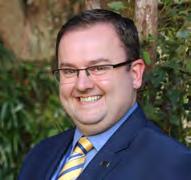
Stephen Twigg, CPA SecretaryGeneral and Jeffrey Hyland, Editor, The Parliamentarianeditor@cpahq.org
It has been a busy time for the Commonwealth and the CPA with Commonwealth Day in March 2025 followed by a number of conferences and seminars for Legislatures. This issue of The Parliamentarian features a wide range of topics relevant to today’s Parliaments. One of last year’s CPA Award winners from Jersey explains why politics needs to be more inclusive, particularly for parents. Scrutiny is a key role for Parliaments, and a Malaysian Member examines how their Public Accounts Committee (PAC) is fulfilling this task. We hear lessons from Pakistan’s Youth Engagement programmes in Parliament and how language can change a parliamentary ruling in Sierra Leone. As a new handbook for Parliamentarians and policy makers is launched on modern slavery, a Canadian Senator explains why a comprehensive legislative framework is vital. A Member of the Welsh Parliament examines how the media can be utilised to promote women's economic empowerment, and we hear from a New Zealand MP about the power of global networks in furthering equal representation for women. The Africa Regional Champion for the Commonwealth Parliamentarians with Disabilities (CPwD) network from Kenya reports on disability inclusion at 3rd Global Disability Summit in Berlin. A South African MP explains how operating under a Government of National Unity can bring opportunities for growth. As the Supreme Court of Canada marks its 150th anniversary, the Chief Justice explains the Court’s relationship with Parliament. This issue of The Parliamentarian also hears regional perspectives from CPA Branches in Northern Ireland and Punjab (Pakistan) and brings you legislative news from Parliaments across the CPA’s membership. We look forward to your feedback on this issue and future contributions to the CPA Journal.
Jeffrey Hyland, Editor, The Parliamentarian Email: editor@cpahq.org
Annual subscription: Four issues per year including supplements: UK: £44 World: £46. Agency discount 15%.
Disclaimer: Opinions expressed in articles published in The Parliamentarian are those of the individual contributors and should not be attributed to the Association.
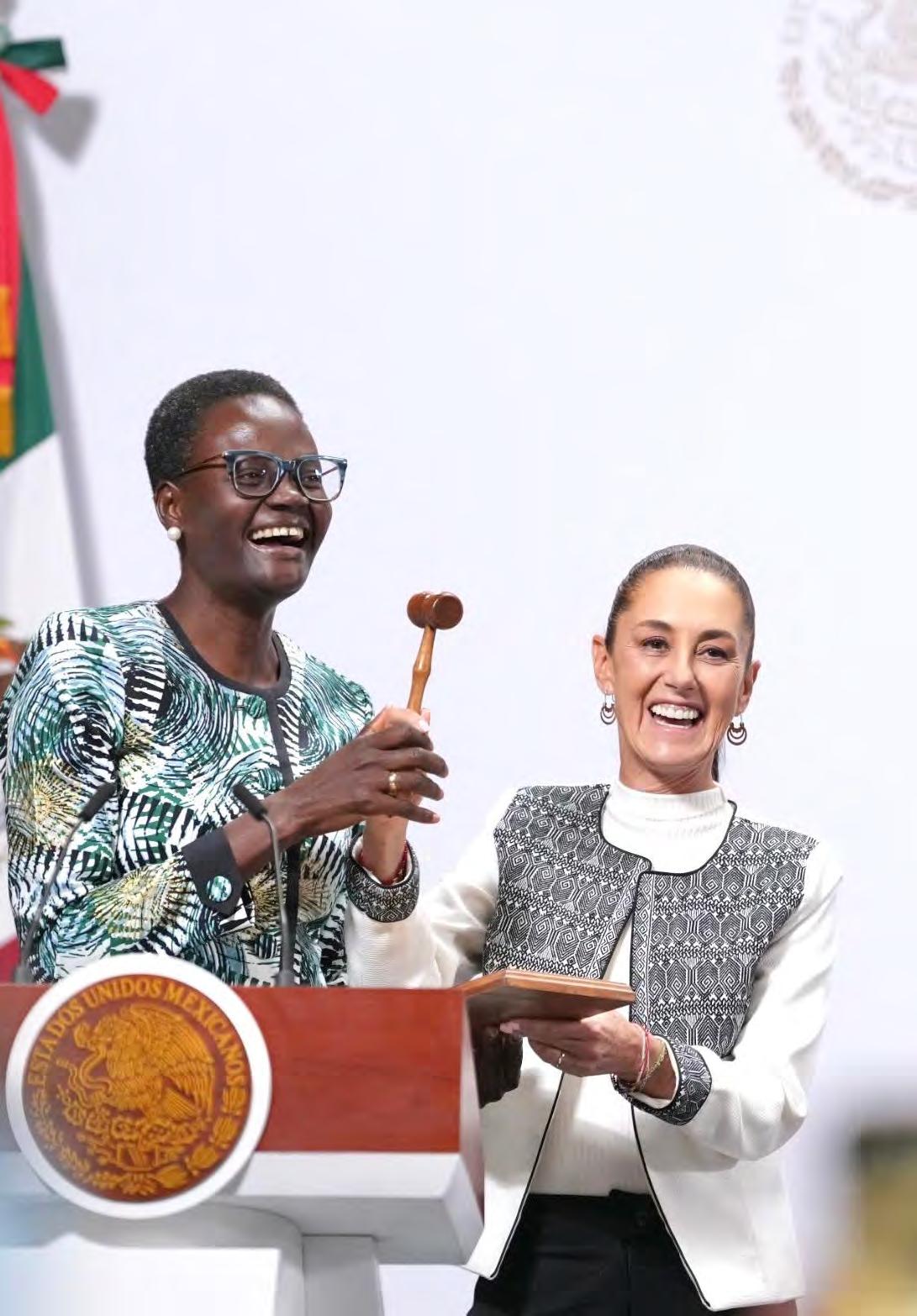
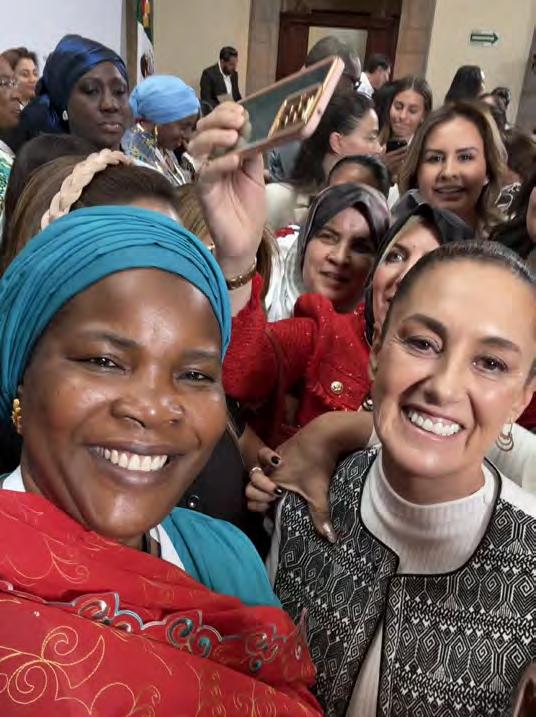
Cover image: © Senate of Mexico/Inter-Parliamentary Union (IPU). The IPU President and Speaker of the National Assembly of Tanzania, Hon. Dr Tulia Ackson, MP is pictured at the First IPU Global Conference of Women Parliamentarians in Mexico City with the President of Mexico, Claudia Sheinbaum.
Contributors: Thank you to all contributors for this issue.
Print: Warners Midlands UK and Times Printers Singapore. Limited print run - contact Editor for details of print copies for CPA Branches.

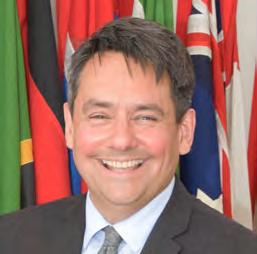
The Secretary-General of the Commonwealth Parliamentary Association, Stephen Twigg E: Stephen.Twigg@cpahq.org
In Commonwealth Week 2025, our new CPA Chairperson, Hon. Dr Christopher Kalila, MP, represented the CPA membership at a wide range of events in London including the UK House of Commons Flag Raising Ceremony, the multifaith Westminster Abbey Service and the Commonwealth’s Marlborough House Reception.
Dr Kalila took the opportunity of his visit to London to hold a series of high-level meetings. Most notably, he was granted an audience with His Majesty King Charles III in his capacity as Head of the Commonwealth and Patron of the CPA. The CPA Chairperson also met with the incoming Secretary-General of the Commonwealth, Hon. Shirley Ayorkor Botchwey, a former Parliamentarian from Ghana, and the UK Minister for International Development, Baroness Jenny Chapman.
These meetings provided opportunities to discuss important shared challenges and for Dr Kalila to provide updates on the CPA’s work and his priorities as the new
Chairperson. He did so in the positive context of progress towards CPA’s long sought goal of achieving a new legal status in the United Kingdom. This new status is on track to be fully in place by the end of 2025.
In May, the CPA International Executive Committee met in London with a busy agenda including plans for the next CPA Strategic Plan which will cover the period between 2026 and 2029. I wrote about this in Issue One of The Parliamentarian and I am very grateful to the CPA Branches, individuals and external organisations who responded to the first phase of consultation about the Strategic Plan. Following discussions at the CPA Executive Committee’s Mid-Year Meeting, the draft will now form the basis for a second phase of consultation with CPA Regions and Branches. A final version will be presented to the 68th Commonwealth Parliamentary Conference in Barbados in October 2025.
Our new legal status will provide opportunities to strengthen the voices of Parliamentarians through partnerships and advocacy both within the Commonwealth and more widely. We will apply for UN Observer Status, and we are in discussion with the Commonwealth Secretariat about enhanced partnership working between the two organisations.
Disability inclusion features
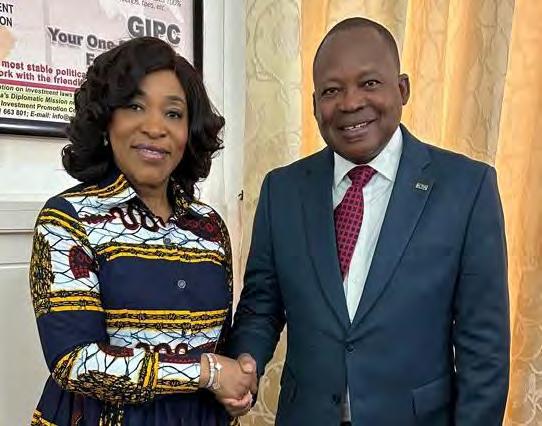
Left: During Commonwealth Week in March 2025, the Chairperson of the CPA Executive Committee, Hon. Dr Christopher Kalila, MP (Zambia) met with the new Commonwealth SecretaryGeneral, Hon. Shirley Botchwey to discuss the priorities for the work undertaken by the Commonwealth Secretariat in partnership with the Commonwealth Parliamentary Association.
prominently in the draft Strategic Plan. The CPA was represented at the recent 3rd Global Disability Summit in Berlin in April by the Chair of the Commonwealth Parliamentarians with Disabilities, Hon. Laura Kanushu, MP (Uganda) and will also be at the 18th Conference of State Parties to the Convention on the Rights of Persons with Disabilities in New York in June.
The CPA networks play a vital role in our work. Since the last edition of The Parliamentarian, we have had two highly successful workshops – for CPA Small Branches hosted by the Isle of Man, and for Commonwealth Women Parliamentarians (CWP) hosted by The Bahamas.
I am immensely grateful to our Branches who volunteer to host CPA events – whether it is a Workshop, an Academy Residency, a Regional Conference or the Commonwealth Parliamentary Conference (CPC).
Since I joined the CPA in 2020, we have had three excellent CPCs in Halifax, Accra and Sydney hosted respectively by the CPA Canada Region, the Parliament of Ghana and the Parliament of New South Wales, Australia. Preparations are now underway for the 68th CPC in Barbados in October of this year. I thank the Parliament of Barbados for hosting the next CPC and I look forward to seeing delegates from across the CPA’s regions there.
Regional Conferences provide important opportunities for mutual learning and I look forward to attending a number of these conferences in 2025 including those for CPA Africa Region and CPA British Islands and the Mediterranean Region being held in The Gambia and Wales respectively. My colleague, CPA Deputy Secretary-General, Jarvis Matiya, attended the first ever joint regional conference for the CPA Asia and CPA South-East Asia Regions with our Chairperson in February hosted by the Punjab Assembly in Pakistan. The Deputy Secretary-General will also attend the CPA Canada Regional Conference in July in Québec.
The current global context is characterised by uncertainty, fragility and conflict. In such times, it is more important than ever that we have a vibrant Commonwealth and an active CPA. Looking at our activities so far this year and our plans for the rest of 2025, this will probably be the busiest year during my time so far as Secretary General with increased Programmes and Communications activities alongside reaching out more and more to work in partnership with others ahead of key events in 2026, including the Commonwealth Law Ministers Meeting in Fiji and the 28th Commonwealth Heads of Government Meeting (CHOGM) in Antigua and Barbuda.
None of this would be possible without the hard work and dedication of staff throughout the organisation – Regional Secretaries, Clerks and other staff in Parliaments and, of course, the CPA Headquarters Secretariat staff with whom I have the privilege to work every day.
I look forward to seeing readers of The Parliamentarian at CPA and wider Commonwealth events over the next six months, including at Regional Conferences and the 68th CPC. As ever, please feel free to contact me with any questions, suggestions or concerns at stephen.twigg@ cpahq.org

Updated as at 16 June 2025
• 17 to 20 June 2025: 54th CPA British Islands and Mediterranean Regional Conference, Cardiff, Wales
• 18 to 20 June 2025: Commonwealth Trade Ministers Meeting (CTMM) and Commonwealth Business Summit 2025, Windhoek, Namibia
• 24 to 25 June 2025: CPA Post-Election Seminar for the Parliament of Trinidad and Tobago
• 30 June 2025: International Day of Parliamentarism / World Parliament Day (IPU initiative)
• 7 to 11 July 2025: CPA Parliamentary Academy: Advanced Residency Programme for Leadership in Parliament for Clerks and Officials, Wellington, New Zealand
• 20 to 24 July 2025: 61st CPA Canada Regional Conference, Québec including CWP Canada Regional Meeting
• 28 July 2025: 15th Summit of Women Speakers of Parliament, Switzerland
• 29 to 31 July 2025: Sixth World Conference of Speakers of Parliament, Switzerland (every five years)
• 7 August 2025: CPA Parliamentarian of the Year Awards deadline
• 10 to 16 August 2025: 54th CPA Africa Regional Conference, Banjul, The Gambia
• 12 August 2025: International Youth Day
• TBC September 2025: 47th CPA Regional Conference of the Caribbean, Americas and the Atlantic (CAA) Region, The Bahamas
• TBC September 2025: 11th CPA India Regional Conference, Bengaluru, Karnataka, India
• 15 September 2025: International Day of Democracy
• 20 to 26 September 2025: Commonwealth Magistrates and Judges Association (CMJA) 20th Triennial Conference, Banjul, The Gambia (www.cmja.biz for details)
October
• 1 to 3 October 2025: G20 Parliamentary Speakers’ Summit (P20), Cape Town, South Africa
• 5 to 12 October 2025: 68th Commonwealth Parliamentary Conference, Barbados including 41st CPA Small Branches Conference; 9th Commonwealth Women Parliamentarians (CWP) Conference; Commonwealth Parliamentarians with Disabilities (CPwD) meetings; 2025 CPA General Assembly; CPA Executive Committee meetings; and 59th Society-of-Clerks-at-the-Table (SoCATT) meetings.
• 19 to 23 October 2025: 151st IPU Assembly, Geneva, Switzerland
November
• 28 to 30 November 2025: CPA Conference on ‘The Role of Parliament in Shaping the Future of Responsible Artificial Intelligence’, Kuala Lumpur, Malaysia
For further information on any events, please email hq.sec@cpahq.org or visit www.cpahq.org
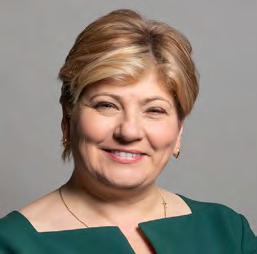
Rt Hon. Dame Emily Thornberry has been a Member of the UK Parliament since 2005.
This is an extract from the CPA Podcast series: 'Parliamentary Conversations in the Commonwealth' which gives a voice to Parliamentarians, civil society experts and activists across the Commonwealth to discuss common democratic challenges and share their ideas on what can be done to solve them. Listen to our Podcasts via the CPA website www.cpahq.org, on the CPA YouTube channel or on your favourite Podcast platform.
Rt Hon. Dame Emily Thornberry is the Labour MP for Islington South and Finsbury in the United Kingdom Parliament and has been an MP continually since 5 May 2005. She is the current Chair of the UK Parliament’s Foreign Affairs Committee. Previous roles include Shadow Foreign Secretary, Shadow Secretary of State for International Trade, Shadow Attorney-General.
Q: The Commonwealth is facing many challenges and questions over its role in geo-politics and reconciling its modern role with its past history. Is this the time for the Commonwealth as it has the opportunity to assert its influence around the work as a global organisation that doesn’t include the USA, China or Russia as part of its membership? How do you see the future for the Commonwealth?
"I think the Commonwealth is so unique. It's just extraordinary where countries no matter what their size have a voice. You know, the smallest island has a voice and is treated as an equal partner. And countries of all types, all over the world are there together around a table listening to one another. As we say if the world looks like it's going to ‘hell in a handcart’ because of the behaviour of the large three powers, it is a time for multilateralism. It is a time for us to work together. It is a time for us to listen to one another, because actually collectively, we are a force in our own right, and this is a good place to be. This is where we get a chance to work together to listen to one another and to find a way through and the answers will not be found I don't believe in China or in America or in Russia. There will need to be other voices that need to be heard, and we need to find a way through. Of course, the one thing that these three nations at the moment don't seem to talk about at all is the really important one, which is the threat to the world from climate change and that has to be a priority for the Commonwealth in a way that nothing else is."
Q: There will also be a transition in the leadership of The Commonwealth with the second female Commonwealth Secretary-General, this time from Ghana, who has just
started in her new role. Why do many organisations still struggle to promote women into leadership positions?
"How long have you got?! Each country will have its own history and its own culture. I can't really speak on behalf of all of them. I suppose the one thing that we all have in common is that is that women have the primary caring role in most cultures. I can't really think of a country around the world where men have stepped up and done that, because we bear the children and we look after the children because we're at home. We also look after the elders too. And because we're at home, we also have a leadership role in a community in a small way. We're the ones who organise things in neighbourhoods. And so, there's an approach that most women are expected to take because of that fundamental biological difference and I suppose it's just a question of how do you respond to that. I mean some in some places that's seen as a strength and actually women will end up being leaders in their own way of a small community. In other countries, there's been a conscious fight by women, saying yes, we can have children, but you know, men have children too. Yes, we have elderly parents, men have elderly parents too. Let's share out that caring responsibility too. And actually, women who may have been matriarchs at home want to be matriarchs in the big world too and so the world changes and it's hard because children continue to be born, Elders continue to need to be looked after, communities need to be organised. And so somebody's got to do that work and in cultures where men are just refusing to do that then women have to continue to do that as well as anything else they might want to do."
Q: The Commonwealth Parliamentary Association, through its Commonwealth Women Parliamentarians (CWP) network, campaigns for equal representation of women in politics. The UK Parliament is leading the way with 40.5% female representation in its current House of Commons. How do you view the progress on gender equality in Parliaments?
"It is amazing that we have such a high proportion of women in the British Parliament, however I don't think that that means that we have 40% equality. It's all very well, being at the table but you need to be listened to and you need to be taken as seriously as a man. We have all had the experience of saying something in a meeting and nobody's seeming to listen and then some bloke says the same thing and everybody at that point thinks what a great idea it is. I mean that is how things are and it continues to be and so there is still much more work that needs doing. Just appreciating how women may approach politics differently but that doesn't mean that we aren't as
important because we are. More than half of the population of the world is female, and we have something different to bring to the table. It should be understood that we can do it in a different way, but it doesn't mean that we're less important or we're less serious - we just do it differently."
Q: What are the main barriers facing women coming into politics and how can we overcome this?
"I think number one is just being taken as seriously as men. I proclaim myself to be a proud feminist, but I internalise the misogyny of society in the same way that other women do. The first time that I thought of standing to be an MP was because the Labour Party had said that we were going to have an all-woman shortlist. You can choose whoever you want so long as they're female. Now before that we had been going through the process of selecting a candidate to be our parliamentary candidate and I had never thought of doing it. Then, when there's an all-women shortlist then suddenly, I start taking myself seriously and worse than that, I compare myself to the other women and I think well I'm at least as good as them. I didn't manage to do that when it was men who were the candidates - I thought that that they were better than me. So I think we hold ourselves back.
The reason I stood for election to the Shadow Cabinet was because Harriet Harman, who's a well-respected woman, pivotal in the development of the Labour Party, chased me down the corridor until I agreed that I would stand for election. Now those people who know me, would be very surprised by both of those stories because I don't come across as anything other than 100% confident. But there are issues, difficulties and experiences that I've had as a woman, some of them are positive but some of them actually get in my own way. I have to acknowledge that, and I need to talk about it because that tells other women that you're not alone. Other people feel that they're imposters too and women have this idea of being an imposter much more than men do, and we have to get over ourselves."
Q: Women Parliamentarians face some of the worst abuse in public life – particularly online. A recent CPA/IPU report found for example that 60% of women MPs from the AsiaPacific had experienced online gender-based violence. How can we combat this and promote a more tolerant society?
"I think women Parliamentarians around the world face abuse, and I'm horrified to hear about what's happening in Asia. It happens in Britain too. I have as much if not more abuse than most, but I tend not to talk about it. You can get toughened up to it but I'm not saying that I'm not impervious to it. What I don't like now is people demonstrating against me outside my constituency office or outside my house or chasing me down the street or jumping out in masks. I mean that's the stuff I get these days. The online abuse continues and I've kind of got past it. There are levels of abuse on all levels and at the last UK election, it was women Parliamentarians who were getting higher levels of abuse, much more than men. Black women and women of Asian heritage were getting abuse much more than white women. What I also want is to talk about what fun it is to be an MP and how brilliant it is to be a politician, and how fantastic it is
and what an honour it is to represent your community and to be able to help people, and to be able to make a difference. I want young women, 14-year-olds to think well Emily's having a ball and why can't I do that too. Because they can. I don't want young girls to think well it's all abuse. The reason they abuse me is because I make a difference and they don't like it. They don't like the fact that I'm a woman, that I'm mouthy, that I'm leftwing, that I'm overweight, that I'm unapologetic. They really don't like it. I'm really rattling them and so I'm going to carry on and they're not going to stop me."
Q: 60% of the Commonwealth’s 2.7 billion population is aged under 30. How can the Commonwealth and Parliamentarians engage with more young people? How can we involve young people in politics?
"That's amazing. I didn't know that but it's sort of thrilling in a way to think that the Commonwealth is regenerating in the way that it is and there's an entirely new generation of youngsters coming through who will have different perceptions. Now I don't think it's for me to say how the Commonwealth Parliamentary Association should engage with young people. Can I just tell you I think we have to ask people under 30 and I'm a long way from that. All I can say is that there are things in common no matter what generation you come from, and I think you need to say what you mean and mean what you say. I think that there's an authenticity that young people have that the public recognises and if you're not authentic then nobody is going to want to hear.
The other bit of experience I have with youngsters is that when it comes to politics what needs to be understood and it's kind of disappointing is that you never get exactly what you want in politics. You have to get something close to it. You need to be able to compromise and accept how much you've got. You won't get everything. The other thing is that lasting change usually takes a long time.
I say to youngsters that I meet within my constituency, do be involved in politics. Politics is about power and why should power be exercised just for an older generation. The younger generation have a lot to be angry about in Britain. It’s the older generation who have got all the property, all the pension funds, had free education. We've eaten all the fish. We've killed all the tigers. We're warming up the planet. Why aren't you more angry? Why aren't you more involved in politics? Politics is about how you change the world. That’s how it works without a war, but even after a war, there has to be politics at the end of it to fix everything. So, politics is where it is and young people should be involved in politics in some way. Step up and say something and tell them what you think. Get involved yourself and don't get put down. Your voice is as important as anyone else's. That's kind of what I would say. How the Commonwealth engages in that I don't know. The ways in which the Commonwealth talks to youngsters is important but more important is how the Commonwealth listens to young people."
Dame Emily Thornberry was speaking with Natasa Pantelic, a founding member of the Labour Women’s Parliamentary Staff Network in the UK Parliament who has worked for a number of UK MPs. Natasa has also previously written for The Parliamentarian
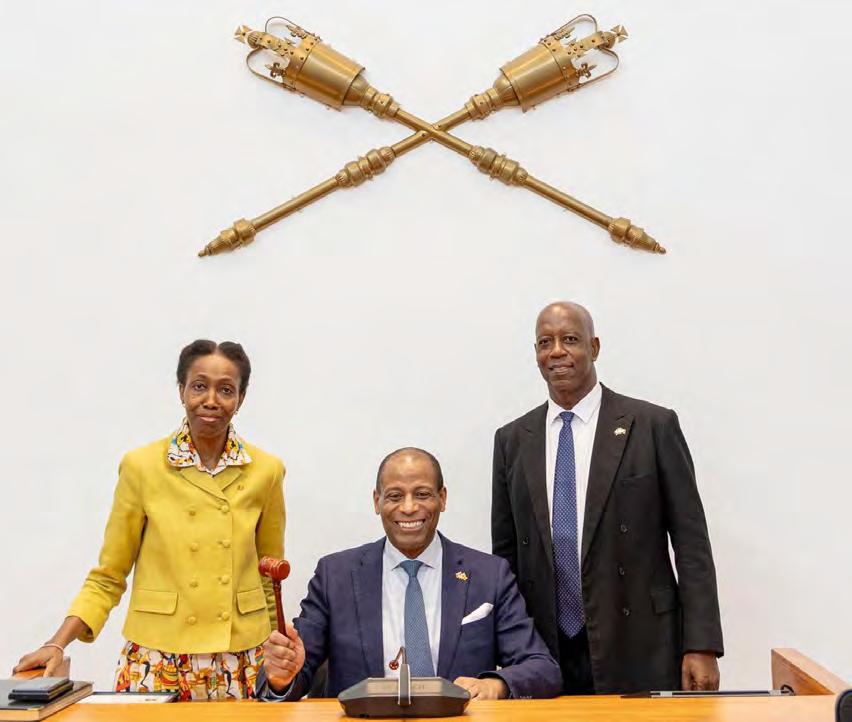
Right: The former Speaker of the Canadian House of Commons, Hon. Greg Fergus visited CARICOM Caribbean nations in March 2025 including Grenada where he met with the Presiding Officers of the Grenada Parliament – Hon. Dr Dessima Williams, President of the Senate and Hon. Leo Cato, Speaker of the House of Assembly.
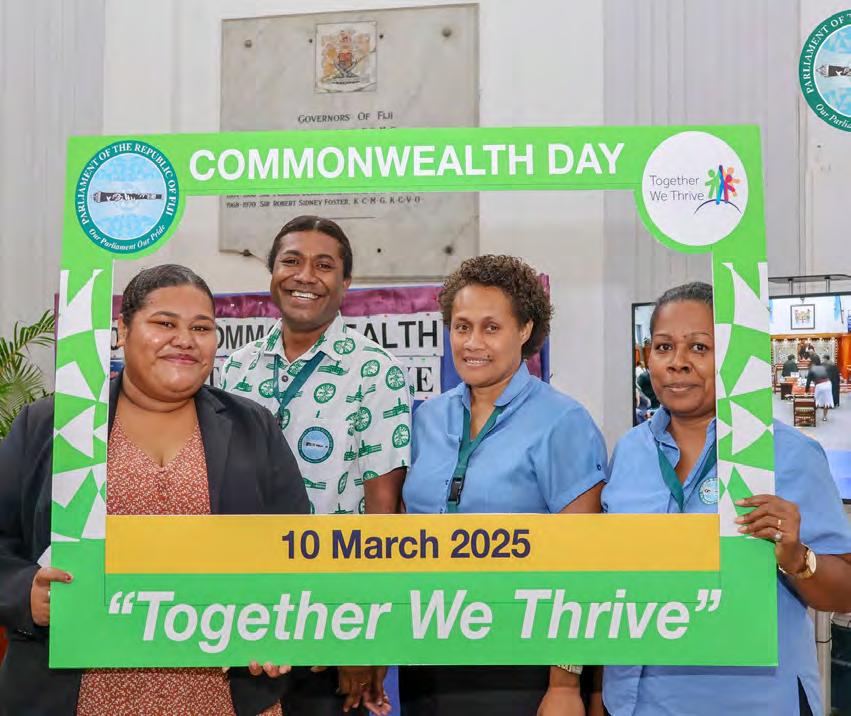
Below right: The annual Commonwealth Day was celebrated on 10 March 2025 with Parliaments across the CPA's membership taking part. Members of Parliament and parliamentary staff at the Parliament of Fiji joined the celebrations.
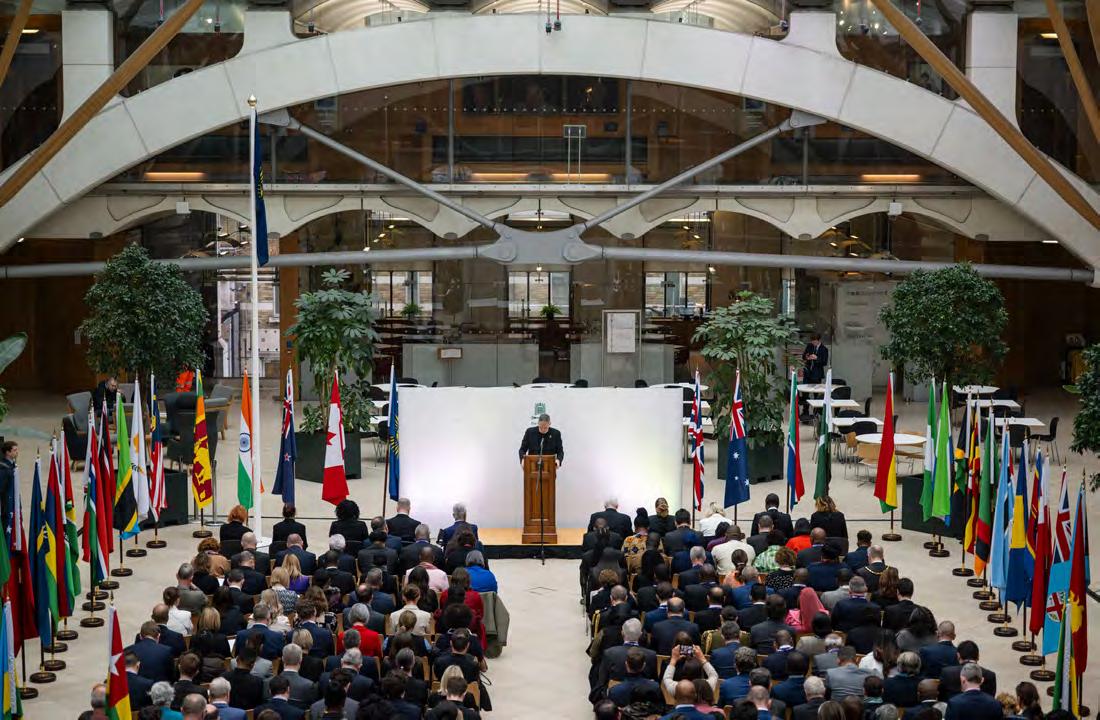
Opposite page - Above: To mark Commonwealth Day on 10 March 2025, the Chairperson of the CPA Executive Committee, Hon. Dr Christopher Kalila, MP (Zambia) and the CPA Secretary-General, Stephen Twigg attended the ceremonial raising of the Commonwealth flag and commemorative event at the UK Parliament hosted by the Speaker of the UK House of Commons, Rt Hon. Sir Lindsay Hoyle, MP along with representatives from across the Commonwealth.
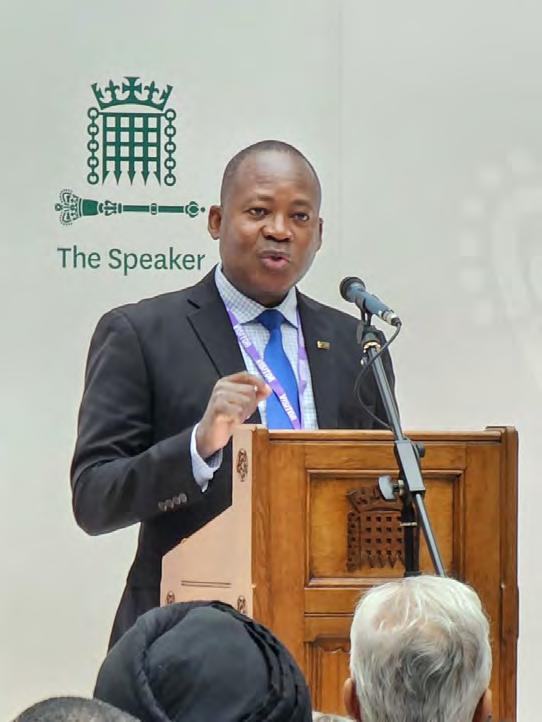
Opposite page - Below left: The CPA Chairperson gave a reading from the Bible’s First Book of Corinthians as part of the flag raising ceremony.
Opposite page - Below right: The Commonwealth Women Parliamentarians (CWP) Chairperson, Hon. Dr Zainab Gimba, MP (Nigeria) attended the First InterParliamentary Union (IPU) Global Conference of Women Parliamentarians from 13 to 16 March 2025 in Mexico City where she met with the President of Mexico, Claudia Sheinbaum, the first woman President of her country who highlighted key initiatives as a result of gender parity in parliamentary and executive leadership.
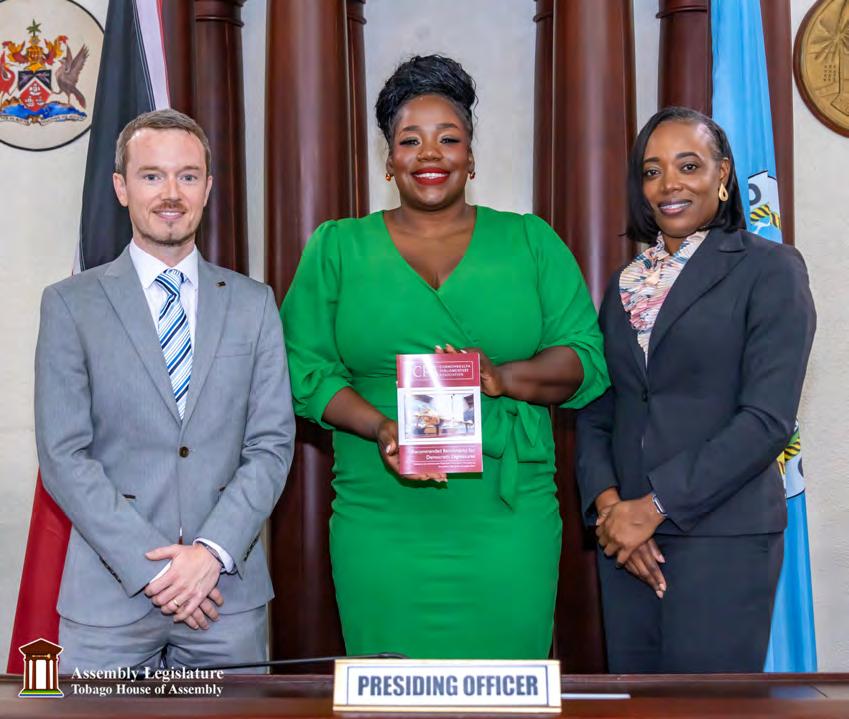
Right: The Tobago House of Assembly’s Presiding Officer, Ms Abby Taylor met with the Clerk to the Houses of Parliament of Jamaica, Colleen Lowe and CPA’s Good Governance Project Manager, Fraser McIntosh as part of a CPA Democratic Benchmarks self-assessment from 5 to 8 May 2025.
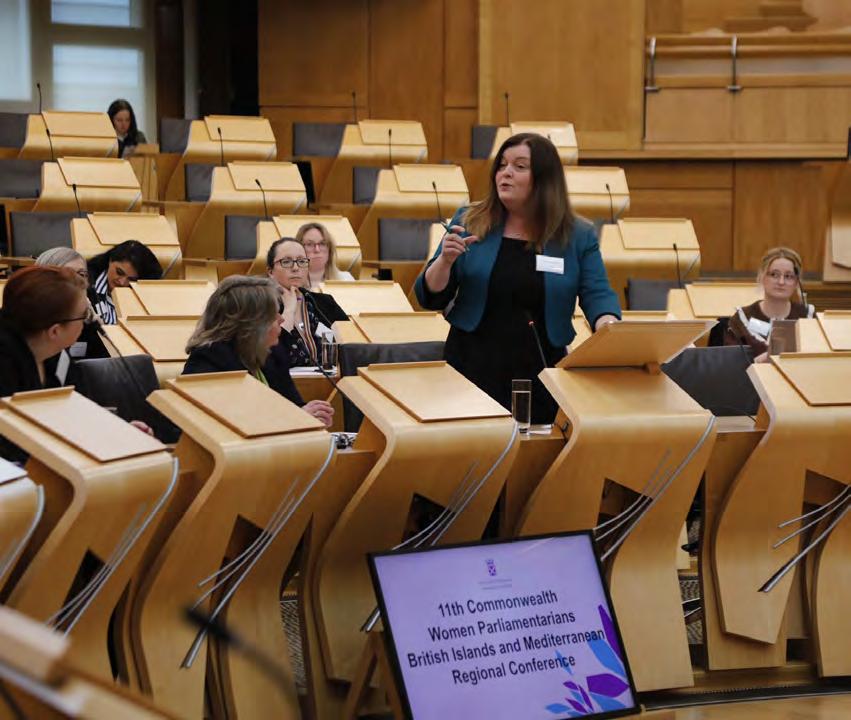
Below right: Women Parliamentarians from across the CWP British Islands and Mediterranean Region met at The Scottish Parliament in Edinburgh for the 11th CWP BIM Regional Conference from 16 to 18 March 2025.
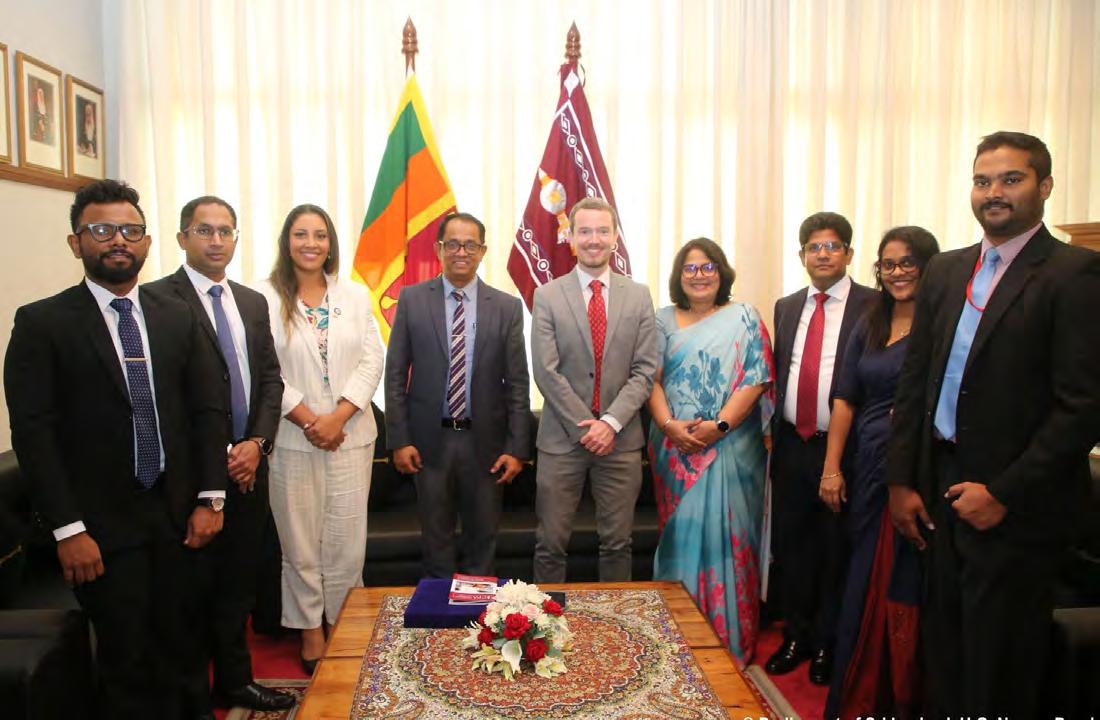
Opposite page - Above: A CPA delegation including the Deputy Clerk from Seychelles, Alexandria Faure met with the Speaker of the Parliament of Sri Lanka, Hon. Dr Jagath Wickramaratne, MP, Members and parliamentary staff from 24 to 28 March as part of a CPA Democratic Benchmarks self-assessment.
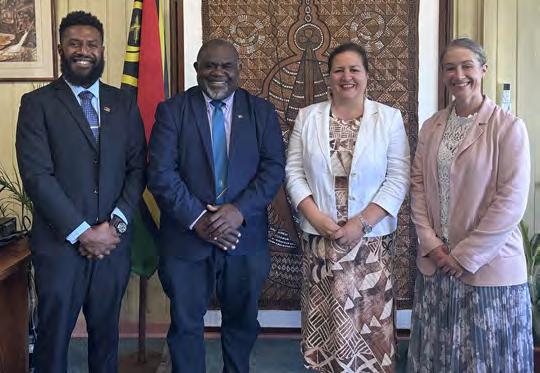
Opposite page - centre left: From 3 to 7 March 2025, New Zealand Parliament's InterParliamentary Relations team visited Vanuatu as part of the ‘Tai a Kiwa: Stronger Pacific Parliaments’ programme. The team led by Amber Walters, who is also CPA Pacific Regional Secretary, met with the Speaker of the Vanuatu Parliament, Hon. Stephen Dorrick Felix and Maxime Banga, Clerk of Parliament.
Opposite page - Below left: The Speaker of the Anguilla House of Assembly, Hon. Tara Carter met with the Speaker of the House of Keys, Hon. Juan Watterson, SHK and the Deputy Speaker, Hon. Ann Corlett, MHK during a study visit to the Isle of Man.
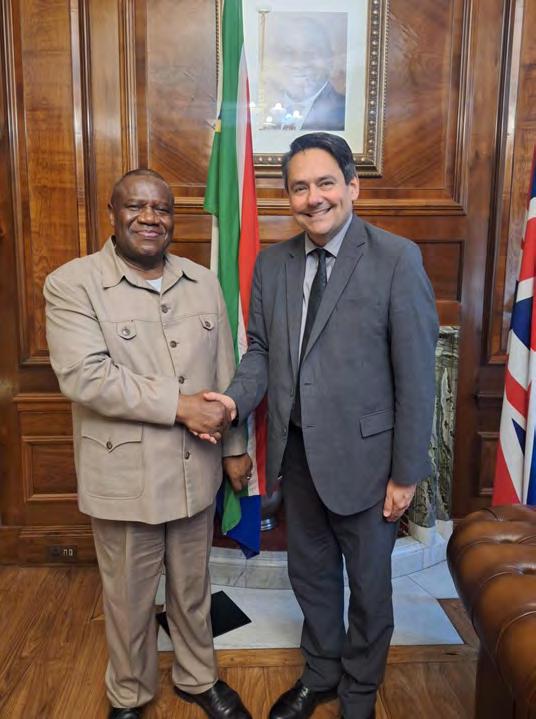
Opposite page - Below right: The CPA SecretaryGeneral, Stephen Twigg met with the South African High Commissioner to the United Kingdom, His Excellency Jeremiah Nyamane Mamabolo.
Right: The Commonwealth Parliamentary Association (CPA) Executive Committee held its Mid-Year meetings on 12 and 13 May 2025.
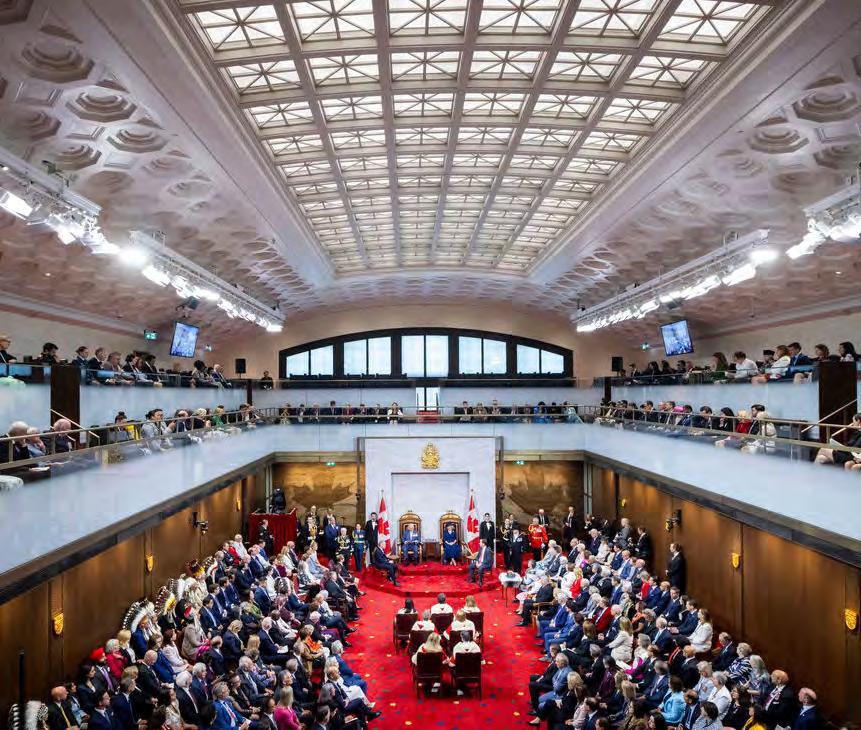
Below right: On 27 May 2025, King Charles opened the 45th Parliament of Canada with the Speech from the Throne in the Senate Chamber. This historic occasion brought back memories of the late Queen Elizabeth II delivering the Speech to open Canada's 23rd Parliament in 1957 and opening the third session of the 30th Parliament in 1977.
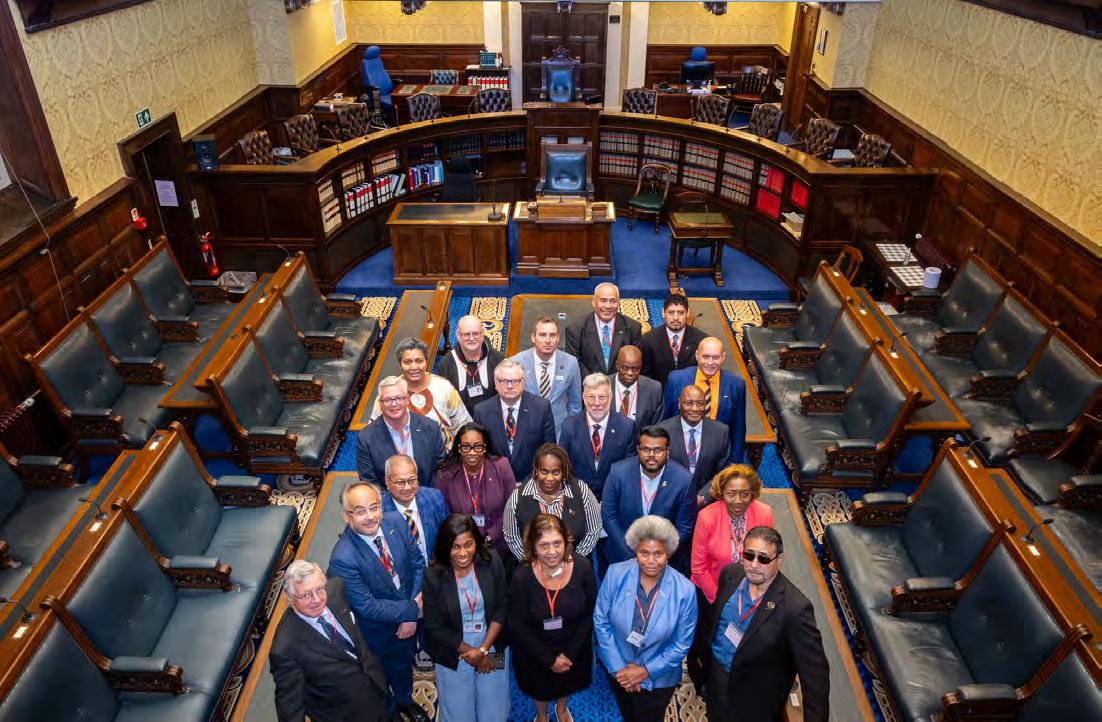
Opposite page - Above: Parliamentarians attended the CPA Small Branches Workshop from 31 March to 4 April 2025 in the Isle of Man, under the theme ‘Strong and Independent Parliaments in Small Jurisdictions’. Members are pictured in the Tynwald Chamber.
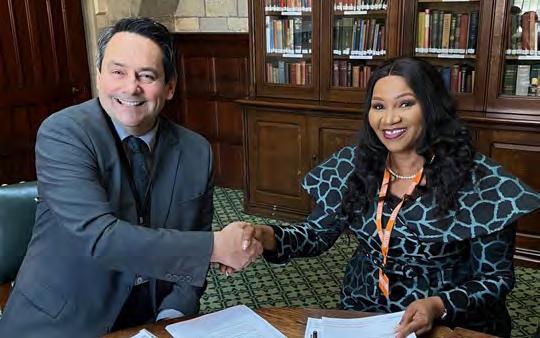
Opposite page - centre left: The President of the Senate of Eswatini, Senator Hon. Lindiwe Dlamini signed an MoU with CPA SecretaryGeneral, Stephen Twigg on 2 April 2025 to continue its parliamentary reforms in line with the CPA's Democratic Benchmarks.
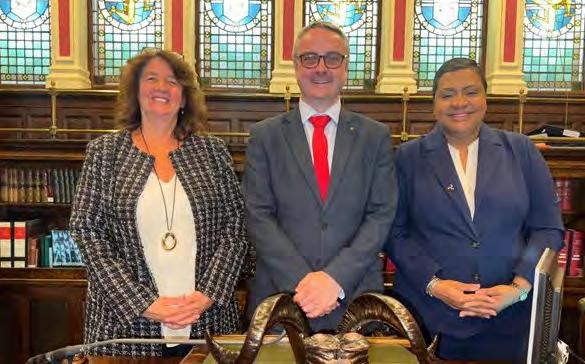
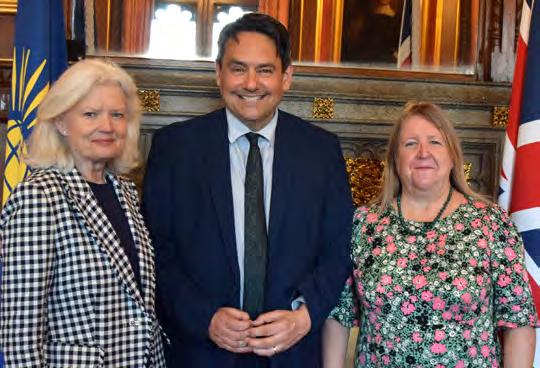
Opposite page - below left: Three Secretaries-General - CPA Secretary-General, Stephen Twigg met with the Secretary-General of the Commonwealth Magistrates and Judges Association (CMJA), Dr Karen Brewer and the Secretary-General of the Commonwealth Lawyers Association (CLA), Brigid Watson.
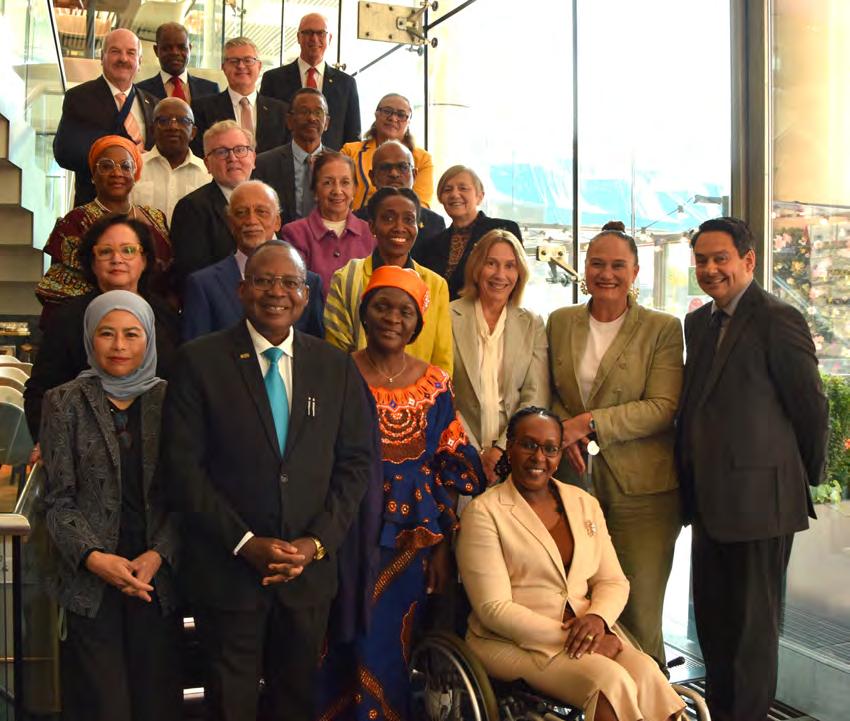
Opposite page - Below right: The inaugural meeting of the Commonwealth Communications Group (CCG) on 26 March 2025 which brought together many of the Commonwealth’s Associated Organisations (AOs) including the Commonwealth Parliamentary Association (CPA).
CPA’s 2024 New Parliamentarian of the Year Award winner from Jersey explains why politics needs to be more inclusive.
Let’s be honest—politics isn’t always family-friendly. While many of us in public life are juggling policies, Committee meetings and constituency work, we’re also navigating school drop-offs, teething toddlers or teenage dramas. If we want truly representative Parliaments - where people from all walks of life, including parents, feel they belong - we must design systems that allow them not just to participate, but to thrive.
I was deeply honoured to be named the Commonwealth Parliamentary Association’s New Parliamentarian of the Year 2024 - a recognition not just of my legislative work and reform campaigns, but of a growing shift in what modern governance must look like. Parliaments cannot simply reflect society through demographic diversity. They must function in ways that honour the real lives of those who serve and those they represent.
If we want more parents - especially mothers and caregivers - to enter politics and stay, we must stop pretending that being a good Parliamentarian and being a good parent are at odds. This isn’t about lowering the bar - it’s about widening the door.
When we model inclusive, realistic work cultures, we send a powerful message: Parliament is for parents too. However, when meetings are scheduled during school drop-offs, late evenings, on bank holidays or with little notice - times when politicians may be on duty, but their dependent children are not considered - it’s not just the children who are excluded. The Parliamentarians who are primary caregivers, especially single parents or
those without local family support, are also automatically excluded.
How is that inclusive or representative? Progress has been made - Jersey has seen improvements - but it shouldn’t feel like fighting for your basic rights as a parent. We need to start walking the walk more than talking the talk.
I’m proud to be part of Reform Jersey (no affiliation with Reform UK) - a social democratic party with ten elected members in a States Assembly (elected Parliament) where independents still form the majority.
In Jersey, party politics is often met with scepticism, shaped by our independents tradition. Many fear that parties stifle individuality - but our model proves the opposite.
We co-develop our manifesto together. We commit to shared goals, but also run on our own name, our own work and constituency commitments. We are all equals, selected in the party by merit and public trust - not internal party politics.
Unlike party-list systems, voters in Jersey choose individuals, not pre-ranked party slates. Outside our manifesto, we decide, vote and speak independently. When we agree, it’s because we’ve already debated and found common ground - not because we’re instructed to. We join the party sharing values, which naturally leads to more agreement than disagreement, but always through informed, voluntary decisions - not enforcement.
In my opinion, you should only join a party if you truly align with its political ideology. That’s why I struggle to understand party-hopping in other countries’ systems - switching to a party with opposing principles is political opportunism, not ideological integrity. I believe most politicians lean slightly left or right depending on the issue - but extremism at either end has never advanced democracy; it has only harmed it and that’s been proven in history.
Our party doesn’t have a whip. We don’t vote blindly. Ministers and backbenchers challenge one another objectively. That’s not weakness - it’s democratic maturity.
When we disagree, we vote differently - openly and respectfully. Our voting records reflect that transparency - and people are beginning to see that this model is about conviction - not conformity. Being in a political party like ours is empowering, not constraining. It gives us structure and solidarity while respecting personal principles. I hope more parties adopt this model: collaborative, value-driven and representative.
My legislative work is deeply grounded in the lived realities of the people I serve, as the backbenchers in Jersey, from just talking about issues with constituents, can bring forward their own propositions, which require the relevant Minister to act upon if approved.
Between others, one of the policies I’m proud of is securing additional leave and financial support for parents with babies in neonatal care. After
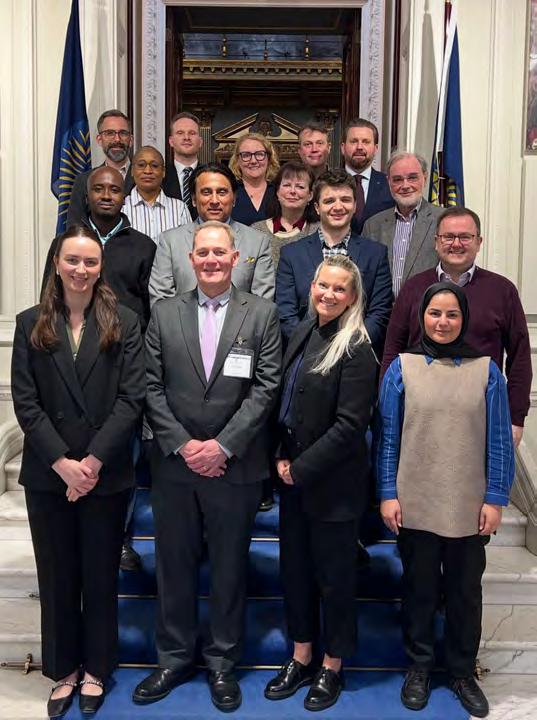
Right: Bienvenue à la Chambre des États de Jersey! With its close proximity to France, the island of Jersey is often visited by French citizens. In April 2024, students from Collège Simone Veil in Elven, France visited the Jersey States Assembly Chamber where Deputy Raluca Kovacs joined parliamentary colleagues answering questions about the history and workings of Jersey's Parliament.
collaborating with family's healthcare professionals and the related Minister we delivered a policy that is both humane and effective. Similarly, I successfully campaigned for free wound dressings and medical hosiery for people with chronic conditions - a small reform that makes a big difference for low-income and elderly citizens. I also had my proposal approved by the Assembly to request that the relevant Ministers develop viable new social housing plans that reduce rental stress for tenants without halting development. Additionally, I secured funding for a support grants scheme for individuals representing Jersey in off-island competitions.
These examples demonstrate how modern Parliaments can be compassionate, agile and responsive.
As a British Romanian woman in Jersey politics and a mother of two girls, gender equality is not abstract - it’s personal. However, feminism is still widely misunderstood. It’s not about favouritism, or about one or another. It’s about fairness and freedom - for everyone. When you address injustice and discrimination for women, those don’t exclude men.
True equality means more than 50/50 representation - it’s about changing systems: from gender-responsive budgeting to reforming workplace culture. That’s why I’ve pushed for gender-impact assessments, joined mentorship programmes for women looking to stand, contributed to gender pay equity initiatives and working group, advocated for family friendly workplaces and for inclusive leadership pipelines.
Feminism also means dismantling the pressure men feel not to show emotion, and the expectation that

women stay agreeable at all costs. These norms limit us all - and we deserve better.
Inclusion can’t be performative - it must be built into Parliament itself The more inclusive our systems, the more representative - and effective - our policies become. Simplifying documents, making Committees work more effective and diverse to accommodate parents’ schedules, adding meetings just if really needed and where possible at suitable hours, are just a few examples.
While my work is rooted in Jersey, I remain deeply engaged with the Commonwealth Parliamentary Association - I am also involved directly in the Commonwealth Women Parliamentarian Regional Committee for the CPA British Islands and Mediterranean Region - learning from and contributing to global conversations on democracy, youth equity and inclusion. What I’ve found is this: ‘Solutions must be local, but the best ideas can be global’. Jersey may be small - but our innovations or findings can inspire larger systems elsewhere and we can also learn from best practices from elsewhere.
As an executive Jersey member of L’Assemblée Parlementaire de la Francophonie, my work and collaborative partnerships extend
even further globally, including with my home country, Romania.
Politics with Purpose and Empathy
In a world shaped by ego-driven politics and populist theatrics, with the global political turmoil we see, it's up to us - Parliamentarians everywhere - to be the difference people need.
Listen - really listen - not just to the people, but to colleagues. Vote informed and from conviction, not pressure. Debate policy, not people. Campaign with solutions, not throwing mud.
Be diplomatic, not divisive. Stand up for justice - not just legal, but moral. Some legislation globally is lawful, but not ethical - don’t close your eyes to that. Confront discrimination and hooliganism. Sanction wrongs before they grow, in Parliaments and on the streets. Do what you say - or at least communicate transparently if you can’t. Accept that you won’t know everything, can’t help everyone and not everyone would like you, but know that you’ve tried your best for the ones you can help.
Politics is a learning process. Empathy isn’t weakness - it’s leadership and it’s needed. If more of us practiced politics this way, we’d restore trust, increase participation and bring voters back to the ballot box. Let’s be the change we want to seebecause that’s the Parliament worth fighting for.
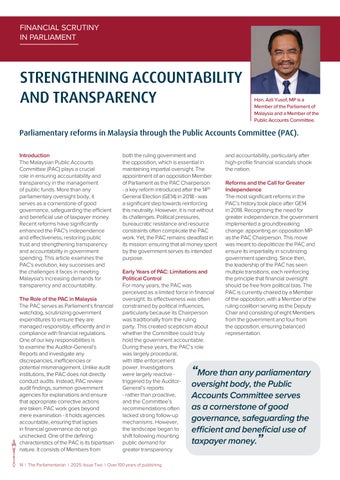
The Malaysian Public Accounts Committee (PAC) plays a crucial role in ensuring accountability and transparency in the management of public funds. More than any parliamentary oversight body, it serves as a cornerstone of good governance, safeguarding the efficient and beneficial use of taxpayer money. Recent reforms have significantly enhanced the PAC's independence and effectiveness, restoring public trust and strengthening transparency and accountability in government spending. This article examines the PAC's evolution, key successes and the challenges it faces in meeting Malaysia's increasing demands for transparency and accountability.
The PAC serves as Parliament’s financial watchdog, scrutinizing government expenditures to ensure they are managed responsibly, efficiently and in compliance with financial regulations. One of our key responsibilities is to examine the Auditor-General’s Reports and investigate any discrepancies, inefficiencies or potential mismanagement. Unlike audit institutions, the PAC does not directly conduct audits. Instead, PAC review audit findings, summon government agencies for explanations and ensure that appropriate corrective actions are taken. PAC work goes beyond mere examination - it holds agencies accountable, ensuring that lapses in financial governance do not go unchecked. One of the defining characteristics of the PAC is its bipartisan nature. It consists of Members from
both the ruling government and the opposition, which is essential in maintaining impartial oversight. The appointment of an opposition Member of Parliament as the PAC Chairperson - a key reform introduced after the 14th General Election (GE14) in 2018 - was a significant step towards reinforcing this neutrality. However, it is not without its challenges. Political pressures, bureaucratic resistance and resource constraints often complicate the PAC work. Yet, the PAC remains steadfast in its mission: ensuring that all money spent by the government serves its intended purpose.
For many years, the PAC was perceived as a limited force in financial oversight. Its effectiveness was often constrained by political influences, particularly because its Chairperson was traditionally from the ruling party. This created scepticism about whether the Committee could truly hold the government accountable. During these years, the PAC’s role was largely procedural, with little enforcement power. Investigations were largely reactivetriggered by the AuditorGeneral’s reports - rather than proactive, and the Committee’s recommendations often lacked strong follow-up mechanisms. However, the landscape began to shift following mounting public demand for greater transparency
and accountability, particularly after high-profile financial scandals shook the nation.
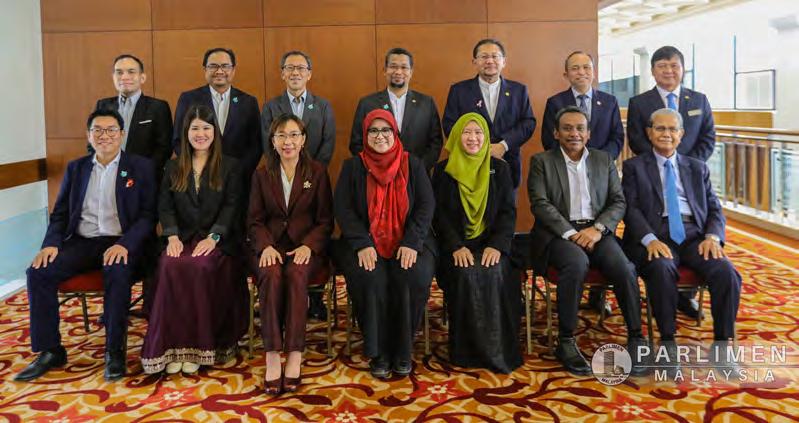
The most significant reforms in the PAC’s history took place after GE14 in 2018. Recognising the need for greater independence, the government implemented a groundbreaking change: appointing an opposition MP as the PAC Chairperson. This move was meant to depoliticize the PAC and ensure its impartiality in scrutinizing government spending. Since then, the leadership of the PAC has seen multiple transitions, each reinforcing the principle that financial oversight should be free from political bias. The PAC is currently chaired by a Member of the opposition, with a Member of the ruling coalition serving as the Deputy Chair and consisting of eight Members from the government and four from the opposition, ensuring balanced representation.
“ More than any parliamentary oversight body, the Public Accounts Committee serves as a cornerstone of good governance, safeguarding the efficient and beneficial use of taxpayer money. ”
Beyond leadership changes, several key reforms have significantly strengthened the PAC's operational effectiveness.
• Tabling PAC Reports for Debate in Parliament: In a historic move on 18 July 2024, PAC reports began being formally debated in Parliament and undergo rigorous parliamentary scrutiny, enhancing transparency and public awareness.
• Conducting Site Visits: instead of relying solely on reports and testimonies, PAC Members now conduct site visits to government projects under scrutiny. This allows the PAC to directly assess project implementation, identify challenges and ensure that allocated funds are utilised effectively.
• Public Access to PAC Reports: to enhance transparency, PAC reports are now more accessible to the public through online platforms, allowing Malaysians to stay informed about government spending and accountability measures. These major reforms have significantly bolstered the PAC’s ability to hold government agencies accountable. However, there is still much work to be done.
The PAC has been at the forefront of investigating some of the most significant financial mismanagement cases in Malaysia’s history. One high-
The 1Malaysia Development Berhad (1MDB) Scandal: The 1MDB scandal is perhaps the most infamous case of financial mismanagement in Malaysia’s history. Billions of Malaysian Ringgit were siphoned from a state investment fund, leading to widespread international investigations.
The PAC played a crucial role in exposing the extent of the misappropriation and pushing for the recovery of stolen funds. Some of the investigation’s highlights include:
• Financial Irregularities: Massive sums were borrowed but unaccounted for, raising serious concerns about governance and oversight.
• International Cooperation: the PAC findings aided global investigations, resulting in asset recoveries from the United States, Switzerland and Singapore.
Despite progress, the fight is not over. The PAC continues to push for the full recovery of stolen assets and greater safeguards against similar mismanagement in the future.
While recent reforms have strengthened the PAC, more efforts are needed to enhance its authority and effectiveness. Some of the key areas of improvement include:
• Greater Investigative Powers: The PAC should be empowered to initiate its own investigations, rather than relying solely on the Auditor-General’s reports.
• Whistleblower Protection: Strengthening legal protections for whistleblowers will encourage more people to come forward with information about financial mismanagement.
• International Collaboration: The PAC should engage with global audit bodies to adopt best practices in financial oversight.
• Publicly Accessible Digital Repository: A centralised, searchable database of PAC reports should be made available for greater transparency and public engagement. These reforms would ensure that the PAC remains a formidable institution in safeguarding public funds and reinforcing good governance in Malaysia.
The Public Accounts Committee (PAC) has made significant strides in strengthening accountability and transparency in Malaysia. Reforms such as bipartisan leadership, public debates on PAC reports and site investigations have enhanced its effectiveness. However, challenges remain, including political pressures, bureaucratic resistance and resource limitations. Continued efforts to increase independence and investigative powers are crucial to making the PAC an even stronger force in Malaysian democracy, ensuring responsible spending of public funds and fostering public trust.
* PAC Official Portal: https://www.parlimen.gov.my/pac
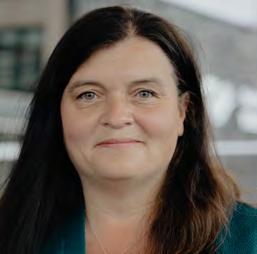
Harnessing the Power of the Media. A Member of the Welsh Parliament examines how the media can be utilised to promote women's economic empowerment.
It was a privilege to represent Senedd Cymru (the Welsh Parliament) at the recent CWP workshop in Nassau, The Bahamas. The theme of the workshop was ‘Parliamentarians as drivers of women's economic empowerment’ ... and drawing on my professional experience as a former journalist, I explored the question of how we could use one of the most powerful national and cultural tools - the media - to communicate and promote women's economic empowerment.
Wales is a small nation which has been called ‘England's first colony’, a historic nation with a rich and unique culture, two official languages and a stated ambition to become a fairer, more equal country - able in many areas of devolved competence, but not always politically willing to do things differently from the rest of the UK to achieve that aim.
We know that when women thrive, economies thrive. In the UK, including Wales, it has been estimated that closing the gender pay gap could boost the economy by £150 billion by 2030. Wales’s economy underperforms - it is one of the poorest parts of the UK - so this work is of course critical. Women generally are underrepresented in entrepreneurship and overrepresented in low-paid sectors like social care and retail. Only 20% of Welsh SMEs are owned
by women. Yet, we know that when women are given the opportunity and support, they don’t just contribute to the economy - they redefine it.
So how to use one of our greatest national tools - the media - to communicate and advance women’s economic empowerment? Unique to Wales, we have a law that requires public bodies to think about long-term impacts - including gender equality - in decision-making - The Well Being of Future Generations Act 2016, which is ten years old this year. It makes ‘A More Equal Wales’ a national goal. It defines this as ‘a society that enables people to fulfil their potential no matter what their background or circumstances (including their socio-economic background and circumstances)’.
I think the Act has helped in increasing awareness of inequalitybut has it resulted in change? Not in the way many had hoped perhaps. While policies matter of course, it is stories that move people and can create support for ensuring policy aims become reality. Stories change perceptions. Stories foster understanding and can create societal change. Stories - told well - can also transform systems.
First, we need to tell real, relatable stories, of women’s economic journeys through local and national media. For example, the story of a female refugee
in Cardiff who started her own food business through a microloan scheme, shared through community radio can reach other women who might not see themselves as ‘economic actors’. Like the story of a single mother in the Rhondda Valleys who launched a tech startup and now mentors others. Her story can change not just how people see her, but how they see single mothers, rural tech and women in leadership. These types of stories challenge the old narrative and offer a new one: ordinary and diverse Welsh women as economic leaders, not exceptions.
Second, we must invest in media training for women, from business owners to carers, so they can speak on panels, give interviews, run podcasts and lead campaigns. We must support women to tell their own stories by investing in communications coaching and leadership visibility programmes.
In Wales, ‘Equal Power Equal Voice’ is a Government-backed mentoring programme which aims to increase diversity of representation in public and political life. From my involvement in this programme, I have seen how there exists massive social and intellectual capital that is untapped and intersectionally excluded from our public and political systems. This programme strengthens the knowledge and skills of those that
“ We know that when women thrive, economies thrive. In the UK, including Wales, it has been estimated that closing the gender

aspire to be in positions of power, influence and authority, whilst learning from and being supported by those who have achieved this in the face of these challenges. These types of programmes are a key pipeline for better communication of women’s economic empowerment.
Third, we must use social media campaigns to reach women directly, especially those in rural areas, younger women and women who have protected characteristics. Platforms like X (formerly Twitter), Instagram and TikTok are powerful for quick, impactful messaging. We can seek out and partner with influencers, community leaders and organisations like the Commonwealth Parliamentary Association (CPA) and the Commonwealth Women Parliamentarians (CWP) network to amplify content.
Fourth, elected representatives must work with journalists to challenge who gets quoted in economic reporting. Why are CEOs the default voice, but not care workers or parttime entrepreneurs?
Finally, we must embed communications into policy design. Following the Gender Equality Review - 'Deeds Not Words’ - commissioned by the Welsh Government in 2019, there is now a commitment to plan how every new policy will be explained, humanised and owned by the people
it’s meant to serve. So, when we design policies for childcare, employment or enterprise, we also plan how they’ll be communicated - whose stories we’ll share and through which platforms.
As a small nation Wales has agility. We can spotlight diverse voices. We can rethink who gets to define ‘economic value’. This is something Wales and other small nations and subnational Parliaments can absolutely achieve with the right political will. Economic empowerment doesn’t have to mean mimicking Silicon Valley. It can mean investing in care, community wealth, circular economies - and storytelling. Because changing who tells the story can change the ending. We must seek out and share the stories of success and potential – of those women entrepreneurs, innovators and leaders across our nations, especially those from underrepresented backgrounds.
Media humanises data and brings policies to life. I would appeal to all to make a point of finding those women who are making strides. For example, an internationally successful brewery in the region I represent is owned and run by two amazing women and highlighting stories like theirs to journalists, in parliamentary debates and questions, and in Committee work, can help get the story out there into the press, onto social media and into
Left: Commonwealth Women Parliamentarians from Western Australia, Turks and Caicos, Nova Scotia and Wales were welcomed by the President of the Senate of The Bahamas, Hon. J. LaShell Adderley as they watched proceedings in the Senate Chamber ahead of the start of the Commonwealth Women Parliamentarians (CWP) Workshop on women's economic empowerment in April/May 2025 which took place in Nassau, hosted in partnership with The Bahamas Parliament.
the community. Sharing their example in a male dominated field like brewing can change attitudes and draw upon the pride felt locally regarding their success as a Welsh-owned brand.
If we want to build economies that work for women, we must tell stories that centre women - in all their diversity, complexity and power. Let’s use media not just to reflect the world as it is, but to imagine the world as it could be.
In Wales, though we are not independent, our democracy can in the great Welsh intellectual Raymond Williams' words ensure "independence of mind" - challenging established norms and ideas rather than passively accepting the dominant social and economic ideologies of dominant nations.
We can do this by using culture and language to localise and enrich our narratives around women's economic inequality; funding and support for women-led media and storytelling projects; celebrating alternative economic models such as co-ops, social enterprises and informal economies while at the same time challenging dominant Western, corporate-centric definitions of success.
This is what can help us make women’s economic lives visible, valuable and unmissable.
This article has been adapted from a presentation given at the Commonwealth Women Parliamentarians Workshop on ‘Parliamentarians as Drivers of Women’s Economic Empowerment’ in The Bahamas from 28 April to 2 May 2025.
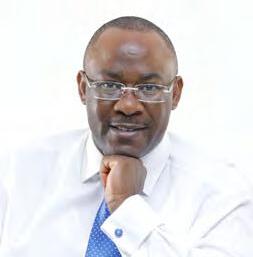
Hon. Timothy Wanyonyi, MP is a Member of the Kenya National Assembly since 2013 and the Commonwealth Parliamentarians with Disabilities (CPwD) Regional Champion for the CPA Africa Region.
I had the opportunity of attending the 3rd Global Disability Summit (GDS) from 2 to 3 April 2025, held in Berlin, which gathered more than 4,500 participants from 100 countries. In my capacity as the Chair of the Kenya Parliamentary Association (KEPIDA) and the Commonwealth Parliamentarians with Disabilities (CPwD) Regional Champion for the CPA Africa Region, I also attended a side event at the GDS with the theme of ‘Advancing disability inclusive development through intensified parliamentary engagements and parliamentary networks’. The Commonwealth Parliamentarians with Disabilities (CPwD) Chairperson, Hon. Laura Kanushu, MP (Uganda) who highlighted the work of the network and the importance of promoting inclusive Parliaments, and the Uganda Minister of Disabilities, Hon. Asamo Hellen Grace, MP, were also in attendance.
The Summit resulted in 800 new commitments from governments, development actors, private sector organisations and civil society as the GDS aims to galvanise global efforts to realise disability inclusion around the world. It is a mechanism bringing together a wide variety of high-level stakeholders, engaging and discussing the progress in disability inclusion: governments, multilateral agencies, the private sector, academia
and civil society organisations, and organisations of persons with disabilities and foundations.
Prior to the GDS, I was also in attendance at the African Regional Summit in Kenya. Regional presummits are an integral part of the GDS, building momentum towards the main event in Berlin, and contributing to the mechanism through regionally focused conversation and commitments mobilisation. As the first regional event for the GDS 2025, the African Regional Summit emphasised Africa’s key role in global disability inclusion, building on the momentum from the 2018 and 2022 Global Disability Summits.
The objectives of the African Regional Summit included building shared understanding of the current challenges and priorities of persons with disabilities in the African region and highlighting such context within the GDS framework, bringing together governments, development actors, civil society organisations (CSOs), along with the private sector, to share learnings and experiences from the previous GDS cycles and provide recommendations going into 2025.
This Summit resulted in multilateral collaboration as the Kenyan government, British High Commission, the United States Embassy, and the hosts and co-hosts (African Disability Forum (ADF), International Disability
Alliance (IDA), and the German Federal Ministry for Economic Cooperation and Development (BMZ)) called on sustainable funding and stronger global cooperation on disability rights, as well as strategic discussions on Africa’s progress since GDS 2018 and 2022, assessing the implementation of past commitments.
At the Global Disability Summit, discussions covered core disability inclusion themes including accessibility, equal participation and inclusion, employment and economic empowerment, humanitarian action and disaster risk reduction, legislation and policy reform, and overall monitoring and accountability.
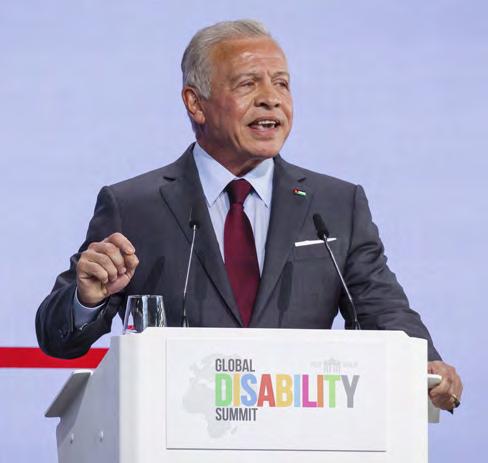
Dr Nawaf Kabbara, President of IDA, emphasised the central role of Organisations of Persons with Disabilities (OPDs) in shaping global policies which reiterates the necessity of the rights-based approach to inclusion and urgency of addressing gaps that persists in policy and practice. Olaf Scholz, Federal Chancellor of the Federal Republic of Germany, shared Germany’s plan to uphold 15% funding target even at a time where many states are backtracking on disability inclusion. He expressed appreciation for Jordan and IDA’s leadership and collective action in driving meaningful change throughout the GDS. His Majesty King Abdullah

II of Jordan spoke about OPDs in the realisation of disability inclusion, and the importance of addressing disability inclusion in situations of risk and humanitarian emergencies. Amina Mohammed, United Nations Deputy Secretary-General, voiced worries that the progress on disabilityrelated Sustainable Development Goals (SDGs) is slowing down, and in some areas, moving backwards, and emphasised the urgent need to address these concerns in the next five years.
The second opening session on ‘Voices of Inclusion’ highlighted pathbreaking initiatives that have the potential to positively change outcomes of persons with disabilities which are rooted in the OPD participation.
The session on ‘Shaping Inclusive Labour Markets and Decent Work for Persons with Disabilities Worldwide’ focused on creating more inclusive and accessible job markets, and on
related topics such as equipping persons with disabilities with the necessary skills and building employer capacity to meet the United Nations Convention on Rights of Persons with Disabilities (UNCRPD) and the International Labour Organisation (ILO) standards. Fatma Wangare, Country Director of the Kenya Association of the Intellectually Handicapped (KAIH), discussed innovative solutions in advocacy, policy, practice and partnerships to enhance disability equality and economic empowerment. The panellists also explored what must change globally to improve employment prospects for people with disabilities.
At the ‘Launch of the Resilient and Inclusive Cities Hub (RICH): Because the Cities of the Future Need to Work for All’ session, discussions centred around how urban areas must adapt to inclusivity, ensuring that no one is left behind, especially people with disabilities, who face disproportionate
risks from disasters, harshening environmental conditions, lack of consideration during reconstruction efforts, inaccessible infrastructure and exclusion from planning processes. RICH focuses on integrating inclusion and resilience into urban development, disaster risk reduction as well as recovery and reconstruction efforts, accessibility gaps, and ensuring meaningful participation of persons with disabilities in all phases of urban planning and governance. The aim is to foster partnerships, drive innovative projects and build a global knowledge sharing platform to disseminate best practices for disability-inclusive urban resilience.
The side event on ‘Advancing Disability-Inclusive Development Through Intensified Parliamentary Engagement and Network’, organised by the Christian Blind Mission (CBM) and the IDA focused on the recognition of the culture of equality, inclusion and human rights
Right: At the 3rd Global Disability Summit, Chairperson of the Commonwealth Parliamentarians with Disabilities (CPwD), Hon. Laura Kanushu, MP (centre) spoke at a panel discussion on ‘Advancing Disabilityinclusive Development Through Intensified Parliamentary Engagement & Networks’. The event looked at issues including strengthening laws, budgets and political will.
in the development of election laws and establishment of political parties. There should be disability mainstreaming in policy and laws enacted by Parliaments as well as advocacy strategies to bolster the number of persons with disabilities that participate in campaigns for elective seats. There should also be a strengthening of disability leagues in political parties to bolster representation of persons with disabilities, which can lead to the election of persons with disabilities into Parliament. International parliamentary consortiums should practice disability inclusion in all their

administrative and structural activities as well.
In May 2025, the Parliament of Kenya passed the Persons with Disability Act 2025, which is a comprehensive legal framework promoting and protecting the rights of persons with disabilities. The Act aligns our disability statute with the CRPD and ushers in an era of a rightsbased approach to disability, dignity and the full and effective participation of persons with disabilities in all aspect of life. It also recognises the legal capacity of persons with disabilities, bolsters affirmative measures, provides lifetime income tax exception certificates for those with permanent disabilities and tax relief for parents and caregivers, and stipulates strict penalties for violations of rights of persons with disabilities.
The KEDIPA has been at the forefront of this transformative legislation
and is further evidence of the influence of organisations for persons with disabilities.
As a Commonwealth Parliament in Kenya, we will strive to make humanitarian action inclusive of, and accessible to, persons with disabilities, as required by Article 11 of the CRPD, the Sendai framework for disaster risk reduction, Security Council Resolution 2475 (2019) on the Protection of Persons with Disabilities in Conflict and the Inter Agency Standing Committee (IASC) guidelines on the Inclusion of Persons with Disabilities in Humanitarian Action.
From the third Global Disability Summit, as a Commonwealth Parliament, we committed to promoting partnerships with relevant stakeholders including national disability inclusion actors, the private sector, trade unions, academia and civil society to foster disability inclusion. These partnerships will be based on mutual learning and exchange to encourage greater research and both bilateral and multilateral funding for disability inclusion and related matters, including assistive technology and artificial intelligence.
Lessons
As Pakistan contends with a fraught political landscape and mounting institutional distrust, one quiet yet significant intervention stands out: the National Assembly’s sustained outreach to the country’s youth. Amidst polarization, rising populism and growing cynicism toward representative institutions, the National Assembly of Pakistan has pursued a deliberate policy to bring young Pakistanis into closer contact with the workings of democracy. It is an initiative worthy of broader attention.
At the heart of this effort is the National Assembly Internship Programme, first formally introduced during Speaker Sardar Ayaz Sadiq’s initial tenure in 2013. What began as a modest engagement has since evolved into a well-structured and widely emulated model of institutional openness. Thousands of students and recent graduates have participated in these programmes, stepping into the corridors of Parliament not as tourists, but as participants – interns placed in research wings, legislative sections, Committee teams and communications departments. They observe the law-making process, assist with parliamentary research, attend Committee meetings and engage with both Members and staff.
The outcome has been quietly transformative. Many enter the programme with rigid stereotypes about Parliament which are reinforced by electronic and digital media narratives – misperceiving democracy as dysfunctional or irrelevant. What they witness, however, is a more nuanced reality: a legislative institution that, for all its imperfections, is home
to rigorous debate, hard negotiations and tireless procedural work around people-centred politics. In place of apathy, many interns leave with a sharpened understanding of the state and its governance, and a newfound appreciation for democratic complexity. Perhaps more importantly, they leave with a sense of ownership – as the ambassadors of democratic and parliamentary supremacy.
In a country where nearly two-thirds of the population is under 30, initiatives like these are no longer optional –they are essential. Pakistan’s ‘youth bulge’ presents both an opportunity and a risk: it can yield a democratic dividend or become a destabilizing force. Which path it takes depends on whether young people are drawn into meaningful civic engagement – or left to the margins, vulnerable to radicalization and misinformation. The same logic applies across the Commonwealth and beyond.
Indeed, the urgency of such efforts has never been greater. Political polarization across the world has deepened in recent years, manifesting not only in parliamentary stand-offs but in the broader digital and social media ecosystems that shape public discourse. Young people, in particular, are susceptible to these distortions. Many are introduced to politics not through textbooks or civic education, but through algorithm-driven narratives that reward anger, division and populist sloganeering. Institutions – particularly those as misunderstood as Parliament – are easily vilified in these echo chambers.
The National Assembly of Pakistan’s outreach, therefore, serves a dual
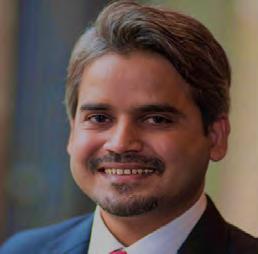
Danish Ali Bhutto is Deputy Director and Speechwriter at the National Assembly of Pakistan and a Member of the CPA Editorial Advisory Board for The Parliamentarian
purpose. It does not merely promote civic education; it actively inoculates against misinformation. By opening its doors, Parliament becomes less of an abstract target and more of a real, functioning institution – far from perfect, yes, but also indispensable. In an age of digital absolutism, such exposure offers a rare space for nuance and reflection.
Beyond internships, the National Assembly’s Secretariat has also supported academic research, facilitated graduate theses on parliamentary studies and organised mock Parliaments for students. A landmark initiative – the first-ever Children’s Parliament in 2022 – offered school-age participants the chance to debate national issues from the floor of the House. From that session emerged an unexpected but profound outcome: the creation of a Parliamentary Caucus on Child Rights, proposed at the insistence of one of the young participants. The symbolic became substantive.
These programmes have the power to shift perceptions about politics itself. On day one, not a single intern surveyed envisions a future in politics – many view it as distant, murky or even disreputable. Yet by the end of their internship, interns begin to see politics not as an abstract or tainted arena, but as a meaningful platform for public service and change. They leave not only more informed and confident, but with a sincere intent to return – as future legislators, policy advisors or reformers – equipped with the conviction that politics can be principled, inclusive and impactful.
Importantly, these initiatives have not been confined to Islamabad. The National Assembly has actively shared its model with Presiding
Officers of Provincial and Regional Legislatures, resulting in similar programmes being launched in Sindh, Punjab, Khyber Pakhtunkhwa, Balochistan and beyond. In doing so, it has provided a rare example of federal cooperation that transcends partisanship and offers a common blueprint for democratic renewal.

Institutionalizing youth engagement within the National Assembly’s strategic planning was a critical move. It ensured that such efforts would not be the product of individual officeholders, subject to electoral whims, but part of the National Assembly’s ongoing administrative ethos. For this foresight, Speaker Sadiq’s leadership deserves recognition. His decision to anchor youth outreach in the National Assembly’s long-term framework allowed it to survive beyond any single political term.
Still, challenges remain. While the programme has made notable strides, its current scale – though significant –remains limited when viewed against the vast and diverse landscape of Pakistan’s youth population. That said, conscious efforts have already been undertaken to enhance inclusivity. On the direction of the Speaker, the National Assembly Secretariat launched an online application portal last year, enabling wider access and ensuring participation from far-flung regions and marginalized groups. Students from remote districts, girls and young women, young people with disabilities, and those from ethnic or religious minorities have increasingly found space within these engagements. Going forward, the value of these
programmes must not be measured solely by participation numbers, but by the quality of mentorship, the depth of civic engagement and the consistency of institutional follow-up.
In recent years, the Parliament of Pakistan has also sought to embed thematic relevance in its youth engagements. Mock Parliaments have been held around pressing issues such as the right to information, climate change, gender-based violence, digital rights and constitutional literacy. These sessions not only offer students a simulation of the parliamentary process but also invite them to confront the policymaking dimensions of challenges they are otherwise experiencing as citizens. This approach serves a dual purpose: cultivating policy-oriented thinking among the youth, while reminding legislators of the perspectives and urgency felt by younger generations.
Equally noteworthy is the facilitation of parliamentary research by young scholars across disciplines. Dozens of graduate students have received access to legislative documents, committee records and staff insights to support their academic theses. In doing so, the National Assembly has helped to seed the emerging field of parliamentary studies in Pakistan, laying
the intellectual groundwork for future generations of lawmakers, analysts and civil society leaders. This quiet academic scaffolding may prove just as consequential in the long run as headline-grabbing legislative reforms.
The idea that democratic institutions must evolve to remain credible is not a new one. Yet in Pakistan, where institutions often retreat into opacity, the willingness of Parliament to open itself up to scrutiny and participation should not go unacknowledged. It represents not only a change in tone but a subtle shift in the institutional imagination of the state – a recognition that legitimacy is no longer inherited; it must be earned, especially from the young.
In the end, democracies are sustained not by buildings or constitutions alone, but by the trust of their citizens – particularly those who will carry the baton forward. If young people are alienated from the democratic process today, the democratic project itself may not survive tomorrow. The Parliament of Pakistan, through its modest but determined outreach efforts, seems to understand this truth.
Now, the question remains whether other Legislatures in the Commonwealth – and indeed, the political class more broadly – will follow suit.
The relevance of prepositions in the removal proceedings of the Auditor-General of Sierra Leone.
This article examines the interpretative authority of the Speaker of Parliament in Sierra Leone, focusing on a ruling regarding the prepositional phrases “in Parliament” and “of Parliament” during the removal proceedings of AuditorGeneral, Lara Taylor-Pearce.
By analysing linguistic, legal and procedural dimensions, the article explores how constitutional language shapes governance outcomes within Commonwealth parliamentary traditions (Erskine May 2023).
The Speaker’s interpretation of these prepositions, grounded in Section 137(7)(b) of the Constitution of Sierra Leone (Act No. 6) of 1991, facilitated a procedurally compliant resolution to a complex constitutional question (House of Parliament of Sierra Leone, 2023).
While some commentators argue that alternative interpretations were possible, the ruling underscores Parliament’s role in adjudicating constitutional questions relatable to its proceedings.
The removal of Sierra Leone’s AuditorGeneral in December 2024 brought renewed attention to the constitutional role of Parliament in overseeing independent offices. Central to the proceedings was the Speaker’s interpretation of the phrase “two-thirds majority in Parliament” under Section 137(7)(b) of the Constitution (Constitution of Sierra Leone, 1991).
This case highlights the ongoing challenge of balancing procedural clarity with constitutional intent, a recurring issue in Commonwealth parliamentary practice (Commonwealth Parliamentary Association Model Law, 2021).
Rather than viewing the ruling as politically motivated, this article focuses on the procedural and jurilinguistic complexities inherent in constitutional interpretation, particularly in a parliamentary setting.
The constitutional basis for Lara Taylor-Pearce’s removal stemmed from Sections 119(9) and 137(7)(b) of the Constitution of Sierra Leone (1991), which require parliamentary approval by a two-thirds majority “in Parliament.”
The Speaker ruled that “in Parliament” referred to Members present and voting, rather than the total number of elected Members of Parliament. This interpretation enabled Parliament to resolve the matter efficiently, with 100 votes in favour of removal, 36 against, and 1 void (constituting 67% of Members present and voting). The ruling demonstrated Parliament’s capacity to act on the tribunal recommendations while operating within procedural confines.
The Speaker’s interpretation centred on the preposition “in” as a spatial qualifier, distinguishing between Members physically present in the parliamentary chamber (“in Parliament”) and the broader assembly of elected representatives (“of Parliament”). This reasoning aligns with Erskine May’s principle that “parliamentary language must be construed in its ordinary sense unless context dictates otherwise” (Erskine May 2023, p. 45).
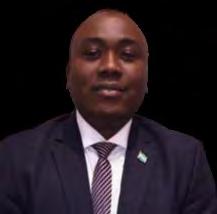
Momodu-Lamin Deen Rogers is Director of Legislative Services at the Parliament of Sierra Leone and a PhD candidate at Fourah Bay College, University of Sierra Leone.
While some legal scholars and critical voices questioned whether the framers of the Constitution intended “in Parliament” to signify Members present and voting, the Speaker’s ruling adhered to the constitutional text as written, prioritising procedural certainty over speculative intent (Jalloh, 2024). This ruling was not without controversy, as critics argued that a stricter interpretation, requiring the participation of two-thirds of all elected Members of Parliament, might have better reflected democratic principles. However, the Speaker’s approach aligns with parliamentary precedent, where quorum-based voting has frequently been upheld as a valid legislative mechanism (Commonwealth Parliamentary Association Model Law, 2021).
Sierra Leone’s approach reflects the diversity of parliamentary mechanisms across Commonwealth jurisdictions in addressing the removal of the AuditorGeneral. A comparative analysis highlights key distinctions:
1. Ghana: Requires judicial tribunal findings and parliamentary approval by a two-thirds majority of all Members (Constitution of Ghana, 1992, art. 146).
2. Canada: The Auditor-General is removable via parliamentary resolution for cause, with strong public accountability mechanisms ensuring transparency (Auditor General Act, 1985, s. 3.1).
3. Australia: Bipartisan parliamentary approval is required before the Governor-General may remove the
Auditor-General (Auditor-General Act, 1997, s. 30).
4. Kenya: The 2010 Constitution introduced explicit safeguards for removing independent officers including the Auditor-General. Article 251(1) requires a petition to Parliament, an inquiry by a tribunal, and approval by a two-thirds majority of all Members of Parliament (Constitution of Kenya, 2010). This clear phrasing eliminates interpretive ambiguity, ensuring that decisions reflect the will of the full Legislature.
5. Uganda: Contrasting with Kenya’s strict procedural requirements, Uganda’s approach has been more flexible. In 2017, the removal of Auditor-General John Muwanga faced challenges due to procedural irregularities (Kasozi, 2020). The Ugandan Parliament approved the removal with a simple majority of Members present and voting, despite the Opposition arguing for a higher threshold. Subsequent court rulings declined to intervene, reinforcing Parliament’s interpretative discretion where Executive influence over Parliament is significant (Mwenda, 2021). Sierra Leone’s hybrid modelincorporating tribunal findings, Executive communication and legislative action - demonstrates a unique adaptation of Commonwealth principles. While some scholars argue that Kenya’s explicit constitutional phrasing (“all Members of Parliament”) offers greater clarity (Constitution of Kenya, 2010, art. 251), Sierra Leone’s process underscores Parliament’s role as the final arbiter in constitutional questions having to do with its systems and processes (Commonwealth Parliamentary Association Model Law, 2021).
1. Procedural Precision: The case highlights the need for unambiguous constitutional language. Ghana’s requirement for a two-thirds majority “of all Members” eliminates ambiguity (Constitution of Ghana, 1992).
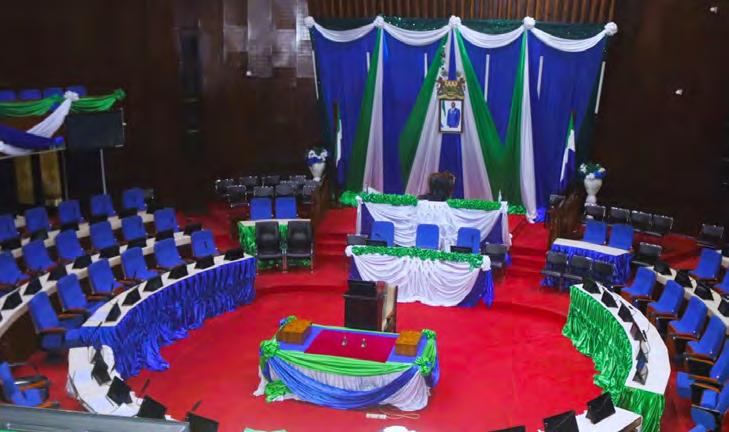
Sierra Leone’s experience may encourage drafters to adopt similar specificity in future reforms.
2. Role of the Speaker: The ruling reaffirmed the Speaker’s authority to interpret procedural rules, a cornerstone of parliamentary sovereignty (Erskine May, 2023). This aligns with the Ugandan Speaker’s role in guiding complex constitutional debates (Kasozi, 2020), illustrating a shared Commonwealth tradition.
3. Interbranch Collaboration: The use of Standing Order 14(1)(b) to facilitate Executive-legislative communication reflects pragmatic governance within the rules, though it invites scholarly debate about the optimal separation of powers (Institute for Governance Reform, 2024).
The removal process prompted significant civic discourse, with organisations like Sierra Leone’s Integrity Advocacy Consortium (IAC) advocating for clearer constitutional safeguards (IAC, 2024). International observers, including the Commonwealth Secretariat, viewed the removal as a learning opportunity for refining procedural frameworks (Commonwealth Secretariat, 2024).
The Speaker’s ruling on the prepositional phrases “in Parliament”
and “of Parliament” illustrates the interplay between constitutional text, procedural rules and institutional roles. Sierra Leone’s experience contributes to Commonwealth parliamentary scholarship by demonstrating how linguistic interpretation can resolve constitutional ambiguities. Future reforms could enhance clarity by adopting phrasing such as “two-thirds of all Members”, as seen in Kenya and Ghana while preserving Parliament’s interpretative authority.
As Erskine May observes, “The strength of parliamentary democracy lies in its adaptability to constitutional challenges” (Erskine May 2023, p. 204). Conclusively, this removal proceeding provides essential lessons for parliamentary practitioners navigating constitutional and procedural complexities.
References:
• Commonwealth Parliamentary Association (2021) Model Law (Appointment and Removal of Independent Officers).
• Commonwealth Secretariat (2024) Parliamentary Governance and Procedural Integrity and (2024) Statement on Sierra Leone’s Parliamentary Proceedings.
• Constitution of Sierra Leone (1991).
• Crystal, D. (2008) A Dictionary of Linguistics and Phonetics. 6th edn. Oxford: Blackwell.
• Erskine May, T. (2023) Treatise on the Law, Privileges, Proceedings and Usage of Parliament. 26th edn.
• Jalloh, M. (2024) ‘Constitutional Interpretation in Sierra Leone: A Case Study’, African Journal of Comparative Law, 12(3), pp. 45–67.
As a new handbook for Parliamentarians and policy makers is launched on modern slavery, a Canadian Senator explains why a comprehensive legislative framework is vital.
Worldwide, over 50 million people are trapped in modern slavery. This monstrous figure hides within the supply chains of the goods and services traded across the globe. It rears its wretched face at any stage in a product’s journey: every time a person is forced to undertake work as a result of threat, force or any other form of coercion.
This journey, covering everything from raw material extraction, component assembly and home delivery, is called a supply chain. Supply chains are routinely corrupted by those who pursue profit through human suffering. Countries around the world have outlawed modern slavery; it is a criminal practice. And yet, it thrives – a black-market business model, sustained by its unfettered access to
legitimate economies. We must sever that access completely. We must reach for sharper legislation to remove the gorgon’s head. That means barring from our markets any goods or services built through exploitation – at any stage of their supply chains, at any site across the world.
Over the past decade, Parliaments have begun this journey, passing legislation that requires companies (and public bodies) to investigate the conditions of workers throughout their supply chains, report cases of modern slavery and detail the steps they are taking to address this.
This is progress, but we must continue to push the legislation further – 50 million people living in modern slavery is evidence that the current status quo is not working.
Senator Julie Miville-Dechêne was appointed to the Senate of Canada in 2018. Previously, she was a journalist across Québec in Canada and the United States for more than 25 years.
We need to move quickly and effectively, learning from fellow Parliamentarians across the world. Where others have already mapped the path, there is no sense in treading a dead end. Where others have made mistakes, we must learn from them. Where others have found success, we must take inspiration.
This does not mean that colleagues should rush to print the latest piece of legislation in their statute books. That way leads only to stalled progress. Parliaments that are further ahead than our own are not waiting for the world to catch up; they are waiting to pass the baton and see it progress further down the track. Legislation, particularly concerning human rights, is rarely a race to salvation; it is an evolution that follows gradual global trends, and it

must be uniquely tailored to the specific environment in which it is born.
Across the Commonwealth, there is so much progress to inspire us – and we must share it more loudly. That’s why last year, alongside 20 fellow Parliamentarians and 30 experts, I contributed to a new handbook for Parliamentarians, ‘Legislating Against Modern Slavery in Supply Chains’.
Released by the UK Branch of the Commonwealth Parliamentary Association (CPA UK) in March 2025, the handbook shares knowledge, advice and strategies from across the world so that legislators may move swiftly against this devastating crime.
Alongside my fellow Canadian Parliamentarian, Hon. John McKay, I reflected on the challenges we faced when introducing the Fighting Against Forced Labour and Child Labour in Supply Chains Act and the importance of maintaining cross-party support.
As public representatives, we always want to see the best solutions make it to the final reading. Although many colleagues proposed amendments that I agreed with, never forgetting the first rule of politics – remember to
count – we steadfastly rejected divisive amendments that risked losing the support of the house. So, our advice to Parliamentarians was clear: don’t let perfect be the enemy of good.
Other Commonwealth colleagues offer more political advice in the new handbook: Hon. Chrizoster P.
Halwindi from Zambia shares how Parliamentarians can build subjectbased credibility to support their advocacy. Former British Prime Minister, Rt Hon. Baroness Theresa May details how establishing the role of ‘Independent Anti-Slavery Commissioner’ has supported her Act’s enforcement and calls for further measures to be implemented.
Meanwhile, Hon. Joe McGirr, who chairs New South Wales’ Modern Slavery Committee, offers tips on how a Committee can effectively scrutinise government, influence decision-making and advocate for legislative change.
From the President of St Lucia’s Senate, Senator Hon. Alvina Reynolds, we discover how neighbouring countries establish shared task forces to crack down on human traffickers.
There is so much we can learn from each other. So much time to be saved. So much to gain by identifying tactics we can replicate and apply to our own context.
Legislating Against Modern Slavery in Supply Chains is an important and comprehensive resource. It covers the legislative options available alongside the political reflections of those who have tried and tested them. It offers advice on navigating politics as well as parliamentary procedure. And because we all know that the legislative process does not end when a Bill passes, the handbook also covers post-legislative scrutiny, enforcement strategies and awareness-raising.
For any colleagues seeking to join the fight against modern slavery, this is your crash course. Don’t keep it a secret.
Download the new handbook at: https:// mailchi.mp/parliament.uk/handbook

OPERATING UNDER A UNITY GOVERNMENT
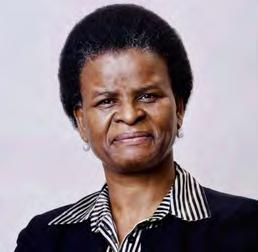
Hon. Bridget Masango, MP is a Member of the South African Parliament and is Chairperson of the Portfolio Committee on Social Development within the Government of National Unity.
Operating under a Government of National Unity (GNU) has become a reality as no party reached an overall majority in elections in May 2024. How has this brought exciting opportunities for growth and complexities for the South African Government?
South Africa’s 2024 national and provincial elections marked a historic turning point, ushering in the return of a Government of National Unity (GNU) - this time under vastly different circumstances than those of 1994. Then, Clause 88 of the transitional Constitution established the Government of National Unity to oversee the drafting of a new Constitution and to promote national reconciliation. As History Online notes, it “contributed immeasurably to improving the spirit of reconciliation in South Africa.”
Thirty years later, in the face of new political dynamics and governance challenges, the 2024 elections again led to the formation of a Government of National Unity - this time as a practical response to a hung Parliament, with the African National Congress (ANC) failing to secure a majority for the first time. Formed in June 2024, the Government of National Unity comprises ten political parties united by a ‘Statement of Intent’, with its fundamental principles, modalities and a shared commitment to addressing South Africa’s most urgent priorities:
• Driving inclusive economic growth and job creation
• Reducing poverty and the cost of living
• Building a capable, ethical, and developmental state.
Early indicators, including a positive economic outlook from global analysts PwC and rising investor confidence, suggest that the Government of National Unity is already restoring hope in South Africa’s economic prospects.
The Government of National Unity reflects a deep commitment to consultation and inclusivity, with cooperation extending across both the Executive and the Legislature, as outlined in Section 6 of the Statement of Intent. Cabinet Ministers, Deputy Ministers, Parliamentary Committee Chairs and Presiding Officers now represent a diversity of political voices. This is unprecedented and signals hope for South Africa and her people. I am honoured to serve as Chairperson of the Portfolio Committee on Social Development, representing the Democratic Alliance within the Government of National Unity. My nomination and unanimous election by colleagues - including those from the former ruling party - was both humbling and historic. Our Committee’s weekly meetings, while reflective of different ideological positions, are increasingly constructive and solutions-oriented.
In the South African National Assembly, robust debate continues along party lines, but when it comes to Committee work and legislative oversight, we find common ground. This collaborative approach marks a welcome departure from previous years when Parliament’s oversight role was often reduced to a formality. The processing of legislation by the two Houses of Parliament promises to be a constructive process, representing a wide
spectrum of society and not only those connected to certain political parties – it is early to tell but signs are promising.
One particularly moving moment was witnessing a member of the Opposition nominate a Deputy Speaker from another party - a powerful symbol of our evolving political culture. These developments have sparked optimism across the country, from ordinary citizens to business leaders and international observers. As Government of National Unity participants, we dare not squander this optimism at an altar of political expediency and short-lived populist agendas.
The 2024 elections were a defining moment in South Africa’s democratic journey. Faced with widespread poverty, unemployment and a struggling economy, the Government of National Unity represents a bold and necessary experiment in cooperative governance. Already, Parliament’s oversight role is gaining renewed purpose as members of the Government of National Unity work together to promote accountability, inclusivity and
“ The Government of National Unity reflects a deep commitment to consultation and inclusivity, with cooperation extending across both the Executive and the Legislature. ”
consequence management. This has a potential to restore trust between the general public and Parliamentarians as the pulling in opposite directions is a source of frustration among the electorate and is widely seen as being at the expense of coordinated programmes geared towards alleviating social ills, broken service delivery and rising levels of vulnerability in general.
In the Social Development portfolio alone, we bear responsibility for millions: over 30 million South Africans regularly go without one or more meals a day, and millions of unemployed youth depend on the R370 Social Relief of Distress Grant (about US$20), initially introduced during the COVID-19 pandemic and extended in response to growing hardship. This raised a number of South Africa’s grant beneficiaries to 19 million, a significant number of which are young people.
This happens in a country where social ills are at all-time high, notably gender-based violence, substance abuse, child stunting, child abandonment and the list continues. These challenges put a lot of pressure on parliamentary oversight mechanisms, as Portfolio Committee Members are expected to be on the ground, listening to their constituents and then deliberate on these issues in Committee with the department undertaking to respond within
available resources and timelines. Working in a Government of National Unity environment makes it easy to collaborate with other Portfolio Committees to share the load as many social ills are cross-cutting and their solutions have to be coordinated across departments.
The Government of National Unity presents a unique opportunity to rebuild public trust and to improve the lives of South Africans who have long felt left behind. Encouragingly, support for this initiative has come from across the political spectrum, civil society, business and everyday citizens.
As South African President Cyril Ramaphosa affirmed during his response to the State of the Nation Address debate: the Government of National Unity is not a temporary arrangement but a solemn commitment. “It is expected of all who have been entrusted with positions of leadership within the Government of National Unity that we rise to the challenge to be builders, not breakers.” It is a call we have heard - and one we have taken an oath to honour.
References:
• South Africa’s Interim Constitution, 1994 (Clause 88)
• PwC Economic Report, October 2024
• President Ramaphosa’s response to the SONA debate, February 2025.
In 2025, the Supreme Court of Canada commemorates its 150th anniversary, a significant milestone that invites reflection on its origins, evolution and enduring role in Canadian society. As the country’s highest court, it has served as a cornerstone of our democracy, entrusted with interpreting our Constitution, safeguarding fundamental rights and freedoms, and upholding the rule of law.
This anniversary also offers an opportunity to reflect on the Court’s relationship with the legislative and executive branches, reaffirming the importance of judicial independence and constructive dialogue, grounded in mutual respect. It is a moment to underscore the Court’s ongoing efforts to nurture public trust and demonstrate its unwavering commitment to preserving the integrity of our democratic institutions.
The Supreme Court of Canada was established by an Act of Parliament in 1875, eight years after Confederation, to serve as a general court of appeal. Unlike many apex courts, it was not created by the Constitution. Instead, the Constitution Act, 1867 left the decision of if, how and when to establish the Court up to Parliament. Canada’s Prime Minister, Alexander Mackenzie carried the measure forward, stating, in the House of Commons, that it was “essential to our system of jurisprudence and to the settlement of constitutional questions.”
Initially, decisions of the Supreme Court could be appealed to the Judicial Committee of the Privy Council in London. It was only in 1949 that the Court became the final court of appeal in both civil and criminal matters.
The Supreme Court of Canada: 150 years as a Pillar of Democracy and protecting the Rule of Law.
The adoption of the Canadian Charter of Rights and Freedoms in 1982 marked a turning point in the history of our Court. The entrenchment of a set of fundamental rights and freedoms in the Constitution significantly expanded the Court’s role. It became not only the final arbiter of private disputes or statutory interpretation, but also the guardian of constitutional rights. Since then, the Court has developed a rich body of jurisprudence that has transformed Canadian law and public life – addressing some of the most pressing issues in our society, from criminal justice and privacy to equality rights, abortion, medical assistance in dying and Indigenous law. Its decisions are grounded in legal principle, while remaining responsive to evolving social values.
The Court typically hears between 40 and 60 cases annually. Most come through an application for leave to appeal, granted if the case raises an issue of public importance, such as novel constitutional questions or conflicting decisions among appellate courts across the country. The federal government can also seek the Court’s advisory opinion through “reference questions” on important legal or constitutional matters. Over the years, references on topics such as the Québec secession, same-sex marriage, Senate reform and climate change have shaped public policy and clarified Canada’s constitutional framework.
The Canadian constitutional order rests on a careful balance among its three branches of government. Parliament enacts laws, the Executive implements them, and the judiciary
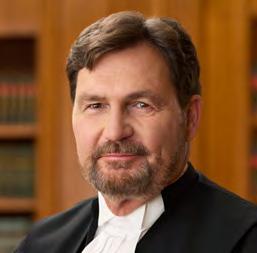

interprets and applies them. Each branch plays a distinct role, yet together they uphold a system of governance grounded in dialogue, mutual respect and institutional independence. The interaction between the legislative and judicial branches is multifaceted.
The judicial review of legislation enacted by elected representatives has historically been a controversial topic among Western democracies, including in Canada. The adoption of the Charter may have broadened the scope of judicial oversight, but it did not grant courts powers they did not already possess. Even before 1982, Canadian courts could invalidate legislation on federalism grounds or under the Canadian Bill of Rights. The enactment of the Charter constituted a deliberate choice –made by elected representatives – to entrench certain rights and freedoms in the Constitution, making legislation subject to these standards. In doing so, Parliament entrusted the judiciary with the responsibility of applying those standards, affirming its democratic legitimacy within Canada’s constitutional framework.
The interaction between courts and Parliament is often described as a “dialogue”. When legislation is found unconstitutional, the Legislature may respond with amendments to meet Charter requirements while pursuing legitimate public policy objectives. This evolving conversation allows courts and Parliament to refine each other’s contributions to the legal landscape.
The reference process is another mechanism for dialogue. When the federal government submits legal questions to the Court, it receives authoritative interpretations that inform future legislative and policy decisions. Landmark references have shaped national debates and clarified key constitutional principles.
Finally, section 33 of the Charter allows Legislatures to override certain Charter rights through the use of what is known as the “notwithstanding clause” While intended as a democratic safety valve, its more frequent invocation in recent years raises important constitutional questions about its scope, limits and legitimacy – issues that will return to the Court for clarification.
The Court’s relationship with the Executive branch is grounded in the principle of judicial independence –both individual and institutional. Judicial independence is not a privilege for judges – it is a fundamental guarantee for the public. It ensures that judges resolve disputes and interpret the law without fear, favour or political interference, safeguarding the rights and freedoms of Canadians and upholding the public’s confidence in the justice system.
In Canada, judicial independence is protected through three core principles: security of tenure, financial security
and administrative independence. Judges of the superior courts, including Supreme Court Justices, are appointed by the Governor-in-Council (the Governor-General on the advice of Cabinet). While the responsibility to appoint judges ultimately rests with the Executive, a commitment to appointing only the most qualified candidates – based on merit and regardless of political affiliation – is essential to maintaining public trust in the judiciary.
Once appointed, judges may serve until the age of 75 and may only be removed from office by joint address of the Senate and House of Commons. Their salaries are set by Parliament and reviewed every four years by an independent commission, ensuring financial security. The framework is completed by administrative independence – allowing courts to control matters essential to their judicial functions. Together, these safeguards are essential to upholding both the impartiality of judges and the public’s confidence in the integrity of the judiciary.
These principles are reinforced through institutional arrangements. As Chief Justice, I signed an agreement with the Justice Minister to enhance the Court’s administrative and financial autonomy from the Executive, including with respect to funding requests and the appointment of senior officials. In
my capacity as Chair of the Canadian Judicial Council, I also signed memoranda of understanding to safeguard the Council’s independence and to ensure that responsibility for judicial training rests with the judiciary.
Meaningful collaboration between the judicial and Executive branches is key to ensuring a more effective and accessible justice system. The Action Committee on Modernization of Court Operations, co-chaired by the Minister of Justice and myself, exemplifies how our respective institutions can work together on issues of common interest, while recognising our distinct roles and fully respecting judicial independence.
Public trust in the judiciary is vital to the health of any democracy. The Court’s legitimacy depends not only on the soundness of its decisions, but also on the public’s understanding of its role and confidence in its impartiality. As Chief Justice, I firmly believe that transparency and outreach are key to maintaining this trust, especially at a time of growing misinformation. That is why our hearings are open to the public and livestreamed; we publish plainlanguage summaries of our decisions and actively promote them on social media; and we release an annual Year-

in-Review of our work, among other efforts. We also regularly meet with students, the legal community and members of the public.
To commemorate its 150th anniversary, the Court has launched various initiatives to deepen public understanding of its role. These include visits to five Canadian cities, an international legal symposium, a special exhibition on the Court’s history, legal essay and art contests, and expanded public education efforts. The aim is to bring the Court closer to Canadians, foster dialogue, and strengthen public trust, at a time when confidence in democratic institutions is more vital than ever.
The Supreme Court of Canada’s 150th anniversary is a testament to the enduring importance of judicial independence, constitutional democracy and the rule of law. From its modest beginnings in 1875 to its current role as an internationally renowned apex court, the Court has shaped public life, influencing policy and legislative reform. It has been a stabilising force in our democracy, safeguarding rights and holding governments accountable.
As we honour this legacy, we look towards a future where justice remains equitable, accessible and principled. The Court’s commitment to transparency, public engagement and institutional dialogue is essential for maintaining public trust and the integrity of our institutions. In the words of Francis Bacon, “If we do not maintain justice, justice will not maintain us.”
This centuries-old truth continues to resonate as the Supreme Court of Canada marks its 150th year and charts its course for the future.
• To find out more about the work of the Supreme Court of Canada visit www. scc-csc.ca
• Find out about the work of the Action Committee on Modernizing Court Operations via the Office of the Commissioner for Federal Judicial Affairs Canada - Action Committee on COVID-19 via www.fja-cmf.gc.ca/COVID-19/

The CPA has designed a curriculum of online courses specifically for Parliamentarians and parliamentary officials.
Our courses are intended to strengthen your capacity to fulfil constitutional and statutory obligations as well as to enhance your knowledge and understanding of the role of Parliament in the democratic governance process. These accessible courses offer an adaptive and flexible learning approach, with both written and visual content along with access to a variety of useful resources.
To register for the CPA Parliamentary Academy, please email hq.sec@cpahq.org or visit our website: www.cpahq.org/parliamentary-academy
Advocacy and awareness of the role that women play in elected positions is one of the most important pieces of work that women do on a daily basis, often without even realising it writes New Zealand MP.
Advocacy and awareness of the role that women play in elected positions is one of the most important pieces of work that we women do on a daily basis, often without even realising it. Sometimes showing up is enough to exhibit unity and strength. Sometimes the struggle can be a relentless and tiresome battle, but mostly it can be incredibly fulfilling. One of the most tangible benefits of sisterhoods, as we like to refer to them, is that we are never happier than being in a room of dynamic, intelligent, inspirational leaders. Women leaders – leaders because they forged a path, against the odds sometimes, to stand up for what they believe in, to stand up for women and to add weight to the conversations with those countries who are yet to embrace the incredible value and perspective that women bring to policy, governance, decision making and leadership.
The challenge we need to shake off is that so many of us feel like we have a good dose of imposter syndrome – we don’t see ourselves as the leaders, we just believe in what we are doing and know we can make a difference. The sisterhood can help with that!
It has been my privilege to be the Co-Chair of the New Zealand branch of the Commonwealth Women Parliamentarians (CWP) and as a result I attended the annual CPA conference, 67th Commonwealth Parliamentary Conference in Sydney in November 2024, where we also had the 8th CWP Conference.
I have since then been to the inaugural Inter-Parliamentary Union (IPU) Global Women's Conference in
Mexico and the IPU’s 150th Assembly in Tashkent, Uzbekistan in 2025 where I delivered an address on behalf of CWP as part of the ‘Women shaping politics –Women’s global networking’ panel.
The address was to share the advantages that come from belonging to an advocacy and lobbying cohort of women from across the globe. A cohort which understands the value that women bring to the democratic system and to the decision-making arms of Parliaments. In the time that has passed since, I have had time to reflect on what more we can do to promote the learnings we have all amassed for the benefit of our colleagues.
Of course, the opportunity that CPA/ CWP gives us is a fine example of a platform to share the exchange of
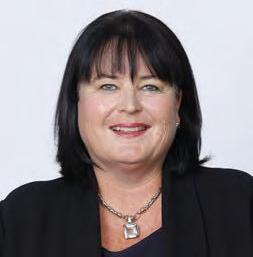
Hon. Dana Kirkpatrick, MP is a Member of the New Zealand Parliament for the East Coast electorate and the Co-Chair of the Commonwealth Women Parliamentarians New Zealand group.
best practice, peer-to-peer learning and collaboration with organisations, including the inter-parliamentary community, all fundamental to achieving CWP’s mission and to supporting our colleagues worldwide.
There are many reasons why these panels are so important and why we must keep the networks alive and thriving. Fundamental is the focus on providing support and development to increase women’s representation in Parliaments, creating more balance and an inclusive political environment.
New Zealand has a great story to tell in its quest for women’s rights, being the first country in the world to give women the vote in 1893. However, the ability to use the CWP and CPA as

international networking opportunities brings benefits to us all.
Networking provides a platform for sharing of ideas, experience, views and best practice that means efficient transfer of knowledge and learnings can expedite progress in countries still early on their equity journey. This is critical to the increasingly important advocacy work we all find ourselves engaged in.

I have had excellent takeaway moments from all of the forums that I have attended and have been able to bring ideas back to New Zealand with a plan to introduce some of the learnings ourselves. We all struggle with the online abuse, the toxic nature of public life where everyone has an opinion and the relentless workload. The lightbulb moments for me have pushed me on to continue the quest for new ways to help the gender balance in our Parliaments.
At the 67th CPC in Sydney last year we had great presentations on many topics, among them a wonderful account of the ‘Pathway to Politics Programme’ designed for women and run out of universities across Australia.
The programme, well established and very effective, provided inspiration for New Zealand’s CWP to emulate parts of it and develop a programme of professional development for New Zealand women and our colleagues across the Pacific Region.
In 2025, New Zealand will now hold a two-day in-person development programme bringing together women
from New Zealand and the Pacific who aspire to elected roles - be that in Parliament or in governance or leadership generally. The sessions will consist of panel discussions and presentations on the challenges that women face in their unique leadership contexts and how they can tackle these. It will be partly funded by the CWP Regional Strengthening Fund, which was one of the many useful presentations in Sydney last year. The fund has tranches of £10,000 available for each CPA Region to grow capability and promote representation of women in CPA Branches and the full and equal participation in political and parliamentary leadership at all levels. We were delighted to secure funding which means we can bring more people from around New Zealand and the wider Region into the cohort for 2025.
At the IPU’s Global Women’s Forum in Mexico there was an entire session, run by men, on how and why men can, and should, advocate for gender balance in Parliaments. It prompted me to think that I hadn’t really considered this and that in New Zealand we don’t really force this point enough.
As a result, whilst promoting a ‘Women in Decision Making’ event I was running, I mentioned to my party
colleagues that they didn’t have to be a woman to turn up, they were welcome to come along too. The highlight of the night for the 60 women present was New Zealand’s Prime Minister, Rt Hon. Christopher Luxon making a surprise appearance with some other male colleagues and flying the flag for women in politics.
Lastly, I want to make specific mention of our honourable colleague from Rwanda that I had the privilege to sit alongside at one event. Rwanda has a ratio of 63.8% women in its lower house – currently 51 women out of the 80 seats. This is phenomenal, streaks ahead of the rest of the world and has largely happened since the horrific events the country suffered in the 1990s. Out of catastrophe can come change and opportunity. Like so many others have endured, it is a long and challenging journey but so very much worth the effort we all bring to the table.
So, whether you are in the showup category while you find your way to greater participation or you are a fully-fledged fighter in the women’s rights movement – the benefit of collaboration, networking and support offered through the CPA and CWP is essential and often welcome relief to know we have so many alongside us.
The development of the Provincial Assembly of the Punjab in Pakistan and its hosting of the 1 st Joint CPA Asia and CPA South-East Asia Regional Conference.

The Provincial Assembly of the Punjab in Pakistan was originally constituted in 1897 and has evolved through colonial, post-independence and modern democratic phases. The Punjab Assembly has undergone numerous transformations - from a colonial council to a modern unicameral Legislature.
The Punjab Assembly became a member of the Commonwealth Parliamentary Association (CPA) in 1954 and with 371 Members of the Legislature (297 general Members, 66 women Members and eight representing minority groups), it is one of the largest Provincial Legislatures in the Commonwealth. Since joining the CPA in 1954, the Punjab Assembly has been an active CPA Branch, advancing inclusive legislative practices and democratic innovation.
The CPA Punjab Branch recently hosted the 1st Joint CPA Asia and CPA South-East Asia Regional Conference in Lahore, Pakistan from 6 to 10 February 2025, attended by over 100 Commonwealth Parliamentarians and
parliamentary staff from across the two CPA Regions and representing 22 Legislatures. This was also the first international event hosted by Punjab Assembly in over 50 years, since it last hosted the 1974 Islamic Summit. The Chairperson of the CPA Executive Committee, Hon. Dr Christopher Kalila, MP (Zambia) was in attendance, making this CPA Regional Conference his first official visit since being elected as CPA Chairperson at the 67th Commonwealth Parliamentary Conference in November 2024.
The Punjab Assembly is the first Provincial Legislature in Pakistan to host a CPA Regional Conference on this scale and international participation. The CPA Asia Region has hosted ten major regional conferences since 2000, with venues including Kolkata, Colombo, New Delhi, Hyderabad, Karachi, and Islamabad. The previous CPA Asia Regional Conference was held in 2019 in Islamabad.
The Joint CPA Asia and CPA SouthEast Asia Regional Conference was held on the theme of ‘Parliamentary
Strategies for Inclusive Growth and Sustainable Futures in Asia and South-East Asia’.
The CPA Regional Conference was addressed by the Speaker of the Punjab Provincial Assembly, Hon. Malik Muhammad Ahmad Khan, with the unanimous adoption of the Lahore Charter by delegates committing to democratic accountability and sustainable and inclusive Legislatures. The Lahore Charter is a forward-looking, 22-point declaration committing member Parliaments to principles of democratic accountability, inclusive governance, climate resilience, responsible digital regulation and equitable development. The Charter affirms the enduring value of parliamentary dialogue in tackling today’s complex regional and global challenges. The Punjab Assembly played a critical role in facilitating inclusive, forwardlooking parliamentary dialogue at this conference.
Other sessions held at the CPA Regional Conference included:
• ‘Collaborative Legislation for Inclusive and Equitable Development’ which saw the Deputy Speaker of the UK House of Commons, Hon. Nusrat Ghani, MP and panelists from Balochistan, Khyber Pakhtunkhwa and Selangor speak about representation, fostering inclusivity and strengthening legislative mechanisms to empower underrepresented groups.
• ‘AI, Misinformation and Digital Governance’ which shared practical approaches for legislating for ethical use of Artificial Intelligence and countering disinformation.
• ‘Local Governance Reforms’ with presentations on local governance initiatives such as Punjab’s new two-tier local government model and examples from Sri Lanka and Sindh.
• ‘Climate Action and Resilient Cities’ focused on legislative responses climate change in
cities such as tackling smog, water scarcity and environmental vulnerabilities as well as legislative frameworks for sustainable urban planning, including green infrastructure.
• ‘Health and Education Equity’ outlined innovative reforms in these policy areas, such as the integrated education framework (PECTA) and expanded rural healthcare outreach.

As a hub for legislative development, the CPA Regional Conference also marked the continuing role of the CPA Asia Region in fostering parliamentary excellence through capacity-building, policy exchange and the promotion of democratic norms.
The Lahore Charter stands as more than a symbolic declaration. It is a practical, action-oriented framework
for Legislatures across Asia and South-East Asia to advance the values of democracy, inclusion, and sustainable governance. The journey continues - but in Lahore, a new chapter began.
This article was written by Ms Mahira Rafique, the Additional Secretary at the Provincial Assembly of the Punjab and the CPA Punjab Branch Focal Person. She is also a Member of the Editorial Advisory Board for The Parliamentarian
The Northern Ireland Branch of the Commonwealth Parliamentary Association marked the 50 th meeting of its Executive Committee with a series of celebratory events.

The Executive Committee of the Northern Ireland Branch of the Commonwealth Parliamentary Association was delighted to hold its 50th meeting on Tuesday 18 February 2025. Formed in 2007, the CPA Branch initially met quarterly before moving to a monthly footing in its drive to deliver its purposes as fulsomely as possible. Halted when the Northern Ireland Assembly was not delivering normal business, each resumption saw a new Committee formed with a drive and vision to connect globally, take its place in supporting other CPA Branches and welcoming international representatives to share their experiences.
Therefore, when the Northern Ireland Assembly resumed normal business in February 2024, it was only a matter of weeks before the CPA Branch held its first meeting and
Mrs
elected a new Chair and Executive Committee. A strategic plan swiftly followed with the objectives of building connections; supporting professional development; and developing and sharing Parliamentary best practice.
That delivery has started by establishing an international partnership with the Legislative Assembly of Ontario; outreach programmes for Commonwealth Citizens who live in Northern Ireland; participation in election observation missions with the CPA British Islands and Mediterranean Region, and attending conferences and
seminars to learn and make valuable connections.
To mark the 50th meeting of the CPA Northern Ireland Executive Committee, the CPA SecretaryGeneral, Stephen Twigg, was warmly welcomed to the 50th meeting with Executive Committee Members very interested to hear about the remit of the CPA Secretary-General and the travel he undertakes throughout the Commonwealth as part of his role. Members were also keen to find out about the strategic direction of the CPA, and the potential for the CPA Northern Ireland Branch to align more closely with the wider network. At
a reception held after the meeting, the CPA Secretary-General met the Speaker of the Northern Ireland Assembly and the CPA Northern Ireland Branch President, Mr Edwin Poots, MLA, as well as other CPA Northern Ireland Branch Members. Commonwealth Day on the second Monday in March is often marked by the CPA Northern Ireland Branch and for Commonwealth Day 2025, the CPA Northern Ireland Branch held an event at the Parliament Buildings during the visit of the CPA SecretaryGeneral. Guests at the event included local Honorary Consuls; governmental representatives from around the world, and MLAs. Both the CPA Northern Ireland Branch President and Branch Chair addressed the audience, before Stephen Twigg gave a keynote speech on the role of the Commonwealth and the work of the CPA. Guests were entertained by musical performers from across the Commonwealth, and treated to a wide range of Commonwealth-inspired food.
Education has always been a key focus for the CPA Northern Ireland Branch and so on the second day of his visit to Northern Ireland, CPA Secretary-General, Stephen Twigg visited two local schools – Botanic Primary School and Campbell College - accompanied by two CPA Northern Ireland Executive Committee members.
The first visit was to Botanic
Right: From left to right: Mrs Emma Little-Pengelly, MLA, Deputy First Minister of Northern Ireland; Mr Jonathan Buckley, MLA, CPA Northern Ireland Branch Chair; Ms Diya Bhattacharya; Mr Edwin Poots, MLA, Speaker of the Northern Ireland Assembly and CPA Northern Ireland Branch President; Ms Leyla Galius; Stephen Twigg, CPA SecretaryGeneral; and Mr Wilson Magwere.

Primary in South Belfast which is a co-educational institution offering both nursery and primary education. The school’s motto is ‘Delight in Effort, Acceptance and Achievement’, reflecting its commitment to fostering a positive and inclusive learning environment. Botanic Primary is renowned for its multicultural community, welcoming children from various backgrounds and nationalities. This diversity enriches the school’s culture and provides students with a broad perspective.
The CPA Secretary-General was accompanied by Mr Stewart Dickson, MLA and on arrival at the school they were greeted by the Principal, Mr Paul Bell, and the Chair of the Board of Governors, Mr Gordon Lucy. The visitors were given a tour of the school, during which they had the opportunity to visit several classrooms and meet many pupils and their teachers including

Northern Ireland MLA, Mr Jonathan Buckley and CPA SecretaryGeneral, Stephen
pupils from Campbell College.
Primary 6 and 7 pupils.
The delegation then travelled to Campbell College in East Belfast where the CPA Secretary-General was joined by Mr Jonathan Buckley, MLA. Campbell College is an independent all boy’s grammar school and one of the few remaining schools in Northern Ireland that offers boarding places to pupils.
The headmaster, Mr Robert Robinson MBE met the visitors and he provided some background on the school, before they were taken to meet a selection of history and politics students. The CPA Secretary-General spoke to pupils about his role and then opened the floor to questions. A riveting questions and answer session then followed. After this session some of the pupils gave the CPA SecretaryGeneral and Mr Buckley a tour of the school, taking the opportunity to ask further insightful questions about the Commonwealth along the way.
The success of the visit and the opportunity to reflect on achievements to date and to share plans for the future was a very apt way to mark the CPA Northern Ireland Branch’s 50th meeting milestone.
This article was written by Ms Nicola Crawford, Parliamentary Engagement Co-ordinator at the Northern Ireland Assembly.
The youngest person to ever speak in a debate in the UK House of Commons, Owen Glass, made his speech during the UK Youth Parliament which took place on 28 February 2025.
More than 300 elected Members of the UK Youth Parliament (MYPs) aged 11 to 18 represented the views of young people in a series of debates held in the UK House of Commons Chamber. Young people from across the UK, the UK Overseas Territories and Crown Dependencies participated in motions including votes for 16- and 17-yearolds in elections, the need for greater political education in schools and free public transport for all young people. 10-year-old schoolboy Owen Glass had travelled to take part in the UK Youth Parliament from the remotest community in the world, Tristan da Cunha - a tiny island in the South Atlantic – and would make history as the youngest person to speak in the UK House of Commons Chamber where he spoke about the importance of universal education. His journey to the UK took over a week by sea and air. He was amongst ten representatives of the UK Overseas Territories and three from the Crown Dependencies invited to participate in the annual UK Youth Parliament.
For the first time in the UK House of Commons, an MYP used British Sign Language to deliver his speech with a BSL interpreter communicating the speech via a microphone in the Commons Chamber.
The Speaker of the UK House of Commons, Rt Hon. Sir Lindsay Hoyle, MP said that he is “very proud that this sitting of the UK Youth Parliament will be the most inclusive and exciting yet.”
Source: Report and photos from Tristan Government UK Representative Chris Carnegy.
The highly respected Clerk of the Nunavut Legislative Assembly, John Quirke has retired after 25 years of service. His first day as Clerk of the Assembly was on 1 April 1999 — the same day the Nunavut Territory in Northern Canada itself was born. His career has spanned a quarter of a century with six Premiers, 85 MLAs and more than 500 bills during his long service. After arriving in Iqaluit in the late 1960s, he worked as a public servant in the Government of the Northwest Territories before joining the new Assembly in 1999.
During his time as Clerk, he welcomed many dignitaries to the Legislature including Queen Elizabeth II and many Canadian Prime Ministers and he fondly remembered taking the
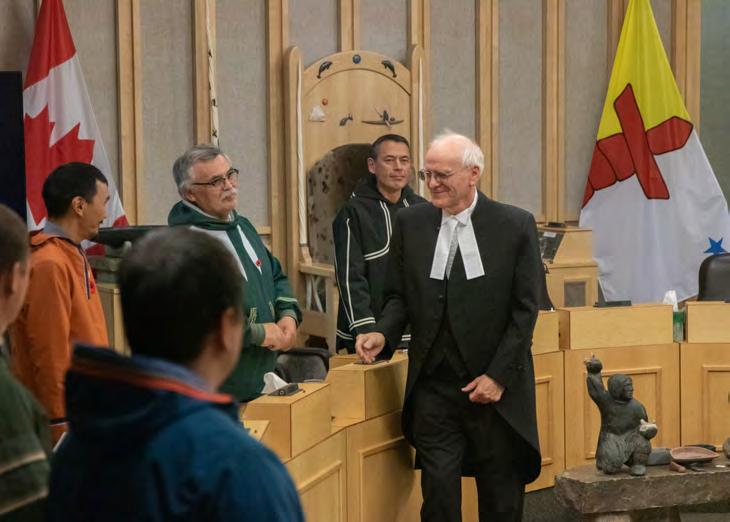
first Legislative Assembly on tour to communities outside of the capital of Iqaluit.
A farewell ceremony was held in the Nunavut Legislature Chamber attended by current and former MLAs, legislature staff and public servants with Nunavut Commissioner, Eva Aariak and Speaker, Hon. Tony Akoak led tributes to acknowledge John Quirke’s final sitting day ahead of his retirement. The new Clerk of the Nunavut Legislative Assembly is Stephen Innuksuk who previously served as Deputy Clerk.
The Parliament of Canada has received an honour from HM King Charles III. The 17th Usher of the Black Rod of the Senate of Canada, Mr Gregory Peters was presented with a new ceremonial sword at Buckingham Palace in London on 12 March 2025. The Speaker of the Senate of Canada, Hon. Raymonde Gagné was also present. The new ceremonial sword was commissioned by the Senate in The King’s honour to mark the change of reign in September 2022.
The King is the Canadian Head of State as well as being the Head of the Commonwealth and Patron of the Commonwealth Parliamentary Association. The ceremonial sword was used in the Senate Chamber when
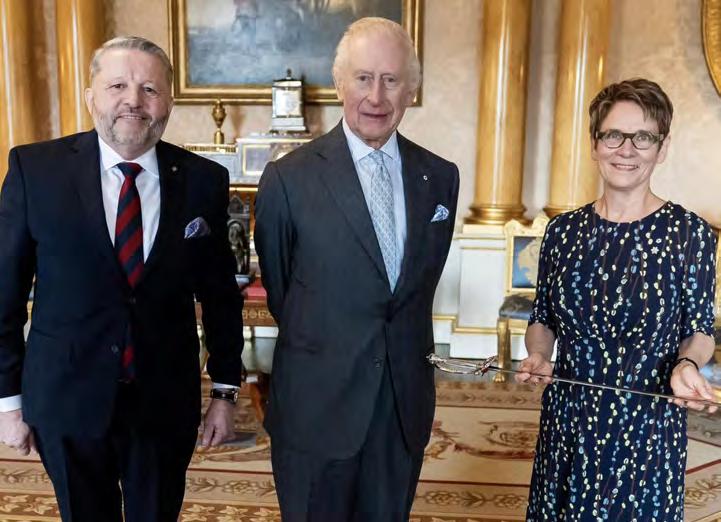
the King came to open the Parliament of Canada on 27 May 2025.
Mr Gregory Peters is the 17th Usher of the Black Rod since the Confederation of Canada in 1867. The position of Usher of the Black Rod, which originated approximately 600 years ago in Westminster, is a senior protocol officer in the Canadian Parliament. Their current responsibilities combine traditional, ceremonial and modern administrative functions.
A historic moment in the Papua New Guinea Parliament took place on 13 March 2025 as Hon. Francesca Semoso, MP (the Member for North Bougainville) became the first-ever female Member of Parliament in Papua New Guinea since 1975 to preside over a parliamentary session. Her appointment as Assistant Speaker came at the end of the last session of Parliament and this was the first opportunity for Hon. Francesca Semoso, MP to take to the Chair. In her first address at the beginning of the parliamentary session, Hon. Francesca Semoso thanked colleagues for the opportunity and dedicated the achievement to the women of the country. Her appointment emphasises her
leadership within the parliamentary system and accelerates action for greater gender inclusivity and the empowerment of women in Papua New Guinea, following International Women’s Day 2025 on 8 March. Parliamentary colleagues stated their hope that Hon. Francesca Semoso’s role as Assistant Speaker will help to inspire future generations to pursue leadership roles. The appointment also marks a significant milestone in the nation’s history and highlights the ongoing progress toward gender equality in Papua New Guinea, which is
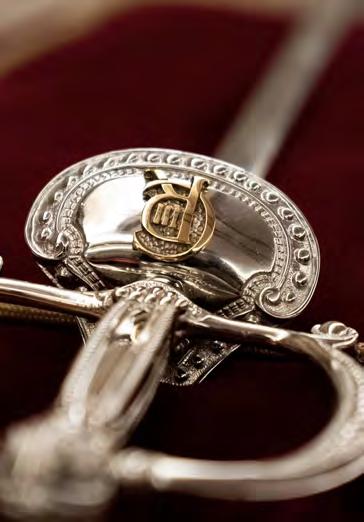
also preparing to celebrate 50 years of Independence in September 2025.
The Deputy Prime Minister of New Zealand and Minister of Foreign Affairs, Rt Hon. Winston Peters, MP launched the design for Tonga’s new Legislative Assembly building - Fale Alea on 11 April 2025. The Deputy Prime Minister led a cross-party delegation from New Zealand as part of a Pacific mission, where they visited the current
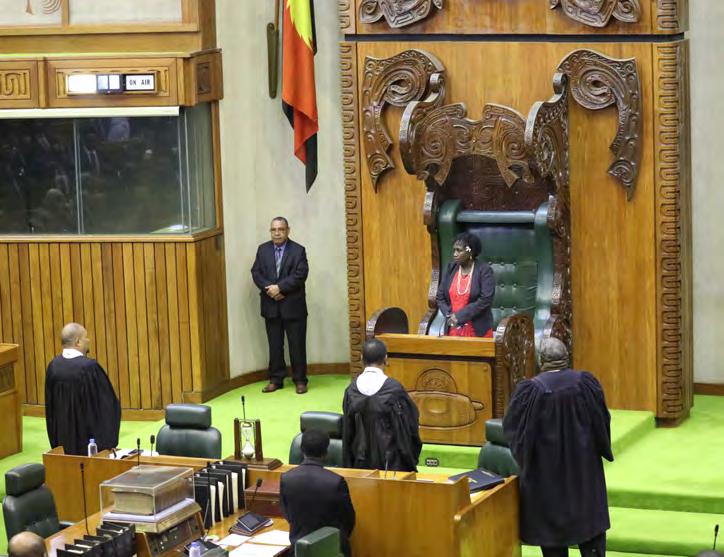
temporary Parliament chamber for the announcement.
The Speaker of the Tonga Legislative Assembly, Lord Fakafanua welcomed the New Zealand delegation via video message (as he was overseas on official duties) and expressed heartfelt appreciation for New Zealand and Australia’s support for the construction project which demonstrates regional cooperation saying: “This design brings us closer to our mission of building a resilient and inclusive Parliament for all.”
The new Parliament building will replace the original structure damaged by Cyclone Gita in 2018 and is designed to reflect Tonga’s rich cultural heritage while incorporating modern materials for enhanced climate resilience.
Andrew Tu’inukuafe, Principal Architect and Chairman of Warren and Mahoney, presented the building design to Members of Parliament, explaining that the innovative structure will feature a new public viewing gallery (a first for Fale Alea), public consultation spaces, a dedicated education and outreach centre and a broadcast studio for media.
Youth voices were also highlighted with Youth Parliament members having input into the design. Elizabeth Kite, founder of Take the Lead and She Leads Fale Alea, acknowledged the role of young leaders in shaping a more inclusive future for Tonga’s governance.
In February 2025, Te Pire Whakatupua mō Te Kāhui Tupua/Taranaki Maunga Collective Redress Bill granted legal personality to Taranaki Maunga (Mount Taranaki), the second highest mountain in New Zealand, on the west coast of the North Island. The Bill gave effect to the collective redress deed signed between the Crown and eight iwi (tribes) to address the Crown’s historical breaches of te Tiriti o Waitangi/the Treaty of Waitangi, including the confiscation of Taranaki Maunga in 1865.
The Bill outlined that “The Crown acknowledges that its indiscriminate confiscation of the sacred peaks and ranges of Taranaki deprived Taranaki Māori of access to sites of profound cultural, spiritual and historical significance, and severed relationships of care that the whānau (families), hapū (subtribes), and iwi of Taranaki had exercised for centuries. In doing so, the Crown broke its promise, made through te Tiriti o Waitangi/the Treaty of Waitangi, that Māori would retain the full and undisturbed possession of any land that they wished to retain.”
Rather than recognising the single mountain peak, the Bill recognised Te Kāhui Tupua, “a living and indivisible whole” made up of Taranaki Maunga and other nearby peaks and surrounding land, “incorporating all their physical and metaphysical elements.” The Bill recognised the mountains as “personified ancestors” and stated that they are “a source of water and food, they are repositories of memory and knowledge, they connect the earth to the heavens”
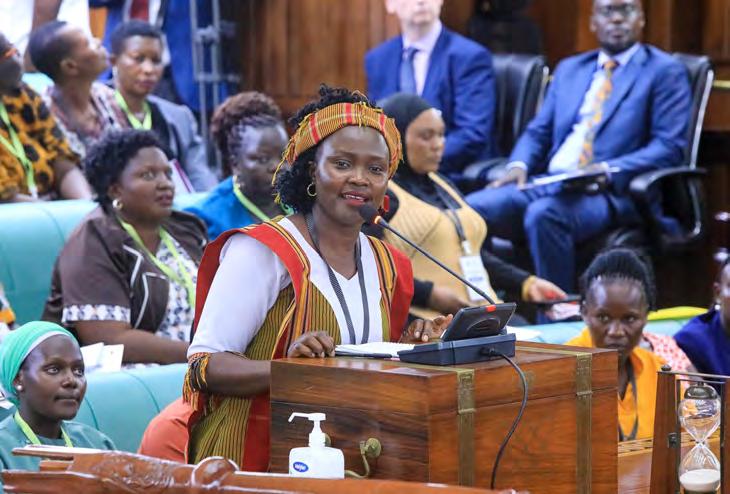
The Bill changed the geographic name “Mount Egmont” to the mountain’s original name, Taranaki Maunga.
The Bill stated that the landmark has “all the rights, powers, duties, responsibilities, and liabilities of a legal person” and set out various protections. The Bill provided that “Ngā Iwi o Taranaki, the Crown, and all of the communities of Taranaki have an intergenerational responsibility actively to protect the health and well-being of Te Kāhui Tupua.” The concept of legal personality for natural landmarks has been used before in Treaty of Waitangi Settlement Bills. Te Urewera National Park and Te Awa Tupua (the Whanganui River) and were granted this protection in 2014 and 2017.
The Bill established a statutory body made up of representatives from iwi and the New Zealand Department of Conservation to act as the human face and voice of the mountains. The land will continue to be a national park, and public access will be protected.
Report by Lizzie Hendy, Parliament of New Zealand.
Government needs to regulate the high financial burden of participation in election campaigns so that women are not disadvantaged due to lack of financial support; and should implement a zero-tolerance policy against all forms of genderbased electoral violence, ensuring legal action against perpetrators of violence; harassment, intimidation, and cyberbullying against women in politics.
These were some of the calls made by women leaders at the Second Women’s Parliament held at Parliament
Left: The 2nd Women’s Parliament took place in the Parliament of Uganda in March 2025.
of Uganda on 3 March 2025. The women leaders also called on the Equal Opportunities Commission, the statutory body mandated to eliminate discrimination and inequalities against any individual or group of persons, to provide an annual report on women’s political participation, assessing challenges and progress, with recommendations for further legislative action.
The Second Women’s Parliament was chaired by the Chairperson of the National Women’s Council, Hajjati Faridah Kibowa. The National Women’s Council is an autonomous body created by an Act of Parliament to bring all women of Uganda together for development purposes, irrespective of their religion, tribe, origin, status or political affiliation.
On 12 March 2025, the Parliament of Uganda presided over by the Speaker, Anita Among, passed the motion urging the Government to accord due consideration to the resolutions of the Second Women’s Parliament.
The Minister of Information, Communications Technology and National Guidance, Hon. Chris Baryomunsi, encouraged legislators to incorporate the concerns raised in the motion into the discussions on Ministerial Policy Statements and to ensure their inclusion in the national budget for funding. In line with Parliament Rules, Ministers are required to submit action-taken reports to Parliament, detailing the measures implemented in response to the resolutions.
Report by Mohammad Katamba, Parliament of Uganda.
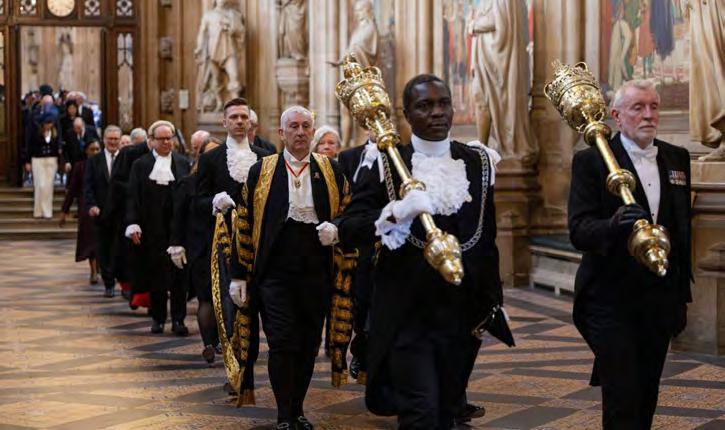
On 8 May 2025 – the 80th anniversary of Victory in Europe (VE) Day marking the end of the Second World War in Europe - the Speakers of both Houses of the UK Parliament processed with senior politicians, including the UK Prime Minister and Leader of the Opposition, to Westminster Abbey for a service to honour and pay tribute to the Second World War generation.
The Speakers of the UK House of Commons and House of Lords met in Central Lobby and processed with the two parliamentary maces, echoing a similar VE Day procession of 1945 led by then-Speaker Clifton Brown. The joint procession reflected the unity of the UK Parliament and the nation in marking 80 years since victory was declared in Europe.
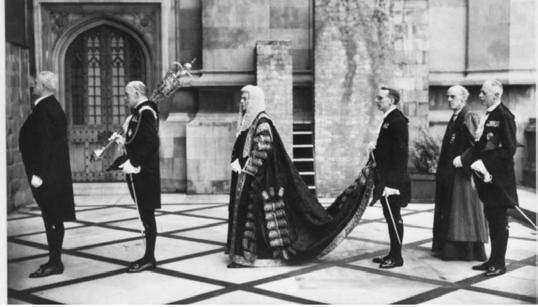
The Speaker of the UK House of Commons, Rt Hon. Sir Lindsay Hoyle, MP reminded MPs that they were recreating an historic moment: “We will now follow in the footsteps of our predecessors 80 years ago. On 8th May 1945, Honourable Members formed a procession out of the House of Lords, where they had been secretly relocated, because the House of Commons Chamber had been destroyed during the Blitz. Today, we shall again follow the Mace – but this time from our own Chamber - through the bomb-scarred Churchill Arch, which stands as a permanent reminder of the fortitude of those who stood firm through the war - and I ask that those invited Honourable Members do the same.”
Members of the UK Parliament also marked the 80th anniversary of VE Day with speeches in the two Chambers.
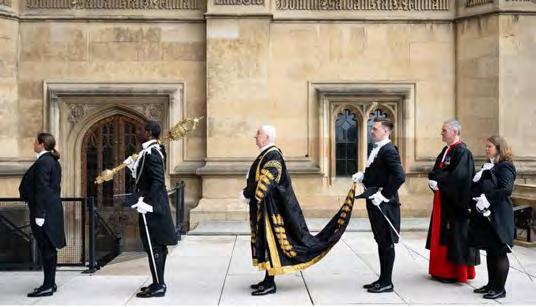
India Parliament: 8th edition of ‘Practice and Procedure of Parliament’ edited and updated by Utpal Kumar Singh, Secretary-General of Lok Sabha (2025). Book review by Rup Narayan Das, Ph.D, Joint Secretary (Retired), Lok Sabha Secretariat and Senior Fellow, Indian Council of Social Science Research. The reviewer is a Delhi-based writer and all views are personal.
In 1954, a few years after India’s Independence in 1947, former British Prime Minister, Sir Anthony Eden, alluding to India’s tryst with destiny, said: “The Indian venture is not a pale imitation of our practice at home, but a magnified reproduction in a scale we have never dreamt of. If it succeeds, its influence on Asia is incalculable for good. Whatever the outcome, we must honour those who attempted it.”
The success of the Indian Republic over the last 75 years has vindicated the cautious optimism of Sir Anthony Eden. The credit for this must go to the dynamic nature of India’s constitution and the healthy exercise of its parliamentary practice and procedure. As rightly pointed out by Sir Anthony Eden, India’s political edifice is not a mechanical transplant of the ‘Westminster model’ or its replica, but a creative adaptation of the British model of parliamentary democracy to suit the native soil.
Over the last 75 years, India has constantly moved forward deepening and strengthening its Parliamentary edifice and emerging as the fourth largest economy of the world.
The treatise under review, the 8th edition of ‘Practice and Procedure of Parliament’, is likened to Erskine May’s classical work of the same title widely regarded as ‘the bible’ of parliamentary practice of the UK Parliament whose 26th edition is scheduled to be launched in January next year.
Meticulously edited and updated by Utpal Kumar Singh, a learned retired civil servant of India and the incumbent Secretary-General of Lok Sabha, the popular lower Chamber of the Indian Parliament, the volume is a ready reckoner for parliamentary officials, legal practitioners, journalists
and civil servants. It is a must for parliamentary officials in jurisdictions practicing the ‘Westminster model’ and more so for officials of India’s State Legislatures.
Survival and strengthening of parliamentary democracy are contingent up on the creative interpretation and application of the provisions of the Constitution, as well as the laws of the land by the Presiding Officer (Speaker) of the House, who is the custodian of the rights and privileges of the House and its Members. The Chair has a quasi-judicial role while interpreting and applying the written words and the spirit of the Constitution. Here lies the salience of the rulings, observations and direction of the Chair. Their compilation with proper annotations is a seminal contribution to understand and appreciate the success of parliamentary democracy. Additionally, procedural innovations add up to the resilience of parliamentary democracy. The updated and revised volume provides all these and much more.
India’s experience of handling the competitive nature of electoral politics, its resonance on the functioning of Parliament both within and outside, and contestation amongst and between organs of the state, such as the Legislature, the Judiciary and the Executive, throw light on the harmonious function of these organs of the state apparatus. If the Indian Constitution is a ‘living Constitution’, the practice and procedures of Parliament have also been constantly evolving in response to political dynamics.
The great Harvard University Professor Samuel P. Huntington in his seminal work ‘Political Order in Changing Societies’ elucidated on
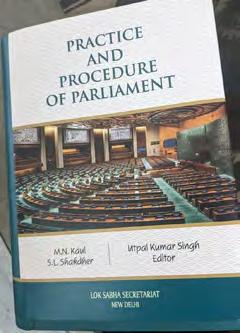
institution building to withstand the stresses and strains on the system. If institution building is important, so also are the practice and procedure of Parliament.
The rich contents in the latest volume of ‘Practice and Procedure of Parliament’ illuminate the innovative structures of Parliamentary Committees which contribute to the entire gamut functioning of Parliament. These Committees are like a microcosm of Parliament. The Standing Committees of Parliament may be in vogue in many Commonwealth Parliaments; nevertheless, it is worth the time on the part of parliamentary officials to browse through the contents of the volume and adapt the best practices on Committees relevant to their Parliament. Over the years, these Parliamentary Committees have not only eased the workload of Parliament but have also co-opted the opposition parties in governance enabling them to be stakeholders in the stability of the government. Similarly, the chapter on parliamentary privileges is very instructive and useful.
Given the broad and extensive nature of parliamentary practice and procedure, it is hoped that future editions will provide more in-depth coverage by dedicating separate chapters to key areas such as antidefection laws and parliamentary diplomacy, both of which play critical roles in the functioning of legislative bodies.
‘Indian Parliament & Democratic Polity – Varied Musings’ by Ravindra Garimella, Secretary to the Leader of the Opposition in Rajya Sabha at Parliament of India. Ravindra is a former Joint Secretary at Lok Sabha and has been involved in CPA activities for over 20 years. Book review by P. D. T. Achary, Former Secretary-General of Lok Sabha at the India Parliament and Honorary Officer of the House (Lok Sabha).
A prodigious amount of literature is available today on the parliamentary system, its practice and procedures and its evolution. Parliamentary systems, since their birth in England around the 13th century, have evolved in form and content and are considered to be the most ideal governance systems in the world today. Of course, they have evolved in different continents, drawing elements from the cultural milieu of the country or regions in each continent. The parliamentary system, which took shape in Europe and went through long periods of wars and social and intellectual ferment, is bound to be different from that of the relatively placid socio-political climate of countries and regions in the Asian continent. The intellectual explosion that shook up the European world was totally absent in the Asian region. Most Asian societies remained untouched by the Renaissance which swept the European intellectual world.
Naturally, the evolution of Parliament as an institution which guides and controls governance has been influenced by history, culture, economic development and society’s faith in and commitment to an orderly system of governance. From this point of view, Asian democracy, if it can be called so, is different from the democracy practiced by European countries. One fundamental difference is that Parliament, meant as an institution to control and guide the Executive and its governance, loses its pre-eminence when the Executive becomes too strong. The phenomenon of a strong leader results in the gradual eclipse of democracy and the power and stature of Parliament. The strong leader phenomenon is almost invisible in European countries. However, it has a tendency to make Parliaments in most Asian countries powerless,
emasculated representative bodies which cannot perform the roles assigned to them by history.
It is, therefore, necessary for those who undertake serious study of the Parliamentary system and its workings in various parts of the world to look deeper into its history and chronicle its evolution, bringing out facts which are common to all Parliaments, while also pointing out their divergences, so as to get a perspective on this most dynamic system of governance evolved by man.
The Parliamentary system in India is a colonial import, albeit with appropriate adaptations. It has progressed through a series of colonial laws and acquired a final shape in the Government of India Act of 1935. In fact, the Constitution of free India adopted most of the provisions of this colonial Act which made it possible for the framers of the Constitution to maintain continuity in the form and context of governance and the legislative matrix.
New situations require new solutions and new procedural approaches. It is there that new books become important and useful. In this context, the latest book written by Shri Ravindra Garimella becomes very useful. Garimella has around four decades of experience in the Indian Parliament. This book in fact reflects his vast experience in the workings of the Parliamentary system. The procedural devices available to MPs have been listed with short annotations which can be useful to Members who need to quickly look for bullet points. All of the various procedural devices have been described with great clarity. MPs and parliamentary staff can grasp the essentials from this book.
Some of the chapters of this book, though brief, are normally not found in conventional books on the Parliamentary system. The chapters on
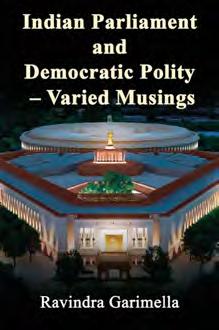
the Tricolour or the Indian national flag; the Sengol or sceptre installed or placed near the seat of the Speaker; the Supreme Court judgment on the rights of the LGBTQ community etc. are highly informative.
It needs to be mentioned here that the story of the Sengol has been narrated with absolute objectivity. The Sengol has created a great deal of curiosity and controversy in some quarters, when it was unearthed from the National Museum and brought to the new Parliament House. Ultimately, it was found that this sceptre was presented to first Prime Minister of India, Jawaharlal Nehru by some Hindu religious heads on the eve of independence . This was transferred to the Museum, and it had no other significance. Sengol is a symbol of monarchy. India is a democracy where symbols of monarchy have no place.
The brief account of the evolution of Indian Parliament is quite informative. It will definitely help MPs and others understand the long journey of Parliament. Garimella can in fact attempt a larger book on this and other related matters which will be of much interest to MPs, historians and research scholars. This book – ‘Indian Parliament and Democratic Polity – Varied Musings’, is a useful addition to the parliamentary literature. It gives a brief account of various aspects of the workings of Parliament which are extremely useful. I am sure the researchers and Parliamentarians will find it very useful. We can legitimately expect a much more detailed book on Parliament and its systems from Shri Ravindra Garimella in the future.
Teresina Bodkin, who died in April 2025, was a Montserratian teacher and civil servant who became the first woman Speaker of the Legislative Assembly of Montserrat. She was born in Montserrat, and she worked as a mathematics teacher in the island’s secondary school and was well known to islanders. She went on to become Director of Statistics for the Montserrat Government, a role that she held for 15 years.
Roy Ngulube: Clerk of the National Assembly of Zambia
The Speaker of the National Assembly of Zambia, Rt Hon. Nelly Mutti, SC, MP, announced the death of the Clerk of the National Assembly of Zambia, Roy Ngulube on 7 April 2025 in Tashkent, Uzbekistan during the 150th Assembly of the Inter-Parliamentary Union (IPU). The international parliamentary community reacted with sadness at the news and tributes were paid from across the world. Roy Ngulube had worked in the public service in Zambia over the course of three decades. He joined the National
Teresina Bodkin served as Speaker of the Legislative Assembly of Montserrat from 2010 to 2014, the first women to be appointed to the role. She served as Speaker under Movement for Change and Prosperity (MCAP) Government and was then reappointed to the role when MCAP returned to power from December 2019 to December 2020.
Assembly in April 2002 and rose through the ranks serving as Assistant Committee Clerk, Executive Assistant to the Speaker, Deputy Clerk (Procedure) and Deputy Clerk (Administration). He also served as Executive Assistant to the Secretary-General of the Southern African Development Community Parliamentary Forum (SADC PF) from 2006 to 2008. He was later appointed as the Clerk of the National Assembly of Zambia in September 2023, the position he held until his untimely death.
The Speaker and Members of the Parliament of Ghana have paid tribute to the former Clerk, Samuel Ntim Darkwa, who passed away in April 2025. Samuel Ntim Darkwa was a recognised parliamentary figure, whose service to Ghana spanned nearly four decades. His parliamentary career began in 1961, and he quickly rose to become Assistant Clerk to the 1968 Constituent Assembly and Clerk to the 1992 Consultative Assembly, cementing his place in Ghana’s democratic development. Uniquely, he held the distinction of having served in all Parliaments and Constituent Assemblies of Ghana from 1961 to 1997, a period marked by constitutional reforms, political transitions, and institutional growth.
His career culminated in his appointment as Clerk to Parliament, the highest administrative position in the Legislature. His expertise in parliamentary procedure and the intricate workings of the House and its Committees earned him accolades from both local and international
peers. He was a familiar face at Commonwealth Parliamentary Association (CPA) Conferences and served as a resource person at several workshops and seminars across Southern Africa. He also contributed to a number of Journals including The Parliamentarian which further contributed to his reputation as a thought leader in legislative affairs.
Following the political upheaval of 1966, Samuel Darkwa was transferred to the Office of the Head of State and later served in the Ministry of Labour, Social Welfare and Rural Development. He was subsequently seconded to the Commonwealth Youth Programme in Zambia, broadening his experience in governance and international development.
Even in retirement, he remained deeply engaged with Ghana’s democratic processes, serving as a consultant to both the Centre for Democratic Development (CDD-Ghana) and the Institute of Economic Affairs (IEA), contributing to studies on the performance of Parliament and reforms to the Standing Orders of the House. He also co-authored with K. B. Ayensu, Ghana’s first indigenous Clerk to Parliament – ‘How Our Parliament Functions’ and ‘The Evolution of Parliament in Ghana’, contributing significantly to the documentation of Ghana’s legislative history.
Parliamentary Conversations in the Commonwealth
A podcast by the CPA that gives a voice to Parliamentarians, civil society experts and activists across the Commonwealth to discuss common democratic challenges and share their ideas on what can be done to solve them.
Listen now to new episodes on all major podcast platforms or visit www.cpahq.org/knowledgecentre/cpa-podcast