The Osprey Winter 2026

Page 1


THE OSPREY

Chair Pete Soverel

Interim Editor Jim Yuskavitch

Associate Editor Sarah MacKenzie Lonigro

Editorial Committee

Brian Braidwood •Rich Simms

Ryan Smith • Guy Fleischer

Scientific Advisors

Rick Williams • Jack Stanford

• Bill McMillan • Bill Bakke

Design & Layout Jim Yuskavitch IT

Andrew Keating

The Osprey is published by: Wild Salmon Rivers 16430 72nd Avenue, West Edmonds, WA 98026

Letters To The Editor

The Osprey welcomes letters to the editor and article proposals. The Osprey P.O. Box 13121 Portland, OR 97213 jyusk@bendcable.com

General business and change of address: https://www.ospreysteelhead.org/contact

The Osprey is a joint publication of not-for-profit organizations concerned with the conservation and sustainable management of wild Pacific salmon and steelhead and their habitat throughout their native and introduced ranges. This unique partnership includes The Conservation Angler, Fly Fishers International, Steelhead Society of British Columbia, SkeenaWild Conservation Trust, Wild Salmon Center, and Wild Steelhead Coalition. Financial support is provided by partner organizations, individuals, clubs and corporations. The Osprey is publishes three issues per year: Winter, Spring/Summer and Fall. All materials are copyrighted and require permission prior to reprinting or other use.

The Osprey © 2026 ISSN 2334-4075

Saving Wild Fish in Interesting Times

After departing in 2024, I’m back temporarily as editor of The Osprey to get the next couple of issues out as the search for my replacement continues. The wild fish conservation landscape, and especially the science that supports it, has changed considerably since I last alighted on this “perch.”

Most of this has been driven by the current adminstration in Washington, D.C. and its antipathy towards conservation, the environment and, especially, scientific research. All of which has reached deeply into the work of wild fish advocates.

From a policy aspect, in June of last year, the Trump Administration pulled out of the Resilient Columbia Basin Agreement made by the Biden Administration in 2023 with the Columbia River treaty tribes and the states of Washington and Oregon. That agreement would have invested $1 billion over the course of a decade that included funding clean energy development that would have eventually made the removal of the four lower Snake River dams more feasible. That withdrawal has a double wammy effect that includes making the extinction of wild runs of Columbia River salmon and steelhead more likely while reducing America’s portfolio of energy sources.

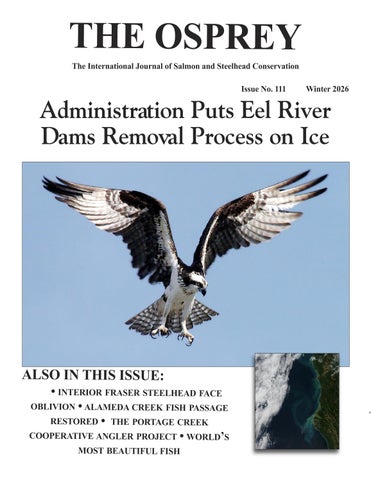
Even smaller efforts to help wild fish don’t fly under the radar, as our cover story on the campaign to remove two dams on the Eel River, and the Trump Administration’s move to derail a plan agreed on by all parties, makes plain.

Rejecting the reality of climate change, its focus on increasing fossil fuel use, and kneecapping clean energy development has obvious potential dire effects for wild fish, along with ecosystems through the world. The recent decision to repeal the landmark 2009 legal ruling that allowed the Environmental Protection Agency to consider climate change in its development and enforcement of regulations, if it survives legal challenges, will be a serious blow to many environmental initiatives.

The aggressive defunding of scientific grants is hobbling

conservation efforts, especially since scientific research produces so much of the knowledge that informs wild fish conservation planning and management.

I’m happy to say there is some good news. Aggressive legal challenges to the Adminstration’s science funding cuts from universities and states have prevailed in a surprising number of cases. Congress has even kept some funding intact by including them in various legislation, maintaining much scientific funding levels flat with last year rather than the intended steep cuts. And more lawsuits continue to make their way through the courts. Many of the Administration’s environmental policies will continue to be challenged as well.

I don’t know any more than you where all this is going to take us. One thing I do know is that there are so many continuous and varied threats to wild fish that the day will never come when their advocates can sit back and say, “Finally, we’re done!”

Environmental Protection Agency's program to photographically document subjects of environmental concern, 1972-1977.

How The Osprey Helps Wild Fish

The Osprey has been bringing the latest science, policy, opinion and news stories to its readers supporting wild Pacific salmon and steelhead conservation and management for 37 years. But we are much more than a publication that you subscribe to because of your own interest in wild fish conservation. The funds we receive from our subscribers allows us to send The Osprey to wild fish conservation decision-makers and influencers including scientists, fisheries managers, politicians and wild fish advocates.

Sending The Osprey to decision makers is key to our wild fish conservation advocacy. Your support makes that possible.

So when you subscribe/donate to The Osprey, you not only receive a subscription yourself, but you also help us put The Osprey into the hands of the people we need bring to our side to save our wild fish.

Please go to the subscription/donation form on page 23 or on-line at www.ospreysteelhead.org/donation and donate whatever you are able. Thank you.

Nekoosa Paper Company on the Wisconsin River. Smoke from the paper mill is heavily laden with sulphites. From DOCUMERICA: The
Photo by Ted Rozumalski

Too Many “Cattle,” Not Enough “Grass”

And the Loss of Two

Wild Steelhead Conservation Greats

In the most recent issues of The Osprey, I have led off this column with news of the passing of Pacific Northwest legends of steelhead angling and conservation. This issue continues that sad trend with notes on the passing of two of our strongest friends and supporters, Jim van Loan and John Sager.

Jim van Loan was a close friend of almost forty years, owner of Steamboat Inn on the banks of Oregon’s fabled North Fork Umpqua River, sage advisor, a founding director of two conservation organizations I founded (The Wild Salmon Center and The Conservation Angler), champion of steelhead conservation, past chariman of the Oregon Fish and Wildlife Commission, staunch supporter of The Osprey, and bon vivant.

Longtime readers will recall John Sager’s decades-long support for The Osprey as editor, advisor, proofreader, fundraiser and financial supporter. Years ago, John recruited me to the Federation of Fly Fishers Steelhead Committee, then the publisher of The Osprey, which I eventually chaired for 11 years. John was also key to developing the Kamchatka Steelhead Project — contacting our Russian partner, Professor Ksenya Savvaitova, helping to secure start-up funding support, camp manager for several years and advisor on all things Russian. He was also a

very close friend, and fishing partner on the Sauk, Skagit and Skykomish rivers, along with many trips to the Thompson, while it was still open.

On one of our last trips, we rented a house on the bluff over-looking the mouth of the Nicola River. One after-

Management agencies flood the Pacific Ocean with billions of hatchery pink and chum salmon that compete for the same grazing rights as the wild stocks, depleting a common food supply.

noon, we split up to fish. John went to The Scollops, river right downstream of the highway bridge. He suggested I go downstream to Murray Creek, the outflow from Spence’s Bridge water supply. There, I landed the largest steelhead of my life — a 45 ¼” x 26” cock fish weighing approximately 40 to 44 lbs. When I got back to the cabin, the Northern Lights were out in force, seeming to celebrate with me.

Tight lines and smooth sailing, old friends, Jim and John. The world, and especially the steelhead conservation community, is a lesser place today without you.

The Overcrowded Ocean “Pasture”

From San Diego to the western Aleutian Islands, almost all steelhead and Chinook salmon stocks have been greatly depleted and scores, maybe hundreds, are already extinct. We are well familiar with the many factors that have contributed to their demise — the four H’s, including hatcheries, harvest, hydropower, and habitat. However, all stocks are not equally influenced by those factors. Some populations live in rivers with no dams, no hatcheries, and relatively pristine habitat, such as those in Alaska and parts of British Columbia. Others face almost every possible obstacle: massive hatchery releases, high harvest levels, significantly degraded habitat, and must ascend and descend numerous dams. The only commonality they share are the waters of the northern Pacific Ocean. Even there, they do not all go to the same places. Some go west from California, others from Oregon north head for the Gulf of Alaska. Management agencies frequently assign blame to the ocean for the poor survival of wild steelhead and Chinook salmon. True enough, but they conclude, incorrectly, that there isn’t much they can do about those circumstances. These same agencies, and especially Alaska Department Fish and Game, flood the Pacific Ocean with billions of hatchery pink and chum salmon that compete for the same grazing rights as the wild stocks. From estuaries to the open seas, there is substantial evidence that the hoards of domesticated denizens are depleting a common food supply. Basically, they are eating the ocean out of house and home, in turn, reducing the growth, survival, and productivity of wild fish. The evidence is dramatically smaller returning adult salmon and steelhead.

Any rancher worth their salt knows the limits of a given pasture. They don’t blame the pasture, instead, they ac-

Continued on next page

The Osprey

Photo courtesy University of Texas at Arlington Libraries

count for its capacity by managing the number of cattle they turn loose. Surely, we are capable of similarly sensible and effective practices.

One wonders why managers continue to obfuscate the science and point the finger at the pasture, rather than turning the one dial they have full control over — the number of hatchery fish they release — just as ranchers do with their cattle.

For example, virtually all Alaskan Chinook stocks are in free fall, joining Washington, Oregon, Idaho, and British Columbia stocks on the highway to extirpation. Everywhere, wild stocks are being replaced by less fit hatchery fish paid for by taxpayers. These same taxpayers are then tapped to pay again if they want to purchase one of those Chinook as table fare. Worse, when the fishery collapses in any given year because there are too few fish, the taxpayer once again bails out the fishers with “emergency relief” funds.

Such an industry management strategy goes against everything capitalism represents. The better approach is to allow Chinook salmon to reach their full age and size and then afford the fishing opportunities to tribes and taxpayers after they return as large, mature fish to their home rivers in California, Washington, Oregon and British Columbia.

The better approach for older and larger steelhead, such as those on the Olympic Peninsula, B-runs in Idaho, and the Thompson River is to eliminate hatchery pink salmon releases coming out of Alaska. Too many cattle, not enough grass.

At the end of the day, we can’t quickly restore freshwater habitat. Nor can we regulate ocean productivity. But we can control what we control. Harvest and hatcheries. Until we put as much effort into managing those two H’s as we do the other two over which we exercise no control, I’m skeptical recovery is possible.

Committee, and founder of The Conservation Angler and Wild Salmon Center.

Research Shows Massive Pink Salmon Numbers Affecting North Pacific Ecosystems

A growing body of research is showing that the superabundance of pink salmon (Oncorhynchus gorbuscha) in the north Pacific Ocean — currently the most abundant salmon in those waters — is having significant negative effects on ocean ecosystems, and other salmon species in particular.

While warming ocean conditions play a role in their increasing population, hatcheries, particularly in Russia and Alaska, are pumping as many as 1.5 billion pinks into the north Pacific each year.

At the fundamental level, these large numbers of pink salmon are causing a trophic cascade driven by predators changing how the food chain functions. Because pink salmon are a primary predator of zooplankton, which feed on phytoplankton, they change the seasonal and yearly abundance of these basin ocean food sources. This, in turn, has cascading affects on other species of salmon especially Chinook, coho and steelhead. Pink salmon compete with Chinook for squid and smaller fish, which pinks will target as prey during their last two or three months of their ocean life history. This results in total prey weight consumed by Chinook salmon to be reduced by 72 to 56 percent. There are 300 times more adult pink salmon in the north Pacific than Chinook salmon.

Pink salmon predation on squid is having similar affects on coho salmon. For example, in odd numbered years, when pinks are most abundant, the Kuskokwim River, Alaska commercial coho harvest declines more than 30 percent. Similarly, researchers find a sharp decrease in squid found in stomachs of steelhead as pink salmon abundance has risen and a reduction in abundance and survival of interior Fraser River, British Columbia steelhead, and B-Run steelhead in the Columbia River.

But intense political pressure from the commercial fishing industry hampers efforts to reduce hatchery pink salmon production. For example, Alaska operates 26 hatcheries producing mostly pink and chum salmon that provides for 81 percent of the commercial fishery catch in Prince William Sound, 39 percent of the Kodiak harvest and 24 percent of fish caught in the Southeast Alaska fishery. In February 2025, a proposal to reduce hatchery pink and chum production in Southeast Alaska to help rebuild Chinook salmon numbers was rejected by the Alaska Board of Fisheries.

For more detailed information on the impacts of pink salmon see Pink Salmon: Overlord of the Pacific Ocean, by Gregory T. Ruggerone, The Osprey, September 2019 and, Pink Salmon and their Profound Impact on Ocean Ecology by Gregory T. Ruggerone and Alan M. Springer, The Osprey, Winter 2024 — Jim Yuskavitch

Pink salmon. Photo by Totti. Creative Commons Attribution-Share Alike 4.0 International license.

Eel River Dam Removal Process Becomes MAGA Target

As 2025 drew to a close, the big news on California’s Eel River was US Secretary of Agriculture Brooke Rollins’ unhinged and weird letter to the Federal Energy Regulatory Commission (FERC) opposing Pacific Gas and Electric’s (PG&E) License Surrender Application for the Potter Valley Project. Rollins demanded the commission reject PG&E’s application, contrary to FERC precedent and federal law, because PG&E proposes to remove Scott and Cape Horn dams from the Eel River. What FERC will ultimately do is more uncertain now, but the license surrender process was always going to take years. PG&E’s plan to begin dam removal in 2028 is aspirational given the studies and plans that must be completed before FERC will issue a surrender order. If the Trump administration truly does mean to thwart Eel River dam removal, it can do things to further slow FERC’s never rapid processes. But I should back up a step or two.

The Potter Valley Project

The Potter Valley Project is a federally licensed hydroelectric project PG&E owns and operates on the upper mainstem of northwestern California’s Eel River, where two dams and the diversion works are, as well as in Potter Valley on the upper East Branch Russian River, where the powerhouse is located. Cape Horn Dam was built in 1908 at a bend in the Eel River where it is separated from the Russian River by only a single ridge to the south. Because the Eel is hundreds of feet higher, builders used gravity to divert water to a powerhouse in Potter Valley below. The Potter Valley Irrigation District was formed around the bonanza of ‘abandoned’ water below the powerhouse.

Though convenient for a diversion, the location quickly proved a poor place for a reservoir on the Eel, which moves as much sediment by volume as any river in the lower 48 states. Cape Horn

Dam’s Van Arsdale reservoir filled in rapidly. Dam builders went looking for a better place for a bigger reservoir. About twelve miles upstream, they found a narrow canyon downstream from a wide valley.

Today, we know these valley-andcanyon formations happen where rivers cross faults. We know the Bartlett Springs Fault that produced this particular formation is an extension of the San Andreas Fault Complex, and we know that scientists think it can produce tremors up to magnitude 7.2. But dam builders in 1920 didn’t under-

The Eel’s “Rapid Dam Removal” plan would knock most of Cape Horn and Scott dams down in the first year of implementation.

stand plate tectonics, so that is where they built Scott Dam.

While Cape Horn Dam got a fish ladder, Scott Dam was so tall no ladder was built. The Eel’s runs of steelhead, Chinook and probably coho salmon that spawned and reared above the new dam were cut off. Of particular note, the southernmost run of summer-run steelhead on Earth vanished. While those fish have not been seen since, their genetic legacy persists in their descendants — rainbow trout trapped above Scott Dam.

Fisheries Collapse in the Eel

The dams have not been the only culprit in the degradation of the Eel watershed and the decline of its fisheries. Overfishing has been a persistent threat, starting with the installation of

canneries in the lower Eel River at the turn of the 20th Century. In 1914, a railroad was completed through the Eel River Canyon, across dozens of ancient landslides, increasing the burden of sediment in the watershed. The postwar logging boom in the redwood and Douglas-fir forests left a vast network of sketchy logging roads across one of the most erosive landscapes on earth.

The Eel River watershed experienced successive record flood events in 1958 and 1964. In those floods and wet winters since, clearcut slopes and badly built roads have repeatedly failed, dumping whole mountainsides into the Eel River. Increased sediment buried salmon and steelhead redds, blunting their ability to find food, a particular burden on coho salmon and steelhead that spend a year in freshwater. After 1964, populations of Chinook, coho, and steelhead that had averaged a million fish a year in returns to the Eel River before colonization plummeted to thousands of adults. Commercial and especially recreational fishing on the Eel fell off dramatically.

21st Century Operations, The Reasonable and Prudent Alternative

For most of the 20th century, PG&E ran the Eel River dams for maximum power production and the convenience of Russian River irrigators. It was not uncommon for flows on the Eel’s upper mainstem to be sharply reduced, as nearly all the river’s flow was sent south to the Russian River.

When the Potter Valley project came up for FERC relicensing in 1977, CalTrout and others challenged it. But it was only after Eel River salmonids were listed as Threatened under the ESA in the 1990s that the National Marine Fisheries Service (NMFS) was able influence operation of the project. NMFS found that the license FERC had approved risked jeopardizing Eel River

Continued on next page

salmon and steelhead. This “jeopardy” finding became the basis for a revised flow schedule, which FERC incorporated into PG&E’s license in 2004. The new flow schedule roughly approximated natural flows on the Eel River, reducing fisheries impacts. It did not address other harms caused by the project, including the fish ladder, high temperatures below Scott Dam, nor predation by pikeminnow introduced to the Eel system via the Lake Pillsbury reservoir.

From PG&E’s perspective, however, the new flow schedule left the utility holding the bag on meeting water allocations with a shrinking reservoir and an increasingly unprofitable dam. A series of very dry and warm years sharpened conflicting demands of irrigation diversions to the Russian River and protecting fisheries in the Eel River.

From Relicensing to a Dam Removal Deal

In 2017 PG&E began preparing to relicense the PVP, with license expiration looming in 2022. The utility ended up putting the project up for auction, before declaring bankruptcy in 2018 and withdrawing its notice of intent to relicense. Abandoning its relicensing attempt means PG&E cannot apply for another license for the project. An additional attempt to offer the project to qualified operators found none. (Sonoma Water, the dominant water system on the Russian River, has held an option to purchase the project since the 1960s, but declined to exercise it.) Thus, when the project license expired in 2022, license surrender and dam removal appeared the only logical option.

Brought together by Rep. Jared Huffman (D-CA2), disparate stakeholders in both river basins developed a deal — what Huffman called a “two basin solution” — that would best serve everyone’s interests. Under the framework ultimately agreed to by Sonoma Water, the Mendocino Inland Water and Power Commission, Humboldt County, the Round Valley Indian Tribes (RVIT), Trout Unlimited, and CalTrout, the Russian River interests agreed to support removal of the Eel River dams as soon as practicable, while the Eel River and fisheries side agreed to support a continued diversion from the Eel to the Russian.

Under the plan diversions will only

happen during higher flows, with a run of the river structure and a pump station into the existing tunnel. The Round Valley Indian Tribes will hold the water right on which PG&E’s diversion had been based. Russian River water users will pay for the costs of their new diversion and for the water, with annual payments to both the Tribes and to an Eel River restoration fund.

By agreeing to a deal that could be presented to FERC with broad support, we all hoped to move as quickly as possible through FERC’sextremely slow processes.

That is the project that PG&E outlined in its August 2025 License Surrender Application — a “Rapid Dam Removal” plan that would knock most of both Cape Horn and Scott Dams down in the first year of implementation, see the new diversion works built while the river was diverted for dam removal, and then plan for the sediment of both reservoirs to flush downriver as soon as high enough flows come. The informed reader will note

A satellite photo shows sedimentation from Eel River reservoirs off the California coast.

that this plan broadly mirrors the dam removal project on the Klamath River, recently completed with greater than anticipated success for fisheries recovery.

Scott Dam and Lake Pilsbury reservoir on the Eel River, California. Photo by Kyle Schwartz, California Trout.
Photo Courtesy NASA

Hitting the Wall

The thing is, some of the people who fought Klamath dam removal are still mad as hell, and are still circulating whole rivers of do-your-own-research conspiracy theories. They have now joined the upper Eel’s own minor flood of dam removal disinformation. For years, naysayers have been focused by summer cabin owners around the Lake Pillsbury Reservoir, and increasingly by Lake County, whose official position is that dam removal is a plot by PG&E against Lake County.

A new strain came into the picture over the last couple of years with the re-election of Donald Trump. Local MAGA partisans whipped up opposition to dam removal among the conservative towns and agricultural interests of the Russian River. Their Save Potter Valley effort is in some tension with the expressed support of the Potter Valley Irrigation District for the two basin deal, reflecting a larger tension between water users on the Russian. Because the two basin solution deal entails both dam removal and an upgrade to the existing diversion, it’s often not clear what opponents actually want, beyond a way to turn back the hands of time.

The Rollins Letter

So that’s the punchbowl in which the Secretary of Agriculture’s submission landed. Why the Secretary of Agriculture? Because the upper portion of the Lake Pillsbury reservoir lies on lands of the Mendocino National Forest. So it is the Forest Service that has been meeting with PG&E and stakeholders for years, planning for dam removal and river restoration which is very much consistent with the agency’s mission and the Mendocino forest plan. Ironically, Forest Service founder Gifford Pinchot engineered his agency’s placement in the Department of Agriculture to insulate it from political interference with public lands endemic to the corrupt Department of the Interior of that era. But when MAGA complaints reached Mar-a-Lago, Secretary Rollins tossed all that woke nonsense. Rollins pulled Mendocino and other Forest Service staff from the PVP process, replacing them with leaders of the Natural Resources Conservation Service with roots in California

agribusiness. Rollins also reversed the Trump administration’s position on Klamath dam removals, which was to not interfere with private business decisions. The new posture is, alas, consistent with administration attempts to force coal plants to continue to operate.

Here, though, there are some other practical problems. First, the transformer in Potter Valley blew in 2021, and PG&E decided not to commission a new one, which is a multimillion dollar process that now takes years. So

The Eel River drains a 3,684-square-mile watershed, the third largest in California. Photo by Robert Ashworth, Creative Commons Attribution 2.0 Generic License

Dam removal opponents have been spreading conspiracy theories and disinformation among area residents and Ag interests.

the dam makes no power at all. More importantly for water users, Scott Dam’s systems are increasingly failing. Continuing sedimentation threatens to irreparably block the only remaining low level outlet. That would end irrigation deliveries, as well as releases to maintain flows in the Eel River.

Finally, an investigation of Scott Dam’s seismic stability resulted in PG&E being ordered by state and federal dam safety regulators to permanently leave the radial gates atop the dam open. The reduced capacity resulting from both the open gates and the need to keep water in the reservoir to prevent sediment mobilization means that, in even the wettest years, PG&E has only a dry year’s supply to meet its flow schedule. This leaves threatened juvenile steelhead in the upper Eel at the mercy of FERC each year. PG&E must seek permission to alter flows in an attempt to balance complying with required flows and maintaining a cold

water pool for releases into the Eel. In 2025, FERC failed again to approve PG&E’s variance request in time, delaying approval until early August. The result was more than two months of deadly temperatures in the upper Eel below Scott Dam.

According to temperature data maintained by the California Department of Water Resources, 24-hour average temperatures in the Eel River below Lake Pillsbury were at or above 20°C for 80 straight days from July 10 to September 30, 2025, and were at or above 22°C for 30 days from August 11 to September 11. Water temperatures below 16°C are best to protect rearing of juvenile steelhead, and temperatures above 20°C may be directly lethal even to adult steelhead. Temperatures above 18°C also favor non-native pikeminnow and allow them to outcompete juvenile steelhead.

There is nothing the federal government can do to make the dams seismically safe, or to solve the physics of sedimentation and the inadequacy of Scott Dam’s failing structures. PG&E wants to remove the dams for really good reasons, and the key interests in the Eel and the Russian basins agree. Nonetheless, Eel River dam removal is far from a done deal. As long as federal power remains in the hands of vindictive ideologues, those of us who want our grandchildren to see wild Eel River salmon and steelhead are going to have our hands full.

Scott Greacen is Conservation Director for Friends of the Eel River, based in Arcata California. To learn more about their work visit: https://eelriver.org/

Interior Fraser Wild Steelhead Populations on the Edge of Oblivion

Early this winter, the British Columbia government delivered what may have been the bleakest steelhead update in the province’s recorded history. In an email to stakeholders on the status of Interior Fraser River steelhead, provincial biologists reported:

“Zero steelhead have been captured this year in test fisheries that produce the data used to forecast the abundance of spawners in the spring. This is the lowest catch result ever observed in over 40 years of these test fishing operations.”

From a world class fishery in the desert, to a deserted fishery

I first fished the Thompson with my dad in 1995. We were from Skeena country and it was new terrain for us. It was my first time fishing in rattlesnake country and I still remember our excitement at being on that big, powerful desert river flanked by sagebrush and ponderosa pine. We stayed at a cheap motel and gathered every night with my dad’s chums from the Steelhead Society, at the iconic Log Cabin Pub in Spences Bridge. Being

nearly a year shy of the legal drinking age of 19, I was flying under the radar. I listened intently as these seasoned anglers swapped fishing stories and debated the merits of various conservation strategies while downing pints in the smokey blue haze, as bighorn sheep and other taxidermied critters watched from the walls. One night we had dinner with Jack Heming-

Steelhead in British Columbia have been mismanaged and have not recieved adequate protections from the full range of impacts they suffer.

way and Sasha Tolstoy—descendants of legendary authors, and notorious fishing bums.

That’s the kind of scene it was, but not anymore. While the pub is still there, the glory days of the steelhead fishery are now a memory.

The run started struggling in the late 2000s and since 2016 it has been in the B.C. government’s “extreme conservation concern” zone. The recreational catch-andrelease fishery closed in 2018 and it hasn’t re-opened. Anglers don’t flock to Spences Bridge in the fall anymore, and the loss of the steelhead fishery has devastated the local economy. I usually drive through at least twice every year along Highway 1 and I get sad and wistful every time.

The Thompson steelhead run used to fluctuate be-

tween roughly 1,000 and 3,000 fish. In a November 19, 2025 email update, provincial biologist Robert Bison states that the number of spawners this year is predicted to be less than 19 fish. The Chilcotin run is predicted to be less than nine fish. And they don’t provide estimates for the smaller runs that make up the larger Interior Fraser steelhead complex. This feels a lot like a death rattle. Our provincial and federal governments have failed in their duty to protect and rebuild this magnificent race of fish.

The Plight of Interior Fraser River Steelhead

Readers of The Osprey are likely aware that most steelhead populations have been heavily overfished, largely because they return to their home rivers in smaller numbers than the commercially valuable salmon species that swim alongside them. In general, steelhead in B.C. and beyond have been mismanaged and have not received adequate protections from the full range of impacts they suffer.

The Thompson River run is the most famous of the Interior Fraser steelhead, which are made up of a handful of genetically and spatially distinct populations that return in late summer and spawn in an array of Fraser River tributaries upstream of Hell’s Gate. Interior Fraser steelhead are thought to be descended from fish that were isolated in the Columbia refugium the last time our continent was covered in glacial ice. They are revered by anglers for their superior size and strength compared to most coastal and winter-run steelhead.

Interior Fraser steelhead are crashing for several reasons. Experts cite various combinations of the following causes: bycatch in net fisheries targeting chum salmon in the Fraser River and Salish Sea, poor conditions in the ocean and in some of the freshwater habitats, and predation by seals and sea

Continued on next page

Interior Fraser steelhead are perilously close to extinction. Photo Courtesy US Fish and Wildlife Service.

lions. This last factor is controversial, with strong arguments being made both for and against pinniped predation as an important limiting factor for interior Fraser steelhead.

The inhospitable ocean and freshwa ter conditions are largely due to climate change, exacerbated in the rivers by loss of forest cover and over-extraction of water. Climate change is intensifying flooding and drought, which are being made even worse by loss of forest cover due to excessive clearcut log ging, and climate-driven increases in wildfires and insect infestations. It is possible that the catastrophic flooding in the region in 2021, caused by an atmospheric river, may have played a role in this year’s terrible run. However, many other steelhead and salmon populations that were hit by the same flooding have not collapsed. While fishing, habitat conditions, and predators are all likely conspiring against these legendary fish, ocean survival is often cited as the biggest likely culprit. Ocean survival is a broad factor that can encompass climate-related carrying capacity, fishing and predation. While climate is a dominant factor, fishing impacts are also significant and are widely recognized as the factor that can be most readily addressed by managers, should they ever make a serious effort to do so. These fishing impacts are occurring in both sanctioned and unsanctioned fisheries, and in-river as well as in marine approach areas on both sides of the border between B.C. and Washington State.

A Story of Negligence and Corruption

A dose of strong government action could have prevented or at least mitigated the collapse of Interior Fraser steelhead. Back in 2019, when the Thompson returns were still in the hundreds, the scientists on the Committee on the Status of Endangered Wildlife in Canada (COSEWIC) assessed the Thompson and Chilcotin populations and designated them as “endangered.” COSEWIC is an independent body of experts with a mandate from the federal government to identify and assess species at risk. They recommended listing these endangered steelhead under Canada’s Species at Risk Act, which would have kicked off strong protections and recovery efforts. But it never

The estimated spawning abundances of Thompson River steelhead in relation to conservation reference points. The last data point illustrates the expected spawner abundance for this season’s return which will spawn in the spring of 2026. Source: Status Update for Fraser River Late-Run Summer Steelhead. Government of British Columbia. November 19, 2025.

happened, due in part to corruption of the process by officials at Fisheries and Oceans Canada. It was a massive scandal in the world of B.C. fisheries management and the whole story is worth a read (https://thenarwhal.ca/dfo-steelhead-scientists-emails/).

The short version is that bureaucrats at Fisheries and Oceans Canada (DFO) fiddled with a crucial science advice

Ignoring scientists’ recommendations, DFO downplayed the benefits of reducing the numbers of interior Fraser steelhead killed in the commercial salmon fishery.

document after it had been peer-reviewed and finalized by an array of government and independent scientists through the Canadian Science Advisory Secretariat. The document was a Recovery Potential Assessment that would inform the federal Minister of Environment in her recommendation to cabinet on whether to protect Thompson and Chilcotin steelhead under Canada’s Species at Risk Act. The result of the DFO bureaucrats’ fiddling with the report’s conclusions was to downplay the benefit that could be gained by

reducing the numbers of Interior Fraser steelhead killed in fisheries targeting chum and other Pacific salmon. It was a shameful breach of the integrity of Canada’s federal science advisory process.

The scandal came to a head when B.C.’s Deputy Minister of Environment, Mark Zacharias, complained to his federal counterpart after DFO refused to restore the document’s summary to the version that had been signed off on by the assessment’s lead authors. In an admirable departure from bureaucratic pussyfooting, Mr. Zacharias charged DFO with changing the report’s conclusions to “support status-quo commercial salmon harvesting,” and stated that “...the DFO-authored summary is no longer scientifically defensible,” and that salmon fisheries are the “only substantial threat to Interior Fraser steelhead that can be immediately mitigated.” The B.C. Wildlife Federation deserves rivers of gratitude for their work in exposing this debacle.

Unfortunately, Mr. Zacharias’ political bosses in the B.C. legislature did not appreciate his salvo against the feds. Rumor has it that he was summoned to the Premier’s office for a talking-to. A few days later I spoke with the Environment Minister, George Heyman, and thanked him for his deputy’s principled stand for conservation and evidencebased decision making. He did not respond with the usual glow that politicians exude when praised. His face darkened, he looked at the floor, his mouth tightened, and he simply said

Continued on next page

“Wilkinson was pissed,” referring to the federal Fisheries Minister. Zacharias was fired a few months later (https://thetyee.ca/News/2020/05/22/Environment-Ministry-Top-ManagerFired/), for unknown reasons.

In the end, those science-subverting bureaucrats won. Prime Minister Trudeau’s cabinet decided not to protect Thompson and Chilcotin steelhead under their endangered species law. In an Orwellian turn of phrase, Environment Minister Catherine McKenna informed Canadians that “The Governor in Council (GiC) has decided that not listing Thompson River and Chilcotin River Steelhead Trout under the Species at Risk Act would result in the greatest overall benefits to current and future generations of Canadians and the conservation of these wildlife species.” She might as well have said “one plus one equals three.”

The B.C. government went along with the charade and, working with the federal government, produced a modest and toothless action plan that failed to sufficiently protect Interior Fraser steelhead from the things that are killing them before they can spawn. At the very least, a strong, legally-mandated recovery plan would have helped us finally get serious about shutting down unselective salmon fisheries that use gillnets and kill significant numbers of fish from non-target species. This would have incentivized widespread adoption of selective types of gear that allow non-target fish to be released alive and healthy. Some will say it wouldn’t have made enough of a difference, but there was only one way to find out.

Action is the Antidote for Despair

Let’s not let this sad moment turn into apathy. There’s a glimmer of hope to be found in the Thompson and Chilcotin Rivers’ healthy populations of resident rainbow trout (the smaller, non-steelhead version that doesn’t go out to sea). They share the same genetics as steelhead and their descendants harbour the ability to go to sea and become steelhead. Things may look grim for this particular year class of Interior Fraser steelhead, but they’re not gone.

Now that it is clear that the B.C. and federal governments’ action plan is failing, as predicted, they should immedi-

ately convene stakeholders to devise a plan that will actually work. The first step in any serious rescue plan for these valuable fish would be to severely restrict the use of gillnets along their migration route and support fishers in switching to selective fishing gear, like fish traps and fish wheels. Robust, independent monitoring would be needed to measure and ensure success, along with strong enforcement to ensure compliance and prevent illegal, unreported and unregulated fishing.

To make this happen, Interior Fraser steelhead require immediate protection under Canada’s Species at Risk Act. The best time to do that was five years ago, but the next best time is now.

It must also be noted that other proposed strategies, like pinniped removals and hatchery intervention, require serious scrutiny. Decades of ev-

idence show that hatchery programs can erode wild fish fitness, alter lifehistory traits, and mask underlying problems rather than addressing the root causes of decline— particularly the solvable problem of fishing mortality. Targeted pinniped removal, by contrast, is a more limited and less risky management tool that warrants evidence-based evaluation as part of a broader recovery strategy.

Finally, we must learn from this disaster and keep it from unfolding elsewhere. There are scores of salmon and steelhead populations around this beautiful corner of the planet that are struggling but still holding on. Let’s fight for them.

Let’s take some inspiration from the 2025 return of Fraser River sockeye. They came back in numbers that ex-

Continued on next page

Figure 1. Major stock groups of steelhead trout in the Fraser River system. (E ~ approximate mean annual escapement in the 1990s)

ceeded official expectations by millions of fish, and this was the same year class that crashed hard in 2009 and led Prime Minister Stephen Harper to launch the Cohen Inquiry on the Decline of Sockeye Salmon in the Fraser River. That set the stage for Fisheries Minister Bernadette Jordan removing virus- and parasite-spewing fish farms from a large swath of the Fraser sockeye migration route in 2022. The juveniles of the 2025 run were the first to swim this route when the farms were cleared.

There are many things we can do that will make a difference for wild salmon and steelhead. These include shutting down the Alaskan interception fisheries that are plundering Skeena and Nass River steelhead, transitioning to selective fisheries, opening up thousands of kilometres of vital nursery habitats that are being blocked by abandoned culverts and obsolete flood control structures, and getting the remaining fish farms out of B.C. waters. None of these things will come easy, but history shows that wins for wild salmon and steelhead can be had with relentless work, cooperation and strategic thinking. Never give up.

If you want to give the governments of British Columbia and Canada a push to rescue Interior Fraser steelhead from doom, here are two places to start:

Hon. Randene Neill, Minister of Water, Land and Resource Stewardship, Government of British Columbia, WLRS.minister@gov.bc.ca

Hon. Joanne Thompson, Minister of Fisheries and Oceans, Government of Canada, Min@dfo-mpo.gc.ca

Aaron Hill is Executive Director of Watershed Watch Salmon Society, based in Port Coquitlam, British Columbia. To learn more about their work visit: https://watershedwatch.ca/

The dark blue waters of the Thompson meet the sediment-laden waters of the Fraser River at Lytton, British Columbia. Photo by The Interior. Creative Commons Attribution-Share Alike 4.0 International License.
Angler David Collins with a fine wild steelhead caught and released on the Thompson River near Shaw Springs circa 1999 (pre-keep-’em-wet era). Photo by Greg Gordon

California’s Alameda Creek

Migratory Fish Passage Restored in Bay Area’s Largest

Watershed

Alameda Creek restoration has reached a historic milestone with the completion of several major fish passage projects that open up the watershed to anadromous fish for the first time in more than half a century. In the wake of construction of three fish ladders in the lower creek and releases of cold-water flows from a major upstream reservoir, steelhead trout and Chinook salmon have gained access to about 20 miles of suitable spawning and rearing habitat in the watershed.

The 45-mile-long Alameda Creek is the third-largest tributary flowing into California’s San Francisco Bay. With its headwaters in the Diablo Range, it drains a 680-square-mile watershed flowing through wilderness and agricultural lands in its upper reaches, and rapidly developing communities in its lower portions before emptying into the East Bay at Fremont. Wild fish advocates have devoted decades working to remove barriers to anadromous fish on streams throughout the watershed.

Stonybrook Creek Tributary

Stonybrook Creek may be the most important tributary in the watershed for steelhead and rainbow trout. This small perennial stream in Niles Canyon provides year-round cold water even during drought years and has been a refugia for resident rainbow trout as well as a spawning destination for a handful of rescued steelhead trout. In 2016, Alameda County fixed two county owned road culverts on Stonybrook Creek that were fish passage barriers. The lower culvert was retrofitted with baffles that provide trout passage upstream, and the upper culvert was removed and replaced with a free-span bridge. Subsequent monitoring showed that rainbow trout immediately moved upstream of both culverts. And in 2022, Caltrans — the California Department of Transportation — finally removed a perched concrete box culvert at the bottom of Stonybrook Creek at the confluence with Alameda Creek. Caltrans

replaced it with free-span bridge and also removed a nearby concrete sill from a former road crossing, enhancing fish passage.

Protecting Niles Canyon

The Alameda Creek Alliance, and Sunol and Niles communities locals spent more than a decade battling Caltrans’ misguided attempts to widen Highway 84 through Niles Canyon. Proposed road widening projects would have turned the winding Niles Canyon

In November 2025, after removing the last major fish barrier on Alameda Creek, two adult Chinook salmon were observed in that part of the watershed for the first time since the 1950s.

Road into a freeway, requiring extensive removal of rare sycamore riparian forest along the creek and needlessly damaging habitat for steelhead trout and other endangered species with minimal safety benefits. Caltrans started cutting streamside trees in the canyon in spring of 2011 but large public protests and three lawsuits by the Alameda Creek Alliance halted the destruction. A settlement agreement in 2011 forced Caltrans to abandon the canyon-wide highway widening project. Further settlement agreements in 2019 and 2020 scaled back highway construction to reasonable levels for road safety. Four smaller safety projects have been completed at hazardous locations. Caltrans is obligated to plant additional native riparian trees and remove invasive plants along Alameda Creek.

Calaveras Dam Replacement

In 2018, the San Francisco Public Utilities Commission (SFPUC) finished rebuilding the seismically-challenged Calaveras Dam in the upper Alameda Creek watershed. The SFPUC built a fish ladder and installed fish screens on the associated 32-foot-high Alameda Creek Diversion Dam in upper Alameda Creek. Changes in SFPUC diversion operations now allow for less impaired natural flows in upper Alameda Creek. The diversion dam is now operated to bypass much more of the high flows in upper Alameda Creek. Minimum bypass flows and reduced diversion capacity means more of the peak flows in winter and spring pass downstream, improving both upstream and downstream fish migration.

The SFPUC also began low-flow releases from the new Calaveras Reservoir in 2020, sending cold water during summer and fall into Calaveras Creek and Alameda Creek. This has dramatically enhanced rearing conditions for trout in a five-mile section below the dam. Rainbow/steelhead trout immediately moved into stream reaches below the dam. Another benefit is that invasive warm water predatory fish such as bass and non-native bullfrogs have been pushed far downstream.

Between 2015 and 2023, SFPUC biologists captured and released an average of 37 juvenile steelhead trout each year in upper Alameda Creek. After five years of cold-water releases into Alameda Creek from Calaveras Dam that enhance creek flows for fish spawning and rearing, trout numbers have multiplied. The winter storms of 2023 also caused excess water to spill out of Calaveras Reservoir, which may have sent previously land-locked steelhead from the reservoir into the creek. In 2024, the SFPUC captured and released a record-breaking 2,588 steelhead fry and smolts. 755 of these trout were PIT-tagged, and more than 50 of those tagged fish were detected 12 miles downstream in Fremont by the Alameda County Water District at the

Continued on next page

antennae in their new fish ladder, passing through on their way to the Bay.

Fish Passage at Last

While we waited for major fish passage projects to be completed, lower Alameda Creek saw its last blocked runs of salmonids, with small numbers of adult steelhead documented below the BART (Bay Area Rapid Transit) weir in 2016, 2017 and 2019, and adult Chinook salmon arriving each fall from 2018 to 2022.

Finally, in recent years fish passage was achieved past the most significant migration barriers in lower Alameda Creek, structures that had blocked adult fish migration through the flood control channel and denied salmonids entry into the upper watershed where there are more suitable spawning and rearing areas for steelhead and salmon. The Alameda County Water District (ACWD) led the way. In 2019, ACWD completed a major fish ladder past their upper inflatable rubber dam.

Then in 2022, ACWD and the Alameda County Flood Control District completed the critical fish ladder at the most significant barrier to fish migration, a 12-foot cement drop structure known as the BART weir. The massive new 625-foot-long fish ladder allows steelhead and salmon to migrate under the BART tracks, over the weir, and past an adjacent inflatable rubber dam used for water supply operations. Both ACWD ladders were built to provide fish passage around water supply and

flood control infrastructure. ACWD’s hybrid fish ladder is one of the most complex fish passage structures in North America. Migrating salmonids can now bypass the BART weir drop structure. Hydraulic gates allow fish to use multiple exits above the adjacent rubber dam, operable at any dam height. ACWD has also installed fish screens on all of their water diversion points in the flood control channel, keeping young steelhead from being diverted out of the stream into adjacent quarry groundwater recharge ponds.

grounds in upper Alameda Creek in Sunol Regional Wilderness. Though lamprey can sucker their way past the BART weir and over the rubber dams, the new ladder likely improves and speeds up their passage.

ACWD has invested $80 million in their Lower Alameda Creek Fish Passage Improvements Program, constructing seven fish passage and fish-friendly water supply projects over the past two decades, in cooperation with 24 agencies and stakeholders. Alameda Creek provides roughly 40 percent of ACWD water serving 357,000 people in Fremont, Newark and Union City. These projects allow ACWD to continue operations of its rubber dams and other water facilities along the creek to recharge the Niles Cone Groundwater Basin sustainably.

Nearly a dozen Chinook salmon were documented migrating up Alameda Creek into Niles Canyon in fall 2025.

If You Build It They Will Come

During ACWD’s testing of their new fish ladder in winter of 2022, a small run of adult hatchery-origin Chinook salmon passed upstream through the new ladder. Within the first two months of the lower fish ladder operation, upstream migrating Pacific lamprey were also observed using the new structure to bypass the BART weir, on their way to spawning

Adult steelhead are expected to start using these fish ladders as well. ACWD has monitoring stations inside the lower fish ladder consisting of a sonar camera and PIT tag antennae arrays. The first spring and summer after the ladder was operational, ACWD detected a few adult steelhead, likely moving back downstream after spawning. The PIT tag array documented juvenile steelhead moving downstream through the ladder in 2024 and 2025. These are trout that were tagged in upper Alameda Creek by SFPUC fish biologists — smolts that are preparing to go to saltwater and come back as steelhead.

Fall of 2025 brought a larger run of adult Chinook salmon. Alameda Creek Alliance volunteers photographed nearly a dozen Chinook moving into lower Niles Canyon, 12 miles upstream from San Francisco Bay and the first time in three decades that salmon migrated this far upstream thanks to the new fish ladders. The Chinook are most likely strays from Central Valley fish hatcheries. However, Chinook spawned in the nearby Guadalupe River in San Jose could enter Alameda Creek as well. Chinook of hatchery origin began spawning in the 1990s in South Bay streams, where there are now small numbers of naturally reproducing fish. Chinook historically spawned in Alameda Creek, evidenced by ancient salmon remains found in Native American shell mounds along the creek in

Continued on next page

The Sunol pipeline project during contstruction. Photo Courtesy Alameda Creek Alliance
Photo Courtesy Alameda Creek Alliance

Fremont. Recent scientific studies and DNA sequencing have provided proof of historic Chinook salmon runs in Santa Clara County in the Guadalupe River. Fall-run Chinook will likely repopulate Alameda Creek now that fish passage projects are completed. The return of salmon benefits other native wildlife in the watershed and has helped bring back a family of river otters and a breeding pair of bald eagles in Fremont.

Sunol Pipeline Project Makes History

The last remaining major and fixable fish migration barrier in the watershed was removed from the mainstem of Alameda Creek in summer and fall of 2025. A massive cement apron across the creek in the Sunol Valley protecting a Pacific Gas & Electric gas pipeline was removed as part of a lightning-fast project led by California Trout. In November 2025 just as the project wrapped up, two adult Chinook salmon swam upstream past the former barrier site! This is the first documentation of salmon accessing this part of the watershed since the 1950s.

Agencies have now completed 20 barrier removal and remediation projects in the watershed and all the significant migration barriers on Alameda Creek have been addressed. This opens up the entire 40 miles of mainstem Alameda Creek for anadromous fish to its headwaters, as well as portions of the tributaries Arroyo de la Laguna, Stonybrook Creek and Sinbad Creek.

Converting Salt Ponds to Steelhead Habitat

Multiple agencies are planning to restore former salt ponds near the mouth of Alameda Creek to tidal marsh as part of the South Bay Salt Pond Restoration Project. This will create estuarine habitat at Eden Landing near the Alameda Creek mouth that could be critical to growth and survival of salmonids. Former salt ponds adjacent to the Alameda Creek flood control channel will become tidal marsh, creating channel complexity and providing brackish transition habitat, and a place where steelhead smolts can feed and get bigger before heading to sea.

Habitat Enhancement in the Lower Creek

The Alameda County Flood Control District is planning a sediment management project in the Alameda Creek flood control channel that will also enhance a lowflow migration channel for fish. The project will notch concrete grade control sills and establish a low flow channel for fish passage, add channel complexity and cover structures to protect migrating fish, and test out a pilot revegetation project in the channel.

Bringing Back the Beavers

The BART Weir fish ladder, built in 2022 on lower Alameda Creek, allowed fish to pass over what was previously a major barrier. Photo Courtesy Alameda Creek Alliance.

The Alameda Creek Alliance has started discussions about potential beaver reintroduction among water and land management agencies in the Alameda Creek watershed. Unlike humans, beavers build helpful dams that improve trout habitat, attract wildlife and provide all kinds of ecological benefits such as raising the water table, keeping streams flowing longer, and providing flood control and fire breaks. A pilot project using beaver dam analogs will be proposed to water and land management agencies in the upper creek.

The Future of Alameda Creek

Alameda Creek continues to surprise us. In 2024, an entirely new type of lamprey previously undescribed to science was detected in Alameda Creek — a fish species that may occur only in our watershed.

The SFPUC is nearing completion on a new Alameda Creek Watershed Center, located in Sunol adjacent to the

Sunol Water Temple. This public amenity is in the heart of the watershed near the confluence of Alameda Creek with Arroyo de la Laguna. The new watershed center will be a hub for watershed education, restoration efforts, and fish monitoring.

And finally, the Alameda Creek Alliance will celebrate its 30th anniversary in 2027, marking three decades of community efforts to protect and restore Alameda Creek and bring back our salmon.

Jeff Miller is Executive Director of the Alameda Creek Alliance, based in Niles, California. To learn more visit: https://www.alamedacreek.org/

Alameda Creek as it flows through Niles Canyon. Photo by Pedro Xing.

The Portage Creek Coperative Angler Program

Monitoring Wild Steelhead on North Shore Lake Superior Streams

Steelhead have long been an important component of the recreational fishery in Lake Superior’s tributaries. Along the Canadian north shore, concerns began to emerge in the late 1980s as anglers reported a decline in fishery quality. The need for systematic monitoring of steelhead populations became evident along with these concerns regarding the status of populations.

Since 1991, the Ontario Ministry of Natural Resources (MNR), in collaboration with the North Shore Steelhead Association (NSSA), has conducted annual monitoring through the Co-operative Angler Program, a citizen science initiative that collects life history and population data on wild steelhead in Lake Superior tributaries. The program runs each spring during the steelhead spawning migration. Participating anglers receive a sampling kit containing a measuring tape, knife, scale envelopes, and instructions, along with a permit issued by the MNR. Anglers record the length and sex of each adult steelhead they catch and collect a scale sample.

In select tributaries, additional efforts include fin clipping and tagging of steelhead. Fin clips enable population estimates using mark-recapture (Petersen) methods, while tags help track movement, harvest rates, and further validate ages. At the end of each season, the NSSA compiles the data. Scale samples are analyzed to determine life history traits such as: the number of years spent as a parr and a smolt, age at first spawn, number of spawning events, and total age. The results are analyzed and published on the NSSA website. Both the MNR and NSSA share the program’s costs and data, supporting ongoing efforts to sustain and manage steelhead populations in Lake Superior.

The Co-operative Angler Program has been successful. In 1996, its contributions helped inform a change to the steelhead harvest limit, which was reduced from a daily catch limit of five fish down to two fish per day, with one fish allowed under and one over 51 cm (1.67 ft). Further regulation changes followed in 1999, when the daily limit

was reduced to one steelhead of any size between the Pigeon River and the Pic River. An exception was made for the Neebing and McIntyre Rivers, where a minimum size limit of 69 cm (2.26 ft) was introduced. The rationale behind the 69 cm minimum in these two heavily fished urban tributaries was to ensure that nearly all steelhead would have the opportunity to spawn at least once before reaching a harvestable size. This regulation was directly supported by size-at-age data collected through the Co-operative Angler Program, highlighting the program’s critical role in evidence-based fisheries management.

Portage Creek adult steelhead numbers increased dramatically between 1995 and 2004, but declined sharply by 2023 to just 39 returning fish.

Portage Creek Steelhead Monitoring

Portage Creek, a small spring-fed tributary on the Sibley Peninsula draining into Lake Superior’s Black Bay, was once renowned among local anglers for its exceptional steelhead production. However, during the era of the five-fish daily limit, the stream experienced significant over-exploitation. In 1994, access to the lower reaches of Portage Creek — where most angling occurred — was restricted when the area was posted as private property. This effectively closed the fishery and created an opportunity to study the steelhead population in the absence of angling harvest following a period of over-exploitation. A long-term research

partnership was established between the landowners, the NSSA and the MNR.

Using mark-recapture methods, population estimates revealed a dramatic recovery in the Portage Creek adult steelhead population: from approximately 1,000 adult steelhead in 1995 to over 2,000 by 2004 (Figure 1). However, the population has sharply declined since 2007, reaching just 39 returning adults by 2023 despite three decades without in-stream harvest. This unexpected decline mirrors broader trends observed in other Black Bay tributaries, including Coldwater Creek, the Wolf River, and the Black Sturgeon River, where anecdotal reports suggest poor angler success. Fortunately, the life history data collected through ongoing monitoring efforts through the cooperative angler and Portage Creek steelhead monitoring programs have provided valuable insights into the underlying causes of the steelhead population declines in Black Bay tributaries.

Changes in the Black Bay Fish Community

Unlike much of Lake Superior, Black Bay offers a productive mesotrophic environment that supports a diverse range of cool-water and cold-water species. Since 2007, a decline in steelhead populations has coincided with an increase in cool-water species such as walleye, northern pike, and yellow perch. Historically, Black Bay sustained one of the largest commercial walleye fisheries on Lake Superior. However, overfishing and/or the loss of spawning habitat led to the collapse of the walleye population in 1968. Several targeted rehabilitation initiatives have been implemented to support walleye recovery following the collapse of the population. One of the most significant measures was the establishment of a harvest moratorium across a large portion of the bay, aimed at reducing fishing pressure and allowing the population to rebuild. In addition to protective regulations, several years of

stocking occurred using walleye from external sources to supplement the native population. These efforts were designed to enhance recruitment and re-establish a self-sustaining walleye fishery. Evidence from fishery-independent surveys conducted from 2002 to 2024 suggest that these management actions have had some success, with observed increases in walleye abundance. However, the rise in percids and other predatory fish populations may have had negative consequences for steelhead, potentially increasing competition, and predation pressures. [Editor’s Note: The Percidae family of fishes refers to ray-finned fish including walleye, sauger and perches.]

Changes in Steelhead Life History Strategies

Portage Creek has experienced a significant shift in the predominant smolting age of returning adult steelhead over the past decade. From 1991 to 2016, the majority of adults returning to spawn exhibited age 1 smolting characteristics. However, that trend reversed in 2017 and 2018 when age 2 smolting became the dominant strategy. This was an unprecedented observation in Portage Creek since monitoring began in 1991 (Figure 2A, B). Co-operative angler data revealed similar temporal trends from other Black Bay tributaries. Combined data from the Wolf River and Coldwater Creek show that while age 1 smolting was historically most common, a shift toward age 2 smolting occurred between 2008 and 2013 (Fig. 2C, D). This shift coincided with a period of population decline in monitored Black Bay tributaries. By 2018, only 28–30% of returning adults across these three tributaries exhibited age 1 smolting, compared to 70–72% showing age 2 smolting, an inversion of past life history strategies. In contrast, the McIntyre River (which drains into neighbouring Thunder Bay, a more oligotrophic environment) has showed no such shift in life history strategy since 1991 as age 2 smolting has consistently remained the dominant strategy among returning adults for both sexes (Fig. 2E, F).

The shift toward age 1 smolting in the Wolf/Coldwater tributaries occurred earlier than in Portage Creek, possibly because of their proximity to preferred walleye habitat in Black Bay. Acoustic

telemetry data showed that walleye are more abundant in the northern part of the bay (where the Wolf and Coldwater enter) compared to the more southern part of the bay where Portage Creek is located (McKee et al. 2022). As walleye populations recovered, steelhead in tributaries closer to preferred walleye habitat may have experienced selective pressures sooner than those further away. However, without mark-recapture data for Wolf/Coldwater steelhead, this possible explanation remains unconfirmed.

It is important to remember that the life history data presented here (Figure 2) are based on the year adult fish returned to spawn and were captured, not the year they were born. This likely explains some of the lag observed between changes in population size (Figure 1) and shifts in life history traits (Figure 2). For example, when we first detected a shift from age 1 to age 2 smolting in returning adults in 20172018, those fish would have been born 3-5 years earlier, accounting for time spent in the stream as parr and time spent in the lake as immature smolts. Additionally, any size-selective pressure influencing smolting age would likely need to persist over several consecutive years to drive a populationlevel shift. Taken together, this aligns the observed life history changes more closely with the period of population decline that began around 2009–2010.

Future Outlook for Portage Creek Steelhead

Steelhead are well known for their phenotypic plasticity, allowing them to adapt to adverse environmental conditions. Comparative analyses of phenotypic traits across steelhead populations often reveal variation between populations, likely reflecting localized adaptations to specific environmental pressures. Observations from the Portage Creek monitoring program support this idea: following a decline in adult steelhead abundance—driven by increased mortality of age-1 smolts (Stratton et al. 2025)—we documented a notable shift in life history strategies within the adult population.

Given steelhead’s capacity to adjust their life history in response to environmental conditions, it is possible that the Portage Creek population could see a future increase in adult abundance. This would likely occur through a shift

toward life history strategies more commonly observed in other Lake Superior tributaries. Similar directional phenotypic changes have been documented in other salmonid populations in response to major environmental shifts, and in some cases, these changes may represent evolutionary responses, depending on the heritability of traits such as stream residency in parr.

However, the small size of Portage Creek may impose habitat limitations that restrict the number of individuals able to survive to age 2 before smolting. This constraint could ultimately limit the population’s ability to return to the adult abundance levels observed in the mid-2000s, especially under the increasing pressure of climate extremes associated with global warming. Additionally, smolting at age 2 does not guarantee survival. While the number of returning adults with age 2 smolting characteristics has declined alongside the overall population, the decrease has been far less pronounced than that observed for adults with age 1 smolting characteristics.

Thanks to ongoing efforts through the Portage Creek and Co-operative Angler steelhead monitoring programs, we will continue to track changes in steelhead population dynamics, not only in Portage Creek and Black Bay, but across the entire North Shore of Lake Superior.

Kyle Stratton is a Management Biologist with the Thunder Bay-Ignace District, Ontario Ministry of Natural Resources. To learn more about the Ontario Ministry of Natural Resources visit its website at: https://www.ontario.ca/page/ministry-naturalresources

References

Stratton, K., George, J., Fischer, F., Hrabik, T. R., Dunlop, E. S., Shuter, B. J., & Rennie, M. D. (2025). Age-dependent juvenile mortality explains delayed smolting in a declining steelhead population. Journal of Great Lakes Research, 51(2), 102508.

McKee, G., Hornsby, R. L., Fischer, F., Dunlop, E. S., Mackereth, R., Pratt, T. C., & Rennie, M. (2022). Alternative migratory strategies related to life history differences in the Walleye (Sander vitreus). Movement Ecology, 10(1), 10.

Seeking Searuns in the Saltchuck The World’s Most Beautiful Fish

Icame to Washington State in December 1968 to attend graduate school at the University of Washington, but mostly to make the acquaintance of steelhead. That pursuit became my guiding star for the rest of my life. Along the way I met searun cutthroat. I love them. Found throughout Puget Sound, Hood Canal, Straits of Juna de Fuca, and the Olympic Peninsula, they are beautiful, especially when caught in the salt. Aggressive, and 100 percent wild where I seek them, living on their own without “help” from the fish managers.

At first I fished for them in rivers such as the Solduc, Hoh, Stillaguamish, Snohomish, Skagit and Bella Coola. In the spring, searuns enter the tidal and lower sections of rivers to feed on outmigrating chum and pink salmon fry. For several years in the late 1970s and early 1980s, I fished British Columbia’s Bella Coola River for its large, aggressive steelhead at the end of March, and all of April. On my first spring trip to the Bella Coola, I soon learned the river hosted an impressive searun cutthroat trout population chowing down on the very abundant chum salmon fry making their way to the sea.

The searuns held way down in the 4to-12-inch deep tailout just before the water broke into riffles. The very shallow water concentrated the salmon fry and the searuns gobbled them up. I would fly-fish the classic steelhead holding water and then switch to lighter tackle and fry patterns for the searuns. It was not unusual to hook 30 to 40 of them, most in the 16-to-eighteen-inch range, but with a good number of threeand four-pound fish. All silver bright and very aggressive. While holding them by their lower jaw to release them, I could see a dozen or so tails in their gullets. Often the fish would regurgitate a ball of dozens of chum fry. When the steelhead run collapsed, I stopped fishing the Bella Coola. I hope the searuns are still there. It was the best fly fishing for searuns I have ever experienced or even heard of.

Maybe 35 years ago, over lunch with Buz Fiorini, renowned hunting and fishing guide, and founder of the Fiorini Family Sports store in Seattle, he recounted to me a most interesting and even astonishing tale of fishing for searuns on kelp beds in coastal Alaska and British Columbia. Buz had discovered on his many flights to those destinations cutthroats hunting shrews that were feeding on marine organisms on the kelp beds. On outgoing tides, shrews would scamper out on the floating kelp beds in search of prey. As the

Searun cutthroat trout in the saltchuck are the most beautiful trout in the world — green back, iridescent silver sides sprinkled with small black dots.

incoming tide flooded the kelp, the shrews would continue to feed by diving a foot or two under water, grab their victims then, bob back to the surface. Buz’s setup was a 9-foot, four- to- six weight rod, sinking shooting head, long 14- to16-foot leader and a floating mouse/shrew pattern, size 4 to 6, well greased. He cast to the working shrew, letting the sinking line settle onto the kelp with the shrew fly floating on the surface. Vigorously stripping 2 feet of line caused the shrew pattern to dive towards the kelp, then float back to the surface. The searuns, aggressive and big at five or six pounds, responded enthusiastically.

Fishing for searun trout can have other unexpected benefits. For many years, I fished various Olympic Peninsula streams for native summer runs in the upper reaches of the Solduc, Calawah, Bogachiel, Hoh, Queets, Clearwater, Quinault. Once, camping

with my family on the Solduc, I had my wife drop me off on a run downstream to the state salmon hatchery. As I came out of the timber to the river bank, I saw a substantial, silver bright Chinook roll awkwardly on the surface before sinking to the bottom. I waded out, stuck my toe under the fish and gave it a flip. It planed to the surface right at my waist. I grabbed it head and tail – it was dead. I waded to shore. I determined it had bled to death after being hooked in the gills – the bait hook was still there. I tagged, gutted and placed the fish in the shade covered with ferns. When Marion returned to collect me she asked how I had done. She loves fish and I rarely kill them. To her delight, I produced the 40-pound Chinook! In 1987, my family moved to a house on a bluff in north Edmonds, Washington overlooking Puget Sound. A short distance from my house a small stream empties into the sound creating a fairly substantial pebble estuary with fishy looking water extending north and south of the stream for a 100 yards or so.

Fishing this beach for the first time in 1967, I waded out and tried to cast across the sound to Kingston. An elderly gentleman walking along the beach with a young girl motioned me over and queried how I was doing. Me: “Nothing.” He then explained that as a kid (probably circa 1920), he had worked in a boat house a mile or two from this particular stream. He noted that they staff hated cutthroat fishermen. Me: “Why?” He explained that the cutthroat fishermen scuffed up the oars on the barnacle covered rocks — a subtle way to telling me I was wading way to far out. The cuts were behind me in 18 to 36 inches of water where they were less vulnerable to seals and their prey was more concentrated. From then on, I rarely waded out past knee-deep water and immediately began hooking fish. This spot is best fished on an ebb tide when the current flows north along the pebble beach and over the drop off at the mouth of the creek. The water is al-

Continued on next page

ways clear and weed free. With easterly air flows, the water along the beach out for a hundred yards or so is glassy calm. Searuns chasing baitfish or shrimp are easily sighted. I simply run to where the fish are showing on bait and cast my fly in the general vicinity. Almost always a searun will grab the fly instantly.

I have fished for searuns in many areas around Puget Sound and, to a lesser extent, Hood Canal, Dungeness and the Straits of Juan de Fuca. They are all productive almost year-round. But, the estuary near my home is my favorite. It is a ten minute walk, and in almost 40 years, I have never seen another fisherman there. I have also never failed to see or hook a fish. In my opinion, searun cutthroat in the saltchuck are the most beautiful trout in the world: green back, iridescent silver sides sprinkled with small black dots. Their “cutthroat” red slash is usually completely washed out. Most fish are 12- to 14- inches with a sprinkling of 16- to 18-inch fish and the occasional 3-pounder. I did once land a 23-incher. Twice, I have hooked steelhead right in the freshwater column at the creek mouth. Both immediately worked me as they blasted off for the far side of Puget Sound.

The rig for fishing searuns in the saltchuck is very simple: 9-foot, four to six weight rod; weight forward floating line; 12 to 14 inch leader tapered to 4x carbon tippet, and a fly selection. Virtually all area fly shops have selections for searuns. I use three patterns: a small shrimp pattern (clear or slightly pink size size 4 to 6), a bait fish pattern (I like Sunray Shadow’s in various colors —1.5 to 2.5 inches long), and a waking foam fly (size 4 to 6). Add nippers, a tippet spool, shooting basket and latex net. That’s it, you’re all set.

Searun Cutts, a

Fish of Affection and Concern

A fish unique to the west coast of North America, searun — or coastal — cutthroat trout range from the Eel River in California north through British Columbia to Alaska’s Prince William Sound along an approximately 60-mile corridor inland from the coastline. While the freshwater streams and rivers of the coastal temperate rainforests provide the fish with critical spawning and rearing habitat, they are the sole cutthroat trout species that also uses the nearshore and estuary marine habitat to forage for food and seek shelter from threats.

Affectionally referred to as “bluebacks” by old-timers, searuns have long been sought after by anglers who chase them along ocean shallows and inland streams by boat and wader, and fly and bait. But in a region dominated by salmon and steelhead, where most fisheries management and research has been focused, there was traditionally little information on the overall conservation health of searun cutthroat trout populations. As is often the case, it was just assumed the fish were doing fine.

According to a report on coastal cutthroat trout by the Western Native Trout Initiative (https://westernnativetrout.org) by the early 1990s runs in Oregon’s Umpqua River seemed to be declining, prompting the National Marine Fisheries Service (NMFS) to review their status. Based on that review, the agency listed Umpqua River coastal cutthroat trout as Threatened under the federal Endangered Species Act (ESA) in 1996.

In the wake of that listing, NMFS conducted further reviews of coastal cutthroat trout populations across their range in the lower 48 states, identifying and applying six Evolutionary Signficant Units (ESU) to the species. Following that review, NMFS and the US Fish and Wildlife Service (USFWS) proposed that the southwestern Washington/Columbia River coastal cutthroat trout be listed as Threatened, while delisting the Umpqua River population after determining that it was part of a larger ESU. Shortly after that, the USFWS assumed jurisdiction over coastal cutthroat trout and changed the ESU designation to Distinct Population Segments (DPS).

The proposal was withdrawn in 2002, then ordered to be reconsidered by the courts. The USFWS revisited the proposal in 2008, and in 2010 determined that searun/coastal cutthroat trout were not warranted for ESA listing after analyzing threats to the fish in marine and estuary environments.

In 2008, the Pacific States Marine Fisheries Commission and USFWS established an interagency committee to continue to coordinate information, management and conservation of searun/coastal cutthroat trout.

Among the three states in the lower 48, California has since designated searun/coastal cutthroats as a Species of Concern, Oregon has identified four management units where they are designated Potentially at Risk, and Washington State has identified 40 stocks as Species of Concern. Alaska has no special designated searun stocks, while British Columbia considers them a Species of Concern.

Pete Soverel is Chair of The Osprey Editorial and Management Committee, and founder of The Conservation Angler and Wild Salmon Center.

Searun cutthroat trout in all its glory, Elk Creek, Coast Range, Oregon. Photo by Jim Yuskavitch

FISH WATCH — WILD FISH NEWS, ISSUES AND INITIATIVES

WA State Fish and Wildlife Commission Adopts Resident Native Fisheries Policy

Last November, the Washington State Fish and Wildlife Commission adopted a Resident Native Trout Fisheries policy to guide the Washington Department of Fish and Wildlife’s recreational fishing and conservation management actions within the state’s freshwater streams and lakes.

The policy specifically focuses on resident native species including coastal rainbow trout, Columbia River redband trout, coastal cutthroat trout and westslope cutthroat trout. Notably, while it is designed to offer guidance for ensuring recreational opportunities for those species while addressing conservation and sustainably of those species in freshwater habitats, it also recognizes species that have life histories that include an ocean phase. In this case steelhead, Pacific salmon and sea run cutthroat trout, which their management while in freshwater habitats will be taken into consideration.

The specific guiding principles of the new policy include:

aProvide a diversity of sustainable recreational fishing opportunity while ensuring conservation of native trout populations.

a Separate rules for streams and lakes, recognizing the unique nature of the environments.

aAre based on biological reference points (e.g. age, length, maturity and/or mortality), empirical data or scientific literature.

a Establish size limits which allow the majority of native trout to spawn at least once prior to attaining harvestable size. For each life history strategy, rules should be protective of immature fish and ensure recruitment based on the average length at maturity for female native trout.

a Consider the uncertainty caused by environmental variability. Harvest rules should be sufficiently conservative and be responsive to changing environmental conditions.

WDFW’s new Resident Native Trout Fisheries policy gives direction for managing various trout species, recognizing that those with an ocean life history phase require additonal management consideration. Rainbow trout photo by Tony Hisgett. Creative Commons Attribution 2.0 Generic license.

aConsider impacts to non-migratory resident native trout. Non-migratory resident native trout populations occur in the majority of watersheds throughout the state, rules should be conservative enough to perpetuate these species statewide.

a Minimize impacts to migratory life histories of native trout. Both non-migratory and migratory life history strategies of native trout may occur in the same system, rules should be conservative enough to be protective of the migratory life history where they occur.

aminimize impacts to anadromous salmonids. If the population status of anadromous salmonids is considered low and requires significant curtailment of their fisheries, consider rules that will reduce their impacts from trout fisheries.

a Minimize impacts to native species of concern. If impacts to native species of concern are significant, consider rules that will limit impacts from trout fisheries.

aAddress the needs of the specific situation by using the appropriate regulations, e.g. catch and release, season length, size limits, and/or gear restrictions

The entire policy statement is available at: https://wdfw.wa.gov/about/commission/policies/resident-native-trout-fisheries-policy-c-3634

Plucking Salmon DNA Out of Thin Air

Researchers at the University of Washington are experimenting with a new method to count salmon by collecting airborne DNA that shows great promise for tracking increases and decreases of salmon numbers over the course of migration periods.

Environmental DNA, or eDNA, can move between water and air. Both mediums collect hair, skin and other organic components containing DNA. Salmon disperse their DNA into the air as they splash around in a stream while swimming, digging redds and spawing. That airborne salmon eDNA can be captured and analyzed in the laboratory.

The study involved placing filters at a number of locations on Issaquah Creek, Washington, near the Issaquah Salmon Hatchery. The filters were placed 10 to 12 feet from the stream and deployed for 24 hours on six different days in August and September of last year to coincide with salmon returning to the hatchery.

Back in the lab, the researchers washed the eDNA from the filters, and were able to identify coho salmon from its DNA tag using a scientific process called polymerase. Then they looked at eDNA concentrations in both air and water to track any changes in run numbers.

Comparing fluctuations in their eDNA concentrations with on-site visual observations of the returning salmon suggested that this may eventually serve as a valuable tool for tracking salmon populations. The method does not yet give an actual count of fish numbers, but does indicate where the salmon are and relative abundance in a stream.

To learn more go to: https://www.washington.edu/news/2025/11/26/countingsalmon-is-a-breeze-with-airborne-edna/

Continued on next page

Keno Dam Fish Passage Study Underway

The Oregon Department of Fish and Wildlife’s Klamath Anadromous Restoration Program released 95 radio-tagged juvenile spring-run Chinook Salmon near Keno Dam on the Klamath River in southern Oregon last April. The release of these tagged fish is part of the Keno Dam Fish Passage Alternatives Analysis, feasibility Study, and Initial Design project funded by the National Oceanic and Atmospheric Administration (NOAA) Restoring Fish Passage through Barrier Removal program.

Located 21 miles downstream of the outlet of Upper Klamath Lake, Keno Dam and its associated fish ladder was built in 1966. While not a complete barrier to fish, the current passage facility does not meet requirements for anadromous fish passage and is in the top 10 of ODFW’s 2025 Priority Passage Barrier List. The dam is a potential obstacle adult anadromous fish will face on their way to the hundreds of miles of newly available habitat or on their way to the ocean as juveniles now that the four lower hydroelectric dams have been removed.

Radio-tagged juvenile Chinook can be detected by mobile tracking from aircraft or vehicle and at numerous radio telemetry stations located from below Keno Dam all the way down the Klamath River to the former site of Iron Gate Dam in California. The goal of this study is to investigate downstream fish passage through the dam and compare survival and migration timing between fish released above and below the dam. Results of this study should help inform the development and feasibility of alternatives for fish passage at Keno Dam.

Nine days after the release, a flight was conducted with Oregon State Police, and some juvenile Chinook released above and below Keno Dam were detected over 40 miles downstream in California below the former hydroelectric dams. Another 95 radio-tagged juvenile Chinook were released in June 2025.

Alaska’s Rusting Rivers Change Water Chemistry, Harm Aquatic Habitat

Arctic rivers have been increasingly taking on an orange color. Since 2022, scientists from the US Geological Service and the National Park Service, along with the University of California-Davis, University of Alaska-Anchorage, and Alaska Pacific University, have been studying this phenomenon in northern Alaska to assess its causes and potential environmental affects.

Often referred to as “rusting” rivers, the orange color of the water results when thawing permafrost releases minerals that have been frozen within it for thousands of years. As the permafrost melts, water seeps deeper into the ground, coming into contact with these minerals, and leaches them into the surrounding soil and eventually into the rivers.

The most visible metal is iron, which is why the rivers take on a rusty hue. However, there are other metals present that aren’t as visible including copper, zinc and aluminum.

In addition to making the rivers murkier, reduced dissolved oxygen and more acidic — along with higher amounts of minerals than in other near-by clearwater streams, — their

Increasingly common in Alaska’s Brooks Range, orange streams are caused by oxidized iron, but may also indicate high heavy metal concentrations. Photo by Mike Carey, USGS

Map of orange stream observations across Arctic Inventory and Monitoring Network (ARCN) parks in northern Alaska. Picture inserts show aerial images of select iron-impacted, orange streams. The NPS units in ARCN are the Bering Land Bridge National Preserve, Cape Krusenstern National Monument, Gates of the Arctic National Park and Preserve Kobuk Valley National Park, and the Noatak National Preserve. Recent observations from Arctic Alaska indicate that waters draining permafrost landscapes may be susceptible to iron and carbon mobilization following thaw. One consequence of these altered iron-cycling processes is the abrupt change in color (orange) of stream and river reaches, reflecting a dramatic shift in water quality. Map by Carson Baughman, USGS. Photos by Kenneth Hill, NPS.

streambeds are often coated with iron materials that may impact the aquatic environment and the various organisms that depend on it.

The “rusting” effect is not necessarily permanent. Scientists are finding the phenomenon comes and goes over time. A river may turn orange one year and clear up the next, while another river may carry elevated heavy metal loads for many years.

Any potential negative effects are still being studied, but appears to be causing a substantial deterioration of the aquatic environment that could harm aquatic insects, fish habitat loss and heavy metals being transported downstream to impact other regions.

Fish may be especially vulnerable to higher heavy metal presence in the rivers. The primary fish in these Arctic regions that may be affected include chum salmon, Dolly Varden trout and Arctic grayling.

Possible impacts on humans is also still unknown at this point. But it could contaminate drinking water for nearby indigenous villages with consequent health issues and the need to upgrade water filtration systems. A decline in fish populations could also affect fishing and add heavy metals to their meat.

Some of the rivers in Alaska’s Brooks Range the scientists are studying include the Nakolikurok, Kutuk and Kobuk Rivers.

For more information go to: https://www.usgs.gov/centers/alaska-science-center/science/rusting-arctic-rivers-freshwater-ecosystems-respondrapidly

B.C.’s Fragmented Policy Landscape Failing to Protect Salmon

A new study by Simon Fraser University Biological Sciences researchers finds that Pacific salmon are facing escalating threats due to a lack of coordinated conservation policy and oversight.

The researchers published their study Barriers and Opportunities for the effective management of cumulative effects in salmon ecosystems in British Columbia, Canada, in FACETS last August. The study outlines “how the existing suite of environmental regulations across multiple jurisdictions in British Columbia is failing to manage the cumulative impacts of industrial development and climate change on salmon and watersheds, and suggests opportunities for reform.”

A major issue, according to researchers, is that the various industries operating in BC are regulated by industry-specific laws and regulations. Those laws allow these, primarily extractive, industries to harm salmon habitat. That incrementally adds up to significant damage. And there is no single policy that assesses the state of watersheds where salmon are present to ensure that hard thresholds are established to reduce environmental damage.

The authors suggest that BC can address gaps in regulations by adopting “collaborative on-the-ground monitoring, regional cumulative effects assessments, enforceable legal thresholds through spatial planning, regional governance, and climate-adapted policy frameworks.” Water Sustainability Plans and Modernized Land-use Planning can also be used to better protect salmon habitat and salmon populations.

This study involved 14 experts in science and policy from institutions that included Simon Fraser University, University of British Columbia, Fisheries and Oceans Canada, West Coast Environmental Law, Central Coast Indigenous Resource Alliance and the POLIS Project of Ecological Governance at University of Victoria as part of the Watersheds Futures Initiative.

For more information see: https://www.sfu.ca/science/news/2025-news/death-by-athousand-cuts—salmon-falling-through-the-cracks-in-b.html

To read the study go to:

https://www.facetsjournal.com/doi/epdf/10.1139/facets-20240348

Proposed Chehalis Dam Project Moves Forward

The Washington State Department of Ecology is moving forward with a proposed mega-dam in the headwaters of the Chehalis River. The comment period for the Draft Environmental Impact Statement (DEIS) closed on February 4, 2026. The project is intended to control flooding within the Chehalis Basin and is projected to cost $1.3 to $2.3 billion.

If completed, it will impact three major salmon spawning areas in the basin that could nearly eliminate coho and spring Chinook salmon by the 2050s and cause extensive declines for steelhead and fall Chinook over time. The DEIS even concludes that many negative environmental impacts would be “significant and unavoidable.”

To learn more: https://www.chehalisriverbasinfczd.com/

Attention Wild Fish Researchers and Advocates

Previous issues of The Osprey, going back to 2008, are now available on our new website, providing access to years of in-depth science, policy and legal articles pertaining to wild Pacific salmon and steelhead, their management, research and conservation written exclusively for us by experts in their fields.

Whether you are doing a literature search for a research project or preparing a wild fish conservation initiative and looking for supporting data, The Osprey is an invaluable data base of wild fish information — past and present.

Access back issues of The Osprey at: https://www.ospreysteelhead.org/archives

David Koopmans

John MacDiarmid

Roy E Morris Jr

Dennis Rankin

Don Simonson

$100 to $199

Todd Sandell

John O. Jenkins

Mark Tuttle

Leonard A. Volland

Richard Albrecht

Bill Bakke

John Bauman

Joe Bettencourt

Todd English

Douglas Paul Fagerness

Trevor Fagerskog

Timothy Goforth

Harry Griffith

Edward Kikumoto

Paulette Lichatowich

Yancy Lind

Larry Lowe

James McRoberts

Vincent Nitido

Robert Plotnikoff

John Scherner

Robert Sheley

Ed Wickersham

Keith Burkhart

Bruce B. Allen

Jay H. Beckstead

Robert Beschta

Bert Bowler

Glenn Brackett

Frederick S. Buckner

Richard Carns

Sam Craig

Brice Crayne

Dale Davey

Mark Dullea

Santa Cruz Fly Fisherman

Danferd Henke

Jim D. Hoschouer

Jim Hubbard

John Lell

Jon Lund

Jim Maus

Barbara Phillips

John T. Rogers

Karen Russell

Doug Schaad

Martin E. Sherman

Christine Soverel

Tom Squeri

Chris Striebich

Bill M. Tattam

Scott Wallace

Philip C. White

John Winzler Jr

Methow Valley Fly Fishers

$50 to $99

Gary Claek

Thomas Baird

Lillooet Tribal Council

Donald J. Starkin

Yale Sacks

Wayne Amos

Joseph Brunner

Captain Tom G. Campbell

Aaron Culley

Redginald Heth

David Lentz

John Magill

Richard Powers

Andrea Warner

Thomas Weseloh

Jack Williams

Tom Alkire

Bruce Ashley

Trinity Fly Shop

Hugh Clark

Frank Collin

Ron Dyslin

James P. Ford

Dan Green

Steve Haskell

Elmer E. Jantz

George Johnson

Richard E. Johnson

Christopher P. Jones

Bill Kuest

Rob Masonis

GBM Enterprises LLC

William W. Pearcy

Steve Rajeff

Jim Shively

Craig Smelter

John Titland

Wil Wilkins

Brett Yantis

$15 to $49

Reggie Hammond

Doug Webb

Chris Denchfield

David D. Beatty

William Boyer

Larry Brown

Michael Clancy Jeralyn Mandell

Dennis Mayer

James Brady Richard Burge

John M. Cunningham

Richard Farmer

Greg E Hult

Clint Kelley

William Knight

Puget Sound Fly Fishers

Rick Kustich

Carmel River Steelhead

Association

Alan L'Hommedieu

Vance Luff

Jerry Mahony

Roger Meyers

Gordon Northrup

Paul Palmer

William Redman

Keith Stamm

Richard Stoll

Robert R. Van Kirk

Richard Watts

Brad A. Wistrom

Sam Wright

McKenzie

Jeff

Wild Salmon Rivers

P.O. Box 13121

Portland, OR 97213

2024-25 HONOR LIST

The Osprey thanks the dedicated people and organizations who gave their financial support. Our readers are our primary source of funding and without your support we could not continue publishing.Your donations are much appreciated, and used wisely.

2025 Donors

$1,000 and Up

Fly Fishers International Steelhead Society of British Columbia

The Conservation Angler

Wild Salmon Center

Wild Steelhead Coalition

SkeenaWild

Keith Beverly

Dale Greenley

David Buchanan

Randy E. Labbe

$500 to $999

John de Yonge

Jim Coraci

Peter Soverel

The Steamboaters

$200 to $499

Lawrence Hill

South Sound Fly Fishers of Olympia

Harry Griffith

David Thyer

Thomas Haensly

Lewis Mason

Joe Bettencourt

Evergreen Fly Fishing Club

Santa Cruz Fly Fisherman

Richard Mace

Don Simonson

$100 to $199

Todd Sandell

Robert Beschta

Frank Collin

Robert C. Stewart

Richard Albrecht

John Bauman

Mark Dullea

Todd English

Frank Escalona

Chris Hertel

Edward Kikumoto

Yancy Lind

Vincent Nitido

Barbara Phillips

Robert Plotnikoff

Thomas Sisk

Adam Tavender

Danny Beatty

Adams Angling, Fly Fishing

Paraphernalia & Books

Bruce B. Allen

Jay H. Beckstead

Wayne Bowers

Bert Bowler

Glenn Brackett

Frederick S. Buckner

Richard Carns

Hugh Clark

Dale Davey

Peter Gustafson

Richard Izmirian

David Koopmans

John MacDiarmid

Bruce McNae

Mike Rende

Edward Robertson

Gregg Rogers

John T. Rogers

Donald J. Starkin

John Sullivan

Robert Tarleton

Bill M. Tattam

John Titland

Peter Tronquet

Leonard A. Volland

Scott Wallace

Philip C. White

$50 to $99

Terry Vaughan

James W. Lukens

William W. Pearcy

John Magill

C. Mark Rockwell

Thomas Rossi

James Sokol

James Walton

Andrea Warner

Bruce Ashley

Ruel C. Brummitt

Joseph Brunner

Richard Burge

Trinity Fly Shop

Keith Burwell

Duane C. Dahlgren

Ron Dyslin

Pat Ford

Will Godfrey

Elmer E. Jantz

Richard E. Johnson

Christopher P. Jones

Bill Kuest

Carmel River Steelhead Association

James Maus

Josey Paul

Robert Sheley

Craig Smelter

Christopher Thompson

Alex Uber

Robert R. Van Kirk

John Winzler Jr

$15 to $49

Chris Denchfield

Larry Brown

Joseph Jauquet

Steve Rajeff

William Boyer

Ed Heidel

Dennis Mayer

David Brown

Steve Haskell

Kurt Hedeen

James R. Holder

William W. Lum

Yale Sacks

Hans Solie

Keith Stamm

Richard Stoll

John M. Brinkley

Arlene Christy

John O. Jenkins

Dennis Lockett

Timothy McGilvrey

Lewis and Clark Law School

Patrick Trotter

John W. Warrick

Richard Watts

Friends of the White Salmon River

Kelly Creek Flycasters Club

2024 Donors

$1,000 and Up

Holdfast Collective - Chalten Fund at the Marin Community Foundation

Fly Fishers International

The Conservation Angler

Wild Salmon Center

Wild Steelhead Coalition

SkeenaWild

Steelhead Society of British Columbia

Keith Beverly

Dale Greenley

Tom White

Daniel Higman

Felton Jenkins

Randy E. Labbe

The North Umpqua Foundation

$500 to $999

John de Yonge

Jim Coraci

Washington Fly Fishing Club Foundation

Peter Soverel

Mary Wahl

The Steamboaters

$200 to $499

Robert C. Stewart

Blake Quinn

Lewis Mason

David Moskowitz

Peter Tronquet

Evergreen Fly Fishing Club

Jim Birrell

Save Our Wild Salmon

Turn static files into dynamic content formats.

Create a flipbook