A Critical Analysis of the Online Community of Shipping
OUR FLAG MEANS (DEATH) ‘FANFICTION’
ACADEMIC ESSAY
Shelby Smit
221111
7 June 2024
Shelby Smit
221111
7 June 2024
Figure 1 Digital illustration of the characters “Stede” and “Blackbeard” from Our Flag Means Death. 11
Fanfiction practices and the production of ‘fanart’ have proliferated through online platforms, with theorists like Henry Jenkins arguing that fan communities function as a “moral economy” (Fathalla, 2017, pp. 22); with fans attempting to prolong their engagement with their favourite shows through participating in the “production and evaluation of knowledge” (Jenkins, 2006, pp. 58). However, Jenkins draws a distinctive line between the fans who protect the characters as if they were their own and those who exploit them for profit (Fathalla, 2017, pp. 22). Firstly, the essay will begin with an overview and contextualisation of the terms shipping, canon, and fanon. Next, the analysis will research the internet community of shipping on the Twitter platform from which I will delve into examining pivotal scenarios in the series Our Flag Means Death (Jenkins & Waititi, 2023) and its unique approach to storytelling, focusing on its utilization of a true historical backdrop while simultaneously using characteristics of fanfiction, and questioning the relationship between producer and consumer. Subsequent theories of ‘The Fanboy Auteur’, ‘Participatory Culture’, and ‘The Death of the Author’ will appear and be utilised to substantiate the main argument of what effect the participation of fans and their cultural creations have on the producer’s content, and how the fan and original producer shares authorship over both their creations in this context. I will focus on the ‘ships’ within the Our Flag Means Death fandom to reinforce this argument.
Firstly, it is important to understand the phenomenon of “shipping”. Deriving from the word ‘relationship’, shipping is an internet subculture in which fans pair characters from popular media (Romano, 2016). Shipping is considered one of the most popular forms of fandom engagement according to Romano (2016) with fans combining characters’ names by creating “portmanteau” versions of them. One such example in Our Flag Means Death occurs between
Stede Bonnet and Blackbeard, birthing the ship name/hashtag “GentleBeard” on the Twitter platform (Twitter, 2024).
Under the umbrella of shipping, there exist two other terms of interest; ‘canon’ and ‘fanon’. Canon, as described by Stein’s models, is “fan-originated ideas regarding character, theme and plot that have come to be commonly accepted within discrete communities” (Fathalla, 2017, pp. 24), meaning media that is considered “original” from the standpoint of the fan viewing a text. Moreover, canon events within forms of narrative are not always agreed upon, as Romano (2016) notes in her article, “... some people have different ideas of what ‘“canon”’ is”. Personal ‘headcanons’, a construct entirely fictional suggested by a small number of fans rather than the entire community, appear on a vast number of platforms, with fans sometimes spreading their ideas and skills to other communities as they navigate in different directions, facilitating the convergence of cultures and prompting producers to shift their focus from their series to the vast web to the creations of fans (Jenkins, 2006, pp. 58). The unique narrative of Our Flag Means Death sets it apart from many other forms of media in that it begins to blur the lines between its canon and fanon content through various scenarios throughout the show.
The cultural creations of fans are not mere “artifacts of a larger cultural community” (Jenkins, 1992, pp. 209) but rather form part of the fans’ personal interpretations of media. The same can be argued for D. Jenkins who expressed his desire to create the show when he learned about the true story of Stede Bonnet and how it was “…lost to history” (Lane, 2022). D. Jenkins forms his interpretations and almost takes up “communal ownership” (Fathalla, 2017, pp. 22) in the creation of Our Flag Means Death just as the fans are doing with their own interpretations of the show. The original story followed the turbulent life of Stede Bonnet, an aristocrat who left his life behind to become a seafaring pirate and who joined the ranks of the infamous pirate Blackbeard (IMDB, 2024) which D. Jenkins has reimagined as a romantic
comedy (Lane, 2022). With this being said, ‘ships’ have gained traction not only in regards to Stede and Blackbeard, but also to other characters in the show; Izzy and Stede (#Stizzy), Blackbeard and Izzy (#BlackHands), Stede, Blackbeard, and Izzy (#SteddyHands), on one hand however, these ships mainly present themselves as fanon ideas whilst on the other hand, the ship between Stede and Blackbeard are canon (Jenkins & Waititi, 2023). This is just one way that fans are interacting and reinterpreting the show.
Henry Jenkins, a seminal author of participatory culture, notes that fans are predominantly viewed as consumers of media and not producers (Jenkins, 1992, pp. 208). Whilst participating can enhance the engagement of fans in a series, it also possesses the ability to contradict the relationship between the producer and consumer, often negatively impacting the “producer’s ability to control public response” (Jenkins, 2006, pp. 58).
With the proliferation of these close relationships of creator-consumer culture and the closing divide between “fan and professional”, viewers of popular media have spontaneously become creators and writers, with fanfiction being one of the forefront contenders of fragmentation, intertextuality, performativity, and intimacy (Gray et al., 2017) in communities. Fanfiction, as Fathalla (Stein and Busse as cited in Fathalla, 2017, pp. 24) notes, begins challenging originality and ownership, with some writers receiving cease and desist letters from media producers. This occurs when fanfiction is created in response to a canon work. In turn, fanfiction introduces new interpretations and ideas into the broader cultural archive. These
additions can influence how future readers engage with the original works, shaping their understanding and interpretation (Leavenworth & Isaksson as cited in Fathalla, 2017, pp. 25).
Fans generate tropes that transcend the original text, shaping others’ perceptions. (Gray et al., 2017). Our Flag Means Death can arguably be seen as fanfiction in itself as D. Jenkins reimagined it to serve his desires (Johnston, 2024). He has drastically changed the storyline and its characters and in doing so, has also become a “fanboy auteur” - a person who traverses the landscape of transmedia storytelling to “break the conventional boundaries between producers and consumers” (Scott as cited in Delwiche & Henderson, 2012, p. 44). D. Jenkins, like many other producers, has sought to effectively understand the media consumed by the fans so that they can target previously ignored desires and fantasies, to maximise the appeal to fans and maintain the airing of said shows (Jenkins, 2006, pp. 58).
Considering this, it is plausible to discern that the romantic depiction of the characters Stede Bonnet and Blackbeard was an intentional choice. It was a mere interpretation made by D. Jenkins since Stede Bonnet’s true, historical story was “lost to history” (Lane, 2022). “[...] all of his facts are fascinating, and then all of the questions that are unanswered are fascinating”, Lane (2022) noted in an interview with D. Jenkins, observing further that the possibilities of a plot for the show would be even more titillating as Jenkins had the freedom to interpret this 18th-century story in any way he wanted. How he told the story would come to encompass many characteristics and interpretations of these characters that for the most part seemed implausible, but without actual historical evidence, no one could argue otherwise.
The fanboy auteur thus possesses the ability to cater to the needs of fans because they too, due to their identity as both an author and a fan, can understand what fans want (Scott as cited in Delwiche & Henderson, 2012). Their main job is to consider fans’ interpretations of the given text and to appeal to these ideas to maintain participation and to facilitate “greater emotional investment for audiences” as well as to best suit an industry’s ideological interests
(Scott as cited in Delwiche & Henderson, 2012, p. 45). This contradicts media advertisers’ and networks’ previous notions to aggressively target fans with commodified products, turning the consumer’s investments into exploitation (Fathalla, 2017, pp. 22). This is still what the industry aims for; creating media that commodifies fans’ tastes and drives them to view and purchase it by focusing on what the fans appeal to, producing “effective economics” (Jenkins, 2006, pp. 62). However, a growing number of these marketers are aiming to build community rather by expanding on the consumer’s “emotional, social, and intellectual investments” to maintain loyalty amongst their fans (Jenkins, 2006, pp. 58).
Whether an author is directly involved with a transmedia story or not, they no longer possess authorship over the original content, commenting on a statement Roland Barthes presents in his “Death of the Author” theory; “...to find the ‘sources’, the ‘influences’ of a work, is to fall in with the myth of filiation”, meaning that all texts consist of other texts and that they no longer have a singular author attached to them (Barthes, 1977, pp. 160). With that in mind, the nature of Our Flag Means Death , in a way, forces D. Jenkins to detach himself as the singular author. In addition, Barthes highlights the viewer’s role in making meaning within a text for it is the reader that creates meaning (Barthes, 2002, pp. 72, 83). D. Jenkins is not the original author but instead acts as a reader who has made new meaning out of the text, similar to what the readers have done in the following image and paragraph:
Before season two of the show, there was no explicit depiction of Stede as a mermaid, however, fans already began creating fanworks depicting him as such, dubbing him with the hashtag on Twitter, “merstede” (Twitter, 2024), as seen in Figure 1 above. However, when season two aired, Stede did appear as a mermaid as if nodding toward fans’ original interpretation. It is evident that D. Jenkins intentionally, consciously, or subconsciously, made the decision
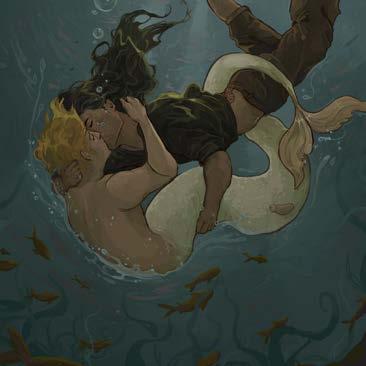
Digital illustration of the characters “Stede” and “Blackbeard” from Our Flag Means Death.
Note: @souopyy on Twitter, 8 May 2022
based on prior knowledge of the inner workings of fans’ imaginations and early fanworks to portray Stede as a mermaid.
This work was not only created before the announcement of season two in June of 2022 (Ashurst et al., 2023) but even before the particular episode depicting Stede as a mermaid aired. Fans would not have known about this event before the announcement of season two. An interesting point to account for is that of Tran Bui (2024), who notes that David Jenkins didn’t know how they started talking about turning Rhys Darby’s character into a mermaid, but all he knew was that “he (I) wanted to see Rhys Darby as a merman”.
While there may not be definitive proof that fans’ iteration of Stede becoming a mermaid led to D. Jenkins adding it to the original plot line of the show, I would argue otherwise with evidence from Johnston (2024) bringing to light how David Jenkins constantly interacts with fans on Twitter. This perpetuates the concept of the fanboy auteur and how D. Jenkins has insofar become a fanfiction writer himself.
Lastly, fans have become vessels for co-creation, engaging and participating through means of creating works of art, fanfiction, and other forms of expression. It is with this that I pose the argument that fans within the shipping community, concerning Our Flag Means Death on Twitter, have the power to alter the course of the relationship between canon and fanon works and what effects it has on how TV series and other forms of digital media that are being created. As fanworks spread on platforms like Twitter, the works can, according to Rheingold, become “a social aggregation that emerges from the internet when enough people carry on these public discussions long enough(...)” (as cited in Shcheblanova et al., 2016, as cited in Chugunov et al., 2016). These cultural expressions function not only as reproductions (digital or mechanical) (Stein as cited in Fathalle, 2017, pp. 24) but can in turn also circle back around to the producer of the original content (canon) and subsequently influence them (Romano, 2016). Another relevant theory is the “mothership” theory. The main story
is the “mothership” while the works of fans become the “secondary texts” (Scott as cited in Delwiche & Henderson, 2012, pp. 46). These secondary interpretations invariably bring consumers back to the mothership (Scott as cited in Delwiche & Henderson, 2012, pp. 46). In both cases, D. Jenkins is brought back to the original story of Stede Bonnet, while the fans of his show, through their fanworks, are brought back to the original story of Our Flag Means Death .
In summary, there is a clear fan influence on D. Jenkins’ work in Our Flag Means Death , particularly the example noted post-season two. This is where I want to argue that D. Jenkins has been influenced by his fans in producing content that caters to them because he too, as a fanboy auteur, is a fan who understands the desires of other fans. This is perpetuated by the notion that he too recontextualised and reinterpreted an existing text, and altered it to serve his own needs, in turn serving the needs of fans that share the same interests. Furthermore, the “mothership” theory underscored how fan creations serve as secondary interpretations that inevitably lead back to the original story, illustrating the symbiotic relationship between creators and their fan communities whether intended, or not. Through these discussions, I have illuminated the dynamic and reciprocal nature of fan engagement in shaping the contemporary media landscape. Shipping acted as a point of analysis to understand the significant role it plays in the distribution and reinterpretation of the text made by fans, with Twitter facilitating a platform for fans to share their cultural productions of art and fanfiction.
@souopyy. (2022). Characters “Stede” and “Blackbeard” from Our Flag Means Death [Digital Illustration]. Twitter. https://twitter.com/souopyy/status/1523332225323917312?s=12&t=ZOS HwYlf-Vaxm2sz-IUMhw.
Ashurst, S., Opie, D., & Cook, R. (2023, October 10). Our Flag Means Death season 2 potential release date, cast, plot and everything you need to know. Digital Spy. Retrieved March 20, 2024, from https://www.digitalspy.com/tv/ustv/a42442404/our-flag-means-deathseason-2-release-date/
Barthes, R. (1977). Roland Barthes: Image Music Text (1st ed., pp. 1-226). Fontana Pres. https:// monoskop.org/images/0/0a/Barthes_Roland_Image-Music-Text.pdf
Bui, H. T. (2024, February 21). “We got some beauty today.” behind our flag means death’s strange mermaid-themed reunion. Inverse. Retrieved March 20, 2024, from https://www. inverse.com/entertainment/our-flag-means-death-season-2-david-jenkins-interview
Delwiche, A., & Henderson, J. J. (Eds.). (2012). The Participatory Cultures Handbook (1st ed., pp. 3-289). Routledge. https://doi.org/10.4324/9780203117927
Fathalla, J. (2017). Fanfiction and the Author: How FanFic Changes Popular Cultural Texts (1st ed., pp. 1-17). Amsterdam University Press. https://doi.org/https://muse.jhu.edu/book/66603
Gray, J., Sandvoss, C., & Harrington, L. C. (2017). Fandom: Identities and communities in a mediated world (2nd ed.). New York University Press.
IMDB (2024). Our Flag Means Death: Plot. Retrieved March 21, 2024, from https://www.imdb. com/title/tt11000902/plotsummary/
Jenkins, D. (Writer), & Waititi, T. (Director). (2023, October 5). Impossible Birds (Season 2, Episode 1) [TV series episode]. In T. Waititi, D. Jenkins, & R. Darby (Executive Producers), Our Flag Means Death. HBO Max; Waititi Human Animals & Dive.
Jenkins, H. (2006). Convergence Culture: Where Old and New Media Collide (1st ed., pp. 1-318). New York University Press. https://doi.org/10.1177/0894439307306088
Johnston, D. (2023, October 26). OUR FLAG MEANS DEATH’S FIERCE FANDOM IS CHANGING THE WAY TV IS MADE. Retrieved February 21, 2024, from https://www.inverse. com/entertainment/flag-means-deaths-fandom-tv-collaboration
Lane, C. (2022, March 3). ‘Our Flag Means Death’ Creator David Jenkins on How ‘The Road Warrior’ and Rom-Coms Inspired the Pirate Comedy Series. Retrieved May 9, 2024, from https://collider.com/our-flag-means-death-creator-david-jenkins-interview-taika-waititi-rhysdarby/
Romano, A. (2016, June 7). Canon, fanon, shipping and more: A glossary of the tricky terminology that makes up fan culture. Vox. Retrieved March 21, 2024, from https://www.vox. com/2016/6/7/11858680/fandom-glossary-fanfiction-explained
Shcheblanova, V., Bogomiagkova, E., & Semchenko, T. (2016). The phenomenon of the virtual youth twitter-community in the discourses of sociological concepts and self-representations. In Chugunov, A. V., Kampis, G., Bolgov, R., Kabanov, Y., & Wimmer, M. (Eds.), Communications in computer and information science: digital transformation and global society: Selected papers from First International Conference in Russia 2016. (pp. 3-619). Springer. https://doi. org/10.1007/978-3-319-49700-6
Twitter (2024). Our approach to recommendations. Retrieved March 21, 2024, from https:// help.twitter.com/en/rules-and-policies/recommendations#:~:text=In%20addition%20to%20 showing%20content,are%20relevant%20to%20your%20interests.
© 2024 The Open Window