
Read about the Michelin gala winners and rising chefs in our special report on page 20

A LOCAL businessman is organising not one, but two, free parties for recovering addicts this Christmas and New Year.
For those in recovery, the holiday season can be tough. Many face loneliness, loss, and the temptation to slip back into old habits.
But this year, the Villa Paradiso Group is offering a lifeline with two free festive lunches on Christmas Day and New Year’s Day –and it’s not just about the food.
“It’s about community, connection, and staying clean,” according to the centre.
The rehab centre, famous for its ‘world-class’ recovery programmes, is rolling out the red carpet with a lavish buffet, Christmas lights and a relaxed atmosphere where guests can kick back without any pressure to drink.
The idea is simple – a safe, supportive environment where former addicts can celebrate the holidays without facing the isolation and temptation that so often come with the season.
“We want to make sure people aren’t alone at Christmas,” explained a spokesman.

“Christmas is a tough time for many, especially if they’ve lost their families or feel disconnected. Our goal is to give them somewhere to go, somewhere they can enjoy the day without feeling like they’re being
Continues on page 3


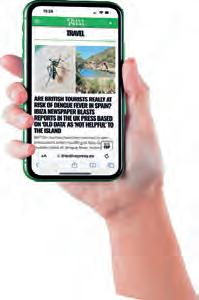
Phone scammers have been preying on fellow expats across Spain posing as police and bank officials, an Olive Press investigation has revealed
A BULGARIAN expat has told the Olive Press how phone scammers masquerading as police stole €10,000 from her in the run up to Black Friday.
Also posing as ‘Bank of Spain’ officials she was talked into moving the money after being told a relative was under an Interpol investigation and had illegally obtained power of attorney over her bank account.
The mother-of-two, based in Valencia, was advised to urgently transfer the funds to a ‘safe’ account linked to the Bank of Spain, or face being dragged into the fraud probe.
“They told me if I did not collaborate I might end up in jail,” Elena Petrova, 49, told the Olive Press.
Her ordeal started when she received a call from a woman who spoke to her in Bulgarian – though with a hint of an accent she identified as Russian.
Masquerading as a ‘chief detective’ with the National Police, the woman spoke slowly and was ‘very convincing’.
By Alessio Ghirlanda
A call from the alleged bank official soon followed, ratcheting up the pressure on her to wire the funds to a Swiss bank account.
Elena requested multiple times they speak in Spanish, but the fraudsters insisted that because Interpol was involved, all communication had to be conducted in Bulgarian.
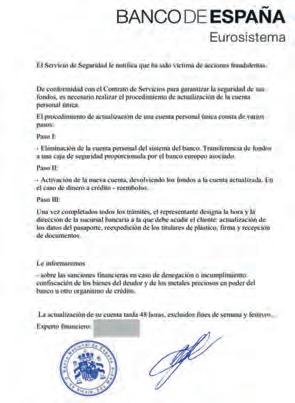
The scammers also sent the victim a photo of a Spanish police ID and a document bearing a Bank of Spain watermark (below) – both forged.
“It was terrifying,” Elena continued. “They basically kept threatening me until I gave up.”
After parting with the money and realising she had fallen victim to a scam, she reported the case to Valencia’s National police, who have now launched a probe into the matter. It soon emerged she is far from the only victim of the scammers, with at least three people losing €45,000 between them recently



Olive Press she is angry her bank, La Caixa, has done ‘absolutely nothing’ to help her. ‘Nor did they try to protect me’.
The bank she sent the money to, Swissquote, replied they were investigating the case – though Elena was never put through to the bank’s fraud specialists and could only speak to customer service.
calls and the texts appear to have been run through an AI translator. Cyber-crime in Spain has surged in recent years, reflecting a growing national security and public-safety challenge.
According to Spain’s Ministry of the Interior, more than 350,000 people were hit with cyber-crimes in 2023, with the bulk of these cases involving online scams, phishing, or fraudulent financial operations.



We understand the conmen have been targeting multiple Bulgarian and Russian nationals based in Spain. In each case they demand urgent transfers of several thousand euros to foreign bank accounts, with victims subjected to intense psychological pressure, including threats.
In one case, a scammer sent a victim a chilling message: “How are you going to look your children in the eye if you lose all your money?”
We have managed to uncover two similar cases in Cantabria, in which
€38,000, and the recent one in Valencia. Elena told the

Even more audaciously, a day after she made the transfer to the Swiss bank the fraudsters came back for more… this time via text, insisting she send more money.
Elena refused, insisting the bogus officials meet her in Valencia, hoping she could expose them.
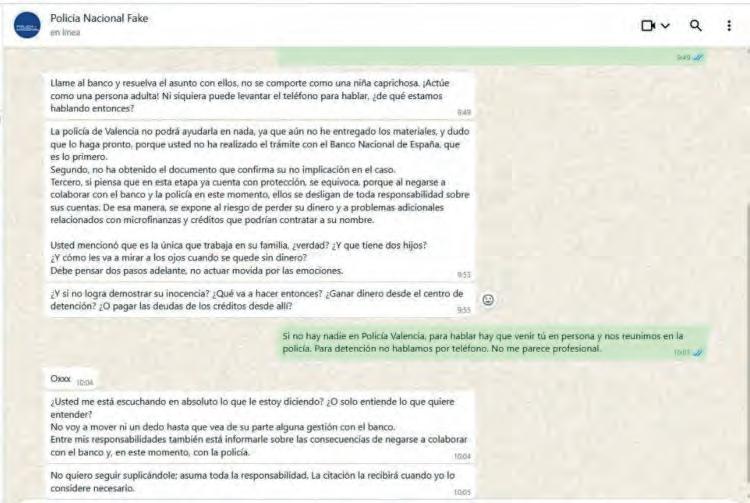
The scammers then threatened her, writing: “What if you cannot prove you are innocent? Make money while in jail? Are you going to pay off your debt from there?”
This time, the fake officer agreed to Elena’s request to communicate in Spanish, but he would never answer
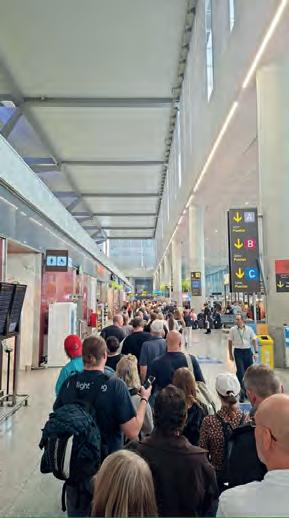
JUMP THE QUEUE: TIE holders should not use the EES lane
Prosecutions continue to lag behind –only about 14% of cyber-crime cases were solved in 2023, even though police arrested or investigated roughly 17,000 people that year.
National police have warned never to trust unknown callers who demand urgent transfers of money.
“When in doubt, always check your own bank first,” said a spokesman.
SPAIN’S Interior Ministry has finally clarified that British residents holding a TIE card MUST not use the new Entry Exit System queues when entering or leaving the country. It now advises that UK nationals are exempt from the torturous queues so long as they hold a valid residence document – such as a TIE.
Instead, they should go to a staffed passport booth and show both their passport and TIE card. It brings long-awaited clarity for tens of thousands of British residents after weeks of contradictory guidance from different authorities.
The Policia Nacional in Malaga had already settled on telling residents with a TIE to avoid the EES kiosks after weeks of officers seeming to have no clue as to what was the official line.
The guidance is especially timely with the Christmas season upon us, with the government warning that Brits with TIEs who mistakenly pass through the EES kiosks will end up being registered as tourists.
This could play havoc as they will be logged under the 90 day rule.
The result could be future flags for overstaying, delays at the border or the need to formally request deletion or correction of their EES record.
A MAN in Barcelona allegedly murdered his own mother by throwing her out of an apartment window. Friends blamed the authorities and said: “It was coming. We hoped it could have been resolved.”
THREE men aged from 18 to 20 have been arrested for luring a girl out of a Malaga disco and raping her in a car park. Two already had criminal records for similar crimes.
BRITISH pilot Aaron Rainbow, 50, who stabbed his Spanish lover Oscar Tornero, 38, to death during a drug-fuelled sex session near Barcelona, has been jailed for 20 years.
THE Bishop of Cadiz has resigned after allegations of sexually assaulting a minor near Madrid in the late 1990s – the first known time the new American pontiff, Leo XIV, has removed a bishop accused of abuse.
Bungled kidnapping exposes corruption plot within resort’s local police – and links to a mysterious foreign national
A FAILED kidnap attempt on a Chinese entrepreneur has exposed an astonishing corruption plot within the Marbella Policia Local.
The chaotic snatch took place at 4pm on a busy afternoon in Malaga, when the victim was apprehended as he had a haircut.
Several men stormed the barber shop, flashing police badges while another levelled a gun at his head. Others wore balaclavas, adding to the terror. Their plan was to drag the
By Walter Finch
wealthy businessman into a waiting car and demand a sizable ransom.
But they hadn’t bargained for the victim to fight back so strongly, refusing to be taken out of the door.
Despite raining punches on him, he refused to budge and the operation had to be abandoned, although they did run off with his bag stuffed with €4,000 in cash.
A VIOLENT neo-Nazi terror group banned across Europe has targeted Spain for expansion.
A three-man cell has been accused of spreading extremist propaganda on behalf of The Base, a white-supremacist network that operates from Russia.
The arrests were made in Castellon after investigators uncovered what they describe as Spain’s first ‘operational unit’, with the ringleader already jailed.
The group is active in the United States, where members have been jailed for attacking synagogues and defacing them under the name ‘Operation Kristallnacht’.
Police say the trio had fully embraced
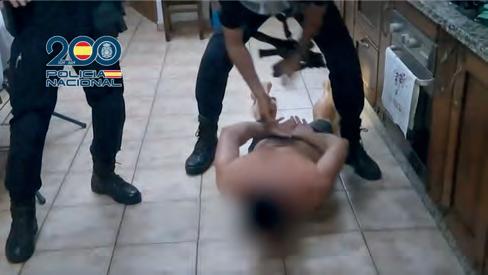
What happened next showed the ineptitude of the gang, as CCTV inside the salon captured clear images of their faces, helping investigators find the getaway vehicle and escape route.
the group’s ideology, carried out paramilitary-style training and openly discussed the possibility of violent ‘selective’ strikes.
When officers raided their base, they seized two guns, nine imitation weapons, ammunition and more than 20 knives.
The Base’s founder is an American extremist called Rinaldo Nazzaro, who has now fled to Russia, from where he spreads his racial hatred.
See Fascists Charter, page 6

AUDACIOUS gangsters ambushed police as they reclaimed a high-speed vessel abandoned on the beach.
The attack near Moguer, in Huelva, came as a Guardia Civil patrol tried to stop a tractor pulling a narco boat along a rural path.
As they approached the tractor a gang of masked men arrived hurling rocks from behind. Despite bringing in backup, the smugglers managed to escape into the nearby fields.
The incident happened after storms left eight narco-boats washed up on the nearby shoreline, most abandoned by their crews.
Policia Nacional detectives eventually traced the suspects to Marbella and arrested three men – among them a serving Policia Local officer and another, a former colleague. They later seized clothing that matched the attackers and then a car belonging to the third man, ‘a foreign national who spends long periods abroad’.
Inside the car were three pistols, police-style radio kits, handcuffs, GPS tracking devices, fake police identification plates, and more than 100 rounds of ammunition.
Described as a ‘false police intervention’, the gang aimed to terrorise the victim into handing over vast sums of money. The three men have been accused of unlawful detention, impersonating police and violent robbery and remanded in custody pending trial.
Given the high-value of the boats many gangs attempt to recover them, leading to Spain’s Anti-Drug Prosecutor, Ana Rosa Moran, to warn the Atlantic is now ‘scandalously full of narco boats and narco-submarines’.
She added the ‘massive oversupply’ of cocaine is fuelling fierce competition among heavily-armed international gangs.
It risks turning Spain into a ‘drug battleground’ akin to what has been seen in the Netherlands.
The escalating violence has led to the Professional Association of Civil Guards (AUGC), to claim its officers are being left ‘defenceless’ on the front line. The association warns that patrols lack guns and important night vision gear, while the gangs have highend equipment and military-grade weapons.
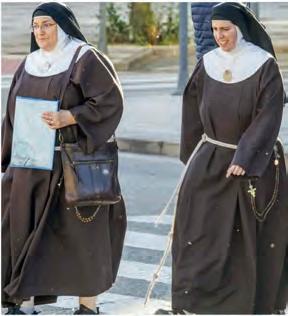
TWO former nuns have been arrested after priceless works of art from their rebel convent appeared on the antiques market.
Laura Garcia and Sor Paloma, ex-abbess of the Santa Maria de Bretonera convent in Burgos, were detained as part of a probe into the sale of rare artefacts.

The arrests are the latest twist in the saga of the ‘rebel nuns of Belorado’, excommunicated last year after breaking with the Catholic Church amid disputes over property sales and doctrine. Investigators accuse the pair of selling 17th-century sculptures, artwork and antique furnishings.
Alarm was raised when a carved statue of Saint Anthony surfaced in a specialist shop, triggering Operation Mirum-Cid. Raids followed at convent sites, and an antiques dealer was also detained. All three have been released pending further investigation.


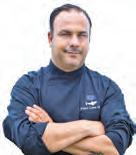
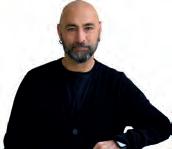
BEING a Richard Gere lookalike might sound glamorous – the Pretty Woman star was once crowned ‘Sexiest Man Alive’, after all – but one unsuspecting Spaniard has learned it also has its pitfalls.
Crowds gathered outside Murcia’s Virgen de la Arrixaca hospital on Friday, eagerly awaiting the Hollywood legend, who was in town to open a paediatric gym for children with cancer and later switch on the city’s Christmas lights. So when a silver-haired man strolled through the doors (pictured, top left), nurses and patients pounced, phones at the ready.
The only problem? He wasn’t Richard Gere (pictured top right)– just a very startled lookalike wondering why everyone wanted a selfie with him.
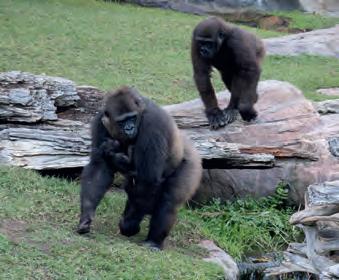
ZOO visitors witnessed an early Christmas miracle when a gorilla gave birth before their very eyes.
This heartwarming arrival marks a major milestone for Bioparc Fuengirola: it’s the first gorilla born in Spain in 2025 and only the second in all of Europe this year. With the western lowland gorilla classified as ‘critically endangered’ every birth is a massive win for the conservation programme. The mother, Wefa, gave
By Dilip Kuner
birth to a baby girl, and far from seeking privacy, delivered her little one in the open air enclosure she calls home, with visitors witnessing every moment.
Staff at the conservation centre say the whole process was fast and completely natural, without any human intervention, proving Wefa’s good health.
From the moment the baby
judged or pressured.”
was born, Wefa showed impeccable maternal instincts, cradling her newborn and caring for it with total devotion.
The other gorillas, known for their complex social dynamics, have responded with gentle curiosity and respect.

Pataky stole the show at the Glamour Women of the Year 2025 awards, taking home the Icono de Fortaleza, Vitalidad y Bienestar (Icon of Strength, Vitality and Wellbeing) prize.
The gala in Madrid celebrated Spain’s most inspiring women, and Pataky – known for her film career and marriage to actor Chris Hemsworth – was one of the evening’s standout stars. She dazzled on the red carpet in a sleek gown, thanking Glamour España for recognising her work promoting health, fitness and female empowerment.

The lunches are part of Villa Paradiso’s Relapse Prevention Programme, designed to help recovering addicts stay on the straight and narrow.
The centre is also running a special 10-day course for people who’ve kicked their addiction – and, for the first time, they can bring a loved one along.
Villa Paradiso has been voted ‘Best Rehab in Europe’, offering a luxury setting with eight private apartments, a team of expert chefs, in-house psychologists, and a whole lot of TLC.
A fleet of minibuses will be picking up guests along the Costa del Sol to ensure no one has to miss out on the fun. And while the event is free, a local liver charity will benefit from any voluntary donations.
“Addiction recovery doesn’t end after rehab,” explains the spokesman. “It’s about building a new life, and that includes the people around you.
“Our aim is to give people the confidence to stay clean and feel supported, not just during treatment, but long after.”
Make sure you call +34 689 80 67 69 by December 19 to let them know they are coming so the Villa’s team of chefs know how many to cook for.




GIBRALTAR could lose up to a third of its revenue and hundreds of jobs after the UK doubled taxes on online gaming.
It comes after the UK budget raised duties on remote gambling from 21% to 40% from next April. While it will raise an extra £1.1 billion a year for the UK treasury by 2029 it will inflict losses of up to £160 million on the Rock, the regional government estimates.
Finance Minister Nigel Feetham said the UK’s decision was ‘challenging’ and ‘not a good outcome’ for the Rock, which supports 3,400 jobs in gaming.
The minister declined to estimate how much Gibraltar could lose in public revenue, and described the impact on Gibraltar as ‘essentially a transfer of wealth from Gibraltar to the UK’.
A third of the enclave’s GDP is estimated to come from the gaming sector.
The Rock’s largest employer Entain, the owner of Ladbrokes and Coral, said it was ‘deeply appalled’ by the scale of the rise and expects underlying profit to fall by £100 million next year.
The Chancellor Rachel Reeves insisted the move was justified as online gambling was linked to the ‘highest levels of harm’.
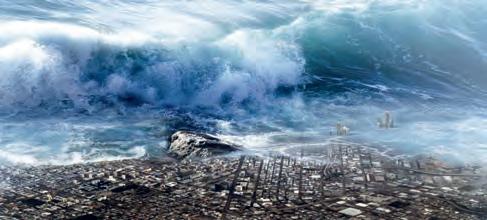
Huge tsunami drill in Cadiz as thousands rehearse for disaster being told to ‘get to the third floor!’
HUNDREDS of thousands of people received an emergency alert as Andalucia played host to the largest tsunami drill ever carried out in Spain.
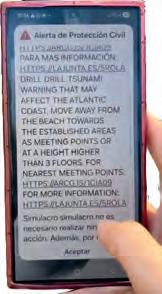
The warning went out at 10.14am to all mobile phones on the Cadiz coastline, mimicking what would happen if a deadly wave was really about to strike.
The rehearsal told people to move away from the beach towards meeting points or buildings ‘at a height higher than three floors’.
By Walter Finch
It was based on the tsunami and earthquake that flattened Lisbon in 1755, killing an estimated 50,000 people.
Some 20,000 people participated in the drill including emergency services personnel, students, hospitality staff and the general public.
In Cadiz centre people were sent to buildings with a safe height in a ‘vertical evacuation’.
On the beachfront at Playa de
Maria del Mar,
cy services practiced rescuing bathers or surfers caught in the water with medical personnel stretchering volunteers off the sand.
At the Museo de Cadiz, tests
ELECTRIC scooter riders will need insurance from January amid a surge of deadly incidents - including the recent death of a 49-year-old man in Sevilla.
The new laws come in after a sharp rise in accidents, including the Sevilla man, who died after a collision at night with an e-scooter illegally carrying two teenagers. According to a study conducted by RACC Mobility Club in Barcelona, one in four e-scooter drivers do not respect rules of the road, such as traffic lights or zebra crossings. In 2024, 13 people were killed in traffic accidents in Spain involving e-scooters. There were a total of 396 incidents leaving over 102 people with serious injuries. Some 65% of accidents involved collisions
with other vehicles, 22% were falls and 10% involved pedestrians.
The whole country will now join a handful of cities, including Alicante, Benidorm and Cordoba, that have required such insurance. The policies cost around €100 and will cover riders for at least €6.4 million per accident for personal injury and €1.3 million for material damage. Under the new rules, e-scooters weighing less than 25 kilos must also have their speed capped at 25km/h, while heavier PVLs will be limited to just 14km/h.
Riders must be 16 years or older - with those under 18 requiring parental permissionand will be required to wear a helmet, or face fines of up to €200.









were conducted to see whether assets of cultural heritage could be protected if a major tsunami rolled in.
In the event of a real tsunami, the public are urged to avoid lifts and cars and help anyone struggling, and keep a battery-powered radio handy.
One thing they should never do is lean out of windows to see what is happening, and avoid calling 112.
A major quake off Portugal’s Atlantic shelf could generate massive waves hitting parts of the Andalucian coast in under an hour.
Gibraltar and La Linea would be in particular danger, while large parts of the Costa del Sol would also be affected with waves of up to three metres.
Marbella enacted its own tsunami evacuation plan this year, creating 69 specific meeting points.


THE Spanish government has ‘handed over the keys of the housing market to squatters’ claims the PP opposition. Senate spokeswoman Alicia Garcia, claims squatting has increased by almost 55% since Pedro Sanchez came to power. “Some 45 homes are occupied every day and 45 families are left unprotected,” she said. “Spain needs security, justice and respect and a home is not booty, it is a home, and a home must always be protected.”
The PP is trying to push through a new law that would give homeowners the legal right to cut off essential supplies such as water and electricity if their property is occupied.
The proposal has passed through the senate and will now head to congress after a period of debate by the lower chamber’s housing committee. In 2024, there were 16,426 reported cases of squatting across Spain, an increase of over 7% from 2023 and the third-highest figure since records began. Catalunya is the most affected region, accounting for 7,009 cases - over 5,000 of which were in Barcelona, representing over 30% of cases nationwide.







PLANS for Spain’s €5 billion Mediterranean Corridor rail network have been unveiled - but Andalucia is glaringly absent.
Transport Minister Oscar Puente confirmed works are already underway, with €2.6 billion spent since 2023 and another €1.3 billion spent this year.
Total investment since 2018 stands at €5.4 billion, much of it EU-funded, aimed at linking Mediterranean ports with the rest of Europe.
Murcia is a clear winner, with a 200km high-speed line under construction to Almeria. Alicante, Valencia, Castellon and Tarragona also see upgrades.
But Malaga, the Costa del Sol, and large stretches of Andalucia’s coast have been left off the map entirely.
Heartbreak for owner as animals slay his pregnant horse on Costa del Sol finca
A HEARTBROKEN Costa del Sol resident has urged authorities to act after his pregnant horse was mauled to death by a pack of wild boars.
Francisco Tineo, owner of the Guadalobonan breeding centre in Estepona, claims his mare died after being attacked - one
By Ben Pawlowski
of many recent incidents as the boars venture closer to urban areas and target pets.
“The boars have eaten all the cats we have around here, but until now they had not attacked
THE use of Russian in Marbella is plummeting, despite the group forming one of the largest expat communities. The fall in the language is believed to be due to the war against Ukraine, which began in 2022.
“Since the Ukrainian war, Russian is not viewed well and therefore its use has declined but the Russian population has not fallen,” explains Professor Jose Pozo, who has published a thesis of his work at the University of Malaga. Russian is still the sixth most used language in Marbella, behind Spanish, English, French, German and Italian, added Pozo.
the horses,” Tineo told Cadena SER.
The attack has even left Tineo and his family feeling scared about leaving their finca at night.
“They are out there right by the back door of the house, and we are already afraid to go out,” he said.
“If they have dared to attack a mare, then it is already very serious.”
Tineo has also appealed to local hunters to step in, but a nearby reed bed makes it hard for experts to capture the boars as ‘they take refuge there and cannot be killed unless they come out into the open’.
He says local officials must do more to hold back the invasion: “Measures must be taken because they are increasingly being seen in residential areas around Selwo and Seghers. “Any day now, they are going
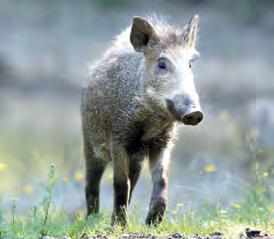
to attack someone badly,” he added.
His appeal has been taken up by local PSOE leader, Emma Molina, who has agreed to bring up the issue at the town’s next full plenary session.
She will insist that Estepona council, alongside the Junta, implement an urgent action plan to cull the boars.
Bosses
Wild boar numbers have risen by an estimated 500% in the last decade in Malaga - causing road accidents and fuelling many complaints from farmers and golf course bosses.
Animal rights activists say this is because their natural habitats are increasingly being built and encroached upon by developers.
There are an estimated 22,000 wild boars in the province, with over 1.5 million across Spain.





Voted top expat paper in Spain
A campaigning, community newspaper, the Olive Press represents the huge expatriate community in Spain with an estimated readership, including the websites, of more than two million people a month.
THE sophisticated phone scam, uncovered by the Olive Press, serves as a stark warning to Spain's expatriate community.
Impersonating police and bank officials, fraudsters are preying on the most vulnerable, exploiting language barriers and psychological pressure to siphon off tens of thousands of euros.
The ordeal of Elena Petrova, a Valencian mother-of-two who lost €10,000, highlights the audacious methods used.
She was threatened with jail and told a relative was under Interpol investigation, a terrifying scenario that led her to transfer funds to a supposed 'safe' account. The scammers' insistence on communicating in Bulgarian - even while forging Spanish ID documents - demonstrates a tailored, calculated attack aimed squarely at Eastern European nationals.
This isn't an isolated incident; at least three victims have lost €45,000, with similar reports emerging across Europe, suggesting an organised, international operation. Beyond the immediate damage, this case exposes systemic failings. Elena's own bank, La Caixa, did ‘absolutely nothing’ to protect her, leaving the victim to fight alone for a refund from a foreign bank.
There will be some people out there victim blaming Elena - and the others - saying they should have been more careful.
But remember, these scammers are highly plausible and know which bells to ring to get their hands on your money.
And given that cyber-crime surged in Spain with over 350,000 victims in 2023, the low 14% clearance rate by police is deeply concerning.
It is time for Spanish banks and law enforcement to urgently improve their fraud response and protection measures for all clients, especially expats who may be unfamiliar with Spanish protocols.
As the police advise, never trust a caller demanding urgent transfers.
When in doubt, hang up and verify with your bank in person - and talk to police as well.
PUBLISHER / EDITOR
Jon Clarke, jon@theolivepress.es


Dilip Kuner dilip@theolivepress.es Walter Finch walter@theolivepress.es
Alessio Ghirlanda alessio@theolivepress.es
Ben Pawlowski ben@theolivepress.es
Rachel Gore rachel@theolivepress.es
ADMIN Victoria Humenyuk Makarova (+34) 951 154 841 admin@theolivepress.es
As Spain’s Far Right marks half a century since dictator Franco’s death, the Olive Press reveals a still more sinister force calling for a second reconquest to eject Muslims out of Europe
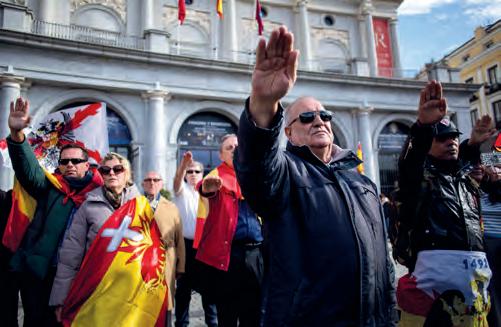
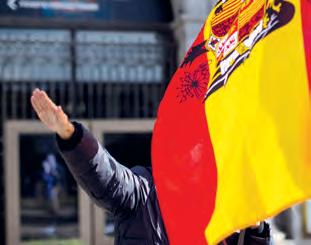
IT was a weekend in Madrid when seemingly every nationalist, right-wing Vox supporter was out in the streets, singing the praises of the former Spanish dictator, Francisco Franco.
Remembering the death of ‘el Caudillo’ exactly 50 years ago to the day, they queued up to laud his many achievements, and how Spain was so much better off when the firm hands of their hero had shaped their country. Mass bloodshed or not.
But as the many visible Francoist demonstrators roiled through the streets of the capital, arms raised and carrying Spanish flags, a group of far shadier men filed quietly into a conference room in the city centre.
By Alessio Ghirlanda

One of them, dressed in a grey suit and dazzling white shirt, beamed as the doorman greeted him with a murmured ‘comrade’ before waving him through.
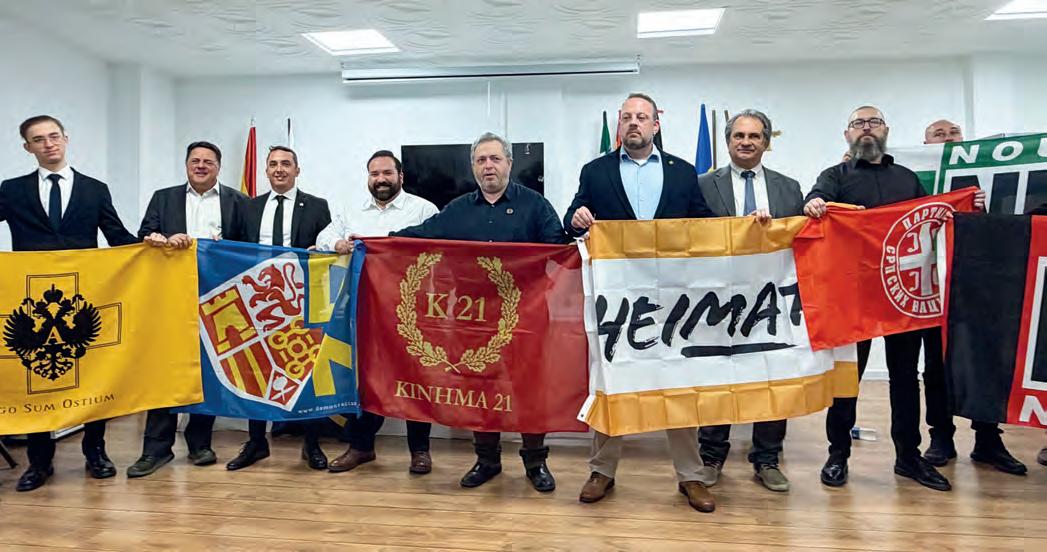
He had come to co-chair a rally hosted by the so-called Alliance for Peace and Freedom (AFP) – a coalition of pro-Putin European nationalists whose manifesto calls for the mass deportation of immigrants, the eradication of what it describes as a ‘globalist-Zionist world order’, and the dismantling of the EU.
That man was Britain’s Nick Griffin, the con-
troversial politician who led the British National Party (BNP) until 2014 – and the AFP’s current vice president. Griffin has (understandably, as we shall see) been on the sidelines of British politics for more than a decade now. But since his AFP appointment in 2018, he has made repeated calls for the forced repatriation of millions of immigrants across Europe - a process he described as ‘remigration’.
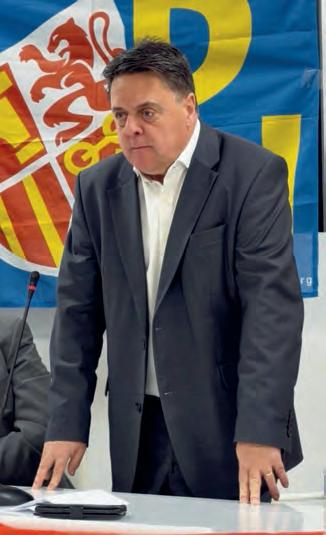
“We face a Europe where there is a very serious problem with Islamisation as well as mass immigration,” Griffin told the Olive Press during the meeting at Espacio Ardemans. Without any evidence he said: “All our various elites now admit that within 20 or 30 years, we will be minorities in our own countries. A lot of nationalists [believe that] once you are a minority, it is all over.
“But Spain proves when you are a minority, it is not all over. You might take 800 years to take your country back, but it can be done.” It was an extraordinary
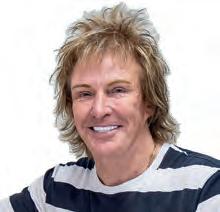
RACHEL REEVES’ ‘CAR-WRECK’ BUDGET SENDS A CLEAR MESSAGE TO YOUNG FAMILIES AND SKILLED WORKERS: THE UK IS FINISHED, WRITES CHARLIE MULLINS

Alex Trelinski alex@theolivepress.es
Joshua Parfitt josh@theolivepress.es


OFFICE MANAGER
Estefania Marquez (+34) 658 750 424 accounts@ theolivepress.es DISTRIBUTION ENQUIRIES (+34) 951 154 841 distribution@ theolivepress.es
NEWSDESK: 0034 951 154 841
For all sales and advertising enquiries please contact +34 951 15 48 41
Deposito Legal MA: 834-2017



2016 - 2020


Trainee news journalist
Hunt Communication


WHEN I first became an Olive Press columnist, editor Jon warned me that his paper was all about Spain and the lives and interests of its readers who are predominately expats in this sunny paradise, and who have the English language in common.
His point was that if I was going to keep this gig UK politics was not a subject he would tolerate me banging on about.
Fair enough! I think I’ve managed to follow the rules most of the timesomething that doesn’t come naturally to me.
So, imagine my surprise when the same said editor in chief collared me on the street in Puerto Banus with a request to leave no stone unturned (or catapulted at) UK Chancellor Rachel Reeves’ complete car-wreck of a budget.
online an hour before his big unveil. Once again showing what a shower UK’s Labour Government is.
Richard Hughes, the OBR boss who took responsibility for the leak, resigned, but there was no such honourable act at Number 11, the headquarters of the Office for Budget Irresponsibility.
And it gets worse.
Reeves wants us to believe that every worker will be £1,800 better off
A financial plan so poorly conceived by the time she stood up in the Commons to deliver her master plan for the nation her jalopy of a financial plan had already run off the road and plunged over a cliff.
The poor bloke in charge of the Office for Budget Responsibility (OBR) has been forced to walk the plank after Reeves’ vampire-budget was ‘leaked’
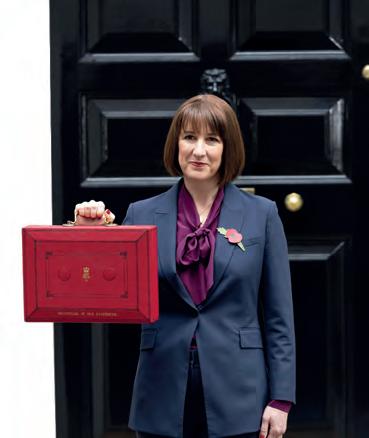
Not only was ‘Rachel from Ac counts’s’ budget the least growth-inspired in living memory, but she clear ly lied to the UK people about how bad things were in a half-arsed at tempt to justify billions of quid in tax rises to pay for her spending plan. Talk about a brass neck; Reeves wants us to believe that every worker will be £1,800 better off because of all the money being shovelled into public services.
If you ask me, most NHS patients waiting months and years for treatment, or victims of crime facing similar stretches for a chance at justice, will be lucky to get a pothole fixed on their street.
The fact is the bilge that came out of parliament last week was bad for business, bad for workers, bad for
pensioners, bad for drivers, patients, and victims of crime.
The only people the budget was good for were those considering exiting the UK for a more prosperous life abroad. Much has been said about people like me, who have chucked in the towel on the UK and settled in warmer climes, but what this budget did was send a very clear message to young families, single professionals and skilled workers like plumbers, electricians and builders, that the UK is no longer a country of aspiration, of hope and the dream of working hard to make a better life for you and your family. It’s finished!
quote, and an outlandish claim, reaching back to the dark Middle Ages of European history. Griffin was harking back to what historians call the Spanish ‘Reconquista’ – a centuries-long series of military campaigns in which the peninsula’s Christian kingdoms conquered Muslim-ruled territories, culminating in the fall of Granada in 1492.
The far-right veteran hopes Spain’s history may serve as a ‘powerful’ inspiration for the AFPat a time when its members believe European countries are being ‘invaded’ by immigrants.
Co-hosted by Spanish nationalist party Democracia Nacional, the rally brought together members of extreme-right factions from across Europe – and even a representative of the ‘Russian Brotherhood of Academics’, a student organisation advocating military involvement for Russian youth.
Speakers at the summit included Pierre Marie Bonneau of France’s Les Nationalistes, Claus Cremer of Germany’s Heimat, Gloria Calarelli of Italy’s Forza Nuova, and Pedro Chaparro of Democracia Nacional.
Many of them accused Europe’s best-known far-right parties – including Spain’s Vox – of being too soft on immigration, with AFP president Roberto Fiore slamming Italy’s PM Giorgia Meloni, leader of far-right Fratelli d’Italia, over last year’s increase in immigrant arrivals.
Griffin echoed his peers, branding Europe’s rising right-wing groups ‘useless populists’ - and added they would rather keep immigrants as cheap labour than rid their countries of ‘undesired’ foreign residents.
“Populists may send home a few criminals, a few Islamists, but never the non-white masses,” he told an audience of more than 40. Griffin has never been far from controversy since he joined the BNP in the mid 1990s and rose to its leadership in 1999.
In 2009, he won one of the party’s two seats in the European Parliament before the movement collapsed amid infighting and financial ruin.
His tenure was overshadowed by controversy when, in 1998, he was convicted of distributing material likely to incite racial hatred after he published a pamphlet that questioned key aspects of the Holocaust.
He then faced fresh charges in 2006 when he said Asian Muslims were turning Britain into a ‘multiracial hell-hole,’ and claimed that some Muslim men were ‘seducing and raping white girls … because their ‘good book’ tells them they can take any woman they want as long as she is not Muslim’.
Today, his return to the political scene as AFP’s vice president has been marked by renewed calls for the mass deportation of non-white residents of Europe.
“As nationalists, we want our people to be free and sovereign in our country - and we want all peoples to be free and sovereign in their own countries,” Griffin said.
Griffin is not alone in his aims. The young representative of the Russian Brotherhood – a gaunt blond who went only by ‘Michael’ – drew applause when he offered a chilling summary of what the Madrid summit was all about.
“Our job is to push public opinion as far right as possible, normalising the idea of forced deportations and the complete cessation of immigration,” Michael said, making sure to keep his surname under wraps throughout the entire
meeting.
Michael’s alarming ideas reflect a worldview rooted in conspiracy – which several AFP members, including Griffin, appear to share.
During the summit, Fiore made repeated references to a ‘deep state’ which, he claims, is using far-reaching covert operations to pursue the interests of a globalist-Zionist elite.
The theory, embraced by both Fiore and Griffin, rests on the belief that a powerful cohort of ‘capitalists, globalists and Zionists’ benefits from sowing discord among world nations –leveraging the resulting chaos for its own profit.
Griffin, in particular, showed his anti-semitic tendencies, saying that Zionist jews have weaponised immigration to create a rift among European nations.
world war by conspiring to pit Russia against Ukraine.
The AFP’s alignment with Russia became clear last month, when members attended a St. Petersburg rally of ultra-nationalists hosted by Kremlin-linked oligarch Konstantin Malofeev, a key sponsor of the Russian Brotherhood.
The Alliance’s shoulder-rubbing with Russia comes at a moment when international relations appear unsettlingly close to the breaking point.
‘Zionist jews have weaponised immigration to create a rift’
“If you really look at the origins and promotion of mass immigration, time and time again you will find [that] Zionists and Christian-Judaic elements are largely responsible for that immigration.
“Immigration is the weapon against us,” he rather implausibly added, so he could somehow rant against jews and muslims at the same time.
Several AFP members also believe the secretive global order is attempting to provoke a third
AFP members currently hold no European Parliament seats –but Fiore insisted the movement is ‘growing in the streets of Europe’, and called for an alliance between ‘militant revolutionaries’ and the populace.
This might just be what disgraced Griffin needs if he is to rise again to rival fellow far right rabble rouser Tommy Robinson.
Once sidelined by scandal, he now leverages decades of experience to serve as strategist and symbol for the pan-European far-right AFP.
He concluded his speech by calling out ‘arriba España, arriba Europa’ – a nod to a popular Francoist slogan loosely translated as ‘Spain and Europe above all.’
He was met with cheers and applause, but only time will tell if anyone will really listen.
By
FIFTY years after Francisco Franco’s death, Spain’s long-gone dictator’s tarnished reputation is being white-washed.
Support for the man who ruled from 1939 to 1975 is surging alongside the rise of the farright Vox party - and the numbers are stark.
A recent CIS poll shows 21.3% of Spaniards now think Franco’s rule was ‘good’ or ‘very good’, including nearly one in five 18–24-year-olds. Even more alarming: almost one in four Gen Z Spaniards say an authoritarian system might be preferable to democracy.
And only six in 10 people correctly identify that poet Federico Garcia Lorca was murdered in Granada by Francoist forces - a stunning lapse in historical memory.
Into this fog steps acclaimed British historian Giles Tremlett, whose new book El Generalísimo: Franco pulls no punches. He paints Franco as a ‘short, squeaky-voiced army officer’ who proves that ‘outward mediocrity is no barrier to the ruthlessly ambitious’.

The Olive Press Podcast comes roaring back with a vengeance: Police violence in Portugal, police negligence in Almeria, and police assistance in tsunami drills in Cadiz
EPISODE 10 of the Olive Press’ flagship podcast The Rest is Spain, has just come out.
The 30 minute show featuring Editor Jon Clarke, Digital Editor Walter Finch and host Caroline Lips get their teeth into a string of hot expat topics of the moment.
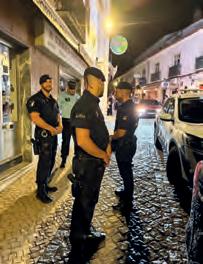
Under the microscope this episode are the actions of two separate regional police forces, one in Portugal (pictured bottom right) and one in Almeria. Jon recounts the tale of a well known British lawyer who got attacked by police after he went to report how he had been beaten up by bouncers. Without rhyme or reason they dragged him down an alleyway and beat him up. Shocking.

Next we discussed how the Guardia Civil in Almeria closed an investigation into the very suspicious death of a Brit living in Mojacar.
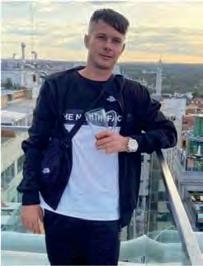
Brett Dryden (pictured bottom left), who ran a cannabis club, was tragically killed two summers ago in what has all the hallmarks – literally all of them – of a violent robbery.
The police did not investigate properly, much to the distress of the family, and finally closed the case with many leads still unexplored.
And finally, we have the strange occurrence of tsunami drills in Cadiz – something which saw everyone on the coastal region - including Walt - receive an alert to their phone with instructions to get to the third floor! (pictured bottom middle).
Compelling stuff, and instructions that may even save lives if another mega earthquake strikes the coast of Portugal as it did in 1755 – catastrophically destroying Lisbon. This was our 10th episode and it has been a rollercoaster ride.
Episode 9 remains unreleased and it will probably be consigned to the podcast dustbin after technical gremlins ruined the audio feed on one of the team members.



It’s a shame but we live and learn, streamlining the product, growing in confidence and getting better every time!
The next one should be out this weekend, with an exciting ‘Costa del Crime Mafia Special’ scheduled for later in the month.
Franco’s coup against Spain’s elected Republican government - fuelled by paranoia about a supposed ‘Marxist-Jewish-masonic plot’ - unleashed a civil war that killed more than half a million. Victory brought no mercy: he ordered 20,000 executions and stripped millions, especially women, of basic rights over their bodies, children, work and property.
His disastrous economic autarky pushed the country towards famine, while Franco basked in what the British ambassador called a ‘heavy mist of self-complacency’. Later tourism-fuelled growth has helped whitewash the era, Tremlett warns. “Ignorance is dangerous,” he writes. “The only way to change this is to break the silence and teach young Spaniards what Francoism really was.”

ANEW model aimed at rejuvenating forests and preventing fires through better care of local landscapes has launched in Spain.
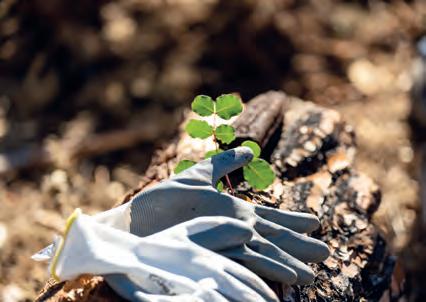
WWF’s Rural Labscape initiative is restoring abandoned areas in Vall de Almonacid to create resilient spaces suited to Mediterranean conditions.
Wildfires across Spain have ‘profound-
By Rachel Gore

ly transformed’ the landscape – areas once filled with long grass, healthy olive groves and tall trees are now dominated by ‘dense and homogenous forest masses that reduce biodiversity and increase future fire risks’, says
who heads the forest programme at WWF Espana. Rural areas have long been neglected, meaning that as they age, wildlife and plant species decline and cultural and natural heritage is lost. Vall de Almonacid in Castellon province in Valencia, was one such abandoned area.

Once a thriving outdoor space, it had become a risk to both wildlife and residents. That was until Rural Labscape intervened.
Combining citizen participation with new economic opportunities and ecological restoration, the initiative aims to support Mediterranean territories facing crop abandonment, fire risk and the decline of traditional land use.
Crucially, the project looks at the wider landscape rather than isolated plots, because, as Colomina notes, ‘environmental, social and economic problems cannot be resolved by acting only in isolated areas’.
Restoring entire landscapes creates blended mosaics that boost biodiversity and increase a terrain’s natural fire resistance. This integrated approach also ‘allows natural spaces to connect with agricultural areas’, reactivating traditional activities and creating new local opportunities.
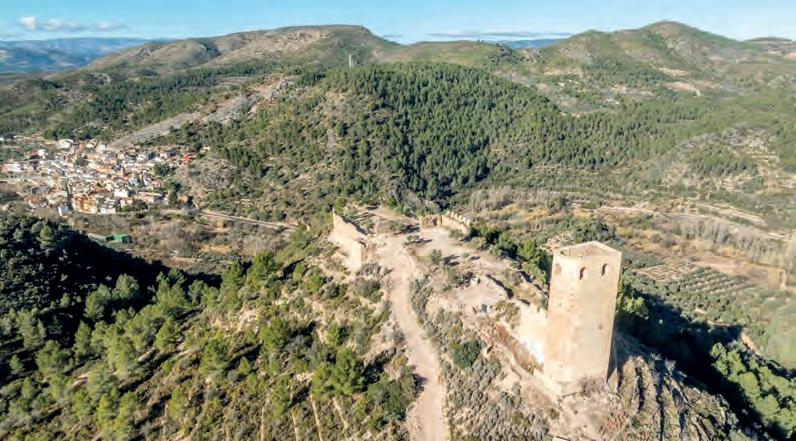
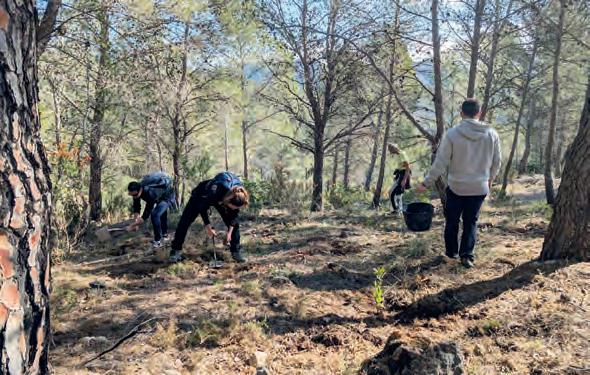
Chosen because it typifies vulnerable Mediterranean rural areas at risk of fire and degradation, Vall de Almonacid has become the first location to undergo this transformation. The initiative has seen the area cleared of debris and restored into a space where multiple species can thrive. Lavandin, lemon balm and stevia were among the plants introduced – all hardy, low-water species well suited to Mediterranean climates and compatible with local biodiversity.
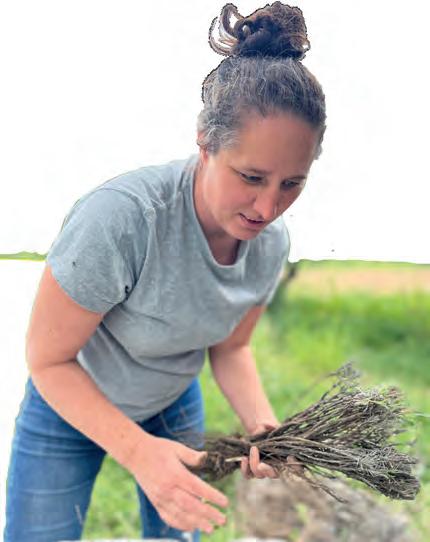
ed ideas and hands-on work. While participation is already strong, the team stresses that ‘the transformation of the landscape will only be sustainable if it also transforms the way people relate to it’.
The team itself is diverse –40% of the 38 participants are women
A botanical garden, designed with the Escuela Taller de Jardineria in the municipality, has transformed another section of the landscape. The high-value species planted here are expected to create new bioeconomic opportunities. The garden not only shows how a thriving rural landscape can boost a local economy, but also how Rural Labscape actively involves the community. “The local community is the heart of this project and is present in all phases,” Colomina told the Olive Press, praising residents who have contribut-
A ‘very large educational programme’ now connects the Living Lab with students from universities and schools. More than 500 students have taken part, helping forge a connection between young people and their environment.
The team itself is diverse – 40% of the 38 participants are women. Applicants were selected through ‘a social media process’, with an interdisciplinary team ensuring ‘the lab represents all voices linked to the theme in the municipality’.
Local authorities have supported the project by offering space for the lab and taking part in decision-making, helping build a model that can be replicated across the Mediterranean. Through this project, WWF has helped Vall de Almonacid recover its ecological structure and function, making it more resilient in the face of climate change.
A Banco de Tierras or landbank now exists for anyone interested in cultivating or restoring abandoned land. This means people who want to help can be directed to areas where they can be the most help.
Colomina stresses that ‘any person can get involved’, whether through volunteering or proposing new initiatives in the collaborative space.
To learn more about the project or get involved, visit www.rurallabscape.com


What thread connects the Spanish theatre of the 17th century, Wolfgang Amadeus Mozart, and the modern bullring? Michael Coy tells us
LET’S start with the bullring. If you ever visit one, you’ll notice that the fence keeping the bull away from the audience (not always successfully!) is punctuated by four open gateways. So far, so good – the toreros have to get into the ring, after all. But you’ll soon spot the wooden barrier shielding each entrance.

This is the burlador’, or deceiver. It serves
two related purposes. First, it stops the bull escaping, as the animal’s eyesight can’t distinguish the burlador as a separate barrier – it sees just one continuous fence.
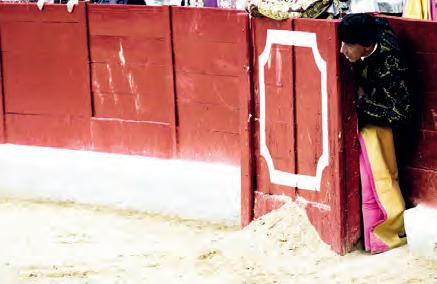
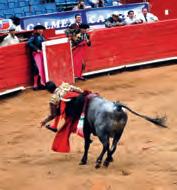
Secondly, it’s a refuge for the matador’s assistants, who can scurry behind it to relative safety when the bull charges.
Many people learn at school about Shakespeare and the Elizabethan theatre. Spain has a similar tradition, which blossomed in the Siglo de Oro, roughly 1520–1620.
The Official Distributor of Sunflex Glass Curtains
Enhance your property with a superior system
We sometimes refer to groups of actors as strolling players.
In both England and Spain, troupes wandered from town to town, putting on shows wherever they could earn a few coins. Naturally, they gravitated towards local fairs and other busy gatherings. One of their favourite venues was
the coaching inn. Think about it – with robbers and outlaws in the countryside, and horses that quickly tired of pulling carriages, travellers had to overnight somewhere safe.
Inns needed a courtyard wide enough to accommodate the carriage, with galleries of bedrooms running around the central yard.
Actors loved this format. As soon as the horses and carriage were stabled, the troupe staged its latest drama. Guests could watch from their balconies and toss money at the end.
Plays were usually moral sermons. The good were rewarded, the baddies punished.
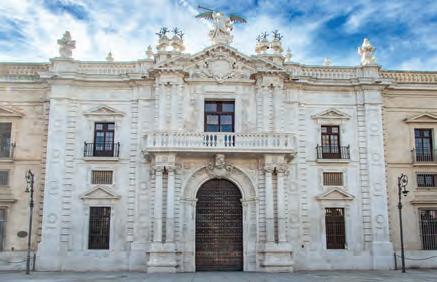
One of Europe’s most successful ever was El Burlador de Sevilla, The Deceiver of Seville.
If you ever see a production of Shakespeare’s Hamlet, you’ll note how visiting actors are pressed into service by the hero. The Deceiver of Seville dates from 1616 – almost the same date as Hamlet Don Juan Tenorio is a philanderer, a relentless skirt-chaser. He pursues women
all over the city. He is the Deceiver of Seville.
One night, during an assignation, he finds himself in a graveyard. A nearby tomb – or rather its stone statue – comes to life. The spectre warns him: “Don Juan, you are a sinner. Come back to see me next week. If you haven’t mended your ways, I will drag you to hell.” Suffice to say, Don Juan doesn’t improve, and the drama ends in a morally appropriate climax.
The womaniser, and the city of loose morals that shelters him, both end up condemned to the flames.
Tirso died in 1648, enjoying three decades of satisfaction knowing his play was a runaway success.
Desperate for a hit, Mozart decided to set
We know little about the author. His name was Tirso de Molina, and he was a monk.
If it seems odd that a monk spent his time writing for the theatre, remember that in the 1600s the Church was the only route open to anyone bookish or inclined towards the arts.





In 1787, Wolfgang Amadeus Mozart was 31 and in a creative trough. (Incidentally, ‘Amadeus’ doesn’t mean ‘loved by God’: it’s the opposite – ‘God-lover’, a latinisation of the German name ‘Gottlieb’.) Three years earlier he had been sacked by the Austrian emperor, and was now scratching a living in Prague. Today Prague is the capital of the Czech Republic, but back then it was the Austrian Empire’s second city. Desperate for a hit to revive his fortunes, Mozart decided to set The Deceiver of Seville to music. He finished writing it the day before opening night. It was an instant triumph. Yet, nationalism being what it is, you can sit through an entire performance of Don Giovanni without ever hearing the city of Sevilla mentioned!


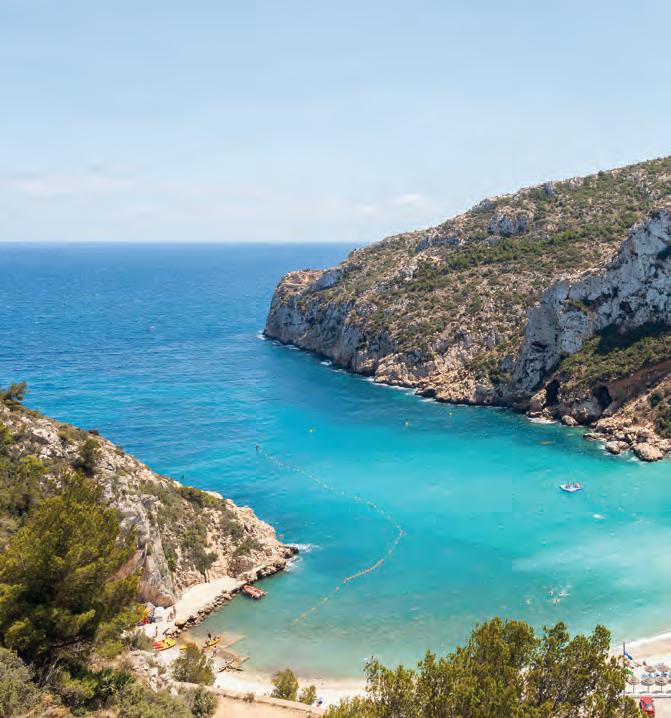
Often hailed as the ‘coolest spot’ on the Costa Blanca, Javea (or Xàbia, in Valenciano) boasts some of Spain’s finest beaches - if you can get to them
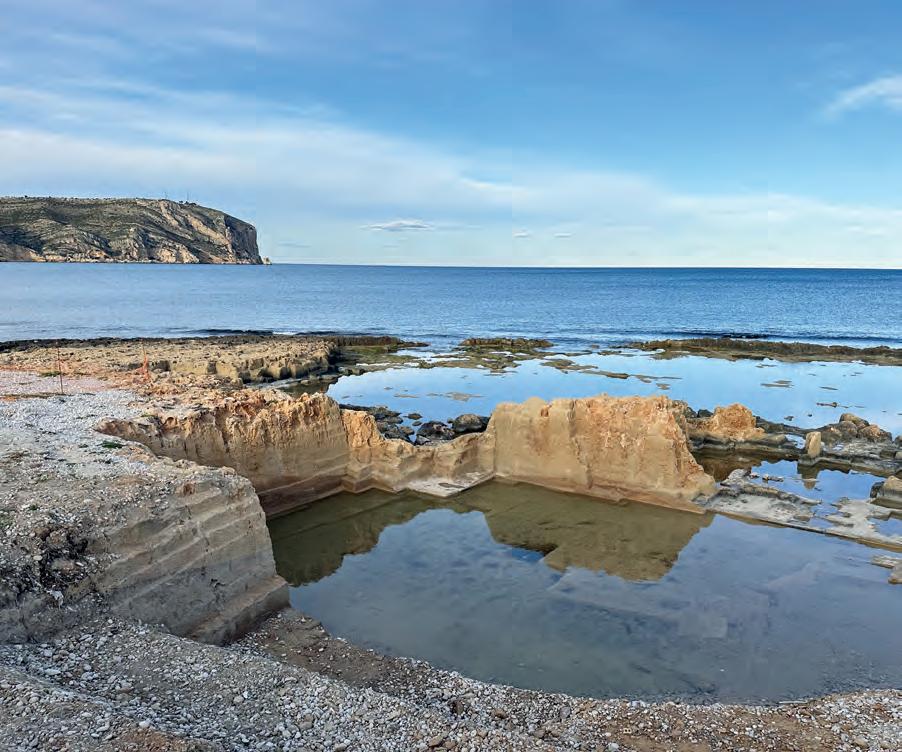
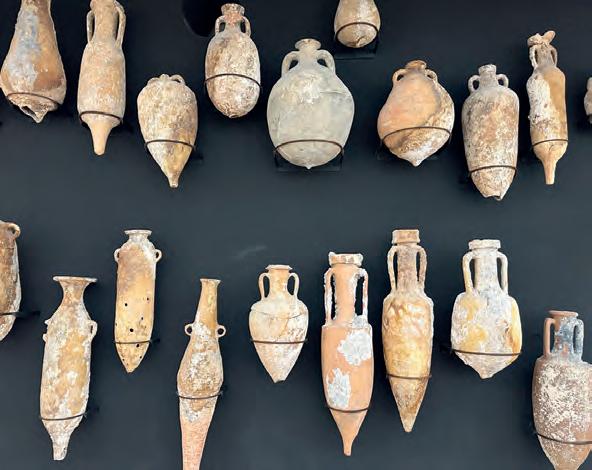
PRICELESS: Gold Roman coins and Phoenician amphoras have been found on Javea’s coastline
JAVEA is stunning. The town itself is full of ancient sites to see and plenty of bars and restaurants to keep the most dedicated gourmandes happy.
But what brings the tourist hordes to this part of the Costa Blanca are its breathtaking beaches and crystal-clear waters.
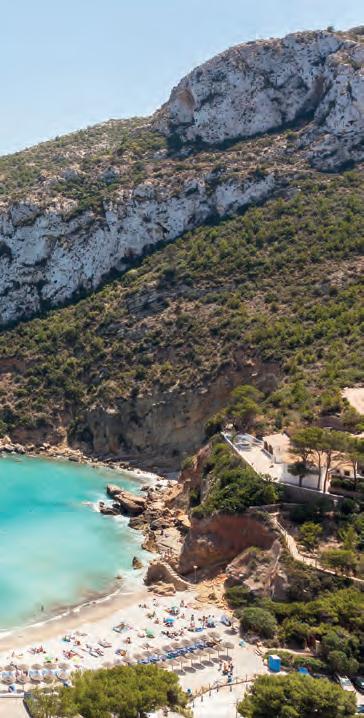
But the peak summer season is possibly not the time to visit what National Geographic and Conde Nast Traveler call one of Spain’s finest beaches - Playa Granadella.
In August it is not unusual for the shore to get so packed that it is roped off to new arrivals and those seeking a day on the beach have to head elsewhere.
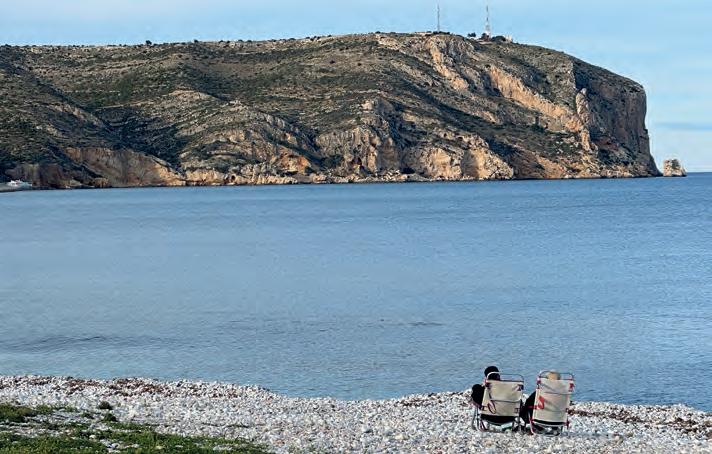
Fortunately, in Javea, there is an elsewhere to go to. Head for Portitxol Beach, situated on the other side of Javea’s dramatic southern headland.
The beach, nestled between cliffs, is a beautiful, serene spot with pebbles underfoot and stunning
views of the surrounding coastline. It is the perfect spot to relax, but those more energetic take to the water and explore further by swimming toward the nearby Portitxol Island.
It was here, just off the island, that a remarkable piece of history was recently discovered - 57 gold Roman coins that made international headlines.
Javea’s beaches not only offer natural beauty but also harbour hidden treasures, adding an intriguing layer of history to the area’s allure.
Portitxol, meaning ‘little port’ in Latin, is one of Javea’s hidden gems. Also called Cala de la Barraca, this 900-metre stretch of pebbles and rocks sits between Cap Prim and Cap Negre.
The beach is sheltered by cliffs and dotted with quaint, privately owned fishermen’s cottages. It’s the perfect example of Javea’s laid-back
charm.
While beaches like Granadella and Portitxol often grab the spotlight, Javea offers much more, especially if you venture off the beaten path.
Cala Blanca, for instance, is accessible only by walking through a round hole in the rock face and leads to a dramatic headland with hidden coves still inaccessible by foot. Another hidden gem is Cala en Calo, which has gained recognition alongside tropical beaches in Thailand and the Philippines.
Michelin starred Tula is an unpretentious gem
Playa Ambolo, ideal for an early morning or evening swim, is another favourite. For those seeking action, Arenal Beach is Javea’s most popular, sandy beach, offering nightlife and great surf when the conditions are right.
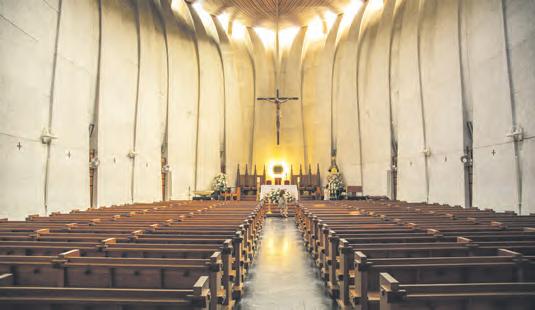
The Arenal area is also home to Michelin-starred restaurants like Tula, an unpretentious gem run by a local couple, and Bambula, a lively bar known for its late-night vibe. Javea’s port area is equally charming, with the pebble beach Playa de la Grava and a variety of excellent restaurants. It’s also home to the famous modernist church and the Cinema Jayan, a cinema that showcases original version films throughout the week.
For hikers, the rocky trail from the port to Cala Tango offers a rewarding view, with a 17-metre-high platform to jump into the sea.
Inland, Javea’s old town, built from local honey-colored tosca stone, offers an atmospheric escape. The 14th-century Iglesia de San Bartolome, made from sandstone quarried at the nearby Cova Tal-
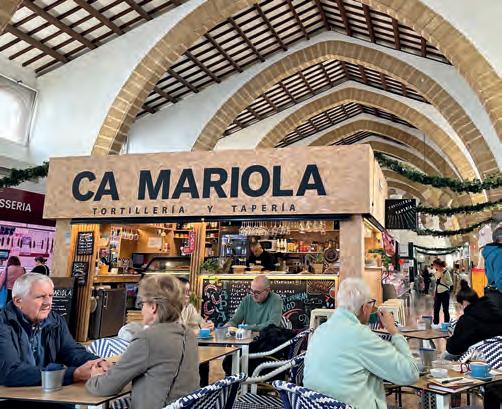
lada (Carved Cave), is a must-see. The town itself, once a fortified haven against Barbary pirates, still has narrow, winding streets perfect for exploring. Be sure to stop by the municipal market, where you can sample a local specialty: the coca, a sourdough flatbread topped with either chopped tomatoes and salted tuna or a single anchovy. Evenings in Javea are especially lively, as tourists and locals alike gather in the old town’s cafes and bars. For a truly local experience, catch an early film at the cinema near the port and then wander into the old town for tapas and a glass of wine.

AnyTech365
Here are three of Javea’s secrets that archeologists, spiritual pilgrims and cave-diving spelunkers have yet to figure out.
THE name of Javea (Xabia in Valenciano) reportedly comes from the Arabic word Xabiga for ‘well’ or ‘cistern’.
Though Javea’s abundance of water is evident in its green hills, the underground secrets of Javea are something cave-divers are still scratching their heads about.
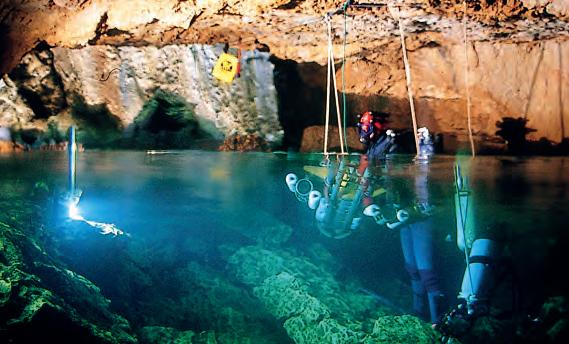
The Moraig river is one of Spain’s most famous for being an underground river – possibly the deepest in the world – but no one can figure out where it comes from.
The river is believed to begin somewhere beneath Javea in the aquifer of Benissa that stretches beneath the town, before it mysteriously emerges from underground at Benitachell’s Cala de Moraig beach.
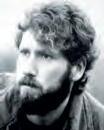
Since 1978 cave divers have tried to follow the river to its source without any luck – the most famous of these, the German expert Bernhard Pack (above), won 17 international awards for his documented expeditions before tragically losing his life to the cause in 1992.
According to neighbouring Benitachell’s town hall, the aquifer of Benissa is one of the ‘most unique hydro-geological phenomena in the world’ together with the Greek Island of Cephalonia.
It could be a source of high-quality potable water to see the region through summer droughts – but despite investigations beginning again in 2014, no one can figure out where this hidden secret of Javea actually resides.
IMAGINE the day a century ago in 1904.
Agricultural labourers are ploughing land to make way for orange groves in the area of La Lluca.
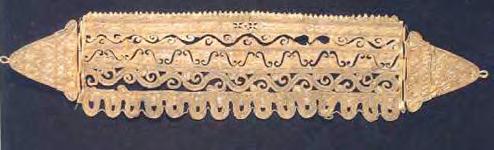
DISCOVERY: The Treasure was ploughed up 100 years ago
Suddenly the plough hits something, which turns ut to be a ceramic urn buried 1.5 metres deep.
Cracking it open, the urn reveals a golden diadem, three gold necklaces, a golden brooch and various gold and silver bracelets.
So highly valuable was the treasure that the landowning Torres Orduña family was in the process of selling the pieces to French researchers when Madrid’s Museo Arqueológico Nacional heard of the hoard.
It turned out to be a 4th century BC bridal trousseau (ornaments worn by a bride at her marriage) and it remains on view known as the ‘Treasure of Javea’ and one of the nations most significant Iberian finds.
Javea’s municipal archeologist Ximo Bolufer told the Olive Press the Treasure of Javea was ‘hidden’ underground during a period of conflict.
This same hypothesis was given to the haul of 57 golden coins recently found at Portitxol – hidden for safekeeping during a likely raid from Barbary pirates that ravaged Javea’ coasts from the 4th17th century.
Experts from the University of Alicante continue to probe the waters around Portitxol to see how many more buried treasures may yet to be discovered.
They’ve already found the highest concentration of ancient anchors in the whole Mediterranean –some 258 dating back beyond 2,000 years.
JAVEA’S 175m-high Cabo de San Antonio has been a place of spiritual refuge for close to 700 years.
The headland got its name in 1373 when the bishop of Valencia granted a female hermit Catalina Blas the right to build a hermitage dedicated to Saint Anthony.
The San Antonio monastery soon sprung up next to it, but it didn’t survive long as in 1388, Barbary pirates sacked it and
burnt it to the ground.
Legend has it that three centuries later an intact canvas of the Virgin Mary was found among the rubble, and it is the only surviving vestige of Sor Catalina’s Hieronymite order of monks. It led to the La Plana area becoming a site of pilgrimage for centuries and in 1964 the current monastery Santuario de Nuestra Señora de los Angeles was rebuilt.
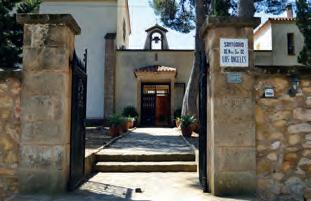
Once a year in August it lets a handful of people in on the secret to behold Javea’s own miraculous piece of history hanging above the altar.
Their services include cybersecurity, device maintenance and performance optimization, and malware removal, enhanced by AI for faster and accurate solutions. Personalized User Experience
AnyTech365 adapt its product and technical support solutions to individual needs, offering a safe online experience to any user.
IAnyTech365
World class, cross-platform security
F you’ve ever looked at the top of your internet browser and wondered why it resembles a row of microscopic dominoes, you’re not alone. It always begins with good intentions: a couple of tabs for the news, one for the weather, and then that recipe you have been planning to cook someday.
with
AnyTech365 IntelliGuard
AnyTech365
And here comes the crux: If your computer is running slowly or your browser feels sluggish, the cause is often simple: too many tabs are open on your computer
AnyTech365 IntelliGuard
It’s at this point your browser has become a teenager’s bedroom floor, and every tab is a sock you swore you’d pick up later.
scanning techniques to identify potential threats from
programs and neutralization of viruses,
But curiosity moves fast, and the internet moves even faster.
and phishing attempts.

AnyTech365 TotalCare
comprehensive
One search leads to another article, then another, then to a list of gadgets you don’t need, a search for what’s on TV, a glance at the footie scores and, suddenly, your screen looks like digital confetti Before you know it, there’s a few dozen (often many more) website pages open.
certified technicians without onsite visits anytime, day or night, with AnyTech365’s around-the-clock support services, offered in more than 15 native languages.
AnyTech365 AI powered unique software can pinpoint the root cause of a problem providing real-time protection and immediate response to suspicious activity. This proactive approach significantly reduces the risk of cyberattacks.
AnyTech365
There really is a limit to how many tabs your brain (and your computer) can handle without protest.
Once you pass three or four active tabs, the warning signs appear. Pages load slowly, your laptop fan goes haywire like a helicopter preparing for take-off, and videos freeze while the audio keeps going.
World class, cross-platform security platform with advanced scanning techniques to identify potential threats from files, programs and neutralization of viruses, malware, and phishing attempts.
AnyTech365
Reducing tab overload isn’t a punishment; it’s one of the easiest ways to improve your computer’s performance and keep your browser running smoothly.
One of the most effective ways to stay organized is bookmarking
Think of it as your digital filing cabinet. Instead of leaving tabs open for days “just in case,” you might one day return, save them neatly for later. Most browsers let you create folders for everything from travel ideas to recipes to tech tutorials. Once you start using bookmarks consistently, you’ll discover that clutter never gets a chance to build up, and you can actually find the pages you meant to come back to.
Modern browsers also offer tab groups; a feature designed specifically for people who tend to collect tabs like souvenirs.

It’s like giving your tabs a proper British-style queue: orderly, polite and blissfully non-chaotic.
With colour-coded groups for shopping, work, banking, or entertainment, you can bring instant structure to the chaos.
A comprehensive security suite, combining all AnyTech365 premium products together with quick issue resolution by certified technicians without onsite visits anytime, day or night, with AnyTech365’s around-the-clock support services, all offered in more than 15 native languages.
It’s surprisingly satisfying, and even better, it makes it far easier to locate the tab you need instead of searching blindly across the top of your screen.
Of course, sometimes the nuclear option is the only option: closing all tabs
When you’ve accumulated dozens of windows about fish recipes, cybersecurity tips, vacation destinations, and a toaster you might or might not buy, starting fresh can feel like rebooting your life.
There may be a brief moment of panic, the sense of saying goodbye to old digital friends, but your computer will thank you immediately with faster performance and a far calmer fan.


A weekly tab cleanup can also work wonders.
On a quiet evening, or any moment when you’re avoiding real responsibilities, take a quick look at your browser and ask yourself whether you actually need each tab.
You may be surprised by how many you don’t even remember opening, especially the ones involving alpaca farming, obscure DIY projects, or three identical articles about the same tech rumour.
The relief you feel after closing them is real, and your PC will run more efficiently as a result.
Because let’s be honest, some tabs aren’t just open, they’ve been squatting there for weeks.
The truth is simple: tabs are tools, not pets: You don’t have to keep them forever.
And if your browser or your entire computer still feels slow, unresponsive, or cluttered no matter what you try, AnyTech365 is ready to help.
Our friendly IT experts can clean up your system, improve its performance, and guide you through best practices for keeping your device healthy. It’s the moment your PC realises you’ve brought in the experts and instantly breathes a sigh of relief.
Grab our exclusive FREE introductory offer below and call
to
the
JAVEA’S old town is a perfectly preserved relic of the past, exuding a rustic charm that is all too rare in today’s world.
Dating back to medieval times, its buildings are a patchwork of historic architecture spanning seven centuries.
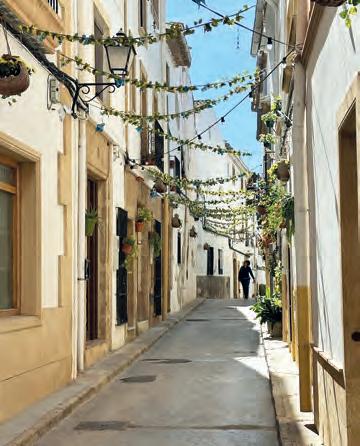
Today’s old town is distinguished by its narrow lanes adorned with white façades and gothic windows
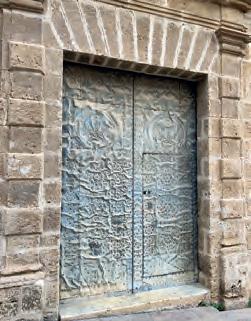
ing heart of the town was once dedicated to the raisin trade, and its ornate raisin drying facilities still remain in the form of sandstone partitions and galleries with large ulls, which would shelter the grapes on thatched mats to dry.
Indeed, to walk through the old town is to dip one’s toe into a rich mercantile history.
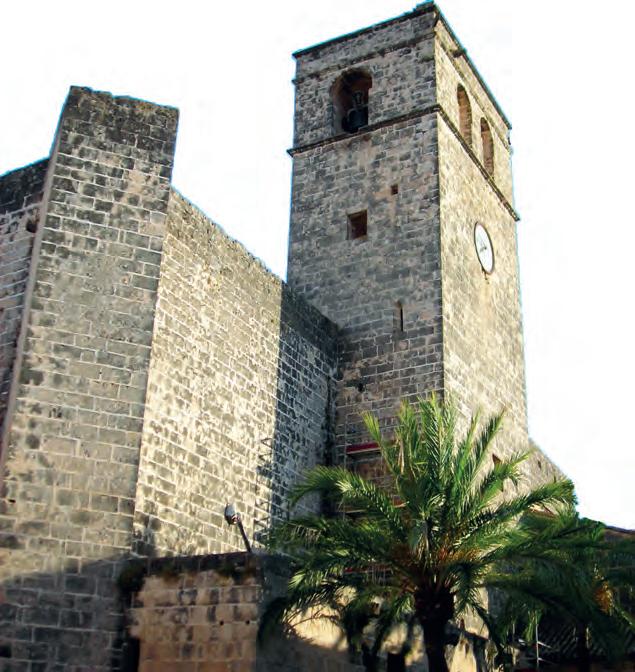
In the 13th century, Javea was but a small enclosure sealed in by city walls but the 16th and 17th centuries gave rise to the construction of Javea’s most inspired architecture, with gothic buildings such as the Palau dels Sapena and the Casa dels Bolufer. There is a nice range of small shops and restaurants to stop at, including the excellent Irish-Romanian-run place, La Sucreria, right by the main church. Also look out for the
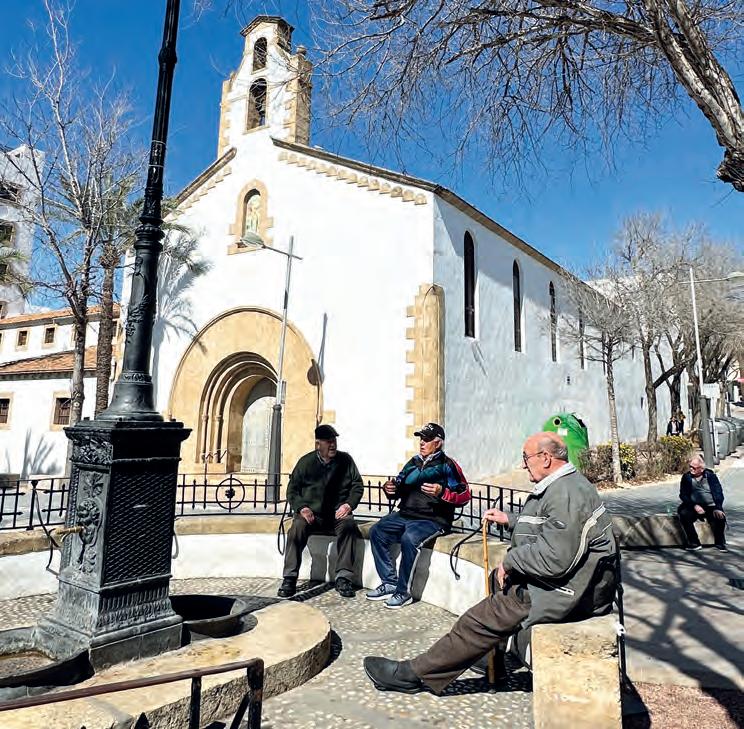
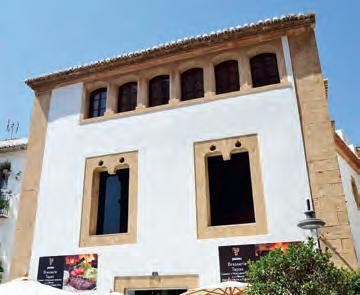
recently opened Carniceria tapas bar, on the outskirts of the centre. Make sure to look out for its ancient market, now converted into a gourmet hall, perfect for lunch or supper. Needless to say Javea’s old town retains an allure that has wowed visitors for centuries and long may it continue.
The modern church that brings a new grace to the town’s architecture
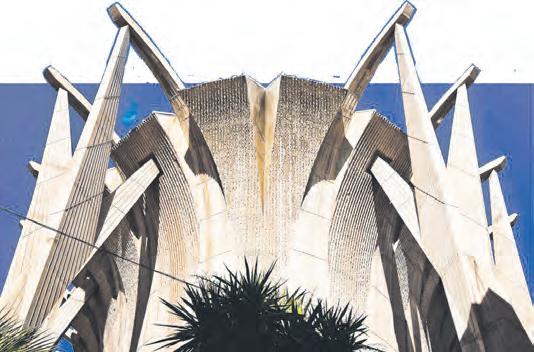
IT could well be the most quirky-looking church in Spain.
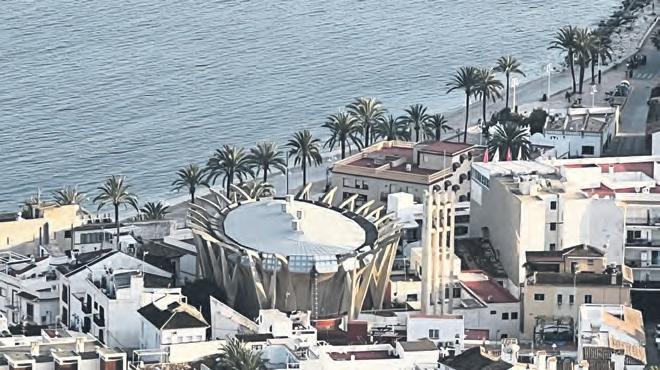
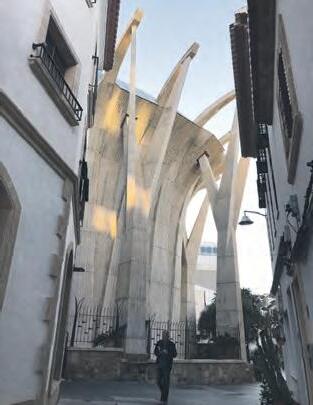
Sculptural Nuestra Señora de Loreto rears up over its nearby buildings like an angry spider or a space-age creature from HG Wells’ War of the Worlds. It was built on the site of an old fishermen’s church by the port in 1967, designed by four architects. An important example of avant-garde religious architecture, it stands out for its bold lines and its use of space. On the outside, its 12 slender pillars represent an allegory of the 12 apostles. Inside, its cement and red pine wood interior is said to represent a fishing boat, with the light penetrating through the skylights in the form of jets, sliding down the pillars and giving the building its boat keel shape. It is a must visit from 9am to 8pm all year round.
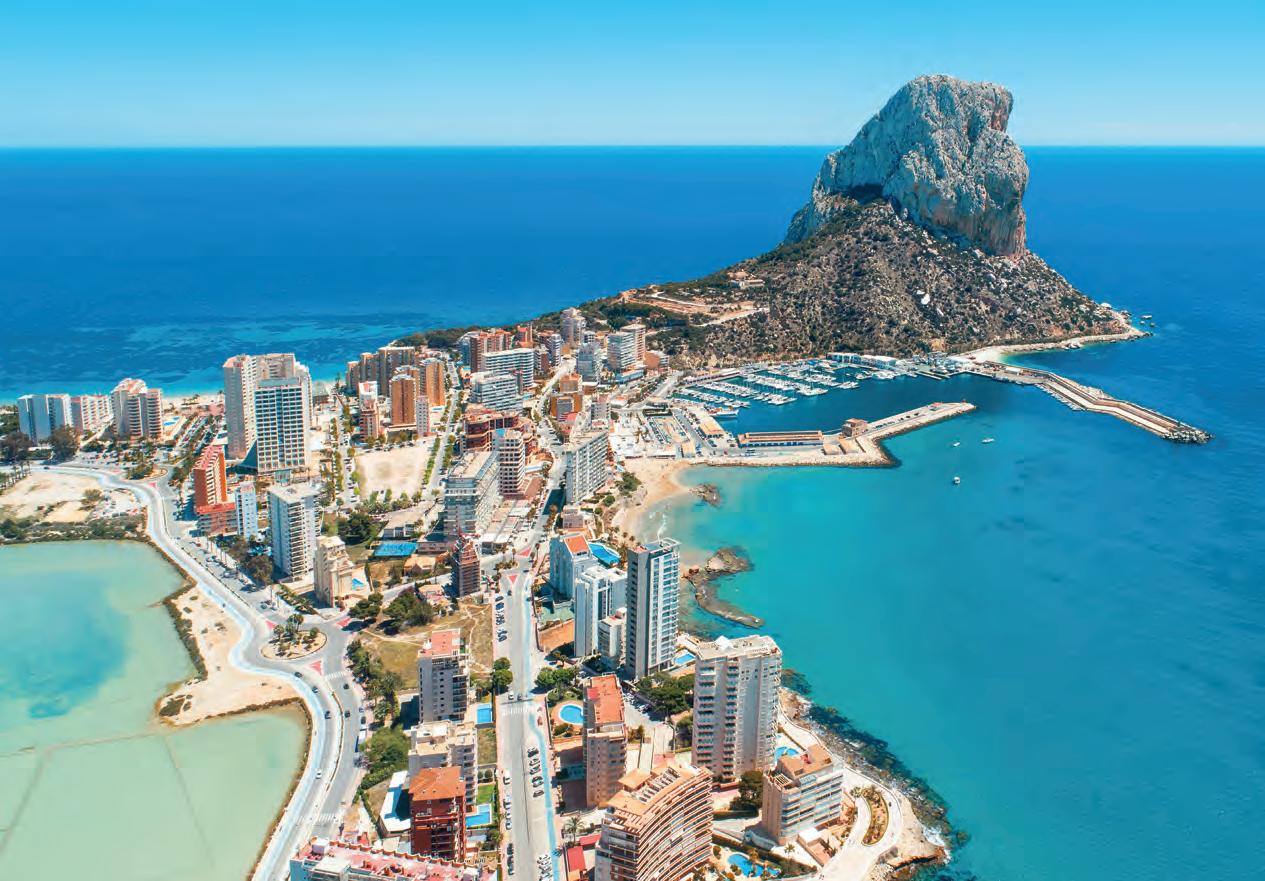
FOREIGN DOMINATION: The Peñon de Ifach marks a town of nearly 10,500 foreigners
To truly understand Calpe’s identity, you need only look a few kilometres down the road to its neighbour, Altea. Where Calpe is vertical, cosmopolitan, and intensely practical, Altea is horizontal, artistic, and gently Bohemian.
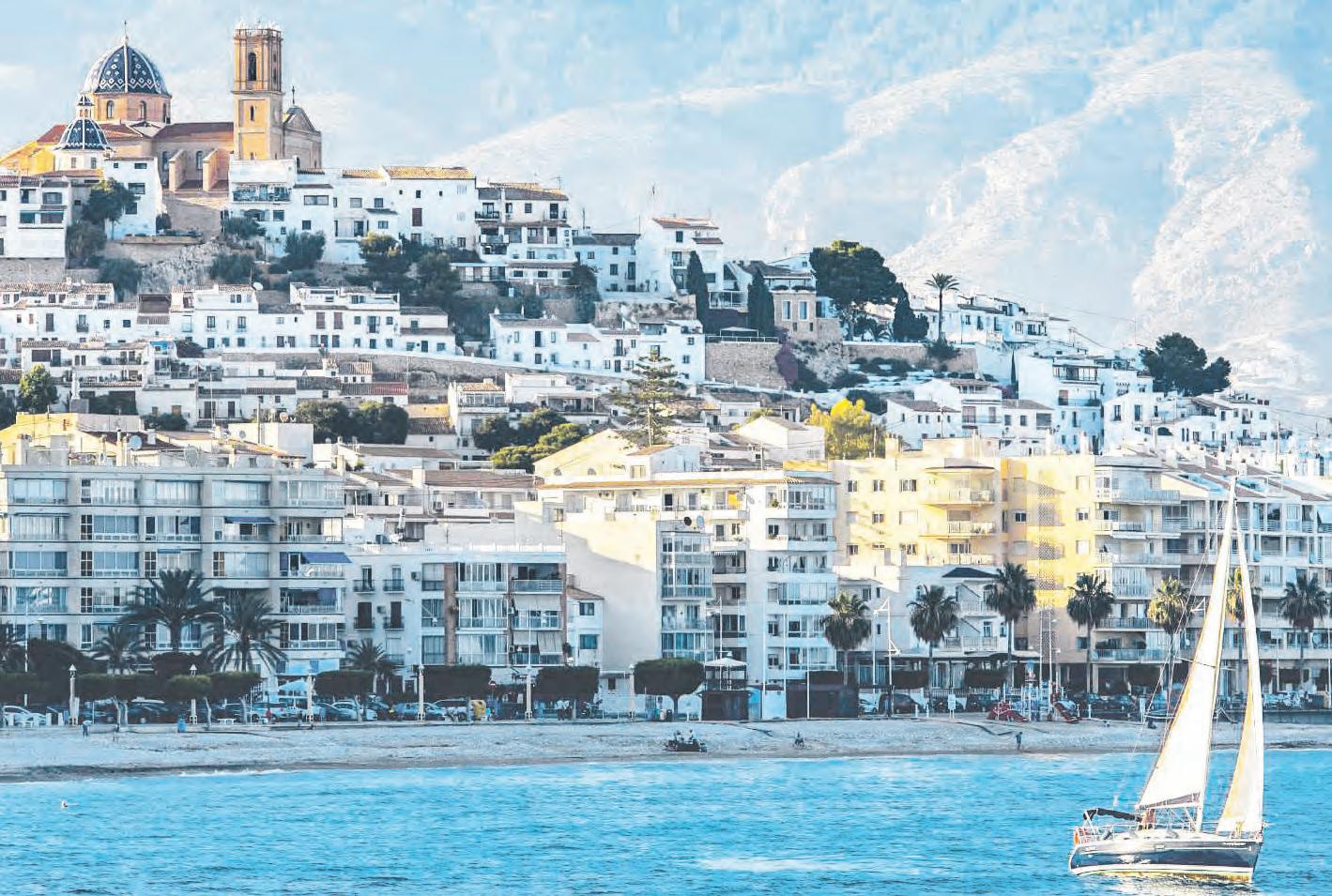
Altea’s Old Town, with its blindingly white stucco buildings and blue-domed church, climbs from the shore up a soft hill, attracting painters and photographers.
Calpe, meanwhile, is the place where people actually live and work year-round, seeking out the easy access to services, the large flat beaches, and the steady, global pulse.
It’s this dynamic - Altea offering the Spanish coastal dreamscape and Calpe providing the reliable, international infrastructure - that makes this stretch of the Marina Alta so unique.
For decades, coastal towns here thrived on a seasonal heartbeat: crowded summers, empty winters. But Calpe and Altea have broken that cycle. The foreign residents didn’t come for a fortnight; they came to stay. They needed schools, doctors, plumbers, yoga teachers... They didn’t vanish in October. So now, even on a chilly Wednesday in January, you’ll find restaurants open, cyclists speeding past the promenade, and the scent of fresh coffee floating from bakeries that once shuttered for the season. This year-round pulse has sparked a quiet revolution.
The town’s mild winters and mountainous backdrop make it
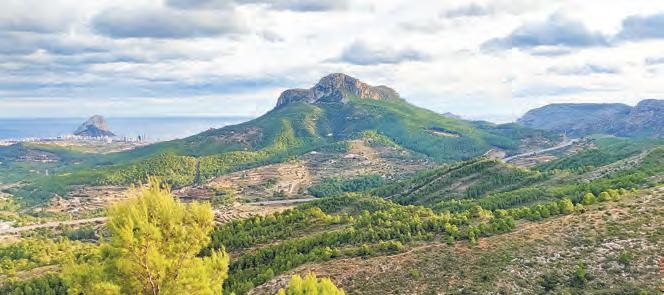
a magnet for cyclists and hikers escaping northern cold. You see them every morning, groups in bright Lycra pedalling through the mist toward the Sierra de Oltà, the clatter of gears echoing against limestone cliffs. The air smells faintly of sea salt and new tarmac. But life here isn’t just about sport. It’s about balance – a kind of comfortable coexistence between Spanish tradition and European convenience.
Klaus Schmidt, a German expat who moved with his family five years ago, puts it simply:
“We came for the weather but stayed because of how easy everything is. My kids go to a local school, but play football in English. I go to a Spanish doctor, but my physio speaks German. We don’t have to choose between home and here. Calpe gives us both.”
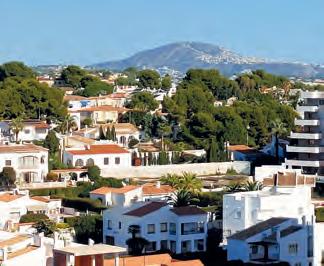
THE first time I visited Calpe, I was convinced I’d walked into the wrong country. It wasn’t the sun that threw me off, or even the Peñon de Ifach looming over the bay like some monumental guardian – it was the voices. English drifted from a bakery queue, Dutch from a nearby café, and German from a couple arguing amiably over sunscreen. Then someone greeted me in Valencian, and I realised this wasn’t confusion – it was Calpe.
And it turns out my ears weren’t exaggerating. The town recently crossed a quietly astonishing milestone: foreign nationals now make up over half of its population. More than 53%, to be exact – meaning Spanish residents are technically the minority in this stretch of the Costa Blanca. It’s the only town in Spain with more than 20,000 people to reach that level of international mix. But statistics don’t quite capture it. You feel it on the street. The conversations switch languages mid-sentence, and the menus carry three translations as naturally as a trilingual child. Calpe, once a sleepy fishing town, now beats to a global rhythm. And this shift has changed everything – not just the faces in its markets, but the entire logic of how it lives and breathes.
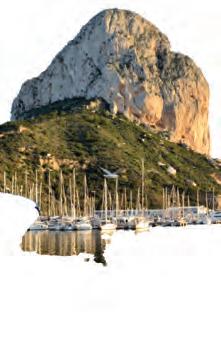
Walk through town and you’ll see what he means. There’s a language exchange in the main square every Thursday, chatter spilling from tables like music.
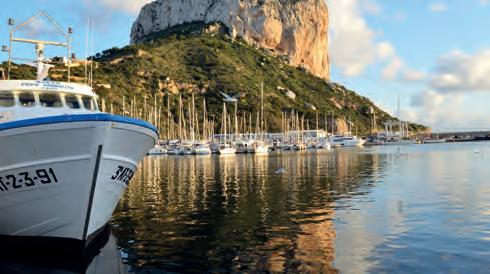
VIEW: From the harbour to the Peñon de Ifach
Hiking clubs meet at dawn by the Peñón’s trailhead. You’ll even hear a bit of Russian at the market when haggling over oranges. Yet beneath this international blend, Calpe still hums with its Valencian roots – the smell of paella on a Sunday, the rhythmic thump of fiestas, the patience of fishermen mending nets by the port. Still, this success brings growing
pains. The population density near the seafront can feel suffocating in August, and parking is a local legend in itself. The council has started tackling these pressures: better waste management, greener transport options, and even a beach smoking ban (which, to be honest, makes the sea air cleaner and the sand less of a cigarette graveyard). These aren’t glamorous reforms, but they signal something rare for a tourist town – long-term thinking.
And maybe that’s the real story. Calpe’s charm isn’t in pretending to be Spanish or international, old or modern – it’s in managing to be all of it at once.
The Rock stands immovable, yes, but the community below it shifts and adapts like the tide. And on certain evenings, when the sun slips behind the Peñón and the sky turns a slow copper, you can’t help wondering if this small town on the Costa Blanca hasn’t quietly reinvented what Europe itself looks like – a place where nobody quite belongs every
where, yet everyone belongs somewhere.

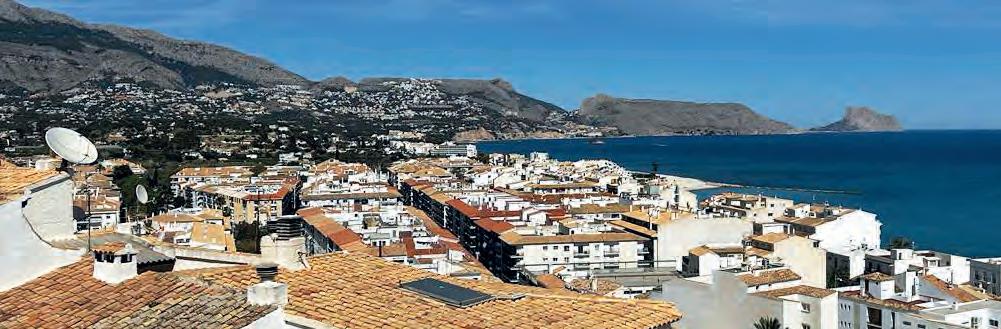
FORGET what you think you know about the Costa Blanca. Sure, there are the skyscraper resorts and sprawling, sun-drenched sands, but tucked between the jagged peaks of the Sierra de Bernia and the dazzling turquoise sea lies a town that moves to a slower, more romantic rhythm: Altea.
If you’re anything like me, you crave authenticity on holiday – and that’s exactly what Altea de -
somehow managed to hold onto its soul despite its growing popularity.
Your first mission? Head straight for the Casco Antiguo – Altea’s Old Town. I’m not going to lie, the climb’s a bit of a workout, especially on a scorching August afternoon, but trust me, it’s worth it. Don’t stress about a map – just let the maze of steep, cobbled alleyways guide you. Every turn offers a new photo waiting to happen: whitewashed houses offset by cascades of fuchsia bougain -
villea spilling from balconies. Eventually, you’ll stumble, a little breathless, into the Plaza de la Iglesia, the town’s spiritual and geographic heart. And there it is – the Church of Nuestra Señora del Consuelo.
Those famous blue-and-white tiled domes, visible from almost anywhere on the coast, really do pop against the brilliant Spanish sky. Pull up a chair at one of the cafés, order a café con leche, and just take it all in. Then wander to the nearby Mirador de los Cronistas de España – that view will steal your breath faster than the climb did. Altea’s reputation as an artists’ haven is clear the minute you start browsing. This isn’t your standard souvenir fare – the
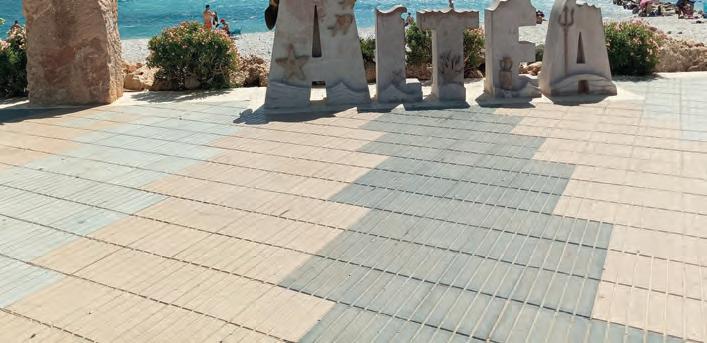
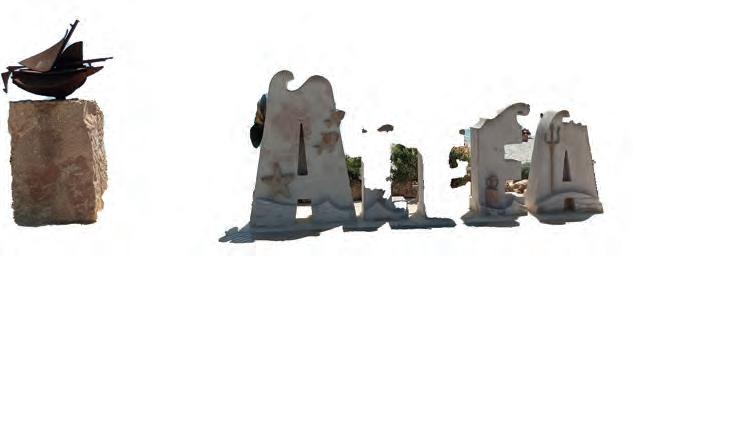
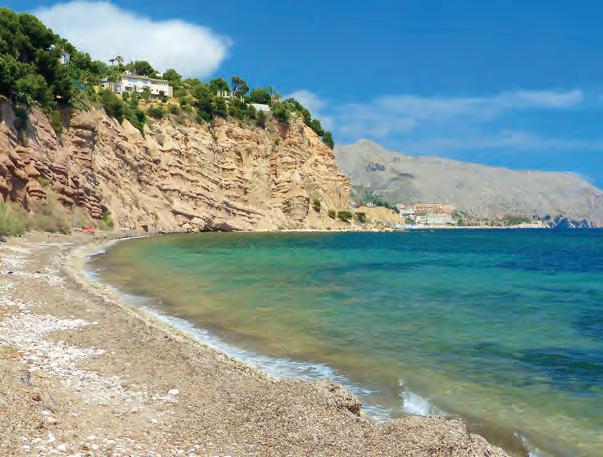
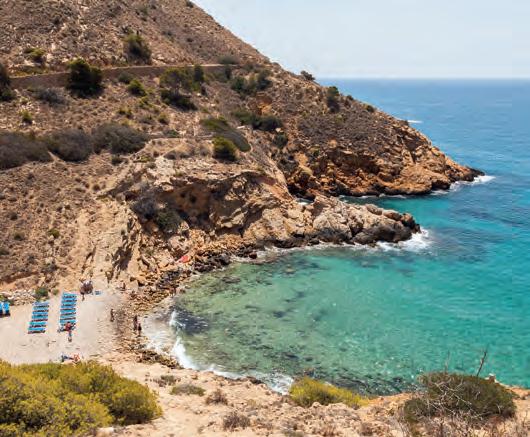
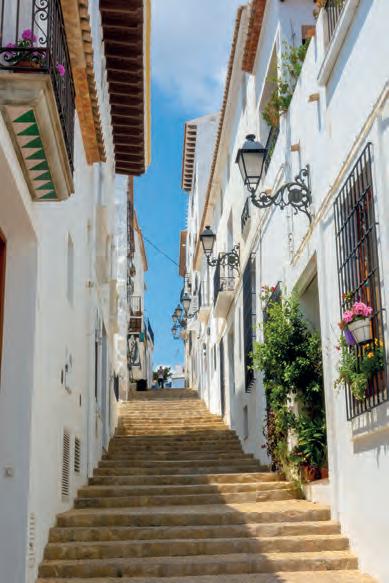
Forget Benidorm, discover Altea, the Costa Blanca’s beautiful white-washed and blue-domed cultural secret

Old Town is filled with genuine art galleries and small studios where local ceramists, painters and jewellers actually work.
The result is a distinctly bohemian feel, especially in the evening when artisan stalls spill into the streets and the scent of jasmine mingles with grilled prawns drifting from hidden courtyard restaurants.
The beaches here aren’t your typical golden stretches – and that’s a good thing. Altea’s shores are mostly made up of clean, smooth pebbles, which keep the water crystal clear and lend the area a quieter, more relaxed feel than some nearby resorts.
Playa de la Roda is the most central, running alongside the lively Paseo Maritimo, perfect for an eve -
ning stroll.
For a calmer spot, head north towards Cap Negret. And for something truly different, check out Marina Greenwich – promotional materials claim it sits exactly on the Prime Meridian (000° 00′ 00″), making it a fun geographical talking point even if that fact is more symbolic than scientific. Need a break from the sea? Altea’s got you covered. The Sierra de Bernia and Serra Gelada Natural Park both offer unforgettable hiking. Some routes are rugged and best tackled with proper shoes, but there are gentler options too –like the scenic trail to the Faro de l’Albir lighthouse just outside town, where the dramatic coastal
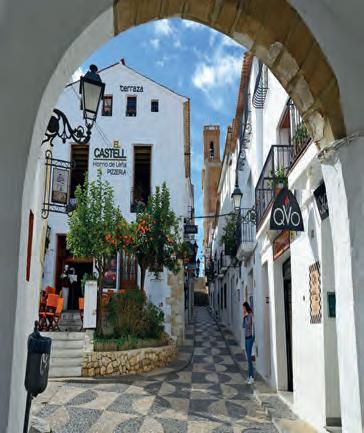

views are reward enough. If you visit on a Tuesday then don’t miss the bustling Altea Market. From fresh oranges and olives to local ceramics and handmade crafts, it’s a proper slice of local life – lively, colourful, and perfect for picking up authentic gifts.
Altea is special. A town that’s resisted the excesses of mass tourism, keeping its quiet dignity and undeniable charm. Go, wander, climb, and let this white jewel of the Mediterranean cast its spell. You won’t regret it.
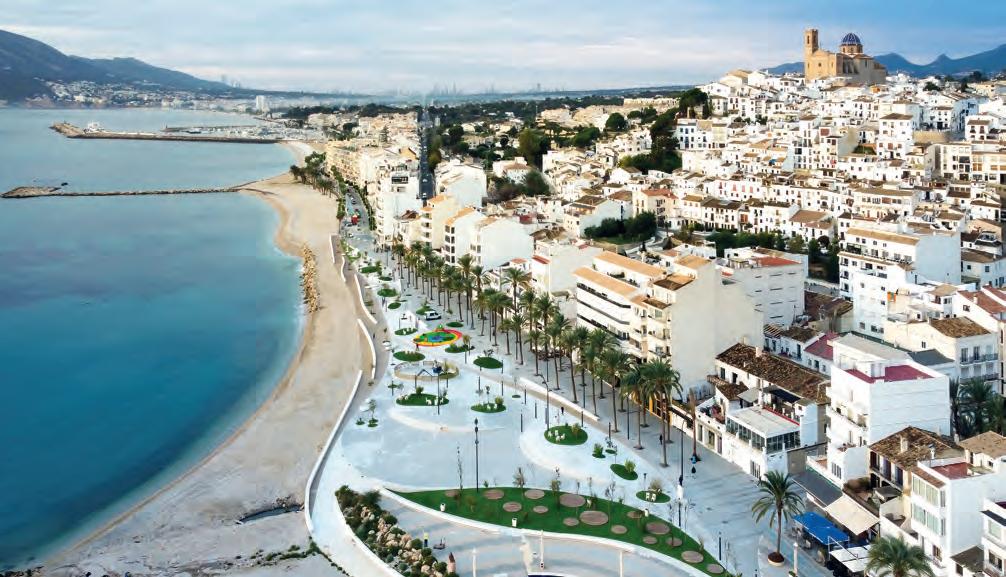
ALTEA: Its blue domed church dominates the skyline
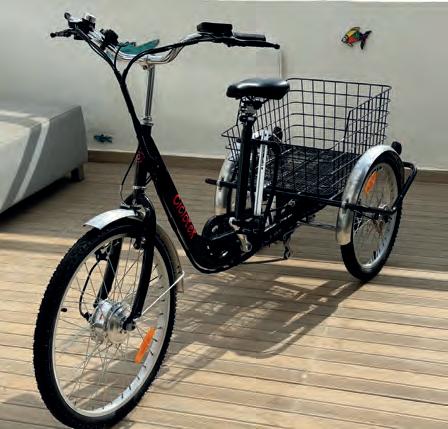
- CICLOTEK adult electric trike- LCD panel with 5 assist levels- 10ah samsung battery- SHIMANO sis 6 speeds- Thumb throttle- Max speed 15 kph- Range 15 kms approx- Weight 30kg- Excellent condition -
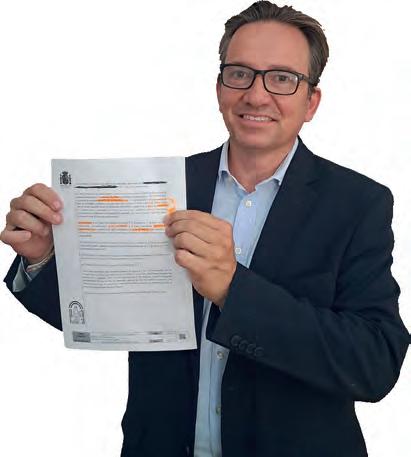
IT was yet another giant victory over the banks for Marbella lawyer Diego Echavarria in the courts this month.
Handing his clients a €16,000 cheque in their battle against Sabadell bank was ‘yet another proud moment’ for the bilingual brief.
The Madrid-born boss of Fairway Lawyers won Peter Cooper, from Fuengirola, the healthy sum in a one-off payment.
“He got it after we found that he had a floor clause inserted into the mortgage he needed to buy a property in 2005.
“He had literally no idea that for many years the rate never went below 3%, even when interest rates dropped to nearly zero.
“To say he was overjoyed with the payout is an understatement.
● Was your mortgage acquired between 2000 and 2010?
● Payments were the same amount for often many years.
● Despite paying off the mortgage and even selling up you can still claim
● There is no deadline since the latest ruling from TJUE (Tribunal de Justicia de La Union Europea)
● Fairway Lawyers acts on a No Win, No Fee basis
“It was a giant gift for his family, who are planning a big holiday this Christmas and a new car.” The battle against Sabadell came after the British family took on Fairway Lawyers in a ‘no win, no fee’ deal three years ago. While it wasn’t a quick process, Diego admits, it is just a matter of doing things by the letter of the law.
Popular lawyer beats Banco Sander again and believes there are thousands still owed big bucks, plus compensation over shameful ‘floor clause’ mortgages
“You just need to be diligent and cross the t’s and dot the i’s,” he explains.
Having taken on and won over three dozen cases over the last decade, he has become probably Spain’s number one legal specialist on the so-called ‘Floor clause scandal’.
The scandal stems back over two decades when many Spanish lenders secretly insert ed a clause in their clients’ contracts that ensured interest rates could not drop below 3.5% or 3%.
This was called the ‘floor clause’ and when for a decade, between 2011 and 2021, the interest rates in Spain sat at a record low, between 0% and 1%, they did not benefit.
It meant hundreds of thousands of peo ple spent years paying usually hundreds of euros more per month above what they should have paid.
Diego (right) estimates that tens of thousands of home owners - over half of them British - could be owed €50,000 or more in compen sation.




“The average is likely a little lower, but whatever happens they are owed money and with interest on top,” he explains this
“It was a really shocking abuse of legitimate trusting clients and the banks were very crafty,” he adds.
“I have spent years exposing these hidden clauses inserted into their mortgages.
“And there are around 100,000 mis-sold mortgages that have yet to be resolved in Spain.”
He explains that most banks, including La Caixa, Sabadell and Banco Popular, used such clauses.



“And it will only take me a few minutes to work out what you have paid and what you are owed today,” he continues.
Over the last year he has had a series of payments, including one for €21,075, plus legal costs, in Mijas, and another for €48,359 for a British family, the Brighouses in Estepona. In one urbanisation in the Malaga resort, Mirador de Costalita, he has four happy clients alone.
The huge golf lover, who named his firm after the sport, added: “It always involves lots of legal letters being sent and it’s a bit of a game, to be honest.
“Luckily I know all the tricks and how the banks try and slow things down.”
He currently has ‘over 100 clients’ he is working with around Spain, most of them expats, who became victims, but also some Spanish buyers.
“I am handling cases all over the country and travel around the place all the time” he adds.
If you want to claim for a mis-sold mortgage - NO WIN, NO FEE - or feel you may have been affected, contact diego@fairwaylawyers.com or send a message via Whatsapp to +34

SPAIN has pledged over €800 million in further support for Ukraine after President Volodymyr Zelenskyy visited Madrid.
The total package - adding up to €817 million - forms part of a 10-year bilateral security and defence agreement signed by the two countries in May last year.
Speaking following a meeting with the Ukrainian leader, prime minister Pedro Sanchez reiterated ‘Spain’s full and firm support for Ukraine and its president’.
“First, for the Ukrainian
army to protect the territorial integrity of Ukraine from the invader. Secondly, to protect the civilian population, and finally to give an impulse to reconstruction,” Sanchez said when asked what the sum would be spent on.
Over €300 million of the support package will go towards the delivery of new defence equipment.
An additional €100 million will be funnelled into NATO’s US arms acquisition programme - known as PURL - to provide Ukraine
ANNOYING cookie pop-ups could soon disappear after the EU agreed to relax strict digital privacy rules.
Instead of approving cookies on every site, users will be able to set preferences directly in their browser.
Certain ‘non-risk’ cookies would no longer require pop-ups at all.
The reforms, driven by pressure from tech giants and the US, would also ease GDPR restrictions by allowing wider sharing of anonymised datasets, simplify AI paperwork for smaller firms, and streamline cybersecurity reporting.
A grace period for high-risk AI rules has been indefinitely extended.
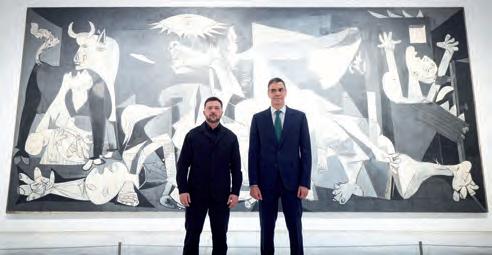
with anti-aircraft defence systems to protect its civilian population from Russian missiles. Sanchez also announced an investment of €200 million

tape while protecting fundamental rights. The package now heads to the European Parliament, where strong opposition is expected.
into reconstruction of the war-torn eastern European country, with a particular focus on energy, transport and water management.
Spain has provided billions of euros of military equipment to Ukraine since the Russian invasion in 2022, including tanks, missiles, ammunition and anti-tank rocket systems.
Spain’s armed forces have also trained almost 8,000 Ukrainian soldiers, according to official figures. The latest aid package comes as pressure builds on Zelenskyy to sign a US peace plan widely derided as overly favourable to Russia.
SPAIN is now responsible for a fifth of all GDP growth in the eurozone despite making up only a tenth of the bloc’s economy, new analysis shows.
The figures, shared by Oxford Economics and Haver Analytics, underline how growth across the currency area is increasingly concentrated in just two countries: Ireland and Spain.
Ireland, which accounts for just 4% of eurozone GDP, is providing around 40% of all growth in 2025.
Spain contributes 20% of growth, leaving the remaining 86% of the eurozone to generate the other 40%.
Economist Angel Talavera notes that half the bloc is expanding at 0.5% or below, pointing to widespread stagnation beneath the
headline growth figure of around 1.4%.
Germany, the eurozone’s largest economy, is expected to grow by around 0.2% this year after two years of contraction.
France, representing roughly a fifth of the bloc, is set for 0.7% growth. Italy, contributing around 15% of eurozone GDP, is forecast to expand by just 0.4%.
Spain, by comparison, remains one of the eurozone’s standout performers. The European Commission expects GDP growth of close to 3% in 2025, following 3.2% in 2024.
SPAIN is emerging as one of Europe’s strongest economic performers, with recent data suggesting it may be outperforming France and Germany.
According to the Telegraph, Spain’s improving budget and declining debt ratio mark a remarkable turnaround since the eurozone crisis, when it required a multi-billion euro rescue package. Spain's budget deficit is projected to fall to 2.5% of GDP in 2025, with six years of consecutive reductions. Its debt, once a major concern, is now around 100% of GDP and expected to drop to 97% by 2027.
Notably, bond markets are lending to Spain at lower rates than to France or Italy, reflecting confidence in its finances. Spain’s economic recovery has been fueled by strong growth, record tourism, and rising tax revenues.
TODAY’S ‘money’ topic is a practical one: how to pay down credit card debt. That we should pay down our debt seldom needs explaining - if we have balances on our credit cards, this is something we likely already know.
The most effective strategy for paying down our credit card balance is to focus on one debt.
If we can zero in on a single debt, we’ll see progress as we pay down its out standing balance. That should encourage us. When we confront a small hill rather than a mountain, it is also less stressful.
According to the US Consumer Financial Protection Bureau, if we make even one extra payment per year to one of our cred it cards we can reduce total interest by hundreds over the life of a balance.
Rate) on card balances in each of these three countries often exceeds 20%.
Even a modest balance can grow rapidly. Perhaps that’s the reason two popular plans to repay our credit card debt have names that refer to snow accumulation: the ‘avalanche’ and the ‘snowball’ effect.

Credit card use is lower in Spain and the UK than in the US and carrying a credit card balance from month to month is less common. Nonetheless, credit cards have some of the highest interest rates of any consumer debt.
The ‘APR’ (Annual Percentage
In the ‘avalanche’ method, we rank our credit cards by interest rate, from highest to lowest, and focus on the most expensive debt first. Our current credit card interest rates are shown on our monthly statements. Next, it’s important that we make minimum payments on all our debts.
Once we’ve done that, we should put any extra money we have toward the debt with the highest interest rate - making multiple payments throughout the month if we can, instead of one on the due date.
Regardless of how big or small that debt is, we’ll save money in interest, which leaves more money for paying down the balance.
Our goal is to pick the card with the highest rate and start paying

that one down as fast as we can. Like an avalanche sliding down a slope, once it’s paid off, we move on to the card with the next highest rate and keep going until all our cards are paid off. In the ‘snowball’ method, we rank how much debt we owe on each credit card (ignoring interest rate) from the smallest balance to the largest.
Just as with the avalanche plan, we’ll need to make minimum payments on all our debts. After that, we should put any extra money we have toward the smallest debt. When the smallest debt is paid off, use the amount we were paying on it to the next-smallest debt, and so on. This method should enable us to build momentum and motivation by paying off our smallest obligations first.
From a strictly numerical standpoint, the avalanche approach works a little bit faster and saves us a little more interest. But either

method can help us climb out of debt. Typically, the snowball method is an easier plan for us to stay committed to because there are more victories early on. But both methods can be effective. Our aim is to pick the one we think will be easiest and get started. These two plans are commonly mentioned in finance literature as ways to pay down our debt. I personally think a third method, which I’ve named the ‘blizzard’ approach, merits mention as well.
If we encounter a new card offering a 0% introductory APR, we could transfer our high-interest credit card debt to that card.
The goal is to pay off as much debt as possible during the introductory no-interest period, which is often 12 - 18 months. We can save a lot of interest during that period. The word
of caution, of course, is we need to watch out for balance transfer fees and make sure to pay off the balance before the introductory period ends.
Additionally, it’s helpful if we can stop using our credit cards except for actual emergencies. Digging ourselves out of a pile of credit card debt (or snow) is very difficult if we’re adding to the pile every month.
No matter which approach we may choose - ‘avalanche’, ‘snowball’ or my self-named ‘blizzard’ - what matters isn’t the weather. It’s that we keep moving through the storm to find a debt balance that’s melted away on the other side.

How the talented young writers at Laude school are learning how to turn a phrase and even invent new words. Olive Press Editor Jon Clarke is impressed
DICTAPHONES set, pencils at the ready, the four house teams at Laude school were sent off to dig into a variety of issues affecting pupils, both at school and out there in the wider world.
Everything from Hurricane Melissa to the spectre of A.I. and from Remembrance
Sunday to the Louvre jewelry heist were tackled across four varied magazines.
Part of the annual inter-house magazine competition, the Marbella college gave each house an entire day to plan and structure their publications.
ticles together, have them edited, then sub-edited before being laid out by the designers… and all this with the help of artists to highlight them.
Following the structure of a professional newsroom, each magazine editor needed to check the articles for clarity, tone and accuracy, before planning the content running order.
Three Olympic size pools of ice are lost from poles every second
With a surfeit of staff - the envy of all modern newspapers and magazines todayeach house, North, South, East and West, had around 20 members of the team.
This began with electing their topics, then choosing their budding young reporters to go out researching and interviewing. Next, they needed to pull their ar-
Pulled in from six years of the school, they particularly loved the idea of grilling their teachers on a range of subjects, including travel plans and sporting knowledge.

And, boy, did they bring up some interesting info: such as how many solar panels are on the roof of the school, what music styles are most popular with pupils and three Olympic sized pools of ice are lost from the poles every second.
And on the subject of the world games, we also learnt that at least two teachers had no idea how often the Olympics take place, or in which country the first one was held in. We also discovered that Corsica is in the Alps, yellow isn’t the easiest colour to produce a magazine in and, best of all, a brand new word: Atomspheric.
Yes, proof reading was one important discipline occasionally missing. In terms of design and creativity, a couple of magazines really stood out (see below) while the artwork and photography in most was particularly impressive.
Head of Secondary Joseph Short said: “We are so proud of our stu-
What Jon liked:
dent teams as they have shown amazing skills in putting these magazines together. “Congratulations, in particular, to South House who were the overall winners, their magazine was amazing!


“We are lucky at Laude to be able to give our students these opportunities for independent learning that goes well beyond the classroom walls. We already look forward to next year’s efforts!”
The winner not just for content but also for its graphic design, if not the cover
While an unexciting cover and generally white on blue isn’t easy on the eye, the allround content and environmental theme stands South Mag a head and shoulders above its three rivals.
An impressive 10 more pages than some of its rivals, it has a good mix of topics, highlighted with good photos and artwork.
I liked the fact it had a content page, bylined its writers and its graphic designers showed some real talent.
I also enjoyed the opening article by Hind and Malak on the environment, nicely linked to Jane Goodall, although it needs a standfirst to explain who she is and that she recently died.
The opening photo at the top is well
What Jon liked:
By far the best front page. Really excellent with its Dickens theme and with pull out quotes from both Mr Short and Ms Palmer.
Unfortunately it couldn’t keep up with the same level of content as South, although I liked the general clean style.
The welcome page was good although there needs to be some understanding of Upper and Lower case letters.The schools events section was well handled and detailed, although it was let down with grammatical mistakes and spelling. Sadly going through the magazine, the spelling and grammar only got worse and I suspect the Proof Reader was off sick. I mean ‘Wolrd cup’ (come on!!!). And someone pls explain that etcetera is shortened to etc, not ‘ect’. And please make Christmas ALWAYS Upper Case! Either way, the World Cup 2026 review looked good layout wise and was an interesting read.

Nice to have photos of interviews but where were the actual interviews? At least Ana at Safeguarding got given a few quotes.
The article on the Louvre heist was interesting and the artwork towards the back was the best of all the magazines. Good to have lots of quizzes and word searches.
chosen and laid out with a big punchy headline over it, plus a nice inset pic of Goodall below. Some excellent facts such as the 6,500 billion tones of ice lost in 2023 being equivalent to three Olympic pools every SECOND!
I also liked the A.I. article, which is topical, as well as what the school was listening to in terms of music.
The interview with Mr Reeves was clever and its headline was enticing as well as the use of photos of both him and where he walked… although I didn’t know that Corsica was in the Alps!
On the subject of spelling is ‘Labyrinlnth’ correct? Am I missing something?
The tips to do well in Year 12 gave an education feel and it was great to have so many quizzes and searches to hold the reader up.
ALSO RUNNINGWest 6/10
What Jon liked:
While the yellow look made this a very hard magazine to read it had a good variety of content and was best for its spelling. Well done Mr Proof Reader!
The interview with Ms Garcia was good and I also liked the appeal for Jamaica after Hurricane Melissa. It needed pics, but the sentiment and message was good. Needed a pic of Mr Prentice for the interview as it was a bit lost.
Good ideas on the bike article, as well as the fun facts (some good ones there) and solar panels.
What Jon liked:
A nice clean looking magazine, which was by far the best for grammar, if not spelling, highlighted on page 2 with the word ‘Atomspheric’ which I actually like, truth be told.
The events section was a good idea and I liked the fact that all writers were given a byline. The sports sec tion was the best of the four mag azines and the great photos of football games in the playground showed nice movement and the joy of these games.
The interview section gave us a little snapshot of the lives of Ms Chillaron (capital C please) and Jaime Romero, although I’d have liked to see a few more questions. Well done for remembering Remembrance Day and well done to Joana (or is it Joanna?) for coming up with the excellent idea of a sports quiz for the teachers. The best idea of all four magazines… and Wow, did Mrs Litchfield and George Y really get ZERO right?
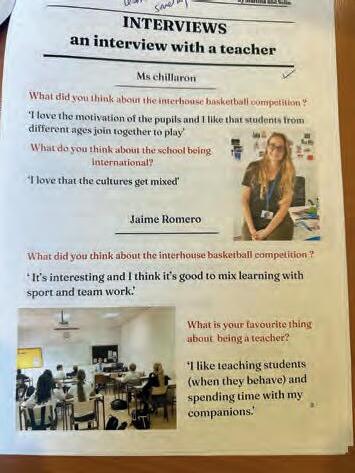


A tunnel for a railway under the AP-7 motorway is not way forward
A DUG out and covered railway tunnel along the AP-7 sounds depressing.
Why not build an elevated light railway running between the lanes of the motorway where possible and above and below it when necessary?
Double railway tracks elevated on single pillars can look very attractive. It has been
done in Athens, Jakarta, London, Delhi and many other places around the world, so why not the Costa del Sol where locals and tourists alike can enjoy the scenery along the way from Malaga to Estepona and beyond.
K Andersen, Estepona
WITH regards to your story about African Leopards being found on a farm - how can that happen in 2025?
It shows just how deep crime runs in our society, and how ineffective the measures are to control and monitor what’s happening.
This can only have taken place with the assistance of gangs in at least two coun-
tries, and almost certainly was enabled by a go-softly approach by some employers in the related government departments.
If you have seen leopards in their natural environment , you will have seen one of the most beautiful animals.
Sheer elegance and power....
Mark via OP website
YOUR article about the woman who had €5,800 stolen after a big win was interesting.
I had a solid gold ID bracelet stolen from me and when I reported it to the police they were not in the slightest bit interested. I’ve heard other expats say that the police don’t bother about thefts concerning expats.
Why is this?
Colin Barr, Alicante
ED: Very good point - the police here aren’t generally that bothered about any crime against foreigners. It’s why the Olive Press has an important role here.
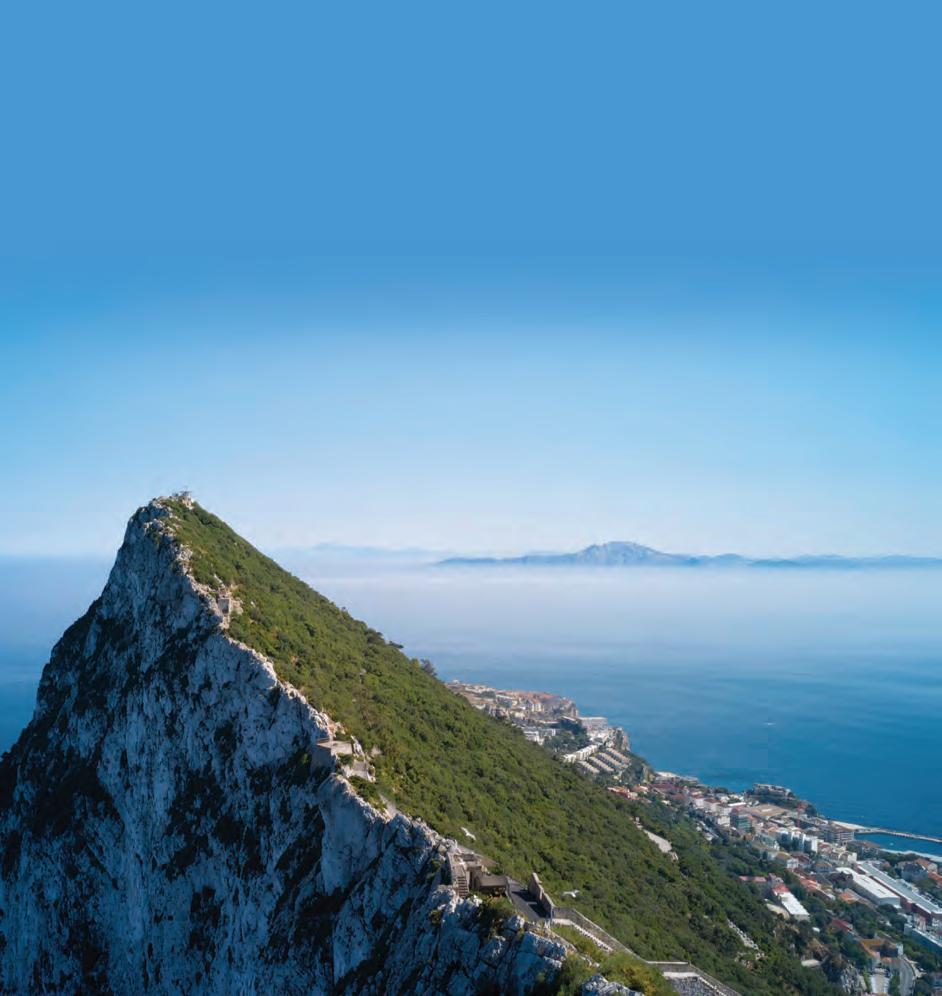
I DO not understand why a hard copy of the Olive Press is provided free, while the online version requires payment.
In the interests of protecting the planet, it would seem more responsible to charge for the printed copy while making the online version freely available.
This would reduce paper use and unnecessary distribution, while still providing access to readers.
John Carrington, by email
ED: Great point… And I totally take what you’re saying except that almost nobody buys newspapers anymore, unless they’re over 50.
Of course, we are very careful with our printed newspapers and don’t have more than 0.5% returns, which is very rare around the world these days. The good news is that all the news in the paper and all the features are also online, where you’ll also find five or 10 times as much reporting.
OUR online piece on the Fascist’s charter (also see page 6) prompted a healthy debate between the good (and not so good) readership of the Olive Press...
FRANCO was a very moral leader, not racist or xenophobic. He was too good, even – long live to his memory.
Marchese Casanova D Ivo
WHAT the f*** are you talking about? Did you live in Spain from 1936 until his death?
Read a bit of history and you may learn a bit. Or perhaps, no; your comment says it all.
I was a postwar child and will forever be grateful to the UK for allowing me to be part of its society and making me what I am today.
Maria Angeles Martinez
NOBODY in Spain is celebrating anything about Franco.
Carlos Lázaro Alcay
WHY say something so wrong?
There was a civil war, which meant there was a LARGE section of the population that supported Franco’s ‘side’. Their children and grandchildren today often continue with similar stances, while plenty of children and grandchildren of Rojos have come to realise Franco did some things right too.
Ben McGarr
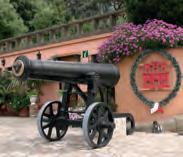
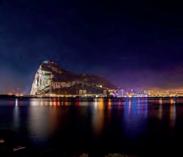
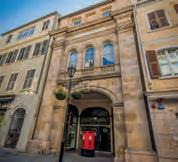
For further information call: Gibraltar Tourist Board +350 200 74950
Or to download a brochure go to: www.visitgibraltar.gi
TRAVELLING by train be-
tween Spain’s two biggest cities will soon take less than two hours, according to plans unveiled by the government.
Transport minister Oscar Puente confirmed that the government will press ahead with plans to increase top speeds on AVE high-speed rail to 350km/h.
Currently, trips between the Spanish and Catalan capitals take between two and a half and three hours, with speeds capped at around 310km/h on certain stretches of rail.
But the 621km journey could be cut to under two hours with tweaks to rail infrastructure allowing trains to travel up to 12% faster without reducing safety.
Puente said: “Our goal is 350km/h and we will be the second country in the world to reach this speed - after China.”
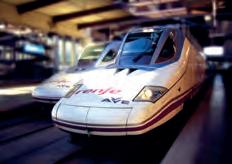

SPAIN’S own ‘Palace of Versailles’ has just been declared a Historic-Artistic Site Spain’s National Heritage Organisation. The sprawling Palacio Real de La Granja, tucked into the hills near Segovia, is a baroque showstopper built in the 18th century on the orders of King Felipe V. Once a serene royal retreat, it now dazzles visitors with echoing halls lined with paintings of Felipe V and his wife, ornate furniture, tapestries and sculptures that tell centuries of royal drama. Outside, the palace opens
By Rachel Gore
onto French-style gardens often compared to Versailles itself. Manicured avenues lead to monumental fountains still powered by the original 18th-century hydraulic system.
On special dates, the fountains roar to life, creating spectacular displays of water jets and cascades without a single electric pump – a scene that has wowed visitors for generations. Beyond the palace gates,
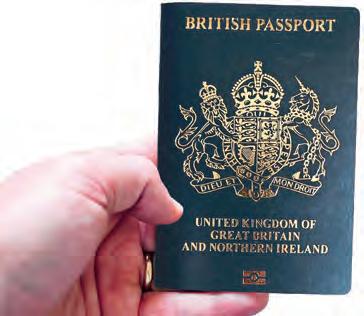

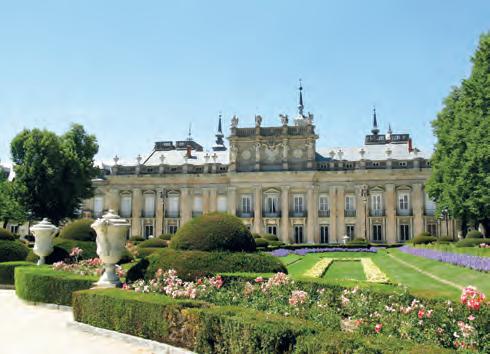
the Real Sitio de San Ildefonso offers more to explore. The Real Fabrica de
THE UK will unveil a new passport on December 1, introducing key updates to security and design.
This marks the first major change since the 2020 shift from burgundy to dark blue following Brexit. Notably, the new passport will feature His Majesty King Charles III’s Coat of Arms, replacing Queen Elizabeth II’s emblem. The King’s design incorporates the Tudor Crown, giving it a rounded top. The passport also includes cutting-edge holographic and translucent features for improved security, making it the ‘most secure British passport ever’. Inside, updated designs showcase UNESCO-protected landscapes from the UK’s four nations, such as Ben Nevis and the Giant’s Causeway. Existing passports remain valid until expiry.

Cristales and Museo Tecnologico del Vidrio bring 18th-century glassblowing and manufacturing to life, while nearby historic churches and monuments, including the Valle de Cuelgamuros and Bosque de la Herreria, add to the area’s royal charm.
With its dramatic fountains, baroque splendour and stunning mountain backdrop, La Granja may echo Versailles in style – but it remains a uniquely Spanish treasure, now officially recognised for its historic and artistic value.
SPAIN may be the world’s number-one exporter of oranges, but it still imports tens of thousands of tonnes of the fruit every year to keep supermarket shelves stocked.
New figures from the Ministry of Agriculture show Spain brought in 82,673 tonnes of oranges during the 2024–2025 campaign. That may sound surprising in a country famed for its citrus groves, and which exports 1.6 million tonnes of oranges a year, but imports play a key role in plugging gaps in supply when domestic varieties are between harvests.
The bulk of those imports –over three-quarters (77.5%) – come from inside the EU. Portugal is by far Spain’s biggest supplier, sending 37,211 tonnes, followed by the Netherlands (12,398 tonnes) and France (7,737 tonnes).
Outside the EU, Spain still buys citrus from countries with major industrial-scale harvests. South Africa (5,019 tonnes), Argentina (4,720 tonnes) and Egypt (2,388 tonnes) are the biggest nonEU countries of origin.



Northern Spain dominates but how did Andalucia and Valencia’s leading restaurants fare at this year’s Michelin star gala?
ONE of Andalucia’s or Valencia’s leading restaurants got an extra Michelin star in this year's annual gala for the guide. Despite persistent rumours, neither Benito Gomez, at Bardal, in Ronda, nor Marcos Granda, at Skina, in Marbella were handed the all-important third star.
Nor was Dani Carnero handed a second for his highly-rated Kaleja in Malaga.
In a largely disappointing night for local chefs at Malaga’s Sohrlin theatre, at least the leading three Michelin maestros - Angel Leon in Cadiz, Quique Dacosta in Denia and Paco Morales in Cordoba - kept the top global culinary honour.
And across Spain, all 16 three Michelin star restaurants maintained the position, while five new two-star joints emerged.
But while the three-star heavens remained unchanged, the Michelin firmament below glittered with fresh energy. Across Spain, 25 new restaurants were awarded their first star, and it was

By Jon Clarke & Dilip Kuner

here that Andalucia and Valencia came into their own.
Five Andalucian kitchens earned their first Michelin star, spread across Granada, Cadiz, Sevilla, Cordoba and Malaga. Farala in Granada impressed inspectors with its freshness and ambition, while Mare in Cadiz brought a refined coastal sensibility to the guide.
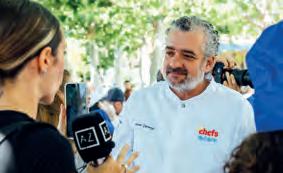
the famous temples of Aponiente and Noor. They underline that fine dining in the south is no longer confined to a handful of celebrated kitchens but is instead emerging across urban, inland and coastal settings.
Valencia and Castellon, meanwhile, enjoyed their own moment of recognition, one that spoke not only of consolidation but of genuine momentum.

Los Rosales, on the edge of Sevilla, saw Ochando recognised for its sharply honed regional character. In Malaga, Palodu earned the city its newest gastronomic badge of honour, and Cordoba’s Recomiendo joined the constellation with a menu that blends creativity with solid culinary roots. Taken together, these new stars offer a portrait of an Andalucia tronomic
Three restaurants in the region entered the Michelin guide with a first star, each contributing to the Comunitat's increasingly diverse gastronomic landscape.
Simposio, just outside Valencia city, was singled out for its contemporary approach rooted firmly in local tradi-
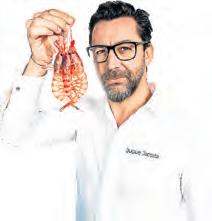
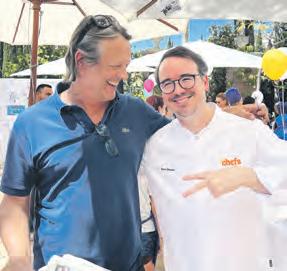


tions and produce. Castellon province, often overshadowed by its larger neighbours, had an exceptional night: Llavor, in Oropesa del Mar, earned a star for the inventive, terroir-driven cooking of young chef Jorge Lengua, while Ruben Miralles in Vinaros added another accolade to a coastal region long known for its produce but seldom recognised at this level. To the east, the effect is almost one of decentralisation. Ten years ago, most of the region's gastronomic prestige radiated from Quique Dacosta's Denia stronghold. Now, Valencia's culinary excellence extends from urban cen tres to quieter towns and coastal enclaves.
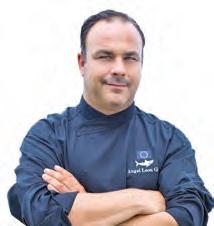
all emerged in the north
Mont
Ramon
There is now a new path to Spain’s finest dining experiences
Spain's new two-star restaurants

Enigma
in Madrid, which regained a second star after moving location. For food lovers, the message is clear: the path to Spain's finest dining experiences no longer runs exclusively through Barcelona, San Sebastian or Madrid. It can now just as easily lead to a hillside in Granada, a quiet hamlet near Sevilla, a fishing town in Castellon or a suburban dining room outside Valencia.
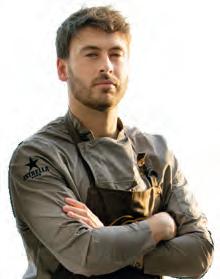
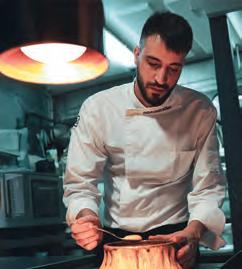







678 45 00 51 costadiggers@hotmail.com














A PROBE into dodgy Covid contracts in Andalucia has exploded into a fullblown corruption storm after investigators uncovered alleged links to a narco gang using bent cops to smuggle drugs into Spain.
Last week, the president of the Almeria provincial council Javier Aureliano Garcia, its vice president Fernando
Gimenez and the mayor of the town of Fines, Rodrigo Sanchez, were all arrested over irregular contract practices for the procurement of personal protective equipment (PPE) during the Covid-19 pandemic.
Garcia and Gimenez have both since resigned.
The politicians - all members of the conservative Partido Popular (PP) - are accused of steering a €2 million contract for Covid masks to a businessman with links to organised crime via a non-competitive process involving possible kickbacks, fraud and corruption.
A TOWN on the Costa del Sol has become the first to install detectors on its beaches that will warn sun bathers of excessive UV ra diation.
Benalmadena town hall has recently installed 20 solmaforos - high-tech devices that record the level of ultraviolet radiation beaming down from the sun. The beaches of Carvajal, La Morena, Tajo de la Soga, Bonita, Malibu, La
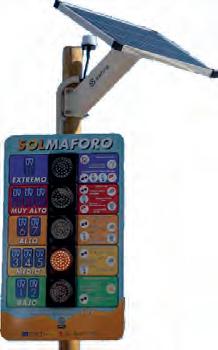
By Ben Pawlowski
Viborilla, Las Yucas, Benalnatura, Torrequebrada, Torrevigia, Los Melilleros, Arroyo de la Miel, Los Maites, El Bil-Bil, Santa Ana, Las Gaviotas, Malapesquera, Torrebermeja 1, Torrebermeja 2 and Fuente de la Salud have all been given a
A TEAM led by a Spanish biologist has designed the first ever lab-grown human bone marrow. This scientific advancement is said to have the potential to transform cancer research and prompt developments in treatment. The lab-grown human bone marrow was created by a team led by Andres Garcia
UV radar.
Powered by a solar panel and a lithium battery, the detectors will give a warning based on UV ratings issued by the World Health Organisation (WHO).
The devices will go green to indicate low radiation levels, yellow for moderate, amber for high, red for very high and violet for extreme.
Benalmadena mayor Juan Antonio Lara said: “By pro-
Garcia, a researcher and natural biologist from Estepona. It accurately reproduces the complete natural structure of bone marrow, including blood vessels and nerves.


viding this information, we help beachgoers make informed decisions about the risk that their exposure to the sun may present and they can decide the level of protection they must use or at what times they can sunbathe and at what times they should not.”
Excessive exposure to UV rays can cause skin damage and increase the risk of skin cancers, such as basal cell, squamous cell or melanoma. Experts say precautions should be taken if the UV index is above 3 - equal to a yellow alert on the new solmaforos - such as staying in the shade or regularly applying sun cream.
The installation has been funded by a €60,500 grant from the EU’s Next Generation programme.




A CATALAN language billboard on Madrid’s Gran Via has stirred controversy, with supporters calling it a sign of democratic progress while critics slam hypocrisy over limits on Spanish signage in Barcelona.
A BRITISH-designed skyscraper in Malaga port faces renewed backlash after experts filed an 80page complaint, warning the rushed project would scar the skyline.
THE EU’s top court has ruled all member states must recognise samesex marriages performed anywhere in the bloc strengthening freedom-of-movement rights and impacting countries that still refuse legal recognition.
WETHERSPOON’S global takeover has officially begun at Alicante airport. The UK’s latest cultural export, beloved for its cheap pints and sticky carpets, has planted its first international flag on Spanish soil. Because nothing says ‘holiday in the sun’ quite like a fry-up and a lukewarm beer before 9am. Travellers can feast on the greatest hits of both Spain and Britain, from garlic prawns
British pub chain famed for its bargain booze lands in Spain
By Dilip Kuner
and burgers to a full English breakfast.
The new pub also has an outdoor terrace for those who prefer their ale with a side of jet fumes.
Martin, now steering the Wetherspoon empire into the EU, insists the airport venture will be a roaring success. And why wouldn’t it be? Brits have long shown an alarming
willingness to consume a pint at any hour so long as the word ‘airport’ is involved.

CHRISTMAS came early for Spain’s top skiing resort, as the Sierra Nevada opened in November this year.

But Martin (pictured) has hinted this is only the start.
A NEW analysis reveals that Spain, not America or Germany, is most similar to Britain.
The Economist magazine compared OECD nations across 10 social, economic, and cultural indicators and found Spain the closest match.
Despite centuries of rivalry, the countries share striking similarities: population size, GDP per capita, alcohol consumption, life satisfaction, religious belief, and more. Both also grapple with separatist movements
- Catalunya, the Basque Country, Scotland and Northern Ireland - while both built vast empires and now face economic and political challenges.
British tourists flock to Spain, and trends show increasing interest in the Spanish language.
While British policymakers have long looked to Scandinavia for inspiration, the UK ‘should reconsider and look to Spain instead’. After all, Spain has a growing economy and a more open immigration policy.

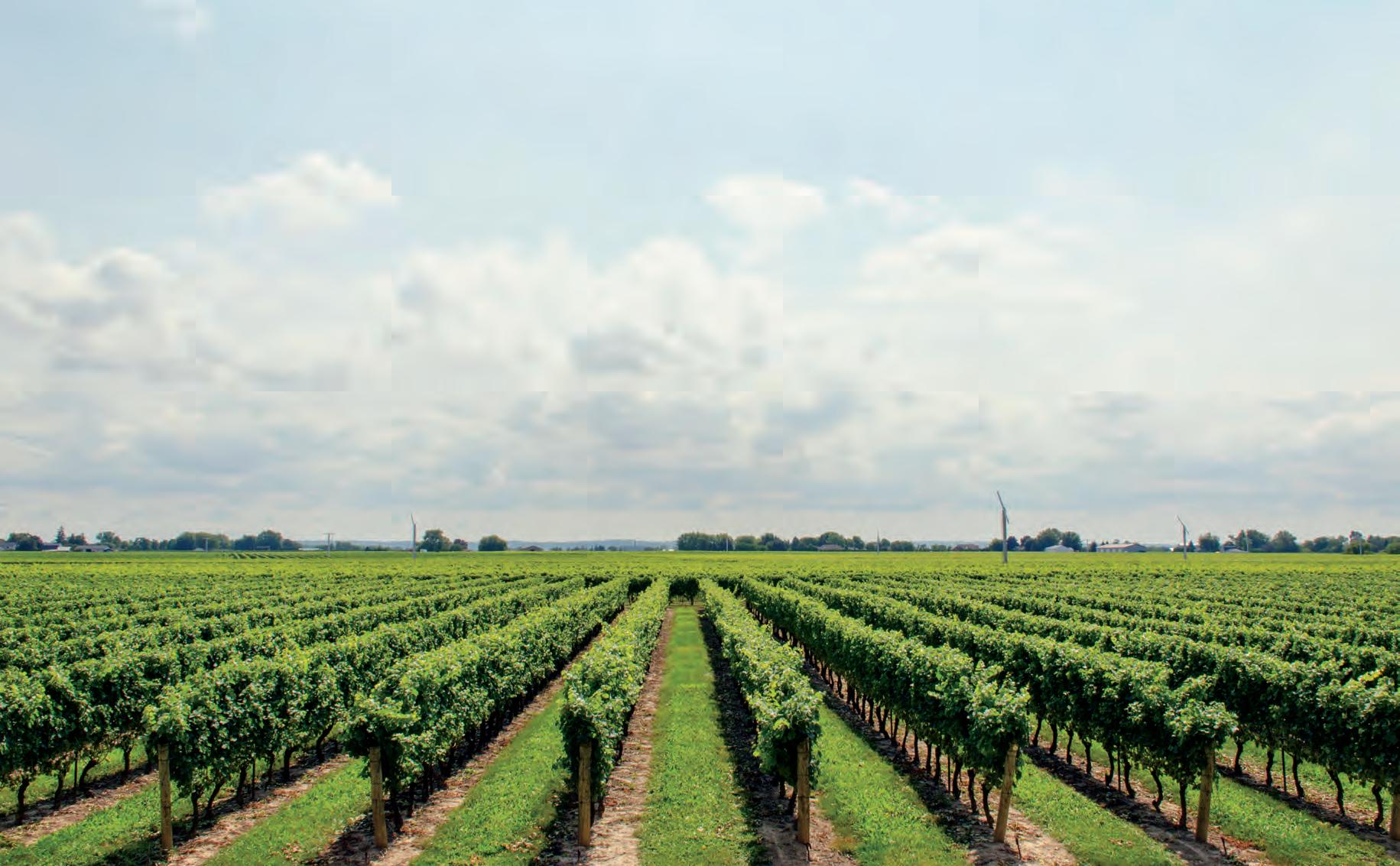

More airport Wetherspoons could soon pop up across the globe, turning international travel into one long, continuous pre-flight pint.
Forget five-star lounges and overpriced sushi – the British public clearly deserves a cut-price fry-up and a bargain lager while standing in yet another queue.
Is it terrifying? Maybe. Comforting? Absolutely. The world has waited long enough. Wetherspoon has landed –and there is no escape.
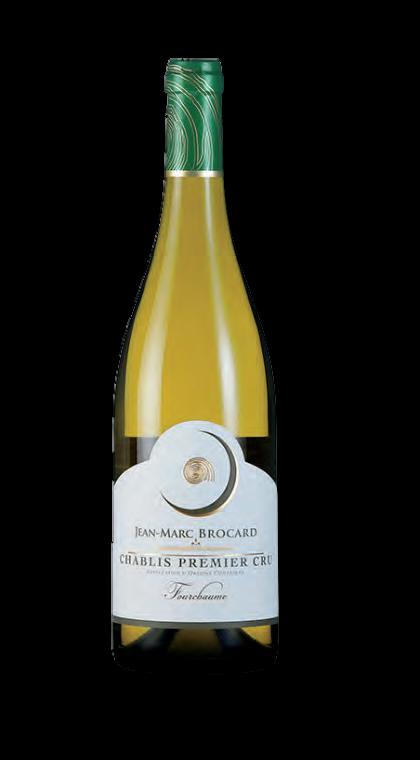
Europe’s southernmost ski resort, kicked off the season with skiers treated to seven kilometres of perfectly groomed runs in the Borreguiles area - easily the best opening day for years! With nine lifts already open the resort was more than ready for action. Snow depths ranged from 20cm to 40cm and the vertical drop stood at 355 metres. With the snow machines going full tilt for some weeks due to low temperatures, a huge range of winter activities are already on offer, including toboggan runs, ice skating and snow slides.
The early start makes it one of Spain’s first major ski resorts to open this season. Lift tickets are €42 per day, with discounts available on the official Sierra Nevada website. Let the season begin!