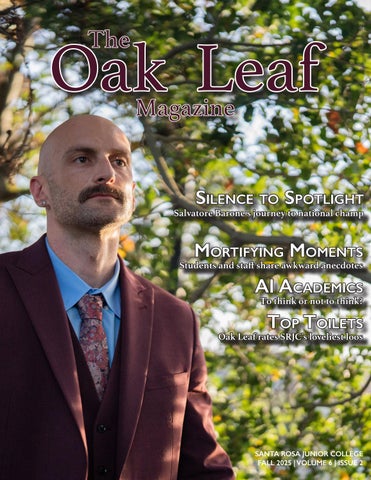

Oak Leaf Magazine The







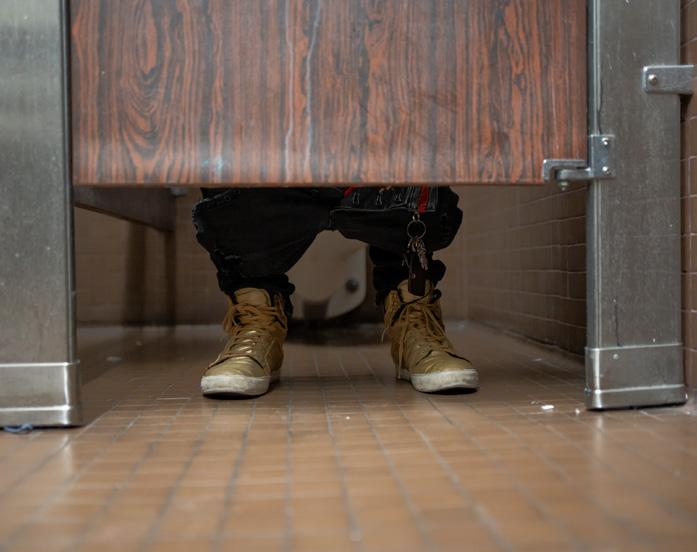

(Top from left to right) A snowy egret rests on the shore of one of the ponds at Las Gallinas Valley Birding Loop on July 9, 2025 in San Rafael, Calif, page 2. An Oak Leaf student shares her story of loss and how she learned to heal herself, page 4. One reporter explores the synchronicity of owls, cats and pretzels, page 6. Need a budget laptop? We have the guide for you, page 8. Treat your bartender well. They see you and plan to serve you when they can, page 10. Confessions of a half-skill hero, half-craft hero, page 16. SRJC student Sal Barone fights through addiction and incarceration to become the nation’s top speaker, page 22. Are you going in the right place? SRJC staff rates and reviews the campus’ bathrooms, page 28. Winger Logan Koop cuts excess tape off of his freshly wrapped hockey stick before practice on Nov. 16, 2025 at Snoopy's Home Ice, page 37.
Editors-in-Chief
Oliver Kindt
Emelle Raschein
Editors
Yna Bollock
Kevin Terlizzi-Bowes
Michael Combs
Natalie Emanuele
Lauren Kelleher
Adair Alvarez-Rodriguez
Cristan Molinelli-Ruberto
Zoë Steiner
Reporters
Natalia Alhakim
Jacob Banks
Rhea Bath
Michael Bragg
Reid Carpenter
Ziggy Leon Carrillo
Dylan Cooper
Wilson Ganzler
Kinda Hamami
Archibald Henderson
Pacific Jeremy
Benjamin Lyle
Kevin Ortega
Juan Padilla
Jesse Saal
Holden Sigala
Nick Stalker
T’Niya Williams
Adviser
Anne Belden PALS
Mark Fernquest
AD Manager
Nick Vides
Letter from the Editors
As the autumn leaves once again give way to the brisk chill of a low 70s Sonoma County winter, your friends at The Oak Leaf remain committed to accurate and timely coverage of campus events, breaking news and goings on. We hope this issue of The Oak Leaf Magazine gives you a muchneeded break from doomscrolling and fills your hearts and minds with our succulent words.
Per usual, it was a turbulent semester in room 106. Things started out hot in the first of the week of the semester with the Pickett Fire and the coverage of an SRJC IT employee’s stalking trial.
Since then we’ve covered five protests, gained two new pets and continued to push the needle for what a community college newsroom can do.
With this magazine, we aimed to highlight the best that SRJC and Sonoma County have to offer, while still acknowledging the challenges of being an SRJC student and navigating the turbulent climate of the U.S. We also made sure to show some love to the weirdest parts of it all.
“The Good, The Bad and The Quirky,” if you will.
Learn about a student who channeled his struggles with addiction and incarceration into becoming a national champion speaker, an Oak Leaf reporter who navigated the loss of a parent, the best and worst bathrooms at SRJC and so much more.
As always, we couldn’t have done it without our amazing adviser, Anne Belden and our TA Mark Fernquest, who held the newsroom together and made sure we didn’t get sued every step of the way.
Signing off for the final time, your favorite EICs, Oliver Kindt & Emelle Raschein
Members of The Oak Leaf received an array of accolades during the Journalism Association of Community Colleges' Fall 2025 Conference held at San Jose State University on October 25, 2025. (Yna Bollock)


Co-editors-in-chief Emelle Raschein and Oliver Kindt are known for their verbal sparring abilities and unhealthy dedication to The Oak Leaf. (Zoë Steiner)


Birds are real: Here's where you can find them
Sonoma and Marin counties are a nature-lover’s dream, with their sweeping meadows, dramatic coastlines, dense redwood forests and golden rolling hills offering a variety of beautiful landscapes.
Located on the Pacific Flyway, the counties are a stopover for migrating birds — particularly in the fall and winter months when they seek warmer southern climates. Thus, it’s no surprise the counties are considered a mecca for birdwatchers.
Birdwatching is a great activity to get your body moving as well as slow down, take in the scenery and relax.
Some birdwatchers are more serious than others, following migrations and carefully logging sightings, while others just enjoy the pleasantness of nature.
Sonoma Valley Regional Park
Sonoma Valley Regional Park is nestled in the hills between Glen Ellen and Highway 12.
This 202-acre park offers multiple trails through oak woodlands and around Suttonfield Lake. The lake attracts geese, ducks and American coots, along with red-winged
blackbirds and osprey. Ospreys are a large, predominantly fish-hunting bird of prey.
Another enjoyable species to observe is the white-breasted nuthatch, a small tree-climbing bird that scoots vertically up and down branches.
However, my favorite bird at this park is the American kestrel, which primarily inhabits the oak woodlands on the Highway 12 side — although I’ve spotted them scouting from branches in the tall trees near the Glen Ellen entrance as well.
The American kestrel, a member of the falcon family, is the smallest bird of prey in the United States, comparable in size to a pigeon.
The kestrel sports beautiful plumage with blue-grey wings, a rust redcolored back and black spots on its chest, with markings on its face reminiscent of running eyeliner.
Crane Creek Regional Park
Crane Creek Regional Park has become one of my favorites because of its gorgeous aerial views of the Santa Rosa floodplain and Petaluma Valley from the top of the hill.
This park is a short drive into the hills east of Sonoma State University in Rohnert Park.
It offers recreational activities such as disc golf and picnic benches to eat lunch with a view. The trails are easylevel difficulty.
A large hill in the southeastern corner of the park supplies plenty of birdwatching vantage points.
Songbirds such as meadowlarks and western kingbirds inhabit the park. Various woodpecker species — such as the downy and most common acorn woodpeckers — can be heard hammering away at trees.
There is also a large presence of birds of prey, mostly red-tailed, red shouldered and Cooper’s hawks.
Northern harriers and peregrine falcons have been spotted in winter and early spring when many raptors migrate to the Bay Area from up north.
Las Gallinas Valley Birding Loop
A bit further of a drive, but well worth it, the Las Gallinas Valley Birding Loop is located in San Rafael off of
Story & Photos by Jacob Banks
Smith Ranch road, nestled behind the McInnis Park Golf Center. It offers a two-mile loop around retention ponds with views of the surrounding wetlands and the San Pablo Bay.
Las Gallinas offers a diversity of bird species including egrets and great blue herons, and seabirds such as ring-billed seagulls, cormorants and massive white pelicans.
California Quail run along the trail, as well as a variety of songbirds. Most notable are the many raptors that inhabit the park due to the various types of prey in the wetlands.
This park has a year-round population of northern harriers and Cooper's hawks. One of the most interesting raptors to observe is the white-tailed kite, which hovers before diving down on unsuspecting rodents.
Las Gallinas is also a popular spot for migrating raptors such as the merlin and prairie falcon.
Schollenberger Park
Sitting on 165 acres just 10 minutes from downtown Petaluma is Schollenberger Park. All trails are flat ground, making it a popular spot for bike riders.
This park has miles of trails spanning along natural salt ponds and the Petaluma River, as well as some offshoot trails that head into eucalyptus groves.
Schollenberger is a haven for birds, with more than 200 recorded species. One species that is only found within the North Bay is the white-faced ibis — a lanky, long-billed brackish and freshwater shorebird.
The white-faced ibis sports iridescent bronze and maroon plumage with a border of white feathers around its bare, pink face. Bald eagles have been spotted on various occasions, soaring high overhead.
Other notable species at this park include mute swans, kingfishers, Canada geese, white-tailed kites, and during raptor migration, peregrine falcons.
Ragle Park
On the edge of suburban Sebastopol is 157-acre Ragle Park with trails that run through redwood patches, meadows and oak forests. It is important to note some of the trails in the further reaches of the park can be narrow, uneven and heavy with vegetation. Many bird species call this park home.
Spotted towhees, goldfinches, quail and dark-eyed juncos are common. In the spring and summer, barn and violet green swallows swoop low across the soccer fields hunting for insects.
Strikingly blue western bluebirds can be seen here, as well as one notable non-bird — the long-tailed weasel. It’s quite entertaining to watch the weasels run about with their cute faces and playful demeanors.
Tolay Lake Regional Park
The largest Sonoma County park is Tolay Lake, which sits on more than 3,400 acres. Tolay Lake is actually a creek most of the year, with low-lying fields and water levels. During winter, water fills up about 200 acres of the park to a maximum depth of 8 feet.
About a 20-minute drive from downtown Petaluma off Lakeville Highway, Tolay Lake is a sacred ceremonial site for the Coast Miwok and Pomo tribes, where charmstone rituals were performed for thousands of years.
One elusive species is seasonally present only at this park: the shorteared owl, a medium-sized bird often seen hunting during the day, dawn and dusk.
Other species that frequent Tolay Lake Regional Park include golden eagles, sharp-shinned hawks, redtailed hawks, burrowing owls, tree swallows, cowbirds, finches, redwinged blackbirds and turkeys. In the wet seasons, many waterfowl, such as the cinnamon teal, migrate here.






Top to bottom: An acorn woodpecker at Crane Creek Regional Park; a snowy egret, a female blackcrowned night heron, and a white pelican at Las Gallinas Birding Loop; a western bluebird, and a long-tailed weasel at Rangle Ranch in Sebastopol, Calif. (Jacob Banks)

Navigating grief as a college student
by Cristan Molinelli-Ruberto
Labor Day 2019 started just like any day as I settled into my new surroundings at California State University, Monterey Bay. It was the second week of classes and I was so excited to finally be off at “real college,” as Dad would say.
After three years of living at home while attending Santa Rosa Junior College after high school, it was time to truly learn who I was, independent of most friends, family and the community I had been so comfortable with — maybe too comfortable — for 21 years.
One phone call from home changed everything.
Mom had been sick intermittently for much of my life. We were in the routine of juggling doctors’ visits, surgeries, radiation treatments and, thankfully, periods of rest and remission from lung cancer and brain tumors.
When I answered Dad’s call that morning, something felt different,
more serious than anything we’d faced before. He told me he’d found Mom still cozied up in her red robe on the couch, where he’d last seen her watching TV the night before. This was unsettling; she was always the early riser of the family.
Growing up, it was odd not to hear her puttering in the kitchen by 6:30 a.m., making her coffee and listening to the Armstrong & Getty On Demand podcast — always on speaker, to my annoyance. When Dad tried to wake her that morning, she didn’t respond. She was in the exact position he had left her the night before. She wasn’t just sleeping in.
She was rushed to the hospital and we learned she had suffered a major seizure caused by her brain tumor growing and putting pressure on her brain stem.
Living three hours from home trying to balance new classes, housing and routine, I felt submerged. I was gasping for air while keeping my troubles private; I didn’t dare tell
my professors or new friends why I was gone every weekend. The time that I’d fantasized about going to college parties, meeting new people and letting loose was now spent commuting between home and school.
I struggled to visit Mom in the hospital. Selfishly, it hurt to see her incapacitated. She wasn’t the Mom I’d always known. She seemed alien, unable to speak well, just yearning to communicate through glances and soft, simple phrases. Mom had never been that quiet before.
Seven long weeks later, the inevitable happened. On Oct. 20, 2019, she died.
It might be surprising to hear, but I felt numb. Maybe it all happened too fast for reality to sink in, but I stayed the model student, missing only two days total that semester. I got straight A’s. When I wasn’t actively in class, I was working on a project or homework, truly anything to keep my mind off my “big secret.”
Cristan Molinelli-Ruberto and her mother, Michele Molinelli-Ruberto, relax after a pool day in summer 2008 in Novato.
A 2021 study by the National Library of Medicine detailed that in the last six years, 9% of college students reported a loss of a parent.
Besides emotional numbness, the study found students often experience classic symptoms of grief: sadness, guilt and anger.
Most sought help from family or friends, but far fewer turned to professors or mental health counselors for support.
Various studies dating back to the 1980s show young adults who face a significant loss for the first time are often not equipped to cope safely and healthily.
Psychology professor Candice Hershman, Ph.D., has witnessed this in her nearly 13 years at SRJC.
“It's not a one-size-fits-all thing," Hershman said. "Different people have different kinds of coping skills.”
“I could see some students responding by over-functioning and becoming the perfect students, yet not really making space for their grief,” she said. “The value is that it's very helpful for someone to feel capable when they're going through a hard thing. It can actually help them feel resilient. The bad news is it can be a distraction from more tender, painful emotions.”
She described me perfectly.

"It's not a one-size-fitsall thing. Different people have different kinds of coping skills.”
My closest friends supported me where they could, but I wouldn’t face reality. I couldn’t face the pity that would come once people knew what I was going through. I buried myself in work until I was crushed by the weight. Burned out, sick as a dog and numb by semester’s end, it was time to seek help.
At first, I struggled with therapy. I felt like I wasn’t being productive or making progress towards “being better” month after month. I had tried a few sessions of grief counseling at CSUMB, but it felt daunting to share some of my ugliest pain with complete strangers.
I was distraught that cancer had taken Mom away from us too early, and years later, still devastated knowing she wouldn’t see me graduate from college or get married. She remains a missing presence in both the milestones and mundane parts of my life. But that was the point of weekly therapy. Talking through those emotions and coming to terms with them. She’s gone, it sucks, but life still goes on.
SRJC Student Health Services licensed supervisor and doctor of psychology Kirsty Hale Viera encourages students to reach out for help. Whether it’s a trusted friend, family member, professor or campus resource, such as disability resources or academic counseling, the key is to talk to someone.

“Reacting to grief and loss is a healthy reaction,” Hale Viera said. “We want people to be able to access and experience grief without thinking there is something wrong with it.”
With therapy that was right for me, being open and honest with my trusted friends and family, and most annoyingly, time, I’ve learned to accept my loss. I no longer avoid thinking or talking about Mom.
Now I remember the good things, like the warmth of her hugs after she spent hours in the garden, hands caked in soil from tending to her Roma tomatoes. I can still hear her laugh, saying “Nice one, Grace!” after I do something clumsy. And every time I board a plane, I picture her pulling her coveted teriyaki beef jerky from her Mary Poppins bag.
I continue to miss her — even the damn podcast.

Michele Molinelli-Ruberto relaxes in bed with some of her favorite things – a good book, red wine and a cigarette – in 1992 in Southern California.
Michele Molinelli-Ruberto holds Cristan’s twin sister, Kathryn Molinelli-Ruberto, in the NICU after giving birth in April 1998 in Sunnyvale.
Jessica Whitaker, Michele Molinelli-Ruberto and Cristan Molinelli-Ruberto take a selfie on Cristan's 21st birthday, April 13, 2019, in Novato.

Before I start, I want to be clear that I am not the world’s biggest skeptic. I believe in science and when I encounter facts, I am inclined to believe them too.
However, like many people, I also hold room for the inexplicable. The questionable happenings or coincidences that leave us wondering: Is the Universe telling me something?
The term is synchronicity — the coincidental happening of events that seem related but aren’t explained by definitions of reality. Simply put, synchronicity is when one thing happens and seems related to another completely different event.
Studies describing the rates of people experiencing synchronicity vary, but according to the National Library of Medicine, more than one in five people experience it at least once.
The earliest memory I have of synchronicity dates back to Oct. 8, 2017, the day the Tubbs Fire began. I
was 12, dancing in the backyard with my mother while belting the lyrics to “Ring of Fire” by Johnny Cash as the sun went down.
It was an incredible day, sullied by a horrific night. My mother woke me up at 10:00 p.m., panicking and telling me we might have to evacuate. My dad had already evacuated, with other members of my family following suit.
Though we stayed home in the end, an underlying paranoia gripped us, largely because of the devastating wildfire that rendered California a state of total disarray, but partly because of the song we sang the day before.
Could our singing “Ring of Fire” mere hours before one of the most horrific fires in California’s history really be a coincidence?
The two events seem too terrifying to be unrelated. My mother and I are still superstitious about it; we haven’t sung the song out loud since that night. I might be crazy for saying this,
but a thought always lurks in the back of my mind, telling me that song was a warning for what was to come.
Regardless of how this event affected my mental state, it led me down the rabbit hole of synchronicity, where I learned what I could until I reached Carl Jung, who discussed this concept in the late 1800s.
Jung, an esteemed Swiss psychologist, established much of modern psychology through his work studying the unconscious mind, as well as for developing the extrovert and introvert archetypes.
Lesser known are his deeper theories that influenced the concept of synchronicity, including the proposal that seemingly random coincidences may hold deeper meaning.
Mankind seeks to derive truths from nature, so using non-causal means of explanation to identify why something fantastical happens is logically sound, according to Jung. Without delving too deeply into Jung’s
Oak Leaf reporter Dylan Cooper tries to make sense of a series of seemingly connected signs from the Universe, Nov. 11, 2025. (Lauren Kelleher)
work, I believe it’s important to view synchronicity from the standpoint of a psychologist. Jung’s ideas regarding hidden relationships between two different events are rooted in the Western paradigm.
When I first pitched this article, multiple members of the Oak Leaf staff seemed intrigued with the idea and lined up to relay personal experiences with synchronicity to me.
The first volunteer, A&E editor Natalie Emanuele, told me how she was eating pretzel sticks one day and sent a photo of them to her brother in New Jersey. Her brother was eating the same sticks at that very moment.
Synchronicity doesn’t just occur when eating salty snacks, though. Take my encounter with journalist Rhea Bath, who recently adopted a kitten named Mocha while reporting a No Kings protest. A couple near the event was seeking someone to be her new owner and Rhea adopted her in an instant.
As I told Rhea about my own attempts to get a cat, she told me about Mocha’s seven siblings who were still looking for permanent homes.
People love to joke about the “Cat Distribution System,” saying that the Universe has a habit of sending cats to people when they need one the most. I never bought into it much myself, until now.
Whether or not I end up adopting one of the kittens, I am left wondering about this coincidence. Is it a sign from the heavens? Has fate chosen me to receive a feline companion in these trying times?
Now, it is almost impossible for me to talk about synchronicity without delving into signs. I’m not talking about the No Left Turn signs I choose to ignore; I’m talking about the Universe physically reaching out to us to show us something we can’t ignore.
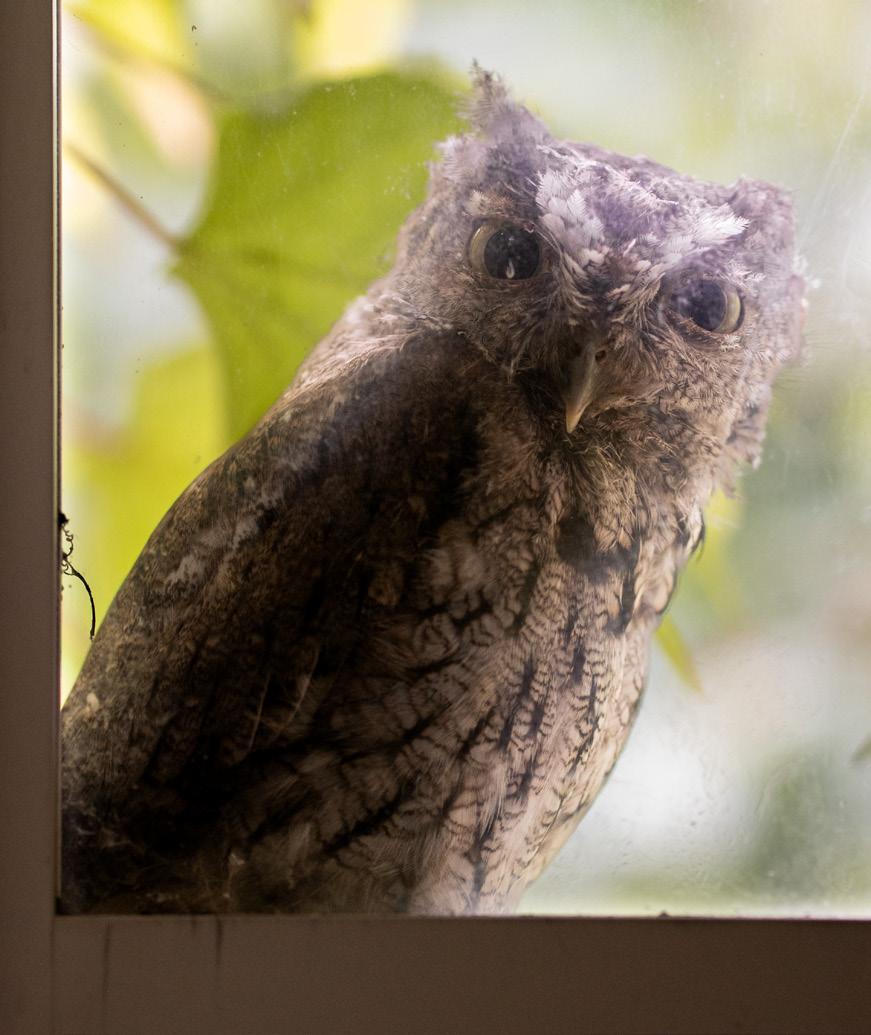
Anne Belden, the Oak Leaf’s adviser, lords over the newspaper from an office in the back of the class with a large window giving view to a luscious tree. That lovely tree has recently become the home to our fourth class mascot, a screech owl who we have aptly named Cronkite, after esteemed journalist Walter Cronkite.
The Tubbs Fire engulfs a home in the Hidden Valley neighborhood in Santa Rosa, Oct. 9, 2017. (Brandon McCapes)

Owls have spiritual meanings in different traditions. According to CountryLiving, seeing an owl can mean that a newfound wisdom is being brought into one’s life, or that one is about to shed light on a hidden truth — or in a darker context, that one’s imminent death is approaching.
Ancient Romans believed the yelloweyed, head-spinning birds were bad omens, bringing death to those who viewed one.
Personally, I hope Cronkite bears a brighter message, seeing as I quite enjoy living.
People have reported seeing owls in conjunction with UFOs, according to Paranormal Casefiles, so maybe there’s a chance that one of the Oak Leaf staff is about to be abducted by aliens. Maybe we already have been abducted by aliens and the owl is trying to warn us.
Aside from Cronkite, just the other day I was walking to my weekly Dungeons & Dragons game while daydreaming about my latest crush, when I tripped on the sidewalk. As I stood up, I saw a car with an air freshener hanging off its rearview mirror that said “luv is in the air.”
That could not have been a mere coincidence; it had to have been a sign! The Universe was telling me to pursue love.
But maybe it’s telling me something more, trying to send me subliminal messages through seemingly random acts?
This all has to be connected in some way — it wouldn’t make sense if it wasn’t. Carl Jung believed this train of thought to be logically sound, so these connections and synchronicities have to be true.
That’s the only sane answer to this conversation. The little black bunny rabbit I found on my porch, the misprint on the back of my Snickers bar and that red stain on the top of my shirt — they all have to mean something.
Maybe the inexplicable is explicable, but only if we start reading into the strange doings of the Universe.
Cronkite has visited adviser Anne Belden's office window several times throughout the fall 2025 semester, and either brings wisdom or impending death — hopefully the former. (Lauren Kelleher)

One laptop’s battery lasted only a few minutes. Another computer malfunctioned every time I tilted it at a 40-degree angle. The dreaded power button on a third would not bring the laptop to life. I’ve made every possible mistake when buying used laptops.
I’ve wasted a shameful amount of money over the years, so let me help you avoid some of my many failures and hopefully clarify the used laptop buying process.
As the first quarter of the 21st century comes to a close, laptops have become an essential tool in any student’s arsenal — yet buying one on a budget can be stressful.
Prospective buyers are hit with confusing technical terms that may or may not mean anything. And worse, most of the time they won’t know if they even like a laptop until they’ve spent considerable time with it.
According to “The Analysis of Factors Influencing Decisions When Buying Laptop” published
in the Cogito scientific journal, students’ highest priority is buying something that just “works.”
This seems logical, perhaps even obvious, but how does the average student who merely wants something that just “works” evaluate a computer’s functionality?
That’s where I’m here to help, starting with the most important limiting factor: price.
Budget of $0
Buying a laptop is a compromise between performance, portability and price. At $0, if the laptop connects to the internet and can open Canvas, consider it a win.
Recycle centers are an option, though your best bet in this price range is to “borrow” one from a relative or friend and hope they never ask for it back.
Of course, there are also many places willing to lend you a laptop for free like the SRJC Library.
Benjamin Lyle rests in a graveyard of defunct laptops. He hopes this guide will help prevent other students' used laptop purchase tragedies. (Lauren Kelleher)
Less than $100
If you’re patient and have a reasonable idea of what you want, you can find a decent computer for less than $100. Individuals selling their old laptops on Facebook Marketplace, eBay or a thrift store often undervalue what they have in hopes of getting rid of it quickly, a situation that works to your advantage. These deals are becoming rarer as economic times worsen, but can still be found with patience and luck.
Those who don’t want to make buying a computer their full-time job can find a borderline-usable laptop manufactured within the last decade at this price range. Expect a charge that, at best, holds a few hours, so knowing how to replace a battery will prove beneficial.
Older MacBooks, Chromebooks or maybe even a Windows laptop from one of the major manufacturers — Dell, Lenovo or HP — should be available. Just understand that these laptops are likely not updatable, and they may even
struggle with basic tasks like opening more than a few web browser tabs at a time.
$100-$300
This is the sweet spot for people who are tech-savvy. There’s nothing too fancy at this price, but for what most people do, such as keeping a handful of tabs open, watching 1080p YouTube videos, using productivity software like Photoshop or even light gaming in some cases, laptops in this range will suffice.
Newer models of all the brands listed above should be available here. Just make sure the machine isn’t more than six or seven years old. If you’re lucky, the laptop may even support Windows 11 or the newest version of macOS.
More than $300
For a modernish laptop, expect to spend $300 and beyond. Much like a used car, a computer’s value drops dramatically after a few years, sometimes losing two-thirds of its sticker price by the third or fourth year. If you require a faster processor or more RAM, the costs can quickly increase, so it’s worth it to research what you actually need.
Once you reach the $1,000 price point, almost anything you could possibly want is available, though I would still recommend purchasing the previous year’s model refurbished, as it will be a better value overall.
What you actually need
After you’ve figured out your price range, think about what specs you can get within it.
RAM — sometimes referred to as Main Memory — is a computer’s temporary memory. Think of it like a temporary hard drive for storing information in currently open programs, rather than permanent storage for personal files and data. Insufficient RAM can lead to significant slowdowns as the computer will have to use
the hard drive to store temporary files, which is significantly slower in most cases.
Eight to 16 gigabytes is usually sufficient, though if you are like me and like to have 60 browser tabs open, or are a video and photo editor, go with at least 16. Bear in mind that prices can rapidly increase with the more RAM you get, sometimes adding $100 or more to the final cost.
Processors on the other hand are a confusing nightmare to evaluate, so I will only go over the most common options. Often referred to as a CPU, the central processing unit is the heart of the computer, managing the speed and responsiveness of the machine and also the number of simultaneous tasks it can perform without lag. For example, whether playing music while you game and talk to someone on Discord causes the computer to lag.
For Intel, the general rule is i7s are faster than i5s, which are faster than i3s; but the generation, or age, of the processor matters equally as much, as well as the core/thread count.
Google the model number (eg. i7-1265u) to see how old the processor is, and how many threads it has. Six threads is the minimum one should aim for in this day and age.
For AMD-branded processors like Intel, google the model number to get basic information about the processor. It’s probably only worth looking for Ryzen processors, as anything else will likely be too old and not as useful.
Apple users have a significantly easier time navigating processors, as the M series, starting at M1 and currently at M4, are the superior option that outperform any Mac using an Intel processor. They handle everything but gaming with relative ease. The MacBook Air and Pro models with M1 processors are a very good value right now, if you can
find them in stock.
Battery life is often overlooked but equally important. Most manufacturers list the expected battery life of the laptop; however, since lithium batteries naturally degrade over time, expect to get significantly shorter battery life out of your machine if it’s more than a few years old.
The good news is that if you are handy with a screwdriver and reasonably careful, almost all laptop batteries are replaceable. Just be careful, as aftermarket batteries dramatically vary in quality.
The safest but most expensive option are batteries from the same company as the computer, usually found by typing in the “original” keyword into a search engine.
Local or online
Buying a used laptop from a local business or recycle center will always be preferable to buying one online, mainly because you have the opportunity to feel it in your hand before buying it. The only catch is the type of computer you want might not be available. Be on the lookout for businesses or educational institutions that recycle computers in bulk, as they often sell high-end business machines that are only a few years old for a bargain.
Used or refurbished
Refurbished machines are a good choice, as the seller usually guarantees they work for a year, sometimes more. Just expect to pay more than the regular used price for the same laptop for the benefit of being able to return the machine if you don’t like it.
While the information listed in this guide only scratches the surface of this complicated topic, I hope it gives you a solid foundation when it comes to second-hand laptop buying — and the ability to avoid my mistakes.
If you worry that bartenders judge you based on your drink orders, you're right. They do. (Lauren Kelleher)


Agentleman walks into a bar after a long day to order a well-deserved drink. The bartender is serving other patrons, and at first, he doesn't mind waiting. Then the bartender turns to pour a few beers for the eager wait staff waiting at the well, apparently ignorant of the man’s need for a drink. The bartender still hasn’t acknowledged him, and his patience has worn thin. What should he do next?
Most guests aren’t aware of proper bar etiquette or the stress the job creates. A touch of personality, the art of drink-crafting and a constant hustle are the essence of bartending.
The job offers a unique view into the human psyche. When you tend bar, you are a part-time therapist, latenight babysitter and occasional hero who might hail a ride when they can barely stand, all while straddling that line between excellent hospitality and the desire to flip off that one guest snapping at you. Nothing can prepare you for becoming a bartender — you just have to sink until you can swim.
For every problem guest, there are 10 pleasant ones who help keep you level-headed and serve as a reminder of the enjoyable side of the job. No matter who sits at the bar, everyone leaves a memory — whether it fades by the end of your shift or etches a story into your brain you can tell for years to come.
Strange tales
Alora Maio has bartended for 15 years and has witnessed her fair share of absurd tales. One of her wildest involved a regular who joined for happy hour every week. One Friday, she showed up missing her front tooth. “Definitely not sober,” Maio said. “I had a full bar top and she chose to sit on the lap of a gentleman. Mind you, his wife was sitting next to him. The wife went ape-shit.”
Maio’s manager escorted the woman out to the parking lot. “About 10 minutes later, she runs in and sits with a party and starts eating their food and drinking their drinks,” Maio said. Mall security arrived and had to chase the woman around the restaurant until she ducked into the
women’s restroom. Police arrived moments later and a female officer coaxed her out of the stall to arrest her. “Then the following Friday, like clockwork, she came in for happy hour,” Maio said.
Justin Elder of Ausiello’s 5th Street Bar and Grill shared a funny moment that, after the fact, became easier for him to laugh about.
“On a busy Friday night, I was clearing food baskets and glasses off the bar and I set them all down while I was throwing away some trash. They ended up falling into the ice well full of trash, food and everything. At that moment with how busy we were, I thought 'WOW,' that really just happened.”
Annoying customers
Many guests want free alcohol and believe bartenders determine the strength of each drink.
Bri Longoria, a bartender of 12 years, formerly of Applebee’s, said, “A customer tried to fight me because I wasn’t going to give them free alcohol.”
Nick Stalker shares tales from his side of the bar and offers advice and etiquette for patrons on how to treat their bartenders. (Lauren Kelleher)
Bartenders are just trying to make a living, following recipes and pouring measurements. Guests never fail to point out that their drink is weak, or ask for a stronger one — always shocked when informed of extra charges.
According to Elder, the most annoying thing a guest can do is snap or whistle at a bartender. “You snap or whistle at me, you’re going to be waiting longer,” he said. Bartenders are there to provide you with friendly and helpful service, not bend to your will.
The behavior that most annoys Ari Perez, a Cheesecake Factory bartender of 10 years, is “when customers ask for light ice and then complain that their drink is not full.”
Maio gets annoyed by some guests' decisions before she even serves them. “When a guest chooses to sit in the one spot that is dirty out of all the open available seats, then rushes me to clear it off.”
Let’s be judgy
A drink order can often reveal a lot about a guest. Whether they choose wine, beer, a shot or a cocktail, it’s difficult to resist forming opinions. Most bartenders tend to enjoy learning and crafting new recipes, and many are quite involved, so no drink is too problematic to make — other than blended drinks.
Longoria said, “No drink makes me judge a customer. I like making different, new drinks.”
And yet, some cocktails stand out and are more susceptible to judgment.
The White Russian is an outdated, rich and creamy drink popularized in the ’90s that should have stayed there. The Appletini was made for those who don’t like the taste of alcohol. It’s pure sugar and tastes like a green Jolly Rancher, with a second round all but guaranteed.
Espresso Martinis are a good option when you need a boost for the rest of the day, while the minimalist is satisfied with a simple rum and Coke. One drink that’s notorious for producing the quickest buzz is the Long Island iced tea.
“If they are ordering that, they are looking to get messed up for the night,” Elder said. The AMF, or an Adios Mother F’er, Long Island’s equally potent cousin, consists of five different liquors, a sweet and sour mix and Sprite to cover up the strength of the drink. This is for “somebody trying to black out,” according to Maio. “Adios, Mother Fucker.”
Part-time therapist
Bartenders show up to work knowing they will be hearing life problems from both strangers and regulars. How each bartender handles their therapist duties is subjective. When people start drinking, words start spilling out, and they will share anything from their weekend plans to their deepest fears.
“Sometimes you just have to sit there and listen to them,” Perez said. “Drunk people always need to get their feelings out.”
Maio has sympathy for these guests. “I like to think that I offer a safe space for my guests,” she said. “When the drinks start flowing, it’s like word vomit. I listen and offer advice when solicited.”
Elder offered a solution for those guests whose stories flow as fast as the drinks.
“If I need to walk away, I start nodding my head and walking away to pull myself away from the conversation,” he said. “If they are oversharing or I feel uncomfortable, I just kindly tell them that I am uncomfortable with the conversation at the moment.”
Danielle Carter, a bartender with 20 years of experience between the Sweetwater Bar and the Cheesecake Factory, said these therapy sessions are transactional. “Lots of people don’t have other people to talk to, so they tip bartenders to talk and pay attention to them.” This is an accurate view of a bartender’s best chance at a profitable night, and one of many reasons to tip your bartender accordingly: We will listen.
To tip, or not to tip
Bartenders live and die by the guests’ generosity. If you can’t
afford to tip, you most likely can’t afford the drink. Drinks are expensive at bars, and that’s a fact. You aren’t tipping for the drink, you’re tipping for the service. You don’t have to break the bank, but don’t stiff your bartender.
All bartenders have a way to achieve their daily financial endgame. “I let my cocktails and outstanding service do the talking,” Maio said.
Elder doesn’t feel like he has to put on a show for tips either. “I just treat people the way I would want to be treated,” he said. “I feel that is what helps me get the bigger tip.”
Perez said it doesn’t matter how she acts. “People are gonna tip you or not, no matter what you do,” she said. “Cheap people are still cheap, even if you are nice to them.”
Carter, straying from the crowd, said, “We absolutely put on a show for tips.”
All bartenders are aligned with Longoria when she said, “The worst thing a customer can do is not tip and be rude on top of that. I just try to be my normal self and give good customer service all the time. Some things in the bar are out of my control.”
So please, be patient with your bartenders. They will wait on you when they get a minute.
Bartender Nick Stalker coats the rim of a glass with lemon oil from a freshly peeled lemon twist before dropping it in to garnish a passion fruit margarita on Nov. 8, 2025. (Lauren Kelleher)



same-day appointments — in person &

Pregnancy Testing & Planning
STD/STI Testing & Treatment
Sexual & Reproductive Concerns
Wellness & Preventive Care
Gender-Affirming Care
Family Planning
HIV Services
Vaccines


OPINION: Don't overindulge in DoorDash by Colin Pratt

College students’ diets are becoming less healthy by the day because of food delivery apps, even though there are many better options for cheap and reliable meals to make at home.
Food-delivery apps such as DoorDash provide an easy option for any meal. However, that ease comes with a hefty price tag.
Santa Rosa Junior College student Jack Fannin, 18, regrets choosing DoorDash so often.
“It did make me feel lazier because I could get that satisfaction with the click of a button,” he said.
Downsides to DoorDash
DoorDash users know they should stop using it because of the extra delivery fees. But it is convenient and reliable, and that convenience can lead students to waste money and eat saltier, more fattening and less nutritious meals.
DoorDash and other delivery apps’ prices have skyrocketed since the pandemic. A simple meal can cost $25–$35, depending on the tip.
According to a CNBC article, Grubhub, Uber Eats and DoorDash’s fees have all skyrocketed since the pandemic. No matter which one consumers choose, it’s going to come with a price.
A large pepperoni pizza from Mary's Pizza Shack costs $34.99, but jumps to $45.77 after delivery fee and tip.
DoorDash’s policy allows restaurant menu items to be priced higher on DoorDash than their standard price.
From the DoorDash website, “DoorDash does not require restaurants to match in-store prices on delivery orders.
Restaurants should not surmise, based on previous incorrect reporting, that their delivery menus need to be at parity to be successful on DoorDash.
Restaurants can continue to make their own delivery menu pricing decisions and assess the trade-offs between volume and unit margins.”
The app also charges a delivery fee, a service fee and estimated taxes. Some of the fees go to Dashers and their insurance. However, most feed the company’s overall profits rather than paying workers reasonable wages.
Per an NPR article, Dashers are starting to get an hourly wage, however, only when they are on deliveries. Meaning stagnant time between deliveries earns them nothing.
With inflation, the costs increase every year. Fees also increase at night, when the number of available Dashers is lower, depending on
the city where you’re ordering. DoorDash targets college students with its DashPass Student Plan, where students can buy a $5 subscription for no-delivery-fee meals.
This allows students to buy more deliveries because they think they are saving money when the service fees and taxes still apply.
According to a survey Wakefield Research conducted for DoorDash, 70% of college students order food from a third-party delivery platform per week, ordering four times per week on average.
Studies show processed foods like those most popular on DoorDash are relatively high in saturated fats, calories and sodium. Some of the more common restaurants on DoorDash, such as Habit Burger, Nick the Greek and McDonald's, all contain these preservatives and chemicals.
Although fast and convenient, there are many hidden costs when using DoorDash. Imagine all the grease and junk students are putting in their bodies four times a week, when this can easily be resolved.
Meal prep
Meal preparation has garnered significant popularity over the past few years. Along with meal prep, GenZ has gravitated towards health trends.
“Instead of DoorDash, I try to prepare food ahead of time so when I don’t want to cook, I have something to eat instead of paying $20 plus a delivery fee on food that’s lukewarm,” SRJC student Ethan Ashton said.
With social media and YouTube tutorials, it has never been easier to make meals at home. The internet helps people around the world achieve their fitness and nutrition goals.
“After hopping off DoorDash, it made making my own meals more enjoyable and satisfying knowing I’m not wasting hundreds of dollars on food deliveries,” Fannin said.
A study by the National Library of Medicine found having a healthy
diet improves mental and physical well-being in the short and long run. Feeling a sense of happiness comes from passion and motivation, and healthy eating is a great way to start.
Easy breakfast Meal
An easy, cheap and reliable meal is a good ol’ breakfast sandwich. You can mix and match whatever you please into this delicacy.
This recipe contains bacon, two eggs, wheat toast and one orange as a healthy side.
The ingredients cost $19.50, including a full pack of bacon, a dozen eggs, a loaf of wheat bread and a bag of oranges.
Each meal averages $3.25 a day for six days, meaning for less than the cost of a McGriddle a day, this breakfast will last you nearly a week and is significantly healthier than anything found on DoorDash.
Eggs and bacon provide protein, while the orange provides vitamin C. Wheat toast is loaded with carbohydrates.
The meal only takes about 20 minutes to make with a couple of easy steps.
1. Put the bacon in the oven at 365 degrees Fahrenheit for 15-17 minutes.
2. When the bacon is 7-10 minutes from being done, crack two eggs into a bowl and whisk to scramble. Put some butter in a pan over medium heat before adding the eggs.
3. Mix the eggs around in the pan while taking the bacon out of the oven.
4. Once the eggs are cooked to your desire, turn the heat off.
5. Put two slices of bread into the toaster oven and assemble the sandwich.
Easy dinner meal
An easy and convenient dinner option for college students is chicken and rice with a variety of sides, such as green beans, fruit, or bread and butter.
This version of the recipe uses boneless, skinless chicken thighs, rice and Brussels sprouts. The total cost is round $18-20 and it provides four meals.
The meal takes about 25 to 30 minutes to prepare and is very simple.
1. Heat the oven to 400 degrees Fahrenheit. Season boneless skinless chicken thighs on a cutting board, and remember to wash your hands before and after handling raw poultry.
2. Bake the chicken in the oven for about 20-30 minutes, and rinse the rice until the water is mostly clear. Prepare you Brussels sprouts by cutting then in half and tossing them with olive oil, salt and your choice of seasonings. Place them in the bottom rack of the oven for around 30 minutes.
3. Cook the rice in a rice cooker or in a pot with water for about 45 minutes or longer, depending on your equipment.
4. All that's left is to plate and serve!
You can tell a lot about someone by their Amazon purchases — or at least, you should be able to. According to my browsing history, one could come to the conclusion I’m anything from a witchy gardening stage magician to a bartender who moonlights as a one-man band with a killer pumpkin bread recipe.
Trying new hobbies is, in a way, my main hobby. I find new interests at the drop of a hat, which makes it a miracle I haven’t looked into haberdashery.
It could be because learning new skills through acquiring a hobby is the fun part, or more likely because I have an attention span that would make a goldfish jealous.
I invite you to come along with me on a journey through some of my previous endeavors before the road gets any longer.
It's only a matter of time before I pull the trigger on getting a pair of stilts.
Music
Ah, the flute. All the elegance of a sweet summer breeze captured in shimmering silver. Such a beautiful sound in the hands of anyone other than me, who was so bad at it in sixth grade I effectively gave up on traditional instruments forever.
In my search for more eclectic musical alternatives to briefly learn then forget about, I've acquired a melodica, ocarina, kalimba and otamatone. This excludes the cowhorn and water whistle, which are relegated to use as Renaissance faire accessories.
While I haven’t mastered any of the instruments in my collection, I learned how to play at least some snippets of songs on most of them.
There were a surprising amount of resources for learning how to play instruments that I thought were relatively niche, and it was fun to be a part of their communities.
Kalimbas have a charming music box-like chime and are used in songs featured in “Minecraft” and “Avatar: The Last Airbender.” The ocarina is similarly relevant in pop culture but I found out very quickly that the miniature strawberry-shaped version I chose for the aesthetic was not going to be as versatile as one with the standard number of holes.
Otamatones are delightful but difficult to learn, though it probably would have been easier if its batteries hadn’t spontaneously disintegrated.
Weird little instruments give me a lot of joy, even if my time learning the melodica probably only brought despair upon anyone within two blocks. Imagine someone described what an accordion sounded like to you and then you had a bad dream about it — that's a melodica.
Baking
There is a drawer in my fridge so stuffed full of sugar and different
types of flour that if my house burned down, it would turn into a cake. Baking is probably one of my longest-running hobbies. I’ve made everything from cakes and cookies to Oreo cream cheese bonbons. At my best, I was making caramel from scratch to drizzle on warm homemade butterscotch pudding. At my worst — well, I don’t think I could even call that unholy abomination a cheesecake.
My baking frenzy slowed around the COVID-19 lockdown when, ironically, I had too much time to bake and got overwhelmed with the possibilities. While I’m not quite as prolific with my pastries as I was a few years ago, my collection of recipe books marked with cocoa powder thumbprints still stand like sweet sentinels on my shelf, ready for use.
There is no better feeling than bringing a baked good to a social gathering or event and seeing people enjoy it. Knowing that you were able to create something people like makes that time you messed up a cake so bad your friend threw it in a bush and it became an inside joke worth it.
Fortune-telling
How else could I get the editors to publish my article about bread clip science? Of course I had a foray into witchcraft.
My witchy phase involved a lot of crystals, candles and baking — quite literally sweetness and light. It was only a matter of time until the siren song of those beautiful boxes of tarot cards behind the Copperfield’s Books register drew me to cartomancy.
Whether you believe tarot cards can read the future or not, it's fun to learn the meanings of each card and their reversals. They’re not as specific as horror movies might have you think; death does not mean you are going to die!
If anything, it's the broadness of the meanings that allows you to apply them to your life in a way that invites introspection. In my experience, tarot revealed more about myself than it did clues about my future.
I had brief interests in other forms of fortune-telling like runework and
pendulum reading but the pretty pendulums were too expensive and the DIY set of sea glass runes still sits unused in my bedside drawer. My tarot card decks also haven’t seen much use these days but with how uncertain the future is, now might be the perfect time for their wisdom to make a comeback.
Video game development
I have a 70-page prologue for a visual novel about a circus sitting in my Google Drive collecting dust. Next!
Mixology
My smoothie-making phase, all grown up! I come from a long line of caterers and bartenders who don’t get shaken when trouble stirs. It was only a matter of time until I put the simple syrup in my veins to good use and embraced my future as a master mixologist.
I don’t remember what actually sparked my interest in cocktails but one thing led to another and I had a fridge full of soda water and a cocktail shaker from Amazon begging to be used.
I didn't make anything alcoholic because I was underage and boring
but after making a mean virgin blueberry mojito I felt like I was on top of the world.
Despite my excitement to be a homebrewed barkeep, it was surprisingly difficult to make a wide variety of cocktails out of things in my fridge and enthusiasm alone.
The realization that, no, a 19-yearold making cocktails for fun at home didn’t have a justification for buying a bunch of new ingredients ultimately muddled this hobby for me. The time I accidentally used red wine vinegar instead of grenadine was just the nail in the coffin.
What comes next?
With all the interests that come and go, there are a number of hobbies that lay on the horizon. Maybe I’ll finally try axe throwing, maybe I’ll learn to unicycle, maybe I’ll pick up any of the things on this list I gave up on and try again.
More likely than not, whatever hobby of the month calls to me next will become another chapter in the encyclopedia of interests.
Now that I mention it, book-binding does sound kind of interesting.

Sonoma State University officials announced the college will eliminate majors, cut academic programs, lay off dozens of faculty members and discontinue the school’s intercollegiate athletic programs to pay off $23.9 million deficit.
Hundreds of Sonoma State University students and faculty voiced their frustrations at an on-campus protest while SSU administrators conducted a virtual town hall meeting to discuss controversial budget cuts.
Around a thousand protesters braved rainy weather and skipped work and school to march through downtown Santa Rosa as part of the nationwide “A Day Without Immigrants” protest of President Donald Trump’s immigration policies.
The Oak Leaf documents
Sept. 3
Jordan Mead was arrested on felony domestic violence and false imprisonment charges Aug. 30. A judge ruled he would be held without bail at the Sonoma County Main Adult Detention Facility on felony charges of false imprisonment and inflicting bodily injury on a spouse. Mead pleaded not guilty on Sept. 9.
Aug. 21
The Pickett fire, which ignited near Calistoga on Aug. 21 and burned 6,819 acres, was fully contained by Sept. 7 after more than two weeks of firefighting efforts, evacuations and community updates from Cal Fire and local officials
Sept. 3
Sept. 3
Sept. 10

Nearly two dozen SRJC students and faculty held a silent protest against the college’s dance program coordinator, Casandra Hillman, at Analy Village.

The SRJC women’s volleyball team came under scrutiny after three athletes filed a complaint with the U.S. Department of Education, alleging Title IX violations by the college and the California Community College Athletic Association.
SRJC students, faculty and community members showed a wave of support for the women’s volleyball team and the trans athlete at a home game, after three players filed a Title IX complaint regarding a transgender teammate.
March 8
Hundreds of Sonoma County community members protested for public support against the Trump administration’s apparent harmful actions against women, transgender people and other marginalized groups for International Women’s Day in downtown Santa Rosa.
Aug. 21
The criminal case against former SRJC employee Jordan Mead proceeded in July with a readiness hearing, which resulted in a continuance of his preliminary trial until October.
March 28
Jordan Mead, a Santa Rosa Junior College information technology employee, pleaded not guilty to felony stalking charges after police arrested him outside of SRJC Vice President Kate Jolley’s home March 19.

June 14
Thousands of residents in Sonoma County and beyond flocked to No Kings protests around the North Bay, demonstrating against President Trump's administration.
a year of dissent
Oct. 8
Protesters and counterprotesters clashed outside and inside SRJC’s Haehl Pavilion over a trans athlete’s participation on the women’s volleyball team, as community members rallied on both sides of the heated Title IX controversy.

June 11
Sonoma County community members of all ages gathered at Old Courthouse Square to protest President Trump’s immigration policies.
Oct. 18
Thousands gathered all across the North Bay for No Kings protests against President Trump’s administration.
Oct. 23
More than 1000 protesters gathered at the Embarcadero Plaza in opposition to President Trump’s deployment of Immigration and Customs Enforcement Agents to the Bay Area.

“You have insomnia?”
My mom repeated my statement as a question, as I flickered before her in the midday Phoenix sun. I guess 30 years late is better than never to start being seen.
Although, perhaps, for both of us, it was the first time my face began to peek out from under my mask. A psychological term, masking refers to a person repressing their true self in favor of presenting behavior to get along with those around them. It’s an attempt to blend into the bushes of “normalcy.”
Masking is generally associated with the neurodivergent population or those with mental illness, but everyone does it to some degree.
Like an alcoholic trying to remember their first drink, I’ve tried to pinpoint the origin of my masking, only to realize it must have started before the memories could form. Maybe as an infant I learned to distill my distress,
something that could disrupt my parents' calm and cause my crib to tremble as they stampeded around me, trumpeting “what’s wrong” with megaphone mouths.
However it started, I always felt like a hologram, something that cast a static image without substance, until I painted layer upon layer of an alien appearance over it at each stage of life. Baby palms, childhood fingers, adolescent knuckles and adult fists kneaded a semi-solid mold to the semi-permanent mesh over my being.
I’ve had insomnia since kindergarten, or, really, a puppy exuberance for life that came out at night, overlooked by ‘80s power parents pushing practical habits of success who looked at me like a sad dog upset at having to take a bath.
Behaving wasn’t sustainable. I’d lie awake all night, letting the bugs burrow through my brain until the gray wrinkled morning lumbered in, birds riding on its back, heckling the
happy helltune telltale of another sun.
Tired. If I had to define my childhood in a word, it would be “tired.” I lost more life with every lethargic day. Complaining turned the sad dog into a bad dog, so the bad dog disobeyed with deception. I pretended to sleep, then slunk out of the house to witness my silent universe.
Feeling good. Feeling like a criminal before I was 10. A criminal like the one my dad howled at through the TV every night. The ones who got what they deserved: prison or unhoused.
The mask itched; deception led to distrust. Distrust led me adrift. Estranged from my guiding mountains, I followed gravity to discord, and fell into a countercurrent of contrarianism. Every other day was a new conflict, every other year was a new school, every time another rung down
Graphics by Natalie Emanuele
the spiral, squeezing my skin as it screamed for escape, until every other thought was suicide.
It had become such a familiar friend that I didn’t understand why talking about him led to a meeting with parents and principal. I started seeing a child psychologist. Depression wasn’t said by anyone, just danced around like movie mobsters discussing a “problem.”
“What do we have to do?”
“How bad is it?”
“How are we going to take care of this?”
“Maybe he just needs to go somewhere else.”
And the final school shift. Local, so I wouldn’t need a ride from my parents. Autonomy. Complicated. Playing sports at lunch turned to talking and flirting, and my sea became a shadow as chit-chat wasn’t programmed into my software. Social anxiety was the term for the stone wall I hit when I tried talking to new people. Every attempt was cringe. School became a daily cycle of disapproval.
“Why’d you do that?”
“Why’d you say that?”
“Where did that come from?”
“What’s wrong with you?”
My goal wasn’t to grow in high school. Just fit in. Practicing superficial social interactions at home, cycling daydreams of success in hopes of avoiding the “weird kid” label. But that’s a sticker that thrives on struggling, and it stuck onto my forehead regardless.
At this time I thought everyone's inner world is the same. That the popular consensus was the correct one. The more my peers invalidated my feelings the more I did as well, until the light under the mask faded to almost nothing.

I didn’t prepare for college. Time simply pushed me into it. Despite academic success, the new word for life became “alone,” and I succumbed to medical intervention in a desperate attempt to revise it.
My psychiatrist didn’t give me an official diagnosis before her pupils dilated into pills. How could I know the pills would lie?
Pills never undepressed me, I just felt “wrong.” But, being unaware of what feeling “right” was, “wrong” meant… something. To my psychiatrist, my loss of personality meant progress.
“That’s good.”
“A clean slate.”
“You can start becoming a new person.”
She was right.
My mood pendulum stayed on “high.” I could do homework for five classes at once, and throw in a video game break every 20 minutes. I could lose my hunger in the middle of meal prep and let the inedible mess decay on the kitchen counter. I could feel superior and stupid at the same time. I could drive drunk. I could fly with my ears. I definitely wasn’t tired anymore.
My psychiatrist’s face beamed with this information as a pop quiz question popped into her head.
“You have a little bipolar in you,” she said, and her pupil pills spun. With a folded prescription paper she shoveled red, white, yellow, blue, green, pink, purple, orange, square, round, oval and diamond bits of trademarked chemicals into my mouth over the passing years.
Then everything muted. The pendulum had swung to the bottom of the ocean, and I short-circuited. No more mood at all. It was like I was driving a car underwater, idling through the murky muck at 2 mph, while reality rippled above at the speed of light.
Until the car stalled, or my foot fell off the gas, and I lied still, wrapped in the cold, comfortable current. Graduate school floated away like flotsam, and health care with it. No more medication, just the euphoria of agoraphobia. My home became a barren womb to age in. A place to

hide from the pounding pressure of public space.
A decade or so drifted by before I snagged onto a loose thread. The stray net of a growing community lifted me up into the open air. Through social media at a time of social isolation, I learned through shared experiences of my neurodivergence. I’m autistic.
As I delved deeper into the neurodivergent community and understood more of myself, I regained my flesh and started to walk again. When I took the first awkward steps under the new scorching sun, my mask melted over my eyes and burned them clean.
All my false behaviors bulled into me, and I staggered. My heels kissed the sea again, bringing the wish to relapse into its embrace once more before I regained my footing and carried on.
I now gazed over endless tombstones of troubles, stemming from my infancy, that I can, for the first time, stop tiptoeing around. I guess 35 years late is better than never to finally learn how to see.

After years of falling into addiction and incarceration, Salvatore Barone uses his love of poetry and writing to win forensics championships.
(Reid Carpenter)
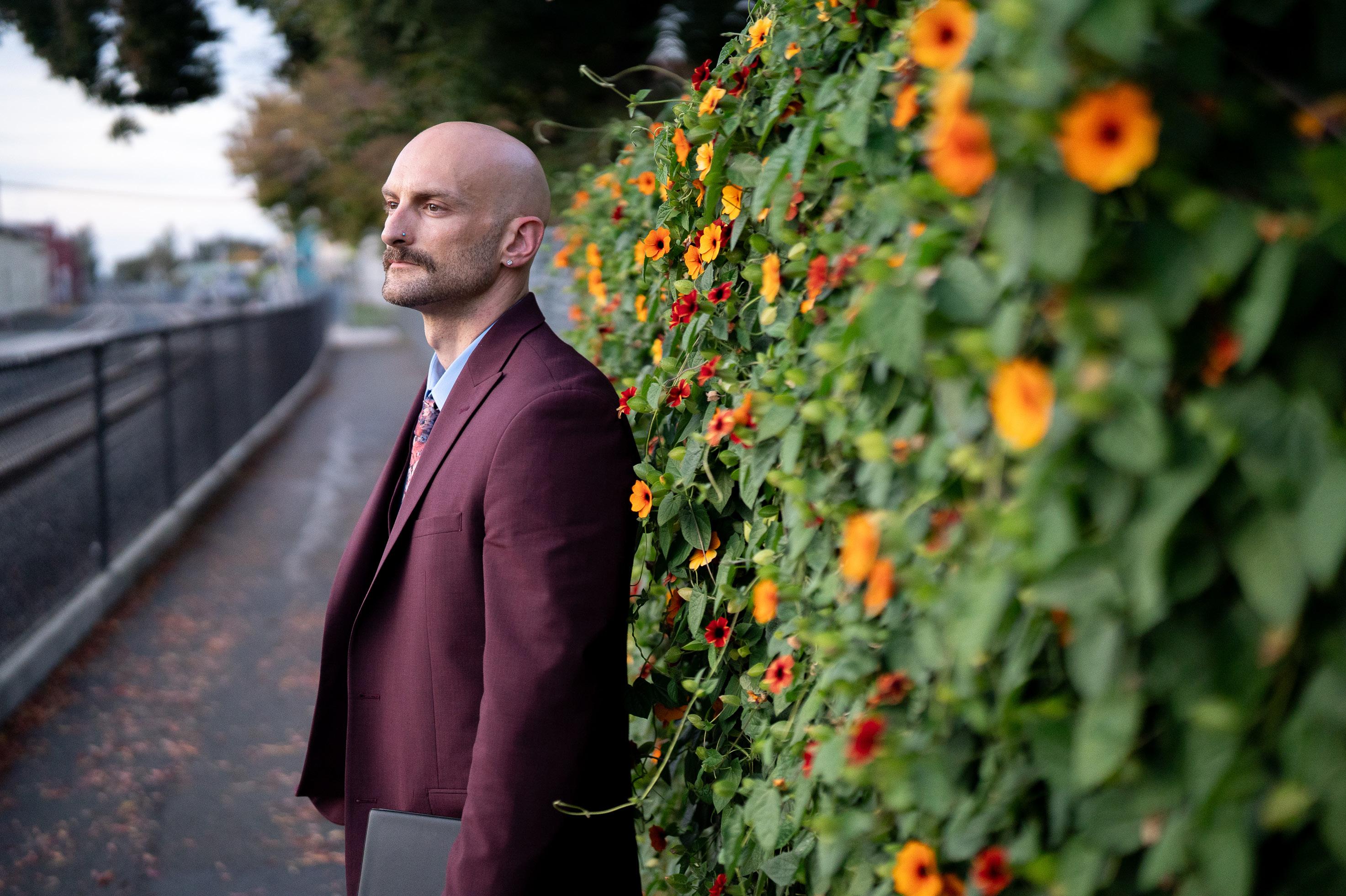
Last April, Salvatore Barone rubbed his hands together anxiously as hundreds of fellow community college competitors from across the country cheered the announcement of each winner at the awards ceremony for the Phi Rho Pi national forensics speech, debate and performance tournament.
The packed and noisy Virginia ballroom was a stark contrast to the silence and isolation Barone had endured for more than three years as a prison inmate.
Back then, he spent nearly every moment of his life locked away alone in a cramped cell, sometimes going weeks without seeing anyone other than a corrections officer.
Now, the Santa Rosa Junior College student found himself surrounded by friends and teammates. He listened as the winning speakers’ names were called and reflected on his journey to this point, waiting to hear if he had won a national award for his tournament performances.
Salvatore Barone: A man of many words by Reid Carpenter
During his first three semesters on the team, Barone, 34, examined the intertwined effects of addiction and incarceration as well as examined the practice of solitary confinement in the U.S. prison system.
He used his own story in which addiction and crime consumed more than a decade of his young life. He now found his story to be a powerful tool for change.
Preparing for fall 2025, his fourth semester with the team, he looked deeper into what he felt was the root of the problem: The idea that in a masculine-centered society, people of all genders are limited to a certain set of norms and expectations.
“It’s kind of a play on American masculine exceptionalism,” Barone said. “Like the culture around masculinity in America and the consequences of it and how might we re-imagine manhood before the consequences become permanent.”
That masculinity-dominant culture is
what Barone credits with driving him to an early life filled with drugs and run-ins with the law. Now he’s using his platform to show how that culture, and the larger systems built on top of it, can perpetuate devastating impacts on society.

(Reid Carpenter)
Sal Barone realized he needed to treat his addiction after stealing a relative's car and breaking into a pharmacy.
Barone grew up in Salinas, the youngest of four siblings. His sister Lindsay, whose last name is now Balcom, remembers he was creative and curious from a young age.
“[We] would make dances together to the Spice Girls and to songs from the movie ‘Grease,' she said. “He was always trying to make people laugh and be entertaining. So I feel like he was pretty connected with who he was; he just wasn’t allowing himself to be that.”
As he grew older, Barone increasingly sought acceptance from others, looking to his brother, Cory, as a role model.
“He just seemed so confident, and he was such a loving and good brother, so well liked and received, and so funny,” Barone said. “And he was everything I wanted to be, and yet the things that he did to be that way weren’t me. So it was like the same person that I looked up to and thought of as my hero, was kind of the same thing that motivated me to be less like myself.”
Barone and his brother both enjoyed sports, though he noted that he wasn’t as interested in playing as he was watching.
Barone wanted to learn a musical instrument or do theater, but he was afraid of the social pushback to a boy participating in activities considered unmasculine. So, because his brother played sports, he felt compelled to do the same.

"As a performer I want to branch out and grow and truly advocate for things that I find important. And do pieces that maybe not necessarily win in the judges’ eyes but win in my heart and the hearts of the people who have watched it.”
“[So I] boxed myself into this persona of a great athlete, and a charismatic ‘I don’t give a fuck, I’ll do anything’ type person. When really I was just empathetic, caring, loving, wanted to play and do theater and all these things that I didn’t allow myself to do because I was afraid of what other people would think of me.”
In high school Barone used weed and alcohol at parties to mask himself and fit in with peers. At 16, after his wisdom teeth were removed, a doctor prescribed him Vicodin.
Quickly, he was hooked. “I fucking fell in love with opioids,” Barone said. “I could do it all the time.”
In 2007, when Barone started abusing prescription pills, the opioid epidemic was near its peak. Many doctors throughout the country were overprescribing opioids. Barone said it was easy to use his parents’ insurance to visit a doctor and lie about experiencing pain to obtain a prescription or a refill.
As Barone’s drug use began to take over his life, he started getting into trouble at school.
In his junior year, he got caught selling drugs on campus and was suspended. Opting for independent study, he spent his senior year in specialized classes designed to help him catch up on credits he missed. When he finished assignments in class, Barone wrote poetry to pass the time.
He looked to hip-hop artists such as Nas, MF Doom and Del the Funky Homosapien as inspiration, respecting their ability to use cartoonish lyrics to create real-life scenarios that reflected on society as a whole. He said the drugs made
his writing better — even more outlandish — like that of his favorite artists. However, his addiction worsened and he overdosed. Barone dropped out before graduation.
In 2010, Barone had another surgery on his back. This time, a doctor prescribed him OxyContin, which he admits he abused. Over time, he found it easier to buy illicit drugs from dealers.
Barone used heroin and meth while living on the streets of Salinas. He did not see his family for months.
Eventually he returned to his parents’ house and asked for help getting clean. His family sent him to rehab in Westlake Village in Southern California. Shortly into his time there, he broke into the medication closet and was arrested. Escaping serious consequences, Barone returned to Salinas and bounced around from town to town, rehab to rehab as he tried to stay clean.
He remembered how one dealer, “Tony” — name changed for confidentiality — tried to help Barone stay away from drugs after his rehab stints. “He always tried to talk me out of it,” Barone said. “He was always hesitant like, ‘Fuck, I don’t know dude. How would your mom feel?’ Even though he didn’t know my mom.”
But Barone didn’t listen to Tony.
Over the next six years, he oscillated between homelessness, rehabilitation centers and — succumbing again to the perils of addiction — jail. He committed many of his crimes to obtain money or valuables to sell to feed his addiction.
In 2011, Barone moved to Detroit in another attempt to stay sober. He went to stay with his grandfather who offered his house as a place of refuge should he ever need a place to go to straighten out his life.
Initially things went well, but after a couple weeks Barone felt the urge to use again. He stole his grandfather’s car and broke into a local pharmacy. When the police arrived on the scene, Barone ran.
He recalled seeing his grandfather drive by him during his escape, signalling to him to stop. Barone immediately realized he wouldn’t make it far and decided to return to his grandfather’s house, where police arrested him.
After a few weeks in jail for the incident, Barone received a visitor. When he entered the room, his grandfather sat on the other side of the glass. He wrote many questions in a notebook for Barone during his visit.
“When the notebook ran out of pages, he said ‘You murdered this side of your family, and no one wants you here,’” Barone said in his latest prose performance, “Death in Detroit.”
Barone served his time in Michigan and upon release, he moved to Ann Arbor. He stayed clean for a while but relapsed again and committed more crimes to support his habit. He was arrested again, but this time he skipped out on his sentencing and ran for good back to California. He continued to use drugs and evade the law.
The years of turmoil came to a head in 2016 when Barone was 25. After getting sober again, he relocated to Chicago with a girl he was dating.
Soon after moving, he relapsed.
Eventually, police arrested him for burglary, and a judge enhanced his charges to a felony for prior arrests and sentenced Barone to six years in Illinois state prison. Once his sentence was served in Illinois, he was extradited to Michigan for the crime he had fled to California to avoid.
Barone said he was often alone in prison and rarely saw the outside or even other inmates. During his 37 months of incarceration, he estimated he spent only 20 minutes outside of his cell per week. Later, this experience would serve as the backbone of his championship speeches that examined the ethics of certain correctional practices on inmates.
“Last year my big thing was the practice of solitary confinement within the United States,” Barone said. “And the fact that the Mandela Act was passed in the United Nations that basically said anything beyond 15 days of solitary confinement is considered torture. I was in solitary confinement for far beyond what that limit is.”
In solitary, Barone wrote poetry to keep his mind busy. In doing so, he began to confront who he was as a person and the decisions he had made that brought him to this point in his life. “Searching for a place to put my emotions that wasn’t the pit

of my stomach, I began to write,” Barone said in “Death in Detroit.” “Something I loathed at school because ‘writing was for pussies.’ My mental health improved with every legal pad I filled.”
With one year left on his sentence, Barone learned his Grandpa Fritz, the same grandfather who he had lost contact with years before, was sick.
A doctor discovered Fritz had stagefour colon cancer, a diagnosis that could have been detected and treated earlier had Fritz not refused a colonoscopy with homophobic ire.
From his cell, Barone wrote a letter to Fritz, hoping to reconcile with his grandfather.
“Shortly after sending that letter, Grandpa Fritz died in Detroit,” Barone said in the speech. “For weeks I hid in my cell so no one would see me cry.”
Released in 2019, Barone returned to California, this time to Santa Rosa, where his parents had relocated.
During the summer of 2020, while looking for a way to spend his time during the pandemic, Barone enrolled at SRJC. In spring 2024 he heard a pitch by SRJC forensics coach Josh Hamzehee about the team and grew interested in performing the poetry he had written since prison.
Hamzehee taught Barone how to find strength in his voice and accurately convey his message to others. He also helped Barone hone his idea of American masculine exceptionalism.
Barone quickly became a strong presence among his teammates. “His energy and enthusiasm for learning, once he understood exactly what forensics is, and being like ‘Oh I can do this,’” Hamzehee said. “It’s been really effective in not only his own performances but also helping create an energy and an atmosphere for everyone on the team.”
Hamzehee said the raw material that already existed in Barone’s poems when he joined the team allowed him to provide a depth and realness to his speeches that others couldn’t quite match.
In his first few semesters with forensics, Salvatore Barone studied the connection between addiction and incarceration. (Reid Carpenter)
Team member Anabelle Thatcher, Barone’s Duo Interpretation partner, finds his performances inspiring. “With a lot of the issues that are talked about at speech tournaments and stuff, it is obviously something the person cares about, but not every time you see it is it actually something the person has gone through,” Thatcher said. “And Sal’s stories are always just, they’re so personal, which makes them even more meaningful.”
Using his life experience as a base for his speeches and performance, Barone joined the nationals team in his first semester with SRJC forensics. By his third semester with the team, Barone and Hamzehee set a goal to win sweepstakes; or all four categories in which Barone competed: poetry, duo interpretation, after dinner speaking and dramatic interpretation.
In Virginia, Barone stood on stage, nervously waiting for the announcer to call the first- and second-place winners for his final category: dramatic interpretation. "I had already gotten a gold in duo, I got a gold in poetry and I got a gold in after dinner speaking," he said.
He reached down and squeezed the hand of Ginger, his friend and fellow competitor. When it came to second place, the announcer called someone else's name. Suddenly it hit Barone: he had won all four categories. "I remember looking up at Josh, and we gave each other a little smile because we both knew I just won sweepstakes," he said.
He was now the top community college speaker in the country. "I think that main drive came from never achieving much or ever achieving anything at all as an adult and always struggling and finally being recognized," Barone said.
His brother Cory, who he had looked up to his whole life, congratulated him on the win via a text: "I'm proud of the person you're becoming." The two didn't talk often during Barone's years of struggle because Cory was a police officer in San Francisco's Tenderloin neighborhood.
"He was dealing with people every day, and he saw me in those people," Barone said. But the siblings have since rebuilt their relationship. Now
Cory, and the rest of Barone's family, are proud of what he has achieved.
"It was always a staple of 'Is Sal OK?'" Barone said. "And now, it's 'What's Sal up to?'"
After winning top speaker honors, Barone shifted his focus going forward from winning top speaker and telling his life stories to delivering meaningful speeches — whether or not they win awards.
“As a performer I want to branch out and grow and truly advocate for things that I find important,” Barone said. “And do pieces that maybe not necessarily win in the judges’ eyes but
win in my heart and the hearts of the people who have watched it.”
He plans to use his forensics team experience and his SRJC communications degree to continue his education at Sonoma State University, where he is currently dual enrolled in his first semester. One day he hopes to coach his own forensics team.
"A big thing for me is allowing people to be individuals," he said. "And not just having these structures that people need to be monolithic. But allowing people to be the full spectrum of who they are as an individual."
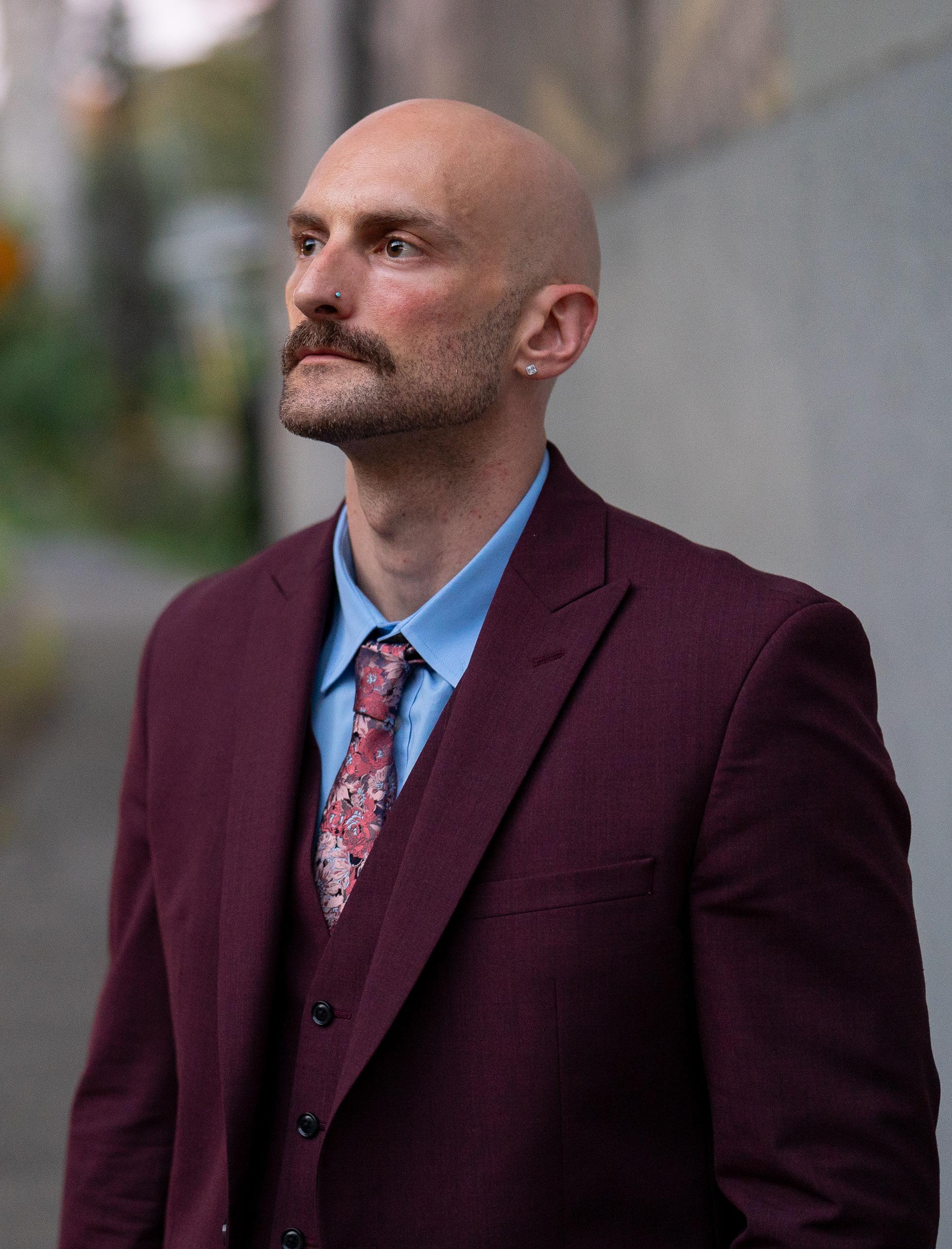
SRJC's Salvatore Barone draws inspiration for his award-winning speech performances from his years behind bars. (Reid Carpenter)

It was late at night and Santa Rosa Junior College firstsemester nursing student Zara, who declined to give her last name, had to give a presentation the next morning. She was tired and wanted an easy out, so she copied and pasted the instructions into ChatGPT. In less than a minute, the artificial intelligence chatbot spat out a ready-to-deliver presentation.
“It’s an easy out, and it’s not that I don’t know what I’m learning, because I do. I’m lazy; I don’t want to write the whole thing,” Zara said.
Another SRJC online-only student, who is majoring in human resources, said half the time she can’t understand the instructions provided. Instead of contacting her instructor or attending office hours, she relies on AI to decipher the assignment and tell her what to do. Then she uses her own brain to complete the work.
SRJC mechanical engineering student
Miles Swarner, who created a ChatGPT account with its debut in 2022, logs
onto the AI chatbot every day and asks it to do everything from analyze the class syllabus to point him to homework resources.
These three SRJC students are trying to navigate how to use AI in a college environment where rules vary from classroom to classroom and college policies have not kept up with everchanging technology.
How SRJC students use AI
According to Copyleaks, nearly 90% of students have used AI for academic work in 2025, with 57% of students using AI to brainstorm, 44% using it to generate initial drafts and 28% to solve math problems.
When she’s struggling with her calculus homework, SRJC earth and space sciences student Aurora, who declined to give her last name, turns to AI.
“I use AI on certain homework assignments. It helps me understand to look at the steps that are placed
out,” Aurora said.
SRJC student Darmielle Galicia uses AI to double-check her work.
Students like Zara use AI to complete assignments for them. “I am also part of a child development class, so I look up other creative ideas I can incorporate into this curriculum,” Galicia said.
According to Emmanuel College, since the creation of ChatGPT, studies show 50-70% of college students have used the tool to cheat. Reports also show 70-80% of high school students use it to cheat as well.
An SRJC psychology student, who declined to give their name, refuses to use AI, fearing they won't learn anything, and they dislike its ease of access.
“It takes away the thought process from students, and what makes them themselves," they said. "Thinking’s a part of learning, and if something’s just given to you, then you’re not learning more about who you are and how you can navigate the world."

Instructors’ policies vary
College instructors have varying policies when addressing AI. One SRJC instructor gives students a zero for assignments completed with AI. Another instructor directs students to develop their own AI policy for their class. With these varying policies come varying results to the AI issue.
San Francisco State University graduate teaching associate and English instructor Laird Harrison instructed his first-semester English students to propose their own AI policy and rules for the semester.
Harrison learned of this approach from a video by director and producer Antonio Bird.
Bird taught him an approach to academic integrity in which students state their individual values and then apply those values into the classroom. They, in turn, make an AI policy based on the previously discussed classroom values.
“On artificial intelligence, we said we will use it as a learning tool but not to copy text generated by AI into assignments,” Harrison said. “We will use it to brainstorm, but not actually write. We will use it to suggest synonyms but not whole sentences. Students who use AI to generate text for an assignment may lose as many as all the points for that assignment.”
Harrison said it's important to note the different ways students can use AI, from correcting grammar and creating outlines to generating text for an assignment.
Other instructors, such as SRJC English instructor Jake Aharonian, have stricter AI policies that limit

students’ use of AI. He restricts students from using AI to write their work, but is OK with them using it to find ideas or process information.
“If I suspect the use of AI or ChatGPT, I’ll run it through three different detector sites,” Aharonian said. “And if the average percentage of AIgenerated content is 60% or higher, then it’ll be a failing grade on that essay.”
SRJC student Leslie Ixmata described two instructors with different AI policies and how those differing policies have impacted her learning.
“My English teacher, Matthew Martin, makes the policy with us at the beginning of the semester. We had a conversation with the class, and he gave us some background on plagiarism and AI. My ASL teacher, Joan Williams, doesn’t care, because you don’t actually need it in her class,” Ixmata said.
“It takes away the thought process from students, and what makes them themselves. Thinking’s a part of learning, and if something’s just given to you, then you’re not learning more about who you are and how you can navigate the world."
SRJC policies on AI
With the ever-growing rise of AI colleges are increasingly attempting to control students' usage, and SRJC is no different. In the fall of 2025, SRJC launched its first Districtwide Generative AI (GenAI) Task Force, a year-long study to evaluate the role of AI across students' learning.
“With representation from all constituency groups and students, the task force will provide districtwide guidance, identify professional development needs and recommend policies to ensure GenAI use at SRJC aligns with the college’s mission, values and commitment to equity and innovation,” said then-acting SRJC Public Information Officer Sarah Laggos.

The GenAI Task Force was formed in response to an Academic Senate recommendation and approved by the College Council.
The Academic Senate feared overuse of AI would stunt students' critical thinking skills, and suggested that integration of AI should be discipline-based rather than generalized, according to the Nov. 5 Academic Senate meeting.
Robert Grandmaison, task force member and SRJC engineering and applied tech faculty, spoke of the committee’s contribution to SRJC and mentioned the beneficial use of AI in teachers' lives as well.
“The Senate and other people in the district have established the need for us to come up with policy as regards the use of AI in the academic environment, not just from a student standpoint, but ways we might incorporate it into curriculum and the development of courses,” Grandmaison said.
He would like to use AI to develop a course outline for one of his classes and use AI to tackle time-consuming administrative tasks, such as writing letters to colleagues.
As AI use rises, and technology and policies surrounding it evolve, students like Zara and Swarner may have to curtail or change their AI use to fit the ever-changing classroom and college policies.
“I think it’s already changed,” Swarner said. "I’ve got an engineering professor who’s already asked me to declare whether I use AI on my assignments or not. It incentivizes me to think a little bit more in depth about the assignment and what I actually need to write."




When nature calls, the porcelain pantheon is not just a place for relief, but one of respite from the chaos and hustle of the day. However, when that washroom is public, the experience can range from fantastic, to funny, to horror show.
As a public service to Santa Rosa Junior College, students and correspondents collaborated to find the bathrooms with the best ambience, amenities and location on the Santa Rosa Campus — or the lack thereof for future avoidance. Out of 10 reviewed student buildings, we picked six for their unique and stand-out environment.
Most Sterile: Race
Ambience: 4/5
Amenities: 4/5
Location: 3/5

The William Race Health Sciences Building is home to some of SRJC’s best bathrooms on each of its four floors. Built with a medical appearance, the bathrooms feel pristine. The nearby water fountains
are ice cold, offering a refreshing way to work toward your next visit. It's a shame that such modern bathrooms are located on the edge of campus and out of range for non-health science students.
bathroom had the psychological experience that accompanies relief in mind,” Oak Leaf editor Michael Combs said.
Best Sense of Community: Emeritus
Modern Magnificence: STEM
Ambience: 4/5
Amenities: 4/5
Location: 4/5
The spacious first floor bathroom in the Lindley STEM Building feels more suited for a spa than a college campus. The stalls are wellproportioned and offer ample privacy. Aesthetically, it may be the most beautiful bathroom on campus.
The cool, grey walls not only complement the bluish glass tiles behind the mirrors, but also make for a calming atmosphere. These bathrooms are particularly great because they offer accessible genderneutral facilities on the first floor, along with men’s and women’s bathrooms.
“It’s clear the designers of this
Ambience: 3/5
Amenities: 2/5
Location: 2/5
Emeritus Hall’s first-floor women’s bathroom may not look like much, with dull tan tile walls and dim lighting. However, it compensates for its drab decor and stalls with its welcoming atmosphere.
Students placed a miniature set of drawers in it, filling them with supplies like pregnancy tests and quarters for the feminine hygiene dispenser.
Whoever first left the drawers also left a note that other women have since added to, sharing support and gratitude for each other. What makes for better ambience than a sense of community?

Oak Leaf editor Kevin Terlizzi-Bowes lets loose in the Analy Hall men's bathroom during class Nov. 13, 2025. (Adair Alvarez Rodriguez) Bottom right, a stretch of urinals gleams in Emeritus Hall. (Kevin Terlizzi-Bowes)

The men’s bathroom at Emeritus feels starkly different without such a sense of community. The layout is dated, with a wall of urinals with no privacy panels. Compared to other bathrooms, Emeritus has no-frills facilities designed for high traffic.
Worst Ergonomics: Maggini
Ambience: 1/5
Amenities: 1/5
Location: 2/5
Their toilets have water-saving flush options, a unique and muchappreciated feature.
“It’s a workhorse of a bathroom,” said Jacob Slone, an SRJC alum.
“Drowning in antiquity. My favorite place to go,” said Mark Fernquest, a teacher’s assistant at the Oak Leaf.
Most Chaotic: Analy Hall
Ambience: 3/5
Amenities: 2/5
Location: 2/5
The bathrooms on the first floor of Maggini Hall are clean, but that doesn’t make up for their explicitly gendered construction. Unlike the neighboring men’s bathroom, the women’s bathroom unfortunately doesn’t have a shelf conveniently located near the entrance.
The white tile walls and dark gray floor may be basic, but they aren’t outright ugly. Unlike most of the other bathrooms we visited, Kunde’s earned its spot for more than what’s inside them.

Wide, tall windows allow natural light to pour into the first-floor women’s bathroom of Analy Hall, making it one of the best lit and well-ventilated bathrooms on campus. The dark, wood-grain paneling of the stalls complements the natural lighting and spacious, towering ceilings.
The black-and-white tile trim of the men’s room was also recolored to pink and white in the women’s room, helpfully reminding anyone who enters it that they’re a woman. If you want to be condescended to by the floor while you pee, this is the bathroom for you.
Unfortunately, it’s situated next to one of the entrances, which means it gets a lot of foot traffic. While more conveniently located than the second floor men’s bathroom, it doesn’t make for the most private bathroom experience.
“They leave the bathroom door open; I feel like I’m peeing in the hallway."
Although equipped with a shelf at the entrance, the men’s bathroom at Maggini is narrow compared to other bathrooms at SRJC. The stalls are cramped and cumbersome to enter properly, making the entire experience claustrophobic and uncomfortable.
Best Amenities: Kunde
Ambience: 5/5
Amenities: 6/5
Location: 3/5
A flight of stairs or elevator ride up into Analy, the men’s bathroom is chaotic yet energetic. Etched mirrors showcase the bygone rebels of classes past. Reflected in them is a hasty coat of white which hardly obscures the artistic freedoms unprompted by lecture, with more writing and cartooning than any other bathroom on campus.
"For a building dedicated to art, vandalism is predictable. For the structure of a college campus: unbecoming.
For someone wanting to read while on the toilet: entertaining."

Just outside its doors are two vending machines and a water fountain. If you need to use the bathroom and are also peckish or thirsty, Kunde Hall is a prime choice.
“An efficient bathroom that will satisfy even the most math obsessed student,” said Oak Leaf editor Michael Combs.
A Welcoming Retreat: Bertolini Student Center
Ambience: 6/5
Amenities: 5/5
Location: 2/5
Kunde Hall’s bathrooms are some of the best SRJC has to offer. Located on the second floor next to the elevator entrance, the bathrooms are both accessible and rarely busy.
On the third floor of the Bertolini Student Center, next to the Disability Resources Department, the plethora of bathroom options include a gender-neutral bathroom with a needle disposal for hormone shots.
The green-and-blue tiling feels outdated, but this proves to be one of the quietest and cleanest bathrooms on campus, complete with a water fountain outside. The only issue is its location: The third floor isn’t particularly convenient.






Junior year, second semester: I was in my first-period Spanish class when my teacher’s classroom phone rang. When he answered, he looked directly at me. At first, I was confused. Did I do something wrong? Did something happen to a family member? Am I getting signed out for the day? Millions of thoughts raced through my head. He hung up the phone and walked toward my desk.
“You’re needed in the office,” he said. I nervously packed my belongings.
When I stepped into the office, the attendance secretary said the principal would call me in shortly. There went the questions again. What was going on? My heart raced. As soon as I stepped into the principal’s office, my heart dropped. Sitting in a chair, lividly glaring at me, was my mother. I could see it in her eyes: I was screwed. No one said a word but my vision started to blur as I teared up — my hands, lips and whole body shaking with fear. Growing up, school was never an issue for me. I loved it. I had perfect attendance, straight A’s, and my teachers always praised me. I won awards, including the Novato Inspirational Student Award, which goes to students who demonstrate the six C’s: collaboration, communication, critical thinking, conscientious learner, character and cultural competence.
However, as I progressed through high school, the days grew longer, lessons droned on and my grades started to slip. Junior year was the death of me. The first semester was rocky but nowhere near as bad as my second. My grades took a nosedive. I skipped more classes than I attended, and I lost all motivation to finish out the school day. At times, I’d cut class for more than a week straight, even when I knew we had quizzes. When I missed tests, my conscience grew louder. Should I go to class just for the test? Or should I just say screw it and take a zero? I told myself I would make them up, but I never did.
During this time, I also switched friend groups. I gravitated toward a rebellious bunch whose members encouraged me to skip class more often. Hell, instead of going to school, we would leave right after first period or lunch — or just cut the whole day. I was living life, playing in the sand and swimming at the beach, shopping or relaxing at the park. My actions never had any consequences, even though they clearly did — I just didn’t care.
My mom received emails every Monday with a summary of my current grades, and at the end of each school day at 4 p.m., another email documented my attendance. She knew I was cutting classes, and she knew my grades had plummeted to mostly D’s. She took away my car at least every two weeks. She told me I couldn’t go out; it was school, softball practice, home.
Did I listen to those rules? Hell no. I did whatever I wanted. Unfortunately, this backfired on me once she called the principal for a meeting. Then my progress report landed: Spanish - D; Algebra - D; English - C; History - C+. I had 134 tardies in one semester and 18 truancies. At times, I had 12 or more absences within a week and a half. I had trashed my high school GPA in only one semester. And that’s what landed me here in the principal’s office. The principal told me I was on the verge of failing 11th grade. If I didn’t get my act together, I would have to transfer to an independent study school. He said he knew this wasn’t the type of kid I was; deep down, I knew it, too.
I had to sign a contract promising to attend class and improve my grades, which seemed impossible at the time. How was I going to get better grades before the semester ended? I hated class and I hated being at school for eight hours, but what I hated more was being in trouble all the time.


Turns out I did care, and that’s when I knew I had to change. I started attending class — even my arch nemesis, algebra. I stayed up until 1 a.m. most nights to finish overdue assignments. A couple of weeks later, my friends begged me to cut school and go to the beach with them. Of course, I was tempted. I paused and thought about the contract I’d signed and what my mom would say if she got yet another email about an absence.
“Sorry, no,” I said.
My resolve made me feel better, stronger. I had found the ability to say no to things that would derail me later on. Come senior year, I was back to my old self. I still skipped classes here and there but my grades and attendance rebounded, and my conscience was clear knowing that I wasn’t putting my future at risk. Although my junior year could haunt me with all of its missteps, I refuse to let that academic setback define me. Don’t let one failed grade, semester or year define you.
For Santa Rosa Junior College counselor Amanda Greene, academic setbacks are personal.
“When you walk into my office now, you don’t see the mile-long transcripts, failed grades, withdrawals and setbacks — you just see the degrees on my wall that say UC Davis (Bachelor’s) and Sac State (Masters) and that’s what I share with my students,” she said. “Your past does not define you. One of the best things about a community college is that you have the opportunity to explore your interests and find yourself before making a long-term commitment to a job or career.”
SRJC offers resources to students looking to get back on track, Greene said. She recommends students who need direction take COUNSELING 6: Introduction to Career Development. It fulfills a local GE area and it transfers to the UC’s and the CSU’s. “In this class, students are able to dive deep into their interests, skills, values and personality and find majors and careers that fit them,” Greene said.
Students can request grade forgiveness or “academic renewal” on up to 24 units. “If you have a D or an F grade that is older than two years, you will most likely qualify for Academic Renewal, which doesn’t remove the grade from your transcript but it does take the grade out of your GPA,” Greene said. “This really helps when someone comes to the JC right out of high school and might not do so well,” Greene said.
Academic setbacks are not uncommon.
According to a study produced Aug. 8, 2025 by Capitol Beat News Service, one in five students were considered chronically absent, missing more than 18 days out of the school year. Many students attend SRJC because of academic setbacks in high school or the high cost of fouryear universities.
On the first floor of Doyle Library and room PC 721 in Mahoney Library on the Petaluma campus, the Tutorial Center offers help with a variety of classes. For free, you can either make an appointment or drop-in with a tutor. The tutors can assist you with math, English and science courses.
Counselors are available on the second floor of the Bertolini Student Center and the Kathleen Doyle Hall on the Petaluma campus to help guide you back on track if you feel lost.
“If you are struggling with your academic journey, please connect with a counselor,” Greene said. “We are here to be the bridge between where you are right now and where you want to be.”



Embarrasing stories people should've kept off the record
Story by Michael Bragg Graphics by Natalie Emanuele
Embarrassing stories — we all have them. But there’s always that one, the one that still embarrasses us years later, the one that haunts our memories like a recurring fever dream.
The Oak Leaf collected the best of these stories from SRJC students, staff and instructors. Hopefully, you will laugh, find commonality and, maybe, discover that — like a good reality TV show — there’s someone with moment more shocking than yours.
The Oak Leaf praises these courageous souls who have shared their stories and respects their wish to remain anonymous. Therefore, we have given all contributors pseudonyms, except one: me.
I bravely take the first step onto the chopping block — whoever gathers the stories begins by telling their own.
‘La Brea Avenue’ by Michael Bragg
2007 was an amazing year for me. I made my Los Angeles Opera debut and, as fate would have it, I signed a contract to sing in Europe a few weeks after I ended my Southern California performances. It was also the year I took a giant shit in broad daylight, wearing a hot-pink T-shirt and white linen pants, in the Hasidic Jewish section of La Brea Avenue.
Let me give you the details.
Picture it: a lovely Saturday morning in LA in May 2007. I had finished eating breakfast with a fellow cast member and was about to embark on my two-bus transit journey from Korea Town to West Hollywood.
I was familiar with the differences between the weekend and weekday schedule. Because it was such a beautiful day, I was cool with waiting longer than normal for the transfer bus that picked me up on La Brea
Avenue, instead of walking and hoping a bus came before I actually made it home.
I boarded the first bus and was feeling fine, bopping along to Dionne Warwick. All of a sudden, a gurgle rumbled through my stomach. You know, the one that says, “Hello, you’d better seek safety and find a bathroom.”
Over the years I’ve learned to listen to my body. Since I was almost to the transfer stop, I figured I’d just hold on and say a little prayer. I left the first bus and waited for as long as I could and then realized I needed to move — quickly — to find someplace I could, pardon my French, dump out.
The white linen pants and brightpink T-shirt factored into my decision to find the closest place to take care of business.

worries, in hindsight, seem moot now, but what can I say — I was still hoping to escape with a shred of dignity. Luckily, I found the perfect time to flee from behind my makeshift toilet and, with my head held high, scurried home.
After walking three blocks, I realized that no businesses were open. Most of the people out and about were Hasidic Jews, and it was Saturday, the Sabbath — meaning I was screwed! Crazed with abdominal pain and feeling streams of sweat pouring down my skin, I grew desperate.
Time ran out and before I knew it, I had no choice but to crouch down behind a bush with so little foliage that it looked like a rooted tumbleweed. I then produced what a friend so elegantly referred to as “a river of hot lava,” while looking anywhere but the ground and the shit stream that was forming on it,
The next question was, what to clean myself with? You guessed it: my underwear. So not only was I taking a dump in public, I was also Donald Ducking. Miraculously, I was able to fully get out of my pants and underwear, wipe, discard my underwear and get back into my pants within seconds.
I shared this story with a friend who worked for the LA Opera and we both had a good laugh. But when I arrived in Germany in July 2007 to perform at the opera house in Hannover and introduced myself to one of the staff members — an American — she looked at me as if she knew me and responded with a question: “La Brea Avenue?”
‘Body Search’ by ‘Joan’
For this “anonymous” pre-nursing student, the subject matter and witnesses were enough to keep her name out of print.
The charge: assault. The victim: the mistress of a now ex-boyfriend. The details of the assault are not important; what’s important is the interaction Joan had with the officers while being booked at the precinct. This was the first and only time the then-29-year-old had had a run-in with law enforcement, and her only guidance on behaving in such a situation was from TV shows.
Joan arrived at the precinct and noticed it was filled with the usual

suspects, or at least what would be usual for an episode of “Law & Order” — the local drunk and some women of the night. She remembers the atmosphere was not particularly aggressive — in fact it was “pretty chill.” What sticks out in her mind was that “La Rosa de Guadalupe,” a Mexican soap opera, was on the TV and had most of the room transfixed.
An hour or so went by before a female officer approached Joan and informed her she would be doing a standard body search. The officer then began inspecting Joan’s hair, removing her hair pins in the process. The officer asked her to take off her shoes, then inspected her jean pockets, removing the part of her jeans that could be considered a danger to her or to someone else.
Without giving much thought and with as much “Law & Order” knowledge at the ready, Joan earnestly and proudly proclaimed to the officer and anybody within ear’s reach, “I’m on my period.” The officer stopped, looked at her, and holding back what one could only imagine was a roar of laughter, said behind a very toothy smile, “It’s not that kind of search.”
Joan stood wide-eyed and motionless with embarrassment. After what felt like minutes of silence, she muttered a sheepish, “Oh OK, my bad,” and let the officer finish the search.
Joan was detained for 10 hours. But after inadvertently telling the entire precinct of officers, local night ladies and a handful of Santa Rosa’s finest brown baggers about her monthly visitor, those 10 hours have turned into seven years of re-lived embarrassment.
‘Black Out’ by ‘Fred’
It was during a power outage when this student texted his friend, hoping to hang out and kill some time. However, he was slightly high — having taken a couple of bong hits prior to the outage. He decided he was fine to go and walked down to his local park to meet his friend.
That is when the catastrophe happened.
They were messing around on a bridge by the creek when a group of

their other friends walked by and joined them.
At this point Fred was already feeling very floaty and didn’t fully realize it, but he knew he desperately needed to go to the bathroom. He began fidgeting, moving up and down the sides of the bridge until he accidentally slipped off the side, straight into the creek. It wasn’t raging, but the creek water was nasty, and as he stood up he discovered a lizard crawling beside him.
Now, if Fred had been in his right mind, he probably wouldn’t have reacted much to it, but since he wasn’t, he shrieked in terror. It wasn’t his brightest moment. Everyone noticed, which helped sober him up quickly, their laughs drowning out any other thought he had.
At this point, Fred became more aware of how urgently he needed to use the bathroom, so immediately after getting out of the creek, he said his goodbyes and sprinted off. However, he wasn’t fast enough ... he was just happy the creek water was a decent enough excuse for why his pants were wet when he got home. After sharing his story, Fred said, “I’m still horrified by this night!”
‘Lay Up’ by ‘Rachel’
This student’s story harkens back to her days at Casa Grande High School where she played guard on the Cougars’ basketball team. A particular game against the Petaluma
Trojans is burned into her memory. It was going to be an exciting game. The Cougars against the Trojans, cross-town high schools whose rivalry dated back to 1974. Enthusiastic fans wearing their team colors of either the Cougars’ blue and gold or the Trojans’ white and purple filled the gymnasium.
As the cougars were down in the first half of the game, tensions arose among players. Toward the end of the first half, one of the Trojans became aggressive — a behavior common for this player, who had a reputation as a shit-talker.
The Trojan grabbed Rachel’s shirt so hard that her bra strap broke, but she wasn't flustered — bra-strap breakage was an occupational hazard of basketball. She quickly took the opportunity to throw back some shit talkin’ and suggested maybe the player was interested in her.
Of course, this did not go over well with the Trojan, and the rivalry between the Cougars and the Trojans heated up. The gloves were off, and it was every gal for herself.
At the game’s midpoint, the teams were neck-and-neck. Several minutes passed and Rachel went for a layup. What could have been a moment to celebrate quickly turned to dread, horror and disbelief. As she came down from her layup, she felt something strange between her legs.
That strange feeling turned out to be her tampon being pulled out! And if that weren’t bad enough, the person doing the pulling was the bra-strap breaker from earlier.
Seconds later, Rachel had to contend with her freed tampon, the packed gymnasium of onlookers and one overwhelming question: “How do I get myself out of this situation?”
Without skipping a beat she scooped up the tampon, lodged it behind her now-bent knee to give the appearance of an injury and signaled to her coach that she needed to be replaced.
The question this jaw-dropping tale brings to mind: “Did the Trojan know she pulled out your tampon?”
Rachel said if the perp knew, she gave no indication, so she was inclined to think it was an accident.
‘Full Moon’ by ‘Rhoda’
In the late ’90s this SRJC faculty member, Rhoda, dressed up for a business meeting in a bougie South Bay town.
The meeting went great. Afterward, she used the restroom and then began walking the three blocks to her car. After two blocks in, she crossed Main Street and passed a construction site.
“Hey Lady,” a man shouted. Rhoda refused to turn around for cat-calling.
“Hey Lady,” he grew louder. Still she didn’t turn.
“Hey Lady!”
She turned around, her middle finger raised.
“Your skirt’s messed up in the back.”
Rhoda whirled around to discover that she had tucked the bottom of her business skirt into the top of her pantyhose and had just mooned three blocks of bougie Saratoga residents and tourists.
‘There’s a Snake in My Classroom’ by ‘Jacque’
It was August 2008. A 22-year-old SRJC faculty member was ready for his first day and year of graduate school. And, Jacque was about to teach his first-ever college class.
He had gone on a few dates with someone in the month prior. On the third date, she invited him over to her apartment.
Yadda yadda yadda.
And like a young person who didn’t think things through, after that night he never reached out to her again.
“She reached out twice, and yes, I left her hanging,” Jacque said. “I was busy, and her house was more than a little gross. There were way too many reptiles — but still, no excuses.
I promise, I’m a better and braver person now!”
So, on that first day of class, he walked into the classroom, trying to act like he knew what he was doing. He greeted students with small talk as they entered. As the class settled into their seats, he noticed a familiar face in the front row.
“It was the person I had dated and ghosted,” Jacque said. “She was enrolled in the first class I was scheduled to teach. And her eyes were locked on me.”
The situation grew even more awkward as the class began opening day get-to-know-you activities. “Do I just say, ‘Hi, how’ve you been?’ Do I ask to speak in private? Do I ask her to drop the course and find another professor?”
So many questions, so few answers. “And if I, the professor, didn’t have the answers, this wasn’t going to be a great start to my potential new career,” Jacque said.

Luckily, he didn’t have to make a decision. Unluckily, she did. She stood up, got the attention of the class, and loudly proclaimed, “This guy stood me up! He stood me up after we had a great date and after I let him meet my snakes! Ssssssssuck it!”
And she slithered out. Everyone laughed awkwardly and looked to their graduate instructor for a response.
After 10 long seconds, Jacque said, “Sssssssso, class, sometimes the universe lets you know it’s time to shed your old skin.” The class laughed. Jacque died. And they all shared awkward stories to start what would be a formative semester.
If Jacque learned anything that day, it was that if someone shows you their 12 snakes, make sure you don’t leave them on “read.” Because they might read you in front of 25 witnesses.


Books with off-kilter woman narrators
by Jesse Saal
Lately, I have been exclusively reading books with weird women protagonists — and having the time of my life. It’s delightful to read a novel that isn’t afraid to explore an unapologetically strange female protagonist, and I want to share that joy. I recently finished three fiction books and absolutely loved them; they all feature leading women sharing remarkable experiences. From brain damage to imprisonment to obsession, each narrator has a perspective that will take you far beyond your own imagination. I’d encourage anyone to read these books and show compassion for the women we don’t understand — those who challenge social norms, make the wrong choices and exist as the weird, awkward, human messes we can all relate to.


“I Who Have Never Known Men” by Jacqueline Harpman is a haunting, surreal, lonely and deeply human story following a narrator finding meaning in a meaningless and unknown world.
It’s a genre-defying book that doesn’t need to explain itself and will leave you theorizing long after it’s finished.
It opens with a young girl who doesn’t remember a time before being trapped in a cage with 39 adult women. They are under nonstop surveillance by guards who never speak and ensure they’re denied all access to dignity, the outside world and knowledge of how they ended up there. The narrator never stops asking questions, even when the vast majority go unanswered. This book is her fight for purpose within a lifetime of mind-numbing monotony.
Her narration is unique in its matter-of-fact, strange and endlessly curious tone. Her perspective on life is truly one-of-a-kind, created from circumstances far outside the ordinary human experience yet remaining undeniably affecting.
Open up your mind for “Sky Daddy” by Kate Folk, a laugh-out-loud heartfelt story about an undeniably weird yet lovable woman. It follows Linda, a woman whose very isolated life revolves around her all-consuming erotic obsession with planes.
Her narration is sometimes dryly funny, sometimes deeply sad and often full of sexually charged descriptions of her favorite planes. Her worldview is absolutely bizarre, with a strict adherence to her belief in destiny, empathy and the spiritual essence of planes.
The greatest dream of Linda’s life is to marry a plane, which means hopping aboard a flight and dying in a plane crash, forever united in death with her airborne soulmate. I promise it’s even more delightfully strange than you’d imagine.
The true heart of this story is Linda’s relationship with her only friend, her coworker Karina — who is terrified of flying. It’s agonizingly tense to watch Linda try to hide her obsession from Karina, scared of losing her best friend. It’s an unflinchingly weird book about one very strange woman who remains fascinating the entire time.
“Hurricane Girl” by Marcy Dermansky is tense, funny, anxiety-inducing and an absolute mindbender. It follows Alison, a meek woman learning to assert herself after losing everything and experiencing a shocking act of violence that leaves her with a traumatic brain injury.
A natural people pleaser, Alison struggles to express her feelings about her family and friends’ simultaneous infantilization of her and their refusal to accommodate her new disability.
Throughout your time with this book, you will feel Alison’s constant frustration intertwined with dark humor commentary on the disabled female experience.
The inside of Alison’s head is gut-wrenchingly claustrophobic with her chaotic, often strange thought processes. At the same time, her deadpan and sarcastic inner monologue is hilariously incisive.
Hurricane Girl is a fast-paced and compelling read. I won’t spoil the ending, but I swear it gave me heart palpitations.


Habits and rituals on ice
At Snoopy’s Home Ice, the Santa Rosa Junior College Polar Bears locker room is a scene of organized intensity long before the first puck drops. Sticks whack against the concrete, gloves slap against benches and a faint pulse of music threads through the noise. Every player moves with a rhythm only he understands, from the order in which he straps on pads to the precise way he tapes his stick.
In hockey, routines aren’t just habits — they’re a lifeline. They calm the nerves, focus the mind and give players a sense of control over a game that moves faster than most can track. Some rituals verge on superstition, while others are purely practical.
For players Logan Koop, Traber Burns and Adam Berry, game day is a careful balancing act between psychology, preparation and habit.
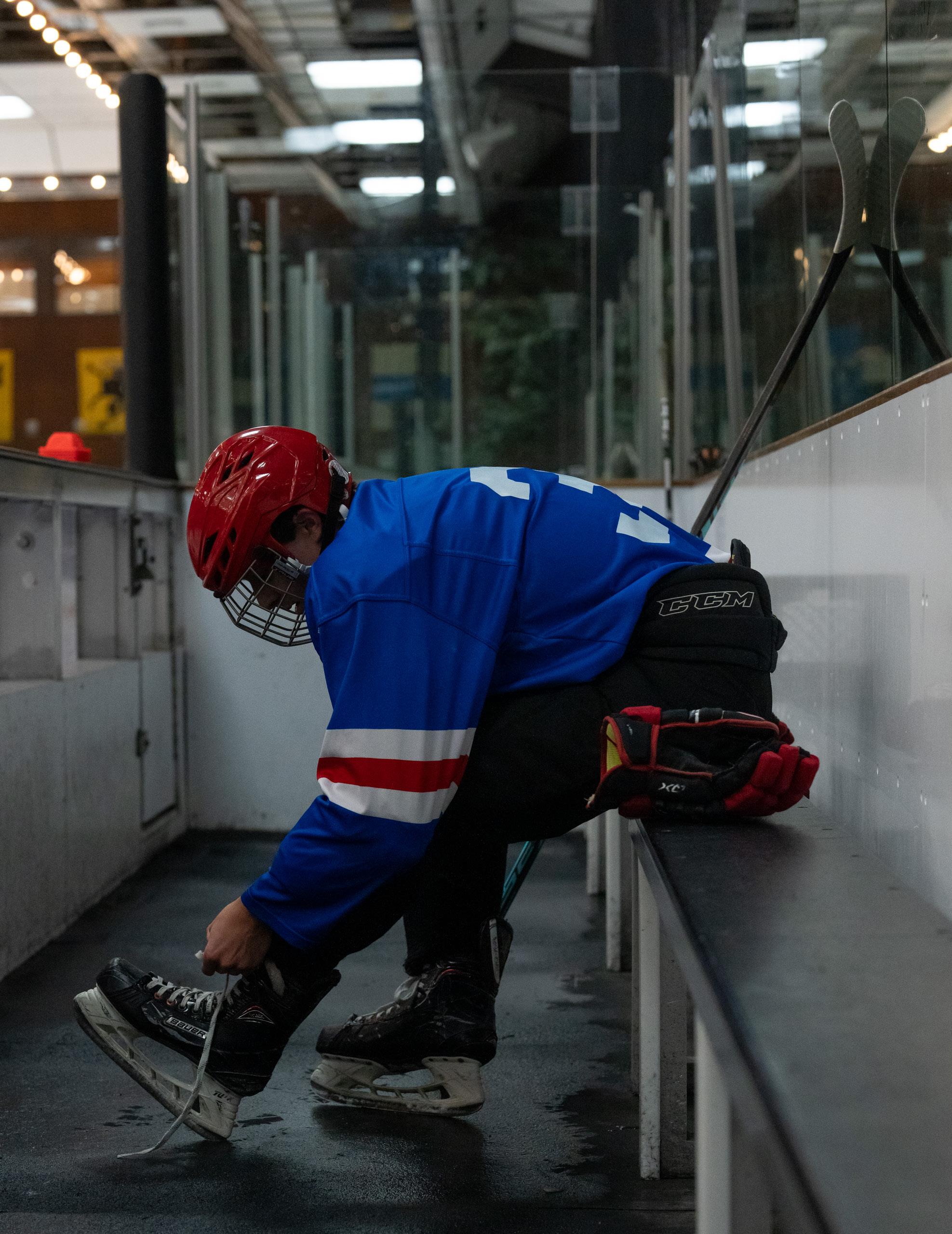
by Rhea Bath
Koop: carefully structured chaos
Forward Logan Koop, No. 44, uses his pregame routine to mentally prepare and maintain control. On a game day, he keeps things poised but intentional.
“If I’m not working, I just stay pretty relaxed,” Koop said. “Throughout the day, I don’t do anything too crazy — I might go to the golf course, hit half a bucket of balls or just go for a walk.”
Koop’s meals are deliberately simple. He eats early in the day, usually around 1 or 2 p.m., and avoids heavy foods that could slow him down or make him nauseous.
“You can run on something like a good bowl of pasta,” he said. “But if I eat too close to the game, I’ll feel sick.”
Unlike some of his teammates, Koop isn’t swayed by showers or other pregame rituals. “Owen [Hamblin] likes to take pregame showers. I’ve tried, but I don’t get it. You’re just gonna get all gross out there anyway,” he said.
Koop follows a specific order to put on his gear — jock, kneepads, pads, socks, pants, skates, tape the socks, shoulder pads, jersey, helmet, then gloves. This repetition keeps him grounded and ensures nothing is overlooked.
Koop also leans on music as part of his mental preparation. He rotates three songs every game — “Walk” by Pantera, “Rooster” by Alice in Chains and “One” by Metallica — then lets the playlist shuffle for the rest of the session.
“I don’t necessarily have a set playlist. Outside of those three songs, it’s whatever I’m feeling at the moment,” he said. “The songs get me in the right spot.”
Koop’s stick receives the same ritualistic attention. He wraps it fully, heel-to-toe, a habit born of wanting to protect an expensive stick. Over time, it became a personal ritual. “It may not actually help, but I’ve stuck with it,” he said. After a bad game, he might retape his stick entirely — after a win or a goal, he usually leaves it as is.
Burns: the anti-superstitious minimalist
Center Traber Burns, No. 2, takes the opposite approach to Koop finds stability in structured habits, Burns prefers simplicity and avoids superstitions.
“I try to not have much work to do,” Burns said. “I get all my homework done before the weekend so I don’t have to worry about it on game day. Then I just do light activities and try to relax.”
Burns focuses on hydration and nutrition. He drinks at least a gallon of water during the day and eats meals high in carbs and protein but low in fat. His pregame meal is usually spaghetti with ham, onions and peppers — functional, but not indulgent. A granola bar and banana a few hours later help prevent cramps during the game. Burns acknowledges hockey culture is rich in superstitions, but he sees them as potential distractions.
“Superstitions are more distracting than helpful,” he said. “I keep my day as low-key and simple as possible.”
He recognizes and respects that his teammates have their own rituals, and he gives them space in the locker room to prepare however they need. Burns himself only has one “habit” he maintains: taping his stick. It’s not superstitious; it’s comfort and a skill he learned growing up. The consistency helps him feel ready without adding mental clutter.
Even away games don’t change his routine much. Though he may not have perfect nutrition on the road, he adapts. “You just do the best you can and focus on what you can control,” he said.
Berry: blending ritual with psychology
Defenseman Adam Berry, No. 68, embraces routine for its psychological benefits. Where Burns minimizes ritual, Berry uses it to stay confident and present.
"I give myself a chance to win no matter the odds,” he said. “If you let negativity creep in, you’re probably doomed to fail.”
Berry focuses on breathing and mindfulness, and incorporates deliberate exercises before games to manage his nerves. He arrives early to the rink, giving himself time to settle, calm down and prepare mentally.
He also carries “lucky” items. For instance, gifts from his family friend occasionally become his talisman — like the Snoopy-adorned socks he wears for a game. While he has no longstanding superstitions, these touches add comfort.
Berry is fascinated by professional athletes’ rituals, both for their absurdity and their consistency. He points to Pittsburgh Penguins player Sidney Crosby’s decades-old jockstrap as a legendary example.
“He still wears the same jock strap from when he was playing Juniors. Gross, but I think it’s been restitched,” Berry said. “Sports are repetitive. Superstitions naturally accompany repetition — shooting, skating, passing — everything becomes a pattern.”

Berry’s pregame routine also includes taping his stick from heel to toe, rubbing wax and conditioning the blade, which helps with the moisture and consistency. For home games, he switches gloves after bad periods for a mental reset. Berry’s rituals, while simple, give him a sense of control in a sport known for its inherent unpredictability.
Common threads: music, bonding and mental prep
Despite their different approaches, Koop, Burns and Berry share a common understanding: The pregame routine is as much about psychology as mechanics.
Music gets the blood flowing and sets an emotional tone. Hydration and nutrition provide physical stability. Gear order and stick preparation create familiarity and calm. Mental exercises, like breathing and visualization, help manage nerves.
Team rituals also matter. Every game, the Polar Bears gather at the net for a final huddle. A few words from coaches and teammates remind them of their focus

points: defensive assignments, like rotations, or strategy for the day. Then comes the cheer: “Bears on me! Bears on three! One, two, three — Bears!”
Koop calls it “a repeat every week.” Berry says it “sets the tone.” Even Burns, who avoids superstitions, recognizes its energy.
From the locker room to the ice
As the Polar Bears take the ice, their pregame rituals fade into the background. The focus shifts to the game, and the players draw on the psychological edge their routines have given them.
Music, nutrition, breathing, taping, glove rotations — each is a small, deliberate act that strengthens focus and calms nerves. Superstitions may vary from player to player, but the effect is universal: a sharper, more confident athlete. Every player finds their own formula, and every formula is valid — even the unconventional ones.
Koop, Burns and Berry all approach their pre-game prep differently: one relies on structure, one relies on simplicity and one on ritual mental training. Together, they illustrate the spectrum of superstition in hockey — a blend of psychology, preparation and performance.
In a game defined by speed and intense unpredictability, these rituals offer a rare consistency. The pregame process becomes a quiet, powerful form of preparation, reminding every Polar Bear that no matter the chaos on the ice, control starts in the locker room.
Emotional support animals Koya, Bodie and Winnie take a break from supporting Oak Leaf journalists on Nov. 22, 2025. (Lauren Kelleher)


Winnie was only 10 weeks old when she first set paw into the Oak Leaf newsroom. She spent most of the first class hiding in her mother, Anne Belden’s, arms, taking the occasional break to sniff around the room and — to everyone’s dismay — gnaw on cable wires.
Though it was Winnie’s first time in room 106, it was by no means the first time a member of the Belden bunch joined the newsroom.
Anne Belden, adviser to the Oak Leaf, has worked at Santa Rosa Junior College as a journalism instructor for 22 years. For just as long, she’s brought a furry friend into work with her.
Belden began fostering Jetta in 2008. “An Oak Leaf student talked me into adopting her,” Belden said. “Fifteen years later, I was still bringing Jetta to work — even on her last day.”
“Koya’s been coming in since she was a puppy,” Belden said of her 8-yearold dog, who spends most of her work days lounging on the floor of the room she grew up in. A seasoned reporter, Koya was the first of the flock to earn a spot on the Oak Leaf’s staff page.
Bodie hasn’t graced Garcia Hall often, but his presence is still palpable. “It’s special having him in the newsroom,” said Editor-in-Chief Emelle Raschein. “He gets a little nervous when everybody’s in the newsroom and weirdly enough, I feel the same way. So I can go sit by him and calm him down, and that calms me down.”
Photos of the fluffy family line the walls of Anne’s office, bringing the spirit of puppies past and present into what has become more of a home than a classroom. “They bring a family element to the Oak Leaf,” Belden said.
For those journalists who have been at the Oak Leaf for years, the Belden dogs have become their own.
Anne recalled how the classroom became a community on Jetta’s last day. “It was heartbreaking,” she said. “People were crying. But they had just grown to love her.”
The presence of puppies in what is otherwise a neurotic newsroom has soothed JC journalists for decades.
“Especially when you’re in charge of everything, it’s nice to have something to ground you because it gets so easy to get wrapped up in whatever’s going on,” Raschein said. “When I sit on the ground and I pet Koya or Winnie or Bodie, it feels like everything is ok.”
As of this semester, the doggies are all officially working members of the Oak Leaf, with staff profiles on the website to boot.
“They all have ESA status, and they wear their vests and press passes proudly,” Belden said.