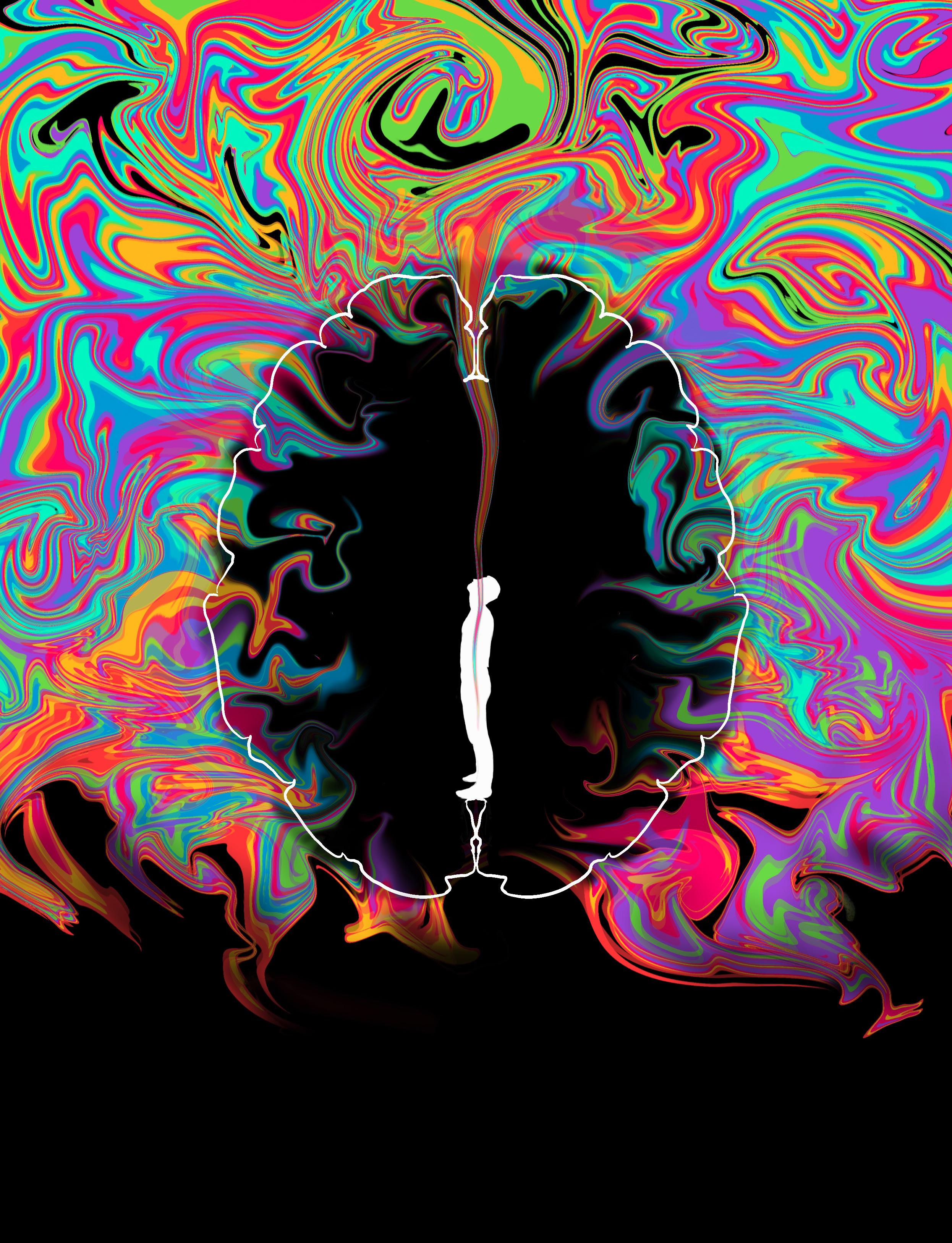
THE DOUBLE VISIONS OF KETAMINE THERAPY
Letter from the Editors
Dear reader,
Last November, board member Jonny Dach was tidying his parents’ attic when he stumbled across a typewritten letter from Andy Court, editor-in-chief of The New Journal in 1982. Addressing future managing boards, Andy called The New Journal “a void filled by people who made a leap of faith.”
We each took that leap of faith in our freshman years when we signed onto The New Journal’s mailing list, wrote our first piece, and applied to join the editorial board as associate editors. The first time we met as a managing board, we started a Google Doc with a list of our dreams for the magazine. We are writing this farewell on that document, which contains every (written) thought we’ve had about The New Journal. It’s almost 30,000 words long. We’ve worked on this document from our desks in local newsrooms, in almost every New Haven café, on the floor of Chloe’s suite. When nights become mornings, we’ve held fast to what Andy calls “a feeling of magic, the magic that comes when, after all the bullshit, you walk into the dining hall and people are reading the magazine.”
In this issue, we look to communities grounded by their faith. Chantal de Macedo Eulenstein ’29 explores New Haven’s biking culture, passed down from one generation to the next, and David Rosenbloom ’25.5 joins a community of people whose lives were transformed by an unlikely treatment for depression— ketamine therapy. Other writers meditate at Yale’s Buddhist shrine, hop on the court with a youth basketball team, and find renewed hope at a local Black hair salon.
If there were a way to keep doing this for the rest of our lives, we would. But while we might not be your managing board anymore, we can still hold fast to what made us fall in love with the magazine. The faith that seasoned and firsttime writers alike can do incredible journalism. The shared belief in depicting reality with grace and clarity. The chance to work with people just as insane about that.
We’re delighted to introduce you to the next managing board of The New Journal. Kelly Kong and Adele Haeg will be your editors-in-chief, Margot Kohn will be the executive editor, and Harry Lowitz, managing editor. They’re a great bunch.
To echo Andy one more time, “something special has happened here.”
Off we go,
Chloe, Calista, Mia, Tina
Thank you to our donors!
Mark Badger
Jean-Pierre Jordan
Aliyya Swaby
Laura Heymann
Jeffrey Pollock
Julia Preston
Armand LeGardeur
Katie Hazelwood
Benjamin Lasman
Kathrin Lassila
Fred Strebeigh
Peter Phleger
Steven Weisman
David Greenberg
Suzanne Wittebort
Romy Drucker
James Carney
Makiko Harunari
Editors-in-Chief
Chloe Budakian
Calista Oetama
Executive Editor Mia Rose Kohn
Managing Editor Tina Li
Publishers
Ethan Kan Alex Moore
Creative Director
Verse Editors
Matías Guevara Ruales
Senior Editors
Maggie Grether
Vivian Wang
Sophia Liu
Samantha Liu
Chloe Nguyen Josie Reich
Jack Rodriquez-Vars
Associate Editors
Odelya Bergner-Phillips
Adele Haeg
Margot Kohn
Harry Lowitz
Moe Shimizu
Sabrina Thaler
Copy Editors
Ella Piper Claffy
Dani Klein
Kelly Kong
Kate Rodriguez
Drew Storino
Kade Gajdusek Zoya Haq
Samhita Kumar
Will Sussbauer
Designers
Erin Lee
Celina Qu
Sophie Molden
Katerina Matta
Serina Yan
Associate Business Manager Tiona Zeng
Photography
Web Design
Colin Kim
Daphne Joyce
Samhita Kumar
Members & Directors: Haley Cohen Gilliland • Peter Cooper • Andrew Court • Jonathan Dach • Susan Dominus • Elizabeth Sledge • Fred Strebeigh • Aliyya Swaby
David Gerber
Daniel Yergin
Jonathan Lear
Barak Goodman
Elizabeth Sledge
Sally Sloan
Leslie Dach
Jodi Kantor
Rollin Riggs
Hilary Callahan The Elizabethan Club The Hull Barrett Family Fund
Advisors: Neela Banerjee • Richard Bradley • Susan Braudy • Lincoln Caplan • Jay Carney • Joshua Civin • Richard Conniff • Ruth Conniff • Elisha Cooper • David Greenberg • Sophie Haigney • Daniel Kurtz-Phelan • Laura Pappano • Jennifer Pitts • Julia Preston • Lauren Rawbin • David Slifka • John Swansburg • Anya Kamenetz • Steven Weisman • Daniel Yergin
Friends: Nicole Allan • Margaret Bauer • Mark Badger and Laura Heymann • Anson M. Beard • Susan Braudy • Julia Calagiovanni • Elisha Cooper • Peter Cooper • Andy Court • The Elizabethan Club • Leslie Dach • David Freeman and Judith Gingold • Paul Haigney and Tracey Roberts • Bob Lamm • James Liberman • Alka Mansukhani • Benjamin Mueller • Sophia Nguyen • Valerie Nierenberg • Morris Panner • Jennifer Pitts • R. Anthony Reese • Eric Rutkow • Lainie Rutkow • Laura Saavedra and David Buckley • Anne-Marie Slaughter • Elizabeth Sledge • Caroline Smith • Gabriel Snyder • Elizabeth Steig • John Jeremiah Sullivan • Daphne and David Sydney • Kristian and Margarita Whiteleather • Blake Townsend Wilson • Daniel Yergin • William Yuen
R. Anthony Reese
Andrew Court
Laura Pappano
Marilynn Sager
When the court is safer than the streets, a youth basketball team reckons with gun violence.
Velvet Wu
Anya Geist
By Prentiss Patrick-Carter
A Thousand and One Sounds of the New Haven Biker
New Haven’s bikers want to ride freely, but the city thinks they threaten public safety. Are the two at a standstill?
The Double Visions of Ketamine Therapy
In New Haven, where ketamine was first used to treat depression, a new generation of clinics embraces a contested method of therapy. I spoke to doctors and patients, and tried the treatment myself.
By David Rosenbloom
Alistair Lam
Nora Tsai
feature By Chantal de Macedo Eulenstein
Heat Check
When the court is safer than the streets, a youth basketball team reckons with gun violence.
By Velvet Wu
When terrance edwards joined the New Haven Heat basketball team as a seventh grader, his coaches taught him to tie his shoes. That year, in 2014, he left New Haven for the first time in his life when the Heat played a tournament in New York. One of his coaches, Rick Kennedy, remembers the drive to New York. They were passing through Bridgeport when Terrance tapped him on the shoulder and pointed at the tall buildings in the distance. “Are we in New York City?” he asked.
Terrance is now 25 and works as a disability service provider. He still attends the Heat’s practices when the coaches need him and talks to his old coaches regularly. “Coach Rick was basically like a second father to me,” he said.
Since 2014, Coach Rick has been the head coach and program director for the New Haven Heat. Founded in 2002 by Frank Redente Jr., now the city’s Ward 15 Alder, the Heat is a youth basketball program with 150 students across elementary, middle, and high school divisions. Redente founded the program to provide kids a productive way to spend their time outside of school and a distraction from the difficult realities of living in the
inner city. He hoped that, in doing so, the program would keep kids safe from crime, and especially from gun violence. The team is also incredibly successful at teaching kids basketball. Over the years, they’ve won three national championships and sent dozens of their kids to play at the college level.
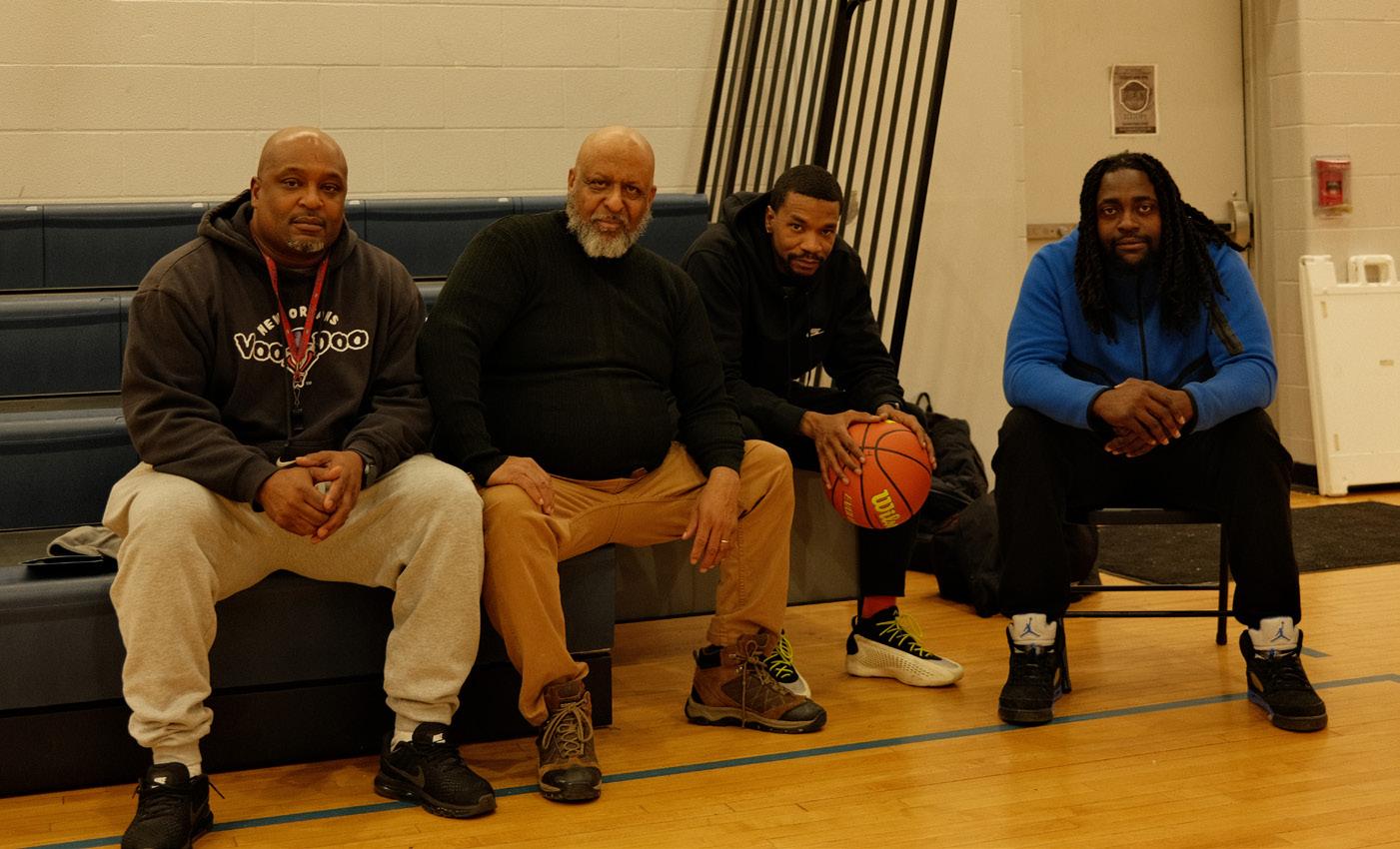
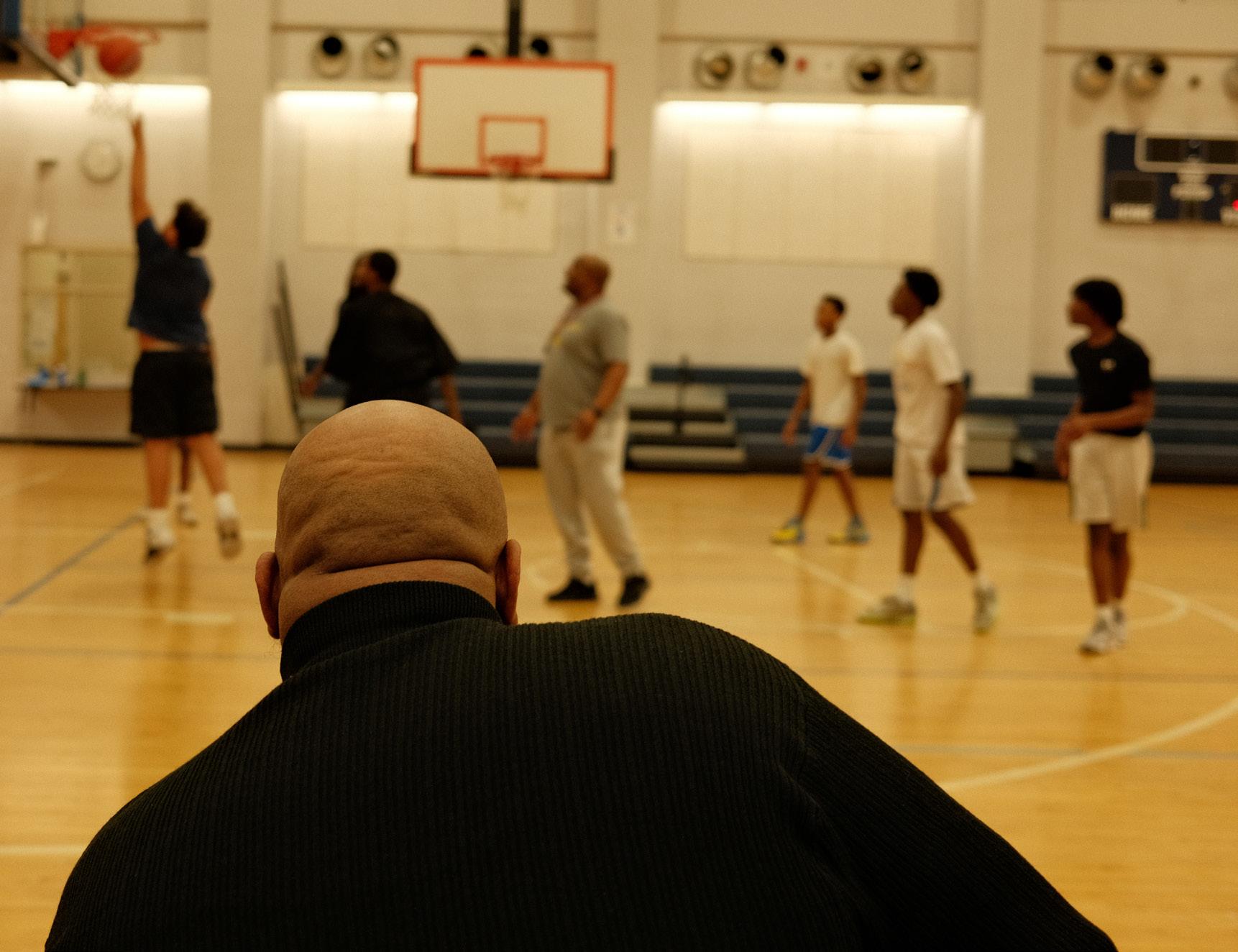
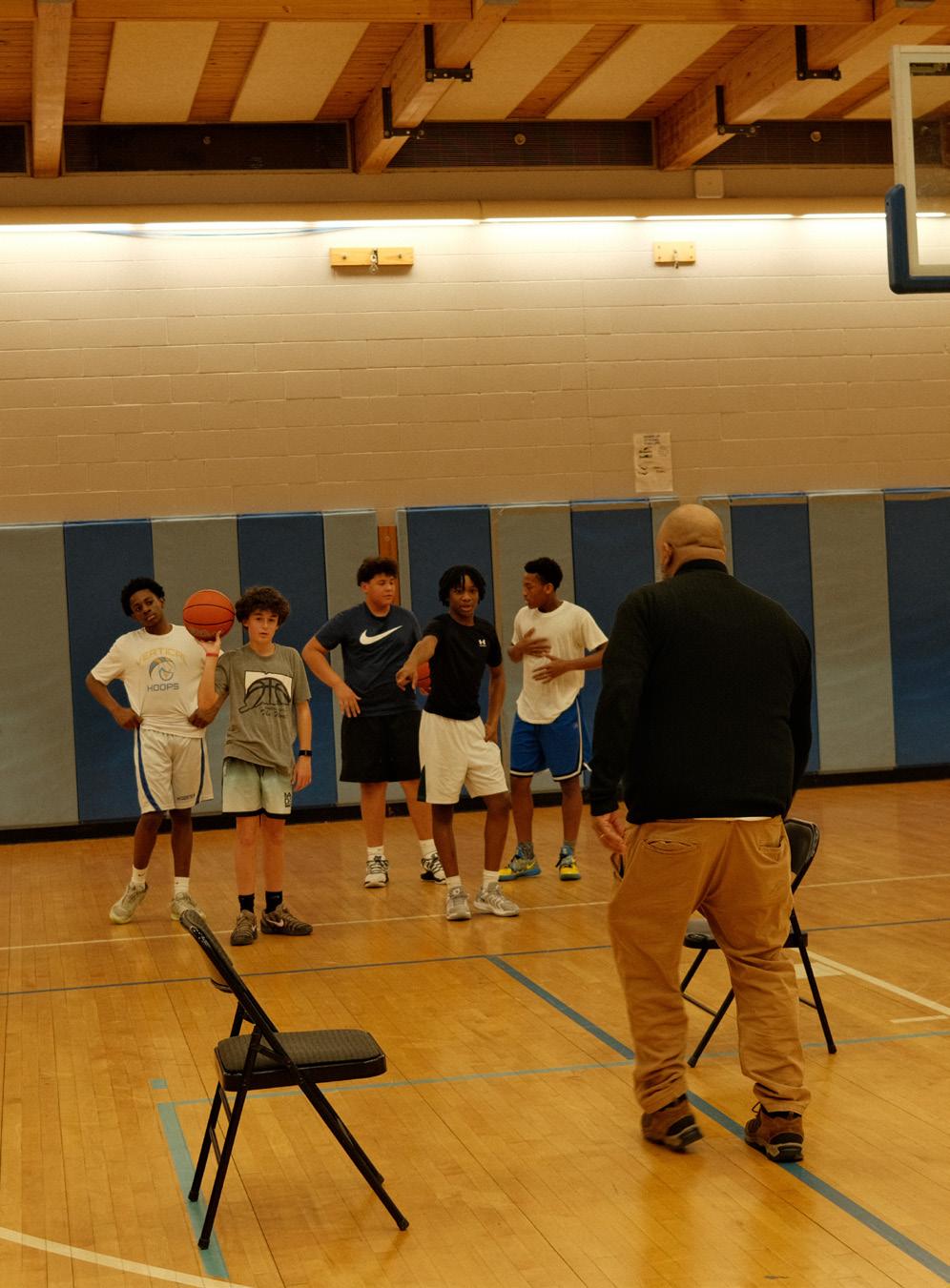
The team meets twice per week, usually at Fair Haven School and Amistad Academy Middle School. There, coaches run the kids through shooting and ball handling exercises. In a hodgepodge of colorful basketball shorts and t-shirts, kids dribble and pass balls back and forth, racing into layups as part of a shooting drill. Coach Rick, with his graying beard and broad figure in a black turtleneck, is an imposing presence on the bleachers, where he yells encouragement and stops players for mistakes.
For the Heat’s coaches, having practice as frequently as possible is a matter of saving kids’ lives—keeping kids at practice minimizes the time they spend unsupervised in the city. In 2025, onethird of victims of homicide due to gun violence were younger than 19. Last year, an 8-year-old died from an accidental shooting on Dewitt Street in the Hill.
Earlier this year, a 13-year-old died driving a stolen car.
Coach Rick and his son, Doc Kennedy, who now works at Amistad Academy Middle School, run the team together. When Doc was 16, TJ Mathis, his brother and Coach Rick’s stepson, was killed in a shooting on South Genesee Street in New Haven’s West Hills neighborhood. Mathis played Division I basketball at Morgan State University before transferring and play ing Division II at Mercyhurst University. He died the day before he planned to sign a contract with a semi-pro team.
In 2025, the Heat lost a player to gun violence. That September, a 13-year-old boy shot and killed 15-yearold Kaiden Phillips, a shoot ing guard for the Heat. In the aftermath of Kaiden’s death, his coaches and teammates, along with the members of the New Haven community, con vened in the Fair Haven School gym to grieve together.
Isaiah Turner, a 14-year-old freshman who plays point guard for the Heat’s high school team, was a close friend of Kaiden’s. After his death, he often found himself zoning out in class and thinking about Kaiden throughout the day. These days, he still finds it difficult to articulate his grief. “It’s pretty hard for me to talk to anyone about it,” he said. He remembers Kaiden as someone the team relied on during games. “Every time you needed a bucket, that’s who we would go to.”
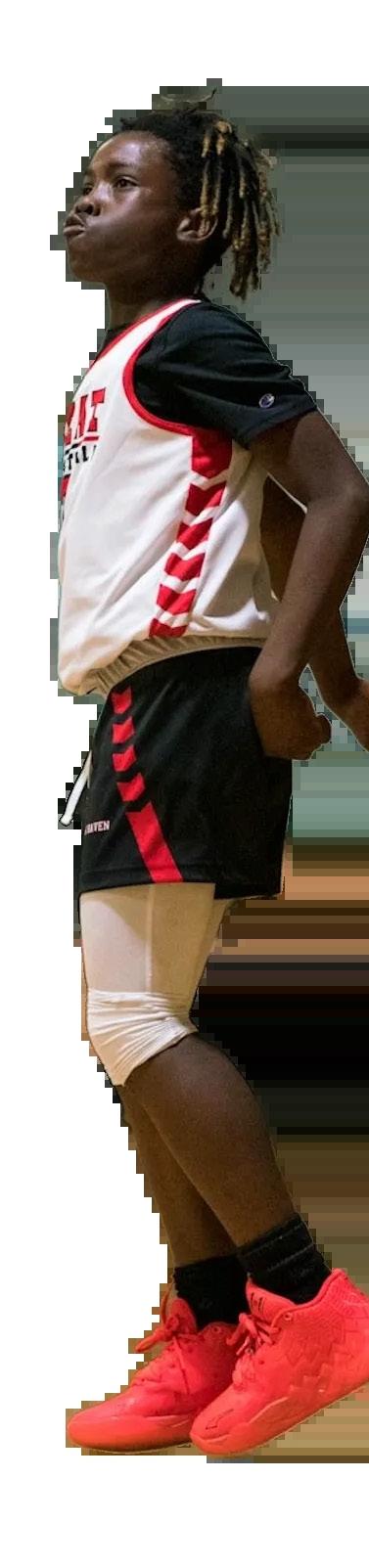
Jahmala Steele, an eighth grader who plays small forward for the Heat’s middle school team, said that after Kaiden’s death, his mother wouldn’t let him walk anywhere by himself. “She said,
photos by colin kim
From left to right: assistant coach Carl Bond, coach Rick Kennedy, Tyshan Smith, Deandre Whyte.
A younger Kaiden Phillips. Credit: New Haven Heat Twitter
it’s either you get picked up or you’re not going,” he recalls.
The players took it upon themselves to help their teammates. At practices after Kaiden’s death, Carl Bond, an eighth grader at Hamden Middle School, said he tried his best to keep morale high. His goal was to make sure “everybody wasn’t getting on each other by mistake, getting mad, sulking,” he said. “Trying to lift everybody up.”
The Heat has about fifteen coaches— all unpaid—who work other jobs during the day, many in New Haven public schools. They rely on regular donors and fundraising efforts to support travel expenses and team uniforms. When the kids don’t have the money to pay for their own meals or the team comes up short on funding for travel expenses such as hotel rooms, the money comes out of coaches’ pockets.
William Young, now 25 and studying for his HVAC license, remembers calling Coach Rick ten years ago from the hospital. His mom, a single parent who worked two jobs to make ends meet, had had a severe allergic reaction. Throughout the next several weeks, while William’s mother was in the ICU,
Coach Rick made sure William got to practice and was still going to school. When his mom died less than a month later, Coach Rick checked on him and his brothers daily, and gave William advice that got him through the rest of the school year.
“He was like a father figure for me. It saved my life when my mom passed away so young,” William said.
The same year that Terrance went to New York City for the first time, his team placed third in a national championship. After the game, he asked Coach Rick for a hug. “That kind of made me melt,” Coach Rick said.
as much as the kids think we save them, they save us. We’re still young men,” Coach Doc said.∎
Redente stepped back from the team in 2014, passing it on to Coach Rick and Doc. To Doc, who’s been coaching since he was 18, teaching and being someone the kids rely on doesn’t just change the kids’ lives. “I tell people all the time: just
Wu is a sophomore in Davenport College.
Velvet
Top photo: Coach Rick Kennedy at practice.
Bottom photo: From left to right: Demari Radcliffe, Mateo Pace, Carl Bond Jr., Jahmala Steele.
Meditations on Meditation
At Yale’s Buddhist shrine, students escape campus’s productivity culture.
By Anya Geist
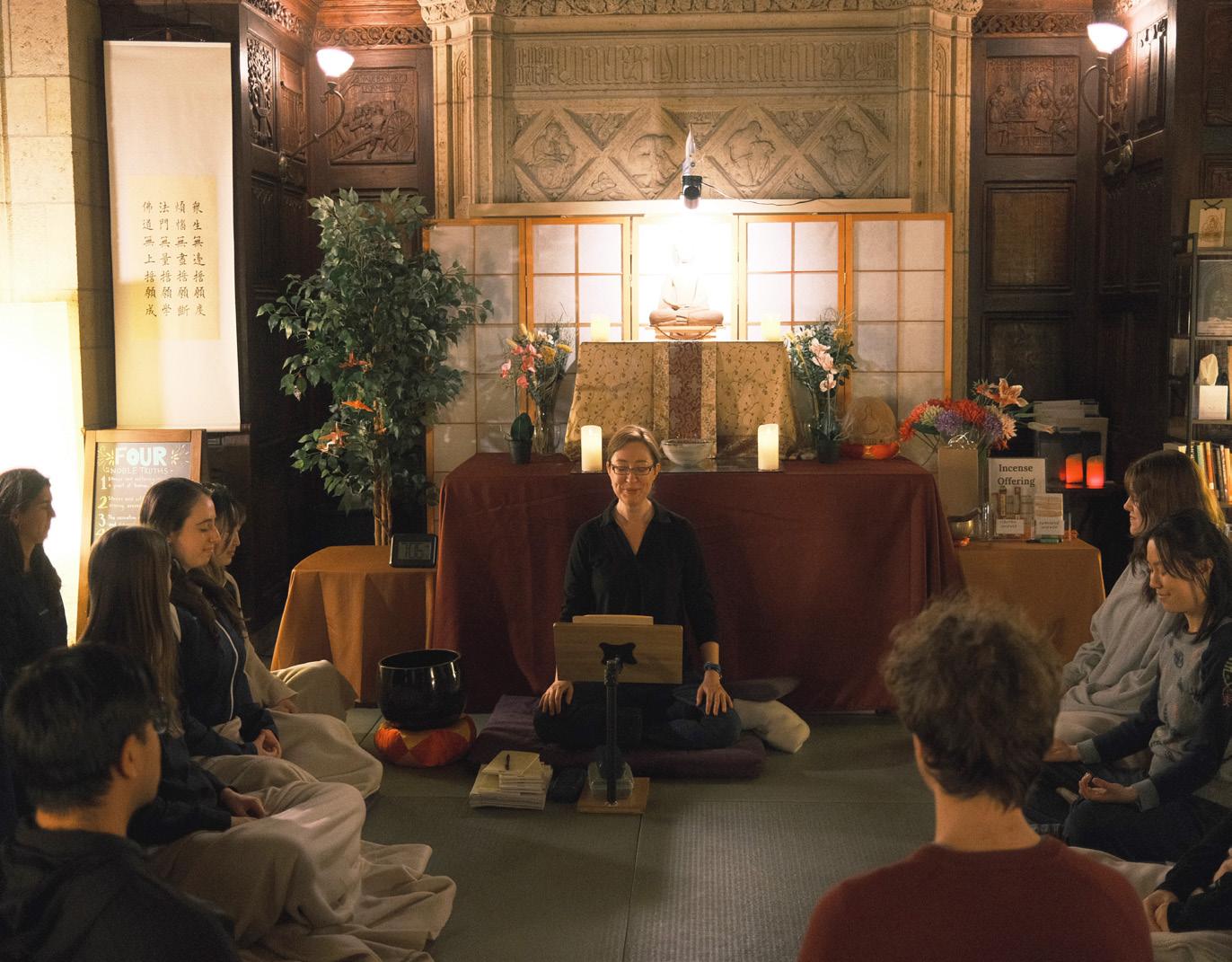
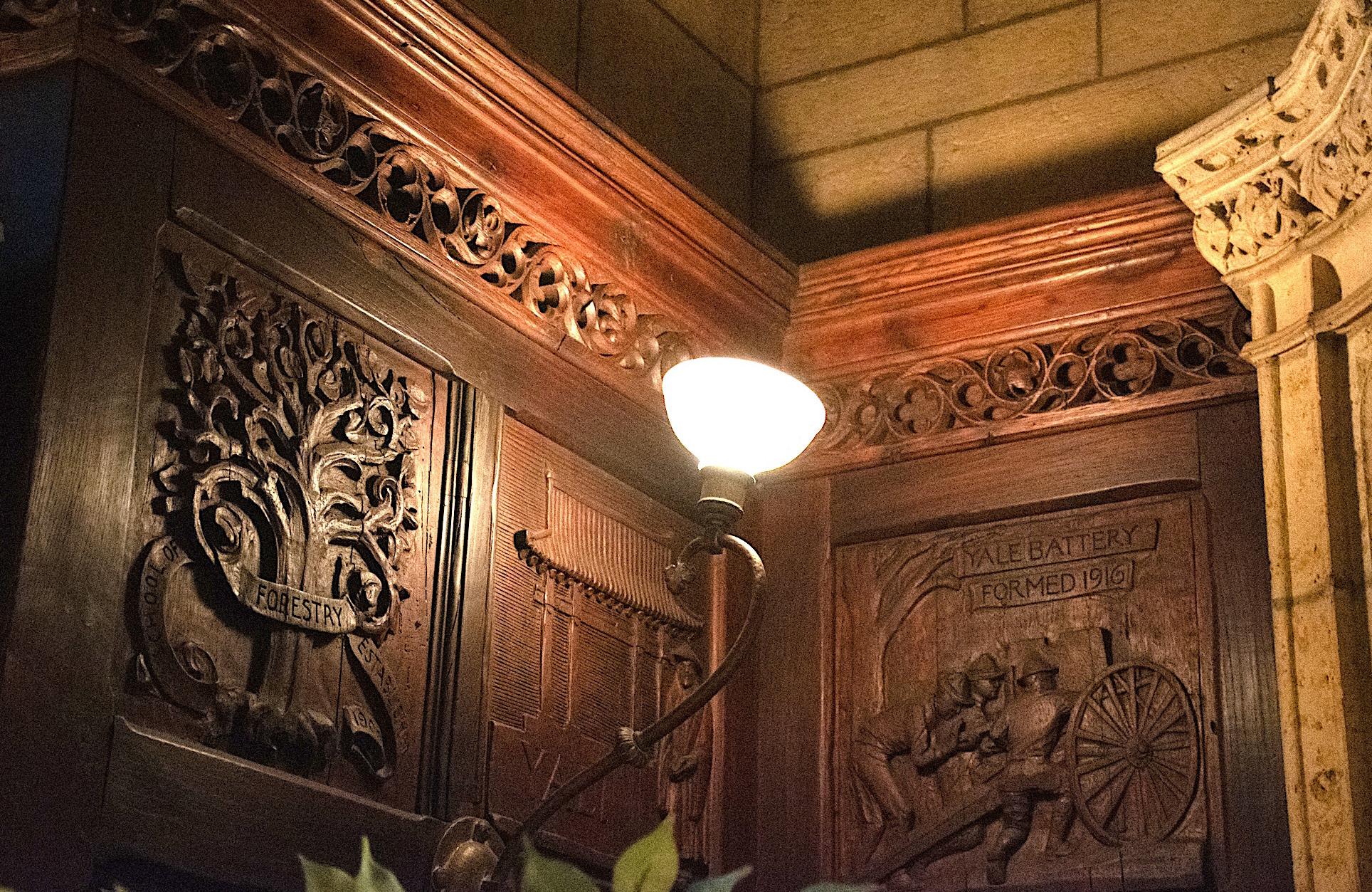
Inside the base of Harkness Tower, stone walls arch up toward the ceiling. At night a large stained glass window on the left wall lies in shadow. The room is a Buddhist shrine, but it is also a shrine to Yale. Stone and wood-paneled walls. The quintessential Yale fireplace, hidden behind a folding screen. A dedication to Charles William Harkness inscribed on the chimney.
Every Wednesday and Sunday evening, Reverend Sumi Kim, Yale’s Buddhist Chaplain, leads an hourlong meditation workshop. Around three dozen undergraduate and graduate students usually show up. Some are Buddhist. Most are not. They aim to free themselves, in Kim’s words, from “craving” or “clinging” to material goals. But Yale students often cling and crave, seeking perfection in their relationships, schoolwork, job searches,
extracurriculars—and even meditation.
Kim sits at the front, back straight. She has a strawberry blond bob and thin rectangular glasses. We sit criss-cross on cushions and low chairs in a semicircle around her. Kim puts us at ease with her quiet humor. The Wednesday after the Super Bowl, she said, “I feel like if Mr. Bunny had been here, he would have done the ‘lovingkindness’ meditation and turned into a Good Bunny.”
Kim became Yale’s Buddhist chaplain in 2018, having previously served as the Buddhist chaplain at Duke University. She now oversees the Buddhist Life program, founded in 2012 under the Yale Chaplain’s Office. Her responsibilities include leading the shrine, providing pastoral counseling, and visiting Yale classes.
Before meditations she welcomes each student into the shrine, often by name. On Sundays, she chats with students as they leave the social hour in the adjoining Trumbull Room, where they mingle over tea and mochi. Kim estimates that only 1 in 5 of her students come from a Buddhist family or tradition. The rest either come from another faith or don’t identify with any particular religion. In her eight years here, Kim’s approach has remained largely the same. “The questions of a 20-year-old in 1980 are the same as [in] 1990, 2000, 2010,
2020,” Kim said. “What is my purpose in life? Who am I? Like, how do I understand myself?”
Kim believes that even students who previously identified as Buddhist should take their time at Yale to recreate their relationship to Buddhism, as they grow intellectually and emotionally. She was raised in a Zen Buddhist community in rural New Hampshire but practiced the Theravada lineage as a teenager, enjoying it because it was “low, gentle, step-by-step.”
Originating in the Indian subcontinent more than 2,500 years ago, Buddhism explores suffering, its causes, and practices to overcome it. The Buddha, Siddhartha Gautama, proposed Four Noble Truths, which are listed on a blackboard in the shrine: Life involves suffering. Suffering comes from desire. Suffering can be overcome by letting go of attachment. Lastly, the Buddha proposed an Eightfold Path, a guide to thought, action, and mindfulness designed to end suffering.
In the spring, Kim teaches metta, or lovingkindness meditation. Metta is a Pali, or ancient Buddhist, word meaning “friend” or “friendliness.” We wish specific people happiness, health, safety, and a fourth wish of their choosing. Sometimes Kim asks us to picture a mentor, a stranger, or a challenging figure, like an estranged friend. She always asks us to picture ourselves.
In 2023, Putt Punyagupta ’23 wrote an opinion article for the Yale Daily News criticizing the shrine for overemphasizing meditation. He argued that the shrine overlooked religious Buddhist practices, such as extensive ritual worship and presenting offerings to the Buddhist clergy. Punyagupta, who had been ordained as a Buddhist monk, argued that the shrine’s vague and all-encompassing focus on meditation made Buddhist practice “sacrally vacuous.”
“I no longer practice Buddhism in any meaningful way as I found its upkeep simply impossible without a space to engage in familiar forms of devotionalism,” Punyagupta wrote.
Punyagupta also lamented how student leaders within the Buddhist community publicly identified with other religions. To him, this meant that they had watered-down and cherry-picked certain Buddhist practices, removing them from their “original religious contexts.”
Punyagupta wrote to me, almost
Sumi Kim leading a meditation workshop at the Yale Buddhist Shrine.
photo by colin kim (left); katerina matta (right)
three years later, that he didn’t mean to blame the Yale Buddhist Student Community (YBSC) for not “doing enough.” Rather, he wanted to speak about his growing sense of alienation due to a “popular desacralization and secularization” of religious practices, not limited to Buddhism.
I asked Kim about the opinion article. She laughed. It was the “bane of her existence,” she said. She wishes she had a chance to speak with Punyagupta and discuss the shrine’s role on Yale’s campus. To reach the most students possible, Kim concentrates on teaching accessible concepts related to secular life: mindfulness, conflict resolution, lovingkindness. Students seeking more rigorous practice organize additional programming. Each Thursday, for example, a few students meet for a forty-five-minute-long meditation.
She also knows that some students may only practice Buddhist meditation during their years at Yale. Even within those four years, students struggle to make time for the Buddhist shrine. YBSC’s current president, Phoenix Boggs ’26, often forgoes Sunday meditations for senior society or to address “Sunday scaries” of unfinished work, she told me. Even though she puts homework first, “if you were to ask me which I think is more important, it would be” meditation, she said.
Even when students do make it to the Buddhist shrine on Sundays, some of them struggle to find peace in these meditations. While Buddhism is a spiritual practice, many attendees at the shrine see it as a form of self-improvement.
even on days when he later goes to the shrine. He sees it as an investment. “I truly do think that it’ll pay its dividends,” he said.
“I TRULY DO THINK THAT IT’LL PAY ITS DIVIDENDS.”
Like Wu, Gus Renzin ’27, the current secretary of the Yale Buddhist Student Community, began meditating in middle school as a form of self-improvement. It wasn’t the “healthiest reason” to start meditating, he told me. It’s easy for a desire to meditate once a day to escalate into a self-improvement regime, he said—similar to the easy toxicity of workout or diet regimes. While these practices could be healthy, practitioners can cling to them for support, the very action that meditation seeks to reform.
My mind wandered. I wondered how many people in the room were worried that they should be studying. How many were frustrated by the challenge of self-compassion.
Then, my mind drifted to the William Wordsworth inscription at the base of the chimney, dedicated to Harkness: “The best portion of a good man’s life, his little, nameless unremembered acts of kindness and of love.”
In the pauses between Kim’s slow words, my thoughts separated from myself, and I existed outside my head, in the corners of the room and the divots in the ceiling.
Kim rang a gong to signal the end of the meditation. I opened my eyes.∎
Tyler Wu ’29 began meditating during the COVID-19 pandemic and has continued his practice at the Buddhist shrine. He saw meditation as a form of self-improvement, not necessarily as a form of spirituality.
Wu’s currently creating a startup to limit social media usage. He thinks apps like Instagram make users less mindful. As his time at Yale gets busier, he said meditation helps him stay balanced. His goal is to meditate for 15 minutes a day,
Renzin tries not to cling to these practices anymore. Every day, at around seven in the morning, he does mindfulness and metta meditation in the Trumbull courtyard. For twenty minutes, he soaks in the sounds around him, the feeling of his breath, and the movement of leaves in the trees.
When I first visited the shrine in January, we meditated on self-compassion. Everything was still. Eyes closed, I laid my hands on my lap, sitting up much straighter than normal.
Anya Geist is a sophomore in Ezra Stiles College.
A detail in the Yale Buddhist shrine in the basement of Harkness Tower.
A Thousand and One Sounds of the New Haven Biker
By Chantal de Macedo Eulenstein
New Haven’s bikers want to ride freely, but the city thinks they threaten public safety. Are the two at a standstill?

New Haven Mayor Justin Elicker stood before a cluster of ATVs and dirt bikes—and an industrial, high-speed crusher. At 9:30 in the morning on September 19th at the New Haven Police Academy, the City of New Haven lined up eighteen ATVs and dirt bikes in a row. Elicker, wearing a crisp blue button-up, faced his metallic victims. The arm of a crane picked each vehicle up and loaded it into the crusher.
The crushing was a public display of New Haven’s decades-long battle against its bikers. All-terrain vehicles (ATVs) are four-wheelers designed for off-highway use. Dirt bikes are motorcycles designed specifically for rough terrain. Both have been illegal to ride on the street in New Haven since 1971, because the Connecticut General Assembly classifies them as “off-road vehicles.” The city says that the bikers are breaking the law, disrupting traffic, and endangering pedestrians. The thunder of engines wakes sleeping residents, who have taken to town hall meetings to complain. In 2003, Noise Free America, a group that fights against noise pollution, recognized the city as having some of the worst noise pollution in the country. The 2025 law “An Act Concerning Street Takeovers and the Illegal Use of Certain Vehicles,” which ruled it legal to destroy confiscated bikes, made Elicker’s crushing possible.
At the press conference, Elicker described these vehicles as nothing but “dangerous, incredibly dangerous.” But they mean something very different to another set of New Haveners. I spoke to twelve bikers. To them, riding is joy. Riding is power. More than a sport or a pastime, their bikes are a means of self-expression. They, too, grapple with danger: they say they are often chased by police, which contradicts New Haven’s no chase policy. They view their sport as a way of declaring themselves and their freedom, and view the crushing as an example of the city’s intolerance. “You’re taking my property, and you’re giving me no money for it—you stole it,” said biker Teddy Salmond.
Salmond remembers the first time he got on an ATV. He was 7. A construction worker lent his bike to Salmond and let him ride down the trails behind his house. “It was like I had a lot of power,” Salmond said. “Some type of adrenaline ran through my body.”
At the press podium, Elicker was adamant: “If we catch you, we will crush them.” Looking into the cameras lined up in front of him, Elicker pressed a big orange button. The arm of the crusher lowered, and the vehicles’ blue and red and green bodies began to blur together. As the crusher reached the bottom, their hulls were dismembered.
I. A THOUSAND AND ONE SOUNDS OF THE CITY
ONE OF THE MOST OBVIOUS features of Yale,” wrote the Yale Daily News in 1932, “is its noisiness.” The News added that “The thousand and one sounds of the city have been endured as a necessary evil.”
New Haven’s noisiness is not new. And neither is the bikers’. In 1990, another News writer reported how a student stood outside of a first-floor window, blocks of charcoal in hand, “ready to fire at the next noisy biker who drives by.”
Say you walk down Chapel or Elm Street today, especially during the summer or on the weekends. You will surely pass a car, ATV, or motorcycle that someone has modified by removing mufflers and altering exhausts. One resident and former biker told me these modifications can render vehicles so loud that they sound like gunshots. The sounds “add up and slowly eat away our nervous systems,” said Matthew Feiner, a resident and the owner of Devil’s Gear Bike Shop on Chapel Street.
Though ATVs and dirt bikes are legal to purchase, it’s illegal to ride them on public roads. For years, municipalities have attempted to further discourage their use. Since at least 2020, several cities in Connecticut have made it illegal for gas stations to service ATVs and dirt bikes.
Only months after Elicker was elected mayor in 2019, he began a campaign against dirt bikes and ATVs, and in 2020, he oversaw a police operation to arrest nine riders and twelve bikes. The riders were “disrespecting our laws, terrorizing our neighborhoods,” he told NBC Connecticut. In 2021, the city launched a deterrence campaign, raising the fines for those caught riding—once ninety-nine dollars, now 1,000 to 2,000 dollars.
In October 2023, alongside then-Police Chief Karl Jacobson, Elicker created a joint regional task force to “combat illegal dirt bikes and ATVs.” Composed of police officers from New Haven and seven other cities, the task force gathers to share intel and collaborates in seizures and arrests. “The people riding these [vehicles] do not see city limits,” Jacobson said at the press conference announcing the task force. “They just drive and create havoc.” Since 2023, the NHPD has seized at least 120 dirt bikes and ATVs.
Charlotte Anastasio is often jolted awake from a deep sleep at two o’clock in the morning. Beneath her 100 York St. apartment, the thunder of motorcycle engines will rip through the street. All she can do is roll over.
A retired registered nurse who grew up in East Haven,
photos by Colin kim
A man photographing the ATVs and dirt bikes as they await their crushing. September 19, 2025. Credit: Adele Haeg
Anastasio, 80, has lived downtown since 2020. She has thin black glasses and a white bob. Anastasio often walks to Atticus Bookstore Cafe to grab a pastry, and she likes to attend Yale lectures that are open to the New Haven community. She loves it here. But the noise is so disruptive that she has considered moving. “It makes me question, is this where I want to live?” she said.
II. SHOOT OR RIDE
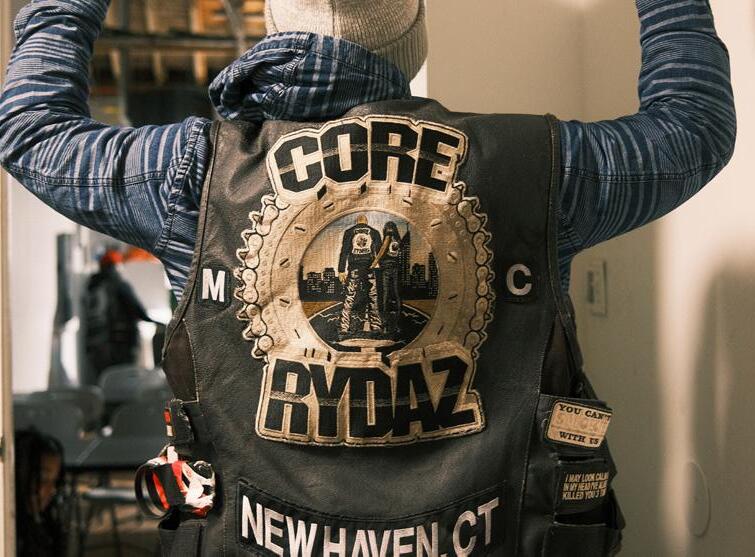
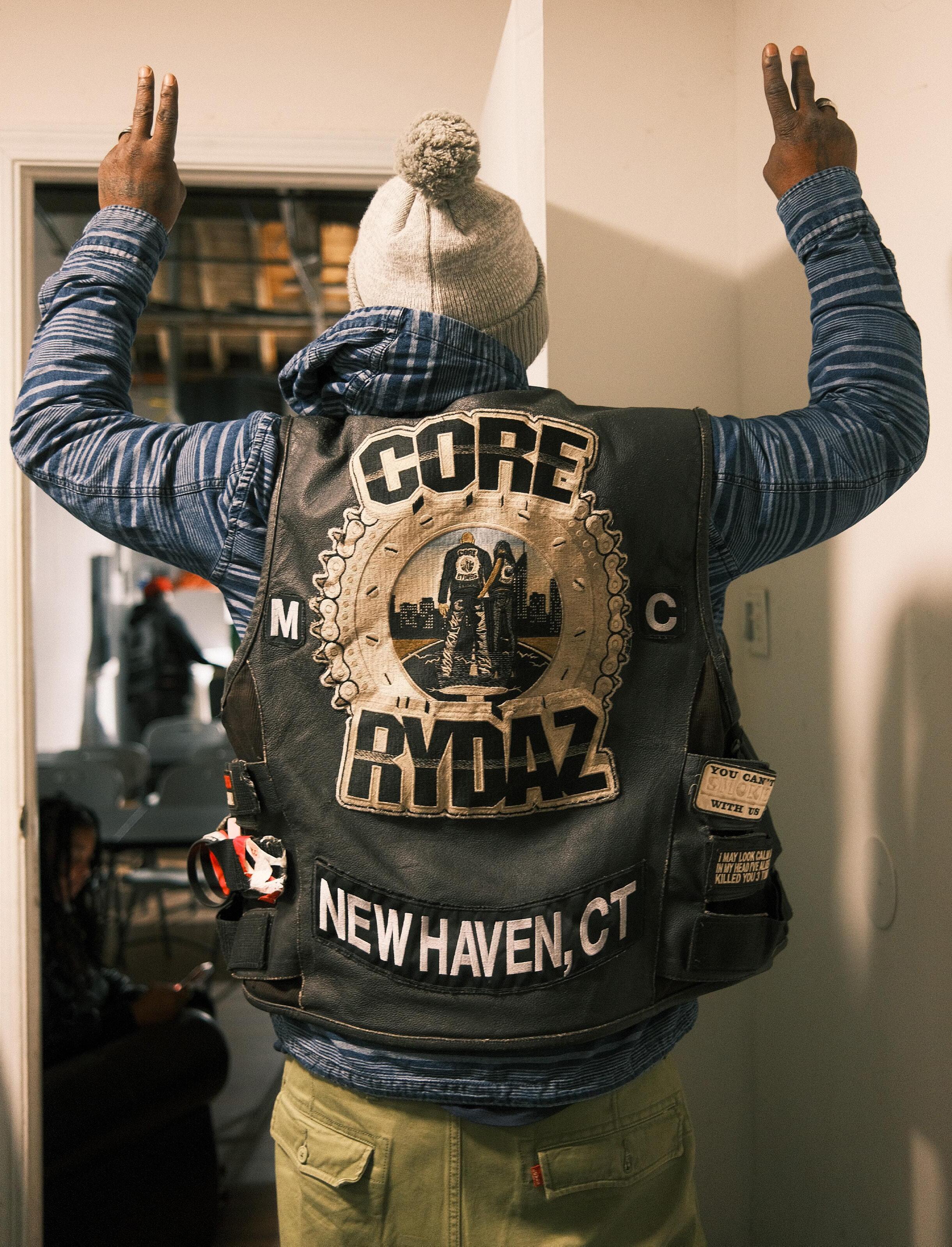
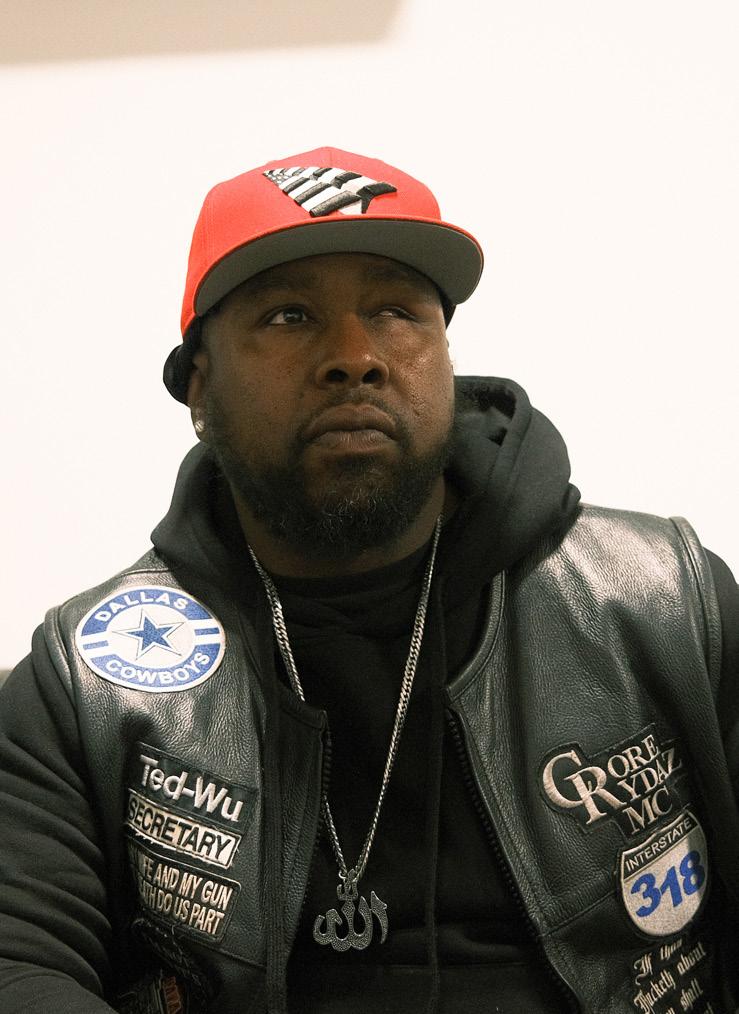
Bobby Bloodworth, whose biker name is Low, is part of the motorcycle club Core Rydaz. Founded in 2009, the club consists of fifteen bikers who ride across Connecticut and the East Coast. When I met them at their headquarters, they were setting up for a night of cards and poker. The kitchen was busy with women who prepared fried chicken and coleslaw stacked on hamburger buns.
To use the language of the biking world, Core Rydaz is a “99-percenters club.” In other words, everything they do is legal. Their vehicles are licensed and insured. Most members are in their 40s or 50s and are married or have kids. Like Bloodworth, many of them fell in love with biking after riding dirt bikes as children.
Framed collages—remnants of game nights and cross-country rides— hang on a wall. Some pictures show girls, surrounded by bikers, in long frilly dresses with tiaras on their heads. The club has done prom escorts for as long as it has been around. They do funeral processions too, but of those there are no pictures.
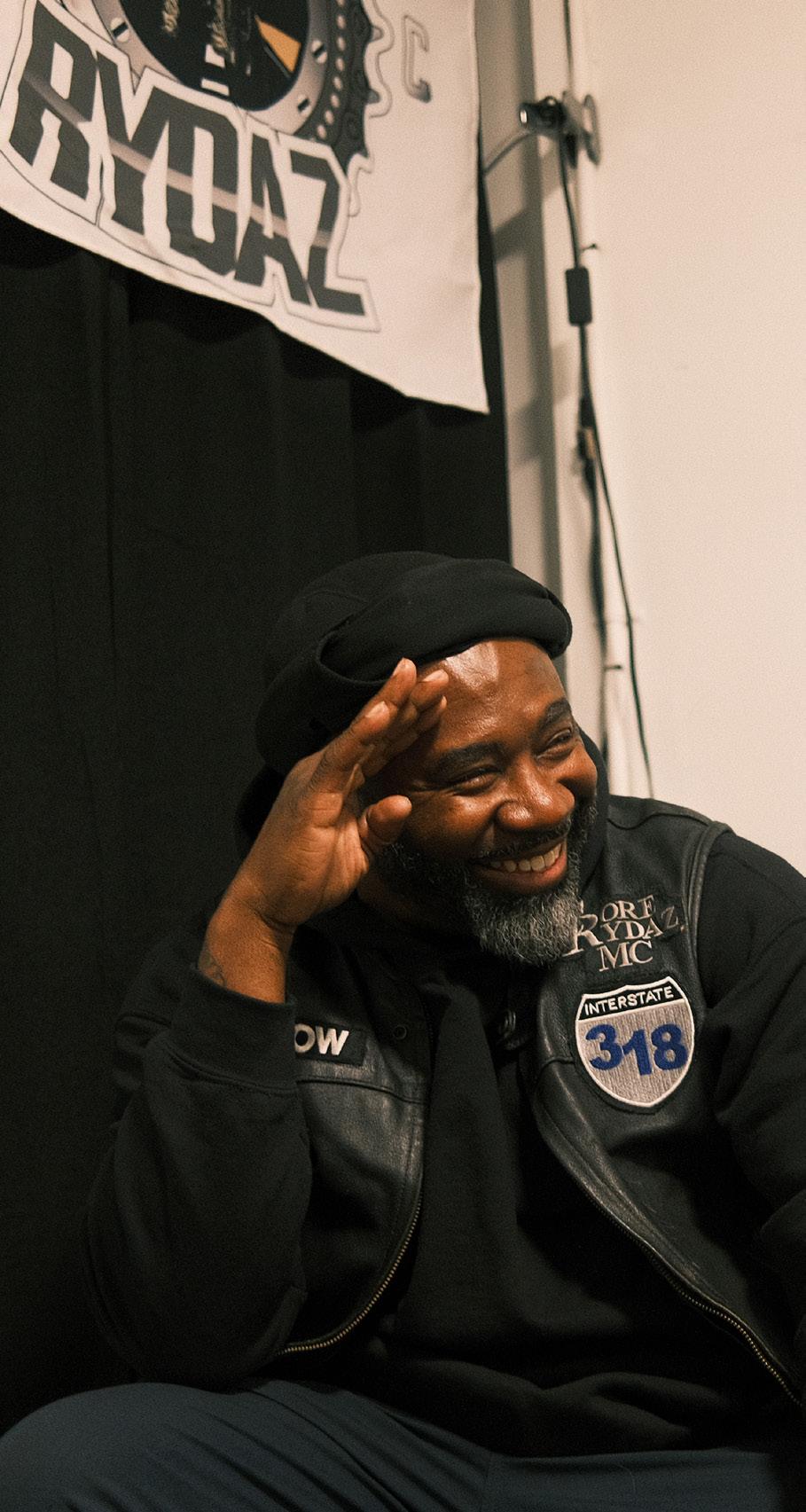
Bloodworth talks rapidly, as though words are spilling out and he cannot keep up. There is dirt beneath his nails and his hands are rugged and worn. The end of his beard is graying. He seems much older than 43.
Bloodworth grew up traveling with his grandmother. As she drove down the highway, Bloodworth watched dirt bikes behind cars. He’d imagine that he owned the bikes. The blue ones were always his favorite. In the neighborhoods of New Haven, Bloodworth watched similar bikes drive past his house and pop wheelies. “Look,” he would tell himself, “that’s my bike coming down the street.”
When Bloodworth’s grandmother moved down South, he had freedom to play. He bought his first dirt bike at 17. It was unregistered and uninsured.
Bloodworth was joyriding everywhere. The streets were his.
At 22, he had a son. He bought a motorcycle—less fun, but safer insofar as he was no longer “being chased on the street while cops were hitting and beating us up.” Five years later, the mother of Bloodworth’s son died. Bloodworth buried her with the help of his grandmother, who gave up her plot for her great-grandson’s mother. After that, riding became a respite from his grief.
It is difficult to talk to a rider without the mention of death: of a friend, a parent, a lover. They rarely name a cause. They talk past it or over it—it’s better to be present, to focus on the living.
Bloodworth walks me through his scars. Faint lines crisscross his knuckles and the sides of his hands. A thick line stretches across his palm. One day, Bloodworth had thrown back a couple of drinks, hopped on a bike, gunned it, and launched himself into a curb. When he got up, he didn’t notice at first that his hand was split open. It took him a month to realize that he had broken his bone.
Unable to use his right hand, Bloodworth lost his jobs at All American Waste and the DACO School Bus Company—his only means of feeding his family at the time.

When he talks about his injury, Bloodworth slows down. His relationship with the bike, like the rest of his life, is complicated. But for “all the time and stress and aggravation” of his loss and his poverty, getting on his bike still makes everything disappear. “It’s relief,” he said.
Biking clubs such as Core Rydaz act as safety nets. If the rent is late, if you can’t pick up your kid from school on time, if there isn’t food on the table, another member will help. Bloodworth keeps an extra can of gas on him, just in case someone runs out. In 2011 Core Rydaz raised funds for a young boy, hospitalized for cancer, who dreamed of owning a bike.
In New Haven, the bikers say, there is a choice: shoot or ride. Terrance Smith, a biker who describes himself as being from the inner-city of New Haven, used to ride with people
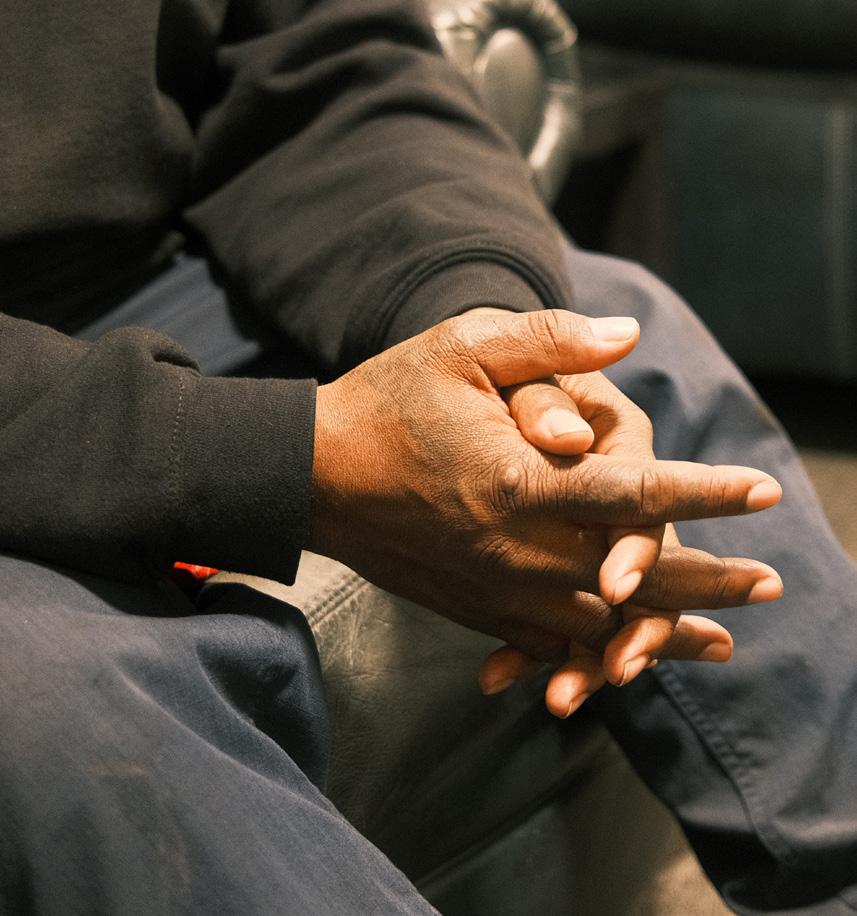

Bobby Bloodworth salutes a friend at the Core Rydaz club. Bloodworth’s clasped hands during a bikers’ game night .





affiliated with certain gangs in New Haven. One such biker told Smith about encountering a member of a rival gang. “Listen,” the biker had said, “we from different neighborhoods, but every Sunday, I ride with him. And because I ride with him, me and him are the best of friends.”
More often than not, though, it is strangers who ride together. Street takeovers are usually unplanned. It begins with one rider, who might sync up with another, and then another. The group of ten to forty bikers will ride together down the street, taking up the entire road, ripping through red lights and blocking traffic from passing. It is part of the thrill to not know who is next to you, but to know that you are together, connected by the thunder of your engines. To know for that moment, the street is yours.
III. WHOSE SAFETY?
In2022, 35-year-old Sueann Lamazon was waiting to enter the crosswalk when a dirt biker popping a wheelie hit her. Lamazon was hospitalized with multiple broken bones and internal bleeding in her head.
Just before crushing the confiscated dirt bikes and ATVs, Elicker looked up at the camera and said, “This is the one time when I talk about ATVs and dirt bikes when you’re gonna see a smile on my face.”
Elicker believes that bikers threaten the community’s safety—riding recklessly and disobeying traffic laws. Occasionally, he adds, dirt bike and ATV riders also possess guns illegally and are part of gangs. It creates an environment where residents feel unsafe.
“Sometimes they’ll stop in an area and drive around cars and taunt drivers,” Elicker told me over the phone.
At the public crushing, former New Haven Chief of Police Karl Jacobson told the press that ATVs and dirt bikes were extremely difficult to police. Both Jacobson and Elicker cite what they call New Haven’s “no-chase” policy. Elicker’s office later confirmed that the “no-chase” policy is a common shorthand for Connecticut’s standardized pursuit policy. But the shorthand is misleading—the actual policy allows officers to chase vehicles if they believe the suspect poses a threat to the community that outweighs the danger of pursuit.
“It is part of the thrill to not know who is next to you, but to know that you are together, connected by the thunder of your engines. To know for that moment, the street is yours.”
The bikers I spoke to said they’re still being chased. In 2017, Core Rydaz member Glen Morrison had stopped in Bridgeport to talk to some friends and parked his bike on a sidewalk. A police car came down the street. Though their behavior was entirely legal, fear shot through them and they considered fleeing.
Morrison says that the police are more aggressive toward bikers who are Black, like himself. In that moment in 2017, he and his friends decided to stay put. The police drove past, rolled down the window, and shot a taser at Morrison. Morrison took off. The taser’s probe ripped off from his skin. The Bridgeport Police did not respond to a request for comment about this incident.
In 2011, a New Haven police officer blocked off a road in the Hill neighborhood with her car to stop drag-racing dirt bikers. Cole, who was under 18 at the time, crashed into a tree. He was left with cognitive impairments, permanent scars on his face, and an almost complete loss of vision. The Connecticut Supreme Court sided with Cole, citing that the police officer’s decision to create a roadblock and activate her lights and sirens violated both the NHPD’s and the state’s pursuit policies. Morrison knows 3 riders who died or suffered serious injury while biking. He says that all of them had been chased by police.
IV. WITH JOY COMES RISK
Asbikers age, many trade their dirt bikes for motorcycles. They’re easier on the joints, bikers tell me. Some older Core Rydaz members have developed their own concerns about dirt bike and ATV riders. Thomas Holloman, whose steady and gentle voice gave him the bike name DIPLOMATIKO (DIPLO), is frequently annoyed at the risks posed by more reckless younger riders. He is often the driver stuck at a red light while bikers do donuts and hold up traffic, startling passersby with excessive honking.
Nate Washington, a burly man with thick black dreadlocks, is the president of Core Rydaz. In 2010, Washington bought his son, Doug Washington, then 10, his first dirt bike and watched him fall in love.
Washington and his family lived in a ranch house in North Haven, near trails where he would send his two kids out to ride. But Washington never considered
Teddy Salmond poses for a portrait at the bikers’ club.
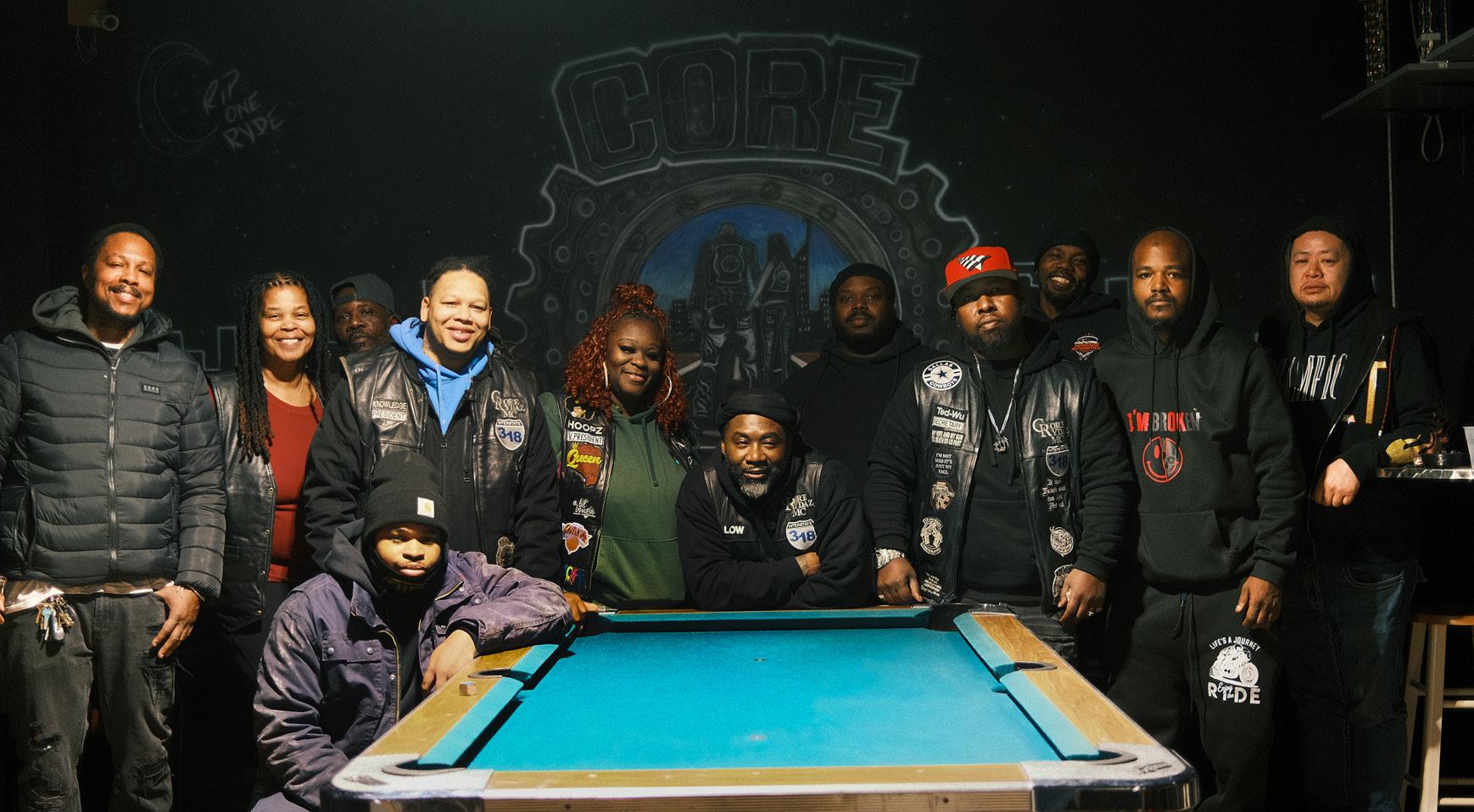
Core Rydaz members pose for a group photo after game night.
himself a “big dirt bike guy”. Thirty or forty bikers thundering down the street and sometimes weaving between cars struck him as dangerous. They ride so close together that one person’s mistake could take everyone down. Washington always rode on the trails, alone or with one or two other people. He instructed his kids to do the same.
Three years ago, Doug was riding in New Haven when police confiscated his four-wheeler. The cops had been chasing after his friend, and when he tried to distract them, they surrounded him. He jumped off his ATV and fled.
Washington got his son’s bike back, but Doug grew nervous about riding his ATV in the street. Last year, with Washington’s encouragement, Doug bought himself a Supermoto—a street-legal dirt bike that met regulations for headlights, turn signals, mirrors, and brake lights. If people want to ride their bikes on the street, Washington believes, they should do it legally.
V. “WE’RE RESIDENTS TOO”
Though Holloman is annoyed by younger, reckless riders, he understands them. You can’t stop someone from riding, he said. They’ll take it to the streets if there’s nowhere else to go.
Across Connecticut and the Northeast, there are few dirt bike tracks—paved or unpaved loops—or trails—wide dirt or gravel paths in forests. However, these spaces are far, expensive, or limited to club members. Each year, a dirt bike and ATV group called Bikelife rents out the New York Safety Track
in Jefferson, New Jersey. They argue that if you provide a space to ride, people will come. Bikelife sells out every time. A quote in the middle of their website reads: “It’s hard to enjoy yourself when your passion is a crime almost everywhere you go.”
For Anastasio, even when revving engines jolt her awake, she doesn’t like that the bikers are vilified. She also wants to see a space where young bikers can ride safely, and where their passion for biking can lead them to jobs. She only wishes that it would happen off the streets, away from her home.
Smith, the biker who recounted how biking kept his friends from turning to violence, doesn’t understand why dirt bikes are legal to sell if there is no recreational land to ride them on. He believes that the city is missing an opportunity. If New Haven built a designated space for biking, the city could be generating revenue from people like him. “Why should I have to drive two or three states over to pay somebody else my hard-earned money to do something I love?”
But Elicker argues that a legal place to ride wouldn’t resolve the issue. A couple of years ago, he recalled, a police district manager rented trailers and offered to take young riders to Connecticut tracks. No one took up the offer. Elicker said he believes that part of the joy in riding comes directly from violating the law.
Smith acknowledges this reality. “I can’t just sit here and lie,” he said: even if there was a dedicated space to ride, dirt bikes and ATVs would not disappear entirely from public roads. “There’s an aspect to bike life that revolves around riding in the streets. It’s part of the culture,” he said. But he


believes that a park would funnel some bikers away from the streets.
Bikers have long wanted to engage in more conversations with the city. In 2019, Morrison said, then-mayor Toni Harp hosted a community meeting and invited both bikers and community members to speak. Morrison attended, but said that the bikers were not heard at all—those who were “there to complain” were given the stand the entire time. Harp told me she does not remember the meeting.
“It didn’t really matter what we said. They kept bringing up taxpayer dollars, and it was like, you know every person in this room who rides a motorcycle pays taxes,” Morrison said. Morrison owns auto shops in New Haven and East Haven. He got his first job in order to buy his first dirt bike, and became a mechanic in part because he loved fixing it. Now, he rides a legal bike, works a job, and pays his taxes. “Why would I want to ruin this town that I give my resources to? That was never the objective.”
Morrison still visits the street where he grew up, still talks to the neighbor who used to call the police on him for riding his dirt bike in the street. That neighbor is old now, and his arms are too weak to pick up a shovel and lift the snow from his driveway. When nearly a foot of snow blanketed Connecticut in late January, Morrison plowed his driveway for him. He shoveled the steps, put down salt, and swept the snow off his cars. He does this every time it snows. “I’m still a good person,” he said, “and I was a good person when I was riding that bike on the street.” ∎
Chantal de Macedo Eulenstein is a first-year in Silliman College and an associate editor at The New Journal.

The Double Visions of Ketamine Therapy
In New Haven, where ketamine was first used to treat depression, a new generation of clinics embraces a contested method of therapy. I spoke to doctors and patients, and tried the treatment myself.
By David Rosenbloom
Mike Finoia was about to crash into a wall. Or at least it looked like a wall. He was moving fast, so he couldn’t say for sure. Waterfall of sand, 2D sepia-tinted mirage, khaki-colored stage curtain were other candidates. Mike’s best guess, though, remained wall—promising, at this speed, an audibly bone-crushing mix of pancaking and pulverization. And, stuck in a dreamlike state of moving-but-you’re-not-doingthe-moving, he was meeting it soon.
Mike was right: wall it was. He braced, fate accepted, and resigned to the certainly quick and hopefully painless. But instead, Mike slid through— emerging alive, intact, and glancing over his shoulder to catch the wall dissolving behind him.
This was one of Mike’s first ketamine odysseys, forming part of his canon of particularly memorable sessions. (See also: experiencing “nothingness and everything” as a fleck of dust, being accosted by Donald Trump, travelling as lint-consciousness on his dog’s fur, and successfully infiltrating jungled enemy territory via stealth canoe.) “It gave me the thought of, ‘It’s okay to be out of control, none of us are in control,’” he said. “It’s been years now, and I still think about it.”
Mike has treatment-resistant depression, meaning two or more trials of conventional oral antidepressants have proven ineffective. In 2022, he hit bottom: his whole body ached; headaches, cold sweats, and nausea on clockwork rotations; he barely slept, and when he did, woke with his mind on a hamster wheel of panic and dread, terror-ridden that if he was late for a meeting, missed a phone call, or forgot to wish a friend happy birthday, hell
would follow. He was terrified to leave his house, to get into the car, to run into his own shadow.
“It was like a snow globe where everything’s shaking all the time, and suddenly I was in the globe,” he said. He felt like he was running out of time, and started looking for residential treatment facilities. “It was terrifying. I was just like, ‘I need to get help.’”
Mike found it in ketamine. Which, yes—the ketamine of “dude I’m floating” dissociation and of the proverbial “k-hole” of mind untethered from all things earthly. But also: a church grey-area for Mormon wives; a tool for entrepreneurial rut-breaking among the Elon Musk school of techbros; and, a novel and promising intervention for depression, especially among previously treatment-resistant patients.
What we call depression isn’t new. In his fourth century Aphorisms , Hippocrates wrote of melancholia—a distinct disease marked by persistent fears and despondency, poor appetite, sleeplessness, and irritability—which he attributed to an excess of “black bile.” Two millennia later, in the first full-length treatise on melancholy, English writer Robert Burton characterized it as a “disease so grievous, so common…that crucifies the body and mind.” Still—with a lifetime prevalence around 20 percent—depression is likely more common than ever. Cross-cultural studies, for example, suggest a grim gradient: the deeper into modernity, the greater the incidence of depression.
Roughly two-thirds of Americans diagnosed with depression opt for some form of treatment, the most common of which is daily oral antidepressants:
SSRIs, SNRIs, MAOIs, tricyclic antidepressants, rogue meds that resist neat categorization. But for onethird of patients, standard medications fail. And, even when effective, they display a four- to eightweek therapeutic lag and carry well-documented side effects: nausea, headaches, sexual dysfunction, emotional numbing.
Enter ketamine. It has proven effective for fifty percent of previously treatment-resistant patients, and it achieves effects within hours. The drug’s promise has made it something of a psychiatric rising star, with the number of clinics in the United States offering ketamine growing from sixty to 2,800 in the past decade alone.
Much, however, remains unknown: how exactly ketamine produces its antidepressant effects; whether treatment should be paired with psychotherapy; the long-term risks of repeated use; the role, if any, of its psychedelic properties in alleviating symptoms.
Yale researchers were the first to discover ketamine’s antidepressant potential, and the Yale Psychiatry Department continues to chart the terrain between promise and unknowns. New Haven is home to three clinics offering ketamine treatment: one white-walled and clinical—and two private clinics leaning into the “psychedelic” of “psychedelic medicine.” Over four months, I spoke to six patients who’ve undergone ketamine treatment, interviewed seven researchers, met with six practitioners, and— because this is The New Journal after all—headed to one of the New Haven centers to undertake my own foray into therapeutic ketamine.
But first, some history. Since the discovery of the first antidepressants in the fifties, depression research and drug development had been structured by the monoamine hypothesis. The hypothesis is simple: depression is caused by deficits in monoamine neurotransmitters—think your canonical feel-good chemicals: serotonin, dopamine, and so on. Antidepressants, according to the model, thus had to act on a monoamine.
But, in 1997, Yale researcher Dr. Charney debunked the model. Experimentally depleting monoamines in healthy subjects, he found, did not induce depression. Though monoamines could be manipulated to improve mood, depression itself wasn’t caused by a monoamine deficiency. (Think of how ibuprofen can alleviate headaches, but headaches aren’t fundamentally “ibuprofen deficits.”) And so: back to the drawing board.
Charney’s mentee at the time was Dr. John Krystal. Now chair of Yale Psychiatry, Krystal was then a young, cutting-his-teeth researcher investigating the role of the neurotransmitter glutamate in schizophrenia. To do so, he turned to ketamine—which transiently increases glutamate levels—and began a series of studies examining its effects in healthy volunteers.
As Charney stared down his research impasse, Krystal suggested he too shift his focus to glutamate. In 1998, they went for it, administering ketamine to eight research subjects at the Connecticut Mental Health Center. Finding a novel intervention wasn’t the aim—this was more of a “what causes depression in the brain” endeavor.
But as with the best-laid schemes of mice and men, the experiment had other ideas. Patients stayed in the clinic for six hours, and by the end, some reported improved mood. Then, at the 24-hour check-in, a few said they felt the best they had in years. After seventy-two hours, seven of the eight patients showed reductions of 30 percent or more in depressive symptoms. “Slowly, we realized that we were watching something unfold that was potentially profoundly important,” recalled Dr. Krystal. Eight years later, Charney and colleagues replicated the study at the National Institute of Mental Health, this time with a cohort of treatment-resistant patients
At the time, following its synthesis in 1962, ketamine was used in four main contexts: the medical— ERs, surgical care units, war zones; the veterinary (hence the whole horse tranquilizer reputation); at low doses, the rave/club/concert; and, at higher doses, the psychedelic—synesthesia, astral journeys, outof-body experiences, oceanic Oneness. Now, Krystal and Charney had introduced a fifth: the psychiatric.
For they had stumbled upon the first antidepressant that doesn’t target the monoamine system, and one that seemed especially effective for previously treatment-resistant patients. A series of small trials lent further credence to their early results, with treatment-resistant depression response rates converging around 50 to 70 percent.
But though ketamine’s antidepressant effects have come into focus, its mechanisms remain obscure. Depression is associated with impaired neuroplasticity—the brain’s ability to “rewire” itself. The rough theory is that the ketamine-induced glutamate surge sets off a cascade of downstream processes that open a window of heightened plasticity. During this period, symptoms are relieved and more entrenched habits of thought and behavior can be more easily rewired.
Ketamine’s antidepressant effects typically last one to fourteen days, peaking within the first three and dissipating thereafter. Repeated dosing, however, can extend their duration, which is why clinics often front-load the first month of treatment with two or three weekly sessions before tapering to a less frequent schedule. Researchers have some hypotheses, but aren’t completely sure why these patterns occur. “Our understanding deepens and expands over time, a bit like shining progressively bigger and brighter flashlights in a dark room,” Dr. Krystal said. “We need to appreciate that we can’t yet see the whole room.”
A decade after Krystal and Charney’s initial experiment, ketamine began to emerge on the treatment scene. Because the FDA had approved the drug

as an anesthetic in 1970, patent protection was off the table, so there was little incentive for pharmaceutical corporations to fund large clinical trials for FDA approval as an antidepressant. Thus, when ketamine entered clinical practice, it did so mainly in private clinics, administered off-label and without insurance coverage.
In the early 2010s, Johnson & Johnson developed a nasal spray using S-ketamine, one of the two molecules that make up generic ketamine. Spravato qualified as a new drug and was therefore patent-eligible. In 2019, the FDA approved it for treatment-resistant depression. With insurance reimbursement now on the table, clinics offering ketamine treatment sprouted nationwide, offering––as one six-train subway ad put it––to “Shpritz Away Your Depression!” Today, nearly three decades after Charney and Krystal’s first study, an estimated 1.7 percent of Americans with depression have tried either Spravato or generic ketamine. * * * * *
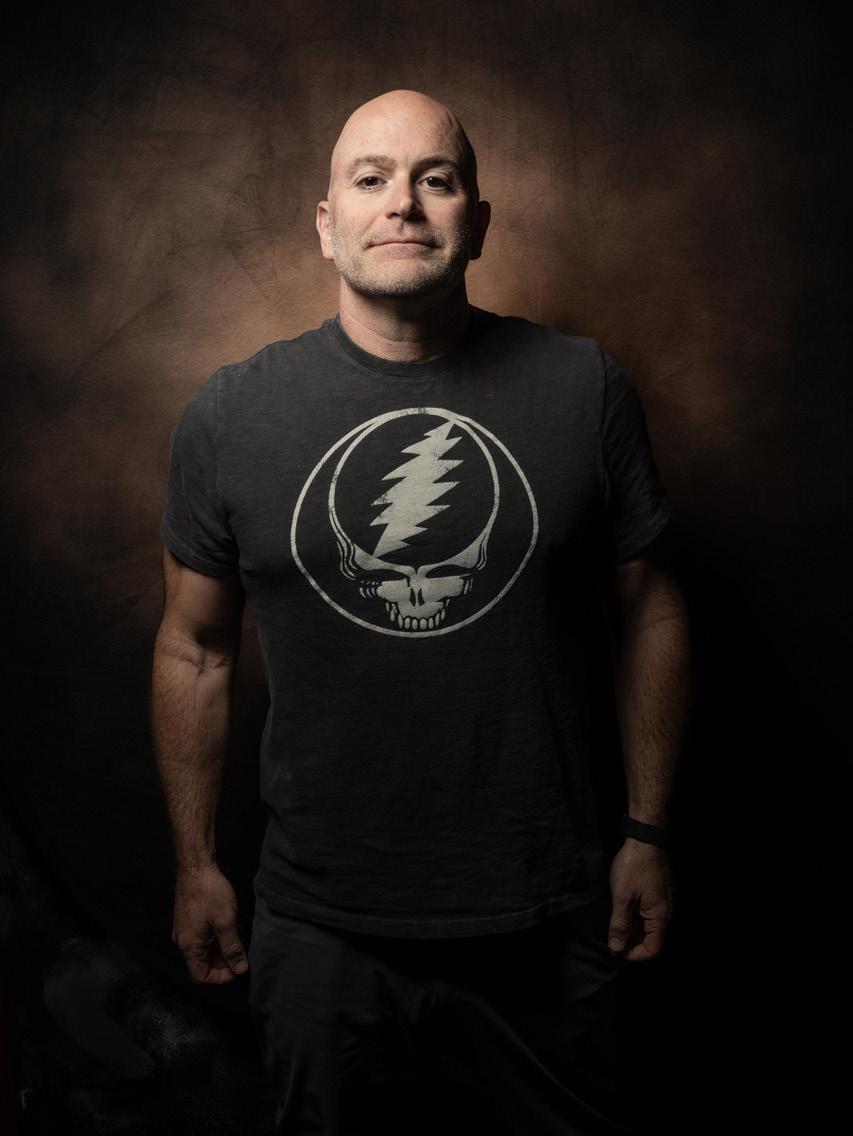
Mike’s all too familiar with the limitations of standard treatments. A southern Connecticut–based stand-up comic in his mid-forties, Mike’s inner child is alive and well—see his three-minute riff on hangman as a strange game for kids (which, fair point)—and his stage presence is sprinkled with nefarious chuckles and who-let-me-up-here grins. And, shaped by the spirit of Jack Kerouac and the Grateful Dead, Mike carries a hazelnut-eyed twinkle of someone charmed by this whole absurdist-mystery, “very in love with the realization that I don’t know what’s up there.”
Mike’s parents separated when he was two months old and got back together when he was eight. They had three more kids, and, by the time Mike finished high school, the family had moved ten times, all within the same Connecticut town.
By seventeen, Mike was living alone in an apartment, applying for college, and working part-time: landscaping, truck driving, car wash attending. It was under this pressure to “grow up way before I was ready to,” that Mike recalled first feeling symptoms of depression. Soon, inner air-raid sirens wailed daily; routine tasks became summiting Himalayan peaks with dumbbells and no oxygen support; and his inner critic—though not exactly mute before—had metamorphosed into a hollering, amphetamine-jacked Energizer Bunny, bang-bang-banging against his psyche without end.
He started seeing a therapist, beginning a lifelong in-and-out-of-therapy cycle he dubbed “emotional blueballing.” In college he was prescribed the SSRI Paxil, which gave him jolt-upright nightmares. Thus began another on-again, off-again cycle—this time with antidepressants that “would only fix one thing at the expense of two others.”
In 2022, Mike found Depression MD, a mental health clinic in Milford. Run by Lisa Harding, an assistant clinical professor in Yale’s Department of
Psychiatry, the clinic offers intravenous ketamine treatment for depression.
At his consultation appointment, where he was assessed as a candidate for ketamine treatment, Mike handed Dr. Harding a write-up of “everything”—the aching, the insomnia, the hamster wheels, the constant fear. “I told her my goal was just to feel okay,” Mike recalled. “If she said jump, I would have asked how high.”
He was also screened for physiological risks—a family history of psychosis, hypertension, and, crucially, any history or profile of substance abuse. Though it has a well-documented safety record as an anesthetic, ketamine carries serious potential both psychological and physical dependence. Frequent, high-dose use has been associated with impairments in memory and executive functioning, as well as damage to the kidneys and bladder. In severe cases, abuse has led to complete loss of bladder control and even surgical removal. After approving him, Dr. Harding started Mike on a regimen: ketamine twice a week for five weeks, then every two weeks, then monthly, then every two months.
“I told her my goal was just to feel okay,” Mike recalled. “If she said jump, I would have asked how high.”
There are two types of clinics in the ketamine treatment world. The first, which makes up the majority of clinics offering ketamine, I’ll call the “medical” model. They treat ketamine like any other pharmacological intervention, giving its psychedelic properties little, if any, therapeutic weight. Think beige walls and aggressively plastic waiting room plants. The second type I’ll call the “holistic” model. These clinics treat ketamine as, yes, a drug that alters your brain chemistry, but also embrace ketamine’s psychedelic side, believing that the insights the drug generates can have therapeutic import.
Depression MD falls squarely in the medical camp. Hooked to a ketamine IV, Mike would lie on a twin bed in a small, private room, monitored through front-facing glass by an attending physician. Ketamine, Mike said, was “spirit chemo.” As a dissociative, the drug induces a sensation of lightness—of reality a little less suffocatingly present and a little more gazing-from-afar distant. Experiencing even transient load-shedding was revelatory: “It felt like, ‘Oh my God. Thank God this place is here.’”
Dr. Harding also had Mike begin weekly cognitive behavioral therapy. If the ketamine experience was marked by lightness, the first weeks of CBT were anything but. “Digging deep and pulling up scabs and scars,” Mike and his therapist were miners chipping against the rockface of panic and anxious spirals that as he put it, “stood between me and happiness.”
Ketamine eased an otherwise “brutal process.” Being “open from the medicine, more malleable,” he was able to apply a new high-res lens to his thought patterns, recognizing his earlier internal programming as “completely distorted.”
Slowly, the lightness Mike felt on ketamine began to seep out of the clinic walls. One morning, a month into treatment, he woke up, for the first time in years, “actually feeling okay.” The sirens weren’t as deafening and the weights weren’t as crippling. And now, a rescheduled meeting wouldn’t trigger a self-deprecating tornado of “Why would anybody want to meet with me about anything? Stupid me for getting happy about something.” Instead, it was: no sweat, things happen, “there aren’t people sitting behind a computer going, ‘Let’s get Mike.’”
Mike stayed at Depression MD for a year and a half. He appreciated the sterility of Depression MD when he began treatment, feeling he needed a straightforwardly medical approach during his “bout of lethal depression.” But, once the clouds began to part, he found himself wanting more attention given to the ketamine experience itself. Alone in the IV room, he found his trips increasingly epiphany-laden. And try as his ketamined brain might to hold onto them, by session’s end they inevitably slipped away.
Mike found Centered, a mental health clinic in New Haven decisively of the holistic spirit. Think patchouli incense, a Dalai Lama quote inscribed on granite slab, fractal and mandala hangings.
At Centered, Mike’s sessions last three hours: preparatory talk therapy and intention setting, the “trip” itself, and additional post-ketamine talk therapy. There is no fixed regimen. In a follow-up “integration” appointment, usually within the week, Mike and his therapist decide whether and when to schedule another dose—typically, in his case, every six to eight weeks, depending on his touring schedule.
As part of the clinic’s emphasis on the therapeutic value of the ketamine experience, Centered’s five clinicians are more flexible with dosing than their medicalized counterparts. Whereas the latter typically administer up to 0.7 mg/kg for generic ketamine—or up to 84 mg for Spravato—Centered’s doses can reach up to 2.0 mg/kg. Patients usually start at around 0.5 mg/kg, then work with their therapist to adjust the dose to what feels most therapeutically meaningful. Because the clinic uses generic ketamine, they can also treat patients who don’t meet Spravato’s strict eligibility criteria—treatment-resistant depression or major depressive disorder with active suicidal ideation. “The idea,” said Robert Krause, Centered’s
co-founder and clinical director, “is not to miss out on what the drug makes possible.”
But, at Centered, the ketamine experience itself is only one piece in the puzzle. “You have this profound experience, but then you go back to your life, to what’s causing you distress,” Dr. Krause said. “That’s when the real work begins—integrating the experience with psychotherapy and your day-to-day.”
A difficulty with Centered’s model, though, is cost. A Spravato session is typically covered by insurance. But because Centered uses generic ketamine, an individual session costs $150 to $250 out-of-pocket. To make treatment more accessible for its clients, 40 percent of whom are on Medicaid, Centered offers weekly $50 group sessions, where eight to ten patients are dosed together in a single room.
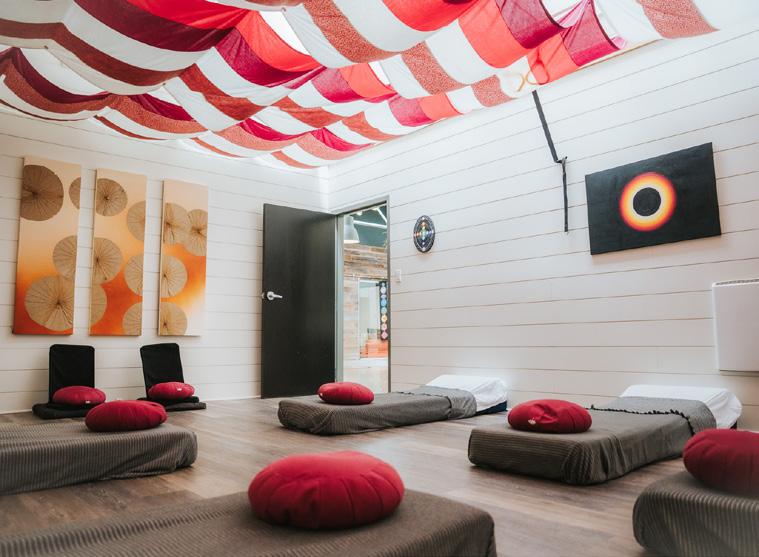
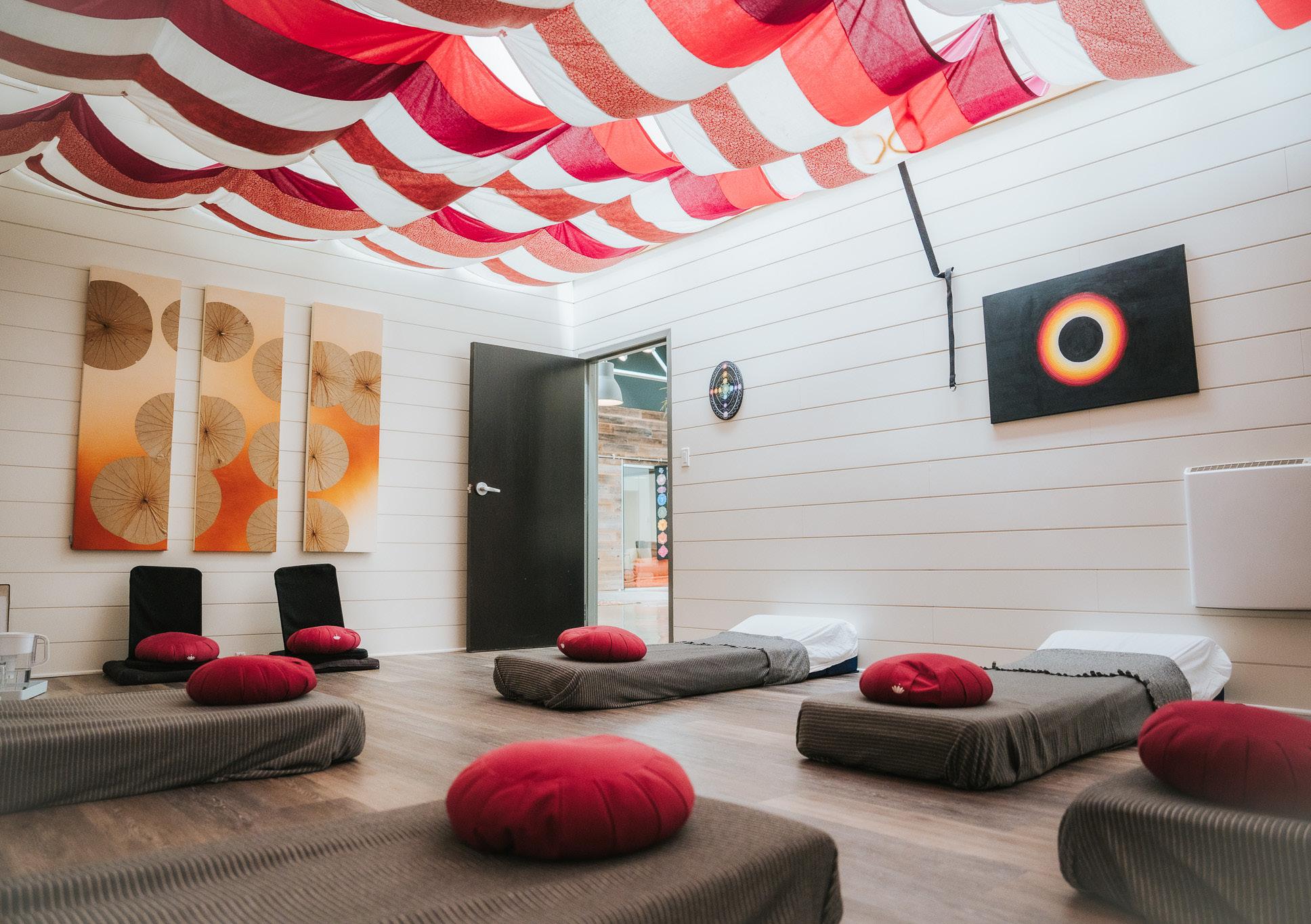
I sat in on one of these. Across Centered’s couches, patients sat chatting, scrolling, meditating. In the dosing room, eight thin mattresses lay directly on the wood floor in a loose U-shape, all beneath draped strips of red and white fabric that gave the room a feel somewhere between a ceremonial pavilion and a carnival tent.
The session began with a Dr. Krause-led meditation and round of how-are-you-feeling-todays. Cherubic-faced graduate student: anxious about the semester starting. Man, sixties, silver stubble and blue beanie: overwhelmed and depressed, difficult week at work. Next, intentions. Suburban mom with creative writing MFA: “To release the overwhelm of what’s not serving me.” White-haired bubby-type with walker: “To avoid falling into an anxious-depressed spiral.” Finally, Dr. Krause: “To keep your body safe so your mind can do what it needs to.”

Mike Finoia, a comedian with over 23,000 followers on Instagram. Credit: Mike Finoia.

After patients had laid down and donned eye shades, the speakers revved to life—a twenty-twofold repeating mantra: I release control and surrender to the flow of love that will heal me. Dr. Krause, with blue surgical gloves now, made his way around the U, metal needle-laden tray in hand. The music transitioned to chanting over shaker percussion, then to a light flute-keyboard-guitar trio over birds, rain, insects. Most patients were cocooned, scarcely moving. To my left, the hands of an Andy Serkis doppelganger rose and fell, fluttering megachurch style, while a woman who arrived near-tears despondent started feet-dancing to the music with a euphoric grin. After an hour, Dr. Krause’s voice appeared over the music. He led another breathing exercise—inhale, bring hands up to ceiling, allow chest to open up, release, repeat— and round of how-are-folks-doing.
When I first began researching Centered, I hadn’t planned to get thrice-dosed myself. But facts and figures are one thing, experiential knowledge is another. Call it journalistic rigor, or what have you. Plus, though after three years, I hadn’t given up on Lexapro entirely, it had, at best, made the anxious-depressive bouts only marginally tolerable, and even then only sometimes.
Paired with Dr. Mark Landreneau, my first experience, at 0.5 mg/kg, was a toe in the water: the occasional color pattern, a rocking-chair sensation, and an expressionist rendering of my eleven-years-gone grandfather’s face—after which, Dr. Landreneau tells me, I proposed doing ketamine with my 90-plus grandmother. For the second session, we upped my dose to 0.8 mg/kg. This, my friends, was a proper, capital-T Trip. I was lightspeed-personified, shot through a Rainbow Road technicolor tunnel. I was the last puzzle piece of a set which, after I clicked into place, turned out to be but one of infinitely many in a shimmering green fractal pattern, which I then promptly fell gravity-sucked into. I was grizzled, greying, eighty
years old, assuring my collegiate self that all told, I was doing this whole life thing just fine. Driving me home, as I sat still space-cadet glowing, my friend remarked that I wore the sly grin of “a Renaissance monk who’s the only one in on some Great Cosmic Joke.”
In the two to three days after, I felt more motivated, calm, light, present—and the usual to-do list churn suddenly felt so obviously anguish-unworthy. I also attended a group session, but when the ketamine took hold, I seemed to have left the realm of earthly recollection entirely. What I can offer, though, is a reflection from one of that morning’s fellow trippers: that while I was whoknows-where, he had been a snake who shed seven skins, and was now feeling almost comically rejuvenated.
To date, Dr. Krause has treated more than 275 patients with ketamine. Only two had adverse reactions, he said, and they were devout Christians who reported visions of hell during their sessions. He estimates that Centered’s five clinicians have treated over four hundred patients with ketamine. Many arrive from Yale New Haven Health’s program, Dr. Krause told me, explicitly seeking a scenery-change from its “medical” model.
Centered’s approach was exactly what Mallory O’Connor needed. A single mother from New Haven, Mallory, who spent her late teens and early twenties selling tie-dye socks at Grateful Dead shows, is no stranger to psychedelia. Mallory has treatment-resistant depression and PTSD. Sexually abused as a child and domestically abused as an adult, she described weeks spent on autopilot, “constantly living inside the trauma.” Antidepressants, when she tried them, did more harm than good, while therapy only heightened her anxiety: “reliving trauma again and again and again, and nothing would change,” she said.
Two years ago, during a recreational ketamine experience, Mallory awoke in a purple room filled with boxes, each containing a vivid scene of past trauma. Pulling them out, she found she could look at them head-on with newfound distance and clarity. The realization followed: “If I don’t clear out all these boxes of trauma,” she recalls thinking, “I can’t make room in my life for joy.” She contacted Centered soon after.
Mallory began biweekly high-dose sessions, where she would “go deep and find all these things I needed to work on.” Between them, she undertook smaller-dose sessions, each devoted to working through a single traumatic memory. Ketamine’s dissociative effects, she told me, enabled distance from ego and shame—letting her view a memory like a cable rerun of an old film, “rather than continuously
Centered offers weekly group ketamine therapy sessions. Credit: Gavin Susantio.
living inside those moments.”
After a month of treatment, the past receding, Mallory noticed she was tapping into the high-dose ketamine state of “ease and relaxation” more and more. She returned to concert-going, took up yoga, and now works at Centered as a ketamine assistant. This winter, she said, is the first in years she’s leaving the house—taking her kids sledding on weekends.
Where she once spiraled—“why did I make these bad decisions, why have I been this person”—compassion now prevailed: “I was able to see myself as a child rather than as an adult who went through this and suffered because of it. And I didn’t want to suffer.”
* * * * *
Mike confronted imminent wall-induced death and learned to relinquish control; Mallory opened the purple room’s boxes and was able to process what she pulled out. But were these experiences actually what alleviated their depressive symptoms? For many lab-coated, dot-your-i’s researchers, the answer is: probably not
Existing research has found that neither the intensity of subjective ketamine experience—dissociation, derealization, visions—nor increased dosage consistently correlates with antidepressant effects. Dissociation, rather than being causally therapeutic, may simply signal that ketamine has elevated glutamate levels sufficiently to trigger antidepressant effects.
When I told Mike that, he laughed. He said that ketamine’s “little journeys” impart wisdom, which, he quipped, can’t be said of Zoloft. “Ketamine reminds me of a better existence,” he said, “of what actually matters, of why I’m even on the road in the first place.”
Researchers, though, are skeptical. “People build narratives and explanations for why things happened to them all the time, and the more disorienting or abnormal the experience, the harder the mind works to make it coherent,” said Chris Pittenger, co-founder of the Yale Program for Psychedelic Science. “People will say, I had this insight, and that’s why I’m living differently now.” But it might be the other way around: patients might find themselves living differently and “retroactively sculpt those memories to explain the change.”
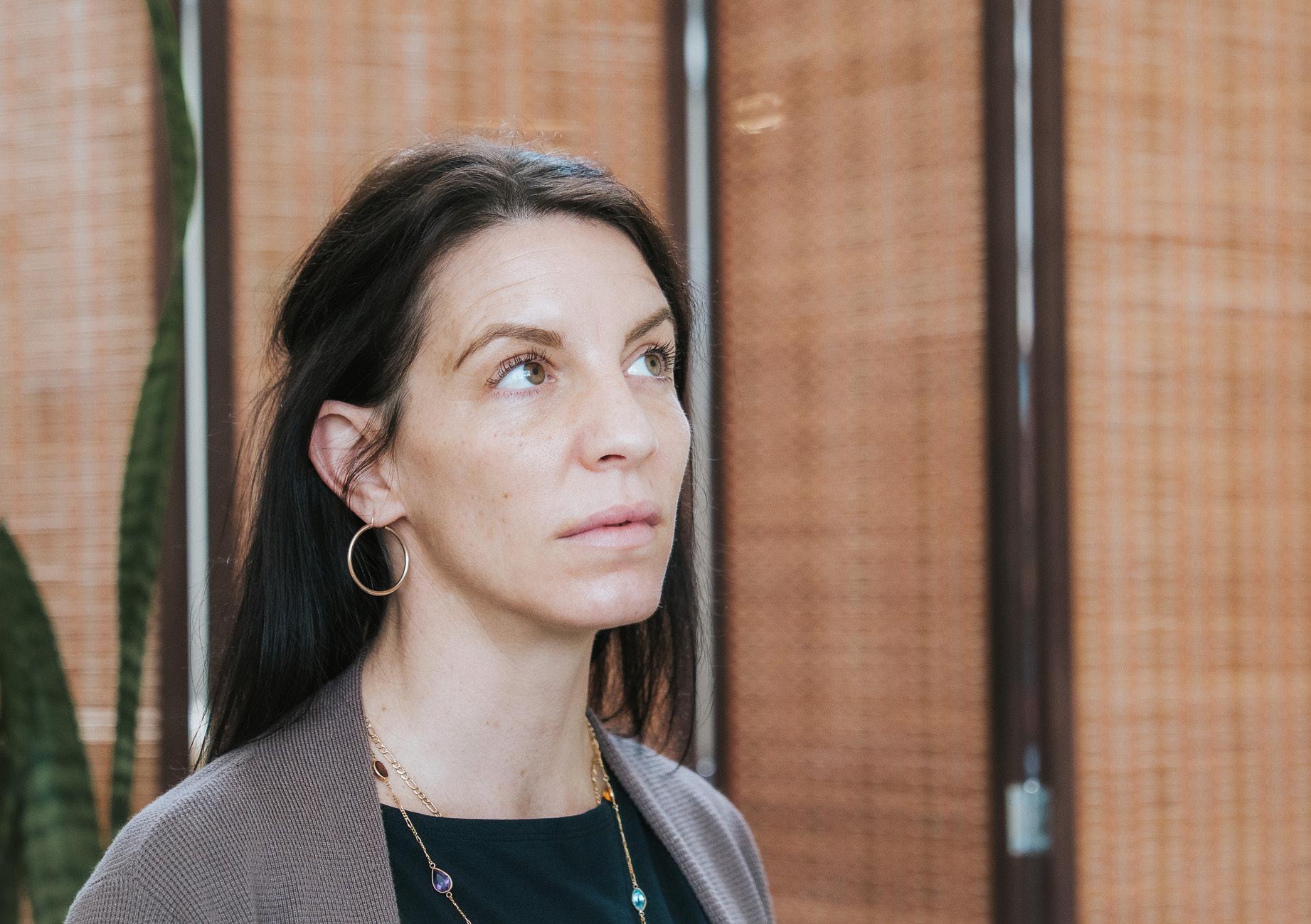
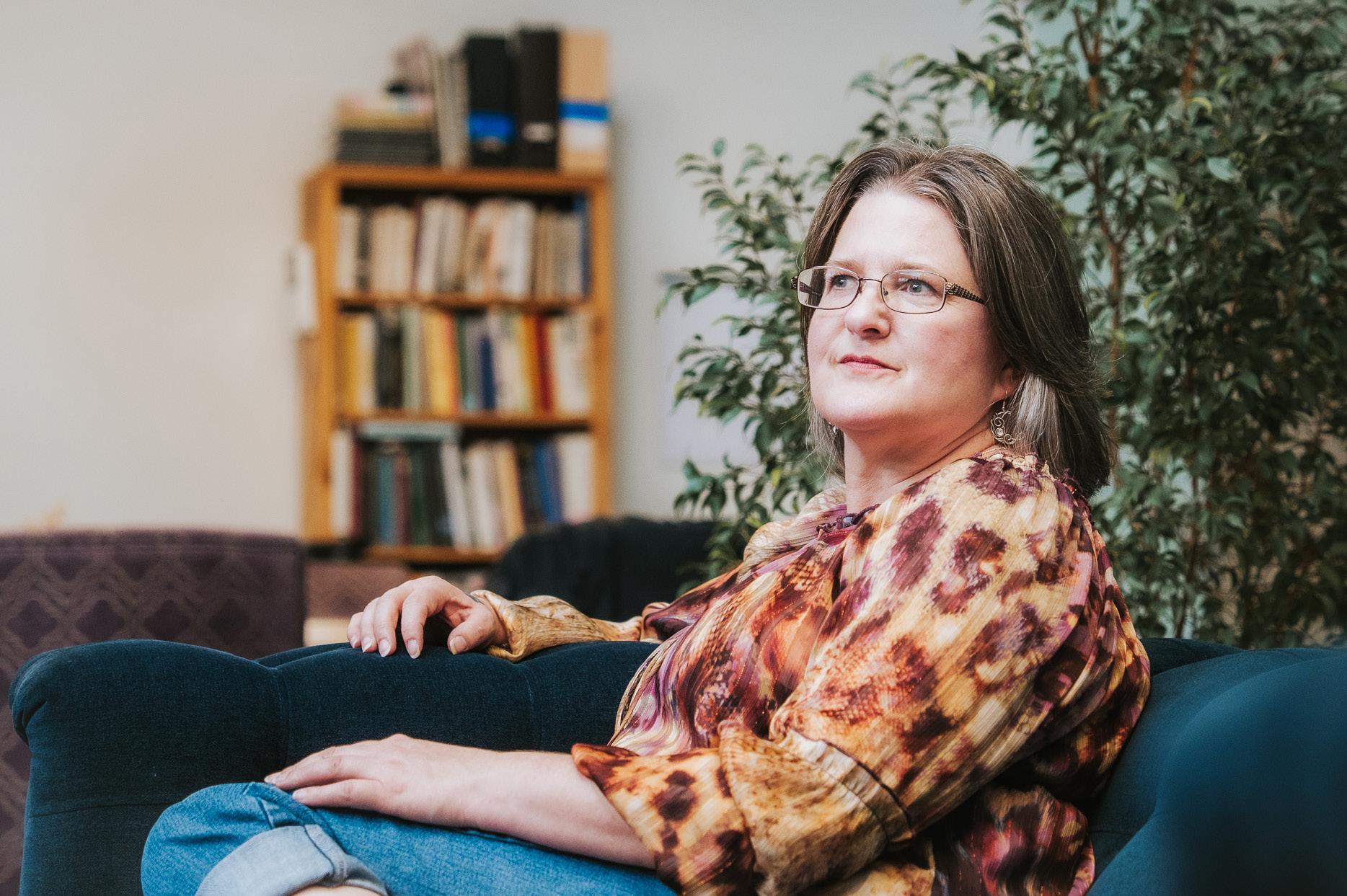
But some patients don’t ascribe as much weight as Mike to ketamine’s psychedelic effects. Jen Spiegelhalter—53, charcoal hair, oval glasses, radiant warmth—found Spravato after unsuccessful stops at every station known under the antidepressant sun. With it, her mood began to lift, motivation returned, and a decades-long hopelessness started to recede. “I realized that if my depression comes and goes, the same is true of the good times,” she said. “I had never thought that way before.”
Jen’s sessions are rarely marked by revelatory visuals. Instead, she attributes most of her progress to a ketamine-induced feeling of her “soul filled with helium,” which she continues to float on in the days that follow.
The most robust data on long-term risks of
ketamine treatment comes from a safety review of the Spravato clinical trials, where participants received esketamine twice weekly for four weeks, followed by maintenance dosing. On average, treatment lasted three and half years, over the course of which cognitive performance across memory, executive function, and reaction time remained stable. The review also found no evidence of abuse, misuse, or withdrawal in the trial context.
To date, though, no clinical studies have examined the long-term safety of off-label, higher dose ketamine regimens. As a result, the jury’s out as to whether the favorable safety results of the Spravato trials generalize to practices like Centered’s. There is also the risk that higher doses, by producing more intense experiences, can unsettle patients not adequately prepared. “I’ve had experiences treating patients who’ve had very dysphoric reactions—saying they wanted to die, horribly anxious, in really terrible places, then two hours later they were fine,” said Gerard Sanacora, professor of psychiatry and director of the Yale Depression Research Program. “I don’t think that risk should be minimized at all.”
Addiction is also a concern with higher-dose regimens, especially with recreational use on a steep rise. (The total weight of ketamine seized in the United States increased by 1,116 percent between 2017 and 2022.) “I’m always a bit worried that twenty years from now, ketamine will be used the way opiates are— so widely available that more and more people access it non-medically,” said Ilan Harpaz-Rotem, professor of psychiatry and psychology at Yale
Neşe Devenot, a researcher in the psychedelic humanities and writing instructor at Johns Hopkins, is focused less on the physiological concerns than the ethical risks of the Centered-type approach. They argue that psychedelic therapy tends to attract two demographics: desperate, vulnerable patients, willing to try anything after all else has failed; and self-styled gurus with totalizing, pseudo-scientific frameworks

Mallory O’Connor is Centered’s Lead Ketamine Assistant. Credit: Gavin Susantio.
for understanding suffering and the therapeutic process. Further, psychedelics make patients more easily influenced: as early as 1964, psychiatrist Sidney Cohen had observed that patients under LSD tended to affirm “the fondest theories of the therapist.” Against the backdrop of psychedelics being cast as the “future of mental health care,” Devenot argues the terrain is ripe for unethical practices and coercive dynamics.
Devenot pointed to the ketamine-assisted-therapy practice of San Francisco–based therapist Veronika Gold. Trained under the MDMA-assisted therapy model developed by Lykos Therapeutics, Gold has written about using a practice known as “focused bodywork”— using touch to intensify distressing sensations, believing that trauma must be “fully experienced and expressed” to be discharged and healed. In one interview, she said her therapeutic intuition means “they don’t have to be talking to me” for her to use focused bodywork. Gold did not respond to a request for comment.
Dr. Krause agreed that malpractice is a real risk for the high-dose-plus-psychotherapy model. To mitigate it, he said, he sees his role as a trail marker, orienting rather than directing. He also underscored that most psychotherapy at Centered occurs in the days between sessions or after the drug’s acute effects have worn off. When psychotherapy is conducted during the ketamine experience itself, the doses are always very low, like those Mallory received in her trauma-focused sessions. Physical touch, such as a hand on the shoulder, is used sparingly and only with explicit verbal consent established beforehand.
Nevertheless, Dr. Sanacora echoed some of Devenot’s concerns. He describes some of the first conferences after psychedelics re-entered the
academy in the late 2000s: bug-eyed peers nodding in unison to “we’re so lucky to have the chance to prove this works,” while Sanacora played voice-of-temperance, reminding them their job was to see if the drugs were effective and safe. “People would say, ‘these drugs are very unique.’ And I’d remind them: every drug is unique, but there’s nothing exceptional about it,” he said. “You don’t get exceptions. You still have to follow all the same rules.”
Ketamine’s addiction profile, the potential for malpractice, and lack of long-term safety data for higher-dose regimens have led many to side with Dr. Krystal. Though he admitted it’s possible clinical trials will eventually lend support to the Centeredtype approach, he thinks that, given existing research, the holistic clinics might be administering doses that tilt the risk-benefit balance in the wrong direction.
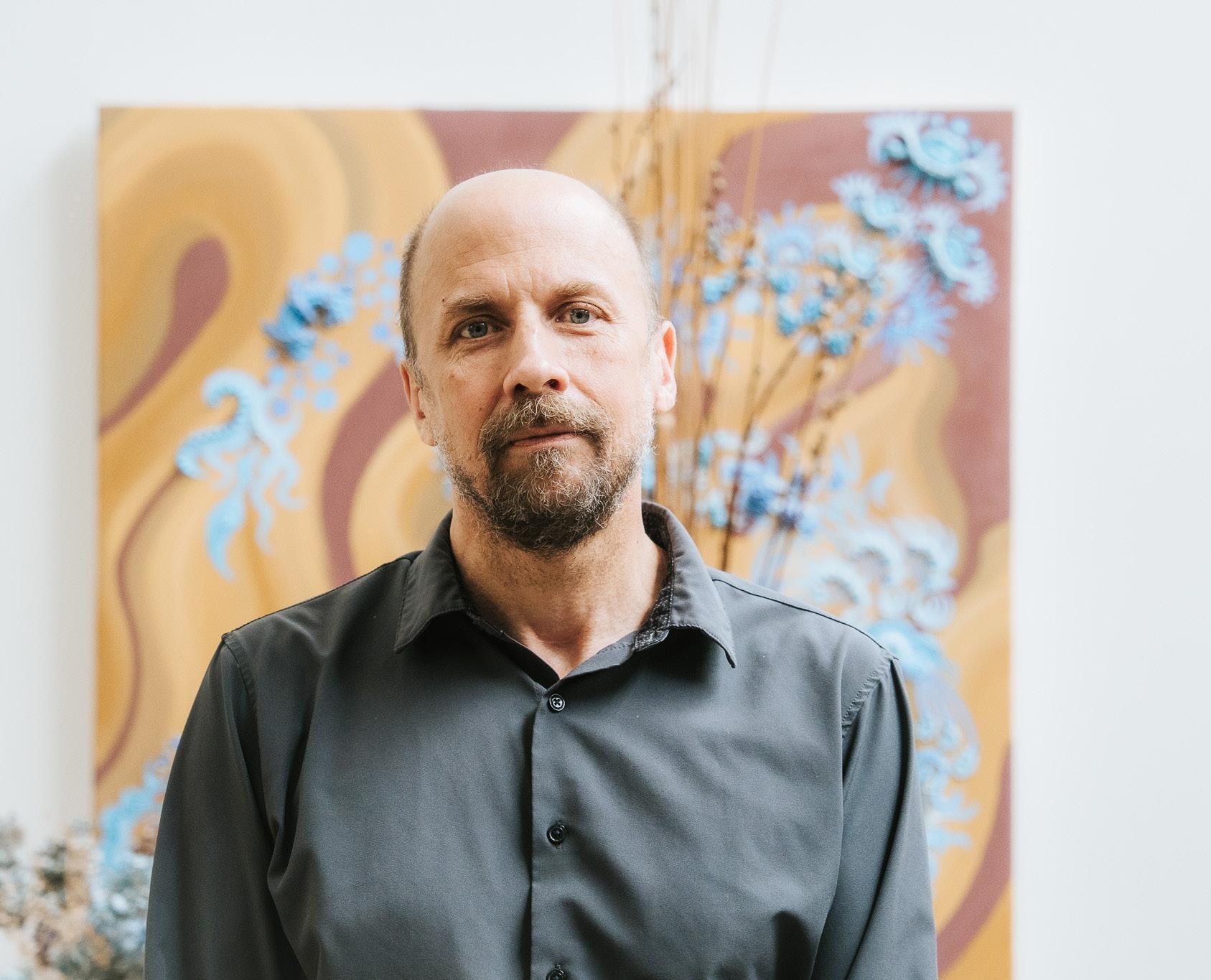
Dr. Krause, however, considers that conclusion premature. “In the quest to be objective, they haven’t objectively evaluated the subjective,” he argued. “They say including things like music or therapy make the data messy.” But, drawing from a decade of therapeutic practice with ketamine, he thinks that such factors are crucial to unlocking the drug’s full potential at higher doses. “So my response would be: we don’t yet have the data to say that the subjective aspects don’t add anything. How do you know that? Did you actually do those studies? No, you didn’t.”

Dr. Robert Krause is Centered’s co-founder and clinical director. Credit: Gavin Susantio.
Jen Spiegelhalter receives ketamine therapy from Centered. Credit: Gavin Susantio.


To date, there have only been two studies that have randomized psychotherapy paired with ketamine treatment, neither of which found that psychotherapy offered added benefit. However, both had small sample sizes, and neither were intentional about the features of “set and setting”—psychedelic-speak for the patient’s mindset, music during the trip, physical environment—that Krause considers integral to clinical outcome.
The disagreement between the Krausians and the Krystalians, though, runs deeper than deciding between two approaches. It also reflects fundamentally different conceptions of psychiatry’s ends. “I’m not just trying to tweak neurotransmitters,” Dr. Krause said. “I’m trying to use ketamine to help them move from being shut down and closed off—hypervigilant, hyper-reactive—toward reconnecting, in a lasting way, with meaningful things in the world. Maybe that’s not what some people would call psychiatry, but that strikes me as narrow-minded.”
Too often, Dr. Krause said, psychiatry treats depression as an individual defect—“you’re broken in this or that way; let me just give you this drug”— rather than asking what in a patient’s life might be driving their distress. Though ketamine can’t address these social factors on its own, Krause added, “by integrating intense experiences with therapy, it can change your relationship to yourself and to what you’re suffering with.”
A number of companies and research groups, though, have already put their chips squarely in the Krystal camp. They’re trying to develop next-generation psychedelics that preserve therapeutic efficacy while minimizing psychedelic effects, but in ketamine’s case, have to date come up empty handed.
But Dr. William Richards DIV ’65, who helped revive psychedelic research in the late 90s, thinks psychiatry is on an inevitable march towards Krause’s outlook. “The science is a little embarrassed about bumping into this spiritual stuff,” Richards said. “The cutting edge is brushing up against what’s called the sacred, and with that will come the need for new models and new languages.”
heart: “I think this type of thing is for people who are really, really serious about changing their life,” he said. “This isn’t doing an eighth of mushrooms in the park.”
But in Mike’s case, at least, the experience has been metamorphic. When he first got the IV at Depression MD, the needle sent him stone-cold to the floor, doctor yelling for help as he sobbed, apologizing for “not even being able to heal.” Now, he’s channeling Bob Dylan in My Back Pages: “I was so much older then, I’m younger than that now.”∎
David Rosenbloom graduated in December. He was in Saybrook College.
This project was supported by the Edward B. Bennett III Memorial Fellowship.
During our last call, I shared my ketamine experiences with Mike, who said he’s begun weaving his therapeutic journey into his comedy. Though “talking about crippling depression” isn’t what all ticket-paying audiences come for, he wants those who need to hear it to know that “the tools are here, the help is here.” And while it’s not as if “the whole crowd lines up and goes, ‘tell me more, sensei,’” two or three people will often come up after shows to ask for advice. Others reach out on social media.
He tells them a few things. First, that comedian is far from doctor, and they should start by talking to one. Second, what worked for him might not work for everyone. And finally, it’s not for the faint of
Profile
Go With What She Says
Under a loctician’s skilled care, a writer uproots Black history, self-care, and his own hair along the way.
By Prentiss Patrick-Carter


illustrations by james tibang
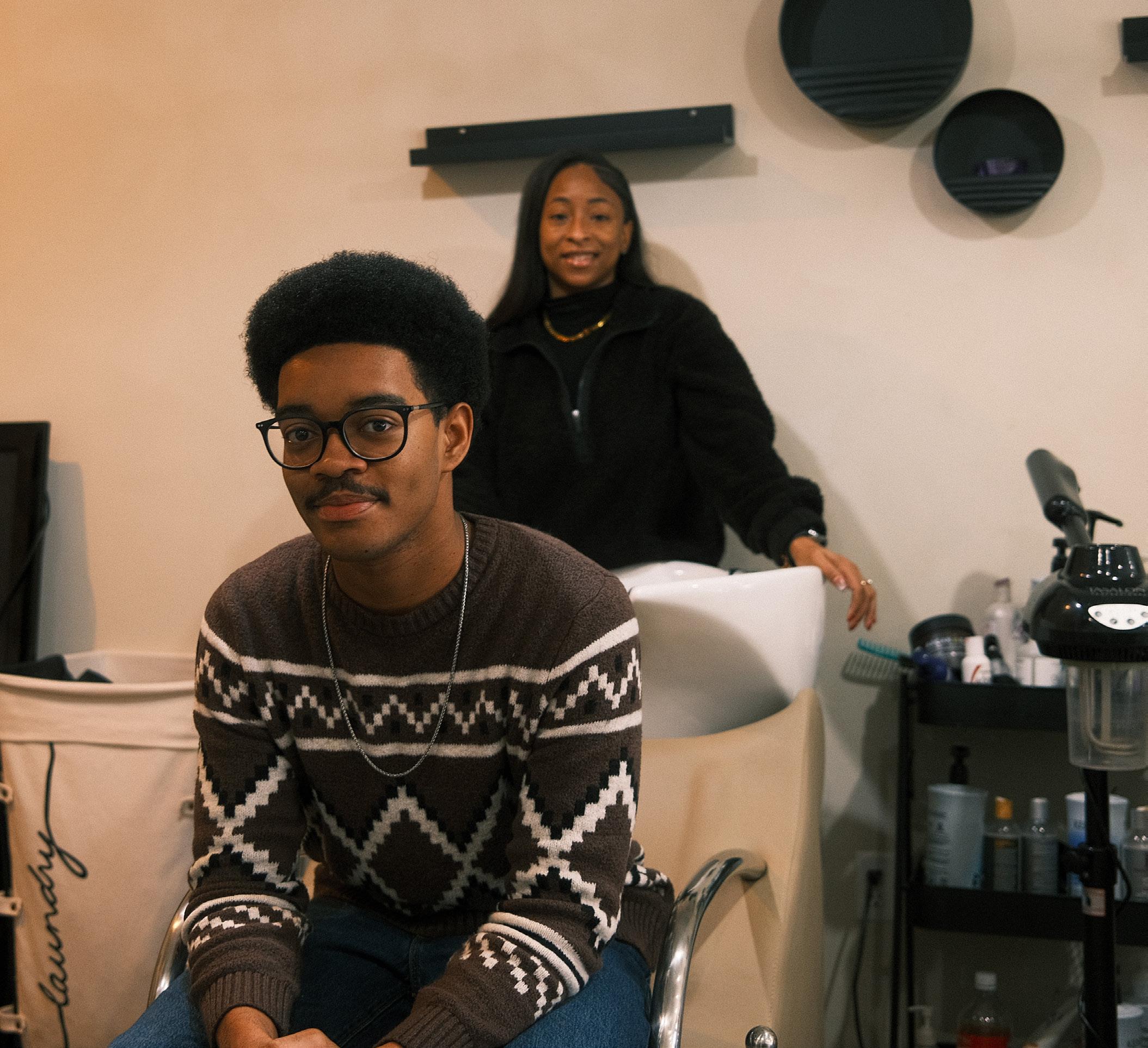
Lyzette hicks knows black hair like it’s the law. Wigs used to be “forbidden,” she says, but now plenty of women are wearing wigs. Lots of kids are wearing bonnets or do-rags outside the house, she says, and they should “throw a hat on.” She says she’s concerned about how ski masks are trending, and how they make every Black boy look the same. She says if you’re a guy above 30, you shouldn’t get cornrows. “They’re immature,” she says. She says lots of women do knotless box braids and you “can’t go wrong with them,” but she says that like she’s bored. She says some women do boho bob styles and “those ones are cute,” and she says that like she really means it. “Locs are huge.” She said that twice. “Locs are huge.” I know very little about my hair, so I go with what she says.
I asked Lyzette what she thought about a recent court decision: In 2023, high school administrators in Mont Belvieu, Texas, suspended a Black student for months because of his locs, and the judge ruled in favor of the school. Lyzette said “hair is hair.” As the owner and head stylist of Nvade Salon and Spa, Lyzette, age 35, could run her corner of Whalley Avenue like a courtroom, bang her comb like a gavel, and make clients live by her hair law. But when clients bring in requests, Lyzette doesn’t judge. She gives them her honest opinion and then gives them what they want. If you’re like me, and don’t know what you want, she might steer you toward locs.
Tuesdays and Wednesdays from 9 a.m. to 3 p.m. and Thursdays through Saturdays from 9 a.m. to 12 p.m., she stands perfectly-postured behind the salon chair, while her eyes split focus between her client’s scalp and the TV screen. Between clients, she rests (ever so briefly) on her leather chair and brushes her own jet-black shoulder-length silk press. Between comb strokes, she wipes gel off her hands. She’s more professional than the characters on Lincoln Lawyer, her entertainment of choice, even if her uniform is sweatpants and t-shirts. When a hair follicle objects, she furrows her brow or narrows her gaze, but this is rare: the hairs know better than to disagree.

I wouldn’t want my lawyer watching Netflix in the courtroom, but based on how much she was looking up at Lincoln Lawyer, I’m confident that Lyzette can style hair without looking.
Lyzette says doing hair is an art. It’s not painting sculptures or landscapes or soup cans. To her the art is making clients feel good when they leave her chair.
According to Lyzette, women don’t feel like themselves when their hair isn’t done (maybe that’s
why she makes time for intermittent self-grooming). Clients with renewed ‘dos feel like dolls fresh out the plastic—brand new.
Lyzette and her two stylists do braids, silk presses, twist outs, wigs, weaves, and her personal favorite: dredlocs.
To create locs, your loctician (loc+beautician, but really more like loc+magician) uses her comb (wand) to bewitch the hair into dozens of tiny sections. She then commands each set of strands to stretch, bind, and intertwine. Afterward, to grow your freshly twisted coils into locs, you must keep them clean, hydrated, dust-free, and wrapped in a do-rag while you sleep. After keeping the routine up for four to five weeks, you revisit the loctician (now think loc+physician) to make a diagnosis, prescribe new products, and retwist the hair.
Unlike her clients, and more like balding men, Lyzette wears a lot of hats: she’s a licensed cosmetologist, a salon owner, a caregiver for adults with intellectual disabilities, a psychology student at Gateway Community College with a certificate in drug and alcohol rehabilitation, and a single mother. Someday Lyzette hopes to run a support group for women—“a safe, consistent space where we can show up, release, grow, and connect”—but for now she just life-coaches from her styling station. She doesn’t want to stay behind the chair forever. (As soon as Lyzette admitted this, her client went, “Woah, woah, woah. Woah,” as if his favorite character just got cut from a series.)
After twenty-one years, I’ve concluded that my afro is dry. If it were a person, it couldn’t hold a conversation. If it were a planet, it couldn’t support life. I constantly touch my hair, treating the spot above my left temple like a toy. I fiddle with the arid hairs so routinely, you’d think a tiny Bop It! guy was on my shoulder telling me to Twist It!
The game was always interwoven with academics. When I was younger, wrapping my head around Biology, I held my homework in one hand and with the other I grabbed two fingers full of follicles to Crinkle It! Roll It! Press It! against my head so that I could better Grip It! then Twist It! some more. Today I play the same game in every Yale library under the sun. (It’s like a Dave & Busters, but instead of 40-year-old sweaty gamers, you’re shoulder to shoulder with somehow sweatier, GPAobsessed twenty-somethings.)
You know how a tree stump’s rings tell you the age of a tree? The number of twists on my head tells you 1) how long I’ve been studying in the library and 2) how stumped I am on any given night.
photos by COLIN KIM
When the evenings end—if they end, or when the evenings become mornings—I uproot every pineshaped hair using my pointer finger as a plow. Then, with the cold metal prongs of a pick, I comb the disconnected curls until they assimilate with the rest of my head.
During this gruesome process, the fallen 4C soldiers fly off my head and parachute onto my shoulders. There are so many hairs that—especially if I’m wearing white—it sort of looks like a three-dimensional Rorschach test. Afterward, I ponder my mortality and think, “Did I really pluck out that many dead hairs, or is this semester so difficult that I’ve started balding?”
When my dad was my age, he had cornrows. Now his scalp is brighter than my future. One day, I may be forced to trade in hairstyles for hats. I went to Lyzette because I needed to do something new with my hair—while it’s still growing, before I grow up.
When lyzette was a kid living in Brooklyn, her hair was safe in the hands of family friends, and the lead stylist was her mother. Her mom, who worked as a nurse, was good enough to have been a full-time stylist but settled for being Lyzette’s parttime styling tutor. She gave 9-year-old Lyzette all the ‘90s styles—bantu knots, ponytails, cornbraids— and Lyzette studied them, practicing on herself and her siblings as homework.
When Lyzette was 12, her mother dropped her off at an African braiding spot on Church Avenue to get braids. This is where Lyzette started shadowing the full-timers. She loved the cramped space, its red walls smattered with photos of braiding styles; the rich smell of incense and oils; the dialogue of African movies on the tiny TV. She took mental notes on the neat patterns that the braiders used, even though their braids were tight enough to make her head hurt.
“I used to watch ‘em and be like, ‘Oooh O.K., now I’ma do this,’” she said. “Mannn, it was over after that.” She became something of a mad scientist, conducting experiments that used hair extensions instead of test tubes. She tried to singe the ends of the hair extensions like her braider did (so the extensions could better seal onto the hair), and she still has a burn mark on her hand to prove it.
By 16, Lyzette got her hands off the lighters and onto people’s heads. She got into cosmetology classes outside of school. She got to work as a salon assistant in Flatbush. In Toya’s salon, a shoebox-sized room with three chairs, Lyzette got to care for strangers’ hair. She got to split her profits with Toya fifty-fifty, unlike most starter stylists who split with salon owners forty-sixty. She got to dream about her own spacious salon, where she’d collect the whole hundred.
Her first self-owned salon was She Bad Hair Studios. “When I think about the name, I just like— yeah, I grew up from that,” she said, also using the words “spunky,” “fun,” and “girly girl” to describe its
aesthetics. She specifically said that she wouldn’t use the phrase “hot girl” to describe its bright pinks and green grass wall. When She Bad closed down in July of 2023, she bounced back with Nvade Salon and Spa. Her new adjectives: “calming,” “relaxing,” “zenful,” “sacred.” The new color palette is mostly a soothing soft brown (on the floor, chairs, and walls), with hints of white (on the sinks and styling stations), and gold (most noticeably glowing from the neon sign spelling NVADE). The new space feels millennial but not spiritless.
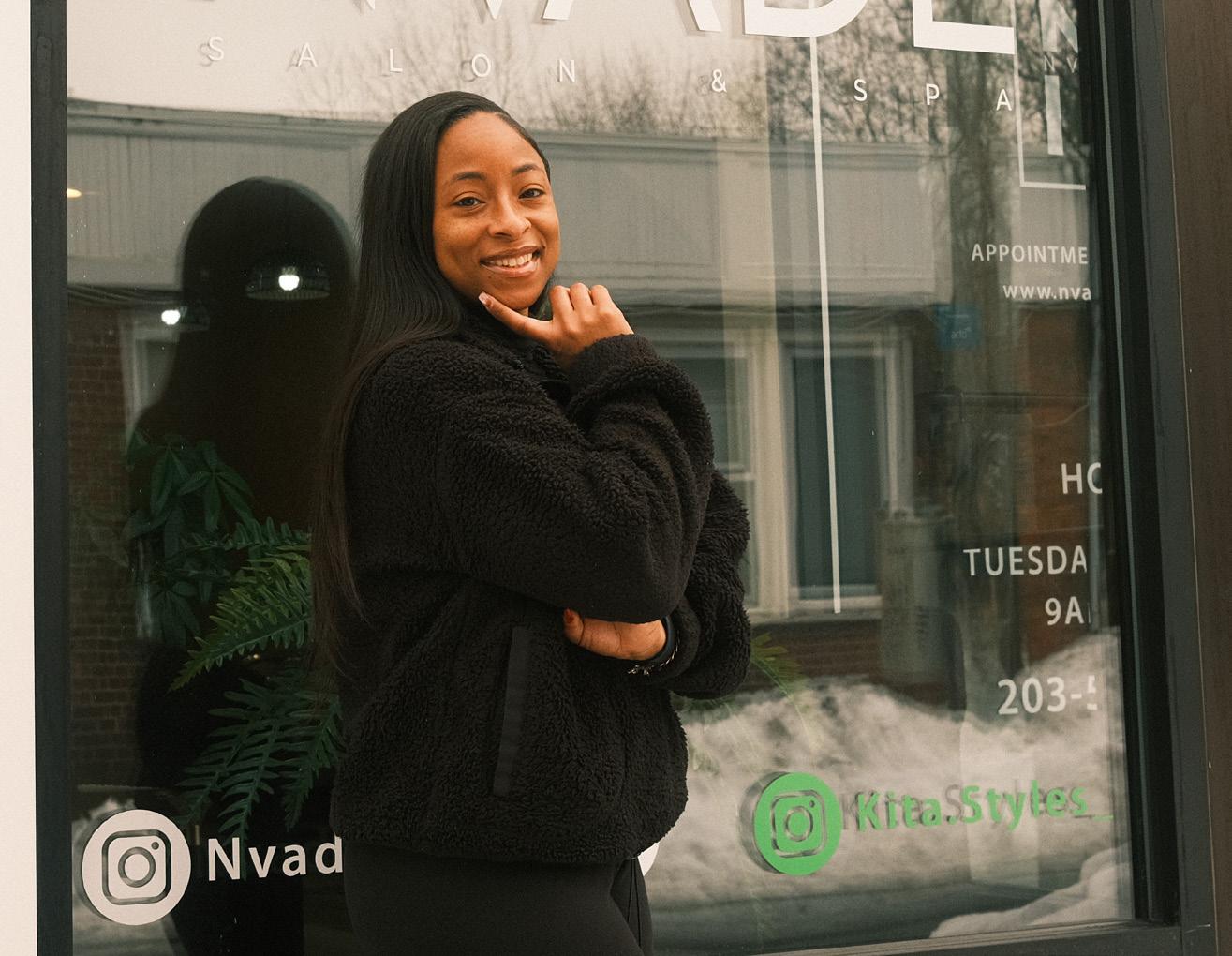
In 15th-cetnrury west african civilizations, hair stylists were usually the most trusted members of society. That sounds like hyperbole, but back then someone’s hair told you everything about them: age, ethnicity, religion, wealth, marital status. Your stylist basically used a wooden comb and palm oil to write your dating profile. For the Mende people, offering to style someone’s hair was an invitation of friendship. Hair styling sessions were social hours. Hair appointments were about more than time or money—your reputation hung in the balance of someone else’s hands. Adorning someone’s hair was the highest honor. In his 1734 memoir, West African nobleman Ayuba Suleiman Diallo called having his hair shaved by enslavers “the highest Indignity.”
Dr. Mathelinda Nabugodi, in her essay “Afro Hair in the Time of Slavery,” wrote: “In preparation for the slave-ship hold, captured Africans had their hair shaved off: while the immediate motive was hygiene, the act of shaving anticipated the social

Lyzette Hicks posing in front of Nvade Salon and Spa.
and cultural death that awaited at the far end of their passage across the Atlantic.”
British colonists intentionally used African hair to liken enslaved people to chattel. “The planters do not want to be told, that their Negroes are human creatures,” said Edward Long in his 1774 The History of Jamaica. He called the hair “a covering of wool, like the bestial fleece.”
For the first African Americans, proximity to the colonies meant distance from the tools, traditions, and culture that upheld their humanity and their majesty. To regain it, they created new tools, new traditions, and new culture. A new country meant new crowns.
In the early 1900s, Black masses were escaping the violent South and migrating to Northern cities. In these urban areas, white entrepreneurs realized the value in Black hair products, but failed miserably at selling them. Black folks didn’t want hot combs from the same people burning down their towns. They wanted their heads in safe hands.
The safest, most reputable, and eventually most wealthy hands belonged to Black women like Madam CJ Walker. She knew the troubles on Black people’s minds (or heads) and most importantly, she knew how to serve them. One solution: straighten that hair. Walker sold your typical products—hot combs, hair growth products—and demonstrated how to use them, attaching self-portraits to her advertisements. And that sister taught her employees the sales strategy like it was gospel. In a letter to her agents, she wrote: “Keep in mind that you have something that the person standing before you really needs. Imagine yourself a missionary and convert him.”
At this time, beauty standards encouraged Black people to opt for straight hair over curls. Walker didn’t set the trend. But she made the trend accessible, and sold it from trustworthy hands. In her lifetime, Walker donated thousands of dollars in sales to organizations such as the National Association for the Advancement of Colored People, and she wasn’t shy about it. She let twentieth century Black people know that haircare was an investment in the longevity of the race.
fingertips. Her forearms leverage the headrest, her wrists rotate at lightning speed, and her fingers pass through the hairs with the delicacy and precision of sutures. You can see her hand’s muscles at work, even without X-ray vision.
I asked Lyzette what the most difficult thing about doing hair was. Without skipping a beat, she said, “the clients.”
Startled, I started laughing, but her eyes were pitch black. Dead serious.
“I’m big on energy, and some people’s energy be off. And you could kinda feel it,” she said. Hardly a moment passed before she corrected herself: “Well, I could feel it.”
For two to three hours at a time, Lyzette studies and serves her clients because their satisfaction is the key to getting compensated. Once she’s worked with someone “on the regular,” Lyzette can tell “if they’re having a good day, if they’re having a bad day.”
She’s even learned to attach energy to style. Silk presses and weaves are indecisive. Dredlocs are quicker to schedule follow-ups.
Leading up to my first meeting with Lyzette, my haircare and self-care (or lack thereof) posed greater medical challenges than Male Pattern Baldness. The nebulous concept of “energy” makes more sense to me than the words vasovagal syncope, sinus tachycardia, and postural orthostatic tachycardia syndrome (also known as POTS). But these are the words I heard in the days before meeting Lyzette. One night last fall, after a week of late nights and stress twists, I fainted for the first time in my life (a vasovagal syncope), and landed directly on my face. Immediately, I was sent to an emergency room (busier than even the most popular hair salons) to get a few stitches, run a CT scan, conduct heart tests, and do a bit of dental work. When I fell, two of my teeth chipped, and one popped out of my mouth like an Airpod out of a dropped case.
Nearly a century later, in Lyzette’s salon, blow dryers whir, water splashes, and clients take calls. The Lincoln Lawyer theme blares, Lyzette asks a question about the show, she remembers a story, her eyes flick around the room, she gets excited, her hands start to dance, hair gets washed, extensions get snipped, weaves get glued, blowouts get blown out, braids get braided, locs get loc’d. You can feel the spirit every day other than Sunday and Monday.

Lyzette is still while she gives her client a retwist—the process of tidying part lines and incorporating new hair growth into existing dredlocs. The only movement happens from her elbows to her
A cardiologist later told me that I was “basically a poster child” for POTS, the syndrome that caused my fainting. As it turns out, skipping meals and barely drinking water—all in the service of a better GPA—are common precursors for passing out. It’s less common to break three of your front teeth, which actually makes you look more like a poster child for the tooth fairy.
The night of my injury, a student doctor placed the tooth back into my mouth, stuffed some gauze under it, and told me to bite down until the tooth was snug in my gums. It fit about as comfortably as a butter knife fits in a power outlet.
I would soon learn that I was actually pretty healthy. More sleep, more exercise, better diet, and more hydration would lower my chances of fainting again. It also meant retiring from all-nighters, no matter how long an essay might take. Restoring my smile would take one and a half years. Over that period of time, I’d get acquainted with esthetic dentists, dentist dentists, and an ER dental student. I’d introduce a number of phalanges and oral ephemera—a metal brace, bridges, Invisalign, root canals,
of her salon,
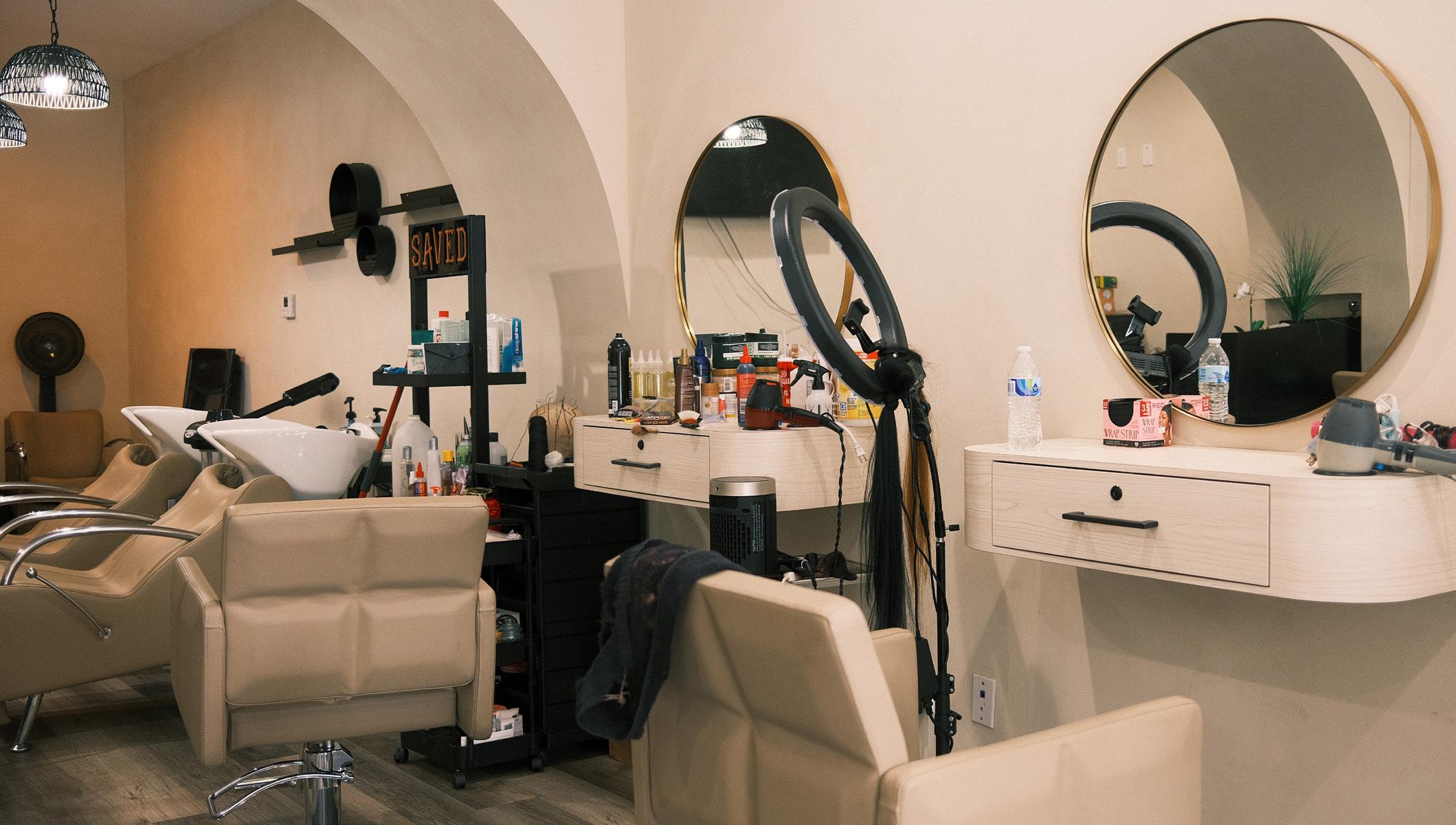
posts, and crowns—to my mouth. As it turns out, restoring your pearly whites is a delicate process, as cosmetic as it is medical.
But for the time being, I was dealing with a combination of health insecurity and cosmetic insecurity. In the mirror, I saw not only a sleep-deprived college student, but a smile with enough holes to give you trypophobia.
The only other time I’d undergone such an instant transformation was in the summer of 2020, the week my afro went on hiatus. During Covid, other stir-crazy souls opted for bangs, big chops, and dye jobs. I was itching to twist my hair. I’d wanted to twist it for years, and maybe I finally felt comfortable doing so because I was spending more time at home and less time out and about in Forest, Virginia. My hometown’s demographics range from rural to suburban, moderate to conservative, and white to whiter. When I was at school, I was mainly seeing straight-haired folks, and I’m not talking silk presses. I’m talking about the Your hair looks so soft, can I feel it? folks. When Covid kept me out of the petting zoo, I let my mom try taming my mane.
In my camera roll, there’s a picture of 15-yearold me, right after my mom twisted my hair. Short frizzy coils sprout from my head in every direction. There’s a somewhat indecipherable look on my baby face. There’s a mix of shock and fear, like I’m taking a mug shot for stealing out of the cookie jar, but I was falsely accused. I remember the thrill of my new hairstyle, but also the assortment of fears: that my friends would see it and say something distasteful, that I didn’t like it as much as my stylist (my mom) wanted me to, that I looked too much like the people—my people—being policed in the news. That
I didn’t look like me. That I looked too much like me—a new, exciting, scary me.
In my camera roll, there’s another photo of me taken a week later. I look just as young. I’m at a food bank holding a bundle of apples. I’m wearing a black cloth mask, but the joy on my face is unmistakable. The hairstyle looked a bit more natural than it did immediately post-living-room appointment. Maybe liking your appearance, having faith in your hairstylist, or being confident in your culture is like enjoying a new hairdo: you grow into it over time.
If lyzette is right, every style makes a statement. I wanted my hair to talk like me, not one of the Black Republicans from that Key & Peele sketch. (They all wear glasses like mine and insist they’re not a monolith.) I wanted my hair to grow closer to my culture. I don’t want the hair of a conservative with weird kinks (à la Clarence Thomas, probably), I want the coily, kinky hair of a liberated artist (à la Basquiat).
At college, I didn’t have to leave my school district to see do-rags and box braids. I could just leave my bedroom and bump into my housemates. And when I told my housemate that I decided to get my hair twisted, she said, “Ooouu that’s so Black.” And I didn’t disagree.
I wonder if Lyzette analyzed my energy when I entered on Thursday morning. I don’t know if she could tell that I was more exhausted than usual; that I pulled another all-nighter catching up on classes; that I’d missed classes because of the
The interior of Nvade Salon and Spa.
The writer, aged fifteen.
medical appointments; that teeth #8, #9, and #10 were under repair.
If she did notice, she didn’t mention it. She could, however, tell that my hair was “definitely on the drier side.”
I reclined into the chair—about forty-five degrees from the ground. I placed my neck against the U-shaped slot on the edge of the sink’s basin. I could’ve fallen asleep, but then I heard the waves crash.
Lyzette held a detachable nozzle in one hand and tsunamied every last strand. The jet washed over my cuticles, removing the surface-level debris.
Then she put her hands in claw formation and filled them with clarifying shampoo. It has surfactants, like many animal-tested, dirt-destroying cleaning products. Lyzette explained that it basically does to your hair what bleach does to white clothes.
Too much clarifying shampoo risks depleting your hair’s natural oils, so Lyzette followed it up with two additional batches of goop: an almond butter shampoo to trap those natural oils in place, and a conditioner to beef up the shinier, stretchier follicles so they wouldn’t break.
Finally, Lyzette showered the hair with a cascade of cold water. My hydrated hair slunk into the sink.
After the wash, Lyzette walked me over to the salon chair and pumped it up until my shiny, stretchy curls were at eye-level (about five feet high). Then she pulled a little black comb from the back of her head. She dolloped a blob of translucent gel onto her gel band—a heart-shaped silver plate with a pink strap—wrapped around her wrist. Lyzette’s methods involved no tugging, no pulling, and no pain.
In the mirror, I saw her technique: she combed out the hairs selected for coiling, latched onto the roots, and rotated the comb like a screwdriver. She
coiled meticulously from kitchen to crown. For every coil, her hands moved from comb to gel to hair— brush to palette to canvas.
Mona Lisa couldn’t have been more comfortable than I was, and I doubt she kikied with da Vinci.
During the appointment, I told Lyzette about my all-nighter, my work, my appointments, and my fall because 1) your doctor should know your full medical history and 2) because my loc doctor is kind. She offered me a bottle of water, then wisdom.
“Your hair is like a plant,” she told me. It requires hydration, sunlight, and maintenance. When I left the salon, I went with what she said.
Over the next four weeks, I watched my twists sprout and grow. I sprayed them under Lyzette’s instruction. I hydrated myself and my hair. During the day, I let my hair flail in the wind. At night, I wrapped my do-rag like a bedtime prayer. I prayed for hydration and renewed confidence. I prayed for new teeth. I prayed for new habits and new growth.
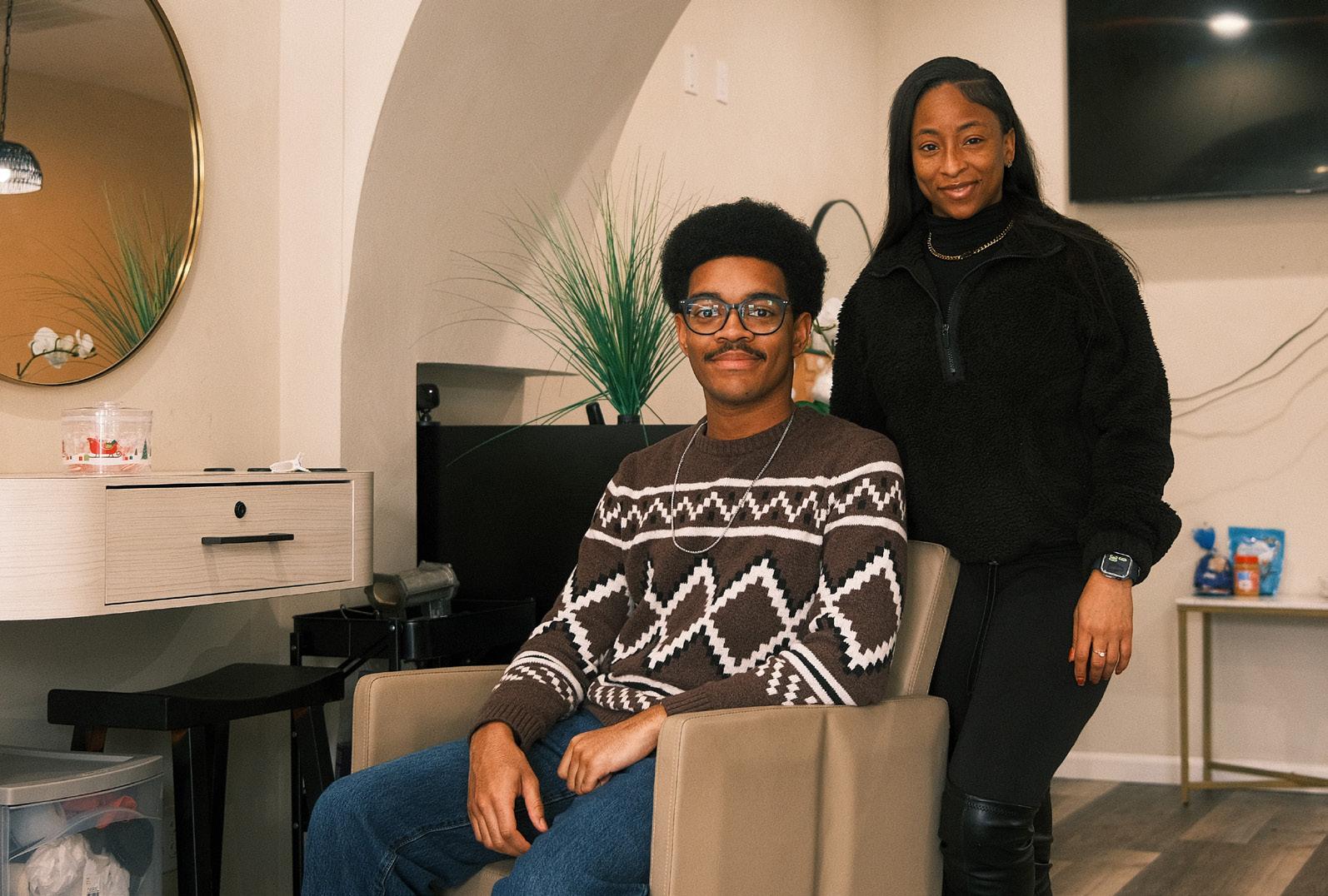
Prentiss Patrick-Carter is a senior in Grace Hopper college.
Lyzette and the writer.
Ars Poetica
after Archibald MacLeish
Don’t you dare tell me who I should be my intentions palpable as armpit hair but never mute you devour my globed fruits dumb as Snow White or Eve and Adam they’re leaving I’m releasing shard by shard listen my birds aren’t wordless aren’t worthless busy warbling the blues unfiltered like maple sap runny yolk pancake batter leaking through a lonely doorway no one’s here to clap for the mind hoards memory contra Fort Knox retreating in time as a night-engulfed silverfish you hand over that rhetorical earring coyotes yodeling behind the fence where love leans down and grief helps make spaghetti slippery
Lam
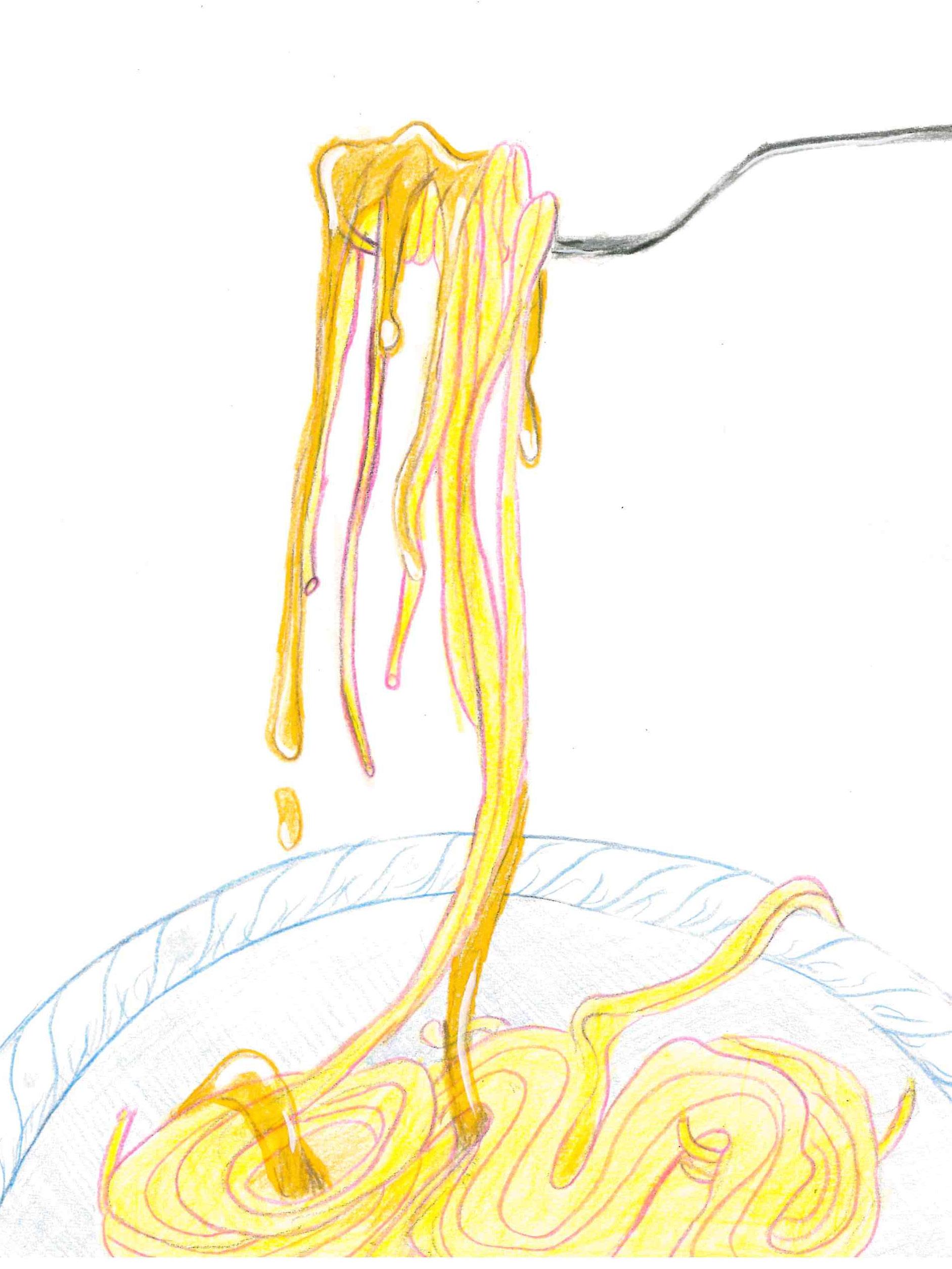
Alistair
Personal Essay
The Mold
By Ethan Kan
The mold had been IN our shower a long time. I was sure that when my parents bought this condo twenty-one years ago, the aged ceramic tiles had come pre-slashed with grime. Every night we stood, barefoot, inches away from the muck. The mold’s sisters—congealed shampoo and matted hair—would congregate every so often at the mouth of the drain, emitting a foul, sour miasma.
I was sure that when my parents bought this condo twenty-one years ago, the aged ceramic tiles had come pre-slashed with grime. Every night we stood, barefoot, inches away from the muck. The mold’s sisters—congealed shampoo and matted hair— would congregate every so often at the mouth of the drain, emitting a foul, sour miasma.
A few years ago, the caulk started to wear out. Water seeped into the
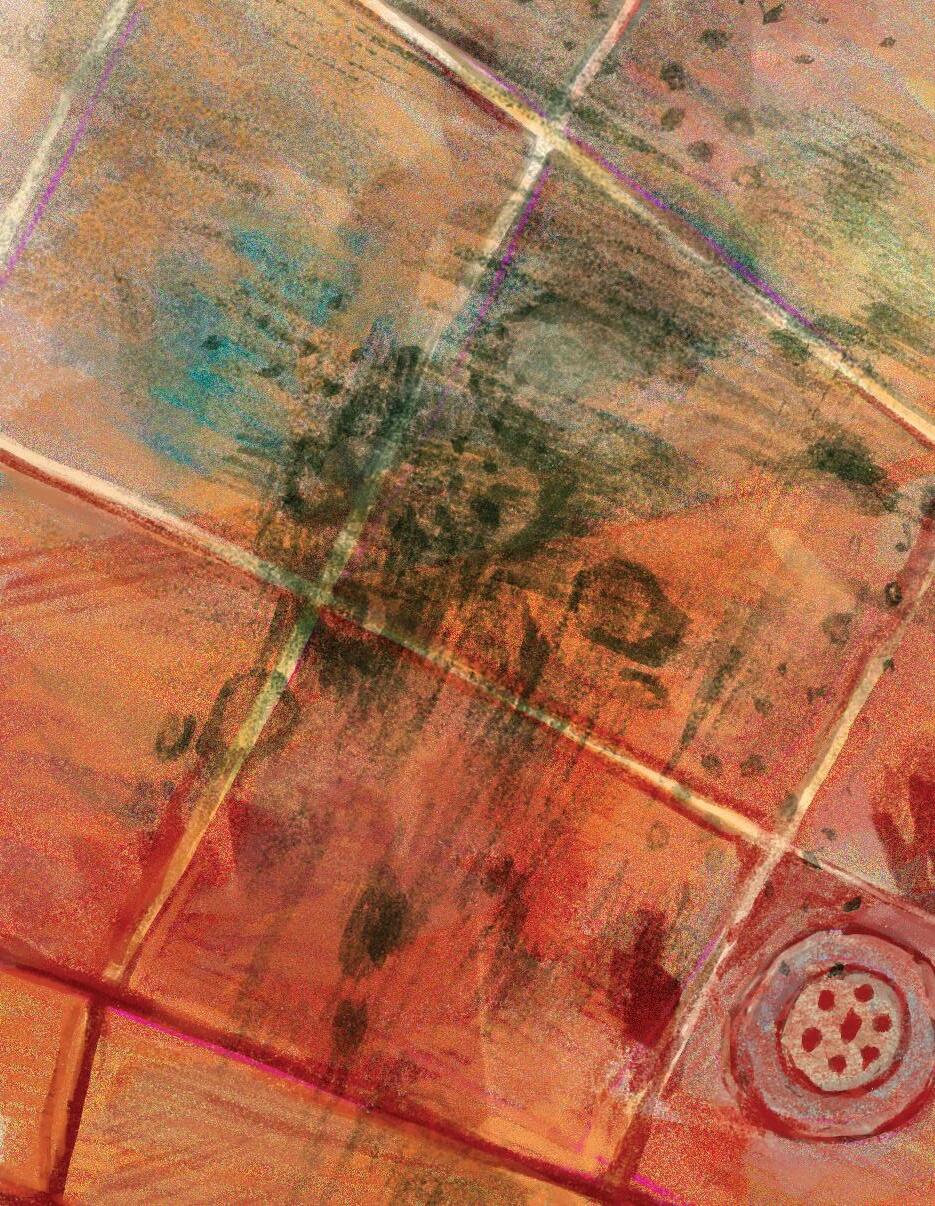
narrow gap between the tiles and the wall. Armed with a bottle of Selleys Wet Area Silicone, my mother set out to seal the gaps. But this solution would not last. Pink mold invaded the silicone until every shade of white disappeared. Only then did a handyman layer over the gaps with cement, which came out thick, uneven, and startlingly white. Within another year, pricks of black started creeping back in.
We were never alone, really, in this bathroom the size of a closet. We had the company of the microbes feeding on our bathwater.
The spores travelled up the nasal cavity, through the olfactory epithelium, and into our brains. A mold state of mind, if you will. When cracks began to appear on the kitchen countertop, my mother protected the granite with a silicone sheet. After a while, spots of black mold started to spread. The mold was impossible to scrub off, but I wasn’t prepared for her next move, which was to fit, over the counter, a slab of steel that could well have been pulled from a supertanker.
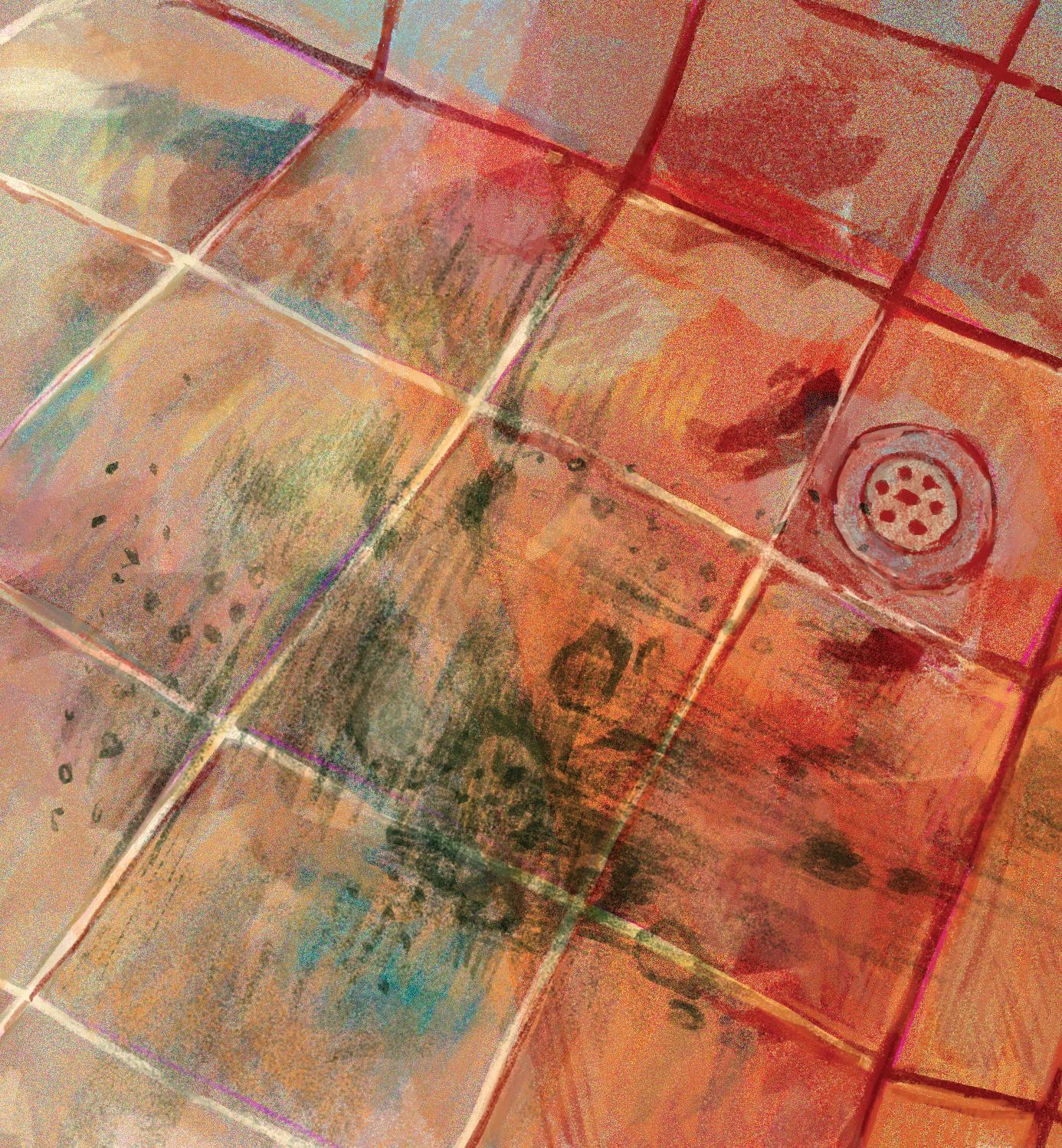
As the condo aged, mold-induced repairs of this sort layered on top of each other until I hardly recognized the place, even as all the furniture remained the same. My mother, to her credit, embarked on these projects for our well-being. On the insistence of a feng shui master, she had the entire apartment repainted in our
“The feng shui master told my mother something else: the apartment’s layout was bad for the men of the household.”
lucky colors to rebalance our vibrations, realign our energies, and retake control of our lives. But the job was done cheaply, and not only did the painters leave several peeling pockets, they also painted over errant pieces of Blu Tack that I had left on the walls. My bad.
The feng shui master told my mother something else: the apartment’s layout was bad for the men of the household. It was too dark; it faced the wrong direction; there was not enough open space. It was no wonder—she nodded solemnly as she told me this—that my father had moved out. To be fair, though, my room is pretty dim. And my father does seem happier nowadays; the bare white walls of his new place bathe in ample sunlight.
I couldn’t help but wonder if the walls that had augured my parents’ divorce had also caused the sorry state of my family relationships. How many times had my brother and I exchanged barbs in this narrow corridor? How many times had I sequestered myself in my room? Had we been doomed from the start?
Perhaps not. But I could see the way we had papered over difficulties instead of confronting them. My earliest memories of my father involve fists banging on wooden desks, vulgarities in a speeding car, and excoriations over a forgotten toothbrush and spilled
grape juice. I remember, as a child, cringing as my mother forced me to speak up. Maybe that’s why I often prefer to remain silent. I can’t pin down when my parents stopped loving each other, but for years I could tell.
We don’t talk about those years anymore, in the same way my father doesn’t talk about his mother, who sent him, alone at age eleven, to school in Singapore—far from his Malaysian hometown. Or how my mother, who is still reckoning with the emotional manipulation at the hands of hers, hasn’t spoken to her mother in years. Thus it came to be that we never really ended our arguments, just covered them up. Or that I’ve perfected the art of the entertaining smile before looking back down at my food. It was easy. It was better than the alternative, talking.
Two summers ago, in the middle of a crowded hotel breakfast in Bangkok,
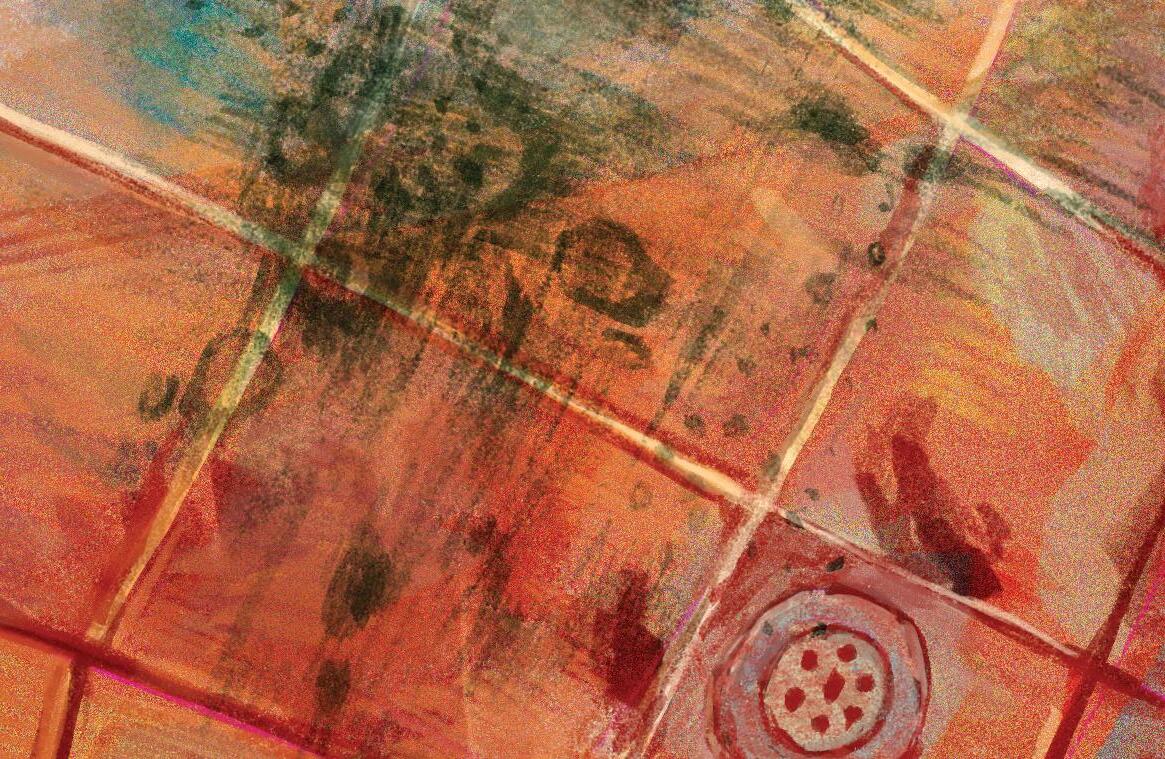
my mother first brought up the idea of selling the house when she retires. Over noodle soup, the unknown sank in my gut like congealed drain hair. For all its ugliness, I couldn’t imagine leaving this worn-out condo in the west of Singapore, the furniture that should have been replaced a long time ago, or the haphazard layers of repair. I could not bring myself to speak to her.
The next summer, after I’d returned from my first year at Yale, my mother brought it up again. We were sitting at our dining table in Singapore. As I looked up at her, I realized I had not truly looked at her face in a long time. Her cheeks were starting to sink and a liver spot bloomed under her eye. I thought of the shower floor and the blocked-off countertop, and I thought that the years we had left were not so long anymore. I imagined that for generations now we had, like the mold,
festered in the corners of the condo and that maybe the feng shui master had a point after all. I met her eyes and said, “Okay.” ∎
Wait for It to Cool
My mother’s brittle wrist bends almost to the point of breaking when she ladles out broth into a ceramic dish
Fingertips trace the bowl’s rim, breathing in the steam of sacrifice and bitter remorse like vegetables that have not yet softened
Thick fleshy starch noodles coil around the hardest and most unforgiving parts of me
But my mouth is burnt in the most predictable way, a naive primal eagerness to digest familiarity over & over
I hear a laugh from the belly of my mother She stands watch as this happens for the fourth, fifth, sixth time
Too many to count I do not learn
Instead I return to the hot stinging flood, the one that singes gummy mouth tissue while my tongue bathes in the disappointment of it all like an addict who refuses to come down from the high
There is just enough broth to remind me of impermanence
Nora Tsai
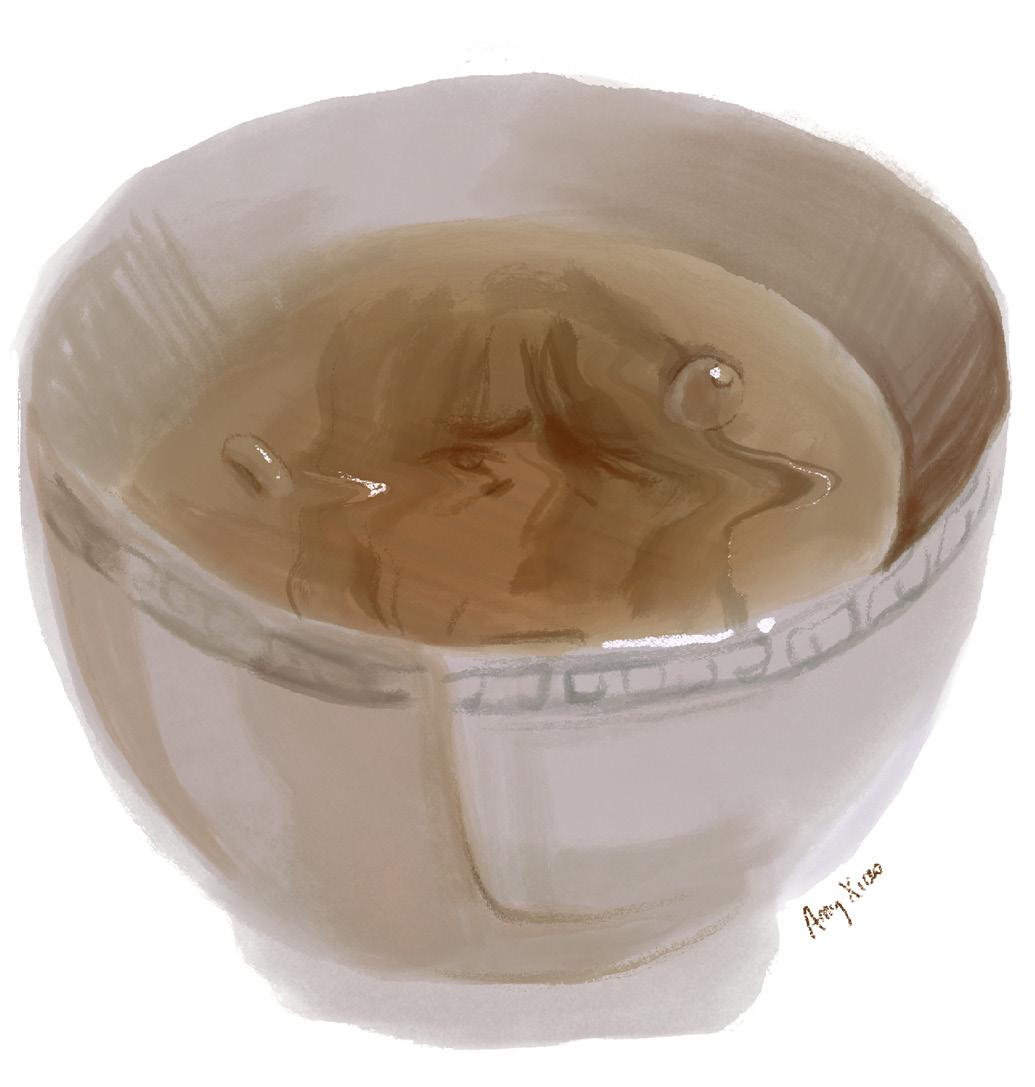
Ethan Kan is a sophomore in Saybrook College and publisher of The New Journal
Poem
Swamp

If the river divines a softness in the passing, there the water must flow.
Cicadas in bluegrass and all the Muting in the go-around as the pond frog wades to the surface of Eternity.
The stilt house where the river women take their mud men into their bog. Let it be known that every marriage is annulled under the haze of marsh law. Underneath the humid den, the lamination of the coal rocks and the whispering of the cattail reeds collide in drizzling rain. The shroud of vines where the cooing symphony of the insects learn to not kiss.
The rhythms reemerge and what once was, again returns.
If the river divines a soft spot in the passing, there the water must flow.
Delicatessen of milkweeds and sweet lies. The plush dewberries lust for the marsh flies.
The reed cat watches, at ides of dusk, the palm fronds sway quietly with the quartet of breeze, and listens to the full notes of the mockingbirds that mock me.
Will you be mine?
The rain pools me a Wake.
If the water pushes on and the excess does not heed, so the imbrication of soil, silt and leaves…
The swamp is born. The land must yield. We onlook. Orange crush dawn.
Saron Ghaim
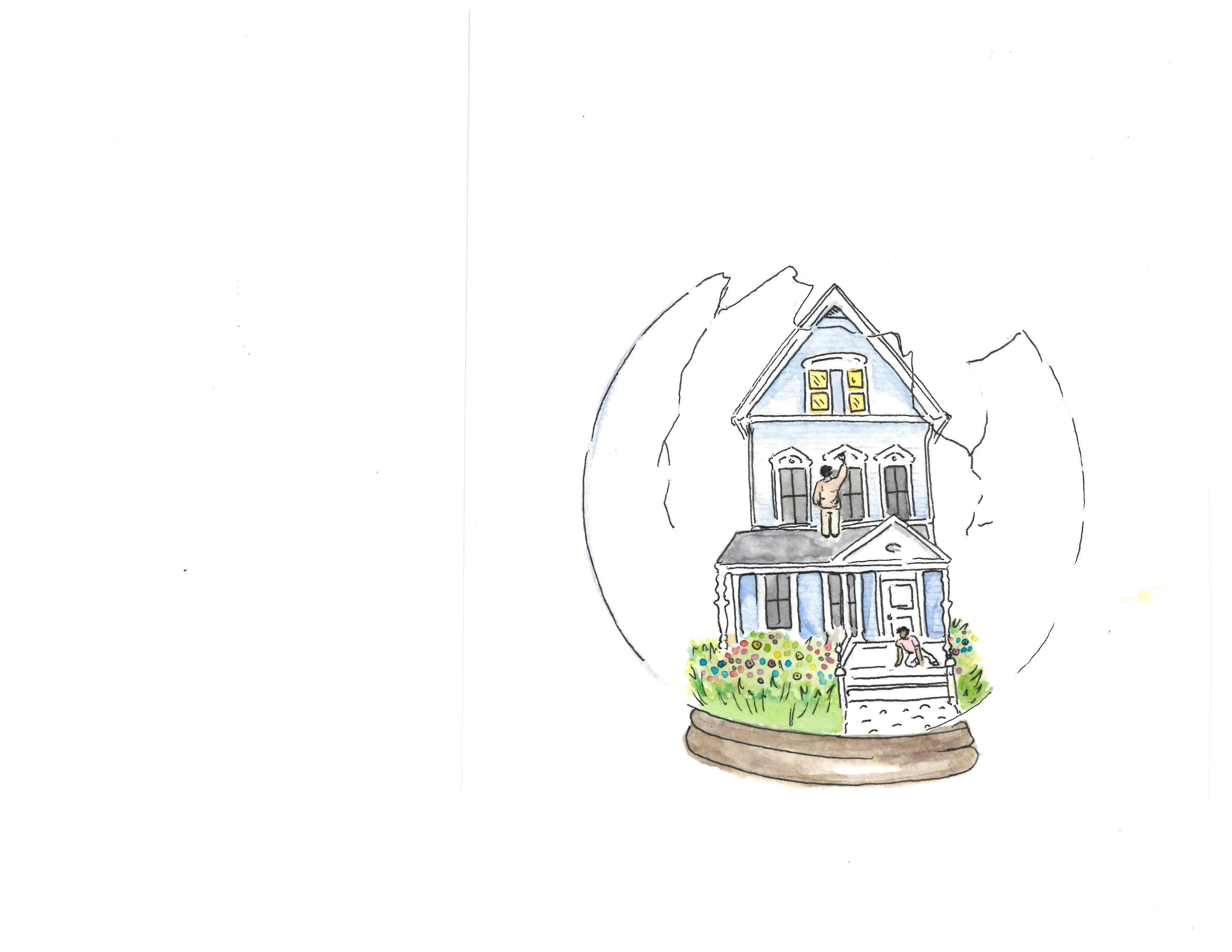
us on the Lakeland bus once a week to escape the city’s stench. This is the house of no one she wants us to meet, but it’s always empty when we arrive. We are mean boys, jaded with the city’s center, but these simplicities — sun, trees, air — make us light, easy. Our great aunt sends us out to play while she works, cleaning the house in strict solitude. In autumn, we dive into piles of leaves we rake ourselves; in winter, we make snowpeople, and in spring, we watch them melt. We spend our summers fighting in the above-ground pool, whipping wet hair at each other while our great aunt bakes in the sun.
Time passes. Our legs grow furred and our faces crater. We chase girls until they are out of breath. But though we are old enough to go through Port Authority alone, the house stays the same. We watch Psycho in the basement, drink dusty garage beers on the wicker
words and secret gentleness, and punish our trespass in the American tradition. But nobody does. To return to Pinebrook is to return to the world inside a snowglobe. The grass, green as paint; the people, simple and smiling; the house, quaint, enclosed, and unchanging.
I enroll at Hunter College, and the house stays the same. Our great aunt passes, and the house stays the same. I become a lawyer and make a living shielding criminals from jail, and the house stays the same. My brother becomes a man who gets people what they need. He conducts his business on flip phones under streetlamps hung thick with sneakers. But when we roll into the driveway in our flashy cars, the house washes our grime from us, remakes us sweet and clean. We do not bring our women to Jersey. We return to Pinebrook, it is with a tenderness that no lover of ours will ever know.
One evening, my brother lumbers down the stairs, and his foot cracks through the step. We pay a carpenter and watch him work, breathing down his neck, as protective over the house as if it were our own. He leaves. The work, we realize, is ours to do. We replace the rotted porch and fix the plumbing. We paint the clapboard exterior. We stop dreading the owner’s return: old fear is replaced by a sense of duty, of stewardship, of care. There are prices to pay for our serenity. We are not the only secrets shielded by this house. So we custodian it; keep it clean. Sleep in its beds, wash its curtains, stock its pantry with rice and bouillon cubes. We dust windows and air the smell and compost the corpses in the attic. And in return, the house opens up to us, two hardened men undeserving of such a monastery: our tenderness, our sanctuary, our breath of fresh air.
Special thanks to G.B. and K.B. Chloe Shiffman
Endnote
Do You Feel With Those Tube Feet?
An extravagant invertebrate biology class turns spiritual.
By Michelle So

Iam lost. The edges of my contact lenses have dried because I’ve blinked so little in the last five minutes. I have been staring down the barrel of my microscope, entertained—no, enthralled—by a spherical Echinoidea. In plain terms: a sea urchin.
I’ve seen you before, I think––in the dramatic YouTube documentary about declining populations of sea otters, through the glass of the Monterey Bay Aquarium kelp forest, neatly cracked open atop my birthday sushi boat.
But this is different. Each sea urchin limb follows its own choreography. Hinges bend, pincers clamp, tube feet wriggle. It’s a spectacle that I am only beginning to learn about.
Do you feel with those tube feet? Are there thoughts in that decentralized brain? What do you remember from being young and adrift?
In Casey Dunn’s class, EEB 2235: Invertebrates, I learned there is mystery in the mundane. Things that were lumps on my dinner plate became organisms that had complex relationships with one another. The class met twice a week: Tuesdays were indoor lectures and, weather permitted, Thursdays were spent at Yale’s private research station on Horse Island. Located on the Long Island Sound, Horse Island is part of an archipelago the Indigenous people of Mattabesett called “the beautiful sea rocks.” Yale acquired Horse Island in 1972 to conduct its experiments. Despite the island’s long history, my Inverts cohort was the first class from Yale to visit on a weekly basis.
At 12:15 p.m., Bob, a burly sun-reddened boatsman, would park the
As my widened eyes dry with wonder, a new wet warmth appears. Curiosity. Do you feel with those tube feet? Are there thoughts in those central brain? What do you remember of being young and adrift?
14-seater ferry by the floating dock. He rarely acknowledged us (I once tipped him $10 and received only a slight nod in return), and 15-minutes of ferrying later, we would arrive on the island.
As our feet marched the plank bridge onto the island proper, a small exodus of little things with many legs—crabs, isopods, and jumping spiders—retreated to rock crevices. Immediately we were intrigued by the spiral form of the channeled whelk—a thick-shelled, spiny conch-shaped snail. These fist-sized shells, some empty and some still inhabited, were
strewn about, half-buried, waiting for a curious hand to pick them up.
For Lynna Thai, a junior Ecology & Evolutionary Biology major, her experience of the class got “very spiritual and religious,” she said. “Because the universe manifested for this thing to be able to experience itself. And I think that is so beautiful.” She also “learned a “freakish amount” about barnacles, which she admits is a niche interest. Although our class released most of our specimens after brief field sketches, we brought some back to the Peabody Museum of Natural History for further research and display.
Some specimens live in public display cases, but most pickled jars of weirdness hang back in the invertebrates research collections, which Eric LazoWasem, the senior collection manager, has been curating for 43 years. “I don’t really like to eat lobster much anymore,” he said.
We’ve come a long way since the days of unsustainable, unethical harvesting, according to Lazo-Wasem. Before the concept of sustainable research was introduced, it was common for researchers to trawl bucketfuls of invertebrates, cherrypicking through the bodies for several specimens of interest and dumping the rest. He laughed while

recalling an arctic voyage from years ago when a sampling trawl snagged dozens of octopuses. When LazoWasem and his colleague, Saybrook Head of College Thomas Near, released a 4-meter-long octopus, their Russian colleagues were upset that they’d lost their prospective dinner.
Once, we were studying a live horseshoe crab when it took a suicidal leap from its ice tray to the vinyl floor. Distraught, we picked it up and plopped it back into ice where its legs passively hinged and wriggled to no avail. Then we continued our blood-sampling procedure, jamming a needle into the soft keratinous membrane under its carapace.
In a high school AP Environmental Science debate, I argued against live harvesting horseshoe crab blood. The blue-tinted substance is widely used in biotechnology and microbiology for its ability to detect bacterial contamination in vaccines. In 2022, an estimated 145,920 horseshoe crabs were killed for the biomedical industry. And like an oil rig upon loads of petroleum, I, too, was complicit in extractivism. We presently do not know and cannot fathom how it feels to think like a horseshoe crab. (Lazo-Wasem also doesn’t think we can answer this question yet.)
Back in the lab, I stared into the crab’s compound eyes, which were dulled by the anaesthetic ice chips. I remembered the gleam of a tiger’s eye bead on a necklace I had been gifted by
my grandmother as a child, the way the shine shifted in the light. As I shamefully plated the horseshoe crab’s blood onto a microscope slide, I felt its eyes shifting. They seemed to follow me to the sharps container, where we discarded the hypodermic needle, still dripping with blue ink. Wasteful.
The incident disturbed the entire class. “I value life highly,” Thai said. “This is morbidly said, but to have desecrated it in the way that we did, I felt very guilty about it.”
Namrata Ahuja, a graduate student working in Dunn Lab and occasional Inverts teaching fellow, remarked that her 2021 class, though upset by the horseshoe crab dissection, was “not as distraught as people this year were about it,” she remarked. She attributed the difference to “interacting with the animals outside of class in the field versus just having them in the lab.” We, the spined, and them, the spineless, were really not so different.
I think of dock scum, the crud-encrusted surfaces boat owners fight to destroy. Five months before our class began, Professor Dunn submerged several ceramic tiles strung on rope into the ocean, allowing their surfaces to become overgrown with stuff our class could examine. When we pulled them up, the tiles only seemed to be mud-covered plates, brown and goopy. You could see some wiggling, if you looked closely.
Well, I looked closely. I saw a million
forms of life I couldn’t even name. There were feather worms, polychaetes, colonial tunicates, amphipods—more animals than all the human faces I could recall. More animals in one square inch than people I had ever met.
Well, I looked closely. I saw a million forms of life I couldn’t even name. There were feather worms, polychaetes, colonial tunicates, amphipods—more animals than faces I could recall. More animals in one square inch than people I had ever met. Ever would meet.∎
Michelle So is a sophomore in Timothy Dwight College.
Plant-based
12th of 12: Abbr.
“Shhhhhh” or a hint to the circled
Cocktail made with a double shot?
Birthstone for many Libras
Rock group?
Everybody Quiet!
Role for Maisie on “Game of Thrones”
Classic sports cars 10 ___ Bowl, acai 11 Many, many moons 12 “Gnarly!” 13 Sci-fi spacecraft 18 ___bone 19 Expenditures 23 Pia of “Butterfly” 24 Fires 25 “Doh!”
26 Turkish peak
27 “I want to join you!”
28 Irish New Ager
29 ___ omen (may that not come true)
30 Thai cash
32 Grace Lee ___, civil rights activist
33 Half a Hawaiian fish
34 Bad way to run
39 String for a rustic gift
40 Gender bending fish
41 Promote
42 Largest USA steel producer
47 Like
48 Tapes sent to recording companies
50 ___ of Dogs
51 “Whatcha ___?”
52 “___be all right”
53 “So long,” in Salerno
54 Seat of Oklahoma’s Garfield County
55 Wave in math class?
56 Freudian concept
57 Suck dry
58 Golf org.

The New Journal, founded in 1967, is a student-run magazine that publishes investigative journalism and creative nonfiction about Yale and New Haven. We produce five issues a year that span reportage, personal essays, and creative work.
Email chloe.budakian@yale.edu and calista.oetama@yale.edu to join our writers' panlist and get updates on future ways to get involved. We're always excited to welcome new writers and artists to our community. You can check out past issues of The New Journal at www.thenewjournalatyale.com.
The New Journal was founded in 1967, under the following mission statement: “This university has once again reached that stage in history when people are talking about the New Yale, presumably to be distinguished from the Old Yale, which in its own day was presumably considered new. Wishing to share in this modernity, we have chosen The New Journal as the name for our publication. Besides, things seemed slow around here.”
Today, The New Journal is published five times during the academic year by The New Journal at Yale, Inc. One thousand copies of each issue are distributed free to members of the Yale and New Haven community. The New Journal is printed by TCI Press, Seekonk, Massachusetts; bookkeeping and billing services are provided by Colman Bookkeeping of New Haven. Office Address: P.O. Box 3311, New Haven, CT 06515.
While this magazine is published by Yale College students, Yale University is not responsible for its contents. All contents Copyright © 2026 by The New Journal at Yale, Inc. All rights reserved. Reproduction either in whole or in part without written permission of the editors in chief is prohibited. Recycle Icon from Flaticon.com.