THE
M O N TA G E
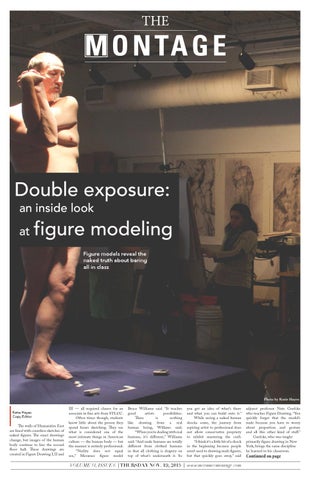
Figure models reveal the naked truth about baring all in class
Photo by Katie Hayes Katie Hayes Copy Editor
The walls of Humanities East are lined with countless sketches of naked figures. The exact drawings change, but images of the human body continue to line the second floor hall. These drawings are created in Figure Drawing I, II and
III — all required classes for an associate in fine arts from STLCC. Often times though, students know little about the person they spend hours sketching. They see what is considered one of the most intimate things in American culture — the human body — but the manner is entirely professional. “Nudity does not equal sex,” Meramec figure model
Bruce Williams said. “It teaches good artists possibilities. There is nothing like drawing from a real human being, Willams said. “When you’re dealing with real humans, it’s different,” Williams said. “And nude humans are totally different from clothed humans in that all clothing is drapery on top of what’s underneath it. So
you get an idea of what’s there and what you can build onto it.” While seeing a naked human shocks some, the journey from aspiring artist to professional does not allow conservative propriety to inhibit mastering the craft. “I think it’s a little bit of a shock in the beginning because people aren’t used to drawing nude figures, but that quickly goes away,” said
VOLUME 51, ISSUE 6 | THURSDAY NOV. 19, 2015 | www.meramecmontage.com
adjunct professor Nate Gaefcke who teaches Figure Drawing. “You quickly forget that the model’s nude because you have to worry about proportion and gesture and all this other kind of stuff.” Gaefcke, who was taught primarily figure drawing in New York, brings the same discipline he learned to his classroom.
Continued on page
NEWS
2
Emerging Scholars Banquet recognizes students’ accomplishments Students reflect on their educational journey with encouragement from mentors Dalila Kahvedzic Editor-In-Chief
STLCC–Meramec chemistry professor Michael Hauser refers to Emerging Scholar students as “bright stars.” “To me, the Emerging Scholars, you are bright, bright shining stars,” Hauser said. Hauser was a guest speaker at the fourth annual Emerging Scholars Banquet held for students on Tuesday, Nov. 3 which recognized their academic success. He compared the Emerging Scholars to not just stars, but glow sticks as well. “How do you activate a glow stick? You break it. Those chemicals have to interact together or no chemistry is actually going to happen in this particular case, so let’s talk about that journey that you used to maybe achieve this sort of success that you found and you’re being honored for tonight,” Hauser said. When Hauser first became a father, he knew there was nothing his child could not accomplish, he said. “I looked at my child and I said there’s nothing this child can’t do. The sky is the limit and that is the case for every person in this room,” Hauser said. But things happen; things dampen our curiosity or family situations occur, Hauser said. He said the world is an oyster. “So, maybe you never knew you were bright, okay? We all grow up and the world is our oyster as they say. Maybe you didn’t have a support network, maybe English wasn’t your first language — perhaps there was no good role model,” Hauser said. With the lights off, he cracked the glow stick. When the two chemicals interacted after the glow stick broke, electrons were excited in the chemicals. The electrons rose to a higher level and then shrank back down to a lower level and light was emitted. This process is known as luminescence. “So then something good can happen; maybe you have a role model develop in your life, maybe you actually have a child and you want to become the role model, maybe that teacher steps into your life, maybe that special person enters your life,” Hauser said. Chemicals shaken together; a
EDITORS
star is born. And that star is the Emerging Scholar, Hauser said. “You had a burning desire in your life and you discovered what that can do for you and what it continued to do for you.” Emerging Scholar and Meramec student Austin Lewandowski began attending classes two and a half years ago. The experience has been awesome, he said. “All the teachers are really great and they’re always willing to help you and go the extra mile to help the students,” Lewandowski said. This night means a lot to Lewandowski. “It just brings it all back together, this being my last semester, it’s nice to see some old teachers... and know what I’m going for in the future,” Lewandowski said. “I had a really great tutor last year who was a really good mentor and my parents obviously are always good role models to look up to.” Lewandowski plans to transfer to Western State Colorado University to study wildlife biology. STLCC-Meramec student and Emerging Scholar of the Year recipient Mary Cravens will apply to the nursing program to become an RN and work toward a BSN. In addtion to attending college, Cravens has a son and a full-time job. “It does get difficult because I work full time and have him and school, but I fit it in when I can. He’s been a big inspiration just because I want him to go to college and I want to be a good example for him,” Cravens said. Cravens did not expect to get the Emerging Scholar of the Year award, but was happy to be
Photo by Alex White
STLCC- Meramec Dean of Business and Communication Vernon Kays (left) congratulates STLCCMeramec student and emerging scholar Austin Lewandowski at the Emerging Scholars banquet ceremony on Tuesday, Nov. 3 in the Student Center. Lewandowski is in his final semester at Meramec and plans to tranfer to Western State Colorado University.
professor Kelly Wavering regularly attends the annual banquet since it began. “We started four years ago and we have gradually gone from four scholars the first two years, then
“This is just the beginning of their journey.”
a part of it and gain recognition along with other students. “It kind of gives you the motivation to continue on,” Cravens said. STLCC–Meramec English
we had six and now we have 16. Of those 16, four are Wildwood scholars,” Wavering said. The Emerging Scholars Banquet is a celebration of students’ hard work, persistence
MONTAGE STAFF
Mike Alivernia Dalila Kahvedzic Editor-in-Chief Jason Waters Production Manager James Claiborne Jonah Durbin Katie Leicht Art & Life Editor Katelyn Ericson Brittney Farrow Opinions Editor Tyler Fuson Christian Hargas Sports Editor Daren Hembrador Marissa Diercks Graphics Editor Jason Jamison Alex White Photo Editor Link Johnson Katie Hayes Online/Copy Editor Patrick Niehaus Shannon Philpott Faculty Adviser Toni Roberson Proud member of
Redwan Saeed Staff Writer Ashley Biundo Staff Writer Darren Grant Staff Writer Noreen D’Souza Staff Writer Lexi Keller Staff Writer Austin Schumann Staff Writer Staff Writer Staff Writer Staff Writer Staff Writer
www.meramecmontage.com Nov. 19, 2015
and dedication, she said. “Often times, we don’t celebrate our students enough when they do really extraordinary things and these students have done extraordinary things,” Wavering said. “They started in developmental courses, they’ve gone on to take college level courses and are doing incredibly well with their college courses and not a lot of people do that.” Although the students put in the hard work, they did not do it alone; they had mentors along the way, Wavering said. Students had faculty, parents, friends and siblings, so it is a celebration for the support system as well. “This is just the beginning of their journey. They have a long one ahead of them. Many have aspirations to go on and earn a four year degree, graduate degree, even PhDs; we have several of our scholars this year that are looking at becoming lawyers and doctors and those sorts of things. That journey is long and it’s going
Staff Writer Staff Photographer Staff Photographer Staff Designer Staff Designer Staff Multimedia Specialist
to be difficult, but they [need to] recognize that they can do it,” Wavering said. “I have conquered, I have done, I have succeeded and I will continue to do so.” Dean of Business and Communication at STLCC– Meramec Vernon Kays says students need to learn how to be an advocate for themselves and always come prepared. “50 percent of what you do is showing up, the other 25 percent is doing your homework, and the other 25 percent is being prepared in class which means reading the textbook ahead of time, having questions so you’re not just sitting there taking it in — being an active, engaged learner,” Kays said. If students continue on this path, they will have many more opportunities of choices, he said. They will not be limited by their grades or by other decisions that they make. “Education is an opportunity, but it’s not a gift. It’s earned,” Kays said.
THE MONTAGE To place an advertisement, contact the advertising manager for rates, sample issues, etc., 314-9847955. Editorial views expressed or content contained in this publication are not necessarily the views of St. Louis Community College, the board of trustees or the administration. The Montage is a student publication produced seven times per semester at St. Louis Community College - Meramec, 11333 Big Bend Blvd., Kirkwood, Mo., 63122. 314-984-7655. One copy of The Montage is
free of charge. Up to 10 additional copies available, $1 each, at the office of The Montage, SC 220. Bulk purchases may be arranged with circulation manager. Editorial policy: All letters should be no longer than 500 words and must include identification as a student or faculty member, phone number and address for verification purposes. Phone numbers and addresses will not be published. All letters are subject to editing for content and length. All letters submitted will be published in print and online.
NEWS
3
ACCESS Office puts the ‘Ability’ in Disability for Meramec students Services designed to impact students’ personal and academic lives Christian Hargas Sports Editor
STLCC–Meramec offers services and accommodations for students with physical, psychiatric and mental disabilities through the ACCESS Office. “We work with students who either have documented disabilities or they suspect that they might,” STLCC ACCESS Office Manager Linda Nissenbaum said. “We always make the ‘Ability’ in ‘Disability’ large because that is what we focus on. In the case that they suspect they might have a disability, we often try to provide resources where we can talk to them about what we can do to figure out what is going on.” Available services include testing accommodations,individual advising and academic counselling, coordination or needed classroom accommodations, interpreters, readers, writers, etc. The mission of the ACCESS Office is to provide accommodations without lowering the expectation of the student, ACCESS Office Specialist Theresa Smythe said. “The teacher is still going to require you to take the test, still going to require you to turn in the same assignments on time, but accommodations are going to help
make up some of the limitations created by the disability. We are not watering anything down, you may just be getting a little extra time for it,” Smythe said. Meramec student Noah Otte said he registered with the ACCESS office in the last weeks of high school. “I did it in advance because I knew accommodations and having a person who could understand someone with a disability such as myself was crucial to my success in college,” Otte said. “I was not nervous at all when I first registered with the ACCESS Office because I knew registering could only do nothing but help me in my time in college.” All different forms and types of disabilities are served through the ACCESS Office, Nissenbaum said. STLCC serves over 500 students per semester through their office. “The highest [most common] disabilities are learning disabilities, Attention Deficit Disorder and psychiatric disabilities. We have a variety from visual impairments, blind, deaf, hard of hearing, physical disabilities, health disabilities — it is the whole range,” Nissenbaum said. “We serve about 52 percent of the overall population of students with disabilities that request accommodations through the Access Office district wide.”
Accommodations depend on the student and what classes they are taking, but there are times when unique challenges are presented, Smythe said. “Teachers will sometimes feel a little bit of panic because they cannot imagine how this person is going to be able to
on a subject not only on tests, but in a class as a whole,” Otte said. No class is off limits for students with disabilities, but there may be essentials that students have to do in a class they are not able to do, based on their disability, Nissenbaum said. “Most of the time, we can find
“They [students] have a right to equal access.”
do the work in their class with their particular disability. It is our job to troubleshoot with the teacher and figure out what is going to be a reasonable way to accommodate this student’s particular need,” Smythe said. The accommodations are a great way to help students improve on their abilities, Otte said. “They allow me to take a test in a good setting, make sure my math problems are correct and I need that in a subject like math that I struggle in a bit. It helps me remember key things I learned like equations. They also allow me to have a better chance at doing better
Manager Linda Nissenbaum discusses services offered by the ACCESS Office.
Photo by Dalila Kahvedzic
a way to ensure that the student is able to do that. We have to look at what the student is requesting, how the disability affects them, what the requirements are for the class, and work with the faculty to see if we can provide an accommodation that will work in that class,” Nissenbaum said. Otte said he uses the majority of his accommodations. There were no accommodations he needed but did not receive. “I have used all of my accommodations I have asked for except for being able to record my lectures because I never needed it. I always received all the accommodations and help I needed whether it be in emotional or educational terms,” Otte said. Sometimes students are not aware of the ACCESS Office because they are not told about the service, but it is a combination of things, Smythe said. “There is some lack of awareness, but there should not be because it [information] shows up in many areas [website, course outlines, syllabus, etc.]. There is some fear and also a reluctance because a lot of students who have learning disabilities received support in grade school and high school,” Smythe said.-Now students want to go off on their own and prove to themselves they can do it. Many times that is not going to work out too well, but they try and they want to try, Smythe said. The best thing about the services provided by the ACCESS Office is it levels the playing field and helps people who have trouble with things, Otte said. “Whether it be in class or coping with the world, you do those things and have as good a chance at doing them as anyone not in the ACCESS Office,” Otte said. “I also feel with the ACCESS Office, students with disabilities can go to someone to talk if they have problems.” The best part about the job is that you always have to think outside of the box,Nissenbaum said. “All of us in this office have to think outside of the box because there is always something new that shows up. There is a new disability, or there is something that I have never heard of that comes along. Also, there may be new technology out there that provides that access.
It is about keeping up with things,” Nissenbaum said. “We have to keep up with what is going on because it is ever changing.” Another great part about this job is that there is never a dull moment, Smythe said. “I have been doing this for a very long time, everyone in here has, and yet we still every day meet somebody new that has some challenge we have never faced. I always feel very privileged because these are sometimes very personal things that people are dealing with that they come to us for help with,” Smythe said. The services provided by the Access Office are fantastic,Otte said. “I feel STLCC does a great job at effectively providing accommodations to students who need them,” Otte said. They [ACCESS Office specialists] encourage people who either suspect that they have a disability or have a disability to register with our office and get everything set up, Nissenbaum said. “It is always their choice what they want to use or not. We never go after students, we never force them to do anything, but this way they are set up with their accommodations and they can use them as they see fit,” Nissenbaum said. “Rather than doing it retroactively, because accommodations are not good retroactively, I would encourage students to do that upfront.” Holding everything in confidence, they really admire the students they work with, Smythe said. “That is probably why we are all still here because we get a lot of really positive stuff from them. They are an inspiration and this is an inspiring place to work. I do not get paid millions of dollars to do this job, but I get paid every day doing some really inspiring stuff,” Smythe said. Students are not any less a human being or any less smart than others are because they use accommodations from the ACCESS Office, Otte said. “I would tell them [students] it is perfectly fine to need and use accommodations, it does not make you any less than or inferior to people who do not need or use them,” Otte said. “It is really a way to help in an area you struggle in, both education wise and personally because once you start doing better, you start gaining confidence and start feeling better.” In the end, the ACCESS Office strives for students to realize that getting equal access is their right, Nissenbaum said. “They have a right to equal access, they have a right to these accommodations and we are here to work with them and support them in any way that we can because we want our students to succeed,” Nissenbaum said. “These accommodations are not set up for success, although we want our students to be successful. They are set up so that students have an equal chance to be successful and that they get to choose success.” Nov. 19, 2015
OPINIONS
4
Street game: public authority does not satisfy narcissism The deadly consequences of growing up Link Johnson Staff Writer
On most mornings I wake as the sun rises, watching each day come to life. Before the sidewalks become busy with people headed to various destinations, as the traffic begins to fill the streets, I watch the police cars slide into the shadows of my neighborhood. “What is wrong with that,” they say. “Oh they are just doing their jobs,” some argue. To others, this may seem partial in truth — a great topic for debate; however, to me, there is a game with no official title at play. I am aware that my community has an active police presence, but this has led to unbearable realities that shape our society. Imagine a world where men of all races and colors share a few basic human characteristics. Testosterone for start, and, if I may say, a strong sense of kinship and a will to fight and protect or to defend. Now, combine those things with social division and racial conflicts with our land’s history. Then you’ll find the ingredients to civil disputes. Let us not overlook any obstacles that women face in society — past or present — but as a black man in America, I am only speaking on the most
prevalent danger that I face daily. To some police officers it is really a game, it seems, to just ride through the ‘hood and harass people all day. It is a concern of mine because this game has become too common in my community and in many communities like mine across America. It is a very dangerous game and I have lost many friends and family to this reallife version of “cops and robbers.” As a man, I can just imagine the rush a guy gets while he laces the boots of a uniform and straps on a badge and a gun that says he is the law. Or when he hops into a hot rod equipped with flashing lights and noisemakers to the roar of a V8 or Hemi engine, propelling him through red lights. Often when a man is given this much power, he is bound to use it in excess on occasion. There is no need to count up the police who patrol my city and blame them all, no, there are way too many good men who honor the code of being a “Citizen On Patrol.” My point is this — in order for that man to do his job effectively is to go out of his comfort zone. He has to work outside of his own community to find that much satisfaction in oppressing others. In other words, communities like mine are rarely patrolled by police officers who understand
the people of my neighborhood. In some cases, it is a sad display of public authority just to satisfy man’s narcissism. I am not one of those “angry black men” blaming failure and self stagnation on “the man.” Nobody is standing in the way of my progress nor preventing me from becoming successful at anything in the world. I will not try to portray all law enforcement agents as malicious beings with ill intentions toward minorities; I have nothing to gain by singing an old familiar song and dance. Besides, I would not fancy myself as perfect. A truth exists and this is my version of it. The battle between black men and white law officials has been going on long before me and it is woven into the fabric of our society. I am simply stating the facts of my everyday life. This game is one that I do not choose to play, for I was born into it. Yes, there is real danger in the world to be aware of, but as a black man, I have grown to know that there is not much protection for me from those dangers. I must also play the game from the shadows, winning only by redemption and through perseverance. It is that hope for victory that keeps me playing. The only choice is to win.
Illustration by Brittney Farrow
Dear holiday shoppers: drop the attitude Do not cause a fight, keep things merry and bright Dalila Kahvedzic Editor-in-Chief
Before anyone steps into a single store this holiday season, there are a few things that should be kept in mind. Each retail employee gets up in the morning ready to tackle the day, not a customer’s attitude, so leave it at home. The employee is a human being; they breathe, live, eat and
sleep just as shoppers do. This employee represents many people, and can be found in many familiar faces — including my own. That may be surprising, but it is the truth. This should be common knowledge, but retail employees do not intentionally make customers’ shopping experiences awful. If someone approaches me, I will ask how they are not because it is a necessary, part of my job but because I genuinely care. I will also ask if everything
was okay — once again, not because it is necessary but because it is the job of employees to provide assistance with any problems that a shopper may have. If the item a customer tries to purchase does not ring up correctly — and is more or less expensive than they thought it would be — most cashiers can easily do a price check. Price checks are easy and should only take a few brief moments. If waiting a few minutes makes shoppers indignant, they have to get over
Illustration by Brittney Farrow
Nov. 19, 2015
it. That is really unreasonable. Something customers must understand is that there are abominable people in the world who lie to get what they want. This makes trusting every shopper in the store impossible because cashiers must constantly be aware of possible scams. I would love to exercise good faith, but it simply is not possible. doing so could easily jeopardize the store product and my job. Do not hand the cashier a coupon that expired a month ago — it cannot be used. Also, do not act surprised when it is denied. Cashiers do not deny the coupon because they wish to kill your holly, jolly spirit but because they abide by the rules given to them by their company. Accepting expired coupons would be like the store giving out free handouts. I am sorry if that upsets shoppers, but employees would much rather stay employed than bend the rules. Honestly, I would rather watch a shopper cry me a river than lose my job. There is a reason I have one in the first place. The money and work experience is useful to me. Keep in mind, if a customer throws a huge fit just to get their way that will not work either. It is immature. Let us all act like adults. If a customer wants to speak with a manager, that is fine. They will tell you the same thing I did, though. Managers tend to side
with their employees over whiny and self-righteous shoppers. If the security bars beep as you exit, do not get frustrated. I bag hundreds of clothing items per day and sometimes I might just miss a hard tag. Please do not damn me to hell. Instead, forgive me. Mistakes are bound to happen in any job and can be made by anyone. Do not call the manager over to complain about the line or how messy the store is. He or she has more important things to do than listen to a long, whiney complaint from a judgmental shopper. Employees do everything in their power to get each customer in and out of the store as quickly as possible. They do not like long lines either. When you are asked to take a store’s survey, do not tell the cashier that you will take it to complain about the “god awful” service because they honestly do not care. Somebody out there sure does care, but that somebody is not them. An employee’s day does not become any more merry and bright because of that snarky comment. It does not maintain holiday cheer. The holidays are not supposed to be a time of dread, but a time to look forward to, and everyone should work together to keep it that way. A good attitude when shopping for gifts goes a long way, and your cashier will certainly appreciate it.
OPINIONS
5
Believe in peace after terror in Paris Making sense of violence Noreen D’Souza Staff Designer
It was the day after Friday, Nov. 13. The mood was somber. The church was stocked full as we gathered for evening mass at St. Monica Church in Creve Coeur (French for broken heart). We listened to the sermon as the priest preached to his audience. He talked about the carnage that occurred in Paris the evening before. The scenes we witnessed on TV and the Internet replayed in our minds. It was horrifying to visualize the cold-blooded murders of hundreds of innocent people who gathered with friends and perhaps family to enjoy a meal, a soccer game or concert. The violence made no sense to us as we sat in the peaceful atmosphere of our church. Why did it happen? Six simultaneous attacks by groups of men with guns and ammunition took place at public locations that were sure to be filled with hundreds to thousands of people. Coincidence? No, it was not. Organized? Yes, it was. These carefully planned acts of terrorism were not just the shooting of rifles into the air to strike terror in people’s hearts. They were deliberately aimed at people’s hearts and heads and any and all parts of their bodies. What were the terrorists thinking as they loaded and killed, reloaded and killed again and again and again? Were they chanting in their heads, “aim and kill, aim and maim” to the beat and rhythm of each gunshot — to
the rocking explosions that reverberated in their ears? As we recited our prayers (forgive us our trespasses, as we forgive our trespassers) I thought, “Can we really, really forgive these heinous acts of murder? Our Father in heaven, are you not asking too much of us? Our hearts are heavy with grief.” I looked around at the peaceful smiles of the statues of the saints around us. I thought to myself, “We are not saints. We are flesh and blood, hearts beating, minds recoiling in horror.” I focused outside of myself as we stood up. I heard the priest call on us to give the sign of peace to our neighbors. In the pew just in front of us was a young family near the aisle: a pregnant mother, a father and a toddler. As his parents wished us peace, the little boy extended his hand to the man and woman to the left of us. With a sweet smile, he then carefully toddled along the pew bench, looking at each one of our faces as he reached out to take our hands and transmit joy and a smile. There was a smile on every face as he proceeded to shake every hand and reached the other end of the pew. We watched anxiously as he stepped close to the front edge of the bench. Then, he was carefully lifted up and placed in the arms of his father who was waiting for him and held him close to the heart. There was peace in our hearts and joy on our faces as we sang the closing hymn and left the church. We believed in peace. Our hearts were with the victims of the attacks in Paris.
Illustration by Brittney Farrow
In women, heart disease kills more than cancer We should fund research based on numbers, not noise Evan Carlen Staff Writer
Illustration by Marissa Diercks
What could be the start to investing in potentially lifesaving research? Most people would throw their money at the biggest killer, right? Wrong. People give money to organizations that make the most noise instead of those that save the most lives. What this means is that the majority of donated money will go into cancer research instead of elsewhere — despite the fact that the progress of cancer research has been less than outstanding in the past few years. Why is that? Cancer makes so much noise because it is a degenerative disease that shows symptoms over time, but the silent killer — heart disease — will kill more people this year than all kinds of cancer combined. With this knowledge, our concern needs to shift toward funding heart disease research instead. When asked about the victims of heart diseases such as Coronary Heart Disease (CHD)
and Microvascular Disease (MVD) most people picture men. Not surprisingly, medical stereotypes painted the wrong picture again. According to the National Heart Institute, since 1984 more women have died from heart disease than men, and the gap between the death count continues to grow wider. This is because over the last 60 years, research on care and prevention has been aimed at men who primarily suffer from CHD. This research hones detection and treatment methods such as angiograms and stress testing, but these methods are only aimed at half of the population. According to the National Heart, Lung and Blood Institute, women suffer primarily from MVD, which is all too often overlooked by CHD-aimed detection methods. If this is the case, why is funding not pouring into the pockets of labs aimed toward MVD detection? Year after year stories are published for the public on the falling percentage of heart disease related deaths. These stories make our
insides get all fuzzy and we go to sleep thinking these percentages are widespread. The truth is they are not, and the trend will continue until initiative is taken by us — the people whose tax dollars fund research. According to the Centers for Disease Control and Prevention, nearly five times as much funding goes toward breast cancer research each year than heart disease research despite breast cancer victims being less than a tenth of those of heart disease, let alone MVD. Since when are the lives of cancer victims, my mother included, valued more than those of heart failure victims? The facts do not lie: heart disease is a serious problem for all of us, especially women. Every life is precious and we need to put the money, time and effort where women need it most —in heart disease prevention efforts. Funding heart disease research will pay off in the long-run, and it will save the lives of so many people. At the end of the day, that is a worthy investment, and the pursuit of heart disease prevention in women will definitely pay off. Nov. 19, 2015
INDEPTH
6
An inseperable par
The story of Sarah Hale: uniting our cou As Thanksgiving draws closer, anxiety over family dynamics, burnt food, exercise and Black Friday sales looms over celebrants’ heads, gathering like November clouds. Amid the holiday pressures and stresses, the day’s origins and original purpose slips into the background. The distant struggles of the Pilgrims grow dusty with time. Even the woman who campaigned for the national holiday is obscured by football, turkey and pumpkins. This woman fought for nearly three decades to make the day recognized as a holiday. Her name was Sarah Hale. Who was Sarah Hale?
She was a single mother who employed her pen to support herself and her five children after her husband died. She never attended college, but she rose to the position of editor for the successful “Godey’s Lady’s Book.” According to her biographer Laurie Halse Anderson, Hale was a novelist, poet and social reformer. In the years before the Civil War, Thanksgiving was not a national holiday celebrated uniformly throughout the nation. It was a celebration held by New Englanders whose ties were to the Pilgrims who had settled in Massachusetts. However, Thanksgiving
was not celebrated solely in New England states, but spread throughout the country as Americans traveled West with their families and traditions, Meramec history professor Robert M. Lee said. “We are a very nomadic people,” Lee said. Sarah Hale was born in New Hampshire, the daughter of an American Revolutionary War veteran, according to Anderson. Through her editorials, she began to promote the national celebration and recognition of the holiday on the final Thursday of November. “It is a festival which will never become obsolete, for
it cherishes the best affections of the heart — the social and domestic ties. It calls together the dispersed members of the family circle, and brings plenty, joy and gladness to the dwellings of the poor and lowly,” Hale wrote. During this time, the declaration of a Thanksgiving holiday was the responsibility of individual governors of the states. Since there was no uniform day for celebration, people gathered for Thanksgiving on different days throughout the United States. Hale campaigned for a single day on which everyone would gather to give thanks. Hale’s ambition led her to
write to five presidents, petitioning them to proclaim the last Thursday of November a national holiday. Four of these men rejected her idea. During these political times, the nation was divided by sectional thinking, Lee said. Since the time of Andrew Jackson, presidents had become more interested in the wishes of their own political party and did not take into consideration the nation as a whole. The president who saw the unifying power of Thanksgiving was Abraham Lincoln, Lee said. In 1863, during the Civil War, Hale sent President Lincoln her request. Lincoln agreed. “I do therefore invite my
The modern Thanksgiving table
Po-tayt-o Po-taht-o e
The average American eats 126 lbs of potatoes per year
The Green Stuff e
656,340 tons of green beans are produced each year
Information provided by Statistic Brain Research Institute, Food Reference, and a 2008 survey by Crisco® and American Pie Council Nov. 19, 2015
INDEPTH
7
rt of American life
untry with one holiday fellow citizens in every part of the United States...to set apart and observe the last Thursday of November next as a day of thanksgiving and praise to our beneficent Father who dwelleth in the heavens,” Lincoln wrote. For years, the United States had been moving along its sectional divides toward the Civil War, Lee said. Lincoln’s political convictions saw beyond the sectional differences in the country, unlike his predecessors. “Lincoln is looking to unify the country,” Lee said. This first Thanksgiving is unifying, and the country comes before any one group, Lee said.
Hale continued her efforts to make Thanksgiving a national holiday declared by Congress, according to Peggy M. Baker, director and librarian at the Pilgrim Society and Pilgrim Hall Museum in 2007. Sarah Hale waged her Thanksgiving campaign from 1847 till 1875, wrote Baker. Sarah Hale was the most vocal and identifiable person who contributed in making Thanksgiving a national holiday, Lee said. Thanksgiving did not officially receive its permanent position until 62 years after Hale’s death. To help the economy during the Great Depression,
President Franklin D. Roosevelt attempted to extend the Christmas shopping season at the request of businessmen by proclaiming Thanksgiving to be on the third Thursday of November in 1939 and 1940, Anderson wrote. However, the plan met with failure as half of the states refused to comply with the president and two other states celebrated Thanksgiving twice, according to Anderson. In 1941, Congress gave Thanksgiving its present date. From its beginnings at Plymouth to the present date, the manner of celebrating this holiday has changed, according to Lee. “The Pilgrim and Puritan
celebration was very different. It was a strict religious activity. It became secular and patriotic slowly and organically,” Lee said. For Hale, Thanksgiving had two purposes: a religious day for giving thanks and a unifying holiday for a split nation, according to Baker. “Thanksgiving Day is the national pledge of Christian faith in God, acknowledging him as the dispenser of blessings,” Hale wrote. “The hymn of thanksgiving should be simultaneously raised, as the pledge of brotherhood in the enjoyment of God’s blessings during the year.” Over the past century, the
religious aspect of Thanksgiving has faded, while shopping and football became new holiday traditions. However, the day’s features of feasting, family and thankfulness continue. “I think there isn’t a single definition of Thanksgiving,” Lee said. “Some see it as devout. It was a day used in history to unite. It is the holiday that most lends itself to personalized taste. It’s whatever you want it to be.” In describing Thanksgiving, Hale wrote that it should be a festival joyfully and universally celebrated throughout the United States and become an inseparable part of American life.
America’s Favorite Pies e
19% Apple 13% Pumpkin 62% Other - Pecan - Banana -Cherry -Etc
Let’s Talk Turkey e
51 million turkeys are consumed by americans each year
Page layout by Jason Waters - Story by Katelyn Ericson
Nov. 19, 2015
Wed., Dec. 2 Bring your papers, projects,
& friends Brainstorm, outline, & cite Write, research, & study
Consult librarians, tutors, & Writing Specialists FREE FOOD & great prizes
Write-In Beat Procrastination! Get feedback on final essays & projects from librarians & writing tutors. 4-9 p.m. College Writing Center Library, 2nd Floor Questions? 984-7570
Sponsored by the College Writing Center, English Department, Phi Theta Kappa, TRIO, Campus Life, the Academic Support Center, and Instructional Resources.
TRANSFER YOUR POTENTIAL You’ve worked hard. And Southern Illinois University Carbondale has all the resources, faculty and support you need to take your initiative further. Our admissions counselors will help make the transfer process as easy as possible. You can even visit our transfer page to see exactly which of your classes transfer, so there’s no confusion about where you stand – or our support. Start here:
siu.edu/transfer
ART & LIFE
9
Figure models reveal the naked truth about baring all in class Continued from page 1
“When a model’s posing, you know, you’re not talking, you’re working at your easel,” Gaefcke said. “We’re very lucky that our models are experienced so they’re very comfortable with being nude and for them it’s no big deal. I think with that comfort that they have, then I think that the students realize it’s no big deal either.” Although models are unable to view the students’ work while they pose, they look after stepping off the stand. “It’s interesting to see the different levels in different classes,” figure model Toby Holmes said. “Sometimes you get the same people in the next semester and you actually get to see people improving throughout and it’s kind of cool.” Although the models do not create the drawings, they are still part of the final product and therefore, a piece of the art. “It’s hard when they throw [drawings] away or when they tear up their sculptures,” Williams said. “I’ve told them that if they’ve got drawings, I’d love to have them.” The models make their own schedules and — while the professor decides if the model sits, stands or reclines — the models select their own poses. Most models take a break after
holding a 20 minute pose. “We’ve lost a lot of models to people who have to have a regular nine to five job to make enough money to live on,” Williams said. “You have to work in a whole lot of different gigs like I do, or try to, or you get a different job.” According to Williams, a four model rotation is ideal, but an eight model rotation is even better. The goal is to give the students as much as possible to draw from. Williams and Holmes are two of five models currently employed by Meramec. While Holmes had her debut as a figure model only three years ago, most models employed by the college have roughly 25 years of experience.You have to have a little bit of courage to start out as a model and be nude in front of strangers, Williams said. “I’ve been in situations where there are newer figure models who, for one reason or another, they have certain hang-ups about being nude in front of other people and it kind of made the entire classroom a bit uncomfortable,” Gaefcke said. Although Holmes is new as a figure model, relative to the others, she showed no signs of apprehension. “[The worst part is] having
to clean the charcoal out of the shower from my feet when I forget to bring my flip flops,” Holmes said. “There’s nothing negative about the job unless you’re like extremely paranoid about what you look like or something.” Both Williams and Holmes received their bachelor of journalism from the University of Missouri-Columbia. Williams worked as a sports writer, sports editor and copy editor at various newspapers in NM and TX. Holmes currently owns her own business making masks and plush animals which are sold at festivals and on Etsy. “The modeling is really more to help income while I’m building up the business,” Holmes said. Williams began his St. Louis modeling career in 1998, although he previously modeled for art classes at St. Edwards University in Austin, TX. “I feel like I’m contributing to the artists, give them a different kind of human being to draw and to work on their practicing so they can bring it over later on to sell or for their own fun,” Williams said. “They get an idea of what the human body looks like or one possibility.” Although commercial modeling traditionally promotes
Photos by Katie Hayes
Student Siobhan Wright draws in charcoal in Figure Drawing II.
an ideal body type, figure modeling doesn’t have one. It makes you a better professional to look at all possibilities and all aspects. If they want to draw hunky men and busty women, fine, but it’s good to get an idea of all the possibilities, Williams said.
“It helps fight against prejudices, thinking that everything has to be one way or only one thing is pretty or handsome,” Williams said. “So you see that even the good-looking models have their flaws — everyone’s human. So it breaks down the barriers of pre-set ideas in people’s minds.”
Empty bowls fill up for charity Ninth annual Empty Bowls Luncheon Dalila Kahvedzic Editor-In-Chief
Over a hundred empty bowls lined the table at the ninth annual Empty Bowls Luncheon on Nov. 4, ready to be filled with hot soup and chili. The Empty Bowls Luncheon has been an ongoing event on the Meramec campus for nine years. Donations from this event benefit Operation Food Search, a local food bank and the Brown Bag Café on campus for students in need. “Empty Bowls is a national program to help support hungry people,” Service Learning Coordinator Debbie Corson said. “Some places serve just soup and bread, we have soup, bread, salad, desert and
a bunch of it was donated.” Meramec Professor Anne Wessely made a generous salad and bread donation, Corson said. Jeff Hsu has been in charge of the blue donation barrels which are located in hallways and rooms around campus. A couple of professors also brought their classes to the luncheon. Assistant Professor Mike Swoboda had his students create the poster and Associate Professor Jim Ibur, along with his students, made around a hundred ceramic bowls to be taken away from the event. “More and more people have come to the event, and this year for the first time we gave a student price of only $5,” Corson said. Since 2006, the Empty Bowls Luncheon has helped feed hundreds of students.
Photos by Dalila Kahvedzic
Ceramic bowls made by students in Jim Ibur’s Ceramics class. Left: Humanities and Social Science Dean Yvonne Johnson selects ceramic bowls made by Meramec students.
Right: Meramec student Jess Ebers, who is a part of the Service Works program on campus, helps serve students and faculty at the Empty Bowls Luncheon.
Nov 19, 2015
AMERICA’S MOST INFLUENTIAL ART AND DESIGN SCHOOL
College Writing Center—Meramec Help us Celebrate the College Writing Center’s
Anniversary!
First Prize: $100 Gift Card and consideration for Currents literary magazine!
Second Prize: $50 gift card
Length: No restriction Deadline: Midnight, Mon., Nov. 30 Submit by e m a i l o n l y to fhooker@ stlcc. edu NOTE: Because our tutors serve as judges, works on which you received help from the CWC are not eligible for this contest.
12th Annual Writing Contest
SAIC encourages investigation that is interdisciplinary, collaborative, and experimental. SPRING 2016 APPLICATION DEADLINE: JANUARY 1 CLASSES BEGIN JANUARY 22 MERIT SCHOLARSHIPS ARE AVAILABLE. APPLY NOW: saic.edu/ugmerit saic.edu/ugapp ADMISSIONS 312.629.6100 800.232.7242 ugadmiss@saic.edu
Graduation. A wedding. 9/11. A birth. A death. Ferguson. A first date. A Supreme Court ruling. Meeting your best friend. Whether personally or historically significant, we all mark major milestones that have shaped our lives and our world. Write an essay, short story, or poem about a significant anniversary. The topic is open; use your imagination!
? g n i r r e f s n sted in Tra
AD_10192015_TransferAd_3_75x8.indd 1
Inteerrseity of Missouri–St. Louis Univ
Transfer
KELLY GRACE SULLIVAN DISPERSE, 2015 BASSWOOD, METAL, LEDS
10/23/2015 11:58:33 AM
MY MEATS ATE
REAL VEGGIES Christy Hummel Transfer Specialist
askchristy@umsl.edu 314-516-6943 Office hours for STLCC Meramec students: Mondays & Thursdays
“I can help with all of your questions about transferring, scholarships and what it’s like to be a Triton!”
TM
CHOOSE
Call 314-984-7575 for an appointment 9:00 am – 6:00 pm Advising Center – Clark Hall
SERIOUS DELIVERY! ★ JIMMYJOHNS.COM ★
TO FIND THE LOCATION NEAREST YOU VISIT JIMMYJOHNS.COM
Serious education. Serious value.SM ©2014 JIMMY JOHN’S FRANCHISE, LLC ALL RIGHTS RESERVED.
ART & LIFE
11
Photos by James Claiborne
Students act in scenes from this semester’s production “Spamalot.”
‘Spamalot’ production plays out at Meramec James Claiborne Staff Writer
STLCC Meramec is hosting its final theatrical production of the semester, “Spamalot,” at 7:30 p.m. Nov. 18-20 and 2 p.m. Nov. 21. The musical was produced entirely by students, staff, faculty and alumni. The musical, celebrating its 40th anniversary, is directed by Meramec Communications
Professor Keith Oliver. The set design is by sync designer Rick Willmore, the musical direction is by Dr. Jerry Myers and his assistant Katie Robinson, and the stage manager is Brook Barnett. The production is based off the group and the film “Monty Python and the Holy Grail”, said Oliver. “I’ve enjoyed Monty Python for years,” he said. The play is about King Arthur who gathers up a couple of men whose intentions are to transition them into knights,
said Kurt Knoedelseder, who plays the role of King Arthur. This way, the characters can search for the Holy Grail throughout the quest, he said. “It’s a very funny play, Knoedelseder said. “I think in real life King Arthur wasn’t as silly and funny as he is portrayed here, but it is a chance to go over the top with a portrayal.” The Lady of the Lake, or the diva of the play, lives in the lake and is played by Brenda Bass, who attends Lindenwood
University in Belleville Ill. “She really is a huge diva,” Bass said. “It was my No. 1 dream role because her vocals are fun.” Josh Wolk plays the knight, Sir Lancelot. Sir Robin is played by Chaz Fox. Michael Flemmings, who works on campus as a housekeeper, plays the Killer Rabbit. “It was a privilege for me to have the opportunity for the campus to have me in the production,” Flemmings said.“It’s been really inspiring to work with
these highly gifted, energetic and upbeat minded individuals.” The stage design consists of a forest background and a wooden rabbit. The lighting set up is by Robert Brooks. The second dress rehearsal was performed in front of 500 high school students who were able to view the production before it debuted. The production included a student who was brought on stage to help the knights locate the Holy Grail during the performance.
country and its politics, Burke said. “There’s a lot of ways to be good citizens. I think students don’t realize they can be good citizens too if they apply their education in a useful way.” Burke said. The time Frost spent in the military gave him a new perspective on relationships and people, Frost said. It gave him the commonality of serving and going through the process of
serving with others, learning to overlook others’ faults and looking at people as individuals. “I have a lot of friends from the military,” Frost said. “In the military, someone is covering your back, and you’ve got that same responsibility.” Of the veteran students at Meramec whom Frost knew, he said, “They are motivated. They have goals. They’re independent.”
A reflection on Veterans Day
Meramec remembers those who have served Katelyn Ericson Staff Writer
From its birth in 1919 to the present, Veterans Day has been a day of remembrance. On Nov. 11, Americans remember the duty and sacrifice of men and women who served and currently serve in the military. Veterans Day’s roots spring from the end of World War I. After four years of fighting in the war to end all wars, the Central Powers surrendered to the United States and her allies. The armistice that ended the fighting came into effect at the 11th hour on the 11th day of the 11th month. Originally, Veterans Day was called Armistice Day. Its purpose was to honor World War I veterans. “It’s a day to remember and give thanks to all who served,” Meramec professor of mathematics and Vietnam veteran Jim Frost said. “These are individuals who left and they’re coming back — some of them have seen combat. We need to look at them with gratitude.” Frost served in the army for two years. He was stationed at Fort Bragg, NC. He then was deployed to Turkey for two weeks during his service.
“I was in the 82nd Airborne Division,” Frost said. “I was a radio operator.” Mike Burke, professor of English, served in the army for 27 years. He retired in 2000. Burke served two tours in Germany, taught English at West Point, and was at the Pentagon, he said. In 1990 and 1991, he spent time in Saudi Arabia and Iraq. For Burke, Veterans Day
Club. Burke and Frost were the original sponsors when the club began five years ago. The club provides social activities for its members, serves the community through various projects and helps veterans integrate back into civilian life, Burke said. We look at college policy and see how the college can best serve the veterans, Burke said. “Each STLCC campus has
“Ultimately, all of the veterans are brothers. We need to carry through that idea.” Photo by Katie Leicht
is a time to think about the people he worked with, the places he was stationed and the struggles of military life. “If you don’t like your job, you can walk away. In the military, you can’t,” Frost said. Burke, Frost and Elizabeth Granier are the sponsors for STLCC-Meramec’s Veterans
improved and streamlined their policies to help veterans,”Burke said. “The club seeks to serve the community — especially veterans,” Frost said. “Ultimately, all of the veterans are brothers. We need to carry through that idea.” Serving in the military gave him a new appreciation for the role of educated citizens engaged in their
Nov 19, 2015
SPORTS
12
Christian’s Corner Christian Hargas Sports Editor
Attention Archer Fans: Where was the support? The lack of support from Archer Fans at Tuesday night’s Lady Archer’s opening game was more disappointing than the actual loss. Lady Archers did not win the game, falling 64-61 to Lindenwood University – Belleville after leading 28-20 at halftime. It is understandable that there is a little bit of an inconvenience for Meramec students because the games take place at the Forest Park campus. The Forest Park campus is not that close, and it takes a while to get there from the Meramec campus. For some, that is a problem because they might not know where the campus is or they might not have the time. With that said however, the amount of Archer fans in attendance was alarming. Since this was the first home game of the 2015-16 regular season, a bigger turnout was expected from the STLCC faithful. That was not the case as they were outnumbered by Lindenwood fans. Credit goes to the Lindenwood fans for supporting their team and travelling with them to root them onto victory, but where was that from our end? The way I see it, this game was too important to have that little of a turnout from Archer fans. It could be more understandable if the Lady Archers were not good, but this is an outstanding team led by one of the best head coaches around. More support can equate to more production; that does not mean the team will only do good if there are a lot of fans in the arena, but to have that support and to know it is there can help in more ways than one. To have the crowd on your side, chanting and cheering, can really result in a positive reaction from the players. That is what the Lady Archers needed at their home opener. They needed that support from the fans, to really kick off the season with a bang. Instead, there was a severe lack in that sense and made the situation worse than it already was. It was tough enough that the game was a loss, but not having that support during one of the biggest games of the season just appears to be the unfortunate icing on top of the cake. The turnout was disappointing. There should have been more fans in the stands during this game. Who knows, maybe that little boost in support could have resulted in a victory. However, the next home game better result in a much bigger turnout from Archer fans. Archer fans, where is your support? Nov. 19, 2015
Lady Archers lose home opener to Lindenwood University-Belleville 21 turnovers, 15 personal fouls contribute to Lady Archers’ 64-61 defeat Christian Hargas Sports Editor
The Lady Archers lost to Lindenwood University–Belleville JV, 64-61, on Nov. 10. They led 28-20 at halftime before being outscored 44-31 in the second half. It was the team’s first home game of the 2015-16 campaign. “We let up defensively and had too many turnovers,” Lady Archers Head Coach Shelly Ethridge said. The Lady Archers had 21 turnovers on offense. “Every turnover is a lost chance to put points on the board,” Ethridge said. “We need to have better focus and discipline on the court.” Despite losing, guard Shania Thornton scored 29 points, had 10 rebounds and three assists. Thornton scored 19 of her 29 total points in the first half with 10 in the second half. “I guess I was trying to play as a team,” Thornton said. “I was trying to get everybody else to be on board with me and try to keep it going, so we can all win together.” Thornton wanted to be more about the team in the second half, guard Sheena Bourne-Buckley said. “We keep telling her that she is our scorer and she needs to score. She can pass the ball, but do not be so passive,” BourneBuckley said. “She was real passive in the second half and I tried to tell her that we need her to score.” Thornton played well, but adjustments still need to be made, Ethridge said. “She has been shooting well and is staying aggressive. This is what we knew she was capable of when we recruited her,” Ethridge said. “She will have to learn how to make adjustments as teams may adjust their game plans to try and
stop her. I think she was trying to get her teammates involved as we have a deep team of several players who can contribute.” Thornton’s performance was really good, Bourne-Buckley said. “I try to set Shania up a lot of times on offense so she can do what she does because I know she is capable,” Bourne-Buckley said. Forward/center LaShonda Brewer had one block in the fourth quarter. The Lady Archers believed they had the momentum at that point, Brewer said. “I thought it [momentum] would carry over and that would help us win. But they [Lindenwood] got it and they won it,” Brewer said. In the game of basketball, momentum can shift in a second, Ethridge said. “We need to take advantage of those opportunities. As we grow as a team, we will learn how to capitalize on that better,” Ethridge said. Forward Alfreda Roberts had four personal fouls during the game and the Lady Archers had a total of 15. “We want our girls to be physical yet disciplined on the floor,” Ethridge said. “Players
Photo by James Claiborne
From left to right, Forward/center LaShonda Brewer had one block and four rebounds. Guard Shania Thorton scored 29 points, had 10 rebounds and three assists.
have played better. The girls were disappointed and upset, but we always stress to come away with a lesson after each game,” Ethridge said. “We will continue to play better and we will take some hits, but we will keep improving.” Brewer agreed and said that feeling can draw the players closer to one another. “It will really bring us together because nobody wants to lose,” Brewer said. “We all
“It will really bring us together because nobody wants to lose.” have to be careful when in foul trouble. It hurts us if we cannot have a contributor on the floor.” It was a frustrating game, Ethridge said. “We could have and should
Women’s Soccer Season Review
understand that feeling and we will bring each other together not just as a team but a family.” Having such a young roster, the team chemistry is getting there but is not fully there yet, Thornton said.
Women’s Volleyball Season Review
Photo by Darren Grant
The STLCC Lady Archers soccer team completed the 201516 soccer season with a loss in the Region XVI final against St. Charles 1-0. The Lady Archers improved upon their 2-13 campaign in 2014 with a 5-112 record this season. Through 18 games, they scored 23 total goals averaging 1.3 per game. Playing one conference game this season, they defeated MCC-Maple Woods 1-0 on
Sept. 10. They defeated MCCMaple Woods in the Region XVI Semi-Final 2-1 on Oct. 30. The Lady Archers posted four shutouts this season which ranked 63rd in the nation. Their 23 total goals ranked 79th and they were 43rd in red cards with 0. Emily Fox led the team with seven goals, four assists and 18 points in 2015. Amanda Hughes had 128 saves and averaged 2.43 goals allowed (37) this season.
“We are all just young, so we just make mistakes-Too many turnovers, missing easy baskets that we should have made and we just all need more discipline,” Thornton said. Bourne-Buckley agreed. “We need to improve with teamwork, getting better on defense and staying up the whole game and staying with each other,” Bourne-Buckley said. “We knew we were not playing so well and then we tried to pick it up, but we weren’t meshing like we usually do.” Through four games, the Lady Archers are averaging 61 points per game. That average is expected to increase as the season progresses, Ethridge said. “I expect to see our offensive production increase as we continue to grow as individuals and as a team,” Ethridge said. “As the players start to gel more and get to know each other better on the court, we will have more and more players stepping up,” Ethridge said. The Lady Archers were defeated 77-72 against Rend Lake on Nov. 14.
Photo by Alex White
The STLCC Lady Archers volleyball team returned to the Meramec campus for the first time in five years. The Lady Archers finished the season with a 3-27 overall record. First year Head Coach Chris Arbini inherited a new roster after STLCC was out of Region XVI for the 2014-15 campaign. The Lady Archers were defeated by East Central (MO) 3-0 in the Region XVI Division II
Volleyball Tournament on Nov. 6. The Lady Archers were 84th in the nation with 93 sets, 105th in kills with 464, 102nd in assists with 453 and 104th in total attacks with 1584. Libero Ashley Noland led the team with 177 digs. Setter Connie Warren led the team with 217 assists. Outside Hitter Alyssa Sarandos led the team with 114 kills. Outside Hitter Megan Ramsey also eclipsed the century mark in kills with 102.