GRAPHICS EDITOR Emma Gillich graphics@themanitoban.com
GRAPHICS ASSOCIATE Teegan Gillich
AUDIO AND VIDEO
AUDIO EDITOR Max Reid audio@themanitoban.com
PHOTO EDITOR Mike Thiessen photo@themanitoban.com
PHOTO ASSOCIATE Ebunoluwa Akinbo
VIDEO EDITOR Zulkifl Rafah video@themanitoban.com
DIGITAL MEDIA EDITOR Faisal Rahman social@themanitoban.com
SOCIAL MEDIA ASSOCIATE Paula Robles Andia
REPORTERS
NEWS Arifah Gheesah
NEWS Nafisa Al Lilo
RESEARCH & TECHNOLOGY Nawal Semir
COMMENT Thandeka Katsika
COMMENT Kyra Campbell
ARTS & CULTURE Carrington Dong
ARTS & CULTURE Jordan Anglin
SPORTS Faiyaz Chowdhury
SPORTS Israel Abejoye
VOLUNTEERS
VOLUNTEERS
Pierre Habimana
VOLUNTEER STAFF
Adam Johnston
interested in volunteering? email me@themanitoban.com today!
The Manitoban is the official student newspaper of the University of Manitoba. It is published monthly during the summer and each week of regular classes during the academic year by the Manitoban Newspaper Publications Corporation.
The Manitoban is an independent and democratic student organization, open to participation from all students. It exists to serve its readers as students and citizens.
The Manitoban is a member of the Canadian University Press, and our journalistic standards can be found on the Manitoban’s website.
The newspaper’s primary mandate is to report fairly and objectively on issues and events of importance and interest to the students of the University of Manitoba, to provide an open forum for the free expression and exchange of opinions and ideas and to stimulate meaningful debate on issues that affect or would otherwise be of interest to the student body and/ or society in general. The Manitoban serves as a training ground for students interested in any aspect of journalism.
Students and other interested parties are invited to contribute to any section of the newspaper. Please contact the appropriate editor for submission guidelines.
The Manitoban reserves the right to edit all submissions and will not publish any material deemed by its Editorial Board to be discriminatory, racist, sexist, homophobic or transphobic, ableist or libellous.
Opinions expressed in letters and articles are solely those of the authors. Editorials in the Manitoban are signed and represent the opinions of the writer(s), not necessarily those of the Manitoban staff, Editorial Board or the publisher.
A “volunteer staff” member is defined as a person who has had three volunteer articles, photographs or pieces of art of reasonable length and/ or substance published in the current publishing year of the Manitoban
Any individual who qualifies as a volunteer staff member must be voted in by a majority vote at a Manitoban editorial board meeting. Elected representatives and non-students may be excluded from holding votes as volunteer staff members in accordance with the Manitoban Constitution.
Candidates United for Student Voice slate secures major victory in UMGPS election
Roy Albright Obah, staff
The provisional results for the 2026-27 U of M Graduate and Postdoctoral Society (UMGPS) election have been officially announced by the chief returning officer in a widely circulated email on March 17 to graduate and postdoctoral students.
This year’s election saw two slates go head-to-head for leadership positions. Team THRIVE and Candidates United for Student Voice each presented candidates for the five contested positions. As polls closed on March 17, the results were officially released, with candidates from the United for Student Voice slate winning three of the contested positions, while Team THRIVE secured two positions.
The election results are in, and the candidates-elect have shared their victory statements.
Emma Heath President and senator
The presidential race was keenly contested between two candidates. At the end of the polls, Emma Heath, a member of the United for Student Voice slate, emerged victorious with 253 votes, representing 57 per cent, as against Uche Nwankwo, who secured 188 votes, representing 43 per cent.
Heath expressed her joy at winning alongside her team and extended appreciation to students who supported them.
“I am very thankful for your trust in me, and in our slate.”
She added, “I would also like to acknowledge the THRIVE slate and all other candidates who ran in this election.”
As she prepares to take on the leadership role of president and senator, Heath said she is “focused on transparency, accountability and student support.” She added, “I look forward to representing graduate students at the [U of M] and working with the new executive team and UMGPS staff to build a stable foundation for the future of UMGPS.”
Heath said she is “committed to listening to any and all concerns graduate students face, and [she invites] any graduate student to please email UMGPS to make their voice heard.”
Laleema Senanayake Vice-president, academic and senator
In one of the most contested races, Laleema Senanayake, a member of the United for Student Voice slate, secured her spot as the next vice president academic and senator with a total of 193 votes, representing 43 per cent.
Senanayake said she was
thankful to “the graduate students who supported [United for Student Voice ] and placed their trust in [her].”
“My vision for the coming year as vice-president, academic is grounded in accessibility and support,” she said. “I will work closely with student support services to develop awareness and outreach initiatives that ensure graduate students can fully benefit from these resources.”
She also emphasized collaboration as one of her key strategies, saying she would work closely with the leadership team to strengthen the grants system for graduate students.
Senanayake further assured students that she is “committed to listening to and advocating for graduate students employed by the university, ensuring their concerns are represented at the senate level.”
Janie Dupuis, who was with Team THRIVE, earned 164 votes (36 per cent), Manish Dhakal secured 56 votes (12 per cent) and Muhammed Aldhshan secured 37 votes (8 per cent).
Abiodun Adejumo Vice-president, events and clubs
Abiodun Adejumo ran uncontested as a member of
Team THRIVE. He secured 87 per cent of the votes, earning 378 yes votes.
Adejumo described the victory “as a reminder of what is possible when we choose community.”
As he steps into the role, he said, “I want to build on the strong foundation that already exists, while creating more opportunities for people to come together.”
“Thank you to everyone who took the time to vote, support, encourage and believe in this vision,” he added, expressing gratitude to all who made the win possible.
Kyra Swenson Vice-president, equity and inclusion
Kyra Swenson, a member of the United for Student Voice slate, ran unopposed and secured the highest percentage of votes, with 378 votes representing 92 per cent.
Swenson said this is a role she does not take “lightly, and [hopes] that any graduate struggling with issues with equity and inclusion will reach out.”
She stated that she is ready to work closely with the executive team to ensure a “solid footing from both budget and policy [documents].”
As part of her objectives in this position, Swenson said,
“I will work to ensure that the strength of our diverse graduate students is reflected in the programs and policies of the U of M, both in values and action.”
Swenson also expressed gratitude to everyone who took part in the election.
Lamia Mahzabin Vice-president, external and senator
Lamia Mahzabin, a member of Team THRIVE, ran unopposed and secured 334 votes, representing 81 per cent of the total.
Mahzabin, who has previously served as vice-president academic and senator, stated, “I’ll be advocating for fair and transparent immigration policies […] and strengthening partnerships with organizations that can expand opportunities for graduate students.”
She described the role as one focused on “ensuring the community is heard and supported,” and pledged to represent graduate students with clarity, integrity and determination.
EMMA HEATH LALEEMA SENANAYAKE ABIODUN ADEJUMO
KYRA SWENSON LAMIA MAHZABIN
Celebrating Indigenous culture at the U of M
UMISA hosts ninth annual Miskofest
Mikaela Warkentin, staff
T
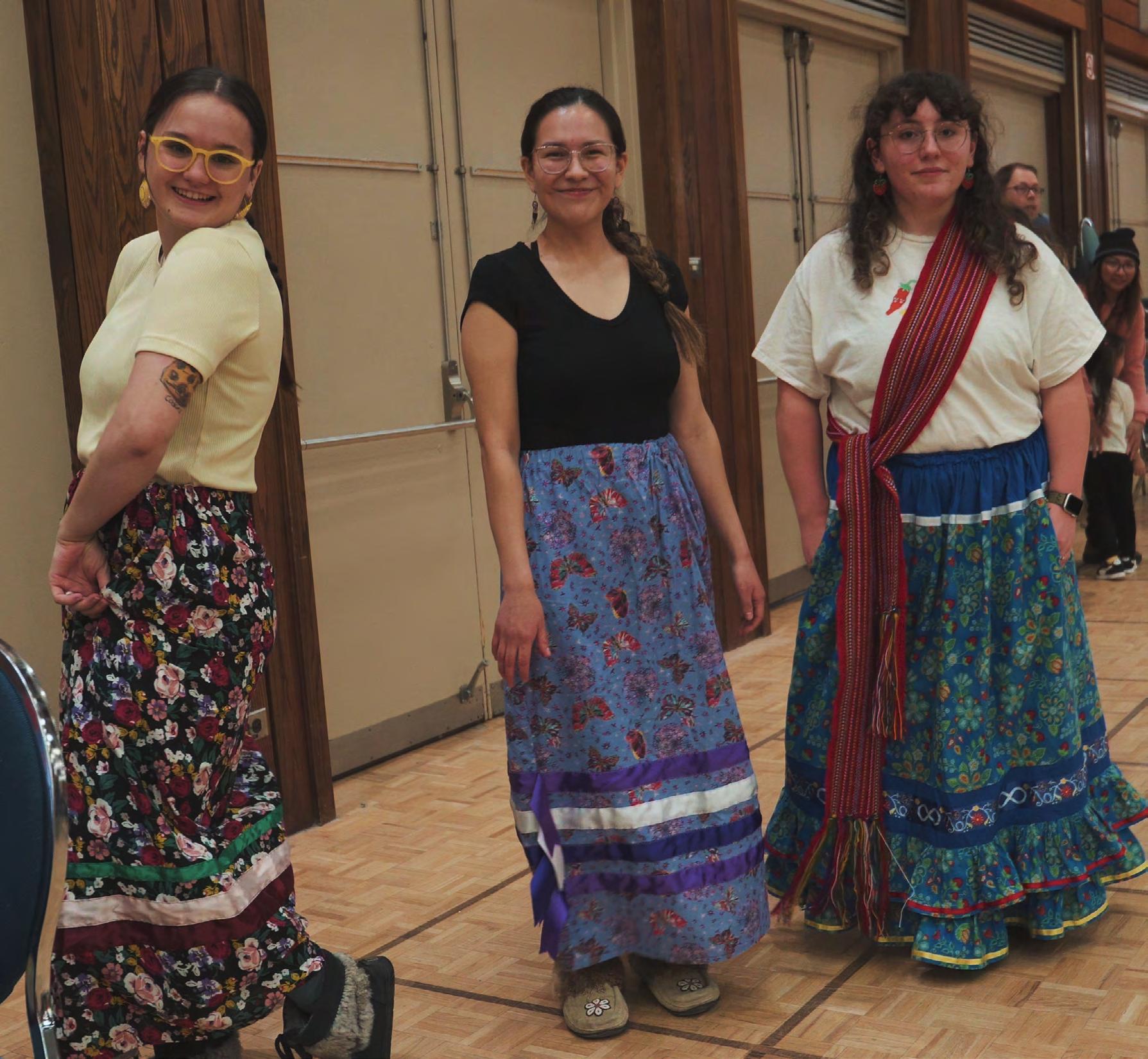
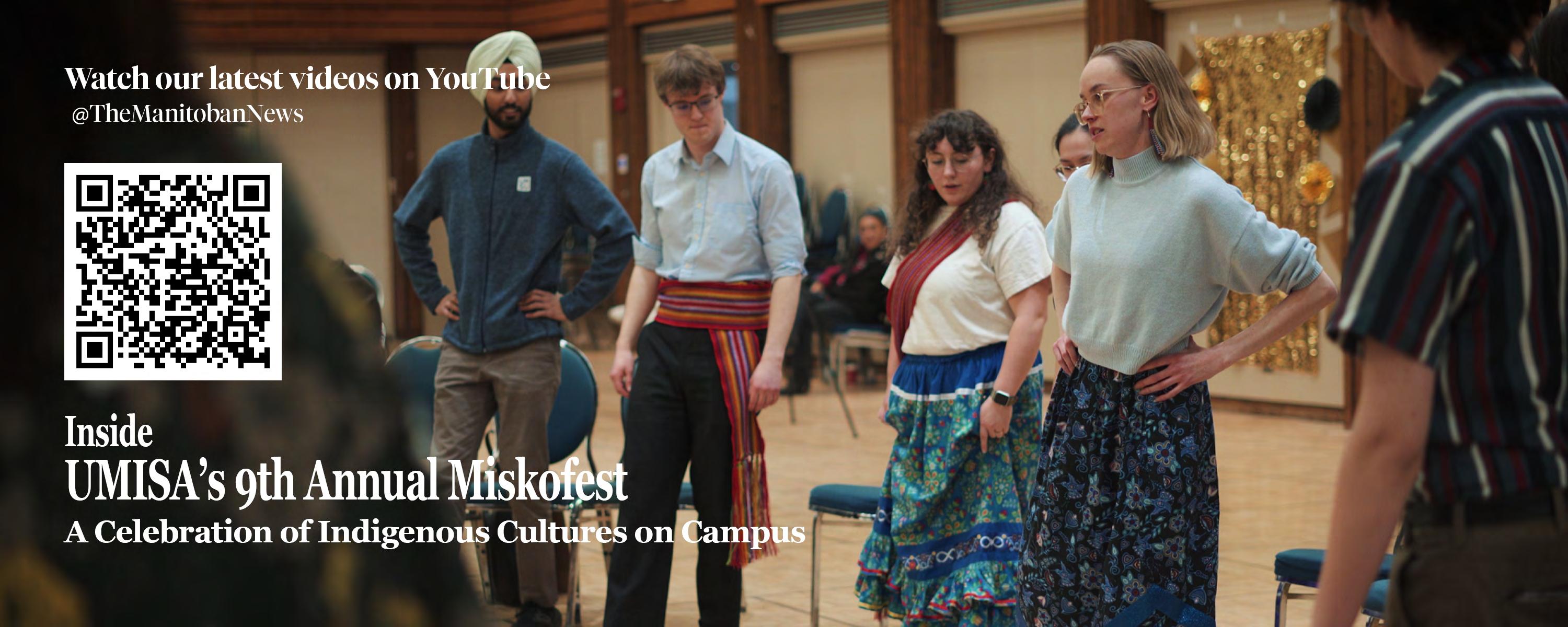
he U of M Indigenous Students’ Association (UMISA) hosted the ninth annual Miskofest on March 20, a day-long celebration of Indigenous, Métis and Inuit culture in the university community. UMISA co-cultural coordinator and next year’s UMSU Indigenous students’s rep Rayden Seela shared that, featuring various performers and speakers, the day served as a way “of celebrating […] a wide variety of all Indigenous culture.” Guest speakers included Manitoba’s minister of advanced education and training Renée Cable, along with U of M vice-president (Indigenous) Angie Bruce.
Sam North, a student at Yellowquill University College, was invited along with her class to attend Miskofest. For North, the event put community first and foremost. “I knew the drummer [and] one of the grass dancers […] I also knew one of the throat singers” shared North. “It’s pretty cool to see a lot of people I knew come together in community and spread good vibes.” When asked what her highlight of the day was, North laughed. “The draws! […] but, the whole day altogether has been really good for me.” Donations for the
North Point Douglas Women’s Centre were collected at the raffle table, with a draw ticket given for each non-perishable good brought in.
Vendor and U of M student Lucy Lindell was selling beadwork along with prints featuring her first solo exhibition at the Manitoba Museum. For Lindell, the event means a reframing of the U of M community as a whole. “As an Indigenous student […] I’ve had a very mixed experience at the University of Manitoba, sadly, with discrimination and racism, but it’s events like this that bring me into the university where I have a greater respect and […] fonder memories.”
A feature of Miskofest was the contests, of which there were many, including an on-the-spot jigging lesson followed by a contest, won by Mackaila Bruce-Tapley. Bruce-Tapley attributed her win to the women in her life. “I just learned [jigging] from watching my family and my aunties do it all the time.”
The jigging lesson was led by Jessica Burzuik, Métis inclusion coordinator at the U of M and the Manitoba Métis Federation. Burzuik shared that she learned to jig at an event hosted by Migizii Agamik’s Karen Courchene,
also known as Kookum Karen. For Burzuik, Miskofest’s importance not only lies in what it is about, but who is running the show. “It’s so
much fun, a bunch of wonderful Indigenous folks coming together,” she said. “[It’s] all student-led and really important work. [I’m] so happy to
support them.”
To stay tuned for future UMISA events, check out their Instagram @umisacouncil.
PHOTO BY MIKAELA WARKENTIN / STAFF
Rethinking Cuba
Discussion highlights democracy, media and global politics
Arifah Gheesah, staff
The U of M Students for Cuba, along with the Manitoba-Cuba Solidarity Committee, hosted an event on March 18 to talk about Cuban democracy. The event covered different areas of the Cuban government, its electoral system and how it contrasts with Canada’s multiparty system. The goal was to debunk the common idea that because Cuba is a one-party state that it is undemocratic.
Diane Zack, U of M alum and retired teacher, was a speaker at the event. “We wanted to have an angle to capture people’s imagination because even the half-sympathetic mainstream media portrays Cuba as an authoritarian dictatorship, which it isn’t.”
The event presented information including statistics on the average voting percentage in Cuba, which is much higher than in Canada and even higher than in the U.S.
“University is a place for inquiry,” Zack explained when reflecting on the importance of such discussions on campus. “Right now, we’re in a period of massive war insti-
gated by the U.S. government [...] We have to watch very carefully how the Canadian government is responding to that.”
“It’s important for young people to be aware of what’s going on in the world,” Zack said. She believed that even though young people “may not have time to follow the news that carefully,” they should have “an open mind and a critical eye [and be] able to evaluate the media they follow.”
“Even though you might feel, as many students say, ‘I’m not political, I’m just focused on my career,’ what happens in the world affects us deeply.”
“Canada was one of the only two countries in this hemisphere that did not break off relations with Cuba after its revolution, which was Jan. 1, 1959,” Zack said. “We would like Canada to continue having positive relationships with Cuba, which is why we call on the Canadian government to do many things.”
The event fostered discussions about education and the three-months-long oil blockade that Cuba is facing.
Attendees also got to discuss Canada’s independence and sovereignty. They also discussed the role of the communist party in Cuba and its function. Zack believed that students were able to learn new things as a lot of people came in not knowing much about the topic.
“The Cuban people are very proud and they will not be starved into submission. They are ready to fight,” she said.
Zack has also been a
coordinator at the Manitoba-Cuba Solidarity Committee for 25 years. She mentioned how the committee’s focus is currently on the campaign to support Cuba against U.S. intervention. She also mentioned that the “committee, and Cuba as a country, have been with Palestine and Palestinian people from even before the founding of the State of Israel.”
The Manitoba-Cuba Soli-
darity Committee and the U of M Students for Cuba will be organizing several events in the weeks to come, such as rallies for Cuba in front of the U.S. consulate, an event with the upcoming MayWorks Festival of Labour and the Arts, as well as their Che Guevara volunteer brigade panel happening March 25. For more information, check out @uofmstudentsforcuba on Instagram.
U of M panel explores antisemitism and inclusion
Students and leaders discuss EDIA gaps and campus experiences
Nafisa Al Lilo, staff
Questions of identity, inclusion and rising antisemitism took centre stage on March 19 at the U of M during the Equity, Diversity, Inclusion, Accessibility (EDIA) Community of Practice Session 5. Titled Jewish Identity, Antisemitism and EDIA, the event aimed at strengthening how institutions approach equity work.
The session was hosted in person and included a panel and breakout discussions. The featured speakers were Melanie Soderstrom, department head of psychology, Emily Kalo, a second-year student at the faculty of law and Lindsay Kerr, director of Hillel Winnipeg.
Soderstrom shared that while antisemitism may look different today, its core meaning remains unchanged.
She noted that modern antisemitism appears in multiple forms, across the political spectrum and in relation to global issues but stressed that these patterns are not new.
“They did not arise suddenly in the last few years,”
she said.
Addressing why antisemitism continues, Soderstrom pointed to both history and present-day conditions, and explained that the “hatred of Jews goes back centuries, not years or decades.”
Education was identified as one of the most important tools in addressing antisemitism, particularly as its modern forms can be less visible.
“I think it is extremely important to educate the general public about what modern antisemitism looks like,” she said.
ization, and we counter that with building bridges,” Soderstrom stated. “It takes time, but deeply hurting communities need support to reconnect with each other.”
A key focus of the session was examining how EDIA frameworks include or fail to include Jewish identity.
“Coming into today’s discussion, the topic that I really wanted to discuss was anti-
Office of Equity transformation or a professor or a dean saying they acknowledge that antisemitism is real,” she stated, “but also building relationships.”
According to Kalo, equity work is rooted in ongoing connection. “[To get toward true equity, it’s] really about having that dynamic relationship so that we can continue to meet up-and-coming needs of these communities.”
“Hate is driven by dehumanization, and we counter that with building bridges”
— Melanie Soderstrom, U of M psychology department head
She explained that while many people recognize overt symbols of hate, newer expressions often require more context to understand. This includes awareness of global events, political language and historical narratives.
Rather than shutting down conversations, she encouraged open dialogue and engagement across differences.
“Hate is driven by dehuman-
semitism and established EDIA frameworks,” Kalo said. “How do we ensure that antisemitism is included?”
Kalo emphasized that inclusion must go beyond symbolic recognition. “Jewish students shouldn’t just be included in those frameworks but should feel like they’re included.”
She explained that meaningful inclusion requires more than statements or policies
“It’s not just about the
She also highlighted the importance of relationships across different groups on campus.
“How do we create that relationship between Jewish faculty and students and other marginalized communities so that we can really build equity at large?” she asked.
Kalo also spoke about lived experiences at U of M. “I think antisemitism is, unfortunately, a real reality,” she said.
She noted that these experiences are not isolated. “As a Jewish student, I’ve definitely
had experiences with antisemitism on campus, and I know, unfortunately, I’m not alone in that.”
For Kerr, supporting Jewish students means creating both community and consistent presence across campuses.
“We tend to run usually one or two social or holiday programs a month,” she said. “I do visit our campuses on a weekly basis and bring snacks or lunch twice a month to our campuses.”
Kerr stressed that while Hillel is centred on Jewish students, it also welcomes others.
“Hillel exists for Jewish students but is also open to allied students who want to learn about our community,” she said.
When addressing antisemitism directly, Kerr encouraged students to take note of the action and share the concerns that they have with someone.
She stressed, “Students should never be made to feel that they have to do something on campus if they feel like it would put them in a position that will make them uncomfortable.”
PHOTO BY MIKAELA WARKENTIN
Flourishing through healthy eating for older adults
U of M’s ESSENCE session guides retirees on balanced nutrition and brain health
Nafisa Al Lilo, staff
The U of M organized a session on March 19. This brought together retirees and community members to explore healthy aging through nutrition as part of a broader initiative aimed at supporting scholars beyond retirement.
The session was titled Nourish to Flourish: Eating Well as We Age with Leslie Redmond.
Francene Perehinec, family resources coordinator, noted the session is one piece of a larger institutional effort through the Emeriti and Senior Scholars Engaged in Navigating Continued Excellence (ESSENCE) Project, funded by the 2025-26 Strategic Initiatives Support Fund.
The project connects to the university’s recognition of emeriti and senior scholars — these titles are awarded to faculty and administrators in acknowledgement of distinguished service and contribu-
tion.
Organizers emphasized that the sessions are primarily designed for retired academics.
Redmond presented different vitamins and minerals, discussed their benefits and explained which foods hold those vitamins.
Throughout the presentation, Redmond emphasized that nutrition in older adulthood is less about strict rules and more about understanding how the different nutrients support the body over time.
A major portion of the session focused on essential vitamins and minerals, particularly B vitamins, which play a role in energy metabolism, brain function and overall health.
For example, B12, primarily found in animal products, was highlighted as especially important for older adults, as
absorption can decrease with age due to changes in stomach acid.
A consistent theme throughout the session was the importance of obtaining nutrients through food rather than relying on supplements.
Redmond shared that although some vitamins can be prescribed in high doses for medical reasons, excessive supplementation can carry risks, including liver damage or nerve issues in certain cases.
The session addressed the relationship between nutrition and cognitive function. Foods like fish, nuts, leafy greens and whole grains were highlighted as part of dietary patterns associated with better cognitive outcomes.
Approaches such as the Mediterranean diet and DASH diet were discussed as examples of balanced eating that emphasize whole foods, lean
proteins, healthy fats and overall lifestyle.
Regulating diet is important, but practical steps such as having an active lifestyle and eating with others are also essential.
U of M Matcha Club launches on campus
A new club whisking students into community
Arifah Gheesah, staff
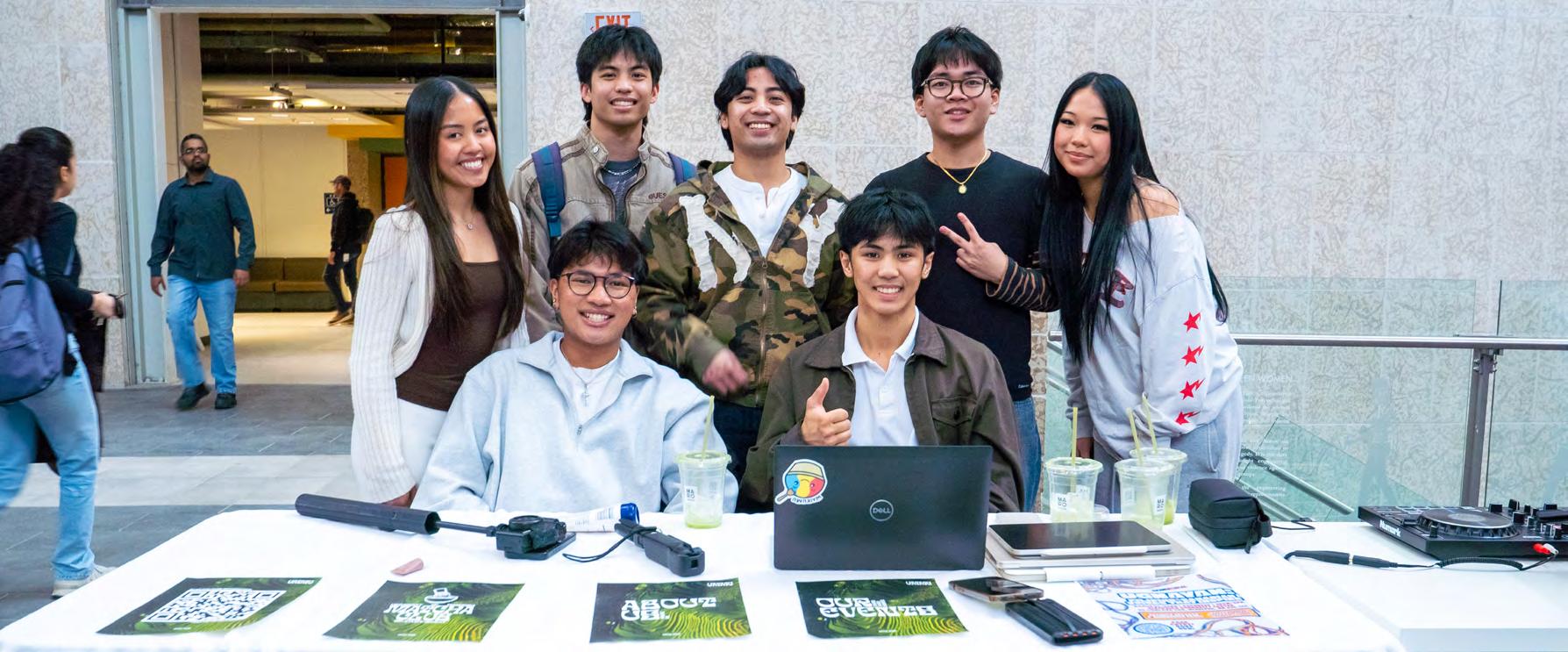
The U of M Matcha Club (UMMC) announced its opening on Instagram on March 10 as ”a welcoming social space for matcha enthusiasts to sip, study and repeat.”
The club started with Johann Tan, UMMC vice president, wondering why there was no matcha club on campus. He then spoke to Arian Andes, UMMC president, and they eventually got to planning.
“Not a lot of students have access to go [to] downtown due to car issues, transportation issues,” Andes explained. The club thought that bringing vendors to campus would be convenient for students. These local pop-ups also benefit a larger student audience.
“Drinking matcha, when you find others that love it too, it’s very sociable. You can meet a lot of people and make lots of friends just by drinking it,” Tan replied when asked about what matcha means to
him personally.
Andes explained how their vision with the club is to have matcha workshops and cafe hopping to create a social space on campus for people who might not already have that social circle.
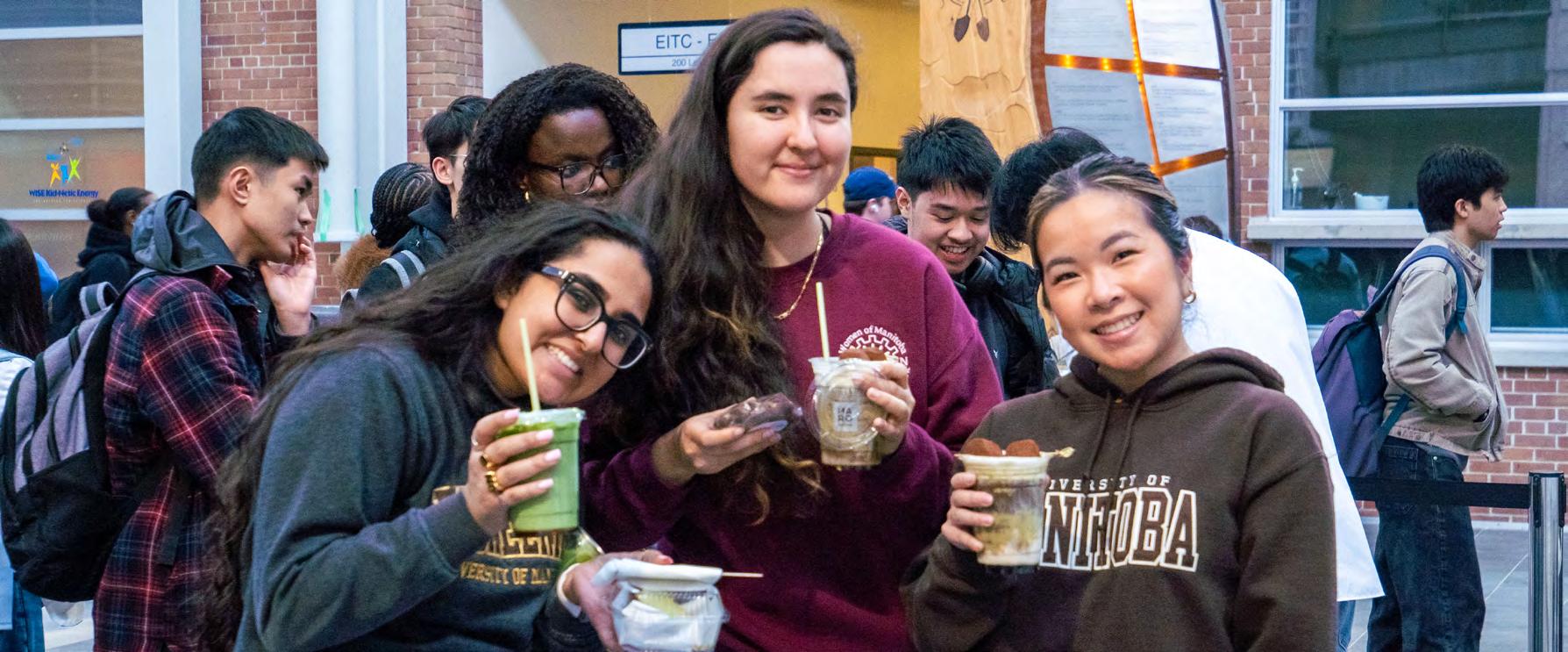
Their first event, UMMC X MARO MATCHA on March 19, a collaboration with a local matcha shop, attracted people beyond their expectations.
This event also featured an exclusive UMMC drink, the Dubai chocolate hojicha.
John Maraneta, UMMC treasurer, explained the importance of having this event in the middle of the stressful midterms season.
“It’s always nice to have this socialization, this community to come back to and just realize that we can take a step back and just chill out.”
To learn more about the U of M Matcha Club and keep up with their events, follow them on Instagram @ummatchaclub.
One of the key messages of the session was simplicity. Rather than looking for a single superfood or nutrient, individuals are encouraged to be intentional about their overall eating habits.
PHOTOS BY MIKAELA WARKENTIN / STAFF
LESLIE REDMOND, ASSISTANT PROFESSOR OF AGRICULTURE AND FOOD SCIENCES.
PAWS FOR A CHAT
Tuesday, March 31 2-3PM
Fireside Lounge - 1st floor, UMSU University Centre
Research & Technology
Spiritual benefits of going offline in a digital age
Research indicates social media impacts spirituality, positively and negatively
Nawal Semir, staff
I
n today’s digital world, spirituality is increasingly shaped by online spaces.
Social media, apps and websites provide new ways to engage with faith, but they also reshape how people think about and practice spirituality. Research shows that while digital tools can support religious life, stepping away from them can significantly deepen spiritual engagement by improving focus, strengthening relationships and fostering intentional reflection.
One key reason offline engagement is beneficial is that digital environments can disrupt spiritual focus and reshape belief formation.
Research by Mark Ehlebracht found that social media influences how emerging adults construct their religious and spiritual beliefs, often creating a more fragmented and individualized understanding of faith rather than one rooted in traditional communities. This suggests that constant online engagement may weaken sustained, structured spiritual practices. By contrast, going offline allows individuals to reconnect with more stable and intentional forms of spirituality, such as prayer, reflection and communal worship.
Another major benefit of disconnecting is the ability to improve attention and mental clarity. These are essential aspects of meaningful spiritual engagement.
cates that high levels of screen time are associated with cognitive strain, reduced attention span and increased mental health challenges. Since spiritual practices such as meditation, prayer and contemplation require sustained attention, reducing digital distractions can directly enhance the depth and quality of these experiences.
Going offline also supports emotional well-being, which is closely tied to spiritual life. Digital detox research shows that limiting social media use can reduce stress, improve mood and enhance overall mental health. Personal accounts and qualitative observations further suggest that stepping away from social media leads to better sleep, reduced anxiety and increased engagement in meaningful offline activities such as reading or creative hobbies. These improvements create a mental and emotional environment more conducive to spiritual reflection and connection.
“Digital overuse can weaken these connections by replacing face-to-face interaction with passive online engagement”
Studies on digital distraction show that excessive device use negatively impacts concentration and engagement, particularly in learning and reflective environments. Similarly, psychological research indi-
In addition, offline engagement strengthens real-world relationships and community, which are central to many religious traditions. Spirituality is not only an individual experience but also a communal one, shaped by shared practices and interactions. Digital overuse can weaken these connections by replacing face-to-face interaction with passive online engagement. In contrast, reducing screen time encourages deeper interpersonal communication and shared spiritual activities, reinforcing a sense of belong-
ing and collective meaning. Despite these benefits, it is important to recognize that digital platforms also offer valuable contributions to spiritual life. Online spaces enable access to religious teachings, communities and resources that might otherwise be unavailable. Ehlebracht’s research argues that social media can foster discussion, questioning and exploration of faith, allowing individuals to engage with diverse perspectives and develop their beliefs. Other research by Heidi A. Campbell explains that digital platforms support new forms of religious expression and community-building, demon-
strating that spirituality is not confined to offline spaces.
Furthermore, digital tools can enhance connection and accessibility, particularly in contexts of isolation. According to Xiaoshuang Lu et al, digital media use highlights how online platforms provide important opportunities for social interaction and support, especially when in-person engagement is limited. This suggests that rather than replacing spirituality, technology can complement it when used intentionally.
Ultimately, the relationship between digital technology and spirituality is not a simple opposition between online and offline engagement. Instead, it is about finding balance. Going offline offers clear benefits — improved
focus, emotional well-being, stronger relationships and deeper reflection. At the same time, digital tools provide access, flexibility and new forms of connection. In a world of constant connectivity, cultivating spiritual depth requires intentional boundaries. When individuals incorporate regular periods of disconnection, whether through daily breaks, reduced screen time or practices like digital fasting, people can create space for more meaningful engagement with their faith. At the same time, maintaining selective and purposeful use of digital tools allows individuals to benefit from the opportunities technology provides. Together, this balanced approach supports a richer, more sustainable spiritual life.

GRAPHIC BY EMMA GILLICH / STAFF
Rethinking care by challenging traumatizing systems
U of M social work scholar studies anti-racist, community-led approaches to healing
Mansura Akter Meghla, staff
F or Christine Mayor, trauma is not just an individual experience, rather it is often produced by the very systems meant to provide care.
Mayor, an assistant professor in the U of M faculty of social work, was recently awarded the North American Drama Therapy Research Award for a second time — the first ever to do so — for her work in anti-carceral and abolitionist practices in the helping professions.
Mayor studies how racism and institutional practices shape experiences of trauma. She specifically focuses on challenging those systems and developing community-led alternatives grounded in justice and collective healing.
“I primarily research issues of trauma and traumatizing conditions, (anti-)racism, educational equity and the arts,” she explained. Additionally, several of her projects examine how anti-Black and anti-Indigenous racism are embedded in schools, mental health services and social institutions — even those claiming to be “trauma-informed.”
Before entering academia, Mayor worked directly in the field, where she directed a trauma-centred K-12 program serving “low-income Black, Latinx and immigrant and refugee students.” She noted, “Most of my research questions stem from the challenges and issues that arose when doing this work in the field and/or with my ongoing relationships with organizations and communities who face systemic inequities.”
One of her current projects focused on community-led approaches to safety in Winnipeg. The study examined Community Safety Hosts (CSH), a program designed to support people who may be excluded from public spaces due to racism or stigma.
“In Winnipeg, many people have difficulty accessing public places like libraries, government service buildings and health care facilities when they experience racism or stigma — often pushed out by security,” she said.
CSH aims to offer an alternative to traditional security models. “Rather than securing spaces, they aim to secure relationships,” Mayor said. The program is grounded in wâhkôhtowin, a Cree and Métis worldview that emphasizes interconnectedness and collective responsibility.
“As part of their training, CSHs are taught through wâh-
kôhtowin […] that everyone is interconnected and related, making us all responsible for one another as kin,” she said. Mayor’s team analyzed hundreds of reports from CHS staff to understand how this approach is practiced in everyday interactions.
“Our findings show that CSHs embody wâhkôhtowin in seven interconnected ways,” she said. These include offering practical support and care, particularly for those who are marginalized or vulnerable.
For example, hosts offer practical support through small acts of care and provide guidance to those who are vulnerable, including youth and older adults. The most significant finding, however, was the value of time and listening to others’ stories. According to Mayor, these interactions often involved slowing down and building trust, an approach that contrasts sharply with traditional security practices.
Beyond individual projects, Mayor sees her work as part of a broader effort to shift how society understands trauma.
“I hope that my research […] bring[s] attention to the ways in which suffering is created through traumatizing systems and conditions,” she said. Rather than focusing on changing individuals, meaningful solutions require systemic change in policy and practice, she added. By centring community voices and using creative, arts-based methods, Mayor aims to make research more accessible and responsive.
Looking ahead, she is beginning a new project funded by the Social Sciences and Humanities Research Council examining “carceral logics” in helping professions (e.g. teachers, therapists, social workers, etc). “By carceral logics, we mean the ways in which punishment-based ways of thinking and acting function to blame, stigmatize and even criminalize individual people,” Mayor explained. “Especially those who are Black, Indigenous, radicalized, disabled, unhoused, migrants, 2SLGBTQ+ or poor — rather than blaming bad systems.”
These logics, she explained, refer to punishment-based ways of thinking that blame and stigmatize individuals instead of addressing systemic issues. “In the ‘helping professions,’ this can look like control, surveillance and ‘behavioural management,’” Mayor said. The project will use focus groups and creative methods such as tableaux
to explore how these practices are enacted and how they might be replaced with more supportive approaches.
Mayor’s research lab is called Creative Community Change. To learn more about her work, find her on Instagram @CCCResearch and for
her latest SSHRC project, visit @abolitionist_enactments.
PHOTO BY MIKE THIESSEN / STAFF
PHOTO BY PHOTO EDITORNAME / STAFF
“NITOTEM” BY JORDAN STRANGER, @TOTEMDOODEN
The wonders of museums
Trips to museums spark inspiration, no matter how long they take
Max Reid, staff
Museums offer a place for more than just displaying art, science and the events of the past. Museums are places for people to get lost in and discover interests and passions on display, to learn about the past and look at the future of what these showcases are teaching us.
For some, like myself, museums even push us to pursue or engage with fascinations we had growing up. As a kid, I was fascinated by dinosaurs and wanted to get my hands on everything I could that involved them. Every rock I picked up, I hoped would contain some sort of fossil that I could take home. I had books of all kinds of dinosaurs — picture books, science books, dictionaries — and I would read them over and over. When my family and I would go to the Manitoba Museum, I would wander around all the exhibits, but when it came to the dinosaur and prehistoric history sections, I would become fully immersed in what the museum had to offer.
The Canadian Fossil Discovery Centre in Morden would also inspire me. Morden is a hot spot for fossil discovery, so it was only reasonable that I had to go there. Being a fossil museum, every display was like looking at gold for me. Every weird, iconic and niche dinosaur and prehistoric reptile I saw, I had to know everything about, which would lead to me talking my parents’ ears off about everything I saw.
There was one fossil centre, however, that would set my interest in stone and shape me and what I wanted my future to look like.
When I was around fourteen years old, we took a road trip to Alberta to visit some family. One of the major activities we did was take a trip to the Royal Tyrrell Museum in Drumheller, a paleontology museum and the highlight of my trip. Everything I could think of seeing was in there, and much more.
I read every card of information, watched every video and walked through every exhibit, doing anything I could do to fill my head with as many dinosaur facts as possible. When I reached the end, I realized my dad and I were the only ones from my family left there — everyone else went back home. I didn’t even notice I was there for over six hours. When we caught up with everyone else, my uncle
asked what I thought about one of the plant exhibits. I was confused, though. I didn’t see the exhibit he was talking about. I dragged my dad back to the museum that night to
make sure I didn’t miss anything and spent another hour and a half going through it again. If it wasn’t for these trips to museums and fossil centres, I
doubt I would’ve chosen the courses that I did and pursued my interest as I have. Those exhibits, for many people, are more than just cool information booths. They are a con-
firmation that their interests are things to chase after. They are examples of their love of art and science on display to inspire them to reach for their dreams.
To complete Sudoku, fill the board by entering numbers 1 to 9 such that each row, column, and 3x3 box contains every number uniquely. In Straights, like Sudoku, no single number 1 to 9 can repeat in any row or column. But rows and columns are divided by black squares into compartments. Each compartment must form a “straight.” A straight is a set of numbers with no gaps but it can be in any order, eg [7,6,9,8]. Clues in black cells remove that number as an option in that row and column, and are not part of any straight. Glance at the solution to see how “straights” are formed.
The Manitoban horoscope for the week of March 25
Zodiac sign mania, flip a coin and see your fate this week
Quinn Mayhew, staff
AQUARIUS
January 20 –February 18
Aquarius, I’m sorry to tell you, you cannot have mini eggs for breakfast, lunch and dinner. Even though Easter is right around the corner, make sure you’re not overindulging in expenses or unnecessary purchases.
for your bank account and it’s not doing wondrous things for your diet. Do us both a favour and try to curb your matcha cravings.
PISCES
February 19 –March 20
Pisces, you need to contact your friends. Your friends care about you, and when you ignore them, they can feel neglected. Make sure you are leaving room to let friends and family know you care about them.
TAURUS
April 20 –May 20
Taurus. It’s time to stop, drop and roll. You need to slow your pace going into next week or risk burning yourself out. Take this week to connect with your childhood self and do things that make you happy.
ARIES
March 21 –April 19
Dear Aries, you need to stop buying multiple matcha drinks in one day. It’s not good
CANCER
June 21 –July 22
In the merry month of March, do indeed walk the yellow brick road. Book that trip you’ve been putting off, go do the thing you’ve feared doing — just make sure you act before it’s too late.
GEMINI
May 21 –June 20
Gemini, beware of two-faced friends this week. That feeling you’ve been getting that a friend is speaking badly about you is not just a feeling, it may be reality. Make sure you are certain, however, that they are speaking badly about you before you confront them.
LEO
July 23 – August 22
Leo, go see a ballet performance or play this week. You need to tap into your more creative side, as you have been spending too much time prioritizing things that need to get done over having a creative outlet.
VIRGO
August 23 –September 22
Virgos, do not sign up for those horseback riding lessons you’ve been wanting to do. As much as you want to
sign up for horseback riding lessons, this may be distracting you from actual problems you may be having. Stop trying to avoid processing things by signing up for random courses.
thing to say. Perhaps save it for next week.
LIBRA
September 23 –October 22
Libra, you have not wasted time on that thing you care deeply about. I know the fear of the future scares you, but when is the future not going to be scary? Trust in your ability that you are doing what’s best for you instead of listening to that annoying tiny voice in your head.
SAGITTARIUS
November 22 –December 21
Sagittarius, you need to reestablish your limits. Just because someone dares you to eat 12 Subway sandwiches does not mean you should eat them. Try to reconnect with your limits and know when to say no.
SCORPIO October 23 –November 21
Scorpios, I need you to stop what you’re doing and do the YMCA. Do not pick arguments with your fellow co-workers this week. The universe is not on your side if you have some-
CAPRICORN
December 22 –January 19
Capricorns, if you see a Facebook ad for a free ferret, you should definitely not go pick up a free ferret. Just because something looks enticing does not mean it’s reality. Be careful this week, as some things may not be what they seem.
A letter to Benson Boone and the Mormon backflip theory
Benson Boone constantly risks his neck just to attract attention
Quinn Mayhew, staff
Recently, my thoughts have been consumed by Benson Boone. If you haven’t heard of him, I would first answer, “Lucky you.” However, my disdain for Boone stems from a deep-seated jealousy of his ability to do backflips, with my own backflipping skills being inferior to his, almost null and void.
Boone rose to stardom as an emerging pop artist with hits like “Beautiful Things,” “Mystical Magical” and “Sorry I’m Here For Someone Else.” While I can acknowledge Boone as multi-talented, he haunts my thoughts daily. There’s something in his lyrics that subtly fosters a sense of distrust towards Boone — one that feels both unwarranted and unprompted. The lyrics, “Moonbeam ice cream, taking off your blue jeans,” from his hit single “Mystical Magical” references the tempting idea of cosmic ice cream being enough to inspire someone to remove their blue jeans, which feels somewhat creepy and invasive. Without fail, every time I hear “Mystical Magical” on the radio, I can’t help but answer Boone vocally as
though he can somehow sense that a girl in Winnipeg, Manitoba is trying to tell him that things are indeed not “mystical magical.”
Although Boone has made a name for himself through his sequin-studded jumpsuits, backflips and his overall over-the-top enthusiasm and zest for life, it’s his excessive use of backflips in almost every on-stage performance that has me questioning why he persists in doing these on-stage stunts when they risk being both unnecessary and dangerous.
Through Boone’s use of nonsensical aerodynamics to cultivate an onstage presence based in flamboyancy, he had me doing weeks of research as to why he keeps trying to defy gravity. Through my research, I found a Boone theory dubbed the “Mormon Backflip Theory.”
Boone’s upbringing was rooted in the Church of Jesus Christ of Latter-day Saints, growing up a devout Mormon in a small town in Washington.
With so much of Boone’s early years being shaped by his Mormon identity, the connection to why he backflips
so much makes a little more sense.
A few creators on the internet have flocked to share their perspective on how backflipping in the Mormon religion is often how young Mormon men attract attention while staying within the parameters of the church’s rules.
YouTuber and former member of the Mormon church
Alyssa Grenfell shared her perspective in a video, stating, “I grew up in the church, and I can confirm that doing a backflip is one of the classic ways for a Mormon boy to attract a mate and to simultaneously dunk on his less athletic friends.”
If the Mormon strategy for attracting attention is a backflip, then is the secular alternative the consumption of alcohol?
The video continues with Grenfell alluding to the fact that neither smoking nor drinking are permitted within the Church of Jesus Christ of Latter-day Saints, with backflipping being the familyfriendly version that can attract attention as an alternative to “Chad” potentially trying to woo you with his cup pong skills.
Although the Mormon backflip is a cool alternative to the consumption of alcohol, I cannot seem to get over the fact that Boone is constantly risking a potential neck injury just to attract attention.
Even with his signature backflips being on brand with his on-stage persona, I feel like a lot of his energy is manufactured as a way to draw in an audience of young women, not only with his backflips but
also with his suggestive nonlyrical lyrics that, at the surface level, are highly illogical.
Benson Boone, I am sorry that I cannot seem to get past what I think is a highly curated inauthentic version of yourself. I know it’s senseless, yet my dislike persists. I think that, at the end of the day, it’s truly your ability to do a backflip and my inability to do the same that makes my disdain for you grow.
GRAPHIC BY TEEGAN GILLICH / STAFF
Pothole magic
Why Winnipeg’s potholes come from climate change and poor city planning
Adam Johnston, volunteer staff
Every spring, Winnipeg enters its annual “pothole season,” when crumbling roads spread chaos from main routes to side streets, frustrating drivers, Manitoba Public Insurance (MPI) and city officials alike.
This recurring “pothole magic” stems from a devilish trio — heavy car use, climate change and sprawling development — leaving rising repair costs and unsafe roads in its wake.
Freeze-thaw cycles fuel Winnipeg’s potholes each season. Melting snow seeps into pavement cracks, and when temperatures drop, the subbase expands, putting pressure on the pavement until it fails, creating new potholes overnight. Mix in heavy traffic and poor pavement, and you’ve added a key ingredient to the pothole magic recipe.
This unwelcome phenomenon spares no corner of the city, from Downtown and North Kildonan to Sage Creek and Waverley West. Pothole magic has become the city’s Achilles’ heel. In early 2024, Winnipeg filled more than 70,000 potholes within three months. In roughly this same period, MPI logged 1,466 pothole-related claims, up from 379 the year prior, citing the
winter’s extensive freeze-thaw cycles. By 2025, those numbers dropped slightly to 45,247 potholes and 682 claims.
Climate change worsens conditions. The Narwhal in 2022 reported that warmer, wetter winters across the Prairies will put additional strain on cities struggling to maintain aging infrastructure.
More frequent freeze-thaw cycles on a warming planet will increase these challenges. Roads in older neighbourhoods, already nearing the end of their lifespans, will deteriorate more quickly, further raising maintenance costs.
Urban sprawl also contributes to the problem. Low-density development stretches Winnipeg’s road network — and its budget — thin. U of M engineering professor Ahmed Shalaby told CBC News that many of Winnipeg’s roads were built 40-60 years ago, making them more vulnerable to cracks. Writer Michel Durand-Wood also told CBC that the city has more roads than it can afford to repair. This adds to the recipe of endless potholes, accelerating pothole magic.
Winnipeg’s pothole magic problem, worsened by climate change, is a fast-growing symptom of the city’s neglect
Money management Navigating spending as a student
Thandeka Katsika, staff
When I lived in Zimbabwe with my parents, I thought I was good with money. I knew how to budget, I did not spend unnecessarily, I tithed regularly and I always felt in control of my own spending habits. But since moving to Canada and living alone as a student, my perspective on money management has completely changed. What felt simple to me back in Zimbabwe now feels like an
impossible balancing act.
One of the biggest differences I’ve noticed since moving is that I no longer have access to what I like to call “invisible hands.” There were so many things that were just there, provided by my parents. Groceries were restocked before they ran out, toiletries like toilet paper and soap never seemed to finish and things like dish soap, surface cleaners and even air fresheners would just appear when needed. My parents and their “invisible hands” took care of all these seemingly small expenses, so much so I never had to consider them.
Living alone has made me realize how many hidden costs I was unaware of. These are not things you buy once and forget about, they are recurring necessities. Every month I have to make sure I’m restocking the basics, and those costs add
and lack of financial foresight. Potholes reveal a deeper issue — Winnipeg’s failure to build within its means.
Decades of sprawl have created a city that is too big and too spread out to maintain. More pavement means more wear, more potholes and endless temporary repairs. Each spring, radio hosts joke about the damage while City Hall repeats the same patchwork cycle — raising costs but avoiding the real conversation about how pothole magic exposes our overreliance on cars.
This cycle harms those least responsible for it. Lower-income residents, people without driver’s licenses and those who take transit or cycle are subsidizing a car-dependent lifestyle that benefits wealthier residents. Bus riders see fewer improvements to transit and cyclists still wait for a safe, complete active transportation network while the city spends hundreds of millions expanding roads.
Winnipeg’s own Transportation Master Plan 2050 calls for a 50 per cent shift away from cars, yet over 80 per cent of Winnipeggers rely on a private automobile in some capacity as their main mode, about 9 per cent take transit and only 6 per cent walk
or bike, according to Statistics Canada. As U.S. soccer analyst Taylor Twellman brilliantly said in 2017, “The definition of insanity is doing the exact same thing knowing the result.” That’s Winnipeg and many North American cities today.
City Hall keeps treating potholes with patches instead of policy, but studies show that reducing car dependency, investing in transit and cycling and rebuilding older neighbourhoods make cities more financially resilient. Better land use can lower costs, support climate goals and improve quality of life.
We cannot keep joking our way through pothole season every year. Pothole magic won’t disappear until Winnipeg stops repeating its mistakes and starts building a sustainable, livable city for everyone. Until we have real hard conversations between us as residents and city council, pothole magic will continue for a long time.
Adam Johnston hosts “Not Necessarily The Automobile” on Thursdays at 11:30 a.m. on UMFM 101.5. He can be reached at notnecessarilytheautomobile@gmail.com
up quickly. I cannot just spend money on things I want anymore. I need to make sure I have what I need for daily function. These things cannot be neglected, and so I have no choice but to spend my money on them.
The same applies to groceries. Before, I did not think twice about having food available, and so any extra money I had could go to eating out with friends. But now I’m fully responsible for making sure I have actual meals at home. The shift from not noticing these responsibilities to carrying them out has been one of the biggest adjustments I’ve had to make since moving to Canada and living alone.
Additionally, I’ve also had a really hard time accepting how quickly small expenses add up. Something as simple as buying a matcha latte here and there doesn’t feel like much in the moment, but over time it becomes a significant amount of money. It’s made me more aware that money management is not just about
big purchases but also the small, consistent ones. I’ve also struggled with balancing what I need versus what I want. As a student with a busy and stressful schedule, it’s easy to justify spending as a way to cope or reward myself. Sometimes it feels deserved, especially after a tough week. But knowing when it’s okay to treat myself and when I need to hold back is something I’m still working on.
I’m still figuring it out, as you can probably tell, but I’ve started trying a few strategies that feel realistic for me. Instead of jumping straight into strict budgeting, I’ve been tracking my spending in my notes app. I will write down the date and anything I spend outside of my necessities. It’s really helped me be more aware of where my money is actually going. I know that there’s a big difference between knowing what I should do and actually doing it, so for now I’m focusing on awareness. From there, I’m slowly building better habits.
For example, instead of constantly buying small treats or drinks, which I noticed I spend a lot of money on, I have started learning how to make things at home, so it’s more sustainable in the long run. I am also trying to start saving a small portion of what I earn every month, 10 per cent to be specific. Even though it’s not much, I think putting aside even the smallest amount consistently is helping me build discipline with my savings.
Living alone has pushed me to be more responsible and more aware of my choices, especially when it comes to money. It is both freeing and challenging at the same time. I’ve had to become more self-controlled than I expected, but in the process, I’m also becoming someone I can rely on. I’m far from perfect, but I’m learning and that itself feels like progress.
GRAPHIC BY TEEGAN GILLICH / STAFF
GRAPHIC BY PIERRE HABIMANA / VOLUNTEER
The worst of 2003 is back
Reactionary politics, body panic and militarism are shaping culture again
Kyra Campbell, staff
I was only two years old in 2003, but looking back, it is hard to shake the feeling that we are back there again, only this time the whole thing is overtly meaner, faster and somehow even less ashamed. Militarism, body panic and reactionary politics are back, but now they are moving through a culture with fewer limits and a greater appetite for content and spectacle.
The Bush era sold needless violence through moral certainty and patriotic theatre. The Trump era is doing something similar, but in a more brazen form. The current U.S. and Israeli war against Iran has already spiraled into a broader regional crisis, pulling more countries into the conflict and opening the door to wider destruction. Trump is now publicly berating NATO allies for not backing the war more aggressively. The old script is familiar — violence is framed as leadership, and restraint as weakness.
While political attention ricochets from one escalation to the next, other suffering is brushed aside or folded into the background. In Gaza, Israel closed all borders again after the strikes on Iran, halting humanitarian aid and medical evacuations, returning famine to a population already pushed to the brink.
In Cuba, a nationwide grid collapse has left millions without power amid a U.S. oil blockade that has cut off fuel and pushed the power grid toward failure. In a country already strained by sanctions, fuel shortages and limited outside support, the blackout has made preserving food and caring for basic needs far more difficult.
In Venezuela, amid longstanding crises, Trump’s recent political moves have intensified instability by capturing Maduro and openly positioning the U.S. to run the country during a supposed transition, turning Venezuela into yet another site of brazen U.S. intervention and oil politics. The speed and volatility of reactionary politics and the ease with which governments now move from one escalation to the next help push longterm suffering out of view.
The same atmosphere is visible in pop culture. If you have not seen photos or videos from recent red carpets, do not go looking for them. The current body ideal being normalized in celebrity culture is not glamorous, it is alarming. Hollywood and influencer beauty standards have shifted toward dramatically
hollowed cheekbones, visible collarbones and extremely thin arms, with red carpets increasingly reflecting a more hauntingly skeletal look. The broader fashion industry has also been moving backwards toward ultra-thinness after years of hard-won pressure for body diversity.
This should be viewed not only as an aesthetic swing, but also as a political one. A culture that rewards women for appearing frail, underfed and easily controlled is not moving in a liberatory direction. You cannot meaningfully
fight misogyny while romanticizing weakness as femininity. You cannot confront war, state violence and reactionary politics while celebrating bodies that look depleted. This does not mean strength has to look one way, and it does not mean that every woman owes the world some performance of toughness, but there is nothing progressive about a beauty ideal built on shrinking.
Even some growing trends marketed as wellness can slide into that same logic. Pilates is great, movement is great and caring about your health is
great. But when the dominant ideal becomes being as small, delicate and non-threatening as possible, wellness starts to look a lot like puritanism in a prettier outfit.
Women do not need to disappear to be beautiful. Eat enough, lift weights and build strength. Be healthy enough to think clearly, act forcefully and resist the systems that benefit from your weakness. Refuse the fantasy that becoming smaller is the same thing as becoming better.
This is why it feels like we are in 2003 again. History
is not repeating itself identically, and not every trend from the early 2000s has returned. But many of the ugliest instincts of that era are back all at once — reckless war, public cruelty, dangerous body standards and a political culture that keeps lowering the bar for what people are expected to accept. The main difference is now everything is more immediate, more algorithmic and more relentless. We do not need a 2003 revival. We need to stop accepting what should still shock us.
GRAPHIC BY EMMA GILLICH / STAFF
RWB’s The Sleeping Beauty a showstopping event
Choreographed by Christopher Stowell,
Carrington Dong, staff
While American actor Timothée Chalamet controversially claimed that no one cares about ballet anymore, one would not believe it with how packed the Centennial Concert Hall was on the evening of March 14 as audiences excitedly waited to watch the Royal Winnipeg Ballet’s (RWB) The Sleeping Beauty
The penultimate performance of a five-show run, this was not the first time RWB had presented the classic ballet set to Pyotr Ilyich Tchaikovsky’s iconic score, but it was the first time dancing to choreography by Christopher Stowell, the company’s new artistic director.
The role of Princess Aurora is considered a dream role for many ballerinas. Dance Magazine noted that the role offers both technical and artistic challenges. Alexandra Ansanelli, retired principal dancer at New York City Ballet and the Royal Ballet — two of the world’s most prestigious ballet companies — called performing Aurora “the epitome of what it means to be a ballerina.”
There are lofty expecta-
tions, but Vancouver-born Kyra Soo was more than up for the task. Soo executed her performance with stunning grace and precision, most notably in the famously challenging “Rose Adagio,” where she held her balance on one toe, en pointe, for over a minute, only supported in intervals by holding the hands of her “suitors” (soloist Logan Savard, soloist Peter Lancksweerdt, second soloist Joshua Hidson and corps de ballet artist Tymin Keown). On March 19, it was announced that Soo had been promoted from the corps de ballet to the rank of soloist, and with such a bravura performance here, I fully understand why. Partnering Soo was thensecond soloist Marco Lo Presti as Prince Florimund. Having already seen Lo Presti as the Nutcracker Prince, he was just as impressive this time, carrying the role with charisma and gravitas. He provided steady partnership to Soo, displayed great acting skills during Act II’s dream sequence, and sent the audience into thunderous applause with his Act III variation. Like Soo, Lo Presti received a promotion following the production’s run. He
the classic ballet impressed all ages
was promoted to the highest rank of principal dancer — certainly well deserved.
The rest of the cast was just as impressive. Principal dancer Stephan Azulay relished his role as the evil fairy Carabosse, cackling enthusiastically while cursing the newborn princess, while Maggie Weatherdon, recently promoted to second soloist, was ethereal as the Lilac Fairy, floating about the stage as if she really had wings. The famous pas de deux between Bluebird (second soloist Liam Saito) and Florine (principal dancer Alanna McAdie) was a great showcase for the dancers’ agility. The ensemble numbers were intricately executed, the dancers not missing a beat despite the complex formations. And it was a special treat to see retired RWB dancers Yayoi Ban, Alexander Gamayunov and Jaime Vargas make guest appearances in character roles, highlighting how RWB continues to honour its past.
It was my first time taking my younger sister to the ballet, and even she, not a dance lover, was impressed by the quality of the production, all the way down to the detailed
costumes, designed by Anne Armit, and the music, wonderfully performed by the Winnipeg Symphony Orchestra conducted by Ming Luke. Luke, who will become RWB’s musical director next season, was a passionate and enthusiastic conductor, and it could be felt throughout the whole ballet.
The Sleeping Beauty was the first real look at RWB under
There is no other band quite like Hut Hut
Local post-punk band reunites for self-titled second album
Jordan Anglin, staff
Hut Hut was formed a decade ago after the semi-disbandment of Boats, which featured lead singer-songwriter and guitarist Mat Klachefsky and a rotating lineup of musicians. When Klachefsky stepped into a new career and could no longer afford the commitment of Boats, he and other members of the band began their Hut Hut project as a more casual alternative. That is, until Klachefsky lost the job and found himself with an onslaught of emotion, culminating in Hut Hut’s second album, Hut Hut
This time around, he describes the new selftitled record as containing more anger than their previous album, Hut Hut Hut, released in 2020. The album is extremely tongue-in-cheek. For example, the chorus of the opening song, “Dukes Up On Lawns,” has the line, “Don’t try hard, you will never get that far / you’ll never be the
who the hell you think you are,” over what is sonically still rather upbeat and danceable.
In the hook-filled song, “Our Stubby Arms,” Klachefsky also sings, “I’ve been meaning to make some friends in case my friends die.”
Both of Hut Hut’s LPs are inspired by a broad taste for post-punk and a certain quirkiness that could only have come from Klachefsky. He noted that in making the selftitled album he was not writing with the goal of achieving any particular sound, and that his favourite albums are ones in which each of the tracks are stylistically different from one another. Hut Hut’s music is somewhat reminiscent of Modest Mouse or Animal Collective, but these comparisons still miss something. Hut Hut stands out among other bands for Klachefsky’s distinctly high-pitched and nasal voice. On that note, he recalled a show he played on tour once when an attendee was con-
fused because they expected him to be a woman based on the music they had heard.
“When I get excited, my voice gets high, and I think it is a natural thing. I never learned how to sing, I just ended up that way. And if you listen to old Boats albums, I did not have control of it,” Klachefsky explained. “I just figured it out now.”
Klachefsky highlighted the experience of performing “EpiPen,” the third track of the record, at live shows.
“‘EpiPen’ is fun to play because I try to ruin the sound guy’s day, just making it sound as loud and obnoxious as I can,” Klachevsky described. “I’ve got a whole bunch of new [effects] pedals. I can get even more loud, more obnoxious. But no one has yelled at me yet.”
In their time, Boats released four albums and once played at the South by Southwest (SXSW) Festival. Klachefsky describes his former band as
Stowell, with most of the season having been curated by retired artistic director André Lewis up to this point. If this is any indication of what is to come for the company, Winnipeg ballet enthusiasts should get excited.
For more information on the Royal Winnipeg Ballet, visit rwb.org.
a relic of its 2010s era, featuring glockenspiels and “Hey” chants. Hut Hut’s name came from Klachefsky’s desire for the simplicity of one repeated word. And naturally, his appreciation for minimalist names is also demonstrated with Boats. “Bark Bark” was another name suggested, but
the band voted in favour of Hut Hut instead. Klachefsky enjoys the chance to “explore the sporting world” with the name Hut Hut, as the logistics of sports pique his interest. He is especially curious about “defunct hockey teams” and the transportation of athletes’ jerseys.
PHOTO PROVIDED BY DAVID COOPER
PHOTO PROVIDED BY HUT HUT
KYRA SOO (RIGHT) AND MICHEL LAVOIE.
HUT HUT.
Working shifts and shifting lives
Lisa Wood paints portraits of precarious labour in rural Manitoba
Boris Tsun Hang Leung, staff
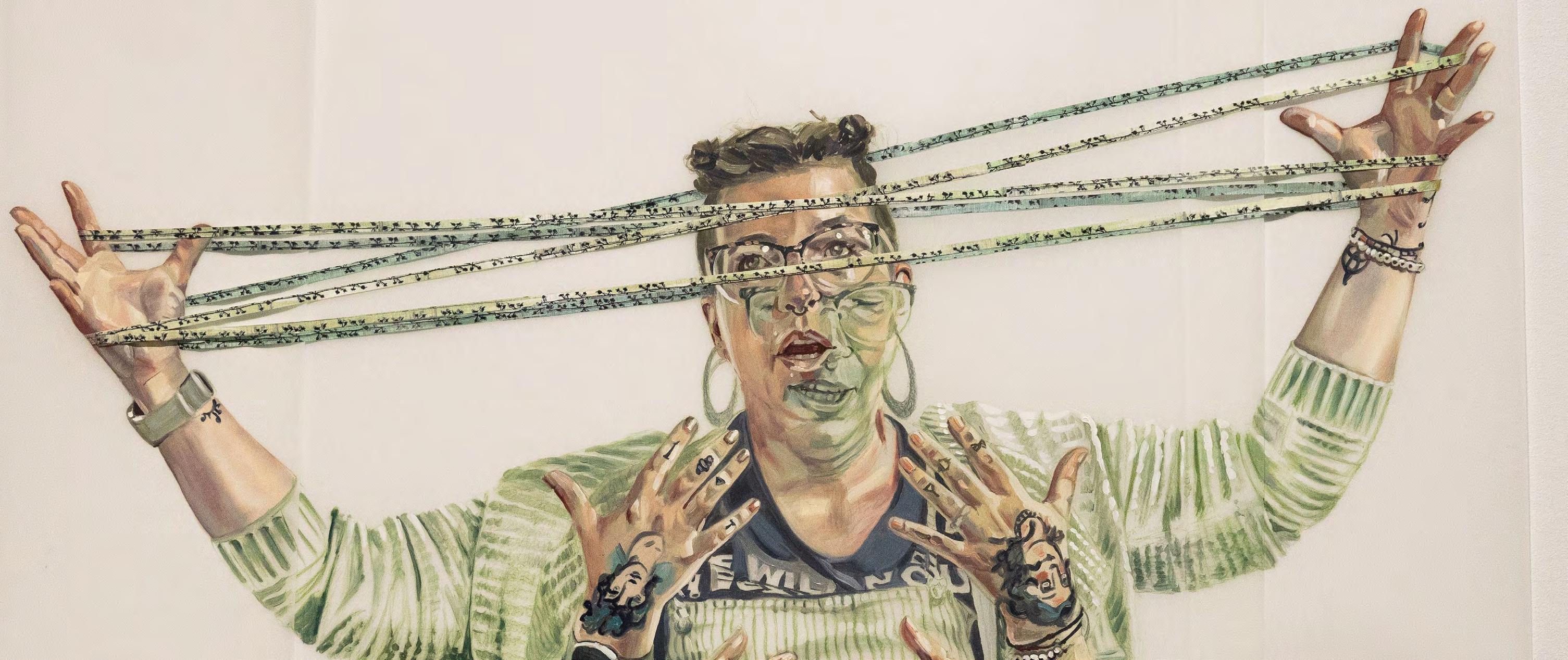
The woman sits, her glassy eyes staring aimlessly into the distance while shifting apparitions of faces and arms float around her. Her hands, clenched tightly into fists, grip and pull strips of paper across her chest. It is as if she, too, like the paper, is about to snap at any moment.
Titled “Pull/Tension,” this portrait is one of Lisa Wood’s seven oil and coloured pencil paintings in SHIFT/ WORK: Portraits of Precarity, a SSHRC-funded cross-disciplinary exhibition at the School of Art Gallery that explores the embodied experience of unstable employment in rural Manitoba.
A U of M and Yale University fine arts alumna, Wood is a visual artist and associate professor of fine arts at Brandon University. Her artistic practice can be described as figurative, focusing on portraits, gestures and how people hold their bodies. Credited to her upbringing with a single mother and her experience with chronic health conditions in rural Manitoba, Wood’s work subverts traditional portraiture and depicts those often neglected in the genre — the non-aristocratic and the unwealthy.
SHIFT/WORK is the culmination of research by counselling psychologist Breanna Lawrence and rural health geographer Rachel Herron, along with artwork by Wood and contributing artists Renata Truelove, Michael Vachon and Dhairya Vaidya. According to Wood, its title derives from a play on words — working shifts, and shifting lives as Manitobans navigate migration, rural living, mental health and family life.
In 2024, the team recruited participants experiencing precarious labour in rural Manitoba. Precarious labour is described as work that is unstable, underpaid and lacking in benefits, a phenomenon exacerbated by the COVID19 pandemic. Precarious jobs may be short-term and contract-based and in settings such as meat packing plants and casinos, but it can take many forms in the gig economy, Wood noted.
Moreover, employment and the cost of living have been major sources of concern among Canadians in recent years, a sentiment well reflected among the participants.
“Not only are you working, but you’re also thinking about how you can get more work, or if you’re going to have enough money to pay the bills that
month. And so you’re not just stressed about work. You’re stressed about the concept of work, or the ramifications of not having enough [work],” said Wood.
Some of the recruits were newcomers who wanted to start a new life, but they were often greeted with barriers and red tape. At the same time, international migration to Manitoba reached an all-time high immediately following the pandemic, and the province received 23,589 immigrants and 35,047 non-permanent residents in 2023-24, according to Statistics Canada.
“What we found in rural Manitoba is there are a lot of newcomers […] They have a lot of very specific things going on for them, involving retraining or having their certifications from elsewhere recognized here in Canada. And so a lot of them are doing survival work,” Wood commented.
For two weeks, research participants were prompted to take photographs and write reflections throughout the day, which became qualitative data for the contributing artists to analyze and turn into art.
Vachon combined crisp pencil drawings of office life, obscured faces, written text and more to create busy, non sequitur and almost surreal
collages. Here, the viewer looks through the eyes of the precariously employed. Precarious work is chaotic — it is everything, all at once.
A piece by Truelove depicts a man with children on either side of his shoulder, literally shouldering the responsibility of providing for his family. However, despite dominant themes of uncertainty and anxiety, the workers’ lives are juxtaposed by stoicism and resilience, with sketches of loved ones and tenderly held hands.
In the second phase, the participants were interviewed on video to tell their stories. The team coded gestures and facial expressions in the footage, and Wood selected stills to use as references.
The portraits were painted with bold brushstrokes, using desaturated shades of greens and skin tones against white backgrounds. Hands are an integral motif in Wood’s artwork. Each portrait possesses several arms, and each hand seems to convey its own message, almost evocative of the thousand-armed bodhisattva and mudras (hand gestures) in Buddhist art. Reproductions of the contributing artists’ works were shredded, woven or knotted and incorporated as sculptural elements in the paintings to show symbolically and literally, how precarity has disassembled and
restructured people’s lives.
Wood’s biggest piece, “Up in the Air (Hold Back/Throw Off),” is a triptych based on snapshots from a Zoom interview with a participant, hence the unconventional angle. She reaches her hands to catch strands of paper falling from a net suspended above her, but they escape her fingertips and fall to the ground, her expression frustrated and desperate.
“[She had] her hands in front of her face a lot of the time, and she was really expressive in this way. And there was a sense of being fed up, but also a sense of letting go,” said Wood.
“[I was] thinking about all of the things that might be held at the same time in the net. And then the net, it’s working most of the time, but things are still slipping through the net […] I thought that that metaphor really spoke to that participant.”
Apart from visual art, Wood and audio artist Brendon Ehinger created a collage using audio recordings of the participants. Overlapping and interwoven voices of various accents are played on two speakers, recounting stories as fragmented as their lives.
Participants may be putting themselves at risk by sharing details of their precarious work, but the process was guided by ethical procedures. The identities of the
individuals are deliberately kept secret, and the portraits are shown in regions where the portraits’ subjects are less likely to be recognized by visitors.
“This was the most pressing issue of the work […] You want to be able to honour them and do right by them as they’re choosing to be in the project, and you also want to be able to tell their story truthfully, but you need to make sure that you’re not revealing too much information,” Wood stated.
Despite the anonymity, Wood hopes that people can see themselves in the art or empathize with those who live in precarity.
“It’s also important to think about how feeling value from work is essential for people to have the resources in order to live a good life, but also to feel that you’re contributing and that you are a part of society in a meaningful way,” Wood added.
Perhaps one day, we will emerge from workplace alienation into an era of fulfilling labour.
SHIFT/WORK: Portraits of Precarity will be on display at the School of Art Gallery until May 1. For more information, visit umanitoba.ca/art/shiftwork.
PHOTO BY EBUNOLUWA AKINBO / STAFF
“PRECARIOUS/SANCTUARY” BY LISA WOOD.
Mise en Scene looks back on their coming of age
Manitoba-made album Drive-Thru Confessional is now out
Jordan Anglin, staff
W innipeg-based dreampop band Mise en Scene recently came out with their fifth LP, Drive-Thru Confessional. It features ten laid-back and retrospective songs, most of which were also promoted through a double-track single and two EPs. The two well-experienced musicians, vocalist Stefanie Blondal Johnson and drummer Jodi Dunlop, have been releasing music together since the early 2010s.
The record marks a turning point in Mise en Scene’s style, as the focus of their writing shifts. The music is played noticeably calmer in order to centre Johnson’s storytelling. The latest lyrical content features much more vividly detailed scenes from Johnson’s life as she recounts stories with new perspectives gained with time and reflection.
“It’s funny how the more specific you get in songwriting, [the broader] you can become,” she described. “It’s amazing what some people will take from some of the songs.”
The closing track, “Remember This Feeling,” is especially emblematic of the album’s theme. The lyrics reflect on the importance of one’s previous experiences and resulting emotions in shaping who they become.
“This record is meant to be […] remembering growing up, and thinking about who I thought I was back then, and what I thought was important back then, and what is and what is not important now. And old lovers, old people I’ve met and had these encounters with,” Johnson explained.
The title Drive-Thru Confessional came to the band shortly after COVID-19 lockdowns were eased. Johnson noticed a sign on a Main Street church advertising their cautious adaptions. The album was nearly self-titled, but the strange juxtaposition of fast food with the intimacy of confessing a secret stuck with her. The photo for the album cover was taken at Junior’s Restaurant on McPhillips Street.
Co-producer and multi-in-
strumentalist Micah Erenberg, known professionally as The Secret Beach, also contributed to the compositions. He added lead guitar and other harmonies onto Johnson and Dunlop’s arrangements. Johnson produced her own vocals for the album as well. The band was thankful to have the independent creative control that came with co-production, compared to the management they had experienced with previous producers.
In the time since Mise en Scene’s last album, Johnson spent time as a representative of the Keychange program, where she helped women and non-binary musicians learn how to pave their way in the music industry.
Johnson also looks back on the last decade and a half of her career with a distaste for the growing influence of social media on the music industry. She is concerned by many record labels’ and booking agents’ prioritization of a musician’s online presence over their music when con-
sidering which acts to take on, and the pressure put on musicians to work as influencers.
“[Mise en Scene has] accomplished so much, and we’re so proud of our careers. And I’m so happy we were doing things when we did,” Johnson elaborated. “Because now the focus of the social media pres-
ence [is] a full-time job.”
Drive-Thru Confessional is to be accompanied by an official album release performance at the Times Change(d) High & Lonesome Club on April 18.
Mia Kelly to release Big Time Roller Coaster Feeling
Canadian singer-songwriter explores joy in upcoming album release
Carrington Dong, staff
Folk singer-songwriter
Mia Kelly has big things ahead in her career. After two successful studio albums, a recent tour in Australia and multiple music festival performances, including at the Winnipeg Folk Festival, the Gatineau artist is set to release her third studio album, Big Time Roller Coaster Feeling, on May 22.
“It’s definitely the happiest record I’ve put out so far,” said Kelly of the album’s concept. “There is a lot of celebration of the juicy, good, joyful bits […] There’s just so much worth celebrating, and it’s an album that celebrates community and friendship and love, and also grief. It’s not all happy […] but there’s kind of a levity and a freedom to it.”
Kelly, who admittedly finds it easier to write songs from a “sadder,” more melancholic place, described it as a pivot from her previous albums, although there are still songs that are tonally like past works.
According to Kelly, the album’s title derives from one of the tracks she wrote about the feeling of falling in love.
“[It is] a song about falling in love or having a big fat
crush […] Your tummy drops when they say something or when they look at you,” she explained. “You’re full-on gushing […] I think it’s super fun and evocative.”
Kelly wrote all but two of the tracks on Big Time Roller Coaster Feeling herself, one of the exceptions being the 2025 single “Sea to the Moon,” co-written with and featuring Blair Dunlop. The album was produced with Montreal producer Connor Seidel, who has produced some of Kelly’s favourite records.
“I’ve been wanting to work with him for a long time, and he [has] honestly exceeded my expectations,” Kelly remarked. “He is so [attentive] and kind and thoughtful and creative and excited […] and was just honestly such a joy to work with. And we were so efficient. It was unbelievable.”
Kelly said her favourite song on the album changes regularly, but she highlighted three. She first noted “Blind Horse,” released last November, which she said was about the theme of privilege.
“I think it came out feeling both heavy and light at the same time […] I really like the message and lyrically how
it lands […] and it feels really topical,” she explained.
Other songs Kelly highlighted include “Holy Grail / Big Magic,” the album’s opening track, inspired by the magic of creating art, and “Time’s Easy to Blame,” a collaboration with Australian artist Kim Churchill.
Kelly has been a fan of Churchill for many years, first finding his music over a decade ago. Sharing mutual friends, they knew of each other, but only met two years ago while Churchill was touring Canada. Upon meeting, they clicked right away.
“It was such an easy friendship, and then that summer […] we kept running into each other at different things and different festivals […] I took him river surfing, and we just have a bunch of intersections of interests and musical interests and life interests and friends,” she recalled. “It’s just this beautiful crossover where it feels so natural despite him being from the other side of the planet.”
Kelly and Churchill are set to tour across Canada together for the next seven weeks, including a stop in Winnipeg on April 14 at the Park The-
atre. She expressed that she loves performing live more than anything.
“A huge theme on the record and off the record, just in my life in the last few years has been community,” she reflected. “I think in these extraordinarily strange and hard times that we’re going through, community is kind of all that will pull us through
[…] It’s such a joy to be able to share that, to create moments where you’re pulling people in and making community out of a room of strangers.”
For tickets to the April 14 concert and more information, visit miakellymusic. com or follow @miakkelly on Instagram.
PHOTO PROVIDED BY MATT HORSEMAN
PHOTO PROVIDED BY MATT HORSEMAN MIA KELLY.
MISE EN SCENE.
Hit the Active Living Centre
Patrons share their motivation, encourage others to join
Abdul-Jalilu Ahmed, staff
Active Living Centre (ALC) patrons have shared what motivates them to keep coming back to the facility. They also pointed out their favourite sessions and said they would encourage others to join the gym.
Dongping Yu said health drives him to patronize the gym. “You need to sometimes […] relax a little bit to […] mitigate your stress from studies. So that’s the strategy I use […] I just go to the gym,” he explained.
His preferred workout sessions include jogging on the track, yoga and total body strength exercises. “Total body strength helps me to strengthen […] all parts of my body [in only 45 minutes].”
Yu expressed a strong appreciation for the gym facilities at the ALC and said he would encourage others to make use of them.
Osman, a third-year student at the U of M, said he uses the gym as a way to strengthen his mental focus and tempor-
arily do away with his personal challenges. “I just hit the gym because of the mentality I have […] I come to the gym and just focus everything on the gym so I [forget] everything else, all the pain, all the miseries or all [the] other problems that I have. This is the only place that I come [to] every day and I feel like I’m free.”
He explained that the chest session is his preferred workout routine. “The bench press, which I hit with my friends, is just ego lifting […] I just look up to people and say, ‘Man, maybe one day I’m gonna reach a new level,’ because every day I try to learn new things. In the gym, I try to learn [from people who are] better than me.”
Osman emphasized that incorporating gym activities into one’s daily routine can be valuable to well-being. “I would encourage people who [like] to do physical activity a lot — you can come to the gym every day and then it might help you gain some progress.”
For David, another U of M student, going to the gym is not merely about maintaining his physical appearance, it is “about discipline, stress relief and personal growth.”
He continued, “life can be demanding, and going to the gym gives me a space to reset. It also helps me to challenge myself and helps me feel very productive. I also like the fact that it helps me to build that kind of consistency that I’ve been longing for in life. Even on days when I do not feel very motivated, sometimes showing up reminds me that progress comes from commitment always.”
David described the benefits he has gained from the strength training sessions. “I enjoy them because they allow me to measure progress clearly over time [to see] whether I’m involved in lifting better, improving form or building more endurance. I also like that strength training pushes me to stay focused and intentional.”
He included that he “[com-
bines] cardio with core work because they leave [him] feeling energized and refreshed.”
He acknowledged that starting a gym routine can feel “difficult” but over time, it becomes both “enjoyable” and “meaningful.”
According to David, “The gym benefits almost everyone […] teaches commitment and self-care. Even starting small can make a real difference.” That is why I would encourage readers to give it a try.
Bisons end seven years wait, compete in nationals again
Bisons women’s hockey loses 1-3 and 0-2 in the national championship
Israel Adeogo Abejoye, staff
The Bisons women’s hockey team made it to the nationals for the first time since 2019. Despite giving it a tough fight, the Bisons lost 1-3 to the Concordia University Stingers in the quarter-finals on Thursday, March 19, and lost 0-2 to the University of Waterloo Warriors in the consolation match on Saturday, March 21. On Thursday, Audrey Clavette gave the Stingers a 0-1 lead in the eighth minute [08:14], after her team had seven shots. After that, the Stingers put more pressure on the Bisons by taking twelve more shots, and in the fourteenth minute [14:17], they scored their second goal.
The Bisons later tried to return to the game and put pressure on the Stingers, but Brenna Nicol was sent to the penalty box for tripping at 16:58. The Stingers then put pressure on the Bisons thanks to the powerplay, but they were unable to convert their opportunities, and the period ended 0-2.
The Bisons got off to a better start in the second period, winning more faceoffs in the first two minutes. Beatrice
Caron of the Stingers was sent off for slashing in the third minute [03:19], but the Bisons were unable to capitalize on the powerplay. The Stingers took a more comfortable advantage when they scored their third goal in the thirteenth minute [13:53]. Aimee Patrick of the Bisons was sent off for contact to the head, less than three minutes [17:23] before the second period ended, but the Stingers were unable to increase their lead.
In the third period, the Bisons scored early to get back into the game. The Bisons’ frustration grew as they attempted to score their second goal, but their several attempts were denied. Despite the Bisons’ exploration of empty nets and timeouts, the score remained 1-3. While the Stingers went to the semifinals, the Bisons settled for a consolation game against the University of Waterloo Warriors.
On Saturday, the Bisons faced off against the Warriors. The Warriors scored 17 seconds into the first period. The Bisons were penalized for too many players on ice in the fourth minute [04:49],
resulting in a player being sent to the penalty box. The Warriors were unable to convert their powerplay opportunities. The Bisons’ Sara Harbus was also sent off for tripping in the tenth minute [10:06], but the Warriors still
failed to capitalize.
Despite both sides taking 43 shots in the second period, no goal was scored and the game remained 0-1 heading into the third period. The Warriors scored another goal early in the third period. Nikki McDonald put the Warriors up 0-2 in the sixth minute [06:18], making it difficult for the Bisons to tie. Despite their best efforts to score a goal, the Bisons were defeated 0-2.
GRAPHIC BY TEEGAN GILLICH / STAFF
PHOTOS PROVIDED BY ZACHARY PETERS
SADIE KELLER (28) AND ZOÉ THIBAULT (7) PREPARE TO FACE OFF.
CLAIRE MOORMAN (5) FIRES A SHOT AT NET.
Capturing one frame at a time
U of M student behind the lens at sporting events
Faiyaz Chowdhury, staff
N ot everyone in the stands at a game is just watching. Some are working, and for a certain U of M computer science student, that work means showing up with a camera to capture moments words cannot.
Third-year U of M student Sudor Wilson Naleerabari Clever has been building a photography portfolio that spans multiple Bisons sports and, most recently, the 2026 U SPORTS track and field championships. His journey into sports photography started long before he ever set foot at a Bison event.
After moving to Canada,
“I’m
hoping that one
day I’ll be able to take photos for the NBA”
— Sudor Wilson
Naleerabari Clever, sports photographer
Clever continued photography. “I saved up enough money to buy my own camera,” he said. “I’ve been freelancing ever since.” The jump to sports photography made sense for him personally. A former high school athlete, he found a way to stay connected to sports even when he was not competing. “I can’t play basketball, but I like to see people play. So, since I can’t play, I can take photos.”
He started with photographing Bisons basketball and quickly found something meaningful in it. “[The Bisons athletes] are very nice. They are approachable. And photos tell you everything that happened in just one shot.”
For the track and field meet, he mentioned he volunteered
through CBC News Sports to gain access to the event. One moment stayed with him long after. Clever recalled photographing a track and field athlete who dropped from first to third place, and said he could see the sadness in the athlete’s eyes when he approached him after the race.
The athletes have noticed Clever’s work. After post-
ing and tagging them, the responses have been enthusiastic. “Most times I post a photo and I tag them, I don’t really expect them to repost and tag me, but most of them repost it.”
For any U of M student thinking about picking up a camera, his advice is simple, “I started by taking photos on the phone, I borrowed a cam-
era, [then] I bought my own,” he said. “You just need to learn how to take a good photo and edit it.”
Clever also opened up about the struggle that goes unseen, “People say taking photos is easy, honestly it’s not easy because you had to take the photo, look for a good one, set the lights in and edit it and upload it.”
Despite all the current projects on his plate, Clever has a dream to follow. “I’m hoping that one day I’ll be able to take photos for the NBA,” he said.
For now, the arena is Clever’s stage and, through his lens, every photograph tells a story worth a thousand words.