vol 112 issue 26 March 11 2026

Page 1


109 HELEN GLASS BUILDING UNIVERSITY OF MANITOBA WINNIPEG, MB THEMANITOBAN.COM | 204. 474. 6535

GENERAL INQUIRIES: ME@THEMANITOBAN.COM

CIRCULATION INQUIRIES:

MISSING OR INCOMPLETE PAPER?

EMAIL: DISTRIBUTION@THEMANITOBAN.COM

EDITOR-IN-CHIEF Mikaela Warkentin editor@themanitoban.com

BUSINESS MANAGER Alice Teufack accounts@themanitoban.com

BUSINESS SUPPORT MANAGER Joshua Herold ads@themanitoban.com

EDITORIAL

MANAGING EDITOR Peace Ifeanyi me@themanitoban.com

COPY EDITOR Eden Quiring copy@themanitoban.com

COPY ASSOCIATE Mursal Ghiyasi

NEWS EDITOR Roy Albright Obah news@themanitoban.com

RESEARCH & TECHNOLOGY EDITOR Mansura Meghla research@themanitoban.com

COMMENT EDITOR Quinn Mayhew comment@themanitoban.com

ARTS & CULTURE EDITOR Boris Tsun Hang Leung arts@themanitoban.com

SPORTS EDITOR Abdul-Jalilu Ahmed sports@themanitoban.com

DESIGN

DESIGN EDITOR Deveney Jarrow design@themanitoban.com

DESIGN ASSOCIATE Patricia Sanque

GRAPHICS EDITOR Emma Gillich graphics@themanitoban.com

GRAPHICS ASSOCIATE Teegan Gillich

AUDIO AND VIDEO

AUDIO EDITOR Max Reid audio@themanitoban.com

PHOTO EDITOR Mike Thiessen photo@themanitoban.com

PHOTO ASSOCIATE Ebunoluwa Akinbo

VIDEO EDITOR Zulkifl Rafah video@themanitoban.com

DIGITAL MEDIA EDITOR Faisal Rahman social@themanitoban.com

SOCIAL MEDIA ASSOCIATE Paula Robles Andia

REPORTERS

NEWS Arifah Gheesah

NEWS Nafisa Al Lilo

RESEARCH & TECHNOLOGY Nawal Semir

COMMENT Thandeka Katsika

COMMENT Kyra Campbell

ARTS & CULTURE Carrington Dong

ARTS & CULTURE Jordan Anglin

SPORTS Faiyaz Chowdhury

SPORTS Israel Abejoye

VOLUNTEERS

VOLUNTEER STAFF: Maryam Beg

interested in volunteering?

email me@themanitoban.com today!

The Manitoban is the official student newspaper of the University of Manitoba. It is published monthly during the summer and each week of regular classes during the academic year by the Manitoban Newspaper Publications Corporation.

The Manitoban is an independent and democratic student organization, open to participation from all students. It exists to serve its readers as students and citizens.

The Manitoban is a member of the Canadian University Press, and our journalistic standards can be found on the Manitoban’s website.

The newspaper’s primary mandate is to report fairly and objectively on issues and events of importance and interest to the students of the University of Manitoba, to provide an open forum for the free expression and exchange of opinions and ideas and to stimulate meaningful debate on issues that affect or would otherwise be of interest to the student body and/ or society in general. The Manitoban serves as a training ground for students interested in any aspect of journalism.

Students and other interested parties are invited to contribute to any section of the newspaper. Please contact the appropriate editor for submission guidelines.

The Manitoban reserves the right to edit all submissions and will not publish any material deemed by its Editorial Board to be discriminatory, racist, sexist, homophobic or transphobic, ableist or libellous.

Opinions expressed in letters and articles are solely those of the authors. Editorials in the Manitoban are signed and represent the opinions of the writer(s), not necessarily those of the Manitoban staff, Editorial Board or the publisher.

A “volunteer staff” member is defined as a person who has had three volunteer articles, photographs or pieces of art of reasonable length and/ or substance published in the current publishing year of the Manitoban

Any individual who qualifies as a volunteer staff member must be voted in by a majority vote at a Manitoban editorial board meeting. Elected representatives and non-students may be excluded from holding votes as volunteer staff members in accordance with the Manitoban Constitution.

All contents are ©2026 and may not be reprinted without the express written permission of the Editor-in-Chief.

From rebranding to organizing

UM Socialists rebrand to embrace their political identity

U M Socialists, a stu-

dent club at the U of M, has been undergoing rebranding.

Initially named Humans Against Capitalism and previously UM Regrowth, the club has decided to turn toward a name that directly reflects their goals.

Hunter Reynolds, UM Socialists president, said the club previously tried to obscure its socialist identity to appeal to other student clubs, but with changing membership the club’s goals changed.

“We’re aiming to appeal to socialists and people who are interested in socialism, so I think they should probably know that,” he said.

“People are passionate

about politics, and we want to give them the opportunity to do something with that passion,” Reynolds explained when asked about the club’s goals.

Currently, as a result of club member interests, they are doing local volunteering, a weekly book club, weekly educational videos and are looking at including movie nights and board game nights.

Reynolds mentioned that the club was previously too focused on its identity, when energy could have been directed to “other things.”

“Once we get a big enough membership, we can focus on things like where we fit in, exactly, in the space of Winnipeg politics, or how we want to present ourselves to the pub-

lic, but right now, we just want to get everyone who shares our goals in the same place together.”

On Feb. 28, UM Socialists volunteered with Food not Bombs, a volunteer organization that aims to recover unwanted food, usually vegan or vegetarian, and share it with the public for free.

The club chose Food Not Bombs because “mutual aid is something that aligns with [the] club’s goals.”

“They’re an anarchist organization, which basically means they believe society should be organized by the people, without centralized structures or government,” Reynolds said.

“That ideology is very similar to ours. They’re really

good at practicing what they preach, though, showing that people can take care of each other without the need for profit incentive or coercive power structures,” Reynolds explained.

During the volunteering event, attendees made all the food from scratch and then distributed it to the people themselves. Reynolds highlighted the cost of groceries and the struggles of students to afford food. “Some students are homeless, too. Food is a human right, not a privilege.”

He stated anything people can do to help others with food insecurity “could potentially go a long way.”

“Believing in socialism is believing in your own best interests, as well as the best

interests of humanity as a whole,” Reynolds said. “Give it a shot.”

“The only way we can realistically make change is through organizing, and this club is a good place to do that. We’re still growing and open to any and all ideas right now, so I think it’s a good time to join,” Reynolds included.

“Community is at the heart of socialist ideas, so I think we could provide a really good sense of community for anyone who might be lacking that. I hope especially that it gives a hopeful space on campus for people who want to see actual change in the world.”

Voices of Elders guide annual U of M gathering

Students learn from knowledge keepers at two-day campus event

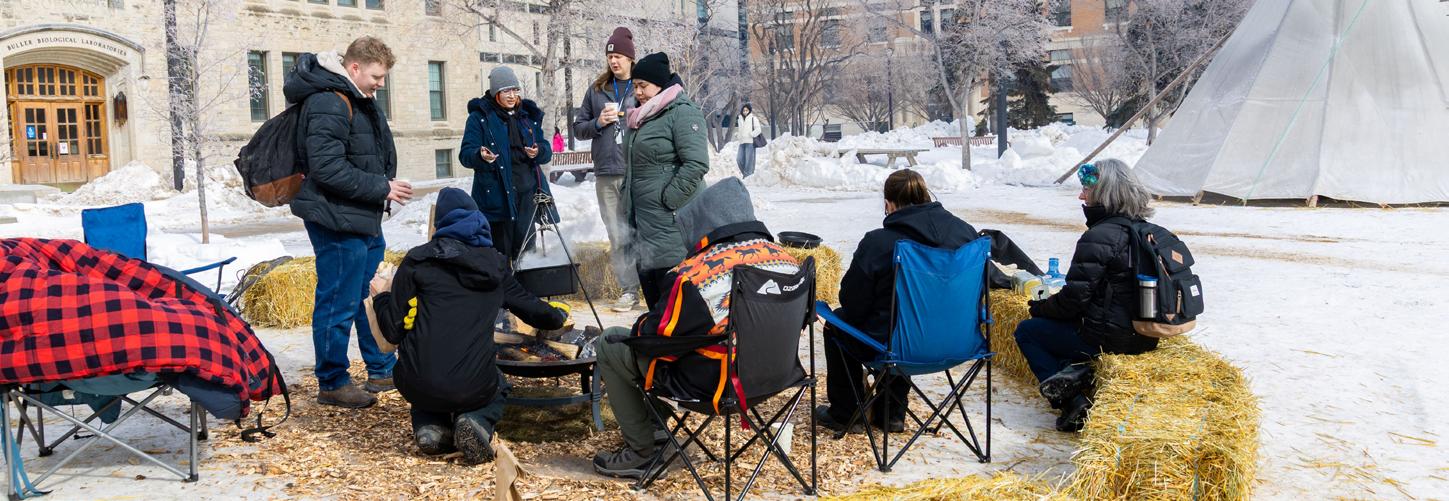
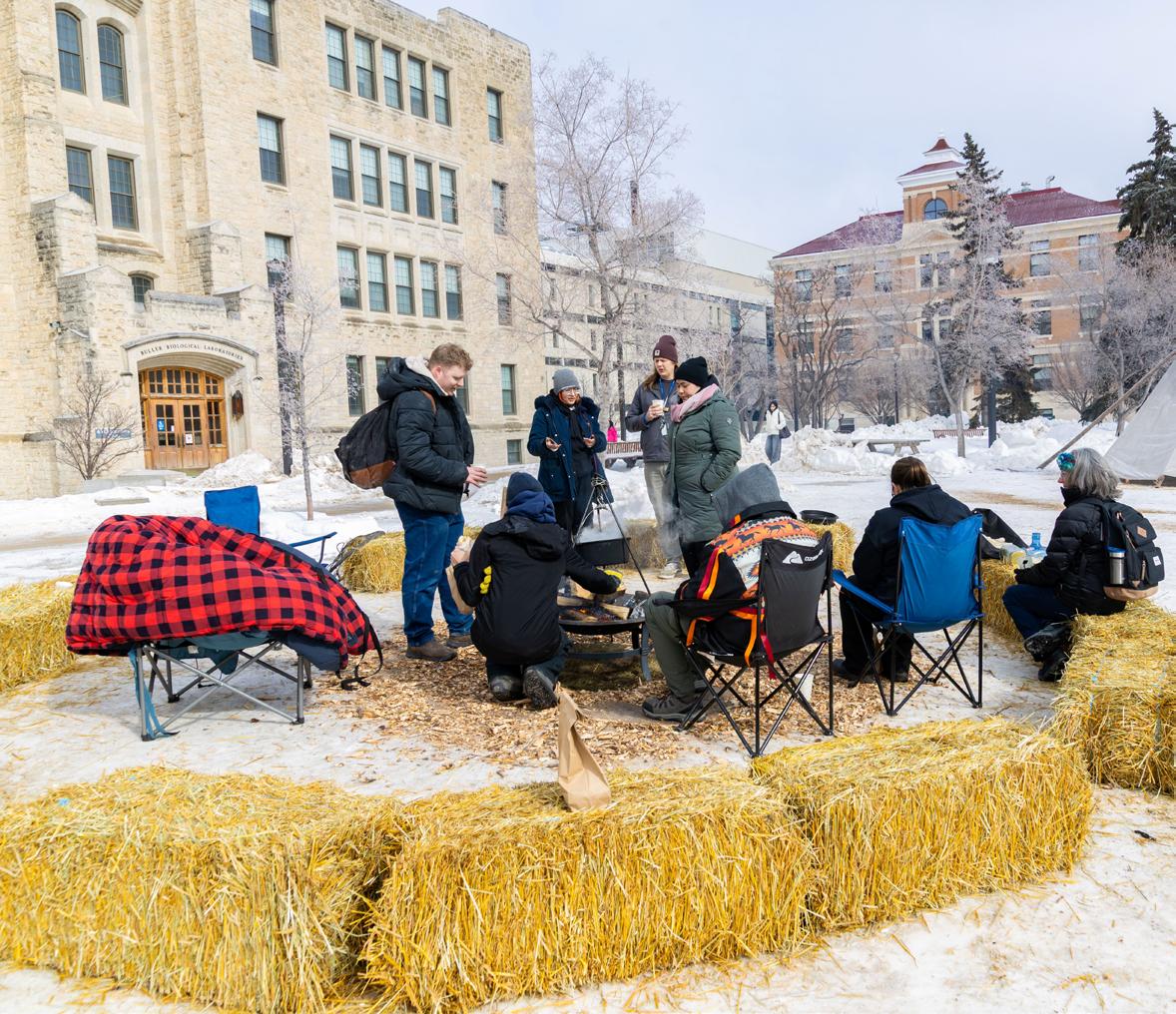
The Elders and Traditional Peoples Gathering returned to the U of M on March 5 and 6, bringing together Elders, students and community members for two days of cultural teachings, ceremonies and community connection.

The Elders Gathering first began in 2002 through the university’s department of Native studies, now known as Indigenous studies.

Now in its 20th year, the gathering provides an opportunity for Indigenous Elders and traditional knowledge keepers to share teachings with younger generations and the wider community.

Vanessa Lillie, director of cultural integration with the office of the vice-president (Indigenous), said this year’s theme, Ancestral Voices Guide Us, highlights the importance of ancestral guidance.

As a core of the gathering, Lillie mentioned that “Elders play a really significant role in Indigenous families, and they’re the ones that we rely on for guidance, and reminding us of our oral histories, and telling us the stories of our history and culture and language.”

Lillie acknowledged the increase in attendance, with hundreds registering this year. “We needed to move into larger spaces to accommodate everyone,” she said.

Outdoor cultural spaces

were an important part of the gathering.

Two teepees and a sacred fire were set up outside, with fire keepers remaining by the fire continuously during the event.

The program featured keynote speakers, presentations and visiting spaces where attendees could listen to teachings or connect to others.

She explained that the gathering was originally designed to strengthen relationships between Elders and young people.

The gathering also featured an Indigenous Student Makers Market where students could showcase and sell their artwork and crafts.

Savannah Moon, one of the student vendors, said the gathering allows people to celebrate Indigenous culture while learning from traditional knowledge keepers.

Moon sells a variety of handmade items, including beaded jewellery, wristlets and ribbon bows decorated with jingle cones. She said the small business helps support her financially while she is in school.

Another booth at the gathering highlighted the work of Women Helping Women Beadwork, an initiative run by Sandra Burling that supports incarcerated women.

At the event supporting the organization was Mackaila Bruce-Tapley, who said the

organization sells beadwork created by women in correctional centres. “All the beadwork that the women make and sell, that money goes toward them for bail or after bail, and also goes toward them if they need resources while they’re in incarceration,” Bruce-Tapley explained.

She described Burling’s work as deeply impactful for the community.

“Sandra is an incredible woman,” she said. “What she does for the community is amazing.”

Jamie O’Neill, another vendor at the market, was representing her family business, 15 Feathers.

O’Neill explained that the business is a collaborative effort among the women in her family to “help spread things that [they] love.”

One of the products they sell is an Action is Required t-shirt connected to the Truth and Reconciliation Commission’s (TRC) 94 Calls to Action.

“On the front, it says, ‘Moving forward requires action,’” O’Neill stated. “On the back, we print whichever of the TRC’s [Calls to Action] really speaks to the customer.”

The idea behind the shirts is to encourage individuals to act in their own way and be able to focus on one action, rather than all.

“94 is too much for any one person, but if we each choose one and move one forward, then one day we’ll get there,”

she shared.

Behind the scenes, dozens of volunteers help coordinate the event and assist the Elders throughout the gathering.

Meghan Young, cultural integration lead for the office of the vice-president (Indigenous), led the volunteer team.

More than 90 volunteers supported the two-day event, guiding attendees between different sessions across the university and remaining by the Elders.

“A volunteer is assigned to an Elder […] to help them over the two days with whatever they need,” Young explained.

Cultural expression was visible throughout the event. Many attendees wore ribbon

shirts and skirts, garments that often carry personal or family stories.

“[Our ribbon skirts are] a piece of our culture that we wear proudly,” Lillie said.

Music and singing also played a role in the gathering’s activities. Bruce-Tapley described a moment where community members gathered to sing songs representing healing and empowerment.

As the gathering concluded, organizers hope even more students will take part in the future.

“We would love to be able to welcome students from across the university in larger numbers next year,” Lillie said.

PHOTO BY EBUNOLUWA AKINBO / STAFF
THE ELDERS AND TRADITIONAL PEOPLES GATHERING TOOK

UMSU elections visualized

A closer look at the new ranked choice voting system

UMSU execs of 2026-27 academic session

Next year’s executives share thoughts on election results

T

he unofficial results are out and next year’s UMSU executives and community representatives are in.

Polls for the 2026 UMSU annual general election closed March 6, with 16.2 per cent of eligible voters casting their ballots in this year’s election, a downtick from last year’s 20.4 per cent. This year also marked the first year a ranked voting system was used, something that has been in the works since 2023. This system, as the name suggests, enabled voters to list their candidates in order of preference on the ballot.

There is only one face returning to UMSU’s executive team, and that is Heaven Kaur. Every other executive member is new and serving for the first time. Following the unofficial election results, each shared their thoughts and reflections.

President

Heaven Kaur

Currently, Heaven Kaur serves as UMSU vice-presi-

dent, university affairs, but she is making her return to the executive team next year as UMSU president.

Reflecting on her win, Kaur thanked the student body who stood by her. “I’m beyond grateful for everyone who supported my campaign, volunteered their time and encouraged me to put my name on the ballot.” Kaur also applauded the other candidates in this year’s election, sharing that “every single candidate truly ran a great campaign.”

As UMSU president, Kaur said she intends to focus on “listening to students, working collaboratively with student groups and advocating for our students to the university, and all levels of government.”

Kaur secured the presidency with 52.2 per cent of the vote.

Vice-president, university affairs

Grace Elendu

The position of vice-president, university affairs went

to Grace Elendu, who shared that upon hearing the results she felt “a deep sense of joy, but that feeling was quickly followed by an even greater sense of responsibility.”

Elendu expressed her thanks to her campaign manager, and said that she “could not have done this without the support of [her] circle and the community that stood behind [her].”

Following three rounds of the ranked voting system, Elendu secured her position surpassing the needed total to win by 442 votes.

Vice-president, external affairs

Aiden Peters

Aiden Peters, stepping into the position of vice-president, external affairs, shared with the Manitoban that his message to students is one of honesty. “A lot of my goals will be incredibly difficult to obtain. However, I promise to do my [utmost] every step of the way, to put my all into the position and fight for students wherever and whenever I can.”

Peters also shared that he “strongly encourages” student body interaction. “Come up to me, to call me out on what I can do better, to talk to me about ideas, problems and hopes,” he stated. “I feel the responsibility on my shoulders.”

Peters won the position with 54.5 per cent of the vote.

Vice-president, student life

Manasa Rajesh

Manasa Rajesh was elected vice-president, student life, a role which she is “grateful” to take on. “As someone who once felt a bit lost on campus, I understand how important it is to feel like you belong.”

For Rajesh, the plan for next year is clear. “I will strive to keep the promises I made during my campaign and continue supporting our clubs and student communities.” Rajesh also thanked the people who supported her through the campaign, “especially [her] friend Ronly and [her] mom, who supported

[her] through the long days and late nights.”

Rajesh was voted in to the position with 53.7 per cent of the vote.

Vice-president, finance and operations

Cameron J. Provost

In the most contested position this election, Cameron J. Provost came out on top as vice-president, finance and operations. This was not Provost’s first time on the ballot for this role. Last year, he walked home with 31.1 per cent of the vote, with the position going to Carolyn Wang who secured 39.8 per cent.

As for Provost’s plans for the year ahead? “I’m excited by the opportunity to put my ideas into action,” Provost shared. “I hope to bring about changes in accessibility that [enable] more student involvement!”

Following four rounds of the ranked voting system, Provost cleared the needed number of votes by 113.
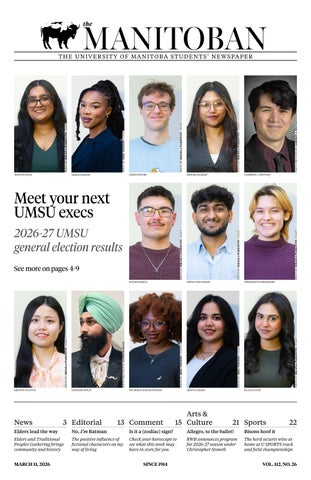

Who is representing you in UMSU 2026-27?

Community representative-elects reflect on election results

Indigenous students’ representative

Rayden Seela

While Rayden Seela ran uncontested for the position of Indigenous students’ representative, it is still near to his heart. “Although I ran uncontested, it still means something to see it confirmed. It means the work begins now,” shared Seela.

“When I ran for this position, I made a promise to make Indigenous students on this campus seen, heard, loved and respected in ways that have never been done here before,” Seela said. “That is a promise I fully intend to keep.”

In a message to the community, Seela shared that he’s looking forward to his term. “I believe deeply in the power of community. Real change doesn’t happen alone, it happens when we come together, when we lift each other up and when we remind this campus that Indigenous students are not just a part of this university, we are part of its future.” Seela’s win was affirmed with 80.3 per cent of the vote.

International students’ representative

Tirth Chaudhary

Tirth Chaudhary, despite running uncontested, shared that these results “mean a lot” to him. “I’m truly grateful for the trust students have placed in me, and I want to thank everyone who participated in the UMSU elections and took the time to vote,” he added.

Chaudhary shared that his experience campaigning gave him “the opportunity to connect with many students and hear their ideas and concerns.”

As for Chaudhary’s plans as International students’ representative, he is already at the drawing board. “I already have some exciting ideas for events and initiatives, and I’m excited to start working on them and connecting with the international student community.”

Chaudhary was elected to the position with an affirmative “yes” vote from 84 per cent of the international students’ community.

2SLGBTQIA+ students’ representative

For next year’s 2SLGBTQIA+ students’ representative Gwendelyn Freeheart, the future looks bright. “I have many plans for next term that I can’t wait to set in motion,” shared Freeheart to the Manitoban

Running unopposed, they also expressed their reaction to their community’s support. “I am beyond honoured that my community has trusted me to represent them at our student union level […] My election to this role would not be possible without the strength and support of my community, so for that I am deeply appreciative.”

As for their plans, Freeheart shared they are “always open to receiving feedback” from fellow students to ensure “Queer Student Family’s lounge and events are access-

ible and inclusive.”

Freeheart’s position was affirmed by an 81.2 per cent vote for “yes” from their community.

Accessibility community representative

Kristen Nguyen

Kristen Nguyen is next session’s accessibility community representative. She expressed to the Manitoban her gratitude for the U of M student community and reflected on her future position’s wider role on campus. “Accessibility affects many people on campus, and this result shows that students want barriers to be taken seriously.”

Nguyen shared her plans for her coming term. “I will work to ensure that the voices of students with both visible and invisible disabilities are heard and that accessibility is treated as a priority on our campus”.

The position of accessibility community representative was the only contested community representative position, and Nguyen secured her role with 66.6 per cent of the vote.

Mature and part-time students’ representative

Sanimar Singh

Mature and part-time students affirmed Sanimar Singh to be the community’s next representative, with Singh noting that his position brings a unique perspective to UMSU’s board table.

“Many part-time and mature students balance school with work, family responsibilities and other commitments,” shared Singh. “It’s important that their voices are represented within UMSU.”

Singh also thanked the members of the community. “I’m truly grateful to the students who supported me and trusted me with the role.” He included, “I’m excited to begin working with the team and advocating for the needs and concerns of part-time and mature students.”

Singh received the affirmative vote of “yes” from 78.3 per cent of the mature and parttime students community.

Black students’ representative

Shumirai Marangwanda

Shumirai Marangwanda ran uncontested for the role of Black students’ representative, but shared with the Manitoban that she sees this as an opportunity to get involved. “The best way to see change or implement ideas is to get involved in the spaces where you can do so.”

Marangwanda intends to bring passion to her role, sharing that her goals are attainable, saying, “I am realistic of what I can achieve,” as she hopes her plans work out. “I will pursue my policies and ideas relentlessly to benefit my community.”

Marangwanda’s win was affirmed by a “yes” vote of 85 per cent.

Racialized students’ representative

Areeva Arora

For Areeva Arora, it is “an honour” to have been elected as racialized students’ representative. She added, “I take this responsibility seriously.” Arora reflected on the necessity of her role in campus discussions. “This role is an important opportunity to amplify the voices and experiences of racialized students.”

Representation is key to Arora, who noted that part of her task will be to “ensure [racialized students’] perspectives are represented in conversations that shape our campus community.”

“I look forward to working closely with the other executive and representatives,” shared Arora. Her goals remain “[advocating] for equity, strengthen[ing] support for racialized students, and help[ing] build a more inclusive and welcoming campus for everyone.”

Arora secured her position unopposed, with an affirmative vote of 84.5 per cent.

Women-identified students’ representative

Kultaj Kaur

At the time of publication, the Manitoban has not received a statement from Kultaj Kaur regarding her securing of the position of women-identified students’ representative.

Kaur received an affirmative “yes” vote from 88.9 per cent of the community.

Meet the 2026-27 UMGPS candidates

Nine candidates seek roles in next UMGPS executive team

T

he 2026–27 U of M

Graduate and Postdoctoral Society (UMGPS) election is scheduled to take place from March 16 to 17. A total of nine candidates are seeking positions on the next executive team, with three of the five roles being uncontested.

There are two slates for the elections, Candidates United for Student Voice and Thrive.

None of the current UMGPS executives are seeking another term in the same role, meaning the upcoming election will bring a fresh leadership team for the next tenure.

President and senator candidates

Emma Heath

Emma Heath, a graduate student in kinesiology specializing in biomechanics and part of the Candidates United for Student Voice slate, is seeking the position of president and senator.

Heath said her decision to run is driven by a desire to refocus the organization on the needs of graduate students and improve transparency in how it operates.

“Graduate students deserve an organization focused on them, who will spend their money responsibly and return as much student support to the community as possible,” she said.

Heath currently serves as co-chair of the Graduate Students of Kinesiology and Recreation Management Association and was involved in a grassroots student initiative to restore departmental association grants, which she said was approved at the 2026 annual general meeting.

If elected, Heath said her priorities would include improving transparency in decision-making, increasing accountability among executives and expanding student supports.

“I will increase transparency by ensuring all meetings are open to graduate students and by publishing meeting recordings and decision-making reports alongside meeting minutes,” she said.

“[I envision my term as] successful, transparent and supportive,” Heath said.

Uche Nwankwo

Uche Nwankwo, a graduate student in biosystems engineering specializing in engineering education, is vying for the position of president and senator.

Nwankwo said he is com-

mitted to “transparent, inclusive and member-centred leadership.” He noted that his leadership approach would focus on proactive advocacy, expanding resources for graduate students and postdoctoral fellows and strengthening collaboration across UMGPS leadership units.

“I strongly believe that UMGPS executives must work collaboratively with all graduate and postdoctoral fellows leadership units to enhance the overall well-being and professional success of every member,” he said.

During his master’s program, Nwankwo served two terms as a senator and participated in several Senate committees, where he initiated projects aimed at improving student well-being and representation.

He added that his priorities include exploring new revenue initiatives, strengthening collaboration across leadership units and expanding support services for graduate students.

“[I envision my term as] productive, collaborative [and] inclusive,” he said.

Vice-president events & clubs

Abiodun Adejumo

Abiodun Adejumo, a master’s student in food and human nutritional sciences, is seeking the position of vice-president events & clubs on the Thrive slate, unopposed.

Adejumo said his motivation to run stems from a desire to strengthen connections within the graduate student community. He noted that “graduate school can sometimes feel isolating, especially when students are focused on their research and spend most of their time within their departments.”

“I believe graduate students thrive when they feel connected, supported and part of a community,” he said.

Adejumo said his focus would be on creating opportunities for students to connect across programs through events, clubs and collaborative initiatives.

“If elected, I hope to strengthen support for graduate student clubs by improving their visibility and helping them access the resources they need to organize activities and reach more students,” he said.

He added “inclusive academic, social and networking events” could help graduate students build professional

connections and feel more engaged in campus life.

“[I envision my term as] inclusive, engaging [and] collaborative,” he said.

Vice-president equity & inclusion

Kyra Swenson, an MBA student, is vying for the position of vice-president equity & inclusion under the Candidates United for Student Voice slate, unopposed.

Swenson said “community is a core value” that motivates her involvement in the graduate student community. Growing up in her Hawaiian grandmother’s home, she said she “witnessed the power of a strong support system” and the importance of creating spaces where people feel welcome and valued.

“I want to contribute to the U of M graduate community, building experiences that support all graduate students while they navigate the complexities of balancing work, life and school,” she said.

Swenson said both her professional and personal experiences shaped her commitment to equity and inclusion. As an educator, she said she “worked to ensure every student felt welcomed in [her] classroom” and supported through individualized approaches to learning.

She added that her own experiences with undiagnosed ADHD, along with raising neurodivergent children, strengthened her commitment to advocacy and removing barriers to success.

“[I envision my term as] thoughtful, responsive and accountable,” she said.

Vice-president academic & senator

The race for vice-president academic affairs & senator has emerged as the most competitive contest in this year’s election. The position initially drew no applicants, leaving the seat vacant at the close of the nomination period.

However, six graduate students later stepped forward to enter the race. Following the withdrawal of two candidates, four contenders remain.

The candidates will now compete for the role, which represents the academic interests of graduate and postdoctoral students at the U of M and at the Senate level.

Laleema Senanayake

Laleema Senanayake, a

PhD candidate in the department of peace and conflict studies, is vying for the position of vice-president academic affairs & senator with the Candidates United for Student Voice slate.

Senanayake said her focus is on bridging the “gap between available resources and student engagement” among graduate students. She noted that, while the university offers several academic and wellness support services, many students are either unaware of them or unsure how to access them.

“Graduate students today are balancing research, coursework, employment, family responsibilities and personal commitments,” she said. “Achieving work-life balance while striving for academic excellence is not easy.”

Senanayake added that her professional experience in institutional development and organizational leadership prepared her for the role. In previous senior management positions, she said she worked with large teams and initiated training programs supporting marginalized groups through “language training, financial literacy and vocational development.”

“I will strive for transparency, accountability and student support,” she said.

Muhammad S. Aldhshan

Muhammad S. Aldhshan, a PhD student in physiology and pathophysiology at the Max Rady college of medicine, is seeking the position of vice-president academic & senator.

Aldhshan

He noted that his experience in student governance and professional roles has prepared him to support academic initiatives and policy improvements for graduate students.

Aldhshan previously served as vice-president marketing & events for the Health Sciences Graduate Students’ Association and has also worked as an awards committee member and events committee member for the former U of M Graduate Students’ Association.

He added that his professional experience as a clinical performance specialist and system performance lead “[has equipped him] with the analytical and policy-driven skills necessary to evaluate academic programs and drive systemic improvements for the student body.”

Aldhshan described his

envisioned term with the words “advocacy, innovation and collaboration.”

Manish Dhakal

Manish Dhakal, an MSc student in mechanical engineering, is seeking the position of vice-president academic affairs & senator.

Dhakal said he decided to run after noticing three gaps affecting graduate students’ academic experience, including challenges accessing funding, workshops that do not always meet student needs and limited awareness of academic rights.

“Funding and grants are hard to find,” he said, as he noted that many students, particularly international and first-year students, do not access available support because information is scattered or unclear.

Dhakal added that graduate students across more than 90 disciplines have varying academic needs, and he hopes to see programming that better reflects that diversity.

“Many students do not know their academic rights,” he added. “When disputes or challenges arise, students often feel alone because they do not know who to turn to.”

Dhakal said his priorities would include improving access to funding information, organizing relevant academic programming and ensuring students know where to seek support.

Dhakal described his envisioned term with the words “listen, act [and] deliver.”

Janie Dupuis

Janie Dupuis, a first-year MSc student in biochemistry and medical genetics, is running for vice-president academic & senator.

Dupuis said she is motivated by a commitment to ensure graduate students and postdoctoral fellows are heard and properly represented across the university.

“I am a person that is very passionate and will give a lot of energy to what I believe is right,” she said. “I am not afraid to connect with leaders across the [U of M] community and beyond to make sure students, and their well-being, are properly represented.”

Dupuis said her campaign priorities include increasing awareness of the organization and its resources, bridging support across all U of M campuses and creating opportunities for students to present their research and access

awards.

She also hopes to develop resources and events that help students with project planning, presentations and time management.

Dupuis described her envisioned term with the words collaboration, transparency and inclusion, and noted that members should

be included in decision-making and trust how resources are allocated.

Vice-president external & senator

Lamia Mahzabin

Lamia Mahzabin, a master’s student in natural resour-

ces management, is running for vice-president external & senator with the Thrive slate, uncontested.

Mahzabin said she is motivated by a desire to advocate for students beyond the campus and build stronger connections with external organizations. She previously served as UMGPSA vice-president

academic & senator in 2025–26, gaining experience in “student advocacy and leadership.”

“This year, I would like to be more actively involved and work on student issues beyond the campus,” she said.

If elected, Mahzabin said her priorities would include advocating for “fairer immi-

gration policies and affordable tuition for incoming international graduate students,” as well as “[strengthening] partnerships with external organizations.”

“[I envision my term as] productive, engaging and resolution-focused,” she said.

EMMA HEATH PHOTO PROVIDED BY EMMA HEATH
MUHAMMAD ALDHSHAN
PHOTO VIA UMGPS.ORG
KYRA SWENSON
PHOTO PROVIDED BY KYRA SWENSON
LALEEMA SENANAYAKE
PHOTO BY LALEEMA SENANAYAKE
MANISH DHAKAL
PHOTO PROVIDED BY MANISH DHAKAL
LEFT TO RIGHT: UCHE NWANKWO, LAMIA MAHZABIN, ABIODUN ADEJUMO AND JANIE DUPUIS
PHOTO PROVIDED BY TEAM THRIVE

Research & Technology

Former U of M professor makes curling breakthrough

Data and innovation help transform the science of curling sweeping

Former U of M professor

Gerry Sande has played a key role in the development of performance technology that has been used by Olympic and World Championship curling teams.

Curling is widely believed to be one of the world’s oldest team sports, with roots dating back to the 16th century. Curling has evolved from its origins on frozen lochs and ponds to the modern indoor rink. While outdoor play continues in some regions when conditions permit, every national and international championship now occurs in an environment where the ice is scientifically controlled.

Regardless of venue, curling requires the use of brooms to sweep the ice on which the granite stone slides. Brooms are essential in every format of the game. They can be used to alter a stone’s path — changing its curve or making it travel further — both for attacking and defending. They are central to the slow, careful tactics of traditional teams and the quick pace of mixed doubles.

In a game where a millimetre’s distance makes all the difference, curling teams focus heavily on perfecting their sweeping with these brooms. After all, a winning strategy is heavily reliant on impeccable sweeping technique.

“One

nique Policy introduced by the WCF affects several of the sweeping techniques used in modern curling. While the policy does not eliminate all existing methods, it clarifies what types of sweeping are permitted and restrict techniques that could excessively manipulate the stone’s movement.

The main principles of the policy include that sweeping should only be used to increase the distance a stone travels, help it hold a straighter line, or slightly influence its curl. However, the policy clearly states that sweeping must not be used to slow the stone down or deliberately increase its deceleration. Techniques designed to dramatically alter the stone’s path in this way are now prohibited.

For Sande, an academic, nationally certified curling coach and the founder of Sande Curling, the improvisation of compliant curling techniques has been a decades-long challenge.

During the early 2010s, Sande set out to better understand how effective sweeping in curling really is. His goal was to find a way to measure

over time and how fatigue affects power and consistency.

At the time, there was no technology capable of accurately measuring these details during sweeping. While searching for possible solutions, Sande came across pressure-sensing technology from the company Pressure Profile Systems (PPS).

A collaboration between Sande and PPS began in January 2013. Together, they developed a system that could closely analyze sweeping performance. The system made it possible to track where and how much pressure athletes apply while sweeping, as well as how their efficiency changes as they become fatigued. This provided researchers and athletes with valuable information for improving sweeping technique.

Through this collaboration, a new curling training brush was developed to help measure sweeping performance more accurately. The brush uses thin pressure sensors from PPS that can detect how much force a player applies while sweeping.

player was found to lose pressure every fifth sweeping stroke. After coaches adjusted the player’s footwork, his sweeping efficiency improved by up to 50 per cent”

Just this year, there has been a crackdown on sweeping techniques by the World Curling Federation (WCF).

The new 2026 Sweeping Tech-

performance objectively so athletes could improve their technique. He was interested in factors like the amount of downward force a sweeper applies, how fast they sweep, how performance changes

These sensors, a PPS product known as DigiTacts, were built directly into the brush head. They send data wirelessly to a computer where it is shown together with video footage of the athlete sweeping. This allows coaches and researchers to see exactly how much pressure is used, how often a player sweeps and how their performance changes over time.

The technology can also

show when a player’s performance drops because of fatigue. This helps teams study stamina and decide which players are most effective at sweeping.

During testing, the system revealed details that are normally impossible to catch. For example, one player was found to lose pressure every fifth sweeping stroke. After coaches adjusted the player’s footwork, his sweeping efficiency improved by up to 50 per cent.

The sensors work by measuring changes between two electrodes when pressure is

applied. According to Sande, the PPS system provides very detailed performance data, much more than most other curling training tools. Sande has used the PPS training brush for over a decade to study and improve sweeping technique in curling. With the help of this system, coaches have been able to improve their teams’ sweeping techniques, and the system has been used by teams and athletes who later won national championships, world championships and Olympic medals.

PHOTO PROVIDED BY AVA VERDI-ASHTON FORMER

From platonic to romantic

Platonic bonds shape the start of romantic relationships

How do people form, maintain and experience meaningful relationships?

Research suggests that many romantic relationships may not begin with a first date at all. Instead, they often grow out of friendship.

Jessica Cameron, a professor of psychology at the U of M, is exploring how romantic relationships form and why many begin with a platonic connection. Her work focuses on interpersonal relationships and the ways personality, identity and perception shape how people connect with others.

Broadly, Cameron’s research falls within social and personality psychology. Her interest in the topic stems from a broader fascination with human interaction.

“Lots of research from numerous labs demonstrates how important good quality relationships are for both psychological and physiological health,” she explained. “We are social animals and relationships are incredibly important to us.”

One of Cameron’s recent research projects examines what she calls “friends-first” romantic relationships. These are relationships that begin as platonic friendships before becoming romantic. The work builds on a 2022 study showing that about two-thirds of romantic relationships develop from existing friendships.

Since then, Cameron and her collaborators have conducted several studies comparing friends-first relationships with those that begin through direct dating. They

asked participants to report on their romantic or sexual attraction toward a friend whose gender was compatible with their sexual orientation.

The results

said.

The research also suggests that the pathway through which a relationship begins may influence its dynamics later on. For example, Cameron noted

friendship. Another study led by an undergraduate student examined power dynamics within relationships. Participants in friends-first relationships reported a more egalitarian power structure, meaning partners tended to share decision-making more equally than

revealed an interesting paradox. Although many romantic relationships begin as friendships, most friendships themselves do not involve romantic attraction.

“What we found was that attraction was only present in a small set of these friendships — roughly 10 to 20 per cent across the data sets we’ve collected to date,” Cameron

that one of her graduate students found that participants in friends-first relationships reported somewhat higher relationship quality compared with those who began dating without a prior

those in dating-initiated relationships. Cameron’s team is also studying what influences people’s preferences for different ways of starting relationships. Early findings suggest personality traits may play a role. For example, individuals who score higher in extraversion are more likely to prefer meeting someone new and begin-

ning a relationship through dating. By contrast, people who hold stronger egalitarian values appear more likely to favour friends-first relationship initiation.

Looking ahead, Cameron is particularly interested in understanding what people mean when they say they were “friends” before dating their partner. Her team is preparing to conduct a thematic analysis of written descriptions from participants about the nature of their friendship prior to the start of their romantic relationship.

The goal is to identify patterns in the kinds of friendships that are most likely to transition into romance.

She continues to explore how individual differences like gender, sexual orientation, culture and personality shape relationship initiation. These projects involve collaborations with several graduate students studying relationship psychology. “I hope our work encourages other researchers to look beyond the traditional dating script in our culture and to study different pathways to forming romantic relationships,” she said.

Cameron hopes the research can have practical implications and believes it may help people better understand how meaningful relationships can develop. “Understanding how [relationships] form is incredibly important,” she said. “To reap the benefits of relationships, we must first form them” Cameron’s broader research examines topics such as bias in relationship science and similarities between romantic partners.

Hidden lessons from the screen

Learning life skills, lessons and mindset from movie characters

Everyone watches television shows and movies, quotes characters and debates over whether Batman could beat Iron Man with proper preparation in a battle. But for me, the most intriguing thing about a character isn’t what, but how they think. Over time, I’ve realized that certain characters tend to stay with me long after the credits have rolled.

Somewhere along the way, I started taking mental notes of the characters I really liked. I would listen to their theme songs, wear their style and cut my hair in a certain way to match theirs. But it’s not always their lifestyle that draws me in. It’s their way of thinking.

Characters in shows are exaggerations of human traits, but when you separate the drama from the mindset, there are ideas worth keeping, like Tyler Durden’s fight with society, Harvey Specter embodying confidence, Spider-Man reminding us that doing the right thing rarely looks heroic and Barney Stinson’s reminders of intentional self-reinvention.

Tyler Durden from Fight Club is one of the most controversial characters in modern film. He is loud, reckless and destructive. He rejects comfort and questions society in every step of his journey. One of the key points I took away from watching this character was the desire to never be complete.

Advertisements promise happiness through possessions, convincing people their identity is built through brands and products. This media influence was never needed for survival among people. Although Tyler pushes the narrative that his ideas and goals are dangerous and extreme, prompting audience to ask, “How much thinking do we do on our own?”

Harvey Specter from Suits embodies confidence. He walks into every room like he belongs there, carries himself with calm and confidence, which eventually helps him win. Throughout the series, his success is tied to preparation, strategy and reading people. His famous attitude of, “I don’t believe in luck, I make my own luck,” has stayed with me till this day. Preparing yourself before everything and working on yourself while being uncomfortable is something I strive for. Of course, the show dramatizes everything — real-life courtrooms

rarely look like a television courtroom showdown — but the underlying lesson is that confidence is a skill that grows with preparation and self-belief.

In the world of superheroes, Spider-Man, or Peter Parker, is not a billionaire, a king or god, but an average young person who suddenly got extraordinary abilities. What makes him great is not the powers, but the moral burden that comes with them.

The famous quote, “With great power comes great responsibility,” is relevant

beyond superhero stories. Spider-Man’s life is rarely a win — he struggles with his personal life and often grapples with expectations placed on him to do what is right. A Spider-Man ideal I decided to add to my routine is the mindset that responsibility is often about finding the balance between living the different parts of your life and managing the expectation to do what is right.

Among all the characters who shaped the way I think, Barney Stinson also from How I Met Your Mother stands out.

For me, the idea of reinventing yourself everyday is something I can’t help but want to emulate. He always has a new rule for himself and learns from each mistake he makes. Barney’s famous catch phrase, “suit up” is more than you think. It symbolizes a choice about how to present yourself in this world. The backstory of his character reveals that he wasn’t always confident and charismatic. At one point, he was insecure and unsure of himself. The idea I take away from his character is that people are not stuck

with the version of themselves they started with. When you strip away the drama, each character represents a certain mindset, such as questioning the system we are accustomed to, walking into a room with confidence, accepting responsibility, finding balance and believing in yourself for reinvention. Of course, these are fictional characters, but the ideas and lessons they carry are real. In the end, mindsets are not something we are born with — they are what we build, one idea at a time.

GRAPHIC BY FAISAL RAHMAN / STAFF

Diversions

self love

If you look in the mirror I’ll look right back at you, if you run I will run away with you.

For I love the smell of your favourite dish and your burnt cake.

I love your droopy eyelashes and I love you with your spectacles

But please do not be kept away.

For I do not know if you will see me waiting for you at the last stop with your suitcase

And if I meet you I will give you a hug, and I’ll tell you that you’re more than loved.

I’ll take you home and tuck you in your comfortable bed. I’ll make you hot chocolate and we will watch your favourite show

All of this to let you know, it’s never too late to come back home,

To look in the mirror or to grow.

Do you have a poem you’d like to submit to the Manitoban? Email your submissions to arts@themanitoban.com

xkcd.com

To complete Sudoku, fill the board by entering numbers 1 to 9 such that each row, column, and 3x3 box contains every number uniquely. In Straights, like Sudoku, no single number 1 to 9 can repeat in any row or column. But rows and columns are divided by black squares into compartments. Each compartment must form a “straight.” A straight is a set of numbers with no gaps but it can be in any order, eg [7,6,9,8]. Clues in black cells remove that number as an option in that row and column, and are not part of any straight. Glance at the solution to see how “straights” are formed.

Poets’ Corner

The Manitoban horoscope for the week of March 9

Zodiac sign mania, flip a coin and see your fate

AQUARIUS

January 20 –February 18

Dear Aquarius, I am simply acting as the messenger this week, but I am going to be honest, you need to figure out where your head is. By being indecisive, you are causing others undue stress. Make sure you make a choice by the end of the week on that decision.

PISCES

February 19 –

March 20

Pisces, make sure you are protecting yourself against illness this week. Make sure you are drinking water, as illnesses seem to be running rampant around you and you may be susceptible.

is optional. Just because it’s online doesn’t mean it’s not real. Start attending online lectures more before it’s too late.

TAURUS

April 20 –May 20

Much like your represented star sign, the bull, you are acting strong-headed. Although you are kind-hearted and have good intentions, you do sometimes have a tendency to overstep people’s boundaries. Make sure you don’t overstep this week.

ARIES

March 21 –April 19

Aries, it’s time to stop pretending like your online class

CANCER

June 21 –

July 22

Cancers, if I have one piece of advice for you this week, it is to try to be more patient. Sometimes people may not understand things as quickly as you, and you need to be more patient instead of getting frustrated.

GEMINI

May 21 – June 20

This week’s forecast for you is clear skies, sunshine and good news. If you have applied for something this week, look out for the possible good news in your email inbox.

LEO

July 23 –August 22

Leos — book that vacation you’ve been avoiding booking. Vacations cost money, but this week is a good week as any to splurge on yourself. Make sure you make memories. Money comes back, but do moments?

problems. Stop trying to avoid processing things by signing up for random courses.

LIBRA

September 23 –October 22

Hello Libra, you cannot avoid your family forever. As much as you want to shut them out for hurting you, it may be time to face the music and tell them how much they’ve hurt you instead of avoiding it. Be brave.

VIRGO

August 23 –September 22

Do not sign up for those horseback riding lessons you’ve been wanting. This desire may be distracting you from actual

SAGITTARIUS

November 22 –

December 21

The circus is not calling you. As much as you yearn to be spontaneous, you always end up stressed. Stop stretching yourself thin by trying to be someone you are not. Just be you.

SCORPIO

October 23 –November 21

Stop the buying. These material possessions will not make you happy. Limit your spending and seek solace in a friend or family member this week. Please trust me when I say you do not need to spend money to feel you are worthy.

CAPRICORN

December 22 –

January 19

Capricorn, you don’t always have to be bubbly and happy for people to like you. It’s okay to show people when you are upset or sad. True friends won’t leave when they see the real you. Take a chance and allow yourself to feel your emotions instead of suppressing them.

GRAPHICS BY EMMA GILLICH / STAFF

Bill 48 manages appearances, not addiction

A 72-hour hold is framed as care, but it strips rights and avoids real solutions

W hat does it mean for Bill 48 to label detention as “care” when it allows 72-hour holds without a criminal charge?

This bill is a core shift in Manitoba’s protective detention legislation. The government frames it as a healthbased response that could save lives and ease pressure on emergency rooms. The problem is that the bill expands coercive power by leaving no protection or oversight for a measure that takes away one’s liberty.

Premier Wab Kinew’s defence of Bill 48 shows why this approach appeals. He said the provider would take people off the street until they calm down and reduce the disorder that makes others feel unsafe. In this framing, 72 hours sounds like a short pause and a bridge into support. The narrative is comforting, but it does not match how addiction works, and it does not match how detention works. A three-day deprivation of liberty is not minor and should not be presented as harmless.

A deeper issue sits beneath this language. Public debate increasingly divides people into those seen as deserving of care and those treated as a problem to manage. The people most often pushed into the latter category are those who are unhoused, those who use drugs and those whose crises spill into the public space. Bill 48 reflects this as it takes visible distress and makes forced removal the first response, then asks the public to accept that confinement is care.

This does not mean people who are intoxicated in public cannot pose safety risks. Sometimes they do, for themselves and others, but dehumanization does not solve that problem. It only makes it easier to accept the lack of protections and supports, because the people affected are treated as disruptions rather than human beings in crisis.

The detention threshold in Bill 48 is broad. An official does not need to lay a criminal charge. All the officer needs is to believe that the person is intoxicated, and that the intoxication is likely to cause a danger or disturbance. Those concepts are elastic, and are applied in fast-moving moments in public and when under stress. When vague thresholds lead to 72-hour detention, the risk is predictable. Enforcement becomes inconsistent, and detention can lose its link to necessity

and proportionality.

Bill 48 is already being discussed in a context that the Manitoba government may not have anticipated. The Mauro Chair in Human Rights and Social Justice as well as the International Human Rights Clinic at the U of M’s faculty of law raise the bill in a submission tied to Canada’s periodic review under the United Nations International Covenant on Civil and Political Rights. They warn that Manitoba is dramatically expanding non-criminal detention in a way that strips people of liberty without the basic rights protections that should accompany state confinement.

Under Bill 48, a person can be held for up to 72 hours without a charge, without a guaranteed right to counsel and without prompt, independent review of whether the

continued detention is proportionate. They also flag the risk of arbitrary detention and stress that a safeguard only matters if a person can actually use it to challenge detention.

In practice, detention often begins at the moment a person is least able to assert their rights. People detained under Bill 48 may not have reliable phone access, may not be in a condition to navigate legal processes and may not be able to reach an independent reviewer. This is what makes this regime so vulnerable to arbitrariness.

The submission also focuses on who this regime affects most often. Public space is the trigger and office discretion drives the decision, so the bill operates heavily on people who are already visible to the state. This includes people who are unhoused and

living in public, and it also includes Indigenous peoples and other marginalized communities in Manitoba where public space enforcement has a documented pattern of disproportionate policing. In that context, a 72-hour hold becomes less like an exceptional response and more like a repetitive mechanism that manages visibility and displacement rather than addressing harm.

The time component is also when the risks are often most acute. Bill 48 treats intoxication as though it can be managed through the removal or pausing of time, but it does not take into account the realities that are inherent in substance use, including withdrawal, chronic illness, disability and serious mental health crises.

A 72-hour hold does not address those conditions, and it can deepen instability. The

result is a system that expands detention first, then assumes care will follow, while real mental health and addictions supports remain secondary to detention in the conversation.

Bill 48 offers a short-sighted response while the root causes of harm go largely untouched. Rising poverty and inequality, a growing mental health crisis and the rising costs of living leave the poorest Manitobans further behind. The problems associated with drug withdrawal require long term investment, not a three-day hold framed as care. Manitoba does not need to be a test case for coercive policy wrapped in compassionate language. It needs sustained work on housing, mental health care and addictions that actually reduce harm and prevent crisis.

GRAPHIC BY TEEGAN GILLICH / STAFF

What affects how we rate our professors Are

student ratings more emotional than accurate?

W

hen I register for a course, one of the first things I do is get second opinions on the course professor, either from the Rate My Professors website or from my peers.

This type of pre-course researching has become part of my routine during the registration period. I feel the need to look up each professor and see what other students have said about them. If I see that a professor’s ratings are quite low and students found their class to be a nightmare, I try to avoid taking the course with them.

That being said, the more I have used Rate My Professors and talked to other students about their experiences, the more I’ve started to notice something interesting. Many of the positive reviews seemed to come from students who did well in the class, while the negative reviews often came from students who struggled.

On the website, there’s an option to include the grade you earned in a certain course, and by observation, students who opted for this inclusion have satisfactory grades and subsequently gave positive reviews of the professor. However, students who did

not include their grades gave negative reviews of the professor.

I have noticed something similar in my own experiences as a student. Regardless of how I initially felt about a professor, my overall opinion of the course often ends up being shaped by how I performed in it.

If I did well in a class and felt confident about the material, I usually ended the semester feeling that the professor was effective and that the course was well structured. But if I struggled with the material and felt overwhelmed by the workload, it was much easier for me to feel frustrated with my professor.

A course I took a few semesters back made me look back and reflect on this pattern. The course itself was very challenging and required a lot of independent studying outside of the lectures. As finals approached and the stress began to build, I remembered thinking, “Why is this class so difficult?” and, “This prof is demanding way too much from us.” The more overwhelmed I felt with the material, the more frustrated I felt toward the person teaching it. However, looking back objectively, I feel as though

the professor was thorough in teaching the course. The lectures were well organized, even though the concepts were difficult to understand. This experience made me realize how much my emotions and stress levels can influence my judgments, and I feel this may be the same for many students. When students feel anxious about exams or disappointed about their grades, those emotions can affect how they view the

professor. At the same time, it’s important to recognize that this pattern does not mean that every negative review is unfair. Sometimes professors genuinely do struggle with explaining material clearly, organizing their course effectively or even supporting students when they need help. Student feedback can be very valuable and can highlight real issues within the classroom that could make profes-

sors evaluate their teaching style and be more effective. Overall, experiences like mine suggest our perceptions of professors are shaped not only by their teaching ability but also by our performance in their courses and our emotions throughout the semester. Recognizing this influence can help us approach course evaluations and online reviews with a more balanced perspective.

Is who you know more important than what you know? Does a degree still guarantee you a job in a market where unemployment is rising?

One could describe the job market outside of university as bleak. Your laptop might be littered with job applications that may never be answered and multiple tabs are open, often filled with LinkedIn job openings you may never quite “qualify” for despite being qualified.

Even with the completion of my undergraduate degree looming just around the corner — in the next few months — I cannot help but feel that there’s nothing for me in the job market. Despite being overqualified for minimum wage jobs, I feel as though, in this economy, it’s the only viable option.

Artifical intelligence (AI) is slowly starting to become more of a looming threat than a distant reality within the job market, narrowing graduates’ opportunities to slim pickings, resembling a Hunger Games-like atmosphere, with everyone competing for a minimum wage job.

Every time I search for a

job within my skillset that matches my degree and passion, I am left with job applications encouraging me to apply to train AI for the job I want to do myself. Redundant, isn’t it?

Although students are encouraged to pursue higher education, such as undergraduate and master’s programs, this does not seem beneficial in a job market that appears to be less interested in not what you know, but rather who you know.

Networking is a vital component in job-searching. It pays to know people. A degree may get you in the door, but it is the networking that often leads you to apply in the first place.

Despite retail jobs not aligning with what most university graduates are looking for, they are most often what we settle for while we search for jobs that align with our degrees.

The unemployment rate among youth aged 15 to 24 years reached 14.7 per cent in September 2025, according to Statistics Canada. Yet, youth

are still pressured into signing up for first and second degrees, with a job market where getting hired is as challenging as completing an IRONMAN competition without any training.

Your undergraduate degree also translates into spending thousands of dollars and often requiries students to sign up for student loans in order to bare the crippling tuition fees. We are past the understanding that a degree promises employment after completion. Thousands of dollars and years’ worth of work were once the building blocks to success, and we live in an environment that often pushes the narrative that a degree still promises employment. This just isn’t the reality anymore.

The reality now reflects the sobering truth that it’s not so much what you know or how much you know, but your ability to successfully network with people who are either going into your desired field or already have experience in the industry you’re look-

ing into. Some of the most successful people know it’s unfortunately not always how

much you know, but your ability to make connections.

GRAPHIC BY TEEGAN GILLICH / STAFF
GRAPHIC BY EMMA GILLICH / STAFF

Arts & Culture

Uncovering the secret lives of medieval concubines

U of M history professors publish new book in collaboration with students

Around 600 years ago in Ferrara, Italy, an Inquisitor interrogated dozens of women cohabiting with supposedly celibate clergymen, leaving behind a register that detailed the investigation and its suspects. Centuries later, this court record became an unexpectedly enlightening document that shed light on medieval Italy’s social history.

U of M medieval and early modern studies professor Roisin Cossar and department of history sessional instructor Jason Brown hosted a talk on March 5 at St. John’s College to mark the launch of Telling Tales: Clerics, Concubines, and an Inquisitor in Late Medieval Ferrara: A Primary Source Study, a book they co-authored exploring the Italian register.

The Inquisition, often led by Dominican friars on its front lines, was a series of tribunals launched by the Catholic Church to combat heresy in the 15th and 16th centuries. Many are no doubt familiar with Inquisitors from popular films such as The Name of the Rose starring Sean Connery or “ The Spanish Inquisition” in Monty Python’s Flying Circus, but the records left by these investigators also offer a rare glimpse into the lives of the accused.

Cossar, a social historian whose focus is on medieval northern Italy, noted that the suspects in Ferrara would have been brought into court by the Inquisitors, questioned about their lives and living situations and then released. However, some of them, such as Doratea, did not get off the hook so easily.

“Doratea got on the Inquisitor’s radar in a more […] serious way, and she ends up being detained, being imprisoned and, in fact, being tortured by the Inquisitor’s team in order to get her to provide more information,” Cossar explained.

“She was someone who, as it turns out, had probably had a couple of different relationships with different clerics over the course of her life. And she was a woman in her 50s. She had a young daughter, she was very concerned about her daughter […] There’s a lot in her and in her testimony [that make] her particularly, I suppose, recognizable to us now.”

This register is the only known document on women in such predicaments, according to Cossar. The concubines lived with priests and took care of their households —

some of them were practically wives, but others were more akin to servants. Regardless, this posed a problem to the Church since clerics are, in theory, allowed to have neither wives nor concubines.

Many of the concubines were also middle aged or older, and the experience of aging before the modern period is still poorly understood.

“To have women in their 50s and their 60s and older […] telling us things about their work, about where they’re living, about the kinds of connections that they have, about their adult children and how their children support them, or they support their children, all of that is really interesting information,” Cossar commented.

“These women and these households, these essentially are the foundation for […] the clergy and for the Church […] They really prop up the Church in their communities because they allow, then, the priest to do his work because they’re doing all the domestic work and maintaining the household, and often providing stability for the cleric.”

Telling Tales is more than a straightforward analysis of a primary source, and the book offers several interpretations of the text, addressing both the Inquisitor and the women he investigated. The Inquisitor might have been seen as a judge, confessor or even a punisher, but there is also evidence to suggest the investigations were performative. Brown, who specializes in medieval Latin texts, transcribed and translated the register into English. He highlighted incidents where disciplinary action should have, but did not, take place.

“One [instance] was a woman named Beatrix who, unprompted, just in the course of talking with the Inquisitor, said that she had poisoned her husband with arsenic […] She just said this matter of factly, and nothing seemed to come of it,” he said.

“The Inquisitor really seemed to want to avoid any kind of severe punishment or applying any kind of permanent consequences to the women or the priest that he was investigating […] There’s no record in this manuscript

of him actually sentencing anyone to a punishment.”

Apart from unearthing the lives of the medieval concubines, the book’s other mandate was to engage with students. The book offers prompts and questions for the reader to come up with original interpretations, such as being asked to map out where the women would have lived.

“I didn’t want it to be just a textbook. I wanted to find something in the middle that would really present scholarship and original scholarship to students, but in a way that was more accessible,” said Cossar.

Brown added, “My overriding goals were to translate accurately, but also in a way that could be understood by readers […] You’ll find some legal boilerplate and repetitive formulas, just like in contemporary legal documents, but I tried to make it as modern in its phrasing and as understandable as possible.”

Students also collaborated with professors and contributed to the making of the book, creating spreadsheets and datasets that would later

help launch a webpage with scans of the original manuscript. Students in Cossar’s class worked on the topic, showing how the manuscript continues to spark critical discourse on gender and religion hundreds of years later.

“There are student names in the footnotes for very good reason because, at times, students [asked] questions or came up with conclusions as they worked,” Cossar stated. “They would say things, and I would think, ‘I have never thought about it like that before.’”

“Things are never as cut and dry as we think they are, and I definitely learned that from working with these students.”

Telling Tales can be purchased from retailers such as University of Toronto Press and Amazon. The book is also available at Elizabeth Dafoe Library. For more information on the project, visit escholarship.umanitoba.ca/ projects/telling-tales.

PHOTO BY BORIS TSUN HANG LEUNG/ STAFF
ROISIN COSSAR (LEFT) AND JASON BROWN AT LAUNCH OF TELLING TALES.

Who has the right to claim Indigenous art?

The Undeniable Accusations of Red Cadmium Light debuts in Winnipeg

The Undeniable Accusations of Red Cadmium Light recently concluded its world premiere run at the Prairie Theatre Exchange.

Ojibwe playwright Drew Hayden Taylor’s latest script is a character study of an expert on detecting fraudulent Norval Morrisseau paintings, over a series of conversations with her visiting daughter and questions from a journalist. In the process, the play raises greater questions about contemporary Indigeneity.

Morrisseau was an Ojibwe artist whose work is celebrated across Canada. He is notable for his role in the Indigenous Group of Seven and creating the vibrant and pictographic Woodland School style of Indigenous art. He is unfortunately also known for the large quantity of paintings falsely attributed to his name, which are the inspiration for Taylor’s latest play. Police investigated the phenomenon and found an underground network dedicated to the production and distribution of Morrisseau forgeries.

“I began to think of [fraud] dramatically,” Taylor

described his creative process. “What if I used it as a stepping stone? As a larger metaphor for what was happening within the larger Indigenous community? […] I’m quite proud of the final product.”

The first act begins with a glimpse of Nazhi Nigig’s life, before Indigenous arts and culture reporter Martine Marten comes to her door.

The reporter explains that he is there because he is writing a story about fraudulent Indigenous art and he has questions for her as an expert on Morrisseau.

Nazhi shows the reporter a painting and explains that it cannot be a real work of Morrisseau’s because the date does not correspond with the period when he was known to paint with the colour red cadmium light to depict skin.

Nazhi states her opinions on the matter, that it is wrong for non-Indigenous people to exploit their culture for profit. She elaborates that she remembers when Indigeneity was something she had to hide, in contrast to nowadays as non-Indigenous people fabricate claims of identity. Martine soon shows a curiosity

about Nazhi’s life, although she seems more interested in discussing her late husband’s art and his connections to the Indigenous Group of Seven. Days later, the journalist returns to reveal what he has uncovered from his research — Nazhi has no record of Indigenous ancestry, and “Nazhi Nigig” was not her name until adulthood.

“As it progresses onward, the focus and the shift of the story changes substantially into a larger exploration of authenticity and where we all fit on that scale of authenticity as artists, as people, as Indigenous people, et cetera,” Taylor explained.

The true conflict of the play comes through Nazhi’s conversations with her daughter, Beverly. They disagree on matters of what Indigeneity means and the role of Indigenous culture in the lives of individuals raised outside of it. There is discussion around the validity of culture or of legal status as a working definition. Moreover, greater emphasis is interestingly placed on debating the factor of a person’s upbringing, rather than the factor of ancestry.

Taylor wrote the play to be an opportunity for spectators to ask themselves where they stand on the topics presented. Rather than clear answers, the audience is left with an openended inquiry into the scope of personal identity, questioning at what degree individuals are deceiving themselves and others.

“Hopefully people sit down, scratch their head and ponder questions and statements made within the context of the play, and come away either with answers or better questions,” Taylor said.

A particularly strong moment is the final line, when Nazhi looks in the mirror and assures herself, “I know a fake when I see one.”

“I don’t even say either way what the truth is,” Taylor explained. “I’ve left it up to the audience to play around with the truth, but that final line, I think, points the audience in the right direction.”

This is not Taylor’s first time publicly tackling the topic of false claims of Indigeneity — CBC also aired his documentary The Pretendians in 2022.

PHOTO PROVIDED BY DYLAN HEWLETT

Adam Yarish’s second single to release March 13

“Shelly, you see” marks the second solo release for Winnipeg

ith a musician for a

W

father, Winnipeg indiefolk and garage rock musician and songwriter Adam Yarish was practically born into music. “[My father] taught me how to play guitar and piano when I was young, [and that] got me started,” Yarish recalled.

While it did not initially spark his interest, Yarish began pursuing music more seriously as a teenager, drawing inspiration from bands that he grew up with, such as The Beatles and Arctic Monkeys.

Yarish has since been active in the Winnipeg music scene for some time. He is most known as a member of the rock band The Love Letters, where he plays rhythm guitar and keyboards. With The Love Letters, he has been able to perform numerous memorable shows.

“[We played] Festival [du Voyageur] for the past couple years. Our past show about a couple weeks ago was one of my favourite shows we’ve done. It was just a really good crowd and really good energy,” he said. “We [also] had some cool shows opening for bigger bands, like Attica Riots at the Park Theatre and Apollo Suns at the Good Will [Social Club].”

Yarish began to venture into solo projects last year with the release of his debut solo single, “Toilet Wall Graffiti,” in

December 2025. The release was promoted with a show at Park Alleys, the first time he had played the song live with a full band.

Yarish’s second solo single, “Shelly, you see,” is set to be released on March 13. The song was inspired by a boss at a former job talking about his high school sweetheart, whose name was Shelly.

“He fully zoned out for a minute, it seemed,” Yarish explained. “When people kept talking, he was just kind of staring into space. I was like, ‘Oh, he’s thinking about Shelly.’ So that just became a funny little running joke with some of my friends, where if [one of us was] falling for someone, it’s like, ‘Oh, you’re thinking about Shelly.’”

The story inspired the idea of a love song, with Yarish using “Shelly” to refer to the person one has feelings for. He began writing the song a few years ago, but it was then shelved until a year ago when writing music with Joe Lezak and Nathaniel Muir, his roommates and bandmates in The Love Letters.

“We were just working on writing some stuff and I had [“Shelly, you see”], and I brought it up and we jammed it for a bit and they helped me finish it […] because it was all there, but I just hadn’t really locked it in and decided for sure, ‘This is it,’” he said.

When asked to describe the song, Yarish said that it has a

darker sound than most love songs, which he felt reflected the scary feeling of falling in love.

“An idea that is present in the song that I’ve always related to is [that] it’s kind of scary to feel that strongly about someone, to feel that type of love where you don’t know what’s happening to you,” he explained. “I can’t say I was consciously thinking about it when working on the song, but looking back at it in hindsight […] I think that feeling comes across a little bit in the lyrics and the sound.”

Yarish, also a filmmaker, is planning a music video for the song. Hoping to use his solo music videos as experimental opportunities, he plans to use a 360-degree camera for the video, planned for release before the end of March. He hopes to release further solo singles throughout the year alongside continued performances with The Love Letters.

Adam Yarish’s second single, “Shelly, you see,” will be released on March 13. For more information, follow @adamyarish. Additionally, Yarish will perform with The Love Letters on March 21 at The Osborne Taphouse and March 27 at The Handsome Daughter alongside Banana Crisis and Empaths in Retrograde. For more information, follow @lovelettersband or visit theloveletters.ca.

‘Toban Turntable Boy Golden — Best of Our Possible Lives

3/5 stars

The most commercially anticipated release to come out of Winnipeg in the last month was, without a doubt, Best of Our Possible Lives by Boy Golden. “Suffer,” the lead single, hit number one on the Billboard Canada modern rock chart and kept its spot for twelve consecutive weeks.

The fourth EP from Liam Duncan’s alternative country persona is a collection of groove-filled, laid-back songs. In a sense, it feels like the experience of standing in a lake. Waves move up and down on the surface, but the rest of your body stays chilled and relaxed underneath.

The album is bookended

by four highlights. “Suffer” is a bluesy rock song capturing a widely relatable annoyance with our current world.

Next, “The Matter at Hand” has a fun beat that keeps a listener on their toes and a chorus reminiscent of the Black Keys — which is ironic, given that “Suffer” dethroned the Black Keys for its number one spot. At the opposite end, “You Got It” has a slower beat to it, driven by a swung twochord accent. Finally, the title track keeps an upbeat shuffle appropriate for a love song and leaves the listener feeling optimistic as the album comes to a close.

That being said, the record contains a lot of filler — songs that are not bad, per se, but not particularly interesting either. The music is composed

and mixed for Boy Golden’s vocals to be the focus, yet he does little to capture that attention. He sings in a neutral tone, remaining inside a narrow range of pitches with few expressive melodies or hooks. Two songs feature Cat Clyde on backup vocals, but she sings practically the same as Boy Golden. Most songs do not seem to have a clear lyrical subject either, opting for vague themes instead.

The album could use more from the rhythm section, too. The drums are played minimally. Simple grooves drive the songs, but many of these lines are only played back and forth between guitar or bass. They rarely incorporate both instruments at the same time.

There is a captivating higher-pitched hook in the song

musician

“Eyes,” and a moody guitar riff in the chorus of “Cowboy Dreams (feat. Cat Clyde),” but overall, Duncan restrains himself too much from using the talents he has in those moments. Much of the rec-

ord comes across as if it was intended to be background music.

Best of Our Possible Lives is decent, but not the best possible album Boy Golden could have made. I give it three stars.

PHOTO PROVIDED BY REIS BEST
PHOTO COURTESY OF BANDCAMP
ADAM YARISH.

Royal Winnipeg Ballet unveils 2026-27 season

Upcoming season mixes classic repertoire with new works

The Royal Winnipeg Ballet (RWB) unveiled their program for the 2026-27 season on Feb. 19. The unveiling of this season largely focused on changes and new beginnings in the company while honouring its roots.

“This gathering marks a really important moment for the Royal Winnipeg Ballet,” said Maureen Kinnear, vicechair of the RWB’s board of directors. “We are entering a new chapter in the life of the company, and that builds on a proud legacy while comfortably moving towards the future, fostering understanding and connection through dance.”

This season will be the first fully curated by new artistic director Christopher Stowell, who took over from longtime director André Lewis in June 2025. Stowell has been planning this season for over a year — it was part of the hiring process for his appointment to artistic director.

The company is scheduled to perform five productions at the Centennial Concert Hall in Winnipeg. These productions include two multiple-bills — the double bill Stravinsky Stories and the triple bill The Mix. Stowell said that the inclusion of these double- and triple-bill programs is intended to provide variety for audiences.

“I don’t want us to always do one story or one ballet all evening, so I try to develop ways of attracting an audience but still diversifying their experience,” he explained.

Both programs feature classic and new choreography. Stravinsky Stories pairs The Fairy’s Kiss, choreographed by former RWB principal dancer Alexei Ratmansky, with a new adaptation of The Fire -

bird, choreographed by RWB School graduate Jera Wolfe and Houston Thomas. “[Wolfe and Thomas] are really fascinating creators,” Stowell said. “[They have] very different movement styles, and I’m assigning them different characters in the story […] I felt like hiring two choreographers is going to really enhance the impact of the story.”

The Mix, planned as the first in what will be an annual series for the RWB, will close the season in May 2027. It will include 5 Tangos, choreographed by the late Hans van Manen (1932-2025), Rubies by legendary choreographer George Balanchine (19041983) and a new work by Alysa Pires to honour iconic Canadian band The Tragically Hip and the 10th anniversary

of lead singer Gord Downie’s passing.

While highlighting new works, RWB will not be shying away from the classics this season. Following their beloved annual production of The Nutcracker in December 2026, the company will perform Pyotr Ilyich Tchaikovsky’s iconic Swan Lake in March 2027. As with this season’s The Sleeping Beauty, it will feature Stowell’s choreography.

“I like to focus on the narrative and make sure we’re always propelling the story forward […] No one’s standing around in the back while the stars dance,” Stowell explained of his approach to Swan Lake. “But the famous set pieces from Swan Lake […] a bunch of swans and white tutus, the Black Swan doing

her 32 fouettés, all of that is in there, but at a faster pace.”

One of Stowell’s biggest hopes is to give RWB’s dancers more opportunities to perform and allow more people to see ballet in Winnipeg.

“I want this community to get to know our artists more, and I want our dancers in front of audiences more,” he explained. “I just think we need to be out there more often and in different ways.”

To achieve this, Stowell has planned new initiatives such as the Studio Series, running from Sept. 24 to 27, 2026, which presents ballet in a more intimate setting and brings audiences closer to the creative process. The inaugural edition, George Balanchine’s Who Cares?, will be set to the music of George Gershwin, and will be in collabora-

tion with U of M’s faculty of music jazz department. The RWB will take the Studio Series directly to U of M with a performance planned at the Desautels Concert Hall on Sept. 27.

Stowell expressed excitement at the breadth of experience that the company’s dancers will gain this season. “They’re going to be working with all these choreographers in different styles,” he said. “Dancers’ careers aren’t very long […] You don’t want to be coasting. You want to be challenged all the time, learning new things […] That’s going to happen for everybody here.”

For more information on the Royal Winnipeg Ballet, visit rwb.org.

PHOTO BY BORIS TSUN HANG LEUNG / STAFF
CHRISTOPHER STOWELL, ARTISTIC DIRECTOR OF THE RWB, UNVEILS THE 2026-27 PROGRAM.

Bisons stampede at the nationals

U SPORTS track and field championships bring wins for the herd

The U of M hosted the 2026 U SPORTS track and field championship from March 5 to 7 in the James Daly Fieldhouse.

This year, the men’s and women’s Bisons teams combined for 75 points overall. The men’s team finished fourth in the standings with 55 points and the women’s team placed 12th with 20 points. The Western Mustangs topped both standings, with 64 points for the men’s and 105 for the women’s divisions.

In the men’s triple jump, Daxx Turner earned the gold medal for the Bisons. In the women’s high jump, Lara Denbow tied against the Brock Badgers to win gold for the herd. Tyrell Davis, Noah Curtis, Roy Tambal Musa and Gavin Moore captured the gold medal in the men’s 4x200 metre relay for the Bisons. Davis also achieved gold in the men’s 60 metre event.

Reflecting on his wins, Davis said, “last time we hosted here in 2024, I was second to my teammate Jordan Soufi, so carrying on that tradition of keeping the gold in the 60 metre here in Manitoba feels really, really good.”

In a separate interview, Davis spoke about overcoming injury throughout the season and his contribution to the men’s 4x200 metre relay team. “We’ve been working together since the beginning of the year. We’ve developed a lot of trust in our team, we got used to our handoffs and stuff, it feels good.” he said.

For the triple jump, Turner won gold with a distance of 16.17 metres, while fellow Bison Adebare Adegbosin came second with 15.68 metres.

According to Turner, the win was bittersweet. “I wanted the championship record. I was so, so close. Some part of me is not entirely satisfied, but I’m very, very proud of the day I had, the career I had, the year I had […] I’m very happy.” On his mindset during the jumps, Turner said he was nervous for the first round but focused on removing mental barriers.

Adegbosin’s jump of 15.68 metres was a personal best. According to him, jumping in front of a home crowd made it special. Adegbosin said his focus for the next year is simple, “Just jump further.”

Denbow reflected on her high jump win, saying, “I’m just so happy to have done it with Daxx and just to have done it, period, with all of our

family and friends here. Daxx and I have been training partners for years.” Denbow said she loved competing in front of the home crowd. When asked to describe her emotions in the moment, Denbow said she was “just grateful.”

Bisons track and field head coach Claude Berube described the event as a great weekend for the team.

“[There were] lots of great results, pretty much what I was expecting, [and] some nice little surprises [...] It’s always great to perform well at home,” said Berube.

Berube commented on Davis’s experience, saying, “He had a pretty bad injury in the summer and has fought back, and [the win was] well-deserved for him. As far as I know, he might be heading to Poland in a couple of weeks for the World Indoor Championships.”

On Turner winning gold in his final year, Berube said, “He’s had a wonderful career

as a Bison, and to finish it at home in front of friends and family and everything is just wonderful for him.”

The men’s 4x200 metre was protested, allegedly because of a foul by one of the Guelph Gryphons athletes. Guelph was ultimately disqualified from that event. With that, the Bisons were awarded first place in the event.

Berube commented, “I’m not even sure what happened, to be honest. It just went back and forth. It’s not something that I’ve seen before […] I’m glad for our guys, because they were pretty down after they thought they were going to be second, but they were pretty excited with the gold.”

The U of M has been listed as the host for the U SPORTS track and field championships in 2027. With many members of the herd set to return, it will be interesting to see how it fares.

Despite semifinal sweep, Bisons lose conference final

Trinity Western Spartans edge Bisons men’s volleyball 3-1 in thrilling matchup

The Bisons men’s volleyball team won against the University of British Columbia Thunderbirds in three straight sets (25-20, 25-20 and 25-17) in the league semifinals, and lost 3-1 (19-25, 25-23, 13-25 and 25-27) to the Trinity Western University Spartans in the final.

On Friday, March 6, in the game against the Thunderbirds, the Bisons started strong with a 3-0 lead in the first set. At 7-6, they scored four consecutive points to take an 11-6 lead. Both teams traded points, and the Bisons won 25-20.

In the second set, the Thunderbirds struck first, but the Bisons tied and scored two more points to take a 3-1 lead. The Thunderbirds scored one more point to make it 3-2, but the Bisons scored three more consecutive points to increase their lead to 6-2. At 8-4, the Bisons scored four more consecutive points to reach 12-4.

The Thunderbirds tried to bounce back, scoring four consecutive points from 7-18 to 11-18 and from 12-19 to 16-19, but it was not enough.

The Bisons took charge again, scoring four consecutive points to take a 24-17 lead and won the set 25-20.

In the third set, the Thunderbirds struck first again, but the Bisons responded with double points. Both teams traded points back and forth. The Bisons started creating a margin, scoring three consecutive points from 8-7 to 11-7 and scored six consecutive points from 11-8 to 17-8. The gap was too much for the Thunderbirds to catch up to, and the Bisons won 25-17.

On Saturday, March 7, the Bisons lost to the Trinity Western Spartans in the conference final. In the first set,

the Bisons started strong, winning the first two points. The Spartans responded with two points to tie the score. Both teams traded points until the Spartans scored five points to take a 10-5 lead. Despite the Bisons’ attempt to tie the score after scoring four points, they only closed the gap to 24-19.

The Spartans won 25-19.

The Bisons bounced back

from the loss in the second set. They scored four consecutive points after the Spartans struck first. The Bisons refused a tie in this set and eventually won the Spartans 25-23.

The Spartans struck first again in the third set, and after the Bisons tied the score [1-1], the Spartans scored three consecutive points to take a 4-1

lead. Soon after, they scored eight consecutive points from 5-3 to take a 13-3 lead. The margin became too much for the Bisons to tally with, so they lost 13-25.

In the fourth set, the Spartans scored the first two points. The Bisons came back to take a 4-3 lead, and both teams started trading points. The Spartans thought

they had a comfortable lead at 23-20, but the Bisons came back to score four consecutive points to take a 24-23 lead. The teams traded points until a 25-24 lead for the Bisons. The Spartans eventually won after scoring three consecutive points to achieve 27-25 in their favour.

PHOTO BY VAMSI NADELLA/UBC THUNDERBIRDS
SAMMY LUDWIG (14).

UMTC captain reflects on team’s performance

Hlib Bohach recounts Prairie Regional Championship victory, praises women’s team

T

he U of M Tennis Club

(UMTC) captain Hlib

Bohach said he felt confident going into his men’s singles match at this year’s Prairie Regional Championship. Bohach went on to defeat Jackson Baerg in straight sets, winning 6-3, 6-3.

“I was pumped up, for sure, but I’m never sure that I’m gonna win,” said Bohach. “I was really excited to play him. I was really confident, but [I try] to never tell myself that I’m sure [I’ll win], even if the opponent is a little weaker, which wasn’t the case [with Baerg].”

Bohach described his mindset throughout the game.

“After the loss in the first day, I figured I need to be a little more patient with my game

[…] Using my power and just striking in the right moment, it helped a lot. I would say my return game was pretty strong, so it helped to break him twice in the first and second set.”

Bohach said some of his main strategies in this game

were serve plus one and serveand-volley. He added, “I tried to rely a lot on my unpredictable style and […] big forehand.”

Commenting on the historic feat by the UMTC women’s team, its first-ever series of wins in both singles and doubles, Bohach noted, “I think they did really well. It was much harder against [the University of Alberta] for them because those girls they are national champions […] their level was impressive.” He continued, “When I saw them on [the] court, when I saw the

“I think the men’s and the women’s team are getting better and better, I would say much better than last year”
— Hlib Bohach, UMTC captain

[…] fire in their eyes and how they were […] listening to our strategies that we gave them and how they were acting on [the] court, they looked really confident.”

Bohach commented on the progress UMTC has been making and shared his views on its ongoing development. “The team kind of starts shaping itself. We get some players that really want to practice and I know […] every single guy, and the women’s team too, they put in a lot of work outside on themselves […] to get the best result possible.” He added, “I think the men’s and the women’s team are getting better and better, I would say much better than last year.”

Bohach said that with support from the U of M, UMTC will continue working to develop its programs and meet its goals. “I think [UMTC] has room for development, and I think [with] the help of [the U of M] we can do it.”

1-5 and 0-1 losses to UBC Thunderbirds in league final

Thunderbirds dominate Bisons women’s hockey in conference league final matches

The Bisons women’s hockey team lost the conference league final 5-1 and 1-0 to the University of British Columbia Thunderbirds in a weekend series on March 6 and 7.

In the first game on Friday, March 6, the Bisons lost to the UBC Thunderbirds after conceding one unanswered goal in period one and tying the second period. They conceded three more unanswered goals in the third period.

The Thunderbirds came determined into the game and scored their first goal in the fifth minute [05:24]. This was the only goal in the first period, and no player was sent to the penalty box.

In the second period, the Bisons came better, but no goal was scored until less than five minutes to the end of the period. Prior to the goal, Thunderbirds’ Mya Healey was sent to the penalty box for too many players. However, the Bisons did not take advantage of the power play. The Bisons eventually converted all the pressure into a goal in the 15th minute [15:36].

Less than two minutes [16:54] after the goal, the Thunderbirds’ Kailee Peppler

was sent to the penalty box for hooking but, again, the Bisons could not take advantage of the power play. In the final minute [19:32] of the second period, the Thunderbirds struck again, and the period ended 2-1.

In the third period, at the eighth minute [08:06], the Bisons’ Sadie Keller was sent off for boarding. The Thunderbirds quickly took advantage of the power play, scoring their third goal in the eighth minute [08:44]. In the 12th minute [12:31], the Bisons’ Dana Goertzen was sent off two minutes for roughing, but the Thunderbirds could not capitalize on the power play this time. However, the fourth goal was scored a few seconds [14:39] after Goertzen returned from the penalty box. At 19:40, the Thunderbirds scored their fifth goal on an empty net, and the game ended 5-1. The Thunderbirds outshot the Bisons 25-9.

On Saturday, March 7, the Bisons lost 1-0 to the Thunderbirds. In the first period, no goal was scored by either team. Despite the Thunderbirds’ Ashton Thorpe being sent off for hooking, the Bisons could not capitalize on

the power play, taking the 0-0 score into the second period. In the first minute [01:18] of the second period, Bisons’ Louise Fergusson was sent off for tripping, giving the Thunderbirds a power play advantage. However, the score remained unchanged.

Goertzen was sent off for bodychecking in the fifth minute [05:58]. Again, the Thunderbirds could not take advantage of the power play. However, with less than four minutes [16:09] to the end of the second period, Cassidy Rhodes gave the Thunderbirds a 1-0 lead. In the last few seconds [19:44] of the third period, Fergusson was sent off for tripping again, but the Thunderbirds could not cause any more damage and won 1-0. The Thunderbirds outshot the Bisons 21-17.

PHOTO PROVIDED BY CRAIG HILLIER
PHOTO PROVIDED BY ALEAH KIPPAN/ THE UBYSSEY
UMTC CAPTAIN HLIB BOHACH.

Turn static files into dynamic content formats.

Create a flipbook