4 March 2026

Page 1


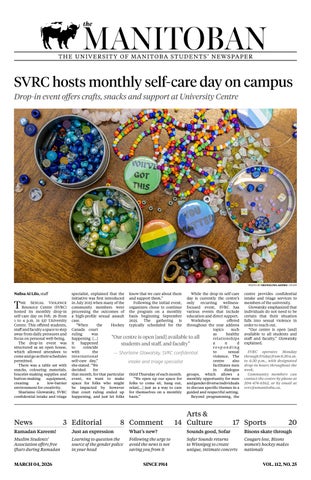
SVRC hosts monthly self-care day on campus

Drop-in event offers crafts, snacks and support at University Centre

The Sexual Violence Resource Centre (SVRC) hosted its monthly drop-in self-care day on Feb. 26 from 1 to 4 p.m. in 537 University Centre. This offered students, staff and faculty a space to step away from daily pressures and focus on personal well-being.

The drop-in event was structured as an open house, which allowed attendees to come and go as their schedules permitted.

There was a table set with snacks, colouring materials, bracelet-making supplies and button-making equipment, creating a low-barrier environment for creativity.

Sharlaine Glowatsky, SVRC confidential intake and triage

specialist, explained that the initiative was first introduced in July 2025 when many of the community members were processing the outcomes of a high-profile sexual assault case.

”When the Hockey Canada court ruling was happening […] it happened to coincide with the international self-care day,” she stated. “We decided for that month, for that particular event, we want to make space for folks who might be impacted by however that court ruling ended up happening, and just let folks

know that we care about them and support them.”

Following the initial event, organizers chose to continue the program on a monthly basis beginning September 2025. The gathering is typically scheduled for the

While the drop-in self-care day is currently the centre’s only recurring wellnessfocused event, SVRC has various events that include education and direct support.

“Our centre is open [and] available to all students and staff, and faculty”

— Sharlaine Glowatsky, SVRC confidential intake and triage specialist

third Thursday of each month.

“We open up our space for folks to come sit, hang out, relax[…] just as a way to care for themselves on a monthly basis.”

Workshops offered throughout the year address topics such as healthy relationships and responding to sexual violence. The centre also facilitates men in dialogue groups, which allows a monthly opportunity for men and gender diverse individuals to discuss specific themes in a guided and respectful setting.

Beyond programming, the

centre provides confidential intake and triage services to members of the university.

Glowatsky emphasized that individuals do not need to be certain that their situation falls into sexual violence in order to reach out.

“Our centre is open [and] available to all students and staff and faculty,” Glowatsky explained.

SVRC operates Monday through Friday from 8:30 a.m. to 4:30 p.m., with designated drop-in hours throughout the week.

Community members can contact the centre by phone at 204-474-6562, or by email at svrc@umanitoba.ca.

Ramadan Kareem!

Muslim Students’ Association offers free iftars during Ramadan News 3

Just an expression

Learning to question the source of the gender police in your head

Following the urge to avoid the news is not saving you from it

Sounds good, Sofar

Sofar Sounds returns to Winnipeg to create unique, intimate concerts Arts & Culture 17

Sports 20

Bisons skate through

Cougars lose, Bisons women’s hockey makes nationals

PHOTO BY EBUNOLUWA AKINBO / STAFF
Nafisa Al Lilo, staff

109 HELEN GLASS BUILDING UNIVERSITY OF MANITOBA WINNIPEG, MB THEMANITOBAN.COM | 204. 474. 6535

GENERAL INQUIRIES: ME@THEMANITOBAN.COM

CIRCULATION INQUIRIES: MISSING OR INCOMPLETE PAPER? EMAIL: DISTRIBUTION@THEMANITOBAN.COM

EDITOR-IN-CHIEF Mikaela Warkentin editor@themanitoban.com

BUSINESS MANAGER Alice Teufack accounts@themanitoban.com

BUSINESS SUPPORT MANAGER Joshua Herold ads@themanitoban.com

EDITORIAL

MANAGING EDITOR Peace Ifeanyi me@themanitoban.com

COPY EDITOR Eden Quiring copy@themanitoban.com

COPY ASSOCIATE Mursal Ghiyasi

NEWS EDITOR Roy Albright Obah news@themanitoban.com

RESEARCH & TECHNOLOGY EDITOR Mansura Meghla research@themanitoban.com

COMMENT EDITOR Quinn Mayhew comment@themanitoban.com

ARTS & CULTURE EDITOR Boris Tsun Hang Leung arts@themanitoban.com

SPORTS EDITOR Abdul-Jalilu Ahmed sports@themanitoban.com

DESIGN

DESIGN EDITOR Deveney Jarrow design@themanitoban.com

DESIGN ASSOCIATE Patricia Sanque

GRAPHICS EDITOR Emma Gillich graphics@themanitoban.com

GRAPHICS ASSOCIATE Teegan Gillich

AUDIO AND VIDEO

AUDIO EDITOR Max Reid audio@themanitoban.com

PHOTO EDITOR Mike Thiessen photo@themanitoban.com

PHOTO ASSOCIATE Ebunoluwa Akinbo

VIDEO EDITOR Zulkifl Rafah video@themanitoban.com

DIGITAL MEDIA EDITOR Faisal Rahman social@themanitoban.com

SOCIAL MEDIA ASSOCIATE Paula Robles Andia

REPORTERS

NEWS Arifah Gheesah

NEWS Nafisa Al Lilo

RESEARCH & TECHNOLOGY Nawal Semir

COMMENT Thandeka Katsika

COMMENT Kyra Campbell

ARTS & CULTURE Carrington Dong

ARTS & CULTURE Jordan Anglin

SPORTS Faiyaz Chowdhury

SPORTS Israel Abejoye

VOLUNTEERS

VOLUNTEERS

Mike Chahal

interested in volunteering?

email me@themanitoban.com today!

The Manitoban is the official student newspaper of the University of Manitoba. It is published monthly during the summer and each week of regular classes during the academic year by the Manitoban Newspaper Publications Corporation.

The Manitoban is an independent and democratic student organization, open to participation from all students. It exists to serve its readers as students and citizens.

The Manitoban is a member of the Canadian University Press, and our journalistic standards can be found on the Manitoban’s website.

The newspaper’s primary mandate is to report fairly and objectively on issues and events of importance and interest to the students of the University of Manitoba, to provide an open forum for the free expression and exchange of opinions and ideas and to stimulate meaningful debate on issues that affect or would otherwise be of interest to the student body and/ or society in general. The Manitoban serves as a training ground for students interested in any aspect of journalism.

Students and other interested parties are invited to contribute to any section of the newspaper. Please contact the appropriate editor for submission guidelines.

The Manitoban reserves the right to edit all submissions and will not publish any material deemed by its Editorial Board to be discriminatory, racist, sexist, homophobic or transphobic, ableist or libellous.

Opinions expressed in letters and articles are solely those of the authors. Editorials in the Manitoban are signed and represent the opinions of the writer(s), not necessarily those of the Manitoban staff, Editorial Board or the publisher.

A “volunteer staff” member is defined as a person who has had three volunteer articles, photographs or pieces of art of reasonable length and/ or substance published in the current publishing year of the Manitoban

Any individual who qualifies as a volunteer staff member must be voted in by a majority vote at a Manitoban editorial board meeting. Elected representatives and non-students may be excluded from holding votes as volunteer staff members in accordance with the Manitoban Constitution.

All contents are ©2026 and may not be reprinted without the express written permission of the Editor-in-Chief.

correction: umsu vice president university affairs candidates In its Feb. 25 issue, the Manitoban incorrectly spelled the name of UMSU vice president university affairs candidate Harisharn Bahra.

UMSU BOD meeting highlights

Federal advocacy, campus initiatives and upcoming elections

Arifah Gheesah, staff

The UMSU board of directors meeting on Feb. 26 included updates on federal advocacy such as the Canadian Alliance of Student Associations (CASA) town hall that was hosted on Feb. 5. The town hall covered discussions regarding student housing concerns and engagement with CASA’s Education Builds a Nation petition.

Prabhnoor Singh, UMSU president, shared that UMSU’s Black Students’ Community Centre was recognized by Terry Duguid, MP for Winnipeg South, with a Canada Post stamp dedicated to Marie-Joseph Angélique in honour of Black History Month.

At the municipal level, advocacy has been ongoing

with Winnipeg Transit and the City of Winnipeg to discuss the U-Pass agreement and future considerations. Discussions regarding improvements are still ongoing.

UMSU recently met with Laurie Schnarr, U of M viceprovost (students), and Mark Torchia, U of M vice-provost (learning, analytics, and academic infrastructure), to discuss the creation of a centralized webpage where course syllabi would be publicly accessible to students, alumni and the wider community.

UMSU also met with members of the U of M Campus Planning Office to discuss opening a GPA’s convenience store on the Bannatyne campus.

Carolyn Wang, VP finance

and operations, shared that UMSU will be providing free tax filings for students, given criteria applies. The tax clinic will operate March 17 to April 2 from 9 a.m. to 3 p.m. Students

need to bring their student ID as well as any needed documents. Activities for the UMSU General Elections are ongoing. Voting is scheduled to take

place on March 5 and 6 .

Candidates are tabling across the university and sharing their policies on their social media.

Ramadan brings students together on campus

MSA hosts nightly iftars and prayers at the university

As the month of Ramadan continues at the U of M, the Muslim Students’ Association (MSA) is hosting nightly iftars and prayers, creating a space for students to gather, reflect and break their fast together.

During Ramadan, Muslims fast from dawn until sunset as an act of worship. Each evening, they gather for iftar, which is known as the meal that breaks the fast.

On campus, MSA organizes free iftar every day of the month, along with suhoor, the pre-dawn meal, during the last 10 nights.

Aryan Fida Nur, MSA internal relations manager, described Ramadan as “the best month.”

He explained that one of the reasons MSA is hosting iftar is because “sometimes students […] on campus, [do not] have time to go home and to break their fast.”

According to Fida Nur, the initiative has become a longstanding tradition supported by community sponsors.

“Our

“The iftar is for everyone, for all the students, community members,” he explained. “Even if any non-

during Ramadan.

Ramadan operation would be incomplete and wouldn’t even be possible without our volunteers”

“It happens through our sponsors — we have a very huge number of sponsors who donate the money to serve students.” The meals are free and open to everyone.

“[I’m] making plates for them, making their seating plans, setting up everything so everything works accordingly for the students coming here to have food.”

— Bareera Kamran, MSA secretary and food lead during Ramadan

Muslim wants to […] join.”

Haris Kamran, a civil engineering student and volunteer, also helps MSA

Kamran said that nonMuslims are welcome to attend and observe.

“It is a very good opportunity to learn about […] the routine of a Muslim

in Ramadan and how […] Muslims break their fast,” Kamran explained.

Bareera Kamran, MSA secretary and food lead on the sisters’ side during Ramadan, described the month as a time of increased worship and discipline.

“We make sure that we’re on our best behaviour,” she explained. “We pray five times a day and we try to practice more of our deen and do more religious acts because they are highly rewarded.”

Due to fire safety regulations, attendance at the mosque is limited to 250 people.

“Because of this capacity limit, we have to put a cap on the number of meals we order every day for iftar,” Bareera said.

Bareera expressed appreciation to the volunteers involved in this initiative.

“There’s about 30-35 people that are involved at iftar time every single day that show up to help us with setup, cleanup [and] food serving,” she said.

“Our Ramadan operation would be incomplete and wouldn’t even be possible without our volunteers.”

PHOTO BY EBUNOLUWA AKINBO / STAFF

Shakerah Jones Hall named CBC Future 40 winner

U of M nursing instructor honoured for leadership and community impact

C

BC Manitoba has announced the recipients of its 2025 Future 40 recognition, an annual award that celebrates individuals under the age of 40 who are contributing to the province in diverse and impactful ways.

Shakerah Jones Hall, an instructor in the U of M’s college of nursing, was named as one of the eight awardees recognized for their leadership, community impact and commitment to positive change in Manitoba.

Hall said being named in the Future 40 is “incredibly humbling and deeply meaningful.”

“It affirms that work rooted in equity, mentorship and community-building matters,” she said. “I view this recognition as a reflection of the students, families and communities who inspire this work every day.”

Hall serves in multiple capacities at the U of M. She is the faculty mentor for the university’s fellows in the Equity, Anti-Oppression and Social Justice Program as well as the founder and lead of the Canadian Black Nurses Alliance (CBNA) — U of M Chapter, formerly known as the Black and Racialized Nursing Student Support Group.

Hall said her work is “grounded in advancing equity, supporting student success and transforming nursing education to better serve Manitoba’s increasingly diverse communities.”

Hall’s path toward founding a CBNA chapter at the U of

M emerged directly from her experiences as a faculty member in nursing education.

“As I watched students fail courses, repeat clinical placements or leave the program altogether, I felt a deep sense of responsibility to act,” she said.

Without what she described as “a clear blueprint,” Hall developed a proposal and brought it to then-dean of nursing, Dr. Netha Dyck. The proposal was approved, marking the beginning of the U of M’s chapter of CBNA.

Hall said her lived experience as “a Black, racialized immigrant woman” informs her work. “I see myself reflected in many of these students,” she said. “I understand how powerful it is to see people who look like you and who share similar experiences in leadership roles.”

She described her approach to teaching as extending beyond clinical instruction.

“While I teach clinical skills and nursing knowledge, I also teach confidence, advocacy, professionalism and selfworth,” she said.

Hall said she hopes her work will contribute to improved retention and success for Black and racialized nursing students, while also supporting Manitoba’s healthcare system.

The CBC Future 40 recognition, for Hall, serves as both affirmation and motivation.

“[It is] motivation to continue building systems that support a more just and equitable future for Manitoba,” she said.

PHOTO PROVIDED BY SHAKERAH JONES

New Gamma Knife elevates neurosurgery in Manitoba

Upgraded system at HSC increases access, efficiency and treatment capacity

Mansura Akter Meghla, staff

Health Sciences Centre (HSC) Winnipeg has unveiled a next-generation Gamma Knife system, marking a major advancement in minimally invasive brain surgery in Manitoba. The new Elekta Esprit unit, funded through the HSC Foundation’s Operation Excellence campaign in partnership with the Province of Manitoba, replaced an aging system that had reached the end of its service life.

A Gamma Knife is not a traditional surgical instrument.

First developed in Sweden in the 1960s, it is a form of stereotactic radiosurgery that delivers highly concentrated beams of gamma radiation to treat brain tumours, vascular malformations and other neurological conditions without making an incision.

At HSC, more than 5,000 patients have been treated with Gamma Knife technology since its introduction in 2003.

Dr. Anthony Kaufmann, HSC neurosurgeon and co-director of Canada’s first Gamma Knife radiosurgery program, has been closely tied to the technology’s development in Manitoba.

A Winnipeg native and U of M alumnus, Kaufmann completed medical school and neurosurgery training in Manitoba before gaining experience with one of the first commercial Gamma Knife programs in the world at the University of Pittsburgh.

In 2003, Kaufmann and Dr. Michael West helped establish Canada’s first Gamma Knife radiosurgery program at HSC. Since then, utilization has

grown steadily. What was initially projected to serve about 100 Manitobans annually now treats more than 200, reflecting a broader recognition of radiosurgery as an effective treatment option.

The new Elekta Esprit introduces several upgrades over previous generations. According to the press release, it can treat larger tumours and includes integrated CT imaging, which eliminates the need for sameday MRI scans.

Kaufmann explained that this added imaging capability improves scheduling flexibility across the hospital, benefiting not only neurosurgery patients but the broader system.

The system also

replacing the traditional head frame in some cases. This allows for “fractionation,” meaning larger tumours can be treated over several

offers a maskbased immobilization option,

sessions instead of a single highdose treatment. “We are able to treat patients with larger tumours compared to before,” Kaufmann explained. “If the tumour is too large, we have to divide that treatment up sometimes into three [to] five treatments.”

Planning efficiency has also improved. Kaufmann noted that the upgraded software allows neurosurgeons to adjust radiation plans quickly and interactively. “With the new technology, we can make those adjustments […] very efficiently using some AI-type technologies that allow us to interact with the computer to make the perfect plan.”

Gamma Knife radiosurgery now accounts

for approximately 20 to 25 per cent of all brain surgery in Manitoba, according to Kaufmann. It is particularly effective for metastatic cancers that have spread to the brain from other parts of the body, such as lung or breast cancer. However, it does not replace open surgery in all cases. Large tumours causing immediate pressure often require conventional surgical intervention, and certain primary brain cancers are not suitable for radiosurgery.

Having the technology in Manitoba reduces the need for patients to travel out of province. Kaufmann emphasized that Manitobans can receive advanced treatment “with the best technology and with one of the largest experiences, over 20 years of experience,” eliminating the need to seek care elsewhere.

Beyond patient care, Kaufmann expressed broader implications for neurosurgery and medical training in Manitoba. He noted that maintaining advanced technology helps recruit and retain skilled neurosurgeons and creates educational opportunities.

“It’s important to maintain a level of excellence,” Kaufmann said. “You want to know that your doctors are not just competent, but they’re actually pursuing excellence.”

GRAPHICBY
EMMAGILLICH / STAFF

The key to a long life or the path to mental turmoil?

Fitness trackers increase anxiety in users as they obsess over health data

R

esearch suggests that increased reliance on smartwatches for habitual health monitoring may be increasing users’ anxiety.

Currently there are more than 562.86 million smartwatch users globally, and the smartwatch market is valued at approximately USD $35.29 billion. These numbers are projected to increase in the coming years, with market estimates at US$62.46 billion by 2028 and the global number of users projected to reach 740 million by 2029.

While these figures point to growing global success, the underlying question remains — what is driving this rise?

Modern smartwatches use built-in sensors like GPS and heart rate monitors to collect data about user activity. Each brand uses its own unique software to turn that information into personalized health metrics that can be understood by users.

With this data, users can monitor their physical activity, blood and oxygen levels, sleep and even heart health. Doctors admit to the benefits of using this wearable technology, especially for patients experiencing occasional heart symptoms.

In the era of “gymfluencers” and increased health consciousness, wearable technologies that make health data available at our fingertips or at the flick of the wrist are a key to elevating our quality of life. According to Apple CEO Tim Cook, some features on smartwatches, such as fall detection, can even save lives.

One 2024 study hints at the affective capabilities on users’ morale, finding that the devices are capable of “fulfill[ing] a motivational void.” Research also shows that wearable fitness trackers not only make users more likely to start working out, but also make them seven times more likely to continue with their fitness regimen six months down the line. Smartwatches can thus boost users’ morale, increasing

physical health.

Despite all the benefits smartwatches may bring to our physical health, the negative impacts on mental health are underexplored.

While knowing one’s body and the changes occurring to it is important, the provision of real time data — notifications about decreased health, productivity or sleep — may create anxiety in users.

In a study published by the Journal of the American Heart Association, 172 individuals with atrial fibrillation (an irregular and rapid heart rhythm) were monitored over a nine-month period. Eightythree of these individuals tracked their condition using smartwatches.

The study found that the cohort of smartwatch trackers expressed increased

anxiety about their symptoms compared to the cohort that did not. In addition, one in five users expressed anxiety because of their usage.

The information overload that wearables provide may also result in alert fatigue — desensitization caused by the mental exhaustion stemming from an overwhelming amount of notifications. In the healthcare sector, alert fatigue is already a growing concern. Increased accessibility to data and notifications encouraging more frequent consultations with physicians can cause frustration in users, resulting in an increase in ignored warnings.

For users free of diagnosed health conditions, the notifications smartwatches provide can also, at times, be a nuisance. Sleep and

productivity insights, for example, often inform pregnant women and new mothers of what they already know — notifying them that they are not getting enough sleep or that they are not productive enough.

Upon cancelling their subscription to WHOOP, a fitness tracking wearable, one Reddit user shared their experience on how their fitness tracker turned them into “an anxiety trigger” in just a few months. They explained that they tracked every aspect of their health including sleep, recovery and performance. However, within a few months, they became oddly obsessed with their heart rate.

The user would track their heart rate during and after workouts, staring at their

watch for extended periods. This constant tracking created a never-before-held anxiety in the user, prompting them to “let go of the band and move on.” The user issued a warning to readers. “These tools can be helpful — but only if you know how to use them without letting them use you.” The Reddit user’s experience is not isolated, many under the thread echo the same warning.

For those already struggling with health anxiety, smartwatches are not tools to improve physical health, but rather tools that feed into existing fears and delusions. In any case, the physical benefits of tracking one’s fitness with a smartwatch may not outweigh the mental consequences for some.

GRAPHIC BY EMMA GILLICH / STAFF

How spaces choreograph for us

Who sets the volume on gender expression?

How much of our gender expression is choice, how much is choreography?

In the fall of 2025, I spotted someone on campus whose clothing seemed unusually bright, in contrast to the subdued and “calm” hues of a Winnipeg semester. The colours were vibrant and the makeup deliberately loud. The contrast was stark. My first thought was simple — that’s too much.

I didn’t say it out loud. But I recall my reaction was immediate.

A few months later, at a conference dinner, I found myself wearing a gown. Now, I am usually a jeans-shirt-andsneakers person, confident in understated comfort. But that evening carried its own expectations. I let a friend style me. I wore the makeup. I put on the heels. The compliments came and I did not feel out of place. If anything, I smiled all through the event, even though I had felt and complained many times to her that “it was too much.”

Two different places. Two different required scripts. But, for both, gender felt less like an instinctive self-expression and more like a choreography — something we ought to follow.

We sometimes discuss gender as if it can be a pure expression and arises from authenticity. Be yourself. Dress how you want. Show up as you are. And yet, most of us intuitively understand that not every version of ourselves fits every room.

Campuses have a distinct aesthetic vibe. And from my observation, in Winnipeg’s fall, the vibe is practical — neutral colours, denim, hoodies and sturdy, functional shoes built for changing weather. The atmosphere is relaxed, casual and almost utilitarian. Against that backdrop, brightness reads loudly — not necessarily wrongly, but noticeably.

On the other hand, I think dinner parties operate at a higher pitch. They welcome elevation. Glamour is not excess there, it is alignment. For example, in my case, a gown and makeup did not disrupt the room — rather, they blended in with the space. But that alignment was learned, acquired, encouraged through persuasion and reassurance — “Hey, Peace, it’s not too much. It’s just right. It’s appropriate. You look good. Enjoy it.”

What unsettled me about my own reaction to the fall campus event, upon reflection, was not the brightness of the clothing. It was the speed with which I recognized and registered it as misaligned. As though I carried, unconsciously, a mental decibel scale for acceptable presentation. As if I knew, without ever being told, how loudly or not femininity, in this case, should speak in a particular space.

That realization forced a harder question — who sets that volume? Why did I think that way?

pretend clothing and gender presentation are exempt from that same negotiation.

But acknowledging performance is different from interrogating its pressure.

At the conference dinner, no one forced me into a gown. I agreed, although not without some convincing and a few moments of checking the mirror. I was also curious to see myself differently. I

because I came to understand the script. This is not to say that wearing my usual pants and sneakers would have made me feel out of place. But I would have been. The room had a clear aesthetic, and my gown aligned easily with it.

And perhaps that is the point. Scripts are rarely written down. They are absorbed. We learn without noticing how much effort a space rewards. How much brightness it tolerates.

“And perhaps that is the point. Scripts are rarely written down. They are absorbed. We learn without noticing how much effort a space rewards”

Sociologist Erving Goffman described social life as a series of performances, with each of us managing impressions depending on the stage we occupy. We adjust tone, posture and even vocabulary depending on whether we are in a classroom, at a job interview or at dinner with new faces. It would be naive to

enjoyed the affirmation. Yet it would be incomplete to ignore that the invitation to “switch it up” was gendered. I was not advised to explore with androgyny or go further into my comfort zone. The expectation of the evening leaned in one direction — a more feminine, more polished, more visible direction.

I complied — not because I lacked confidence, but

How much deviation it registers. Over time, we learn what seems expected the next time we enter a similar room, what belongs and what feels out of place.

The individual I noticed in the fall did not violate a rule. There was no dress code. Vibrant colours and elaborate pinky makeup that matches your pink outfit are not prohibited. The only thing disrupted was harmony. The quiet, collective agreement

about how campus typically looks. My reaction revealed that I, too, am attuned to that harmony.

So maybe the issue is not that someone was “too much.” Maybe it is that we are deeply trained to detect when someone exceeds the “aesthetic expectations of a room.” And perhaps that reveals more about us than about them. If gender is self-expression, then it is also social negotiation. It moves between authenticity and adaptation. Between environment and instinct. Between who we think we are and who a room invites us to become.

We all perform in various ways, therefore the question is not whether we should. The question is whether we recognize how frequently the performance is subtly staged for us, and if we ever stop, midjudgment or mid-adjustment, to ask — is this what I want to express or what this space has choreographed for me?

GRAPHIC BY EMMA GILLICH / STAFF

Diversions

To complete Sudoku, fill the board by entering numbers 1 to 9 such that each row, column, and 3x3 box contains every number uniquely. In Straights, like Sudoku, no single number 1 to 9 can repeat in any row or column. But rows and columns are divided by black squares into compartments. Each compartment must form a “straight.” A straight is a set of numbers with no gaps but it can be in any order, eg [7,6,9,8]. Clues in black cells remove that number as an option in that row and column, and are not part of any straight. Glance at the solution to see how “straights” are formed.

Spiraling

Mike Chahal, volunteer

Circling back

Again and again

Like a howling wind

Moaning in spirals

Through dark Dense trees

Until deadened

Like hollow air passing through A sighing

Dying trumpet

In the river’s rushing mouth I see half-sunken stones

Who all share

The same face

Carved out

From the water’s whip

They wade

Through stagnant hopes

And as I sit and watch

The river’s long arms

Cradling everything

Away from view

I find nothing

Brings the day more to an end

Than feeling

Like it never began

Looking off

To where my horizon ends I know

Another begins

And over there

Somewhere else

Someone Is moaning in spirals And walking

Through dark Dense trees

Poets’ Corner Do

Email

Straights Puzzle by Signdicated Puzzles Puzzle by Signdicated Puzzles
Sudoku Sudoku Solution

Politics, power and responsibility

Why the UMSU elections matter

I

t is officially election time! Announcement boards around campus have been filled with posters and campaigning has reached full swing for another UMSU general election.

Outside of offering a wellrounded academic education and access to student clubs and societies, the university allows students to become engaged in the diplomatic process through student elections. Whether as candidates or as voters, we get the chance to actively take part in our university’s democracy.

For 2026, there are 13 UMSU positions available.

On its face, voting may seem like just something extra to do on March 5 and 6 — log in to some website and cast a vote, or don’t. But at its core, it gives students a direct voice in decisions that affect tuition, campus life, food security and student clubs.

Representatives are meant

to advocate for student needs, negotiate with administration and help shape initiatives that can improve mental health support, accessibility and sustainability efforts, as well as equity on campus. When students choose to participate, they are not just filling positions — they are influencing real outcomes that impact thousands of people.

For voters, participating in student elections builds civic awareness and responsibility. We, as students, take the time to engage with campaign material and be informed about campus issues. This encourages critical thinking because, as voters, we must compare ideas, evaluate feasibility and decide which candidate aligns most closely to our values. Voting also reinforces the idea that individual voices matter. Casting even a single ballot is active participation in a larger democratic process. It shifts

students from being passive observers of university decisions to being active contributors in shaping them.

More broadly, I feel that student elections reflect a larger trend of increasing youth engagement in politics across Canada. We are organizing, advocating about social issues and using our voices to promote change. Through TikTok and other forms of social media, we are seeing young people demonstrate that they can influence national conversations and take up space in a sphere that has traditionally excluded youth under the premise of being “too young” or “too immature” to make decisions.

I do not think this shift in youth engagement is coincidental. Many young people today have grown up in a world shaped by economic uncertainty, climate change, social justice movements and rapid technological

transformations. As a result, politics does not feel distant or abstract anymore. It feels personal. Many young people are aware of the consequences of not getting involved.

We also live in a society shaped by other people’s choices and other people’s votes, so student elections serve as an accessible entry point for democratic participation that in some way shapes society. More so, voting in larger federal elections can feel overwhelming, especially where there are long histories and complicated policy debates to navigate. I feel UMSU elections are a bit easier to digest.

This accessibility, however, also comes with responsibility for our candidates. Student elections are meant to be a training ground for democracy, so the individuals who are elected must treat their roles with seriousness and integrity. Being chosen by the student body is not simply

about getting a title to place on a resume, visibility, popularity on campus or a paycheck. It represents a transfer of trust. When we cast our ballots, we are placing confidence in someone to speak on our behalf and prioritize collective good over personal ambition. Those elected to UMSU positions have a duty to remain accountable to the students who put them there. That means actively listening and being transparent about decisions. Students deserve representatives who are just as enthusiastic during their term as they were while campaigning. Student elections are about more than posters and online ballots. They give students the opportunity to shape their campus experience. When we vote, we prove to ourselves that our voices matter, and when candidates lead with integrity, they prove that leadership is about service, not status.

Hockey played politics, then claimed it was ‘just a game’ Hockey’s default setting is male comfort, and everyone else is told to cope

The Canadian men’s and women’s hockey losses at the Olympics were rough to watch. However, the fallout that followed quickly took centre stage, pushing hockey into the mainstream discourse far beyond the usual debates about lines, matchups and referees.

At the heart of it was the U.S. men’s Olympic team being invited to the White House and State of the Union address, soaking up the cameras and the praise, but acting offended when anyone treated that as a poor political choice. The moment that really lit the fuse was the team laughing along when Trump made a misogynistic joke about having to invite the U.S. women’s hockey team too, even though they also won gold — as if their presence would be a burden rather than an equal achievement.

Jack Hughes of the New Jersey Devils tried to wave it away, saying, “Everything is so political,” and framing the White House invitation as exciting no matter how others view it. This is where the disconnect is evident. It is only possible to have this view when you believe other people’s rights and safety are just background noise.

Hockey players love the comfort of being “just athletes,” right up until being an athlete becomes a way to stand beside power and share in the attention. This is why “everything is so political” lands like a dodge rather than a reflection. It suggests politics invade sports from the outside, when in fact sports have always been part of national identity and public messaging. The difference is that some people treat politics as optional. If you can walk into a room full of cameras, elected officials and applause, then walk back into a world where your place is not questioned and your rights are not up for discussion, politics feel like a nuisance. However, if you are a woman, queer, trans or someone else whose dignity is constantly debated, politics are not so simple. They are as unavoidable as air.

That is why Team USA’s choices hit so hard. This was the most recognizable political stage in the country, and the players chose to be there. The moment with Connor Hellebuyck of the Winnipeg Jets intensified it because he was not only present, he was singled out. Trump used the occasion to announce Hellebuyck would

receive the Presidential Medal of Freedom, turning him into the night’s feel-good symbol. It also landed differently for Canadian fans because Hellebuyck plays for Winnipeg at the same time Trump’s politics repeatedly include threats and contempt aimed at Canada itself.

Hellebuyck accepted the kind of spotlight that only exists to send a message, and the message came from a political stage that has spent years demeaning women. That is why the backlash is not about overreacting. It is about refusing to pretend this was harmless.

Defenders will say it was only a visit. But it cannot be simply boiled down to a private dinner and a handshake line. It was a deliberate appearance on the most televised political stage in the world. Once you choose that spotlight, you also choose the message, and you cannot demand everyone pretend it is meaningless. The through

line here is men performing for men, protecting the room they think they own and making women pay the price.

The insistence that none of this should matter asks women, queer folks and anyone who is not part of that club to swallow discomfort so the sport can keep running on its usual terms. It asks them to take the jokes, accept the dismissiveness and watch women’s success get treated as a footnote. It also asks them to smile through pridethemed branding while the wider culture keeps treating them as an acceptable target.

This is where the culture shows itself — in the institutions, but also in reflexes. Sports reporter Claire Hanna asked Brady Tkachuk of the New Jersey Devils a question regarding the recent events. The responses from some male hockey fans were not disagreements. They were contempt, sexualized insults and claims that Hanna should not have been there. Tkachuk

did not write those messages, but the pile on was triggered by this moment, and it drew from the same reflex that women exist in the space on borrowed time. Men perform for other men, protect the vibe and reward loyalty. Women are expected to clap, soften their tone or leave. If a woman refuses that role, the crowd polices it.

With hockey dominating the news, I must, of course, bring up Heated Rivalry Harper’s Bazaar published a piece headlined “Heated Rivalry Was a Fun Fantasy, But Hockey Is Still Deeply Toxic.” But the show is not selling a harmless daydream. It is built around the fear of coming out in hockey culture and the calculation that staying silent can feel safer, so much so that the two main characters keep that part of themselves private to protect their careers and safety. The gap between the headline and the story is the gap fans are seeing in real time. This is why the Team

USA events remain connected to the larger conversation about belonging. The players chose proximity to a president whose public persona relies on mockery and hierarchy. This is not to say that I am demanding political purity from athletes, but there should at least be accountability when athletes step into political spectacle and then complain that people noticed.

This is why being a men’s hockey fan can feel embarrassing right now. It is nauseating to watch the sport insist it is above politics while actively chasing political attention, then acting offended when anyone responds accordingly. However, fans still have leverage. Leverage is attention, money and what you choose to celebrate. Put your time and dollars into women’s hockey. In Winnipeg, that can look like showing up for the Professional Women’s Hockey League Montreal Victoire vs. Ottawa Charge game on March 22.

GRAPHIC BY EMMA GILLICH / STAFF

It pays to be informed

As viewership of the news drops, misinformation spreads

The ability to access news is within the reach of our fingertips, but despite accessibility being at an all-time high, people are choosing to ignore the reality of world issues as a way to maintain a form of normalcy that alleviates tensions in their own lives.

Even though your social media feed may be flooded with the constant onslaught of news articles, people are choosing to stay ignorant. This often stems from wanting to avoid the emotional toll that negative news articles often bring and an overall distrust of the media.

With people opting not to watch the news, they are treating world issues as a metaphorical wound being covered by a band-aid. Just because you cover the wound doesn’t mean it’s not there, much like how news persists whether people choose to watch or not.

Universally, news avoidance is at an all-time high. According to a survey performed in 2025 by the Reuters Institute for the Study of Journalism of people across 50 countries, 40 per cent said they often opt to avoid the news.

In this age where misinformation is more common than not, the idea that people are choosing to remain in the dark is both surprising and overwhelmingly not.

In a world where misinformation is encouraged by news outlets such as Fox News and where fearmongering is occurring daily — orchestrated by decisions of the president of the U.S. — it’s no wonder people are choosing to tune out the static as a way to remain positive.

Sure, it’s easy to turn off the TV and pretend that global issues aren’t occurring when the crisis isn’t in your backyard or when it “doesn’t affect you.”

The news is also a continual

fixture of ruptures and crises happening around the globe — whether that’s the war against Ukraine, the U.S. attacking Iran, the ongoing violence within the Palestinian-Israeli conflict, the crisis in Haiti or the Taliban’s continual war on women and girls in Afghanistan.

Although distrust of the media continues to increase, the realization is that this distrust is not only produced by news outlets that misrepresent information, but also by the ongoing slew of AI-generated images and videos that present fabricated information.

AI-produced videos are detrimental to news outlets with vetted credentials, as well as to the representation of credible and true news stories that are told with the intention of informing and stirring up a population.

The news is vital in maintaining and understanding humanity. The value that a journalist brings does not diminish just because people choose not to watch — if anything, it makes their jobs more important. In an age where information is fragmented in every corner of the internet, journalists still choose to wake up every morning and tell someone else’s stories. Sometimes this is at the cost of their own lives and livelihoods, and often wading through swampy water, surrounded by pay cuts and criticisms.

Listening to the news is worth it. It allows you to have access to information beyond yourself. You might not want to listen, but it matters. It matters to listen to voices and stories that might not always be positive, but that are the lived reality of people around the world.

It pays to listen, read and hear news stories — it pays to be informed, well-read and to listen to voices other than your own. So next time you may be thinking of turning off the news, keep it on.

GRAPHIC BY TEEGAN GILLICH / STAFF

Making art from everyday campus items

Two artists showcased in U of M School of Art Student Gallery

S quashing Bugs is the latest show at the U of M School of Art Student Gallery that ran from Feb. 20 to 26. It featured art by Juca Aquino and Julia Mary Langer, made with the abstraction of found objects.

Their art is similar in a visual sense, but juxtapose one another in character. Aquino’s art is made from exploring his surroundings, and Langer’s is made of her own belongings. To that end, Artalogue podcast host and curator of the show Madison Beale notes that Aquino creates art devoid of noticeable influence from any known person while Langer utilizes found objects to enhance her understanding of herself.

Upon entry, the viewer first encounters two equally large works hung on the wall opposite the doorway. On the left is Langer’s black smudged canvas resembling a touchscreen, and on the right are four stain-covered tabletops from

Aquino’s Homework series — an expansive collection of tabletops worn from decades of use in the school of art.

Aquino took the tabletops after spending a year observing them with fascination. He and a friend secretly removed the tabletops from the Art Barn studios at night and made new ones by painstakingly carving wood to avoid students or faculty suspecting anything. Aquino recalled that no one else knew about the heist until he put them on display as art.

Aquino’s artwork is appreciative of anonymous characters shaping oftendismissed objects. In many cases, such as the Homework series, he focuses on how the collective students of the school of art have shaped their physical environment. Other works of Aquino shown in the student gallery are blocks and plywood stained from fine art students’ printmaking, a lineup of broken and discarded wooden sledgehammer shafts he collected from a quarry and various plastic hospital urinals

which he covered in plaster to the point of unrecognizable abstraction.

Langer’s work, on the other hand, is made through introspection. She recently suffered the grief of losing her mother, and one of the first things she did in her wake was repaint everything in her studio a neutral shade of blue to which she had taken a great liking. Langer’s blue desk, chair and tower of canvas stretchers taken from the studio are on display. Also included in the show are paint-covered tarps draped over a podium as well as a film depicting the sentiment of Langer’s tiring grief and demonstrating the creation of the previously mentioned art. The exhibit’s name, Squashing Bugs, refers to the process of resolving issues while designing a computer program, in reference to Aquino’s problem-solving abilities while creating the show. The title is also a nod to his personal interest in coding.

Freeze Frame film festival highlights youth cinema

Artistic director Pascal Boutroy talks children’s films and festival’s 30th anniversary

Boris Tsun Hang Leung, staff

Freeze Frame International Film Festival for Kids of All Ages, an annual festival in Winnipeg, is about to mark its 30th anniversary. Taking place at the Centre culturel franco-manitobain from March 8 to 14, the festival showcases a diverse selection of children’s films from around the world.

Pascal Boutroy, filmmaker and Freeze Frame’s artistic director and co-founder, explained the goal of the festival.

“The mission is to expose the children of Winnipeg, who often [come] from various cultural [backgrounds], to films that emulate their own diversity […] It’s a window on the world that aims to expand the worldview of […] Manitoban children. It strives to educate and entertain,” he stated.

According to Boutroy, Freeze Frame is the oldest children’s film festival in Canada and is one of the three in the country that is still in operation. It is also the third most attended film festival in Manitoba, he noted.

Throughout the week, 11

films, ranging from drama and comedy to animation, will be screened. One of the selected movies is Inuk director Zacharias Kunuk’s Uiksaringitara (Wrong Husband), a story about a pair of star-crossed teenage lovers in an Inuit village. Another selection is Living Large, a stop-motion film by Czech animator Kristina Dufková about a 12-year-old boy’s journey with his weight and body image.

To commemorate the festival’s historic milestone, award-winning films from previous installments are also making a reappearance. This includes Jonathan Elbers’s The Club of Ugly Children, a dystopian movie set in the Netherlands where the president has ordered the deportation of all “ugly” children. Ultimately, the children organize and revolt against the government.

“A good [children’s] film is a film where children are treated with respect for their [intelligence] and sensitivities, and where children are key and active to the [development] of the story. You [recognize] one

when you see one,” Boutroy commented.

While some may see children’s film as frivolous entertainment, Boutroy’s vision for the festival is anything but.

“When people think of children’s production they think of unambitious [American] films that monopolize our screen in Canada and elsewhere. Freeze Frame brings more ambitious films and also more satisfying ones with an age-appropriate slant,” he shared.

He explained that by diversifying the kinds of films children watch, they are exposed to different portrayals of youth and family as well as different ways of telling stories, which is especially important in the digital age.

“Becoming more discerning and critical is capital in our times when children and youth spend a huge amount of time alone with screens of all [kinds. Equipping] them with tools to understand how messages are constructed is very important and can be fun when you do it by watching different [kinds] of films or learning how to make them,”

he stated.

Apart from film screenings, the festival entails hands-on film and audiovisual workshops for children. There are also two video contests — one where professional films are judged by youths and another where films by youths are judged by professionals.

When asked what advice he would give to young aspiring filmmakers, Boutroy responded, “Educate yourself about filmmaking

by watching [different kinds] of films, ambitious ones. Get inspired, but don’t copy. And try to make films that matter, which [can] also be enjoyable. It’s not mutually exclusive.”

For more information and tickets to screenings, visit freezeframeonline.org. Tickets are also available at the door. The opening and closing films on March 8 and 14 are free and open to the public.

PHOTO BY JORDAN ANGLIN / STAFF
PHOTO PROVIDED BY PASCAL BOUTROY
WORK BY JULIA MARY LANGER (FRONT) AND JUCA AQUINO.

The Sleeping Beauty returns to Royal Winnipeg Ballet

The classic ballet to feature choreography from new artistic director

Carrington Dong, staff

Royal Winnipeg Ballet (RWB) is set to return to the Centennial Concert Hall with their production of The Sleeping Beauty Based on the classic fairytale and set to Pyotr Ilyich Tchaikovsky’s iconic score, the ballet will feature choreography by new artistic director Christopher Stowell. Born to Kent Stowell and Francia Russell — former dancers with the famed New York City Ballet — Stowell spent 16 years as a dancer at San Francisco Ballet, rising to the rank of principal dancer. He has served as artistic director of the Oregon Ballet Theatre and associate artistic director of the National Ballet of Canada. He was appointed as artistic director of RWB in January 2025, taking over from longtime director André Lewis in June.

“I feel really honoured to

have been chosen,” Stowell said. “Interestingly, when I was a ballet student in Seattle, the RWB used to come on tour there […] frequently […] I hadn’t imagined that my career and the RWB would unite or connect, but when the opportunity came up I realized it was a perfect match because of my interest in the company from when I was much younger and my long experience in working in Canada.”

The Sleeping Beauty features the classic elements from the original fairytale — the birth of Princess Aurora, the blessings from the fairies, the curse of the evil fairy Carabosse and Aurora’s 100year sleep following her 16th birthday, which can only be cured through true love’s kiss.

Stowell’s production emphasizes the importance of time in the storyline, with each scene in the ballet being distinctly sometime later from

the previous.

“There’s the prologue where [Princess Aurora] is a baby, and then we immediately jump 16 years ahead. Now, she’s a grown up, and then after an intermission, we jump 100 years ahead, and now she’s asleep in the castle waiting for her prince,” he explained.

Stowell created his version of The Sleeping Beauty for the Oregon Ballet Theatre in 2010, adapted from the original choreography by famed choreographer Marius Petipa. Stowell noted that while there are good records of the “basic architecture” and famous elements of Petipa’s production, not all of it has been well-preserved. Additionally, the length of the score required adaptation for modern audiences.

“There’s […] almost four hours of music for Sleeping Beauty that Tchaikovsky wrote,” he said. “Mine’s two hours and 20 minutes […] As a

choreographer, the first thing you have to decide is where you want to make the cuts in the music […] and then how you want to link the famous set pieces together.”

Stowell stated that the RWB’s dancers have been great to work with, describing them as engaged and invested in the process of learning the new choreography. According to him, The Sleeping Beauty relies heavily on the strength of the whole company and not just the principal dancers.

“The leading roles are incredibly hard, but it’s really about how the whole company dances,” he said. “[The Sleeping Beauty is] great for a company to take its technical and artistic level [or] abilities to the next level collectively. We all have to pull ourselves together to dance this ballet,” he reflected.

When asked what he is most looking forward to about The Sleeping Beauty,

Stowell said that this was the first production that he has primarily helmed during his RWB tenure, with this previous season having been primarily curated by Lewis before his retirement.

“I’ve been proud of everything we’ve been doing. It’s been a great season, but this is the first time audiences are going to get to see what this company looks like with my hands directly on the production,” he stated. “Sleeping Beauty is an important step in our relationship.”

RWB’s production of The Sleeping Beauty will run from March 12 through 15 at the Centennial Concert Hall. For tickets, visit rwb.org. For more information on RWB, follow @rwballet on Instagram.

PHOTO PROVIDED BY RWB
SOPHIA LEE IN THE SLEEPING BEAUTY (2013).

Toronto band Napoleon releases EP Napoleon, Vol. 1

First EP in a three-part series leans deeper into metalcore and hardcore sounds

Dong, staff

T

he Toronto band Napoleon released their new EP, Napoleon, Vol. 1, on Feb. 27.

Consisting of vocalist Jonathan Elmaleh, bassist Camilo Martinez and drummer Eitan Garazi, the band was founded in 2018, when they were in grade 12.

Napoleon began as a hard rock band, but the group’s sound has evolved over time.

“I would say we’re definitely a metalcore band nowadays,” Elmaleh said. “We’ve definitely been getting heavier […] We started more as a hard rock kind of band, then became more of a punk band, then a post-hardcore band.”

Highlights of the group’s career thus far include a performance at the Velvet Underground in Toronto

in 2022, which Elmaleh described as the first time they had ever performed such a large show, and their release show for their EP Dear God in 2024 at the Toronto dive bar Sneaky Dee’s.

“[The Dear God release show] was completely sold out as well, and that was the first time we’d ever sold a legitimate amount of tickets to one of our own shows […] It was just a really special show,” Elmaleh reflected.

On Feb. 27, the band released their latest EP, Napoleon, Vol. 1, preceded by the single “No Victory” earlier in February. As the title implies, the EP will be the first in a planned three-part series, which will eventually form their fulllength debut album.

“We’ve been writing this for a while,” Elmaleh explained.

“I found that there’s three distinct, separate flavours to what the songs sound like, so, I had the idea […] to just split it into three […] Because people will get it in smaller doses, they’ll be more inclined to listen to the whole thing.”

The group supported the album with concerts in Ontario and Montreal from Feb. 27 through March 1. Elmaleh said that the group hopes to perform in Winnipeg sometime in the future. On their recent shows, Elmaleh said, “We definitely found that the vibes of these shows were different. We were playing primarily the new songs, and even the old songs we tuned down a bit. So, they all sound a little bit beefier, a little heavier, and it’s making us play it with more energy and aggression.”

When asked what fans would love about Napoleon, Vol. 1, Elmaleh said, “I hope that they appreciate how much heavier it is than the past. We definitely noticed stronger responses to our heavier tracks. People like the breakdown vibe and stuff. So, it’s like […] ‘Let’s just put a bunch of heavy breakdowns in the song, make the songs

Sofar Sounds relaunches in Winnipeg

super fast, super heavy.’” Napoleon’s latest EP, Napoleon, Vol. 1, is now available on Spotify and Apple Music. For more information on future releases and upcoming concerts, visit napoleontoronto.com or follow the band on Instagram @napoleontoronto.

Local producer revives secret concert network with First Fridays performance

Boris Tsun Hang Leung, staff

Dan Kennedy, a local music producer, is relaunching Sofar Sounds’s Winnipeg branch after a hiatus.

Sofar Sounds started in London, England in 2009 as a concert network that specializes in lowkey and intimate gigs in “unconventional spaces,” created in response to overly crowded and boisterous music venues. Several notable artists, such as Jack Harlow, Billie Eilish and Chappell Roan, have performed at Sofar shows before their careers took off. The network currently has over 200 branches across the world.

“The sizes of the [shows] range from 50 to 120 or so [people], so they’re very intimate. You can sit a foot away from the musician that’s performing, or you can sit in the back of the room,” Kennedy said.

Sofar shows boast a “secretive pop-up nature,” and the venue of each concert is only revealed to ticketholders 36 hours before the show starts. Past venues include

people’s homes, cafés after hours and art galleries. The Winnipeg relaunch concert consists of three 20-minute sets and will take place on March 6 at 8 p.m. in the Exchange District as a part of First Fridays in the Exchange.

In addition, the performers are kept secret for the concertgoers to discover upon arrival. Kennedy noted that artists are mostly Winnipegbased and will be performing original songs or pieces since part of the network’s goal is to showcase grassroots arts and culture.

“We want people to experience new music [and] give artists the opportunity to also showcase stuff that they’re working on, maybe test it with a smaller audience.” he said.

Sofar Sounds launched in Winnipeg in 2017, but the underground concert series has wound down since then. Inspired by his time working at Sofar Sounds’s Vancouver branch between 2022 and 2023, Kennedy wanted to get involved with the network again after moving back to Winnipeg.

“I just worked as event crew or event support and emceed a few shows [in Vancouver]. I enjoyed it quite a bit. [There was a] new location [and] new artists each time […] Meeting new people [in the crowd] was also enjoyable,” he recounted. Looking forward, Kennedy hopes to continue cultivating the brand of the Winnipeg branch. He emphasized that, other than enjoying the

music, the experience is also meant to foster connection and community among the audience.

“[I hope] they’ve met more people than they expected and they’ve had conversations with people that share the same values and what they care to see happening in the city,” he stated.

“If people are buying tickets based off just seeing

the Exchange District or some other area in town [like] St. Boniface […] then you usually assume that there’s a similar mindset as to why everyone who’s sitting around you [is attending] that show.”

For more information and tickets to the concert on March 6, visit sofarsounds. com.

PHOTO COURTESY OF NAPOLEON VIA SPOTIFY
PHOTO PROVIDED BY ALBERT TING

Local artist celebrates return after medical recovery

Soulful Seasons by Jordan Miller to open for First Fridays in the Exchange

S

t. Andrews-based artist, consultant and U of M bachelor of fine arts graduate Jordan Miller will soon be featured at the 210 Gallery starting March 6. The gallery will be showing her exhibition Soulful Seasons, Transitions of Change, with the opening night a part of First Fridays in the Exchange.

Miller paints with a distinct style of scraping, rather than traditional brushwork. Her pieces are typically comprised of vibrant pools of colour and topped with glossy varnish and constellations of white dots. Recently, she has also begun incorporating layers of swiped alcohol ink and experimenting with manipulating paper. She creates nearly all of these works by intuition rather than with any plan or concept in mind.

Lately, her intuition has unintentionally resulted in compositions resembling landscapes. Leaning into the idea of landscapes, Miller will exhibit these works in her show Soulful Seasons, Transitions of Change, which is organized by colour palette into four sections — spring, summer, autumn and winter.

The season-based approach to curation also gives Miller the opportunity to reflect on the past year and how drastically her life has changed since last winter. She spent most of 2025 unable to speak or breathe properly due to her state of health and an ensuing full hysterectomy.

Last November, she began a new pharmaceutical treatment that enabled her to return to painting in the months since. However, her mobility is still limited. She attributed the creation of her landscape paintings to her

longing for nature.

“It’s […] interesting just to let my mind go free,” Miller explained. “I think that, because I live in the prairies, [because] I live in nice open air and I’m trying to relax when I create, that that’s where my mind goes because that’s what I really enjoy. I used to like hiking when I was physically able to, and biking and skiing and all those things. So naturally mountains are […] something that I look back to as good moments in my life.”

Miller’s latest works are smaller than what she has typically painted over her career, due to the limits of her new studio. Until 2025,

“I’m looking forward to just connecting with people and having them connect with my art”

— Jordan Miller, artist

Miller was the owner of Cre8ery Gallery & Studio in the Exchange District. It operated for many years until Miller’s ill health became insurmountable. She now continues to help Manitoban artists sell their work online with her new venture, ShopArtMb.

“I’m looking forward to just connecting with people and having them connect with my art, more so […] than any other time of my life,” Miller said.

“[At Cre8ery] I was surrounded by people all the time […] now I’m really appreciating those people that I had [who] surrounded me.”

For six months of 2025, Miller mentored a group of nine rural and northern Manitoban artists in a guided

program with the 210 Gallery. It culminated in their feature show Nine Perspectives in the 210 Gallery throughout January and February.

Arts AccessAbility Network Manitoba will soon welcome Miller to chair its board of directors, another way for her to stay involved with the

arts community. The position is currently filled by Diane Driedger, who will co-chair with Miller for the next year to ease the transition.

Miller noted that, apart from Cre8ery, not many galleries in Manitoba are often accepting new artists, so she hopes to create more accessible

opportunities as the new chair.

Soulful Seasons, Transitions of Change will remain at the 210 Gallery until April 4. Miller will also be showing her art at the Winnipeg Fine Art Fair in April.

PHOTO PROVIDED BY JORDAN MILLER

The WolfPack hunts down the herd

Bisons women’s volleyball wins one, loses two against Thompson Rivers

The Bisons women’s volleyball team lost the Canada West quarterfinals against the Thompson Rivers University WolfPack in Kamloops, B.C., at the Tournament Capital Centre.

The Bisons women’s volleyball team won bronze in the 2024-25 Canada West championship but were knocked out this year, bringing their season to a close. However, it wasn’t a clean flush. This weekend, the Bisons lost 2-3 on Thursday, Feb. 26, won 3-1 on Friday, Feb. 27 and lost 0-3 on Saturday, Feb. 28.

In game one on Thursday, the WolfPack won the first set, the herd won the second, the WolfPack won the third, the Bisons won the fourth and the WolfPack won the fifth. No team won consecutive sets. Even though the Bisons had more total kills (56-49) and both teams committed the same number of attack errors (27), the herd lost due to swings in key scoring stretches. The WolfPack’s efficiency in the two most important sets (2516 in Set 3 and 15-8 in Set 5) directly determined the win. Bisons’ Raya Surinx had 17 kills, the highest in the game. In game two on Friday, the Bisons won 3-1. Each set was

highly contested (25-21, 23-25, 25-20, 25-22). Surinx, who played well in the previous game, went nuclear and got 30 kills. In comparison, the WolfPack had a total of 49 kills in the game. The Bisons dominated this game with higher kills (56-49), higher assists (54-46) and higher digs (67-62).

After splitting the wins in the first two games, the WolfPack dominated the herd 3-0 in game three on Saturday. The first set was extremely close, 25-23.

However, in the second set, the WolfPack did not take their foot off the gas. The WolfPack was able to find gaps where the herd athletes were not able to go for a dig. Additionally, the WolfPack’s defence blocked the responses from the Bisons — this allowed them to stretch the lead to 10-1. The Bisons tried their best and cut the score to 18-13. This is where the Bisons lost grip of the game, as the WolfPack went from 18-13 to 25-13 with kills by Keira Gent, service aces and, on top, two attack errors by the herd.

The Bisons improved in the third set, but still lost 18-25. The WolfPack took the win to qualify for the Canada West final four.

In the final game, the

Bisons were having trouble playing high roll shots from the WolfPack, Gent was getting kills from the line shot. To block line shots, the Bisons would gather on a side of the net, resulting in a sizeable gap in the middle of the court which was later targeted. WolfPack libero Olivia Andulajevic was great at setting up balls for the

offence, setting up kills for Rida Erlalelitepe.

With great blocks from the WolfPack, the Bisons struggled to get the ball over the net. On strong serves from the WolfPack, the Bisons sometimes struggled to send it back. Even when the Bisons did return the serves, it was often a free ball in play for the WolfPack offence, so the

WolfPack’s offence either went directly for a kill or set up for a roll shot.

With this win, the WolfPack has secured their place in the U SPORTS Championships. The WolfPack will face the Alberta Pandas on March 6 for the Canada West semifinals.

The Heat and Bisons trade wins in league quarter-finals

Win and loss for Bisons men’s volleyball against UBCO

The Bisons men’s volleyball team faced off against the University of British Columbia Okanagan Heat in the league quarterfinals, with a win in the first game 3-2 and a loss in the second game, 2-3.

In the first game on Feb. 27, the Heat struck first, winning the first four points of the first set. However, the Bisons quickly closed the gap, tying the Heat at 14-14. The Heat regained the lead and eventually won the set 25-21. The Heat continued to dominate in the second set and won 25-17.

However, the Bisons bounced back in the third set, winning 25-15. The fourth set was tightly contested, with both teams trading points. The Bisons gained a significant advantage with

four consecutive points from 17-16 to 17-20 for the Bisons. Eventually the Bisons won the set 22-25. In the fifth set, the Bisons took an early 2-8 lead and never looked back, winning 11-15 in this set.

In the second game on Feb. 28, the Heat took the first set 25-19, despite the Bisons striking first. The Bisons dominated the second set, winning 25-13. They continued to dominate the third set, winning 25-18. However, the Heat bounced back in the fourth set, winning 25-14. The Heat struck first in the fifth set, but the Bisons immediately tallied [3-3] after a kill by Owen Weekes. The Heat then gained a significant advantage of four consecutive points to take a 7-4 lead. Despite the Bisons’ effort to tie the points, the Heat eventually emerged victorious 15-11.

The Bisons’ win in the first game showcased their ability to come back from adversity, while their loss in the second game showcased the Heat’s resilience.

PHOTOS PROVIDED BY ARCHIE GOLDING
PHOTOS PROVIDED BY WILL THOMPSON

U of M Tennis Club makes history at 2026 championship

Women’s team achieves first-ever series of wins in both singles and doubles play

The U of M Tennis Club (UMTC) women’s team has made history at the 2026 Prairie Regional Championships. The team achieved its first-ever series of wins in both singles and doubles competition.

This marks only the second time the women’s team has competed in the championship. They made their debut in 2025 and have now taken a major step forward with this year’s breakthrough performance.

In singles, Estefanía García Reyes showed resilience, earning a 6-4, 7-6 (4) win. Caitlyn Willison overpowered her opponent with a 6-0, 6-2 victory. Marlene Zarychta closed out a hard-fought game 6-3, 6-4 (11-9).

In doubles play, Zarychta and Willison delivered a decisive performance, securing an 8-4 win.

Reyes explained how she adjusted her strategy to secure the win in the closely contested game. “By the end of the second set, obviously the nerves kind of start heating,” said Reyes. “One thing that I try is to keep playing calm and try to avoid any unnecessary risks, so I could keep my confidence in the right level [and] I can keep playing smoothly.”

She outlined the importance of breathing exercises and self-talk to perform at her best during the most critical moments of the game. “During that moment, obviously, you can make mistakes — especially in tennis, it’s part of the sport. For me, it’s important to have positive [and] encouraging self-talk for me to stay in the right mindset and be able to compete at my best level.”

Reyes added, “This year, the group did great in terms of chemistry. We had different

programs, it was a very diverse group, but […] we were there with the mindset that we had nothing to lose […] and [tried] to do our best, and I think that was the difference in this year for the team.”

Gabriela Rzeszutek reflected on the lessons from last year and this year’s championships. “Last year was my first year competing after a long time,” said Rzeszutek. “So, this year, I really saw an increase in my strength and performance in tennis. I was really excited to play [and] I

didn’t win my matches, but I think I still performed really well, considering the other players were really strong. So it was a good experience and I was happy with how I performed.”

Simreen Shahi shared her thoughts on UMTC. “For me, the tennis club is about community,” said Shahi. “I’ve played all my life, or for as long as I can remember, so coming to university [and] finding out like-minded people, it’s very fun. And this year, I got to travel with a lot

of my friends, [which was a] great experience.”

Shahi described how she balances her academic schedule with the demands of playing tennis. “It can be hard at times, schedule conflicts do happen. If I’m not able to make it to practice, I try to balance it out another way, maybe I’ll [...] train at the gym instead for tennis. But most times I plan my classes around practice.” She included, “[It’s] just a priority thing for me.”

Bisons women’s hockey team qualifies for nationals

Bisons defeat the Cougars 6-1, qualify for nationals for the first time since 2019

Israel Adeogo Abejoye, staff

The Bisons women’s hockey team faced the Mount Royal University Cougars in a weekend series on Feb. 27, 28 and March 1 for the conference league semi-finals.

In the first game on Friday, the Bisons lost 2-1 to the Cougars who struck first.

In the first period, Bisons’ Alyssa Rasmuson was sent to the penalty box in the seventh minute [07:04] for bodychecking, and the Cougars quickly took advantage of the powerplay with a goal from Jerzey Watteyne, nine seconds later. The period ended 1-0 in favour of the Cougars.

In the second period, the Cougars’ Ava Metzger was sent off for tripping in the fifth minute [05:07]. The Bisons capitalized on the powerplay, tying the score with a goal in the sixth minute [06:54]. However, Jordynne Hojnocki

gave the Cougars a 2-1 lead less than a minute [07:22] later. Gabby Lindsay was sent off for bodychecking with less than two minutes [18:40] remaining in the second period, giving the Bisons a powerplay advantage that they could not maximize.

The third period saw no goals, although Bisons’ Brenna Nicol was sent off in the sixth minute [06:56] for bodychecking. The game ended 2-1 in favour of the Cougars, who outshot the Bisons 18-17.

In the second game on Saturday, the Cougars got their first powerplay in the eighth minute [08:35] when Hanna Bailey was sent off for holding, but they could not take advantage. Bailey returned to score for the Bisons, giving them a 0-1 lead. Norah Collins added another goal before the end of the first period, giving the Bisons a

confident lead into the second period.

In the second period, Sadie Keller increased the Bisons’ lead by a goal, further boosting the team’s confidence.

The Cougars struggled to keep up but managed to put pressure on the Bisons in the third period. Julia Bilous was sent to the penalty box in the ninth minute [09:02] for tripping, and the Cougars capitalized on the powerplay with a goal from Sydney Benko. Bailey was sent off again in the tenth minute [10:54] for head contact, but the Cougars could not take advantage.

As the game drew to a close, Jordyn Hutt was sent to the penalty box in the 16th minute [16-15], allowing the Bisons to mount pressure on MRU. The tactic paid off, as the Bisons held on to win 1-3. Despite outshooting the Bisons 16-15, the Cougars

could not overcome their penalty troubles. The win gave the Bisons momentum heading into the third game.

On Sunday, March 1, the Bisons defeated the Cougars 6-1 in the third game of the series, earning their first trip to nationals since 2019.

The Bisons will play the University of British Columbia Thunderbirds in the conference championship next weekend. Their result in that game will determine their seeding for the national tournament, set for March 19 to 22.

PHOTO PROVIDED BY CRAIG HILLIER
PHOTO PROVIDED BY ADRIAN SHELLARD
U OF M TENNIS CLUB WOMEN.

Turn static files into dynamic content formats.

Create a flipbook