UMSU president provides update on campaign promises
Progress made on numerous fronts, some controversy over financial transparency
Colton McKillop, staff
N
ow at the beginning of his second semester in office, UMSU president Jaron Rykiss recently provided the Manitoban with updates regarding progress made toward his campaign promises.
Rykiss was elected as UMSU president in April of last year, defeating Savannah Szocs with 63.6 per cent of the vote. He previously served as an Arts Student Body Council representative on UMSU’s board of directors and vicechair of the judicial board for the union.
He was elected on promises to increase transparency regarding UMSU’s finances, to increase the accountability of the union’s board and executives and to engage the student population in order to rebuild a sense of community following online learning due to COVID-19. He also promised to increase mental health supports and provide more job opportunities for students on campus.
Rykiss was unable to interview with the Manitoban to give an update on his campaign promises, but provided written answers to questions asked via email. According to him, UMSU recently held meetings to review campaign promises made by its executives.
“ When going through these promises, we found that every item had been either started or completed,” he said.
He highlighted efforts that UMSU has taken or planned to engage with students and make the union “more transparent and accessible,” such as meetings with student groups, as well as scheduling in-class discussions with students in January to help explain UMSU’s role and answer students’ questions.
Regarding his efforts to support student mental health, Rykiss pointed to the creation of the mental health working group, formed to recommend mental health initiatives and actions to UMSU and the U of M. Rykiss said that the group is currently working on ways to provide more information to students on supports that are available to them.
“We created a partnership with My Student Wellbeing which uses the UMSU Health and Dental Plan, to provide students counselling based on the up to $1,250 coverage that students get in their [Health and Dental Plan], for external counselling and therapy,” he said.
Rykiss said that UMSU is also requesting more money
in its budget to hire more counsellors for the Student Counselling Centre (SCC).
One idea that Rykiss proposed in his campaign was to establish an online portal where students could schedule counselling appointments. Currently, there is no online portal where students can book counselling with the SCC, but director David Ness said that Rykiss has discussed
regarding the percentage bars.
He said that some of the tasks related to increasing accountability measured in the bar graphics included more judicial board reports — though these have not been made public as these reports are presented to the board of directors in closed sessions — posting write-ups on board meetings to Instagram and moving Rykiss’s office
on finances are not available online, Rykiss pointed out that students are invited to attend finance committee meetings to ask questions and learn more about UMSU’s finances.
A breakdown of what UMSU fees are used for is available on UMSU’s website, as well as a budget summary for the 2022-23 academic year.
Rykiss reported that the
“When going through these promises, we found that every item had been either started or completed”
— Jaron Rykiss, UMSU president
the possibility of establishing such a portal.
Ness said the SCC would review the idea, but that currently the centre does not do online bookings in order to preserve the security and privacy of students’ information.
The president’s page on the UMSU website features a series of percentage bar graphics to represent how much progress has been made on a given issue or campaign promise.
Notably, the bars measuring Rykiss’s promises regarding increased accountability for UMSU’s board of directors and establishing a mental health working group are both listed as being 100 per cent complete.
“There is no easy way to quantify the progress made on such big projects; however, the current system we have in place includes a few key tasks in each category,” Rykiss said
hours to public areas following the remote office hours of the past executive. Prior to the two-year transition to online learning, UMSU presidents’ office hours took place in public as well.
union had recently conducted a “major” audit and that he was “delighted to hear that there were no issues found.”
“We will be looking to present this to our board of directors as soon as we have the official vote from our executive committee and we can sign off on it.”
At the same time, Rykiss and his executive have faced some controversy regarding financial transparency.
UMSU was withholding an unknown amount of funds from ASBC.
U1SC president Keji Preston also spoke out, claiming in October that U1SC had not received a budget since the previous year.
Documents provided by UMSU vice-president finance and operations Brook Rivard revealed that UMSU had been withholding $110,601.40 from ASBC and $5,070.04 from U1SC, claiming that the funds were being withheld due to issues regarding financial reporting from the groups. Preston disputed the U1SC figure.
Rivard attributed the confusion surrounding funds to possible accounting errors that may have been caused by post-pandemic disorganization, constant turnover in the union and a lack of updates making it difficult to access old financial reports. For these reasons, UMSU decided to pay out all outstanding balances.
Regarding where the process of paying out the funds currently stands, Rykiss said that UMSU has “started the process of giving out all of the money that was owed.”
Following comments made by Rykiss to the Manitoban that the Canadian Federation of Students had driven a “wedge” between UMSU and student groups such as the Arts Student Body Council (ASBC) by providing them with funding for events — as opposed to the groups receiving funding from the student union — ASBC president Chloe Dreilich-Girard responded by saying that
“ There will be two more rounds of funding, and then all of the funding will have been given out.”
He said that UMSU is scheduling training sessions for “each financial officer of each student association and faculty council” to make sure that they know and understand what information is required.
According to Rykiss, all of these tasks have been completed, which is why the bar for increasing the UMSU board’s accountability reads as 100 per cent complete. Despite Rykiss’s promise to increase accountability for the board of directors, at the time of publishing, minutes for UMSU board of directors’ meetings have not been posted publicly since October. During his campaign, Rykiss suggested that UMSU could increase transparency surrounding finances by doing more regular audits and providing monthly financial updates. While monthly updates news@themanitoban.com
photo / Jaron Rykiss / provided
Researching English proficiency exams in nursing
Exams strict, native and non-native English speakers struggle to pass
Robert Moshe Thompson, staff
Canada has seen rising numbers of internationally educated nurses since the 1990s. Many of these nurses came to Canada from the Philippines.
Today, language tests in nursing may delay certification for months or years.
Kim Mitchell, an assistant professor in the U of M College of Nursing, is researching English language proficiency tests for nursing students.
Mitchell began her work in response to a 2019 proposal by the College of Registered Nurses of Manitoba, which would have required all aspiring nurses to pass an English language proficiency exam.
This proposal was met with backlash from students and universities.
One reason for the negative reaction was the cost of the test. Nursing graduates already had to pay $500 for their registration exam, and the added English proficiency test would have been an additional $320.
Another reason for the backlash was the fact that all nursing graduates had to take the test, including those who were born and educated in Canada. Native English speakers who know no other language have also been known to fail these tests multiple times.
Mitchell believes that the current tests are inadequately assessing the English skills of the nursing students who take them.
“When you do these language exams, it’s a little bit about your language capabilities, but it’s just as much about your ability to play the test, and to write the test, and meet what the test is asking for,” Mitchell said.
Before entering the field of nursing, Mitchell graduated with a degree in English literature. For her doctoral thesis, she investigated self-efficacy in the writing of students in nursing programs.
with writing. This is because the students learn a different writing style in university that might not be represented on the exam.
The exam content itself may also differ significantly from what they learned in school. One exam, the International English language
BAN is more manageable because it is guaranteed to test nursing-related content, something that all nursing students are familiar with.
The only two students in the cohort who did not pass were affected by extraneous circumstances, such as technical difficulties.
“What I see my work doing long-term is really questioning that assumption, that there is this one standard English”
— Kim Mitchell, assistant professor in the College of Nursing
Part of the background of her research was that the field of nursing had several outdated writing perspectives.
Even as a fluent English speaker, Mitchell encountered a writing-related learning curve coming from arts to nursing. She found that writing expectations were different in each field.
Mitchell said that when Canadian-educated students fail English proficiency exams, it usually stems from an issue
testing system, tests a wide variety of topics in the written portion.
Another exam, called the Canadian English Language Benchmark Assessment for Nurses (CELBAN), tests material that is directly related to the field of nursing. Mitchell has taken the exam herself in order to help a group of 13 students participating in a study of hers to prepare for it.
Mitchell has found that the CEL-
Mitchell said that another part of the problem lies in the fact that standardized tests often privilege a particular dialect of English that might not be spoken by large portions of the world’s English-speaking population.
She said that this comes at the expense of students from countries such as Nigeria and Jamaica, which have their own dialects of English. Their accents and word order may sound ungrammatical to native speakers of North American English.
“Prescriptive grammar” is a term that refers to beliefs about how a language or components of the language should be used. This is in con-
trast to “descriptive grammar,” which explains how a language is used in practice.
Prescriptive grammars are often referred to by their users as “correct,” although this distinction is generally not recognized by linguists, who use the descriptive approach instead.
Mitchell believes that objectivist sentiments in nursing and health care can make people in those fields more susceptible to prescriptive ideology. She hopes to change this perception through her research.
“What I see my work doing long-term is really questioning that assumption, that there is this one standard English, and that how do we get instructors who have been governed by that thought of one standard English, how do we get them to be more flexible in looking at variations from it that are also very legitimate.”
research@themanitoban.com
The good in the ominous
The way you look at others probably says a lot more about you than them
Matthew Merkel, staff
As one of two news editors at the Manitoban, there are strict journalistic practices that I must follow when writing any news article. I must write in a specific format, and present an impartial perspective that does not choose sides. This is done to ensure that news coverage is neutral, unbiased and allows readers to develop their own opinions on the topics being covered.
As an editor, I have the responsibility twice a year to venture outside of my section and into editorials. So, here I present the little bit of creativity and emotion that I feel comfortable sharing with a faceless audience.
Even though qualified journalists take these steps to present facts objectively, the readers will often pick a side, judge individuals and groups or even pick and choose facts out of a story to help shape a narrative that benefits them.
In other words, humans consistently pick a hero and a villain. There is good and evil.
Light and darkness.
Humans have been doing this in every facet of our lives for millennia.
Blue Bombers fans cheer for their team and boo the Saskatchewan Roughriders. Marvel fans clapped for the Avengers and cried when Thanos snapped his fingers. Children play with ladybugs and run at the sight of a spider.
What terrible thing has the aforementioned arachnid done to warrant such a negative reaction? Other bugs are equally as creepy or more so. Meanwhile, rodents are partly responsible for the spread of viruses that have wiped out millions of people, and Canada geese have terrorized U of M students for years.
them on sight.
Yet, when we really break down why we do not like spiders, it’s usually just because they creep us out. Most people have not encountered a spider that has done anything worse than scurrying a little too close to their feet or landing on their shoulder.
Even with most people’s limited interactions with and knowledge of spiders, we still demonize them on sight.
thing bad, gross, dirty or something to avoid.
We view others from these perspectives every day. Politicians, that old man on the bus and bruised bananas are all things people routinely interpret as gross, dirty and even potentially dangerous.
become aspects that people allow themselves to associate with fear, and allow themselves to hate in others.
Remember, when you peel a bruised banana, the fruit is still nutritious. Please do not throw it away before taking the time to see what is on the inside for yourself.
Please do the same when in class, walking the tunnels, at the bar, working out in the gym or reading the news.
These eight-legged creatures, not that different from other insects, have been socially constructed to be disgusting varmints that cause people to have nightmares, and in most cases, people kill
This is because humans avoid things that make them uncomfortable and that can potentially harm them. We seek to defend ourselves from things we do not understand or control, or that we think may hurt us.
However, not all politicians are crooks, and the old man is probably just on the way to go see his grandkids. When we open that slightly bruised banana, more often than not it tastes just fine.
We must think critically about how we look at things, and understand why we interpret and react to them the way we do
Spiders, darkness and fire are all things that have been associated with evil and fear. The concept of evil can also be interpreted simply as any-
Rather, intentional, systematic, negligent or patterned forms of unprovoked aggression and violence are often accurately identified as evil. We must think critically about how we look at things, and understand why we interpret and react to them the way we do.
When this is not practised, things like hairstyles, clothing, skin colours, languages, cultures, religions and music
Just like the banana, not everyone is going to perfectly fit into your idea of what they should be. You don’t have to pretend to love them, just understand that they have been on a long, bumpy journey, just like you.
And trust me, the spider is more scared of you. Let it build its web.
editor@themanitoban.com
Learning for life is hard to come by
Public schools in U.S. lack education for lifelong well-being
WSarah Cohen, staff
e start to learn from the day we’re born. Every day after that, we continue to learn. We acquire language and social behaviour subconsciously as we grow older. Then as we begin systematic schooling we develop and strengthen fine motor skills and interpersonal skills. With that, the government-required learning begins.
Somewhere in the middle of my mandatory 13 years of school, attending class began to feel more like following the law. I mean, it was the law that I attend school, and that was the attitude of many I knew who walked the halls of Los Angeles schools. School was nothing more than a place to go and waste the days.
Most public schools in the U.S. lack the engaging element of academics. They need to stop teaching for tests or to meet state requirements and start teaching students how to succeed in a world that is not centred on academics. That means more than just teaching us how to do taxes or calculate a mortgage.
are markers for what students should be taught and when.
Common Core helped further push standardized tests to become a nation-wide baseline for ranking schools and determining part of their funding.
Deciding which schools or students are better than others in algebra or understanding literature are all based on testing outcomes rather than teaching materials for success in the actual world.
Along with Common Core, LAUSD and plenty of other schools in California have graduation requirements that correspond to what’s known as the A-G guideline. This
On the one hand, for students who want to pursue higher education, these requirements set them up to be admitted to several universities. But that doesn’t account for students who are interested in going into the trades or want non-academic careers, or students who have the drive for higher education but not the financial capability.
the quadratic formula or the fact that George Washington crossed the Delaware River.
Learning should be about the process and problem solving, not the diplomas and degrees that it results in.
Rather, it’s what you learn along the way that matters.
Learning should be about the process and problem solving, not the diplomas and degrees that it results in
Here in Manitoba, graduation requirements provide the essentials of English language, math and a few other courses, but also allow students to choose many electives. Optional credits allow for Manitoba students to take classes that explore subject fields like computer science, business and law.
The Los Angeles Unified School District (LAUSD) serves the second highest number of students in America, yet its curriculum compared to even the Winnipeg School Division has been severely lacking in the way it prepares students for life outside of an academic world.
California education follows a set of academic standards known as Common Core State Standards. Common Core created standards for English and math that were initially adopted by over 40 states, with the goal of setting up an equal playing field for all students. These standards
guideline establishes a list of approved courses in science, English, math, history, languages and visual and performing arts. Students are required to take a certain amount of hours from this list in each subject, both to graduate in the district and to be admitted to any of the University of California and California State University campuses.
Using these guidelines as high school graduation requirements is both good and bad.
Having never been a student in Canadian public schools, I can’t speak on what going through that high school experience would be like. I can, however, say that it sounds like a much more fulfilling education.
I think we’re at a point in history where we need to be teaching kids how to understand the world around them. Yes, we are taught photosynthesis and that the mitochondria are the powerhouses of the cell, but I have yet to find a use for
Kids and teens should be taught how to understand politics and policies and be
active in their communities. Teach them to know and use their rights. Teach culture and language for more than just checking a box on a university application. Teach students that there is more to life than the outcome of a progress report. Most important, there needs to be an emphasis on teaching students how to be their own person, and not just the cookie-cutter product of the education system.
comment@themanitoban.com
Winnipeg demands a better public transit system
We must move away from car dependency, improve public transportation
Dina Hamid, staff
Busing in Winnipeg is not for the faint of heart.
It takes a lot of time, it’s inefficient, inconvenient and generally, is not a pleasant experience. That is understandable, though, given that today’s Winnipeg was developed with cars in mind rather than people.
Our city’s infrastructure and urban design prioritizes the car at the expense of its citizens, with a layout that encourages reliance on vehicles as the only means of efficient mobility.
Car dependency is a widespread trend across most of Canada. It’s been reported by Statistics Canada that 24.1 million passenger vehicles were registered in 2021, an alarming amount considering that Canada’s population is only around 39.3 million people. Of these millions of vehicles, nearly 95 per cent were fully reliant on gasoline.
This data is concerning given the ongoing climate crisis that only seems to worsen with time. There are many environmental consequences because of our dependence on cars.
Research shows that transportation is one of the biggest causes of greenhouse gas emissions worldwide. Cars are a significant contributor to these transportation-related emissions.
The Canadian government has estimated that air pollution from traffic leads to 1,200 premature deaths annually and greatly exacerbates the asthma and acute respiratory symptoms of many Canadians.
Four out of every 10 Canadians live within 250 metres of a busy road, which is a high exposure area for traffic-related air pollution. This increases the likelihood of
negative health issues for surrounding residents, many of whom belong to health-vulnerable demographics.
However, it doesn’t have to be like this.
In all the major cities around the world I’ve visited, public transportation was far more efficient than I expected, considering the fact that it needed to accommodate large populations. Nevertheless, good public transportation doesn’t have to be limited to major cities.
I learned this during my trip to Tours, France, a relatively small city with a population of less than half of Winnipeg’s. Despite not having a car and staying on the outskirts of the city, there were many bus lines available in the area, as well as a major tram line that
connected the city’s two ends and downtown together.
The tram was a convenient and dependable way to get around the city, often operating every five to 10 minutes during most weekdays until late into the evening. In addition to using public transportation, I observed that many citizens of all demographics also got around on bicycles, walked or used electric scooters, which was made possible by the availability of bike and pedestrian-friendly infrastructure.
When I compare Tours with Winnipeg, it is disappointing how far behind we are.
Although, change should be on the horizon since the announcement last summer that Winnipeg’s transit system would be getting a revamp in
an effort to reduce our carbon footprint. The city’s transit system will be completely redesigned, receive new electric buses and a new garage in the upcoming years through over $458 million in funding from the federal, provincial and municipal governments.
A large portion of the funding will be allocated to adding 135 diesel buses and 100 new electric buses to the existing transit fleet.
This is exciting news, yet I am still apprehensive. Electrifying the transit fleet is a rather interesting goal when bus ridership is currently quite low. Surprisingly, the trade-off of taking a bus — even an electric bus — that arrives 20 minutes late and leaves you waiting outside in the cold isn’t compelling enough to con-
vince most people to give up their dependable cars. We need people to want to give up their cars in order to reduce our carbon footprint. We are a long way from an effective public transportation system or a pedestrian-friendly city, but hopefully this is the first step. We still need to continue to advocate for better public transportation, and more work needs to be done to lessen our dependence on cars and reduce Winnipeg’s emissions.
comment@themanitoban.com
photo / Faith Peters / staff
Military recruiters prey on students
Misleading recruitment efforts on campus pose danger to students
TBraden Bristow, staff
he U of M Annual Career Fair took place on Jan. 17 and 18, allowing students and alumni to network with potential employers and gain a better understanding of career prospects outside of university. The fair saw a host of both private and public sector organizations in attendance, including the Manitoba government, Canada Life, the City of Winnipeg and PepsiCo Foods Canada.
Also present were Canada’s very own Canadian Armed Forces (CAF).
The CAF advertises, according to one of its brochures, “full and part-time job opportunities that make a difference.” In addition to potential employment, the brochure boasted that if members are enrolled in one of the CAF’s paid education entry plans, the CAF will pay their student expenses in full.
Advertising the CAF in universities while simultaneously promising the potential for paid education is equivalent to bribery.
Students in precarious financial situations who may be unable to pay their tuition are much more likely to be
drawn in by this promise, making this a predatory practice.
A 2020 study by Diane Galarneau and Laura Gibson with Statistics Canada found that around half of all Canadian post-secondary students who graduated in 2015 finished school with debt.
Furthermore, graduates with a bachelor’s had a median debt amount of close to $20,000. Paid education and guaranteed employment is the same as a promise to wipe away the debt that many students dread.
death. But this is not a movie, and neither is it a video game. Bombs and missiles kill real people with real lives. Advertising to young people that there could be an opportunity to blow someone apart using one of these weapons is morally reprehensible.
point out that nearly a whopping 15 per cent of CAF members are female. Considering that women make up just over 50 per cent of the Canadian population, this is not much of a bragging point.
In addition to being underrepresented at the recruitment level, the report also stated that
The service members present at the career fair were also in violation of the U of M mask mandate. This is not a point of criticism at the military itself, I suppose, but it is blatantly disrespectful to community members and the rules of the U of M.
The CAF’s recruiting booth was preying on young people who find the prospect of the military exciting
While a majority of the booths at the career fair were trying to draw students in, the CAF used the risk of death or the idea of having to take someone else’s life as a way to attract students. This point was driven home by the presence of decommissioned explosive devices at the CAF booth.
We have all seen action movies or played video games where cars or people are repeatedly hit with grenades, bombs, missiles, mortars and other instruments of
The CAF brochure goes on to talk about a diverse environment full of equitable opportunity. However, a 2022 report by the Minister of National Defence Advisory Panel on Systemic Racism and Discrimination puts this claim in a very different light.
For starters, the nature of the CAF’s diversity is clearly up for debate. By the report’s own admission, “Indigenous, Black and racialized people are vastly underrepresented in both CAF and [the Department of National Defence], and women are also notably underrepresented in both populations.”
For its part, the CAF brochure does make sure to
Black service members are frequently underrepresented in leadership positions and experience antiBlack racism.
On top of the racism present in the CAF, there is also hostility toward transgender people. The report notes that numerous transgender service members experience “psychosocial burdens, challenges and barriers that range from adverse social attitudes to open hostility.”
One of the most concerning finds of the report is the increasing presence of white supremacy and extremism. Therefore, not only is there a lack of positive diversity in the CAF, but there is also strong suspicion of an outright violent and negative presence.
The CAF’s recruiting booth was preying on young people who find the prospect of the military exciting. Statistically, many of these young people are in financially precarious situations and likely lack a sense of direction regarding life after university — I know I do.
By taking advantage of the instability many students face, playing up the exciting elements of violence and advertising a diverse and equitable environment that its own reports show is seriously misrepresentative of life in the Canadian military, the CAF preys upon and misleads students.
comment@themanitoban.com
Squinting at a graph is fine for getting a rough idea of the answer, but if you want to pretend to know ityouexactly, need statistics.
To complete Sudoku, fill the board by entering numbers 1 to 9 such that each row, column and 3x3 box contains every number uniquely
In Hidato, fill the board by continuing the chain of numbers from 1 to 100 moving any direction or diagonally to the next number.
In Straits, like Sudoku, no single number can repeat in any row or column. But rows and columns are divided by black squares into compartments. These need to be filled in with numbers that complete a “straight.” A straight is a set of numbers with no gaps but can be in any order, eg [4,2,3,5]. Clues in black cells remove that number as an option in that row and column and are not part of any straight. Glance at the solution to see how “straights” are formed.
Apps and much more on our store.
Sudoku Puzzle by Syndicated Puzzles
Hidato
Puzzle by M.J.D. Doering
Straights Puzzle by Syndicated Puzzles
Horoscopes for the week of Jan. 25
Zodiac tips for surviving life at the U of M
Damien Davis, staff
ARIES
Your tarot card for the week is the Eight of Swords. It’s time to show respect for your limitations. Your body can only endure so much before it collapses. This card symbolizes a need to buckle down and tend to your exhaustion and wounds. Where do you go on campus to feel safe and comfortable? Finding a sanctuary among the shuffling of shoes and slamming of lockers seems unimportant, but we all need a place to call a home away from home.
TAURUS
LEO
Your tarot card for the week is the Seven of Swords. Your honourable traits are clearly visible right now and this card can feel it. People will always consider Leos a little vain, but you shouldn’t pay attention to that. You know who you are and you’re humble while expressing it. A natural glow follows you this week, resting underneath your hair. Let your hair down and think on this: every day of your life could be this good, if you truly wanted it to be.
VIRGO
SAGITTARIUS
Your tarot card for the week is the Two of Cups. There are forces engaging in a game of tug of war with you. You’re longing for something but you can’t quite place the ”who” or the ”what.” Worry not, archer. Even with a blindfold on, your aim inherently will remain true. Now is the time to harness your instincts and your natural ability to get to the bottom of things that aren’t always what they seem. This card asks you — who do you find yourself seeking when you need a mentor?
CAPRICORN
Your tarot card for the week is the Four of Cups. How do you cope with feeling out of control? The future can seem like it’s taunting you on the horizon, but take another glance with a calmer state of mind and you’ll realize no one is laughing. You cannot control everything; this is a lesson you’ll be learning this week as you tap your fingers and calculate your grades. Ask yourself — why do you need to be the one in charge rather than someone along for the ride?
GEMINI
Your tarot card for the week is the Ace of Wands. You’ve done well in your attempts to listen to your feelings and your other self. Even if you don’t see a change, the work you’ve done has started to leave its mark on you. This card asks you to think before you act and to put more stock into utilizing your natural intuitions and good intentions. This week, be above what others may think of you and confident in your ability to be unbothered and elegant while doing so.
CANCER
Your tarot card for the week is the Hermit. This card implores you to seek out the company of likeminded individuals. You’ve generated a wealth of wisdom from your solitude but it’s time to share it and collaborate with others. Lurk the halls of University Centre this week and you may just find a group worth sharing your thoughts with. Water knows where to flow and so do you.
’Toban Tips
Hots for profs
Dear Toby,
I have a HORRIBLE, painful, festering crush on my professor. I can’t avoid him, because I have to go to class to pass. He’s also the only professor at the U of M who specializes in what I’m studying. It seems he won’t be out of my life anytime soon (not that I’d want that) so I have to make the best of the situation.
How do I manage my feelings and impulses?
Thank you, Moose
Dear Moose,
Your tarot card for the week is the Eight of Cups. Another life has been plaguing you in your dreams, and maybe you even wish things could’ve been different. Be cautious, Virgo. It’s natural to always want more, but to keep yourself up at night on the “what ifs” will get you nowhere. If you’re restless, you could always try making changes in your life, like a haircut or new clothing. Adopt a new persona, but don’t abandon the old one.
LIBRA
Your tarot card for the week is the Star. This card is proud of your determination to stay positive and to go out of your way to be kind and optimistic. However, do not ignore omens. Always throw salt over your left shoulder, carry rosemary to keep away negative energy and check your due dates in advance. Don’t look back at the animals in the trees when you pass them. You don’t know where they come from.
SCORPIO
Your tarot card for the week is the Lovers. For better or for worse, you are overflowing with love. The tip of your tail drips with it and you drink from it greedily. Not just in the realm of romance, but in friendships, education, music, food and dancing. Love will always win, scorpion, but don’t let it win your battle with getting assignments done on time. You’ll find yourself wearing black this week, a colour most would associate with mourning, but for you, it’s the colour of romance.
Crushes are fun, but often anxiety provoking. You may find that having such a crush on your professor gets you out of bed and onto campus in the morning, and maybe even gives you more drive to do well in class.
However, the U of M strongly discourages relationships between faculty members and students. Journaling or talking to a trusted friend is always a great way to manage feelings.
Above all, maintain a professional relationship. A crush is entirely nor-
Your tarot card for the week is the Moon. You’ve been resisting the urge to dream and to fantasize, opting instead to focus on the material world and its maintenance. Now is the time for dreaming. The man in the moon has been calling, and it’s time to close your eyes and allow yourself to let loose the creativity and imagination that you’ve denied yourself this week. What do you gain from never letting yourself embrace the unknown, and more importantly, fun?
AQUARIUS
Your tarot card for the week is the World. It’s time to reflect and know that we are all connected. There is nothing wrong with knowing your worth, but never assume your value is more than someone else’s. In a university so large, take a moment to reflect on how we all lead our own intricate lives. We are all trying to get to our goals and futures. It’s time to join the circle, to live life to the fullest and to understand that our lives are interwoven.
PISCES
Your tarot card is the Chariot reversed. With the moon at a waxing crescent and in Pisces, this card reversed tells you that needing self-discipline isn’t the result of being wild, but is a skill you learn to enhance the parts of you that have the potential to take you farther than before. Try engaging in research of any kind, and anything that will flex the schol arly bug that has bitten you this week. If you find yourself in Elizabeth Dafoe Library, close your eyes and reach out. The book that you’re meant to find will find you. Be careful not to leave strands of your hair there, or the books will know you in a way you can’t anticipate.
mal, but because of the power imbalance, acting on your feelings would place your professor in a very awkward situation. It’s best to do nothing and simply let yourself feel your feelings, daydream and wait for it to pass. Take a deep breath. Everything will be alright.
Best of luck, Toby the Bison
To ask Toby a question, email comment@themanitoban.com
A journey into U of M’s ‘untapped treasure’ Campus archives
Gillian Brown, staff
I
n a room on the third floor of Dafoe library, right beside the Icelandic reading room, a small group of archivists work to preserve history.
Since its establishment in 1877, life at the University of Manitoba has reflected the lives of students and faculty from across the province. Those lives and their histories have been preserved by the U of M archives & special collections.
Head of archives & special collections Heather Bidzinski said that the archives, though only an official unit of the university library since 1978, holds records dating back to before the university officially existed.
Bidzinski, the third-ever head in the archive’s history, emphasized the necessity of having archives to look back to.
“It’s important for us to know where we came from in order to make progress in the future,” she said.
Despite working with the past, Bidzinski said that somehow, there’s always something new to be discovered.
“Sometimes you open a box and you’ll find the most amazing pieces of history there,” she explained.
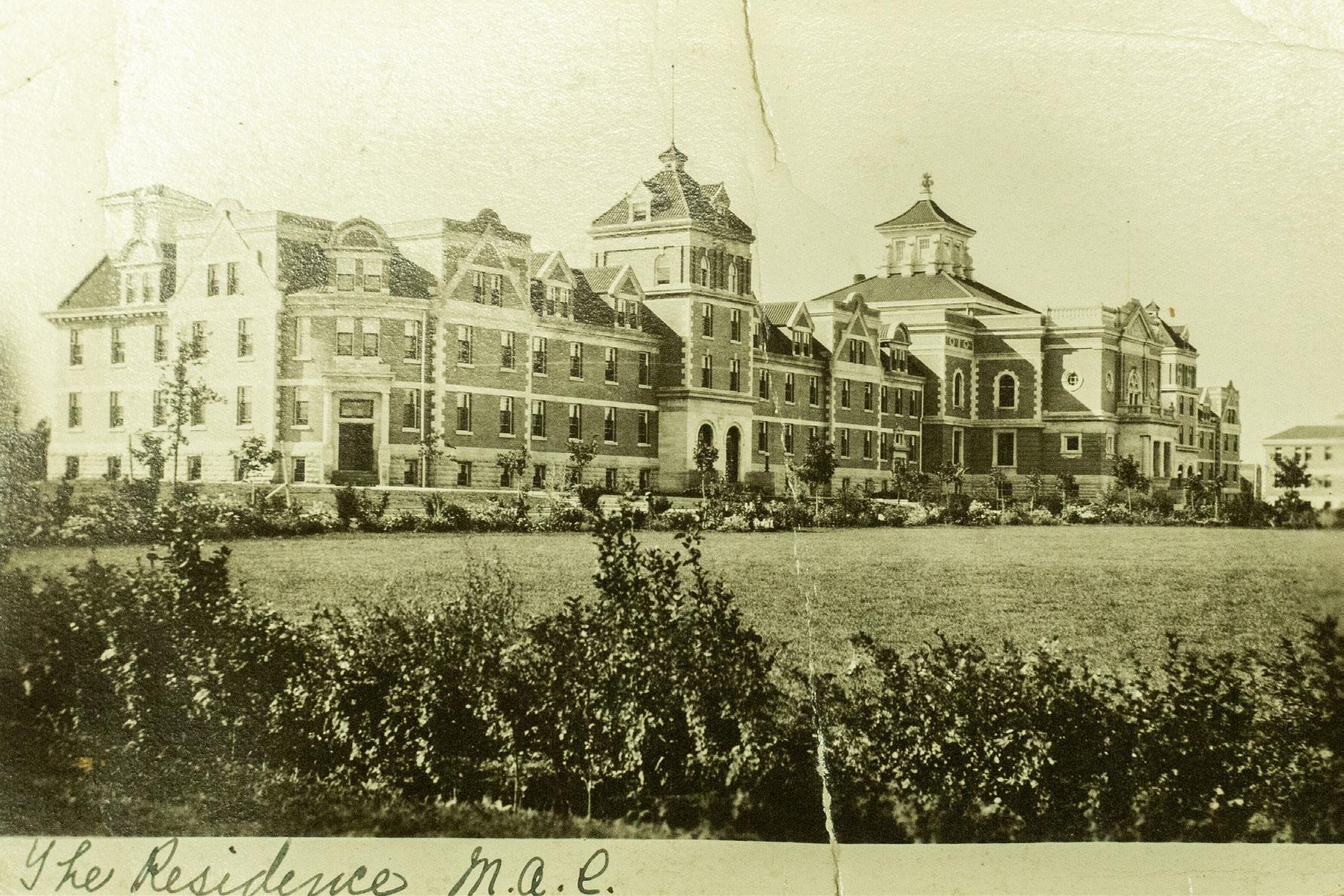
Bidzinski highlighted that, fitting for Manitoba and its constituents, part of the archive’s large collection pertains to agriculture. The current Fort Garry campus of the university was originally the site of the Manitoba Agricultural College, which would eventually become the U of M’s faculty of agriculture and food sciences.
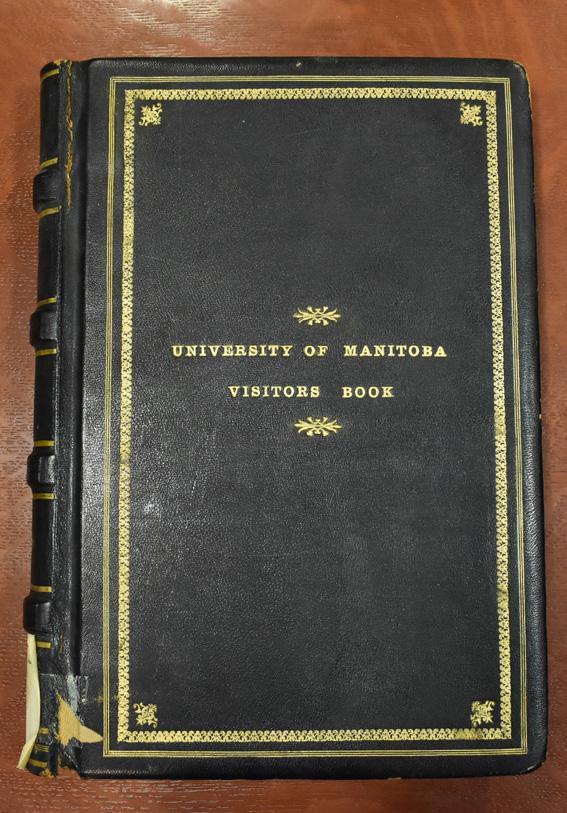
While many items and documents in the archives are digitized, Bidzinski pulled aside some physical pieces from its collections. One visitors book belonging to the archive holds the signatures of major historical figures who visited the university, such as England’s King George V and Queen Mary — then the Duke and Duchess of Cornwall and York — and later, Albert Grey, the fourth Earl Grey and governor general of Canada.
Through the archives, one can get a glimpse not only into U of M history, but also into how world history has been observed through the lens of the university, its students and its faculty.
While continuing to offer studies after 1914 in fields such as arts, sciences, agricul-
& special collections holds university’s history
ture, home economics and law through its sponsorship of the newly founded law school, the U of M added programming to suit the needs of the First World War. The university council established its committee on military instruction, which allowed the teaching of military tactics and science. It also formed a university corps, which organized practise drills, and some students in the corps took extra classes to become officers.
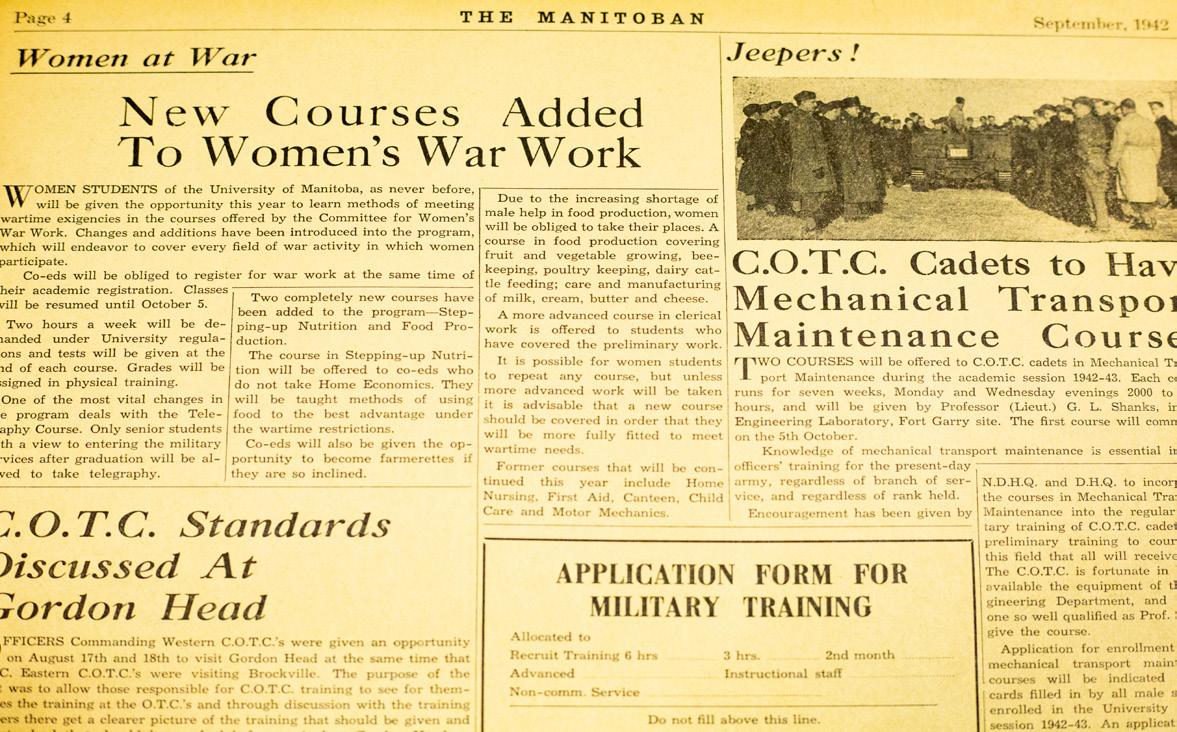
By 1940, however, the university had leased its Fort Garry student residence to the army to serve as barracks for soldiers in training during the Second World War. All 18-yearold male students had to take six hours of military training each week. Approximately 3,600 members from the U of
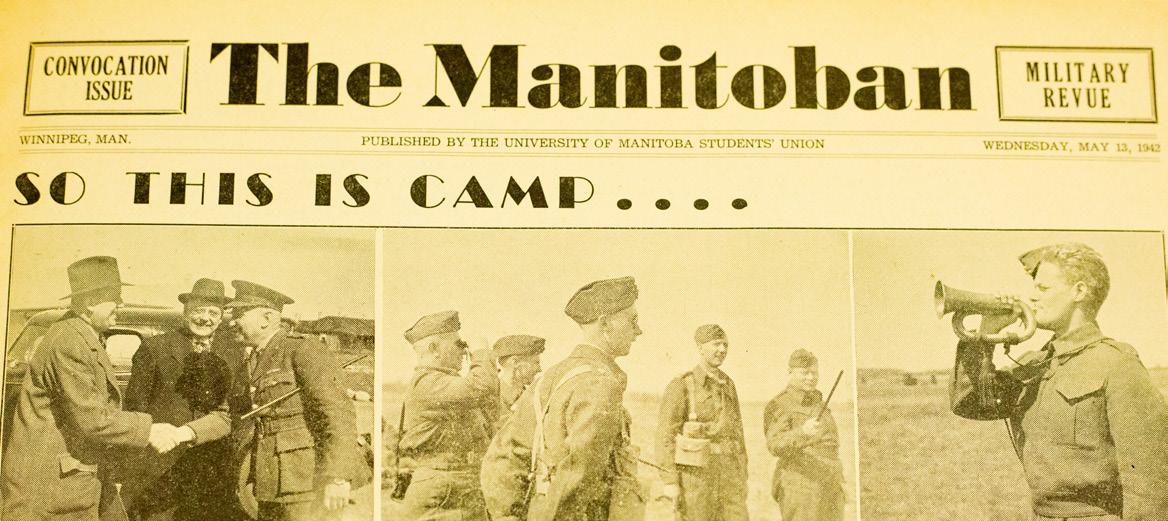
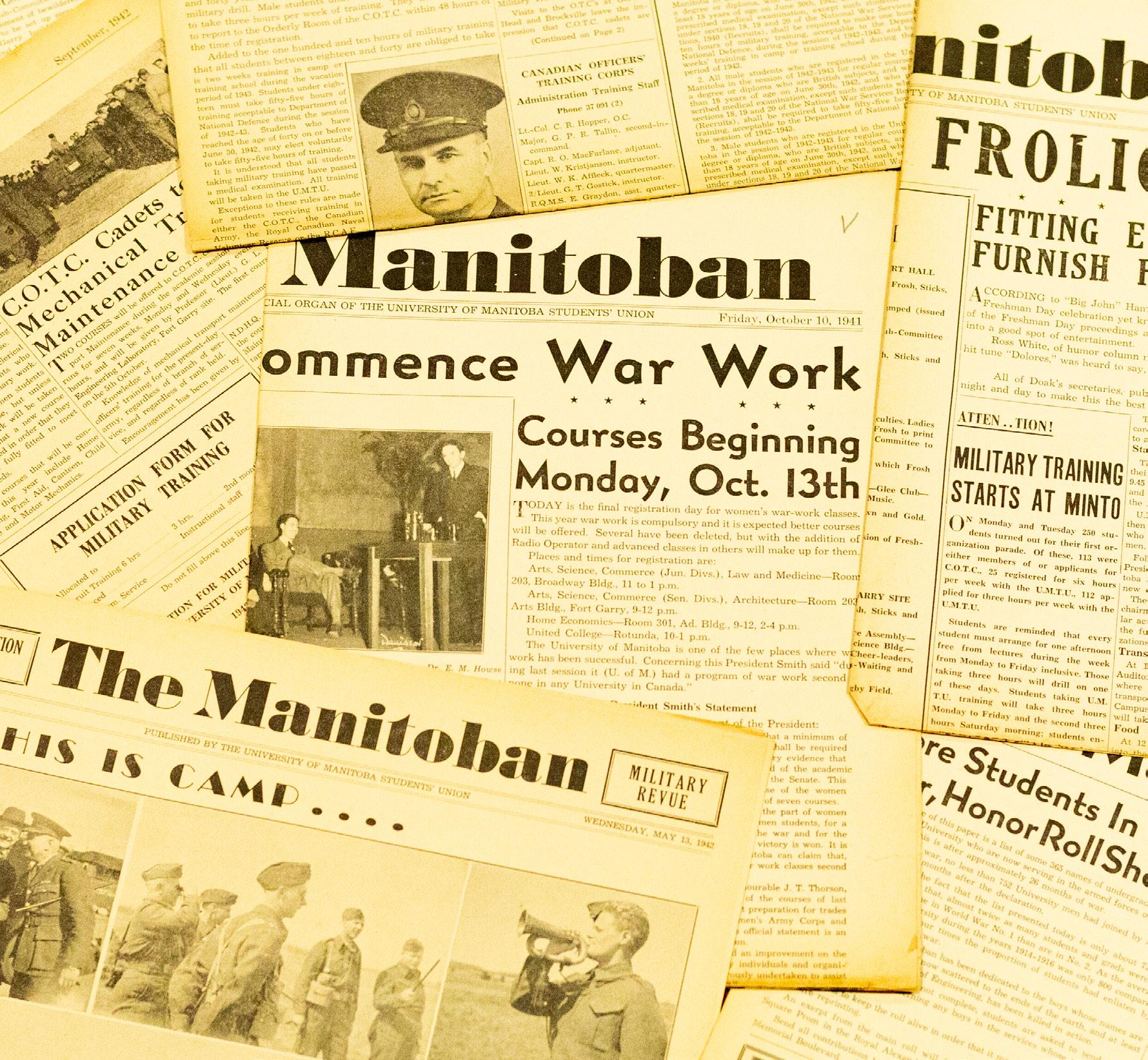
documented life on campus, and it’s been a great source of information since day one,” she said, noting that the publication recorded everything from the social activities of students, like the Freshie Queen contest of 1941, to what was happening on-campus and overseas during wartime.
“Sometimes you open a box and you’ll find the most amazing pieces of history there”
— Heather Bidzinski, Head of U of M archives & special collections
By the end of the war, 1,160 U of M students and 14 staff and faculty had enlisted. Of those, 123 died and 142 received military honours.
However, Bidzinski explained that “it wasn’t all business for students.”
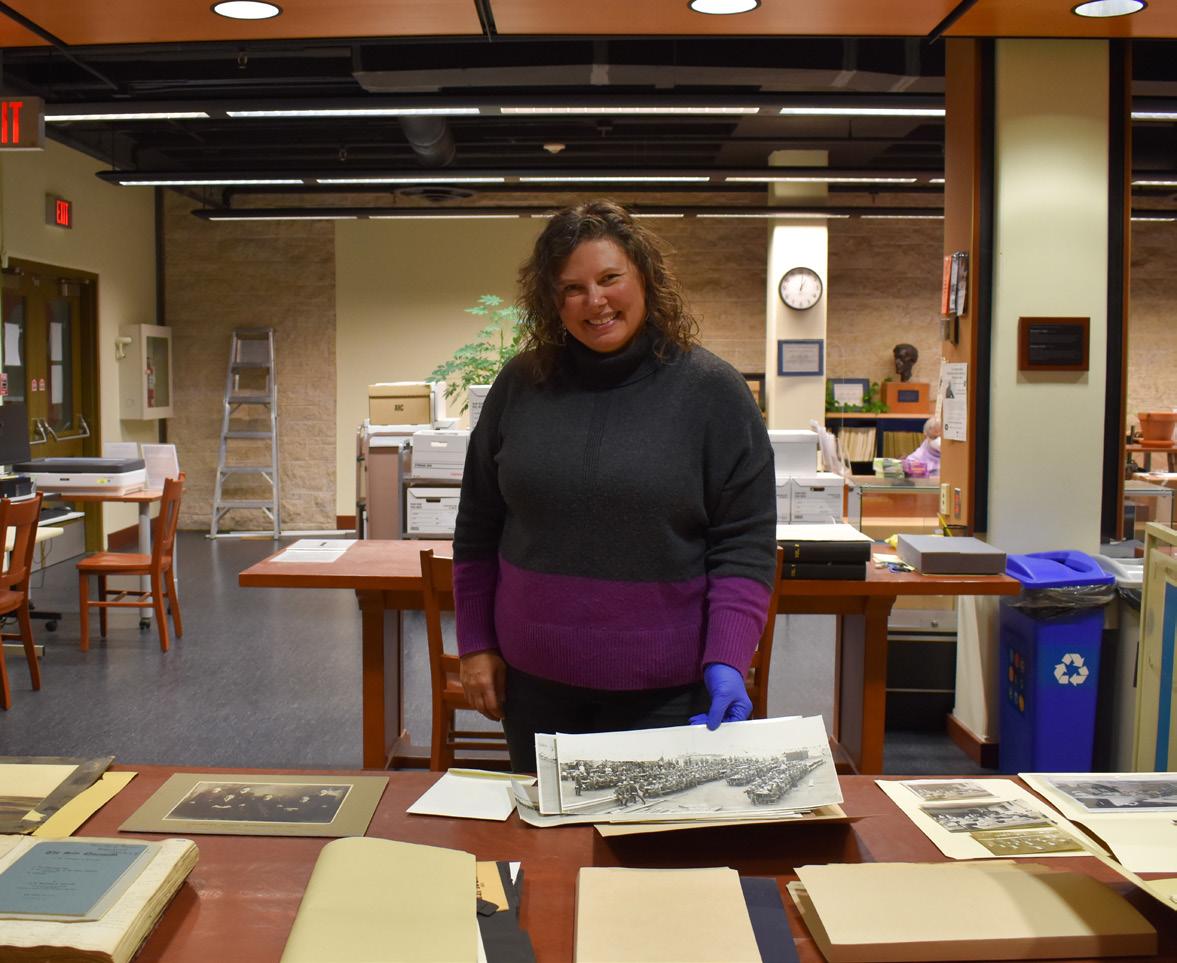
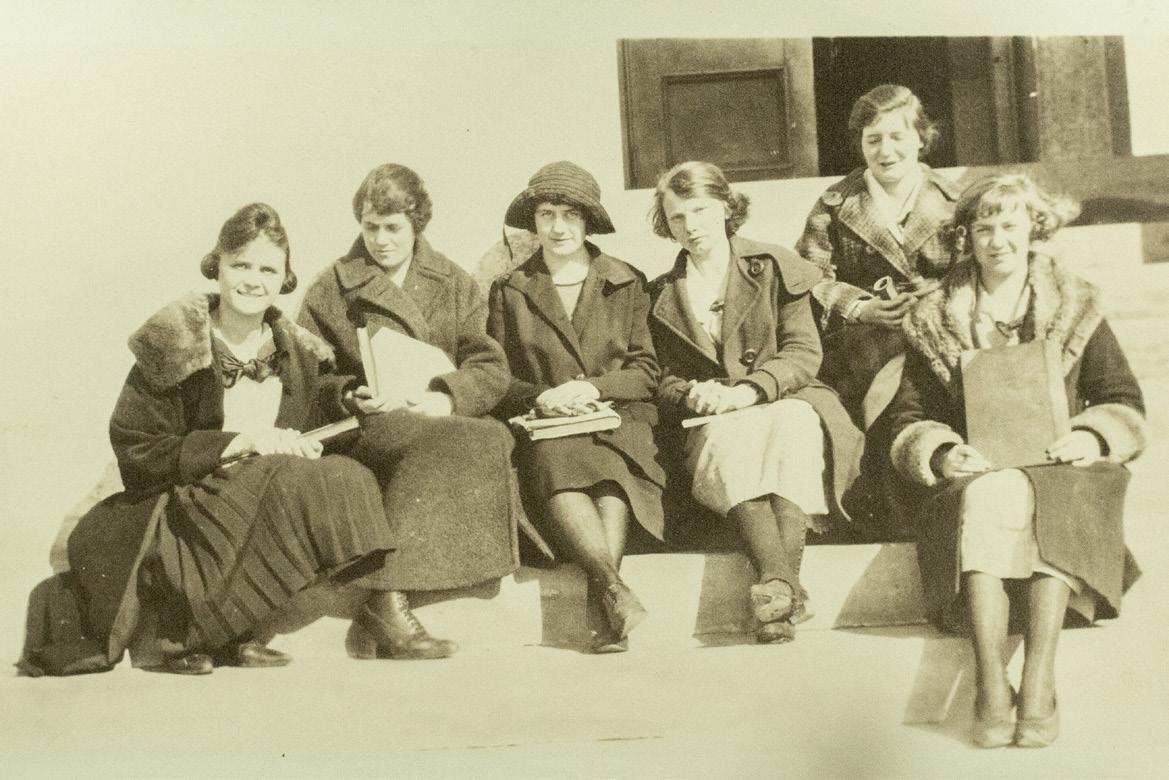
During these major events, student activities kept on going. The archives has kept records of student life through well-preserved black-andwhite photographs that can only be touched while wearing gloves. For example, Bidzinski showed pictures of the university’s glee club, which was especially active between 1929 and 1940.
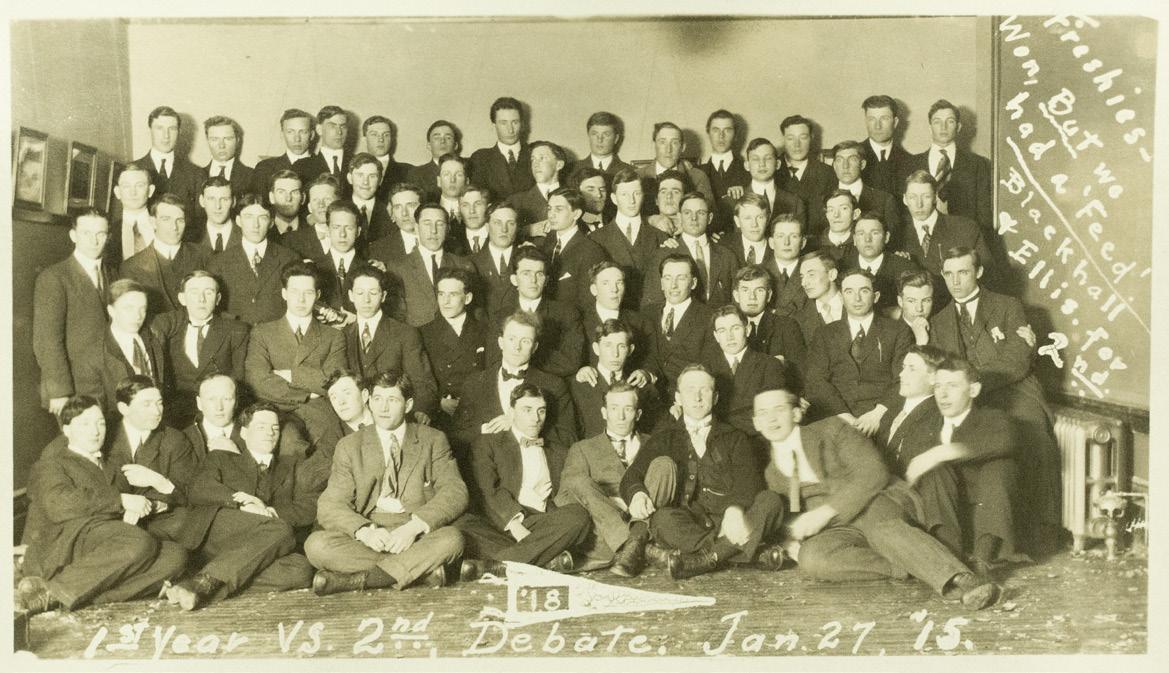
Photos also show debate tournaments, football teams, student body councils and regular students just studying outside.
M community served in the military during the war.
After the war, many students who enlisted came back to finish their degrees. At convocation ceremonies, those who served were often highlighted.
“They put their schooling on hold, but would come back and continue their education,” Bidzinski explained.
Through it all, Bidzinski said the Manitoban worked to keep the community informed. Issues of the paper — both hard copies in the archive’s back room vault and now completely digitized versions up to 2012 on the archive’s website — also act as a reference point for the archivists to see the dayto-day lives of students as far back as 1914.
“The Manitoban has always
“It’s interesting for people interested in the history of the university, but also in student activism and journalism and communication in general,” she said.
The archives show some similarities between the present and the past as well.
In the same way that the university closed for nearly two years between 2020 and 2022 due to the COVID-19 pandemic, in 1918, over 100 years earlier, an influenza epidemic caused a Canada-wide restriction on public meetings and resulted in the closure of the university from Oct. 11 to Dec. 2 of that year.
their learning, which in 1918 meant the telephone.
The editor of the Manitoban at the time wrote of this period that “our mail from the registrar lay unopened on our desks [and] our homework suffered in the interests of journalism.”
Bidzinski expects that when people want to look back on recent years, they’ll look through digital records like website captures and messages from the university president.
She is confident that those connected to the university community will be eager to know what the goings-on on campus looked like during any historically important period of time.
“I think that there will be an appetite to study those major events going forward,” she said.
Bidzinski encourages students to come and visit the archives on campus, open Monday to Friday, from 8:30 a.m. to 4:30 p.m.
“Although we can be a challenge to find, I think it’s really an untapped treasure within the University of Manitoba,” she said.
“I hope that students will come by and say hello and see what we have here.”
Similarly to the past few years, the 1918 closure made it so that grading and instruction methods had to be re-evaluated, and students relied on city and student news sources to inform themselves. The closure also required those at the university to incorporate relatively new technology in features@themanitoban.com
The archives & special collections’ rare book collection.
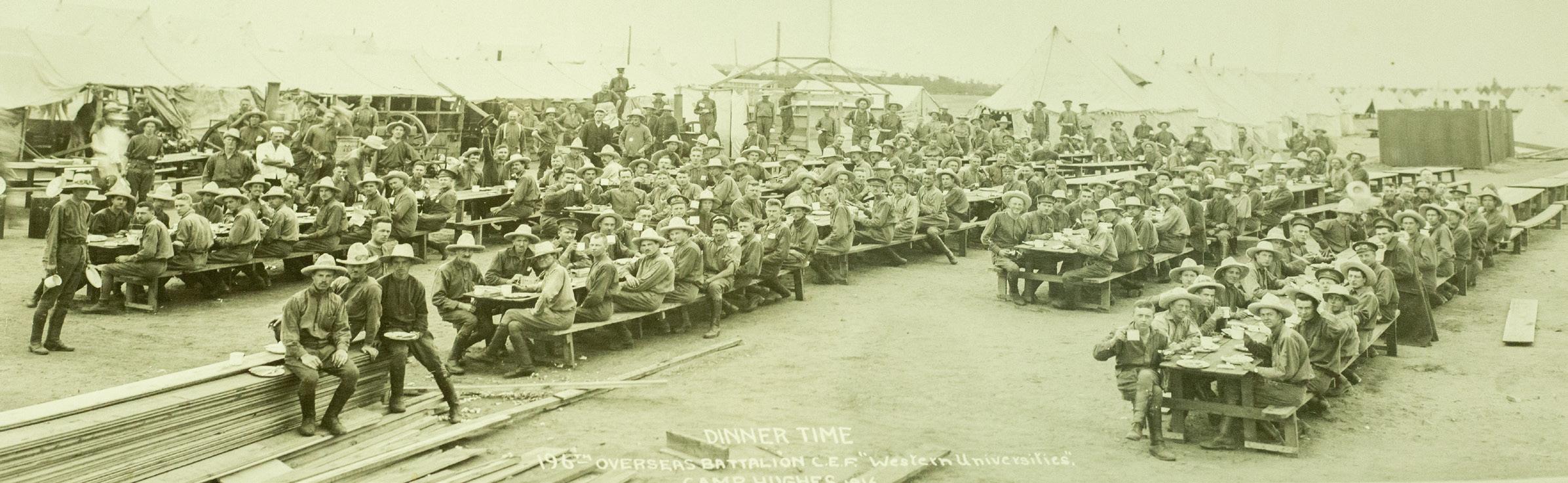
“Dinner Time,” 196th Overseas Battalion C.E.F., “Western Universities,” Camp Hughes 1916. In 1915 the Western Universities Battalion was established with the U of M contributing a company and a platoon.
“1st Year vs 2nd Year Debate” Jan. 27, 1915.
Head archivist Heather Bidzinski posing with pieces from the archive.
Students from the Manitoba Agricultural College, dated between 1915 and 1920. By then, the college offered a home economics degree.
Letter to the editor
Re: Vanity pickup trucks are a blight on Manitoba society,
I drive a 2002 Honda Accord and, on the highway, I set my cruise at 101. In my 150 km ride to Winnipeg, I get passed by no less than seven of these road hogs going no less than 130. And invariably they keep their LED headlights on bright, blinding me. Why can’t RCMP radar get these guys off the road? It’s no coincidence that Trump rallies and the Freedom Convoy were full of these man-children with sexual inadequacies.
— Ray Bernier
Jan. 18
letters@themanitoban.com
Classifieds Section
Part of a student group on campus? Send your event details to me@themanitoban.com to be included in the Classifieds!
Alpha Phi Sorority
Are you looking for unlimited opportunities and lifelong friendships? Join the Ivy League and find your forever home with Alpha Phi! Recruitment is currently ongoing. Come and chat with the Phis on Wednesday, Jan. 25th from 6 p.m. to 8 p.m. at 118 St. John’s! We also have another open house on Friday, Jan. 27th from 1 p.m. to 4 p.m. at 117 St. John’s.
Follow us on Instagram @manitobaalphaphi to keep up with more of our events. We can’t wait to see you there!
Arts Student Body Council (ASBC)
Winter Affair
Exciting News!
ASBC is hosting a social to celebrate the beginning of a new winter term and we want YOU and all your friends to attend!
Join us on Jan. 28 from 9 p.m. to 1 a.m. in the MPR (2nd floor of the University Centre) for a night of music, food and fun!
Tickets are $15 in advance or $20 at the door! You can purchase your tickets by going to the link in our bio on Instagram (@um.asbc) or come see us in person in the Arts Lounge next week Monday to Friday from 11 a.m. – 3 p.m. (Thursday we will be in the University Centre)
There will be free pizza from Boston Pizza and snowcones, as well as any door prizes including gift cards to Leopold’s and LOCAL Public Eatery! Plus, great music to get everyone on the dance floor.
Please note, this is an 18+ event and there is no intoxicated entry. Please have your photo ID with you and cash for beverages.
’Toban about town — Juneberry
Much ado about brunch
Jessie Krahn, staff
J uneberry is presently one of Winnipeg’s trendiest brunch places, and Winnipeggers are flocking to Old St. Vital to fortify themselves with the power of full-bodied coffee under kitschy wallpaper.
This much ado is not about nothing. I have visited the restaurant three times — in the summer, fall and again over the winter break — and in those visits Juneberry has cemented itself as one of my personal favourite destinations for brunch in the city.
Juneberry’s menu of caffeinated drinks is small but formidable. The raspberry matcha latte confirms my theory that matcha and fruit combinations are woefully underrepresented and underrated in the culinary industry. Tart raspberry flavouring compliments the more subdued notes from the matcha very nicely.
Brunch-goers who are less inclined to experiment with unconventional flavour combinations will have more than enough to tide them over. Juneberry serves Gimli’s own Flatland Coffee blend piping hot.
My new favourite item from Juneberry’s menu since visiting again over the holidays is the Honduran baleadas. The dish is served in a soft tortilla with egg, refried beans, avocados, a bit of shaved ginger and patrons’ choice of spiced sweet potatoes or steak.
Plated with summery greens, yellows and oranges bursting out of the tortilla, the baleadas are as much a treat to look at as they are to chow down on. The pop of pink crunchiness from the ginger is a warm and bright complement to the baleadas’s mosaic of subdued savoury, sweet and nutty flavours.
I am still daydreaming about this dish weeks later.
Besides the baleadas, the sweet potato latkes strike a tricky balance of crispiness on the outside and softness on the inside which I have never mastered in my own shameful attempts with the recipe. The latkes’ portions are a little stingy though, especially relative to other items on Juneberry’s menu, so the decision to label the latkes an entree is perplexing.
Juneberry’s eggs Benedict distinguishes itself despite the ubiquity of eggs Bennies on every brunch menu in existence. The hollandaise sauce is creamy and smooth, but what really pulls me in is the addition of delectable caramelized onions.
The beef short rib grilled cheese is a testament to the creative potential of sandwiches. The inclusion of horseradish aioli really elevates the recipe from an eye-rolling twist on grilled cheese to a special dish with its own identity.
For dessert, I highly recommend making room for the apple fritters. Juneberry serves them with a heavenly honey labneh nonchalantly smeared against the side of the bowl, along with a rich caramel drizzle. The labneh’s presentation belies its lifechanging impact.
Juneberry’s menu evolves a little with time. The one and only disappointment I’ve had through those changes was with an earlier form of its signature pancakes served with the option of chocolate ganache.
The ganache was a glossy dark chocolate, with very little else provided by way of sides or sauces. Because the ganache was extremely viscous and layered between each pancake, it effectively glued the cakes together.
What is more, the ganache was then poured over the top of the stack such that it demolished all other flavour profiles and breached the unthinkable too-chocolatey threshold.
If this pancake topping is ever revived, I think a salty side, or even a different hydrating sweet like some fruit would offset desertifying effects of the ganache onslaught. As it stands, the recipe has been tweaked and the ganache is no longer offered.
There is one major hurdle standing between Winnipeggers and brunch at Juneberry, and that is Winnipeggers’ monstrous enthusiasm for brunch.
The restaurant only takes reservations for parties of six or larger, and any smaller groups must check in on a wait list before going in. I’ve visited in summer, fall and winter weather and have never not been seated swiftly without that six-person minimum reservation.
The rules are understandable, though, as the restaurant follows a formula that Winnipeggers clearly find irresistible. Impulse reservations and no-shows would clog up the tables that people like you and I need to hold our fritters.
Juneberry is open from 9 a.m. to 3 p.m. Wednesday through Monday.
arts@themanitoban.com
photos / Faith Peters / staff
The restaurant follows a formula that Winnipeggers clearly find irresistible
Around the world in a single day
U of M Spanish Club hosts international potluck
Damien Davis, staff
f you find yourself pass-
Iing through the bottom of the Tier Building on Jan. 27, you’ll be greeted with a variety of aromas emanating from the U of M Spanish Club (UMSC) and its first event of the year — an international potluck.
UMSC has hosted potlucks before, focusing more on Latino and Spanish-speaking students. However the potluck being hosted Friday is expanding internationally to accept dishes from all cultures.
tently filled to the brim with members, they decided to host an event where everyone could connect with each other.
“We decided, ‘how about if everybody gets to know each
it a huge community of people who want to learn Spanish, are interested in the culture and a place just to hang out in between classes,” Guillen said.
“We decided ‘How about if everybody gets to know each other for a day and bring in their food?’”
The club has other upcoming events, such as a karaoke night in March and Valentine’s Day events Feb. 13 and 14.
— Rosie Guillen, co-vice president and communications director for UMSC
other for a day and bring in their food?’” she explained.
Rosie Guillen, co-vice president and communications director of UMSC, explained, “we just want to try different foods, we want to give everybody the chance to really do that and also to talk to each other, because we have such a large group of people come to the Spanish club every day.”
Guillen explained that because the club is consis-
The club was originally formed by the faculty of arts, but its student members eventually got together and became recognized by UMSU.
However, due to complications with procedures during COVID-19, the club is currently not recognized by the union.
Regardless, the intention remains the same for UMSC — they want to form a community.
“We just wanted to make
’Toban turntable
“We’re going to have a photo booth, we’re going to have sweet treats there and we’re going to have a little mini contest of the cutest photo,” she explained, adding that the winner of the contest would receive a small prize.
Concerning the potluck, Guillen told the Manitoban that she is excited to get the chance to learn about other cultures and their cuisine, how it’s made, what goes into it and how it comes together.
“All different countries use different spices altogether and it’s nice,” she said.
The club is open to anyone, and welcomes students who
Mac DeMarco — Five Easy Hot Dogs
Alex Braun, staff
3/5 stars
Over the past 10 or so years, in the shadow of the ’00s indie boom, by my estimation only two artists from the sphere have crossed the threshold into real mainstream acceptance and fame — Tame Impala and Edmonton native Mac DeMarco.
Musically they share a taste for woozy psychedelia and bygone eras of record production, favouring the texture of tape saturation. But career and image-wise, they have taken wildly different paths.
almost completely shied away from traditional stardom. In his early years he built a very distinct image for himself as a silly, slightly gross Everyman party dude with a heart of gold. His thrift store fashion sense, loose confidence and unfortunately glamorized cigarette habit made him an icon for a certain type of person.
in a slightly upsetting way, like the music playing over the speakers of a dead mall, or sitting in a dingy motel in the August heat as the lounge music pumping from the TV weather channel fights for airspace with the whine of a window AC unit. There’s an emptiness and griminess just beneath the surface.
There’s an emptiness and griminess just beneath the surface
Tame Impala mastermind Kevin Parker has transitioned from his classic prog rock image of insular studio wizardry to an awkward but whole-hearted acceptance of pop stardom, headlining festivals and rubbing shoulders with stars like Rihanna and The Weeknd.
DeMarco, meanwhile, has
But DeMarco’s party dude persona never quite jelled with his gentle, heartfelt soft rock, and in recent years he has removed himself from the spotlight, returning now for his first album in almost four years — a deeply unassuming collection of instrumentals called Five Easy Hot Dogs
Recorded over the course of a continent-spanning road trip, the record leans into DeMarco’s softest, sleepiest tendencies. The result is deeply chill
DeMarco’s music has always had a certain humidity — early albums like 2 and Salad Days have so much tape warp they sound like they’ve melted in the sun — but the addition of a more overt lounge and new age influence here amplifies it even further.
DeMarco has long aligned himself with Steely Dan, and Five Easy Hot Dogs is his first album to approach the harsh, cynical surreality of the Dan’s lyrical and aesthetic vision. In the absence of his heartfelt, straightforward lyrics and pop hooks, all that’s left here is slimy smoothness and jazz
are curious about a culture and country that they want to learn more about. It’s a space that encourages students to learn about Latino culture and culture from Spain from members who have connections to them. arts@themanitoban.com
image / Mac's Record Label / provided guitar. This might all sound negative, but Five Easy Hot Dogs is a quite enjoyable listen in a background music type of way. It is disappointingly low on effort and has insanely low energy, but it’s perfectly fine. If fading into the background is DeMarco’s prerogative, then more power to him,
The International Potluck will be hosted by the Spanish Club at 101D Tier from 11 a.m. to 2 p.m., Jan 27.
but I can’t expect more than a few devotees will follow him.
Five Easy Hot Dogs is available on major streaming services.
arts@themanitoban.com
photo / Faith Peters / staff
Sports teams’ schedules
U of M Bisons — Women’s Basketball
Mount Royal Cougars @ Bisons
Jan. 20 — Final: 62 – 58
Mount Royal Cougars @ Bisons Jan. 21 — Final: 79 – 69
MacEwan Griffins @ Bisons Jan. 27 — 6 p.m.
MacEwan Griffins @ Bisons Jan. 28 — 5 p.m.
U of M Bisons — Women’s Hockey
UBC Thunderbirds @ Bisons Jan. 20 — Final: 3 – 2
UBC Thunderbirds @ Bisons Jan. 21 — Final: 3 – 1
Bisons @ Trinity Western Spartans Jan. 27 — 9:15 p.m.
Bisons @ Trinity Western Spartans Jan. 28 — 4 p.m.
Mount Royal Cougars @ Bisons Jan. 20 — Final: 68 – 91
Mount Royal Cougars @ Bisons Jan. 21 — Final: 80 – 97
MacEwan Griffins @ Bisons Jan. 27 — 8 p.m.
MacEwan Griffins @ Bisons Jan. 28 — 7 p.m.
U of M Bisons — Men’s Hockey Bisons @ UBC Thunderbirds
U of M Bisons — Men’s Volleyball
U of
Bisons fall prey to Thunderbirds U of M women’s hockey team drop both games against UBC
Quinn Mayhew, staff
On Jan. 21, the Bisons women’s hockey team began Saturday afternoon’s game against the University of British Columbia Thunderbirds with a bang, rocking Wayne Fleming Arena.
The game was a chance at redemption for the herd after Friday night’s loss, which saw the Thunderbirds triumph 3-2. UBC scored two goals within the first period of Friday’s game, and the U of M couldn’t bounce back from the early deficit.
With UBC’s win over the U of M Friday night, the herd went into Saturday’s game looking for payback. The game
started off with the Bisons making good, crisp passes and using their speed in the neutral zone.
As the U of M broke out of its zone in the first period, Dana Goertzen was able to score the first goal of the game, setting up a successful start for the Bisons.
The U of M was able to score within the first period, setting a different tone compared to Friday night’s showing. That game, the herd didn’t score until the first 10 minutes of the second period with a goal by Kate Gregoire.
The Bisons were looking for a win on Saturday to secure a Canada West (CanWest) play-
off spot. They currently rank seventh in the standings, just two points behind Trinity Western University.
Undeterred by the loss Friday night, the team rallied Saturday afternoon with breakout passes to its centremen. Despite the different tone, the animosity from Friday night’s game carried over to Saturday.
The contest saw 13 penalties from both teams, with many of these infractions committed in the third period. Manitoba came out with six power plays throughout the entire game.
The U of M did a good job winning most of the face offs, however, the herd had trouble
maintaining control of the puck and difficulties with its zone entries.
The herd struggled to maintain pressure on the Thunderbirds, and UBC was able to jump on loose pucks and kill off the Bison power plays by maintaining great defensive gap control.
UBC continued to gain momentum through the game, scoring in the second period and staying aggressive on the penalty kill.
The Thunderbirds hungered for the puck in the third period, converting that desire into offence. They managed to score two goals within the first two minutes of the third per-
iod, making the score 3-1 for UBC.
UBC continued to be aggressive in the last few minutes of the game, stifling the U of M’s last ditch efforts and winning 3-1 over the herd. In sweeping the Bisons over the weekend, the Thunderbirds maintained their winning streak and their top position in the CanWest rankings.
The Bisons will play their next game against the Trinity Western Spartans in Langley, B.C. on Jan. 27 and 28.
sports@themanitoban.com
Bisons triumph over Cougars
U of M men’s basketball team sweeps Mount Royal University
TJoshua Brandt, staff
he U of M men’s basketball team collected two convincing victories this past weekend against the Mount Royal University Cougars, improving their record to 13-1 on the season. They now sit alone atop the Canada West (CanWest) standings.
Bison first-year forward Simon Hildebrandt was, and is, a big reason why.
He poured in 18 points in Friday night’s 91-68 win and added 25 more in Saturday’s 97-80 win. He’s now averaging 17.1 points per game, good for tenth place in CanWest scoring.
Hildebrandt’s most notable play over the weekend came in the third quarter of Saturday’s game when he drove a vacant lane and threw down a vicious one-handed slam, posterizing Mount Royal’s Keivonte Watts and electrifying the home crowd.
When asked about how he stays confident under pres-
sure as a rookie in a tough conference like CanWest, Hildebrandt responded, “when I’m playing, I just lock in.”
“I don’t think about anything else around me,” he said. “I just focus on my shot, and it’s the same shot every time.”
The Bisons’ defence also stood tall over the weekend, holding the Cougars to 68 and 80 points respectively in the two games.
“We pride ourselves on our team defence,” Hildebrandt said.
In fact, the Bisons held CanWest second leading scorer Holt Tomie of the Cougar’s below his usual average of 23.8 points per game.
When asked how the team planned on stopping Tomie, Hildebrandt said, “we’ve got to make sure it’s not just one guy guarding him, it’s all five.”
Needless to say, the team executed its gameplan in exemplary fashion, forcing Tomie into many highly contested, fadeaway jump shots, and seldom letting him penetrate into the key for an easy layup.
Boasting a shimmering 13-1 record, the U of M men’s
“We all have the same goal, we all want to win a lot”
— Simon Hildebrandt,
Forward, men’s basketball team
basketball team is now in sole possession of first place in the CanWest conference, a game up on the second place University of Victoria Vikes, breathing down the Bisons’ neck at 12-2.
When asked about what being in first place meant to the team, Hildebrandt was quick to draw attention to the plethora of local talent
that the team possesses, making their rise to the top more meaningful.
Hildebrandt said that the team’s chemistry enables it to function well as a unit.
“We all have the same goal,” he said. “We all want to win, a lot.”
With the best record in CanWest three weeks before the start of the playoffs, Hildebrandt said that the team has grown in confidence.
“We’re kind of at the point where we’re like, ‘we’re good, we’re really good, we can do this now,’” he said.
Hildebrandt firmly believes that the team has what it takes to succeed at nationals.
“The way we’ve been playing this season, we can definitely win it now,” he said.
The last time the Bisons won the U-Sports men’s
basketball National Championship was in 1976.
Before the team can win Nationals, though, it has to get there. To do that, it needs to win its CanWest semi-final matchup, should it make it that far.
The team isn’t getting too hasty, though. Hildebrandt said they’re going to take the remainder of the season “one game at a time.”
Students thinking of attending a game should do so, as they’ll be treated to excellent, entertaining basketball — especially if the team can go on a deep playoff run.
The next home games for the herd are Jan. 27 and 28 as they play host to the MacEwan University Griffins.