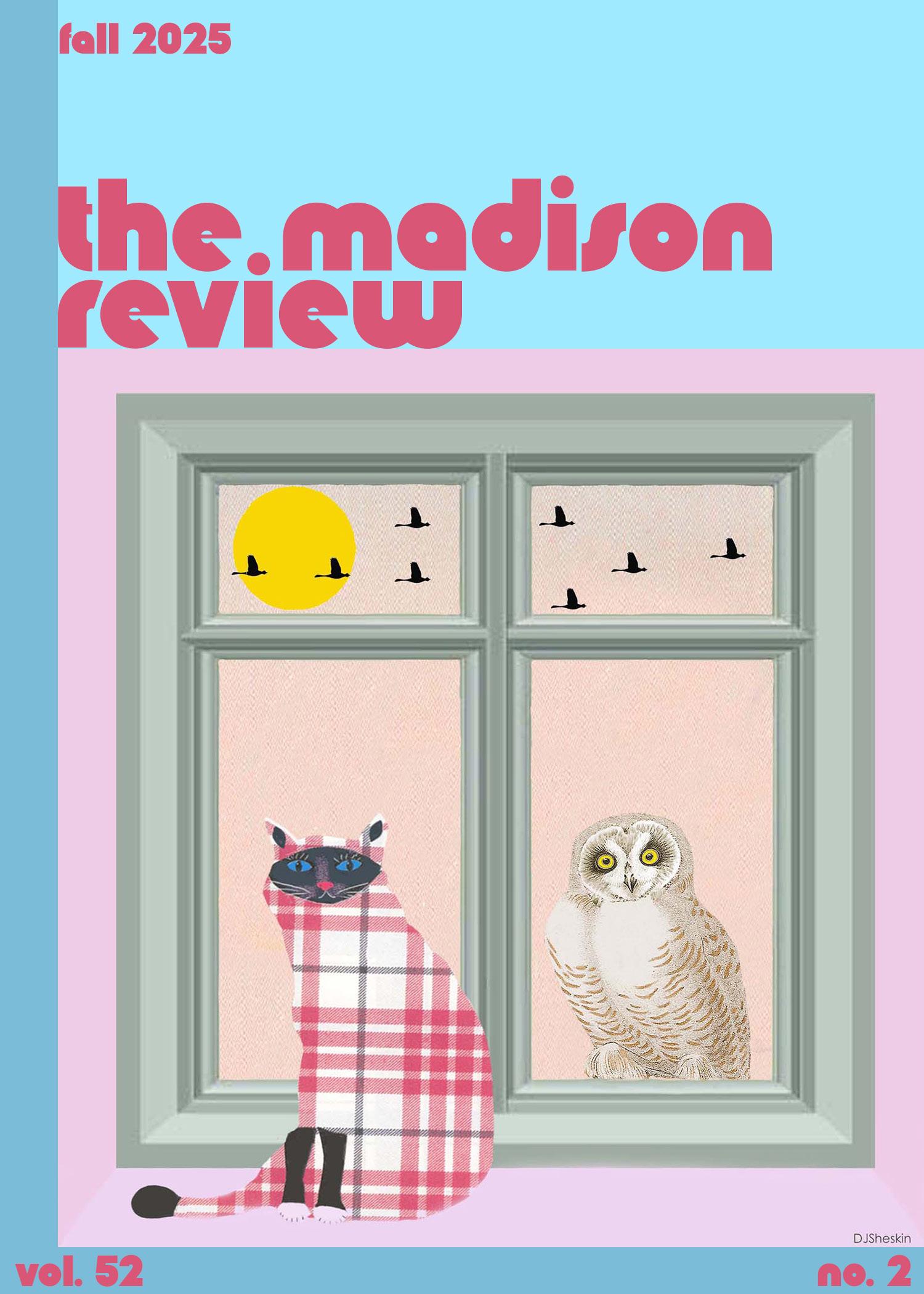
Welcome to this Fall’s edition of The Madison Review. This issue urges us all to take respite in the shared familiarity of everyday life, wading between stories of youthful provocations to walking with speakers processing the love that remains in the wake of loss and grief. Focusing so intently on place, these pieces transported us across time and space, planting us right in the heart that beats through their lively prose and tender verse.
We sincerely hope you are as moved by these pieces as we have been over and over again. We would like to thank each of our contributors, without whom this edition would not be possible. Thank you for trusting us with your precise craft, earnest dedication, and undeniable skill, as well as calling this journal home.
We would also like to thank our program advisor, Ron Kuka, for his immensely resilient patience, abundant wisdom, and steadfast support, along with the UW-Madison English Department and the Program in Creative Writing.
To the staff, thank you for the love you have poured into this journal. None of this would be possible without the dedication, profound curiosity, and careful attention you dedicate to the literary craft.
A final thanks belongs to you, our Reader. This issue would not exist without your devotion to, and appreciation for, the written word. We sincerely thank you.
Warmly,
The Editors
Retainer
Scott Nadelson
They’re already running late, and now the fucking retainer’s missing again. He looks in all the places he’s found it in the past: her backpack, the pockets of her sweatshirts, the bathroom counter, the impassable floor of her bedroom, her laundry basket. But all he comes up with are wads of tissue, sticky Skittles whose color has melted off, a permission slip for an upcoming field trip he was supposed to sign two days ago. He signs it now, returns it to the backpack, and then thinks better of it and tapes it to the front of the pack instead, so she doesn’t forget to turn it in.
Did you find it? he calls, but she’s no longer looking, just reading texts on her phone, or else the web comics that entertain her for hours. His ex’s insurance covered her braces to the tune of two grand, but it won’t pay for a replacement retainer to keep her teeth as straight as those of the pop stars she idolizes. He wants to shout at her about responsibility and independence, to threaten to restrict her in ways he hasn’t yet imagined, but of course he lost his own retainer within weeks of getting his braces off three decades ago, and what did it really matter? His teeth have slid into an overbite that makes it hard to snip off anything too skinny—rice noodles, for example, which he made for dinner last night—without shifting it to his molars. But his smile isn’t hideous, as his parents warned him it would be, just a little quirky and individual, and it hasn’t caused him any trouble in life. They refused to buy him a new one, but of course that won’t be an option for him, because his ex won’t hear of it: since the split, she’s insisted on making everything as perfect as possible for their daughter, buying her any clothes she wants, taking her on trips to Disneyland, driving her to school even though it’s only a dozen blocks away from their house, the one he moved out of eight months ago.
His new place, a two-bedroom in a recently constructed, slapdash complex, is three miles from the school, and he doesn’t have time to drive her there without being late to work. The bus is due at the end of the street in seven minutes, and still no sign of the retainer. Why does she have to lose everything while she’s staying with him? Unlike his ex—an employment lawyer working for the state—he can’t afford to make everything perfect. When people ask what he does for a living, he says, I’m a musician, but what that really means is he
drives up and down the valley giving guitar lessons at colleges and supplementing with private lessons to high school kids on weekends. None of his students are interested in classical or jazz guitar, none have ever listened to Segovia or Wes Montgomery or Tal Farlow. They all want him to teach them the chords to Hozier songs so they can impress their friends at open-mics. He performs with a jazz trio once, maybe twice a month at most, in the lounge of a local pizza joint, and sits in with the local symphony orchestra on the rare occasions they need a guitar. While married, this was a perfectly reasonable set-up, a welcome boost to his wife’s sizeable income. Now it barely pays the rent, but he refused to ask for alimony or child support, which would have meant dealing with more lawyers—he’s finished with them and their relentlessly rational arguments—as well as further humiliation.
He can’t afford trips to Disneyland, nor can he afford a replacement retainer, so he looks again in the bathroom. While there, he studies his own teeth, the lower growing crowded, one of them twisting slightly sideways. He can’t remember if he brushed them already this morning so does it now, making sure to work at the gums in back, where the hygienist told him plaque had been building up. He can’t afford dental work, either, and is determined to take better care of himself now that he’s forty-seven and cut loose to survive on his own, nothing but catastrophic health insurance to keep him from going bankrupt if he’s in a car accident or develops a tumor. But determination alone doesn’t fend off the despair he experiences when he spits into the sink and sees the toothpaste foam has turned pink from his blood, the gums still tender though he has flossed every day for two weeks. Despair, too, because now he knows there’s no chance he’ll get his daughter to the bus stop in time and will have to drive her to the middle school across town, the opposite direction from the one he needs to go. His first lesson is at nine, half an hour south, and he’ll inevitably hit traffic getting onto the freeway. His phone tells him it’s 8:14. The rumble of the bus shakes the apartment’s flimsy walls.
He hates the word retainer, which again makes him think of lawyers. His ex sometimes talked about going into private practice so she could make even more than she already did, and she occasionally tossed out the word along with figures her colleagues charged various corporate clients for their services, which usually amounted to keeping employees from accessing benefits or suing for discrimination. At the time he encouraged her to do whatever she thought was best for her career, especially as more income would mean he could agree to fewer lessons, a boon for him even if it meant she spent more hours at work. Now
the word suggests something impossible—a bit of plastic or a pile of money to hold things in place when everything is in constant motion, sliding toward chaos.
Retainers work against the natural disorder of the universe, he thinks, but that doesn’t keep him from making another sweep through the apartment’s few rooms, once again digging in the pockets of dirty clothes and this time coming up with a bracelet he’s never seen, not the delicate type his ex would wear but a chunky silver chain with three black beads, one in the shape of a raven’s head, the others a pair claws. It doesn’t fit with his daughter’s outfit—athletic shirt and leggings—but he thinks that maybe it suggests a movement in a new direction, a gradual drifting like that of teeth left to their own devices. Most important, a change his ex won’t approve but can’t prevent if she tries.
This yours? he asks his daughter, who stands by the door now with her shoes on, the backpack her mother bought her at Disneyland slung over one shoulder. She doesn’t answer, just snatches it out of his hand and slips it onto her skinny wrist. I guess we’ll do without the retainer today, he says. I’ll find it when I get home. Drop it off at your mom’s tonight.
Again she doesn’t answer, but this time she bares her teeth at him, as if she’s about to growl. Those teeth are still perfectly straight, a movie-star smile paid for by the state. It’s the mouth of a lawyer’s kid, not a musician’s, and though he taught her some basics of guitar before she turned ten, she shows no inclination to play it now. Nor is she interested in listening to Django Reinhardt, only to Olivia Rodrigo and Taylor Swift and Miley Cyrus. When she’s in college, maybe she’ll want to play Hozier songs, or if the raven bracelet does indicate an emerging inclination, Nine Inch Nails and The Cure.
Her teeth are still bared. Now she taps against the front. And only then does he recognize the transparent film over them, molded to her mouth to keep molars and incisors from moving. Where was it? he asks, but she just shrugs. Next year, when she starts high school, she’ll need to wear it only at night. She’ll also be able to walk to school from his apartment, and her mother will have to drive her across town when she misses the bus. Changes are certainly coming, good ones, perhaps, but now he decides he’s had enough change for a while. He’d like to hold things in place just as they are right now, mid-transformation: the Disneyland backpack and the raven bracelet together, incongruous, his child like a tadpole after its back legs have sprouted but before its tail has disappeared. He hears the bus pull away from the curb. He’ll be
late for his first lesson for sure.
Let’s get you to school, he says but stays right where he is.
at the end
Christian Yeo Xuan
just a sound like a gunshot
the dog walks in finds us prone
like doormats how did this happen
the dog asks. we cannot speak, being
dead. so the dog puts his glasses on
does the post-mortem he holds up the arguments & counterarguments, lies & half-lies, prims his glasses like a doctor when he says god, he cannot look at god silence blooms like magnolias
you get up, alive & adrenal— step gingerly over my body
walk out into the rain, into pasture, with your past selves, you love like wild horses
like wild horses you run
Dwell Time
Hillary Moses Mohaupt
Germantown Avenue stretched from the gritty inner city of Philadelphia to its glamorous suburbs, from one end of the economic continuum to the other. The street, which wound up and down hills as it made its way through the city, was tree-lined in places, barren in others, a through-line from Philadelphia’s past to its present, a living, breathing trajectory of change.
In the Mt. Airy section where Sara Gibb lived, the road was flanked by restaurants and consignment stores, bars and music shops, historic homes and house museums, self-help programs for seniors and criminals and disadvantaged youth, a Lutheran seminary, and a Baptist church campus that had once housed a school for the deaf.
Sara hated the mile-long stretch of Germantown Avenue between their apartment and the farmer’s market, and this morning Josh was walking faster than usual down the Avenue, beating the path from their apartment to the market at a pace Sara couldn’t match, even if she hadn’t been so pregnant she could not longer see her own legs when she looked down. Sara found she had to keep an eye on the sidewalk just before her, so she couldn’t keep her bearings on time and place. Even now as she paused to glimpse the stain on Josh’s retreating rear end, she thought this part of Philadelphia felt worlds away from the historic blocks downtown where Franklin and Jefferson had once pounded the pavement themselves. The left leg of his blue shorts were stained in a place Sara was sure he couldn’t see in the mirror and wouldn’t notice in the drawer, just to the left of the inseam, right in her line of sight as she watched his steady gait carry him farther and farther away. She resisted the gravitational pull of the market at the bottom of the hill, determined to make him see that he wasn’t compensating for her belly at all.
Here the road was cluttered with Belgian blocks that seemed to need resetting every season, as if the city of Philadelphia had committed to paving Germantown Avenue in the style of 19th century infrastructure, but minus actual proper 19th century road paving techniques. She imagined horse-drawn carriages careening down the road from one neighborhood to the next, not disturbing the blocks the way present-day cars did as they sped up the hill at ten or twenty miles above the posted speed limit. She suspected, too, as she watched Josh walk briskly, that the natural elements—the snow and rain and grade of the street—didn’t help
matters very much.
She was twenty-nine weeks pregnant, a calendar Bubbie which kept closer tabs on than did she or Josh. Josh’s grandmother was worried that the hormones weren’t affecting Sara the way they’d once afflicted Bubbie herself. Whenever Bubbie mentioned it, as she had the previous night, Sara felt like a museum specimen being dissected by an overly inquisitive anthropologist.
“I’m fine,” she’d insisted last night. “And I’m sure the baby’s fine.”
Josh had turned to her, offering another roll from the basket his grandmother always kept on hand. “How can you be sure?” Josh had asked her.
“I think I’d know,” she’d insisted, and she was not surprised that he was, finally, demonstrating the characteristics of all the men she’d ever known.
After dinner, when they’d sat around Bubbie’s living room with reruns of Star Trek providing the only real light in the room, he’d held her hand and laid his head on her shoulder, a gesture of goodwill, she knew, not because she’d ever witnessed her father apologize to her mother, but because Josh himself was always remorseful, always first to recognize his own faults, which were, despite her suspicions, few, inconsequential—at least so far. And yet the damage of his doubt had been done, and in the morning she hadn’t said much over coffee and breakfast, even when Josh had asked for her contributions to the shopping list for the farmer’s market trip.
“Whatever you like,” she’d said plainly, and slipped on her sneakers without another word.
In a way her silence had more of an effect than if she’d flown off the handle unreasonably, the way Bubbie had warned more than once she might do while pregnant. Josh’s face had crinkled, his eyes narrowed, and she knew he felt hurt. She felt powerful.
It was only at the bottom of the hill that he stopped to wait for her. He kept his gaze trained on the produce table on the outskirts of the market, their canvas market bags stuffed under his arm. The market sat at the dividing line between their neighborhood and the next one, in a sort of valley where the road then continued upwards.
Sara caught up to him, then paused before him only long enough to take a breath. The baby seemed to suspend herself in that breath, as if she too were testing the limits.
“Carrots,” she exhaled. She pointed in the direction of the first canvas pop-up tent where carrots were arrayed alongside a bounty of other vegetables.
She didn’t listen for his response. She circled the produce table in search of the perfect carrots, one of the rare, sudden, unshakable demands from the baby. Whenever the baby made a move Sara felt compelled to make a corresponding one, a hand on her belly to meet the place where the baby kicked, or a thumb pressed against the baby’s back. It calmed her, connecting with this child inside her. Her father had undermined her own mother relentlessly, and that had been the least of the abuses he’d lobbed at her. That her mother had, in response, escaped from their father with Sara and her younger sister in tow had only fortified Sara’s feelings that men were to be avoided. Falling in love with Josh had been an aberration, and now she wondered if it had been a mistake. Bubbie had been pestering her lately about her lack of hormonal outbursts and outlandish cravings, but Sara knew Bubbie would approve even less of the impulses she actually was having, and Sara didn’t really care.
A plump man in a dirty green apron, not one of the regular vendors, stood with his arms crossed behind the card table piled with vegetables, a rickety metal scale, and a cash box.
“Morning,” he said.
“How much are your carrots?” she asked. Josh was lingering just outside the orbit of the table.
“Buck fifty a pound,” the man said.
“Organic?” she asked, buying herself time to consider whether this price was remotely reasonable, whether this man was trying to rip her off.
The man unfolded his arms and put his hand on his hips. “Everything you see here is as organic as it gets.”
Josh approached the table then. He reached for a round head of butter lettuce and weighed it in his hands before holding it out to Sara. “Butter or romaine?”
“Romaine,” Sara said.
Josh set the head back on the pile and chose one of the dark leafy bunches. The vendor shook out a plastic bag.
“We have our own,” Sara said, and Josh pulled a canvas bag from under his arm and held it out for the lettuce.
It had been years—a full decade—since she’d launched herself from the home she shared with her mother and sister, and now here she was in this market, where time was suspended. She could purchase carrots, lettuce, whatever produce she felt compelled to tuck into one of the canvas bags, but she could not put behind her the suspicion that all men, when given the chance, disappointed her, or worse, destroyed her family.
During her second trimester Sara had been seized with the realization that she could not remember really knowing another woman who was
pregnant. She couldn’t remember whether her mother’s belly had undulated under the stress of a swimming fetus, whether her appetite had fluctuated unpredictably, whether her temper had flared for no apparent reason.
Whenever it occurred to her that a new stage of life, a new lifetime altogether, was waiting on just the other side of a handful of months, Sara wanted to pack up her possessions and take off by whatever mode of transportation could carry her away from the future as quickly as possible. Bubbie would never understand this impulse: Bubbie had lived within the same ten square miles all her life, surrounded, more or less, by her children and their children, and was doted on by a grandson who’d never known any kind of loss or real hardship, and who ought, Sara thought, to crack any day now under the pressure of a full-time job, a grandmother to care for, a baby on its way into the world, and a girlfriend who could get up and leave, if only she could achieve escape velocity. And yet Josh was eager to feel the baby’s movements, was more than willing to jog over to Wawa in the dead of night to buy sririacha ranch Doritos or jelly-filled Tastykakes or neon green slushies—was immovable in the face of her silent anger.
“You’re tired,” he’d said last week when she’d thundered back into the bedroom after a long day at school.
“I’m not,” she’d insisted, though her legs ached and her brain jostled against a headache.
“I’ll make tacos for dinner,” he’d said. He leaned against the door jam of their bedroom, watched her pull off her clothes. “Any special requests?”
She’d rummaged through a drawer for a loose dress to pull on, annoyed that she was hungry and annoyed that he was so understanding. How could she be angry with a man so calm?
“Beef,” she’d said, though she knew he’d have to run to the store for supplies. “And olives.”
That his own anger had not flared yet had confused her for a few days, but then she felt obliged to test its edges. Would anything make Josh resort to violence? She’d felt the urge to try.
Now Sara watched as Josh handled tiny new potatoes, holding a half dozen in his hands, before passing them to the market vendor. She watched him empty a pint box of beans into the canvas bag slung over his shoulder, watched him glance up in her direction as if locating her in space. She turned, satisfied that he’d seen her, and seen her turn away.
The market was set up at the intersection of three streets that formed a wide triangular plaza large enough for a dozen or more white market
tents, folding tables, a neon tangerine food truck that cast the aroma of grilling hamburgers over the entire market. Cars trundled off in one direction, continuing up the hill into the Chestnut Hill neighborhood, where Josh had bought the baby a bookshelf when she first learned she was pregnant.
Sara plodded across the plaza now, in search of melons. She surveyed each of the white-tented stalls and saw out of the corner of her eye that Josh had paid for the potatoes and beans and was moving toward the cheese vendor. They never bought cheese at the market, but in the last few days she’d sent him to the Acme grocery store around the corner for cheddar and gouda and brie.
The banner over the melon man’s stall featured a field of sunflowers though he and the melons were from a farm somewhere in southern New Jersey, a place Sara imagined was steeped in refinery sludge, the roads slick with a sheen of oil. It was an unlikely idea, and anyway it didn’t stop her from buying a watermelon.
“It’s almost as big as you are,” the melon man said, as he handed over her change.
Sara tucked the watermelon in the vice grip of her armpit. She flashed him a genial smile she did not mean. “You probably shouldn’t say that to a pregnant woman,” she said. “The hormones might make her do something you’d regret.”
The melon man raised his hands in surrender. “No kidding,” he said. “My wife would have my head.”
“Smart wife,” Sara said, her voice icy as she turned back up to the market plaza.
She ambled past a couple of crafters’ stalls, an organic honey table, a white tent with a vinyl banner plastered with a cartoon smiling Holstein cow and the words LOCALLY RAISED GRASS FED HAPPY COWS. Sara glanced at the large gray coolers stacked behind the folding table and shivered.
Last night, after Bubbie and Josh had questioned her reaction to her own pregnancy, Sara had stepped into the back garden for some fresh air. She’d inhaled lungfuls of thick Philadelphia night and felt an ache for the humid breezes of her mother’s home in the Midwest. She’d stood on Bubbie’s small patch of patio feeling like a stranger in a place she didn’t recognize and pressed her palms to the round moon of her belly to steady herself as memories rushed back through all her senses. Her sister had been just a baby when the three of them had fled an angry man and landed in Illinois, a place that felt a universe away from this garden. Later, she’d been banished from her mother’s orbit by her own teenage
powerlessness, her own misunderstanding of her mother’s point of view, and her mother’s misunderstanding of Sara’s. She wished this pregnancy, this commitment to a future, had released her from the dark regrets of her past, but instead she found she was stuck here, dwelling forlornly in a time between what was and what was to come.
What would her mother have done in Sara’s position, wherever it was that Sara was now, waiting for Josh to be angry, or at least to be on her side? The fury she felt at Josh and her father seeped through her skin, the dull ache of missing her mother spread across her chest, and if she could have spoken she wouldn’t have known what to say.
Now she’d lost track of Josh.
The market was swarming with families of various stripes, couples and dogs and children on tricycles, and Josh was now nowhere to be seen among the crowds. She felt a flutter in her neck—a muscle spasm, probably, but she imagined a jolt of misgivings shooting down her spine.
She turned toward a vendor who had a table piled with tiny, early season apples, and remembered, in a flash, going to the planetarium in Chicago with her sister and her mother. Her sister had still been small then, a little hesitant to watch an IMAX movie about the Space Shuttle Discovery. Sara had taken her sister’s hand in hers to reassure her. “We’ll go with you,” she’d said. And so they’d gone together to witness the shuttle blast off on one of its many missions, its course set for somewhere among the stars.
Sara bought a half-bushel of apples and hugged the basket against her hip, the weight of it balancing out the watermelon.
“You need a hand with that?” the apple man asked.
Sara shook her head. “I got it,” she said.
She turned from the apple vendor to find Josh waiting a few paces away.
“I got cheese for you,” he said.
“Why?” she said. “It wasn’t on the list.”
He glanced up the hill toward the baker at the very top of the market. “I know,” he said. “But when I saw it, I thought you might like it.”
She didn’t tell him that what for him was a small act went a long way to melting her resolve, though she remembered her father’s own small kindnesses—piggyback rides in the backyard, ice cream to celebrate a good report card, his hand in hers at the dentist—and, in the end, those nice gestures could not mask or make up for the mean realities of his actions.
“I do like cheese,” she said. “Thank you.”
Josh hiked the canvas bags up on his shoulder. “That’s the most you’ve
said to me all week,” he said. “I’ll carry the apples, if you want.”
She didn’t tell him that while she might not feel the impulses his grandmother expected her to have as a pregnant woman, she did have others—ones more complicated than the food cravings and the exhaustion that could be solved by a trip to Wawa or a good night’s sleep. She didn’t tell him she missed her mother and her sister. She didn’t tell him she was having trouble finding her footing in this life, and perhaps would falter in the next.
Still, she shifted the basket off her hip and held it out for him to take.
A Conversaton with Jon Hickey Alex
Gershman
Jon Hickey is a writer from Minnesota. He earned an MFA from Cornell University and was a Stegner Fellow in fiction at Stanford University. His short stories have appeared in numerous journals such as Virginia Quarterly Review, Gulf Coast, and The Massachusetts Review, among other places. He is a member of the Lac du Flambeau Band of Chippewa Indians (Anishinaabe). He lives in San Francisco with his wife and two sons. Big Chief is his debut novel.
Alex Gershman: I know it was a long process, writing this specific novel, but I want to go even further back than that. How you got into writing, how you decided it was the thing for you, and what kind of stuff you were reading at that time.
Jon Hickey: I don’t remember becoming a big reader until my middle school years, when I started reading Stephen King. That was a big one because I remember getting into the short stories. I don’t know if you’ve read Stephen King short stories.
AG: I haven’t. That’s interesting that you were reading short stories so young. I don’t even think I was aware of them until I got to college.
JH: It’s funny because what brought me to Stephen King was The Stand, you know, which is like a thousand page-plus novel. But I don’t know why, I got into those stories. And the thing about those collections—there’s a couple of them, one of them was Skeleton Crew—but they have a section in the back, an annotated list of the stories. So he kind of goes back and he talks about the origin of the story, what inspired the story. And I remember being very interested in those things and and I think that that was maybe my first exposure to the craft of writing. This is a thing that you can do now, you know, it’s not something that lives in the past.
But I don’t think the wheel really clicked until college, that there was this path to getting a book out or or learning how to write. And what I remember undergrad being was just learning brushtrokes. The stories that I was writing were maybe a little bit more high concept rather than
truthful. There was a certain quirkiness I think I was going for. I won a contest there for a story about an Abraham Lincoln impersonator—I don’t know where that came from, honestly, I have no idea [laughs]. I don’t think I really knew what I wanted to write about. I think that I was dancing around it, obscuring it from myself. It’s hard when you’re a young writer. You get kind of scrambled by what you think is expected, and also there’s a tendency to promote things in your life into bigger things than they actually are. In your stories, girlfriends become wives, apartments become houses, you know, the things sort of expand so that they appear to have, like, the worldview weariness of your Raymond Carvers. And that gets you further from the truth a little bit, there’s this insecurity there. And if that insecurity is there, I think you wear it. I think a lot of people do. I think it’s very difficult to lose that.
AG: I read two books for this conversation that inspired your novel, Big Chief—All The King’s Men by Robert Penn Warren and Invisible Man by Ralph Ellison. What is it about those books that made you want to spend so much time with them?
JH: With Invisible Man, it was an identification with a narrator, who feels disconnected from, let’s say, the community. Feels ostracized in ways that I wasn’t, you know, but I felt distant from my mother’s family, from the reservation that they’re from, which is Lac du Flambeau. So I felt like there was that in-betweenness, that I don’t present a certain way, that I don’t look a certain way. Nobody ever guesses that I’m indigenous by looking at me.
There was something about that that I recognized, and going even further, just the absurdities of that existence, feeling disembodied in ways. I thought, you know, you have this book, and there’s a way of thinking about it that makes it make sense. Accepting its absurdities. I thought that if I read it enough, I would figure that out too. And I don’t know if that was true or not. I don’t think so. But it became this keystone to all this other literature. The prologue of Invisible Man, right off the bat you have Dostoevsky. Then you move into Melville, something that’s basically just lifted from Melville. The sermon.
AG: Really?
JH: Yeah, that’s directly from Moby Dick, from the beginning of Moby Dick.
AG: I need to read that. That’s one that I’m terrified of for sure.
JH: I don’t remember when I read Moby Dick. It wasn’t until my 30s. But you come to that one at the right time. Otherwise, a lot is lost, I think. But it’s something you do have to do eventually. I think it’s a great book. People don’t give Moby Dick credit for it being funny. Melville is wry and ironic. And you see it in White Jacket. You see it in Moby Dick. And you also see it in Invisible Man, when Ralph Ellison takes up the mantle. Because Ralph Ellison is funny.
AG: I love that idea of absurdity that you bring up. And your decision to explore that inside of politics.
JH: When I was stabbing around in the dark, I kept on going back to writing about the reservation and politics. I went on a trip with my family one of those years. We have a casino up at Lac du Flambeau, and one of the promo things that they were doing was a tic-tac-toe-playing chicken. The chicken plays tic-tac-toe and you’re supposed to play against it and you win some money or a voucher or something like that. And it’s just ridiculous. It’s just a ridiculous sort of thing. But when we went around to my cousin’s house and to my great uncle’s house, just sitting around in the garage, nice summer day, everybody’s hanging out: “So did you play the chicken?” Everybody’s talking about this chicken, and I think it’s funny, again, it’s like a touch of absurd, that here’s the discourse.
So I started writing a story about that and the characters were not as formed as they needed to be necessarily, but it was like, oh yeah, you know, here we go. Now we’re talking about politics a little bit. I’m a little sad it didn’t make it into this book [laughs].
AG: I was going to say I need that in the novel [laughs].
JH: There’s a lot of stuff that did not make the book. The book had to be shorter. The book was too long. And that was one of those things that had to go.
AG: This isn’t primarily a political novel, even if the story is focused on an election. It’s more of a spiritual crisis. You write about belonging. Mack, who’s the president of the tribe, and Mitch the main character, his
right hand man, one of the things they’re doing a lot of is disenrolling people. I find that really interesting, for them to be deciding who belongs and who doesn’t, especially Mitch, who feels, himself, like he doesn’t belong. There’s the flashback with his mother, where he’s trying to light her way into the spiritual world, but he doesn’t know if he believes in it. And yet he’s the one calling these shots. How do you see Mitch’s journey, politically versus spiritually?
JH: I started writing this as an homage to All the King’s Men. I knew [Big Chief] was going to take place during an election on the reservation. But the immediate story that pops up isn’t satisfying for me. Right, like, “who wins?” It would have been a very light book if it had been, like, look at these ridiculous people doing ridiculous things for power. It couldn’t just be about that and mean something to me.
So I started looking into how people write about politics and trying to get at why I was so interested in it. All The King’s Men is ostensibly about politics, it’s ostensibly based on the story of Huey P. Long. But at the heart of the novel is really the main character’s nihilism.
AG: The Great Twitch.
JH: The Great Twitch. It’s what he replaces a belief system with. That it becomes power at all costs. That takes on a spiritual importance because there’s nothing else there. That was intriguing to me. I think that the political discourse we have today reflects a spiritual and moral vacuum, that a lot of politics has become a show. That starts getting into the book a little bit. We have characters trying to win an election. But for what? Power? They’re trying to fill this void.
AG: That makes me think of the title. I figured Big Chief was referring to the president. No, it’s a truck [laughs]. It’s the truck that Mac has because he wins. That’s almost what the election is for, he gets to ride downtown in his big truck.
JH: I put a lot in Big Chief, and I had a lot of fun. That title is provocative, in a way. If you look at the cover—I always joked that being an indigenous writer, they were going to put a feather on my book. And it’s there. But it’s deliberate. I wanted to take these preconceptions, these ideas, and subvert them. We don’t generally read about indigenous
politics. It’s all very based in ideas that are maybe outdated, and kind of insulting in their outdatedness. So Big Chief is a provocation. Cartoonish, in a way.
So the title is meant to provoke, it’s meant to bring up these things, these outdated things, in order to point out the absurdity. The absurdity of a book about people that are very concerned with surfaces, iconography, symbols, and showing out that way.
AG: Was it difficult to work away from these bigger themes? Starting this book, being like I want to write the indigenous All the King’s Men or Invisible Man.
JH: I did not start small [laughs].
AG: But you reached the character level. People will turn the page because of your characters.
JH: The danger of writing a book about politics is it becomes didactic. There are certain things you have to avoid, I feel like. Falling into the tropes. Like I said, who wins and who loses can’t be the central question. The thing that I was doing with this book was going back to it, rewriting it every time and getting closer to the characters. This book does not happen unless these people feel real to me, hopefully real to the reader. This book is not interesting to me if I can say this person is bad and this person is good. Everything needed to be, like, shades of gray.
Mac is the tribal president, right? He’s the big guy. In the very beginning drafts, he was there, but he was not as serious. He was kind of goofy, and he was just a secondary character. And what was happening, draft by draft, was that he was edging himself in a little bit more, a little bit more and more. And then there was a point where it was like, that guy’s one of the main characters. He really wants to be there, you know. And once I opened the door for him, he took over. That’s what’s exciting about writing, right? Revelations of character are what keep it exciting. If I was going by themes, and like you said, I was conscious of them, maybe too conscious—I was tossing everything in the debut book, like, I don’t know if I’m going to have another chance at this so let’s throw everything in there [laughs]. But if that’s the starting point, I find it limiting. Things can get real simple real quick. And when they’re real simple like that, I
don’t think a book is worth going back to. So nobody in the book is evil. They all have their justifications. And I hope that’s coming through, that it provides the level of complexity that brings somebody back to read the book again.
AG: What’s interesting to me is how Mitch and Mac became friends. Mitch is really not accepted as a child, and Mac is the one guy who defends him. You kind of wonder why that is—or maybe you don’t, I sort of just accepted it. But then at the end of the book, Mitch has this big revelation about it.
JH: He totally underestimates Mac, in the beginning. Mitch is very concerned with the surfaces of things. He has his suspicions about Mac, but he doesn’t think about it too hard. In that way, it resembles my own development of the character. Because I underestimated Mac as well. Just thought he was some goofball nepo-baby [laughs]. In one of the readings, I called him a sort of Fredo Corleone character. Not serious, maybe a little bit dumb. But as you get further into the book, as you spend more time with him, you realize there’s a lot going on underneath. So much so that it has to come out. And I think that’s what happens.
AG: Mac’s adopted father is Joe, and Joe is white. At one point in the book, Mac calls out Joe, tells him I belong here and you don’t. He refers to the ways in which Joe talks about the ancestors, the water flowing from the ground, and essentially calls him a fraud.
JH: I think that was one of those weird realizations, like the things I know about my community, about Anishinaabe culture—there’s a surprising amount of my own knowledge that comes from a white interlocutor. In school, for example, these indigenous programs that were run by a white guy. With no tribal affiliations.
You do run into characters like that, a white character who has an affinity with an indigenous community. And they do all the things right, they’re respectful, they listen to the elders, they don’t go where they’re not supposed to go. But, you know, what is their level of belonginess? In a lot of ways, they are stewards of that information as well. There’s no answer to any of this by the way, it just is.
But that particular moment stood out to me, right, we’re acknowledging that Joe had introduced this idea to Mac, and then Mac wrestles it away
from him. He says this is not your idea to give, this is not your culture to dole out.
AG: At one point, Mac talks about Mitch’s mother. He says, ‘She was a good lady, your moms. This place chews up good people like that. This place is poison.’ I think that’s really interesting, because it shows the part of Mac that wants Mitch to be vengeful. But Mac blames the place, the people, whereas Mitch doesn’t necessarily. It reminds me of that scene in Invisible Man where two men argue over the stones that a third man is throwing at them. Gloria, another character in Big Chief, says something like our ways are incompatible with the systems they impose upon us.
JH: One of the things I was concerned about, in the writing, was an implication that indigenous communities can’t govern themselves. Which I don’t believe. I think there’s a lot of examples of governance going right, a lot of dedicated people. But I also think you can have a lot of people with good intentions, but as Gloria would say, the instruments of it are flawed. The rot comes from the system that’s imposed. One of the main things I wanted to get across was that a lot of this disconnection, a lot of this corruption, a lot of this betrayal of fellow community members is the direct result of Indian policy of the twentieth century. Relocation, termination, those sorts of things.
One of the things that scares me is, like, with my sons, being citizens of the nation yet not having that connection. There’s that part of me that says, wow, this was the point of all that stuff. The point was that we would be dispersed, that we would lose our claim to this land.
That’s one of the big takeaways. I’m writing a fictional book, not a persuasive essay. But if there is anything I did want to say, it’s that the policy is destructive. That’s what leads us here. Like you said with that quote from Invisible Man, we’re all fighting each other. And who are we supposed to be fighting?
This interview was conducted on April 22, 2025. It has been shortened and edited for clarity.
Big Chief was released on April 8, 2025 from Simon and Schuster and is available wherever books are sold.
Midpoint
Elizabeth Hickson
I have learned to expect almost nothing, to weave my arms around myself as a scrape might make of cotton and sprigs a nest. What if, when a life ends, there is only darkness? No field of lilies to run through. No hallway of doors. Everywhere, I search for evidence of the contrary: morning dew in perfect orbs, a shaft of ice the sun slices to mirror. I reach for the cup of cream that is the moon, florescent as my grandmother, poltergeisting as she does in the corner of my room. The black hole of her mouth rounding into form: God, I am afraid. I know so little of how to live a life. Another night and once more I am dreaming of a bridge, my shadow a defect in the water’s ink. The long helix of tunnel appearing out of nowhere. My whole life still before me.
Order
Maryam A. Ghafoor
1.
He hiccupped, and a decade later, I was changing in the bathroom with my sister, trying to stop time. We were laughing, and I was shaking while she helped me clean my body with those iodine wipes. We took too long. We were together. Before the operating room,
I asked for everything. I said yes to the anxiety medication. I said yes to the Alka-Seltzer.
I was more agreeable than I’d ever been in my life. Which took me by surprise. My father
was never agreeable. My father asked for everything after. My father wanted a Coke.
He said it was the best Coke of his life. I wanted a Wendy’s Frosty. It was the best of my life.
I woke up hot and sweating, unable to cool off, scaring the nurses. My father took too long to wake, so they went back in, damaging the nerve. The cancer had spread to his spine. Mine hadn’t.
Mine was even smaller than they thought, which rarely happens, the doctor told me. I caught it soon enough because he caught it almost too late. Astaghfirullah. Alhamdulillah.
2.
“The dead don’t feel things like we do,” the medium said, then caught her breath, surprised as I could almost hear Dad
arguing with her. “Your dad is saying…he left you too soon. He wants me to be very clear here. He misses you.”
Doctors say this cancer isn’t hereditary. They don’t understand poetry, symbolism. Metaphor as transformation.
They take your father’s sickness out of you, which feels like losing him all over again.
You should be more grateful, but you don’t understand the passage of time.
3.
Did we miss each other so much, a small piece of tissue bloomed and bloomed
and would’ve kept blooming between us, like string tethering us between dunya and akhira?
It would’ve dragged me to the other world if I didn’t cut it. Was I so grief-sick?
Only Child
Cotton O’Connell
A few weeks after I turned eight and a half, my parents had a party. They let me and Esther come downstairs to say hi before bed, since Esther really wanted to show everyone how her Frozen nightgown twirled up when she danced.
I didn’t want to come down, but Esther grabbed my arm and made me. She sometimes threw fits when she didn’t get her way, so I was used to going along with what she wanted, even though I was two years older. So I stood in the corner while Esther got all the attention. That’s how it usually went with us. She could talk to anyone—people at Target, on the bus, even in line for the bathroom. She’d tell them my name and that I was her shy brother. Sometimes I hated when she did that, but other times I didn’t really mind.
We went upstairs, and Daddy tucked us in. He played yoga music on a little speaker to help us fall asleep. We told him our energy was up to the ceiling, and he said it would come down if we closed our eyes and listened to the music. Then he said they used to have a lot of parties before having us, but now they didn’t. This one was special because Mommy was turning thirty. It was his way of saying sorry and not sorry at the same time.
I tried getting to sleep but couldn’t relax. Chairs were scraping and doors were slamming inside the house, and people outside were laughscreaming so loud it blocked the music from Mommy’s favorite playlist. It was my fault we got up. Esther’s breathing had already gotten long and slow. But I told her I wanted to see what the grown-ups were doing, and she followed me.
Nobody noticed us sitting at the top of the stairs because everyone was in the living room or dancing on the patio. Through the window behind us, people looked like tall shapes with pointy heads and fuzzy edges. The brightest was Mommy, wearing this shiny purple dress from the back of her closet. She looked way more beautiful in it than we could’ve imagined. Like a princess, Esther said, but I thought she looked more like a superhero with her naked arms and braided cinnamon hair.
I smelled something baking in the kitchen and led Esther downstairs to check it out. We found a pan of brownies cooling on the table. I knew I could cut us each a little square, since I was old enough to use a knife at
dinner. Then we could sneak back upstairs without anyone noticing, and the grown-ups would think it was one of them being greedy.
So that’s what I did. We each had a square, and it was the best brownie ever, so we wanted more. I knew it was wrong, but I also knew the parents were in too good a mood to get mad if they caught us. I cut us each another piece, then another. While we were eating our third, a lady with orange hair came into the kitchen and gasped. I looked at Esther’s face and started laughing, because it was smeared with chocolate. She was only six and hadn’t learned to eat without making a mess.
It didn’t take long for the lady to bring Daddy to the kitchen. His smile disappeared when he saw us, but he didn’t yell. Instead, his face turned pale like Swiss cheese, and he told the lady to find Mommy. Then he knelt on the floor tiles, hooked his arms around our waists, and whispered, “Did you eat all that?”
I started feeling silly, so I giggled when I answered. Then I couldn’t stop giggling as I looked at Daddy’s sweaty forehead and honey eyes with little red streaks in them. The more I stared, the weirder his face got, and I kept laughing even though I knew he wanted me to be serious. Then Mommy came in. She looked at the brownie pan, then at us, then back at the pan. I giggled even harder, and Esther joined in, but I didn’t know if she felt the same silly feeling or was just copying me like always.
Mommy told Daddy, “Get everyone out of here.” Daddy looked like he was going to throw up. He kissed our foreheads before getting up to do what Mommy said. She was his boss. It was their joke, but also kind of true. Then Mommy picked up Esther. Her skinny legs dangled over Mommy’s front like noodles. I followed them upstairs and into Mommy and Daddy’s bed. I felt sleepy, but not in a normal way. It felt like a cloud was thumping around inside my head. It was too big to be in there, so it was fluffing itself up to force its way out.
Mommy ran her fingers across my cheek and asked, “Was this your idea?” I could tell she was mad but trying not to show it. I knew this from the times she got mad at Daddy, like when he forgot to take the recycling out and it spilled on the garage floor, or when he bought himself a computer just for playing video games without asking her first. I giggled again because she wouldn’t stop looking at me with that mad-but-tryingnot-to-be face.
Mommy switched the lights off, then came to my side of the bed, got under the covers in her silky dress, and curled her body around me. She ran her fingers through my hair and whispered until I fell asleep. I don’t remember what she said. My head was puffed up tight like a balloon, so it
was hard to pay attention.
Our parents didn’t wake Esther up when she slept late the next morning. They just leaned over her to make sure she was breathing. That weird, prickly cloud was still stuck in my head.
I ate my oatmeal at the kitchen table. It was still covered with plastic wine cups and paper plates with grapes, cracker crumbs, and bits of salami stuck to them, but the brownies were gone. Then I went to the living room and watched Pokémon. I thought the parents would yell at me for not asking, but they didn’t. I was too cloudy to play with Legos or trucks, so I watched TV all day. Esther joined me when she got up. She tried to eat something first, but threw it up.
I could hear the parents fighting in the kitchen. Mommy wanted to call the doctor and Daddy didn’t. He was scared they would get in trouble, and we’d be taken away. Hearing that made the scratchiness in my head worse, like someone was scrubbing my skull with the rough side of a sponge.
Daddy won the fight, which meant Mommy must’ve secretly agreed with him.
We watched TV all the next day because our batteries were still low. At least the cloud inside my head was smaller. I started worrying about how much trouble we were going to be in.
I put Frozen and Doc McStuffins on for Esther that morning. She still wasn’t eating much because of her upset tummy, but she told me she was better. She held my hand tight so I wouldn’t leave to play with my toys, but I didn’t want to anyway. I never minded watching her shows or playing with dolls, since she’d play trucks with me too, and it was fair. I never minded that I had a sister and not a brother, because she was the best girl in the world.
Mommy spent most of that day cleaning. Between episodes of Doc, I saw her watching us from the doorway, giving a nervous smile with a broom or cleaning cloth in her hand.
I got bored that afternoon and went looking for her. She was upstairs in their bedroom with the windows open, wiping around the edges. She had taken her clothes out of the closet so she could clean the shelves too. I had never seen our house so clean.
I asked Mommy if we were okay, and she said, “Yes, of course.” Something to help grown-ups relax had gone into the brownies, but the worst it had done was make us a bit sleepy and sick to our stomachs. Her mouth looked like it wanted to say more. I told her, “You’re the best Mom,” because I wanted to cheer her up, but it only made her cry. Not her usual crying, where one or two tears would drip after her patience
wore out. This time, her whole face caved in like a ball of tin foil. There were too many tears to count.
I wanted to run downstairs, but she grabbed me and kept saying, “Sorry, sorry, sorry.” I thought of my kindergarten teacher Miss Alvarez explaining that “sorry” wasn’t a magic word that fixed everything. Then I thought of how Mommy shouldn’t say it anyway. I was the one who got out of bed and found the brownies.
Mommy splashed cold water on her face and calmed down. Then she ordered pizza for dinner and gave us chocolate ice cream for dessert. She and Daddy held hands under the table.
Before bed, I read Esther a book about a princess who wore pants under her fancy dresses so she could run, swim, and climb like a boy. It was the third time I’d gotten it from the school library because Esther liked it so much. After we finished the book, I told her what Mommy had said about the grown-ups putting something into the brownies. She asked if it was a magic potion to turn people into toys. That’s how it had felt, like she was trapped in a doll body. I said, “Not really,” and told her not to worry. We went back to school the next day.
Seven weeks later, Esther got pneumonia. She went to the hospital and died. I was the only one who understood why it happened. The cloud from the brownies never found a way out of her body. It got trapped inside her and made her sick. There was no other way to explain it.
I’ve been an only child for almost a year now, but I can still talk to Esther from the top bunk of our bed. It’s easy to picture her below, not saying much because she’s sleepy. Most nights, I tell her my popsicle, poopsicle, and dreamsicle: the best and worst things that happened to me today, and what I hope will happen tomorrow. Sometimes I also tell her side of it.
Her popsicle: having spaghetti and meatballs for dinner, or finally reading a chapter book on her own, since she’d be in first grade now. Things like that. Her poopsicle: a bruise in the school playground from playing too rough on the slides, or me not agreeing to put on a dance show for our parents with her. Her dreamsicle: a playdate with Ava or Emerson or Taylor or Gemma. It would always be a different kid, since Esther made a lot of friends and could never decide who she liked best.
Without her, our house is quiet. Way quieter than it should be when you’ve only subtracted one from four, but the three of us make hardly any noise. We’re quiet when we eat, and Mommy wears headphones when she
makes dinner instead of playing music on the speaker. Daddy works late a lot, or says he does. They sometimes argue about where he’s been. It’s the only time our house is loud—when they fight.
Mommy doesn’t shine like she used to. Before, it felt like she was famous—people who barely knew her would stop to talk to her at Target or the grocery store. Now she keeps her head down unless she’s looking for something on a high shelf. When people see her, they usually pretend they haven’t and look the other way.
She leaves work early now to pick me up from school, so I don’t have to ride the bus. I had an accident a few months ago (the pee kind). It was pretty bad, considering I was almost nine. That was the only time I wanted my parents to feel sorry for me. When I begged them not to make me take the school bus anymore, they agreed.
Until lately, I was allowed to watch all the TV and play all the video games I wanted after school. Mommy would sit at the other end of the couch looking at YouTube on her phone. I’d hear different voices talking about a stolen election, since she kept the volume high. When I asked why one or two videos wasn’t enough, she said it was important to find your own information. Some of her shine seemed to come back when she tried to talk to Daddy about what she was learning, but he wasn’t interested and looked a bit upset by it, so she stopped telling him.
Now that the daffodils and tulips are blooming again, Mommy is making me go outside. She says I’m turning into a zombie from staring at screens. That hurt my feelings, since I’ve tried to be really good ever since I became an only child. So I cry and tell her she’s being unfair. She still moves my outside toys from the garage to the patio and taps me out the back door. I stop crying once I’m sure she’s not peeking from the kitchen window.
The thing about our house is it’s up in the foothills, so we have to drive down into town to go to school or run errands. There aren’t many houses near ours and zero other kids, and we get twice as much snow as people below. Playing outside would be fun if there were playgrounds or basketball hoops or neighbor kids around, but it’s not like that up here.
I take my pail and shovel and fire truck into the trees where my dig site is. It’s way back from the house, past the patio and lawn, hidden by juniper and pine trees. Inside the trees, there’s this secret hideout with branches that make walls and a roof. Me and Esther used to play here all the time, digging and pretending we had a restaurant. We’d pretend the pine cones were cupcakes and the pine needles were spaghetti and the dirt was cereal. It was fun then, but now it’s creepy. The juniper
branches remind me of witch arms, so I’m already freaked out before I see what’s over in the shadows, near the boulders where our yard ends and the mountain starts to drop down. There’s a blue sleeping bag, a red backpack, and a lady sitting on her heels. She looks like a cobra, ready to spring up and attack.
When she puts her finger to her lips, I’m sure something bad is about to happen. Then she lifts herself off the ground. I want to run, but my legs are frozen.
“I’m just passing through,” she says.
Her girly voice is familiar, like I’ve heard it on TV, maybe on one of Esther’s shows. I look closer and see she’s just a bigger kid, maybe as scared of me as I am of her. That doesn’t mean she won’t hurt me. I’ve learned in school that bears and mountain lions are most dangerous when they’re scared.
She keeps looking at me, waiting for an answer to a question she hasn’t asked. My mouth feels rusted shut, like the Tin Man in that movie. When I force it open, my words come in a rush.
“I’m here to dig in my dig site. I buried my sister’s doll here last year. One she never played with. I still think I should find it.”
When she gets closer, I can tell she’s really pretty, with dark, thick eyebrows, tan skin, and a high ponytail. Her eyes are this bright green— kind of like an owl in a baby book would have. Or maybe like a sneaky fox that’s trying to trick a mouse into being its lunch.
“How old are you?” she asks.
“I’m nine and a half,” I say. “My name is Brendan. How old are you?” I know I shouldn’t tell her my name, but she already knows where I live.
“I’ll be sixteen in a month. Brendan, do you think you can get me some food?”
“Why?” I ask, then feel dumb. I should have just said “yes” and hurried inside.
“Because I’m down to my last Clif bars here, and they’re pretty gross.” She points to the backpack behind her.
Her eyes are shiny, so I guess she’s upset about being hungry, but the tears aren’t falling. I’m jealous because I can’t stop my crying when it starts. Kids at school have started calling me Crybaby because of how easily I get upset about dumb stuff—like when I haven’t been first in the lunch line in a while, or when the crocodile painting I made in art class didn’t come out how I pictured it, or when no one wants to punt my football with me at recess.
“Why don’t you just go home? Don’t you have a mom and dad?” I ask.
I’ve decided she won’t hurt me, so I can ask what I want, as long as I’m polite.
“I’ll go home eventually. I’m just waiting for things to calm down.”
“Calm down how?”
“It’s hard to explain, especially when I’m hungry. What about that food? We could have a picnic out here together, or you could just bring it to me and then go back inside. I promise I’ll be out of here soon. You don’t have to tell your parents.”
I go inside to look for food but don’t see Mommy. She’s probably having one of her headaches and watching videos in bed. I make a ham and cheese sandwich and put it in a spare backpack the parents got for taking Esther and me on hikes. Then I pack grapes, carrot sticks, string cheese, and a hard-boiled egg, all in plastic baggies. I also pack hummus, a cup of yogurt, a bag of chips, three bottles of water, a spoon, and a fork.
The backpack makes a thump when I drop it at the girl’s feet. Now that I’m closer, I can tell she needs a bath. She smells like Mommy used to when she went out running and didn’t have time to shower after, but ten times more. Her gray sweatpants are filthy. So is her blue fleece with Crystal High School Fencing on it. She smiles when she sees me notice the writing on her chest.
“Do you actually get to fight with swords?” I ask. “That’s so cool.”
“Not really,” she says, digging through the backpack. “Fencing is for dorks who’d get cut in any of the sports people actually care about. I’m just doing it to have a sport for my college applications.”
“Okay.” I think about asking her to explain more, but I don’t want her to laugh at me.
She sits cross-legged and wolfs down the sandwich, grapes, and cheese without paying attention to me. Then she looks over to where I’m sitting on my throne of pine needles.
“Thank you so much,” she says. She has good manners, like I do.
“You’re welcome. You can stay if you want. My parents don’t really come outside, so they won’t see you. Last year, they didn’t garden or mow the lawn much. I don’t think they will this year either. I’ll bring you food or anything you need.”
“Thanks. I might sleep here just for tonight if that’s okay.” She looks like she’s trying to be interested in me, but her mind has flown outside her body to visit other places.
I know she wants to be alone, so I go back inside. I don’t feel like watching TV, so I go upstairs to Mommy and say I have a tummy ache and can I lie with her. She seems to have forgotten about wanting me to
play outside and says, “Sure honey,” then turns down the volume on her videos while I curl up on her bed. She runs her fingers through my hair. It’s knotty, since no one reminds me to brush it anymore, but she pulls her fingers through gently so it only hurts a teeny bit. I almost tell her about the girl but decide I can handle it on my own.
Mommy gets up and makes us mac and cheese, eating barely any of her portion. I go to bed before Daddy comes home but can’t sleep. It’s still cold at night even though it’s spring—so cold that snow starts falling outside my window. I decide to check on the girl once the parents are asleep. I watch as the red numbers on my Lightning McQueen clock climb all the way to fifty-nine, then start again from zero, then loop around another time. I try not to think about the girl’s lips turning blue.
Finally, I hear gravel crunching under Daddy’s tires and the front door slamming. Then only Mommy’s footsteps go upstairs to bed, which means Daddy is on the basement couch. The hallway light under my door clicks off after midnight, but I decide to wait thirty minutes to make sure they’re both asleep. At 12:46, I get up and pull the comforter off my bed and ball it up in my arms. Then I take the stairs one at a time so the creaks mix in with other nighttime house sounds. Daddy’s a bad sleeper, so I don’t get my coat from the hook by the front door, since I don’t want to make extra noise on the floors. I take a flashlight from the kitchen cabinet and go out the back door in my PJs and slippers.
It’s cold outside, but not as bad as I imagined. Only when I’m in the pitch black of the trees do I turn on the flashlight and see a girl-sized lump in the sleeping bag by the boulders. She’s wearing a hat that covers her hair, but her face is turned away. I step closer and hope for a tiny twitch to show she’s okay. The flashlight is bright on her cheek, and I see the skin is golden brown instead of blue, but I still don’t see her moving, not even a tiny up and down of her breath.
I start to worry because any grown-up should have woken up with all this light in their face. Then I remember she’s a kid. So I put the flashlight down and shake out the comforter and cover her with it. It feels thin between my fingers, hardly warmer than a few paper towels, but I do it anyway. Then I try not to step on pine cones and leaves as I back away, but every step is crunchy, no matter how careful I am. It makes no difference to her, being fast asleep.
I make it back upstairs and into bed without being caught and fall asleep right away. This almost never happens. I normally have to toss and turn for a while before sleep comes.
The next day is Saturday, and the parents have plans. Daddy’s cousin is getting married in Denver, and they dress up fancy—Daddy in his blue suit, Mommy in a green dress that shows her legs, with the high heels Esther used to stomp around in without permission. Daddy says, “We still clean up nice,” and Mommy kisses him on the mouth. I used to be grossed out when they kissed, but it doesn’t happen much anymore, so I don’t mind.
My babysitter, Caroline, comes after lunch. I tell her I’m making a snack and going outside to play, and she says, “Have fun,” without looking up from her phone. Her eyebrows go up when she notices I’m making three sandwiches, but she gets pulled back into the phone and forgets about it. I put the sandwiches, some yogurt, water bottles, and a familysize bag of Veggie Straws into the hiking backpack.
There’s no sign of the girl in the trees, but her sleeping bag is there, all rolled up, with my comforter folded neatly on top. Her backpack is there too. I sit in the dirt and wait. She appears a few minutes later and looks glad to see me.
“Oh, you again,” she says in a brighter voice than yesterday. “I remembered there was a little hippie store that sells tie-dye T-shirts and mandalas and that sort of crap pretty near your house, and I thought maybe they’d let me charge my phone. I even offered to buy something, but they didn’t have a USB port. Probably just wanted to get rid of me.” She looks down at her dirty clothes and wrinkles her nose.
“Probably not,” I say, though I don’t really know. Mommy used to be friends with the owner, who would give me and Esther a lollipop if we came by.
“Any chance you can charge this for me?” the girl asks, holding out her phone.
“Sure. Are you trying to call your mom and dad?”
“Not yet. They’re probably freaking out when they shouldn’t be,” she says, talking between bites of the first sandwich. “I wrote them this long letter explaining that all I was doing was camping for a few days. They’ve taken me camping in way crazier conditions. There was hail the size of golf balls pounding our tent one time. This isn’t that big a deal.”
“Why do you need to camp?” Her green owl eyes lock on me like I said a bad word.
“You wouldn’t understand.” Her glaring makes me think that’s all she has to say about it, but she keeps going. “There’s a guy in school who I thought was a friend, or more than a friend. And I sent him a picture of
myself that I shouldn’t have. Now he wants me to do something I don’t want to do, and if I don’t, he’ll post the picture so everyone at school can see it.”
“That’s not very nice,” I finally reply, after a pause where I tried to think of something smarter to say.
“No shit,” she says, already starting on the second sandwich. “Sorry, I shouldn’t have said shit. Anyway, I thought if I just ran away for a few days, he’d forget about the whole thing. He would lose steam, because he’s the kind of person who’s focused on one thing, or one person, at a time. So, if I’m not there to be humiliated, he won’t see a point in doing it.”
“Why would he forget you?” She doesn’t seem forgettable.
“Because he’ll already have moved on to someone else.”
“That makes sense,” I say, to be nice. But I’m not sure it does, if her school is anything like mine.
After I punched one of the kids calling me Crybaby—Grant—in the nose, the principal told me they would stop if they didn’t get a rise out of me. I didn’t get suspended because of how much I cried after I did the punching. The principal mistook the crying for being sorry, when really, I couldn’t have said why I was crying.
Grant’s mom called Mommy and told her everyone’s heart hurt for our family, but was I getting the help I needed? I heard Mommy tell Daddy about it, not happy about Grant’s mom giving her opinion.
Grant left me alone after that, but his friends haven’t. The point is, I don’t think bullies stop being mean that easily once they get a taste for it.
I want to ask the girl what the photo was of, but she’d just tell me I’m too young to know. I’m pretty sure it was a naked photo. I don’t get why grown-ups send them to each other, but I know it embarrasses them when they get caught. Like the time Esther was scrolling through Daddy’s phone while we were waiting for our doctor check-ups, and she found one of Mommy. His face turned ketchup-colored, and he wouldn’t talk to us on the way home.
The girl asks again if I’ll charge her phone, so she can find out what the boy has done with her picture, and I say, “Yes.” When I come back inside, Caroline looks confused, like she can’t remember why I’m here. I go downstairs and plug the phone into the charger next to Daddy’s sleeping couch. He won’t see it, since weddings have wine and beer, so he’ll sleep beside Mommy later. (Since Esther died, they’re happiest together when both have had alcohol, unhappiest if one has but not the other.) Then I go back to the trees, and the girl asks me to stay and have Veggie Straws, since she’s finished reading all the books she brought for
her camping trip and is bored. She says she wants to ask the questions now, and I say, “Okay.”
I can tell my answers aren’t very interesting until she asks about my family and I explain how I became an only child. Her owl eyes get big as I talk about Esther getting something called sepsis in the hospital after going there with pneumonia. Everyone thought it was bad luck, except me. I knew what really happened. Since I ate the brownies too, I knew what they did. The cloud they set off had damaged her from the inside, and that’s how the poison got in her blood.
The girl’s sad face is confusing, because you aren’t supposed to care about people dying if you don’t know them. If you started caring like that, you wouldn’t be able to get out of bed or do math homework or play with trucks. You definitely wouldn’t be able to eat bacon. If I had to care about someone dying besides Esther, I’d be in big trouble.
“The thing about the brownies is actually funny,” she finally says. “You would have laughed about it with Esther when you got bigger. If she had lived, I mean. But it has nothing to do with how she died. It was just bad luck. I can’t believe someone hasn’t explained this to you.”
I don’t like her thinking she knows better than my parents. The fact is, they told me it wasn’t my fault so many times I got sick of hearing it. They even sent me to a doctor who let me play with toys while asking about my feelings. I’m a smart kid, so I told that doctor what she wanted to hear. But I knew then, just like I know now, that nothing was wrong with Esther before I fed her a brownie.
I don’t feel like talking to the girl anymore, so I tell her I need to go inside before Caroline comes looking for me.
When I get up to leave, she says, “It’s hard to imagine that the guy I know in school was like you once, all sweet and innocent.”
I flinch, since I’m old enough to know that being called innocent is no compliment.
“You’re a kind kid is all I’m saying,” she adds, pointing to my comforter on top of her sleeping bag. “Promise me you won’t be different when you’re older?”
I promise, though I’m not actually kind. Grown-ups are always wanting to believe that kids are good, when not all of us are. Some of us will hurt and steal and even kill when we get older, but our badness is hard to see when we’re small, like the tiny roots of weeds tunneling into soil. Just because you can’t see them doesn’t mean they’re not there. The proof is in the weed, and how it grows toward the sun.
I go inside and watch Paw Patrol. It’s for little kids—even Esther
would be outgrowing it by now. But I still like it. Then Caroline says it’s dinner time, and we share a pepperoni pizza. I can tell she feels bad for ignoring me all day, so she asks what I’m learning in school and what are the names of the Paw Patrol pups and what are their powers. When I answer, I can tell she’s already thinking of her next question instead of really listening. I wish she’d just let me enjoy my pizza. Esther didn’t like pepperoni, so I never got to have it when she was alive.
After three slices, I tell Caroline I’m going to bed even though the sun is still pretty high in the sky. I put on my PJs, brush my teeth, climb into the top bunk, and read my Bad Guys book. I must have fallen asleep because the next thing I know, it’s dark, and there’s a dinging sound at the window. My Lightning McQueen clock says it’s 10:23. The sound comes again a minute later, and I get up and see the girl waving in the yard, obviously wanting her phone back. So I sneak through the house, not as carefully as yesterday, since Daddy won’t be sleeping under the creaky floors after all that beer and wine. I get her phone from the basement, put on my coat and sneakers, and go outside. When I don’t see her in the yard, I head for the trees with the flashlight of her phone turned on. Just past the entrance to our hideout, her face glows in the darkness.
“You got it!” She rips the phone out of my hand like a baby grabbing a toy.
“You woke me up,” I say, but she’s already disappeared into the phone. Then her face just crumples.
“What is it?” I ask, but I already know. She drops to her knees and cries so hard I’m scared she’ll choke, and I won’t be able to help her.
Just when I’ve decided to go wake up Mommy, there she is— moonlight in her hair, pushing through the branches of the pines. I rush to her, and she pulls me in close.
“Who is that?” she whispers. I tell her. The girl is on all fours now, swaying a little, her cries sounding more like harmless puppy whimpers. Mommy’s grip loosens around my shoulder.
The girl finally collapses onto the pine needles, the side of her face pressing into the dirt as she snuffles softly. She’s not a wild, dangerous creature anymore—just herself again.
“Why don’t you come inside, honey,” Mommy says. “I’ll get you something to eat, and you can shower.”
Mommy’s voice works like a spell, lifting the girl to her feet and pulling her into our house. In the light of our kitchen, her eyes glitter through the dirt smudged across her face. Then Mommy leads her upstairs. I sit on Daddy’s lap in the shadowy living room and let him rub my back.
I’ve scared them so bad they can’t be mad yet. Just like the night of the brownies.
I can hear Mommy upstairs in the master bedroom, giving the girl choices of what shampoo, conditioner, and body wash to use, like this is a fun vacation with new things to try. Then Mommy comes downstairs, pours milk into a coffee mug, and heats it up in the microwave for me. The girl comes next, wearing Mommy’s sweatpants and a white T-shirt, with wet spots on her shoulders from her long, clean hair. Daddy disappears, so it’s just us three. Mommy has a cup of peppermint tea ready for the girl, plus a bowl of chili with shredded cheese and sour cream on top. She fixes me a bowl too, and we sit at the table.
Once Mommy gets the girl talking, she finds out stuff I didn’t know. One new fact is the girl’s name: Margot, with a T. Another is that she’s been camping for five days. Before sleeping in our yard, she was staying downtown by the creek. She liked the idea of being close to her house, but invisible. The problem was, she wasn’t invisible to some of the men who were camping nearby. So she hiked up the mountain, where it was safer to fall asleep.
I used to think Mommy had lost her superpower of knowing how to make people feel special, but it turns out I was wrong. That power is strong on Margot. She lights up like a shy kid with their favorite teacher as she answers Mommy’s questions: where exactly was Margot camping (she moved around), how did she know what to pack (her parents were into camping and taught her), did she get very cold (kind of), did she get very hungry (kind of), did anyone offer to sell her drugs (yes), did anyone offer to call her parents (no).
I know how that power feels when it’s pointed at you. It’s like stepping out of pouring rain into a sun so bright it dries you instantly. I used to be jealous when Mommy used it on other people—especially on Esther, who was the baby and got all the attention. But now I’m just glad Mommy hasn’t lost it.
Now that all of Margot’s friends, their friends, and people she doesn’t even know have seen the photo, her life is over. She tells this calmly to Mommy, as if it doesn’t really matter. Her eyes slide over to me for the first time since we’ve come inside, as if to tell Mommy I’m in the way of what else she could have shared about the picture and the boy she sent it to.
“Can I sleep here tonight, please?” Margot asks in her super polite way. “We can call my parents in the morning.”
I see Mommy turning it over in her head, wanting to say yes. Wanting Margot to keep thinking she’s one-of-a-kind and looking up to her. Then
she says: “It’s fine with me, if your parents are okay with it. We have to let them know you’re safe right away.”
So Mommy makes Margot call her parents even though it’s after midnight. I catch her sneaking peeks at Margot’s phone screen to make sure she’s really calling “Mom” and “Dad.” When they don’t answer, Mommy takes their numbers and texts them from her own phone. Then she tells us to go to bed. I know she means for Margot to sleep in the lower bunk. It’s still made up, waiting for Esther to come home from the hospital.
Before sending us upstairs, Mommy gives Margot a hug and says, “It’s only high school.” I have a feeling Margot won’t like being hugged like that, or touched at all, and I wish Mommy would’ve asked first. But Margot’s eyes are closed in the hug, so maybe she’s okay with it. And maybe Mommy really believes what she’s saying—that everything will be fine. It’s the same thing she said about Esther, but that doesn’t mean it’s wrong this time.
I take Margot upstairs and find her an extra toothbrush in the linen closet. I see her look at Esther’s bed with its Frozen comforter and Esther’s polar bear stuffy on the pillow. She puts the stuffy on the carpet very gently, like it’s alive. We brush our teeth, take turns peeing, turn out the lights, and get in bed.
“If I’d called my parents a second time, their phones would have rung,” she says from the lower bunk. “You can override the Do Not Disturb setting. I’m surprised your mom didn’t know.”
“Oh,” I whisper. The word hangs in the room like a ghost. I search my brain for new words to chase it away. “Do you really think your life is over?” I add, then realize it would’ve been better to let the “oh” keep haunting the room. It’s a while before she answers.
“Probably not. There’s only a month left of school. Maybe I can do it remotely from home or something. And the guy who’s doing this? He’s a senior, so he’ll be gone next year. Maybe everyone will have forgotten by August when we go back. Or maybe my parents will let me go to private school, if I work over the summer and after school to help with the tuition?” Her voice is lower and smoother than usual, like she’s trying to sound grown-up, as if talking that way will make her more convincing.
Then she goes quiet for so long I think she’s fallen asleep. “Your mom is really great,” she finally says, back in her Disney Junior voice. “You can actually talk to her and feel like you’re having a conversation. She listens without automatically judging. Not like my mom. You’ll see how she is tomorrow. How fake she is.”
“I wish you didn’t have to leave,” I say.
“Me too. It’s beautiful up here, where you live. You’re lucky.”
“I guess. I wish I could just get to sleep. It takes forever, even when I’m really tired.”
“Do you want me to tell you a story?”
“Yes.”
So Margot tells me a story about a clever little fox who saves his deer friend from men who turn into wolves under the full moon. He does this by tricking the wolves, who are fierce but stupid. First, he makes fake deer tracks to lead them astray, then he makes rabbit sounds to send them in another direction. When they realize they’ve been tricked twice, he reveals his true self, and they chase him. He runs for as long as he can until they’re right on his heels, then scampers up a tree just in time. They howl and bare their teeth all night, and he laughs at them from his perch. When the sun rises, they turn back into confused humans with no memory of why they’re in the forest They shrug it off and head back to their village to look for breakfast.
My eyelids droop as I listen to the story, but I fight off sleep so I don’t miss anything.
Once the room is quiet except for Margot’s soft snoring, I feel wide awake again. It’s okay, because my mind wanders to interesting thoughts—like whether Margot made up the story and whether Esther would’ve liked it.
I decide she wouldn’t have. Esther would’ve gotten all worked up when the little fox was in danger of getting caught and killed. She was still too little to understand that almost all stories about kids have happy endings. Despite everything, I’ve started believing that again. In Esther’s own story, we were just unlucky. ###
Words
Jeanne Yu
I find peace hiking in the second growth forest, sounds muffled, surrounded by young trees reaching for light, steps cushioned by the trail built on decomposed material of old growth.
It’s April in the Northwest, sword ferns everywhere along the creek, down into the gulch, up the ridge, the foggy mist collects on the fronds of the ferns, wet leafy umbrellas lining the path’s edge.
Not enough weeks have passed since my mom’s stroke. Nameless and wordless, she wanders, searching among tangled debris her neuron branches, jumbled, tumbled or lost,
an understory seeking second growth, one word, one memory, one connection at a time. None come easily, I don’t know, “It’s a tree, can you say tree?” Tree. We think we teach her, but this mother who raised me
is still teaching me, resilience is more than hard work; the not giving up is the most difficult. She perseveres on those few things that matter and leaves the lost.
Unprompted the other day, she said Jeanne, as if she had just found and named a tiny frog amongst all the sword ferns.
The Dilligence in the Snow, Gustave Courbet
Lila J. Cutter
The ox and horses struggle no hoof sounds clack in the onslaught of frozen sea churning in muffled try. To get here to stand in front of this painting in Dublin’s Hugh Lane Gallery with my teenage students we waded through the density of anti-choice protesters saw my girls’ mouths stitch tight taking in the way some people wish their body a snowfield. I try to show them through Courbet’s brushstrokes no we aren’t the white smother or the men yanking the reins. We are the oxen belly full and wheel-axel-strained in animal effort against the yoke but look— their rippled muscles cursive how they’d heave their own cargo into the bleak break of winter to keep on living.
A Conversation with Gabrielle Bates
Alex Gershman
Gabrielle Bates is a writer, visual artist, and co-host of The Poet Salon podcast. Her poetry has appeared in The New Yorker, Poetry Magazine, American Poetry Review , and other publications. Originally from Birmingham, Alabama, Gabrielle lives in Seattle, Washington. Judas Goat , her debut collection, was named an NPR best book of 2023.
Alex Gershman: The first poem in this collection, “The Dog,” is unique for a couple reasons. It uses very straightforward language up until the very last line, and then that last line carries into the book almost, adopts the more poetic language you use throughout. Why did you put that poem first, separating it from the collection, in a way?
Gabrielle Bates: “The Dog” is so intense, so narrative-based, and the language is really sort of stripped down, it doesn’t have the bells and whistles and flourishes that one might typically associate with a poem. At first, I really resisted putting it first, because I worried it would turn readers away, that the trauma and intensity at the heart of it might be repellent. Or that it might set readers up for a certain expectation that I might subvert and then risk disappointing them. But the poem wouldn’t go anywhere else—I tried it every other place in the book and it demanded to go at the beginning. In some ways that’s because it’s a bit of an outlier. In some ways it feels emotionally, or in tone, the most severe and cutting that the narrator or narrators ever get. I was thinking about the arc of the book as a whole and wanting to end on more of a tenderness. And so to start at a place of utmost sharpness and severity and then make our way to a more tender portrayal or approach to love, attachment, dependency, all these themes that rear their heads in “The Dog” made sense.
AG: The lone epigraph in Judas Goat ,“The body goes into such raptures of obedience,” comes right after “The Dog.” I looked up that poem.
GB: Isn’t it so good?
AG: It was so good. And there was so much in it that reminded me of your collection. I was wondering specifically about that word obedience, what it means to you in regards to this book.
GB: Yeah, it comes from Linda Gregg’s poem, “The Poet Goes About Her Business.” Obedience was an obsession of this collection, and an obsession of my own throughout my twenties. So many first books are really grappling with coming of age, your life up until that point, and I was really trying to wrestle with myself as a very obedient, “good girl” in the deep south. Being somewhat of an overachiever in school, I really put so much of my identity into meeting certain expectations set by others. I had a disposition to authority that was very unquestioning in my youth, and gradually, all these facets of myself that I had to deny or suppress in order to uphold that facade of perfection, they started to build up in me and feel like they were absolutely going to kill me [laughs] if I didn’t find a way to honor them. In college, poetry became my pressure release valve for so many of those doubts. The sides of me that are not pretty and pleasing all the time rushed into poems. They became something new there, something fun. Just because a poem is dark doesn’t mean I’m not getting joy out of it.
And there’s something so delicious about encountering that line after “The Dog,” which is so brutal. This idea of rapturous obedience is a big swerve, because we’ve just seen this symbolic dog-on-a-leash forced obedience, and then to transition into this book that complicates that idea a little bit. We meet the speaker at first and she’s an adult, she’s married, and I needed something to transition to the speaker earlier in life, girlhood, backstory, if you will.
AG: You mentioned finding poetry in college. What about it captivated you, and how did it become the thing to move forward with?
GB: I knew very early on in my life that I wanted to be a writer or do something with books. Books were a refuge for me. The mystery was what that would look like. And so when I got to college, I was an English major broadly, focusing more and more on creative writing. And I thought I wanted to be a creative non-fiction writer. That was the only way I could sort of see a career path happening. But then to fulfill the requirements of the degree, I had to take some other
types of classes. So I took this poetry class, and it was with a young professor, Keetje Kuipers. And she assigned contemporary poetry collections, books that were touched by contemporary life in a way I had never seen. I had encountered poems here and there in school of course, but it was like an E.E. Cummings poem, which I loved at the time. I really did. But there’s a big leap between like E.E. Cummings, Emily Dickinson, and being able to see yourself writing poems today. It was really not on my radar that poetry was something people today still wrote and published.
But reading contemporary collections, especially Crush by Richard Siken, just blew open all the doors in my brain. I was so in love with it. It was frenetic and strange and violent and funny and sexy and queer. It was all of these things I had no idea poetry could be, was allowed to be. And it changed my life. It totally changed my life. I loved that class. I loved writing poems.
I continued to downplay its potential to lead me into a kind of life for very reasonable reasons. I still didn’t know what it would look like to pursue a life in poetry, but I knew I loved this art form and it was going to be a part of my life forever. And when I learned about the existence of MFA programs and it came time to apply, I was still trying to shoehorn myself into being a non-fiction writer. But I was looking at my writing samples and I was like, “Okay, I have all these poems which seem to be doing something interesting and then I have these essays that are terrible.” Like, if I was on a graduate school committee, I would maybe let this person in for poetry, but I would not let her in for non-fiction. And so I applied in poetry with this plan in mind that I would get in and then I would use that supported time at a funded program to write my non-fiction. Like that was what I thought my plan was, which is hilarious. And of course that did not happen. I just fell deeper and deeper in love with poems and I eventually relented to the fact that that is just my primary mode. I’m a poet. I can still write in other genres, of course, and I do, but I have to admit to myself that poetry is for whatever reason the genre of literature that matches my brain and my skill set and my desires the best.
It relates back to the idea that I was talking about, about obedience and what it meant to be a good person. I was so attached to hard work and difficulty as a marker of worth. Poetry was too fun. I couldn’t take it seriously because I enjoyed it too much [laughs] and I was at a phase
in my life where, like, pleasure equals bad and unserious and really toiling and suffering is the noble thing. So it was all a part of that journey too.
AG: There’s a sense of divinity in this book, religious and otherwise. Conversations with Mary, the speaker interacting with Judas, the Hansel and Gretel folktale. It’s almost like you’re breaking the limits of time, of worlds, if that makes sense. Is that something you were going for?
GB: Those pieces of art and those stories that we encounter early in life, that are there as we’re coming into our own consciousness, I believe that those are baked into us to an inextricable degree. And you can wrestle with that, but they’re a part of your artistic disposition. I grew up spending a lot of time with the bible, and I was in those stories, with those characters—I believed that text to have consequence in my life. And so stepping into myself as a writer, those legacies were going to come with me whether I wanted them to or not.
There were times when I chose to go towards them really purposefully, especially the figures, stories, dynamics that scared me the most growing up, as I was questioning and changing my own relationship to religion, notions of god in general. And so Judas and Mary and particularly the contrasting stories in the bible of how Judas died became a point of interest and obsession for me. This idea of, again, multiple stories and the truth maybe being somewhere in between or outside of both options. In this book that’s so interested in various kinds of betrayal, betrayal of a self, betrayal of others, it just made sense that Judas would appear as a figure in the book
When I was working on this book at least, I was just so fascinated by those really difficult dynamics of ignorance, complicity, obedience, and violence. It all feels related to me, spending lots of time with the bible as a young person and, you know, fairy tales, those other stories that tend to swim around when one is a child and the ways that they captivate the imagination.
AG: I know you’ve been talking about this book for almost two years, so I want to try and give you an original question, and I’ve got two that are kind of about football.
GB: Oh god. Okay [laughs].
AG: One of my favorite poems was “The Lucky Ones,” which mentions the Auburn oak poisoning. You’re from Birmingham, which might have been where that guy was from, and you went to Auburn, this place he hated so much. And then for him to call into a sports show bragging about what he did. It reminds me that the things we’re so quick to appreciate or value in the world of sports are actually the opposite of what is good in real life. And then in “Strawberries,” you use football imagery to question the idea of patriotism. I just wonder how being in the south, being around that kind of football culture, shaped this collection?
GB: Yeah, being from the deep south, the two religions are football and Christianity. And so I knew that southernness was something I wanted to contend with in the book. And being a poet who’s very rooted in the tangible and the imagistic, football is such a spectacle. There are even spectacles around the spectacle, right? Which I touch on in “Strawberries,” the painting of the chests and the war simulation aspect of football in particular, you know, in a book where I’m really taking a look at violences of various kinds. And football as this sort of playful version of that that we gather to watch.
I was so much outside of it as a spectator, someone who didn’t really enjoy football. I felt like I was expected to love it and that made me not want to. It was kind of repellent to me, the rabid effects on the fans. There were people I knew growing up who if their team lost that night, it almost wasn’t safe to go over to that house because the dad would be so angry, and it just seemed absurd to me that people would care so much and be rocked so deeply.
All of its kind of beauty and absurdity, you know, because there’s beauty, too, the way it brings people together. Tailgating, gathering before a big game and just spending time eating with each other outside, like that’s beautiful to me. It really is. So, I don’t want to just come off anti, but I have my critiques.
AG: There’s a line in “And Even After All That, No Epiphany” that goes something like “a friend said to me once, ‘I’m good at sex, that doesn’t mean I should be a prostitute,’ and I began considering a lot of things: cows, mostly, but also tax evasion.” I think that’s my favorite
line, it’s hilarious, but it begins to make sense, like, I assume that’s a real thing, MDs buying farms for tax purposes. Not only that, but you go back “Should The First Calf Of Winter Be White,” and now you understand the situation that that speaker was in. So I was wondering a little bit about the ordering of poems and how you might be telling a story throughout the book?
GB: I’m so glad that you’re drawn to “And Even After All That, No Epiphany.” Early on, a friend suggested cutting that poem because it’s so different from the rest. It’s risking humor more than the other poems, it was a bit more of an outlier tonally at that point in time. But it feels important to the book as a whole, in part because it is different and it’s offering some humor and sprawling a little longer, almost like an impressionistic painting of a narrative of this speaker’s life with the farm returning.
For me, putting this book together was an exercise and trial and error over and over again across years. It was not an efficient process. It was maddening. I felt like I was getting closer and closer, but I still wasn’t there for so long. And I would print out all the poems. I’d spread them out on the floor. I’d say what happens if it starts here? And then what would come after that poem if it started there? And what would be the most surprising or inevitable place to go next? And I would just do that process and do that process and do that process. And there were so many days when I worried it would just never happen. I would never get it to its right order. The relief I felt when it finally got there and when I was working with my editor at Tin House and doing those final screw-tightening moves. I can’t even fully describe the full body relief of that feeling, of having done it after wondering for so many years if I’d be able to.
This interview was conducted on May 27, 2025. It has been shortened and edited for clarity.
Judas Goat was published by Tin House in the U.S. and The 87 Press in the UK. It is available wherever books are sold.
Dev
Kelly Stolle
He curls up against me under the covers. He is warmth in the winter and discomfort now in the height of summer, but he doesn’t move. He doesn’t mind.
He’s my own little Guinefort, the saintly savior of my life. He pulls me from my room and out of my mind. We walk to the river lost in sunshine, while stopping to smell things and take stock of our world.
Later, when I’m cooking dinner, he sits at my feet every so often looking up at me. I wish I could tell him, but he can’t speak, so I kiss his orange forehead and toss him some of the meat.
Highway 70
Kelly Stolle
Midwest preachers loom on the sides of highways. Their message in the glower: Heaven or Hell? They ask you from the interstate. They’ll teach you all about babies’ heart rates and where the best burger is in town. Under the sheen of bird shit and sunbeams, you learn you can find salvation with the local western station, but if you don’t you can get a deal on a brand new cow hide coat. You pass the pleasure palace, a haunted hotel, and more McDonalds than you can count, and you think again of that lingering question: “which is it?” Well, which is it?
A Conversation with Melissa Lozada-Oliva
Alex Gershman
Melissa Lozada-Oliva is the child of Guatemalan and Colombian immigrants and the author of Dreaming of You and peluda. Her work has been featured in NPR, Vogue, Harper’s Bazaar, PAPER, Armani Beauty, and more. She is a member of the band Meli and the Specs. She holds an MFA in poetry from NYU and lives in New York City.
Alex Gershman: I wanted to ask you first about form. You’ve written poetry, which itself is very experimental, as well as a novel, a novel-inverse, and now a short story collection, Beyond All Reasonable Doubt, Jesus is Alive! What for you is the value of finding new ways to communicate on the page?
Melissa Lozada-Oliva: I think poetry showed me that all writers need a box to put the goo of their brains into. Those forms can be sonnets or villanelles, or you make up a form. A short story has a form also—it can only have so many pages, so many scenes. That containment was really useful to me for parsing out complicated feelings.
AG: You use second person a lot, which is something I really enjoyed. I feel like you see that far more in poetry than in short stories. And sometimes it changes from a second person retelling of events to a more direct address, but what is it specifically about the second person that you enjoy, do you turn to it automatically? Do you try out all different points of view?
MLO: I love talking about the second person. I teach a class on it. Dreaming of You was a big meditation on second person and how we put people we love on pedestals by turning them into a “you,” and once they’re a you they become like this third person. And that takes agency away from them. I think there’s so many ways and reasons to write the you—sometimes it’s this trauma response, like you’re writing about yourself but you want to separate yourself from what happened to you, sometimes it’s to a loved one, sometimes it’s to someone who’s deceased, sometimes it’s a prayer. I wanted to explore how the you in these short
stories works because they’re talking to people who can’t respond to them just yet, much like the way that when you’re praying, god never responds to you.
Like in the first story, this young woman is talking to her friends and confessing something. In the second story, this guy is talking resentfully to his girlfriend while also telling a story to the people around him. And I think it’s a good container for the brain goo to be, like, okay, writing this is easier if you have someone in mind.
AG: You mentioned the first story, the title story, Beyond All Reasonable Doubt, Jesus is Alive! Obviously the second clause is what sticks out in the title, but I wonder about that first, “Beyond All Reasonable Doubt,” because your characters don’t seem very certain of anything. If they do hold beliefs, it’s that touching too many receipts will make you go mad. So, what does that title mean to you, and why did it feel appropriate for that story, or even the book as a whole?
MLO: I think I’m in love with the phrase because it’s so crazy, and the certainty is so wild to me, to really believe in something that hard. I think the characters in these stories are trying to find certainty. They’re trying to find steady footing in a world that is unmooring them, and they’re trying to find something to believe in. That’s the billboard that the character sees in that first story, and I think that person believes she’s above proclamations like that—she’s ironic, she’s educated, millennial. And yet, she’s doing something really dangerous and pretty stupid.
AG: One of my favorite stories in this collection was “Dream Man.” It was the first one I read, because I always read story collections out of order.
MLO: Oh, interesting. Do you listen to albums out of order, too?
AG: Actually, yes [laughs]. That story felt to me like it was capturing this sort of nostalgia for something that never existed—obviously it’s about people from two different time periods, and only one of them is interacting with the other. How do you think about a piece that short, that inventive? What are you looking for it to do before putting it in a collection?
MLO: Thank you for liking it, I almost didn’t include it. I started hating
it, I started hating the guy, the dream man.
AG: He’s a weirdo, a little bit.
MLO: Lurker! Yeah, the story’s about the man everybody sees in their dreams, and he’s hired by the CIA to investigate people’s dreams, in particular this one woman who seems to be able to predict the future. I think that was the most poem-y of the stories, where it kind of just came out of me, and then I got really fixated on that folktale that there’s a guy everybody sees in their dreams with a unibrow. How lonely would it be, like everyone knows him, but he’s this stranger. I think it ended up fitting well in the collection because the collection is about women and their demons, basically, and he’s kind of this demon. He’s in love with this woman that he can’t have. And I really was so close to cutting it, but I’ve heard from a lot of people that they like it, so I’m glad I didn’t.
AG: You have a scene in the novella, “Community Hole,” where someone is looking at a painting of a panther and begins to brush their teeth harder and harder, to the point that their gums bleed. That kind of sensory overload, or confusion maybe, you do a great job of really sitting in those moments. It feels very real, very true to experience.
MLO: I really like thinking about how fear and anxiety manifest in the body. Those are two emotions that are very closely linked, kind of the same, but we really try to ignore them, to move on with our day and our life. But they don’t like to be ignored. They manifest by, like, all of a sudden you’re brushing your teeth so hard that your gums bleed. 1 think that’s true for me, how I deal with fear. Like I don’t notice I’m feeling something until my body is telling me. That’s something that I tried to honor.
AG: In terms of the novella, I wonder a bit about the commentary you envision that having. I should say it’s about a famous musician who has been canceled, and she’s moving back home into (possibly haunted) community housing. There’s obviously cancel culture, there’s people choosing certain pronouns for nefarious reasons, white people telling people what they can and can’t say. It almost leads us to this diagnosis of society, but at the end, that almost flips on its head.
MLO: Yeah, I think there’s a lot going on there. When I started, I really wanted to write a haunted house story and I really wanted to write about
this, like, affliction of the 2010s of cancellation. And what it’s like to live with a bunch of people, to be on top of each other. I’m interested to see how people interpret it. At its core, I think it’s about somebody who is trying to be better and they don’t know how to be better because they haven’t addressed a bunch of stuff going on in their life. I was reading Haunting of Hill House, and it felt very modern, for a bunch of strangers to live in a house together. They’re all outcasts, they don’t have any ties to the real world, and the main character is really trying to run away. That makes her really vulnerable for a house that, like, wants her. I wanted to explore that with a modern woman—why would she want to run away? What is she running away from?
AG: I really love the beginning of “Pool House.” It’s so, so hooky. And your endings tend to be vague, that one even more so, as a tribute to “Where Are You Going, Where Have You Been?” by Joyce Carol Oates. Using that story as a template, I wonder if you could talk a bit about beginnings and endings, because they work in some really interesting ways in the collection.
MLO: That’s really my slam poetry background, to have a hooky beginning. Because if you’re not being paid attention to in the first ten seconds of the poem, you’ll get a bad score, you’ll lose to the audience. That’s a horrible way to think about art, but it’s very ingrained in me. And I just love when the thesis, the answers to the mystery of the story are in the preface. Like the blueprint is there when you go back to it at the end. I wrote that beginning a few times, as the story changed, so I could make sure it had the right blueprint. This ending, I was deeply moved, inspired, terrified by “Where Are You Going, Where Have You Been?” by Joyce Carol Oates, so I was thinking about how to re-create that feeling without plagiarizing her [laughs].
Like, this girl is still like a little kid. She’s barely hit puberty. And I think the drums have started and the adult world and the cruelty and the evilness of it are being made known to her. And she kind of just realizes she has to keep living. Which isn’t really how “Where Are You Going, Where Have You Been?” ends, but I think that is what I realized in myself as I was reading it.
AG: The main character in “Pobrecito” was one of my favorites. He seems strangely indifferent, which gives him the ability to diagnose everyone around him who belongs to this sort of high literary society.
His partner, her co-workers. He’s thinking about publishing, about masculinity, late-stage capitalism, his possibly failing relationship. So much happens around him but nothing quite to him. I wonder what it was like writing that story and if it feels at all representative of you as a writer, because you seem to be able to move between all these spaces in a really interesting way, never boxing yourself in.
MLO: I think it strangely is very representative of me. I really like playing with voice, and that was something I wanted to do with “Pobrecito.” You’re right, it’s this really indifferent guy who can be indifferent because he has all of these privileges in his life. Nothing really ever happens to him except for at the end, and, yeah, there’s this supernatural element throughout, this nostalgic childhood tale happening throughout. I love a story within a story. Ling Ma does that incredibly. But I love an A plot, B plot, seeing how they collide.
I was kind of just resentfully writing this story, and I thought of two things—first, I had the immense privilege of interviewing Julia Alvarez, and she said “if you’re going to write a villain, you have to write them with love. Otherwise they’re a cartoon.” And then my good friend Sophie Abromowitz, who’s an incredible writer, she said “if you’re going to bring someone into the world, why be cruel to them?” So I think about that when I write my characters. And with “Pobrecito,” I definitely thought of him as a pobrecito, as this poor guy. But also, he’s annoying as hell [laughs]. But in order to write a full person, you have to be kind to them.
This interview was conducted on August 6, 2025. It has been shortened and edited for clarity.
Beyond All Reasonable Doubt, Jesus is Alive! was released on September 2, 2025 from Astra House and is available wherever books are sold.
Flight 1044 to Cincinatti
William Hawkins
It’s Hannah Reese. It has to be. She may have gained weight in the belly and hips, she may sport a stylish haircut just above her ears, when before, in high school, her hair was dyed a cheap black and hung over her eyes, but it must be Hannah Reese, surely, looking very smart, gained weight aside, in a crisp, ironed-out pant suit, a subtle charcoal color, all of it pointing to something worth the look of it, something beyond Margarite’s own price range, or, at the least, implies it, this lovely garment that Hannah Reese — it has to be Hannah Reese! — has chosen to wear at the airport. She wears flats of some kind which help her move quickly through the terminal. She is part of that steady stream of people and wheeled luggage, her own a tasteful, nondescript black. Hannah Reese is moving away now, towards the other end of the terminal, the signs that say Gates 20-27, whereas Margarite is stuck at Gate 18, Flight 4674 to Midland International Air & Space Port, MAF on her ticket, only MAF on the ticket.
“Is that Hannah Reese?” she asks her husband, seated beside her, his eyes on the cellphone plugged into the seat beneath him, her husband doing nothing but seeing how much longer until it’s completely charged.
“Where?”
“There, right there.”
“Don’t point,” he says, even has he to looks to where her finger rests, narrows his eyes behind his glasses – he needs a new prescription, he has needed a new prescription for the last two years as she has reminded him at least once, twice a month lately, as she has become the wife who nags her husband about his own eyes. Clark squints behind his glasses, his heavy face taking on a stupid look, scratching himself absentmindedly across his chest, a T-shirt that reads, almost, Brad Paisley American Summer Night Tour 2009 – almost because the graphic of the tee, whatever material they use to make shape and color, is flaking off, Brad Paisley little more than a cowboy silhouette on a faded red fabric. “Where is Hannah Reese?” Clark asks.
“She’s passing the Jamba Juice. Look, the woman in the grey pantsuit? She’s passing the fat guy, look.”
“That’s not Hannah Reese,” Clark says and looks back at his phone.
Margarite is almost winded by the injustice of it. She shakes her
head. He isn’t looking at her. He doesn’t see this rejection of what he knows. What he thinks he knows.
“I’m telling you.”
“What happened to her, anyway?”
“What happened is she’s walking down the terminal, right there.”
“You remember she had that stuffed rabbit in her locker?”
“It wasn’t a rabbit.” Margarite is losing an argument she hadn’t known she started. Some truth is being tossed aside, and she isn’t sure what it is. “It was a bobble head. Or something. It was something Japanese.”
“That was Micah Caulson.”
“No.”
“Yes, he was into all that Pokemon shit.”
“Anime.”
“I know what it’s called,” Clark says. He’s reaching into his backpack. He’s reaching for the pouch that holds his airpods. She knows this because she knows where he packs his airpods. She knows exactly what is in his backpack. She could, blindfolded, announce what she’s going to grab from his backpack, put her hand inside and, like a magic trick, pull it out in a second, less than a second. She doesn’t look at him. She’s looking in the direction where Hannah Reese has disappeared. It was Hannah Reese. She knows it.
“I’m going to get a Jamba Juice.”
“We start boarding in fifteen minutes.”
“That’s plenty of time.” She gets up, without her roller, just her purse, but why is she thinking of taking her roller with her? Clark has his airpods in. She looks down at him, and he looks up at her, confused as she does an awkward half wave goodbye. He nods. He looks a little worried, too.
It was Hannah Reese.
She intends to stop at the Jamba Juice, but it turns out she lied not just to her husband but herself, because she walks by without stopping. It’s a straight walk down the terminal. They are at 17; the terminal ends at 28. 28C, rather. She walks toward the end. And in every terminal in between, she looks. Every restaurant and to-go line, every kiosk, she looks. And eventually she spots Hannah Reese in Terminal 24, 24A, really, Flight 1044 to Cincinnati. Margarite finds a place in terminal 24B, which is a flight to Detroit that won’t leave for another three hours, so it’s easy to find the seat she wants, one that puts a scattering of people between her and the woman who is most definitely Hannah Reese, maybe, where Margarite can sit and look
and decide if it is, in fact, Hannah Reese or not.
What her husband remembered as a stuffed rabbit was, Margarite is certain, a bobblehead of either Marilyn Manson or Ozzy Osbourne, and she is almost certain that Hannah Reese meant it as a comment on what people made of her, that it was an ironic Marilyn Manson or Ozzy Osbourne, and really, doesn’t that denote a taste, even in that distant high-school girl, that could be carried over to the woman she possibly became seated not twenty yards from Margarite, reading a paperback? This Hannah Reese does not look at her phone, as nearly every other passenger does, but is reading a paperback, and not a mass market either but a paperback that demands both hands to read, a paperback with a bright color and words in red that Margarite cannot make out. Hannah Reese was a book-reader in high school. Hannah Reese was the kind of girl you knew was smart, even if her grades weren’t all there, and even the teachers would agree. They made fun of Hannah Reese, the others in high school, Margarite among them. Of course. Wasn’t that high school? A round robin of insults and insecurity? This is what Margarite feels about high school, Margarite with a daughter approaching eleven and a son approaching eight. Margarite coming home from a family funeral that didn’t produce a tear. Everyone in high school wanted to know the world and were relentless in discovering it through each other, what others knew, what someone like Hannah Reese represented, Hannah Reese who was never ostracized, Margarite wouldn’t say ostracized, but who certainly was on the outskirts of the social scene. But she could defend herself! In fact, Margarite could remember Hannah being quite mean. In fact, they had been in the tenth grade, tenth grade Spanish, and they had been doing one of those skits where the teacher, Mrs. Beardsley, may she rest in peace, had paired them off, and Margarite and Hannah had faced their desk together, Margarite and Hannah facing, Margarite looking right at Hannah’s awful black blangs, the roots of her paler, brown hair visible in a line across the top, Margarite saying something in Spanish, who knows what, Margarite retained nothing of that language beside hola and adios, but whatever Margarite had said, Hannah had replied, in perfect English, “God, Margarite, why does your mouth smell like pussy?” and wafting the air around her nose. And David Harrborough and John Mitchell, sitting by them, paired with one another, had laughed. And John Mitchell, fine, but David Harrborough! She had masturbated to David Harrborough. Well. To the idea of David Harrborough. “Why does your mouth smell like pussy?” “How do you know what a pussy smells like, Hannah?” is
what Margarite should have said. Or anything as cruel, she could have been that cruel, wasn’t the point of high school to be unimaginably cruel? But she hadn’t thought of that until years – years! – later, when, in college, a particularly nasty pledge season had jarred the memory loose. “Why does your mouth smell like pussy?” David Harrborough, guffawing, loudly enough that Mrs. Beardsley had come over, telling them to quiet down. And she had to keeping doing the skit with her! Hola, mi nombre, donde esta, and on and on. Had to do the skit with a smirking Hannah Reese, in her awful dye job. Wouldn’t she laugh, to know that Margarite had ended up with Chip Dumas? Ugly Chip Dumas.
Margarite isn’t friends with Hannah Reese on Facebook, or Instagram, or Twitter. Margarite has all three. She even has a TikTok account she’s set up for the family. She has never been able to find Hannah. She’s looked, not for Hannah specifically, but for other members of her graduating class. Some to friend. Some just to see what has happened to them, some she looks up with nothing more the same curiosity one has passing a wreck on the highway, slowing down the car for a better look. Hannah is among that small clutch of people whom Margarite can find nothing about. Hannah doesn’t come back to their hometown; her parents moved to Arizona shortly after graduation. What Hannah Reese has become at the age of thirty-six is a matter of hearsay and guesswork. She moved to San Francisco. No, she moved to Chicago. She’s some sort of tech person. No, she’s some kind of writer. No, she got her PhD in something or another and teaches. If Margarite presses her memory, the last thing she heard about Hannah Reese was from her friend Morgan Keller, who graduated from the same school, a class below them, and whose sister was friends with someone who themselves were friendly with the Reeses and has kept up with them since the move, and through this telephone game of people the last thing Margarite heard about Hannah Reese was that she was still unmarried. Possibly gay. But even gay, still unmarried.
Flights are being announced. Boarding times. Margarite hears that her own flight has started to board. Clark will be looking for her. He may be beginning to panic. Clark is the type that likes to get in line, once there’s a line to get into. He’s one of those in the milling crowds as they call boarding group numbers. Margarite prefers to sit and wait. The fear of a checked bag doesn’t weigh too heavily on her. She prefers to sit as she is sitting now, watching Hannah Reese flip through the pages of her book, while at the gate the airline representatives are
beginning to busy themselves because - look, Hannah! - but she doesn’t look. She’s too engrossed in her book to see the plane has arrived at gate 24A. The plane that will deboard and then take Hannah to Cincinnati. Why is Hannah Reese going to Cincinnati?
Margarite’s flight is being called again. They have no doubt passed even Margarite and Clark’s boarding group. He will be panicking now. He will be asking them to ring her name over the intercom. Any moment now, she is going to hear her name, and that is what she is waiting for, she realizes, she wants them to say her name because she wants Hannah Reese - it IS Hannah - to look up, perhaps perplexed, maybe not knowing, at first, why she knows this name, “Margarite Dumas, please report to Gate 18, your party is now boarding.” That’s it, that’s her name, look up, Hannah! But the woman who must be Hannah Reese does not look up. There are no headphones in her ear. There is no reason she should not hear. Is she too engrossed with her book? But by the way she flips the page, surely not, the book is obviously only a convenient way to procrastinate until her plane is ready to take her to Cincinnati. Passengers are beginning to file out of what will be Hannah Reese’s plane. There is nothing doing; Margarite will have to go up to her, say something, to know. There is her name over the speaker again, “Margarite Dumas,” is it that Hannah remembers her as Margarite Rowley? Surely, though, she remembers Clark, they were all together, doesn’t she remember when they were all together? Young and stupid and bored and thrilled?
The plane finishes deplaning. Minutes pass, and cohere into ten, fifteen, even twenty now. They are no longer broadcasting her name. Her flight has left. Is Clark on it? No, not Clark, he wouldn’t leave her, he wouldn’t know how. He is furious, but probably he is mostly frightened, in fact she is sure he is somewhere in the terminal, talking to some TSA agent, explaining what she looks like. Soon they will be looking for her. She made them miss their flight. There probably won’t be another till tomorrow. All for her to say hello to Hannah Reese. But look, the plane is beginning to board for Cincinnati, and when they call out, “Gold Star Members,” Hannah stands up, a finger in her book, her hand on her roller, of course she’s a Gold Star Member, priority boarding, and as she stands, as she collects herself to board her plane to Cincinnati, the woman tucks her hair behind her left ear and it isn’t Hannah Reese at all, it never was, Margarite isn’t sure how she knows but something about the ear, all ears are unique, maybe, and maybe somewhere inside her there is imprinted the memory of Hannah Reese’s ear because that isn’t Hannah Reese, it’s obvious in
the profile now. And Margarite is crying, not even crying but weeping, and first the woman seated next to her asks her if she is all right and then a kind man is kneeling in front of her asking her if she is all right and there’s a small crowd now, people asking one another, “What happened? What’s wrong?” because she can’t breathe, she is crying so hard, because very soon her husband will find her and they will have to decide what they are going to do next.
Contributors
Lila J. Cutter is a writer and educator living in Portland, Oregon, with roots in the Midwest. Her poetry and nonfiction can be found in Watershed Review, The Louisville Review, Write Place, and Cathexis Northwest, among others. Lila currently teaches poetry at the Attic Institute and Oregon State University, where she received her MFA.
Maryam A. Ghafoor is a queer, neurodivergent PakistaniAmerican Muslim poet from Illinois. Her poems appear in journals such as American Poetry Review, Foundry, SOFTBLOW, Barnstorm, and Mid-American Review. She currently works at Purdue University.
William Hawkins has been published in Granta, ZZYZYVA and TriQuarterly, among others. Originally from Louisiana, he currently lives in Los Angeles where he is at work on a novel. Read more of his writing at oncetherewas.substack.com.
Elizabeth Hickson is a graduate of Brooklyn College, where she earned her MFA in Poetry, and Wake Forest University, where she earned her B.A. in English Literature. Her work has been published or is forthcoming in Sundog Lit, december magazine, Booth, and elsewhere. Most recently, she was the winner of West Trade Review’s 2024 Prize for Poetry, judged by Brian Turner. Originally from Ohio, she currently lives in North Carolina.
Hillary Moses Mohaupt is a listmaker: she’s a writer, operations professional, baker, flâneuse, and francophile. Her work has been published in For Page and Screen, Dogwood, sneaker wave, Brevity’s blog, The Writer’s Chronicle, Hippocampus Magazine,
Split Lip, Lady Science, and elsewhere. Born in the Midwest, she now lives in the Mid-Atlantic.
Scott Nadelson is the author of nine books, most recently the novel Trust Me, winner of the Edward Lewis Wallant Award for Jewish fiction. His work has appeared in Ploughshares, STORY, New England Review, Five Points, and The Best American Short Stories.
Cotton O’Connell’s fiction has appeared or is forthcoming in Southern Humanities Review, South Dakota Review, Twelve Winters Journal, and Fiction on the Web. She lives in Colorado and spends her free time cycling, playing the piano, and exploring with her husband and two young kids. She was previously a journalist for AdAge and other publications.
Rebecca Pyle is an artist who visited Madison, Wisconsin for the first time last March. She will never forget the sight of students going out to walk on frozen Lake Mendota. Her artwork has appeared in Banyan Review, New England Review, Here Comes Everything, Raven Chronicles Journal, Vassar Review, Silk Road Review, and Courtship of Winds. A writer, too, she’s often published as a writer of short stories, poetry, and occasionally, also, essays or creative nonfiction. After two years living in Europe, mainly in France, she lives now in northern New Mexico. See rebeccapyleartist.com.
Verena Raban is a Series-LXXXVII Replicant from the storm-swarmed planet Saturn09. She writes & draws poems & punks & flowers. Her poetry, prose, and art can be seen in Action, Spectacle, Thin Air Magazine, Slipstream, Screen Door Review, and others. She is an Anaphora Arts Fellow, SVA Multimedia Arts Fellow, and former Art Editor for the Northwest Review. She holds an MFA in Writing from Pacific University where she studied poetry.
A self-taught artist, David Sheskin made his first work of art
at the age of 40. His initial efforts were pen and ink drawings. He then began to paint in acrylics and subsequently utilized sculpture, mixed media, collage and digital technology to create an extensive yet diverse body of art. His works have been exhibited in galleries and museums and over 200 of his images have been published in magazines, as well as within other formats.
Kelly Stolle is a poet and fiction writer living in Florissant, Missouri.
Christian Yeo Xuan is the forthcoming author of So Rain, winner of the 2025 Sundress Chapbook Competition. His work has been published or is forthcoming in EPOCH, ANMLY, Indiana Review, Missouri Review, Tupelo Quarterly, Oxford Poetry, The Hajar Book of Rage and New Singapore Poetries, among others. He has placed or been a finalist for the Washington Square Review New Voices Award, the Poetry London Pamphlet Prize, the National Poetry Competition, and the Bridport Prize. He is a Fall ‘25 Brooklyn Poets Fellow, and has received support from the Kenyon Review Writers’ Workshop, Tin House, Fine Arts Work Centre in Provincetown, and the National Arts Council of Singapore. He holds a BA in Law from Cambridge.
Jeanne Yu is a writer, poet, mom, engineer, and ecophile who loves every day in her hope for the world. Her work can be found in Rattle, Grist, Camas, Breakwater Review, Paper Dragon, Bellingham Review, Fourteen Hills, Intima, The Inflectionist Review, New Letters, Moonstone Art Center, MER, Sneaker Wave and Otter House Arts. She has enjoyed volunteering at Northwest Review, Perugia Press and CALYX. Jeanne completed her MFA at Pacific University in 2023. https://integr8ec.com/index.php/jeanne-yu-studio/