FrontiersintheRomanWorld
ImpactofEmpire
EditorialBoardoftheseriesImpactofEmpire (=ManagementTeamofImpactofEmpire)
LukasdeBlois,AngelosChaniotis SégolèneDemougin,OlivierHekster,GerdadeKleijn LuukdeLigt,ElioLoCascio,MichaelPeachin
JohnRich,andChristianWitschel
ExecutiveSecretariatoftheSeriesandtheNetwork
LukasdeBlois,OlivierHekster GerdadeKleijnandJohnRich
RadboudUniversityofNijmegen,Erasmusplein1, P.O.Box9103,6500HDNijmegen,TheNetherlands
AcademicBoardoftheInternationalNetworkImpactofEmpire gézaalföldy–stéphanebenoist–anthonybirley christerbruun–johndrinkwater–wernereck–peterfunke andreagiardina–johanneshahn–fikmeijer–onnovannijf marie-thérèseraepsaet-charlier–johnrichardson bertvanderspek–richardtalbert–willemzwalve
VOLUME13
Frontiersinthe RomanWorld
ProceedingsoftheNinthWorkshopofthe
InternationalNetworkImpactofEmpire (Durham,16–19April2009)
Editedby OlivierHeksterandTedKaizer
This is an open access title distributed under the terms of the CC-BY-NC 4.0 License, which permits any non-commercial use, distribution, and reproduction in any medium, provided the original author(s) and source are credited.
Thisbookisprintedonacid-freepaper.
LibraryofCongressCataloging-in-PublicationData
ImpactofEmpire(Organization).Workshop(9th:2009:Durham,England)
FrontiersintheRomanworld:proceedingsoftheninthWorkshopoftheInternational NetworkImpactofEmpire(Durham,16-19April2009)/editedbyOlivierHeksterandTed Kaizer.
p.cm.–(Impactofempire,ISSN1572-0500;v.13)
Includesbibliographicalreferencesandindex. English,French,andGerman.
ISBN978-90-04-20119-4(hardback)
1.Rome–Boundaries–History–Congresses.2.Romanprovinces–History–Congresses.I. Hekster,Olivier.II.Kaizer,TedIII.Title.IV.Series:ImpactofEmpire(RomanEmpire,c.200 B.C.-A.D.476)(Series);v.13.
DG59.A2.I472011 937'.06–dc22
2011009937
ISSN1572-0500
ISBN9789004201194
Copyright2011byKoninklijkeBrillNV,Leiden,TheNetherlands. KoninklijkeBrillNVincorporatestheimprintsBrill,GlobalOriental,HoteiPublishing, IDCPublishers,MartinusNijhoffPublishersandVSP.
Allrightsreserved.Nopartofthispublicationmaybereproduced,translated,storedin aretrievalsystem,ortransmittedinanyformorbyanymeans,electronic,mechanical, photocopying,recordingorotherwise,withoutpriorwrittenpermissionfromthepublisher.
AuthorizationtophotocopyitemsforinternalorpersonaluseisgrantedbyKoninklijkeBrillNV providedthattheappropriatefeesarepaiddirectlytoTheCopyrightClearanceCenter, 222RosewoodDrive,Suite910,Danvers,MA01923,USA. Feesaresubjecttochange.
CONTENTS
Preface.................................................................vii
FinesProvinciae ........................................................1
JohnRichardson
TheLimitsofEmpireinthe ResGestae ofAmmianusMarcellinus..13 JanWillemDrijvers
Penserlalimite:delacitéauterritoireimpérial......................31 StéphaneBenoist
DrawingtheLine:AnArchaeologicalMethodologyforDetecting RomanProvincialBorders..........................................49 KatedaCosta
OntheFringe:TradeandTaxationintheEgyptianEasternDesert61 DarioNappoandAndreaZerbini
ContextualizingHadrian’sWall:TheWallas‘DebatableLands’.....79 RichardHingleyandRichHartis
Recherchesurlesfrontièresdel’afriqueromaine:espacesmobiles etreprésentations...................................................97 ArbiaHilali
RomjenseitsderGrenze:Klientelkönigreicheundder Impactof Empire ...............................................................113 GüntherSchörner
TheFrontiersofGraeco-RomanReligions:Greeksand Non-GreeksfromaReligiousPointofView.......................133 ElenaMuñizGrijalvo
Arxaeternaedominationis:EmperorWorshipRitualsinthe ConstructionofaRomanReligiousFrontier......................149 FernandoLozano
ReligiousFrontiersintheSyrian-MesopotamianDesert.............157 LucindaDirven
vi contents
AFineLine?CatholicsandDonatistsinRomanNorthAfrica......175 AlexanderEvers
ZwischenItalienundden‚Barbaren‘:DasWerdenneuer politischerundadministrativerGrenzenin caesarisch-augusteischerZeit.......................................199 KarlStrobel
TheNewFrontiersofLateAntiquityintheNearEast.From DiocletiantoJustinian..............................................233 ArielS.Lewin
ReducingSenatorialControloverProvincialCommanders:A ForgottenGabinianLawofbce.................................265 FrederikJ.Vervaet
The‘UltimateFrontier’:War,TerrorandtheGreek Poleis between MithridatesandRome..............................................291 ToniÑacodelHoyo,BorjaAntela-Bernárdez, IsaíasArrayás-Morales,SalvadorBusquets-Artigas
LesBatavesaucentreetàlapériphériedel’Empire:quelques hypothèsessurlesoriginesdelarévoltede–.................305 PierreCosme
ThePracticeof Hospitium ontheRomanFrontier...................321 JohnNicols
ResidentAliensandTranslocalMerchant Collegia intheRoman Empire...............................................................335 KoenVerboven
TheImpactofWomen’sTravelsonMilitaryImageryinthe Julio-ClaudianPeriod...............................................349 LienFoubert
PREFACE
OlivierHekster&TedKaizer
TheRomanEmpire,evenifitpurportedtobe imperiumsinefine,certainlyhadfrontiers.Bynomeansallofthem,however,wereattheouter limitsoftherealm.ThevastandheterogeneousRomanworldknewmany differenttypesoffrontiers,betweenoneprovince(orindeedonetown) andthenext,betweentheEmpireanditsso-called‘clientkingdoms’,but alsoatdifferentlevelswithintherealm.Frontierscouldexistasphysicalboundaries,buttherewerealsoreligiousandcultural,administrative andeconomic,andideologicalfrontiers.Indeed,individualswithinthe Empirecontinuouslycrossedfrontiers,switchingbetweenmultipleidentitiessuchastheirbeingRoman,inhabitantofatown,ormemberofa specificpeople.
ThedifferentwaysinwhichtheRomanEmpirecreated,changedand influencedperceptionsoffrontiersformedthesubjectoftheNinth WorkshopoftheInternationalNetwork ImpactofEmpire(RomanEmpire,bc–ad),whichwasheldatDurhamUniversityfromto April.Neithertheworkshopnortheseproceedingshavetakena strictlineastohowtodefine‘frontiers’.Rather,wehopethattheassembledarticleswithinthisvolumeillustrateavarietyofavailableapproaches andconceptsrelatedto‘Romanfrontiers’,goingbeyondthenarrowgeographicalsense.
Thevolumeopenswithanintroductorysectionwithinwhichthemeaningoftheterms‘frontier’and limes,withinthecontextoftheempireand thecityofRome,areplacedtotheforeoveralongerperiodoftime.Thus, thepaperbyJohnRichardson(EdinburghUniversity)dealswiththe changesthattookplaceovertimeinhow finesprovinciae wereconceived, fromtheboundariesonthepowerofRomanmagistratestoactualbordersofprovincialterritory,changeswhichhesuggestshavenottodowith issuesoflanguageonly,butalsowithdevelopmentsinmentality.Likewise,throughhiscarefulanalysisoftheuseof limes inAmmianusMarcellinus,JanWillemDrijvers(RijksuniversiteitGroningen)distinguishes arangeof(changing)meaningsfortheword,intheprocessnotinghow
Ammianusrecognisedthefrontierregionasacontactzonebetweendifferentcultures;anotiontowhichseveralotherauthorsreturn.Finally, StéphaneBenoist(UniversitéCharles-de-Gaulle-LilleIII)reflectsupon thechangingnotionsoftherelationshipbetweenthecityofRomeand herterritory,andthewayinwhichthisEmpirecouldberuled,fromthe lastcenturyoftheRepublicallthewayuntilthefifthandsixthcenturies ad.Again,changingvocabularydenotedchangingmentalities,showing developmentsinhowthetemporalandspatiallimitsofRomewereperceivedovertime.
AsecondsectionlooksattheconsequencesofthepresenceofRoman (provincial)bordersforthoselivingnearthesefrontiers.Indeed,Kateda Costa(UniversityofSydney)arguesthattracesofsuchconsequencescan beoftheutmostimportanceindefiningthespatiallimitsofterritorial provinces.Distortionsindistributionpatternsoflocalceramics,inher view,maywellhavebeencausedbycustomsdutyonprovincialborders, whichwouldhavemadeituneconomicaltoimportlocalceramicsfrom acrossborders.Bycarefullyanalyzingthesepatterns,then,onecanmap thelocationsofprovincialborders.Tradeanddistributionarealsocentral tothecontributionbyDarioNappo(UniversitàdiNapoliFedericoII& UniversityofOxford)andAndreaZerbini(UniversityCollegeLondon), wholookindetailathowthevarious ostraka thatoverthelastfewyears havebeenfoundattheRedSeaportofBerenikecanhelpusinanalysing tradeatthesouthernmostfrontieroftheEmpire.TheEgyptianeastern desert,itisargued,formsafiscalfrontier,withmanyrepercussionsfor military,administrativeandcommercialstructuresinthearea.
RichardHingley(DurhamUniversity)andRichHartis(DurhamUniversity)lookatwhatwouldhavebeenahighlyvisiblefrontierforanyonelivinginitsvicinity:Hadrian’sWall.Accordingtothem,however, theWall’smonumentalsoliditynotwithstanding,theareawasaporous andcontestedfrontier.Takingtheircuefromstudiesoffrontiersandbordersinotherculturalcontexts,theauthorspromoteabroadcomparative approachtoRomanfrontiers,andindoingsoformulatenewapproaches toRomanidentitiesandsocialchangeinfrontierareas.Romanfrontier zones,clearly,werenotonlyplaceswereRomanpowerwasexpressed throughadministrative(andmilitary)supervision,butalso,asisillustratedbyArbiaHilali(UniversitéParisX,Nanterre),whoanalysesthe frontiersofRomanAfrica,spacesforeconomicexchangeandsocial dynamicsbetweenvariousgroupsofpopulationwithdivergentways oflife.Alongsimilarlines,GüntherSchörner(Friedrich-Alexander-
UniversitätErlangen-Nürnberg)putsforwardthattheso-called‘client kingdoms’—whichaccordingtotheclassicformulationbyD.Braund (,p.)“werethefrontiersoftheRomanempire”—illustratewell howfrontiersaretobeseeninthefirstplaceascontactzonesfordifferentcultures.TheadoptionandadaptationofRomanculturalelements isstudiedthroughthelensofbuildingtechniques,militaryequipment, crockeryandcookingmaterials,andreligiousactivity.
Thislatteraspect,religiousactivity,isthesubjectofthecontributionsin thethirdsection.ElenaMuñizGrijalvo(UniversidadPablodeOlavide, Sevilla)arguesthatStrabo’s Geography wasintendedtocreateafrontier,fromareligiousperspective,betweenthosewhoadheredtoGraecoRomanpatternsofworshipandthosewhodidnot,andsimultaneously tonavigatetheinhabitantsoftheGreekpartofRome’sempiretothevery heartofthatsameempire.FernandoLozano(UniversidaddeSevilla)discussestheroleofemperorworship,andespeciallyofsacrificetoRome’s ruler,inthecreationofareligiousfrontierthatdividedRomeandits loyalsupportersfromhostileoutsiders.ThepaperbyLucindaDirven (UniversiteitvanAmsterdam)focusesonthe‘religiousfrontiersinthe Syrian-Mesopotamiandesert’.Hercase-studiesofRomanPalmyraand ParthianHatrashowhowtheculticpatternsofthesetwocitieswere affectednotonlybytheirownparticulareconomicandsocialcircumstances,butalsobytheirrespectivealliancestothesuperpowersofthe ancientworld.Finally,inthissection,AlexanderEvers(LoyolaUniversityChicagoatRome)attacksthetraditionallyupheldfirmboundaries betweenCatholicsandDonatistsintheAfricanprovincesoftheLate RomanEmpire.Itisarguedthatthereisnogoodevidencetosee(asis commonlyaccepted)aproperdividebetweenthetwoformsofChristiansintermsofsocialclass,degreeofurbanization,linguisticissuesand churcharchitecture.
Frontiers,ofwhatevercategory,werenotfixed.Politicalactionsoftenhad consequencesfortheorganisationoftherealm,asisdemonstratedby thearticlesinthefourthsectionoftheseproceedings,onshiftingfrontiers.KarlStrobel(UniversitätKlagenfurt)setsouthowadministrative andfiscalfrontiersinthealpineterritorychangedduringthepolitical dominanceofCaesarandAugustus,andhowtheserelatedtopoliticaldevelopmentsintheregion.Goingtotheotherendofthechronologicalspectrum,ArielLewin(UniversitàdeglistudidellaBasilicata, SedediPotenza)suppliesanoverviewofthechangesalongtheeastern
frontiersoftheEmpireinLateAntiquity,andhowthesehadconsequencesforpatternsoflivinginthefrontierareas.
Onecategoryofpoliticalactivitythatalmostinevitablyledtoshiftingfrontierswaswar.Indeed,inwarlikecircumstancesevenseemingly minormeasurescouldleadtolonglastingandveryinfluentialconsequences.Itwas,forinstance,accordingtoFrederikVervaet(University ofMelbourne),aseeminglyminor lexGabinia ofbc,otherthanthe oneofthesamenameconcerningthewaragainstpiracy,thatchipped awayatthecontrolthattheSenatehadtraditionallybeenabletoexercise overitselectedofficialsintermsoftenure.Itisarguedthat,byintroducingalegally-defineddurationforprovincialcommanderstoholdoffice, itwasthis‘forgotten’lawthatcreatedthemodelforthelaterandmuch betterknownlong-termprovincialcommandsofCaesarandAugustus. Butmostconsequencesaffectedpeoplemoredirectly,andtheseeffects wereoftenrelatedto(changing)politicalalliancesduringwartimes. AnextremecaseishighlightedbyToniÑacodelHoyo,BorjaAntelaBernárdez,IsaíasArrayás-MoralesandSalvadorBusquets-Artigas(UniversitatAutònomadeBarcelona),whoarguethatthewarbetweenRome andMithridatescreatedsuchterrorwithintheGreekpoleisthatittransgressedallsortsofboundariesthathadheldinearlierwars,especially forpoleiswhochangedsidesduringtheMithridaticWar.‘Lesser’wars, too,hadtheirconsequencesforhowpeoplehadtopresenttheiralliance. Thus,PierreCosme(UniversitéParisI,Sorbonne)revisitstheBatavian revoltintheyearofthefouremperorsbytakingintoaccounttheposition oftheBataviansbothontheimperialfrontier,intheformofauxiliary units,andinRomeitself,aspartoftheimperialbodyguard.
Frontiers,almostbydefinition,aregoingtobecrossed.Thelastsectionof thevolumediscussespeoplecrossingboundaries.JohnNicols(UniversityofOregon)suggeststhatanimportanttooltoeasepotentialproblemsforpeoplegoingfromonecommunitytothenextwasthepracticeof hospitium.Throughananalysisofthearchaeologicalandliterary evidence,heexploreswaysinwhich hospitium facilitatedexchangeand understandingontheRomanfrontier.But hospitium wasnottheonly tool.StartingfromthefamousinscriptionfromPuteolithatrecordshow thecommunityofTyriansbasedtherehadaskedtheirmothercityto helpthemoutwiththerentfortheir‘clubhouse’abroad,KoenVerboven (UniversiteitGent)investigatestheroleplayedbyassociationsofforeign residentsandmerchantsintheprocessthatcontributedtothecreation ofacivicstructure,andhencetotheempire’ssolidity,bysmoothingthe
preface xi progressofmobilityofgroupsandindividualsacrosscivicboundaries. LienFoubert(RadboudUniversiteitNijmegen),finally,exploressomeof theeffectscrossingfrontiershadforanewgroupoftravellersduringthe EarlyEmpire:imperialwomen.Byjoiningtheirhusbandsoncampaign, thesewomencrossedboth‘physical’frontiersandideologicalboundaries,whichhadinevitableeffectsonthemodesinwhichthesewomen couldbepresented.
NeitherthemeetinginDurhamnoritsresultingvolumewouldhave beenpossiblewithouttheaidofseveralinstitutionsandindividuals.The organizationoftheNinthWorkshopwasfacilitatedbytherespective institutionsoftheorganisers,anditwasmadepossibleespeciallythrough generousgrantsfromtheJongeAkademie(partoftheRoyalDutch AcademyofScience)andtheResearchSchoolofClassicsintheNetherlands(OIKOS).Wewishtothanktheseinstitutionsfortheirmuchappreciatedfinancialsupport.Inaddition,weofferthankstoStJohn’sCollege, Durham,forprovidingtheparticipantsoftheworkshopwithawonderfulacademicsetting,andtotheDepartmentofClassics&AncientHistory,DurhamUniversity,andGeorgeBoys-Stonesinparticular,forwelcomingtheparticipantstoDurhamandforhostingareception.Weare furthermoregratefultothefollowingcolleaguesforchairingsessions: LuukdeBlois,StéphaneBenoist,ChristianWitschel,JohnRichardson, JohnRichandDavidHunt,andlastbutnotleasttoourconferenceassistants,SimonDayandRikvanWijlick.BartHekkert,finally,wasofenormoushelpduringtheeditorialprocess.
January Nijmegen&Durham
FINESPROVINCIAE
JohnRichardson
ThenotionofafrontierintheRomanworldiscapable,asthevarietyof paperscontainedinthiscollectiondemonstrates,ofawidespectrumof significance,meaningandcontext.Mycontributiontothisfeastislittle morethanan aperitif or(asImighthope)a bonnebouche,sinceIshallfor themostpartbelookingonlyattheperiodoftheRepublic,andwithin thatataparticularquestionorpairofquestions.Thosequestionsarenot, however,insignificantnor,Ihope,withoutinterest.Theyareaboutthe provinciae ofRoman imperium-holdersandoftheRomanpeople,and, byextension,ofthe imperiumpopuliRomani asawhole.Myquestions are:Didthe provinciae andindeedthe imperium haveboundariesatall? Andifso,whatweretheytheboundariesof?
Ofcourse,ifweweretoconfineourattentiontosomeofthemost memorablestatementsinLatinliterature,theanswertothefirstquestion wouldappeartobeasimple‘No’.FamouslywritersinthelateRepublic describedRome’s imperium asembracingthewhole orbisterrarum 1 MorefamousstillisthepromisemadebyJupiterinthefirstbookof Vergil’s Aeneid: hisegonecmetasrerumnectemporapono: imperiumsinefinededi.2
Butthisanswermaynotbeadequateforaseriousresponsetothequestion.Quiteapartfromthetendencyofsuchwriterstomakeexaggerated claims,thereisthematterofwhatitisthattheword imperium isreferringto;and,asIhavetriedtoshowinabookIhavewrittenrecently,3 the predominantmeaningof imperium downtotheendoftheRepublicis notofaterritorialempirebutthepoweroftheRomanmagistratesand
1 RhetoricaadHerennium .;Cicero, InVerrem .; ProlegeManilia ; De legeagraria .;.;.: ProMurena ; ProSulla ; EpistulaeadAtticum ..; De domo ; ProSestio ;; Deoratore .; Derepublica .; ProregeDeiotaro ; EpistulaeadAtticum ..; Deofficiis .; Philippicae .;Catominor, ORF .; Anon., BellumAlexandrinum .–;Nepos, Atticus ..
2 Vergil, Aeneid .–.
3 JohnRichardson, TheLanguageofEmpire:RomeandtheIdeaofEmpirefromthe ThirdCenturybctotheSecondCenturyad (Cambridge).
john richardson
pro-magistratesand(byextension)oftheRomanpeople.Theboundaries,thefrontiersofsuchpoweraresomewhatdifferentfromthoseofa pieceofland,howeverextensive.
Inanycase,thequestionsIhaveposedareinthemselvesill-conceived. TheyimplythatthroughoutthemiddleandlateRepublicanperiodthere wasoneanswer.Thisis,toputitmildly,improbable.The provinciae of thetimeofJuliusCaesarandPompeiusMagnusareverydifferentfrom thoseduringtheHannibalicwar,anditisonlytobeexpectedthatthe boundaries,the fines and termini,ofthosetwosetsof provinciae will bedifferenttoo.So,withthoseprovisos,whatcanbesaidabout fines provinciae inthelasttwocenturiesoftheRepublic?
Imustbeginwithanobservationthatwillnot,Ithink,beasurprisetoanyone,butwhoseramificationshavenotalwaysbeennoticed. Itisclearthatinthelatethirdandsecondcenturiesbca provincia was ataskallottedbythesenatetoanindividualholding imperium.This isapparentfromthenamesofthe provinciae whichLivygivesinthe noticesofallocationswhichfrequentlyappearatthebeginningofconsularyears.Althoughsuch provinciae dooftenbearthenameofageographicalarea,thisisnotalwaysthecase:theallocationstothepraetors whohadchargeofthecourtsinRomeoccursintheallocationlistsas the provincia or iurisdictiourbana and peregrina.;4 andinothercases provinciae arecalledbythenameofapeopleorofatasktobecarriedout,suchas‘thefleet’or‘thewarwithHannibal’.5 Thesearethe namesofresponsibilitiesratherthanareas,andthegeographicallynamed provinciae arenodifferent:the provincia wasatask,whichmightbe definedinavarietyofways,oneofwhichwastheregionwithinwhich thetaskwastobecarriedout.Itiswithinthisframework,thisunderstandingatleastbythesenateofwhata provincia was,thatthedevelopmentofthestructuresoftheprovincesoftheRomanempiretook place.
Butwere provinciae withgeographicalnamesgeographicallybounded?Themodelforsuchadefinitionofanareahasbeensoughtin thelistings(formulae)whichAemiliusPaullusdrewupinhissettlementofMacedoniain.6 Theproblemwiththissuggestionisthat
4 Livy..;..–;..–;..–;..–;..–;..–; ..–;..–;..–;..–;..–;..–;..;..–; ..–;..–; ..;...
5 Livy..(‘Salelntini’);..(‘classis’);..(‘bellumcumHannibale’).
6 A.W.Lintott, ImperiumRomanum:PoliticsandAdministration (London),–.
whatPaulluswasconstructingwasnota provincia,andthereisnoevidenceforsucha formula forcommunitiesunderthecontrolofaprovincialgovernoratthisdate.7 ItistruethattheRomanskeptanofficial listoftheirallies(formulasociorum),twicementionedbyLivy;8 and aninscriptionofbcreferstoindividualsbeingenteredonalistof friendsoftheRomanpeople,9 whichprobablyimpliestheexistenceof anofficiallistof amici,bothindividualandcorporate.Neitherofthese, however,providesevidenceforaprovincial formula inthesecondcenturybc.
Thereare,however,someindicationsthattherewereprovincial boundariesofsomesort(fines or terminiprovinciae)inthelatethird andsecondcenturiesbc.WheninthepraetorAp.ClaudiusinSicily becameanxiousaboutthesituationinSyracuse,whencehehadhad reportsofthenegotiationsthenewyoungking,Hieronymus,wasconductingwiththeCarthaginians,heissaidbyLivytohaveestablishedall hisforcesontheboundarybetweenthe provincia andthekingdom;10 andwhen,in,Livydescribestheallocationof provinciae,herecords thatofthetwopro-magistratesinSicily,M.Marcellus(theconsulofthe previousyear)wasallottedtheterritorywhichhadpreviouslybeenthe kingdomofHieronymus’grandfather,HieroII,whileP.Lentuluswasto holdthe‘old’ provincia. 11 Althoughtheallocationof provinciae forthe previousyearismissingfromLivy’saccount,itappearsthatthisrepeats thepatternoftheendof.Inboththesecases,Livyusestheword fines, anditseemsclearthattherewasindeedafrontieratthispointbetween theearlier provinciaSicilia andtheSyracusankingdom,whichbecame itselfa provincia oncetheRomanswereengagedinwarfareagainstthe city.TheotherclearevidenceofaprovincialboundaryinLivy’saccount ofthisperiodcomesin,whenforthefirsttimetwopraetorswere senttotheSpanish provinciae,M.Helviusto Hispaniaulterior andC.
7 TheearliestuseofthetermasaprovinciallistingthatIknowofisthenoteofPliny theElder(NaturalisHistoria .)thattheemperorGalbaaddedtheAvanticitothe formulaofthe provinciaNarbonensis.Bytheearlythirdcenturyadsuchalistappears tohaveexistedforall provinciae.
8 Livy..;...
9 CIL ,,(=R.J.Sherk, RomanDocumentsfromtheGreekEast (Baltimore ),,):[UteiqueQ.Lutatius,M.] Aemiliuscos.a(lter ) a(mboque), s(ei) e(is) v(ideretur ), eosinameicorumformulamreferundoscurarent
10 Livy..: ipseadversusSyracusanaconsilia ad provinciaeregniquefinesomnia convertitpraesidia.
11 Livy..: prorogataimperiaprovinciaeque,M.ClaudioSiciliafinibuseisquibus regnumHieronisfuisset, P. Lentulopropraetoriprovinciavetus.
john richardson
SemproniusTuditanusto Hispaniaciterior.Thesemenwereorderedto fixtheboundaries(terminare)ofwhatwastoberegardedaseachofthe two provinciae. 12
Hereareundoubtedly fines and termini of provinciae,anditisprobable thatinatleastthelasttwooftheseinstancessuchlanguagewasusedin theofficialreportsemanatingfromthesenate;but,inviewofthepicture ofwhata provincia waswhichwehavenotedinLivy’saccountsoftheir allocation,itisworthaskingwhattheseboundariesweremeanttobound.
Inthefirstpassage,theboundarymentionedliesbetweenthe provincia towhichtheRomanshadsentpraetorssinceandthekingdomover whichHieroIIhadruleduntilhisdeath.Theterritoryofthekinghad beenguaranteedtohiminthetreatymadewiththeRomanswhenin hehadcomeovertotheRomansideintheearlystagesofthe firstPunicwar,andthistreatyhadbeenrenewedin.13 Itwasin thecourseofhisattempttogetthistreatyrenewedwithHieronymus afterthedeathofhisgrandfatherthatAp.Claudiuswasconfronted inwiththepro-Carthaginianstanceoftheyoungking.14 Itseems highlyprobablethatthelimittowhichLivyrefersisthereforethatwhich kepttheholderofthe provinciaSicilia fromexercisinghis imperium withintheterritoryofanallywhoselandshadbeenassuredtohim byafulltreaty.15 Underthesecircumstancesaboundarybetweenthe twoishardlysurprising.Thiswasofcoursenolongerthesituationin or,bywhichtimetheboundaryhadbecomeadividingline betweentwo provinciae.Thesameistrueoftheobligationplacedon thepraetorssenttotheSpanish provinciae in,whereLivyexplicitly statesthattheyweretodelimitwhatwas Hispaniaulterior andwhat Hispaniaciterior 16 Moreover,althoughthisdemarcationseemstohave madelittleornodifferencetothemilitaryactivitiesofthecommanders inSpain,whooverthenextfewyearswerefrequentlytobefound fightinginwhatwasproperlytheterritoryassignedtotheircolleagues,17 oneincidentshowsthatatleastthesenatesawthisasasignificant
12 Livy..: etterminareiussiquaulteriorciteriorveprovinciaservaretur.Theuse oftheverbservare,whichusuallymeans‘keep’,‘save’or‘watchover’,mayseemoddhere, butitisusedinasimilarsensebytheelderPliny(NaturalisHistoria .;.and.). Onthisboundary,seeJ.S.Richardson, Hispaniae (Cambridge),–.
13 Polybius..;Didorus...Ontherenewalin,Zonaras..
14 Polybius..;.;Livy...
15 F.W.Walbank, AnHistoricalCommentaryonPolybius I(Oxford),–, pointsoutthatthiswastechnicallya foedusaequum.
16 Livy..: etterminareiussiquaulteriorciteriorveprovinciaservaretur
17 Richardson,op.cit.(n.),–;–.
boundarybetweentheareasinwhichtheymightproperlyexercisetheir imperium.WhenM.Helvius,thepraetorsentto Hispaniaulterior in, eventuallyreturnedtoRomein,heclaimedatriumphforavictory foughtagainsttheCeltiberians,asheproceededfromhis provincia to thecampoftheconsulCato,forwhichhehadusedtroopsprovided byhissuccessoraspraetorin Hispaniaulterior,Ap.ClaudiusNero.18 Thesenaterefusedhimatriumph,onthegroundsthathehadfought undersomeoneelse’sauspicesandinsomeoneelse’s provincia, 19 and insteadallowedhimthelessercelebrationofan ovatio.AlthoughHelvius stillheldproconsular imperium, 20 hisvictoryhadbeenwonin Hispania citerior andwithforcesunderNero’scommand.Forthesenateatleastthe boundarybetweenthetwo provinciae wasaliveissue.
ThecommonelementwhichlinksthesethreepassagesfromLivyis thatineachcasetheboundaryofthe provincia setsalimitonexerciseofpowerbythemagistrateorpro-magistratetowhomitisallotted. ThisisalsotheimportofoneothermoregeneralisedpassageinLivy whichreferstotheboundariesof provinciae.Whenintheconsul C.ClaudiusNero,facingHannibalinthesouthofItaly,gainedintelligenceofHasdrubal’sintentionofmarchingsouthfromUmbriatolink upwithhisbrother,hedecidedtojoinM.LiviusSalinatorinthenorth. Livy,describingClaudius’reasonsformakingthisdecision,statesthatthe consulthoughtthatthiswasnotamomentatwhichacommandershould berestrainedbytheusualconventionstothelimitsofhisown provincia tofightwithhisownforcesagainsttheenemyprescribedbythesenate.21 Onceagain,the fines ofthe provincia areboundariesontheexerciseofthe magistrates’ imperium ratherthanthefrontiersofanadministrativearea; anditisworthnoticingthatonthisoccasionthe provinciae oftheconsuls,asgiveninLivy’saccountoftheannualprovincialallocations,were respectively‘againstHannibal,theBruttiiandLucani’and‘Galliaagainst
18 Livy..–.
19 Livy..: causatriumphinegandisenatuifuitquodalienoauspicioetinaliena provinciapugnasset.Comparethesenate’sreactionintotheattemptedincursionby theconsul,C.CassiusLonginus,fromtheprovinciaGalliaintoMacedonia,whichwasheld byhiscolleague,P.LiciniusCrassus:senatusindignaritantumconsulemausum,utsuam provinciamreliqueret,inalienamtransiret (Livy..).
20 Asseenintherecordofhis ovatio inthe FastiUrbisalvienses (A.Degrassi, Inscriptiones.Italiae .(Rome),).
21 Livy..: tumClaudiusnonidtempusessereipublicaeratusquoconsiliisordinariisprovinciaesuaequisquefinibusperexercitussuoscumhostedestinatoabsenatubellumgereret.
john richardson
Hasdrubal’,22 inbothcasesdescribingtheareainwhich imperium wasto beexercisedandthetasktobecarriedout.
Theboundariesof provinciae atthisstageoftheRomanrepublicareof coursegeographical,butseemtobelimitationsontheuseoftheholder’s imperium ratherthanofterritoryoftheRomanempire.23 Goodfences makegoodneighbours,astheNewEnglandfarmerremarksinRobert Frost’spoem;24 butinthiscasetheneighboursonbothsidesofthefence appeartobeRomancommanders,oraRomanandatreaty-basedally. That,afterall,iswhatmightbeexpectedataperiodwhena provincia wasseenasthetaskassignedbythesenatetoaholderoftheessentially unrestrictedpowergiventoamagistrateorpro-magistrate,notleastto avoidproblematicclashesbetweentwosuch imperia.Itwouldappearthat theboundariesofa provincia intheearliersecondcenturybcwerelimits onthe imperium ofitsholder.
Tomoveforward,whatwasthesituationinthefirstcentury?The obviousplacetolookisintheworksofCiceroandhisusageofthe terms fines and termini withregardbothto imperium and provincia.It isworthnoticinginpassingthat,ofcourse,thereareothersortsoflimits to imperium thanterritorialones:the imperium ofamagistrateorpromagistratehadachronologicalend,andthewords finis and terminare areusedbyCicerointhisway.25 Buttoconcentrateforthemoment on imperium asthepoweroftheRomanpeople,therearesixpassages whereCicerouses termini or terminare tospeakaboutthelimits(ormore accuratelythelackoflimits)ofthepeople’spower,allbutonefromthe periodbetweenandbc.26 Althoughtheseareundoubtedlyabout thebounds(orboundlessness)ofthe imperium,itisinmostcasesnot easytodeterminewhatitisthatis(orrather,isnot)bounded.Itisworth noting,however,thattheinstancewhichappearsatfirstsightthemost territorial,whereinthe proBalbo CicerodescribesthewallsofGadesas
22 Livy..: provinciaeiisnonpermixtaeregionibus,sicutsuperioribusannis,sed diversaeextremisItaliaefinibus,alteriadversusHannibalemBruttiietLucani,alteriGallia adversusHasdrubalemquemiamAlpibusadpropinquarefamaerat,decreta
23 ThatisnotofcoursetosaythattheRomanshadnoconceptofboundariesofother sorts.PolybiusreferstolimitsonsailinginthefirsttreatywithCarthage(..)andon thetreatywiththeIllyriansinbc(..);andtolimitCarthaginianmilitarymovementsintheEbrotreaty(..).Theword finis alsooccursinaveryearlyinscription fromSamnium(ILLRP ).
24 R.Frost,‘MendingWall’,in ThePoemsofRobertFrost (NewYork),–.
25 InVerrem .(finis); EpistulaeadFamiliares ..(terminare).
26 InCatilinam ; ProSestio ; Deprovinciisconsularibus ; ProBalbo ;; Orationesperditae (DeaerealienoMilonis)fr..
havingbeensetbythe maiores astheboundsof imperium justasHercules hadusedthemasthelimitsofhislaboursandhisjourneys,the imperium inquestionislinkedwiththe nomen oftheRomanpeople,whichsuggests that imperium hereisabstract(thatis‘power’)ratherthanterritorial.27 In caseof fines28 itisstillmoredifficulttodeterminewhetherthe‘bounds’or the‘territories’ofthepowerarebeingreferredtosincetheword finis in thepluralcanhaveeitherofthesemeanings.29 Insomecasesitisclear that‘boundaries’isintended,becausethewordisusedinconnection with terminare;30 inothers,especiallywherethereferenceisto propagatio finiumimperi, 31 itisnotclearwhichisintended(andindeedmaynot havebeentoCicero).Aninterestinginstance,whichrevealsprecisely thisambiguity,isin proMurena,whereCiceroiscontrastingthelegal activityoftheprosecutor,Ser.Sulpicius,withthemilitaryfunctionsof Murena.‘Ille (thatisMurena) exercitatusestinpropagandisfinibus,tuque (Sulpicius) inregendis.’32 Herethe fines are(atleastinSulpicius’case) clearlyboundaries,since finesregere isatechnicaltermforfixingthe boundariesoffieldsandthelike;33 butitwouldberashtopretendon thebasisofsuchacarefullyambiguouspassageasthisthattheideaof finespropagare relatestoboundariesratherthanterritory.Whatitdoes show,however,isthatforCiceroandhishearerstheambiguitywasalive one,andthatthemeaningof fines wasnotsettled.Forthatveryreason,it isnotpossibletoknowfromsuchpassageswhetherthemeaningof fines imperi wasforCicero‘boundsonthepowerofthepeople’or‘territoryof theRomanempire’;orevenwhethersuchadistinctionwouldhavemade anysensetohim.
Itisinterestingtonote,however,thatherarelyreferstotheboundaries of provinciae,andonlyspeaksof finesprovinciae inonespeech,that againstL.Pisoin.34 Herethesameproblemarisesaswith finesimperii
27 quorummoenia,delubra,agrosutHerculesitinerumaclaborumsuorum,sicmaiores nostriimperiacnominispopuliRomaniterminosessevoluerunt (ProBalbo ).
28 InCatilinam ; Deprovinciisconsularibus ; ProBalbo ; Derepublica .; ProMilone ; Philippicae ..
29 See OLD,s.v.finis()and().
30 InCatilinam ; ProBalbo .
31 Deprovinciisconsularibus ; Derepublica .; Philippicae ..
32 tegallorum,illumbucinarumcantusexsuscitat;tuactioneminstituis,illeaciem instruit;tucavesnetuiconsultores,illeneurbesautcastracapiantur;illetenetetscitut hostiumcopiae,tuutaquaepluviaearceantur;illeexercitatusestinpropagandisfinibus, tuqueinregendis.(ProMurena ).
33 Compare Topica and,and Delegibus .forthisusage.
34 InPisonem ;;;.
johnrichardson
astowhetheritistheboundariesortheterritoryofthe provincia which isbeingreferredto,orevenifthedistinctionisonewhichCicerowould haverecognised.Atonepointhedescribesthe fines ofthe provincia Macedonia ashavinginthepastbeenthesameasthatoftheswords andjavelinsofitscommanders,35 whichsoundsasthoughitmeans ‘boundaries’;butintheprevioussectionhehasupbraidedPisoforhaving acquiredbyimpropermeansa consularisprovincia with fines limitedonly byhisowncupidity,towhichforthefirsttimeAchaea,Thessaly,Athens andindeedthewholeofGreecehadbeenattached.36 Thatsoundslike anareaorterritory.Inanotherpassagethe finesprovinciae aresaidto havebeenaslargeashecouldwish,whichmustsurelymean‘territory’; buttheninthesamesentencePisoisdescribedasnotconfininghimself withintheseandbringinginanarmyfromSyria,outsidethe provincia. 37 Here,aswiththe finesimperii,thereseemstobenosharpdistinction betweenthetwomeaningsoftheword.AsiniusPollio,writingtoCicero in,saysthatmattersaresopeacefulin Hispaniaulterior thathehas nevergoneoutsidethe fines ofhis provincia,whileCicero,writingtothe senatefromCiliciain,describesareasinwhichhewaspresentwith hisarmyas finesLycaoniaeetCappadociae. 38
ItisclearthatforCicero provincia couldbeusedbothoftheresponsibilityofamagistrateorpro-magistrateandofapieceofterritoryfor whichsuchapersonwasresponsible,evenwhenthe imperium-holder wasnotinvolved.Thistwo-foldpatterncanbeseen,forinstance,from acomparisonofCicero’sremarksabouttheconsulsof,L.Pisoand A.Gabinius,andaboutCaesar,followinghisvictoriesintheCivilWars. Theformerpair,whomheaccusesofhavingbeenboughtoffbythetribuneClodiusbybeinggivendesirable provinciae throughthe lexClodia, hedescribesas‘tradersin provinciae’,andClodiusasselling provinciae 39 Herewhatisbeingboughtandsoldistheresponsibilityofthemagistrate, notpiecesofterritory.Ontheotherhand,hedescribesCaesarasbeing
35 InPisonem : Macedoniampraesertim,quamtantaebarbarorumgentesattingunt utsemperMacedonicisimperatoribusidemfinesprovinciaefuerintquigladiorumatque pilorum.
36 InPisonem .
37 InPisonem : cumfinisprovinciaetantoshaberetquantosvoluerat,quantosoptarat, quantospretiomeicapitispericuloqueemerat,eissetenerenonpotuit;exercitumeduxitex Syria
38 AsiniusPollio, apud Cicero, EpistulaeadFamiliares ..;Cicero, Epistulaead Familiares ...
39 PostreditumadQuirites ; Postreditumadsenatum ; EpistulaeadFamiliares ..(ofPisoandGabiniusin); ProSestio (ofClodiusin).
preparedtoselloff provinciae and regiones alongsidethepossessionsof individualcitizens,wheretheitemsforsalearepiecesofland.40
Despitethedifficultythatwefaceintranslating finesprovinciae,and theinfrequencyofitsuseinCicero,thereisnodoubtthathecanusethe wordinastronglygeographicalsense.Forinstance,the provinciaAsia canbedescribedas‘girdedbythesea,adornedwithports,surrounded byislands’,41 andinanotherplaceas‘girdedbythreenew provinciae.’42 Boththesedescriptionsareoftheland-massthatconstitutedthe provincia,withnoreferencetoanyholderof imperium.Indeed,althoughin principleandinorigina provincia canonlyexistifthereisamagistrate orpro-magistratewhose provincia itis,forCiceroitcanalsohavean on-goingexistenceintheabsenceofan imperium-holder.Inaletterto Atticus,writtenashereturnsfromCiliciain,Cicerocomplainsthat thesenatehasleft provinciae ‘sineimperio’;43 andinthe deprovinciisconsularibus in,hedescribesMacedoniainthesametermswhenspeaking ofatimewhenitwascontrolledthroughlegates.44 Mommsenbelieved that sineimperio wasatechnicaltermforthetemporaryabsenceofan imperium-holder,45 butwhetherthisbetrueornotitdoesseemthatthere wasanotionofanon-goingentitywhichwasstillcalleda provincia when therewasnospecificindividualwhose provincia itwas.Ciceroinseveral places,whenheisatpainstoemphasisethehistoryofRomanpresence inanarea,speaksintermsofthe provincia passingfromonemagistrate toanotherinwayswhichdemonstrateitscontinuity;46 andhementions amongtheforgeriesofCaesar’sproposalswhichAntoniusperpetrated aftertheassassinationofthedictator,adecreethatCreteshouldnolonger bea provincia afterthetenureofM.Brutusasproconsul.47 IfCicero’s understandingofwhata provincia washadchangedtoincludeamore purelyterritorialsensethanthatwhichwehaveseeninLivy’saccountof theearlysecondcentury,themeaningoftheboundariesofa provincia willhaveexpandedtoo.
40 Deofficiis .: nonsingulorumciviumbonapublicaret,seduniversasprovincias regionesqueunocalamitatisiurecomprehenderet.Cf. Philippicae ..
41 ProFlacco :maricincta,portibusdistincta,insuliscircumdata.
42 Deprovinciisconsularibus : nunctribusnovisprovinciisipsacingatur.
43 EpistulaeadAtticum ...
44 Deprovinciisconsularibus .
45 Th.Mommsen, RömischesStaatsrecht I(Leipzig,rded.),n..
46 DivinatioinCaecilium ; InVerrem .;.;.;.; .;.;.;.; In Pisonem ;; ProPlanco ; ProScauro ; ProLigario .
47 Philippicae ..
johnrichardson
Ihavearguedinmyrecentbookthatthemajorchangeintheideas thattheRomanshadabouttheir imperium andthusofthe provinciae andtheir fines cameaboutinthelatterpartofthereignofAugustus.48 Thesenseofthe imperium asaterritorialentityandofthe provinciae as piecesofterritoryorganisedaccordingtoRomannorms,seemtohave theirrootsinthatperiod.Itisthentobeexpectedthatthemeanings of finesimperii and finesprovinciae showconsonantchanges.Infact finesprovinciae occursrarely.Augustusinthe ResGestae claimstohave increasedthe fines ofallthe provinciae oftheRomanpeoplewhich wereclosesttothosenationswhichdidnotobey‘our imperium’(where imperium clearlystillmeans‘power’);andhere fines,whileitcouldmean ‘borders’,soundsmorelike‘territory’.49 Otherwisethereareonlyfour uses,twofromTacitus’ Histories andoneeachfromtheelderPlinyand Suetonius,inLatinwritersdowntothemid-secondcenturyad,andall relatetotheboundariesofareasofRomanruleratherthanlimitsonthe powerofitspro-magistrates.50
FromlateinthereignofAugustus, imperium acquiredtwonewmeanings.Itreferstotheoffice,thepositionoftheemperor;and,inthephrase imperiumRomanum,itmeansthe‘RomanEmpire’.Thisdoesnotmean thattheolderideasof imperium haddisappeared.Throughouttheperiod therearestillreferencestothe imperium oftheRomansasencompassingtheentireworld.51 Therewerealso,however,recognitionsoftheexistenceofboundariesandlimitstotheextentofthe imperium,whether temporaryorpermanent.52 Inpractice,asTacitusknewwell,therivers
48 Richardson,op.cit.(n.),chapter.
49 Augustus, ResGestae : Omniumprovinc[iarumpopuliRomani], quibusfinitimae fueruntgentesquaen[onparerentimperionos]tro,finesauxi
50 Tacitus, Historiae .(exercitusfinibusprovinciarumdiscernebantur );.(isconcitagente (necdeestiuventus) arcereprovinciaefinibusOthonianosintendit );Pliny, NaturalisHistoria .(CiteriorisHispaniaesicutconpluriumprovinciarumaliquantumvetus formamutataest,utpotecumPompeiusMagnustropaeissuis,quaestatuebatinPyrenaeo, DCCCLXVIoppidaabAlpibusadfinesHispaniaeulteriorisindicionemabseredactatestatussit );Suetonius, DivusJulius .(consecutusquecohortisadRubiconemflumen,qui provinciaeeiusfiniserat,paulumconstitit ).
51 Forinstance:Velleius..–;Seneca, Dialogi ..;SiliusItalicus.;Suetonius, DivusJulius ..Onthis,andthecontinuingbeliefinRome’sworld-widerule, seeP.A.Brunt,‘Romanimperialillusions’,inP.A.Brunt, RomanImperialThemes (Oxford ),–.Onthelimitsofthisunderstanding,seeC.Ando, ImperialIdeologyand ProvincialLoyaltyintheRomanEmpire (Berkeley—LosAngeles—London),–.
52 terminiimperii:Seneca, Dialogi ..; Naturales.quaestiones..pr.;Pliny, NaturalisHistoria .;.;Tacitus, Germania .; Ann...finesimperii:Seneca,
whichboundedtheGermanstothewestandsouthwerefrontiers,which theGermantribes,unlesstheywereespeciallyfavoured,couldonlypass unarmedandatafee.53 Itishighlyprobablethatboundariessuchas Hadrian’sWallwereintendedtocontrolthemovementofthoseoutside themintotheempire.54 Itdoesnot,ofcourse,followthattheRomans hadnointentionofmovingbeyondtheselines,butitdoessuggestthat therewasanentitywithinthemthatmightbecalled(asindeeditwas nowcalled)aRomanEmpire.
Bythetimewehavereachedthefirstcenturyad,then,theboundaries, the fines,ofthe provinciae andofthe imperium certainlyexist,and whattheyboundarepiecesofterritory.Butitwasnoteverthus.The changethatIhavesketchedoutinthispaper,fromlimitsonpowerand responsibilitytolinesonamap,marksachange;andthechange,Iwould suggest,isnotjustoneoflanguagebutofmentality,achangeinwhatthe Romansthoughttheirempirewas.
Durham,May
Dialogi ..;Pliny, NaturalisHistoria .;Pliny, Panegyricus .; Epistulae ..; Tacitus, Historiae .;Juvenal..
53 Tacitus, Germania ; Historiae ..
54 D.J.BreezeandB.Dobson, Hadrian’sWall (Harmondsworth,thed.),–; –.
THELIMITSOFEMPIREINTHE RESGESTAE OFAMMIANUSMARCELLINUS1
JanWillemDrijvers
Introduction
Inthe ResGestae oftheemperorAugustuswereadthefollowing: IextendedthebordersofallthoseprovincesoftheRomanpeopleon whoseborderslaypeoplenotsubjecttoourgovernment.Ibroughtpeace totheGallicandSpanishprovinces,aswellastoGermany,throughoutthe areaborderingontheoceanfromCadiztothemouthoftheElbe...My fleetsailedthroughtheoceaneastwardsfromthemouthoftheRhineto theterritoryoftheCimbri,acountrywhichnoRomanhadvisitedbefore eitherbylandorsea,andtheCimbri,Charydes,Semnonesandother Germanpeoplesofthatregionsentambassadorsandsoughtmyfriendship andthatoftheRomanpeople.2
OneoftheinterestingaspectsofthispassageisAugustus’claimofGermanterritoryaspartoftheRomanEmpirewhereas,accordingtomodernhistorians,Romehadnotofficially—albeitineffect—givenupher effortstoconquerandincorporatethepartsofGermanybetweenthe mouthsoftheRhineandtheElbenotlongafterthedisastrousbattlein theTeutoburgForestinad.3 ThereaftertheriversRhineandDanube
1 IwishtothankMarkGraham,DaandenHengstandNickHodgsonfortheir commentsonanearlierdraftofthispaper.SpecialthanksareduetoBenjaminIsaacfor hiswillingnesstocommentonapapermanyoftheviewsofwhichhedoesnotshare;I profitedgreatlyfromhiscriticalremarksandhemademereconsidersomeofmyopinions orputthemforwardinamorenuancedway.AlasdairMacDonaldwaskindenoughto correctmyEnglish.
2 .–: OmniumprovinciarumpopuliRomaniquibusfinitimaefueruntgentesquae nonparerentimperionostrofinesauxi.GalliasetHispaniasprovincias,itemGermaniam, quaincluditOceanusaGadibusadostiumAlbisfluminispacavi...Classismeaper OceanumabostioRheniadsolisorientisregionemusqueadfinesCimbrorumnavigavit, quonequeterranequemariquisquamRomanusanteidtempusadit,CimbriqueetCharydesetSemnoneseteiusdemtractusaliiGermanorumpopuliperlegatosamicitiammeam etpopuliRomanipetierunt ;tr.Brunt&Moore.
3 Onthe ResGestae asageographicalsurveyandcatalogueofconquestsasserting Rome’scontroloverthe orbisterrarum,seeC.Nicolet, Space,Geography,andPoliticsin theEarlyRomanEmpire (AnnArbor),Chaptersand.
janwillemdrijvers hadbecomethedemarcationlinesbetweentheRomanEmpireandthe ‘barbaricum’.However,Augustusandhiscontemporariesseemtohave hadadifferentconceptofRomanterritorythanmodernhistorians.The Romansstilladheredtotheideaofan imperiumsinefine.Actualconquest,occupation,andprovincialisationwereapparentlynotnecessaryto letthemconsiderGermaniaaspartoftheworldunderRoman imperium. ThisattitudehasconsequencesforhowtheRomansperceivedfrontiers orbordersintheearlyimperialperiod.TheconceptofanimperialfrontierseemstohavehadlittlemeaningandtheRomansintheearlyEmpire seemnottohavebeenaccustomedtothinkingaboutfrontiersasphysical andstaticboundaries.4
Overtime,however,thenotionof imperiumsinefine disappearedand sincethethirdcenturytheRomanscametoseetheirempiremoreand moreintermsofdefinedterritory.5 Alongwiththisnewideaofempireas adefinedterritory,aconsciousnessoffrontiersasdividinglinesbetween Romanterritoryandtheregionsthatlaybeyondthoselinesseemstohave developed.Theperceptionthattherewereactuallimitstotheterritory ofthe imperium ofRomewasnodoubtpromptedbythethreatsmade bynorthern‘barbarians’fromtheendofthesecondcenturyonwardsto whatwasconsideredRomandomain,andbythemilitaryinvasionsin theeasternprovincesundertakenbytheSassanidEmpireinthethird century.
FourcenturiesafterAugustus,thenewconsciousnessoflimitsto RomanterritoryiswellexpressedbySt.Augustine.Augustine,contemplatingthatTerminus,thegodofboundaries,hadseveraltimesgiven groundtoRome’senemies,referstoJulian’sdisastrousPersiancampaign ofandthepeaceagreementthathissuccessorJovianwasforcedto concludewiththeSassanidkingShapurII.Territorialconcessionshadto bemade:thecityofNisibisandfiveTranstigritaneregionsweresurrenderedtothePersians.6 Augustineremarksthatpeacewasmadeandthat theboundariesoftheempirewerefixedwheretheyremaintoday,i.e.as intheseconddecadeofthefifthcentury.7 Augustineusestheterms fines and termini,clearlyindicatingthattherewasanapprehensionthatthere
4 M.W.Graham, NewsandFrontierConsciousnessintheLateRomanEmpire (Ann Arbor),ix.
5 Graham,op.cit.(n.),.
6 AmmianusMarcellinus(Teubneredition,W.Seyfarth,Leipzig),..–and J.denBoeftetal., PhilologicalandHistoricalCommentaryonAmmianusMarcellinusXXV (Leiden),ff.
7 Augustinus, DeCivitateDei .: placitopacisillicimperiifinesconstituerentur,
limitsofempireinammianusmarcellinus’ resgestae
existedeitheradefinedoranabstractendtoRomanterritoryandthatin territorialtermsRomeinLateAntiquitywasnotan imperiumsinefine anymore.8
Thelastdecadeshaveseenanincreasinginterestintheconceptof theRomanfrontierorborder.9 Therearemanykindsoffrontiersor borders—e.g.political,economic,cultural,religious,judicial,social.In thisarticleIshalldealwithfrontiers/bordersintheterritorialandmilitarysense.
TheusualRomantermforlandboundaryis limes.Originally,theword wasusedbylandsurveyorstoindicatetheboundaryorlimitbetween fields,consistingofapathorabalk.Subsequently,thetermwasalso usedtoindicatetheactualpathoraroad.LiketheRomanconceptof territorythemeaningof limes changedovertimeintheRomanimperial period,andcanhaveseveralmeanings:astripofgroundmarkingthe divisionofland;aboundaryofaplotofland;apieceoflandenclosed withinboundaries;anationalboundaryorfrontier;adividingline;alane, trackorroad;alineoftravelorroute;atrail.10 Moderninterpretation andunderstandingoftheterm limes hasbeenheavilyinfluencedbythe imperialisticandcolonialideologyofthenineteenthcentury.Itwasseen asadividinglinebetweenthecivilisedandthebarbarian.Inaccordance withthislineofthinkingthe limes wasthereforeusedasreferringtothe Romandefencesystemalongtheborderoftheempire,withpermanent defensivestructuressuchasgarrisoncamps,watchtowers,patrolling riverfleets,andevenwallsofwhichthemainpurposewastokeepthe
ubihodiequepersistent.In DeCivitateDei .Augustineremarksthattheboundaries oftheRomanEmpirewerechanged(Romaniimperiiterminimoverentur )afterJulian’s expedition.
8 Ideologically,RomanpropagandastillconsideredthelateRomanempireas sine fine.However,therewasaclearsenseofrealitythattherewereactuallimitstotheempire; seeJ.Arce,‘FrontiersofthelateRomanEmpire:perceptionsandrealities’,inW.Pohl— I.Wood—H.Reimitz(eds.), TheTransformationofFrontiers.FromLateAntiquitytothe Carolingians (Leiden),–.
9 E.g.S.L.Dyson, TheCreationoftheRomanFrontier (Princeton);A.D.Lee, InformationandFrontiers.RomanForeignRelationsinLateAntiquity (Cambridge); C.R.Whittaker, FrontiersoftheRomanEmpire.ASocialandEconomicStudy (Baltimore— London);H.Elton, FrontiersoftheRomanEmpire (Bloomington—Indianapolis );D.Williams, TheReachofRome.AHistoryoftheRomanImperialFrontierth–thcenturiesad (London);D.Cherry, FrontierandSocietyinRomanNorthAfrica (Oxford);S.P.Mattern, RomeandtheEnemy.ImperialStrategyinthePrincipate (Berkeley—LosAngeles—London),ff.;C.R.Whittaker, RomeanditsFrontiers: TheDynamicsofEmpire (London).
10 OxfordLatinDictionarys.v. limes.
barbarianout.Eventhoughmanyscholarshavenuancedthisone-sided meaningof limes,thetermisstilloftenassociatedwithafrontierof militarycharacter,demarcatingRomanterritoryfromthatbeyond,and meanttokeepoutsidersoutoftheRomanEmpire,oratleasttoregulate thecrossingoftheborderbyoutsidersenteringtheempire.11
Tomyknowledge,thefirstscholartochallengetheunderstandingof limes asasystemofmilitarydefencewasBenjaminIsaac,inanarticle publishedin.12 Isaacarguesthat limes neverhadthemeaningof militarydefendedborderordefenceagainstbarbariansinanyperiodof theRomanEmpire,andthatitneverindicatedapermanentdefensive systemofmilitaryinstallationsorreferredtoaformalmilitaryand administrativeorganisation.13 Isaacnotesthatinthewrittensources fromtheearlyempiretheword limes wasusedinthesenseofamilitary road,asystemofmilitaryroads,orademarcatedlandboundary.14 The meaningofthewordwasthusstillclosetoitsoriginaldenotationas usedbylandsurveyors.AccordingtoIsaac,however,insourcesfrom thefourthcenturyonwards,whenthetermoccursmoreoftenthanin theearlierwritings,themeaningof limes hadchanged.Itnowreferstoa borderdistrict,morespecifically,asIsaacmentionsintheconclusionof hisarticle,“itistheformaltermusedtodesignateafrontierdistrictunder thecommandofa dux”(i.e.a duxlimitis).15 Isaacaddsthat limes inLate Antiquity“denotedanadministrativeconcept,againunconnectedwith themilitarystructureswhichmayhaveexistedinthearea...Innosingle caseisa limes describedassomethingmadeorconstructed”.16 Alsofor thelaterRomanperiod,accordingtoIsaac,theterm limes wasnotused bytheRomanstodenoteastructureofdefenceworksalongtheedges oftheRomanEmpire.Isaacbaseshisargumentonacloseexamination
11 E.g.D.Baatz, DerrömischeLimes (Berlin).
12 B.Isaac,‘Themeaningoftheterms Limes and Limitanei’, TheJournalofRoman Studies (),–;repr.withapostscriptinIdem, TheNearEastunderRoman Rule.SelectedPapers (Leiden),–.
13 Cf.e.g.Lewis&Shortwhichgivesasoneofthemeaningsof limes “afortified boundary-line”;accordingtotheOxfordLatinDictionary limes canmean“apatrolled andfortifiedlinemarkingafrontier”.
14 Isaac,op.cit.(n.),ff.
15 Isaac,op.cit.(n.),.Inthepostscriptofthereprintedversionofthearticle inIsaac,op.cit.(n.),heformulatesitslightlydifferently:“Theessence,then, oftheterm limes isthatitindicatesaformofarmyorganization...Itisnotatermthat describesphysicalstructures,forts,defenceworks,roadsandrelatedfeatures,butaterm indicatingarmybureaucracy.”
16 Isaac,op.cit.(n.),.
limitsofempireinammianusmarcellinus’ resgestae
ofawidevarietyofwrittensources—historicalwritings,inscriptions, panegyrics,the NotitiaDignitatum—whichhavetheword limes orits Greekequivalent σ ατια (‘remoteregions’).
Isaac’sarticlehad(andstillhas)considerableinfluenceandhisideas werepickedupbyotherscholars.17 Hehimselfrepeatedhisargumentsin hismonograph TheLimitsofEmpire.TheRomanArmyintheEast which appearedafewyearsafterhisarticlein TheJournalofRomanStudies. 18
The ResGestae ofAmmianusMarcellinuswereanimportantsource forIsaacwithwhichtounderpinhisargument.Althoughitappearsfrom Ammianusthat limes usuallyhasthemeaningofborderdistrictorfrontierzone,acloseexaminationofthetermandthecontextinwhichit isusedinAmmianus’ ResGestae makesclearthatitcanalsohaveother meanings.ContrarytowhatIsaacargues,Ammianusinafewcasesmay evenreferto limes asaconstructeddefence-linewithmilitaryinstallations.Thatitcanhavethatmeaningorwasassociatedwithmilitary defenceisplausibleandunderstandable:whenithadbecomeevidentthat theRomanEmpirewasnot sinefine anymoreandthatthedemarcations ofRomanterritory,inparticularintheRhineandDanuberegions,were clearandfixed,the limes becameconnectedwiththeconstructionofa frontiersystemconsistingofmilitaryinstallationsforreasonsofsecurity.
Theaimofthisarticleisthreefold.Firstly,Iexaminetheuseoftheword limes byAmmianusMarcellinusandthedifferentmeaningsitcanhave inhiswork.Secondly,Ibrieflydealwithriversasdemarcationlines,and finallyIsuccinctlydiscussthefrontierasaninterculturalcontactzone, asdisplayedintheworkofAmmianus.
Limes
AmmianusMarcellinuswastheTacitusofLateAntiquity.His ResGestae, whichoriginallyconsistedofthirty-onebooks,wasacontinuationofhis famouspredecessor’s Histories.Unfortunately,thefirstthirteenbooksof the ResGestae arelost,andonlythebooks–havebeenpreserved,
17 E.g.alsoWhittaker,op.cit.(n.),,arguesthatborderswerenotseenbythe Romansintermsofmilitarydefence.SeealsoP.Mayerson,‘TheMeaningoftheword Limes (λ μιτ ν)inthepapyri’, ZeitschriftfürPapyrologieundEpigraphik (),–andMattern,op.cit.(n.),ff.
18 B.Isaac, TheLimitsofEmpire TheRomanArmyintheEast (Oxford2;rev.ed.), ff.
janwillemdrijvers
describingthehistoryofAmmianus’owntimes,i.e.theyears–. Ammianuswasamemberofthemilitaryélitecorpsofthe protectores domestici. 19 Inthatcapacityheservedbothontheboundariesofthe westernhalfoftheempireandontheeasternfrontier.Heparticipated inJulian’sfatalexpeditionagainsttheSassaniansin.Becauseofhis militarybackground,Ammianuswasverymuchamilitaryhistorian,20 describingmilitaryexpeditionsandmilitaryencountersbetweenRoman armiesand‘barbarians’ontheedgesandbeyondthelimitsoftheempire. Althoughnottheonlysource,Ammianus’historicalworkisdefinitelyan importanttextforIsaacindefiningwhattheterm limes (or σ ατια or λ μιτα)standsforinthefourthandfifthcenturies.21 Limes occursthirtyfourtimesinthe ResGestae. 22
I.Isaacisabsolutelycorrectinarguingthat limes generallyindicatesa frontierzoneorterritoryinthefrontierregions,inparticularwhenit isusedinitspluralform.InthissenseAmmianususesthewordtwentytwotimes.ThiszonecouldeitherbesituatedontheRomanside(eighteen instances)oronthenon-Romanside(fourinstances).
A. FrontierZoneswithinRomanTerritory orientisverolimesinlongumprotentusetrectumabEuphratisfluminisripis adusquesuperciliaporrigiturNililaevaSaracenisconterminansgentibus, dextrapelagifragoribuspatens ...(..)
19 SomeimportantmonographsonAmmianus:R.C.Blockley, AmmianusMarcellinus. AStudyofhisHistoriographyandPoliticalThought (Brussels);G.Sabbah, La méthoded’AmmienMarcellin.Recherchessurlaconstructiondudiscourshistoriquedans lesResGestae (Paris);J.F.Matthews, TheRomanEmpireofAmmianus (London; repr.withanewintroductionAnnArbor);T.D.Barnes, AmmianusMarcellinus andtheRepresentationofHistoricalReality (Ithaca—London);G.Kelly, Ammianus Marcellinus.TheAllusiveHistorian (Cambridge).
20 E.g.G.A.Crump, AmmianusMarcellinusasaMilitaryHistorian (Wiesbaden); N.Bitter, KampfschilderungenbeiAmmianusMarcellinus (Bonn);N.J.E.Austin, AmmianusonWarfare.AnInvestigationintoAmmianus’MilitaryKnowledge (Brussels ).
21 Othertexts: PanegyriciLatini VIII(V).,VI(VII),XII(IX).,,;Ausonius, GratiarumActio .; CIL .(ILS ); HistoriaAugusta, TyranniTriginta ; Festus, Breviarium ;Malalas, Chronographia ,,f.,f.,,,; Zosimus, HistoriaNova .–;Suidas,s.v. Εσ ατια;Procopius, Anecdota .–; CodexTheodosianus ..; NotitiaDignitatuminpartibusOrientis ;Rufinus, Historia Ecclesiastica .; IGLS .; SEG ,.
22 Isaac,op.cit.(n.),andonlyreferstofourinstances.
limitsofempireinammianusmarcellinus’ resgestae
The limes oftheEast,extendingalongdistanceinastraightlinefromthe banksoftheriverEuphratestotheshoresoftheNile,borderingontheleft ontheSaracensandontherightexposedtothesea...
Limes ishereprobablytobeinterpretedasRome’seasternfrontierzone.23
The orientislimes isalmostequaltotheDioceseofOriens,whichexisted oftheRomanprovincesalongtheeasternfrontier.
persultantbarbariGalliasruptalimitumpace (..)
thebarbariansoverranGaulafterhavingdisturbedthepeaceofour limites furorhostilis...vastabatextimalimitum (..)
Thefuryoftheenemy[theSarmatianLimigantes]devastatedourfarthest limites.
cumnulluscausamveniendiadextremasRomanilimitispartesiampossessorem...auderetexigere (..)
Noonedaredtoaskwhyalandedproprietorshouldgototheextreme partsoftheRoman limes
Limigantes...limitesquecontrainterdictapulsarent (..)
theLimiganteswerepushingagainstour limites indisregardofourprohibition
Postquaetamsaevadigestisprosecuritatelimitum,quaerationesmonebant urgentes,ConstantiusSirmiumredit (..)
AfterthesecruelaffairsConstantiusmadearrangementsforthesecurity ofthe limites asconsiderationsofurgencydemanded,andreturnedto Sirmium
ScottorumPictorumquegentiumferarumexcursus...localimitibusvicina vastarent (..)
RaidsofthesavagetribesoftheScotsandthePicts...laidwastethe regionsnearthe limites
amnisveroDanubiusorienspropeRauracosmontesqueconfineslimitibus Raeticis (..)
ButtheriverDanube,risingnearAugstandthemountainsclosetothe limites ofRaetia
23 Isaac,op.cit.(n.),.
RomaesuperhocbellolibrosSibyllaeconsultos,utiusserat,imperatoremei annodiscederealimitibussuis,apertoprohibuisseresponso (..)
atRometheSibyllinebookshadbeenconsultedaboutthiswar,ashe [Julian]hadordered,andhadgiventhedefinitereplythattheemperor mustnotthatyearleavehis limites
quodDiocletianusexiguumantehocetsuspectummuristurribusquecircumdeditcelsis,cuminipsisbarbarorumconfiniisinterioreslimitesordinaret ...(..)
Thisplace[Cercusium],formerlysmallandexposedtodanger,Diocletian surroundedwithwallsandloftytowers,whenhewasarrangingtheinner limites ontheverybordersofthebarbarians(i.e.thePersians)
AlthoughAmmianusrefersheretomilitaryinstallationsitisevident thatthesewerenotsituatedonthedemarcationlinebetweentheRoman andPersianEmpiresbutonthe interioreslimites.These interioreslimites shouldbeseenastheterritoryontheRomansideoftheboundary betweenthetwopowers.24
MalechusPodosacisnomine,phylarchusSaracenorumAssanitarum...per nostroslimitesdiugrassatus (..)
theMalechus,Podosacesbyname,phylarchoftheAssaniticSaracens... hadlongraidedour limites.
famacircumlatafineshaudprocullimitumessenostrorum (..)
Therumorwascirculatedthatthebordersofour limites werenotfaraway
Thislatterpassageisoneoftheclearestwhere limes referstoafrontier zone,i.e.territoryontheRomansideofthedividinglines(fines)segregatingtheRomanfromthePersiandomain.Theword finis referstothe actualborderlinebetweenthetwoempires.Thiswordoccursfrequently inthe ResGestae;apartfromthemeaning“end”,itdenotesinitssingular form“boundary”or“border”andinitspluralform“territory”.25 However,unlike limes itdoesnothavethedenotationoffrontierdistrict.
24 AsIsaac,op.cit.(n.),hasnoted,theEnglishtranslationsbyRolfeand Hamiltonreflectthemodernnotionthat limes wasprimarilyamilitarylineofdefence. InparticularHamilton’srendering“...whenhewasorganizingdefencesindepthon ouractualfrontierwiththebarbarians”reflectsthisideaaswellastheinfluenceof E.N.Luttwak, TheGrandStrategyoftheRomanEmpire (Baltimore)onthestrategy ofdefenceindepth.
25 ..;..;..;..;..;..;..;..; ..;..;.. ;..;..;..;..;..;..;..; ..;..;..;
limitsofempireinammianusmarcellinus’ resgestae
Hoctempore...gentessaevissimaelimitessibiproximospersultabant (..)
Atthistime...themostsavagenationsoverranthe limites closesttothem
AlamannienimperrupereGermaniaelimites (..)
FortheAlamanniburstthroughthe limites ofGermania
Alamanni...Gallicanoslimites...persultabant (..)
TheAlamannioverranthe limites ofGaul
The Gallicanoslimites refertothesameterritoryasthe Germaniaelimites mentionedin...26
PapaitidemqueCylacesetArrabannes...celsorummontiumpetiveresecessuslimitesnostrosdisterminantesetLazicam (..)
PapaaswellasCylacesandArrabannes...soughttherefugeofthehigh mountainswhichdivideour limites fromLazica
Valentinianusenimstudiomuniendorumlimitum...abipsoprincipatus initioflagrans (..)
Valentinianusfromtheverybeginningofhisreignburnedwithadesireof fortifyingthe limites27
MunderichumducempostealimitisperArabiam (..)
Munderichus,later dux oftheArabian limes
ThelastcaseistheonlyoneinAmmianusmentioningafrontierdistrict undercommandofa dux.AlthoughAmmianusdidnotcomposea workabouttheadministrationoftheRomanEmpirebutapolitical andmilitaryhistory,itisneverthelessnoteworthythathehasonlyone instanceofwhataccordingtoIsaacisthemainmeaningof limes,namely aborderdistrictunderthesupervisionofa duxlimitis. 28
..;...Theword terminus isusedfivetimesbyAmmianusinthemeaningof aboundarydemarcatingterritoryofRomefromthatofothers;..;..;..; ..;...
26 SeeJ.denBoeftetal., PhilologicalandHistoricalCommentaryonAmmianusMarcellinusXXVII (Leiden),.
27 Ammianusgoesontosaythatinordertodefendthe limites Valentinianorderedthe buildingofagarrison-campacrosstheDanubeintheterritoryoftheQuadi; transflumen HistruminipsisQuadorumterrisquasiRomanoiureiamvindicatisaedificaripraesidiaria castramandavit (..).
28 Isaac,op.cit.(n.),and.
B. FrontierZonesorRegionsOutsideRomanTerritory
Alamannorumreges...quorumcrebrisexcursibusvastabanturconfines limitibusterraeGallorum (..)
theAlamannickings...whosefrequentraidsweredevastatingtheregions ofGaulborderingontheir limites
quicumfideconcinentespeculatorumapertecognossentSaporeminextremisregnilimitibus ...(..)
They,whentheywereassuredbytheunanimousreportsoftheirspies thatSaporwasattheremotest limites ofhisrealm...(i.e.withinPersian territory)
FromaRomanperspectivetheremotest limites ofPersiamusthavebeen theeasternfrontierzonesoftheSassanidEmpire.
LimigantesSarmatas...regionesconfineslimitibusoccupasse (..)
TheSarmatianLimigantes...hadseizedupontheregionsborderingon their limites
ProximoshislimitespossidentBactriani (..)
TheBactrianipossessthelandsclosesttotheMargiani
InthelattercaseAmmianusreferstolandsfarfromRomanterritory.29 Limites doesnotseemtorefertoafrontierzonebuttothewholeterritory ofBactria.
InthosecaseswhereAmmianususes limes inthesenseoffrontier zone,itistobenotedthathealwaysemploystheplural,exceptforthe instancein...
II.InsevencasesAmmianusislikely,eventhoughwecannotbeentirely certain,torefertoanactualborderordemarcationline.Intheseinstances heuses limes initssingularform.
ipsiquoquetempusaptissimumnanctilimitemperrupereRomanum (..)
They[theLimigantes]alsoconsideringtheopportunitymostfavourable toforcetheirwaythroughtheRoman limes
Theverb perrumpere,alsousedin..below,clearlysuggestsa(possiblyreinforced)barrierordemarcationlinewhichtheenemyhadtobreak through.
29 Isaac,op.cit.(n.),.
limitsofempireinammianusmarcellinus’ resgestae
Vadomariusveronostriscoalitusutpotevicinuslimiti (..)
ButVadomariuswhowasfamiliarwithouraffairsbecausehelivedclose toourfrontier
Iulianus...inlimitemGermaniaesecundaeegressusest (..)
Julian...setoutforthefrontierofGermaniaSecunda indicaturequestreshostiumturmasvicinolimitequodamperrupto (..) itwasreportedthatsquadronsoftheenemy’scavalryhadforcedtheirway throughthenearby limes30
Saxonummultitudo...Romanumlimitemgradupetebatintento (..) amultitudeofSaxons...atgreatpacemadetowardstheRomanfrontier ille...evolareprotinusfestinaratausostemerarelimitembarbaros... oppressurusarmorum (..)
he[Valentinian]...hadbeeneagertosetoutatonceinordertocrushthe barbarianswhohaddaredtoviolateour limes
Peridtempusnostrilimitisreseratisobicibus (..)
Atthattimewhenthebarriersofour limes layopen
III.AccordingtoIsaac, limes neverreferstoaborderdefencelineconsistingofmilitaryinstallations.However,theimpressiongainedfromfive passagesinAmmianusisotherwise.Inthesepassagestheterm limes carriesclearundertonesofalineofdemarcationofmilitarycharacter.The sameisalsotrueforthepassagefrom..citedabove.
Constantius,metuensexpeditionesParthicas...impensiorecuralimitem instruebateoumomniapparatubellorum (..)
ConstantiusforfearofPersianinvasions...withultimatecareequipped theeastern limes witheverykindofwarmachines
praesidiaquelimitesexploransdiligenteretcorrigens (..) andhe[Julian]carefullyexaminedandimprovedthefrontierdefences(i.e. thefrontierdefencesontheRhine)
instaurabaturbesetpraesidaria...castralimitesquevigiliistuebaturet praetenturis (..)
30 SeealsoJ.denBoeftetal., PhilologicalandHistoricalCommentaryonAmmianus MarcellinusXXIII (Groningen),.
he[TheodosiustheElder]restoredthecitiesandgarrisontowns...and heprotectedthefrontierswithguard-postsanddefenceworks
nemoeumvelobtrectatorpervicaxincusabitilludcontemplans,quodmaius pretiumoperaeforetinregendisveriuslimitebarbarisquampellendis (..)
notevenhis[Valentinian’s]harshestcriticwillreproachhimespecially bearinginmindthatitwasagreaterservice(i.e.tothestate)tocheckthe barbariansbyfrontierdefencesthantodefeattheminbattle
Inthelastcasethetextiscorruptanditsreliabilitythereforeuncertain; limite isaconjecturalreadingbyH.Valesiusinhiseditionofthe Res Gestae from.31
oppidorumetlimitumconditortempestivus (..)
he[Valentinian]wasalwaystimelyinestablishingtownsandfrontiers
Fromthisoverviewitappearsthattheterm limes asusedbyAmmianus canhaveseveralinterpretations,andthatthemeaningof limes inLate AntiquityismorecomplexandlessstraightforwardthanIsaacargues. ThemostcurrentmeaningisthatoffrontierzoneortractalongthefrontierbothwithinandoutsideRomanterritory.However,inAmmianusa frontierzoneneednotalwaysdenoteaformalandadministrativeconceptcontrolledbya dux—onlyinonecase(..)doesAmmianususe limes inthatmeaning.Ammianusseemstousetheword limes alsowhen referringtoaphysicalborderlineoreventoamilitarilydefensivefrontier.32 Inthelattercaseweshouldconsiderthefrontierasaconstructed lineofdefenceworksintendedtopreventoutsidersfromenteringRoman territory.Remarkably,inthesecasesAmmianus’referencesareonlyto northernfrontiersinBritainandtheRhineandDanuberegions,and primarilyconcerningthereignsoftheemperorsValentinianI(–) andValens(–).33 ValentinianI,inparticular,isknownforhismilitaryqualitiesandhisawarenessofdefendingthefrontiers.Wouldthis emperorhavestartedimplementingtheadviceoftheanonymouswriter ofthe Derebusbellicis,aworkgenerallyagreedtohavebeencomposed
31 MsVreads veriusmilite.
32 Isaac,op.cit.(n.),:“thereisinLatinnotermtoindicatewhatmodern frontierstudiesdescribeasa limes,adefendedborder.”However,Arce,op.cit.(n.), ,suggeststhat limes couldhavethemeaningofamilitarilydefendedborder,although hedoesnotthinkthatfrontierswithmilitaryinstallationswereeverinstalled.
33 The limites intheseregionsseemtohavemorethecharacterofmilitarilydefended borderlinesthanthe limites intheeasternprovincesandAfrica.
limitsofempireinammianusmarcellinus’ resgestae
aroundthemiddleofthefourthcentury?Accordingtothisauthoritwas necessarytosolvetheproblemsatthefrontiersbycreatingacontinuous lineof castella,situatedeverythousandfeetandlinkedbyasolidwall withstrongwatchtowers.34
ItwouldseemthatAmmianuswiththenotionof limes inhisminddid notonlyconnectthetermwithafrontierzonebutalsowithasettingof militaryinstallationsalongalinedemarcatingRomanfromnon-Roman territory.
Rivers
Riversandmountainrangesareeffectivebarriersandlinesofdefence, andwereusedassuchbytheRomans.35 Riversare,asisrightlyemphasisedinmodernstudies,geographicalbridgesaswellasbarriers.36 For Ammianus,riversconstitutedinparticularpoliticalandmilitarydividinglinesbetweenRomanandnon-Romanterritory.37 Twoinstances(and morecouldbepresented)makethisclear.WhentheRomanarmywas retreatingfromPersia,rumourspreadthat“thefrontiersofourterritorywerenotfaraway”,38 whereuponthesoldiersdemandedthatthey beallowedtocrosstheTigris.Evidently,theriverTigriswasconsidered thelineofdemarcationbetweenRomanandPersianterritory.39 ThesecondexampleconcernsthepeacetreatybetweenValensandtheGothic leaderAthanaric.Thelatterwasboundbyoathfromeversettingfoot onRomansoilandsinceitwasunbecominganddegradingforValens tocrossovertoGothicterritory,itwasdecidedthatthetreatywastobe
34 Derebusbellicis : Estpraeteraintercommodareipublicaeutilislimitumcura ambientiumubiquelatusimperii;quorumtutelaeassiduameliuscastellaprospicient,ita utmillenisinteriectapassibusstabilimuroetfirmissimisturribuserigantur.
35 E.g.M.J.Nicasie, TwilightofEmpire.TheRomanArmyfromtheReignofDiocletian untiltheBattleofAdrianople (Amsterdam),–.TheRhine,Danubeand EuphratesdivideRomanfromnon-Romanterritory;e.g.Tacitus, Germania ; Annales .;Strabo, Geographika ...
36 C.R.Whittaker, Lesfrontièresdel’empireRomain (Besançon),ff.;Whittaker ,op.cit.(n.),;Isaac2,op.cit.(n.),–.SeefurtherGraham, op.cit.(n.),–.
37 Forriversasborderlines,seee.g.Nicasie,op.cit.(n.),–;Mattern ,op.cit.(n.),.Themostelaboratediscussionofriversasbordersispresented byGraham,op.cit.(n.),ff.
38 ..: famacircumlatafineshaudprocullimitumessenostrorum.
39 SeealsoLib. Or..;Nicasie,op.cit.(n.),.Inotherinstancesthe crossingoftheEuphratesequalsenteringorleavingPersianterritory;..;..; ..;...
janwillemdrijvers concludedmid-streamintheriverDanube(..).40 Fromthispassage wecanhardlyconcludeotherwisethanthatbothRomansandGothshad aclearterritorialandfrontierconsciousnessandthattheyconsidered themiddleoftheDanubeasthedemarcationlinebetweentheirrespectiveterritories.41 Moreover,throughoutthe ResGestae thecrossingofthe RhineandtheDanubebytheRomansisidenticaltoenteringbarbarian territory;barbarianswhocrosstheseriversareconsideredinvadersof Romansoil.42 SincetheRhineandDanubewereconsidereddemarcation linesbetweenRomanandbarbarianterritory,theRomanemperorsconstructedfortificationsandorganisedmilitarydefenceontheriverbanks, asAmmianusmentionsseveraltimes,43 makingthemintofortifiedfrontierstokeepbarbarianpeoplesout.
FrontierZonesandInterculturalExchange
AlthoughitseemsthatsomepartsoftheRomanfrontier,inparticularin theRhineandDanubeareas,wereclosedtooutsiders,oratleastintended tokeepinterlopersout,inmostcasesAmmianusrefersto limes asafrontierzone.Thisstripofland,thefurthestextentoftheempire,shouldbe seenasademarcationregionbetweenRomanandnon-Romansocieties. ThefrontierzonewastypifiedbyagradualtransitionfromRomanto non-Romansocietyanditwasbycharacterpermeable,dynamic,and fluid.
Inthisfrontierzone,exchangeofgoods,ideasandpeopletookplace betweenthevariousgroupswhowerepresent,suchasRomansoldiers, Romancivilians,localnativesandoutsidersor‘barbarians’.Thefrontier zoneswereregionsofeconomic,military,political,diplomatic,cultural, andsocialinteractionas,forinstance,thecaseofVadomariusin..
40 Forsimilarinstancesofriversasterritorialandpoliticaldividinglines:Velleius Paterculus,.(GaiusmeetstheParthiankingonanislandintheEuphrates);Josephus, AntiquitatesJudaicae .–(VitelliusandArtabanusmeetmidwayonabridge overtheEuphrates);Tacitus, Annales .(CorbuloorderedbyClaudiustowithdraw behindtheRhine); ILS (DanubeperceivedaspoliticalborderbetweenRomansand Transdanuviani);seealsoJ.denBoeftetal.,op.cit.(n.),–.
41 Graham,op.cit.(n.),ff.persuasivelyarguesthatinthelateempire limes qualifiesriversandriversarepresentedasactualboundariesoftheempire.
42 Rhine:..;..;..;..;..;..;..;..;..; ..;..;..;...Danube(Hister /Danubius):..;..;..; ...RhineandDanube:...
43 E.g...;..;..;..;...
limitsofempireinammianusmarcellinus’ resgestae
(citedabove)makesclear.Theymaythereforealsobedesignatedascontactzones.MaryPratthasdefinedcontactzonesinpost-colonialterms as“socialspaceswheredisparateculturesmeet,clash,andgrapplewith eachother,ofteninhighlyasymmetricalrelationsofdominationandsubordination”,andasspaces“inwhichpeoplesgeographicallyandhistoricallyseparatedcomeintocontactwitheachotherandestablishongoing relations”.44 Transculturationisaphenomenonthatischaracteristicof thecontactzone:thedominantpowertriestoshapetheculturesonthe peripheryaccordingtoitsownvalues;however,thedominantpowercan alsobeinfluencedandchangedbytheperipheralcultures.Theconcept ofcontactzonemay,Iwouldargue,befruitfullyappliedtothefrontier zonesinlateRomantimes.However,adistinctionshouldbemadetothe frontierzonesinthenorthandtheeast—RomanAfricawillbeleftout ofthediscussion.
AttheRhineandDanubefrontiers,exchangeandinterchangebetween RomeandtheGermanicpeoplestookplaceatleastfromthetimeof Caesar’sexpeditionsinGaulonwards.TherelationsbetweenRomans andGermanswereoftenofanasymmetricalkindandRomanculture dominatedoverthatoftheGermansandclearlyinfluencedGermanic culture,inparticularthroughthemilitaryserviceofGermanicpeoplesintheRomanarmy.Historians(still)tendtospeakinthiscaseof romanisation.Romanisationisnotanadequatetermsinceitsuggests atop-downandone-wayprocess,inthecourseofwhichnon-Roman societiesadaptedtoandadoptedRomanculture.45 However,romanisationwasacomplexprocessofmulti-sidedexchangeandwasdefinitely notamatteronlyofRomanversusthe“other”.AlsoRomanculture,in particularinthefrontierzone,adaptedtoandadoptedGermanicculturalfeatures.Throughoutimperialtimes,Roman-Germaniccontacts ofvariouskindscontinuedwithanintensificationinLateAntiquity. “Romanisation”ofGermanicpeoplesincreasedinthefourthandfifth centuriestosuchanextentthathistoriansliketospeakofthebarbarisationofRome.InLateAntiquitythenumberofGermanswhofoughtin theRomanarmiesincreasedconsiderablyandmanyGermanicleaders
44 M.L.Pratt, ImperialEyes.TravelWritingandTransculturation (London—NewYork ),,.
45 E.g.G.Woolf, BecomingRoman.TheOriginsofProvincialCivilizationinGaul (Cambridge);R.Brandt—J.Slofstra(eds.), RomanandNativeintheLowCountries.SpheresofInteraction,BARInternationalSeries(Oxford).Seenowalso A.Wallace-Hadrill, Rome’sCulturalRevolution (Cambridge),–(“the‘Romanisation’debate”).
janwillemdrijvers
enteredRomanservice,bothmilitaryandcivil,andmadesuccessful careers.Ammianusmentionsmanyofthem.46 Twoexamplesmaysufficehere.ThefirstexampleconcernsacertainCharietto.Hecamefrom therightbankoftheRhineandwaspossiblyofFrankishdescent.Before hesettledinTrierandfoughtasortofguerrillawaragainstbarbarianswhocrossedtheRhinefornocturnalraidsinRomanGaul.After becomingCaesarin,JulianmadeuseofChariettoandhisrobber bandtofightthebarbarians,inparticularagainsttheAlamanniandthe Quadi.47 ChariettoprobablyneverheldanofficialpositioninRomanservice,unlikemanyother‘barbarians’,suchastheAlamannickingVadomarius.AmmianusreportsaboutVadomariusthathewasfamiliarwith Romanaffairsbecausehelivednearthefrontier.48 Initiallyafierceenemy oftheRomans,hewascapturedbyJulianandenteredRomanserviceand hadadistinguishedcareer.Vadomariusclearlyaccommodatedtoand adoptedRomanculture,contrarytohisson(Vithicabius)whoremained hostiletoRometilltheendofhislife.Thesetwoexamplescaneasilybe multiplied.
ThesituationwasdifferentintheEast.ThereRomefoundasuperpowerlikeitselfatitsborders:theSassanidEmpire.Thereexistedamore symmetricalrelationbetweenRomeandPersiathanbetweenRomeand thepeoplesintheRhineandDanuberegions,asaconsequenceofwhich bothculturesinfluencedoneanotherandasortofmixedRoman-Persian culturecoulddevelopintheborderlands,inparticularinthenorthernMesopotamianplain.49 Exchange,cross-bordertransculturalcontacts,andacculturationwerefacilitatedbythefactthatSyriac,adialect oftheAramaiclanguage,wasthe linguafranca.Theinterchangeand themulticulturalcharacteroftheeasternborderregionsarewellillustratedbyAmmianusMarcellinus’storyaboutAntoninus(.).AntoninuswasverywellknowninMesopotamia;hehadbeenamerchant
46 SeeingeneralM.Waas, GermanenimrömischenDienst(im.Jh.n.Chr.) (Bonn ).
47 HecapturedanAlamannicguideontheorderofJulian; NesticaetribunoScutariorum,etChariettoni,virofortitudinismirae,imperaveratCaesar,utmagnaquaesitumindustria,comprehensumqueofferrentsibicaptivum,etcorreptusvelociteradolescens duciturAlamannuspactoobtinendaesalutispollicitusitinerasemonstraturum (..). Seealso..andZosimus, HistoriaNova .; PLRE I,Charietto;K.W.Welwei— M.Meier,‘Charietto—eingermanischerKriegerdes.Jahrhundertsn.Chr.’, Gymnasium (),–.
48 ..: Vadomariusveronostriscoalitusutpotevicinuslimiti ...
49 ForthevarietyofinterchangeintheeasternfrontierregionseeLee,op.cit. (n.),–.
limitsofempireinammianusmarcellinus’ resgestae
andanaccountantintheserviceoftheRomanmilitarycommander ofMesopotamia,buthaddefectedtothePersianswithinformationon Romanmilitarydispositions.Withoutdifficulty,hewasabletocontinue hislifeattheothersideoftheborderandeventopursueacareerinthe serviceofthePersianking.Antoninus’casewasnotunique.Ammianus (..–)alsomentionsCragausius,aprominentmemberoftheelite ofNisibiswho,likeAntonius,wentovertothePersianside.Antoninus andCragausiusareclearexamplesofthesymmetricalculturaladaptabilitythatcharacterisedrelationsandconductinthisfrontierzonebetween thetwoempires.50
Tosumup, limes isacomplexandmulti-facetedterm.Ihopeto haveshownthat limes asitisusedbyAmmianusMarcellinushasmore meaningsthanonlyafrontierdistrictcommandedbya dux orafrontier zone,asIsaacargues.Itcanhavethesedenotations,butAmmianusalso uses limes inthemeaningofboundarylineandprobablyeveninthe senseofamilitarilydefendedborder.RiversinAmmianus’ ResGestae areconsideredasclearboundarylinesbetweenRomanandnon-Roman territory.Finally,Ammianusprovidesexamplesforthefrontierregionas acontactzonewheredifferentculturesmeetandacculturate—sometimes symmetrically,atothertimesasymmetrically.
Groningen,December
50 Matthews,op.cit.(n.),;alsoLee,op.cit.(n.),.
PENSERLALIMITE: DELACITÉAUTERRITOIREIMPÉRIAL
StéphaneBenoist
I.Prologue
Débutonsceparcoursdesconceptionsimpérialesdelacité,desonterritoireetdespouvoirsquis’yexercent,duderniersiècledelaRépublique, fondateurdesapprochespostérieures,auxVe etVIe sièclesdenotreère, parunepremièretentativededéfinitiondeslimites,temporelleetspatiale del’ Vrbs,etdelasignificationqu’ilconvientdeleurdonner.Des Antiquitésdivines deVarron(,)àla CitédeDieu d’Augustin(VII,)qui s’enesttrèslargementnourrie,laperceptiondel’approcheromainedes dieux,dutempsetdel’espace,par-delàlacésurearbitrairedelachristianisation,s’avèrestructuranteetconfèreàl’aventureimpérialeuneprofondeunitéconceptuelle.SiVarron,quifutassociéàlaréformecalendairedeCésaren,s’estnaturellementinterrogésurlasignificationde l’annéeromainearchaïqueafindedéfinirlesmodalitésd’unemodificationdurythmeluni-solairedutempsàRome,1 lesréflexionsd’Augustin surlesensàaccorderauxdeuxpremiersmoisducycle,janvieretfévrier, etaurôledeJanus,premier deusselectus envisagé,révèlentl’importance des Terminalia danstoutetentativedepriseencomptedesétapessuccessivesdel’élaborationd’uncalendrierritueletcivique.2
Nouslaissonsdecôtélesenjeuxthéologiquesmajeurs,pourl’évêque d’Hippone,desliensentrecommencementetachèvementluiayantsuggéréd’unirJanusetTerminusenunseuletmêmedieu.Retenonsl’essentielpournotrepropos,l’existencededeuxrythmesannuels:une premièreouvertureenmarsavecunefermetureendécembre,puisde
1 Varron, Antiquitatesrerumdiuinarum (éd.BurkhartCardauns,),, dediis praecipuisatqueselectis,(Terminalia): adeum[Ianus]dicunturreruminitiapertinere, finesueroadalterum.QuemTerminumuocant.Nampropterinitiaetfinesduobusistisdiis duosmensesperhibentdedicantespraeterillosdecem,quibususqueaddecembremcaputest Martius,IanuariumIano,FebruariumTermino.IdeoTerminaliaeodemmenseFebruario celebraridicunt,cumfitsacrumpurgatorium,quoduocantFebrum,undemensisnomen accepit
2 Augustin, DeCiuitateDei .:cf.appendice,texte.
stéphanebenoist
nouveaudeuxmoisrésumantunetelleapprochedeslimitestemporelles, janvieretfévrier,avecunJanusregardanttoutautantl’annéeécouléeque celleàvenir,lafêtede Terminus seplaçantquantàelleàlalimitedes pratiquesd’intercalation,dumoisde/joursau diesbissextum,et lespropriétéspurificatricesde Februum. 3 Cettepremièreconceptionde lalimitetemporelleprendplaceenuncontextepropiceàlacélébration desterritoires,àlaconceptionspatialedetoutbornage,parexempleà l’occasionduparcoursritueldes Lupercalia uneneuvaineplustôt.La permanencedespratiquesde lustratio marquel’importancedecetenjeu deladélimitationqu’évoqueVarronquandils’interrogesurlesrituels defondation.4
Lepassagequecedernierconsacreeneffetauxgestesdefondation suivantleriteétrusquedansson deLingualatina contientlesclésd’une lectureréunissanttouslesenjeuxdel’approcheromainedel’ Vrbs etde l’ orbis,quenousvoudrionssuivredanscetteréflexionsurlanotionde limite.5 Abordantletracédu sulcusprimigenius,ilmentionnel’attelage debovins,lefosséetlamurailleproduitsparlesocdelacharrue,lecercle ainsitracé(orbis)etlecommencementdelavillequ’ilinduit(urbs),le rapprochemententre postmurum et postmoerium,marquantlalimitedes
3 EnpartantdeJ.Rüpke, KalendarundÖffentlichkeit.DieGeschichtederRepräsentationundreligiösenQualifikationvonZeitinRom (Berlin—NewYork)avecles complémentsdeS.Benoist,‘Fasti et«gesteimpériale»:letempsciviqueàRome(Ier s. av.J.-C.–IVe s.ap.J.-C.)’,dansJ.LeGoff—J.Lefort—P.Mane(éds.), Lescalendriers.Leurs enjeuxdansl’espaceetdansletemps:colloquedeCerisy,duer aujuillet (Paris ),–.
4 Cf.J.Scheid,‘LessanctuairesdeconfinsdanslaRomeantique.Réalitéetpermanenced’unereprésentationidéaledel’espaceromain’,dans L’Urbs.Espaceurbainethistoire (I er siècleavantJ.-C.-III e siècleaprèsJ.-C.) (Rome),–,etS.Benoist, ‘Lesprocessionsdanslacité:delamiseenscènedel’espaceurbain’,dansP.Fleury— O.Desbordes(éds.), RomaIllustrata.ReprésentationsdelaVille (Caen),–,avec lamentiondelabasetétrarchiquedes decennalia surleForumquifournitladernière imaged’unelustration,enfinS.Benoist, LaFêteàRomeaupremiersiècledel’Empire. Recherchessurl’universfestifsouslesrègnesd’AugusteetdesJulio-Claudiens (Bruxelles ),chap.IIIetIV,àproposnotammentdes Lupercalia etdecertainsritesinauguraux desmoisdejanvieretfévrier.
5 Varron, DeLingualatina .: OppidacondebantinLatioEtruscoritumulti,id estiunctisbobus,tauroetuaccainteriore,aratrocircumagebantsulcum(hocfaciebant religioniscausadieauspicato),utfossaetmuroessentmuniti.Terramundeexculpserant, fossamuocabantetintrorsumiactammurum.Posteaquifiebatorbis,urbisprincipium; quiquoderatpostmurum,postmoeriumdictum,eousqueauspiciaurbanafiniuntur. CippipomeristantetcircumAriciametcircumRomam.Quareetoppidaquaepriuserant circumductaaratroaborbeeturuourbes;et,ideocoloniaenostraeomnesinlitterisantiquis scribuntururbes,quoditemconditaeutRoma;etideocoloniaeeturbesconduntur,quod intrapomeriumponuntur.
penserlalimite:delacitéauterritoireimpérial
auspiciaurbana,lesbornesdu pomerium ou cippi,enfinlesensd’ urbes formésur orbis (pourtour)et uruum (araire),quidésignetouteslescités crééessurlemodèledeRome,cescolonies quoditemconditaeutRoma.
Quoiqu’ilensoitdespropositionsphilologiquesdenotreéruditet deleurvalidité,jeretienslasignificationàl’époquecésariennedece discoursdesoriginesdelacité-État,devenuecapitaled’empireet,dece fait,portéeàlatêted’unvasteréseaudecitéscolonialessurleterritoirede l’ imperiumRomanum.C’estdecetteapprocheduritueldefondationde l’ Vrbs,notammentdela limitatio,qu’ilconvientdepartirpourdresser leconstatd’unetrèslonguepostéritédesrécits abVrbecondita portés parlesauteurstriumvirauxetaugustéens,puisleursdescendants.Pourle moment,noussommesenprésencedeplusieursmarqueursdelalimite: les cippi del’ Vrbs etlesdeux fines temporels,dedécembreau Terminus dumoisdefévrier;l’enceintepérimétriquedéfinissantun orbis etson parcours;lazoneintermédiaireconduisantdu sacrumpurgatorium de Februarius àl’ AnnaPerenna deMars.
Jemeproposed’évoquersuccessivementtroistypesdediscourspermettantd’abordercetteconceptionromainedelalimiteafinderéconcilierlesdeuxgrandsaxesdelarechercherécentequiatraité,laplupart dutempsdemanièreséparée,le pomerium etle iuspomeriiproferendi ou les prolationes,d’unepart,ledestinimpérialdeRomesouventévoquéen termesde cosmopolis oud’œcuménisme,d’autrepart.6 Aprèsl’évocation d’unpremierdiscoursimpérialsurlesoriginesdeRome,c’estunsecond quienvisagelesrelationsentre Vrbs et orbis quinousretiendra,avantde revenirsurlesenscommund’unepenséedelalimiteetdel’universalité, sinond’unevéritableidentitéromaineaulongcours.
II.Undiscoursimpérialsurlesorigines
Lafigureduprinceen conditor àlaquellenousavonsconsacréquelques recherchespasséess’estimposéedèsl’installationduprincipat,AugusteRomuluscomposantuncouplequel’annalistiqueetlapoésiedelafindu Ier s.av.n.è.etdespremièresdécenniesduIer s.den.è.ontdéveloppéà l’envidanslesdiversrécits abVrbecondita. 7 Lesmonumentsdemotssont
6 Pourdeuxtémoignagesdesrecherchescollectivesetétudesspécifiques urbietorbi durantlesdeuxdernièresdécennies,M.Sordi,‘Sillaelo‘iuspomeriiproferendi’’,dans Ilconfinenelmondoantico (Milan),–;C.Edwards—G.Woolf(éds.), Rome theCosmopolis (Cambridge),chap.I,–.
7 AveclestémoignagesdeDenysd’Halicarnasse,TiteLiveetOvide,enpartantde
stéphanebenoist
venusaccompagnerlesmonumentsdemarbredelaRomeaugustéenne.8 Laréécrituredupasséapermisenoutreplusieursaffranchissementsdes règlesenvisagéescommerelevantdu mosmaiorum.LaRomedesorigines selonl’interprétationqueleséruditsontproposédesritesdefondation, notammentdela limitatio,imposaituncadrestructurantàl’approche spatiale,qu’ellesoitpolitiqueaveclesdéclinaisonsdel’ imperium endeçà etau-delàdupomérium(domi et militiae)etladétentiondel’ auspicium afférent,religieuxavecl’ augurium danssapleineexpressionsacerdotale, enfinsymbolique,depuisleslimitesentre urbs et ager jusqu’àl’approche impérialedela patria. 9
Lesrecherchesrécentesontsoulignélasignificationpremièredesaménagementsdel’ imperium augustéenen,toutcommedesassouplissementsfutursenmatièrederésidencepontificaleàpartirde.10 Quoi qu’ilensoitdecettepriseenchargedupassédelacitéimpérialeetde sonhistoiredepuislesorigines,lesprincesonttenuàincarnercetemps longquelesfêtesdécennalesdeleur imperium oujubilairesdela Roma Aeterna,lacréationdes Romaia oulesmonnaiesfaisantexpressément référenceàl’ imperator en conditor,conduisantl’attelagedebœufs,avec desurcroîtlemotifdelalouveetdesjumeaux(parexempleHadrienlors del’inaugurationdu templumVrbis),diffusaient urbietorbi. 11 Jen’insiste passurcesfragmentsd’unehistoireayantpermisd’insérerles principes abVrbecondita.Jenevaisretenirquedeuxaspectsquimesemblentsus-
S.Benoist,‘Leprinceensaville: conditor, paterpatriae et divifilius’,dansN.Belayche (éd.), Rome,lesCésarsetlaVilleauxdeuxpremierssièclesdenotreère (Rennes), –.
8 Horace, Carmina ..–: Exegimonumentumaereperennius/regaliquesitu pyramidumaltius.
9 Citonspourdeuxapprochescomplémentaireslesétudesd’A.Magdelain,‘Lepomériumarchaïqueetlemundus’, REL (),–;etdans Id., Ius,Imperium,Auctoritas.Étudesdedroitromain (Rome),–;etdeC.Ando, ImperialIdeologyand ProvincialLoyaltyintheRomanEmpire (Berkeley),part.sae partie‘From imperium to patria’.
10 J.-L.Ferrary,‘Lespouvoirsd’Auguste:l’affranchissementdelalimitedupomérium’,dansBelayche,op.cit.(n.),–;etJ.-L.Ferrary,‘Àproposdespouvoirs d’Auguste’, CahiersGlotz XII(),–;A.Fraschetti, Romaeilprincipe (Rome ),–;etJ.Scheid,‘Augusteetlegrandpontificat.Politiqueetdroitsacréau débutduPrincipat’, RHDFE -(),–.
11 Enpartantdesétudesd’A.Chastagnolréuniesdans LepouvoirimpérialàRome: figuresetcommémorations.ScriptavariaIV (Genève);etdeS.Benoist, Rome,le princeetlaCité.Pouvoirimpérialetcérémoniespubliques (I er siècleav.–débutduIV e siècle ap.J.-C.) (Paris);avecM.T.Boatwright, HadrianandthecityofRome (Princeton ),–,àproposdel’inaugurationdu templumVrbis etdelaprisedutitrede paterpatriae.
penserlalimite:delacitéauterritoireimpérial
ceptiblesderendrecomptedesétapesd’uneréflexiond’ensemblesurla notiondelimite,du pomoerium au limes :ils’agitentoutpremierlieu desréférencesaux prolationes dansnossources,etsecondairementdes variationséruditessurlecouplegémellairedeRomulusetRémus.
Dansson Histoireromaine,TiteLivenousoffreuneapprochefort significativedesrelationsentrelesroisetlacité,éclairantespourlespratiquesprésentesdel’époqueaugustéenne.12 ÀproposdesopérationscensorialesdeServiusTulliussontévoquéeslapremièrecérémoniedeclôturedu lustrum parlesacrificedusuovétaurile,lapremièreextensiondu territoireurbainparl’incorporationduQuirinaletduViminal,enfinla constructiond’unmurd’enceintepermettantdepréciserlasignification del’espaceenclosetsaconsécration.Iln’estpasindifférentpouraborder ledossierdel’agrandissementdupomérium,quejeneferaiqu’évoquer trèsbrièvement,departirdecepassagemettantenrelationétroitecensure,conceptiondel’espaceurbainconsacréetextensionpomérialeliée àl’érectiond’unmur.
DeSyllaàAurélien,lessourcesévoquentlesdifférents imperatores ayantprocédéaudéplacementdesbornespomériales(Claude,VespasienetTitus),ouétantcréditéd’untelgeste(César,Auguste,Néron,Trajan,Hadrienn’ayanteffectuéqu’unerestauration,etAurélien).13 Dela pluralitédesexplicationsproposées,retenonslelienentreconquêtede nouveauxterritoiressurlesennemis,augmentationdel’espacecivique habité,etextensiondel’espaceenclos,etlesproposqu’Aulu-GelleattribueàMessala,consulenav.etmembreducollègedesaugures.14 Dans
12 TiteLive,..–:cf.appendice,texte.
13 Jeretiensparminossourceslittérairescesdeuxpassagespertinentsquantaux prolationes etàleursignification:Tacite, Annales ..–..: EtpomeriumVrbis auxitCaesar,moreprisco,quoiisquiprotulereimperiumetiamterminosVrbispropagare datur.NectamenducesRomani,quamquammagnisnationibussubactis,usurpauerant, nisiL.SullaetdiuusAugustus.Regnumineoambitiouelgloriauarieuulgata.Sedinitium condendietquodpomeriumRomulusposuerit,noscerehaudabsurdumreor.Igituraforo boario,ubiaereumtaurisimulacrumaspicimus,quiaidgenusanimaliumaratrosubditur, sulcusdesignandioppidicoeptus,utmagnamHerculisaramamplecteretur;indecertis spatiisinteriectilapidesperimamontisPalatiniadaramConsi,moxcuriasueteres,tum adsacellumLarundae.ForumqueRomanumetCapitoliumnonaRomulo,sedaTito TatioadditumVrbicredidere.Moxprofortunapomeriumauctum.EtquostumClaudius terminosposuerit,facilecognituetpublicisactisperscriptum ;etHistoireAuguste, Vita Aureliani,.–: adhibitoconsiliosenatusmurosurbisRomaedilatauit.Pomerioautem neminemprincipumlicetadderenisieum,quiagribarbaricialiquaparteRomanamrem p(ublicam)locupletauerit.AddiditautemAugustus,addiditTraianus,addiditNero,sub quoPontusPolemoniacusetAlpesCottiaeRomanonominisunttributae 14 Aulu-Gelle, NoctesAtticae .:cf.appendice,texte.
stéphanebenoist
cettenoticedes Nuitsattiques,silaquestiondel’exclusiondel’Aventin del’espacepomérialjusqu’àladécisionclaudienneestpremière,deux précisionssontàretenir:d’unepart,ladéfinitiondupomériumcomme espaceautourdelavilleentrelesmursetlacampagnefixantleslimites desauspiceset,d’autrepart,lesconséquencesdeladoublepriseauspicialedeRomulusetRemus,lesecondsurl’Aventin.
Iln’estévidemmentpasindifférentqueledestindel’ Vrbs soitétroitementassociéàceluidel’ imperiumRomanum danstoutessescomposantes,territorialesethumaines,citésetcitoyenneté,depuislamunicipalisationdel’Italie(Sylla)jusqu’àlaréunificationdel’empiresous laconduited’Aurélien(empiregauloisetroyaumedePalmyre).15 De même,l’évocationdu iusproferendipomerii auseindela lexdeimperioVespasiani,toutecirconstanciellequ’ellepuisseapparaître,confère-telleau princeps unelégitimitéincontestabledanslaconduitedudestin impérialdeRome,del’ imperator garantdela paxdeorum au censor dispensateurdela ciuitasRomana etdu iushonorum (ClaudepuisVespasien).16
L’intégrationdel’Aventin,exempleconcretd’undéplacementdes bornespomérialessouslerègnedeClaudepourlequeldix cippi attestent lamatérialitédela cura impérialeencedomaine,17 peutêtreégalementinterprétéedanslecadredel’œuvrederéincorporationprogressivedeRemusauseindel’histoire abVrbecondita.DèsAuguste,il
15 Parmiunebibliographietrèsabondante,jeretienslestitressuivantsquimesemblent lesplussignificatifsdanslecadredemaréflexion:Fr.Hinard,‘L’élargissementdupomérium.L’Italieetl’espaceurbaindeRome’,dans LaCiutatenelmónromà (Tarragone ),–= Rome,villeetcapitale,deJulesCésaràlafindesAntonins (Paris), –;M.T.Boatwright,‘ThepomerialextensionofAugustus’, Historia -(),–;J.ParkPoe,‘TheSecularGames,theAventine,andthepomeriumintheCampusMartius’, ClassicalAntiquity –(),–;A.Giardina,‘Seneca,Claudioeilpomerio’, dans« AllaSignorina»:MélangesoffertsàNoëlledelaBlanchardière (Rome),–;etR.Syme,‘ThepomeriumintheHistoriaAugusta’,dans BonnerHistoria-AugustaColloquium –(Bonn),–= HistoriaAugustaPapers (Oxford), –.
16 LexdeImperioVespasiani (= RomanStatutesI,MichaelCrawfordéd.[Londres ],nº,–),ll.–: Utiqueeifinespomeriiproferrepromouere,cumex republica/censebitesse,liceat,itautilicuit,Ti.ClaudioCaesariAug./Germanico
17 Cf.deuxsériesdedixcippesclaudiensetquatreflaviens: CIL ,a–d(a= ILS )eta–b(a= ILS )-;a–c(b= ILS ).Encequiconcernela restaurationd’Hadrien,quatre cippi : CIL ,a–betb= ILS : [Exs(enatus)] c(onsulto),co[llegium/au]gurum,auctore/imp(eratore)]Caesarediui/T]raianiParthici f(ilio),/d]iuiNervaenepote,/T]raianoHadriano/Aug(usto)pont(ifice)max(imo), trib(unicia)/pot(estate)V,co(n)s(ule)III,proco(n)s(ule),/terminospomeriirestituendos curauit.
penserlalimite:delacitéauterritoireimpérial
convenaitd’exonérerle conditor detouteresponsabilitédanslamort desonfrère,commeles Fastes d’Ovidel’ontsuggéré;unnouveauresponsablefutdésignécommeboucémissaireenlapersonnedeCeler. Desglissementspeuventalorss’opérerentreAventinetPalatinàcette datepourancrerlesouvenirdesfondateursdansl’espacechoisiparle princeps commerésidence,enraisonjustementd’unpasséromuléen avéré(casaRomuli,ficusRuminalis).Remus,excluduPalatin,réfugié surl’Aventin,pouvaitdenouveauyêtreaccueilli,l’ententedesjumeaux prenantsensencettepérioded’oublidesguerresciviles,de respublica restituta etdepartagedespouvoirsentreunAuguste-Romulusetun Agrippa-Remus.18 Dèslors,lavoieestlibrepourinstalleraucœurde Romecettedoubleprotectiondes conditores,anticipéeparlemonument des Ogulnii,ces simulacra delalouveetdesjumeauxplacésauprèsdu figuier,désormaisauforum,aprèslemiracled’untransfertinopinédu Palatinprèsdu comitium,àl’inspirationnousdit-ondel’augureAttus Navius.19
C’estencemêmelieucentralpourlesinstitutionsrépublicaineset leurappropriationaugustéennequel’onplacele mundus desprémices ensevelis,fossequireçutlenommêmedel’univers,commenousle rappellePlutarque(Rom.,)danssonrécitdelafondationromuléenne, etfinalementlemonumentenl’honneurdeMars,delaCitééternelle etdesesfondateurs,dédicacéunavril, natalisVrbis,etdressépar lederniergrandbâtisseurdel’ Vrbs,l’empereurMaxence,pèred’un nouveauRomulus,quis’affirme conseruatorVrbissuae 20
18 Ensereportantàl’étudedeM.VerEecke,‘Del’AventinauPalatin:lenouvel ancragetopographiquedeRémusaumomentdupassagedelaRépubliqueàl’Empire’, DHA -(),–,prolongéedansM.VerEecke, LaRépubliqueetleRoi.Lemythe deRomulusàlafindelaRépubliqueromaine (Paris).
19 TiteLive,..–: EodemannoCn.etQ.Ogulniiaedilescurulesaliquotfeneratoribusdiemdixerunt;quorumbonismultatisexeoquodinpublicumredactumestaenea inCapitolioliminaettriummensarumargenteauasaincellaIouisIouemqueinculmine cumquadrigisetadficumRuminalemsimulacrainfantiumconditorumurbissububeribus lupaeposueruntsemitamquesaxoquadratoaCapenaportaadMartisstrauerunt
20 CIL ,(ILS ), forumRomanum : Martiinuictopatri/etaeternaeurbis suae/conditoribus/dominusnoster/I[[mp(erator)Maxent[iu]sp(ius)f(elix)]]/inuictus Aug(ustus)(inlateredextro)[[magistriquinqu(enales)col(legi)fabru(m)]]/dedicatadieXI kal.Maias/perFuriumOctauianumu(ir)c(larissimus)/cur(ator)aed(ium)sacr(arum), avecPh.Bruggisser,‘RemusconditorVrbis.L’empereurMaxence,legrammairienServius etlethéologienAugustin,outroisperceptionsdelaRomedesorigines’,dansSt.Ratti (éd.), Antiquitéetcitoyenneté (Paris),–.
stéphanebenoist
III.Undiscoursimpérialsur ledestind’unecité-capitale
Lesrapportsétroitsentrelacité-capitaleetsonterritoireimpérials’exprimentnaturellementdèslesIIIe etIIe sièclesav.n.è.àl’occasiondes conquêtesdelaRépublique;ilss’imposentparlasuitelorsdesdébats entreéruditssurlasignificationpremièredel’extensiondel’enceinte pomériale,puisprennentunevaleurremarquableenlapersonnemême du princeps,incarnantlesvertusd’unpouvoirgarantdela paxAugusta, toujoursvictorieuxetdépositairedudestind’une RomaAeterna.Quand TiteLiveévoquelanaissancedel’ Vrbs enassociantl’ imperium deson fondateuretlenomqu’illuidonna,OviderenchéritetlivrelaclédesrapportsentreRomeetsonempiredanslanoticeconsacréeaux Terminalia dufévrier.21 Cesjeuxd’échelletraduisentlesresponsabilitésmultiples del’ ImperatorCaesarAugustus quecélèbreVitruvedanslapréfacede sontraitéd’architecture:lacitébrilledel’éclatdesnouvellesprovinces conquisestoutautantquedesaparuremonumentale,telleestlamajesté dupouvoirduprince.22
Latitulatureimpérialetémoignequantàelle,aufildesrègnes,deces identitésmultiplesdusouverain,détenteurd’un imperium quisedécline desonprénomauxacclamationsimpériales,duconsulatauproconsulat. Lessurnomsethniquescomposentlamosaïquedesterritoiresconquiset livrentl’étatd’unempiresouslaprotectiondu piusfelixinuictus,tout commelesreprésentationsfiguréesinsistentsurlavigilancedel’homme soucieuxdesa statioprincipis. 23 A.Mastinofitnaguèrelerelevédes expressionsserapportantàl’empireuniverseldanslessourcesépigraphiquesetnumismatiques,depuislesemploisdestermesserapportant àl’extensionduterritoireimpérial(amplificator,ampliator,augere,propagator)jusqu’àlacélébrationdu conditor etdu cosmocrator.Relevons l’emploiremarquableduterme orbis danslesémissionsmonétairesde MaximinàCarin(sur),tandisquel’expression terramarique est
21 TiteLive, HistoriaRomana ..: quinomennouaeurbidaret,quiconditamimperio regeret etOvide, Fasti .: RomanaespatiumestVrbisetorbisidem
22 Vitruve, Dearchitectura praef.: Cumueroadtenderemtenonsolumdeuita communiomniumcurampublicaequereiconstitutionehabere,sedetiamdeopportunitate publicorumaedificiorumutciuitaspertenonsolumprouinciisessetaucta,uerumetiamut maiestasimperiipublicorumaedificiorumegregiashaberetauctoritates.
23 LirelaremarquejudicieusedePaulVeyneconcernantunCaracallaensentinelle dans L’empiregréco-romain (Paris),,pourrépondreàlaquestion«Qu’était-ce qu’unempereurromain?».
penserlalimite:delacitéauterritoireimpérial
d’unusageexclusifauIer siècle,d’AugusteàDomitien(occurrences), toutcomme mundus deDioclétienàLicinius(cas).Enrevanche,dans lesdocumentsépigraphiques,l’usageleplusfréquentd’ orbis estdécalé dansletemps,deConstantinàJulien(sur),lesAntoninsrecourantplusfréquemmentàl’ oïkouménè (sur)etau cosmos (sur ).24
Dèslepréambuledes ResgestaediuiAugusti,lesrapportsentre orbis terrarum et imperiumpopuliRomani sontinvoquésàproposdel’œuvre dufondateurduprincipat,cequeladiffusion urbietordi decetexte nemanqueraitpasdeprolonger,duMausoléeduchampdeMarsaux templesprovinciauxdeRomeetAuguste.25 Demême,lecontrôleparles armesdecemondehabité,selonlesproposdeRomulusrapportéspar TiteLive,26 historicisaitla paxAugusta triomphanteaprèsActium.Un bonsiècleetdemiplustard,MarcAurèleévoqueégalement,enstoïcien, cesjeuxd’échelleentrelacité-patrieetlacité-monde,employantàce proposlestermesde polis, patris, Romè et cosmos. 27
CetempiresurlesterreshabitéesétaitdéjàenvisagéparlepseudoCicéronausortirdelaguerredesalliés,énumérantlespeuples,roiset nationsconquisparlesarmesoula liberalitas romaines.28 QuantàFlorus danslapréfacedesonépitomé,ilidentifiaitl’histoiredupeupleromain etcelledugenrehumain,unefoisl’universconquisparlesarmes.29
24 Cf.A.Mastino,‘Orbis, Κ ΣΜ Σ, ΙΚ ΥΜΕΝΗ,aspettispazialidell’ideadi imperouniversaledaAugustoaTeodosio’,dansP.Catalano—P.Siniscalco(éds.), Popoli espazioromanotradirittoeprofezia (Naples),–.
25 ResgestaediuiAugusti : RerumgestarumdiuiAugusti,quibusorbemterrarumimperiopopuliRomanisubiecit,etimpensarumquasinrempublicampopulumqueRomanum fecit,incisaruminduabusaheneispilis,quaesuntRomaepositae,exemplarsubiectum.
26 TiteLive,..: «Abi,nuntia»inquit«Romanis,caelestesitauelleutmeaRoma caputorbisterrarumsit;proinderemmilitaremcolantsciantqueetitaposteristradant nullasopeshumanasarmisRomanisresistereposse.».
27 MarcAurèle, Écritspourlui-même ..: π λιςκα πατρ ς ςμ ν Αντωνινωμ ι Ρ μη, ςδ ν ρ πω κ σμ ς.AveclesréflexionscomplémentairesdeN.Méthy, ‘UnesignificationnouvellepourlenomdeRomeausecondsiècledenotreère?Àpropos d’unephrasedeMarc-Aurèle’, RBPh.-(),–;etdeG.Schepens,‘Between utopianismandhegemony.Somereflectionsonthelimitsofpoliticalecumenisminthe Graeco-RomanWorld’,dansL.AignerForestietal.(éds.), L’ecumenismopoliticonella coscienzadell’occidente (Rome),–.
28 Rhet.adHer..: Sicumfinitumisdefinibusbellumgererent,sitotumcertamenin unoproeliopositumputarent,tamenomnibusrebusinstructioresetapparatioresuenirent; nedumilliimperiumorbisterrae,cuiimperioomnesgentes,reges,nationespartimui, partimuoluntateconsenserunt,cumautarmisautliberalitateapopuloRomanosuperati essent,adsetransferretantulisuiribusconarentur
29 Florus, Praef.liv.: PopulusRomanusaregeRomuloinCaesaremAugustumseptin-
stéphanebenoist
CesdiversesappréciationsdudestinuniquedelapetitecitéduLatium postulentunrapportfondateurentrel’ Vrbs etl’univershabité.Leslimites pomérialesdelacitéaccompagnentlesdéplacementsdeslimitesde l’espaceimpérial,lesportesdutempledeJanusscandentauforum lerythmedescampagnesmilitairesetlesretoursàlapaix,lepeuple deRomeesttenurégulièrementinformédesprogrèsdel’empirepar lesprocessionsdesgrandescérémoniesàportéetriomphaleetl’œuvre édilitairedesprinces,toutunchacundécouvrantdanslaRomeantonine louéeparAeliusAristideunmarchéouvertsurlemonde,desproduits venusdetouteslesprovinces,oulesanimauxexotiquesquicélèbrentdans l’arèneladiversitédecetuniversdevenuromain.
Laseulevéritablevariabled’ajustementauseindecetteperception communed’unmondesouslecontrôledel’ imperium dupeupleromain, c’est-à-direenvéritédeson princeps,provientdelacontradictionnative entrelesconceptionsd’unterritoiresansborneetlapratiqued’une strictedélimitationdesconfinsprovinciaux,ouplussimplementdes ambitionsimpériales.Certes,Hérodien(II,,)attribueàAuguste,à l’occasiondel’arrivéedeSeptimeSévèreenItalieauprintemps,la conceptiond’uneprotectiondel’empireauxfrontières,parunréseaude forteressesetdecampsetl’utilisationdesespacesnaturels,énumérant ainsifleuves,fossés,montagnesetdéserts.Maisledésaccordpersiste entrel’objectifd’un imperiumsinefine évoquédèsVirgile(Aen.,I,) etlafixationprogressivede termini oude claustra. 30
Ilconvientdegarderàl’espritl’approchetardo-républicainepuis augustéennedesnouvellesconquêtes,quidéplacentnaturellementles limitesterritorialesaugrédel’adjonctiondenouveauxterritoires,etle conseilfaitàTibèred’enresterauxlimitesprésentesaprèsledésastrede Varus.31 Lesdeuxpremierssièclesduprincipatpermettentdesuivrecette
gentosperannostantumoperumpacebelloquegessit,ut,siquismagnitudinemimperiicum annisconferat,aetatemultraputet.Italateperorbemterrarumarmacircumtulit,utqui resilliusleguntnonuniuspopuli,sedgenerishumanifactacondiscant.Pouruneréflexion partantdel’œuvre«augustéenne»deDenys,P.M.Martin,‘L’œcuménismedanslavision deRomeparl’historienDenysd’Halicarnasse’,dansAignerForestietal.,op.cit. (n.),–.
30 Jerenvoieàdeuxréférencesauseind’unemêmerecherchecollective:Fr.Salerno, ‘Ilproblemagiuridicodellefrontiere’etR.Talbert,‘«Ubiquefines».Boundarieswithin theRomanEmpire’, Caesarodunum (Concepts,pratiquesetenjeuxenvironnementauxdans l’Empireromain)XXXIX(),–;–,àcompléterparE.LoCascio,‘Impero econfininell’etàdelprincipato’,dansAignerForestietal.,op.cit.(n.),–.
31 AvecC.Nicolet, L’inventairedumonde.Géographieetpolitiqueauxoriginesde l’Empireromain (Paris,nded.),àproposduglacisprotecteuretd’uneassimi-
penserlalimite:delacitéauterritoireimpérial
évolutionquipalliel’absenceoriginelledebornesextérieures,etc’est probablementlerésultatdecettepolitiquesuivieaulongcoursqu’évoque Hérodienenenattribuantlapaternitéauseulpremier princeps.Lacité délimitéedonnefinalementnaissanceàl’idéed’unempireauterritoire borné:d’AugusteàHadrien,leseffetsd’unetellemutationsontobservablesgrâceàl’archéologiedes limites etnotammentauréseauprovincial de termini dontonpeutinventorierlesdécouvertes.Iln’estpasindifférentquecetteprotectionnécessairedel’espaceimpérial,quis’estimposéeentempsdepaix,soitdevenueauIIIe siècleuneurgenceconduisantauxdiversesréformesdel’arméeetdel’administrationprovinciale,deGallienàDioclétien.Commentnepasassocieràcetteapproche delalimiteàl’échelledel’ imperiumRomanum lalecturetardivede l’identificationdecetespaceimpérialdélimitéàunecitéetson pomerium,quelaSoudabyzantineinterprètedéfinitivementcommelemur d’enceinte,uneimagedécalquéedela Romacommunisnostrapatria de Modestin(D.,,,).
IV.Épilogue,délimiteretpenserl’universalité
Àtroissièclesdedistance,unemêmeconceptiondelacitéuniverselle s’estexprimée,inspiréetrèsfortementparlestoïcismeimpérial.Ellepermetderéaffirmerl’importancedela ciuitas etd’accompagnersadiffusion,repoussantavecla constitutioAntoniniana leslimitesdelaromanité. Cicéronabordedansdeuxœuvrespolitiqueetphilosophiquedenature différente,le Definibus etle Delegibus,leproblèmedel’universalitéde lacommunautédeshommesetoffreàla ciuitasRomana sonfuturhorizondecitoyennetédumonde.32 Mundus, urbs et ciuitas aidentàpenserlacitécommunedeshommesetdesdieux,grâceàlaprovidencedes secondsetpourlesouverainbiendespremiers,envalorisantlerespect deslois,lesdevoirsdescitoyensetladéfensedela patria,celle-cirecouvrantdeuxréalitésincluses,lapatrienaturelleimmergéedanslapatrie politique.Leprocessusd’évolutionachèvelafusiondesdeuxpatries,la ciuitasRomana étantdésormaisétendueauxlimitesdel’empire,Rome lationprogressivedeslimitesdel’empireauxlimitesdumonde: RGDA .(omnium prouinciarumpopuliRomaniquibusfinitimaefueruntgentesquaenonparerentimperio nostrofinesauxi).PourlesconseilsaugustéensàTibère:DionCassius,..etTacite, Annales ..(intraterminosimperii)et Agricola ..
32 Cicéron, Definibus .–:cf.appendice,texte,etCicéron, DeLegibus .: appendice,texte.
stéphanebenoist
caputimperii s’étantidentifiéeauprincequilui-mêmeestgarantducorps territorialdel’empire.
PourAthénée,dansle Banquetdessophistes quiestcensésedérouler lorsdesfestivitésdu natalisVrbis,Romeestbienl’abrégédel’univers qu’évoquaitdéjàendestermesguèredifférentsAeliusAristideundemisiècleplustôt.33 TouteslespartiesduglobesontdansRome,maisRome n’est-ellepasdevenueelle-mêmeuneimageenréductiondecemonde qu’elleincarneetquiluiassureundestin urbietorbi !C’estd’ailleurs bienlesensquel’onretiendradesproposdeMécènedanslediscours recomposéparDionCassiusendestempsoùl’éditdeCaracallaadéjà profondémentbouleverséladonne:ilconvientd’accorderàtousledroit decité,defairedetousleshabitantsd’uneseuleville,lavillevéritable. Lescitésdel’empireconstituentainsi,danscettenouvellelectureimpérialed’époquesévérienne,la chorâ d’une asty quiestl’ Vrbs parexcellence,34 celle-làmêmedontj’aitentédesuivrelesdestinéesultimesdans unecommunionaveclesouverainquilaréduit infine aurangdecité «commune»,cetteRomequin’estplusdansRome,nomdevenugénériquepourtoutecité-capitale,Constantinople,Antioche...,commele prouventlespratiquesdeslégendesengrecdesmosaïquespalestiniennes desVIe–VIIe siècles,comprenantdesvignettesreprésentantlesgrandes capitalescontemporaines.35
Cetteextensionprogressivedelanotiond’ Vrbs,endeçàpuisau-delà del’enceinteaveclapriseencomptedes continentia parlesjuristes, d’AlfenusàPaul,cesjeuxd’échelleentreRomeetl’empire,patriecommuneau-delàdeslimitesdelacité,rendentcomptedel’évolutiontardoantique.Leprincedemeurecegarantdesdestinéesdela RomaAeterna : pourlemeilleurquandRutiliusNamatianuscréditeenunmondeaux aboisHonoriusd’unetransformationmajeureparsesvictoires,enayant faitdel’ orbis une Vrbs ;pourlepirequandunmauvaisprince,undespotedéguiséen AeternusAugustus,seprendpourle dominusorbistotius, ConstanceselonAmmienMarcellinquinousalivrélerécitd’unevisite mémorableend’uneRomedevenuemusée.36 Leparcoursritueldans
33 Athénée, Deipnosophistes .b–c;AeliusAristide, Enl’honneurdeRome, passim
34 MétaphoreétudiéeparL.deBlois,‘Theworldacity:CassiusDio’sviewofthe RomanEmpire’,dansAignerForestietal.,op.cit.(n.),–.
35 G.Bowersock, Mosaicsashistory.TheNearEastfromLateAntiquitytoIslam (Cambridge[Mass.]),pourunpremierétatdesdécouvertesrécentes.
36 RutiliusNamatianus, Dereditusuo –: Dumqueoffersuictispropriiconsortia iuris,/Vrbemfecisti,quodpriusorbiserat ;AmmienMarcellin,..: quoillestudioblanditiarumexquisitosublatusinmunemquesedeindeforeabomnimortalitatisincommodo
penserlalimite:delacitéauterritoireimpérial
laVille, extra puis intrapomerium,toutcommelesantiquesprocessions descultesdesconfinsmarquantlecommencementdel’ agerRomanus, lavisitedesprovincesensuite,etlaprotectionnaturelleauxfrontières confèrentàlamajestéimpérialeunrôledécisifdansl’incarnationde l’unité,ens’affranchissantdetoutesleslimites.
Encesens,ladéfinitiondePomponiusassociantleterritoireàl’universalitédesterrescomprisesàl’intérieurdeslimitesetparlantd’une ciuitas quis’exerceparlamagistratureetl’applicationdudroitannoncelepréambuledes Institutiones deJustinien.37 Cedernierincarneaunomde «notreseigneurJésus-Christ»unecertaineidentitédelaRomeimpériale,sil’onveutbienretenircommecritèresunterritoirepartagé,que les cognominadeuictarumgentium permettentd’esquisser,unehistoire commune,quelatitulatureduprinceévoqueparsa statio,sinonlemythe desoriginesquipeuttoutefoiss’exprimerautraversdelarhétoriqueofficielle.38 Voilàbienuneexcellenteconfirmationdeshéritagesassuméspar l’empereurbyzantin:unedénominationfidèleàlaconstructionimpérialedespremierssiècles,unmétierquis’étenddesarmesaudroit,depuis lanouvelleRomejusqu’àcetteAfriquerécemmentreconquise.
Underniermottoutdemêmepourfinir:dupomériumau limes,lafigure deslimitescorrespondbeaucoupplusàunezone,unentre-deux,qu’àune
fidenterexistimansconfestimaiustitiadeclinauititaintemperanter,utAeternitatemmeam aliquotienssubsereretipsedictandoscribendoquepropriamanuorbistotiussedominum appellaret,quoddicentibusaliisindignanteradmodumferredeberetisquiadaemulationemciuiliumprincipumformareuitammoresquesuos,utpraedicabat,diligentialaborabatenixa.Enneretenantquedeuxmisesencontexte:L.CraccoRuggini,‘L’ecumenismo politiconelIVsecolod.C.inOrienteeinOccidente’,dansAignerForestietal., op.cit.(n.),–;etJ.Matthews,‘AmmianusandtheeternityofRome’,dans C.J.Holdsworth—T.P.Wiseman(éds.) Theinheritanceofhistoriography– (Exeter),–.
37 Dig....: Pomponiusl.S.enchir.«territorium»estuniuersitasagrorumintra finescuiusqueciuitatis:quodabeodictumquidamaiunt,quodmagistratuseiuslociintra eosfinesterrendi,idestsummouendiiushabent.Cf.M.Campolunghi,‘UrbsAeterna.Una ricercasuitestigiuridici’,dans Popoliespazioromanotradirittoeprofezia (Naples), –.
38 ImperatorisIustinianiInstitutionum : Prooemium.InnominedomininostriIesu Christi.ImperatorCaesarFlauiusIustinianusAlamannicusGothicusFrancicusGermanicusanticusAlanicusVandalicusAfricanuspiusfelixinclitusuictoractriumphatorsemper Augustuscupidaelegumiuuentuti.Imperatoriammaiestatemnonsolumarmisdecoratam, sedetiamlegibusoportetessearmatam,ututrumquetempusetbellorumetpacisrectepossitgubernarietprincepsRomanusuictorexistatnonsoluminhostilibusproeliis,sedetiam perlegitimostramitescalumniantiuminiquitatesexpellens,etfiattamiurisreligiosissimus quamuictishostibustriumphator.
ligne;c’estbienceàquoinousconduitlarichessedescomposéssanskrits sur antar/anta ayantdonnéenlatin inter ouenanglais end.L’idéede limite,debord,maisaussideseuil,peutainsipermettred’évoquerle voisinage,l’issue,lamort;l’intérieursignifianttoutautantleprocheet l’intime,l’intervalle,l’espaceintermédiaire,ladistance,l’éloignementet finalementl’autre.Dumêmeauprocheetàl’autreou,cheminfaisant,ce quirelieetsépareàlafois,cequiestautrerenduproche,lacommunauté deshommes,celledesdieux,etleprinceenjonction,guetteurd’un fleuve,entredeuxrives...
Paris,février
penserlalimite:delacitéauterritoireimpérial
Appendice:texteslatins
Texte:Augustin, DeCiuitateDei .: Ianusigitur,aquosumpsitexordium,quaeroquisnamsit.Respondetur:Mundusest.Breuishaecplane estatqueapertaresponsio.[textedeVarron supra n.] Numquidergoad mundum,quiIanusest,initiarerumpertinentetfinesnonpertinent,ut alterillisdeuspraeficeretur?Nonneomnia,quaeinhocmundofieridicunt, inhocetiammundoterminarifatentur?Quaeestistauanitas,inopere illidarepotestatemdimidiam,insimulacrofaciemduplam?Nonneistum bifrontemmultoelegantiusinterpretarentur,sieundemetIanumetTerminumdicerentatqueinitiisunamfaciem,finibusalteramdarent?quoniamquioperaturutrumquedebetintendere;inomnienimmotuactionissuaequinonrespicitinitiumnonprospicitfinem.Vndenecesseest amemoriarespicienteprospiciensconectaturintentio;namcuiexciderit quodcoeperit,quomodofiniatnoninueniet.Quodsiuitambeatamin hocmundoinchoariputarent,extramundumperfici,etideoIano,idest mundo,solaminitiorumtribuerentpotestatem:profectoeipraeponerent Terminumeumqueabdiisselectisnonalienarent.Quamquametiamnunc cuministisduobusdiisinitiarerumtemporaliumfinesquetractantur,Terminodaridebuitplushonoris.Maiorenimlaetitiaest,cumresquaeque perficitur;sollicitudinisautemplenasuntcoepta,donecperducanturad finem,quemquialiquidincipitmaximeadpetitintendit,expectatexoptat, necdereinchoata,nisiterminetur,exultat
Texte:TiteLive,..–: Censuperfectoquemmaturaueratmetulegis deincensislataecumuinculorumminismortisque,edixitutomnesciues Romani,equitespeditesque,insuisquisquecenturiis,incampoMartio primaluceadessent.Ibiinstructumexercitumomnemsuouetaurilibuslustrauit,idqueconditumlustrumappellatum,quiaiscensendofinisfactus est.Miliaoctogintaeolustrociuiumcensadicuntur;adicitscriptorum antiquissimusFabiusPictor,eorumquiarmaferrepossenteumnumerum fuisse.Adeammultitudinemurbsquoqueamplificandauisaest.Addit duoscolles,QuirinalemViminalemque;Viminalemindedeincepsauget Esquiliis;ibiqueipse,utlocodignitasfieret,habitat;aggereetfossiset murocircumdaturbem;itapomeriumprofert.Pomeriumuerbiuimsolam intuentespostmoeriuminterpretanturesse;estautemmagiscircamoerium, locusquemincondendisurbibusquondamEtrusciquamurumducturi erantcertiscircaterminisinauguratoconsecrabant,utnequeinteriore parteaedificiamoenibuscontinuarentur,quaenuncuolgoetiamconiungunt,etextrinsecuspurialiquidabhumanocultupateretsoli.Hocspatium
stéphanebenoist
quodnequehabitarinequeararifaserat,nonmagisquodpostmurum essetquamquodmuruspostid,pomeriumRomaniappellarunt;etinurbis incrementosemperquantummoeniaprocessuraeranttantumterminihi consecratiproferebantur.
Texte:Aulu-Gelle, NoctesAtticae .: Quidsit«pomerium».. «Pomerium»quidesset,augurespopuliRomani,quilibrosdeauspiciisscripserunt,istiusmodisententiadefinierunt:«Pomeriumestlocusintraagrum effatumpertotiusurbiscircuitumponemurosregionibuscerteisdeterminatus,quifacitfinemurbaniauspicii».. Antiquissimumautempomerium,quodaRomuloinstitutumest,Palatimontisradicibusterminabatur.Sedidpomeriumproincrementisreipublicaealiquotiensprolatumest etmultoseditosquecolliscircumplexumest.. Habeatautemiusproferendipomerii,quipopulumRomanumagrodehostibuscaptoauxerat.. Proptereaquaesitumestacnuncetiaminquaestioneest,quamobcausam exseptemurbismontibus,cumceterisexintrapomeriumsint,Auentinus solum,quaeparsnonlonginquanecinfrequensest,extrapomeriumsit, nequeidSeruiusTulliusrexnequeSulla,quiproferundipomeriititulum quaesiuit,nequeposteadiuusIulius,cumpomeriumproferret,intraeffatos urbisfinesincluserint.. HuiusreiMessalaaliquotcausasuideriscripsit, sedpraetereasomnisipseunamprobat,quodineomonteRemusurbis condendaegratiaauspicaueritauesqueinritashabueritsuperatusquein auspicioaRomulosit :. «Idcirco»inquit«omnes,quipomeriumprotulerunt,montemistumexcluseruntquasiauibusobscenisominosum».. Sed deAuentinomontepraetermittendumnonputaui,quodnonpridemego inElydis,grammaticiueteris,commentariooffendi,inquoscriptumerat Auentinumantea,sicutidiximus,extrapomeriumexclusum,postauctore diuoClaudioreceptumetintrapomeriifinesobseruatum.
Texte:Cicéron, Definibus .–: exhocnasciturutetiamcommunishominuminterhominesnaturalissitcommendatio,utoporteathominemabhomineobidipsum,quodhomosit,nonalienumuideri.Utenim inmembrisaliasunttamquamsibinata,utoculi,utaures,aliaetiam ceterorummembrorumusumadiuuant,utcrura,utmanus,sicinmanes quaedambestiaesibisolumnataesunt,atilla,quaeinconchapatula pinadicitur,isque,quienateconcha,qui,quodeamcustodit,pinoteres uocaturineandemquecumserecepitincluditur,utuideaturmonuisse utcaueret,itemqueformicae,apes,ciconiaealiorumetiamcausaquaedamfaciunt.Multohaecconiunctiushomines.Itaquenaturasumusapti adcoetus,concilia,ciuitates.. Mundumautemcensentreginumine
penserlalimite:delacitéauterritoireimpérial
deorum,eumqueessequasicommunemurbemetciuitatemhominum etdeorum,etunumquemquenostrumeiusmundiessepartem;exquo illudnaturaconsequi,utcommunemutilitatemnostraeanteponamus.Ut enimlegesomniumsalutemsingulorumsalutianteponunt,sicuirbonuset sapiensetlegibusparensetciuilisofficiinonignarusutilitatiomniumplus quamuniusalicuiusautsuaeconsulit.Necmagisestuituperandusproditor patriaequamcommunisutilitatisautsalutisdesertorproptersuamutilitatemautsalutem.exquofit,utlaudandusissit,quimortemoppetatprore publica,quoddeceatcarioremnobisessepatriamquamnosmetipsos.Quoniamqueillauoxinhumanaetscelerataducitureorum,quinegantserecusarequominusipsismortuisterrarumomniumdeflagratioconsequatur— quoduulgariquodamuersuGraecopronuntiarisolet—,certeuerumest etiamiis,quialiquandofuturisint,essepropteripsosconsulendum.
Texte:Cicéron, DeLegibus .:Atticus: Equidemmecognosseadmodumgaudeo.Sedilludtamenqualeestquodpauloantedixisti,hunc locum—idenimegoteaccipiodicereArpinum—Germanampatriamesse uestram?Numquidduashabetispatrias,anestunaillapatriacommunis?NisifortesapientiilliCatonifuitpatrianonRomasedTusculum.— Marcus: Egomeherculeetillietomnibusmunicipibusduasessecenseo patrias,unamnaturae,alteramciuitatis:utilleCato,quomessetTusculi natus,inpopuliRomaniciuitatemsusceptusest,ita que quomortuTusculanusesset,ciuitateRomanus,habuitalteramlocipatriam,alteramiuris; utuestriAttici,priusquamTheseuseosdemigrareexagrisetinastuquod appellaturomnisconferreseiussit,etsuierantidemetAttici,sicnoset eampatriamdicimusubinati,etillam a quaexceptisumus.Sednecesse estcaritateeampraestare e quareipublicaenomenuniuersaeciuitati est,proquamorietcuinostotosdedereetinquanostraomniaponere etquasiconsecraredebemus.Dulcisautemnonmultosecusesteaquae genuitquamillaquaeexcepit.Itaqueegohancmeamessepatriamprorsus numquamnegabo,dumillasitmaior,haecineacontineatur.
DRAWINGTHELINE: ANARCHAEOLOGICALMETHODOLOGYFOR DETECTINGROMANPROVINCIALBORDERS
K.daCosta
Mommsenpublished DieProvinzenvonCaesarbisDiocletian in andalthoughourunderstandingofthelimitsofofficialauthority(provincia)isnowmorenuanced,1 itdoesnotappearthathistorianshavemade verymuchprogressindefiningthespatiallimitsofterritorialprovinces. Indeed,thestandardgeographicalreferencestatesclearly,atleastofthe easternprovinces,that“Provincialboundariesareapproximateandin manycases,veryuncertain”.2 Provinceswere,nonetheless,theessenceof theempire:nexttothestandingarmy,theadministrationoftheprovinces waswhatkepttheempiretogetherforoveryears.Whileitismoreor lessclearhowprovinceswereaccumulated—frominheritancethrough conquesttoacquisition—itismuchlessclearwhattheywerefor.Not onesingleancientsourcedescribestherationalebehindthedefinition ofterritorialprovinces,northereasonsbehindthetransferofterritory fromonetotheother.Ouronlyreferenceistheunreliabletestimonyof LactantiusthatDiocletianchoppeduptheEmpiretogivemorejobsto hiscronies.3
Intermsofthefunctionsofprovincestherehasbeenrelativelylittle scholarshipusingdocumentaryevidencetoassistinclarifyingtheproblemofterritorialassignment,althoughprosopographygivesinvaluable informationontherolesofofficialsinprovinces,4 andthereremains
1 InteraliaF.Millar, TheEmperorintheRomanWorld (London,nded.); E.Meyer-Zwiffelhoffer, Politikôsarchein.ZumRegierungsstildersenatorischenStatthalter indenkaiserzeitlichengriechischenProvinzen (Stuttgart).
2 T.Elliott—R.Barckhaus,‘EgyptafterthePharaohs:LateRomanEgypt(map)’at www.unc.edu/awmc/awmcemap.html (,lastaccessed).
3 Lactantius, demortibuspersecutorum .;C.Roueché,‘Provinces’,inP.Brown— G.Bowersock—O.Grabar(eds.), LateAntiquity:AGuidetothePostClassicalWorld (Cambridge),f.
4 ProsopographiaImperiiRomani,–;PIR2 http://www.bbaw.de/forschung/pir; ProsopographyoftheLaterRomanEmpire,Cambridge:vol.,A.H.M.Jones,J.R.Martindale,J.Morris(eds.);vol.,J.R.Martindale(ed.);vol.,J.R.Martindale (ed.).
muchtobeminedfromotherdocumentarysources,asrecentlydemonstratedbySipilä.5 Itistimetouseotherdata,andapotentiallyfruitful startingpointistobetterimproveourknowledgeofprovincialborders, sothat,byobservingthechangesovertime,wemightbeabletocalculate thereasonsforthosechanges.ItisstillacommonplacetoascribetoDiocletionthemajorprovincialreorganizationsinLateAntiquity,andyet, asthehistoryofchangein Judaea/Palaestina and Arabia shows,smallto largesectionswerereassignedbothbeforeandafterhisreign.6
Provincialterritorywasdefinedfromtheinsideout,asitwere,with citiesandtheirassociatedlandsbeingassignedtoaprovince,andthe outerextentofallthoseterritoriesformingtheborder.Someofthisterritorialknowledgeispreservedinavarietyofways,somewhatbetterinthe westthantheeast.7 Theprovinceinwhichparticularcitieswereplaced isusuallyknownfromgeneralhistoricaldocuments,ormorespecific textssuchasitineraries,geographicalworksorevenchurchcouncilattendancelists,8 andtheseoftenalsoindicatedependentsettlements.Inscriptionsareinvaluablesources.City(orother)territoriescanbedefined bycadestrationsorboundarymarkers.9 Someprovincialboundariescan becalculatedwheretheycrossmajorroads,basedonmilestones,or wherethereweresettlementsattheborder.10 Landdeedsshowclearly
5 J.Sipilä, TheReorganisationofProvincialTerritoriesinLightoftheImperialDecisionMakingProcess:LaterRomanArabiaandTresPalaestinaeasCaseStudies (Helskinki ).
6 E.Kettenhofen,‘ZurNordgrenzederprovinciaArabiaeim.Jahrhundertn.Chr.’, ZeitschriftdesDeutschenPaläestina-Vereins ()ff.;T.D.Barnes, TheNewEmpire ofDiocletianandConstantine (Cambridge),;G.W.Bowersock, RomanArabia (Cambridge),;;P.Mayerson‘Justinian’snovelandthereorganization ofPalestine’, BulletinoftheAmericanSchoolsofOrientalResearch (),–; Y.Tsafrir—L.DiSegni—J.Green, TabulaimperiiRomani:Iudaea—Palaestina:EretzIsrael intheHellenistic,RomanandByzantineperiods:MapsandGazetteer (Jerusalem), .
7 e.g.J.-C.Beal‘Territoriesdescitésantiques:notesdegéographiehistoriqueen regionlyonnaise’, RevuedesEtudesanciennes /(),ff.
8 e.g.AmmianusMarcellinus, RomanHistory –;theBordeauxPilgrim—P.Geyer—O.Cuntz‘ItinerariumBurdigalense’,inP.Geyer—O.Cuntz(eds.), ItinerariaetAlia Geographica (Turnholt),ff.;Eusebius, Onomasticon
9 S.L.Dyson‘SettlementpatternsintheAgerCosanus:theWesleyanUniversitysurvey,–’, JournalofFieldArchaeology (),ff.;J.-F.Breton,‘Lesinscriptionsforestièresd’HadriendanlemontLiban’, IGLSyr .,(Paris),nos.–; M.Sartre,‘Appendice:Bornesduterritoireoumarquesdepropriété?’, Syria (), f.;J.Seigne,‘LeslimitesorientaleetmeridionaleduterritoiredeGerasa’, Syria (),ff.;F.Millar, TheRomanNearEast,bc–ad (Cambridge),ff.
10 R.Laurence,‘Milestones,communications,andpoliticalstability’,inL.Ellis—
amethodologyfordetectingromanprovincialborders
thatboundariesofindividualpropertieswerewellknown,11 asweshould imagine,giventhatpropertywastaxable.Intheorythen,thelimitofterritorydependentoneachcitywasknown,basedontaxrecordsofland holdings,andthus,theprovincialborderswereknownfairlyexactly,even iftherewasnophysicalmarker.Butrelativelyfewlanddeedssurvive,and mostoftherestofthistypeofwritteninformationfadesawaybytheth century.
Thatthelinesofprovincialborderswereknowninantiquity,evenif thisknowledgehasnotsurvivedforus,conformswithourunderstandingoftheinterestofRomansinboundariesofmanytypes.Weknow thatRomanlawwassophisticatedenoughtodistinguishconceptually betweenthe finis (limit)and limes (boundary)ofland,andbetweenland delimitedbyanaturalfeatureandlandmeasuredout.12 Markersofland dependedonwhetherthepropertywas agerarcifinius or agerlimitatus:theformerdelimitedbynaturalfeatures,suchasmountainridges orrivers,thelaterby termini ofstoneorwood.13 Rivershadparticular connotations,14 butinthemorearideast,Kennedyhasremindedusthat watershedsmightbeasimportant.15 Rulingonterritorialdisputesorconductingauditsofprovincialterritorywasacommondutyofprovincial officials,implyingbotharecordoflandholdings,andtheuseofsurveyorstodetermineclaims.16
F.Kidner(eds.), Travel,CommunicationandGeographyinLateAntiquity:Sacredand Profane (Aldershot),ff.;Toponyms: AdFines inDalmatia:R.J.A.Talbert(ed.), BarringtonAtlasofGreekandRomanWorld (Princeton),MapE.
11 FromNessana: PColt (Nov.,ad;C.J.Kraemer, ExcavationsatNessanaIII: Thenon-literarypapyri (Princeton))anoticeofthetransferoflandfromthebrothers AbrahamandAbu-Zunayn,sonsofSa"adAllah,grandsonsofValens,toafellowsoldier Thomas,sonof #Awidh,grandsonofAmmonius.Theboundariesofthelandwere:E: propertyofAbla,sonofDarib;N:thesame;W:propertyofZeno,sonofFirsan;S:the desert(i.e.notfixed).
12 O.A.W.Dilke, TheRomanLandSurveyors:anintroductiontotheagrimensores (NewtonAbbott).
13 E.Hermon,‘Leconcept d’agerpublicus etl’équivalence ageroccupatorius/agerarcifinius chezlesGromatici’,inD.Conso—A.Gonzalès—J.-Y.Guillaumin(eds.), Lesvocabulairestechniquesdesarpenteursromains (Franche-Comté),ff.
14 D.Braund,‘RiverfrontiersintheenvironmentalpsychologyoftheRomanworld’, inD.Kennedy, TheRomanArmyintheEast (PortsmouthRI),ff.
15 D.Kennedy,‘TheidentityofRomanGerasa:anarchaeologicalapproach’,inG. Clarke(ed.), IdentitiesintheEasternMediterraneaninAntiquity (Sydney/), ff.;.
16 e.g.PlinytheYounger, TrajanicLetters ;G.P.Burton,‘Theresolutionofterritorial disputesintheprovincesoftheRomanEmpire’, Chiron (),ff.
k.dacosta
Incontrasttothewrittensources,archaeologicaldata,particularlyceramics,areabundantineveryprovince.Distributionpatternsoflocally producedceramicshavelongbeenrecognizedassignificantindicatorsof localeconomicactivity,17 andtheopportunityexiststousethismaterial toaddresstheproblem.
Theuseofceramicpatterningtoexaminetheextent,ornature,of imperialinfluenceinprovinces,hasbeenusedinpre-RomanLevantine studies,andinMeso-America.Thepersistenceofculturalregionsinthe southernLevantsincetheNeolithichasnowbeendocumented.18 Allowingfortheeffectsofvariouspre-Romanimperialauthorities,ranging fromEgyptianstoAssyrians,theseculturalregionscanbetakenasthe naturaltradingzonesofthesouthernLevant,againstwhichtheresultsof theprojectpresentedherecanbeevaluated.
Workonthedistributionofdistinctivepotteryinpre-andImperial Aztecpolitiesisparticularlyrelevantfromamethodologicalperspective.19 Therearemanystrikingparallelsbetweentheanthropologyand archaeologyofMeso-AmericaandtheRomanEmpire:inbothcases writtendocumentationisheavilybiasedtowardseliteclasses,andcities ratherthanruralareas.Traditionalstudieshavefollowedthewritten material,andonlyinrecentdecadeshasthelarger,undocumentedworld oftheuninfluentialpopulationbeenexamined.Inthisrespect,thevastly greaterdocumentaryevidencefromtheRomanempire,whichincludes, forinstance,personalletters,epigraphyandsermons,hasledtoextensive examinationofthenon-elite,wellbeforesuchissueshavebeenraised inAmerica.Ontheotherhand,possiblybecausescholarsoftheAztec empirehavebeenemployedinanthropologyratherthanClassicsdepartments,andbecausethewrittensourcesaresolimitedincentralAmerica,
17 K.daCosta‘ByzantineandearlyIslamiclamps:typologyanddistribution’,in P.Watson—E.Villeneuve(eds.), Lacéramiquebyzantineetproto-islamiqueenSyrieJordanie(IVe–VIIIesièclesapr.J.-C.) (Beirut),ff.;B.D.Shaw, Rulers,Nomads, andChristiansinRomanNorthAfrica (Aldershot);L.deLigt, FairsandMarketsin theRomanEmpire (Amsterdam);D.P.S.Peacock, PotteryintheRomanWorld:an EthnoarchaeologicalApproach (London);H.Howard—E.L.Morris(eds.), ProductionandDistribution:aCeramicViewpoint (Oxford).
18 S.K.Kozlowski—O.Aurenche, Territories,BoundariesandCulturesintheNeolithic NearEast (Oxford-Lyon);P.Bienkowski‘Thenorth-southdivideinancientJordan: ceramics,regionalismandroutes’,inT.Potts—M.Roaf—D.Stern(eds.), Culturethrough Objects:AncientNearEasternStudiesinHonourofP.R.S.Moorey (Oxford),ff.
19 M.Hodge—L.Minc,‘ThespatialpatterningofAztecceramics:implicationsfor PreHispanicexchangesystemsintheValleyofMexico’, JournalofFieldArchaeology (),ff.
amethodologyfordetectingromanprovincialborders thereisastrongeremphasison,anduseof,archaeologicalmaterialsand methodologyinthatfieldofscholarship.20
HodgeandMincstudiedthedistributionpatternsofselectedhighqualityceramicsmadeinlimitedcentresandmarketedwidelybutnever invastquantities.Theyusedthecollectedmaterialofearliersurveys, andcollateddatafromsites.Theirdefinitionsofpolitiesdepended onwrittensourcesalthoughtheystressedthat“inthefuture,archaeologicaldatagatheredforthepurposeofdetectingcity-statepolitical boundariescouldbeusedtoevaluatetheethnohistoricalaccountsof theextentofpoliticalterritories”.21 TheirresultsrevealedseparatedistributionpatternsofdistinctiveceramicsintheEarlyAztecperiod,when autonomouscity-statesbelongedtotwomainconfederacies,withvery limitedexchangebetweenthelargerunits.IntheLaterAztecImperial period,thepatterningchangedtoamuchmorehomogenousmarketingsystem,althoughsomeregionaldifferencesremained.Althoughthe resultsaredifferentfromthearchaeologicaldatadescribedbelow,theydo indicatethatmaterialculturepatternscanberelatedtopolitical,aswell associalstructures,dependingontheartifactclassandlevelofquantificationstudied.
InthesouthernLevant,patternsofdifferingclassesofceramicsseem tobeshowinganequallyunevendistribution.Thesubstantialproduction ofcookingwaresfromKefarHananyaisnotknownoutside Judaea/Palaestina 22 DistributionpatternsofGolanceramicsdropsignificantlyon theeasternedgeoftheregion,althoughthereisnomajortopographic barrier.23 CeramiclampsproducedduringtheByzantineperiod,fromthe rdtotheearlythcenturies,seemtoberestrictedtoeither Palaestina or Arabia 24 Watsonhasshownthatbulkimportationofceramicsinto Pella,in Palaestina,fromtheimportantproductioncentreofJarash,in Arabia,didnotoccurbetweentherdandthcenturies,althoughby theearlythcentury,mostofPella’sceramicsupplywasfromJarash.25
20 Theseadmittedlysweepingassertionsmaynotbecompletelytrueofworkonthe RomanempireinthewesternpartsofEurope,especiallyBritain,butitdoesseemthat studyoftheeasternRomanempireisstillinthralltowrittenhistory.
21 Hodge—Minc,op.cit.(n.),,note.
22 D.Adan-Bayewitz, CommonPotteryinRomanGalilee:AStudyofLocalTrade (Tel Aviv).
23 M.Hartal, TheMaterialCultureoftheNorthernGolanintheHellenistic,Romanand ByzantinePeriods (Jerusalem;unpublishedPhD).
24 K.daCosta,‘EconomiccyclesintheByzantineLevant:theevidencefromlampsat PellainJordan’, Levant /(),ff.
25 P.Watson,‘ChangeinforeignandregionaleconomiclinkswithPellaintheseventh
ThecitieswererelativelycloseandlinkedbyamajorRomanroad. Someotherfactor,beforethelatethcentury,actedasabarriertolocal trade.Thepatternsarebestexplainednotbytopographicfeaturesnor bysimpledistancefromproductioncentres.Theyseemboundedbythe approximatelineofprovincialborders,inthefewplaceswherethesecan bereasonablyreconstructed.
Themostlikelyexplanationistheimpositiononmajorprovincial bordersofacustomsduty.26 Ourknowledgeofthecollectionofindirect taxesisratherpatchy.27 Ofthese,customsduty, portorium,waslevied— at.or—ontheImperialfrontiers,andalsowithintheEmpire; therateisnotcertain,butprobably.–.28 Ourinformation,while heavilybiasedtowardsEgyptandtheearlyEmpire,showsthattaxes, tollsandlevieshadaconspicuouseffectonsmall-scaleeconomicsand localtrade.Itseemsclearthatthecustomsdutyonmajorborders, suchas Arabia/Palaestina,butnotinternalborders(betweenthethree Palaestinas),remainedinplaceuntilthelatethcentury.Bymakingit uneconomicaltoimportlocalceramicsfromneighbouringprovinces, thedutydistortedtradepatterns.Thisdistortioncanbeharnessedtomap thelocationoftheunknownsectionsoftheprovincialborders.
TheBordersofArabiaandPalaestina (BAP)project,acase-studyinan areaoverlappingpartoftheborderbetween PalaestinaSecunda and Arabia,isdevelopinganarchaeologicalmethodologytoallowamoreprecisedefinitionofprovincialterritorybasedonthisdistortiontoceramic trade.29 ProvincialbordersinthispartoftheEmpirearerelativelywell known,althoughtheentiresouth-eastcornerofPalaestinaSecunda’s centuryad:theceramicevidence’,inP.Canivet—J.-P.Rey-Coquais(eds.), LaSyriede Byzanceal’IslamVIIe–VIIIesiecles (Damascus),ff.
26 M.Cottieretal.(eds.), TheCustomsLawofAsia (Oxford).
27 R.Delmaire, Largessessacréesetresprivata:L’aerariumimpérialetsonadministrationduIVeauVIesiècle (Rome);I.W.J.Hopkins,‘ThecityregioninRomanPalestine’, PalestineExplorationQuarterly (),ff.;W.Goffart, CaputandColonate: TowardsaHistoryofLateRomanTaxation (Toronto);A.H.M.Jones—P.A.Brunt (eds.), TheRomanEconomy.StudiesinAncientEconomicandAdministrativeHistory (Oxford).
28 Probably.,accordingtoA.H.M.Jones, TheLaterRomanEmpire–:a Social,EconomicandAdministrativesurvey (Oxford),;;P.J.Sijpestejin, CustomsDutiesinGreco-RomanEgypt (Zutphen);DeLaet,inthemajorstudy of portorium,wasunabletocommentoncustomsdutyafterDiocletian,duetoalack ofwrittenevidence:S.J.deLaet, Portorium:étudesurl’organisationdouanièrechezles Romains,surtoutàl’époqueduHaut-Empire (NewYork).
29 K.daCosta,‘RomanprovincialbordersacrossJordan’, StudiesintheHistoryand ArchaeologyofJordan (),ff.
amethodologyfordetectingromanprovincialborders
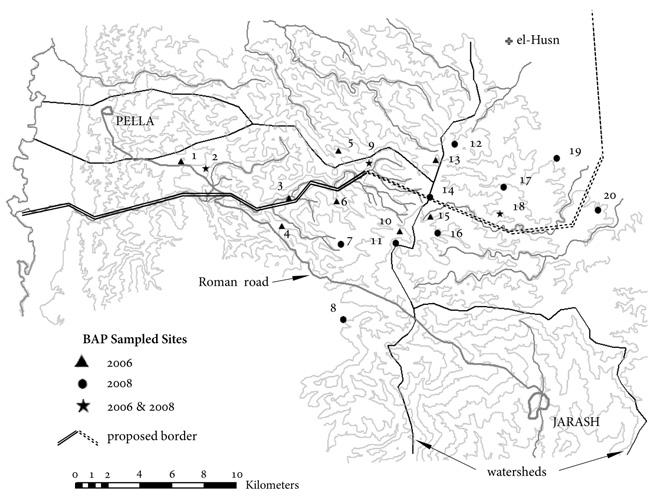
Figure borderisundocumented.Theaimoftheprojectwastocollectceramics oftherdtothcenturiesfromsitesintheareaofthesupposedborder route(figure).Theoverallcorpusfromeachsitewillbecategorizedby referencetotheknowncorporafromPella(Palestinian)andJarash(Arabian).Thebordermustliebetweenthe Palestinian and Arabian sites.
Sitesselectedforsamplinghadpreviouslybeenidentifiedinearlier surveysofnorth-westJordan,althoughinmostcaseslittleornopotteryhadbeenpublished.FromthenearlysitesoftheRomantoearly Islamicperioddocumentedintheregion,settlementswhichappeared tobesmalltownswerethepriority,asthesewouldbeexpectedtocontainthelargestrangeofceramics.Twofieldseasons,and, havebeenundertaken,withtheaimofcollectingatleast,sherds oftheByzantine(rd–earlythcenturies)fromeachsite.However,of thetwentysitessampled,onlyaroundtenwillproducereliablestatistics becauseofcollectiondifficulties.Therewerefewersitesintheeastern halfofthesamplingarea,andmanyofthesehadsignificantmodernor mediaevaloccupationovertheentirearea.TherewerealsofewerByzantineandRomansitesintheeasternpartofthestudyareathanthewest, althoughmoremediaevalmaterial—asettlementpatternchangewhichis
k.dacosta
intriguinginitself.Thefocusofprocessingtodatehasbeenonthe coarsewarebodysherds—exactlythoseceramicsnormallyunsampled ordiscardedinconventionalsurvey.Itisthiswhichdistinguishesthe projectfromthemethodologyused,forinstance,byHodgeandMinc todiscussmarkettypesandintegrationintheAztecEmpire.The. taxonprovincialbordersintheRomanEmpireseemstohavehadlittleor noinhibitingeffectonluxuryorexpensivegoods,includingceramicfine waressuchasAfrican,CypriotorPhocaeanRedSlipproducts.Itisonly atthelevelofbulktradeinlow-profitcommonwaresthatthedistorting effectseemstoappear.Processingofthematerialstillcontinues,andonly preliminaryresultsarepresented.
Onereasoncoarse(orcommonwares)arenotprioritizedinconventionalsurveyorsamplingisthetremendousdifficultyofclosedating, particularlywhencorrectivedatafromexcavationsisunavailable.The BAPprojectthereforehasbeenusingverybroaddateranges,andthere areclearlypotentialproblemsforinterpretation,giventheknownhistoryofborderchangesatmorefrequentintervalsthanwemaybeableto detectceramically.Leakageofceramicsacrosstheborderhasalsobeen anticipated,particularlysincewehavesampledsitesquiteclosetothe hypotheticalborderline,anditisquitefeasiblethatsmallquantitiesof materialcrossedover.However,theidentificationofacorpusas Palaestinian or Arabian willdependongeneralratiosofwaresacrosstheentire sample,ratherthanthepresenceofafewdistinctivepieces.Assofew sitesinthecasestudyareahavebeenexcavatedorpublished,ourtreatmentofthecoarsewaresmustremainverygeneral.However,itappears fromtheinitialresultsthatthemethodologyisabletoindicatedifferencesincorpora,andthesecorrespondtothepresumedprovincialallocationsofeachsite.Giventhatthesamecircumstancesexistacrossthe Empire—abundantcoarsewareceramicsandacustomsdutyonmajor borders—thismethodologyshouldbeapplicableelsewhereinorderto morepreciselydefinethelineofaprovincialboundary.
OnlythosesiteswhereoverathousandsherdsoftheByzantineperiod havebeencataloguedhavebeenincludedinthesepreliminaryresults. Coarsewaresherdshavebeendividedintohandmadeandwheelmade categories,intoribbedandunribbedifwheelmade,andineachcase,by thickness,moreorlessthanmm.Withthesameprocessingprotocol foreachsite,andwiththelargestpossiblequantitiescollectedinthe timeavailable,webelievethatminorfluctuationsincataloguingwill beevenedout.Bodysherdsineachcategoryhavebeencountedand weighed.Resultssofarhavebeencollatedataverygenerallevelofware
amethodologyfordetectingromanprovincialborders
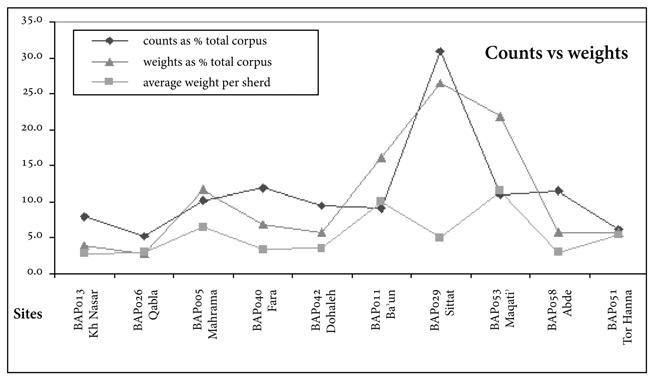
definition.Thefinalprocessingofdiagnosticsherdswillhelpinsomeway togaugethebodysherds,althoughitisnotpossibleinmanycasestotell ifrimsherdscomefromribbedorunribbed(orribbedandunribbed) vessels.
Figuredemonstratesthatcountsandweightsofsherdsdonotnecessarilyprovidethesameresults—Kh.Sittathadlargenumbersofsmall sherds,whereasMaqati" andBa"unhadlargenumbersoflargesherds. Theseresultswillhelpcharacterizeeachsite,andareusedtonormalize results.
Plotsofpartoftheceramiccorpusateachsite,showingthemain groupsofcoarsewaresherdsfromstorageandsimpletablevessels(althoughnoplatesandfewcupshavesofarbeenrecovered)andthedistinctiveLateRoman(LR)PalestinianBagShapedAmphora(Brown Slipped,WhitePaintedBSWP),aregraphedinfigure.
Siteshavebeengroupedbasedonsupposedprovincialaffiliation: NasartoDohaleharethoughttobein Palaestina;Ba"untoTorHanna shouldbein Arabia.Oftheelevensitesplotted,sevenhavesimilar profiles—themostcommonwaresaretheorangeterracottas,followed bybrown,paleandgrey.NasarhasextraordinaryquantitiesoftheLR amphorainBSWPwareanditmayverywellbethatsomeofthegrey warescataloguedatthatsitearealsoBSWPsherds.Nasarisoneof theclosestsettlementsonthemainroadtothebordercrossingfrom Palaestina to Arabia.Allthesupposed Arabian siteshaveverylow
Figure
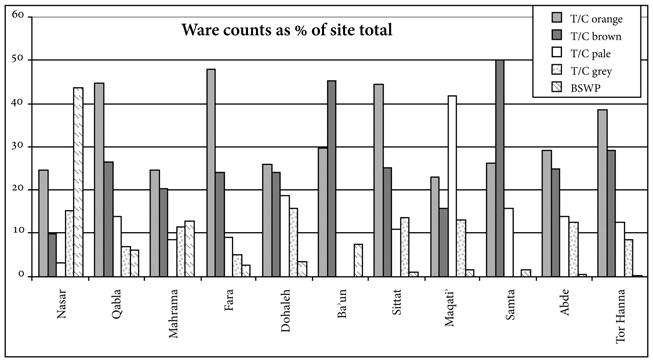
quantitiesofthisware,exactlyaswewouldexpectgiventhatitsdistributionshouldfalloffoverdistance,butmightbeexpectedtocrossthe borderinsmallnumbers,giventhatitwasthecontentsofthevesselthat weretraded,ratherthantheamphoraethemselves.Thiswouldexplain thequantitiesatBa"un,thefirstmajorsettlementin Arabia acrossthe PalaestinianborderalongthemajortraderoadtoJarash.Nonetheless, thefactthatLRisa Palaestinian amphoraisemphasizedbythequantitiesatFaraandDohaleh,bothasfarfromPellaasSittatandMaqati"
ApartfromNasar’scorpus,alltheother Palaestinian siteshavequite similarprofiles,althoughtheoverallnumbersaremuchloweratMahrama,asitewithsignificantMamlukeupperlevels.Incontrast,there doesnotseemtobeanyconsistencyamongstthe Arabian sites—Ba"un hasnopaleorgreypotterytospeakof,Maqati" haslargeamountsof paleterracottawares,Sittatisdominatedbybrownwares,andAbdeand TorHannahaveprofilessimilarto Palaestinian sites,withthenotable exceptionoflowquantitiesofBSWPLRamphorae.
However,iftheproportionsofthetwomainwaregroups,orangeand brownterracottas,iscompared,thepatternisclear.Figureshowsthat Palaestinian siteshaveanaverageratiooforangetobrownwaresof., andthelowestratiois.atDohaleh,anothersitewithlargeamountsof Islamicmaterial.Incontrast, Arabian siteshaveanaverageratioof., andtwositeshavearatiooflessthan.
ThepositionofDohalehisequivocal.Thesiteisoneofthemore easterlyofthecasestudyarea,inaregionwherethelineoftheborder
amethodologyfordetectingromanprovincialborders
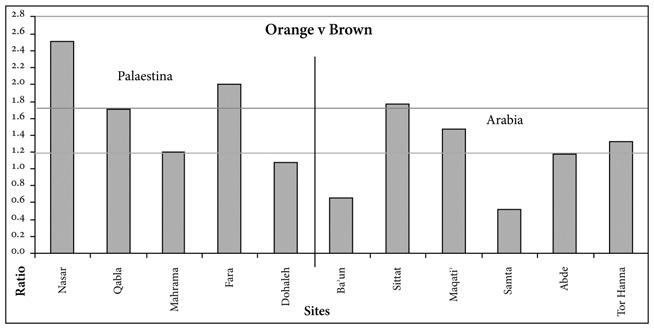
isleastwellknown.ThesitehasbeenexcavatedbySalehSari,and someofthepotterypublished.30 TherearereasonablequantitiesofLR BSWPamphoraesherdsatthesite,therangeoflampsfromDohalehis similartothatatPella,31 andaccordingtoAvi-Yonah,theborderlayto itseast.32 Certainly,themilestonesoftheroadfromJarashtoDera"a, whichlayentirelyin Arabia,wereeastofDohaleh,andiftheborder ranalongriverbeds,thereareseveralwadistothesouthandeastof DohalehandYa"amunwhichwouldserveasboundaries,asindicated infigure.Ontheotherhand,churchesatYasilehandel-Husn,tothe northofDohaleh,excavatedinthes,haveinscriptionssaidtobe datedbytheArabianera.HusnwasadependentvillageofIrbid(ancient Arbela),andsoitseemslikelythattheborderwasmuchfurtherwestthan Avi-Yonahsuggested.Itmaybethatthemajornorth/southwatershed ofnorthernJordanwastheborder,andthatDohalehlayin Arabia. Recalculatingtheaveragesoftheratiosoforangetobrownwareswith
30 S.Sari,‘PreliminaryreportontheresultsoftheexcavationsatKh.Dohaleh-alNu"aymeh,stseason,Summer’, AnnualoftheDepartmentofAntiquitiesofJordan (),ff.(Arabic);S.Sari,‘Dohaleh,anewsiteinnorthernJordan.Firstseasonof Excavations,’, LiberAnnuus (),ff.Prof.Sarikindlygavepermissionfor theBAPteamtosampleDohaleh—samplingsquareswereplacedawayfromtheYarmouk Universitytrenches.
31 daCosta,op.cit.(n.),.
32 M.Avi-Yonah, TheHolyLandfromthePersiantotheArabConquest(bc–ad) AHistoricalGeography (Michigan,rev.ed.),,maps&:thelistofsitesinthe textdoesnotmatcheitherofthemaps,bothofwhicharesubstantiallydifferentfrom eachother—Avi-Yonahneveraddressedthisdiscrepancy.
Figure
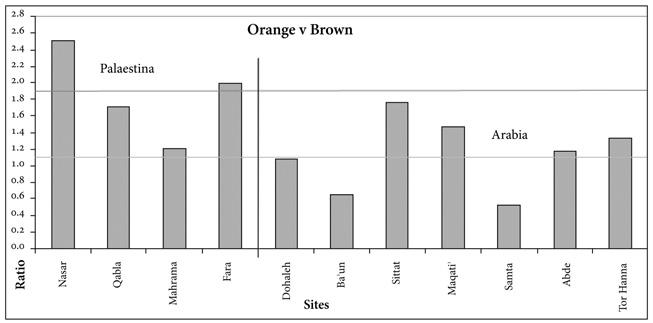
thisconfiguration,asshowninfigure,increasestheaverageorange: brownwareratioof Palaestinian sitesto.,decreasesthatof Arabian to.,andshowsDohalehfittingneatlyintoan Arabian pattern.As DohalehistheonlysitesampledbytheBAPprojectinthisconjectural zonewithusablequantitiesofByzantineceramics,thequestionofthe borderlinemustrestuntilfullprocessingofthesiteiscomplete.However, eventhesepreliminaryandincompleteresultsindicatethevalueinthe time-consumingprocessofintensivecataloguingofbodysherds,andthe potentialdatawhichcanbeobtainedfromthem. Durham,May
Figure
ONTHEFRINGE: TRADEANDTAXATIONINTHE EGYPTIANEASTERNDESERT*
D.NappoandA.Zerbini
I.OrganisationofEasternTrade(D.Nappo)
TheaimofthisarticleistoinvestigatetheroleoftheEgyptianEastern DesertasafiscalfrontieroftheEmpire.Itisalreadywellknownthat thisareaplayedanimportantroleasacommercialrouteconnectingthe RomanWorldandtheFarEast.1 Ithasalsobeendemonstratedthatthe fluvialportofKoptos2 actedasahubforcollectingtaxesontheincoming Easterngoods3 andthattollswerechargedthereonmerchantsreaching theRedSeaviathedesertcaravanroutes.4 Yetverylittleisknownabout
* Thecollectionsofpapyriandostrakacitedinthistextareabbreviatedfollowing theconventionssetoutinJ.F.Oateset.al.(ed.), ChecklistofEditionsofGreekPapyriand Ostraka (Atlanta).
1 S.E.Sidebotham, RomanEconomicPolicyintheErythraThalassa.bc–ad (Leiden);F.DeRomanis, CassiaCinnamomoOssidiana (Rome);R.Tomber, Indo-RomanTrade:FromPotstoPepper (London).
2 OnKoptosanditsimportance,seeV.A.Maxfield,‘Theeasterndesertfortsandthe armyinEgyptduringtheprincipate’,inD.M.Bailey(ed.), ArchaeologicalResearchin RomanEgypt (AnnArbor),–;D.W.Rathbone,‘Koptostheemporion.Economy andsociety,I–IIIad’,inM.-F.Boussac(ed.), AutourdeCoptos.Actesducolloqueorganisé auMuséedesBeaux-ArtsdeLyon (Lyon),;R.S.Bagnall—D.W.Rathbone, Egypt fromAlexandertotheCopts (London),–.
3 OnthistopicthemainsourceofinformationisstillSammelbuchGriechischer UrkundenausÄgypten(=SB),,alsoknownasthe‘Muzirispapyrus’.See H.Harrauer—P.Sijpesteijn,‘EinneuesDokumentzuRomsIndienhandel,P.Vindob. G’,in Anzeigerd.ÖsterreichischenAkademiederWissenschaften,Phil.-Hist.Klasse (),–;L.Casson,‘P.Vindob.G.andtheShippingoftheGoodsfrom India’, BulletinoftheAmericanSocietyofPapyrologists (),–;L.Casson,‘New lightonmaritimeloans:P.Vindob.G..’, ZeitschriftfürPapyrologieundEpigraphik (),–;DeRomanis,op.cit.(n.),–;DeRomanis,‘Commercio, metrologia,fiscalità.SuP.Vindob.GVerso’, Mélangesdel’écolefrançaisedeRome. Antiquité (),–;D.W.Rathbone,‘The“Muziris”Papyrus(SBXVIII): FinancingRomantradewithIndia’, BulletinSocietéArchéologiqued’Alexandrie (), –;Rathbone,op.cit.(n.),–.
4 Thetollisattestedinthe‘KoptosTariff’, OGIS ,;republishedinSB,. Asisnowevidentfromtheavailableevidence,thecontrolofthefiscalsysteminthe
d.nappoanda.zerbini
thefiscalorganisationofthecaravanroutesthemselvesandoftheports ontheRedSea,fromwhichshipswoulddeparttowardstheEast.Thisgap inourdocumentationhasbeenreduceddramaticallyoverthelastfew years,thankstoanumberof ostraka foundinBerenike,aportlocatedin theareaofRasBanas,thesouthernmostRomansettlementinEgyptand aterminaloftherouteconnectingSouthIndiatotheRomanEmpire. Berenike’sgeneralroleintheeconomyoftheareahasbeendescribed inanumberofpublications5 andwillnotthereforebeexaminedhere. Attentionwillberatherfocusedonthedossiersof ostraka discoveredat Berenikeandrecentlypublishedintwovolumesbyanéquipeofscholars ledbyRogerBagnall.6 Itisourbeliefthatthesedocumentscanbeused toshedaconsiderableamountoflightonthedynamicsoftaxation ontradeasappliedintheEgyptianportandonthedesertroutesat large.
Sofar ostraka havebeenpublished,andmostofthesedocuments comefromaRomandumpdatedtothefirstcenturyad.7 Inthisfirst sectiononlythosedocumentswhichareconnectedtotheprocessby
EgyptianEasternDesertwasinthehandsofthearabarchs,apowerfulcorporation,whose origindatedtothePtolemaicage.Onthearabarchsandtheirorganisation,seeD.Nappo, ‘Ilruolodell’arabarchianellafiscalitàromana’,inE.LoCascio—G.Merola, Formedi aggregazionenelmondoromano (Bari),–.
5 S.E.Sidebotham—W.Wendrich, Berenike’.PreliminaryReportoftheExcavations atBerenike(EgyptianRedSeaCoast)andthesurveyoftheEasternDesert (Leiden); S.E.Sidebotham—W.Wendrich, Berenike’.PreliminaryReportoftheExcavationsat Berenike(EgyptianRedSeaCoast)andthesurveyoftheEasternDesert (Leiden); S.E.Sidebotham—W.Wendrich, Berenike’.ReportoftheExcavationsatBerenike(EgyptianRedSeaCoast)andthesurveyoftheEasternDesert (Leiden);S.E.Sidebotham— W.Z.Wendrich, Berenike.ReportoftheExcavationsatBerenike(Egyptian RedSeaCoast)andthesurveyoftheEasternDesert (Leiden);S.E.Sidebotham— W.Z.Wendrich, Berenike.ReportoftheExcavationsatBerenike(EgyptianRed SeaCoast)andthesurveyoftheEasternDesert,includingExcavationsatShenshef (Leiden);S.E.Sidebotham—W.Wendrich, Berenike.ReportoftheExcavationsatBerenike(EgyptianRedSeaCoast)andthesurveyoftheEasternDesert,including ExcavationsinWadiKalalat (Leiden);S.E.Sidebotham—W.Z.Wendrich, Berenike /.ReportontheExcavationsatBerenike,IncludingExcavationsinWadiKalalat andSiket,andtheSurveyoftheMonsSmaragdusRegion.(LosAngeles);S.E.Sidebotham,‘LateRomanBerenike.’ JournaloftheAmericanResearchCenterinEgypt (),–.
6 R.S.Bagnall—C.Helms—A.M.F.W.Verhoogt, DocumentsfromBerenike.VolumeI. Greekostrakafromthe–seasons (Bruxelles);R.S.Bagnall—C.Helms— A.M.F.W.Verhoogt, DocumentsfromBerenike.VolumeII.Textsfromthe– seasons (Bruxelles).Thedocumentscitedfromthesetwovolumesarehereafter referredtoasO.Berenike.
7 Bagnalletal.,op.cit.(n.),.
tradeandtaxationintheegyptianeasterndesert
whichgoodsandtheirtransporterspassedthroughthecustomsgateat Berenikewillbediscussed.Theyservedaslet-passordersforgoodsgoing throughthecustomsstationofBerenike,ontheirwaytoshipsdestined forlocationsalongtheAfricanorIndiancoast.Althoughsomeofthese goodscouldhavebeenusedforpersonalconsumptionbythecrewofthe ships,mostofthemwereinfactexportwares.8 Thesereceiptsoflet-pass orderswereissuedsomewhereontheNile-Berenikeroute(mostlikely Koptos)andreceivedbytheofficialsinchargeofthecustomsgatein Berenike;thiswouldmean,accordingtotheeditorsofthedocuments, that“theamountsduewerecollectedinthevalley[i.e.atKoptos],with thegoodsthenfreetopassthroughthegateinBerenike.”9 Itisworth stressingthatthesedocumentsforthefirsttimeattestunequivocallythe presenceofacustomsgateatBerenike.Althoughthetaxeswerepaid elsewhere(i.e.atKoptos),thelaststepofthefiscalcontroltookplace atBerenike,beforetheoutgoinggoodslefttheEmpiretotheEast. Wewillnowgothroughthestructureofthe ostraka toshedsomelight ontheorganisationofthiscontrol.Wecandividethelet-passesintofour groups,accordingtotheirgeneralstructure:
.NNtoNN, quintanensis,greetings;please,letpassforNNaX amountofsomeitem
.NNtoNN(notitlegiven)greetings;please,letpassforNNaX amountofsomeitem
.NNtothoseinchargeofthecustomsgate,greetings;please,letpass forNNaXamountofsomeitem
.EpaphroditosslaveofDeliasslaveofAeimnestosslaveofCaesarto NN, quintanensis,greetings;please,letpassforNN,slaveofDelias slaveofAeimnestosslaveofCaesaraXamountofsomeitem
Asitcanbeeasilyrecognised,groupsonetothreerepresentonlyslight variationsonageneralpattern,whichincludesawriter,whoaddresses toanofficertoaskaletpassforpeoplecarryingsomequantitiesofitems (usuallywine,butalsooilandvinegar).Theaddresseesaresometimes qualifiedbytheirnameandthetitleof quintanensis (asingroup); sometimesonlybytheirname(group);sometimestheyarejustcalled “thoseatthecustomsgate”,withnonameortitlegiven(group).Here followsanexampleforeachgroup.Forthefirstgroup,wehaveselected onefromthedossierofAndouros(O.Berenike–):
8 Bagnalletal.,op.cit.(n.),.
9 Bagnalletal.,op.cit.(n.),.
d.nappoanda.zerbini
(O.Berenike)
“ToAndouros, quintanensis,letpassofTiberiusClaudius[Achilleus] Dorion,forPaouossonofPaouos,italika,totalital(ika).”
Forthesecondgroup,anexamplefromthedossierofSosibios(O.Berenike–):
(
“SosibiostoAndouros,greetings.LetpassforAndourossonofPach() italikaofwine.”
Forthethirdgroup,anexamplefromthedossierofRobaos(O.Berenike –):
“Robaostothoseinchargeofthecustomsgate,greetings.Letpassfor Haryothesforoutfitting,rhodia.”
Whatwecaninferfromthefirstthreegroupsisthat,duetotheclose similaritybetweentheirstructures,wecanidentifythe quintanenses with the‘peopleatthecustomsgate’.Aspointedoutbytheeditors,10 thephrase ‘peopleatthecustomsgate’wasusedbyawriterwhodidnotknowthe nameoftheofficerhewasaddressing,andallowsustounderstand,on theonehand,thatthe ostraka wereusedbythemerchantsaslet-passes togothroughthecustomsgateatBerenike,and,ontheotherhand,that theofficerinchargeofcontrollingthisprocesswascalled quintanensis. 11
Thefourthgroupoflet-passescanshedsomelightondifferentaspects. Itpresentssomequitedistinctivecharacteristics,althoughwithinthe generalpatternseenforthefirstthree:thewriterisalwaysan“EpaphroditosslaveofDeliasslaveofAeimnestosslaveofCaesar”,addressingthe quintanensis Pakoibis,requestingalet-passforsomepersonbelonging tothesamegroupofslaves(O.Berenike–).Thefirstpeculiarity isthatinthesedocumentsthewriterisqualifiednotonlywithhisname, but,moreimportantly,heappearstobelongtoagroupofslaves,linked
10 Bagnalletal.,op.cit.(n.),–.
11 Adetaileddiscussionontheoverallfunctionofthisofficerwillbepresented infra inthesecondpartofthisarticle.
tradeandtaxationintheegyptianeasterndesert
toAeimnestos,aslaveofthe familiaCaesaris.Anevenmoreexceptional characteristicofthedossierofEpaphroditosisthatallthe ostraka,apart fromO.Berenike,arepre-madeformswhereablankspaceisleftto addthenameofthepersontransportingthewineandtheprecisenumberof keramia ofwineatalatermoment:
(O.Ber.).
“EpaphrodeitosslaveofDeliasslaveofAeimnestosslaveofCaesar,to Pakoibis quintanensis,greetings.Letpassfor(blank)ofthoseofDelias slaveofAeimnestosslaveofCaesar,(blank)keramiaofPtolemaicwine.”
Theeditorssuggestedthat,sinceallformsendedupintherubbishheap atBerenike,theymighthavebeenusedwithoutactuallyhavingbeen filledin.12 Thepersonstransportingwine,whosenamesweretobefilled later,areallidentifiedas τ νΔηλ [υ]
σαρ ς,“ofthe menofDelias,slaveofAeimnestos,slaveofCaesar”.Theissuerhimself, Epaphroditos,isalsoqualifiedasaslaveofthesameDelias.Thisdossier allowsustospeculateontheroleoftheimperialadministrationinthe managementoftradewiththeEast.Epaphroditosandhismenallbelong tothisgroupofslavesgoingbacktotheemperorhimself.Although therearethreelayersofownershipofslaves,thehypothesisofadirect involvementoftheemperororhisentourageintheEasterntradecannot beruledout.
Inprinciple,itseemslikelythattheemperorswouldbeinterestedin gettinginvolvedinsuchcommercialactivity,whichcouldentailhuge marginsforprofit.13 Thishypothesisbecomesevenmoreintriguingif weconsiderthechronologyofthedocuments.The terminusantequem forthe ostraka isca.ad,whereasthe terminuspostquem is–ad, aperiodthatfollowsthebigtradeboomwiththeEastoftheTiberian age,andincludestheageofNeroandpartoftheageofVespasian, whentheEasterntradeexperiencedanewrevival,alsothankstothe infrastructuresbuiltintheEasternDesertbyVespasian.14 Thisleadsus
12 Bagnalletal.,op.cit.(n.),.
13 PliniusMaior, NaturalisHistoria .:[...] nulloannominusHS,,imperii nostriexhaurienteIndiaetmercesremittentequaeapudnoscentiplicatoueneant.Seealso thepapyrus SB ,,whereitisspecifiedthatthetotalvalueofacargocomingback fromIndiaatthemiddleofthesecondcenturyadistalentsanddrachmae.
14 SeeH.Cuvigny, LaroutedeMyosHormos,Fouillesdel’IFAO/ (Paris).
topostulatethatthepossibilityofimperialinvolvementinthetradeis verypromising,andisunlikelytoremainjustahypothesis,althoughthe dossierofEpaphroditosaloneisnotasufficientprooftosustainit.
Thelastgroupofdocumentswewouldliketoanalysehereisthe dossierofSarapion(O.Berenike–).Thereasonthatthisgroupof documentsdeservesitsownanalysisdoesnotdependonitsstructure,15 butratheronthetextsofthe ostraka.Itisimmediatelyevidentthat Sarapion’slet-passesarecomposedbytwodifferentsubgroups.Inthefirst oneSarapionalwaysaddressesthe quintanensis Andourostoaskaletpassforpeoplecarryingwine.Inthesecondsubgroup,Sarapionalways addressesthe quintanensis Pakoibis,toaskalet-passforpeoplecarrying μαρσιπ().Thisdifferenceleadsustothinkthatwehavehereanew particularnotpresentinthedocumentsdiscussedbefore:thecustoms atBerenikemighthavehadacomplexarticulation,withdifferent‘offices’ accordingtothedifferentmerchandisethatthetradersneededtoexport. SowhenSarapionneedstoexportwine,hedirectshismerchantsto Andouros,whereaswhenheneedstoexport μαρσιπ()headdresses Pakoibis.Foracompleteunderstandingofthisprocess,itiscrucialto solvetheabbreviatedword μαρσιπ().Theeditorsinterpreteditasan abbreviationfor μαρσ ππια. 16 TheGreekword μαρσ ππι ν means‘a (carrying)bag,acontainer’;somethingtotransportitems.Sowecan interpret μαρσ ππι ν asabag,butinnocaseinthetextisthecontent ofthesebagsspecified,asitisclearfromthefollowingexample:
Σαραπ ωνΚασ υ
Πακ ι (α ρειν) δι(απ στειλ ν) ΑντωιΤ αλι υμαρσ π(πια)
σλε σεση(με ωμαι).
(O.Berenike)
“SarapionsonofKasiostoPakoibis,greetings.DispatchforAntossonof Tchaliosbags.Signed.”
Theword μαρσ ππι ν iswellattestedinthepapyri,anditsdiminutive (μαρσ ππιν)appearsinthe ostraka fromMonsClaudianus.17 Thequantitiesof μαρσ ππια involvedinthetextsfromBerenikeareimpressive,as canbeseeninthetablebelow.18
15 Intermsofstructure,thedossierofSarapioncanbeconsideredasanexampleof whatislistedaboveasgroup.
16 Bagnall,op.cit.(n.),.
17 O.Claud.;;.
18 Aspointedoutbytheeditors,seeBagnalletal.,op.cit.(n.),,themedian ofthequantityof marsippia fallsbetweenand,ahugeamount,ifcomparedto themedianof ladikena ofwine,whichfallsbetweenand.
tradeandtaxationintheegyptianeasterndesert
Attestationof μαρσ ππια inO.Berenike
Text Number
Thequantitiesmarkedwitha*arequalifiedinthe ostraka with διπ(λ ), ‘double’,whichsuggeststhattheword μαρσ ππι ν standsasastandard unitofmeasurement.Sowecansaythatthe μαρσ ππια wereused totransportitemsinstandardpackagesanddispatchedinverybig quantitiesgiventheenormousamountof μαρσ ππια attestedinthe documents.
Asithappens,themostpopularRomanexporttoIndiawasRoman coins,19 indeedaperfectcontentforour μαρσ ππια.Thisinterpretation issupportedbythepapyrologicalevidence.Infactinthepapyrithe word μαρσ ππι ν isoftenusedastheequivalentoftheEnglishwallet, acontainerforcoins.20 Whenusedwiththismeaning,itissometimes attestedinthephrase μαρσ ππι
σμεν ς, 21 ‘sealed marsippia’, whichmightgiveanewhinttounderstandthenatureofthedocuments wearedealingwith.
Tounderstandwhythese‘sealed marsippia’werenecessary,weneed toexplainhowtheactualsystemoftransportingmerchandiseandcoins overthedesertworked.ThecargoeswouldleaveAlexandria,thebig emporion ontheMediterranean,tobeconvoyedtoKoptosontheNile andfromthereoverlandtoBerenike.Asfarasweknow,themerchants wouldborrowthemoneyfortheircommercialexpeditionsfromwealthy peoplewillingtofinancesuchtrade,andwhoreapedhugeprofitsfrom theseloans.22 Itisreasonabletoimaginethatthesefinancerswould alsohaveprovidedthemerchantswiththecoinstotradeinIndia.At thispointitisworthrememberingthatRomancoinsfoundinIndia arevirtuallyall denarii or aurei,i.e.typesofcoinsofficiallyforbidden fromcirculationinRomanEgypt.23 Infact,althoughtheexcavationsat BerenikeyieldedRomanbronzecoinsandPtolemaic tetradrachmai,not
19 SeeTomber,op.cit.(n.),–;S.Suresh, Symbolsoftrade (NewDehli).
20 SeeforexampleP.Sarap.,;P.Tebt.,;;;P.Mert.,;P.Oxy;; P.CairZen,;;P.Petr.,.
21 AttestedforexampleinP.Mert.,;P.Oxy.,;P.CairZen,;.
22 ThispractiseisattestedinSB,.Seealsotheworkscitedatn..
23 K.W.Harl, CoinageintheRomanEconomy (Baltimore),–.
d.nappoanda.zerbini
asingle denarius or aureus wasfound.However,astheRoman denarii foundinIndiadidindeedarrivefromEgypt,weareconfrontedwith aseeminglyinsolublecontradiction.Theanswertosuchapuzzleis,in ouropinion,representedbythe μαρσ ππι ν σ ραγ σμεν ς.Thecoins necessaryforthetradewiththeIndianswouldbecollectedinsealedbags withastandardnumberofcoins(and,consequently,ofstandardweight). Thiswouldformaguaranteeforbothfinancerandmerchant:thefinancer wouldbesurethatthetraderscouldnotopenthebagsandtrytosteal somecoins,andthetraderswouldbeabletocountthecoinsfaster(bag bybag,ratherthanonebyone).
Acomparativeexampletosupportthishypothesisexiststhrougha recentdiscoverymadeontheshoresofItaly,theso-called‘tesorettodi Rimigliano’.24 The‘tesoretto’comesfromawreckandissupposedtorepresentthestandardwayinwhichcoinswerecirculatingoncommercial shipsaroundtheMediterranean.Itisablockofca.,coins,originally containedinsmallleatherbagsofcircularshapeandthenputtogether intoalargerbasket.Thesmallbagscontainastandardnumberofsilvercoins,splitingroupsoftenunits,inordertofacilitatetheprocess ofcounting.Asimilarorganisationtotheoneattestedinthe‘tesoretto diRimigliano’canbepostulatedfortheEasternDesert,andthisisthe situationtowhichthe μαρσ ππια wouldthenrefer.ThedossierofSarapion,ifourinterpretationiscorrect,shedsnewlightontheorganisation oftradeintheEasternDesert,tellingushowthedeliveryoftheRoman coinstoIndiawasactuallyorganised.
Wehaveseen,then,howthedocumentsfromBerenikeprovidenew evidenceonaveryspecifictypeoffiscalandcommercialorganisation withregardstotheEasterntrade.Fromwhatwehaveseensofar,it appearsevidentthatacentralroleinthisprocesswasplayedbythe quintanenses.
II. Quintanenses andthe quintana (A.Zerbini)
Asmustbeclearbynow,Berenikeactedasafiscalfrontierwithregards tothetaxationontheEasterncommerce.Yetthefunctioningoftaxation ontradeseemstohavebeenmuchmorearticulated,includingaspecificformoftaxationoncommercialactivitiesinsidethedesertroutes
24 ItwasfoundinnearLivorno,inTuscany.SeeA.DeLaurenzi, UnTesorodal Mare:ilTesorettodiRimiglianodalRestauroalMuseo (Pisa).
tradeandtaxationintheegyptianeasterndesert
linkingKoptostotheRedSeaports.Asforthecustomsgateprocedures witnessedbythelet-passorders,muchofthetaxationoninternaltrade seemstohavebeenstructuredaroundthefigureofthe quintanensis. DespitetherelevanceofthisofficialintheBerenikedocuments,lighthas yettobeshedonhisdutiesandresponsibilities:sofar,wehaveonlylearnt thatthe quintanenses,whilepresumablyinchargeofthecustomsgateat Berenike,werenotresponsibleforthecollectionofthetaxesappliedon outgoinggoodsbutonlyforcontrollingthereceiptsthatallowedsuch goodstobeshippedoverseas.Inwhatfollows,weaimtoconcentrateon the quintanensis inordertoassesshowtheevidenceofhisrolecanbe usedtoilluminatetheorganisationoftaxationontradeintheEastern Desert.
OutsidethedossierofdocumentsfromBerenike, quintanenses areseldompresentinthesources.Theonlyotherreferencescomefromtwo inscriptionsfromItalyandGermanyandfromthepapyrusP.Gen.Lat. .25 Thecontextisalwaysamilitaryone:inafuneraryinscriptionfrom the agerAlbanus,thelateAureliusCrysomallosisreferredtoasa quintanesislegionis,whileaninscriptionfoundintheareaofthefortof Niederbieber(GermaniaSuperior)wassetuptothe Geniushorreorum of the numerusBrittonum byatleasttwosoldiers,oneofwhomisreferred toas quintane n sis. 26 Bothinscriptionscanprobablybedatedtothe latesecondorearlythirdcentury,whilethethirddocument,thewell knownP.Gen.Lat.isdatedtothereignofDomitian.27 The verso of thistext—whichcomesfromthearchivesofthe legioIIICyrenaica or XXIIDeiotariana stationedatAlexandria—recordspartofa brevis,i.e. atextlistingtheservicesanddutiesofthesoldiersofacentury,overa periodoftendaysfromthefirsttothetenthofOctober.Oftheforty soldierswhosedutiesareknownfromthetext,thevastmajoritywere employedinthecamp,butsomeweresentofftodetachedfortletsand perhapstemples.Moreimportantly,foursoldiers(nos.V,X,XVI,XVIII) wereallocatedforatimevaryingbetweenfourandfivedaystoaservicedefinedas proquintanesio,whichcouldmeantheyhadtoserveas
25 CIL ,(agerAlbanus); CIL ,(GermaniaSuperior ).P.Gen.Lat.= Doc.Eser.Rom.=ChartaeLatinaeAntiquiores(=ChLA)I=CorpusPapyrorum Latinarum(=CPL).Thedifferentdocumentsbornebythispieceofpapyrusareedited separatelyinR.O.Fink, RomanMilitaryRecordsonPapyrus (Cleveland)(=RMR) ,,,,.
26 Zangemeisterunderstood quintane n sis asa cognomen,apossibilitythatremains obviouslyopen.
27 SeethecommentaryinChLAI(esp.col.V–).
quintanenses orinthesteadofthe quintanensis orperhapsalso,witha locativemeaning,bythe quintanenses (safeguardingthesecurityofthe officials).
Whilethesedocumentsclearlyshowthatthe quintanenses weresoldiers,theirresponsabilitiesremaintobeidentified.Alookattheetymologyoftheword quintanensis immediatelyshowsaderivationfrom the uiaquintana,athoroughfareofaRomancampwhich,accordingto Polybius,wasnamedafterthe π μπτατ γματα whohadtheirquarters inthisareaofthe castra. 28 ForPseudo-Hyginus,whowroteinthesecond centuryad,the uiaquintana andthetwo quintanaeportae inwhichit endedupateithersideofthecampwereonlylaidoutwhenthefortwas builttoaccommodatefiveormorelegions(hencethename quintana).29
Interestingly,fromearlytimesonwards,the uiaquintana orthe quintanaporta seemstohavebeenassociatedwiththepresenceofamarket: theidentificationofthemilitaryforumandthe uiaquintana wasalready impliedinLivyandlatermadeclearbySuetonius.30 Finally,Festuslocates the forumrerumutensilium bythe quintanaporta,thoughthepositionof thelatter postpraetorium seemstosuggestthattheauthorwasreferring tothewholeofthe uiaquintana ratherthanjustitsgates.31
Ifthe uiaquintana wasconnectedwiththemilitaryforum,theofficialnamedafterthisareaofthecastra,the quintanensis,mustbearsome relationwiththemarketaswell.Thisassumptionseemstobesupported notonlybytheroleofthe quintanenses whichemergesinthelet-pass orders,butmoreimportantlybyadossierofdocumentsfromBerenike whichwerepublishedinundertheheading“receiptsforQuintana”.32 Thesedocumentsspanoveraperiodgoingfromthelatterpart ofthereignofAugustus(O.Berenikebc/ad)tothereignofVespasian(O.Berenike,ad/).Thecoreinformationprovidedby thesedocumentscanbegaugedbylookingatO.Berenike,whichis oneofthebestpreservedtexts:
28 Polybius..–.
29 Pseudo-Hyginus(A.Grillone(ed.), Demunitionibuscastrorum (Leipzig)) .–.
30 ThepassageinLivius(..),thoughnotestablishinganidentificationofthe quintana withthemarket,suggeststhat forum andthe uiaquintana werelocatedinthe sameareaofthecamp(i.e.belowthe praetorium,astheothersourcesalsoconfirm).It isinthisareathattheplunderingenemiesfound omniumrerumparatamexpositamque copiam (Id...).Suetonius, Nero .–.
31 PaulusexFesto(W.M.Lindsay(ed.), SextiPompeiFesti.Deuerborumsignificatu quaesupersuntcumPauliEpitome (Leipzig)),p..
32 O.Berenike(=O.Berenikea);–;.
tradeandtaxationintheegyptianeasterndesert
(
)
)
( υ).
“Germanos, quintanensis,toGaianussonofHimeros,greetings.Ihavethe quintana forPauni,(dr.)andPachon(dr.)YearofNerothelord”
Inthisdocumenta quintanensis iswritingtoacknowledgethereceiptof the κ υτ να,clearlyequivalenttotheLatin quintana,forthemonthsof PauniandPachon.Thesumreceivedamountedtodrachmaeamonth ordrachmaeintotal.ThetextisthendatedtothetwelfthyearofNero (ad).Furtheradditionstotheformatofthisdocumentinclude:
–Thepresenceoftwo quintanenses asthesendersofthereceipts (O.Berenike).33
–Thespecificationthatthe quintanensis isinchargeforacertainyear (O.Berenike,)
–Thesignatureofthe quintanensis attestingreceiptofthemoney (O.Berenike,,a,)
–The quintana isspecificallysaidtobe“ontwodonkeys”(O.Berenike ).
Thesereceiptsrecordthefulfilmentofpaymentsofapreviouslyunknown tax,the quintana,whichappearstohavebeengatheredatafixedrate ofdr./monthandremainedunchangedthroughouttheseventy-year periodcoveredbyourdocuments.The quintana couldalsobecollected fortwomonthstogether(assuggestedbyO.Berenike)orinpartial instalments(O.Berenikel.),butitremainedessentiallyacapitation tax,ratherthanan advalorem oneasthe tetarte,thetaxonincoming goodsthatwasappliedtoimportsfromtheEast.34
Regardingthefunctionofthisduty,theeditorshavetendedtooverestimatetheimportanceofO.Berenike,whichbybearingtheexpression τ νκ ιντ( ναν) τ Με (ε ρ) νω(ν) hasbeeninterpretedasevidence thatthe quintana wasataxleviedsolelyontransportersofgoods.35 Ifthat
33 ThisisaparticularlyinterestingaspectasitmirrorswhatweknowfromP.Gen.Lat. wherethesoldiersondutyas proquintanesio arechoseninpairs.
34 Onthe tetarte,seethebibliographycitedatn..
35 Bagnall,op.cit.(n.),–.Theeditorslikenthe quintana tosimilarcharges knownfromtheKoptostariff,i.e.the apostolion andthe pittakion,butseebelow.This opinionhasbeenrecentlyexpressedalsobyH.Cuvigny:H.Cuvigny(ed.), Laroutede MyosHormos (LeCaire,nded.),.OntheKoptostariff,seen..
wasthecase,wewouldexpectthenumberofanimalsinvolvedtodiffer accordingtotheamountpaid.Yet,thatdoesnotseemtoapplytoour evidence,unlessweassume νω(ν) tobeastandardformulaotherwise omittedinthereceipts,anexplanationwhichappearstobeunlikely.Itis moreconvenienttotiethe quintana morestronglytoitsetymology,i.e. theareaofamilitarymarketandtoitscollector,whowastheofficialin chargeofthemilitarymarket.Inthisrespect,wewouldsuggestthatthe quintana beinterpretedasacapitationtaxchargedonthosewhowere engagedincommercialtransactionsspecificallyinvolvingthearmy.As the quintana wasafixedamount,therewasnoneedtospecifytheprofessionorcommercialactivityofthepersonsliabletopayit,assuchdetails werenotrelevantwhenassessingthetax.
Thisexplainswhytheonlyevidenceforthe quintana beingleviedon aspecificactivitycomesfromacompletelydifferenttypeofdocument. Therecentlypublishedcollectionofostrakafromthemilitary praesidium ofKrokodiloprovidesimportantinformationonmilitarylifealong thedesertroutesleadingtoMyosHormosandBerenike.36 Moreimportantly,someofthesedocumentshaveledtotheidentificationofthetax quintana,herechargedonthemonthlyleaseofprostitutestothemilitarydetachmentsofthedesert.37 Suchtextshavebeendatedtothereign ofTrajanandrecordthecorrespondenceof kyrioi ofprostituteswiththeir agentslocatedinthedifferent praesidia ofthedesert.38
Thefactthatprostitutionwaslikenedtootherformsoftradeandtaxed assuchshouldnotcomeasasurprise,asevidenceofthisaboundsfrom therestofEgypt.Inparticular,O.Wilb.(Elephantine,ad)refers toatax-farmerstylinghimselfas mistôthêscheirônaxioumêniaioukai hetairikou,i.e.collectorofthemonthlytaxontradeandprostitution.39
36 ThedocumentsarereferredtoasO.Krok.andhavebeenpublishedin:Cuvigny ,op.cit.(n.);H.Cuvigny, OstracadeKrokodilo (LeCaire).
37 SeeespeciallyCuvigny,op.cit.(n.),–.SeealsoCuvigny,op.cit. (n.),wheretheauthorpointsoutthatthesedocumentsalsorepresentthefirst attestationofprostitutioninamilitarycontext.
38 InoneunpublisheddocumentfromDidymoi(O.Did.inv.)ontheBerenike routethesenderisthecuratorofthe praesidium ofAphroditesOrousrequestingthatthe pimpsendoneofhis paidiskê to oiektoupraisidou,i.e.thesoldiers.Thetextwascirculated byH.Cuvignyatthethcongressofthe FédérationinternationaledesAssociations d’étudesclassiques,Berlin–August (hereafter FIEC).Itisnowdiscussed inH.Cuvigny,‘Femmestournantes:remarquessurlaprostitutiondanslesgarnisons romainesdudésertdeBérénice’, ZeitschriftfürPapyrologieundEpigraphik (), –.
39 SeealsoO.EdfouIwherethetaxonprostitutesisdefinedas merismou hetairikou.C.A.Nelson,‘Receiptfortaxonprostitutes’, BulletinoftheAmericanSocietyof Papyrologists (),and passim forfurtherreferencesontaxationonprostitution.
tradeandtaxationintheegyptianeasterndesert
Asacommercialactivity,taxationofprostitutionintheEasterndesert wassubjecttothepaymentofthe quintana.Suchprocedureisdescribed inO.Krok.,whichreadsasfollows:
“NNtoPtolema,verymanygreetings....IhaveletProclatothepraesidiumofMaximianonfordrachmaswiththequintana.Pleasesendher withthedonkeydriverwhobringsyouthisostrakon.Ihavereceivedthe depositofdrachmasoutofwhichIhavepaidthefareofdrachmas. Receivefromthedonkeydriver[...]drachmas.Giveherthecloak.Ishall giveherthetunic.Donotdootherwise.Greetings”
Aswecansee,thesenderrequestsacertainPtolema,probablythe agentofthe‘pimp’inKrokodilo,tosendProklatothe praesidium of Maximianon(furtherdowntowardsMyosHormos)towhichtheauthor statestohaveleased(misthoun)theprostituteforarateofdr. σ ντ κ υινταν .AsCuvignyinformsus,thisexpressionstandsinopposition tothatfoundintheunpublishedO.Krok.,whereaprostituteisleased fordr. ωρ ςτ ςκ υινταν ς. 40 FromO.Krok.,and,along withotherunpublisheddocumentsfromthe praesidium ofDidymoi,it appearsthatdrachmaewasregardedasthestandardmonthlyamount atwhichtheprostituteswereleasedout.41 Tothisweshouldaddthe quintana.Althoughtheexactamountofthetaxisnotgivenintheletters fromKrokodilo(wearenotdealingwithreceiptsasinthecaseofthe documentsfromBerenike),afigurecanbededucedbysimplycomparing theratesgiveninO.Krok.and.Inthefirst,thedrachmae σ ντ κ υινταν representthenetamountthatthe kyrios cashedafter
40 Cuvigny,op.cit.(n.),.
41 Forotherevidenceonthestandardleaseholdratesee:Cuvigny,op.cit.(n.), –;thattheamountsreferredtoareindeedmonthlycanonsisconfirmedbyseveral documentsamongwhichtheunpublishedO.Did.inv.(forthetextseeCuvigny, op.cit.(n.)).
d.nappoanda.zerbini
havingpaidthe quintana,whileinthesecondcasethemonthlyfarewas raisedtodr. ωρ ςτ ςκ υινταν ς sothatthe kyrios couldthenpay thetaxwithouteatingintohisprofit.Inthisrespect,ourviewdiffersfrom thatofCuvigny’s,forwhom σ ντ κ υινταν wouldrepresentthe grossratefromwhichthe quintana hadyettobededucted.42
The quintana appliedtothemonthlyleaseofprostitutesseemed, therefore,tobecalculatedatdrachmae.43 Thisfigureisdifferentfrom thatfoundinBerenike(dr.),afactthatcouldperhapsbeexplainedby achangeintheassessmentofthetaxthatoccurredbetweenthereign ofVespasianandthatofTrajan,agapforwhichwedonothaveany evidenceforthe quintana.Despitethis,itseemsapparentthatweare dealingwiththesameduty,amonthlycapitationtaxthatatKrokodiloas wellasBerenikewaschargedonthoseengagedinanykindofcommercial activitydirectlyinvolvingthearmy.Inthecaseofprostitution,theperson chargedwouldobviouslybetheprostituteherself,althoughher‘pimp’ wouldeventuallyberesponsibleforthepaymentofthetax.However,it ispossible(asinO.Krok.)thatthecanoncouldberaisedsothatthe clients(i.e.thesoldiers)wouldpayforthetaxaspartofthemonthlyfare.
Interestingly,thetwoknownfiguresfor quintana (anddr.per month),whencomparedtocapitationtaxesontradesknownfromother areasofEgypt,strikeashighrates.Documentsfromcomparableperiods, providingfiguresforthetaxonprostitution,givemuchsmalleramounts (–drperyear)whileothertradetaxesrangebetweentodr./year.44 Thehigherratesofthe quintana incomparisontofiguresfor cheironaxia,
42 Cuvigny,op.cit.(n.),–.CuvignycitesN.Lewis,‘Themeaningof sunhemiolia andkindredexpressionsinloancontracts’, TransactionsandProceedingsof theAmericanPhilologicalAssociation (),–,whenarguingthattheuseof syntekuintane shouldbelikenedtothatof synhemiolia inloancontracts,wherethe sumprecedingtheexpressionwith syn includedalsotheinterestorpenaltytobepaid. However,thereisnoobviousreasonwhyloancontractsandtaxationoncommercial transactionsshouldemploythesameformulas.Infact,justafterthisarticlewaswritten, HélèneCuvignyhasrevisedherinterpretationoftheuseof syn/chôris withregardtothe quintana.HernewinsightsonthistopiccanbefoundinCuvigny,op.cit.(n.).
43 Thesameamountseemstobealsoconfirmedbyunpublisheddocumentsfrom Didymoi:seeBagnalletal.,op.cit.(n.).
44 Taxonprostitution:O.Berol.inv.(ad);WO(ad);O.Wilb. (ad).Thesedocumentsarediscussed,alongwithmuchotherevidenceinNelson ,op.cit.(n.),–;R.Bagnall,‘Atrickadaytokeepthetaxmanatbay?The prostitutetaxinRomanEgypt’, BulletinoftheAmericanSocietyofPapyrologists (). Forageneraldiscussiononcapitationtaxesontradesseeespecially:S.Wallace, Taxation inEgyptfromAugustustoDiocletian (Princeton),–.
tradeandtaxationintheegyptianeasterndesert
anditsbeingafixedtaxratherthandependingonthetypeofactivity andthecentralroleofthe quintanensis,stronglysuggestthattaxationon internaltradeintheEasternDesertreceivedanorganisationthatdiffered fromwhatisknownfortherestofEgypt.Thestructureofthe quintana wasbasedonasimplerformofassessment,i.e.aninvariableamounttobe paidforalltrades,andhighertaxationratescouldperhapsbecountered bythecomparativelyhigherprofitabilityofcommercialactivitiesinthe desert.
Sincethe quintana appearstohavebeenleviedinalltheoutpostsofthe desertaswellasinBerenike,itissomewhatsurprisingthatnoreference ismadetothe quintanenses inthe ostraka fromthe praesidia.Itispossible thateachdetachmenthaditsown quintanensis orperhapsthatsoldiers couldbeputondutyas proquintanesio foracertainnumberofdays (seeabove,P.Gen.Lat.),thoughtheevidencefromBereniketendsto suggestthatthe quintanenses wereappointedforafixedtermofoneyear. Somelightonthispointcouldbeshedbyanunpublished ostrakon from Didymoi(O.Did.inv.,ad–)writtenbyLonginus,curatorof the praesidium ofAphroditesOroustothe kyrios Apollinaris.45 Inthis text,LonginusrequestsApollinaristosendacertaingirl“whomakeshim (Apollinaris)dr.”andconcludesbysayingthat τ τ
στι,i.e.the“partofthe conductor willbepaidforbyus(= thesoldiers)”.
Conductor,muchinthesamewayas quintana and quintanensis,wasa Latinwordwhich,thoughtransliteratedintoGreek,musthaveretained itsoriginalmeaning,i.e.thatofprivatecontractor.Inthiscontextboth CuvignyandBülow-Jacobsenhavearguedthatthe conductor wouldbe atax-farmercollectingthe quintana,raisingtheissueofwhetherthe quintanensis himselfshouldberegardedasaprivatetax-farmerrather thanasamilitaryofficial.46 Yet,thisisnotaneither-orsituation.Acertain conductorPorcius,whoappearsinP.Gen.Lat.inalistofsoldiers opera uacantes,mayverywellbeasoldierholdinganunspecifiedcontract, whileinRMRtheauxiliaryPantarchususesmoneytobuythecontract (procontuctione)forsomethingunknown.TextsfromVindolandaseem toshowthatsoldierscouldactasprivatecontractorstosupplytheir
45 Seen..WeonlycitethosepartsofO.Did.inv.whichweremadeavailableby Cuvignyinthecourseofthe FIEC conference.
46 A.Bülow-JacobsenandH.Cuvigny, LesOstracadeDidymoi(O.Did.) (forthcoming). Cuvigny,op.cit.(n.),ff.
campswithgoods.47 Ifsoldierscouldbecontractors,itisperhapspossible thatsomewouldhaveboughtthecontracttofarmthetaxesonthe uia quintana.
ThiscouldbethecaseforDomitiusGermanus(ChLAIII,ad), whostyleshimselfas misthôtêskuintanês,anexpressionwhichmayoverlapwiththetitleof quintanensis.Inthisdocument,asrightlysuggested byCuvigny,thefactthatGermanusiscollectingthe dekatê (correspondingtothe enkyklion inEgypt)onthesaleofaslavesuggeststhat kuintana shouldbeinterpretedagainasthe uiaquintana,theareaofthemilitary market.48 Germanuswas,then,thefarmerofalltaxesconcerningthe uia quintana,i.e.allthecommercialtransactionsinvolvingthefleetstationed atSeleukiaofPieiria(thedocumentisan emptio-venditio betweentwo soldiers).Thisdocumentisparticularlyimportantbecause,althoughnot directlyreferringtoeitherthe quintanensis orthe quintana asatax,it provesthataspecificmodeoforganisationoftradetaxesinvolvingthe armyextendedbeyondtheboundariesoftheEgyptianEasternDesert and,intime,beyondtheperiodcoveredbythedocumentsofBerenike andthe praesidia.
III.Conclusions(D.NappoandA.Zerbini)
ThedocumentsfromtheRedSeaportofBerenikeandthemilitaryposts oftheEgyptianEasternDesertshowhowthesouthernmostfrontier oftheEmpirecametobestructuredasamilitary,administrativeand commercialfrontierbetweenthefirstandsecondcenturyad.Assuch,it isouropinionthattheentireareaactedasabufferzoneclearlyopen toexchangewiththeEast,butalsocloselymonitoredbytheEmpire. TheEmpire’scontrolwasexertedthroughthearmyviaacombinationof incentivesandrestrictions:themilitarisationoftheEasternDesertmeant thatsaferroutescouldbegrantedforthehighlyprofitableEasterntrade butalsothattheentireareafromKoptostotheRedSeaportscametobe organisedasonehugemilitarycamp.Insideit,commercialtransactions
47 C.Whittaker, RomeanditsFrontiers:theDynamicsofEmpire (London),; C.Whittaker,‘SupplyingtheRomanarmy.EvidencefromVindolanda’,inP.Erdkamp (ed.), TheRomanArmyandtheEconomy (Amsterdam),;R.Alston, Soldierand SocietyinRomanEgypt (London—NewYork),–.
48 Cuvigny,op.cit.(n.),.OnChLAIIIseealsoP.M.Meyer, Juristische Papyri (Berlin),no.,whotentativelyproposedtoregardGermanusastheleaseholdercollectingtaxesonthe quintanauia conceivedasthemarketplaceofamilitary camp.On telosenkyklion seeWallace,op.cit.(n.),–.
tradeandtaxationintheegyptianeasterndesert
wouldberegardedasiftakingplaceinthe uiaquintana andtherefore besubjecttothesupervisionandtaxationexertedbythe quintanenses, theyearly-appointedcollectorsofthe quintana,amonthlycapitationtax ondifferentkindsoftrade(andprobablyotherdutiesoncommercial transactionsasChLAIIIseemstosuggest).Howthemoneygathered inthiswaywasinvestedisamatterforsomespeculation.Mostlikelythe fundswouldhavebeenusedtomaintainthedesertroutes.
Ontheotherhandthetaxationofexternaltrade,bothoutboundand incoming,wasleftunaffectedbytheintroductionofthispeculiarsystem oftaxation.Inthisrespect,theRomanspreferredtoborrowthepreexistingsystemintroducedbythePtolemiesandcentredontheroleof thearabarchs.AstheKoptostariffandtheMuzirispapyrusshow,itwas throughthearabarchsandtheiragentsthattheRomanstategathered thefundsderivedfromtaxationoftheEasterntrade.Nordoesthefact that quintaneses wereinchargeofcontrollingthelet-passorderson outgoingcargoesatBerenikechallengethisargument:asthetaxmen onthecommercialactivitiestakingplacewithintheEasterndesert,the quintanenses wouldberegardedasthebestmenontheterritorytocheck thelet-passorderscomingfromKoptosandprobablyissuedbyagentsof thearabarchs.ItisalsolikelythatatBerenikethe quintana receipts/taxes oninternaltradeandthelet-passorderswouldhavebeencheckedinthe sameplace,acustoms-houseoperatedby quintanenses andcoveringa widerangeoftasks.
Inconclusion,thecombinedanalysisofbothnewandolddocuments clearlyshowsthehighlevelofcontroloftheRomanStateofthisfrontier area.Wecanonlyspeculatethatasimilarsetupwastobefoundinother frontierzones,butthelackofcomparabledocumentationfromother partsoftheEmpirepreventusfromassessingsuchathing.Nevertheless, itissafetosaythattheEgyptianfrontierrepresentsausefulcasestudyto comprehendtheRomanattitudetowardfiscalandmilitaryfrontiers.
Oxford,December
CONTEXTUALIZINGHADRIAN’SWALL: THEWALLAS‘DEBATABLELANDS’
RichardHingleyandRichHartis
.Introduction
ThisarticleemphasizesthesymbolicmonumentalityofHadrian’sWall, exploringtheideathatitwasaporousandcontestedfrontier.1 There hasbeenarecentoutpouringofarchaeologicalandmanagementpublicationsonHadrian’sWall,2 whichprovidesubstantialnewknowledge andimproveourunderstandingofthestructure.Inlightofthestate-ofplaywithWallstudiestoday,ourmotivationhereistwofold.Firstly,we aimtoencouragetheopeningupresearchonHadrian’sWalltoabroad seriesofquestionsderivingfromstudiesoffrontiersandbordersinother culturalcontexts.3 Therearemanynewapproachestocontemporaryand historicborderlandsandfrontiers,stemmingfromgeography,history, culturalstudiesandEnglishliterature,andwewishtopromoteabroad comparativeapproachtoRomanfrontiersthatdrawsuponthiswider frontier-research.4 Secondly,ourapproachdrawsuponrecentwritings thatformulatenewapproachestoRomanidentitiesandsocialchange,5
1 R.Hingley,‘TalesoftheFrontier:diasporasonHadrian’sWall’,inH.Eckardt(ed.), RomanDiasporas (Portsmouth,).
2 Forexamples,P.Bidwell, UnderstandingHadrian’sWall (Kendal);D.Breeze, J.CollingwoodBruce’sHandbooktotheRomanWall (NewcastleuponTyne,th ed.);A.Rushworth, HousesteadsRomanFort—TheGrandestStation (London); M.F.A.Symonds—D.J.P.Mason, FrontiersofKnowledge:AResearchFrameworkforHadrian’sWall (Durham).
3 SeeS.James,‘LimsefreundeinPhiladelphia:asnapshotofthestateofRoman FrontierStudies’, Britannia (),–andR.Hingley,‘Hadrian’sWallintheory: Pursuingnewagendas?’,inBidwell,op.cit.(n.),–.
4 C.R.Whittaker, FrontiersoftheRomanEmpire:Asocialandeconomicstudy (London ),–.
5 Including:E.Dench, Romulus’Asylum (Oxford);R.Hingley, GlobalizingRomanCulture:Unity,DiversityandEmpire (London);M.Millett, TheRomanization ofBritain (Cambridge);G.Woolf, BecomingRoman:Theoriginsofprovincialsociety inGaul (Cambridge).
richardhingleyandrichhartis
exploringthesignificanceoftheseworkstotheinterpretationofthe buildingandpeoplingofHadrian’sWall.
Toopenupresearch,thispaperarguesthatstudiesofHadrian’sWall canturntheirfocusontothedialogic,transformativeandcontested natureofthestructuresthatdefinetheRomanfrontier-zone.6 Bydrawingcross-culturalcomparisonshere,wearenottryingtoclaimacrosscultural,cross-temporallogicforthecreationofallfrontierworksand zones,butweareaimingtoviewRomanfrontiersfromabroaderperspectiveinordertoopennewlinesofenquiryand,hopefully,tostimulate newresearch.7
Someaccountsofancientmonumentsexploretheideaofcontested landscapestoaddresscontemporarycontexts—awell-exploredexample inBritainisBarbaraBender’sassessmentofStonehengeandcontemporaryDruids.8 Elsewhere,thecontestednatureofHadrian’sWallisbeginningtobeaddressedin‘art’andscholarship.9 Topursuethisaim,we drawuponrecentwritingsthatfocusuponRomanimperialidentityin anattempttoaddressthesymboliccontextandinitialpurposesofthe Wall.Thearticleaimstobuilduponthefunctionalexplanationsthathave dominatedmuchdiscussion,includingconceptsoftheWallhavingprovidedafightingplatformorline,10 asystemofmilitarydominationfor aresistantlandscape,11 orthatitwasprimarilyanimpedimenttomovementwitha‘customs’function.12 Theseexplanationsallhaverelevance
6 R.Witcher—D.P.Tolia-Kelly—R.Hingley,‘Archaeologiesoflandscape:Excavating thematerialitiesofHadrian’sWall’, JournalofMaterialCulture ()(),–.
7 Hingley,op.cit.(n.).
8 B.Bender,‘Stonehenge—contestedlandscapes(Medievaltopresent-day)’,inB.Bender, Landscape:PoliticsandPerspectives (Oxford),–.
9 R.Hingley‘“ThemostancientboundarybetweenEnglandandScotland”:GenealogiesoftheRomanWalls’, ClassicalReceptionJournal ()(),–;S.Shimon,‘Kika andtheFerryman’,inS.Chettle, WritingontheWall:AnInternationalwritingprojectfor Hadrian’sWall– (NewcastleuponTyne),–;D.P.Tolia-Kelly—C.Nesbitt, TheArchaeologyof‘race’:ExploringthenorthernfrontierinRomanBritain (Durham ).
10 J.C.Bruce, TheRomanWall:AHistorical,TopographicalandDescriptiveaccountof theBarrieroftheLowerIsthmus,extendingfromtheTynetotheSolway (London); G.H.Donaldson,‘ThoughtsonamilitaryappreciationofthedesignofHadrian’sWall’, ArchaeologiaAeliana5 (),–;H.F.Pelham, EssaysonRomanHistory (Oxford );I.A.Richmond, J.CollingwoodBruce’sHandbooktotheRomanWall (Newcastle uponTyne,thed.).
11 J.C.Mann,‘TheFrontiersofthePrincipate’, AufstiegundNiedergangderRömischen Welt .(),–.
12 Forimpedimenttomovement,seeE.Birley,‘Hadrianicfrontierpolicy’,inE.Swoboda(ed.), Carnuntina:VorträgebeiminternationalerKongressderAltertumsforscher
contextualizinghadrian’swallas‘debatablelands’
tointerpretingtheWall’sreception,purposeandfunction,butitisnot primarilyuponthesereadingsthatwewishtodwell.
.DescribingtheImperialFrontier
AsignificantissueformanyRomanantiquariesandarchaeologistssince thelatesixteenthcenturyhasbeenthedocumentationofevidenceforthe Wall.13 Antiquaries,fromthelatesixteenthcentury,visiteditsremains, collectedartefactsandsurveyedandmappeditsphysicalremains;from themid-nineteenthcentury,excavationshavebuiltupknowledgeof chronologyandsequence.Thisbuildingofknowledgehasprovideda veryimportantcontributiontoourunderstandingoftheprovinceof Britannia andofthenorthernfrontieroftheRomanempire.14 Mostofthe authoritativearchaeologicalaccountsofthemonumentanditslandscape thathaveariseninthepastyearsaimatacomprehensiveandcompleteknowledgeandunderstandingoftheconstruction,sequenceand formofHadrian’sWall.
ArchaeologistshaveprovideddetailedreconstructionsoftheRoman credentialsofHadrian’sWallandtheiraccountsfocusattentiononits Romanchronology,architecturalformandsequence,togetherwithgaps inourknowledgethatwecansurelyfillwithfurtherresearch.Forexample,therecent ResearchFrameworkforHadrian’sWall explores‘whatwe know;whatwedon’tknow;whatwe’dliketoknow,and,finally,themost effectivemeansofacquiringtheknowledgeweseek’.15 Inthissearchfor completeandcomprehensiveknowledge,itisthegapsininformation thatwecanfillthatareworthaddressing,andmoreesotericformsof understandingtendtobesidelinedordownplayedinasearchforconsensus.The ResearchFramework isaveryimportantandhighlyuseful documentwhichprovidesanimpressivesummaryofawealthofavailableinformationthathasbeenderivedfromcenturiesofresearch.Butit alsorepresentsanapproachthatemphasizesthesecurity,dependability
Carnuntum,RömischeForschungeninNiederösterreich (Graz—Köln),–. Fortheideaofthecustomsbarrier,seeD.Breeze,‘Tostudythemonument:Hadrian’s Wall–’,inP.Bidwell(ed.) UnderstandingHadrian’sWall (Kendal),–; R.G.Collingwood,‘ThepurposeofHadrian’sWall’, Vasculum (),–.
13 E.Birley, ResearchonHadrian’sWall (Kendal);A.Ewin, Hadrian’sWall:A SocialandCulturalHistory (Lancaster);R.Hingley, TheRecoveryofRomanBritain –:‘AColonysoFertile’ (Oxford),–.
14 D.Breeze—B.Dobson, Hadrian’sWall (London).
15 Symonds—Mason,op.cit.(n.),ix.
richardhingleyandrichhartis
andthecumulativenatureofknowledgeandunderstanding.Itisbased onaphilosophythatsuggeststhatfillingthegapsininformationwill, inherently,leadtobetterunderstanding,resultinginhigh-qualityinterpretation,managementandconservation.Butcanwereallyunderstand theWallthroughamassinganever-increasingquantityofdetail?Wealso havetore-contextualizethisknowledgethroughanassessmentofthe broadersignificanceofthefrontierandtoacceptthefundamentaltransformativenatureofknowledgeasacontestedfieldofunderstanding.
.DebatingtheImperialFrontier
Inastudyofcolonialfrontiers,LynetteRussell(,)remarksthat boundariesandfrontiershaveparticularsignificanceas‘spaces,both physicalandintellectual,whichareneverneutrallypositioned,butare assertive,contestedanddialogic’.16 Aliteraryapproachtoaddressingthe borderlandascontainingmultiplealternativehistories,ortheilluminationofthediverseculturesoftheborderregion,17 promisesnewperspectivesonarangeoffrontierzones,includingtheRomanworksinBritain.18 Frontierzones,asplacesinwhichpeoplecomeintocontact,createnew transformationalidentitiesacrossthedebatablelandsthattheyincorporate.19 Thereisawealthofpublishedresearchthataddressesbordersand frontiersinthemodernageandwecannotaimtodrawonthisresearch indetailhere,butitisworthexploringthenatureofcurrentresearchon theRomanfrontierwiththesecross-culturalparallelsinmind.
Wedrawuponcontemporaryideasaboutborderzonesas‘debatable lands’inordertodefineanewreadingfortheWall,proposingthatitis amonumentalphysicalboundarythatexpressesawishtorefocusaconceptionofRomanidentityneartheporousedgeofRomanimperialspace. Thisprocesscanbeparalleledwiththeroleofcitywallsasasignifierof civicidentity;importantlyforHadrian’sWall,thisfocalpointlayatthe
16 L.Russell,‘Introduction’,inL.Russell, ColonialFrontiers:Indigenous-European EncountersinSettlerSocieties (Manchester),–.SeealsoJ.Juffer,‘Introduction’, inJ.Juffer TheLastFrontier:TheContemporaryConfigurationoftheU.S.-MexicoBorder (Durham),–.
17 S.Vaqurea-Vásquez,‘Notesfromanunrepentantbordercrossing’,inJuffer, op.cit.(n.),.
18 Hingley,op.cit.(n.);Hingley,op.cit.(n.).
19 R.Edmond,‘Homeandaway:degenerationinimperialistandmodernistthought’, inH.J.Booth—N.Rigby, ModernismandEmpire (Manchester),–.
contextualizinghadrian’swallas‘debatablelands’
perimeterofacity-spaceandnotatitscore.20 Inadiscussionofmodern frontiersandborders,ClaireLamontandMichaelRossingtonobserve that‘debatablelands’occurwhenaborderinthemodernworldis,‘for whateverreason,“indistinct”andprobablyalso“porous”’.21 Thisconcept isderivedfromtheterritoryonthebordersbetweenthemedievalkingdomsofScotlandandEngland,anareathatwasnotwithinthelegalterritoryofeithernation.22 Ithasbeenappliedmorewidelytothedisputed borderterritoriesinothercolonialcontextsandalsotowritingsthatcross boundaries.23
InthecontextofHadrian’sWall,wedrawontheideaofdebatablelands inordertoexplorethereasonbehinditsconstruction,manning,maintenanceandeverydayoperation.Fromtheperspectiveaddressedhere, theconstructionoftheWallintheadsbuildsuponanincreasingly hybridvarietyofimperialidentities,re-projectingthesethroughthecreationofamonumentalstatementofimperialorder,stabilityandmight. Itsconstructionprojectsanimperialfocusuponcreatingaunifiedidentity,attemptingtofindasolutiontosuchculturalconcernsthrougha monumentalphysicalexpressionofboundingthatisaimedatdefining somethingthatisactuallyrelativelyun-definable.Thismonumentality, however,wasnotemptyrhetoricastheWallwasalsointendedtobeboth mannedandused.24 Withmilecastlesandfortsformingpointsofaccess, permeabilityallowedmovement.Althoughthestructureappeareddivisive,itsinteractivenaturemadethegrandgestureofconstructionavailabletoallwhomovedthroughthelandscape.Hadrian’sWallwasone expressionofarenewedfocusuponaunifiedRomanidentity,projected throughtheconstructionofnewbuildingsandmonumentsthroughout thecitiesoftheRomanempireduringthereignofHadrian.25 Thisgrand physicalstatementcreatedthroughthemediumoftheWallalso,perhaps, projectstheproblematicnatureoftheislandsthatconstituted Britannia inthemindsoftheRomanelite.
20 E.Thomas, MonumentalityandtheRomanEmpire:ArchitectureintheAntonineAge (Oxford),–.
21 C.Lamont—M.Rossington, Romanticism’sDebatableLands (Basingstoke),; c.f.A.Christianson,‘Genderandnation:debatablelandsandpassableboundaries’,in G.Norquay—G.Smyth(eds.), Acrossthemargins:CulturalIdentityandchangeinthe Atlanticarchipelago (Manchester),–.
22 Lamont—Rossington,op.cit.(n.).
23 Lamont—Rosssington,op.cit.(n.);Norquay—Smyth,op.cit.(n.).
24 J.C.Mann,‘ThefunctionofHadrian’sWall’, ArchaeologiaAeliana5 (),–.
25 A.R.Birley, Hadrian:Therestlessemperor (London);M.T.Boatwright, Hadrian andtheCitiesoftheRomanEmpire (Princeton);Thomas,op.cit(n.),–.
. Britannia’s Marginality
ThesubstantialformoftheWallposesrelevantquestions.Itisgenerally recognizedtobethemostcomplexandbestpreservedofthefrontiers oftheRomanempire.26 Wearenotmakinganationalisticpointhere. AnemphasisonthescaleandprominenceofHadrian’sWallhasbeen usedsincetheearlyeighteenthcenturytoargueforthespecialstatusof BritainintheRomanmindandtolinkthegrandeurofimperialRome withtheambitionsofGreatBritainoverseas.27 Thisisnotapositionwith whichwewouldconcur,butHadrian’sWalldoesappeartobephysically moresubstantialandimpressivethatmanyotherRomanfrontiersacross theempire.WhydidRomebuildsuchasubstantialfrontierhere?In comparison,theGerman limes waslessmonumentalandconstructed fromturfandtimber,yetdespitethisthe limes mayhavebeenconsistently involvedinconflictinamannerwhichwasnotthecaseforHadrian’s Wall.Inthepast,thescaleofthis‘fortification’hasbeentiedinwiththe ideaofthestrengthofnativeoppositiontoRomeincentralBritain.28 ThenatureofoppositiontoRomein Britannia wasprobablynostronger thanelsewherealongtheempire’snorthernfrontierandthestructureof Hadrian’sWallwasnotnecessarilydirectlydefensive:29 sowhybuildsuch asubstantialwall?
OnesuggestionisthatthescaleandphysicalcharacteroftheWall reflectsBritain’snatureasaspecialandmarginalplaceintheRoman mind.30 SuchanideatiesinwellwithDavidBreeze’srecentproposalthat thespecialnatureofthisWall,itsregularityandstoneconstruction,result fromHadrian’sroleinitsdesign. Britannia wasconqueredlateinthe expansionofRomeandclassicalsources,inparticularTacitus,suggest thattheRomanssawthisplaceasparticularbarbaricandmarginal.31 Its
26 D.J.P.Mason,‘Introduction’,inSymonds—Mason,op.cit.(n.),xv.
27 Hingley,op.cit.(n.),.
28 D.Breeze,‘DidHadriandesignHadrian’sWall’, ArchaeologiaAeliana 5 (), ;Hingley,op.cit.(n.),–;Hingleyop.cit.(n.).
29 Breezeop.cit.(n.);Breeze,op.cit.(n.);B.Dobson,‘Thefunction ofHadrian’sWall’, ArchaeologiaAeliana (),–;J.C.Mann,‘Power,forceandthe frontiersoftheEmpire’, JournalofRomanStudies (),–;Mann,op. cit.(n.);S.P.Mattern, RomeandtheEnemy (London).
30 D.Braund, RulingRomanBritain:kings,queens,governorsandemperorsfromJulius CaesartoAgricola (London);K.Clarke,‘Anislandnation:re-thinkingTacitus’ Agricola’, JournalofRomanStudies (),–.
31 Clarke,op.cit.(n.).
contextualizinghadrian’swallas‘debatablelands’
locationacrossOceanmadeitrituallysymbolic,32 resultingineffortsby theRomanmilitaryandadministratorstobringBritainanditspeople intotheambitofRomancivilizationduringthelaterfirstcentury.Tacitus writesthattheRomangovernorAgricola’sconstructionofalineofforts betweentheForthandClydeinthelatesandearlyadcreatedanew boundarytothisislandterritory.33 Hadrian’sWallwouldappeartohave achievedacomparablefunctioninamoremonumentalformyears later.
ThisprocessoftheincorporationofthepeoplesofBritainintothe culturalandeconomicstructureoftheRomanempireappearstohave slowedasRomespreadnorthandwestinthelatefirsttoearlysecond century.Indeed,theRomanadministrationseemstohavestruggledto incorporateandassimilateareasacrosscentralandnorthernBritain.The Wallmayreflectalimitingofimperialambitiontothelandssouthofthe Solway-Tyneisthmus,essentiallyafailureoftheRomanadministration toincorporatethemajorityofthefrontierzone’spopulationintoavisible formofRomanimperialculturalidentity.34 However,viewingtheWall asanattemptatcreatinganimperialidentityinthesedebateablelands showsthatitsconstructionandusemayhavebeenindicativeofRoman ambition,ratherthanapathy.
FromFlaviantimesforward,theeliteofsouthernBritish civitates appeartohavebeeneffectivelyincorporatedintotheexpandingRoman state,inawaythatdrewtheirgoverningclassesintoeffectively‘becomingRoman’.Urbandevelopmentsat civitas centressuchasVerulamium (Hertfordshire)andSilchester(Hampshire)inthelatefirstcenturyshow agrowingassimilationoftherulingclassesofcertainsouthernpeoples.35 Bytheearlysecondcenturythisurban-basedcivilizationappearstohave beenspreadingacrossmuchofthelowlandsofBritain,butthesamedoes notappeartrueofthepeoplesinwhatwasintheprocessofbecomingthe frontierregionsof Britannia.Intheareajustsouthofwhatwastobecome Hadrian’sWall,townslongcontinuedtohavedirectmilitaryassociations andvillasareveryrare.36 Thismaysuggestthatacrossmuchofcentral
32 Mattern,op.cit.(n.),–.
33 Tacitus, Agricola ;seeClarke,op.cit.(n.);M.Fulford,‘Asecondstart: FromthedefeatofBoudiccatothethirdcentury’,inP.Salway, TheRomanEra (Oxford ),.
34 R.Hingley,‘RuralsettlementinNorthernBritain’,inM.Todd, ACompanionto RomanBritain (Oxford),–.
35 Fulford,op.cit.(n.).
36 Hingley,op.cit(n.).
richardhingleyandrichhartis
Britain,theareatraditionallycalledthe‘militaryzone’,Romecameto dominatelocalsocietieswhichitfounddifficultorimpossibletoassimilateintoitsexpandingsystem.Manyindigenouspeoplecontinuedto liveintraditionalways,inroundhousesand‘nativesettlements’,without muchapparentRomanimpactontheirsettlementsorlives.Althougha fewvillashavebeenfoundinwhatistodaynorth-easternEngland,there isnosignofaviablelocalself-governingelitetocomparetotheareas with civitas capitalsinthesouthoftheprovince.37
ThismaywellmarkoutthefrontierzoneofBritainasespecially marginalintraditionalRomanimperialterms.Inthiszone,theimperial idealofspreadingcivilization(humanitas)toself-governingelites,perhaps,cametobechallenged.38 Howunusualsuchastateofaffairsreally wasisunclear.Workthroughoutthewesternempire,inGermany,Iberia andGaul,isindicatingthattheonce-dominantRomanizationparadigm impliestoosimpleaconceptionofimperially-directedculturalchange, upontheregularoccurrenceofMediterranean-stylecitiesandmonumentalvillas.Itwouldnowappearthatmanyareasdidnotdevelop theregularnetworkofvillasthattheRomanizationparadigmsuggested andthatmanyotherwaysoflivingarerepresentedacrosstheRoman empire.39 ButtheindigenoussettlementsthatoccuracrosscentralBritain appearparticularlylackinginevidenceforRomanimpact,evenimported potteryandRomancoinsappearscarceonthesesites.40 Howdothese observationsrelatetothebuildingofHadrian’sWall?
.Hadrian’sWallandtheCreation ofImperialUnityattheFrontier
SimonJameshaswrittenofthepeoplewholivedinthefortsandtowns oftheWallzone,fromtheearlysecondcenturyonwards,asaneffectivelyRomanizedcommunity,characterizedbyamilitarypopulationof incomers.41 Inhisterms,thewealthofRomandedicationsandquantitiesofRomangoods—pottery,amphorae,coins,buildings, etc.—from
37 Ibidem.
38 For humanitas,seeWoolf,op.cit(n.),–.
39 Hingley,op.cit.(n.),.
40 Hingley,op.cit.(n.);M.Symonds,‘ThePre-Romanarchaeologyofthe Tyne-SolwayIsthmus’,inSymonds—Mason,op.cit.(n.),–.
41 S.James,‘“Romanization”andthepeopleofBritain’,inS.Keay—N.Terrenato, Italy andtheWest:comparativeissuesinRomanization (Oxford),–.
contextualizinghadrian’swallas‘debatablelands’
alongthelineofHadrian’sWallindicatethecreationofaRomanidentity amongstthesoldierswhoprovideditsgarrison.ThisRomanidentity,in James’terms,isa‘sub-culture’,aRomanmilitaryidentitythatsubsumed thecommunitiesrecruitedtoserveinthearmyacrosstheempireand, inthiscase,settledontheWall’sline.Suchacommunitywascreatedon Hadrian’sWallintheads,throughtheconstructionandoccupation ofthefrontierworks,survivinginsomeformuntiltheearlyfifthcenturyad.IthasalreadybeennotedthattheseRomanizedcommunities didnotsubsumethelocalpopulations,whichcontinuedlivesthatappear rathercomparabletothepre-Romanwaysoftheirancestors.42
WewouldaddtoJames’helpfulworkonmilitarysub-culturesin Britannia bysuggestingthatWall-communitiesarealsopartofanincreasinglydisparateseriesofRomanculturesthatoccuracrosstheprovinceof BritainandthroughouttheRomanempire.Inordertoexpandandincorporatepeopleacrossitsvastterritories,Romewasassimilatingpeople whoadoptedaformofRomanculture,butonethatwasnotdirectlythe sameastheeliteculturesoftheurban-dwellinglocalgoverningclassesof the civitates ofLowlandBritainandGaul.GregWoolfhaswrittenpersuasivelyoftheselocalelitesinGaulas‘becomingRoman’duringtheearly periodsofRomanruleinGaul,andtheseideashavebeenextendedto theLowlandareasofBritain,where civitas capitalsandvillasdeveloped.43 Thedegreetowhichthemilitaryauxiliarycommunitiesthatservedalong Hadrian’sWallweretrulyRomanis,however,problematic.44 ThesepeoplewererecruitedintoandservedintheRomanarmy.Theyfoughtthe empire’swarsandprotecteditsfrontiers,buttowhatextentcanthey reallybearguedtohavebecomeRoman?Thecomplexityofidentities acrosstheempireisdiscussedbyWoolfinRomanAchaea,wherethe appearanceofRomanmaterialculturemaynotexistinaone-to-onerelationshipwiththeprocessofbecomingRoman.45
Jameshasstudiedhowwearingmilitaryuniform,eatingmilitaryfood fromimportedtableware,marchinginorder,learningLatinandlivinginaRomanfortmighthelptocreatesomethingofanewculture
42 Hingley,op.cit.(n.).
43 Woolf,op.cit.(n.);James,op.cit.(n.).
44 R.Hingley,‘Culturaldiversityandunity:empireandRome’,inS.Hales—T.Hodos (eds.), MaterialCultureandSocialIdentitiesintheAncientWorld (Cambridge),–.
45 G.Woolf,‘BecomingRoman,stayingGreek’, ProceedingsoftheCambridgePhilologicalSociety (),–.
amongmembersoftheRomanauxiliaryforcesin Britannia 46 Inthese terms,thephysicalactsofthebuildingandmanningofHadrian’sWall alsohelpedtocreatetheimperialidentitiesofthelegionaryandauxiliarysoldierswholivedandworkedalongit.Constructionalabilitywas clearlyhighlyregarded:theprominentrolebuildingscenesplayonTrajan’sColumnshowthatthisaspecthadaclearpropagandafunction, whichprobablyreflectedtherealworldsituation.Hadrian’sspeechtothe AlaIHispanorum,recordedatLambaesis,makesitclearthatconstructionwasinspirationalandequallyimportanttothesoldieryasmilitary victory.47 Romanmilitaryconstructswerethustangibleevidenceofboth thevictoriousnatureofRome’smilitaryanditstechnicalskill.Hadrian’s Wallwasoccupiedbyauxiliarysoldiersderivedfromacrosstheempire, themselveslegallydifferentfromRomancitizensoldiery,demonstratingthevastresourcesofRomeandgaveanactiveexampleofbecomingRoman.48 ThroughtheirexperienceoflivingaRomanmilitarylife, buildingandoccupyingRomanstructures,thesepeoplewereenabledto becomepartoftheRomanmilitarysub-culture.TheWallemphasizeda formofRomanessinamarginal,contestedlandscape,amongstindigenouspeopleswhointhelongtermdonotappeartohaveappreciated thevaluesspreadbytheRomanculturalinitiative.Throughtheactof constructingthemonumentandtheroutinesofmanningandsupplying theWall,soldiersandtradersestablishedandreaffirmedtheirimperial rolesandidentities,49 reinforcedthroughtheireverydaylives,ritualsand burials.
Fromtheperspectivesdevelopedhere,RomanmilitaryidentityformedanotherwayofbecomingRoman.50 Thismilitaryidentityforthe empire’scommonsoldiersisnotdirectlycomparabletotheelitemodels ofRomancultureexploredbyGregWoolf,EmmaDenchandothers.51 Commonsoldiers,inimperialterms,werelow-statusindividuals.Their commandingofficersmayhavehadsomeimperialstatus,butcommon auxiliary(evenlegionary)soldierswerenotmembersoftheprovincialor
46 S.James,‘Thecommunityofsoldiers’,inP.Baker—C.Forcey—S.Jundi—R.Witcher (eds.), TRAC:ProceedingsoftheEighthAnnualTheoreticalRomanArchaeology Conference,Leicester (Oxford),–;James,op.cit.(n.).
47 CIL .,;Thomasop.cit.(n.),–.
48 R.Hartis, BeyondFunctionalism:AQuantitativeSurveyandSemioticReadingof Hadrian’sWall (unpublishedPhD,Durham).
49 Hingley,op.cit.(n.),.
50 Hingley,op.cit.(n.).
51 Woolf,op.cit.(n.);Dench,op.cit.(n.).
contextualizinghadrian’swallas‘debatablelands’
imperialelite.However,inthecontextofthelocalcommunitiesinwhich theysettled,thesesoldierswillhavehadaconsiderableelevatedstatus intheirdealingswithlocalpeople.52 Thefortsandbuildingsinwhich thesepeoplelived,theiraccesstoitemsofpersonaladornmentincluding weaponsandimportedfoodstuffs,willhavegiventhemparticularpower inthecontextsoftheregionsinwhichtheyhadcometoserve.The constructionoftheWall—withitsforts,milecastles,templesand vici togetherwithactsofthecommemorationofgodsanddeadpeople,will havedefinedtheexplicitlyRomancharacteroftheWall’spopulation.In thecontextofcentralBritainthiswasaverydifferentidentityfromthatof indigenoussociety,sincethereisrelativelylittleevidencethatindigenous peoplestartedtoconstructRomanstylebuildingsorsettlementsorthat theyadoptednewwaysofeating,livingandcommemoratingtheirdead.
TheantiquarianWilliamStukeleyandthenovelistRudyardKipling sawHadrian’sWallasalinearRomantownthatfollowedthesouthside oftherampart.53 InKipling’sterms,in PuckofPook’sHill: justwhenyouthinkyouareattheworld’send,youseeasmokefromeastto westasfarastheeyecanstretch,housesandtemples,shopsandtheatres, barracksandgranaries,tricklingalonglikedicebehind.54
KiplingmakesitclearthathebelievedtheWallwasattheedgeofRome’s assimilativepowers,or,perhaps,evenbeyondthisboundaryzone,and modernarchaeologicalworksupportsthis.ManyoftheindigenouspeopleswholivetothesouthoftheWall’slinewouldnothaveappearedat allRomantotheemperorHadrianwhen,ashasbeenargued,hevisited theeastendoftheWallinad.55 Theylivedinroundhousesinpeasantsettlements,withoutaccesstomanyimportedartefacts.Modelsthat pre-supposetheWallasaheraldofRomanapathycategorizesuchpeopleasunabletosupportfurtherRomanimperialexpansion.However, theWall’sporouscharacter,longacauseofconcernfordivisiveinterpretations,showsthatanessentialaspecttothestructurewasitsintenttobe used.WithprovisionforcrossingeveryWall-mile,thestructuresystematicallyprovidesopportunitiesfortraversalregardlessofthelandscape.
52 Hingley,op.cit.(n.),.
53 W.Stukeley,‘IterBoreale,’inW.Stukeley, ItinerariumCuriosum.Or,anAccountof theAntiquitiesandRemarkableCuriositysinNatureorArt,ObservedinTravelsthrough GreatBritain (London,nded.),–;R.Kipling, PuckofPook’sHill (London ).
54 Kipling,op.cit(n.),.
55 Birley,op.cit.(n.),–;Breeze,op.cit.(n.),.
Whilstastructureforciblycontrollingmovementyetsimultaneously makingtheprocessaseasyaspossibleseemscontradictory,itisvital toconsidertheeffectsandmeaninginvolvedwhencrossingtheWall. Thevastremodellingofthelandscapereflectedthehugecontrolover labourandresourcestheRomanscouldwield.ItsexistencedemonstratedRomantechnicalabilityandinconstructingacrossablebarrier theRomanscreatedaforumforthemediationoftheirstatuswithnonRomans.Thesymbolicandreligiousconnotationsofsuchstructuresalso ledtodisplaysofRomancultureandthepotentialuseofWallasacustomsbarrierfurtherreinforcedsuchdisplay,moneytakeninsuchonesidedrelationshipsemphasisedRomanstatus.56 Importantly,functionin suchamodelisnolongeranendinitself,butratherastepinalarger process.ThesefactorsindicatetheWallmayhavebeenintendedtoplay akeysocial,ratherthanmilitary,role.
.LookingBothWaysBeforeCrossing
TheWalldefinedtheRomanmilitarycommunitythatmaintainedand occupieditsstructure.DrawingonEdmundThomas’stimulatingaccountoftheAntonineWall,wecanconsidertheimperialmotivation fortheconstructionofHadrian’sWall.57 ItislikelythatHadrianvisitedtheeastoftheWallduringhisvisittoBritaininadandhemay haveinspectedthelocationinwhichthisconstructionwasproposedand helpedtoplancertainelementsofthework.58 ThescaleandrelativeregularityofthestructureofHadrian’sWallhighlightedthemonumentality oftheworks,despitetheconstructionoftherampartandfortsfromrelativelyroughmasonry.59 AsThomasemphasizes,drawingontheworksof AeliusAristides,thefrontiersoftheempirebecomeametaphorforthe scaleandmagnificenceoftheRomanarmythatmannedsuchareas.60 Aristidesreflectedonthefrontiersas‘asecondlinebeyondtheoutermostringofthecivilizedworld’.61 Importantly,thisnotionalplacement ofthefrontiersbeyond‘civilization’showsthatsuchstructuresdidnot
56 Mattern,op.cit.(n.),.
57 Thomas,op.cit.(n.),–.
58 Seeabove,n..
59 P.Bidwell—P.Hill,‘Thestonecurtain,’inSymonds—Mason,op.cit.(n.), –.
60 Thomas,op.cit.(n.),.
61 QuotedbyThomas,op.cit.(n.),.
contextualizinghadrian’swallas‘debatablelands’ signifyanendtoRomanambition.Hadrian’sbiographer,overyears afterthebuildingoftheWall,believedthatitsthenpurposewastodivide thebarbariansfromtheRomans,62 butwereallthebarbariansentirelyon thefarsideofthefrontiers?
Ithaslongbeenenigmatic,intheseterms,thattheWalleffectively facestwoways.The vallum wasconstructedasamajorphysicalboundarythatdefinedandidentifiedtheWallfromthesouth,perhapsdemarcatingamilitarycompound.63 Thiscomplexearthworkisnotparalleled onotherRomanfrontiersacrosstheempire.InBritain,itappearsthat someefforthadtobemadetodefineandidentifythisfrontierworkin termsofcommunitieslivingwithinitsbounds,creatingafocusupon whowastobeincludedandwhoexcluded,perhapsdelineatingamilitary,Roman-centric,corridorinamarginalland.However,thepotent symbolismofareorderedlandscapecouldaffectmorethanthecommunitieslivingwithinitsbounds.Asnoted,theWallwasnotplannedas ahermeticsealandtheentrancessuggestthatpeoplewereallowedto pass.ByoccupyingtheTyne-Solwayisthmusithadtobeused;therewere notalternatewaystomovethroughthelandscape.Thishighlightsthe structure’sfundamentaldichotomy:itwasatonceexclusiveandinclusive.
RecentaccountsofRomanidentityandsocialchangehavefocussed uponitshybridnature.64 Thissuggeststhatthelargescaleincorporation ofpeopleintoadisparateRomanculturemayhavebeenplacingstress onthecreationofamorecentralconceptofRomanimperialculture.65 PerhapsthisveryinsecurityofideasaboutthenatureofbeingRoman, initself,ledtoanincreasingemphasisinthefirstandearlysecond centuriesonthephysicalandconceptualboundingofRomanimperial space.66 TheWall,intheseterms,maybeviewedasanassertivemeasure aimedatdefiningthephysicalboundariesofRomanidentityandspace throughaphysicalstatementofimperialmight,anactofconstruction andmaintenancewhichincludedthepeoplewhomannedthefrontier inadditiontothearchitectureoftheWallitself.67 Thiscleardefinition
62 HA,Hadrian,..
63 T.Wilmott,‘TheVallum:howandwhy:Areviewoftheevidence’,inBidwell, op.cit.(n.),–;T.Wilmott,‘TheVallum’,inSymonds—Mason,op.cit. (n.),–.
64 Hingley,op.cit.(n.),–.
65 Hingley,op.cit.(n.).
66 Hingley,op.cit.(n.).
67 Thomas,op.cit.(n.),;Hartis,op.cit.(n.).
richardhingleyandrichhartis ofspacecanbeconnectedtoanattempttodefinethenatureofbeing Roman.Again,giventheporouscharacteroftheWall,thiswasboth inclusiveandexclusive.
ThetheoryofBecomingRomanandthesubsequentdevelopment ofideasonRomanidentitybyEmmaDenchintermsofacultureof inclusionandexclusioncontinue,68 effectively,toemphasizetheunifying natureofRomanculture.BythetimeofHadrian,thelarge-scalemovementofpeoplethroughouttheempireandacrossitsfrontiersmusthave createdafairlyhybridculturalmix,particularlyinthemajorurbancentresoftheempireand,also,inthefrontierzones,whereauxiliarieswere stationedwhohadbeenrecruitedfromacrosstheempire.Romancitizenshipincorporatedvaryingculturalgroupsspreadacrosstheempire andtheunifyingethosofRomancultureenabledthesepeopletoadopt aspectsofRomanculturewhilstdevelopingtheirownimperialcredentials,ornot,asthecasemaybe.69 Thebroadlyassimilativenatureof Romanimperialidentityledtothesuccessfulexpansionoftheempire inthelaterfirstmillenniumbcandearlyfirstmillenniumad.70 Roman culturewasmalleableandtransformativeandthis,asGregWoolf,Emma Denchandothershavestressed,explainstheassimilativesuccessoflate RepublicanandearlyimperialRome.Aflexibilityofimperialpolicy, derivingfromthe‘Romulus’Asylum’originmythofRomansocietyhelps toexplainthesuccessfulexpansionoftheRomanempireuntil,perhaps,thelatefirstcenturyad.71 TheRomanscouldincorporatedisparate groupsoflocalelites—acrossItaly,theMediterraneanandnorth-western Europe—intothepowerstructureofempireby,effectively,leavingthem inchargeoftheircommunitieswhilesupplyingthemwithnowhighly powerfulwaysoflifethatenabledthemtocommunicateincreasedstatus inanempirethataimedtospreaduniversalpeaceinsideitsfrontiers.72 Itiscommonlyobservedthattheperiodofimperialstability,during theearlysecondcentury,thatsawtheconstructionoffrontierstructures inBritainandonthecontinent,witnessestheeffectiveendingofimperial ambitionsofexpansion.73 Thecreationofphysicalfrontierstructures,in thiscontext,mayaccompanytheendingofRome’sexpansivepolicy,a tendencythatisoftenthoughttohaveevolvedfromtheendofAugus-
68 Woolf,op.cit.(n.);Dench,op.cit.(n.).
69 Woolf,op.cit.(n.).
70 Hingley,op.cit.(n.).
71 Dench,op.cit.(n.).
72 Hingley,op.cit.(n.),drawingonWoolfop.cit.(n.)andotherauthors.
73 Birley,op.cit.(n.);Breeze—Dobson,op.cit.(n.),.
contextualizinghadrian’swallas‘debatablelands’
tus’reignwhenheissupposedtohaveleftinstructionstoTiberiusnot toexpandthebordersoftheempire.74 However,themutabilityofsome suchbordersisdemonstratedintheeast,wheretheperceivedboundary ofRomanpowerchangedfromtheEuphratesinthetimeofAugustus, totheTigrisbySeverus.75 Inthecontextdiscussedabove,theWall’screationofRoman-centricspaceprovidedtangiblepropagandisticexamplesofRomanlifeavailabletoallwhomovedthroughthelandscape. ByconditioningspaceinaRomanformat,andmakingtheuseofthis spacearequirementofmovement,theWallbothsymbolicallyandpracticallyalteredlifealongRomanlines.Inthecompanyofotherexamples of‘becomingRoman’,theWall’seffectswerenotlimitedsolelytoelites.76 ThustheWallappearstobeareactiontotheapparentfailureoftraditionalmethodsofpropagatingRomanculturein Britannia,representing anewmethodofattainingthesamegoals.Thus,ratherthanbeingsolely exclusive,theWallcontributedtotheongoingdialogueonthenature ofRomanculture.Theinvolvementofdiscrepantexperience,enforced throughpowerimbalance,createdafurtherformof‘Roman-ness’asdistinctfromthetraditionalelitecharacterasRomanmilitaryidentityitself. IronicallyitwasthesesoldiersthatsooftencontributedtothepropagandaimagesatRome’smonumentalcore.
.Conclusion:Becoming(partly)RomanontheWall
Asrecentworkhasemphasized,themythofaunifiedimperialculture embodiedinapproachestoRomanizationisunrealistic.Peoplebecame Romanintransformationalwaysthatcreatednewformsofimperial identityintheirownhomelandsandtheareastowhichtheymoved, includingtheimperialfrontiers.Manyofthenewformsofculturethat aroseareRomaninthetermsthattheyexistedwithinthepolitical territoryofRomangovernance,buttheywerenotreallyfullyRomanin anymeaningfulsense.Thus,theideathatthemajorityofpeoplelivingin thenorthernprovinceof Britannia,orintheterritoryofthe Batavi,were inanysenseRoman,devaluestheconceptofRomanculture—anidea thatshouldreallyberetainedfortheRomanelite.PeoplesacrossBritain andthewesternpartoftheempirereactedtothephysicalpresenceof
74 ThisisasimplifiedversionoftheargumentsincludedinBreeze—Dobson,op. cit.(n.),–.
75 Mattern.op.cit.(n.),.
76 Hingley,op.cit.(n.).
Romeandtheirculturestransformed,buttheiridentitieswouldnotbe seenasRomanbytheeliteoftheMediterraneancore,oreven,bythe urbaneliteoftheprovincesofthefarnorthandwest.77 Youwouldnot becomeRomanintheelitemindjustbecauseyouuseda terrasigilata bowl,spokeaformofLatinorlivedinabarrackblockalongwithother soldiers.
Hadrian’sWall,fromthisperspective,becomesavastphysicalstatementofimperialmight.Italsoemphasizesthetransformativenatureof thisimmenseempirebuiltonthebasisoftwinaspectsofthecampaigningoftheRomanarmyandtheunifyingeffectsoftheassimilativeculture ofRome.TheproblemforRomanimperialunityintheearlysecondcenturyad,fromtheperspectivethatweareaddressing,isthatthisassimilationinsometermshadbeentooeffective.ThenatureoftherecruitmentofauxiliariesintotheRomanarmyprovidesaclearindicationof thesuccessofsuchapolicy,despitesetbacksliketheBatavianrevolt. Thattheempire’straditionalmethodsofincorporationceasedtobeeffectivein Britannia canbeseenwiththelackofRomanmaterialculture amongstthedescendantsoftheindigenouscommunitiesinthenorth oftheprovince.ThisnecessitatedanalternativemethodofincorporationthatcanbeseenintheWall’sform,effectsandday-to-dayoperation. InBritain,theissueofincorporationmayhavebeenparticularlyproblematic,astheRomanelitehadlongseentheislandasbothspecialand particularlyun-Roman.TheseissuesmayhelptoexplainwhyHadrian plannedsuchasubstantialWallfortheTyneandSolwaygapandalso, perhaps,whyHadrian’sWallremainedinuseformuchoftheperioduntil theearlyfifthcenturyad.Itmaywellbethecasethatcontinuedoccupationrepresentsthefailureofthestructureinitsgoalofnon-eliteincorporation,furthercontributingtotheuniquenatureofHadrian’sWallas partofthedebatablelandsofcentralBritain.
Acknowledgments
Thispaperarisesforresearchundertakenbyoneauthoronthereception ofHadrian’sWallsinceitsconstruction,andtheother’sPhDresearch ontheconstructionandsymbolismoftheWall.78 Hingleywouldlike
77 Hingley,op.cit(n.).
78 Hingley,op.cit.(n.);Hingley,op.cit.(n.);Hingley,op.cit(n.); Hartis,op.cit.(n.);Witcher—Tolia—Kelly—Hingley,op.cit.(n.).
contextualizinghadrian’swallas‘debatablelands’
tothanktheArtsandHumanitiesResearchCouncilforfundingthe ‘TalesoftheFrontier’project,fromwhichthispaperemerged.Healso wishestoacknowledgeDavidBreezeforencouraginghimtopursue thesetopicsthroughanearlierpaperon‘Hadrian’sWallintheory’and alsoforveryhelpfulcommentsonanearlierversionofthispaper.Both authorswishtothankRobWitcherforhisinputintotheideasdeveloped hereandHartiswouldliketothankEdmundThomasforhisstimulating discussionontheWall’sroleinthelandscapeandArthurAndersonfor hishelp.HingleywouldparticularlyliketothankOlivierHeksterand TedKaizerfortheinvitationtopresentthepaperattheWorkshopand tocompleteitforpublication.WearealsogratefultoPaulBidwell,Peter WellsandMichaelShanksfordiscussionofsomeoftheissuesraisedhere.
RECHERCHESURLES
FRONTIÈRESDEL’AFRIQUEROMAINE: ESPACESMOBILESETREPRÉSENTATIONS
A.Hilali
«Imperiumsinefinededi».
Virgile, Enéide,I,.
Lafrontièreromaineestl’undesendroitsoùs’exprimelemieuxlasubstancedel’Etatetdelasouveraineté.1 Lafrontièreexterneestunepromessed’uneconquêteillimitéedansletempsetdansl’espacepourréalisercet« imperiumsinefine ».2 Parconséquent,lesRomainsconsidéraient lafrontièrecommeunechoseàlafoisdéfinieetfiniepourlesautres peuples.3 Danslecadredecetteconceptiondumonde,leterritoirede l’AfriqueduNordaconnuuneorganisationadministrativeetterritorialeavecunedélimitationgéographiquedesesfrontières.Cesdernières constituentl’achèvementspatialdelaconquêteromaineauxlimitesdu mondeconnudanscetterégiondel’Empire.Ilconvienttoutd’abord des’interrogersurlanaissanceetl’évolutiondesfrontièresafricaines. Ensuite,ilimported’examinerlanatureetlafonctiondecesmêmesfrontières.Enfin,ilseraquestiondesinteractionsentreRomainsetpopulationslocalesdansleszonesfrontalières.
1 Leterme limes issudulangagetechniquedesagronomesetdesarpenteurs(la route,lechemin)n’entredanslelexiquemilitairequ’auIIIesiècleap.J.-C.Lemot limes appartientoriginellementauvocabulairedesarpenteursetdésigneuncheminbordier. Parextension,lesécrivainsduIer siècle,notammentTacite(Histoire .; Annales .; Germanie .)ouFrontin(Stratagemata ..),l’emploientpourévoquerlesvoiesde pénétrationtracéesparlesRomainsenterritoiregermanique.C’estsecondairementque letermefinitpardésignerlafrontièredel’Empire.
2 Virgile, Enéide ..
3 Ovide, Fastes .: Gentibusestaliistellusdatalimitecerto.Romanaespatiumest UrbisetOrbisidem.
a.hilali
I.Desfrontièresmobilesdansl’espace
. Histoireetconfiguration
Dèsl’époqueaugustéenne,Romesesouciadelaprotectiondesesfrontièresparl’installationdesgarnisonsetd’unréseauroutier,etceafin defaciliterlamobilitédesindividus,desproduitsetdel’information.En Afriqueromaine,lesystèmedéfensifauxfrontièrestouchatouteslesprovincesàdesrythmesdifférents.Lafrontièreafricaines’étendaitenligne droitesurkm,pluslonguequelafrontièrerhénano-danubienne (km)maisprivéed’uneorganisationuniqueetsurtoutavecun effectifconsidérablementinférieur.Saformationfutparticulièrement lente,quasihésitante,etilfallutattendreleprincipatdeSeptimeSévère avantqu’ellen’atteignîtsonaspectdéfinitif.4 Ceretardestdûauxcaractéristiquesmorphologiquesetclimatiquesdel’Afrique,etsurtoutau manquedepousséesdémographiquesetéconomiques,plutôtqu’àla «résistance»arméedesberbères.5
LesRomainsprennentpiedenAfriqueàlasuitedelaprisedeCarthage enav.J-C.Dèslorscommenceunepolitiqued’organisationdela province(Africa).Scipionl’Africain,tracelapremièrefrontièreromaine: les fossareggia,fosséesetlevéesdeterresquibornentl’influenceromaine àl’ouest.Cettelimitemarquelafrontièreentrelaprovinced’Afrique etleroyaumedeNumidie.6 C’estledébutd’uneimplantationquifinit parenglobertoutleMaghrebactueljusqu’àlacyrénaïqueauxconfinsde l’Egypte.L’annexiondelaMaurétaniesousClaudemarquel’avancéedes frontièresversl’Ouestetmodifieducouplesperspectivesstratégiques.7
4 A.Ibba—G.Traina, L’Afriqueromainedel’AtlantiqueàlaTripolitaine (–ap. J.-C.)(Bréal),.
5 Ibba—Traina,op.cit.(n.).
6 A.Mrabet, LafrontièreromainedeTunisie (Tunis),.«LesRomains,soucieux deséparerleurnouvellepossessiondesterritoiresnumidesvoisins,secontentèrentd’en marquerlalimiteoccidentaleparunfosséquisuivaitletracédelalimitedudomaine laisséàCarthageaprèsladeuxièmeguerrepunique.Baptisée fossaregia,cettepremière frontièred’Afriquepartaitalorsdel’embouchuredelaTusca-el-oued-elKébir,Tabarka, nord-ouestdupaysetaboutissaitàThaenae(Thina),situéeàkmausuddeSfax;Connu grâceàunrebornageultérieureffectuéen–ap.J.-C.souslerègnedel’empereur Vespasien,sontracépassaitpar Vaga (Béja), ThubursicumBure (Teboursouk), Thugga (Dougga)et,traversantleshauteursdesJebelsChehid,MansouretFkirine,gagnaitla plainedel’Enfidhaetcontinuaitendirectiondulittoralausudde Taphrura (Sfax)qu’il atteignaitenpassantpeut-êtreparlesSebkhatKelbiaetSidiel-Hani».
7 P.Salama,‘Lesdéplacementssuccessifsdu limes enMaurétanieCésarienne(essai desynthèse)’,dans XIintern.Limes-Kongress (Budapest),–.
recherchesurlesfrontièresdel’afriqueromaine
Romedoitassumerlesconséquencesd’untelacteenprotégeantla frontièreméridionaledelaNumidie.Ensecondlieu,lamiseenvaleur deterrainsagricolesn’estpasànégligerpourleravitaillementdeRome. Pourrépondreàcettedoublenécessité,lesRomainsontfaitpreuve d’uneattitudeplusagressive,etceenexerçantunepousséeverslesudouestdelaProconsulaireetl’établissementd’unefrontièrequicouvre l’AurèsausuddelaNumidie.8 Lafrontièreromainedemeurestable pendantlesdeuxpremierssiècles.Romen’apascherchéàs’étendre territorialementmaisàprotégersoninfluence.AlacharnièredesIIe etIIIesiècles,SeptimeSévèreveutaccroîtrel’influenceromainedansle SaharadeTripolitaine.9 Soussonrègnes’établissentlestroisgarnisons deGhadamès,GheriatetBuNjem.10
L’achèvementdesfrontièresn’étaitpasdéfinitif,ilsuivaitlaconquête quiaétéprogressivedeCésarjusqu’àSeptimeSévère.Lapolitiquede conquêteromaineetl’avancéedesfrontièresrépondaientàdeuxmotivations.Lapremièremotivationétaitd’ordrepratique:assurerdesterritoireséconomiquementutiles,c’est-à-direl’Afriqueutile(laTunisie actuelle).Quantàlasecondemotivation,elleétaitd’ordremoralet répondaitàl’idéologiede« l’imperiumsinefine ».Ainsi,lespanégyristesromains,jusqu’auBasEmpireinclus,ont-ilstoujoursdéclaréque l’Empiren’avaitd’autreslimitesquesesarmesetquelesfrontièresétaient provisoires.
. LesdiversesconceptionsdelafrontièreromaineenAfrique
Lesdernièresétudessurlesfrontièresprésententuneconceptionhétérogèneetévolutivedesconfinsdel’Empire.11 Lesfrontièresquisontune
8 J.Baradez, Vueaériennedel’organisationromainedanslesudalgérien.Fossatum africae (Paris);M.Janon,‘Lambèseetl’occupationmilitairedelaNumidieméridionale’,dans XinternatiolesLimes-Kongress,BonnerJahrbücherBeihefte (Bonn), –.
9 P.Trousset, RecherchessurlelimestripolitanusduChottel-Djeridàlafrontière tuniso-libyenne (Paris);R.Rebuffat,‘Unezonemilitaireetsavieéconomique:le limes deTripolitaine’,dans Arméeetfiscalitédanslemondeantique (Paris),–.
10 R.Rebuffat,‘LafrontièreromaineenAfrique:TripolitaineetTingitane’, Ktèma (),.
11 C.R.Whittaker, Lesfrontièresdel’Empireromain (Paris);P.Trousset,‘Significationd’unefrontière:nomadesetsédentairesdanslazonedu limes d’Afrique’, Roman FrontiersStudies (),–;P.Trousset,‘Lafrontièreromaine:conceptsetreprésentations’, Frontièresd’empire.Mémoiresdumuséedepréhistoired’îledeFrance (), –;Ph.Leveau,‘Le limes d’Afriqueàl’épreuvedenouveauxconcepts’, Frontières
zonedecontrôlemilitairesontaussidesespacesd’échangeséconomiques etculturels.Cesontaussi,desespacesquienglobentàlafoisdespopulationssoumisesàladominationromaineetdespopulationsindépendantes,maisencontactrégulieravecl’arméeetlescivils.Lestravauxdes dernièresdécenniesnécessitentdoncd’abandonnerl’idéed’uneAfrique assiégéeparlesnomadesetprotégéeparunearmée.OnestloindecertainesdescriptionsdesauteursancienstelsqueAppienetAeliusAristide quinousontcommuniquél’impressionquelesempereurspréparaient soigneusementlesplansd’unestratégied’encerclementdesespacesnon civilisés.12
Cetteimagedel’Empirecommeune polis,entouréedemursoude camps,quiestévoquéepardesauteursgrecs,étaitessentiellementune vueidéaliséedel’espacesacrédelacitégrecque,sansrapportaveclaréalitédelastratégiemilitaireimpériale.13 Lesfrontièressontmobilesetnon statiquesavecunseulobjectifàsavoiruneligneinfranchissable,naturelle ouartificielle,quiséparaitl’EmpiredelaBarbarie.14 Denombreuxtravauxsurl’Afriqueontavancéuneapprochenovatricedelaquestion;certainsportentsurlesréalitésdiversesquerecouvraitleconceptmêmede frontière.15 R.Rebuffatdécritunesituationtrèscomplexeetvariéeavecla présencedefrontièresmilitairesetéconomiques.Lafrontièreabienune fonctionmilitaire,maisaussipolitiqueetéconomique,cequiimplique desliensavecl’au-delàdelafrontière.16 Ondécrituneréalitédiverseavec desfrontièresouvertesoufermées,linéaires,internesouexternes.Pour l’Afrique,leIIIe sièclesembleavoirétélaphasedel’extensionmaximale desfrontières.Laformedutracén’étaitpassimplementlerésultatde considérationsstratégiques,maisbiendavantagelefaitdelagéographie régionaleetdesrelationsaveclessociétéstribalesetl’implicationdans l’économieagro-pastoralecaractéristiquedelazonefrontalière.17
etlimitesgéographiquesdel’AfriqueduNordantique,Paris(),–;A.Hilali,‘La mouvancedespopulationsdelaNumidieméridionaleetl’urbanismeromain’, L’Africa Romana (),–;Mrabet,op.cit.(n.).
12 Appien, pr.:«Lesempereursentourentl’Empired’uncercledevastescampset surveillentuneaussivasteétenduedeterreetdemercommeilsferaientd’undomaine». «Au-delàdel’anneaudumondecivilisé,vousaveztracéunesecondeligne»,ajoutait AeliusAristide(adRom.),«commeunrempartenserrantlemondecivilisé».
13 Whittaker,op.cit.(n.),,note.
14 Ibba—Traina,op.cit.(n.),.
15 Ibba—Traina,op.cit.(n.),–.
16 M.Wheeler, Lesinfluencesromainesau-delàdesfrontièresimpériales (Paris), –(surleSahara).
17 Ph.Leveau,‘Occupationdusol,géosystèmesetsystèmessociaux.Romeetses
recherchesurlesfrontièresdel’afriqueromaine
Réfléchirsurlanatureetlafonctiondesfrontières,c’estenfaitréfléchirsurlanaturedel’Empireromain.L’Empireneseraitpasexclusivementuneconstructionmilitaire,fruitdelapuissancedeslégionsqui permettraitlaconquêtepuisl’acculturationd’immensesrégions.18 Tout Empiredotédequelqueduréesaittrouver,danslespaysconquis,les appuisnécessairesàsalongévité.19 Ildécouledecetteapprochequeles frontièresdel’Empireromainnerelèventquetrèssecondairementdes problèmesmilitaires.Lafrontièreestavanttoutleproduitd’unesituationpolitiqueetéconomiqueetmaintenueetévoluegrâceàdesassises sociales(alliancesavecleséliteslocales)etculturelle(diffusiond’un modedevieàlaromaine).Lapositionstratégiquemaisaussilesdonnéessocio-économiquesimposentl’endroitoùs’implantelafrontière. Cessituationssontsusceptiblesd’évoluergrâceauxmutationsquiseproduisentdanscertainsespacesduterritoireafricainetquirendentenvisageablesonintégrationdansl’Empire.Iln’estpasquestionicideprésenter uncataloguedecesfrontièresmaisdevoirunouplusieursdecesaspects quicontribuentàfaired’unespacefrontalier,unlieud’interactionet d’acculturation.
II.Lafrontière:unesphèrepolitique danslaquellerègnel’ordreimpérial
AlafinduIIe siècle,l’arméeromaineaétablitdéjàunsolideréseau, quiluipermettaitd’intervenirpartoutoùsonactionétaitaiséeetrentable.Désormais,plutôtqu’unelimitefixeséparantentredesterritoires biendistincts,lafrontièreallaitprogressivementdevenirunevastezone desurveillanceparseméed’ouvragesàmorphologieetàgéographie variables.20 Jusqu’auxFlaviens,lescampagnesmilitairesnemanquaient passurlafrontièredusuddelaTunisie.21 Outreleurdimension ennemisdesmontagnesetdudésertdansleMaghrebantique’, AnnalesESC,nov-déc (),–.
18 Y.Thébert,‘Naturedesfrontièresdel’Empireromain:lecasgermain’,dansAline Rousselle(éd.), Frontièresterrestres,frontièrescélestesdansl’Antiquité (Paris),–.
19 Thébert,op.cit.(n.),.«Penserqu’unecité,puisl’Italie,puissent soumettreparlaforceunnombreconsidérabledepeuples,etcelapendantplusieurs siècles,découled’uneidéeabstraitedel’impérialisme,quinetientpascomptedes profondesévolutionshistoriques».
20 Mrabet,op.cit.(n.),.
21 Mrabet,op.cit.(n.),.«EnTunisieromaine,l’enverguredelafrontière
militaire,cesexpéditionsavaientaussipourbutdeservirlapropagande dupouvoirimpérialquiavaitbesoind’exploitsmilitairespourdémontrersoncharismeaprèslaguerredeTacfarinas(–ap.J.-C.).22 La mainmiseterritorialeaconduitàlacadastration,àlamiseenplaced’un réseauroutiermaisaussid’unréseaudeconstructionsmilitairesdont ladestinationetladispersionrépondaientàcettenécessitédecontrôlerlesespacesetleshommes.23 Aupremierrangdecesouvrages,on dénombretroiscamps, Bezereos (sousCommode), Tillibari (IIe siècle) et Talalati (sousGallien)avecdesavant-postesdontleplusimportant est Tisavar ;etdesouvrageslinéaires,les clausurae deBiroumAlietde djebelTebaga(km).24 Cedispositifaétéimplantédansdesaxesde circulationspourlarégulationdesmouvementsdespopulationsfrontalières.25 Lapénétrationromainedansl’espacepré-désertiquepritl’allure d’unevéritablepolitiqued’occupation.Invariablementpoursuiviparles empereursdepuisDomitienjusqu’àValentinienIII,l’objectifdecontrôle territorialintégraldupré-déserttunisiendonnalieuàdiversescréations devoiesquisereliaientetàdespistesstratégiques.26
L’itinéraireAntoninetlaTabledePeutingernousinformentdel’étenduedesfrontièresjusqu’àlaMaurétanieTingitane.OnconnaîtdeuxitinérairesprincipauxquipartaientdeTanger,etgagnaientl’unSalasurla côte,l’autreVolubilis.LeMarocmilitairedel’époquedeCommodeprotégeaitdonclesdeuxroutesessentiellesnord-sudTanger-SalaetTangerVolubilis.27 AlafinduIIe siècle,uncertainnombredescampsmilitairesmarocainspourraientavoirétéétablis,commeentoutcas Thamusida. 28 Lestroupesétaientessentiellementrépartiesenfonctiondes
couvraitpasmoinsdeKMets’étendaitsurunespacequi,allantdesmonts deGafsaaunordjusqu’augrandErgauSud,intégraitdeuxgrandesensemblesgéographiques,l’unpré-désertique,l’autresaharienetsous-tendaitdeuxsystèmesdéfensifs,le limes tripolitainetle limes deNumidie».
22 P.Trousset,‘LesbornesduBledSegui.Nouveauxaperçussurlacenturiationromainedusudtunisien’, AntiquitésAfricaines (),–.
23 Trousset,op.cit.(n.).
24 Mrabet,op.cit.(n.),.
25 Pourlesouvragesmilitaires,voirN.Djelloul, LesfortificationsenTunisie (Tunis ),–;A.Mrabet, LaTunisieduSud(sitesetmonuments) (Tunis),–; Mrabet,op.cit.(n.).
26 Mrabet,op.cit.(n.),(Capsa,Tacapes,TurrisTamalleni,Nepte,etc.).
27 R.Rebuffat,‘LafrontièredelaTingitane’,dansC.Lepelley—X.Dupuy(éds.), Frontièresetlimitesgéographiquesdel’AfriqueduNordantique (Paris),–.
28 J.-P.Callu—G.Hallier—J.-P.Morel—R.Rebuffat, Thamusida.Fouillesduservicedes AntiquitésduMaroc (Paris).
recherchesurlesfrontièresdel’afriqueromaine centresurbainsàprotéger.29 Lecontrôledesespacesoùlespopulations étaientmoinsurbaniséesetmoinssédentariséesétaitmoinsconstantet pouvaitêtreexercéindirectementàtraversdesaccordspassésavecles tribuslocalescommeles Zegrenses autourdeBanasaoules Baquates ausuddeVolubilis.30 Auxlimitesdel’Empire,lesfrontièrespolitiques étaientcenséesincluredevastesterritoiresappartenantauxroisetprinces africainsdontRomeavaitrecueillil’héritage.Cettepolitiquedestraités consolidaitlasouverainetéeffectiveounominaledeRomedanslecadre mêmedesfrontièresquellerevendiquait.31
Lafrontière,quandelleprendlaformed’installationslinéaires,ils’agit avanttoutdematérialiserlafrontière.Ilestclairquel’investissement architecturalainsiréaliséaunefonctionavanttoutidéologique.Iltransformel’Empireenunespaceprivilégié,comparableàunespaceurbain placéenpositionprépondéranteparrapportàunextérieurqu’ildomine, ouprétenddominer,maisdontiln’estnullementcoupé.32 Lafrontièrequiarticuledeuxmondessidifférents,seprêteàunemiseen scèneidéologique:d’oùcesinstallationslinéaires,fossés,palissadesou murailles,militairementdérisoires,maisquisignalentlasphèredans laquellerègnel’ordreimpérial.33 Lafrontièreromained’Afriqueresta fonctionnelletoutaulongdel’Antiquitétardive.AuVe siècle,connues d’aprèsla NottiaDignitatum,seslimitesetsonorganisations’articulaient surdessecteursplacéssouslecommandementde praepositilimitanei eux-mêmesrelevantdel’autoritédu dux deTripolitaineouducomte d’Afrique.34
III.Lafrontière:unespaced’échangeséconomiques
Acôtédel’aspectpolitico-stratégique,lesdernièresétudesontmisl’accentsurd’autresfacteurspourl’installationdesstructuresdéfensives.On évoquela«frontièreclimatique»35 etonconsidèrelesecteurfrontalier
29 Rebuffat,op.cit.(n.),.
30 E.Frezouls,‘Les Baquates etlaprovinceromainedeTingitane’, Bulletind’ArchéologieMarocaine (),–.
31 Rebuffat,op.cit.(n.),.
32 J.Napoli,‘Significationdesouvrageslinéairesromains’, Latomus (),–.
33 Thébert,op.cit.(n.),.
34 Mrabet,op.cit.(n.),.
35 P.Trousset,‘Limes et«frontièreclimatique»’,dans congrèsnationaldessociétés
commeunebandedeterritoireàlaquellesontliésdessystèmesagraires etécosystèmes.36 Lafrontière«statique»cèdelaplaceàunefrontière «dynamique»,axéesurlecontrôledesoasisenTripolitaineetdespoints d’eauenNumidie,àtraverslaquelletransitaienthommesetmarchandises.LerôledeRomen’étaitpasseulementdesécuriserl’espacedominé maisderégulerlesfluxéconomiquesetmigratoires.LadéfensefrontalièrefutréaliséeenAfriqueavecdestechniquesetdesobjectifsquel’on peutretrouverégalementdansd’autresprovincesdel’Empire.Cependantunefrontièreauxmaillestropserréesauraitétécontre-productive pourl’économieetlasociétéafricaine.C’estcetteraisonmêmequi amenalesRomainsàopterpourunsystème«àvasescommunicants» oùlesfluxmigratoiresrégionauxétaientautorisésselonuncalendrier précis.37 Unexamenattentifdesaménagementssurlesfrontièresnous dévoilecetaspectéconomiquepasloindesvallées,descourtsd’eau (oueds)etdesplainesfertiles.
Lafrontièreestunlieud’échangeetdesurveillancemilitaro-administrative,unlieudesymbiosenécessaireentrepopulationsetrégionsécologiquementcomplémentairesdansunezoneàdoublevocationagricole etpastorale.C’estunespaced’intégrationdesnomadesetsemi-nomades danslemonderomano-africain.Laprésenced’untarifdouanierquidate detémoignedel’existenced’uncourantd’échangescommerciaux.38 Lafrontièrepeutsedéfinircommeuncouloirdecirculationdontlesaxes convergeaiententreautresversdespassagesdouanierscommeceluide Zaraï.LastationmilitairedeZaraïsetrouveprèsdelafrontièreentre laMaurétanieetlaNumidie,aucroisementdepistesnord-sud,dela meraudésertetderoutestransversalesest-ouest.39 Lazonemilitairefut surveilléepardesimplantationsmilitairesquiétaientuninstrumentde régulationdescircuits.Lecontrôleétaitunesourcedeprofitpourlefisc. LedépartdesmilitairesdeZaraïmontrequel’administrationromaine n’avaitmêmeplusbesoinduconcoursdelaforce,maisqu’ellepouvait savantes.III e Colloquesurl’histoireetl’archéologied’AfriqueduNord (Montpellier), –.
36 Leveau,op.cit.(n.).
37 Ibba—Traina,op.cit.(n.),.
38 CIL ,.Letextedresseunelistedesobjetssoumisàdestaxations,énumèreles produitsdel’élevage,dutissage,delapêche,desproductionsdusud(dattes),legarum, etc.
39 J-P.Darmon,‘NotesurletarifdeZaraï’, LescahiersdeTunisie (),–;P.Trousset,‘LetarifdeZaraï:essaisurlescircuitscommerciauxdanslazone présaharienne’, AntiquitésAfricaines.–(–),–.
recherchesurlesfrontièresdel’afriqueromaine
passerauxmainsdel’administrationciviledelanouvelleprovincede Numidie.40
P.Salamasedemandaitsil’organisationmilitaireetéconomiquede labandeausuddelaNumidien’étaitpaspourfaciliterlescontacts nomadessédentairesparlacréationdemarchés,sécuriserlespoints d’eauetprofiterdelaproductiondelalaine.41 L’exploitationdumassifde l’Aurèsn’avaitpaspourbutencerclerlestribusmaisassureretconsoliderlapaixrendueplusurgenteparlagrandeprospéritééconomiquedont bénéficiaientlesprovincesafricaines.42 C’estpourquoi,danscecontexte, uncontrôletotalduterritoireétaitfondamentalàtraversdesopérations depolice.L’installationdescampsfutappuyéeparlaconstructionde routesmilitairesquireliaientlescampements.Autreélémentnonnégligeabledecetobjectif,laconstructionenNumidiedeplusieurscomplexes défensifspoursurveillerlesroutes.43 L’archéologieetlaphotographie aériennerévèlentdanslazonedefrontièredenombreusesterrassescultivées,desvestigesdefermesromainesetdestracesdepressoirsàhuile.44 Cetteprospéritééconomiquetoucheàdesrythmesdifférentslesautres provincesdel’Afriqueromaine.
LaTripolitainefaisaitpartiedesterritoiresdynamiquesavantetaprès l’arrivéedessoldatsRomains.Cesderniersnefontqueprofiterdece système.TouteunepartiedecetteorganisationmilitaireestabandonnéeàlafinduIIIe siècle(départdudétachementdeBuNjemaprès )maislarégionrestedynamique.45 Ledépartdel’arméen’apas perturbéleséchangesetprobablementlaprésencemilitaireromainea consolidéceséchangespuisquelazonebénéficiedavantagedesécurité.46 Laprospéritéévidentedesvillesdelacôtesupposeleurlibrecommunicationavecl’arrière-pays,carcesrégionssontéconomiquement
40 Trousset–,op.cit.(n.),.
41 P.Salama,‘Unpointd’eaudu limes maurétanien’,dansJ.Despois(éd.), Maghrebet Sahara,Mélanges(Paris),.
42 P-A.Février, ApprochesduMaghrebromain t(Cahors),–.
43 Ibba—Traina,op.cit.(n.),.
44 Baradez,op.cit.(n.);P.Morizot,‘Vuesnouvellessurl’Aurèsantique’, CRAI (),–;P.Morizot,‘EconomieetsociétéenNumidieméridionale,l’exemplede l’Aurès’, L’Africaromana (),–.
45 Rebuffat,op.cit.(n.),.
46 R.G.Goodchild,‘The limes tripolitanusII’, JournalofRomanStudies (),–.
IRT :l’inscriptionfutdédiéeàFlaviusNepotianus,quiaméritélareconnaissance: quodlimitisdefensionemtuitionemq(ue)perpetuamfuturisetia(m)temporibusmunitam securamq(ue)abomnihostileincursionepraesiterit.
complémentaires.Lessourceslittérairesetarchéologiquestémoignent decettedynamique.Unmarchéetunestationdecaravanesutilisent l’eaudespuitsdeGholaia(birGhelaia).Romevassalisecertainestribus (lesGaramantes).Ellecontrôlelescaravanes,détachedessoldatsauprès d’eux,enreçoitpeut-êtredublé.LaprésenceromaineàZella,probablementàWaddan,indiquequ’elleaenfaitmislamainsurunepartiede l’immenseréseaucaravaniergaramante.47 SurlafrontièredesArzuges, lacorrespondanced’Augustinmontrequeles«barbares»viennenten grandnombres’engagercommemain-d’œuvreagricole.48 Ilestpossible queladouanesesoitsituéedanslesoasissurveilléesparlesgrandesforteresses.Sousl’enceinteurbainedeBuNjem,onarepérélaprésence degrandsenclosquipourraientavoirétédesairesdestationnement.49 Lanouvellefrontièresévérienne,assurantlapaixdanslepré-désert,a permisauxsédentairesdevivreenpaixetdecultiverl’olivier.Cen’est certainementsansraisonquelebiographedeSeptimeSévèreétablitune relationentrelapacificationetlaproductiondel’huile.50 Enfait,on peutpenserquechaquebassind’ouedafaitl’objectifdetravauxhydrauliquessuffisants,pouralimenterlesciternes,etirrigueréventuellement lespiedsd’oliviers.51 Lelongdelafrontièretripolitaine,enl’absence d’inscription,ilestdifficilededistinguerlesfortsromains(turres,centenaria,praesidia)quipeuventêtreconfondusaveclesfermesfortifiées habitéesparlesafricainsetquiserépandirentàpartirdumilieuduIIIe siècle.52 Eneffet,lesconstructionsducouloirdeTebagaenTunisieet
47 Rebuffat,op.cit.(n.),.
48 Augustin, Lettre .;.:«ChezlesArzuges,àcequej’aientendudire,les Barbaresontlacoutumedeprêtersermentaudécurionquicommandele limes,ouau tribun,etilsjurentparleursdémonsquandilsconcluentdesengagementspouraccomplir destransportsoupourgarderlesrécoltes.Despropriétairesfonciersoudesfermiersont l’habitudedelesaccueillircommedesgensdignesdeconfiance,pourassurerlagardedes récoltesquandledécurionleuraenvoyéunelettre;lesvoyageursquidoiventtraverser lepaysenlesprenantcommeguidesfontdemême...»;Rebuffat,op.cit.(n.), .
49 Rebuffat,op.cit.(n.),.
50 HA,VitaSeveri.:«ilapportaàTripoli,sonpaysd’origine,uneparfaitetranquilitéenécrasantdespeupladesbelliqueusesetaccordaenpermanenceaupeopleromain uneabondanterationd’huilequotidienneetgratuite».
51 Rebuffat,op.cit.(n.),(note);O.Brogan,‘TheRomanremainsinthe Wadiel-Amud’, LibyaAntiqua (),–,(site).DanslavalléeduSofeggineon connaîtdespressoirsàolives,d’autresauvoisinageduZemZem;ilyenajusqu’àGhirza, oùunreliefreprésentepeut-êtrelacueillettedesolives.
52 Ibba—Traina,op.cit.(n.),:«Cesédificesquadrangulairessecaractérisaientparunhautmurépaisconstruitautourd’unecouretpouvaientêtresoitisolées soitregroupéescommeàGhirsa».
recherchesurlesfrontièresdel’afriqueromaine
danslesvalléeslibyennes,qu’onprenaitpourdesforts,sontidentifiées aujourd’huiàdesfermes,ouencoreauxmausoléesdeschefsgaramantes quisesituentbienau-delàdelalignedel’avancemilitaireenTripolitaine.53
AuSuddelaTunisie,quiestleprolongementdu limestripolitanus, 54 la frontièreétaitunezonededéfensemilitaire,desurveillanceetdecontacts économiquesetculturels.C’estuninstrumentd’administrationmilitairepoursurveillerlescourantsdecirculation.Ainsi,derrièreuneligne défensiveprincipaleconstituéeparlaroute TurrisTamalleni (Telmine)AdAmadum (Dehibat,ausudde Tillibari/Remada),lazonedesoasisest protégéeparplusieursfossés,entrecoupésdepointsdepassageobligés, les clausurae :sortedeguichetsdedouane.Cesbarrièresdecontrôlesont desouvrageslinéairesquibarrentcertainspassagesetaccèsnaturelset contribuentainsiàl’opérationgénéraledecontrôleetderégulationdes mouvementsdespopulationsfrontalières.55 Celapermetdefairerespecterlecalendrierdesrécoltesparlestroupeauxtranshumantsetéventuellementdepréleverdestaxesdouanières.56 Cesmouvementsdenomades extérieurspénétrantpacifiquementàl’intérieurdel’Empiresontattestés parlalettred’unpropriétaireafricain, Publicola,àAugustinàlafinduIVe siècle,danslaquelleilévoquelesArzuges.Afin«d’accomplirdestransportsougarderlesrécoltes»dansl’Empire,ces«barbares»prêtentsermentau«décurionquicommandele limes ouautribun»etobtiennent ainsiunsauf-conduit.Lemêmetypedesauf-conduitleurpermetdeservirdeguidesaux«voyageursquidoiventtraverserleurspays».57
Cependant,plusqu’unterritoiremilitaire,lazonefrontièreausudde laTunisieétaitunespaceéconomiqueetunezoned’interactionsculturelles.Acedoubletitre,elleintégraitdescentresurbainsetd’anciens chefslieuxdetribus: TurrisTamalleni (Telmine), Tacapes (Gabes), Capsa (Gafsa), Tusuros (Tozeur), Nepte (Nefta).Onobserveunemultitude d’établissementsruraux:desfermesetdesétablissementsagricolesdes plusdivers;d’aménagementsetd’installationshydrauliquesainsiquede
53 Rebuffat,op.cit.(n.),–;R.Rebuffat,‘Au-delàdescampsromains d’Afriquemineure:renseignement,contrôle,pénétration’, ANRW .(),; ;D.J.Mattingly,‘Libyansandthe‘limes’cultureandsocietyinRomanTripolitania’, AntiquitésAfricaines (),–.
54 P.Trousset, RecherchesurlelimesTripolitanusduChottEl-Djeridàlafrontière tuniso-libyenne,(Paris).
55 Mrabet,op.cit.(n.),.
56 Augustin, Lettre .;..
57 Augustin, Lettre .;..
a.hilali
mausolées.58 Autourdespositionsprincipales,depetitesagglomérations depeuplementromainoudeberbèresplusaumoinsromaniséss’étaient développées.Desaménagementshydrauliquesantiquesontétéégalementidentifiésenplusieursendroitsdanslaplainedelajeffaraetsur leplateauduDahar.59 Certainsd’entreeuxcorrespondentàdesciternes pourlacollectedeseauxdepluie.D’autresfigurentsouslaformede barragespourladéviationetl’épandagedeseauxderuissellement,dans l’objectifd’unemiseenvaleuragricole,commec’estlecasàl’ouedOuni etàl’ouedMortebasituésdanslesenvironsdeDehibat.60 L’entretien d’uneimportantegarnisonà Bezereos,ainsiquelaformationd’unepetite agglomération,ontrendunécessairelaconstructiondubarrageantique deHinshiral-Sudd.61 LefortindeSidiAounalaisséunmausoléeetcinq citernes.62 Enfin,lecampde Tisivar avaitpourmissionlecontrôledes pistescaravanières,siimportantespourlecommerceentreLeptisMagna, lesoasisduFezzanetl’Afriquetransaharienne.63 ApartirduIVe siècle, dessecteursentiersrelevantdel’arméerégulièrefurentconfiésàdes limitanei.Cessoldatsmontaientlagardesurla«frontièreagricole»,oùils pouvaientexploiter,entoutepropriété,autourdefermesfortifiées,des plantationsd’oliviersetdeslopinsdeterreexemptsd’impositionsfiscales.64
EnMaurétanieTingitane,laprospéritédelaprovinceatoujoursimpliquédesrelationsentrelamontagne,lepiémontetlafaçadeatlantique. Lecontrôleromains’étendaitdudétroitdeGibraltarjusqu’àRabatetà lavalléeduSebouausud,àtraverslesplainessurl’AtlantiqueduRharb, jusqu’auxrégionsfertilesduTellautourdeVolubilis.65 Lafrontièrequi suivaitladirectionNord-Sudpourprotégerlacôteatlantique,n’avait riendel’imagetraditionnelledelafrontière(uneceinturedefortsetde tourslelongdelafrontière);maisconsistaitenunesériedecampements installéssurlesartèresprincipales,auxpointsnévralgiquesetprèsdes communautéslespluspeuplées.66 Leprocurateursetrouvechargédes relationsaveclesdynastiestribales,relationsauxquellesnousdevonsdes
58 Mrabet,op.cit.(n.),.
59 H.BenOuezdou, DécouvrirlaTunisieduSud (Tunis),–.
60 BenOuezdou,op.cit.(n.),–.
61 N.Djelloul, LesfortificationsenTunisie (Tunis),.
62 Djelloul,op.cit.(n.),.
63 Djelloul,op.cit.(n.),.
64 Djelloul,op.cit.(n.),.
65 Ibba—Traina,op.cit.(n.),–.
66 Ibba—Traina,op.cit.(n.),–.
recherchesurlesfrontièresdel’afriqueromaine
documentscommelaTabledeBanasa,oulasériedesautelsdeVolubilis,commémorantlasériedes conloquia traditionnels.67 Noussommes informéssurlesdynasties(Baquates,Bavares)etsurlerenouvellement desrelations,maisnonsurlecontenudesconversationsetdesaccords conclus.68 Orlapaixquiaétérenouveléeimpliquaitévidemmentque les gentes reconnaissaientetgarantissaientsoientauxreprésentantsde l’autorité,soitauxcitoyensdelazonecivique,diversespossibilités.On peutimaginerqu’ellestouchaientàlalibertédecirculeretdecommercer.69 OnpeutsupposerentrelaTingitaneetlaCésarienne,despostesde péagesdevaientsetrouveràAltavad’abord,puisà NumerusSyrorum. 70
IV.Lafrontière:unespacesocialementdynamique
Lestextesantiquesassimilentparfoislafrontièreàunecoupure.Ainsi, certainspassagesdeTacite71 faisantdelafrontièreunezoneinterdite comportant,enavantdesfortifications,des agrivacui réservésauxmilitaires;ouencorel’ HistoireAuguste érigeantlemurd’Hadrienendivision entreRomainsetBarbares.72 L’archéologieetl’épigraphiedémontrent, aucontraire,laprésence,àproximitéimmédiatedesinstallationsqui marquentlafrontière,depopulationsparfoisinstalléesparlesautoritésromaineselles-mêmesetquientretiennentaveccesdernièresdes rapportsdenaturediverse.Lesenquêtesonomastiquesmenéesdans plusieursrégionsontpermisderétablirlerôledelapopulationlocale dansl’exploitationdesressourcesdeszonesfrontalières.73 Leséchanges économiquesetlerecrutementdansl’arméeromainefacilitentcette
67 Rebuffat,op.cit.(n.),.
68 IAM ;G.diVita-Evrard, ZPE (),. I(oui)[O(ptimo)M(aximo)]/ceterisq(ue)diisd[eabusq(ue)Immortalibus,prosalute etincolumit(ate)]/etuictoriaimp(eratoris)C[aes(aris)M(arci)Aureli(i)SeueriAlexandri PiiFelicis/A]ug(usti),Q(untius)Herenni[usHospitalis?—u(ir)e(gregius),proc(urator) eiusprolegato,conloquium/cu]m[Au]relio?[princ(ipe)gentisBauarumetBaqua/tium pa]cisfirmand[aegratiahabuitaramq(ue)posuitetdedicauit]idibusSep]tembribus, I[mp(eratore)SeueroAlexandroAug(usto)(iterum)etAufidioMarcello(iterum)co(n)s(ulibus)].
69 Rebuffat,op.cit.(n.),;:«Laprésencedesfrontièresinternes n’empêchentpaslesdéplacements.Parfoislafrontièren’estpasmatérialiséetestnaturelle.IlsuffitparexempleauxhabitantsdelaMaurétanietingitanedetraverserlaMoulouyapourpasserlafrontièreetseretrouverenCésarienneetviceversa».
70 Rebuffat,op.cit.(n.),.
71 Tacite, Annales ..
72 HA, DevitaHadriana ..
73 Ibba—Traina,op.cit.(n.),.
a.hilali interactionsocio-culturelle.74 Lafrontières’arrêtelàoùl’étatdedéveloppementneluipermetplusdetrouverdesalliéspotentiels,àsavoirun typed’élitessocialesintéresséparuneparticipationausystèmeromain. Ilyatouteunefrangedepopulationsquientretiennentdesrapports administratifsetpolitiquesavecl’Empire,sansenfaireréellementpartie:d’oùl’organisationdelafrontière,souventétaléeenprofondeur.75 Il enrésulteensuitequecettecoupurepolitiquen’interdisenullementdes contactsmultiples,enparticulierd’ordreéconomique,d’oùlafonction principaledecesconstructionslimitrophes,quiestderégircesrapports, nondes’yopposer.76 Lecaractèrenomadeettribaldecertainespopulationsneconstituenullement,dumoinsdurantl’AntiquitéetleMoyen Age,unfacteurd’oppositionconstantecontreuneorganisationdetype étatique.77
Danslamesureoùdesécrivains,commeGallien,pouvaientécriredes proposcomme:«Jen’appréciepaspluslesGermainsquelesloupsetles ours»,ilsnerisquaientpasdelivrerdesdescriptionsnuancéesduprocessusd’acculturationqu’ontlancéau-delàdesfrontièreslecommerceetles échanges.DionCassiusreprésentel’unedesraresexceptions.Onconnaît safameusedescriptiondecequ’ilprétendaitêtrelerésultatdesincursionsd’Augusteau-delàduRhinmaisqui,enfait,représentaitlasituationaudébutduIIIe sièclequ’ilconnutparsonexpériencedegouverneur surleDanube:«lesBarbares,dit-il,s’adaptaientaumonderomain.Ils créaientdesmarchésetdesassembléespaisibles,mêmes’ilsn’avaientpas oubliéleurshabitudesancestrales,leurscoutumestribales,leurvieindépendanteetlalibertéfondéesurlesarmes.Ainsi,étantdonnéqueleur apprentissageétaitprogressifetquelquepeucontrôlé,ilsn’éprouvaient pasdedifficultéàchangerleurvieetdevenaientdifférentssanss’en apercevoir».78 Ilyavaituneaffinitécommercialeetpeut-êtreculturelle entrelesélitesbarbaresd’au-delàdesfrontièresetleshabitantsromains descitésoudescampsfrontaliers.C’estaussigrâceàlaprésencemilitairesurlafrontièrequ’onapuvéhiculerlesdieuxgréco-romainset construiredestemplesauxlimitesdesprovincesafricaines(BuNjem,
74 Y.LeBohec, LatroisièmelégionAuguste (Paris),–.
75 Wheeler,op.cit.(n.).
76 Thébert,op.cit.(n.),.
77 Y.Thébert—J-L.Biget,‘L’Afriqueaprèsladisparitiondelacitéclassique:cohérence etrupturesdansl’histoiremaghrébine’,dans L’Afriquedansl’Occidentromain (Rome ),–.
78 Dion,...
recherchesurlesfrontièresdel’afriqueromaine
DimmidiGemellaeetc.).79 Jupiterlereprésentantsuprêmedelamajesté del’Empireromainetdesasouverainetéauxfrontièrestenaituneplace primordialedanscepanthéon.Al’époquetardive,le praeposituslimitis ajouéunrôledanslemaintiendelareligionromaineauxfrontièresde l’Empire.80
V.Conclusion
LafrontièreenAfriqueromaineestunlieud’échangesetdesurveillance militaro-administratif,unlieudesymbiosenécessaireentrepopulations etrégionscomplémentairesdansunezoneàdoublevocationagricole etpastorale.LeretraitdestroupesdelafrontièredeNumidieoude laTripolitaineauIIIe sièclen’impliqueaucunementquelesRomains aientrenoncéàleursouverainetésurcesfrontières.L’intégrationrelative desnomadesetsemi-nomadesdanslemonderomano-africainetle développementd’uncadreurbainàproximitéfontqueleschefsdetribus etl’autoritécivilereprésentaientl’autoritéromainesurplace.
Laréflexionsurlesfrontièresaveclavisiond’unespaceouvertqui inviteàl’accès,un« openfrontier »,enrichitnotreconnaissancesurles interactionsentrelespopulationsàl’intérieurdel’Empire.Ellenous inviteàdévelopperetàapprofondircetterechercheenabordantdes étudesrégionalesafindedégagercertainesspécificitéstoutenexploitant d’autressourcestellequel’épigraphietransfrontalière.Jusqu’àl’époque tardive,l’idéologieromaineconsidèrequel’accèsauterritoirebarbare luiétaitouvertetquenullefrontièreformellenelelimitait.Leprocessus del’effondrementdel’Empiredébutelejouroùlesroisbarbaressemettaientàadopterlemêmepointdevueetàseconduiredelasorte,c’est-àdirerevendiquerundroitdecontrôleau-delàdeslimitesformelles.Cette nouvelledonnehistoriquetraduitlaréalitédelafrontièrecommeun espaceintégrédansleterritoiredel’Empire.ElleestaucœurdelastratégiepolitiquedeRomeetdéterminelemaintiendesasouverainetéà l’intérieurdesesprovinces.
Paris,Octobre
79 A.Hilali, Lessoldatsdel’arméeromained’Afrique:mentalitésetviereligieuse (Nanterre),ThèsedactylographiéesousladirectiondeC.Lepelley.
80 Regiae(Arbal),MaurétanieCésarienne; CIL ,(D.): DianaeVictrici,/ C(aius)IuliusMaximus,/proc(urator)Aug(usti),/praeposituslimitis ; CIL ,: Dianae Aug(ustae)/sac(rum),/Q(uintus)Maximus,/praep(ositus)lim(itis).
ROMJENSEITSDERGRENZE: KLIENTELKÖNIGREICHEUNDDER IMPACTOFEMPIRE
GüntherSchörner
I.Einleitung
EsisteineallgemeinbekannteTatsache,dassdierömischeAktionssphäre nichtmitdemGebiet,dasvonrömischenInstitutionenverwaltetwurde, identischist.WieWhittakerüberzeugendnachweisenkonnte,unterteiltendieRömerinderfrühenKaiserzeitdieWeltindreiunterschiedlicheZonen:1 dasunterdirekterrömischeVerwaltungstehendeTerritorium,dasnichtunterdirekterrömischerVerwaltungstehendeTerritorium,unddieäußerePeripherie.Entscheidenddabeiistauch,dass nichtderRaumdasgrundlegendeKonzeptist,sonderndieVerfügungsgewalt,das imperium—einBegriff,dererstsekundäraucheineraumhafteBedeutungannimmt.2 Legtmaneinelokal-geographischeGliederungzugrunde,soistdasGebietder Oecumene inverschiedene provinciaeusqueadoceanum eingeteilt,dieabernichtnotwendigerweiseidentischsindmitdenProvinzenalsVerwaltungseinheiten;sogibtesPseudoProvinzenwie Sarmatia oder Germania,diefürGebietestehen,fürdie dieRömerKontrolleinAnspruchnehmen,nichtaberVerwaltung.3
1 MeinDankgiltProf.Dr.O.Hekster(Nijmegen)undDr.T.Kaizer(Durham) fürdieEinladungzumNeuntenWorkshopdesInternationalenNetzwerkes‚Impactof Empire‘.FürwichtigeAuskünfteundKommentaredankeichR.Hingley(Durham), T.Kaizer(Durham),T.Kleinschmidt(Jena),A.Levin(Florenz/Potenza)undmeinerFrau H.Schörner.
C.R.Whittaker, FrontiersoftheRomanEmpire (Baltimore),–.
2 J.S.Richardson,‚ImperiumRomanum:Empireandlanguageofpower‘, Journalof Romanstudies (),–.
3 ZurrömischenSichtweisevonRaumundGrenzen:C.R.Whittaker,‚Mentalmaps andfrontiers.SeeinglikeaRoman‘,in:P.McKechnie(Hrsg.), Thinkinglikealawyer. EssaysonlegalhistoryandgeneralhistoryforJohnCrookonhiseightiethbirthday (Leiden ),–;Wiederabdruckin:C.R.Whittaker, Romeanditsfrontiers (London— NewYork),–;vgl.auchS.P.Mattern, Romeandtheenemy.Imperialstrategyin theprincipate (Berkeley—LosAngeles—London),–;wichtigist,dassrömische GesetzesowohlfürdieProvinzenalsauchfürdieKlientelreichegalten:D.Braund, Rome andthefriendlyking.Thecharacterofclientkingship (NewYork),.
güntherschörner
ÜberträgtmandieseKonzeptionaufdieKlientelstaaten,sogehören sienotwendigerweisezudiesen provinciae 4 TeildesImperiumszusein bedeutetealso,unterimperialerKontrollezustehen,nichtunbedingt abereineProvinzunterdirekterrömischerAdministrationmitStatthalterzusein.DieseDiskrepanzzwischenverwaltetemundkontrolliertemGebietwarnatürlichgrundlegendfürdierömischeWahrnehmung vonKlientelkönigenundderenReiche.EsmindertalsonichtdenHerrschaftsanspruchRoms,wennGebieteamRandedesdirektverwalteten TerritoriumsvonKönigenbeherrschtwurden,dieinengerBeziehung zuRomstanden.5 Derenge,direkteKonnexzwischenRomalsMachtzentrumunddiesensogenanntenKlientelkönigenwirdinderlateinischenTerminologieevident,wiesieliterarischeQuellenbelegen:Sueton schreibt,dassAugustusdieeinheimischenRegenten alsmembrapartesqueimperii betrachtete.6 DieKlientelkönigewurdenoffiziellmehrfach als sociietamicipopuliRomani bezeichnet.7 TrotzdieserTerminologielagdieobersteVerfügungsgewaltnachrömischemVerständnisin
4 GrundlegendeLiteraturzuKlientelkönigenausalthistorischerSicht:P.C.Sands, The clientprincesoftheRomanEmpireundertheRepublic (Cambridge);M.R.Cimma, RegessociietamicipopuliRomani (Mailand);Braund,a.a.O.(Anm.); D.Braund,‚Clientkings‘,in:D.Braund(Hrsg.), TheadministrationoftheRomanempire (bc–ad) (Exeter),–;R.D.Sullivan, NearEasternroyaltyandRome,–bc (Toronto);E.Paltiel, VassalsandrebelsintheRomanEmpire.Julio-Claudian policiesinJudaeaandthekingdomsoftheEast (Brüssel);M.Sommer, RomsorientalischeSteppengrenze.Palmyra—Edessa—DuraEuropos—Hatra.EineKulturgeschichtevon PompeiusbisDiocletian (Stuttgart),–;undjetztT.KaizerandM.Facella(eds.), KingdomsandPrincipalitiesintheRomanNearEast (Stuttgart).ZuKlientelkönigreichenimNordenundWesten:E.Will,‚Römische‚Klientel-Randstaaten‘amRhein?Eine Bestandsaufnahme‘, BonnerJahrbücher (),–;L.F.Pitts,‚Relationsbetween RomeandtheGerman‚kings‘ontheMiddleDanubeinthefirsttofourthcenturiesad‘, JournalofRomanStudies (),–;J.Creighton, CoinsandpowerinLateIron AgeBritain (Cambridge),–;J.Creighton, Britannia.TheCreationofaRoman province (London—NewYork),passim,vorallem–;D.Mattingly, AnImperial Possession:BritainintheRomanEmpire,bc–ad (London),–.
5 VergleichbaristdieWichtigkeitvonGesandtschaftenfremderKönigenachRom, dienachrömischenVerständnisdieMachtverhältnissezumAusdruckbringen;zentrale Belege: ResGestaeDiviAugusti –;Sueton, Augustus .;Horaz, Carmensaeculare f.;Tacitus, Annales .;Strabo...grundlegend:J.Gagé,‚L’empereuretlesrois: Politiqueetprotocol‘, Revuehistorique (),–;Mattern,a.a.O.(Anm. ),f.;zuGeiselns.u.Anm..
6 Sueton, Augustus .
7 Grundlegend:W.Dahlheim, StrukturundEntwicklungdesrömischenVölkerrechts imdrittenundzweitenJahrhundertv.Chr.(München);vgl.A.Co¸skun,‚FreundschaftundKlientelbindunginRomsauswärtigenBeziehungen‘,in:A.Co¸skun(Hrsg.), RomsauswärtigeFreundeinderspätenRepublikundimfrühenPrinzipat (Göttingen ),–.
klientelkönigreicheundder impactofempire
Rom,dasheißtbeimVolkundSenatvonRombzw.beimKaiserselbst. TacitusbenanntedementsprechenddieHerrschafteinesKlientelkönigs als donumpopuliRomani. 8 EinKlientelreichkanndeshalbineineProvinzunterVerwaltungeinesrömischenStatthaltersumgewandeltwerden(undwiederzurück).9 FürdievonKlientelkönigenbeherrschten GebietetrifftsomitdervonRichardDuncan-JonesgeprägteBegriffder ‚occupationwithoutannexation‘ebenfallszu.10
WährenddasrömischeVorgehengegenüberden reges imWestenund Ostengutuntersuchtist,bestehtjedochnochgroßerForschungsbedarf hinsichtlichderAuswirkungen,diedieVerbindungenzuRominden HerrschaftsgebietenderKlientelkönigeselbsthatten,wobeigrundsätzlichvorallemzufragenist,wieweitdieEinflüssereichen,dasheißt, welchegesellschaftlichenGruppenindiesenGrenzregionenüberhaupt betroffensind.DieseFragestellunghatvorallemeinenVorteil:Sielegt denSchwerpunktderAnalyseaufdiePeripherieundnichtaufRomals Zentrum,dasnacheiner‚GrandStrategy‘vorgehenddiealleinigeHandlungsmachtbesitzt.11 ImFolgendensollendie ModiderAdaptionrömischerKulturelementeinzweiverschiedenenBereichenüberprüftwerden,imBereichderKulteundimBereichdermateriellenKultur.
II.ÜbernahmeundAdaptionrömischer KulturelementeinKlientelreichen
. Rituale
EinederwichtigstenCharakteristika,diefürdieKonstitutionderBeziehungzwischenRomunddenKlientelreichenentscheidendsind,istdie
8 Tacitus,AnnalesIV,: MaurosIubarexacceperatdonumpopuliRomani;vgl.auch Tacitus, Annales ..überdieEinsetzungdesarmenischenKönigs.
9 Whittaker,a.a.O.(Anm.),;vgl.auchdasSchemabeiCreighton, a.a.O.(Anm.),Abb..;signifikantauchderBegriffdes rexdatus: ResGestaeDivi Augusti ;Gagé,a.a.O(Anm.),–;alsMotivderMünzprägung:E.W.Swoboda,‚RexQuadisdatus‘, CarnuntumJahrbuch (),–;R.Göbl,‚rex...datus:Ein KapitelvonderInterpretationnumismatischerZeugnisseundihrenGrundlagen‘, RheinischesMuseum (),–;M.Rosenbaum-Alföldi,‚Nochmals‚RexQuadisdatus‘‘, NumismatischeZeitschrift –(),–.
10 R.Duncan-Jones,‚Ti.ClaudiusSubatianusAquila:„firstprefectofMesopotamia“‘, ZeitschriftfürPapyrologieundEpigraphik (),–.
11 E.N.Luttvak, TheGrandStrategyoftheRomanEmpire,(Baltimore);hierzu unteranderem:Mattern,a.a.O.(Anm.),–;Whittaker,a.a.O.(Anm. ),–.
güntherschörner
BindunganRomdurchKulte.DerdabeigebräuchlichsteWegistdie EtablierungeinesKultesfürdenrömischenKaiser,wieanhandepigraphischer,literarischerundarchäologischerEvidenzbezeugtist.12 HerodesderGroßeließTempelfürAugustuserrichten,KultefürAugustuswurdenindenherodianischenHauptstädtenCaesareamaritima, Samaria-SebasteundCaesareaPhilippi-Paneasetabliert.13 EinzigeAusnahmescheintTiberiasgewesenzusein,fürdasbishernochkeineentsprechendeEvidenznachgewiesenist.14 DerKaiserkultwurdealsso bestimmendangesehen,dasssogareineVerbindungzurjüdischenReligiongeschaffenwurde:WährendrömischeHerrscherOpferanYahweh imTempelvonJerusalemdarbrachten,soopfertendieHohenPriester zumWohlederKaiser.15
DieweiteVerbreitungdesKaiserkultesinden provinciae außerhalbdes römischenReichesistdurchausgebräuchlichwiedas templumAugusti vonMuzirisinIndienaufderTabulaPeutingerianabeweist.16
NochsignifikanteralsdieVerehrungdesrömischenKaisers,die durchausnachdeneigenenkultischenVorstellungenkonzipiertund
12 Allgemein:M.Clauss, KaiserundGott.HerrscherkultimrömischenReich (München )(mitreicherLit.);H.Cancik—K.Hitzl(Hrsg.), DiePraxisderHerrscherverehrung inRomundseinenProvinzen (Tübingen);G.Woolf,‚Divinityandpowerinancient Rome‘,in:N.Brisch(Hrsg.), ReligionandPower:DivineKingshipintheAncientWorld andBeyond (Chicago),–;zumKaiserkultinKlientelreichen:Braund, a.a.O.(Anm.),–;Mauretanien:D.Roller, TheWorldofIubaIIandKleopatra Selene:RoyalScholarshipatRome‘/sAfricanFrontier (London—NewYork),f.; Palästina:M.Bernett, DerKaiserkultinJudäaunterdenHerodiernundRömern:UntersuchungenzurpolitischenundreligiösenGeschichteJudäasvonv.bisn.Chr.(mitder älterenLit.)(Tübingen).
13 Allgemein:S.Japp, DieBaupolitikHerodes’desGroßen:dieBedeutungderArchitekturfürdieHerrschaftslegitimationeinesrömischenKlientelkönigs (Rahden),–; zurbaulichenGestaltderKaiserkulttempelzusammenfassendzuletzt:S.Japp,‚Tradition undInnovationimBauprogrammHerodes’desGroßenamBeispielderHeiligtümer‘, in:K.S.Freyberger—A.Henning—H.vonHesberg(Hrsg.), KulturkonflikteimVorderen OrientanderWendevomHellenismuszurrömischenKaiserzeit (Rahden),–; Caesarea:H.Hänlein-Schäfer, VeneratioAugusti:eineStudiezudenTempelndesersten römischenKaisers (Rom),–Kat.A;Sebaste:ebenda–Kat.A; Panias:ebendaf.Kat.A;Z.U.Ma"Oz, Baniyas,theRomanTemples (Qazrin), –.
14 S.Freyne,‚TheGalileanworldofJesus‘,in:P.F.Ester(Hrsg.), TheearlyChristian world I(London—NewYork),f.;R.YatTinLee, RomanizationinPalestine.A studyofurbandevelopmentfromHerodtheGreattoad (Oxford),.
15 YatTinLee,a.a.O.(Anm.),.
16 Hänlein-Schäfer,a.a.O.(Anm.),Kat.A;zumantikenMuziris: K.P.Shajan—R.Tomber—V.Selvakumar—P.J.Cherian,‚Locatingtheancientportof Muziris:freshfindingsfromPattanam‘, JournalofRomanArchaeology (),–.
klientelkönigreicheundder impactofempire durchgeführtwerdenkonnte,istjedochdieÜbernahmevonrömischen RitualenalseinemfremdenSystemkomplexerAktionen.
SozeigenMünzen,dievonKönigeninSüd-undOstenglandvorder EroberungderInseldurchClaudiusgeprägtwurden,dieDarstellungvon Ritualen,diegemäßKultvorstellungenRomsdurchgeführtwurden.Die ÜbernahmerituellerPerformanzverdeutlichtambesteneineMünzevon Cunobelin,aufderenRückseiteeinePersonzwischenzweiDreifüßenzu sehenist.17 Der foculus wareinesdertypischstenKultgerätebeimrömischenOpfer,daaufihmdie libatiotureacvino,dasOpfervonWeihrauchundWein,als praefatio vordemblutigenOpferodereigenständigesRitualdurchgeführtwurde.18 DieDarstellungdesDreifußesaufder Münze—verstärktdurcheineVerdoppelung—weistdeshalbinverkürzter,aberdafürbesonderskonzentrierterFormaufdieÜbernahmedes römischenOpferritualsdurcheinenenglischenKlientelkönigimBritannienvorderEingliederungalsProvinzindasImperiumRomanumhin.19
AndererömischeRitualgerätesindaufeinemMünztyp,dervonDubnovellaunus,TasciovanusundCunobelingeprägtwurde,wiedergegeben, aufdessenRückseiteeinaufeinemThronsitzenderManndargestelltist, dereinenlituushält.20 Zwaristder lituus auchZeichendes imperium undsomitderBefehlsgewalt,dochistdieVerbindungmitdemRitualder Auspiziengrundlegend,sodasszumindesteinetypischrömischeKultinsignieEingangindieherrschaftlicheIkonographieeinheimischerHerrschergefundenhat.21
WiewichtigdieÜbernahmerömischerRitualeist,wirdevidentam SuovetaurilienreliefdesBogensvonSusa,demantikenSegusio,dasDonnus,deralsKönigüberdiesesGebietindenWestalpenherrschte,zu seinerHauptstadtgemachthatte.22 Donnus’SohnCottiusschlossmit
17 Creighton,a.a.O.(Anm.),Abb...
18 GrundlegendeBearbeitungder foculi:U.Klatt,‚RömischeKlapptische.Drei-und vierbeinigeStützgestelleausBronzeundSilber‘, KölnerJahrbuch (),–,vor allem–;zumGebrauchbeimOpfer:ebendaf.–;vgl.auchA.V.Siebert, Instrumentasacra.UntersuchungenzurömischenOpfer-,Kult-undPriestergeräten (Berlin ),–;Zur praefatio:J.Scheid, Romulusetsesfrères.Lecollègedesfrèresarvales, modèleducultepublicdanslaRomedesEmpereurs (Rom),–.
19 Allgemein:Creighton.a.a.O.(Anm.),–(mitweiterenBelegen).
20 Creighton,a.a.O.(Anm.),–Abb...
21 Siebert,a.a.O.(Anm.),–(mitderälterenLit.).
22 ZurGeschichtedesGebiets:J.Prieur, LaprovinceromainedesAlpesCottiennes (Lyon);J.Prieur,‚L’histoiredesrégionsalpestres(AlpesMaritimes,Cottiennes, GraiesetPennines)souslehaut-empireromain(Ier-IIIersièclesaprèsJ.-C.)‘,in: Aufstieg undNiedergangderRömischenWelt II,(Berlin),–;G.Walser, Studien
güntherschörner
AugustuseinenVertrag,sodasserzum praefectuscivitatium wurde.Er veranlassteimJahr/v.Chr.dieErrichtungeinesBogensalsAusdruck seinerEintrachtmitdemrömischenKaiser.23 ThemadesBildschmuckes isteinOpfer,dassCottiusgemeinsammitAugustusdurchführte:24 CottiusinTogawirdvonLiktorenbegleitetundentsprichtdabeiganzder DarstellungdesAugustusaufderanderenSeitedesBogens.SowohlCottiusalsauchAugustusbegeheneinekultischeReinigungmitStier,Schaf undSchweinalsOpfertieren(Abb.).DasLustrationsopferwirdalso nachrömischenVorstellungendurchgeführt,diePerformanzentspricht einerinRomdurchgeführten suovetaurilia. 25 AuchwennMarcusIulius CottiusnichtmehrnominellKönigwar,soentsprichtseinePlatzierung inderFriesmitteganzderdesAugustusundistAusdruckseinesSelbstverständnisses.DasReliefamBogenvonSusaistsomiteinBeispiel,wie lokalePotentatenrömischeRitualenutzen,umihrVerhältnissowohl nachaußenzumrömischenKaiseralsauchnachinnengegenüberden eigenenBürgernzumAusdruckzubringen.26 CottiusscheintinsbesondereseineStellunggegenüberRomerfolgreichbehauptetzuhaben: SeinSohnCottiusII.wurdewiederzumKönigernannt.27 Grundsätzlich bestehtbeiÜberbetonungderkultischenVerbindungenzumZentrum
zurAlpengeschichteinantikerZeit (Stuttgart);G.Barruol, Lespeuplespréromaines dusud-estdelaGaule (.Auflage;Paris);T.Bechert, DieProvinzendesRömischen Reiches.EinführungundÜberblick (Mainz),–.
23 E.Ferrero, L’arcd’AugusteàSusa (Paris);F.Studniczka,‚ÜberdenAugustusbogeninSusa‘, JahrbuchdesDeutschenArchäologischenInstituts (),–;J.Prieur, ‚LesarcsmonumentauxdanslesAlpesoccidentales:Aoste,Suse,Ais-les-Bains‘,in: AufstiegundNiedergangderRömischenWelt II,(Berlin),–;S.DeMaria, GliarchionoraridiRomaedell’Italiaromana (Rom),f.;D.Fogliato, L’arcodi AugustoaSusa (Collegno);P.Pensabene,‚Monumentiaugusteidelleprovincealpine occidentali:cultura,architettonica,materialiecommitenza‘,in:M.SapelliRagni(Hrsg.), StudidiarcheologiainmemoriadiLilianaMercando (Turin),–.
24 S.Reinach, Répertoiredesreliefsgrecsetromains I(Paris),–;B.M.Felleti Maj,‚Ilfregiocommemorativodell’arcodiSusa‘, RendicontidellaPontificiaAccademia (/),–;M.C.Calvi,‚Osservazionisulfregiodell’arcodiSusa‘, Archeologia Classica (),–;S.DeMaria,‚Apparatofigurativonell’arcoonorariodi Susa‘, Rivistad’Archeologia (),–;K.Moede,‚DerAugustusbogenvonSusa. RömischeRitualeaußerhalbRoms‘,in:F.undT.Hölscher, RömischeBilderwelten.Von derWirklichkeitzumBildundzurück (Heidelberg),–.
25 RE XIII(),–s.-v.lustratio(F.Boehm);U.W.Scholz,‚Suovetaurilia undSolitaurilia‘, Philologus (),–;F.Fless, ThesaurusCultusetRituumAntiquorum I(Zürich),–s.v.‚Prozession,römisch‘;D.Baudy, RömischeUmgangsriten (Berlin),–;F.Stilp, Mariageetsuovetaurilia.Etudesurlesoi-disant‚Autel deDomitiusAhenobarbus‘,.SupplementRivistad’Archeologia().
26 Moede,a.a.O.(Anm.),–.
27 Braund,a.a.O.(Anm.),.
klientelkönigreicheundder impactofempire
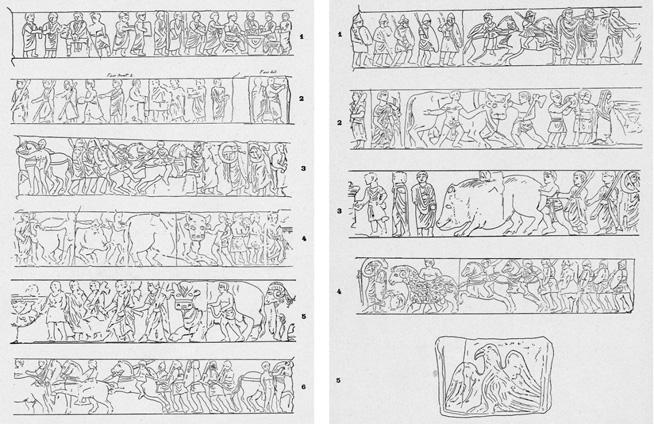
Abb.:RelieffriesdesBogensvonSusa: Augustus(a)undCottius(b)beimOpfer
freilichdieGefahr,dassengekultischeBeziehungenzwischenKönigund einheimischenUntertanenaufgegebenwerdenundsowohlsichbeide SeitenentfremdenalsaucheineFormvon‚kolonialerReligion‘etabliert wird.28
. MaterielleKultur
a. Bautechnik
DiematerielleKulturspiegeltbesonderseindrucksvollUmfangund Nachhaltigkeitdes‚ImpactofEmpire‘indenKlientelkönigreichenwider. EinbesonderswichtigergemeinsamerFaktorder regna istdieAdaptionrömischerBautechniken.AmdeutlichstenwirddiesanderVer-
28 ZurömischenRitualenaußerhalbRoms:C.Ando,‚ExportingRomanreligion‘, in:J.Rüpke(Hrsg.), AcompaniontoRomanreligion (Malden—London),–;zukolonialerReligionalsideologischeKomponentevonWeltreichengrundlegend: C.M.Sinopoli,‚Thearchaeologyofempires‘, AnnualReviewofAnthropology (), –,vorallemf.;Beispieleausnicht-römischerPerspektive:G.W.Conrad— A.A.Demarest, Religionandempire:ThedynamicsofAztecandIncaexpansionism (Cambridge);E.M.Brumfiel,‚Aztecheartsandminds:religionandthestateintheAztec empire‘,in:S.Alcock—T.D’Altroy—K.Morrison—C.Sinopoli(Hrsg.), Empires.Perspectivesfromarchaeologyandhistory (Cambridge),–.
güntherschörner
breitungvon opusreticulatum und opuscaementicium 29 DieVerwendungvonRetikulatmauerwerkistfürherodianischeZeitgutinIudaea bezeugt,soamDrittenWinterpalastinJericho,verschiedenenGebäuden inPaneas,inMasada,inJerusalemundinCaesareamaritima.30 Sogar kampanischePozzolan-ErdewurdenachCaesareaimportiert,umden HafenSebastoszuerrichten,31 weilgeeigneteRohstoffefürdieadäquate Anwendungder opuscaementicium-TechnikinHerodesReichfehlten. AberauchinanderenKlientelreichenistdasrömische opusreticulatum belegt:InCherchellinMauretanienwurdedieBautechnikbeieinem Nymphäum,dasindas.Jh.v.Chr.datiertwird,angewandt.32 WährendderHerrschaftdesPtolemaiosistsieandenköniglichenMausoleeninderNähederselbenStadtbelegt.33 DieRetikulat-Technikwurde genutztfürdieErrichtungderStadtmauernvonSamosata,derHauptstadtdesReichesvonKommagene,34 undinSebaste-ElaioussaanGebäuden,diemitArchelaos,demKönigvonKappadokien,inVerbindung gebrachtwerden.35 DieBeispielevonRetikulat-VerwendungimöstlichenMittelmeerraumundimVorderenOrientsindumsoerstaunlicher,alseskeinegleichzeitigenParallelenaußerhalbderKlientelreiche gibt.36
EinBeispielfürdieAdaptionrömischerArchitekturkonzepteaneigeneBedürfnisseimWestenstelltderPalastvonFishbournedar,wie jüngstH.vonHesberggezeigthat.37 DieAnlagezeigt,wieElementeder
29 Allgemein:H.vonHesberg, RömischeArchitektur (München)(mitderälteren Lit.);H.O.Lambrecht, Opuscaementitium (sic!)(Düsseldorf).
30 S.Rocca, Herod’sIudea.AMediterraneanStateintheClassicalWorld (Stuttgart ),–.
31 ZumHafenallgemein:R.Hohlfelder(Hrsg.) KingHerod’sdream.Caesareaonthe sea (NewYork—London),–;Japp,a.a.O.(Anm.),–.
32 allgemein:Japp,a.a.O.(Anm.),f.;Roller,a.a.O.(Anm.),.
33 P.Leveau,‚TroistombeauxmonumentauxàCherchel‘, Bulletind’ArchéologieAlgerienne (),–.
34 A.A.Tirpan,‚RomanmasonrytechniquesatthecapitaloftheCommagenian Kingdom‘,in:D.H.French—C.S.Lightfoot(Hrsg.), TheEasternFrontieroftheRoman Empire (Oxford),–.
35 SodiePhaseIderHafenthermen:M.Spanu,‚Letermedelporto‘,in:E.Equini Schneider(Hrsg.), ElaiussaSebasteII (Rom),–.
36 M.Waelkens,‚TheadoptionofRomanbuildingtechniquesinAsiaminor‘,in: S.Macready—F.H.Thompson(Hrsg.), RomanarchitectureintheGreekworld (London ),–,vorallem.
37 H.vonHesberg,‚EinheimischeBauherrenundrömischeArchitekturkonzepteim WestendesrömischenReiches‘,in:F.Pirson—U.Wulff-Rheidt(Hrsg.), Austauschund Inspiration:KulturkontaktalsImpulsarchitektonischerInnovation;Kolloquiumvom...inBerlinanlässlichdes.GeburtstagesvonAdolfHoffmann (Mainz),–
klientelkönigreicheundder impactofempire
römischenVillaübernommen,abergleichzeitigeinheimischenVorstellungenvonRepräsentationangepasstwurden,indemvorallemdiePersondesBesitzers,wohlTogidubnus,herausgestelltwurde.
DerTechniktransfererfolgtewohldurchrömischeHandwerker,wobei unklarbleibenmuss,obessichumAbteilungenderrömischenArmee gehandelthatoderumkaiserlichebzw.privateBauhütten.38 Treibende KraftfürdieÜbernahmescheintjedochimmerderKönigselbstgewesen zusein,wennmandenCharakterderBautenundderenLokalisierung indenjeweiligenKapitalenoder‚Palästen‘berücksichtigt.
b. Militärausrüstung
DieHerrschaftderKlientelkönigeberuhteinstarkemMaßeaufder UnterstützungdurchRom.InsofernspieltedieVerbindungmitderrömischenArmeealsdemwichtigstenMachtinstrumenteineentscheidende Rolle.Esistallgemeinbekannt,dassdie reges engeBeziehungenzum Militärunterhielten.EinebesondereQualitäterhältdieserKonnexdadurch,dasserzurRepräsentationundzurStatusaffirmationoder-steigerunggenutztwurde,wobeiinsbesonderedieBefehlsgewaltüberAuxiliartruppenvondenKlientelkönigenherausgestrichenwird.39 ArchäologischlässtsichdiesdurchdenFundrömischerMilitariainGräbern finden,diemitKlientelkönigeninVerbindunggebrachtwerdenkönnen:HervorragendeBedeutungkamanscheinenddenMaskenhelmen zu.40 SowurdeimKönigsgrabvonBizyeinThrakien,derHauptstadtdes
,vorallemf.;zumPalastvonFishbourne:J.Cunliffe, ExcavationsatFishbourne –.vols.I.II(London);J.Cunliffe,‚Fishbournerevisited:thesiteinitscontext‘, JournalofRomnArchaeology (),–;E.Black,‚Fishbourne,Chichester, andTogidubnusrexagain‘, JournalofRomanArchaeology (),–(mitder älterenLit.).
38 ZumTransfervonBautechnikeninderAntike:R.MacMullen,‚Romanimperial buildingintheprovinces‘, HarvardStudiesinClassicalPhilology (),–; T.F.C.Blagg,‚RomancivilandmilitaryarchitectureintheprovinceofBritain:aspectsof patronage,influenceandcraftorganisation‘, Worldarchaeology (),–;O.Stoll, ‚DerTransfervonTechnologieinderrömischenAntike.EinigezusätzlicheBemerkungen zueinemBuchvonSigridDuˇsek‘, MünsteranerBeiträgezurAntikenHandelsgeschichte (),–;K.Greene,‚Technologyandinnovationincontext:theRomanbackgroundtomediaevalandlaterdevelopment‘, JournalofRomanArchaeology (); O.Stoll,‚Ordinatusarchitectus.RömischeMilitärarchitektenundihreBedeutungfürden Technologietransfer‘,in:L.Schumacher(Hrsg.), Religion—Wirtschaft—Technik.AlthistorischeBeiträgezurEntstehungneuerkulturellerStrukturmusterimhistorischenRaum Nordafrika/Kleinasien/Syrien (St.Katharinen),–.
39 Creighton,a.a.O.(Anm.),–.
40 G.Franzius,‚Maskenhelme‘,in:WolfgangSchlüter—RainerWiegels(Hrsg.), Rom,
güntherschörner
Abb.:GesichtshelmausdemKönigsgrabvonBizye(Vize)
odrysischenKönigreichs,nebenKettenpanzer,SchwertundzweiLanzen einaufwändiggestalteterGesichtshelm(Abb.)gefunden.41 Einnahezu identischerHelmistTeildersehrwertvollenBeigabeneinesGrabes inEmesa,dasaufgrundderDatierungamehestenIamblichusII.,dem erstenKlientelkönig,zugewiesenwerdenkann.42
DieBedeutung,dievoneinheimischenHerrschernderVerbindung mitdemrömischenHeerzugemessenwurde,wirdbestätigtdurchdie FundequalitätvollerrömischerMilitärausrüstunginBestattungenvon PersonenhohengesellschaftlichenRangsinBritannien,soinVerulamium/SaintAlbansinLexdenundFollyLanesowieinBaldock43 oder
GermanienunddieAusgrabungenvonKalkriese (Osnabrück),–;N.Hanel— U.Peltz—F.Willer,‚UntersuchungenzurömischenReiterhelmmaskenausderGermania inferior‘, BonnerJahrbücher (),–.
41 A.M.Mansel,‚GrabhügelforschungimöstlichenThrakien‘, ArchäologischerAnzeiger (),–,vorallem–;N.Ba¸sgelen, ArifMüfidMansel’sExcavationsof TumuliinTurkishThrace (Istanbul);zumHelm:G.Waurick,‚RömischeHelme‘, in:A.Bottini(Hrsg.), AntikeHelme.SammlungLipperheideundandereBeständedes AntikenmuseumsBerlin (Mainz),–;Franzius,a.a.O.(Anm.),; L.Hansen, DiePanzerungderKelten.EinediachroneundinterkulturelleUntersuchung eisenzeitlicherRüstungen (Kiel),.
42 H.Seyrig,‚Antiquitéssyriennes.Antiquitésdelanécropoled’Émèse‘, Syria (),–;W.Ball, RomeintheEast.Thetransformationofanempire (London ),f.;zumHelm:Waurick,a.a.O.(Anm.),–;M.Junkelmann, Reiter wieStatuenausErz (Mainz),;.
43 Creighton,a.a.O.(Anm.),f.
klientelkönigreicheundder impactofempire im‚KöniglichenGrab‘vonEsSoumâainAlgerien.44 RömischeMilitaria könnendeshalbalseinweitererBausteinfürdieKonstruktionderkulturellvielseitigenIdentitätderKlientelkönigebetrachtetwerden.
c. Koch-undTafelgeschirr
DiebisherigeUntersuchungkonzentriertesichganzaufdiePersondes Herrschers.Umherauszufinden,obundinwelchemUmfangrömische ObjekteoderKulturtechnikenvonbreiterenBevölkerungsschichten übernommenwurdenbzw.—allgemeiner—welcheFolgendieTatsache, ineinemrömischenKlientelreichzuleben,fürdieEinwohneraußerden Königenhatte,mussvonandererarchäologischerEvidenzausgegangen werden.FürdieEinbeziehungdieser,auchniedrigstehendersozialer GruppenistinersterLinieKeramikgeeignet,dasiealsbilligesundeinfachherzustellendesProduktweitverbreitetwarundingroßenMengen zurVerfügungsteht.45
IndenbeidenKlientelreichenEnglands,imSüdenundOstender Insel,kameninder.Hälftedes.Jhs.v.Chr.neueKeramikformenwie TelleroderBecherauf,dierömischeVorbildernachahmten.46 Einigeder GefäßewarenvomFestlandimportiert,beidenmeistenhandelteessich aberumlokalproduzierteImitationen.DaalleGefäßederNahrungsaufnahmedienten,sprichtihrmassivesAufkommenfüreineÄnderungder Ess-undTrinkgebräucheindieserZeit,diesichdurchdieÜbernahme römischerTafelsittenerklärenlässt.DieAnalysedesFormenbestandes anunterschiedlichenFundstättenwieBraughing,Gorhamburyunddem KingHarryLane-FriedhofinVerulamiumhatgezeigt,47 dasszwischen derOberschichtunddeneinfacherenGruppenderGesellschaftdeutlicheUnterschiedeexistieren,sogibteseineTrennung,diesichdurch
44 G.Waurick,‚DieSchutzwaffenimnumidischenGrabvonEsSoumâa‘,in:H.G. Horn—Ch.B.Rüger(Hrsg.), DieNumider.ReiterundKönigenördlichderSahara (Bonn ),–.
45 ZurRollevonrömischerKeramikalsFundmaterial:J.T.Peña, Romanpotteryinthe archaeologicalrecord (Cambridge)(mitderälterenLit.);grundlegendzuKeramik alsIndikatorvonkulturellenWandlungsprozesseninGrenzgebieten:M.L.Okun,‚An exampleoftheprocessofacculturationintheearlyRomanfrontier‘, OxfordJournalof Archaeology (),–.
46 ZumFolgenden:H.E.M.Cool, EatingandDrinkinginRomanBritain (Cambridge ),–.
47 Cool,a.a.O.(Anm.),–;vgl.auchM.Pitts,‚Globalizingthelocalin RomanBritain:Ananthropologicalapproachtosocialchange‘, JournalofAnthropological Archaeology (),.
güntherschörner
dasTrinkenvonWeinanstellevonBiermanifestiert.48 Grundsätzlich kannimvorrömischenBritanniennichtvoneinerÜbernahmerömischerTafelsittenaufbreitergesellschaftlicherBasisgesprochenwerden, eineentsprechendeÜbernahmevonKulturpraktikenwurdenurvom oberenSegmentderGesellschaftgetragen.
Keramiklässtjedochnichtnuraufeine—partielle—Änderungbeim Verzehr,sondernauchbeiderZubereitungvonSpeisenschließen.Eine spezielleGruppevonGefäßenmiteinemdickenrotenÜberzugimInnerenwirdgewöhnlichalsPompeianRedWarebezeichnet.49 Dabeihandelt essichmeistumflacheSchüsselnundPlattenmitzugehörigenDeckeln. DavielederGefäßeRußspurenzeigen,müssensiemitFeuerinBerührunggekommenseinunddeshalbprimärderZubereitungvonSpeisen gedienthaben.DieflachenFormenderPompeianRedWaresindbesondersgeeignetzumBackenvonKuchenoderAufläufen,wiesietypischfür dierömischeKüchesind.AuchzumBackenvonBrotkönnensieverwendetwerden.ImKochbuchdesApiciuswerdenentsprechendeSchüsseln, meistpatinaegenannt,fürinsgesamtRezeptebenötigt.50 InBritannienwurdedieseKeramikgattungvoralleminMilitärlagernundgrößerenStädtendes.Jhs.n.Chr.gefunden,aberauchvorderEroberungin verschiedenenOrten,soinSheepen,derResidenzdesReichesderCattevellauniinderNähederspäterenrömischenKolonieColchester.51 Der BelegvonPompeianRedWareverweistalsoaufrömischeKochpraktiken,vermutlichaufdieExistenzentsprechendgeschulterKöche,beiden ElitendesöstlichenKlientelreiches.52
PompeianRedWareistauchimHerrschaftsgebietHerodes’desGroßenbezeugt:InJudaeawurdedieseKeramikanStättenwieSamaria,Cae-
48 Cool,a.a.O.(Anm.),–.
49 ZurGattung:C.Goudineau,‚Notesurlacéramiqueàengobeinternerouge-pompéien(‘Pompejanisch-rotenPlatten’)‘, Mélangesd’ÉcolefrançaiseàRome (),–;D.S.Peacock,‚Pompeianredware‘,in:D.S.Peacock(Hrsg.), Potteryandearlycommerce.CharacterizationandtradeinRomanandlaterceramics (London—NewYork— SanFrancisco),–;M.C.Leotta,‚Ceramicaavernicerossainterna‘,in:D.Gandolfini(Hrsg.), Laceramicaeimaterialidietàromana.Classi,produzioni,commercie consumi (Bordighera),–.
50 Apicius..;.;.;.;..;..–;.;..;..;..;..;..;..–.;..;..;..;..–.
51 ZurVerbreitunginBritannien:Peacock,a.a.O.(Anm.),f.;Belegein Sheepen:C.F.C.Hawkes—M.R.Hull, Camulodunum.Firstreportontheexcavationsat Colchester– (Oxford),FormA;Cool,a.a.O.(Anm.),.
52 Cool,a.a.O.(Anm.),f.;indieselbeRichtungweistdasVorkommenvon mortaria anFundplätzenmitElite-CharakterinKontexten,dievordieEroberunggesetzt werdenmüssen:ebendaAnm..
klientelkönigreicheundder impactofempire
sareamaritima,Jericho,Machairos,demHerodionundJerusalemgefunden,außerhalbJudaeasinDorundPanias.53 InJerichoistsieinderZeit vonv.Chr.bisn.Chr.datiert,sodassdieEinfuhrausItalienindie HerrschaftszeitvonHerodesgesichertist.54 GrundsätzlichistPompeian RedWarerelativhäufigindenstädtischenZentrendesherodianischen ReichesunddenköniglichenResidenzen,abersehrselteninländlichen Siedlungen.Eskanndeshalbangenommenwerden,dassauchinPalästinawieinBritannienpompejanisch-rotePlattendenBedarfdesKönigs unddereinheimischenElitedeckten.55 DieflachenBackschüsselnhatten insoferneinenEinflussaufdieKeramikproduktionundKücheinHerodes’Reich,alswährenddes.Jhs.n.Chr.lokaleImitationenhergestellt wurden.56 DaentsprechendeFormennichtimRepertoiredesöstlichen Mittelmeerraumsvorkommen,sindsieeinHinweisaufdieAdaption römischerKochgewohnheiten,dochwarihreAkzeptanzsehrbeschränkt undistzudemhäufignurbestimmtengesellschaftlichenGruppenzuzuordnen,wiedieBefundeausTellAnafabelegen.DieserwichtigeFundortinderNähedesHula-SeeshatunsereKenntnissevomKeramikgebrauchimReichdesHerodesPhilipposentschiedenerweitert.57 Hier wurdendeutlicheUnterschiedezwischendemGefäßspektrumderspäthellenistischenundrömischenZeitfestgestellt.58 SokonntenderPhase zwischenv.Chr.undn.Chr.offensichtlichwenigerKrügezumServierenvonGetränkenundwenigerParfümfläschchenzugeordnetwerden,wasaufeineneinfacherenLebensstandardschließenlässt.BesonderskennzeichnendistderGebrauchvonBackschüsseln,zumTeilauch vonPompeianRedWare,dieeinenAnteilvondesKochgeschirrs ausmacht,währendsiefürdiefrühereZeitfehlen.59 EineÜbernahme römischerKochgebräuchedurchdieeinheimischeBevölkerungkann
53 A.Berlin,‚Theplainwares‘,in:S.C.Herbert(Hrsg.), TellAnafaII,i:TheHellenistic andRomanPottery (AnnArbor),–;R.Bar-Nathan, MasadaVII.TheYigael Yadinexcavations–.Finalreports:ThepotteryofMasada (Jerusalem),–.
54 R.Bar-Nathan, HasmoneanandHerodeanPalacesatJericho (Jerusalem)–.
55 R.Rosenthal-Heginbottom,‚HellenisticandEarlyRomanfinewareandlampsfrom AreaA‘,in:A.Geva(Hrsg.), JewishQuarterExcavationsintheOldCityofJerusalemII (Jerusalem),f.;Bar-Nathan,a.a.O.(Anm.),f.
56 Berlin,a.a.O.(Anm.),f.
57 ZurGrabungallgemein:S.C.Herbert, TelAnafaI,i.ii:Finalreportontenyears ofexcavationataHellenisticandRomansettlementinNorthernIsrael..Supplement JournalofRomanArchaeology(AnnArbor).
58 Berlin,a.a.O.(Anm.),–.
59 Berlin,a.a.O.(Anm.),–.
güntherschörner
jedochdeshalbnichtangenommenwerden,zumalauchweiteretypische Gefäßformenwie mortaria fehlen.60 Amwahrscheinlichstenist,dassSoldateninTellAnafastationiertwaren,derenEssgewohnheitenjedoch nichtallgemeinübernommenwurden.TrotzdemzeigtdieKeramikin TellAnafa,dassaucheinfacheSiedlungeninKlientelreichenKontaktzonenwaren,wobeifreilichnichtimmerregerKulturaustauschherrschen musste,sondernesauchzueinemNebeneinanderzweierLebensstile kommenkonnte.
III.KlientelkönigtümeralsThemavon FrontierStudies
DiegenauereBetrachtungvorallemdermateriellenKulturindenKlientelkönigreichenhatgezeigt,dasssiealsKontaktzonenRegionenerhöhtenkulturellenAustauschswaren.61 DadieseGebietenichtlinearals border,sondernnurgebietsweiseals frontiers zuverstehensind,kanndie Beschäftigungmitihnendazuverhelfen,einigeVersäumnisseundProblemevon frontierstudies imAllgemeinenzubenennenundsichihrer bewusstzuwerden,sovorallemdieeinheimischeBevölkerungvom KönigbiszudeneinfachenUntertanenzuignorierenundzumarginalisieren.62 GanzindiesemSinnsolltendieBewohnerderGrenzregionen desImperiumRomanumselbstalshandlungsmächtigeAgenteninProzessenkulturellenWandelsgesehenwerden.63 ZweiProblemesindinsbesonderezunennen:
60 Berlin,a.a.O.(Anm.),–;A.Berlin,‚Italiancookingvesselsand cuisinefromTelAnafa‘, IsraelExplorationJournal (),–.
61 ‚Kontakt‘und‚Kontaktzonen‘sindKernbegriffederaltertumswissenschaftlichen Forschung:K.G.Lightfoot,‚Culturecontactstudies‘, AmericanAntiquity (),–;J.Cusick, Studiesinculturecontact:interaction,culturechangeandarchaeology (Carbondale);R.Rolle—K.Schmidt(Hrsg.), ArchäologischeStudieninKontaktzonender antikenWelt (Göttingen);C.Gosden, Archaeologyandcolonialism.Culturecontact frombctothepresent (Cambridge).
62 DieUnterscheidungvon‚border‘und‚frontier‘lässtnichtdurchdasdeutsche Wort‚Grenze‘wiederholen;vgl.Braund,a.a.O.(Anm.),;methodischgrundlegend:P.Southern,‚Comparativefrontierstudies‘,in:E.Scott(Hrsg.), TheoreticalRoman Archaeology:FirstConferenceProceedings (Avebury),–;K.G.Lightfoot— A.Martinez,‚Frontiersandboundariesinarchaeologicalperspective‘, AnnualReviews ofAnthropology (),–;C.M.Wells,‚Profuitinvitistedominantecapi:social andeconomicconsiderationsontheRomanfrontiers‘, JournalofRomanarchaeology (),–;A.Gardner,‚Fluidfrontiers:culturalinteractionontheedgeofempire‘, StanfordJournalofArchaeology (),–.
63 ZumKonzeptder agency inderArchäologie:M.-A.Dobres—J.E.Robb(Hrsg.), Agencyinarchaeology (London—NewYork);J.L.Dornan,‚Agencyandarchaeology:
klientelkönigreicheundder impactofempire
.)HistorischeUntersuchungender regna behandeltenmeistdasGebiet inseinerGesamtheit,galtenalsoderMakroregion.ArchäologischeAnalysenbeschränkensichmeistaufeineodereinigewenigeAusgrabungen, sindalsoaufMikroregionenbezogen.Esistnotwendig,beideHerangehensweisenmiteinanderzuverbinden,danuraufdieseintegrierteWeise sowohldiespezifischenFormenalsauchdieweiterenEffektedesKulturkontaktsnachgezeichnetwerdenkönnen.
.)DieStudienzuKlientelkönigenundihrenHerrschaftsgebietenunterstützennotwendigerweiseein‚topdown‘-ModelldesKulturwandels,das eherEntwicklungenamKönigshofindenFokusstelltalssolcheinanderengesellschaftlichenBereichen.EsliegtnatürlichimInteressederEliten anderPeripherie,inersterLiniedesKönigsselbst,dieengenBeziehungenzuRomalsderwichtigstenLegitimationseinerHerrschaftherauszustellen.Esistjedochunbedingtzufragen,obanderesozialeGruppen derBevölkerungihreeigenenspeziellenIdentitätenindiesemGrenzbereichkreierten,insbesondereinwieweitdiestarkeBezugnahmeaufRom, diederKönigpraktizierte,übernommenwurde.64 TrotzSchwierigkeitenbeiderQuellenlagekanndurchAnalysederarchäologischenEvidenz,insbesonderevonMassenproduktenwieKeramik,gezeigtwerden, dassdieBeeinflussungseinereigenenUntertanendurchPraktikenund
past,present,andfuturedirections‘, JournalofArchaeologicalMethodandTheory (),–;A.Gardner(Hrsg.), AgencyUncovered:archaeologicalperspectiveson socialagency,power,andbeinghuman (London).
64 ‚Identität‘istindenletztenJahrenzumzentralenParadigmainnerhalbderrömischenArchäologiegewordenundhat—berechtigterweise—denzupauschalenundhistorischbelastetenTerminusRomanisierungersetzt:A.Gardner,‚Socialidentityandthe dualityofstructureinlateRomanBritain‘, Journalofsocialarchaeology (),–;D.Mattingly,‚BeingRoman:expressingidentityinaprovincialsetting‘, Journalof RomanArchaeology (),–;A.Schmidt-Colinet(Hrsg.), LokaleIdentitätenin RandgebietendesrömischenReiches.AktendesInternationalenSymposiumsinWiener Neustadt,.-.April(Wien);A.Gardner, AnArchaeologyofIdentity:soldiers andsocietyinlateRomanBritain (WalnutCreek);R.Roth—J.Keller(Hrsg.) Roman byIntegration:dimensionsofgroupidentityinmaterialcultureandtext..Supplement JournalofRomanArchaeology(Providence);S.Hinds—T.Schmitz,‚Constructing identitiesintheRomanEmpire:threestudies‘, Millenium (),–;M.Pitts,‚The emperor’snewclothes?TheutilityofidentityinRomanarchaeology‘, AmericanJournal ofArchaeology (),–;M.Sommer,‚BauenanderGrenze.Überlegungen zurMonumentalisierungkulturellerIdentitäten‘,in:F.Pirson—U.Wulff-Rheidt(Hrsg.), AustauschundInspiration:Kulturkontaktals ImpulsarchitektonischerInnovation;Kolloquiumvom.-..inBerlinanlässlichdes.GeburtstagesvonAdolfHoffmann (Mainz),–;L.Revell, Romanimperialismandlocalidentities (Cambridge )(jeweilsmitweitererLit.).
güntherschörner
FormenderrömischenKultur,dievomKönigdemonstrativaufgegriffen wurden,geringist.EskommtalsoinKlientelkönigreichen—imUnterschiedzuvielenProvinzendesRömischenReiches—nursehrbegrenzt zueinem‚trickledown‘-Effekt.65 DieteilweiseunmittelbarandiePersondesKönigsgebundeneBeziehungzwischenKlientelreichundRom bzw.ItalienkannarchäologischambestenanhandvonLebenmittellieferungenexemplifiziertwerden:InMasadafandmanAmphoren,dielaut AufschriftdirektfürHerodesbestimmtwarenundWeinundÄpfelaus Italiensowie garum ausSpanienenthielten.66
ImUnterschiedzumZentrum-Peripherie-Modell,wodasZentrum dieentscheidendeRollebeiderVeränderungkulturellenWandelsinnehatte,spieltebeiKlientelkönigreichendiePeripheriedenaktivenPart.67 ZwarwurdenimRahmenderErziehungderPrinzenals obsides inRom periphereElementeinsZentrumgebracht,dochwurdensienachihrer ErziehungandenäußerenRandgesandt.68 SomitwarendieKönige AgentendeskulturellenWandels,freilichunterschiedsichderenkulturelleIdentitätnachdrücklichvonderseiner‚Landsleute‘,diedeutlich vielgliedrigerwarundeinedezidiertrömischeFacetteaufwies.Sosind auchGemeinsamkeiteninderRepräsentationder reges zuerklären.69
65 Grundlegend:M.Millett, TheromanizationofBritain (Cambridge).
66 Soz.B. RegiHerodiIudaico:H.M.Cotton—J.Geiger, MasadaII:TheYigaelYadin excavations–.Finalreport:TheLatinandGreekdocuments (Jerusalem), passim;Bar-Nathan,a.a.O.(Anm.),–.
67 T.Champion(Hrsg.), CentreandPeriphery.ComparativeStudiesinArchaeology (Cambridge);M.Rowlands—K.Kristiansen(Hrsg.), CentreandPeripheryinthe AncientWorld (London—NewYork);G.Schörner,‚DasZentrum—Peripherie— ModellinderRomanisierungsforschung‘,in:G.Schörner(Hrsg.), Romanisierung— Romanisation.TheoretischeModelleundpraktischeFallbeispiele (Oxford),– (mitweitererLit.);zumZentrum-Peripherie-Modellin frontierstudies:P.S.Wells,‚Productionwithinandbeyondimperialboundaries:goods,exchange,andpowerinRoman Empire‘,in:N.Kardulias(Hrsg.), World-Systemstheoryinpractice:leadership,production, andexchange (Lanham),–.
68 Allgemein:J.Gagé, ResgestaediviAugusti (.Auflage,Paris),f.;Braund ,a.a.O.(Anm.),–;einbesondersguterforschtesBeispiel:M.Hadas-Lebel, ‚L’éducationdesprinceshérodiensàRomeetl’évolutionduclientélismeromain‘,in: M.Moru.a.(Hrsg.), JewsandgentilesintheHolyLandinthedaysoftheSecondTemple, theMishnaandtheTalmud (Jerusalem),–; obsides ausdemWesten:Creighton ,a.a.O.(Anm.),–.
69 SowerdenidentischeMünztypen,dieaufPrägungenRomszurückgehen,gleichermaßenvonTincomarus,VericaundEpaticcusinBritanniensowieIubaI,IubaIIund PtolemaiosinMauretanienverwendet,außerdemvonKönigenNoricumsunddemtreverischenFürstenArda:Creighton,a.a.O.(Anm.),–Abb...ZumrömischenVorbild:RRC.
klientelkönigreicheundder impactofempire
DassdabeiderenAusdrucksformenausdemRahmendesregionalTypischenfallenkönnen,verdeutlichtdieMünzprägung.Sounterscheiden sichdieMünzenderReicheimOstendeutlichvondenenderPoleisin ihrerunmittelbarenNachbarschaft.70 JeneahmenstadtrömischePrägungennach,ganzähnlichwieauchindenKlientelkönigreichenimWesten, währenddieseeinenvielstärkerenLokalbezugaufweisenundvorallem lokaleMythenundSpielethematisieren.Teilweisewird,wieimFallevon Agrippa,sogarLateinfürdieTitulaturbenutzt.71
DerGrundfürdiesenungemeinengenAnschlussanrömischeFormenistevident:Die reges musstenihrefestenBeziehungenmitRom alsihrenraisond’êtreherausstreichenundimmerwiederaugenfällig machen.
DasgrundsätzlichePrinzip,nämlichdassmaterielleKulturrömischer PrägunginnerhalbdesImperiumsinlokalenGesellschaftenalsStatussymbolgenutztwerdenkonnte,giltauchfürdieKlientelreiche.72 Esgibt jedocheinsignifikantesCharakteristikum:DieAdoptionrömischerKulturbeziehtsichmeistaufdieKönigeundistauchhauptsächlichvon ihnenveranlasst.ImUnterschiedzudenProvinzenwarderProzess deskulturellenWandelsindenKlientelreichendeshalbungleichmäßigerundkurzlebiger:ungleichmäßiginsofern,alsmancheBereicheder indigenenKulturvielstärkerdurchrömischeModellebeeinflusstsindals andere,häufigauchineinerArtundWeise,wiesienichtmitdenregulärenProvinzendesRömischenReichesvergleichbarist,wiedieBauten in opusreticulatum oderdieMünzenmitlateinischenLegendenbeweisen.73 GleichesgiltfürdiePorträtsdermauretanischenKönigeimbestenrömischenStil74 oderdieWanddekorationzweitenStilsinMasada.75
70 A.Burnett,‚TheRomanWestandtheRomanEast‘,in:Ch.Howgego—V.Heuchert—A.Burnett(Hrsg.), CoinageandidentityintheRomanprovinces (Oxford), –.
71 Burnett,a.a.O.(Anm.),.
72 Grundlegend:P.S.Wells,‚IdentityandmaterialcultureintheLaterPrehistory ofCentralEurope‘, JournalofArchaeologicalResearch (),–;vgl.auch P.W.M.Freeman,‚‘Romanisation’andmaterialculture‘, JournalofRomanarchaeology (),–.
73 HierAnm.;Burnett,a.a.O.(Anm.),.
74 K.Fittschen,‚BildnissenumidischerKönige‘,in:H.G.Horn—Ch.B.Rüger(Hrsg.), DieNumider.ReiterundKönigenördlichderSahara (Bonn),–.
75 G.Foerster, MasadaV.TheYigaelYadinexcavations–.Finalreports:Art andarchitecture (Jerusalem),–;K.Fittschen,‚WalldecorationsinHerod’s kingdom:theirrelationshipwithwalldecorationsinGreeceandItaly‘,in:K.Fittschen—
Kurzlebigervorallemdeshalb,weildieAnnexionderKlientelreiche einenWandeldermateriellenKulturnachsichzieht,dieeinheimischer wirdbeziehungsweiseinersterLiniestärkerenlokalenCharakterannimmt.BeispielehierfürsinddasVerschwindenvonPompeianRed wareaußerhalbvonStädtenundMilitäranlagenimrömischenBritannienoderdasKeramikspektruminMasadanachderÄraHerodesdes Großen.76 DeshalbscheintdieKulturindenKlientelreichennochmehr fragmentiertzuseinundnochmehrErgebnisvon‚bricolage‘zusein, alsdiesN.TerrenatofürdieregulärenProvinzenangenommenhat.77 Freilichistessehrfraglich,obdieKlientelkönigeüberhauptdieSchaffungeinermöglichsthomogenenKulturrömischerPrägunginihrenReichenanstrebtenoderobsiedurchihreBindunganRom,dievomRest derBevölkerungnichtnachvollzogenwurde,ihrekulturelleIsolierungin Kaufnahmen.
JedenfallssinddieKlientelreichesehrguteBeispieledafür,dasswir grundsätzlichGrenzeneheralsZonenkulturellenKontaktszusehen habenundnichtalsscharfeTrennlinien.DieBewohnerdieserRegionenkönnendeshalbeineVielfaltunterschiedlicherkulturellerIdentitätenausbilden,wobeiindenKlientelkönigreichendieMöglichkeiten zwischenengerAnlehnunganRomundFesthaltenandertraditionellenKulturbesondersgroßsind.Grundsätzlicherfordertesdieseaktive Rolle,diedieBewohnerinden regna einnehmen,unserefestgefügten VorstellungenvomrömischenImperialismusbeziehungsweiseKolonialismusundvomVerhältnisvonZentrumundPeripherieinFragezustellenundeinerkritischenPrüfungzuunterziehen.78
Jena,Januar
G.Foerster(Hrsg.), JudaeaandtheGreco-RomanWorldintheTimeofHerodintheLight ofArchaeologicalEvidence (Göttingen),–;vgl.auchS.Rozenberg,‚Thewall paintingsoftheHerodianPalaceatJericho‘,in:Fittschen—Foerster,a.a.O.,–.
76 HierAnm.und.
77 N.Terrenato,‚TheRomanizationofItaly:globalacculturationorculturalbricolage?‘, in:C.Forcey—J.Hawthorne—R.Witcher(Hrsg.), TheoreticalRomanArchaeologyConference (Oxford),–.
78 ZuKolonialismusundImperialismusausarchäologischerSicht:B.Bartel,‚Colonialismandculturalresponses:problemsrelatedtoRomanprovincialanalysis‘, World Archaeology (),–;R.Hingley,‚RomanBritain:thestructureofRoman imperialismandtheconsequencesofimperialisminthedevelopmentofaperipheral province‘,in:D.Miles(Hrsg.), TheRomano-Britishcountryside (Oxford),–;
klientelkönigreicheundder impactofempire
Abbildungsnachweis
Abb.aS.Reinach,RépertoiredesreliefsgrecsetromainsI(Paris). Abb.bS.Reinach,RépertoiredesreliefsgrecsetromainsI(Paris). Abb.aA.M.Mansel,‚GrabhügelforschungimöstlichenThrakien‘,ArchäologischerAnzeiger,Abb..
Abb.bA.M.Mansel,‚GrabhügelforschungimöstlichenThrakien‘,ArchäologischerAnzeiger,Abb..
J.Webster—N.Cooper(Hrsg.), RomanImperialism:post-colonialperspectives (Leicester );D.Mattingly, DialoguesinRomanImperialism.Power,discourseanddiscrepant experienceintheRomanEmpire..SupplementJournalofRomanArchaeology(Portsmouth);Gosden,a.a.O.(Anm.);G.Schörner,‚Imperialismus,KolonialismusundPostkolonialismusinderRomanisierungsforschung‘,in:Schörner,a.a.O. (Anm.),–;M.Given, Thearchaeologyofthecolonized (London);Revell, a.a.O.(Anm.);zuZentrumundPeripherie:hierAnm..
THEFRONTIERSOFGRAECO-ROMANRELIGIONS: GREEKSANDNON-GREEKSFROMARELIGIOUS POINTOFVIEW
ElenaMuñizGrijalvo
AncientGreeksseemedtobeveryconcernedaboutwhowasGreekand whowasnot.Atleast,thisiswhatwecaninferfromthegreatnumber ofliterarysourceswhichdealtwiththetopicinonewayoranother.
FromHerodotus’ Histories to,say,Tatian’s AddresstotheGreeks (togive justoneexampleofextremelyoppositegenresandaims),thefrontierof GreeknesswasanimportantissuenotonlytotheGreekmind,butalso tothemindsofotherintellectualsfromalloverthe oikouméne.However, Greeknesswasrarelysystematicallydefined.ThefeaturesofGreekness couldbefoundinallformsofart,andcoveredareasfromdescentand languagetomoregeneralwaysoflife.1
Inthisgeneralpicturereligionplayedakeyrole,or,tobemore precise, some religiousaspectsdid.InthefifthcenturybcHerodotus wrote“sothatthingsdonebymannotbeforgottenintime,andthat greatandmarvellousdeeds,somedisplayedbytheHellenes,someby thebarbarians,notlosetheirglory”(.).Hisapproachtothesetwo largegroups,“Hellenes”and“barbarians”,setakindofagendaforthose intendingtodescribenewpeoples.Amongthecategoriesthatcould beexploredwhendealingwithaforeignpeople,religionoccupieda privilegedposition.Herodotusfocusedonahandfulofreligiousaspects toexplainthedistancebetweenthey-barbariansandwe-Greeks.The resultwasnotaclearpictureofwhatGreekreligionactuallywas,noreven ofwhatreligionmeantforHerodotus.Itwasmoreawayofestablishing thelimitsofGreekreligionwithrespecttonon-Greekpeoples,inorder tomaketheintellectualfrontiersoftheGreekworldexplicit.
Aswewillsee,theethnographicalcategoriesdrawnbyHerodotus provedtobelasting.AuthorsrepeatedlytriedtosetthelimitsoftheGreek worldbyfocusingonquitesimilarsubjectstodescribeotherpeoples. However,thiscontinuityintheethnographicalreligiousapproachdid
1 Well-knowndefinitionsofGreeknessareHerodotus..;Isocrates, Panegyricus ;DionysiusofHalicarnassus..;DioChrysostom..
notmeanthatGreekreligionwasalwaysthesame,nor(andthisismy pointhere)thatthefrontierofGreekreligionwasalwayssetatthesame place.Theaimofthispaperistoanalysehowreligionwasusedasaway ofconstructingdifferentlimitsfortheconceptofGreekness.Afterabrief sketchofHerodotus’workasastartingpoint,IwillfocusonStrabo’s Geography,firstlytoshowhowhebroadenedthelimitsofGreekreligion, sothatitcouldbeunderstoodas“Graeco-Romanreligion”instead,and secondlytoshowhowthedevicewasintendedtosetfrontiersnotonly betweenGreeksandbarbarians,butalsobetweenGreeks(orGraecoRomans)andnon-GreekswithintheRomanEmpire.
AnalysisofreligioninHerodotusisbecomingincreasinglyfrequentin studiesofhiswork.2 Thisisnotsurprisingastheamountofreligiousdata concerningnotonlytheforeignpeoplesHerodotusdescribes,butalso theGreeksthemselves,isindeedremarkable.However,whatwereadin HerodotusisnotanaccuratepictureofwhatGreekreligionwasactually like.Nomatterhowmuchwereadintoit,3 hehadnointentionofdoing so.Aswehaveseen,hewasmerelytryingtoofferhisaudienceanaccount ofthedeedsofGreeksandbarbariansalike,andofthecauseswhichled tothePersianwars.Toachievehisgoal,heconsidereditnecessaryto digress,focusingonthedifferentpeopleswhichhadtodowitheither thebarbarians(i.e.Persians)ortheGreeks.Theresultis,ashasbeen pointedout,a“patterneddisplayprovidedbytherangeofcultures”,in whichGreeceisnottobeunderstoodwithoutbarbarians,andviceversa.4
2 WorksincludinganalysisofreligioninHerodotusare:G.Lachenaud, Mythologies, religionetphilosophiedel’histoiredansHerodote (Lille);E.Hall, Inventingthe Barbarian (Oxford);S.Scullion,“HerodotusandGreekReligion”,inC.Dewald— J.Marincola(eds.), TheCambridgeCompaniontoHerodotus (Cambridge),–;W.Burkert,“HerodotalsHistorikerfremderReligionen”,inG.Nenci—O.Reverdin (eds.), Hérodoteetlespeuplesnon-Grecs (Genève),–;P.Cartledge,“Ancientand moderncontestationsofHellenism”, BulletinInstituteClassicalStudies (),–; J.Redfield,“Herodotusthetourist”, ClassicalPhilology (),–.Specifically aboutreligioninHerodotus:F.Mora, ReligioneereligioninelleStoriediErodoto (Milano );J.Gould,“Herodotusandreligion”,inS.Hornblower(ed.), GreekHistoriography (Oxford),–;T.Harrison, DivinityandHistory.ThereligionofHerodotus (Oxford);J.D.Mikalson,“ReligioninHerodotus”,inE.J.Bakker—I.J.F.deJong— H.vanWees(eds.), Brill’sCompaniontoHerodotus (Leiden-Boston);J.D.Mikalson, HerodotusandReligioninthePersianWars (ChapelHill).
3 Andnomatterhowoptimisticonechoosestobe,asisthecasewithMikalson, op.cit.(n.),,whoclaimsthat“hisHistories(...)mayreasonablybeclaimedtobethe bestandrichestsinglesourceforGreekreligionasitwaspractisedintheclassicalperiod”.
4 Redfield,op.cit(n.),.
thefrontiersofgraeco-romanreligions
Herodotusconceivedtheworldasasystemformedbythecombination ofpeopleswhoweredifferentfromeachother.Aconsciouseffortto describetheconstituentsofhissystemcanbefoundinhiswork,although healwaysfocusesonwhatmadethedifferencebetweenthem.
ThisisprobablywhyHerodotusconcentratedoncertainmattersand notonothers,includingwhenreferringtoreligion.Oneoftheeasiest waystounderlinethedifferencesbetweentwopeoplesistodescribewhat ispatentlyobvious:theircustoms,whattheydo,especiallywhatthey doasapeopleandinpublic,andinthereligiousdomainthismeans rituals.Herodotus’concernaboutritualprobablyhadalottodowith this.5 Inaddition,ofalltherituals,sacrificeiswhathecommentedon mostextensively.
ThetworichestdescriptionsofsacrificearethoseofPersiansand Egyptians.Inbothcases,butespeciallyinPersiansacrifices,hechoosesto centeronwhatwasdefinitelynon-Greek.Andthushesaysexplicitlythat Persians“donotbuildaltarsorkindlefire,employlibations,ormusic,or fillets,orbarleymeal”(..),andcontinuestoexplainhow“topray forblessingsfor(oneself)aloneisnotlawfulforthesacrificer”(..); orthat“nosacrificecanbeofferedwithoutaMagus”(..).
ThereisalsoasimilarityinhisdescriptionofEgyptiansacrifices.After dwellingatlargeonhow“theyinstitutedcustomsandlawscontraryfor themostparttothoseoftherestofmankind”(..),hegivesexamples ofsomebizarreEgyptianhabits.Finally,hegetstoreligion,wherespecial attentionispaidtosacrificeandthewayofkillingandpreparingthe animaltobeconsumed:“theycutitsthroat,andhavingdonesosever theheadfromthebody.Theyflaythecarcassofthevictim,theninvoke manycursesonitshead,whichtheycarryaway.Wherethereisamarket, andGreektradersinit,theheadistakentothemarketandsold;where therearenoGreeks,itisthrownintotheriver”(..–).
Asarule,itseemsthatwhenHerodotuscommentedonaritual,it wasbecausetherewasoftenaGreekreferencethatwasclearlydifferent fromtheforeignone.6 Theoppositemayalsobetrue:itseemsthathe
5 Wewillprobablyneverknowtowhatextenthisrealconceptofreligiousthingshad todoonlywithritual.Thisisanimportantissue,whichwillnottobedealtwithhere.But IthinkthatweshouldbeabitmorecautiousthanGould,op.cit.(n.),,when heobserves“howstrikinglyit(Herodotus’work)underlinesforustheextenttowhich heand,onemightguess,themajorityofGreeks,definedtheirownreligiontothemselves andunderstooditssignificancelargelyinritualterms”.
6 Thisiswhatmayexplainthat,inhisdescriptionsofothersacrifices,Herodotus stressessuchthingsasthewayofslaughteringthevictims.WhenhedescribesScythian
elenamuñizgrijalvo
bringsupdetailsaboutGreekreligionbecausetheyexplicitlyshowthe differencesbetweentwopeoples(everypieceofinformationaboutGreek religion,therefore,shouldbeconsideredinthislight).Butessentiallythe differencewasnotsogreat.Tohismind,whatcharacterisedtheGreeks oranyotherpeoplewasnotthattheyhaddifferentcustoms,butthat theywentaboutthemindifferentways.AsScheidhasobserved,ancient authorsthoughtthat“everywherepeoplemadesacrifices,prayers,and vows,celebratedsacredgames,andbuiltsanctuaries(...)Butonething madethedifferencebetweenthereligionsoftheworld:thegoverning rules,thosesmalldetails,choices,andpostureswhichgaveeachsystem itsoriginality”.7 Herodotuswasthereforepreparedtoadmitthatthe realmofreligionwascommontoallcivilisedpeople:8 inhiswords“I believethatallmenareequallyknowledgeableabout(thegods)”(..). Consequently,nosignsofsuperioritywillbefoundinHerodotus regardingGreekreligion.Admittedly,hisworkshowshisdeeppride inbeingGreek:“fromoldtimestheHellenicstockhasalwaysbeen distinguishedfromforeignbyitsgreaterclevernessanditsfreedom fromsillyfoolishness”(..).Butreligionhadlittletodowiththis.As hasbeenobserved,Herodotus’implicitaim“wastopromotenotGreek ethnictriumphalismbutGreekethno-politicalsolidarity”.9 Toachieve this,itwasnotnecessaryforGreekritualstobeolderorbetterthanthe others:theyjusthadtobefeltasGreek.
Thesenseofbelongingtoacommonpoliticalunitcouldbereinforced ifpeopleshared“theshrinesofgodsandthesacrifices”,astheAthenians claimedwhentheywishedtounderlinetheirGreeknesstotherestof theHellenes.10 Aslongasthisbondwasstrongenough,Herodotusdid
sacrifice,hechoosestounderlinethatthesacrificer“throwinganoosearoundthebeast’s neck,hethrustsinastickandtwistsitandsostranglesthevictim,lightingnofirenor offeringthefirst-fruits,norpouringanylibation;andhavingstrangledandskinnedthe beast,hesetsaboutcookingit”(..).IfScythiansstrangletheirvictims,theTauri “strikethevictimontheheadwithaclub”(..),andtheLybiannomads“wringthe victim’sneck”(..).
7 J.Scheid,“GraecoRitu:AtypicallyRomanwayofhonoringthegods”, Harvard StudiesinClassicalPhilology ().
8 “Barbarians”werenotnecessarilyuncivilisedpeopleforHerodotus:underthis rubricverydifferentgradesofcivilisationwereincluded,fromthePersiansortheEgyptians,whoweremorecivilisedthantheGreeksinsomerespects,totheremotepeoples wholivedoutsidethelimitsofcivilisation.Interestingly,Herodotusdoesnotrecordany religiouscustomofthelatter.
9 Cartlegde,op.cit(n.),.
10 ...SimilarclaimsaboutwhattheGreekssharedorwhatmaybelabelledas GreekreligionmaybefoundinIsocrates, Panegyricus orDemosthenes, Philippics ..
thefrontiersofgraeco-romanreligions
notmindacknowledgingthatGreekritualswerenotoriginal,thatthere wereolderandhigherformsofreligion,oreventhattheGreekshad copiedagreatnumberoftheirhabitsfromforeignpeoples.Moreover, hiscompletelackofnationalisminthisrespectallowedhimtopresent religiousimitationaspositiveandtypicalofcivilisedpeople.Onlythe Scythians(thosebarbarians)wouldbothertorejectforeignrituals,as theydidwhentheirfellowcountryman,Anacharsis,daredtocelebrate thefeastoftheMotheroftheGodsintheGreekway,andtheScythian king“shotanarrowathimandkilledhim”(..).
Civilisedpeopletendedinsteadtoadoptanddevelopforeigncustoms, whenthesewereclearlysuperior.ThatiswhattheGreeksdid,especially withrespecttoEgyptianreligion.11 InhislongdescriptionofEgyptian customs,HerodotusadmitsthatnotonlyhadthenamesofGreekgods beenimportedfromtheNile(..),butalsoGreekrituals(..), orthose“practicescalledOrphicandBacchic,butinfactEgyptianand Pythagorean”(..),orevenhighlyGreekcustomssuchas“thatrite ofDemeter,whichtheGreekscallThesmophoria(...)Thedaughtersof DanauswerethosewhobroughtthisriteoutofEgyptandtaughtittothe Pelasgianwomen”(..–).
Tosumup,notonlywasGreekreligioninHerodotusconceivedasa commonpossessionofallthosewhocalledthemselvesGreek,butalso asarecipientofforeignwisdom.Ithadbeenformedbytheadditionof theindigenous(thepre-Greek),withagreatdealofPelasgiancustoms, inadditiontootherdefinitelyforeignnamesandrituals,inasortofcentripetalprocesswhichculminatedintheformationofwhattheGreeks ofthefifthcenturybcregardedas“their”religion.ThefrontiersofGreek religioninHerodotuswere,therefore,easytocross.
Thingswereverydifferentwhen,morethanfourhundredyearslater, Strabowrotehis Geography,aworkdevotedto“theactivitiesofstatesmen andcommandersbutalsoasregardsknowledgebothoftheheavensand ofthingsonlandandsea,animals,plants,fruits,andeverythingelsetobe seeninvariousregions”(.).Strabothoughtthatgeographicalscience had“abearingonthelifeandtheneedsofrulers”(.),soheconceived hisworkasatoolforthose“menofexaltedstationsinlife”(.). AswasthecasewithHerodotus(butforverydifferentreasons),his
11 AlthoughGreekswerenotonlysubduedtothesuperiorEgyptianreligion,theyalso adopted“therobeandaegisoftheimagesofAthena[which]werecopiedbytheGreeks fromtheLibyanwomen”(..).
taskincludedacomprehensivedescriptionofawiderangeoflandsand peoples.Followingwhatwasbythattimealongethnographicaltradition, heturnedtothesamecategorieswhichhadbeeninusesinceclassical times.However,atthispointallsimilaritiescometoanend:neither imperialtimesnorStrabo’sagendawerethesame.Inwhatfollows,my aimistoshowhowtheRomanempirehadaprofoundimpactonStrabo’s suggestionsonthefrontiersofGreekreligion.
Atfirstsightnotalothadchanged.Strabocontinuedtounderstand the oikouméne asacompoundoftwobasictypesofpeople:Greeksand barbarians.12 Hisworkwasdeeplyhellenocentric,aswasonlynaturalfor ascholarwell-trainedinGreekliteraryandphilosophicaltraditions.13 In addition,hisdescriptionofthelimitsoftheworldandthecharacteristics ofthepeopleswholivedoutthererestedupontradition,eventhough hewaswellawareofpoliticalchanges.14 Inhiseyesbarbarianswere unsocial,wild,andingeneralabletoperformthemostextremereversals ofGreekcustoms.Andthismeantnotonlyinnocentcustoms(asmy fellowcountrymen,theCantabrians,who“bathewithurinewhichthey haveagedincisterns,andwashtheirteethwithit,boththeyandtheir wives”(..)),butalsotheperversionofallthatwassacredamongthe Greeks.
AswasthecasewithHerodotus,Strabo’smainconcernwhendealingwiththereligionofotherpeopleswasritualand,morespecifically, sacrifice.SacrificewasprobablywhatdistinguishedmoreclearlythebarbariansfromtheGreeksfromareligiouspointofview.Somebarbariansperformedhumansacrifices,suchastheCimbri,who,afterkilling thevictim,“wouldbeatonthehidesthatwerestretchedoverthewickerbodiesofthewagonsandinthiswayproduceanunearthlynoise”(..); ortheAlbanians,whotrampledthecorpsesoftheirvictims(..),or theLusitanians,whocutoffoneofthehands(..).However,themost
12 InthishedifferedfromotherauthorssuchasDionysusofHalicarnassus,Ciceroand Quintilianus,whopreferredtoexplaintheworldasdividedintobarbarians,Greeksand Romans;orthosewhoproposeddifferentdivisions,suchasEratosthenes,whospokeof civilisedpeople vs.badpeople.SeeE.Almagor,“Whoisabarbarian?Thebarbariansinthe ethnologicalandculturaltaxonomiesofStrabo”,inD.Dueck—H.Lindsay—S.Pothecary (eds.), Strabo’sculturalgeography.Themakingofakolossourgia (Cambridge-NewYork ),–.
13 Strabo’sintellectualbackgroundinD.Dueck, StraboofAmassia:AGreekmanof lettersinAugustanRome (London-NewYork),ff.IhavefoundthisandDueck etal.(eds.),op.cit(n.),especiallyuseful.ForafullbibliographyonStrabo,see SarahPothecary’sexcellentwebpage:http://strabo.ca.
14 Dueck,op.cit.(n.),.
thefrontiersofgraeco-romanreligions
barbaricofallforStrabowastheScythians,whonotonlykilledhuman people,but“eattheirflesh,andusetheirskullsasdrinking-cups”(..).
However,beingabarbariandidnotnecessarilymeangoingtothe extremeofhumansacrifice.StrabocouldeasilytellaGreekfroma barbarianbymerelydescribingwhatheconsideredasodditiesinthe sacrificialprocess.AsinHerodotus,therearealotofexamplesofthese oddities,attributedalwaystopeopleswhowereculturallyremovedfrom truecivilization.Capadocians,forinstance,“donotsacrificevictimswith aswordeither,butwithakindoftree-trunk”(..);Indianpriestsdo notweargarlands,norburnincenseorpouroutlibations,“neitherdo theycutthethroatofthevictim,butstrangleit”(..).15
TohighlightthedistancebetweenGreeksandnon-Greeks,therefore, Strabobasedhistheoriesontraditionalcategoriesofanalysis,thevery oneswehaveseenusedbyHerodotus.But,unlikeHerodotus,itisquite interestingtonotethatStrabofocusesonsacrificetomarkthefrontiers betweencivilisedandnon-civilisedpeople.Aswesaw,Herodotushad commentedindetailonPersianandEgyptianrituals.Fromthereading ofthosepassagesitiseasytoconcludewhatwasnon-Greek.Ontheother hand,PersianorEgyptianritualswereinnowaypresentedasinferior. ThingswerequitedifferentforStrabo.Dealingwiththesamesubjectsas Herodotus,hemanagedtodrawaverydifferentpictureoftheinhabited world,inwhichforexamplethewayapeopleperformedsacrificemight beinterpretedasoneofthefrontiersbetweencivilizationontheone hand,andtherestoftheworldontheother.Ifwetakeintoaccount thatStrabowasdrawingamapoftheworldintendedtobeusefulto theleadersoftheRomanempire,16 theimplicitmessagebecomesclearer: thosewhosacrificeasweGreeks,mayberegardedascivilised,andvice versa.
Asaresult,sacrificecontinuedtobeasignificantfeatureofGreek identityinStrabo’swork,justasitwasinHerodotus’.Whathadchanged weretheeffectsofbeingGreek,andevenmoreso,whotheGreekswere inStrabo’seyes.Referringtoamongotherthingsreligion,Strabowas suggestingthattheGreeksdeservedaspecialpositionintheRoman Empire,becausetheyweretherealcivilisedpeoplewithinit.Accordingly, beingGreekceasedtobe(asitwasforHerodotus)justoneofthemany ethnicandpoliticalunitsinthe oikouméne.Itbecameacoreidentity,and noteverybodycouldclaimtobepartofit.
15 OtherexamplesaretheDerbices(..)ortheLusitanians(..).
16 .;..
Firstly,Strabo’s Geography containedawiderangeofargumentsto supporttheexclusivityandsuperiorityoftheGreeks.Aswewillsee presently,mostoftheargumentswerereligious.Secondly,wewillsee howGreekreligioushistorywasreinterpretedandhow,inStrabo’seyes,it ceasedtobearecipientofforeigntraditionstobecomequitetheopposite: alandthathadirradiateditsreligiouswaystotherestoftheworldand offeredacanonicalinterpretationofreligionsuitablefortheleadersof theempire.Thirdly,andmoreimportantly,Straboalteredthefrontiers ofreligiousGreeknesstomakeroomfornewandveryusefulfellow communitymembers:theRomans.Wewillseesomeexamplesofanew religiousidentity,whichratherthan‘Greek’shouldbelabelled“GraecoRoman”.
LetusfirstlylookathowGreekreligionwaspresentedassuperiorto others.UnlikeHerodotus,whowasreadytomarvelatforeigntemples,17 Straboignoredalmostallthenon-Greeksanctuaries.18 However,inhis booksdedicatedtothedescriptionofGreecetheoppositeistrue:even thehumblestaltarinGreecedeservedhisfullattention.Maybethebest waytosummarisethegeneralimpressionhewantedtoconveytohis readersaboutGreeceliesinoneofthestatementshemakesaboutAttica. Admittingthattherearetoomanyremarkablethingstodescribeinit, heresortstothewordsofHegesias,whohadalsorecognizedthathewas unabletopointthemalloutonebyone,andpreferredtosumthemup bysayingthat“Atticaisthepossessionofthegods,whoseizeditasa sanctuaryforthemselves,andoftheancestralheroes”(.,).
LikeAttica,Strabo’sGreecewasakindofsanctuary.Throughout Greececountlesssacredspotswhetherextravagantormodestcouldbe found:altars,sanctuaries,statues,andsoon.Nomatterhowsmallor unimportantaplacehadbecome,itcouldstillclaimthegloryofbeingthe seatofsomeheroicordivinecult,whichdignifieditandmadeitdifferent. Hismaininterestslaynaturallyinthemostfamousfestivals,suchasthe OlympianGames,whichwerefamousworldwideandremainedfamous evenaftertheoracleoftheOlympianZeushadfailedtorespond:“the gloryofthetemplepersistednonetheless,anditreceivedallthatincrease offameofwhichweknow,onaccountbothofthefestalassemblyand
17 SeeJ.Lightfoot(ed.), OntheSyriangoddess (Oxford),–,whoremarks thatHerodotususestheword hagios torefertoforeigntemples.
18 ExceptforthelargesanctuariesinAsiaMinor,whichattractedhisattentionbecause heprobablyknewmanyofthematfirsthand,seeforexampleStrabo, Geographika .., whichisadescriptionofthetempleofMaComana.
thefrontiersofgraeco-romanreligions
oftheOlympianGames,inwhichtheprizewasacrownandwhichwere regardedassacred,thegreatestgamesintheworld”(..).
However,notonlydidOlympiaattractStrabo’sattention,buthealso tooktimetocommentmainlyonreligiousthingsrelatedtomuchsmaller andlessimportantplaces,unknowntoanyoneoutsideGreece,suchas aplace“betweenLepreumandtheAnnius”,where“thetempleofthe SamianPoseidon”19 is(..),orasettlementcalled“Samicum,whereis themosthighlyreveredtempleoftheSamianPoseidon”(..).These placeswereunlikelytobeofanyimportancefromastrategicpointof view.TherewasnopointininformingtheRomansoftheirexistence, unlessintendingtodrawtheirattentiontothesacrednessofGreeceasa whole.Everymountain,everyvalley,everytown,nomatterhowsmall orinsignificanttheywere,was(orhadbeen)eitherthebirthplaceofa god,oraplacewhereaherohadstayed,orthelocationofaHomeric episode.20
ThisleadsusdirectlytoanotherofStrabo’smostobviousgoals.Apart fromgivingageneralimpressionoftheholinessofGreece,animpression whichwasnotsharedbyanyoftheinhabitedworld,hefocusedonthe antiquityandthecontinuityofreligioustraditionsasstrongpointsin aclaimforGreeksuperiority.21 Withthisinmind,thefactthataritual hadbeenperformedinthesamewaysinceancienttimeswasindeeda goodargument,andthereforehementionedthisateveryopportunity. AgoodexampleisStrabo’saccountofthepan-Ioniansacrificespaid totheHeliconianPoseidon:“theseawasraisedbyanearthquakeand itsubmergedHelicê,andalsothetempleoftheHeliconianPoseidon, whomtheIoniansworshipeventothisday,offeringtherethePan-Ionian sacrifices”(..).Inthiswayhedrewalineofcontinuitywhichlinked hisowneratoarchaictimes,intheassumptionthattheGreekwayof doingthingshadalwaysbeenthesame,andthattherewasonlyone possiblewayofperformingrituals,iftheyweregoingtobelabelledas “Greek”.22
19 SeePausanias..–:Pausaniasexplainsthattherewasnosanctuaryinhisdays, exceptforonewhichbelongedtoDemeter.
20 Someexamplesare..;..–;..;..; ..;...
21 AlsoDionysusofHalicarnassuswasofthesameopinion:nationalritesdonot change,unlessthenationhasbeendefeatedbyothers(seeF.Prescendi, Décrireet comprendrelesacrifice (Stuttgart),).
22 Forinstance,speakingaboutmountaineersinIberia,heexplainsthat“theyalsooffer hecatombsofeachkind,aftertheGreekfashion—asPindarhimselfsays,‘tosacrificea hundredofeverykind’”(..).
However,hisstrongestargumentinthisrespecthadtodowiththe factthatthefatherofreligion,Homer,wasGreek.Ithasbeenpointed outthatStrabodevotedmuchofhisworktoHomerand,ingeneral, topoeticdiscussions.23 Thereasonswhy“thepoet”(ashelikestocall him)wassoimportanttohim,havebeenverywellexplainedbyDueck inherrecentworkaboutStraboas“aGreekmanofletters”:24 firstand foremost,becauseofhisscholarlyorientation,whichhadbeenhighly influencedbyhisteachersandwhichmadeofhimaStoic.25 Inmyview, afurtherreasonmaybeaddedtothis.StraboarguesthatHomer“alone hasseen,orelsehealonehasshown,thelikenessesofthegods”(..), andthereforeitwashewhoinspiredsculptorsorpoetswhentheywere physicallyrepresentingthegods:
ItisrelatedofPheidiasthat,whenPanaenusaskedhimafterwhatmodel hewasgoingtomakethelikenessofZeus,herepliedthathewasgoing tomakeitafterthelikenesssetforthbyHomerinthesewords“Cronion spake,andnoddedassentwithhisdarkbrows,andthentheambrosial locksflowedstreamingfromthelord’simmortalhead,andhecausedgreat Olympustoquake”.Anobledescriptionindeed,asappearsnotonlyfrom the“brows”butfromtheotherdetailsinthepassage,becausethepoet provokesourimaginationtoconceivethepictureofamightypersonage andamightypowerworthyofaZeus,justashedoesinthecaseofHera, atthesametimepreservingwhatisappropriateineach..... Homer’sauthoritywasthereforeundisputed,andthefactthathewas GreekandthathisworkswereattheheartofGreekreligion,wasthe mainargumentforsupportingtheideaofGreeksuperiority,atleastin thereligiousdomain.Infact,Strabowasnottheonlyonewhomade useofthispowerfulargument.Otherauthorswishingtounderlinethe exceptionaldignityandantiquityofGreekreligionreferredbackto Homer26 beforeand,inparticular,afterStrabo’stime.
23 ForanoverviewofworksdealingwithStrabo’suseofHomer,seeA.M.Biraschi, “StraboneeOmero.AspettidellatradizioneomericanelladescrizionedelPeloponneso”, inA.M.Biraschi(ed.), StraboneelaGrecia (Perugia),–.
24 Dueck,op.cit.(n.),–.
25 ButseeBiraschi,op.cit.(n.),,whoremarksthat“seèverocheperla piena‘riabilitazione’dellapoesiaomericasieranobattutigrossiesponentidelpensiero stoicoqualiCratereePosidonio(...)èperòancheverocheStrabone,nellasuadifesadel Poeta,segueunapropriaprospettivachesembraavereessenzialmentecomescopoquello digiustificarelapienavaliditàdellapresenzaomericainun’operadigeografiauniversale”.
26 SeeforexampleDioChrysostom, Oration XII passim,orPlutarch, OnthePythian Responses, passim.
thefrontiersofgraeco-romanreligions
NoteverybodyinStrabo’seyescouldboastaboutbeingGreek.Who theGreekswereisquiteacontroversialissue,especiallyduringthe RomanEmpire.Ofcoursethereisnosimpleanswertothequestion—it dependsbasicallyontheinterestsofwhoeverusestheterm.Theanswer rangesfromaverybroaddefinitionofGreekness,liketheoneproposed byFergusMillar,including“thoseplaceswhichwerethelocationofthe namedrecurrentagones—musical,theatresandathleticcontests—which weresoimportantafeatureofthecommunallifeofGreekcities”,and thatwere“attestedasfarsouthasGazaandBostra,butnofurther;at DamascusbutnotatPalmyra;andupto,butnotacross,theEuphrates”,27 tothealltoolimiteddefinitionofGreeknessinPausanias,forwhomall Greekthings(thefamous pantàtàhelleniká)28 werecontainedwithinthe limitsoftheGreekpeninsula—andnoteventhroughout.29
Whatseemstobeawell-attestedtendencythroughouttheRoman periodisthatGreekintellectualsestablishednarrowerlimitsonHellenism.30 Itisonlynormalthatitshouldbethisway.IftheGreekswere tobenefitfromRomanbenevolence,Greeknesscouldnotincludethe countlesspeoplewhoclaimedtobelivingaGreekwayoflife.SoparadoxicallythenumberofGreeks,whichhadconstantlyincreasedfrom Alexandriantimeson,declinedformanyGreekwriters.Inmyview, religiousargumentsweredecisiveforthismorerestrictivedefinitionof Greekness.31
Strabo’s Geography wasoneofthefirstworkswherethedefinition ofGreeknessisdefinitelymorelimitedthanitwasinHerodotus.In his Histories,Herodotusdescribedtheprocessoftheformationof“the Greeks”,whoinhiseyeswereablendofthepeopleswholivedinGreece fromancestraltimes,andthePelasgians.32 Greekness,andevenGreek
27 F.Millar, TheRomanNearEastbc–ad (Cambridge,Mass.—London), .
28 Pausanias...
29 C.Bearzot,“Lanozionedi koinós inPausania”,inD.Knoepfler—M.D.Piérart,(eds.), Éditer,traduire,commenterPausaniasenl’an (Genève);M.Jost,“Unitéet diversité:LaGrècedePausanias”, RevuedesÉtudesGrecques (),–.
30 SeeforinstanceD.Braund,“GreeksandBarbarians:TheBlackSeaRegionand HellenismundertheEarlyEmpire”,inS.E.Alcock(ed.), TheEarlyRomanEmpireinthe East (Oxford),–.
31 Ormaybenotsoparadoxically,ifweconsiderthatidentityismostinsistently definedwhereitismostatrisk(T.Whitmarsh,“Theharvestofwisdom:landscape, description,andidentityintheHeroikos”,inE.B.Aitken—J.K.B.Maclean(eds.), Philostratus’s Heroikos:ReligionandCulturalIdentityintheThirdCenturyce(Leiden), ).
32 ...
religion,wasforhimamixtureofforeignideas,namesandrituals.33 This viewwascompletelyunacceptableforStrabo.Infact,heattributesno foreignoriginstoanyofthereligiousfeaturesthatheexplains.Moreover, heevensuggeststhatitwastheGreekswhohadexportedtheirrituals andhadthemselvesprovokedablendofcultures,butalwaysoutsidethe Greekworld.Therefore,ifHerodotusdescribedtheformationofGreek religionasakindofcentripetalprocess,34 Strabodidexactlytheopposite, alludingtoacentrifugalmovement,whichspreadapureGreekreligion allovertheMediterranean.
TheexportationofGreekgodsandritualstookplaceduringtheGreek hegemonyofEurope,whichwaspriortotheMacedonianandtheRoman leadership,asStraboproudlyremindsus.35 Itwasprobablyatthattime whenmanybarbariannationsadoptedcertainGreekrituals,whichthey continuedtoperformtoStrabo’stime.Thus,theIberianmountaineers offered“hecatombsofeachkind,aftertheGreekfashion”(..);the IberianshadbeentaughtbytheMassiliotes“thesacredritesoftheEphesianArtemis,aspracticedinthefatherland,sothattheysacrificebythe Greekritual”(..);andeventheRomans“offeredasacrificeto(Heracles)aftertheGreekritual,whichisstilltothisdaykeptupinhonour ofHeracles”(..).36 ItisquiteinterestingtonotethatHerodotusregisteredonlytwosimilarcasesofreligioustransfer,butbothofthemwere theresultofprivateinitiativeandwereabortedsoonafterwards.37
Inaway,thereligiouscolonizationoftheMediterraneanbytheGreeks setanimportantbasisforfuturecolonizationorconquests.However, Strabodidnotstopatthat.Notonlyhadthebarbariansadoptedsome GreekwaysandthuscouldbemoreeasilyunderstoodbytheGreeks ortheirlike,butGreekreligiouscategoriescouldalsobeappliedto describeandtoanalyzebarbariancustomswhich,haditnotbeenfor theGreeks,wouldhavebeencompletelyincomprehensible.Strabowent tothetroubleofexplainingritualsalreadyfamiliartotheRomansasif theywereGreeks:“theSabini(...)vowed(justassomeoftheGreeksdo) todedicateeverythingthatwasproducedthatyear”(..).
33 Ibidem.
34 Inclassicaltimes,aswasobservedbyJ.Rudhardt,“Del’attitudedesGrecsal’égard desreligionsétrangeres”, Revuedel’HistoiredesReligions .(),,theGreeks didnotexporttheirgods.
35 ...
36 AbouttheRomansacrificetoHerakles graecoritu,seeScheid’silluminatingarticle: Scheid,op.cit.(n.).
37 Herodotus..
thefrontiersofgraeco-romanreligions
TheimplicitideahereisthatfortheRomansthejobofthepacificationandunificationoftheMediterraneanhadalreadybeencarriedoutby theGreeks,whohadeitherleftaunifiedworld(inculturalandreligious terms)behindthem,orhadatleastprovidedtheintellectualtoolsnecessarytounderstandallbarbariancustoms.ThisisexactlywhatStrabowas aimingfor.Inhisefforttooffertheleadersoftheempireausefulguideto rulingtheirdominions,Strabopresentedareligiousethnography,which couldbeunderstoodbytheGreeksandtheRomansalike.
Toachievethisgoal,heuseddifferenttechniques.Oneofthemwas,as wehaveseen,toidentifybarbarianritualswiththeirGreekequivalents. However,themostpowerfuldevicewashisgeneralapproachtoreligious customs.Untilthedevelopmentofanthropologicalsciencewellinto thenineteenthcentury,so-calledethnographershadalwaystendedto chooseandcommentonthoseforeignhabitsthattheycouldunderstand; thatis,onthecustomsthatwereparalleltotheirown.Todayweare perfectlyawarethatthisapproachpreventsusfromobtaininganyreal knowledgeofforeignpeoples.However,itisalsotruethatthiskindof reductionistanddistortedapproach,whichfocusesonlyonwhatmaybe understandableforthereaders,helpstobringforeignersmuchcloserto thepeopleinquestion.ComingbacktoStrabo,evenwhenhewastrying toseparatethebarbariansasmuchaspossiblefromcivilizedpeople,even whenhewasdescribinghowtheScythiansdrankwineintheskullsof theirvictims,inawayhewasbringingtheScythians(thebarbarians) closertohisaudience.Afterall,humansacrificewasnothingmorethan akindofsacrifice.Thechoiceoffamiliartopicswasthereforeessentialto helpeverybodyunderstandhimandtheMediterranean.
YetanotherfurtherdevicewasusedbyStrabointhisattempttobring thesubjectsoftheempireclosertohismasters.Itconsistedinpresenting foreigncustomsthatwereinhiseyessimilartotypicallyGreekones,as commontothewholehumanrace.Inacoupleoflongpassages,which werecharacteristicofStoicscholars,hemaintainedthatcertainattitudes werenotonlycommontoGreeksandbarbarians,butwerealso“natural”. Togivebutoneexample,whentheJewswereharassingthelandofSyria andPhoenicia,
...stilltheyhadrespectfortheiracropolis,sincetheydidnotloatheit astheseatoftyranny,buthonouredandrevereditasaholyplace.For thisisnatural;anditiscommontotheGreeksandtothebarbarians;for, beingmembersofstates,theyliveundercommonmandates;forotherwise itwouldbeimpossibleforthemassofpeopleinanycountrytodoone andthesamethinginharmonywithoneanother,whichisprecisely
whatlifeinafreestatemeans,orinanyotherwaytoliveacommonlife. Andthemandatesaretwofold;fortheycomeeitherfromgodsorfrom men;andtheancients,atleast,heldthosefromthegodsingreaterhonour andveneration...–
ThetypicallyGreekexplanationofcivilandreligiousordercontained inthispassagewasthereforepresentedasthereasonforalienreligious behaviour.Herodotushadalsoexplainedcertainreligiousfeaturesas universalandcommontoallmankind.38 ButStrabowasmoreclearly applyingGreekmentalcategoriestotheanalysesoftheseattitudes,which canbeconsideredas“onlynatural”.39 Thereisanilluminatingpassagein Plutarchthatrevealsthesameapproachtoreligion.Inhisorationagainst theepicureanColotes,Plutarchdescribeswhatheregardsasthereligious behaviourcommontoallhumangroups:
Inyourtravelsyoumaycomeuponcitieswithoutwalls,writing,king, housesorproperty,doingwithoutcurrency,havingnonotionofatheatreoragymnasium;butacitywithoutholyplacesorgods,withoutany observanceofprayers,oaths,oracles,sacrificesforblessingsreceivedor ritestoavertevils,notravellerhaseverseenorwilleversee.No,Ithinka citymightratherbeformedwithoutthegrounditstandsonthanagovernment,onceyouremoveallreligionfromunderit,getitselfestablished oronceestablishedsurvive.e
Aswecansee,notonlydidPlutarchconsideritimpossibletorulemen withoutresortingtoreligion,buthealsomadewhatheregardsastheonly possibleritualsthatmaybeperformedina polis explicit:prayers,oaths, oracles,sacrifices,andsoon.Inaword,allthosethingsthatrepresented Greekcivicreligion.
Whenappliedtothedescriptionofawidevarietyofalienpeople, Greekreligiouscategoriesactedasapowerfulresourcethathelpedto “domesticate”barbarians.AndthuswearebacktotheoutsetofStrabo’s Geography:StrabowasavowedlyworkingfortheRomans,providing themwithtoolstoruleahugeempire.Notonlydidhephysicallydescribe theempire,buthealsoofferedanintellectualapproach,whichwould helptheRomansintheirtaskofrulingtheMediterranean.Ofcourse,
38 Seeabove,page.
39 Anothergoodexampleofthesamemaybefoundin...Asregardstheetymologyoftheword“Curetes”,Straboadds:“NowthisiscommonbothtotheGreeksandto thebarbarians,toperformtheirsacredritesinconnectionwiththerelaxationofafestival,theseritesbeingperformedsometimeswithreligiousfrenzy,sometimeswithoutit; sometimeswithmusic,sometimesnot;andsometimesinsecret,sometimesopenly.And itisinaccordancewiththedictatesofnaturethatthisshouldbeso,for...”.
thefrontiersofgraeco-romanreligions
thisapproachwouldbemuchmoreeasilyunderstoodandacceptedif GreekreligionwasfeltnotonlyasGreek,butasRomantoo,thatis,ifthe RomansfeltthatStrabo’sperceptionswerecommontotheonlycivilized peoplesintheempire,theGreeksandtheRomans.SoStrabodeviseda newreligiousidentity,whichceasedtobemerelyGreekandmightbefelt as“Graeco-Roman”.
Consequently,wecometomythirdandfinalpoint.Thecreationof thisnewidentitymeantafurtherbenefitfortheGreeks:aspartnersof theRomansinthekeyrealmofreligion,theycouldclaimforaprivilegedpositionwithintheempire.Tothisend,Strabogotdowntowork vigorously.Alloverthe Geography,Greekswerepresentedassuperior toRomansinmanyrespects:certainlynotinpoliticalachievements,but decidedlysoinculturaldeeds,somuchso,thathedarestodescribethe situationofthesouthofItalyinhisowndayas“completelybarbarized”,40 justbecausetheGreekshadleftitinthehandsofother(incidentally,very romanized)peoples.Buthewentevenfurther.Heportrayedtheancient Romansaspeoplewhodidnotcareforlearningoreducation.However, thiswasgoingtochange:assoonastheRomanscameintocontactwith theGreeks,theystartedtopayattentiontowhatthetruevirtuesofrulers were:
TheRomanstoo,inancienttimes,whencarryingonwarwithsavage tribes,needednotrainingofthiskind,butfromthetimethattheybeganto havedealingswithmorecivilisedtribesandraces,theyappliedthemselves tothistrainingalso,andsoestablishedthemselvesaslordsofall...
Ifthe Geography weretobereadbyanyRomanleader,inmyopinion Strabowasindeedbeingverybold.However,hisapproachtoreligion couldmakethissuperioritycomplexmorebearable.Heusedreligious topicstocreatestrongerbondsbetweenGreeksandRomans.ThisisevidentinhisdescriptionoftheRomancolonyofNicopolis.AfterexplaininghowAugustushadre-foundedthecity,hegoesontodescribethe presentappearanceofNicopolisasathoroughlyGreekcity,fullofsacred spots,justasheenvisagedtherestofGreece:41
Nicopolisispopulous,anditsnumbersareincreasingdaily,sinceithas notonlyaconsiderableterritoryandtheadornmenttakenfromthespoils ofthebattle,butalso,initssuburbs,thethoroughlyequippedsacred precinct—onepartofitbeinginasacredgrovethatcontainsagymnasium andastadiumforthecelebrationofthequinquennialgames,theother
40 ...
41 Seeabove,page.
partbeingonthehillthatissacredtoApolloandliesabovethegrove. Thesegames—theActia,sacredtoActianApollo—havebeendesignated asOlympianandtheyaresuperintendedbytheLacedaemonians...
NicopoliswasfoundedbyAugustusandthereforeRoman,butitkeptand enhancedtheGreekreligiousflavour,thuscreatingaperfectmixtureof identities.ThisideawaslaunchedinamoreexplicitwaywhenStrabo spokeabout“ourusages”,referringtotheGreekreligiouscustomsthat hadbeenadoptedandimposedbytheRomanstootherpeoples:
Theheadsofenemiesofhighrepute(...)they(theGallicpeoples)used toembalmincedar-oilandexhibittostrangers,andtheywouldnotdeign togivethembackevenforaransomofanequalweightofgold.Butthe Romansputastoptothesecustoms,aswellastoallthoseconnectedwith thesacrificesanddivinationsthatareopposedtoourusages...
Inconclusion,presentingtheGreeksasclearlysuperiorinculturaland religioustermswasnodoubtanimportantstrategyfornegotiatingthe positionoftheGreekswithintheRomanempire.Straboandothersused itrepeatedlytotheendoftheRomanEmpire.However,itwasequally importanttocreateacommonreligiousgroundonwhichanewGraecoRomanidentitycouldbebased.Strabo’s Geography,aworkdevisedto explaintheworldtotheRomans,wasaperfectchancetobuildareligious frontierfortheempire,whichplacedtheirGreeksubjectsatthecenterof theRomanuniverse.
Sevilla,December
ARXAETERNAEDOMINATIONIS: EMPERORWORSHIPRITUALSINTHE CONSTRUCTIONOFAROMAN
RELIGIOUSFRONTIER
F.Lozano
SoonaftertheRomanconquestofBritannia,thecolonyofCamulodunumwasfoundedandamagnificenttempleinhonoroftheEmperor wasbuiltinthecity.1 Asaresultoftheinclusionoftheislandasa partoftheRomanEmpire,oneofthemosttypicalRomanreligious practicesstartedtotakeplace,namelytheimperialcult.2 Thispractice ofemperorworshipstartedinRomeafterthedivinizationofCaesar, andmustbeincludedinthecomplexandlongprocessoftheaccumulationofpowersbytheEmperors.3 Asamatteroffact,afterthe reignofAugustus,theEmperorsmonopolizedpoliticalappointments, togetherwiththemilitaryforceand,ingeneral,allthepowerswhichhad
1 Forthiscultsee:D.Fishwick, TheImperialCultintheLatinWest Volume(Leyden –),part:ff.;andC.Ando, ImperialIdeologyandProvincialLoyaltyinthe RomanEmpire (Berkeley),–.
2 Onemperorworship,seetheclassicworksof:L.Cerfaux—J.Tondriau, Lecultedes souverainsdanslacivilisationgreco-romaine (Paris);F.Taeger, Charisma.Studien zurGeschichtedesantikenHerrscherkultes (Stuttgart);A.D.Nock,‘Studiesinthe Graeco-Romanbeliefsoftheempire’, JournalofHellenicStudies (),–;and L.R.Taylor, TheDivinityoftheRomanEmperor (Middletown).Afterthepublication oftheseclassicworks,severalstudiesshapedthetopicasweunderstandittoday:W.den Boer(ed.), LeCultedesSouverainsdansl’EmpireRomain (Geneve);K.Hopkins, ConquerorsandSlaves (Cambridge),ff.;S.Price, RitualsandPower.TheRoman imperialcultinAsiaMinor (Cambridge);andFishwick–,op.cit.(n.). Ofthevastnumberofrecentworksonimperialcult,Ihavefoundespeciallyinteresting: M.Bergmann, DieStrahlenderHerrscher.TheomorphesHerrscherbildundpolitische SymbolikimHellenismusundderrömischenKaiserzeit (Mainz);U.M.Liertz, Kult undKaiser.StudienzuKaiserkultundKaiserverehrungindengermanischenProvinzen undinGalliaBelgicazurrömischenKaiserzeit (Rome);M.Clauss, Kaiserund Gott.HerrscherkultimrömischenReich (Stuttgart-Leipzig);R.Gordon,‘TheRoman imperialcultandthequestionofpower’,inL.Golden(ed.), RaisingtheEyebrow:John OniansandWorldArtStudies.AnAlbumAmicoruminHisHonour (Oxford),ff.; andI.Gradel, EmperorWorshipandRomanReligion (Oxford).
3 OnthebeginningofthispracticeinRomesee:S.Weinstock, DivusJulius (Oxford ),especiallychapter.
f.lozano
beentraditionallydistributedamongthehighestmagistratesoftheRomanRepublic.4
Thesereforms,whichcouldbelabeledas“political”,wereaccompanied bysignificantchangesintraditionalreligion.Suchchangeswereaimedat makingroomfortheEmperoranditsnewgovernment.ThefirstCaesar wasmainlyresponsibleforthedeepreligiousreform,usuallycalled “Renaissance”,whichreallymeantadeeprestructuringoftheprevious tradition,inwhichtherulershadconcentratedprogressivelythehighest religiouspositions,especiallythepositionof PontifexMaximus. 5
Ashasalreadybeensaid,theimperialcultisoneofthemostoutstandingreligiousinnovationsofthePrincipate,ofwhichthetempleof ClaudiusatCamulodunumisjustanotherexample.Emperorworship stronglyanchoredintraditionbecameoneoftheideologicalcreations whichpromotedthesocialandpoliticalcohesionamongthecommunitiesruledbyRome.Furthermore,theritualsfortheCaesarswerethe endorsementwhichthenewfigureoftheabsoluterulerneeded.However,theimperialcultshouldnotbeseenasamonolithicandsingle entity,butasacomplexphenomenoncomposedofamyriadofdifferentcultpractices.6 Thisdiversity,amongotherreasons,isexplainedby thelocalassociationoftheemperorswiththemainancestraldivinities ofeachcommunity.7 Whileimperialcultwasdeeplyrootedinlocalreligion,atthesametimeitsurpassedthelocalscaleandservedanimperial purposeasit“providedthecontextinwhichinhabitantsoftownsspread forhundredsofmilesthroughouttheempirecouldcelebratetheirmembershipofasinglepoliticalorderandtheirownplacewithinit”.8 Imperialcultwas,then,acomplexreligiousmanifestationofboth localandglobalsignificationandfunction.InthisarticleIwouldliketo
4 J.A.Crook,‘Augustus:power,authority,achievement’, CAH (Cambridge2 ), ff.
5 R.Gordon,‘TheVeilofpower:emperors,sacrificers,andbenefactors’,inM.Beard— J.North(eds.), PaganPriests.ReligionandPowerintheAncientWorld (London), ff.
6 Onthecomplexityofemperorworshipsee:P.Herz,‘DerrömischeKaiserundder Kaiserkult:Gottoderprimusinterpares?’,inD.Zeller(ed.), MenschwerdungGottes— VergöttlichungvonMenschen (Freiburg),ff.Seenowalso:F.Lozano,‘ThecreationofImperialgods:Notonlyimpositionversusspontaneity’,inP.P.Iossif,A.D.ChankowskiandC.C.Lorber(eds.), MorethanMen,LessthanGods.StudiesinRoyalCultand ImperialWorship.ProceedingsoftheInternationalColloquiumOrganizedbytheBelgian SchoolatAthens(–November) (Leuven-Paris),–.
7 F.Lozano,‘DiviAugusti and TheoiSebastoi.RomaninitiativesandGreekanswers’, TheClassicalQuarterly .(),ff.
8 Hopkins,op.cit.(n.),.
concentrateontheimperialimportanceofemperorworship,specifically initsconstitutionasareligioustraitsharebyallpeopleruledbyRome. Thisroleoftheimperialcultasanintegratorcouldbeillustratedwith manyexamples.However,Ibelievethatthischaracteristicbecomeseven clearerifwetakeintoconsiderationthehatredshowntotheimperialcult bypeoplesthatdidnotwanttobeintegratedintheEmpire.Goingback toBritain’scase,aclearproofofthisistheanimosityagainstClaudius’ templeduringtherevoltofBoudica:
Thebitterestanimositywasfeltagainsttheveterans;who,freshfromtheir settlementinthecolonyofCamulodunum,wereactingasthoughthey hadreceivedafreegiftoftheentirecountry,drivingthenativesfrom theirhomes,ejectingthemfromtheirlands[...]Morethanthis,the templeraisedtothedeifiedClaudiuscontinuallymettheview,likethe citadelofaneternaltyranny;whilethepriests,chosenforitsservice,were boundunderthepretextofreligiontopourouttheirfortuneslikewater [...].9
Thesettlersdiedwhiledefendingthecityandwhen“allelsewaspillaged orfiredinthefirstonrush:onlythetemple,inwhichthetroopshad massedthemselves,stoodatwodays’siege,andwasthencarriedby storm”.10 Thus,Rome’senemiesbrokenotonlytheEmpire’spolitical borders,butalsotheirreligiousconnectionandtheclearestsignoftheir subjugation,namely,thetempleofClaudiusanditssymbolicandritual context.
Inthiscontextofcentral,imperial-wideuseofemperorworship,a specialplacewasassignedtotheritualofsacrificingtotheEmperor.It wasasimpleproceduretoprovethesubmissiontoandacceptanceof RomeanditwasusedtothisendbyRomanmagistrates,generals,and provincialsalike.Itwasalsoemployedfortheexaminationofenemies oftheRomanstateliketheChristians.Sacrificetotheemperorwasa performativeactthataffirmedthedivinestatusoftheemperorandstated theloyaltyofhissubdits.11
9 Tacitus, Annales ..
10 Tacitus, Annales ..OnimperialcultinBritainseeforconvenience:M.Henig, ReligioninRomanBritain (London),–;M.Millet, TheRomanizationofBritain. AnEssayinArchaeologicalInterpretation (Cambridge);andFishwick–, op.cit.(n.),I.:ff.
11 Onperformativeutterances(andacts)seetheclassicworkbyJ.L.Austin, Howto dothingswithwords (Oxford).Seealso:J.Derrida, MargesdelaPhilosophy (Paris ),ff.;J.Derrida, LimitedInc (Evanston).Morerecently:R.A.Rappaport, RitualandReligionintheMakingofHumanity (Cambridge),ff.
f.lozano
Thisprocedurewasfrequentlyusedasanexternalmarktoshowthe subjugationofforeignkingsandpeoplestoRome.Thisisthecase,for instance,oftheearlyfoundationofimperialaltarsinSpain,12 towhich wecouldaddsimilarculticconstructionsinGermanyandFrance.13 Two examplesfromtheEastareevenclearer.Thefirstonetookplaceatthe timeofGaius.Artabanus,thekingofParthia,invadedArmeniainorder toplacehissonArsacesonhisthrone.Inthismanner,hecouldreach bothterritoriesofUpperMesopotamiaandSyria,whileprotectinghis kingdomfromRomanattacks.Tiberiusdidnotreactand,accordingto Tacitus,Artabanuswasdeterminedtoregaintheterritories,whichhad oncebelongedtoPersianandMacedonians.14 ThegovernorVitelliusled thesuccessfulcounteroffensiveatthetimeofGaius.Theborderswent backtoitsoriginalposition;Armeniabecameruledbyapro-Roman king,andwhatitisevenmoreinteresting,whenitcomestoArtabanus:
HeattendedaconferencewiththeGovernorofSyriaand,beforereturning acrosstheriverEuphrates,paidhomagetotheRomanEaglesandstandards,andtothestatuesoftheCaesars.15
DuringthereignofNeroandinthesamescenario,thekingTiridates celebratedasimilarceremony:
ItwasthenarrangedthatTiridatesshouldlaytheemblemofhisroyalty beforethestatueoftheemperor,toresumeitonlyfromthehandofNero; andthedialoguewasclosedbyakiss.Then,afterafewdays’interval,came animpressivepageantonbothsides:ontheonehand,cavalryrangedin squadronsandcarryingtheirnationaldecorations;ontheother,columns oflegionariesstandingamidaglitterofeaglesandstandardsandeffigies ofgodswhichgavethescenesomeresemblancetoatemple:inthecentre,
12 OnimperialcultinHispaniaseeforconvenience:F.Lozano—J.Alvar,‘Elculto imperialysuproyecciónenHispania’,inI.Rodà—J.Andreu—J.Cabrero(eds.), Hispaniae:Lasprovinciashispanasenelmundoromano (Barcelona),ff.Forthe altarsandimperialcultinNorthenSpainsee:A.Tranoy, LaGaliceromaine.Recherches surlenord-ouestdelapéninsuleibériquedansl’Antiquité (Paris);andJ.Mangas,‘El cultoimperialenelnoroestedeHispania’,inT.Nogales—J.González(eds.), Cultoimperial:políticaypoder (Mérida),ff.ForsimilarconstructionsinSouthernSpain: J.Beltrán—A.U.Stylow,‘Unaspectodelcultoimperialenelsuroestebético:el“puteal”de Trigeros(Huelva),unaltardedicadoaAugusto’,inT.Nogales—J.González(eds.), Culto imperial:políticaypoder (Mérida),ff.
13 Fishwick–,op.cit.(n.),III.:ff.
14 Tacitus, Annales ..See:S.P.Mattern, RomeandtheEnemy,ImperialStrategy inthePrincipate (London),.OnRomanfrontiersandthearmy,seealso: A.K.Goldsworthy, TheRomanArmyatWarbc–ad (Oxford);andB.Isaac, TheLimitsofEmpire:TheRomanArmyintheEast (Oxford).
15 Suetonius, Gaius ..Seealso:CassiusDio..–.
arxaeternaedominationis
thetribunalsustainedacurulechair,andthechairastatueofNero.To thisTiridatesadvanced,and,aftertheusualsacrificeofvictims,liftedthe diademfromhisheadandplaceditatthefeetoftheimage.16
ThesameimportancewasgrantedtotheEmperorinthereligionofthe Romanarmy.17 TheCaesarswereworshipedinthesanctuarythatdominatedeveryLegionarycamp,togetherwiththeeaglesandothermilitarysymbols.Likewise,theEmperors’statuesweremainelementson everyLegionandthus,theywerevenerated.Furthermore,thetroops weresubmittedtoastrictreligiousregime,whichmadetheircommunityliferevolvearoundRomanofficialgods,whichhadtobeworshiped. ThemilitarycalendarfoundatDuraEuropos18 clearlyshowsthecontinuouspresenceofritualsforthe divi;toanextendthatitcanbeassessed thattheofficialreligionofthesoldierswasmainlydevotedtotheperformanceoffestivalsandsacrificeswhosemainpurposewastocelebrate theEmpireandtoreligiouslyhelptheenduranceoftheemperorandits regime.19 Thiswas,withoutadoubt,anexternalexpressionofthetroops’ faithfulness.
16 Tacitus, Annales ..
17 MuchhasbeenwrittenaboutthereligionoftheRomanarmy.Seeforinstance: E.Birley,‘ThereligionoftheRomanArmy:–’, ANRWII .(),; andJ.Helgeland,‘RomanArmyreligion’, ANRWII .(),ff.Seelatelythe generalaccountinO.Stoll,‘Thereligionsofthearmies’,inP.Erdkamp, Acompanionto theRomanArmy (London),ff.OnthereligionoftheRomanarmyintheEast see:O.Stoll, ZwischenIntegrationundAbgrenzung;dieReligiondesRömischenHeeresin NahenOsten (St.Katharinen).Seealsorecently:L.deBlois—E.LoCascio(eds.), TheImpactoftheRomanArmy(bc–ad):Economic,Social,Political,Religiousand CulturalAspects (Leyden).OntherelationbetweentheCaesarsandthearmy,see: J.B.Campbell, TheemperorandtheRomanarmy,bc–ad (Oxford).
18 Onthecalendarsee:R.O.Fink—A.S.Hoey—W.F.Snyder,‘TheFerialeDuranum’, YaleClassicalStudies (),ff.Challengingthetraditionalviewonthecalendar: M.B.Reeves, TheFerialeDuranum,RomanMilitaryReligion,andDura-Europos:A Reassessment,(Diss.StateUniversityofNewYorkatBuffalo).OnreligioninDuraEuropossee:T.Kaizer,‘LanguageandreligioninDura-Europos’,inH.M.Cotton— R.G.Hoyland—J.J.Price—D.J.Wasserstein(eds.), FromHellenismtoIslamCulturaland LinguisticChangeintheRomanNearEast (Cambridge),ff.;andT.Kaizer, ‘PatternsofworshipinDura-Europos:acasestudyofreligiouslifeintheClassical Levantoutsidethemaincultcentres’,inC.Bonnet—V.Pirenne-Delforge—D.Praet, Les religionsorientalesdanslemondegrecetromaincentansaprèsCumont(–)Bilan historiqueethistoriographique (Brussels—Rome),ff.
19 Ileavetoonesideinthispaperthequestionofthelevelofinteractionthatexisted betweenlocalcommunitiesandthearmy.Somescholarsrefertothearmyasatotal institution,isolatedfromsurroundingsocieties,seeforinstance:B.Shaw,‘Soldiersand society:thearmyinNumidia’, Opus (),ff.whoiscriticisingtheopinionof E.Fentress, Numidiaandtheromanarmy (Oxford).ContrarytoShaw’sargument:
f.lozano
Inasimilarway,theFlavianmunicipallawstatedthattownmagistrates mustsacrificeandswearopenly“inanassemblybyJupiter,thedivine Augustus,thedivineClaudius,thedivineVespasianAugustus,thedivine TitusAugustus,the genius ofImperatorCaesarDomitianAugustusand the deiPenates”thattheywouldactinaccordancewiththelawandin thebestinterestofthetown.Andthislocalsacrificetotheemperorwent handinhandwithaprovincialsacrificeusuallypresidedoverbythe governor.20
Likewise,therelationsbetweenChristiansandtheimperialpower provethisuseofthesacrificestotheEmperor.Idonotintendtogive anewanswertotheoldquestionof“whywereChristianspersecuted?”, buttoshowthatoneofthemostfrequentmethodsofexaminationof accusedChristianswastherealizationofsacrificestotheemperors.21 To sustainmycase,Iwouldliketohighlightoneofthebestexamplesofhow provincialrulersfoughtagainstChristiansduringtheRomanPrincipate, thatisthefamousletterofPlinytoTrajanandthesubsequentanswer fromtheEmperor.22 TheLatinauthorinformedtheemperoraboutthe presenceofChristiangroupsinhisprovince,Bithynia.Atthebeginning, wrotePliny,“thisisthelineIhavetakenwithallpersonsbroughtbefore meonthechargeofbeingChristians.Ihaveaskedtheminpersonif theyareChristians,andiftheyadmitit,Irepeatthequestionasecond andthirdtime,withawarningofthepunishmentawaitingthem.Ifthey persist,Iorderthemtobeledawayforexecution;for,whateverthe
R.Alston, SoldierandSocietyinRomanEgypt:Asocialhistory (London),chap..See alsoonthistopic:N.Pollard, Soldier,citiesandciviliansinRomanSyria (London); andN.Pollard,‘TheRomanarmyas“totalinstitution”intheNearEast?Dura-Europosas acasestudy’inD.Kennedy(ed.), TheromanarmyintheEast (AnnArbor),ff.
20 ILS par..See:A.Bendlin,‘Peripheralcentres—centralperipheries:religious communicationintheRomanEmpire’,inH.Cancik—J.Rüpke(eds.), RömischeReichsreligionundProvinzialreligion (Tübingen),ff.
21 ThiswasthetopicofaveryinterestingintellectualdisputebetweenSherwin-White andG.E.M.deSte.Croixpublishedin PastandPresent ()and().The problemwasalsoaddressedbyF.Millar,‘Theimperialcultandthepersecutions’,inden Boer,op.cit.(n.),ff.AgainstMillar’sopinion,see:H.S.Versnel,“Geefdekeizer watdeskeizersisenGodewatGodsis.Eenessayovereenutopischconflict”, Lampas (),ff.OftheoverwhelmingrecentbibliographyonChristianpersecutions,I foundespeciallyinteresting:J.B.Rives,‘ThedecreeofDeciusandthereligionofEmpire’, JournalofRomanStudies (),ff.;S.J.Friesen, ImperialCultsandtheApocalypse ofJohn.ReadingRevelationintheRuins (Oxford);andH.JdeJonge,‘Theapocalyse ofJohnandtheImperialCult’,inH.F.J.Horstmanshoff—H.W.Singor—F.T.vanStraten— J.H.M.Strubbe(eds.), Kykeon.StudiesinHonourofH.S.Versnel (Leyden),ff. 22 Fortheletterssee:A.N.Sherwin-White, TheLettersofPliny.AHistoricalandSocial Commentary (Oxford).
natureoftheiradmission,Iamconvincedthattheirstubbornnessand unshakeableobstinacyoughtnottogounpunished”.23
AfterPliny’sinvolmentinthismattertheaccusationsincreasedandso hedevicedamethodofexamination:“IconsideredthatIshoulddismiss anywhodeniedthattheywereoreverhadbeenChristianswhenthey hadrepeatedaftermeaformulaofinvocationtothegodsandhadmade offeringsofwineandincensetoyourstatue(whichIhadorderedtobe broughtintocourtforthispurposealongwiththeimagesofthegods), andfurthermorehadreviledthenameofChrist”.24 Therefore,whenthe Romangovernorwasforcedtofindaneasywaytoseparatetheloyal subjectsfromtherebelones,heusedsacrificetotheemperorasthekey toolofexamination.
Governorswereinchargeofjudgingnon-citizensfromtheprovince. Theplacewherethosereunionstookplacewaspresidedoverbythe Emperor’sstatues.Therefore,itisnotmuchtosupposethatwhenaChristianoranyenemyoftheregimewastakenbeforethegovernor,hecould beaskedtoworshiptheEmperoratthatsamemoment.Theiconography showssomeinterestingexamplesofthis.Amongthem,theChristianrepresentationonsarcophagifromthesecondtothefourthcenturyofthe threebrotherswhodeniedtoworshipthekingNebuchadnezzarstands out.S.PricehasconvincinglylinkedthisscenetoChristianprosecution, becauseinsteadofthekingtheimagerepresentedisthatoftheEmperor’s bustplacedbehindaRomanmagistrate.25 Tertullianexplainsthereason fortheirdenialasfollows:
Foritisforthisreason,too,thatthefamousexampleofthethreebrothersprecedesus,who,thoughinotherrespectsobedienttothekingNebuchadnezzarrefusedwiththeutmostfirmnesstodohomagetohisimage, thusshowingthateverythingmustberegardedasidolatrywhichelevates someonebeyondthemeasureofhumanhonouruntothelikenessofdivine majesty.26
Inconclusion,theappearanceofthePrincipateasapoliticalsystem madeitnecessarytocreateanewideologicalbase,betteradaptedtothe needsofthenewgovernmentandthenewpoliticalandsocialreality.
23 PliniusMinor, Epistulae ..
24 PliniusMinor, Epistulae ..
25 Forthesesarcophagisee:F.W.Deichmann, Repertoriumderchristliche-antiken Sarkophage (Wiesbaden),I.no.:;;;;;.Foraparallelinthe catacombsatRomeconsult:J.Wilpert, DieMalereienderkatakombenRoms (Freiburg ),pls.and.SeealsoPrice,op.cit.(n.),ff.
26 Tertulianus, Deidololatria ..
f.lozano
Thisideologicalconstruction,whichwassupportedbytheState,but whichactuallybenefitedasignificantpartofthepopulationsubmitted toRome,wasnotuniversallyaccepted,asIhavetriedtoshowinthis paper.Moreover,thisoppositionwasgreater,mainlysinceimperialcult, andspecificallythesacrificetotheemperor,soonbecameoneofthemain toolstoproveadherencetoRome;ameanstoseparateRomanfromnonRomanandenemyfromfriend.
Seville,May
RELIGIOUSFRONTIERSINTHE SYRIAN-MESOPOTAMIANDESERT
LucindaDirven
EversinceMichaelRostovtzeff’sarticle“DuraandtheProblemofParthianArt”waspublishedin,ithasbeencommonplacetospeakof citiesintheSyrian-Mesopotamiandesert,suchasPalmyra,Hatra,DuraEuroposandEdessa,asbelongingtothesameculturalorbit.1 Whereas Rostovtzeffprimarilyarguedfortheexistenceofasharedmaterialculture,othershaveputforwardtheconceptofasharedlanguageandreligion.HanDrijvers,mymuchadmiredandsorelymissedteacher,devoted manypublicationstothecommonculturalpatterninthecitiesoftheSyrianMesopotamiandesert.Drijvers’highlyinfluentialarticleonHatra, PalmyraandEdessa,publishedin AufstiegundNiedergangderrömischenWelt in,linkedthesecitiesinthemindsofmany.2 Although historianssuchasTedKaizerhaverecentlyputsomestressonthelocal characteristicsofcitiesinSyriaandMesopotamia,3 theideaofashared indigenousculturestilldominatesacademicdiscourse.MichaelSommer’srecentpublicationonRome’seasternfrontierzoneisacasein point.4
Ifthenotionofacommoncultureiscorrect,thiswouldimplythat politicalbordersdonotnecessarilycoincidewithculturalandreligious frontiers.Allthecitiesmentionedaboveweresituatedinthefrontierzone betweentheRomanEmpireintheWest,andtheParthianEmpirein theEast.Theirpoliticalfate,however,wasratherdiverse.Palmyrawas partoftheRomanEmpire,andneverbelongedtoParthianterritory.5
1 M.Rostovtzeff,‘DuraandtheProblemofParthianArt’, YaleClassicalStudies (),–.
2 H.J.W.Drijvers,‘Hatra,PalmyraundEdessa.DieStädtedersyrisch-mesopotamischenWüsteinpolitischer,kulturgeschichtlicherundreligionsgeschichtlicherBeleuchtung’, AufstiegundNiedergangderrömischenWelt II.(),–.
3 T.Kaizer,‘Introduction’,inid.(ed.), TheVarietyofLocalReligiousLifeintheNear EastintheHellenisticandRomanPeriods (Leiden),–.
4 M.Sommer, RomsorientalischeSteppengrenze.Palmyra—Edessa—Dura-Europos— Hatra.EineKulturgeschichtevonPompeiusbisDiocletian (Stuttgart).
5 OnPalmyra’spoliticalhistory,seeDrijvers,op.cit.(n.),–.See Sommer,op.cit.(n.),–,forreferencestomorerecentstudies.
lucindadirven
Dura-Europos6 andEdessa7 initiallyfellwithintheParthianorbit,but changedhandsinduringthecampaignofLuciusVerus.Hatraonly joinedRomeinabout,aftertheParthianshadbeendefeatedby theSasanians.8 Unliketheothercitiesthen,Hatrawasconnectedtothe ParthianEmpireformostofitsexistence.
TheviewthatcentralpoliticalpowershadlittleinfluenceonthecultureoftheirsubjectsisatoddswithrecentstudiesonRomanisationthat emphasisetheroleofindigenouselitegroupsintheprocessofRomanisation.Thisnewapproachresolvesaroundtheideathatthecomingof Romeresulted,consciouslyorunconsciously,inarealignmentofsocial relations.Romancultureisthoughttohaveplayedanimportantpart withinthisredirection.Inordertoestablishandconfirmtheirelevated socialposition,elitegroupsalignedtheirinterestswiththoseofRome andforgedaconnectionwiththeRomanrulerstobecomemorelike them.9 OnewayofdoingthiswasbyadoptingRomanculturalelementsorincorporatingRomanculturalelementsintoone’sownculture.10 NotablywithrespecttocivicorpublicreligionintheRoman Empire,itisfrequentlystressedthatpoliticsandreligionwereinfacttwo sidesofthesamecoin.11
RecentstudiesofvariousaspectsofPalmyreneculturestresstheimpactofRomanruleonthelocaleliteofPalmyra.Romaninfluences toalargeextentdeterminedPalmyra’spublicandreligiousarchitec-
6 SeeL.Dirven, ThePalmyrenesofDura-Europos.AStudyofReligiousInteraction inRomanSyria (Leiden),–,forashortintroductiontoDura’shistoryand referencesforfurtherreading.
7 OnthehistoryofEdessa,seenowS.K.Ross, RomanEdessa.PoliticsandCulturein theEasternFringesoftheRomanEmpire,–ce (London—NewYork).
8 OnHatra’spoliticalfate,seeSt.R.Hauser,‘HatraunddasKönigreichderAraber’, inJ.Wiesehöfer(ed.), DasPartherreichundseineZeugnisse (Stuttgart),–.
9 M.Millett, TheRomanisationofBritain.AnEssayinArchaeologicalInterpretation (Cambridge);T.Derks, Gods,TemplesandRitualPractices.TheTransformationof ReligiousIdeasandValuesinRomanGaul (Amsterdam),;G.Woolf, Becoming Roman.TheOriginofProvincialCivilizationinGaul (Cambridge),–.
10 TheideathatforeignRomanelementswerenotnecessarilyblendedintotheindigenousculturetomergeintoanew,typicallocalculture,wasrecentlyadvocatedbyA.Wallace-Hadrill, Rome’sCulturalRevolution (Cambridge),–,whopointsoutthat elementsfromdifferentculturescansurvivesidebyside.Interestingly,Wallace-Hadrill’s pleaforculturalbilingualismwasinspiredbyFergusMillar’scharacterisationofculture inSyriancitiessuchasPalmyrain TheRomanNearEast,bc–ad (Cambridge— Massachusetts—London).
11 R.Gordon,‘Therealandtheimaginary.ProductionandreligionintheGraecoRomanworld’, ArtHistory (),–;M.Beard—J.North—S.Price, Religionsof Rome,Vol.I(Cambridge),throughout.
religiousfrontiersinthesyrian-mesopotamiandesert
ture,andinspireditshonorificsculptures,funeraryportraitsandother funerarymonumentssuchassarcophagiandmausoleums.12 Surprisingly,thisredirectionofresearchhasnotresultedinare-evaluation oftheculturalremainsofHatraandtherelationshipbetweenHatra andPalmyra.IfPalmyra’seliteassimilatedthemselvestoRome,one mightexpecttherulersofHatratolooktotheirpoliticaloverlords,the Parthiankingsofkings.Unless,ofcourse,oneassumesthattheParthian Empirewaspoliticallytooweaktoexertanyculturalinfluenceonitssubjectedpeoples.13 Thisnotionisindeedwidespreadamongancienthistorians.
Inanearlierstudy,Ihavechallengedtheideathatthematerialculture ofallthecitiesintheSyrian-Mesopotamiandesertwasfundamentallythe same.14 Inthepresentarticle,Ishallalsodisputetheideathatthereligious worldsofthesecitiesweremoreorlessidentical.TothisendIcompare materialfromtwocitiesoneitherendofthescale:RomanPalmyraand ParthianHatra.Myevaluationisbasedmainlyonthearchaeological remainsfromthetwocitiesthatdatefromthefirstthreecenturiesofthe CommonEra.Asiswellknowntherearescarcelyanyliterarysources aboutreligioninthetwocities.
BeforeIproceedwithadiscussionofthetwocities,itisnecessaryto maketwomethodologicalremarks.First,inhighlightingtheculturaland religiousdifferencesbetweencitiesintheSyrianMesopotamiandesert
12 K.Parlasca,‘DasVerhältnisderpalmyrenischenGrabplastikzurrömischenPorträtkunst’, RömischeMitteilungen (),–;K.Parlasca,‘PalmyrenischeSarkophagemitTotenmahlreliefs—ForschungsstandundIkonographischeProbleme’, Koch(a curadi)AktendesSymposiums“JaheSakophag-Corpus”,Marburg,.-.Oktober (Mainz),–;G.Schenke,‘FrühepalmyrenischeGrabeliefs:Individuelleund kulturelleIdentitätdurchSelbstdarstellungimSepulkralbereich’,inK.S.Freyberger— A.Henning—H.VonHesberg(eds.), KulturkonflikteimVorderenOrient (Leidorf), –;J.-B.Yon,‘LaromanisationdePalmyreetdesvillesdel’Euphrate’, Annales: Histoires,SciencesSociales (),–.
13 ThisideawaspromotedaboveallbytheSasaniandynastythatsucceededthe houseoftheArsacidsandclaimedtorestoreacentralizedkingdomwithacentralized churchinIran.DuetothelackofParthiansources,itisdifficulttoweakenthisview. However,thefactthatthisideawasadvocatedbythesuccessorsoftheParthians,who usedtheargumenttolegitimatetheirownpowerandrule,callsforprudence:A.deJong, ‘SubSpeciesMaiestatis:ReflectionsonSasanianCourtRituals’,inM.Stausberg(ed.), ZoroastrianRitualsinContext (Leiden),–.
14 L.Dirven,‘AspectsofHatreneReligion.ANoteontheStatuesofKingsandNobles fromHatra’,inT.Kaizer(ed.), TheVarietyofLocalReligiousLifeintheRomanNearEast (Leiden),–.ThefigurativeremainsfromcitiesintheSyrian-Mesopotamian desertwillbediscussedextensivelyinmyforthcomingstudyonthesculpturesfrom Hatra.
Idonotarguethattherewasanimpermeablefrontierandtwoutterly distinctcultures.Isubscribetotheidea,recentlyadvancedbyBenjamin Isaacandothers,thattheso-calledfrontierbetweentheRomanandthe ParthianEmpiresismorelikeazonethanaline.15 Toalargeextent, itwasanopenfrontier,throughwhichpeopleandgoodscouldmove easilyfromoneregiontotheother.Thereisunambiguousproofofthis effect.PeoplefromPalmyraareattestedinHatrainTempleXIII.16 A substantialPalmyrenecommunitylivedinDura-Europosfromatleast bconwardsuntilthefallofthecityinad.17 Adedicationtothe citygodofHatraintheHatrenescriptthatwasfoundinDura-Europos suggestspeoplefromHatraalsofrequentedDura.18 Thepresenceof peoplefromHatrainthemiddleEuphratesregionissubstantiatedby graffitiinscribedinpotteryfoundinKifrin.19
Inanycomparison,however,astudyofthedifferencesshouldbeas importantasastudyofthesimilarities.Itis,afterall,thedifferencesthat callforanexplanation,andnottheresemblances.Preciselybecausethere wascontactbetweenthesecitiesandbecausetheysharedanumberof culturalelements,variationstestifytolocalcharacteristics.Theselocal characteristicsmayinturnbeduetoanumberoffactors,suchascultural historyaswellaspolitical,socialandreligiouscircumstances.SinceHatra wastheonlyoneoftheSyrian-Mesopotamiancitiesthatbelongedtothe ParthianEmpireforthegreaterpartofitshistory,itisnotunreasonable tosupposethatitspoliticalallianceaccountedforatleastsomeofthe differencesbetweenHatraandtheothercities.
15 C.R.Wittaker, FrontiersoftheRomanEmpire:aSocialandEconomicHistory (Baltimore);B.Isaac, TheLimitsofEmpire.TheRomanArmyintheEast (Oxford), –;–;N.Pollard,‘RomanMaterialCultureacrossImperialFrontiers?Three CaseStudiesfromDura-Europos’,inS.Colvin(ed.), TheGraeco-RomanEast:Politics, Culture,Society (Cambridge),–.
16 Intheso-calledthirteenthtempleinHatra,astelewasfoundthatwasmanufactured inPalmyraandhasaPalmyrenededication:W.al-Salihi,‘PalmyreneSculpturesfound atHatra’, Iraq (),–,pl.XIII;L.Dirven,‘PalmyrenesinHatra.Evidence forCulturalRelationsintheFertileCrescent’,inK.Jukabiak(ed.), FiftyYearsofPolish ExcavationsinPalmyra (forthcoming).
17 TheevidencethattestifiestothepresenceofPalmyrenesinDura-EuroposisassembledinDirven,op.cit.(n.).
18 IntheTempleofAtargatisinDura,astelewasfoundwithaculticstandardinrelief, dedicatedtoShamash:R.Bertolino,‘LesinscriptionsHatréennesdeDoura-Europos: ÉtudesÉpigraphique’,inP.Leriche—M.Gelin(eds.), Dura-Europos.ÉtudesIV– (Beyrouth),–.
19 M.Gawlikowski,‘BijanintheEuphrates’, Sumer (),.
religiousfrontiersinthesyrian-mesopotamiandesert
Second,itoughttobenotedthatjuxtaposingPalmyraandHatraisnot afaircomparison.Apropercomparisonrequirestwoequalparties,and thisisbynomeansthecase.Whereaswearewellinformedaboutculture andreligioninRomeanditsdisseminationintheprovinces,information aboutParthianculture,materialorotherwise,isverylimitedindeed.20 Ctesiphon,theParthiancapitalinMesopotamia,isagreatunknown,and thefewmaterialfindsfromtheremainderoftheParthianEmpireare datedfairlylateintheParthianeraandoriginatemostlyfromplaceson themarginsoftheParthianEmpire.
Inthefollowingdiscussion,Ishallstartwithabriefoverviewof thepoliticalandsocialhistoryofthetwocities.Thisservestoputthe subsequentdiscussionofthereligioussituationintoperspective,for religionineachcitywaslargelydeterminedbyitsindividualpolitical andsocialsituation.Becauseofthedifferentcharacterofbothcities,their religiousworldsdifferaswell.However,politicalalliancesinfluencedthe religiouscultureofbothcitiestoo.Intheconcludingparagraph,two instanceswillbediscussedthatillustratethispoint.
ShortOutlineoftheHistoryofPalmyraandHatra
AroundthebeginningoftheCommonEra,Palmyraemergedasamajor emporiumor‘desertport’.TheriseofPalmyraasanimportantcaravan citycoincideswithactiveRomaninvolvementinthecity.21 Althoughthe formalstatusofPalmyraintheempireisthematterofdebate,therecan benodoubtthatthecitywastosomeextentsubjecttoRomefromthe firstcenturyonwards,andthatthisrelationshipintensifiedinthetwo subsequentcenturies.22 Thisinvolvementwasfurtherincreasedwhen theRomanlimeswasextendedsouthintoArabia,whichwasannexed ince.Palmyramayhaveregainedsomeofitsindependenceafter Hadrianvisitedthecityince,andthecitywasrenamedHadrianaTadmor.ItbecameacolonyunderSeptimiusorCaracalla.After thefamousqueenZenobiacommandedPalmyra’srevoltagainstRome’s
20 ForanoverviewofmaterialremainsofParthiancultureandreferencesforfurther reading,seeS.B.Downey,‘ArtinIraniv.Parthianart’, EncyclopediaIranica ,Fascicle (),–.
21 PlinytheelderwroteofPalmyraashavingaquasiindependentstatusbetweenthe twogreatempiresParthiaandRome,butthisiscertainlyanachronisticforPliny’stime: Hist.Nat...
22 Pliny, Hist.Nat..,note.
hegemonyintheEast,Aurelianconqueredthecityince.Afterits defeat,thecityquicklylostitsimportanceandwasturnedintoamilitary baseonthe StrataDiocletiana.
ThePalmyrenesverysuccessfullyestablishedthemselvesasmiddlemen,regulatingthetradebetweentheParthianEmpireintheEastand theRomanEmpireintheWest.Palmyracontrolledthedesertbetween PalmyraandtheEuphratesbymeansofmilitaryforceanddiplomacy, therebymakingcaravantradepossible.Inaddition,thePalmyrenespossessedtradingcoloniesinParthiancities.23 InthisrespecttheydidsomethingtheRomanscouldnotdoforthemselves.Andtheydiditsowell thattheyacquiredimmenserichesintheprocess.Thankstothiswealth, Palmyradevelopedintoasplendidandmonumentalcityduringthesecondcenturyce.
OurmainsourcesofinformationonthesocialorganisationofPalmyra aretheinscriptionsthathavebeenfoundintheoasisingreatquantity. Intheseinscriptions,kinshipterminologyisusedtodenotephysical andsocialrelations.Inascendingorderofinclusion,theinscriptions mentiontheindividual,thefamily,agroupoffamiliesorclan,andthe tribe.24 Initially,familiesandclansappeartobetheprincipalformof organisationinPalmyra.Induetime,weseethisstructureadaptingto thatoftheGraeco-Romancity.HenceduringthereignofNerothecity wasartificiallysplitupintofourquarters:awellknownfeatureofGraecoRomancitiesthroughouttheempire.25 Thesequarterswereadministered byfourtribes,therepresentativesofwhichconstitutedthe boulè ofthe citythatisfirstattestedinaninscriptiondatedtoce.26 Inthisway, RomanengagementinPalmyra’smunicipalaffairscertainlycontributed tothediminishingimportanceoftraditionalsocialstructuresandthe increasingimportanceofacivicidentity.
VirtuallyallremainsfromHatra,locatedintheeasternJazirahabout kilometressouth-westofpresent-dayMosul,datefromtheperiod betweentheendofthefirstandthemiddleofthethirdcenturyofthe
23 OnPalmyrenetrade,seeG.C.Young, Rome’sEasternTrade.InternationalCommerce andImperialPolicy,bc–ad (London—NewYork),–.
24 OntheroleofPalmyreneinscriptionsinthereconstructionoffamilyrelations,see J.-B.Yon, LesnotablesdePalmyre (Beyrouth),–.
25 D.Schlumberger,‘LesquatretribusdePalmyra’, Syria (),–;Recently, T.Kaizer, TheReligiousLifeofPalmyra (Stuttgart),–.
26 The boulè isfirstmentionedinaninscriptiondatedtoce:J.Cantineau,‘Tadmorea’, Syria (),–,no.B.
religiousfrontiersinthesyrian-mesopotamiandesert
CommonEra.27 Apartfromthelastdecenniaofitsexistence,thecity wasinsomewaysubjecttotheParthiankingofkings.Theofficialstatus ofthecitywithintheParthianempireis,however,bynomeansclear. TheoldestHatreneinscriptionsrefertotheHatrenerulersas‘lords’, whereasfrom/onwards,inscriptionscallthem‘kings’.According totheveryplausibleinterpretationofStefanHauser,thisshiftreflectsthe increasedsignificanceofHatrawithintheParthianEmpire.Intheyear ce,theprovinceofOshroenefellintoRomanhands,meaningthat Hatra’sterritorybecamethefrontierzoneoftheParthianEmpire.28 As aconsequenceofitselevatedstrategicposition,Hatrabecameavassal kingdomoftheParthianEmpire.
Hatrawasofgreatstrategicimportanceanddifficulttodefeat,asis clearfromthekeeninterestthatboththeRomansandSasanianstookin thecity.RomanhistorianstellusthatthetroopsofTrajanandSeptimius Severusattemptedtoconquerthecityinvainonthreeoccasions.29 In turn,thefirstSasanianrulerArdashirunsuccessfullytriedtotakethecity around,beforehissuccessorShapurfinallysucceededin.30 The strategicimportanceofthecityrelatestothecloserelationshipbetween thepeoplewhohadsettledinthecityandthepeopleinitsterritorywho adheredtoanomadicwayoflife.InscriptionsrefertoHatrenerulers as“kingofArab”,whichsuggeststhatHatra’sterritorywasknownas “Arab”,andthatitspopulationwascalled“Arabs”.31 Severalinscriptions fromthecityshowthatnomadicandsedentarymembersofthesame
27 ForabriefsketchofHatra’shistory,seeDrijvers,op.cit.(n.),–; Hauser,op.cit.(n.),–;M.Sommer, Hatra.GeschichteundKultureiner Karawanenstadtimrömisch-parthischenMesopotamien (MainzamRhein),–; Sommer,op.cit.(n.),–.
28 Hauser,op.cit.(n.),.FollowedbySommer,op.cit(n.),and Sommer,op.cit.(n.),.ForthecomplicatedrelationshipbetweenOshroene andRomeduringtheseyears,seeRoss,op.cit.(n.),–.
29 Trajan’sfailureince(CassiusDio.)wasfollowedbytwoattemptsby SeptimiusSeverus,inandad(CassiusDio..–;..–.;Herdodian .;.).
30 CassiusDio...ArdashirsucceededintakingHatraince.Accordingto AmmianusMarcellinus..,thecitywasdesertedwhenJovianandhistroopspassed thecitywiththedeadbodyofJulianince.Literarysourcespraisethewealthof thiscity.ForanoverviewofthewrittensourcespertainingtoHatra,seeJ.Tubach, Im SchattendesSonnengottes.DerSonnenkultinEdessa, . Harr¯anundHatr¯aamVorabendder christlichenMission (Wiesbaden),–.
31 K.Dijkstra,‘Stateandsteppe.Thesocio-politicalimplicationsofHatrainscription no.’, JournalofSemiticStudies (),;St.R.Hauser,‘Ecologicallimitsandpoliticalfrontiers:The“KingdomoftheArabs”intheeasternJazirahintheArsacidperiod’, inL.Milano—S.DeMartino(eds.), Landscapes.Territories,frontiersandhorizonsinthe
kinshipgroupassembledinsanctuariesinthecity.32 TheHatrenerulers controlledthenomadsthatroamedthecity’sterritory,and,through them,theentireregion;thus,inordertocontroltheregion,theParthian kingsalliedthemselveswiththeHatrenerulers.
TheReligiousEnvironmentsofPalmyraandHatra
Likethecultureofthetwocities,thecultsofPalmyraandHatrahavealso frequentlybeenlumpedtogether.33 Itistruethatreligioninbothcities waspreponderantlySemitic,withnotableBabylonianandArabinfluences.34 Thatis,however,asfarasthesimilaritiesgo.Apartfromafew namesofdeities,thereligiousorganisationinthecitieswasverydifferent.Inmyview,thisdistinctionislargelyduetothedifferentcharacter ofthetwocities:Palmyrawasprimarilyacaravancity,whereasHatra wasastrategicstrongholdthatalsofunctionedasaholycity.Inaddition, however,itcanbeshownthatatleastsomeofthedifferencesweredue totheirpoliticalaffiliations.Ishallstartwithageneraldescriptionand subsequentlyturntoadiscussionofthepossiblepoliticalinfluenceson thereligiouslifeofthecities.
ReligioninPalmyramirrorsthetown’ssocialorganizationandfollows thesamedevelopment.35 ThevariedoriginsofPalmyra’sinhabitants arereflectedingreatreligiousdiversity.ThedivineworldofPalmyra comprisedatleastsixtydeities,originatingfromavarietyoftraditions. Mostofthesegodsfunctionedastheancestraldeitiesofindividuals andfamilies.Inturn,thefamiliesassembledtoworshiptheirdeities inclansanctuariesthatwereheadedbyoneofthefamilygods.When Palmyradevelopedintoacityinthefirstcenturyad,severalofthese tribalsanctuariescametofunctionasthesanctuaryofacityquarter. Inturn,thedivineandhumanrepresentativesofthemostimportant templesassembledinthecitytemple,thetempleofBel.Asfaraswe
ancientNearEast.PaperspresentedtotheXLIVRencontreAssyriologiqueInternationale Venezia–July,II:Geographyandculturallandscapes (Padova)(Historyof theancientNearEast.Monographs,.),.
32 NotablyHandH.
33 H.J.W.Drijvers,‘MithraatHatra?SomeRemarksontheProblemofIrano-MesopotamianSyncretism’ ActaIranicaIV,ÉtudesMithriaques (),.
34 J.Caquot,‘NouvellesinscriptionsAraméennesdeHatraI’, Syria (),. FollowedbyJ.Greenfield,‘Nergaldhspt’, ActaIranica (),–.
35 M.Gawlikowski,‘LesdieuxdePalmyre,’ ANRW II.(),–.Recently Dirven,op.cit(n.),–andKaizer,op.cit.(n.),.
religiousfrontiersinthesyrian-mesopotamiandesert
cantell,thegodsdidnotlosetheiroriginalcharacterinthisprocess. Althoughtheyacquiredanewmeaningwhenincorporatedintoanew constellation,theiroriginalcharacterandcultremainedunaltered.36 DuringthefirstthreecenturiesoftheCommonEra,thesethreelevels ofreligiousorganisationchangedaccordingtosocialdevelopmentsin theoasis.Induetime,tribalstructuresbecamelessimportant,whereas thecivic,supra-tribalcharacterbecameincreasinglyprominent.37
Thefirstthingthatstrikesoneincomparingthereligiousworldof HatrawiththatofPalmyra,ishowfewdeitieswereworshippedinHatra.38 Insteadofsixtynames,theinscriptionsofHatrayieldonlyabout seventeendivinenames.39 Furthermore,itisclearthatmanyofthese namesrefertovariousmanifestationsofthesamegod.HenceMarenis alsocalledShamashandNasr,MartenisalsoknownasAllatorIˇ s ˇ sarbel, andBarmarenispossiblyanothernameforthegodNergal.40 Thefigure ofHeracles,whoisexceedinglypopularinthecity,isknownasNergal, butalsoappearsastheGadorprotectivedeityofanumberofgroups orplaces.41 Together,thesefourdeitiesfigureineightypercentofthe inscriptions.
36 ThemostobviousexamplesarethegodsIarhibolandAglibol,whoarebothmembersofthetriadofBelinhistemple,butarestillworshippedintheiroldermanifestations insanctuariesinthecity:Dirven,op.cit.(n.),–.
37 Dirven,op.cit.(n.),.
38 ForanoverviewofreligioninHatraandreferencesforfurtherreading,seeT.Kaizer, ‘SomeRemarksontheReligiousLifeofHatra’, Topoi (),–.
39 ForalistofthedivinenamesthatareattestedininscriptionsfromHatra,seethe indexinB.Aggoula, InventairedesinscriptionsHatréennes (Paris),.Thefollowingdeitiesareattestedintheinscriptions(inalphabeticalorder):Allat,Atarata(Atargatis),Bel(?),Baalshamin,Barmaren,Gad,Iˇ s ˇ sarbel,Zaqyqu,Maren,Marten,Nanaia, Nergal,Nabu;Nasra,Shahiru,Shahru,Shamash.
40 OntheidentityofShamash-Maren-Nasr,seeTubach,op.cit.(n.),–. OnAllat-Iˇ s ˇ sarbel-Marten,seeJ.T.Milik, Dédicacesfaitespardesdieux(Palmyre,Hatra, Tyr)etdesthaisessémitiquesàl’époqueromaine (Paris),;J.Hoftijzer, Religio Aramaica (Leiden),withnote,concludesfromH,agraffitoinwhichNergal takestheplacenormallytakenbyBarmaren,thatBarmarenandNergalwereinfactthe samegod.Althoughthispushestheevidencetoofar,thetwowereundoubtedlyclosely associated.OnthecultofBarmareninHatraanditsrelationshipwiththecultofNergal, seeG.Theuer, DerMondgottindenReligionenSyrien-Palaestinas.Unterbesonderer berücksichtigungvonKTU. (Göttingen),–.
41 AboutaquarterofalldivineimagesfromthesmallshrinesrepresentHeracles(of thestatuesofdivinitiesthatwereunearthedinthesmallshrines,arerepresentationsoftheGreekgod).Furthermore,thecultofNergal-Heraclesisattestedinofthe smallshrines.OnthecultofthisgodinHatra,seenowL.Dirven,‘MyLordwithhisDogs. ContinuityandChangeintheCultofNergalinParthianMesopotamia’inL.Greisiger, C.Rammelt.J.Tubach(eds.), Edessainhellenistisch-römischerZeit.Religion,Kulturund
Thehugetemenosinthecentreofthecitydemonstratestheprominenceofasmallnumberofdeitiesthatwerecrucialtothereligiouslifeof thecityasawhole.InthiscentraltemplecomplexHatra’smostimportant godswereworshippedinvariouscultbuildings.InscriptionsandrepresentationsfromthegreatTemenosclearlyshowthattherulersofHatra wereintimatelyconnectedwiththissetofcentralizedcults;notonlywere theytheprincipalcommissionersofthecultbuildingsintheTemenos, butthekingofHatraalsofiguredasthechiefpriestofShamash,theprincipaldeityofthecity.42 Inthisrespect,Hatra’smainsanctuarydifferssignificantlyfromtheTempleofBelinPalmyra,whichwasacommunal enterprisefinancedbymanyindividuals.43
Themostimportantdeitiesofthecitywerenotonlyworshippedin templesinsidethecentralTemenos,butalsoreceivedacultinvarious ofthefourteensmallshrineslocatedinthelivingquartersaroundthe greatcourtinthecentre.44 Severalofthesesmallshrinescanbeascribed totribalgroups.Itfollowsfrominscriptionsthatwerefoundhere,that somemembersofthesegroupsstilladheredtothenomadicwayof life.45 Thissuggeststhesmallshrinesfunctionedasaplaceofassembly forthosefromoutsideandfrominsideHatra.Theygatheredhereto worshiptheirfamilygodsandtopaytheirrespectstotheGadofthe kingandthemaindeitiesofHatrathatwereassociatedwithhim.46 Hencethefunctionofthesmallshrineswastwofold:ontheonehand theyaffirmedthetribalidentityofthepeoplethatgatheredhere;on theother,theyformedabridgebetweenthesegroupsandthecentral authorities.
PolitikzwischenOstundWest.BeiträgedesinternationalenEdessa-SymposiumsinHalle anderSaale,.-.Juli (Beirut),–.
42 OntheintimaterelationbetweenrulersandcentralcultinHatra,seeL.Dirven, ‘Hatra:a‘Pre-IslamicMecca’intheEasternJazirah’, ARAM –(–),–.
43 M.A.R.Colledge,‘LetempledeBelàPalmyre.Quil’afaitetpourquoi?’,in Palmyre. Bilanetperspectives.TravauxduCentrederecherchesurleProche-OrientetlaGrèce antiques (Strasbourg),–.
44 Thetemplesareusuallyindicatedbynumeralsinthesequenceinwhichtheywere found.Sinceitisfrequentlynotknowntowhichgodorgodstheywerededicated,itis besttofollowthiscustom.
45 NotablyH.OntherelationshipbetweensedentaryandnomadsinHatra,see Dijkstra,op.cit.(n.),–.
46 Onthetribalcharacterofthecultinthesmallshrines,seeL.Dirven,‘Banquetscenes fromHatra’, ARAM (),–.Theprominentroleofthecentralcultsinthesmall shrinesandtheroleofthekinginthemhavelargelybeenneglectedsofarandwillbe discussedinmyforthcomingpublicationonthesculpturesfromHatra.
religiousfrontiersinthesyrian-mesopotamiandesert
ItisnoteworthythatapartfromHatra’smaindeities,fewgodswere worshippedinthesmallshrines.Infact,eightofthefourteenshrines seemtohavebeendedicatedtoagodwholooksliketheGreekgod HeraclesandwhoisvariouslyidentifiedastheGadofaparticularfamily ortribe.Inalllikelihood,allmanifestationsofthisgodwereassimilated toNergal,adeityofBabylonianoriginassociatedwiththenetherworld.47 TheprominenceofthisHeraclesfigureinthesmallshrines,andthefact thatheseemstoembodyvarioustribaldeities,suggestthatthepeople whovisitedtheholycityorwhosettledhereassimilatedtheirgodsto thedeitiesthatwereofprimaryimportanceinHatra.Thiswouldexplain therelativelysmallnumberofdivinenamesanddivinefiguresattested inHatreneinscriptionsandsculptures.HowexactlythisHeracles-figure relatestothegodsthatwereworshippedinthemainsanctuariesinthe cityisnotentirelyclear.Representationsofthegodhavebeenfoundin varioustemplesinthegreattemenos,whichsuggeststhathereceiveda culthereaswell.
Thisbriefoverviewshowstwodistinctreligiousworldsthatareillustrativeofthewaythetwocitiesfunctioned.InPalmyra,sharedinterests ineconomicresourcesandRomaninfluenceeventuallyledtotheriseofa civicreligiousidentityandareductionofclanaffiliations.Thegodsofthe citythatreceivedacultinthetempleofBelarehardlyattestedinthetribal sanctuariesinthecity.Instead,themaingodsfromthetribalsanctuarieswereassembledinthetempleofBel.UnlikethecaravancityPalmyra, Hatrawasfirstandforemostaholycityandastrategicstronghold.As such,itfunctionedasapoliticalandreligiouscentreforthedesertpeopleslivinginandaroundthecity.Thetribesgatheredinthecitycentre topayhomagetothemaindeitiesofHatraandtoitsruler.Inaddition, theyassembledintheirtribalsanctuaries,wheretribalaffiliationsseem tohaveremainedstrongthroughout.ContrarytoPalmyra,thecentral godsofthecitywereworshippedinthesefamilytemplesaswell.Furthermore,thetribaldeitieswerefrequentlyadaptedtotheirnewhabitat andassimilatedtoHatra’smostimportantgods.
ReligionandPolitics
NotwithstandingthedistinctlylocalcharacterofreligiouslifeinPalmyra andHatra,itcanbeshownthattheirreligionwasalsoinfluencedbytheir
47 Dirven,op.cit.(n.)onthecultofHeracles-NergalatHatra.
respectivepoliticaloverlords.InbothPalmyraandHatra,thesepractices wererelatedtothelocaleliteortolocalrulers,whousedforeignreligious elementstoconfirmtheirownposition.
ThesoleinstanceofclearRomaninfluencesinthereligionofPalmyra istheimperialcult.EvidenceofthecultoftheRomanemperorsisconfinedtothree,orperhapsfour,inscriptions.However,theseinscriptions doshowbeyonddoubtthattheimperialcultwasofcivicimportance. Theofficeofpriestoftheimperialcultwasfulfilledbythe symposiarch andhighpriestofthegodBel,themostprestigiousreligiousofficeof thecity.48 Hencetheimperialcultwasextremelywellintegratedintothe civic,communallifeofPalmyra.AsincitiesinAsiaMinor,theimperial cultwasdominatedbythelocalelite.Thisincorporationisreflectedin theiconographyofPalmyrenegods,thatwasinfluencedbytheimage oftheemperor.Aroundthemiddleofthefirstcentury,shortlyafter Palmyra’sincorporationintotheRomanEmpire,asignificantchange tookplaceintheiconographyofPalmyra’smostimportantdeities.As inmanycitiesandvillagesintheregion,militarydeitieswereextremely popularinPalmyra.49 BeforetheadventoftheRomans,thegodswere depictedwearingaso-calledlamellar-cuirass,ofHellenisticorigin.50 Aroundce,however,themostprominentgodsofthecitysuchas Iarhibol,AglibolandArsu,changedtheircostume,adoptingaRoman musclecuirass,thecuirassnormallywornbytheRomanemperor.51 It isnoteworthythatitisonlythecitygodsofPalmyrathattakeonthis costume;themilitarydeitiesworshippedinthevillagesaroundPalmyra remainedcladintheirtraditionaloutfit.Thissuggeststhattheadoption oftheemperor’sdressforPalmyra’sdeitiesassuredthesedeitiesaplace intheRomanorder.ThattheadoptionoftheRomancuirasswasindeed relatedtoRomanruleisconfirmedbythegodsofParthianHatra,who werenotrepresentedwearingRomanarmour.52
48 ForanoverviewofallmaterialthatpossiblyreferstotheimperialcultinPalmyra, seeYon,op.cit.(n.),–,withnote.
49 H.Seyrig,‘LesdieuxarmésetlesarabesenSyrie’, Syria (),.
50 Inmanypublications,thistypeofcuirassisreferredtoas‘stripcuirass’.‘Lamellar cuirass’is,infact,theproperdesignation.IthankAndreasKroppforthisinformation.
51 OntheadoptionofthebodycuirassbyPalmyrenedeitiesanditsimplicationsfor emperorworship,seeL.Dirven,‘TheJuliusTerentiusfrescoandtheRomanImperial cult’, MediterraneoAntico .–()[],–.
52 ContraSommer,op.cit.(n.),,whoarguesthatcuirassedgodsare commoninthedivineiconographyofHatra.Infact,onlytworepresentationsofcuirassed godsareknowntodate;thestatueofabeardedgodflankedbyeaglesfromTempleV (Drijvers,op.cit.(n.),)andarelieffromthegreatTemenos(S.Downey,‘AStele
religiousfrontiersinthesyrian-mesopotamiandesert
InParthianHatra,Iranianinfluencesaremainlyfoundinadministrativetitlesandarehardlynoticeableinthereligioussphere.53 Theepithet Dahashpata,‘LordoftheGuards’,associatedwiththegodNergal,isone ofthefewexceptions.54 AllgodswereofSemiticstockandnoneappears tohavebeenassimilatedtoanIraniandeity.55 However,ifmyinterpretationofoneofHatra’sreligiousbuildingsiscorrect,thereisonenoticeable exceptiontothisrule.Somewherearound,Sanatruq,thefirstkingof Hatra,constructedasquarebuildingbehindthegreatsoutherniwanin thecentralTemenos.Fromanarchitecturalpointofview,thisbuildingis ananomalyinHatra’sreligiousarchitecture.InviewofitsobvioussimilaritiestoZoroastrianfiretemplesdatedtotheSasanianperiod,itwas formerlyidentifiedasanIranianfiretemple.56 However,sinceIranian godsdonototherwisefeatureinHatrenereligion,thishypothesisisnow generallyrejected.Mostscholarsholdthatthebuildingwasdedicatedto Shamash.Iproposetoreturntotheformerinterpretation,albeitwitha slightalteration.Inmyviewthe‘SquareBuilding’housedthedynastic fireoftheHatrenemonarchs.
TheascriptionofthebuildingtoShamashisbasedonthepresence ofabustofasungod,whoisrepresentedinthecentreofthelintelof thedoorthatleadsintotheSquareBuilding.57 Sincedoorlintelsarenot themostobviousplacetoexpresstheologicalnotions,thisargumentis ratherunconvincing.Doubtisaugmentedbythefactthatnoinscription dedicatedtoShamashhasbeenfoundintheSquareBuilding.Infact, divinenameshardlyfigureininscriptionsfromthisbuilding,norare manygodsrepresentedinthefigurativedecoration.Instead,numerous fromHatra’, Sumer (),–).ThegodsfromHatrawearHellenisticlamellar andstripcuirasses,ratherthantheRomanmuscularcuirass.
53 OnIraniantitlesinHatra,seeGreenfield,op.cit.(n.),.
54 Dirven,op.cit.(n.),onthepossibleIranian-Semiticsyncretismreflectedin thisname.
55 Drijvers,op.cit.(n.),–.
56 K.Schippmann, DieiranischenFeuerheiligtümer (Berlin—NewYork),–,quotespreviouspublicationsandsummarizestheproblems.Againsttheideathatthe SquareTemplewasafiretemple:H.Lenzen,‘DerAltaraufderWestseitedessogenannten FeuerheiligtumsinHatra’,inK.Bittel—A.Moortgat(eds.), VorderasiatischeArchaeologie. FestschriftAntonMoortgat (Berlin),–.Theidentificationofthebustofa sungodinthedoorlintelasMithrawasanimportantargumentinthisrespect.This identificationwasconvincinglyrejectedbyDrijvers,op.cit.(n.),–.
57 W.Andrae, Hatra.I.Teil:AllgemeineBeschreibungderRuinen.NachAufnahmen vonMitgliedernderAssur-ExpeditionderDeutschenOrient-Gesellschaft (Leipzig), –,fig.,Pl.XI;Tubach,op.cit.(n.),–;pl.a–b.
lucindadirven
life-sizestatuesofroyaltywerefoundhere.58 Forthisreason,itisunlikely thattheplacefunctionedasashrineforadeity.Doubtsareincreased stillfurtherbythefactthatthebuildinginfrontoftheSquareBuilding, knownastheSouthIwan,wasdedicatedtoShamash.59 Thisfollowsfrom H,averyimportanttext,whichisinscribedonalimestoneslabfound insideroom.Itreferstothetemple(sgyl),whichBarmarenbuiltfor Shamash,hisfather.Asfaraswecantell,theadditionoftheSquare BuildingdidnotaffectthecultintheSouthIwan;atitsbackwalla cultinstallationwasfoundthatprobablyservedasthebaseforthecult statue.
TheSquareBuildingwasprobablyconstructedbySanatruqI,about fiftyyearsafterthegreatiwanswerebuilt.60 Sanatruqwasthefirstofthe HatrenerulerswhoreferredtohimselfaskingofHatraandworetheroyal headgear,thetiara.61 Bothtitleandcrownwereprobablygrantedhim bytheParthiankingofkings,duetotheaugmentedstrategicposition ofthecityatthetime.62 TheSquareBuildingstrikinglyresembleslater Sasanianfiretemples,thatconsistofasquarechambertoppedwitha rounddomewhichrestsonsquincesspringingfromfourcornerpiers. Sanctuarieswithpermanentfiresaresurroundedbyroofedambulatories
58 Allmaterialpertainingtothistemplewillbepublishedinmyforthcomingbookon thesculpturesfromHatra.
59 H.Forthereadingandtranslation,seeK.Dijkstra, LifeandLoyalty.AStudyin theSocio-ReligiousCultureofSyriaandMesopotamiaintheGraeco-RomanPeriodBased onEpigraphicEvidence (Leiden),–.
60 AvexedquestioniswhodecidedtobuilttheSquareBuilding.AccordingtoF.Safar andM.A.Mustafa, Hatra.TheCityoftheSunGod (Baghdad)(inArabic),,King SanatruqIfinishedthebuilding.SanatruqIismentionedintheinscriptioninthelintel (H)andinatextinscribedinoneofthefragmentarycolumnsthatonceformeda baldachin.Unfortunately,itcannolongerbeestablishedwhetherSanatruqIstartedthe buildingorwhetherhefinishedabuildingthatwasbegunbyhispredecessors.Roberta Venco-RicciardidatesthefoundationofthebuildingtothereignofNasru,around–ce(oralcommunication).However,thestyleofthelintelthatadornsthedoorthat leadsintotheSquareBuildingsubstantiatesamuchlaterdate,inthereignofSanatruqI (above,note).ComparedtotheotherlintelsthatdecoratethedoorsintheNorth andSouthIwanComplex,thestyleofthislintelisremarkablyun-classicalandcrude. ItismuchclosertothearchitecturaldecorationintheTempleofAllat,datedtothe reignofKingSanatruq(Sommer,op.cit.(n.),figs.,,,),thantothe remainderofthearchitecturaldecorationfromthegreatiwans(W.Andrae, Hatra.II.Teil: EinzelbeschreibungderRuinen.NachAufnahmenvonMitgliedernderAssur-Expedition derDeutschenOrient-Gesellschaft (Leipzig),figs.–,pl.XII;Sommer, op.cit.(n.),fig.).
61 OnthechangeinHatrafrom mrn (lord)to mlk’ (king),seeSommer,op.cit. (n.),–.
62 Above,n..
religiousfrontiersinthesyrian-mesopotamiandesert
whichprotectthefireburningintheinnerchamber.63 Thefactthat theconstructionofthisbuildingofIranianappearancecoincideswith theintensificationoftherelationswithParthiastronglysuggeststhatits functionisalsorelatedtotheArsacids.
NotmuchisknownaboutthefirecultduringtheParthianEra,asis thecasewithmostthingsrelatedtotheParthians.Infact,itseemsthat thetemple-cultoffirefamiliarfromlaterZoroastrianpracticeappeared fairlylateinIran,andprobablyonlyfullydevelopedintheSasanian period.Theworshipofvariouskindsofsacredfiresdidexistbeforethis date,however,probablyinconjunctionwithotherformsofworship.64 Onesuchformoffireworshippingisdynasticfire.Itsuseandmeaning mustbepiecedtogetherfromIraniansourcesdatedbeforeandafterthe Parthianera.ItmaybeinferredfromanaccountbyDiodorusSiculus thatasacredfirewaslitupontheaccessionofthePersiankingandwas extinguishedathisfuneral.65 Inalllikelihood,thiscustomderivedfrom thewell-attestedexampleofahouseholder’sfirethatwaslitforevery maninhisownhome.66 TheeternalfireatAsaakinAstauene,where theParthiankingArsacesIwascrowned,mayverywellhavebeensuch adynasticfire.67
BytheendoftheParthianperiod,thesub-kingsandgreatvassalsof theArsacidshadestablisheddynasticfiresoftheirown,possiblywiththe knowledgeoftheParthiankingofkings.Thisisknownfromatextcalled the“letterofTansar”,Ardashir’shighpriest.Tansar’sletteriswrittenin defenceofthefounderoftheSasaniandynasty,whowasaccusedbya formerParthianvassalkingofhavingextinguishedmanydynasticfiresof otherformerParthianvassalkings.68 AccordingtoTansar,thesefireshad beeninstalledwithoutroyalauthorisation,sothatArdashirhadevery
63 M.Boyce,‘ZoroastrianTempleCultofFire’, JournaloftheAmericanSociety . (),.
64 Boyce,op.cit.(n.),,whoarguesthatthefirecultandthecultofimages initiallyexistedsidebyside.
65 AlexanderorderedalltheinhabitantsofAsiato...“extinguishwhatthePersians callthesacredfire,untilthefuneralwasover.ThePersianswereaccustomedtodothis onthedeathofkings.Sothepeoplethoughttheorderwasanillomen,andthedeities wereforetellingtheking’sowndeath”.(DiodorusSiculus..).TranslationA.Kuhrt, PersianEmpireSourcebook:aCorpusofSourcesofAchaemenidPeriod (London—New York),.
66 M.Boyce—F.Grenet, AHistoryofZoroastrianism.. ZoroastrianismunderMacedonianandRomanRule (Leiden),.
67 MansionesParthicae,par..
68 M.Boyce, TheLetterofTansar (Rome),(translation)and–(notes).
lucindadirven
righttoremovethem.Infact,however,thevassalkingsprobablydidhave royalauthorization,butfromthewrongroyalhouse.Asforthereligious meaningofthesefires,itseemsthattheyembodiedthedivineFortune ofthekingandprovidedadivinelegitimationofhisrule.Undoubtedly, thisincitedArdashirtodestroythesefiresandcentralisethecultaround hisownpersonanddynasty.69
ThehypothesisthattheSquareBuildinghousedthedynasticfireofthe Hatreneroyalhouseaccordswellwiththefoundationofthebuildingat thetimethattheHatrenelordsweregrantedroyalstatusbytheParthian kingofkings.Thisfunctionisconfirmedbythelargenumberofroyal statuessetupintheambulatoryoftheSquareBuilding.70 Theclose associationbetweenthekingandthegodsisapparentfromH,found inTempleXI,thatspeaksof‘theFortuneofthekingthatiswiththe gods’,aconceptthatrecallsIranian xwarrah. 71 Thenewandelevated positionoftheHatrenerulersisnotaradicaldeparturefromtheexisting politicalandreligioussituation.TheParthiannotionwasasupplement thatwasintegratedintotheexistingsituationwithoutapparentlyaltering itsubstantially.
Conclusion
ItfollowsfromtheabovethatthereligiousworldsofPalmyraandHatra differedsubstantially.Thesedifferencesaremainlyduetothedistinct characterofthetwocities,whichinturnresultsfromtheirownpeculiar economicandsocialhistories.Politicsdidnothaveaprofoundeffect here.Theelitesofbothcitiesdid,however,adoptreligiouselementsfrom theirrespectivepoliticaloverlordsthatconfirmedtheirelevatedposition. AlthoughthepoliticalfrontierbetweentheRomanandParthianEmpire bynomeansgaverisetotwoutterlydifferentreligiousworlds,there
69 EarlySasaniancoinshavetheimageofthedynasticfireofthereigningmonarch ontheirreverse,identifyingitassuch(e.g.“FireofArdashir”):M.Alram—R.Gyselen, SyllogeNummorumSasanidarumI.ArdashirI.—ShapurI.(Wien),– (P.O.Skaervo).
70 Intotal,sevenlife-sizestatuesofroyaltywerefoundherewhereasnostatuesofother peoplewererecovered.Safar—Mustafa,op.cit.(n.),figs–and–.
71 AlreadyDijkstra,op.cit.(n.),.Forthedebateontheexactmeaningof thisnotion,seeA.deJong,‘Neitherinideology,norinart.Reassessingtheconceptof xwarrah inSasanianIran’(forthcoming).IamgratefultoAlbertdeJongforsendingme thisunpublishedmanuscript.
religiousfrontiersinthesyrian-mesopotamiandesert
isampleproofthatpoliticalalliancesaccountforatleastsomeofthe differencesinthereligiousdomainsofPalmyraandHatra.
Amsterdam,January
AFINELINE?CATHOLICSAND DONATISTSINROMANNORTHAFRICA*
AlexanderEvers
I.Introduction
OnthestofJuneoftheyearad,bishopsfromalloverRomanNorth AfricagatheredtogetherinthemainhalloftheBathsofGargiliusat Carthage,rightinthecentreofthecity,asAugustineofHippopointed out—inurbemedia 1 Theyweredividedintwocamps:ontheoneside Catholicbishopswerepresent,ontheotherDonatist.TheEmperor Honoriushadcalledforthiscouncil,inordertofindtheDonatists guiltyofschismandtodeliverafinalblowtothemovement,whichhad startedahundredyearsearlier.The verbatim recordsofthemeetingwere meticulouslywrittendownandhavebeencarefullypreserved,thusbeing byfarthemostvaluableliterarysource,providinganalmostcomplete recordoftheAfricanepiscopalsees—onbothsidesofthedividingline— atthebeginningofthefifthcentury.
* FirstofallIwouldliketoexpressmygratitudetoOlivierHeksterandTedKaizer fororganisingthiscolloquiumonFrontiersintheRomanWorld,andforallowingmeto speakonmostlyimaginaryboundaries—thedividinglinesbetweentwopartieswithinan entitythatatthetimewasperhapsalsoonlyseparatedfromitssurroundingworldinthe “imaginationoftheirhearts”:theChurchwithintheRomanEmpire.Iamverygrateful toAverilCameron,RobertDodaroo.s.a.,AlanFitzgeraldo.s.a.,PeterGarnsey,Paulvan Geest,ClaudeLepelley,FergusMillar,SimonPrice,BryanWard-Perkins,andGregWoolf forprovidingdirectionsandsharingopinions.AlanDearnhasbeenparticularlykindin sendingmesomeofhisownmaterialonDonatistmartyrstoriesandthearchaeology ofRomanAfricafromhisOxfordDPhilthesis, ThePolemicalUseofthePastinthe Catholic/DonatistSchism ().Also,inhisarticle‘TheAbitinianmartyrsandthe outbreakoftheDonatistschism’, JournalofEcclesiasticalHistory .(),–,he argueshowtextsareusedtocreatedivisions,evencenturiesaftertheactualevents.
1 Augustine, BreviculuscollationiscumDonatistislibriIII .;Augustine, AdDonatistaspostCollationem ..SeealsoAugustine, CollatiocumDonatistis;S.Lancel(ed.), SourcesChrétiennes (Paris–),,,; SC ,–;B.D.Shaw, ‘AfricanChristianity:disputes,definitions,and‘Donatists’’,inM.R.Greenshields—T.A. Robinson(eds.), OrthodoxyandHeresyinReligiousMovements:DisciplineandDissent (Lampeter),–,at.
ThedevelopmentoftheChristianChurchinRomanAfricaduringthe fourthandfifthcenturieswasgreatlyinfluencedbytheissueofDonatism. InarelativelyshortperiodoftimethisdivisionwithintheChurch,largely adirectresultofthepersecutionsoftheEmperorDiocletian,developed intoaneffectivelyorganisedmovement:anindependentChurch,with itsownbishops,otherclergy,andanevergrowing,flourishingfaithful flock.Ourknowledgeoftheschismislargelylimitedandunilateral, andmostlydeterminedbytheworksofCatholicwritersagainstthe partyofDonatus,thuscreatingmorethanafineline.AsBarnesalready indicated:“theearlyhistoryoftheDonatistschismisknownalmost exclusivelyfromdocumentsquotedbyEusebius,andfromdocuments whichOptatusandAugustineusedintheirpolemicalworksagainstthe Donatists”.2 Augustine,ofcourse,canberegardedasthechampionof virtuallyeverything,beingoneofthemostinfluentialfiguresoftheLatin ChurchintheWest,aswellastheChurchingeneral.Butwhenitcomes tobeingarelevantsourceregardingtheDonatistissue,Optatusisequally important.AsbishopofMilevisinNumidiaduringthesecondhalfofthe fourthcentury,hewasthepronouncedpredecessorofAugustineinhis battleagainsttheDonatists,andpossiblysetthetoneforthedecadesto come.Extremelylittleisknownaboutandofhim,asonlyhistreatise knownas ContraParmenianum hassurvivedthroughouttheages—a highlypolemicalworkdividedintosevenbooks,addressingParmenian, theDonatistbishopofCarthageatthetime.Ofgreat,perhapseven greater,historicalimportanceisthedossierofcontemporarydocuments, whichOptatushadcollectedandusedasareferencetosupporthisown arguments,suchasthe ActapurgationisFelicis (ad()andthe Gesta apudZenophilum (ad).
WhentalkingabouttheDonatistsandtheDonatistChurch,itis importanttoreflectondefinitions.Shawreckonsthatmodern-dayhistorianshaveconsistentlylabelledthemovementasDonatism,butunjustifiablyso.Forthe“sakeofconvenience”,historiansandalsotheologians havedeludedthemselvesbyexploitingthepastmostlyforpresentideologicalpurposes.Theexistingrecordswereobviouslybiasedtowards “those”people,andreferredtothemas“Donatists”.Butthentheserecordswerealmostwithoutexceptionwrittenbymembersofthe“winning”Catholicside.Andsoeversincethebattlewasfoughthegemonic dominationhasseverelyinfluencedlabellingthese“AfricanChris-
2
T.D.Barnes, TheNewEmpireofDiocletianandConstantine (Cambridge),.
catholicsanddonatistsinromannorthafrica tians”—asShawpreferstocallthem,sincehearguesthattheyweremore tiedtoAfricanrootsandtraditions—as“Donatists”.3 Fornow,however, “convenience”haswononceagain,beitinfullawarenessoftheissues attachedtoit.Shaw’s“AfricanChristians”shallcontinuetobelabelled “Donatists”—aparty,amovement,aChurch.
ItisprobablyunlikelythattheancientliterarysourcesregardingDonatismwilleverbedescribedandanalysedingreatermagnitudethanby Monceaux.4 Frend’simpressiveworkhasmadethatDonatismhasoften been,andstillis,regardedasasocialmovementofresistanceofthe poorpopulationofAfricaagainstRomanrule.5 Thegeographicaldivide intheAfricanterritoriesledhimtobelieveso.Frendpointedoutthat theliteraryevidencebyitselfshowsthatDonatismwasstrongestin Numidia.InAfricaProconsularistheCatholicswereatanadvantage.In thetwooutlyingprovincesofTripolitaniaandMauretaniaCaesariensis thetworivalpartiesappeartohavebeenofapproximatelythesame strength.Themajorityofthenative castella inMauretaniaSitifensis wereunchallengedDonatistbishoprics.AccordingtoFrendthemain divisionbetweentheDonatistandtheCatholicChurchwasthatbetween respectivelytheinlandplainsandthecitiesandtownsontheTell.There wasacleardivergencebetweenthecitiesandthecountryside,between richandpoor,betweenRomanandindigenous.Toacertainextent therewasanotherdifference,inthattheDonatistareaswereBerberspeaking,whereastheCatholicsseemtohavespokenLatin.6 Thedivision oflanguagealsomarkedthegeographicaldistributionofDonatistsand CatholicsinNorthAfrica.Allthis,accordingtoFrend,isconfirmedby archaeologicalandepigraphicevidence.7
3 Shaw,op.cit.(n.),.
4 P.Monceaux, L’histoirelittérairedel’Afriquechrétienne:d’originejusqu’àl’invasion arabe,vols.(Paris–).
5 W.H.C.Frend, TheDonatistChurch.AMovementofProtestinRomanNorthAfrica (Oxford,nded.).
6 Oneoughttobeprudentabouttheuseoftheterm“Berber”.Seeforexample F.G.B.Millar,‘LocalculturesintheRomanEmpire:Libyan,Punic,andLatininRoman Africa’, JournalofRomanStudies (),–,at–;J.N.Adams,‘Latinand Punicincontact?ThecaseoftheBuNjemostraca’, JournalofRomanStudies (), –,at–.OnthesurvivalofAfricancultureandlanguagesseealsoD.J.Mattingly, ‘Libyansandthe Limes:cultureandsocietyinRomanTripolitania’, Antiquitésafricaines (),–;G.Camps,‘Punicalingua etépigraphiquelibyquedanslaNumidie d’Hippone’, BulletinarchéologiqueduComitédestravauxhistoriquesetscientifiques (),–.
7 SeeFrend,op.cit.(n.),–.
Allthesedivisions,however,musthavebeenlessclear-cut,andthe questionremainswhetherthemutualdifferencesbetweenCatholicsand Donatistswerereallythatbig.Also,greateremphasisoughttobeput onthereligiouscharacterandbackgroundoftheschism.Iwillget backtothisfurtheron.First,however,itisusefultobrieflyoutlinethe historyoftheschism,mainlyonthebasisofourliterarysources,before addressingsomeproblemsconcerningtheliterature,bothancientand modern,aswellassomeofthearchaeologicalevidencefromvarious RomancitiesofNorthAfrica.Theprincipalargumentwouldbethat thearchaeologycancontributetoanunderstandingofDonatismasa religiousmovementnotallthatdifferentfromitsCatholicbrothersand sisters.
II.ChristianityinAfrica
IntheaftermathofhisvictoryattheMilvianBridgeinRomeinad, theEmperorConstantinemadeenormouseffortstocreateanequal positionforChristianityamongstalltheotherreligionsoftheRoman Empire.8 Christiansnolongerconstitutedapersecutedminority,but theirfaithbecameaneverfasterrisingstaratthereligiousfirmament. Christianityspreadrapidly,notonlygeographically,butalsoacrossall levelsofRomansociety.ThespiritualleadersoftheChristiancommunities,bishops,priests,anddeacons,becamepublicfigureswithanincreasingauthority—duetotheemperor’sdreamnotonlyprominentwithin theChurch,butalsooutsideitsorganisation.Theygainedawiderangeof imperialandjuridicalprivileges.Theemperorhimselfgreatlystimulated theconstructionofchurches.Butprivateinitiativesalsotookoff.Christianbuildingsgraduallybecameafamiliarfeatureoftheurbanlandscape, bothinRomeandinallotherpartsoftheempire.Christiancommunitiescameintobeingandflourishedeverywhere,inthecitiesandinthe countryside,oftenwiththeirownbishop.
NorthAfricaalwayswasoneofthemostdesirableareasoftheRoman Empire,fromthetimeofitsconquestonCarthageuntiltheArabinvasions.WithEgyptandCyrenenotincluded,theAfricanprovincesof theRomanempirestretchedfromtheGulfofSydra(Syrtes)tomodernCasablanca,sandwichedbetweentheSaharadesertandtheMediterraneanSea.Inthemid-fourthcenturyad,thewriterofthe Expositio
8 SeeLactantius, Demortibuspersecutorum ;Eusebius, VitaConstantini .–.
catholicsanddonatistsinromannorthafrica
totiusmundietgentium describedtheprovinceofAfricaProconsularis aloneas:
...richinallthings.Itisadornedwithallgoods,grainsaswellasbeasts, andalmostaloneitsuppliestoallpeoplestheoiltheyneed.9
BythistimetheRomanshadgovernedNorthAfricaforsomefivehundredyears.TheprovinceshaddevelopedintosomeofthemostprosperouswithintheentireEmpire.Theyclearlyshowedthecreativeforceof Romancivilisation,probablymostobviouslysointhemanytownsand citiesdenselypackedacrosstheentireregion.Manytraceshavebeenleft behind,bearingwitnesstotherich“Romano-African”cultureinoneof themosturbanisedareasoftheEmpire.Anexactnumberofcitiescannot bedetermined,butplausibleestimateswaveraroundfivehundredforthe wholeofRomanAfricaandmorethantwohundredforAfricaProconsularis.10 Carthagewasbyfarthemostimportantcity,theonly metropolis intheregion,withasix-figurepopulation.11 AccordingtoAusonius itwasthethirdlargestcityintheEmpire,afterRomeandConstantinople.12 Othercitiescountedpopulationsbetweentwentyandeightythousandinhabitants,forexampleLepcisMagna,whichfounditselfatthe topendofthescale.PlaceslikeCaesarea,andsomeofthemajorports suchasSabratha,Hadrumetum,Utica,HippoRegiusandHippoDiarrhytus,aswellasinlandcitiesasVolubilis,CirtaandThysdrusranked furtherdown.13 Mostcitieswerecomparativelysmall.Yet,oneofthe maincharacteristicsofurbanlifeinAfrica,unlikemanyotherpartsofthe Empire,wasthecontinuityofalargenumberoftownsandcities,almost allwiththeirlegalstatusandtheirmunicipalapparatusstillintact.They
9 Expositiototiusmundietgentium :... divesinomnibusinvenitur;omnibusbonis ornataest,fructibusquoqueetiumentis,etpaeneipsaomnibusgentibususumoleipraestat. 10 F.G.B.Millar, TheRomanEmpireanditsNeighbours (London,rded.),;G.Ch.Picard, Lacivilisationdel’Afriqueromaine (Paris,nded.),.Alistingofallthe identifiedcitiesinNorthAfricacanbefoundinC.Lepelley, Lescitésdel’Afriqueromaine auBas-Empire,vol.(Paris).SeealsoJ.-M.Lassère, Ubiquepopulus.Peuplement etmouvementsdepopulationdansl’AfriqueromainedelachutedeCarthageàlafindela dynastiedesSévères,a.C.–p.C.(Paris);andP.Romanelli, Storiadelleprovince romanedell’Africa (Rome).
11 Expositiototiusmundietgentium : Quaemultasetdifferentescivitatespossidens unampraecipuametadmirabilemnimiumhabet,quaesicvocaturKarthago.
12 Ausonius, Ordourbiumnobilium ;.–: Primaurbesinter,divumdomus,aurea Roma[...]ConstantinopoliassurgitCarthagopriorinontotocessuragradu,quiatertia dicifastidit.
13 TheseestimatesarederivedfromS.Raven, RomeinNorthAfrica (London,rd ed.),.
alexanderevers continuedtobe“themaincentresoflifeandoflocaladministration”.14 Accordingtothewriterofthe Expositio,Africainthefourthcenturystill hadagreatnumberofexcellentcities—multasetdifferentescivitates. 15 TheurbanisationofRomanAfricahasstronglycontributedtothe christianisationoftheregion.ItisnotclearwhenexactlyChristianity reachedAfricaforthefirsttime.Itisnotdifficult,however,tounderstand whereandhow:Carthageandtheotherportsalongthecoastsurelymust havebeentheplaceswheremissionariesstartedtheirwork.TheChristian religionoriginallypossessedastronglyurbancharacter.Citieswerethe maincentreswhencethefaithwaspreached.Christiansmadegrateful useoftheinfrastructureoftheRomanEmpire.Duetoitsextensiveand intenselyusedlinesofcommunication—searoutesaswellashighways acrosstheregions—rapidconnectionsexistedbetweenthevariousparts oftheEmpire,betweenprovinces,andbetweencities,towns,andvillages. Towardstheendofthesecondcenturyad,the“newreligion”hadpenetratedvirtuallyallareasoftheAfricanprovinces,bothgeographically andsocially.AlthoughtheChurchinAfricasupposedlyknewarelativelylatestart,sheflourishedincrediblyrapidly:notjustinnumbers,but alsofromamaterialandculturalperspective.Furthermore,theAfrican contributiontoearlyChristianliteratureandtheologyhasbeensignificantlygreaterandfarmoresubstantialthanforexamplethatofRome. ThegreatmindsandspiritualleadersofLatinChristianityduringthe second,third,andfourthcenturiescamefromRomanAfrica.Tertullian livedandworkedinCarthage,justlikeCyprian,whobecameabishop inanddiedamartyrtenyearslater,in.ThewriterArnobius camefromSicca,modernElKef,andalsoLactantiusoriginatedfrom theprovinceofAfricaProconsulariswhentheEmperorDiocletiansummonedhimasateacherofLatinrhetorictotheimperialcourtatNicomedia.Later,ofcourse,itwasAugustineofHippo,whohashadamore thanparamountinfluenceonthefurtherdevelopmentoftheChurch.
WiththespreadofChristianity,persecutionsalsobegantoaffect theAfricanprovinces.OnthethofJulyintheyear,duringthe reignoftheEmperorCommodus,twelveChristiansfromthetownof
14 J.M.Reynolds,‘Cities’,inD.Braund(ed.), TheAdministrationoftheRomanEmpire. bc–ad (Exeter),–,at.SeealsoRaven,op.cit.(n.),–;andB.H.Warmington, TheNorthAfricanProvincesfromDiocletiantotheVandal Conquest (Cambridge),.
15 TheLatin differens isusedhereasitsGreekequivalent δια ρ ς.See Expositio totiusmundietgentium,ed.andtransl.J.Rougé, SourcesChrétiennes (Paris), .
catholicsanddonatistsinromannorthafrica
ScilliuminNumidiawerecondemnedtodeathbythe proconsul Vigellius Saturninus.Theirtrialhasbeenrecordedandhandeddown,andthe ActsoftheScillitanmartyrsareinfactourearliestdateddocument fromtheLatinChurch—althoughoneshouldtakeintoaccountthe possibilitythattheActsoftheScillitanmartyrsintheirpresentform wereonlycomposedatalaterstage,duetoanumberofinconsistencies inthetext.However,despitesomeproblems,“the PassioSanctorum Scillitanorum seemstoreflectoneoftheearliestandmostauthentic stagesinthetextualtransmissionofthe actamartyrum”.16 Inanycase, theseactsseemtoallowtheassumptionthatChristianityhadmadea large-scaleadvancementintotheinterioroftheAfricanprovinces.17 The persecutionscouldnotslowdown,orevenhalt,the“newreligion”.On thecontrary:thenumberofChristiansincreasedevenmorerapidly.The populationofallpartsoftheEmpireoftenfeltdeeplyimpressedbythe courageandsteadfastnessoftheChristianmartyrs,likeoneoftheguards oftheyoung,pregnantPerpetua,aRoman milesoptio namedPudens.18 Withoutperhapsactuallyintendingtodoso,bywayofthepersecutions andexecutionsoftheChristianstheRomanauthoritiescontributedto thefurtheradvanceoftheChristianfaith.Andso,atthetimeofCyprian eighty-sevenbishopsfromAfricaProconsularisandNumidiaattended theCouncilofCarthagein.Thetotalnumberofbishops,however, wasmuchhigher:probablytherewerealreadymorethanonehundred andfiftyepiscopalsees,perhapseventwohundred.19 Thegreatmany citiesofRomanAfricaalsomademanybishops:eachtown,eachcity haditsownchurch,eachchurchitsownbishop.
TheEmperorDiocletian’sGreatPersecution(–)apparently ragedheavilyinNorthAfrica,wherehistetrarchiccolleagueMaximian heldthereinsofpower.20 Theliterarysources,however,thataccount
16 PassioSanctorumScillitanorum;SeeH.Musurillo, TheActsoftheChristianMartyrs (Oxford),xxii–xxiii.
17 SeealsoT.D.Barnes, Tertullian (Oxford,nded.),–.
18 PassioSanctarumPerpetuaeetFelicitatis ;Musurillo,op.cit.(n.),–.
19 SeeY.Duval,‘Densitéetrépartitiondesévêchésdanslesprovincesafricainesau tempsdeCyprien’, Mélangesd’archéologieetd’histoiredel’ÉcoleFrançaisedeRome,série antiquité .(Rome),–;Barnes,op.cit.(n.),;andalsoJ.-L.Maier, L’épiscopatdel’Afriqueromaine,vandaleetbyzantine (Rome),.
20 Eusebius, HistoriaEcclesiastica ...OntheedictsofDiocletian,seeJ.Molthagen, DerrömischeStaatunddieChristenimzweitenunddrittenJahrhundert (Göttingen), –;J.-L.Maier, LeDossierduDonatisme,vols(Berlin–),.–;and S.Corcoran, TheEmpireoftheTetrarchs:ImperialPronouncementsandGovernment, ad– (Oxford),–.
alexanderevers
fortheimperialedictsandtheirimplementationintheAfricancities notonlydealwiththehardshipsthatChristianshadtosuffer,butat thesametimedemonstratethattheChurchinAfricaduringthefifty yearsbetweentheepiscopateofCyprianofCarthageandtheoutbreak ofthepersecutionshadgrownconsiderablyoncemore.Thenumberof episcopalseeshadrisen,anditcontinuedtoriseinthefollowingyears.In adtheremusthavebeennolessthanseventybishopricsinNumidia alone.21 Andintheyear,Donatuswasabletobringtogethertwo hundredandseventybishopsofhisschismaticmovementforacouncil inCarthage.22 Afterthepersecutionshadcometoanend,theAfrican provincesoftheRomanEmpirecountedhundredsofepiscopalsees. AndtheissueofDonatism,partlycreatedasaresultoftheimperial actionsofDiocletian cumsuis,meantthatthenumberwasevenlarger, infactalmostdoubletheamount:manycitiesinthefourthcentury sawtwobishops—oneCatholic,andoneDonatist.23 TheDonatistsalso createdbishopricsoutsidethetownsandcities,ontheruralestates andthroughoutthecountryside.24 Foraperiodofahundredyearsthe situationremainedratherexplosive.Eventuallybishopsofbothparties assembledinCarthageintheyear,inwhatwassupposedtohave beenafinalattempttofindawayoutofthe impasse.
III.Donatism
Twoyearsaftertheyhadstarted,Diocletian’spersecutionscametoanend inMarch,atleastintheWest.However,thisdidnotbringpeacetothe
21 Warmington,op.cit.(n.),–.SeealsoW.Eck,‘DerEpiskopatimspätantikenAfrica:organisatorischeEntwickelung,sozialeHerkunftundöffentlicheFunktionen’, HistorischeZeitschrift (),–;andS.Lancel,‘Évêchésetcitésdans lesprovincesafricaines(IIIe–Ve siècles)’,inA.Akerraz—E.Lenoir(eds.), L’Afriquedans l’OccidentRomain,I er siècleav.J.-C.–IV e siècleap.J.-C. Collectiondel’ÉcoleFrançaisede Rome(Rome—Paris),–.
22 Augustinus, Epistulae .: aducentisetseptuagintaepiscopisvestriesconcilium Carthaginicelebratum.
23 D.Hunt,‘TheChurchasapublicinstitution’,inA.Cameron—P.Garnsey(eds.), The CambridgeAncientHistory vol., TheLateEmpire,ad– (Cambridge,nd ed.),–,particularly–.
24 GestaConlationisCarthaginiensis .: AlypiusepiscopusEcclesiaecatholicaedixit, Scriptumsitistosomnesinvillisvelinfundisesseepiscoposordinatos,noninaliquibus civitatibus.Asfarastheestablishmentofepiscopalseesontheestatesinthecountryside isconcerned,seeLancel,op.cit.(n.),–;andalsoFrend,op.cit.(n.), .
catholicsanddonatistsinromannorthafrica
ChurchinAfrica.Anumberoftheologicaldisputesimmediatelyfollowingtheendofthepersecutionswerethestartingpointofthelong-lasting strugglebetweenCatholicsandDonatists.25 ManyChristians,including considerablepartsoftheclergy,hadgivenwayevenbeforetheviolence ofthepersecutorshadarrivedorhadatleastinsomewaycompromised withthem.ObeyingDiocletian’sfirstdecreeagainsttheChristianreligion,bishops,priestsanddeaconshandedoversacredbooksandliturgicalobjects.Afterwards,asareaction,fundamentalistChristianswho hadremainedsteadfastintheyearsofpersecutionregardedthosewho hadbowedtotheauthoritiesas traditores (traitors,orliterally“those whohandedover”—namelytheScripturesandliturgicalobjects).Bishop MensuriusofCarthage,himselfnotguiltyof traditio,didnotapproveof thesehard-liners.Thisplacedhiminaratherdifficultposition,bothin CarthageandinpartsofNumidia.WhenMensuriusdied,towardsthe endoforearlyin,theissuerapidlyescalated. WiththeepiscopalseeatCarthagevacant,theadministrationofthe churchtherewaslefttotheclergyandthe senioreslaici,agroupofelderly laymembersofthecommunity.26 Theyalmostimmediatelyarrangedthe theelectionofanewbishop.Caecilian,thearchdeaconofCarthageat
25 Itwouldexceedthelimitsofthispapertogiveafulldescriptionofthehistoryof Donatism,butageneralbackgroundneedstobeprovidedforabetterunderstanding. FordetailedstudiesseeMonceaux,op.cit.(n.),vol.,–;Frend,op.cit. (n.).AnessentialcontributiontothedebateontheschismisE.Tengström, DonatistenundKatholiken.Soziale,wirtschaftlicheundpolitischeAspekteeinernordafrikanischen Kirchenspaltung (Göteborg).TengströmdismantlesmanyofFrend’stheories.See alsoP.Brown,‘ReligiousdissentinthelaterRomanEmpire:thecaseofNorthAfrica’, History (),–;reprintedinP.Brown, ReligionandSocietyintheAgeofSt. Augustine (London),–;T.D.Barnes,‘ThebeginningsofDonatism’, Journal ofTheologicalStudies (),–;W.H.C.FrendandK.Clancy,‘Whendidthe Donatistschismbegin?’, JournalofTheologicalStudies,newseries(),–; Barnes,op.cit.(n.);B.Kriegbaum, KirchederTraditorenoderKirchederMärtyrer?DieVorgeschichtedesDonatismus (Innsbruck—Vienna);A.R.Birley,‘Some notesontheDonatistschism’, LibyanStudies (),–;Shaw,op.cit.(n.). AnexcellentandextensivecollectionofdocumentsdealingwiththeoriginsanddevelopmentsoftheDonatistissueisMaier–,op.cit.(n.);M.A.Tilley, TheBible inChristianNorthAfrica.TheDonatistWorld (Minneapolis)isfocusingonthereligiousdimensionofthemovement,providingnewinsightsintoDonatismandplacingit inabetterperspective.
26 SeeP.G.Caron, IpoterigiuridicidellaicatonellaChiesaprimitiva (Milano); P.G.Caron,‘Les senioreslaici del’Egliseafricaine’, Revueinternationaledesdroitsde l’antiquité (),–.SeealsoP.Monceaux,‘Les senioreslaici deséglisesafricaines’, BulletindelaSociétéNationaledesAntiquairesdeFrance (Paris),–;W.H.C. Frend,‘The senioreslaici andtheoriginsoftheChurchinNorthAfrica’, Journalof TheologicalStudies,newseries(),–;B.D.Shaw,‘TheEldersofChristian
alexanderevers thetime,wastosucceedMensurius.27 Likehispredecessor,Caecilianwas alsoamanofmoderatetendency.However,hiselectionwasunacceptable forthefanatics.TheyweredeterminedtoopposeCaecilian,urgedonby: somefactiouswomanorothercalledLucilla,who,whilethechurchwas stilltranquilandthepeacehadnotyetbeenshatteredbythewhirlwinds ofpersecution,wasunabletobeartherebukeofthearchdeaconCaecilian. Shewassaidtokisstheboneofsomemartyrorother—if,thatis,hewas amartyr—beforethespiritualfoodanddrink[ofcommunion],and,since shepreferredtothesavingcuptheboneofsomedeadman,whoifhewas amartyrhadnotyetbeenconfirmedasone,shewasrebuked,andwent awayinangryhumiliation.28
ThemainaccusationagainstCaecilianwasthathehimselfhadbeena traditor whenstilladeacon.AllegedlybothhispredecessorbishopMensuriusandbishopFelixofAbthungi,oneofthethreebishopswhohad ordainedhim,werealsoguiltyof traditio. 29 Furthermore,bothMensuriusandCaecilianwereaccusedofnotdoinganythingwhen,atthe timeofthepersecutions,agroupofChristiansfromAbitiniawastransportedtoCarthageandimprisonedinthecapitaloftheprovince.Mattersturnedevenworse,asthebishopandhisdeaconsupposedlysent theirownguardstowatchthegatesoftheprisontopreventsupporters oftheAbitiniansfromenteringwithprovisionsfortheprisoners.Apparently,physicalforcewasusedagainsttheirfamilyandfriends.Thishostile actbytwoleadingmembersofthechurchatCarthagetowardstheAbitinianmartyrsandtheircirclewasnotreceivedextremelywell.Hence, whenCaecilianwaselectedbishop,hewasbelievedtobeunworthyof
Africa’,inP.Brind’Amour(ed.), MélangesoffertsàR.P.EtienneGareau (CahiersdesÉtudes anciennes)(Ottawa),–.
27 See‘Caecilianus’:A.Mandouze, ProsopographiechrétienneduBas-Empire,vol.: Prosopographiedel’Afriquechrétienne(–),d’aprèsladocumentationélaboréepar A.M.Bonnardière (Paris),–.
28 Optatus, ContraParmenianum ..: perLucillamscilicet,nescioquamfeminam factiosamquaeanteconcussampersecutionisturbinibuspacem,dumadhucintranquillo essetecclesia,cumcorreptionemarchidiaconiCaecilianiferrenonposset,quaeantespiritalemcibumetpotumosnesciocuiusmartyris,sitamenmartyris,libaredicebatur,etcum praeponeretcalicisalutariosnesciocuiushominismortui,etsimartyrissednecdumvindicati,correptacumconfusioneiratadiscessit.See‘Lucilla’:Mandouze,op.cit.(n.), ;‘Lucilla’:A.H.M.Jones—J.R.Martindale—J.Morris(eds.), TheProsopographyof theLaterRomanEmpire,vol.:ad–(Cambidge),;Shaw,op.cit. (n.),–;seealsoF.Dölger,‘DasKultvergehenderDonatistinLucillavonKarthago. ReliquienkussvordemKussderEucharistie’, AntikeundChristentum (),–; P.Brown, TheCultoftheSaints.ItsRiseandFunctioninLatinChristianity (Chicago), .
29 OnbishopFelix,see‘Felix’:Mandouze,op.cit.(n.),–.
catholicsanddonatistsinromannorthafrica
theofficebytheAbitiniansandmanyothers.BishopFelix’s traditio,Caecilian’scommunionwithhimthroughhisepiscopalordination,aswell asCaecilian’sacquiescenceinthemartyrdomofthosewhohadembodiedthewordsoftheBibleintheirownliveswerereasonsenoughforthe opposingpartynottoacceptthenewbishopofCarthage.30 AlanDearn isveryconvincinginarguingthatthetextoftheActsoftheAbitinian Martyrs,alsoknownasthe PassioSaturnini,oneoftheveryfewsurvivingDonatistdocuments,isofamuchlater,fifth-centurydate,ratherthan acontemporaryeye-witnessaccount,whichwascomposedandusedin thepolemicalbattlebetweenCatholicsandDonatists.Hearguesthat “[p]olemicaltextssuchasthe PassioSaturnini primarilyfurnishevidence forthecontextinwhichtheywerewritten,amendedorused,ratherthan forthecontexttowhichtheyrefer”.31 Accordingtothewriter,orpossibly evenwriters,ofthe Passio,theeventsconcerningtheAbitinianmartyrs weretrueandjustifiedmotivesfortheDonatistschism.Thispieceoffers afarmoreexcitingintroductionthana“disputedecclesiasticalappointment”,whichis“notthemostevocativemotifwithwhichtoengagethe reader”.32
FurtheraccusationstowardstheinvalidityofCaecilian’sordination comprisedthefactthattheNumidianbishopshadnotbeenpresentathis election.33 EversinceCyprian’stime,andprobablyalreadywellbeforehe hadpossessionoftheepiscopalseeofCarthage,theprimateofNumidia hadacquiredtherightofconsecratingthenewbishopofCarthage. FortheheadoftheCarthaginianchurchwasnotonlymetropolitanof AfricaProconsularis.Healsocarriedspiritualandpastoralresponsibility forthewholeofAfrica,includingNumidia,Byzacena,andthetwo Mauretanias.However,theprimate’srightwasonlyacustomaryone.In Caecilian’scaseanumberofbishopsfromsomeofthesurroundingcities inAfricaProconsularishadbeenpresentathiselectionandordination. TheirpresenceandtheirapprovalofCaecilianasacandidate(either beforehandorafterwards),combinedwiththevoteoftheclergyandthe peopleofCarthage,wassufficienttoguaranteeavalidelection.Thethree relevantpartiesrequiredforepiscopalelectionshadallbeenrepresented, andsothecriteriaforalawfulelectionhadbeenmet.Theabsenceof
30 Tilley,op.cit.(n.),–;M.A.Tilley, DonatistMartyrStories.TheChurch inConflictinRomanNorthAfrica (Liverpool),–.
31 Dearn,op.cit.(n.),.
32 Dearn,op.cit.(n.),.
33 Optatus, ContraParmenianum .–: absentibusNumidis;seealsothe Gestaapud Zenophilum,passim.
alexanderevers
theNumidianbishops,andspecificallyoftheirprimate,didnotaffect theelectoralproceduresassuch.Caecilianwaselectedbythevoteofthe entirepeopleandconsecratedbybishopFelix.34 However,regardlessof earlycanonlaw,itweighedheavierthatFelixwasconsidereda traditor. Theactof traditio wasregardedtobetheworstofallsins.Notonly the traditores wereguilty,butalsoeveryoneincommunionwiththem. Sacramentsimposedbyabishoporapriestwhohadbeenfoundguilty of traditio wereregardedasinvalid.AndsoCaecilian’sordinationwas condemnedfromitsoutset.
BishopSecundusofTigisis,inNumidia,didnotacceptthis faitaccompli. 35 HecalledforacouncilofalltheNumidianbishops.InadseventyofthemmetatCarthage.TheordinationofCaecilianwasoverruled, andinhisplacetheNumidianprelateselectedacertainMaiorinus—a manalsosupportedbyLucilla.36 ThedisputeoverCaecilian’sconsecrationnowactuallyhadcausedaschism.Maiorinus,however,wastakenill shortlyafterhiselectionanddied.DonatusofCasaeNigraewasimmediatelychoseninhisplace.37 Heprovedtobeagreatorganiser,andeventuallyhisroleandhisinfluencegaveanametothemovement—Donatism. ShortlyafterhisconversionintheEmperorConstantinedonated aconsiderableamountofmoneytoCaecilianfromtherevenuesof theimperialestatesintheAfricanprovinces.Constantineunderstood CaeciliantobetherightfulbishopofCarthage.Inanimperialletterto thebishoptheemperorwrotethathehad: dispatchedalettertoUrsus,themostdistinguishedfinanceministerof Africa[i.e.the rationalis—financialofficer—inchargeoftheimperialestatesinAfrica],and...notifiedtohimthathebecarefultopayoverto thyFirmnessthreethousand folles 38
34 Optatus, ContraParmenianum ..: TuncsuffragiototiuspopuliCaecilianuseligituretmanumimponenteFeliceAutumnitanoepiscopusordinatur
35 See‘Secundus’:Mandouze,op.cit.(n.),–;Augustine, Contra CresconiumgrammaticumpartisDonatilibri IV.: episcopusTigisitanusprimaecathedrae—thisindicatesthatheactedasprimateofNumidia.
36 See‘Maiorinus’:Mandouze,op.cit.(n.),–.
37 OntheidentityofthisDonatusofCasaeNigrae,see‘Donatus’:Mandouze, op.cit.(n.),–,particularlyat–.SeealsoBarnes,op.cit.(n.),; J.S.Alexander,‘ThemotiveforadistinctionbetweenDonatusofCarthageandDonatus ofCasaeNigrae’, JournalofTheologicalStudies (),–;A.Mandouze,‘Le mystèreDonat’, BulletindelaSociétéNationaledesAntiquairesdeFrance (Paris), –.Donatusgavehisnametothemovement,butbeforehimtheywerealsoknown as‘thepartyofMaiorinus’or‘Maiorians’.SeeShaw,op.cit.(n.),,n..
38 Eusebius, HistoriaEcclesiastica .;H.vonSoden, UrkundenzurEntstehungs-
catholicsanddonatistsinromannorthafrica
Previously,ConstantinehadalreadyorderedtheproconsulofAfrica, Anulinus,torestoretotheChurchitspossessionsfrombeforeandduring thepersecution.Inasecondlettertheemperorconfirmedhisrecognition ofCaecilianastheoneandonlybishopofCarthage.Concomitantlyhe exemptedallclergyincommunionwithhimfrommunicipal munera. Constantineorderedthat:
thosepersonswho,withintheprovincecommittedtothee[i.e.Anulinus], intheCatholicChurchoverwhichCaecilianpresides,bestowtheirservice onthisholyworship—thosewhomtheyareaccustomedtocallclerics— shouldonceandforallbekeptabsolutelyfreefromallthepublicoffices, thattheynotbedrawnawaybyanyerrororsacrilegiousfaultfromthe worshiptheyowetotheDivinity,butratherwithoutanyhindranceserve totheutmosttheirownlaw.Forwhentheyrendersupremeservicetothe Deity,itseemsthattheyconferincalculablebenefitontheaffairsofthe State.39
Thisstepwasextremelyimportant.Thepriesthoodinduecoursebecame arefugeformembersofthecurialclass,whosoughttoescapetheir municipalduties.40 Moreimmediately,however,thesituationchanged dramaticallyfortheDonatists.Orthodoxy,intheshapeofimperialrecognition,nowalsomeanthavingconsiderablefinancialprivileges. Thereforeitbecamevirtuallyessentialtobelabelledasnothingbutorthodox,inordernottoberuledout.Hence,theDonatistsdecidedtoappeal totheemperor.InOctoberthebishopofRome,Miltiades,alongwith bishopMaternusofCologne,bishopReticiusofAutun,andbishopMarinusofArlesconvokedacouncil.FifteenbishopsfromtheItalianpeninsulawerecalledtoRome.TheproconsulAnulinuswasaskedtosend CaecilianandtenotherCatholicbishopsfromAfrica,aswellasanequal numberoftheiropponents—amongthemDonatusofCasaeNigrae,the newlychosensuccessorofMaiorinus.Thecouncildecidedinfavourof Caecilian.Donatusandhisfollowerswerecondemnedfordisturbingdiscipline,re-baptisingclergy,andcausingaschism.41 Notacceptingthe outcomeofthemeetinginRome,theDonatistpartydecidedtoappeal totheemperoroncemore.Donatus cumsuis insistedthattheevidence
geschichtedesDonatismus (Bonn),–;Barnes,op.cit.(n.),;Maier ,op.cit.(n.),–.
39 Eusebius, HistoriaEcclesiastica ..;VonSoden,op.cit.(n.),–; Barnes,op.cit.(n.),;Maier,op.cit.(n.),–.
40 C.Lepelley, Lescitésdel’AfriqueromaineauBas-Empire,vol., Lapermanenced’une civilisationmunicipale (Paris),–.
41 K.M.Girardet,‘DiePetitionderDonatistenanKaiserKonstantin(Frühjahr). HistorischeVoraussetzungenundFolgen’, Chiron (),–.
alexanderevers againstbishopFelixofAbthungiwouldbetakenintoaccount.ConstantineorderedthecaseofFelixtobere-investigatedbeforetheproconsul atCarthage.AtthesametimeageneralcouncilwastobeheldatArles,in .Butagain,Caecilianwasvindicated,andbishopFelixfoundinnocent.42
Intheyearsbetweenandmoreviolentmeanswereusedin ordertotrytorepressanddissolvetheDonatistChurch.Itsleaderswere sentintoexile.43 Butactionsagainstthemovementwereonlyincidental,notverysevere,norsuccessfuleither.TheDonatistleadersdidnot withdraw,anditcametoapermanentbreachbetweenthetworival Churches.InalettertoalltheAfricanbishopsandthepeopleofthe CatholicChurch,datedMay,Constantinerecognisedthatthere wasnohopeintryingtorestorereligiousunitytotheAfricanprovinces. HethereforerecommendedbothclergyandlaitytohavefaithinGod’s judgement,andurgedthattheDonatistswouldbetolerated.44 Donatism waslefttogrowalmostunchecked.45
ForalongperiodoftimetheDonatistshadafreehandintheprovinces ofAfricaProconsularisandNumidia.AlargepartoftheNorthAfrican populationwaswonoverfortheircause.TheDonatistChurchgrewinto aneffectiveorganisation,mainlyduetotheleadershipandorganisational talentsofDonatus.TheCatholicChurchcameunderenormouspressure, asitwasnotcapableofcarryingoutanyformofeffectiveopposition.
IV.EvidenceandDebate
ThebulkofinformationconcerningtheDonatistschismandthemovementthatresultedfromitcomesfromauthorssuchasOptatusofMilevisandAugustineofHippo.Frendarguedthattheliteraryevidenceby itselfshowsthatDonatismprevailedinNumidia.TheCatholicswere atanadvantageinAfricaProconsularis.InTripolitaniaandMauretaniathetwosidesseemtohavebeenofequalstrength.Thisgeographic
42 ForthecouncilatRome,seeVonSoden,op.cit.(n.),–;Maier, op.cit.(n.),–,FortheoneheldatArles,seeVonSoden,opcit.(n.), –;andMaier,opcit.(n.),–;seealsoBarnes,op.cit.(n.),.
43 VonSoden,op.cit.(n.),–,coveringtheperiodbetween/–.
44 Optatus, Appendix ;VonSoden,op.cit.(n.),;seealsoFrend,op. cit.(n.),–;F.G.B.Millar, TheEmperorintheRomanWorld (London,nd ed.),–;Tengström,op.cit.(n.),–.
45 OnthegrowthandconsolidationofDonatism,seeFrend,op.cit.(n.),–.
catholicsanddonatistsinromannorthafrica
divisionbroughtalongalinguisticdifference.Catholicsspokeandwrote inLatin,whereastheDonatistregionsweremainlyofanativeBerber tongue.AccordingtoFrend,archaeologicalandepigraphicevidenceconfirmwhatiswritten.46
Thereiscertainlynothingwrongintryingtoindicateageographicand linguisticdistribution.Tengström,however,alreadyquestionedthemain elementsofFrend’sthesis:therevolutionaryaimsofthe Circumcelliones andtheDonatists;theDonatistpredominanceinadistinctivegeographicalarea;andthepreponderanceofDonatisminthecountrysideandthat oftheCatholicsintheAfricantownsandcities.AccordingtoTengström thedistributionofthetwoChurcheswasnotdeterminedbythefactthat theDonatistsconstitutedarevolutionarymovement,shapedbysocial andgeographicalcircumstances.Socialclassorracialoriginwerenotthe decisiveelements,buttheeffectiveuseofforcebyeitherside:theactive repressionexertedbyCatholicbishopsandimperiallegislation,andthe fromtimetotimeextremelyfanaticandviolentmanifestationsofthe Donatists.47
WithoutdisregardingthevalueofFrend’sworkandthatofothersociopoliticalstudies,Ibelieveitiscrucialtostressaboveallthereligious natureofDonatism.BrownalreadynotesthatindealingwithDonatism oneshouldfirstofallconsidertheimplicationsoftheroleofareligiousmovementinsociety.Itsmainobjectiveismostofalltodefend itsownidentity.Onlythencanitexpandintoandeventuallydominate thesocietyinwhichitexists.48 MarkusbelievesthatDonatismrepresentedamucholderAfricantheologicaltradition,rootedinitsown characteristicreligiousmentality.49 Tilleyspecificallypointsatthereligiouscharacterofthemovement.Becausethisparticularaspectisusually ignored,mosthistoriansarenotabletointegrateavailablematerialsinto acoherentwhole,astheyfocustoomuchonliteraryandsocio-political issues.Becauseofthisveryreasontheycannotexplainthepersistenceof Donatisminstronglyromanisedareas,orwhytheCatholicChurchwas stillwidelypresentintheDonatistregionsofNumidia.Astraightforward
46 SeeFrend,op.cit.(n.),–.
47 Tengström,op.cit.(n.),–;–.
48 P.Brown,‘Reviewof DonatistenundKatholiken.Soziale,wirtschaftlicheundpolitischeAspekteeinernordafrikanischenKirchenspaltung byTengström’, JournalofRoman Studies (),–,at–.
49 R.A.Markus,‘ChristianityanddissentinRomanNorthAfrica:changingperspectivesinrecentwork’,inD.Baker(ed.), Schism,HeresyandReligiousProtest.Studiesin ChurchHistory(Cambridge),–,at–.
alexanderevers andlogicalgeographicaldistribution,assuggestedbyFrend,simplydoes notexist.Furthermore,itcannolongerbemaintainedthattheDonatist Churchwasamovementofpopularresistanceofthepoorindigenous peopleagainsttheRomansandtheromanisedCatholicChurch,dueto thefinancialresourcesavailable.50
BrownbelievesthatChristiancultureintheAfricanprovinceswas exclusivelyLatin.Insteadoffosteringnativetraditions,bothCatholic andDonatistChristianitybecamecloselyconnectedtoeducation,thus wideningthefranchiseoftheLatinlanguage.Andeventhoughliteracymaystillhavebeenrelativelylimited,audiencesandcongregations wouldhavelistenedtohomiliesandspeechesdeliveredinLatin.Christianpreachingandreligiousdebatesdrewlargeaudiences.AsaconstantfeatureintheAfricancitiesthiswouldhavefavouredtheuniform languageofculture.51 Furthermore,inNumidia,whereDonatismwas strongest,largeurbanbasilicasweretobefound.Inscriptionsonthese greatDonatistchurches,asthatofTimgad,praisedtheDonatistbishop, inLatin.52
ThepreponderantlyruralcharacterofNumidia,moresothanthe otherprovincesoflateRomanAfrica,asanexplanationforthetenacityoftheDonatistChurchhasbecomemoreandmorequestionable.To persistindescribingDonatismasadistinctively“rural”religionistomisunderstandthecontinuingroleoftheAfricantownsandcitiesinthis period.TheirvigourduringtheLateEmpirecannotbeunderestimated. BrownarguesthatifasocialconflictinNumidiaexistedinthefourth century,itwasprobablynotbetween“town”and“country”,butmoreso betweentwolayersoftheurbanélites.Ontheonesideonecouldfind the“traditional”local curiales and grammatici,whotendedtobeeither paganorDonatist.The“new”aristocracyof honorati,largelydepending onimperialpatronage,morelikelyfollowedtheemperorsintoCatholicism.53 Buteventhisdivisiondoesnotstandtall,asonecanseethatat thebeginningofthefifthcenturyaDonatistaristocracyclearlyexisted, including honorati. 54
50 Tilley,op.cit.(n.),ff.
51 P.Brown,‘ChristianityandlocalcultureinlateRomanAfrica’, JournalofRoman Studies (),–,at.
52 Brown,op.cit.(n.),–.
53 Brown,op.cit.(n.),–.
54 C.Lepelley,‘Lessénateursdonatistes’, BulletindelaSociétéNationaledesAntiquaires deFrance (),–,at.
catholicsanddonatistsinromannorthafrica
Thesearchforaspecificbasisoflocaldiscontentmighthavebeencarriedtoofar,then.IthasoftenbeenassumedthatChristianity àla Donatus wastoprovideanideologicalexpressionforpre-existingtensions,avehicleofsocialgrievances,strengtheningthesolidarityofagroup.Butreligioncanalsoactasamediator.Itcanopenupaneliteculture,andmake itavailabletoawideraudience,enablingpeopletoparticipateinsomethingdifferentfromtheirordinaryexistence.55 Christianitywasprecisely suchacatalyst.Graduallyexpandingduringthecenturiesithadtoadapt toRomansocietyinordertoachieveacompletevictory.Constantine’s dreamalonewasnotenough.TraditionalRomanculturebecameavehicleforthenewreligion.AtthesametimeChristianitybecameavehicle fortheRomanwayoflife.TheDonatistbishops,theirclergy,andtheir laityweresubmergedintheuniversalcultureoftheLatinworld.They hadgainedtheirbeliefinLatin,andtheyclaimedtoberight,inLatin.56 ItisimportanttoaskwhetherandtowhatextentDonatismreally didrepresentanexclusiveandlocaltraditionofresistance;andwhether itcanbetreatedas“asymptomofthebreak-upoftheparasiticbulk oftheRomanEmpire”.57 Apossibleanswerentirelydepends,ofcourse, onabeliefinasocialandeconomic,orratheramorestrictlyinternal andreligious,basisofthemovement.Thequestionarisestowhatextent thisemphasisinmodernscholarshiponthelocalandtheexclusive inDonatisminfactobscureditslinkswithChristianityasawhole.58 Frend’sviewoftheDonatistschismasasocialmovementhasbeenan extremelyimportantcontribution,andinmanywaysitstillis.Butitis virtuallyimpossibletoregardDonatismasjustasimpledivisionbetween townandcountry,betweenrichandpoor.Thebalancebetweentown andcountrysidecannotberegardedinquantitativetermsofwealthand
55 Brown,op.cit.(n.),;SeeP.Brown,op.cit.(n.).
56 Brown,op.cit.(n.),.
57 Brown,op.cit.(n.),.
58 Brown,op.cit.(n.).OnthismatterseealsoA.H.M.Jones,‘Wereancient heresiesnationalorsocialmovementsindisguise?’, JournalofTheologicalStudies . (),–;andB.Baldwin, PeasantRevoltinAfricaintheLaterRomanEmpire (NottinghamMediaevalStudies)(Nottingham);A.Mandouze,‘Ledonatisme représente-t-illarésistanceàRomedel’Afriquechrétiennetardive?’,inD.M.Pippidi (ed.), Assimilationetrésistanceàlaculturegréco-romainedanslemondeancien.Travaux duVI e congrèsinternationaldelafédérationinternationaledesAssociationsd’étudesclassiques(Madrid,septembre)(Bucharest—Paris),–;A.Mandouze,‘Les donatistesentrevilleetcampagne’, Colloqueinternationald’histoireetarchéologiede l’AfriqueduNord,actes,vol.(Paris),–;A.Chapon, Ledonatisme:expressiond’unphénomèned’acculturation (Paris).
alexanderevers population.Moreimportantly,thereistheenormousgapbetweenurban cultureontheonesideandtheabsenceofitontheother.Townsandcities remainedthecentresofpolitical,socialandculturallifeforquitealong time,mostcertainlyinRomanAfrica.Itisthereforehighlyimprobable tosuggestthatDonatismwasaformofChristianitywhichpractically rejectedthetowns.Mostsignificantly,throughoutthefourthcentury theDonatistmovementcontinuedtobeledfrommajorcitiessuchas Carthage,CirtaandTimgad.ThesewereimportantRomancentresand theirprominenceliterallyexcludesaconsciousrejectionofthecitiesby Donatists.59
Mostofall,itisessentialtorealisethatonecannotdenytheoverall importanceofthereligiousbasisofDonatism.Preciselybecauseofthis foundationandallthereligiousdimensions,theDonatistmovementwas abletogainandmaintainthecommitmentandtheinvolvementofboth theeducatedurbanChristiansandtheilliterateruralfaithfulforsucha considerableperiodoftime.ThehistoricalcircumstanceschangedduringthehundredyearsandabitinwhichtheDonatistsconstitutedadominantfeatureofthereligiousaswellasthesecularAfricanworld.They answeredthesechanges,usingvariousimagesofself-representation, whichinfactwerenotthatdifferentfromtheCatholicpointsofview: essentially,bothpartiesregardedthemselvesastheoneandonly,trueand holyChurch.TheDonatistself-perceptionofthere-incarnatedpeople’s assemblyofIsraelwasnotatallthatdifferentfromthecollectiveCatholic conceptualisationof populusDei,God’schosenpeople,fortheseperceptionsofidentificationhadthesameroot:theBible.Besidethis,numerousDonatistmartyr-actswerecomposed,orwrittendown,inLatin,in whichawholerangeofargumentswaspresented,aimedatcreatingthe worldoftheopponentsasthecompleteoppositeofDonatistorthodoxy. Onlyfewofthesestorieshavesurvived—suchasthe PassioSS.Dativi, Saturninipresbyterietaliorum (betterknownastheActsoftheAbitinian Martyrs),the PassioSS.Maximae,DonatillaeetSecundae,the Sermode PassioneSS.DonatietAdvocati,the SermodePassioneMaximianietIsaac andthe PassioBenedictiMartyrisMarculi—butdespiteallthepolemics, theyshowalmostanidenticalworldasthatofthe“enemy”.60 Furthermore,apartfromthesameBiblicalrootsandsimilarliterarymotives,
59 Brown,op.cit.(n.),;Frend,op.cit.(n.);W.H.C.Frend,‘Heresy andschismassocialmovements’,inD.Baker(ed.), Schism,HeresyandReligiousProtest. StudiesinChurchHistory(Cambridge),–.
60 Tilley,op.cit.(n.).
catholicsanddonatistsinromannorthafrica
theideologyofbothself-identificationandidentificationwasalsoinfluencedbytheconventionalterminologythatcamefromsecular,imperial andlocal,municipalsocietyasitwasstillknownandintactinRoman AfricainLateAntiquity.Theinteractionbetweenreligionandsocietyhad iteffects,inthatsocietyhelpedtoshapethe“new”Christianreligion— andthatsocietycontinuedtobethoroughlyLatinandRoman.Butjustas onecanargueinfavourofaLatincharacter,perhapseventhe Romanitas, oftheDonatistChurch,theAfricanCatholicsdefinitelycannotbedenied acertain Africanitas—despitethepolemicsofOptatusandAugustine.
Atthispointthearchaeologicalevidencecomesin,orrather:thehunt forDonatistchurches.Optatusclaimedthat basilicas[...]nonhabebant.61
InoneofhislettersAugustineclearlyreferstohowhissermonatthe occasionofthefeastofLeontius,onthethofMayintheyear,was disturbedbythesoundofrevelryfromtheDonatistbasilica,oneblock awayfromhisownchurch.62 ThegreatDonatistbasilicaatTimgadwas constructedtowardstheSouth-WestofthecitybyOptatus,theDonatist bishoptherefromto—animportantandratherbrutalleaderof themovement,orsowearetoldbyAugustine.Thiswasavastchurch, feetlongbyfeetacross,withimportantstructuresattachedto it.Infrontofthegreatnavewasaspaciousatrium,toonesideofthe basilicaarichlydecoratedbaptisterium,ontheotherthebishop’spalace, whereaninscriptionwasfound,referringtoOptatushimself.63 Andalso inhiscathedralamosaicrecorded:“Howgreatisthepraiseofhisname”.64 Here,then,isaperfectexampleofagreatandsplendidDonatistbasilica. So—andapologiestoOptatus,butthenagainhewouldnothaveknown aboutthisparticularchurch,ashisworkisofanearlierdate—basilicas habebant !
FrendpointedoutthatbeforetheSecondWorldWarBerthierand Martincarriedoutavastnumberofinvestigationsintoseventy-two sitesofRomano-Berbervillages.Theyestablishedtheplansofover
61 Optatus, ContraParmenianum ..: Nonenimgrexautpopulusappellandifuerant pauciquiinterquadragintaetquodexcurritbasilicaslocumubicolligerentnonhabebant. Sicspeluncamquamdamforisacivitatecratibussaepserunt,ubiipsotemporeconventiculumhaberepotuissent,undeMontensesappellatisunt.
62 Augustine, Epistulae ..OnthelocationoftheDonatist basilica,seeF.vander Meer, AugustinetheBishop.TheLifeandWorkofaFatheroftheChurch (London), .
63 Lepelley,op.cit.(n.),.
64 Frend,op.cit.(n.).
alexanderevers churchesandchapels.Theresultsoftheirexplorationsshowanative Christianculture,whichisremarkablyuniformandlargelybasedon thevenerationofmartyrsandtheirrelics.Thechurchesandchapelsin thesevillagesunderexaminationweremostlyrudelyconstructedwith mudandstonewallsandfloorsofbeatenearth,andoftencrowded togetherwithsurroundingedificialstructures.65 Frendbelievedmanyof thesechurchestobeundoubtedlyDonatist.“Inaboutadozen,asatAin Chorab,HenchirZoura,Medfoun,HenchirelAtrous,BiresSedd,Ain Mtirchou,FoumelAmba,andOuedR"zelvi,theDonatistwar-cry Deo Laudes hasbeenfoundoninscriptions”.66 This,infact,isoneofthevery fewwaysinordertopossiblyidentifyaDonatistchurch.
Alreadyin,Monceauxemphasisedthatnoobvious,exterior, visibledifferencesexistedintheappearanceofDonatistandCatholic churches.Virtuallynothinginthecompositionoftheliturgicalspace pointsatadistinctlyunambiguousbuildingofeitherside.Onlythe inscriptionscouldperhapscontributetosomesortofidentification.But tobehonest,thedifferencesareminimal.InsteadoftheCatholic Deo gratias and Deogratiasagamus,soundedtheDonatist DeoLaudes andthe variations Deolaudesdicamus/Deolaudesagamus.WheretheCatholics seemedtowishuponeachother PaxDei,theDonatistssalutedanyvisitor totheirbasilicaswith HicpaxinDeo. 67
AnumberofgeneralremarkscanbemaderegardingtheAfrican churches.First,manyofthemareratherpoor,andalwayshavebeen. Eventhoughsomemayhavebeenvast,eventhoughtheircomposition andtheirplansformanarchitecturalensembleoffairlygreatcharacter, theyusuallyleaveanimpressionofacertainmediocrity,withoutrich andexuberantdecorations,exceptforthemanyfloormosaics.Asecondremarkfollowsthefirstone:manybasilicasarebuiltinastrange fashion,asonecanseeforexampleinthefactthatmanyofthemshow rupturesintheiraxes,orarebuiltinbetweentheexteriorwallsofother, adjacentbuildings.Theinsensibilitytotheaestheticscouldhavebeen duetopoverty.Atthesametime,manyofthesechurcheswouldhave beenbuiltattimeswhentherespectivecommunitieswerestillsmall, andsoneededtobeexpandedatgivenmoments.Perhapsmorethan anything,comparedtootherpartsoftheMediterranean,thesebuildings
65 Frend,op.cit.(n.),.
66 Frend,op.cit.(n.),.
67 P.Monceaux,‘Épigrahiedonatiste’, Comptes-rendusdesséancesdel’Académiedes InscriptionsetBellesLettres .(),–.
catholicsanddonatistsinromannorthafrica
maywellhavechangedownerseveraltimesfromthebeginningofthe fourthcentury,henceexplainingtherupturesandadaptations.Orthodox,“Catholic”churchespassedintothehandsofDonatists.Withthe arrivaloftheVandals,churchesweredestroyedor,again,weretaken overbytheotherside,inthiscasetheArians;orgivenaway,bytheArianstocollaboratingDonatists.Andfinally,theByzantinesarrived—time forprobablyanotherkindofliturgy.Churchesprobablychangedwith Catholics,Donatists,AriansandByzantines,intheirinteriorbymoving around baptisteria andaltars,butalsointheirexteriorbytheaddingonofcounter-apses—aphenomenonwhichhasbeenextensivelystudiedbyNoëlDuval.68 However,itisstilladifficulttasktotryandidentifytheremainingmonumentsandtheirspatialstructuresincombinationwiththeverylittleweknowabouttheactualtypesofliturgyofthe variousdenominations.WeonlyknowthattheDonatistshadaparticularcultfortheirmartyrs—asisbeingtoldbyadversarieslikeOptatusandAugustine,butwhichbecomesalsoapparentfromthesurviving Donatistmartyr-acts.Here,however,onehastobearinmindagainthe polemicalcharacterofthesewritings.Andsofar,notmanyplaceshave beenpositivelyidentifiedinconnectionwithDonatistmartyrsandtheir cult.69 Infact,theonlypersonknownfromtheliterarysourcesandwhose cultisarchaeologicallyattestedisthatofthedonatistmartyrMarculus. HistombwasidentifiedinasmallbasilicainKsarelKelb(Vegesela), inwhatusedtobeancientNumidia.70 Threeinscriptionswerefoundin thischurch:onthedooraConstantinianmonogramandtheinscription “DomusDei”and“AulaPacis”,whilethekeystonetoaninternalarchwas inscribed“Deolaudesh(ic) omnesdicamu(s)”.71 Thiswasalreadyenough toconvincescholarsthatthiswasinfactaDonatistchurch.72 Ofgreater interest,however,wasthediscoveryofthethirdinscription:“Memoria domniMachuli”—domnus beingequivalentto sanctus ormartyr.73 This leftnodoubtthatatKsarelKelbthecultofthisDonatistmartyrwas
68 N.Duval, Leséglisesafricainesàdeuxabsides,vols.(Paris–).
69 Y.Duval, LocasanctorumAfricae.LecultedesmartyrsenAfriqueduIVeauVIIe siècle,vols.(Rome).
70 SeeP.Cayrel,‘UnebasiliquedonatistedeNumidie’, Mélangesd’Archéologieetd’Histoiredel’ÉcoleFrançaisedeRome (),–,at;P.Courcelle,‘UnesecondecampagnedefouillesàKsarelKelb’, Mélangesd’Archéologieetd’Histoiredel’École FrançaisedeRome (),–,at.H.Delehaye,‘DominusMarculus’, Analecta Bollandiniana (),–.Duval,op.cit.(n.),–.
71 Cayrel,op.cit.(n.),–.
72 Delehaye,op.cit.(n.),.
73 Delehaye,op.cit.(n.),.
alexanderevers practised.AttheCouncilofCarthagetheDonatistbishopofNovaPetra alsorememberedMarculusinsimilarwords.
Oneotherinscription,fromAlaMiliariainMauretaniaCaesariensis, referstoawoman,aconsecratedvirginnamedRobbaorBobba.Sheis otherwiseunknown.However,theinscriptionalsomentionsherbrother Honoratus,theDonatistbishopofAquaeSirenses,knownfromthe Gesta oftheCouncilofCarthagein.Furthermore,shediedatthehands of traditores,whichmakesapositiveDonatistidentificationcertain.She diedinad,aswecantellbytheprovincialdatingsystem.
ButtheDonatistswerenottheonlyoneswhoworshippedtheirmartyrs.OntheCatholicsidethemartyr-cultwasalsopractised,forexampleinthecaseofVictorinusandSalsa,atTipasa.Toreckontheworship ofmartyrsasaspecificallyDonatisthabit,onthebasisofwhichtheir churchescanbeidentified,wouldbetoosimple,andwrong.Manyofthe churcheswithcounter-apses,aslistedbyDuval,andwhichareusedfor theliturgicalcelebrationofthelifeanddeathofalocalmartyr,areinfact notDonatist.Thecounter-apseasaplaceforthebaptisteriumisalsonot astrictlyschismaticfeature.ThebasilicaofServusatSufetula,modern SbeïtlainTunisia,hasbeenidentifiedasaDonatistchurch.Ahigh ciborium towersabovethebaptismalfont.Itcouldbeinterpretedasasignal totheoutsideworld,indicatingtheplacewhereaccordingtothepuritan Donatiststruebaptismhappened.However,thisishighlysuggestive.The epigraphicevidenceremainsasoneofthefewstrawswecanholdonto. Butevenherecautionisneeded.Exclamationssuchas DeoLaudes were notmonopolisedbyDonatusandhisfollowers.EvenAugustinehimself, aswellasthemembersofhiscommunityatHippo,canbefoundpraising God,andnotjustthankingHim.
Iftheepigraphicevidenceisoneoftheveryfew,andcertainlynot totallyunambiguous,leadswehave,itimmediatelytriggersthequestion ofhowdifferenttheDonatistswerefromtheCatholics.Fromthepolemicalwarsfoughtbythetwoparties,itseemstohavebeenanenormous difference.Whenlookingatthematerialworld,thingsbecomerather morecomplicated.Theremainsarenotextremelyhelpful.Churcheshave beendemolishedallovertheAfricanprovincesoftheRomanEmpire, eitherbyforceofnature,orbythehandsofmen:destroyedbyfire, accidentallylit,orasaresultofsomeone’spyromanicdesires.Andof courseaftertheCouncilofCarthage,manyDonatistchurchesweretaken overbythe“winningteam”,visiblememoriesremoved,backtowhatit usedtobe,orgoingalongwithnewliturgicalmoods.Therefore,traces arehardtofind.This,however,mightalsobethecasebecause,despite
catholicsanddonatistsinromannorthafrica
allthepolemics,Donatistswereperhapsmore“Roman”andCatholics more“African”thanhasalwaysbeenargued,atleastuntilrecently.The divisionsbetweenthetwomightnothavebeenassharpandasclear. Donatismstartedasaschism,notaheresy.InthewordsofMihalic: “DonatismwasadisputebetweenChristians.Tostressnon-religiousfactorstoostronglywouldmisinterpretthenatureoftheconflict”.74 And fromareligiouspointofview,itcouldperhapsbearguedthatboth CatholicsandDonatistsremainedbrothers(andsisters)inarms.They perhapsshowedmoresimilaritiesthaneithersidewouldhavewantedor daredtoadmit—perhapslikeanunsuspiciousRomanCatholicwalking intoaHigh-AnglicanchurchonaSundaymorning,leavingagainwith theideahehasfulfilledhisSundayduty,notrealisinghedidnotattend HolyMass,butonlyaEucharist.Bothpartieswantedtopresentthemselvesastheoneandonly,trueandholyChurch.Theyaimedatidentifyingthelegitimatebishops,thepureandrighteousclergymen,andall thefaithfulandsteadfastpeopleincommunionwiththem—bothwith similarmeans.
TheEmperorHonoriuscalledfortheCouncilofCarthagein withitsonlypurpose:tohavetheDonatistsfoundguiltyofschism. Itwasa“ceremonialdisplayofpower”.75 Theconclusionofthisfinal verbalconfrontationhadalreadybeendrawnwellbeforetheactual meeting.FlaviusMarcellinuswasappointedtochairallsessions.Hewas anextremelypious,orthodoxCatholic,andagoodfriendofAugustine ofHippo.Thelatterwasnodoubtthemostpowerful,prestigious,and influentialbishoppresentattheCouncil,aswellasofhistime.Shaw appropriatelycallsthewholeprocessa“puppettrial”anda“kangaroo court”.76 TheCouncilofisusuallyregardedasthevictoryofthe CatholicChurch,thefinalblowtotheDonatists.Kangaroos,however, arehighlyflexibleanimals,abletojumphighandfar,torunveryfast, andtheyareextremelygoodboxers.Despiteafewquicksuccesses,the religiousunificationoftheAfricanprovincesreceivedlittlesupportand stillconsiderableresistance.TheDonatistChurchwasabletomaintain itsposition,particularlyinNumidiaandMauretania.Despitetherules andregulationsoftheCouncilandaconstantlygrowingnumberof imperialedicts,Donatismsubsisted.Catholicpropaganda,theworkof
74 P.M.Mihalic, ConstructiveConfrontation:TheApproachofOptatustheAfrican TowardtheDonatists.Ananalysisof LibriOptati(Rome),–.
75 Shaw,op.cit.(n.),.
76 Shaw,op.cit.(n.),–.
alexanderevers
peoplesuchasAugustine,didnothavethedesiredeffect.Shaw’s“African Christians”wereabletoresistimperialpoliciesandsurvivedoppression, intotheVandalperiodandevenbeyond,untilwellafterthearrivalof Islam.
Rome,December
ZWISCHENITALIENUNDDEN‚BARBAREN‘: DASWERDENNEUERPOLITISCHER UNDADMINISTRATIVERGRENZENIN CAESARISCH-AUGUSTEISCHERZEIT
DieentscheidendePhaseinderhistorischenEntwicklungNorditaliens zumBürgerland,dessenGrenzenimsüdlichenSaumderAlpenlagen unddasimOstenüberdieIulischenAlpenhinausreichte,istmitdem WirkenCaesarsundderRegierungdesAugustuszuverbinden.Ausder ProvinzGalliaCisalpinawurdedernördlicheTeilItalias,derenGrenzen nunandenPässenderWestalpen,amMontGenèvre,MontCénis, GroßenundKleinenSanktBernhard,Simplon,SanktGotthard,Splügen, Septimer,StilfserJoch,Ritten,Plöckenpaß,Predil,LoiblpaßundPaßvon Atransdefiniertwaren.DievorgelagertenWest-,Zentral-undOstalpen wurdenneugegliedertundmitdenProvinzenRaetienundNoricum neueadministrativeRäumederrömischenHerrschaftgeschaffen,deren NordgrenzeamLaufderDonaudefiniertwurde.1 SowarzwischenItalien undden‚Barbaren‘eineneuemilitärischgesicherteZoneprovinzialer Herrschaftdes populusRomanus gebildet.
IndiesemZusammenhangmüssenwirzuerstaufdieMaßnahmen CaesarsinOberitalienzurückkommen.DurchdasVolkhattesichCaesar inder LexVatiniadeimperioC.Caesaris v.Chr.fürseinProkonsulat dieProvinzGalliaCisalpinamitdreiLegionenunddie provincia IllyricumauffünfJahreübertragenlassen;dereingeschüchterteSenatfügte nochdieProvinzGalliaTransalpinamiteinerweiterenLegionhinzu (Plut. Caes.,;Suet. Caes.,–).Eskannalssicherbetrachtetwerden,dassCaesarv.Chr.denPlanverfolgthat,vonderGalliaCisalpina aus,diedurchdasrömischeBürgerrechtfürdieBevölkerungsüdlichdes PounddasLatinischeRechtfürdieunterrömischerHerrschaftstehende
1 Vgl.zusammenfassendmitAngabeweitererLiteraturundDetaildiskussionenK. Strobel,‚DerAlpenkriegunddieEingliederungNoricumsundRaetiensindierömische Herrschaft‘,inChristianeFraneketal.(Hrsg.), Thiasos.FestschriftfürErwinPochmarski zum.Geburtstag (Wien),–;K.Strobel,‚AugustusunddieAnnexiondes Alpenbogens‘, Germania (ImDruck).
KarlStrobel
BevölkerungnördlichdesFlusseseinentscheidendesRekrutierungsgebietfürdierömischenLegionendarstellte,einenEroberungskriegim pannonisch-dalmatischenRaumzuführen.Auchistessehrwahrscheinlich,dassCaesar,derSohndesGöttlichen,derspätereAugustus,inseinemIllyrienkrieg–v.Chr.denmilitärischenPlänenCaesarsfolgte.2 GleichesgiltbekanntlichfürdengescheitertenPartherkriegdesMarcus Antonius.
ImSommerdesJahresv.Chr.,alsCaesarseineKräftezumKampf gegendengroßengallischenAufstandkonzentrierthatte,wareszu einemplötzlichenÜberfallwohlderindenSüdostalpenlebendenIapoden3 aufdasTerritoriumvonTergeste(Triest)gekommen;deshalbwurde v.Chr.dieLegioXVinderGalliaCisalpina,sehrwahrscheinlichin Aquileia,stationiert.4 AlsCaesardie.LegionimJahreanPompeiusabgebenmusste,wurdediesedurchdie.Legionersetzt.5 Caesar selbstwarimFrühlingv.Chr.inOberitalienanwesend,woihneine RundreisedurchalleRegionenführte.6 ObwohldieerhaltenenQuellen dazuschweigen,hatCaesaralsAntwortaufdenÜberfallaufTergeste offensichtlichdiedirekterömischeKontrolleanderOstflankederProvinzausgebautundTeiledesGebietesderCarni,7 dassichbisTergeste
2 ZumIllyrienkriegvgl.J.Bleicken, Augustus (Berlin),–;einausführlicherKommentarzuAppiansIllyrikébeiM. ˇ Saˇsel-Kos, AppianandIllyricum (Ljubljana ),hierzuIllyriké–.BereitsimSommerwarendieiapodischenundpannonischenGebieteunterworfen,imSommerundWinter/konzentriertesichdas GeschehenaufdieOperationengegendendalmatischenRaumzwischenSeniabzw.dem südlichenIapodengebietundSalona.UnterdemethnischenNamenIapodenwurden zahlreicheStämmezusammengefaßt,dievomHinterlandvonTergestebzw.desOcraPassessowiederInnerkrainbishinnachWestbosnienlebten.DieStämmeindenJulischenAlpen,dieinneralpinenIapodenunddieKarnerwarenv.Chr.endgültigunterworfen(Appian, Illyriké );vgl.K.Strobel,‚DieNoreia-Frage.NeueAspekteundÜberlegungenzueinemaltenProblemderhistorischenGeographieKärntens‘, CarinthiaI (),–,bes.,–.WichtigechronologischenAnsätzesindbei ˇ Saˇsel-Koszu hoch;Emonawurdenichtbereitsv.Chr.römischeColonia,dieInschriftenvonNauportuskönnennichtincaesarischeZeitgesetztwerden.
3 Vgl. ˇ Saˇsel-Kosa.a.O.(Anm.),ff.;Boˇzi ˇ c.,a.a.O.(Anm.); D.Balen-Letuni´c, Japodi (Ogulin);B.Oluji´c, PovijestJapoda (Zagreb).Sie schließenimSüdenandieNotranjska-Kras-Gruppean.Vgl.u.Anm..
4 Hirtius,in: DebelloGallico ..;Appian, Illyriké .
5 Hirtius,in: DebelloGallico ...
6 Hirtius,in: DebelloGallico ..–..
7 Vgl.V.VedaldiIasbez, LaVenetiaorientaleel’Histria.Lefontiletterariegrechee latinefinoallacadutadell’ImperoRomanod’Occidente (Rom),–;G.Bandelli,‚VenetieCarnidalleoriginiallaromanizzazione‘,inG.Bandelli—F.Fontana(Hrsg.), IuliumCarnicum.CentroAlpinotraItaliaeNoricodallaprotostoriaall’etàimperiale (Roma),–;S.Vitri(Hrsg.), ICeltiinCarniaenell’arcoalpinocentroorien-
zwischenitalienundden‚barbaren‘
erstreckte,annektiertunddiesmitderGründungvonForumIulii(Cividale)gesichert,8 welchesdieentsprechendevenetisch-karnischeVorgängersiedlungablöste.9 DamitwardieKontrolleüberdenwichtigen VerkehrswegdesNatisohergestellt,wassicherzueinerSteigerungder
tale (Trieste);G.Cuscito(Hrsg.), ICeltinell’AltoAdriatico (Trieste);G.Righi, ‚ICeltiinCarnia:Idatiarcheologici‘,inCuscito,a.a.O.,–;M.Buora,‚Le moneteceltichedelFriuli.Ladocumentazionearcheologica‘,in Numismaticaearcheologiadelceltismopadano (Aosta),–;zurGesamtregionL.Rupel,‚Contributi allacartaarcheologicadellevallidelNatisoneI‘, ForumIulii (),–;L.Rupel, ‚ContributiallacartaarcheologicadellevallidelNatisoneII‘, ForumIulii (),–;S.Vitri,‚Castellieritral’etàdelferroelaromanizzazioneinFriuli‘,inG.Bandelli— E.Montanari(Hrsg.), CarloMarchesettieicastellieri– (Trieste),–; P.Donat—G.Righi—S.Vitri,‚PratichecultualinelFriulisettentrionaletratardaetàdel ferroeprimaetàimperiale‘,in:S.Groh—H.Sedlmayer(Hrsg.), BlutundWein.KeltischrömischeKultpraktiken (Montagnac),–.
8 PaulusDiaconus, HistoriaLangobardorum ..;Vgl.V.VedaldiIasbez,‚Cesare, ForumIuliieilconfinenordorientaledell’Italia‘,inG.Urso(Hrsg.), L’ultimoCesare (Roma ),–;M.Chiabà,‚LaromanizzazionetraNatisoneeIsonzo‘,inM.Ciabà— P.Maggi—C.Magrini(Hrsg.), LevalledelNatisoneedell’IsonzotraCentroeuropeae Adriatico (Roma—Trieste),–;J. ˇ Saˇsel,‚ZurFrühgeschichtederXV.Legionund zurNordostgrenzederCisalpinaincaesarischerZeit‘, Operaselecta (Ljubljana), –;ZurOrganisationeinesrömischenTerritoriumsdurchdieAnlagevonFora vgl.E.Ruoff-Väänänen, StudiesontheItalianFora (Wiesbaden).DassderOrt bereitsv.Chr.Municipiumwurde,isteherunwahrscheinlich.ZumWegenetzder Regionvgl.S.Magnani,‚Leviedicommunicazioneinepocaromana‘,inG.Banchig etal.(Hrsg.), Terred’Incontro.KrajiSreˇcanj (Cividale),–;S.Magnani, ‚ViabilitàecommunicazionitraItaliasettentrionaleedareaalpinanell’antichtà:tendenze eprospettivedellaricercha‘, QuaderniFriulanidiArcheologia (),–.Die BedeutungderRoutenüberIuliumCarnicum/Plöckenpaß,Civicale/Predilundauch dasbegangeneFellatalwerdendurchdieMünzfundedeutlich;vgl.Buoraa.a.O. (Anm.);S.Vitri,‚MonetepreromanedallevallidelNatisone‘,in:Banchig,a.a.O., –,bes.Fig.;auchF.Tassaux,‚Lesimportationsdel’Adriatiqueetdel’Italie duNordverslesprovincesdanubiennesdeCésarauxSévères‘,inG.Urso(Hrsg.), Dall’AdriaticoalDanubio.L’Illiriconell’etàgrecaeromana (Pisa),–,bes. ff.ZurEntwicklungderMünzprägungzwischenKarnischenAplenbzw.Karawanken undTauernbzw.Boiernvgl.G.Gorini, IlripostigliodeEnemonzoelamonetazionedel Norico (Padua).
9 SanPietroalNatisone;diebefestigteSiedlungMonteBarba-RodavordemÜbergangindasIsonzotalwarbereitsinderälterenEisenzeitvonBedeutung;seitdem.Jh.v. Chr.zeigtsichdonau-keltischePräsenz.DasfrüherömischeInteressespiegelnImporte unddieEnde./Anfang.Jh.zudatierendenSchleuderbleie,diewohlmitdemKarnerKriegdesM.AemiliusScaurusv.Chr.zuverbindensind;incaesarisch-augusteischer ZeitwarhierrömischesMilitärstationiert.Vgl.D.Casagrande—A.Pessina—G.Rhigi, ‚SanPietroalNatisone,loc.MonteRoba‘, AquileiaNostra (),–;G.Rhigi, ‚ArmiceltichedaMonteRobapressoS.PietroalNatisone‘, ForumIulii (),–; Rupel,a.a.O.(Anm.),–;S.Pettarin, LenecropolidiSanPietroalNatisonee DernazzacconelladocumentazionedelMuseoArcheologicaNazionalediCividaledelFriuli (Roma).
BedeutungderRouteAquileia—Cividale—S.PietroalNatisone—Kobarit—Predil—Tarvis/Gailitz—Gailtal/VillacherBeckenführteundvermutlichauchdenÜbergangüberdenWurzenpaßförderte.ZurSicherungderrömischenPositionvordemzentralenDurchgangdurchdie IulischenAlpen,derAdelsbergerPforte,wurdeinTergesteeinerömische Kolonieerrichtet10
CaesarsEingreifenimmitteldalmatischenKüstenraumv.Chr. brachtekeinenErfolg;v.Chr.entsandteerQ.Cornificiusmitzwei LegionenindiesenRaum,woeszuschwerenKampfhandlungenkam; inderZeitnachdemSiegbeiPharsaloswurdezudemA.Gabiniusmit kürzlichinItalienausgehobenenKohortenundReiterndorthin entsandt,derjedochimWinter/v.Chr.schwereVerlusteerlitt.11 ImJahreveranlassteCaesardie Lexdecivitate fürdieProvinzGallia Cisalpina,mitderauchdielatinischenBewohnerihrerCivitatesnördlich desPodasrömischeBürgerrechterhielten;imFrühjahrwurdedurch dieTriumvirnaufVeranlassungCaesardesSohnesdesGöttlichender ProvinzstatusaufgehobenunddiebisherigeGalliaCisalpinaindasitalischeBürgerlandvollintegriert.12 Spätestensv.Chr.wurdeIstrienzu Illyricumgeschlagen.DessengrößterTeilkammitderVerschiebungder OstgrenzeItaliasvomFormioandieArsia(Raˇsa)13 entwederimVorfeld desAlpenkriege/oderbeiderNeuorganisationv.Chr.ebenfalls zuItalien.
DiestrategischundwirtschaftlichüberauswichtigePassagederSüdostalpendurchdenPassvonOcraunddieAdelsbergerPfortestand bereitsseitEndedes.Jh.v.Chr.unterrömischerKontrolle.14 Dieser
10 Vgl.Appian, Illyriké ;P.CàssolaGuida—F.Càssola,‚Tergestepreromaneeromane:nuoveconsiderazioni‘,in LanecropolidiSanServolo.Veneti,Istri,CeltieRomani nelterritoriodiTrieste (Trieste),–;F.Salimbeni(Hrsg.), PerlastoriadiTrieste (Trieste);C.Zaccaria,‚L’etàromana‘,inSalimbeni,a.a.O.–,bes.f.; C.Zaccaria,‚Tergeste—AgerTergestinusetTergestiadtributus‘, SupplementaItalica (Roma),–;zudenBevölkerungsgruppenR.F.Rossi,‚Romani,preromani, nonromaninelterritoriodiTergeste‘,inG.Cuscito(Hrsg.), ICeltinell’AltoAdriatico (Trieste),–;auchU.Laffi,‚LaprovinciadellaGalliaCisalpina‘, Athenaeum (),–.ZumethnischuneinheitlichenUmlandvonTergestevgl. Lanecropolidi SanServolo.Veneti,Istri,CeltieRomaninelterritoriodiTrieste (Trieste).
11 Appian, Illyriké ; BellumAlexandrinum –;Cicero, AdAtticum .()..
12 LexdeGalliaCisalpina, LexRoscia;M.H.Crawford, RomanStatutes (London), Nr..;vgl.C.Zaccaria,‚AmministrazioneevitapoliticaadAquileiadalleoriginial IIIsecoloD.C.‘,inG.Cuscito(Hrsg.), AquileiadalleoriginiallacostituzionedelDucato Longobardo (Trieste),f.
13 Plinius, NaturalisHistoria .;..
14 Vgl.zusammenfassendStrobel.,a.a.O.(Anm.);J.Horvat—A.Bavdek,
zwischenitalienundden‚barbaren‘
wichtigeDurchgangsraumwardasSiedlungsgebietderlatènezeitlichen Notranjska-Kras-Gruppe(Ocra/RazdrtoundPostojna(Adelsberg),GebietderFlüsseReka,PivkaundCerniˇ s ˇ cikasowiedesKras/Karst).15 Er hatteseitder.Hälftedes.Jh.v.Chr.fürdenrömisch-italischen FernhandelzunehmendBedeutunggewonnen;dieszeigenbesondersdie FundevonVictoriati.16 NachOstenschlosssichdasGebietderkeltischenTaurisker,derTrägerderMokronog-Kulturgruppean.17 DerwichtigeHandels-undStapelplatzNauportus18 gehörtezujenemTeilder TauriskerimGebietderoberenSave,derLjubljanicaundvonCeleia, derEndedes.Jh.v.Chr.alsNorikerodernorischeTauriskervon den(eigentlichenTauriskern)unterschiedenwurdeundindessen
Ocra:TheGatewaybetweentheMediterraneanandCentralEurope (Ljubljana),bes. ff.;J.Horvat,‚ThebeginningofRomancommercealongthemainrouteAquileia— Emona‘,inS.Karini(Hrsg.), TerrediMare (Udine),–;J.Horvat,‚Roman provincialarchaeologyinSloveniafollowingtheyear:settlementsandsmallfinds‘, ArheoloˇskiVestnik (),–,bes.–;auchG.Guˇstin—A.Gaspari,‚Ocra. Ilpassotrailmondoromanoelacomunitàprotostorichecontinentali‘,inBandelli— Montanari,a.a.O.(Anm.),–;V.Vedaldi-Iasbez,‚Aquileiadallaseconda guerraistricaall’etàpostsilliana‘,inCuscito,a.a.O.(Anm.),–;G.Bandelli, ‚MomentieformenellapoliticailliricadellaReppublicaromana(–a.C.)‘,inUrso ,a.a.O.(Anm.),–;überholtK.Tausend, RGA (2),–,s.v. Taurisker.
15 LatènisierteOsthallstattgruppe,alsKarnerimweiterenSinnebezeichnet;Plinius, NaturalisHistoria .nenntoffenbar Subocrini alsdie(römische)Bezeichnungder imKarstimVorfelddesPasseslebendeBevölkerung.Vgl.J.Horvat,‚Settlementin thePivkaareaandalongtheuppercourseoftheRekaRiverfromLateBronzeAgeto theLateAntiquePeriod‘,in:J.Horvat(Hrsg.), WaterandLifeinaRockyLandscape (Ljubljana),–;J.Horvat,‚Notranjska(InnerCarniola)atthebeginningof RomanTimes‘, ArheoloˇskiVestnik (),–;D.Boˇzi ˇ c,‚Zurlatènezeitlichen BevölkerunganKrkaundKolpa‘, ArheoloˇskiVestnik (),–;D.Boˇzi ˇ c,‚Die ErforschungderLatènezeitinSlowenienseitdemJahre‘, ArheoloˇskiVestnik (),–,bes.(Karte);auchJ.Dular,‚HöhensiedlungeninZentralslowenien vonderKupfer-biszurEisenzeit‘, PrähistorischeZeitschrift (),–;J.Dular., Podzemelj (Ljubljana);J.Dular, DievorgeschichtlichenNekropoleninderUmgebung vonVinjiVrhoberhalbvonBelaCerkev (Ljubljana).
16 Vgl.Strabon..;..;esistdersogenannteArgonautenweg,jeneVerkehrsroute, aufdervonAquileia/AdriaüberNatisone,dieIsonzomündungundFrigidus(Vipava) hinaufgefahrenrespektivehochgetreideltwurde,umdannvonNauportusausüberden Nauportus(Ljubjanica)unddieSavezurDonauzugelangen(Plinius, NaturalisHistoria .).DieArgoseiaufdenSchulternderMännerüberdieLandbrückegetragenworden. Vgl.A.Miˇskec,‚TheearlyromanizationoftheSoutheasternAlpineRegioninthelightof Numismaticfinds‘, ArheoloˇskiVestnik (),–.
17 Vgl.D.Boˇzi ˇ c.,a.a.O.(Anm.);D.Boˇzi ˇ c, LateLatène-RomanCemetery inNovoMesto (Ljubljana).
18 Strabon..;..;Plinius, NaturalisHistoria .,zumNauportus(Ljubljanica) alsWasserwegfürdieGütervonundzurDonau.
Territoriumv.Chr.dieSchlachtbeiNoreiastattfand.19 Beherrscht wurdederDurchgangsraumvondergrößtenbefestigtenHöhensiedlung derInnerkrainGradbei ˇ SmihelamBergNanos20 amNordranddes Pivka-Beckens,dieziemlichsichermitdemkarnischenOrtOcra21 am MonsOcra(Nanos/Birnbaumerwald)zuidentifizierenist.Mitgroßer WahrscheinlichkeitstammendiedortigenmittelrepublikanischenWaffenfundeausKampfhandlungenwährenddesÜberfallsdesKonsulsC. CassiusLonginusaufdieKarner,HistrierundIapodenimJahrev. Chr.22
DieKlagegegendasrechtswidrigeHandelndesKonsulswurdev. Chr.voneinerGesandtschaftdes rexGallorum CincibilusunterderFührungseinesBrudersimSenatvorgebracht.GleichzeitigkamenGesandte derbetroffenenVölkerschaften.CincibiluserhobKlage,dassmandie Gebieteder„Alpenvölker“,seinerBundesgenossen,verwüstetundviele MenschenindieSklavereiverschleppthabe.DerSenatbehandeltedie GesandtschaftdesCincibilusbesondersehrenvollundbeschlosszwei angeseheneSenatorenalsGesandtezuihm„überdieAlpenhinüber“zu schicken;dreiweitereGesandtesandtemanzudendreiVölkerschaften. Hierauswirddeutlich,dassCincibilusfürRomeinedurchausbedeutendeGrößedarstellte.Manhatimmerwiederversucht,inihmeinen KönigderNorikerzusehenunddarausweitreichendeSchlüssefürdie innerstaatlichenStrukturenNoricumsundseinerfrühendiplomatischen BeziehungenzuRomzufolgern.23 DiesistjedochohneGrundlage.VielmehristCincibilusalskeltischerHerrscherjenseitsderIulischenAlpen
19 Plinius, NaturalisHistoria .;.;vgl.Strobel,a.a.O.(Anm.).DieKeltisierungdeseigentlichenvorrömischenNoricumsüdlichdesTauern-Hauptkammesund westlichderKoralpewurdedurchdieMokronog-Kulturgetragen;vgl.Boˇzi ˇ c,a.a.O (Anm.);H.Sedlmayer, DieFibelnvomMagdalensberg (Klagenfurt);K.Dolenz, ‚RestaurierungkeltischerGrabfundeausMittelkärnten‘, Rudolfinum.JahrbuchdesLandesmuseumsKärnten (),–;P.Gleirscher,‚GräberkeltischerSchwertkrieger vomFußederGracarca(Kärnten)‘,inG.Tiefengraber—B.Kavur—A.Gaspari(Hrsg.), Keltske ˇ studieII.StudiesinCelticArcheology.PapersinHonourofMitjaGuˇstin (Montagnac),–.
20 J.Horvat,‚ThehoardofRomanrepublicanweaponsfromGradnear ˇ Smihel‘, ArheoloˇskiVestnik (),–.DieHöhensiedlungsetztim.Jh.v.Chr.einundbehielt ihrezentraleStellungbiszumEndederPeriodeLatène(Lt)CunddemÜbergangzuLt. D(StufeMokronogII/IIIa),alsobisgegenca.n.Chr.
21 Plinius, NaturalisHistoria .–;..
22 Livius..–;..–.
23 SoG.Dobesch,‚ZumHospitiumpublicumzwischenRomunddemRegnum Noricum‘, RömischesÖsterreich (),–;G.Dobesch, DieKelteninÖsterreich nachdenältestenBerichtenderAntike (Wien—Köln—Graz),–;–; –;zuletztTausend,a.a.O.(Anm.),f.
zwischenitalienundden‚barbaren‘ zuverstehen,wobeiwirihnmitgutemGrundalsKönigderTauriskerbzw.destauriskischenHerrschaftsverbandesidentifizierenkönnen.24 SeinebetroffenenVerbündetensindindenCarniTaurisci(s.u.),der Notranjska-Kras-GruppeundwohlauchimRaumNauportuszulokalisieren.
DerFeldzugdesKonsulsC.SemproniusTuditanusrichtetesich v.Chr.gegendieaufständischenHistriersowiegegenTaurisker25 und Iapoden,26 wobeierletztereerstmitHilfeseineskonsularischenLegatenD.BrutusCallaicusbesiegenkonnte.MitdiesenKarner-Tauriskern kannnurdieBevölkerungderNotranjska-Kras-Gruppegemeintsein. DiebesiegtenIapodenwarenoffensichtlichdieangrenzenden,inden AusläufernderSüdostalpenimHinterlandvonOst-Istrien27 bzw.Rijeka undimRaumdesOberlaufesderKolpa/KupalebendenGruppen.DamalswurdedierömischeKontrolleüberdenOcra-Passhergestellt;die zentralebefestigteSiedlungGradbei ˇ Smihelendetejetzt,spätestensaber v.Chr.;imPassbeiRazdrtoentstandeinrömischerPostenmit italischenSiedlern,diekaumKontaktzureinheimischenUmwelthatten.28 ImJahreunternahmderKonsulL.AureliusCottaeinenFeldzuggegendaskarnischeSegesta,29 dasbeiPliniusalsabgegangenerOrt vermerktistundwahrscheinlichimRaumdesmittlerenIsonzozwischenTolmeinundGörzzusuchenist.DerKonsuldesJahresv. Chr.,M.AemiliusScaurus,triumphierteüberdieGalliCarnibzw.Carni Taurisci,wasaufdieBevölkerungderNotranjskaunddesKarstmit
24 SoauchBandelli,a.a.O.(Anm.),f.
25 Plinius, NaturalisHistoria .und ILS = Inscr.Aquil.= Inscriptiones Italiae XIII,;dieInschriftistentgegenbisherigenVorschlägenimVersmaßzu ergänzen:... TauriscosC[arneosetIapudes]
26 Livius, Epitoma ;Appian, Illyriké ;dieTriumphalfasten(InscriptionesItaliae XIII,b)nennennureinenTriumph DeIapudis.Vgl.Strobel,a.a.O.(Anm.), ;H.Graßl,‚DieTaurisker.BeiträgezurGeschichteundLokalisierungeinesantiken Ethnonyms‘, OrbisTerrarum (),f.;nichtimmerzutreffend ˇ Saˇsel-Kos, a.a.O.(Anm.),ff.
27 Vgl.Plinius, NaturalisHistoria .;.;Strabon...
28 Razdrto-Mandrga;vgl.Horvat—Bavdek,a.a.O.(Anm.),ff.(spätes. undAnfang.Jh.v.Chr.;späterscheintdiePaßstationnachdemklimatischgeschützteren ˇ Suˇsecverlegtzusein).EinSicherungsposteninderspätlatènezeitlichenBefestigung aufdenGolivrhistmöglich.
29 Appian, Illyriké ;Plinius, NaturalisHistoria .DietraditionelleGleichsetzung mitSegesta/SisciaamZusammenflussvonmittlererSaveundKolpa/Kupa(soauch ˇ SaˇselKos,a.a.O.(Anm.),ff.)istunwahrscheinlich.DiehierangegriffenenSegestani könnenmitgutemGrundalsdieBevölkerungdesmittlerenIsonzo-Talesangesehen werden.
demGebietderVipavaundvonHruˇsicazubeziehenist.30 ImJahre beriefsichderKonsulCn.PapiriusCarbogegenüberdenKimbern aufdasbestehende amicitia-VerhältniszudenkeltischenGruppenjenseitsderAdelsbergerPforte,dentauriskischenNorikern31 imRaumsüdlichderKarawanken,alsodennordöstlichenNachbarnderNotranjskaKras-GruppeumobereSave,Nauportus(Ljubljanica)undimLaibacher Becken.
DasGebietderNotranjska-Kras-Kulturgruppezeigtseitdemausgehenden.Jh.v.Chr.einenstarkenrömischenEinfluß.AusgangspunktfürdenalsBernsteinstraßebekanntenHandelswegüberdenOcraPasswarenAquileiaundauchTergeste;vonersteremführtederWeg überdasTaldesFrigidus(Vipava),vonTergesteüberdieSiedlungvon ˇ SkocjandurchdenKarst.ImPivka-BeckenzweigteunterhalbvonGrad bei ˇ SmiheleinVerkehrswegnachSüdenzurliburnischenKüstenstadt TarsaticabeiRijekaab;nachderPassagedurchdiePfortevonPostojna/AdelsbergverliefeinwichtigerAbzweigüberdasBeckenvonCerkniˇskomitdem„SumpfgewässerLugeon“zumFlußKrokoras(Krka),auf demdieWarennachSegesta/Sisciaverschifftwurden.32 Zudemführte vonhiereinVerkehrswegzuroberenColapis(Kupa/Kolpa).
StrategischbeherrschtwurdenbeideRoutenvonderbefestigtenHöhensiedlung ˇ Zerovniˇ s ˇ cek,derenAuflassungmitdemIllyrienkrieg v.Chr.undderrömischenAnnexiondesRaumeszuverbindenist.33 DieimLaufedererJahredes.Jhs.v.Chr.inNauportusentstandenerömischeHändlerniederlassung wurdefürdenIllyrischenKriegzu einerbefestigtenlogistischenNachschubbasisausgebaut.34 AuchEmona
30 DeGalleisKarneis (Triumphalfasten);Pseudo-AureliusVictor, LiberdevirisillustribusUrbisRomae .,bringtdieNachricht,erhabe LiguresetGantiscos gezähmtund übersietriumphiert;dermitVariationenüberlieferteVolksname C/Gantisci istzweifellos verderbtüberliefertundzu (Carni)Taurisci zuverbessern.
31 Appian, Kelitké ;vgl.Strabon...WährenddiePräsenzderälterennorischen PrägungendieengereVerbindungdesRaumesvonCeleiazudemRaumnördlichder Karawankenbereitsinder.Hälftedes.Jh.v.Chr.anzeigt,deutetdiemassivePräsenz vonMünzendesjüngerennorischenPrägehorizontesdes.Jh.v.Chr.(abca./v. Chr.)eineAusdehnungdesdirektenEinflussesausdemzentralnorischenRaumesauf dieseGruppenjenseitsderKarawankenhin.Vgl.A.Miˇskec,‚Monetarycirculationin thePoso ˇ cjeRegioninAntiquity‘,inChiabàetal.,a.a.O.(Anm.),–.
32 Strabon...ZurStellungSisciasimVerkehrssystemdesgesamtenRaumesvgl. auch ˇ Saˇsel-Kos,a.a.O.(Anm.),ff.
33 B.Laharnar,‚The ˇ Zerovniˇ s ˇ cekIronAgehillfortnearBlo ˇ ciceintheNotranjska Region‘, ArheoloˇskiVestnik (),–.
34 DiewichtigeSiedlungderPhasenLtDundDistdurchFundegesichert,jedoch nochnichtlokalisiert.AlsSiedlungder(norischen)TauriskerbeiStrabon...Zum
zwischenitalienundden‚barbaren‘ entwickeltesichseitMittedes.Jh.v.Chr.zueinemwichtigenHandelsplatz,vermutlichsogarmiteinemConventusrömischerBürger.Die alsNorikerbezeichneteBevölkerungsüdlichderKarawanken(Nauportus,obereSave,LaibacherBecken)wurdev.Chr.derProvinzIllyricumunterstellt.DerRaumdesspäterenStadtterritoriumsvonCeleia, wahrscheinlichdasStammesgebietderUperaci,dürftehingegenTeil desVasallenstaatesdesRegnumNoricumgebliebensein.35 DieBeziehungenzumKönigreichderNoriker,dessenzentralesOppidumauf demMagdalensberginderÜbergangperiodeLtD/LtDaca./v. Chr.errichtetseindürfte,wurdenzweifellosbereitsvonCaesarintensiviert,dessenBedarfanStahlmitderAufrüstungseinesHeeresseit v.Chr.massivangestiegenwar.Spätestens/v.Chr.wirdman anlässlichdesVordringensindasnördlicheundnordöstlicheKarnergebieteinenVertraggeschlossenhaben,denCaesarzurAbsicherungseiner AktionenundmitBlickaufdiesichabzeichnendeAuseinandersetzung mitseinenGegnernbenötigte.EntsprechendseinerStellungals amicusetsocius unterstütztedernorischeKönigCaesardurchdieEntsendungeinesKavalleriekorpsvonAdelsreitern.36 AlsFolgedesneuen
Befundvgl.B.Muˇsi ˇ c—J.Horvat,‚Nauportus—AnEarlyRomantradingpostatDolge NjiveinVrhnika‘, ArheoloskiVestnik (),–.DieältestenrömischenBefunde findensichamFlußufer.DerbronzezeitlicheundhallstattzeitlicheVorgängeralsZentralsiedlungkonnteaufderTi ˇ cnica-HöhebeiVhrnikafestgestelltwerden:A.Gaspari— R.Masaryk,‚TracingthePrehistoricNauportus‘, ArheoloˇskiVestnik (),–; vgl.fernerJ.Isteni ˇ c,‚TheEarlyRoman‚HoardofVrhnika‘;AcollectionofRoman findsfromtheriverLjubjanica‘, ArheoloˇskiVestnik (),–;J.Isteni ˇ c,‚The EarlyRomanmilitaryroutealongtheriverLjubljanica(Slovenia)‘,inA.Morillo— N.Hanel—E.Martín(Hrsg.), LimesXX (Madrid),–;P.Turketal.(Hrsg.), TheLjubljanica—ARiveranditsPast (Ljubjana);bes.ff.zuEmona.
35 Vgl.Strobel.a.a.O.(Anm.).ZudenneuenBefundenvomMagdalensbergweiterK.Strobel—H.Dolenz,‚DerMagdalensberg‘,in KeltenamRhein.Aktendes dreizehntenInternationalenKeltologiekongresses (Mainz),–;H.Dolenz,‚Zu spätlatènezeitlichenWallanlagenamMagdalensberg‘, RömischeÖsterreich (),–;Dolenzetal.,‚ZurvorannexionszeitlichenSiedlungaufdemMagdalensberg‘, FundberichteausÖsterreich (),–;Sedlmayer,a.a.O.(Anm.),bes.ff. BefundeverfälschendundsichinPolemikerschöpfendP.Gleirscher,‚ZurantikenBebauungaufdemGipfeldesMagdalensberges.ZwischenOppidum,KönigsburgundHeiligtum‘, BonnerJahrbücher (),–.DurchdieGrabungvonH.DolenzimJahre istfürfürdennördlichenAnnexwallzumTerminuspostquemvon/v.Chr. einTerminusantequemvon/v.Chr.erwiesen.DamalswurdezurErrichtungder monumentalenBautenaufdemGipfelplateaueinemassiveAuffahrtsrampemitbeidseitenStützmauernerrichtet,diedenAnnexwallwiedievorrömischeStraßezumnördlichenHaupttordesälterenHauptwallesteilsüberlagert,teilsdurchschneidet.
36 Caesar, Bellumcivile ...EsistfürdieEntwicklungderBeziehungencharakteristisch,dassdiejüngerennorischenTetradrachmen-SerienmitvermindertemGewicht
karlstrobel
VertragsverhältnisseskameswohlnachdemEndederHauptphasedes Bürgerkriegesv.Chr.zurErrichtungderrömischenHändlersiedlung amSüdhangdesMagdalensbergesunterhalbdesWallesdesOppidums. FürdieRüstungenderTriumvirnwar/norischesEisenebenfalls vonBedeutung.InVorbereitungdesIllyrienkriegesmussteschließlich dieSicherungderNordflankederrömischenOperationeneinzentrales Anliegensein.WirkönnenmitgutemGrundannehmen,dassdasRegnumNoricumdamalsdieRömischeOberhoheitanerkennenmussteund zueinemabhängigenVasallenstaatgewordenwar.
DieKarner,derenSiedlungsgebietsichvomoberenTagliamentobisin dassüdlicheVorfelddesMonsOcraerstreckthat,37 wurden,wasihrostalpinesGebiet,dieIdrija-Isonzo/So ˇ ca-Kulturgruppe,betrifft,endgültig vonCaesardemSohn/v.Chr.derdirektenrömischenHerrschaft unterworfenundspäterindieRegioXItalienseingegliedert.38 Dabei
denDenardesMünzmeistersP.Crepusiusvonv.Chr.zumVorbildhaben;G.Dembski, BeginnundEndederMünzprägunginNoricum,inU.Peter(Hrsg.),StephanosNomismatikos.FestschriftEdithSchönert-Geiss(Berlin,).DagegensindVictoriati nichtnachNoricumgelangt,obwohlsiemitälteremGroßsilberdesnorischenRaumes imvenetisch-karnischenRaumVerwendungfanden(HortvonEnemonzo;Gorini, a.a.O.[Anm.]).DieswiderlegtdieTheseneinesfrühenengerenVerhältnisseszwischen RomunddenNorikern;diehierzuherangezogenenLivius-Stellenbeziehensichaufdas GebietjenseitsderIulischenAlpenbzw.aufdenTaurisker-Komplex(Liv.,,–;, ,;,,–;,,–).App.Kelt.,beziehtsichaufdie(tauriskischen)Südnoriker,diezusammenmitNoreia,demSchlachtortvonv.Chr.,südlichderKrawanken zulokalisierensind.Im.Jh.v.Chr.warderHandelzwischendemnorischenRaum undItaliennochindenHändenderVeneter,wieauchdieVerwendungnordostitalischvenetischenAlphabetsnichtnuraufTetradrachmenprägungenca.–/v.Chr., sondernauchaufeinemGraffitivomkeltischenHeiligtumdesOppidumsFrauenberg beiLeibnitzzeigen(D.Stifter,‚VernacularCelticWritingTraditionsintheEast-Alpine RegionintheIron-AgePeriod?‘,inR.Karl—J.Leskovar(Hrsg.),InterpretierteEisenzeiten,Linz,–).AuchaufdievenetischenBlechevonderGurinaundaufdie venetischenFelsinschriftenisthinzuweisen(P.Jablonka DieGurinabeiDellachimGailtal (Klagenfurt),;–).
37 Strabon..;..fixierthierdieGrenzzonezwischenKarnernundIapoden, wobeierin..–dieindenAusläufernderSüdostalpenlebendenIapodenvonderen KernbereichinWestkroatienundSüdwestbosnienabgrenzt.UnterdemIapoden-Namen waren,wieStrabonzeigt,verschiedeneGruppeneinerkeltisiertenBevölkerungdes genanntenRaumeszusammengefasst.DieNotranjska-Kras-KulturgruppestellteimSüdennachPlinius, NaturalisHistoria .bereitseineÜberlappungszonemitdenalpinen Iapodendar.
38 Appian, Illyriké ;Plinius, NaturalisHistoria ..TeilederKarnerundnördlichenIapodenwurdenvonAugustusderColoniavonTergesteadtribuiert(Carni,Catili, Rundictes);ihreOberschichterhielterstunterAntoninusPiusüberdieBekleidungder städtischenÄdilitätdasrömischeBürgerrechtunddenEintrittindenCurialenstand(CIL ,= ILS = AE ,; CIL ,= ILS ).
zwischenitalienundden‚barbaren‘ istesoffensichtlichimBereichdesmittlerenIsonzo-undIdrijca-Talzu Kampfhandlungengekommen.39
ZudenmilitärischenOperationenCaesarsimKarnischenRaumverfügenwirnurüberdieNachrichtbeiVitruvvonderBelagerungund EinnahmederbefestigtenHöhensiedlungLarignum,derenLokalisierungbisherunbekanntist,diesimZusammenhangmitseinerBehandlungdesLärchenholzes(,,–).Darausergibtsich,dassLärchenholz,dasnachdiesemOrtbenanntwordensei,späteraufdemPonach Ravennatransportiertwurde.DiessagtjedochnichtsüberdieLagedes Ortesaus,dermiteinigerWahrscheinlichkeitimBereichderKarnischen Alpenzusuchenist,woCaesarbisinsVorfelddesPlöckenpassesvorstieß undhierzurSicherungdieseswichtigenVerkehrswegesdenrömischen VicusIuliumCarnicumanderStelleeinerkarnischenSiedlungmitvenetischemBevölkerungsanteilvordemAufstiegzumPlöckenpaßgründete; dieserOrtwurdevonAugustusmöglicherweiseschonvordemAlpenkriegzumMunicipiumundnochvorClaudiuszurColoniaerhoben.40
39 WaffenfundevondenbefestigtenHöhensiedlungenGradbeiRekaundGradiˇ s ˇ cebei Cerkno;vgl.J.Isteni ˇ c,‚EvidenceforaveryLateRepublicansiegeatGradnearRekain WesternSlovenia‘, Carnuntum-Jahrbuch (),–.DerGrabsteineinesAngehörigen derLegioXVvonMostnaSo ˇ ciistkeinIndizfüreineBesetzungdesIsonzo-Talesbereits incaesarischerZeit;erkannnurgrobindieZeitspanne/–/v.Chr.datiert werden.
40 Vgl.G.Uggeri, DNP (),s.v.IuliumCarnicum;F.Mainardis,‚Iulium Carnicum‘, SupplementaItalica ,,–;G.Bandelli—F.Fontana(Hrsg.), Iulium Carnicum.CentroAlpinotraItaliaeNoricodallaprotostoriaall’etàimperiale (Roma); dazuG.CresciMarrone, AquileiaNosta (),–;S.Vitri,‚L’AltoFriulitraetà delFerroeromanizzazione‘,inBandelli—Fontana,a.a.O.–;C.Zaccaria,‚L’arco alpinoorientalenell’etàromana.IuliumCarnicum—UncentroalpinotraItaliaeNorico (Isec.a.C.–Isec.d.C.)‘,inBandelli—Fontana,a.a.O.–,–;F.Mainardis, IuliumCarnicum.Storiaedepigrafia (Trieste).Befunde:Latène-Keramik,venetische Keramik,römischesImportgutseitca.v.Chr.DieGründungeinesMunicipiums nochincaesarischerZeitistwenigwahrscheinlich.DasTerritoriumumfasstedieSüdseite desKammesderKarnischenAlpenmitdemoberenTagliamentovondenQuelltälern derPiaveoberhalbvonBellunum(GrenzebeiCadore)bisChiusaforteunterEinschluss vonGlemona(Gemona)undOsopus(Osoppo).DierömischeAnnexionseitcaesarischer ZeitwirdindenarchäologischenBefundenvonAmaro,Verzegnis-ColleMazéitund Raveo-MonteSorantideutlich;vgl.P.Donat—G.Righi—S.Vitri,‚Pratichecultualinel Friulisettentrionaletratardaetàdelferroeprimaetàimperiale‘,inS.Groh—H.Sedlmayr (Hrsg.), BlutundWein.Keltisch-römischeKultpraktiken (Montagnac),–; G.VannacciLunazzi,‚L’esperienzadiscavinell’insediamentofortificatodiVerzegnis localitàColleMazéit‘,inM.ValoppiBasso(Hrsg.), Lefortificazionieicastellidella Carnia (Udine),–;M.Buora,‚Idatiarcheologicisulpopolamentodelsettore alpinoinepocaromana‘,in Castelraimondo.Scavi– (Roma),–. ZurEntwicklungderGalliaCisalpinaauchL.BrecciaroliTaborelli(Hrsg.), Formeetempi dell’urbanizzazionenellaCisalpina(IIsecoloa.C.–Isecolod.C.) (Florenz).
DieGrenzezumVenetergebietalsTeilderGalliaCisalpina,alsozum TerritoriumvonBellunum,lagbeiCadore.41 DerPlöckenpass(m) warzusammenmitdemFindenig-Törl(Lodintörl,m)dietraditionellePfortevonNorditalienüberdenoberenTagliamentonachKärnteninsGailtal,überdasdieVerkehrsdrehscheibedesVillacherBeckens erreichtwurde.DieBedeutungderbeidenÜbergängewirddurchvenetischeSchriftzeugnissebelegt,diesichauchimspäthallstattzeitlichen KontextderGurinafinden.Währenddiehallstattzeitlicheunddann römischeSiedlungaufderGurinadirektgegenüberdemAbstiegvom Findenig-Törllag,konntenachdemAbstiegvomPlöckenpassbeiKeutschach-MauternüberdenGailbergsattel(m)auchdasobereDrautal unddamitderBrennererreichtwerden.EinweitererÜbergang,dersich indenfrühenMünzfundenabzeichnet,führtevomunterenFella-Tal42 überdenPontebba-Pass(m),denSattelvonCamporossoundTarvisinsGailitztalunddirektnachVillach.DiemittlereFella-Schluchtwar alsVerkehrswegungeeignet.
FürdasJahrv.Chr.hatteCaesardieProvinzenGalliaComataL. MunatiusPlancusundGalliaCisalpinaD.IuniusBrutusAlbinusübertragenlassen.BeidewarenfürdenKonsulatdesJahresvorgesehen. EndeApriltrafderCaesarmörderinderProvinzein,woihmzwei VeteranenlegionenzurVerfügungstanden.ImSommerdrangerindie Alpentälervor,woerreicheBeutemachteundvieleHöhenbefestigungen eroberte.43 IneinemSchreibenerklärteerCiceroimSeptember,dass erdasnichtwegendesImperatorentitelsgetanhabe,mitdemihnseine Soldatenakklamierthatten,sondernumseineTruppenzutrainierenund ansichzubinden.Esistjedochanzunehmen,dassdieseOperationen zudenAnweisungenCaesarsfürBrutus’Statthalterschaftgehörten.Es istkeinZufall,dassauchMunatiusPlancusimJahreoffensivgegen alpinebzw.raetischeStämmevorging,die,wiemitgutemGrundanzunehmenist,andasHelvetier-oderAllobrogergebietangrenzten;dafür feierteeram..einenTriumph exRaetis. 44 CaesarsVersucheiner
41 Supplementa Italica , Bellunum = AE ,.
42 DerFundlatzMoggiobringtrömisch-italischesFundmaterialder.Hälfte.und .Hälfte.Jh.v.Chr.;vgl.M.Faleschini,‚MaterialidiepocaromanadaMoggioUdinese‘, QuaderniFriulanidiArcheologia (),–.ZurProblematikdesschluchtartigen mittlerenFellatalsvgl.M.Faleschini,‚ViabilitàalpinaepresenzeinsediativetraAlto TagliamentoeValCanale‘, RivistadiTopografiaAntica (),–.
43 Cicero, Adfamiliares ..–(Septemberv.Chr.).Vgl.Münzer, RE Suppl.V, ,–.
44 CIL ,= ILS ;Vgl.W.Eck, DNP ,,–.
zwischenitalienundden‚barbaren‘
EroberungdesWallis(GebietderNantuaten,VeragrerundSeduner)im Herbstv.Chr.durchdenVorstoßdesLegatenServiusGalbamitder .LegionundReitereivomGenferSeeausindasobereRhonetalwar unterschwerenVerlustenbeiderSeiteninderSchlachtumOctodurus imSpätherbstgescheitert.45
CaesarsZielwarnachdenKämpfenbeimAlpenübergangv.Chr.46 zweifellosdiesichereÖffnungwichtigerAlpenpässenachItalien.MunatiusPlancusdürfteinderOstschweiz(Schwyz,Walensee-Gebiet)operierthaben,hauptsächlichaberwohlimBereichderSavoyerAlpen undderIsère,woessichereinAnliegenCaesarswar,dieSchartevon OctodurusauszuwetzenunddieKontrollewichtigerPassverbindungen zugewinnen.SehrwahrscheinlichkamendabeidieCeutrones,gegen dieCaesarschonimJahregekämpfthatte,imTalderoberenIsère (Tarentaise)mitdemwestlichenVorfelddesKleinenSt.Bernhardunter römischeHerrschaft.47 EsdürfteBrutus’Auftraggewesensein,dasvon Caesar–v.Chr.amnordöstlichenAlpenbogenErreichtefortzuführenundgegebenenfallsdiedirekteVerbindungzumHelvetiergebiet bzw.nachOstgallienzuöffnen.Esistsomitanzunehmen,dassBrutus dieDolomitenregionwestlichdeskarnischenGebietesderrömischen Herrschaftunterworfenhat,alsodasTrentino,dieVicenzerAlpenund dasGardasee-Gebiet.DiegewaltsameUnterwerfungderTrumpilini(Val Trompia)istsehrwahrscheinlichimZusammenhangmitderNeugründungdesMunicipiumBrixiaalsColoniaCivicaAugustav.Chr.zu sehen.SiezeigtdieWiederaufnahmedervonCaesarinitiierten,dann unterbrochenen,aktivenPolitikimAlpenbogen.48
DieSalasser,diedasTalderDuriaMaior(DoraBaltea)unddasGebiet vonAostamitdenZugängenzudenwichtigenwestlichenAlpenpässen (Großer/KleinerSt.Bernhard)kontrolliertensowieübergroßeBodenschätzeverfügten,warenbereitsv.Chr.formellderrömischenOberhoheitunterworfenworden;gegensieführtenimJahreC.Antistius Vetusundv.Chr.ValeriusMesallaCorvinusalsLegatenCaesars,des
45 Caesar, DeBelloGallico .–.
46 Caesar, DeBelloGallico ...
47 Caesar, DeBelloGallico ..;vgl.Strabon..;sieerscheinenimGegensatzzu densieumgebendenStämmennichtaufderListedesTropaeumAlpium.Caesarkämpfte v.Chr.,alserdieLegionenausOberitalienheranführte,auchgegendieCaturigesund dieGraioceli(östlichesVorfelddesMt.Cenis).
48 Vgl.Strobel.,a.a.O.(Anm.).ZuTrientvgl.C.Bassi,‚Nuovidatisulla fondazioneel’impiamentourbanodiTridentum‘,inBrecciaroliTaborelli,a.a.O. (Anm.),–.
SohnesdesGöttlichen,Feldzüge,diemiteinerformellenUnterwerfung endeten.49 ZielwaroffenkundigdiesichereKontrollederVerbindung mitGallienüberdenKleinenSt.Bernhard.ImJahrev.Chr.wurde ihrGebietvonA.TerentiusVarroMurenaerobert,offiziellnacheiner EmpörunggegenRom.50 MurenasHeerwarinzahlreicheKolonnenaufgeteiltvorgedrungen;nachStrabonwurden.Salasser,darunter .wehrfähigenMänner,indieSklavereiverkauft.Aufdembesten TeilihresLandeswurdedieColoniaAugustaPraetoria(Aosta)gegründet unddamitdieGrenzeItaliensindieWestalpenhineinausgeweitet.Ein TeilderSalasser,dersichoffenkundigmitRomarrangierthatte,wurde als incolae indasTerritoriumderKolonieeingegliedert.51
DerAlpenfeldzug
DieoffizielleBegründungfürdenganzoffensichtlichintensivvorbereitetenAlpenkriegdesJahresv.Chr.52 warenangeblichvielfacheEinfälle der„Raeter,diezwischenNoricumundGallienihreWohnsitzenaheden anItaliengrenzendenTridentinerAlpenhatten“,indasbenachbarteGallienundauchnachItalien;dabeihättensichdieRaeterdurchbesondere barbarischeGrausamkeitausgezeichnetundzudemhättensieReisende belästigt.53 DementsprichtdieSchilderungdieserVölkerbeiStrabon(, ,.).EshandeltsichhierbeiumPropagandazurKonstruktioneines bellumiustum undzurKaschierungdesrömischenAngriffskrieges.Dies betontAugustusausdrücklich:„DieAlpenließichvonderGegendnahe derAdriabiszumTyrrhenischenMeerbesetzen,wobeikeinerVölker-
49 Strabon..–;Plinius, NaturalisHistoria .;Livius, Periocha ;CassiusDio ..;..;Appian, Illyriké .SelbstCaesarmusstefürdenDurchzugmitseinen Truppenbezahlen(Strabon..).
50 Strabon..;CassiusDio..–;Sueton, Augustus ..
51 ILS :die Salassiincolaequiinitioseincoloniamcontulerunt ehrtenAugustus/v.Chr.alsihrenPatronus.
52 Livius, Periocha ;Horaz, Carmen .–;Augustus, ResGestae ; Consolatioad Liviam –;–;–;VelleiusPaterculus..–;..;..;Strabon ..;..;..;Sueton, Augustus .; Tiberius .–;CassiusDio.;Florus..–; CIL ,.;vgl.Strobel.,a.a.O.(Anm.);C.S.Sommer,‚DieAnfänge derProvinzRaetien‘,inI.Piso(Hrsg.), DieRömischenProvinzen.BegriffundGründung (Cluj—Napoca),möchtemitW.Eck,‚Germanien—EineProvinzunterAugustus‘,inI.Piso(Hrsg.), DieRömischenProvinzen.BegriffundGründung (Cluj—Napoca ),f.(„GesamtkonzeptanRheinundDonau“)erneutvoneinerEinbindungder AlpeneroberungineinegroßangelegteGermanienpolitikdesAugustussprechen.
53 CassiusDio..–;Appian, Illyriké ;Florus...
zwischenitalienundden‚barbaren‘
schaftderKriegunrechtmäßigerklärtwurde“(ResGestae .).NatürlichhabendieAlpenvölkerWegzölleerhobenundschonCaesarSchwierigkeitenbereitet,ebensosindsicherÜberfälleaufbenachbarteGebiete nichtvonderHandzuweisen,wiederaberweitzurückliegenderaetischeÜberfallaufComum/v.Chr.zeigt.DasVerlangenvonPassgeldernwirdalsRäubersittegekennzeichnet;sohattendieSalasserdem D.IuniusBrutusAlbinusbeiderVerfolgungdesAntoniusnachden KämpfenbeiMutinaeinenDenarproMannabgepresst(Strabon,, ).CaesarbegründeteseinenVorstoßindasWallisdamit,denAlpenübergangfreivonZöllenmachenzuwollen(DebelloGallico ,,).
DasrömischeSicherheitsbedürfnis,wieesdiePropagandaalszentralesMotivbetont,trifftsichernichtdenwahrenGrund.Horazspricht bezeichnenderWeisevondenRaetern,dieumihreFreiheitkämpften (Carmen ,,).Eswarvielmehrdaspropagandistischgutverkaufte ideologischeSchlagwortvonderSicherungItaliens,vonderRolledes AugustusalsVollenderundGarantseinerSicherheit,derdieGefahr durchbarbarischeStämmeendgültigbeseitigthabe.54 Augustusselbst hatinseinen Commentarii dieUnterwerfungderillyrischenVölkerund desgesamtenAlpenraumesalsseineLeistungdargestellt(Appian, Illyriké ).DiebreitangelegteSiegespropagandaspiegelndieDrusus-Panegyrik inHoraz(Carmen ,)undspäterdie ConsolatioadLiviam.Liviushatte einenTeildes.BuchesderBezwingungderRaeterdurchTiberius undDrususgewidmet,wiedie Periocha diesesverlorenenBucheszeigt, dasbiszumCensusinGallienv.Chr.undbiszumToddesAgrippa imJahrev.Chr.herabreichte.
Lösenwirunsvonderoffiziellen,ideologischbestimmtenVersion,so zeigtsichalskonkretesZieldesEroberungskriegesdieSchließungjener Lücke,dieinderKontrolledesAlpenbogensunddamitdesnördlichen VorfeldsItalienszwischenNoricumimOstenunddemrömischenOstgallienmitdemHelvetiergebietklaffte,abernicht,wieoftpostuliert,die VorbereitungderEroberungGermaniensalsTeileinesgroßangelegten augusteischenKonzeptes.DieProvinzGalliaCisalpina,derenGemeindensüdlichdesPoimJahredasrömischeBürgerrecht,jenenördlich desPodaslatinischeBürgerrechterhaltenhatten,warbisherdernördlicheSchutzschilddesitalischenBürgergebietesundfürCaesarseitv. Chr.dieRekrutierungsbasisseinerLegionengewesen.v.Chr.blieb dieProvinzalsMilitärkommandobestehen.NachderAufhebungder
54 Vgl.Appian, Illyriké ;Horaz, Carmen ..–; Epistula .;.–.Das. OdenbuchhatteHorazaufDrängendesAugustusverfasst.
ProvinzaberwardieNordgrenzedesentmilitarisiertenitalischenBürgergebietesmilitärischungeschützt.MilitärischeAufgabenmusstenvon demgallischenoderillyrischenKommandoausorganisiertwerden.Es warnachv.Chr.politischundstrategischvordringlich,fürItalieneine neue,imNordenvorgelagerteundmilitärischbesetzteGrenzzonedurch dieEinrichtungvonProvinzenzuschaffen.AuchbildetedieendgültigeHerstellungeinergeschlossenenterritorialenVerbindungzwischen NorditalienundGallieneinezwingendeAufgabe.ImJahrev.Chr.war AugustusausdemOrient,woerimVorjahrdieArmenien-undPartherfragegeregelthatte,nachRomzurückgekommen;Agrippahattediesich überJahrehinziehendeEroberungNordspanienserfolgreichabgeschlossen,unddieinnenpolitischeLagewarmitdenMaßnahmenderJahre undv.Chr.endgültigstabilisiert.NachderglanzvollenFeierderSäkularspielekonntenneuemilitärischeProjekteinPlanunggenommenund fürv.Chr.dieunmittelbareVorbereitungdesAlpenkriegeseingeleitet werden.DagegenwardieCladesLollianaimFrühsommerv.Chr.,bei derdieLegioVGallicaihrEndefand,einüberraschendeingetretenes Ereignis,dasdieAufmerksamkeitdesPrincepswiederaufGallienund Germanienlenkte.
DiePlanungdesrömischenVorgehensfolgtedenTransitwegenüber dieZentralalpen,55 einmalüberdasEtschtalzumReschenpaß(m) insInntal,zumanderenvomEtschtalüberRittenundEisacktalzum Brenner(m)unddannüberdasSilltalinsInntal.FürdenVerkehr mussteallerdingsdieKunter-SchluchtnördlichvonBozenerstdurch einerömischeKunststraßepassierbarbemachtwerden.DieUmgehungsroutezogüberdenRitten.VonOsten,vonNoricumaus,warderBrennerüberdasobereDrautalunddasPustertal,alsoüberdieGebiete derLaianciundSaevates,zuerreichen.SowohlReschenpaßwieBrennerhattenschonfrühgroßeBedeutungfürdenAlpentransit.DasInntalwarbereitsinderFrühgeschichteeinezentraleVerkehrsroute.In dasschwäbisch-oberbayrischeAlpenvorlandgelangtemanvomInntal ausüberdenFernpaß(m)unddasLoisach—bzw.Lechtal,ferner überdenSeefelderSattel(m)undMittenwald-Scharnitz(m) sowieüberdieAchensee-PforteunddasnachNordenführendeIsartal. DieanderegroßeAlpentransversaleführtealsStraßenroutevonComum überJulier-undSeptimer-PaßindasAlpenrheintalundwarfürWagen-
55 Vgl.etwadieBeiträgein: ÜberdieAlpen.Menschen.Wege.Waren (Stuttgart); M.Dolci, PerviaepaucisAlpes.ViabilitàromanaattraversoivalichidelleAlpeCentrali (Oxford).
zwischenitalienundden‚barbaren‘ transporteinrömischerZeitvongroßerBedeutung.Salzach,Inn,Traun undEtschwurdenschonimvorrömischenVerkehrimSommeralsWasserstraßengenutzt.
DerKriegwarbereitsam..v.Chr.miteinemglänzendenErfolg abgeschlossen.56 UnmittelbardanachundindenJahrenundv. Chr.kannbiszumBeginndesOffensivkriegesgegenGermanienund derdamitverbundenenTruppenkonzentrationamRheinvoneinersystematischenDurchdringungdesRaumesundvonderPräsenzgrößererTruppenverbände,auchvonLegionseinheiten,ausgegangenwerden. DerGroßteilderwaffenfähigenMännerbzw.dieJungmannschaftender besiegtenRaeterundVindelikerwurdenaußerLandesgeführtundin AuxiliareinheitenindasrömischeHeereingegliedert.57 DievierCohortesAlpinorum58 wurdenausdenunterworfenenStämmenderAlpes Maritimae,AlpesCottiaeundAlpesGraiaerekrutiert.
DieSchaffungderProvinzen Raetia etVindelicia und InRegnoNorico
DieEingliederungNoricumsindasImperiumRomanumwirdnoch injüngsterZeitinzweizeitlichgetrenntenSchrittengesehen,erstin einer„Okkupation“desRegnumNoricumimRahmenderAlpenfeldzügev.Chr.,obwohldirekteQuellenhierfürfehlen,danninder ErrichtungderprokuratorischenProvinzinclaudischerZeit,59 alsder
56 Horaz, Carmen ..–.
57 CassiusDio..,dernurvondenRaeternspricht.
58 Vgl.J.Spaul, Cohors2 (Oxford),;–.
59 SoTh.Fischer, Noricum (Mainz),;G.Ubl, RGA2 (),–, bes.–;Ubl,‚DieBersteinstrassealsVerkehrswegdesrömischenHeeres‘, RömischesÖsterreich (),–,bes.f.;;K.-H.Dietz, DNP (),–;G.Dobesch,‚DieOkkupationdesRegnumNoricumdurchRom‘, Ausgewählte SchriftenII.KeltenundGermanen (Köln—Wien—Weimar),–;dieältere ForschungzusammenfassendG.Alföldy, Noricum (London—Boston),–;nur oberflächlichbehandeltbeiV.Gassner—S.Jilek—S.Ladstätter, AmRandedesReiches. DieRömerinÖsterreich,ÖsterreichicheGeschichtev.Chr.–n.Chr.(Wien), –;unbefriedigendM. ˇ Saˇsel-Kos,‚TheendoftheNoricankingdomandtheformationoftheprovincesofNoricumandPannonia‘,in AktendesIV.Internat.Kolloquiums überProblemedesprovinzialrömischenKunstschaffens (Ljubljana),–; ˇ Saˇsel-Kos ,a.a.O.(Anm.),;E.Weber,‚DieAnfängederProvinzNoricum‘,inPiso, a.a.O.(Anm.),–versuchtdasclaudischeDatumzuretten,wobeiereineMitverwaltungdurchPannonienund„staatsrechtlicheBedenken“annimmt,diegegeneine sofortigeAnnexiongesprochenhätte.
karlstrobel
ersteprokuratorischeStatthalter60 belegtist.Ebensogingmanauchfür Raetien,dessenAnnexionwährenddesAlpenkriegesbezeugtist,von einerEinrichtungderrömischenProvinzerstinclaudischerZeitaus. InbeidenFällenwurdeninderForschungähnlicheSzenariendergeschichtlichenEntwicklunggezeichnetundParallelengezogen.61
WieStrabon,,ausdrücklichdarlegt,hattenallevonTiberiusund DrususimJahrev.Chr.unterworfenenAlpenvölker,alsoRaeterund Vindeliker,zumZeitpunktseinerNiederschriftJahreinfriedfertiger RuhegelebtundihreSteuernbezahlt.DasgesamteGebietderunter dierömischeHerrschaftgeratenenVölkerschaftenwaralsozum ager stipendiarius,zumsteuerpflichtigenTerritoriumrömischerUntertanen geworden.Eskommthinzu,dassschonderOberbefehlderStiefsöhne desAugustuseinendeutlichendynastischenundpropagandistischen Aspektaufweist.DiePropagierungderUnterwerfungderRaeterund Vindeliker(gentesindicionempopuliRomaniredactae)hattediese v.Chr.ohneZweifelalsindenStatuseiner provincia desrömischen Volkesübergeführterklärt(Raetia bzw. Vindeliciainformamprovinciae redacta).WirkönnenalsParalleleaufGermanienverweisen,womitdem TriumphdesTiberiusam..v.Chr. exGermania dierömischeProvinz alserrichtetproklamiertwurde.62 DerWinter/v.Chr.waroffiziell
60 EhreninschriftfürC.BaebiusAtticus, procuratorTi.ClaudiCaesarisGermaniciin Norico;BronzetafelausIuliumCarnicum/Zuglio,gestiftetvonderCivitasSaevatumet Laiancorum; CIL ,= ILS ; CIL ,.ErwarPrimuspilusderLegioVMacedonica,dann praefectuscivitatiumMoesiaeetTreballiae, praefectuscivitatiuminAlpibus Maritumis,Tribunder.Prätorianerkohorte, primuspilusiterum,dannStatthalterin Noricumundzuletzt Duoviriuredicundo inIuliumCarnicum.Vgl. PIR2 B.
61 TypischF.M.Ausbüttel, DieVerwaltungdesrömischenReiches (Darmstadt), ,„DieAlpengebiete,dieAugustusbereitsv.Chr.eroberthatte,wurdenerstunter ClaudiuszuProvinzen“.Vgl.etwaK.-H.Dietz,‚OkkupationundFrühzeit‘,inW.Czysz— K.Dietz—T.Fischer(Hrsg.) DieRömerinBayern (Stuttgart),–;G.H.Waldherr, DNP (),–; DNP (),;R.Kaiser, RGA2 (),–; ZuletztsuchtD.Faoro,‚NeueszudenritterlichenFastenderStatthalterRaetiens‘, BayerischeVorgeschichtsblätter (),–;D.Faoro,‚NovitàsuiFastiEquestridellaRezia‘, QuaderniFriulanidiArcheologia (),–mitganzunzureichendenArgumenteneineProvinzgründungerstunterClaudiuszuerweisen.Hirrutusistzuspätangesetzt, fürCaeciliusCisiacuswirdsogareineDatierungerstunterLuciusVerusundMarcAurel diskutiert,wasalsausgeschlossengeltenmuss.
62 Vgl.K.Strobel,‚VommarginalenGrenzraumzumKernraumEuropas‘,inL.De Blois—E.LoCascio(Hrsg.), TheImpactoftheRomanArmy(bc–ad) (Leiden— Boston),–,bes.ff.;G.Weiler,‚RömischesMilitärunddieGründungder niedergermanischenStädte‘,inDeBlois—LoCascio,a.a.O,–,bes.–; zuKöln;W.Eck,‚Germanien—EineProvinzunterAugustus‘,in:Piso,a.a.O.(Anm. ),–.
zwischenitalienundden‚barbaren‘
derAbschlussdermitdenFeldzügendesDrususimSpätsommerv. Chr.begonnenenEroberungGermaniens.
EsmussvonderunmittelbargegebenenAbsichtundderNotwendigkeiteinereigenständigenmilitärischenundzivilenOrganisationdes neuenrömischenHerrschaftsgebietesausgegangenwerden.Mankann nicht,wielangeZeitüblich,nacheinemzeitlichenAbstandzwischender römischenEroberungundderEinrichtungalsProvinzsuchen,deram FortschrittdesinnerenAusbausfestgemachtwerdensoll.Eineandere MöglichkeitwärederAnschlussaneinebestehende provincia,einenentsprechendenmilitärischenundzivilenAufgabenbereich.Dochgibtes hierfürwederimFalleRaetiensnochNoricumseinenHinweis,jadies mussalsimhöchstenMaßeunwahrscheinlichgelten.Vielmehrfolgten administrativeDurchdringungundinnererAusbauimmererstinder ZeitnachderformalenEinrichtungeinerProvinzinFolgevonSiegoder Annexion.DerspätereAusbaueinerProvinzistsomitkeinKriterium, derenEinrichtungersterheblichnachderEingliederungeinesGebietes indasImperiumRomanumanzusetzen.AuchVelleius’Provinzlisteist hierfürkeinZeugnis,daermehrfachnurzwischendemerstenmilitärischenAuftretenderRömerundderendgültigenUnterwerfungunterscheidenwill.
IndiesemZusammenhangmuss,daimmerwiederMissverständnisseinderDiskussionzubeobachtensind,aufdieBedeutungvon provincia63 undaufdenaktuellenWissensstandzudenAnfängenritterlicherProvinzenhingewiesenwerden,denzuletztS.Demougin64 herausgearbeitethat,wobeisiedieBezeichnung„prokuratorische“Provinz mitgutemGrundablehnt.KennzeicheneinerritterlichenProvinzist dieEinsetzungeinesStatthaltersritterlichenRangesalsDelegiertendes Princeps. Provincia bezeichnetegenerelldenräumlichenundsachlichen Kompetenz-bzw.ZuständigkeitsbereicheinesMagistratsoderPromagistratsbzw.Imperiumsträgers,sodannimspeziellendieterritorialeund administrativeEinheitdesUntertanengebietes,diealsAmtsbereicheines MagistratsoderPromagistratsdauerhafteingerichtetwar.Dabeikanndie
63 Vgl.etwaW.Eck,‚Provinz—IhreDefinitionunterpolitisch-administrativemAspekt‘,in:H.v.Hesberg(Hrsg.), WasisteigentlichProvinz?ZurBeschreibungeinesBewusstseins (Köln),–.
64 S.Demougin,‚Lesdébutsdesprovincesprocuratoriennes‘,inPiso,a.a.O. (Anm.),–;vgl.weiterW.Eck,‚DieAusformungderritterlichenAdministration alsAntisenatspolitik?DieLeitungundVerwaltungeinerprokuratorischenProvinz‘,in W.Eck(Hrsg.), DieVerwaltungdesRömischenReichesinderHohenKaiserzeit.AusgewählteunderweiterteBeiträge (Basel),–;–.
karlstrobel
AusübungdermilitärischenundadministrativenLeitungeinersolchen territorialenEinheitdelegiertwerden.
SchonPompeiushattefürseinKommandogegendieSeeräuberund MithradatesVI.vonPontoseinproconsularischesImperiummitdem Rechterhalten,LegatenmitpropraetorischemImperiumzubestellen; späterließerdiespanischenProvinzendurchLegatenverwalten.Biszur DiktaturCaesarsmusstedieformelleEinrichtungeinerProvinzdurch eine lexprovinciae inRomerfolgen,inderdieRechtstellungderStädte bzw.LandgemeindensowiediejuristischenundadministrativenPrinzipien,dieinnerhalbderProvinzzugeltenhatten,d.h.dieStatutender Provinz,festgeschriebenwurden.DiebeiderAnnexioneinesGebietes durchdenjeweiligenImperiumsträgererlassenenRegelungenmussten darinbestätigtwerden.DiesesProcedereentfielmitderSonderstellung zuerstdesDiktatorsCaesar,danndertriumviralenSondergewalt,die Caesar,derSohndesGöttlichen,bisv.Chr.alleininnehatte.Beider TeilungderProvinzenzwischendemPrincepsunddemSenatimJahre wurdenihminderStellungeinesProconsulsdiewichtigenMilitärprovinzenmitdementsprechendenuneingeschränktenImperiumübertragen,wobeidiesmiteinemallgemeinformuliertenSchutzauftrag,der curatutelaquereipublicae verbundenwar.65 ImJahrewurdedasImperiumproconsularedesAugustusdannauchformalrechtlichdenStatthalternindensenatorischenProvinzenübergeordnetunddamitzueinem allgemeinen imperiummaius 66 HinzukamenseineSondervollmachten, wiesieinder LexdeimperioVespasiani (ILS )direktzufassensind, sodasRechtunddieVollmacht,Verträgezuschließen,mitwemer wolle,sowiealleMaßnahmeneinzuleitenundzutreffen,dienachseinerAnsichtimInteressedesStaatesliegen.DieEinrichtungeinerneuen ProvinzwarnunalleineinAktderpolitischenEntscheidungdesPrinceps.
DieEinrichtungeinerProvinzalsterritorialeEinheitmilitärischerund zivilerAdministration,geführtvoneinemDelegiertendesPrinceps,der mitdenentsprechenden mandataprincipis67 seinerBeauftragungversehenwar,kannnichtimarchäologischenBefunderkanntwerden.Weder derGraddesAusbauseinesannektiertenGebietesnochdievollständige militärischeBesetzungsindKennzeichenfürdieExistenzeinerformal eingerichtetenProvinz.DieEinrichtungeinerProvinzwareinpolitischer
65 Vgl.D.Kienast, Augustus.PrincepsundMonarch (Darmstadt,rded.),–.
66 Cicero, Philippica .;vgl.Kienast,a.a.O.(Anm.),f.
67 Vgl.V.Marotta, MandataPrincipum (Turin).
zwischenitalienundden‚barbaren‘
EntschlussdesPrinceps,gefolgtvondementsprechenden,vonihmerlassenenadministrativenAkt,dernundasProvinzreglementunddieDefinitionderGrenzenbeinhaltete.VerlautbartwurdediesdurcheinekaiserlicheConstitutio,einenErlassbzw.eineVerfügungdesPrinceps,wobei manoffiziellfeierlichverkündete,dasseinGebietunterdieBotmäßigkeit desrömischenVolkesgekommenundineineProvinzumgewandeltsei.
DieEinsetzungvonStatthalternritterlichenRangesbegannimJahre v.Chr.mitderÜbertragungderneuerrichtetenProvinzAegyptus anC.CorneliusGallus(praefectusAlexandreaeetAegypti);dieBefugnissedesritterlichenVizekönigsder‚Hausprovinz‘Ägyptenorientierten sichandenKompetenzenderrepublikanischenPromagistratemitvollermilitärischerundzivilerGewalt(imperium).68 ImaugusteischenSystembezeichnetederTitel procurator zuerstalleindenRepräsentanten desPrincepsinFinanzangelegenheiten;fürMännerritterlichenRanges, diemitderFührungvonneugeschaffenenProvinzenalsDelegiertedes PrincepsmitvollerzivilerundmilitärischerVollmachtbeauftragtwurden,fanddagegeneinerspätrepublikanischen,besondersinderTriumviralzeitgepflegtenManierfolgend,derTitel praefectus Verwendung.69 Ritterliche praefecti wurdenvonImperiumsträgern,Magistratenoder PromagistratenfürAufgabenverschiedensterArtalsStellvertreterbzw. Beauftragteernannt;zwischeneinemsolchenritterlichenPräfektenund demjenigen,derihnmitderkonkretdefiniertenAufgabebetrauthatte, bestandeinedirekteBindungundAbhängigkeit,dieweitgrößerwarals zwischeneinemImperiumsträgerundeinenLegatensenatorischenRanges.DerUnterschiedzwischensenatorischenLegatenundritterlichen PräfektenalsvoneinemImperiumsträgereingesetzteundmitBefehlsgewaltausgestatteteHandlungsträgerlagimsozialenRang,nichtjedoch inderNaturihrerStatthalterschaft,siehtmandavonab,dassRitterauf GrunddersozialenHierarchienichtdasKommandoüberVerbändeführenkonnten,dievonOffizierensenatorischenRangesbefehligtwurden, undsomitLegionsgarnisoninihremAufgabenbereichfehlten.
68 Ulpian, Dig...;vgl.R.Haensch,‚DieProvinzAegyptus:Kontinuitätenund BrüchezumptolemäischenÄgypten.DasBeispieldesadministrativenPersonals‘,inPiso ,a.a.O.(Anm.),–,bes.–;A.Jördens StatthalterlicheVerwaltunginder römischenKaiserzeit.StudienzumpraefectusAegypti (Stuttgart),–;zuGallus: F.Hoffmann—M.Minas-Nerpel—S.Pfeiffer, DiedreisprachigeSteledesC.Cornelius Gallus (Berlin—NewYork).
69 Vgl.Demougina.a.O.(Anm.),f.;C.Nicolet, L’órdreéquestreàl’époque républicaine (Paris),;.BeispielesindetwaderFreundCiceros, Q.Caecilius Atticus,als praefectus CaesarsunddesTriumvirnCaesar,SohndesGöttlichen(SEG [],).
WirkönnenzuRechtdavonausgehen,dassalleStatthalterritterlichenRangesunterAugustusundTiberiusdenTitel praefectus getragenhaben.70 EntsprechendwardieAmtsbezeichnungdesPontiusPilatus praefectusIudaeae (I.CaesareaMaritima).71 Mitden praefecticivitatium habendieseStatthalternichtszutun.IndemFalle,dassinderProvinzAbteilungenvonLegionenlagen,erhieltensiedenallerdingsmeist nurverkürztwiedergegebenenAmtstitel praefectusprolegato unddamit dasKommanoauchüberdieseEinheiten.72 DerTitelProcuratorwarin denProvinzenbisClaudiusnurdenkaiserlichenFinanzprokuratoren vorbehalten;erstjetztwurdederTitelzurallgemeinenBezeichnungvon StatthalternritterlichenRanges,wobeietwaderStatthalterderneueingerichtetenProvinzMauretaniaTingitanazuBeginndenTitel procurator prolegato trug,daerdasOberkommandonichtnurüberAuxilien,sondernauchübereineLegionsvexillationführte(M.FadiusCelerFlavianus Maximus,/n.Chr.;ILM).
RechtlichgibtesnurdieUnterwerfungunterdierömischeHerrschaft oderdieErlaubnis,alsKlientelstaatmiteinervonRomeingesetztenoder zugestandenenFührungweiterzubestehen(Augustus, ResGestae , ).DieEinrichtungalsProvinzbedeutetdenÜbergangallerHoheitsrechteaufden populusRomanus,dieAuferlegungdesTributs,dieEinrichtungeinerRechtsprechungdurchrömischeFunktionsträgersowie dieFestlegungderterritorialenAbgrenzunggegenüberdenanderenVerwaltungseinheitenunddennichtunterrömischerBotmäßigkeitstehendenTerritorien.EsgibtkeinrechtlichesZwischendingzwischenderEinrichtungalsProvinz(informamprovinciae oder inpotestatempopuli Romaniredigere)undderExistenzalseigenständiger,ein‚völkerrechtliches‘SubjektdarstellenderKlientelstaat.Durchdie deditioinfidem bzw. inpotestatempopuliRomani,dieformalimmerfreiwilligeSelbstübergabe einesunabhängigenGemeinwesensanRom,dievomSenatrespektive vomImperiumsträger,alsonunvomPrincepsangenommenwurde,verlordiesesseineExistenz.Land,MenschenundmaterielleGüterwurden römischerBesitz.73 DieEinrichtungeiner provincia erfolgtenunnicht
70 Vgl.Demougina.a.O.–.
71 Vgl.Demougina.a.O.ff.EinanderesBeispielistder praefect[usC]ommageni[sTi(berii)]CaesarisAug(usti) (andersergänztbeiS.Demougin, ZPE (),–)anderSpitzedes–n.Chr.zueinerProvinzumgewandeltenKönigreichsKommagene;zurDiskussionvgl.M.Christol—T.Drew-Bear,‚Unnouveaunotabled’Antioche dePisidieetlespréfetsdeDuumviridelacolonie‘, AnatoliaAntiqua (),–.
72 Vgl. ILS ;J. ˇ Saˇsel,‚Prolegato‘, Operaselecta (Ljubljana),–.
73 ZurDeditiobzw.ProvinzialisierungdurchUnterwerfungvgl.W.Dahlheim, Struk-
zwischenitalienundden‚barbaren‘
mehrdurcheine lexprovinciae,sonderndurcheineConstitutiooderein EdiktdesPrincepsimRahmenseines imperiumproconsulare.Esistzu betonen,dasseskeinePräsenz,insbesonderekeinedauerhaftePräsenz vonrömischemMilitärohnedieEinrichtungeinerentsprechenden provincia,einesAmtsbereichesfüreinemImperiumsträgeroderfüreinen LegatenrespektiveeinenritterlichenFunktionsträgersmitübertragener Befehlsgewalt,gebenkonnte,einAkt,dernunebenvomübergeordneten ImperiumdesPrincepsausging.DieOrganisationeinessolchenterritorialdefiniertenAufgabenbereichseinesrömischenFunktionsträgersmit imperium erfolgtenunaufgrundseinerBeauftragungdurchdenPrinceps;esgenügtedessenEdikt,einkaiserlichesDekretwarnichtnotwendig,die mandataprincipis regeltendieBefugnissedesStatthalters.74 Die EtablierungderinnerenOrdnungder provincia imSinnederOrganisationdesLandesinCivitatesundkaiserlichesPatrimoniumerfolgtedurch dasEdikt,dasderrömischeFunktionsträgerimNamendesPrincepsverkündete(formulaprovinciae).
UnmittelbarnachderEroberungkanninRaetienindenJahren/ biszumBeginndesOffensivkriegesgegenGermanienundderdamitverbundenenTruppenkonzentrationamRheinv.Chr.voneinersystematischenDurchdringungdesRaumesundderPräsenzgrößererTruppenverbändeeinschließlichvonLegionseinheitenausgegangenwerden. IndieserPhasehatteVindelikien,zudemdamalsdasgroßeLagerDangstettenzurechnenist,offensichtlicheineeigenständigemilitärischeund administrativeFührungdurcheinenpropraetischenLegatenkonsularen Ranges,wiediesdurchC.VibiusPansaals legatuspropraetoreinVindolicis75 belegtist.DieEinsetzungeinessolchenLegatenbeinhalteteselbstverständlichdieexakteDefinitionseiner provincia,seinesterritorialen turundEntwicklungdesrömischenVölkerrechtsim.und.Jh.v.Chr.(München), –;D.Nörr, FidesimrömischenVölkerrecht (Heidelberg);L.Loreto, Ilbellum iustumesuoiequivoci (Neapel);L.DeLibero,‚VernichtungoderVertrag?BemerkungenzumKriegsendeinderAntike‘,inB.Wegner(Hrsg.), WieKriegeenden.Wegeaus demKriegvonderAntikebiszurGegenwart (Paderborn),–;auchM.Kaser,‚Die TypenderrömischenBodenrechteinderspätenRepublik‘, ZeitschriftderSavignystiftung fürRechtsgeschichte,RomanistischeAbteilung (),–.
74 Vgl. Dig...–;ferner Dig.....
75 CIL ,= ILS = InscriptionesItaliae X,= AE ,;W.Eck, DNP (),;W.Eck,‚SenatorischeAmtsträgerinRätienunterAugustus‘, Zeitschrift fürPapyrologieundEpigraphik (),–(Pansanur„faktischalsStatthalter“ zusehen); PIR2 P.AllerdingswurdebisherdieMöglichkeiteinerursprünglichen militärischenundadministrativenTrennungvonRaetiaundVindelicianichtinBetracht gezogen.
AmtsbereichesundseinerKompetenzen;damitwareineProvinz inVindolicis existent.DementsprechendsindRaetiaundVindeliciazuerstals getrennteAmtsbereiche,alszweieigenständige provinciae,organisiert anzunehmen,wobeiderAlpenrandöstlichderLikatiermitdenFokunaten,KosuanetenundRunikatenzuRaetiageschlagenwar.
EinegleichzeitigeübergreifendeOrganisationbeiderDistriktehinsichtlichFinanzenundLogistik,wiesieauchvonderRheinzonebekannt ist,zeigtdieFunktiondesQ.OctaviusSagitta;inseinernochvordem TodedesAugustusgesetztenInschrifterscheinendiefolgendenprokuratorischenPosten: procuratorCaesarisAugustiinVindalicisetRaetiset invallePoeninaperannosIIIIetinHispaniaprovinciaperannosXetin Suriabiennium;76 diesistzweifellosalseineFolgevonFinanzprokuraturenmiteinerDienstzeitvoninsgesamtJahrenzuverstehen.Zuvor hatteSagittaeineritterlicheOffizierskarriereals praefectusfabrum, praefectusequitum und tribunusmilitumapopulo durchlaufen.SeineAmtszeitinRaetienundVindelikienkannnurindieJahre/–v.Chr. datiertwerden.DienachPansaeingesetztenpropraetorischenLegaten könntenbereitsdenGesamtkomplexder provinciainVindelicisetRaetisetinvallePoenina verwaltethaben,derfürdenausOberitalienkommendenNachschubfürdieOperationeninGermaniengroßeBedeutung hatte.SpätestensmitderEinrichtungderProvinzGermaniav.Chr.dürfenwirwohlvoneinereinheitlichenOrganisationdersüdlichenNachbarregionausgehen.WährendderderExistenzdergroßenBasisstellung inAugsburgundderAnwesenheitvongroßenLegionsverbändenistvon einempropraetorischenLegatenkonsularenoderprätorischenRanges auszugehen.
Esistnichtverständlich,warumdieseLegatennureinemilitärische Funktion,nichtaberdieVerwaltungderunterworfenenBevölkerung ausgeübthätten.77 Dieswidersprichtallem,waswirüberdieAmtstel-
76 AE ,= ILS = AE ,= SupplementaItalica (),– Nr.;dieInschriftwurdenochvordemToddesAugustusgesetzt.BiszudessenTod warerfernerdreimal Duovirquinquennalis (CIL ,= ILS ; AE ,= AE ,= SupplementaItalica ,Nr.).EsbestehtkeinGrund,indemangesprochenen HerrscherTiberiuszusehen;Vgl.S.Demougin, Prosopographiedeschevaliersromains Julio-Claudiens(av.J.-C.–ap.J.-C.) (Roma),–Nr.; PIR2 O; auchU.Laffi,‚LaprocuratelaquadriennalediQ.OctaviusSagitta‘, Athenaeum (), –.AufgrundderbesonderenstrategischenundmilitärischenSituationträgtdas Argument,derSprengelseiimVergleichmitregulärenFinanzprokuraturenzuklein, nicht.
77 SoDietz,a.a.O.(Anm.),–,bes.,–,f.,–mitder Annahmeeinesabhängigen,demgermanischenKommando(dasdocherstv.Chr.nach
zwischenitalienundden‚barbaren‘
lungeinespropraetorischenLegatenkonsularenRangesaußerhalbeines direktenFeldzugsgeschehenswissen.TacitusbezeichnetRaetienfürdas Jahrn.Chr.keineswegsuntechnischals provincia;GermanicuskommandiertedamalsimRahmenseines imperiumproconsulare denVerbandunruhiger,frischentlassenerVeteranenindieProvinzRaetiaab, woeineentsprechendeBefehls-undMilitärstrukturvorauszusetzenist.78 DerentscheidendeEinschnittinderweiterenEntwicklungwardie Varus-KatastropheimSeptemberdesJahresn.Chr.;derKommandeur desoberenHeeres inGermania mitzweiLegionen,NoniusAsprenas, konzentriertealleverfügbarenTruppenanderniedergermanischen Rheinfront.MitderraschenAnkunftdesTiberiuswurdenweitereTruppenamRheinzusammengezogen.79 DerAbzugdernochinRaetienstehendenLegionsabteilungenundauchvonAuxilienkannzuRechtmit denJahren–n.Chr.verbundenwerden.
NachdiesemTruppenabzugwareinpropraetorischerLegatinRaetiennichtmehrerforderlich.AnseineStelletrateinritterlicher praefectus;eingutesParallelbeispielistdieimJahren.Chr.eingerichtete ProvinzIudaea.80 DieserwartrotzeinergewissenÜbergeordnetheitdes konsularensyrischenStatthaltersdurchseinKommandoüberdiezum syrischenProvinzheergehörendenTruppeneineigenständighandelnder StatthalterundverfügteüberdieentsprechendenKommandobefugnisse.
demWeggangdesTiberiusetabliertwurde)untergeordnetenMilitärbezirk,obwohlerzu Rechtvoneinerkontinuierlichenfrühenrömischen,auchmilitärischenAdministration fürdieunterworfenenVölkerschaftenausgeht,hierfüraber praefecti alsselbständigeMilitäradministratorenannimmt,dienebenden„fallweise“alsHeereskommandeureeingesetztenLegatenamtierthabensollen;/n.Chr.seieinProkuratormiterweiterten KompetenzenindemsichzunehmendverselbständigendenVerwaltungsdistrikteingesetztwordenundwohlschonunterTiberius,spätestensunterCaligulahabedannein procuratoretprolegato indernunerstvollwertigenProvinzamtiert.Dasmöchteermit denadministrativenMaßnahmendesGermanicusinGallienverbinden,aufwelchedie TabulaSiarensis AE ,Frg.I,Z.hinweist,dochbeziehensichdieseaufdieVorbereitungenfürdieWiederaufnahmederOffensivfeldzüge/n.Chr.
78 Tacitus, Annales ..mit..;...DieStärkedesVerbandesdieser subvexillo inReservegehaltenenVeteranendürfteca.Mannbetragen.Dietzmöchtesowohl dieseStellewieauchVelleius’GebrauchdesBegriffs provincia als„untechnisch“bewerten.
79 Vgl.CassiusDio.ff.;.,a–b;.;..–;Velleius..–; ..;R.Wiegels(Hrsg.), DieVarusschlacht.WendepunktderGeschichte? (Stuttgart ),–.
80 Vgl.G.Vermes—F.Millar—M.Black—P.Vermes(Hrsg.), TheHistoryoftheJewish PeopleintheAgeofJesusChrist (Edinburgh),–.FürdieProvinzRaetien kommthinzu,dassnachderAbberufungdesGermanicusderLegatdesobergermanischenHeeres deiure nureinMilitärkommandoindemformalnichtadministrativeigenständigenMilitärdistriktführteundkeinerProvinzvorstand.
DiePräsidialprokuraturalsInstitutionderritterlicheStatthalter(außerhalbÄgyptens)warinihrerendgültigenFormdannunterClaudiuseingerichtet81
AlsersterritterlicherStatthaltererscheintSex.PediusLusianusHirrutus, praefectusRaetisVindolicisvallisPoeninaeetlevisarmaturae. 82 Er hattedieseProvinzpräfekturnacheinerKarriere,dieihnzumPrimipilat derLegioXXIRapaxführte,inne;anschließendverfolgteereinekommunaleKarriereinseinerHeimatstadtalsQuattuorvir,dann praefectusGermaniciCaesarisquinquennaliciiurisexsenatusconsulto,derden gewähltenkaiserlichenPrinzenvertrat,undschließlichselbstzweimal alsQuattuorvirquinquennalis.SeinzweitesstädtischesAmtistjedenfalls vor,wahrscheinlichvordieAbreisedesGermanicusindenOsten n.Chr.zudatieren.SeineritterlicheStatthalterschaftinRaetienistsomit amwahrscheinlichsten–/n.Chr.anzusetzen;seinoffenkundig persönlicherKontaktzuGermanicusdürfteaufdieVorgängedesJahres n.Chr.zurückgehen.MitQ.CaeciliusCisiacusSepticiusPicaCaecilianus,83 dessenEhreninschriftaufGrundderverwendetenArchaismen (durchgehend AI statt AE)zuRechtinclaudischeZeitgesetztwird,könnenwirsehrwahrscheinlichdieEinführungdesProcuratorentitelsfür dieraetischenStatthalterfassen.DieTitulatur procuratorAugustorum etprolegatoprovinciaiRaitiaietVindeliciaietvallisPoeninai zeigtdie BekleidungdesPostensübereinenRegierungswechselhinwegan,wobei einAmtsantrittnochunterTiberiuskaumanzunehmenist,sodasserdie StatthalterschaftoffensichtlichunterCaligulaübernommenhat.
KommenwirnunzuNoricum.Esistbezeichnend,dassinderbeiCassiusDio,,–übernommenenQuellenurvondenBewohnernzwischenGallienundNoricumalsdenGegnerndesAlpenkriegesgesprochenwird,undzwarindemSinne,dassdiesebeidenGebietezumZeitpunktdesFeldzugesbereitsrömischbeherrschtenTerritorienwaren. DagegenfälltinsAuge,dassFlorusnachderDarstellungdesBürgerkrie-
81 Vgl.Tacitus, Annales ..–;S.Demougin, L’ordreéquestresouslesJulio-Claudiens (Roma)–(zueinseitiginderAussage„unchevalierquigouvernait unterritoiresouslecontrôlemilitaire“);W.Eck, DNP ,,,;erfasstdiese KategorievonPraefectiunterdemStichwort praefectuscivitatium zusammen;jedochist eineDifferenzierungnotwendigunddiestatthalterschaftlicheStellungderPraefectiin RaetienoderIudaeahervorzuheben.
82 CIL ,= ILS = EAOR ,= AE ,;Demougin,a.a.O. (Anm.),f.nr.; PIR2 P.UnbegründetistderAnsatzauf–n.Chr.bei Dietz,a.a.O.(Anm.),f.
83 CIL ,= ILS ;vgl. PIR2 C;Demougina.a.O.(Anm.),.
zwischenitalienundden‚barbaren‘
gesdieKriegegegenauswärtigeVölker,diegegenRomaufbegehrthätten, ineinerListezusammenfaßt,inderRaeterundVindelikerfehlen,jedoch dieNorikersogaralserstegenanntsind: Adseptentrionemconversaferme plagaferociusagebat,Norici,Illyrii,Pannonii,Delmatae,Moesi,Thraces etDaci,SarmataeatqueGermani (,[IV],–).DasfolgendeKapitelistmit BellumNoricum überschriebenundsetztauchentsprechend ein:„DenNorikernverliehendieAlpenMut,alsobeinKriegnichtin zerklüfteteFelsenundSchneefelderhinaufsteigenkönne;aberalleVölker,dieinjenerGegendsiedelten,dieBreuner,KennerundVindeliker, hatderführendeManndurchseinenStiefsohnClaudiusDrususvollständigunterworfen“.84 WieauchFlorus,,deutlichmacht,isthier unterdem BellumNoricum diegesamteUnterwerfungderAlpenvölker subsumiert;diezugrundeliegendeDarstellungdesLiviusmussdementsprechendmiteinermilitärischenAuseinandersetzungmitdenNorikern begonnenhaben.
DiesistmitgutemGrundaufdieOperationendesP.SiliusNerva85 im Jahrev.Chr.zubeziehen,mitdenenLiviusoffenbarseineverlorene DarstellungdesAlpenkriegesbegonnenhatte.SiliusNerva,ordentlicher Konsulv.Chr.undengerGefolgsmanndesAugustus,war/–v. Chr.ProconsulvonIllyricum.WieCassiusDio,,berichtet,haben damalsPannonierimVereinmitNorikerndasrömischeIstrienüberfallen.DerVorstoßistentwederüberdenOcra-PassoderüberdenWeg Pivka—IlirskaBistricaerfolgt.DiePannonier,diemanbereitsimRahmendesIllyrienkrieges/v.Chr.unterworfenhatte,botenvonsich ausihreerneute deditio an,nachdemihnenSiliusNervaundseineUnterfeldherrenschwerenSchadenzugefügthatten.v.Chr.erhobensich diePannoniererneut,wurdenabersofortwiederniedergeworfen(CassiusDio,,),wobeinichtgesagtist,dassessichdabeiumdiegleichenStämmegehandelthatwiezweiJahrezuvor.ÜberdieNorikersagt CassiusDioausdrücklich,dassSiliusNervaundseineKommandeurees dahingebrachthaben,dassdieNorikerindiegleicheSklavereigerieten,d.h.ihreFreiheitverlorenundunterdirekterömischeHerrschaft gebrachtwurden.
84 Florus..;Übersetzungnach:G.Laser(Hrsg.), Florus.RömischeGeschichte (Darmstadt).DieVersion Ucennos istnureineKonjekturzurproblematischen Textüberlieferung BrennosCennos;zweifellossindletzteredieCaenaunes/Genauni.
85 Vgl. PIR2 S;W.Eck, DNP ,,,derallerdingsannimmt,dassdas norischeKönigreichvonihmv.Chr.aufgelöstunduntereinemPräfektenanIllyricum angeschlossenwordensei.
DieAussageisteindeutig.DermassiverömischeGegenstoßwurde v.Chr.,wiesichausCassiusDioergibt,vonmehrerenrömischenHeereskolonnengegendierebellierendenPannonierundNorikerdurchgeführt.DiebefestigtenHöhensiedlungeninderUntersteiermarkenden v.Chr.oderunmittelbardanach.InCeleiaisteinefrüherömische Militärpräsenzzufassen;aufderHochterrasseamMiklavˇz-Hügelwurde einefrührömischebefestigteSiedlungalsneuerHauptortderRegion angelegt.86 InderHöhenbefestigungGobavicabeiMengeˇsnördlichvon EmonaisteinerömischeBesatzungnachzuweisen,inKrainburg/Kranj87 einekurzlebigeaugusteischeSiedlungzurKontrolledesoberenSaveTals.DieGründungderrömischenColoniaEmonaistmitgroßerWahrscheinlichkeitbereitsimRahmenderumfangreichenVeteranendeduktionvonv.Chr.erfolgt.InderNeuordnungnachdemJahrebzw. v.Chr.wurdedasGebietbisNauportusdemTerritoriumvonAquileiazugeordnet,währenddasnunmehrfixierteTerritoriumvonEmona zurRegioXItalienskam.DamitwurdedasGebietderSüdnorikeraus derProvinzIllyricumherausgenommenundbiszumPassvonAtransin dasitalischeBürgerlandeinbezogen;dieIulischenAlpenwarenzueinem TeilItaliensgeworden.
AnderErhebungpannonischerStämmehattensichwohlnurNorikersüdlichderKarawankenindenspätereTerritorienvonEmonaund CeleiawahrscheinlichangesichtsderzunehmendenLeistungsanforderungeninVorbereitungdesAlpenkrieges,insbesonderederRekrutierungenvonAuxilien,angeschlossen.DiesdürftefürdierömischeSeite einwillkommenerAnlassgewesensein,dasabhängigeRegnumNoricum zurProvinzzumachen.DennesliegtinderLogikdesfehlendenprovinzialenVorfeldesdesBürgergebietes,auchdasanNordostitaliengrenzendeGebietjenseitsvonKarnischenAlpenundKarawankenzubesetzen.DieeinzigeStelle,inderNorikerimZusammenhangdesAlpenfeldzugeserscheinen,findetsichbeiVelleiusPaterculus,–inder AufzählungderdemImperiumRomanumhinzugefügtenProvinzen,die mitSizilienbeginnt.TiberiuserscheintbeiVelleiusalsOberkommandierenderundalleinigerSiegerüberdieRaeterundVindeliker(,,), dementsprechendderGesamterfolgimAlpenkriegzugerechnetwird,
86 ZuCeleiavgl.B.Vi ˇ ci ˇ c,‚RömischeFundeamFußedesMiklavˇskirhibbeCilli‘, ArheoloˇskiVestnik (),–;R.Krempuˇs—A.Gaspari—M.Novˇsak,‚Dieneuen spätkeltischenundfrühkaiserzeitlichenHeiligtümervonCeleia‘,in:H.Dolenz(Hrsg.), Götterwelten.Tempel—Riten—ReligioneninNoricum (Klagenfurt),–,zurfrührömischenMilitärpräsenzinCeleia:Alföldy,a.a.O.(Anm.),.
87 Vgl.M.Sagadin, AncientKranj.ZgodnjeantiˇcniKranj (Kranj).
zwischenitalienundden‚barbaren‘ wasauchinderoftzitiertenPassage,,–zumAusdruckkommt.88 HierführtVelleiuszuerstaus,derDivusAugustushabeaußerSpanien unddenanderenVölkern,dieanseinemForumgenanntseien,insbesondereÄgyptendemReicheinverleibt(,,);danngehterzudenLeistungendesTiberiusüber(,,): atTi.CaesarquamcertamHispanis parendiconfessionemextorseratparensIllyriisDelmatisqueextorsit.RaetiamautemetVindelicosacNoricosPannoniamqueetScordiscosnouas imperionostrosubiunxitprouincias.uthasarmis,itaauctoritateCappadociampopuloRomanofecitstipendiariam.WieAugustusdenSpaniern, sohabeTiberiusdenIllyrernundDalmaterneinsicheresGehorsamsgelöbnisabgenötigt.ErhabedemReichneueProvinzenhinzugefügt,und zwardieersteGruppedurchWaffengewalt(„DieProvinzRaetiahingegen...unddieProvinzPannonia...haterdurchUnterwerfungunseremReichhinzugefügt“),daszuletztgenannteKappadokienalleindurch seine auctoritas. 89
BeideProvinznamendererstenGruppewerdendurchdieNennung vonVölkerschaftenergänzt,dienichtindemjeweiligenProvinznamen zumAusdruckkommen,aberebenfallsvonTiberiusderrömischen Herrschaftunterworfenwurden.EssinddiesbeiRaetiadieVindeliker undNoriker,beiPannoniadieSkordisker.VonderEinrichtungderProvinzNoricumisthierabernichtdieRede,auchwenndieseStelleimmer wiederalsBelegdafürgenanntwird,dassTiberiusdieProvinzNoricum eingerichtethabe.VelleiuswilleinekompletteListedergroßen,vonTiberiusmilitärischbesiegtenVölkerunddervonihmerworbenenProvinzen
88 AusführlichzudieserStelle:R.Rollinger,‚RaetiamautemetVindelicosacNoricos PannoniamqueetScordiscosnovasimperionostrosubiunxitprovincias.Oder:Wann wurdeRaetien(einschließlichNoricumsundPannoniens)alsrömischeProvinzeingerichtet?EineStudiezuVell.,f.(miteinigeneinleitendenBemerkungenzur‚provinzialrömischenGeschichte‘imwissenschaftlichenOeuvreFranzHampls)‘,inP.W.Haider— R.Rollinger(Hrsg.), AlthistorischeStudienimSpannungsfeldzwischenUniversal-und Wissenschaftsgeschichte (Stuttgart),–,woallerdingsS.f.eineunrichtige ÜbersetzungderStelleübernommenist.ZuRechtbetontRollingerhingegen,dassdie Versuche,dasZeugnisdesVelleiusherunterzuspielen,nichtgerechtfertigtsindund provincianova alsklarerTerminustechnicusverwendetist.RollingersiehtfürRaetieneinen ÜbergangvondermilitärischenVerwaltung,zudererHirrutuszählt,zueinerzivilen unterTiberiusumn.Chr.(SagittaalsersterPräsidialprokurator;nochunterCaligula ein procuratoretprolegato imAmt).Ähnlich:A.Schaub,‚DieförmlicheProvinzkonstituierungRaetiensunterTiberiusnachdemZeugnisdesVelleiusPaterculus‘, Germania (),–;C.S.Sommer,‚DieAnfängederProvinzRaetien‘,inPiso,a.a.O. (Anm.),–.
89 TiberiuslockteArchelaosnachRom.DortwurdeervordemSenatangeklagtund starbnochvorseinerVerurteilungalsgebrochenerMannimJahren.Chr.Sein KönigreichwurdealsProvinzeingezogen(Tacitus Annales ..–).
karlstrobel
vorführen.90 AlleindieAmbisontes,dievondenRömernseitv.Chr.zu dennorischenCivitatesgezähltewurden,findensichinderListedermit WaffengewaltunterworfenenAlpenvölkerdesTropaeumAlpium.Dies kannalsGrundfürdieErwähnungderNorikerunterdenvonTiberiusmilitärischunterworfenenVölkernausgemachtwerden.Während alsodieobenbehandelteStelledesVelleiusPaterculusfürdenZeitpunkt derUmwandlungdesRegnumNoricumineinerömischeProvinzkeinen Anhaltspunktgibt,wirddieEinrichtungderProvinzenRaetiaundPannoniaeindeutigaufTiberius,genaueraufeinemilitärischeUnterwerfung durchihnzurückgeführt.
Vonder provinciaNorica sprichtTacitusimZusammenhangdesJahresn.Chr.(Annales,,.);esgibteskeinzwingendesArgument, denBegriff provincia hiernichtalsdenfürdieZeitzutreffendenTerminustechnicuszusehen.Velleius,,nenntzwarfürdasJahrn.Chr. ausdrücklichdasRegnumNoricum,dochistdieskeinGegenargument. DennwiedieTitulaturderritterlichenStatthalterals procuratoresregni Norici nochzwischenundn.Chr.zeigt,91 ist RegnumNoricum die korrekte,jedochmeistabgekürzteBezeichnungderProvinz,wasdievon denüblichenProvinznamenabweichendeFormNoricumerklärt.Wir könnenmitgutemGrunddavonausgehen,dasssofortmitderAnnexion desJahresv.Chr.einrömischerFunktionsträger inregnoNorico eingesetztwurde,dessenAufgabezuerstdiemilitärischeSicherungunddie TeilnahmeamAlpenkriegdesJahreswar,dannab/v.Chr.der AufbauderzivilenVerwaltung.DanachdererstenPhasederProvinz vonderAnnexionundderZeitdesAlpenkriegesbiszudenschweren KämpfeninPannonienab/v.Chr.mitderAnwesenheitzumindestvonLegionsvexillationenzurechnenist,dürfteessichzuerstum einenpropraetorischenLegatengehandelthaben;alsanschließendkeine größerenmilitärischenVerbändeinderProvinzstanden—nebenAuxiliensichertenrelativkleineDetachementsderLegioVIIIAugustaRuhe undOrdnung—,dürftesieein praefectusinregnoNorico alsritterlicher Statthalterübernommenhaben,derseinenAmtssitzaufdemzueiner
90 UnrichtigRollinger,a.a.O.(Anm.),bes.f.;f.,derhierdieNennung vondreiProvinzensehenwill(RaetiaetVindelici,Noricum,PannoniaetScordisci), wobeiereineErsetzungderToponymedurchEthnonymealsStilmitteldesVelleius postuliert.EineProvinzPannoniaetScordisciahatesaberniegegeben.AuchderVerweis aufVell...bringtkeinzusätzlichesArgument,ebensowenigdieTatsache,dassinder TitulaturderfrühenAmtsträgerinRaetiennebendenRaetiundVindelicidasToponym VallisPoeninaanstellederAufzählungderdortigenCivitateserscheint.
91 Vgl.auchAlföldy,a.a.O.(Anm.),mitAnm.,f.
zwischenitalienundden‚barbaren‘
MachtundHerrschaftdemonstrierendenAkropolisausgebautenMagdalensberggipfelerrichtete.WesentlichfürdieinnereOrganisationder neuenProvinzwardieEinrichtungderCivitatesundihresConventus, ebensodieFestlegungdes patrimoniumregniNorici,deskaiserlichen BesitzesderGold-undErzgebiete,SalzlagerundausgehnterWaldgebiete.92 DiesdarfjedochnichtalsEinziehungeinesfrüherenKönigsgutesverstandenwerden.FürdiebewieseneLoyalitätgegenüberRomwurdenMitgliederdereinheimischenElitemitdemBürgerrechtausgezeichnet,wobeisichSchwerpunkteimRaumVirunum,Celeia,Frauenbergbei Leibnitz/FlaviaSolva,aberauchinAguntumundIuvavumabzeichnen.93 EntscheidendfürdasVerständnisderOrganisationdieserProvinz sinddieMonumente,welchedieCivitatesderNorici,Ambilini,Ambidravi,Uperaci,Saevates,Laianci,AmbisontesundElvetifürLivia(Tafel ),IuliaMaior(Tafel)undIuliaMinor(Tafel)sowiefürAugustus (Tafel)sehrwahrscheinlich/v.Chr.inVirunumerrichtethaben.94
DieStämmemitdendominierenden,inZentralkärntenbeheimateten NoricianderSpitzeerscheineninallenInschriftentafelnindergleichen Reihenfolge.EshandeltsichhierumdieCivitatesdesvondenRömern eingerichtetenConventusNoricorumbzw.desProvinziallandtages(conciliumNoricorum),diediesenLoyalitätsaktwahrscheinlich/v.Chr. währendderAnwesenheitdesAugustusundseinerFamilieinAquileiavollzogen.VersammlungsortdesConventuswarVirunum,dienun römischeStadtaufdemMagdalensberg.
DieAlaunioderAlouniimChiemgaugehörteninmittelaugusteischerZeitnichtzumConventusNoricorum,wiedieInschriftenzeigen.EsistmitgutemGrundanzunehmen,dasssiewiedasInnviertel unddasgesamteInntaldamalszuRaetia/Vindeliciagehörtenunddie
92 Vgl. CIL ,;G.Alföldy,‚DieregionaleGliederunginderrömischenProvinz Noricum‘,in:G.Gottlieb(Hrsg.), RaumordnungimrömischenReich.ZurregionalenGliederungindengallischenProvinzen,inRätien,NoricumundPannonien (München), –;dagegenaber:R.Wedenig, EpigraphischeQuellenzurstädtischenAdministration inNoricum (Klagenfurt)f.,derdieExistenzeinerzusammenhängendenkaiserlichenGroßdomänezuRechtverwirftundvoneineReihevonteilssehrgroßenkaiserlichen fundi ausgeht.
93 Vgl.Alföldy,a.a.O.(Anm.),;f.
94 G.Piccottini,‚ZudenaugusteischenEhreninschriftenvomMagdalensberg‘,in: F.Beutler—W.Hameter(Hrsg.), „EineganznormaleInschrift“...undÄhnliches.FestschriftEkkehardWeber (Wien),–;G.Piccottini,‚Zudenaugusteischen EhreninschriftenvomMagdalensberg‘, Carinthia (),–.PiccottinisVermutung,die.TafelkönnteTiberiusgewidmetsein,istwenigerwahrscheinlich.ÜberholtDobesch,a.a.O.(Anm.),–,auchzurAusdehnungeines„norischen Reiches“.
ProvinzgrenzeamOstuferdesInnnördlichderChiemgauerBergeerst durchdieReorganisationsmaßnahmendesTiberius/n.Chr.zustandekam.AuchdieBevölkerunginderSteiermarkjenseitsvonSeetalerAlpenundKoralpe,derenZentralortdaslatènezeitlicheOppidumaufdemFrauenbergbeiLeibnitzwar,zähltenichtzumaugusteischenConventus.DasGebiet,fürdaswirbisherkeineneinheimischen Civitas-NamenkennenunddasniezumvorrömischenRegnumNoricumgehörte,95 wurdedemnacherstnachdemAlpenkrieg,entwederim ZusammenhangmitdempannonischenAufstandvonv.Chr.oder denOperationendesTiberius/v.Chr.annektiertundderProvinzzugeschlagen.SpäterwurdederRaumalsTerritoriumdesMunicipiumFlaviaSolvaorganisiert.DierömischeProvinzRegnumNoricumerstrecktesich,auchwennwieinRaetienundPannonienderAusbaueinesDonaulimeserstspätereinsetzte,staatsrechtlichundformalbis zurDonau,wieTacitus(Annales ,)fürdasJahrn.Chr.bezeugt. DieseAusdehungwarjedochalleineineFolgederrömischenNeuordnungundDefinitionderGrenzender provincia desStatthalters,wobei sichdessenDonauabschnitt/v.Chr.–/n.Chr.vomaugusteischenCarnuntumimOsten,dasheuteinBratislava/Preßburgzulokalisierenseindürfte,wohlnurbiszurTraunmündungerstreckte.96 VorrömischeCivitas-OrganisationenwarenimVoralpengebietinder.Hälfte des.Jh.v.Chr.offenkundignichtmehrexistent.
DasGebietbeiderseitsderBernsteinstraßenördlichvonPoetovio/Ptuj gehörtebiszurNeuordnungIllyricumsdurchdieEinrichtungderPro-
95 IndiemittlereundöstlicheSteiermarksindkeinesogenanntenwestnorischePrägungengelangt.DerGeldverkehrberuhteaufPrägungenprimärderTauriskersowieder Boier(imNorden)unddespannonischenRaumes;diesgiltauchfürdieanderenHöhensiedlungendesRaumesim.und.Jh.v.Chr.Vgl.U.Schachinger,‚Derrömerzeitliche Geldverkehrimnorisch-pannonischenGrenzgebiet‘,inC.Franeketal.(Hrsg.) Thiasos. FestschriftErwinPochmarski (Wien),–(keltischeMünzfunde);dies.,‚Die keltischenMünzenauseinemspätlatènezeitlichenHeiligtumamFrauenbergbeiLeibnitz/Steiermark‘, NumismatischeZeitschrift /(),–.DasVerbreitungsgebietderälterenPrägungendesnorischenRaumeserstrecktsichvonOberkärntenbis CeleiamitFundeninNorditalien,diejüngerenPrägungenhabeneinenzusätzlichenVerbreitungsschwerpunktimoberenSave-Gebiet.KleinsiberdesMagdalenberg-Typskam erstmitderrömischenOkkupationaufdenFrauenberg.
96 Vgl.K.Strobel,‚DasWerdenderrömischenProvinz inRegnoNorico unterAugustus‘,in:Anodos.StudiesoftheAncientWorldinHonourofWernerJobst,Trnava, –.DiezahlreichenKleinsibermünzenderTypenMagdalensberg,EisundKarstein sindmitderjetztnachgewiesenenrömischenHändlersiedlungamBurgberg,römischer MilitärpräsenzundderZugehörigkeitzurProvinzRegnumNoricumbiszurNeuordung durchTiberiusmitderGründungderProvinzPannoniazuverbinden.
zwischenitalienundden‚barbaren‘ vinzenDalmatiaundPannoniadurchTiberiusn.Chr.zurProvinz Noricum;entsprechendnenntVelleius,,Carnuntumalsdendem ReichdesMarbodnächstgelegenenOrtdes(römischen)RegnumNoricum.SpäteristimOstenderRaumderBernsteinstraßemitdemWienerBeckenundderCivitasBoiorumanPannoniengefallen,imWesten dafürRaetienaufdasGebietbiszumInnbeschränktworden.DerFluss selbstverbliebimZuständigkeitsbereichdesraetischenStatthalters.Die zurFritzens-Sanzeno-KulturTirolsgehörendenSaevatesimPustertal, dieLaianciinOsttirolmitoberemDrau-undMölltal,dieimPongausiedelndenAmbisontesunddieimTennengau,FlachgauundSalzkammergutzulokalisierendenElvetikamenerstdurchdierömischeNeuordnung /v.Chr.indenVerbanddesConventusNoricorum.DieSaevates, LaianciundElvetihabensichoffenkundigRomfreiwilligunterworfen. DasvorrömischeRegnumNoricum,dassicherstim.Jh.v.Chr.ausgebildethatteundalsVasallenstaatwegen‚erwiesenerUnbotmäßigkeit‘ v.Chr.annektiertwordenwar,wurdeimNordendurchdenAlpenhauptkammbegrenzt.EsumfasstedasGebietdereigentlichenNoriciin ZentralkärntenmitdemoberenMurrtal,diesichoffensichtlichinmehrereGauegliederten.HinzukamendiekeineethnischeNamentragendenVerbändederAmbilini(Gailtal)undAmbidravi(unteresMölltal, DrautalbiszumVillacherBeckenmitMalta-undLiesertal);eshandeltes sichoffenkundigumEthnogenesenaufräumlich-politischerBasisohne einenNamenstraditionundStammesidentitättragendenKernverband. DieUperaciwarensehrwahrscheinlichdiesüdöstlichenNachbarnder NoriciimGebietvonCeleiabiszumRadlpassundPossruck.Dadieser Raum,obwohlersichindenVerlaufdeszentralenVerkehrswegesder BernsteinstraßezwischenderRegioXundderProvinzPannonien(LegionslagerPoetovio)schob,dauerhaftbeiderProvinzNoricumverblieb, isteroffenkundigeinBestandteildesvorrömischenRegnumNoricum gewesen.DieBesetzungdesLandesdürftev.Chr.sehrwahrscheinlichsogarwesentlichvonderUntersteiermarkauserfolgtsein.ImFalle vonCeleiawurdedieScheideliniezwischenPannoniernundnorischtauriskischenGruppenindierömischeGrenzziehungübernommen.
THENEWFRONTIERSOF LATEANTIQUITYINTHENEAREAST. FROMDIOCLETIANTOJUSTINIAN*
ArielS.Lewin
Thepresentarticleaimstodiscussamoregeneralissue:isitmethodologicallycorrecttoarguethatalllateantiquenear-easternfrontiersstretchingfromtheEuphratestotheRedSeamustbeseenasamoreorless coherentsystemhavingthesamedemographic,economicandmilitary featuresinallitssections?Inthelastyears,afundamentalchangehas occurredinthewaysscholarshaveperceivedthecharacterofthelateantiqueNearEast:theyhavestressedhowitwasaworldwhereeconomy andcommercedeveloped,citieswerethriving,thenumberofsettlements inthecountrysidewasexpanding,andademographicpeakwasattained. Therefreshingairthatpenetratedintothescholarlyworldwas,atleastto alargedegree,theresultofnewarchaeologicalcampaignscarriedout accordingtomodernmethodologiesandusingbettercriteriafordating ceramicmaterial.Infact,excavationsandsurveysconductedatseveral sitesshowedtheextraordinaryvitalityoflate-antiquesettlements.1
Astimulatingintroductiontoanimportantvolumehasthusstated confidentlythat(andthisisworthquotingatlength):“Thepermanent deploymentofsoldiersintheEastactedasastimulusforsettlementin thedesertfringes,especiallyfollowingthereorganisationofthelimotrophefromtheRedSeatotheEuphratesunderDiocletian.Centres... developedinsuchaclimate...,when limitanei mannedtheimpressivechainofpostsandmansiosonthefortified StrataDiocletiana,the militaryroadbuilttoquicklymovetroopsalongthefrontierandwhich
* GeoffreyGreatrexmustbethankedforhissupportintherevisionofthepresent article.Moreover,DenisGenequand,MarkusGschwind,MichaelaKonradandMinna Lönnqvistofferedusefulinformation.ConorWhatelyandGeoffreyGreatrexwerekind enoughtosupplymewithsomeworkbeforepublication.
1 ForanoverviewseeA.Walmsley,‘ByzantinePalestineandArabia:urbanprosperity inLateAntiquity’,inN.Christie—S.T.Loseby(eds.), TownsinTransition.UrbanEvolution inLateAntiquityandtheEarlyMiddleAges (Aldershot),–;B.Ward-Perkins, ‘Specialisedproductionandexchange’,inA.Cameron—B.Ward-Perkins—M.Whitby (eds.), CAH (Cambridge2),–.
stretchedfromBostratotheEuphrates...Inthisperiodofdemographic growthandculturalandmilitaryreorientation,whichsawtheChurch ubiquitouseveninthedesertmarginsandthearmyentrenchitselfinthe Syriansteppe...,theunprecedentedurbanisationofcentralSyriahardly seemsaccidental.Waystationsonthe StrataDiocletiana policedthehighwayandprovidedsecurity,andtheirgarrisonsattractedmerchantsand eventuallyapermanentpopulation,ashadtheirearlyimperialpredecessorselsewhere”.2 Suchobservationspresentastimulusforamoresubtleanddeeperinvestigation.Inthesixthworkshopofthepresentseries, TheImpactoftheRomanArmy,Ialreadytriedtoshowthatthegreat economicanddemographicdevelopmentinthelatefifthandsixthcenturyoftwodifferentmarginalareas,theNegevandCentralJordan,was notduetothepresenceofthearmythere.Otherfactorsweresufficiently influentialtocausetheexpansionofthesettledareaandtoimprovethe economy.Moreover,itcanbeobservedthatthefeaturesofthesetwoareas didnotremainthesamethroughoutthecenturiesofLateAntiquity.They bothunderwentchangesintheireconomyandindevelopmentsoftrade andagriculture.3
Equally,itisinterestingtonotethatotherstudieshavestronglyargued againsttheideaofonegeneraliseddevelopmentforallareasofthe NearEastinLateAntiquity.Someareaswerelessvitalinlateantiquity thaninprevioustimes,whereasforotherschangesorfluctuationsare lesseasilydetectable.4 Inevaluatingthewideworldofthenear-eastern frontier,itwillappearimmediatelyclearthatwearedealinghere,too, withalargemosaic,inwhicheachparthadpeculiarfeaturesofits own.Butwecangofurtherthanthis.Thecharacterofthevarious sectionsofthefrontierchangedseveraltimesduringLateAntiquity: thesechangeswerecausedbyseveralfactors,suchasthepolicyofthe
2 S.Kingsley—M.Decker,‘NewRome,newtheoriesoninter-regionalexchange.An introductiontotheEastMediterraneaneconomyinLateAntiquity’,inS.Kingsley— M.Decker(eds.), EconomyandExchangeinEastMediterraneanduringLateAntiquity (Oxford),–.
3 A.S.Lewin,‘TheLateRomanarmyinPalaestinaandArabia’,inL.deBlois—E.Lo Cascio(eds.), TheImpactoftheRomanArmy,(bc–ad) (Leiden—Boston), –.
4 Ch.BenDavid,‘LateAntiqueGaulanitissettlementpatternsofChristianandJews inrurallandscape’,inA.S.Lewin—P.Pellegrini(eds.), SettlementsandDemographyinthe NearEastinLateAntiquity (Pisa—Roma),–;Z.T.Fiema,‘Cityandcountryside inByzantinePalestine.Prosperityinquestion’,inLewin—Pellegrini,op.cit.supra, –;U.Leibner,‘SettlementanddemographyinLateRomanandByzantineeastern Galilee’,inLewin—Pellegrini,op.cit.supra,–.
thenewfrontiersoflateantiquityintheneareast
imperialgovernment,activitiesoftheArabtribes,andthedifferentpace ofthedevelopmentofagricultureandcommerce.Moreover,aswewill see,thedevelopmentwithinsuchareaswassubjecttofluctuations,that weresometimes,butnotalways,connectedwiththepresenceofthe army.
Onemainpointmustbestressedinordertounderstandthehistory ofthelate-antiquefrontier.Therenovationofthewholenear-eastern militarysystem,asaccomplishedbyDiocletianafterthecrisisofthe thirdcentury,hadanextraordinarilydeepimpact.Thisemperorbuilt aseriesofstructuresandrouteswiththeaimofreassertingthestrength oftheRomanEmpire.Hissoldiersoccupiedmarginalareasbordering onthedesert,andinacoupleofsectionsofthefrontierthearmy wasdeployedbeyondthesitesthathadbeenpreviouslyoccupiedby SeptimiusSeverus’soldiers.Noscholarcananylongermaintaindoubts abouttheexistenceofagrandschemethatwasconceivedand,atleastto alargedegree,accomplishedbyDiocletian.5 Moreover,wemustobserve thatinthefollowingdecadeshissuccessorsaddedsomenewfortsalong thefrontier.6
MyfirstexampleisthesectionofthefrontierrunningfromSurato Palmyra,stretchingforalengthofsomethinglessthankm.The NotitiaDignitatum liststhreelegionsdeployedalongit,the XVIFlavia
5 A.S.Lewin,‘Diocletian:politicsand limites intheNearEast’,inPh.Freemanetal. (eds.), LimesXVIII.ProceedingsoftheXVIIIthInternationalCongressofRomanStudies (Oxford),–;A.S.Lewin,‘DidtheRomanEmpirehaveamilitarystrategy andweretheJafnidsapartofit?’,inD.Genequand—Ch.Robin(eds.), Regardscroisés del’histoireetdel’archéologiesurladynastieJafnide,forthcoming.Theideathatagreat planofreconstructionoftheneareasternfrontierwaslaunchedbyDiocletianfindsnew supportbythediscoveryofaninscriptionatUdruhrevealingthatthefortforthe legioVI Ferrata wasbuiltaround.SeeD.Kennedy—H.Falahat,‘CastralegionisVIFerratae: abuildinginscriptionforthelegionaryfortressatUdruhnearPetra’, JournalofRoman Archaeology (),–.Moreoveranewinscriptionrevealsthatthe castranova atTeimainSyriawerebuiltin.SeeM.Sartre,‘L’arméeromaineetladéfensedela Syriedusud’,inA.S.Lewin—P.Pellegrini(eds.), TheLateRomanArmyintheNearEast. FromDiocletiantotheArabConquest (Oxford),–.
6 OnQusair-asSaila(Tetrapyrgium),locatedbetweenSuraandOrizaandbuiltafter seeM.Konrad,‘ResearchontheRomanandEarlyByzantinefrontierinnorthSyria’, JRA (),–;M.Konrad, DerspätrömischeLimesinSyrie:archäologische UntersuchungenandenGrenzkastellenvonSura,Tetrapyrgium,CholleundinResafa (Mainz).SomefortswerebuiltintheareaoftheJebelDruzearoundmid-fourth century.SeeM.Sartre, Troisétudessurl’Arabieromaineetbyzantine (Bruxelles), –;M.Sartre,‘Unnouveau dux d’Arabie’,in Mélangesenl’honneurdeJ.P.ReyCoquais.Mélangesdel’UniversitèSaintJoseph (),–.
ariels.lewin
Firma atSura,the IVScythica atOriza,andthe IIllyricorum atPalmyra. ThislastonewasstationedintoitsbasebyDiocletianandprobablyitwas underthesameemperorthattheothertwowereestablishedintheforts mentionedinthe Notitia. 7
ThetwomostimportantsiteslocatedbetweenthecitiesofSuraand PalmyrawereOrizaandResafa.OrizaliesapproximatelyhalfwaybetweenSuraandPalmyra.Thissiteisdescribedintheanonymous Vita of themonkAlexanderwhovisiteditinthefirstdecadesofthefifthcentury asavillagehavingrichinhabitantswhoharvestedtheirfieldsandowned livestock.8 Resafaislistedinthe NotitiaDignitatum asthebaseofaunit of equitespromotiindigenae.Scholarsareconvincedthatsuchunitswere deployedintheirfortsintheneareasternducatesinTetrarchictime.9
Accordingtotradition,thefamoussaintSergiuswasmartyredat ResafaduringtheTetrarchicpersecutions.Afterthechristianizationof theEmpire,thesiteacquiredgreatfameandwasvisitedbypilgrimscomingalsofromdistantplacesinordertoworshipSergius.Thesettlement expanded,eventuallytoattainthestatusofcityatthetimeofAnastasius. ProcopiusaffirmsthatJustinianbuiltseveralcivicbuildingsthereand anewcitywall.Moreover,hesaysthatthesameemperorestablisheda
7 NotitiaDignitatumor..;.;..
8 V.Alex.Acoem.;P.L.Gatier,‘Unmoinesurlafrontière,Alexandrel’Acémète enSyrie’,inA.Rousselle(ed.), Frontièresterrestres,frontièrescélestesdansl’antiquité (Perpignan),–;F.Millar,‘Community,religionandlanguageintheMiddleEuphrateszoneinLateAntiquity’, SCI (),–,arguesthatmostprobablythe sitedescribedinthe Vita isResafaandnotOriza.Hearrivesatthisconclusionnotingthat the Vita mentionsthepresenceofabishopthere,whileitisknownthatatthebeginningof thefifth-centuryOriza,unlikeResafa,wasnotabishopric.Orizaisattestedasasuffragan bishopricofResafaonlyatthetimeofAnastasius.SeeA.H.M.Jones, CitiesoftheEastern Romanprovinces (Oxford),.However,itmustbestressedthatinthe V.Alex. Acoem.itissaidthatbishops(atplural)wereapproachedbytheinhabitantsofthe castrum ontheirbehalf.Thetextdoesnotstateexplicitlythatthesitehadabishopandthat theinhabitantswereaskingforthesupportofthebishopofthe castrum.P.L.Gatier, op.cit.supraobservesthatthe Vita tellshowAlexanderandthemonkshadspentthree daysinthedesertbeforereachingPalmyra.ThisfitswiththedistancebetweenPalmyra andOriza.
9 NotitiaDignitatumor...Foradiscussionofthedocumentaryevidencesupportingtheideathattheunitsof equitespromotiindigenae weredeployedinDiocletianictimeintheneareasternbasesmentionedinthe Notitia seeP.Brennan,‘Divideand fall.TheseparationoflegionarycavalryandthefragmentationoftheRomanEmpire’, inT.Hillard(ed.), AncientHistoryinaModernUniversity (GrandRapids),–;A.Lewin,‘Limitanei and comitatenses intheNearEastfromDiocletiantoValens’,in Y.LeBohec—C.Wolff(eds.), L’arméeromaindeDioclétienàValentiniènIer (Lyon), –.
thenewfrontiersoflateantiquityintheneareast
garrisonofsoldiersinthecityinordertoprotectitfromenemyassaults. Themagnificentcitywallwithitsfifteentowersandfourmaingatesis stillvisibiletoday.AmongthecollapsedstructuresofRusafa,archaeologistshavedetectedthepresenceofsomelargechurches.Theevidence provesthatthesitewasathrivingone,adornedwithcolonnadedstreets, courtyardsandcivilbuildings.Thequalityofthedecorationofthemonuments,inparticularofthenorthgate,revealstheprosperitythecityhad attainedinthesixthcentury.10
Palmyra,afterhavingbeenseriouslydamagedatthetimeofitsrevolts duringAurelian’sreign,receivedalegionarygarrisoninthereignof Diocletian,whichwasstationedinthe castra builtintheareaofthe templeofBel.Theextraordinarywealthofthecityhadgonebythattime, butthesitestillmaintaineditscitystatus,althoughpopulatedbyfarfewer inhabitantsthaninthepast.UnderDiocletiannewbathswerebuiltand ina curatorcivitatis restoredthecolumnsofaportico.Palmyraisstill attestedasbeingapolisinthefifthandsixthcentury.11
ProcopiusaffirmsthatJustinianfoundthesitealmostcompletely deserted.Hestrengtheneditsdefences,provideditwithabundantwater andagarrisonoftroops.12 AccordingtoMalalas,inJustiniandecided toincreasePalmyra’smilitaryimportance,byaddingaunit,perhaps acomitatensianone,tothelimitaneangarrisonalreadypresentinthe city.Moreover,theseatofthe duxPhoenicisLibanensis wasshiftedfrom EmesatoPalmyra.Atthesametimetheemperorinvestedlargesumsof moneyinordertoembellishPalmyrawithchurchesandpublicbuildings.13 Finally,itisinterestingtoobservethatthepresenceofsomelate antiquefarmsteadsinthehinterlandofthecityhasbeendetected.It
10 NotitiaDignitatumor..;M.Konrad,‘FlavischeundspätantikeBebauungunter derBasilikaBvonResafa’, DaM (),–;E.KeyFowden, TheBarbarianPlain. St.SergiusbetweenRomeandIran (Berkeley);G.Brands, DieBauormanentikvon Resafa-Sergiupolis (Mainz).
11 SeeM.Baranski,‘TheRomanarmyinPalmyra.Acaseofadaptationofapre-existing city’,inE.Dabrowa(ed.), TheRomanandByzantineArmyintheEast (Krakow), –.ForacollectionoftherelevantsourcesseeS.P.Kowalski,‘LateRomanPalmyra inliteratureandepigraphy’, StudiaPalmyrenskie (),–.Forthemilitary campbuiltbyDiocletianatPalmyraseeM.Gawlikowski, PalmyreVIII.Lesprincipiade Dioclétien.“TemplesdesEnseignes” (Warszawa);S.P.Kowalski,‘Thecampofthe legio IIllyricorum inPalmyra’, Novensia (),–.
12 Procopius, Deaedificiis ..–.
13 Malalas;G.Greatrex, RomeandPersiaatWar,– (Leeds),; G.Greatrex,‘DukesoftheEasternfrontier’,inJ.Drinkwater—B.Salway(eds.), Wolf LiebeschuetzReflected (London),.
ariels.lewin
appearsthattheywereinhabitedduringthesixthcentury,butonlyfuture researchwillshowwhetherornottheiroccupationpredatesJustinian’s time.14
Surawasvaliantlydefendedbythesoldiersandbythecivilpopulation beforesufferingcaptureanddestructionbyChosroesIandhisarmy in.ProcopiusnarratesthatJustinianlaterprovidedastoutwall forthecity,whichhadpreviouslyonlybeenprotectedbyquiteaweak fortification.Actually,thecitywalldisplaysthepresenceoftwodifferent parts:thewesternoneismadeofashlarsfromlocalstone;theeasternpart hasarubblestonebaseandmudbricks.Thetwosectionsaredividedby anotherwall,whichrunsdirectlytothewesterncurtainwallofthefort. ItisknownfromProcopiusthatthefortificationserectedbyDiocletian weremadeofmudbricks.Consequently,wemustsupposethatthenew vicus builtbyJustinianwastheonecomprisedbythewesterncircuit. Equally,afortisstillvisibleatthesite.Itislocatedonacornerofthe oldersettlementandhasitswesternwallrunningdirectlyintotheeastern oneofthenewsettlement.Itsfeaturesindicatethatitisthefortbuiltby Justinian,mostprobablyontheruinsoftheolderonethathadhadthe samegroundplan.15
Someminormilitaryinstallationshadbeenbuiltalongthissection ofthefrontier,suchas Tetrapyrgium,CholleandJuwalbetweenSura andOriza;SuknehbetweenOrizaandPalmyra.Archaeologicalresearch revealsthat vici arosearoundthefortsandthatagriculturewaspractised.16 Detailedcampaignsofexcavationsconductedat Tetrapyrgium haveshownthatthefortwasbuiltsometimeafter,asanaddition totheprojectofrenovationofthefrontierlaunchedbyDiocletian.The archaeologicalevidencepointstoacontinuousoccupationofthefort untilaround.The vicus underwentitsmostintensedevelopment phaseinthefifthandsixthcenturyandwasinhabiteduntilUmmayad
14 D.Genequand,‘Projet“implantationsumayyadesdeSyrieetdeJordanie”.Rapport deprospection(Juin/Juillet)’, Schweizerische-LiechtensteinischeStiftungfürArchaeologischeForschungenimAusland (),–.
15 SeeProcopius, Debellis ..–; Deaedificiis ...Inthetwentiesofthesixth centurysomesoldiersfromtheBalkanshadbeentransferedtoSura.SeeMalalas. Again,thatwouldnotimplythattheyfoundthecityvoidofamilitarypresence.Foran importantinterpretationoftheruinsofthesiteseeM.Konrad,‘ResearchontheRoman andEarlyByzantinefrontierinnorthSyria’, JRA (),–;Konrad,op. cit.(n.),–.
16 Konrad,op.cit.(n.),–;Konrad,op.cit.(n.);G.Majcherek— A.Taha,‘RomanandByzantinelayersatUmmel-Tlel:ceramicsandotherfinds’, Syria (),–.
thenewfrontiersoflateantiquityintheneareast
times.Mostprobably,thesamehappenedalsoattheothersitesalongthe routebetweenPalmyraandSura.17
Unlike Tetrapyrgium,whosefortwasbuiltonthecornerofthe vicus, Chollehasa quadriburgium builtinthemiddleofits vicus.The vicus itselfwasprotectedbyawall.Thelayoutofthesettlementisahippodamianone,regularlyalignedwithrespecttoitscircuitwall.Suchafact, combinedwiththeobservationthatthewallsofthe vici of Tetrapyrgium andChollerevealquitesimilarfeatures,suggeststheexistenceofawellconceivedplanbehindtherenovationofbothsettlements.According tothearchaeologicalinvestigations,thecitywallat Tetrapyrgium was builtinthesixthcentury.However,someconsiderationsmayindicate theexistenceofanoldercitywall,runningonthesamelinesofthenew one.
Ithasbeenarguedthat Tetrapyrgium andChollewerebuiltinthe contextofageneralprogram,mostprobablysupportedbythearmy.If so,thepurposebehinditcouldhavebeentofacilitatethelogisticsalong thenetworkofamilitarizedroutesystem.Moreover,the vici wereused asstopping-placesforcaravans,tradersandnomads.18 Resafaapart,all themilitarysiteswerebuiltinnaturalspring-fedoases.19 Wemayeasily inferthatthegeographicalfeaturesofthissectionofthefrontiermade easiertheconditionsoflifeforthesoldiersandforacivilianpopulation. Thesiteswerecapableofdevelopingagricultureandbecamemagnetsfor commercialactivity.
Twofascinantingliterarytextsdescribethecharacteroflifealongthis stretchoffrontier.ThefirstofthemisthetheAnonymous Passio ofthe SaintsSergiusandBacchus.Thesettingoftheeventsistherouterunning alongtheborderofthedesertbetweenBarbalissusandSuraandfrom thereto Tetrapyrgium andResafa.Accordingtothetext,itwasatthetime oftheTetrarchythatthe dux of Euphratensis triedtoconvinceSergiusto abandontheChristianfaith;afterSergius’svigorousdenial,themilitary commandercompelledhimtowalkforseveralmilesalongthefrontier route,fromoneforttotheother,withspikesfixedinhisfeet.Sergius
17 SeethedetaileddiscussionofthematerialfindsbyKonrad,op.cit.(n.),–.SeealsoM.Konrad,‘Romanmilitaryfortificationsalongtheeasterndesertfrontier: settlementcontinuitiesandchangeinNorthSyria,th–thcenturyad’,inK.Bartl—AalRazzaqMoaz(eds.), Residences,Castles,Settlements,TransformationProcessesfromLate AntiquitytoEarlyIslaminBiladal-Sham (Rahden),–.
18 Konrad,op.cit.(n.),–.
19 KeyFowden,op.cit.(n.),–.
ariels.lewin
displayedanextraordinaryendurancebutwaseventuallybeheadedin the castrum ofResafa.20
Thesecondextraordinarytextisthe Vita ofthemonkAlexanderthe Akoimeites,writteninGreekinthesixthcentury,butderivedfroman originalSyriactext,mostprobablywrittenbyoneofhiscompanionsin thesecondpartofthefifthcentury.Accordingtothe Vita,atacertain stageofhisactivity,attheendofthefirstoratthebeginningofthe seconddecadeofthefifthcentury,Alexanderandhisgroupofmonks walkedalongaseriesoffortressesbuilteverytentotwentymilesfrom eachotherfordefenseagainstthebarbarians.Thesoldiersandtheir officerslivedthere,andAlexanderusedtopreachtotheinhabitantsof the castra,soldiers,officersand,mostprobably,civiliansaswell.The worlddescribedbythe Vita wasadangerousone:banditsusedtoattack travellersandtosteallivestock;yearsofdroughtwerealwaysapowerful threattothelifeoftheinhabitants.21
Again,asinthecaseoftheaforementioned Passio,wecannotethe existenceofaseriesofmilitaryfortresseslocatedalongaroutebordering thedesert.Thepresenceofthesoldierswasdictatedbytheneedtoprotect theareafromArabattacks.However,wemustnotethatinthe Vita of AlexanderacaravanofSaracensleadingtheircamelsisdescribedas providinghelptothemonks.The Passio revealsthatResafawasaplace wheredifferentworldsandcultureshadthechancetomeeteachother. Infact,theSaracensusedtovisitthe martyrium ofthesaintandtogether withtheinhabitantsofthe castrum andotherpilgrimsworshippedhim there.
Bothliteraryworkswerewritteninthesecondhalfofthefifthcentury. Aswehaveseen,Sergius’martyrdomdescribedinthe Passio pertains totheTetrarchicage;inhisturnAlexandervisitedthesamesection offrontierintheearlyfifthcentury.Thesettingofboththestoriesis afrontierrouteinthesteppeborderingthedesertwhereaseriesof fortresseshadbeenbeenbuiltatamoreorlessregulardistanceonefrom theother.Itisinterestingtoobservethataccordingtothewitnessofthe authorofthe Vita sucharoutewithfortsandothermilitarystructures locatedalongitwascalled limes. 22
20 KeyFowden,op.cit.(n.),–.
21 V.Alex.Acoem.–;Gatier,op.cit.(n.);D.Caner, Wandering, Begging Monks.SpiritualAuthorityandthePromotionofMonasticisminLateAntiquity (Berkeley ),–.
22 SeeC.Zuckerman,‘SurledispositiffrontalierenArménie’, Historia (),–.The Passio cannotprovethatallthestructuresofthesystemwerealreadyestablished
thenewfrontiersoflateantiquityintheneareast
ProcopiusaffirmsthatJustinianestablishedagarrisoninPalmyra. However,aswehaveseen,Malalasprovidesamoredetaileddescription ofthesameevent.HerevealsthatwhenJustiniantransferredanewunit, presumablyacomitatensianone,toPalmyra,therewerealreadysome limitanei whoweregarrisoningthecity.23 Consequently,itmustbenoted thatProcopius’sdescriptionisinsomewaydeceptive.Equally,Procopius praisesJustinianforhavingestablishedagarrisonofsoldiersinResafa, inordertodefenditscitywallagainstSaracenassaults.24 Itisdoubtfulif thisinformationismorereliablethanthataboutPalmyra.Mostprobably, itwasbeyondhisinteresttospecifythatsomesoldierswerealready presentinthesites.Alternatively,scholarshavearguedthatProcopius didnotvisitPalmyraorResafa.25 Ifthisweretrue,hewouldnothave hadanyfirst-handknowledgeaboutthatsectionofthefrontier,andwe canconsequentlysuspectthathefailedtoknowhowsomesoldierswere alreadystationedinthecitybeforeJustiniantransferredothertroops there.
In,whenChosroesattackedResafa,thereweretwohundredsoldierstodefendthecity.26 Thatwasasmallgarrison,perhapsaweakened limitaneanunit.Itispossiblethatinprevioustimes,immediatelyafter Justinianhadtransferredsomesoldiers,perhapsatthesametimeashe increasedthegarrisonofPalmyra,thegarrisonhadbeenlarger.Themore relaxedatmosphereoftheyearsaftertheconclusionofthetreatyofEternalpeace,combinedwiththefinancialproblemsoftheimperialadministration,couldhavebroughtaboutareductionofthearmyatthefrontiers.ItistruethatthearchaeologicalresearchconductedbyMichaela Konradhasshownthat Tetrapyrgium wascontinuouslyoccupieduntil around.27 Nonethelessitremainspossible,andindeedprobable,that inpeacetimetheunitswerekeptunder-strength.However,Konradalso arguesthatanalysisofthepotteryandcoinsindicatesthatanArabgarrisonwasinstalledatTetrapyrgiumatthetimeoftheallianceofArabtribes atthetimeofDiocletian.Infactthefortof Tetrapyrgium,althoughmentionedinthe narrationprovidedbytheauthorasoneofthemilitaryinstallationscrossedbySergius andhispersecutors,wasbuiltonlylater,sometimeafterad.SeeKonrad,op. cit.(n.),–.
23 Procopius, Deaedificiis ...
24 Procopius, Deaedificiis ...
25 Th.Ulbert,‘Procopiusdeaedificiis.EinigeÜberlegungenzuBuchII,Syrien’, AnTard (),–,isscepticalabouttheideathatProcopiushadafirsthandknowledge ofResafa.
26 Procopius, Debellis ...
27 SeeKonrad,op.cit.(n.),;–.
withByzantium,undertheleadershipoftheGhassanids.28 Ifso,sucha presencewouldgiveusaglimpseofthenewsituationwhichwasemergingontheedgeoftheempire,withfederatesoccupyingsomefrontier forts.
AsfarastheembellishmentofResafaisconcerned,wemustnote thatProcopiusnarratesthatJustiniansurroundedthesitewithacity wallandstoredupagreatquantityofwaterthereandthusprovidedthe inhabitantswithabountifulsupply.Moreover,headdedhouses,stoas andotherbuildingstotheplace.
Yettwoinscriptionsdiscoveredinthelastdecadescastseriousdoubt onthereliabilityofProcopius’description.Thefirstofthemrecallsthat workonthebuildingoftheso-calledbasilicaBbegunin;theother onethat,approximatelyinthesameyears,acisternwasconstructed.It issignificanttoobservethattheyindicatethatboththeprojectswere financedbytheepiscopalseeofthecity.29 Ontheotherhand,itmust benotedthatProcopiusdoesnotactuallysaythatJustinianbuiltthe churches.Moreover,thefirstinscriptionrecallsthetimeofthebeginning oftheworks,butwecannotestablishwhentheywerefinished.Ifso,we mightassumetheexistenceoftwophasesofworksatResafa:inthefirst thechurcheswerebuilt;theregularplanofthecity,thecircuitandthe generallayoutwereestablishedlater.30
Wehavealreadynotedthat,unliketheothermilitarysitesalongthis sectionoftheneareasternfrontier,Resafawasnotanoasis.Itwasnot suppliedbywells.Itwas,however,locatedontheintersectionofsome wadis.Waterfromsomewadishadtobecollectedandrainwaterwas storedincavelikehollowsinthegroundandincisterns.ElizabethKey Fowdenhasobservedthat“AerialphotographofRusafashowtracesof gardenswithenclosures...andbuiltbasinsandbarrages...Withthe helpofcollectedrainwater,theareaunderthewalledsettlementofRusafa couldconceivablyhavesupportedorchards,oliveandfigtreesandeven grain,butnoevidencesurvivestobearwitnesstosuchindustry”.31 To
28 Konrad,op.cit.(n.),;–.
29 SeeUlbert,op.cit.(n.),–.SeealsoKeyFowden,op.cit.(n.), –.
30 SeetheobservationsadvancedbyR.Harrison, CR (),–reviewing theimportantstudybyW.Karnapp, DieStadmauervonResafainSyrien (Berlin). Nonetheless,itmustbeobservedthatHarrisonarguedthattheconstructionofthecistern belongedtothefirstbuildingphase.Forthechronologyofthebuildingofthecitywall seealsothediscussionbyKonrad,op.cit.(n.),–,n..
31 KeyFowden,op.cit.(n.),.
thenewfrontiersoflateantiquityintheneareast
conclude,itseemsclearthatthesettlementexpandedonlyasaresult oftheestablishmentandgrowthofSergius’worship.Atthebeginning, ithadbeenafortsurroundedbya vicus,asothersitesalongtheroute. EventuallyitattainedthestatusofcityunderAnastasiusandtookthe nameofSergiopolis.Itwasunderthatemperorthatnewimportant buildingworkswereplanned.However,itwasonlylater,underJustinian, thatthecityfinallyhadthechanceofdisplayingacompletelynewurban look,protectedbymagnificentcitywalls.32
ThesecondsectionofthefrontierthatIintendtodiscussistheone leadingfromPalmyratoThelseeandDamascusinthesteppesouthof theJebelRawaq.ItpassedthroughtheslopesoftheJebelatanaltitude ofapproximatelymeters,attheedgeofthe hamad.Diocletianbuilta seriesoffortstherealongaroutethattheFrenchscholarshavedesignated “laroutedeskhans”.Somemilestonesfoundalongthisroutereveal thatitwascalled StrataDiocletiana.Thesamenamewasgiventoat leastapartofthefrontierlineconnectingPalmyrawithSura,wherea similarmilestonehadbeenfoundatArak,milesnorthofPalmyra. Moreover,itmustbeobservedthatthe StrataDiocletiana,farfrombeing asimplelinearroute,wascomposedofaseriesofdifferenttrunks.A goodexampleofsuchasituationisprovidedbythetrunkthatdiverted fromthemainonefromPalmyratoDamascus,stretchingkm.tothe southofPalmyratothefortatalBakhra,identifiedwiththeancient Avatha. 33
ItispossiblethatatthetimeofSeptimiusSeverusonlyacoupleof fortsexistedalong“laroutedeskhans”,atplaceswheretherewereaccess pointsthroughthechainoftheJebelRawaq.Ifso,wecouldassumethat atthetimeofthatemperornocoherentsystemwithamilitaryrouteanda seriesoffortshadyetbeenbuiltsouthoftheJebelRawaqandthatthebest
32 KeyFowden,op.cit.(n.),–.SeenowT.Ulbert,‘JahreForschungen inResafa/Sergiupolis.StrukturundKontinuität’,inK.Bartl—A.al-RazzaqMoaz(eds.), Residences,Castles,Settlements (Rahden),–;D.Sacks,‘Resafa-Sergiupolis/RusafatHisham-neueForschungsansätze’,inBartl—al-RazzaqMoaz,op.citsupra,–.
33 Th.Bauzou,‘Epigraphieettoponymie:lecasdelaPalmyréneduSud-Ovest’, Syria (),–;D.Genequand,‘‘Al-Bakhra’(Avatha),fromtheTetrarchicForttothe UmayyadCastle’, Levant (),–.Aunitof equitespromotiindigenae was stationedinthefortofAvathainDiocletianictime.SeeTh.Bauzou,‘Activitédelamission archéologique“StrataDiocletiana”enà’, ChroniquearchéologiqueenSyrie (),–.
connectionbetweenPalmyraandDamascuswasstilltherouterunning northofthemountainchain.34
Itisfundamentaltonotethatarchaeologyhasshownthat,contraryto whatwehaveobservedabouttheroutebetweenSuraandPalmyra,no vici arosenearthefortsalongtherouteofthekhans.Moreover,itisdifficult toprovethatintervaltowerswerebuiltbetweenonefortandanother.Itis truethatsomeminorsiteshavebeennotedbetweendifferentforts,butit isimpossibletoprovethattheyweremilitaryinstallations;moreover,the dateofthesestructuresisnotknown.Thesameholdstrueforagriculture: inhisfamousbook,AntoinePoidebardwrotethatalongthegreatest partoftheroutehehadnotedtheexistenceofwaterpointsandfarmed lands.35 However,aswiththecaseoftheminormilitaryinstallations, itisdoubtfuliftheclaimissupportedbytheevidence.Inparticular, itmustbenotedthatPoidebardconsideredeveryruintobelongto theRomanorlate-Romanperiod,anddidnotenvisagethepossibility thattheyhadbeenbuiltearlierorlater.Itcanbecalledtomindthat someimportantstudieshavenowshownthatatsiteselsewhere,where Poidebardnotedhugeagriculturalsystems,theseshouldbedatedtoa muchlaterdate.36 Mostimportantlyofall,recentinvestigationshave detectedthattherewerenotmanystructuresrelatedtoagriculturealong “laroutedeskhans”;consequently,itcanbearguedthatonlyalimited amountofagriculturewaspracticed,andnotaroundallthekhans.37 Most oftheareareceivesundermm.ofannualrainfallandrequireshuge irrigationdevicesifonewishestoundertakealargescaleagriculture.The soldiersgottheirwateronlyfromwells;barragesforkeepingwaterwere usedinordertowaterthecattle.38 Wemustdeducethatthesoldierswho livedintheinstallationsalongthatrouteenduredadifficultlife.
The NotitiaDignitatum showsthatthefortsalongthe StrataDiocletiana werestilloccupiedbyRomansoldiersaroundtheyearad. However,inafamouspassage,Procopiusdescribeshowashorttime beforetheoutbreakofthewarbetweenRomeandPersiain,thechiefs
34 SeeD.vanBerchem, L’arméedeDioclétienetlaréformeconstantinienne (Paris), –.
35 A.Poidebard, LatracedeRomedansledésertdeSyrie (Paris),–;–.
36 Seee.g.Genequand,op.cit.(n.),–.
37 ThisinformationwasprovidedbyD.Genequand.
38 Th.Bauzou,‘LesroutesromainesdeSyrie’,inJ.M.Dentzer—W.Orthmann(eds.), ArcheologieethistoiredelaSyrieII (Saarbrücken),;Th.Bauzou,‘La“Strata Diocletiana”’,inL.Nordiguian—J.F.Salles(eds.), Auxoriginesdel’archéologieaérienne. A.Poidebard(–) (Beyrouth),–.
thenewfrontiersoflateantiquityintheneareast
oftheAraballiesofthetwosuperpowersquarreledoversomerightsto adesolateland:
Thiscountry,whichatthattimewasclaimedbybothtribesofSaracens iscalled Strata,andextendstothesouthofPalmyra;nowheredoesit produceasingletreeoranyoftheusefulgrowthofcorn-lands,foritis burnedexceedinglydrybythesun,butfromofoldithasbeendevotedto thepasturageofsomefewflocks.NowArethas—theallyoftheRomans— maintainedthattheplacebelongedtotheRomans,provinghisassertion bythenamewhichhaslongbeenappliedtoitbyall(for Strata signifies apavedroadintheLatintongue)andhealsoadducedthetestimoniesof menoftheoldesttimes.Alamoundaras,theallyofthePersians,however wasbynomeansinclinedtoquarrelconcerningthename,butheclaimed thattributehadbeengivenhimfromoldforthepasturagetherebythe ownersoftheflocks.39
Later,aministerofJustinianadvisedtheemperornottoofferthePersiansapretextforwarforthesakeofasmallbitoflandwhichwasof absolutelynoaccount,butaltogetherunproductiveandunsuitablefor crops.40 The Strata southofPalmyramustbeidentifiedwith“lavoiedes khans”.WemustremainconfidentthattheRomantroopshadlongsince withdrawnfromit.AsBenIsaachasobserved:“Theveryfactthatsucha disputecouldtakeplaceisanindicationthattherewasnoarmypresence there”.41
39 Procopius, Debellis ..–(tr.H.B.Dewing).Itmustbestressedthatuntilnow theareahasnotbeenthesubjectofintensivesurvey.ForthewatersystemsofManqura andQattarseeY.Calvet—B.Geyer, BarragesantiquesdeSyrie (Lyon),whereonly forthefirstsiteevidenceforcultivationispresented.Itmustbeobservedthatelsewhere hydraulicdevicesandhugeagriculturalsystemspreviouslysupposedtobelongtoRoman timehavebeendatedtolateth–thcenturies.SeeD.Genequand,‘Somethoughtson Qasral-Hayral-Gharbi,itsdam,itsmonasteryandtheGhassanids’, Levant (), –whereitisshownthattheHarbaqadamwasmostprobablyconstructedbythe Umayyads.
40 Procopius, Debellis ..–.SeeG.Greatrex—S.N.C.Lieu, TheRomanEastern FrontierandthePersianWars.PartIIad– (London—NewYork),–.
41 B.Isaac, TheLimitsofEmpire.TheRomanArmyintheEast (Oxford),.He arguesthatthesamewastrueofthesectionofthefrontierbetweenSuraandPalmyra. Nonethelessthedocumentationwehaveexaminedaboveprovesacontinuityofthe militarypresenceinthesitesalongthatsectionofthefrontier.Actually,Procopiusis accurateenoughintellingthatthesettingofthequarrelbetweenArethasandAlMundhir wasthearea south ofPalmyra.W.Liebeschuetz,‘ThedefencesofSyriainthesixthcentury’, inD.Haupt—H.G.Horn(eds.), StudienzudenMilitärgrenzenRomsII (Köln),–connectedsuchadisappearenceoftheRomanmilitarypresencealongthe strata diocletiana withageneralweakeninginthefifthcenturyofthelimitaneanarmiesinthe neareasternducates.
Letusnowexaminethesectionofthefrontierrunningalongtheright sideoftheriverEuphrates,fromthecityofSuratotheconfluenceofthe Khabur.ThemostimportantsitealongthatroutewasZenobia,located approximatelyhalfwayalong.AccordingtoProcopius,itwasfounded asasmallcitybythePalmyrenians,butlater,afterthecollapseoftheir power,theRomansdidnotshowanyseriousinterestintakingcareofit.42 Evennow,Zenobia’surbanplananditssolidcircuitimpressvisitors.The citywasbuiltinastrategicposition,dominatingfromacliff,wherethe chainoftheJebelBishricomesclosertotheEuphratesandthevalleyhas awidthofonlyapproximatelykm.Ithasatriangularshape,adapted tothefeaturesoftheterrain.
ItmustbeobservedthatZenobiaisnotmentionedinthe NotitiaDignitatum.Suchanabsencecanbetakenasaproofofthefactthatnogarrisonwaspresenttherearoundad.Consequently,wemustassume thatitisextremelyprobablethatDiocletian,andtheotheremperorsafter him,werenotinterestedindeployingamilitaryforceinthesite.That fitswithProcopius’commentsonZenobias’decay,andhissilenceabout anyinterestshownbyDiocletian.Accordingtothesamewriter,inJustinian’stimethecitywallsofZenobiahadbecomeaheapofruins,and theplacewasdestituteofinhabitants:“soitwaspossibileforthePersians freely,whenevertheywished,togetintothemiddleofRomanterritory beforetheRomanshadwordofthehostileinroad”.But,stillaccording toProcopiusJustinianrebuiltitcompletelyandfilleditwithinhabitants; moreoverheintroducedagarrisonwithitscommander.Inordertogive greaterstrengthtothecircuitwallinthewesternpartofthecityheincorporatedahighcliffintoit.Theemperorhadalargeandambitiousplan forZenobiainordertoenhanceitscivilianfeatures:infact,relyingonthe abilityoftwofamousarchitects,heerectedchurches,bathsandstoas.43 IthasbeennotedthatthelongdescriptionprovidedbyProcopius aboutthecharacteroftheJustinianicworksseemstosuggestthatthere weretwodifferentphasesofrenovationworks,bothundertakenbythat emperor.Unfortunately,itisextremelydifficulttoestablishthetiming ofthebeginningoftherenovationsworks.Moreover,itmustbestressed thatscholarssupposethatnonewfortificationsonthefrontierhadbeen
42 Procopius, Deaedificiis ...SeealsoProcopius, Debellis ...Scholarsused totentativelyidentifythesitewiththe Birtha-Asporakos mentionedinsomeRoman documentsofthefirsthalfofthethirdcentury.Forthestoryofthefrontierinthesecond andthirdcenturyadseeP.Edwell, BetweenRomeandPersia.TheMiddleEuphrates, MesopotamiaandPalmyraunderRomanControl (London-NewYork),;–.
43 Procopius, Deaedificiis ..–.
thenewfrontiersoflateantiquityintheneareast builtinthetimebetweentheeternalpeaceof/andtheinvasion ledbyKosroesin.44 Accordingly,GeoffreyGreatrexsuggeststhatat thetimeofthePersianinvasionin“whatRomanfortstherewere alongtheEuphrateshere,suchasCircesiumandZenobia,wereinbad conditionandpoorlyguarded”andthattheirstrengtheningoccurred onlysomeyearsafterChosroes’invasion.45
ProcopiuswritesthatthePersianswhoinvadedtheRomanprovinces inpassedthroughaterritoryin Euphratesia wheretherewereno well-protectedcities.HesaysthatthePersianshadneverbeforethat timelaunchedanattackbymarchingalongthebankoftheEuphrates: “TheydisregardedthelandoutsidetheriverEuphrates,whichwasfor themostpartunwateredanddesertedbymen”(Bell.I,,).Theidea ofleadinganarmythroughtherouteflankingtheriverwassuggested bythechiefoftheAraballiesofthePersians,AlMundhir.Hesaidto thePersiankingthat:“inthelandwhichliesoutsidetheriverEuphrates andinSyriawhichadjoinsitthereisneitherafortifiedcitynoran armyofanyimportance”(Bell.I,,).AfewpageslaterProcopius narrateshowtheinvasionmaterialized:“thePersianscrossedtheriver EuphratesinAssyria,and,afterpassingoversomeinhabitedcountry, theysuddenlyandunexpectedlythrewtheirforcesintoCommagene” (Bell.I,,).Pseudo-ZachariasdescribesthecharacteroftheinvasionrouteemployedbythePersiansinaquitesimilarway:“ThePersians passedthroughthedesertlandoftheRomans”(Zach.IX,).Information providedbyMalalasclarifiesthatthePersianarmycrossedtherivernear Circesium.Ifso,itmustbeclearthatProcopius,indescribingalandfor themostpartunwateredanddesertedbymen,intendedthesectionof thefrontierbetweenCircesiumandSuraontherightflankoftheriver.46
44 SeeL.M.Whitby,‘ProcopiusandthedevelopmentofdefencesinUpperMesopotamia’,inPh.Freeman—D.Kennedy(eds.), TheDefenceoftheRomanandByzantine East (Oxford),–withadiscussionofthecharacterandthechronology ofthefortificationworksundertakenbyJustinian;Greatrex,op.cit.(n.),; Greatrex—Lieu,op.cit.(n.),.
45 Greatrex,op.cit.(n.),.ContraUlbert,op.cit.(n.),, preferstodrawfromProcopius, Debellis ..–thatinCircesiumhadalreadybeen strengthenedbyJustinian.
46 MalalaswiththeobservationsofferedbyGreatrex,op.cit.(n.),–,n..Onthecharacteroftheworkwrittenbytheso-calledPseudo-Zachariasand onthesourceusedbythisauthorseenowG.Greatrex,‘LePseudo-ZachariedeMytilène etl’historiographiesyriaqueausixièmesiècle’,inM.Debié(ed.), L’Historiographiesyriaque (Paris),–.ForanewtranslationofthetextseeR.Phenix—C.Horn— G.Greatrex, TheMiscellaneousHistoryofPseudoZachariasofMytilene (Liverpool).
ariels.lewin
Finally,ProcopiussaysthatthePersiansontheirreturnhomeafterhaving devastatedtheprovincesof Syria and Euphratesia stoppedoppositethe cityofCallinicum:“Fromtheretheywereabouttomarchthrougha countryabsolutelyuninhabitedbyman,andthustoquitthelandofthe Romans;fortheypurposednolongertoproceedasbefore,keepingto thebankoftheriver”(Bell.I,,–).
Itmustbenotedthatwhenhedescribestheinvasionoftheyear ledbyChosroesI,Procopiusrevealstheexistenceofadifferentscenario. ChosroesattackedtheRomanEmpire,comingagainthroughtheland neartheEuphrates,in Euphratesia.HepassednearZenobia,whichisnow describedbythewriterasacity.However,inthefollowingnarrationof theeventsProcopiusstressesthefactthatZenobiawasnotanimportant centeratthattime.“Chosroesuponlearningthattheplacewasnot importantandobservingthatthelandwasuntenantedanddestituteof allgoodthingsfearedlestanytimespentbyhimwouldbewastedbyan affairofnoconsequence.Heattemptedtoforcetheplacetosurrender, butmeetingnosuccesshehastenedhismarchforward”(Bell.II,,).
Accordingly,Procopius’passagesseemtoimplythatinZenobia wasstilladesertedsite;however,whenthePersianarmyskirteditin itwasaninhabitedcity,presumiblyprotectedbysomedefences.Ifso,it couldbearguedthatthefirstrebuildingworkswereundertakenduring thethirtiesandthatthemostimportantphaseoftherenovationofthe cityoccurredlater,attheendofthefortiesoratthebeginningofthe fifties,whenJustiniandecidedtostrengthenthecitywalls.Infact,one oftheengineersmentionedbyProcopiusasinvolvedintherebuilding ofZenobia,Isidorustheyounger,fromMiletos,isattestedasresponsible forsomeimportantworksatthecitywallsofChalcisin/.47
Aswehaveseen,thereisaseriousproblemwithachronologyimplyingthatafirstphaseofbuildingworksoccurredinthethirtiesofthe sixthcentury:infact,itispossiblethat,ashappenedinpreviouscases,
47 SeetheimportantdiscussionbyF.de’Maffei,‘ZenobiaeAnnoukas:fortificazioni diGiustinianosulmedioEufrate.Fasidegliinterventiedata’, Milion (),–, indisagreementwiththeevaluationofthephasesoftheworksofferedbyJ.Lauffray, Halebiyya-Zenobia.PlacefortedelimesOrientaleetlaHauteMésopotamieauVIesiècle,I (Paris),whoarguesthatitwasAnastasiuswhobeguntorebuildZenobia.Actually suchanideadoesnotappearconvincing:Procopiususuallyadmitswhichworkswere initiatedbythatemperor;moreoverthesourcesrecordthatAnastasiuswasactivein reinforcingthedefencesinOsrhoene,MesopotamiaandArmenia,butaresilentabout hisinvolvmentinprojectsin Euphratesia.Anexceptionwasrepresentedbyhisinterest inembellishingResafa,dictatedbythefactthatthesitewasaveryimportantChristian shrine.
thenewfrontiersoflateantiquityintheneareast
thetreatyoftheso-calledaeternalpeacestipulatedin/obliged RomansandPersiansnottobuildnewfortificationsalongthefrontiers.48 Ihavediscussedthetopicelsewhere,tryingtoverifyifitispossibleto arguethatsomeexceptionsweremadetosuchascheme.49 Iamnotsure tohavearrivedatsufficientconclusionsthere;yetatleasttwoimportant pointshavetobeadvancednow.
Firstly,IfeellessconfidentthaninmypreviousstudythatProcopius’ passagesinthefirstbookofthe Bella suggestbeyondreasonabledoubt thatatthetimeofthePersianattacktheareaontherightbankofthe EuphratesbetweenCircesiumandSurawasdeserted.AsfarasZenobia isconcerned,ProcopiusaffirmsthatJustinianmadeitasolidstronghold (phylakterion)andanoffensivefortress(epiteichisma)againstthePersians.50 Atfirstsightthatwouldimplythatfromthebeginning,Zenobia’s buildingwasconceivedasastrategicreactiontotheusebyenemyforces oftherouteontherightflankoftheEuphratesasapenetrationaxis.Ifso, JustinianbecameinterestedinstrengtheningZenobiaonlyafteror, alternatively,aftertheinvasionofad.Procopius’statementis,however,toacertaindegree,misleading.The deaedificiis wasapanegyricalwork,aimedatmagnifyingJustinian’sachievements,andwecannot expectfromitacompletelistofalltheworkslaunchedbyJustinianora cleardescriptionandchronologyofdifferentstagesofexecutionofthese works.51
Ifthisistrue,itremainspossiblethatJustinianrebuiltZenobiabefore theoutbreakofthefirstPersianwar,inthesameyearsinwhichheaccomplishedthebuildingofthenewcircuitatResafaandstrengthenedthe militarypresenceinPalmyra.ProcopiusstressesthattheSaracenthreat pushedtheemperortoreinforcethedefencesandthemilitarypresence there.WemaysurmisethatthesamekindofconsiderationsledJustinian toplanthefoundationofawell-fortifiednewcityintheMiddleEuphrates area,inordertostresstheweightoftheRomanpresenceinthatarea. Atalaterstagetherouteontherightflankoftheriverbecameafocus
48 SeeaboveWhitby,op.cit.(n.),andGreatrex,op.cit.(n.).
49 SeethediscussioninA.S.Lewin, Popoliterreefrontieredell’imperoromano.Ilvicino orientenellatardaantichitàI:ilproblemamilitare (Catania),–.
50 Procopius, Deaedificiis ...
51 SeeWhitby,op.cit.(n.),–;D.Roques,‘LesconstructionsdeJustiniendeProcopedeCésarée:documentsoumonuments?’, CRAI (),–.On theideologyatworkbehindthe deaedificiis seeA.Cameron, Procopius (London), –.FortheimportantobservationsmadebyB.IsaaconthecharacterofProcopius’ worksseebelow.
ofconfrontationbetweenthetwosuperpowersandconsequentlythe Romanauthoritiesdecidedthattherewasaneedtofurtherstrengthen thedefencesofZenobia.
ThesecondpointIintendtounderlineisthatactuallyZenobiawasnot builtasacitylocatedinthemiddleofacompletelydesertedarea.Infact, ProcopiussaysthatDiocletianhadbuiltthree phrouria inmudbricks inthedesertareabetweenSuraandtheKhabour.Heclarifiesthatone ofthem,Mambri,fallenintodecayovertime,wasrebuiltbyJustinian.52 Scholarshavenotedtheexistenceofatleastsixsitesofsomeimportance alongtherightflankoftheEuphratesbetweenSuraandtheconfluence oftheKhabur,allofthemprobablyinhabitedinlateantiquity.Fourof them,Siffin,Nouhaila,Djazla,TellMa"adanaresituatedalongthefirst sectionoftheroute,betweenSuraandZenobia;two,Tibni,whichwas usuallyidentifiedwithMambrimentionedbyProcopius,andTabus,lay beweenZenobiaandtheKhabur.Theresearchconductedonthesitehas revealedthatDjazlawasaSeleucidcolony,foundedinthesecondorin thefirstcenturybc.Itswallsunderwentimportantworksofrestoration inlateantiquity,perhapsinDiocletian’stime.Itisalsoprobablethatthe otherthreesitesplacedalongthefirststretchoftheroutehavethesame chronologicalsequenceasDjazla,butintheabsenceofanyexcavations nofirmconclusionscanbedrawn.53
RecentstudieshavenowsuggestedthatTibnicannotbeidentified withMambri.Unfortunately,theancientsettlementliesunderaMuslim cemeteryandconsequentlyitwillnotbeinvestigated.Ontheotherhand, archaeologicalresearchhasbeenconductedatTabus,locatedkm. fromZenobiainthedirectionoftheconfluencewiththeKhabur.The sitehasadimensionofm. × m. × m.Itdisplayslateantique occupation,mostprobablystretchingfromDiocletiantothesixthcentury.54 Thedimensionsandthefeaturesofitscircuitappeartoestablish thatTabuswasaciviliansettlement.55
52 Procopius, Deaedificiis ..–.
53 J.Napoli,‘LesrempartsdelaforteressedeDjazlasurlemoyen-Euphrate’, Syria (),–.ThefivemilesdistancegivenbyProcopius, Deaedificiis ..–between MambriandZenobiafitswithTibni’slocation.
54 J.L.MonteroFenollos—F.Caramelo—I.Marquez—J.Vidal,‘Oprojectoarqueologico“MedioEufratesSirio”:resultadosprovisoriosdeprimieracampana’, RevistaPortoguesadeArqueologia (),(Tibni);M.Lönnqvist,‘Archaeologicalsurveyof JebelBishri’, Kaskal (),–;M.Lönnqvistetal.,‘Archaeologicalsurveysof JebelBishri.ThepreliminaryreportoftheFinnishmissiontoSyria–’, Kaskal (),–.
55 Onthefeaturesofthecitywall,whichdisplaysasimilaritywiththeonesofRe-
thenewfrontiersoflateantiquityintheneareast
Aswehaveseen,inthe bella Procopiusseemstodescribethearea betweenSuraandtheconfluencewiththeKhaburasquitemarginal, desertedofmenandwithoutanysettlements.Ontheotherhand,a passageinthe deaedificiis mentionstheexistenceofthreefortsthere.As farasisknown,then,TabuswasthelastRomansettlementdownstream theriver.Moreover,adetailedinvestigationhasrevealednosignificant late-antiquepresencealongtherightbankoftheEuphratesfromDeir ez-ZortoAbuKamal.56 ThatwastheareathatProcopiusandtheps. Zachariasdescribeasbareandunproductive.Theywerethusrightin affirmingthatthePersianattackintheyearwasledthroughaRoman landthatwasdeserted.ThefirstsettlementthePersianscouldhavemet, Tabus,wasalmostkm.fromtheconfluenceoftheEuphrateswiththe Khabur.
Accordingtothe TabulaPeutingeriana,theboundaryoftheRoman statewasestablishedatSura:theawkwardLatinofthetexttransmitted tousaffirmsthatthesitewas Finisexercitussyriaticaeetcomertium Barbaros.Thecityfunctionedasanofficialtollstation,wherethegoods crossingtheboundaryweretaxed.Nonetheless,theareadownstream ofSuraalongtherightbankoftheriveruntiltheconfluencewiththe KhaburwasconsideredtobewithintheRomansphere.
Alongtheleftbankoftheriveraseriesoffortifiedsettlementsarose inLateAntiquity.AstudyofthepotteryatthesiterevealsthatTallarRum,afortifiedsitewithanenclosureof × m.,musthavebeen foundedbythefirsthalfofthefifthcenturyadatthelatest,andthat itwascontinuouslyoccupieduntilUmayyadtimes.Itisimportantto notethatthetypesofceramicusedinthefourthcenturyarestillnot verywellknown.Consequently,itstillremainsprobablethatthesettlementwasfoundedbeforethefifthcentury,57 possiblyatthetimeofthe
safaandZenobiaseeM.Gschwind—H.Hasan,‘Diespätrömische-frühislamischeZivilsiedlungTallar-RumunddiespätantikeBesiedlungdesEuphrateszwischenZenobia undCircesium’, DamaszenerMitteilungen (),–.Itmustberemarkedthat extremecautionisneededbeforeassumingthatallthesiteswecandetectalongtheright flankoftheEuphrateswereoccupiedduringthesamespanoftime.Infact,recentstudies haveprovedthatalQreiyewasaRomanfortoftheMiddleimperialperiod,builtby SeptimiusSeverus,evacuatedinthemid-thirdoftherdcentury,nevertobeoccupied again.SeeM.Gschwind—H.Hasan,DasrömischeKastellQreiye-Ayyash,ProvinzDeir ez-Zor,Syrien.Ergebnissedessyrisch-deutschenKooperationsprojektes’, Zeitschriftfür Orient-Archäologie (),–.
56 SeeB.Geyer—J.Y.Monchambert, Labassevalléedel’EuphratesyrienduNéolithique àl’avènementdel’Islam (Paris),.
57 SeeGschwind—Hasan,op.cit.(n.),–.
Tetrarchyorsometimelater.Aswewillsee,somehistoricalconsiderationssupportsuchanidea.
ThefeaturesofthecircuitandoftheroadsystematTallar-Rum resembletheoneswehavealreadynotedforthe vici of Tetrapyrgium and Cholle alongtheroutebetweenSuraandOriza.Hence,wemustsuspect thatinthiscase,too,thebuildingofthesitewaspartofawiderplan, supportedbytheimperialgovernment.However,unlikeat Tetrapyrgium andCholle,inthecaseofthefortifiedsettlementofTallar-Rumwecan excludethatthesiteincludedamilitaryfort.
Tallas-Sinnandal-Kasra,withtheirha.,aremuchlargersitesthan Tallar-Rum.Theydisplaystrongpoligonalfortificationsbuiltwithclay bricks.Nodetailedinvestigationshavebeenconductedthere;nonethelessitislogicaltosupposethattheyboth,togetherwithTallar-Rumand Annoukas,werepartofthesamelate-antiquesystemwhichhadtheaim ofsupportingthelogisticsofthearmyandofprovidingfacilitiestothe traders.58
Asfarasthelastsiteisconcerned,wemustobservethatitwasbuilt justoppositeZenobia,ontheothersideoftheriver.Procopiussays thatJustinianfoundthewallofthefortofAnnoukas,whichhadbeen builtinprevioustimes,tobecompletelyruined.Hethenrebuiltitin amagnificentway.Thefortressislocatedinastrategicposition,upon aspuroverlookingtheEuphrates.ScholarshavenotedtheclosesimilaritiesbetweenthefeaturesofitscitywallsandthoseofZenobia. Thatpointstotheideathattheywereconstructedintheframeofthe sameplanofstrengtheningthefrontier.Moreover,aninvestigationat thesiterevealsthatProcopiuswasrightinaffirmingthatAnnoukas, althoughonlya phrourion,haddimensionscomparabletotheonesof somecities.59
UnlikethesituationattestedontherightbankoftheEuphrateswhere sitessuchasQreyeandTabuswerealreadyoccupiedinthesecond-third century,Tallar-Rum,Tallas-SinnandalQasrawerebuiltforthefirsttime
58 Gschwind—Hasan,op.cit.(n.),;–;Gschwind—Hasan,‘TallarRum.ALateRomantoEarlyIslamicsettlementontheriverEuphrates’,inK.Bartl—A.alRazzaqMoaz(eds.), Residences,Castles,Settlements (Rahden),–;M.Gschwind,‘EverysquarestructureaRomanfort?RecentresearchinQreiye-#Ayyashand itsallegedbridgeheadfortTallar-RumontheEuphrates’,inA.Morillo—N.Hanel— E.Martin(eds.), LimesXX.XXCongresointernacionaldeestudiossobrelafrontiera romana (Madrid),–.SeenowthethepublicationofthenecropolisofTall as-SinnbyJ.Montero-Fenollos, LanecropolisbyzantinedeTallas-Sinn (Madrid).
59 Procopius, Deaedificiis ...Seede’Maffei,op.cit.(n.),–.
thenewfrontiersoflateantiquityintheneareast
inLateAntiquity.60 Circesium isdescribedbyAmmianusMarcellinus asasmallandnotwelldefendedplacebeforeDiocletian’stime.That emperorrebuiltthedefencesatthefrontierbydeployingtheRomanarmy inbarbarianterritoriestoreducethechancesthatthePersianscould attacktheRomanEmpire,astheyhadpreviouslydone.Consequently, heerectedhighcitywallswithtowersatCircesiumwhichbecamea munimentumtutissimumetfabrepolitum. 61
Theplaceislistedinthe NotitiaDignitatum asthebaseofthe legio IVParthica.However,itisknownthatintheyearthelegionwas stationedatBeroea.Mostprobablytheunithadabandoned Circesium duringthefifthcentury.ProcopiusreportsthatJustinianshiftedtheseat ofthe dux to Circesium,addinganewunittothelocalgarrison.Thefact thataneedforamilitarypresencewasfeltthere,suggeststhatonlya fewsoldierslivedinthecityatthattime.Itseemslogicaltodeducethat theweakeningofthemilitarypresenceat Circesium,andmostprobably alongallthesitesalongthemiddleEuphrates,hadoccurredduring thefifthcentury,inthecontextofageneralsituationofmorepeaceful relationswiththePersians.62
ThelastsectionofthefrontierIintendtodiscussistheoneinthearea ofcentralJordan.Alongarouteinthesteppeborderingthedesert,some –km.beyondthe vianovaTraiana,aseriesofmilitaryinstallation wasbuiltinLateAntiquity,suchasatUmmal-Rasas(KastronMefaa), QasrelThuraiya,QasrelAl,QasrBshir(CastraPraetoriiMobeni).Expeciallyimportantwasthelegionarybasisof Bethorus (Lejjun)wherethe legioIVMartia wasstationed.
ThetracesoftherouteinthesectionnorthofthewadiMujibhavebeen observedbyscholars.ItspavedstonesarestillvisiblebetweenUmmal RasasandQasrelThuraiya;moreover,beyondthelastmentionedfortit ispossibiletoobservethedescentoftherouteintothegorgeofthewadi Souaida,atributaryofthewadiMujib.Theimperialengeneershadto
60 Gschwind—Hasan,op.cit.(n.),–.Inabsenceofanyarchaeological researchconductedonthesiteitisstillimpossibletoestablishthetimeofAnnoukas’ foundation.
61 AmmianusMarcellinus, ResGestae ..–.ItmustberecalledthatsomeArab sourcesaffirmthatCircesiumhadbelongedtothequeenal-Zabba.SeeA.Musil, The MiddleEuphrates.ATopographicalItinerary (NewYork),.
62 NotitiaDignitatumor..;Theoph.Sym...;Procopius, Deaedificiis ...For theconvincingideathatthelegionhadbeenwithdrawnfromCircesiumduringthefifth centuryseeWhitby,op.cit.(n.),.SeealsoGreatrex,op.cit.(n.),.
overcomegreatdifficultiesinordertobuildsucharoadthatdescended tothebottomofthewadiandwentupagain.Itcanbearguedthatsuch amilitarysystemwasconceivedbyDiocletianandGalerius:infact,a groupofTetrarchicmilestones,unfortunatelystillunpublished,hasbeen foundalongtheroutenearUmmal-Rasas.Moreover,afragmentary LatininscriptionatteststothepresenceoftheRomanarmyatUmm alRasasin.ThesitehasbeenidentifiedwiththeMefalistedinthe NotitiaDignitatum asthebaseofaunitof equitespromotiindigenae. 63 Itisnowclearthatsuchatypeofunitwasdeployedintheneareastern ducatesinTetrarchictimes.64
SurveysandexcavationsconductedinsitesasQasrelThuraiya,Qasr Bshir,thelegionaryfortofLejjunandotherminorsitessouthofthewadi MujibshowthattheywereoccupiedforthefirsttimeintheTetrachic age.Detailedarchaeologicalresearchhasshownthataseriesoftowers andminormilitaryinstallationswasbuiltinthissectionofthefrontier. Allthestructureswerepartofacomplexsystemwherethesiteswere atsuchadistanceastoenablethemtocommunicateonewithanother throughopticalsignaling.Suchasystemwasstillactiveatthetimeof the Notitia whichlists Bethorus and Mefaa amongthebasesoccupied byRomansoldiers.However,ithasbeendetectedthatbyaditwas nolongeractive.Infact,atthattimeQasrelThuraiya,QasrBshirand Khirbetel-Fityan,togetherwithalltheotherminorsitessouthofthe wadiMujib,hadbeenabandoned.65
AtthelegionarycampatelLejjunsomeofthethebarracksinthe praetentura werenotrebuiltaftertheearthquakeof.Itmustbe deducedthatthenewaccommodationswereprovidedforaunitthat wasnowreducedinrespecttotheoriginalone.Moreover,itisprobable thatthe vicus attachedtothefortwasabandonedinthesameyears.In fact,surveysmadeatthreedifferentbuildingsinthe vicus havedetected alackofoccupationafter.Nonetheless,thefortitselfcontinuedto beoccupieduntilthemid-sixthcentury.Theevidenceshowsafemale presenceinthefortduringthefifthandsixthcenturyanditislogical toassumethatthefamiliesofthesoldiersmovedtoliveinsidethefort.
63 A.Lewin,‘KastronMefaa,the equitespromotiindigenae andtheCreationofaLate RomanEmpire’, LiberAnnuus (),–.
64 Lewin,op.cit.(n.).
65 S.T.Parker, RomansandSaracens.AHistoryoftheArabianFrontier (Winona Lake),–;S.T.Parker,‘HistoryoftheRomanfrontiereastoftheDeadSea’,in S.T.Parker(ed.), TheRomanFrontierinCentralJordan.FinalReportonthelimesarabicus Project– (WashingtonD.C.),–.
thenewfrontiersoflateantiquityintheneareast
Parkerhasarguedthataftertheeartquakeofadthefortwasless intensivelyinhabited.66 Thecharacterofthislateoccupationisunder discussionandParker’sviewthatitwasveryreducedhasnowbeen challenged.67 Thefortwasevacuatedaftertheearthquakeoftheyear. Thesettlementsthathadgrownonthetheeasternplateauandadjacent desertfringewerelargelyabandonedbysedentarypopulationsinthe sixthcentury.68
AsfarasUmmal-Rasasisconcerned,itisimportanttonotethat theresearchconductedbytheFranciscanfathersshowstheabsence offifth-centuryceramicsintheinvestigatedareas.Thatwouldleadus toassumeagapintheoccupationofthesiteduringthefifthcentury. Moreover,thesametrendappearstoemergeattheneighbouringsiteof Nitl,wheretheareaofthecomplexofSaintSergiushasbeeninvestigated byBasemaHamarneh.69 Ontheotherhand,itispossiblethatthefinal reportofthearchaeologicalresearchconductedbytheSwissteamleadby JacquesBujardonotherareasofUmmal-Rasaswillmodifysuchnegative conclusions.
AnewphaseinthelifeofthissectionofthefrontierincentralJordan emergedinthefollowingcentury.TheareawithinthefortofKastron Mefaabecameavillagewithfourchurches;thesettlementexpanded totheareaoutsidethefortaswell,whereanothertenchurchesarose. Thechurcheswereadornedwithbeautifulmosaics;manyofthemwere discoveredandstudiedbyfatherMichelePiccirillowhosedeathisnow deeplyregretted.70
Anotherfascinatingmosaicwasfoundinthechurchdedicatedto SaintSergiusinthenearbyvillageofNitl,km.northeastofMefaa. AgroupofinscriptionsrevealthattheGhassanids—orratherasscholars havepointedout,theJafnids—whowerethechiefaraballiesofRome atthattime,hadastrongimpactonthevillagelife.Oneoftheirleaders
66 Parker,op.cit.(n.),.
67 C.Whately,‘El-Lejjun:LogisticsandlocalizationonRome’seasternfrontierinthe sixthcentury’,forthcoming.
68 Parker,op.cit.(n.),–.
69 E.Alliata,‘Ceramicaromana,bizantina,araba’,inM.Piccirillo—E.Alliata(eds.), Ummal-RasasMayfa" ah.I.GliscavidelcomplessodiS.Stefano (Jerusalem),–;B.Hamarneh,‘RelazionedelloscavodelcomplessoecclesialediNitl,stratigrafiae ceramica’, Liberannuus (),–.
70 ForabibliographyofPiccirillo’spublicationsonUmmar-Rasas,seeB.Hamarneh, Topografiacristianaedinsediamentiruralinelterritoriodell’odiernaGiordanianelleepoche bizantinaedislamicaV–IXsec.(CittàdelVaticano),–.
wasburiedinthechurchitself.71 Thegreatdevelopmentthatoccurred atMefaaandatNitlmust,therefore,havebeenheavilyinfluencedby thepresenceoftheGhassanids,whorevitalizedthearea,offeringan effectiveprotectiontothepopulation.Probablysomegroupsofthesame confederationsettledandinhabitedthetwovillages.
Itistimenowtooffersomeevaluationofthedynamicsofthedevelopmentofthefoursectionsofthefrontierwehaveinvestigated.Firstof all,theydisplaydifferentfeaturesandtipologyofdevelopment.However,theyhaveincommonthattheywerereorganised,andinsomecases organisedforthefirsttime,accordingtoaplanlaunchedbyDiocletian. Mostprobably,untilthebeginningofthefourthcenturynocoherentmilitarysystemexistedbetweenPalmyraandDamascusbeyondtheJebel Rawaq.However,theTetrarchicorganizationoftheroutewithitsseries offortsdidnotsurviveforalongtime.Infactitseemsthatitwasduringthefifthcenturythatthestructuresalong“laroutedeskhans”were abandoned.
TheresearchconductedbyThomasParkerwithhisteamprovethatin centralJordan,southofthewadiMujib,DiocletianandGaleriusinstalled thearmyinmarginalplacesnotpreviouslyoccupiedbyRomansoldiers. Inparticular,thefortofLejjunwasbuiltonavirginsite.Ontheother hand,wecannotbesurethatUmmal-Rasashadnotbeensettledbefore theTetrarchsinstalledagarrisonof equitespromotiindigenae there.In fact,ceramicsofearliertimeshavebeenfoundatthesiteandsuch materialstillneedstobestudied.72
TherouteincentralJordansouthofthewadiMujibwasquitemarginal.Mostprobablyitwasbuiltforthemovementoftroopsandtravellers asanalternativeroutetothe vianovaTraiana,whichinthewadiMujib sectionusedtobefloodedafterseasonalrains.However,suchasystem witharoutebeyondthe vianovaTraiana andaseriesofmilitaryinstallationsconnectingtheareanorthofthewadiMujibwiththeterritoryto thesouthofitcametoanendduringthefifthcentury.Southofthewadi somemilitaryoccupation,clearlyreduced,continuedonlyatthefortof Lejjun.
Aswehaveseen,however,itispossiblethatnewpublicationswill revealthepresenceoffifth-centuryceramicsatUmmal-Rasas.Thesame remainstruefortheresultsofthenextexcavationsatNitl.Ifso,theidea
71 SeeLewin,op.cit.(n.),–;withtherelevantbibliography.
72 InformationprovidedbyD.Genequand.
thenewfrontiersoflateantiquityintheneareast
ofagapintheoccupationofthesitecouldberejectedandtheoneof acontinuouspresenceofsoldierswiththeirfamiliesadvanced.These peoplecouldhavetransformedthelookofthefort,constructinghouses, roadsandchurchesandextendingthesettledareabeyondthewalls. Thereareindeedsomecaseswhereitispossibletoarguethatatleastafew limitaneansoldiersusedtoliveinavillage,togetherwiththeirfamilies andtherestofthecivilianpopulation.Forexample,someinscriptions revealthatatShivtaintheNegevthesoldiersandtheofficersofthearmy livedinthevillageinthesixthcentury;however,nofortisdiscernibleat thesite.Moreover,atNessanaandAvdatfortifiedenclosureswerebuilt ontheacropolis.Inthefinalstagethereweretwenty-sevensmallrooms atthefortressofNessanaandonlytwoattheoneatAvdat.73 Probablythe soldiersdidnotliveintherooms,whichwereusedforstoringweapons orforkeepingdocuments.
Nonetheless,inlightofalltheotherevidencewehaveaboutthe situationincentralJordan,wemustsupposethatatUmmal-Rasas aswellthetrendwastowardsashrinkingofthemilitarypresence. Moreover,althoughtheplacewascalledKastronMefaainsixth-century inscriptions,itisobviousthatsuchafactcannotprovethatamilitary unitwasstillthereatthattime.Also,assumingthattheceramicmaterial willindeedrevealcontinuityintheoccupationofUmmal-Rasasthrough thefifthcentury,suchevidence perse cannotrepresentproofthatthe developmentatUmmalRasasandNitlwasduetothemilitarypresence. Afterall,thefewsoldierswiththeirfamilieswholivedinLejjuninthe fifthcenturyandperhapsinthefirsthalfofthesixth,werenotcapable ofexpandingtheinhabitedareaofthesitebeyondthewallsofthefort.
73 SeeLewin,op.cit.(n.),–.ThatdoesnotimplythatintheNearEast nonewfortwasbuiltatalatedateforhousingsoldiers.SeeJ.Magness,‘Redatingthe fortsatEinBoqeq,UpperZohar,andothersitesinseJudaea,andtheimplicationsfor thenatureofthe LimesPalaestinae’,inJ.Humphrey(ed.), TheRomanandByzantineNear East.Volume.SomeRecentArchaeologicalResearch (Portsmouth),–where itisarguedthatthearchaeologicalevidenceshowsthatthefortletsatEinBoqeqand UpperZoharwerebuiltinthemid-sixthcentury.AtSura,anewfortwhoseruinsarestill visiblewasbuiltbyJustinianafterthePersianattackhaddestroyedthecityandtheold fort.SeeKonrad,op.cit.(n.),–;Konrad,op.cit.(n.),–;.On theotherhand,nosixth-centuryfortisdiscernibleamongtheruinsofResafa.Theoldone builtbytheTetrarchshadbeenabandonedalreadyseveraldecadesbeforeanewchurch wasbuiltinitsarea.M.Konrad(personalcommunication)observingthatthetowersat Resafaarequitebigsuggeststokeepinmindthepossibilitythatthesoldierswerelodged inthem.Forchangesinthecharacterofthelimitaneanarmy,duetothefactthatsoldiers wereallowedtoownlandsseeC.Zuckerman,‘L’armée’,inC.Morrisson(ed.), Lemonde byzantinI.L’Empireromaind’Orient(–) (Paris),–.
Infact,theyabandonedthe vicus.Themostprobablereasonforthe importantdevelopmentwhichoccurredatUmmal-RasasandNitlmust remaintheimpulsegiventoitbyanexternalforce,theJafnids.
InthesectionbetweenSuraandtheKhabur,Diocletianbuiltonly threeforts.OntheleftbankoftheEuphratesheenlargedthesmallsiteof Circesium,connectingittoCallinicumbyamilitaryroute.Somefortified villageswerebuiltalongit;presumablytheimperialauthoritieswere involvedinsupportingtheenterprise.Mostprobablyaweakeningofthe militarypresencealongtherouteoccurredduringthefifthcentury.In fact,aswehaveseen,therearesomeindicationsthatthelegioninstalled atCircesiumbyDiocletianwastransferredelsewhereinthefifthcentury. InJustinian’stimethesituationchangedagain:relationswithPersia deterioratedandtheareabecamethefocusofrenewedmilitaryactivity. ThewallsofCircesiumwerestrengthenedandthedefencesofthecity werereinforcedwiththetransferofsoldiers.Ontherightbankofthe riverZenobianowemergedasasolidstronghold,accordingtothenew imperialstrategicplans.
WecanbesurethatthesectionofthefrontierbetweenSuraand Palmyradidnotexperienceagapinoccupationinthefifthcentury. Averydetailedandscholarlystudy,conductedbyMichaelaKonradat thefortof Tetrapyrgium,hasrevealedthepresenceofceramicofthe latefifthandthebeginningofthesixthcentury.74 Ifthatfort,asitis logicaltoargue,waspartofamilitarysystembuiltalongthefrontier route,theotherinstallationswerenotabandonedinthefifthcentury.An impulseforthedevelopmentoftheareawasgivenbythepresenceofa famousChristianshrineatResafa.Moreover,aswehaveseen,allthesites werelocatedatgoodwaterpoints,afactthatenabledthemtodevelop agriculture.
Toconclude:twomainissueshavebeendiscussedbyscholarsinrecent years.First,theyhaveadvancedtheideathataweakeniningofthemilitarypreseceintheducatesoftheNearEastoccurredinthefifthcentury. ThepeacefulrelationswiththePersianspromptedalesserinvestmentin theupkeepingoftheNear-Easternfrontiers,theAraballiesofthePersiansremainedquietformanyyears,andtheducatesallowedareduced presenceofsoldiers.Itwassuchareducedpresenceofthelimitanean armythatmadethesuccessofAmorkesos’ambitiousplansatthetime
74
thenewfrontiersoflateantiquityintheneareast
oftheemperorLeoeasier.ThisArabchiefsucceededinoccupyingthe islandofJotabe,threateningthebordersof PalaestinaIII andeventually becameofficiallyacknowledgedasphylarchbytheemperor.Itisprobablethatbeforethattimethelimitaneanarmyhadbeenfurtherweakened byitsparticipationintheAfricancampaignagainsttheVandalsundertakenbyLeo.TheAfricanexpeditionwasafailureandmostofthearmy perishedinit.75
Ontheotherhand,wecannotbesurethatthesituationalongthe near-easternfrontierfromtheEuphratestotheRedSeawasalways peacefulthroughoutthefifthcentury.Infact,somesourcesrevealthat conflictswithArabtribesatthebordersoftheaforementionedducates occurredalsoinyearswhentherewasnowarbetweenthePersians andtheRomans.76 Accordingtotheevidenceexaminedinthisarticle, theideaofaweakeningmilitarypresenceinthefifthcenturymustbe maintained.ThesectionofthefrontierbeyondtheJebelRawaqwas dismantledandthesamehappenedtothesysteminCentralJordan.If somefortsremainedoccupied,aswasthecaseatLejjun,theywerethe exception.
Areductionofthemilitarypresenceinthetwoothersectionsofthe frontierwehaveexaminedcanbesurmisedbythefactthatatJustinian’s timetheneedwasfelttoreinforcethegarrisonsatbothCircesiumand Palmyra.However,thatdoesnotimplythatduringthefifthcenturyall thesoldiershadbeenwithdrawnfromthesitesalongthosesectionsofthe frontier.Moreover,itmustbeobservedthatthereissomedocumentation fromothersectionsoftheNearEastshowingthatmilitaryforceshad beenwithdrawnfromtheirbases.ThesmallfortofYotvatah,builtatthe timeofthefirstTetrarchy,wasabandonedinthesecondpartofthefourth century.ThefortofUdruh,builtaroundtheyearasabaseforthe legio VIFerrata,isnotmentionedinthe NotitaDignitatum wherethelegion itselfisalsoabsent.InthenorthernpartoftheducateofArabiathefort atSa"aneh,builtaround,doesnotshowtracesofoccupationinthe fifthcentury.77
75 SeeG.Fisher,‘AnewperspectiveonRome’sdesertfrontier’, BulletinoftheAmerican SchoolsofOrientalResearch (),–whoexploringtheresultsofrecent archaeologicalexcavationsandthewitnessofliterarysourcesshowsthataweakeningof theTetrarchicmilitaryapparatusalreadybeguninthesecondhalfofthefourthcentury; I.Shahid, ByzantiumandtheArabsintheFifthCentury (Washington),–.
76 A.S.Lewin,‘Amribn #Adi,Mavia,thePhylarchsandtheLateRomanarmy.Peace andwarintheNearEast’,inLewin—Pellegrini,op.cit.(n.),.
77 U.Avner—G.Davies—J.Magness,‘TheRomanfortatYotvatah:interimreport
Wecanassumethattheweakeningofthelimitaneanarmyledtoa moreintenseusebytheRomangovernmentoftheAraballiesasbrokers betweentheworldoftheagriculturalistandtheoneofthepastoralists livingastridethefrontiers.TheAraballiescouldhaveeffectivelyworked atinspectingthemovementsofthepastoralists,monitoringtheiraccess tothefarmedlandsatthetimeoftheseasonalmigrations.Inparticular, itiswellattestedthatinthesixthcenturytheJafnidshadthetaskof supportingthelimitaneanarmyagainsttheattacksbroughtbyhostile Arabtribes,expeciallytheNasridalliesofthePersians.
Thesecondissuethatdeservesattentionistheproblemofasupposed disbandmentofthe limitanei inJustinian’sreign.Afamousstatementby Procopiushaslongpuzzledscholars.Thewritersaysthattheemperor, afterhavingleftthe limitanei unpaidforfourtofiveyears,requestedsome sumsofmoneyfromthem.Finallytheylostthetitleofsoldiers.78 Itis notonlythatthevalueofthestoryhasbeenseverelychallenged.The characterofProcopius’grandgeneralstatementsinthe deaedificiis and inthe Anekdota hasitselfundergoneradicalcriticism:Procopiussays explicitlythatunderJustinianchurchesanywhereintheempirewere builtorrestoredwithimperialfundsonly.Thestatementisdefinitelynot true,andthisisofinterestforourjudgementoftheauthor:hemusthave knownitwasuntrueandthathisreaderswereawarethatitwasuntrue, likehispassingremarksthatJustinian‘abolished’the limitanei.Hedoes, however,mentionbynamenumerouschurcheswhichJustinianbuiltor restored.79 Yet,thedearthofcoinsdatedtotheyearsafterinsome fortsof Palaestina hasbeenseenbyJohnCaseyasaproofoftheveracityof Procopius’statement,atleastasfarasthatprovincewasconcerned.Other scholarshaveadvancedtheideathathisobservationcouldbeenlarged tootherareasoftheNearEast.80
()’, JournalofRomanArchaelogy (),–(Yotvatah);Kennedy—Falahat ,op.cit.(n.)(Udruh);M.Lenoir,‘Sa"anehouledésertdestartares:uncampoublié du limesarabicus’, Syria (),–(Sa"aneh).Itmustberecalledthatthefortat Avdat,builtatthetimeofoftheTetrarchy,wasabandonedfewdecadeslater,probably atthetimeofConstantine.SeeT.Erickson-Gini,‘NabataeanorRoman?Reconsidering thedateofthecampatAvdatinlightofrecentexcavations’,inPh.Freemanetal.(eds.), LimesXVIII.ProceedingsoftheXVIIIthInternationalCongressofRomanStudies (Oxford ),–.ItremainsprobablethattheunitstationedatAvdatwaslatertransferred toasiteclosertotheedgeoftheempire.
78 Procopius, Anecdota .–.
79 Isaac,op.cit.(n.),.
80 J.Casey,‘Justinian,the limitanei,andArab-Byzantinerelationsinthethcentury’, JournalofRomanArchaeology (),–.SeealsoKonrad,op.cit.(n.),
thenewfrontiersoflateantiquityintheneareast
However,thecontinuityofthepresenceofRomanmilitaryunitsin Palaestina atJustinian’stimeandlaterissolidlyattestedbyinscriptions andpapyri.81 Moreover,newfortswerebuiltatEinBoqeqandUpper Zoharinthemidsixthcentury.82 Intheducateof Arabia aninscription atteststhatthefortofHallabatwasrestoredin.83 Attheendofthe twentiesofthesixthcenturyJustinianwasreinforcingthemilitaryapparatusalongthebordersoftheneareasternducates.Wehaveseenthat hetransferredsomeunitstoPalmyrain.Mostprobably,itwasatthe sametimeorveryfewyearslaterthathedeployedsomesoldiersinResafa andCircesiumandbegantorebuildZenobia.WhenResafawasbesieged byChosroesin,ithadstilltwohundredsoldiersinit.Moreover,the buildingofanewfortatSurainthefortiesmustprovethepresenceof aunitthere.Morethanthirtyyearsago,WolfLiebeschuetzarguedthat, althoughthe stratadiocletiana betweenPalmyraandDamascushadbeen abandonedinthefifthcentury,therewerestillsomemilitaryforcesin Syriainthesixthcentury.84 Wehaveseenthatnewdocumentsandafresh examinationofthesourcesreinforcehisview.
Anotherimportantissuedeservesattention:aswehaveseen,the returnoftheconflictwiththePersiansbyAnastasius’timeledtheemperorstostrengthenthemilitaryapparatusatthenear-easternfrontiers.Two
whonotingtheabsenceofJustinianicissuespostdatingat Tetrapyrgium arguesthatthe Romangarrisonhadbeendisbandedbythattime.Thepresenceofceramicmaterialis explainedbythefactthatAraballies,whopresumablydidnotreceiveacashpayment, replacedtheRomansoldiersinthefort.Fordifficultiesinthepaymentofthearmy, alreadyinthethirties,seeGreatrex, RomeandPersia,op.cit.(n.),–.
81 SeeB.Isaac,‘ThearmyintheLateRomaneast:thePersianWarsandthedefence oftheByzantineprovinces’,inA.Cameron—L.Conrad—G.King(eds.), TheByzantine andEarlyIslamicNearEastIII.States,ResourcesandArmies (Princeton),–; A.Cameron—L.Conrad—G.King(eds.), TheNearEastunderRomanRule.Selected Papers (Leiden),–.ForsomecorrectionsseeL.DiSegni,‘TheBeerSheba TaxEdictreconsidered’, Scriptaclassicaisraelica (),–,n..Foranup-todatediscussionofthesources,seeZ.T.Fiema,‘Themilitarypresenceinthecountryside ofPetrainthethcentury’,inPh.Freemanetal.(eds.), LimesXVIII.Proceedingsofthe XVIIIthInternationalCongressofRomanStudies (Oxford),–;Z.T.Fiema, ‘TheByzantinemilitaryinthePetrapapyry—asummary’,inLewin—Pellegrini, op.cit.,(n.),–;G.Greatrex,‘LesJafnidesetladéfensedel’empireauVIes.’, inD.Genequand—Ch.Robin(eds.), Regardscroisésdel’histoireetdel’archéologiesur ladynastieJafnide,forthcoming.
82 Magness,op.cit.(n.).
83 D.L.Kennedy, ArchaeologicalExplorationsontheRomanFrontierinNorth-East Jordan (Oxford),.
84 W.Liebeschuetz,‘ThedefencesofSyriainthesixthcentury’,inD.Haupt—H.G. Horn(eds.), StudienzudenMilitärgrenzenRomsII (Köln),–.
newlargefortresseswerebuilt,DaraandZenobia.TheRomangovernment,however,combinedtheprogramofreinforcementofthemilitary defenceswithanimportantplanofurbanisationofthecitiesatthefrontiers.85 Sothedeploymentofmilitaryforcesatthebordersoftheempire hadtheeffectofcreatingnewcitiesandofshiftingthemaincharactersof theRomanurbanculturetothemostperipheralareasoftheNearEast. Cities,suchasPalmyra,wherestagnationhadoccurredduringthetime ofthelongpeacewiththePersians,werenowfurnishedwithnewcivic monuments.Still,themeasureofthefinancialinvolvementoftheimperialgovernmentintherealisationofnewurbanmonumentsisunderdiscussion.Someinscriptionsconfirmthattheemperorswerecreditedwith therealisationofimportantworks,butinothercasestheinitiativewasa localone.86
Finally,itmustbestressedthatallalongthefrontierfromSuratoAila ontheRedSeatheexternalthreatthattheRomanshadtocopewith wasrepresentedbytheArabtribes.Theiractivitieshadtobecontrolled, negotiated,andeventuallyopposedwhenhostileattacksmaterialised. IntimetheAraballiesofRomebecameinvolvedinsupportingthe Romanarmyinsuchimportanttasks.87 Itisimportanttoobservethatthe Persianswereneveractivealongthissectionofthefrontier.Accordingto Procopius,whenJustinianreinforcedthedefencesatPalmyraatResafa hehadinmindtheSaracenthreat.88 Itwasonlyasrevengeagainstthe bishopofResafa,Candidus,thatChosroesledhisarmyagainstResafain .89
85 S.Janniard,‘Arméeet“acculturation”dansl’Orientromaintardif:l’exempledes confinssyro-mésopotamiens(V–VIs.apr.J.C.)’, Mélangesdel’EcoleFrancaisedeRome (),–.
86 D.Feissel,‘LesédificesdeJustinienautémoignagedeProcopeetdel’épigraphie’, Antiquitéstardives (),–.Twoinscriptionsshowthatthelocalbishopricof Resafaorganisedandfinancedtwoimportantbuildingsthere.SeeUlbert,op.cit. (n.),–.SeealsoIsaac,op.cit.(n.),–;E.Zanini,‘Theurban idealandurbanplanninginByzantinenewcitiesofthesixthcenturyad’,inL.Lavan— K.Bowden(eds.), TheoryandPracticeinLateAntiqueArchaeology (Leiden),–.Forthecharacterofthesixth-centuryurbanisationseenowthesplendidbookby H.G.Saradi, TheByzantineCityintheSixthCentury.LiteraryImagesandHistoricalReality (Athens).
87 Lewin,op.cit.(n.);Lewin,op.cit.(n.),–;W.Liebeschuetz, ‘Nomads,Phylarchs,andsettlementinSyriaandPalaestine’,inLewin—Pellegrini, op.cit.(n.),–.
88 Procopius, Deaedificiis ..–;...
89 Procopius, Debellis ..–;.–.
thenewfrontiersoflateantiquityintheneareast
Thisisverydifferentfromthesituationofthethirdcentury,whenthe invasionledbyShapurIusedtheroutealongtheEuphratesasaPersian axisofpenetration.DiocletianstronglyreinforcedCircesiumandbuilt othermilitaryinstallationsthereinordertoavoidnewattacksconducted alongtheflanksoftheriver.Nonetheless,untilthesixthcentury,that partofthefrontierdidnotbecomeafocusofmilitaryconfrontation withPersia.OnlytheArabtribeshostiletoRomeusedtoroamthere andeventuallytheJafnidAl-Mundhirrevealeditsstrategicimportance tothePersianking.90
Florence,January
REDUCINGSENATORIALCONTROL OVERPROVINCIALCOMMANDERS: AFORGOTTENGABINIANLAWOF67BCE
F.J.Vervaet
I.Introduction
AttwocriticaljuncturesinRomanhistory,M.TulliusCicero(cos.)bitterlycomplainedthatCaesar’slegally-guaranteedsecond quinquennium intheGaulsandIllyricum(fromMarchtoMarch)hadputhim inaformidablepositionofpowervis-à-visafrustratedSenate.*1 Onthe thofDecember,lessthenamonthbeforetheoutbreakofcivilwar betweenCaesarandhisopponentsintheSenate,Ciceroindicatesin Ad Atticum ..(Trebula)thatthissecondfive-yearterm,protectedbylaw, wasoneofthemainfactorsthathadmadeCaesarnigh-irresistible.He complains,
Curimperiumilliautcurillomodoprorogatumest?Curtantooperepugnatumutdeeiusabsentisrationehabendadecemtribunepl.ferrent?Hisille rebusitaconualuitutnuncinunociuispesadresistendumsit;quimallem tantaseiuirisnondedissetquamnunctamualentiresisteret. Whywashiscommandextended,andinsuchafashion[i.e.,inunder thetermsofthe lexPompeiaLicinia]?Whywastheresuchpressuretoget thetentribunestobringinthelawabouthiscandidature inabsentia [i.e., forasecondconsulshipin,passedwiththesupportofCn.Pompeius as consulsineconlega]?Bythesesteps,hehasbecomesostrongthathope ofresistancenowdependsononeman;andIwouldratherthathe[i.e., Pompeius]hadnotgivenCaesarsuchformidablestrengthinthefirstplace thanthatheshouldresisthimnowthatheissopowerful.
In AdAtticum ..(Formia,ca.Dec.),Cicerorepeatsthesame bittercomplaint:
Curautemnuncprimumeiresistam us ?‘ γ ρδ τ δεμε ν πι κακ ν’ quamcumquinquenniumprorogabamus,autcumutabsentisratio habereturferebamus,nisifortehaecillitumarmadedimusutnunccumbene paratopugnaremus.
1* Alldatesarebce,unlessindicatedotherwise.
Andwhyshouldwestartstandinguptohimnow?‘Sure,’tisnoworsea thing’thanwhenwegavehimhisfiveyearsextensionorwhenwebrought inthelawauthorizinghiscandidature inabsentia.Ordidweputthese weaponsintohishandsonlytofighthimnowthatheisequippedand ready?
InSeptember,Ciceroagaincallstomindin Philippicae .that Caesar’slegally-guaranteedsecond quinquennium provedaformidable weaponagainsttheSenate:
DuotamentemporaincideruntquibusaliquidcontraCaesaremPompeio suaserim;eauelimreprehendas,sipotes:unumnequinquenniimperium Caesariprorogaret,alterumnepatereturferriutabsentiseiusratiohaberetur.Quorumsiutrumuispersuasissem,inhasmiserasnumquamincidissimus.
However,thereweretwooccasionswhenIadvisedPompeiusagainstCaesar’sinterests,andyoumayblamemeifyoucan:onewhenIadvisedhim nottoprorogueCaesar’sfive-yearcommand,theotherwhenIcautioned himagainstlettingthroughtheproposalthatCaesarshouldbepermitted tostandforoffice inabsentia.Ifhehadlistenedtomeoneitherpoint,we shouldneverhavefallenontheseeviltimes.
Indeed,legally-definedtenuresimplymeantthattheSenatealonecould notrecalltheprovincialcommanderconcernedbeforetheexpirydateof histerm.Inthisrespect,itisalsowellworthcallingtomindthatatthe beginningof,asCaesarOctavianusandMarcusAntoniuswerestill fightingeachother,theSenatepassedadecreeabolishing,
alltheprivilegesthegrantingofwhichhithertotoanyindividualscontrary toestablishedcustomshadpavedthewayforsupremepower;theyvoted, ofcourse,thatthisdecreeshouldapplytobothparties,intendingthereby toforestallthevictor,butplanningtolaytheblameupontheotherwho shouldbedefeated.Inthefirstplace,theyforbadeanyonetoholdofficefor alongerperiodthanayear,and,second,theyprovidedthatnooneman shouldbechosensuperintendentofthecornsupplyorcommissionerof food.2
2 Dio..–.
aforgottengabinianlawofbce
OnNovemberofthisverysameyear,thenotoriousTitianLaw wouldinvestLepidus,AntoniusandOctavianuswiththeinfamousTriumvirateforConstitutingtheRepublic,completewithabatteryofspecial powersandagenerousquinquennial tempus. 3
IntheirquestforprecedentsandwatershedsontheroadfromRepublictoEmpire,Romanhistorianshavemostlyfocusedonthenotorious lex Gabiniadeunoimperatorecontrapraedonesconstituendo whichresulted inPompeius’secondelected—andthusextraordinary—proconsulate.4 Inordertofacilitatethegigantictaskoferadicatingpiracyacrossthe Mediterranean,oneofthelaw’sclausesindeedprovidedforatriennial tempus. 5 Regardlessofthefactthatthis lexGabinia wouldcertainlyredefinetheconceptofextraordinarycommand,therearegood groundstobelievethatthehistoricprecedentforthepracticeoflegallydefinedprovincialtenurewassetbyanother,mostlyforgotten,Gabinian Lawpassedearlierthatyear.AlthoughP.Willemsbelievedthatthe lex Gabinia appointingPompeiustohispowerfulMediterraneancommand alsoassignedtheprovinceofBithyniatotheconsulManiusAcilius Glabrio,6 theevidencesupportsR.S.Williams’suggestionthatGabinius carriedaseparatelaw“appointingM’.AciliusGlabriogovernorofBithynia-PontustosucceedL.LiciniusLucullus.”7 Tomythinking,thereare strongindicationsthatthisGabinianlawnotonlyassigneda(new) provincetooneoftheconsulsof sinesorte,onthemodelofthenotorious lexManlia of,butalsothatitintroducedacoupleofmomentous noveltiesintheinstitutionalhistoryoftheRomanRepublic.
3 Foradiscussionofthedurationofthetriumvirate r.p.c aswellasthenatureofits tempus,seeF.J.Vervaet,‘Thesecrethistory:theofficialpositionofimperatorCaesar Divifiliusfromtobce’, AncientSociety (),–.Foradiscussionof howpreciselythe curatioannonae wouldfrombecomeoneofthecornerstonesof theAugustanregime,seeF.J.Vervaet,‘Arrogatingdespoticpowerthroughdeceit:the PompeianmodelforAugustan dissimulatio’,inA.J.Turner—K.O.Chong-Gossard— F.J.Vervaet(eds.), PrivateandPublicLies:TheDiscourseofDespotismandDeceitinthe AncientWorld (Leiden—Boston),–.
4 ThatthisprobablywastheofficialdenominationofthisGabinianLawcanbe deducedfromCicero, ProLegeManilia : A.Gabinium[...]deunoimperatorecontra praedonesconstituendolegempromulgasset
5 Dio..;.;.andAppian, TheMithridaticWars .
6 P.Willems, LeSénatdelaRépubliqueromaine.Sacompositionetsesattributions, (Leuven),.
7 R.S.Williams,‘TheappointmentofGlabrio(cos.)totheeasterncommand’, Phoenix (),;:Gabinius“simplypassedalawalteringtheprovincealready assignedtoGlabriounderthe lexSempronia”.Comp.alsoV.Mühll,‘Gabinius’(nr.),in RE,Band(),c..
f.j.vervaet
II.ThePoliticalBackground:TheWar againstMithridatesfromto
Themainissueofthisinquirycannotbeproperlyaddressedwithouta preliminarydiscussionofthevaryingfortunesofL.LiciniusLucullusin theEastfromto.In,afterintensivelobbyingbytheconsuls,the Senateoverturneditsprevious s.c.deprouinciisconsularibus (passedin legeSempronia)byassigningCiliciawiththewaragainstMithridates toLucullusandBithyniaaswellasthePropontiswithafleettohis colleague,M.AureliusCotta,bothassignmentsbeingmade sinesorte. 8 By,LuculluscommandedanareaspanningAsia,Cilicia,Bithyniaand Pontus,obviouslybyvirtueofaseriesofadditional senatusconsulta. 9 Fromthenextyearonward,however,hisformidablepositionintheEast becameincreasinglycontested.10 In..f.,DiorecordsthatLucullus’ decisiontoletTigranesescapetriggeredthegradualandultimately completereductionofhispowerfulcommand:
Becauseofthishewaschargedbythecitizens,aswellasothers,with refusingtoendthewar,inorderthathemightretainhiscommandalonger time.Thereforetheyatthistime[i.e.,]restoredtheprovinceofAsiato thepraetors,andlater,whenhewasbelievedtohaveactedinthissame wayagain,theysenttohimtheconsulofthatyeartorelievehim.
Inotherwords:inwhatwouldprovetobejustthefirststageofthe dismantlementofLucullus’command,theSenatethrewtheprovinceof Asiaintothe sortitiapraetoria for.11 In..,Diocompletesthis
8 SeePlutarch, Lucullus f.;andT.R.S.Broughton, TheMagistratesoftheRoman Republic Vol.(AnnArbor,nded.)[= MRR ],.Forthefactthatthe SempronianLawconcerningtheconsularprovincesdidnotprohibitassignmentsof consularprovinces sinesorte,eitherbeforeoraftertheconsulsconcernedhadassumed office,seeF.J.Vervaet,‘Thescopeofthe lexSempronia concerningtheassignmentofthe consularprovinces(bce)’, Athenaeum (),–.
9 Broughton,op.cit.(n.),.
10 SeeWilliams,op.cit.(n.),f.foragoodoutlineofthereasonsforthe decreasingpopularityofLucullusinRomeandabroad,forwhichLuculluswasatleast partiallytoblamehimself.
11 Williams,op.cit.(n.),acceptsthesuggestionofE.Badian, Publicans andSinners:PrivateEnterpriseintheServiceoftheRomanRepublic (Ithaca),;
aforgottengabinianlawofbce
picturebyrecountingthatin,Lucullus’soldiersgrewrestiveagain “largelybecausetheyheardthatAcilius,theconsul,whohadbeensent outtorelieveLucullusforthereasonsmentioned[in..f., supra],was drawingnear,andtheyaccordinglyregardedLuculluswithcontempt,as beingalreadyamereprivatecitizen.”12 Thecomplementofbothpassages showsthatLuculluswastobesucceededaltogetherbyM’.AciliusGlabrio, oneoftheconsulsof.Diogoesontoexplainin..thatLucullus’ positiongrewevenweakeras“Marcius[Rex],Acilius’predecessor,who wasonhiswaytoCilicia,hisdestinedprovince,hadrefusedarequestof hisforaid.”13 AlthoughMarciusRexmusthavereceivedCiliciaasconsul in,hehadapparentlyreachedhisprovinceonlyatsomepointearlyin ,shortlybeforeGlabriowastoarriveinhis.14 ThismeansthatGlabrio musthavebeenchargedwithLucullus’commandearlyinandhad rushedofftohisprovinceathisearliestconvenience,planningtospend thebetterpartofhisconsulshipintheEast.
thatthe publicani werethedrivingforcebehindthisallocationofAsiatoanewgovernor, incasu oneofthepraetorsof.In Lucullus .f.,Plutarchrelatesthatthe publicani in AsiawereoutragedbyLucullus’measurestoreducethepublicdebtoftheAsiancitiesand beganlobbyingagainsttheproconsulatRome.Plutarchexplainsthattheybribedsome ofthetribunestoproceedagainstLucullusastheyweremenofgreatinfluencewhogot manyoftheactivepoliticiansintotheirdebt.A.Keaveney, Lucullus:ALife (London— NewYork),suggeststhatAsiawaswithdrawnfromLucullus’commandby meansofaplebisciteearlyin.Althoughthispowerfulcoalitionofpublicansand tribunesofthe plebs indeedsuccessfullypressuredtheSenateintoreduceLucullus’ provincialcommand,thereisnoconclusiveproofofaplebisciteatthisstage. 12
.ForthefactthattheSenate hadauthorizedMarciusRextoconscriptthehugeforceofthreelegionsforservicein Cilicia,seeSallust, Historiae ,frag.(ed.Maurenbrecher,): AtLucullusaudito Q.MarciumRegemproconsuleperLycaoniamcumtribuslegionibusinCiliciamtendere. In..,DiofurtheraddsthatMarciusturnedLucullus’requestforhelpdownonthe pretextthathistroopsrefusedtofollowhim(torenderassistancetoLucullus).Instead,he wentstraighttoCiliciawhere,addinginsulttoinjury,hereceivedaprominentdeserter fromTigranesaswellastheyoungP.ClaudiusPulcher,whohaddesertedLucullus becauseofhissubversiveroleinthemutinyatNisibis.
14 Marcius’ratherlatedepartureforCiliciamusthavebeenduetothefactthatheheld officealoneforthegreaterpartofhistenure.Hiscolleague,L.CaeciliusMetellus,died earlyintheyearandthesuffectconsuldesignatediedbeforeenteringuponhisoffice:Dio ...Inalllikelihood,thissequenceofominouseventscausedtheSenatetoconsultthe auguralcollege,whothenformallyadvisedagainstanyfurtherattempttogetMetellus replaced.
Insum,thisbriefanalysisrevealsthatin,theSenatehadnotonly decidedtomakeAsia prouinciapraetoria,butalsoassignedCiliciaas oneoftheconsularprovincesforunderthetermsoftheSempronian Law.15 AlthoughLuculluswouldthusbegraduallydeprivedofAsiaand Cilicia,theSenatedidleavehimincommandofBithyniaandthe bellum Mithridaticum inPontusanditsperiphery.Thisstronglysuggeststhat theystillwantedtogivethebesiegedproconsultheopportunitytotake fullcreditforhistroublesbyputtinganhonourableendtothewaragainst MithridatesandTigranes.16 TheSenate’sintentions,however,weresoon tobethwartedasoneoftheconsulsofgottheremainderofLucullus’ commandandhurriedtosecurehisprize.
In ProLegeManilia –,Ciceroproducesastrikingsurveyofthe politicalandmilitarysituationinAsiaMinoruntilthespringof,when totalchaosseemedtobeimminent.CicerobeginstotellhowLucullus conductedaninitiallyhighlysuccessfulcampaignwhichculminatedin theconquestandsackofPontus,theheartlandofMithridates’kingdom, includingthecaptureofaseriesofPonticcitiesandCappadociantowns. MithridatesultimatelyhadtofleetoTigranestheGreat,whohadturned Armeniaintoaformidableregionalpower.AsTigranesoverconfidently refusedtoextraditeMithridates,LuculluspromptlyinvadedArmenia. AftertheconquestofTigranocerta,however,mutinyputaninglorious endtoLucullus’triumphantadvance.Livy’sepitomatorindicatesthat thisinsubordinationchieflywastheworkofthetwoso-called‘Valerian’ legions,whoinsistedthattheirtermofservicehadexpired.17 Atthesame time,Mithridates,resilientasever,returnedtoPontusincommandofa
15 See MRR ,;.BroughtonseemstothinkthatMarciusgotCilicia extra sortem in.Unfortunately,itisimpossibletoestablishwhetherornottheconsulsof ,L.CaeciliusMetellusandQ.MarciusRex,hadproceededtothe sortitioconsularia immediatelyuponenteringtheiroffice.Incasetheconsulshadnotcastlotsbefore Metellus’untimelydeath,itispossiblethatMarciusRexwasallowedtotakehispick fromtheprovincesassignedtheyearbefore legeSempronia,orthattheSenateindeed passedanewdecree,assigningCiliciatoMarciusRex sinesorte.Iaminclinedtobelieve thatCiliciawasassignedin legeSempronia,andthattheconsulsofdulycast lotsfortheir prouinciae atsomepointearlyintheirtenure.SeeVervaet,op.cit. (n.)foradiscussionofhowthetimeandactualorderofthedecreesontheconsular andpraetorianprovinces,the sortitioconsularis/praetoria,the prorogatioimperii ofthe variousimperatorsinthefieldandthe ornatioprouinciarum werealwaysfullyatthe discretionoftheSenateandcouldvarysubstantially.
16 SeePlutarch, Lucullus .(infra)forthefactthatthenoblesweredismayedatwhat theybelievedtobeLucullus’wrongfulsuccessionbyPompeiusin.
17 Periochae : duaelegionesValerianae,quaeimpletaasestipendiadicentesLucullum reliquerunt.
aforgottengabinianlawofbce
newarmyconsistingofPontictroopsandsoldiersprovidedbyTigranes andhisvassals.Atthebeginningof,Mithridatesevenmanagedto inflictacrushingdefeatuponthearmyofC.ValeriusTriarius,oneof Lucullus’legates.18 In ProLegeManilia ,Ciceroimplicitlyindicates thataroundtheverytimeofthisdisastrousdefeat,Luculluswasrobbed oftheremainingpartofhisoncepowerfulcommandbytheComitia, whocompelledtheproudproconsultodemobilizethosetroopswhohad servedtheirtimeandhandovertheresttoManiusAciliusGlabrio:
HicinilloipsomalograuissimaquebellioffensioneLucullus,quitamenaliquaexparteiisincommodismederifortassepotuisset,uestroiussucoactus,quodimperidiuturnitatimodumstatuendumuetereexemploputauistis,partemmilitumquiiamstipendiisconfectiserantdimisit,partemM’. Glabrionitradidit.
Hereintheveryhourofdisasterandofamostseriousreverse,because youthoughtthat,outofdeferencetooldprecedent,somelimitshouldbe setonhislongtenureofcommand,Lucullus—amanwhomightperhaps havebeenableinsomemeasuretorepairtheselosses—wasbyyourorders compelledtodisbandapartofhistroops,whohadservedtheirtime,and tohandoveraparttoManiusGlabrio.
CiceronextindicatesthatGlabriowasinforaparticularlyroughridein AsiaMinor:
Multapraetereoconsulto,sedeauosconiecturaperspicitequantumillud bellumfactumputetisquodconiungantregespotentissimi,renouentagitatae nationes,suscipiantintegraegentes,nouusimperatornosteraccipiatuetere exercitupulso.
ThereismuchthatIleaveoutonpurpose:youmustsupplytheomission foryourselvesandrealizewhatmagnitudethiswarmusthaveattained whenitiswagedinconcertbytwomostpowerfulkings,renewedbytribes inferment,takenupbyfreshnationsandentrusted,afterthedefeatofthe oldarmy,toanewRoman imperator.
Thisevidenceunambiguouslyconfirmsthat,earlyin,apopularvote terminatedLucullus’provincialcommandaltogetherbytransferringitto theconsulM’.AciliusGlabrio.19 AnotherfragmentfromSallust’s Histories
18 In ProLegeManilia ,Ciceroclearlyrevealsthemagnitudeofthisreverse: Sinite hocloco,Quirites,sicutpoetaesolentquiresRomanasscribunt,praeteriremenostram calamitatem,quaetantafuituteamadauris[L.Luculli]imperatorisnonexproelionuntius sedexsermonerumoradferret.Cf.alsoAppian, TheMithridaticWars andPlutarch, Lucullus .forthenotoriouslyseriouscharacterofthisdefeat.
19 Inpointoffact,Cicerohadalreadyindicatedin ProLegeManilia thatAcilius GlabriowasappointedtoreplaceLucullusascommander-in-chiefinthewaragainst
corroboratesandcompletesCicero’sevidencesinceittellsusthat LegionesValerianaecompertolegeGabiniaBithyniametPontumconsulidatam, sesemissosesse:“ThelegionsofValerius,whenithadbeendiscovered that(theprovinceof)BithyniaandPontushadbeengiventotheconsulbyaGabinianLaw,thatthey[reading sese afterDouza]hadbeen discharged.”20 Thebrevityofthisbitofinformationisinverselyproportionaltoitsimportance.ItnotonlyshowsthatAciliuswasgivenBithynia andPontuswiththewaragainstMithridatesandTigranesbyvirtueof aGabinianLaw,butalsothatthisstatutecontainedanumberofaccurateprovisionsconcerningthearmyofLucullusandAciliusGlabrio.The statutethereforedidmorethanjusttransferringLucullus’commandto oneoftheconsulsof.This,then,begsthequestionoftheprecisenature ofitsadditionalprovisions.
However,beforeaddressingthiskeyissue,itnotunimportanttopoint outthatthechiefaimofthisGabinianLaw,viz.Lucullus’replacement inthewaragainstMithridatesbytheconsulM’.AciliusGlabrio,never materialized.Afterexplaininghowtheimminentarrivaloftheconsul rekindledthemutinyinLucullus’army(supra),Dionotesin..that the‘Valerians’withdrewaltogetherwhentheylearnedthattheyhadbeen dischargedbytheauthoritiesathome.21 In..,Dioexplainsthatasa directresultofthisdesertion,Mithridatesmanagedtorecovermostofhis domainandtoinvadeCappadocia,“sinceneitherLucullusdefendedit, onthegroundthatAciliuswasnear,noryetAciliushimself.”According toDio,thelatterhadatfirstbeenhurryingtorobLucullusofthevictory, whereasafterhelearnedwhathadactuallytakenplacehedidnotventure tocometothecampbutdelayedinBithynia.Inallprobability,tidingsof Triarius’crushingdefeatandrenewedmutinyinLucullus’armymadethe consulreconsider.ThisshowsthatAciliushadbeenblissfullyunaware oftherealityinthefieldbeforearrivinginBithynia.Inasimilarvein, Plutarchrecountsin Luc..f.howthetraditionalcommissionof decem
MithridatesandTigranes: L.Lucullummagnisrebusgestisabeobellodecedere;huicqui successerit,nonsatisesseparatumadtantumbellumadministrandum.Comparealsoa concisebutclearreferencein ScholiaGronovianaPompeiana §p.(ed.Stangl): Nouusimperator.Glabrio.ForalateantiqueallusiontoLucullus’replacementbyoneof theconsulsof,seeEutropius..: LuculloparanticaptaNisibicontraPersassuccessor estmissus
20 Historiae ,frag.(ed.Maurenbrecher,)—Iwarmlythankmycolleague,Dr.AndrewTurner,forhisvaluableassistancewithtranslatingthisratherdifficult excerpt.
21 παρ τ ς κ ιτ λεσιν.
aforgottengabinianlawofbce
legaticumauctoritate,sentbytheSenatetoregulatetheaffairsofPontus onthesuppositionthatitwasasecureRomanpossession,22 too,were inforaratherunpleasantsurprise.Totheirutterastonishment,they foundthat,whileTigraneswasravagingCappadociaandMithridates triedtorecoverhisformerpower,Lucullushadbecomethe risée ofhis ownarmy.ThesuddenturnfortheworseintheEastinthespringof apparentlycameasacompletesurprisetooutsiders,friendandfoealike. Theinstabilityofthearmywas,perhaps,themostimportantrationale behindAcilius’decisiontoremaininBithyniaand,perhaps,waitfor thestormtoblowover.Afterall,yearsofbitterfightinghadbrought Mithridatesonthevergeofexhaustion,regardlessofhiscrushingdefeat ofTriarius.Hissuccessesinthespringofwerelargelyduetothe subversiveinactionofLucullus’army.Indeed,whenPompeiusrefused tocometotermswithMithridatesin,thelatterimmediatelytookto hisheelsagain.23
III.TheScopeoftheGabinianLaw
The lexGabiniadepermutationeprouinciaeM’.AciliiGabrionis wasone ofthehighlightsof popularis agitationagainstLucullus.24 In Luc..f., PlutarchrecountsthatLucullus’army,dissatisfiedwithhisarrogantausterity,25 gotthevigorousbackingofpopularleadersatRome.These enviedLucullusanddenouncedhimforprotractingthewarthrough enjoymentofpowerandgreed.TheyportrayedLucullusastheabsolute
22
μ νων.AsPlutarchpointsoutthatLucullushimselfhadreportedto theSenatethatTigraneshadbeencompletelysubdued,itisobviousthattheproconsul’s victoriousmissivesaboutMithridateshadbeenequallypremature.
23 Dio..
24 Seeesp.R.S.Williams, AulusGabinius:APoliticalBiography (Diss.MichiganState University),f.foragooddiscussionofthepoliticalcontextandGabinius’political methods.Since,inalllikelihood,theSenatehadalreadydefinedtheconsularprovinces legeSempronia in,this lexGabinia probablywasa lexdepermutationeprouinciae Nonetheless,thepossibilitythatitwasa lexdebelloMithridaticoM’.AcilioGlabrioneextra ordinemmandando (ontheanalogywiththenotoriousManilianLawof—seeAsconius (ed.Orellius,): alteradebelloMithridaticoCn.Pompeioextraordinemmandando, exqualegetumMagnusPompeiusbellumgerebat )cannotberuledoutaltogether.
25 Infact,Dioin.ascribesLucullus’embarrassingfailuretomaintaintheloyalty ofhistroops,costinghimthechancetoconcludehisbrilliantcampaigngloriously, entirelytohisdemanding,haughty,stingyandharshdisposition.See,forexample, Plutarch, Lucullus .forwarbootyandlootprovidingavitalsourceofincomeforthe rankandfileatthetime.
rulerofCilicia,Asia,Bithynia,Paphlagonia,Galatia,Pontus,Armenia andtheregionsextendingtothePhasis,anddeclaredthatthesackingof Tigranes’palacessuggestedthathehadbeensenttostripthekings,notto subduethem.AccordingtoPlutarch,thesewerechieflytheaccusations ofL.Quinctius,26 “oneofthepraetors,towhommostofallthePeoplelistenedwhentheypassedavotetosendmenwhoshouldsucceedLucullus inthecommandofhisprovince.Theyalsovoted”,Plutarchadds,“that manyofthesoldiersunderhimshouldbereleasedfrommilitaryservice.”27 In Luc..–,Plutarchclarifiesthat,aftertheirmutinyatNisibis duringthewinterof/,thetroopsreturnedtotheirstandardsfollowingMithridates’defeatofM.FabiusHadrianusandhismarchagainst SornatiusandTriarius,anddepartedwithLucullustosettlescoreswith Mithridates.However,whileLuculluswasmarchingbacktodealwith TigranesbeforehecouldjoinforceswithMithridates,the‘Fimbrians’ mutiniedandlefttheirranks,declaring“thattheyweredischargedfrom servicebydecree,andthatLucullusnolongerhadtherighttocommand them,sincehisprovinceshadbeenassignedtoothers.”28 In Mithr., Appian,too,recordsthatshortlyafterthedefeatofTriarius,whenLuculluswasalreadyencampednearMithridates,theproconsulofAsiasent heraldstoproclaimthattheRomanshadaccusedLucullusofneedlessly prolongingthewar,andhadorderedthatthesoldiersunderhimbedismissed,andthatthepropertyofthosewhodidnotobeythisordershould beconfiscated.29 Appianaddsthatthetroopsconcerneddisbandedat once,exceptafewwhoremainedwiththeproconsulbecausetheywere verypooranddidnotfearthepenalty.
26 ForPlutarch’sL.QuintusbeingreallyL.Quinctius,see(thesourceslistedin) MRR , . 27
.Astheproconsul ofAsiaprobablysentthismessageearlyin,itobviouslyregardsthepraetorwhohad drawn prouinciaAsia in.See MRR ,;fortheplausiblesuggestionthatthe proconsulinvolvedwasP.CorneliusDolabella.Thiseagernessonbehalfoftheproconsul ofAsiasuggeststhathewashostiletoLucullus.
aforgottengabinianlawofbce
Forthesakeofthisargument,itisnotunimportanttopointout thatsomeconfusionhascreptintoPlutarch’saccount.First,Plutarch’s representationin Luc..f.mightcreatetheimpressionthatasearly asinaplebiscitehadassignedoneorbothconsularprovincesatthe expenseofLucullus.Theexplicitconnectionbetweenthedispatchof ‘successors’forLucullusandthedemobilizationofaconsiderablepartof hisarmy,however,stronglysuggeststhatPlutarchreferstothepopular voteofonbehalfofAciliusGlabrio.Plutarchseemstoconfusethe eventsofwiththeSenate’sdecisionoftoassignCiliciaasoneofthe consularprovincesfor.In Luc..,Plutarchsimplyrecapitulatesthe casemadebyLucullus’enemiesbeforetheSenatedecidedtowithdraw AsiaandCiliciafromhiscommand.30 L.Quinctiuswasthuspraetorin either,sincebothCiliciaandAsiawerementionedinwhatreportedly washisspeech,or,ashisagitationisexplicitlylinkedtothepopular votetosend‘successors’tothecommandofLucullus.31 Atanyrate, itisclearthatQuinctiuscarriedmuchweightwiththecommonsand thatthedecreesofconcerningAsiaandCiliciawerepassedunder strongpopularpressure.32 Stillnotsatisfiedwiththequitesubstantial reductionofLucullus’commandof,hisopponentsinRomeand abroadrelentlesslycontinuedtounderminehimthroughandfinally wonacompletevictoryattheoutsetof.Plutarch’stwofoldreference to‘successors’forLucullus’‘provinces’,33 too,canbeexplainedeasily. Bothin/andatthebeginningof,successorsindeedarrived successivelyforAsia(oneofthepraetorsof),Cilicia(oneoftheconsuls of)andBithynia(oneoftheconsulsof).Plutarchmadetheerrorof
30 Williams,op.cit.(n.),,n.arguesthatPlutarchhereconfoundsthe eventsoftwoyears,andthatthereferencetothereleaseofsomeofLucullus’troopsfrom militaryserviceregards“surelyaconfusionwiththereleaseoftheValeriansbyGabinius thefollowingyear”.
31 ContraMRR ,;Keaveney,op.cit.(n.),,whorangeL.Quinctius amongthepraetorsof.Mühll,op.cit.(n.),c.datesthepraetorshipof L.Quinctiuscorrectlyto.ItisperfectlypossiblethatL.Quinctiushadalreadybeen vociferouslyopposingthepositionandpoliciesofLucullusin,makingtheargument paraphrasedbyPlutarch,andsubsequentlygavehisfullbackingtoGabinius’billto terminateLucullus’commandaspraetorin.
32 Cf. MRR ,;(whereBroughtonmorecautiouslyassertsthatQuinctiuswas praetorin“or”)forthefactthatLucullusasconsulcheckedanattemptonthepart ofthetribuneofthe plebs L.Quinctiustorestorethepowersofthetribunate.Sincewe donothearofhimanymoreinthecontextofthe legesGabinia and Manilia onbehalfof Pompeius,QuinctiusapparentlyactedprimarilyoutofrancourtowardsLucullus.
33 Cf. Lucullus .;.,quotedintheabove.
ascribingallthreeoftheseappointmentstothesamepopularvote.Furthermore,acommissionof decemlegaticumauctoritate wasdispatchedat theverylatestintoassistLucullusinhiscapacityofproconsulofBithyniawiththetaskofreorganizingPontusandthesurroundingregions.34 ThatsomeofLucullus’closestconnectionswereamongtheappointees35 confirmsthesuspicionthat,regardlessofthegradualreductionofLucullus’sphereofcommand,theSenatestillwantedhimtoputaglorious endtothewar.36 Althoughincreasingpopularandequestrianpressure maypartiallyexplaintheassignmentsof(Cilicia prouinciaconsularis forandAsia prouinciapraetoria for),thesedecisionsprobablyalso resultedfromLucullus’ownoptimisticreportsofthatyear.Asamatterof fact,Machares’requestforPontustobeenrolledamongstRome’sfriends andalliesmadeLucullusdecidethatthewaragainstMithridateswasfinishedandpromptedhimtoinvadeArmenia.Thiscampaignculminated inthedefeatofTigranesnearTigranocertaonthesixthofOctober.37 ThefactthattheSenateinauthorizedMarciusRextoraisetheconsiderableforceofthreelegionsinordertoquashpiracyinCiliciafurther underscorestheirgenuinebeliefthatthetimewasripeforanoverallreorganizationofthetroubledpeninsula.38
34 Williams,op.cit.(n.),suggeststhatbyrequestingforacommissionof decemlegati,Lucullus“hadgivenhispoliticalenemiesjustificationforchargesthathe wasneedlesslyprolongingthewar”.Inmyview,quitetheoppositeistrue.
35 AdAtticum .a(June): atquehocetiamaccepi,nonsolitosmaioresnostros eoslegareindecemquiessentimperatorumnecessarii,utnosignaripulcherrimorum institutorumautneglegentespotiusM.LucullumetL.Murenametceterosconiunctissimos adL.Lucullummisimus.Thesewordsalsoshowthatsuchcommissionsof decemlegatiex SC,mandatedtosettletheaffairsofaconqueredareaorashatteredprovince,werestill commonpracticeduringthelastcenturyoftheRepublic.
36 MRR ,(+n.,)datestheappointmentofthe decemlegati to,arguing thatthefavourablecompositionofthecommission“suggeststheleadershipoftheconsuls ofratherthanof,yetapoliticalclimateinRomemorefavorablethanthatwhichset inin.”InlightofthefactthattheSenateatanyratewantedLucullustocompletehis achievementsagainstMithridates,bothand,perhapsmoreplausible,areperfectly feasible.
37 Cf.Plutarch, Lucullus .;..
38 FortheplausiblesuggestionthatMarcius’powerfulCiliciancommandwasprimarilyaimedateradicatingpiracyinthatregion,seeKeaveney,op.cit.(n.),“Rex’s briefwastofightthepiratesinCilicia”.Preciselyoneyearlater,Cn.PompeiuswouldconductasweepingcampaignagainstthestrongholdsofCilicianpiracy.Besides,theSenatehadalreadydemonstrateditsdeterminationtogaincontroloftheAnatoliancoastal watersin,whenitproposedtovotenolessthan,talentstoprovideLuculluswith anadequatefleetforthewaragainstMithridates.AccordingtoPlutarch, Lucullus ., thismotionwaseventuallydroppedsinceLucullushimselfwrotealetterinwhichhe
aforgottengabinianlawofbce
Mostimportantly,however,PlutarchandAppiannotonlyconfirmthat LuculluswastobereplacedaltogetherbyvoteofthePeople,butalso thatthisstatuteatonceorderedthedemobilizationofapartofhisarmy. Undernormalcircumstances,thearrivaloftheconsulAciliusGlabrioin hisprovinceinthespringofwouldhaveofficiallyterminatedLucullus’ commandinAsiaMinor.SincetheGabinianLaworderedthedismissal ofagreatnumberofLucullus’soldiers39 andAciliushimselfassumedthat hewouldeasilygainthefinalvictoryagainsttwokingswidelybelieved defeated,40 theplanclearlywastorobLucullusofthecrowninggloryof hiscampaign.Inalllikelihood,AciliusGlabriowastoimposethe leges pacis onthevanquishedkings,possiblyincooperationwiththe legati cumauctoritate dispatchedin.41 Thisboldinterventiononthepartof the populares wasadirectassaultonLucullus’dignity.Onceconfronted withrealityinthefield,however,Aciliusdeemeditwisertoremainin Bithynia,42 sodelayingthe traditioimperii inthewaragainstMithridates. Lucullus’owndecisiontoremaininCappadociawithhisunrulyarmy, inthemidstofaverychaoticsituation,maysuggestthathestillnursed hopesthathewouldeventuallybereinstatedascommanderinthewar againstMithridatesandTigranes.43 statedthathewoulddriveMithridatesfromtheseawithoutsuchcostlyarray,usingonly alliednavalforces.Lastbutnotleast,thefactthatMarciusRexputP.ClaudiusPulcher incommandofhisfleetin,leadingtothelatter’sabductionbypirates(Dio..f.), alsosuggeststhatMarciushadbeensenttoCiliciawithamandatetocrushtheinfamous Cilician praedones.Allthisindicatesthatin/,whenthestageseemedtohavebeen setfortherestorationoflawandorderacrossAsiaMinor,theSenatehadalsodecidedto destroythethreatofCilicianpiracy.
39 Williams,op.cit.(n.),pointsoutthat,asfarasweknow,Aciliuswasnot givenanynewtroops.
40 M.Gelzer, DasersteConsulatdesPompeiusunddieÜbertragungdergroßenImperien (Berlin),rightlysuggeststhattheclauseofthelawconcerningtheso-called ValerianlegionsshowsthatauthoritiesinRomeunderestimatedthemilitarysituation intheEastandhadnotfactoredthechangefortheworse.
41 SinceAciliusGlabrioowedhiscommandtoaplebiscitepassedearlyinagainst thewilloftheSenate(cf. infra)andtheyhadalreadydispatched legaticumauctoritate mandatedtoreorganizeaffairsinAsiaMinorincooperationwithLucullus,‘theSenate’s proconsul’,acollisionbetweenthisplenipotentiarycommissionandGlabriowaswritten inthestars.Foranexcellentstudyontheroleofsuchsenatorialembassiesintheadministrationoftheprovincesandinparticularthenatureoftheso-called legesprouinciae,see D.Hoyos,‘LexProvinciaeandgovernor’sedict’, Antichton (),–.
42 SeeWilliams,op.cit.(n.),foragooddescriptionofthehopelesssituation confrontingGlabrioatthetimeofhisarrival.
43 Comp.also Lucullus .–,wherePlutarchrecordsthatatthebehestoftheother troops,thelegallydismissedsoldiersagreedtoremainduringthesummerprovidedthey
Equallyimportantly,thereissomegoodcircumstantialevidencefor supposingthattheGabinianLawonbehalfofAciliusGlabrioalsobroke newgroundinthatitcontainedaclauseconcerningthedurationofhis provincialtenure.First,Diorecordsin..–.that,atthevery outsetof,thetribuneofthe plebs C.Manilius,inadrasticbidto securethesupportofGabiniusandPompeius,“wentsofarastooffer himcommandinthewaragainstTigranesandthatagainstMithridates, andthegovernorshipofBithyniaandCiliciaatthesametime.”Diogoes ontosaythat,
Nowindignationandoppositionweremanifesteventhenonthepart ofthe optimates,particularlybecauseMarciusandAciliuswerebeing removedbeforetheperiodoftheircommandhadexpired.44 Butthepopulace,althoughalittleearlierithadsenttheproperofficialstoestablisha governmentovertheconqueredterritory,regardingthewarasatanend fromtheletterswhichLucullussentthem,neverthelessvotedtodoas Maniliusproposed.TheywereurgedtothiscourseverystronglybyCaesar andMarcusCicero.45
Ontheonehand,Dio’svaluablenoteimpliesthatthe imperium ofMarciusRexhadprobablybeenprolonged inannum in,whichmeantthat hewasnormallyentitledtogovernCiliciaasproconsulthroughout. weretobedischargedifnoenemyshouldcomedowntofightthem.Aftertheexpirationof thisagreedterm,thevastmajorityofthesesoldiersinrathertheatricalfashiondischarged fromservice.
44 SeeSuetonius, DiuusIulius fortheLatinequivalentbeing antetempus:beforethe expiryoftheofficiallydefinedterm.
45 Dioherewronglysuggeststhatthesenatorialcommission,too,hadbeenconstituted andsentoutbyvirtueofapopularvote.Itshouldnotbedoubtedthatitwasdispatched bydecreeoftheSenatesometimebeforeGabiniuspassedhislawonbehalfofAcilius Glabrio.First,Diohimselfnotesin..f.thatLucullusintriedtoconvince Pompeiusthatthewholeconflictwasoverandthattherewasnofurtherneedofan expedition,andthatforthisreasonthemensentbySenatetoarrangeforthegovernment oftheconquereddistrictshaddulyarrived:
.Second,Cicerorecords in AdAtticum .a(June,quotedinn.)thatsomeofLucullus’closestconnections servedinthiscommission.Thispositivelyrulesoutthepossibilitythattheyhadbeensent bythePeopleaspartofthecampaigntodeprivehimofhisresponsibilitiesintheEast.
aforgottengabinianlawofbce
Ontheotherhand,italsoindicatesthattheGabinianLawhaddefined a tempus forGlabrio’scommandinBithyniaandthe bellumMithridaticum.Second,thereisthefactthatthesubsequentandfamous lex Gabiniadeunoimperatorecontrapraedonesconstituendo amongstother thingsempoweredtheproconsulPompeiustoexercisehis imperium in thewaragainstthepirates intriennium.Therefore,itisquitelikelythat theGabinianLawconcerningGlabrio’sprovincecontainedananalogousclauseauthorizinghimtoadministerBithyniaandthewaragainst Mithridates intriennium,i.e.,forthreeconsecutiveyears.Admittedly,the Senatethemselveshadfirstintroducedthepracticeoftriennialprovincial tenureonbehalfofCn.PompeiusandM.AntoniusCreticusinand respectively.46 Thecriticaldifference,though,wasthattheSenatecould alwaysrevisetheirowndecisionswhereastheycouldnotaltertheprovisionsofstatutelaw.Finally,itisimportanttopointoutthattheGabinian lawconcerningGlabrio’sconsularprovincewasmostprobablypassed inuitosenatu,againstthewilloftheSenate.In Luc..,Plutarchexplains thattheSenate,andthe nobiles inparticular,feltaggrievedaboutLucullus’successionbyPompeiusinandconsideredtheformerawronged man,becausetheybelievedthathehadbeensupersededinatriumph, notinawar,andthathehadbeenforcedtorelinquishandturnover tootherstheprizesofvictoryinhiscampaign,andnothiscampaign itself.Byanalogy,itisreasonabletosupposethattheGabinianLawon behalfoftheconsulAciliusGlabriomusthavemetwithsimilarobjectionsfromtheSenate,especiallyasthemilitarysituationhadseemed muchbetterattheturnof/.Giventhesecircumstances,itwould havemadeperfectsensetoprotectGlabrio’sprovincialtenurelegallyso astoprecludeanyprematuresenatorialattemptstohavehimrecalledor replaced.
ItshouldnotbedoubtedthatthisGabinianLawwaspassedsometimeattheverybeginningoftheyear.Dio,whosechronologically organizedaccountofthisyearrunsfrom.to..,mentions theimminentarrivalofAciliusGlabrioinBithynia..–.,ata timewhenQ.MarciusRexhadnotyetarrivedinCilicia.Thissuggests thattheGabinianLawmusthavebeenpassedaround,perhaps,February.SinceAciliussubsequentlydepartedforBithyniaathisearliest
46 ForPompeiusinitiallybeinggrantedatriennialtenureagainstSertoriusin,see F.J.Vervaet,‘Pompeius’careerfromtobce:constitutional,politicalandhistorical considerations’, Klio (),–;forM.Antonius(pr.)beinggivenhiscommandagainstthepirates intriennium,seeVelleius..–.
conveniencehehadprobablyarrivedinhisprovincebyMayatthe latest.47 Byanalogywiththescopeofthe temporalegitima asdefinedby the legesVatinia and PompeiaLicinia ofandsuccessively,which notoriouslyauthorizedCaesartogovernhisprovincesfromMarch toMarchandthenagainfromMarchtoMarch,48 itisquite possiblethatthisGabinianlawentitledAciliustoexercisehis imperium inBithyniaandthewaragainstMithridatesfrom,forexample,April toApril.49 Thisgeneroustermwouldgivehimampleopportunityto endthewarineasternAsiaMinorandsosecureapublictriumph,to reorganizetheregioninaccordancewiththebestinterestoftheforces whichhadbackedhim,and,lastbutnotleast,toenrichhimself.
IV.Conclusions
Preciselyfortyyearsafterthe lexManlia hadtransferred prouinciaAfrica andthewaragainstIugurthafromtheproconsulQ.CaeciliusMetellusNumidicus(cos.)totheconsulC.Marius,50 asimilarplebiscite transferredBithyniawiththewaragainstMithridatesfromtheproconsulLucullustotheconsulAciliusGlabrio.Anotherstrikingparallelwas thatthisplebiscite,too,waspassedagainstthewilloftheSenateandwith strongpopularandequestrianbacking.Intermsofitsscope,however, thisGabinianLawrepresentsanotherimportantmilestoneinRoman history.InhisfamousanalysisoftheRomanpolityastheprototypeof composite,well-balancedconstitution,PolybiusexplainsthattheSenate essentiallyhadthreeinstrumentstokeeptheconsuls—andbyextension all imperatorescumprouincia—incheck:namelyitstraditionaldiscretion inallmatterspertainingto()the ornatioprouinciae (stipendium, uestimenta & frumentatio);()the tempusimperii (throughitsdecisionson prorogatioimperii);and()theratificationofthecommanders’actsand grantsofpublicfundsfortriumphs.51 AstheprovisionsoftheGabinian Lawdefinedtheconsul’s ornatioprouinciae aswellasalegally-guaranteed
47 Williams,op.cit.(n.),;,too,believesthatthislawwasvoted“Early in”,andthattheGabinianlawonpiracyfollowed“laterinthespringof”.Williams ()supposesthatGlabrioleftRomeinthespringof.
48 Adiscussionofthe termini ofCaesar’ssuccessivequinquennialtermsintheGauls andIllyricumisbeyondthescopeofthisinquiry.
49 Thiswouldfurtherexplainwhytheconsulwasinsuchahurrytomakeittohis provincein:hewantedtomakethemostofhislegally-guaranteedtriennialtenure.
50 See MRR ,.
51 Polybius..–.
aforgottengabinianlawofbce
minimumtermforhisprovincialcommand,twoofthesefundamental pillarsofsenatorialcontrolwereforthefirsttimeunderminedsimultaneously.Whilethefirstarrangementwas,perhaps,modeledonthe notorious lexSulpicia of,whichtransferredthecommandagainst MithridatesfromtheconsulSullatotheextraordinarilyappointedproconsulMarius,52 theadditionalestablishmentofalegally-defined tempusimperii representsanimportantprecedent.Byvirtueofthisclause, thepositionofAciliusGlabrioinBithyniawassecurevis-à-vistheSenateandthisfromsometimeearlyintosometimeearlyin.It thereforewasthisGabinianLawratherthanitssuccessorconcerningthe waragainstpiracy 53 whichservedasthepioneering,iflargelyforgotten, modelforCaesar’slegally-guaranteedquinquennialcommandsinthe GaulsandIllyricum,and,ultimately,thesuccessivelong-termprovincialcommandsgrantedtoAugustus.RegardlessofthefactthattheSenatehadsettheprecedentfortriennialprovincialtenureinand, thisGabinianLaw,passedhardlythreeyearsaftertherestorationofthe tribuniciapotestas,thuswasaremarkableandaudaciouspieceoflegislation.
Ontheonehand,AciliusGlabriowasnopartofthe paucipotentes who dominatedtheSenatearound,regardlessofhisnobleancestry.54 On theotherhand,asregardsthequestionoftheextentofPompeius’involvementintherun-upandvoteofthis lexGabinia,thisanalysiscorroborates Williams’cogentargumentthatAciliusGlabriodidnotreceivethecommandagainstMithridatesasPompeius’“placeholder”,55 andthatonemay
52 Appian’snotein BellaCiuilia .thatthelegionariesencampedatNolafeared thatMariusmightenlistothersoldiersinsteadofthemselvesstronglysuggeststhatthe SulpicianLawhadtransferredthesixlegionsoftheconsulararmytoMarius,authorizing himtoreplaceorsupplementthelegionsashesawfit.
53 SoE.Badian,‘TheyoungBettiandthepracticeofhistory’,inG.Crifò(ed.), CostituzioneRomanaeCrisidellaRepubblica (Perugia),andK.M.Girardet, ‘Imperium‘maius’.PolitischeundVerfassungsrechtlicheAspekte.VersucheinerKlärung’, in FondationHardtpourl’Étudedel’AntiquitéClassique, Entretiens, TomeXLVI:La RévolutionRomaineaprèsRonaldSyme (Genève),n..
54 See,forexample,Gelzer,op.cit.(n.),;andWilliams,op.cit.(n.), ;n..
55 Forthislineofthought,see,amongstothers,J.M.Cobban, SenateandProvinces–bc.SomeaspectsoftheforeignpolicyandprovincialrelationsintheSenateduringthe closingyearsoftheRomanRepublic (Cambridge),f.,whoarguesthatPompeius didnotreceiveLucullus’commandininordernottosnubtheSenateneedlessly: “Glabriowasdeliberatelychosen,withouthisownknowledge,tokeeptheplacewarm forPompey.Certainly,therecouldhavebeennobetterchoice;forwhilehisknown integritylulledtheSenateintoacquiescence,hisconstitutionallazinessandindecision
notconsiderthisGabinianlawas“partofasingle,far-sightedscheme,as manybelieve”,butas“oneofaseriesoffortunatecircumstanceswhich Pompeiusshrewdlymanipulatedtohisownadvantage.”Tomythinking, Williamsrightlyconcludesthat,
“ToseePompeiusasaMachiavellianoverlordwiththeforesighttoknow howeventsintheEastwouldstandinistoexaggerategrosslyhis abilities.ThatPompeiushadsecuredandexecutedthepiratecommand brilliantlywasduetohistalentsandambition.Thathehadaccomplished thiswithinayearandwasthusavailabletostepintothenowdeteriorated commandintheEastinwastheresultofhisgoodfortune.”56
WilliamsexplainsthatGlabriowasthenaturalchoicebecauseC.CalpurniusPiso,“apoliticalenemywhoseactivehostilitywasdemonstrated laterinGabinius’tribunate,wasclearlyunacceptable”.57 Thislaweffectivelysecured,ifnottheactivesupport,thebenevolentneutralityofone oftheconsulsofandsoseriouslyunderminedthepositionofthe remainingconsul.Williams’argumentthatthisGabinianLawcannotbe consideredapreludetothe lexManilia (debelloMithridaticoCn.Pompeio extraordinemmandando)doesnot,however,precludetheprobability thatGabinius,PompeiusandAciliusGlabriohadreachedsomeagreementtowardstheendof:abilltoawardGlabriowithapromising provincialcommandfollowedbyabilltoinvestPompeiuswithapowerfulcommandagainstthepirates,bothcommissionsbeinggranted in triennium. 58 Thereiseveryindicationthatatthebeginningof,the madehisownreplacementaneasymatterwhenthetimecame.”Forasimilarview,see alsoR.Seager, Pompey.APoliticalBiography (Oxford),;andKeaveney,op. cit.(n.),f.
56 Williams,op.cit.(n.),–.
57 Williams,op.cit.(n.),–.AnincidentrecordedinDio..f. indicatesthateversincetheremayhavebeenbadbloodbetweenGlabrioandLucullus. Inthatyear,bothmenheldthetribunateofthe plebs andthepraetorshipsuccessively. ForthefactthateventhoughtheCalpurniiPisoneswerenotamonolithicbloc,they consistentlyopposedPompeiusandhisassociateswellintothefiftiesbce,seeE.S.Gruen, ‘PompeyandthePisones’, CSCA (),–.
58 Williamsfinalconclusiononthismatter(Williams,op.cit.(n.),f.:“All thingsconsidered,aninterpretationthatremovesPompeiusfromtheroleofMachiavellianmastermindinismuchmoreinkeepingwithbothhismilitaryandpolitical activitiesatthatpointinthiscareer.Suchaninterpretationeffectivelytakesintoaccount theactionsandambitionsofGabiniusandGlabrioandleadstoamorebalancedview ofthecomplexpoliticalclimateofthelatefirst-centuryRepublic.Bystripingawaythe subsequenteventsofMithridates’revivalandPompeius’successiontotheEasterncommand,moreplausibleexplanationsemergefortheissuesathand.Gabiniusappearsasan abletribuneestablishingpopulariscredentialsanddemonstratinghiseffectivenessinthe
aforgottengabinianlawofbce
interestsofCn.PompeiusandthoseofLucullus’predominantly popularis andequestrianenemiesconverged,tothedetrimentoftheSenateandits controlovertheadministrationoftheprovinces,bothintheshortand thelongterm.
politicalarena.Pompeius’amicitiawithGabiniusseemstobetheresult,ratherthecause, oftheGlabrioappointment.Glabriosurfacesfromobscurityasafigurewhohopedto benefitthroughpersonalmilitaryglory,notonewhomerelyservedasaplace-holderfor theawesomePompeius.FinallyoneisabletoseePompeiusinamorerealisticframeof reference.HedidnotemergeinfromretirementtotakechargeoftheRomanpolitical arena.Rather,thepoliticalsceneremainedwhatithadbeen:atapestryofmanyambitious men,allseekingpoliticalpower,militaryglory,andpersonaldignitas.Pompeiuswasultimatelythegreatestbeneficiaryofeventsof,butstillonlythebenefeciary.”)shouldbe qualifiedinthisrespect.
Appendix:TheProvincial CommandofC.CalpurniusPiso
OnthebasisofDio..f.,L.LangesuggestedthatthisGabinianLaw alsobenefittedtheotherconsulof,C.CalpurniusPiso,byputting himincommandofGalliaTransalpina.AccordingtoLange,thisstatute thusreallywasa lexdeprouinciisconsularibus ratherthana lexde belloMithridatico. 59 Ifthisweretrue,thisGabinianLawwouldhave beenthefirstofitskindinRomanhistory.Asthisstudyfocuseson theprecedentvalueofthislargelyforgottenGabinianLaw,thismatter certainlydeservesfurtherscrutinyandrequiresacloserlookathowPiso gothisconsularprovince.
In..f.,DiorelatesthattheSenateeventuallyproceededtoa reluctantratificationoftheprovisionsofthe lexGabiniadeunoimperatorecontrapraedonesconstituendo,andlikewisepassedsuchotherdecreesfromtimetotimeaswerenecessarytotheireffectiveness.Dioalso explainsthatthispolicywaspromptedmoreparticularlybythefactthat theconsulPisorefusedtoallowPompeius’officerstolevytroopsinGallia Narbonensis,“whichhe(then)governed”:60
59 L.Lange, RömischeAlterthümer (Berlin,rded.),f.:“dasetztesich A.GabiniusdenAntragdurch,daßBithyniennebstPontusdemConsulM’.Acilius GlabrioalssofortanzutretendeProvinzüberwiesenunddieLegionesValerianaeentlassenwerdensollten.BeiderKürzedeseinendieselexGabinianennendeSallustianischenFragmentsmußesdahingestelltbleiben,obdieLexGabiniapassendereine lex debelloMithridatico odereine lexdeprouinciisconsularibus genanntwird.Letzteres erscheintindessenwahrscheinlicher,weilderandereConsulC.CalpurniusPisoschon inseinemConsulatsjahresichalsStatthalterderProvinzGalliaNarbonensisbetrachtete, obwohlererst/dahinabging.OffenbarwaresdieAbsichtdieser LexGabinia, zunächstdenLucullus,derdieProvinzAsiavorläufigbehielt,lahmzulegen,umdann, wennsichM’.AciliusGlabrio,wieerwartetwerdenkonntte,unfähigbewies,diesemund nichtdirectdemLucullus,denPompejusalsNachfolgerzusenden.DadieseAbsicht sorgfältigverheimlichtwurde,soscheintderAntrag,derdenInteressenderbeidenConsulnentsprach,ohneSchwierigkeitendurchgegangenzusein.Erstnachdemdießgelungenwar,aberauchnochfrühimJahre(vgl.S.),promulgirteA.Gabiniusdenzweiten, aufdieUnterdrückungderSeeräuberbezüglichenAntrag...”Inthesamesense(supposedly)alsoA.W.Zumpt, StudiaRomana (),(nonvidi).
60 ThatPisohadbeenputinchargeofGalliaNarbonensisisalsoonrecordinSallust, BellumCatilinae ..
aforgottengabinianlawofbce
Theconsul’sintractableoppositionsoangeredthecommonsthatthey “wouldstraightwayhaveremovedhimfromoffice,hadnotPompeius beggedhimoff”.61 Afterthisincident,Diogoesontosay,Pompeiuspreparedhiscampaignashesawfitandsubsequentlymanagedtosubdue thegreaterpartoftheMediterraneanin.62 In Pomp..f.,Plutarch likewiserecordsthat,fromRome( νδ Ρ μη),Piso,consumedwith wrathandenvy,interferedwithPompeius’equipmentanddischarged hiscrews.PompeiusthereforehadtosendhisfleetroundtoBrundisium whilehehimselfpromptlyreturnedtoRomebywayofTuscany.Since abundantprovisionsweremeanwhileflowingintoRome,hispopularityamongthecommonsskyrocketed.PlutarchalsorecountsthatPiso wasalmostdeprivedofhisconsulshipandthatPompeiuspersonallypreventedthepassageofa rogatioGabiniadeabrogandoimperioC.Calpurnii Pisonis aswellasaseriesofotherhostileacts.Pompeiussubsequently departedforBrundisiumandsetsail,“afterarrangingeverythingelsein areasonablematterandgettingwhathewanted”,63 evidentlybyvirtue ofthosesupplementary senatusconsulta onrecordinDio.Plutarchsets Pompeius’interventionimmediatelyafterhispreliminarycampaignto purgetheTyrrhenianandtheLibyanSeasandthewatersaboutSardinia, CorsicaandSicily,theso-called prouinciaefrumentariae,anoperation whichreportedlytookonlyfortydays.64
Piso’slast-ditchattempttoblockPompeius’designsshouldcomeas nosurprise.Afterall,hisfierceoppositionagainstthe rogatioGabinia deunoimperatorecontrapraedonesconstituendo hadalmosthadhim lynchedbyafuriousmobonthedayofitspromulgation.In..–,Dioclarifiesthatthesenatorsweresooutragedatthisbillthatthey almostslewGabiniusinthe curia.Whenthecommonslearnedofthis theyturnedviolentandstormedtheSenate-house.Dioindicatesthatthe senatorswouldhaveperishedhadtheynotfledthescene.Piso,however,boldlystoodhisground,andonlyapersonalinterventiononthe partofGabiniushimselfsavedhimfrombeingslainonthespot.65 In
61
62 Dio..f.
63
64 Pompeius .f.Plutarchexplainsthatallhissourceswereunanimousonthematter ofthedurationofthispartofPompeius’waronpiracy.Appianalsoattestsin The MithridaticWars thatPompeiusclearedtheWesternbasinoftheMediterraneanfrom piracyinfortydays.
65 In ProFlacco ,CicerorecallsthatPisohadbeena consulfortisconstansque.
Pompeius .,Plutarchlikewiserelatesthatoneoftheconsuls(τ νμεν
π των τερ ς)wasnearlylynchedbyamobwhenhetoldPompeius afterthepromulgationofthe rogatioGabinia thatifheemulatedRomulushewouldsharehisfate.66 FurtherinhisaccountofDiomoreoverrecountsthat,laterthatyear,Pisoheadedtheoptimateopposition againsttheprogramofthetribuneC.Cornelius,andhowhis fasces were brokentopiecesbyafuriouscrowdasaresultofhisravingopposition toCornelius’sintentiontocarryabillreassertingtheexclusivediscretionofthePeopleinmattersinvolvingexemptionsfromtheexisting laws.67
AsPisothuswasoneofthemostzealousopponentstothe rogatio Gabiniadeunoimperatorecontrapraedonesconstituendo,thepossibility thathehadshortlybeforereceivedhisconsularprovincebyvirtueof another lexGabinia ishighlyunlikely.Lange’ssuggestionhastherefore rightlyfoundverylittleacceptance.68 ItisgenerallyassumedthatPiso, alsoonrecordasgovernorofCisalpineGaul,69 gotbothGaulsbydecree
66 ThisnoteshowsthatAciliusGlabriowasstillinRomeatthistime,whichsuggests thatthisGabinianbill,too,musthavebeenpromulgatedandpassedsometimeearlyin .
67 Dio...ForthefactthatPiso’s fasces werebrokeninconsequenceofhis oppositionagainstthisbill,seealsoAsconius, ProCornelio ,p.(ed.Stangl). In.,Dioassertsthatin,theSenateordainedbothconsulstoframealaw de ambitu,inreactiontoC.Cornelius’farmoreseverebillonbribery.In.f.,Dioindicates thatsincethe(consular)electionshadalreadybeenannouncedandaccordinglynolaw couldbeenactedtilltheywereheld,theSenatevotedthatthelawshouldbeintroduced beforetheelectionsandthatabody-guardshouldbegiven“totheconsuls”.Cornelius angrilyrespondedbyproposingtomakethePeoplethesolesourceofexemptionfrom thelaws.In..,Diogoesontosaythatthisparticularbillcausedtheuproarwherein Piso’s fasces werebroken.Atfirstsight,onemightdeducefromDio’srepresentationthat AciliusGlabriowasstillinRomearoundmid-.However,asCicero, ProMurena ;, Asconiusp.;;and ScholiaBobiana p.(ed.Orellius)invariablymention a lexCalpurnia (deambitu),nota lexCalpurniaAcilia,andsinceonlyPisotookthelead oftheoptimateoppositionagainstCornelius’rogation delegibussoluendo,itisbetter toconcludethatDioismistakeninthatAciliusGlabriowasnolongerinRomeatthe timeofthepoliticalturmoilcausedbythesetwoCornelianbills.TheSenatemighthave simplyreferredtothegenericpluralinitsdecreeconcerningabody-guardforPiso.This alsoimpliesthatthedefinitionofthislawasa‘lex [Acilia] Calpurniadeambitu’(e.g., G.Rotondi, LegesPublicaePopuliRomani (Milano),;C.Macdonaldinthe [=rd]LoebeditionofCicero’s ProMurena,),oughtbediscardedinfavourof ‘lex Calpurniadeambitu’toutcourt.
68 Rotondi,op.cit.(n.),makesmentionofa“LexGabinia(deprovinciis consularibus?)”.Gelzer,op.cit.(n.),n.takesnoteofLange’ssuggestionbut stopsshortofexpressinghisownviewonthematter.Gelzerleavesasidethequestion whetherPisoinreceivedCisalpina,too.
69 See AdAtticum ..(Rome,shortlybeforeJuly),whereCicerotellsAtticus
aforgottengabinianlawofbce
oftheSenate,andthatatleasttheCisalpineprovincewasassignedduring hisactualtermofoffice.70 Inmyopinion,Diodoesnotofferanyrelevant informationin..f.concerningtheprocedurebywhichPisogot GalliaNarbonensis.AlthoughDio’sfairlyextensivereportof(from .to..)ispartiallylost(thebitsfrom..to.,and from..to.),itlooksasifhedidn’tmakeanymentionofthe GabinianLawonbehalfoftheconsulAciliusGlabrio.Dio’snarrative ratherrevolveschieflyaroundthe lexGabiniadeunoimperatorecontra praedonesconstituendo (.–..).NeitherdoesDioindicatethat Piso’scolleaguegothisattractiveprovincialcommandbymeansofa popularvote,somethinghecouldhavedoneperfectlyin,forexample, ..;.and..
Anyhow,theinformationprovidedbyDioandPlutarchisnotatall inconsistentorcontradictory.71 Bothsourcesclearlyshowthatinthe immediateaftermathofPompeius’appointmenttohissecondextraordinaryproconsulshipbyvirtueoftheGabinianLaw,Pisoproactivelytried topreventhimfrommakingthenecessarypreparationsandapparently didsowhereverhefeltentitledto,viz.inGalliaNarbonensis,his prouinciadecreta,aswellasinItaly.72 ThatPisostagedthisinterferenceasconsul
thatheplannedtoserveonPiso’sstaffin(Cisalpine)GaulfromSeptembertoJanuary ,andSallust, BellumCatilinae ..
70 Willems,op.cit.(n.),n.suggeststhatPisogotGalliaNarbonensis underthetermsoftheSempronianlaw,andargues()onthebasisofDio.that Pisogovernedthisprovincein inabsentia,throughlegates.Gelzer,op.cit.(n.), n.observesthatWillems“Wohlunrichtigbezieht...dieDiostelle,aufLegaten desPiso,undsobleibtfraglich,oberseineProvinzenschondurchSenatsbeschluß erhaltenhatte.”WithreferencetoDio..f.,Broughton(MRR ,)claimsthat GalliaTransalpina,too,wasgiventoPisoduringhisconsulship.N.J.Woodall, AStudyof theLexSemproniadeProvinciisConsularibuswithreferencetotheRomanconstitutionand RomanpoliticsfromtoB.C.(DissertationStateUniversityofNewYorkatAlbany ),f.,however,believesthatthispassagefromDiodoesnotruleoutthepossibility thatTransalpinawasassigned legeSempronia,althoughuncertaintyremains.
71 Contra H.Siber, DasFühreramtdesAugustus (Leipzig),whereitisargued thatDiocausedconfusiontotheextentthathemixedup“denvonPlutarchPompeius ,erzähltenWiderstand,denPisoalsKonsuldenRüstungeninItaliengeleistet hatte,miteinemFall,dersicherstindenJahrenseinerprokonsularenStatthalterschaft inderNarbonensis/zugetragenhabenkann”.Gelzer,op.cit.(n.),n. thinksitunlikelythatDiowouldnothaveextractedthisdetailedinformationdirectly fromoneofhissources,andcorrectlyaddsthat“Plutarch,dervonEntlassungder Schiffsmannschaftenspricht,kannzurNotauchdamitvereinbartwerden.”
72 AsisclearfromPlutarch, Pompeius ..
fromRomeisparticularlyinteresting.73 Normally,anyimperatorcould onlyexercisehis imperium inhis prouinciadecreta fromthemoment hehadphysicallyenteredthis prouincia,theso-called traditioimperii beingtheembodimentoftheactualassumptionoftherighttowield one’s imperium inone’sdecreedprovince.74 Piso’snotable(andnoted) interferencefromRomesuggeststhathemighthavefeltentitledtodoso inconsequenceofamoreorlessunusualsituation.AsLange’serroneous assumptionthatPisointerferedinNarbonensisbecausehewasgiven thisprovincebyvirtueofalawfailstoexplainwhyPisoapparentlyalso tamperedwithPompeius’equipmentinRomeandItaly,75 thisquestion requiresamoreplausibleexplanation.
Tomythinking,thehighlystrategicconcentrationofboththeGallic provincesunderthecommandoftheconsulPisosuggestsanunusual arrangementmadeinthefaceofanexceptionalsituation.Possibly,the SenatehadassignedbothGaulsintotheconsulsof,inaccordance withtheprovisionsoftheSempronianLaw.Whilethe lexGabinia on behalfofAciliusGlabriodoubtlesslysulliedtheprestigeoftheSenateand musthaveoffendedproudnobleslikePiso,Pompeius’subsequentelectiontoapositionofunprecedentedandunparalleledpowerdoubtlessly causedfargreaterconcernamongstthevastmajorityofsenators,now fearfulofoutrightmilitarydespotism.76 Itis,therefore,quitepossiblethat the rogatioGabinia againstpiracypromptedtheSenatetoassignboththe Gallicprovinces sinesorte tothe‘loyal’consul.ThiswouldcreateapowerfulsafeguardtoprotectRomeandItalyagainstanypossiblePompeian coupd’état. 77 Onthestrengthofthisstrongsenatorialbackingandhis consulship,whichtheoreticallystillmadehimoneoftwo summiimperatores inchargeoftheRepublicandtheprovincesoftheRomanPeo-
73 ComparealsoGelzer,op.cit.(n.),,n.,whoremarksthatifLangewould berightandPisodidowehisprovincetoa lexdeprouinciisconsularibus,“soergäbe sichdiewichtigeErkenntnis,daßPiso,obwohlnochalsKonsulinRomamtierend,sich berechtigtfühlte,inderihmdurchPlebiszitübertragenenProvinzderartigeVerfügungen zutreffen.”
74 SeeChapter(Summumimperiumauspiciumque and prouincia)ofmyforthcoming monographon TheRomanHighCommand.ThePrincipleofthesummumimperium auspiciumqueundertheRomanRepublic.
75 Plutarch, Pompeius .f.
76 See,forexample,Dio..f.;Plutarch, Pompeius .f.
77 Afterall,Pompeiushadalreadyruthlesslyabusedhislegionstoimposehiswillupon theSenatein,and:Vervaet,op.cit.(n.).Inalllikelihood,Gabiniusand hisassociatesrefrainedfromobstructingthisdecreenottoendangertheirownprojects forbypushingPisoandtheSenatetothelimits.
aforgottengabinianlawofbce
ple,78 PisoperhapsfeltstrongenoughtointerferewithPompeius’equipmentinItalyandhis prouinciaedecretae.Inthefaceofwhatheandmost ofhissenatorialpeersperceivedasaformidablethreattotheRepublic,hemayhavesimplyfeltthatitwashisdutytoobstructPompeius reipublicaecausa,evenifthismeantameasuredbreachofprevailing rulesandrestrictions.79 BothGabiniusandPompeiusmusthavesubsequentlymadeitcleartoPisothathehadnorightwhatsoevertoexercise his imperium inhisdecreedprovinces inabsentia, 80 andthathewasfurthermoreobstructingtheexecutionoftheprovisionsofatremendously popularpieceofcomitiallegislation.Inalllikelihood,Gabiniusframed hisbilltoabrogatePiso’s imperium asaclearwarningthat,oncestripped ofoffice,hecouldandwouldbeprosecutedforviolationsofthe lexCorneliamaiestatis. 81 BothDioandPlutarchexplicitlyattestthatonlyafter GabiniusandnextPompeiushimselfhadbroughttherecalcitrantconsul toreason,theSenatereconcileditselfwiththefactsbypassingaseriesof decreesinsupportofPompeius’equipmenteffortsasprovidedforinthe Gabinianlaw.82 Thiswasnottheendofthisbitterfeud,though,asPiso
78 ForadiscussionofthistheoreticalRepublicanconstitutionaldoctrine,seeChapter (Theconsulsandthe prouinciaePopuliRomani)ofmyforthcomingmonographon The RomanHighCommand.ThePrincipleofthesummumimperiumauspiciumqueunderthe RomanRepublic.
79 AsPiso’sinterferenceseemstohavebeenlimitedtoItaly,traditionallyaconsular sphereofpower,andhisdecreedprovinces,heapparentlydecidedtoactwithcalculated measurement.See,forexample,Cicero, ProRabirioPostumo (Gabiniusseidfecisse dicebatreipublicaecausae,quodclassemArchelaitimeret,quodmarerefertumforepraedonemputaret )forthefactthatlegislationrestrictingcertainactivitiesandmovements onthepartofprovincialcommanders(maiestatis, repetundarum)allowedforexceptions onan adhoc basisand reipublicaecausa,inthebestinterestoftheRepublic.Obviously,invokingsuchdiscretionaryclausesincourtwouldrequireaverystrongdefence argument.
80 Langewronglysupposesthata lexGabiniadeprouinciisconsularibus hadempoweredPisotoexercisehis imperium inhisprovince inabsentia.Inmyopinion,Cn.Pompeiuswasthefirstproconsulevertoreceivetherighttoadministratehisprovinces in absentia,whileremaininginItalyandthrough legatipropraetore:Velleius..andDio ...PompeiusgotthisprivilegebyvirtueoftheTrebonianLawof,theexception beingofficiallymade reipublicaecausa,inorderinordertoallowPompeiustocontinue his curatioannonae:Caesar, DeBelloGallico .;Dio...
81 Notquitecorrectly,Williams,op.cit.(n.),stylesthismoveonthepart ofGabiniusas“anunprecedentedstepwhichwouldhavebeentrulyrevolutionaryhad itbeencarriedout.”For abrogatioimperii usuallybeingthefirststeptowardscriminal prosecution,seeR.A.Bauman,‘Theabrogationofimperium,somecasesandaprinciple’ RhM (),–.
82 Dio..f.; Pompeius .,cf. supra.
f.j.vervaet
waseventuallyprosecuted depecuniisrepetundis inforfactsallegedly committedinTranspadaneGaul,Caesarbeingamongtheadvocatesof theprovincials.83
Melbourne,November
Cicero, ProFlacco ;Sallust BellumCatilinae
THE‘ULTIMATEFRONTIER’: WAR,TERRORANDTHEGREEK POLEIS BETWEENMITHRIDATESANDROME
T.ÑacodelHoyo,B.Antela-Bernárdez, I.Arrayás-Morales,S.Busquets-Artigas1
“Ontheonehand,wehavetoseethe worldintermsofthechoicesmadeby theselocalcommunities;ontheother, wehavetorememberthatRomewas nottheonlyimperialistpower[inthe East],andthatRomancontrolwas fluctuatingandincompletethroughout mostofthecentury”.2
InMithridatesVIEupatorinstigatedagreatnumberofGreek poleis. WithEphesusatitshead,theysystematicallymurdered,onthesameday, allthe romaioi whofordecadeshadcontrolledtheirportsandwerein chargeofcollecting vectigalia inthenameofRome.3 Allofthistook placeafewmonthsafterMithridates’springinterventionintheprovince ofAsia,whenthePontickingdomtookadvantageoftheRepublic’s
1 UniversitatAutònomadeBarcelona,andICREA(T.ÑacodelHoyo).Thispaper, mainlywritteninOxford(WolfsonCollege),hasreceivedsupportfromaresearchgrant bytheH.F.GuggenheimFoundation(NewYork,USA),aswellastheresearchproject HAR–grantedbytheSpanishMinistryofScience,andSGRbythe Cataloniangovernment.WewouldwanttothankTedKaizerandOlivierHeksterfor theirkindinvitation,aswellasJohnStrisinoforhisassistance.Alldatesarebcunless otherwisenoted.
2 F.Millar,‘TheMediterraneanandtheRomanrevolution:politics,war,andthe economy’,inH.M.Cotton—G.M.Rogers(eds.), Rome,theGreekWorld,andtheEast vol.(ChapelHill—London),–.
3 Appian, Mithridateios ;;;Cicero, proLegeManilia .;.;Cicero, pro Flacco ;;Livius, Periochae ;VelleiusPaterculus,..;ValeriusMaximus,..; Tacitus, Annales ..;Plutarch, Sulla .;Orosius, HistoriarumAdversumPaganos ..–;Eutropius,..;Florus...See,mostrecently:S.Alcock,‘Makingsureyou knowwhomtokill:spatialstrategiesandstrategicboundariesintheEasternRoman Empire’, Millennium (),–;T.Ñaco—B.Antela-Bernárdez—I.Arrayás-Morales—S.Busquets-Artigas,‘TheimpactoftheRomaninterventioninGreeceandAsia Minoruponcivilians(–bc)’,inB.Antela—T.Ñaco(eds.), TransformingHistorical LandscapesintheAncientEmpires,BA.R.,Int.Ser. (Oxford),–;A.Mayor, ThePoisonKing (Princeton),–.
t.ñacodelhoyo etal
weakness,stillinthemidstoftheSocialWar,toadvancedecisivelyover Romanterritory.Lateron,in,thedeportationofthemajorityofthe populationofthecityofChios,alsounderMithridates’orders,hadthe contraryeffectonGreekpublicopinion,whichlargelyrejectedit,even inthecitiesthathadinitiallysupportedthePonticking.4
BothcasesindicatethattheMithridaticWarselevatedthescaleof violenceintheEasternMediterraneantoratesthatwerepreviously unknown,withintensecombatsandharshreprisals.Nevertheless,neitherarmysufferedthemostintheconflict;thesituationofintensewar andprolongedperiodsof‘coldwar’notablyincreasedcollateraldamage, whichtooktheformofsiegesandplunderoftheurbancentres,seriously affectingitsinhabitants.Confrontedwithsuchatrocities,itwasverydifficultforthe poleis torespondunanimously,fortheyweresociallyand politicallydivided;asituationthatwasundoubtedlyusedbybothpowers. ThesupporttoeitherMithridatesortheRepublicdependedonwhocontrolledthecityateachmoment,eitherthe demos orcertainaristocratic factions.Afterall,thesurvivaloftheseelitesalsodependedontheeventualsuccessorfailureoftheirpoliticalalliancewithoneofthetwosuperpowers.5 Itispreciselythis‘ultimatefrontier’,understoodingeostrategicalterms,thatthisarticlewillanalyzeindetail,usingevidencefromthe citiesofcontinentalGreece,theislandsandAsiaMinor.
SixTowns,TwoSuperpowers,OneDestiny
Duringtheyear/,Athenssufferedaharshslaverevolt.6 The economiclossesresultedintheimpoverishmentofagoodportionof Atheniansociety.7 Inthefollowingdecade,themostsignificantpostsin
4 Appian Mithridateios –;Memnon(FragmentedergriechischenHistoriker ), ;M.Rostovtzeff, SocialandEconomicHistoryoftheHellenisticWorld (Oxford), ;–;W.Z.Rubinsohn,‘MithridatesVIEupatorDionysosandRome’sconquest oftheHellenisticeast’, MediterraneanHistoricalReview .(),–;R.KalletMarx, HegemonytoEmpire (Berkeley—LosAngeles—London),;L.Ballesteros Pastor, MitrídatesEupator,reydelPonto (Granada),–;J.Thornton,‘Terrore, terrorismoeimperialismo.Violenzaeintimidazionenell’etàdellaconquistaromana’,in G.Urso(ed.), Terroretpavor (Pisa),–.
5 F.Santangelo, Sulla,theElitesandtheEmpire (Leiden-Boston),–;J.M. Madsen,‘TheambitionsofMithridatesVI:HellenistickingshipandmodernInterpretation’,inJ.M.Højte(ed.), MithridatesVIandthePonticKingdom (Aarhus),–.
6 SIG2 ;E.Badian,‘Rome,AthensandMithridates’, AmericanJournalofAncient History (),–;S.V.Tracy, IGII 2 (MeisenheimamGlan),–.
7 S.V.Tracy,‘Athensin’, HarvardStudiesinClassicalPhilology (),.
the‘ultimatefrontier’:war,terrorandgreek poleis
Athenianpoliticswereheldbyareducednumberoffigures,8 probablythe onlyoneswithsufficientcapitaltoconfronttheelevatedcostsofthemain positionsofpublicresponsibility.9 Thesourceofwealthofthisdominatinggroup,withMedeiosofPiraeusatitshead,apparentlycamefromthe commerceoftheislandofDelos.10 Actually,themenwhomonopolized politicalpostsduringthedecadeofthesalsodidthesamewiththe restoftheofficesonDelos.In,Medeioswaselectedandthenre-elected Archonseveraltimesuntil,11 andin/, anarchía wasdeclared.This unusualsituationisreflectedinAthenion’sspeech,inwhichhejudged theRomansenateresponsibleforthesituationinAthens.Thus,with thesupportofmanyimpoverishedcitizens,12 Athenionseizedpowerin Athens.13 HethensentApelliconofTeostoDelostoassureAtheniancontrolovertheDeliantreasure.14 Themissionwasunsuccessful,andnothingmoreisknownofAthenionorApellicon.15 Shortlyafter,thePontic generalArchelaosreducedDelosbyforce.16 Themoneyobtainedhelped financethegovernmentoftheEpicureanAristion,whogovernedAthens asaloyalallyofMithridatesuntilSulladeposedhimin.17 UnlikeAthens,thecityofKosalmostbroughtdisasteronitselfin byjoiningthe poleis ofAsiathathadsidedwithMithridates.Fortunately
8 P.MacKendrick, TheAthenianAristocracytobc (Cambridge),; E.Badian,op.cit.(n.),;Tracy,op.cit.(n.),–.
9 D.Glew,‘TheSellingoftheKing’, Hermes (),;S.V.Tracy,op.cit.(n.), .
10 OnAthensandDelos:C.Habicht, AthensfromAlexandertoAnthony (Cambridge ),–.OntheRomaninterestsinDelos,see:C.Hasenohr—C.Müller,‘GentilicesetcirculationdesItaliens:quelquesreflexionsméthodologiques’,inC.Hasenohr— C.Müller(eds.), LesItaliensdansleMondeGrec (Paris),–;C.Habicht,‘Roman citizensinAthens(–)’,inM.C.Hoff—S.I.Rotroff(eds.), TheRomanizationof Athens (Oxford),–;C.Hasenohr,‘LesItaliensàDélos:entreromanitéethellénisme’, Pallas (),–.OnAthensandRome:E.Candiloro,‘Politicaecultura enAtenedaPidnaallaguerraMitridaica’, StudiClassicieOrientali (),–.
11 AnunprecedentedeventinAthenianpolitics:E.Badian,op.cit.(n.),.
12 Pausanias, DescriptionofGreece ...;B.Antela-Bernárdez,‘BetweenMedeios andMithridates:ThePeripatheticConstitutionofAthensinbc’, ZeitschriftfürPapyrologieundEpigraphik (),–.
13 Athenaeus, Deipnosophistae .–;L.BallesterosPastor,‘Atenión’, StudiaHistorica.HistoriaAntigua (),–.
14 C.Hoff,‘Sulla’ssiegeofAthensin/bcanditsaftermath’,inHoff—Rotroff, op.cit.(n.),;B.Antela-Bernárdez,‘SilanovinoaaprenderHistoriaAntigua’, Revue desÉtudesAnciennes .(),–.
15 B.Antela-Bernárdez,op.cit.(n.).
16 Athenaeus, Deipnosophistae D–B;Appian, Mithridateios ;Pausanias; ,;Plutarch, Lucullus ..
17 G.R.Bugh,‘AthenionandAristion’, Phoenix (),–.
forKos,itsactionsatthebeginningandendofthePonticdominionof AsiaweresufficienttoavoidthedirectconsequencesofRomanrevenge, because,likeChios,KosprotectedtheRomanandItaliansettlersfrom themassacrethatspreadthroughouttheAsiancities.18 Kosonlyaccepted tosurrendertoMithridates’demandsoutofpurenecessity,fortheisland wasnotpreparedtosustainaPonticassault,likeneighbouringRhodes haddone.19 Instead,thelattershoweditselfaloyalallyofRome.From thebeginningofRomaninterventioninHellenisticaffairs,attheendof thethirdcenturybc,Rhodesplayedapredominantroleintherelations betweenRomeandthelocalpowers,althoughthetensionsthatbroke outperiodicallyconditionedthepolicyofthecityforthefollowing centuries.AfterPydna(),theRepublicpunishedRhodes’ambiguous attitudeduringtheThirdMacedonianWar.Thiswascarriedoutby directlyattackingthecommercialcapacitiesofLyciaandCariaand creatingthefreePortofDelos.20 ConsideringthecomplexRomanoRhodianrelationshipofthesecondcentury,aswellastheirbehaviour duringtheFirstMithridaticWar,itishardlysurprisingthattheRhodians adoptedaresignedandloyalalliancewithRome,consciousthatthe latterunquestionablydominatedthewholeMediterranean,despitethe temporaryvictoriesofMithridates.21
DuringtheverylastperiodoftheFirstMithridaticWar,Pergamon andotherAsian poleis weredirectlyinvolvedincombat(Memnon(FragmentedergriechischenHistoriker ),.).Theimminentarrivalof FimbriaforcedMithridatestofleethecitythathehadmadehiscapitalsincethewinterof,whilehehelplesslywatchedthedefectionof mostoftheAsian poleis 22 Therearethreeinscriptionsthatrefertothe king’speriodatPergamonthatarededicatedtohissupporters:twoin
18 A.N.Sherwin-White, RomanForeignPolicyintheEastbctoad (London ),.
19 K.Buraselis, Kos.BetweenHellenismandRome (Philadelphia),.
20 E.S.Gruen, TheHellenisticWorldandthecomingofRome (Berkeley-LosAngelesLondon),–.
21 ItsroleasaRomanallymayalreadybeseeninthecampaignsagainstthepirates: H.A.Ormerod, PiracyintheAncientWorld (Liverpool-London),–;Ph.de Souza, PiracyintheGraeco-RomanWorld (Cambridge);Ph.deSouza,‘Navalbattles andsieges’, TheCambridgeHistoryofGreekandRomanWarfare (Cambridge),; –.
22 Appian, Mithridateios ;;Orosius, HistoriarumAdversumPaganos ..;Livius, Periochae .;Plutarch, Sulla .; Lucullus .;Memnon(Fragmentedergriechischen Historiker ),.;BallesterosPastor,op.cit.(n.),–;F.deCallataÿ, L’histoiredesguerresmithridatiquesvueparlesmonnaies (Louvain-la-Neuve);–;–;–;.
the‘ultimatefrontier’:war,terrorandgreek poleis honourofrespective strategoi (I.Perg.–)andonededicatedtothe priestAsclepiades(I.Perg.).AfourthonemighthavehonouredaproRoman strategos,who,atthearrivalofFimbria,resistedintheacropolis (I.Perg.;IGRR,).23 Theinscriptionrecordsthestresssuffered inPergamoninthosedays;adividedcityandsymboloftheadherence oftheAsiancitiestothePonticcause,24 whichhad,furthermore,participatedinthemassacreof romaioi decreedbyEupator.25 Itispossiblethat the strategos tookoverthereignofthecityaftertheflightoftheking, astheleaderofthepro-Romanelitefactionand,therefore,initiatedthe transitiontowardstherestitutionofRomancontrol.26
DuringtheMithridaticwars,thedestinyofHeracleaPonticawas markedbyacalculatedequidistancebetweenRome’sinterestsandthose ofthePonticking.Mostofthehistoricalevidenceforthisperiodderives fromthehistorian,MemnonwhowasprobablyofHeracleanorigin.27 DespitethegeographicalproximityofPontus,Heraclea’spro-Roman characterwaswellestablishedsincethebeginningofthesecondcentury,probablythankstoacertainmilitaryallianceofmutualprotection.28 AfterreceivingseverallegationsfromHeracleaduringthewarbetween AntiochusIIIandRome(–),MemnonrecordsthebrothersPubliusandCorneliusScipiosendingaletterratifying,inthenameofthe senate,thetermsofamilitaryalliance.Itwaspromulgatedthrougha doubleinscriptioninbronze(Memnon(FragmentedergriechischenHistoriker ),.–).However,sincethereexistsasimilarinscription referingtoHeracleaunderLatmos,thismaycauseadegreeofconfusion.Thisinscription,attributedtothesecondHeracleaanddatedto
23 T.Drew-Bear,‘Deuxdécretshellénistiquesd’AsieMineure’, BulletindeCorrespondenceHellénique (),–;C.P.Jones,‘DiodorosPasparosandtheNikephoria ofPergamon’, Chiron (),–.
24 B.C.McGing, TheForeignPolicyofMithridatesVIEupatorKingofPontus (Leiden ),–;B.Virgilio, GliAttalididiPergamo (Pisa),–.
25 M.Sartre,‘Tuez-lestousoulesGrecs,RomeetMithridateVIEupator’, Histoires Grecques (Paris),–.
26 Virgilio,op.cit.(n.),–.
27 H.B.Mattingly,‘Rome’searliestrelationswithByzantium,HeracleaPonticaand Callatis’,inA.G.Poulter(ed.), AncientBulgaria (Nottingham),;–;–;L.Jonnes, TheinscriptionsofHeracleaPontica (Bonn);S.Y.Saprykin, Heracleia PonticaandTauricChersonesusbeforeRomanDomination.VI–Icenturiesbc (Amsterdam ).
28 S.M.Burstein, OutpostofHellenism:theemergenceofHeracleaontheBlackSea (Berkeley—London—LosAngeles),–;D.B.Erciyas, Wealth,aristocracyandroyal propagandaundertheHellenistickingdomoftheMithradatids (Leiden-Boston),; .
t.ñacodelhoyo etal
c.,mentionsaletter,inwhichbothScipiosrecognizedthe‘freedom’ofthecity,justbeforeannouncingthearrivalofL.Orbius,“so thatnooneshouldtroubleyou”(CIG,lin.–),perhapsas theheadofahypotheticalRomangarrison.Actually,inthemidstof theMacedonianWarin,HeracleaPonticasenttwotriremesto Chalcis,wheretheRomanfleetofM.Lucretiuswasdocked,although thelatterrefusedthereinforcements(Livy,..–).Thisdispatch musthavebeenpartofthemilitaryobligationsassumedbyvariouscities oftheBlackSea,Heracleaamongthem,establishedinthetreatythat endedthewarbetweenPharnacesofPontusandEumenesIIofPergamon(–).Infact,theinscription,whichpreservessomeofits clauses,alreadyrevealstheincreasingRomaninfluenceovertheregion, whichwasmademoreexplicitattheendoftheThirdMacedonianWar in.29
ConfrontingMithridates&Rome: CollateralDamageamongtheGreeks
ThecommercialandmercantilecapacityoftheportofDeloswascompletelylinkedtothemaintenanceofthecirculationofgoodsfromthe recentlycreatedRomanprovinceofAsia.30 ManyoftheItalianresidents inDeloswerededicatedtothemercantilerelationsbetweenRomeand theEast.31 Still,despitetheirnumber,thereisnomentionofany Romaioi fromDeloshavingsufferedtheEphesianVespers.32 Amiottihasshowed theadherence(throughclientage)ofthemajorityofthevictims,probably negotiatores,totheMarianparty.Additionally,wealsoknowofthelinks thatexistedbetweenthegoverningeliteofAthens,throughMedeios,and theMarianfactionduringthedecadeofthes,ifnotbefore.33 Therefore,blamingthesenateoftheAthenian anarchia,Athenion’swordsmust betakenintoconsideration.Itisveryprobablethat,despitethetheo-
29 Memnon(FragmentedergriechischenHistoriker ),.;J.-L.Ferrary, Philhellénismeetimpérialisme (Rome),–;n.;J.Ma, AntiochosIIIandtheCities ofWesternAsiaMinor (Oxford),.
30 E.Will, HistoirePolitiqueduMondeHellénistique (–av.J.C.)(Nancy), –;S.V.Tracy,op.cit.(n.),–.
31 C.Hasenohr,‘LescollègesdemagistrietlacommunautéitaliennedeDélos’,in Müller—Hasenohr,op.cit.(n.),–.
32 G.Amiotti,‘IGreciedilmassacredegliItalicinell’a.C.’, Aevum (),–.
33 S.Byrne,‘IG II2 andtheDeliaof/’, ZeitschriftPapyrologieEpigraphik (),.
the‘ultimatefrontier’:war,terrorandgreek poleis
reticalautonomyofAthensaftertheendoftheAchaeanWar,34 Rome wouldhavefavouredthecreationofadominantgroupthroughwhichto manageitsrelationwithAthens.35 Furthermore,thispro-Romanaristocraticgroupmaintaineditseconomicpositionthroughtheonerous Deliancommerce,asisclearfromthecaseofMedeios.36
Thus,thefigureofAthenionremainsasasortofoppositiontothe‘conservative’elite,representedbyMedeios.AthenionandApellicon,37 aswell astheirsalientsupporters,includingAristion,wereallrichdescendants fromforeignfamilieswithmercantilelinkstoDelos,andhadrecently acquiredcitizenship.38 Inaddition,theywerealsothecommercialcompetitorsofthe negotiatores andtheItalians,whowerealliedtothearistocratsledbyMedeios.Thus,inoppositiontothetraditionalandproRomaneliteofMedeios,thecrisisinthesgaverisetoanewsocial andeconomicgroup,whichaligneditselftoMithridatesforthenecessarysupporttogainpowerinthecityanddeposetheoldaristocracy.39 Despiteeverything,Delosreturnedtoitseconomicprowess;thepillar, thatinconflict,sustainedtheresourcesofthetwogroups.WhoevercontrolledDeloswouldcontrolAthens.
TheinternalstruggleinAthensoverthecontrolofDeloswasalsoa fightbetweenMithridatesandRome.Atthesametime,italsomeanta disputebetweenthesupportersofMariusandtheSullani.OncethecommandagainstMithridateswasgranted,andtheking’ssupporterssubstitutedtheMarianelite,Sullamanagedtorenewtheeconomicrelationsof theDelian negotiatores inhisfavour,eliminatingtheeconomicpowerof Marius’supportersintheEast.Afterall,theFirstMithridaticWarhighlightsthecomplexityofthesituation.Itdemonstratedthevariouslinksof powerbetweenRomeandAthens.TheexternalconflictbetweenRome andPontus,then,exposedthefightoverthepoliticalcontrolofAthens,as didthefightovertheexploitationoftheportofDelosbytwogroupsof
34 Tacitus, Annals .;Strabo, Geographica .;S.Accame, IldominioRomanoin GreciadallaguerraacaicaadAugusto (Roma),.
35 A.K.Schiller,‘MultiplegentileaffiliationsandtheAthenianresponsetoRoman domination’, Historia .(),–.
36 Schiller,op.cit.(n.),–.
37 OntheroleofthephilosophicalschoolsintheAthenianuprising,see:Ferrary, op.cit.(n.),–.
38 S.Dow,‘AleaderoftheAnti-RomanpartyinAthensinbc’, ClassicalPhilology (),–.
39 Cicero, Brutus ;Plutarch, Sulla ..OnthefidelityofAthenstoRomeuntil the‘anarchía’year,see:H.B.Mattingly,‘SomethirdmagistratesintheAtheniannewstyle silvercoinage’,inH.B.Mattingly(ed.), FromCoinstoHistory (AnnArbor),.
wealthyAthenians,onetraditional,theothercomposedfromnewrich men.40 ForAthens,theresultwasoneofthemostbrutalsiegesinits history.AsforPontus,thetransgressionofitslastboundarywithRome meantthebeginningofitsowndecompositionasastate.41
TheinhabitantsofKosopenedtheirporttoLucullus’fleetandthereforetheiroldalliancewithMithridatessuddenlycametoanend,very likelywithdramaticconsequencesfortheanti-Romanfactions.42 Onthe otherhand,thecaseofCnidos,whichalsooffereditsporttotheRoman forcesissimilar,butitdidnotavoidSulla’sreprisals.43 Anapparentwillto cooperatewas,therefore,notsufficientfortheRomancommanders.An inscriptionfoundinPatara,Lycia,referstotheestablishmentofagarrisoninKosbycontingentsofRomanauxiliaries,commandedbyaLycian namedKrinolaos.44 Atthebeginning,Krinolaos’troopsservedRhodes. PerhapstheirserviceinKoswasofadifferentnature.Thisisacontroversialmatter,though.AccordingtoCh.Marek,theLycianswouldhavekept aneyeonthePonticshipsstationedatKos,whileK.Buraselisthinksthat theirrolewastogarrisontheislandtoavoidanuprising.45 Asupporting factortoRome’smistrustwasthebehaviourofKos’forces.Asamatterof fact,Lucullusincorporatedtheshipsbelongingtothe poleis ofKosand CnidoswithhisownfleetandattackedSamos,wherehewasdefeated. Aftertheloss,theshipsofKosandCnidosreturnedtotheirports,and nolongercollaboratedmilitarily.46
SullarewardedorpunishedthoseAncientcitieswhoseattitudes ‘seemed’favourabletoRome.Therefore,becauseKoshadopeneditsport fortheRomanstowardstheendoftheFirstMithridaticWar,itfound itselfinarelativelygoodpositionandreceivedmixedrewards:itacquired itsfreedom,butgotnofinancialexemption.47 Ontheotherhand,Rhodes
40 OntheRomanfinancialsituationduringtheSocialWar:Plutarch, Pompey .; Orosius, HistoriarumAdversumPaganos ..–;M.H.Crawford, RomanRepublican Coinage,Cambridge(),–;deCallataÿ,op.cit.(n.),;C.T.Barlow, ‘TheRomangovernmentandtheeconomy,–bc’, AmericalJournalofPhilology (),–;Santangelo,op.cit.(n.),.
41 B.C.McGing,‘Subjectionandresistance:tothedeathofMithridates’,inA.Erskine (ed.), ACompaniontotheHellenisticWorld (Oxford),–.
42 Andthatoccurredbetweenandbc.A.Keaveney, Lucullus.ALife (London& NY),.
43 Buraselis,op.cit.(n.),.
44 Buraselis,op.cit.(n.),.
45 Buraselis,op.cit.(n.),–.
46 S.J.vanOoteghem, LuciusLiciniusLucullus (Namur),;A.Keaveney, Sulla. TheLastRepublican (London),.
47 Sherwin-White,op.cit.(n.),.
the‘ultimatefrontier’:war,terrorandgreek poleis gainedalargerrecognition,i.e., immunitas,forhavingresistedthePonticforcespracticallyonitsown.Despiteeverything,theseRomanconcessionsprogressivelylosttheirpracticaluse.Such,forinstance,wasthe caseforGytheion,aPeloponnesiancitythatsufferedfromtheactionsof M.AntoniusCreticusashewaspreparingtoinvadeCretein.48 An exampleofthecontributionsKoswasforcedtogivetheRomansisfound intheSecondMithridaticWar.BoththemilitaryoperationsofMurena andAulusTerentiusVarroarerelatedtotheuseofshipsfromKos.49 Anotherintriguingproblem,althoughdifficulttosolvewiththeavailablesources,istheevolutionofcoinageinKosduringtheFirstMithridaticWar.Theislandasofmintedthe tetraoboloi,i.e.,sincethePonticinvasionofAsia.Kosdidnotmintcoinsagainuntil–,andthen onlyinbronze.50 ThereasonsforthismaybeduetoMithridatespartially depletingKos’treasuryasleftbythePtolomeiccrownand,tothelegal dispositionsissuedbySulla.
AlthoughresignationtoRomanpreponderanceseemstohavelain behindRhodes’militarycollaboration,theinitiativebehindtheantipiracycampaignscamefromRhodes,notRome,sinceitwastheisland’s commercialrouteswhichweremostaffected.Rhodes,then,wasnot immunetothegrowinginterestinMithridatesfromcertainsocialcircles ofAsia.Ciceropointsoutthathonoursandstatueswerededicatedto himinAthensandRhodes(Cicero, InVerrem ..).Inthissense,it isimportanttounderlinethatMithridaticsupportersintheAsiancities mainlycamefromlowersocialclasses,whilstinRhodesthecommercial andlandowningeliteheldcontroloverthepowerfulcommercialand militaryfleet.AnykindofinternaltensioninRhodesthusremains unknown,althoughcontrolclearlyremainedinpro-Romanhands.A similarargumentappliestoKos.51
Rhodes’longresistanceagainstthePonticforcesis,therefore,adifferentiatingfactorwhencomparingitwithitsneighbouring polis.This differencein‘foreignpolicy’isdirectlyrelatedtomilitarycapacity,since otherfactorsbringthecontextofbothcitiestogether.52 WhenthePonticmenacebecamearealityforthetwo poleis,Rhodesconsideredboth
48 Accame,op.cit.(n.),–;Buraselis,op.cit.(n.),.
49 Sherwin-White,op.cit.(n.),;Buraselis,op.cit.(n.),.
50 Buraselis,op.cit.(n.),.
51 J.Thornton,‘MisosRhomaionophobosMithridatou?Echistoriograficidiundibattitodiplomatico’, MediterraneoAntico .(),ff.
52 Ithardlyneedsemphasisingthatbothpoleisareadjacentislandsandin,kepta closealliancewithRome.
t.ñacodelhoyo etal
itsmilitarycapacityanditsinternalandexternalaffairs.Itsinsularity andnavalcapacity 53 werestrongfactorsinfavourofdefendingitself againstMithridates’troops.ButmilitaryreasonsarenotenoughtoexplainRhodes’firmdefence;infact,itwasthefearofRome’sreturnto Asia,whichdroveRhodestoriskasiegeorPonticattack.Giventhat Rhodeshadfirst-handknowledgeoftheinflexibilityofRome’shandlingofunfaithfulallies,54 itsattitudeduringtheFirstMithridaticWar isplainlyalongthelinesthattheytookafterPydna.Afterthatconflict,Rhodes’firmalliancetoRomewasrewardedwiththeconcession ofCaunus,Caria.55
AstoPergamon,theharshpunishmentsimposedbySullaincaused themostseveresocio-economiccrisiseversufferedbymostoftheAsian cities.56 Actually,disorderensuedandsome poleis,toocommittedwith Mithridates’policiesinAsia,couldhardlyavoidRome’sdecisivereprisal.57 Pergamon’sconditionastheoldMithridaticcapitalinAsiameant thelossofallitsprivilegesandofitsfreeandfederatedstatus.58 Only throughtheintercessionofeminentcitizens,whowerewellthoughtofby Romanauthorities,didPergamonmanagetoovercometheseverecrisisit sufferedandtorestoreitslinkswithRome.59 Thepoliticalandeconomic situationresultedintheemergenceofanewcivilelite.BesidestheItaloRomanresidentswho,duetotheirwealthandinfluence,wereintegrated incitylife,therewerealsonotableGreekswhowereabletotakeadvantageofthesituationandcreategreatfortunesincommerce,through speculatingandlending(Cicero, ProFlacco ).Paradoxically,thesefortunesallowedthemtoestablishfriendlyrelationswiththeauthoritiesand residing romaioi,aswellastobecomethesavioursoftheir poleis,which earnedthemhonoursandexceptionalprivileges.60
53 V.Gabrielsen, ThenavalaristocracyofHellenisticRhodes (Aarhus),–.
54 B.C.McGing,‘MithridatesVIEupator,VictimorAgressor?’,inHøjte,op.cit. (n.),.
55 Kallet-Marx,op.cit.(n.),.However,allCariahadbeentakenbyRome fromtheRhodiandominionaftertheIIIMacedonianWar.
56 Appian, Mithridateios ;Plutarch, Sulla .; Lucullus .;.;Cassiodorus, Chronica .BallesterosPastor,op.cit.(n.),–;deCallataÿ,op.cit. (n.),;McGing,op.cit.(n.),.
57 Livius, Periochae .;Plutarch, Lucullus .–;Suetonius, Iulius ..
58 Strabo, Geographica ..;Sallustius, Historiae .;Appian, Mithridateios ;; BellumCivile .;J.-M.Bertrand, Inscriptionshistoriquesgrecques (Paris),– n..
59 J.-L.Ferrary,‘LesGrecsdescitésetl’obtentiondela ciuitasRomana’, Citoyennetéet participationàlabasseépoquehellénistique (Paris),–.
60 M.Sartre, L’AsieMineureetl’Anatolied’AlexandreàDioclétien (Paris),–.
the‘ultimatefrontier’:war,terrorandgreek poleis
DiodorosPasparos,whosepoliticalactivitycoveredthewholeperiod ofMithridaticwars,standsoutamongthe evergetai ofPergamon.61 His epigraphicrecordreflectstheimportanceofhisactionsduringthedramatictimesinPergamonand,ingeneral,inthewholeAsianprovince.62 AninscriptionofDiodorostellsushowhetriedtorecoverallpropertyof thosepeoplewhohadbeenexecutedbyMithridates,orhaddiedduring thewar(IGRR,).Itseemstoalludetotheexecutionofpeople fromPergamonin,whowereaccusedofconspiringagainstthePontic king,andwhosepropertywasafterwardsconfiscated.63 Itcould,however,alsorefertotheexecutionoftheGalatiantetrarchs,whosegoods weresimilarlyextracted(Appian, Mithridateios ,–),orevento theconfiscationssufferedbythepro-PonticfactioninPergamon,who eithercommittedsuicide,wereexecutedbySulla,orfledwithEupator afterDardanos(Appian, Mithridateios ).64 Asithappens,recoveryof propertylostbytheproscribedduringthewarcontributedtoareduction ofsocialtension,andhelpedtoreconcilecivillifeinPergamon,which, duetotheconflict,hadbeendividedbetweenfollowersanddetractorsof theking.Thiswasespeciallyproblematicinadecimatedcity.Pergamon wasinaveryprecariousstateofaffairsasaresultofdisturbances,persecutionsandconfiscations.Thisdramaticsituationunleashedanintense diplomaticactivitydirectedtowardsRome,ledbythemosteminent membersofPergamon’selite,andheadedbyDiodoros.Thelatterwas offeredexceptionalhonoursbyhisfellowcitizens,65 whowereencouragedbythesuccessofhisembassiesandhisflawlessadministrationas gymnasiarchos. 66 Therestorationofthe gymnasion andthecelebrationof the XXIXNikephoria (Plutarch, Lucullus .),thefirstsincethebeginningofthewar(IGRR,),werebotharesponsibilityofDiodoros’ towards,andconstitutedthefirstsignsoftherecuperationofPergamon.67
61 H.Halfmann, ÉphèseetPergame (Bordeaux),–.
62 IGRR ;;;;Jones,op.cit.(n.),;Virgilio,op.cit.(n.), ;.
63 Appian, Mithridateios ;Orosius, HistoriarumAdversumPaganos ...
64 McGing,op.cit.(n.),;;Jones,op.cit.(n.),–;Virgilio ,op.cit.(n.),;BallesterosPastor,op.cit.(n.),–.
65 P.Gauthier, Lescitésgrecquesetleursbienfaiteurs (Athens),–;Virgilio ,op.cit.(n.),–.
66 Drew-Bear,op.cit.(n.),;Jones,op.cit.(n.),;Virgilio, op.cit.(n.),;;.
67 Halfmann,op.cit.(n.),–.
t.ñacodelhoyo etal
DuringtheSocialWar(–),HeracleaPonticadecidedtooffermilitarysupporttotheRepublic,and,accordingtoacontroversialaccount ofMemnon,evensenttwotriremesallthewaytoItaly.68 Ifthiswere true,itwouldshowtheextenttowhichHeracleawenttokeepaliveits ancientmilitaryalliancewithRome(Memnon(FragmentedergriechischenHistoriker ),).Despiteitstheoreticalneutrality,theGreek townmusthavebeenmoredisturbedbyPonticexpansionismthanby Rome’s.ShortlyafterthedefeatofArchelaosinChaeronea(–),the HeracleanfleetfreedtheprisonersofthecityofChios,whichhadpracticallybeendestroyedbyMithridatesonaccountofhavingsupported RhodesandRome.Monthslater,LucullusexpelledthePonticgarrison leftinChiosasameasureofprotection.Mithridates’attempttodeport themassivepopulationofChiostoPontuscreatedgreatdiscomfortin manyGreek poleis,tothepointthatpartoftheelitesstartedtoconspire againsttheking.He,inturn,triedtoattractthefavourofthe demos in thesecitiesthroughtheuseofaclearlyanti-aristocraticrhetoric(Appian, Mithridateios ).69
ThissituationstartedtochangeatthebeginningoftheSecondMithridaticWar,whenbothcontendingpartiesincreasedtheirdemands.In fact,the‘Chiosepisode’meantthebeginningoftheendofHeraclea’s apparentneutralityinforeignpolicy.70 Anepisodein,asdescribedby Memnon,isparticularlyrevealingforitsfurtherpoliticalconsequences.71 ThetextnotesthecoincidingoftwodiplomaticdelegationssenttoHeracleaatthesametime.OnewasdispatchedbyL.LiciniusMurena,Sulla’s promagistrateinAsia,theotherbyMithridates(Cicero, proMurena . –).Theleadingelitesofthecityexpressedtheirfeartothearrivalof Murena’slegatesofwhattheyconsideredanexcessivelyclosepresenceof
68 D.Dueck,‘MemnonofHerakleiaonRomeandtheRomans’,inT.Bekker-Nielsen (ed.), RomeandtheBlackSeaRegion (Aarhus),–.
69 Decree:R.K.Sherk, RomeandtheGreekEast (Cambridge),n..Seealso: T.Reinach, MithridateEupatorroidePont (Paris),–;D.Magie, RomanRule inAsiaMinor (Princeton),;n.;n.;Mattingly,op.cit.(n.), –;(n.);deCallataÿ,op.cit.(n.),n.;Saprykin,op.cit. (n.),ff.
70 Appian, Mithridateios –;Memnon(FragmentedergriechischenHistoriker ), ;Plutarch, Lucullus ..Sherwin-White,op.cit.(n.),;Kallet-Marx, op.cit.(n.),;deCallataÿ,op.cit.(n.),n..
71 Memnon(FragmentedergriechischenHistoriker ),.:‘Therefore,they[the Heracleians]repliedtotheambassadorsthatinasmuchassomanywarswereerupting, theywerehardlyabletoprotecttheirowninterests,letalonetoprovideassistanceto others’.Transl.Jonnes,op.cit.(n.).
the‘ultimatefrontier’:war,terrorandgreek poleis
Mithridaticarmiestotheir chora.Evenso,theydidnotcommitthemselvestotheRomandemandseither,withtheexcusethattheirforemost preoccupationwastolookafterthedefenceoftheirowninterests.72
ThankstoMemnonweknowthecircumstancesunderwhichHeracleaswitchedtothePonticfactionin–,althoughhisaccountmay notbeveryaccurate.Thus,accordingtohisversion,Archelaos’fleetnot onlyobtainedprovisionsfromtheGreekcity,but,takingtwomembers ofHeraclea’selitehostage,Archelaosalsoforcedtheauthoritiestohand overfivetriremestofightagainstRome.Next,Memnonmentionsthe dispatchofRoman publicani tothecitytocollectmoney,towhichthe populationrespondedwiththekillingoftheseRomanagents.73 Consideringtheseevents,itismorelogicaltoseethedecisionofsupplyingtheMithridaticfleetandthedefectionfromtheRomansideasa reactiontothepreviousandinconvenientpresenceof publicani inHeraclea,andnottheotherwayaround.Thedecisionwouldhavebeencarefullydeliberatedduringtheinter-warperiod,andwouldthenhavebeen madeeffectiveatMithridates’pressure.Atthesametime,allofthismay beconcealinganinternalfightbetweentheinterestsofthe demos,betterdisposedtoanalliancewiththePontickingdom,andtheinterests ofsomearistocraticfactions,reluctanttoabandonthetraditionalproRomanpolicy,perhapsbecausetheyhadpreviouslyestablishedbusiness withRomansandItalians.74 Infact,thechangeofsidesresultedinalong siegeandthebrutalplunderofthecityundertakenbyLucullus’deputy, M.AureliusCotta,Lucullus’deputy(–;Memnon(Fragmenteder griechischenHistoriker ),.–).Cottahadtofacetheconsequences ofhisactionsoncehereturnedtoRome,losingnotonlythebooty,but alsohissenatorialrank.75 Asaresult,thesenatedecidedtoallowthe
72 D.G.Glew,‘Betweenthewars:MithridatesEupatorandRome,–bc’, Chiron (),–;Kallet-Marx,op.cit.(n.),;deCallataÿ,op.cit.(n.), –;Saprykin,op.cit.(n.),–;J.-L.Ferrary,‘L’essordelapuissance romainedanslazonepontique’,A.Bressonetal.(eds.), UneKoinèpontique (Bordeaux ),.
73 Memnon(FragmentedergriechischenHistoriker ),.–;Magie,op.cit. (n.),vol.,;vol.,;Sherwin-White,op.cit.(n.),–;Dueck ,op.cit.(n.),.
74 Memnon(FragmentedergriechischenHistoriker ),.;Kallet-Marx,op. cit.(n.),;Saprykin,op.cit.(n.),–;deCallataÿ,op.cit.(n.), –;Ferrary,op.cit.(n.),–;S.Mitchell,‘Geography,politics,and imperialismintheAsiancustomslaw’,inM.Cottieretall.(eds.), TheCustomsLawof Asia (Oxford),–;.
75 Appian, Mithridateios ;Memnon(FragmentedergriechischenHistoriker ),
t.ñacodelhoyo etal
restorationofHeraclea’scivicinstitutionsandportinfrastructure,althoughthe polis neverregaineditsancientsplendourasacommercial enclaveoftheBlackSea,noritspreviousstatus(Memnon(Fragmente dergriechischenHistoriker ),.;.;Strabo, Geographica ..). Romeattemptedtocompensate,inthisway,thedamagedonebyCotta, althoughitcertainlycouldnotforgetthetreasonofanancientally.76 Intheend,Heracleahadpaidahigherpricethanothersforitssudden decisiontobacktheMithridaticparty.
TheMithridaticWars,the‘UltimateFrontier’
ThewarsbetweenRomeandMithridatesVIemergeasthe‘ultimatefrontier’oftheHellenisticWorld.Aseriesofboundarieswerecrossed,not onlythroughthelargenumberofvictimsamonglocalnon-combatants, butespeciallythroughtherelevantpoliticalconsequencesofsuchevents. Therefore,most poleis intheEasternMediterraneanbecamethepassive objectsofdesireforthetwoleadingpowersintheregion:Romeand Pontus.Theyopenlydisputedforthepoliticalandmilitaryhegemony oftheEast.Inthiscontext,asFergusMillarhassuggested,mostofthe Greektownswereforcedtomaketheirownchoicesinforeignpolicy. TheyeitheralignedthemselveswithRepublicancommandersorthePonticking.77 Atthesametime,internalleadershipwasdividedintoseveral factionswithopposingcommercial,politicalandsocialinterests,often differentfromtheinterestsofthe demos.Yet,intheend,therewasno roomforambiguouspositions.Anyalliance,regardlesswhetheritwas startedearlyorlateintheconflict,posedalimittothepost-warconditions,andtothedegreeofeconomicandpoliticalrecoverywhichthe Greek poleis,andtheirsocialinstitutions,weregoingtoenjoywhenthat ‘ultimatefrontier’finallyceasedtoexist.
Barcelona-Oxford,December
.–;Reinach,op.cit.(n.),n.;Sherwin-White,op.cit.(n.),–;M.Alexander, TrialsintheLateRomanRepublic (Toronto),;deCallataÿ ,op.cit.(n.),;Saprykin,op.cit.(n.),ff.;Dueck,op.cit. (n.),–.
76 McGing,op.cit.(n.),–;Saprykin,op.cit.(n.),–; C.Eilers,‘ARomanEast:Pompey’ssettlementtothedeathofAugustus’,inErskine, op.cit.(n.),–;H.-L.Fernoux, NotablesetélitesdescitésdeBithynieauxépoques hellénistiqueetromaine (Lyon),.
77 F.Millar,op.cit(n.),–.
LESBATAVESAUCENTREETÀ LAPÉRIPHÉRIEDEL’EMPIRE: QUELQUESHYPOTHÈSESSURLES
ORIGINESDELARÉVOLTEDE69–70
P.Cosme
Ilyaunecinquantained’années,G.Walser1 etP.A.Brunt2 ontdéfendu deuxinterprétationsopposéesdelarévoltebatave.Pourlepremier,le récitdeTacites’inspiraitd’unouvrageperdudePlinel’AncienconsacréauxguerresdeGermanie.Soucieuxdeménagerlanouvelledynastie, Plineauraitdélibérémentprésentécommeunconflitextérieurdesévénementsquinereprésentaientqu’unprolongementdelaguerrecivile, JuliusCivilisprenantpartipourVespasiencontreunearméeromaine deGermaniedemeuréetrèsattachéeàVitellius.Aucontraire,P.A.Brunt prenaitdavantageaupieddelalettrelerécitdeTaciteenconsidérantqu’il nefallaitpasnégligerl’exaspérationdespopulationsrhénanescontrela conscriptionromaine,quis’étaitdéjàmanifestéecontreVarus,sousla conduited’Arminius.L’historienbritanniqueallaitmêmejusqu’àcomparerledésird’indépendancedespopulationsrhénanesàceluidesGrecs confrontésàlapuissanceperse.
Ilmesemblequecesdeuxhypothèsesneprennenttoutefoispasassez encomptelerôlejouéparuneélitedesoldatsgermainsdanslagarde impériale.Environcinqcentscavaliersgermainsétaienteneffetattachés personnellementàAuguste,commeilsl’avaientétéauparavantàCésar, appelés Germanicorporiscustodes.Onrelèvecertesparfoisdansles sourcesunregaindedéfiancedupouvoirimpérialenverscettecatégorie desoldats.Augusteavaitainsidéjàlicenciésesgardesducorpsgermains àlanouvelledeladéfaitedeVarus,maisunenouvellegardeàchevalavait étérapidementreconstituée.3 Or,cettetrouperecrutaitbeaucoupchezles
1 G.Walser, Rom,dasReichunddiefremdenVölkerinderGeschichtsschreibungder frühenKaiserzeit.StudienzurGlaubwürdigkeitdesTacitus (Baden-Baden),–.
2 P.A.Brunt,«TacitusontheBatavianrevolt», Latomus (),–;Cf. G.E.F.Chilver—G.B.Townend, AHistoricalCommentaryonTacitus’Histories (Oxford ),–.
3 Suétone, Auguste ; CIL ,(ILS );etM.P.Speidel, RidingforCaesar.The RomanEmperors’HorseGuard (Londres),–.
Batavescommeentémoignentlesépitaphesdesessoldatsretrouvéesà Rome,4 aupointqueces Germanicorporiscustodes étaientcouramment appelés Bataui. 5
M.P.Speidel,quiaétudiécesinscriptionssouventornéesdebasreliefs,insistesurleurqualitéetleurressemblanceaveclesépitaphesdes prétoriensentrelesrègnesdeCaligulaetdeNéron.6 Ellestémoignent d’unenrichissementdecesgardesducorpsqui,àcetteépoque,étaient lesseulsmilitairesàpouvoirfonderuncollège,attestésouslenomde collegiumGermanorum,dontlesmembrescotisaientpoursupporterle coûtdelagravuredestèlesfunéraires.7 Maisceprocessusd’intégration dansl’élitedelagarnisondeRomefutbrutalementinterrompuparGalba quilicenciales Germanicorporiscustodes :
ItemGermanorumcohortemaCaesaribusolimadcustodiamcorporisinstitutammultisqueexperimentisfidelissimamdissoluitacsinecommodo ulloremisitinpatriam,quasiCn.Dollabellae,iuxtacuiushortostendebat, proniorem. 8
Ons’estinterrogésurlesmotivationsdeGalba.Ilestdifficiled’envisager qu’ilaitpriscettedécisionpoursanctionnerl’abandondeNéronpar sesgardesducorps.9 Outrequenossourcesmanquentdeclartésur l’enchaînementdesévénementsquiconduisirentàlachutedudernier Julio-Claudien,10 Galba,àladifférenced’OthonetdeVitellius,n’ajamais cherchéàseprésentercommesoncontinuateur.J.SanceryavanceletraditionalismedeGalbaquiluiauraitinterditdeconfierlasécuritépersonnelleduprinceàdesbarbares.11 Toutefois,onavuquel’épigraphie suggéraitplutôtuneacculturationdecettetroupedontcertainssoldats étaientd’ailleurscitoyensromains.12 Leurprétenduappuiàun capax
4 CIL ,(ILS );,(ILS );,;,(ILS )et, (ILS )souslesrègnesdeClaudeetdeNéron.Touscesdéfuntssedisentd’origine batave.
5 DionCassius,..DionCassiusseplacedanscepassageàl’époqueaugustéenne, avantlacréationdelacitédesBatavesàl’intérieurdel’Empireromain.
6 Speidel,op.cit.(n.),–.
7 Speidel,op.cit.(n.),–;et CIL ,(ILS ).
8 Suétone, Galba (trad.H.Ailloud,Paris):«Deplus,illicencialacohorte germainequelesCésarsavaientconstituéejadispourenfaireleurgardeducorpsetqui avaitdonnémaintespreuvesdesonabsoluefidélité,puisillarenvoyadanssapatriesans aucunerécompense,sousprétextequ’ellepenchaitpourCn.Dolabella,dontlesjardins avoisinaientsoncamp».
9 DionCassius,..
10 M.T.Griffin, Néronoulafind’unedynastie (Gollion),.
11 J.Sancery, Galbaoul’arméefaceaupouvoir (Paris),.
12 CIL ,(ILS ).
lesbatavesaucentreetàlapériphériedel’empire imperii13 commeCn.CorneliusDolabella,quisupposeunebonneinsertiondanslesfactionspolitiquesdel’ Vrbs,vadanslemêmesens.14 Cedernieravaitpeut-êtreprofitédelaproximitédesesjardinsaveclacaserne des Germanicorporiscustodes danslequartier TransTiberim poursolliciterleursoutien.15 M.P.Speidelinvoquelavolontéimpérialederéduire lesdépensesmilitaires.16 Suétone,quiestleseulàrapportercettemesure, lacited’ailleursdansunpassagecenséillustrerl’avaricedeGalba.Or,ses biographiessuiventgénéralementunplanthématique.L’empereuréconomisaitlessoldesetlesnombreusesgratificationsdontbénéficiaientles gardesducorps,maisenprofitasansdouteaussipoursaisirlacaissedu collegiumGermanorum dissousparlamêmeoccasion.Lesanciens Germanicorporiscustodes furentdoncréduitssoitàresteràRomepourtenterleurchancedansl’agitationquiyrégnait,soitàrentrerchezeux.17 Maisdanslesdeuxcas,ilsseretrouvaientdansunesituationtrèsinférieureàcellequ’ilsavaientpuespéreraumomentdeleurenrôlement. Cettefrustrationsuscitadoncvraisemblablementunerancoeurcroissanteàl’encontred’unpouvoirromainquilesprivaitdesperspectives d’enrichissementetdepromotionsocialequ’avaientconnueslesgénérationsprécédentesdegardes.
Lesanciensgardesducorpsquiétaientrentréschezeuxsupportèrentprobablementd’autantplusmalleslevéesdeVitelliusqu’elles leuroffraientdesconditionsdeservicenettementmoinsgratifiantesque cellesdontilsavaientbénéficiéauparavant:
IussuVitelliiBatauorumiuuentusaddilectumuocabatur,quemsuapte naturagrauemonerabantministriauaritiaacluxu,senesautinualidos conquirendo,quospretiodimitterent;rursusimpubesetformaconspicui (etestplerisqueprocerapueritia)adstuprumtrahebantur.Hincinuidia,et compositiseditionisauctoresperpulereutdilectumabnuerent. 18
13 Surcettenotion,cf.I.Cogitore, Lalégitimitédynastiqued’AugusteàNéronà l’épreuvedesconspirations (Rome),–.
14 Plutarque, Galba ;et AE,..
15 Speidel,op.cit.(n.),;etW.Eck,«Horti:P.Cn.Dolabella»,dans M.Steinby(éd.), LexiconTopographicumVrbisRomae (Rome),.
16 Speidel,op.cit.(n.),.
17 C’estl’hypothèseprivilégiéeparA.R.Birley, GarrisonLifeatVindolanda.ABand ofBrothers (Stroud),.
18 Tacite, Histoires .(trad.H.LeBonniec,Paris):«Surl’ordredeVitellius,les Batavesenâgedeporterlesarmesétaientappelésàs’enrôler;cetteobligation,déjàlourde enelle-même,étaitrenduepluspesanteparlacupiditéetlesexcèsdesrecruteurs,qui recherchaientlesvieillardsetlesinfirmes,pourlesrançonneravantdeleslibérer;d’autre part,lesimpubèresquisefaisaientremarquerparleurbeauté(laplupartdesjeunes garçonsdupayssontdetailleélancée)étaientenlevéspourêtrelivrésàladébauche.Cefut
p.cosme
SelonG.Alföldy,ils’agiraitdelapremièreapplicationdu dilectus romainchezlesBatavesqui,jusqu’alors,auraientlevépourRomedes contingentsdesoldatsenvertud’un foedus particulier.19 Ilexpliquecette innovationparlanécessitéoùs’estalorstrouvéVitelliusdeprocéderà desrecrutementsmassifs.Maissil’onprendencompte,outreles Germanicorporiscustodes,lestroupesauxiliairesquirecrutaientégalement desBataves,onpeutconsidérerquecesderniersétaientdéjàtrèssollicitésauparavant.20 W.J.H.Willemsévalueeneffetàaumoinscinqmille hommeslecontingentdeBatavesdansl’arméeromaineàl’époqueJulioClaudienne,surunepopulationtotalequ’ilestimeàenvirontrente-cinq mille.21 Surtout,danslamesureoùlesauxiliairesbatavespercevaientun stipendium, 22 dontleversementétaiteffectuésurlabasederôlesdressésdanschaqueunité,ilsembledifficiled’envisagerqu’ilsn’aientpas étésoumisau dilectus,avantleslevéesdeVitelliusde.Lefaitqueceux quicomptabilisaientuncertainnombred’annéesdeservicepuissentêtre qualifiésdevétéransvadanslemêmesens.LechangementdevocabulaireemployéparTacitepourdésignerlessoldatsbatavesentrelescampagnesdeGermanicusetlaconquêtedelaBretagne23 inciteplutôtàdater cetteapplicationdesrèglesromainesenmatièrederecrutementmilitairedurègnedeTibèreoudeceluideCaligula.Ceneseraitdoncpas lepremier dilectus imposéauxBatavesquilesauraitmécontentés,mais peut-êtreplutôtunsentimentdebrimadechezunpeuplequi,auparavant,avaitfournidessoldatsd’élite.24 Parmilespremierspartisansde Civilis,lesBataveschassésdel’élitedelagardeimpérialeétaientdonc peut-êtreplusnombreuxquelesvéritablesbarbaresdemeuréscomplètementimperméablesàtouteinfluenceromaine.Danscesconditions, unmotifderessentiment,etdesmeneurschargésdecomploteruneséditionpoussèrent lesBatavesàrefuserl’enrôlement.»;Cf.DionCassius,..
19 G.Alföldy, DieHilfstruppenderRömischenProvinzGermaniainferior (Düsseldorf ),–;–.
20 Onconnaîtpourcettepériodeaumoinshuitcohortesettroisailes,dontlecassera étudié infra
21 W.J.H.Willems, RomansandBatavians.ARegionalStudyintheDutchEastRiver Area (Amsterdam),.
22 Tacite, Histoires .;ContreH.Callies, DiefremdenTruppenimrömischenHeerdes PrinzipatsunddiesogenanntennationalenNumeri.BeiträgezurGeschichtedesrömischen Heeres (),;etK.Kraft, ZurRekrutierungderAlenundKohortenanRhein undDonau (Berne),–;Alföldy,op.cit.(n.),–;–admet qu’ilspercevaientle stipendium etconstituaientdesunitésrégulièresmaiscontesteleur soumissionau dilectus,cequiparaîtcontradictoire.
23 Tacite, Annales .et..
24 Tacite, Histoires .;..
lesbatavesaucentreetàlapériphériedel’empire
ilvaudraitpeut-êtremieuxparlerdedéçusdelaromanisationquede réfractairesàlaromanisation.
Ladissolutiondes Germanicorporiscustodes ad’ailleurspuaffecterd’autrespeuplesgermaniques,quileurfournissaientégalementdes recrues.C’estlecas,notamment,desFrisons,attestésaussisurlesstèles funérairesromainesdesgardesducorps.25 Or,Tacitenousapprendque lesFrisonssejoignirenttrèsrapidementauxCanninéfatespourpillerles quartiersd’hiverdedeuxcohortesauxiliaires:
... statimqueaccitisFrisis(Transrhenanagensest)duarumcohortiumhibernaproxima[occupata]Oceanoinrumpit.Necpraeuiderantimpetum hostiummilites,nec,siprouidissent,satisuiriumadarcendumerat:capta igituracdireptacastra. 26
Laconfrontationdes Histoires aveclesvestigesarchéologiquesasoulevédesinterrogationsquantàladatedecesraids.Eneffet,l’appelau soulèvementlancéparCivilisnepeutavoirétéantérieuraumoisde septembre,alorsquel’analysededébrisvégétauxetanimauxsurle sitede Traiectum suggèrequel’incendieremonteraitaudébutdumois demai.27 Toutefois,ilnes’agissaitpasducamp«leplusprochede l’Océan»,pourreprendrelaterminologiedeTacite: PraetoriumAgrippinae et NigrumPullum étaientplusprochesdelaMerduNordeton yaégalementretrouvédestracesdedestructionparlefeu.Sil’attaque decesdeuxcampspardesCanninéfatesetdesFrisonsenseptembre répondaitàunedémarchedeCivilis,onpeutsedemandersilespilleurs de Traiectum auprintempsprécédentnecomptaientpasdéjàdansleur ranguncertainnombred’anciensgardesducorpslicenciésetappauvris, peut-êtrefrisons,quiauraiententraînéleurscompatriotessansattendre d’yêtreincitésparleprincebatave.28
Endehorsdes Germanicorporiscustodes,denombreuxBatavesavaient étérecrutésdanslesauxiliairesaumomentdelaconquêtedelaBretagne.
Dansses Annales,Tacitementionnehuitcohortesauxiliairesassociéesà laXIVe Légion MartiaGeminaVictrix pendantlacampagnecontrela
25 Parexemple, CIL ,–(ILS
26 Tacite, Histoires .(trad.H.LeBonniec,Paris):«Aussitôt[Brinno,chef desCanninéfates]appelleàluilesFrisons(c’estunenationtransrhénane)etattaque parsurpriselesquartiersd’hiverdedeuxcohortes,toutprochesdel’Océan.Lessoldats n’avaientpasprévul’attaqueennemie,etmêmes’ilsl’avaientprévue,ilsn’étaientpas assezfortspourlarepousser;lecampfutdoncprisetpillé».
27 L.A.W.C.Venmans,«Deincendiocastrorumromanorumquaefueruntinmedia urbeTraiectoadRhenum», Mnemosyne (–),–.
28 Chilver—Townend,op.cit.(n.),.
p.cosme
reineBoudiccaen,29 sanspréciserleurnom.Maisdansles Histoires, ilévoqueàplusieursreprises30 leshuitcohortesauxiliairesbatavesde laXIVe Légiondefaçonexplicite.Ils’agitdoncsansaucundoutedes mêmes,quiauraientétélevéesdèslerègnedeClaude,méritantainsileur appellation ueteranaecohortes souslaplumedeTacite.31 Ellesavaienten effetsuivicettelégionenItaliequandelleyavaitétéappeléeparNéron. DestinésàpartircombattredansleCaucase,légionnairesetauxiliaires furentenfaitenvoyéscombattreVindexen.32 DesdissensionsopposèrentalorslaXIVe Légionetsescohortesbataves:
Grauisalioquinseditioexarserat,quamaltioreinitio—nequeenimrerum aCaecinagestarumordineminterrumpioportuerat—repetam.Cohortes Batauorum,quasbelloNeronisaquartadecimalegionedigressas,cumBritanniampeterent,auditoVitelliimotu,inciuitateLingonumFabioValenti adiunctasrettulimus,superbeagebant,utcuiusquelegionistentoriaaccessissent,coercitosasequartadecimanos,ablatamNeroniItaliamatqueomnembellifortunaminipsorummanusitamiactantes. 33
LeconflitqueTacitedésignesouslenomde bellumNeronis correspond auxopérationsmilitairesconduitessurordredeNéroncontresesadversaires.Contrairementàcequ’écritE.Flaigsurl’absenced’initiativepolitiquepropreauxauxiliaires,34 lesBatavesprirentparticontreledernier Julio-Claudienaupointdeprétendreluiavoir«enlevél’Italie»,alorsque laXIVe Légionluidemeuraitfidèle.D’aprèscetteformule,lalégionetses auxiliairescomposaientlestroupesqueNéronenvoyaaunorddel’Italie enapprenantlaproclamationdeGalbaparsessoldats,probablementle ouleavril.Nossourcesnepermettentpasdedétermineraveccertitudequienexerçalecommandement.SiDionCassiuscitelenomdu
29 Tacite, Annales .;etAlföldy,op.cit.(n.),–.
30 Tacite, Histoires .;.;.;.;.;Cf.Chilver—Townend,op.cit. (n.),.
31 Tacite, Histoires .;.;.;etAlföldy,op.cit.(n.),.
32 Tacite, Histoires ..
33 Tacite, Histoires .(trad.H.LeBonniec,Paris):«Unegravemutinerieavait éclatéparmieuxenuneautreoccasion;jeremonteraiunpeuplushautpourlaraconter— cariln’eûtpasétéopportund’interromprelerécitsuividesopérationsdeCaecina.Les cohortesbatavesqui,pendantlaguerrecontreNéron,s’étaientséparéesdelaquatorzième légionetqui,serendantenBretagne,avaientfaitleurjonctionavecFabiusValensdansla citédesLingons,àlanouvelledusoulèvementdeVitellius,commenousl’avonsrapporté, faisaientpreuved’arrogance:parcourantlestentesdechaquelégion,ellessevantaient d’avoirmisaupaslessoldatsdelaquatorzième,d’avoirenlevél’ItalieàNéronetdetenir entreleursmainstoutlesortdelaguerre».
34 E.Flaig, Denkaiserherausfordern.DieUsurpationimRömischenReich (Francfort— New-York),.
lesbatavesaucentreetàlapériphériedel’empire
consulaireRubriusGallus,35 Tacitefaitbrièvementallusion,audébutdes Histoires, 36 àunautreconsulaireauquelladirectiondecesopérations militairesauraitpuêtreconfiée:ils’agitdePetroniusTurpilianus,ensuite condamnéàmortpouravoirétéun duxNeronis parGalba.37 A.R.Birley envisagequ’ilsaientétédésignéstouslesdeux,maisdoutedelaréalité desopérationsqu’ilsauraientpuconduire.38 Quoiqu’ilensoit,ledésaccordentrelégionnairesetauxiliairesbataveséclataavantquecettearmée aitquittél’Italie.
Est-cedanscecontextetroubléqu’ilfautsituerlapremièrearrestation deCivilis?Certes,Taciten’yfaitallusionqu’aumomentoùéclatala révoltebatave:
IuliusCiuilisetClaudiusPaulusregiastirpemultoceterosanteibant.Paulum FonteiusCapitofalsorebellioniscrimineinterfecit;iniectaeCiuilicatenae, missusqueadNeronemetaGalbaabsolutussubVitelliorursusdiscrimen adiit,flagitantesuppliciumeiusexercitu:indecausaeirarumspesqueex malisnostris. 39
Laconcisiondel’auteurdes Histoires aconduitcertainshistoriensmodernesàconclurequecesdeuxprincesbatavesavaientétéjugéstousles deuxchezeux.40 ClaudiusPaulusdevaiteffectivementalorssetrouveren Germanieinférieure,puisqu’ilfutaccuséderébellionetexécutéàlasuite d’unesentenceprononcéeparlelégatFonteiusCapito.QuantàJulius
35 DionCassius,.;etP.LeRoux,«MaienGaule»,dansM.-M.Mactoux— E.Geny(éds.), MélangesP.Lévêque,: Religion,anthropologieetsociété.AnnalesLittérairesdel’UniversitédeBesançon (Besançon),.Galbaavaitétéproclaméle avril.
36 ..
37 Plutarque, Galba ;;Griffin,op.cit.(n.),n’envisagepasd’autre commandantenchefquePetroniusTurpilianus,alorsqueletémoignagedeTaciten’est guèreexplicite.E.Cizek, Néron (Paris),laisselaquestionouverteenlescitant touslesdeux.
38 A.R.Birley, TheRomangovernmentofBritain (Oxford),–;etaussiR. Syme,‘ThecolonyofCorneliusFuscus:anepisodeinthe BellumNeronis’, American JournalofPhilology (),= DanubianPapers (Bucarest),.
39 Tacite, Histoires .(trad.H.LeBonniec,Paris):«JuliusCivilisetClaudius Paulus,desoucheroyale,surpassaientdebeaucouptouslesautresBataves.Paulus,accusé faussementderébellion,futmisàmortparFonteiusCapito;Civilisfutchargédechaînes etenvoyéàNéron;acquittéparGalba,ilfutdenouveauendangersousVitellius,car l’arméeréclamaitsonsupplice:tellesfurentlescausesdesesressentiments,etilmitson espérancedansnosmalheurs».
40 C’estlepointdevuedeD.Timpe, Arminius-Studien (Heidelberg),;d’H. Devijver, PME .I.(Louvain);etdeK.Wellesley, Theyearofthefouremperors (Londres—NewYork,rdéd.),quienvisageégalementqu’ilsauraientpuêtre cousins.CertainsmanuscritsattribuentaussilegentiliceClaudiusàCivilis.
Civilis,Taciteécritsimplementqu’ilfutenvoyéenchaînéàNéronmais acquittéparGalba.L’accusationderébellionlancéeparFonteiusCapito àl’encontredeClaudiusPaulusneleconcernaitdoncpeut-êtrepas.41
DanssaréponseaupréfetdecohortetrévireAlpiniusMontanusqui cherchaitàleconvaincrededéposerlesarmes,audébutdenovembre, CivilisrevientsurcesfaitsenprécisantsesliensdeparentéavecClaudius Paulus:
... siVespasianumiuuareadgressusforet,satisfactumcoeptis.AdeaCiuilis primocallide;postubiuidetMontanumpraefectoremingenioparatumque inresnouas,orsusaquestupericulisque,quaeperquinqueetuigintiannos incastrisRomanisexhausisset,« Egregium,inquit,pretiumlaborumrecepi, necemfratrisetuinculameaetsaeuissimashuiusexercitusuoces,quibusad suppliciumpetitusiuregentiumpoenasreposco ».42
J.Hellegouarc’h,danslesnotesdel’éditiondelaCollectiondesUniversitésdeFrancecommentel’allusiondeCivilisauxvingt-cinqannéespasséesdanslescampsromains,enexpliquantqu’ils’agissaitdeladurée habituelledeservicechezlesauxiliaires.Outrequecetteduréenefit l’objetd’unevéritableréglementationqu’àl’époqueflavienne,ellene concernaitnormalementquelessimplessoldats,cequin’étaitpaslecas deCivilis.Toutefois,lesofficiersderangéquestrequicommandaientdes cohortesoudesaileslevéesexclusivementdansleurproprepeuplene bénéficiaientpasdesmêmesperspectivesdecarrièrequelesautreschevaliersromainsdotésdecommandementmilitaire.Eneffet,ilsn’étaient d’habitudepaspromusàlatêted’autrescorpsdetroupeninepouvaientprétendreàunavancementdanslesprocuratèlesetlespréfectures etrestaientdonctrèslongtempspréfetsd’unecohorteoud’uneaile.43 Ilséchappaientdoncaurèglementetàl’avancementhabituelsdescarrièresmilitairesenconservantleurpréfectured’aileoudecohorteplus longtempsquelesautreschevaliersromains,toutcommeJuliusCivilis.44
41 SelonR.Syme, Tacitus (Oxford),,ilenvoulaitauxRomainspourdiverses raisons...
42 Tacite, Histoires .(trad.H.LeBonniec,Paris):...«s’ilavaitentreprisde venirenaideàVespasien,c’étaitassezd’avoircommencé.Civilisréponditd’abordavec adresse;puis,voyantqueMontanusavaituncaractèrefougueuxetdisposéàlarévolte, ilsemitàseplaindre,rappelantlespérilsqu’ilavaitendurésdanslescampsromains pendantvingt-cinqlonguesannées:«Elleestbelle,dit-il,larécompensequej’aireçue pourmespeines:lemeurtredemonfrère,pourmoi,laprisonetlescrisférocesdecette arméeexigeantmonsupplice;aunomdudroitdesgens,jedemanderéparation»».
43 Timpe,op.cit.(n.),–;etS.Demougin, Prosopographiedeschevaliers Julio-Claudiens:av.J.-C.-ap.J.-C.(Rome),nº,–.
44 Demougin,op.cit.(n.).
lesbatavesaucentreetàlapériphériedel’empire
UnprincebatavenomméChariovaldaavaitdéjàcombattuArminiusaux côtésdeGermanicusen.45 MaisTaciteneluireconnaîtqueletitre de dux,sansqualifiersestroupesd’ ala oude cohors,alorsqu’en–, Civilisportelegradede praefectus etcommandeunecohorteauxiliaire régulière.46
Entreautresarguments,AlpiniusMontanusseréféraitàlacauseflaviennedontCivilissedisaitunferventpartisan.Or,dansledernierdiscoursqueluiprêteTacite,adresséàQ.PetiliusCerialissurlefleuveNabalia,47 lechefbatavevamêmeplusloin,enévoquantson«respectde longuedate»pourVespasien,dontilseditl’ amicus. 48 Aumomentde cetterencontre,lesoulèvementavaitprisdetellesproportionquelesoutienaurivaldeVitelliusnepouvaitplusluiservirdeprétexte.Cetteproximitétoujoursrevendiquéeàcemoment-làentreCivilisetlefondateurde ladynastieflaviennedépassedonclesimpleralliementtactiqueàVespasien,quiavaitjustifiél’insurrectionàlafindel’été.Cesliensd’amitié encoreinvoquésdevaientdoncvraisemblablementcorrespondreàune certaineréalité.Onpeutsedemanders’ilsn’avaientpasététissésenBretagne,àl’époqueoùVespasienycommandaitlaIIe LégionAuguste,en tantquelégat,entreetap.J.-C.SiCivilisétaiteffectivementpréfetdecohortedepuisvingt-cinqansàlafindel’année,ilavaitpu commencersacarrièremilitaireversetfairelaconnaissancedeVespasienenBretagneàl’occasiondelaconquête,d’autantplusquelaXIVe Légionyavaitparticipédèsledébut.49 D’aprèsM.W.C.Hassal,ilaurait pufairepartiedesrecrueslevéesparCaligulapoursagardeetrecevoir àcetteoccasionledroitdecitéromaineaveclegentilice Iulius,tandis quesonfrèrel’auraitreçuplustarddeClaude.50 Or,lesprincesbataves restantlongtempsàlatêtedumêmecorpsdetroupes,sansconnaître lesaffectationssuccessivesdesautresofficierséquestres,nepourrait-on envisagerqueCivilisfûtdemeurésurl’îlejusqu’auxopérationsmilitaires menéescontrelareineBoudiccaen?Onpourraitcertesobjecterà cettehypothèsequeTacitenefaitjamaisétatd’uncommandementque
45 Tacite, Annales .;Cf.Alföldy,op.cit.(n.),;etH.Devijver, PME .I. (Louvain).
46 Tacite, Histoires .;.;etDemougin,op.cit.(n.),nº,–.
47 Onl’identifiegénéralementavecl’Yssel,unbrasduRhinenamontdeArnhemou avecleLeedanslarégiondeLienden.
48 Tacite, Histoires ..
49 Tacite, Agricola ;Suétone, Vespasien ;M.W.C.Hassal,«BataviansandtheRomanconquestofBritain», Britannia (),;B.Levick, Vespasien (Gollion), –;etBirley,op.cit.(n.),–.
50 Suétone, Caligula ;etHassal,op.cit.(n.),.
Civilisauraitexercéaudébutdelaguerrecivile.Maiscedernierestprésentégénéralementcommeunpréfetdecohorte.51 D’autrepart,ilarrive àl’auteurdes Histoires depassersoussilencecertainsépisodesimportantspourlacompréhensiondesévénementsqu’ilrelate.C’estd’ailleurs particulièrementlecaspourlerécitdusoulèvementdesBataves.C’est ainsiqu’ilévoqueàunmomentunsecondsiègede Vetera parCivilis aprèsavoirmentionnéunpremierdontl’issuen’estpasprécisée,52 ou encorequ’ilfaitallusionàunetentativeromainedefaireleverlesiègede Mayence,sansavoirécritauparavantquececampétaitassiégé53 ...
JuliusCivilisseraitrentrésurlecontinentquandlalégionaucôté delaquelleilcommandaitunecohorteauxiliairefutappeléeparNéron enItalie,avantd’êtreenvoyéeversleCaucase.Cepassagedansl’ Vrbs luiauraitfaitprendreconsciencequed’autresBatavesmenaientdansla capitaleuneviedegarnisonquin’avaitrienàvoiraveclesannéesqu’il avaitpasséesdanslescampsromains,pourreprendrel’expressionque luiprêteTacite.Demêmequelaguerrecivileréveillaensuiteunehostilitéentreprétoriensetlégionnaires,quiétaitlatentedepuislesmutineriesquiavaientéclatéàlamortd’Auguste,54 lerôlejouéparsescompatriotesauprèsduprince,putinciterCivilisàrevendiquerpourluiun commandementplusimportant,pourseshommesdesconditionsdeserviceplusavantageuses.C’estcetteattitude,aumomentoùlepouvoirde Néronétaitdéjàcontesté,quiluiauraitvalud’êtremisaufer,puisgrâcié parGalbaavantmêmed’avoireuletempsd’êtrejugéparsonprédécesseur.Unretournementaussirapidedesituationsecomprendmieux, mesemble-t-il,s’ilexerçaitalorslapréfectured’unedeshuitcohortesde BatavesentréesenconflitaveclaXIVe Légion,quandellessetrouvaient encoreenItaliedunord,surlechemindesGaules.Danssaréponseà AlpiniusMontanusdéjàcitée,onpeutreleverqueCivilisneparlepasde FonteiusCapito,mais«descrisférocesdecettearméequiréclamaitson supplice»,peut-êtrepoussésparleslégionnairesdelaXIVe Légion.
Taciteluifaitalorsdemanderréparationaunomdu iusgentium, traduitpar«droitdesgens»parH.LeBonniec,dansunsenspeutêtreunpeuaffadi.JuliusCivilisétaitcitoyenromain,maislaformule employéedansles Histoires suggèrel’invocationd’undroitdifférent desgarantiesoffertesparlaconditioncivique.UnconflitentreJulius
51 Tacite, Histoires .;..
52 Tacite, Histoires .;..
53 Tacite, Histoires ..
54 Tacite, Annales ..
lesbatavesaucentreetàlapériphériedel’empire
CivilisetlelégatdelaXIVe MartiaGeminaVictrix surlesolitalien,si l’onretientcettehypothèse,posaitdesproblèmesjuridiques.Unsimple légatdelégionétaiteneffetdépourvudu iusgladii,quipermettait,en revanche,àunlégatd’Augustepropréteurouàunproconsul,placé àlatêted’uneprovince,decondamneràmortunmilitaire,même citoyenromain,sansappel.55 Or,nousignoronssileoulesconsulaires investisducommandementdecettearméeparNéron,RubriusGalluset PetroniusTurpilianus,l’avaientreçu.Toutauplus,peut-onremarquer quesiPetroniusTurpilianuss’étaittrouvéàlatêtedel’ exercitus,ilaurait puavoirfait,luiaussi,laconnaissancedupréfetbatave,pendantqu’il gouvernaitlaBretagneentreet.56 Peut-êtreCivilisavaitt-iljugé plussûrdeseprévaloirdegarantiesjudiciairesattachéesàsonstatutde princebatave.Danscederniercas,leterme gens correspondraitàson peuple.Maisonpeutaussiconsidérerqu’ilvoulaitsimplementsignifier àAlpiusMontanusqu’ilavaitététraitédefaçoninhumaine.
Dansunesituationdéjàconfuse,lecasinhabituelreprésentéparCivilis avaitdûembarrasserlahiérarchiemilitaireromaine,quiauraitrenoncéà l’exécuter.Sonincarcérationtraduitd’ailleursprobablementcetembarras,danslamesureoùilnes’agissaitpas,àproprementparler,d’une peineàRome,maisd’unemesuredesûreté.57 Cettedétentionavait vraisemblablementpourseulobjetd’empêcherCivilisdes’échapper avantqu’ilfûtjugé.SoncasrappelleceluidulégatQuintusPleminius accuséd’exactionsàLocresenav.J.-C.,58 ouencoreceluidurebelle trévireJuliusValentinus.CapturéprèsdeTrèves,cederniercomparutdevantDomitienetMucienquil’entendirentavantdeprononcer sacondamnation.59 Civilisestluiaussiconsidérécommeunennemi dansuncontexted’étatdeguerre.Taciteemploielestermesde catenae etde uincula 60 Cederniertermepeutavoirunevaleurmétonymique etdésignerl’emprisonnement,maisaussicorrespondreàunepeinede
55 DionCassius,.;.;H.-G.Pflaum, LesprocurateurséquestressousleHautEmpireromain (Paris),–;A.H.M.Jones, StudiesinRomanGovernmentand Law (Oxford),–;etA.H.M.Jones, TheCriminalCourtsoftheRomanRepublic andPrincipate (Oxford),–;P.Cosme,‘Lechâtimentdesdéserteursdans l’arméeromaine’, Revuehistoriquededroitfrançaisetétranger /(),–;et Fr.Hurlet, Leproconsuletleprinced’AugusteàDioclétien (Bordeaux),.
56 Tacite, Annales .;etBirley,op.cit.(n.),–.
57 Y.Rivière, Lecachotetlesfers.DétentionetcoercitionàRome (Paris),–.
58 TiteLive,.–.
59 Tacite, Histoires ..
60 Tacite, Histoires .;..
p.cosme
travauxforcés.61 EncequiconcerneCivilis,c’estplutôtlesensmétonymiquequ’ilfautretenir.Ilenallademêmeunpeuplustardpour HerenniusGallusetNumisiusRufus,respectivementlégatsdesLégions IaGermanica et XVIaGallica,«misauxfers»surordredeJuliusClassicus.62 Civilisauraitétédégradépuistransféréàl’empereur,seulsusceptibledetrancherl’imbrogliojuridiquequesoncasreprésentait.Iln’était d’ailleurspeut-êtrearrivéàRomequ’aprèslesuicidedeNéron.Onpourraitalorsavancerl’hypothèsequel’arméeoùavaientétéintégréeslaXIVe Légion MartiaVictrix etlescohortesbatavesavaitétéplacéesousles ordresdePetroniusTurpilianus,peut-êtrechoisiparcequ’ilavaitdéjà eul’occasiondelescommanderenBretagneetenraisondelafidélité dontilavaitfaitpreuveenversNéronlorsdelaconspirationdePisonen .63 Dèslors,ilétaitlogiquequ’ilfûtcondamnéparGalbaetexécuté àRome,64 enmêmetempsqueJuliusCivilisyétaitgrâcié.Enrevanche, RubriusGallus,moinsmarquéparsesliensavecledernierJulio-Claudien suthabilementlouvoyerentreOthon,VitelliusetVespasien,demanière àpoursuivresouslesFlaviensunecarrièrequil’amenaaugouvernement delaprovincedeMésieen.65
JuliusCivilisfutdenouveauinquiétéquandVitelliusfutproclamé empereurparl’arméedeGermanieinférieurelejanvier:
IuliusdeindeCiuilispericuloexemptus,praepotensinterBatauos,nesupplicioeiusferoxgensalienaretur.EterantinciuitateLingonumoctoBatauorumcohortes,quartaedecimaelegionisauxilia,tumdiscordiatemporuma legionedigressae,proutinclinassent,grandemomentumsociaeautaduersae. 66
UnelecturerapidedeceseulpassagedeTacitepourraitlaissercroirequ’il avaitalorsétéréintégrédanssoncommandementdecohorte.Maisle déroulementdesévénementsrapportésdansles Histoires suggèreplutôt qu’ilétaitdéjàrentréchezlui,tandisqueleshuitcohortesdeBataves
61 Rivière,op.cit.(n.),–.
62 Tacite, Histoires ..
63 Tacite, Annales ..
64 Tacite, Histoires ..
65 Tacite, Histoires .;.;FlaviusJosèphe, GuerredesJuifs .;Cf.Levick, op.cit.(n.),.
66 Tacite, Histoires .:«JuliusCivilisfutensuitesoustraitaupéril:commeilavait unegrandeinfluencechezlesBataves,oncraignaitquesonexécutionn’aliénâtcepeuple belliqueux.Or,ilyavaitdanslacitédesLingonshuitcohortesdeBataves,auxiliairesde laquatorzièmeLégion,quelesdissensionsdel’époqueavaientséparéesdecettelégionet qui,selonlecôtéoùellespencheraient,devaientpeser,alliéesouennemies,d’ungrand poidsdanslabalance».
lesbatavesaucentreetàlapériphériedel’empire
avaientpoursuivileurrouteendirectiondelaBretagne,oùGalbaavait décidédelesenvoyer,etsetrouvaientdanslacitédesLingons.67 En effet,lecasdeCivilisestévoquéjusteaprèsceuxduprocurateurdeBelgique,PompeiusPropinquus,dupréfetdelaflottedeGermanie,Julius BurdoetducenturionCrispinus,assassindeFonteiusCapito.68 Après avoirmentionnéCivilis,Taciterelatel’exécutiondequatrecenturionsde laXXIIe Légion Primigenia quiavaienttentédeprotégerlesimagesde GalbarenverséesparlespartisansdeVitellius.Touscespersonnagesse trouvaientenGermanieinférieureaumomentdel’usurpationdeVitellius,audébutdumoisdejanvier.Taciterapporteensuiteleralliement dulégatdeGauleBelgique,avantd’envenirauxautresprovinces.En revanche,FabiusValens,quiavaitprislecommandementd’unedesdeux arméesvitelliennesquimarchaientsurl’Italie,opérasajonctionavecles huitcohortesdeBataveschezlesLingonsplustard,aprèsavoirappris lamortdeGalbalorsdesonpasagechezlesLeuques.69 Galbaayantété assassinélejanvieràRome,lanouvellenedutpasêtreconnuedans lenord-estdelaGauleavantladernièresemainedejanvier.C’estdonc parcequ’ilsavaitquelestroupesdeFabiusValensallaientrencontrerces cohortesdeBatavesqueVitelliusavaitménagéJuliusCivilis.Cettedécisionsecomprendmieuxdansl’hypothèseoùcedernieravaitauparavantcommandél’uned’entreelles.Sicesauxiliairesétaientdemeurés chezlesLingonspendanttoutlemoisdejanvier,c’estqu’ilsavaientdû êtreavertisdel’usurpationdulégatdeGermanieinférieureetavaient doncinterrompuleurmarcheverslaBretagne.D’ailleurs,JuliusCivilisusadesoninfluencesurlesBatavesdèslaproclamationdeVitellius, puisqueTaciteécritqu’ilsuthabilementexploiteràsonprofitl’hostilité desonpeupleauxlevéesordonnéesparlenouvelempereur.70 Enfin,les messagersqu’ilenvoyaalorsauxcohortesdeBataves,queVitelliusavait finalementpréféréenvoyerenGermaniesupérieureaprèslabataillede Bédriac,prouventqu’iln’yexerçaitplusdecommandement:
MoxoccultisnuntiispellexitBritannicaauxilia,Batauorumcohortesmissas inGermaniam,utsuprarettulimus,actumMogontiaciagentes 71
67 L’actuellevilledeLangres,cf.Tacite, Histoires .;..
68 Tacite, Histoires ..
69 Tacite, Histoires ..Lechef-lieudesLeuquescorrespondàlavilleactuelledeToul.
70 Tacite, Histoires ..
71 Tacite, Histoires .(trad.H.leBonniec,Paris,CUF,):«PuisCivilisséduisit pardesmessagerssecretslesauxiliairesdeBretagne,cescohortesbatavesdontnousavons ditplushautqu’ellesavaientétéenvoyéesenGermanieetquiétaientalorscantonnéesà Mayence».Cf.aussiTacite, Histoires .;..
p.cosme
Cependant,TaciteattribueàJuliusCivilisuneallusionàunecohorte «qu’ilcommandait»aprèslapremièreattaquelancéecontrelescamps romainsparlesCanninéfates.72 P.A.BruntetK.Strobelendéduisentqu’il étaitpréfetd’unecohortedemeuréeengarnisonsurleRhin.73 Maisàce momentprécis,ilavaitdéjàécritauxcohortescantonnéesàMayenceet, fortdesinstructionsqu’ilareçuesd’AntoniusPrimusetd’Hordeonius Flaccus,ilpouvaitprétendreavoirrecouvrélapréfecturedecohortesdont ilavaitétéprivépendantle bellumNeronis. 74 ToutefoisTaciteprécise:
Ciuilisaduentuueteranarumcohortiumiustiiamexercitusductor 75 ...
JuliusCivilisn’exerçaitdoncpasdecommandementavantcettearrivée desauxiliairesbataves.
Onpeutdoncreconstituerainsisonparcourspendantlaguerrecivile: préfetd’unedeshuitcohortesdeBatavesassociéesàlaXIVe Légion MartiaGeminaVictrix,ilavaitétéappeléàRomeparNéronavantque fûtconnulesoulèvementdeVindex.Envoyéàlatêtedesonunité combattrel’usurpateuraveclaXIVe Légionetlesseptautrescohortes deBataves,JuliusCivilisfutimpliquédanslesdissensionsquiéclatèrent entrelégionnairesetauxiliaires,alorsqu’ilssetrouvaientencoreenItalie. Cetteattitudeluivalutd’êtredéféréàNéron.GraciéparGalbasans retrouversoncommandement,ilrentrachezlui.Inquiétéparcertains partisansdeVitellius,ilfutfinalementdenouveauépargnéetlaissé libredesesmouvements.Ilputdoncenprofiterpourpréparerune insurrection.Taciterevientàplusieursreprises76 surl’oppositionentre laXIVe Légionetsesauxiliairesbatavessansavancerd’explication.La clefsetrouvepeut-êtredansleséjouràRomedeshuitcohortesvenues deBretagnesurl’ordredeNéron.Ellesfirenteneffetpartiedes«troupes inaccoutuméesquiremplissaientRome»selonlaformuledel’auteurdes Histoires. 77 Lesauxiliairesbataveseurentdoncl’occasiondecomparer leurrudeexpériencepasséedanslescampsinsulairesaustatutprivilégié dontjouissaientleurscompatriotesentréschezles Germanicorporis custodes,quitiraientungrandprestigedeleurproximitéavecl’empereur.
72 Tacite, Histoires ..
73 Brunt,op.cit.(n.),,n.;etK.Strobel,«AnmerkungenzurGeschichte derBataverkohorteninderhohenKaiserzeit», ZPE (),.
74 Tacite, Histoires ..
75 Tacite, Histoires .(trad.H.leBonniec,Paris):«L’arrivéedecescohortesde vétéransfaisaitdeCivilislechefd’unearméerégulière»...
76 Tacite, Histoires .;.;.;..
77 Tacite, Histoires ..
lesbatavesaucentreetàlapériphériedel’empire
Ilestpossiblequelesavantagesdesgardesducorpsaientencouragéles auxiliairesàrevendiqueruneaméliorationdeleursortetàrefuserleur subordinationàunelégion.D’ailleurs,lesproposqueTaciteprêteàJulius Civilisdanslediscoursqu’iladresseauxBatavespeuventsuggérerqu’il contestaitlaprimautéhiérarchiquedeslégions:
NumquammagisadflictamremRomanamnecaliudinhibernisquam praedametsenes:attollerenttantumoculosetinanialegionumnominane pauescerent.Atsibiroburpeditumequitumque,consanguineosGermanos, Galliasidemcupientes 78
L’allusionaux inanialegionumnomina correspondcertesaudépart d’unepartiedeslégionnairesqui,ensuivantVitelliusàRome,ontdégarni lescampsduRhin.Maisn’exprimerait-ellepasaussil’espritdecorps particulièrementfortdeBatavesquiavaientprouvéleurvaleurmilitairesurleschampsdebataillebretonsetcontribuéàlaprotectiondu princeàRome?D’ailleurs,letraducteuratraduitparunsingulierle plurielemployéparTacite,quivisaitpeut-êtrel’ensembledeslégions. TacitedétaillelesrevendicationsdescohortesdeBatavesaumomentoù ellesfurentrejointesparunauxiliairedeCivilis,alorsqu’ellesavaientété appeléesenrenfortenItalieparVitellius:
IsdemdiebusBatauorumetCanninefatiumcohortes,cumiussuVitellii inVrbempergerent,missusaCiuilenuntiusadsequitur.Intumuerestatimsuperbiaferociaqueetpretiumitinerisdonatiuom,duplexstipendium, augeriequitumnumerum,promissasaneaVitellio,postulabant,nonut adsequerentur,sedcausamseditioni. 79
L’auteurdes Histoires attribuecesexigencesautempéramentnaturellementbrutaldesmilitairesengénéral,etdecesauxiliairesenparticulier,maisonpeutsedemandersidetellesréclamations,peut-êtreinspiréesparlesconditionsdeserviceavantageusesdes Germanicorporis custodes,n’avaientpasdéjàétéàl’originedespremièresdissensionsentre lesBatavesetlaXIVe Légion.
78 Tacite, Histoires .:«Jamaislapuissanceromainen’aétéplusabattue;dansles quartiersd’hiverilnerestequedubutinetdesvieillards:ilsuffitdereleverlatêteetde nepastremblerauvainnomdelégions.Eux,aucontraire,ontuneinfanterie,uneforte cavalerie,ilsontpourfrèrelesGermains,lesGaulespartagentleursvœux».
79 Tacite, Histoires .:«Danslemêmetemps,lescohortesdesBatavesetdesCanninéfates,qui,surl’ordredeVitellius,sedirigeaientversRome,sontrejointesparun émissairedeCivilis.Aussitôtelless’enflèrentd’orgueiletd’arroganceet,pourprixde leurdéplacement,ellesréclamaientunegratification,unedoublepaie,uneaugmentation del’effectifdescavaliers,avantagespromis,ilestvrai,parVitellius,maisqu’ellesdemandaientmoinspourlesobtenirquecommeprétexteàsédition».
LorsqueGalbalicenciales Germanicorporiscustodes,leurrancœur s’ajoutaauxrevendicationsdesauxiliairesbataves.Cesderniersavaient certesalorsquittél’ Vrbs,àl’exceptiondeCivilis.Maissilesuccesseur deNéronn’apasrendusacohorteàCivilis,illuiapeut-êtreconfiéla missionderamenersurleRhinlesBatavesrenvoyésdansleursfoyers. Cen’estbiensûrqu’unehypothèse,maisellepourraitexpliquerleretour duprincebatave,dontl’influenceestsoulignéeparTacite,ainsique sacapacitéàfédérertouslesmécontentsautourdesapersonne.Dans cesconditions,oncomprendqueleshuitcohortesdeBatavesaient représentéuntelenjeulorsdelaproclamationdeVitelliusparl’arméede Germanieinférieure,aupointquelespartisansdel’usurpateuraienttenu àménagerJuliusCivilis,demanièreàobtenirleralliementd’auxiliaires quisetrouvaientalorsenterritoirelingon.80
THEPRACTICEOF HOSPITIUM ONTHEROMANFRONTIER
J.Nicols
APPIOIUNIOSILANOP(UBLIO)SILIO/NERVACO(N)S(ULIBUS) /TILLEGUSAMBATIF(ILIUS)SUSARRUS/|(CASTELLO)AIOBRIGIAECOHOSPITIUM/FECITCUMLOUGEISCASTELLANIS/TOLETENSIBUSSIBIUXORILIBE/RISPOSTERISQUESUISEUMQ/UE UXOREMLIBEROSQUEEIUS/INFIDEMCLIENTELAMQUESUA/M SUORUMQUEINPERPETUOCAS/TELLANEITOLETENSISRECEPERUNT/EGITTILLEGUSAMBATIIPSE/MAG(ISTRIS)LATINO ARIETAIOTEMARI1
Historians,bothancientandmodern,assumethatRomansinteracted constructivelywithfrontierpeoplesinwaysthatbothpartiesunderstood. Acentralcomponentofthisinteraction,andthebasisofpeacefulintercoursebetweenpeopleofdifferentethnicgroups,wasbuiltaroundthe practiceof iurahospitalis.
Hospitium isoneofthoseinstitutionsthatallclaimtorecognize.Yet itisastrikingphenomenoninmodernscholarshiphowlittleattentionhasbeendevotedtoasystematicanalysisoftheexpectationsand ritualsassociatedwiththepracticeof hospitium intheRomanworld. Mommsen’sstudyremainseventodaycentraltoanyassessment.Only averyshortarticleappearedintheRE.Occasionalstudiesoftheuse of hospitium inLivyandinCicerohavebeenpublishedmorerecently.2 Moreover,andthankstothedevelopmentof‘metaldefectors,’agood numberof tesserae and tabulaehospitalis havebeenuncoveredover
1 P.BalbínChamorro, HospitalidadypatronatoenlaPenínsulaIbéricadurantela Antigüedad (Salamanca),No.=appendixbelow.
2 Th.Mommsen,‘DasrömischeGastrechtunddierömischeClientel’,in Römische Forschungen (Berlin),I,–;R.Leonhard,‘hospitium’, RE VIII()–.OnLivy,L.Bolchazy, HospitalityinEarlyRome (Chicago);onCicero,J.Nicols ‘Hospitium andPoliticalFriendshipintheLateRepublic’,inM.Peachin(ed) Aspects ofFriendshipintheGreco-RomanWorld = JRomArchSuppl. (PortsmouthRI) –.AlsoO.Hiltbrunner/D.Gorce,‘Gastfreundschaft’, ReallexikonfürAntikeund Christentum,VIII(Stuttgart),Sp–.BalbínChamorro,op.cit.(n.).
thelastquartercentury.Theselatterespeciallyhaveprovidedimportant insightsintothepractice.
TheevidenceforthecentralperiodofRomanhistory(asdistinctfrom theepisodesdescribedinLivyanddatingtotheearliesthistoryofthe city)ispeculiarthoughhardlyunique.Thatis,betweenCaesarandTacituswehaveagoodnumberofreferencesintheliteraryandlegalcorpus tothepracticeof hospitium especiallyontheGallo-Germanicfrontier.3 Wealsohavenowaconsiderablebodyofepigraphical/archaeological evidence,especiallyfromSpain.
Forourpurposeshereandinreferencetothe‘frontier’Iwishtostress up-frontthatIunderstand‘frontier’intwosenses,geographicaland psychological.First,frontierreferstogeographicalspace,tothatarea whereRomansandperegrinesinteractedatornearthebordersofthe Empire.Conventionally,thisfrontiermightbeamilitarydistrictonthe upperRhineorinthatpartofNorthwestSpainpacifiedbyAugustusand Agrippa.Evenso,‘borderland’mustbeunderstoodbroadlytoreferto areasthatwere‘moreorless’orsometimeeven‘ratherlessthanmore’ underRomancontrol.The‘frontier’mayalsobeconstruedaspsychologicalspace,asacomponentoftheintellectualandmoralframework withinwhichRomansandperegrinesinteractedregardlessofwherethey werephysically.
Inthispaper,andrelyingonboththearchaeologicalandliterary evidence,Iintendtodevelopacaseforunderstandingmoreprecisely how hospitium facilitatedexchangeandunderstandingontheRoman frontier.Inbrief,theargumentisthat:
.TheLatinliteraryevidenceindicatesthattheRomansunderstood thatperegrinespracticed hospitium inamannerthatwasconsistent withRomanexpectations.
. Hospitium waseasilyandfrequentlyestablishedbytravelerson officialandonprivatebusiness.
. Hospitium isanextra-legalinstitution;therewerenolegalremedies forfailuretorespectitsconventions.
.Therewereavarietyofritualsassociatedwiththeestablishmentof hospitium,someveryformal,othersquiteinformal.
.Asignificantnumberofeverydayissuescouldberesolvedbyappealingtoexistingrelationshipsbasedon hospitium.
3 Casesfromthelegalandliteraryevidenceappearinthetextbelowespeciallyin sections–ofthispaper.
thepracticeof hospitium ontheromanfrontier
.Theintensityoftherelationshipvaried,butascircumstances changed,thepartiestotherelationshipclaimedandrespectedthe expectationsofthepartner‘forthemostpart’.
Thereareotherquestionsthatcannotbeaddressedhere,forexample:In timesofimperialcrises,thecontendingpartiescalculatedtheirsupport basedontheirbeliefthat hospites reallycouldbemotivatedtoactontheir behalf.Moreover,theliteraryevidenceismoreconcernedwiththeabuse ofthe iurahospitii (e.g.Verres)thanitiswithitsproperfunctioning.4
I.TowardsaDefinition
Theconventionssurroundingthesocialinstitutioncalled hospitium (hospitality,or‘guest-friendship’)bytheRomansprovidedameansby whichmembersofdifferentcommunities,eitherindividuallyorasacollective,mightfindawaytointeractwithoneanothertothe mutual advantageofbothparties;thealternative,hostility,inevitablyledtothe disadvantageofone,ifnotofbothparties.Thoughitcannotbeexplicitly demonstratedfromtheextantsources,therearemanyindicationsthat thepracticeofhospitality,inmanyforms,wasubiquitousintheancient world,andthatitwasuniversallyviewedinapositivelight.Indeed,the conventionssurroundinghospitalitywereprobablycriticalinthemitigationofconflict.5
Theword hospitium coversarangeofmeanings.So,forexample,in referencetotheearliesteventsinRomanhistory,thesourcesgenerallyreferto hospitium inthecontextofsocialconnectionsestablished betweenindividualsofdifferentstates.Wemaycallthiskindofrelationship hospitiumprivatum (privatehospitality).6 Inpractice,thisentailed somekindofexplicitagreementbetweenthetwopartiesnotonlyto offeroneanotheramenities(lodging,entertainment: locuslautiaque. E.g., hospitiumaclocalautiamihipraebiturum.Apul. Metam ),but alsotoshowcarefortheinterestsandsafetyofthepartner;thatis, toprovidelegalprotectionforthepersonandforhisproperty.Itis
4 SeeJ.Nicols,‘HospitalityamongtheRomans’inM.Peachin(ed.), TheOxford HandbookofSocialRelationsintheRomanWorld (OxfordUP,forthcoming).
5 HiltbunnerandGorce,op.cit.(n.),providethemostimportantreferences fromHomertotheNewTestament,andbeyond.
6 Forsomeearlyexamples,BalbínChamoro,op.cit.(n.),= ILLRPImagines (Berlin),.Ihavepostedasampleofthesetextsat:http://www.uoregon.edu/~nic/ tess&tab/illustrations.html.
implicitintheserelationshipsthattheparties,thoughofdifferentcommunities,areofroughlyequalsocialstatus,andthateachshouldbe capableofofferingsimilarservicestotheother.7 Duringthecourseofthe Republic,theseprivatearrangementsalsoacquiredapublicdimension, inthatoneofthepartnerstothearrangementwasacollective.Hereafter, thisformwillbereferredtoas hospitiumpublicum (publichospitality) (appendix: tessera ).Moreover,andalreadyduringtheearlyperiod, hospitium alsoisappliedtotheactualstructuresdevotedtoprovidinghospitality;thus, hospitium mayreferbothtopublicbuildingsforentertaining visitors,andmayalsoincludeguesthouses.Duringthelastdecadesof theRepublic,andperhapsconnectedtotheextensionofcitizenshipto allItalians, hospitium wasappliedtoinclude‘hospitable’arrangements evenbetweenRomancitizens.8 Despitethevariationslistedhere,there isampleevidencethatthewordcontinuedtobeusedinthetraditional sensethroughoutRomanhistory,i.e.,withrespecttofriendlyrelationshipsinvolvinganycombinationofindividualsorcollectives(clan,tribe, natio,etc.)whowerecitizens/subjectsofdifferentstates.
II.TheNatureoftheEvidence
Referencestotraditional hospitium appearthroughoutLatinliterature, andtheycontinuewellintothePrincipate.Thechronologicalcontext ofthesereferencesispredominantly,however,theearlyRepublicand the‘frontier’geographicallyandpsychologicallyisItalyandthecentral Mediterranean.Livyisofcourseamajorsourcefortheseearlyexchanges; CiceroandCaesaremploythetermextensivelytodescribecontemporary socialrelationshipsbetweenRomansandperegrines.PlinytheElder alsoprovidesagoodnumberofreferences;Tacitusfewer,butwhatall fourprovideisconsistentlyilluminating.Inbrief,theliteraryevidence indicatesthat hospitium initsmanyformscontinuedtobepracticed throughoutthecentralperiodofRomanhistory(roughly,thesecond centurybcthroughthesecondcenturyad).9
Theepigraphicalevidenceisalsoextensive,butunevenlydistributed, geographicallyandchronologically.Someinscriptionsreferencing hospi-
7 Seethearticlescitedinfootnotesand.
8 Cicero, Balbus,suggeststhatBalbus,nowaRomancitizen,wasconsideredthe hospes ofhishometownofGades—thatis,Balbusretainedtheaffectionofhishomestate anddefendeditsinterestsas sanctissimumhospitem
9 Forthedetails,seethefollowingsectionsandNicolsforthcoming,op.cit.(n.).
thepracticeof hospitium ontheromanfrontier
tium arefoundinallperiodsofRomanhistoryinItalyandNorthAfrica, butfewintheRhine/Danubeareas.TheIberianPeninsulaisthemost importantsinglesourceofmaterial.Agoodnumberoftheinscriptions originatingthere(andinGaul)werewritteninKelticorKeltibericlanguages.10 Suchevidence,andthestatementofTacitusthatthepracticeof hospitium wasalsoacriticalcomponentininterstateandinterpersonal relationsamongtheGermans,leadstotheconclusionthattheinstitutionwasalreadywellestablishedhereandpresumablyelsewherebefore theRomansarrived.
III.OntheInitiationoftheRelationship
Hospitium isextendedbyaformalinvitation,byadecreeofthelocalsenateifitispublic,orbyanindividualwhoofferslodging,victualsand protection,ifitisintheprivatesphere.Inbothcases,theformulaisclear (respectively): invitareeumtectoacdomo (toinvitehimintohouseand home; InVerrem ..); vocareinhospitium (toofferhospitality;Livy ..), eumdomumsuaminvitare (toinvitehimintoone’shome; In Verrem...),or, hospitioinvitabit (hewillofferahospitablerelationship;Cicero OrationesPhilippicae .).Dependingonhowformalthe relationshipwas,atoken(tessera,orlatera tabula)mightbepreparedto commemoratetheoccasion(appendix: tessera ).11 Theoccasionmight alsobemarkedbytheformalexchangeofgifts,orbysacrificingandconsumingananimal(cf.Statius Achilleis .: munera...signumhospitii, giftswhichareamarkofhospitality).Alternatively,apoliticalalliance mightalsocomplement hospitiumpublicum;forexample,CaesarindicatesthattheAeduienjoyedthe hospitiumamicitaquepopuliRomani (the hospitalityandthefriendshipoftheRomanpeople; Debellogallico.. ).
Howwastherelationshipinitiated?AsunitsoftheRomanarmyprogressedinthefieldandascaravansoftradersproceededtomarketsthey haddailyneeds.Amongthemweretofindwaterandfodderfortheir animalsaswellascampsitesand/orsecureplacestospendthenight. Bothgroupsneededtogainaccesstolocalmarkets.Certainplaceslent
10 BalbínChamorro,op.cit(n..),nos.,,,=Platesonpages,, ,.Also:sometextsat:http://www.uoregon.edu/~nic/tess&tab/illustrations.html.
11 BalbínChamorro,op.cit.(n.),discussedp.=No.;illustratedon page.
themselveswelltotheseneeds,anditisunderstandablethatsenior Romansoldiersandexperiencedtradersnotonlyknewwhichlocations weremostsuitable,butalsoknewsomethingaboutthelocalswhoprovidedtheservices.Isuspectthattheconnectionswereformedinaselfevidentway:nameswerenoted,servicesandgiftswereexchanged,benefactionsconferredandremembered.Insomecases,theexchangesmay haveledtotheestablishmentofformal hospitium butinformalrelationshipssurelyalsodevelopedandwerevalued.
IV. Hospitium ontheFrontier andintheLiteraryEvidence
Caesarregularlyemployedaslegatesorasagentsindividualsinhisarmy whohadalreadyestablished hospitium withtheGallicandGerman opponents.Hence,MarcusMettiuswassenttonegotiatewithhis hospes, Ariovistus(Debellogallico,.).Cicerocommentsthathisbrother, Quintus,wasthe hospes ofDivitiacus,aGaulanddruid(DeDivinatione ..).ValeriusProcilluswasthesonofanenfranchisedGauland familiarisethospes ofCaesar(Debellogallico..).Again,Caesardoes nottellushowMettiuscametoknowAriovistusandadmittedlyMettius wasnottreatedwellwhenhearrivedatthecampofthelatter,butthat shouldnotdistractfromthefactthattherelationship hospitiumprivatum existed,thatthisrelationshipwasknowntoCaesar,andthatCaesarfelt hecouldbuildonit.
Caesaralsonotesamongothersimilarcases,thatthattheAedui enjoyedthe hospitiumatqueamicitiapopuliRomani (Debellogallico. .).Herewehave hospitiumpublicum,andwemayassumethatitwas formallyconfirmedbyadecreeoftheRomansenateandbysomeaction oftheAedui.12
12 ThemostimportantepisodeforthisprocessisLivy’sstoryaboutRomanambassadors(legati)ontheirwaytoDelphitobringagifttothegodApollo.Whentheycameto Lipari,thechiefmagistrate,Timasitheus,entertainedthem inpublicumhospitium (surely tobeunderstoodhereasapublicbuildingspecificallyintended,atleastinpart,forentertainingimportantguests),andassistedthelegatesontheirvoyagetoandfromDelphi. AfterthelegateshadreturnedsafelytoRome,acovenantofhospitalitywasmadewith Timasitheusbyadecreeofthesenate,andgiftswerepresentedtohiminthenameof thestate(Livy..–).Herewefindalmostalltheingredientsoftherelationship:a chanceencounter,apartyinneed,protectionoffered,theuseofpublicfacilities,mutual obligation,asenatorialdecreeauthorizing hospitiumpublicum,andthearrangementfor giftstobeprovidedatpublicexpense.
thepracticeof hospitium ontheromanfrontier
InotherpassagesCaesarmentionsthatAmbiorixenjoyed hospitium withtheMenapii,andthatbothhadtieswiththeGermansthroughthe Treveri.SotoodidtheBellovacisendtroopsagainsttheRoman attherequestoftheir hospes Commius(Debellogallico..).Indeed, Caesartakesforgrantedthatsuchrelationshipsexisted,buthedoesnot explainhowtheycameabout.WhatissignificantisthatCaesarclearly perceivesthatwhatwemightlabel‘diplomacy’isindeedcoveredbythe ritualsof hospitium.Moreover,hisuseofthewords hospes and hospitium heremakesitmanifestthathejudgedthattheperegrineversionfunctionedinamannerthatRomansunderstood.Thatperegrinesandtheir communitieswouldestablishsuchrelationsisconfirmedbythesurviving tesserae fromSpaintobediscussedbelow.
Tacitusprovidesagoodnumberofexamplesofthepracticeof hospitium ontheRomanfrontier:Inthe Germania,.henoteshow hospitium servedtofacilitateblendingamongthevarioustribes.Inonecase, also,adisagreementbetweenalegionary,hislocal hospes,andamemberofaBataviancohortturnedviolentwhentheBatavianaccusedthe hospes ofthelegionaryoffraud,andthelattercametothedefenseofhis guestfriend(Historiae ..).Furthermore,Tacitusmentionshowthe soldiersofVitelliusinstilledfearintheheartsoftheir hospites asthey marchedtowardRome.AntoniusPrimusinterpretedthesedepredations asasignofweakness(Historiae ..).ThisepisodeconfirmsthesuggestionaboveabouthowRomansoldiersandadministratorsmightcometo relyonlocal hospites forsupportwhiletraveling.Moreover,andinconnectionwiththesameevents,Valensregularlyabusedthe hospitium providedtohimbylocalsasheproceeded(Historiae .).MostilluminatinghoweveristhedescriptionoftherelationshipbetweentheLingones andthelegionariesintheirmidst.‘The civitasLingonum,followingan ancientcustom,hadsentclaspedrighthandstothelegionariesasasign of hospitium’(Historiae .)13
Insum:wehavesufficientevidenceintheliterarysourcestoconclude thatRomansandperegrineseasilyestablishedrelationshipsof hospitium onthefrontier.Theformalitiesassociatedwithsuchrelationshipsvaried considerably,butevenfromthebriefepisodesprovidedherewecan understandthatprivaterelationshipsfacilitatedtheprovisionoffoodand lodgingfortravelers,aswellasprotectionandsupportwhenneeded. Sotooisitreadilyapparentthatthoseparticipatingin hospitium came
13 Appendix:tessera;illustratedalsoathttp://www.uoregon.edu/~nic/tess&tab/ illustrations.html.
j.nicols
from allsocialranks.Admittedly,providing hospitium didnotguarantee thatthegoodwillwouldbereciprocated,butexpectationsweregenerally respected.
V.The TessaraeHospitales (TokensofGuest-Friendship)
Theearliest tesserae (tokens)mayhavebeenofearthenware,havingthe headofJupiter Hospitalis stampeduponthem(Plautus Poenulus...; .–).MorecommoninthelateRepublicandearlyPrincipatewas theuseofmetal tesserae and tabulae,especiallyinthosecasesinvolvingtheconclusionofa hospitiumpublicum.Theseobjects,andmostare foundinareasthatwereontheRomanfrontier,aresometimesinthe formofanimals,e.g.,apig(appendix: tessera ),perhapstocommemorateananimalslaughteredaspartofaritualmealconfirmingtherelationship.14 The tesserae atleastinsomecasesappeartobedeliberately brokeninhalf,orconstructedwithinterlockingparts,sothatthetwo partiescouldrecognizeoneanotheronasubsequentoccasionbyfitting thepiecestogetheragain.15 Laterbronzetabletstendtotakeeitherapentagonal(appendix: tesserae and)orquadraticform(appendix: tessera ).16 Thoughtherearemanyvariations,allrecordatleastthenamesofthe hospites,theirintentiontoformalizearelationship,andtheintentionthat therelationshipshouldcontinuetofuturegenerations.17 Inmanycases, hospitium isbroughtintoconnectionwithothersocialrelationships— mostnotablywithformsofpatronagethatwouldseemtounderminean otherwiseimplicitnotionofequalityofstatusandservices.
Anotherwaytoformalizesucharelationshipwasthetransmittalof claspedrighthandsasasign/symbolof hospitium (appendix: tesserae and).TheLingones,asdescribedabove,sentclaspedrighthandstothe nearbylegionsasasignofhospitality(Tacitus Historiae .,andat His-
14 BalbínChamorro,op.cit.(n.).DozensofsuchitemsaretobefoundinBalbín Chamorro’splates,pp.ff.Fishandavarietyfour-legged,domesticatedexamplesmay befound.Notealsothemuch-publishedpigfromPisuerga(No.).Ihaveposteda sampleofthesetextsat:http://www.uoregon.edu/~nic/tess&tab/illustrations.html.
15 BalbínChamorro,op.cit.(n.):PlateNo..Thisoneappearstobemanufacturedtoachievethesameresult.
16
BalbínChamorro,op.cit.(n.):Platesandforexamplesofrectangular items;nos.,,forthepentagonal.
17 ... liberisposterisque—fortheirchildrenanddescendants;alsoinliterarytexts,e.g., Livy..Ontheseformulations,seeJ.Nicols,‘TabulaPatronatus’in Aufstiegund NiedergangderrömischenWelt II,(Berlin),–.
thepracticeof hospitium ontheromanfrontier toriae ..whereSyrianlegionssentasimilargifttothepraetorians). Tacitusishereexplicitthatthiswasawell-establishedLingonianpractice.18 Inthiscase,thereferenceisclearlyto hospitiumpublicum.SignificantisthefactthatthereferencesfromPlinytheElder,fromStatius,and fromTacitusconfirmthearchaeologicalrecord,namely,that hospitium continuedtobeinitiatedinafairlyconventionalwaywellintothend centuryad.
Itshouldalsobenotedthattheidenticalform,claspedhands,mayalso beenfoundonbronze tesserae thatwerefabricatedtocommemoratean alliancebetweenperegrines(appendix: tessera ),thatiswhereLatinis notemployed.Such tesserae confirmtheconclusionmentionedearlier thatthepracticeandritualsassociatedwith hospitium haveauniversal quality.
VI.Services
Asidefromprovidingforthecomfortsofvisitors, hospites alsoprovided services,someofwhicharenotatalleasilydistinguishablefromthose providedbypatronsandclients.Recalltheepisodementionedearlier,in whichalegionarywenttotheaidofa hospes accusedoffraudduringthe YearoftheFourEmperors.Theevidence,whichisprimarilyepigraphical, alsoindicatesthattheRomanswerenotparticularlytroubledbytheconsequencesofcombiningrelationshipsthathadverydifferentimplications inrespecttoequalityorinequalityofstatusandofservice.Indeed,asignificantnumberof tesserae and tabulae recordnotonlytheestablishment of hospitium (appendix: tesserae and),butalsoof patrocinium/clientela (patronage/clientship).19 Moreover,thesetextsareexplicitinsayingthat bothrelationships—i.e.,hospitalityandpatronage—arebeingestablished atthesametime.Thoughmuchscholarlyinkhasflowedonthisissue, theevidenceisconsistentinatleasttworespects,namely,that:a)the Romansandperegrinesdidnotseethetworelationships(again,hospitalityandpatronage)asmutuallyexclusive;andb)anindividualcouldthus simultaneouslybebotha hospes anda cliens and/or patronus.Indeed, theRomansdonotappeartohavebeentroubledbythefactthatthe
18 BalbínChamorro,op.cit.(n.):Plates,,.Thereissomereasontobelieve thatthesymbol signumhospitalis mayhaveoriginatedinPersia(cf.Xenophon Anabasis .).
19 Fordetailedaccountoftheissue,seeBalblínChamorro,op.cit.(n.),ff.
firstrelationshipassumesequalitybetweenthepartiesinvolved,andthe latterinequality.Thereisnotmuchsenseintryingtobring(whatwe wouldperceiveas)ordertothesystem.Onemayguessthatthecircumstancesdictated(inafashionreasonablycleartoaRoman)whetherone respondedasaguest-friend,asapatron,orasaclient.Furthermore,the flexiblenatureofthestructuremayhavemadeitmoreattractivetoall theparticipants,allowingeachtostresswhatseemedmostimportantat anygivenmoment.20 Thatis,inseekingaide,aninferiormightvariously playtheroleof hospes inonesituationand cliens inanother.So,too,the superiorpartymightalsoemphasizehisstatusas patronus inonecaseor as hospes inanother.
VII.Conclusions
TheliteraryandespeciallytheepigraphicalevidencesuggestthatRomans andperegrineseasilyenteredintohospitablerelationships.Theprocess wasso‘selbstverständlich’thattheLatinauthorscommentonthefact onlywhentherewerecasesofabuse(forexampleasCicerodoesatlength inthe Verrines)orwhenRomansmadespecificcalculationsbasedon theconnection(asCaesardoeswithMettius).Theself-evidentnature oftherelationshipisamplyconfirmedbythe tesserae.Theydocument awidevarietyofconnectionsbetweenindividuals,betweenindividuals andcommunities,andbetweencommunities.Moreover,thesources, bothepigraphicalandliterary,areconsistentthatRomansandperegrines alikehadacommonunderstandingofwhatwasinvolved.
Andhowmightwedescribetheservicesandbenefactions?Certainly theybeginwiththeprovisionofaccommodationsandshelter,ofvictuals andfodder.Theyalsoinvolvedacommitmenttothesecurityofperson andpropertyofthe hospites andareemphaticthatthechildrenand
20 Cicero Cato notesCato’son-goingobligationstofriends,clients,and hospites.Cf. alsoCicero EpistulaeadFamiliares ..,where hospitium and amicitia (friendship)are complementary;and EpistulaeadFamiliares .,whereCicerocommendsHegesaretus ofLarissaashis hospes and familiaris (closeacquaintance),andalsoasagratefulandgood man,thefirstinhisstate.OnemightthinkalsoofC.AvianusPhiloxenus,whomCicero calls antiquushospesmeus (mylong-standingguest-friend),andalso familiaris (intimate acquaintance);asafavortoCicero,CaesarmadePhiloxenusacitizenofComum(Cicero EpistulaeadFamiliares .).Reputable amiciethospites weresummonedandtortured (Cicero ProCluentio )onhisrestoration(Cicero ProCluentio ).Cicerooffers hospitium toAtticus,clearlyageneralizedmeaninghere(Cicero EpistulaeadAtticum ..).
thepracticeof hospitium ontheromanfrontier
descendantsofthosewhoconcludedtheoriginaltreatyshouldcontinue enjoytheresponsibilitiesandbenefits.
Admittedly,therewasconsiderablevariationintheintensityofthe relationships,buttheveryexistenceofthe tessarae and tabulae constituteanimportantreminderofhowseriouslytheparticipantstooktheir commitmentsatleastatthetimethat hospitium wasestablished.Moreover,bothinformandincontentthesedocumentalludetothewelldevelopedritualthatwasemployedtoformalizetheconnection.Ritual means,exchangeofgiftsandtokensallappeartobepartoftheprocess.
Inrespecttothequestionthatformsthethemeofthisvolume, hospitium functionedontheRomanfrontiertoamelioratethetensionsthat mightarisewhenonepartyfoundhimselfastrangerinanothercommunityandtherebyservedtofacilitatepeacefulexchangeonthefrontier.It surelyplayedasignificantroleintheprocessofRomanization.
Eugene,Oregon,andMunich,Germany,August
Appendix:Selected tesserae
Ihavepostedasampleofothertextsat:http://www.uoregon.edu/~nic/ tess&tab/illustrations.html
Tessera
– Date:d.C.
–
BalbínChamorroPlateonPage=No.
– Form:pentagonal
– Transliteration: AppioIunioSilanoP(ublio)Silio/Nervaco(n)s(ulibus)/TillegusAmbatif(ilius)Susarrus/(castello)Alobrigiaeco hospitium/fecitcumLougeiscastellanis/Toletensibussibiuxori libe/risposterisquesuiseumq/ueuxoremliberosqueeius/infidem clientelamquesua/msuorumqueinperpetuocas/tellaneiToletensis receperunt/egilTillegusAmbatiipse/mag(istratibus)LatinoAri (filio)etAioTemari(filio)
– PlaceFound:Lugo
– Date:ca.ad
Tessera
– BalbínChamorroPlateonpage=No.
– Form:Quadratic
– Transliteration: C(aio)LaecanioBasso/Q(uinto)TerentioCulleo/ne co(n)s(sulibus)/CluniensesexHispania/Citeriorehospitiumfe/ ceruntcumC(aio)Terentio/BassoC(aii)f(ilio)Fab(ia)Mefanate/ EtruscopraefectoAlae/Augustaeliberisposteris/queeiussibiliberis posteri/squesuis/Egeruntleg(ati)/C(aius)MagiusL(ucii)f(ilius) Gal(eria)Silo/T(itus)AemlliusFuscus
– PlaceFound:Burgos
Tessera
– Date:d.C. – BalbínChamorro,discussedp.=No.;illustratedonpage .
– Form:pig
– Transliteration:PartA: Sex(to)PompeioSex(to)Appuleioco(n)s(ulibus)/k(alendis)Augustis/CaraegiuserAbuanusetCaelio mag(istratus)et/senatusMaggaviensesAmparamum/NemaiecanumCusaburensim/civitatehonorariadonatalibertos/posterosque
thepracticeof hospitium ontheromanfrontier
itavotaomniaeifecerunt/finibusMaggav(i)ensiumquae/civi(s) Maggaviensiu(m)
PartB: Sex(to)PompeioSex(to)Appuleio/co(n)s(ulibus)ApparamusNemaioq[um/Cu]saburensishospitiumfecitcum/civitateMaggav(i)ensiumsibiliberisliber/[t]isqueposterisquesuiseunqueliberos /libertosposterosq(ue)eiusomnisMaggav(i)e(n)s/esinhospitium fidemclientelamquesuam/suorumquireceper(un)teademq(ue)condicione/essetquacivi(s)Permag(istratus)Caelione(m)/erCaraegiumetAburnum/actum
– PlaceFound:Palencia
Tessera
– Date:earlyPrincipate
– BalbinCharmorro,No.,plateonpage
– Form:Claspedhands
– Transliteration: Tesseradehospitalis/cumP(ublico)TurullioP(ublii)f(ilio)/Mai(cia)
– Placefound:Teruel(?)
Tessera
– Date:LateRepublic??
– BalbínChamorro,No.;plateonpage
– Form:hand,clasped??
– Transliteration: lubosaliðo/kumaualoke/kontebiað/belaiskað
– Placefound:Zaragoza
Tessera
– Date: earlyPrincipate
– BalbínChamorro,No..Plateonpage
– Form:Pentagonal
– Transliteration: Sex(tus)CurviusSilvinusq(uaestor)pr(o)/pr(aetore)hospitiumfecitcumsenatu/populoqueMuniguensiHispaniae /Ulterioriseosqueliberosposteros/queeoruminfidemclientelamque/suamliberorumposterorumque/suorumrecepit/Egerunt /L(ucius)LucceiusL(ucii)f(ilius)mag(istratus)/leg(atus)/L(ucius) OctaviusM(arci)f(ilius)Silvanus
– PlaceFound:Munigua(Mulva)
RESIDENTALIENSANDTRANSLOCAL MERCHANT COLLEGIA INTHEROMANEMPIRE
K.Verboven
Boundariesareessentialfeaturesofsociety.Theydeterminethelimits withinwhichspecificnormativebehaviorisrequired.Theydefinethe ‘ins’andthe‘outs’anddistinguishthosetowhomweareboundby sociallyprescribedtiesofgrouprelatedsolidarityandrespectfromthose whoremainunboundbytheimpersonalrulesofgrouprelatedmorality.1
ThegreatestachievementoftheRomanempirewasthatitsucceeded increatinganimaginedcommunitybasedonRomancitizenship,which transcendedthelocallevel.Insidethisgrandimaginedcommunity,however,thousandsofsmallercommunitiesorganizedincities,tribesand nations,continuedtoprovidethesettingforsociallife.Underthetechnologicalconditionscharacterizingtheempire,sociallifelargelyremained locallife.Localcommunities(patriae)remainedstrongmoralcommunities,basedonlocalcitizenship,ethnicityortribalmembership.
Nevertheless,asarguedbyHordenandPurcell,2 mobilitywasthe essenceoftheMediterraneanandoftheRomanEmpire.Portsandmajor citieswerefamiliarwithsmallerorlargercommunitiesofmigrants,residentaliens,andpassingmerchants.Ethnicgroupsandciviccommunities wereboundtogetherinacontinuousexchangeofoutsidersfrequenting andsettlingineachother’scommunities,spreadingnewsandestablishinglinksbetweendistantplaces.3
Problemsandchallengeswereinevitable.Foreigncommunitiessought tomaintaintheirethnicorculturalidentity,preservingclosetieswith
1 Thispaperislargelybasedonresearchdoneatthe AcademiaBelgica inRomein March.IwouldliketothankthestaffoftheAcademiaBelgicafortheirhospitality andsupport.SpecialthanksareduealsototheEcoleFrançaisedeRomeandtothe librariesoftheBritishSchoolandtheAmericanAcademy.
2 P.Horden—N.Purcell, Thecorruptingsea.Astudyofmediterraneanhistory (Oxford ).
3 OntheinstitutionalandlegalaspectsseeO.Licandro,‘Domiciliumeincolae trarepubblicaeprincipato’,inR.Compatangelo-Soussignan—Chr.Schwentzel(eds.), Étrangersdanslacitéromaine(ActesducolloquedeValenciennes(–octobre) “Habiteruneautrepatrie”:desincolaedelaRépubliqueauxpeuplesfédérésduBas-Empire) (Rennes),–.
theirhomeland,butalsohadtointegrateinlocalcommunities.Translocalmerchantsneededreliablelocalcontactsandstoppingplaces.Host communitieshadtofindwaystosatisfybothgroups,withoutalienating theautochthonouspopulation.Thispaperstudiestheroleofvoluntary associations(collegia)ofresidentaliens(katoikountes, consistentes)and translocalmerchantsinthisprocess.4
InadtheTyriansofPuteolisentadelegationtotheirmother citywithalettercontainingarequestforfinancialaid.5 TheTyrian communityinPuteoli(hoienPotioloiskatoikountes)hadoncebeenlarge andprosperous.Their statio wasstillthelargestandmostsplendidinthe city.Butasaresult(nodoubt)ofthegrowingimportanceofOstiaand Portus,theirnumbersandprosperityhaddeclinedandfinancialburdens hadbecomeincreasinglydifficulttoshoulder.Theyhadtofinanceand performthesacrificesandritestothepaternalgodsofTyreinvarious temples,andwerechargedwiththe munus ofpayingthebullsacrificeat thegamesinPuteoli.Inaddition,theypaidfortheupkeepofthe statio anditsdecorationontheimperialsacreddays.ContrarytotheTyrian statio atRome,the statio inPuteolididnotreceivecontributionsfrom shippersandmerchants.ThereforetheyrequestedthatthecityofTyre wouldhenceforthpaytherentof denarii forthe statio toensureits continuedexistence.6
TherequestwasopposedbyPhiloklessonofDiodoros,whorevealed thattheTyrian stationarii inRomehaduntilthenpaidthe misthos onbehalfofthePuteoleans(presumablybecausetheyoriginatedasan off-springofthePuteolean statio whentheportofOstiaopened).The TyriansbasedinRomerefusedtocontinuethisarrangementandthe Puteoleangroupfacedtheadditionalexpense,forwhichtheyrequested helpfromTyre.Philoklesproposedinsteadthatbothclubsshouldmerge intoanewassociation.TheTyriansfromPuteolirepliedbyproducinga documenttoprovethatthecityofTyrehadprovidedfortwo stationes. Unfortunatelythetextbreaksoffatthispoint.Presumably,sincethe
4 J.R.Patterson,‘ThecollegiaandthetransformationofItaliantowns’,in L’Italie d’AugusteàDioclétien (Rome),;N.Tran, Lesmembresdesassociationsromaines: lerangsocialdescollegiatienItalieetenGaules,sousleHaut-Empire (Rome),–;H.Mouritsen, PlebsandPoliticsintheLateRomanRepublic (Cambridge), .Forreasonsofspacestrictlylocal collegia acceptingforeignersintheirrankswillbe excluded.
5 CIG ,= IG ,.Forthebestrecenteditionandanalysis(withfurther bibliography)seeJ.D.Sosin,‘Tyrian“stationarii”atPuteoli’, Tyche (),–.
6 Mommsenandothersread C(entum(milia))N(ummum),, denarii.Butsee againstthispersuasivelySosin(loc.cit.):CN= σν =(drachmai).
inscriptionwaserectedinPuteoli,theirviewhadprevailedandthe subsidywasaccorded.
TheinscriptionrelatingthecaseoftheTyrian stationarii istherichest documentwehaveonanassociationofforeignresidents.Itdocuments itsimportanceasacultassociation,itsrelationwithitshomeandits hostcity,itsrelationtoasisterassociationanditsrelationswithshippers andmerchants.Itisnot,however,theonlyforeigners’clubonrecordin Puteoli.ClubsareattestedinthefirstandsecondcenturyofBerytenses, Heliopolitanenses(Baalbek),Germellenses,andNabataenses,besides manyindividualforeigners(merchantsforthemostpart)andinscriptionsattestingorientalcults.7 Agraffitoatteststheexistenceof compitani Daphnenses (probably)fromAntiochia.8 A vicusTyanianus inPuteoli mentionedinagraffitoinHerculaneumsuggestsaCappadociancommunity.9 Foreigncommunitiesasthese,prominentenoughtolendtheir namestoquartersofthecity,undoubtedlyhadtheirowncultassociationsand scholae.Apartperhapsfromitssizeandsplendorthereisno reasontobelievethattheTyrian statio wasexceptional.
Puteoliwasanexceptionalplace.LikeOstia,thecitywasacommercialstronghold,wherethenumberofoutsidersrivaledthenumbersofcitizens.Bothtownssharedmanyfeatures,butdifferedsubstantiallyfrom‘ordinary’cities.10 Nevertheless, collegia groupingforeigners arewidely,althoughnotabundantly,attestedthroughouttheempire.In Rome(forobviousreasons) stationesmunicipiorum and stationescivitatumexterarum werecommon,someofthemsituatedintheheartof thecityonandnearthe forum.Wefindgroupsand stationes attestedof Anazarbus,Ephesus,Heraclea,Mopsuestia,Tarsus,Tyre,Nysa,Sardis, Tralles,TiberiasandClaudiopolis.11
7 G.Camodeca,‘Communitàdi“peregrini”aPuteolineiprimiduesecolidell’impero’, inM.Bertinelli—A.Donati(eds.), Leviedellastoria.Migrazionidipopoli,viaggidi individui,circolazionediideenelMediterraneoantico(attidelIIincontrointernazionale diStoriaAntica,Genova) (Roma)(= Sertaantiquaetmediaevalia ),–.
8 AE ,= HD ;G.Soricelli,‘ComunitàorientaliaPuteoli’,inCompatangelo-Soussignan—Schwentzel(),op.cit.(n.),;D.Steuernagel, Kultund AlltaginrömischenHafenstädten:sozialeProzesseinarchäologischerPerspektive (Stuttgart ),,nr..
9 CIL ,; Ostraka (),–;Soricelli,op.cit.(n.),.Compare alsoinfran.onthe pagusTyrianus
10 Cf.J.D’Arms,‘PuteoliinthesecondcenturyoftheRomanempire:asocialand economicstudy’, JournalofRomanStudies (),.
11 D.Noy, ForeignersatRome.Citizensandstrangers (London),–. IGUR –,no.–;L.Moretti,‘Sulle“stationesmunicipiorum”delForoRomano’,
k.verboven
Inmostplacesthenumberorforeignresidentswastoosmallto supportsuchspecificclubs.InMalacatheSyrianandAsiancommunity formedasingleassociation.12 InDaciawefind collegia ofGalatians, possiblygroupingallAsianresidents.13 IntheGermanprovinceswefind collegia of peregrini. 14 EveninRome,wefindacommon statio forthe entireprovinceofNoricum.15
ThemodelforsuchforeignresidentassociationsgoesbacktopreRomantimes.TheiressentiallyMediterraneanandHellenisticcharacter isillustratedbytheRhodianassociationsofthethirdandearlysecond centurybce,16 theclubsofRomansandothernationalitiesatsecondandfirst-centurybceDelos,17 andthe conventusciviumRomanorum throughouttheempireinprimarilytheRepublicanperiod.18
Foreigners’associationsnotonlytendedtoresidentaliens,butalso providedservicestovisitingmerchantsandshippers.Thedistinction betweenbothgroupswasblurry,sinceresidentaliensthemselveswere mostlymerchantsandmerchants’agents.Nevertheless,theletterofthe Tyrian stationarii expresslydistinguishestheresident stationarii(katoi-
Athenaeum n.s.(),–;C.Ricci, Orbisinurbe Fenomenimigratorynella Romaimperial (Roma),–.
12 CIL ,p.= CIGR cf.J.M.SanteroSanturino, Asociacionespopularesen HispaniaRomana (Sevilla),p.,no..
13 CIL ,= AE ,= HD .
14 CIL ,(,p.*)(ForumHadriani); CIL ,= HD (Waldheim); CIL ,(Marbach).
15 CIL ,== HD (notealsotheforgedcopyofthesameinscription onanurn AE ,).
16 V.Gabrielsen,‘TheRhodianAssociationsandEconomicActivity’,inZ.Archibald etal.(eds.), Hellenisticeconomies (London—NewYork),–.
17 J.-M.Flambard,‘ObservationssurlanaturedesmagistriitaliensdeDélos’,inF. Coarelli—D.Musti—H.Solin(eds.), Deloel’Italia (Roma),–;C.Hasenohr, ‘LescollègesdemagistrietlacommunautéitaliennedeDélos’,inC.Müller—C.Hasenohr (eds.), LesItaliensdanslemondegrec:IIesiècleav.J.-C.—Iersiècleap.J.-C.:circulation, activités,intégration(Actestableronde,Écolenormalesupérieure,Paris,) (Athènes ),–;C.Hasenohr,‘Les“Compitalia”àDélos’, BulletindeCorrespondanceHellénique (),–;NoteforinstancetheHeracleistesdeTyreandthePosidoniastesofBeritus:C.Hasenohr,‘ItaliensetPhéniciensàDélos:organisationetrelationsdedeuxgroupesd’étrangersrésidents(IIe–Iersièclesav.J.-C.)’,inR.CompatangeloSoussignan—Chr.-G.Schwentzel, Etrangersdanslacitéromaine(Actesducolloquede Valenciennes(–octobre)“Habiteruneautrepatrie”:desincolaedelaRépublique auxpeuplesfédérésduBas-Empire)(Rennes),–.
18 W.VanAndringa,‘Citésetcommunautésd’expatriésinstalléesdansl’Empireromain:lecasdescivesRomaniconsistentes’,inN.Belayche—S.C.Mimouni(eds.), Les communautésreligieusesdanslemondegréco-romain.Essaisdedéfinition (Turnhout ),–.
kountes) inRomeandPuteolifrommerchantsandshippers.TheRoman statio receivedincomefromthelatter,whilethePuteoleandidnot. Possibly,theRoman stationarii charged‘costs’forthefacilitiesoffered bythe statio.Thesemayhaveincludedperformingritesandsacrifices, butlayingcontacts,obtainingintroductions,findinglodgingsandstoring facilitiesetc.couldlikewisehavepersuadedmerchantsandshippersto contributetothe statio’sexpenses.
Collegia ofresidentsaliensmaintainedcloserelationswiththeirhome cities.ThecaseoftheTyrian stationarii suggeststhatthehomecityat leasthadmoralauthorityovertheiremigrantcommunities.Therequest thatTyreshouldpaytherentfortheir statio isnotwithoutparallel. SalvidienusOrfituswaschargedforplottingagainstNerobecausehe hadhiredoutthree tabernae ofhishouseneartheforumtocitiesfor useas stationes. 19 InthecaseoftheTyrianstheclubsatRomeand Puteolioperatedindependently,butthisneednotalwayshavebeenthe case.ParticularlyinRomepublic stationes,with stationarii actingunder instructionandonbehalfoftheir patria,mayhavebeencommon.The cityofGazaerectedastatuewithhonoraryinscriptioninPortusto Gordianonorderofitsancestralgod,undersupervisionofTi.Claudius Papirius, epimelètès ofthesanctuaryofMarnasatOstia—Portus.The factthatacitizenfromOstiaservedasthesanctuary’ssupervisorargues againstthepresenceofastrongGazancommunity.20
Diodoros’proposalthattheRomanandthePuteoleanassociationof Tyriansshouldmergeintoasingletranslocalassociationmayhavebeen inspiredbytheprevalentmodeloftranslocalmerchantassociationsthat seemstohavegainedimportanceinthesecondcenturyce.InOstia numerous collegia of negotiantes and navicularii areattested.Theyare differentiatedaccordingtotheiroriginand(sometimes)specialty:the oleariiexBaetica,the naviculariiMisuenses,the naviculariiKarthaginienses,the Sabratenses,....Atleast(possibly)ofthe stationes atthe ‘PiazzaledelleCorporazioni’belongtoforeignmerchantsandshippers.21 ProminentmembersundoubtedlyresidedatleastpartlyinOstiaor Rome,butthereisnoreasontoassumethatonlyresidentmerchantsor shippersbecamemembersoftheseassociations,orthattheassociations reliedonlocalcommunitiesoflongtermresidents.
19 Suetonius, Nero ..
20 I.Porto = IG ,;SeeL.RossTaylor, CultusofOstia (BrynMawr),–.
21 CIL ,.OntheroleoftheOstian collegia intheintegrationofoutsiderssee Tran,op.cit.(n.),–.
The corpusoleariorum hada statio inRomeorOstia,butalsoonein Hispalis,wherethedaughterofamember,ValeriusValens,donateda statueofVenusGenetrix adcultumoperis tothe corpus. 22 L.MariusPhoebus, mercatoroleariusexBaetica acquiredapositionas viatortribunicius inRome,wherehedied.Butheandhissonfigureamongthededicants ofthefuneraryinscriptioninhonorofacertainAugewhodiedandwas buriedinCorduba.23 Thepresidentsoftheimportant oleariiexBaetica sometimesresidedinRome,butkepttheirestatesandtownhousesin Baetica,wheretheirfamiliesanddescendentscontinuedtolive.Iulius Hermesianus,forinstance,erectedanepitaphforafreedwomanofhis inRome,butreceivedstatuesinhishonorfromhissonandthe corpus oleariorum inHispalis.24
The corpora offoreign negotiatores and navicularii inRomeandOstia werewellintegratedinlocallife.The‘PiazzaledelleCorporazioni’in Ostiaisanimportantlandmarkinthecity’spublictopographyand emphaticallylinksthecorporationsofforeignshippersandmerchantsto thecity’stheatreanditspublicfestivals.AtleastfromthetimeofTrajan onwards collegia of navicularii and negotiantes mediatedintheextension ofprivilegestomerchantsandshippersworkingfortheimperial annona, whichgreatlyincreasedtheirprestigeandinfluence.25
22 AE ,;A.M.Canto,‘Addendumadno.b’, HispaniaEpigraphica () [],–.
23 CIL ,; AE ,= CIL
(),,(Cordoba); CIL ,–(tituli picti fromtheMonteTestaccio);J.RemesalRodríguez,‘L.MariusPhoebusmercatorolei hipaniexprovinciaBaetica.Consideraciones entornoalostérminosmercator,negotiator ydiffusoroleariusexBaetica’,inP.Gianfranco(ed.), Epigraphai.MiscellaneaEpigrafica inonorediLidioGasperini (Roma),–.
24 HEp ,; CIL ,.G.ChicGarciaetal.,‘Unanuevainscripciónannonaria deSevilla:M.IuliusHermesianus,diffusoroleiadannonamurbi’, Habis (),–;P.LeRoux,‘L’huiledeBétiqueetlePrince.Surunitinéraireannonaire’, Revue desEtudesAnciennes (),–;U.Ehmig,‘Pinselaufschriftundstempelauf einersüdspanischenÖlamphoreausMogontiacum—Mainz—Whoiswhoinfamilia M.IuliiFrontiniani?’, Pyrenae (),–;A.Tchernia,‘D.CaeciliusHospitalis etM.IuliusHermesianus(CIL ,b;)’,inJ.M.B.Martínez(ed.), Produccióny comerciodelaceiteenlaAntiguëdad.PrimercongresoInternacional (Madrid),–;Cf.Chr.Rico,‘Mercatores,negotiatoresetdiffusoresoleariietlecommercedel’huile deBétiqueàdestinationdeRomeauxIeretIIesièclesdenotreère’, RevuedesEtudes Anciennes (),–.
25 B.Sirks, FoodforRome:thelegalstructureofthetransportationandprocessingof suppliesfortheimperialdistributionsinRomeandConstantinople (Amsterdam); L.DeSalvo, Economiaprivataepubbliciservizinell’imperoromano:icorporanaviculariorum (Messina);E.LoCascio,‘Ancorasugli“Ostia’sservicestoRome”:collegi
TheepitomeandperhapstheoriginalmodelforsupralocalassociationswasprovidedbytheGreekguildsofactors(Dionysitechnitai)and ofathletes.TheyoriginatedintheHellenisticperiodandcontinuedto thriveinthePrincipate,whentheywerestyled‘world-wideassociations’. TheirimportancetooneofthecoreaspectsofGreek‘High’culturemade theminfluentialwithlocalandimperialelites,guaranteeingthemeven imperialprotection.26
InRometheEphesianpancratistM.UlpiusDomesticusdonateda building(?)dedicatedtotheemperor,tothecity(?)ofEphesusandtothe nauklèroi and emporoi ofEphesus.WhethertheEphesianmerchantsand shipperswereorganizedinatranslocalassociationthatcouldhaveused thebuildingasa statio isunknown.However,UlpiusDomesticuswas alsoHighPriestandpresidentoftheRomanAthleticGuildandpatron oftheinternational‘SacredGuildofAthletesDevotedtoHerakles’.He succeededinobtainingfromAntoninusPiusthedonationofaspotof landnearthebathsofTrajan,wherethesplendid CuriaAthletarum was built.27
Translocalmerchantandshipperassociationsarecommonlyfound alsoelsewhere.28 InLugdunumwefindalargecommunityofresidents incanabisconsistentes,thatwascloselylinkedtothe colonia.Many consistentes werenodoubtlongtermresidents,butnotall.Theimportant corporationsofthe nautaeArarici,the nautaeRhodanici andthe vinarii Lugduniconsistentes,werefirmlybasedinLugdunum,wheretheyerected ecorporazioniannonarieaOstia’, Mélangesdel’EcoleFrançaisedeRomeetd’Athènes (),–;W.Broekaert,‘Creatioexnihilo?TheOriginofthecorporanauiculariorumreconsidered’, Latomus (),–.
26 Z.Newby, GreekAthleticsintheRomanWorld (Oxford),–;C.A.Forbes, ‘Ancientathleticguilds’, ClassicalPhilology (),–;Caldelli,op.cit. (n.);H.W.Pleket,‘SomeaspectsofthehistoryoftheAthleticGuilds’, Zeitschriftför PapyrologieundEpigraphik (),–;V.Hirschmann,‘MachtdurchIntegration?AspekteeinergesellschaftlichenWechselwirkingzwischenVereinundStadt amBeispielderMystenundTechnitendesDionysosvonSmyrna’,inA.Gutsfeld— D.-A.Koch(eds.), Vereine,SynagogenundGemeindenimkaiserzeitlichenKleinasien (Tübingen),–.
27 IGUR ;Noy,op.cit.(n.),–;Forbes,op.cit.(n.),–; Newby,op.cit.(n.),–;M.I.Caldelli,‘Curiaathletarum,ieraxystikesynodos eorganizzazionedelletermeaRoma’, ZeitschriftförPapyrologieundEpigraphik (), –.
28 SeeVerboven,op.cit.(n.),–;K.Verboven,‘Magistrates,patrons andbenefactorsof collegia:statusbuildingandRomanisationintheSpanish,Gallic andGermanprovinces’,inB.Antela-Bernárdez—T.ÑacodelHoyo(eds.), Transforming HistoricalLandscapesInTheAncientEmpires (Oxford),–.
honorarymonuments,electedpatronsandtookpartinthelocalandthe provincialfestivities.Theirmembers,however,camefromalloverGaul.29 ThewinemerchantandbargeshipperAproniusRaptor,forinstance,was honoredinLugdunumbythe corpora ofthe nautaeArarici andthe negotiatoresvinariiLugduniconsistentes,butwasacitizenandcouncilmemberofTrier.30
Membersfromthe CorpussplendissimummercatorumCisalpinorum etTransalpinorum areattestedinLugdunum,Aventicum,Mediolanum, NovaraandindirectlyinTrier.Theassociationenjoyedhighprotection fromsenatorsandmayhavedominatedthelandroutesovertheAlps.31 A highrankingnoblemanfromAventicum,Q.OtaciliusPollinus,whorepresentedtheHelvetiiatthecounciloftheGaulsandreceivedthreetimes tax-immunityfromHadrian,washonouredaspatronofthe Venalicii CisalpinorumetTransalpinorum.InadditionPollinuswaspatronofthe Helvetiiandofthe nautaeAraricietRhodanici. 32
Animportantfunctionof collegia ofalienresidentsandtranslocal businessmenwastoforgeandstrengthensocialrelationsbetweenpersonssharingthesamebackground,customsand(mostly)profession. Collegia wereaboveall‘brotherhoods’;closedgroupswithaselectnumberofmemberstiedtogetherinbondsoftrustandsolidarity.33 Thiscommunityaspectrestedonthreepillars:cult,commemorationandconviviality.
Itwasunthinkableintheancientworldthatacommunitycouldexist withouttutelarydeities. Collegia werealwaysalsocultassociations.34
29 Tran,op.cit.(n.),–.
30 AE ,= CIL ,; CIL ,;L.Wierschowski, FremdeinGallien— ‘Gallier’inderFremde.DieepigraphischbezeugteMobilitätin,vonundnachGallienvom .Bis.Jh.n.Chr.(Stuttgart),–,no..
31 G.Walser,‘CorpusmercatorumCisalpinorumettransalpinorum’, MuseumHelveticum (),–;A.Alföldi,‘LacorporationdesTransalpinietCisalpinià Avenches’, SuissePrimitive (),–;Verboven,op.cit.(n.),–; B.Tasser,‘DieVereinederCisalpiniundTransalpini—eineAlpenumspannendeHandelsgesellschaft?’,inR.Lafer—K.Strobel(eds.), DieGeschichtederAntikeaktuell:Methoden, ErgebnisseundRezeption:Aktesdes.gesamtösterreichischenAlthistorik (Klagenfurt— Wien),–.
32 CIL ,–= AE ,.OnOtailiusPollinus:J.Reynolds,‘Q.OtaciliusPollinusofAventicum’, ProAventico (),–;R.FreiStolba,‘Q.Otacilius Pollinus:inquisitorIIIGalliarum’,inP.Kneissl—V.Losemann(eds.), AlteGeschichteund Wirtschaftsgeschichte (Darmstadt),–;H.E.Herzig,‘DieFamiliederOtacilier inAventicum’, JahrbuchdesBernischenHistorischenMuseums –(–),–.
33 Cf.the contuberniumperegrinorum mentionedin CIL ,= HD .
34 Cf.J.-P.Waltzing, Étudehistoriquesurlescorporationsprofessionnelleschezles Romains:depuislesoriginesjusqu’àlachutedel’Empired’Occident (Bruxelles—Louvain),
Theterms schola,statio and templum overlapandweremostlychosen merelytostresseitherprofaneorculticaspectsofanassociation.35 The questionisnever‘arewedealingwithareligiousassociation?’,butrather whatotherpurposesdidtheassociationserveandhowdiditsreligious dimensionscontributetothis?Inthecaseofclubsofforeignresidents andtranslocalmerchants,affirmingandexperiencingthecommunity’s culturalidentitythroughtheperformanceofcommoncultpracticeswas ofmajorimportance.
TheletterfromtheTyrian stationarii atPuteoliisalmostentirely focusedonthecultpracticesitensuredforthegodsofTyreandthe emperor.ThecitizensfromBerytusresidinginPuteolidescribethemselvesas cultoresIovisHeliopolitaniBerytensesquiPuteolisconsistunt. 36
Anotherinscription(possiblyreferringtothesamecommunity)mentionsthe quiincultucorporisHeliopolitanorumsunt. 37
But‘national’godsarenottheonlydeitiesbeinghonoredbyforeigners’ collegia.ResidentsfromBracaraugustainPaxIuliainLusitaniadedicated their schola (?)inthendc.cetoSolortoMithra.38 InMarbach (GermaniaSuperior)amemberofthe collegiumperegrinorum offered astatueofVictoriawithbasetohis collegium infulfillmentofavow39 Twomembersofa collegiumperegrinorum inForumHadrianidedicated astatuetotheGeniusoftheir collegium. 40
Funeralandcommemorationritesfordeceasedmembers,patrons andbenefactorswereaprimeresponsibilityofallancient collegia 41
I,–;F.Ausbüttel, UntersuchungenzudenVereinenimWestendesrömischen Reiches (Kallmünz),;J.Scheid,‘Communautésetcommunautés:réflexionssur quelquesambiguitésd’aprèsl’exempledesthiasesdansl’Egypteromaine’,inN.Belayche— S.C.Mimouni(eds.), Lescommunautésreligieusesdanslemondegréco-romain.Essaisde définition (Turnhout).
35 D.Steuernagel,‘“Corporateidentity”:überVereins-,Stadt-undStaatskulteim kaiserzeitlichenPuteoli’, MitteilungendesDeutschenArchaeologischeInstitutsRömische Abteilung (),.
36 Camodeca,op.cit.(n.),–.
37 CIL ,;V.TranTamTinh, LecultedesdivinitésorientalesenCampanie (Leiden ),;Steuernagel,op.cit.(n.),;Camodeca,op.cit.(n.).
38 AE ,= AE ,;J.C.Edmonson,‘MithrasatPaxIulia—are-examination’, Conimbriga (),–.
39 CIL ,.
40 CIL ,.
41 Th.Mommsen, DesodaliciisetcollegiisRomanorum (Kiel);K.Hopkins, Death andrenewal (Cambridge),–;SeeJ.S.Perry, ADeathinthefamilia:the funerarycollegesoftheRomanEmpire (ChapellHillDiss.);J.Patterson,‘Patronage, collegiaandburialinimperialRome’,inS.Bassett(ed.), Deathintowns:urbanresponsesto thedyingandthedead,– (Leicester),–;K.Verboven,‘Theassociative
Collegia guaranteedarespectablefuneral,providedfundsfortheupkeep ofcollectivesepulchralmonumentsandburialplots,andensuredthat theirdeceasedmemberswouldberememberedandtheirlastresting placeskeptinhonor.Membershipwasnotfree.Accordingly,themain contributionof collegia wasnotfinancialbutsocial.Theirimplication inthefuneraryandcommemorationritualsformembers,patronsand benefactorsexpressedtheintegrationofthedeceasedandhisfamily inthebrotherhoodofthe collegium andrememberedthehonorable positiononceattainedbydeceasedpresidents,patronsandbenefactors.
InPuteolithe corpusHeliopolitanorum owned iugera ofland,witha cisternandworkshops.Thislargecomplexwasnodoubtintended inter alia forcommemorativeritualspracticedbythe corpus.Theletterfrom theTyrian stationarii makesnomentionofit,buttheexistenceofa pagusTyrianus witha taberna andkitchenindicatesthatTyriansowned substantialpropertyoutsidethetownofPuteoli.Presumablypartofthis servedforburialsandfunerarymonuments.42
Thekitchenpointstothethirdcoreactivityofancient collegia:commensality.Collegiateliferevolvedaroundsocialgatheringsforcommunaleatinganddrinking.Inadditiontoregularmoreorlessinformal meetings,43 banquetswereheldtomarkbirthdays,marriages,religious events,etc.Donahuedescribedsuchmeetingsas‘segregativecommensality’,intendedtoreinforceintra-grouprelations.Ascough,however, notedthatthebanquetsfitbetterinthecategoryof‘exceptionalcommensality’.Thecalendarforbanquetswasmostlybasedonlifecycleevents ofoutsiders(emperors,benefactors,patrons...)andpublicfestivals— inthecaseofforeigners’ collegia bothofthehostcityandthemembers’ homeland.44 Thus,theyservedtointegrateforeigners’ collegia symbolicallyintheirhostcitiesandtoexpressthemembers’lastingrelationwith their patria
Oneofthemostobviouseffects(andfunctions)of collegia andclosely connectedtotheirperformanceascommunitieswasthecreationof order.StatusandethosamongRomanbusinessmeninlaterepublicandearlyempire’, Athenaeum (),–.
42 OntheHeliopolitanicf.supran.;onthe pagusTyrianus:Camodeca,op. cit.(n.),–: L.DomitiusPudenspatro/nuspagiTyrianitabernametculinam cocinatoriamobhonorepatronici(sic)/pecuniasuaasolofecitpaganispagi/Tyriani
43 Dig....
44 J.F.Donahue,‘TowardatypologyofRomanpublicfeasting’, AmericanJournalof Philology (),–;R.Ascough,‘FormsofcommensalityinGreco-Roman associations’, ClassicalWorld (),–.
statuspositions. Collegia neededrepresentatives,priests,protectorsand benefactors.45 Theethnicandtrans-local collegia conferredstatusupon theirmagistratesandprotectorsasmediatorsbetweenlocalcommunities ontheonehandandforeignresidentsandfrequentvisitorsontheother. Thistiedtheelitesofforeignresidentsandmerchantsfirmlyintothe socialandpoliticalfabricoflocalcommunitiesandgaveforeigners’clubs aplaceinlocalsocietyandpolitics.
TheinscriptionoftheTyrian stationarii recordstwopersonswho spokeintheassemblyofTyrwhentherequestwasdebated.TheassociationoftheGermellenseshonoredtheirpriestandsonoftheir curator AureliusTheodorusbygivinghimatorqueanda velum. 46 Wealready mentionedthehonorarystatuethatIuliusHermesianus,presidentofthe oleariiexBaetica,receivedinHispalis(cf.supran.).SentiusRegulianusstartedhiscareerasawinemerchantinLyon,butbegandealingin Baeticanoliveoilandrosethroughtheranksoftheircorporation,which broughthimtoRomeastheirpresident.Herehebecame diffusorolearius,receivedtherankof equesromanus andeventuallydied.Althougha residentofRomeatthetimeofhisdeath,hiswifeandchildrenappearto havelivedelsewhere(probablytheirhome-cityLugdunum).47
Clubsofforeignresidentsandtranslocalbusinessmenengagedina symbolicinteractionwiththeirhostcommunitiesexpressingtheintegrationofthe collegia andtheirmembersinlocallife.Theydidso primarilybyfollowingthemodellaidoutbyprominentlocal collegia Collegia ingeneralwerecloselyconnectedwithpublicfestivals.Seatingarrangementsintheaters,amphitheaters,stadiaetc.,laiddownby lawsandcouncildecrees,wereanimportantwaytosignifypublicly acknowledgedsocialpositions.48 Important collegia hadreservedseats intheatersthroughouttheempire.InthetheatreofAphrodisiasseats
45 SeeonthisaspectVerboven,op.cit.(n.);Verboven,op.cit.(n.).
46 CIL ,;V.TranTamTinh, LecultedesdivinitésorientalesenCampanie (Leiden ),–;Camodeca,op.cit.(n.),.
47 CIL ,;B.Rémy,‘Unegrandefamilleségusiave:lesUlattii’, RevueArchéologiquedel’EstetduCentre-Est (),;J.P.Vallat,‘LacitédesSégusiavesàl’époque romaine’,inS.Walker(ed.), Récentesrecherchesenarchéologiegallo-romaineetpaléochrétiennesurLyonetsarégion (Oxford),–.
48 J.Kolendo,‘Larépartitiondesplacesauxspectaclesetlastratificationsocialedans l’empireromain’, Ktèma (),–;–;J.C.Edmondsen,‘Dynamicarenas: gladiatorialpresentationsinthecityofRomeandtheconstructionofRomansociety duringtheearlyempire’,inW.J.Slater(ed.), Romantheaterandsociety.E.TogoSalmon PapersI (AnnArbor),–;E.Rawson,‘Discriminaordinum:thelexIulia theatralis’, PapersoftheBritishSchoolinRome (),–.
werereservedfortanners,gold-workers,gardeners,cornmerchants(?), neighborhoodassociations,andanumberofotherclubs.49 Attheother endoftheempire,examplesareattestedinNemausus,Lugdunumand Arelate.50 Foreigngroupsaswellweregivenreservedseats.Anumberof seatsintheCollosseumwasreservedforGaditani.51 InLugdunum,seats werereservedforMacedones.52 InAphrodisiaswefindreservedseatsin thestadionforcitizensofMastauraandAntioch.53 Althoughmembershipofalocalforeigners’associationwasmostlikelynotrequired,they werepresumablyinvolvedintheindividualdistributionoftheseats. Likewise,associationsoftranslocalbusinessmensometimesreceived reservedseats.AtNemaususthecorporationsofthe nautaeAtr(icae?) etOvidis andthe nautaeRhodanicietArarici respectivelyhadand seatsinthetheatre.54 AtArlesthe diffusoresolearii (presumablyelite membersofthe corpusoleariorum whoservedas diffusores atRome)may havehadreservedseats.55
Theintegrationofforeigners’andtranslocalmerchant collegia inlocal communitieswasnotonlyvisuallyexpressedthroughseatingarrangements. Scholae,templesandmonumentsbelongingorreferringto collegia formedanintegralpartofthepublicurbantopographyinimportant cities.InPuteoli,atleastsevenroomsontheoutsideoftheamphitheater wereusedbyvarious collegia.InOstiathe‘PiazzaledelleCorporazioni’, adjoiningthetheater,wastheresultofdeliberateurbanplanning.The stationes atthePiazzaleweremostlikelyrentedouttothe corpora occupyingthem.Steuernagelrightlystressestherepresentationalfunctionof
49 C.Roueché, PerformersandpartisansatAphrodisiasintheRomanandLateRoman Periods (London),–.
50 Nemausus: CIL ,;;Lugdunum:A.Audin—J.Guey, Bulletindelasociété nationaledesantiquairesdeFrance (),–,no.;Arelate: CIL ,,.
51 CIL ,,l-m(notforofficialdelegations,whoreceivedseatsmarked hospitibus publicis (CIL ,e;Roueché,op.cit.(n.),)).Ofcourse,a statio ofthe GaditaniinRomemayhavebeenfinancedandsupervisedbyGades.On peregini in theatersingeneralseeRawson,op.cit.(n.),–.
52 AE ,= HD ;C.Vismara—M.L.Caldelli, Epigrafiaanfiteatrale dell’Occidenteromano.:AlpesMaritimae,GalliaNarbonensis,TresGalliae,Germaniae, Britannia (Roma),–.Lugdunumwasexceptional,becausethetheatreserved attheyearly‘counciloftheGauls’towhichallGallic civitates sentofficialrepresentatives J.Guey—A.Audin,‘L’amphithéatredesTrois-GaulesàLyon’, Gallia (),–.
53 Roueché,op.cit.(n.),,nos.,,O;..S.
54 CIL ,;; CIL ,epossiblymentioningreservedseatsfor nav(icularii)
55 CIL ,,.
these stationes 56 BylayingoutthePiazzaleinthiswaythecitycouncil emphaticallyputthetranslocalmerchantcorporationsonaparwithlocal collegia.Outsidetheaterstoo,publicspacewasgiventoforeigners’and translocalmerchant collegia.ThusthecitycouncilofPuteoligranteda publiclocationforastelecommemoratingthejourneyofBaalSareptato thecity.57
Immaterialarrangementssymbolizingtheintegrationofforeigners’ andtranslocalmerchant collegia arebadlydocumented,butarelikelyto havebeenasprominent.TheTyrian stationarii atPuteoliatleastwere chargedwiththebullsacrificeattheoccasionofthemunicipalgames (cf.supra).
Anotherwayforforeigners’andtranslocalmerchantassociationsto expresstheirintegrationinlocallifewasthroughparticipationinthe honorificpracticesforlocalnotables,publicbenefactorsandpatrons. Thesenotonlyenhancedthesocialstatusofthosewhowerebeing honored,butalsoservedtoclaimrelevanceforthesocialopinionsof thosewhodidthehonoring,thusaffirmingtheirrightfulplaceinthe moralcommunity.58 InOstia,theformergrainmerchantM.Iunius Faustus,whobecame duumvir ofthecityand flamen intheemperorcult, wasco-optedaspatronbythecorporationsof curatores oftheAfrican andoftheSardinianships.59 InBarcino,thecollegeoftheAssotani, contributedastatuewithmarblebaseintheseriesof+suchstatues setupinornearthe forum ofBarcinoinhonorofL.LiciniusSecundus, apowerfulfreedman accensus oftheconsularLiciniusSura.Secundus waselected seviraugustalis ofBarcinoandTarraco.The collegium ofthe Assotanifiguresbesidesthe ordo ofBarcino,the ordo oftheIamontani, the ordo ofAusoandthe collegium of seviriaugustales ofBarcino.60
56 Steuernagel,op.cit.(n.),–.Onthevisibilityof collegia inurban topographyseeTran,op.cit.(n.),–;B.Bollmann, RömischeVereinshäuser. UntersuchungenzudenScholaederrömischenBerufs-,Kult-undAugustalen-Kollegienin Italien (Mainz).
57 IGRR ,;foreditionandcommentaryV.TranTamTin,op.cit.(n.),; –(no.S,fig.),;P.Visona,‘PuteolanaAnalecta’, Puteoli –(–), –.
58 SeeVerboven,op.cit.(n.),;O.vanNijf, TheCivicWorldofProfessional AssociationsintheRomanEast (Amsterdam),–.
59 CIL ,;G.Rickman, TheCornSupplyoftheCityofRome (Oxford),; R.Meiggs,op.cit.(n.),;;.
60 CIL ,(,).SeeF.Piernavieja,‘El‘collegiumassotan(orum)’yotros similares’, ArchivoEspagnoldeArqueologia –(–),–;Santurino, op.cit.(n.),–;,no..
Lastbutnotleast,foreigners’associationswerededicatedtotheimperialcultandjoinedlocal collegia andcitiesincelebratingtheemperor.We mayguesstheydidsoenthusiastically,becauseultimatelytheirposition dependedonthestrengthoftheempire.Thus,theTyrian stationarii in Puteolispentwhattheyfeltwasaconsiderablesumondecoratingtheir statio onimperialholydays.InGermisarainDacia,theclubof‘Galatians’dedicatedanaltartoHerculesInvictusforthewell-beingofthe emperor.61 AsimilarinscriptioninhonorofJupiterTavianuswaserected bythe Galataeconsistentes forthewell-beingofAntoninusPiusandMarcusAureliusCaesarinNapoca.62
Collegia ingeneralprovidedaframeworkforurbanlife.Theytiedsubelitecitizenstotheformalstructuresofthecitydominatedbylocalaristocracieswhosewealthwaslargelybasedonlandedestatesandurban property,andtheyintroduceddynamicstatusdistinctionsamongsubelitegroups.63 Collegia ofmigrants,residentaliensandtranslocalbusinessmendidthesameforforeignersresidinginorfrequentinglocal communities.Theyprovidedpassagewayscrossingthroughborders definedbythecivicandimperialorder,and—beingmicro-communities themselves—definedtheirownsocialboundariescrossingthroughcivic frontiers.Bydoingsotheyfacilitatedandintensifiedthemobilityofpeople,goodsandideasandtherebyultimatelycontributedtothecohesion oftheempire.
Ghent,December
THEIMPACTOFWOMEN’STRAVELSONMILITARY IMAGERYINTHEJULIO-CLAUDIANPERIOD
L.Foubert
AnecdotesintheliterarysourcesontheadventuresofAgrippinaMaiorin GermaniaorofJuliaMaiorinAsiaMinorclearlydemonstratethatitwas consideredcustomaryforawifetotravelthroughtheprovincesandjoin herhusbandduringhismilitaryordiplomaticcampaigns.Atthesame time,however,awomanwassupposedtoavoidthemilitary,sincethis belongedtothepublicsphere,adomainwhichwastraditionallyreserved formen.DuringtheJulio-Claudianperiodandthereafter,thetension betweendailypracticeandidealfemalebehaviourplayedanimportant roleindebatesonsocialnorms.Thetopicofwomen’stravelsinparticular exposesaspectsofthedominantideologieswithregardtofemaleconduct anduncoverssomeofthemechanismsatworkintherepresentationof Romanwomen.Thiscontributionfocusesonthecorrelationbetween thephysicalpresenceofimperialwomenintheprovincesandtheir representationinliteraryandnon-literarysources.Theemphasiswill lieonthewesternprovinces,aswearebetterdocumentedonwomen’s travellingactivitiesintheseregions.
I.Upper-classWomenEnRoute: PracticeandControversy
Thepracticeofwomen’stravellingseemstohaveevolvedfromtheextraordinarycircumstancesbroughtforthbyaperiodofcivilwarinthe firstcenturybc.1 Theearliestexamplesoftravellingwomenthatare extensivelydescribedbytheancientwritersrefertowivesfollowingtheir husbandsduringflightsoutofRomeorexile.2 Bytheendofthecentury,
1 Theoriginofwomen’stravellingconstitutesanimportantlacunainmodernscholarshipasanin-depthstudyonthesubjectismissing.Scholarshipisstilllargelyconfined toA.J.Marshall,‘Tacitusandthegovernor’slady.AnoteonAnnalsiii.-’, Greece& Rome (a),andA.J.Marshall,‘Romanwomenandtheprovinces’, AncientSociety (b),which,thoughindispensable,merelyscratchesthesurfaceofthesubject.
2 E.g.Appianus, Bellumcivile .;ValeriusMaximus..;Plutarch, Pompeius .
thepracticeofwivesaccompanyingtheirhusbandsabroadduringmilitaryordiplomaticcampaignsseemstohavebecomecommon,withthe exampleofOctaviawhospentaconsiderabletimewithAntonyinAthens asthebest-knownillustrationofthisdevelopment.3 ItwassimilarlycommonpracticeforwomenoftheJulio-Claudianfamilytoaccompanytheir husbands.Livia,forinstance,issaidtohavejoinedAugustusduringhis travelsintheeasternandwesternprovinces,ofwhichherpresencein Gaulistheonlyspecifiedattestation.4 JuliaMaiorfollowedherhusband AgrippaduringhiscampaigninAsiaMinor,thoughthejourneyturned outtobenotwithoutperil.JuliaalmostdrownedintheScamandernear Iliumonanightofheavystorms.5 DuringAgrippa’scampaignshemay havegivenbirthtoAgrippinaMaiorandperhapsalsotoJuliaMinor.6 Severalotherimperialchildrenwerebornintheprovincesaswell:AntoniaMinorgavebirthtoClaudiusinLugdunum,JuliaMaiordelivereda childfatheredbyTiberiusinAquileia,andAgrippinaMaiorgavebirth toAgrippinaMinorandLivillawhiletravellingwithGermanicus.7 Near theendoftheperiodunderdiscussion,StatiliaMessalinaaccompanied NeroduringhisvoyagetoGreece.8
Regardlessofthefactthattravellingwomenhadbecomeacommon featureofRomansociallife,thepracticeremainedsubjectofmaleconcernandpublicdebate.ThemostillustrativeexampleoftheexistingcontroversyoccursinTacitus’descriptionofAulusCaecinaSeverus’interventionduringasenatorialdebateinad.9 Duringadiscussiononthe questionwhoshouldbethenextgovernorofAfrica,Caecinaraisedthe issueofthepresenceofgovernors’wivesintheprovinces,whichhesaw asaninsurmountableproblem.InCaecina’sview,womenobstructedthe executionofmilitarycampaigns,encouragedcorruptbehaviourinmen,
3 Plutarch, MarcusAntonius .
4 Tacitus, Annales..;Seneca, Declementia ..
5 FgrHist F.Cf.E.Fantham, JuliaAugusti.TheEmperor’sDaughter (London— NewYork),.
6 Theexactbirth-datesofJuliaMinorandAgrippinaMaiorareunknownandhave tobededucedfromtheirmarriagesandtheknownbirth-datesoftheirbrothers.Cf. J.-M.Roddaz, MarcusAgrippa (Rome),;Fantham,op.cit.(n.),,.
7 AntoniaMinor:Suetonius, Claudius .;Seneca, Apocolocyntosis ;JuliaMaior: Suetonius, Tiberius .;AgrippinaMaior:Tacitus, Annales ..;..;...
8 ActaFratrumArvalium (ed.Henzen),.
9 Tacitus, Annales .–.ThedebatehasbeenstudiedinMarshalla,op. cit.(n.)andA.A.Barrett,‘AulusCaecinaSeverusandthemilitarywoman’, Historia (),–withthelatterfocusingontheunderlyingmotivesofCaecina’s interventionthroughastudyofhiscareer.
theimpactofwomen’stravelsonmilitaryimagery
andwereinclinedtointrigue.10 TheobjectionsofCaecina,asarticulated byTacitus,seemtohavebeenaprevailingview.Otherauthorssuchas MartialandJuvenal,near-contemporariesofTacitus,voicesimilarsentimentsintheirdescriptionsofwomen’sbehaviourintheprovinces.Both authorsdescribethewivesofRomanofficialsstayingintheprovinces asgreedy,corruptandpromiscuous.11 Inmodernresearch,apassagein Suetonius’ LifeofAugustus hassometimesbeencitedasanexampleof theanxietyfeltbymenabouttravellingwomenandtheirpresencein theprovinces.12 AccordingtoSuetonius,Augustusimposedreneweddisciplinebylimitingthecontactbetweenofficialsandtheirwivesduring campaignstobriefwintervisits.Theauthor’sphrasing,however,doesnot permittointerpretthisregulationasanAugustanprohibitionforwomen totravel.Itdoesindicate,ontheotherhand,howAugustusfeltthatcontinuouscontactbetweenhusbandsandwivescoulddistracttheofficial inquestionfromhisduty—oratleastthatitwasperceivedassuchby Suetonius.
Clearly,thereseemstohavebeenatensionbetweendailypractice andgeneralperceptioninthisrespect.Inordertofullyunderstandthe literaryandnon-literaryimagesdiscussedbelowwhich,asIseeit,were fuelledbythepresenceofJulio-Claudianwomenabroad,oneneedsto beawareoftheideologicaldiscoursesthatplayedaroleintheRomans’ conceptionoffemaleconduct,morespecificallyintheperceptionofthe behaviourofupper-classwomenfacedwithavoyagetoorstayinthe provinces.
II.DealingwithIdeological Frontiers:PublicversusPrivate
Asstated,inadCaecinaraisedtheissueofwomen’spresenceinthe provincesduringasenatorialdebate.InTacitus’account,thesenator
10 Tacitus, Annales ..
11 E.g.Juvenal, Satirae .–;.–;Martial, Epigrammata ..
12 Suetonius, Augustus : Nelegatorumquidemcuiquam,nisigravitatehibernisque demummensibus,permisituxoremintervisere (Itwaswithgreatreluctancethatheallowed evenhisgeneralstovisittheirwives,andthenonlyinthewinterseason).Cf.Marshall b,op.cit.(n.).Onthispassageanditsvariousinterpretations,seeA.A.Barrett, ‘Augustusandthegovernors’wives’, RheinischesMuseum ().Notethatthe translationsusedinthiscontributionaretakenfromtheLoebClassicalLibraryeditions. TranslationsfromTacitus’ Annales aretakenfromA.J.Woodman, Tacitus.TheAnnals (Indianapolis).
l.foubert
criticizedthepracticeofhisdayandthebehaviourofhisfemalecontemporaries,whileatthesametimepresentinghimselfandhiswifeas paradigmsofexemplarybehaviour:
InterquaeSeverusCaecinacensuitnequemmagistratumcuiprovincia obvenissetuxorcomitaretur,multumanterepetitoconcordemsibiconiugem etsexpartusenixam,sequequaeinpublicumstatueretdomiservavisse, cohibitaintraItaliam,quamquamipseplurisperprovinciasquadraginta stipendiaexplevisset.(Tacitus, Annales .) ItwasinthemidstofallthisthatSeverusCaecinaproposedthatno magistratetowhoselotaprovincehadfallenshouldbeaccompaniedthere byhiswife(hehadpreviouslyretractedatsomelengthhisownspouse’s harmonywithhimselfandhersixchildbirthsandthefactthatwhathewas establishingforthepublicgoodhehadalreadyobservedathome,having restrictedhertowithinItalyalthoughhehimselfhadfulfilledfortyyears’ serviceacrossseveralprovinces).
InTacitus’versionofCaecina’sspeech,theperceivedoppositionbetween thepublicandtheprivatesphereismadeexplicitasanideological concern.13 Caecinaispositionedasapublicfigure,commendableforhis yearsofservice,whilehiswifeisacknowledgedforherroleinthe domus. Shelookedafterthe concordia betweenhusbandandwifeandgavebirth tosixchildren.BothdeedscontributedtowhattheRomansconceived ofasidealfemalebehaviour.14 InCaecina’sview,women’stravelstothe provinces,whichimpliedleavingbehindthe domus andsteppingintothe publicsphere,adomaintraditionallyseenasbelongingtomen,ruptured socialorder.
Asimilarideologicaldiscourseappearsinthe consolatio whichSeneca wrotetohismotherfromexileinad.Inthistext,hedrawshis mother’sattentiontohersister,aparagonofvirtueandtheidealperson toturntoforconsolation.AsthewifeofGaiusGalerius,Seneca’saunt hadspentsixteenyearsinEgypt,whereherhusbandwasgovernor.15 Senecaadmiresherbecausesheneverbecamethesourceorthesubject ofprovincialgossip.Infact,shewasneverseeninpublic,butconfined herselftothe domus.Furthermore,shedidnotinvolveherselfwithher
13 ForadiscussiononwhetherTacitus’renderingofthedebateshouldbeconsidered factorfiction,seeF.SantoroL’Hoir,‘Tacitusandwomen’susurpationofpower’, Classical World (),–.
14 OntheimpactoftheidealoffemalebehaviourontherepresentationofRoman women,seeL.Foubert, WomenGoingPublic.IdealsandConflictsintheRepresentationof Julio-ClaudianWomen (Nijmegen,unpublisheddissertation).
15 Seneca, ConsolatioadHelviam ..
theimpactofwomen’stravelsonmilitaryimagery
husband’saffairs,neverseekingfavoursforherselforothers.Seneca’s aunt,sotheauthorseemstosuggest,deferredtotheseparationofthe publicandtheprivatesphereandthetraditionalrolesattributedtomen andwomen.
Theperceivedtensionbetweenthepublicandtheprivatesphere,as wellastheRomannotionoftheidealoffemaleconduct,playedanimportantroleintherepresentationofJulio-Claudianwomen.TheirimportanceforthedynasticpolicyoftheJulio-Claudianemperorsprovided themwithan—accordingtoRomanview—unprecedentedpublicpositionandahighamountofvisibility.16 Theactoftravellingshookupthe perceivedideologicalboundariesbetweenthepublic/privatedichotomy. Ontheonehand,imperialwomeninawayabandonedtheirRoman domus,whileatthesametimeassociatingthemselveswiththepublicand militarydomain.Ontheotherhand,however,accompanyingtheirhusbandsabroadseemedtohavebecomeanextensionoftheirwifelyduties. ThisisillustratedbyTacitus’renderingofthewordsofDrusus,which constitutedtheclosureofthedebatestartedbyCaecina:
AddiditpaucaDrususdematrimoniosuo;namprincipibusadeundasaepius longinquaimperii.QuotiesdivumAugustuminOccidentematqueOrientem meavissecomiteLivia!SequoqueinIllyricumprofectumet,siitaconducat, aliasadgentisiturum,haudsemperaequoanimosiabuxorecarissimaet totcommuniumliberorumparentedivelleretur.(Tacitus, Annales .)
Drususaddedafewwordsabouthisownmarriage: principes wereoften requiredtovisitdistantpartsoftheempire:howmanytimeshadDivine AugustusmadeexpeditionstoWestandEastwithLiviaascompanion! HehimselftoohadsetoffforIllyricumand,ifitprovedadvantageous, wouldgotoothernations,butalwayswithaheavyheartifhewere wrenchedfromhisdearestwife,theparentoftheirnumerousmutual children.
TakingthemaritalpairAugustusandLiviaasan exemplum,Drusus’ wordssuggestthatstandingalongsideherhusbandwasanintrinsicpart ofbeinganimperialwoman.Byfollowinghim,awomandidnotcease tobeawifeormother,whichformedhermostimportantdomestic roles.Infact,Tacitus’characterizationofAgrippinaMaior,whichwillbe discussednext,indicatesthatthepresenceofawifeduringherhusband’s travelsledtothecreationofasecond(travelling) domus.
16 Forastudyontheimpactofthenotions‘public’and‘private’ontherepresentation ofJulio-Claudianwomen,seeFoubert,op.cit.(n.),esp.chapter.
III.TheImpactofWomen’sTravel onTacitus’ duxfemina Model
Letusnowturntosomeconcreteexamplesoftheimpactofwomen’s travelsandtheirpresenceabroadontheirrepresentation,startingwith theliteraryportrayalsbyancientauthors.Thepresenceofupper-class womenintheprovincesiscloselyconnectedtotherhetoricalstereotypeofthe duxfemina,acommonfeatureintheliterarysourcesfrom thefirstcenturybconwards.A duxfemina canbedefinedasanupperclasswoman“whoactsasa dux orwhoattemptstoexercise power ”.17 Thestereotypealwayscontainsareferencetothemilitarysphere,either throughtheappearanceordressofthewomaninquestion,herdeedsor behaviour,orthevocabularyusedbytheancientauthorinhisdescription.Thepreoccupationofancientauthorswithtransgressivemilitary behaviourbywomenseemstohaveincreasedasthepracticeoftravelling womenbecamemorecommon.18 Thoughtheattestedtransgressionsdifferinnature,theyallseemtohavethesameideologicaldiscourseattheir core:namelytheconceptionthatthepresenceofwomenintheprovinces andtheirproximitytomilitaryaffairsturnsthemintousurpersofmasculinepower,thusdissolvingtheseparationofthepublicandtheprivate sphere,whichinitsturnleadstogeneraldisorderandcorruption.
Literaryauthorspresentthecarryingofarmsastheclearestmanifestationofawoman’scravingforpower.Awell-knownexampleofthisisthe portrayalofMarkAntony’swifeFulviaintheworksofCicero,Plutarch andCassiusDio.19 Accordingtotheseauthors,Fulviawasactivelyinvolvedinmilitarycampaigns,addressingthetroopsandorganising councilsofwar.Sheisevendescribedascarryingasword,whichserved asavisualmarkerofherstatusasa duxfemina 20 AJulio-ClaudianparalleltoFulvia’sliteraryportraitisSuetonius’descriptionofCaligula’s wifeCaesonia.TheauthorstatesthatCaesoniaoftenaccompaniedthe emperorwhenhemetwithhissoldiers,ridingbyhissideandwearinga cloak,helmetandshield.21 Ofcourse,intheseaswellasinothercases,the literarycharacterizationofwomenoftencontributedtothecharacterizationofthehusbands.Thoughtheancientauthorsdonotmakethenotion
17 SantoroL’Hoir,op.cit.(n.),.
18 Onthissubject,seeSantoroL’Hoir,op.cit.(n.).
19 Esp.Cicero, Phillippica .;.;Plutarch, MarcusAntonius .;CassiusDio .–.
20 CassiusDio..–.
21 Suetonius, Caligula .
theimpactofwomen’stravelsonmilitaryimagery
offemaletravellingexplicitassuch,FulviaandCaesoniaareclearlydissociatedfromthe domus.Theirintrusioninthepublicsphere,bothby beinginthepresenceofsoldiersandbydressinglikeone,turnedthem intoanegativeexampleofidealfemaleconduct.
Theancientauthors’useofthestereotypeofthe duxfemina does notnecessarilyalwaysleadtocharacterassassination,thoughitdoes sointhecasesofFulviaandCaesonia.InTacitus’literaryportrayalof AgrippinaMaior,forinstance,onecandetectanundertoneofpraise forheractionsonthebattlefield.Tacitus’AgrippinaMaiorisarguably oneofhismostcomplexcharacterisations,asthereaderneedsalarge frameofreferencetofullygraspthecomplexityofher persona.Complete understandingisperhapsnotevenpossible.Herliteraryportrayalis partlyconstructedthroughcomparisonwiththeportraitsofherallies, forexampleGermanicus,andofheradversaries,forexampleTiberiusor Plancina.UnlikeintheexamplesofFulviaandCaesonia,thenotionof femaletravellingisomnipresentinTacitus’descriptionofAgrippinaand oftenprovidesthebackgroundforTacitus’deliberateparallelsbetween Agrippinaandothers.22
Itiswell-knownthatAgrippinaMaioraccompaniedherhusbandGermanicusonseveralofhistravelsabroad.BothherpresenceintheWest duringGermanicus’militarycampaigninGermaniainadandtheir journeytotheEastinadareamplydocumented.Tacitus’description ofAgrippina’sstayinGermaniapresentsherasawomanwhotravelled alongwaytobewithherhusbandandwhofollowedmilitaryactivities fromupclose.Oneexampleofherproximitytomilitaryaffairsisher roleinbringingdownthemutinywhichbrokeoutamongthesoldiers afterAugustus’death.23 Whereasotherresourcesseemedtohavefailed, thepublicspectacleofafleeingAgrippinaandherinfantsonCaligula, togetherwithathrongofcryingupper-classwomen,wivesofGermanicus’friends,evokedasenseofshameamongthesoldiers,thusbringing theuprisingtoanend.AsecondexampleofAgrippina’sinvolvementin militarylifeillustratesmoreclearlyhowTacitusappliedthestereotypeof the duxfemina inhisliterarycharacterization.24 WhenGermanicusand hisarmywantedtoreturntotheircampafteramilitaryaction,arumour
22 OnTacitus’techniqueofparallellingfemalelives,seeL.Foubert,‘Literaryconstructionsoffemaleidentities.TheparallellivesofJulio-ClaudianwomeninTacitus’ Annals’, inC.Deroux(ed.), StudiesinLatinLiteratureandRomanHistory,vol.(Brussels), –.
23 Tacitus, Annales .–.
24 Tacitus, Annales ..
l.foubert
hadspreadamongtheremainingsoldiersthattheyhadbeentrapped ononesideoftheRhineandthatGermanwarriorswereplanningan attack.OnlytheinterventionofAgrippinapreventedthepanickingsoldiersfromdemolishingtheRhinebridgeatVetera,whichwouldhave entrappedGermanicusandtheretreatingsoldiers.Tacitusstates:
Sedfeminaingensanimimuniaducispereosdiesinduit,militibusque,ut quisinopsautsaucius,vestemetfomentadilargitaest.TraditC.Plinius, Germanicorumbellorumscriptor,stetisseapudprincipiumpontislaudeset gratesreversislegionibushabentem.(Tacitus, Annales .)
Asitwas,a femina ofmightyspiritassumedduringthosedaystheresponsibilitiesofa dux anddistributedclothinganddressingstothesoldiers accordingtoeachman’sneedorinjuries.C.Plinius,thewriteroftheGermanicwars,transmitsthatshestoodattheheadofthebridge,extending praiseandgratitudetothereturninglegions.
Theauthorialvoice,bychoiceofvocabulary,clearlydepictsAgrippina asa duxfemina.Nevertheless,whenonecomparesthispassagewithTacitus’descriptionofGermanwomenin Germania,whichpredatesthe Annales,thesuggestioncanbemadethatitwasnottheauthor’sintentiontopaintanegativepictureofAgrippina,butrathertopraiseherfor thewayshehandledthecrisis.Itiswell-knownthatinseveralinstances Tacitus’attentionwasdrawntotheconductofGermanwomen,which heoftenconsideredoppositetocontemporaryRomanwomenandfor whichtheydeservedpraise.Inhisview,Germanwomenwerechasteand committedtotheirchildrenandhusband.25 Infact,Tacitusclaimsthat theexemplarybehaviourofthesewomenstrengthenedthebraveryof theirhusbandsonthebattlefield.HebelievedthatGermanwomenwere presentduringmilitaryencounters,encouragingandpraisingtheirfightinghusbands,afterwhichtheytookcareofthewoundedandofferedfood tothewarriors.26 Thesimilaritiesbetweentheauthor’sviewonGerman womenandthedescriptionofAgrippina’sconductattheRhinebridge arestriking.LiketheGermanwomen,Agrippinaactedoutofloyalty towardsherhusband.Shedidnotgirdonasword,ofwhichenough examplesexistedinRomanliterature.AgrippinaMaior’sbehaviourcan beconsideredasthatofa duxfemina,butindoingsoshedidnotneglect herdomesticroles.Iwouldliketoofferthehypothesisthattheimageof Agrippinaasa‘travellingwife’andthelocationofheractionsinspired
25 Tacitus, Germania –.
26 Tacitus Germania –.Cf.J.B.Rives, Tacitus/Germania (Oxford),pp.–.
theimpactofwomen’stravelsonmilitaryimagery
theauthorinhiscreativeprocess:herpresenceintheRhineregionmay havesuggestedtoTacitusacomparisonwiththeGermanwomen.
ThefactthatAgrippina’sroleasa duxfemina carriesapositiveconnotationalsoderivesfromtheparallelwhichTacituscreatedbetweenher andPlancina,thewifeofGnaeusCalpurniusPiso.Plancinaresembles Agrippinainmanyaspects.27 Shetoowasamemberoftheupper-class, andtravelledabroadwithherhusbandduringhiscampaignswhereshe cameintocontactwiththemilitarysphere.However,inTacitus’narrative,Plancinaturnedouttobeadifferentsortof duxfemina.ConsideringherbehaviourduringPiso’sgovernorshipofAsia,theauthor states:
NecPlancinaseintradecorafeministenebat,sedexercitioequitum,decursibuscohortiuminteresse,inAgrippinam,inGermanicumcontumeliasiacere, quibusdametiambonorummilitumadmalaobsequiapromptis,quodhaud invitoimperatoreeafierioccultusrumorincedebat. (Tacitus, Annales .)
NordidPlancinakeepherselfwithinfemaleproprietiesbutparticipated incavalryexercisesandthemarches-pastofcohorts,andhurledinsultsat AgrippinaandGermanicus—someevenofthegoodsoldiersbeingready forwickedcompliancewithher,becausetherehadspreadaconcealed rumorthatsuchdevelopmentswerenotcontrarytothecommander’swill.
Here,TacitusopenlycriticizesPlancina’sunwomanlybehaviourandits corruptiveeffectonthepeoplesurroundingher.Thecontrastwiththe figureofAgrippina,whoseactionswerepresentedasanextensionofher domesticroles,isobvious.
Forthesakeofcompleteness,Ishouldcallattentiontoaspeechwhich TacitusattributestoTiberiusinreactiontoAgrippina’sinterventionon thebridgeatVetera.Inthisspeech,theemperorcomplainedabouther behaviourduringGermanicus’campaign.Recallingtheincident,Tacitus states:
IdTiberiianimumaltiuspenetravit:nonenimsimpliciseascuras,necadversusexternosstudiamilitumquaeri.Nihilrelictumimperatoribus,ubifemina manipulosintervisat,signaadeat,largitionemtemptet,tamquamparum ambitiosefiliumducisgregalihabitucircumferatCaesaremqueCaligulam appellarivelit.PotioremiamapudexercitusAgrippinamquamlegatos, quamduces;conpressamamuliereseditionem,cuinomenprincipisobsistere nonquiverit.(Tacitus, Annales .)
27 OnTacitus’parallelbetweenAgrippinaMaiorandPlancina,seealsoFoubert, op.cit.(n.).
That(i.e.theincidentonthebridge)madeanunusuallydeeppenetrationintoTiberius’mind:itwasnotthecasethatherconcernswere straightforward,hereflected,norwasitwiththeaimofopposingforeignersthatshewasseekingthesoldiers’affections;nothingwasleftfor commanderswhenafemalevisitedthemaniples,inspectedthestandards, experimentedwithlavishness—asthoughshedidtoolittlecanvassing whenshecarriedaroundtheleader’ssoninatrooper’sdressandwanted himcalledCaesarCaligula!AlreadyAgrippinawasmoreinfluentialwith thearmiesthanlegates,thanleaders:thewomanhadsuppressedamutiny whichthe princeps’snamehadbeenunabletostop.
Atfirstglance,thispassagepresentsAgrippinaasanegativelydescribed duxfemina,takinganoppositedirectionfromTacitus’earlierwords. However,sincethespeechisdeliveredbyoneofAgrippina’sadversaries, anemperorwhosedepravedcharacteriselaborateduponinthe Annales, thepicturebecomesambiguous.Atthesametime,Tiberius’wordsare highlyironic,sincetheyconstituteaportentofPlancina’sbehaviour,who, togetherwithherhusband,wascommissionedbythatveryemperorand hismothertomakethelivesofGermanicusandAgrippinadifficult,at leastaccordingtoTacitus.28
IV.FemalePortraitsonMilitaryObjects
Afinalpartofthiscontributionwillexaminetheimpactofwomen’s travelonnon-literaryimages.Overtheyears,utensilsandotherobjects thatcanbeattributedtoamilitarycontexthavebeenfoundcontaining depictionsoffemalemembersoftheJulio-Claudianfamily.Eventhough theappearanceoffemaleportraitsonmilitaryobjectsconcernsisolated cases,oftendifficulttoidentify,itmightstillindicateabroadericonographicaltrend.Withtheexamplesdiscussedbelow,Ipresentthepossibilitythatthepresenceofwomenintheprovincesinspiredthecreative processoftheimage-makers,whotookadvantageofthefactthattheuser orrecipientoftheseobjectswasfamiliarwiththedepictedwoman’s persona. 29
28 Tacitus, Annales ..
29 Unfortunately,thereisnogeneralstudyontheappearanceofportraitsofimperialmenorwomenonmilitaryorotherutensils.Inthepresentcontribution,Iwilllimit myselftoobjectsfoundinthewesternprovinces,sincethesearepublishedmostextensively.Itwould,however,beworthwhiletoexamineobjectsfoundintheeasternprovinces aswellandcomparethemtothetravelactivitiesofimperialwomenintheseregions.The currentstateofresearchdoesnotyetallowsuchacomparison.
theimpactofwomen’stravelsonmilitaryimagery
Asstatedabove,thetravellingactivitiesofAgrippinaMaiorarewidely documentedintheliterarysources.Whenconsideringhernon-literary representation,variousoccasionsshowareflectionofherreputationas a‘militarywife’inthevisuallanguageusedbytheimage-makers.The portraitofAgrippinaMaior,forinstance,appearsonglass phalerae from Caligula’sreign. Phalerae weregivenasarewardtodeservingsoldiers andmanyofthemwerefoundintheGermanregions.30 Itisunclearwho decidedonthesubjectforthesemedallions,butobviouslytheportrait ofAgrippinawasregardedtohaveacertainsymbolicvalueandtobe appreciatedbytherecipientofthegift.Herpresenceinthevicinityof thetroopsstationedinGermaniaandheractionsonthebridgeatVetera mayverywellhavecontributedtoherpopularity.
TheportrayalofAgrippinaMaiorontheso-calledGemmaClaudia shouldbeseeninthesamelight.31 Ofteninterpretedasaweddinggiftto ClaudiusandAgrippinaMinor,thecameoshowstheoverlappingbusts oftheemperorandhisnewwifefacingrightandthebustsofGermanicus andAgrippinaMaiorfacingleft.Theentirecompositionrestsonacollectionofcapturedarmour,referringtothespoilsofvictoryofClaudius’ militarycampaigninBritainandGermanicus’campaigninGermania.32 ClaudiuswearsanoakcrownandtheaegisofJupiter,whileGermanicus wearsalaurelwreathandamilitary paludamentum.AgrippinaMaior’s portraitreferstothemilitaryaswell,forshewearsalaurelwreath,likeher husband,combinedwithacrestedhelmet.ThesemanlyattributesastonishWood,whostatesthat“themostobviousassociationiswithMinerva, buthereasinsomanyothercases,theidentificationofthevirgingoddess
30 Othersurviving phalerae canbedividedinthreesets:aTiberiansetwithimages ofTiberiuswithDrususandGermanicus,aCaligulansetwithportraitsofAgrippina Maior,CaligulaandGermanicus,andthirdlyaClaudiansetwithimagesofClaudiusand hischildren.Themostextensivetreatmentofthese phalerae isD.Boschung,‘Römische GlasphaleraemitPorträtbüsten’, BonnerJahrbücher ().Seealso,F.Drexel,‘Ein BildnisderälterenAgrippina’,inC.Albizzati(ed.), AntikePlastik.WaltherAmelungzum sechzigstenGeburtstag (Berlin—Leipzig),–;J.Stäcker,Princeps und miles. StudienzumBindungs-undNahverhältnisvonKaiserundSoldatim.und.Jahrhundert n.Chr.(Hildesheim),–.
31 W.-R.Megow, KameenvonAugustusbisAlexanderSeverus (Berlin),no.A; T.Mikocki,Subspeciedea. Lesimpératricesetprincessesromainesassimiléesàdesdéesses: étudeiconologique (Rome),no.;A.Alexandridis, DieFrauendesrömischen Kaiserhauses.EineUntersuchungihrerbildlichenDarstellungvonLiviabisIuliaDomna (MainzamRhein),nos.,.
32 S.Wood, ImperialWomen.AStudyinPublicImages,bc–ad (Leiden), .
l.foubert
withthemotherofninechildrenmakesanawkwardfit.”33 Wooddoes notfindaconclusivecontextforanassociationwithMinervabecause shefocusesontheaspectofthevirginityofthegoddess.However,the imagerybearsaboveallamilitaryconnotationand,therefore,itseems morefittingtofocusonthemartialaspectoftheattributes.ThedepictionofAgrippinawithmilitaryattributesontheGemmaClaudiaagrees withhermilitarybackgroundandpresentsherasaworthyconsortof Germanicus.
TwoothermilitaryobjectsseemtodepictJulio-Claudianwomenas well,butinthesecasesidentificationismoredifficulttomake.Thefirstis adrinkingcupfoundinVeteraandcontainsthesignatureofChrysippus.34 Onthiscup,theassociationwiththemilitaryismadethrough depictionsofvariouswreathstogetherwithrefigurationsofVictoriaand Minerva.Thecupcontainsimagesofcolumnsofwhichtwoshowontop bustsofmembersoftheimperialfamily,possiblyAugustusandLivia.35 ThesecondexampleisabronzescabbardfromtheAugustanperiod, foundinBonn,showingthreefigures,twomaleandonefemale.36 The malefiguresbothwearabreastplateandamilitarycloak.Intheirmidst standsafemalefigurewithherhairintheso-called nodus hairdo.Based onthefigures’hairstyles,twosuggestionsforidentificationhavebeen made.Accordingtoafirsthypothesis,thethreesomerepresentsJulia MaiorwithhersonsGaiusandLuciusCaesar.37 Inthisview,theimage shouldbereadasareferencetoAugustus’dynasticpolicy.Asecond hypothesisidentifiesthethreefiguresasLiviawithhersonsTiberiusand DrususandseesthescabbardasacommemorationoftheRomanmilitarycampaignintheAlpsinbc.38 BothLiviaandJuliaMaiorhave beenattestedtravellingwiththeirhusbandsduringmilitaryanddiplomaticcampaigns.Asmentionedabove,thesourcesstatethatLiviainpar-
33 Wood,op.cit.(n.),.
34 LVR-LandesmuseumBonn,inv.,–.
35 H.Lehner,‘ZweiTrinkgefässeausVetera’, BonnerJahrbücher (),–;K.Galinsky, AugustanCulture.AnInterpretiveIntroduction (Princeton),; J.Komp,‘ACO-Becher’,in JahreVarusschlacht.Imperium (Stuttgart),no...
36 LVR-LandesmuseumBonn,inv..Cf.A.Reis,‘ZierblechfragmenteinerSchwertscheide’,in JahreVarusschlacht.Imperium (Stuttgart),no...
37 E.g.P.Zanker, AugustusunddieMachtderBilder (Munich),;E.R.Varner, MutilationandTransformation.DamnatiomemoriaeandRomanImperialPortraiture (Leiden),.Cf.A.Reis,op.cit.(n.).
38 E.g.B.Severy, AugustusandtheFamilyattheBirthoftheRomanEmpire (New York—London),.Cf.Reis,op.cit.(n.).
theimpactofwomen’stravelsonmilitaryimagery
ticularspentsometimeinthewesternprovinces.39 Itis,however,difficult toascertaintherelationbetweentheirtravelsandtheimageryonthese militaryobjects.
Obviously,itisdifficulttodeterminetheexactoriginsofthedevelopmentofanewvisuallanguage.IntheWest,depictionsofwomenina militarycontext,withtheexceptionofmilitarydivinities,donotappear beforetheAugustanperiod.40 Onecouldimaginethatartistssoughta waytotranslatetheextraordinarypositionoftheJulio-Claudianwomen, leadingperhapstothechoiceformilitaryelements.Insomecases,such astheexampleofAgrippinaMaior,thefameconnectedtothewoman’s presenceintheprovinceswouldhavemadethatchoiceobvious.
TravellingbecameacommonpracticeforfemalemembersoftheJulioClaudianfamily.Eventhoughthepresenceofwomenintheprovinces seemedtohavebeenreceivedwithcontroversy,inseveralinstancesit alsoappearsthatthenotionof‘imperialwivesenroute’contributedto thepublicimageoftheimperialfamily.ThepresenceofJulio-Claudian womenalongsidetheirhusbandsevokedanimageofmaritalharmony andfamilialunity.ThecaseofAgrippinaMaiorinparticularshows thatawoman’sactivitiesabroadcouldhaveastrongimpactonher representationinliteraryaswellasnon-literarysources.Thetravels ofAgrippinaMaiorresultedinthecrossingofbothgeographicaland ideologicalfrontiers.
Nijmegen,December
39 Tacitus, Annales ...
40 AcointypemintedbyMarkAntonywithaportraitofawingedVictoriahasoften beeninterpretedasarepresentationofhiswifeFulvia(RPC –).Thisidentification, however,ishighlyuncertain.Ontheassociationofimperialwomenwithso-called militarydeities,suchasMinervaorDeaRoma,seeL.Foubert,op.cit.(n.), chapter.
INDEX
Abitinia(ns),– AbuKamal,
Achaea(n)(Roman),, War,
ActapurgationisFelicis, Actia,
Actium,
Aedui,–
AeliusAristides,,,, AemiliusPaullus,Lucius,–
AemiliusScaurus,Marcus, Africa(n),,,,–,–,,–,–,–,–,–,,, ,,
Proconsularis,,–,,
Africanitas, agerarcifinius, agerlimitatus,
Aglibol,
AgrippinaMaior,,–,,
AgrippinaMinor,
Aguntum, Aila,
AinChorab, AinMtirchou, Alamanni,–, AlaMiliaria,
Alamoundaras,
Alauni,
AlBakhra,
Albanians,
AlexandertheAkoimeites,, Alexandria(n),,,,
AlfenusVarus,
Algeria,
Al. H¯arithibnJabalah,seeArethas, Flavios
AlKasra,
Allat,seeMarten
Allobroges,
Al-MundhiribnImrual-Qays,,
AlpesCottiae,
AlpesGraiae,
AlpesMaritimae,
AlpiniusMontanus,– Alps,,–,,–, –,,–,,–,, Altava,
Ambisontes,–, AmberRoad,
Ambidravi,,
Ambilini,,
Ambiorix,
AmmianusMarcellinus,–,–,–,, ResGestae,,–,,,,
Amorkesos, Anacharsis,
Anafa,
AnastasiusI,,, Anazarbus, Annius,
Annoukas, Antioch,, Antiochia, AntiochusIIItheGreat, AntistiusVetus,Gaius, AntoniaMinor, AntonineWall, AntoninusPius,,,, AntoniusPrimus,Marcus,, Anulinus,
Aosta,
Aphrodisias,
AphroditesOrous,
Apicius,
Apollo,
AppeliconofTeos,,
AppianofAlexandria,,,, ,– Mithridatieos,,–
AppiusClaudiusNero,
AppiusClaudiusPulcher,–
Apuleius,
Metamorphoses,
Aquileia,,,,, Arab,–,,,–, ,,,–,–
Arabia(n),,,–,,,
Arak,
Aramaic,
Arbela,seeIrbid
ArchelaosofCappadocia, Archelaos,,–
Archon,
Ardashir,,–
Arelate, Arethas,Flavios,
Arian(s), Ariovistus, Aristion,, Arles,, Armenia,,,,, Arminius,, Arnobius, Arrabannes, Arsaces(sonofArtabanusII), ArsacesI, Arsacids, Arsia, Arsu, ArtabanusIIofParthia, Arzuges,– Asaak, Asclepiades, Asia(n),,,,–,, –,–, AsiaMinor,,–,,, ,–
AsiniusPollio, AssaniticSaracens,seeSaracens Assotani, Assyria(ns),, Astauene, Athenaeus, Deipnosophistae, Athanaric,, Athenion,, Athens,,–,–, Acropolis,, Athenians, AtlanticOcean,
AtransPass,, Attica, AttusNavius,
Augsburg,
Augst,
AugustaPraetoria,seeAosta
AugustineofHippo,,,,–,–,,,,–
DeCivitateDei,, Augustus,,–,–,, ,,,–,–, ,,–,,–, ,,,,,,, ,,,–,,,
ResGestae,,,, AulusGellius,, Aurelian,–,, AureliusCotta,Marcus,,– Aurès,, Auso, Ausonius, Avatha, Avdat, Aventicum, Aztec,–,
Baalbek,seeHeliopolitanenses BaalSarepta, Babylonia,, Bactriani, Baetica,–,
baptisterium,,–
Baquates,,
Barbalissus,
Barcino,
Barmaren,seeNergal
Batavi,,,–,,,
BatavianRevolt,,,
Ba"un,–
Bavares,
Bedriacum,Battleof,
Bel,,–,
Bellovaci,
Bellunum,
Berber(s),,,,,
Berenike,–
Beroea,
Berytus,
Bethorus,–
Bezereos,, Bible,,
BiresSedd,
Birnbaumerwald,seeHruˇsica
BirooumAli,
Bitinia/Bithynia,,–,, –
Bizye,
BlackSea,,
Bobba,seeRobba
Bonn,
Bostra,,
Boudica,,, Bracaraugusta,
Bratislava/Pressburg, Braughing,
Bretagne,–,,– Britain,,,,–,–, ,,–,,,, , Britannia,seeBritain
Brixia,
Brundisium, Bruttii,
Brutus,MarcusJunius, BrutusAlbinus,DecimusJunius, , BrutusCallaicus,Decimius,
BuNjem,,–, Burdo,Julius, Byzacena, Byzantine(s),,–,,
Cadiz, Cadore, Caecilian,– CaeciliusCisiacusSepticiusPica Caecilianus,Quintus, CaecinaSeverus,Aulus,,– Caesar(title),,,–,, –,,,–,, –,,
Caesar,GaiusJulius,–,,,, ,,–,,–, ,,–,,–, ,,,– DebelloGallico,,– Caesarea, Caesareamaritime,,,–
CaesareaPhilippi(Paneas), Caesonia,– Caligula,,,,,, ,,–,– CalpurniusPisoCaesoninus,Lucius, – Camporosso, Camulodunum,– Cananefates,,– Cantabri, Cappadocia(ns),,,,, –,, Capsa,seeGafsa Caracalla,, Caria,, Carinus,
Carni,, Carnuntum, Carthage,,–,–, –, Councilof(ad), Councilof(ad),– Carthagians,– Casablanca,
CassiusDio,,,–,–,,–,–,, ,
CassiusLonginus,Gaius,
castellum,,
CastraPraetoriiMobeni,seeQasr
Bshir
Catholic(s),–,–,, –,–
Catuvellauni, Caucasus,, Caunus,
Celeia,seeCelje
Celje,,,,,
Celtiberi,,
Celti,,,
Ceramics,–,,–,, ,,–
Cercusium,
Cerniˇ s ˇ cika,
Ceutrones,
Chaeronea,
Chalcis,,
Charietto,
Chariovalda,
Charydes,
Cherchell,
Chiemgau,
Chios,,,
Cholle,–,
ChosroesI,,,–,–
Christian(s),,,–,–,–,,–,–,,
Church/Christianity,,, –,–,, ciborium,
Cicero,–,,,,,–,–,,–,, ,,,,
DeFinibus,,
DeLegibus,,,
InVerrem,,, Philippicae,,
ProBalbo,
ProFlacco,
ProLegeManilia,–
ProMurena,,
Cicero,QuintusTullius,
Cilicia,–,–,–,–
Cimbri,, Cincibilus,
Circesium,,,,–, ,
Circumcelliones, Cirta,, CivicaAugusta, CividaledelFriuli,seeForumJullii Civilis,Julius/Claudius,,–,– CladesLolliana, Classicus,Julius, Claudiopolis, ClaudiumVirunum, Claudius,–,,,,, ,,–,,,, Templeof,– ClaudiusMarcellus,Marcus, ClaudiusNero,Gaius, ClaudiusPaulus,– ClodiusPulcher,Publius, Cnidos, Colchester, collegium,–,– collegiumGermanorum,– ColotesofLampsacus, Commagene,Kingdomof,, Commius, Commodus,, Como,– Comum,seeComo consistentes,,–, ConsolatioadLiviam, Constantine,,,–,, ConstantiusII, Constantinople,, Constantius,, ConstitutioAntoniniana, ContraParmenianum,
Corduba,
Cornelius,Gaius,
CorneliusDolabella,Publius,
Cornificius,Quintus,
Corsica,
Cotta,LuciusAurelius,
Cotta,MarcusAurelius CottiusI,MarcusJulius,– CottiusII,MarcusJulius,
Cragausius,
Crete,,
Crispinus,
Cronion,
Ctesiphon,
Cunobelin,
Cylaces,
Cyprian,–,
Cyrene,
Dacia(ns),,,
Dahar,
Dahashpata,
Dalmatia,,, Damascus,,–,,
Danaus,
Danube,,,,,–,, ,,,
Dara,
Dardanos,
Dehibat,– deiPenatas, Deirez-Zor, DelianLeague,
Delos,–,–,
Demeter,
Dera"a,
Didymoi,,
Dimmidi,
Diocletian,,,,,,–,,–,,,, ,–,,,
DiodorusPasparos,
DiodorusSiculus, Divitiacus,
Djazla,
DjebelTebaga,,
Dohaleh,–
Dolomites, Domitian,,,,, DonatillaeetSecundae, Donatist(s),Donatism,–, –,– DonatusofCasaeNigrae,,, –,, Donau,seeDanube Donnus,
Dor,
DoraBaltea,seeDuriaMaior Drautal,,, Druids,
Drusus,NeroClaudius,,–,,, Dubnovellaunus,
Dura-Europos,,–,
DuriaMaior,
dux,,,,,,,, ,, femina,–
Edessa,
Egypt(ians),,,–,–, ,–,,,,,, ,, Religion,
EinBoqeq, ElaiussaSebaste, Elbe,
ElKef,seeSicca
ElHusn,seeHusn
Elveti,, Emesa,, Emona,, Emperor,seeCaesar(title) Emperorworship,seeImperialcult England,, EphesianArtemis, EphesianVespers, Ephesus,,, Epicurean,, epiteichisma, EsSoumâa, Etsch, Etschtal, Eucharist,
index
EumenesIIofPergamon,
Euphrates,,,,,,, –,–,–, Euphratesia,–
EusebiusofCaesarea,
FabiusHadrianus,Marcus, FadiusCelerFlavianusMaximus, Marcus, familiaCaesaris,
Fara,
FelixofAbthungi,–, Festus,SextusPompeius, Fezzan,
Fimbria,GaiusFlavius,– fines,–,,,,
Fishbourne,
Flachgau,
Flavian(s),,,,–,
FlaviaSolva,–
FlaviusMarcellinus,
Florus,,–
Focunates,
FonteiusCapito,Gaius,–, , Formia, Formio, formula,– ForumJullii,– FoumelAmba, France, Franci, Frauenberg,– Frigid, Frisii, Fulvia,
Gabès, Gabinius,Aulus,,,,, ,, Gad,– Gades,
Gaditani,
Gafsa,
Gailitz,,
Gailtal,,,
GaiusJuliusCaesarAugustus Germanicus,seeCaligula
GaiusCaesar(sonofJuliaMaior),
Galatia(n),,,, Galba,–,–,,–
Galerius,,
Gallia,seeGaul
Belgica,
Comata, Cisalpina,–,,,, –,
Narbonensis,, Transalpina,,
GallicEmpire,
Gallienus,,,
Gallus,GaiusCornelius, Garamantes, Garda,Lake, Gargilius,Bathsof, Gaul,,,,–,–,–, ,,,,,,, –, Gaza,, Gemellae, GemmaClaudia, Geneva,Lake, genius,, Germania,seeGermany GermaniaSecunda,,,–, GermaniaSuperieur,,, GermanicusJuliusCaesar,–, ,,,– Germanicorporiscustodes,–, – Germany,–,,,,,, ,–,–,,, ,,–,–, Germellenses,, Germisara, GestaapudZenophilum, Ghadames, Ghassanids,,– Gheriatel-Garbia, Gholaia,seeBuNjem
Gibraltar,
Glabrio,ManiusAcilius,,, –,,–,–
Gobavica,
Golan,
GordianIII,
Gorhambury,
Görz,
Goths,–
Graeco-Roman,,,, Religion,,
Greece,,,–,,, ,
Greekness,–,,, Religion,–,–,–
Greek(s)(people),,–, ,,–,–,– Gurina, Gytheion,
Hadrian,–,,–,–, ,,, Forumof,, Wall,,–,– HadrianaTadmor,seePalmyra Hadrumetum, Hallabat, Hampshire, Hannibal,, Hasdrubal,–
Hatra,–,– HegesiasofMagnesia, Helice, HeliconianPoseidon, Heliopolitanenses,, Hellenes(people),, Hellenism,
Hellenistic,,,,,,
Hellenocentric,
Helvetii,–,,
HenchirelAtrous,
HenchirZoura, Hera,
Heraclea,
HeracleaPontica,–,–
Herakles,seeHercules Hercules,,,,,,
Herculaneum,
HerenniusGallus, HerodesPhilippos, HerodestheGreat,,,–,, Herodian,– Herodium, HerodotusofHalicarnassus,–,–,
Historiae,, Hertfordshire,seeVerulanium HieroII,– HieronymusofSyracuse,– Hinshiral-Sudd, Hippo, HippoDiarrhytus, HippoRegius, Hispalis,,
Hispania
ulterior,–, citerior,– HistoriaAugusta,
Histrii,– HolyMass, Homer,– honorati, HonoratusofAquaeSirenses, Honorius,, Horace, CarmenSaeculare, HordeoniusFlaccus,Marcus, hospitium,–, Hruˇsica, Hula, Husn,
IamblichusII, Iamontani, Iarhibol, Iberia,
Iberian(s), Idrija, Ilium,
Illyria,,,,,
Illyricum,,,,–, ,,, Imperialcult,,– imperium,–,–,–,,, ,–,,–,–,– India(n),–,–,,,
Inntal,,
Interioreslimites,
Ionian, Iranian,,–
Irbid,
Isartal,
Isère,
IsidorustheYounger, Islam,,,
Isonzo,,– Israel,
Iˇ s ˇ sarbel,seeMarten Italy,,,,–,,–, ,,–,,,–,,–,–,–, Italians,,–,,
IuliumCarnicum,
Iurgurtha,Waragainst, Iuvavum,
Jafnids,,,, Janus,– Jarash,,,– Jazirah,
JebelBishri,
JebelRawaq,,, Jericho,, Jerusalem,,, Jews, Jordan,,,,,–, Jotabe, Jovian,
Judaea,see Palaestina
JuliaMaior,,–,
JuliaMinor,,
Julian,,,,,,
JulierPass,
Julio-Claudian,,,,, –,–,,–
JuliusCaesar,seeCaesar,Gaius
Julius
Jupiter,,,, JustinianI,,–,–, –,–,–, –
CorpusIurisCivilis,
Juvenal,
Juwal,
Karawanken,–, KastronMefaa,seeUmmal-Rasas katoikountes, KefarHananya, Khab(o)ur,,–, Khirbetel-Fityan, Kifrin,
Kobarit,
Kolpa/Kupa,–
Koptos,,,,,– Koralpe, Kos,,– KosroesI,seeChosroesI Kosuanetes, Kozjak, Krainburg,seeKranj Kranj, Krinolaos, Krka, Krokodilo,– KsarelKelb,
Lacedaemonian(s), Lactantius,, Laianci,,, LaibacherBecken,seeLjubljanska kotlina
Lambaesis, Lapides,,– Larignum, Latium, Latmos, Leibnitz,–
Lejjun,seeBethorus
LeoI,
Leontius,feastof,
LepcisMagna,
Lepidus,MarcusAemilius(triumvir),
Lepreum,
LeptisMagna,
Leuci,
Levant,–
Lex
Clodia,
CorneliadeMaiestate,
deimperioVespasiani,,
Gabinia,,–,–, ,–
LiciniaetPompeia,,
Manilia,
Sulpicia,
Titia,
Vatinia,,
Lexden,
Libya,
LibyanSea,
Licates,
Licinius,
Liesertal,
limes,–,,,,
Limigantes,seeSamatian Limigantes
Lingones,,– Livia,,,,
Livilla,
LiviusSalinator,Marcus,
Livy,–,,,–,,,, ,,,–,– Ljubljanica,,
Ljubljanskakotlina,–
Locris,
Lodintörl,
Lucani,
LuciusJuliusCaesar, LuciusVerus,
Lucretius,Marcus, Lucullus,LuciusLicinius,–, ,,– Lugdunum,–,–, Lupercalia,
Lusitania,
Lusitani, Lycia,, Lyon,seeLugdunum
Macedonia(ns),,–,,, MacedonianWars, Third,,
Machairos,
Machares,
Magdalensberg,–,
Maghreb,
Mahrama,
Mainz,,
Maiorinus,–
Malaca,
Malalas,,,
Malechus,
Maltatal,
Mambri,
Mamluk,
Manilius,Gaius,
Maqati",–
Marbach,
Marboduus,
MarciusRex,Quintus,,, –
Marculus,
MarcusAgrippa,,,,
MarcusAntonius,,,–, ,
MarcusAntoniusCreticus,, MarcusAurelius,, MarcusHelvius,, Maren,seeShamash
Margiani,
MarinusofArles, Marius,Gaius,–, Marianfaction,– MarkAntony,seeMarcusAntonius
Marnas, Mars,,
Marten, Martial, martyrium, Masada,,– Massiliotes,
Mastaura,
MaternusofCologne,
Mauretania,,,,, Caesariensis,,,,,
Sitifensis,,,
Tingitana,,–,
Maxentius,
Maximian,
Maximianon,
MaximinusThrax,
Maecenas,Gaius,
MedeiosofPiraeus,,–
Medfoun,
Mediolanum,
Mediterranean,–,,,, ,,–,,,, ,,,,,, Mefaa,–
MemnonofHeraclea,–,–
Menapii,
Mengeˇs, Mensurius,– Meso-America,
Mesopotamia,–,,,–
MessallaCorvinus,MarcusValerius, , MetellusNumidicus,Quintus Caecilius,
Mettius,Marcus,, Miklavˇz, Milevis, Miltiades,bishopofRome, MilvianBridge, Minerva, Mithras, MithridatesVIEupator,,, –,,–,–, –
MithridaticWars,,,–,,,,,
First,,– Second,, Mittenwald/Scharnitz, Modena,
Moesi, Moesia, Mokronog, Mölltal, MonsClaudianus, MontGenèvre, MontCénis, Mopsuestia, Mosul, Mucianus,GaiusLicinius, Mujib,–, Munderichus,
Murena,AulusTerentiusVarro,,
Murena,LuciusLicinius,,, Murrtal, Muziris,,
MyosHormos,–
Nabalia, Nabataenses, Namatianus,Rutilius, Nanos, Nantuates, Napoca, Nasar,– Nasr,seeShamash Nasrid, Natiso, Nauportus,,–, NebuchadnezzarI, Negev,, Neolithic, Nefta, Nemausus, Nepte,seeNefta Nergal,,,– Nero,,,,–,,, –,–,,,, Nessana, Nicomedia, Nicopolis, Niederbieber, Nile,,,, Nisibis,,, Nitl,–
index
NoniusAsprenas,Lucius,
Norici,–,–,–
Noricum,,,–,–,,–,–,
Noreia,
Northsea,
NotitiaDignitatum,,,–,,,–
Notranjsko-kraˇska,,–
Nouhaila,
NovaPetra,
Novara,
NumerusSyrorum,
Numidia,–,–,,–,–,–,–, ,
NumisiusRufus,
Nysa,
Ocra,–
Mons,, Pass,,–,
Octavia,
Octavianus,–
OctaviusSagitta,Quintus, Octodurus, oikouméne,,,,– Olympia(n), Games,–, Zeus,, Olympus,
OptatusofMilevis,,,, opuscaementicium, opusreticulatum,, Orbius,Lucius, orientislimes, Oriza,,, Osrhoene, Ostia,–,–,– ostrakon,–,–, Otho,,
OuedelMorteba, OuedR"zelvi, Ouni,seeWenitheElder Ovid,– Fasti,
Palaestina,,–,–,, ,– Salutaris, Palmyra,,,–,–, –,–,,–, ,,–,– Palmyrenians,
paludamentum,
Panaenus,
Panias,
Pan-Ionian,
Pannonia(ns),,,,–
Papa,
Paphlagonia,–,,, –,
PapiriusCarbo,Gnaeus,
Parmenian,
Parthia(n),,–,–
Parthians,,,,
Patara,
Pausanias,
PaxAugusta,–
PaxDei,, PaxIulia,
PediusLusianusHirrutus,Sextus,
Pelasgian(s),, Pella,,,– Peloponnesian, peregrines,,,,–, , Pergamon,–,– Persia(ns),,,–,,–, –,,, wars(thcenturyBC), PetiliusCerialis,Quintus, PetroniusTurpilianus,Publius,, – phalera,, PharnacesofPontus, Pharsalos, Phasis, Pheidias, Phoenicia, phrouria, phylakterion,
index
phylarch,
PiazzaledelleCorporazioni,–,– Picts,
Piso,GaiusCalpurnius,,–,,
Pivka,–,, Plancina,,– Plancus,LuciusMunatius, Plautus,TitusMaccius, Poenulus,
Pleminius,Quintus, PlinytheElder,,,,,
PlinytheYounger,– PlöckenPass,,– Plutarch,,,–,,, –,,,
VitaeParallelae:
Lucullus,–,,
Pompeius,–
Romulus,
Po,,,,
Podosaces,
Poetovio,
Polybius,,
PompeianRedWare,–,
PompeiusMagnus,Gnaeus,,, ,–,,–,–
Pomponius,Sextus,
PomponiusAtticus,Titus,
Pongau,
PontebbaPass, pontifexmaximus,
PontiusPilatus,
Pontus,–,,–, forces/army,, king,,,, kingdom,,, rule,, populusDei
PorciusCatotheElder,Marcus, portorium,
Portus,, Possruck,seeKozjak PredilPass,,
princep(s),,–,–,, –, principate,,–,,–, ,
ProcopiusofCaesarea,–, –,,–,, Anekdota, DeAedificiis,,, DeBellis,,
Propinquus,Pompeius, Propontis, protectoresdomestici, provincia,–,,–,, ,–,–,, Pseudo-Cicero, Pseudo-Hyginus Pseudo-Zacharias,, Ptolemaic,–,, Ptuj,seePoetovio
PunicWars First, Pustertal,,
Puteoli,–,,–, –
Pydna,, Pythagorean,
QasrBshir,– QasrelAl,
QasrelThuraiya,– Qreye,
Quadi,
Rabat, Raetia,,,–,–, –
Raeti,, Raˇsa,seeArsia RasBanas, Ravenna, Razdrto,, RedSea,–,,,,, Reka, Remus,–
Resafa,–,–,,, – ReschenPass,
ReticiusofAutun,
Rharb,
Rhine,,,–,–,,, –,–,–,, ,–
Rhodes,,–,
Rhodian(s),
Rhone,
Rijeka,–
Ritten,,
Robba,
RomaAeterna,,, Roman army,,–,,,–, ,,–,,, ,–,–,, ,,,,,, –,,– auxilia,,,,,,, ,,–,– coins,–,, culture,–,–,–, , Empire,,–,–,–,, –,–,–,,–,–,,–,–,,–,–, ,–,,–, ,–,–,, –,–,,, ,,–,,, ,,,,,–,–, frontiers,–,,,,–,–,–,,, ,–, identities,,,,–, law, military,seeRomanarmy religion,–, Republic,–,,,–,, ,,,,–, –,,,,, , rule,,,, society/civilization,,,, ,
Romanisation,,–,,, Romano-Berber, Romano-Rhodianrelationship, Romans(people),–,–,,, ,,–,–,,, ,–,–,,, ,,,,,,, ,–,,–,–
Romanitas,
Rome(city),,,–,–,, ,,–,,–, ,–,,,,, ,–,,,–, –,–,–, AventineHill,–
CampusMartius,
Colosseum, GatesofJanus, PalatineHill, QuirinalHill, ViminalHill, Romulus,,–,,
RubriusGallus,,–
Runikates,
Rusafa,seeResafa
Sa"aneh,
Sabini, Sabratha,
Saevates,,, Sahara,,
SaintAlbans,
Sala,
Salassi,–
Sallust,–
Historiae,–
Salsa,
Salzach,
Salzkammergut,
Samaria(Sebaste),,
SamianPoseidon,
Samicum,
Samos,
Samosata,
Sanatruq,–
SanPietroalNatisone,
Sanzeno,
Sapor,
Saracens,–,–,,,
Sardinian(s),,
Sardis,
Sarmatia(ns),,
Limigantes,,
Sas(s)anians,,,,,,, –
Save,,–,
Saxones,
Sbeïtla,seeSufetula
Scamandar,
Schweiz,
Schwyz,
Scillium,
Scipio,Cornelius,–
Scipio,Publius,–
ScipioAfricanus,PubliusCornelius, schola,,,
Scordisci,
Scotland,
Scots,
Scythian(s),,,
Sebastos,
Sebou,
SecundusofTigisis,
Sedunii,
SeefelderSattel,
Segesta,–
Segusio,–
Seleucid,
SeleukeiaPieria,
Semnones,
SemproniusTuditanus,Gaius,–,
SenecatheYounger,
SeptimerPass,,
SeptimiusSeverus,,,–, ,,,,
Sergiopolis,seeResafa
SergiusandBacchus,,–, ,
ServiusSulpiciusGalba(praetor bc),
ServiusTullius,
Servus,
Shamash,–,–
ShapurI,, ShapurII,
Shivta,
SibyllineBooks, Sicca, Sicily,,, SidiAoun, Siffin, Silchester,seeHampshire SiliusNerva,Publius,
Silltal,
SimplonPass,
Sirmium,
Siscia,seeSegesta
Sittat,– ˇ
Skocjan,
Smihel,–
SocialWar,,
Sol,
Solway,,,
Souaida,
Spain,,,,,,,, ,, StatiliaMessalina, statio,–,– Statius,, Achilleis, StelvioPass, Stoic,,
Stonehenge,
Strabo,,–,–, Geographica,,,–, ,– StrataDiocletiana,,,–, stratego(s/i),
S(o)uda,
Suetonius,,,,,, Sufetula,
Sukneh,
Sulla,LuciusCornelius,–,, ,– Suovetaurilia,,–
Sura,–,–,–, –,–,,–
Suria, Susa,seeSegusio Sydra,Gulfof, Symposiarch, Syracuse, Syria(n),,,,,–, ,–,,, Syriac,, Syrtes,seeSydra,Gulfof
TabulaBanasitana,, TabulaPeutingeriana,,, Tabus,– Tacapes,seeGabès Tacfarinus,
Tacitus,,,–,,,, ,–,–,,, ,,–,–,–
Annales,,,,–, –
DeOrigineetsituGermanorum,
Historiae,,,,,–
Tagliamento,,
Talalati,
Tallar-Rum,–
Tallas-Sinn,
Tangier,
Tarentaise,
Tarraco,
Tarsatica,
Tarsus,
Tarvis,, Tasciovanus, TatiantheAssyrian,
OratioadGraecos,
Taurisci,,–, Tell,,
TellAnafa,seeAnafa
TellMa"adan,
Telmine,
Temenos,–, Tennengau,
Tergeste,,, terminus,–,,,
Terminus(deity),,– Terracotta,–
terrasigilata,
Tertullian,,
Tetrapyrgium,–,,,
Tetrarchy,,–,,, ,
TeutoburgForest,
Thamusida,
Thelsee,
TheodosiustheElder,
Thesmophoria,
Thessaly,
Thrace,seeThracia(ns)
Thysdrus,
Tiberias,,
Tiberius,,,,,,, ,–,–,–, ,,,–,
Tibni,
TigranestheGreat,,–, –
Tigranocerta,Battleof,,
Tigris,,
Tillibari,,
Timgad,,–
Tipasa,
TiridatesIofArmenia,–
Tirol,
Tisivar,
Titus,,
Togidubnus,
Tolmein,
TorHanna,–
Tozeur,
Thracia(ns),, traditor(es),–,,
Trajan,,,, Bathsof, Column,
TrajectumadRenum,
Tralles,
Traun,,
Trebula,
Trentino,
Treveri,
Trier,,,
Triest,seeTergeste
index
Tripolitania,,–,,,
Triumvirate(bc–bc),, Triumvirate(bc–bc),, –, TropaeumAlpium, Trumpilini,
Tunisia,,–,–, TurrisTamalleni,seeTelmine Tusuros,seeTozeur Tyne,,, Tyre,–,, Tyrian(s),–,–,– Tuscany, Tyrrheniansea,,
Udruh, Ummal-Rasas,– Ummayadperiod, Uperaci,,, UpperZohar, Utica,
Vadomarius,,, Valais,, Valens,–, Valens,Fabius, ValentinianI,,– ValentinianIII, Valentinus,Julius, ValeriusTriarius,Gaius,– ValTrompia,seeTrumpilini Vandal(s),,, Variandisaster,,, VarroReatinus,–
Antiquitatesrerumhumanarumet divinarumlibriXLI, vectigalia, Vegesela,seeKsarelKelb VelleiusPaterculus,Marcus,, –, Veneti,– VenusGenetrix, Veragri, Vergil,,,
Aeneid,,,
Verres,Gaius, Verulamium,, Vespasian,–,,,,, ,–, Vetera,–,– ViaNovaTraiana,, VibiusPansaCaetronianus,Gaius, – Victoria,, Victorinus, ViennaBasin, VigelliusSaturninus, Villach,,, Vindelicia,,,, Vindelici,–,– Vindex,GaiusJulius,, Vindolanda,
Vipava,
Vithicabius, Vitruvius,
Vitellius,–,–,, –
VittelliustheElder,
Volubilis,–,–,
Waddan, WenitheElder,
Xwarrah,
Ya"amun,
Yahweh, Yasileh, Yotvatah,
Zaraï,
Zegrenses,
Zella, Zenobia,
Zenobia(city),–,,, – ˇ Zerovniˇ s ˇ cek,
Zeus,seeOlympianZeus Zoroastrian,,