ALL RIGHTS RESERVED. Content may not be reproduced in whole or in part without written permission and is intended for informational purposes only.
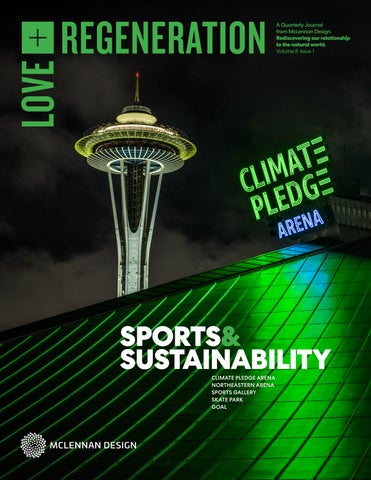
Cover: Climate Pledge Arena (photo courtesty of Cimate Pledge Arena
WANT TO HAVE THE NEXT ISSUE OF L+R EMAILED TO YOU? SUBSCRIBE HERE
BAINBRIDGE ISLAND STUDIO 1580 Fort Ward Hill Road Bainbridge Island, Washington 98110 mclennan-design.com perkinswill.com/studio/bainbridge-island admin@mclennan-design.com
KANSAS CITY STUDIO 1475 Walnut Street Kansas City, MO 64106 perkinswill.com/studio/kansas-city
Jason
Sports & Sustainability
Jason F. McLennan
The State of Sports Architecture
P+W
Year 5 - Climate Pledge Arena
Jason F. McLennan
GOAL
Kristen Fullmer, GOAL Game Changer
Sustainable Skate Park
Josh
Biomimicry
Johanna Collins
Memorable Meals
My Life In Gastronomy
Jason F. McLennan
McLennan Design respectfully acknowledges the Suquamish and Duwamish peoples, who, throughout the generations have stewarded and thrived on the land where we live and work.
L+R Sports Issue!
Long before I knew I wanted to be an architect, I loved sports. Sports of all kinds played a huge role in my early development, and I considered myself a ‘jock’ in high school. As a Canadian, my father put me in skates and got me into Hockey before I was 5 years old – nothing out of the ordinary in Northern Ontario. And over the years I had the opportunity to play a huge variety of sports – both organized and non-organized – Cross Country and Downhill Skiing, Track and Field and Cross-Country Running, Basketball, Soccer, Tennis, Judo and more. All year round, in all weather, my family and friends participated and competed and it was an inseparable part of my life – for in sports there was community and self-improvement both.
I’ve had a few big highlights that still stand clear in my mind from my childhood days – Winning Mr. Fit Sudbury in my hometown when I was just 16 (that’s a long story and involved competing in swimming, canoeing, running, biking, cross-country skiing and quadrathalon), proudly wearing my nation’s official jerseys and representing Canada against Mexico and the USA in a international level track and field meet (I came last – or otherwise known as ‘the worst of the best’ so to speak, since I was the Canadian junior Champion), running against the World’s Fastest Man in an exhibition event (never have I felt so slow), scoring 42 points in a single high school basketball game when my coach was absent and therefore couldn’t restrict my unorthodox style with the structured game he insisted on (a metaphor for later), accidentally breaking a kid’s leg in judo competition – which also broke my heart (are you supposed to cry when you win?)… I could go on and on.
Once I went to University to pursue a degree in architecture, I mostly hung up my skates, spikes and sneakers – but the competitive spirit never left me. Sports never left my imagination. Then in 2019, I had the chance of a lifetime to combine my love of architecture and hockey and help bring to life the Climate Pledge Arena and the Seattle Kraken. What an adventure. A project of a lifetime.
This issue is dedicated to the intersection of sports and design – with features on great Perkins&Will athletic facilities like the Northeastern Arena, reflections on the Climate Pledge and the Creation of the GOAL system for continuous improvement of sports facilities. It also features some great thought pieces from members of our team – Josh Fisher and his passion for Skateboarding, and Johanna Collins as she brings Biomimicry thinking to practice. On the lighter side of things is a short article I wrote on food, called “My Life in Gastronomy”.
I hope folks will enjoy our first “themed” issue – and remember your own forays into athletics – as a spectator or as a participant.
- Jason
Jason F. McLennan Founder, Living Building Challenge Principal, McLennan Design Chief Sustainability Officer, Perkins&Will
DESIGNING THE NEXT 100 YEARS
Future-focused & Project-ready
Join practitioners, policymakers, and industry leaders to tackle the real-world barriers to regenerative buildings — from carbon and materials to cost, policy, and delivery.
April 14-17, 2026 | Seattle, Washington
A Tribute to Dr. Jane Goodall
1934-2025
by Jason F. McLennan
The world lost an ecological hero recently, and all of us at McLennan Design are deeply saddened by her passing. Few people have done more and cared more about the living legacy of life on the planet as Jane, and she raised awareness for decades and educated hundreds of thousands of people.
She was a primatologist and anthropologist and spent decades understanding the lives and behaviors of chimpanzees in Africa –while sharing her lessons and knowledge with people of all ages globally. Heavily decorated and recognized by leading academic and government institutions, she exemplified the 'citizen scientist' – speaking up for others that have no voice in the world. Author of 32 books and countless appearances on TV and other media, she was a key voice of environmentalism. Winner of the Presidential Medal of Freedom and a Commander of the Order of the British Empire, she was an elder statesman who championed the planet up until her death at 91 years of age.
While I didn’t know Jane personally, her work was an inspiration to me from a young age when she took a special interest in my hometown in Sudbury, Ontario as a hopeful place that represented how a community can heal and regenerate an entire landscape. In 2022, Goodall and Prime Minister Trudeau together planted Sudbury’s 10-millionth tree as a marker of 44 years of positive regeneration.
SPORTS & SUSTAINABILITY Building Legacy & Community
Perkins&Will Chief Sustainability
Officer Jason F. McLennan talks about how community sports projects lend themselves to sustainable initiatives, both through architecture and common sense regenerative principles.
What's the biggest challenge?
Sports venues – especially professional and university scale ones, are like instant cities –thousands of people show up in a short amount of time – eat, spectate, purchase things, use resources and then decant just as quickly to wherever they came from. They have to be built to handle the pressure and impact of mini-mass migrations!
As a result of their population densities, they use a ton of resources in a short amount of time. People are literally there to consume – content and concessions. Thus, operations are a big deal and critical to get right –there is a big delta between green and non-green facilities.
What about a sports venue project makes it a great fit for sustainable elements?
Every building type is a great fit for sustainability. But sports venues have huge impacts – with a lot of low-hanging fruit. Good design and thoughtful approaches to systems and operations can make a huge difference.
What's special about working on a sports venue project?
by Jay Torrell
Any chance you have to bring large groups of people together is an opportunity to build community and motivate positive change. Our sports teams help define who we are and can serve as important emblems of civic pride and cohesion – bringing people together in a heavily divided world…. Celebrating human movement and human excellence, and creating lived, shared experience. They often also serve as backdrops for cultural events, concerts and performances – and expand our horizons beyond sports to all sectors of society. They are key elements of our urban fabric and symbols for the environments in which they are built.
Materials
Sports venues are massive structures often built with very carbon-intensive structural systems. Exploring opportunities for mass-timber structures and lower-carbon materials can drastically reduce a project’s embodied carbon.
Renewables
Big buildings mean big roof areas – prime real estate for photovoltaic arrays – and big footprints – prime opportunities for geoexchange and other renewable energy systems.
Daylight
Often, sports venues are located in industrial areas zoned for lower density than central business districts. This means fewer tall buildings nearby and greater opportunities for prime access to natural light and passive thermal gain.
Recyclables
Significant investments have been made in existing, outdated arenas. That offers developers greater incentive to adapt and renovate, rather than tearing it all down to start anew. Adaptive reuse is one of the most effective methods of reducing the carbon footprint of any project.
Community
By their very nature, sports venues draw people and communities together. Nothing is more powerful than a group of passionate people united in a common goal! Arenas offer a great opportunity to inspire and educate people on the benefits of regenerative design.
What’s your favorite P+W sports venue project?
The Climate Pledge Arena was a project of a lifetime – getting a chance to be on the inside of the creation of a new NHL franchise and working behind the scenes on all aspects of the planning and operations – including the branding and public positioning of the facility. We broke so much new ground – it was literally ten or fifteen years ahead of any arena in the world relative to environmental performance. But technically that was a McLennan Design project, before we joined PW.
Since joining PW, we have loved seeing the variety of sports projects emerging from our practice. I have to say that my favorite sports projects are fairly humble, but very well-designed community arenas from our Toronto studio. They create these lovely, simple and elegant hubs for community and sports.
I also really like some of our small interventions – our Vancouver studio did an amazing canopy over a seating area at Simon Fraser University… its beautiful. (Page 10)
How important is the positioning of your sports venue, and why?
The most important decision around sports venue planning is where a venue is located – as the single largest impact is tied to the transportation-related impacts of fans going to and from it. Most people-in the US, at least-drive, but they will take buses, light rail and shuttles if the whole mobility sphere is properly thought through. Getting people out of cars and to and from their home or office with low carbon solutions is fundamental as a first step in planning. At Climate Pledge arena, that was a big deal for us – making sure that the venue was optimized to get as many people there on public transportation and to make vehicle parking and access efficient and uncluttered as possible. Think about the negative impact to climate and air quality with thousands of vehicles idling and stuck in traffic - it's paramount to minimize that as much as possible.
Every sports architecture project— whether a 70,000-seat stadium or a community athletics center—offers boundless opportunities to inspire, energize, educate, and affirm a simple truth: we’re better when we gather to cheer or play together.
We’ve brought together leaders from the Perkins&Will Sports Practice to share their perspectives on the future of sports architecture and the evolving role these spaces play in our communities.
HOW IMPORTANT IS FACTORING SUSTAINABLE ELEMENTS INTO SPORTS PROJECTS?
MR: Sustainable elements are really important for municipal community centres. Municipalities need to consider that any new project will add on-going carbon emissions to their portfolio.
TH: Sports facilities have notoriously large carbon footprints, so incorporating highly efficient design into athletics projects can have a big impact.
POS: All our SRE project have some form of sustainability. Whether or not they pursue certification of any kind, we are always taking advantage of the ‘sunk cost’: windows, walls, roof, foundations, to introduce Passive House principles that help to achieve a base amount of energy / operational efficiency that benefit the owners and the environment. Generally, we are designing all our facilities to LEED Gold or better – increasingly getting to NetZero Carbon operations.
Adam Murphy
WESTREET ICE CENTER
NEXUS CENTER
Portland Community Squash, Community Commons
Portland Community Squash
Portland, Maine
Perkins&Will Boston
Teton County, Jackson Recreation Center
Teton County, Wyoming
Perkins&Will Denver
City of Utica
Perkins&Will Denver
Brad Loperfido, Revette Studio
David Agnello
Jeremy Bitterman
BIGGEST CHALLENGES WHEN PLANNING A SPORTS VENUE?
MR: Recently, the biggest challenge has been the pressure on project budgets from rapid escalation. Municipalities plan their capital plans in 5 year cycles. The capital planning was based on earlier project budgets and there has been pressure to tighten up building sizes to meet targets.
TH: One of the biggest challenges is balancing the need to provide the best experience for both spectators, athletes, and staff. And providing enough storage!
POS: Controlling the cost of the work. These spaces are highly specialized and have technical performance requirements that can increase cost based on perceived specificity. Design a set of construction documents that are legible, clear, and complete goes a long way to getting everything you need in a building.
WHAT’S THE BIGGEST OPPORTUNITY WITHIN EACH SPORTS PROJECT?
MR: I think that biggest opportunity is working with municipalities on new approaches to washrooms and changerooms.
TH: Sports projects typically have large volume spaces with long spans, so expressing those elements both architecturally and structurally are one of the biggest challenges and opportunities of any sports project.
POS: To find new and creative ways to implement and organize the evolving needs of SRE facilities (Sports domes, skate trails, large volumes to heat, programmatic misalignments. etc.) and maintain a high level of sustainable achievement.
ROUGE VALLEY COMMUNITY RECREATION & CHILD CARE CENTRE
Scarbororough, ON, Canada
Perkins&Will Toronto
POS FAVORITE: Rouge Valley Community Recreation Centre – is a netZero building that is unique in its approach to the site as it is a stacked facility. The programs were strategically arranged to maximize the operations of the facility but also to utilize the views over the site.
COLUMBIA UNIVERSITY
Philip & Cheryl Milstein Family Tennis Center
New York City, NY
Perkins&Will Boston
TH: One of my favorite projects that is quite unique is our Millstein Tennis Center at Columbia University on the northern tip of Manhattan, right next to the Hudson River. We designed the building and site to be able to flood in response to future Sea Level Rise and storm threats. We incorporated a resilient ground floor that lets water in through flood vents and then lets the water back out.
SIMON
FRASER UNIVERSITY STADIUM
Burnbary, BC, Canada
Perkins&Will Vancouver
Majestic! It's absolutely majestic, any way you look at it.
WHAT’S YOUR FAVORITE DESIGN ELEMENT TO CONSIDER WITH EACH SPORTS PROJECT?
MR: Part of our approach is that each community-building project is a reflection of the community it supports. My favourite design element is more of design process, which involves listening and co-creation.
TH: Daylight! Bringing daylight and views into athletic projects is incredibly important, but we must carefully control glare and the quality of light to meet the demanding requirements for athletic performance.
The transformation of the Ballpark site offers a framework for longterm investment in community identity, cultural expression, social cohesion, and neighborhood resilience. By preserving meaningful history while embracing innovation, the Ballpark NEXT Community Design Plan creates a thriving urban destination that reflects what Ballpark residents value today while uplifting the community’s future.
Sports architecture is constantly evolving. We’re seeing a significant shift, particularly in large venues, toward integrating stadiums and arenas within mixed-use entertainment districts that activate communities yearround. At the same time, the industry remains incredibly strong across all scales. Communities and organizations nationwide are investing in everything from recreation centers and ice facilities to 3,000- to 6,000seat music halls. Sports tourism continues to grow at an exponential pace, driving demand for destination complexes that blend indoor and outdoor experiences and create lasting economic impact. Importantly, sustainability is no longer optional in the large venue market. We’re seeing major touring artists increasingly select venues based on their environmental strategies and operational performance. The future of sports architecture lies in creating dynamic, community-centered destinations that are economically resilient, environmentally responsible, and designed for long-term adaptability.
Don Dethlefs, FAIA, LEED AP Firmwide Sports, Recreation and Entertainment Practice Leader
WHAT EXCITING SPORTS PROJECT(S) DO YOU HAVE COMING UP?
MR: The Brentwood Community Centre in Burnaby, BC is starting construction soon. The community centre will open in 2029. The project will be a great new public space for a developing neighborhood. The BCC is projected to achieve Passive House levels of energy consumption.
POS: We are working on a 200,000 sq.ft Recreation Centre in Pickering, Ontario. The site has been stripped down to clay, so we are working to plant the landscape and design the building in a way that is reminiscent of nature being welcomed back to the community and into the building. We are describing them as ecotones. We have also completed two projects recently: Carrville Community Centre and Rouge Valley Community Recreation centre, NetZero Carbon and NetZero, respectively.
WHERE DO YOU SEE THE MOST OPPORTUNITY IN THE SPACE (PRO, COLLEGE, COMMUNITY, K-12)
MR: We see opportunity for Net Zero projects in the community projects.
TH: All of the above! Each provide interesting opportunities in today's world.
POS: K-12 in Canada is traditionally a very ‘lean’ market to design and construct in. To be able to imbue this market with willingness and understanding about the benefit of sustainability on it students and staff AND cost of operations would be beneficial to all.
WHAT’S THE BIGGEST OPPORTUNITY WITHIN EACH SPORTS PROJECT?
MR: I think that biggest opportunity is working with municipalities on new approaches to washrooms and changerooms.
TH: Sports projects typically have large volume spaces with long spans, so expressing those elements both architecturally and structurally are one of the biggest challenges and opportunities of any sports project.
POS: To find new and creative ways to implement and organize the evolving needs of SRE facilities (sports domes, skate trails, large volumes to heat, programmatic misalignments, etc.) and maintain a high level of sustainable achievement.
University of Dayton Arena Renovation
University of Dayton Dayton, Ohio
Perkins&Will Chicago
Perkins&Will Denver
DO YOU FORESEE ANY BIG CHANGES AHEAD IN HOW WE DESIGN NEW SPORTS FACILITIES?
MR: I think a really important consideration is to make sure that there are formal and informal gathering spaces in our projects. The program spaces are often a big focus of establishing the budgets for the project, but the areas for social interaction are equally as important for community building.
TH: I expect more sports facilities to incorporate mass-timber structure going forward, both for its embodied carbon benefits and its aesthetic value.
POS: Keeping up with our responsibility as designers to create buildings that are environmentally responsible and ensuring that we design with the specific ecology of the site in mind – doing our best to make it better with the building.
WHAT ARE THE KEY ELEMENTS THAT MAKE A SPORTS VENUE FLEXIBLE AND EASILY ADAPTED TO OTHER USES, SUCH AS CONCERTS, CEREMONIES, ETC.?
MR: Multi-purpose spaces that support the needs of multiple user groups are critical to make tighter project budgets work for the largest number of users.
TH: To be flexible, a facility or venue must have enough infrastructure (e.g. structural and/or electrical capacity) in place to support a variety of uses.
POS: The approach to planning that matches program uses to appropriate facilities -washrooms, admin, service / info, etc. are all key aspect that are common to recreation and public uses. Designing the level of finish and selecting materials with significant amount of people / traffic is vital to ensure long term durability of the facility and ease of operations. Again, common elements of consideration for venues and recreation.
IN
YOUR OPINION,
WHAT IS ONE OF THE MOST SUCCESSFUL SPORTS VENUES IN THE WORLD? WHAT MAKES IT SO BELOVED?
MR: Last year, I had the opportunity to watch a football game at the Estadio Olímpico Universitario in Mexico City. Built in 1952, it was the host of 1968 Olympics events and 1986 World Cup games. We should be looking at the long-term adaptability and sustainability of venues so that they can still play a role in our sports experiences for many years.
TH: I'm a baseball fan, and I think that Camden Yards in Baltimore remains the gold standard for integrating a ballpark into the fabric of the city. I love the way the field opens below the street level as you enter, and the surrounding neighborhood feels like it is part of the stadium, enclosing the open space while at the same time stitching into the fabric of the city.
As Climate Plege Arena enters it's 5th year of operation, Perkins&Will Chief Sustainability Officer Jason F. McLennan, who consulted on the project, reflects on it's successes and lessons learned.
What was the orginal vision?
The project always had a vision of being something larger than simply a sports venue- of having a community presence and a global message of hope. OVG worked with Amazon to upend the traditional approach of naming a stadium after a company – and instead reframe it as an opportunity to name a call to action. The Climate Pledge is an initiative started by Amazon to encourage vendor companies to meet ever more stringent emissions. So that’s the name! And everyone who goes there is reminded of the importance of that mission – but that’s also why it was so important to walk our talk and back up the name with action and leadership. Can you imagine if we had named the building Climate Pledge Arena and then we used fossil fuels?
So from the start we had to figure out how to decarbonize and get rid of all Scope One (direct) emissions – and also calculate and address all scope 2 and 3 emissions as well. We ended up going farther than any project I know of in history.
What were the biggest challenges?
No one had ever built an arena of this size and scale without using fossil fuels before. So we showed how you could cook for 18,000 people at once without any gas cooktops, how you could create interior comfort conditions and stable temperatures and dehumidification for NHL hockey and in fact do everything without burning fossil fuels. It was a challenge to break new ground on all that.
We were the first venue of this size to also ban single use plastic as well – in the process saving hundreds of thousands of plastic bottles. That is huge and an unsung victory. If you can do that there – you can do that anywhere.
What couldn't you do, that you wanted to include?
Honestly – we did just about everything I proposed doing on the project. It shows even the most audacious visions are possible when a client team is so bought in to the mission of the project.
How important was it to save the roof, how was that decision made?
The roof was a historic landmark in the City from the Seattle World’s Fair – and had to be saved! The trick was always to figure out how to do that – while making the arena large enough for professional hockey and eventually NBA Basketball. The solution was to dig down – but that also meant figuring out how to hold up 44 million pounds in the air while cutting all the main structural columns. Who does that?
Biggest lessons learned?
Goethe once said that 'boldness has genius in it'. This was the boldest project I’ve ever seen in Sports. It was a genius move that paid off for the City of Seattle. What a powerful story! Learn more about McLennan Design's involvement here.
See page 24 for a review of the many implemented sustainable elements at Climate Pledge.
CLIMATE PLEDGE ARENA BY THE NUMBERS
Climate Pledge Arena in Seattle has garnered numerous prestigious awards for sustainability, engineering, and design, solidifying its reputation as the world's most sustainable venue. Key accolades include the International Living Future Institute's Zero Carbon CertificationTRUE Platinum Certification for zero waste, and Sports Facility of the Year (2022).
Key Sustainability & Environmental Awards
ILFI Zero Carbon Certification (2023): First arena in the world to achieve this.
TRUE Platinum Certification (2024): First arena on the West Coast to achieve the highest level of waste diversion.
2024 World Architecture News (WAN) Awards: Gold for Overall Sustainable Architecture Project. 2022 MONDO-DR Awards: Sustainability.
Construction, Design & Engineering Awards
2023 Outstanding Civil Engineering Achievement Award (OCEA): Recognized for groundbreaking design and construction
2023 ENR Best of the Best Projects: Sports/Entertainment
2023 ACEC Engineering Excellence Grand Award & Colorado Grand Conceptor Award.
2022 NAIOP Night of the Stars: Best in Class Development
Industry & Operational Awards
2022 Sports Business Journal: Sports Facility of the Year
2021 VenuesNow All-Stars: Venues and Innovation
2023 IES Illumination Merit Award: For lighting design
Groundbreaking: December 5, 2018
Opening: October 19, 2021 with Foo Fighters
Proud Home of: NHL’s Seattle Kraken & 4-Time WNBA National Champion Seattle Storm
Owner: Public-Private Partnership between Oak View Group, Seattle Kraken Hockey, & Seattle Center
Operator: Oak View Group
Project Manager: CAA/ICON
Architect: Populous
Construction Contractor: Mortenson
Functions: Multi-purpose live entertainment venue built for NHL hockey, live music and events, WNBA and future NBA basketball
Rain to Rink: Rainwater harvesting fills a 15,000 gallon on-site cistern to resurface the ice
Plants and Trees: 12,500 total on-site. The Climate Pledge Living Wall is one of the largest in the country. It covers 1,700 sq. ft., and 27 different plant species.
Digital Signage: 28,175 square feet of digital signage, covering 145 million pixels. The most in the world for a sports and entertainment venue at the time of opening.
Acoustic Lapendary Panels: 5,155
Climate Pledge Arena helped inspire GOAL, the industry impacting leader in Arena sustainability. Learn more on page 26.
SMELLS LIKE SUCCESS YEAR 5
THE CLIMATE PLEDGE SUSTAINABILITY
It's in our name...
Our goal is to be the most progressive, responsible and sustainable arena in the world. It might sound ambitious, but that’s the point. We aren’t named after a corporation. We are named after The Climate Pledge, founded by Amazon and Global Optimism in 2019, which is a commitment from companies globally to be net zero carbon by 2040.
READ MORE ABOUT THE CLIMATE PLEDGE
CERTIFICATIONS
Climate Pledge Arena is the first arena in the world to achieve the International Living Future Institute Zero Carbon Certification.
This certification provides a vision for a future of carbon positive buildings that reverse the effects of climate change. By addressing both operational and embodied carbon emissions, Zero Carbon Certification offers organizations a valuable tool to demonstrate credible climate action.
Our embodied carbon from construction was calculated to be 34,400 metric tons.
READ MORE ABOUT HOW THEY ACHIEVED THIS CERTIFICATION
ZERO WASTE
Climate Pledge Arena has been awarded TRUE (Total Resource Use and Efficiency) Platinum certification for its efforts in operating as a functionally zero waste arena. This means that over +90% of waste generated onsite is diverted from a landfill.
Administered by Green Business Certification Inc. (GBCI), TRUE helps facilities measure, improve and recognize zero waste performance by encouraging the adoption of sustainable waste management and reduction practices, which contribute to positive environmental, health and economic outcomes.
READ MORE ABOUT CPA ZERO WASTE INITIATIVES
100% RENEWABLE ENERGY
We are powered by 100% on- and off-site renewable energy.
Both on the Alaska Airlines Atrium roof and above the 1st Ave N. Garage, we have more than 1,300 on-site solar panels generating an average of 440,000 kwh annually.
What we can’t generate on-site, we look for renewable sources off-site. One of the ways to procure this power is through Renewable Energy Certificates (RECs).
We purchased our RECs in part from Puget Sound Energy’s Snake River wind farm and then retired those RECs so they can’t be reused or resold.
Starting in 2025, Climate Pledge Arena has committed to being one of the first commercial clients of Seattle City Light’s Renewable Plus Program. The Renewable Plus Program will build brand new wind and solar farms and will offer the energy generated by those new renewable sources to clients like Climate Pledge Arena.
READ MORE ABOUT RENEWABLE ENERGY
PUBLIC TRANSPORTATION
Climate Pledge Arena is one of the only arenas in the country to offer free public transportation to games and publicly ticketed events.
Our goal is to have of 25% of guests choose public transit.
WATER CONSERVATION
Climate Pledge Arena has a large 15,000 gallon cistern to capture rainwater off the roof to make our NHL ice.
Given our location on the Puget Sound, we believe it’s important to demonstrate leadership in water quality and water reuse whenever we can.
Along with our Rain-to-Rink System, we also installed waterless urinals and ultra-efficient showers and have significant on-site retention tanks to reduce stormwater runoff.
SUSTAINABLE EVOLUTION
Sustainability is constantly iterative and evolving. There are new challenges, new barriers, new opportunities. There are the consistent renewals and revalidation of certifications, there’s making good on the commitments set forth from the beginning, and there’s continuing to evolve, innovate and maintain a seat at the leadership table.
REUSABLE CUP PROGRAM
The team recently launched a reusable cup program, conquering the next frontier of waste reduction. READ MORE
IMPACT ON OTHER ARENAS
CPA showed the industry what’s possible and we're starting to see progress in projects like the new Northeastern University Arena. It has become an inspiration to many, but an intimidator to some. Some venues will say “I can never be Climate Pledge Arena” - that’s why GOAL exists, to help venues chart their own path for sustainability. A critical narrative is that “you don’t have to be Climate Pledge Arena to be a sustainability leader”. (See page 28 for more on GOAL.)
GOAL sits at the intersection of design intent, operational reality, and cultural influence. Sports venues are not just buildings — they are highly visible, resource-intensive, community anchors.
GOAL exists to help these complex systems operate in alignment with regenerative values, day in and day out.
What Is GOAL?
GOAL (Green Operations & Advanced Leadership) is an industry-led sustainability platform for sports, entertainment, and live events that helps venues translate sustainability goals into consistent, measurable operational practices.
• It does not prescribe a single solution or aesthetic
• It supports both new builds and legacy venues
• It is built with operators, designers, and owners — not imposed on them
How GOAL Works
• Frameworks across energy, water, waste, food, DEI, governance, guest engagement, etc.
• Measurement & benchmarking focused on progress over time
• Peer learning between operators, designers, owners
• Venues operate as micro-cities (energy, water, food, materials, people)
• High intensity + high visibility
• If sustainability works here, it can work anywhere
• GOAL helps translate ambition into repeatable, real-world practice
How to Be Involved
GOAL membership is open to sports and entertainment venues, teams, and operators.
Members engage through:
• Use of GOAL sustainability frameworks
Annual benchmarking and progress tracking
• Peer learning and shared best practices
Participation in GOAL convenings and working sessions
• Recognition through the GOAL Medals program reflects verified actions and continuous improvement
Learn more/get involved
Success Stories
GOAL supports patterns of impact, not one-off wins
• Members include both iconic legacy venues and new builds Climate Pledge Arena is a founding member
Other members are diverse: Fenway Park (historic building), UBS Arena (newer build), Co-op Live (newer build in UK)
Featured Members
FENWAY PARK - Boston Red Sox
KASEYA CENTER - Miami Heat
MOODY CENTER – Austin Texas
"GOAL is the live event venue industry’s only sustainability consortium. We are proud to convene, celebrate, and support some of the most sustainable facilities in the world.”
- Kristen Fulmer, Global Head of Sustainability, Oakview Group
Members
Acrisure Arena (Palm Desert, CA), Anfield (Liverpool, UK), Arvest Convention Center (Tulsa, OK), Beaver Stadium (University Park, PA), Benchmark International Arena (Tampa, FL), BOK Center (Tulsa, OK), Canada Life Place (London, ON), CFG Bank Arena (Baltimore, MD), Chicago Cubs (Chicago, IL), Chip Ganassi Racing (Indianapolis, IN), Climate Pledge Arena (Seattle, WA), Co-op Live (Manchester, UK), Enmarket Arena (Savannah, GA), Enterprise Center (St. Louis, MO), Etihad Arena (Abu Dhabi, UAE), Frost Bank Center (San Antonio, TX), Gainbridge Fieldhouse (Indianapolis, IN), Grand Casino Arena (St. Paul, MN) , Iowa Events Center (Des Moines, IA), Kaseya Center (Miami, FL), McCormick Place (Chicago, IL), MGM Music Hall Fenway (Boston, MA), Moda Center (Portland, OR), Mortgage Matchup Center (Phoenix, AZ), PPG Paints Arena (Pittsburgh, PA), Prudential Center (Newark, NJ), Rocket Arena (Cleveland, OH), Rupp Arena (Lexington, KY), Sacramento River Cats (Sacramento, CA), Scotiabank Arena (Toronto, ON), Snapdragon Stadium (San Diego, CA), Spectrum Center (Charlotte, NC), State Farm Arena (Atlanta, GA), Subaru Park (Chester, PA), Target Field (Minneapolis, MN), The Liacouras Center (Philadelphia, PA), Toyota Center (Houston, TX), UBS Arena (Elmont, NY), Wintrust Arena (Chicago, IL), Vegas Golden Knights (Las Vegas, NV), Yas Marina Circuit (Abu Dhabi, UAE)
Northeastern University
Multipurpose Athletic Facility
When Northeastern University needed to update the historic Matthews Arena in Boston, Massachuesetts, they turned to Perkins&Willwho assembled an all-star partnership with the Boston, Chicago, Bainbridge Island, and Denver Studios to bring their vision of an industry leading sustainable multi-use sports venue to life.
The following Northeastern University World Press article describes the Arena's sustainability initiatives.
by
Renderings by Perkins&Will
Cynthia McCormick Hibbert December 16, 2025
The new multi-purpose athletics and recreation complex will be fossil-fuelfree and use rainwater for the ice rink.
The complex replacing the Matthews Arena is being built to meet ‘aggressive’ standards for sustainability and energy efficiency.
THEnew multi-purpose athletics and recreation complex replacing Matthews Arena will harness the power of nature available onsite to meet the building’s demands for water, heat and electricity.
Rainfall collected from the roof will be used for the ice hockey rink and rowing tanks, and to water native plants in a rooftop terrace garden.
A grid of geothermal wells under the 310,00-square-foot building will meet most of the complex’s cooling and heating needs, while solar panels on the roof will use the sun’s energy to offset part of the demand for electricity.
Even before construction has started, the complex is making history as a model of sustainability and heat recovery, says Jacob Glickel, Northeastern University’s director of sustainability operations.
The innovative technologies being employed are “leaps and bounds” over what was possible even a couple of years ago, he says. “It really shows where we’re headed” with campus sustainability.
Tyler Hinckley, team leader of the project for the architectural design firm Perkins&Will, said the new complex will include an all-electric system, down to electric induction cooking equipment for the concessions.
“There are no fossil fuels on the site except for a backup generator,” he said.
In constructing the new complex, Northeastern is seeking to attain Living Building Challenge (LBC) Core certification, one of the most advanced sustainable building standards in the country, Hinckley said.
Unlike LEED certification, which gives points for reduced negative impact, LBC Core projects have to meet verified standards in 10 areas, including responsible water use, energy, materials, ecology and even beauty, in order to be considered “regenerative.”
“It’s a very aggressive standard,” Hinckley said.
Jacob Glickel, director of sustainability operations, and Matthew Eckelman, professor of civil and environmental engineering, said Northeastern is breaking new ground in sustainability and heat recovery with new multi-purpose athletics and recreation complex. Photos by Alyssa Stone/Northeastern University and Matthew Modoono/ Northeastern University
GEOTHERMAL ENERGY
A major feature of the new complex is a geothermal exchange system that relies on relatively constant temperatures beneath the Earth’s surface to provide 80% of the new building’s requirements for heat and cooling, Hinckley said.
The system uses a geothermal loop, or network of underground pipes, filled with fluid to exchange heat with the Earth.
The network creates a source of heat in the winter and a sink for heat pulled out of the building in the summer using electric pumps, said Matthew Eckelman, a Northeastern professor of civil and environmental engineering.
“What’s different about a heat pump is that it’s not converting energy from electricity to heat,” said Eckelman, who visited the site with undergraduate and graduate students to see bore holes being drilled for the pipes.
“It’s just moving heat,” he said.
Typically, the geothermal grid is located in open areas, but this one will be located under the complex.
Thirty-five out of a total of 46 geothermal bore holes, 800 to 850 feet deep, have already been drilled and capped, Hinckley said. The rest will be installed during the construction of foundation supports for the new building.
In addition, the system will use waste heat from ice making for the hockey rink and adding it to the building’s energy loop, he said. “That’s capturing waste heat that would otherwise have been exhausted” into the atmosphere.
570 kW PV Array = 7 kBtu/squ.ft. of Annual Electricity Production
46 800' Deep Geo-Exchange Boreholes
200 Tons Energy
Geo-exchange system include (46) 800" deep boreholes with roughly 200 tons of heating/cooling capacity. The sytem connects to an energy loop within the building, contributing to a predicted EUI of 70.5 kBTU/ sq.ft/yr that achieves a 62% reduction of energy use compared to baseline.
Rendering by Perkins&Will
100k
Gallon Water Cistern for
Collected Rainwater, which will be used for Plants Irrigation, Ice Making and Rowing Tanks
A 100,000-GALLON CISTERN
In what can only be described as a gigantic watersaving move, rainwater from the roof will be stored in a 100,000-gallon cistern under the building’s lobby.
“We’re taking all of the rainwater that falls on this building and reusing it on site for most of the things that don’t require potable water,” Hinckley said.
“The hockey players will be skating on ice made from water that fell on the roof of this building.”
Outside the building, underground infiltration pits will help absorb stormwater and prevent flooding.
76% Daylit
76 % of all Regularly Occupied Spaces have access to Quality Light
Healthy Materials
65% - 75% of Materials are Declare / Red List Free
WINDOWS AND WALLS: ENERGY SAVINGS AND LOTS OF LIGHT
Triple-glazed high-efficiency windows will drive down the new building’s energy load, as will “super-insulated” walls and roof, Hinckley said.
Part of the LBC Core challenge is connecting buildings to nature, which the new athletics and recreation complex will encourage through the use of light and windows, he said.
Hinckley said 75% of regularly occupied space will be functionally daylit. Even the basketball practice area will have the benefit of sunlight from skylights thanks to a glazing technique that cuts down on glare.
LBC CORE
Ecology of Place Requirement
Green Roof Structure and Species
Selection is Informed by Reference Habitat of Outcrop Ecosystem in the Region.
A ROOF THAT GENERATES ENERGY AND WELLNESS
Solar panels on the roof will generate approximately 590,650 kWH of electricity annually, offsetting up to 10% of the building’s energy usage, Hinckley said.
He said designs for the lower roof setback edging Gainsborough Street feature a “living roof” with native plantings and shrubs similar to those in Middlesex Fells, a state park just north of Boston.
ECO-FRIENDLY MATERIALS
The structural deck on top of the building is being made of cross-laminated timber to reduce the amount of carbon that goes into construction, Hinckley said.
He said the building is being thoughtfully designed to reduce “embodied” carbon in materials by using, for instance, steel from plants that use electric arc furnaces instead of coal.
The new complex will be the first multi-use athletic and community recreation facility in a dense urban setting to achieve LBC Core certification, which speaks to the boundaries the project is pushing, Hinckley said.
“We’re doing something very new,” Glickel said. “We’re setting a new standard for sustainability that will influence how we design and build across all our campuses.”
Northeastern will “surgically” deconstruct Matthews Arena before building the new multi-purpose athletics and recreation complex, which is scheduled to be finished in the fall of 2028.
The complex will span the entire two-acre footprint of the old arena and will house 4,050 fans for hockey and 5,300 for basketball. It will include an additional 54,000 square feet for recreational use, including for ceremonies, concerts and other events. The venue will simultaneously accommodate an array of activities.
PERFORMANCE DESIGN TEAM IMPACT
From the earliest stages of design, the Perkins&Will project team engaged the firm's internal Performance Design Team to work in close collaboration with project architects, engineers, contractors, and the client. Together, they advanced a shared vision across multiple fronts—integrating sustainability, efficiency, and innovation—to deliver a high-performing, environmentally responsible arena.
At the end of CD phase, project has realized. Embodied Carbon Reduction
Pursuing: Living Building Challenge Core certification AND ILFI Zero Carbon Certification
Collectively, all these strategies–along with careful consideration for the ecology of place–this project an exceptional example of a high-performing, sustainably-crafted, large-scale arena project.
High performance projects require industry-leading analysis and support, which is why Perkins&Will created the Performance Design Team.
Comprised of experts in energy efficiency, passive design strategies, mechanical systems approaches, renewable energy, embodied carbon, daylighting and other aspects of operational building performance the PDT uses the latest industry-leading tools to provide the best analysis and assessments possible.
Rendering by Perkins&Will
ECOLOGICAL ENGAGEMENT
Juan Rovalo (Director of Ecology) Navya Raju (Ecologist)
Ecology at the NU Multipurpose Facility reimagines what nature can be in the heart of a dense city while redefining how an urban site can contribute to the health of a regional ecosystem. Guided by the Living Building Challenge Ecology of Place framework, the design draws inspiration from the rocky outcrop ecosystems of the Middlesex Fells Reservation, where shallow soils, wind exposure, and temperature extremes shape resilient native communities.
These conditions inform a native planting strategy and layered habitat structure that bring living systems back to a site where development had long erased natural function. Structural habitat elements such as exposed rock surfaces and partially buried woody material create diverse microhabitats that support pollinators, insects, and birds, strengthening on-site biodiversity. Rather than recreating a lost past, the project restores ecological processes suited to today’s urban conditions and demonstrates how architecture and landscape can work together as living infrastructure that strengthens biodiversity, resilience, and everyday connections to nature across the campus and city.
“Skate parks + spots are no longer being seen as single-use recreation facilities relegated to the edges of community parks - they belong front and center in our public spaces.”
improved micoclimate, beautiful destinations, accessible recreational options, and biodiverse landscapes integrated with skatability.
radical Regenerative +
INFRASTRUCTURE
Rethinking
BY JOSH FISHER, LFA
parks, plazas, and stormwater landscapes through the lens of movement and play.
What if the same urban spaces designed to cool cities, manage water, and support biodiversity could also invite movement, creativity, and play? By merging regenerative landscapes with skateable terrain, cities can transform everyday infrastructure into vibrant public spaces.
Skateboarding, Urban Design, and the Future of Cities
Cities are increasingly being asked to do more with less space. Plazas, parks, and streets are no longer just circulation routes or aesthetic amenities—they are becoming critical infrastructure that manages stormwater, improves microclimates, supports biodiversity, and strengthens public health. In an era of climate adaptation and urban densification, these spaces must work harder—functioning simultaneously as environmental systems, social infrastructure, and places of movement and play.
This article is based on research conducted as part of the Perkins&Will Innovation Incubator program, I led, and further explored through this grant-funded research on next-generation skatable terrain integrated with regenerative urban environments.¹
Skateparks are no longer being seen as single-use recreation facilities relegated to the edges of community parks—spaces that take years for communities to fundraise and then cram with features within constrained perimeters. Instead, an emerging trend is visible in cities like
Venice Beach, Copenhagen, Barcelona, San Francisco, Los Angeles, and Portland, Oregon, where skatable terrain is integrated into plazas, parks, and streets, offering recreation, social engagement, and civic activation and no longer segregated.
As Jason F. McLennan notes in his book Zugunruhe—drawing on the German term for migratory restlessness—
...there is a growing cultural and environmental impulse toward more regenerative, resilient, and meaningful urban solutions.
Building on this insight, our research highlights an emerging trend: integrating skateable terrain with sustainable, ecologically minded infrastructure. These hybrid spaces not only invite movement, creativity, and play, but also improve urban livability with healthier microclimates, support biodiversity, and broaden access to regenerative landscapes for diverse urban populations.
From SimCity to the Matrix
Designing cities, buildings, and landscapes can sometimes feel like playing SimCity: Pick a building aesthetic, layout some roads, add some greenery, park, and plazas, and then furniture and art where it seems right. Yet cities are not simulations, and people rarely use spaces exactly as designers intend.
Some demographics experience the city in an entirely different way. Planners, designers, and architects should take a second look at skateboarders, BMXers, bladers, and other wheeled users—they are perhaps some of the most dedicated fans and critics of urban space, architecture, and design. They obsess over cracks and curbs, document and cultivate culture in the built environment, and make visible how people truly interact with cities. Open any skate video, magazine, or social feed, and you’ll see riders using everything—from high-design plazas and marble ledges to mundane curbs, planters, and benches—performing extraordinary feats down rails, stairs, gaps, and even walls. They coopt infrastructure and have an intimate relationship with it—storm drains, manholes, and urban ledges—and turn the city into a playground, expressing themselves in community, following unwritten codes, and embracing anyone who steps up with respect and style creating an entire culture and industry that extends across the world.
Where designers see sidewalks, ledges, and railings as fixed objects with predetermined uses, skaters see the city like the Matrix: an interconnected landscape of surfaces, slopes, textures, and possibilities. Every corner, gap, stair, and elevation change becomes terrain waiting to be interpreted, manipulated, and celebrated.
Skateboarding has long functioned as a form of informal urban research. By navigating streets, plazas, and infrastructure features, riders continuously test and document the durability, circulation, and spatial potential of urban design, even if sometimes unwanted! This knowledge, shared through videos, photography, and magazines, has sometimes influenced architects, city planners, and designers—effectively turning skateboarders into co-creators and critics of public space. Cities that embrace this insight gain access to decades of embodied feedback on what makes spaces usable, engaging, and resilient to some of its most engaged and active citizens.
Skateboarding: A Cross-Demographic Playground
Skating & wheeled sports are unlike almost any other sport or hobby in that it is an activity that blends architecture, recreation, urban design, athletics, and creative expression—and does so in a way that brings together people of all ages, skill levels, races, genders, and economic backgrounds; uniting communities and cultures through a shared passion, fashion, and sport. In skateboarding, you’ll see eight-year-olds shredding alongside high schoolers, adults, and even grandparents. It’s one of the few activities that truly slices across demographic and generational boundaries, transforming cities and parks into a shared spaces for play, creativity, athleticism, and culture. Things like plazas, architecture, benches, curbs, ditches, stairs, and rails becoming internationally recognized and garnering cult-like obsession; copied in skateparks across the world and bringing diverse demographics together.
Beyond physical activity, skateable landscapes encourage intergenerational and multicultural engagement, bridging social divides that traditional parks often fail to address. Inclusive skate plazas can host community events, workshops, and skill-sharing sessions, activating spaces throughout the day and building social cohesion alongside ecological and recreational performance.
Skateboarding as Spatial Analysis
BY JOSH FISHER, LFA
COURTESY OF NEW LINE SKATEPARKS
VANCOUVER SKATE PLAZA, BC IS RECOGNIZED AS THE FIRST “SKATEPARK” THAT WAS BUILT AS A “STREET PLAZA”, REPLICATING FOUND OBJECTS FROM FAMOUS PLAZAS AND ARCHITECTURE CATERED FOR SKATING.
From Villa Mairea to City Streets
How Architecture Inspired Skateboarding
Skateboarding has been around for nearly sixty years, beginning in the late 1950s and early 1960s in California. Its early years were fueled by empty backyard swimming pools during droughts, with riders improvising ramps and experimenting on curbs, stairs, and streets. These pools, with their flowing, organic shapes, were not mere stylistic choices—they trace a lineage to modernist architecture that sought warmth and humanity in response to cold, rigid forms. Alvar Aalto’s Villa Mairea in Finland, with its organically shaped pool, exemplified a rejection of impersonal modernism in favor of forms inspired by nature, culture, and human experience. Thomas Church encountered Aalto’s work firsthand and translated that sensibility into the Donnell Garden pool in California—a celebrated design featured on magazine covers that sparked countless iterations of curved, site-responsive backyard pools across the state.²
When drought emptied these pools, skaters transformed them into living laboratories of movement, improvising ramps, bowls, and half-pipes, co-opting concrete technology to create scalable, customizable skateable objects. In doing so, they extended Aalto and Church’s exploration of organic form into a new realm—one defined by flow, human scale, and adaptive use.
From these DIY origins, skateboarding expanded into streets, stairs, rails, and ledges, eventually evolving into the highly engineered parks and now Olympic sport we see today. Yet its DNA remains
rooted in exploration, adaptability, and reinterpreting urban forms. Segregating skating into purpose-built parks, however luxurious, can never replicate the spontaneity, creativity, and social integration of authentic city features.
As Jane Jacobs observed in The Death and Life of Great American Cities (1961):
“Cities have the capability of providing something for everybody, only because, and only when, they are created by everybody.”
Skaters experience the city in three dimensions, reading slopes, edges, textures, and transitions as potential lines of movement. Curbs, stairs, ledges, rails, and plazas become stages for creativity, personality, and flow, revealing latent playability embedded within the urban environment—transforming ordinary elements into expressions of movement, culture, and community, while demonstrating how thoughtful design can create spaces that are both resilient and inspiring for all users.
“Two hundred years of American technology has unwittingly created a massive cement playground of unlimited potential. But it was the minds of 11 year olds that could see that potential,”
Craig R. Stecyk III in Skateboarder magazine in 1975.³
Illustration ( Behind)
Aalto, with the Villa Mairea pool, transformed the swimming pool from a rigid, functional object into an organic, experiential landscape, inspiring generations of architects, designers, and California’s iconic backyard pools.
Skaters as Urban Allies and Co-Creators
From Brutalist plazas designed for hierarchy and order, to stark modernist surfaces stripped down to marble or concrete, the built environment often left vast, underused spaces. In cities like Chicago, Mies van der Rohe’s plazas became unintended skate havens, while Philadelphia’s John F. Kennedy Plaza—Love Park—emerged as the city’s unofficial skate mecca in the 1980s and 1990s, until regulation forced its closure.
Skateboarding, architecture, urban design, landscaping, engineering, are interconnected. Iconic public plazas, stormwater channels, benches, and staircases have been tested, documented, and celebrated in skate culture. As an example, Tony Hawk’s Pro Skater video games multi-series reached millions worldwide with digital recreations of plazas, infrastructure, and iconic destinations rebuit for skaters to play in. Skaters appropriated spaces meant to impose authority, reversing the intended narrative of control. Life, it seems, has a way of flipping things on its head.
Skateparks have up until recently been predominately single-use facilities, isolated in parks and forced to include as many features possible in their footprint. Now, we are seeing a new paradigm of integrated skate spots is emerging across the world from Copenhagen’s stormwater ditches, Barcelona’s DIY plazas and Born Skate Plaza, San Francisco’s newly revitalized U.N. Plaza, and Los Angeles’ refurbished downtown City Hall Courthouse plaza with integrated skateable features all demonstrate how cities are beginning to embrace skateable urbanism. Cities like Copenhagen and Malmö are now intentionally embedding skatable features throughout urban landscapes. Recently, in Malmö, Sweden, the reconstruction of the “Love Park” section into LOVE Malmö illustrates how shared, skatable spaces can blend cultural heritage, play, and public life. Gustav Edén, Malmö’s Skateboarding Coordinator, explains:⁴
“Malmö has learned that skateboarding is not detrimental to urban life but can actually be an asset in activating spaces.”
Skateboarding can activate spaces that might otherwise sit empty, while respecting other uses. It’s recreation, culture, and urban infrastructure all at once.” Malmo and Philadelphias cross continent collaboration salvaged granite blocks and debris from the demolition of the old Love Park and literally rebuilt a portion of the plaza on an underutilized street and park plaza in Malmo. As a solution for constrained sites, awkard geometries, and underutilized space; skate spots should be considered as a meaningful option for placemaking, activation, culture, and even, integration with ecological green infrastructure.
Benefits of Skate Spots
Cost-effective per square foot
Skateable surfaces provide long-term use without continuous maintenance costs.⁵
High users per square foot
High-density activity, supporting multiple skaters and wheeled-riders at once, from children to adults.
All day time of use
From sunrise to sunset, nearly every day of the year, depending on climate and shelter availability.
Versatility and Adaptability
Works in plazas, parks, streets, stormwater channels, under bridges, and unconventional urban sites.
Skateable Ecological Infrastructure
Skaters are not merely users; they are documentarians and critics of architecture and urban design. Many skate video, photo, and magazine spreads serve as a record of how real people interact with the spaces planners and designers imagine. This offers continuous feedback on what works, what inspires, and what fails—knowledge freely shared across global communities.
The implications for urban design and sustainability are profound. What if we could intentionally integrate skateable infrastructure with ecological systems? Imagine hybrid plazas and linear parks that not only provide recreation but manage stormwater, clean runoff, generate solar energy via bifacial PV canopies, reduce urban heat islands, support pollinator habitat, and encourage biodiversity.
Concrete skate terrain can be engineered with lighter albedo materials and integrated vegetation to reduce urban heat island effects. Curved terrain and banks can direct stormwater to bioswales, rain gardens, and infiltration beds, treating hundreds to thousands of gallons per acre annually. PV canopies installed over skate plazas can generate renewable energy while providing shade and weather protection, turning recreation space into a climate-responsive urban asset.
These spaces are immediately accessible, scalable, and visible—engaging far broader demographics than most greenbuildings ever will. Skateboarding, in this sense, can catalyze regenerative urban design while offering a low-cost, high-impact recreational amenity for all ages, abilities, and interests.
Skateparks themselves exemplify efficiency: they are among the most versatile public amenities per square foot, supporting multiple users simultaneously, adaptable to irregular sites, and capable of lasting decades. Yet when integrated into the fabric of everyday urban life—plazas, streets, and parks—they offer something beyond function: vitality, community, and inclusivity. They also encourage physical activity, counteract nature-deficit disorder, and provide spectator-friendly spaces that animate cities.
Skaters, Health, and Well-Being
Beyond ecological and spatial benefits, skateable public spaces directly address human health and well-being. In the U.S., adults spend roughly 90% of their time indoors, often in sedentary environments.⁶ This contributes to rising rates of obesity and chronic diseases, while limited exposure to nature and physical activity exacerbates “nature deficit disorder.” Research indicates that even modest outdoor engagement—about 120 minutes per week in natural settings—can improve mood, reduce stress, and enhance cognitive function.⁷
By embedding skateable terrain into plazas, parks, streets, and stormwater infrastructure, cities can encourage people of all ages and abilities to move, play, and interact socially, while enjoying the benefits of daylight, fresh air, and active engagement with the built and natural environment. Unlike traditional recreational facilities that serve narrow user groups, these hybrid landscapes maximize participation, supporting diverse demographics—from children to grandparents—and turning everyday urban spaces into vibrant, health-promoting environments.
Skateboarding, therefore, is not only a tool for urban vitality and ecological impact, but also a lever for physical activity, mental health, and community engagement, complementing the regenerative and climate-responsive functions of these spaces.
Co-Design and Governance
Skateable infrastructure works best when planners, designers, and local skate communities collaborate from the start. Co-design ensures spaces meet ecological, recreational, and cultural goals while maintaining authenticity and safety. Partnerships between parks departments, stormwater agencies, and skate organizations can pilot hybrid plazas, linear parks, and freeway caps—monitoring performance over time to refine and adapt. By treating skaters as active contributors, cities can uncover hidden potential in spaces that might otherwise remain overlooked.
From Skateparks to Skateable Cities
For decades, communities have labored—often for years—for skateparks, only to receive facilities that are typically smaller, isolated, and forced to compress multiple uses into a single footprint. Skateparks remain essential—but they cannot carry the weight of an entire culture. The real opportunity is distribution, not containment: embedding skateable intelligence across plazas, streets, parks, campuses, and infrastructure
.This doesn’t mean turning every space into a skatepark. It means designing everyday environments to be adaptable, durable, and capable of multiple forms of use. Doing more with what we already have. Cities already contain the raw elements—curbs, ledges, stairs, rails, plazas, stormwater systems. With thoughtful design, these elements can double as civic infrastructure, ecological devices, and platforms for creativity; designed to do more.
Engage skatepark designers early—not as specialty consultants, but as spatial strategists working alongside architects, planners, and landscape architects. They bring movementbased spatial intelligence, flow and grading strategy, edge calibration, material performance, and multi-use surface design. The result: public space that performs, adapts, and thrives over time. This approach transforms public space from a backdrop for life into a stage for community, culture, and resilience.
Urban Ecolocial Skate Park Concept
10–25°F
Heat reduction typically enabled by micro-climate amenities (shade, tree coverage greenery, etc...)
“Let’s
pursue the potential to not just build places for skateboarding—but build places for regeneration, people, beauty, and whimsy that can also be skated. Design for what people will do, integrate movement intelligence early, and let the city itself become more capable, resilient, and alive.”
ACTIVE BY DESIGN:
Skate-integrated landscapes convert single-purpose infrastructure into highperforming urban systems—supporting multi-generational recreation while delivering measurable gains in shade, urban heat reduction (often 10–25°F at the surface), stormwater management, and even on-site energy generation.
Just as critically, they operate with minimal programming and oversight: skateboarding is a self-regulating use, where continuous occupation drives stewardship, safety, and longevity—making these spaces a low-cost, highimpact strategy for activating constrained or underutilized sites where conventional recreation fails.
Skateboarding turns leftover space into infrastructure that performs—socially, environmentally, and economically—proving the most resilient public spaces aren’t programmed into existence, they’re continuously claimed.
BIODIVERSITY
100%
of stormwater captured, cleaned, and infiltrated onsite & integrated with public place and skatable features.
City Hall and Library
Museum and City Plazas
Corporate Bank and Drainage Ditches
School Campus & University
Transit Stations and Museum
Corporate Parks & Plazas
Climate Center
UN Skate Plaza | San Francisco
MACBA | Barcelona
Nykredit Building, Kokkedal | Copenhagen
UBC | Vancouver, BC & Scandinavian Schools
Museumplein, Hengelo | Amsterdam, Hengelo
NIKE EHQ | Hilversum, Netherlands
Klimatorium | Lemvig, Denmark
MUSEUM TRANSIT STATION
SCHOOLS & UNIVERSITY
Why It Matters
STORMWATER INFRASTRUCTURE
SCIENCE CENTERS
PLAZAS
A distributed, skateable city expands access, activates underutilized spaces, reduces maintenance, increases equity, and generates long-term social and economic value. Integrating skateable intelligence into urban design isn’t just playful—it maximizes longterm returns across multiple metrics. When designed intentionally, these spaces invite broader community engagement, foster stewardship, and make the city more inclusive for all ages and abilities. Additionally, when integrated with ecological infrastructure, skateable spaces create more resilient environments—improving microclimate, increasing biodiversity, reducing heat island effect, and uplifting the human spirit through art, connection, and movement. This is a chance to redefine what public space can be—flexible, resilient, and alive with movement, creativity, and possibility.
Let’s pursue the potential to not just build places for skateboarding—but build places for regeneration, people, beauty, and whimsy that can also be skated. Design for what people will do, integrate movement intelligence early, and let the city itself become more capable, resilient, and alive.
Skaters remind us that cities are living, adaptable canvases—let’s push forward together to design them bold, playful, resilient, and regenerative.
By Josh Fisher, LFA Associate, Director of Visualization Skateboarding Spatial Strategist
by Johanna Collins
by Johanna Collins
Beyond sustainability: learning from nature
What if the most innovative design solutions weren't new at all?
Nature has been solving complex problems for 3.8 billion years — perfecting systems that perform, restore and endure without waste, without excess, and without compromise. Regenerative design asks us to stop looking past this and start learning from it.
Through a six-month biomimicry course, I've been exploring how shifting the design question — from what should this look like to what are we actually trying to solve for — opens up a entirely different order of solutions.
One question has anchored my research...
How might we mitigate the Urban Heat Island Effect while allowing cities to grow in a truly Life Positive way?
The answer, it turns out, is already out there. Nature has been managing heat, airflow, moisture and urban density long before we named them problems. The challenge is knowing where to look — and how to translate what you find.
I'm currently deep in that translation, and what's emerging is genuinely exciting. If you're curious about what influenced the solution, which natural models proved most compelling, and what this thinking could mean for the way we approach design together — I'd love to share it with you.
Biomimicry will be on the agenda at this year's International Living Future Unconference in Seattle. Come find me there or reach out directly. This is a conversation worth having.
SCOPING
What is the Challenge?
How do we mitigate UHI, grow and dwell in a Life Positive Way ?
The Place
The Sonoran Desert is the most biologically diverse of the four U.S Deserts. Its mountains, rivers and canyons provide luxurious habitat for numerous unique species specially adapted to their place.
Habitat Loss
Due to urban sprawl, important riparian areas are altered and destroyed, and water is scarcer than ever. As a result, species that have hardily adapted to desert life for thousands of years are suddenly disappearing,
The Phoenix Metropolitan area is amongst one of the fastest growing in the United States, urban sprawl and ongoing habitat loss.
Urban Heat Island
This rapid expansion, along with the use of materials with a high heat storage capacity, intensifies the Urban Heat Island (UHI) effect — causing temperatures to rise higher and stay hotter for longer periods.
Summers are becoming increasingly extreme: hotter, longer, and drier, with rainfall growing ever more scarce. These compounding environmental pressures pose a serious challenge to the Phoenix Metropolitan area's long-term livability, ecological health, and climate resilience.
The Challenge Statement
As climate conditions intensify, reducing ambient air temperatures is critical to ensuring Scottsdale remains livable over the long term. In the heart of downtown, residents of multifamily housing developments face limited access to nature, cooling relief, and opportunities for urban agriculture. They need spaces that offer connection to the natural environment, opportunities for urban agriculture, and moments of respite from extreme heat.
Design solutions must be mindful of the desert context—addressing water scarcity, leveraging or mitigating the intense solar exposure, and remaining economically viable for developers through smart, cost-effective strategies.
Design Parameters
Non - Negotiable Parameters
• Restore Habitat/ Foster conditions for all life to flourish (Hydrological and Ecological restoration)
• Adapted to a desert environment - hot and low humidity (context)
• Actively cool ambient air at night
• Be water sensitive / use less water / use greywater…
• Lower operational cost
• Could provide a place to grow food
• Low capital cost
• Could provide a “magical” experience Negotiable Parameters
Main Natural Models
Thylakoid Structures - Grana
Latin for “stacks of coins”
A chloroplast thylakoid membrane is the site for the initial steps of photosynthesis that convert solar energy into chemical energy, ultimately powering almost all life on earth
Function
Minimize solar exposure, while maximizing access to light and provide sufficient shade.
This would aid in lowering the overall ambient air temperature.
Native Desert Mesquite
Tree Bark
Function
Regulate Temperature (Radiative Temperature Control)
Bark of trees keeps surface cool by minimizing absorption of solar light and maximizing thermal emission.
Apache Cicada
Diceroprocta apache
Function
Evaporative Cooling
Apache cicadas siphon water from the xylem and channel it via large ducts to the surface of the thorax for evaporative cooling. Similar to sweating.
Main Design Principles Used
Thylakoid Structures - Grana
Convert Light into Energy/ Efficient Distribution
ADP (Abstracted Design Principal)
The pouch is where life happens. It provides a place for processes conducive to life to occur. Sunlight is the source for life to thrive within.
Within the pouch, are stacks of discs. These stacks are connected by bridges, which is how resources get moved, efficiently.
Tree Bark
Regulate Temperature
ADP
Layers have chemicals/polymers (e.g. lignin, tannins), which help slow down the transfer of heat into or out of the tree’s living tissues, optimized ability to reflect incoming sunlight while simultaneously being highly efficient at absorbing and emitting radiation.
Apache Cicada
Cooling through Evaporation
ADP
Regulate Temperature through evapotranspiration. Using an extraction process water is accessed and delivered to the surface through ducts. It is at the outlet location that water evaporates, providing evaporative cooling.
I was very amazed by how well I liked fermented bread prepared by experts.
GRANDMA'S SAUTE
Ludington, Michigan, 1977
Phaedra Svec, Director of Regenerative Design - Principal
As a little girl I was standing beside my Italian American grandmother in the kitchen learning how to sauté fresh zuccini with onions, EVO, salt and pepper. It was the way that her mother taught her and she was teaching me. It was the first time as a girl that I realized how simple foods could feed one's soul and how food really can accompany the loving moments of our life with family and friends.
CROQUETAS ESPAÑOLAS
Casco Viejo Bilbao, España, 2015
Diana Perez, Designer
SEA URCHIN/PNW OYSTERS
Puget Sound, WA 2025
Juan Rovalo, Ecologist
Perhaps a defining moment for me was discovering uni (sea urchin) and later the fresh PNW oysters.
GRILLED LIONFISH Belize Reef
Josh Fisher, Director of Visualization
Snorkeled and spearfished off the reef in Belize; then grilled our lionfish for dinner on the beach with fresh ceviche.
KOBE BEEF STEAK
Kobe, Japan, 1986
Jay Torrell, Marketing Manager
I was a Rotary Exchange student visiting Japan. My host family took me to have a world famous Kobe Steak IN KOBE, JAPAN! And it was $80 US dollars, which would be over $230 dollars today. I hope I said thank you.
The
McLennan Design team
loves to travel and we
love great food. So, it's no coincidence that many of our most memorable meals were discovered amidst other cultures - enriched by the flavors and flourishes found abroad.
MAMMA MIA FISH
Backpacking Greece, Athens, 2024
Bridget Weibel, Intern
Living the Mamma Mia dream: traveling in Greece with two Swedes I met studying abroad.
ANTICA FATTORIA DEL COLLE
Deruta, Italy, 1998
Susan Roth, Graphic Designer
8 course meal at Antica Fattoria del Colle in Deruta, Italy....4 hour meal where everything we ate was grown on the property including the pig, Theo. Espresso was offered at midnight, and when Scott asked if it was decaf everyone laughed at him.
WILD ORANGE
Hania, Crete, Greece 1993
Joanna Jenkins, Director of Certifications - Senior Associate
A single orange picked from orange trees that grow wild near the town on Hania on the island of Crete in Greece. I studied abroad in Greece as an undergraduate and orange trees were absolutely everywhere. Greece has the most perfect oranges in the world- the perfect temperatures and soil for growing citrus. There is something about the hot weather and the refreshing sweetness of an orange. It's simple and wonderful.
GRILLED GOAT (WITH CLIENT)
Ethiopia, Gurage Region, Sept. 27, 2011
Johanna Collins, Architect
Grilled Goat with our Client, A field outside of Welkite, Ethiopia, Gurage Region, I can still hear the chanting!!!
SCOTTISH FRY UP BREAKFAST
Castle moil restaurant. Isle of Skye Scotland, 1994
Trevor Butler, Senior Regenerative Design Advisor
By 4am, after a night of relentless battering winds and torrential rain on the Isle of Skye, our tent flooded, everything saturated, decided it was time to pack up and get moving. In the freezing cold darkness, we began hitchhiking back to the port to get the Skye ferry back to the mainland. Just as dawn was breaking, after walking for several miles in soaking wet clothes carrying heavy backpack, a friendly soul picked us up. He happened to be the owner of the dockside café and was on his way to open up for the day. He invited us inside, sat us down and fired up the griddle, and cooked the best Scottish fry up breakfast imaginable. When we tried to pay, he would have no one of it, “this one's on me, boys”, the best meal ever.
WATERMELON SOUP
Gossip Bistro, Chennai, India 2021
Kishore Kandasamy, Designer I
Mamma Mia Fish Grilled Goat
Scottish Fry Up Breakfast, Isle of Skye
AFTERarchitecture and music, it is food that excites me most from a cultural perspective. Over the years, I’ve had the opportunity to travel the globe to many far-flung places, and I’ve come to appreciate the powerful cuisines that emerge from place, climate, and culture and how they shape people and their experiences. When I travel, I relish the chance to sample local dishes and expand my palette to new tastes and my mind to new possibilities. Taste is, in turn, complemented and enhanced by smells, tactile experiences, and visual delights.
For me, life has been a gradual awakening to the power of great food, cooked by skilled chefs – sometimes from Michelin star restaurants, but more often from humble kitchens far from the spotlight, be they humble food truck or small town bistro.
Jason F. McLennan
Ten dishes that reshaped my understanding of food and culture
At home, I have worked to learn the art of growing much of my own food, and have introduced a culture of appreciating quality food to my family. I cook and bake whenever I can –often trying to recreate things I’ve tried abroad – with varying degrees of success. I am not a great cook, but a competent one that occasionally produces decent dishes, so I truly appreciate when others elevate the simple act of eating to a work of art far beyond what I’m capable of.
Food doesn’t have to be flashy to be transformative – but it does have to be fresh, cooked with love, and done with skillful application of local ingredients. This article is intended as a fun exploration of how, over the years, I have grown to experience and love food from all over the world – endearing me to people and places that I now cherish. I identify ten of my favorite dishes that each, in their own way, expanded the world of food for me in powerful new ways.
1980 PEDAHEH, PEROGI
Sudbury, Ontario
I grew up in Northern Ontario in the 1970s and 1980s and, needless to say, it was far from being a food mecca. Restaurants at the time consisted primarily of fast food and “roadhouses” offering fried foods and basic staples like meat and potatoes. At home I was lucky to have good –albeit simple – home-cooked meals – primarily food reflecting our Scottish and French heritage, but nothing fancy or with much character. Potatoes were boiled or mashed, meat was roasted or fried, and never was anything spicy or exotic to be found.
My mother excelled at baking, using recipes her mother had perfected like blueberry and apple pies, butter tarts, and banana breads. But we were far from adventuresome. Iceberg lettuce was what I thought lettuce was growing up! Other vegetable offerings never strayed much beyond carrots, potatoes, green beans, cabbage, onions and broccoli, boiled and buttered.
1995 TIKKA MASALA
Glasgow, Scotland
After leaving Sudbury post-high school, I went to pursue my Undergraduate degree in Eugene, Oregon and had the opportunity to travel and study abroad in Glasgow, Scotland. Within my first few weeks there, I decided to try Indian food in a restaurant across the street from my flat called Mother India, located on Sauchiehall Street. It was an auspicious moment. I am not sure when I first technically tasted Indian food, but in my mind, this was the seminal moment in my experience with Indian cuisine.
I ordered Chicken Tikka Masala with Naan and the food awoke something within me. It was transcendent. I had never tasted something so profound – spicy, sweet, creamy and so tasty that I wanted to literally lick the plate. Indian food is widely available now– but to this day I have not had Tikka Masala as good as that year in Glasgow. As it turns out, this same restaurant was filmed by Anthony Bourdain shortly after I was there – a testament to the quality of the food and Mother India’s reputation as one of the best examples of how Indian food was being elevated within the UK – run by Indian families who moved to Scotland and England after the Raj.
Sudbury had no “ethnic” restaurants either – other than the heavily modified Chinese restaurant found in every Canadian community at the time. We had two – the Sun Wah and the Orient, owned by the only Asian families in my school.
But one thing that changed, sometime in the early 1980’s, is that we began to incorporate some Ukrainian food into our diet, influenced by the community of Ukrainians and Polish immigrants who lived in our city. One day my mother returned home from work bearing some homemade Pedaheh (otherwise called Pierogi) from a coworker,which we ate with fried onions and sour cream for the first time. I loved it, as it was different, yet still felt somehow familiar, and it soon expanded our mealtimes, alongside other eastern European dishes like cabbage rolls stuffed with meat, cheese and rice, and occasionally Kielbasa and sausage. To this day, these are comfort foods for me – and while not particularly daring from a culinary perspective, it represented a big change for a small kid in the north used to simple burgers and fries and pizza! It was simple, but represented the beginning of a culinary expansion for me, where I recognized the variety to be had out in the world beyond what I could expect at home.
After that experience, I embarked on a quest to try as many Indian dishes as I could, and it became for some time my favorite cuisine. Eating curries and learning to cook them myself was an expansive moment – I beginning to appreciate the vast complexity of the culture of India and the variety of food to be had throughout the sub-continent. Thank you Mother India!
1995 COQ AU VIN
Glasgow, Scotland
Another culinary moment for me emerged that same year, when I befriended an older English student named Jamie, who – while studying architecture – was also something of a foodie and burgeoning chef. At that point in time, cooking for me consisted of warming things up in the microwave, or boiling spaghetti and dumping canned red sauce on them. Yet here was this fellow student, only a few years older than me, that would host me at his flat and cook extensive multi-course meals that often took us hours to prepare, make, and eat. It was lovely. He introduced me to good wine, educated me about quality ingredients (I had no idea that balsamic vinegar existed before he introduced it me, for example), and taught me great lessons about the importance of good cookware (I only
had borrowed, cheap pots) and knives. We’d spend hours listening to music, discussing food (mostly him educating me), chopping and preparing Mise en Place, drinking more wine and then cooking and eating! Together we made my first dishes featuring rabbit, duck, and many other ingredients previously unknown to me.
Apparently, Jamie’sfamily had grown up cooking together, and preparing foodwas how they built relationships and friendships. I was in awe of a 25-year-old kid who had dozens of expensive pots and pans and knew how to make so many exotic dishes.
My favorite thing he prepared for me was Coq au Vin – as Jamie was a serious student of French cooking, of the opinion it was the best in the world. While I had many “stews” growing up, a truly well-made Coq au vin is an elegant and wonderful thing in the hands of someone skilled. Cooking with wine, making sauces, layering ingredients - taken all together, it was the next step in my gastronomic journey. Upon my return to the US the following year, the first thing I did was invest in a set of proper cookware and began my own journey to expand my culinary horizons. To Coq au Vin I owe the beginning of my love of French food.
1996 PAD THAI
Eugene, Oregon
1997 BBQ CHICKEN
Kansas City, Missouri
This reminiscence is a fun one, and not overly exotic – but important in terms of understanding how regions and culture shape culinary trends. In 199,7 I moved from Eugene to Kansas City and began my expansion into appreciating Midwest and Southern cooking styles – in particular those influenced by African American communities. Canadians grilled – but people from KC (and a few other places in the southern US) take things to a different level. Brisket, BBQ, Baked Beans, Cornbread, Hushpuppies –you know it. But I didn’t until then – not really.
When I moved to KC, I was shocked at the racial divide in the city. The city, like so many in the US, had a history of redlining –if you went east from Troost Avenue, everyone was Black – and on the west side, nearly everyone was White. When I went to work in my new job in downtown, almost everyone that I worked with was White – and nearly everyone who served me lunch was Black. It was a disturbing inequity. For a Canadian, it was a rude awakening to how racial issues were still so evident on the surface of a community.
And who offered the best BBQ? Hands down it was from the Black community.
When I got back to Eugene, Oregon after my cultural awakening in Glasgow – learning about architecture in places like London, Paris, Rome, Amsterdam, and Barcelona, and eating food that was on a very different level – I came home and continued my culinary explorations. Perhaps surprisingly, it was there in humble Eugene that I first tried Thai food, at a restaurant that no longer exists, but was quite extraordinary for an Oregon college town at the time.
Indian food had become my go-to when I went out – but now I was hooked on Thai food as well. The first Pad Thai I had blew my mind and hooked me for life. Alongside this simple noodle dish, the landscape of Thai food featured an expandedrange of curries and offered new flavors, spices and textures to my growing palate. Lemongrass, coconut, galangal, chili, and my new favorite herb – cilantro (which, shockingly, I didn’t know existed for the first 20 years of my life). Thai food was starting to have its moment in the 90s in the US, and soon there were restaurants opening everywhere from Thai chefs, which was a good thing, because the cuisine has so much to offer. Every city I travel to now, I try to sample the local version of Thai – and I’m constantly on the hunt for the best Pad Thai yet (possibly one I had in Vancouver, BC holds the current title for me, as I have yet to visit mother Thailand). Around this time, I started to cook more stir fry and began branching out to experiment with Asian dishes whenever I could.
First, I tried Gates BBQ and then Jack Stack, Jones and Slaps, and then so many others who would show up at festivals and events with nothing much more than a smoker and a homemade sauce. Who knew that simple ingredients like white bread with beans and chicken could be so incredible. Cole Slaw? Amazing. Sauce that I wanted to drink! I corralled many dinners while driving home from work over the next few years, stopping by places like Gates where they shout out “How may I help you?” They helped me alright! It didn’t take me long to buy my own BBQ and begin experimenting with simple grilled meats and foods in my own way with different sauces – to this day I still use KC BBQ sauce whenever I grill. Now that I live in Seattle, the food I miss the most is KC BBQ.
2000 DORO WATT
Kansas City, Missouri
My expansion and appreciation of Black and African cuisine continued in KC when I had the opportunity to try Ethiopian food for the first time at a restaurant called The Blue Nile. The dish that really stirred my imagination was Doro Watt – incredible chicken cooked in a stew with a whole boiled egg, simmering in Berbere spice alongside vegetables like Tikal Gomen and Atiklett – cabbage, potatoes, carrots that are heavenly, all held together by a wonderful spongelike bread called Injera. Traditionally, you eat this food with your hands, using the Injera as an implement. Its messy, but also a fun and tactile experience. Ethopian food is not meant to be experience at the distance of a fork or spoon.
Doro Watt is probably in my top three favorite dishes of all time, and also one that from time-to-time I cook from home, now that it is easier to find authentic ingredients. I still struggle to make good Injera, but I make a decent Doro Watt.
Over the ensuing years, I’ve begun to really appreciate African cuisines – and when traveling through South Africa and Mauritius, I have expand this appreciation to encompass regional dishes like Bunny Chow (you have to try it) and Bobotie. Whenever I go to a new city anywhere in the world, I keep my eye out for an east African community – Ethiopian or Somalian,in particular – and find their local restaurants –usually not fancy, but almost always excellent.
2008 CHICKEN MOLE
Mexico City, Mexico
When I grew up in Sudbury it was impossible to get Mexican food – not even a western facsimile like Taco Bell existed!I was slowly introduced to Mexican food upon my move to the United States – and while I liked it, I wasn’t overly inspired at first (even though I had some great Tortas and Enchiladas in California, and salsa that was quite amazing in other US cities).
It wasn’t until I visited Mexico City nearly twenty years ago that I really began to appreciate Mexican food as one of the world’s greatest cuisines. My favorite dish (another chicken dish) is Mole – an incredible dish typically made with chocolate and chiles and smothered over chicken. A properly done Mole – which can take several days to make – is profound and complex.
However, Mole is not a singular dish – as I learned over the years visiting and teaching in Mexico for nearly a decade. There are at least seven major varieties – my favorite being Mole Negro, but also including Mole Verde and Mole Poblano. Mexican food is the embodiment of regional variations – in just about everything,the more time you spend in different regions, the more you expand your understanding of the range of spices, seeds, nuts, chiles, and cooking styles that create a gastronomic miracle. Some of it can be quite colorful – like the Chiles en Nogada, decorated with different colored sauces like the Mexican flag, and dishes like Escamoles (ant eggs) that expands your palate to a different place entirely.
2012 CHILI CRAB Singapore
In 2012 I was asked to fly to Singapore to film a TV commercial for Mitsubishi Solar. Kind of funny – but it paid well, so I said yes. They wanted a “western expert” and it was my first and last time ever “acting” – having to memorize a script, walk and hit marks, and deliver lines with certain emphasis and intonation. I kind of sucked at it. But sure enough, I was on Japanese and other Asian television sets for the next couple years extolling the virtue of solar panels. I even had a friend tell me a couple years later, “Man I was in an airport in Tokyo and I looked up at a TV station – and there you were!”
It is important to realize that Mexico, Latin America, and northern South America are the origin point of so many ingredients used all over the world… corn, tomatoes, potatoes, beans, squash, peppers, sweet potatoes, avocados and many, many more. This is the birthplace of the greatest agricultural revolution on the planet. Can you imagine Italian food without tomatoes? Irish and British food without Potatoes? Food inspired by the fusion of Mayan, Incan, Aztec and many other native tribes is alive and well today, creating a diversity not found almost anywhere else. What a gift!
All that aside, while I was in Singapore, I ate out at some pretty amazing restaurants – and the food blew me away. One of my favorite dishes was a straightforward endeavorthey called Chicken Rice – which almost makes this list by itself; a simple chicken and rice dish with garlic and ginger, served with a panoply of amazing dipping sauces. But the ultimate prize – and probably my favorite dinner experience of all time – was getting Chili Crab at a downtown restaurant. Chili Crab is a truly messy, beautiful experience. The dish is built around Mud Crabs (soft shell) found in the region that are consumed shell and all – and it sits in a sweet, savory tomatobased sauce cooked with chiles, ketchup, and eggs. It sounds crazy, but the concoction I had in Singapore might have been the single best-tasting thing I’ve ever eaten. Truly lick-theplate-clean good. Thankfully, it is served with steamed buns that you use to lap up the sauce, so you don’t have to resort to such barbarism – no matter how well-deserved it might be!
I’ll be honest, I have attempted to make chili crab at home –but so far I’ve not come close. It may bethe kind of dish best left to a local expert. I’ve eaten decent chili crab in New York City and Japan – but it’s really in Malaysia or Singapore where it’s best experienced.
At this point in my life – as you can tell – I had become a full-fledged,hard-ass foodie – eager to travel just for the opportunity to try new foodsand building entire travel itineraries around restaurants and dishes I wanted to explore. Food had become one of the things I valued mostin my life –cooking, eating, and sharing with others.
2015 XIAOLONGBAO
Sydney, Australia
In 2015, I began a large-scale project in Sydney, and on a whim, one of my colleagues took me to a little dumpling house called Lotus. It wasthere I fell in love with Xiaolongbao – otherwise known as soup dumplings. Magical little creations filled with pork and spices swimming in a scalding hot soupy broth inside the dumpling wrapper. The first time you eat it you wonder “How did they get the soup inside it?” Try to guess before you look it up!
In America, Chinese food was adopted and adapted early in our history from early Chinese immigrants who came here to work the railroads. Over many decades of western appropriation, it now barely resembles true Chinese food – the real thing is much more diverse and expansive than people here realize until they have a chance to travel – or at least to visit a Chinatown in a major market. The dumplings I had that day in Sydney started me off on an exploration of more authentic Chinese cuisine that continues to this day – and this has also expanded my love of other Asian cuisines like Japanese, Vietnamese, and now Korean, each bringing wondrous culinary adventures and delicious experiences. How can I stop at just ten dishes when there are so many things? Kimchi and Korean BBQ, Japanese Sushi and Ramen, Vietnamese Com Chien and fresh rolls… I’m salivating!!! Outside of the Italian and French food that I cook the most, it is usually an Asian fusion dish of one kind or another that we cook the most in our house – tasty and healthy.
2019 ROMAN PASTAS
Bainbridge Island, Washington
This last choice is meant to bring me rather full-circle. Perhaps the food I eat most often is Italian food in some form –probably like many people living in North America. You know – pizza, pasta, lasagna, etc. It’s easy and comforting and who doesn’t like things with cheese and sauce and bread? But this depiction of Italian cusine is, as well, far too simplistic.
I had long ago learned to cook decent Italian food with homemade sauces, and for a while my favorite dish was the simple aglio olio – pasta cooked with olive oil, crushed red pepper flakes and garlic, and finished with parmesan and parsley. Simple and incredible with fresh bread. However, during the pandemic (when we all found ourselves with suddenly a lot more time at home), I decided to perfect the art of the Roman Pasta. Four dishes that when done right, are truly a heavenly experience. Yes, I’ve had them in Rome and throughout Italy – but they are very transportable, and great versions can be made at home and shared anywhere if you learn the simple techniques. Thus, I did, and the final
dish on my list is actually four – that I take turns loving the most – Cacio e Pepe ( the simple, peppery, creamy sauce), Carbonara (the creamy, eggy sauce, and the richest of the four), Gricia (the base sauce of cheese, pepper and guanciale, which is a type of bacon), and Amatriciana (the only one with actual tomato in it). All are fantastic and speak to me of simplicity and the power of great ingredients – and how much variation we can get out of life by making simple, small changes. Che Buono!
I don’t know how anyone who travels and samples food from around the world can help but be awakened to the beauty of human culture that exists everywhere. I have a theory that racists and bigots are either people who have never traveled or have something wrong with their tastebuds – in addition to the lack of empathy and love in their hearts. The greatest human gifts we bring to each other is our diversity – the diversity of our ethnic, racial, linguistic and geographic differences that over time have manifested in differences in language, architecture, art, music, and food. My gastronomic journey through life has been extraordinarily important to my development as a human being. Everywhere I go in the world, I have learned to appreciate people by breaking bread with them, and eating what they eat.
It has been a gift, and a privilege. I hope this little journey down taste-memory lane entices you to expand your culinary horizons.
Let’s eat, together!
Catch
up on a selection of our past issues
WINTER
FALL
HOUSE UP ON THE HILL tells the story of an important design partnership that represents a bellwether for both the green building movement and regenerative building materials industry. Jason F. McLennan, CEO of McLennan Design and the founder of the Living Building Challenge, along with Harlan Stone, CEO of global flooring manufacturer HMTX Industries, joined forces nearly a decade ago to envision and create a dynamic and restorative headquarters in Norwalk, Connecticut.
Colloquially known as the House Up on the Hill (or HUOTH), HMTX’s new home base is more than “a place to sit and answer emails,” according to Stone. It is “a house, a place where we gather to create.” The building is many things at once: a collaborative maker space, a community space, an exhibition space, a museum, an office building, and a retreat all under one roof. Completed in 2022, HUOTH is a future Petal-certified, mixed-use building that embodies a lowimpact approach to sustainable and passive design.
Situated on a rocky and forested promontory along the edges of Norwalk, the building’s unusual siting is both secluded and urban. The land’s topography is tenuous; the linear site itself, oriented along a north-south axis, is surrounded by a combination of second-growth forest, wildlife habitat, transit infrastructure, and medium-density commercial and multifamily residential development. Within this distinct context, McLennan and Stone assembled a design team that could rise to the challenge of designing a four-story, 24,000-square-foot building that simultaneously responded to and restored this once-neglected pocket of land.
This book details in depth the collaboration between McLennan and Stone and how their design vision for HUOTH was brought to life. It likewise explores the history of the Living Building Challenge and its impacts to date, as well as the decades-long evolution of HMTX Industries that led the company to become a global leader in corporate transparency, employee equity, and responsible material sourcing. The story of HUOTH is one of these two paths converging; it is a catalogue of best practices, and an examination of what restorative development truly looks like when design visionaries are at the helm.
“The
new HQ is a unique space for artists, engineers, developers and architects, as well as creative and disruptive thinkers, to exchange ideas and thoughts. It’s more than a place to sit and answer emails, talk on the phone, and communicate with distant people. Let’s think about it as a house, a place where we gather to create rather than a place to go to the office.”
HARLAN STONE CEO, HMTX Industries
Break free from perfectionism and finish your creative projects. This unconventional guide shows you how to overcome creative blocks and finally complete your work through strategic imperfection.
ORDER HERE
ABOUT MCLENNAN DESIGN
McLennan Design is one of the world's premiere regenerative design practices, dedicated to the creation of living buildings, net-zero, and regenerative projects all over the globe. Founded in 2013 by renowned sustainability leader and green design pioneer Jason F. McLennan, the firm focuses on deep green outcomes in the fields of architecture, planning, consulting, and product design. As the founder and creator of many of the building industry’s leading programs - including the Living Building Challenge and its related programsMcLennan and his design team bring a unique ecological lens and unmatched expertise to every project.
Since its founding, McLennan Design has attracted top talent from around the world and has assembled a uniquely qualified team of experts in regenerative design, high-performance building techniques, energy and daylighting analysis, embodied carbon, and beyond. This collective of experts – known internally as the Performance Team – delivers world-class building performance analysis and design solutions, informing projects with context-based approaches that deliver real results. Paired with the architectural acumen and deep sustainability knowledge of Jason McLennan and his experienced design team, the Performance Team expands the capabilities of the McLennan team to address projects of any scale and scope worldwide.
In July 2022, McLennan Design merged with global architecture and design firm Perkins&Will to accelerate and scale up decarbonization and elevate the level of regenerative design expertise across the entire industry. Equipped with the global reach and resources of the world's second-largest architecture firm - while maintaining the flexibility and focus of a small-scale practice of carefully selected experts - the McLennan Design team is uniquely positioned to deliver world-class design solutions. Most importantly, the firm continues to serve as a global thought-leader and innovator of sustainable outcomes, striving for each new project to serve as an inspiring beacon of hope for a regenerative future.
ABOUT JASON F. MCLENNAN
Jason F. McLennan is considered one of the world’s most influential individuals in the field of architecture and the green building movement. The recipient of the prestigious Buckminster Fuller Prize, Jason has dedicated his career to advancing the field of regenerative design in pursuit of a more ecologically-responsible and socially-just world. In 2016, Jason was selected as the National Award of Excellence winner for Engineering News Record - one of the only individuals in the architecture profession to have received the award.
McLennan is the creator of the Living Building Challenge – the most stringent and progressive green building program in existence, as well as a primary author of the WELL Building Standard. He is the author of seven books on Sustainability and Design used by thousands of practitioners each year, including The Philosophy of Sustainable Design. Jason serves as the Chief Sustainability Officer at Perkins&Will and is the Managing Principal at McLennan Design.
Jailbreak
It’s time to break out –Jailbreak time. Time to punch our way out of the dark winter prison. Lilacs are doing it in sudden explosions of soft purple, And the jasmine vines, and ranunculus, too. There is no jailer powerful enough to hold Spring contained. Let that be a lesson. Stop holding back the blossoming! Quit shutting eyes and gritting teeth, curling fingers into fists, hunching shoulders. Lose your determination to remain unchanged. All the forces of nature want you to open, Their gentle nudge carries behind it the force of a flash flood. Why make a cell your home when the door is unlocked and the garden is waiting for you?
– Maya Spector
BAINBRIDGE ISLAND STUDIO 1580 Fort Ward Hill Road Bainbridge Island, Washington 98110 mclennan-design.com perkinswill.com/studio/bainbridge-island admin@mclennan-design.com
KANSAS CITY STUDIO 1475 Walnut Street Kansas City, MO 64106 perkinswill.com/studio/kansas-city