Feel free to rearrange/remove the components of this in any way. I intended for them to be assets in creating an infographic (since I’ve found little information on the content matter) :)
I would love to participate in the arrangement/content matter 1-on-1 during the workday, if any assistance is needed
Vol. 37, Issue 4
www.thedispatchonline.net
James Bowie High School 4103 W. Slaughter Lane, Austin, TX, 78749
Bowie adds behavioral program
Peyton Dorsey News Editor
Character Strong is a behavioral program put into place by Austin Independent School District (AISD) in response to a requirement from the Texas Education Agency (TEA). TEA investigated AISD’s compliance with required special education services. TEA discovered AISD was out of compliance with these services, they also found the district did not have a campus behavioral program. AISD was then required to implement one on all of their campuses.
Instructional coach Wendy Uzzle and assistant principal Crystal Keck attended an in-person training for Character Strong in September. This training was to prepare for the enforcement of Character Strong on campuses, it was provided by the program to teach representatives from each campus about the program, and the benefits of it.
“We learned about the research behind it, and that some secondary middle and high schools are having trouble fitting it in,” Uzzle said. “We realized we’d have to be creative with that, which has been a challenge but we’re working ways around it.” The decision was then made for Character Strong to take place on Mondays during Flexible
Instructional Time (FIT) sessions. FIT is designed to work into the school day after first period as a 25 minute slot for students to attend a class they need some extra help in. During FIT, students are able to finish up home-
work and ask questions they might not have during class. Character Strong will now take up this time slot on Mondays. Teachers will host their third period classes for the Character Strong sessions. The option for a specific department (such as the English department) to host character strong was suggested. This was ultimately rejected and the decision was made to build the tine into the FIT schedule instead. This decision involves the whole campus, with the goal of students and staff who engaging
with the program will receive some benefit.
Some students have mixed feelings about the program and are struggling with the adjustment.
“I honestly think it’s a waste of time,” junior Abby Evington said. “I could be studying and using that time to do my work.”
Since Character Strong takes place during FIT, students are required to attend and participate in the program. Mandatory attendance is taken by teachers, and those stu-
BUDGET
dents who do not attend their Character Strong FIT session will be assigned lunch detention.
“We are treating these absences just like we would for any other FIT session,” Uzzle said. “Administrators get a report
each day of students who were not in FIT but were present in class (and had not been checked out) and those students are assigned lunch detention.”
History teacher Ross Anderson has some previous experience with Character Strong. The program was used at Clear Falls High School where he taught before teaching at Bowie. At his previous school, Anderson was able to see how the program helped students in the long term, and how the experience they gained while participating manifested in the students’ behavior.
“It gave them a place where they knew someone’s name and could be genuine with their classmates,” Anderson said.
“I thought it was a really neat classroom community that we built and we all looked forward to it.”
According to the Character Strong website, the program is a collection of curriculum and training that is designed to provide a sense of belonging, improve well-being, and expand student engagement. The lessons are also designed to improve behavior patterns, increase student safety, and support the mental health of the students partaking.
“As with anything in life, I think you get what you put into it,” Anderson said. “If you make a commitment to showing up once a week, it can create an environment unique to that group.”
Texas legislation considers school funding
Sara Fowler Dispatch Reporter
English teacher Megan Holden watches her students file into her overcrowded classroom. At the same time, Texas representatives file into the capital, set to decide the path of education funding for the next two years. Texas’s 89th bi-annual legislature session convened on Tuesday, January 14, and will run through June 2, 2025. During the 140-day session, Texas lawmakers will construct the state’s budget and pass further policies, determining the future of funding for public education across Texas.
“In the public schools, we are responsible for educating every child,” Holden said. “Trying to do this with so many students, and such a small budget is really hurting public schools and public education.”
Outside of special legislative sessions called by the governor, Texas’s regular bi-annual legislative sessions are the only opportunity for lawmakers to pass bills. While the state budget is the only bill lawmakers must pass, hundreds of additional bills will be passed during the session.
“I hope we will have more funding per student, so families don’t have to provide the finances for our education,”
sophomore Eleanor Klentzman said. “In the marching band, we are only allotted about $30 per student, meaning our families have to pay upwards of $7,500 out of pocket.”
Texas’s basic per-student funding allotment was last increased during the 86th legislature in 2019 and has remained at $6,160 since. However, when adjusting for inflation, the per-student allotment has decreased by over $1,000 in the past six years. According to the U.S. Census Bureau, as of the 2023 fiscal year, Texas’s per-student spending is over $3,500 behind the national average.
“Inflation has driven up the
prices of literally everything, so when we’re trying to pay for services, or just get paper supplies, the cost of those things has gone up, but we still have the same amount of funding from the state as six years ago,” history teacher Mathew Parente said. “If they're not going to reallocate money actively then they should do it passively; Whatever inflation is recognized as, funding automatically gets that bump.”
Per-student funding also serves as the basis for recapture, a significant factor in the budget deficits of property-rich school districts, including AISD. When the local property taxes collected by a district exceed its funding allotment, the excess money is sent to the state through the recapture system, where it is distributed to property-poor districts. When recapture money is leftover, it’s absorbed into the state's general budget. Increasing per-student funding would increase all districts' funding allotment, reducing the amount property-rich districts pay to recapture.
“I feel that the intent of recapture is good, but the actualities of it are bad, so that needs to be reconfigured,” Parente said. “If they're accounting for money that should go to education then, it should go to education, not a general fund.”
During legislative sessions, lawmakers can pass bills that instate mandates on school dis-
tricts, potentially necessitating districts to adjust their budgets to meet mandates. For example, House Bill 3, passed in 2023, requires an armed officer to be present on every campus. While the bill increased districts’ school safety allotment by $15,000 per campus and $10 per student, districts, including AISD, report the allotment not fully covering all mandates under the bill.
“Underfunded mandates are a real issue because they take money from the classroom and put it into other things, which in turn creates larger classes,” Holden said. “Large classes damage the relationship between student and teacher, which is what causes students to learn. So, bigger class sizes are the number one threat to good education.”
Education Savings Accounts (ESAs), or vouchers, are a new piece of legislation that lawmakers may instate this session. ESAs would allow parents who opt out of public education for their children to receive money from the state to help cover their child’s private education. Last legislative session, vouchers were tied to the bill increasing public school funding, preventing both when the bill failed to pass.
“Any money that gets removed from public schools is further threatening the public school system,” Holden said. “There's not enough money to go around as it is."
90% attendance is required to receive class credit in Texas if not met attendance recovery is the solution
The Texas Education Agency has notified all districts that students must meet a 90% attendance requirement to receive credit for a class. This standard has not been reached by many students, and to address this, Bowie has begun to reinforce its attendance recovery policy.
“This policy has always been in place but has not been enforced since Fall 2019,” academic director Kaylin Brett said. “One component of school funding is based on student attendance. Therefore, the district began enforcing the attendance policy to support our district funding.” The need for attendance recovery is also determined by having four or more unexcused absences in a single course, which is based on each semester, not the school year as a whole. Bowie has seen an increase in absences after a student loses eligibility for an Attendance Incentive for a final exam. This shift in policy aims to ensure students recognize the importance of attendance as a graduation requirement along with their academics.
“Without the enforcement of the attendance policy, we saw a spike in our chronic absenteeism numbers,” Brett said. “Right now, our chronic absenteeism is at 13%. We are hoping to get this number down to the single digits by next year.” There are two different ways a student can attend attendance recovery. A student can attend tutoring before or after school with any of their teachers. Additionally, students can attend silent work sessions on Tuesday or Thursday after school, held by Chloe Carr, Regan Dowdy, Jacqueline Gonzalez, or Corey Hooks.
“It can be difficult to stay after school depending on what extracurriculars you do,” junior Ava Flores said. “But overall attendance recovery is pretty easy, and it's a good tool for students who have a hard time coming to school.”
The primary goal for attendance recovery is to help students recover the credit needed to meet graduation requirements. According to Brett, this year 97 senior students are currently not eligible for graduation or to attend prom due to their attendance.
“I find the opportunity for attendance recovery super helpful,” Flores said. “Without attendance recovery, I might have had to go to summer school for credit, which I'm so glad I didn't have to do.”
The state of Texas along with AISD saw a major increase in absent students without the enforcement of attendance, this policy is designed to assist students in meeting their attendance requirements to receive credit for a class and assure students don't fall behind in curriculum.
“I have not seen students care so much about their attendance in a long time,” Brett said. “I am really happy to see students talking to their APs about their attendance and ensuring that they are on track to receive all their credits.”
STORY BY Marissa McGowan
ART BY Olive Trevino
ART BY Sophia Sepulveda
PHOTOS BY Sophia Shaw
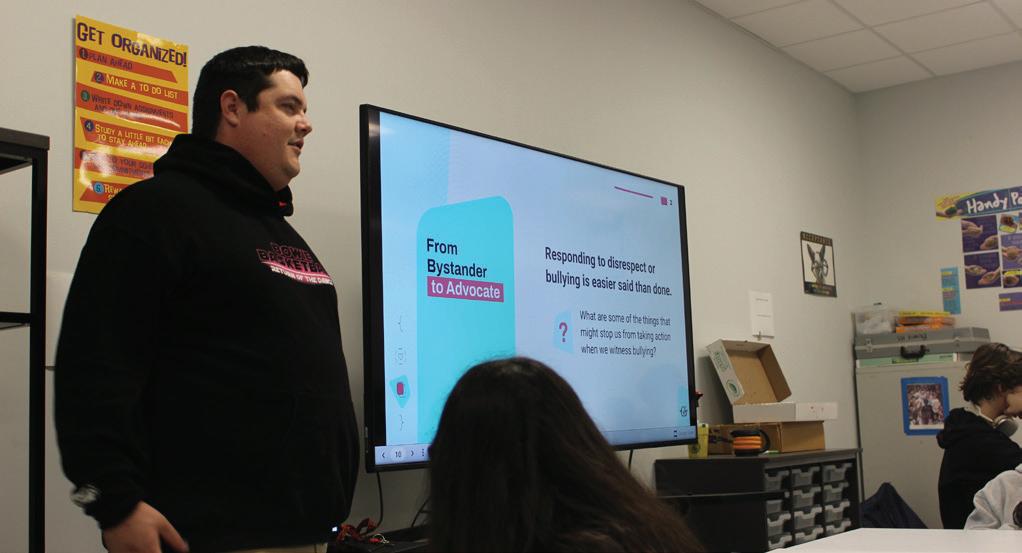
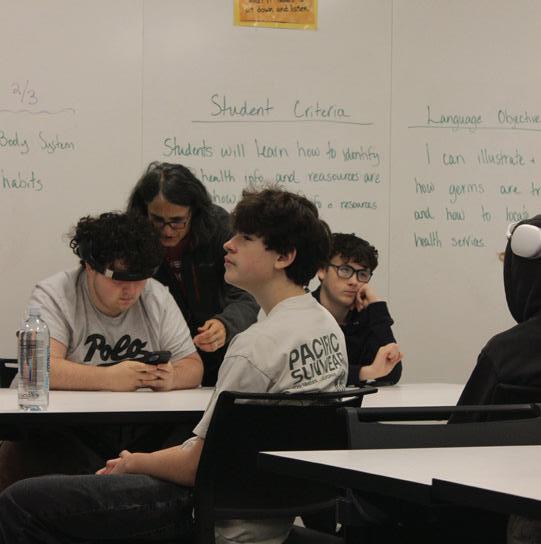
LIFE LESSONS: History teacher Ross Anderson gives Character Strong lesson to his class.
PARTICIPATION POINTS: Students listen to and engage with Character Strong lesson about bullying and bystanders during Monday FIT session.
"If we take this seriously, Character Strong has the possibility to grow our community at Bowie," Anderson said.
AISD prepares staff for new policies
The district begins to develop new plans in response to recent immigration legislation
Katie Grumet News Editor
Imagine sitting in class one day focused on your work and then being interrupted by a blaring announcement. 'We are now on hold'. Your teacher stops what they’re doing and checks that the door is locked. It’s supposed to be “business as usual” with no students leaving or entering classrooms until the hold is over.
No one in the room knows what’s going happening, or when the hold will end. The hold could mean a few things, there’s an altercation in the hallway, a medical issue that needs attention, unfinished maintenance that is being done in a common area, or that federal agents are on campus and are looking for a student or staff member. The latter scenario is something AISD has been preparing for.
As President Donald J Trump beings his second term, he has begun following up on his campaign promises, including the start of mass deportations for undocumented immigrants. One action Trump has taken during his presidency to help these deportations take place is removing the policies that had previously prevented migrant arrests from taking place in sensitive locations such as churches and schools.
In response to this, AISD has taken action in preparing district faculty on what to do if federal officers enter campus and what steps families should take if they are here illegally.
“The district has created what is called a Family Separation Hub, it provides resources specifically for teachers, administrators, and families,” Academic Director Kaylin Brett said. “It is just to provide support to students who need support and so we have what's called in the district, parent support specialists that we could parents can reach out and say I'm needing support in this area we have, and they basically provide ways to support them.”
According to Brett, the only way students can access this hub is if they talk to a counselor or a teacher or if their parents contact the school asking for resources. Once a student or a guardian contacts a staff member asking for help, the staff member then can connect the family with specific resources based on what they need. Brett explains that AISD’s legal counsel has created the hub and is constantly updating it.
“The Family Separation Hub was built by our legal team and our communications team in the district, so they are keeping up with executive orders, keeping up with any policies, and making adjustments based on that,” Brett said. “Because the executive orders are constantly changing we also reach out to our district and ask how we can help a specific student or family to ensure that we’re able to offer the most recent and accurate information.”
AISD also sent out an email to staff and families that contained resources such as a FAQ page for families and talk points for teachers. Brett believes that these talking points can help teachers navigate difficult conversations with students.
"If a student feels nervous, let them come talk to a counselor or a teacher," Brett said. "Having the fear that they could go to school and someone could come take them, definitely creates a sense of unsafeness for certain students."
The email sent out to families was a completely separate thing from the Family Separation Hub that was created for staff members only. The hub is
designed to help staff support families with specific needs related to recent immigration legislative orders, and the email was sent out to provide direct resources for families and staff trying to navigate these difficult times.
“All of my teachers have always been just like, good support systems in general, with anything, especially with mental health,” senior Julia Perez* said. “I think that the letter that the district sent out was very helpful, and I feel like people have been already mentally preparing for what’s to come by keeping up with the news and doing their research.”
AISD policy states that they do not collect immigration status for families, meaning the district has no knowledge about the legal status of students. According to Brett, if a student confides in a counselor or teacher about their or their family’s immigration status, that information is legally protected, and staff members cannot disclose that information to any federal officers. This protection is similar to doctor-patient confidentiality.
“In Austin ISD, we do not collect immigration status. That is a piece of identity that we don't collect and so we don't know who is facing these fears and who's not unless they confide in us,” Brett said. “We have a lot of students who are afraid that other students are going to report them, or other students are going to say something, and that would go under our Austin ISD bullying and harassment policy, and would follow those consequences too.”
One of the scenarios AISD has been preparing for is if a parent doesn’t pick up their kid after school or if a student goes home and their parents are not there. If this situation does arise for a student, Brett explains that a Student Resource Officer (SRO) would be contacted and would work directly with Child Protective Services to ensure that the student is getting their needs met such as making sure they have a place to sleep and food to eat. AISD’s Student Resource Officers are available all day, including after school or on weekends by calling 512414-1703.
“I do think if a student doesn’t get picked up and or they go home and their parents are not there, they're going to be afraid to stay in that house,”
Brett said. “And so I think our community is so supportive and anytime we have a student in need, the amount of support that comes out blows my mind and so I do know, the immediate action would be Student Resource Officers, CPS, and then helping problem solve with that child individually, based on if they do have other family members around or what needs are required at that time.”
Since the Trump Administration removed the policies that protected schools from being infiltrated by federal agents, AISD has prepared an extensive procedure if a federal agent were to enter campuses looking to speak with or arrest a specific student. According to Brett, if a federal agent enters campus the first thing that the admin team would do is scan the badge and send it to AISD’s legal counsel.
“So, if an agent comes in and provides us their badge, I'm supposed to then scan that and send it to our legal team, then [the federal agents] have to provide us with their action plan which would involve the individual that they're seeking information on,” Brett said. “And so while that's being reviewed, they are to wait in the
ART BY Layne Foxcroft
front office, and then once I hear back from the legal team, if it is request for student information, or for parent or for staff information,I then have to go by based off of what our legal team tells us to do.”
Brett describes that if this situation were to happen, the entire school would be placed on hold while the legal team reviews the situation and advises admin on what to do. While badges and paperwork are being reviewed, federal officers are not allowed to leave the office and enter the main campus until admin authorizes them to do so. Senior Kamryn Reyes feels that the campus will not be a safe place if federal agents are allowed to enter.
“I think it's just going to make school in an unsafe place, and I feel like there's already so many elements that make school an unsafe, like the potential for shootings and drugs and other kinds of violence,” Reyes said. “And now you have to worry about school being a place where you are taken from your home and your family, and that is really not something that kids should have to be worried about.”
According to The 74, a non-profit news agency that covers U.S. education, the fear students may be experiencing
SOCIAL MEDIA
with federal agents entering schools could cause more tension in classrooms and be disruptive to all students, whether they’re concerned about their personal safety or not. Consequently, in The Hechinger Report author Jennifer Rich advises teachers to talk about difficult topics such as immigration in order to foster open discussions and teach students to disagree respectfully. Perez disagrees with this concept.
“I feel like teachers shouldn’t advise students on what to do and if they want more information, they should research it themselves,” Perez* said. “But I have total empathy for families that are going through a difficult time right now and at the same time I feel that something needs to be done because its not fair for people to come into this country illegally.”
According to AISD, teachers may take part in political events regarding national issues outside of their role as a teacher, and they can prepare lessons on current events as long as they include both viewpoints on that event and help facilitate respectful behavior in the classroom. Similarly the Inter-cultural Development Research Association describes 10 ways schools can help support students such as
affirming safe spaces for students and equip staff with training and resources to help support students. Reyes agrees with this and feels that Bowie could be doing even more outreach for students needing support.
“There could be more announcements that are less cautious as far as addressing the safety of students or a club could be started just so that kids could talk to other people about how they're feeling support each other,” Reyes said. “I definitely think that our counselors should be open to kids coming in and expressing their concerns and make it known that counselors have the time for students to come talk to them so that they don't feel like scared to bring up their concerns. A lot of my AP teachers have been very gently open, like, not aggressive at all, but about their own feelings and, just trying to tell us, hey, this is going to be hard, but we're here for you and I think other teachers should do this too.”
*Julia Perez is a fictitious name that was generated to protect the identity of a source who asked not to be identified due to concerns related to sharing their political views.
TikTok ban takes a toll on student's day to day lives
Sydney Murphy Dispatch Reporter
In a surprising move that left students shocked, SCOTUS has upheld congresses law banning TikTok due to national security concerns. This decision left millions of American teens scrambling to find new platforms for their creative expressions and their daily dose of dopamine.
According to CBS News, at 10:30 pm, Saturday, January 19, TikTok disappeared from app stores. TikTok became inaccessible due to a law passed in Congress last year. However, the TikTok ban only impacted the United States. “I first heard about the ban on TikTok,” sophomore Audrey Savasky said. “I didn’t actually think that it was going to happen, I thought it was just a rumor.”
The BCC stated that people found the ban surprising and unreal at first. However, they eventually realized that TikTok would be banned. Additionally, users reported that the app had also been removed from both Apple and Google’s U.S. app stores.
“I think that teens are too addicted to their phones and that they are uneducated in the real world,” Savasky said. “I have been able to disconnect since I accidentally deleted TikTok and I have been able to focus on homework.”
The Verge claimed that TikTok or other ByteDance apps like CapCut are still not able to be re-downloaded. So, people who deleted the app during the ban are unable to re-download the app, as of press time. “I used TikTok pretty much every day and opening the app every morning became muscle memory before it got banned,” sophomore Jacob Geldart said. “Although, TikTok getting banned doesn't change anything for me since there will be other apps created to have a similar format to TikTok.”
According to AP News, there are apps like Rednote which have been around for over a decade which have a similar format to TikTok. Although, both apps are Chinese owned which causes concerns from the government due to social security risks.
“I don’t think that any other apps are at risk of getting banned,” Geldart said. “Most other apps are American-owned companies.”
Audrey Savasky Sophomore
“I think that teens are too addicted to their phones and that they are uneducated in the real world.”
The New York Times stated that TikTok’s owner, ByteDance has said for years that they will not sell the app to an American company due to the fact that the Chinese government would not allow the export of its addicting video format. However, the ban says TikTok can no longer be controlled by any Chinese-owned company.
“All of my students are constantly on TikTok,” Bowie track coach Lora Tilson said. “I don’t really agree with
the ban because I do believe that everyone has a First Amendment right and that TikTok should not be banned.”
According to Built In, Donald Trump extended the ban for 90 days. However, after the 90 days are up, if TikTok has not sold their company to an American-owned brand, a permanent ban will be reconsidered.
“During the ban I deleted TikTok and now I can’t get it back,” Savasky said. “I am upset that I deleted it because I don’t know how long it will be before I can get it back.”
CBS News claimed that most of the reasons the government banned it were based on accusations that TikTok is sharing personal information of its users. The U.S. government claimed that the Chinese government could access sensitive user data through the app.
“Although the TikTok ban didn’t last for too long there is a possibility that the app could be banned again in the future,” Dauterive said. “I don’t think it matters that much though because new apps will always be created.”
ART BY Olive Trevino
FEB. 14, 2025
FEDERAL LEADERS
President Trump's second act begins
The historic inauguration embraced traditions while facing future challenges for the
Savannah Riggins Politics Editor
On January 20, 2025, Donald J. Trump was sworn into office for his second term as the 47th president of the United States. During his inauguration, Trump shared information about the future of America and what issues he intends to tackle during his time in office.
There were many noteworthy events during the ceremony including that the inauguration took place inside the U.S. capital building. Typically this celebration is held outside of the building on the west front. There was also a large number of tech billionaires in attendance.
“I believe that it’s going to be a good turning point for our country,” senior Daniel Soto said. “We saw what he did in 2016 so hopefully, it will be repeated. I think this is what’s best for this country.”
This inauguration was significant in multiple ways. Trump is the second president in U.S. history to be elected for two non-consecutive terms, and his inauguration fell on Martin Luther King (MLK) Day.
“A President inaugurated on MLK Day is always interesting,” history teacher Jen Isaacs said. “I think when you think of someone like Martin Luther King, and how he represented love, kindness, and worked for a better future where everyone in this country would be equal under the law. And then you see some of the rhetoric that has come from the Trump administration, it can be in conflict sometimes. It can be difficult to celebrate a man who represented that kind of love for humanity, while also recognizing that maybe not everyone shares that same opinion.”
justice have ever been truly balanced,” senior Avery Fechter said. “No matter the outcome of any situation no one will ever be truly appeased. I think his comment is a big promise that he will be unable to fulfill.”
Trump announced in his speech that he not only plans to restore America to how it was during his last presidency but he also plans to undo policies that previous presidents have put into place.
“We have a public health system that does not deliver in times of disaster, yet more money is spent on it than any country anywhere in the world,” Trump said during the address. “We have an education system that teaches our children to be ashamed of themselves, and in many cases to hate our country despite the love that we try so desperately to provide to them. All of this will change starting today and will change very quickly.”
According to the BBC, the first of these changes that Trump is making is the securing of America’s borders, in an attempt to stem the flow of illegal immigration. Not only will the boarder be secured but Immigration and Customs Enforcement officers (ICE) will begin to deport mass amounts of illegal immigrants, he said.
“I believe that it’s going to be a good turning point for our country. We saw what he did in 2016.” Daniel Soto
“I agree with the plans of mass deportation,” Soto said. “My family came from Mexico legally, and there are so many other people that also come here legally. When people come illegally it's not fair for everybody else.”
Senior
Trump began his inaugural speech by stating his confidence in his ability to lead the nation toward a greater future, according to CBS News. He also claimed that during his term he intends to re-balance the scales of justice and prioritize prosperity and freedom for our nation.
“I don’t think the scales of
According to Issac’s, the announcement of mass deportations brought concern to many students who fear that they could be targeted by ICE officials in public places like parks and schools.
“My students haven't changed the way that they treat each other,” Issacs said. “Everyone in my classroom still regards everyone with kindness, but I think the biggest change has come with some of the regulations. There is a question mark on certain
things about how school will work and what is acceptable.”
Another plan Trump has for his term is to tackle America’s increasing inflation and energy costs, and during his address, he declared that this issue is now a national emergency and as a country, the government will focus more on mining fossil fuels.
“The inflation crisis was caused by massive overspending and escalating energy prices,” Trump said. “Today I will also declare a national energy emergency. We will drill, baby, drill. America will be a manufacturing nation once again, and we have something that no other manufacturing nation will ever have, the largest amount of oil and gas of any country on Earth. And we are going to use it.”
vehicle mandate, saving our auto industry and keeping my sacred pledge to our great American autoworkers,” Trump said. “In other words, you'll be able to buy the car of your choice. We will build automobiles in Amer ica again at a rate that nobody could have dreamt possible just a few years ago.”
“It will be useful to focus on ourselves and the acts of love and kindness we can spread to the world.” Jen Isaacs
History teacher
Trump’s promise to increase drilling has caused people to question the effect that this will have on the environment.
According to the World Wildlife Fund harvesting for fossil fuels like oil can harm ecosystems and animals by disrupting migratory patterns and ruining critical habitats, especially in the event of an oil spill.
“Multiple studies have shown that inflation rates were decreasing during Biden's presidency,” Fechter said. “There was a significant decrease from 2022 to 2023. While having resources like oil is important to America’s economy, mining can also be detrimental to the environment and there should be very strict policies and restrictions to prevent the overuse of such an important fossil fuel.”
Trump also announced his plan to end the Green New Deal. This congressional resolution, a statement released by the senate, that recognized the obligation of the Federal government to tackle the crisis of climate change. This focus resulted in the passage of the Inflation Reduction Act which is the largest-ever federal investment into fighting climate change.
“With my actions today, we will end the Green New Deal and we will revoke the electric
Trump is not the only person who was sworn in on January 20, Trumps vice president nomi nee James David Vance, commonly referred to as JD was also sworn in. “I like JD Vance,” Soto said. “He came up from pretty much nothing and served his country as a Marine and made it to where he is now. I think he's a really good speaker and is very charismatic.”
Elon Musk was also wel comed into a spot on Trump's cabinet. Musk will be the Head of the Department of Govern ment Efficiency (DOGE) and he made an appearance at the inauguration which sparked controversy. During his speech made a gesture while thanking the crowd. According to the BBC Musk placed his right hand over his heart and then put that same arm straight into the air. This gesture caused viewers to become skeptical of his intentions.
na
"Quite frankly, the salute was disgusting," senior Nate Motes said. "However, it is not unexpected from him. I think he is a horrible racist man who is power hungry and payed his way to the top of our government."
According to Issac’s, follow ing the inauguration students have been voicing concerns
POLICY
are who are people fighting for it, and it will be useful to focus on ourselves, the acts of love and kindness we can spread to the world on a day to day basis in our
New executive orders bring changes to current policies
Marissa McGowan Review Editor
In the United States, the president is able to implement executive orders, which are directives that contribute to the management and operations of the federal government. With the re-election of Donald J. Trump as the 47th U.S. President, he has begun to act on his campaign promises by signing various executive orders. His objectives include heightened border security, more affordable energy, limiting federal hiring, and more.
“An executive order is not as powerful as a piece of legislation,” history teacher Charles Stampley said. “An executive order is often challenged in court. It is only a temporary fix.”
Trump has been reversing some of former President Joe Biden’s policies, including the Executive Order ending Advanced Racial Equity and Support for Communities Through the Federal Government along with getting rid of Executive Order 13988, Preventing Discrimination on the Basis of Gender Identity or Sexual Orientation.
“I honestly think that reversing many of Biden's policies immediately after coming into office was not the most effective decision,” junior Ayah Hakim said. “However, this is definitely a pattern that many newly elected presidents follow.”
Trump voiced that one of his primary goals while in office is taking action to secure the border and the mass deportation of undocumented immigrants. While concerns revolving around the impact of illegal immigrants are a contentious topic, studies show many immigrants are actively contributing to the workforce. According to the Bureau of Labor Statistics, 68% of the foreign-born population above the age of 25 are working, compared to 63% of native-born citizens. According to the Budget House Committee, there have been over eight million immigrants who illegally crossed the U.S. border during Biden's term.
“Immigrants who came in under Biden, most of them, they're not working, they're just kind of being a burden to this country,” sophomore Cade Venable said. “People that know this more than anything are people who immigrated here legally, now there's all these people pouring in and just cutting in front of everybody in line, and cheating the system.”
Trump has also implemented various executive orders surrounding climate and the environment. Trump has withdrawn the United States from
the Paris Climate Agreement, eliminated Biden's policies encouraging electric vehicles, and repealed multiple Biden administration executive orders regarding climate change, including the guidelines for establishing climate-related parts of the Inflation Reduction Act of 2022.
“I think that as such an important nation, I believe that we have a duty to focus on climate,” social studies student teacher Ana Guerra said. “We've had presidents before, like Teddy Roosevelt, talk about the importance of nature. I just wonder, what direction are we heading if we forget that.”
Trump also declared the first national energy emergency in U.S. history, enabling the current administration to suspend environmental rules or expedite mining projects, and open the Alaskan wilderness to more oil and gas drilling. According to the Energy Information Administration, crude oil imports of about 6.48 million barrels per day, accounting for 76% of U.S. total gross petroleum imports in 2023. The top five source countries of U.S. gross petroleum imports were Canada, Mexico, Saudi Arabia, Iraq, and Brazil.
“I think Trump's oil and gas exploration is going to be good because under Trump we got all of our energy domestically,” Venable said. “Biden kind of stopped doing that, which I think is a bad thing because we had to rely on foreign countries like Saudi Arabia and Russia for our oil.”
On January 21, Trump signed an executive order stating that Diversity, Equity, and Inclusion (DEI) policies, preferences, mandates, and programs would be completely removed from the federal government. This has received a range of reactions, some arguing that the policy promotes fairness of qualifications while others believe that it defeats efforts to address inequality.
”I don't think it matters what skin color you are, I think it matters if you can do the job,” Venable said. “I don't think they should have to meet a certain number or certain quota of any particular race. I think it's just who can do the job.”
As of February 5, President Trump has signed a total of 54 executive orders, along with revoking a record 96 previous executive orders.
“His executive orders so far have been very strong, he came in, he knew what he wanted to do, and he was not at all hesitant to do them,” Guerra said. “But an executive order is not a law, they're still contested, and he still has to abide by checks and balances, just like any other president has to.”
ART BY Layne Foxcroft
ART BY Sophia Sepuldeva
ACADEMIC ACHIEVEMENT
Danube dashes towards her diploma
Sophomore strives to set herself apart,heading to Massachusetts Institute of Technology
Isabella Verette Senior Editor-in-Chief
Striding down the hallways and striving for a faster start in the world, Danube Shudic makes a mark on clubs, classes, and her peers.
Shudic is part of the class of 2027 cohort but will be graduating along with the class of 2025 seniors.
“I’m really excited to graduate early honestly,” Shudic said. “I did a lot of my credits online during middle school, and I’ve thought about graduating early for a long time so it’s always been this goal to reach for.”
Shudic who will be turning 16 this year has been surrounded by older kids since elementary school when she skipped a grade. But navigating high school relationships being two years younger at points, is somewhat different.
“I don’t usually tell people I’m young when I first meet them,” Shudic said. “I try to let them get to know me and make friends and then drop the fact that I’m young, it’s odd to look around in my classes and see people who are two to three years older than me.”
Sophomore Madeline Davis and Shudic met at the beginning of Davis’ freshman year through mutual friends.
“We ended up sitting in the same group at lunch because of some mutual friends and have stuck with that group since then,” Davis said. “We are also in Key Club and Acts of Kindness together.”
Davis believes Shudic’s work ethic is an important part of her success.
“I think Danube is motivated by her goal to be the best she can be,” Davis said. “ She doesn’t want to settle for mediocre, which I really admire.”
Balancing an older peer group, strenuous classes, and a multitude of extracurriculars Shudic strives to set herself apart from her peers
and this year’s graduating class.
“I’m taking seven AP classes this year alone so it’s kind of stressful,” Shudic said. “A lot of colleges now want to see you do something crazy amazing. I don’t have the means to create a non-profit so I’m trying my best to set myself apart academically.”
Shudic has found her place on Bowie’s campus, but navigating an older peer group and maintaining friends her age is something of priority to her.
“When it comes to my friends from middle school, I just make a point to see them during lunch or before school and hang out outside of school,” Shudic said.
Outside of academics when Shudic isn’t making time to see long time friends she’s participating in a number of extracurriculars.
“I really like to do taekwondo,” Shudic said. “I’m a third degree black belt, so I’ve doing it for a while, and I’m in taekwondo club here at school, it’s something I just really enjoy doing in my free time. I’m also taking around nine club photos for clubs like Society of Women’s Engineers, Spanish Honor Society, and Choir.”
Being 15 and only being in high school for two years, Shudic has accumulated over 27 course credits, in those two years. Thus exceeding Bowie’s credit graduation requirement.
“The workload is definitely a lot. Because I’m in like, two years, I’m trying to fit them all in,” Shudic said. “I get to school really early, and so I just do all my work then, and then I try to work as much as I can during fit. And so it’s only, like maybe an hour, an hour and a half after school every day when it comes to homework, which is really nice.”
Between the extracirrculars and the seven AP courses Shudic is taking this year alone, she has set herself up for early success.
“I’m going to MIT. I got a full ride scholarship,” Shudic said. “My parents aren’t going with me so it’s all a little scary but its the top school for my major.”
When applying to schools Shudic knew she wanted to attend a school on the
InformationfromBowies
east coast, and the fact that MIT has the number one undergraduate engineering program according to the U.S. News and World report, it ended up being the perfect fit.
“I’m gonna double major in Mechanical Engineering and Applied Math, and so I really want to go into research in mechanical engineering,” Shudic Said. “I would probably do research with waves and how they affect building structures. We were doing like earthquake unit in engineering, and I thought it was really cool how buildings have to adapt to those waves. And so I would research just how to make earthquakes less devastating to infrastructure.”
Throughout Shudic’s short time on campus, teachers have taken notice to her drive and work ethic.
“I believe Danube’s drive to work so hard comes from the expectations she has set for herself,” English teacher Lillian Glasscroder said. “She knows she can excel and achieve amazing things, so she does. I have never known her to doubt her own intelligence and this shows clearly in what she is able to accomplish.”
Outside of just her work ethic according the Glasscroder, Shudic’s personality and happy go lucky attitude shine just as bright.
“Her kind and understanding nature are the first things that stand out to me,” Glasscroder said. “She is incredibly sweet and respectful to every teacher and student I have seen her interact with. She is also incredibly funny.”
While Shudic has a good head on her shoulders and has already learned valuable skills like, time management, stress management, and has soon she is capable academically of moving on to a college setting, she is still only 15.
“I think my parents are excited to have a kid who’s 15 and graduating, for sure. I mean, they want the bragging rights,
but they are very scared for me,” Shudic said.
“It’s just because they’re they can’t really keep an eye out for me all that often. And so you see parents that they’re like, Oh, we don’t want you to go out with your friends today, and here I am just being in a whole different state.”
While Shudic’s parents have their own worries so does she, not only is she headed toward facing the adjustments that any incoming college student would have to make, shes doing it at a younger age with less experience in a setting like high school thats prepares you for change.
“Specific worries I have are just doing random things, like booking a doctor’s appointment, I’ve never really done that before, and just changing insurance, like, random things that you don’t really think about,” Shudic said.
“Even getting paid, because I’ve never had a job. I’m too young to do that, so once I do work study, that’s kind of scary.” Shudic’s nerves haven’t stopped her from looking forward to her new life in the upcoming school year.
“I am really excited just for like, a new type of city, like, I know the transport, transportation is, really different. It’s a lot of public transport, and I really like that,” Shudic said. “ It’s walkable, and there’s just a lot to do in one area. There’s so many cities there that are close to each other. So if you want to get a job, I think it’d be really easy. Once I visited the campus I knew its where I wanted to go, it’s beautiful.” With her strong personality and drive to succeed Shudic is ready for success.
“Danube’s quiet intelligence, yet wonderfully loud and bubbly personality are what makes Danube, Danube,” Glasscroder said. “She deserves every wonderful thing that comes her way.”
Gracie
Ruland Staff Reporter
When the lights dim and the performers take the stage, different colors, patterns, and textures catch the eye of the audience. An ac tor’s costume is not just the clothes on their back but is a storytelling tool. The Bowie Starlight Theater Company has support from AP Government and Economics teacher, Ruth Narvaiz, who dedicates part of her time to helping create costumes while inspiring her students to have a passion for costuming.
“Mrs. Narvaiz, better known to me as Ruth, is wonderful,” junior and member of tech theatre Opal Burns said. “She has helped me grow both personally and professionally in the creative and theatre departments.”
Narvaiz interest in costume de signing and sewing has been a part of her identity for many years, and the STC has become an outlet for her creative passion.
“I started sewing with my grand mother when I was elementary school age and then with my mother after that,” Narvaiz said. “What I
love about costuming is that you get the opportunity to make things you would never make if you were just sewing for yourself. I have sewn all types of fabrics and made all kinds of crazy outfits that only a costume maker gets to make.”
Narvaiz started helping the Starlight Theater Company with costumes six years ago when her son first joined the company, and she has been participating in the
freshman year was Big Fish,” Narvaiz said. “The wedding dress they were using broke on opening night, and I was sitting in the audience when I got a text from my son saying, ‘We have an emergency, we need you backstage.’ I went backstage and repaired the dress and before I knew it I was sucked into the
working on the Starlight Theater shows, Narvaiz has worked on designing costumes for several other programs, including the AISD Summer Theater Series and Broadway Series shows at the UT PAC.
“After I started working on costumes at Bowie I networked my way into some other costuming jobs. I worked two summers at the AISD Summer Theater Series. I have worked two summers at Impact Arts Summer Stock program,” Narvaiz said. “I have also worked as a stitcher and a dresser with the Broadway Series shows when they come through town and perform at the UT PAC.”
Even when Narvaiz isn’t in a school environment, she still contin ues to be dedicated to the company and her students.
“The Bowie Theatre department would struggle without Mrs. Narvaiz leadership and her costume depart ment skills,” Burns said. “She creates articles from scratch, borrows from her many friends in the industry, and scavenges thrift stores, and other stores for pieces that she can alter to help each actor shine on stage. “
Not only does Narvaiz play a role in Bowie’s Theater department, she also holds a position in the academic building, where she teaches A.P. Eco nomics and Government.
“Sometimes it is hard to teach classes all day and then come work in the theater. Sewing is way more fun than grading papers,” Narvaiz said. “Lots of times when we are in the middle of something as intense as the musical, I’m sitting in my classroom trying to get my regular work done when I would really rather be down in the theater sewing.”
Although multitasking as a teacher and a costumer can be difficult, the Starlight Theater Company holds a special place in Narvaiz heart and she does not plan to leave anytime soon.
“What makes Bowie theater special is the people. The directors are awesome to work with and I love that they have high standards and expect everyone to work hard. I love that they have accepted me and made me feel like I was part of a team,” Narvaiz said. “I also really enjoy the students. Working with students several years in a row and really getting a chance to see them learn and grow has been awesome.”
Juniors Jack Lowe and Burns, two of the students who work with Narvaiz in costumes, only think incredible highly of Narvaiz according to Lowe.
“Mrs. Narvaiz has greatly impacted my life. She taught me many new things about theatre, especially costuming, and has helped me on many different shows that I have been a part of,” Lowe said. “Mrs. Narvaiz inspires me by how much she creates things and how much creativity she has. She is always making new costumes for the theatre, and these costumes are always so creative. I hope one day I can make costumes like she does.” Narvaiz ‘contribution to the company, and its members, will last beyond Bowie’s halls.
“I do hope to teach new people the beauty of costuming as Mrs. Narvaiz has. Before I joined costuming, I really didn’t pay attention to costumes, and I didn’t really consider them important,” Burns said. “But Mrs. Narvaiz has really opened my eyes to how much costuming can affect a theatre show.”
Isabella Verette
Bikers in the shade of success
Two freshman create RideLens, a sunglasses brand focused on affordability and quality
Charlotte Schwarte Feature Editor
Daniel Morgali and Jack Trumbly fly through the trees on their bikes, tires crunching on the gravel. Branches whip past them as the boys pedal faster and faster, weaving around the trail. One last push and they emerge into a clearing, sun beating down on them, the identical glasses on their faces glint in the brightness.
In October of 2024, freshmen Daniel Morgali and Jack Trumbly put into motion their entrepreneurial venture, RideLens, a sports glasses brand designed and produced by the Bowie students “RideLens are high quality, affordable glasses,” Trumbly said. “They’re comfortable and stylish, built for every kind of sport, and they’re just overall great glasses.” Morgali and Trumbly decided to create their own glasses brand after their experience with eye-wear in the sport they met in, mountain biking. They spent the past summer painting home addresses to raise funds, eventually collecting enough to launch what has quickly become a flourishing business.
“When you are on cross-country bikes flying through the trails, there’s a lot of branches and you need to keep your eyes safe,” Morgali said. “So, we wear sunglasses, but we were tired of spend
ing money all the time after breaking glasses that cost $250. We wanted to create something affordable but with the same quality as every other glasses brand.”
The co-owners are both members of the Bowie Composite Mountain Biking Team, which is made up of bikers from Bowie and South Austin middle schools. Mountain biking consists of off-road competitive bicycle racing usually on rough terrain, such as the trails around Austin.
“I’ve been biking for many years now, and I just love the thrill of endurance biking, and learning the technique of riding,” Morgali said. “It’s what led me to making the first RideLens.”
Typical sports glasses are used in a wide range of physical activities that require both eye protection and sun prevention, such as baseball, golf, tennis, and more. RideLens glasses enhance upon that with detachable arm and nose pieces, two interchangeable lenses, and lens care essentials, all included in the purchase price of $35.
“Being a biker, we know what’s ideal for glasses,” Trumbly said. “We know what fits well while you’re wearing a helmet, and what’s comfortable to use while biking, running and playing other types of sports.”
The actual sport-shades are manufactured and shipped by an external supplier, following a design created and selected by the RideLens team.
“We did hours and hours of research to find the best and fastest factories,” Morgali said. “Ordered tons of samples to figure out the best one for the price, and we studied all the plastics and all the lenses.”
A large part of the RideLens brand has been its active social media, in which over a dozen posts focus on the glasses in unboxings, reviews, advertisements, and edits. They can be found on Instagram, TikTok, and YouTube under the handle, ridelens_ official.
“Daniel and Jack are super hard working,” Morgali’s mother Maria Garcia said. “They spend a lot of hours working on their online store and their social media. Also building relationships with potential buyers like big mountain bike brands.”
Morgali and Trumbly are working on partnering with different biking and athletic brands, and have been
recognized on social media accounts like the Texas Mountain Biking League Instagram and more. They have had vendor booths at several different biking events and races, and will soon be featured on the back of the Bowie Run Club t-shirts as a sponsor.
“Jack and Daniel are natural entrepreneurs,” Garcia said. “They are passionate about mountain biking, so if you combine those two things, I am sure they will be extremely successful.”
Several members of the boys’ biking team have become early supporters of RideLens, frequently wearing the glasses during their rides on the trail. The entrepreneurs gifted samples of their first product out to their teammates, with one of them, sophomore Joaquin Gonzalez, even going as far as to bike 100 miles with the shades to prove their durability.
CLUBS
“They definitely like to involve people from the team,” sophomore Tyson Schwartz said. “I was one of the first people to get a pair of RideLens, and they really wanted to know what the feedback was and what we thought about their product. We tried it out, and we liked it a lot.”
Earlier this year, Schwartz met Morgali and Trumbly and has since collaborated with them on various aspects of the business, including developing the upcoming website and assisting with product photography.
“They’ve progressed really quickly for being a homemade business, and it’s the way they’ve been getting all these deals, and promoting it, and starting all their social media accounts,” Schwartz said. “The way they did it, it worked really well.”
With little outside help from their parents or other mentors, Morgali
and Trumbly have paved the way for their business. They have had to overcome hurdles such as obtaining an Employer Identification Number for taxes and juggling other challenges accompanied with their young age.
“It can be a bit challenging at times to get work done with our business, while also doing schoolwork on the side, but we always manage to make time for it,” Trumbly said.
RideLens’ primary goal is to give back to the athletic community, and Morgali and Trumbly have already taken big strides to establish themselves in it.
“Mountain biking is my passion,” Trumbly said. “It’s fun to be able to make the glasses, do something that we love, and put it into our passion of biking.”
Black Student Alliance club spreads cultural awareness
Sydney Murphy Dispatch Reporter
Decorative lights fill the room, the air buzzes with anticipation as students eagerly file into the classroom for Bowie’s Black Student Alliance’s weekly meeting.
The Black Student Alliance, or BSA, is making a significant impact this year by fostering cultural awareness. Their diverse events and social activities are transforming Bowie into a more inclusive and enlightened campus.
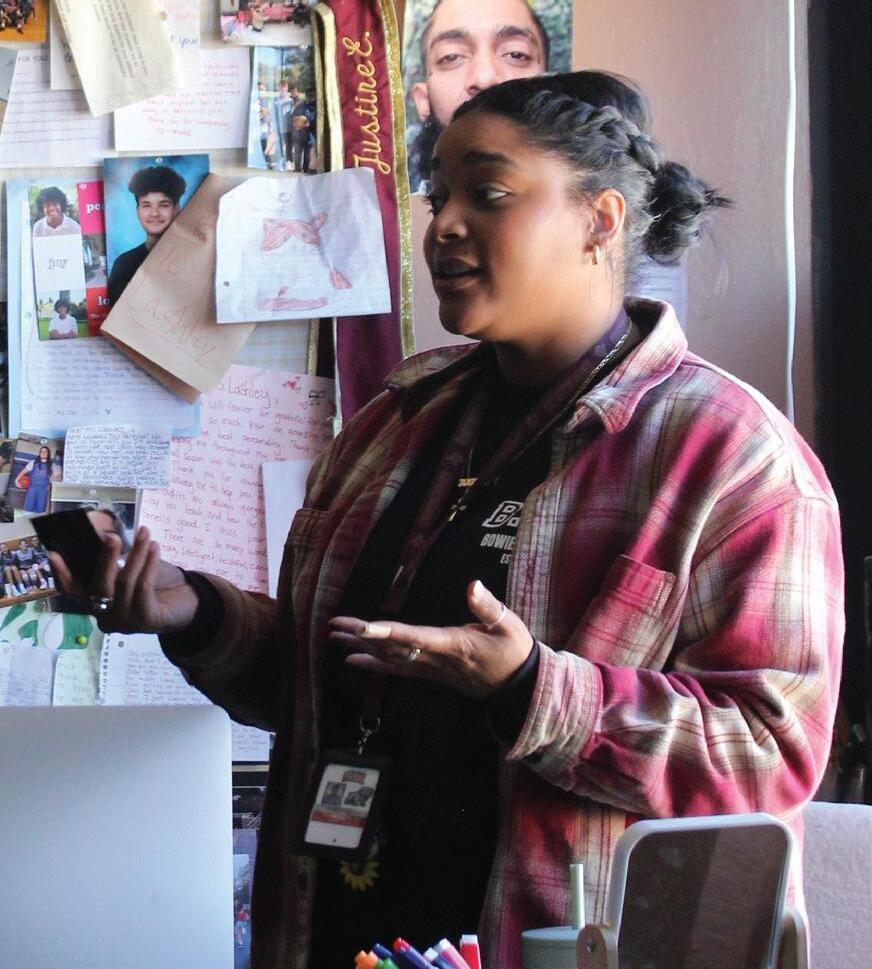
“I believe that having representation is important, and with the Black community being only two percent here at Bowie, it’s a way for students of color to have community,” BSA sponsor Justine Lashley said. “At Bailey Middle School, I was able to establish a partnership with the University of Texas BSA, and from there, our partnership was formed. I’m very grateful for them and their guidance with our board members.”
This is Lashley’s third year being involved with BSA. Although Bowie has not always had a partnership with UT, this fairly new collaboration provides many new opportunities for the club. BSA has expanded at Bowie by creating a safe and healing environment for its members. However, the club has a large group of individuals who are eager to join.
“I joined as soon as I heard about it,” sophomore Katelyn Mathabela said. “I had a family friend who’s a senior who was running it so that helped me decide to join.”
According to Lashley, there is such a high demand for entry to the club, but every student is welcome. BSA fosters a supportive community in which members are encouraged to be themselves.
“We aim to create a more inclusive environment by fostering cultural awareness, promoting open communication, and advocating for equality within Bowie ,” Lashley said. “We host events that celebrate black culture and history as well as provide a safe space for students to share their own experiences.”
There is a right fit for everyone at BSA, and even underclassmen are able to serve leadership positions.
“I enjoyed my experience in BSA especially
because I am in a leadership role and it has been really fun helping plan the upcoming events,” sophomore Jayden Pratt said.
Pratt is historian of BSA, but every member of BSA comes together to organize events for the entire school to participate in.
“We’re very excited to organize a game night where anyone can come and enjoy playing games and have fun,” Lashley said. “We are also hosting our first annual pickleball tournament.”
However, social activities aren’t the only thing BSA organizes, as they also focus on other activi-
ties and programs.
“We actually have a partnership with George Washington Carver Museum where we will be planting gardens for the surrounding community,” Lashley said. “It’s nice knowing that black students can have an impact on their community and their voices matter and can be heard.” BSA according to Lashley hopes helping out with both the Austin and Bowie community will broaden their impact. They host meetings every week to talk, brainstorm, and plan new projects.
“All meetings are a team effort by our leadership,” Lashley said. “We usually have some sort of ice breaker, talk about our topics, allow club input, and have refreshments.”
Meetings at BSA are planned to be relaxed so everyone feels comfortable. Senior Kayson Mathabela has continued to participate in weekly meetings ever since joining.
“We meet every Friday either after school or during FIT but honestly it’s a great club to be a part of and I am glad to be in the group,” Mathabela said. “We learn about African American history and we get a community together to talk about our experiences as a group.”
According to Lashley, BSA created an oath that all members pledged to when they first joined. This helps ensure a successful year for the club by providing clear guidelines that everyone can agree on. BSA will continue to implement this practice for years to come.
“We host events that the entire student body can participate in,” Lashley said. “The mission of Bowie Black Student Alliance is dedicated to fostering a supportive and empowering space for all students by celebrating culture, advocating for equity and promoting unity.”
PEDAL TO THE METAL: Daniel Morgali races past another bicyclist during a trail ride, a pair of RideLens set upon his face. Morgali created RideLens in the hopes of making high quality, but cheap, sport-glasses. PHOTO BY Reese Walker
ART BY Charlotte Schwarte
PHOTO ESSAY
PHYSICS
Which egg drop will come out on top?
Physics class inspires creativity in science
Arden Ray
Essay Editor
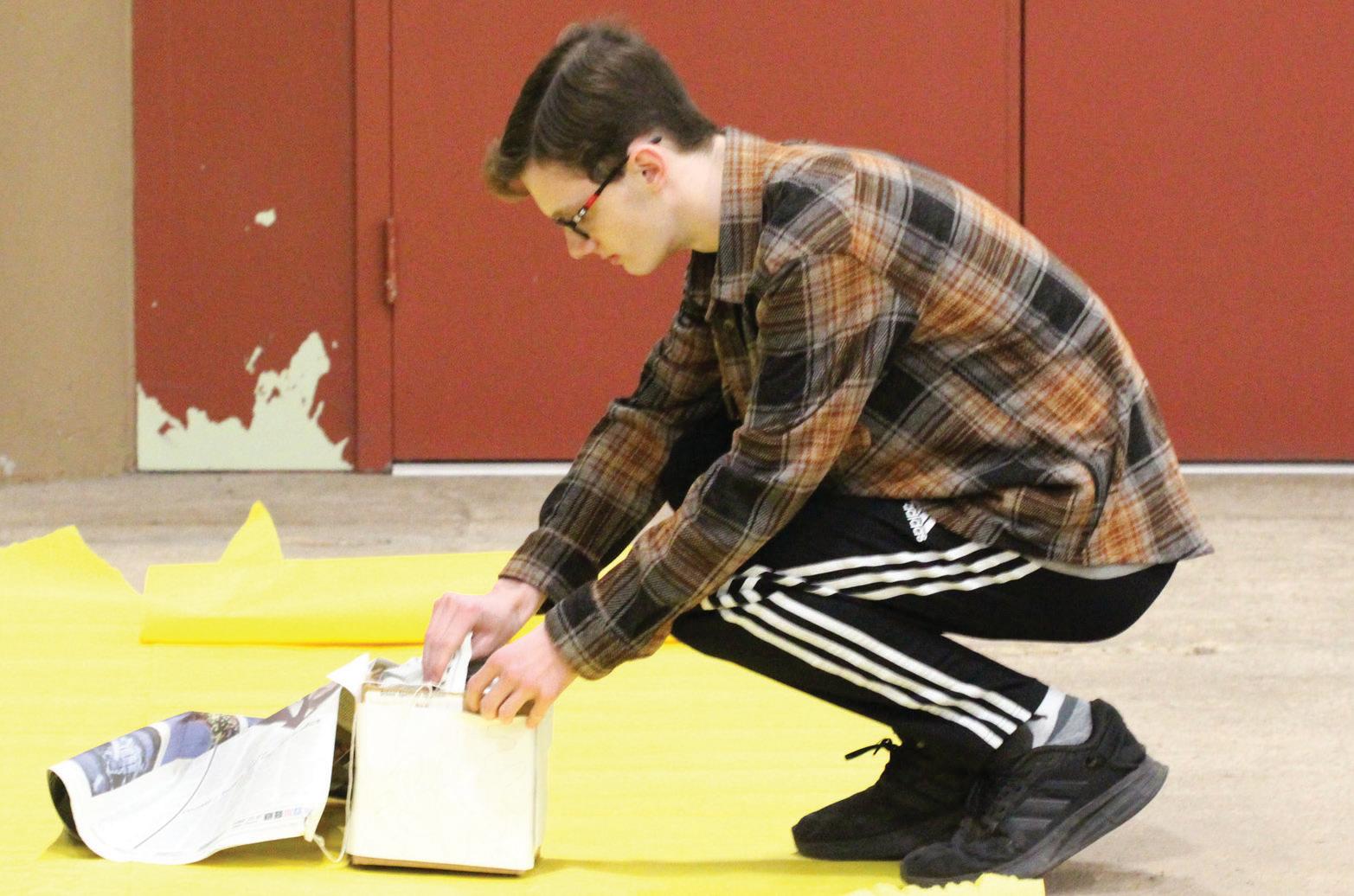
In a creative display of physics and teamwork, the physics students at Bowie High School took on the challenge of creating a structure for an egg to make a two-story drop without cracking.
Students spend the first half of class getting into teams to brainstorm, design, and create a secure structure to place an egg inside of.
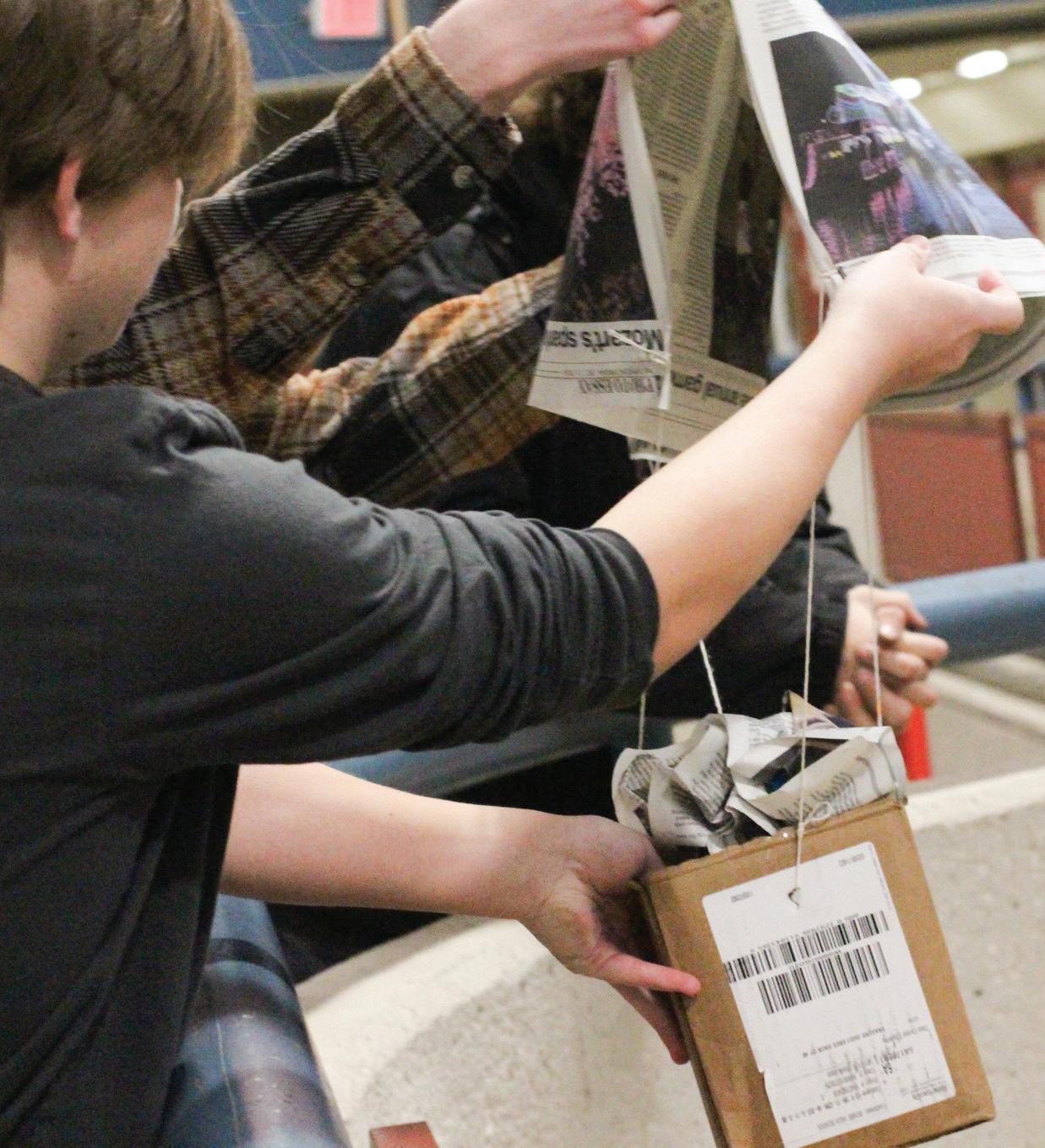
Senior Havia Goulding participated with her team to create a parachute style contraption to softly land from the upstairs hallway.
“I had a lot of fun with my team making our egg cage,” Goulding said. “I was pretty nervous that the egg was going to break but I’m glad our first idea worked because we would not have had time to come up with a new idea.”
The challenge may seem easy, but limited time and materials add more difficulty to the challenge.
“The hardest part was definitely working within 30 minutes and also not really having the ability to test if our parachute will work or not,” Goulding said.
The majority of the grade is for the egg to not break after the drop, but another grade is taken based on the design of the structure. Goulding and her teammates added last minute designs to bring the assignment altogether.
“I just drew a lot on the sides
to make the box look better and less plain,” Goulding said.
Goulding and her teammates used papers to create padding for the egg and a parachute to soften the landing of the box.
“We came up with our idea pretty quickly and we found the materials easily,” Goulding said. “ I think the best part was making a cushion in the box and that was probably what really kept the egg from breaking.”
Many other groups were successful and their egg had survived the fall. Junior Bagel Driscoll worked with her team to create something simple to secure an egg quickly.
“A lot of it wasn’t too bad because one of our teammates prepped us and thought of our contraption beforehand so that was kind of easy,” Driscoll said.
A difficult aspect to the egg drop challenge is finding materials to create a strong enough container to take a big drop. Driscoll and her teammates took advantage of used cardboard in their construction.
“We just used a regular cardboard box and used those cardboard toilet paper rolls to protect the box from impact and absorb the shock so, when we dropped it, the egg wouldn’t take any damage,” Driscoll said.
Recycling cardboard was a common theme for multiple teams because it is very accessible around classrooms. Junior Caden Beard and his teammates had strong ideas that created a smooth experience in construction.
“It was pretty easy and there
was not too much of a challenge,” Beard said. “We focused on the stability of the contraption the most, so we went with a really easy design.”
After teams test their design and drop the egg, they are required to create equations for velocity depending on their results.
“The equations were a lot easier to do since our egg didn’t break,” Goulding said. “Knowing that the equations are a part of the grade, it added extra pressure even after having to make an egg contraption in a short amount of time.”
Beard and his team had ease with the equations, but a hiccup in finding the right materials in enough time. Since multiple teams are using similar materials, it can be difficult for teams to find what they need and still have an original idea.
“The equations were not that bad at all, but it took us a while to find what we needed to make a parachute,” Beard said. “We had our simple box design figured out, but we couldn’t do anything to make a parachute until we found papers.”
Goulding expressed that all teams found success in the well rounded assignment that challenged the creative minds of students with physics, math, and limited time.
“I learned a lot from this assignment and enjoyed being able to be creative and also have fun,” Goulding said. “I hope this assignment should continue on in the future because I think it’s a really good lesson.”
Photo
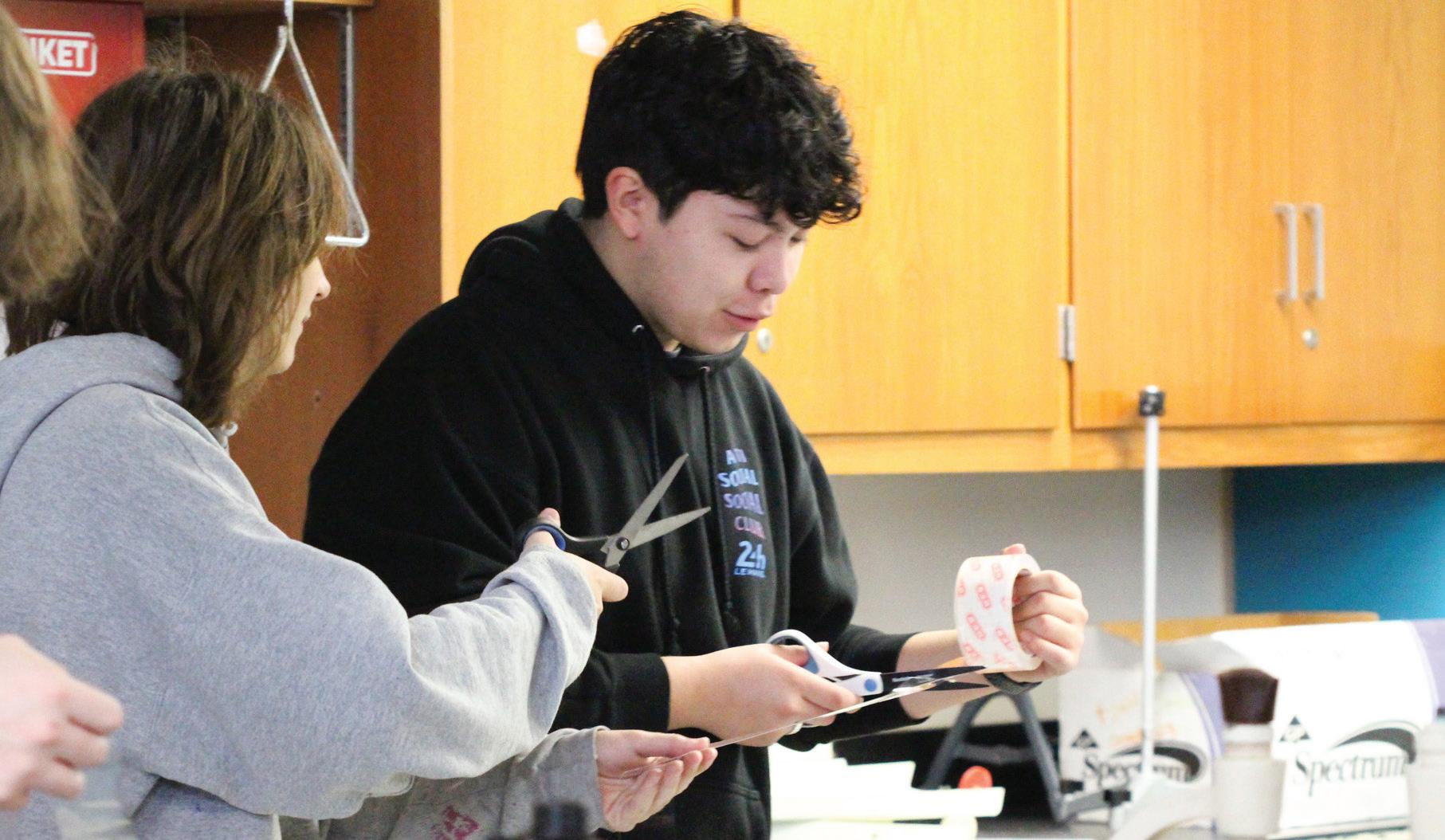
TEAMWORK: Students collaborate on their egg contraptions while taping together boxes. Since teams are given about 50 minutes to design and make their egg container, teamwork is used to get work done. “Working in teams made the process much better because we could all work on individual things at once,” senior Havia Goulding said. “It would have been way more difficult if we had to do it alone.”
PHOTO BY Arden Ray
ORIGINAL DESIGN: A physics class team creates a net-like structure to catch an egg from the balcony drop. Teammates used paper and their own belongings such as a scarf and jacket. “I thought the next one was super cool and definitely an original idea,” senior Havia Goulding said. PHOTO BY Arden Ray
THE BIG DROP: Caden Beard and his team prepare to drop their egg contraption from the second floor of the hallway. The team tested the parachute many times by dropping it from a shorter height. “We went with a parachute because it made the most sense with the box we designed and we had extra paper,” Caden Beard said. PHOTO BY Arden Ray
MOMENT OF TRUTH: Junior Caden Beard hurries to check if his team’s parachute box prevented the egg inside from breaking. Caden Beard, Havia Goulding, and their team were surprised to find out that their egg survived the fall. “I was so glad the egg did not break,” Goulding said. “It’s a big relief to know that our idea worked because we would not have had time to change it.” PHOTO BY Arden Ray
ARTIFICIAL INTELLIGENCE
AI takes a seat in the modern classroom
The use of AI in the educational environment, and its impact on students
Elizabeth Yowell Junior Editor-in-Chief
‘What can I help with?” lingers on the screen. While working on a math assignment, junior Caleb Morello prompts an Artificial Intelligence (AI) program to break down the steps involved in a problem he’s struggling with. In less than a second, Caleb is met with a terse and meticulous breakdown of every step.
A 2023 survey administered by the college testing nonprofit ACT found that 46% of students in grades 10 to 12 use AI services like Chat GPT, Dall-E 2, Bing Chat and others. As artificial intelligence technology continues to develop and grow in popularity, students and teachers around the world are learning to navigate its place in the educational setting.
“I see AI tools helping students in ways in the classroom and education,” CTE teacher and Animation club sponsor Andrew Nourse said. “In general we are becoming more online based, and there are more digital and AI tools that could help, But also, I think they can harm students in terms of creativity and individuality. But there's a lot of benefits. There are pros and cons.”
NEW WAYS TO LEARN
There are several ways that AI tools can be and are being utilized in the classroom setting. A 2024 report co-written by Harvard’s Center for Digital Thriving, Common Sense Media, and Hope Lab reported that help with school work was the third most popular use for AI of those aged 14 to 17, just after getting information and brainstorming ideas.
“If I got something wrong on my math assignment, I’ll look back at my notes, if I can’t figure out what I did wrong from the key, I'll run it through an AI,” Morello said. “If it gets the answer right, maybe one or two because of the difference in rounding. I’ll follow it’s steps and say ‘ok this is how I do it for the rest of it.’” Similar to Morello, the Harvard report mentions students who remark that using AI to facilitate learning helps them ask questions without feeling pressure. However, the report also cites several teens who report that they abuse, or know someone who abuses, AI to cheat on their schoolwork.
“I've seen it used in two different ways,” Morello said. “I've seen it used as a helper. For example, let's say you can't call anyone at the moment, or your parents can't help you, or you're not at school, and you need help with something, you can use AI to teach you. But there's also the case where some people just finish assignments with it. They say, ‘do this for me’ and then copy and paste a few things.”
“I think that there will be a catch with everyone at whatever point, whether it's like a lesson talking about guardrails that are in position in school,” CTE teacher Cheryl Navarette said. “You have to defend the paper that you wrote, not just turn in the paper, because then you have to demonstrate your understanding of what you presented. So, that's a place where you're going to get called out.”
In California, guidelines for AI use in the educational environment are executed at the state level. The California Department of Education published a page on their website dedicated to providing guidelines for AI use in California schools. This page highlights the importance of teaching students to use AI tools in a responsible, respectful, honest, and safe way.
“It hinders learning, especially if you use it a lot,” junior Lexi Chavarria said. “If that's your main go-to when you get an assignment, just going to chat GPT and being done with it, I think it hinders learning for sure. I do find myself using it. I try not to use it often. I usually will try to use it if it's something I already know how to do, and I just want to be done with it. But there are definitely people who will just use it without taking any notice.”
STUDENT CREATIVITY
A concern of many students like Chavarria, who takes both upper level graphic design and animation classes, is the use of AI in the creative field. Students have the chance to learn about and develop the skills to create artistic content they feel passionate about in school. However, many AI tools are eliminating the need to learn those skills.
“It's so unethical, I use it, but it's so unethical, especially when it comes to human core values,” Chavarria said.
“When a human creates something, it’s made with a lot of passion. But AI creating something, generating music, writing something, or anything like that, it just doesn't have passion.”
“It's so unethical, I use it,but it's so unethical especially when it comes to core human values.” Caleb Morillo Junior
According to the Harvard report, concern about job opportunities as AI seeps into different creative industries is one of the largest worries of young people like Chavarria.
Generative AI saves both time and money in the art industry, which eliminates the creative roles many students have developed skills in and are passionate about.
“I think it is a harm to your culture, to society in general, in terms of creativity, especially,”
Nourse said. “It's a concern for students that want to pursue something like this, with the likelihood of AI taking over jobs, or already decreasing job openings and that sort of thing, so it's definitely a threat to careers that are based on creative content.”
As of 2024, the Austin Independent School District’s Responsible Use Policy states the expectation that students in the district are required to be honest and transparent when using digital tools like Artificial Intelligence. The policy also states that these tools should be used in order to ‘support’ students’ learning.
In a 2024 survey conducted by the Society of Authors, 26% of illustrators report having already lost their jobs because of generative AI software. In addition, the survey reports others in many different creative fields, like fiction writers, anticipate their jobs being affected negatively by generative AI.
“AI can do animation already, and that’s gonna reduce the cost of films, they're predicting like 90%,” Nourse said. “So, if a film that used to cost $20 million only cost $2 million to create, what happened to all those jobs and all those people that were involved in that? And so then it almost makes us like a work-less society. That's a concern.”
uncertain because of AI’s Influence.
“People take a lot of stuff for granted, things that are actually human made,” Chavarria said. “It's important because that's how people express themselves. So, I feel like, if AI becomes more and more of a problem, people will take things for granted. And everything starts to have less value.”
REGULATING
Artificial intelligence technology continues to develop with seemingly little guidance or direction. Discussions about regulation, especially in the educational environment, are becoming increasingly relevant. The Association for Career and Technology education published a guide for CTE teachers like Nourse and Navarette, arguing that in order to welcome AI into the classroom environment, students must be taught how to utilize it in a manner that ensures they are still learning and understanding skills essential to the CTE curriculum.
“In our classroom, in graphic design, there's plenty of room for AI, the software that we use,” Navarette said. “Adobe Photoshop and Adobe Illustrator both have built in generative AI features now, and so I allow use for students. We have altered assignments to allow for the use of generative AI, but I've also had to figure out what those limits are.”
“I think it is a harm to your culture to society in general, in terms of creativity especially.” Andrew Nourse
Bowie CTE Teacher
Students like Chavarria who have learned the skills to create digital art and want to pursue a creative career, will enter the workforce at a time where the type and quantity of opportunities are
As of late 2023, only the states of California and Oregon had provided official state-wide guidance to schools to regulate AI use, according to the Center on Reinventing Public Education. Since then, AI has only become more prevalent in the classroom, especially generative AI and AI tools like those recently added to Adobe platforms.
“Most teachers are against it, I’ve seen, but there are a few that kind of have the idea that we can't really do anything now,” Chavarria said. “We can't get rid of it, so might as well adjust to it. It puts the limit on something that is a very powerful tool and that can be easily misused. It puts a limit on it, but still allows students to use the tools that they are given."
According to the Harvard report, 41% of young people ages 14-22 believe AI will have both positive and negative effects on their future. Others in the report are worried about
AI becoming too advanced for human control.
“It needs to be regulated, but I don't know if it's possible,” Nourse said. “It's a competitive environment and a competitive industry. We have all these different countries and companies producing all this AI, and they're trying to advance it as fast as possible.”
As Caleb finishes his math assignment, he thinks back to a few years when this kind of technology wasn't accessible at the click of a cursor. Putting his assignment into his folder, he wonders how different the educational world will look in the next few years.
“I think the cat’s out of the bag, and it’s never going back in and we just have to figure out how to roll with it,” Navarette said. “I think that fearing it and trying to control it are futile. We can just move forward and figure out how to utilize it.”
Students
% of students who use AI in different ways:
Manifesting and affirming
Liberty Pittman Junior Editor-in-Chief
Laughing cheerfully as he starts his lesson
Charles Stampley exudes positive energy.
Whether making jokes about food from Sonic, calming down students panicking about grades, or showing genuine interest in his students personal success, Stampley remains a steady positive force in the lives of many that he interacts with.
Stampley is a former member of the U.S. military, and would help build up soldiers’ self-esteem helping to find positive light in a world of negativity.
Stampley now uses those skills as a history teacher, building up the students and staff around him.
“It’s important to be grounded in the real world and understand that bad things are going to happen,”
Stampley said. “Bad things are going to happen to good people, and being prepared to help in those circumstances, helping yourself, helping your friends is important. Not everything is good every day.”
er risk of heart failure, fewer chronic illnesses, and reduced risk of hypertension.
“Recently, there is a larger awareness of the impacts on mental health,” Croll-Guard said.
“We can thank a few high-profile athletes for their bravery in addressing their mental health issues under public scrutiny, Naomi Osaka and Simone Biles. They both did an amazing job of humanizing the fact that mental health can have huge impacts on an individual and that it is important to address mental health in addition to physical health.”
MINDFULNESS AND AFFIRMATION
being affirmed or confirmed.
“I’ve had a lot of experience helping other people, not just students, but soldiers and employees,” Stampley said. “I’m familiar with helping students, so if a student has a bad day, or something bad happens at home can try to help find the positives in that person. If somebody is doing really good in school, but something bad happens at home I can tell them, ‘Hey, you’re doing really good, you have a bright future’.”
“ think of manifestation almost like praying, but not in a religious way.” Gavin Suskic
results people can set both short term and long term goals, and they can set SMART goals which stands for specific, measurable, attainable, relevant, and timebased goals.
Positive practices have a variety of long lasting impacts on mental health and physical well-being (Remove the background layer)
Stampley helps others remain positive by being positive himself. In the modern world there are many practices people can use to focus on and bring more positivity into their lives.
According to the Berkeley Well-Being Institute, positivity is the continued action of being optimistic or positive. That includes positive emotions, thoughts, and behaviors. However along with true positivity which is fostered through healthy positive habits, there is also false positivity which can feel forced, and can just be used to suppress other negative emotions. The Berkeley Well-Being Institute pushes an ideology that positivity may only be good for those who are genuine about what they are feeling.
“Positivity can impact memories,” psychology teacher Diana Croll-Guard said. “There is a concept in psychology called mood congruence which states that someone’s current mood will help elicit memories that match. For instance, when someone is happy, they are more likely to recall happy memories. When someone is angry, they will have a stronger recall of other instances when they had that emotion.”
Positivity can impact mental health in many ways. According to the University of Pennsylvania Online LPS, the serotonin produced when a person thinks optimistically can actually have a calming or focus effect. Furthermore, positive emotions can activate a person’s prefrontal cortex stimulating problem solving and creative thinking. According to the Business Insider, positive thinking habits can also have long term physical benefits such as low-
One thing that is important for maintaining positivity is mindfulness which is being aware of thoughts, emotions, and things going on in the surrounding environment without making judgments. According to the University of Pennsylvania Online LPS, it is important for people to disengage when they realize they are around negative environmental stimuli such as a negative work environment, group of people, or continuous news involving crime and hatefulness. It is also helpful for people to avoid negative thought patterns including perfectionism, minimization of positive experiences, and over-generalization of negative experiences.
Another form of affirmation is self-affirmation. Self-affirmations are similar to mantras, and according to MentalHealth.com, are statements which positively assert someone’s worth. According to the University of Pennsylvania Online LPS, positive affirmations can re-frame negative thoughts, and the act of engaging in positive self-talk can be motivating, can improve state of mind, and can reduce worry.
“When someone is happy, they are more likely to recall happy memories.” Diana Croll-Guard
“Mindfulness to me is being content with where am, or what’s around me, just staying calm and knowing that I’m going to be fine,” junior Gavin Suskic said. “It’s important to step back and just chill out for a second to be like, ‘Okay, I’m good, I’m fine’, and to just be mindful for a little bit. feel like it’ll help to not feel so stressed or overwhelmed in the moment.”
One practice commonly related to improved mindfulness is meditation. Meditation, while often represented by a person sitting with their palms facing up resting on their knees, is actually a term that refers to a variety of practices.
According to National Center for Complementary and Integrative Health (NCCIH), meditation is meant to focus on mind and body integration and often include maintained focus on breathing, visuals, phrases, or sounds. Based on data from a 2012 survey done in the U.S., utilized by NCCIH among those who responded that they practiced meditation 73% claimed to meditate for their general wellness, and 92% claimed to meditate for relaxation or stress reduction purposes.
“Meditation is focusing inwardly, emptying your mind of all external stimuli and breathing deeply,” Croll-Guard said. “One of my favorite experiences with meditation happened in grad school. One professor would always have our class start with a quick meditation mindfulness practice. The quick meditation at the beginning of class helped us focus on our class material better afterward because we were not thinking about everything else in our lives we were carrying with us into the space.”
“Affirmations are just a way for someone to keep building themselves up, it’s really all in the mind,” sophomore Mallory Hartono said. “Affirmations are a good way for someone to keep positive about what they’re doing, like when someone gets down and they’re about to give up, affirmations can definitely help with that. normally just keep telling myself, there has to be some way around it. There’s no set way to find something. I always tell myself, there has to be another way, If this way doesn’t work, it’s fine.”
MANIFESTING AND GOAL SETTING
One practice that can be related with affirmation is manifestation. Manifestation, according to MentalHealth.com, is the process of using focused thoughts and actions in order to bring certain desires into reality, which often involves visualization and goal setting. Manifestation can be used to overcome negative thought patterns such as catastrophizing which is the act of assuming or imagining the worst possible outcome for a situation. However, manifestation is not magical, because goals still often require actual action in order to be achieved, meaning manifesting a 100 on a math test may not actually have that result.
“Affirmations are just a way for someone to keep building themselves up, it’s really all in the mind.” Mallory Hartono
Sophomore
“Manifestation is like wishing for a positive result, or the best results of something,” Suskic said. “I think of it almost like praying, but not in a religious way. think realistically manifestation has an effect of making people more optimistic. think of it more as a short term thing. For example, when manifesting my group does good on a quiz, I don’t believe that there’s a way that something would change the results, but it makes the people around me feel better and have more optimism.”
Something that can help people feel more confident and secure with themselves is positive affirmation, which Oxford languages defines as emotional support or encouragement.
Affirmation can also be defined as something
Something that can help manifested dreams come to fruition is goal setting. According to PositivePsycology.com, goal setting can improve performance, persistence, task enjoyment, effort, and self-esteem. According to CALE Learning Enhancement, for the best
“Goal setting is a very important, and a good thing to do, because if someone is just wandering around life, not really knowing what they’re doing and what they’re going for, I feel like that’s a very aimless thing to do,” Hartono said. “Wandering aimlessly without knowing what to do can also become negative, because then someone can start wondering what is my point in life, or what am I doing? It can bring out those kinds of aspects in life, and cause someone to feel lost.”
One well known example of goal setting is New Year’s resolutions. At the start of the new year many people come up with intentions for the year ahead whether to exercise more, eat less sugar, or just be nicer. Although many people set goals for the new year, many people also quit their goals soon after with national quitters day landing on the second Friday in January.
“People shouldn’t have a set time for when they want to set their goals,” Hartono said.
“People should be able to make their own goals whenever they want.
Setting it up where someone will do a goal once a year specifically on New Year’s, makes it feel like they have to wait till they get there, and kind of waste time until then. I don’t think setting a New Year’s resolution is really that useful.”
Another activity that many people participate in at the start of the new year is the creation of vision boards.
GRATITUDE AND EMPATHY
Along the path of life every human being experiences some good, and some bad. One practice that is often talked about when considering a positive attitude is gratitude, which is the state of being grateful or thankful. According to PositivePsycology.com, the practice of gratitude whether saying thank you or keeping a gratitude journal can improve empathy, interpersonal relationships, stress, anxiety, and depression bringing people more happiness in daily life and even in some cases reducing feelings of pain.
“If someone goes through life just being thankful for the little things they’re going to see all the positivity around them, it’s huge,” Stampley said. “That’s one reason why I’m so positive and thankful for little things, because I’ve been in situations that aren’t positive. I really don’t take things for granted.”
Many practices related to maintaining a positive mindset such as manifesting and gratitude can also be associated with some form of spirituality. Some define spirituality as being concerned with the spirit rather than material things, some define it as a belief that there is something bigger than everyone that connects everyone, and some connect the idea of spirituality with religion. While acts like gratitude can relate to spiritual or religious acts like prayer, positive practices are separate from religious ideas, and one does not need to be religious to practice different forms of positivity.
“If someone goes through life just being thankful for the little things they’re going to see all the positivity around them, It’s huge.”
Vision boarding is an activity done year round, and is typically a collage of images, words, quotes, and other decorative items which can be made physically or digitally. Vision boards can be a way for people to physically visualize their goals. According to BetterUp, vision boards can be used to manifest goals, and frequently reviewing the board can help reinforce goals and possibly increase motivation.
“I love vision boards,” Suskic said. “I like making them visually appealing, and then also having some goals in mind, or general feelings of where want to go, keeping in mind whenever the vision board is set to, whether it’s long term or short term.”
According to Culture Works, working towards and achieving goals helps with self esteem, creating a growth mindset, and learning about individual strengths and weaknesses.
Culture Works also states that celebrating achievements is important for maintaining motivation and fulfillment when working towards goals.
“I feel very happy and satisfied when I’ve met my goals, and I feel like I should try to make more goals that will make me reach beyond that to get be the person I want to be,” Hartono said.”My vision board is more of things I’ve been proud of, and what I’ve accomplished. That way I can see how I’ve progressed and where I need to go. like having boards to see what I’ve done, so I know myself, I’ve made progress, I’ve done this, and I can do more.”
“Spirituality means different things for different people,” Stampley said. “For a lot of people it means religion, but you can manifest and meditate and spend time alone for non religious reasons. Just thinking about the bigger things in life, besides the daily grind is important.”
Having a positive attitude can affect an individual’s mental health, but Michigan State University Extension writer Ann Chastain also states that those surrounding a person with a positive attitude can be affected by it as well.
“Positivity is just the act of being positive to not only yourself, but to others,” Hartono said. “It’s important to be mentally aware that you’re in that mindset of being positive and that you should act that way to other people, because other people can be affected by how you’re feeling, whether you’re positive or negative that day. You need to be aware that other people can feel what you’re feeling, especially with empathy being a sense on people’s emotions. I think positivity is just keeping yourself in check so you don’t affect others with your thoughts.”
SPORTS 10
Hoopers against Golfers
Girls basketball team takes on boys golf in a friendly scrimmage
Michael Vienneau Sports Editor
Every morning before the halls are filled with students, the Lady ‘Dawgs basketball team fills the gym with intensity and work ethic, in order to become the best possible version of themselves. Coach Iesha Collins turned to the Bowie boys golf team in an attempt to push the girls to their limits, using them as a scout team.
Junior forward Grace Guzman has been a starter on the Lady ‘Dawgs team throughout the whole season. She has been able to see several different scout teams throughout her three year tenure as a member of the varsity Lady ‘Dawgs basketball team.
“It definitely is helpful having scout teams,” Guzman said. “You get to play a team that is taller and faster than we are which makes us play harder and makes us more physical and tough for sure. I think the biggest advantage is just being able to run our plays against a team that doesn’t already know them. When we scrimmage our own team, it is easier for players to jump the play and get a steal which is not always realistic to game situations.”
Along with the Bowie boys golf team, the Lady ‘Dawgs have also been able to compete against the freshman boys basketball team, as well as the boys basketball managers dating back to last year.
“I like that Collins keeps giving us new scouts,” Guzman said. “I think it is mostly very helpful, the only downside would probably just be an increased injury risk. When you play guys who are a lot taller and stronger, but less skillful, you get some reckless moments which can create injury risk for the scout team and us as well.”
One of the members of the Bowie boys golf team that participated in the game is senior Jack Considine. Considine is a third-year member of the golf team and has his fair share of basketball experience as he played his freshman year.
“It was a lot of fun getting to play against the girls team,” Considine said. “We all had fun with it, we dressed up in jerseys and made it an overall funny, and light-hearted experience for us. I think we were all a little anxious to see how it turned out and how we competed, but I will say it went well on our side of things. I was just glad to suit up with my boys.” The scout team starts in a typical 5-on-5 half-court format. Both teams get three possessions on offense and switch off with one another. The coaches then had the scouts learn the upcoming opposing team’s offense,this was to help prepare the Lady ‘Dawgs for their game against Lake Travis the following day.
“Learning Lake Travis’ offense was confusing but also valuable,” Considine said. “I was definitely very confused at first, but I think we all kind of got the hang of it, once we ran it a few times. It definitely helps that we were all former basketball players. I think it was helpful for both sides and as soon as we learned their offense we really started pouring it on them. None of them could guard me.”
With district play coming to a close, it is likely that there will not be another chance for the scout team to perform. The ‘Dawgs finished the season going 10-2 in district play and 24-9 overall. Finishing second place in the seven-team bracket.
“I think individually my goal is to just keep pushing on defense,” Guzman said. “Playoffs are starting soon, and as a team, we are going to try and push and make a deep run. The scout teams have helped us get to this point and now our goal is to just play the best basketball possible.”
SOFTBALL
Softball’s awaited dynamic duo
Freshman Ellie Lauer and coach/father Karl Lauer take Bowie by storm
Caroline Baxter Sports Editor
Going up to the plate; getting ready to bat; getting a pep talk from her coach, all things normal for varsity softball player Ellie Lauer. However, in her special case, her coach is her father.
Lauer is a freshman and having her first experience playing varsity for Bowie. Having her dad, coach Karl Lauer right there with her along the way is something she appreciates.
“I think it’s fun to have my dad coach me especially because he coaches the same sport I play,” Ellie said. “It’s good that I get to be with him and he can help me.”
Karl sees coaching Ellie as something special to him and something he enjoys. Ellie has been in the softball world with him since she was in elementary and he has been waiting for her high school career.
“It’s extremely special to be coaching her,” Karl said. “She has grown up around the Bowie Softball program since the day she was born. It has been her dream as a little girl starting out in T-ball to be a part of the Bowie softball team.”
With Ellie being a part of Bowie’s softball team and her dad coaching, there are benefits and downsides. Ellie believes it is good to have a mixture of both.
“The benefit is that I feel more safe, like if I mess up he will still get on me but it’s less pressure,” Ellie said. “The downside is that everyone thinks I get favored because he’s my dad.”
The relationship between a child and a parent differs from the relationship between a coach and an athlete. However, on the field, Karl thinks of his daughter as just another one of
“When we are out there, she is part of the team just like anyone else, and I treat her that way,” Karl said. “In the past when I have coached her, I have tended to be harder on her than anyone else. I feel as though I have been better about it now that she is part of the Bowie team.”
Ellie enjoys that her dad lets her be herself on the field, but this doesn’t mean he doesn’t push her. She practices in her free time with the help from her father.
“If I am sitting around and not doing anything he will tell me to go practice,” Ellie said. “If I am messing around during practice he will tell me to focus and it helps me stay on track and get better.”
According to NCSA, it is more common for freshmen to be put on JV than varsity. Junior and varsity teammate Josie Busceme backs up Ellie in earning her spot on
varsity as a freshman.
“Ellie has worked very hard during this fall to earn her spot on varsity for this season,” Busceme said. “She had a high expectation from the team knowing she was an incoming freshman who was the ‘coaches kid.’” Ellie knows she has worked for her spot on varsity. She said she is grateful for the opportunity and is excited but nervous for her first season at Bowie.
“It feels great to be on varsity, but games are definitely scary because you don’t want to let the coaches down,” Ellie said. “It’s good that there is other freshman on the team so we can experience this together.”
Busceme believes having a good relationship with their teammates is a big part of sports, and loves to play with Ellie, and enjoys what she brings to the team.
“Ellie has a very outgoing personality and definitely brought a positive goofy vibe to the team,” Busceme said. “Besides her being a great teammate, she is a great player and you can always
TRACK
count on her on and off the field.”
Karl thinks personality grows with time. He has been with Ellie since the day she was born and has admired her growth.
“Other than the obvious fact of how tall she has gotten; I have seen her develop a sense of pride in everything she does,” Karl said. “It has been years since I have asked her if she wants to go practice, she takes it upon herself to work, and work hard.”
Bowie star runner breaks the two-mile record
Eve Johansson Dispatch Reporter
Anticipation soars through the air at the University of Michigan as high school runners from all over America take their marks on the indoor track and wait for the sound of the starting gun. Junior Griffin Hummel takes a deep breath to calm his nerves as he steps on the line, not knowing he’s about to run the best race of his life.
The University of Michigan’s high school track showcase took place this year on January 19. The two-mile race Hummel would run earned him a nomination for MileSplit’s Runner of the Week.
“I feel honored to represent an elite field of Texas runners,” Hummel said. “I was a bit surprised, as I don’t feel like my times are as fast compared to others. However, the recognition reminded me that I am capable of running and competing at an elite level, and I want to use this achievement to prove that Bowie running is a strong team that belongs at competitive races.”
As he prepared to begin the two-mile race, Hummel’s supporters, including his high school track coach Lora Tilson, were cheering him on. Tilson explains that, at first, Hummel wasn’t close to the front at all, but slowly gained ground, one lap after the next. “I watched the entire race,
which was super exciting,”
Tilson said. “He started off at almost the very back of the pack, in 8th or 9th place, and methodically moved up. He seemed to be telling himself to pass a person every lap and by the sixth one, he had moved into second or third place.”
From there, it looked like it was just a question of who wanted to win more. Hummel was able to overtake his competitor and cross the finish line, not only coming in first place but also achieving his record time of 9:19:55.
“I was able to let go of any stress or uncertainty I had and just run, and I let my plan to slowly move up to the front guide me,” Hummel said. “After the race, I was excited because I’d never won a competitive race before. There were a handful of races from the past year where I came in second, but it felt good to finally get the win.”
His success continued when his running time was good enough to get him a nomination for men’s runner of the week in all of Texas. Junior Miah McAulay, one of Hummel’s Bowie running team members, has run with him for years and is in awe of the grit and determination he expresses in every race.
“I am so proud of him because he has put in so much work for this and deserves it, one hundred percent,” McAulay said. “Griffin has such a positive mindset and he uses
it to become a better runner every day.”
According to Tilson, the positive outlook Hummel has and his motivation to get up and work hard when others do not put him in leagues above most other runners his age. She says he is always ready to give his best effort for anything he puts his mind to, which ranges from academics to his sport.
“He comes in every morning hyped and ready, always wanting the biggest high five,” Tilson said. “I think what’s important is that he’s so concerned with everybody, and it’s very rare for him to focus on what he needs to do rather than his ideas for the team. He wants to share not only his successes but also what he’s done to get there with everybody and wants them to feel the same success he’s felt.”
Hummel credits many of his accomplishments to the peers he runs with at Bowie and the coaches he has worked with for years. He expresses that without their constant support, friendly competitiveness, and the team’s lively environment, he wouldn’t be where he is today.
“My past years in Bowie running have helped me discover more about myself and develop not only better running habits but better overall habits and life skills,” Hummel said. “Coach Tilson’s emphasis on consistency and making sure to do the little things is the mindset that has ultimately brought me to this point today. The Bowie running community pushes me to do my best, and I love being able to get to know
everyone and also help them on their running journey.”
Since he is a Bowie High School record holder, Tilson says Hummel has impacted the Bowie running community. She believes he exemplifies that beating times and placing high is only part of a sport.
The other part is attitude and the time willingly dedicated to becoming the athlete you aspire to be.
“His excitement, dedication, and work ethic has become a model for other people on the team,” Tilson said. “He generally brings a very strong desire of not only wanting to be there but also wanting to become better. I’m really, really proud of him.”
SWING OF GLORY: Making contact and crushing the ball at the plate, freshman Ellie Lauer hits to the outfield during practice to simulate big game moments. The Lady Dawgs are preparing for the season that is soon to come. PHOTO BY Cole Wong
SCAN TO SEE MORE
PHOTOS BY Cole Wong
PRACTICE MAKES PERFECT: Striding through the bowie fields, Griffin Hummel flies through the final moments of his run. He is preparing for the upcoming track season as he hopes to get great personal records. PHOTO BY Cooper Ford
SCAN TO SEE MORE
PHOTOS BY Cooper Ford
ELLIE LAUER AND KARL LAUER
PHOTO BY Cole Wong
Senior transitions from court to water
Natalia Portilla gives up basketball in hopes to fuel a successful collegiate rowing career
Michael Vienneau Sports Editor
Pushing to exhaustion and slicing through the water, senior Natalia Portilla began rowing in March of 2024, now less than a year later, her sacrifice and commitment to the sport has now led her to pursue rowing for a collegiate program. Portilla had a unique upbringing to the tranquil, yet intense sport.
“It actually started with my brother going to a practice,” Portilla said. “I went to pick him up one day, he did not end up liking it, but I thought it looked fun so I joined one day. I loved how competitive the sport was and how versatile it was. You can be on a team but also row individually. Ever since I started, the sport has challenged me both mentally and physically.” Due to the extremities of the sport, a rigorous training schedule is needed in order to keep up with the best. Portilla has stuck to a routine that she has found to help propel her up the leader-boards.
“In the mornings I wake up around 7 a.m. to use the rowing machine,”
Portilla said “I eat a healthy high protein breakfast before heading to school to do weightlifting. I also practice after school from 5-7 p.m. where we either go out on the water or do a land workout on the rowing machines. When the weather is poor we will find another workout to do. I also try my best to sleep and properly recover with a sauna and Epsom’s salt baths in order to perform at full capacity.”
Coaches look at a variety of different characteristics to choose the best fit for their team. Physically, coaches typically look for a certain height and weight to best suit their positional needs. Coaches all look for the intangibles as well, such as character, attitude and academics. Most importantly, the biggest factor in recruiting is their times, in order to be successful at a collegiate level, performance is above all.
fully continue to break my own records and pursue it professionally.”
For Division 1 sports, the NCAA provides up to 68 full scholarships depending on each individual school’s funding and the athletic director’s use of spending. According to NCSA sports,There are currently 89 rowing teams in Division 1 and there is an average of 47 athletes per team.
“I started the recruiting process summer before senior year,” Portilla said. “This was the same time I started the process of applying to schools, I spent a lot of time researching every school and seeing if they had a rowing program. I started emailing coaches and filled out questionnaires. To my surprise a lot of them got back to me, and I stayed in close contact with a couple of them.”
Portilla has made lots of sacrifices order to dedicate herself to rowing.
Her most important decision came when she decided to drop basketball, the sport that she has been playing for over a decade.
Portilla was a starter on the Lady ‘Dawgs basketball team before quitting just a few weeks into the season.
“I was not really sure if I fully wanted to commit to rowing,” Portilla said. “I still really loved basketball and it put me in a really tough spot. After talking to several of my rowing coaches, and seeing all the opportunities there were in rowing, I knew that is what I wanted to do.”
Portilla has been developing at the Texas Rowing Center for the last several months. Coach Liz Hiebel has been the main coach that has been helping her transform as a rower, ever since she moved up to the top team in October. The program takes place on Ladybird Lake in downtown Austin.
“My program is heavily focused on increasing the baseline fitness for all the girls on the team and being able to translate that fitness to the water,” Hiebel said. “We work on our strength and resilience at practice every day, but it is up to the individual to push themselves in order to get the times
University of Minnesota rowing program, where she consistently started for several years on the team. This experience has helped her in her new profound coaching career. Including her ability to help communicate with college coaches.
“I have contacts at a lot of schools,” Hiebel said. “The path is very different for every athlete depending on
are looking at. Sometimes coaches reach out to me to ask about a specific athlete. Other times my athletes will reach out to certain schools and the coaches will reach out to me to hear what I have to say about their athletic and academic performance. Either way, my job stays the same, I stay honest with the coach and support the athlete in the really exciting time of recruiting.”
One of Portilla’s biggest supporters throughout her blossoming career is her twin sister Valeria. Valeria has been able to attest to the growth of Natalia by seeing her progression as an athlete since she was young. “I see my sister succeed in everything she does, not just sports, but in school and in life,” Valeria said. “Having her as my twin, we have lived
SCAN TO SEE MORE
PHOTO GALLERY BY Sydney Cotsonas
SOLID STROKES: Natalia Portilla takes deep breaths as she prepares to preform another stroke. Exerting her upper body strength with the goal of pushes the boat forward. PHOTO BY Sydney Cotsonas
PULLING TOGETHER: The boat glides against the water as Natalia and her fellow teammates work hard to be in sync together. Timing is essential to the speed of the boat.
PHOTO BY Sydney Cotsonas
Throughly Theater
Music has a big impact during the processes of a theater performance
Every year, the Bowie’s Starlight Theater Company puts on an exciting main-stage musical. Audiences typically only pay attention to the story the actors tell on stage, but what they don’t see is all of the action going on behind the curtain. While meticulously choreographed scenes take place in front of the curtain, backstage is abuzz with costumes, lights, sound, props, and set.
One of the most crucial parts of the musical process is the actual music. In past years, the Starlight Theater Company's musical has featured live performances from Bowie's Fine Arts Department, made up of members from choir, orchestra, and band. Incorporating live music can, at times, be frustrating for the band members, directors, and actors, but it provides a great learning experience for students involved. When an actor works with pre-recorded music, it can be easy to memorize the tempo and rhythm, but when they work with a live band, they must learn how to follow along on the spot.
Every year, the cast of the musical has a sitzprobe, where they sit down with the band and work together to run through music and get a feel for what the performance will sound like. Even with significant practice time, anything can happen in a performance; tempo can get off, mics can go out, and actors can get thrown off and must learn to recover on the spot.
A live band can strengthen performers by teaching them to adjust their voice, tempo, and rhythm on the fly. It also teaches them how to fix a mistake and keep moving forward. All of the musical participants can learn a tremendous amount from one another.
While the live band spends most of their year learning how to produce many different types of music, the musical is a unique experience for them. Learning how to follow along with the actors and their lines can be tricky because they have to know every cue for a two-hour show.
For example, having the sitzprobe is helpful, but it cuts about two to three rehearsal days for the actors, which can make a huge difference when it comes to assembling a musical. Having a live band can also create more complications with the sound booth. With tracks, they can easily turn the volume up and down, but with a band, they must ensure everything is balanced while maintaining consistent volume.
Having a live band can cause stress for the actors because runs are often unpredictable. Although having a live band adds a level of difficulty, it teaches students valuable lessons like working with others, being quick on their feet, and fixing mistakes while maintaining a positive mindset. Even though tracks are simpler and more predictable, a live band can give students skills for the future.
Student creativity conquers
Kids in visual art classes construct masterpieces to be evaluated
Bentlee Toland Entertainment Editor
Making careful brushstrokes junior Amelie Baker swirls acrylic paints together to reveal her final VASE piece. The Visual Arts Scholastic Event (VASE), is a Texas visual art competition where students submit their artwork to be evaluated by a panel of judges. According to Baker, artists can submit two pieces each year making it similar to a UIL competition.
“Art has always been a creative and emotional outlet for me," Baker said. “I like working with materials that I am not familiar with, like oil pastels or watercolor and VASE helped me with that. VASE also helped me socially. I have always made friends at VASE and it's nice to just meet fun people and create something new”
High school students from throughout Texas can take part in the event. Students do not need to be enrolled in an art class to enter VASE, however a sponsoring teacher must sign off on the student's entry.
“I've submitted two paintings in the last three years,” Baker said. “But right now I'm working on two new acrylic pieces. Both of them are a different, so I get to have a wide spread of styles, and analyze my methods of making them.”
Since the competition started 25 years ago, the entries for VASE have risen to over 35,000 per year.
Participants not only create artwork but also write about their creative processes and their understanding of visual art. Contestants are judged on a one to four scale, with four the
highest score. Artwork is judged based on originality, technical skill, understanding of art principles and interpretation of the artist's intent.
“There's two categories of scoring to get one through four," junior Lily Pierce said. “The first category is the actual art and application and like, technical ability. The other half is the ability to talk about the art piece. I have to be able to create that balance. I made a four every year I've done it, but I've not made a state, unfortunately.”
Students who receive a four can be chosen to go to state by judges, who pick a select group of artists. Artworks that receive a four are awarded a Regional Medal. Some of the top-rated artworks are eligible for the Gold Seal Award based on the judge's decision. The gold seal award is known to be the highest honor in VASE. If students don't get a four, they receive a certificate for participating.
“I started in freshman year and had my two pieces selected to go to state,” Baker said. “They sit down with your piece and ask you all the questions you have to compose for it. I've gotten great scores for the past few years, which have always been a big confidence booster. It makes me want to continue to make art when I know someone in the real art world is approving.”
Students can submit a variety of artwork for the competition. They can create 2D artwork using hand-painted pieces or paper and fabric scraps. There is also the opportunity to create 3D artwork using natural elements like flowers. The wide range of options allows
each artist to express their creativity in a unique way.
“I'm trying to experiment with new ways to use acrylic paint, while also highlighting the people that matter in my life,” Baker said. “Both of the paintings I submitted were of friends. One of them is inspired by our Western dancing club. Both of my friends are from different cultures and have bonded over Western culture. Being part of the South brought them together and they ended up being friends, so I painted a cute action piece of them moving around. The other piece I made is of my friend eating food in front of me.”
VASE can be a great way for artists to express themselves out there but some students feel the opposite. Entries are not allowed to feature explicit content according to Pierce; it can make students feel censored. One rule that stands out to Pierce is that artworks cannot display any sexual content.
“I have conflicted feelings about VASE,” Pierce said. “There are certain rules like, no gore, no nudity, which make me wonder, why are we censoring art? It's not meant to be disturbing or shocking. It's meant to be something beautiful and make a statement. It's like that because it is a school-related competition, which is unfortunate. They also don't typically prefer fantasy, they prefer human subject matters. If you have a different art style than what
they prefer you're not gonna do well which is unfortunate.”
One thing that most students coming to Vase can agree on is it’s good for college scholarships. Over 30 students in 2023 were given college scholarships with money ranging from $100 to $1,000. With 14 different types of scholarships given out to students depending on what they submitted for the competition.
“You do get opportunities for scholarships," Baker said. “If a student goes to state multiple times it's proving their success. It makes people put themselves out there, I have to think about how I want to be perceived and how I want to sell myself. Presenting myself is a big social skill."
According to the University of Florida’s College of the Arts, art can foster self-expression, allowing students to connect with their identities and manage their emotions, leading to a better social life for students. Junior Andrew Lee notes that participation in VASE can enhance social skills as well as boost academic achievement.
“VASE is a great chance for artists who want to display their artworks while getting new skills not only socially but academically,” Lee said. “It looks good on college applications and gets your work acknowledged. Overall, I enjoy going and value the knowledge I gain.”
Alice Goss Dispatch Reporter
Culinary students rush around the kitchen, hurriedly prepping over 50 meals for Bowie’s staff and teachers. The hearty aroma of Polish food spreads through the air as students get ready to open their own restaurant for the day.
Pop-ups at Bowie have been a long standing tradition in the culinary program, these events occur periodically throughout the year, heavily in the second semester. For this to happen, seniors and the occasional junior get the opportunity to gain restaurant experience in the culinary kitchen.
“As a team, we create the menu and bring it to fruition,” Advanced Culinary and baking teacher Ricardo Howard said. “The students also work on the dining room, the theme, the decorations, and all of the recipes for the event.”
The students spend their junior year in the culinary program gaining experience and working to earn their spot as pop-up leader their senior year. They do this by helping other seniors prep the food for their own pop-ups, working under pressure, and completing tasks on a timeline. Towards the end of the year the students can start to plan their own pop-up after seeing how much work goes into it.
“A lot of seniors who come back after their first year are really excited, so their presentations can be very nice,” Howard said. “And they are showing me more than their culinary skills, they need to be able to calculate all of the ingredients and how much of each is needed, as well as thinking about ways to be cost effective with their recipes.” Howard, or Chef Ric as the students call him, has helped maintain
the program and develop the program into one where juniors get all the experience and guidance they need to be successful in leading their own pop-up. The final experience is meant to simulate a real life restaurant which is a common practice used in culinary schools.
“I feel much more prepared this year after I watched and worked under a number of seniors during their popups last year, and saw their respective
methods, their shortcomings, and what needed no improvement,” senior August Mosel said. “I give so much credit to Chef Ric and my mom, two of the most patient people in the world.”
On January 23, senior culinary student Maya Dudek got to open her Polish pop-up. She had to open on short notice combating weather delays and other conflicts, she only had two days to prep, compared to the customary four.
“Leading the restaurant with such little time was definitely a little stressful, but honestly I work really well under pressure, so we were able to finish prepping in time,” Dudek said.
“I decided to do Polish food for my pop-up because of my Polish culture. Both of my parents were born in Poland, making me first gen, and I found it surprising that Polish food is not common here. I wanted my pop-up to be more unique, so I thought this was perfect.”
Another pop-up coming in the near future is being led by August Mosel, who plans to serve dinner cuisine like burgers.
“I wanted to create a pop-up that would give you the same dining experience you would receive if I were to invite you to dinner some night,” Mosel said. “I chose to make food that we make in my home often simply because it’s my favorite. I actually intend to go into finance, and in my application, I talked about the pop-up planning process, and how we price and plan for costing our menus.”
Culinary pop-up season is a time of year that students and teachers look forward to, they allow students to be creative and can give each student great experience for real life and college. The culinary program here at Bowie plans to continue these events for the benefit of its students.
“I love pop-ups and how personal each of them are,” Dudek said. “They are all based on the food and people we love or places we’ve been. Everyone works hard to execute their pop-up and we love seeing the food bring people together.”
ACRYLICS APPEAR: Bristle by bristle junior Amelie Baker carefully puts the last drops of acrylic paint on her VASE submission. Baker's art pieces are inspired by the joy in her friends. PHOTO BY Bentlee Toland
PERFECT PASTRIES: Zachary Pasley gives a customer a freshly made Neapolitan cookie. Culinary students sold four different pastries for $3 each at the event PHOTO BY Chance East
Gracie Ruland - Dispatch Reporter
PAINTS POP: Colors shine and shimmer ready to be showcased at VASE. Amelie Bakers second submission was inspired by her friends dancing. PHOTO BY Bentlee Toland
SCAN TO SEE MORE
VIDEO BY Ryan Zuniga and Arlo Stockstill
The unsettling and gory film, Nosferatu
An unauthorized adaptation of the 1897 novel, Dracula, hit theaters in late December
Eleanor Blue Review Editor
The original Nosferatu premiered in 1922 as a silent, black-and-white German horror. This expressionist masterpiece is now over 100 years old and yet, still manages to stay relevant.
In many ways, Nosferatu was the film that we were never supposed to see. Before depictions of the undead villain haunted theaters worldwide, copyright issues lingered in produc tion. To create the movie, the director, F. W. Murnau, needed to gain rights to the original “Dracula” book. However, the author’s widow, Florence Bal combe, refused to give away rights to the story. They made it anyway, and copy right battles ensued for decades afterward.
The initial German tapes were destroyed, but before it could be completely eradicated, the film made it to American audiences and ran from there.
What’s more, the original actor in Nosferatu, Max Schrek, was an elu sive figure. It was common folklore that he was an actual vampire, and at one point was rumored to have never existed.
Count Orlok is a bloodless repre sentation of death itself. The main character is terrifying because he is unknowable, he is everywhere and nowhere at all. Similarly, much mys tery remains about Max Schrek, even a century after his initial performance as Nosferatu.
It is most likely that Schrek, which roughly translates to “fright,” in German, was a background character. He was illusive out of a desire for a complete separation from the ghoulfaced mystic that he played on screen. Likely, we will never know about the man behind the iconic character.
The stories of his life, or lack of it, have led to continued mystery and inspiration for filmmakers, making the film itself, and the idea behind it, eternal.
Robert Eggers was one of these enthusiasts, bringing audiences a retelling of Nosferatu on Christmas day.
Everyone knows the name Dracula, but this film is somewhat dependent on an understanding of the story.
The movie is true to its predecessors in a way that can make it difficult to comprehend when viewed through a modern lens.
If you’re used to red-
eyed Twilight vampires with sparkling skin, Nosferatu might be startling. The character is jarring and more of a leech than a heart-breaker.
This is done for a reason.
In the book, Nosferatu is a caricature for xenophobic beliefs, and society’s view of “the Other.” He is not meant to be a misunderstood
Yet, Robert Eggers translates the story well while paying homage to its inspirations.
For instance, when Nosferatu bites his victims, he does so from the chest, not the neck. This seemingly insignificant directorial change adds a disturbing element that would have been lost other
Nosferatu’s desperation shows his inherent desire for connection and closeness to the heart juxtaposed with the gruesome act. I’ve never been the biggest paranormal enthusiast. I find what humans are capable of far more scary than a demon possession.
So, although skeptical, I went
moonlight. She’s reaching out into the night, searching for guidance, regardless of who or where it comes from.
Nosferatu’s presence appears and asks her to pledge her eternal devotion to him. In her desperation and loneliness, Ellen agrees. The movie begins with this promise, the guarantee that in a way, the people in this story were cursed from the beginning.
Years later, Ellen dreams of convincing her new husband (played by Nicholas Hoult) to stay home after having a dream about upcoming horrors. He refuses, and the couple is plunged into a task to escape and, inevitably, destroy Nosferatu.
The film itself is disturbing, even hard to watch at times. Nosferatu was created to serve as a rat-like reminder of past horrors, and his time on and off screen is chilling and disorienting.
When he comes to find Ellen, he brings the plague with him. The etching shadows and sound design are expertly done, creating an atmosphere
As for the cast, everyone is phenomenal. The highlight for me was Willem Dafoe, who’s made a name for himself playing simultaneously off putting and comforting characters.
Another great aspect of the movie is the erosion of time. Throughout the movie, the audience grapples with dark scenery and ebbing time frames. This distortion of day vs. night cultivates a disorienting atmosphere over
The whole thing is mystical, frightening, and unsettling. This separation from reality, conveys a feeling of claustrophobia while only ever alluding to the passage of time. It has mastered the art of “show don’t tell” which leaves the viewer feeling uneasy even in unproductive scenes.
The complaint that this movie was “gross” isn’t a valid critique. That’s the point,to be gory, entitled, and honestly, unpleasant to watch. I would argue that Nosferatu serves to make you feel disgusted, not It’s not shock value, it’s a deep and lingering revul-
In that way, Robert Eggers achieves exactly what he set out to do with this movie. He carries on the legacy of a disturbing cinematic universe where death and decay are the center point.
Games compete for the spotlight: Block Blast vs Tetris
Logan Cottle Dispatch Reporter
Many people, students and desk jockeys alike, have, at one point or another, played Tetris, and felt the joy and satisfaction of completing a row, and getting that new high score. But now, the fast paced game with blocks falling from above, has been replaced by an entirely new game: Block Blast. Its popularity skyrocketed on social media and has been a big hit with today’s teens. Is Tetris slowly becoming obsolete now that Block Blast is starting to steal the spotlight?
Tetris is a game sporting bright, multicolored blocks that fall from above almost like rain. It was originally made back in the mid 1980’s, during the peak of video game entertainment. The goal of the game is to rotate the falling blocks and fit them into spots where they would logically fit, clearing rows, and trying not to let the blocks pile to the top. The game features the aforementioned blocks, along with a score counter, a display for the high score, and a variety of other bells and whistles on the side panels, which quite frankly make my head hurt. There’s a second version of the game
that you can play, called B-type, where instead of endurance, the only goal is to clear 25 lines. In addition to that, there’s also a two player option that not many people know about. While the goal in single player Tetris is to survive as long as you can, your goal in multiplayer is to make your opponent slip up, by sending down “garbage” to fill up their board. Each block has tetra (ancient Greek for four) blocks molded into a variety of shapes, ranging from solid cubes, to L shapes. The speed at which the blocks fall steadily increases the higher and higher your level and score gets, which is a tad annoying, but makes the game more challenging. There’s very little time to think about what you’re doing, and throughout the entire game, you’re trying to compensate for the mistake that you made a few blocks ago. Tetris was originally made in Moscow, Russia, by computer engineer Alexet Pajitnov, for PC. Later, Tetris was made for arcade, and lastly, it was released as a handheld version, being packaged on the Game-boy alongside Super Mario Bros. A little over 30 years later, another game featuring suspiciously similar blocks was released: Block Blast. The game was made available in late 2022, and started to gain traction in 2024. While similar to its predecessor in a variety of ways, it also put its own spin on the block puzzle genre. The game’s openings are unsurprisingly similar, but while Tetris’ blocks fell downward and you had to collapse rows as quickly as possible, Block Blast allows players to be slow and methodical. Block Blast gives a selection of
three blocks with varying amounts of tiles within them at a time, and gives you the choice to clear upward columns of blocks as well. However, there is no way to rotate these blocks, like in Tetris. One major difference between the two games is Tetris’ 8-bit vs the Block Blast’s high definition graphics. Block Blast includes the perfectly square board with a score counter atop it, as well as a high score counter in the top left of the screen across from the games settings button. Similar to how Tetris progresses, the game gets more and more difficult the more that you play it. With the added vertical lines to collapse, you would think the game would be considerably easier, but not being able to rotate the blocks reduces your options. Thus, the game in many ways felt considerably more difficult than Tetris. It didn’t really evoke the need for that split second reaction time, but it certainly made you think more about what to do. For me, Block Blast felt like playing chess, working against the game, having to look multiple steps ahead to see what repercussions your decisions will have down the line.
This shiny new game has some of the newest graphics, and quickly gained mass popularity everywhere, especially social media. Content creators came in waves, trying to get sponsorship deals. Tetris on the other hand, is slowly becoming obsolete. Only middle aged mothers and students who are bored in their Spanish classes played an online web version of the game.
While Block Blast and Tetris each put their own unique twist on the block puzzle game genre and seem very similar, they both have incredibly different play styles. Block Blast allows you to take a slow and cautious approach, while Tetris does the complete opposite, relying almost entirely on reaction time and speed. Each of these games are an incredible way to work your mind, and a five star rating is most definitely deserved for each.
ART BY Olive Trevino
ART BY Layne Foxcroft
ART BY Marissa McGowan
AI software harms the planet
Modern technologies have damaging effects on the environment
Checking sentences for grammatical errors, compiling research for projects, or creating images that depict individuals as animated characters are just some of the ways artificial intelligence (AI) is used. With AI technologies capable of providing entertainment and making everyday tasks more efficient, why shouldn’t people take advantage of this technology? However, what resources are required to make such functions possible?
According to the National Public Radio (NPR), around 40% of U.S. citizens between the ages of 18 to 64 have utilized generative artificial intelligence technologies, with a significant number of people using it frequently. As more and more people have started using AI, studies have begun revealing the shocking environmental impacts of this software.
Developing AI can have wide-ranging and destructive environmental impacts from greenhouse gas emissions to significant water usage. Therefore, the Dispatch Editorial Board believes that artificial intelligence poses a serious threat to the environment which should be addressed through the regulation of the corporations developing these technologies.
AI software requires a staggering amount of water to function. The data centers used to train artificial intelligence and develop algorithms create heat, and large volumes of water are consumed to cool these servers down.
Water usage for AI technologies is expected to increase to 6.6 billion cubic meters of water by the year 2027, according to a report by Forbes. The consumption of water to advance AI technologies only contributes to the depletion of this resource which will have serious detrimental
impacts such as worsening drought conditions and increasing the risk of wildfires.
Furthermore, tech companies have reported skyrocketing greenhouse gas emissions while further developing AI software. Google has reported a 48% increase in greenhouse gas emissions since 2019, and Microsoft has disclosed a 29% increase in emissions since 2020, as stated in an article by NPR. These emissions have undeniable effects including their contribution to steadily warming temperatures. The soaring greenhouse gas emissions associated with progressing AI take an irreversible toll on our planet from impacting the global climate to the air we breathe.
Finally, according to the United Nations Environment
Program, the materials used to manufacture AI technologies are often mined in ways that cause harm to the environment. Additionally, data centers produce toxic waste, including materials such as lead and mercury which can pollute nearby water sources with the potential to harm both humans and aquatic life.
Although some argue that AI can play a role in environmental conservation by assisting in the development of clean energy, or monitoring waste and greenhouse gas emissions, it is impossible for this software to be considered a driver for sustainability while its advancement causes environmental damage.
To combat these detrimental effects, tech corporations must be held accountable. The federal government should impose
strict regulations requiring companies to research and implement strategies that reduce the environmental footprint of AI if they wish to continue developing such software. Individuals can help to curb the consequences of this technology by considering how often they rely on AI.
The environmental toll of artificial intelligence must be addressed to preserve the earth which our very existence depends on. So, the next time you find yourself turning to ChatGPT to compose an email or are wondering how you might look as an animated character from a favorite movie or show, consider the consequential impact of your actions on the only planet we have to call home.
INFRASTRUCTURE Widening Slaughter Lane will be of benefit
With crawling traffic and drivers growing increasingly frustrated, roads in South Austin have become a daily headache. However, a new solution on the horizon could alleviate some of this congestion.
The City of Austin will be starting road work on Slaughter Lane in spring of 2025. One lane will be added to both sides of the road from either direction making the already four lane road into a six lane road. Changes will also be made to sidewalks and bike lanes. These lanes will be added to the section of Slaughter in between MoPac and Brodie Lane. Construction is predicted to be finished by summer of 2026 costing about $22.9 million according to city documents. These changes to Slaughter will help to reduce congestion and crashes as well as make the road more accessible to cyclists
and pedestrians. This is an important and beneficial addition that will help to keep the many people who frequently drive on Slaughter Lane safe.
According to KXAN, there have been well over 400 car accidents on Slaughter just from MoPac to Brodie in the span of five years. Due to Slaughter being a highly frequented roadway in Austin with many neighborhoods and stores along it, a high concentration of traffic is seen daily, especially around times when school and work get out. Adding two more lanes may not seem like much, but it will help to clear up traffic quicker, and make crashes less likely. According to Wired, the expansion of State Highway 161 in Dallas cut the time of rush hour in half.
The addition of these lanes will also bring a more accessible walkway at intersections such as Brodie Lane and Bowie High School. A continuous ADA-compliant sidewalk will be added to areas of Slaughter where there isn't already. Since many students at Bowie walk to and from school,
safety improvements can help to prevent accidents or dangerous pathways.
With a more accessible way to get to school, this could even lead more students to choose alternative forms of transportation, especially walking if they live nearby. This will help to protect the young citizens of Austin and work to prevent pedestrian related accidents.
In addition to the extra lanes and improved sidewalks, continuous bike lanes will be added to Slaughter Lane. Austin sees a large number of bicycle riders daily, so the addition of continuous bike lanes will ensure the safety of cyclists in Austin. Not only will this help to protect cyclists on such a busy road, but it could even influence more people to use a bike as a mode of transportation, lessening traffic. This will ensure that there are fewer bike related accidents along Slaughter and could help clear up some of the traffic.
Some citizens are concerned that there will be additional traffic due to construction, making congestion worse than it already is. While this issue is a common problem when it comes to road work, the end result will be a roadway that is even quicker and safer than before, benefitting all drivers. These changes will take time but they will contribute to the overall betterment of our roads.
Changes to improve roads in Austin should be continued throughout the city in order to maximize safety for both motorists and pedestrians. More projects such as improvements to I-35 and roads downtown should be prioritized especially since these areas experience a large amount of accidents. Citizens of Austin deserve to be protected and should not feel unsafe on the roads of their own city.
In order to promote safety among the citizens of Austin, these changes to Slaughter are important and vital for the betterment of our community. Additions such as extra lanes, continuous sidewalks, continuous bike lanes, and improved intersections will reduce injuries and accidents, improve traffic flow, and overall boost safety within Austin.
ART BY Layne Foxcroft
ART BY Sophia Sepulveda
Women claim and modify hurtful slang
Weaponized language against girls is rightfully being altered to be uplifting and positive
Bode
Popular music artist Chappell Roans’ fame skyrocketed in 2024, landing her the Best New Artist award at the Grammys this year. She became so popular because of her unique style, lyrics, and use of controversial slang on stage. Her use of slang helped to shed light on a relatively recent movement against sexist slang.
Women have faced sexism in slang for years. It isn’t uncommon to hear a woman being called a derogatory term just for being assertive or unwavering in her opinion. There is a wide ranging vocabulary of sexist words, and it doesn’t seem like these words are going to disappear any time soon. Because of this, women are taking initiative and changing the connotation of the words that were previously used against them.
This, for now, is the best case scenario. Asking everyone to stop using a large range of words is an unrealistic goal, but changing the connotation and the situations the words are used in is achievable and should be done.
Women are slowly but surely changing the way these words are used. B*tch is becoming a word with a non-specific connotation. It is now being used in a more casual or witty way rather than in an insulting one. The "C-word" is another word that has undergone massive changes. It’s historically been taboo. It was an offensive slang word to refer to a vagina or a woman. But it has changed a lot recently due to a new phrase: “serving c***”. This short but powerful phrase was popularized by Roan when she started using it on stage. It means that a woman is showing strength and attitude and doesn’t feel bad about it. It’s a term of endearment. Women have successfully taken something that was previously tasteless and changed it into something powerful and uplifting.
While sexist slang words are often vulgar, some sexist terms are more subtle.
Women are taking initiative and changing the connotation of the words that were previously used against them. This, for now, this is the best case scenario.
Throughout history, women have been put down and made to feel small by being compared to animals. The technical definition of a b*tch is a female dog. In the past, women have been called this when they are acting anything other than compliant because they are “b*tching like a dog”.
Women are also compared to pussycats. When a woman is referred in some similar way, she’s being compared to a scaredy cat; it’s to make her feel weak and nervous.
When these terms are used against men, often by other men, it’s to insult them and question their strength by comparing them to women. It’s sad that one of the worst insults a man can face is that they are acting like a woman.
The word bachelor is used to describe an unmarried man. When thinking of someone as a bachelor, you probably think of a handsome and successful man.
The equivalent of the term bachelor for women is spinster. Spinster is used to describe a woman as unmarried, unwanted, and an old maid. This is another example where women are punished for being independent, while men are celebrated. According to Smithsonian Magazine, it wasn’t until 2005 that the terms spinster and bachelor were removed from official documents in England and Wales.
Slang that isn't as "loud" as other vulgar terms can still be just as threatening. Because it initially sound less extreme, it is harder to catch when someone is using it. But just because the term isn't vulgar, it doesn't mean it isn't offensive. Changing the meaning or the way we use these words is more important than ever. Some women have dedicated their lives to climbing through the ranks of their respective fields, and yet, are still attacked for being powerful. Though his campaign denied
it, President Donald J. Trump was accused of calling then-Vice President Kamala Harris several of these derogatory terms. Harris wouldn’t have endured as much sexist shaming during her campaign if she weren’t a woman. Trump and his campaign used sexist language against Harris because she is a woman, but for others, it was more complicated than that. When claims that she had affairs earlier in her career emerged, her political opponents latched onto them and never let go. Some even discredited her career because of it, saying she slept her way to the top. Because of this, they thought that using sexist slang against her was justifiable. Be a part of the change. If you use any famously sexist slang, don’t use it for its original meaning or in a sexist manner. Women deserve to live their lives free of being put down by these overused and outdated terms.
Fantasy punishments; fun or useless?
Olivia Hunter
Fantasy Football has become a popular game for many, combining the thrill of sports and friendly competition. As the stakes rise, so do the creative but controversial punishments for the league's losers. While these punishments can add a funny element, they can also be harmful. The real question is when do the players draw the line between fun and humiliating?
Participants love creating pranks, like making the loser wear a ridiculous outfit for the day or completing a public challenge to humiliate themselves. Many people encourage these light-hearted pranks, as an incentive to
keep players active within the game.
Engagement is the number one issue when it comes to players, as some lose interest and stop managing their teams, especially when there is little chance of winning. To prevent this, punishments are created, but in doing so, boundaries can be crossed.
Kids often take advantage of the pranks they force onto the last-place finishers. For example, viral videos have shown the losers having to commit embarrassing acts, like locking themselves into a cage and pouring an ingredient of the winner's choice over them or running a mile covered in mayonnaise. Most punishments are intended as good-natured fun and seen as hilarious, but the public tends to have mixed views.
Unintended effects on others and the environment from public challenges have occurred, which has caused
people to feel divided over the aspect of these punishments. Many people enjoy watching or participating in these punishments, as they create a funny scenario to look back on and laugh at.
On the other hand, public challenges have caused disruption within crowded areas and businesses. Overall, people are okay with these punishments continuing as long as they keep the game enjoyable without negatively affecting others, but some remain unsure because they worry these challenges may go too far and cross a line.
Teenagers seem to love the idea of fantasy football punishments, eagerly sharing videos and laughing at the consequences players go through. Whether it’s spending 24 hours in a fast-food restaurant or performing karaoke, it all becomes entertainment.
More traditional adults view them as childish, disrespectful, and outright ridiculous. To them, the idea of grown men and women dressing up in silly costumes in public is immature and unnecessary, arguing that fantasy football is meant to be a fun game and if people were to take such things so seriously then they should focus on strategy and competition rather than turning the game into a spectacle.
Despite the differing opinions on fantasy football punishments, one thing remains clear: they have become a major part of the game. The game continues to evolve because of these punishments. For instance, the punishments bring awareness to the game itself, which attracts more participants, especially seen when there is a 16% percent increase in female fantasy football players and a record 13 million players within the game. As more people join, leagues strive to create entertaining and engaging experiences, often relying on these punishments as a way to maintain players.
In the end, with fantasy football’s popularity continuing to grow, the role of punishments will likely remain an important topic of discussion. Will they continue to be the driving force behind the game’s engagement, or will a new idea change what the game is now? Ultimately, the future of fantasy football punishments will depend on whether they continue to enhance the enjoyment of the game.
Lucy Bowie Senior AI can be helpful for certain things, like in healthcare, but it's just getting abused in today's society.
There are reasons AI could be useful, but the way we are currently using it is harmful.
Shivani Dilip Latha Junior
It is good, but can be bad when it is used in unsafe ways. It is an easy way to get information and is usually correct.
It is very useful, and I use it to help me with all of my math homework.
ART BY Sophia Sepulveda
Mamma Mia musical takes the stage
The Starlight Theatre gives more opportunities for student leads to perform a
As the lights in the house dim, and the sounds of familiar jukebox tunes fill the air, the audience is transported to the vibrant Greek tavern where the story of Mamma Mia takes place. January 16 through 19 and 23 through 26, the Starlight Theatre Company (STC) put on the production of Mamma Mia directed by Marco Bazan, Matthew Humphrey, and Kade Lasseigne.
“We worked on Mamma Mia from late October until January,” Lasseigne said. “We had about two weeks of vocal practices where we were learning how to sing the songs, and then we had a month of choreography work, and then just kind of putting it all together.”
For Mamma Mia, the directors triple casted, meaning there were three sets of casts rotating from opening and closing night. The three casts were Nixon, McKinney, and Bryan. These casts were named after the last name of the actor who played the role of Donna, Sophie’s mom.
“We wanted to do Mamma Mia because it’s a great show, a great crowd pleaser and a great opportunity for female performers,” Bazan said. “Which is not always the case in a lot of musicals and it’s just really fun to do and gives a lot more opportunities for people to kind of step up into leading roles.”
The cast practiced every day after school, sometimes these practices would last until 10 or 11 p.m. When it was nearing opening night, the cast got field tripped for two days in order to perfect their performances.
“Balancing the musical and school was definitely a lot, especially near the end and sometimes you just have to ask teachers for extensions on assignments which I had to do during show week,” junior actor Ellie Nowlin said. “You just have to focus your time as best as you can and use the most of your time in both places so you can get all of your stuff done.”
Background dancers and actors in the musical are referred to as the ensemble. If a student doesn’t receive a call back for a certain role after auditions, they’re automatically a part of the ensemble. Junior Brandon Beeler has experience as a part of the ensemble and as a leading role in Mamma Mia.
“I was in an ensemble on my off nights and you get to be a part of everything and sing everything,” Beeler said. “I was also a part of the ensemble last year and it’s so much fun because it’s where all of your friends are and you don’t have the pressure of being a lead who has to memorize lines.”
Alice Jefferies, Gibson Gelfer, Madigan Pound, and Genevieve Downing are student choreographers who created the dances throughout the musical. Each was assigned songs to create a number to.
“I am such a dance person and I’ve always loved to dance,” Lasseigne said. “So, getting the chance to work with the four student choreographers and getting to tell the story through dance is probably my favorite part about putting on a musical.”
This is STC’s second time putting on Mamma Mia. In 2019, Mamma Mia had 12
performances while this year Mamma Mia only had eight performances, including two sold out shows. According to Humphrey, Mamma Mia raised $48,000, now considered the most money any musical has made since the STC opened.
“I’ve been doing theatre for so long that it gets to the point where you just don’t have stage fright,” Beeler said. “You can’t really see people individually because the lights are so bright and the second you go on stage and say your first couple of lines, the audience just melts away, it’s like they’re not even there. It’s hard to fathom that there are 250 people watching you.”
Every year, the STC puts on one major musical and a musical in their theatre course that is performed in class in the Starlight Theatre.
“I hadn’t seen the musical, so I wanted to just make the character my own and be original with it,” sophomore actor Liam Sullivan said. “I learned how to become a better dancer and how to have more chemistry on stage by being connected with such amazing and talented people from this show and