
QUEER FEMINIST BRAZILIAN PUZZLE
After two decades of dictatorship, the building a relict of an emancipated time was in a depressing state: its infrastructure was vandalized and misused and its people cracked and forgotten What once was Oasis had become the Executive Bar, a striptease and sex bar which had lost the connection to its inhabitants or the history of its building. With many street kids, prostitution and drugs it became a segregated playground for sexual liberation during the 80s: for gays, lesbians and transgender people, exposed to high life threats and risks. Slightly elevated through the condition of revitalization the area slowly changed during the early 2000s. In 2010, before the second coup d' state that darken Brazil until now, Como clube opened its doors, with the guideline “creation before the project”. In other words, it was exploring and proliferating how creative processes can be supported in their own and experimental ways. Considering the historical background and its realities around the building, merging it with Como clubbers' interest it became a queer art related environment generating unplanned effects and encounters extended into time, gender and feminism “Como clube can and should be seen as a precedent (there are a few oases in the desert), creating the possibility of opening gaps in space, time, and corporeal experience It is a shrill burlesque scream for difference, a belief that experimental artistic practices still have the power to denaturalize, and de territorialize the givens to produce other existential territories Imagination is a performative activity imaginaction , meaning a political, clinical and (aesth)ethical intervention in the world” Amilcar Packer (http://terremoto mx/article/comoclube/) photo: Renato Paschoaleto https://issuu.com/thelmabonavita/docs/poppornets.compressed
Excerpts of a conversation with Thelma Bonavita Como clube was based in the historic downtown of São Paulo Brazil, in the first modernist building of the city “Edifício Esther” was built in 1930, during a period when Brazil was flourishing out of colonialism As an offspring of a modernist utopia, this pre Alphaville building combined commercial, entertainment, and residential needs Its nightclub Oasis Assis Chateaubriand aka Chatô has drawn MASP* personalities like amongst others Pietro Maria Bardi(co founder)or Lina Bo Bardi (architect) Di Cavalcanti, a well known modernist painter as legend has it resided on the ninth floor, flat 905, which was one of Como clube’s late locations

Photo: Natália Lima de Castro
Transchoreography at Sao Paulo Biennial, 2014 Transchoreoraphy is an invented approach to performing on a big scale, gathering multiple singularities and allowing their differences Metaphorically works as a kaleidoscope, when moved changes its patterns, but keeps somehow its unity Fake Ritual was one of transchoreography outcome Presented at the 2014 Sao Paulo Biennial as an interrelation at the crisscross of gender, species, and beliefs Actually not fake at all, Fake Ritual was just made up, invented in a syncretic mode An offspring of a practice called transchoreography, where the choreographer role is to provide guidelines and tools for a free flow of time and intensities, a trans pass of performative modes or if you wish a catwalk of collisions over concepts In this broth Fake Ritual is able to fold and unfold the public and the participants in a continuous becoming with Inspired by the afro Brazilian religion Candomblé where different entities emit different performative qualities in nonfixed hierarchies Fake Ritual is situated beyond the good and evil Judaic Christian logic. During each Fake Ritual, the assembly is organized according to the specific vocation in form of “entities” in order to play the ritualistic score with as many people as we are able to gather at the moment. Carrying out an individual bath inside a plastic swimming pool, filled with cold water and many spices and herbs we are evoking the “Cannibal Manifesto” from Oswald de Andrade, written in 1922.

While the audience is being invited to change their clothes and make a cellophane “bathing” suit, hosted by Mavi Veloso, a transgender artist and Como clube co founder:
Photo: Sofia Colucci (left to right: Gustavo Silvestre, Mavi Veloso and Annick Kleizen)
While the air is flavored by Gabi Vanzetta, artist and Como clube co founder: Photo: Sofia Colucci


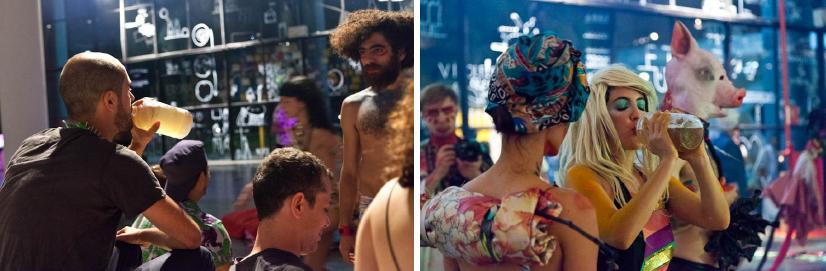
While a special elixir prepared by Amilcar Packer a visual artist and Como clube collaborator, is offered and taken: Photo: Sofia Colucci While getting “blessed and warmed”, by Caio César, artist and co founder of Como clube:
Photo: Sofia Colucci Como participants: Ad Ferrera, Amilcar Packer, Allyson Amaral, Ana Dupas, Caio César, Daniela Pinheiro, Eidglas Xavier, Emilija Skarnulyte, Gabi Vanzetta, Gustavo Silvestre, Henrik Sørlid, Karlla Girotto, Marco Biglia, Marcos Nasci, Marsil Andjelov Al Mahamid, Matti Aiko, Mavi Veloso, Nicolas Siepen, Piero Bonavita, Rafael Amambay, Renata Alcoba,Thelma Bonavita and Yuri Tripoli.


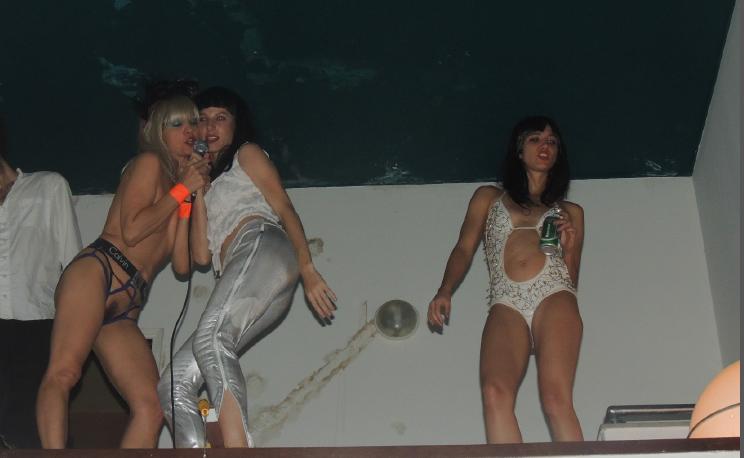
Against any normativization of the female empowered figure Hot Hole takes the cliche image of a blond pop star and dismantles it, exposing its contradictions Touching on female sexuality and expressing it freely Messing up gender politics and poetics, borrowing Chacrinha's* motto: “I came here to make you confused, not to explain!”
https://soundcloud
https://soundcloud
Hot Hole band and Feminism com/thelma bonavita hothole com/ana dupas/free to fuck (left to right:Thelma Bonavita, Gabi Vanzetta and Ana Dupas, 2012) photo: unknown Hot Hole brings up another wave of Brazilian feminism breathing and voicing inspired by Desbunde (Debauch) a political and aesthetic movement developed under dictatorship and misused negatively by the dominant system as well by some radical Marxists Desbunde somehow echoed “the flower power” North American political movement against the Vietnam war The peak of the Brazilian political repression was quite parallel to the height of the American war: both countries had thousands of young people, murdered, tortured, dead and so on And the whole world felt the power of North America's Empire for the good and the bad Meanwhile, we could not forget how strong North American pop music and its empowering of the female body had left its traces: what was up with the fixation on the blond female? What resides behind this replication? From Marilyn Monroe (originally red haired), over Madonna (dark hair) to Lady Gaga (also dark), just to draw an illustrative shortcut Not forgetting Nico from The Velvet Underground!
*Chacrinha was a comedian, radio, and TV personality, over dictatorship had his peak of career
*MASP; Museu de Arte de São Paulo
(Thelma Bonavita, Hot Hole at Como clube, 2012) print of video by: Danilo Barros Hot Hole has a performative musical repertoire composed mostly by Thelma Bonavita during 2012 13 at Como clube in collaboration with Ana Dupas and Gabi Vanzetta And some material was developed in 2007 at PAF Performing Arts Forum/ France Hot Hole lyrics are composed of more than one language in the same song entangling so called peripheral languages ( Brazilian Portuguese, South America Spanish) with the hegemony of English. Recently engaged in a long term project called Archeology of Desire /Fleshion ( flesh + fashion), which touches on concepts of time, desire, fashion and body, focusing on female bodies and their variations and manipulations through cultures and time. Now joined by Ana Dupas and Gabi Vanzetta among others. So, our feminist practices are ready to take another breath!
