TheLittleHawk Iowa City High School - Iowa City, Iowa - Volume 70, Issue 2 - November 2, 2012 - www.thelittlehawk.com
youth politics and
kierangreen@thelittlehawk.com
In October of 2008, City High school was abuzz with electionmania. The hallways were plastered with printed-out posters advertising the Obama and McCain campaigns, and it was not uncommon to find students going door-to-door or making phone calls on behalf of the candidates. Four years later, that enthusiasm has dissipated. Many students have attributed the decline in student participation to the political process. “Its sort of sad. The ridiculous aspect is that the only way that candidates get elected is if they focus solely on politics,” Emmet Adamson ‘16 said. People under the age of 25 were instrumental in propelling president Barack Obama to victory. However, those same voters are now less likely than ever to vote. A recent Pew Research Center poll found that the projected youth vote in 2012 is down 10 percent, (62 percent as opposed to 72 percent during the 2008 elections). Despite the decline in participation, many students have not switched their party affiliation. “Neither of the candidates has put out a plan. They’re uncivil to one another, and the election is more about tearing the other person down than it is about solving national problems,” Andrew Brown ‘16 said. Despite this, both parties have made it a point to reach out, primarily to university students. “At the University of Iowa campus, there are University Democrats and University Republicans. Both are pretty active clubs. We’re working closely with the university democrats and they are actively involved with campaign efforts,” Terry Dahms,
Chair of the Johnson County Democratic Party, said. However, this has not necessarily translated to high school participation. “I haven’t seen much participation [from high school students]. [Its been] few and far between. Primarily, I don’t think they probably quite understand the importance yet. They’re focusing on other things, things going on in high school,” Dahms said. Despite being disaffected with the political process, many students have taken an active interest in national policy.
“
SOCIAL ISSUES WILL BE VERY IMPORTANT FOR OUR GENERATION. IT'S THE ONE THING THAT UNIQUELY INFLUENCES all of OUR LIVES.
“
By Kieran Green
-Peyton Grenzel ‘14
“Social issues will be very important for our generation. It’s the one thing that uniquely influences our lives because so many of us have to live with the repercussions,” Peyton Grenzel ‘14 said. Other observers have cited the economy and deficit as major issues. “[The biggest problem is] the national debt, we owe 16 trillion dollars in debt and that’s going to fall on the shoulders of the next two, three,
four generations,” Cathy Grawe, a former chair of the Johnson County Republicans, said. The economy also weighs heavily on the minds of both students and professionals. Cary Covington, Associate Professor of Political Science at the University of Iowa, focused on this issue. “Big picture, it’s positioning the country economically to be able to compete on an international basis. Developing infrastructure to encourage investment, and getting young people properly educated are both extremely important,” he said. Students have been divided in their approach to re-invigorating the political process. Some support the third-party candidacy. “A serious third party contender would definitely increase interest at this point. The two-party system might have worked well in the past, but ever since the Clinton and Bush years, it has just gone to Hell,” Brown said. However, that interest has not yet translated into support for thirdparty candidates. “I can’t say that we’ve seen much evidence that students are focusing their attention towards third-party candidates. However, we have seen that when you’re younger, you tend to experiment more, and this includes trying out where you stand politically,” Covington said. In the end, there was a consensus that student interest depends on politicians making an effort to reach out. “To get young people involved, candidates have to care about politics, not just attaining office,” Brown said. “They must focus on the country as a whole, and the policies that will improve it.”
TheLittleHawk
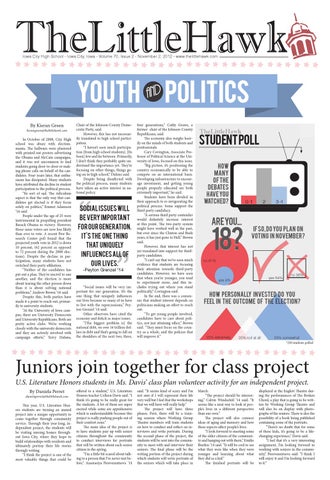
STUDENT POLL how many of the debates have you watched?
0-1
Areyou...
18?
2
3-4
If so, do you plan on voting in November?
no 91%
yes 64%
yes 9%
no 36%
HOW PERSONALLY INVESTED DO YOU FEEL IN THE OUTCOME OF THE ELECTION?
20% extremely
25% not at all
55% somewhat *250 students polled
Juniors join together for class project U.S. Literature Honors students in Ms. Davis’ class plan volunteer activity for an independent project. By Daniela Perret
danielaperret@thelittlehawk.com
This year, U.S. Literature Honors students are turning an annual project into a unique opportunity to come together through community service. Through their year-long, independent project, the students will be visiting nursing homes throughout Iowa City, where they hope to build relationships with residents and ultimately portray their life stories through writing. “I think the project is one of the most valuable things that could be
offered to a student,” U.S. Literature Honors teacher Colleen Davis said. “I think it’s going to be really great for the students. A lot of them are super excited while some are apprehensive which is understandable because this project is really pushing people out of their comfort zone.” The main idea of the project is to have students pair up with senior citizens throughout the community to conduct interviews for portraits that will be written about each senior citizen in the spring. “I’m a little bit scared about talking to a person that I’ve never met before,” Anastasiya Perevezentseva ‘14
said. “It seems kind of scary and I’m not sure if I will represent their life very well but I feel that the workshops that we will have will really help.” The project will have three phases. First, there will be a training session where Working Group Theatre members will train students on how to conduct and reflect on interviews and write portraits. During the second phase of the project, the students will be sent into the community to meet with and interview their seniors. The final phase will be the writing portion of the project during which students will write portraits of the seniors which will take place in
March. “The project should be interesting,” Calvin Windschitl ‘14 said. “It seems like a neat way to look at people’s lives in a different perspective than our own.” The project will also connect ideas of aging and memory and how these aspects affect people’s lives. “I look forward to meeting some of the older citizens of the community and hanging out with them,” Emilie Burden ‘14 said. “It will be cool to see what they were like when they were younger and learning about what they did as a kid.” The finished portraits will be
displayed at the Englert Theatre during the performances of The Broken Chord, a play that is going to be written by Working Group Theatre and will also be on display with photographs of the seniors. There is also the possibility of a book being published containing some of the portraits. “There’s no doubt that for some of these kids, it’s going to be a lifechanging experience,” Davis said. “I feel that it’s a very interesting assignment, I’m looking forward to working with seniors in the community,” Perevezentseva said. “I think I will enjoy it and I’m looking forward to it.”