China Walks, Suite 111, Black Prince Road, London, SE1 7SJ
Telephone: 020 7394 5553
E-mail for membership enquiries: thelcdc@gmail.com Web: www.lcdc.cab
Editor: Grant Davis
The Badge is distributed free to the Licensed London Cab Trade.
For advertising enquiries please contact the office on 020 7394 5553 or E-mail: thelcdc@gmail.com
All advertising in The Badge is accepted under our terms and conditions. These are available at the LCDC office. Before entering into any commitment, financial or otherwise, always remember to seek professional advice.
The views expressed in this publication are not necessarily those of the Editor or of the Management Committee of the London Cab Driver’s Club.
Contributions for publication are welcomed and should be sent to the Editor at the above address.
Printed by Iliffe Print. T: 01223 656500
DIVISION UNDERMINES OUR CREDIBILITY
I would like to begin this editorial by wishing all our members, and the wider taxi trade, a very Merry Christmas and a prosperous New Year.
I also feel it is important to address a serious issue relating to the airport which will have clear repercussions for drivers. Since the marshalling scheme came to an end, tensions have risen, particularly among those who had grown accustomed to a predictable routine of two trips a day and an early return home.
Regrettably, this situation has led to unwarranted criticism of LCDC representatives. One representative has recently found themselves at the centre of a wholly unjustified and disappointing smear campaign, falsely alleging that they complained about certain taxis being parked at the wall. I want to be absolutely clear: this allegation is entirely untrue.
The act of taking a screenshot from a so-called “private” group chat and sharing it with representatives from another organisation serves only one purpose - to create division within the trade. Such behaviour is deeply disappointing, particularly when it comes from individuals who are meant to be acting in the best interests of drivers.
At a time when companies such as HAL and Uber stand to benefit from any weakness or disunity among us, this kind of internal conflict only damages our collective position. Division does nothing but undermine the credibility and effectiveness of proper trade representation.
After 38 years behind the wheel, it is disheartening to say that some things appear not to have changed. However, the choice remains with the membership: do we want strong, professional representation that works for the good of the trade, or do we allow behaviour that serves only to weaken us?
That decision ultimately rests with you. Grant
The London Cab Drivers’ Club Ltd.
END OF YEAR REPORT - IMPACT OF UBER
Uber launched in London in May 2012, initially as a premium service but quickly expanding into affordable ride-hailing.
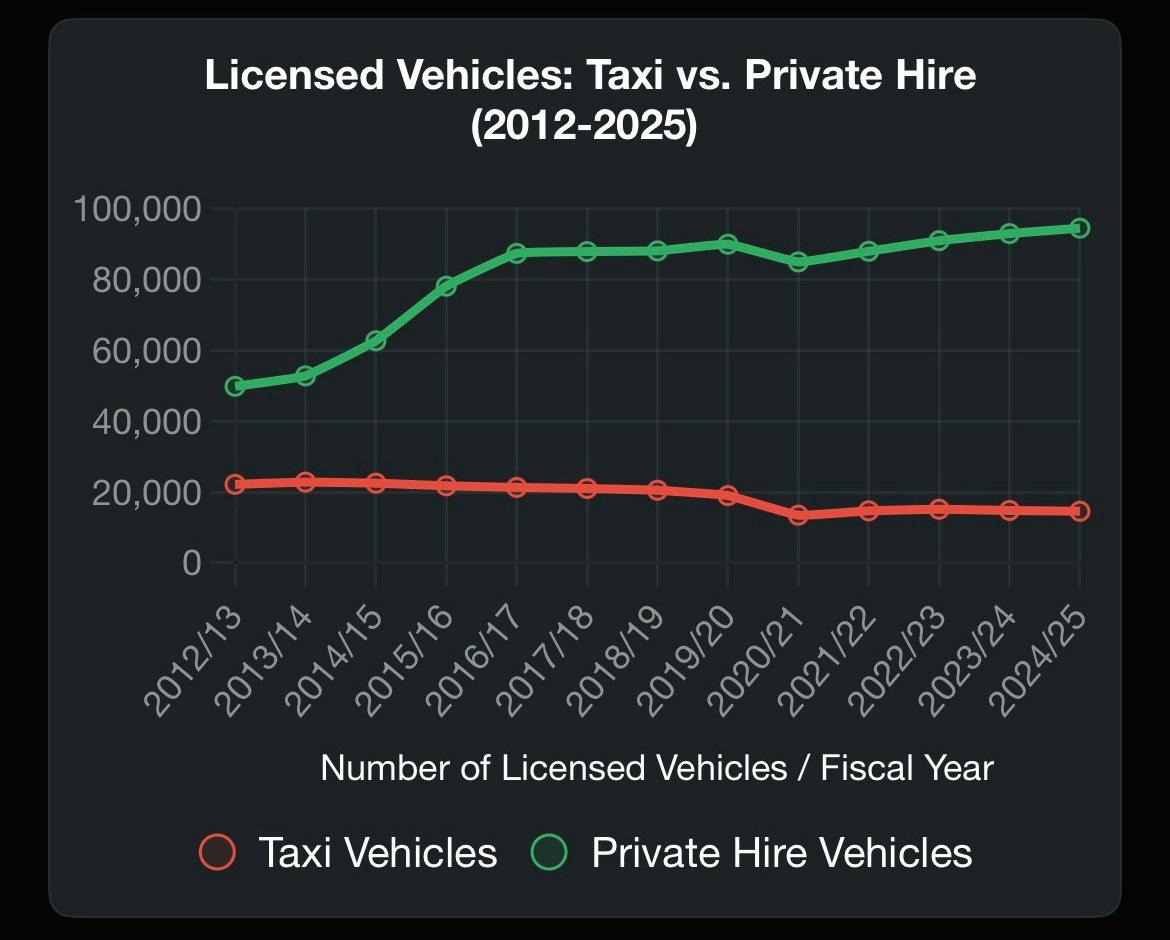
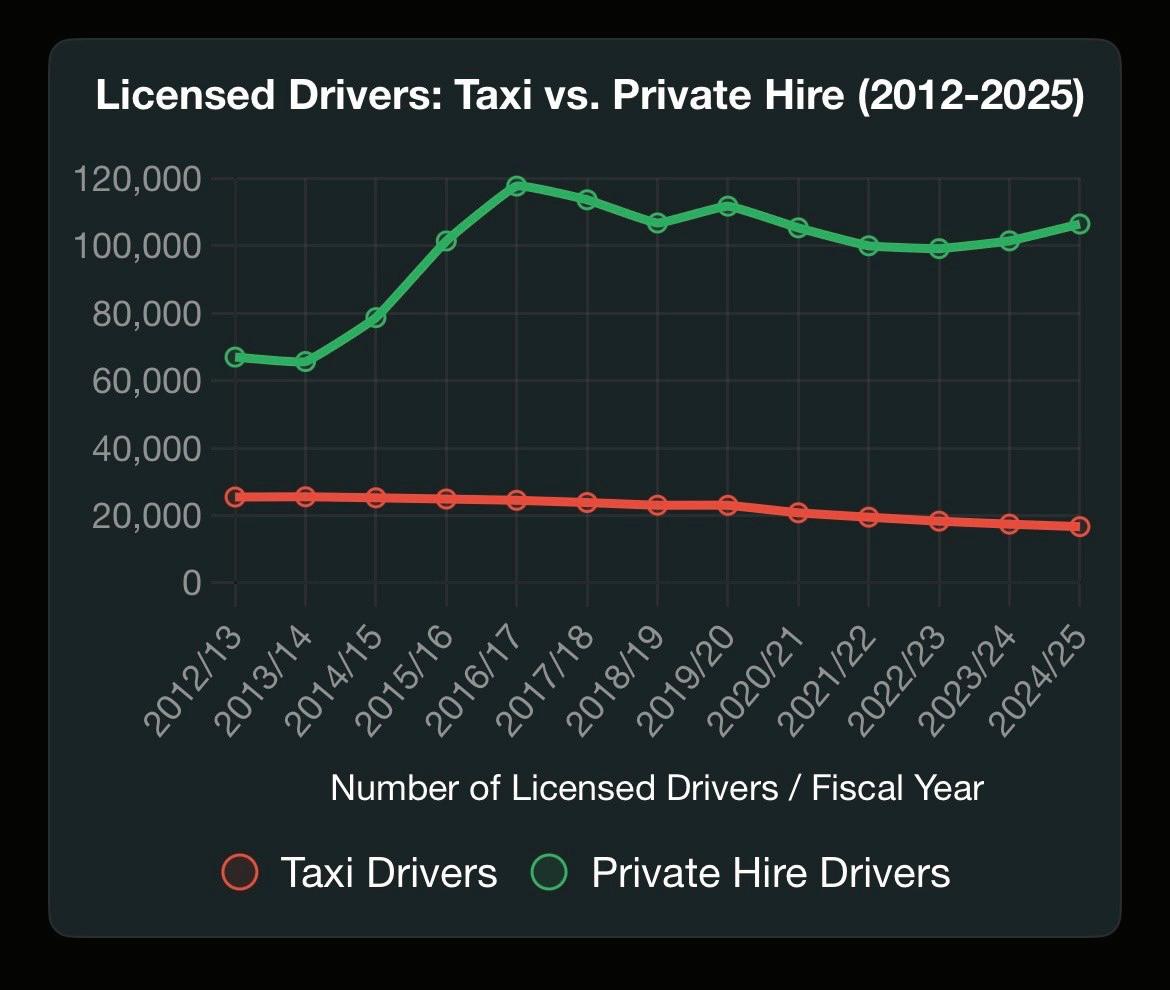
This disrupted the traditional taxi (black cab) market by offering appbased booking, dynamic pricing, and lower barriers to entry for drivers and vehicles. Transport for London (TfL) data shows a clear correlation: private hire (PH) licences - where Uber operates - surged post-2014 as Uber scaled, while taxi licences declined steadily, accelerated by competition, the 20172018 English Language requirement for PH drivers (which temporarily slowed growth), COVID-19, and high costs for taxi drivers (e.g., The Knowledge test, expensive wheelchairaccessible vehicles).
Key impacts:
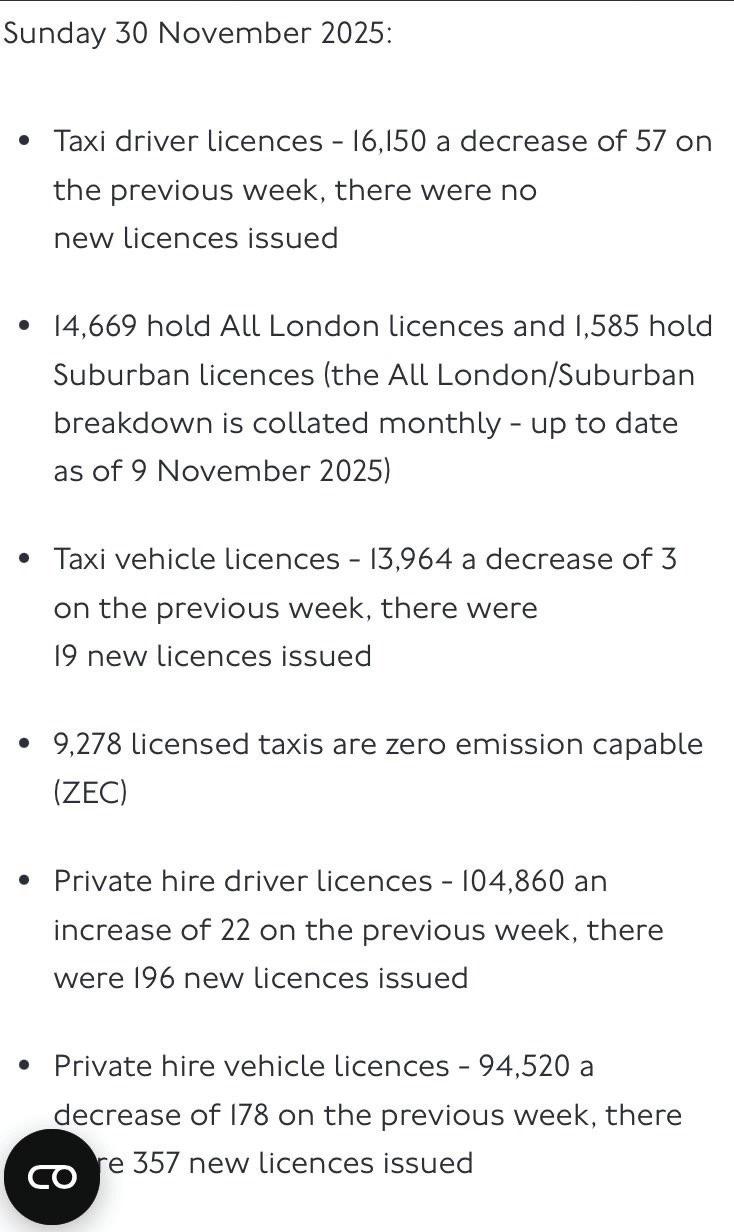
• PH Growth: PH drivers rose ~59% from 66,975 in 2012/13 to 106,468 in 2024/25, vehicles up ~90% from 49,854 to 94,520. Uber claims ~45% of London’s PH
market (per 2023 filings), with PH trips now ~4x taxi trips (TfL Travel in London reports).
• Taxi Decline: Taxi drivers fell ~34% from 25,460 to 16,676; vehicles down ~34% from
estimates); Uber generated £1.5bn+ in London fares by 2023.
• Other Effects: Increased congestion (PH vehicles +50% since 2012), safety scrutiny (Uber’s 2017
22,168 to 14,570. New taxi licences dropped 90% (1,010 in 2016 vs. 104 in 2024), linked to Uber’s convenience eroding hail/rank demand.
• Market Shift: PH now ~86% of drivers (vs. 72% in 2012), handling 70-80% of for-hire rides.
Revenue impact: Taxis lost £200m+ annually (London Assembly
licence revocation, later overturned), and emissions progress (9,282 ZEC taxis by 2025, but PH lags). Post-COVID recovery favoured PH flexibility.
Data sourced from TfL licensing statistics (tfl.gov.uk) and DfT surveys.
Figures are fiscal yearend (March).
k EEPIN g l ONDON MO v IN g
Why cabbies rely on VTS to navigate the capital’s traffic, tourists, and challenges
Driving a black cab in London is unlike anywhere else. With constant traffic, busy streets, and over 20 million overnight visitors each year, every shift is unpredictable. Cabbies need tools that keep up, and that’s where Curb’s VTS comes in – built to handle the city’s pace and challenges.
Built for London Shifts
London drivers contend with tight schedules, heavy traffic, and unexpected mobile signal drops and outages. VTS includes Offline Protection, so payments go through even if the network drops. This ensures drivers never
lose a fare, even in areas where mobile signals are weak or during high-traffic periods. Security is also crucial: the system integrates a TfL-approved taxi CCTV for drivers and passengers, fully compliant and easy to install at no extra cost.
The 8.7-inch tablet makes transactions simple and professional, with clear displays, smart tipping, receipt printing, and seamless meter integration.
“It feels like this system was built for cab drivers,” added driver Stephen Jay. “Transactions are quicker, offline mode
works perfectly, and I can focus on my passengers without worrying about tech issues.”
Helping Drivers Earn More
VTS helps drivers save up to 26% on credit-card processing fees compared to other providers,* putting more money in their pockets. For cabbies navigating London’s competitive and busy streets, every saving counts. Beyond fees, the system gives drivers greater control and confidence, ensuring every journey runs smoothly, whether it’s a short city ride or a long
airport run.
“I've saved over £700 in card processing fees in a year,” said driver Scott De Garis.
*Compared to competitor rates of 3.75% + 20p per transaction.
Support That’s Close By
Even the best tech needs support. Curb’s Driver Hub in Bethnal Green provides direct guidance, with additional teams in West and North London nearby. Whether it’s a quick question or a more complex issue, help is always within
reach. Backed by 65+ global markets and used in over 45,000 cabs, VTS combines proven technology with local insight to keep London drivers moving efficiently and confidently.
Join the Driver-First Journey
New drivers signing up today can receive a £250 welcome bonus, one year of free meter, and £50 for each friend they refer.
Offer valid for new drivers only.
For more information, call 0333 666 1000 or visit gocurb.co.uk
gOvERNMENT FINAllY ClOSES TOUR OPERATOR lOOPHOlE
The Government’s decision to amend the Value Added Tax Act 1994 marks an important change for the Private Hire trade, and one that many in the taxi trade will view as long overdue. Some private hire operators, mainly large online platforms, have relied on the so called “tour operator loophole” to reduce the VAT applied to their fares. That avenue has now been firmly closed.
The amendment introduces a new subsection, Section 53(3A), which states that businesses whose activities consist mainly of transporting passengers by taxi or private hire vehicle cannot be treated as tour operators. The only exceptions are where the journey is genuinely supplied together with accommodation or another form of transport such as a coach, train, ship, or aircraft.
Routine PHV journeys no longer qualify for the Tour Operator Margin Scheme. The rule applies to all supplies made on or after 2 January 2026.
For those of us within the London taxi trade, the direction of travel has been clear for some time. The December 2021 Part 8 case, established that PHV operators in London act as principals when contracting with passengers. Once they were recognised as the party providing the transport service, the logical conclusion was that VAT should be charged on the full fare, not merely on the
operator’s commission (margin). Although this ruling only applied within the capital, it exposed the fundamental commercial reality of how large app based PHV businesses operate.
Despite that clarity,
some private hire operators relied on the tour operator rules to limit their VAT liability. The Government’s legislative change removes that option, aligning the tax treatment of PHV services more closely with how the Club has long argued
they should be treated.
Outside London, the position is different. The D.E.L.T.A. Merseyside Ltd (and another) v Uber Britannia Ltd appeal court decision confirmed that PHV operators outside the capital may
still operate under a genuine agency model, provided their business is structured and run in a way that reflects that status.
Crucially, the agency model must be genuine in both paperwork and practice. Given the government’s need to raise revenue, it’s not beyond the realm’s of possibility HMRC will be scrutinising those declared models.
A CROSS BORDER SOLUTION IS URGENTLY REQUIRED
Although the closing of the loophole is broadly welcomed, it does raise real concerns for London. A PHV operator currently licensed outside the capital but operating under an agency model could start sending vehicles into the capital and gain a competitive advantage, as they would not charge VAT on the full fare.
In fact, nothing would prevent established London operators from obtaining operator licences in places such as Wolverhampton, dispatching vehicles from there. Another scenario, you could have two operators with offices half a mile apart, one charging VAT and the other isn’t required to. Along with cross border safety concerns this distortion of the market should not be ignored.
For the taxi trade, the amendment is a positive step, but it also highlights the ongoing need for a fair, consistent approach to regulation and tax across the whole country.
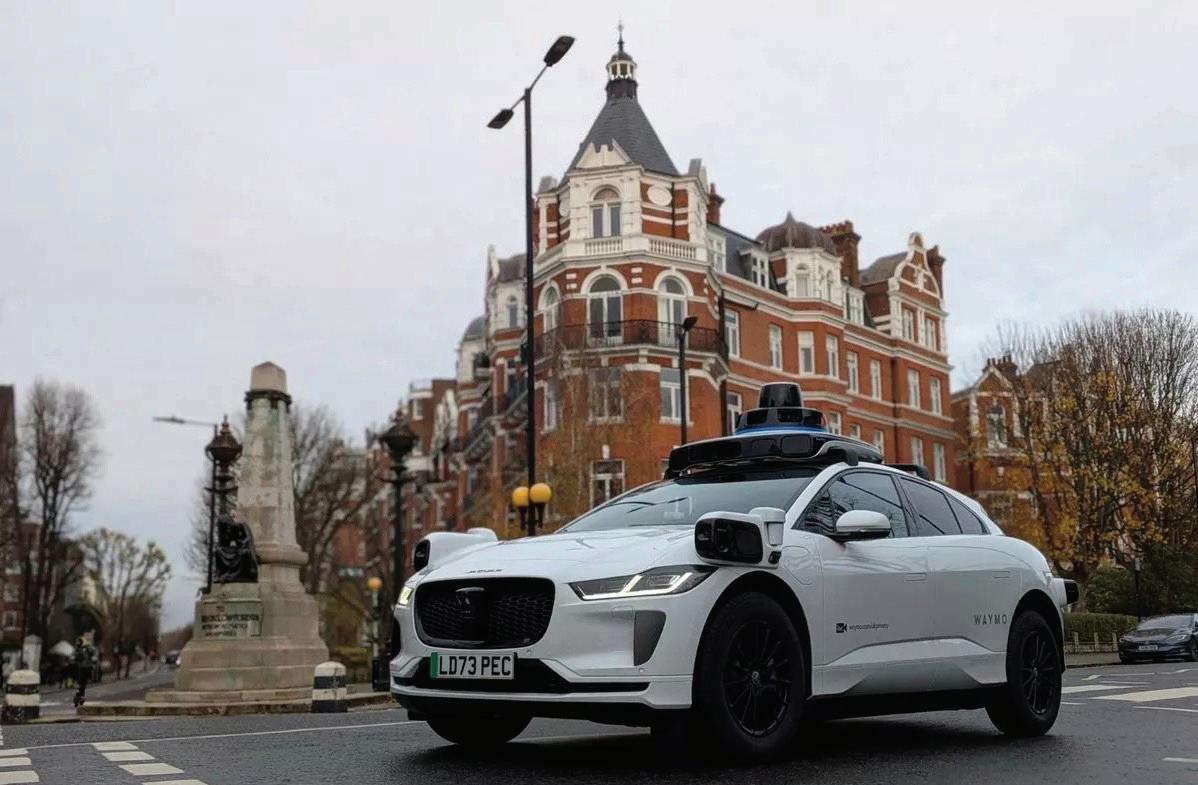
While the trade is heavily divided over the introduction of a new Taxi vehicle which doesn’t have the unique turning circle of a Hanson Cab, it has been confirmed that autonomous cars have now received authorisation to work as private hire vehicles in 19 of London's central boroughs.
The post on social media declared: "The Waymo Driver has landed in London… We're now driving around the streets of London as we prepare to bring the safety, reliability and magic of our autonomous ride-hail service to the city next year."
These driverless cars have recently been spotted around London streets as part of a trial, ahead of them being used under ride-hailing regulations, to pick up passengers in early 2026.
Waymo, which operates under Google's parent firm Alphabet Inc, recently
posted an image on social media showing one of its self-driving Jaguar I-Pace cars passing the famous Abbey Road zebra crossing.
Waymo has been operating driverless private hire vehicles in the USA since 2020, with more than 10 million paid rides being completed.
It also say their cars will be able to "navigate London's unique streets and understand all of the complex layouts and traffic patterns."
The announcement follows on from Uber, confirming it will be launching self driving minicabs in London from spring 2026.
The ride-hailing app company will operate services in partnership with artificial intelligence (AI) start-up Wayve.
You really couldn’t make it up.
It’s unbelievable to think that our regulatory body,
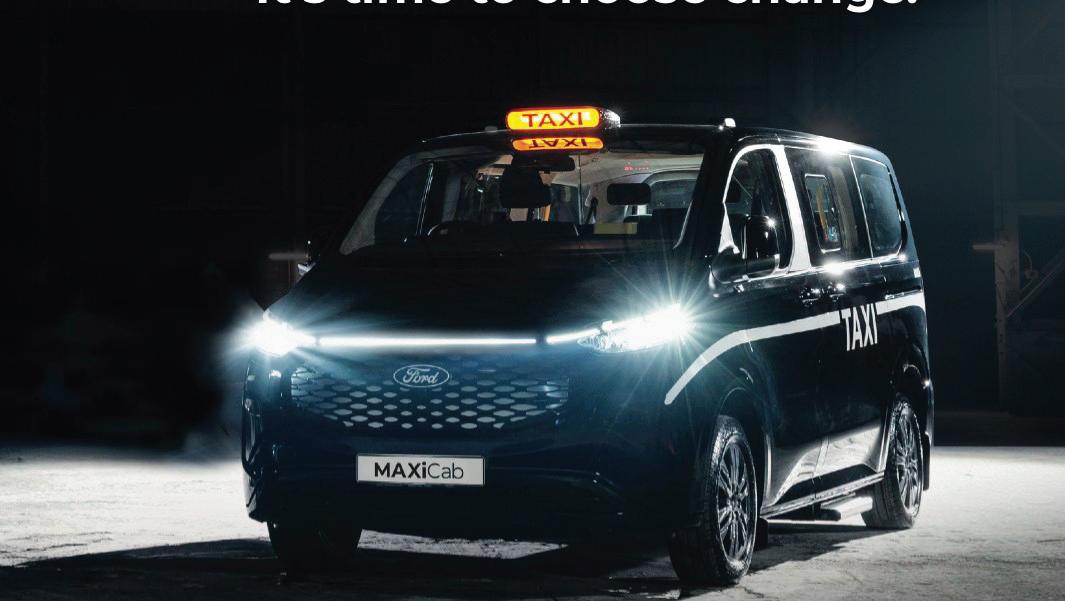
who refuse to authorise the new Ford MaxiCab Taxi vehicle (for not having the legislated turning circle ability) have voiced not one word in opposition to the public being transported in a passenger vehicle without a driver!
So, driving a Taxi with black painted handles (according to TfL/TPH) is more dangerous than not having a driver?
But, just when you thought it couldn't get any worse:
And yet…TfL have recently announced that if you have painted the handles on your TXE black, it will not pass inspection at NSL.
When we asked for clarification, they have confirmed it is an unapproved modification.
Valo has now announced that from 2028, its electric flying Taxis will be available to service Heathrow and Gatwick, which will revolutionise airport travel in the UK. These Flying Taxis can achieve 150mph and will slash Heathrow to the City journey times to just 12 minutes.
Planned destinations for the new flying taxis departing from Canary Wharf include Gatwick, Heathrow, Cambridge, Oxford and Bicester.
The company plans to build seven certificated aircraft in the UK to undergo final testing with the UK Civil Aviation Authority (CAA) and the European Union Aviation Safety Agency (EASA).
The all new electric, vertical take off flying Taxi will have a cabin capacity for 6 passengers and 12 items of luggage.
Valo will be able to enter commercial service after obtaining the Type Certification, which is the regulated approval issued to new aircraft designs by regulatory bodies like the EASA and CAA to guarantee safety standards are met.
They also say the service, which should be up and running by 2028, could end up being as cheap as booking an Uber.
l CDC WRITES TO ANDY l ORD O v ER l ONDON CITY TAXI CHAR g E P l AN
Dear Mr Lord,
We are writing to you with regard to the LCY (London City Airport) proposal to charge taxis for picking up and setting down passengers.
PICK UP CHARGE
Until Spring 25, this charge was £1.00 for drivers picking up at the LCY rank., after which the cost was raised by 100% to £2.00.
Less than six months later, LCY announced their intention to raise this fee by yet another 50% to £3.00.
TPH made it clear to LCY that they had no intention of allowing drivers to put this charge on the taximeter, as requested by LCY management. The matter was raised at a Tariff meeting, where the trade group was of the opinion that the charge should not be raised.
DROP OFF CHARGE
This is a far more contentious issue. LCY approached TFL, informing them that LCY intended putting a £7 drop off charge in place and licenced taxis would not be exempt from the charge, anticipating that drivers could add the charge to customers’ fares.
TPH (Taxi and Private Hire) made it clear that they were opposed to adding these charges to the tariff.
Again, this matter was raised with the tariff group, who were opposed to the charge, irrespective of whether the charge would be recoverable or not.
A site meeting was convened between the LCY CEO, Darren Crowson
(TPH) and Sam Houston (Taxi Trade Tariff Group). It was made clear that TPH and Taxi trade were opposed to any proposed drop off charge.
LCY suggested that they were considering introducing these charges in order to reduce traffic flow to and from the airport because they were under pressure from TfL to do so in order to comply with The Mayor’s Action Plan. This
to 20% of all road traffic. Reducing road traffic into LCY would have an obvious positive effect on traffic pollution and The Mayor’s strategy.
However, London’s taxi fleet are part of the 20% of traffic not intended to be reduced and therefore, should this charge be introduced on road pollution effect, there is a compelling case for taxis to be exempt from such a
was not a plan to increase revenue streams.
It would appear that LCY were unhappy with the decision of TPH and appealed to TfL, presumably a department dealing with the environment.
As a result, the upcoming tariff adjustment has been delayed in order to include questions re LCY pick up and drop off charges in the tariff consultation that is currently live.
CONFLICTS OF INTEREST
The Mayor’s Transport Strategy’s aim is to reduce non - public road transport
charge. Taxis are, in fact, part of the public transport system that would be expected to replace the private road travel that LCY are trying to reduce. Additionally, as nearly 70% of London’s taxi fleet are ZEC vehicles and this number is growing, any improvement in air quality by deterring travel by taxi use to LCY would be negligible.
Introducing the charge would reduce the flow of taxis to and from LCY, regardless of who pays the charge, drivers or passengers, as a result of LCY placing applying the drop off charge to part of the public transport system i.e. taxis.
TfL appear to have conflicting internal aims and taxi drivers and their passengers could be the casualties.
At the extreme, the proposed drop off charge could increase a fare from Canary Wharf by almost 50% on current fares if the cost were to be borne by passengers.
On the other hand, if this charge fell on drivers, TfL would indirectly be forcing discounted fares on drivers. LCY is a compellable distance from Charing Cross. If TfL have given enough encouragement to LCY to apply the charge and not allow drivers to recover this from passengers, then TfL would effectively be forcing a £7 discount on taxi fares as the driver would be unable to refuse a fare.
This is what makes the proposed LCY charge different from other London airport charges in that a driver has the right to refuse a fare to all other airports. From Central London to LCY, a driver is compelled TfL to accept the fare. While the decision to pay the pick up fee is the driver’s choice, the decision to pay a drop off fee would be forced upon the driver by an arrangement between LCY and TfL
TAXI FARES CONSULTATION
These proposed charges should never have been included in the current review. The consultation paper had already been constructed a considerable time before LCY made the appeal that ended with the inclusion of their proposed charges.
This has delayed publication of the consultation. It will now not end until 14th December. It takes at least six weeks to assess the results and put papers to the Finance Committee. In order to obtain a tariff adjustment in April, these papers have to be in by 6th February. That give just 7.5 weeks, including the Christmas and New Year period. If this deadline is missed as a result of the inclusion of LCY charges, it will be September before any adjustment can be made, due to Mayoral elections in the Spring.
That would result in drivers losing 4% of their income for 6 months, potentially. This is patently unfair. Drivers had to make sacrifices in order to get the adjustment back to the April traditional. The Cost Index is always a year behind inflation and this has had to be increased to eighteen months to achieve an April adjustment.
Finally, the taxi service is already on its knees. The fleet is consistently reducing, in large part due to the imposition of a £70,000 + vehicle and uncertainty over future supply of vehicles and current problems over the supply of parts. Driver numbers are consistently falling, the Knowledge has been failing for years.
If these charges are applied by LCY, they will have a serious effect on taxi supply and demand. If only applied to the taxi driver, this will exacerbate the current unsustainable loss of existing drivers and falling driver replacement numbers
The London Cab Drivers' Club
How a chatty passenger nearly got me killed on a mountain...
By Jamie Hawes
A tale of friendship, fighter jets, rare birds and one man’s catastrophic decision to trust his own sense of direction.
If you’d told me a week earlier that I’d soon be clinging to the side of a mountain in Glencoe, waving hopelessly at a fighter jet and swearing at endangered wildlife, I’d have politely asked what you’d been drinking.
But that’s the thing about working as a cab driver: one minute a customer is recommending a “nice little walk in Scotland,” and the next you’re standing on a Munro wondering whether you’ve accidentally joined the cast of 127 Hours: The Musical.
It began with a passenger who chirped, “You should go to Glencoe, mate. Beautiful part of the world.” And because I’m apparently susceptible to tourism advice from complete strangers, I roped in an old friend—who, just to add social complexity to the situation, happens to be a Conservative councillor for Aylesbury.
We booked into the Clachaig Inn, which is a perfectly lovely place unless you’re easily influenced by rustic décor and two pints of local ale. Together, they convinced us that we were rugged outdoorsmen rather than two middle-aged blokes who should really know better.
Our target was Stob Coire Raineach, a Munro that looks innocent enough on the internet but develops a mean streak in person.
The “three-hour walk” to the base was a chaotic
blend of ice, rock, ankletwisting surfaces, and the kind of wind that tries to gently push you into your own grave.
After the promised three hours (read: four and a half), my hiking partner announced he could go no further. He said it with the gravity of a man stepping down from Cabinet.
So, naturally, I pressed on alone—because nothing marks a true adventurer like ignoring common sense.
_I looked for my path down. I did not find my path down. I looked at alternative routes. They did not look like routes. They looked like nature’s way of saying, “Not that way, idiot.”
And so, in a moment of panic-driven genius, I made the worst decision of the entire trip:
I sat on my backside and started sliding.
Now, sliding on ice sounds fun. Sliding on a steep
up to see a military aircraft skimming past at a height that suggested the pilot had lost a bet.
I waved furiously. The pilot responded by casually banking the jet sideways, showing me nothing but the top of his helmet before vanishing into the distance. This is exactly why fighter jets never win “Scotland’s Most Helpful Aircraft.”
Accepting that community air support was not forthcoming, I began clawing
To my astonishment, I eventually clambered onto the summit just as the sun broke through the clouds like a triumphant spotlight on a very confused amateur.
I even had phone signal, which didn’t just feel miraculous—it felt suspicious. I FaceTimed family and friends, proudly showing them the view and pretending I wasn’t 40% sweat, 30% fear and 30% “I hope this impresses someone.”
I hung up. And the sun immediately disappeared. Like it was done with its shift. Suddenly everything looked less like a scenic wonderland and more like an insurance claim waiting to happen.
Scottish mountainside toward what could generously be described as “oblivion with a view” is significantly less fun.
Within seconds, the slope became vertical enough to qualify as a wall. One more slide and I’d have been Scotland’s first human toboggan.
Only when I attempted to stop did I look up and realise I’d descended 150 feet. I had achieved this in record time, powered purely by terror and poor judgment. I was now officially stuck.
As I teetered on my icy ledge of regret, the roar of a fighter jet echoed through the glen. I looked
my way back up the slope. Halfway up, I paused, gasping like a Victorian orphan, and nearly sat on what I thought was a rock. The “rock” moved.
It was a ptarmigan—a rare, camouflaged Highland bird beloved by twitchers and, apparently, entirely unfazed by sweaty men making bad decisions. It stared at me with the air of a creature wondering how humans survived long enough to invent Wi-Fi.
It only shifted when I, utterly frazzled, told it to “F-off!”
A command it obeyed at a leisurely pace, as if humouring me.
By some miracle—and the
friction of my fingernails—I made it back to the summit.
After a frantic search, I spotted my original path, half buried but still just visible.
The descent was less a walk and more a series of controlled collapses.
Right until a female climber passed me, glanced at my shredded waterproof trousers, and burst into a laugh so heartfelt it probably added years to her life.
Shaking, starving and emotionally bruised, I finally reached the car and grabbed the only food available: a packet of crisps.
They were called EXTREME RIDGE. Of course they were.
In Conclusion: Listen to Cab Passengers Carefully It’s astounding how a casual chat with a punter can escalate into:
• scaling a mountain,
• sliding down the wrong side of it,
• trying to hitchhike with the Royal Air Force,
• almost flattening a rare bird,
• and returning to civilisation with trousers that looked like they lost a fight with a lawnmower.
I wanted a scenic walk.
I got a near-death experience sponsored by Walkers crisps.
And honestly? 10/10. Would do again. After therapy.
Merry Christmas and be lucky!
MERRY CHRISTMAS FROM THE MAYOR
KhaN ShOULD BE STRIppED Of CONTROL Of MET pOLICE aS pUBLIC CONfIDENCE IN fORCE pLUNgES, SaYS ThINK TaNK
Confidence in the Met Police has fallen to an all-time low as Londoners lose faith in the force’s management of protests, ability to solve thefts and local policing, according to a new report.
A damning report published by the Policy Exchange think tank recommended that responsibility of the service should be stripped from mayor Sadiq Khan and transferred to the Home Office instead. It also said that the Met should be put back onto special measures, which were lifted at the start of the year.
Conservative MP for West Suffolk Nick Timothy said that the report “demonstrates how the Metropolitan Police is still a long way from being anything like an effective crime fighting force”.
The Policy Exchange found that the Met was effective at confronting serious incidents, including homicides and knife crime, but it was failing to solve “high volume”, lower level crime such as thefts.
The Met Police solves nearly all of homicide cases (95 per cent), and the rate of homicides has dramatically lowered from an average of 141 per year between 20032022 to just 42 offences in the first half of 2025. Hate incidents have also fallen significantly since commissioner Mark Rowley was appointed,
and knife crime has dipped by 14.82 per cent in the first ten months of 2025.
But the force has not effectively tackled stealing offences. The Met only solves one in 76 reported bike thefts, and one in 179 thefts from a person.
London has become the phone theft capital of Europe with criminals nicking 80,000 mobile devices last year, which amounts to roughly one every six minutes. This is despite the force specifically tackling phone and watch theft from people riding e-bikes, as part of its plan to restore public trust.
But the report said that two-tier policing had become a reality and was "inadequate". The Policy Exchange report said that often the force chose to “prioritise the rights of protestors” over the wider public and Westminster, with access to parliament being “substantially obstructed" on a number of occasions.
Some 70 per cent of London’s local police stations closed between 2008 and 2018, and the think tank said the force had “failed” to mitigate the impact of the closures. This is coupled with a fall in the number of local frontline police officers.
It was also announced in October that 10 more stations will close, meaning there are only 27 counters open across the whole of the capital.
Richmond Council recently announced it was planning legal action against the mayor of London and the Met after Scotland Yard decided to shut Twickenham Police Station.
The “A Long Way To Go” report said there was also a focus on engagement and community relations rather than fighting crime.
A spokesperson for the Mayor of London told the Daily Mail: “Nothing is more important to the Mayor than keeping London safe and he continues to lead the way by being tough on crime with a record £1.16billion support for the police this year alone and tough on the complex causes of crime through the country's first Violence Reduction Unit which is leading an approach rooted in prevention and intervention.”
Met Commander Hayley Sewart said: “Our New Met for London plan is delivering significant improvements on the issues that matter most to our communities and crime is falling across London.
“Despite a £260million funding gap and amid a shrinking Met, we are protecting neighbourhood policing, response policing and public protection so we can be there where and when the public needs us.”
Courtesy of The Standard
Sadiq khan spends £500,000 on rare birds for one of london’s poorest boroughs
SADIQ Khan has been blasted for spending £500,000 of public money on storks instead of tackling real issues.
Critics accused the London Mayor of being “out of touch” and sitting in an “ivory tower”.
He has spent £500,000 of public money in a rewilding project in Dagenham, East London, one of the capital’s poorest boroughs. As part of the scheme, a flock of white storks have been introduced to the area.
The money is part of a £3.84million pot of cash from Sir Sadiq’s Green Roots Fund which is aimed at boosting access to nature around London.
Sir Sadiq has said the project is a win for ordinary Londoners. He said: “Access to nature is an issue of social justice. It can’t just be those who live in the countryside who get to share their home with our amazing wild creatures. We are proud to be supporting some fantastic projects through my Green Roots Fund, including the historic reintroduction of white storks and beavers to East London.”
The Sun Online has approached Sir Sadiq for further comment.
However, the leader of the Conservative Party in London, Susan Hall, blasted the move, which was first reported in The Telegraph.
She told The Sun: “It is ridiculous and this is the trouble, it’s because it’s not their money. If you’re a mother and you’re short of money, and something really important needed to be done, as in, in London, this is not it.
“The police service, spending money on nice-to-have things. Yes I’d be spending it on what I needed to. And in London’s case, put some more money into policing. I mean, if you look today at the different demonstrations going on…
“This is costing London an absolute fortune, with constant demonstrations, and a large one. We need more money going into the police. Now, having lovely storks and beavers and God knows what else is great, but actually, we can’t afford it.”
The move comes as fares on the London Underground, the Overground and the Elizabeth Line are all set to rise by 5.8 per cent in the new year. The increase is 1% above the rate of inflation and will come into force in March.
Ms Hall added: “In my view, this is where Labour get it wrong. They do not understand. They call it austerity, they call it everything else. But for Londoners it’s really living within your means, and spending money where it needs to go.
“And because it’s not his money, he can’t just dish it out, it’s hard earned taxpayer money. It’s all PR stuff, you know, if it makes him look good. I get so cross with it you know, I don’t feel safe walking. I don’t care what the Commissioner said yesterday, I don’t feel safe.
“I mean, granted, I have had death threats, but of course, I’m a
politician, so I get that. But lots of people don’t feel safe. We need money put into policing, not rare birds that could easily be caught by the people.
Concerns about crime remains a big concern, with the latest figures showing the overall crime rate in London is 81 crimes per 1,000 residents. The most common crimes reported are violence and sexual offences. Reports come from roughly every 23 out of 1,000 daytime population, according to Crime Rate.
Courtesy of The Sun
Bus speeds ‘worst in 40 years,’ Assembly told
Slower bus speeds are sparking a dramatic decline in ridership in London which will have a knockon effect on the Mayor’s active transport goals and Transport for London’s (TfL) revenue, the London Assembly has been told.
Average bus speeds on the capital’s streets in 2024/25 were just 9.17mph – down from 10.27mph four years ago, according to data obtained by City Hall.
In October – the latest month for which data was available – the mean speed of a London bus was just 9.06mph. Meanwhile, passenger numbers fell for the first time since the pandemic last year,
from 1.869 billion to 1.842 billion.
Paul Lynch, Managing Director of Stagecoach London, said: “We are used to difficult traffic conditions in London – it’s our bread and butter. However, conditions have worsened over the last few years to a point where somebody who works for me in charge of our service performance and has been around for 40 years operating buses in London says it’s the worst he has ever seen.
“The biggest single impact, of course, is on the customer, on the people using the buses, it’s making them less attractive and less reliable for them. It’s got to be one of the reasons why bus passenger
numbers are declining at the same time that bus speeds are."
The latest TfL annual ‘Travel in London’ report shows a decline of 1.5 per cent in bus journeys compared to last year, with three per cent more journeys on the London Underground and 10 per cent more on the Elizabeth line.
In the document, officials revealed that average bus journey time was 34.3 minutes, higher than the 34.1 minute target.
TfL’s own analysis suggests numbers need to increase from 5.1 million daily bus journeys currently to nine million by 2041.
They also found that if buses in London increase their speed by an average of 1mph, it could save up to £200 million per year and generate additional revenue of £85 million from increased passenger numbers as a result.
Some boroughs have it worse than others, with average speeds of under 7mph seen in the City of London, Camden and Westminster.
Meanwhile, the highest average speeds were seen in the outer boroughs of Bexley, Hillingdon and Havering, all of which were over 11mph.
Courtesy of The BBC
PERSONAl FIEFDOMS vERSUS PROgRESS: HOW UNION
RIvAlRIES ARE HOlDINg BACk HEATHROW'S TAXI TRADE
Heathrow Airport should be the place where London’s taxi trade shows its strongest unity.
Thousands of drivers rely on Heathrow every day, and five unions operate there, although it should only be four now that the RMT no longer has a cab section. Why are the old redundant RMT reps still attending meetings when they no longer represent anyone. The remaining four organisations are there to protect drivers’ rights, negotiate conditions, and help the trade adapt to rapid change. But instead of unity, Heathrow is currently defined by division.
According to many within the trade, two unions— whose members include those from the LTDA and UCG—are refusing to participate in dialogue or attend meetings that involve the London Cab Drivers Club (LCDC). This refusal, widely seen as rooted not in policy disagreements but in personal issues with certain LCDC representatives, is creating a damaging standstill.
Last year it was with a certain member of Unite the union, more recently the senior Union rep of the LCDC & now another union rep of the LCDC. Can you not see a pattern forming here, whenever a rep speaks out against certain issues or isn’t in agreement with certain individuals they try to ostracise the outspoken party. What’s more concerning is certain individuals sat at a table in the canteen and said we can work together, only for them to later threaten to walk out of any meeting the latest rep was to attend. Now call me a sceptic but this sounds like collusion & bullying taken to the next level. Unfortunately for these protagonists you can’t bully the latest target of their malice. The whole issue
stinks of lies, duplicitous behaviour & school playground antics. Is this latest behaviour the official stance of the LTDA & the UCG towards this individual or is this just the usual suspects airing their own personal agenda. Another target of spite for loosing their gravy train of free rides, but never mind they can all book in & sit in their cosy office without going through the feeder park. That’s why we now have to rewrite the SLA agreement for reps because not only are they signing in without being on official Heathrow business, they do so without following the correct procedures.
UCG representatives leave drivers without a strong, collective voice. Heathrow Airport Limited and other stakeholders are far more likely to ignore or bypass a fragmented trade. This harms every driver working the airport—not just union members.
For many drivers, watching personal politics overtake professional responsibility feels like a serious failure of leadership.
A Trade Held Back by Personalities, Not Policies
The problem, as understood by many within
essential discussions?
Are personal animosities being allowed to shape the direction of the entire Heathrow taxi operation?
Who pays the price for this division?
The answer, every time, is the drivers.
Why Heathrow Needs Unified Representation
Now Heathrow is not like any other workplace in the taxi industry. The rules, pressures, and decisions made there have immediate effects on drivers’ earnings, shift patterns, and long-
Whatever the historical grievances may be, the impact is clear: personal fiefdoms are being placed above the needs of the taxi trade as a whole.
When Dialogue Stops, Progress Stops
The taxi industry at Heathrow faces major challenges: access rules, rank management, private hire competition, and the shift towards greener vehicles. These issues require coordinated representation. Without unity, the trade’s negotiating power weakens dramatically.
By refusing even to sit at the same table, LTDA and
the trade, isn’t a principled disagreement about strategy or outcomes. It’s interpersonal: unresolved disputes, personal dislike, and long-standing clashes between individuals.
If that is the reason for refusing dialogue, then the unions involved are allowing personal grievances to outweigh representation. No trade can progress when its negotiators behave as if they are defending private turf rather than public responsibility.
This leads to difficult questions:
Can unions claim to represent drivers if they refuse to engage in
term prospects. That is why the airport has always required strong, coordinated representation.
A unified approach would mean:
1. Stronger negotiations
A single, coordinated voice forces stakeholders to take the trade seriously.
2. Fairer outcomes
Issues like charging structures, working conditions, and infrastructure are better resolved collectively.
3. Transparency
When all unions attend
the same meetings, no one group can dominate the narrative or filter information.
4. Defence against external pressures
App-based competition and airport policy changes require united strategy—not isolated responses.
Fragmentation only helps those who want to weaken or sideline the trade.
Professionalism Must Come Before Personality Union representatives are chosen to lead, not to obstruct. Leadership means facing difficult conversations, setting aside personal pride, and working with people you may not agree with. If personal disputes are stopping LTDA and UCG representatives from attending meetings with the LCDC, then the trade is being held back not by external pressures but by internal immaturity.
Drivers deserve better. They deserve leaders who can put professionalism before personality and responsibility before ego.
Time to Put the Trade First
The taxi trade at Heathrow has enormous potential, but only if its representatives can sit down together and act like the professionals they claim to be. Personal issues may be real, but they cannot be allowed to dictate the future of the trade.
Unity doesn’t require everyone to be friends. It requires commitment to a common purpose: protecting drivers’ livelihoods.
The first step is simple:
Show up. Talk. Work together. Put the trade before personal fiefdoms
The LCDC team.
Holborn and Fleet Street under threat
Two of our most important east–west corridors are quietly being lined up for major redesigns.
Camden are pushing ahead with their “Holborn Liveable Neighbourhood” –with sketch plans that talk about “car-free” sections, wider pavements and new cycle tracks across Holborn, High Holborn and the streets that feed them.
The City of London is gearing up to “transform Fleet Street” – with design options already approved and a full public consultation due in spring 2026.
On paper these schemes are about safer junctions, cleaner air and more pleasant streets. In practice, unless the taxi trade gets stuck in early, we risk losing direct access to key destinations and being pushed onto longer, more congested diversion routes.
This is a briefing for working cabbies: what’s being proposed, what it could mean behind the wheel, plus a short look at why Holborn and Fleet Street matter so much in London’s history.
Camden’s Holborn Liveable Neighbourhood (HLN) is a multi-year project, backed by TfL, aiming to turn Holborn into “a place for people” with attractive, healthy, accessible streets, cleaner air, more trees and public spaces.
Recent council and media coverage makes it clear this isn’t just about a few crossings – it’s a fundamental recasting of the whole Holborn street network, including:
- New public spaces and planting at key junctions.
- Segregated cycle lanes and “Healthy Streets” treatments.
- “Car-free” or heavily restricted sections on some streets.
A local report puts the price tag for the full scheme at around £55m, with backing from TfL.
Early sketches highlight Southampton Place, Museum Street, Bedford Place, Great Russell Street and New Oxford Street as locations for major pedestrian and cycling zones.
At the same time, Camden are running “STARter” projects –smaller traffic orders and street schemes that effectively pre-shape the area before the big consultation even happens.
Lincoln’s Inn Fields and Red Lion Street are being used this way already.
The “conversation” on the new HLN sketches runs to
– a short history cabbies can tell
If we’re going to argue for continued taxi access, it helps to remember – and remind councillors – what these streets represent.
- Holborn has been a key route into the City since medieval times, climbing the hill from the west towards Holborn Viaduct and Newgate.
- The district became famous as London’s legal quarter, home to Gray’s Inn, Lincoln’s Inn, Staple Inn and Barnard’s Inn – training grounds and workplaces for generations of barristers and solicitors.
press, and many of the old newspaper buildings – and pubs where deals were done – are still there.
For tourists, Fleet Street is a living museum of the media age. For lawyers, it’s the route from Temple and the Royal Courts up into the financial district. For us, it’s a vital working road – and one of the places where a black cab can still tell a story just by rolling slowly down the hill towards St Paul’s.
4. What drivers can do now
Both schemes are still in play – and there is time for the trade to shape the outcome, if we use it.
February 2026, with a full detailed consultation not scheduled until autumn 2026 – but key decisions on side streets and traffic filters are being taken now.
2. Transforming Fleet Street – the City’s next big move
While Camden reshape Holborn, the City of London Corporation is lining up a major scheme on Fleet Street, another critical east–west artery for cabs. The official plan:
- Improve the experience of people walking and wheeling.
- Provide wider pavements, more space for pedestrians and wheelchair users.
- Add improvements for cycling, plus seating and planting to create a “highquality environment”.
- Align with the wider Fleet Street Area Healthy Streets Plan, which is about making City streets more pedestrian-friendly, quieter and cleaner.
3. Holborn & Fleet Street
- Kingsway, running down to Aldwych, was carved through the area in the early 1900s as a grand, wide boulevard, replacing a warren of slum streets and joining High Holborn to the Strand as one of the key north–south routes in central London.
- Holborn Viaduct itself, opened in the 1860s, was a huge piece of Victorian engineering that finally tamed the steep valley of the River Fleet, improving traffic flow between the West End and the City.
Today, Holborn still carries the legal tradition: the Inns, chambers, law firms and the Royal Courts are all within a short cab ride, as are national institutions like the British Museum and Great Ormond Street Hospital.
Fleet Street: the voice of the nation
Fleet Street’s history is just as rich – and just as bound up with movement, information and power.
- Even after the big titles moved printing to Wapping and other sites in the 1980s, Fleet Street remained shorthand for the
- Engage with the “Holborn Liveable Neighbourhood” conversation
Camden are actively inviting comments on their latest sketches until February 2026, with detailed consultation to follow later that year.
- Push three clear messages in responses and meetings: 1. Taxis are public transport, not private cars – we should be treated like buses in all “people-first” schemes.
2. Door-to-door access for disabled, elderly and hospital passengers is essential, especially around Great Ormond Street, the British Museum, legal chambers and offices.
3. Any “car-free” or filtered streets must retain taxi access via signed exemptions, timed access or camera-enforced bus/ taxi gates.
- Monitor and challenge “STARter” projects
- Prepare for the spring 2026 consultation
- Use history as well as practicality
Scott Kimber LCDC rep
It’s true, I love words. But before Grant starts panicking and thinking ‘what the hell is Scott going to say this time?’ let me just mention a few of the C’s I mean.
R UN BY C ' S ...
trade never knew the true potential of the job.
Then came the corporate capitalism, a world full of excess and opulence, a time when everybody started bragging about having ‘loadsamoney!’ Big business and the banks
be scratched.
Fast forward to today and we now find ourselves in a situation where the politicians are not just piggy backing on the large corporates of this world for the trappings but also insisting these businesses
and control but is also paying handsomely into their coffers out of our own pockets.
During the week of the tube strike I attended the funeral of my dad’s old school mate and Dial-a-cab Chairman
much this prominent figure earned off the back of this grafter whilst sitting on his fat backside doing sweet FA.
We’ve been hijacked by greed and continually conned and weakened by every mayor but still many are happy to go along with everything they and TfL say.
TFL ‘BIASES’ NEED SCRUTINY
Corporatism - mainly Authoritarian Corporatism, where the state forces everyone to join one of a limited number of corporations and where the state also defines the goals these corporations try to achieve.
In the August edition of The Badge, the LCDC reported that a member reminded Transport for London (TfL) through a court claim that traditional taxi laws are still in force.
Capitalism - an economic and political system in which a country’s trade and industry are controlled by private owners for profit.
Control - the power to influence or direct people’s behaviour or the course of events.
In response to this claim, TfL’s legal department clarified a key issue raised by our member: whether a taxi driver may start the meter upon accepting an immediate app-based booking. TfL replied:
Communism - where the state controls production in an attempt to divide resources fairly, often resulting in a singleparty state controlling everything.
“TfL has already confirmed to you in correspondence dated 21 May 2024, that a hackney carriage driver may not switch on the taximeter prior to the point at which the passenger is picked up, when it is being pre-booked as a hackney carriage. Again, we consider that this point is clear and does not require a declaration from the High Court before that is the case.”
organisations like the LCDC, LTDA, Unite, RMT, and UCG, where TfL stated: “…case law has determined that a hiring for a London taxi takes place where the booking is accepted, not where the passenger is picked up.”
potentially favouring the commercial interests of app companies?
These companies, also licensed by TfL as private hire operators and contribute substantial revenue through licensing fees, could this be a conflict of interest?
legal framework for London’s regulated taxi service.
By treating taxis and private hire vehicles similarly and allowing app companies to do the same, TfL may be acting unlawfully?
cancellations if drivers are not compensated from the moment of booking acceptance, as case law and the London Cab Order allow.
In the early days the London cab trade was like a secret society. Nobody had a clue how we were working or what we were earning, the same with many self employed occupations. I’ve heard stories of cab drivers pre 1980 living in nice houses in the suburbs either making sure the cab went in the garage out of view or was even parked around the corner so that anyone from outside the
This 2017 statement was related to a case involving yellow badge taxi drivers working for Computer Cab, addressing whether they were plying for hire in the green badge sector. Given that TfL understands that hiring occurs at the booking location, it should also recognize that Section 39 of the London Cab Order 1934 permits the meter to start from the acceptance point. Section 39 of the Cab Order 1934 specifies: “The driver of a motor cab shall start the taximeter no sooner than when the cab is hired or at such later time as the driver thinks fit.”
This statement from TfL appears to contradict a 2017 statement made during a trade meeting with
started getting their fingers into every pie in a hope of making big profits. Those with bundles of money were given incentives to invest and make even more money for doing very little. The rich got richer no matter what the economy did. Sure, we benefitted from this too, especially with the rise of corporate accounts on the radio circuits that we, the drivers, owned. But the genie was out of the bottle. To earn more, serious lobbying of the powers that be in Westminster was needed, making sure the politicians shared in the wealth that their policies were creating and that they’d continue along the same path. Egos had to be fed, backs had to
TfL has stated that it does not regulate taxi apps, an assertion that seems intended to deflect responsibility for protecting both the public and taxi drivers.
now follow their political ideologies in return for being allowed to operate. Those that don’t will be over regulated and costed out of existence. Net zero itself demands that there be less consumerism of everything. And it’s not just us that’s being affected by this. Every small business, every self employed person, is being driven under and the people are being forced towards the large companies that work hand in glove with the politicians, thus helping them to control all of us.
Since taxis perform a public service, the app companies that dispatch them also perform a public function, thereby falling under the PSED, which TfL is tasked with enforcing.
This inconsistency raises questions about TfL’s taxi and private hire department? Drivers are asking if they are
However, case law classifies taxis as public transport, unlike private hire vehicles, which are categorized as private transport. As a result, Section 149 of the Equality Act 2010 requires TfL to fulfil its Public Sector Equality Duty (PSED) when third parties, such as app companies, dispatch taxis. Therefore, TfL’s claim that it does not regulate apps appears misleading; it has a statutory duty to ensure that these apps operate within the
Brian Rice. There were many prominent figures at the wake afterwards that I thought best to avoid because a funeral is not the place to start an argument. Someone from one of the apps was telling my dad about how the game wasn’t dead because “yesterday one of our drivers earned £900!’ - in the middle of the tube shut down, possibly one of the busiest weeks we’ve had for years.
The PSED mandates that TfL eliminate discrimination, harassment, victimization, and practices that endanger the public. Therefore, TfL cannot permit app companies or drivers to cancel bookings, which could leave passengers, particularly those relying on contracted services in a vulnerable situation if drivers cancel the app job in Favor of a street hail.
Where’s the resistance? Where’s the fight back? Well let’s make next year the year where we stand up and get heard, when we as a trade finally grow some ‘Cojones’. Whilst drivers at the moment are busy watching each other and being encouraged to grass their own up, they’ve taken their eyes off the true culprits responsible for our demise. Please, please, please remember this come the kipper. ‘Camaraderie’ is something that we seem to have been losing over the last decade or so and is desperately needed to make us stronger. United we will stand, divided we will fall.
Moreover, TfL's PSED duty includes maintaining regulated fare limits. Added fees, such as technology charges, high-demand fees, and surge pricing may make a taxi unaffordable for vulnerable passengers, including wheelchair users and disabled individuals who may already be financially disadvantaged.
Enough.
All that remains now is for me to mention just one more ‘C’ - Christmas!
In conclusion, TfL’s claim of non-regulation over apps seems disingenuous given its statutory duty to safeguard public welfare in taxis, a form of public transport distinct from private hire vehicles.
I can’t help but feel disappointed at the way our trade has basically rolled over and not only accepted outside influence
No mention of the amount of hours he worked or whether he took the next day off, no mention of the expenses he incurred, no mention of the commission stolen from this driver and definitely no mention how
And may each and every one of you have a glorious one and a fantastic New Year. Try to spend as much time as you can with those who mean the most to you, relax, rejoice and remember what’s important.
TfL’s policy requiring drivers to start the meter only when the passenger is picked up may lead to app booking
There is a pressing need for government intervention to address TfL’s apparent shortcomings and potential biases that continue to affect the London taxi industry.
God bless to you all and I’ll see you all on the other side.
TfL has been contacted for comment.
Breaking the monopoly - why the Ford Maxicab matters to the london Taxi trade
By Chris Johnson
There has been a growing amount of noise on social media about the Ford Maxicab, much of it misleading and some of it plainly wrong. A small but vocal cohort within the taxi trade continues to claim that the Maxicab is more expensive than the LEVC TXE. That claim does not withstand even the most basic scrutiny.
Let us start with the facts.
The price is established – and it is on the road
The Ford Maxicab 2.5-litre petrol plug-in hybrid (PHEV) is available at an on-the-road price of £56,995. This is not a headline figure subject to exclusions or hidden extras; it is the actual OTR price.
By contrast, it is now widely established within the trade – and acknowledged by Transport for London – that purchasing a new LEVC TXE, once finance is taken into account, results in a total cost of approximately £100,000 over the life of the agreement. The majority of sensible and experienced drivers accept this reality.
Despite this, a small cohort continues to assert that the Maxicab is “considerably more expensive” than the TXE. This is not a difference of opinion; it is misinformation. At best it is careless. At worst, it amounts to gaslighting the wider taxi trade.
Monopoly creates fragility
What underpins this debate is a market monopoly. For years, the London taxi market has effectively been served by a single manufacturer. A lack of competition inevitably creates fragility.
We are now seeing welldocumented supply-chain issues affecting the LEVC TXE. Taxi garages are increasingly reporting that they cannot obtain parts, leaving vehicles off the road for extended periods. In a monopolised market, these issues do not remain isolated; they
become trade-wide problems.
Competition is not a threat to the taxi trade. It is a safeguard against precisely this type of systemic failure.
Competition, affordability and the reality of London’s roads
The introduction of alternative vehicles such as the Maxicab is about choice, affordability and resilience, not about lowering standards.
aspect of this debate is who is being left out of it.
There is a substantial cohort of taxi drivers who are ageing, disabled, or who have childcare or adult care responsibilities, and who can therefore only work part-time or limited hours. These drivers cannot simply work 50 or 60 hours a week to service the significantly higher costs associated with a £100,000 vehicle. For them, vehicle affordability is not a lifestyle choice or a theoretical debate; it is
Much of the opposition centres on the absence of a tight turning circle. That argument is increasingly detached from the reality of modern London:
Pavements have been widened
Cycle lanes have significantly reduced available road space
Double white lines prevent U-turns across large parts of the capital
Taxis are banned from Bishopsgate, in part because TfL did not want vehicles performing U-turns in that location
London’s road environment has changed dramatically. The regulatory framework has not kept pace.
The drivers being ignored
Perhaps the most concerning
the decisive factor in whether they can remain in the taxi trade at all.
Yet the loudest voices opposing the Maxicab tend to come from drivers who are able-bodied, without caring responsibilities, and capable of working very long hours. What we are witnessing is a group of drivers constructing arguments that suit their own economic position, rather than supporting an inclusive trade that accommodates drivers with different capacities to work.
“Just share a cab” is not a serious answer
The suggestion that drivers who cannot afford an LEVC should simply share a taxi is often made casually, but it does not withstand scrutiny.
Sharing a taxi introduces:
Logistical complications in
changing drivers over
The need for another vehicle to transport drivers to and from the cab
Additional tax, insurance and running costs
Lost time between shifts
For drivers with disabilities or caring responsibilities, this is neither practical nor affordable.
Choice is inclusion
The Ford Maxicab, priced at £56,995 on the road, is a plug-in hybrid alternative that introduces genuine competition into a market that urgently needs it.
A healthy taxi trade is one that:
Encourages competition rather than monopolies
Reflects the realities of modern London streets
Supports drivers with varying capacities to work
Avoids single-supplier risk that exposes the entire trade to supplychain disruption
This debate should be grounded in facts, not disinformation, and driven by inclusion rather than self-interest. On that basis, the Maxicab deserves a fair and honest assessment by the trade.
HEATHROW
TAXIS AT A CROSSROADS
What Was Raised, What Was Promised — and Why Falling Work Levels Make Action Urgent
The Heathrow Taxi Trade Liaison Meeting on 11 December 2025 brought into sharp focus a reality many London cab drivers have been feeling for some time: too many long-standing operational issues at Heathrow remain unresolved at precisely the moment when work levels are falling again.
This is not a theoretical problem. It directly affects how long drivers wait for work, how much they earn, and whether working Heathrow remains viable at all. When income falls while costs, delays and inefficiencies increase, pressure builds quickly — and that pressure is now evident both in the data and in drivers’ daily experience on the ground.
What follows is a clear and complete account of what was raised, what has been promised, and why the figures now show that further delay is no longer acceptable.
SAFETY
FIRST — BUT STILL WAITING
Terminal 2 Concave Mirror
One of the most basic safety issues at Heathrow remains unresolved: the broken concave mirror at the exit of the Terminal 2 taxi rank. The mirror allows drivers to see buses approaching from the left as they pull away from the rank — a simple but essential safety measure in a busy and constrained environment.
The frame is already in place and only the glass needs replacing. Despite this, Heathrow Airport
scheduled
The current “fixed when faulted” approach leaves facilities reactive rather than properly maintained.
ACCESS, SECURITY AND BASIC STANDARDS
Airport Matters
By LCDC Airport Team
Limited (HAL) has asked drivers to record all near misses and accidents over a three-month period before a replacement will be considered. Reports must be logged with APCOA in the Cab-In.
The LCDC made clear that this approach is impractical. Drivers typically leave Terminal 2 immediately due to traffic flow, and near misses that do not result in a collision are unlikely to be formally reported. This risks under-recording incidents and delays a straightforward safety fix.
The point was made clearly: safety measures should be preventative, not reactive. Waiting for an accident to justify a low-cost fix represents bureaucracy overriding common sense and leaves drivers exposed to avoidable risk.
FACILITIES: OPEN, BUT NOT FINISHED — OR FIT FOR PURPOSE
Multi-Faith Prayer Room
The Multi-Faith Prayer Room at the Taxi Feeder Park is now operational, following repeated requests from drivers. That progress is welcome.
However, the room is not yet complete:
• There is no confirmed timeline for installing the altar, seating or remaining fittings
• Signage has been received but not yet installed
• Drivers who wish to join the user group can contact multifaith@ heathrow.com
The LCDC will continue to monitor progress until the facility is fully completed and genuinely fit for purpose.
Toilets and Canteen
Concerns first raised in October remain unresolved.
Eurest No-Show
Claire, the Accounts Director from Eurest, agreed to visit the canteen on two occasions. She attended neither visit and provided no apology, explanation or advance notice.
Drivers had rearranged rest periods and sleep schedules to attend. The failure to show has reinforced frustration and the perception that accountability around
canteen standards remains weak.
Ongoing Problems
Drivers continue to report:
• Poor food quality
• Hygiene concerns
• No clarity on a return to a 24-hour service
• Loss of custom to nearby takeaways and drive-throughs
For drivers working long shifts, particularly overnight, the canteen is not a luxury — it is a basic support facility.
Vending Machines
Eurest has indicated it is willing to install vending machines, but HAL’s safety teams have raised concerns about the proposed location.
This has highlighted wider confusion over:
• Which department controls the seating area
• Who is responsible for cleaning
• Which team handles property requests
• How maintenance is
The land beside the canteen is HAL property, not a public park. It remains unfenced and poorly controlled, with ongoing concerns about unauthorised access and fly-tipping.
Drivers were reminded of last year’s serious incident where a homeless individual began living in the canteen. Social-care intervention proved unsuccessful and legal action was ultimately required to resolve the situation. The LCDC stressed that better site management could have prevented this.
Exercise Area Proposal
The LCDC proposed a simple outdoor exercise area with basic equipment. This would allow drivers to stretch or exercise while waiting for work, improve wellbeing, modernise outdated facilities, and reduce the need for drivers to leave site to use local hotel gyms — helping ensure drivers are available when work arises.
SYSTEM FAILURES AND CONGESTION
Taxi Feeder Park Barriers
The Taxi Feeder Park barrier system is now a serious operational risk:
• Only one barrier remains fully operational
• The second has been stripped for parts
• System reboots can take up to 15 minutes
• IT involvement extends delays beyond 30 minutes
• Engineering attendance can take hours
• Manual despatch leads to queues and confusion
A replacement Taxi Feeder Management System, first promised around seven years ago, has again been delayed. HAL was asked to produce a clear emergency contingency plan rather than relying on ad-hoc workarounds.
PHV Congestion
PHV congestion at AVA and Short Stay continues to:
• Block tunnels and ramps
• Increase pollution
• Create safety risks
The relocation of Uber to the ground floor has worsened congestion. HAL advised that discussions on redesign or additional enforcement could not progress at this meeting.
Drivers were told to report dangerous congestion to APCOA so emergency measures can be triggered.
CHARGES, ENFORCEMENT AND LOST INCOME
Terminal Drop-Off Charge (TDOC)
HAL confirmed the TDOC will rise to £7 in January 2026. Taxis will remain at £6 until April, but late notification to TfL means the increase may not be reflected in meters during the 2026 tariff review.
This creates real problems:
• Drivers may not recover the full cost
• Multiple terminal dropoffs now require multiple charges
• Manual meter input takes time and causes delay
• On short local trips, charges can approach the value of the fare
Urgent coordination between TfL and HAL was requested.
Enforcement Rules
thanked Sean for his long service and wished him well for the future.
The priorities I will be raising with her are clear:
• The Terminal 2 safety mirror
around 15–20% down year-on-year. This is not a seasonal dip but a sustained decline.
• Canteen standards and accountability
• Barrier system failures
New TDOC enforcement rules include:
Alison Crathorne will now be working jointly with Ravinder Brar, who joins the operation. Drivers were advised that Rav will be taking on an active role going forward, and the LCDC welcomed him to Heathrow.
• PHV congestion and enforcement
• A 10-minute maximum stay
• An £80 penalty (£40 if paid promptly)
• Over 35,000 vehicles a month exceeding the limit
Flexibility for wheelchair bookings and Blue Badge holders is under review.
LEADERSHIP CHANGES AT APCOA
The meeting also noted a change within APCOA.
Sean Taylor will be moving on to a new role after 11 years working with the Heathrow taxi operation. The LCDC
A CHANGE IN LEADERSHIP — AND A CHANCE TO RESET
Against this backdrop, I was invited to meet Sarah Appleton, Heathrow’s new Head of Transport & Logistics.
First impressions matter, and Sarah made a good one. She was engaged, open, and — crucially — asked what taxi drivers want. That has not happened often enough in recent years.
I made clear that drivers are proud to work Heathrow and want the airport to succeed. But goodwill depends on visible action, not endless discussion.
Crucially, work is drifting back towards pre-Covid levels with post-Covid costs:
• Higher operating costs
• Higher charges
• More PHVs
• More inefficiencies
That means longer waits, thinner margins and more unpaid time for drivers.
WHY THIS MATTERS NOW
When work is falling:
• Safety issues cannot wait
• Inefficiencies become unacceptable
• Charges must be recoverable
• Facilities must support drivers, not push them away
Ignoring these pressures risks losing experienced drivers from Heathrow altogether.
A FINAL WORD TO DRIVERS
• TDOC cost recovery
• Clear signage and TfL engagement
• Proper maintenance regimes
Her appointment comes at a time when Heathrow needs to rebuild trust with the taxi trade.
THE DATA CONFIRMS WHAT DRIVERS FEEL
Taxi throughput figures show that after a strong post-Covid recovery in 2022 and a record year in 2023, momentum slowed in 2024 and reversed through 2025.
By autumn 2025, taxi movements were
The LCDC will continue raising these issues firmly, consistently and constructively. But progress will not come from silence.
If you experience unsafe conditions, excessive delays, enforcement problems or system failures, report them. They will be taken directly to the top.
This is a moment of opportunity — but opportunity only matters if it is followed by delivery.
The figures confirm what drivers already know.
Now Heathrow must respond.
YOUR FARES
THE TRADE’S RECOVERING, BUT SLOWLY
Walker on the March... Walker on the march...
to some degree.
THEN AND NOW
It’s that time of year when TfL decide what, if any, fare increase you will get next year, hopefully in April.
If we compare today with 1977, our figures don’t look too bad.
If you haven’t done so already, there is still time for you to have your say on the subject.
In 1977, we had a fleet of 12,452 cabs. Today, we currently have 14,803, an increase of nearly 20%.
Equally, in 1973 we had 16,474 drivers, against the current number of 17,356, making an increase of nearly 10%.
There are 3 proposals with regard to the tariff on the consultation document to be considered and they each relate to all four of the tariff rates.
Option A is a 4.01% increase on the meter.
Option B is 20p on the flag fall and 2.88% on the meter and equates to 4.01% overall.
Option 3 is for the tariff to be frozen with no increase.
The trade tariff group that meets regularly with TfL are represented by the five main driver organisations – LTDA, Unite the Union, LCDC, UCG and RMT –are recommending option B.
Looking at these figures, its not unreasonable to ask why some in the trade, including myself, are worried for its future. But this doesn’t tell anything like the whole story. Its when you look at the KOL (Knowledge of London) figures, that the problems become clearer. In 1973, there were three times as many KOL students as there are today. Then, it took less than half the time it does today to pass out. That means that there were effectively six times as many KOL students over a 4yr period.
This old geezer passed out in December 1979 and it took me 19 months, doing it part-time. Today it takes more than 4 years, on average. There is an argument that the KOL is harder today, than it was then, but I would dispute that.
You can add your weight to the decision by going to the TFL “Have Your Say” page and respond to the consultation on taxi fares. Just type “haveyoursay” into your search engine, click on “project hub”, then click “London buses, taxis and PH”, then scroll down to the fare consultation. The consultation closes on 24th December. If you don’t respond and you don’t get the outcome you would like, complaining afterwards is not the way forward.
It can be argued that places like The Docklands and E20 weren’t part of the KOL in my day. Against that though, denied road access means that most runs will be simpler today. For example, the rat run from Oxford Circus to St Giles Circus required calling 11 points Similarly, it is no longer possible to use the rat run between Guildhall and Southwark Bridge Rd. There were plenty more like this that have gone today.
LCY (London City Airport)
THE LAST DECADE
LCY contacted TfL a few months ago with regard to pick up and drop off fees.
Viewed over the last 10 years, the problems become clearer and it is no coincidence that it’s the same period of time during which Uber first gained a serious foothold in London.
From 2014 to September 19, just prior to Covid, the
In the case of pick - up charges, they doubled the price from £1 to £2 in the Spring and now want to increase them by yet another 50% to £3.00; 200% in a year.
As yet and unlike all other “London” airports, they haven’t been charging to drop off. Now they intend to charge £7.00 to do so. They claim this to be for environmental reasons as much as raising revenue. If this is the case, it is nonsense not to exempt taxis from this charge.
The Mayoral transport strategy wants to reduce road traffic by 80% and replace it with public transport or travelling by foot or bicycle. Taxis are
part of public transport. If LCY, are charging in order to reduce private traffic into the airport. logically, taxis are be part of the public transport infrastructure that will replace this reduction in road traffic and this is why taxis should be exempt from set down fees.
cab numbers fell off a cliff.
Not to mention that most of the taxi fleet is now electrified and so less pollutive than the average road vehicle, including buses. Of course, they may be lying and the only objective is raising more cash. Nah, they wouldn’t do that, would they?
Just think about the effect
stance of not allowing the charge on the meter. By this time, the tariff consultation was in the process of signing off before going live in time to make the change to the tariff in April 26.
Then, out of the blue, TfL decided to include questions on these charges in the tariff consultation document.
Although we have had a resurgence since the bottom dropped out with Covid and a ridiculously expensive vehicle became compulsory, driver numbers are still down by 5,562 and cabs down by 4,331 on those 2019 figures.
KOL
If the £7 charge applies to taxis, irrespective of whether the driver or passenger pays the charge, demand for our services will fall. If drivers have to pay it, this will reduce the supply of public transport to the airport rather than replace the reduced private road traffic into the airport by drivers not wanting to give a £7 discount on fares. On the other hand, if this charge is passed on to the passenger by extras on the meter, this will reduce the demand for taxis (public transport) meant to replace private road transport, by increased fares. Either way, by placing the charge on taxis, LCY will be defeating their own environmental objectives,
On current numbers, we’ll be lucky to see more than 200 new drivers annually. Back in 2014, the GLA FP (Future Proof Report) warned about this situation, while the Mayor and TfL sat, and continue to sit, on their hands instead of doing something useful and positive. They pointed out then that more than 40% of drivers were aged 55 or over.
on a fare from Canary Wharf. That £7 represents around 30 to 35%. Of the current fare. That means either a 35% increase to passengers or drivers being forced to give a 35% discount on the fare.
manufacturers, repair garages, etc – be able to continue serving our trade? Then what?
This is wrong. Not only because the questions shouldn’t be asked at all but also because holding up the consultation from going live in this way is unheard of.
The KOL needs sorting out badly. It doesn’t need watering down as it is what makes our trade what it is and what it has always been. Come on, though. If I could do the KOL in 19 months in 1979, does it really need to take 4 years today? Really? Are today’s K students really that much thicker than me?
What’s happening here is unfair but the TfL response is scandalous LCY approached TfL in the summer to ask if drivers could recover this charge from passengers. TPH responded and made it clear that they were not interested in allowing the charge on the meter. This was a good thing as if left there, it would have made a decision by LCY to charge taxis the drop off fee more difficult.
At this rate, even if we don’t take leavers from the trade into account, at current pass out rates, it will take until 2051 before we get the number of drivers back up to 2019 numbers. In reality, there are currently far more drivers leaving the trade than there are joining it and so our number is more likely to fall.
We only have a fleet of 14,408 cabs now. How long before that figure drops to 10,000? Scare-mongering? I think not. Andi if it does? At
LCY came back again and a meeting was arranged with TPH and tariff group reps. The tariff group supported the TPH
“When did you get out?” “1990”. “How long did it take you?” “36 months”. “36 months, well you must be really thick because it only took me 19 months.” I’d probably get a punch in the mouth if I had that conversation in a café. So, why does it take more than twice the time it took 45 years ago? It isn’t because the streets are more numerous and complicated. It isn’t because today’s students are much thicker. It can only be one thing and that’s the administration.
Time was already tight for the April deadline as Xmas falls within the evaluation period and it must get to the first Finance Committee meeting of 2026 in order to be approved and give the meter companies time to adjust meters by April. This further delay means we may possibly miss the deadline. Should this be the case, Mayoral elections will delay considerations until after the elections and that would probably mean getting any increase around September, costing you and me six months of a 4.01% increase.
a drop off charge at LCY. All other London airports make this charge but the difference is they are all outside the Met, other than Heathrow, and don’t even bother to consult TFL on these charges.
Heathrow do consult with TfL and TfL do allow the drop off charge to be put on “the extras” but that is because it is in the Met. However, acceptance of a fare to Heathrow will usually be a driver’s choice as it will not be within the compellable time/ distance. LCY will. A fare from Charing X to LCY will usually be a compellable fare.
Theoretically, a cab driver could be passing Custom House Station (Elizabeth line with direct link to Heathrow), be hailed to go to LCY and would be compelled to accept a fare for £15 and pay £7 to set down, effectively a discount of around 50%.
got your suburbs. On these you would be asked about 6 straightforward runs and you either got through immediately or were asked to come back later in the day to review any that you did wrong or maybe asked back a second time and then you got your badge and bill. The current system was supposed to streamline the K when what is has done in reality is double the time required to pass and for no good reason.
At the same time, TfL have been unable or unwilling to prevent PH becoming a pseudo-taxi service. With the advent of Apps, the customer no longer prebooks a ride, as per the law, but just opens a phone, looks at the screen for cars in the area and electronically hails a PHV that is cruising the streets or parking in busy areas. What kind of idiot will spend 48 months doing the K today when he/she can spend just 4 weeks in order to drive a pseudo-taxi?
In any case, TfL should flatly oppose charging taxis
When I di the K, you started with 2 x 56 days (which were 90 days in reality. You then went on to 28s. After about 12 appearances on 28s, you went on to 21s. Your drive
wheelchair accessible but only 0.5% of PHV were accessible. Their recommendation was that the number of accessible PHVs should be increased over time to 25%. Its still only 0.5% and TfL doesn’t give a toss about the disabled or the equality Act. The situation is actually worse now. While PHVs were pre-booked, there was a case for them being only 25% accessible. Now though, with immediate street hiring of PHVs, a disable person, that is supposed to have an equal opportunity of booking a PHV, has only a 1 in 200 chance to book one, against the chances of an ablebodied rider. If they are going to allows electronic hailing by PH, all PHVs should be accessible. If Uber and its ilk were a cinema, theatre, shopping centre, etc, it would immediately be closed down.
TFL: COULDN’T RUN
A BATH
TfL, by giving encouragement to LCY to charge taxis, thinking drivers will be allowed to charge passengers, are placing unfair rules on cab drivers. If this results in taxi drivers being charged and not being allowed to recover the charge on “the extras” they will, at best, forcing be drivers to effectively offer discounts on fare up to 50% in some cases. At worst, they would be complicit if drivers flout the compellability rules by refusing fares that they should not be refusing.
END NOTE
Another year done. I hope everybody has had a good one and that you all have a better one next year.
TALKING OF FUTURE
A very merry Christmas to all and a Happy, Healthy and Prosperous New Year.
PROOF
Back in 2014, FP pointed out that 14% of taxi users and a greater number – 19% - of PH customers were
One of our members, Andrew, sent in his licence renewal early in the new year. When he hadn’t heard back after two months, he eventually managed to contact TFL. They’d lost his forms and by then, he needed to redo his CRB check again. He duly did this and then nothing happened again. He then got The Club involved and frankly, we did not do any better at first. Andrew’s licence eventually ran out and he could no longer work. The Chair, Grant, involved the two top bods that deal with taxis at TFL. At first, all he got was promises, excuses and blame. By the time it finally got sorted out, Andrew had not only lost eight weeks’ work through TFLs ineptitude, he also paid his cab rent throughout the period out of fear of losing the cab if he handed it back. At time of writing Andrew still doesn’t have his bill but he has an email granting permission to drive the cab. You would think TFL would be shame-faced and at least offer an apology. Nah, the day before the email arrived, they were still trying to blame Andrew himself, for the delay.
bOXING YEAr IN rEVIEW
LCDC Member Danny Fitzgerald
A look back at the year and the work behind it.
The past year has been a busy one, involving different fighters and a schedule that didn’t always run smoothly. Like most years in boxing, it didn’t follow a straight line and required adapting as situations changed.
This included moving gyms twice after the closure of Bermondsey Boxing Club, before settling at Royal Resistance, which brought much-needed stability.
I’ve been involved in more fights than I can easily count this year, working across different roles, from coach to cutman. Weeks and months have blurred into each other, and it’s felt at times like every weekend has been spent at York Hall or beyond. It’s a blessing in that sense, bringing some fantastic moments, from redemption shots through to title-level shows.
That being said, selecting a single fight of the year is difficult, as the year was defined by a number of moments rather than one standout occasion.
Ruth Huntley’s year summed that up well. She came to me after losing her professional debut, picked up her first win, then added a second later in the year to move to 2–1 up. With that behind her, January gives her the chance to keep on building.
James Hawley’s year followed a similar pattern of steady progress. I have been involved in the majority of his fights, and his first major test came at Commonwealth level, where he picked up his first title. I’m very proud of the way James handled that
step up. Each came with its own demands and expectations.
Numan Hussain’s Southern Area title win was significant for its own reasons. Becoming the
first Pakistani Southern Area champion added context to the result and showed what can be achieved at domestic title level when preparation and opportunity come together.
Focus now shifts to York Hall on 31 January,
where Herne Bay’s Fred Ketteringham is set to make his professional debut, with Ruth Huntley also on the bill as she looks to continue her progress in a rematch with the opponent she lost to on her debut.
Next year will bring its own challenges, as it always does in boxing. The aim is to take what’s been built this year, keep improving the details, and move into the next phase with the same consistency and focus.
As 2026 approaches, it feels right to acknowledge those who have supported me throughout the year. Boxing might look
individual, but none of this is done alone. Thanks to Nick at Arena Video, Tony Marson and ComCab, Steve at Royal Resistance, the team at True Cryo, Vinci Hair Clinic, Payments Pro and HP Taxis for their backing. Appreciation also to WBM, Queensbury, Matchroom and Boxraw for the continued opportunities and support across the year.
Finally, I’d like to wish everyone a very Merry Christmas and a Happy New Year, and thank you for the support throughout the year. For ticket and sponsorship enquiries, please contact danny@ wrappedupfighting.co.uk
EU 2035 petrol and diesel car ban to be scrapped – will the Uk follow?
The EU could be on the verge of scrapping the proposed ban on the sale of new petrol and diesel cars in a move that would send a seismic wave through the car industry.
Sunday Times that he “ha[s] it on good authority that the EU is going to add five years on to the current 2035 [deadline] to make the date 2040. [This] would mean that from January 1 2040, all
Such a move has been supported by several manufacturers within the car industry which have all been struggling to accelerate their electric car sales in-line with government targets.
a market like Norway that is already electrified, [but] Croatia and even bigger markets like Italy, Spain, Poland are at [just] three to 8 per fully electrified vehicles.”
TFL ‘BIASES’ NEED SCRUTINY
President of the European People’s Party (the largest party in European Parliament), Manfred Weber, told German newspaper, Bild, that the EU will instead impose strict emissions reductions on new vehicles, rather than a complete ban on combustion engines.
In the August edition of The Badge, the LCDC reported that a member reminded Transport for London (TfL) through a court claim that traditional taxi laws are still in force.
“For new registrations from 2035 onwards, a 90 per cent reduction in CO2 emissions will now be mandatory for car manufacturers' fleet targets, instead of 100 per cent,” Weber said.
In response to this claim, TfL’s legal department clarified a key issue raised by our member: whether a taxi driver may start the meter upon accepting an immediate app-based booking. TfL replied:
The rumoured 2040 deadline won’t be going ahead, either; “There will also be no 100 per cent target from 2040 onwards,” Weber revealed. “This means that the technology ban on combustion engines is off the table. All engines currently manufactured in Germany can therefore continue to be produced and sold.”
“TfL has already confirmed to you in correspondence dated 21 May 2024, that a hackney carriage driver may not switch on the taximeter prior to the point at which the passenger is picked up, when it is being pre-booked as a hackney carriage. Again, we consider that this point is clear and does not require a declaration from the High Court before that is the case.”
organisations like the LCDC, LTDA, Unite, RMT, and UCG, where TfL stated: “…case law has determined that a hiring for a London taxi takes place where the booking is accepted, not where the passenger is picked up.”
potentially favouring the commercial interests of app companies?
These companies, also licensed by TfL as private hire operators and contribute substantial revenue through licensing fees, could this be a conflict of interest?
TfL has stated that it does not regulate taxi apps, an assertion that seems intended to deflect responsibility for protecting both the public and taxi drivers.
legal framework for London’s regulated taxi service.
By treating taxis and private hire vehicles similarly and allowing app companies to do the same, TfL may be acting unlawfully?
new vehicles would need to be pure electric”.
How will the EU plan work?
This 2017 statement was related to a case involving yellow badge taxi drivers working for Computer Cab, addressing whether they were plying for hire in the green badge sector. Given that TfL understands that hiring occurs at the booking location, it should also recognize that Section 39 of the London Cab Order 1934 permits the meter to start from the acceptance point. Section 39 of the Cab Order 1934 specifies: “The driver of a motor cab shall start the taximeter no sooner than when the cab is hired or at such later time as the driver thinks fit.”
Since taxis perform a public service, the app companies that dispatch them also perform a public function, thereby falling under the PSED, which TfL is tasked with enforcing.
will make this pivotal announcement. Perhaps the biggest uncertainty, however, is whether the UK will follow suit; Keir Starmer’s Labour administration have already in the last year restored the 2030 ban on the sale of new pure-petrol and diesel cars, with a requirement that everything sold after 2035 must be fully zeroemissions.
Until recently, electric car sales have been growing strongly and are up 26 per cent for 2025 to date, but the rate of growth has slowed in recent months with November sales up just 3.6 per cent on 2024. Many manufacturers are also struggling to hit ZEV mandate targets that require 28 per cent of their sales to be zeroemission vehicles in 2025 and 33 per cent in 2026.
cancellations if drivers are not compensated from the moment of booking acceptance, as case law and the London Cab Order allow.
Moreover, TfL's PSED duty includes maintaining regulated fare limits. Added fees, such as technology charges, high-demand fees, and surge pricing may make a taxi unaffordable for vulnerable passengers, including wheelchair users and disabled individuals who may already be financially disadvantaged.
This news conflicts with recent comments made by Tim Tozer, former UK boss of Vauxhall and chairman of car insurance firm, Allianz. He told the
This statement from TfL appears to contradict a 2017 statement made during a trade meeting with
This inconsistency raises questions about TfL’s taxi and private hire department? Drivers are asking if they are
So what does all of this mean in practice? Well, a 90 per cent reduction in CO2 emissions could enable efficient plug-in hybrid models to be sold in the EU after 2035, as well as even more climate-friendly full EVs.
Xavier Chardon, CEO of Citroen, recently told Auto Express: “We believe electrification is important. We’re not saying that it's the wrong direction, but [given] the premises that were used in 2017, the market is not transforming as fast as people were expecting at that time.”
“Europe is not transforming at the same speed, [either]; you have
However, case law classifies taxis as public transport, unlike private hire vehicles, which are categorized as private transport. As a result, Section 149 of the Equality Act 2010 requires TfL to fulfil its Public Sector Equality Duty (PSED) when third parties, such as app companies, dispatch taxis. Therefore, TfL’s claim that it does not regulate apps appears misleading; it has a statutory duty to ensure that these apps operate within the
The PSED mandates that TfL eliminate discrimination, harassment, victimization, and practices that endanger the public. Therefore, TfL cannot permit app companies or drivers to cancel bookings, which could leave passengers, particularly those relying on contracted services in a vulnerable situation if drivers cancel the app job in Favor of a street hail.
Other manufacturers who are further along with the process of electrification may well be frustrated by the EU’s apparent decision; Volvo CEO, Hakan Samuelsson recently remarked: “I don’t see the logic in slowing down”.
What will the UK do?
TfL’s policy requiring drivers to start the meter only when the passenger is picked up may lead to app booking
At this time, it’s unknown exactly when the EU
Stop talking about it and JOIN!
In conclusion, TfL’s claim of non-regulation over apps seems disingenuous given its statutory duty to safeguard public welfare in taxis, a form of public transport distinct from private hire vehicles.
There is a pressing need for government intervention to address TfL’s apparent shortcomings and potential biases that continue to affect the London taxi industry.
This lacklustre sales performance can be attributed in-part to the government’s sometimes contradictory approach to EV adoption. On the one hand there’s the £3,750 Electric Car Grant available on some models, which has recently been extended to March 2030, but on the other there’s the looming eVED pay-per-mile tax which will see EV and PHEV drivers charged over and above their annual road tax payable by ICE car drivers.
TfL has been contacted for comment.
Courtesy of AutoExpress
L.C.D.C LEADERS NOT FOLLOWERS
Ok then, hands up who still watches the film ‘Quadrophenia’ every time it’s on your telly. Thought so, not just me then.
Strange really having seen it so many times, but if I happen to start watching it, bosh, its job done and I’m there till the end.
So as it celebrates its 40th anniversary this year, now seems the appropriate time to give it the ‘Speakeasy’ treatment.
In 1979 news of the film swept around my council estate and secondary school very quickly. This just had to be seen.
For many around my age (Heinz Varieties next birthday) this was THE seminal film as I entered my late teens. The clothes, the music & the lifestyle it portrayed were all something to aspire to, especially if you were of the Mod persuasion, which I was beginning to dip my toe into back then.
With the band The Jam hitting it big in 1979 and then this film, it was pretty much game over for me. All these years later, I’m still serving a ‘Mod’ life sentence and unlike some of my contemporaries who gave up on good clothes and music (never really worked out how that happens?) I like to think I’ve stayed the course and distance.
And ‘Quadrophenia’ with all its faults, played a huge part in that.
The storyline was loosely based on the 1973 ‘rock opera’ that goes by the same name by the legendary band The Who. As with the music on the ‘Quadrophenia’ album, guitarist and the groups main songwriter Pete Townsend was also in the writers chair for the film, along with first time director Franc Roddam, Dave Humphries and Martin Stellman.
The production had a budget of two million pounds and was shot entirely on
The Mumper of SE5
location in six weeks. It stars Phil Daniels as the lead character, James (Jimmy) Michael Cooper who escapes from his boring job and mundane life at home, by submerging himself in the Mod culture of 1964/5 London of sharp suits, scooters, all-nighters, Ready Steady Go, pills and the ‘girl of your dreams’, who in Jimmy’s case is ‘Steph’, played by Leslie Ash.
‘I suppose they wear wet jeans and all’
Jimmy’s bedroom walls are covered in newspaper cuttings of beach fights between mods and rockers and of photographs of The Who’s Pete Townsend.
‘I Am one of the faces!’ -
A Speakeasy Classic
insurance problems put an end to that.
‘What do you mean going to be? I AM one of the faces!’
‘There’s a party down Kitchener Road’
Daniels is of course great in the role, though I often wonder what Sex Pistol John Lydon, having screen tested for the part, would have been like in the ‘Jimmy’ role. We never found out as
Alongside for the ride with Jimmy are his mates, ‘Dave’ ‘Chalky the Ponce’ and ‘Spider’ with Mark Wingett, Phil Davies and Gary Shail respectively taking those roles. The film follows them as they prepare for a weekender down in Brighton.
courage like rats, in hunting in packs, came to Brighton with the avowed intent of interfering with the life and property of its inhabitants.’
‘I’ll pay now if you don’t mind. You haven’t got a pen have you, your honour?’
The come down when back in London after a weekend of exciting excess, hits Jimmy hard though and it is too much for him to bear. Things then begin go from bad to worse, when his old mum finds his drug stash and throws him of the family home.
He also packs in his job and is then rejected by Steph. To top that little lot off, his Lambretta, his pride and joy, is run over by a post office van.
We follow them collecting their suits – ‘Rent-a-tent, innit?’ – getting their barnets trimmed and the all important stash safely gathered in.
Once in Brighton, Jimmy has a rare old time. Slung out of a club for acting up – by the way that’s Jeff Dexter, original Scene club DJ, on the decks cooking up the tunes. He also taught the ‘Ace Face’ character played by Sting to dance in that memorable scene –and he then finds himself sleeping rough among a group of rockers who are also in town.
He finally gets hold of Steph in the now famous alleyway scene, only to then find himself nicked after running into the middle of a full-scale ruck after between the warring factions throwing deck chairs at each other.
Cue newspaper headlines of ‘The Wild Ones’ and all that. Folk devils and moral panic indeed.
‘These long-haired, mentally unstable, petty little hoodlums, these sawdust Caesars who can only find
He hits the pills big time, swallowing handfuls and then hops on a train back to Brighton in the hope of reliving the weekend all over again. Instead, he finds the ‘Ace Face’ is actually a bellboy at The Grand Hotel.
Confused and now totally disillusioned, Jimmy nicks Sting’s scooter which then ends up going off the edge of a cliff. I remember seeing the film for the first time thinking that Jimmy went in after it, but subsequent viewings revealed that the scene of Jimmy walking at the start of the film is actually Jimmy walking away from the Mod life in general.
One other interesting aspect of the film for me, includes the soundtrack, which was a healthy mixture of Who originals and classic 60s sounds like ‘Green Onions’ ‘Louie Louie’ and ‘Night Train.’
iWatching it now you can’t help but notice there are few clunkers on screen – flared trousers, car number plates much later than 1964, and a cinema showing the film ‘Grease’ to name but a celebrated few – but still the film and its legacy endure.
It has simply become part of our heritage and that’ll do for me.