
THE LANTERN
The independent student voice of Ohio State University since 1881.
Dorm renovations, the Ohio Union protest and Wexner’s name on campus: The Lantern’s sit-down with Ted Carter
Davis Beatty and Ally Wolfe
Managing Campus Editor and Campus Editor
Ohio State President Walter “Ted” Carter Jr. hinted at, but said there are no finalized plans for major dorm renovations, supported students’ right to free speech amid Tuesday’s protest at the Ohio Union and does not anticipate Les Wexner’s name will disappear from campus buildings.
In a 30-minute interview with the Lantern Tuesday, Carter also talked about his confidence in Ohio State’s football team despite over 30 players entering the transfer portal, the hard work of faculty and staff to comply with Senate Bill 1 and explained why there was a decline in international students.
Here is what Carter had to say.
On-Campus Dorms
On Jan. 10, a major pipe failure in Taylor Tower, a 60-year-old dorm, displaced over 750 students who had to find alternative housing two days before the spring semester began, per prior Lantern reporting.
Students in Lawrence Tower had to move out prior to the 2025 spring semester after major mold growth was found in the rooms.
“[I’m] never going to try to make excuses

for when bad things happen, and the timing of the thing that happened in [Taylor,] you know. [It] was not good,” Carter said.
When asked if Taylor Tower will reopen, Carter said maintenance work was set to begin in June 2026 but with these new circumstances, the date was moved up and will “eventually get that back to where it’s in good living conditions.”
Regarding any renovations or changes for other dorms, especially the older, non-air conditioned South Campus residence halls and Morrill and Lincoln towers, Carter said they are developing plans but have not yet been finalized.
“Lets face it, those towers have been there a long, long time,” Carter said. “Not making any hard announcements today, but we’ve got to come to some decisions here in the next few months.”
Carter said they will continue to look at the aging living spaces on campus and develop a new strategy because overall, the students’ safety and experience on campus is his priority.
“When something bad happens, you know what, we’re going to own it, and we’ll do everything we can to fix it and make it right by our students,” Carter said.
Career Fair Protest
As The Lantern was meeting with Carter, a protest was taking place at the
Ohio Union for the U.S. Customs and Border Protection’s involvement at the College of Arts and Sciences Career Fair, per prior Lantern reporting.
The fair had over 150 private and public companies, and the border patrol has had a table there for the last four years, Carter said.
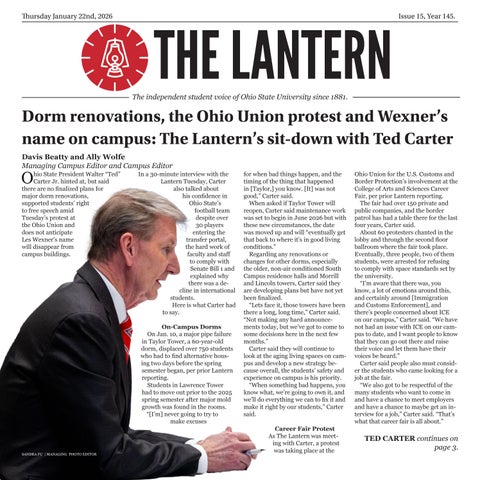
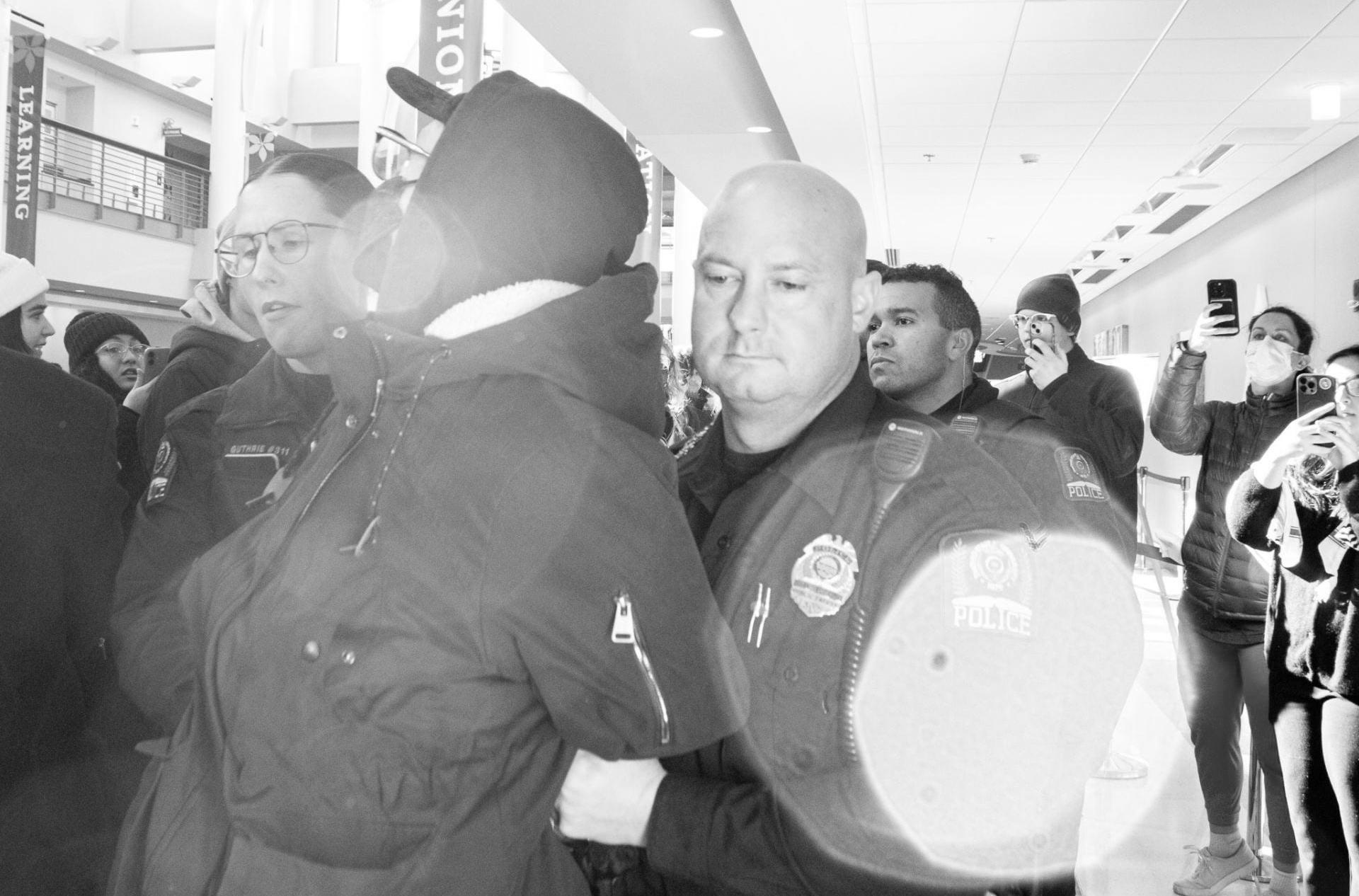
About 60 protesters chanted in the lobby and through the second floor ballroom where the fair took place. Eventually, three people, two of them students, were arrested for refusing to comply with space standards set by the university.
“I’m aware that there was, you know, a lot of emotions around this, and certainly around [Immigration and Customs Enforcement], and there’s people concerned about ICE on our campus,” Carter said. “We have not had an issue with ICE on our campus to date, and I want people to know that they can go out there and raise their voice and let them have their voices be heard.”
Carter said people also must consider the students who came looking for a job at the fair.
“We also got to be respectful of the many students who want to come in and have a chance to meet employers and have a chance to maybe get an interview for a job,” Carter said. “That’s what that career fair is all about.”
TED CARTER continues on page 3.

On page 4
USG open house
On page 5
“Heated Rivalry” and its impact on hockey
Demolition of The Little Bar postponed, property lease to continue through March 31
Helena Hennessy Arts & Life Senior Writer
The demolition of The Little Bar, a beloved establishment known for its welcoming environment, game day celebrations and close-knit community — located at 2195 N. High St. — has been postponed.
A demolition date of Jan. 12 was previously set by project Architect Mitchell Acock at a University Area Commission’s Zoning Committee meeting on Oct. 6, 2025 to replace the bar with a nine to 12 story apartment building that will touch High Street, Norwich and Lane Avenues, per prior Lantern reporting.
John Massimiani, co-owner of The Little Bar, said his lease for the bar’s property ends March 31. He did not comment on a closure date for the business. Massimiani said he was on vacation in Cancún, Mexico when he was sent a video of the FOX 28 Columbus live news broadcast discussing the Jan. 12 demolition date.
“I don’t understand how they’re putting stories on the news saying it’s being knocked down,” Massimiani said. “I don’t know why they keep saying that date, because that’s not the date.”
Massimiani explained The Little Bar never had an agreement in place with the demolition project developers stating that the bar would close prior to March 31.
“Everybody thinks we’re closing early,” Massimiani said, expressing his concern with the publication of the previous project timeline.
To combat this confusion, the bar has posted stories via their Instagram
account to keep the Ohio State community informed of their weekly hours.
Seth Golding, University Area commissioner and zoning committee chair, said he was not surprised by the delay.
“Big projects are usually a little later by the time they get all their ducks in a row; a little longer than when they first state,”

Golding said. “I remember [Jan. 12] being thrown out. I guess I always think of that as sort of a loose date they aim for because there’s so many things involved.”
Golding said he is most curious as to how the upcoming construction will impact the Ohio State community.
“I am anxious to see how the construction affects business as usual in that area of town, as far as how much disruption it’ll be,” Golding said. “It’s
definitely going to be a sort of inconvenience for a lot of people, but it’s really not different than other big projects.”
In reflecting on the business’ eventual closure, Massimiani said he is grateful for the community that The Little Bar has established, and the care it has shown customers.
“Everybody’s enjoyed the last 20 years,” Massimiani said. “We got a good product there. I’m sorry that we’re leaving, but I don’t really have any choices. Just come. Come as much
as you can before we end up not being there anymore.”
Golding expressed his sympathy for The Little Bar and its patrons as it teeters toward its eventual fate.
“I’m personally sad to see smaller businesses evaporate from our landscape,” Golding said. “Especially ones that have been here a long time … It’s a done deal, but hopefully The Little Bar can get a new location, or something to that effect.”
The Little Bar was originally scheduled to be demolished Jan. 12, 2026. However, the bar will remain on campus till at least March 31.
ZACHARY RILLEY | LANTERN FILE PHOTO
Key takeaways from Ted Carter’s interview
Continued from page 1.
ICE Concerns
Concerns over ICE grew following more sightings of arrests in Columbus and the Jan. 7 shooting of Renee Nicole Good in Minneapolis.
Carter said that although ICE is allowed to go on campus because Ohio State is a public university, the agency is not allowed to go into buildings and dorms. If any students, faculty or staff see something, Carter said he encourages them to call university police.
“Our security team is there to protect our students,” Carter said. “So I would not hesitate to say, ‘Hey, call somebody in OSU police department and ask them the questions.’”
Carter said the Office of Student Life has resources for affected students and the Office of Legal Affairs can provide legal advice. In addition, Carter said the legal affairs office has an ICE interaction guide to provide clarity on what is allowed.
Ohio State’s Reputation amid Sexual Assault Concerns Ohio State has been the center of legal cases, such as the class action lawsuit brought by survivors of Dr. Richard Strauss for the university’s handling of Strauss’ sexual abuse. The U.S. House Committee on Oversight Reform also served a subpoena to Les Wexner, the founder of L Brands and chairman of the Wexner Medical Center, over his ties with sex offender Jeffrey Epstein.
When asked about how these cases may affect Ohio State’s reputation, Carter said he is not concerned since there are many positive things happening at the university.
Carter said Ohio State is a top 15 research university, the Wexner Medical Center is opening a new hospital tower next month and the university created Buckeye Bridge, a program that provides free tuition at Ohio State for students who earned their associate degree at Columbus State College. With growing questions of Wexner’s
ties with Epstein and his knowledge of Strauss’ actions while Wexner was a Board of Trustee member, some groups and advocates have called for Wexner’s name to be removed from campus buildings.
Carter currently has no plans to change the name, but said there is a process for name removal.
“I don’t want to speculate because we don’t know what’s coming or is going to happen, right?” Carter said. “There is a process for any kind of name changes. So we’ll follow all the processes that we have, but I don’t
done,” Carter said. “But I will tell you what, we will continue to be competitive next year.”
Carter said the college athletic landscape, specifically football, is completely different now and he thinks Ohio State, specifically head coach Ryan Day, has done a great job of navigating it.
“I mean, let’s not kid ourselves, the transfer portal, NIL, all of those things, even though those are acronyms and words that we’ve used now for a couple years, we’re in a different space,” Carter said.
attractive,” Carter said. “Here’s what I do know: now, the portal window is closed and the music is about to stop, and everybody’s going to be looking for a chair to sit in.”
Carter said some players who enter the portal and don’t find a new home might find themselves hoping to come back, only to find the spot they once held has been taken by someone else.
International Students
The first-year enrollment of international students declined by almost 40 percent for the 2025-26 school year, per prior Lantern reporting.
Chris Booker, a university spokesperson, said in the article from September the difference was because of the unusually high enrollment the year before, and Carter, agreed.
“A little over a year ago, when we brought in that very large freshman class, we were a little over 6,600 international students, and that was partially because of that large class,” Carter said. “A lot of them are still here.”
Carter said this year, there has been less than a five percent reduction in the overall international student body with just under 6,000 students.
On a larger scale, Carter said international students are applying less because of the national higher education landscape, not Ohio State specifically.
anticipate anything there.”
Ohio State Football Transfers
Despite over 30 players from the Ohio State Football team entering the transfer portal this past cycle, per prior Lantern reporting, and how that will affect Ohio State’s team, Carter said he still thinks the Buckeyes will continue to be successful next season.
Carter said the loss of departing players is offset by the immense experience of new athletes transfering to Ohio State.
“There’s still a lot more work to be
Carter said with college football gaining more parity, the common thread between the highly ranked teams is the amount of experience the players have on them, just one year out of the portal.
Carter said it is up to the players to decide what is best for them and their talent, whether it includes financial or playing time motives, and whether those factors mean entering the transfer portal.
“If you’re not feeling like you’re a starter next year, the transfer portal, for a lot of our players, looks very
“[International students are] mostly not coming here because they’re hearing about the landscape,” Carter said. “They’re not being refused visas, they’re just choosing not to come.”
Last spring, at least 11 international students’ visas were revoked and the federal government began pausing visa applications for increased social media vetting, per prior Lantern reporting.
Read about Senate Bill 1 and accessibility requirement progress online at www.thelantern. com!
A third protestor was arrested outside the Archie M. Griffin Grand Ballroom on Tuesday as officers attempted to disperse protesters.
DANIEL BUSH | CAMPUS PHOTO EDITOR
USG Open House explains student government roles ahead of Jan. 25 application deadline
Jacob Joliff Lantern Reporter
T
he Undergraduate Student Government executive branch hosted an open house on Tuesday to explain the responsibilities and impact of student government as the election application deadline nears on Jan. 25.
The event, held during USG’s weekly cabinet meeting, allowed prospective members to learn how the organization operates and explore its various committees before deciding whether to apply. The upcoming election is to fill next year’s executive branch and various committee positions.
“The purpose of the open house was to give potential new members an inside look into what being a committee representative in USG can look like,” said Anoushka Dubey, director of recruitment and membership for USG and second-year in public health.
helped potential applicants better understand how cabinet meetings operate and decide which committee best fits their interests.
Dubey said the event aimed to show students how diverse USG representatives are.
“I hope they understand how diverse
hesitate to apply due to misconceptions about student government.
“I think people see student government as hard or scary to join, or that it’s too much work,” Shuster said. “It is a lot of work, but it’s work that is very important and is benefiting the whole student body, and it’s not hard
with directors and assist with events, Dubey said. Students seeking more responsibility can take on additional leadership roles.
Both Dubey and Shuster encourage students who are unsure about applying to take the opportunity.
“If you’re on the fence, just join,” Shuster said.

“It helps them see what different committees do and where they might fit in this really big organization.”
Brett Shuster, a committee representative for recruitment and firstyear in journalism, said the event
and truly representative USG is and how there truly is a place for every single major,” Dubey said. “I hope people leave the event thinking there is a place for them here.”
Shuster said many students might
or scary to join.”
USG leaders emphasized that the time commitment varies depending on a student’s level of involvement. All members are required to attend weekly cabinet meetings, communicate
“I joined my second week of freshman year, and it helped me meet so many new people and really get involved on campus.”
Dubey said students should apply for reasons beyond professional development.
“I’ve met people that I’ll be friends with for life,” Dubey said. “It’s one of those organizations where you can talk to anyone, and you will leave with having the most insightful conversation.”
For students still interested in applying, the deadline is midnight on Jan. 25.
According to the website, additional informational and recruitment events will be held leading up to the deadline to give students more opportunities to learn about involvement in USG.
Undergraduate Student Government is holding elections for the next school year. Applications close on Jan. 25.
DANIEL BUSH | CAMPUS PHOTO EDITOR

ARTS & LIFE
On page 6 On page 7
Buckeye Beatbox club Brutus claims national title
Beyond the ice: How “Heated Rivalry” is redefining masculinity in hockey
Natalie Zurakowski Lantern Reporter
Captivating. Beautiful. Enamoring.
These are the three words Elizabeth Pilon, a first-year in nursing, used to describe the global phenomenon of “Heated Rivalry.”
Inspired by the queer hockey romance novels by Rachel Reid, “Game Changer” and “Heated Rivalry,” the Crave original television series from Canada has become a worldwide sensation since its debut in late November. The series follows the complicated relationship between hockey superstars — and rivals — Shane Hollander and Ilya Rozanov as they face challenges with sexuality, acceptance and culture.
Since its release on HBO Max, the series has quickly become one of the streaming platform’s most popular shows. According to a Jan. 10 New York Times article, it has exceeded 600 million minutes streamed in the U.S. alone since early January.
The show’s unexpected success has broken barriers in the sports community and changed the narrative of how masculinity and sexuality are seen in athletics, with the show inspiring NHL player Jesse Kortuem to publicly come out as gay following the show’s rise in popularity.
Abby Corcoran, a third-year graduate student in the Department of Women’s, Gender and Sexuality Studies, said she believes part of the series’ success comes from its opposition to toxic masculinity.
“The thing that makes these sports legible is their vision of masculinity that requires or is in contrast to any
sort of queerness,” Corcoran said.
“‘Heated Rivalry’ is showing versions of an alternative masculinity that is soft and vulnerable ... particularly as we’re coming off of this conversation about how masculinity is toxic and damaging, this gives an alternative vision for women and men who are attracted to men [as] something to hope for or aspire toward.”
For fans like Pilon, she said the appeal of “Heated Rivalry” goes beyond the sport. It is not about the action-packed, game-winning shots on the ice; it is about the secret texts and shared looks between Hollander and Rozanov. Their decade-long, slow-burn relationship full of “heated” moments is what keeps viewers glued to the screen.
“In October, my roommate and I saw the trailer for it through Crave Canada and thought it looked so good,” Pilon said. “We were like, ‘Are we going to have to download a VPN?’”
Episode five, “I’ll Believe in Anything,” quickly went viral for its iconic moments and became the second television episode ever to receive a rare perfect 10 rating on IMDb. The episode features a gut-wrenching Russian monologue from Rozanov, Hollander’s acceptance of his sexuality, the ground-breaking kiss Scott Hunter — team captain of the fictional New York Admirals — and his boyfriend Kip share publicly after Hunter’s team wins the Stanley Cup and Rozanov’s climactic, episode-ending line: “I’m coming to the cottage.”
Hudson Williams, who plays Hollander, said on “Andy Cohen Live” that the series’ vulnerable and intense moments have resulted in closeted professional athletes reaching out to the show’s stars, Williams and Connor Storrie, who plays Rozanov, to share their stories.
Pilon said she hopes the show continues to help more people feel comfortable with their authentic selves.
“There are most likely people in those situations seeing this and seeing the outpouring of support and love,” Pilon said. “Hopefully, the athletes at our school can potentially feel that and feel that this is a school and an environment where people are supportive of them and do love them, no matter what.”
“Heated Rivalry” has become a beacon of queer representation in a sport known for “locker room talk,” and has also welcomed new communities
to the world of hockey. According to a SeatGeek article published Jan. 16, in-between Nov. 28 and Dec. 23, the time in which the first and fifth episode were released, NHL tickets saw a 24% surge in average tickets sold per game and a 36% increase in revenue.
Corcoran said she hopes the series’ popularity will inspire viewers to take real action and stand up for the queer community outside of the hockey community.
“I think it’s really important for us to sort of harness that momentum to do something more tangible,” Corcoran said.
Fans will not have to wait too long to see the next chapter of Rozanov and Hollander’s story. Producers announced that the series has been renewed for a second season, which will adapt Reid’s sequel novel, “The Long Game.”
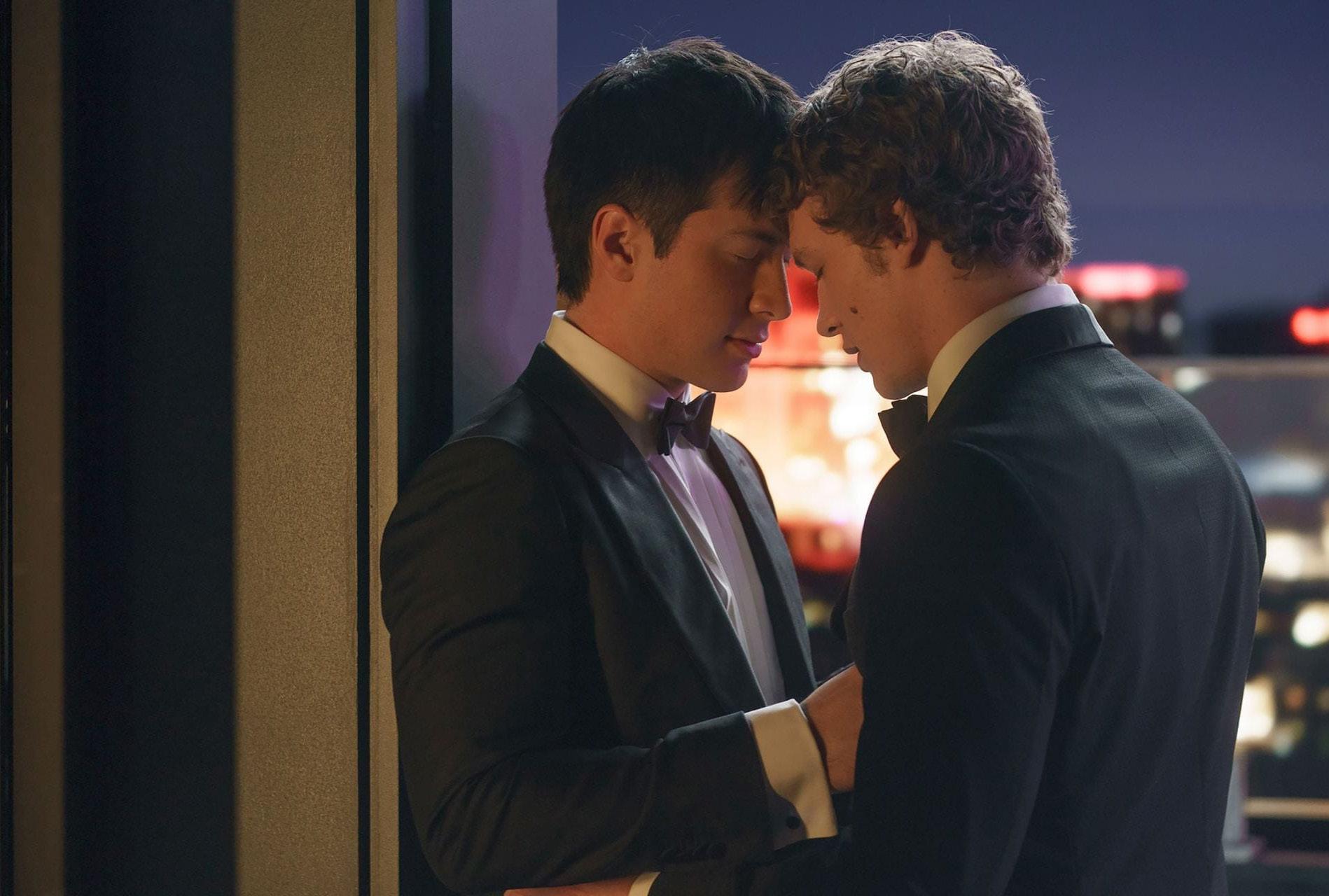
Hudson Williams (left) and Connor Storrie (right) in “Heated Rivalry.”
SABRINA LANTOS | HBO MAX VIA TNS
Buckeye Beatbox: A club that brings many a sense of belonging
Jasmine Williams Lantern Reporter
After being unable to find a space to practice beatboxing on campus, Malachi Webster founded Buckeye Beatbox, a student organization that meets weekly and gives students on all levels a space to learn, practice and perform the art.
Webster, a fourth-year in finance and president of Buckeye Beatbox, said the club was created to fill a gap he felt as a student with a niche musical interest. He said he started beatboxing before college and had hoped to find a community at Ohio State that shared the interest, but quickly found out it didn’t exist.
“I had a hard time finding places where I felt comfortable beatboxing,” Webster said. “It’s kind of a weird thing to just do out in public, and I really wish there was a space where people could do it openly without feeling judged.”
Webster said this led him to form Buckeye Beatbox at the end of his second year. The club officially launched during his third year and he said it has grown into a community that prides itself on accessibility, creativity and collaboration.
“Buckeye Beatbox aims to cultivate an engaging and collaborative space for individuals passionate about beatboxing,” Webster said. “Our goal is to nurture a supportive community where members can share their expertise, learn from one another and embrace self-expression through the art of beatbox.”
The club meets on Mondays from 6-8 p.m. in the Timashev Family Music Building, where they host conversational and group activities.
“We usually start with a backing track jam,” Webster said. “We’ll pass a microphone around and let everyone freestyle over a track. It’s a good way to warm up, experiment and just get comfortable.”
Tyler Ahlers, vice president of Buckeye Beatbox and a second-year
in animal science, said the welcoming environment is one of the strongest qualities the club has.
“It’s a very friendly club where people work to increase and learn their beatboxing and music skills,” Ahlers
Ahlers said. “That’s something you don’t really get anywhere else on campus.”
Webster said that the club has expanded significantly since its inception, moving from casual meetups to
said. “Members don’t need any experience, just an interest in the hobby.”
Ahlers said meetings often include workshops, group jams and some activities to help build the members’ confidence and techniques. The club also invites professional beatboxers to campus for workshops and even performances.
“We’ve had well-known beatboxers come in and work with everybody,”
more structured learning and community engagement. This year, the organization collaborated with other student groups, such as Ohio State’s Breakin’ Club, a breakdancing student organization and College Mentors for Kids, which connects children with college-aged students to foster connections, engage with learning and build relationships.
“We’re able to do more now because
our members have grown so much,” Webster said. “We can talk about advanced techniques, performance skills and even the history of beatboxing.”
One of the most memorable moments in the club came when the members traveled to Kansas for a beatboxing competition, where Webster and Ahlers said they competed with the support of members from the club.
“The other members rooting for me and [Webster] felt really special,” Ahlers said. “It felt like being a team captain trying to bring back something for your group.”
Webster said that those moments reflect the deeper sense of belonging that the club provides for its members.
“Beatboxing is so niche, so when people collectively love it, strong friendships are made,” Ahlers said. “It’s easier to grow when others are helping you.”
For Webster, he said the organization became the defining part of his college experience.
“This club is likely the thing I’ll remember most about college,” Webster said. “It’s given me leadership skills, friendships and a space to express myself.”
As Webster gets ready to graduate, he said the club’s new leadership is ensuring that Buckeye Beatbox will continue to grow.
“I want it to keep existing and reach more people,” Webster said. “Beatboxing is accessible, expressive and powerful. Once people see what can be created, it changes their perspective.”
Any students who are interested in joining Buckeye Beatbox can simply attend a meeting, message the club on Instagram or even join the GroupMe chat, all found on the Find a Student Organization page. Ahlers said all are welcome.
“Once people give it a shot, they usually fall in love with it,” Ahlers said.
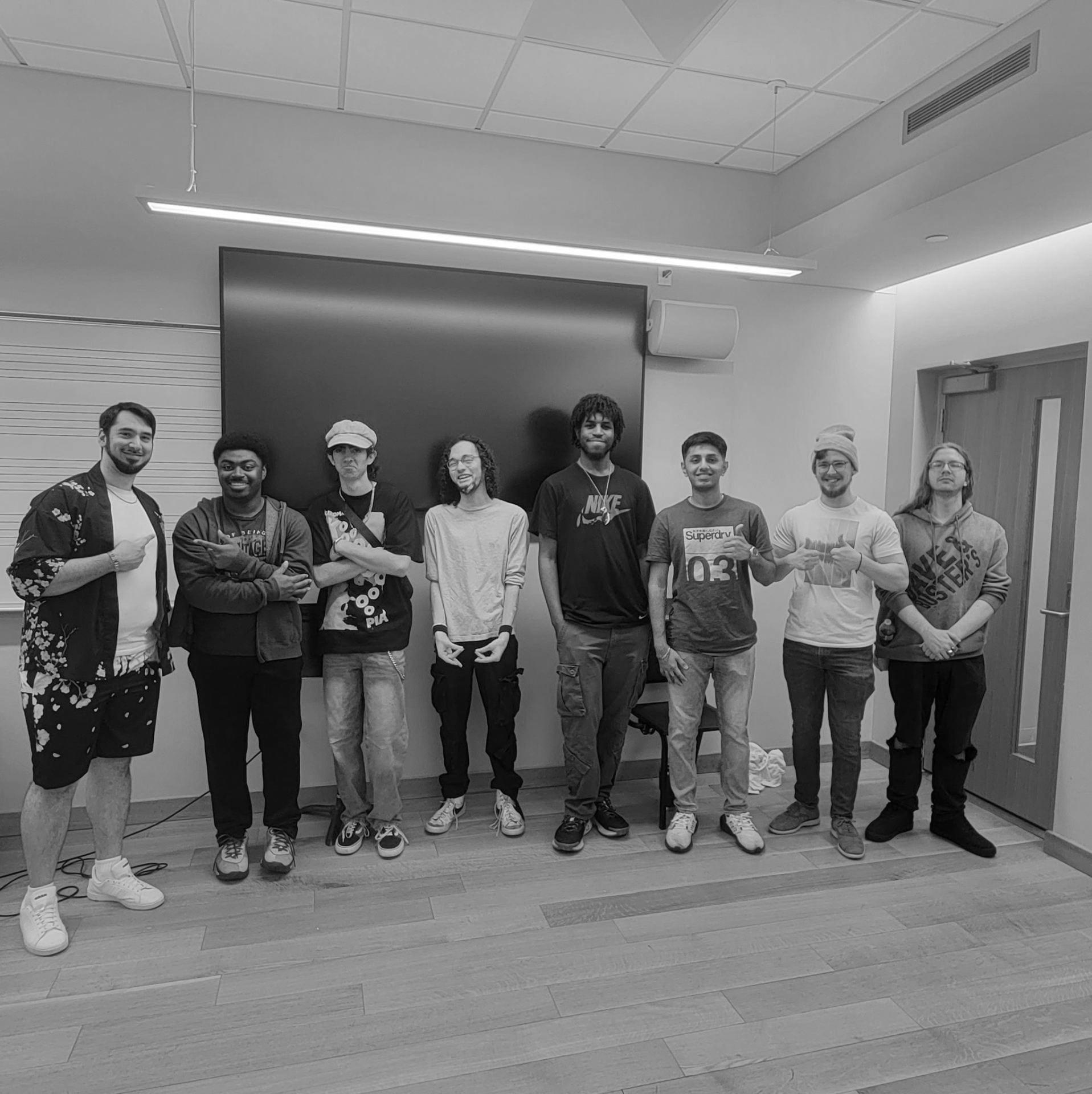
The Buckeye Beatbox club meets Mondays from 6-8 p.m. in the Timashev Family Music Building.
PHOTO COURTESY OF MALACHI WEBSTER
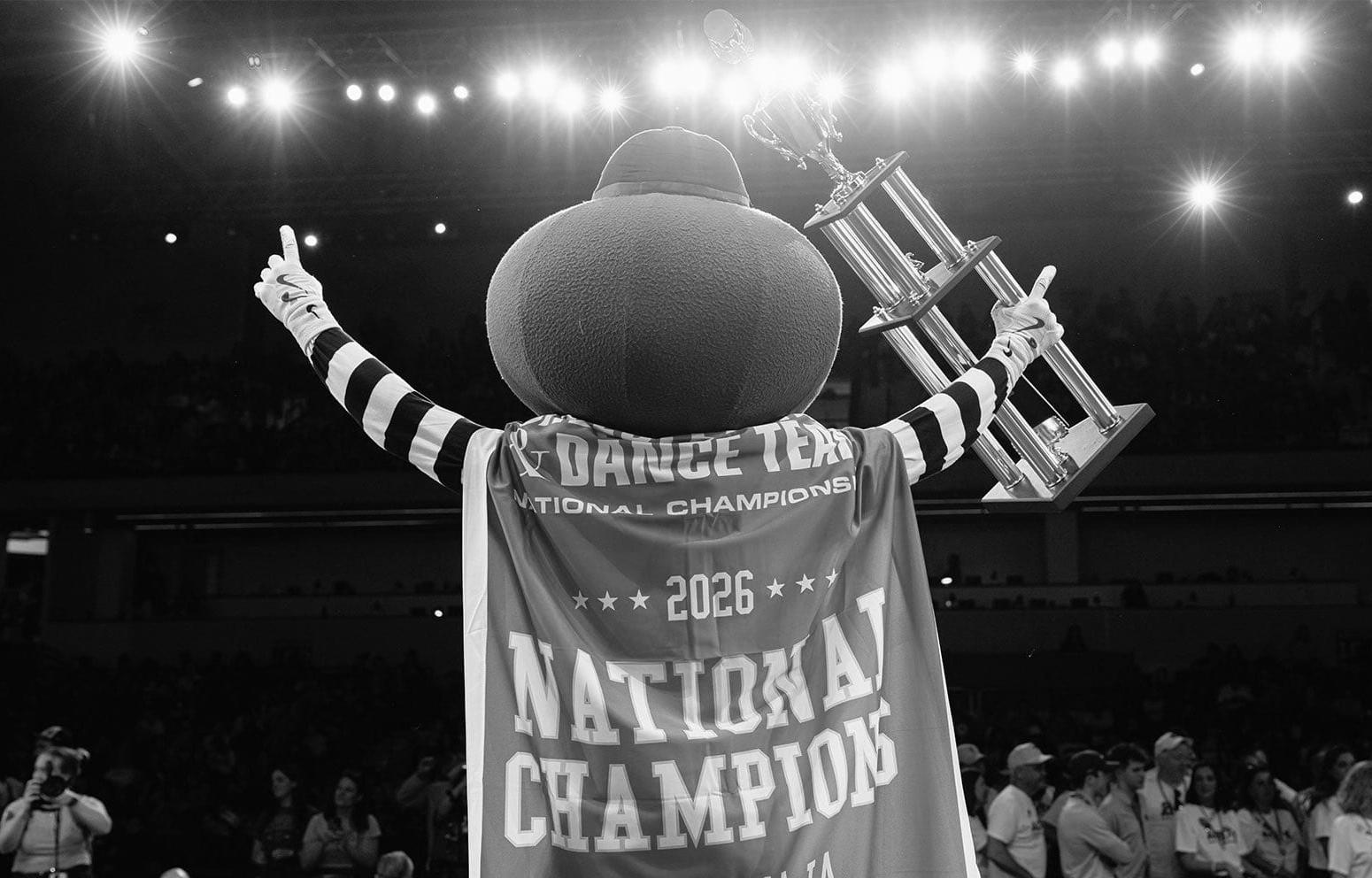
Brutus Buckeye claims national title as Ohio State shines at ADA Nationals
Liv Rinaldi Sports Editor
Ohio State’s spirit program left Orlando with more hardware - and Brutus Buckeye led the charge.
Brutus won the Division IA Mascot national championship Saturday at the 2026 UCA & UDA College Cheerleading and Dance Team National Championship, held Jan. 16-18 at the ESPN Wide World of Sports Complex. The victory marked Brutus’ first national title in the mascot division since 2019, capping a weekend that saw Ohio State collect multiple champion-
ships across spirit disciplines.
Mascots must first qualify for nationals through a preliminary video submission, with only the top 10 competitors nationwide advancing to the live event. Those video scores account for 50% of the final score, with the remaining half determined by an in-person performance.
Brutus delivered a 90-second, bank heist-themed routine during Saturday’s finals, portraying a quest for a championship ring. The performance,
written by members of Ohio State’s spirit squad in collaboration with coaching staff, combined physical comedy, choreography and audience interaction — all elements emphasized in mascot judging criteria.
Brutus finished ahead of Minnesota’s Goldy Gopher, who placed second, and Tennessee’s Smokey, who took third.
Ohio State continued its success beyond the mascot competition.
The Buckeyes opened the weekend
by winning the Division IA Spirit Game Day national championship, marking their third consecutive title in the category. Ohio State Dance also claimed its third straight Division IA Jazz championship, while finishing third in Pom.
Ohio State Cheer is led by first-year head coach Kelsea Giantonio, while the dance and spirit teams are directed by Melissa McGhee. The mascot program is coached by Ray Sharp and Tim Thiel.

On page 2 On page 3
The Little Bar’s postponed demolition Important points from Ted Carter
John Mobley Jr.’s work ethic paying off for the Buckeyes
Reilly Cahill Sports Senior Writer
John Mobley Jr. felt that he had let his teammates down.
The sophomore guard had scored a season-low three points on just five shot attempts in Jan. 11’s 81-74 loss to Washington on the road, a surprisingly quiet night for the Buckeyes second-leading scorer.
Mobley Jr. never lost confidence, but head coach Jake Diebler challenged him to be more aggressive.
He got right back to the gym.
With a week separating the loss from Ohio State’s next game, Diebler said he wasn’t concerned about Mobley Jr.’s slump lingering.
“He didn’t have his best game, he knows that,” Diebler said, “but like good players do, he’ll respond.”
He certainly did.
Mobley Jr. erupted for a career-high 28 points with six 3-pointers on Saturday, leading the Buckeyes to an 86-72 win over UCLA. Three days later, he put up a 26-point performance in an 82-74 overtime win over Minnesota.
The surge didn’t come out of nowhere.
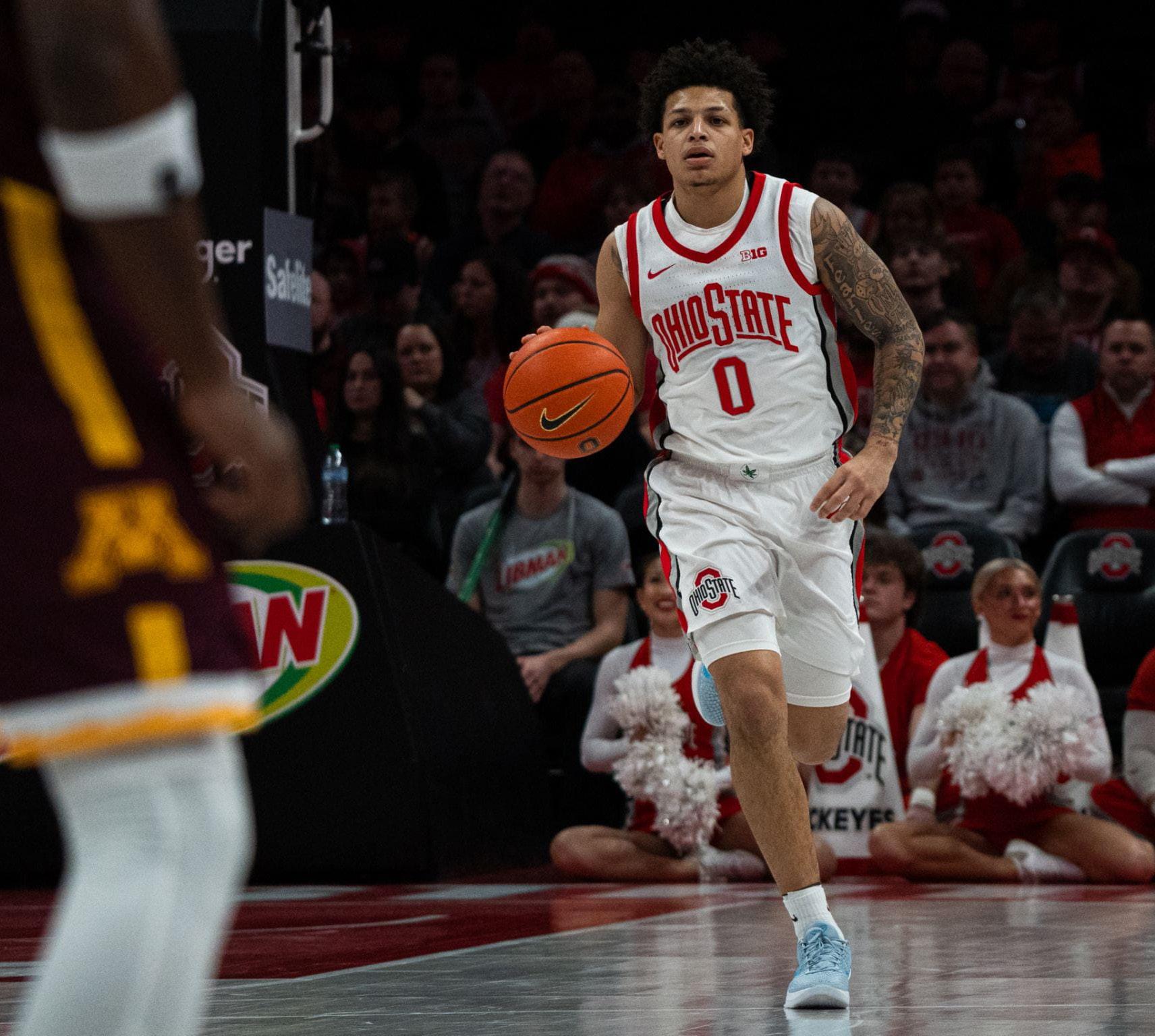
Mobley Jr. credited the extra shooting work he’s been putting in at the practice facility, often long before most of the team arrives.
“I’ve been getting in the gym at 5 a.m. every day,” Mobley Jr. said. “I knew there was going to be a turnaround; it was just a matter of time.”
Almost every morning, Mobley Jr.,
along with his father, John Sr., are the first people in the facility, working out for roughly 45 minutes before sunrise.
Ohio State basketball manager Will DeVere has seen those early morning workouts firsthand.
“He does some finishing, works on his touch, he shoots some mid-range shots then goes to threes,” DeVere said. “It’s a pretty full workout which is kind of unusual for going that early. It’s impressive.”
Diebler compared Mobley Jr.’s work ethic to his own time when he played at Valparaiso University from 2005 to 2009.
“It’s why I have such trust and believe in him, because I know the work that he puts in,” Diebler said after the UCLA game. “I’m kind of cut from the same cloth, that’s how I was brought up. When you’re shooting it well, you get in the gym. When you’re not shooting it well, you get in the gym. When
you’re playing great, you get in the gym. Maybe you struggle, you get in the gym. And he’s the same way.”
In addition to extra shooting, Mobley Jr. has tried to become a more well-rounded player this season.
“Just [watching] a lot of film, if I’m going to be a complete player, I’ve got to see other things besides putting the ball in the basket,” Mobley Jr. said. “Trying to find my teammates, making the right play, having poise in the paint.”
Over the two-game stretch, the Reynoldsburg, Ohio native shot 11-of-23 from 3-point range, boosting his percentage from beyond the arc to 41.4%, which ranks first in the Big Ten.
After winning its last two games, Ohio State is 5-3 in the Big Ten, marking the first time since Jan. 1, 2023, that the Buckeyes are two games above .500.
Mobley Jr., who averages 15.3 points, has proven to be the difference maker on a Buckeye offense that ranks fifth in the Big Ten with 83.2 points per game. When the guard scores 15 or more points, Ohio State is 9-1.
With Ohio State projected as a No. 10 seed in CBS Sports’ Bracketology, Mobley Jr.’s surge arrives at a pivotal moment. But the foundation was laid long before the Buckeyes climbed back into the conference race—in early mornings, empty gyms and extra reps taken when no one was watching.
John Mobley Jr. (0) brings the ball up the court during Monday’s game against the Minnesota Golden Gophers.
DOMINIC FERRARO | LANTERN FREELANCE PHOTOGRAPHER