











By Kathi Caldwell-Hopper
Here are some interesting animal facts: Tree Frogs will freeze and thaw depending on the winter temperature, Flying Squirrels and bats will cuddle together for warmth and the brain size of Chickadees actually increases in the winter.
These and many other facts give us clues as to how New Hampshire’s wild animals survive in winter. It is a subject that has fascinated Wendy Oellers-Fulmer, a Lakes Region resident, for many years. As a teacher by profession, Wendy says, “My connection with nature was woven through my work as a teacher. I encouraged my students to observe what is around us, and to look, listen and be curious.”
Wendy points to a quote she came across that greatly influenced her work as a teacher. She says, “It is by Robert Michael Pyle and it is, ‘How can we get our children to care about the fate of the condor if they haven’t even made the acquaintance of the wren in the backyard?’ It inspired my curriculum focused on the natural world.”
After she left teaching and retired, that did not mean the end of her thoughts about how to connect children and adults with the world around them, and specifically, with nature. One day, in the Gilford Public Library, she was chatting with library director, Katherine Dormody, about this subject. Katherine suggested Wendy might do an article/column in the library’s email newsletter.
Wendy saw the invitation as a way to

reach people and create awareness that there is a natural world all around us if we only take the time to listen and ask questions. Thus, she began writing a column called Nature Corner, covering all sorts of interesting facts about birds, animals, reptiles and plants that most people might not know about.
One big question many of us have, should we find ourselves outdoors, such as driving to work and spying a squirrel in a tree on a freezing winter’s day, is how animals in New Hampshire/New England survive the temperature drop.
Such a question is a good starting point, according to Wendy. When out-
doors, there are three things to consider, ultimately leading to a greater awareness and caring about what happens around us. The first is to pay attention. For example, if you see a squirrel or a bird during a snowstorm, that observation could well lead to asking, “How does that creature survive when the weather is bad? Does it have food and shelter? How does it keep warm?”
Those questions are part of the second point, which is what we do when we wonder about such things. Do we look up information or ask someone who might know more? This is called curiosity and once we have the answers, we can consider becoming more
involved.
The third is to make connections, which can lead to caring about the environment and wanting to learn more, by attending educational programs, volunteering, keeping a nature journal or even donating to nature organizations. If we care, we can protect and nurture the animals and their habitats. (Recent research indicates that since the 1970s, the population of North American birds has dropped nearly 30 percent, which translates to 3 billion birds gone.)
Wendy’s Nature Corner column in the library newsletter is well read and answers many questions about such topics as how the variety of animals in New Hampshire endure and thrive during our sometimes extreme winters. Always interested in nature, Wendy is an artist and has featured birds in her paintings and photography. She also is a jewelry maker along with her husband, Ron, and the natural world figures in some of their designs as well.
“My parents were big birders,” she explains. “As a child, I spent summers in Maine with my family and that is when I really got aware of and interested in nature and wildlife.”
Over the years her interest has grown, helped along by her days as a teacher. “I have always loved being outdoors and taking my students into the woods to observe,” she says. “Nowadays I have found that when I bring along a • Animals continued on page 3

camera when I am outdoors, it helps set my intention to pay attention,” Wendy comments as she points to fine photographs she has taken of birds, some in wintertime.
We can all participate in observing the natural world. It can be as simple as looking out our windows, to walking in the woods. Our observations can lead to curiosity. If we see animal tracks, for example, we can ask what animal made those tracks. Where was the animal going and why? What does it eat and where might it find a food source? These are just a few of the many questions that lead to a better understanding of the world around us and the impact animals have. “There are so many resources available to help us discover the wonder that surrounds us in nature,” says Wendy.
People wonder how New Hampshire wildlife survives winter and it turns out there are many adaptations dependent upon the animal. Some are behavioral, like hibernating or storing food, the other can be physical adaptions, like growing heavier fur, building up fat, and going into states of torpor. (Torpor is a survival mechanism involving the temporary, often involuntary reduction in the body temperature of an animal, metabolic rate and activity to conserve energy when food is scarce or the temperature very low.)
Deer endure the cold by huddling together for warmth. Amphibians and reptiles go into a hibernation. Native birds that don’t migrate have a variety of ways to survive.
Some methods of coping with winter are amazing and extreme, such as the chickadee. Wendy says the bird increases its brain size during winter to help it remember where it stored its food. (For example, did it store some food in a crevice near a rock or in a hole in a tree to be accessed later?) This is a fascinating method for getting through the winter but it makes scientific sense.
We think of most animals as hibernating during the winter, but Wendy says, “There are only four mammals who are true hibernators: chipmunks, wood chucks, the jumping mouse and the little brown bat.” Skunks, bears and raccoons will go into deep sleep but will wake up and venture out when higher temperatures permit.
Other animals have found ways to cope and survive and their bodies are created and adapted to help them do so. The fox is active all winter and has acute hearing skills. Their bones are lightweight, allowing them to walk on top of the snow versus sinking into it. As they walk across the snow, their acute hearing identifies animals who have burrowed under the snow. “They can actually hear animals scampering around and that is how they catch food,” marvels Wendy.
Should we decide to feed the birds from our homes, we must be vigilant and not put the feeding on hold should we, for example, go away on vacation for a few weeks. The birds are used to a food source and will expend precious energy resources in finding new food sources. “Please offer birds quality food,” Wendy stresses, “and if possible, a water source.”


There are many ways to protect animals in the natural world, including stopping the use of rodenticides and pesticides, taking time to explore the outdoor world and realize the positive benefits of spending time outside in nature, and lastly, being aware of current projects on a town and state level when it comes to nature.
Wendy hopes that through her newsletter column, people are becoming more aware. She adds, “It is rewarding when someone comes up to me and says they never knew this or that about animals and/or the natural world. Hopefully, when they make that connection, it will ultimately lead to being proactive for the animals and their habitats.”
In our busy lives, we may wonder why we should care deeply about the fate of animals. Wendy recites a quote by Chief Seattle: “We do not inherit the
earth from our ancestors; we borrow it from our children.” We must protect what we have for the future.
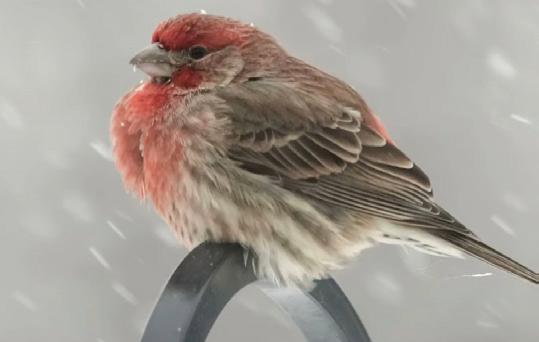
Wendy concludes, as she gazes at one of her many photographs taken of birds braving a recent snowstorm, “It is dangerous to ourselves and our future not to care about the natural world we live in.”
To access Wendy’s Nature Corner in the Gilford Public Library’s newsletter, call the library at 603-524-6042 or visit www.gilfordlibrary.org.
(A portion of the sales of Wendy’s jewelry, based on nature designs, and also her nature-based calendars, is donated to five different nonprofits that support the environment: The Sea Turtle Conservancy, the Nature Conservancy, the Sierra Club, the Audubon Society, and the Cornell Laboratory of Ornithology. See examples of Wendy’s jewelry at dreamscapejewelry.com.)
What could pirates and ballet possibly have in common? Answer: a great story. See for yourself how Sole City Dance’s adaptation of “Treasure Island”, replete with intrigue and romance, mermaids and treasure, as well as a cast of memorable characters, brings beauty and artistry to Stevenson’s beloved adventure tale.
With Sole City’s characteristic attention to detail and theme, the story becomes more than a race for treasure. The ballet features characters learning to “treasure” the most important things in life.
See the show on Friday, April 3 at 7 pm, or Saturday, April 4, at 1 pm and
6pm. Tickets are $15 for Table Seating or $12 for Balcony, and can be purchased at rochesteroperahouse.com.
The Rochester Opera House is located at 31 Wakefield Street in Rochester. The show is produced by Sole City Dance. More information can be found at solecitydance.org or by calling 603750-7777.
Sole City Dance provides a strong technical foundation in dance in a non-competitive, nonjudgmental environment, for the encouragement of artistic expression. Sole City Dance is a federally-designated 501(c)(3) non-profit arts organization.








By Kathi Caldwell-Hopper
If you need to store food or leftovers, you likely reach for a plastic container with an air tight cover. A family member reminds you, “Don’t forget to ‘burp’ it!” Nodding, you push down on the well-fitting cover, let out all the container’s air (burping), affix the cover and slide the food into your refrigerator.
You are doing what thousands of people have done over the years, making use of a Tupperware product. The handy plastic storage containers come in all sizes and a variety of shapes with well-fitting covers.
Tupperware is quite brilliant, as is the practice of home parties to sell Tupperware to a variety of people - usually women when the product was in its infancy - over the years.
It is so ingrained in our collective culture that we seldom wonder where Tupperware originated and who invented the product. Many people might be surprised to learn the creator of Tupperware was Earl S. Tupper and he was from northern New Hampshire where he spent his first few years.
Tupper was born in 1907 in Berlin, New Hampshire. It was a much different world back then, especially in a town such as Berlin, located in the northern portion in the state. Tupper’s family were farmers and they were not rich. His mother ran a boarding house and took in laundry to help make ends meet, and his father ran the farm. Eventually, when Earl was still a young child, the family relocated to Massachusetts. They moved around the state to different farms, according to Wikipedia.org. They probably moved in search of more opportunities to succeed, which would not have been easy in those days.
Earl’s father was an inventor at heart, always looking for ways to make work-saving devices. For example, he created a frame to make cleaning chickens easier and even got a patent for the device.
Watching his father over the years of his boyhood, Earl probably caught the invention bug as well and also had a knack for selling things. This combination would prove handy years later when he had to market/sell Tupperware. Earl’s ambition grew and he was said to have commented he hoped to make his first million dollars by the time he was 30 years of age. This would have seemed like a pipe dream for a boy who grew up less than wealthy, but Earl had his ambitions.
After high school, Earl, like most young men at the time, went out to work. It was a necessity to support himself and help his family. He worked at a number of jobs in the 1920s, including as a mail clerk, on the railroad, and other positions. But most importantly, he set up a landscaping and tree surgery business as well as marrying in the early 1930s.
While not a millionaire – at least not yet – Earl was successful at his landscape business. The money helped the Tupper family and gave Earl the resources to work on his inventions. But the Depression years may have been the reason his landscape business eventually failed.
It was 1937 but Earl was not one to give up. He saw his inventions as a way out of financial worries and continued to create and tinker and work for a better future. Beyond the financial incentives, Earl just could not give up being an inventor, because it was who he was. Earl worked for DuPont, the plastics company in Massachusetts. Although he stayed just one year, he would say at a later time that “my education really began” as an employee at DuPont. Earl learned a great deal at the company, such as how plastics worked and how to design products and manufacture plastic material.
Like many inventors, Earl did not want to work for someone else but rather make his own way in business. It was risky, especially during the Depression and post-Depression years
when many people were struggling and counted themselves lucky if they were employed.
Earl started the Earl S. Tupper Company in 1938 to design and produce industrial plastic products in Leominster, Massachusetts, where he resided. As the years of World War II arrived, Earl’s business was thriving due to defense contracts. His company made use of plastics for gas masks and signal lamps.
After the war, Earl wanted to make plastic products for the average American consumer. He must have been taking note of things that would be of help in a home, such as his plastic tumbler to be used in a bathroom when someone was brushing their teeth or using mouthwash.
We live in a world surrounded by plastics, and don’t think much of it on a daily basis. But in the 1940s, it was a lesser known or utilized product. Few people would have used the strange plastic in a home product so it was an uphill battle to bring the material off the factory floor and into the homes of Americans.
But Earl was not one to give up and he continued to experiment, making a product that was durable, translucent and would not have greasy residue from food stored within. He also added an airtight cover to the product which would make each container impervious to liquid leakage.
Marketing his plastic product was daunting. Department stores had a hard time selling it but still Earl persisted. While trying to figure out a way to convince the public that Tupperware was a viable home product, back in his birthplace of Berlin things were bustling. It was a paper mill town populated by workers; about 20,000 people lived in Berlin at the time. Because Tupperware had not yet become popular, most people in northern New Hampshire probably did not remember the Tupper family or have much knowledge of how hard Earl was working on the new plastic project.
When Brownie Wise, a business woman from another state, embraced Tupperware and added it to her line of home party products, things changed.
Brownie outlined for Tupper her plan of selling the plastic product at her home parties. (The parties were a chance for housewives to invite friends and family into their homes for coffee, pastries and a chance to see the products up-close and ask questions of a party representative. Ultimately, the parties were an incentive for the hosting housewife to earn complimentary products when her guests ordered on the spot.)
The new offshoot of the Tupperware company was called Tupperware Home Parties and it launched in 1951. Things were off and running and business grew.
While Brownie was the visible side of Tupperware and a great salesperson, Earl was quiet and careful. He continued to invent and produce his plastic wonder product in Massachusetts while the outgoing Brownie was the face of the company.
Eventually, Earl and Brownie parted ways around the time Earl sold his company. Perhaps seeing his chance to finally make that million dollars (and more) for which he had always dreamed, Earl sold to the Rexall company for a whopping $16 million. For a boy who started out with next to nothing in a small northern New Hampshire town, Earl was now in a different league; perhaps he wanted big changes to match his altered life position. One of those changes was a divorce between Earl and his wife. Another change was his relocation to an island he purchased in Central America.
“Once an inventor, aways an inventor” could be the catch phrase for Earl Tupper’s life. It is said he continued to work on inventions and carried a notebook where he wrote down his ideas. One such idea was a round stove and another a new version of a washing machine.
When Earl Tupper passed away in 1983, he left behind his amazing invention/product – Tupperware – that is in many homes to this day. The next time you store leftovers in a Tupperware container and remember to “burp” the lid, think of inventor Earl Tupper, born in northern New Hampshire’s Berlin, and give a nod of thanks.
































By Mike Moore
There are many small towns dotted along Route 16, each having their own rich history of building communities through fellowship and entertainment. In Tamworth, New Hampshire, celebrating the arts has been a big part of the community’s identity for centuries. The Tamworth Outing Club ensures that its most celebrated tradition, the Second Saturday Dances, continues to bring neighbors of all ages and dancing ability together to enjoy the wide variety of music with their friends and family.
Located right in the heart of Tamworth, on Cleveland Hill Road, the Town House has been the place where folks could Contra Dance every second Saturday of the month throughout the year since the late 1980s. However, the Tamworth Outing Club first got the town dancing regularly back in 1937, making it the second-oldest group of its kind in New Hampshire. 70 men and women came to Huggins Barn to dance along to the orchestra. TOC’s idea was to create community camaraderie by getting everyone in attendance to participate in the music, whether playing with the band or dancing along in the line. Today, the nonprofit group is comprised of spirited locals wanting to “organize and host recreational, inclusive activities for the benefit of Tamworth residents and visitors of all ages”. In addition to the monthly dances, TOC throws a yearly Winter Fest, offers a Sled Dog Fun Day toward the end of the winter, holds events for Halloween and Christmas, and offers a multitude of volunteer opportunities for anyone in the Lakes Region wanting to sign up and take part. TOC’s philosophy is simple: “provide an opportunity for the town’s residents and visitors to get out and meet their friends and neighbors in a wide variety of face-to-face settings”. Continuing Tamworth’s legacy as a warm and welcoming community
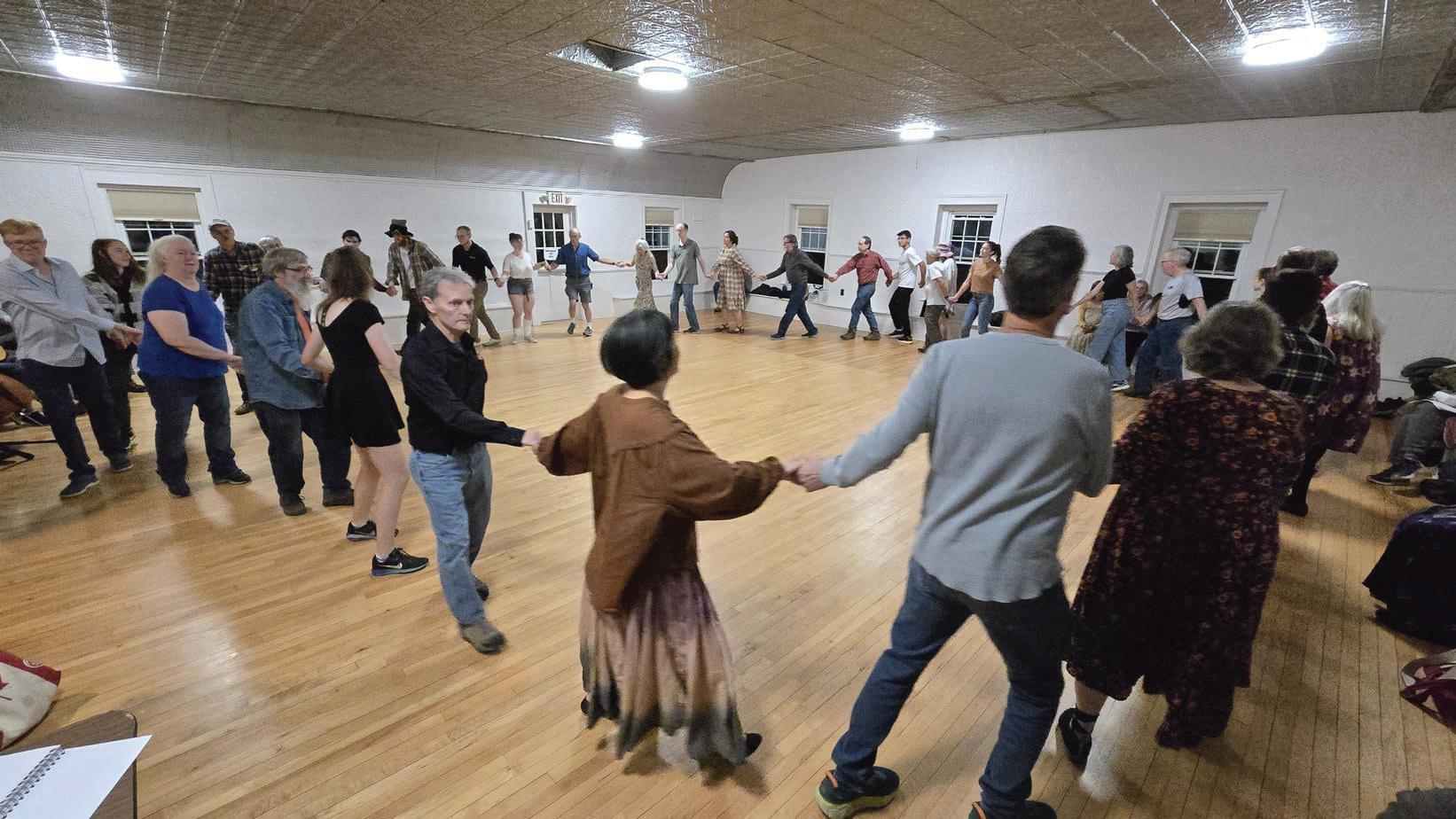
was the mission in the 1930s and is as strong as ever today.
From the very beginning, participants of all ages and skill levels have been encouraged to head on down to the dance hall each month. This year at the Town House, the festivities kick off at 7:30 pm each second Saturday, and eventually conclude around 10 pm. Prices remain modest year after year (kids 12 and under are free), which keeps the dance lines full from one side of the hall to the other. The dance has become an honored tradition after 90 years of success; it continues to bond neighbors, provide some great exercise, and get people away from their electronic devices for an evening as they interact the old-fashioned way.
Contra dancing derives from traditional Native American folk dancing and has easy to learn walking steps, making the night enjoyable regardless of skill level. The “caller” is the central figure of the event, as they not only direct the steps throughout the night, they also help teach the steps as well. Experienced dancers won’t hesitate to lend a helping hand to those just learning the steps for the first time, too.
All music is age-appropriate, and the variety offered could give those in attendance the chance to line dance and


waltz on the same night. Some other popular dances learned at the Town House are jigs, reels, and circles. The small difference between contra and square dancing is that you and your dance partner will each join a line that could stretch on down the entire length of the dancehall, rather than joining a square with three other couples. This format allows the chance to partner up with nearly everyone, giving the opportunity to catch up with all your old friends and even make new ones.
Ensuring the love of dance endures for future generations throughout the Lakes Region will forever be a foundation of the Tamworth Outing Club. Last year, the TOC was able to visit local schools to teach and encourage appreciation for contra dancing. Their efforts extend beyond school hours, as they offer the children of the community opportunities to learn, instruments, dance, and even work with those wanting to become a caller at a future Second Saturday dance.
The Second Saturdays aren’t just for bringing the community together for dancing. The TOC welcomes visiting musicians or those just wanting to join the fun for a night or two. Those interested in continuing the robust musical history in Tamworth can
find more information at the group’s website tamworthoutingclub.org. For the upcoming dances, the Second Saturday Calendar is full of returning favorites. In February, New Leaf will be performing, with Bryon Ricker serving as the caller for the evening. In March, Shana Aisenberg and Amy Berrier will play the music to Jennifer McHone Villalobos’s call. Celtic Joy will be playing in April, with Jacqueline Laufman listed as the caller. Those making their way out to the dance hall in May will be treated to the music of Birds on a Wire, while Eric Rollnick will teach and call out the steps for everyone that night.
Contra dancing is such a New Hampshire treasure that there are dozens of other communities throughout the state. In addition to contra, there are plenty of groups that offer folk dancing from around the world, including Scandinavian, Scottish, Irish, and English. In Concord, there’s the New Hampshire English Country Dance Society and the Concord Area Contra Dance group. Down by the Seacoast, dance enthusiasts can go to Seacoast Contra in Newfields or learn Irish Set Dancing with the Seacoast Set Dancers in Durham. A little further into the White Mountains region offers opportunities to get out and dance as well. Try some Scottish Country Dancing in Lancaster, or Do Si Do over to Plymouth for some square dancing. Could be you’re trekking along Route 16 on your daily commute and trying to come up with something fun to do with the family this weekend, or you’re waiting out the weather for a day while up visiting for fun on the lakes or slopes. Whatever the reason for being in the area on the second Saturday of the month, stop by the Town House in nearby Tamworth; it’s a cherished tradition that you and the family won’t want to miss.
An outdoor space to share the things that matter most.
At Trex® the #1 brand in outdoor living, we believe that a deck is more than just a deck. It’s a place to be enjoyed with the people that matter most -- not sanded, stained and sealed. And you can feel good knowing that our high-performing, low-maintenance decking is made from 95% recycled and reclaimed content and comes backed by 25-, 35- and 50-year limited warranties. At Trex, we see it too. To learn more, contact belletetes.com or stop in at any of our locations.




























Through Feb. 21, Portraits of Home – An Artist’s View, group show interpreting ideas of home, Hurricane Mt. Design Group, 112 Mechanic St., N. Conway, hours/info.: gayfreeborn@gmail.com
Through March, Mount Washington Snow Coach Tours, Great Glen Trails, Gorham, info/tickets: www.greatglentrails.com
Through March 3, Nordic Meisters, 10 a.m. - 4 p.m., ski, snowshoe, fat bike, or do all three, race series, Great Glen Trails, 1 Mount Washington Auto Rd., Gorham, 603-466-3988, www.greatglentrails.com. Takes place on Tuesdays.
Through March 9, Bill Koch League, 1:30 – 3:30 p.m., ski event, Great Glen Trails, 1 Mount Washington Auto Rd., Gorham, 603-466-3988, www.greatglentrails.com. Takes place on Sundays.
Through March 24, Winter: Learn to Knit, 5:30 p.m., meets every Tues. through March 24, Conway Public Library, 15 Greenwood Ave., Conway, 603447-5552, www.conwaypubliclibrary.org.
Through March 29, The Quiet Season, Mt. Washington Valley Arts Assoc., 16 Norcross Circle, N. Conway, exhibit of art by Assoc. members focused on winter, 603-356-2787, www.mwvarts.org
Feb. 12-March 1, Spider’s Web, M&D Playhouse, at Eastern Slope Inn, 2760 White Mt. Highway, N. Conway, 603-733-5275, www.mdplayhouse.com.
Feb. 13, Friday Night Jazz with Glenway Fripp, Fabio Gutierrez & Jon Deveneau, 7 p.m., Majestic Theatre, 34 Main St., Conway, 603-447-4737, www. mountaintopmusic.org.
Feb. 14, Cranapalooza, 2:30 – 4:30 p.m., DJ music, games and more, Cranmore Mountain Resort, 239 Skimobile Rd., N. Conway, 603-786-6754, www. cranmore.com
Feb. 14, Winter Wander, 10 – 11:30 a.m., Tin Mountain Conservation Center, 1245 Bald Hill Rd., Albany, 603-447-6991, hmckendry@tinmountain.org, www.tinmountain.org
Feb. 14-17, Love Letters to Mt. Washington Art Show & Sale, Whitney Community Center, artwork from over 20 local and national artists,16 Black Mountain Rd., Jackson, 603-307-0639.
Feb. 15, Candle Making Workshop, 11 a.m. – 12:30 p.m., with Bewitched Acres, Carriage House, Castle in the Clouds, Rt. 171, Moultonborough, pre-register: 603-476-5900, www.castleintheclouds.org.
Feb. 15, Songbird: The Singular Barbara Streisand Trio, 7:30 p.m., Majestic Theatre, 34 Main St., Conway, 603-447-4737, www.mountaintopmusic.org.
Feb. 15, The Fretless & Vasen, 3 pm, Stone Mountain Arts Center, Brownfield, ME, 207-935-7292, www.stonemountainartscenter.com
Feb. 18, Family/Friend Portrait Painting at Cheese Louise, 3 – 5 p.m., Cheese Louise, 2686 White Mountain Hwy, S. Main St, North Conway, 603356-2961.
Feb. 18, Kevin Dolan & Simon Crawford, 6:30 p.m., Majestic Theatre, 34 Main St., Conway, 603-447-4737, www.mountaintopmusic.org
Feb. 19, Lighthouse Louie, 7 p.m., Majestic Theatre, 34 Main St., Conway, 603-447-4737, www.mountaintopmusic.org.
Feb. 20, Dine to Donate at American Legion Post #46, 4 – 7 p.m., 47 Tasker Hill Rd., Conway, 603-447-3927.
Feb. 20, Craft Clean Out Day, 2 – 4 p.m., for children, drop in and make a craft, Freedom Public Library, 38 Old Portland Rd., Freedom, 603-539-5176, www.freedompubliclibrary.org
Feb. 20, Friday Night Jazz with the Craig Jaster Trio, 7 p.m., Majestic Theatre, 34 Main St., Conway, 603-447-4737, www.mountaintopmusic.org.
Feb. 21, Cranapalooza, 2:30 – 4:30 p.m., DJ music, games and more, Cranmore Mountain Resort, 239 Skimobile Rd., N. Conway, 603-786-6754, www. cranmore.com
Feb. 21, Wildlife Wonders: Live Animal Event, noon – 1 p.m., Tin Mountain Conservation Center, 1245 Bald Hill Rd., Albany, 603-447-6991, nbeem@tinmountain.org, www.tinmountain.org
Feb. 21, 3rd Annual Winter Fest, 10 a.m. - 2 p.m., sledding, winter tracking, crafts in the Carriage House, Castle in the Clouds, Rt. 171, Moultonborough, pre-register: 603-476-5900, www.castleintheclouds.org.
Feb. 22, 14th Mount Washington Valley Cupcake Battle, 1 – 2:30 p.m., North Conway Community Center, 2628 White Mt. Highway, N. Conway, tickets: 603-374-6241.
Feb. 22, Chain of Ponds Winter Ecology Snowshoe, 9:30 a.m. – 12:30 p.m., Tin Mountain Conservation Center, 1245 Bald Hill Rd., Albany, 603-447-6991, nbeem@tinmountain.org, www.tinmountain.org
Feb. 22, Ski, Shoe, Fatbike to the Clouds, 10 a.m., Great Glen Trails, 1 Mount Washington Auto Rd., Gorham, 603-466-3988, www.greatglentrails.com
Feb. 26, White Mt Ceili Band, 7 p.m., Majestic Theatre, 34 Main St., Conway, 603-447-4737, www.mountaintopmusic.org.
Feb. 27, Friday Night Jazz with Al Hospers & guests, 7 p.m., Majestic Theatre, 34 Main St., Conway, 603-447-4737, www.mountaintopmusic.org.
Feb. 27, Heartless – Ann Wilson Tribute , 8 p.m., St. Kieran Community Center for the Arts, 155 Emery St., Berlin, tickets: 603-752-1028, www.stkieranarts.org
Feb. 28, Coastal Birding Field Program, 10 a.m. – 1 p.m., Tin Mountain Conservation Center, 1245 Bald Hill Rd., Albany, 603-447-6991, nbeem@tinmountain.org, www.tinmountain.org
Feb. 28, Cranapalooza, 2:30 – 4:30 p.m., DJ music, games and more, Cranmore Mountain Resort, 239 Skimobile Rd., N. Conway, 603-786-6754, www. cranmore.com
Feb. 28, Pokey LaFarge, Majestic Theatre, 7 p.m., 34 Main St., Conway, 603447-4737, www.mountaintopmusic.org.
Feb. 28, Winter Wander, 10 – 11:30 a.m., Tin Mountain Conservation Center, 1245 Bald Hill Rd., Albany, 603-447-6991, hmckendry@tinmountain.org, www.tinmountain.org
Feb. 28-March 1, Bill Koch League Festival, Jackson Ski Touring Foundation, call for hours, 603-383-9355, 153 Main St., Jackson, www.jacksonxc.org (Ski/snowshoe rentals available)
March 4, Open Mic Night at the Medallion, 6 - 8 p.m., free, Medallion Opera House, 20 Park St., Gorham, 603-723-3421, www.medallionoperahouse.org
March 5-7, Maple Sugaring Tours, 11 a.m., Remick Country Doctor Museum & Farm, 58 Cleveland Hill Rd., Tamworth, 603-323-7591, www.remickmuseum.org
March 7, Late and Alone: An Intimate Portrait of Johnny Cash, 7:30 p.m., Majestic Theatre, 34 Main St., Conway, 603-447-4737, www.mountaintopmusic.org.
March 7, Mount Washington Valley Adaptive Sports THAWFEST, 4 – 8 p.m., Ledge Brewing, 15 Town Hall Rd., Intervale, 603-374-2688.
March 12-13, Maple Sugaring Tours, 11 a.m., Remick Country Doctor Museum & Farm, 58 Cleveland Hill Rd., Tamworth, 603-323-7591, www.remickmuseum.org.
March 14, Gubbulidis, 7:30 p.m., Majestic Theatre, 34 Main St., Conway, 603-447-4737, www.mountaintopmusic.org.
March 14, Hannes Schneider Meister Cup Weight, Cranmore Mountain Resort, 239 Skimobile Rd., N. Conway, 603-786-6754, www.cranmore.com
March 14, NH Maple Weekend Open House in the Sugarhouse, 10 a.m. – 2 p.m., Remick Country Doctor Museum & Farm, 58 Cleveland Hill Rd., Tamworth, 603-323-7591, www.remickmuseum.org.
March 14, St. Paddy’s Celebration and Dinner, Stone Mountain Arts Center, Brownfield, ME, 207-935-7292, www.stonemountainartscenter.com
March 17, Soup Night, 5:30 – 7:30 p.m., The Preserve at Chocorua, 88 Philbrick Neighborhood Rd., Chocorua, Tamworth, https://www.reservethepreserve.com.
March 19-21, Maple Sugaring Tours, 11 a.m., Remick Country Doctor Museum & Farm, 58 Cleveland Hill Rd., Tamworth, 603-323-7591, www.remickmuseum.org.
March 21, Altan, 8 pm, Stone Mountain Arts Center, Brownfield, ME, 207935-7292, www.stonemountainartscenter.com
March 21, From Landscape to Foodscape: Seed Starting, 10:30 a.m. - noon, Remick Country Doctor Museum & Farm, 58 Cleveland Hill Rd., Tamworth, 603-323-7591, www.remickmuseum.org.









March 21, Once Upon a Story Hour: Ada Lovelace, 10:30 a.m., mathematician Ada gives a costumed story hour, read 3 stories, learn American sign language and do a craft, children and caregivers welcome, Freedom Public Library, 38 Old Portland Rd., Freedom, 603-539-5176, www.freedompubliclibrary.org
March 26-28, Maple Sugaring Tours, 11 a.m., Remick Country Doctor Museum & Farm, 58 Cleveland Hill Rd., Tamworth, 603-323-7591, www.remickmuseum.org.
March 26-April 5, Women, M&D Playhouse, at Eastern Slope Inn, 2760 White Mt. Highway, N. Conway, 603-733-5275, www.mdplayhouse.com.
March 28, Debo Ray, 7:30 p.m., Majestic Café, 34 Main St., Conway, 603447-4737, www.mountaintopmusic.org.
March 28, MWV Chamber Chili Cookoff, 11 a.m. – 2 p.m., Tuckerman Brewing Co., 877-948-6867, www.visitmwv.com.
ArtWorks Chocorua Creative Arts Center, gallery, workshops & events, open year-round with seasonal hours, 603-323-8041, 132 Rt. 16, Chocorua, www.chocoruaartworks.com
Believe in Books Literacy Foundation/Theatre in the Wood, Intervale, programs for children, 603-356-9980, www.believeinbooks.org.
Breakfast Buffet, 7 a.m. - 11 a.m., Wolfeboro Masonic Lodge, 35 Trotting Track Rd, Wolfeboro. Pancakes, French toast, scrambled eggs, home fries, bacon, sausage, omelets made-to-order, Eggs Benedict, biscuit and gravy, juice, and coffee. Served the second Sunday of every month. 603-569-4637.
Coffee Hour, 10 – 11 a.m., coffee, tea and snacks, Wednesdays, Effingham Public Library, 30 Town House Rd., Effingham, 603-539-1537, Effingham. lib.nh.us.
Cog Railway, 3168 Base Station Rd., Mount Washington, 800-922-8825, www.thecog.com.
Conway Historical Society, historical info., 603-447-5551, www.conwayhistoricalsociety.org
Conway Public Library, 15 Greenwood Avenue, Conway, many learning experiences, 603-447-5552, www.conwaypubliclibrary.org.
Conway Scenic Railroad, train rides to White Mt. areas, 603-356-5251, station located at 38 Norcross Circle, North Conway, www.conwayscenic.com
Fiber Arts Monthly Mingle, first Tues. of every month, 6 – 8 p.m., Makers Mill, 23 Bay St., Wolfeboro, 603-569-1500, www.makersmill.org.
Great Glen Trails, outdoor center/activities, Mt. Washington Auto Rd., Gorham, 603-466-3988, www.greatglentrails.com
In the Round, Sundays at 8:45 a.m., thought-provoking topics related to tolerance, Benz Center, Sandwich, 603-284-7532.
Jackson Historical Society, 23 Black Mt. Rd., Jackson, info./hours: 603-3834060, www.jacksonhistory.org
Ladies of the Lake Quilt Guild, meets second and fourth Wednesdays of each month, 10 a.m. - 2 p.m. at First Congregational Church, 115 Main St., Wolfeboro. A second group meets first and third Tuesday of each month at Community Center, 22 Lehner St., Wolfeboro, www.llqg.net.
Live Music While Making Art, 4 – 6 p.m., make something unique, come with family and friends or alone, no experience necessary, Aplomb Project, 262 Central St., Dover, 603-208-3300, reservations recommended: www. theaplombproject.org
Little Angel Service Dog at Gibson Center, 10:30 A.M., Wednesdays, 14 Grove St., N. Conway, 603-356-3231, www.gibsoncenter.org
Majestic Café, jazz, blues, and more, 34 Main St., Conway, 603-447-4737, mountaintopmusic.org.
Makers Mill, variety of workshops, classes in arts and crafts and more, Makers Mill, 23 Bay St., Wolfeboro, 603-569-1500, www.makersmill.org.
Making Strides, 8 – 9 a.m., daily drop-in walking for groups or singles, Ossipee Town Hall, no pre-registration required, 55 Main St., Center Ossipee, www.ossipee.recdesk.com.
Mt. Washington Valley Arts Assoc., 16 Norcross Circle, North Conway, 603356-2787, www.mwvarts.org
Nature Programs/Hikes, Tin Mountain Conservation Center, 1245 Bald Hill Rd., Albany, registration/info.: 603-447-6991, www.tinmountain.org.
NE Ski Museum, ski exhibits, 2628 White Mt. Highway, North Conway, www.newenglandskimuseum.org.
Open Drawing Sessions, 1st Mondays monthly from 4 – 7 p.m., 3rd Mondays monthly from 11 a.m. – 2 p.m., no experience necessary, Mt. Washington Valley Arts Assoc. (gallery), 16 Norcross Circle, N. Conway, exhibit of art by Assoc. members focused on winter, 603-356-2787, www.mwvarts.org
Open Mic Night at the Medallion, 6 - 8 p.m., free, first Wed. of each month, Medallion Opera House, 30 Park St., Gorham, 603-466-3322, www.medallionoperahouse.org
Outdoor Nature Based Storytime for Young Children, Tuesdays, 10:30 a.m. - 1:30 p.m., Cook Memorial Library, 93 Main St., Tamworth, 603-323-8510, www.tamworthlibrary.org.
Poetry Group 2026, 4 p.m., meets monthly, Conway Public Library, 15 Greenwood Ave., Conway, 603-447-552, schedule: www.conwaypubliclibrary.org
Quilting & Crafting Group, 1 p.m., meets 2nd & 4th Thurs. monthly, Ossipee Public Library, 74 Main St., Center Ossipee, schedule/info: 603-539-6390.
Remick Country Doctor Museum & Farm, events, tours, 58 Cleveland Hill Rd., Tamworth, 603-323-7591, www.remickmuseum.org.
Roller Skating Night, 5 p.m., Mondays, bring your own skates, for age 18 and up, Ossipee Town Hall, 55 Main St., Ossipee, info/updates: 603-539-1307, www.ossipee.org.
Second Saturday Contradance, Tamworth Outing Club, 7:30 – 10 p.m., Tamworth Town House, 27 Cleveland Hill Rd., Tamworth, admission charged, info.: Amy Berrier 603-651-5800 or Teresa Fournier at 978-609-2181.
Snow Coach Tours, take a trip up Mt. Washington, Great Glen Trails, Gorham, pre-register: 603-466-3988, www.greatglentrails.com
Song and Jam Circle, 6:30 – 8 p.m., community created jams and song circle, 3rd Monday of each month, Runnells Hall, 25 Deer Hill Rd., Tamworth, free, bring your favorite instruments, Arts Council of Tamworth, 603-584-2712, www.artstamworth.org
Stamp Club, 7 p.m., All Saints Church, 258 South Main St., Wolfeboro, info: 603-569-3453.
Tamworth Farmer’s Market, Saturdays, 9 a.m. - noon, 30 Tamworth Road, Tamworth, info: www.tamworthfarmersmarket.org.
Tamworth History Center, 25 Great Hill Rd., Tamworth, info: www.tamworthhistorycenter.org.
Tamworth Townhouse Hoot – Bruce Berquist & Jim Alt, 1 – 3 p.m., Saturdays, 27 Cleveland Hill Rd., Tamworth, song circle, local musicians welcome to participate, bruceberquist@gmail.com
The Recipe Club, 12:30 – 1:30 p.m., meets monthly, Pope Memorial Library, 2719 White Mountain Highway, S. Main St., N. Conway, 603-356-2961, www. popelibrarynh.org.
Thompson Wildlife Sanctuary, Fred Steele Memorial Trail, Rt. 113, Sandwich, 603-356-3231.
Thursday Night Book Club, meets fourth Thursday of every month for discussion of books; Mystery Book Club meets second Thursday of the month, White Birch Books, 2568 White Mt. Highway, North Conway, 603-356-3200, www. whitebirchbooks.com.
Tin Mountain Conservation Center, 1245 Bald Hill Rd., Albany, programs, hikes, nature learning center, 603-447-6991, www.tinmountain.org.
Wolfeboro Table Tennis meets every Wed. from 4 - 6 p.m., in basement of All Saints Church, Wolfeboro, all skill levels welcome, $5 admission charge each week, info: 603-520-5651.
Writer/Poetry Group, meets first Thurs. of each month through Dec. 2026, 4 p.m., Conway Public Library, 15 Greenwood Ave., Conway, 603-447-5552, conwaypubliclibrary.org.
Yarn Lovers, noon – 2 p.m., weekly on Tuesdays, Effingham Public Library, 30 Town House Rd., Effingham, https://effingham.lib.nh.us/contact-the-library/, 603-539-1537.





















There’s no time like wintertime to savor the comforting warmth of homemade soups, stews and slow-cooker favorites.




Slow-cooked beef stew makes an ideal cold-weather comfort food
For many folks, nothing is more comforting on a cold winter day than a warm bowl of slow-cooked stew. As winter settles in, those looking for some slow-cooked comfort can try this recipe for “Crockpot Beef Stew With Potatoes and Peas” from Lines+Angles.
Crockpot Beef Stew With Potatoes and Peas
Makes 6 servings
2 pounds boneless stew beef
1 teaspoon coarse salt
1 teaspoon freshly ground black pepper
1⁄3 cup all-purpose flour
2 tablespoons olive oil
1 medium onion, peeled and finely chopped
2 celery ribs, rinsed, trimmed and sliced
2 cloves of garlic, peeled and pressed
2 cups baby carrots, sliced
6 small new potatoes, rinsed and cut into bite-sized pieces
6 ounces tomato paste
4 cups beef broth
2 tablespoons Worcestershire sauce
1 tablespoon dried parsley
2 cups frozen peas
1. Rinse the beef under cold running water and pat completely dry with paper towels. Using a sharp knife, cut the beef into generous bite-size pieces.
2. Combine the salt, pepper and flour. Place the cubed beef in a large resealable plastic storage bag. Add the seasoned flour and shake to thoroughly coat the beef with flour.
3. Heat the oil in a heavy bottomed skillet over medium heat. Add the flour-coated beef and brown on all sides.
4. Place browned beef in the crock pot. Add onions, celery, garlic, carrots, potatoes, tomato paste, beef broth, Worcestershire sauce, and parsley.
5. Cook on low for 10 hours or on high for 6 to 7 hours. About 30 minutes before serving, add the frozen peas, cover and continue cooking for an additional 30 minutes.
6. Ladle stew into individual serving bowls and serve.
Tip: Cooking time may vary depending on age and size of crockpot.




Italian seasonings and ingredients are on display in this recipe for “Hearty Tuscan Soup” from “Season’s Best: Fast, Fun & Fabulous” by The Pampered Chef™ Test Kitchens.
Serves 8
2 15-ounce cans reduced-sodium pinto beans
1 tablespoon olive oil
8 ounces Italian turkey sausage (about 2 links), casings removed
1 large onion
1 medium sweet potato, peeled
4 garlic cloves
4 cups unsalted chicken stock
r chicken broth
1 14.5-ounce can fire-roasted diced tomatoes, undrained
1 tablespoon Pampered Chef™ Rosemary Herb Seasoning Mix
1⁄2 teaspoon black pepper
1 package fresh baby spinach leaves, washed and dried
16 melba toast rounds
3 tablespoons shredded Italian cheese blend
1. Drain and rinse pinto beans in a small colander. Transfer half of the beans to a food processor; process until almost smooth. Set aside both whole and mashed beans.
2. Heat oil in a Dutch oven over medium heat 3 to 5 minutes or until shimmering. Cook sausage 4 to 6 minutes or until no longer pink, breaking into crumbles.
3. Wedge onion, then chop. Cut sweet potato into chunks, then coarsely chop. Add onion, sweet potato and garlic to Dutch oven; cook and stir 5 to 6 minutes or until onion is softened.
4. Stir all beans, chicken stock, tomatoes, seasoning mix, and pepper into Dutch oven. Cover; bring to a boil over high heat. Reduce heat to medium; simmer, covered, 10 minutes.
5. Preheat broiler. Remove Dutch oven from heat; add spinach. Cover; let stand 2 to 3 minutes or until spinach is wilted. Top soup with melba rounds; sprinkle with cheese.
6. Place Dutch oven 2 to 4 inches from heating element. Broil 2 to 4 minutes or until croutons and cheese are lightly browned. Ladle soup and croutons into bowls.



The Barnstormers Theatre Partners with MWV School to Career in support of a new MWV
Thanks to a generous gift from Rick and Jean Seavey, The Barnstormers Theatre is proud to announce a new partnership with the Mount Washington Valley School to Career to present MWV StageWorks, creating expanded opportunities for students to engage with the performing arts through handson, career-focused learning.
Through this partnership, students participating in Mount Washington Valley StageWorks, a summer day camp for youth entering grades 7, 8, or 9, will have the opportunity to experience all aspects of theatrical production. From acting and performance to set, prop, and costume construction, as well as marketing and behind-the-scenes operations, students will gain real-world exposure to the collaborative work that brings professional theatre to life. This summer’s program will culminate with a student-run performance of Seussical the Musical.
at the historic Tamworth theatre. These experiences are designed to deepen students’ understanding of the arts while introducing them to potential career pathways within the creative economy.
“We are thrilled to partner with Mount Washington Valley StageWorks to support students who are curious about theatre and the many careers it offers,” said Jordan Ahnquist, Artistic Director of The Barnstormers Theatre. “By opening our doors and sharing our expertise, we hope to inspire the next generation of artists, technicians, and arts leaders.”
This collaboration reflects a shared commitment to arts education, workforce development, and community engagement, ensuring that students have meaningful access to creative learning experiences both in and beyond the classroom.
The Barnstormers Theatre will supplement the StageWorks program by providing masterclasses led by professional artists and administrators, complimentary tickets to its summer season productions, and hands-on learning opportunities
For information about these non-profit organizations, visit mwvschooltocareer.org and barnstormerstheatre.org, or find them on Instagram at @mwvschooltocareer and @barnstormerstheatre; or on Facebook, at MWVS2C and TheBarnstormersTheatre.


Nestled in the foothills of the White Mountains just over the New Hampshire border, the acclaimed Stone Mountain Arts Center is one of New England’s most cherished live music destinations. Known for its intimate, timber-frame performance hall and warm, welcoming atmosphere, the Arts Center presents a year-round lineup of national and international artists, spanning genres from folk and roots to blues, Irish music, and beyond. Hosted by acclaimed singer-songwriter Carol Noonan and her team, SMAC combines world-class concerts with a relaxed, close-up experience that brings audiences and performers together in a way few venues can. Dinner service is available on most show nights at the on-site Queen Post Café, and a wellstocked bar of beer and wine complements the evening’s entertainment.
February 2026 Concert Schedule:
• 17 – The War And Treaty — Award-winning American vocal duo.
• 18 – Bob Marley — (Typically comedic or tribute performance; check details).
• 19 – Mavis Staples — Legendary voice and soul music icon.
• 21 – Lúnasa — Irish music superstars bringing Celtic energy.
• 27 – Lori McKenna & guest Mark Erelli — Acclaimed singer-songwriters.
• 28 – Robert Cray Band — Renowned blues ensemble.
March 2026 Highlights:
• 6 – Bright Cloud Mountain — Album release performance by the unique quartet.
• 13 – Mallett Brothers Band — Acoustic roots show.
• 14 – St. Paddy’s Celebration & Dinner — Irish-themed dinner with live music.
• 20 – Lucius: A History Worth Repeating — Songs and stories from the acclaimed duo.
• 21 – Altan — Authentic Irish music legends.
• 27 – Danielle Nicole — Blues performance.
• 28 – Tricky Britches — A blend of bluegrass, country, and folk.
Whether you’re a devoted local music fan or planning a special night out, Stone Mountain Arts Center offers exceptional performances and a uniquely personal concert experience in the heart of rural Maine.
The Stone Mountain Arts Center is located at 695 Dugway Road in Brownfield, Maine. More information and tickets can be found at stonemountainartscenter.com.


Story and Photo by
Alyson Short
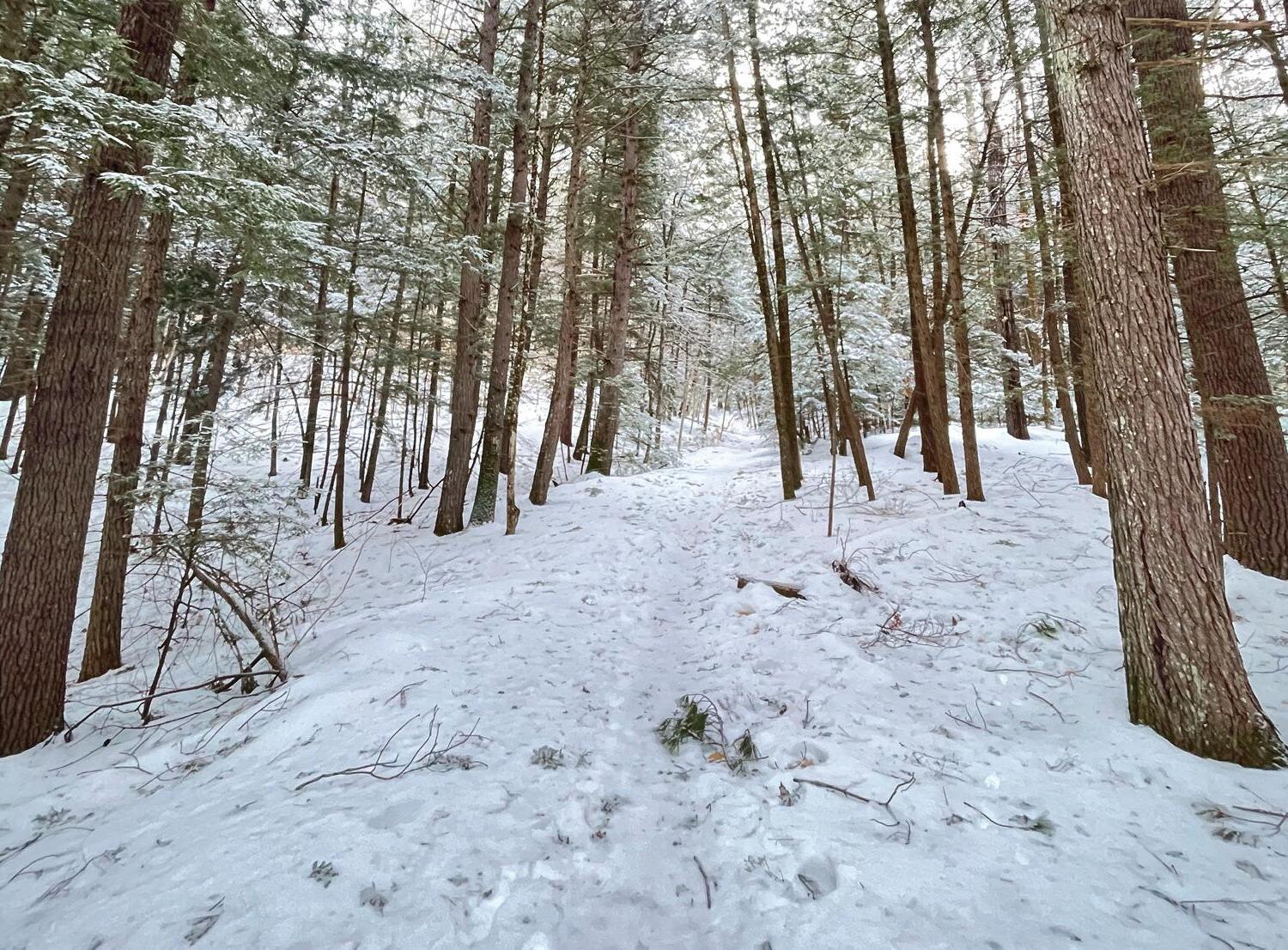
Route 16 transforms into a winter wonderland corridor each year, offering walkers and snowshoers access to some of New Hampshire’s most accessible and beautiful cold-weather walks. From riverside paths to preserved pine barrens and historic rail trails, you’ll find winter walking opportunities for all ability levels.
Before we dive into trails, let’s talk about the obvious – winter! Winter walking demands careful attention to traction devices, layered clothing systems, preparedness, and weather forecasting. But with proper preparation, these trails become magical winter destinations where frozen waterfalls, snow-laden forests, and peaceful solitude reward those willing to bundle up and venture out. A few essentials to consider:
Footwear & Traction: Wear waterproof boots and bring micro spikesrubber harnesses with metal spikes or treads that can stretch over boots. They are easy to pack and essential to bring along. Call them creepers, traction cleats, nano-spikes, etc. Whatever you name them, they can be found at most local outdoor supply stores, and you’ll want them in your winter-walking arsenal.
Layers: When it comes to recreation clothing in the winter, avoid cotton at all costs. When wet, it loses all insulating ability and pulls heat from your body. Much more thorough information about layering can be found online, but a three-layer system is the basic
concept to keep in mind: a synthetic or wool base layer, fleece or wool midlayer (and pack extra!), and a waterproof/ breathable shell jacket and pants. Add wool or synthetic socks (pack extras), warm gloves (pack spares), fleece/ wool hat, neck gaiter, and gaiters to keep snow out of your boots. Start out feeling slightly cool—you’ll warm up within 15 minutes and appreciate your layers!
Preparation and planning: Start early. Winter days are short; it’s smart to bring a headlamp in your pack. Manage your body heat by removing layers before sweating; as mentioned, wet clothing may lose insulating ability. Eat and drink appropriately – winter recreating burns more calories. Pack

nuts, or energy bars, use wide-mouth water bottles (hydration bladders may freeze), and a thermos with hot tea is invaluable. Keep your breaks short, and layer up when you stop moving. Plan your turnaround time well before the end of daylight, regardless of the distance covered.
In addition to micro spikes, layers, and food, know your limitations and be prepared for emergencies. Pack a space blanket, fire starter, foam pad, hand warmers, and a fully charged phone. These may sound excessive, but one unexpected circumstance or injury changes everything – especially in winter.
Forecast: Conditions at lower elevation trails may not be as volatile as
those in the mountains, but it is still important to be aware. Check detailed forecasts before heading out, noting temperature, wind chill (many avoid outings below 0°F), wind speed (over 25mph makes trails unpleasant; over 40mph is dangerous), and precipitation. Temperatures can drop just along the drive – be aware of changing conditions and pack and plan accordingly. Additionally, if trail conditions are not what you anticipated or you feel unprepared, call it off and return another day when you’re better equipped.
Now for some trails! The Dover Community Trail provides over six miles of relatively flat winter walking through town and along the Cochecho and Bellamy Rivers. Following a former railroad bed, this multi-use trail often gets packed down quickly by winter users, creating good conditions for microspikes. The paved urban section from the Dover Transportation Center to Fisher Street typically stays clear, while the natural riverside section offers beautiful winter scenery with ice formations along the water. The trail’s flat terrain makes it ideal for testing your winter gear without committing to remote locations.
Just off Route 16 at Exit 18, Plummer’s Ridge Forest and Farms trails in Milton offer nearly seven miles of winter walking through 400 acres connecting the New Hampshire Farm Museum, Branch Hill Farm, and McK-
• Winter Walks
Continued on page 14




enzie’s Farm. Accessed via the Farm Museum on Route 125 (1.4 miles from Route 16), the trails feature gentle terrain winding through forest and open fields with expansive winter views. Excellent trail maps with area features can be found at nhfarmmuseum.org. After heavy snow, snowshoes may be necessary, but the trail often packs down quickly.
In this area, you’ll also find the Cotton Valley Rail Trail – 12 miles connecting Wolfeboro, Brookfield, and Wakefield. This is a Route 16 crown jewel for winter walking. Easy access from Route 16 is at Turntable Park in Wakefield/Sanbornville. The hard-packed trail offers exceptional conditions for walking, snowshoeing, and cross-country skiing, shared with snowmobiles. Highlights include spectacular causeways crossing Lake Wentworth and Crescent Lake, where winter winds create dramatic ice formations, and perhaps some unexpected chill (time to call in your layers!) Fernald Station at Route 109 (3 miles from Wolfeboro) provides a good turnaround with parking and facilities. Starting from downtown Wolfeboro’s old train station offers the most scenic approach across Back Bay
Issue
to the beautiful lake causeways. If you walk closer to Wakefield, exercise extreme caution while crossing Route 16. Traffic moves fast, and roadside snowbanks may reduce visibility. Find a full trail overview at cottonvalleyrailtrail. org.
Near West Ossipee, at Routes 16 and 41, is the Ossipee Pine Barrens Preserve, which protects New Hampshire’s last pitch pine-scrub oak woodland. The three-quarter-mile trail from the West Branch Trailhead (Route 41, two miles off Route 16) provides exceptional winter walking on typically hard-packed surfaces, often passable after moderate snowfall. The gnarled pines hold snow in dramatic fashion, creating a distinctly different winter landscape. Additional trails include the quarter-mile Pine Barrens Loop and the 2.4-mile Cooks Pond Loop. There are exposed areas on these trails, which might mean stronger wind; check forecasts and use your layers! For additional information and trail maps, visit nature.org.
Breezing between Ossipee and North Conway seems like an injustice, but we only have so much space – and so much terrain to cover! The Conway Recreational Path’s 2.8 miles of paved surface from Mount Cranmore to
Dining Out in the Lakes Region Available at Hundreds of Locations around the Lakes Region!
Hemlock Road often gets packed down quickly, providing accessible winter walking with stunning views of the snow-covered White Mountains across the Saco River valley. Micro spikes are typically sufficient here, though icy conditions can develop during thawfreeze cycles, and snowshoes may be necessary if you visit after a fresh and abundant snowfall. For a map and details, visit mwvrecpath.org.
And to finish our walking tour, one final destination to consider: the village of Jackson, just off Route 16 via Route 16A, offers delightful village walking on the 1.45-mile Jackson Village Loop. Village sidewalks are typically maintained in winter, passing the famous Jackson Covered Bridge (stunning when snow-laden), Jackson Community Church, and historic Wentworth Hotel. The half-mile path along the Wild and Scenic Wildcat River through Jackson Town Park provides pastoral winter scenery when conditions allow. See additional information
at jacksonnh.com.
This is by no means a comprehensive list of winter walks on this corridor. Information, gear, and guidance can be found at local retailers, some of which rent winter gear, making it easy to try before buying. Start with easier, well-traveled trails like the Cotton Valley Rail Trail or Dover Community Trail to test your gear and build confidence.
In winter, Route 16 becomes a quiet corridor of accessible nature, perfect for walkers who want fresh air, scenery, and movement without committing to high-risk mountain terrain. From the farm and forest paths of Milton, through the sun-washed Ossipee Pine Barrens, to scenic walks in Conway, these lower-elevation trails reward those who come prepared with traction, layers, and respect for winter conditions. With proper gear and planning, winter walks near Route 16 are not just possible, but genuinely rewarding!
The Gafney Library in Sanbornville will once again offer free IRS tax preparation assistance through the AARP Foundation Tax-Aide program. Appointments will be available on Tuesdays from February 10 forward, from 9 am to 5 pm.
IRS-certified, AARP-trained volunteers will provide free tax preparation assistance to New Hampshire residents. While the program is primarily designed for individuals aged 50 and older and those with limited financial resources, services are available to
anyone who may benefit.
AARP Foundation Tax-Aide operates at more than 5,000 locations nationwide, including libraries, community centers, banks, and senior centers. There is no fee for this service, no sales pitch for additional products or services, and AARP membership is not required.
To schedule an appointment, please contact the Gafney Library at 603-5223401.

Pancakes | French Toastserved on thick Texas toast Sandwiches & Burgers | Don't forget to check out our daily breakfast & lunch specials! Grab breakfast or lunch at The Farmer’s Kitchen. We use only the freshest ingredients
to order