REFLECTIONS
THE SUMTER ITEM
SUNDAY, JUNE 15, 2014
|
C3
PHOTOS PROVIDED
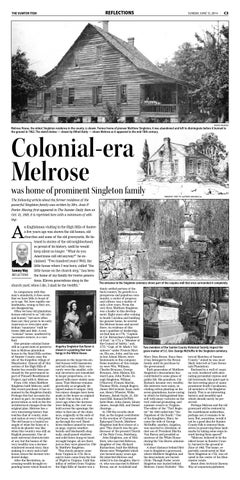
Melrose House, the oldest Singleton residence in the county, is shown. Former home of pioneer Matthew Singleton, it was abandoned and left to disintegrate before it burned to the ground in 1962. The sketch below — drawn by Alfred Hutty — shows Melrose as it appeared in the mid-18th century.
Colonial-era Melrose
was home of prominent Singleton family The following article about the former residence of the powerful Singleton family was written by Mrs. Josie P. Parler. Having first appeared in The Sumter Daily Item on Oct. 31, 1939, it is reprinted here with a minimum of editing:
A
n Englishman visiting in the High Hills of Santee a few years ago was shown the old homes, old churches and some of the old graveyards. He listened to stories of the old neighborhood, so proud of its history, until he would keep silent no longer. “What do you Americans call old anyway?” he exclaimed. “Two hundred years! Well, the little house where I was born, called “the
Sammy Way
little house on the church step,” has been
REFLECTIONS
the home of my family for twelve generations. Eleven generations sleep in the
church yard; when I die, I shall be the twelfth.” In comparison with this man’s standards, it does seem that we have little to boast of as to age. Yet, how rapidly our landmarks, young as they are, are disappearing. Often we hear old plantation houses referred to as “old colonial homes,” but more often than not, they prove to be early American or even later antebellum “mansions” built between 1800 and 1840. A real “colonial” house, unaltered by successive owners, is a rare find. One genuine colonial home still in a good state of preservation is Melrose plantation house in the Sand Hills section of Sumter County, near the site of the forgotten village of Manchester. Almost all of this section of the High Hills of Santee has recently been purchased by the government as part of Poinsett Resettlement Project, and with it, Melrose. From 1760, when Matthew Singleton built Melrose, until this recent purchase, it has remained in the Singleton family. Perhaps this fact accounts for, at least in part, its remarkable preservation as well as the few architectural changes from the original plan. Melrose has a very interesting history that touches that of county, state and nation at every vital point. The old house is a typical example of what the home of a well-to-do planter was like when this country was still an English possession. One almost universal characteristic of any but the homes of the very wealthy was a dormerwindowed second story, thus making it a story-and-a-half house; hence the dormer-windowed dodge. After the Revolution, increasing wealth brought expanding tastes which found ex-
Angelica Singleton Van Buren is shown in a painting that now hangs in the White House. pression in the large two-storied houses with basements and tall columns. Only very rarely were the smaller, colonial structures not remodeled to larger proportions, or replaced with more stately mansions. That Melrose remains practically as originally designed makes it unique. Only two minor changes have been made in the house as originally built: One is that, a few years ago when the dormers were falling in, the roof was built across the openings; the other is that one of the chimneys, originally at the ends of the house, was rebuilt to run up through the roof. Handhewn timbers joined by wooden pegs, cypress weatherboards and blacksmith shop nails, small-paned windows and solid doors hung on handwrought hinges; all are there just as they were placed in 1760 by Matthew Singleton. This sturdy pioneer came from Virginia in 1752. He is said to have come from the Isle of Wight to Virginia. Until this influx of settlers from Virginia the High Hills of Santee was a
The entrance to the Singleton cemetery shows part of the coquina wall that once surrounded it completely. thinly settled portion of the back country. Its growth to a prosperous and populous community, a center of progress and culture, was a matter of only a few years. From the very first, Matthew Singleton was a leader in this development. Eight years after coming to South Carolina and building his pioneer home, he erected the Melrose house and moved there. As evidence of this man’s qualities of leadership, we find him in 1770, “Captain in Col. Richardson’s Regiment of Foot,” in 1774, a “Member of the Council of Safety,” and, 1775, “Capt. of St. Mark’s Volunteers” under Francis Marion. His son, John, and his sonin-law, Isham Moore, were lieutenants in this company. Some members of this company were Wm. Williams, Charles Brunson, George Brunson, John Malone, Edward Lane, John Foster, Joseph Singleton, William O’Harrow, Francis Martin, Thomas Wells, Joseph Rogers, James McCormick, Isaac Jackson, Henry Wheeler, Willis Ramsey, Josiah Gayle, Jr., Edward Hill, Samuel DeWitt, Sabe Stom, John James, Isham James, Joseph Hill, and Daniel Jinnings. ... In 1788 the records show that, as the largest contributor to the erection of Claremont Episcopal Church, Matthew Singleton had first choice of a pew. This church was the predecessor of the present Church of the Holy Cross, Stateburg. John Singleton, son of Matthew, who married Rebecca, daughter of Gen. Richard Richardson, built the Midway House near Wedgefield which was burned many years ago. He inherited Melrose and willed it to his daughter, Harriet, who was married to Robert Broun, son of Archibald and
Two members of the Sumter County Historical Society inspect the grave marker of S.C. Gov. George McDuffie in the Singleton cemetery. Mary Deas Broun. Since then it has belonged to the Broun family until its purchase by the government. Each generation of Matthew Singleton’s descendants has contributed to some phase of public life. His grandson, Col. Richard, became very wealthy. His interests were many, including cotton planting on his seven plantations, horse-racing in which he distinguished himself with many victories on the turf, railroad promoting, and summer resorts in Virginia. The editor of the “Turf Register” for 1840 called him “the Napoleon of the South.” One of his daughters, Mary, became the wife of George McDuffie; another, Angelica, was married to Abraham, eldest son of President Martin Van Buren and presided as mistress of the White House during the Van Buren administration. A short distance behind Melrose is Singleton’s graveyard, where Matthew Singleton and his descendants are buried. (Note: Though Parler wrote Singleton was buried behind Melrose, Cassie Nicholes’ “His-
torical Sketches of Sumter County,” stated he was most likely interred at Cane Savannah Plantation). Enclosed in a wall of coquina rock, bordered with alternating pyramidal cypress and tall boxwoods, this quiet spot is the last resting place of many prominent South Carolinians, all members of the Singleton family. This is an interesting historic and beautiful spot which should surely be preserved. Perhaps Melrose and the old graveyard will be restored by the resettlement authorities, perhaps not; it remains to be seen. But, meantime, would it not be a good idea for Sumter County folk to interest themselves in preserving these landmarks by taking some steps toward having them spared? *Melrose, believed to be the oldest house in Sumter County, burned to the ground in June of 1962. The home, reportedly constructed by Matthew Singleton in 1753, was situated in the center of his Manchester estate. Reach Item Archivist Sammy Way at waysammy@theitem.