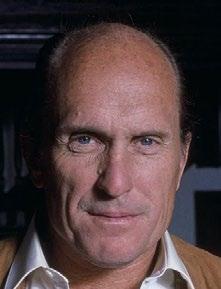
Actor Robert Duval died at his farm in Middleburg, Va., on Sunday, Feb. 15 2026 according to a statement released Monday by his wife of more than 21 years, Luciana Pedraza. She did not disclose a cause of death.
Duvall was 95 years old. By all accounts, his career in film and television, which spanned more than 60 years, is one of the best of all-time. From his lineless debut as a 31-year-old in 1962’s “To Kill A Mockingbird” to the Netflix films “Hustle” and “The Pale Blue Eye” in 2022, few have the film resume of Duvall.
After Mockingbird, his films include, just to name a few, “Bullitt,” “True Grit,” “M*A*S*H,” “THX 1138,” “Joe Kidd,” “The Godfather,” “The Godfather, Part II”, “The Conversation,” “Network,” “Apocalypse Now,” “True Confessions,” “Tender Mercies,” — for which he won the Best Actor Oscar — “The Natural,” “Colors,” “Days of Thunder,” “Falling Down,” “Rambling Rose,” “The Paper,” Sling Blade,” “Deep Impact,” “Gone in 60 Seconds,” “Open Range,” “Crazy Heart,” … you get the picture.
Despite all those iconic movie roles, his favorite role was in a TV miniseries.
In 1989, Duvall portrayed Captain Augustus “Gus” McRae in the miniseries “Lonesome Dove,” an adaptation of the Pulitzer Prize-winning novel by Larry McMurtry. He won a Golden Globe Award and earned an Emmy nomination for the role.
SEE MCCOMBS PAGE A4
‘The
most exciting environment in the world’
Beaufort resident remembers his Olympic experience as 2026 Winter Games continue
By Luke Frazier
Special to The Island News
George Greenfield sits comfortably in his Lady’s Island home overlooking a pond where blue herons visit daily as he thinks back to the warm day of Aug. 26, 1972. He was one of the 400 U.S. athletes marching into the Olympiastadion in Munich for opening ceremonies of that summer’s Olympics.
He remembers wearing a wide tie of red, white, and blue (as early 70s fashion dictated) and pair of black and white patent leather shoes as part of his outfit.
“It took about two hours to get into the stadium just to do the lap,”
George recalls, “and then you get to the place they designated for you to stand for the next two hours.”
The ceremonies included the Olympic pledge, the lighting of the torch, and plenty of pomp and circumstance. There was absolutely no other place on earth he would rather have been that day.
“It was just the most exciting environment in the world,” Greenfield said, “and one of the reasons the Olympics is so big is that it’s the only venue that brings all the sports together.”
Greenfield also shares some memorabilia from the day: the Olympic ring belt buckle, now smartly mounted on marble, and
the captivating commemorative ruby ring.
Greenfield is among the tiny percentage of U.S. male gymnasts who ever make it to the Olympics, and he knew he was going to go to Munich after sticking the landing in his final horizontal bar routine at the men’s trials two months before.
He said that feeling was incredible, and the video from the broadcast on ABC’s Wide World of Sports program he shares 54 years later confirms both the perfect landing and the huge smile on his face.
His Olympic journey began in earnest four years before that on
SEE OLYPMICS PAGE A6
Former Beaufort Elementary principal Summerlin dies at 76
2000 National Principal of Year was honored by President Clinton, attended State of the Union
By Delayna Earley
Island News
the former Beaufort Elementary School principal whose leadership transformed
one of South Carolina’s lowestperforming schools into a National Blue Ribbon campus and earned her national recognition from President Bill Clinton, has died. She was 76
Summerlin passed away peacefully in her sleep on Jan. 24 2026, in Gainesville, Ga., after a battle with Alzheimer’s disease, according to her family. For many in Beaufort County,
Summerlin’s name is synonymous with one of the most dramatic school turnarounds in local education history.
SEE PRINCIPAL PAGE A6
MIKE MCCOMBS
The
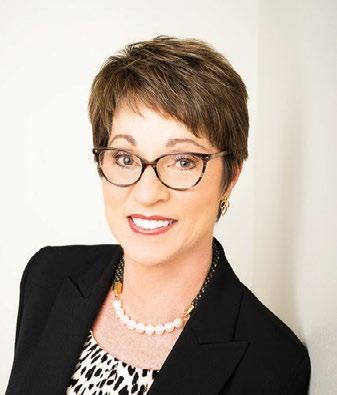
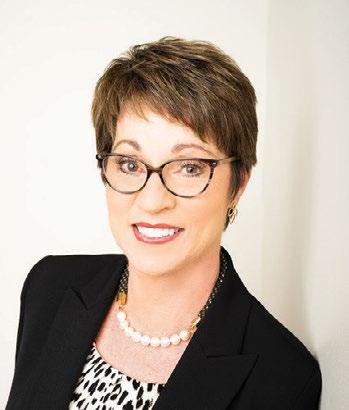
Beaufort — Ruth (Stanley) Summerlin,
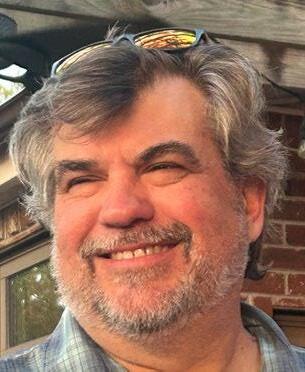
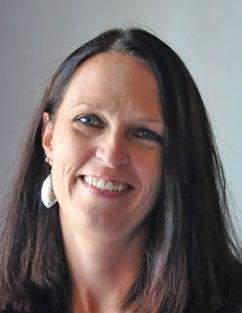
Ruth (Stanley) Summerlin
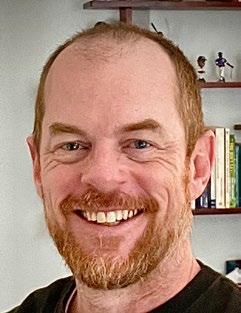
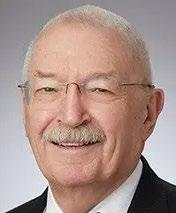
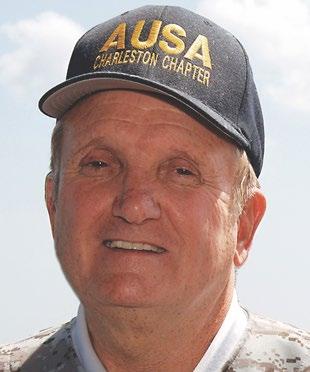
Robert Duval
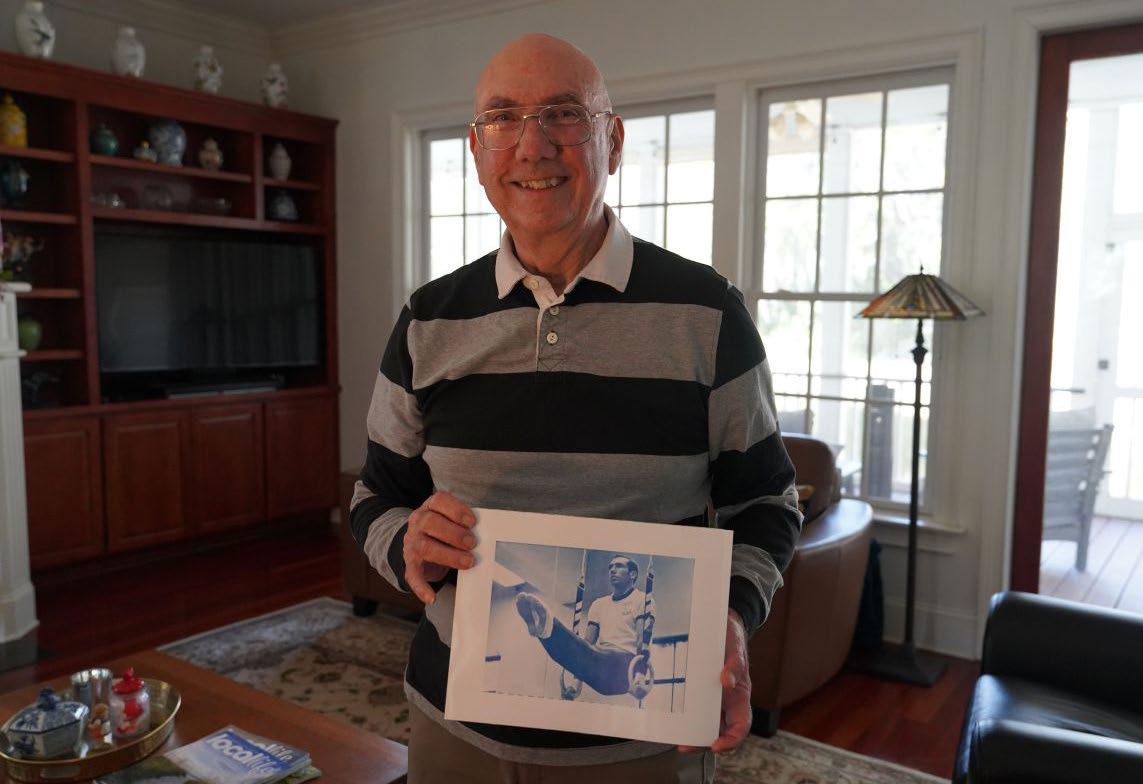
George Greenfield, a gymnast on the U.S. Olympic Team for the 1972 Summer games in Munich, holds a photo of himself at his home on Lady’s Island. Amber
Hewitt/The Island News
LOWCOUNTRY LIFE & NEWS
Tom Sams snapped this photo of the recent snow falling on the mossy oaks lining Beaufort’s Broad Street. To submit a Lowcountry Life photo, you must be the photographer or have permission to submit the photo to be published in The Island News. Please submit high-resolution photos and include a description and/or names of the people in the picture and the name of the photographer. Email your photos to theislandnews@gmail.com.
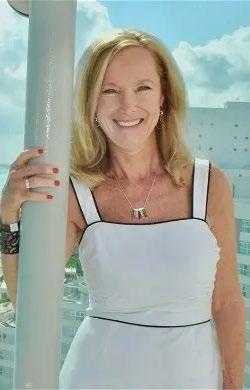
American Legion Beaufort Post 207 brings you Annabelle O’Grady, 49, who joined the U.S. Army in South Lake Tahoe, Calif., in 2000 and attended Basic Training at Fort Jackson. She then trained in administrative support before being assigned to a Combat Support Hospital (like a MASH) at Fort Lewis, Wash. She was next assigned to a Combat Support Hospital at Phitsanulok in central Thailand. She separated at the end of 2002 to attend the City University of Se-
attle on the GI Bill. After earning a BA degree in project management, she worked for the biotech company, AMGEN in Seattle before working for another biotech
research company in Japan. In 2013 she returned to Seattle to work on clinical trials of common health issues. In 2013, O’Grady moved to Beaufort County to do remote work for CorEvitas, tracking the wellness of 65,000 people with arthritis. In 2022, she began work for a Chinese company as the head of evaluation for pediatric rare disease trials. Beginning last year, she has been volunteering to help veterans write resumes, translating
BAHA’S HOSPITALITY STARS
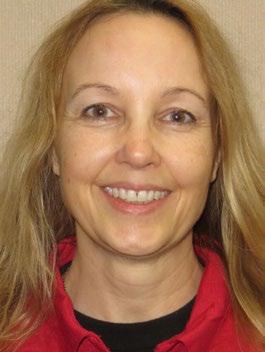
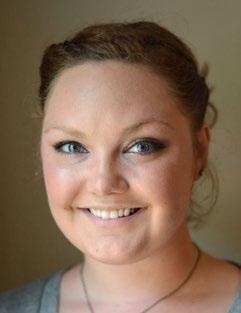
On Feb. 11 2026, the Beaufort Area Hospitality Association (BAHA) awarded its latest Hospitality Star Awards to Lynn Crouse and Petra Vaughn, also known as the “dynamic duo,” at Southern Sweets Ice Cream Parlor and Sandwich Shop downtown. The owner, Bonny Gordon, spoke so highly of the dedication, teamwork, and warmth they bring to both the business and the guests they serve every day.
military terms into civilian terminology and finding “best fit” civilian employment. She also qualified as a DAV disability claims officer and helps process claims at AMVETS each Thursday morning, all while beginning an on-line course at Harvard studying brain disease.
– Compiled by John Chubb, American Legion Post 207 For Veteran Of The Week nominations, contact jechubb1@gmail.com.
US PO Box 550 Beaufort, SC 29901 TheIslandNews@gmail.com www.YourIslandNews.com facebook.com/TheIslandNews
The Hospitality Star Award was created to acknowledge the outstanding hospitality and tourism professionals in the Beaufort area. Nominations are submitted by hospitality business owners, coworkers, managers, and even members of the public — making it a true community-driven recognition. This program is a meaningful way to recognize the hardworking individuals who keep Beaufort’s hospitality industry thriving and who so often work behind the scenes.
Community members can nominate a Hospitality Star at http://bfthospitality.com/hospitality-star/. – Caroline Gecy, Beaufort Area Hospitality Association
THIS WEEK IN HISTORY
February 20
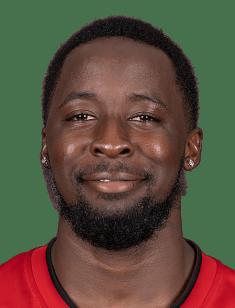
1995: Dee Delaney is born in Beaufort. Delaney, a Seabrook native, was a star athlete at Whale Branch Early College High School, earning 14 total varsity letters in four sports – baseball, basketball, football and track. Delaney played college football at The Citadel, then the University of Miami (Fla.). Delaney played for five teams (Jacksonville Jaguars, Miami Dolphins, New York Jets, Washington Redskins, Tampa Bay Buccaneers) in the NFL. He was named the head football coach at Whale Branch in February 2026
February 23
1868: James Edwin McTeer, future Beaufort County Sheriff, is born.
1915: Beaufort’s Robert Smalls dies. At the time of his death, he was suffering from malaria and diabetes.
– Compiled by Mike McCombs
Do you value your free hometown newspaper – made by locals, for locals? Free news isn’t cheap. Please help support The Island News!
Donations gratefully accepted at www.yourislandnews.com or The Island News, PO Box 550, Beaufort, SC 29901
Letters to the
should consist of
than 275 words and be emailed with a name and contact information to TheIslandNews@gmail.com DEADLINE For press releases and advertising, please submit by noon on Friday for the following week’s paper. LEGAL NOTICES
Contact ads.theislandnews@gmail.com for more information on
Annabelle O’Grady
Bay Street reopens at intersection with Charles Street
By Delayna Earley The Island News
A major downtown Beaufort
intersection that was closed for critical drainage infrastructure upgrades has reopened, restoring traffic flow through one of Beaufort’s most heavily traveled corridors.
Bay Street, through the intersection with Charles Street, reopened Monday this week following completion of a stormwater infrastructure and paving project designed to improve drainage capacity and protect downtown streets from flooding. Charles Street remains closed.
The work, led by the City of Beaufort in partnership with the South Carolina Office of Resilience, began in mid-November and continued through the holiday season.
Construction closed the intersection just as downtown merchants were preparing for peak holiday foot traffic and shopping, prompting detours through adjacent streets and changes in traffic patterns. According to the SCOR project summary, the effort involved
replacing undersized stormwater pipe and upgrading the drainage network under Charles Street and at the Bay Street junction.
The improvements aim to reduce chronic flooding during heavy rain and high-tide events that have increasingly affected downtown Beaufort in recent years.
Holiday disruption and business access
By closing the Bay and Charles intersection just before Thanksgiving, the project came at a sensitive time for downtown businesses relying on holiday shoppers and weekend visitors.
Earlier project notices published by local media noted con-
cerns from shoppers and shop owners alike about detours that rerouted traffic off familiar routes into surrounding blocks.
While no official sales figures were released, merchants told The Island News in November and December that narrowing access at a primary gateway into downtown changed travel behavior for some customers who were unfamiliar with detour signage or who chose alternative parking routes.
City officials had noted in earlier coverage that the closure would affect the “western entrance” to the downtown grid and encouraged drivers to allow extra travel time.
Paving, weather delays and reopening
Paving of the reopened intersection was temporarily delayed in January when extended cold weather prevented nearby asphalt plants from operating.
Those weather conditions slowed the supply of fresh asphalt, leaving crews to wait until temperatures rose enough to pave the intersection..
Once conditions allowed, crews
completed the final pavement and the intersection was opened to vehicles.
Bay Street functions as Beaufort’s primary commercial corridor, linking waterfront attractions, restaurants and shops to the broader street network.
Bigger picture: resilience for downtown
City officials and SCOR say the project is part of a multiphase initiative to modernize stormwater infrastructure downtown and protect heritage street corridors from worsening flood risk.
The engineering enhancements are expected to improve stormwater capacity, reduce standing water on the roadway and extend the life of street surfaces that have historically been vulnerable to weather and tidal influence.
Delayna Earley, who joined The Island News in 2022, formerly worked as a photojournalist for The Island Packet/The Beaufort Gazette, as well as newspapers in Indiana and Virginia. She can be reached at delayna.theislandnews@gmail.com.
Stewart offers City alternative to chain-link fence at Waterfront Park
By Delayna Earley
The Island News
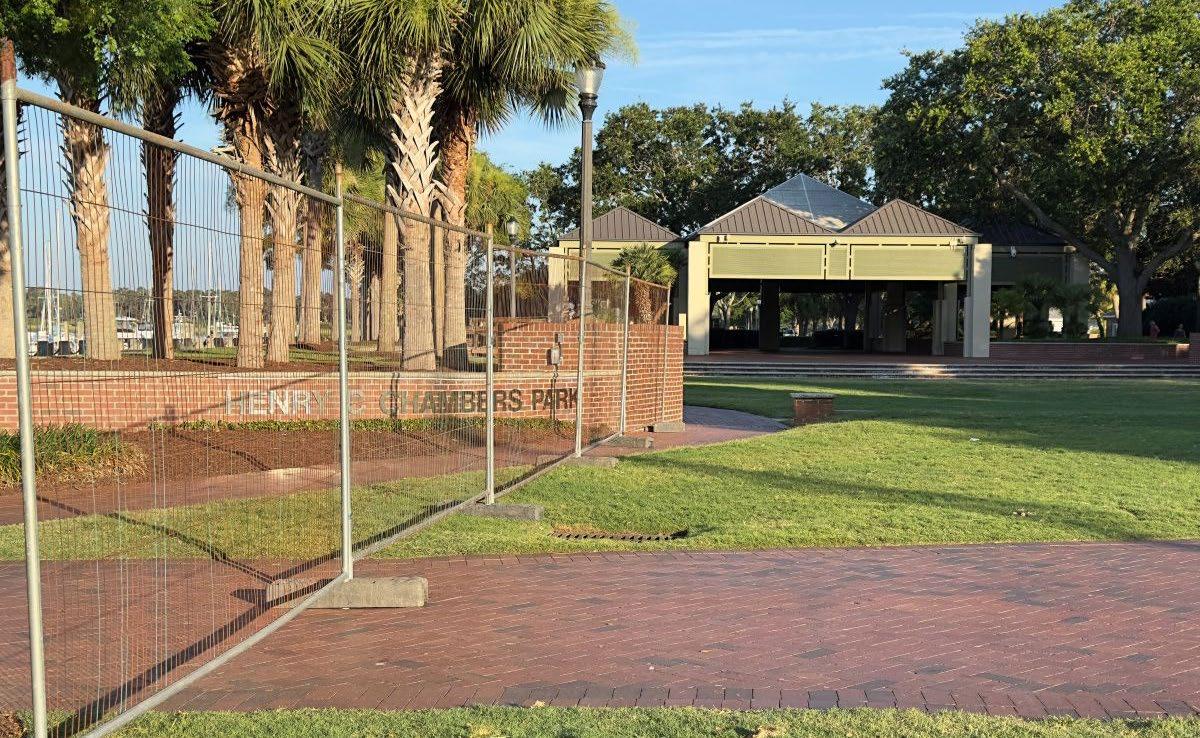
An offer made Monday, Feb. 9, during the Waterfront Advisory Committee meeting could lead to a quicker and more visually appealing replacement for the chainlink fencing now blocking the promenade at Henry C. Chambers Waterfront Park.
Dick Stewart, chairman of the board for the Freedman Arts District, told a city board the organization is prepared to fund a temporary, upgraded fence and push to have it installed by the start of the spring tourism season.
“This is the beating heart of downtown,” Stewart said. “It’s an economic driver for the city.”
The chain-link barrier was installed last June after structural concerns led to the closure of portions of the seawall.
Since then, merchants have said the fencing blocks views, limits access to popular swings and creates the perception that downtown is shut down.
“Those people are hurt down there,” Stewart said of Bay Street businesses.
“Some of those people last
McCombs from page A1
week, for the first time in the history of their businesses, did not have a single customer.”
A March target Stewart said the Freedman Arts District wants to replace the current fencing with a black aluminum style similar to cemetery fencing seen elsewhere in Beaufort.
The proposal calls for multiple gates and clear sightlines to the water.
“We can get an answer from City Council this week,” he said. “This fence can be finished when spring starts on March 25. No more ‘Beaufort is broken.’”
In a Facebook post after the meeting, Cherimie Weatherford, owner of SugarBelle and executive director of the Freedman Arts District, urged leaders to accept the proposal.
“We are just asking that leadership accept this gift,” Weatherford wrote.
She also noted she was unable to attend the meeting because she was preparing the organization’s new space at The Arsenal.
“We are an organization of doers, believers and visionaries,” she wrote.
But it’s two movies in particular that endeared Duval to many in the Lowcountry – “The Great Santini,” which put Beaufort on the map as a filmmaking town, and “Something To Talk About.”
In 1979’s “The Great Santini,” Duvall played USMC Lt. Col. “Bull” Meechum.” The film was adapted from Pat Conroy’s novel, said to describe Conroy’s difficult relationship with his own father, Co. Donald Conroy.
Ironically, according to Barbara Conroy, Pat Conroy’s first wife, who had already split from the author at the time, Donald Conroy asked Duvall to accompany him to Savannah for a Marine Corps Birthday Ball. Duvall, a U.S. Army veteran, was honored and accepted.
An approximately 40-foot-wide section of Henry C. Chambers Waterfront Park, on the water side of the park that rests on the relieving platform, was closed and fenced off for safety reasons on Monday, June 30, 2025. Amber Hewitt/File/The Island News
Strong public backing
The proposal quickly drew a wave of encouragement online from residents, artists and business owners.
“If Cherimie Weatherford is for it, I’m for it,” wrote Fred White.
“As a new business in downtown Beaufort, I highly encourage this action to help support all downtown businesses,” wrote Barbara Vining Robinson of Beverly’s Off Bay.
Others pressed for speed.
“The Great Santini” struggled at the box office, but it was a critical success, earning Duvall an Oscar nomination for Best Actor. Filming at Tidalholm and around Beaufort, Duvall is said to have come to love Beaufort. And at least one resident at the time, still has some affection for Duvall.
Hamlin O’Kelley, now a Charleston attorney, was a young boy of 7 growing up on the Point in Beaufort when Santini was being filmed. Along with his brothers and several other friends, O’Kelley got to know the man playing the title character, referring to him as Uncle Bobby.
In the movie, there’s a tense basketball game in the Meechum driveway between an aging Bull and his son Ben, played by Michael O’Keefe. Unknown to the people who saw that scene on the big screen, between takes and during
“This is a free gift to all of us,” wrote Trea Thiesen Tucker. “Stop the talking and get it done.”
How fast is fast?
Whether installation could happen by March depends on how the city structures the arrangement.
City Manager Scott Marshall said procurement requirements may still require staff to gather multiple quotes if the city is the purchaser.
set up and breaks, Duvall was engaged in a much more enjoyable basketball game with O’Kelley and his friends.
“He would go out on The Green and throw the football with us,” O’Keefe said. “We would play hide-and-seek in Tidalholm and in that yard with him and the assistants and the people playing the Meechum children. He was just this guy, Uncle Bobby.”
And then Duvall made those kids’ year.
“He went trick-or-treating with us on the Point,” O’Kelley said. “It was great. We were going from house to house, and people were like, ‘Oh my God, you look just like Boo Radley’ or ‘Is that Tom Hagan on our porch?’”
One man greeted him with one of his most famous lines from “Apocalypse Now,” an occurrence Duvall would eventually have to endure thousands of times.
If any formal expectations accompany the gift, City Council could also need to approve an agreement.
“There are some expectations on the part of the Freedman Arts District,” Marshall said.
A cost estimate discussed at the meeting placed the project at just under $20,000
Marshall outlined a potential path in which the organization donates funds earmarked for the project and
“Charlie don’t surf,” the man told him.
“He just burst out laughing,” O’Kelley said. Duvall would come back to Beaufort to film 1995’s “Something To Talk About” with Julia Roberts, Dennis Quaid and Gena Rowlands.
Jay Neese, who now lives in Mount Pleasant, and ironically, worked on the remodel of Tidalholm, worked on the set as Duvall’s set double.
Neese said Duvall had slowed down a bit by then and kept to himself when he wasn’t filming.
“He didn’t hang with us off the set,” Neese said. “He didn’t go out to the bars with Julia and the rest of us.”
Neese remembers Duvall’s sense of humor – “He thought he was funny.”
“His personality was pretty funny,” Neese said. “He’d crack these really wry jokes and just giggle to
the city manages installation, a method he said could move more quickly while still satisfying purchasing rules.
The bigger argument Stewart told officials the longer the chain link remains, the more damage it does to Beaufort’s image and the bottom line of the downtown businesses.
“The chain link fence is unsightly,” he said. “It looks unkempt, and it’s damaging your reputation every day.”
Board members signaled interest in advancing the idea, though questions remain about approvals and design.
For businesses eyeing spring, the issue is simple: how quickly can change happen?
Editor’s note: Cherimie Weatherford is an award-winning, regular contributor to The Island News’ Voices section.
Delayna Earley, who joined The Island News in 2022, formerly worked as a photojournalist for The Island Packet/The Beaufort Gazette, as well as newspapers in Indiana and Virginia. She can be reached at delayna.theislandnews@gmail.com.
himself. He was just really cool. I got along with him. Most of the people working on the film got along with him, … except for the director.”
Apparently, from what I’ve read, directors often got the worst of Duvall.
But all-in-all, Neese enjoyed his time around the actor.
“[He shared] some wild stories,” Neese said. “But he was a cool guy.”
O’Kelley said he’s never forgotten Duvall’s kindness to a bunch of kids he didn’t know.
“He was just great, and we didn’t know anything,” O’Kelley said. “He was just Uncle Bobby. And then, as you age, you’re like, ‘wait a minute …’” Farewell, Uncle Bobby.
Mike McCombs is the Editor of The Island News and can be reached at TheIslandNews.com.
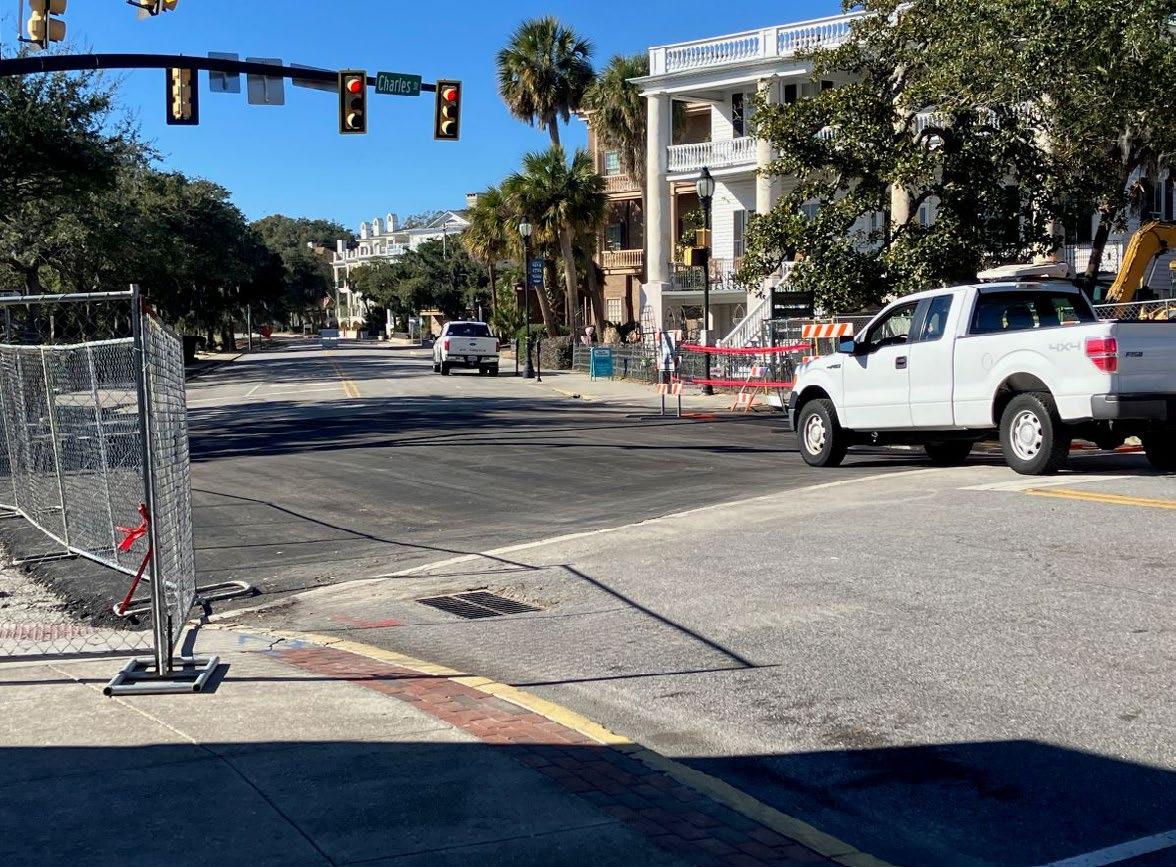
A pickup truck drives through the newly reopened Bay Street at the intersection with Charles Street on Monday, Feb. 16 in downtown Beaufort.
Mike McCombs/The Island News
Beaufort revisiting noise ordinance
City Council wrestles with decibel limits, quiet hours in downtown noise rewrite
By Delayna Earley The Island News
Before deciding how lively downtown should be, Beaufort’s leaders are first deciding how loud it can be.
During its Feb. 10 meeting, the Beaufort City Council took up first reading of a revised “loud and unseemly noise” ordinance — a rewrite intended to clarify decibel thresholds, quiet hours and enforcement standards in the historic district.
Police Chief Stephenie Price told Council the proposed changes are designed “to improve clarity and consistency and alignment with current community expectations” and to “balance our neighborhood impacts with business and event activity.”
What followed was a detailed debate over science, practicality and institutional history.
85 decibels or 70?
One of the sharpest disagreements centered on the proposed 85-decibel cap.
Mayor Pro Tem Mike McFee questioned whether that level aligns with accepted medical guidance on safe sound exposure.
“I think the decibel levels are too high,” McFee said. “I think that the highest decibel that we should be looking at is 70. Eighty-five … is onerous or excessive.”
McFee pointed to widely recognized public health standards that identify prolonged exposure to higher decibel levels as potentially harmful.
His argument: if medical science recognizes 70 decibels as a safer long-term exposure level, the city’s ordinance should reflect that benchmark — particularly in mixed residential areas.
Councilman Josh Scallate raised concerns about how the draft structured the nighttime music district exemption, specifically questioning the logic of a 60-to85-decibel range.
“If the cap’s 85… why would you have a range there?” Scallate said during discussion of the exemption language.
Others suggested relying more heavily on a “plainly audible” standard — whether sound can be clearly heard from a certain distance — rather than strictly on decibel measurements.
The exchange highlighted a core tension: measurable science versus what residents actually experience from their homes.
Not just music
While much of the public focus centers on live music and nightlife, council members emphasized the ordinance applies far more broadly.
The noise code governs not only
amplified performances and bar patios, but also construction activity, landscaping equipment, delivery operations and other commercial work that can begin early in the morning.
Leaf blowers, garbage trucks and power tools were all referenced as examples of sounds that routinely trigger complaints.
That broader scope is why quiet-hour start times — particularly the proposed 7 a.m. threshold — drew scrutiny.
For residents living above storefronts or near commercial corridors, the difference between 7 and 8 a.m. can be significant.
“Much history” with the music district
The discussion repeatedly returned to the city’s existing nighttime music district downtown.
“There is much history between the nighttime music district downtown. Much history,” Councilman Mitch Mitchell said during the debate.
Mitchell later suggested the simplest path forward may be consistency.
“I think they both should match and right now it seems like the easiest path of least resistance is to make the new draft match the old one and then we can revisit it down the road,” he said.
McFee also referenced the ordi-
nance’s deeper roots, noting past legal challenges helped shape its current structure.
The nighttime music district dates back decades and has been refined through previous council actions and litigation. That institutional memory continues to inform how carefully Council approaches revisions.
Quiet hours under scrutiny
Public comment sharpened the debate over quiet hours.
Graham Trask, who lives at 1211 Bay Street, urged Council to reconsider the proposed 7 a.m. start time for louder activity.
“I believe that 7 a.m. start time for loud hours is really early,” Trask said. “St. Helena’s bells don’t go off until 8. I think 8 is appropriate, not 7.” Trask also questioned the 85-decibel benchmark.
“I did measure 85 decibels … and 85 decibels … that’s loud,” he said.
Council members also acknowledged complaints about automotive noise and bass from live music carrying into nearby residential streets.
“If we’re going to change it … maybe meet down there, listen to it, see exactly what that sounds like,” Scallate suggested during discussion about how far 85 decibels actually travels.
Enforcement and next steps
Chief Price emphasized that the rewrite was developed in collaboration with the city attorney and with public input to ensure the ordinance remains enforceable and legally sound.
Council approved the ordinance on first reading and will take it up again for second reading in the coming month.
The noise ordinance discussion comes as Council also considers a proposed downtown social district under a 2023 state law allowing municipalities to designate open-container zones.
While the two issues are separate, both reflect an ongoing balancing act: encouraging economic activity while preserving quality of life for residents who live within and near the historic district.
The Feb. 10 debate made clear that Beaufort’s question is not simply how many decibels are acceptable.
It is how the city defines the sound of its downtown — and who gets to decide when it crosses the line.
Delayna Earley, who joined The Island News in 2022, formerly worked as a photojournalist for The Island Packet/The Beaufort Gazette, as well as newspapers in Indiana and Virginia. She can be reached at delayna.theislandnews@gmail.com.
City Council adopts social media comment policy
Comments will be moderated; appeals safeguard added
under public records laws.
By Delayna Earley
The Island News
After weeks of public criticism, legal questions and visible hesitation from the dais, Beaufort City Council voted Tuesday night to formalize how comments will be moderated on the city’s official social media pages — approving the policy only after removing disputed language and adding a path for residents to appeal.
The debate revealed a difficult balance: protecting open access to government while acknowledging staff concerns about workload, consistency and liability in an increasingly heated online environment.
City Manager Scott Marshall told council the proposal was designed to bring structure to a situation that has grown harder to manage. “It clarifies the informational purposes of the city’s social media accounts,” Marshall said. “It establishes reasonable standards for public comments … prohibits obscene, threatening, commercial, spam or disruptive content, and authorizes the city to hide or remove
comments that violate the policy in accordance with applicable law.”
Marshall emphasized that the city’s platforms are intended first to distribute information, not serve as ongoing discussion boards.
He said without clearer rules — and the staff time to enforce them consistently — the city risks claims of selective moderation and allowing misinformation or personal attacks to sit directly beneath official announcements.
At the same time, he acknowledged residents want access.
The challenge, Marshall indicated, is maintaining fairness while working within limited resources.
What the policy does
The Social Media Community Comment Policy frames the city’s accounts as informational tools. Under it, Beaufort may hide or remove comments that include: obscene or threatening language personal attacks • discriminatory remarks commercial promo-
tions repetitive or disruptive posts material unrelated to municipal business
The policy states comments do not reflect official city positions and may be subject to public records laws.
Residents can still reach staff by email, phone or direct contact, and may speak during public comment at meetings.
Council acknowledges tension
Even with that explanation, council members said the issue remained uncomfortable.
Council member Josh Scallate said he heard more from constituents about this topic than nearly anything else.
He has repeatedly cautioned against blaming residents for reacting to government decisions.
“I can’t hold or wouldn’t hold the public accountable for something that we did because we don’t like the response,” Scallate said during the January workshop.
Council member Mitch
Mitchell earlier described the matter as a classic trade off.
“For every pro, there’s a con,” he said.
Mayor Phil Cromer has also said that comments can serve as an early warning system, sometimes bringing attention to problems the city might otherwise miss.
Scallate pushes for revisions
Before the vote, Scallate said a requirement that comments be “reasonable and relevant” risked opening the door to subjective enforcement.
“I think that leaves a lot of room for subjectivity,” he said. “I don’t think that’s very clear.”
He argued that if the city is going to hide or restrict speech, residents deserve due process.
“This is something that we’re telling people we’re going to limit and restrict,” he said. “So it’s a little bit different.”
Scallate proposed deleting the relevance standard, adding an appeals mechanism and clarifying how hidden comments would be retained
Several colleagues agreed the change would make the policy stronger and more defensible.
Amendment passes, then resolution
Council unanimously approved the amendment.
Members then unanimously adopted the policy as revised.
Under the final version, individuals whose comments are hidden or who are limited from posting may submit a written appeal to the city manager or a designee. The city must review the request and respond within a set timeframe.
The resolution also confirms comments will be preserved according to records schedules and made available through lawful Freedom of Information Act requests.
Marshall reiterated that if comment activity continues to grow, the city may eventually need additional personnel dedicated to social media oversight.
January’s warning from residents
Public skepticism first
emerged at the Jan. 27 workshop. Beaufort resident Amanda Patel urged officials to view criticism as data, not disruption.
“Public engagement didn’t create those problems,” Patel said. “It exposed them.” Former ombudsman Peggy Summer told council the city risks losing valuable insight if it shuts down visible conversation.
“You would lose a lot of good informational data,” she said.
What changes now The city maintains that its pages are not designed to host debates.
Residents will still be able to contact officials directly or speak during meetings. What council clarified Tuesday is the structure governing which comments stay public — and how residents can challenge decisions when they disagree.
Delayna Earley, who joined The Island News in 2022, formerly worked as a photojournalist for The Island Packet/The Beaufort Gazette, as well as newspapers in Indiana and Virginia. She can be reached at delayna. theislandnews@gmail.com.
Downtown Beaufort social district proposal advances
Council makes substantial progress after two work sessions
By Delayna Earley
The Island News
Beaufort’s proposed downtown
social district moved from a philosophical debate to a discussion about operational details over two recent work sessions of the Beaufort City Council.
During the Jan. 27 session, council members wrestled with how quickly and how broadly to implement the idea. By the City of Beaufort’s regularly scheduled council meeting on Feb. 10, the conversation shifted to specific boundaries, operating hours, enforcement logistics and crime data.
Together, the meetings mark the most substantive progress yet toward launching a 90-day pilot program downtown.
Jan. 27: A debate over pace and scope
The Jan. 27 work session centered on whether the city should move aggressively to help downtown businesses or begin with a limited rollout.
Councilman Josh Scallate argued the city should move quickly, saying he believed the district should already be operational. He pointed to reports from other cities indicating that social districts have “tremendously help[ed] the businesses in that area.”
Scallate advocated for broader hours — suggesting a 10 a.m. to 10 p.m. schedule and potentially more days per week — contending that businesses need relief now rather than later. He also pushed back against characterizations
Principal from page A1
From “worst 200” to Blue Ribbon In 1995, Summerlin became principal of Beaufort Elementary School, a Title I campus serving predominantly low-income students that had been ranked among the 200 lowest-performing schools in South Carolina.
Over the next five years, she designed and implemented a comprehensive improvement plan that reshaped instruction, expanded academic support programs and restructured the school calendar.
The campus added af-
Olympics
from page A1
that the district would transform downtown into a party scene. “I don’t think that’s an accurate representation of what’s being proposed here,”
Scallate said, describing instead a scenario where someone might grab a drink while waiting for a pizza and browse nearby shops — not create a “Vegas strip” atmosphere.
Under the proposal presented Feb. 10 the pilot would run for 90 days and operate Wednesday through Saturday from 4 p.m. to 10 p.m.
footprint for 2025, including 13 assaults — 11 simple and two aggravated — as well as alcohol violations and disorderly conduct cases.
“It’s important to have an officer that’s responsive to your needs in the downtown area,” he said.
Another speaker cautioned that while downtown vibrancy is important, “the tool is alcohol,” urging Council to consider the broader implications for the historic district.
Other council members urged caution, suggesting that launching the program gradually could help ease public skepticism. One member compared the approach to “easing into the water versus one big splash,” arguing that starting smaller would allow the city to expand later if successful.
The Jan. 27 discussion focused largely on philosophy — how bold Beaufort should be in redefining its downtown experience.
Feb. 10: Structure, staffing, public reaction
By the Feb. 10 city council meeting, city staff presented a structured 90-day pilot proposal, shifting the conversation from theory to implementation.
Staff explained that a “tiger team” appointed in February 2024 had been meeting to identify ways to “strengthen downtown vitality, support local businesses, and increase economic activity”.
The group recommended exploring a social district as a tool to increase foot traffic and encourage longer dwell times.
ter-school and summer remediation programs, reduced early-grade class sizes and lengthened its academic year to 200 days. By 1999, the results were dramatic.
Beaufort Elementary was named a National Blue Ribbon School by the U.S. Department of Education.
According to the official White House guest biography published at the time, “student performance at Beaufort Elementary exceeded district and state averages in both reading and math.”
The school, previously a 100% free-and-reduced lunch campus, began attracting students from private academies and sub-
the day the 1968 games in Mexico City ended. He sat with his coach and cracked open a blue spiral notebook to the last page. On it he wrote, “1972, make the U.S. Olympic Team.”
Then he and the coach proceeded to write down all the steps that needed to take place in the years before then to make it a reality, including national and international competitions and training regimes. Greenfield hit all the marks and made the team.
In Munich, the bubble burst a bit. Greenfield and the U.S. team underperformed.
“It was frustrating because we had worked so hard,” George reflects, “and the nerves kind of got to me and the whole team didn’t do really well and placed 10th … we didn’t live up to our possibilities.”
All that concern disappeared in the face of the grim reality that soon erupted next door to the American compound on September 5
“The night after we finished, the terrorists came into the Israeli
The proposed boundaries would stretch from Port Republic Street to the waterfront park area, incorporating walkways and restaurant-adjacent tables while excluding grass areas and the pavilion.
Beer and wine would be served in city-branded, dated plastic cups designed to be easily identifiable by law enforcement and participating businesses.
Clear signage would mark entry and exit points to the district, and disposal stations would be placed at boundaries to prevent containers from leaving the area.
The plan also calls for a dedicated community response team officer to be assigned during operating hours, supported by patrol units.
Police data shapes the discussion Beaufort City Police Chief Stephenie Price told Council that staffing limitations informed the recommended six-hour window.
“It was our recommendation for six hours … three to four days a week and that is what we can fully dedicate an officer to being downtown,” Price said. He also shared crime statistics within the proposed district
urban schools — a striking reversal that underscored the magnitude of the turnaround.
The White House credited Summerlin as “instrumental in the school turnaround.”
A seat in the First Lady’s Gallery
In January 2000, Summerlin was invited to Washington, D.C., as one of 10 citizens seated in the First Lady’s Gallery during the State of the Union address.
The archived White House announcement described the selected guests as Americans “making an impact in their communities” and cited Beaufort Elementary’s transformation as
compound,” George said, “which we could throw a baseball and hit their building, but we knew nothing about what was happening.”
The next morning, U.S. officials heard rumors about shots fired in the Olympic village, but details were nonexistent. All Greenfield and other U.S. athletes were told is that security was going to be tighter and if they were leaving the village, be sure and take their identification badges. Greenfield went on a planned day trip to tour Bavarian Castles.
When he returned to the village around 6:30 p.m. it was cordoned off by German military and police. Greenfield finally heard what was happening from a news report on the radio that someone had been playing in his compound.
Meanwhile, back in the U.S., his fiancé (now long-time wife) Gail had already known what was happening via television broadcasts.
“And I remember when that happened,” Gail Greenfield somberly recalls, “We had just gotten engaged and I thought ‘there goes my future.’ I mean, it was scary.”
The world was shocked as the chaos of hostages, failed negotiations, late-night helicopter flights and armed standoffs unfolded over the next two days. Eventually
The presentation of crime data marked a shift from conceptual discussion to practical enforcement concerns.
Public comment reveals divided priorities Feb. 10 drew substantial public input, reflecting both enthusiasm and skepticism.
Mark Cutler, Chairman of the Board of the Beaufort Regional Chamber of Commerce, told Council the chamber is “in full support” of the proposed district and emphasized that “many of our business owners [are] struggling right now.”
Angela Simmons, vice chancellor for student development at the University of South Carolina Beaufort, said students are looking for a “third space” downtown — somewhere to gather outside campus housing.
She noted that students are not necessarily seeking a place to drink but want more opportunities to engage with the life of downtown.
Residents also expressed concerns. Peggy Simmer, who lives within the proposed district, reminded Council that the social district would sit “in my front yard” and asked city leaders to include homeowners in discussions.
a model of school improvement.
Her inclusion placed Beaufort’s public schools in a national spotlight and marked one of the most visible moments in the district’s history.
That same year, Summerlin was named National Principal of the Year, further cementing her reputation as an education leader.
Beyond Beaufort
Born Ruth Grechia Stanley on April 13 1949, in Chattanooga, Tenn., she grew up in Buckhead, Ga., and graduated from the University of Georgia in 1970
She later earned a master’s degree from Georgia Southern University and a
the battle resulted in the deaths of all hostages and many terrorists. Brutal reality smashed the hope of cooperative competition into the blood-stained tarmac.
The Olympics paused for 34 hours. George Greenfield attended the memorial service in the same stadium that was filled with celebration just days before, then flew back home.
Now, almost 5,000 miles away and decades later, George Greenfield is asked about his views concerning politics and the Olympics, a subject relevant in this Olympic year. A Ukrainian athlete was recently disqualified from the 2026 Winter Olympics in Milano Cortina [Italy] for refusing to replace his skeleton sledding helmet that was adorned with pictures of athletes and coaches killed in the ongoing war with Russia.
George says that it’s difficult when political statements get in the way of pure competition but acknowledges, “This is a really difficult question … we all have very strong opinions. It’s a two-sided coin [because] I believe that one of the strengths that we have in the world is the ability to speak our opinion.”
On the other hand George
State law backdrop South Carolina authorized municipalities to establish social districts in 2023, allowing defined downtown areas where alcohol may be carried outdoors in approved containers.
Several cities — including Charleston and Greenville — have since adopted similar programs. Beaufort’s proposal would begin as a temporary pilot before any permanent designation.
What’s next?
No vote has been taken.
The Jan. 27 session framed the philosophical divide over how aggressively to proceed. The Feb. 10 meeting clarified the operational framework, introduced crime data and expanded public input. Council is expected to continue refining operating hours, boundaries and enforcement provisions before bringing the ordinance forward for formal consideration.
The question now is not whether the idea exists — but how, and how quickly, Beaufort chooses to implement it.
Delayna Earley, who joined The Island News in 2022, formerly worked as a photojournalist for The Island Packet/The Beaufort Gazette, as well as newspapers in Indiana and Virginia. She can be reached at delayna.theislandnews@gmail.com.
doctorate in education from Nova Southeastern University.
After her tenure in Beaufort, Summerlin returned to Georgia, where she became principal of Bascomb Elementary School in Woodstock.
Under her leadership, that school also earned National Blue Ribbon status before her retirement in 2007 She later worked as a School Improvement Specialist for the State of Georgia, taught at the International Student Center and served as a part-time professor at Piedmont College.
Remembered for leadership and warmth Friends and family de-
“It was just the most exciting environment in the world and one of the reasons the Olympics is so big is that it’s the only venue that brings all the sports together.”
GEORGE GREENFIELD, U.S. Olympic Gymnast, 1972
Greenfield feels strongly that the Olympics are intended to bring people together and affirm harmony and political neutrality. He wonders about a suggestion that there be some middle ground in allowing political statements.
“Yeah, I think they could create a place on the uniform for statements,” George says, “But even then, making a statement is going to be bigger [than a patch], so how do you even manage that?”
At this point in his life George Greenfield is OK with letting his
scribed Summerlin as vibrant, positive and deeply committed to students and educators alike.
She is survived by her daughter, Catherine Flanigan of Cumming, Ga., two grandchildren, her sisters, extended family and her longtime partner, Clyde Morris Jr.
A celebration of life will be held March 15 in Cumming, Ga. For Summerlin’s complete obituary, visit https://bit.ly/4qFXYVa. Delayna Earley, who joined The Island News in 2022, formerly worked as a photojournalist for The Island Packet/The Beaufort Gazette, as well as newspapers in Indiana and Virginia. She can be reached at delayna.theislandnews@gmail.com.
opinion remain incomplete. He knows it’s a thorny and complex issue, “but I look at it through my rose-colored glasses and try and just look at the athleticism.”
Instead of this seeming like an excuse, sitting with George Greenfield as he reflects on his Olympic career and the issue of politics is a lesson in humility. He is a deeply grateful man who feels lucky to have been part of an elite level of athletics. He also loves his family and doesn’t take his good fortune for granted.
“The Olympics has opened a lot of doors for me,” he says, “my first job out of school, my interviewing manager was more interested in my athletic career than my business capabilities. Because of the doors that were opened, I had a really great career, which has funded us being here, which we love.”
On this day of beautiful sunshine in the Lowcountry, that sentiment is more than enough to earn the gold.
Why young savers should consider a long-term mindset
Provided by Wells Fargo Advisors
Four key considerations could help young adults create a mindset to succeed with saving and investing for the future.
Michelle Wan, Wells Fargo Investment Institute lead wealth investment solutions analyst, has met many younger clients who have had reservations about investing. “Young investors may find themselves delaying investing for retirement because it seems so far in the future. Alternatively, they may enjoy trading volatile investment instruments for rapid profits,” she says. “They underestimate how important it is to methodically develop planning and investing goals at a young age. Time is a young saver’s greatest ally.”
Here, Wan shares four key considerations for young savers when it comes to prioritizing long-term savings and investment plans.
1. Adopt a planning mindset
One key factor is having a planning mindset — a positive and proactive stance that could set savers on a path to positive financial outcomes. A planning mindset can provide a road map that can help strengthen a person’s financial future.
2. Start with small changes
Small changes in your financial behavior today could have a big impact on long-term success. Creating a budget, building healthy financial habits, and becoming more comfortable and familiar with investing
could go a long way in contributing toward achieving long-term financial goals. Some practices to consider: Automatically transferring part of your income into a savings account or an investment account Paying down student loans to avoid late fees and damage to credit scores
3. Begin saving and investing now
Start saving for retirement as soon as you can. The sooner you start, the more time every dollar saved has the potential to grow. If dollars saved early in your working years generate investment gains year after year, they can have a much bigger impact on the size of your account
balance at retirement than you might think. Thanks to the power of compounding, as the dollars invested potentially earn returns, those reinvested returns can start earning returns, and so on — year after year.
“For younger investors, compounding returns become especially powerful given their longer time horizon, so an early start can make a dramatic difference in helping investors reach their financial goals,” says Wan.
4. Take full advantage of retirement savings plans
If your employer offers a Qualified Retirement Plan (QRP), be sure to participate — and max out any kind of matching-contribution offers. They are the equivalent of free money.
Roth IRAs — to which you contribute after-tax dollars — are also worth a closer look because they offer taxfree growth potential. Investment earnings are also distributed tax-free in retirement if specific requirements are met.
PM-07032027-7425974
“Another savings vehicle to consider is a Health Savings Account (HSA), which offers tax benefits to qualified investors,” Wan says.
A discussion with an investment professional about your investment goals can help you develop a longterm plan and strategies to potentially help you achieve those goals.
Celebrate the legacy of Pat Conroy at the 10th annual March Forth Celebration
By Cele & Lynn Seldon Special to The Island News
Wednesday, March 4, 2026, commemorates the 10th anniversary of the passing of Pat Conroy, and the Pat Conroy Literary Center is hosting the 10th annual March Forth celebration to pay homage to the extraordinary life and legacy that this literary giant left behind.
This year’s event (Monday, March 2 through Sunday, March 8, 2026) will feature 10 unique events sprinkled throughout the Lowcountry that he loved (and eloquently wrote about) over a weeklong celebration honoring his legacy and his inspiration for the next generation of writers and readers.
Whether you are a long-time admirer of his writing, a newcomer to his captivating storytelling, or simply want to explore more of the Lowcountry through his eyes, March Forth will feature themes of his writing and teaching life, including social justice, inclusivity, nature, history, education, and, of course, storytelling.
As writers who relocated to the Lowcountry eight years ago, we know how “place” can influence work and life. And Pat certainly wrote the book on that. He once said, “When I started out as a kid in Beaufort who wanted to be a writer, I didn’t have the slightest notion on how to become one. What I owe South Carolina is not repayable.” And, for that, we are so thankful.
The week kicks off on Monday, March 2, when book lovers will meet for an engaging discussion at the Beaufort Library as Marly Rusoff, Conroy’s longtime literary agent, shares stories about his life, his literary journey, and the influence he’s had on the Lowcountry and beyond.
Tuesday, March 3, features the chairman of the Pat Conroy Literary Center (and close friend of Pat Conroy), Sean Scapellato, as he discusses the profound impact and invaluable contributions that Conroy’s work had on the literary community, as well as the Lowcountry and the state of South Carolina.
The menu expands on Wednesday, March 4, with the Taste of the Lowcountry Crawl. Experience the charm of downtown Beaufort as we embark on a 1 5-mile walking culinary tour, sharing some bites from our new book, “100 Things to Do in the South Carolina Lowcountry Before You Die,” and personal stories about our relationship with Conroy (Lynn was fortunate enough to call Pat his mentor and we were hon-
ored to call Pat a friend). Lowcountry bites include tomato pie, shrimp and grits, southern barbecue, cider, pastries, and more at a variety of Beaufort’s best restaurants. The crawl departs from McIntosh Book Shoppe, and participants receive a copy of our new book, or one of our other books.
Also, on Wednesday, enjoy the lush sounds of poetry (one of Conroy’s first loves) under the Beaufort Witness Tree, as several local poets share the beauty of their words and celebrate the storytelling and artistic legacy that Conroy left behind. Scheduled poetry readers include Pat’s brother, Tim Conroy; Ellen Malphrus; Brea Parker; Susan River Madison; Jacqelyn Markham; and Quitman Marshall. Take a literary journey on Thursday, March 5, with a bus tour of The Citadel with John Warley, Conroy’s Citadel classmate and friend, and author of The Citadel history book, “Stand Forever, Yielding Never.” Departing from the Pat Conroy Literary Center, the tour includes many Citadel locales that were highlights of Conroy’s college career, including Daniel Library, Summerall
Chapel, Mark Clark Hall, McAlister Field House (the home of many basketball games that Conroy recounted in “My Losing Season”), and Stevens Barracks, Conroy’s residence for four years.
Friday, March 6 features an unforgettable day on Daufuskie Island, inspired by Pat’s memoir, “The Water is Wide.” This six-hour tour (departing by boat from Bluffton’s May River Excursions) includes a private guided tour of the island hosted by Sallie Ann Robinson, Conroy’s former student and celebrated Gullah chef, along with Jim Alberto, who taught at the same school after Conroy. Listen to their rich history and insider stories about Conroy and the cultural significance of this magical island and how it influenced his writing.
Friday evening is all about the power of music in literature (something Conroy loved) with award-winning novelist and bestselling author, Brendan Slocumb (“The Violin Conspiracy,” “Symphony of Secrets,” and “The Dark Maestro”) talking about his writing process and inspiration at the Beaufort Black Chamber of Commerce.
Saturday, March 7 is filled with nature, history, and fellowship, starting with Paddle & Pen, a threehour Kayak Tour & Creative Writing Class with travel writer, Katherine Tandy Brown, at the Port Royal Sound Foundation Maritime Center. Paddle the serene waters of the breathtaking Port Royal Sound and practice creative writing techniques to describe the natural beauty surrounding you.
In the afternoon, learn about Beaufort’s role in the Civil War and the Reconstruction Era as you sit underneath the Beaufort Witness Tree and learn about its rich history with Chris Barr, the Interpretive Program Manager for the Reconstruction Era National Historical Park.
Cap off the evening with an Open House at the Pat Conroy Literary Center. Enjoy guided tours, tasty treats, complimentary beverages, engaging conversations filled with literature and history, and the opportunity to meet the authors and presenters of March Forth.
The weekend will close on Sunday, March 8 at March Forth at Penn Center, combining Conroy’s many loves, including nature, literature, Gullah culture, and, of course, food. There will be nature walks along the grounds of Penn Center, presentations by Oscar-nominated screenwriter Rob Edwards and children’s book author (and great-great-grandson of Robert Smalls) Michael Moore, a tasty discussion with Gullah chef and author (and former Conroy student) Sallie Ann Robinson, and a delicious Lowcountry lunch by Catering by Debbi Covington.
Whether you are a nature nerd, history hound, literature lover, foodie fan, or simply have a passion for Pat Conroy’s poetic prose, March Forth brings all these together and celebrates the man who brought them all to life through his wonderful words. For more information or to buy tickets, head to the Pat Conroy Literary Center’s website https://patconroyliterarycenter.org/events-overview/.
Pat Conroy Literary Center’s 10th Anniversary March Forth Monday, March 2, 2 to 3 p.m.:
“Introduction to a Lowcountry Legend,” by Pat Conroy’s literary agent Marly Rusoff, at the Beaufort Library.
• Tuesday, March 3, 2 to 3 p.m.:
“Introduction to a Lowcountry Legend,” by longtime Conroy
friend and chair of the Pat Conroy Literary Center, Sean Scapellato, at the Bluffton Library.
Wednesday, March 4, 11:30 a.m. to 2 p.m.: Taste of Lowcountry Crawl with authors and travel journalists, Lynn and Cele Seldon, authors of “100 Things to Do in the South Carolina Lowcountry Before You Die.” Meeting place is McIntosh Book Shoppe. (limited to 20).
• Wednesday March 4, 5 to 6:30 p.m.: Poetry Readings at the Beaufort Witness Tree by several poets including Pat Conroy’s brother, Tim Conroy. Thursday, March 5, 10 a.m. to 3:30 p.m.: Pat Conroy Citadel Tour guided by Conroy’s Citadel classmate and fellow author, John Warley (bus tour leaving from the Conroy Center).
Wednesday, March 4 through Sunday, March 8, Noon to 4 p.m.: Guided Tours of the Pat Conroy Literary Center (601 Bladen Street, Beaufort).
• Friday, March 6, 10 a.m. to 4 p.m.: Daufuskie Island Tour led by Pat Conroy’s student turned celebrity chef, Sallie Ann Robinson. Depart from Bluffton by boat (limited to 12).
• Friday, March 6, 5 to 6:30 p.m.: Award winning novelist Brendan Slocumb, bestselling author of “The Violin Conspiracy,” “Symphony of Secrets,” and “The Dark Maestro,” at the Beaufort County Black Chamber of Commerce.
Saturday, March 7, 10:30 a.m. to 1:30 p.m.: Kayaking and Nature Writing at the Port Royal Foundation Maritime Center with travel writer, Katherine Brown. Saturday, March 7, 4 to 5 p.m.: Chris Barr, Interpretive Program Manager for the Reconstruction Era National Historical Park, will share the history of the Beaufort Witness Tree.
• Saturday, March 7, 5 to 6:30 p.m.: Meet the March Forth authors and presenters at an Open House at the Conroy Center.
Sunday, March 8, 10 a.m. to 2 p.m.: March Forth at Penn Center, St. Helena Island, featuring nature walks, lunch, educators, screenwriters, authors, and a conversation by Gullah celebrity chef Sallie Ann Robinson.
USCB Artist in Residence
Fayle to lead public workshops Feb. 27-28
Staff reports
The University of South Carolina Beaufort (USCB) has announced Hillary Waters Fayle as the Sea Islands Center Gallery Artist in Residence, according to a media release. A Virginia-based textile artist, Fayle is known for her delicate botanical constructions. Using found leaves and simple hand tools—needle and thread and X-Acto knives—she creates refined, fragile assemblages that invite viewers to see art in nature.
Fayle will lead two public workshops at the USCB Printmaking Studio at 602 Carteret Street in Beaufort.
Impressions in Blue: Cyanotype Printing – 10 a.m. to 2 p.m., Friday, Feb. 27. Participants will explore the historic cyanotype (blueprint) process, using sunlight, bo-
tanical materials, and found objects to create prints on paper and fabric. Each participant will leave with a custom cyanotype bandanna and a collection of sample prints.
Cost is $50, materials included. The Explored Stitch – 10 a.m. to 2 p.m., Saturday, Feb. 28. This workshop focuses on foundational embroi-
dery techniques and experimentation with stitch styles and materials, emphasizing stitching as a personal and expressive practice. No prior embroidery experience is required. Cost is $50, materials included.
Register for one or both workshops at https://bit. ly/3MAnUmX or on Facebook at "Sea Islands Center
Gallery."
Fayle is an associate professor and director of the fibers program at Virginia Commonwealth University. Her work is held in prominent international collections, including the U.S. Embassy in Sri Lanka, the Kalmthout Arboretum and Botanical Gardens in Belgium, and the Burchfield Penney Art Cen-
ter in New York. Her work has been exhibited at U.S. embassies in Algeria and Bangladesh, the AKG Museum in New York, the Virginia Quilt Museum, and the Hangaram Design Museum in Seoul, South Korea, where it was awarded the Fiber Art International Bronze Medal.
Artist's Reception
The public is invited to a reception honoring the artist from 5:30 to 7:30 p.m., Friday, Feb. 27, at Sea Islands Center Gallery at 1106 Carteret Street in Beaufort. Fayle’s exhibition, "Echo," is currently on view through March 7 For more information
Contact Joanna Angelle, Director of the Sea Islands Center Gallery, at ANGELLE@uscb.edu.
ARTS BRIEFS
Books Sandwiched In continues
Once again this year, as is has since 1987
The Friends of the Beaufort Library is hosting Books Sandwiched In, a lunchtime, multi-week Monday series featuring each week a community leader discussing a book that has been meaningful to him or her, with questions and discussion to follow.
Thanks to the generosity of community sponsors, these discussions are free and open to the public. All are warmly welcome, light refreshments are served, and raffle items are available for bidding each week. For further information, contact Melanie Jarvis at bsi@friendsofthebeaufortlibrary. com.
2026 Books Sandwiched In Schedule
Feb. 23: “A Sand County Almanac” by Aldo Leopold. Presented by Andrew Bridges, President and CEO, NEMOURS Wildlife Foundation.
March 2: “Me & Patsy Kickin’ Up Dust: My Friendship with Patsy Cline” by Loretta Lynn. Presented by Amanda Brewer Dickman, Director, Beaufort County Library.
‘The World is Our Oyster’ — Beaufort Art Association hosting January/February show
“The World is Our Oyster” is the theme for the Beaufort Art Association’s January-February show of featured artists, which will explore the beauty of the Lowcountry. Maritime art of all kinds will be showcased. The new show celebrates treasures of the Lowcountry coastal paradise — plenty of marsh and boats and birds and seafood — with different artistic interpretations in many styles and mediums.
More than 60 local artists will also be exhibiting new art throughout the gallery. Jewelers, potters, sculptors, wood workers, textile artists, and painters of all mediums will be represented.
The show is free and open to the public and runs through February at the Beaufort Art Association Gallery located on 913 Bay Street in downtown Beaufort. For hours and more information, visit beaufortartassociation.com.
incorporating environmentally conscious systems, from high-efficiency HVAC units to native landscaping. They encourage readers to build homes in harmony with their environment, arguing that "by leveraging the beauty of the land, and all that it has to offer, into the design of the home, its value increases. This well-informed blueprint for resilient design will appeal to architects and prospective homeowners alike."
and April:
The exhibit will be open from 10 a.m. to 7 p.m. daily and Friday until 6 p.m. Local artists, BAA members and non-members alike, plus budding artists from area high schools are invited to participate. Guidelines, forms, and more information about deadlines and registration are available online at www.beaufortartassociation.com.
Artist Amiri Farris has been selected to judge this year’s show, the BAA’s largest art exhibit and fundraiser of the year. Farris is an interdisciplinary artist, educator, and university professor who received his Master of Fine Arts degree from Savannah College of Art and Design.
More than $3 000 in prizes will be awarded, including “Best in Show,” First, Second, and Third places, the “Founders Award,” “3-D Award,” and several memorial awards. “There will also be the coveted “Peoples Choice Award” voted on by all visitors to the show,” said Walter.
In conjunction with the show, Farris will be teaching a Professional Art Development Workshop on Saturday, March 7 from 10 a.m. to noon at the Technical College of the Lowcountry, Beaufort Campus. Cost is $75 per person, with a portion going to benefit the BAA Spring Show, and space is limited to 40 participants.
This workshop is designed for emerging and mid-career artists, focusing on the process of preparing artwork for presentation, both visually and conceptually. The workshop is open to the public but registration must be made in advance by contacting either Anne Short at anneshort13@gmail.com or Traci Walter at jollypigpottery@gmail. com. Once registered, payment will be accepted for the workshop in cash or check at the door.
Beaufort Art Association is a nonprofit, 501(c)(3), powered entirely by donations and volunteers.
Coastal Discovery Museum highlights Hilton Head's legendary Round Table Artists
signings
Fredericks hosting two book
Two book signings are scheduled for “Contemporary Southern Vernacular: Creating Sustainable Houses for Hot, Humid Climates,” written by local architects Jane and Michael Frederick of the Beaufort firm Frederick + Frederick Architects. The book signings are Saturday, Feb. 28, from 3 to 5 p.m. at Ta Ca Ron, 6983 Okatie Highway (Hwy. 170) and Saturday, March 7, from 11 a.m. to 2 p.m., at Nevermore Books at 910 Port Republic Street.
Architectural Digest named the book one of the best design books of Fall 2025 Publisher's Weekly praised the book in saying, "In this authoritative handbook … the authors demonstrate the importance of
Library names Threet Artist in Residence for
Spring
The Beaufort Library has named Genni Lib Threet its next Artist in Residence for the spring. Threet is an artist, creative writer, and educator who blends art history, mixed media, and the natural world into projects that are thoughtful, colorful, and genuinely accessible. Through her “Art with Intention” series, Genni invites participants of all ages to slow down, look closely at the world around them, and reconnect with the simple act of making something by hand.
She will host programs at the Beaufort and Port Royal Branch libraries in March
Cover to Cover: Paint Your Own Writing Journals (All ages), 11:30 p.m., Wednesday, March 4, Beaufort Library; 11 a.m., Thursday, March 5, Port Royal Branch. Marsh + Moon: Painting Meaning Through Lowcountry Symbols (Adults), 4 p.m., Wednesday, March 11, Port Royal Branch; 11:30 a.m., Thursday, March 26 Beaufort Library. Words to Keep: Poetry Bracelets & Painting (All Ages), 4 p.m., Wednesday, April 1, Port Royal Branch; 4 p.m., Thursday, April 2, Beaufort Library. Space is limited for each session. Register online.
‘Unveiled’ — Beaufort Art Association set to host 62nd annual Spring Art Exhibit
The 62nd annual Beaufort Art Association Spring Art Exhibit, titled “Unveiled,” will be held Tuesday, March 10 through Friday, March 13, in the lovely Old Bay Marketplace & Rooftop in downtown Beaufort at 917 Bay Street. The public is invited, and admission is free.
The Coastal Discovery Museum, a Smithsonian Affiliate, is hosting a retrospective exhibition, “It's Thursday! Artists of the Round Table,” celebrating 15 prominent local artists who gathered weekly at The Red Piano Gallery from the 1970s through 1994 to share ideas and projects that nurtured Hilton Head Island’s growing art community. The exhibit will be on view through March 23, 2026
This retrospective brings together approximately 80 works from private collections and new museum acquisitions. The Artists of the Round Table include Aldwyth, Ralph Ballantine, Joe Bowler, Danielle DeMers, Joe DeMers, Ray Ellis, Elizabeth Grant, Walter Greer, Tua Hayes, Katy Hodgman, Louanne LaRoche, Allen Palmer, Marge Parker, George Plante, and Coby Whitmore The museum is offering free curator’s tours of the exhibit on the following dates: Thursday, Jan. 22, at 1 p.m.; Tuesday, Feb. 24 at 11 a.m.; and Saturday, March 14, at 11 a.m. – Staff reports
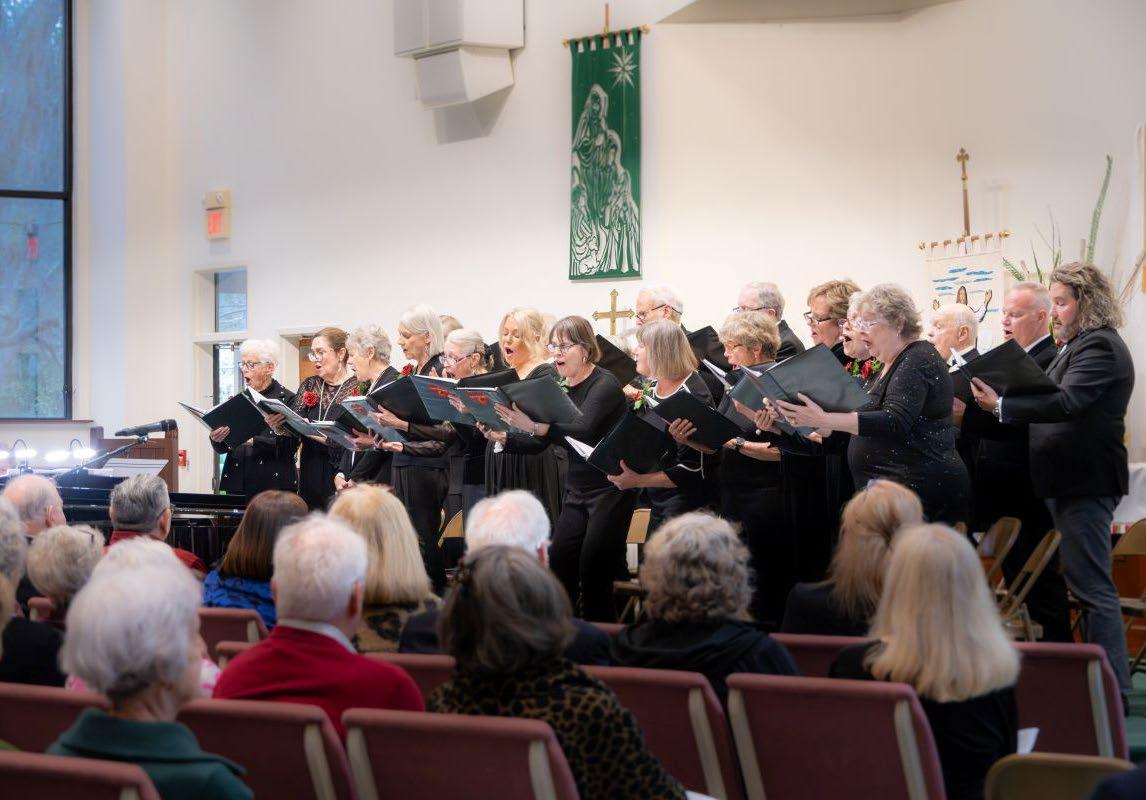
Almost 250 people attended the Broadway (Off Paris!) community choral extravaganza held by St. Mark's Episcopal Church on Sunday, Feb. 15, at St. John's Lutheran Church. Photo courtesy of Jane Abrams
By Margit Resch
Voice, violin, piano: The Lindsay and Jason Duo
Special to The Island News
Are you one of the lucky people who got to hear -- and see -- TAKE3 on Fripp Island in the fall of 2023? Three musicians who dazzled both the ears and the eyes of the audience and received such enthusiastic ovations that they played two encores.
Well, two of those fabulous musicians are coming back to Fripp on Sunday, March 1: Lindsay Deutsch, founder of TAKE3, vocalist, violinist, raconteur and gymnast (of sorts), and Jason Stroll, pianist. The duo is adhering to Lindsay’s idea of combining, as she put it, “classical music with music people actually like.” A principle that she applied to the repertoire of TAKE3 Her duo, too, is cleverly fusing melodies by rock stars of yesteryear like Bach, Beethoven and Mozart with jazz tunes or with songs like Louis Armstrong’s hit "What a Wonderful World,” Willie Nelson’s unforgettable “On the Road Again,” Leonard Cohen’s “Hallelujah,” and even with popular hits of today.
Deutsch is an amazing performer in many ways. She sings beautifully, with heart-wrenching elocution. She is an expert on the violin, displaying genre-appropriate versatility, no matter whether it is a classical piece of music, jazz, rock and roll or bluegrass, and her athletic body movements are stunningly expressive. While performing her magic on the violin, she dances, leaps, struts and prances, grimaces, laughs, frowns and otherwise
emotes, all in the service of illustrating the music.
“She played like a column of fire – her head thrown back, her body an extension of the instrument,” one reviewer said of her physical stage demeanor. You will also be mesmerized by her eloquent and humorous narration, when she is explaining the history or meaning of a musical piece or sharing an anecdote. Given her array of talents, it is not surprising that Deutsch is a sought-after musician, that she has traveled all over the world as guest soloist with a number of famous American and Canadian orchestras, that she was selected for NPR’s respected SymphonyCast Program. She even has movie credits, having played the violin soundtrack for “The Good Shepherd,” starring Robert De Niro.
Deutsch made her solo orchestral debut at age 11, playing with the Clear Lake Symphony in Texas. In ad-
dition to forging a reputation as a violinist, she won (would you believe) a gold medal in the World Junior Olympic Racquetball Championships in 1997 and was selected to the 2000 U.S. Junior Olympic Racquetball Team. No wonder Deutsch is moving with such elegance and agility on stage.
At age 15 she decided to pursue a musical career. While earning her degree from the Colburn School of Music in Los Angeles, where she studied with Robert Lipsett, she performed with major orchestras all over North America. She was just 20 years old when she received national attention. No, not for winning in racquetball, not for playing violin (not yet), but because her violin, a 1742 Sanctus Seraphin, valued at $850,000 (on loan from the Mandell Collection of Southern California), had been stolen out of her car. Deutsch offered a $10,000 reward, and the instrument was returned five days later.
3 years running: TCL places in Top 100 in national cybersecurity competition
Staff reports The Technical College of the Lowcountry has, for the third year running, made the Top 100 “power rankings” in the National Cyber League’s (NCL) Fall 2025 “ethical hacking competition,” according to a media release from the school.
Coached by TCL’s Cybersecurity Program Director Angel Kern and Cybersecurity Program Director Ronnie Bustamante, this year’s team placed 83rd in overall performance in the national competition which saw more than 8 500 participants from 490 colleges nationwide.
“Year after year our students have shown they are able to go head-to-head with teams from colleges –both community colleges like TCL and four-year institutions – from across the country and perform ad-
mirably,” said Kern. “They worked hard and performed well together under pressure. We are very proud of them.”
Every year, students from across the United States participate in the NCL competitions, which offer a way for students to prepare and test themselves against cybersecurity challenges they will likely face in the workforce. Students performed such tasks as identifying hackers from forensic data, running industry tests and audits, recovering from ransomware attacks and other challenges. The rankings measure the students’ abilities to work individually and as a team. The “Cyber Power Rankings” is a published list of the Top 100 schools within the NCL, according to the League. Making the Top 100 is a testament to the
quality of TCL’s programs and dedication of the college’s faculty and staff in helping students to prepare for careers in cybersecurity, Kern said.
This year’s team included cybersecurity faculty and students: Kenneth Casavant, Olivia Ward, Jared Jimenez, Jonathan Eleuterio Candelario, Christian Osborne, Jennifer Crews, Ethan Ascencion, Nicholas Moser, Katherine Ellis, Mark Douglas, Lionel Grant, Gaston Langford, Brandon Biggins, Kenneth Kelch, Michael Freney, Daniel Taylor, Joshua Albridge, Danniella Bekisz, Abigail Mitchum, Randall Noriega, David Andiano, Grant Laseter, Walt Gnann and Guillermo Genovese. For more information on TCL’s cybersecurity program visit www.tcl.edu/cybersecurity.
Currently, she plays on an 1845 Jean-Baptiste Vuillaume violin.
Pianist Stroll’s career is equally as impressive as Deutsch’s. He knows how to key his way into your heart.
A graduate of the Juilliard School and the Glenn Gould School of the Royal Conservatory of Music in Toronto, Jason enjoys a multifaceted reputation as concert soloist, recitalist, and chamber musician. He has also served for several years as educator and piano instructor at the Bronx Conservatory of Music.
As a soloist, he has played with many reputable symphony and chamber orchestras, as well as with a multitude of ensembles, such as trios and quartets known for unique instrumentation and repertoires. He has participated in several prestigious summer music festivals, including the Miami Music Festival, the Pianofest in the Hamptons, the Aspen Music Festival, and in the Adamant Music School Concert Series.
Stroll has successfully participated in several international piano competitions and should be proud of having been named finalist in the 2013 American Paderewski Piano Competition. Stroll consistently charms audiences all over the world with his creative renditions of both classical repertoires and various popular genres, and with an eclectic mixture of all of the above.
Currently, Mr. Stoll is a piano instructor and lecturer at California State University, Northridge, and a freelance pianist, master-
WANT TO GO?
Who: The Lindsay and Jason Duo
What: Fripp Island Friends of Music Concert Series
When: 5 p.m., Sunday, March 1
Where: Fripp Island Community Centre, 205 Tarpon Boulevard, Fripp Island
Tickets: $30 at the door or in advance. For more information, go to www. frippfriendsofmusic.com. For FIFOM membership, concert reservations, or questions, contact Rebecca Climer at 615-594-1552.
class presenter and adjudicator throughout the Los Angeles area.
The Lindsay and Jason Duo will entertain us at 5 p.m., Sunday, March 1, in the Fripp Island Community Centre at 205 Tarpon Boulevard. But come and join us at 4:30 p.m., when a group of young musicians from a Beaufort school will play and sing their hearts out for us. Both shows are sponsored by Fripp Island Friends of Music and supported by the S.C. Arts Commission.
Tickets at the door are $30 for adults (credit cards accepted). Students are free, thanks to the Peg Gorham Memorial Fund.
Stay after the performance for a complimentary reception, catered deliciously by Harold’s Chef Services, and help us entertain Lindsay and Jason. For more information, go to www.frippfriendsofmusic. com. For FIFOM membership, concert reservations, or questions, contact Rebecca Climer at 615-594-1552
Staff reports
USCB Center for the Arts will be showing Academy Award-nominated film “Hamnet” at 3 and 7 p.m., Monday, Feb. 23
Hamnet is a 2025 historical drama directed by Chloé Zhao, who co-wrote the screenplay with Maggie O'Farrell based on the 2020 novel by O'Farrell. The film dramatizes the family life of William Shakespeare and his wife Agnes Hathaway as they cope with the death of their 11-year-old son, Hamnet.
The film stars Jessie Buckley and Paul Mescal as Agnes and William, alongside Emily Watson, Joe Alwyn, and Noah Jupe in supporting roles.
For information on purchasing tickets please visit uscbcenterforthearts.com or call 843-521-4145 for
ets.
John Paul II Catholic School earns AP School Honor Roll Gold Recognition
Staff reports John Paul II Catholic School has been named a Gold designee on the College Board’s Advanced Placement (AP) School Honor Roll for the 2024–25 school year. This marks the second consecutive year JPII has earned Gold recognition and the third year in a row the school has been honored on the AP School Honor Roll.
Just two years ago, JPII achieved Platinum designation, highlighting sustained academic excellence even as the student population continues to grow.
The AP School Honor Roll recognizes schools nationwide for expanding access to AP coursework, supporting student success in rigorous academics, and preparing students for college and beyond. JPII’s continued recognition reflects strategic growth, ongoing investment in teacher training, and a schoolwide culture of academic excellence.
“At JPII, we have worked diligently and with purpose to grow our AP availability,” Principal Heather Rembold said in a media release. “This recognition is a shared accomplishment and a testament to the dedication of our teachers, students, parents, and staff.”
In May 2024 133 JPII students (56% of Grades 9 through 12) completed 281 AP exams, with 80% earning a score of 3 or higher, exceeding national averages. JPII offers AP courses across multiple disciplines, including English, math, science, computer science, history, and visual arts, as well as the prestigious AP Capstone Diploma program.
“This honor reflects the academic rigor that defines John Paul II Catholic School,” President David Lima said. “Our students rise to the challenge, our teachers invest deeply in their craft, and our families support a culture where excellence is expected.”
The Lindsay and Jason Duo are two-thirds of the act TAKE3. Submitted photo
HEALTH
When tender tendons mean something more
Achilles tendinitis doesn’t just affect runners and athletes
By Dr. Cory A. Messerschmidt Beaufort Memorial Orthopaedic Specialists
Tendons connect muscles to bones, and tendinitis occurs when a tendon becomes inflamed. When this affects the Achilles tendon, it’s known as Achilles tendinitis — a common injury that can make walking, running, jumping, and climbing painful.
Dr. Cory Messerschmidt
The Achilles is a large tendon connecting the calf muscles to the heel, playing a crucial role in mobility. It commonly becomes inflamed due to overuse, sudden increases in activity, high-impact sports, or improper footwear, but with the right care, full recovery is achievable.
Depending on where the inflammation takes place, you may be diagnosed with either of the following:
• Insertional Achilles tendinitis — Inflammation affects the lower area of the tendon, where the tendon connects to the heel bone. This injury is
often the result of excessive stress on the Achilles tendon caused by tight calf muscles. With this condition, you may also develop bone spurs on your heels.
Noninsertional Achilles tendinitis — This inflammation affects the middle of the Achilles tendon. When this happens, the fibers in the tendon may break down and develop small tears. If this happens, the tendon may swell and become thicker.
Both conditions are common among runners, but noninsertional tendinitis often affects younger runners, while insertional Achilles tendinitis may occur at any age, regardless of your activity level.
Recognizing an inflamed Achilles tendon is essential for timely diagnosis and treatment. The most recognizable symptom is heel pain and swelling.
Other symptoms you may experience with Achilles tendinitis include:
Extreme pain the day after exercise; Heel pain that comes on when wearing shoes;
Morning pain or stiffness along the affected tendon; Swelling that worsens with activity; and/or Thickened Achilles tendon.
During a physical examination, your healthcare provider will assess you for signs of Achilles tendon inflammation. You may be asked to stretch your calf or point your toes downward. If these movements cause heel pain or uncover limited ankle range of motion, further testing can help pinpoint the cause of your problem.
Imaging tests your healthcare provider may prescribe include MRI, ultrasound or an X-ray. Along with confirming a diagnosis, these imaging exams can rule out other conditions. MRI is often used to detect similar conditions, such as Achilles tendon ruptures, and to plan surgery for tendinitis.
Conservative treatment options
Noninvasive treatments that may bring healing and relief for Achilles tendinitis include:
• Ice — Apply ice to the affected area two or three times a day for 15 to 20 minutes at a time.
• Lifestyle changes — Stop any
Embrace hope
How optimism can play a role in the cancer journey
Special to The Island News
Facing a cancer diagnosis can be overwhelming, and it’s natural to feel fear, uncertainty and sadness.
Yet many patients and survivors point to one thing that makes a real difference in their overall well-being: optimism.
While staying positive won’t guarantee a cure, research shows that having an optimistic outlook and believing in a better future can significantly improve quality of life.
Dr. Eric Turner, a board-certified and fellowship-trained medical oncologist with Beaufort Memorial Oncology Specialists at the Keyserling Cancer Center in Beaufort, says that optimism isn’t about putting on a brave face 24/7
“It’s about maintaining hope, trusting the treatment process and acknowledging your emotions honestly,” he says. “This mindset can help patients stay engaged in their care, follow recommended treatments and feel more resilient through the ups and downs of treatment and recovery.”
Real benefits of optimism
Many patients, like Beaufort’s Victoria Carter, have found that for them personally, there is power in remaining positive through cancer treatment and survivorship.
Broad-scale benefits of optimism show impacts that include:
• Improved quality of life – positive attitudes are often linked with less stress, reduced anxiety and better overall emotional well-being, which helps patients cope with their diagnosis, treatment side effects and their day-to-day life along their journey.
• Greater treatment adherence –Optimistic patients are more likely to follow their care plans, attend appointments and work with their care teams, all of which can impact their overall outcome.
Health beyond cancer – Some studies suggest that optimism is associated with lower risks of conditions like heart disease, showing that mindset can play a huge role in overall health, not just along a cancer journey.
“Of course, optimism doesn’t mean suppressing real feelings,” Dr. Turner says. “Feeling fear, anger or grief during cancer treatment is valid and often unavoidable. Embrace those emotions; they can coexist with hope.”
Seeking support
Even with a positive outlook, a cancer journey can, at times, feel isolating. Even with supportive family and friends, few people outside of the cancer community fully understand the emotional and practical challenges that come with diagnosis and treatment.
For some patients and survivors, support groups can make a difference. These support groups can offer:
Emotional connection and understanding – “Groups let you talk openly with others who know exactly what you’re going through – the fears, the frustrations, the small victories,” says Kianna Brown, LMSW, an oncology social worker at Beaufort Memorial. “That shared experience can make you feel less alone or isolated.”
• Practical advice and coping tools
– Support group attendees often exchange tips or managing side effects, handling appointments, balancing work or family life and navigating the healthcare system. This practical wisdom can be invaluable.
• Flexible options to fit your needs
– At Beaufort Memorial, support groups for all cancers as well as specifically breast cancer are held in person as well as over Zoom.
Beaufort Memorial breast cancer support groups meet the second Wednesday of every month from 6 to 7 p.m., while the all-cancer group meets the fourth Wednesday from 1 to 2 p.m. Both groups meet at the Beaufort Memorial Medical and Administrative Center (BMAC), 990 Ribaut Road, in the third-floor boardroom, room 317
Support groups can help cancer patients and survivors stay grounded and hopeful, Brown said.
“Sharing fears or frustrations is as important as celebrating small wins,” she said. “They are a place for honesty, not forced positivity, and that authenticity can help create a sense of community that can promote mental well-being.”
Harnessing hope and community
A cancer diagnosis rarely feels fair, but hope and community can help you carry it. An optimistic mindset, while not a promise of a cure, can strengthen resolve and improve day-to-day wellbeing. Support groups offer understanding, practical advice and emotional backup, helping you remember that even though you may feel isolated at times, you’re not alone.
activity that causes pain or swelling and try new exercises. If running causes you pain, consider swimming or biking. This change allows you to stay fit without aggravating your inflamed tendon.
• Over-the-counter medication — Nonsteroidal anti-inflammatory drugs (NSAIDs), including aspirin and ibuprofen, help manage pain and inflammation.
Physical therapy — Strengthening exercises and stretches can protect your Achilles tendon from further harm.
• Updated footwear — Proper shoes can guard against heel pain. You may also benefit from a brace, boot or cast while the swelling in your Achilles tendon goes down. Inserting a heel lift in your shoe can also bring relief.
Treatment options your care team may recommend when conservative approaches don’t bring relief include:
• Extracorporeal shockwave therapy (ESWT) — A machine sends acoustic shockwaves through the affected
tendon. These shockwaves aid in healing and provide pain relief.
Platelet-rich plasma injections — Platelets removed from your blood are injected into the injured tendon. These platelets then work to bring healing to the hurting area.
• Surgery — The orthopedic surgeon may remove or repair damaged tissue in the Achilles tendon. If bone spurs have formed, they are also removed. Once finished, the surgeon reattaches the repaired tendon to the heel bone. In some cases, the surgeon may lengthen the calf muscle to reduce stress on the Achilles tendon.
It can take up to a year to recover from surgery, but it usually helps patients regain full function.
As painful as it is, Achilles tendinitis is a treatable condition that can be managed with proper care.
Fellowship-trained in sports medicine, Cory A. Messerschmidt, M.D., FAAOS, is a board-certified orthopedic surgeon with Beaufort Memorial Orthopaedic Specialists who sees patients at the practice in Port Royal and Okatie.
Is a vasectomy reversible?
Let a urologist guide you when considering the procedure
Special to The Island News
According to the Urology Care Foundation, more than 500 000 American men undergo a vasectomy every year. This common form of birth control is effective at preventing pregnancy, but what happens if you change your mind?
“There are a lot of reasons a man may wish to reverse his vasectomy,” says Dr. Maurizio Buscarini, a board-certified, fellowship-trained urologist at Beaufort Memorial Urology Specialists, who sees patients in Beaufort and Okatie. “Fortunately, vasectomy reversal is possible and often leads to successful future pregnancies.”
How a vasectomy works
Unlike condoms and other birth control methods, a vasectomy permanently prevents a man from impregnating a woman with minimal risk of side effects. While a vasectomy doesn’t affect a man’s sex drive or his ability to achieve an erection or orgasm, it can’t protect against sexually transmitted infections (STIs). Therefore, you’ll need to practice safe sex after the procedure.
As a minor surgery, a vasectomy can be performed in a urologist’s office or a hospital operating room in approximately 30 minutes.
The surgery prevents sperm cells from mixing with semen. Pregnancy following a vasectomy is extremely rare. Full recovery usually takes less than a week, and a follow-up appointment with your urologist after a few months can confirm that no sperm is present. You then have long-term protection against unwanted pregnancy.
Reversing your procedure
If you ever have second thoughts about your vasectomy, you may opt to reverse the procedure. Reversal is often successful, but the likelihood of success decreases the longer you wait, according to the U.S. Food & Drug Administration.
With a reversal, a urologist reconnects the ends of the divided vas deferens in each testicle. The surgery typically follows these steps: You receive anesthesia — While you likely remained awake for the original surgery, you may receive general anesthesia for your reversal. This prevents pain and keeps you asleep during the procedure.
• Surgery takes place — Through small incisions on both sides of the scrotum, the urologist opens the ends
of the severed vas deferens. If sperm is seen, the urologist reattaches the two ends of the vas deferens. Otherwise, your urologist attaches the vas deferens to the epididymis, a tube where your body stores sperm.
Recovery from reversal takes approximately a week, and the pain is often similar to the original procedure.
“The majority of men who have their vasectomies reversed enjoy fertility for years to come,” Dr. Buscarini says. “While it can take a few months to get a partner pregnant after vasectomy reversal, it often happens, and men can again grow their families as they desire.”
Deciding to undergo a vasectomy or to reverse the procedure is a deeply personal issue. Before making the choice, you may want to talk with your men’s health provider about other birth control options. Though condoms are the only other choice for men, there are several birth control options for women, including:
• Birth control pills — A daily pill contains hormones that prevent a woman’s body from releasing an egg. With no egg to fertilize, sperm cannot result in pregnancy. The same shortterm results can be achieved with a patch. Implanted protection — A women’s health provider places a device in the woman’s body that can prevent pregnancy for up to a decade.
Tubal ligation — Also known as “tying your tubes,” this surgery closes or removes the fallopian tubes. It is a lifelong method of birth control.
“Whether you choose a vasectomy or other birth control methods or decide to reverse a previous vasectomy, it’s important to make sure you and your partner are on the same page,” Dr. Buscarini says. “Open communication goes a long way toward maintaining a healthy relationship and satisfaction and comfort in whatever option you choose.”
IARTS
VOICES
Editor’s Note: The opinions of our columnists in the Voices section are not necessarily the opinions of The Island News
It wasn’t perfect but was it fair?
t is Wednesday, 12:15 p.m., and I’ve just finished listening to the appeal of Richard Alexander Murdaugh.
I still have my morning coffee, a small tub of Chobani (Vanilla) Yogurt and I’m contented — contented because my laptop has delivered the various arguments of Richard Harpootlian, Jim Griffin and Creighton Waters as to whether Alexander Murdaugh got a fair trial consistent with the 6th Amendment.
All of us saw the original trial.
We sat on our respective sofas every day watching Judge Newman, Jim Griffin and Creighton Waters— not to mention an army of experts — go through a thousand exhibits dealing with automatic rifles, spent cartridge casings, cell phones, GPS data and a thousand other bits of disputed information.
And when it was over we had an opinion.
But today the question before the South Carolina Supreme Court is no longer guilt or innocence, but
SCOTT GRABER
whether or not Murdaugh got a fair shake in Walterboro. Did the Clerk of Court, “Miss Becky,” poison the jury when she spoke to the jurors — allegedly asking them to “watch his body language” and “don’t be fooled;” and did the State go too far when they put Murdaugh’s multiple “financial crimes” into evidence?
It seemed to this former attorney — I argued two cases in the S.C. Supreme Court — that certain of the Justices were concerned that the Clerk of Court went “rogue” when she allegedly said, “watch his actions” and allegedly made other statements to the jurors when they were in her care.
Creighton Waters characterized these comments as “not egregious” and the “overwhelming majority (of the jury) were not influenced” by the Clerk’s comments.
But a big part of the hearing dealt with Murdaugh’s “financial crimes” and whether the presentation of that evidence went too far.
The Chief Justice, John Kittredge, said that the “granular detail and the expansiveness in which everything under the sun was allowed was arguably problematic.”
Problematic?
Everyone in this courtroom knew that the underlying, unspoken question in this case was what could have driven Alexander Murdaugh to murder his wife and his son. And to this point Deputy AG Creighton Waters spent much of his allotted time talking about the so-called “boiling point” which then triggered the shootings.
Waters defended the “38 transactions” and the details connect to the millions of dollars stolen
“The
by Murdaugh in order to completely explain the “looming storm cloud;” the “slow burn;” that would eventually compel Murdaugh to shoot his wife and his son at his dog-filled kennels.
But Justice Kittredge was clearly concerned with these lengthy and granular descriptions — especially the descriptions of the disabled clients who were victimized by Murdaugh — and seemed to ponder the notion that all of this was “unfairly prejudicial.”
All of this back and forth colloquy sent my own fading and enfeebled mind back to January 23, 1979,
when I was standing in front of Judge Clyde Eltzroth saying — along with my partner, Ralph Baldwin — that a Beaufort County jury should not hear certain (sexual) details that preceded the murder of a St. Helena Island woman.
Those details involved events that took place prior to the killing of Betty Gardner and would, we argued, surely “inflame” the jury against our client, John Arnold.
As soon as those inflammatory details were revealed, we said the jury would be incapable of calm, deliberate evaluation of any other evidence.
Randolph “Buster” Murdaugh — Alexander Murdaugh’s grandfather — said those details were “an intricate part of the State’s case — it shows malice on their part.”
Then, later, Ralph and I had our morning in front of the Supreme Court Justices arguing — just as Dick Harpootlian and Jim Griffin argued earlier today — that they should vacate the jury’s verdict and send
it back to Beaufort for another trial.
And that Court did reverse the verdict — saying “Buster” had gone too far when he said, “I’ll never try a death penalty case in Beaufort County unless you bring back a guilty verdict in this case …” But all of that was long ago, now forgotten, the Plath/Arnold case moldering law books, largely unread.
But what will this Court — these four men and one woman — do?
Now the Justices will retreat into their teak, leather and diploma-accented rooms — their chambers — and search for similar cases that will help them define “fairness” as relates to the facts in this case.
The State does not have to deliver “perfection;” however, it does have to deliver “fairness.”
Will we again spend our nights with Court TV?
Scott Graber is a lawyer, novelist, veteran columnist and longtime resident of Port Royal. He can be reached at cscottgraber@gmail.com.
Bill to hide from public scrutiny payments from schools to athletes is a betrayal
The bill to shelter millions of dollars in contracts between schools and athletes now pending in the South Carolina Senate is a betrayal. It is a betrayal of a commitment made by the General Assembly to the people of South Carolina more than 50 years ago when in 1972 it adopted the South Carolina Freedom of Information Act, stating:
The General Assembly finds that it is vital in a democratic society that public business be performed in an open and public manner.
“Vital in a democratic society.”
The appellate courts of South Carolina have consistently held that this commitment to the people of South Carolina is to protect the public from secret government activity.
Members of the public are justifiably concerned about how their public officials spend public money. Recent cases reveal theft
or misuse of public funds by sheriffs, probate judges and county council members. The amount of money involved in these cases and others like them is miniscule in comparison to the millions of dollars in public funds that would be hidden from public view if this bill were to pass.
Under an agreement to settle an antitrust suit brought by athletes’ schools, such as the University of South Carolina and Clemson University, each will be allowed to distribute up to $20 5 million to athletes during the 2025-2026 school year. The amount will increase in future years. If this
legislation were to pass those millions of dollars of public funds would be spent by schools secretly and away from public scrutiny.
Members of the General Assembly are being told that the schools will spend the money responsibly and appropriately. One needs to look no further than the lavish and unreviewed expenditures by Jim Holderman when he was president of the University of South Carolina to look skeptically at this representation.
The money for the expenditures the university sought to hide from public view was said by the university to come from a private nonprofit entity that was separate from the university. It turned out that this was a fabrication as millions of dollars in public funds were being spent outside of oversight by a foundation created, funded and managed by the university.
No rational justification exists to hide from public scrutiny and oversight millions of dollars in
annual spending by universities just because the money is supposed to be paid to athletes. This legislation invites and endorses secret government activity on a grand scale.
This legislation is also a betrayal of the legislative process. The bill was introduced in the House on Jan. 14 2026, and was passed two days later without any debate or opportunity for public comment. In the normal legislative process there would have been subcommittee and committee meetings in each chamber to consider the bill. The expedited, extraordinary path of this legislation is a betrayal of public trust in the legislative process where it is hoped that legislation will not be adopted without thoughtful consideration and debate. By rushing this bill through the House and now the Senate, members are acting like rulers rather than representatives.
The University has been lying when it says the contracts with
athletes are with a “third party.”
That third party, Ascend Carolina, is a part of the athletic department. It is not a separate, independent party dealing fairly with athletes.
Contracts with public bodies such as the University and by extension Ascend Carolina, are declared “public records” in the South Carolina Code of Laws. Why should a contract with an athlete be hidden from public view when other contracts with public bodies are required to be public?
This legislation will not “save college sports.” It will not make South Carolina a national champion in football. It only serves the interests of the schools at the expense of the public, the players and the credibility of the General Assembly.
Jay Bender is a retired University of South Carolina professor and media lawyer who represents the S.C. Press Association and its newspapers.
JAY BENDER
Editor’s
VOICES
We live in the Carolina Bight
What is it? Why does it matter?
Isuspect most of us have experienced meaningful coincidences in our lives — those events that seem preceded by, and linked to, some thought or dream, and feel far from accidental. If you have, you understand how they might evoke wonder, awe, and a sense of destiny in your life.
A bight is a wide, shallow, gentle bend or curve in a coastline the creates an open, often large bay. Examples include the Australian Bight, the Southern California Bight, South Atlantic Bight, and the Georgia Bight.
The Carolina Bight is the area that includes the Calibogue Sound, the Port Royal Sound, and the Beaufort, Chechessee, Colleton, May, Pocataligo, Tulifiny and Whale Branch rivers. The ecosystem is unique in ways we are only now coming to understand.
We are part of the “Lowcountry” but that name is too broad to recognize the importance of the Carolina
ODICK STEWART
Bight and why different regulations and behavior are essential to protect this ecosystem. The Carolina Bight is not like the freshwater system of the ACE Basin; not like busy Port of Charleston or the rivers that flow through the Port. The sounds and rivers of the Carolina Bight share the following qualities:
• High salinity levels: Freshwater flowing into the area is quite limited. This allows sea turtles, sharks, large and small sea creatures, and salt marshes to thrive miles inland from the Atlantic. This also means anything we put in the
water sloshes around and is not flushed into the ocean.
High tidal amplitude: Tides of 7 to 10 feet twice daily cover large areas that serve as a nursery for fish species, oysters, crabs, shrimp, and birds.
Salt marsh: The salt marsh covers 200 000 acres of the Carolina Bight. Salt marsh protects our communities from storms and high waves. South Carolina has more salt marsh than any state on the east coast. Beaufort County has more than 53% of the total in the state
• Bird species: The Carolina Bight salt marshes, waters, and beaches are essential to our bird populations. In one month, more than 70,000,000 birds were in Beaufort County. The Carolina Bight is in the Atlantic Flyway, which
is a major migration path for birds traveling between the Arctic and South America. These birds depend on the Carolina Bight salt marsh as a safe place to rest, nest, and feed.
• Carbon absorption: The Carolina Bight salt marsh absorbs 4 million pounds of carbon each year. We must keep the marshes healthy and our waters clean. The salt marsh is in peril and needs protection.
The good guys?
Great work is being done in the Carolina Bight by several groups including the USC Beaufort Marine Sciences and Biology program, the Carolina Bight Birding Center, the Coastal Discovery Museum, Hunting Island State Park, the Lowcountry Institute, Nemours Wildlife Foundation, Pinckney Island National Wildlife Refuge, the Port Royal Sound Maritime Center, St. Phillips
Island, the Waddell Mariculture Center, the Pritchard’s Island Research and Living Shoreline (PIRLS). Several additional communities also have important programs.
Are you and I good guys?
What is our responsibility?
You and I each benefit from this special ecosystem that is the Carolina Bight. The more I learn, the more I care. I bet you will as well.
When Jenn of the Carolina Bight Birding Center told me about the 6 million birds in Beaufort County in a single night, I was excited. When she told me about injured birds that rely on volunteers to be driven two hours for care, I was humbled by the commitment of the volunteers and concerned for our birds.
When Craig Reeves of Sea Eagle Market talks about our shrimp and fish populations, I can sense his passion for a world I can’t see but a world that I enjoy for dinner. When the Port Royal Sound Maritime Center hosted a talk
on crabs, oysters, and cobia, the attendance was beyond overflowing. Lots of people love this place.
What can we do?
Become an Ambassador for the Carolina Bight. Tell your friends and family about this place. Our home is different and deserves different regulations and management.
Tell the policy makers you appreciate their good work and remind them about why this place is special. Choose to celebrate an identity and a shared love for this place. I am proud to live in the Carolina Bight. I chose the Carolina Bight to call home. The Carolina Bight matters to me. I hope it matters to you.
Dick Stewart serves on several nonprofit boards, is a former member of Beaufort County Council and has invested in properties in Beaufort including properties along Waterfront Park. You can send your thoughts to Stewartthoughts@gmail.com.
Time and a place for everything
nce upon a time and long ago, I worked in theater in New York City. Almost all my male friends and coworkers were homosexual. I knew there were women who were attracted to other women, but I was quite innocent and, for the first few years did not know of any among my acquaintances.
For a time, my first husband and I often worshiped at St. Clements on West 46th Street. It was an Episcopal Church on Sunday and a theater during the rest of the week. One of the church leaders asked me if I would consider joining the vestry. I said that I was a Catholic, but my husband was Episcopalian, so he would be the better choice for the vestry. She assured me that they really wanted me to join. Intrigued, I agreed.
At my first and only vestry meeting, I walked into a room filled with the male pastor and twelve or so women, almost all of whom I realized were lesbians. I do not remember exactly what happened in the meeting, but shortly after it ended, I thanked everyone for the honor and stated I would be attending Holy Cross, the historic Catholic church on West 42nd Street. In more ways than one, I realized St. Clements was not my tribe.
The level of discomfort that I felt in that meeting may have been the uneasiness a homosexual person feels all the time in the majority world of male-female attraction. The Big Apple has always been
more comfortable for people who differ from the mainstream as the City is far more accepting of all life choices than, say, Paducah, Ky.
Since those long-ago days – 50 years – the shutters, doors, windows have been thrown wide open. Now, we have folks who believe that there are multiple genders and sexual orientations. People born one way can try to become the opposite. To someone like me who believes in biological fact that there are two sexes with the occasional chromosomal aberration, it is, to say the least, baffling. I believe what a person chooses to do with his or her life once one reaches the age of majority, that is, can vote and sign legal documents, is entirely his or her business.
I also strongly believe that sexual orientation does not need to be on public display at any time or place. I would prefer that people keep their personal lives private.
Three-time United States women’s figure skating champion Amber Glenn, a self-described “pan sexual,” recently stated, “I hope I can use my platform and
my voice throughout these (Olympic) Games to try and encourage people to stay strong in these hard times. I know that a lot of people say you’re just an athlete, like, stick to your job, shut up about politics, but politics affect us all … It’s been a hard time for the community overall in this administration. It isn’t the first time that we’ve had to come together as a community and try and fight for our human rights.”
Almost immediately, Ms. Glenn’s comments during her Olympic press conference inspired backlash. She responded, “I chose to utilize one of the amazing things about the United States of America (freedom of speech) to convey how I feel as an athlete competing for Team USA in a troubling time for many Americans. I am now receiving a scary amount of hate/threats for simply using my voice WHEN ASKED (her emphasis) about how I feel.”
She also noted she believes people cannot stand that there are “two woke b***ches” at the top of the USA figure skating team. I wonder if Ms. Glenn was outing teammate Alyssa Liu or just referring to Alyssa’s mood.
Whether or not a person chooses to engage in the LGBTQA+ “rights” movement is another choice. Many non-heterosexual people hold important positions in government and society and do not dwell on their sexual orientation. It is part of their private lives,
and they seem unconcerned about their rights or perceived lack thereof as they go about daily business.
Others, such as Ms. Glenn, seize the moment to proclaim an agenda whether their timing is appropriate or not.
Ms. Glenn complains about the need to fight for human rights under the current administration. I have tried to understand what those human rights are, and why a certain voting block feels this is a “hard, troubling time.”
Is it a right to join the United States military? Is it a right to have the government pay for sex-changing surgery? Is it right to castrate or perform double mastectomies on children and youth under the age of 18? Which right is it that the current administration prevents LGTBQA+ people from enjoying?
Perhaps I have a libertarian streak, but I believe our rights are defined in the Declaration of Independence and the Bill of Rights, and that’s it. Everything else is an issue.
Much of the negative feedback Ms. Glenn received for expressing her right to free speech was about her decision to “use her platform” during the Winter Olympics. Perhaps she chose to do so because she will probably not have such visibility again. Perhaps she felt inspired by skiers Hunter Hess and Chris Lillis and curler Rich Ruohonen who criticized Immigration and Customs Enforcement and alpine skier Mikeala Shiffren
who referred to a violent world and read a statement about peace and goodwill.
As Mama would say, “There’s a time and a place for everything.”
The Olympics are neither the time nor the place for manifestos.
The Olympics are a world event to foster sports and fraternity among athletes. In a fractured world, it gives us hope that at least for a time, all people can come together with unity and goodwill. The model might be favorite, “quad-god” Ilia Malinin, who unexpectedly finished in eighth place, yet embraced long-shot gold medal winner Mikhail Shaidorov in a congratulatory hug.
While I do not condone the hateful responses Ms. Glenn and the other outspoken athletes received, I agree with those who believe athletes should compete during the Olympics and save their political statements for a later date. All I want from Amber Glenn is that she skates as beautifully and exceptionally as she is able.
The only platform Ms. Glenn should concern herself about while competing is the one on which the first, second, and third place figure skating champions will stand.
Louise Mathews retired from a career in community colleges, and before that, theater.
A 13-year come-by in Beaufort, she has been a dingbatter in North Carolina and an upstater from New York.
Don’t defend Trump’s racism
Donald Trump has a long, well-documented history of racism. In 1973, the U.S. DOJ sued the Trump Management Corporation for refusing to rent apartments to Blacks. In 1989 Trump took out ads in the N.Y. Times calling for the death penalty for the "Central Park 5," five Black and Latino teens who were falsely accused of attacking and raping a white woman in NYC's Central Park. The 5 teens were exonerated, but Trump never apologized for or retracted his calls for their execution.
In the 1990's, several Trump Casinos were sued for racial profiling of Black customers. In 2000, Trump ran a series of newspaper ads against the St. Regis Mohawk Tribe whose casino would compete with his casino. Trump stated that the tribe had a “record of criminal activity” and their dark skin was proof that their ancestry was fake.
In 2005, Trump stated that he wanted to pit Black people against white people on
"The Apprentice" to generate controversy. Then a few years later he pushed the ridiculous "birther" theory that Barack Obama was not a U.S. citizen, and therefore ineligible to serve as President. When Trump kicked off his own Presidential campaign in 2015, he called Mexican immigrants rapists who were “bringing crime” and “bringing drugs” to America. During his first Presidency, Trump referred to coronavirus as “kung flu” and the “Chinese virus.” His blatant racism helped fuel a surge in hate crimes against Asian Americans.
I could go on and on, but I'll stop here. The evidence is clear. Donald Trump is a racist. So it was rather sad to read Louise Mathews' feeble attempt to defend Trump against his latest racist outrage, depicting the Obamas as monkeys in an AI-generated video ("Bull in the China Shop?" The Island News, Feb. 12-19.) Her attempt to put a humorous spin on Trump's racism was pathetic.
Then again, it must be very difficult to constantly defend this President and this
administration. Abduction of children, beatings, shootings and murders by ICE agents. Health care costs skyrocketing. Grocery prices rising steadily. The invasion of another country for oil and threats against our allies over mineral rights. Blatant corruption and self-dealing. And not to forget, the Epstein files where Trump has been mentioned more than 38 000 times. Maybe his apologists can explain why his DOJ refuses to release the remaining 3 million files. What are they hiding?
– Peter Birschbach, Port Royal H.4760 ‘replaces medical expertise with punishment’ House Bill 4760 would criminalize safe, evidence-based abortion care by misclassifying abortion medication as a controlled substance. This dangerous move replaces medical expertise with punishment, expands surveillance of pregnancy, and creates new barriers to essential health care, including miscarriage management.
The bill is sponsored by State Representative Weston Newton, R-Beaufort, who also serves as Chair of the House Judiciary Committee. As Chair, Rep. Newton also has the authority to stop this bill from advancing.
H.4760 threatens bodily autonomy, worsens South Carolina’s already poor pregnancy health outcomes, and disproportionately harms people who already face barriers to care including people with low incomes, people in rural communities, and people of color. H.4760 continues the attack on restricting women’s rights. We are regressing to second-class citizens of this country. Government is creating barriers to critical health care, attempting to criminalize a women’s right to autonomous decision making.
Make your voice heard to withdraw H. 4670: Abortion Medication Bill. South Carolinians, especially marginalized women, deserve laws grounded in science, dignity, and care.
– Diane Patino, Beaufort
LOUISE MATHEWS
Editor’s
Decent people can shut down Internet trolls, haters
There’s more than one word for people who lurk around social media using its anonymity to spew hatred and venom because they don’t like someone’s views or the way they look.
Most of those descriptive words can’t be published in a family newspaper. But here’s one that can: Cowards.
If you’ve been on Facebook or Instagram or X, you’ve surely seen the kind of nonsense that these haters and racists use to bully their way into conversations where no decent person cares for their opinions.
Earlier in the week, the Charleston City Paper published a story on the Modjeska Simkins School in Columbia, which is affiliated with the S.C. Progressive Network. For the 11th year, the school is again offering a 16-week curriculum of classes that teaches little-known history about South Carolina. It sounds like pretty interesting
Pompous! Arrogant! Haughty! Overbearing! Egotistical! Shall I continue?
ANDY BRACK
stuff — if you’ve got an open mind to learn facts you might not know about things like racism, oppression and how the planter class long took advantage of regular people. Maybe not everybody’s cup of tea, but definitely interesting.
And like most of the stories we offer, this story was published online — with a photo of some of the recent graduates. It showed a diverse crew of folks who looked happy on graduation day.
But some of them apparently didn’t look like some of the closeted bigots who hide behind the
secrecy of the Internet. These word thugs crawled out from under their rocks for long enough to write some pretty horrible things that would cause any decent grandmother to find a big bar of soap to wash out their mouths. (If you ever wondered how the behavior in the Epstein files could have gotten started, it’s got to be somewhere near the kind of depraved mindset that pokes fun of people who may not have a model’s figure or have a different skin color or ancestry.)
Here are some of the wicked things these wretched Internet trolls said:
“No one in their right mind wants anyone like that anywhere near their kids.”
“I can smell this picture.”
“I’m going to make a bingo card for this.”
“Maybe they should take a class on nutrition instead.”
Fortunately, there are a lot of decent people who saw this crap
on the Internet and shot it down.
They didn't hold back on junk from the haters, bigots and sizists with comments like:
“I’m proud we have a group that does continuing education with a focus on the facts surrounding our history. I am deeply saddened and upset at the bullying in these comments regarding people’s body size and appearances.”
“The men showing up in this comments section are demonstrating why there is a ‘male loneliness epidemic.’”
• “Apparently, you’re still in middle school with that stupid comment.”
“Insulting someone’s eyes when you look like the offspring of two diseased siblings is a wild choice.”
The Simkins class will be offered in Columbia and six satellite locations around the state starting
Her own day of infamy
All of these, some simply passing thoughts, others uttered aloud, along with additional words not fit for the delicate ears of some of my dear readers, cannon balled through my head as I watched the cameras roll on Pam Bondi’s amateurish drama on Wednesday, Feb. 11 Before I continue, let me establish what constitutes the duties of the Attorney General. In doing some research, I was able to find a list sufficiently abbreviated for this column. To uphold justice and enforce federal laws, the duties of the U.S. Attorney General include: Overseeing the Department of Justice and its various divisions. Representing the United States in legal matters before the Supreme Court. Enforcing federal laws, including civil rights and antitrust laws. Advising the President and federal agencies on legal issues. Managing federal prosecutors and overseeing criminal investigations.
And last, which to my thinking should be first: Ensuring fair and impartial administration of justice across the country. I could write an entire column about these six duties and how Ms. Bondi has failed on so many
Ylater this month.
“We’re going to teach you how to be effective” in challenging the historical power structure, said organizer Brett Bursey, who heads the 30-year-old, nonpartisan S.C. Progressive Network Education Fund. He also added, “The school’s mission is re-seeding a movement for systemic change with autonomous groups across the state.”
In our free society, people are going to disagree with news stories like the one on the new history class. But let’s remain civil. Often, that may be hard — and many of us may be guilty of lashing out occasionally (I am such a sinner). But let’s not fuel and sow division. If you disagree, stay within the guardrails of decency. Or just shut up and move on.
Andy Brack is editor and publisher of the Charleston City Paper and Statehouse Report. Have a comment? Send it to feedback@statehousereport.com.
levels, but that is fodder for another day.
Instead, I am choosing to address Feb. 11, a day that will surely be her own “day of infamy!”
To say the hearing was contentious would be a gross understatement. Sadly enough, it was also an open display of just how corrupt Bondi is as was evidenced by the large folder she brought with her, one that contained information on what each committee member had accessed from the Epstein files. This gave her a handle on what questions she might expect from each member, and she referenced it constantly.
I compare this to the cheat sheet a kid would bring to a test, except the kid would use it surreptitiously. For her it was an overt resource from which to lob insults to each member who had the temerity to question her role in cover-
ing up the Epstein files.
If you watched this hearing with any level of objectivity, you have to admit that the attorney general of the United States came to this event with one objective, and that was to defend the president, regardless of whom she might offend.
Her responses included such childish statements as, “You washed-up loser lawyer. You’re not even a lawyer.” Bondi said this to Rep. Jamie Raskin (D-Md.), a lawyer and former constitutional law professor.
After Rep. Thomas Massie, a Republican from Kentucky, asked about the Epstein files, Bondi said he had “Trump derangement syndrome” and called him “a failed politician.”
Under questioning from Rep. Dan Goldman (D-N.Y.), Bondi said, “You’re about as good of a lawyer today as you were when you tried to impeach President Trump
in 2016.”
Perhaps this was best addressed by Rep. Hank Johnson (D-Ga.) when he said, “You do a Jekyll and Hyde kind of routine around here,” adding when Bondi asked for clarification, “Well, it means you’re nice to the Republicans and you turn like Hyde on Democrats.”
Interesting that he had to explain the concept.
Perhaps the most reprehensible act on the part of the “impartial” DOJ head was her failure to even look at the survivors of the Epstein scandal.
It was Rep. Pramila Jayapal (D-Wash.) who asked her to turn around and address the 11 victims who said they had not met with the department and “apologize for what your Department of Justice has put them through.”
The request ignited a shouting match between
IT WAS A CLOSE CALL
ou may recall that Dorothy and Toto didn’t move fast enough to join Auntie Em and Uncle Henry in the storm cellar. A cyclone born of chaos had picked them up and transported them to unfamiliar surroundings, causing Dorothy to exclaim: “Toto, we’re not in Kansas anymore.”
They weren’t. They had touched down among a group of Munchkins in the land of the Wizard; nice enough people, the Munchkins, but Dorothy wanted to get home ASAP, knowing Auntie Em and Uncle Henry would be worried. She asked the Munchkins for help.
However, the Munchkins had no idea where Kansas was. They advised Dorothy to follow the Yellow Brick Road to the Emerald City, where a Wizard lived who routinely claimed he could help. Dorothy asked how she should travel.
“You must walk a straight line,” the Munchkins said, “your journey will be through inconsistency.”
Dorothy’s journey to the Wizard, the adventures she experiences, and the interesting folks she meets along the way are the stuff of life and of this classic childhood tale.
Space does not allow recitation of all the challenges Dorothy and her friends faced on their jour-
ney. However, I hope to provide enough highlights to help readers forced to navigate paths through glitter.
Soon, Dorothy and Toto encountered a cornfield. In the middle of the field stood a scarecrow. He was stuffed with straw and had a face of painted features. The scarecrow winked at Dorothy, whereupon she lifted him off the pole he was on. The scarecrow expressed his gratitude and asked what he could do to repay her kindness.
Dorothy asked if he could take them to the Emerald City. But the scarecrow said he couldn’t, because he had no brains and couldn't form the convictions needed to support an ideology, rendering him unable to choose a path.
“Do you think the Wizard could give me brains?” the scarecrow asked. Dorothy said she didn’t know, but thought he might be
able to create an illusion of one.
As they journeyed along, they heard a groan coming from the woods. Dorothy went to investigate and found a tin woodsman. She asked him why he had groaned. The woodsman told her he was unable to move as his joints were frozen shut with rust. He said that if Dorothy were to apply oil to his joints from the nearby oil can, he would be most grateful. Dorothy did.
“You saved my life.” the tin woodsman said, “How did you happen to come this way?”
“We are on our way to see the Wizard,” Dorothy answered.
“Why? The woodsman asked.
“The scarecrow needs brains and Toto and I need to get back to Kansas.” Dorothy replied.
“I would rather have a heart than brains,” replied the woodsman. “Do you suppose the Wizard could give me a heart?”
“If he has one to give.” Dorothy replied.
So, the tin woodsman joined them. But as they started back toward the yellow brick road, a large lion bounded upon their path.
Toto barked and ran at the Lion, alarming Dorothy, who ran up to the lion and slapped him on the nose.
“Don’t you dare bite Toto, she said. “You ought to be ashamed of
yourself, a big beast like you, scaring a little dog like Toto. You’re nothing but a big coward!”
“I know,” said the Lion, hanging his head in shame. “But I come from a pride of the legislator breed, and we don’t have an ounce of courage or pride.”
“Maybe the Wizard can give you courage.” The woodsman speculated, so the Lion joined them on their journey.
Now, a full complement, Dorothy and her new friends soon reached the Emerald City. After purchasing trinkets in the gift shop, they made their way to the Wizard’s throne room to make their pitches.
The Wizard told them he would grant their wishes, but first, they would each have to do something for him.
They all did what the Wizard asked.
So, the Wizard grabbed some bran and put it in the scarecrow’s head providing him with “Bran New” brains. He had the Lion drink a “Bravery” potion, and inserted a heart shaped pin cushion in the chest of the tin woodsman.
They had all experienced the magic of the Wizard!
But the Wizard had deployed this magic from behind a curtain, while directing supplicants to keep their eyes closed and telling
the two women, as Bondi pushed back and replied that she wasn’t going “to get in the gutter with these theatrics,” while Jayapal argued Bondi was ignoring victims. At the end of the exchange, Bondi muttered, “Unprofessional.” Indeed, Ms. Bondi, indeed! As you perform for an audience of one. It is Mary Trump who observed, “Because Pam Bondi is the most corrupt and depraved Attorney General in American history, she doesn't seem to care that it's her job to bring rapists of girls and young women to justice, not be a cheerleader for the Stock Market.” Kudos, Mary! No digressions necessary.
Carol Lucas is a retired high school teacher and a Lady’s Island resident. She is the author of the recently published “A Breath Away: One Woman’s Journey Through Widowhood.”
them that, though he was invisible, he was everywhere.
But being everywhere at once caused the Wizard to trip over the curtain, fall, and reveal his actual form: an old man with thinning hair, holding a megaphone.
“Whoops,” said the Wizard.
“Now, how will I get back to Kansas?” Dorothy implored.
“By helping me inflate this balloon,” the ex-Wizard said. So Dorothy held the hose while the Wizard exhaled sufficient air to fill a big balloon.
But when the balloon was full, the ex-Wizard floated off, leaving Dorothy behind.
What, at first, appeared to be a setback worked out well:
A group of students from the local elementary school appeared and thanked Dorothy for her lesson on duplicity. As a reward, they presented her with a pair of magic slippers made in class, slippers that, when their heels were clicked together in a joyful leap, could grant a wish.
So Dorothy leaped joyfully, clicked, wished, and she and Toto were back in Kansas.
But it had been a close call.
Doug Pugh is a retired judge from northern Michigan. He and his wife are wintering on Fripp Island and are pleased to be there. He can be reached at pughda@gmail.com.
CAROL LUCAS
DOUG PUGH
LEGAL NOTICES
AND ALSO, all right, title, interest and privileges extending to Owner Use Period 29, as contained in that certain Supplemental Declaration of Multiple Ownership Rights, Restrictions, Affirmative Obligations and Conditions for Floating Time for said foregoing Unit(s) in Heritage Club Horizontal Property Regime, said Supplemental Declaration being attached as Exhibit "H" to the aforementioned Master Deed Lien Book and Page 4431/1799; Total Amount Presently Delinquent $1,405.31. You are currently in default under certain provisions of the Master Deed Establishing Heritage Club Horizontal Property Regime, Beaufort County, South Carolina by MARRIOTT OWNERSHIP RESORTS INC. recorded in the Registrar of Deeds, Beaufort Coun-
lying
and
in Hilton Head Island, Beaufort County, South Carolina, and being more particularly shown and described by reference to the Master Deed, establishing the said Horizontal Property Regime, being dated June 17, 2004, and recorded in the Land Records for Beaufort County, South Carolina, on June 22, 2004 in Deed Book 01976 at Page 0001, as further amended from time to time, the most recent amendment being the Third Amendment to the Master Deed dated July, 14, 2005, and recorded July 25, 2005, in Deed Book 2193 at Page 1839, and by reference to that certain plat entitled "Plat of Phase 1, 2 & 3 SurfWatch Horizontal Property Regime", said plat prepared by Surveying Consultants, Inc., Terry G. Hatchell, S.C.R.L.S.#11059 , said plat being dated July 15, 2005, and recorded in the Land Records for Beaufort County, South Carolina, in Plat Book 108 at Page 5, as may be further revised from time to time ("Plat").
AND ALSO, all of the rights, privileges, easements, and common areas appertaining to the above-described property as set forth in the Master Deed and By-Laws of SurfWatch Horizontal Property Regime. AND ALSO, all right, title, interest and privileges extending to Time Sharing Interest Numbers(s) 5337-G-39 in each of the respective aforedescribed Units, as contained in that certain Time Sharing Declaration, dated June 17, 2004, recorded in the Land Records for Beaufort County, South Carolina, on June 22, 2004 in Deed Book 01976 at Page 0082, as amended from time to time. Lien Book and Page 4433/301, ; Total Amount Presently Delinquent:$1,213.80.
You are currently in default under certain provisions of the Master Deed Establishing SurfWatch Horizontal Property Regime, Beaufort County, South Carolina by MARRIOTT OWNERSHIP RESORTS INC. recorded in the Registrar of Deeds, Beaufort County, South Carolina on June 22, 2004 in Deed Book 01976 at Page 0001, as further amended from time to time,, lienholder has chosen to proceed with a non-judicial foreclosure procedure in accordance with Article 3 of Chapter 32 of Title 27 of the Code of Laws of South Carolina. If you fail to cure the default or take other appropriate action with regard to this matter within thirty calendar days after the date of this notice, you will risk losing your interest in this timeshare estate through a nonjudicial foreclosure procedure. However, under the nonjudicial procedure, you will not be subject to a deficiency judgment or personal liability for the lien being foreclosed even if the sale of your timeshare estate resulting from the nonjudicial foreclosure is insufficient
Whale Branch names
Delaney head football coach
By Justin Jarrett LowcoSports.com
On more than one occasion, it has appeared that Dee Delaney’s days playing football might be over, and now it seems they really are.
But it has always been abundantly clear that Delaney wasn’t ready to be done with football, and it seems he still isn’t.
The Whale Branch Early College High School alumnus is coming home to coach on the same field where he starred in
high school, taking the reins as the school’s new head football coach.
Dee Delaney
Delaney replaces Willie White, who held the position on an interim basis this school year after efforts to hire a long-term replacement for veteran coach Jerry Hatcher failed last summer.
A four-sport standout who graduated in 2013, Delaney helped put Whale Branch on the map in
the school’s infancy. As a senior, he was the No. 2 scorer on a boys basketball team that finished state runner-up and starred as a receiver and defensive back for Hatcher’s football program, earning a NorthSouth all-star game nod and a scholarship to The Citadel.
A two-time FCS All-America selection for the Bulldogs, Delaney played his final collegiate season as a graduate transfer at the University of Miami, but he didn’t hear his name called on NFL Draft day. He was signed by the Jacksonville
HIGH SCHOOL WRESTLING
Area wrestlers punch tickets to Florence
LowcoSports.com
A record 57 wrestlers from Beaufort County schools are headed to the SCHSL State Championships on Friday and Saturday at Florence Center.
Battery Creek will send 11 wrestlers to state in the Class 3A division, including Lower State champions Nate Najar and Theo Johnson, while Beaufort has six qualifiers for the Class 4A division led by 215-pound champion Colton Freeman and girls 105-pound title hopeful Olesya Mullins.
In Class 2A, Bridges Prep is sending six to state, including Lower State champ Kevin Summers, and Whale Branch had three qualifiers, led by 132-pound champion Javaree Bartley. Wrestling begins at 10:30 a.m., Friday at the Florence Center. Day 1 will include three rounds of championship matches, resulting in the championship finals being set by the end of the day, as well as one round of consolation
matches. The remainder of the consolation rounds and the placement matches will be held Saturday beginning at 9 a.m.
SCHSL Lower State Qualifiers 4A at Hartsville May River (11) — 1st: Blake Butler, Bryce Butler, Marcus Foulk, Stephano Calderon, Thomas Brough; 2nd: Henry Santiz, Leandro Larranaga, Ryan Seman; 5th: Liam Engblom; 6th: Sean Zadroga-McNulty; 7th: Oliver Wang
Bluffton (10) — 1st: Abraham Brown; 2nd: Christian Vargas, Oscar Roman; 3rd: Andrew Lawson, Noah Scott, PJ Ventrone; 4th: Brady Wall, Eli Garcia, Xander Carter; 5th: John Gareis
Beaufort High (5) — 1st: Colton Freeman; 4th: Jaden Priester, Santino Communale; 5th: Jessob Paris; 6th: Cameron Posey Hilton Head Island (4) 1st: Bryce Stephenson; 2nd: CJ Florencio; 5th: Alex Florencio, Cole Sowers
3A at Swansea
Battery Creek (11) — 1st: Nate Najar, Theo Johnson; 3rd: Anthony Barradas Perez, Elijah Shuler, Khalil Myers; 4th: Chris Martinez, Pharrel Myers; 5th: David Bain, Landon Dear, Quinn Mathews; 6th: James Snead
2A/1A at Whale Branch
Bridges Prep (6) — 1st: Kevin Summers; 2nd: Travon Jenkins; 3rd: Harold Scott; 7th: Gavin Helm; 8th: Austin Ratcliff, Christopher Johnston
Hilton Head Island: Makayla Hinckey (1st, 155), Jourdyn Mootry (3rd, 130), Rosa Olivetti (4th, 110)
May River: Vivian Urriola (1st, 130), Angely Mendez (2nd, 120)
Beaufort: Olesya Mullins (2nd, 105)
Bluffton: Aimery Alvarez (2nd, 155)
Jaguars and assigned to the practice squad, briefly earning a promotion to the active roster, but he didn’t stick.
After short tenures with Miami, the New York Jets, and Washington in 2019, Delaney found himself out of football. He came back home and went to work trying to earn another chance, which came in 2021 with the Tampa Bay Buccaneers.
Delaney spent three full seasons with the Bucs, appearing in all 17 games in 2022 and 2023 and making five career starts.
After short stints with Buffalo and Dallas in 2024, Delaney spent last season with the Michigan Panthers of the USFL.
Now he’s ready to see the game from a new perspective and lead a growing number of Whale Branch alums on staff.
Justin Jarrett is the sports editor of The Island News and the founder of LowcoSports.com. He was the sports editor of the Island Packet and the Beaufort Gazette for 6½ years. He has a passion for
HIGH SCHOOL BASKETBALL
SCHSL playoffs underway
LowcoSports.com
The South Carolina High School League’s basketball playoffs tipped off Monday night, and two area teams took care of business in the opening round.
Beaufort High’s girls continued their dominant play, following up a perfect run through Region 6-4A with a 64-25 rout of visiting Crestwood. The Eagles (20-4) will be back in The Nest on Friday for a rematch with region rival Bishop England, which beat May River 55-38 on Monday.
Janie Hayward scored 19 points, and Amirah Brown had 18 points and nine rebounds to lead the Eagles.
Battery Creek’s boys held off Marlboro County for a 62-60 victory in the opening round, earning a trip to No. 2 seed Fox Creek on Friday. The Dolphins finished in a three-way tie for the top spot in Region 6-3A but slid to the No. 7 seed via athe region tiebreaker.
Ethan Cox collected 19 points and 10 rebounds, and Tyjuan Simmons scored 19 points to lead the Dolphins in their playoff opener.
The girls from Battery Creek and Whale Branch were set to begin their playoff journeys Tuesday night.
Speaks signs with Newberry
Beaufort’s Club Karate hosting 32nd annual Goodwill Tournament
By Mike McCombs
The Island News
Beaufort’s Club Karate is hosting the 32nd annual Goodwill Tournament on Saturday, Feb. 28 2026, at the Beaufort High School gymnasium. The event celebrates martial arts, community spirit, and friendly competition. The doors open at 9 a.m., with demonstrations beginning at 10 a.m., and competition beginning at 11 a.m.
The cost for spectators is $10 for those 6 and older. Tournament participants can pre-register online at clubkaratellc.com, or register in person at Club Karate at 10 Sams Point Way, Suite B-3 on Lady’s Island. Pay-
ment can be made online ($65) or at the event ($75).
The tournament is a longstanding community event showcasing martial artists of all levels across various disciplines. Participants are divided into categories based on age, skill, and discipline. Awards include ribbons and an 11-by-17 plaque for all participants.
Club Karate Chuck Elias touts the tournament as
more than just a competition, but a celebration of martial arts and community. It has become a platform for martial artists of all ages and skill levels to showcase their talents, learn from each other, and foster a sense of camaraderie, he told The Island News in 2025
“Nothing but happiness, a good experience,” Elias said, when asked what he hoped a first-time participant would
take home from the event.
“It’s an opportunity to find out their strengths, their weaknesses and what they need to work on, to find out that there are people out there who train hard. Can they be one of them?”
Elias said tournaments played a big part in his own development in the martial arts.
“I know that if I had not attended a tournament, I’d have never been past a
white belt,” he said. “I got to see how big martial arts really was. Tournaments are about seeing people of all ages, ability and ranks. About getting inspired, getting motivated.” For more information, contact Chuck Elias at 843-252-7283 or Clubkick@gmail.com.
Mike McCombs is the Editor of The Island News and can be
Bridges Prep’s Austin Ratliff pins his Whale Branch opponent at their 2026 SCHSL 2A/1A Lower State match held at Whale Branch Early College High School on Saturday, Feb. 14, 2026. Amber Hewitt/The Island News
Beaufort High’s Kenshon Speaks signs with Newberry College to play football on Wednesday, Feb. 4, 2026. Nancy Wolff/Beaufort High School Yearbook Adviser
Beaufort High’s Alyson Dennison jumps to catch a pass against Hilton Head Island on Tuesday, Feb. 10, 2026, at Beaufort High School. Amber Hewitt/The Island News
LOCAL MILITARY
Beaufort’s Gallego tests hoses on PCU John F. Kennedy
Damage Control Fireman Musrasrik Tulensru, left, from Kona, Hawaii, and Damage Control Fireman Nathaniel Gallego, from Beaufort, S.C., both assigned to Engineering Department aboard Pre-Commissioning Unit John F. Kennedy (CVN 79), test an aqueous film forming foam (AFFF) hose in the hangar bay during Builder’s Trials on Saturday, Jan. 31, 2026. Builder’s Trials provide an opportunity to test ship systems and components at sea for the first time, and make required adjustments prior to additional underway testing. Mass Communication Specialist 1st Class Tyrell K. Morris/U.S. Navy
Homelessness still major problem for thousands of veterans
This is the third article in a series of three articles on homeless veterans and the resources available to those who are homeless or at risk of becoming homeless due to financial hardship, unemployment, addiction, depression, injury, illness, disability, or transition from jail. Articles 1 and 2 can be read online at https://yourislandnews.com/ category/voices/larry-dandridge/.
The first two articles in this series covered:
Two recent real-life examples of homeless or about to become homeless veterans.
What a veteran should do and who to contact if he or she is homeless or about to become homeless. If enrolled in VA healthcare, contact the Veteran’s PACT Team social worker. Contact the RHJVAMC&HCS Senior Social Worker/Homeless Care Coordinator (HCC), Erin Ashoff, at 843-789-6804 or ErinAshoff@ va.gov. If unable to contact the HCC, call the National Call Center for Homeless Veterans at 877-424-3838. If you are in any kind of crisis, call the Veterans Crisis Line at 988 and press 1. Call the North Charleston CRRC at 843-789-6804. Call your local County Veterans Affairs/ Services Office (The Beaufort Veteran Affairs Office phone number is 843-255-6880, and the Savannah, Ga., Veterans Affairs Office phone is 912920-0214, Ext. 312191.
The high importance of enrolling in VA healthcare as soon as you leave military service or as soon as possible, any time after military separation, discharge, or retirement.
The importance of knowing who your VA Primary Care Patient Aligned Care team (PACT Team) social work-
er is. PACT Team Social Workers are experts in all VA services and to whom to refer veterans.
Who is the Charleston, S.C., Ralph H. Johnson VA Medical Center Homeless Care Coordinator (and Senior Social Worker at the Community Resource and Referral Center – CRRC), and how to contact her. The RHJVAMC&HCS Senior Social Worker/Homeless Care Coordinator (HCC) is Erin Ashoff, at 843-789-6804 or ErinAshoff@va.gov. What the Charleston VA Homeless Care Coordinator can help with (food, shelter, permanent housing, employment, financial support, addiction treatment, depression treatment, health and dental care, and more).
The Charleston, S.C., Community Resource and Referral Center – CRRC. The North Charleston, S.C., CRRC is located at 2424 City Hall Lane, North Charleston, S.C. 29406, 843-789-6804. There are 34 VA CRRCs.
Using a VA-accredited Veterans Service Officer at your local county Veterans Affairs/Services Office. The Beaufort County Veterans Affairs Office is headquartered at 100 Clear Water Way, Beaufort, S.C. 29906; 843-2556880. There are also satellite offices on Hilton Head Island and Bluffton. USMC Lt. Col. (Retired) and Veterans Ser-
vice Officer Caroline Fermin serves as the Director of the Beaufort County Office. Her phone is 843-255-6880, and her email is caroline.fermin@ bcgov.net. Miquel Rivera is the Savannah, GA VSO/Office Manager. The Savannah Veterans Field Office is located at 1170 Shawnee Street, Savannah, GA 31419, 912920-0214, Extension 312191, miquel.rivera@vs.ga.gov.
• How VA Vet Centers (the Charleston and Savannah Vet Centers) can help. The closest Vet Centers to Beaufort are located in Savannah, Ga., and Charleston. The Savannah, Ga., Vet Center is located at 1170 Shawnee Street, Savannah, Ga. 31419, Phone: 912-961-5800. The Charleston/North Charleston, Vet Center is located at 3625 West Montague Avenue, North Charleston, S.C. 29418, Phone: 843-789-7000.
VA and other Housing Programs (SSVF, GPD, and HUD-VASH).
VA Employment Assistance Programs (HVCES and CWI).
VA Health Care for homeless veterans (HCHV).
• VA Dental Care for homeless veterans.
This article will cover the VA’s Veterans Justice Outreach (VJO) and Healthcare for Re-entry Veterans (HCRV) Programs and other resources.
VA’s Veterans Justice Outreach (VJO) and Healthcare for Re-entry Veterans (HCRV) Programs
According to the Charleston, S.C., VA webpage, “Homeless Veteran Care” (https://bit. ly/4tEBM0n), the VA’s VJO program aims to prevent homelessness by helping justice-involved veterans with mental health or substance use issues access the
EDITOR’S NOTE This article is the third in a series of three.
VA clinical services they need. HCRV specialists (social workers) work with veterans to ease their transition from prison/jail back into the community.
VJO specialists provide direct outreach, assessment, and case management to veterans in local courts and jails, helping them navigate the justice system. Every VAMC has at least one VJO specialist. HCRV specialists meet with incarcerated veterans before they are released and assist them in planning for reintegration into the community by accessing VA and community services, as well as housing and employment opportunities. Learn more about VJO at the “VA Homeless Programs (Veterans Justice Outreach Program)” webpage at https://bit. ly/40e61gZ and The Island News article “Veterans vs. the System (What veterans, their families can do when veterans run afoul of law enforcement, the criminal justice system), by Larry Dandridge, published on Nov. 4, 2021 (https:// bit.ly/3ZKiY1Y).
Health Care for Re-entry Veterans Services and Resources
According to the Ralph H. Johnson VA Homeless Program and the VA webpage, “Health Care for Re-entry Veterans Services and Resources (HCRV)” (https://bit.ly/3Ok3MX2), most Veterans who are in jail or prison will eventually re-enter the community. VA’s HCRV program is designed to promote success and prevent homelessness among Veterans returning home after incarceration.
HCRV services include: Outreach and pre-release assessment services for veterans in prison
Referrals and linkages to medical, mental health, and social services, including employment services on release Short-term case management assistance on release
The VA may not provide medical services that correctional institutions provide.
HCRV Specialist contacts
Each VA Veterans Integrated Service Network (VISN) has an HCRV specialist who serves as the regional point of contact and provides outreach and assessment services to incarcerated Veterans. Each state also has a specialist who is the state point of contact. The S.C. HCRV regional point of contact is Kyle Elsea at Kyle.elsea@va.gov. The Georgia HCRV regional point of contact is Brandy Stinson at brandy. stinson@va.gov. The Ralph H. Johnson VA Medical Center and Health Care System VJO specialists are listed in The Island News article “Veterans vs. the System (What veterans, their families can do when veterans run afoul of law enforcement, the criminal justice system), by Larry Dandridge, published on Nov. 4, 2021 (https:// bit.ly/3ZKiY1Y). This concludes the series on homeless veterans and how veterans who are homeless or at risk of becoming homeless can find help.
Larry Dandridge is a Vietnam War wounded warrior, disabled veteran, ex-Enlisted Infantryman, ex-Warrant Officer Pilot, and retired Lt. Colonel. He is a past VA-accredited VSO, a Patient Adviser at Charleston and Durham VA Hospitals, a Fisher House Charleston/Friends of Fisher House Charleston Goodwill Ambassador, and the Veterans Benefits Adviser for his local Association of the U.S. Army (AUSA) Chapter and Cary, N.C., VFW Post 7383. Larry is also the author of the award-winning “Blades
LARRY DANDRIDGE
SERVICE DIRECTORY
ATTORNEY
Christopher J. Geier
Attorney at Law, LLC
Criminal Defense & Civil Litigation
2048 Pearl Street, Beaufort, SC 29902
Office: 843-986-9449 • Fax: 843-986-9450
chris@bftsclaw.com • www.geierlaw.com
AUDIOLOGY & HEARING
Beaufort Audiology & Hearing Care
Monica Wiser, M.A. CCC-A Licensed Audiologist 38 Professional Village West, Lady's Island monica@beauforthearing.com www.beauforthearing.com | 843-521-3007
Hear the Beauty that Surrounds You
The Beaufort Sound Hearing and Balance Center
Dr. Larry Bridge, AU.D./CCC-A 206 Sea Island Parkway, Suite 31, Beaufort thebeaufortsound@gmail.com www.thebeaufortsound.com | 843-522-0655
CHIMNEY SERVICES
Put your business in the spotlight by advertising in the
Directory. Connect with eager customers, showcase your expertise, and secure your space today! Connect with one of our advertising reps: Amanda Hanna – amanda@lcweekly.com | Sasha Horne Hirshout – sasha.theislandnews@gmail.com
A customer favorite! Enjoy the classic newspaper format in a digital environment. Published every Thursday, the E-Edition is a digital replica of the print newspaper, with all of the same news and advertising content, on your computer, tablet or smartphone.
CLASSIFIEDS & GAMES
THURSDAY’S CARTOON
ANNOUNCEMENTS
Replace your roof with the best looking and longest lasting material – steel from Erie Metal Roofs! Three styles and multiple colors available. Guaranteed to last a lifetime! Limited Time Offer up to 50% off installation + Additional 10% off install (for military, health workers & 1st responders.) Call Erie Metal Roofs: 1-855-900-1261
Portable Oxygen Concentrator May Be Covered by Medicare! Reclaim independence and mobility with the compact design and long-lasting battery of Inogen One. Free information kit! Call 833-230-8692
We Buy Houses for Cash AS IS! No repairs. No fuss. Any condition. Easy three step process: Call, get cash offer and get paid. Get your fair cash offer today by calling Liz Buys Houses: 1-855704-3381
DENTAL INSURANCE from Physicians Mutual Insurance Company. Coverage for 400 plus procedures. Real dental insurance – NOT just a discount plan. Do not wait! Call now! Get your FREE Dental Information Kit with all the details! 1-855-397-7030 www.dental50plus.com/60 #6258
AUCTIONS ADVERTISE YOUR AUCTION in 80 S.C. newspapers for only $375. Your 25word classified ad will reach more than 1 5 million readers. Call Randall Savely at the S.C. Newspaper Network, 803750-9561
HELP WANTED – DRIVERS
ADVERTISE YOUR DRIVER JOBS in
80 S.C. newspapers for only $375. Your 25-word classified ad will reach more than 1 5 million readers. Call Randall
Savely at the S.C. Newspaper Network, 803-750-9561
MISCELLANEOUS FOR SALE
Prepare for power outages today with a Generac Home Standby Generator. Act now to receive a FREE 5-Year warranty with qualifying purchase. Call 1-844-775-0366 today to schedule a free quote. It’s not just a generator. It’s a power move.
TELEVISION & INTERNET SERVICES
DIRECTV OVER INTERNET – Get your favorite live TV, sports and local channels. 99% signal reliability! CHOICE Package, $84 99/mo for 12 months. HBO Max and Premium Channels included for 3 mos (w/CHOICE Package or higher.) No annual contract, no hidden fees! Some restrictions apply. Call IVS 1-855-237-9741
DIRECTV- All your entertainment. Nothing on your roof! Sign up for Directv and get your first three months of Max, Paramount+, Showtime, Starz, MGM+ and Cinemax included. Choice package $84 99/mo. Some restrictions apply. Call DIRECTV 1-844-624-1107 Get DISH Satellite TV + Internet! Free Install, Free HD-DVR Upgrade, 80,000 On-Demand Movies, Plus Limited Time Up To $600 In Gift Cards. Call Today! 1-877-542-0759
VACATION RENTALS
ADVERTISE YOUR VACATION PROPERTY FOR RENT OR SALE to more than 1 5 million S.C. newspaper readers. Your 25-word classified ad will appear in 80 S.C. newspapers for only $375. Call Randall Savely at the South Carolina Newspaper Network, 803-750-9561
YOUR AD HERE
Looking to advertise your business, announce a yard sale, or share other classifieds? Contact Amanda Hanna (amanda@lcweekly.com) or Sasha Horne Hirshout (sasha.theislandnews@gmail. com). It’s an easy and affordable way to reach thousands of local readers right here in the Lowcountry.
What If God Was One of Us? A
radio hit sparks a conversation at the office
A surprising topic for a pop song.
In the 90s, Joan Osborne released the hit song “One of Us,” in which she wondered, “What if God was one of us? Just a stranger on the bus, trying to make his way home? …If God had a name, what would it be and would you call it to his face? …What would you ask if you had just one question?”
“Wouldn’t that be a great idea for a story?”
A Christian author, Mark Shea, shares how this song began playing on his coworker’s radio one day at the office. The coworker looked thoughtful for a moment and then said, “Wouldn’t that be a great idea for a story?” Mark said, “What?” She replied, Suppose God became a human being Wouldn’t that be a great idea for a story?”
God did become one of us!
Mark explained to his coworker that this has indeed already happened. Two thousand years ago, God did enter the world and became one of us. He did look just like one of us, no different from anyone else in the crowd. You could look into his eyes and ask him any question. He did have a name: his name was Jesus.
This changes everything.
Mark’s coworker correctly grasped that, if God actually became one of us, this would be the most wonderful event that had ever happened in human history. How could the infinite God, without beginning or end, become part of finite creation? How could God, who the entire universe cannot contain, become an infant growing in Mary’s womb? And wouldn’t we want to know everything he did and said while on earth?
This is the astonishing belief at the heart of Christianity. A number of the major world religions hold that their founders were inspired by God or taught on his behalf. But only Christianity declares that God has actually chosen to become one of us, entering the world as a human being. (John 1:14) The man known by historians as Jesus of Nazareth was different from all others in history, because he was truly God in our midst.
How extravagant is God’s love! Instead of communicating once more through human messengers, God came to earth himself! Rather than giving a little of himself, he gave himself completely. This is how much he loves us. This is how important each of us is to him. Looking into the face of Jesus, calling him by name as a close friend, we discover joy that the world cannot take away!