
For more than 15 years, EvoHeat has specialised exclusively in heat pump technology. It’s the only thing we do and the only thing we’ve focused on perfecting. That singular expertise is why EvoHeat delivers better pool heat pumps, backed by superior reliability and expert support.

More than 580 independent reviews
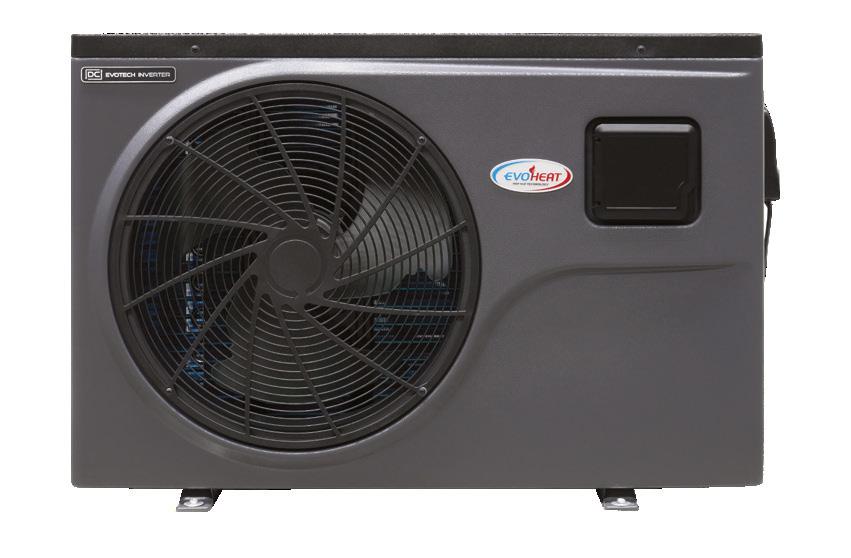


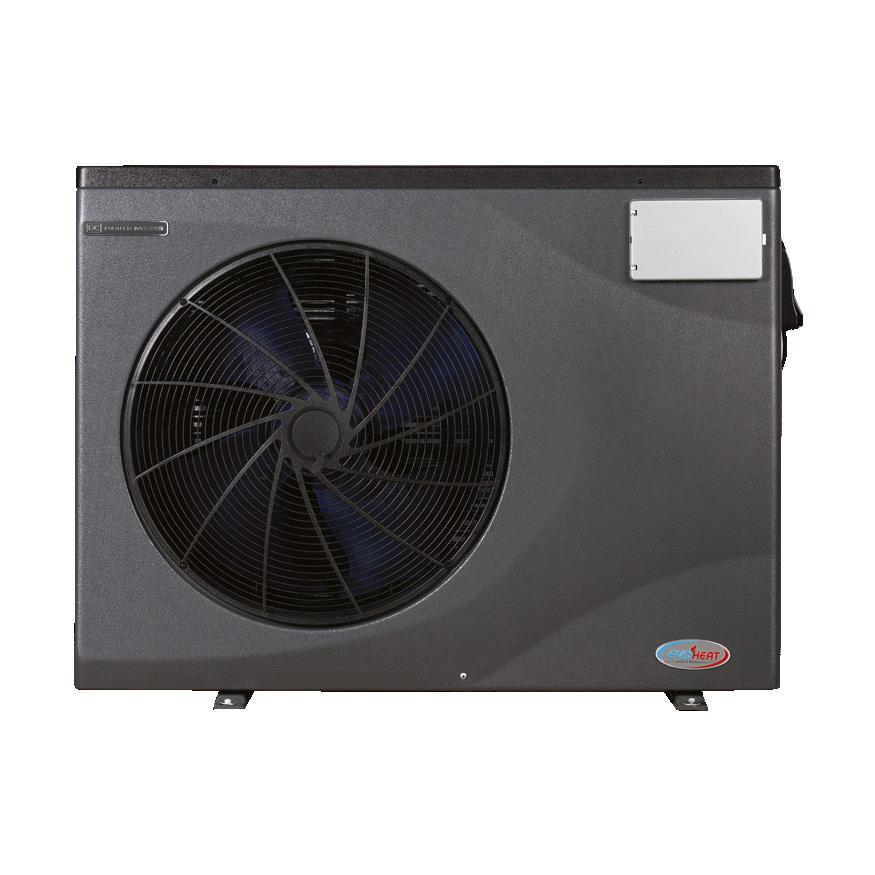
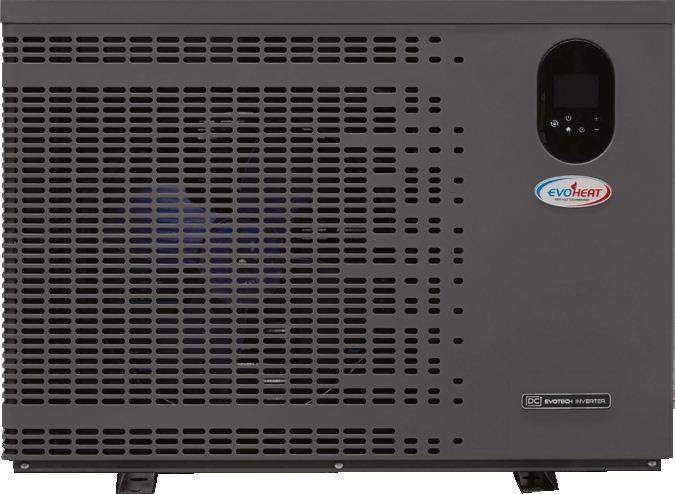
GREAT UNIT, SUPER-EFFICIENT & VERY QUIET
Keeps my pool at a beautiful temperature all year round!
-
Daniel
AWESOME UNIT
Much quieter than expected, performs brilliantly to heat and maintain temperature of large pool. Highly recommend!
- Jarrod
Published by
The Intermedia Group Pty Ltd
ABN 940 025 83 682
41 Bridge Road, Glebe, NSW, 2037 Australia
Ph: (02) 9660 2113
Fax: (02) 9660 4419
On behalf of The Swimming Pool & Spa Association of Australia Ltd (SPASA Australia)
Managing Editor: Chris Maher
Phone: +61 412 048 639
Email: chrismaher@intermedia.com.au
Contributors: Veda Dante, Kristin Brookfield, Ben Makepeace, Brett Abbott
Advertising enquiries: Gillian Doreian
Phone: +61 488 983 102
Email: gillian@spasa.com.au
Graphic Designer: Leanne Hogbin
Production Assistant: Tazlin Cantrill
Subscriptions: 1800 651 422
Email: subscriptions@intermedia.com.au
Copyright All material in this publication is copyright to the publisher and/or its contributors. No material may be reproduced without the express permission of the publishers.

Disclaimer: This publication is published by The Intermedia Group Pty Ltd (the “Publisher”) on behalf of SPASA Australia. Materials in this publication have been created by a variety of different entities and, to the extent permitted by law, the Publisher accepts no liability for materials created by others. All materials should be considered protected by Australian and international intellectual property laws. Unless you are authorised by law or the copyright owner to do so, you may not copy any of the materials. The mention of a product or service, person or company in this publication does not indicate the Publisher’s endorsement. The views expressed in this publication do not necessarily represent the opinion of the Publisher, its agents, company officers or employees. Any use of the information contained in this publication is at the sole risk of the person using that information. The user should make independent enquiries as to the accuracy of the information before relying on that information. All express or implied terms, conditions, warranties, statements, assurances and representations in relation to the Publisher, its publications and its services are expressly excluded save for those conditions and warranties which must be implied under the laws of any State of Australia or the provisions of Division 2 of Part V of the Trade Practices Act 1974 and any statutory modification or re-enactment thereof. To the extent permitted by law, the Publisher will not be liable for any damages including special, exemplary, punitive or consequential damages (including but not limited to economic loss or loss of profit or revenue or loss of opportunity) or indirect loss or damage of any kind arising in contract, tort or otherwise, even if advised of the possibility of such loss of profits or damages. While we use our best endeavours to ensure accuracy of the materials we create, to the extent permitted by law, the Publisher excludes all liability for loss resulting from any inaccuracies or false or misleading statements that may appear in this publication. This issue of SPLASH! magazine published by The Intermedia Group Pty Ltd (Intermedia) may contain magazine or subscription; offers, competitions, forms and surveys (Reader Offers) which require you to provide information about yourself, if you choose to enter or take part in them. If you provide information about yourself to Intermedia, Intermedia will use this information to provide you with the products of services you have requested and may supply your information to contractors that help Intermedia to do this. Intermedia will also use your information to inform you of other Intermedia publications, products, services and events. Intermedia may give your information to organisations that are providing special prizes or offers that are clearly associated with the Reader Offer. Unless you tell us not to, we may give your information to other organisations that may use it to inform you about other products, services or events or to give it to other organisations that may use it for this purpose. If you would like to gain access to the information Intermedia holds about you, please contact Intermedia’s Privacy Officer at The Intermedia Group Pty Ltd, PO Box 55, Glebe, NSW 2037.
Copyright © 2026 - SPASA Australia.




Innovation, imagination and creative excellence are the hallmarks of a true master – but only when combined with a dedication to doing it right and a fastidious eye for detail. When both these elements combine, you end up with a truly special project.
This issue we talk with the builder behind a spectacular swimming pool built on a large property on the prestigious outer fringes of Melbourne. It’s a creative design, and one that required an absolute exactness to bring it to fruition – not to mention a lot of hard work. Being awarded the Master Pool Builders Technical Award means that the builder’s peers understood the intricacy and effort needed, and respected his whole team for it – because something like that takes an entire dedicated team to be fully realised.
Chris Maher Managing Editor chrismaher@ intermedia.com.au
The team is proud of their work, and the accolade is reward for their effort. It’s also a timely reminder that entries are about to close for this year’s SPASA Awards of Excellence. And don’t forget, the awards gala will be a big one, held at SPLASH! 2026 on the Gold Coast. So get your entries in.
Needless to say, the winning pool was a prestige project at the top end of the market. We also have a feature on pool tiling – and some of the projects featured there are absolutely at the premium end of the market as well. Tiled concrete pools are still the crème de la crème of the pool industry, and we can see why when you see some of these projects. We also ask the experts how to ensure the builder and the client both get the best experience using tiles on swimming pools.
This issue, we also look at plunge pools and how they can add an extra option for pool builders, delve into water saving innovation for pools and spas, as well as exploring ideas on pool renovations, fighting bushfires with swimming pool water, quantitative analysis of swimming strokes and the latest in regulatory changes relevant for the industry.
I hope you enjoy this edition.
The Intermedia Group takes its Corporate and Social Responsibilities seriously and is committed to reducing its impact on the environment. We continuously strive to improve our environmental performance and to initiate additional CSR based projects and activities. As part of our company policy we ensure that the products and services used in the manufacture of this magazine are sourced from environmentally responsible suppliers. This magazine has been printed on paper produced from sustainably sourced wood and pulp fibre and is accredited under PEFC chain of custody. PEFC certified wood and paper products come from environmentally appropriate, socially beneficial and economically viable management of forests.
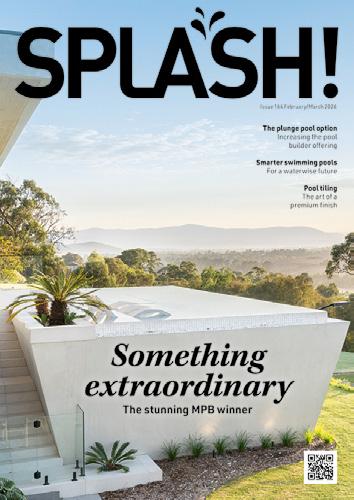
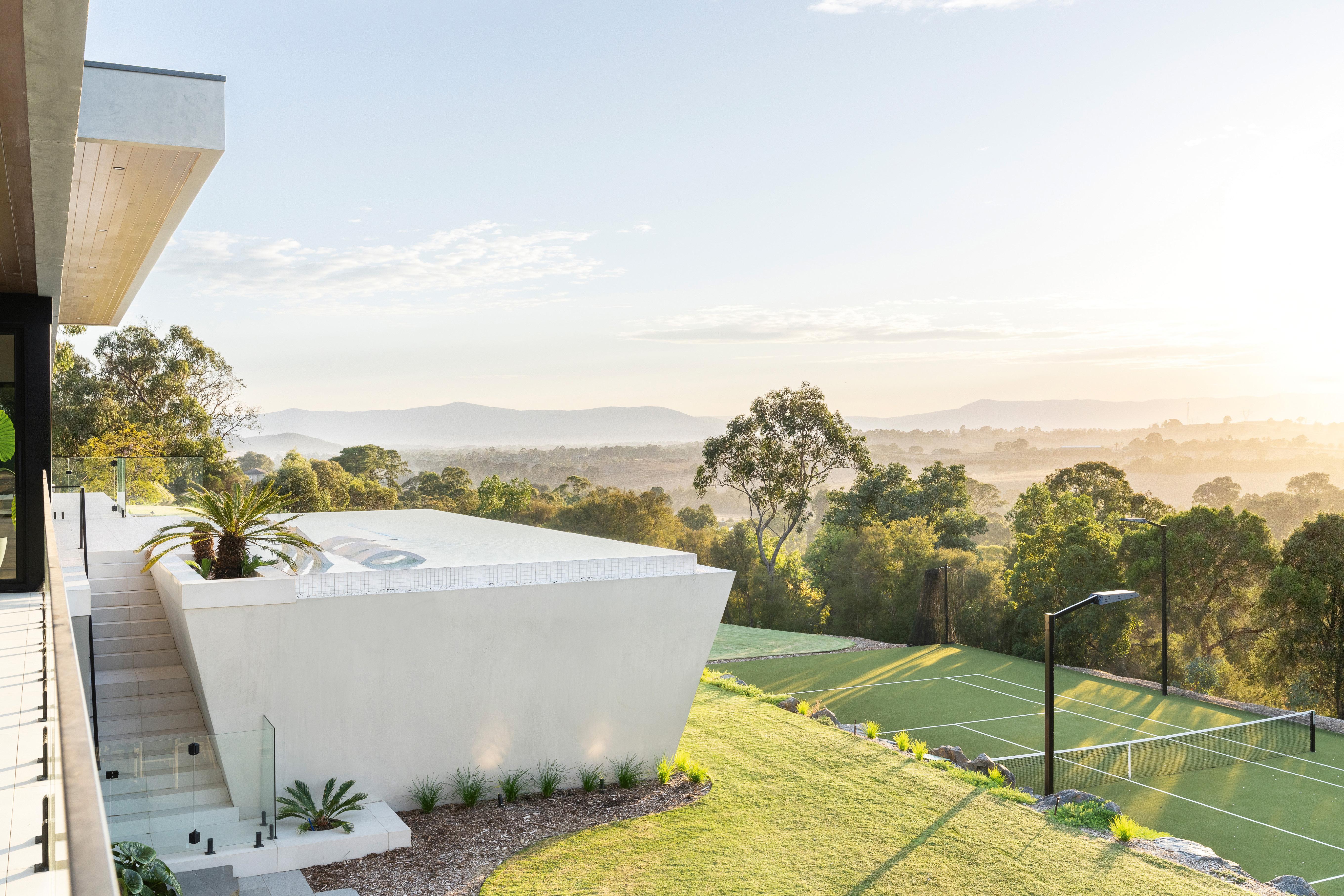
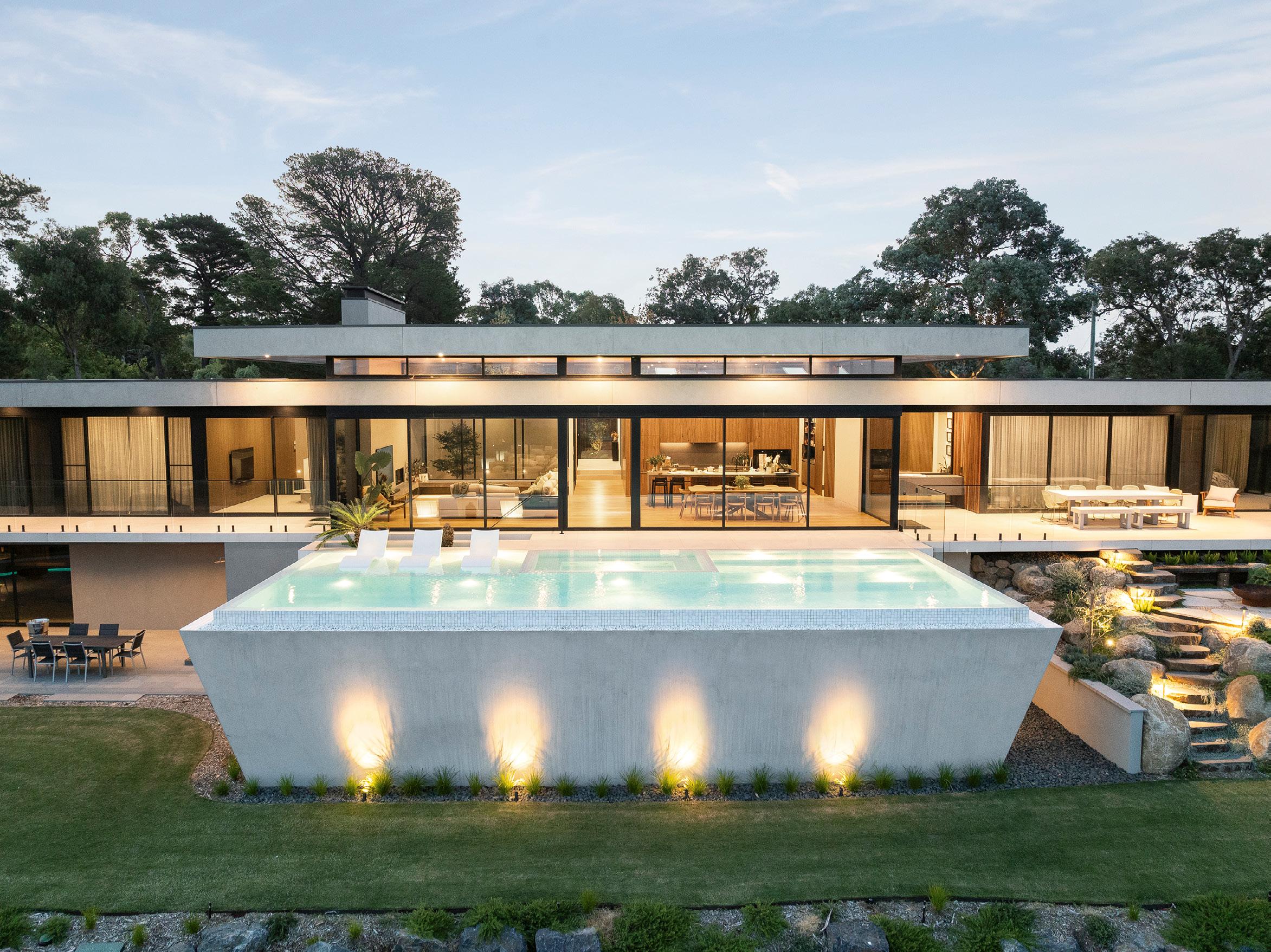
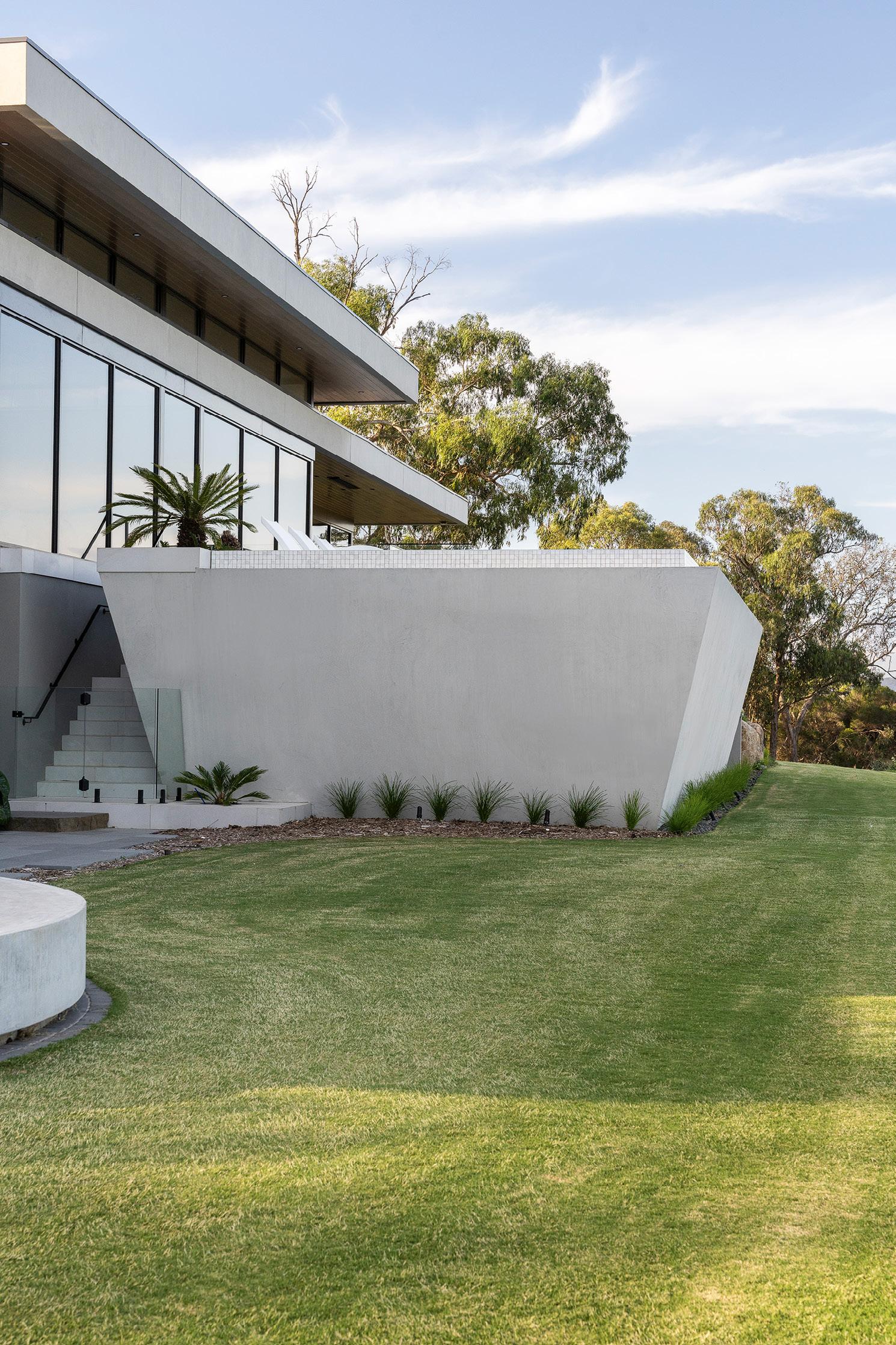
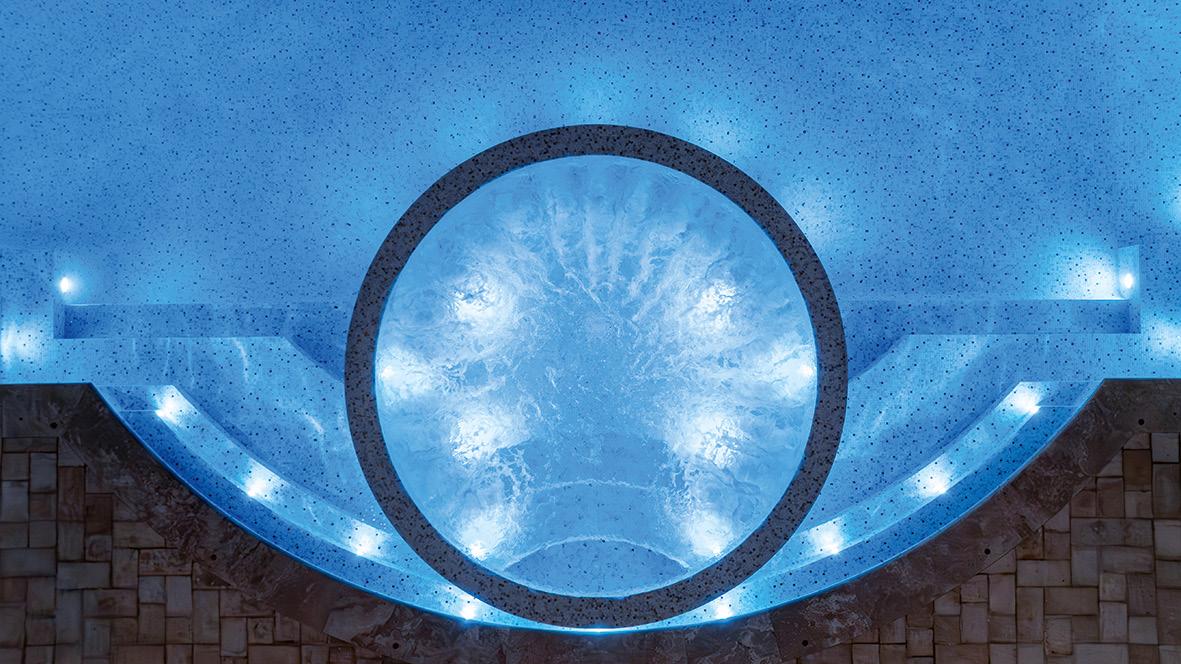
The martini-glass pool project that won Apex Pools and Spas the inaugural Master Pool Builders Technical Project Award. There is more on this pool on page 22.
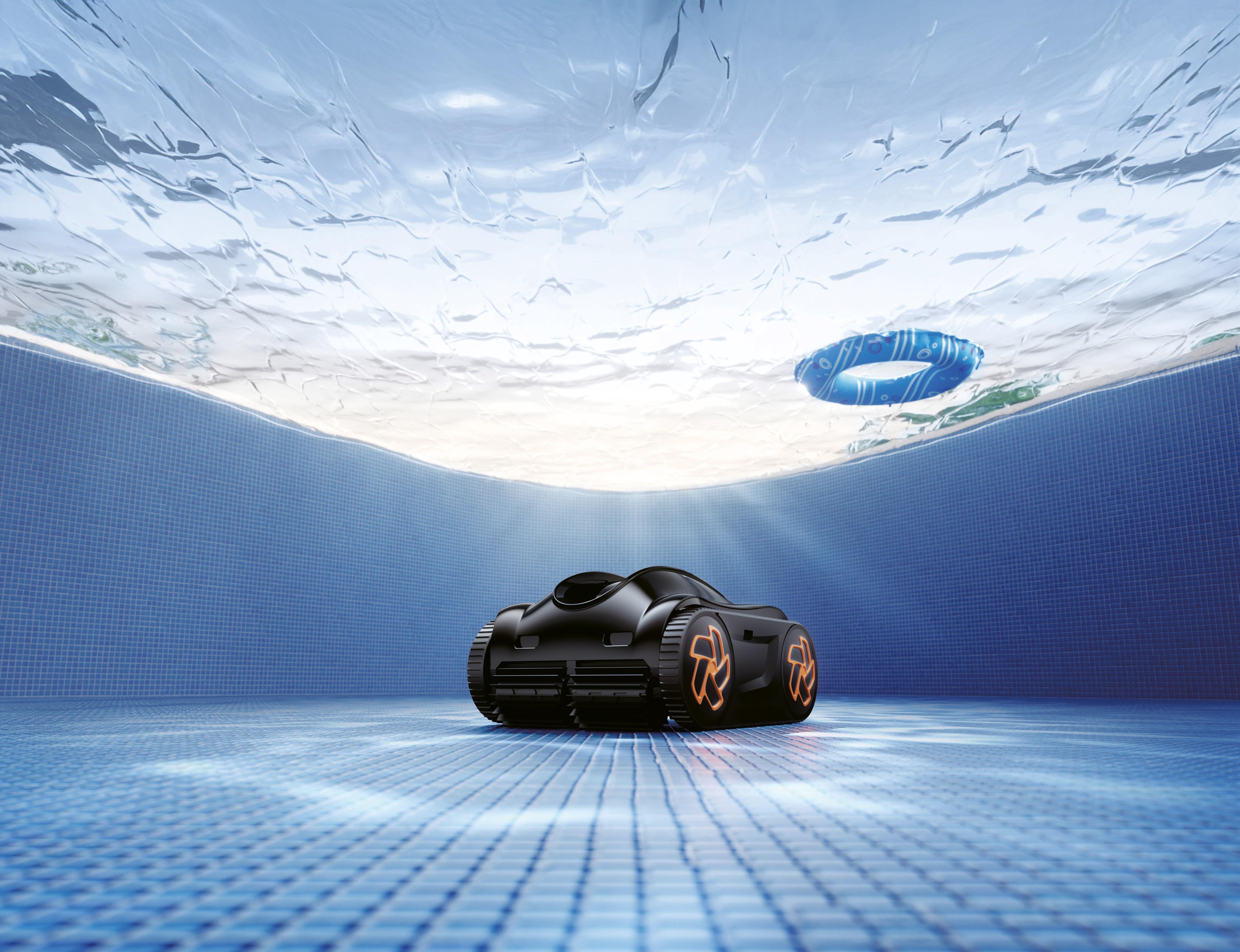
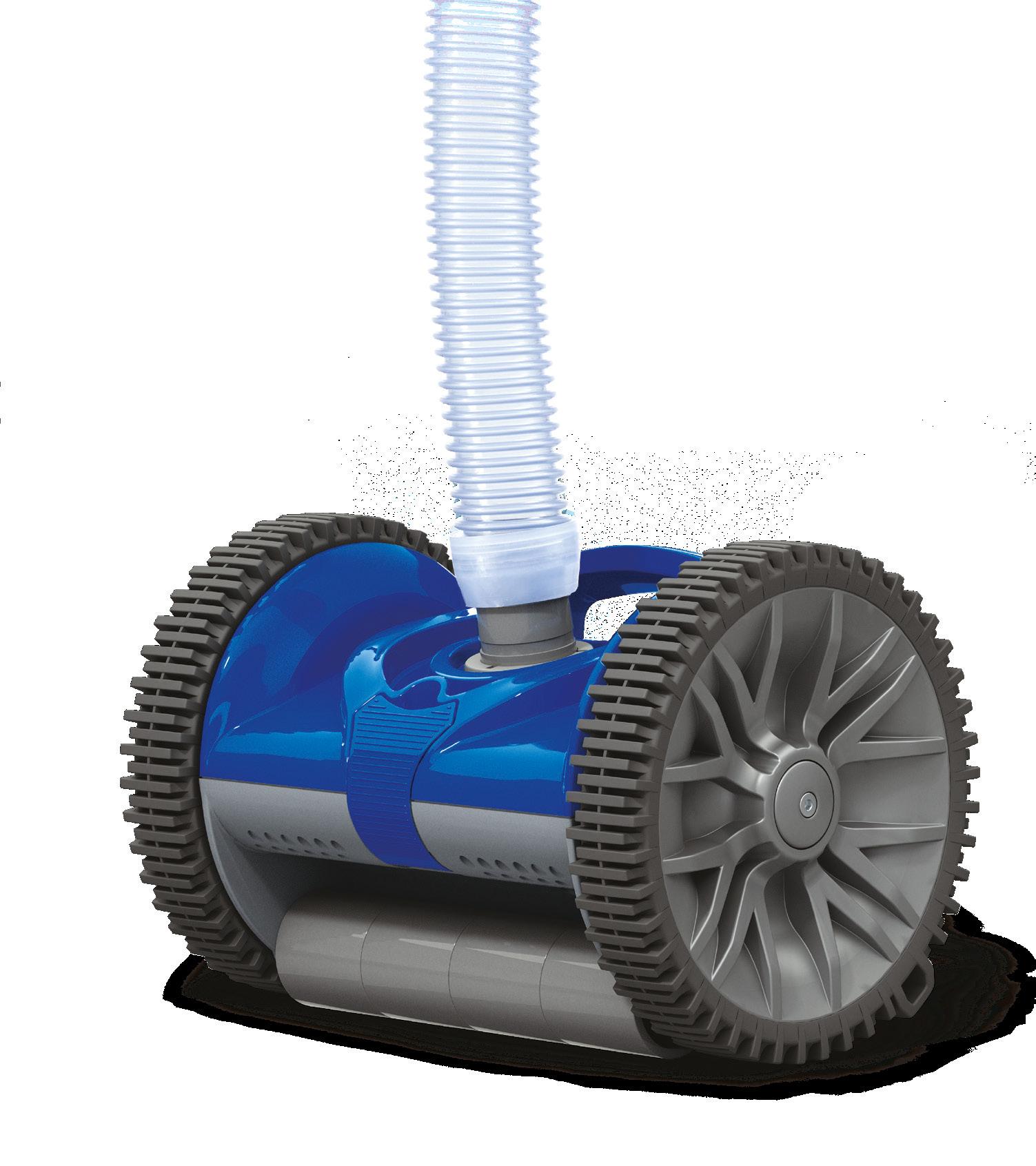
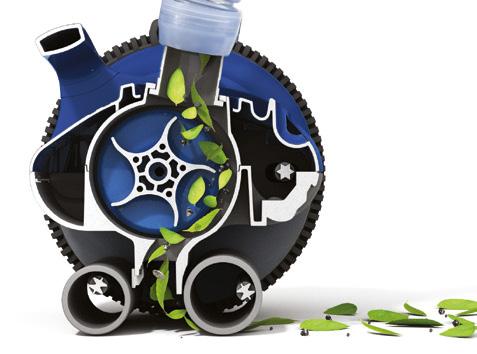
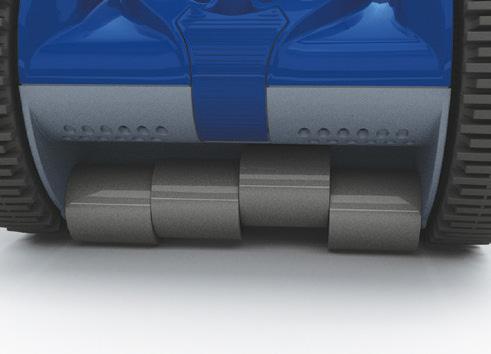
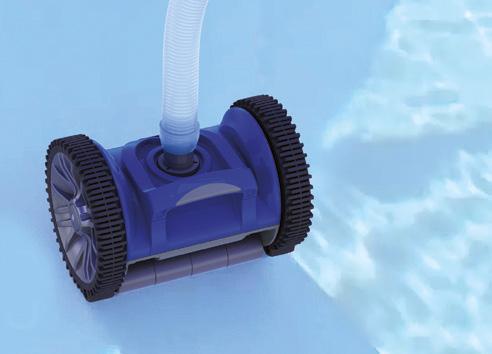
EFFORTLESS POOL MAINTENANCE. SIMPLY CONNECT & CLEAN.
The Rebel® 2 cleaner packs amazing performance into a compact, easy-to-use package. Its preprogrammed steering and two-wheel design allows the Rebel® 2 cleaner to access hard-to-reach corners where debris often hides.

16 Profiting from pool renovations
Brett Abbott offers advice on how to make money from pool renovations by having the courage to “talk about the possibilities”.
18 Members supporting members
Kristin Brookfield discusses how the range of SPASA offerings this year are excellent examples of members supporting other members for the benefit of the whole industry.
22 Something out of the ordinary
Matt Seymour discusses the Apex project that won the inaugural Master Pool Builder Technical Project, while also explaining their unique business model.
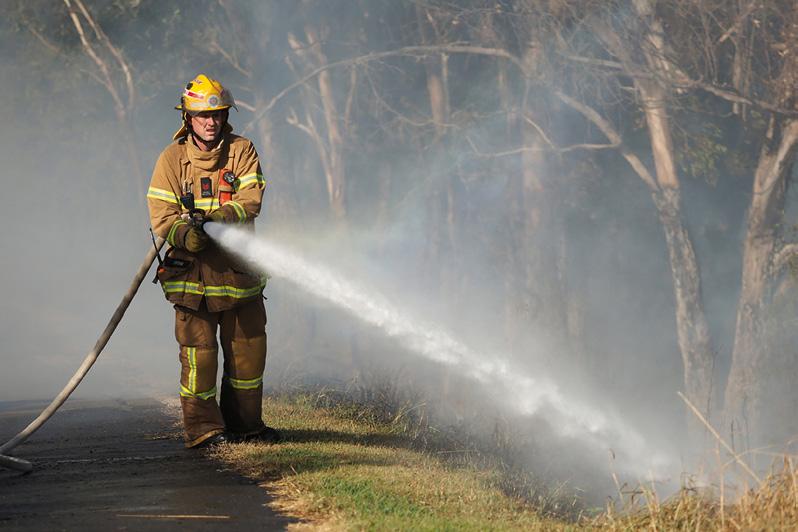
28 The backyard pool’s role in fighting bushfires
Authorities and water utilities say backyard pools can be a valuable source of water to protect homes from bushfires, especially as our fire season is getting hotter and longer.
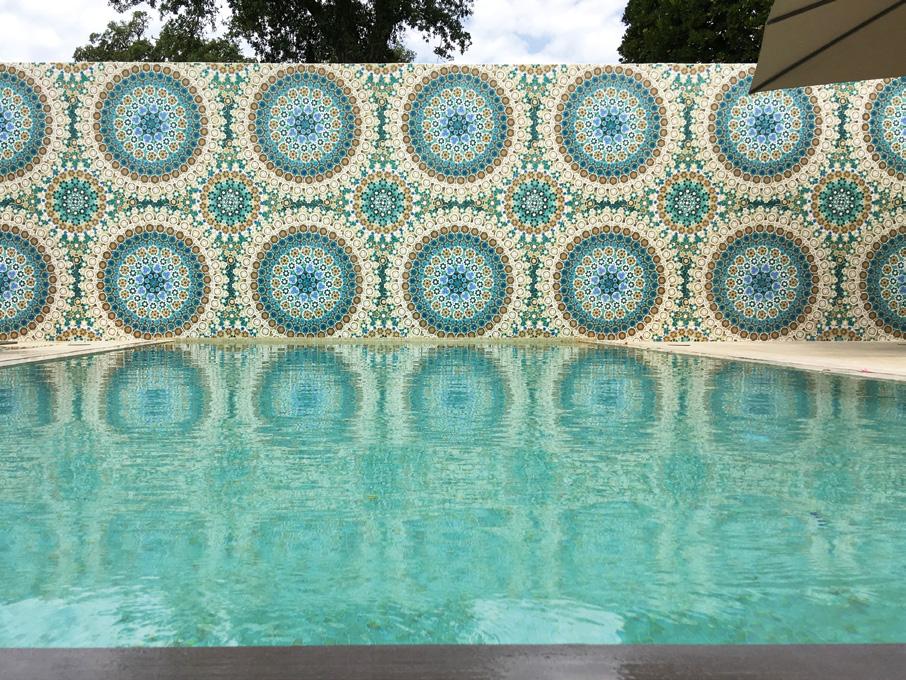
30 Pool tiling and the art of a premium finish
Veda Dante explores the tiling design trends, technical innovations, and material choices shaping Australia’s contemporary swimming pools and spas.
38 Regulation update
SPASA policy manager Ben Makepeace updates us on the results of the association’s advocacy as well as regulation relevant to the industry.
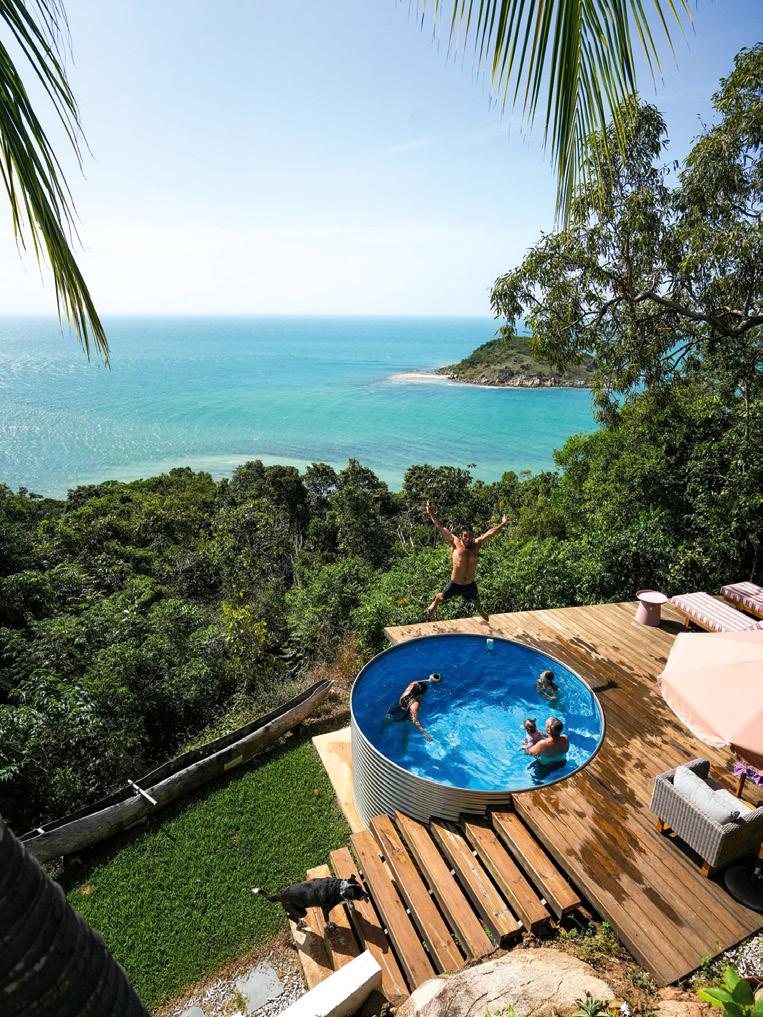
40 Pool builders increasing their offering with the plunge option
The plunge pool market is enabling pool builders to have an extra string to their bow when faced with tight budgets and small sites.
Smarter pools for a waterwise future
Veda Dante looks at how innovation, automation and intelligent design are transforming water efficiency for pool owners.
New pool for the world’s biggest baby swim school
The world’s largest baby and infant swim school has opened a new pool in the UK, focusing on safety, accessibility and enjoyment.
Using data to analyse the effectiveness of swimming techniques
A new book by Dr Rod Havriluk helps coaches better understand swimmers’ effectiveness through the water.
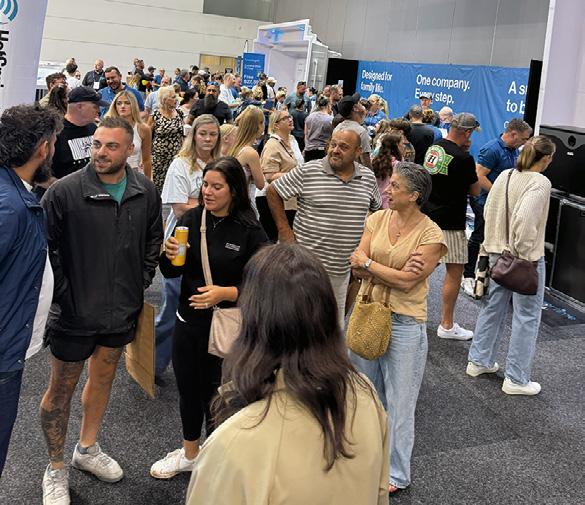
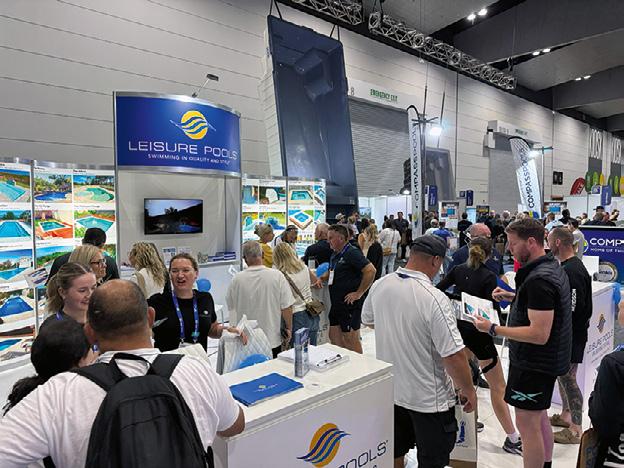

The 2026 Melbourne Pool Spa Life Expo kicked off the 2026 season with a successful opening show, with organisers saying it delivered strong attendance and quality consumer conversations with attendees ready to invest in a pool or spa.
Held at the Melbourne Convention & Exhibition Centre, the expo brought together more than 90 SPASA member exhibitors to connect and engage with thousands of consumers across the three-day weekend.
Aaron Tyzzer from Seaspray Pools says the show was a fantastic opportunity to get their brand in front of a large, engaged audience and have real, face-to-face conversations with consumers.
“Our stand was busy throughout the event, with strong foot traffic and plenty of genuine interest in what we do. The buzz on the floor, combined with the volume of attendees, made it a standout experience and a great platform for us to engage with possible clients,” he says.
Simon Andresen from Aquea had an excellent experience exhibiting at the Melbourne Pool Spa Life Expo, saying they had strong crowd numbers and felt positive energy throughout the event.
“It was a highly productive event for Aquea, increasing brand awareness with consumers and industry, and creating new business opportunities for the year ahead,” he says.
Exhibitors across the floor highlighted the enthusiasm of attendees, their
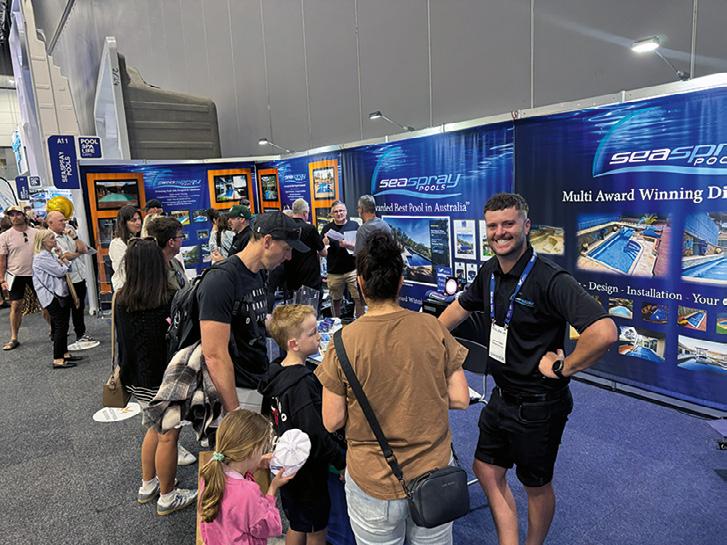
intent to purchase, and the business value created through in-person engagement.
The event’s success was driven by the strategic timing and reach of an integrated marketing campaign, supported by the launch of Season 2 of Pool Spa Life Australia as well as fresh TV commercials, and billboards across key suburbs and breakfast TV placements. There was also a campaign of radio advertising across breakfast and drive, and ongoing live posts on social media reaching consumers at key decision-making moments.
Across the expo floor, attendees had access to expert advice, innovative products and design inspiration under one roof.
The consumer focus and intent at the event added value for exhibitors and reinforced the expo’s position as a key driver of business and industry growth across the sector.
Pool Spa Life Expo Melbourne was followed by Pool Spa Life Expo Perth and Sydney.
Pool Spa Life Expo Adelaide will be held on March 21-22, Auckland on Apr 11-12 and Brisbane on May 16-17.
The Southern Hemisphere’s biggest swimming pool and spa trade show, the SPLASH! Expo, will be held on August 18-21.
Contact: www.spasa.com.au/events
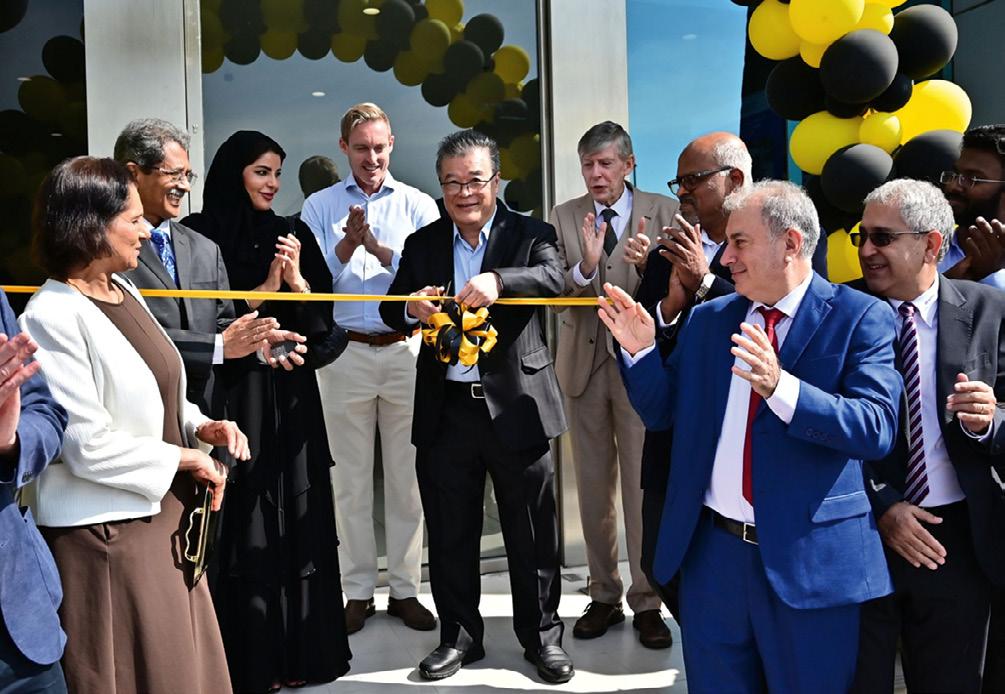
Waterco Limited has reinforced its long-term commitment to the United Arab Emirates and marked another milestone in its Middle East strategy with the official opening of a new purpose-built facility in Dubai. Moosa-Daly, the exclusive supplier of Waterco-owned Davey Water Products in the UAE for more than 50 years, unveiled a new sales outlet to meet growing regional demand for integrated pool, spa and water management solutions.
Waterco founder and CEO Soon Sinn Goh officiated the opening, cutting the ribbon alongside the Bin Moosa & Daly team to mark the milestone.
The showroom opening builds on Waterco’s broader Middle East expansion, following the establishment of Waterco Middle East in Jebel Ali in October 2025. The regional base strengthens the company’s water treatment capabilities across the Middle East and North Africa, including the supply of Davey water transfer pumps, and underscores its strategy of combining global manufacturing expertise with strong local partnerships.
Obituary
By Greg Jones with Yvette Audet
Peter Hobson (1949–2026)
We are deeply saddened by the sudden passing of Peter Hobson, aged 76, a respected leader of Chadson Engineering and a true icon of the Australian and international aquatic and engineering industry. A visionary from a young age, Peter played a pivotal role in shaping the future of domestic backyard pools in Western Australia. Through his foresight and entrepreneurial spirit, he established a residential division within Chadson Engineering that, at its peak, captured up to 80 per cent of the Western Australian market. This achievement helped define the modern residential pool landscape in WA and set new benchmarks for the industry.

Available pool DA figures from Cotality for the three months from November to January show applications up by 13 per cent, while the annual numbers for the 12 months to January show an improvement of seven per cent.
The three-monthly numbers show Western Australia up by 77 per cent, New South Wales up by 32 per cent and Queensland up by eight per cent; while South Australia is down by four per cent and Victoria is down by 29 per cent.
The national annual DA numbers continue to improve when compared to the same period last year, with Western Australia and New South Wales both up by 26 per cent and Queensland up by 18 per cent; while South Australia is down by three per cent and Victoria is down by 33 per cent.
Peter was also instrumental in uniting the industry, helping to instigate the WA pool builders association (CASPA). He firmly believed in collaboration – working for a common cause rather than against one another – and his leadership helped strengthen relationships and professionalism across the sector.
His impact on the commercial aquatic industry was nothing short of world-leading. In the mid-1970s Peter designed and created the world’s first horizontal high-speed fibreglass sand filters, later known as the Chadson MHS filters. These pioneering products achieved global adoption and remain widely used today.
Currently, it is estimated that 50 to 60 per cent of commercial pool filters across Australia, and approximately 80 per cent in Western Australia, are Chadson MHS filters, with a strong presence throughout the Asia-Pacific region. Peter later went on to develop the CPC model filters, further cementing Chadson Engineering’s reputation as an industry leader.
Peter possessed an intimate working knowledge across many facets of the aquatic industry, blending deep technical expertise with sharp commercial insight. Despite his extraordinary achievements, he remained a private, humble and quietly influential figure, preferring to work behind the scenes and let outcomes – and people – speak for themselves.
Above all, Peter was a kind, warm-natured, and highly respected man who cared deeply for his family, colleagues and the industry he helped build. He was much loved by all who knew him, and his legacy – both personal and professional – will endure for generations. Peter Hobson leaves behind an extraordinary contribution founded on innovation, collaboration and integrity. He will be greatly missed.
Our heartfelt condolences are extended to Peter’s family, friends and colleagues during this difficult time.
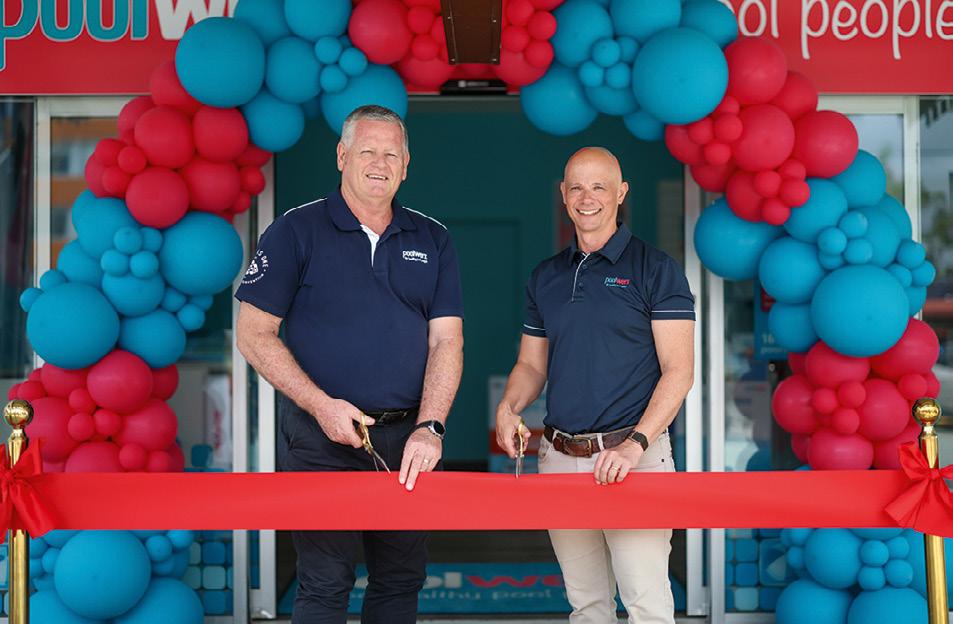
Poolwerx has reached an historic milestone with the opening of its 150th retail store in Cannon Hill, Brisbane.
Global COO Steve Halls says this landmark caps more than three decades of steady growth and signals the franchise network’s next phase, with the anticipation of double-digit expansion over the next five years and double-digit total revenue growth targeted for FY26.
“For over 30 years, Poolwerx has achieved steady, sustainable growth, but what’s ahead is exponential,” he says.
Tim Ward has stepped down from his role as general manager of PoolCorp’s Australian business, Pool Systems, replaced by Frank Petruccelli.
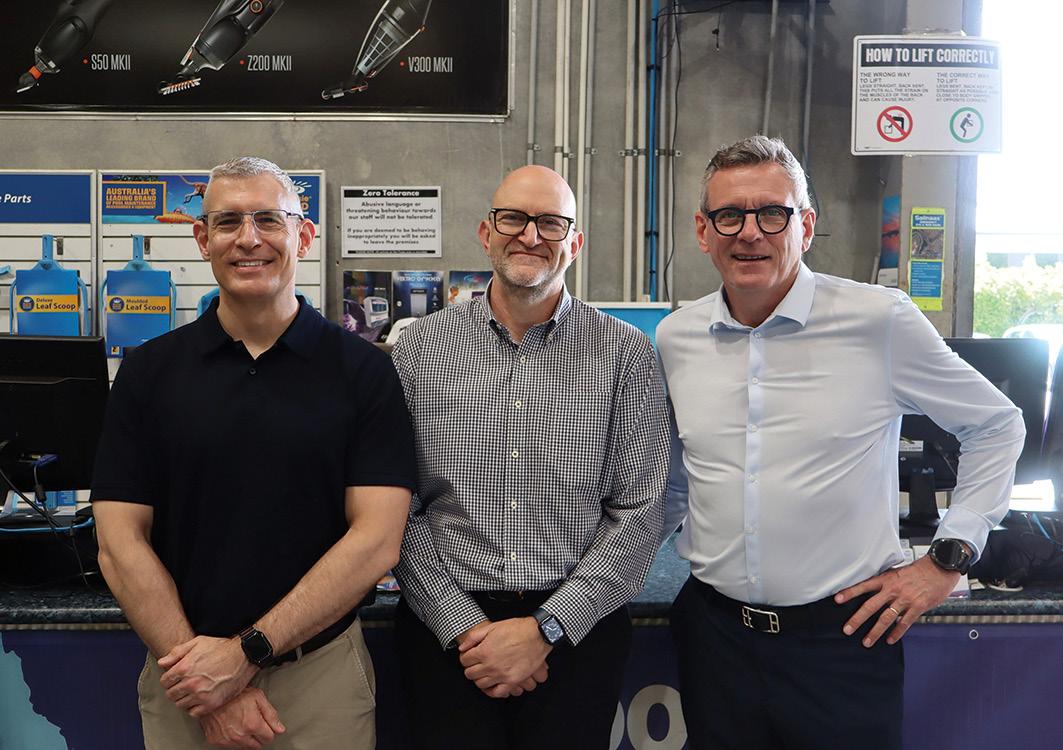
PoolCorp thanked Ward for his contribution to the business and wished him well in his future endeavours.
In a statement PoolCorp says Petruccelli joins Pool Systems at a pivotal time as the business continues to focus on growth, customer experience, and operational performance across its national branch network.
“He brings more than 20 years of senior leadership experience across distribution, automotive and industrial supply sectors.”
Most recently, Petruccelli held senior general manager roles at Burson Auto Parts, part of the Bapcor Group, where he was responsible for national sales, operations, and the delivery of major transformation initiatives across hundreds of locations.
Petruccelli began his career in finance and accounting and holds an MBA. He is a qualified CPA and is known for his hands-on leadership style, strong commercial discipline, and focus on improving supply chain performance, service execution and team capability within large customer-centric organisations. He will be based in Melbourne.
In welcoming him to the business, PoolCorp said in the statement it was confident his experience and leadership would support the next phase of growth for the business.
Meanwhile Pool Corporation (PoolCorp) announced its senior VP, 40year veteran Kenneth “Kenny” G. St. Romain will retire from his position in 2026, and that John B. Watwood has joined the company as executive vice president, reporting to president and CEO Peter D. Arvan. He will lead PoolCorp’s swimming pool operations in North America, as well as overseeing digital and technology initiatives.
Keep informed by subscribing to the free online newsletter.
NSW school syllabus leaves water out of swimming lessons
The new syllabus enables students to “learn to swim” in the classroom – without ever entering a pool or other body of water.
“We’re seeing more business professionals invest in the pool and spa industry as they recognise its resilience and the strength of our franchise model. The 150th store isn’t just a number, it’s a testament to our franchise partners’ belief in the brand, and their commitment to building local businesses that create lasting community impact.”
Richard Kelly is the driving force behind Poolwerx Mt Gravatt Group, one of Poolwerx’s largest and most successful territories, and the franchise partner opening the 150th store in Cannon Hill.
Since joining Poolwerx in 2021, Kelly achieved 58 per cent revenue growth across his four retail stores (Balmoral, Carindale, Mt Gravatt and Rochedale) and 20 service vans, cementing his position as one of the network’s top-performing franchise partners.
The Cannon Hill store was part of the recent JC Pools acquisition.
The online stories that made the news over the past two months.
Energy subsidies can help pool pumps run for free
Free power throughout the middle of the day has been seen as an ideal chance for pool owners to filter their pool water for free.
$135 million Adelaide Aquatic Centre opens to celebration
More than 10,000 people registered in the ballot to be among the first to enjoy everything the new aquatic centre has to offer.
Swimming pool industry innovator and icon Peter Hobson passes away
The industry was saddened by the sudden passing of Peter Hobson, aged 76, a respected leader of Chadson Engineering.
Backyard pools have a role to play in fighting bushfires
Residents of bushfireprone areas are being advised to include a water supply such as a swimming pool in their emergency plan.
2026
Mar 21-22 Pool Spa Life Expo Adelaide
Apr 11-12 Pool Spa Life Expo Auckland
May 16-17 Pool Spa Life Expo Brisbane
June 6
June 12
Awards of Excellence NZ Gala
Awards of Excellence ACT Gala
June 13 Awards of Excellence NSW Gala
June 20 Awards of Excellence Qld Gala
June 25 Awards of Excellence NT Gala
June 27 Awards of Excellence SA Gala
July 11
July 18
Aug 11-14
Awards of Excellence WA Gala
Awards of Excellence Vic Gala
Expolazer & Outdoor Living, Sao Paulo, Brazil
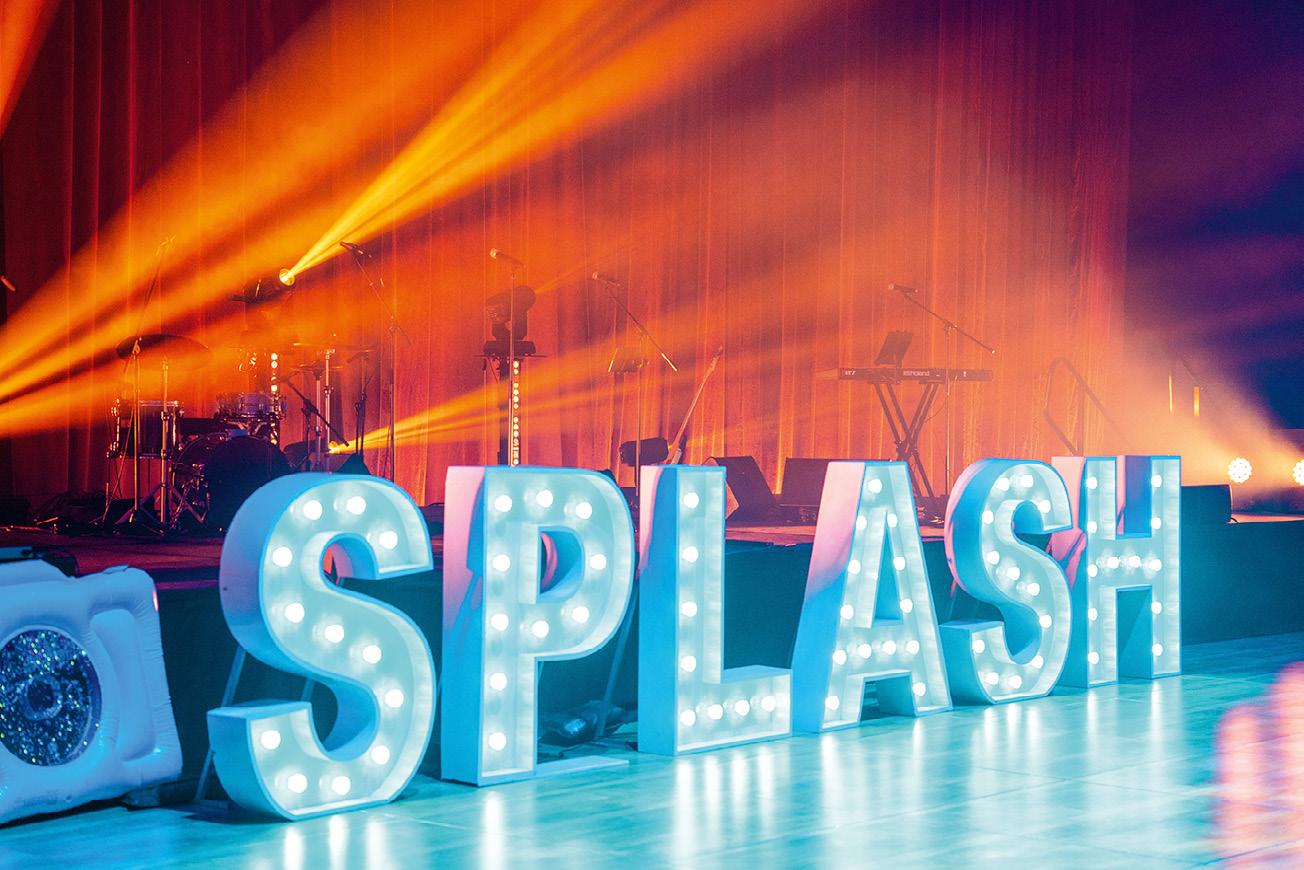
Aug 18-21 SPLASH! Trade Expo, Gold Coast Convention & Exhibition Centre, Broadbeach, Queensland
Aug 19 Australasian Awards of Excellence Gala, Gold Coast
Aug 25-27 SPARK 26, Gold Coast
Sep 10-12
Asean Patio Pool Spa Expo, Kuala Lumpur, Malaysia
Oct 6-8 Interbad, Stuttgart, Germany
Nov 17-20 Piscine Global, Lyon, France
More details at www.splash.online Dates are subject to change and should be checked with the relevant organisation. Send calendar submissions to info@splashmagazine.com.au.
Landscaper, unlicensed pool builder and ex-AFL player Nick Stevens is facing trial in the County Court of Victoria, accused of defrauding six families in Mildura of $171,000 for incomplete or undelivered swimming pools.
Stevens has been charged with 13 counts of obtaining a financial advantage by deception, one count of using a false document and four counts of theft laid as alternatives. He has pleaded not guilty.
The Herald Sun reports prosecutor Toni Stokes alleging in court that Stevens deceived the six families into paying him $171,000 for pools that were either illegally installed or not provided.
The court heard that Stevens had previously run a landscaping business, and had legally installed some fibreglass pools under supervision. However, the prosecutor alleges that he decided to go out on his own, knowing he was unlicensed.
It is alleged he received tens of thousands of dollars in payment from six families despite knowing he was not qualified as a registered builder and needed a major building contract and domestic building insurance.
The prosecution alleges that three families were left with illegally and shoddily installed swimming pools, while three others were left with “giant holes in their backyards”.
The families are expected to give evidence about their dealings with Stevens.
It is alleged that one family received a full refund of $26,500, while another received a partial refund of $10,000.
Stevens’ barrister Jim Stavris asked jurors to listen carefully to the evidence in the trial, including the chronology of the training his client received.
The Herald Sun reports him telling the court that Stevens’ intention was a key consideration.
“I submit to you that if someone intended to defraud someone, deceive someone, they don’t give money back.”
At the time of writing the case was continuing.
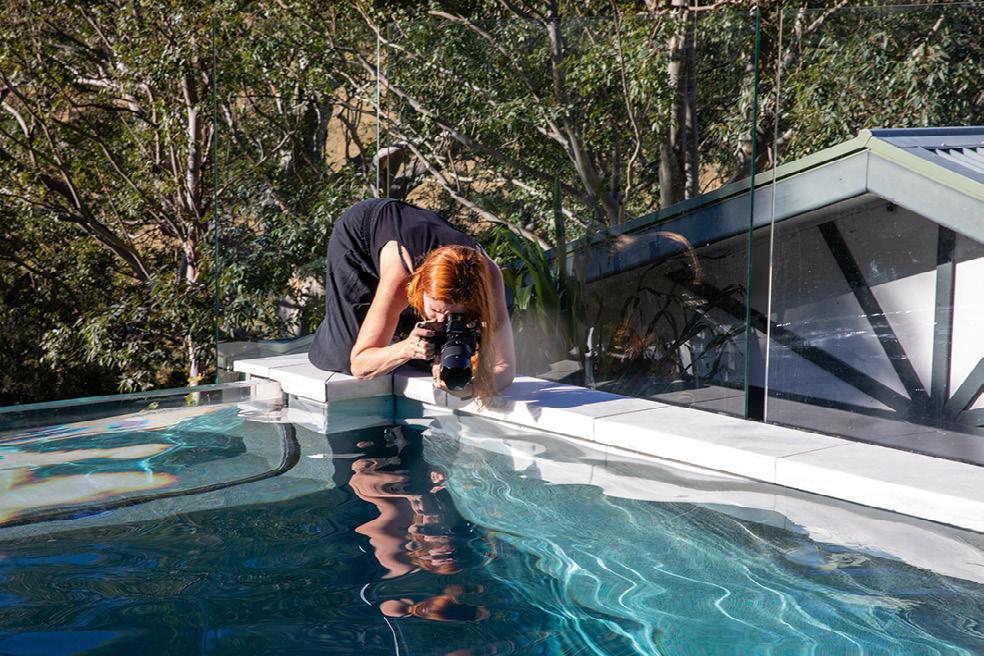

In edition 159, SPLASH! interviewed acclaimed photographic artist Tamara Dean, discussing her swimming pool which has a dedicated Perspex wall acting as a window for her to undertake her stunning underwater photography.
Her meticulously styled and shot photographs, installations and moving images are feted around the world for the way in which they present the human form as a part of nature, with all its fragility and contemplative sensuality. They are predominantly shot underwater and, since the construction of her Highlands swimming pool, in her own enclosed studio-pool.
In the interview we discussed the many aspects related to managing the shoots –especially the water temperature, as the models will be barely clad in the water for a considerable period of time, and also water clarity to ensure a crisp shot.
She installed the Naked Pools system, and now Naked has engaged Bellwether Agency to develop a campaign with
Dean for their water disinfection product.
Bellwether creative director Andrew Crook says the aim was to create something authentic and unique that highlighted the many practical benefits of the Naked System in a way that challenges consumers’ perceptions of water quality.
“What always amazes me is how much energy people pour into choosing tiles, pavers and landscaping, yet the actual quality of the water – the heart of the experience – is often overlooked,” he says.
He says the campaign was about flipping that mindset. After Dean told them the story of the pool and Naked’s part in the water quality and clarity, they used their creative process to deepen the narrative and pair it with her visual artistry in a cinematic storytelling style.
“The result is something that feels less like an ad and more like an intimate glimpse into the world of her art,” he says.
You can seem more of Tamara Dean’s work at: www.michaelreid.com.au/artist/tamara-dean
An improved NSW swimming pool register is launching soon.
The Building Commission of NSW says the new register aims to provide clearer, more reliable pool compliance information, delivering a userfriendly experience and provide more accurate reporting of pool compliance and inspection outcomes required under NSW legislation.
The Commission says key improvements will include:
• A better online user experience for consumers, local councils and registered building certifiers.
• Single source of truth for NSW pool registrations and compliance status.
• Pools and spas will no longer be registered
under an owner’s personal details. Instead, registration will be based on the property address only, as the pool or spa is linked to the property rather than the individual owner.
• Clearer role-based access for council and registered building certifier users, helping streamline the inspection process and record management (as well as reducing the common issue of duplicate records).
• More relevant and reliable information for all users within the register.
The updated register will launch in mid-March 2026. After it has launched, councils and building certifiers will begin using the updated register for managing swimming pool and spa compliance.
Contact: www.nsw.gov.au/departments-andagencies/building-commission



The Australian Water Safety Council has released a refreshed Australian Water Safety Strategy 2030, strengthening national efforts to reduce drowning deaths by 50 per cent by the end of the decade. The target, first set in 2020, followed two decades of steady downward progress.
However, since the covid pandemic, drowning has been trending upwards. Declining swimming and water safety skills, changing recreational behaviours, population growth – particularly among people from countries with limited water safety awareness – and a hotter, more volatile climate are all contributing factors.
The renewed strategy sets out three national imperatives to reverse the current rising trend: boosting swimming and water safety skills for all, localising water safety efforts, and strengthening coordination across sectors and jurisdictions.
The Australian Water Safety Council convenor and Royal Life Saving Australia CEO, Justin Scarr, says the strategy marks a critical moment for water safety in Australia.
“Drowning remains unacceptably high, particularly during summer,” Scarr says.
“This Strategy recognises that water safety starts with being able to swim, and that many of the most effective solutions are driven by local communities.
“It calls on governments to double down on what we know works – improving swimming and water safety skills, developing local water safety plans, and working better together.”
Developed through extensive consultation, the strategy provides a sharper, evidenceinformed roadmap to guide all levels of
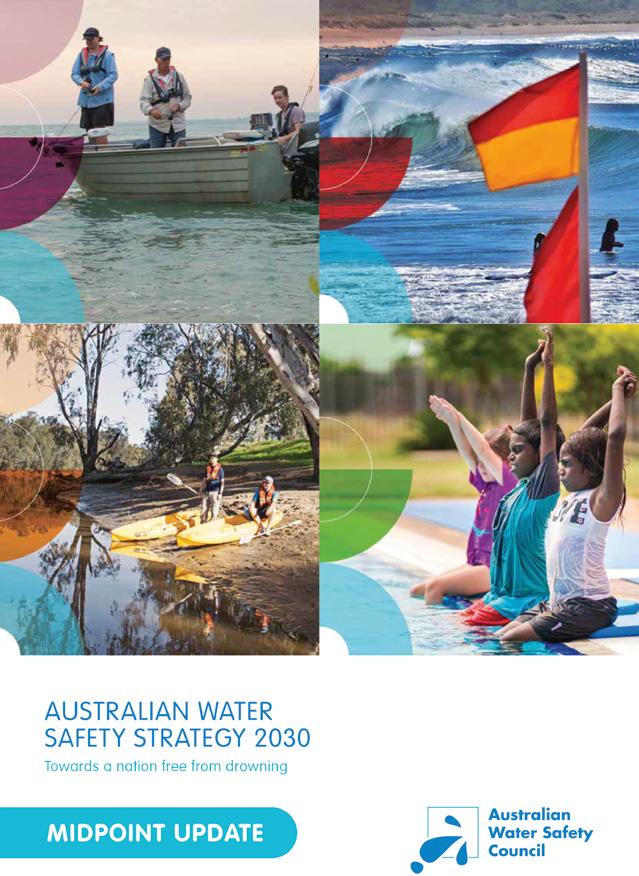
Australian Water Safety Strategy 2030 –Midpoint Update
government, water safety organisations and community partners.
Surf Life Saving Australia CEO Adam Weir welcomed the strategy, highlighting the importance of place-based solutions.
“The Strategy has highlighted that beaches remain a high-risk drowning location. This summer, all coastal drowning fatalities have occurred outside of patrolled areas, highlighting the huge risk associated with swimming at unpatrolled beaches.
“By working together with governments and the water safety sector, we can expand our community reach, strengthen water safety skills, and implement targeted strategies to protect visitors to our
The Australian Water Safety Strategy 2030 Midpoint Update identifies several gaps in current water safety efforts, including:
Decline in swimming skills: There is a noticeable decline in swimming abilities, particularly in multicultural, regional, and disadvantaged communities.
Access to programs and facilities: Limited access to swimming and water safety programs and aquatic facilities, especially in regional, remote, and disadvantaged areas.
Multicultural communities: Lower participation in swimming and water safety programs due to cultural differences, language barriers, and limited exposure to water safety education.
Regional and remote communities: These areas face challenges such as limited access to lifesaving services, longer emergency response times, and fewer water safety education opportunities.
coastline, particularly at remote locations and unpatrolled beaches.”
The strategy was informed by extensive consultation, including the 2025 National Water Safety Summit, and sets clear priorities. It highlights that:
• Beaches, rivers and lakes account for a large proportion of drowning deaths, reinforcing the need for coordinated lifesaving systems and improved risk management.
• Children aged 0-4 years continue to drown at unacceptably high rates, averaging 14 deaths each year, underscoring the importance of pool fencing, active supervision and early intervention.
• Young males aged 15-29 years remain over-represented in drowning deaths, with alcohol, risk-taking and peer influence identified as key factors requiring targeted education and communication.
• Older adults aged 65 years and over are experiencing increasing fatal drowning rates, linked to medical conditions, changing physical ability and higher participation in aquatic recreation.
The strategy renews commitments to Aboriginal and Torres Strait Islander peoples, multicultural communities, people in regional and remote areas, people with disability, and those experiencing social and economic disadvantage.
The Australian Water Safety Council is calling on governments, industry, community organisations and the public to unite behind the Australian Water Safety Strategy 2030.
Coordinated action over the next five years will be critical to achieving the goal of halving drowning deaths by 2030.
Disaster resilience: Drowning risks during flood events are not adequately integrated into disaster management and climate change adaptation planning.
Research and data: There is a need for improved drowning surveillance systems, exposure metrics, and data linkage efforts to better understand risk factors and inform prevention strategies.
Workforce and infrastructure: Challenges include ageing infrastructure, workforce shortages, and inconsistent safety standards in aquatic facilities, particularly communal pools at hotels, motels, and caravan parks.
Policy and coordination: Fragmentation in services, programs, and approaches across jurisdictions, and insufficient alignment of policies and partnerships at national, state, and local levels.
Addressing these gaps is critical to achieving the goal of reducing drowning rates by 50 per cent by 2030.

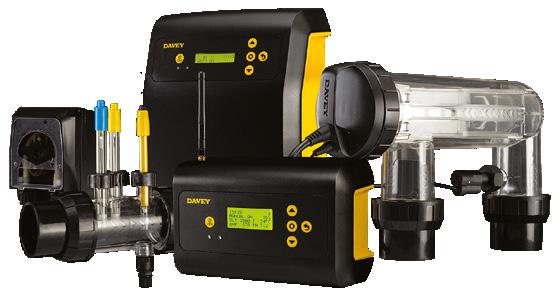
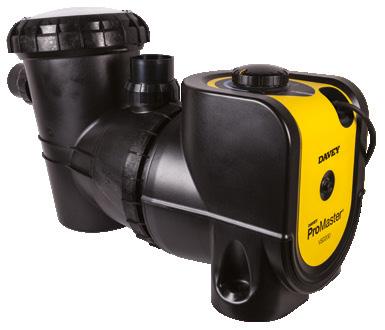
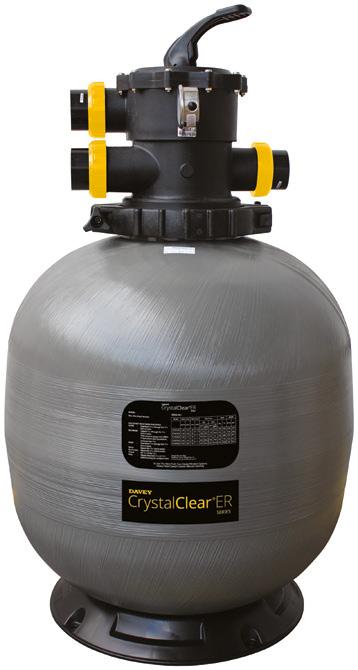
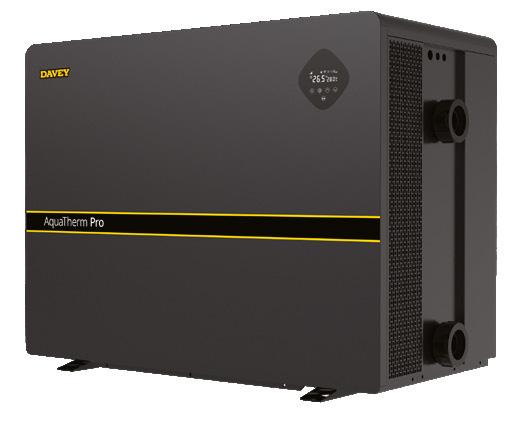
From quiet, energy-saving pumps to intelligent controllers and heat pumps, Davey’s Australian-designed solutions make pool care effortless, and pool time unforgettable.
• Trusted for generations, Davey delivers energy efficiency, and reliability that stands up to the harshest conditions.
• Whether it’s for the family splash zone, the lap pool, or the ultimate backyard oasis - there’s a Davey solution to suit.





I’d like to share some new ideas about how to make more money and profit in this highly lucrative slice of the swimming pool industry.
First of all, let’s remember that every time someone sells and installs a new inground pool, they’re adding a future prospect to the pool renovation business. It’s estimated that Australia has more than 1.4 million pools in the ground, and each year, more are added.
And every year, each and every in-ground pool gets closer to needing a renovation. So even when year-to-year new pool sales are flat or down, the number of swimming pools that need a renovation still goes up.
It’s an always growing business, with exciting new ways to upgrade and renovate these old pools – and not just the plaster, tile and coping that is a given for any pool more than 10 years old.
The excitement happens when you visualise a pool built back in 1985 or 1975 or 1965.
Do you see a cutting-edge beauty, with all the latest features? More likely, you see a stark relic from the past, looking woefully out-of-date and out-of-place next to a home that may be old, but has likely been updated to modern times.
Let’s consider how homeowners keep their 40-, 50- or 60-year-old homes looking modern and contemporary. Like replastering a pool, re-painting a house is a given. It helps it look well-kept, but it does not make it look modern. So eventually, re-painting your home is simply not enough.
The most popular way to modernise a home is to completely gut the kitchen, and install all new cabinets and appliances – to the tune of $100,000 or more. The bathrooms will be next, similarly completely gutted and reconfigured to look completely updated. You might also knock down walls, widen doorways, add skylights, and do any number of other major modifications to help your home keep up with the times.
The same is true with a swimming pool. A 40-year-old swimming pool probably doesn’t have a vanishing edge, beach entry, perimeter overflow, tanning ledge, deck jets, sheer descent waterfall, LED lighting or many other features we now take for granted.
Maybe it’s an old kidney-shaped pebblecrete pool, and the homeowner would prefer something more linear and modern.
Looking beyond the pool, it probably doesn’t have an outdoor kitchen, sports bar, “Ladies Lair,” pizza oven, sport court or putting green. Nor a bath house or a guesthouse for friends and family to spend the night.
These are options that would potentially delight the homeowner to no end. They probably never considered it, because they didn’t know these options were possible. And that’s because most renovators would balk at suggesting such high-dollar items, for fear they would get laughed out of the running for the renovation.
Many homeowners would never consider spending six-figures renovating a pool that only cost them four or five-figures brand
By Brett Lloyd Abbott
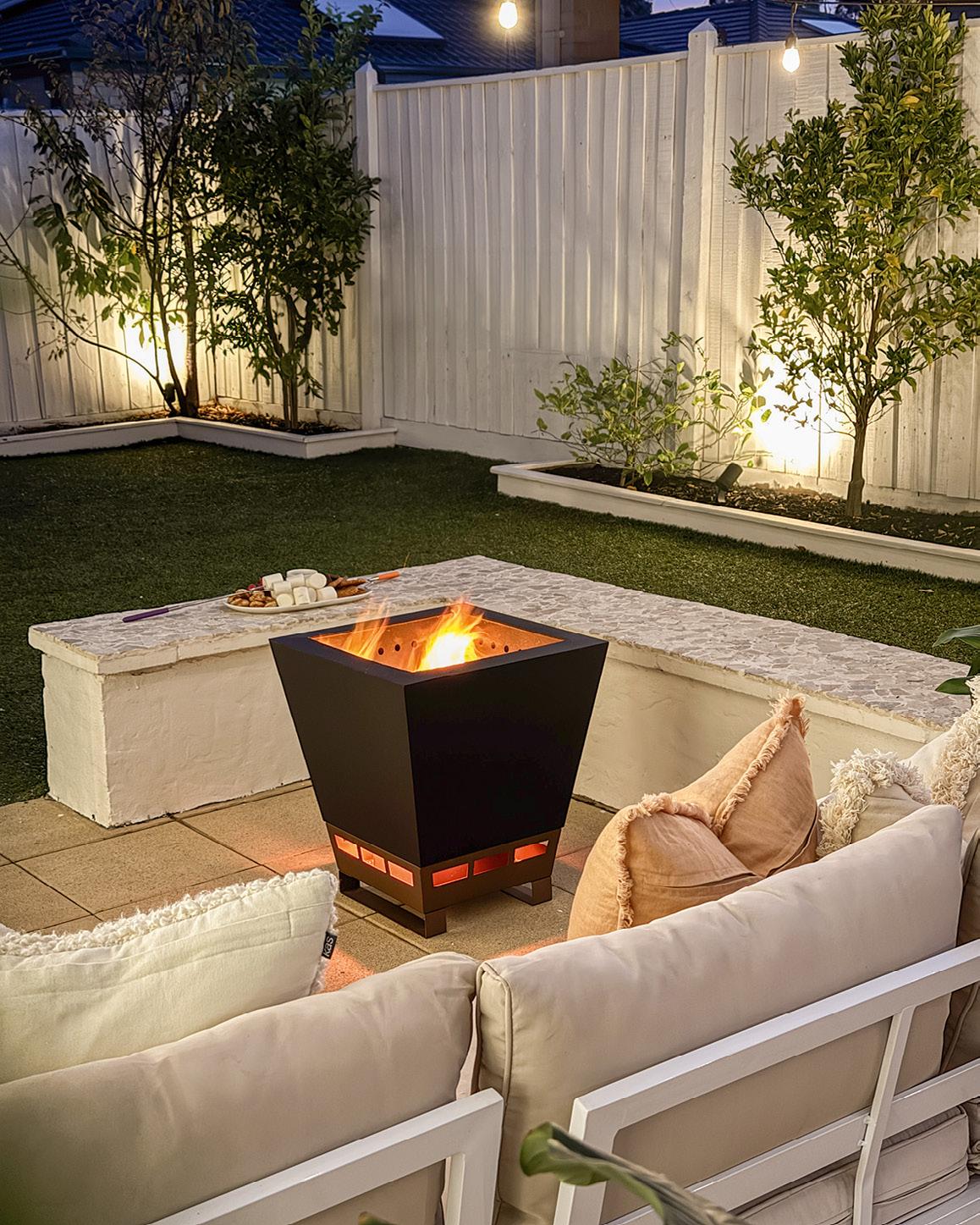
“Firepits and socialising spaces can add value to a renovation. ”
new. However, some homeowners do consider it, and then decide to spend that money on their renovation.
It comes down to having the courage to “talk about the possibilities.” If you’re a little shy in this arena, let me suggest a line that can easily open up the conversation without scaring away the homeowner.
I would say “I’ll be happy to quote you a price for the basic renovation here, which would be the interior finish, the tile, the coping, and maybe the deck. But if you want to have a little fun, I can also share with you some other ideas that you may have never considered. Maybe you didn’t even know they were possible. If you’re game, we can talk about what it would take to make your pool look like it was built in 2026, instead of 1976.
“Would you like to hear a few wild and crazy ideas?”
Rare is the pool owner who doesn’t want to at least hear a few interesting ideas to make their old swimming pool look more modern. We’re not suggesting they should buy these ideas. We’re just throwing some ideas out there for brainstorming, and a little bit of fun.
Now once you’ve broken that ice, and had a little fun talking possibilities, they may find a wild and crazy idea they actually fall in love with. And before you know it, you’ve sold a six-figure
• Automatic cover
• Beach entry
• Fire/water works
• Glass tile
• Grotto
• In-water table/chairs
• Perimeter overflow
• Raised walls
• Spillover spa
• Tanning ledge
• Vanishing edge
• Water features
project to a homeowner who is on cloud nine because of the amazing transformation you’ve offered them.
After all, who doesn’t want a transformation? Especially if it’s a 40-year-old pool they’ve considered an eyesore for years.
And if “transforming the backyard” doesn’t resonate with them, there’s a pretty good chance they’re still interested in transforming themselves.
Health and wellness is big in Australia, with a market value just shy of $200 billion per year – and growing at 7.5 per cent each year.
A recent survey showed more than 80 per cent of Australians were very interested in maintaining their health, with the statement “Staying healthy is a top priority for our family” resonating with them.
Odds are your pool owner is in that 80 per cent of people who are interested in features and appliances for their improved health and wellness. So even if you aren’t currently a dealer, it might still make sense to have conversations about saunas, hot tubs, swim spas, cold plunges, massage chairs, and other healthy appliances.
In fact, sometimes simply upgrading the old swimming pool and surroundings will give the forlorn pool owner all the inspiration and motivation they need to fall in love with their swimming pool again, and start enjoying the health benefits inherent in every pool.
Now let’s talk about another curious slice of the market that may be good prospects for swimming pool renovations. In addition to the millions of old swimming pools out there, there is a number of new pandemic-era inground swimming pools that were designed, purchased and built in a hurry by new and sometimes unskilled entrants into the market.
I won’t get into the potential technical challenges for renovating these pools, but I think the decision-making process for the panicked homeowner at that time was not nearly as rigorous as it might have been pre- or post-pandemic.
That means many homeowners may be sitting on relatively new swimming pools that look good, but aren’t really what they want or need today. Some of these pool owners may be ripe for some new ideas and enhancements to their pool and pool area, even if the pool itself isn’t ready for new plaster, tile or coping. Everyone loves health and wellness, and most people love sitting in their backyard, enjoying their swimming pool and backyard haven. It’s our duty, as experienced pool contractors, to help these pool owners upgrade these spaces to once again be the backyard of their dreams. n
Contact: www.poolbuildermarketing.com

By Kristin Brookfield
Very early in my journey with SPASA I had the privilege of meeting each of our industry partners and sponsors. It was important for me to understand why members were choosing to support the association in this way, and to listen to ideas about how we can work to promote the industry.
Thanks to the support of our industry partners, each year we are able to deliver a range of events, forums and services to members. Having members support members in this way is a sign of a strong association, and recognition of the value these partnerships can bring to the businesses involved.
As the year kicks off, we have been excited to announce the first wave of industry partners for 2026. Please join me in thanking them: Fluidra, Platinum Industry Partner; Pentair, Gold Industry Partner; Reece Irrigation and Pools, Daisy Pool Covers and The Acoustic Box, Waterco and Davey, Silver Industry Partners.
I look forward to announcing more amazing partners for our 2026 activities in the coming weeks.
With SPASA’s mission to protect, promote and grow the swimming pool and spa industry, 2026 has started with a focus on consumers through our Pool Spa Life brand.
Season 2 of Pool Spa Life hit the 9Life TV airwaves on Sunday 25 January, showcasing members delivering fresh inspiration, expert insights and the latest in pool and spa design, technology and outdoor living across eight episodes. Thanks go to our Premium Partners – Fluidra, Maytronics and Polaris – for supporting the show, along with many SPASA members who have taken part in this year’s series.
Each episode aims to helps homeowners make confident choices when building, upgrading or maintaining
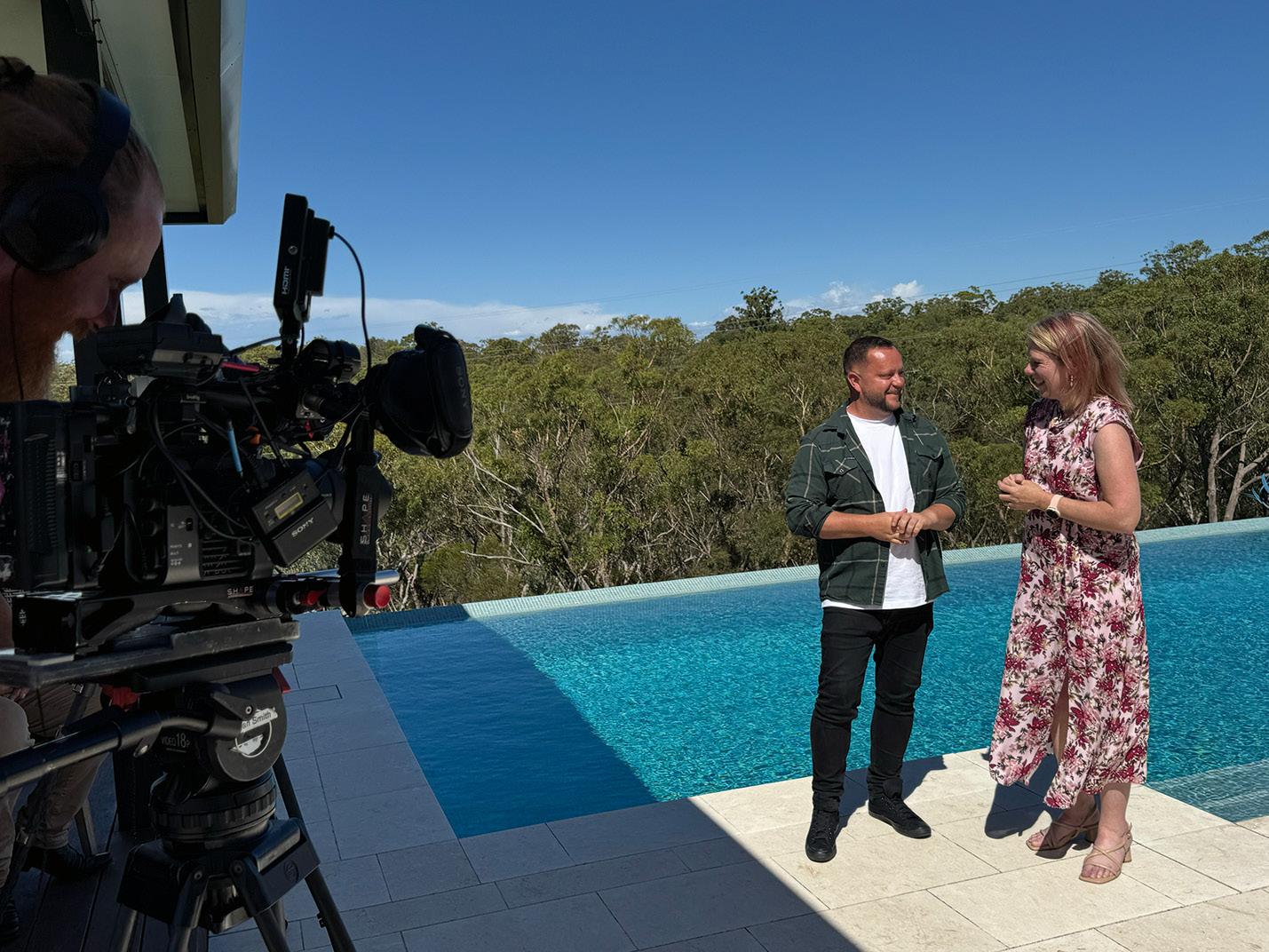
their pool or spa, while reinforcing the importance of choosing a SPASA member for all their pool and spa needs.
The consumer expo season has started – beginning with the Melbourne Pool Spa Life Expo in January – providing the opportunity for SPASA members to connect with potential customers and showcase their businesses and products. If you’re interested in being part of the expos reach out to the SPASA team.
“It’s a SPLASH! Year next year,” was one of the first things people said to me when they heard I was joining SPASA.
Well, next year has arrived, and there are just seven months until the doors open at SPLASH!26, our flagship event for the Australasian pool and spa industry – and it is shaping up to be an amazing event.
As the largest pool and spa trade show in the Southern Hemisphere, SPLASH!26 will bring together more than 100 exhibitors under one roof – showcasing new products and innovation from across the world.
But SPLASH! is more than just a trade show. This year the action starts on Tuesday night with our opening event, the ALL INdustry Drinks, bringing everyone together to reconnect with old friends and to welcome new faces to the Gold Coast.
Wednesday kicks off bright and early
with the inspiring WAVES breakfast event before the expo doors open. Spend the day exploring the show floor, listening to industry experts at the seminar stage and building your industry network. If you’re looking to build your knowledge, you can sign up for our professional development sessions delivered by the Institute of Research and Learning and our member benefits partners.
Day 1 finishes with our Gala celebration – recognising the finalists from across Australian and New Zealand at the 2026 Australasian Awards of Excellence.
Thursday offers more time to tour the show floor, speaking to exhibitors and your industry network.
And finally for those keen to get some sunshine after a few days inside, sign up for a round of golf on Friday where you can rest your feet in a buggy and finish those business deals.
Of course, none of this would be possible without the support of our 2026 SPLASH! partners. I’m excited to announce that Fluidra (Platinum), Pentair (Gold) and Reece Irrigation and Pools (Silver) will be supporting SPLASH! once again this year. And we will have more to announce in coming months. SPLASH!26 will be a jam packed few days, and we can’t wait to see you all on the Gold Coast from August 18 to August 21. The registration portal is now open, so grab your tickets today. n
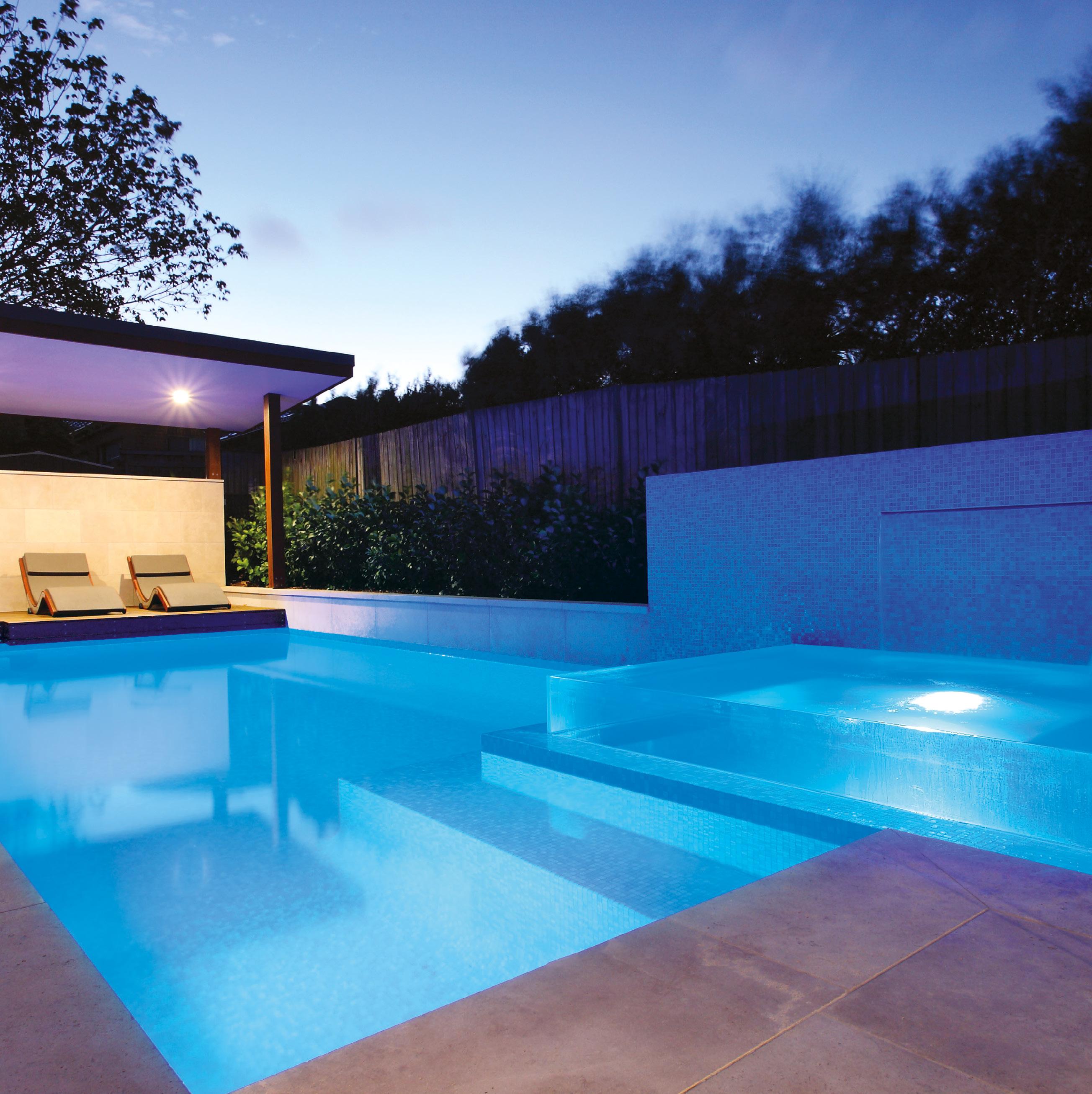
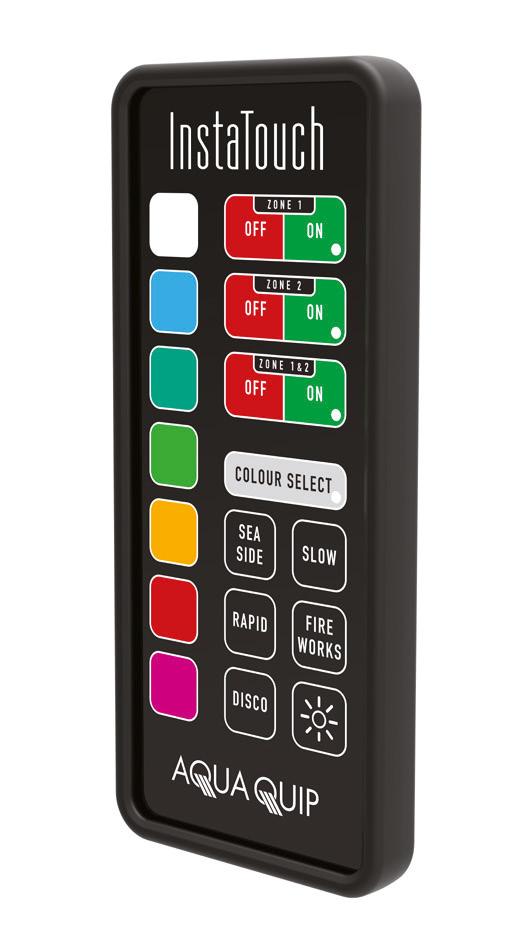
Aqua-Quip designs and manufactures in Australia, innovative underwater LED lighting systems for use in concrete and fibreglass swimming pools, spas, water features and catch tanks for the Australian and international pool markets.
Lights are compatible with all popular pool controllers and home automation systems. The innovative InstaTouch™ Smart Lighting Controller provides instantaneous control via a water-resistant handset to enhance the evening atmosphere in your pool and spa.

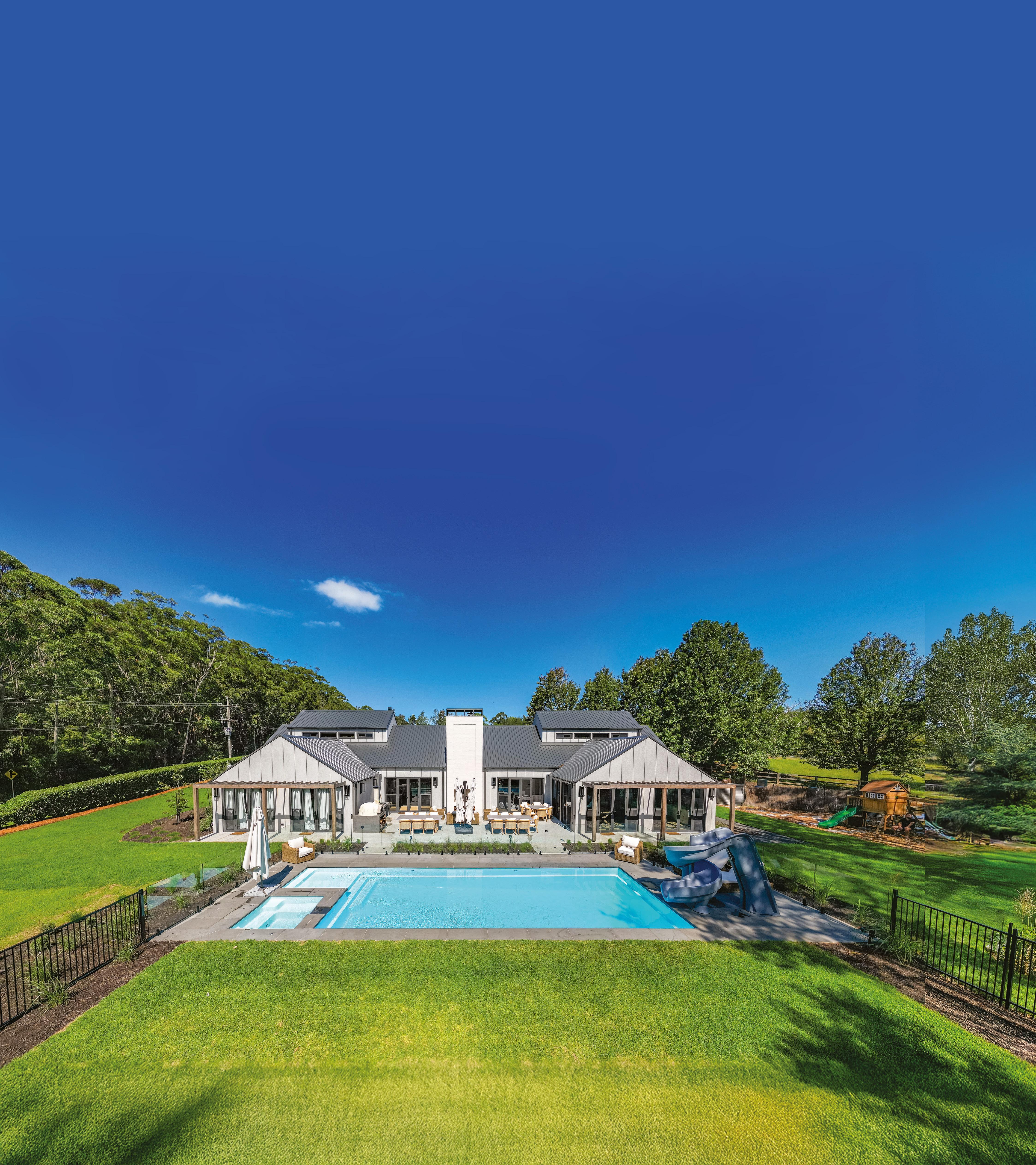






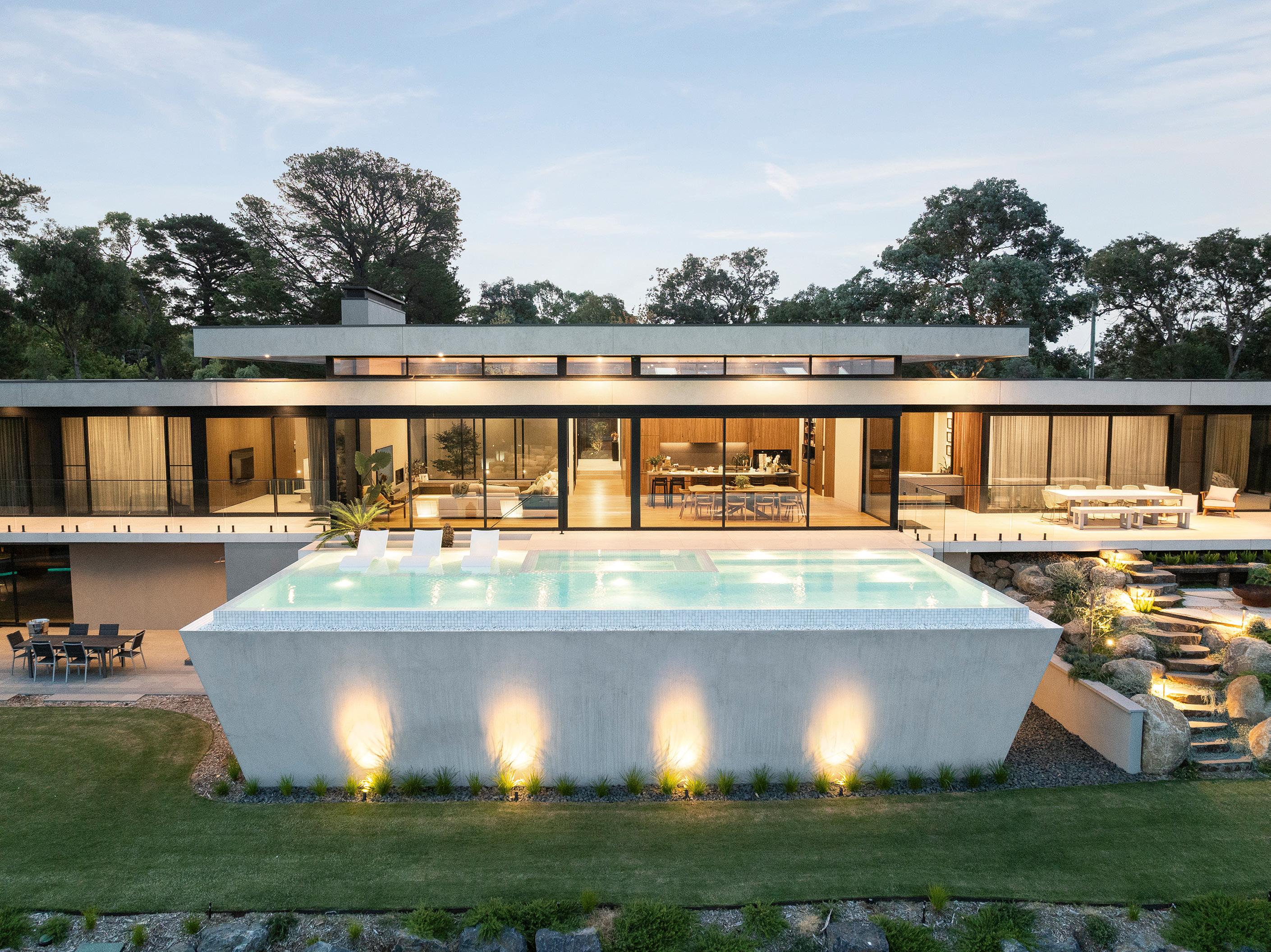
Matt Seymour is the director of Apex Pools and Spas, the winner of the inaugural Master Pool Builders Technical Project. He talks us through aspects of the project, his unique business model, and what winning the award means to him and the team.
Matt Seymour and Steve Blencowe have worked together since they were teenagers. This year, they are celebrating 20 years as co-directors of their award-winning construction company.
“We’ve known each other since we were 19 years old, working together for different companies,” says Seymour.
“When we went out on our own individually, we would help each other on our projects.
“Then in 2006, we started Apex.”
Seymour says it took them a few years to work out the best way to utilise their individual talents and share responsibilities.
“Like every good marriage, you have to work out where you both sit in it. And we worked that out over time.
“Now I run all the construction and manage all our staff and contractors on that side of the business – actually getting the pools built, so the front end of everything.
“Steve manages the back end of our business. He hands over all the pools, looking after that stage with the clients, and also
oversees all our filtration and purchases all our stock holdings.”
Purchasing the equipment and construction supplies is a bigger job than it would be with many other pool construction companies due to Apex’s unique business model. They buy their pool equipment and all construction materials in bulk, enough to last for several months, warehoused in their own pick-and-pack facility.
Seymour says this makes the company extremely responsive and efficient.
“When a customer or builder calls and says they require the pool equipment, pipe run or a stage of construction works done tomorrow, most pool builders may not be able to react that quickly. Having control over our stock means we can pick and pack quickly at our facility and be on the job the same or next day.
“There’s never a day where we can’t do something. Even if we go to a job site and there’s a hold up, we’ll just go back to the yard, pick up something else and we go out to another job.
Everything’s always ready to go.”
Seymour says the model was developed during covid, when builders were struggling to get materials and suppliers were suffering under
“ This year Apex is celebrating its 20th anniversary.”
the burden of the supply chain crisis.
“It wasn’t too much of a risk because we knew how many pools we had to finish, so we knew what we needed to buy. We had them all contracted already, so we just purchased everything for our upcoming jobs.”
They now stock pretty much all materials for the build process, all organised in an orderly fashion, bought in bulk and picked and packed when needed.
Blencowe manages that side of the business as well as the service division, which employs three dedicated techs and services up to 300 clients.
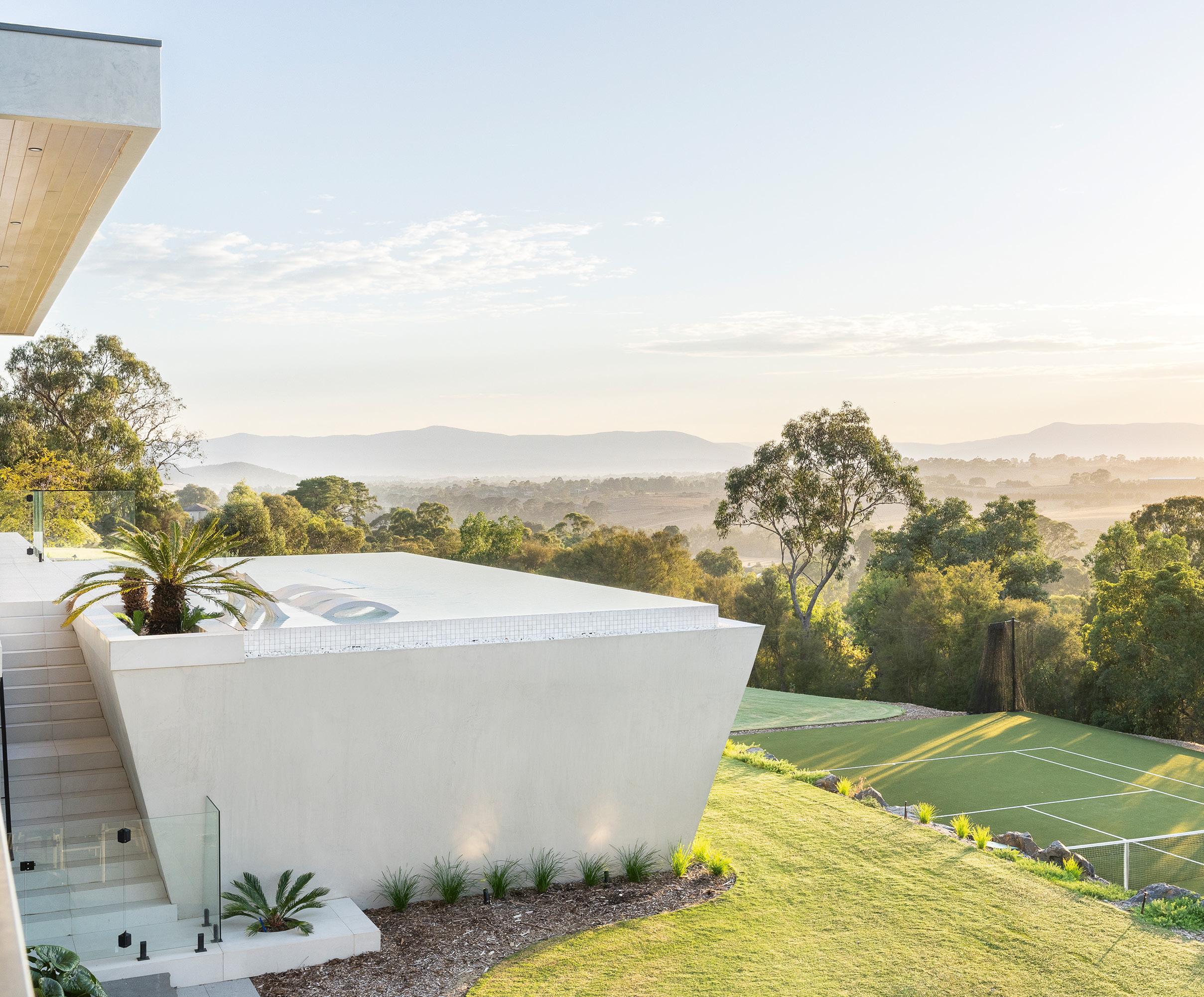
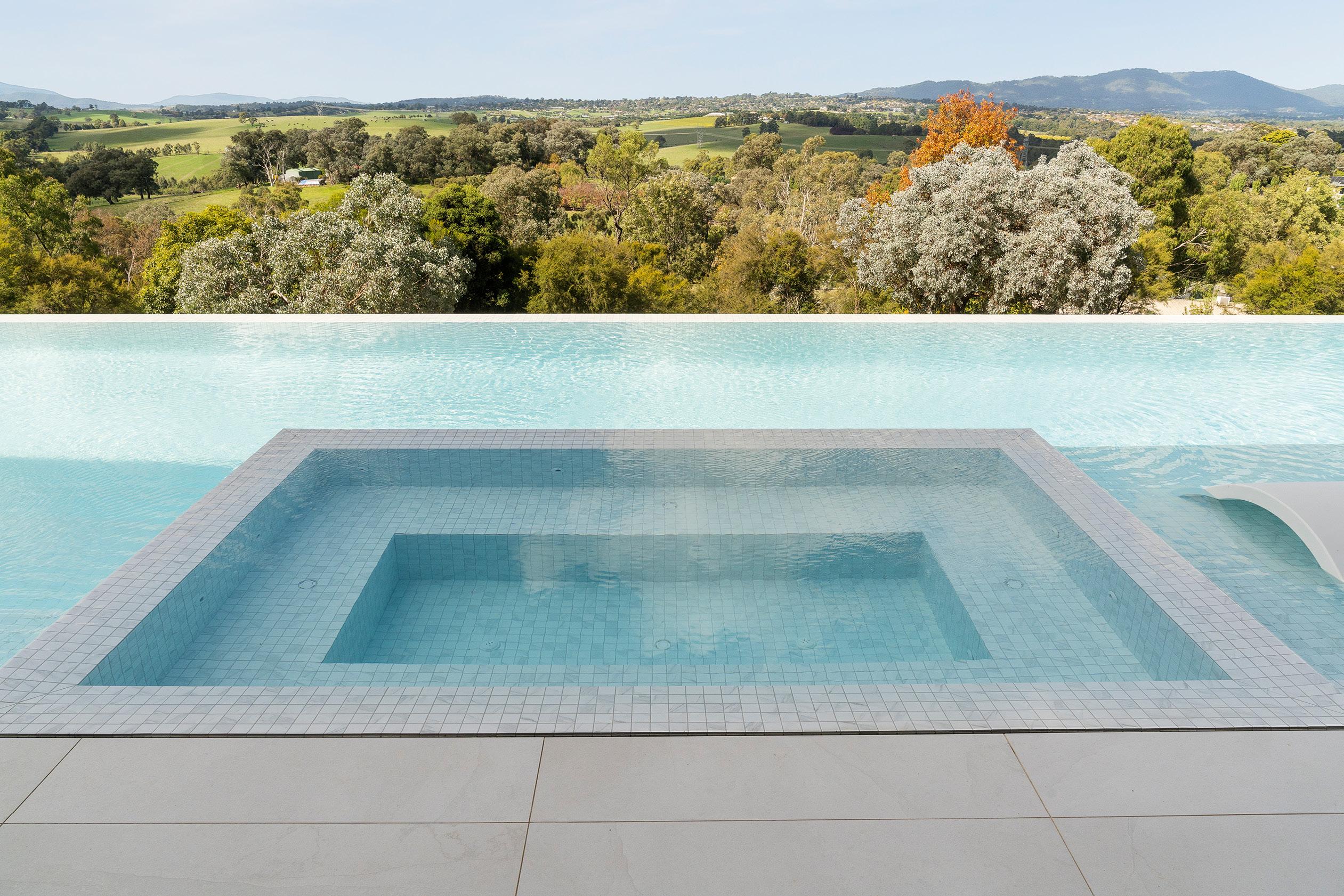
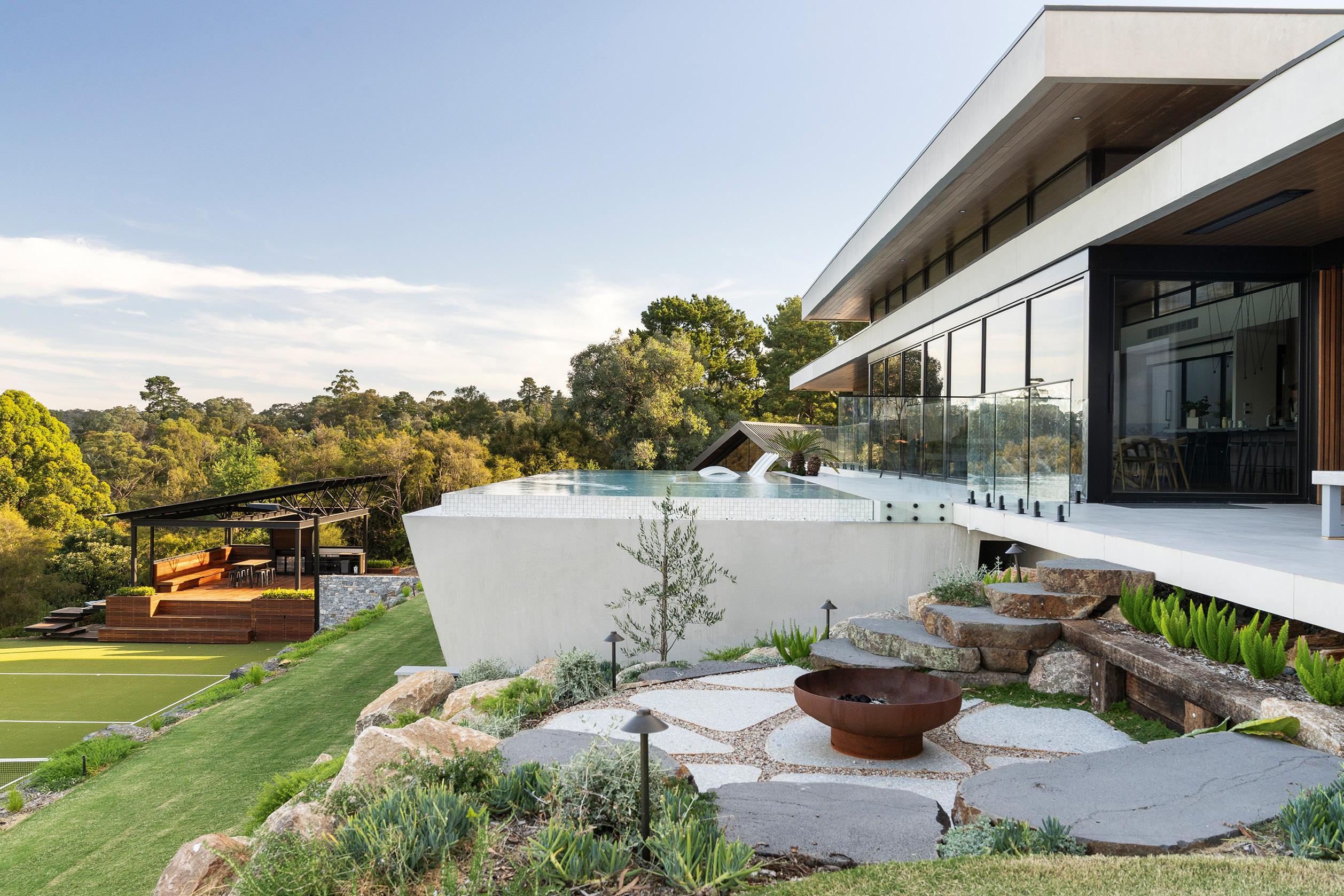
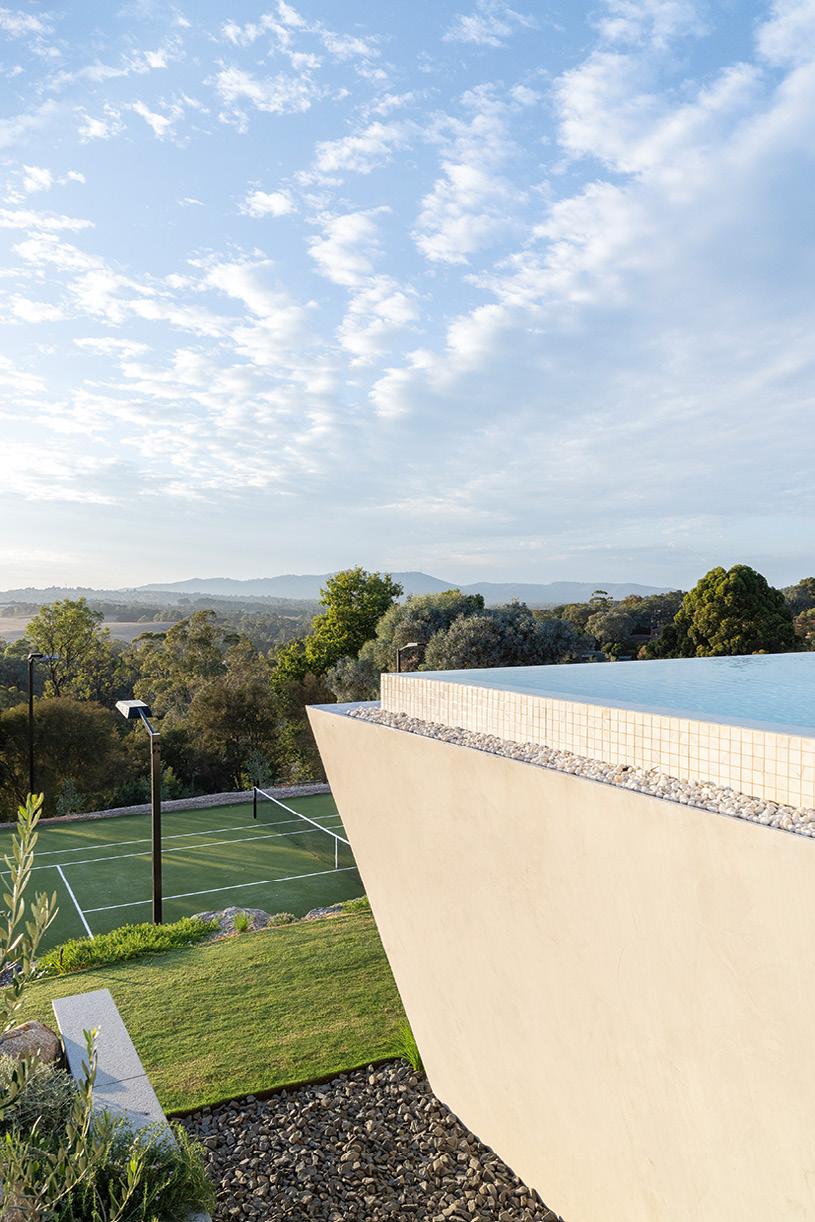
The impressive martini-shaped concrete pool that won the Master Pool Builders Award is in Wonga Park on the eastern fringe of Melbourne – a wealthy, spacious area where plenty of large, high cost swimming pools are being built.
“ There’s never a day where we can’t do something.”
“We had built up a really good working relationship with this particular client, and he gave us pretty much free range with the design of the pool,” says Seymour.
“When we get that opportunity, we always like to try and come up with something that hasn’t been done before – something out of the ordinary.
“I’d thought about doing a martini-shaped pool for a while, but it had never really eventuated. I passed the idea onto our team, and Nick Goff and I designed it in collaboration.”
They have a close relationship with their engineer, who is a dedicated consultant who works for Innovezza but engineers all the Apex pools.
“A lot of the time I’ll come up with a design then I’ll run through how I want to build it with my engineer, and ask if he can make it work. Then he’ll engineer it back from that.
“He’s the same engineer we’ve used for the past 15 years, and when we’re busy, its not uncommon for us to be doing two pools a week. Every time an Apex job goes through Innovezza he does it for us.”
Good relationships
Relationships with staff and contractors are
important to maintain consistency, quality and timelines.
Apex have a permanent staff of 12, but they have many contactors who are essentially fulltime including excavation, steel fixing, spraying and tiling crews.
“We find it easier when we are building upwards of 60 pools a year; we essentially have all our contractors booked on particular days each week for the entire year. We then supply them with the job folders a few weeks out from each job.
“And I’d rather keep them busy – rather than them having find work in between, and then I have to try and get them back again.”
Apex works very closely with their building surveyor and their engineer, because when they do up to 100 pools per year, they have to get the engineering done very quickly and need to get building permits quickly.
“When you’re doing between 60 and 100 building permits a year, you’ve got to have a building surveyor who’s working with you. We’re constantly communicating with them and our engineers combined to make sure we are all aligned.
Across the course of a normal week, Apex will have 35 different people working for them.
“The same steel-fixing contractor, pool tilers, excavation and shotcrete crews have been with us since the beginning.
“Relationships are important. Even if it
“I’d thought about doing a martini-shaped pool for a while.”
costs a little bit more, it’s better to have good relationships.”
When asked how he felt to win the inaugural Master Pool Builder Technical Project Award, Seymour says he is really chuffed.
“It’s a very tough award to win,” he says. “To be honest, it probably means more than any of the other awards we’ve won.”
Their long list of awards over the years includes the Victorian Pool of the Year and the Victorian Builder of the Year.
“It was fantastic to win them – but they are more subjective awards. Whereas this award is essentially judged by your peers, actually judged by people who build swimming pools and are in the game. So, we really feel like this one means more to us – to be respected by our peers who understand that a lot has gone into a project like this.”
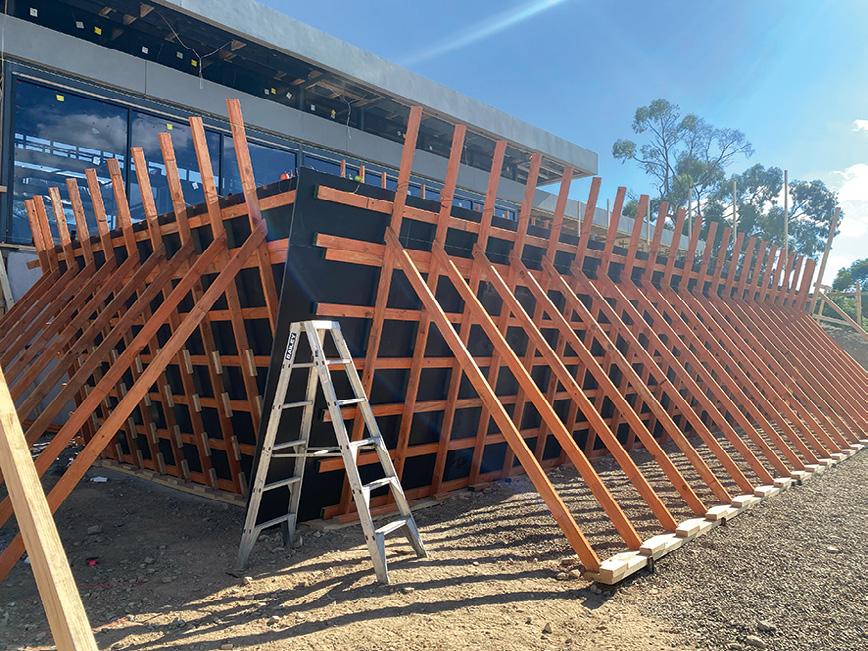
Seymour says that it was quite a challenge to build one solid concrete unit that’s an inverted pyramid shape, with the walls angling back in.
“The formwork structure has a lot of
“ The same steel fixing crew have steeled up every pool we’ve built.”
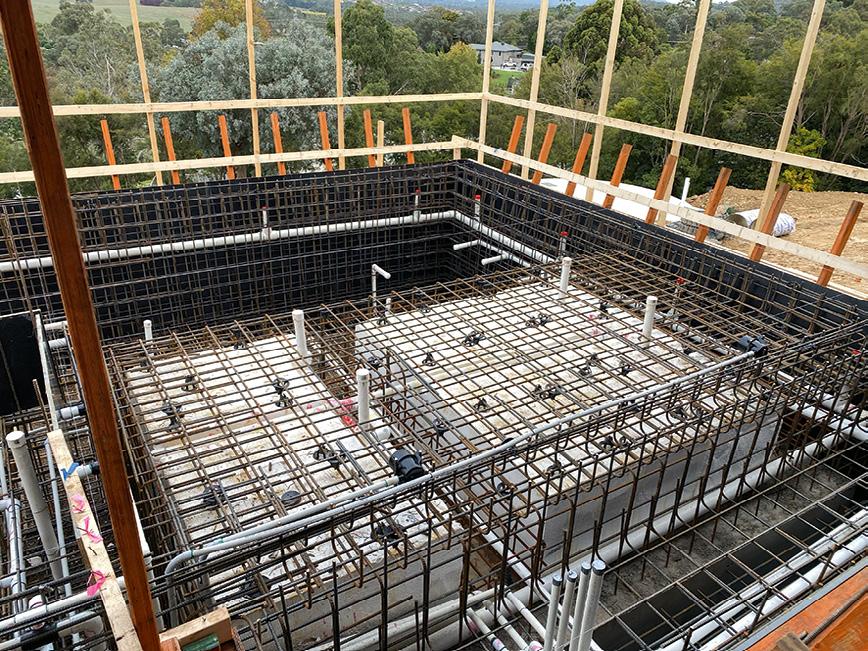
complexity,” he says. “It was a pretty impressive structure that took three weeks to form up – and one day to concrete. And all that preparation was key to making sure that when it got stripped it was perfect. So, the formwork and steel were a lot of work compared to a normal straight up and down pool build.”
Seymour says that winning the award will definitely help with marketing, and that is currently a focus of theirs – putting more energy into marketing and building the Apex brand.
“Over the last decade we have been working on building Apex Pools as a brand and less focused on Steve and me. That’s been our focus, since we moved into our new facility. We have an incredible sales team lead by Rhett Sutton, and now the majority of clients who reach out to us have been referred to the brand as opposed to Steve, Rhett or me.
“They don’t care who answers the phone and who the salesman is they’re dealing with. They’ve come to buy an Apex pool, and that’s what we’re trying to do. If you want to buy a new Mercedes, it doesn’t matter which salesman you buy it from or which dealership you go to – you just want a Mercedes. You could say we are trying to emulate Mercedes, in the context of the pool industry.”
marketing and awareness around the principals, then find the business can’t really operate when they’re not there. It also makes it harder for a succession strategy.
couple of years, and while Seymour doesn’t think change is going to happen instantly, they have seen an increase in enquiries.

over the past few months, with a focus on getting back up towards the 2021 and 2022 boom the pool industry had, when we were building close to 100 concrete pools a year.
“Our enquiries are up twenty-five percent this quarter, and they seem to be more realistic leads. The feedback from Sales is that everyone is pretty genuine.”
Apex is at the premium end of the market –with concrete the top end of the pool market, and the company aiming for the top of that segment.
“In saying that, we still do a percentage of small, really nice but simple concrete pools, at the same time as doing the big stuff.
“For example, we’re digging one today that’s a basic seven-by-four pool, no spa, no infloor cleaning, a two pump system, just solar. And then next week we’re starting one in Portsea that is big in every sense of the word.
“Completely different ends of the scale over the course of a fortnight, which is good because it keeps cash flowing. It’s a very broad range.
“We build across the whole of Victoria, down to the Bellarine Peninsula, Gippsland and the Surf Coast, and everywhere in between.
“And we’re very proud of what we do.” n Contact: www.apexpools.com.au
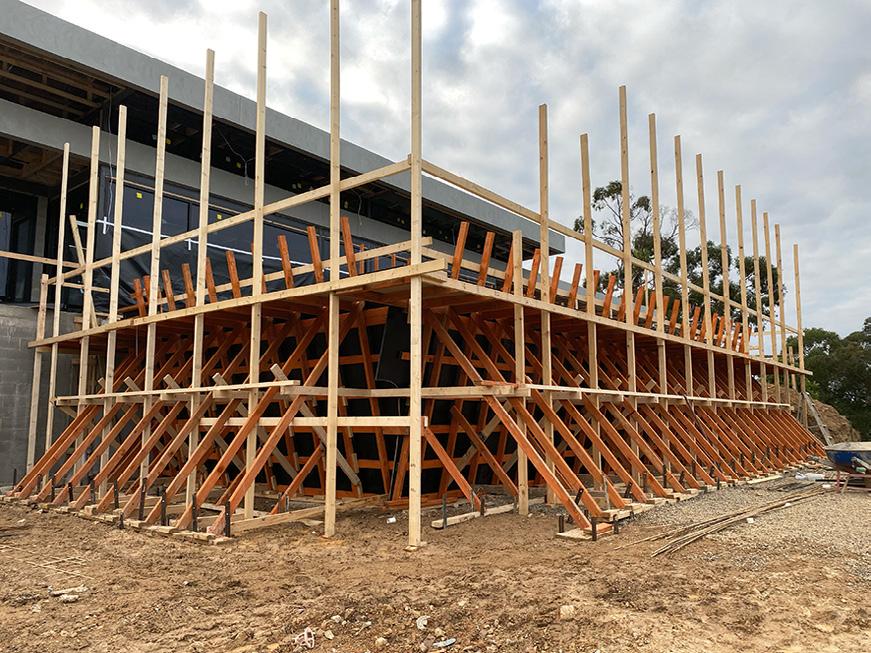
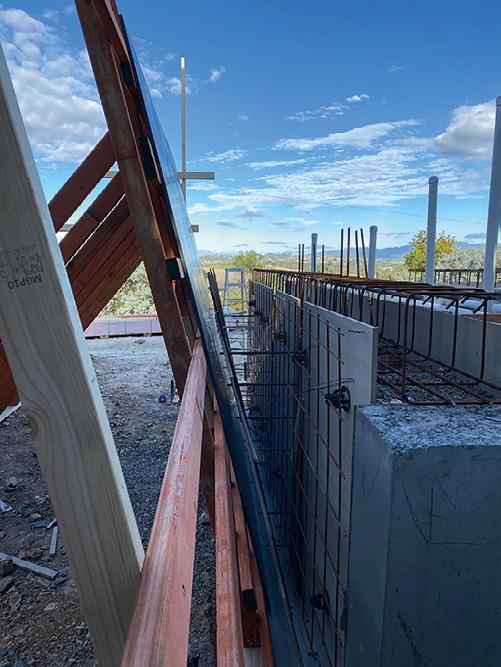

• The inside is 48mm Carrara ceramic tiles from the Pool Tile Company.
• There’s a negative edge gutter around the whole top of the pool, flowing into a balance tank underneath the pool.
• The balance tanks and equipment is housed underneath the walkway.
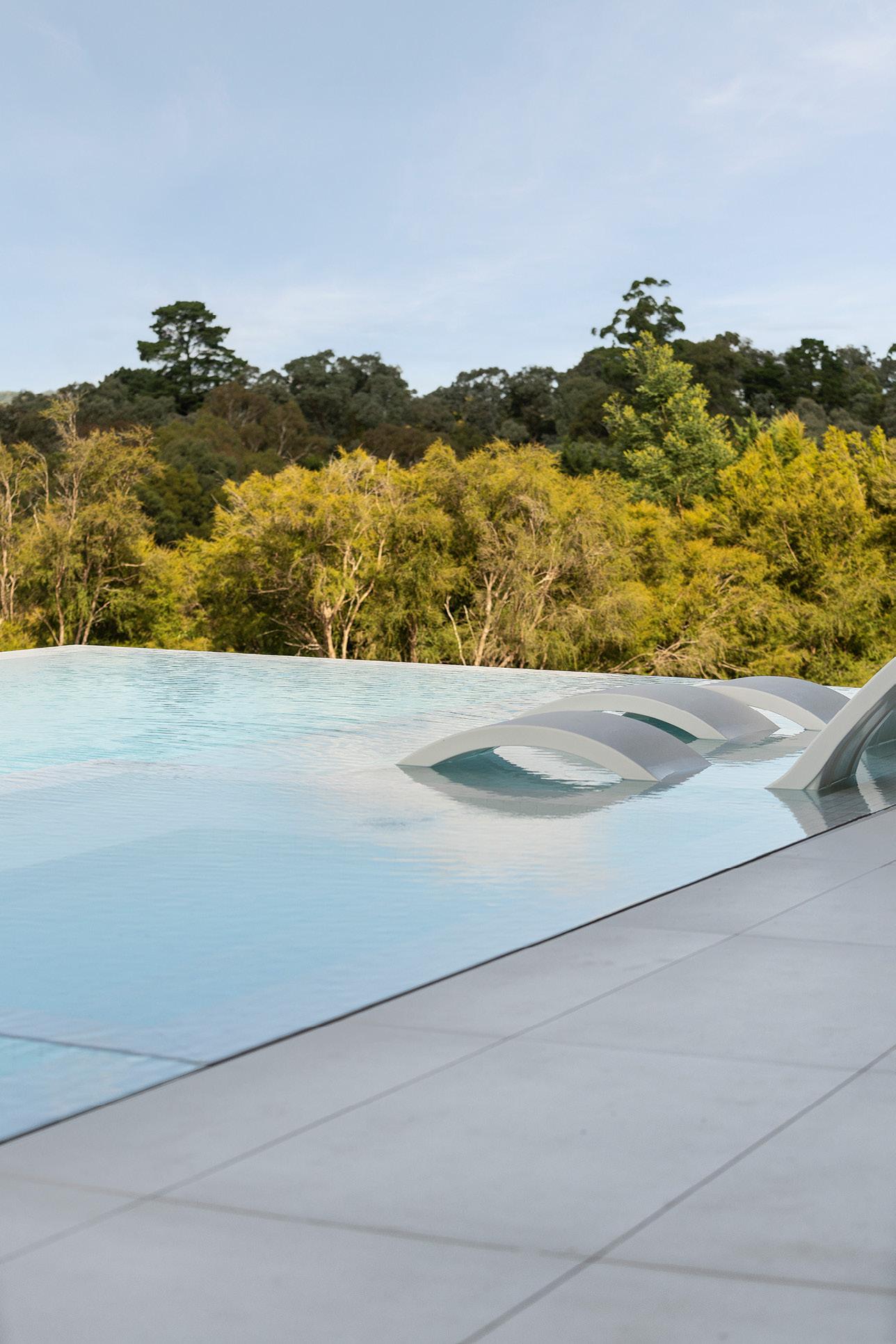
• The beach area with the lounges is frequently used by the owner’s three teenage daughters – in fact they spend more time sunbathing than swimming.

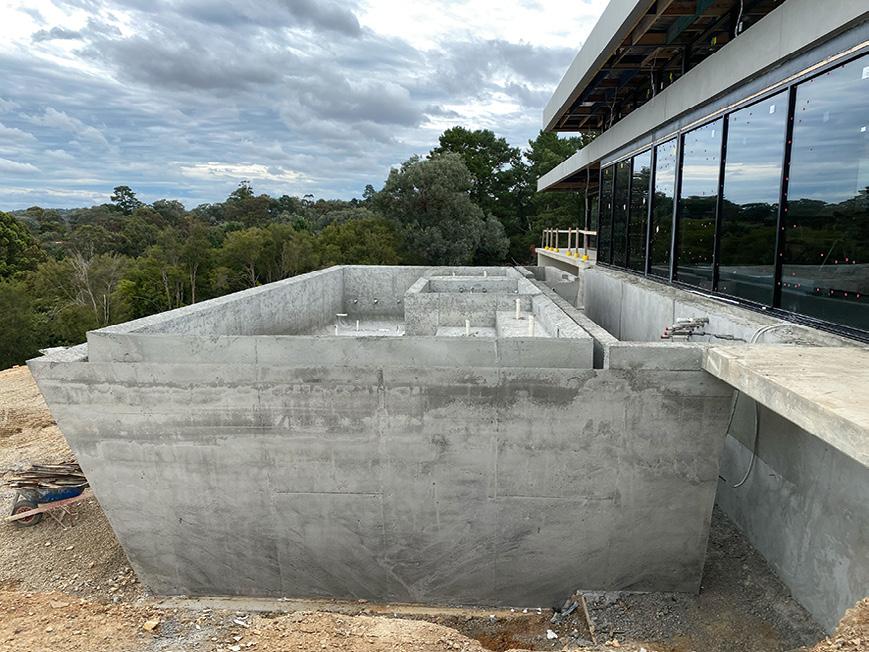
The pool volume is 90,000 litres.
• Depth is 1.7m in the deep end to 1.2m in the shallow end.
• There is a big 2.5m spa with 10 spa jets.
• The spa jets and lighting are all Spa Electrics.
• The hydraulic and heating equipment is all Fluidra and AstralPool.
• There are five pumps in total, glass media vessel filtration, a chlorination system, and a gas heater as well as two Oasis heat pumps and a Paramount infloor cleaning system.
• The build took a year and a half, being constructed as the house was getting built.
With record-breaking temperatures and catastrophic potential for bushfires hitting many parts of Australia, Yarra Valley Water is urging customers in grass fire and bushfireprone areas to include a water supply in their emergency plan.
The Victorian Country Fire Authority (CFA) has stated this fire season could be the most dangerous since the 2009 Black Saturday fires. This is part of a trend of fire seasons starting earlier and lasting longer due to changing weather patterns.
The fire danger period is expected to continue through to May 2026.
Bridie Fennessy, general manager of asset services for Yarra Water, says a reliable water supply cannot be guaranteed during a fire and preparation is crucial.
“We all know grass fires and bushfires can happen at any time, with the potential to devastate properties and damage water pipes and tanks,” she says.
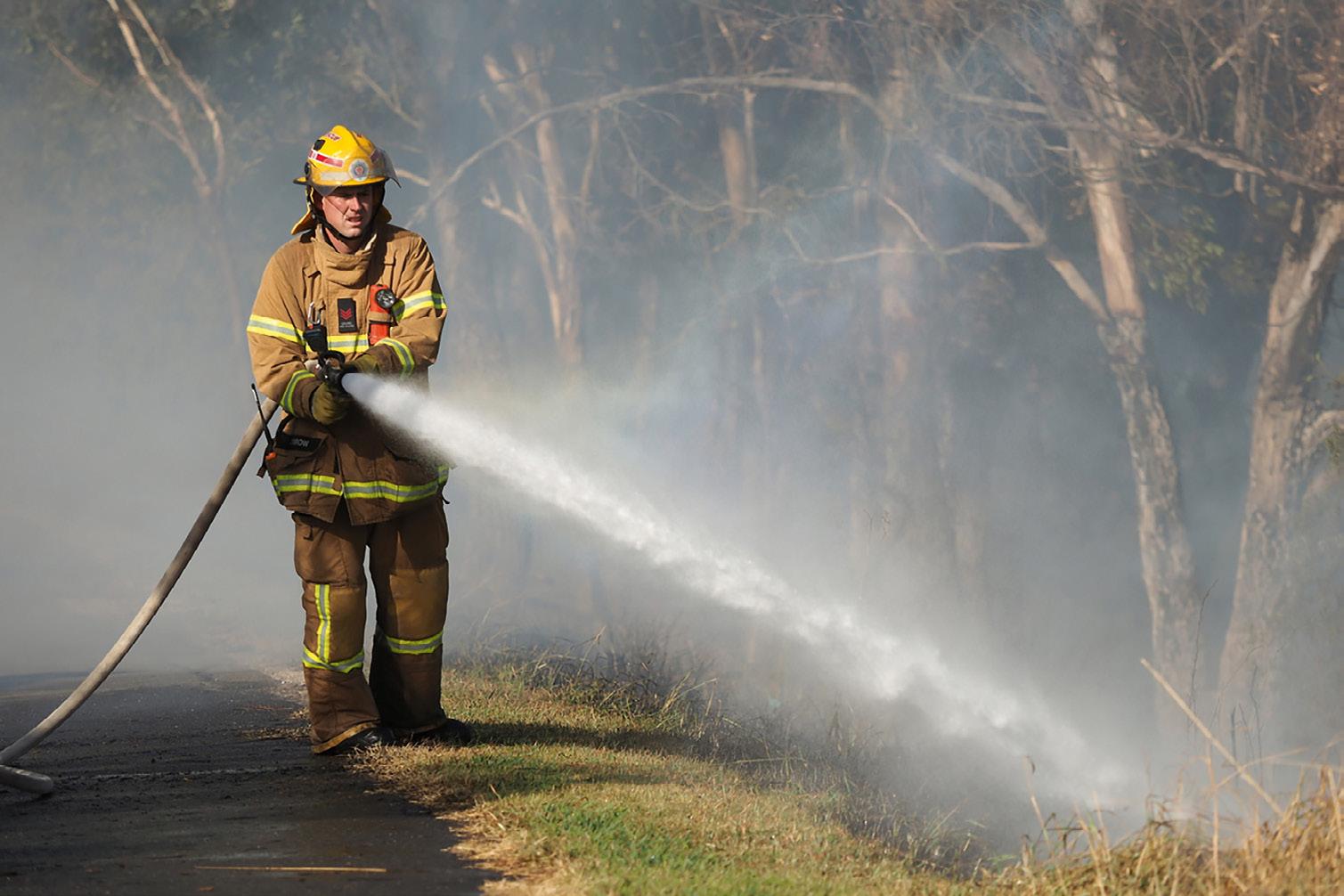
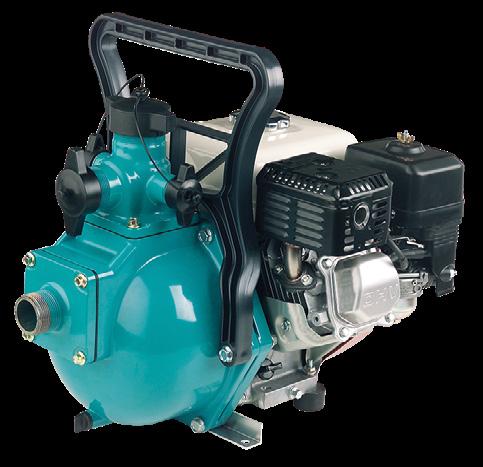

“During a fire, our customers could experience low water pressure, loss of supply or reduced water quality. This could be due to equipment damage due to heat or fire, high demand for water from firefighters, or power outages.”
As well as urging everyone to include drinking water in their emergency kit, she says if they intend to defend their property, they will need an independent water supply because you won’t be able to rely on mains water during a fire.
The CFA and Fire Rescue Victoria recommend an independent water supply of at least 10,000 litres and a nonmains reliant pump if you are intending to stay and fight a fire.
Fennessy also says it is also important for customers to update their contact details with a mobile phone number for SMS updates during an emergency that affects water supplies.
In New South Wales, the Static Water Supply (SWS) program is a free service that enables residents to help local firefighters by identifying existing water supplies (such as swimming pools, dams or tanks) on their property that could be used for firefighting purposes.
The NSW Rural Fire Service provides specially designed SWS signs for properties with suitable water supplies. This helps firefighters access vital water supplies quickly and efficiently to help them defend the property. Examples of suitable water supplies include:
• A property dam which can be used to refill fire tankers and firefighting aircraft such as helicopters which support our firefighters on the ground.
• A backyard swimming pool, which provides an ideal static water supply for small portable pumps and hose lines to help protect your home.
• A tank, which with appropriate fittings can also be used to quickly supply water for firefighting.
If you have a pool, tank or dam with more than 3000 litre capacity and wish to be part of the SWS Program, please contact your local Fire Control Centre or email: community.engagement@rfs.nsw.gov.au.
Some Plungie pools can have a fire provision added to them to help fight fires. The provision is a small modification that can be made to the pool shell, allowing it to be used as a firefighting water source. This provision provides for two additional suction points, which allows a valve to be added to the pool, which can ultimately be connected to a hydrant or pump connection for firefighting.
Plungie had received requests from homeowners in bushfireprone areas to add a fire provision to their pool, so they introduced this as a standard modification that can be added to the Original and Max models.
Swimming pool and spa equipment suppliers Davey and Pentair manufacture pumps to help defend against bushfires.
Davey Firefighter pumps are engineered for powerful, reliable performance in bushfire protection and emergency water transfer applications. Proudly Australian-made, the range includes high-performance petrol and diesel-engine-driven pumps, as well as the Remote Start Firefighter MKII, offering fast response when operating from a distance. Designed for tough Australian conditions, each pump features corrosionresistant construction and high-pressure output, making them ideal for rural properties, farms and fire-prone areas.
Pentair has a vast range of fire-fighting pumps through their Onga brand. Onga’s single stage Blazemaster pumps are designed to move more water more economically and come available in a wide range of petrol (Honda and Briggs & Stratton), diesel (Yanmar and Kohler), recoil and electric start models. They are suitable for fire-fighting, tank filling, water transfer, boom spraying and irrigation. Made from lightweight high-grade corrosion resistant materials, they are strong and durable. n
Contact: www.davey.com.au, www.onga.com.au, www.plungie.com/en-au

By Veda Dante
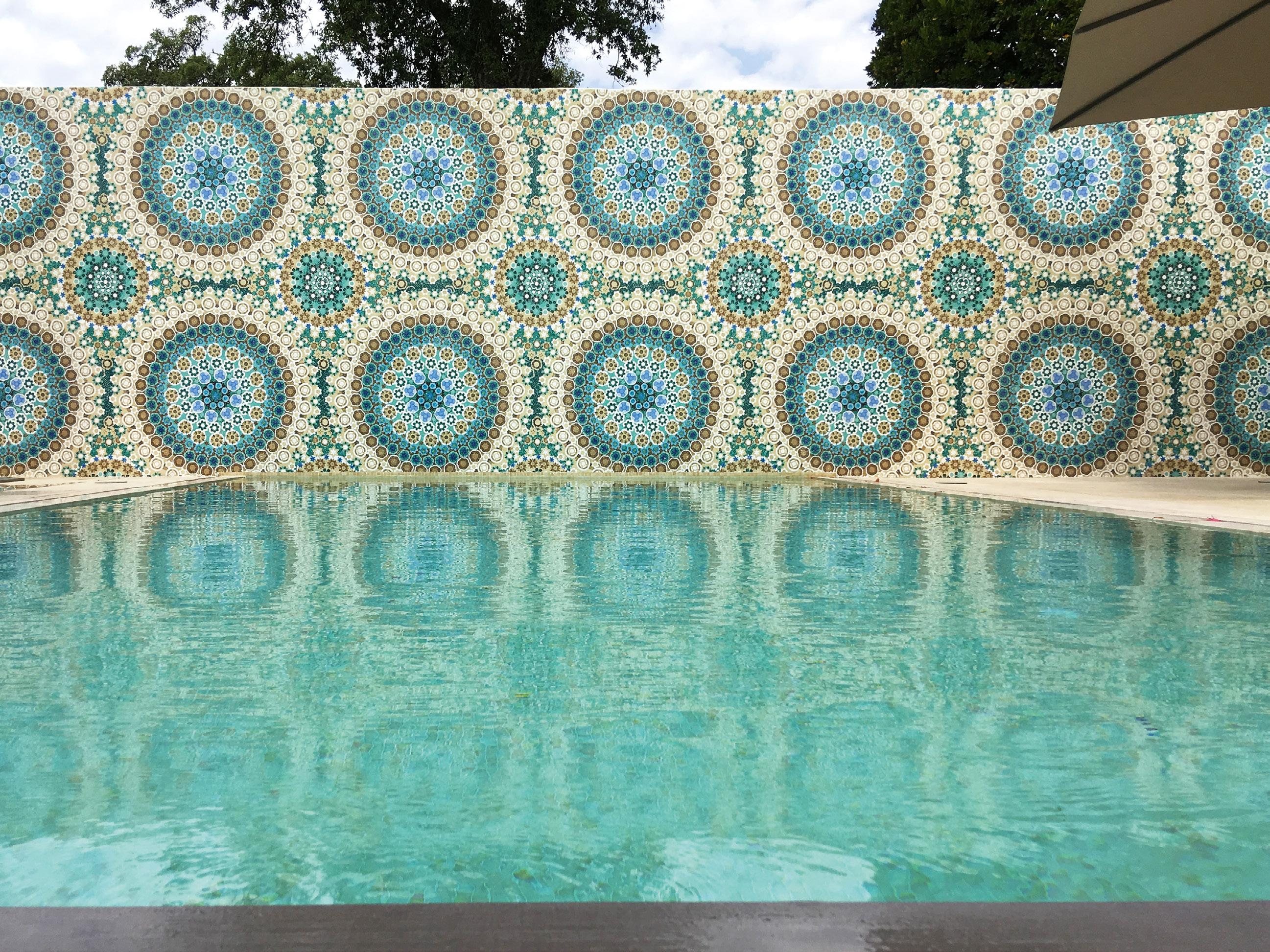
Veda Dante explores the tiling design trends, technical innovations, and material choices shaping Australia’s contemporary swimming pools and spas.
Pool and spa tiling is not just a finishing touch. It has become an integral part of design, performance, and long-term durability in premium installations. From selecting materials that can withstand harsh sun, complete submersion, chemical treatment and fluctuating temperatures, to achieving precise finishes across curves, steps and infinity edges, tiling requires both technical expertise and aesthetic vision.
In today’s carefully designed aquatic environments, tiles, water and light combine with architecture to create an immersive experience.
Leading industry voices agree that tile choice goes beyond colour or style. Performance, adhesion and longevity are equally important, and installers must consider how they behave under real-world Australian conditions. As the market evolves, designers, tilers and suppliers are redefining the standard of excellence, blending technical innovation with high-end design and customisation.
Europe Imports director Carl Yench describes Ezarri glass mosaics as the gold standard for pool applications, owing to a combination of European engineering, precision manufacturing, and strong local partnerships.
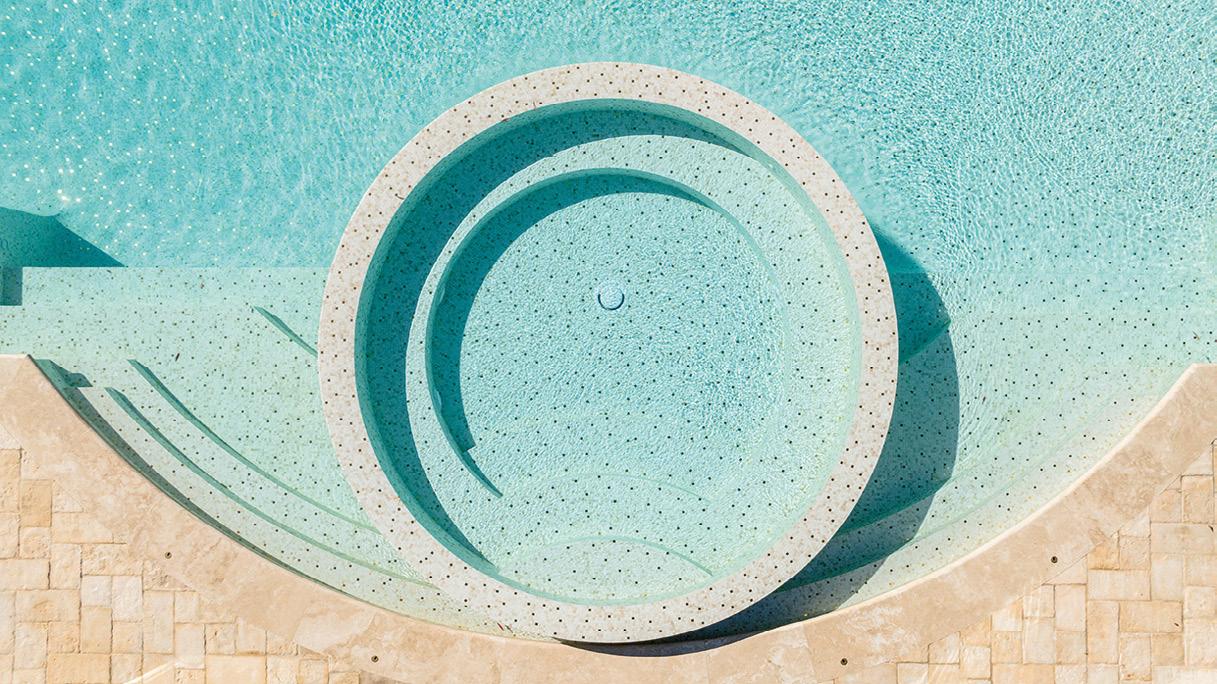
“Ezarri has earned its reputation globally because of its advanced manufacturing and the way it translates into robust performance in Australian conditions,” he says.
“The Australian Designer Collection, curated with local architects and pool builders in mind, reflects the specific climate, light and construction challenges found here.”
Failures in low-quality mosaics, Yench notes, are often tied to both raw materials and mounting systems. Contaminated recycled glass can lead to costly issues, while polyurethanebacked sheets may restrict adhesive contact, leading to detachment or yellowing over time.
“We have seen materials contaminated with metal causing rust, which is a serious problem and extremely expensive to resolve,” he explains.

“During shipping, high temperatures can soften the polyurethane, compromising mosaic placement and causing crooked tiles.”
“I have also seen other mosaics with contaminants which don’t allow the mosaics to maintain integrity. This causes the glass to be easily chipped or broken, and difficult to cut cleanly.”
To meet Australian Standard 3958:2023, some manufacturers have reduced the footprint of polyurethane on mosaic sheets. Yench says this creates new challenges for tilers that can affect both aesthetics and longevity.
“During shipping, high temperatures can soften the polyurethane, compromising mosaic placement and causing crooked tiles,” he explains. “Fixing these issues is timeconsuming, often extending installation and adding costs.”
Australia’s hot climate can soften these systems again on site.
“Installing a softened polyurethane-backed mosaic is difficult because the sheet stretches when picked up, misaligning tiles and increasing grout joint spacing,” he says.
UV exposure also affects fully or semi-translucent mosaics, causing the polyurethane to yellow and become brittle, which can reduce adhesion and lead to delamination. He says these issues usually occur in exposed areas such as overflows and balance tanks.
By contrast, he says Ezarri’s JointPoint system eliminates these problems. Each mosaic piece is joined by four inert points, removing the need for mesh, paper or polyurethane backings.
“JointPoint leaves up to 92 per cent of each mosaic and 95 per cent of the sheet available for direct adhesive contact, exceeding Australian standards and preventing one of the most common causes of failure – tile detachment,” he explains.
The flexible, pre-mounted sheets also simplify installation on curves and architectural features, reducing stress for tilers and ensuring consistent results.
Colour trends have shifted as well, moving beyond the traditional blues and aquas once standard in swimming pools.
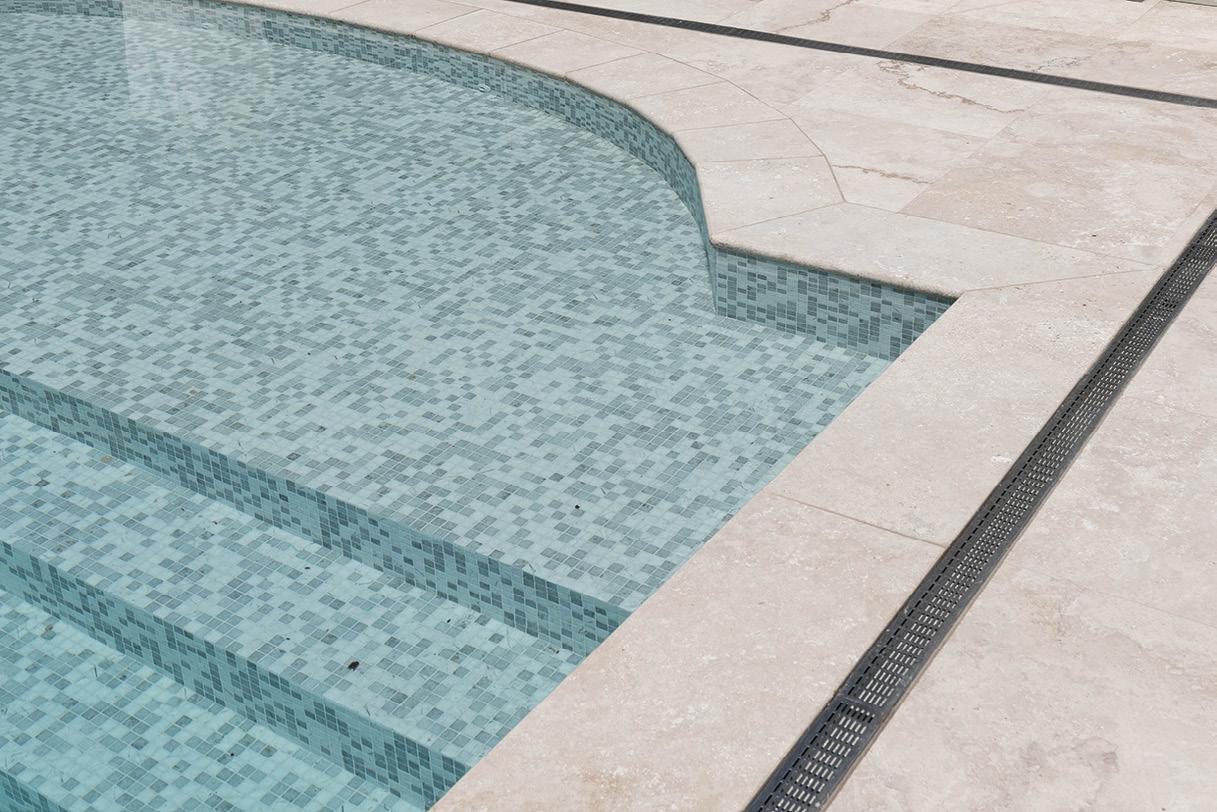
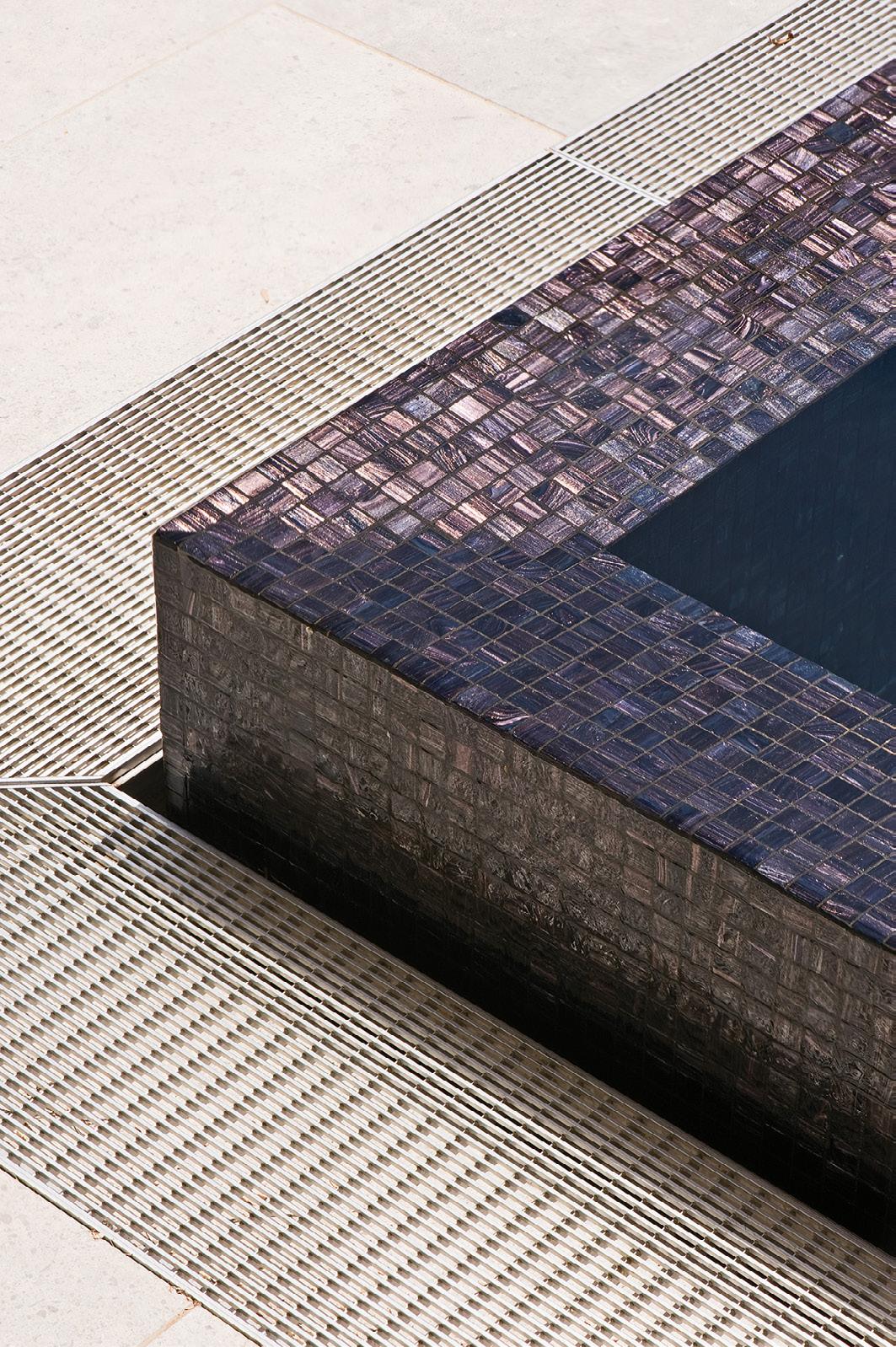
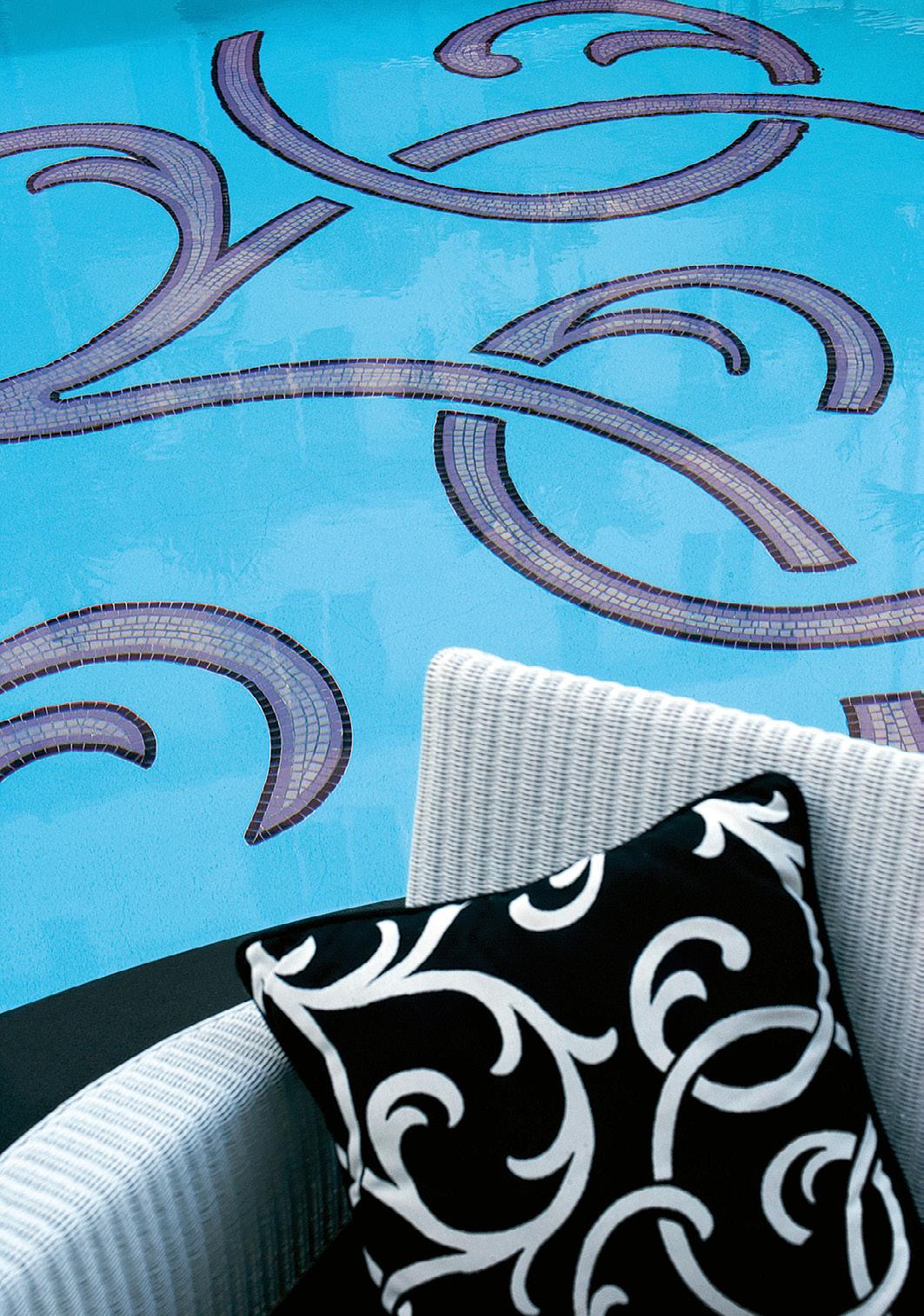
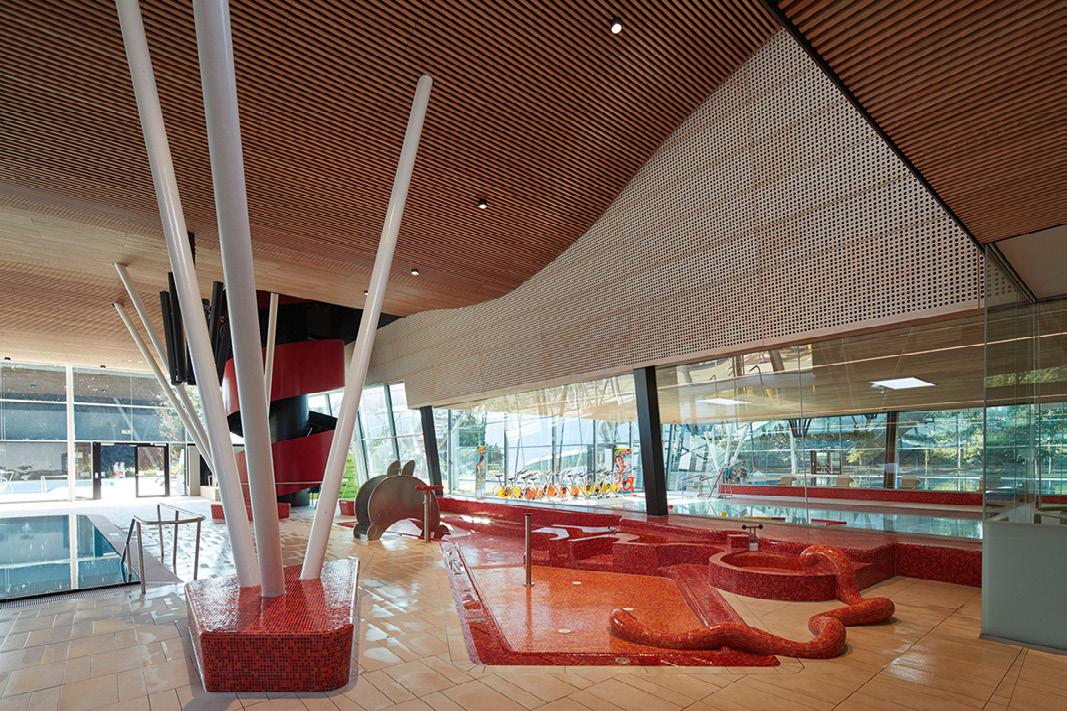
Today, designers and clients are favouring softer, muted tones, natural textures and subtle gradients that interact with sunlight, water movement and surrounding architecture. Lighter shades, pearlescent finishes and organic palettes inspired by stone, sand and mineral tones are increasingly popular, while metallic and iridescent mosaics add depth and dynamic reflections, particularly in wellness-focused or luxury residential projects.
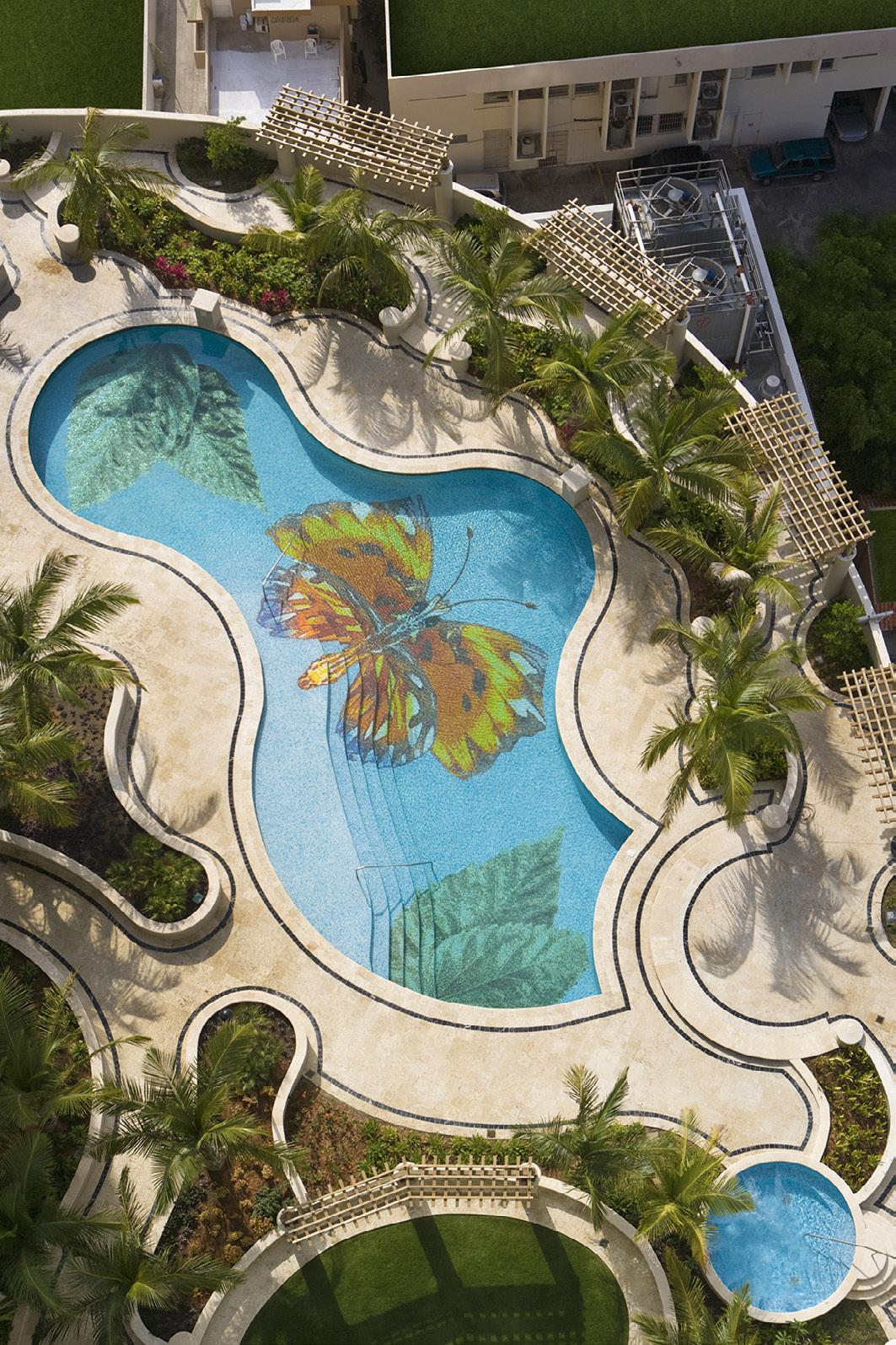

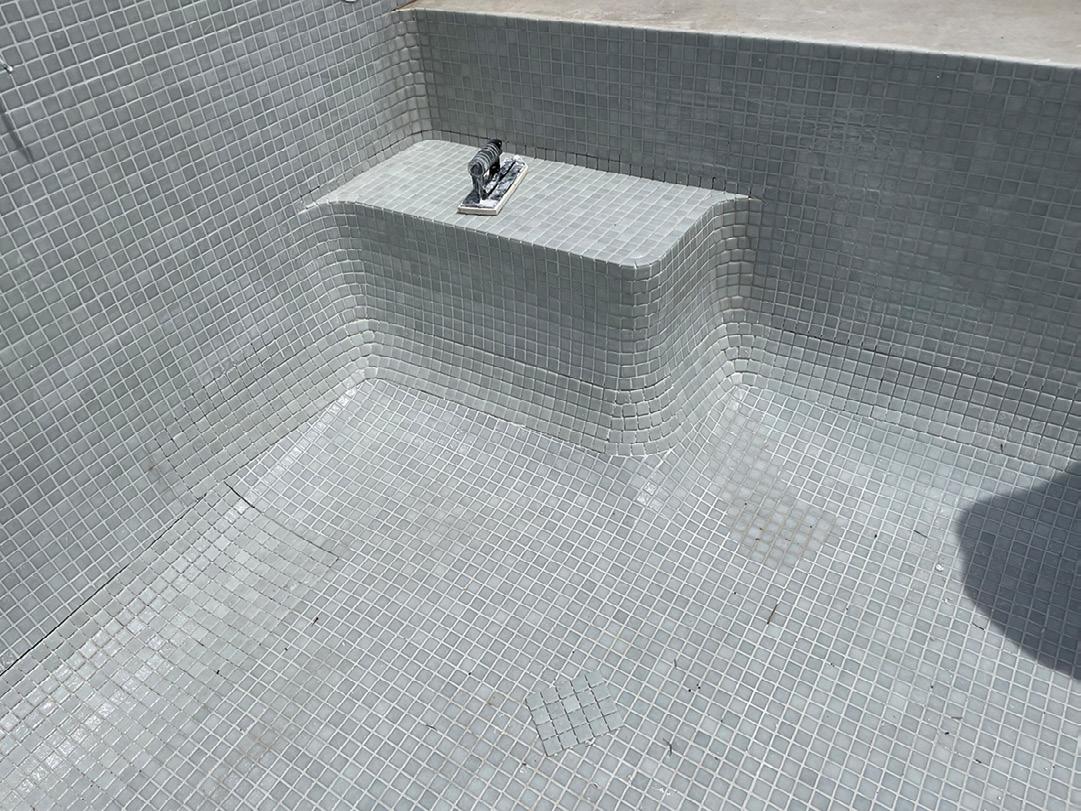
“Australian projects now embrace lighter, muted tones and organic textures that complement surrounding architecture and landscaping,” he says.
“We focus on creating collections that are visually subtle but technically robust, with tiles that meet safety and performance requirements while achieving the desired design impact.”
He also notes that in recent years there has been a growing demand for anti-slip solutions that do not compromise visual appeal.
“Ezarri’s Safe Step finishes, now integrated into design-led collections such as Zen, allow designers to specify matte, tactile surfaces that meet safety requirements while maintaining a refined, contemporary aesthetic, he says.
“We have also worked closely with Ezarri to create a commercial Safe Steps collection specifically for Australian public spaces which guarantees a P5 rating, meeting the strict regulatory requirements of the building codes.”
Bondi Trading managing director Kevin O’Neill highlights the global forces shaping local pool tiling trends.
“Europe sets the bar for architectural clarity, the Middle East pushes technical limits, and the USA drives lifestyle-led, expressive palettes,” he explains.
“In Australia, tropical and coastal aesthetics inspire vibrant, water-centric mosaics that harmonise indoor and outdoor spaces. Gradient effects, metallic finishes, and iridescent glass create movement and depth in the water, while large modular mosaics and pre-mounted sheets streamline installation.”
O’Neill points to new technologies improving both performance and design.
“Epoxy grouts, heat-reflective glass, and smart lighting integration are changing the way designers think about mosaics,” he says.
“Tiles aren’t just decorative – they’re interactive elements that enhance the pool experience.”
Specifiers for luxury resorts, residential plunge pools and commercial wellness spaces are increasingly using these innovations to deliver visually dynamic and long-lasting results.
The technological advances in tiling are not limited to largescale or commercial projects.
In the residential pool sector, artisans like Mauricio Aybar and Andrea Castiglione are translating innovation into highquality, customised mosaics that combine durability with visual
“Delamination
typically occurs when substrates aren’t properly prepared or incorrect adhesives are used.”
impact. Founded on European design heritage and decades of artistic expertise, Maurimosaic brings a creative, hands-on approach to the Gold Coast building industry.
“As Spanish immigrants who arrived in Australia in 2014, we quickly found our place in the local market and fell in love with sharing our mosaic expertise,” Aybar explains.
“We wanted to solve a common problem in the industry: delivering unique, high-quality designs without long lead times or excessive costs for shape, colour or quantity.”
By combining traditional craftsmanship with a deep understanding of modern pool technologies and materials, the duo ensures each installation enhances the overall aesthetic while performing reliably in Australia’s demanding outdoor conditions.
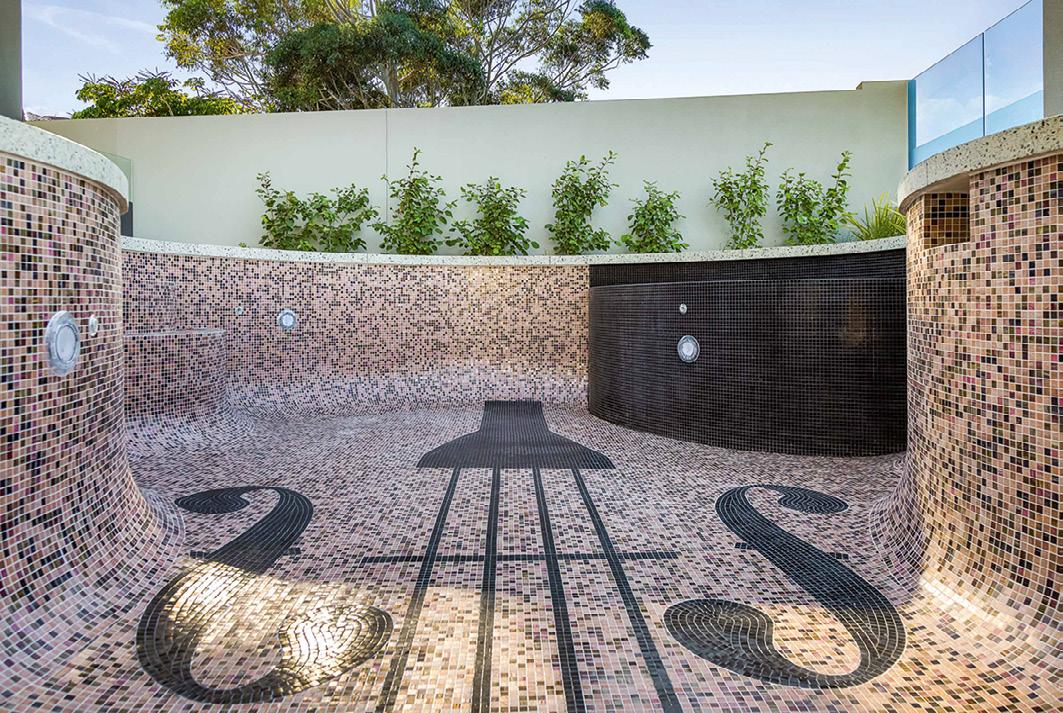
“I’ve seen a clear shift away from pixelated mosaics towards custom designs and true artworks. Clients are no longer looking for repetitive patterns: they want pieces with movement, emotion and identity,” Castiglione says.
“Waterjet-cut mosaics allow me to work with flowing lines and subtle colour transitions, which gives the work a much more organic and refined feel.”
Technical execution, she adds, is just as critical as creative intent.
“Delamination typically occurs when substrates aren’t properly prepared or incorrect adhesives are used. Low-quality
“A pool is a living structure. It moves, it’s exposed to chemicals, and it is constantly under pressure.”
grout can stain, crack and compromise the entire mosaic,” Castiglione explains.
placement, and adequate curing are essential to long-term performance.
absorption can weaken adhesive bonds over time, whereas glass mosaics provide low porosity and superior colour stability, making them a preferred choice for premium residential installations,” she adds.

Material choice, however, extends beyond the tiles themselves. Even the highest-quality mosaics rely on compatible fixing systems to perform as intended in submerged environments, with grout selection playing a critical role in long-term durability and overall system integrity.
“Low-quality grout doesn’t just affect the appearance – it compromises the integrity of the entire piece,” she says.
“It can stain, crack and allow water penetration, which eventually leads to long-term damage. For pool applications, grout must be strong, flexible and chemical-resistant. This is why we recommend using epoxy grout, as it offers superior durability, performance and protection for both the design and the structure.”
As Maurimosaic’s in-house art project manager, Castiglione views residential pools as complex compositions rather than static surfaces, where design decisions must account for constant movement, chemical exposure and environmental pressure. For her, successful mosaic work relies on a strong understanding of how materials behave over time in these conditions.
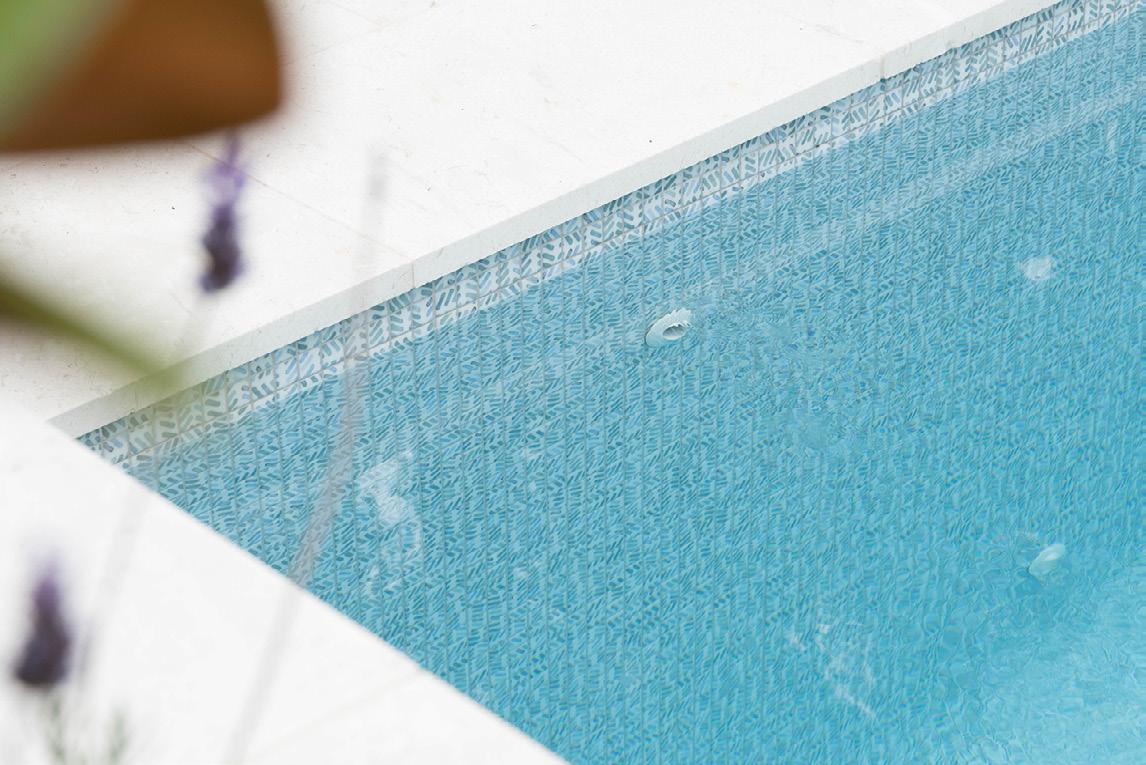
“A pool is a living structure,” she explains. “It moves, it’s exposed to chemicals, and it is constantly under pressure. Designers and builders need to understand substrates, waterproofing, movement and material compatibility.
“When those elements are respected, the artwork and the structure can truly work together.”
25 years of proven field history, proudly manufactured in Australia, and exported all over the world.
High Performance Surface Coating
Market leading cosmetic finishes with exceptional durability
High Quality Pigments Vibrant and long-lasting colours
Outstanding UV Protection Aquaguard® X protection for extreme environments.
Excellent Chemical Resistance Extensively tested for fade resistance to maximise the lifespan. 1800

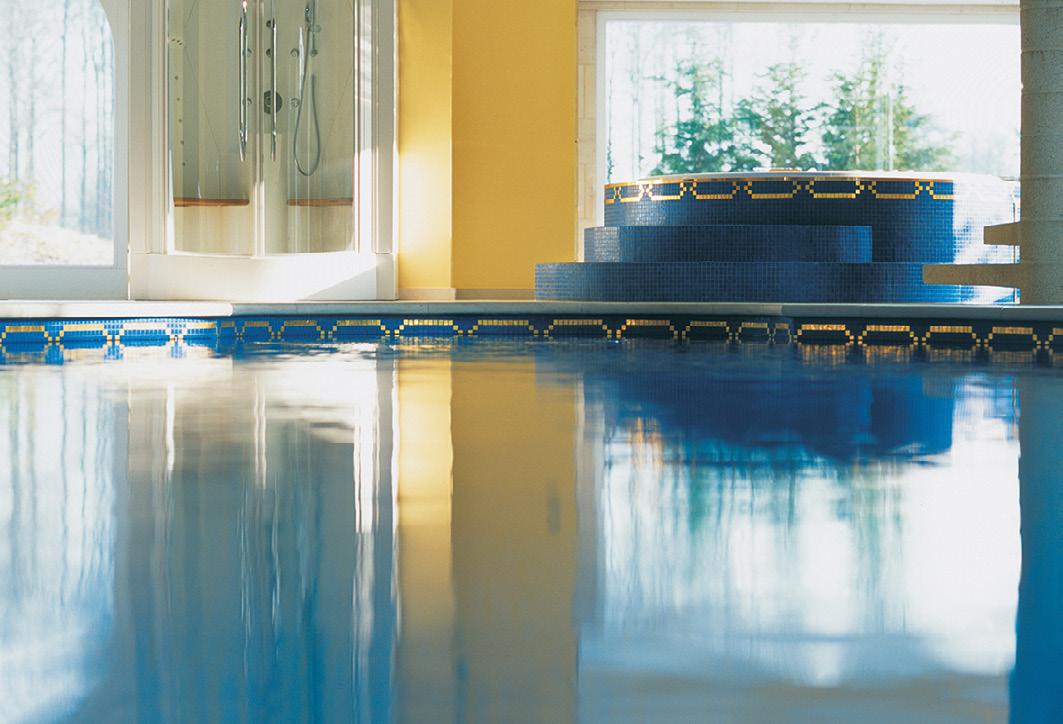
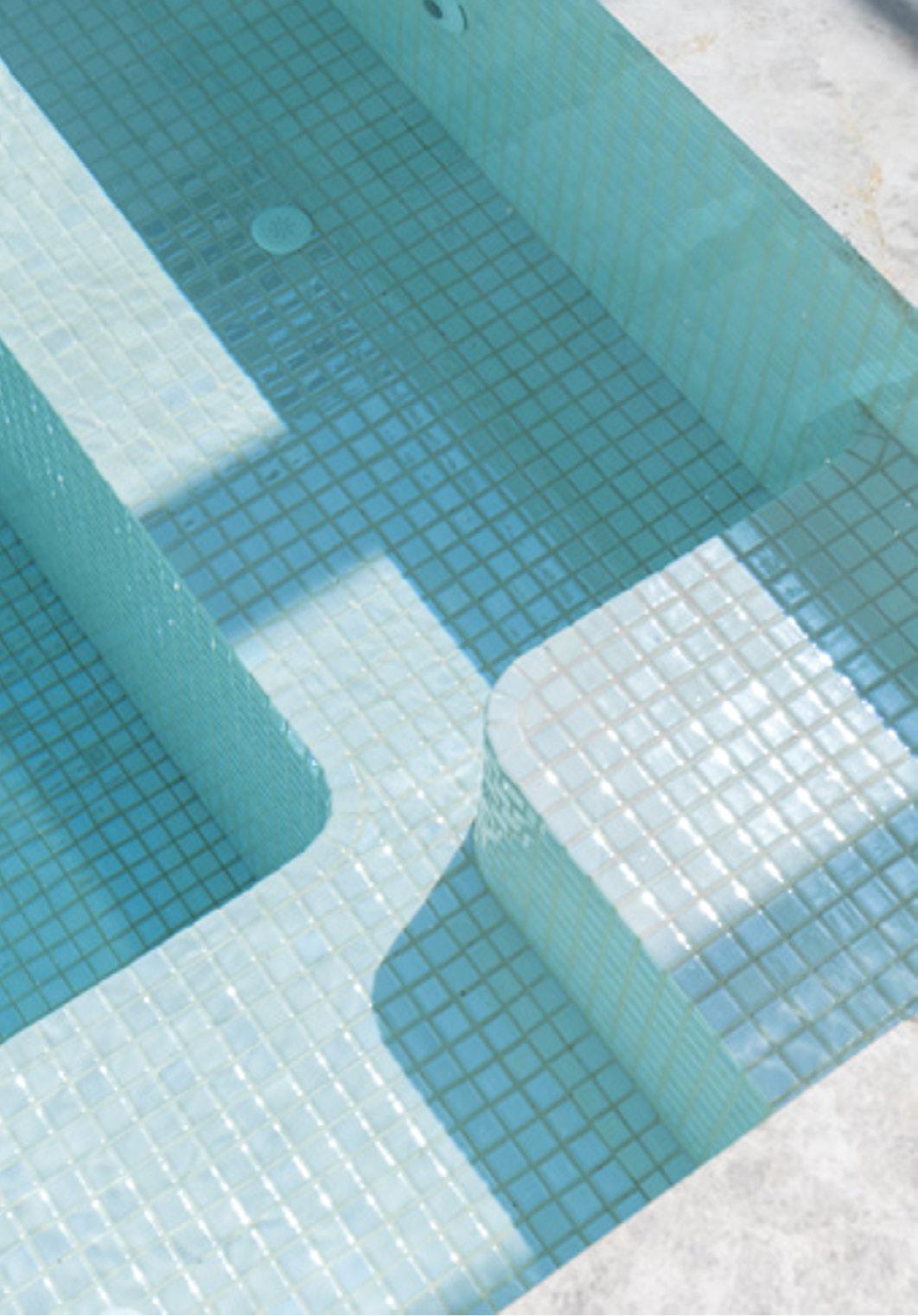
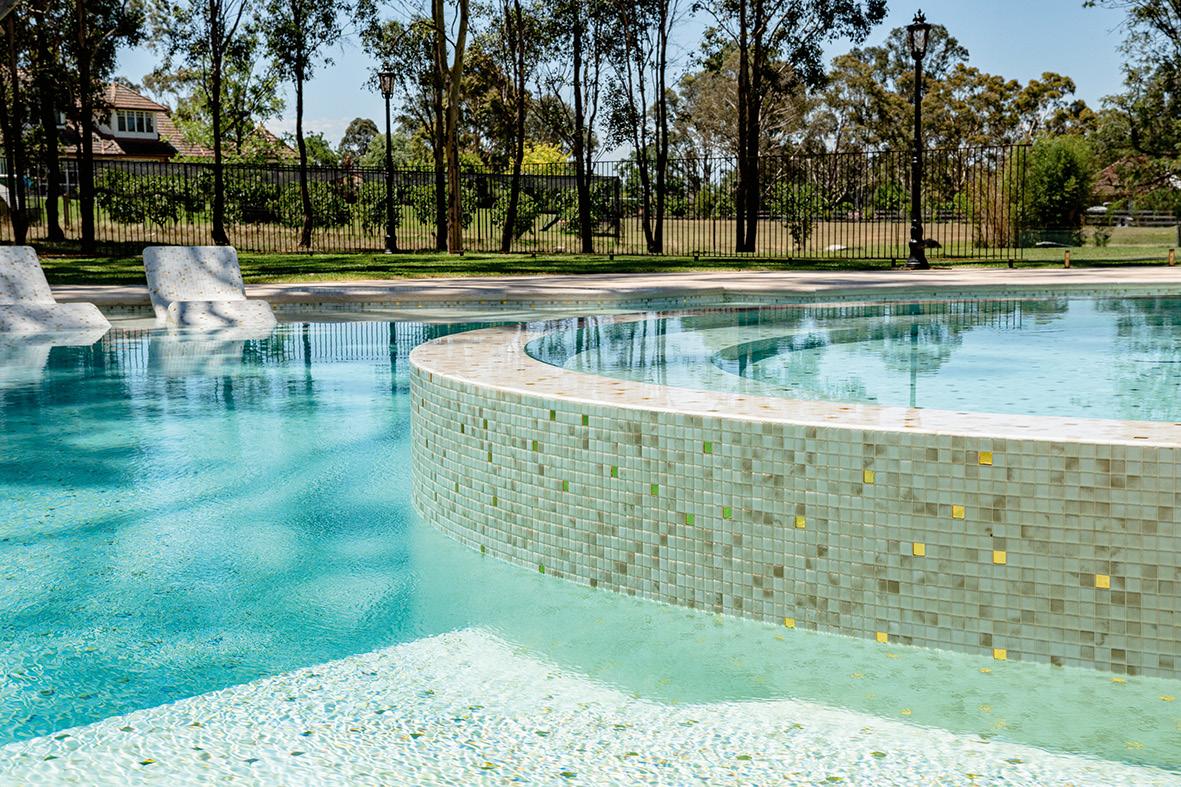
Correct preparation, material selection and curing remain critical to the long-term performance of tiled swimming pools and spas, particularly in fully submerged environments.
While there is no specific certification for pool tilers in Australia, the updated AS 3958:2023 provides clear guidance for tiling in wet conditions through Appendix E, which addresses submerged and continuously wet applications.
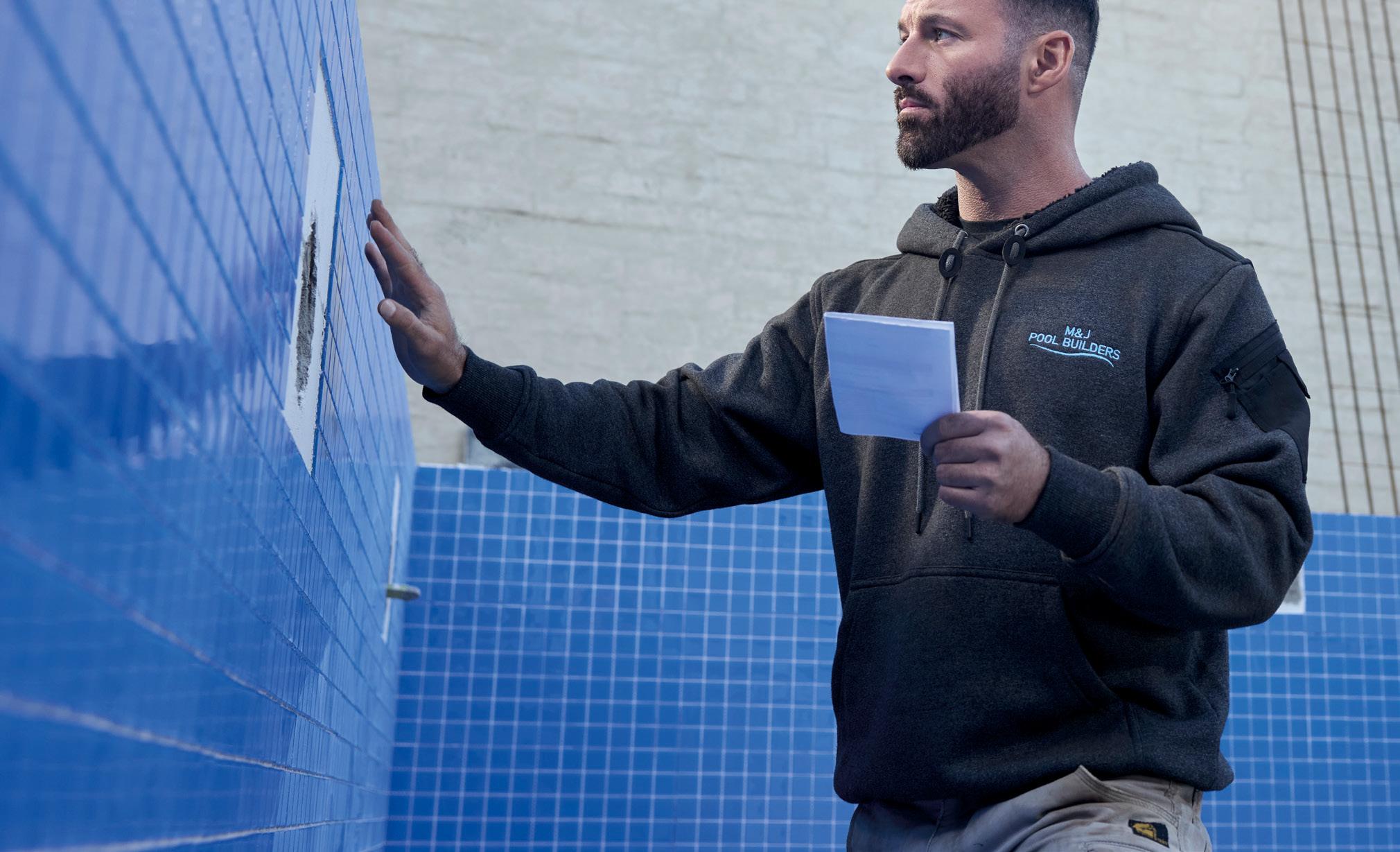
According to Tectonic Pools director Zac Dejanovic, achieving a durable tiled finish starts with proper preparation of the pool shell itself.
“The surface of the concrete or Gunite pool shell that is going to receive rendering, screed, tiling or mosaic needs to be prepared in a way that ensures maximum bond,” he says.
“AS 3958:2023 describes the appropriate preparation methods for walls and floors in Clauses 4.3 and 4.5, and these steps should never be skipped.”
Before any finishes are applied, the structural integrity of the pool shell must also be confirmed.
“The shell should be tested for watertightness prior to rendering or tiling,” Dejanovic says. “If there is an issue at that stage, tiling will not resolve it and can make future rectification far more difficult.”
Rendering of pool substrates is another area where experience and technique are critical.
Dejanovic describes it as a highly specialised process that differs significantly from standard tiling work.
“Rendering pools is a skilled trade that requires specific mix designs and bonding agents to ensure the render properly bonds to the pool’s concrete surface,” he says.
“Poor workmanship at this stage is a common contributor to tile failure in submerged applications.”
While waterproofing is commonly specified in other wet areas, pools are treated differently under Australian Standards.
“Waterproofing of pools is not required by AS 3958:2023,” Dejanovic explains. “That said, it can be specified by the architect, client or pool builder as an additional measure, often to help reduce the risk of efflorescence.”
Material selection also plays a significant role in long-term performance. Unlike in Europe, there is currently no formal classification system in Australia that grades pool tiles by quality or suitability for submerged use, which means not all tiles perform the same once installed.
“Not all tiles are created equal. How they flex, adhere and withstand water matters more than colour alone. Tile rigidity is critical. Pool tiles need to be structurally stable, so they don’t flex or distort once fully immersed.”
Dejanovic also recommends turning the tile over rather than judging it from the face alone.
“I always look at the back of the tile to see how much surface area there is for the adhesive to bond to,” he explains. “Ideally, you want a minimum of 90 per cent glue coverage.”
Other indicators of tile quality include consistent thickness across sheets, which helps maintain even adhesive beds and alignment, and uniform spacing between mosaics to allow proper grout penetration and curing.
“Poorly manufactured tiles can also vary in density and porosity, which can affect adhesion, water absorption and longterm durability,” he adds.
“They must also comply with Australian Standards for submerged conditions if the full product warranty is to apply. Adhesives and grouts must be selected with equal care. Adhesives should comply with AS4992.1, specifically Types C2S1 or R1, and they must be suitable for continuous immersion.”
Once installation is complete, adequate curing time is essential before the pool is commissioned.
“Adhesives should comply with AS4992.1, specifically Types C2S1 or R1, and they must be suitable for continuous immersion.”
“The completed pool needs to be left to dry and cure in line with the requirements of AS 3958:2023, including Clause E2.1(d),” Dejanovic says. “Filling the pool too early can compromise adhesion and overall system performance.”
Although pool and spa tiling does not carry a dedicated certification pathway, AS 3958:2023 provides a clear and practical framework for tiling in wet and submerged environments.
When followed correctly, it helps ensure tiled pools deliver



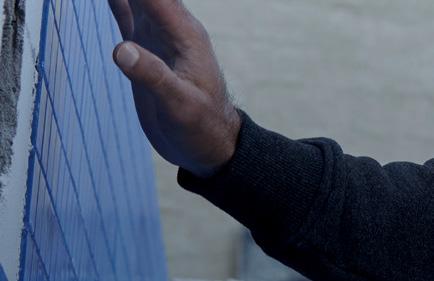
Bondi Trading managing director Kevin O’Neill highlights how regional trends are influencing pool tiling in Australia. Each region brings its own strengths, inspiring local designers and builders to blend performance, aesthetics and innovation in residential and commercial projects.
Global Influencers:
Europe (Italy): Leads in architectural sophistication and artisanal precision, often setting colour direction and refinement standards.
Middle East: High-end resort and luxury residential projects push technical limits with large-scale, glossy and luminous mosaics.
Australia and Southeast Asia: Tropical and coastal aesthetics create vibrant, water-centric palettes and seamless indoor–outdoor transitions.
USA (California, Florida): Lifestyle-driven design accelerates trends with playful, bold colours while combining highperformance materials.











the durability, appearance and service life expected by builders, installers and clients.
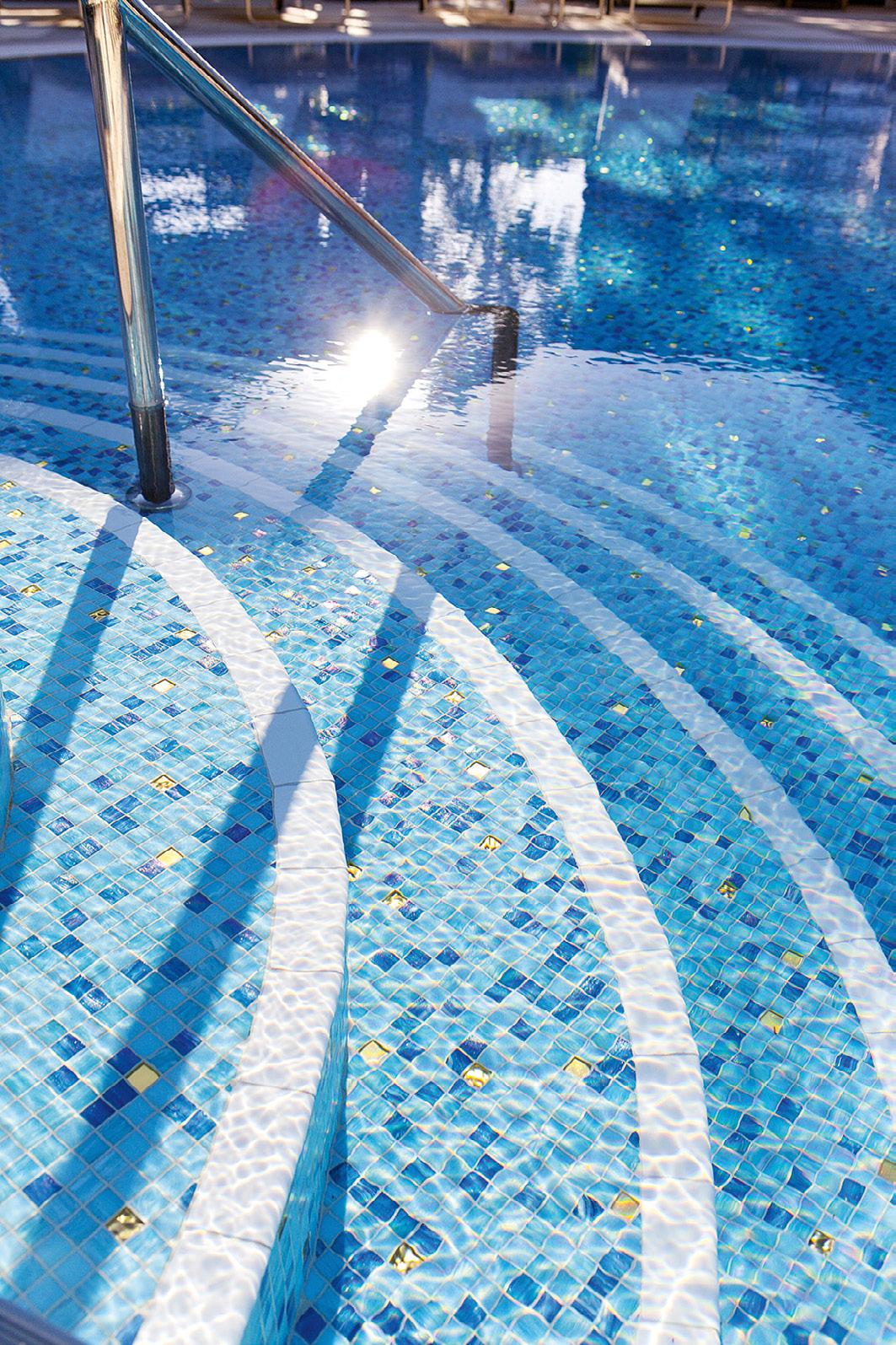
Across the industry, a common message emerges: choosing the right mosaic is a long-term investment. High-performance glass mosaics, carefully selected and installed with compatible adhesives and grouts, can last the lifetime of the pool.
Today’s Australian market demands a balance of aesthetics, safety and durability, with designers and tilers working closely from the earliest stages to integrate pool surfaces seamlessly into the broader architectural vision.
From colour trends to technical innovation, pool tiling has matured into a sophisticated discipline.
For homeowners, designers and builders alike, success comes from combining technical excellence with creative vision, ensuring pools remain both visually stunning and structurally sound for generations. n
www.bonditrading.com
www.europeimports.com.au
www.maurimosaic.com
www.tectonicpools.com.au
www.transformpools.com.au
Carl Yench from Europe Imports stresses the importance of tile suppliers getting involved early in the process.
“We always try our best to be involved at the early stage to understand the entire project, but unfortunately it’s not always possible.
“One project that comes to mind was a large pool in an open area with an east-west aspect. The pool was exposed to the sunlight all day and the client chose a highly reflective white mosaic which when used in the right settings looks amazing,” he says.
“Unfortunately for the owner, the designer didn’t consider that the reflection at certain times of the day would cause the sun to reflect directly into the house causing an almost blinding effect.
“This is why we like getting involved at the early stages. Although the pool looked stunning, our professional design advice and experience could have been utilised to select a tile that would have given the same beautiful design but without the heavy reflection.”


By Ben Makepeace
SPASA policy manager Ben Makepeace updates us on the results of the association’s advocacy as well as regulatory issues relevant to the industry.
Shortly before the end of 2025, South Australia’s Department of Housing and Urban Development advised that the Assessment Improvements Code Amendment had been finalised and adopted by the Minister for Planning.
This Amendment proposed several technical changes to South Australia’s Planning and Design Code (PDC), which contains the planning policies and rules for the state.
SPASA has been actively involved in the stakeholder and community consultation process which occurred on the draft Code Amendment from December 12, 2024 to March 11, 2025.
The Code Amendment focused on the following areas:
• Part 1 – Rules of Interpretation
• Part 2 – Zones and Sub Zones
• Part 3 – Overlays
• Part 4 – General Development Policies
• Part 7 – Land Use Definitions
• Part 8 – Administrative Terms and Definitions
• Part 9 – Referrals
Of particular note for SPASA members, was the proposal at 4.2.6 Swimming Pool Pumps – Acoustic Enclosure Policy of the consultation document.
As a result of the feedback received, several adjustments were recommended to the Code Amendment across a range of areas.
SPASA’s position has been that electric water heaters should be clearly exempted from potentially damaging acoustic enclosure requirements and be treated the same as air-conditioners and domestic hot water heaters, which are not subjected to the same locational or noise restrictions as pool water pumps.
In engaging with SA Government throughout 2025, SPASA’s goal has been to update the relevant wording in the PDC which relates to pool pumps, water heaters, and air handling units, to provide greater clarity and reflect the intention of the direction. This will in-turn provide councils with clearer instructions and lead to consistency throughout the state.
Part 8 – Administrative Terms and Definitions has been amended to clarify the definition of pumps and/or filtration systems which are associated with a swimming pool or spa.
The new definition of pumps and/or filtration systems says: “In relation to swimming pools or spas, does not include a heat pump.”
This change will alleviate the issues many builders have been having with SA councils requiring heat pumps to comply with the distance and acoustic requirements intended for swimming pool pumps. The inconsistent and incorrect interpretation has caused many builders and their clients to deal with delays and increased costs.
The Accepted Development Classification Criteria, found in Part 2, Table 1 has been amended to refer specifically to an acoustic structure as follows:
Location of pumps and/or filtrations systems from a dwelling on an adjoining allotment:
a) not less that 5m where the filtration system is located inside a solid acoustic structure; or
b) not less than 12m in any other case.
Additionally, in Section 4 – Interface between Land Uses, the definition has been amended to improve clarity as follows:
DTS/DPF 4.3
Pumps and or filtrations systems associated with a swimming pool or spa that is ancillary to a dwelling erected on the same site are:
a) enclosed in a solid acoustic structure at least 5m from the nearest habitable room located on an adjoining allotment; or
b) located at least 12m from the nearest habitable room located on an adjoining allotment.
You can read the full amendment on the PlanSA website. The relevant amendments are listed under 4.2.6 - Swimming Pool Pumps – Acoustic Enclosure Policy.
SPASA is engaging with councils across the state and is able to provide advice and broader context in addressing any issues. If you have a situation with council, SPASA recommends that you arrange a phone call, or ideally a short face-to-face meeting to discuss the situation.
Email can be used to provide documentation and reports; however, a conversation goes a long way to resolving misunderstandings which come from lengthy email threads.
If you continue to have an issue with a council, and would like some support, please contact SPASA via members@spasa. com.au or 1300 021 482. If you’re not a SPASA member, you can join today.
Late last year, the New Zealand Government released a list of determinations on the Building Performance website. Their determination for 2025/057: Compliance of part of a pool barrier on a property boundary with Building Code Clause F9 is relevant for the swimming pool and spa industry.
This determination considers whether part of a proposed pool barrier on a property boundary complies with Building Code Clause F9 – Means of restricting access to residential pools. The barrier consists of a 1.2m high timber fence on top of an existing retaining wall.
The matter to be determined, under section 117(1)(a), is whether part of a proposed pool barrier along the property boundary complies with Building Code Clause F9 – Means of restricting access to residential pools.
It was determined in accordance with section 188 of the Building Act 2004, that the part of the proposed pool barrier, consisting of the timber fence on top of the retaining wall, complies with clause F9.
Members are encouraged to read the determination in full at: www.building.govt.nz n

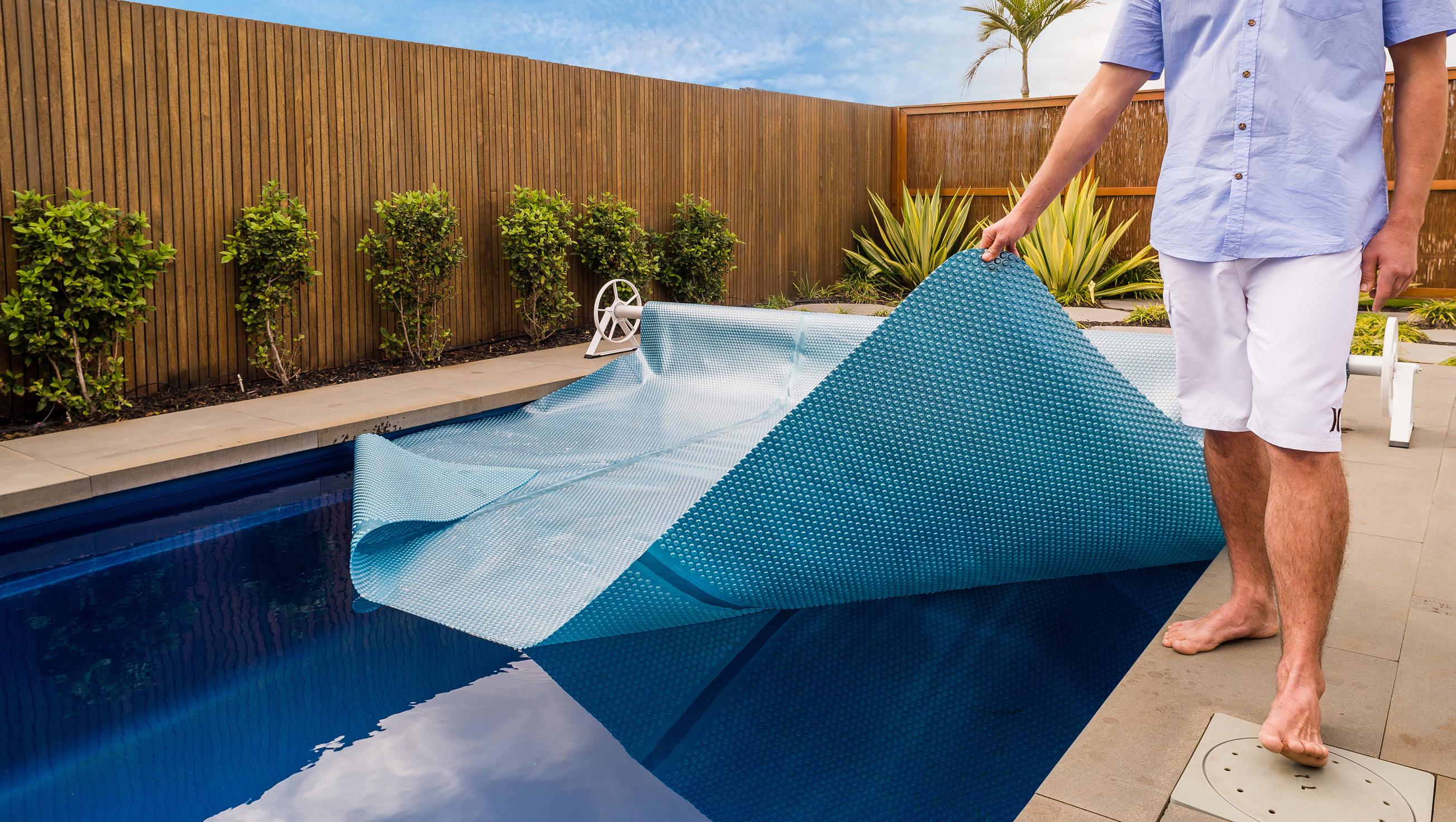
Save money.
Higher quality. Better design. Lasts longer.
Reduces evaporation by 99%.
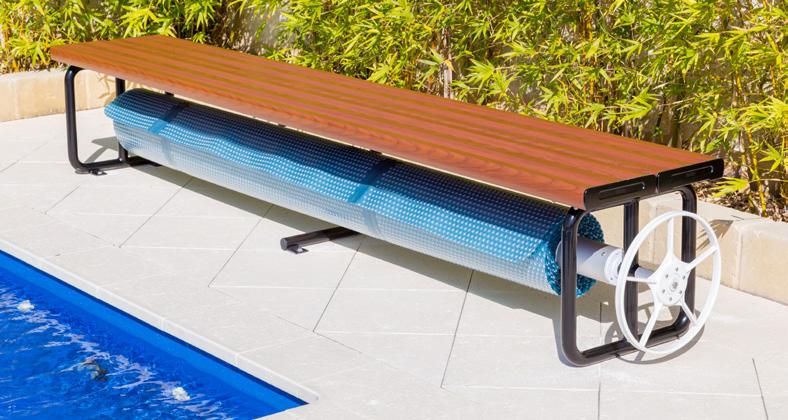
Warms your pool by up to 8˚C for free.
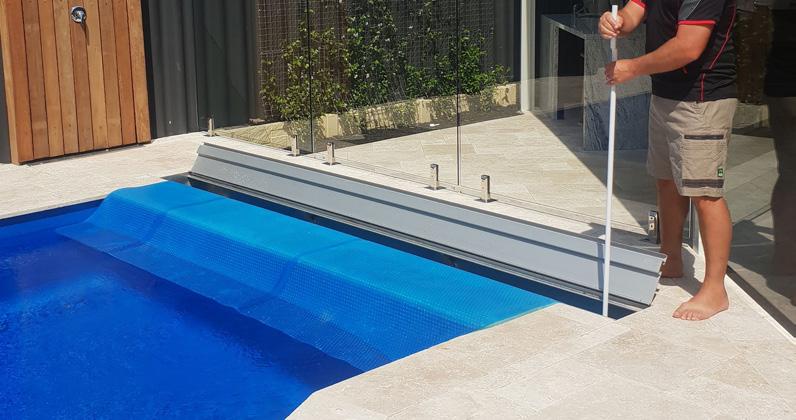
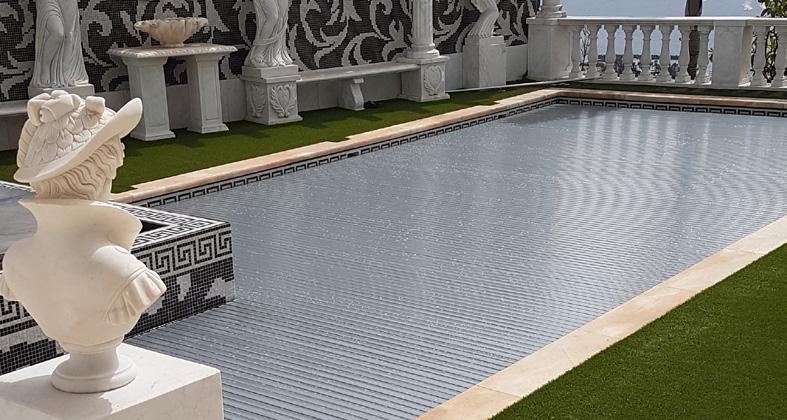
Daisy Pool Covers™ has been Australia’s favourite brand for pool covers and rollers since 1983.
Daisy Pool Covers™ provides the largest and best range of pool cover and roller designs in Australia, manufactured using the highest quality materials, specially formulated to protect swimming pools all year round.
The experienced team at Daisy Pool Covers™ can provide cover and roller solutions for any pool type or shape.
Reduce the cost of maintaining a warm, sustainable swimming pool with the original and best Daisy Pool Covers™.
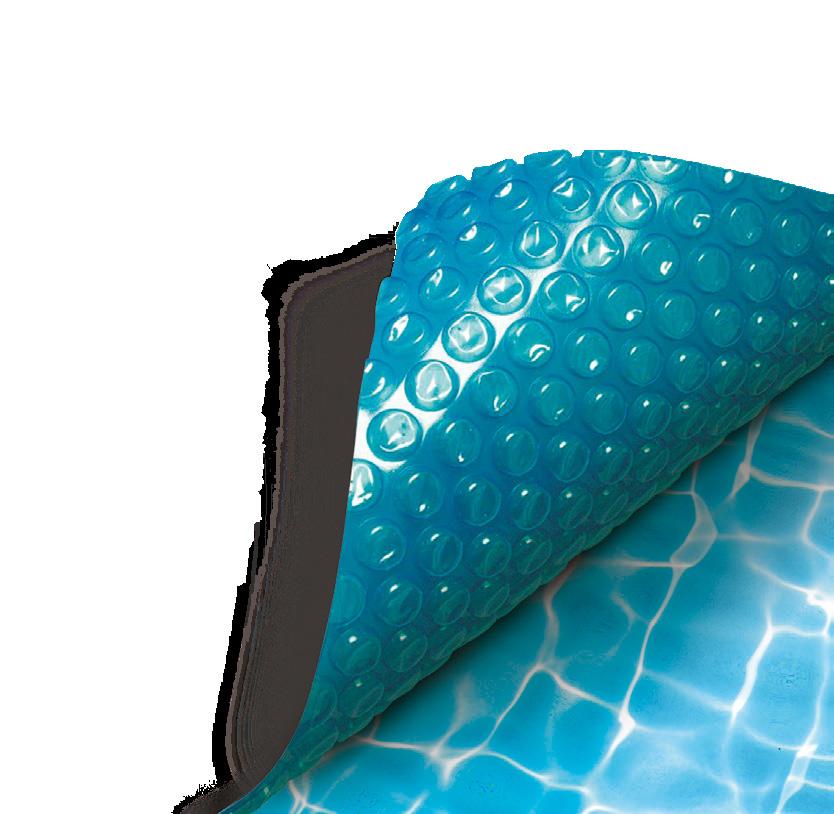

he plunge pool market is developing strongly based in part on the reduced size of residential blocks, and this option is enabling pool builders to have an extra string to their bow when faced with tight budgets and small sites.
Tank Pools is a new, trade-only pool initiative from the team behind Outback Plunge Pools, featuring a round corrugated water tank-style pool developed specifically to support pool builders.
General manager Beau Rixon says Outback Plunge Pools designed the Tank Pools as a builder-first solution to give trade partners another way to retain customers and keep teams moving, particularly in situations where a conventional pool isn’t practical.
“The concept centres on flexibility: a highly adaptable ‘filler pool’ that solves common site, access, and timing challenges while still delivering a strong visual outcome,” he says.
Tank Pools are designed for pool builders, builders and landscapers who want to avoid losing customers when standard pool options won’t work, by offering a practical alternative without compromising margins. It also enables the builder to maintain high levels of customer service on challenging builds.
“While Tank Pools naturally suit clients seeking a rustic or outback aesthetic, its versatility makes it suitable for a wide range of problem-solving scenarios,” he says, detailing the way it fulfills a “filler” role.
These include being a:
• Time filler: Tank Pools can be finished off in as little as four hours, making them ideal when projects are under time pressure or other projects have stalled.
• Space filler: A smart solution for tight or constrained sites where alternative pool styles are not feasible due to footprint or clearance limitations.
“A ‘filler pool’ solves common
site, access and timing challenges while still delivering a strong visual
outcome.”
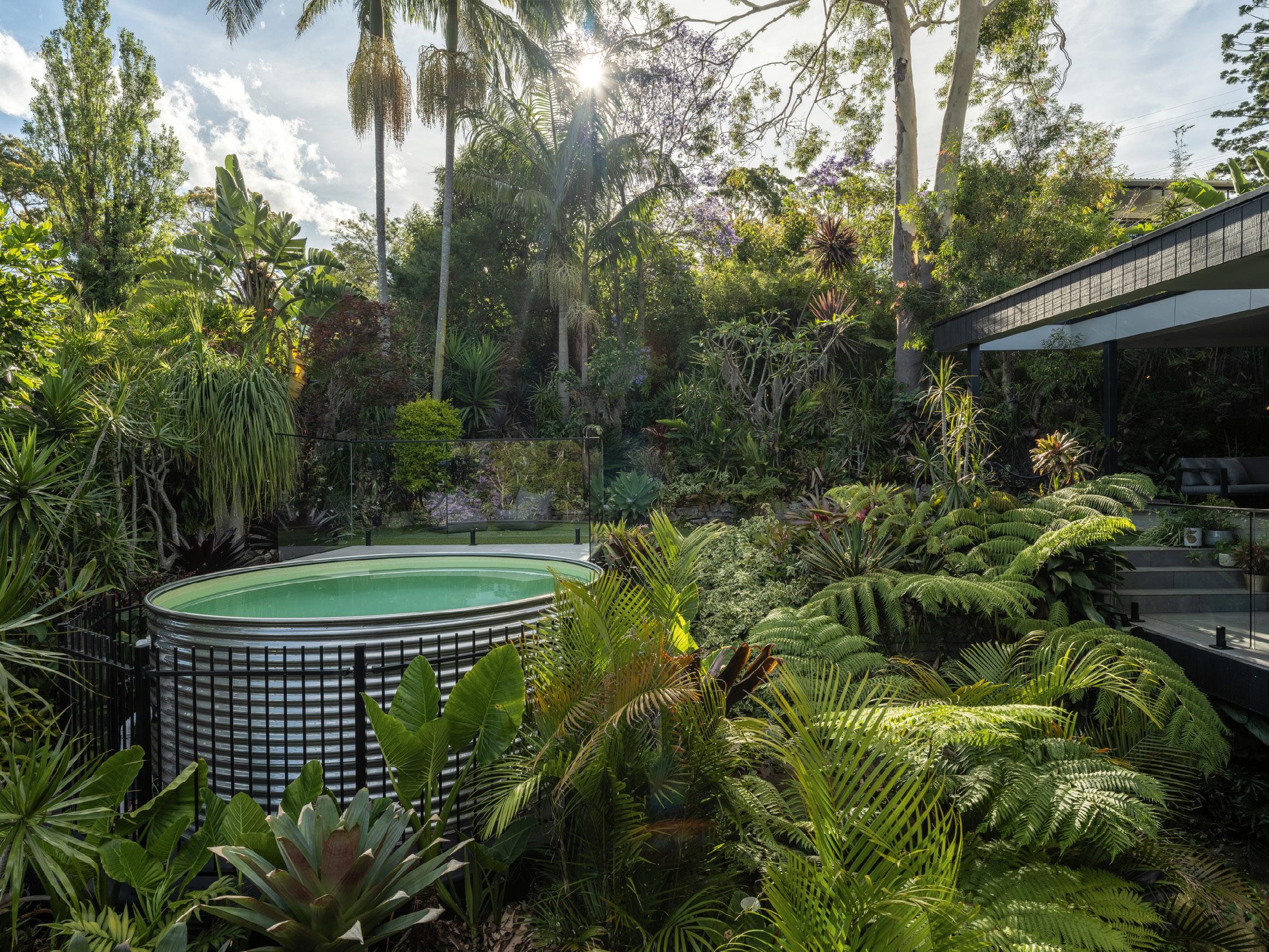
• Wet weather filler: Tank Pools can be installed during unpredictable weather or under a marquee, allowing teams to keep moving when other installations could be delayed.
• Access filler: Ideal for sites where restricted access makes the delivery or installation of fibreglass shells or larger pool solutions impractical or cost-prohibitive.
• Site filler: Well-suited to sloping blocks or difficult terrain, where traditional pool installations could be complex or uneconomical.
Rixon says this all gives the builder another opportunity to offer a solution.
“Instead of losing a customer due to site constraints, access issues or time pressures, builders can present a flexible, visually appealing alternative that still delivers a premium experience,” he says.
Tank Pools are available in three diameters: 3.3m, 2.9m and 2.5m; and two depths: 1.22m and 1.52m.
“This range allows builders to match the pool size and depth to both the site and customer expectations,” he says.
They come in a variety of Colorbond styles including Classic Stainless Steel, Night Sky, Monument and Surf Mist, and can be installed in-ground or aboveground, providing builders with additional flexibility across different site conditions, build types and design requirements.
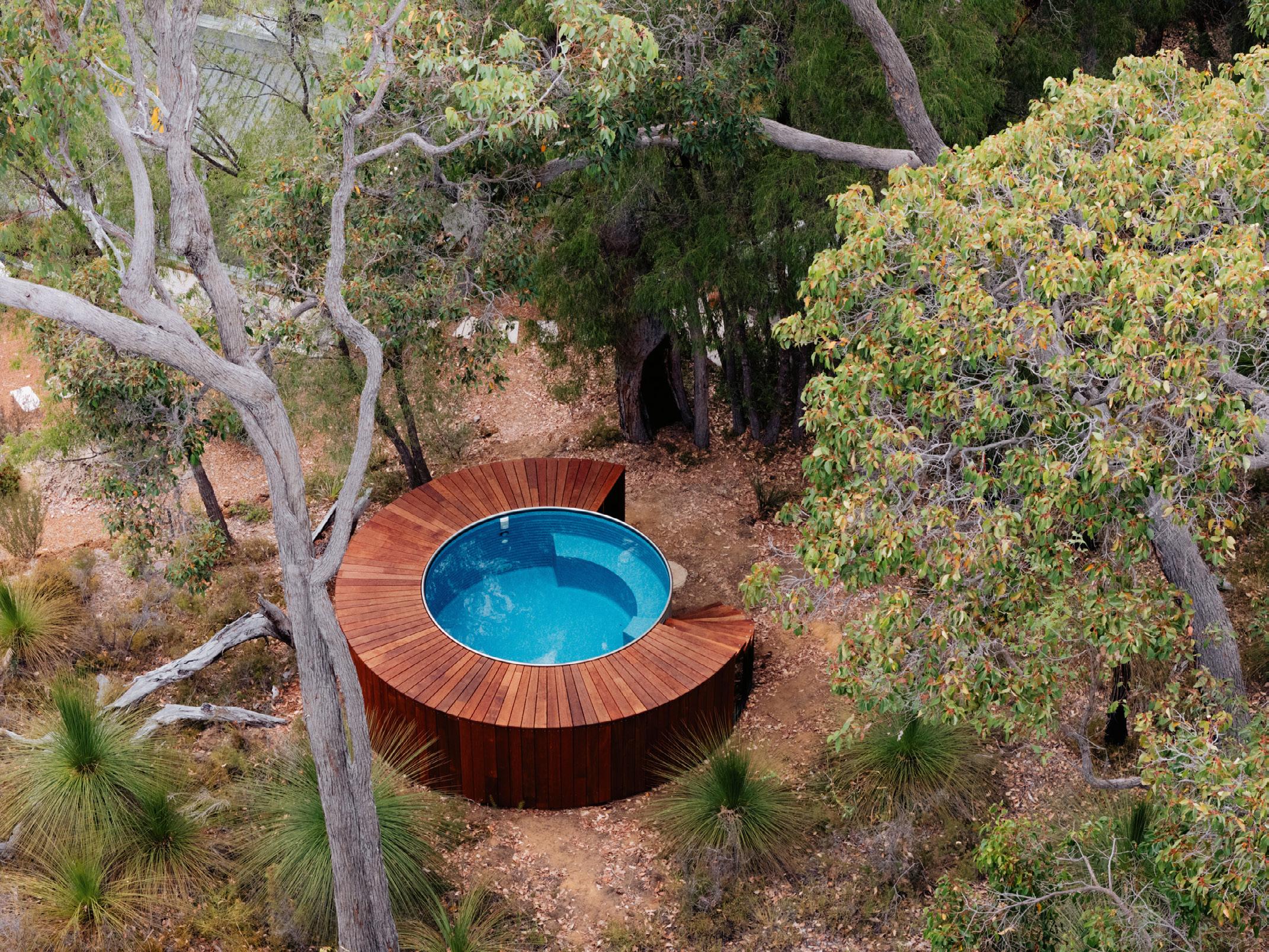
Customers can choose from three commercial grade Aqualux internal pool finishes, allowing the water colour and overall look of the pool to be tailored to the home, landscape or design brief. These are Maui, Dark Blue and Light Blue.
“Tank Pools can be manufactured and delivered to site within as little as four to six weeks, if required,” says Rixon.
“This gives builders additional confidence when working to fixed construction schedules or responding to late-stage client decisions, without the extended lead times often associated with alternative pool solutions.”
ABGAL supplies a number of products for the plunge pool market, including liners and a variety of covers.
As mentioned above, ABGAL supplies commercial grade
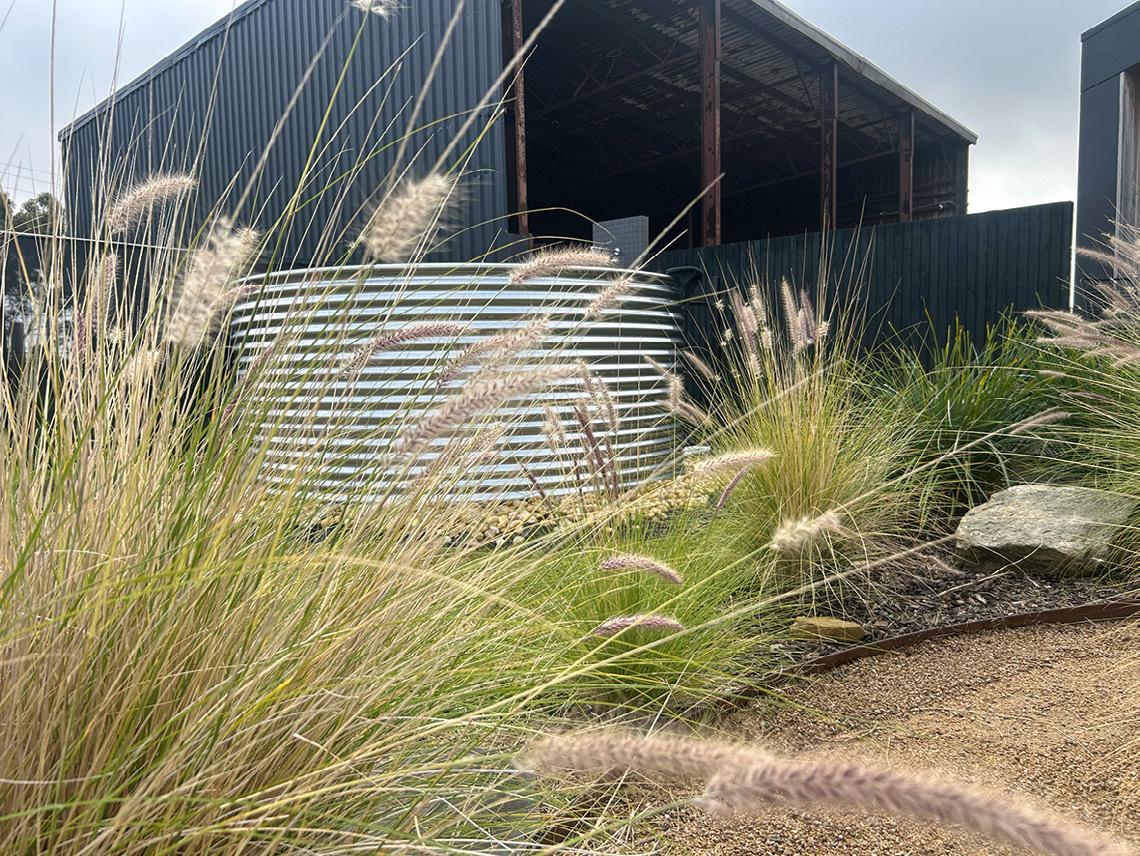
Aqualux internal pool finishes in a variety of colours, and also does renovations with pool liners, particularly for tank pools. While carrying out renovations, pool water can be stored in their vinyl bladder product, so the water can be saved and reused. There is more on this product on page 64.
They also supply Climate Care Certified thermal covers such as SpaRoll (thermal lockable covers) and SpaTex (thermal floating cover) suitable for plunge pools as well as swim spas. Their slat design makes them easy to roll, fold, store and
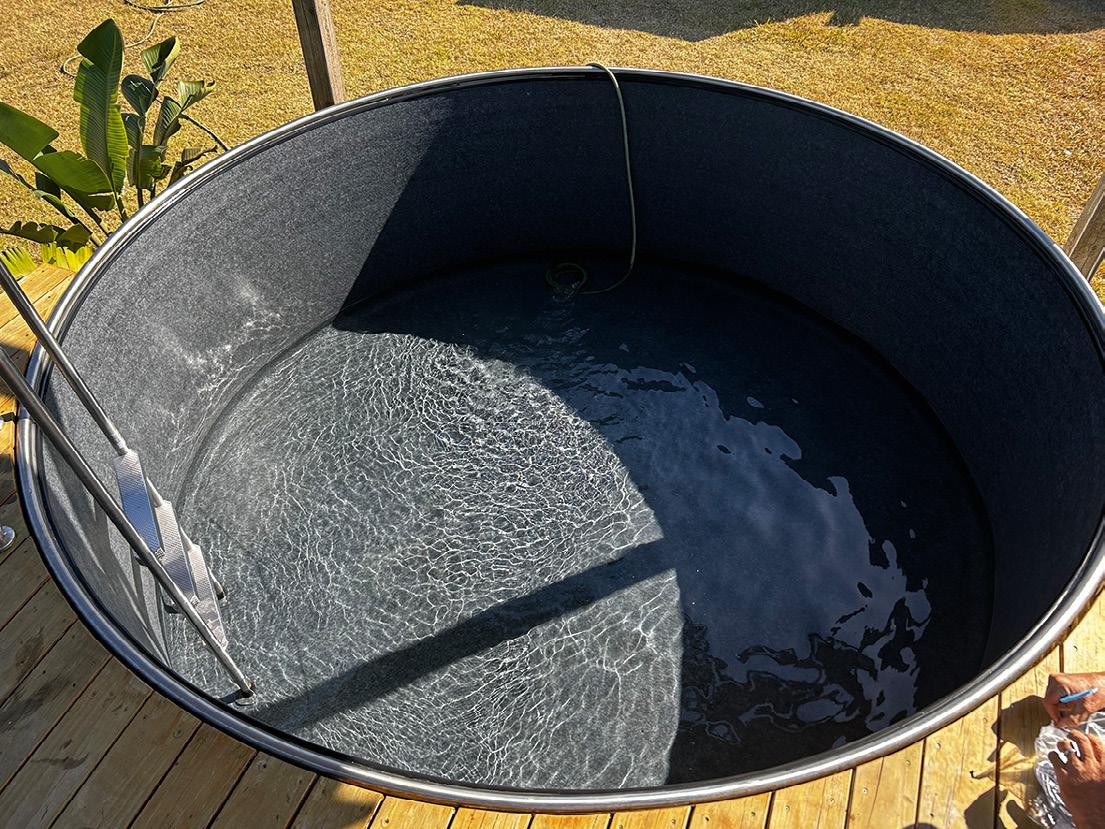
transport, and they weigh less than half that of a traditional hard cover. They come in standard sizes and shapes, and can also be tailored to fit any pool or spa.
ABGAL also manufactures a fitted debris cover specifically for tank pools.
Designer Plunge Pools is launching a new product called the Spalunge, which is a cross between and a spa and a plunge pool
“Designer Plunge Pools was the first to market with affordable lightweight tank-style pools, and while not unique in itself, we have focused on the development of the product and now ship over 150 units per year,” says David Mortimer.
He says one of the unique features of the Spalunge is that can be made to measure using their online size-a-pool feature. This enables you to select the external finish from a wide range of Colorbond claddings including Core 10, Copper, Brass and Timber.
“These can even be changed every season if you wish,” he says.
The fully welded Spalunge is Australian-made, with a price point around $15,000 to $20,000, depending on accessories. Mortimer says its fabrication is unique, leveraging their higher volume tank building experience.
“The beauty of our product is it lightness, and nine times out of ten we can man-handle it or roll it into position. This can avoid thousands in crane costs,” he says.
“We have been doing these pools now for more than five years and pioneered this space,” he says. “It fits nicely between an assemble onsite type of liner pool, and a concrete type plunge pool in terms of price point.”
They are currently doing approximately 100 units per year and are looking for distributors.
The typical setup uses Pentair equipment with UV sterilisation and ozone injection, with a variable speed pump and cartridge filter.
“We are very much focused on the freshwater experience,” he says, saying the UV and ozone minimises the amount of chlorine required.
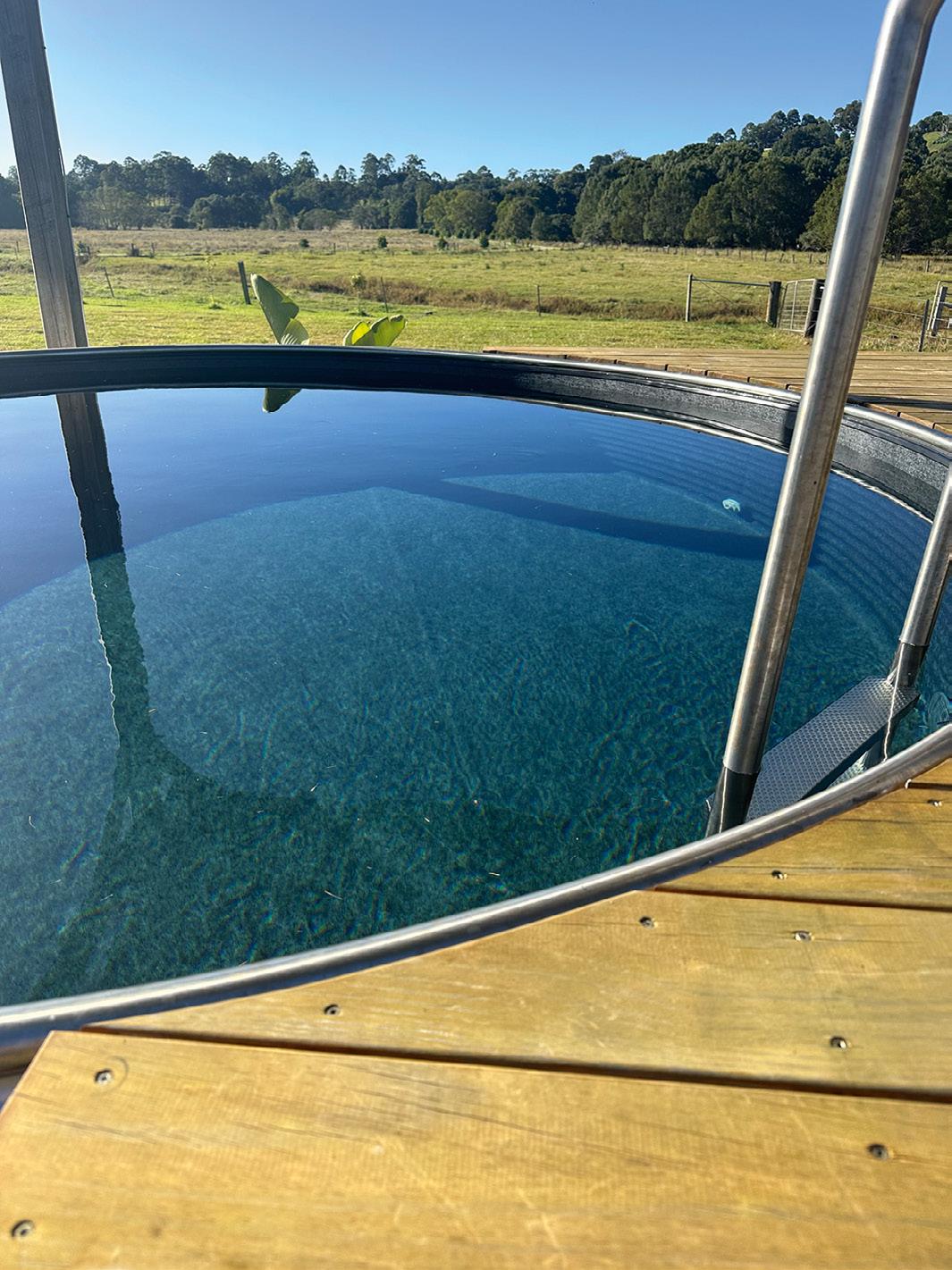
“The rise of small plunge pools isn’t just about saving space or cost, it’s about intention and lifestyle.”
Tank Pools are the perfect filler pool shell that solves space, time, weather, access, and price issues...not to mention they look great.

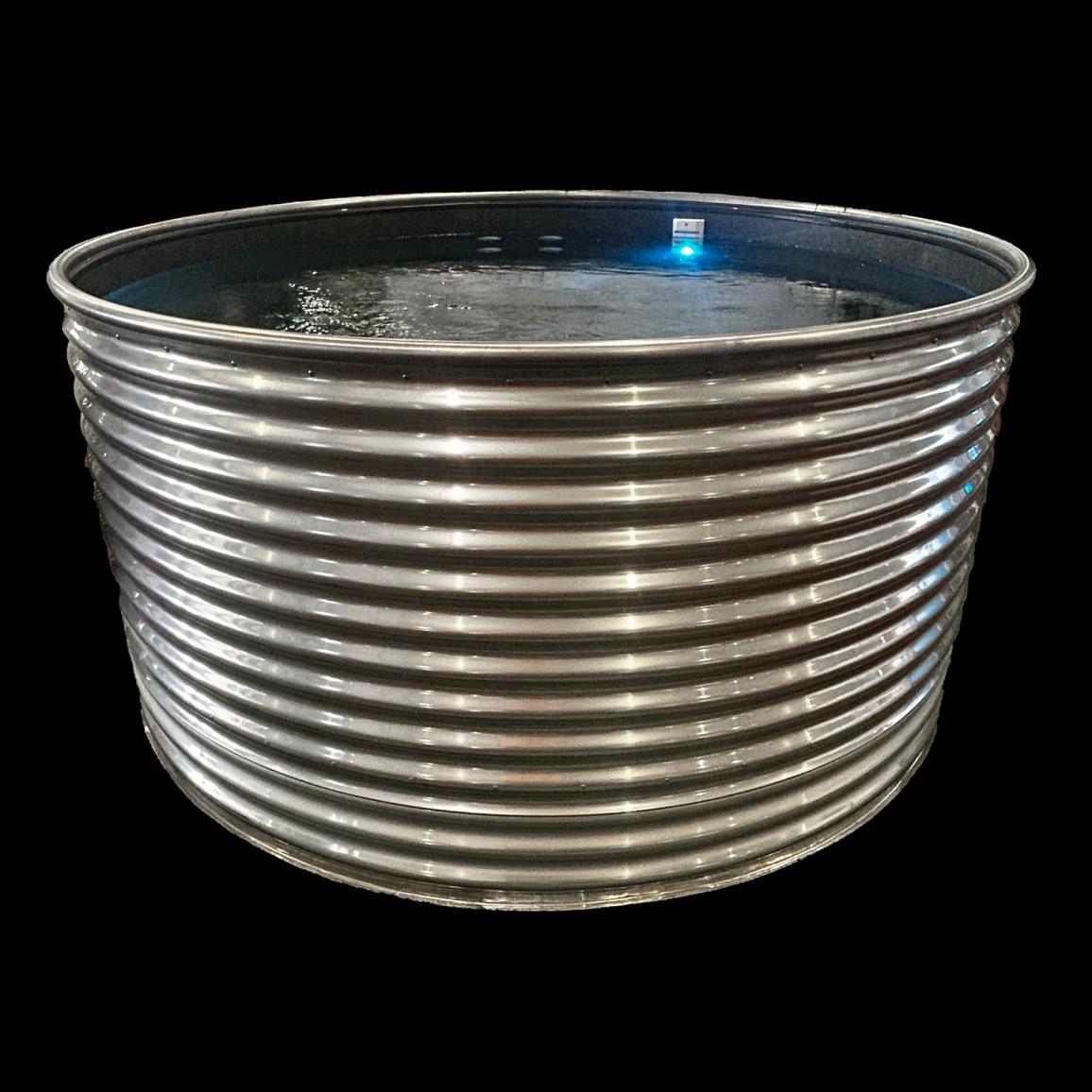

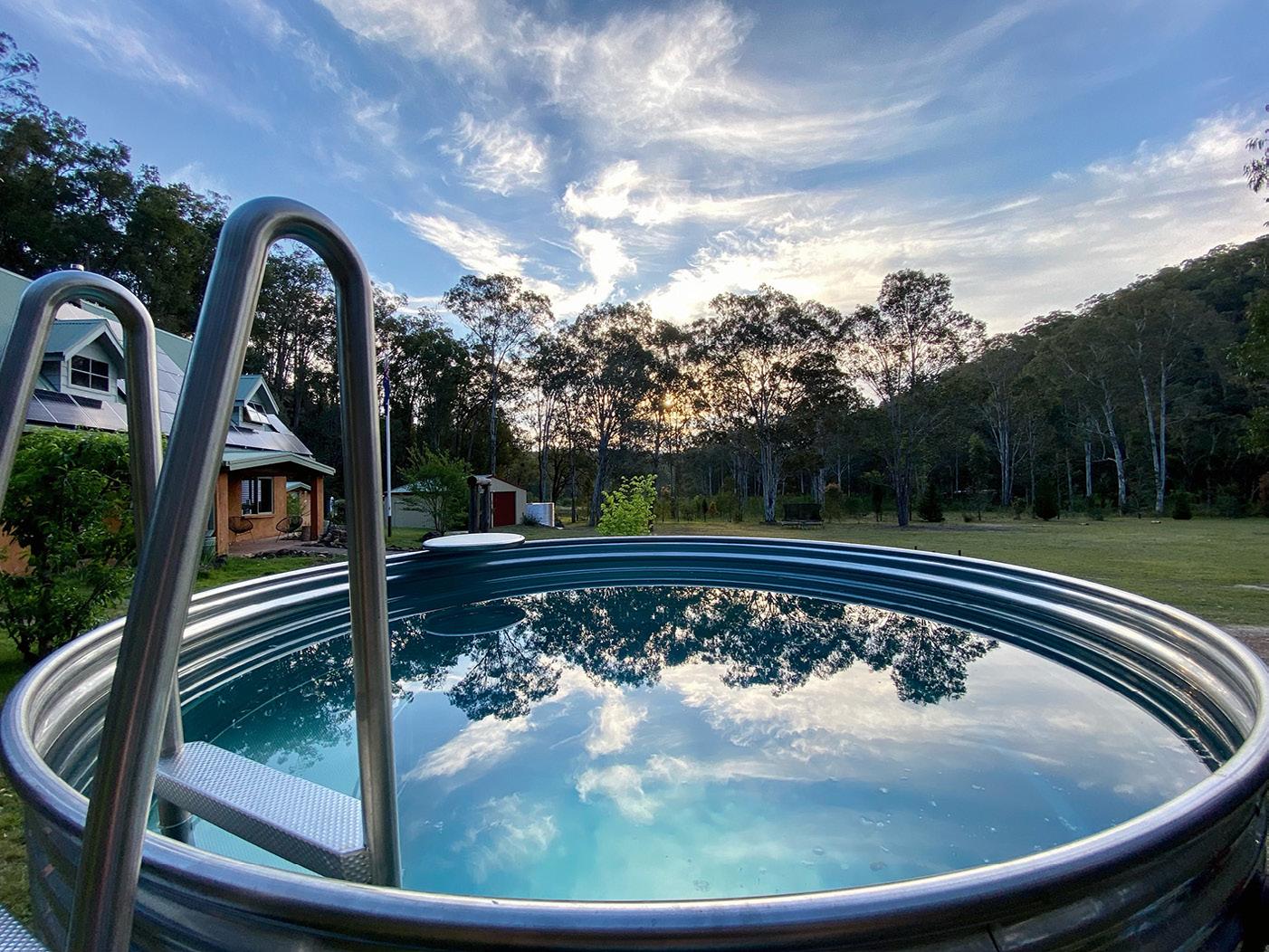
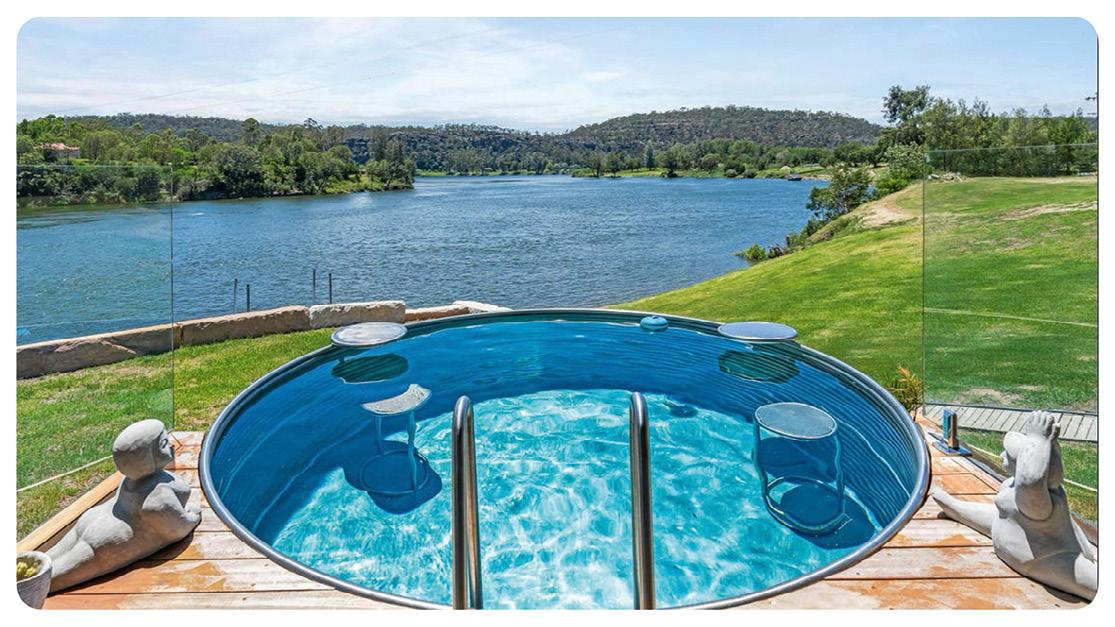
Hot and cold with the Quad
Plungie has launched the Quad – a hot and cold plunge pool designed to tap into the booming wellness-at-home trend.
At just 2.2m x 2.2m x 1.5m deep, the Quad is Plungie’s smallest pool and can be included as an add-on to an existing pool or entertainer’s deck, or alternatively as the centrepiece of a backyard wellness zone.
Plungie is an official supplier for The Block Plungie CEO Cam Levick says the Quad is the first of its kind in the industry: a multi-purpose plunge which runs hot and cold for relaxation and recovery.
“The tiny square plunge pool packs a big punch with the ability to be heated to a soothing 38C for a leisurely hot soak or cooled to 6C for a revitalising cold plunge,” he says.
Levick says that not only is demand growing for wellness at home – but the global cold plunge pool and ice bath market is projected to grow at a compound annual growth rate of more than eight per cent over the next 10 years, increasingly driven from the Asia Pacific region.
“Pools and spas are no longer just about leisure, and wellness at home is no longer a luxury,” he says.
“As Australians rethink the way they use their homes, the Quad makes at-home wellness and recovery accessible to all, even those with a smaller budget and smaller space.”
Levick says the rise of small plunge pools isn’t just about saving space or cost, it’s about intention and lifestyle.
“Just as we did with the original Plungie, we are aiming to disrupt the market with the Quad and give Australians the
option to choose pools that work harder and smarter and provide the tools they want to live a better life every day.
“It can be installed just about anywhere, from a townhouse courtyard to a rooftop to a balcony or an existing pool deck. Just like all our plunge pools, the installation is quick and easy as our pre-cast concrete pools are delivered pre-engineered for the most efficient installation. The Quad can also be integrated in-ground, semi-recessed or as a fully aboveground square plunge pool.
“We’re excited about how our newest plunge pool is responding to the market trends and how Plungie as a business continues to shape the industry.”
When paired with a heater, the Quad transforms into a personal spa retreat, offering everyday luxury at home and year-round use, with the key benefits of hot water therapy in small plunge pools including:
• Muscle relief and recovery: ideal after training or long days.
• Improved circulation: heat promotes blood flow and joint relief.
• Stress reduction: soaking in warm water calms the nervous system.
• Better sleep: warming the body before bed can help trigger deeper sleep.
• Year-round use: enjoy even in the colder months.
When paired with a chiller (or a heater with capacity to chill), the Quad becomes a powerful tool for recovery right in the backyard. Key benefits of a cold plunge pool include:
• Faster recovery: reduces muscle inflammation and soreness.
• Mental clarity: cold exposure triggers alertness and focus.
• Mood boosting: cold water stimulates dopamine and endorphin release.
• Immune support: cold immersion can help improve circulation and resilience.
• Daily resets: a few minutes in cold water can create a positive mindset for the whole day.
The Quad pool shell is priced at $14,990, comes in a range of colours, has a 10-year structural warranty and is made to order. It can be delivered within two weeks from order. n www.plungie.com
www.abgal.com.au www.designerplungepools.com.au



www.tankpools.com.au
Remco’s Swimroll cover effectively reduces evaporation which is a cause of pool water loss
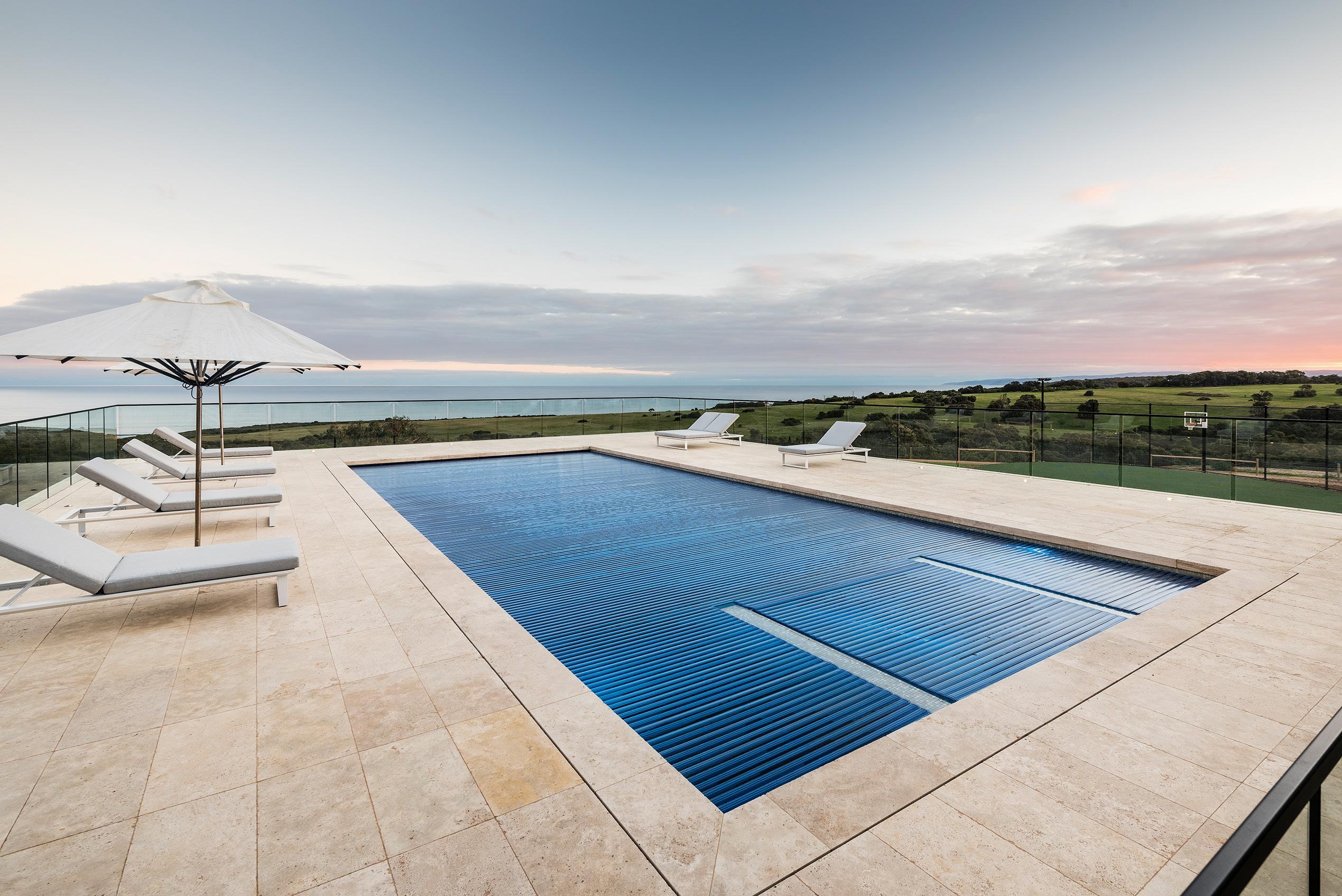
Innovation, automation and intelligent design are transforming water efficiency for pool owners.
By Veda Dante
Water conservation is no longer a side conversation for the pool and spa industry – it’s a priority for homeowners, operators and manufacturers. With rising water scarcity, stricter regulations and growing environmental awareness, every drop counts.
Yet despite advances in technology and automation, many pools still operate inefficiently, losing water through evaporation, poor chemistry management and outdated equipment. Smarter products, thoughtful design and integrated systems are essential to reduce waste while preserving the enjoyment and comfort that pool owners expect.
The industry is rising to the challenge with solutions that put water efficiency at the heart of pool design. Quality pool covers, automated
systems, chemical stabilisation methods and real-time water management all work in concert to limit evaporation, maintain water balance and minimise unnecessary water replacement.
By integrating these elements into cohesive systems, pools can be both enjoyable and sustainable, turning every aspect of pool operation into an opportunity to conserve water.
Pool covers are more than accessories – they are a frontline tool in water and energy conservation. By controlling evaporation, stabilising chemistry and retaining heat, they reduce chemical use while making pools more efficient.
“Evaporation remains one of the biggest – yet most preventable – causes of water loss in pools,” says Carl Voshege, Remco Australia managing director. “By combining intelligent design with automation, our pool covers don’t just hold water – they actively protect it.”
Remco’s approach pairs German design principles with Australian manufacturing to suit local conditions and ensure systems are durable, adaptable and efficient.
“Our focus is on creating solutions that integrate seamlessly into pool operations – from water retention to chemical stability – without relying on constant intervention,” he says.
Advanced materials and automated systems mean Remco’s pool covers are more than static barriers. When designed as part of an integrated system, they reduce waste, extend water life, and improve overall pool efficiency.
“Early integration is critical,” Voshege adds. “Considering covers during the design stage ensures long-term water-saving performance and operational efficiency.”
For Daisy Pool Covers, the emphasis is on thermal performance and energy efficiency.
“Pool covers are essentially insulation for your pool,” says managing director Derek Prince.
“Without it, energy escapes overnight, forcing heaters to work harder and increasing costs. With proper coverage, you maintain heat longer, stabilise water chemistry, and reduce ongoing energy and chemical use.”
Prince highlights that insulation isn’t just about energy savings – it’s about smarter pool management.
“By retaining heat and reducing unnecessary water replacement, pool covers allow operators and owners to proactively manage their pools rather than constantly reacting to loss or imbalance,” he explains
Daisy also measures thermal efficiency using internationally recognised R Value standards, helping pool owners understand the real impact of their covers on energy retention and operating costs.
“A pool cover isn’t a luxury; it’s a fundamental tool in sustainable pool management,” Prince says.
For Australian water disinfection technology company AIS Water, respect for water and water savings is central to its mission.
“We are extremely passionate about saving and enhancing life through greater access to water. This is why we’ve reduced water wastage through our award-winning salt and freshwater chlorinators, which are currently operating in over 55 countries worldwide,” says CEO Elena Gosse.
Conventional chlorine dosing requires swimming pool water to be dumped or continuously diluted, a practice Gosse finds “completely unacceptable”.
“Our technology has been independently tested and proven to show that in just one 50-metre pool, savings of more than 1.6 million litres of water can be achieved per annum,” she says.
Numerous companies claim their products save water, but few have university research to prove it. AIS Water engaged Brisbane’s Griffith University’s associate professor and microbiologist Helen Stratton to test its technology and quantify the savings.
“During the course of our research, we found that a pool using liquid or granular chlorine for water disinfection would need to dump pool water at least once a year to stay within recommended guidelines for total dissolved solids,” Stratton explains.
The study confirmed that AIS’ saltwater chlorination technology was superior at maintaining stable water chemistry over six months.
“A long course, 50-metre pool using granular chlorine, converted to AIS’ technology, would eliminate at least 1.6 million litres of water and save up to $40,000 annually in water rates,” she says.
“On an environmental note, reducing that amount of water is a huge saving for our waterthirsty planet.”
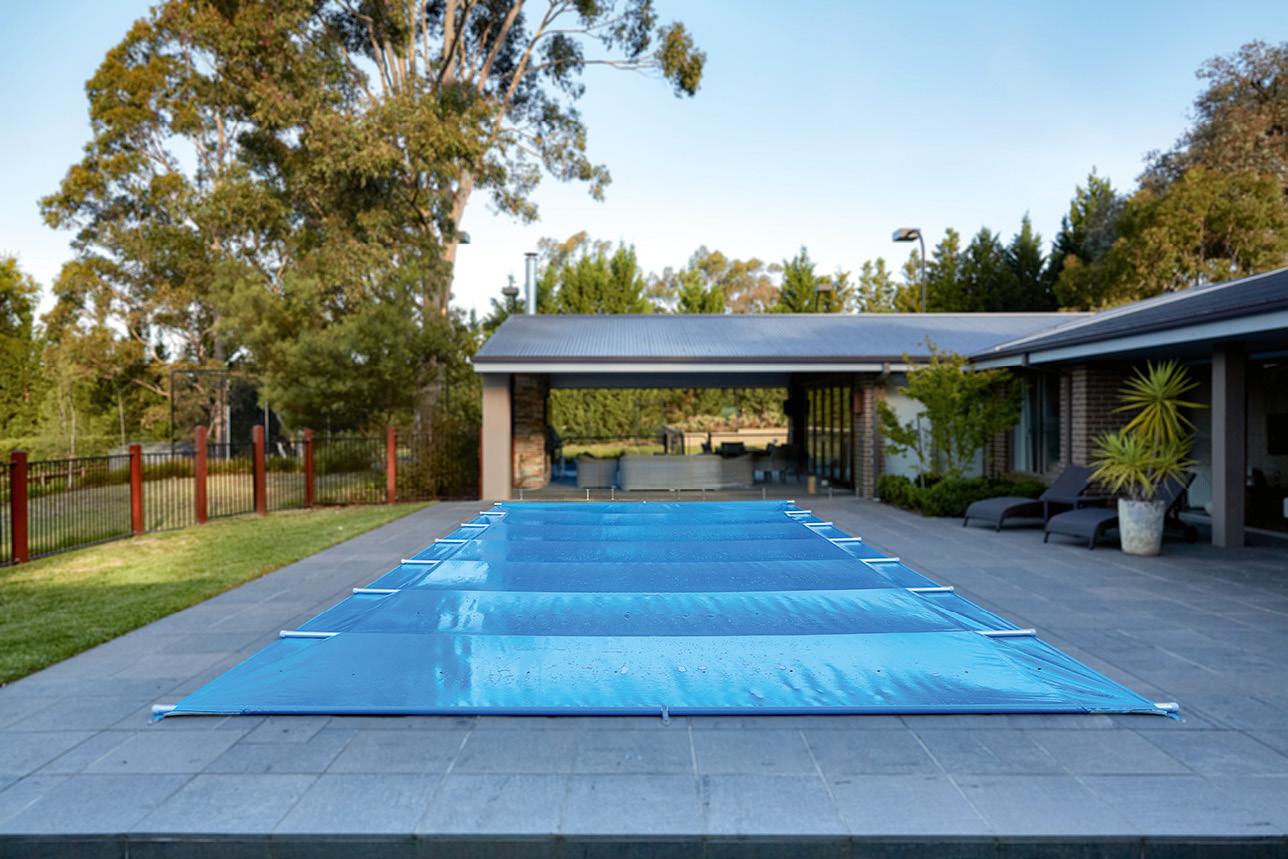
“A pool cover isn’t a luxury; it’s a fundamental tool in sustainable pool management.”
Gosse says that when extrapolated to a city with 100 similar pools, the savings would exceed 160 million litres of water and $4 million annually.
“Progressive local councils, such as Brisbane City Council, have already adopted AIS Water’s technology in many pools,” Gosse says.
“Inline chlorination not only reduces water consumption but also eliminates procurement, and storage and handling of dangerous chemicals, along with associated environmental corrosion.”
When the pool and spa industry talks about saving water, the conversation often drifts toward restriction – shorter backwash cycles, tighter refill rules, or simply encouraging homeowners to use less.
But genuine water efficiency doesn’t come from compromise. It comes from intelligence.
“True water saving isn’t about limiting how people enjoy their pools,” says David Dean, marketing and customer experience manager at Maytronics Australia. “It’s about designing systems that actively protect water quality, reduce waste and extend the usable life of the water already in the pool.”
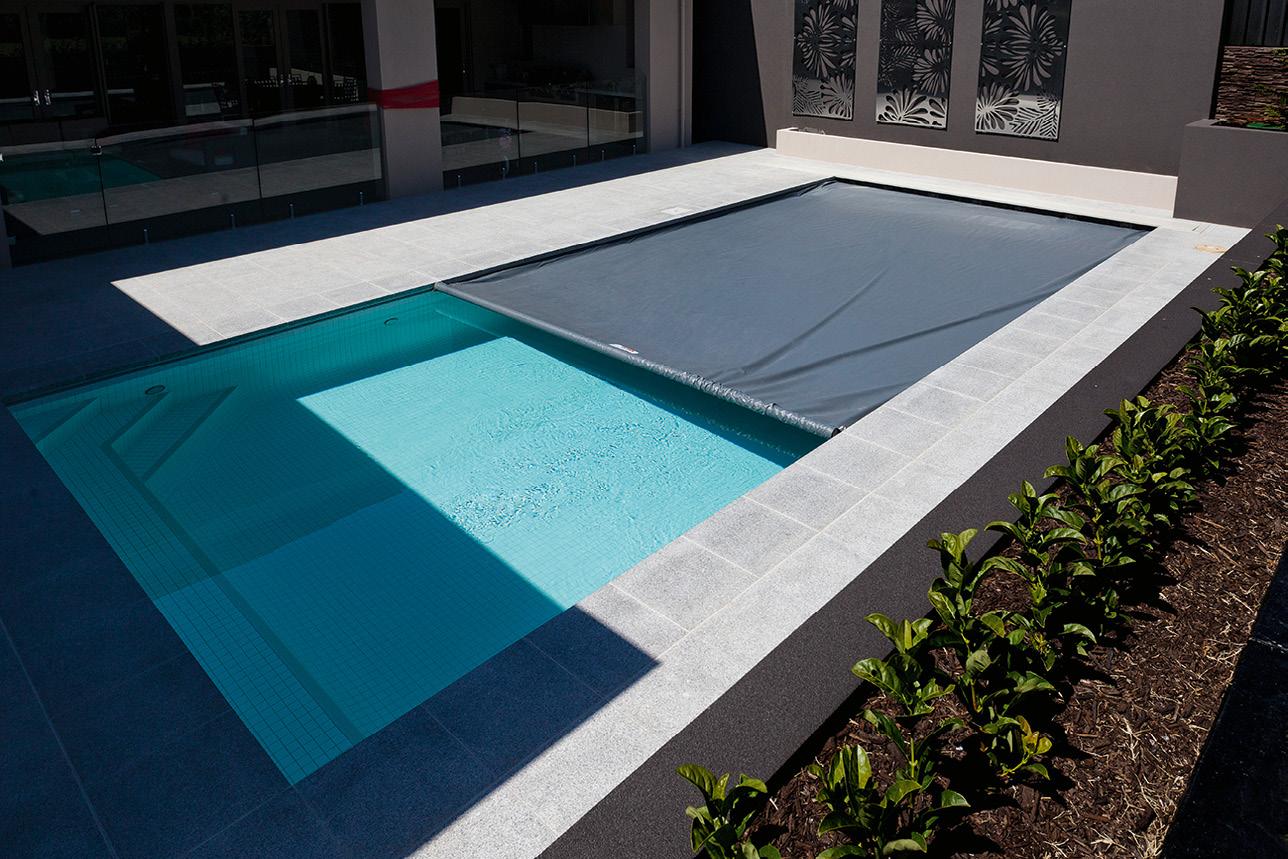
“Evaporation remains one of the biggest – yet most preventable – causes of water loss in pools.”
Real efficiency is achieved when systems work together as an integrated ecosystem. Automation, stable water chemistry and modern cleaning methods each play an important role, but their greatest impact is unlocked when they operate in unison.
“Water efficiency is built into the system, not imposed on the user,” Dean says. “When automation, sanitisation, purification and cleaning are designed to complement each other, water lasts longer and far less is wasted.”
At the centre of this approach is intelligent automation, which removes the guesswork from pool care by continuously monitoring water conditions and making precise adjustments in real time. Rather than reacting to problems after they appear, these systems maintain balance proactively, reducing overcorrection and unnecessary water replacement.
“Automation shifts pool care from reactive to preventative,” Dean explains. “By keeping water stable day after day, you avoid the issues that typically lead to dumping and refilling.”
Next-generation platforms such as Ecoclear Automation, launching in Australia in 2026, are designed with efficiency at their core. By integrating circulation, sanitisation and monitoring into a single system, they help reduce human error, minimise chemical overdosing and ensure water is only replaced when necessary. As automation continues to evolve, it is becoming a critical sustainability tool rather than a convenience feature.
Waterco has long been at the forefront of delivering high-performance, water-saving solutions. From MultiCyclone pre-filters to Glass Pearl filter media and a broad portfolio of Climate Care Certified products, it helps empower the pool and spa industry to safeguard its most vital resource while maintaining the highest standards of performance and water quality.
Built to withstand Australia’s harshest conditions – and trusted in extreme climates across North Africa and the Middle East – these innovations are designed not only to meet local water challenges but to set a global benchmark in responsible water management for the industry.
“Sustainability is not a trend for us; it’s a
“Automation shifts pool care from reactive to preventative.”
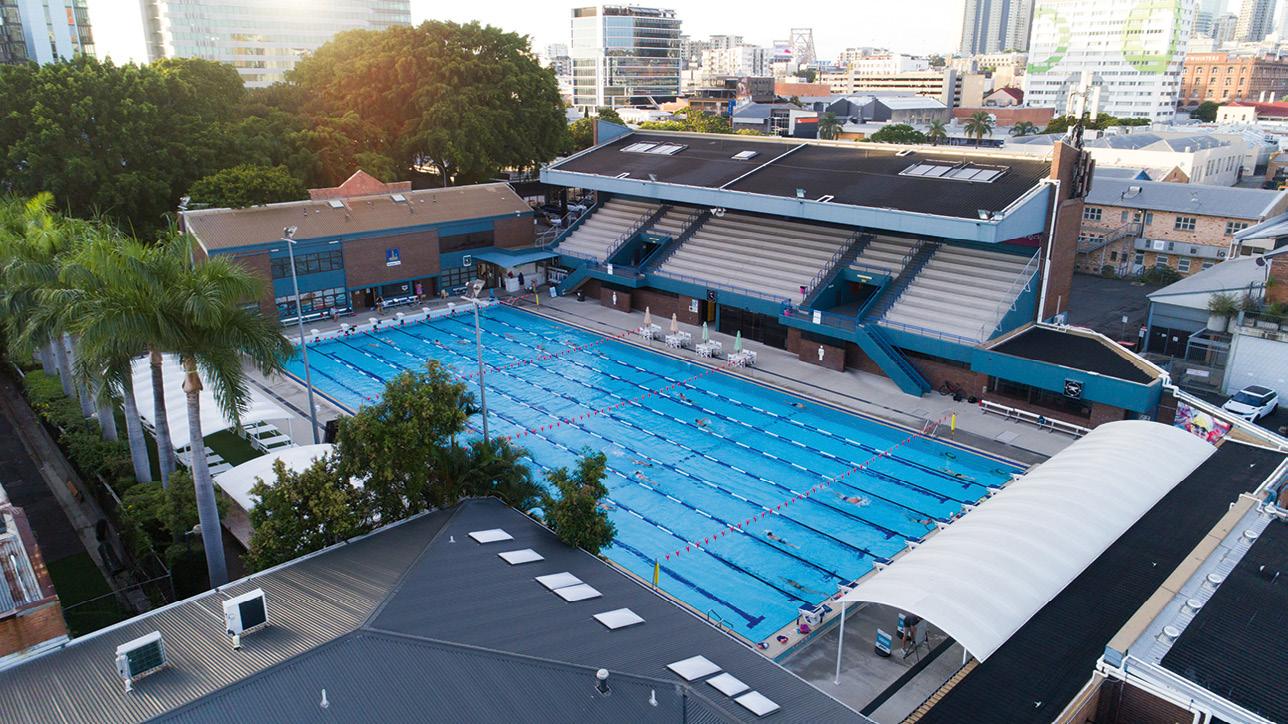
commitment,” says George Flory, domestic water care product manager at Waterco. “By integrating innovation, efficiency, and durability into our product development, we give people the tools to make responsible choices for their pools and spas and the environment.”
The MultiCyclone range demonstrates the practical results of this approach. Originally launched in 2007, the pre-filter introduced a new standard in centrifugal filtration. Its evolution continued with MultiCyclone Plus, integrating a cartridge filter and earning Best Product at Spatex UK in 2011. Today, the latest generation, MultiCyclone Duo, builds on that legacy with enhanced water-saving performance in a more compact design.
“By reducing filter maintenance, minimising backwashing and extending cartridge life, MultiCyclone Duo is helping pool professionals deliver smarter, more sustainable builds,” he says.
Waterco’s Glass Pearl filter media has also established a new benchmark in water-saving filtration. Independent testing at the University of New South Wales water research laboratory verified its superior hydraulic performance, reduced backwash requirements, and high filtration efficiency. Its spherical design lowers water flow resistance and allows backwashing at rates as low as 12m3/hr/m2 up to one-third of the rate required by other media.
“This translates into potential water savings of up to 66 per cent during each backwash cycle, while still maintaining excellent water clarity and filtration performance,” says Flory.
Beyond individual products, Waterco’s Climate Care Certified range reflects a broader commitment to sustainability. With more certified offerings than any other pool equipment manufacturer, the portfolio provides solutions that optimise water use, reduce chemical dependency, and support responsible practices. From residential pools to commercial installations, these products help achieve both operational efficiency and environmental stewardship.
“Global challenges such as water scarcity, harsh climates and rising energy costs continue to shape our design, engineering and manufacturing processes,” he says.
The Top-Up Turtle is a clever Aussie invention that takes the guesswork out of pool maintenance. This automatic water leveller keeps pools at the perfect level, protecting pumps and liners while preventing overfilling and reducing water waste.
Fully adjustable to the pool’s needs, it works with standard garden hoses, handles pressures up to 150 psi, and even creates a subtle cascading effect as it fills.
ABOVE: AIS inline sanitisation helps reduce water usage – saving up to 1.6 million litres per year. Image is of The Valley Pool in Brisbane, which uses AIS technology
“The Top-Up Turtle is a definite way to shut water off when filling pools and spas from a standard garden hose,” says designer Robin Jobe. “It’s made to set and forget, preventing water overflow and chemical wastage.”
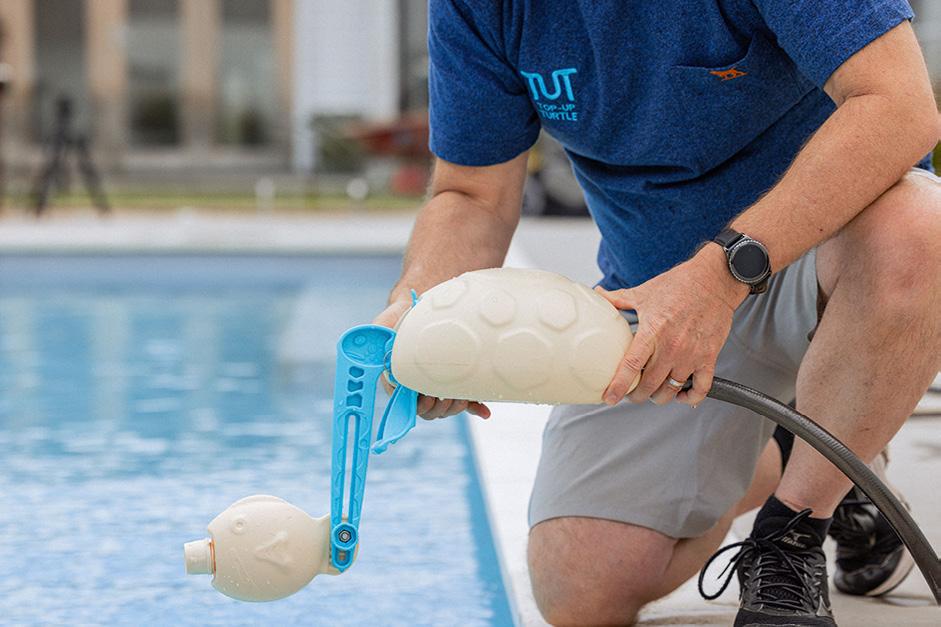
Water efficiency has become one of the most critical challenges facing Australia’s pool and spa industry. With increasing pressure on resources and heightened consumer awareness around sustainability, the way pools and spas are designed, equipped and operated is under greater scrutiny than ever before.
Recognising this shift, SPASA launched its Climate Care Certified (CCC) program in 2018, creating a clear, industry-led framework to identify products and installation packages that deliver measurable improvements in water and energy efficiency.
“Climate Care Certified was developed to give both industry and consumers confidence,” says Ben Makepeace, SPASA policy manager. “It allows members to clearly demonstrate their sustainability credentials, particularly when it comes to pool equipment and products that genuinely reduce water and energy use.”
The program sets both water and energy efficiency as its primary benchmarks, requiring evidence-based performance to support certification. By focusing on verified outcomes rather than marketing claims, CCC highlights solutions that actively contribute to more responsible pool and spa operation.
“As a SPASA-led initiative, Climate Care Certified helps pool and spa owners make smarter, greener choices without sacrificing comfort or enjoyment,” Makepeace says. “It’s about protecting our most precious resources while ensuring pools and spas remain a source of relaxation, health and lifestyle benefits.”
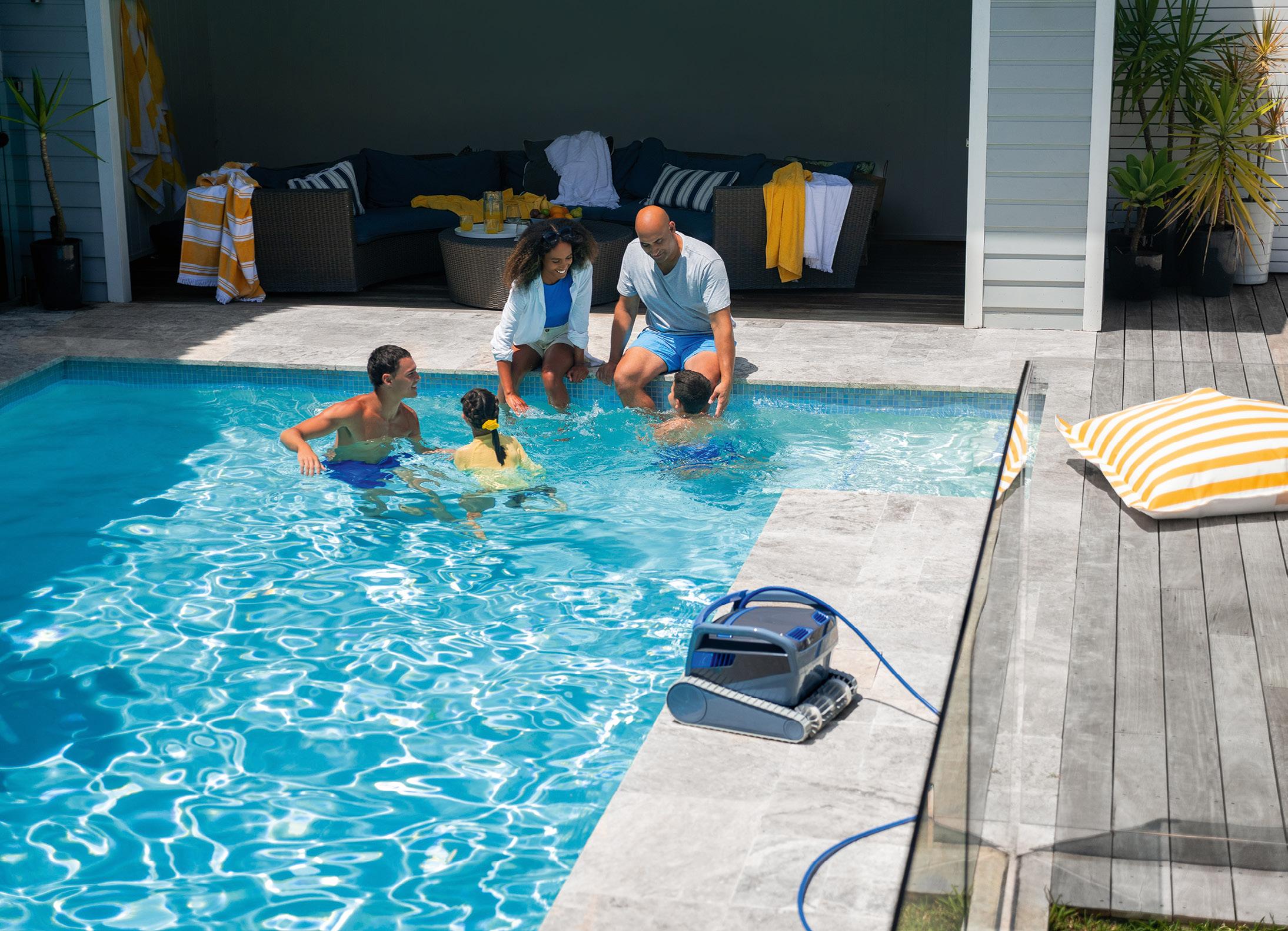
“This focus ensures that every product delivers measurable benefits in both water and energy savings, while supporting long-term environmental responsibility.”
One of the most significant – and often overlooked – causes of water loss is instability.
Poorly managed water chemistry leads to cloudy water, scaling, corrosion and algae outbreaks. When these problems arise, the most common response is also the most wasteful: dumping and refilling the pool.
Balanced water chemistry is supported by modern sanitisation systems and quality pool
“During droughts, evaporation control suddenly becomes a priority.”
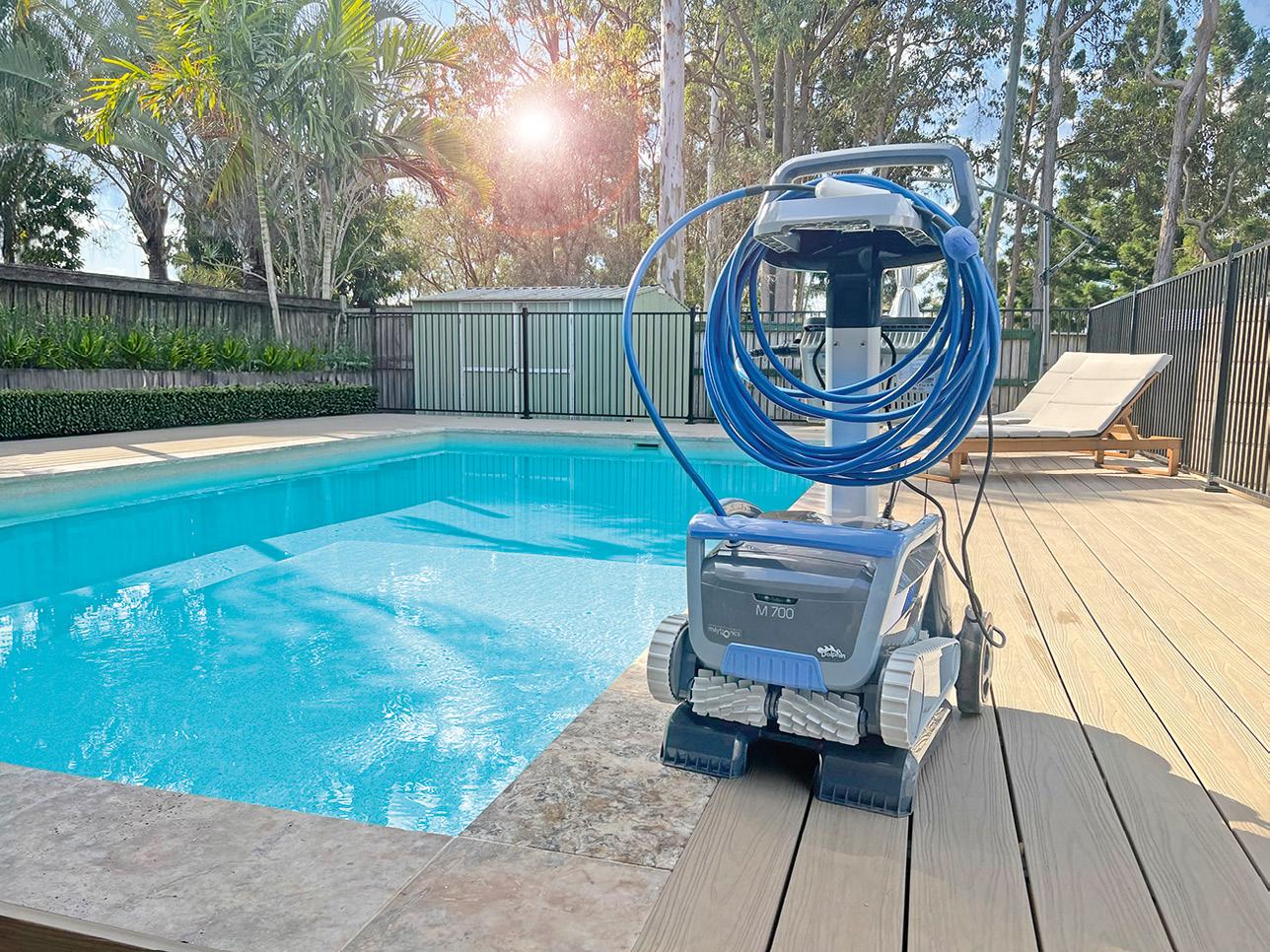
chemicals formulated to work with them. Products within the Focus Products range, recently acquired by Maytronics Australia, are designed to maintain consistency rather than fight against automated and mineral-based systems.
Mineral-based solutions such as Mineral Swim further enhance stability by delivering naturally balanced water that lasts longer. By combining minerals with ozone support, Mineral Swim reduces chemical volatility, minimises corrective treatments and lowers the likelihood of water dumping.
“The goal is stability, not constant intervention,” Dean says. “When water stays balanced, it feels better, looks better and doesn’t need to be replaced nearly as often – particularly in high-use pools.”
Cleaning also plays a critical role in water conservation, yet it is frequently overlooked. Traditional cleaning methods often rely on backwashing and vacuum-to-waste processes, sending thousands of litres of usable water straight down the drain.
He says that during decades of innovation, Dolphin robotic pool cleaners have helped redefine how pools are cleaned – not only improving performance but quietly saving water.
“Operating independently of a pool’s main filtration system, Dolphin robots significantly reduce the need for backwashing and vacuum-towaste cleaning methods.
“By removing debris before it breaks down and disrupts water chemistry, robotic cleaning helps keep water clearer and more stable,” Dean says.
“That means fewer chemical corrections and far less water replacement over time.”
By bringing monitoring, chemical dosing and circulation control into a single, coordinated system, Davey is helping pool owners maintain efficient, balanced pools without constant manual input.
“Automated products like Lifeguard controller reduce unnecessary circulation, prevent overfilling, and keep water balanced – saving water, energy, and effort,” says Hamish Caunter, Davey’s head of trade marketing and retailer partnerships.
“We also understand that barriers to change exist, such as the perceived difficulty of upgrading, upfront costs and installer familiarity.”
He says they have developed products like the EnduraFit VS pump as a universal-fit solution at a reasonable price.
“Its universal design makes installation simple for professionals, helping remove complexity and encourage adoption of water-saving technology,” he says.
Outside of evaporation, Caunter says the next major source of water loss is backwashing traditional sand filters.
“Each backwash cycle can waste hundreds of litres of water, and many pools are backwashed multiple times per month. Over a season, this can add up to thousands of litres unnecessarily lost,” he explains.
“Managing backwashing is therefore critical, starting with the most impactful factor: selecting the right filter. From there, additional measures such as maintaining proper water chemistry, using variable-speed pumps, monitoring the pressure gauge, and considering smart automation to optimise pump and filter operation all play a role.”
While water efficiency remains a discussion point in the pool industry, many pools still operate with outdated or inefficient equipment. For Jonathan Bristow, senior category manager at Fluidra, the barriers to wider adoption of water-saving technologies are often behavioural rather than technical.
“Water savings are at the forefront of everything we do at Fluidra,” Bristow says. “But breakthrough innovations in equipment and chemicals remain limited. In regions with plenty of rainfall, water scarcity isn’t front of mind, so consumers often prioritise energy savings over water efficiency. During droughts, evaporation control suddenly becomes a priority, but cost and perception still play a major role – many won’t invest in expensive water-saving solutions when topping up a pool seems relatively inexpensive.”
As mentioned above, evaporation remains the largest preventable source of water loss in residential pools, particularly where pool covers are not used. Bristow notes that poor pool design, splash-out and installation quality, including leaks, also contribute significantly.
“From an equipment perspective, cartridge
“If you have excessive stabiliser levels, you may need to replace water to correct it.”
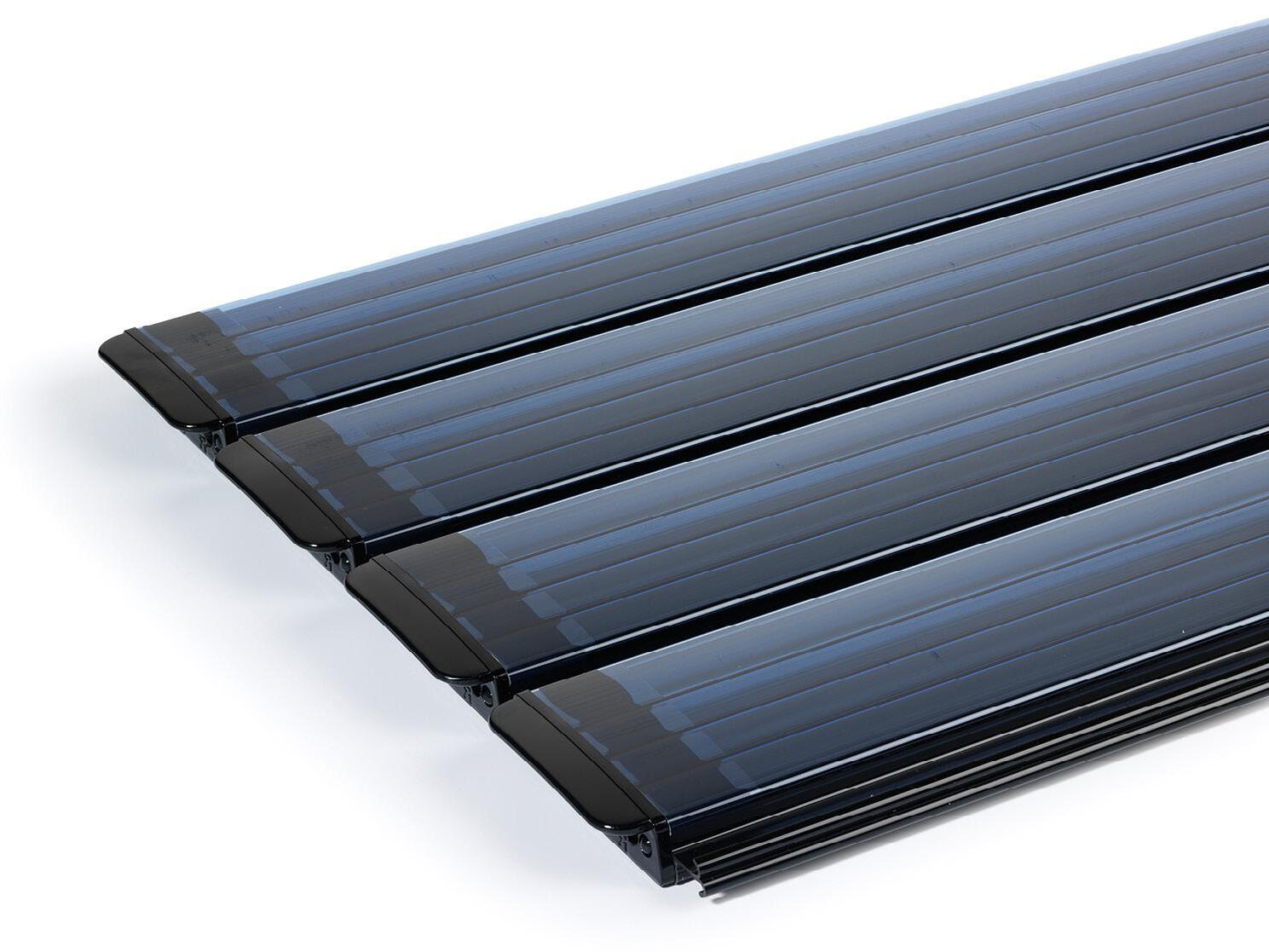
Ben Makepeace, SPASA policy manager, explains how the Climate Care Certified program works.
Q . What inspired SPASA to launch the Climate Care Certified program?
A. SPASA and its members wanted to ensure that water sustainability and energy efficiency were being addressed in the swimming pool and spa industry. The Climate Care Certified program was designed to provide a way to clearly highlight products and installation packages which work towards this aim, and to help pool and spa owners make smarter, greener choices without compromising on comfort or enjoyment.
Q How does Climate Care Certified help consumers avoid greenwashing?
A. The program requires claims to be substantiated. Climate Care Certified applicants must provide verified testing information, compliance documents and other evidence to support their product claims.
Q . Out of all the certified products, how many help pool owners reduce water consumption?
A. There are 37 certifications which are in the water saving category. But not all are products – this number includes pool install packages, which are a package of plant and equipment working together to achieve Climate Care Certified program objectives.
Q How can pool and spa professionals become better informed about water saving equipment and systems?
A. Ask suppliers and manufacturers which of their products are Climate Care Certified, or for evidence of reduced water usage. The Climate Care Certified website has a complete list of all certified products and installation packages, which can be filtered to show those which provide water saving benefits.
Q Is there anything new on the horizon for SPASA in this space?
A. The Climate Care Certified program is being highlighted in an episode of the new season of Pool Spa Life which is broadcast on 9Life. This year will see highlights from the Climate Care Certified range being promoted through SPASA social media channels.
In addition to water saving and efficiency benefits, other Climate Care Certified products include:
• Energy efficiency.
• Noise reduction measures.
• Environmentally sustainable designs.
• Efficiency/sustainability innovations.
• Chemical use reduction.
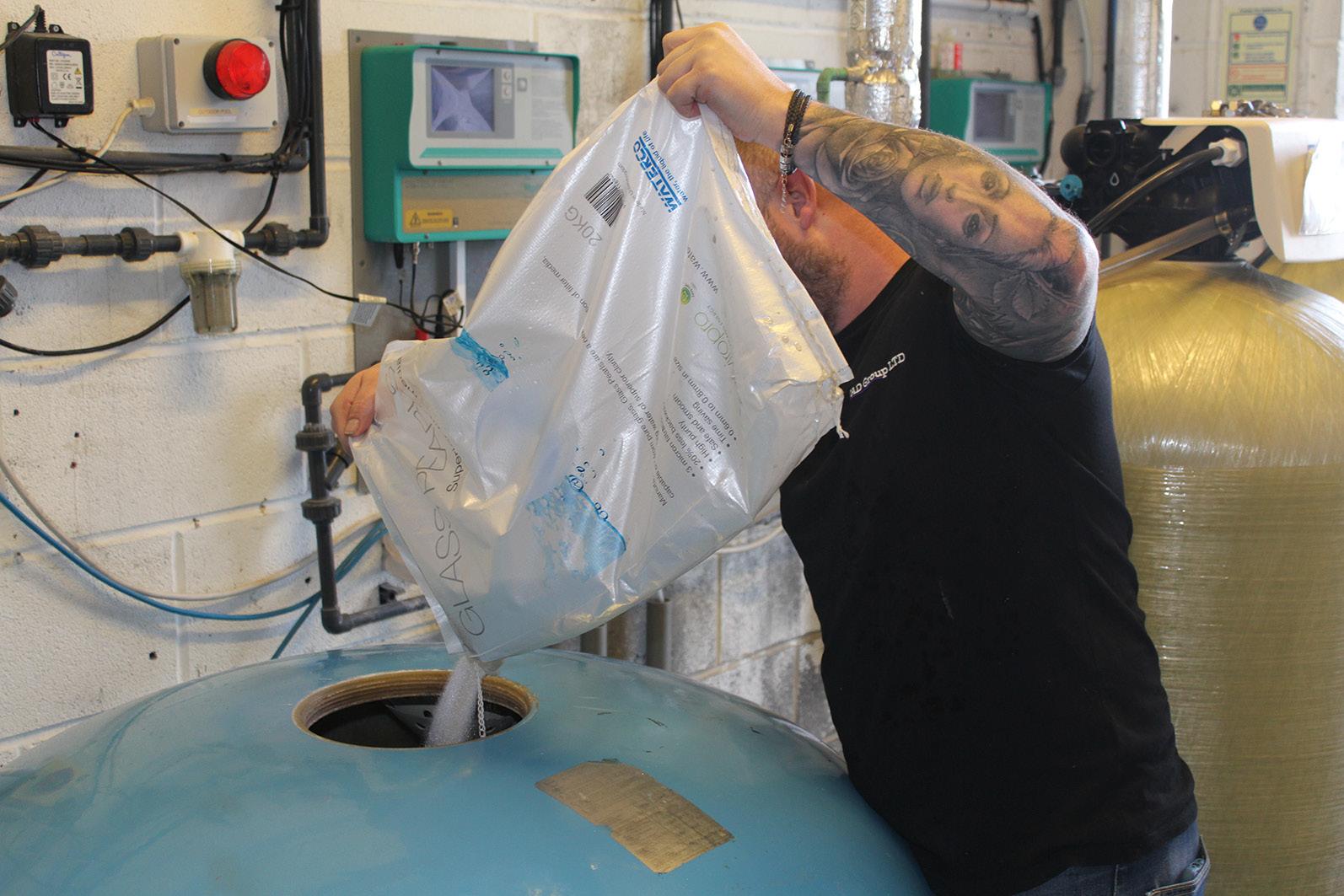
filtration can help reduce water waste,” he explains. “But most losses are driven by how systems are installed and operated rather than the choice of equipment itself.”
Automation and smart controls are continuing to evolve as a complementary tool.
“Automation improves energy efficiency and water quality management, though it has limited direct impact on water consumption,” Bristow says. He says one exception is cyanuric acid management, because if you have excessive stabiliser levels, you may need to replace water to correct it.
For pool owners, spotting inefficiencies early is crucial.
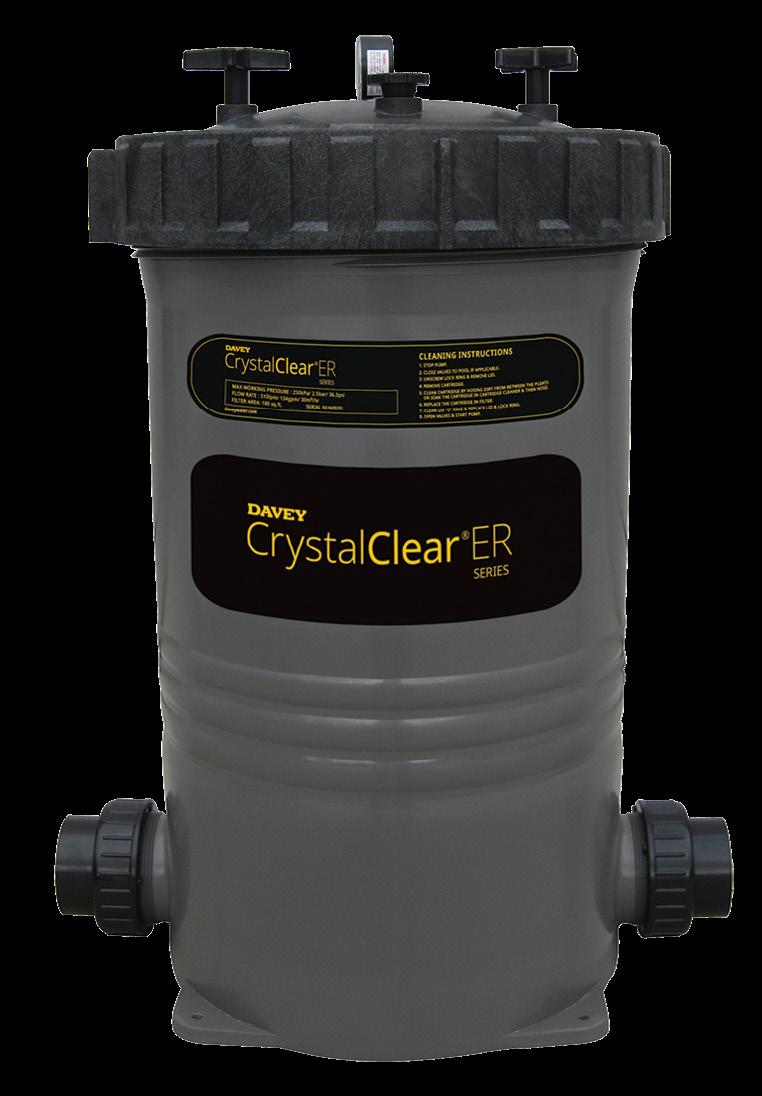
“There’s no single product that eliminates water loss,” he warns. “Oversized filters and proper chemical management help, but leaks, poor installation, and plumbing faults are the most common preventable causes. Simple techniques like the bucket test can quickly identify hidden water loss before it becomes a bigger problem.”
Bristow also highlights the need for caution around marketing claims.
“Any product promoting water-saving should be backed by evidence. Claims that sound too good to be true often are,” he says. “Credible manufacturers can substantiate performance.”
Looking ahead, Bristow sees opportunities for innovation in both design and chemistry.
“Future water-saving strategies will focus on smarter pool design to reduce splash-out and capture displaced water, along with chemical innovations that manage by-products without requiring water replacement,” he says.
Waterco skid with an Opal cartridge filter, a Multicyclone pre-filter and a Hydrotuf pump is a ready-made water saver
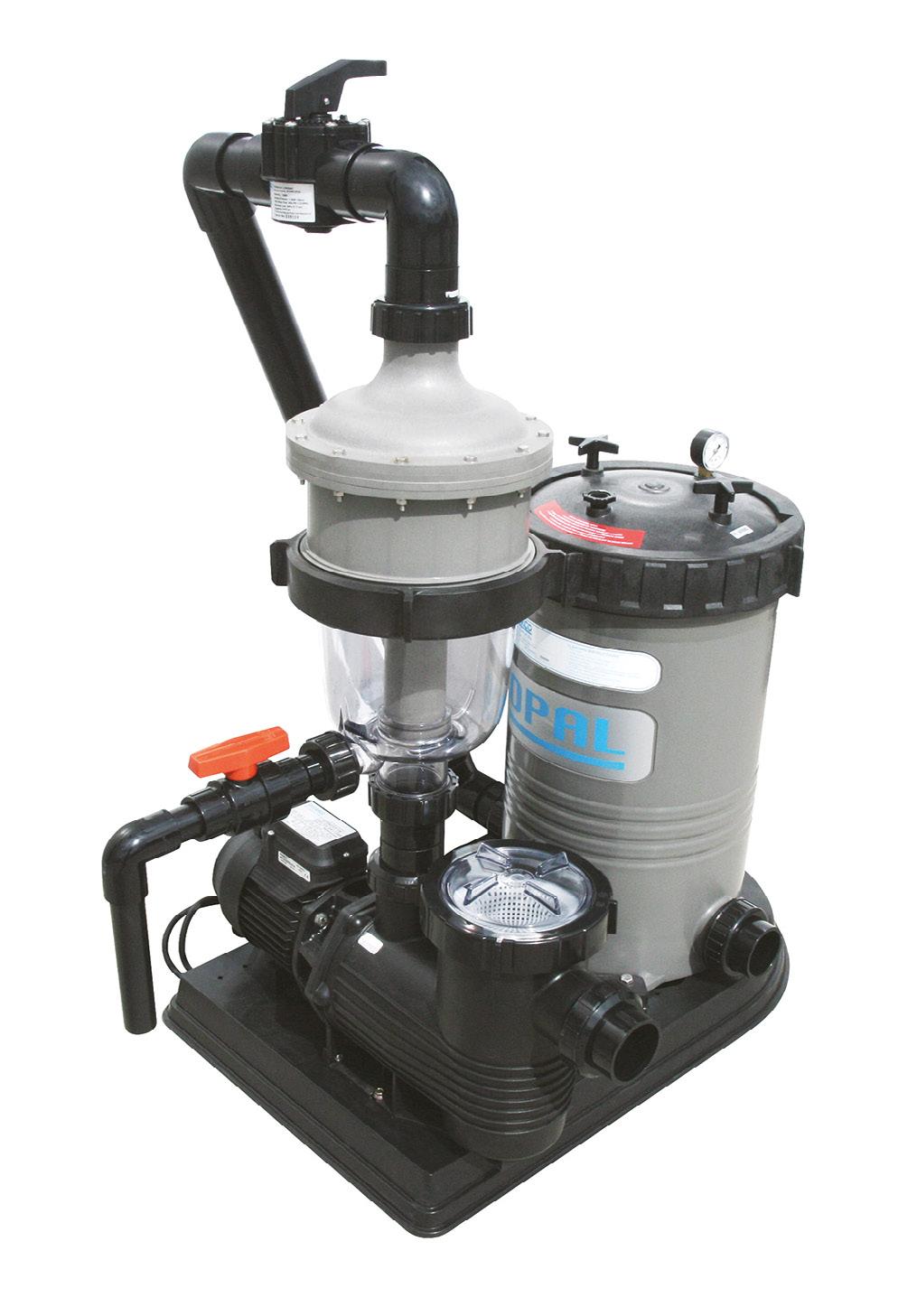
“Future water-saving strategies will focus on smarter pool design to reduce splash-out and capture displaced water.”
“There’s huge potential to reduce consumption through integrated approaches that combine design, equipment and intelligent water management.”
The message is clear: water saving isn’t achieved through a single product or feature. It comes from intelligent systems working together.
Automation provides control, stable sanitisation protects water quality, and efficient cleaning prevents unnecessary waste.
As the industry continues to innovate, the opportunity lies in designing pools that don’t just hold water – but actively protect it. n
www.aiswater.com.au
www.climatecarecertified.com
www.daisypoolcovers.com.au
www.davey.com.au
www.fluidra.com
www.maytronics.com.au
www.remco.com.au
www.top-upturtle.com
www.waterco.com.au





AUSTRALASIAN AWARDS OF EXCELLENCE
HONOURING EXCELLENCE & INSPIRING INNOVATION
LEVEL UP YOU & YOUR TEAM
LEADING EXPERTS, INNOVATORS, & PROFESSIONALS
OVER 100 EXHIBITORS
THOUSANDS OF PEOPLE
ALL
INDUSTRY NETWORKING & SOCIALISING
BUILDING EXCELLENCE THROUGH ACCREDITATION, ENGAGEMENT, DISCIPLINE, AND IMPACT
QLD CONTRACT MASTER CLASS
POOL SAFETY INSECTOR MEETING
INNOVATION EXPERIENCE
ENHANCE YOUR BUSINESS WITH AUSTRALASIA’S FINEST
SPLASH GOLF DAY
INDUSTRY NETWORKING THE ULTIMATE GOLF TEAM DAY
WOMEN ATTAINING VISION EXCELLENCE & SUCCESS
LEADING POOL & SPA SHOW IN THE SOUTHERN HEMISPHERE THE MUST-ATTEND EVENT FOR ANYONE IN POOLS, SPAS & OUTDOOR LIVING
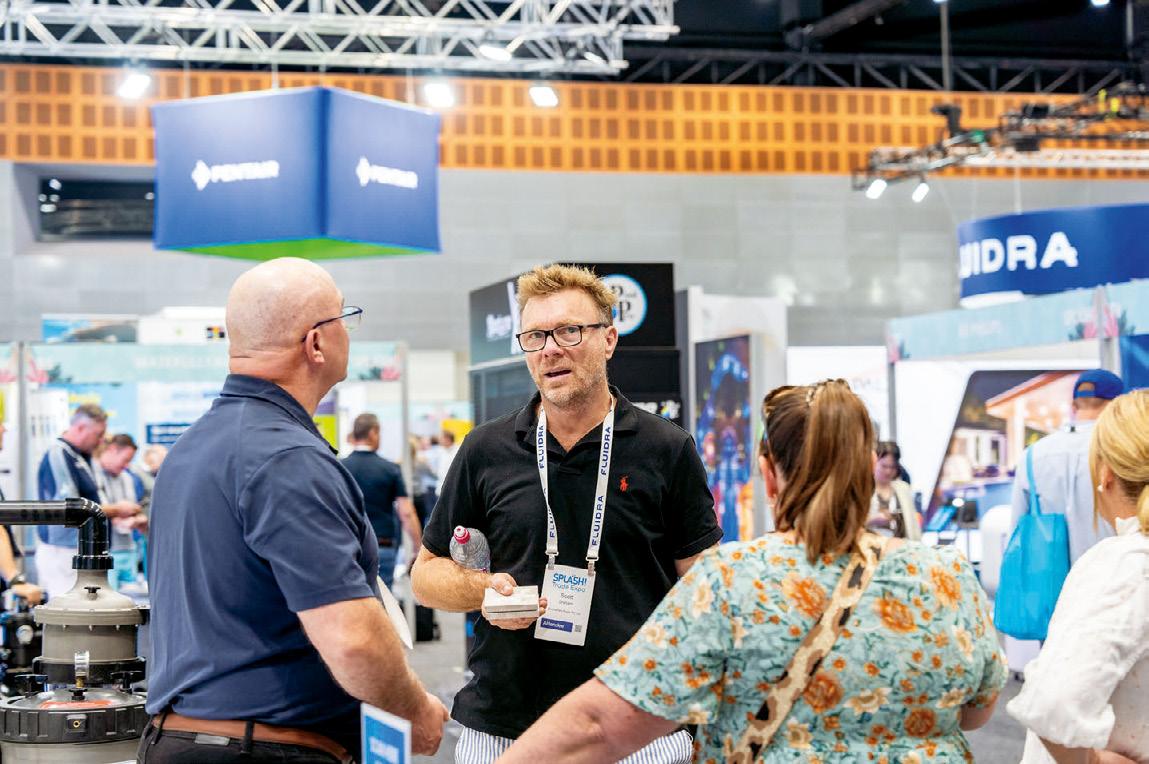
SPECIAL THANKS TO PLATINUM SPONSOR


In brief 58
Record attendances with Brisbane’s $2 entry campaign 58
Swimming to raise money for sick kids 59
NSW school syllabus leaves water out of swimming lessons 59
New facility for world’s biggest swim school 60
The value of quantitative swimming analysis 62
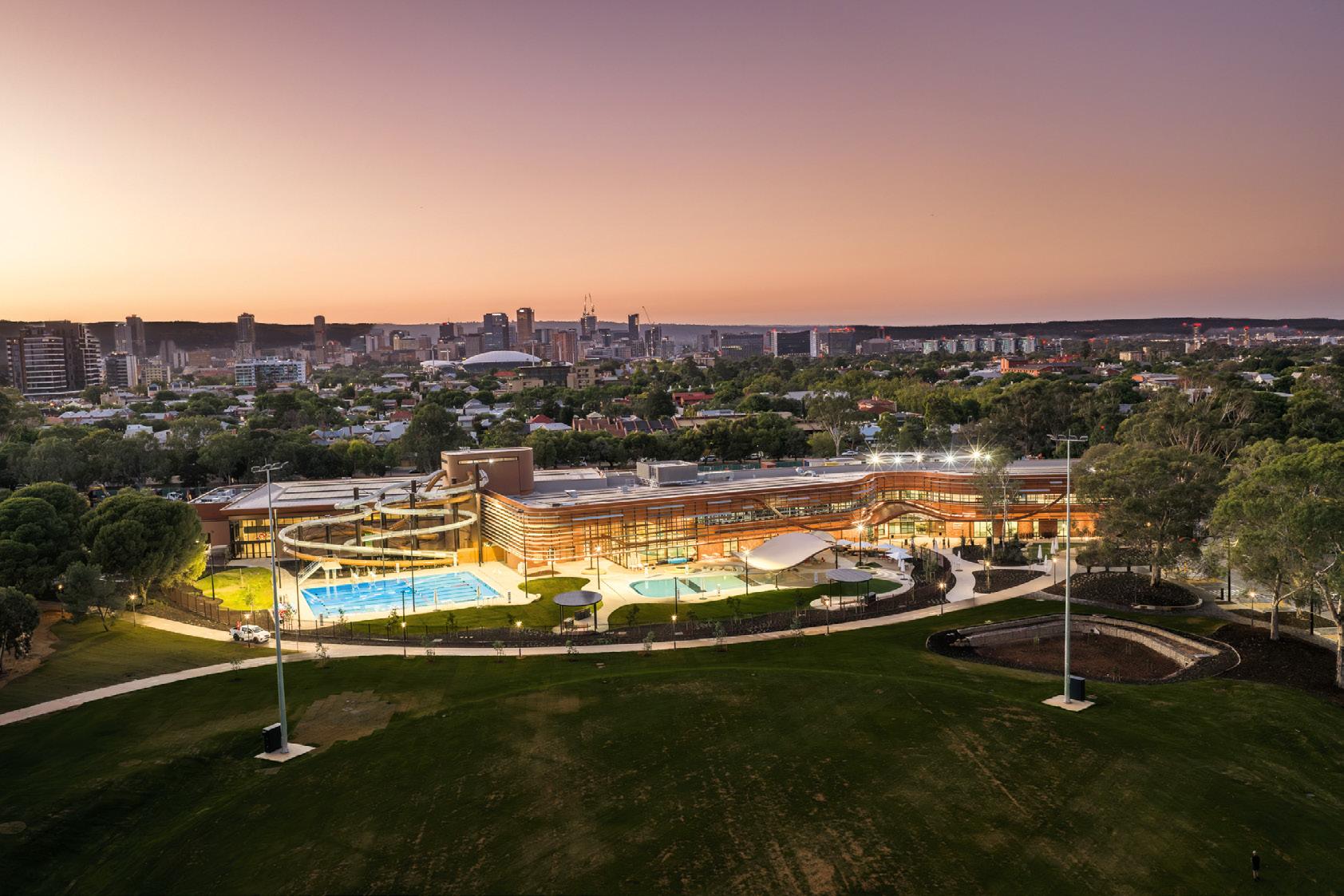
The landmark $135 million Adelaide Aquatic Centre opened with a gala day on January 26 –opening fully to the public the following day.
More than 10,000 people registered in the ballot to be among the first to enjoy everything the new Aquatic Centre has to offer which includes indoor and outdoor pool areas, four water slides, splash zones, diving amenities, sauna and steam rooms, café and retail spaces, and lawned recreation areas.
The South Australian Government says this response demonstrates the community excitement and expectation for the new aquatic centre.
More than 2000 people are already enrolled in learn-to-swim and squad classes while 1700 health and wellness memberships have already been snapped up since memberships for the new centre opened in November last year.
More than 100 sporting, community and health groups will return to the brand-new facility after being accommodated at alternative venues across the Adelaide pool network during construction. The completion of the project comes less than two years after major construction began in February 2024. Landscaping and installation of new irrigation and turf is continuing after opening.
More than 1500 full-time equivalent jobs were supported over the life of the project, with more than 2500 people working at pace to complete the finishing touches in the final weeks prior to the opening.
Approximately 2800 cladding panels, 685 tonnes
of structural steel, 720 concrete piles, and 1.35 kilometres of underground plumbing were used in the build. Around 160,000 tiles were installed in the leisure pool, with just under 153,000 tiles used across the other indoor pools.
More than 50 timber beams and columns, each one up to 37 metres long – or more than 10 metres longer than the 25 metre, 8-lane outdoor pool – were used in the centre framework. These were milled in Austria, as there are no facilities in Australia capable of producing beams of this size.
Excavators removed 40,000 cubic metres of soil during construction, helping backfill the former pools at the old aquatic centre site, ahead of more than 1000 square metres of space being returned to park land.
Powered by 100 per cent certified renewable energy, the new centre is an accessible space for everyone and sets a new benchmark for recreational aquatic facilities nationally.
The consulting aquatic engineer was Neil Davey of MLEI Consulting Engineers.
YMCA Aquatic will run the new Adelaide Aquatic Centre.
Features include:
• 50m, 10 lane indoor pool.
• 25m, 8 lane outdoor pool.
• Dedicated indoor warm water rehabilitation pool.
• Dedicated indoor learn to swim pool.
• Lagoon outdoor pool.
• Four new waterslides, reaching speeds up
to 40 km/h.
• Entry level diving amenities.
• Indoor leisure space, with splash zones.
• Relaxation zone, sauna and steam room.
• Outdoor splash pad with waterplay.
• Outdoor aquatic zone with BBQs and lawned areas.
• Café available for both centre visitors and other Park 2 users.
• Gym and fitness facilities three times the size than first planned.
• Inclusive amenities and changerooms.
• Increased car parking with access from Jeffcott Street.
• Improved pedestrian and cycle pathways connecting the centre with existing networks.
Eight cases of cryptosporidiosis were linked to the Waterworld aquatic centre in Adelaide’s north-east in January, and one of those people then visited the Adelaide Aquatic Centre. Centre management then closed three pools for 24 hours for decontamination as a precaution, even though the case was not contracted from the facility and the risk to most visitors was low.
SA Health’s notifiable diseases weekly report says there have been 36 cryptosporidiosis cases in the state this year to February 7, which is a similar number to the same time last year.
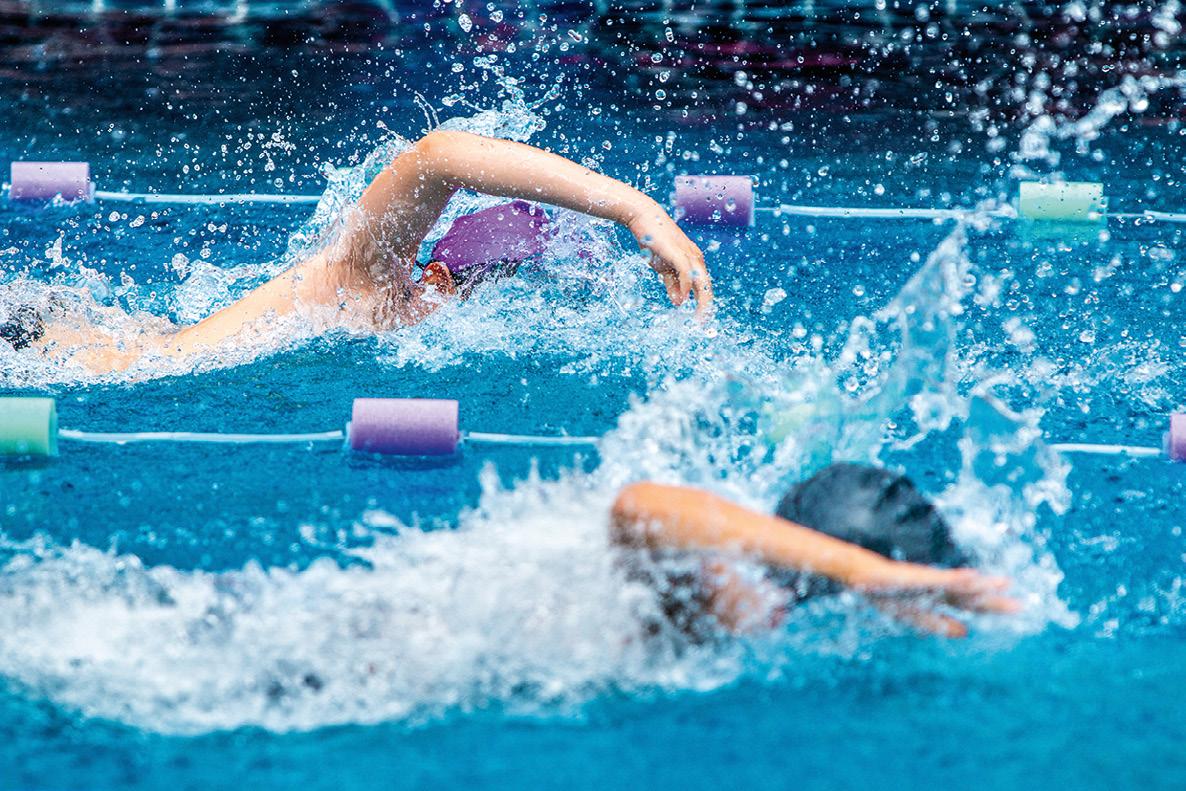
On February 6, staff at Balaklava Swimming Pool in South Australia received reports from swimmers of low voltage electrical current in and around the pool during the Balaklava High School Swimming Carnival.
The pool management contractor Belgravia Leisure exercised caution, notifying the high school immediately, and evacuating and closing the pool and cancelling the swimming carnival.
Wakefield Regional Council Mayor Rodney Reid says that the council staff attended the site to liaise with Belgravia and SA Power Networks to find the source of the incident, and that SafeWork SA was notified.
“SA Power Networks were at the swimming pool over the weekend monitoring power in and around the pool and swimming pool grounds,” he says.
“The pool will remain closed until Council, SA Power Networks, SafeWork SA and Belgravia Leisure address any issues to ensure the pool can safely reopen.”
The council’s other facilities, Owen and Hamley Bridge swimming pools, remain open and are able to cater to the Balaklava community while the pool is closed.
“Safety at our pools is paramount, ensuring the patrons safety always comes first. Closing the pool was necessary to address any potential danger and we trust Belgravia’s lifeguards made the right call – especially with how many patrons were at the pool for the swimming carnival,” he says. SPLASH! understands there were more than 400 children at the carnival.
“It’s a shame the students couldn’t finish their carnival, but safety always come first.”
Belgravia Leisure and Wakefield Regional Council will keep the community informed as to when the pool will reopen. Currently there is no set date for reopening.
At the time of writing, investigations and testing were continuing and the pool remained closed.

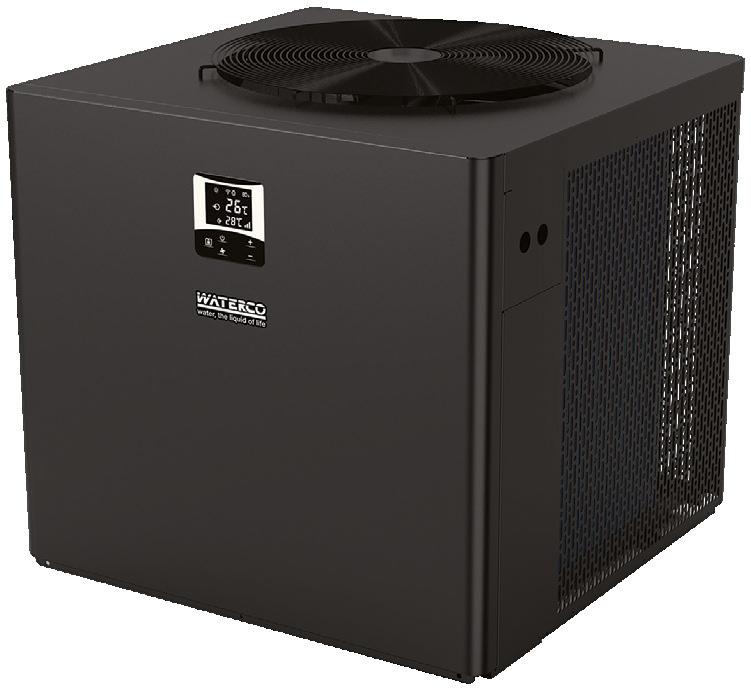
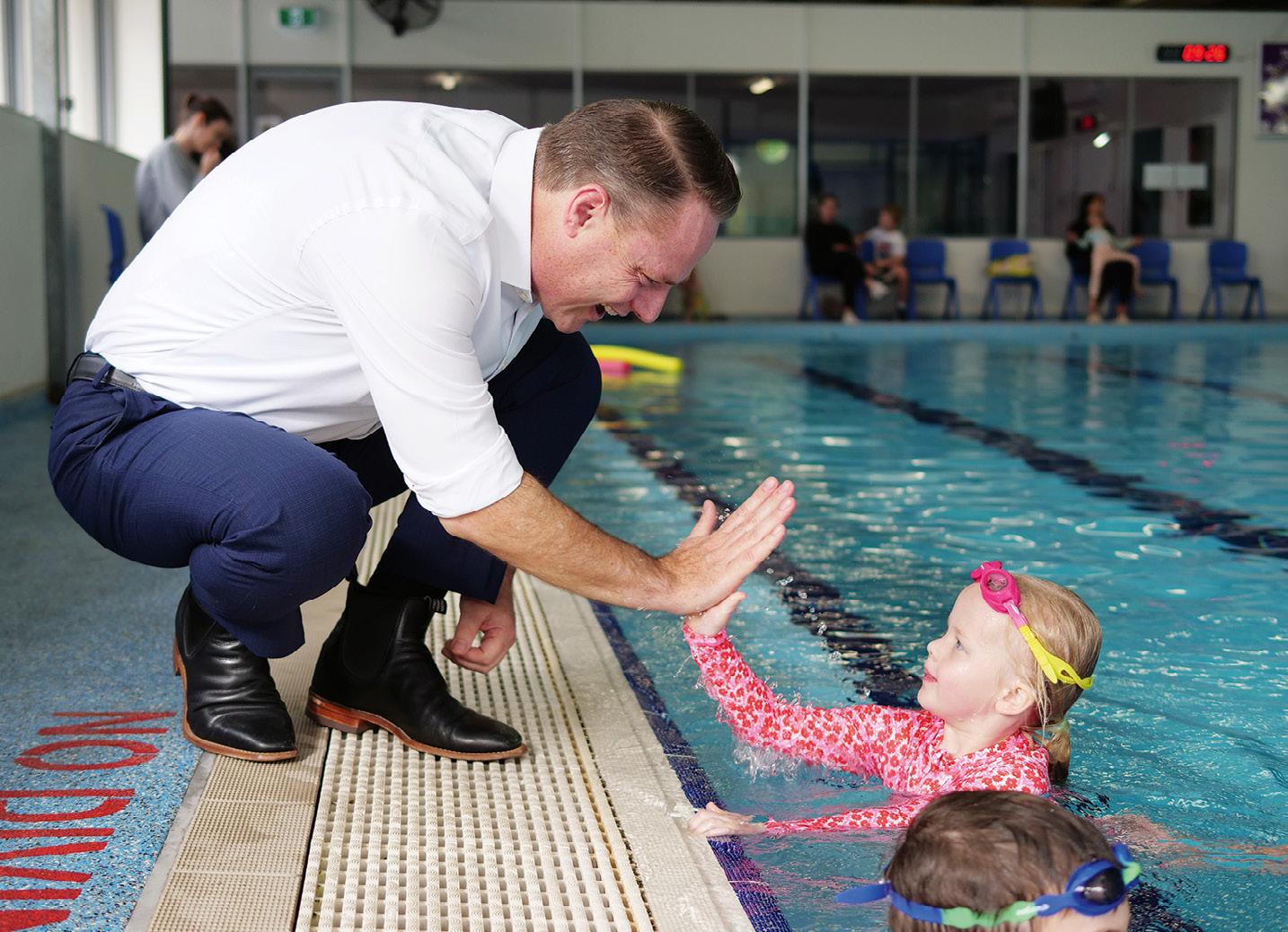
Brisbane City Council residents are diving into summer with a record-breaking uptake of the popular $2 Summer Dips program.
Pools across the suburbs have become go-to destinations to beat the heat, with more than 513,000 residents enjoying $2 entry
After more than 50 years of serving the community, Mount Druitt Swimming Centre is preparing for a $40.6 million redevelopment under the NSW Government’s Western Sydney Infrastructure Grants program, which will extend the pool to year-long opening instead of just being a seasonal venue. The plans include a 25m indoor learn-to-swim pool for children and adults; refurbishment of the 50m outdoor pool; inclusive amenities and changerooms, as well as spaces for community meetings; a new kiosk which will serve people in the pool area and outside the venue; and landscape improvements.
A couple of days after opening, following a $3.5 million six-month makeover, the Rocks Riverside Waterpark in Brisbane was closed while Council addressed surface safety concerns. There were reports of children suffering grazes after slipping on the surface of the waterplay splash area. Council checked the facility and found
residents more than $2 million in fees.
Lord Mayor Adrian Schrinner says that Summer Dips is all about helping Brisbane families enjoy summer together and make the most of Brisbane’s incredible lifestyle.
“Brisbane summers are made for swimming, and this popular program makes it easier for families to stay active, stay cool and still stay on budget,” he says. “Whether it’s cooling off after school, splashing around with the kids or swimming a few laps after work, our local pools are the place to be each summer.
“That’s why we’re putting plans in place to continue improving them into the future.”
Introduced as part of the 2023/24 budget, the program reduces the cost of entry at 22 pools across the suburbs to just $2.
Now in its third year, the popular initiative has already saved Brisbane families around $7.5 million, with more than 1.9 million residents taking advantage of the program to date.
1. Sandgate Aquatic Centre – 65,603
2. Newmarket Olympic Swimming Pool –64,879
3. Musgrave Park Swimming Centre - 42,953
4. Yeronga Park Memorial Swimming Pool –37,991
5. Dunlop Park Memorial Swimming Pool – 32,076
inconsistencies across the waterplay surface. The contractor was required to replace the surface without those inconsistencies.
The Fluidra Australia Water Polo Cup was held in December at the AIS in Canberra, bringing together Tier 2 and Tier 1 water polo teams from across Australia and New Zealand, creating a rare and valuable highperformance environment for emerging athletes. The Women’s Division Champions were UWA Torpedoes from WA, with the tournament MVP being Sterre Bijkerk from UWA, while the Men’s Division Champions were the Canberra Krakens with the tournament MVP being Hamish Ellison. Fluidra says it is proud to be one of the very few – and potentially the only – aquatic manufacturing companies actively investing in Australian sporting pathways beyond infrastructure and equipment, supporting opportunity, access and development at the athlete level.
Leisure and aquatics facilities that use music during exercise and aquarobics classes have been put on notice to not use unlicenced music, following a gym chain owner being heavily fined. The S1 gym CEO Kieran Turner and five of his companies were ordered to pay more than $260,000 by the Federal Circuit and Family Court of Australia. The use of unlicensed music was discovered by the musical regulatory body, the Australasian Performing Right Association Limited (APRA), after a sting operation. Initially APRA offered Turner a license to play the music through OneMusic, a joint licensing initiative that APRA launched to grant licenses. When he rejected the offer, APRA launched an investigation, discovering the playing of unlicenced songs by secretly using the Shazzam app while group fitness classes were being undertaken. Twenty-five works played at the gyms were identified as being owned or licensed by APRA.
For the month of February, Fluidra Commercial supported the Starlight Foundation through a swimming-based fundraising initiative encouraging staff, industry partners and aquatic professionals to participate in regular swimming at their local aquatic centres across Australia while raising funds for sick children.
Since 1982 the Starlight Foundation has been delivering happiness to seriously ill kids and their families. Every minute of every day, a child in Australia is admitted to hospital. For many of them, it’s a scary and isolating experience.
By aiding the foundation, participants in the Starlight Super Swim help them achieve their aim of bringing joy, laughter and comfort to sick kids when they need it most.
“This initiative brings our people together around swimming – supporting sick children while reinforcing the positive
Swim schools
role aquatic facilities play in communities,” says Fluidra APAC’s sustainability manager Jeremy Tang.
Fluidra Commercial’s Australian programs are part of the global work of the Fluidra Foundacio, the company’s international charity delivering social impact initiatives focused on water safety, health, inclusion and sustainability. The foundation supports programs and partnerships worldwide, investing millions of dollars annually into community-based initiatives.
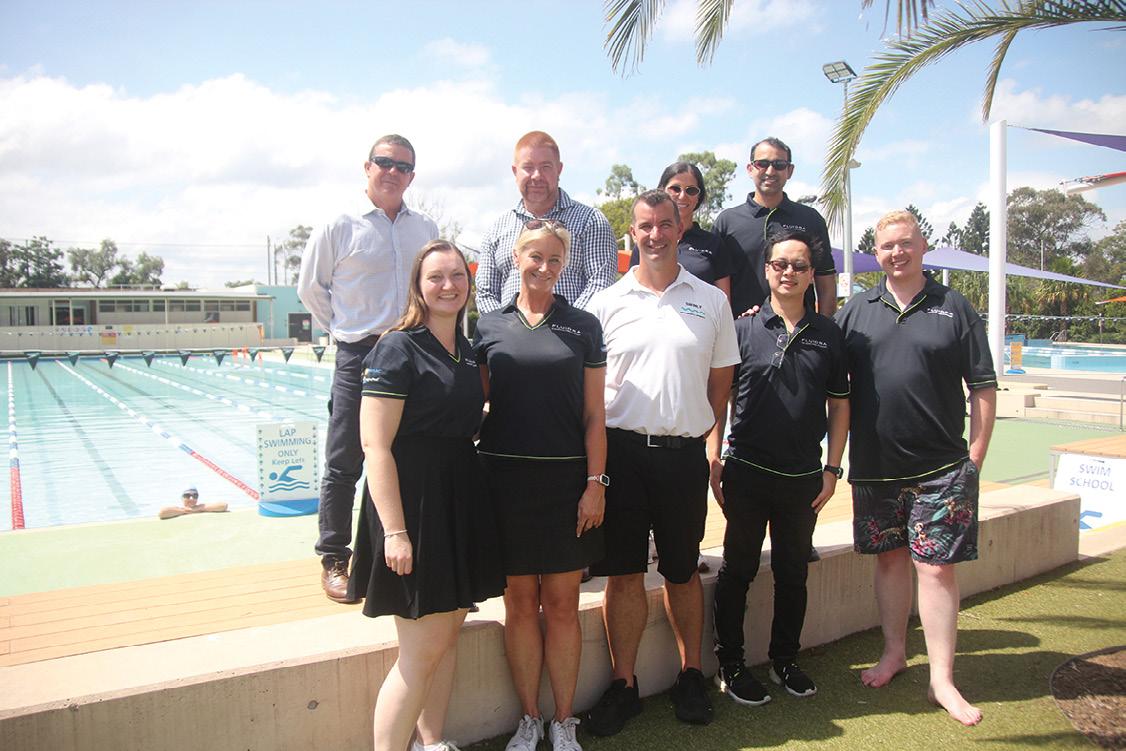
Some of the Fluidra Commercial team gathering for a swim session at Wentworthville Memorial Swim Centre, where Australian competitive swimmer Jason Cram from Swimly provided tips to help the team members with their technique
At the time of writing, The Fluidra Starlight Swim Team had raised nearly $7000 for the Starlight Foundation.
While the swim challenge ran in February, donations are still accepted until the end of March.
Fluidra thanks Cumberland Council, Noble Park Aquatic Centre, Swimly adult swim lessons/stroke correction and BlueFit.
The New South Wales education department’s seemingly counterintuitive new Personal Development, Health and Physical Education (PDHPE) school syllabus has been criticised for potentially encouraging swimming and lifesaving lessons without one vital element – water. The new syllabus enables students to “learn to swim” in the classroom – without ever entering a pool or other body of water.
This flawed policy has been criticised by teachers, swim schools and the Royal Life Saving Australia CEO Dr Justin Scarr, leading to a review by the department with assistance from RLS.
The NSW PDHPE syllabus is developed by the NSW Education Standards Authority (NESA) and plays a critical role in setting expectations and educational frameworks that guide, amongst many things, the provision of swimming, lifesaving and water safety lessons in primary and high schools.
RLS met with NESA in December and gained a commitment to working together early in 2026 to review elements of the syllabus, and strengthen the advice and support materials provided to schools, so that they can continue their critical role in water safety, both in the classroom and importantly, in swimming pools and at open water locations like beaches, rivers and lakes.
Scarr says that Royal Life Saving’s position is that being able to swim is critical to water safety, and that swimming and lifesaving skills are best taught in the water, usually at a local swimming pool or where safe to do so, in a bay, lake or beach.
NESA has committed to work with RLS to communicate to teaching staff the clear benefits of swimming lessons as part of the NSW curriculum. The new syllabus begins in 2027 but some schools will implement it from 2026.
Donate at:
https://superswim.org.au/t/fluidra-fitness
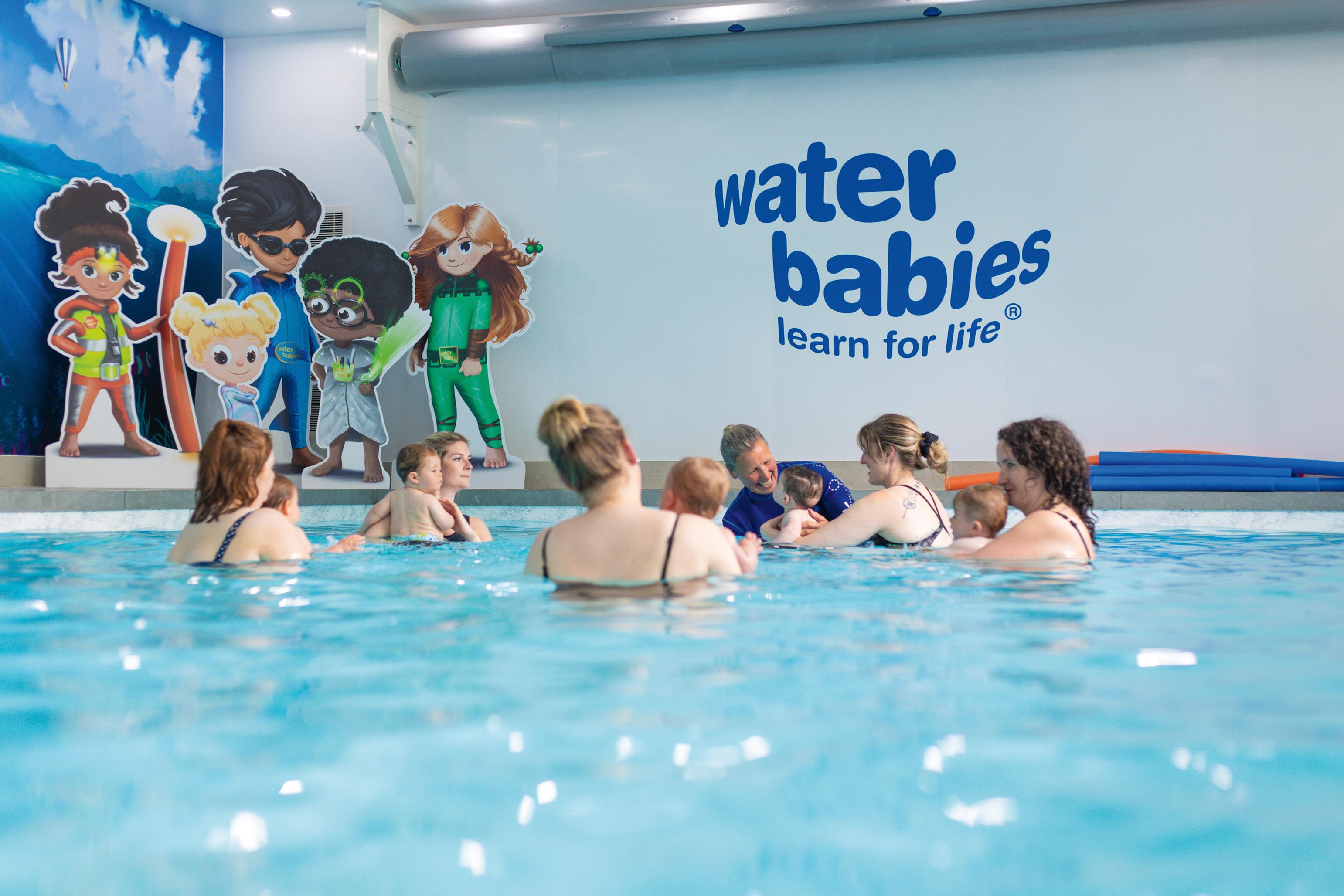
The world’s largest baby swim school has opened a new pool in the UK, focusing on safety, accessibility and enjoyment .
In an era where early childhood education increasingly recognises the importance of physical activity, Water Babies, the world’s largest baby and toddler swimming school, has taken a significant leap forward.
The unveiling of its latest swimming pool, Splash Cove in West Sussex, England, constructed by Bell Leisure Pools and outfitted with Waterco commercial equipment, is a testament to the school’s commitment to providing top-tier facilities for students.
“Bell Leisure Pools, renowned for its expertise and quality pool construction, has once again demonstrated mastery with this project,” says Waterco Europe CEO Tony Fisher.
“The new 60m3 Aquaflex-lined pool is not just a place for fun and games; it’s a meticulously crafted environment designed to enhance the learning experience for young swimmers. The attention to detail in the pool’s design and surroundings ensures safety, accessibility and enjoyment, catering to the unique needs of children learning to swim.”
The hydraulic equipment includes two Waterco SMDD1200 Micron 4-bar commercial sand filters and two Waterco Hydrostar commercial 5.5hp pumps controlled by Waterco variable frequency drives to ensure the ultimate in filtration, energy saving and performance.
This integration of top-tier equipment underscores the school’s dedication to providing a superior learning
experience, minimising risks while maximising the benefits of water-based activities.
“Parents can take comfort in knowing that their children are not only learning an essential life skill but doing so in a state-of-the-art facility,” says Fisher. “The combination of Bell Leisure Pools’ construction expertise and Waterco’s advanced equipment provides an unparalleled environment for young swimmers.”
Swimming is a vital skill, and early exposure can significantly enhance a child’s confidence, coordination, and overall physical health. With this new facility, Water Babies not only provides an excellent platform for developing swimming skills but also fosters a love for physical activity that can last a lifetime.
“The collaboration with Bell Leisure Pools and Waterco reflects a thoughtful investment in quality and safety, recognising that the best learning environments are those that are well-designed and well-equipped,” says Fisher.
Caroline Braund, Water Babies Sussex West franchisee, says the team is excited to finally open this new facility and provide families in the local area with more lessons to teach their little ones how to swim and learn a skill for life.
“It’s been a truly collaborative project with Bell Leisure, and we’re thrilled with the final product which gives customers a premium swimming experience,” Braund says.
Lawrence Pearce, a director at Bell Leisure, is equally thrilled with the new facility.
ABOVE: Water Babies is the world’s largest baby and toddler swimming school
“It’s been a great project to work with the Water Babies team and build this new swimming pool facility where families can enjoy and learn to swim,” he says. “Our new office is right next door, so we’re looking forward to seeing the local community enjoying the pool.”
Fisher says the new Water Babies pool is a shining example of what can be achieved when excellence in construction and equipment meets a dedication to early childhood development.
“It sets a high standard for educational facilities and serves as an inspiring model for others to follow,” he says.
“Here’s to many years of joyful splashes, confident strokes, and the bright smiles of children mastering the art of swimming.” n
www.bell-leisure.co.uk
www.waterbabies.co.uk
www.waterco.com
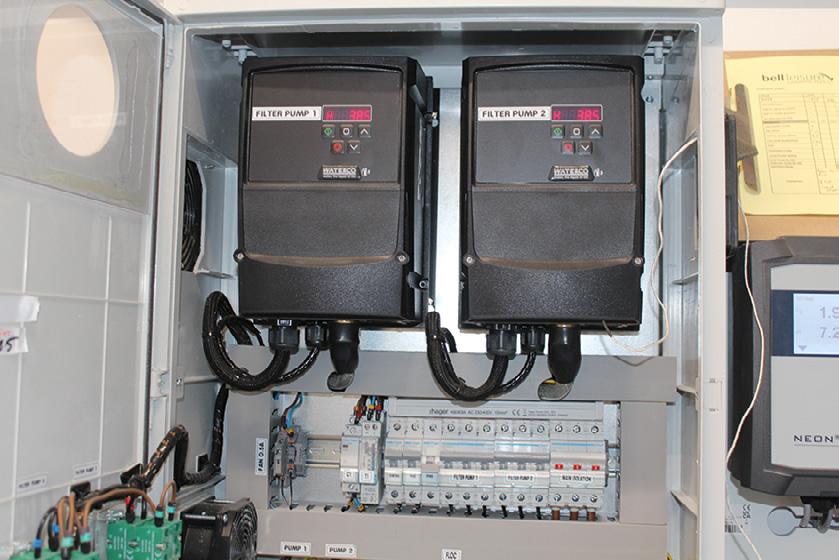
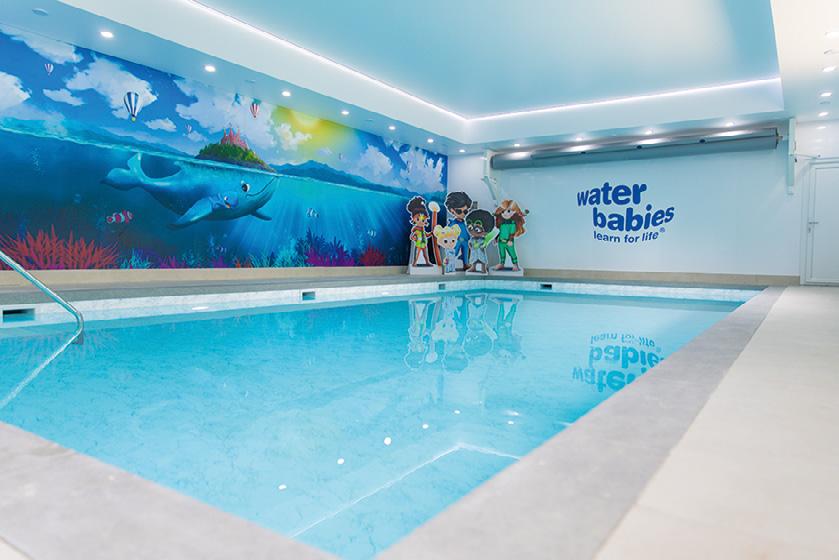
Splash Cove in West Sussex, England was constructed by Bell Leisure Pools and outfitted with Waterco commercial equipment
Micron SMDD side mount deep bed filters
Manufactured from high-grade, non-corrosive materials and employing the latest in proprietary winding technology, Waterco’s Micron Commercial Filter range features continuous strands of fibreglass filament that create vessels with refined consistency and superior quality. The filter’s 1200mm media bed also ensures that finer dirt particles and colloidal substances are retained to a far greater level than a filter with a shallower bed depth.
Key features include:
• UV and corrosion resistant fibreglass wound tank.
• Hydraulically balanced laterals maximise water flow and filtration.
“Parents can take comfort in knowing that their children are not only learning an essential life skill but doing so in a state-ofthe-art facility.”
• Optional six position multiport valve with sight glass and quick connect half unions.
• Available in filter areas of 0.87m2 to 3.14m2.
• Pressure rated at 2.5 Bar (36 psi), 4 Bar (58 psi), 6 Bar (87psi) and up to 8 Bar (116 psi).
• Maximum working temperature of 50C.
Hydrostar Plus commercial pumps
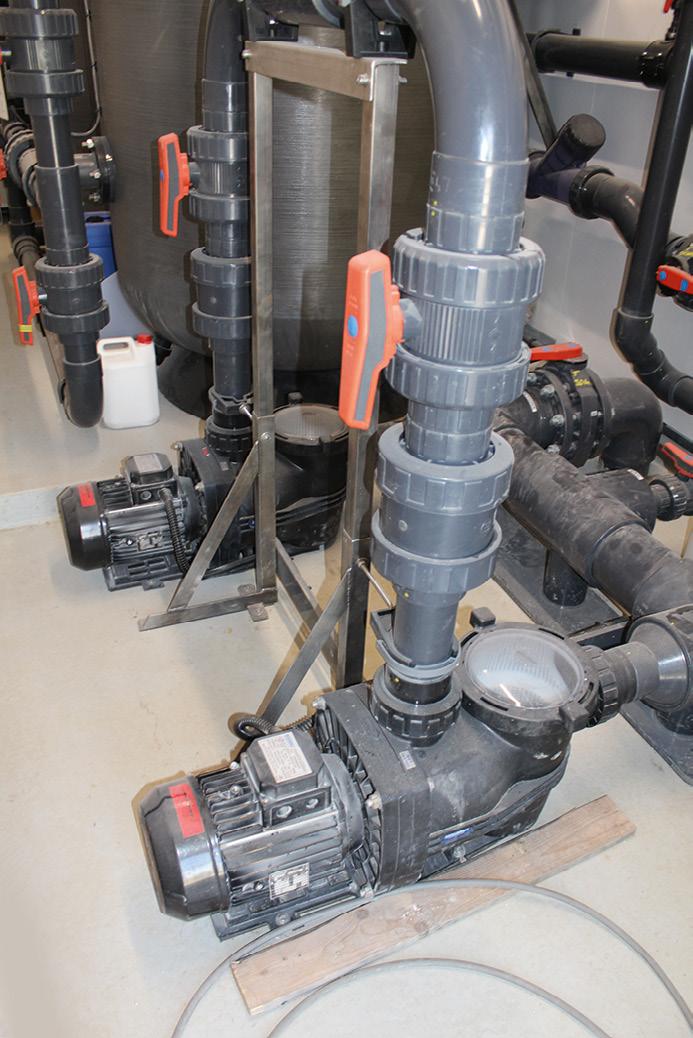
The two Waterco Hydrostar Commercial 5.5HP pumps are controlled by Waterco variable frequency drives
Hydrostar Plus pumps incorporate the latest technology in design and construction to produce a high performance self-priming pump. Constructed from an injection moulded glass reinforced thermoplastic that possesses superior mechanical and chemical resistance compared to steel. Its pump body is manufactured utilising state of the art engineering plastic moulding for extra strength.
Key features include:
• UV stabilised glass filled polypropylene housing.
• Clear polycarbonate strainer lid for quick inspection.
• Lid lock ring with ergonomic handles; easily remove and replace without additional tools.
• 16-litre moulded polypropylene strainer basket.
• Heavy duty IP55 weather proofed motor with stainless steel shaft.
• Enclosed glass filled Noryl impeller for long lasting reliability.
• Available in 7.5hp, 10.0hp, 12.5hp and 15hp.

Swim Coaching Science: Technique Analysis Strategies
A new book by Dr Rod Havriluk helps coaches better understand swimmers’ effectiveness through the water.
here are two primary methods to analyse swimming technique: qualitative and quantitative.
If an analysis is primarily numerical, it is deemed “quantitative.” If numbers are lacking and evaluations are categorical, the analysis is “qualitative.”
A swimmer’s technique can be qualitatively assessed as “effective,” or quantitatively evaluated regarding the values of such variables as stroke length, peak hand force or the angle at the elbow.
A coach is limited to making qualitative assessments most of the time. Feedback such as “better” or “good” is qualitative.
When a coach can quantitatively analyse technique, the variables usually reflect gross body movement (e.g. stroke counts) instead of a specific part of the motion. Although an analysis using stroke counts is quantitative, it gives no information about specific technique elements.
Swim Coaching Science: Technique Analysis Strategies seeks to enable quantitative analysis for swim coaches. It is written by Dr Rod Havriluk, PhD, president of Swimming Technology Research.
Havriluk is a biomechanist who specialises in swimming technique instruction and analysis, and his expertise focuses on three primary areas: optimising technique, preventing shoulder injuries, and accelerating skill learning.
He has coached swimming at all levels from age group to NCAA Division I and has served on numerous boards, including the advisory board for the Counsilman Center for the Science of Swimming; the educational board of the International Swim Coaches Association; and the review boards of numerous sport science journals.
Havriluk has worked with thousands of swimmers and triathletes, including Olympians and world record holders. Swimming World magazine named Havriluk as one of the top ten people with the greatest impact on swimming in 2015.
He has also been a speaker at many conferences, including for the American Swim Coaches Association, Australia Swimming Coaches and Teachers Association, Biomechanics and Medicine in Swimming, Federation Internationale de Natation (World Aquatics), the International Olympic Committee, the International Swim Coaches Association, USA Swimming, US Masters Swimming and the US Swim School Association.
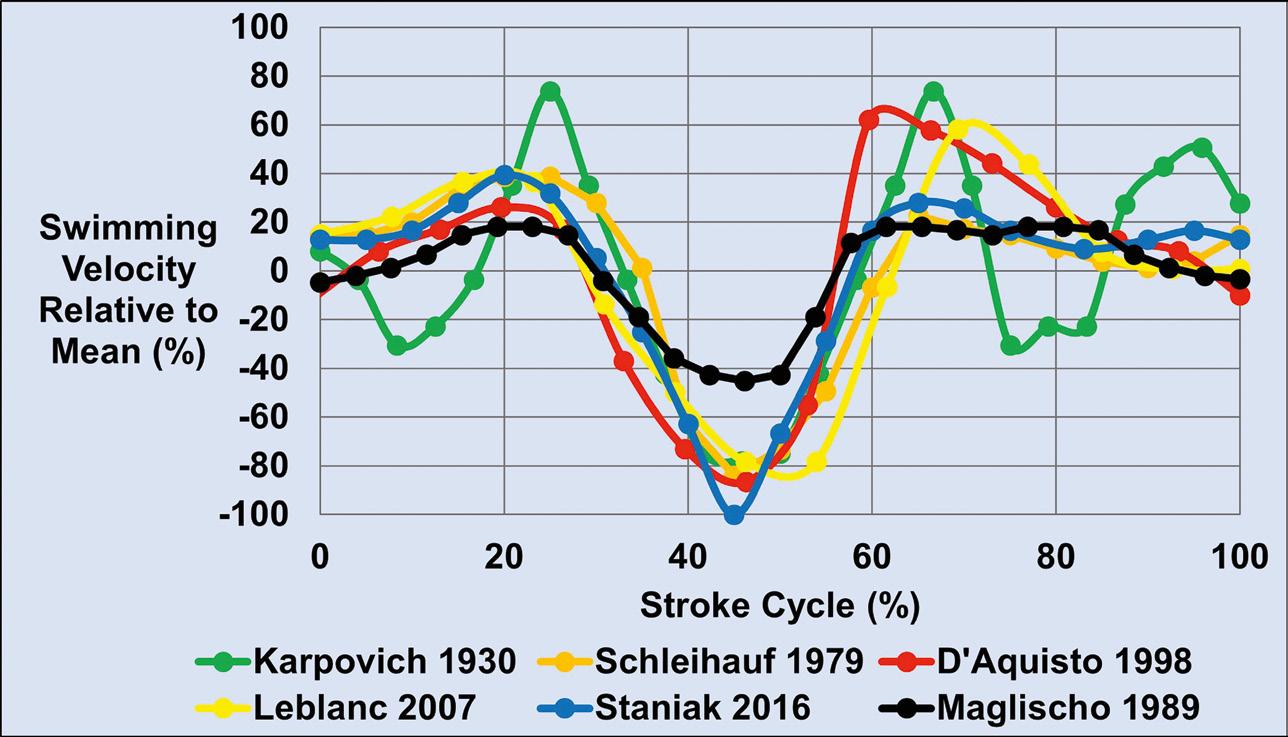
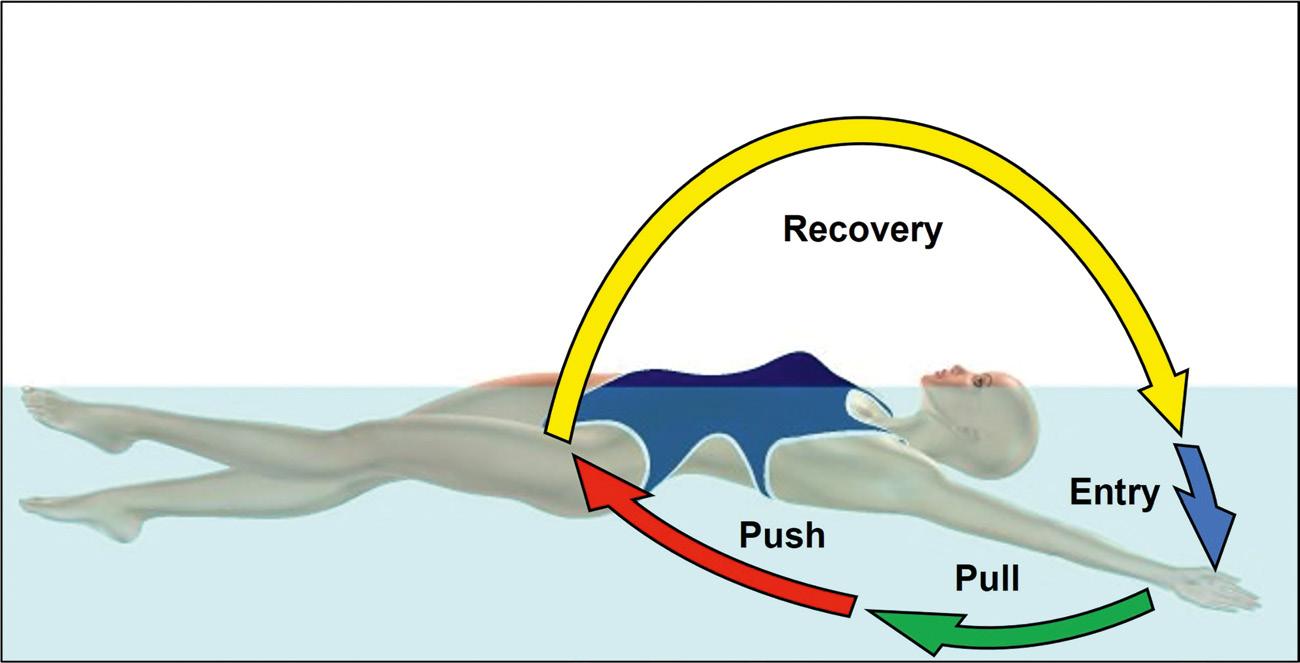
Countries where Havriluk has conducted clinics for swimmers and/or coaches includes Aruba, Australia, Bahamas, Bahrain, Barbados, Brazil, China, Curacao, Ecuador, England, Grand Cayman, Greece, India, Lebanon, Puerto Rico, Saudi Arabia, Serbia, St Vincent, Trinidad, Turkey, and the USA.
Of his many published ebooks, two series of importance are the Approaching Perfect Swimming series and the Swim Coaching Science series, as well as more than 100 articles in research journals and popular magazines.
Havriluk was awarded three US patents and is the inventor of the Aquanex system for analysing swimming technique, and is the developer of MONA, software with a biomechanical model of optimal technique. n
Contact: swimmingtechnology.com
TOP: Plotting velocity of the swim cycle
ABOVE: Backstroke technique
“His expertise focuses on optimising technique, preventing shoulder injuries and accelerating skill learning.”

BUILDING EXCELLENCE THROUGH ACCREDITATION, ENGAGEMENT, DISCIPLINE, AND IMPACT.


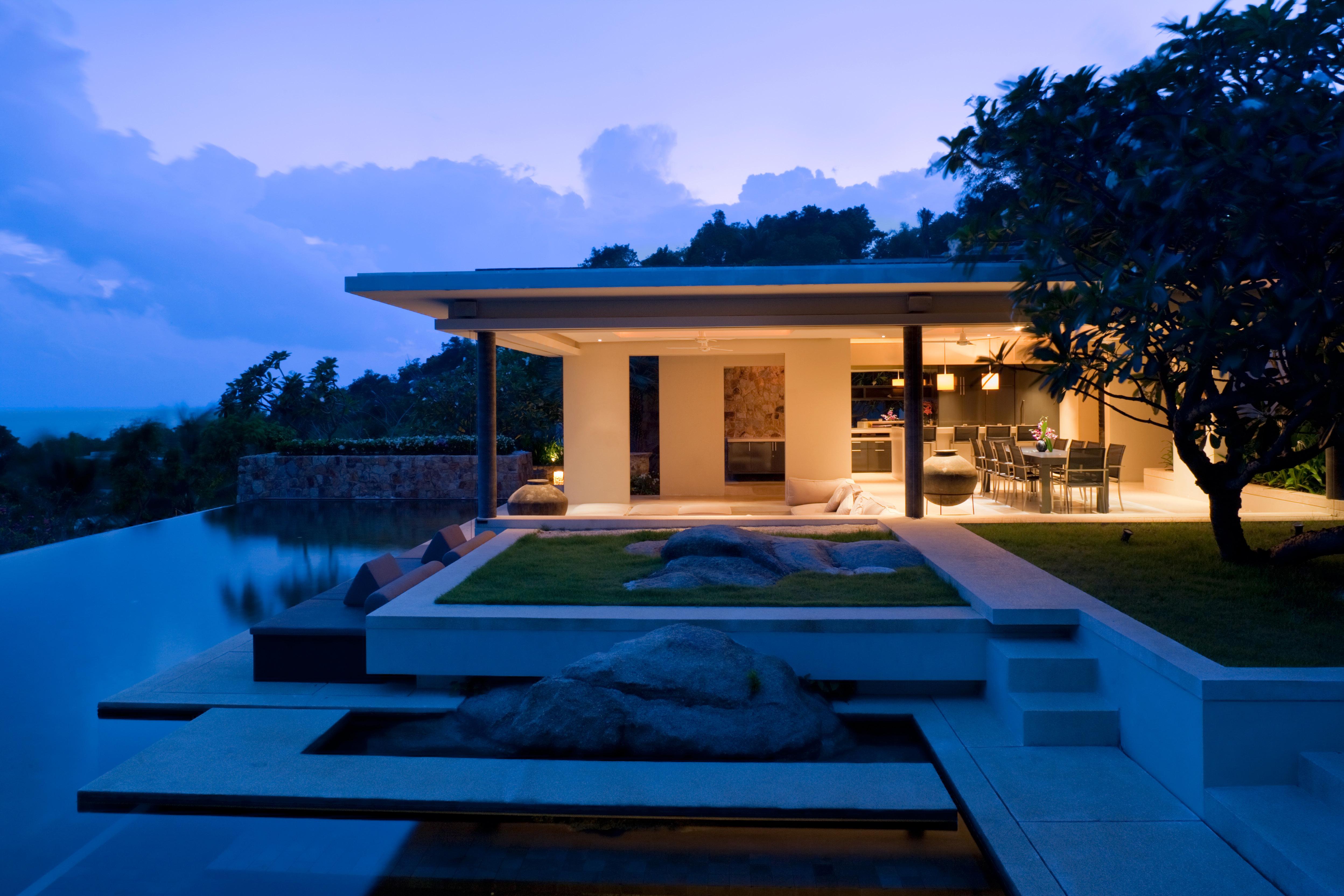
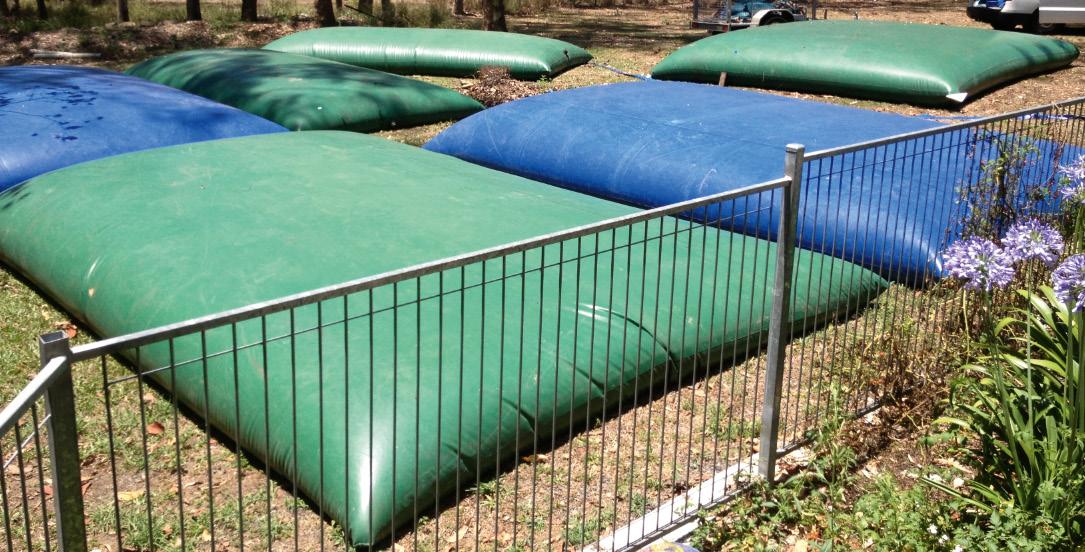
ABGAL’s portable bladders are designed to be use by installers during pool renovations to save the pool water. The existing pool water can be pumped in and stored on site for the duration of the renovation, then pumped back into the pool once the renovation is complete.
These are particularly useful when installing an Aqualux liner over a fibreglass shell, as the water is there and ready to go straight back in once the liner is installed. There are no delays trying to co-ordinate water trucks –thus minimising the amount of time the pool is left empty and reducing the risk of the shell “popping”.
They also supply Climate Care Certified thermal covers such as SpaRoll and SpaTex suitable for plunge pools and swim spas, as well as a fitted debris cover specifically for tank pools.
Contact: www.abgal.com.au
Aaron White from award-winning technology platform uDrew says that pool builders exhibiting at consumer shows such as the Pool Spa Life expos are reporting significant improvements in lead quality and conversion rates after adopting this interactive visualisation technology on their stands.
The shift comes as the global property technology (PropTech) market continues its rapid expansion.
He says pool builders using uDrew technology at major Australian expos are reporting three to five times more booth engagement compared to traditional setups, with average visitor dwell times increasing from two to three minutes to 10 to 15 minutes.
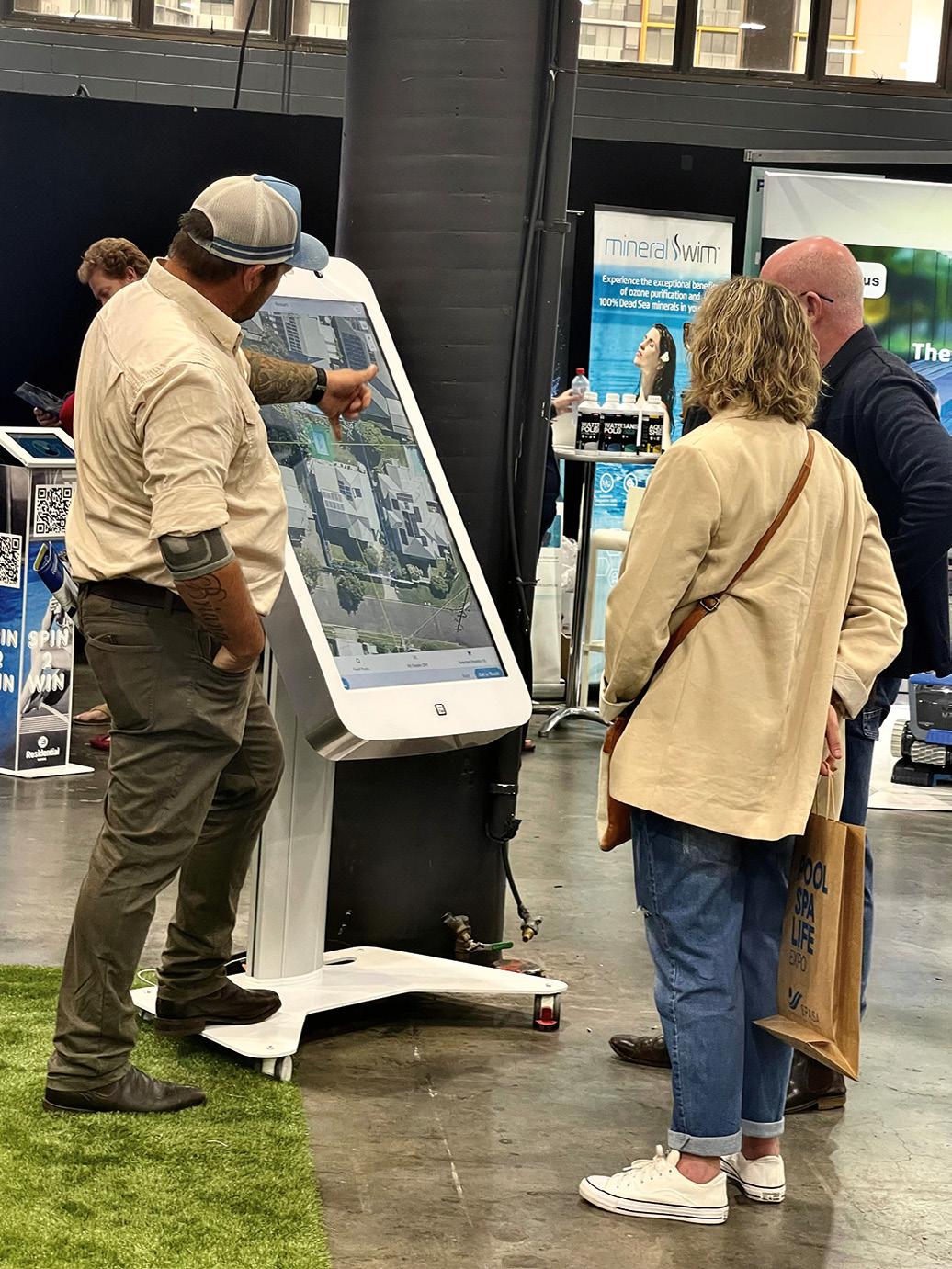


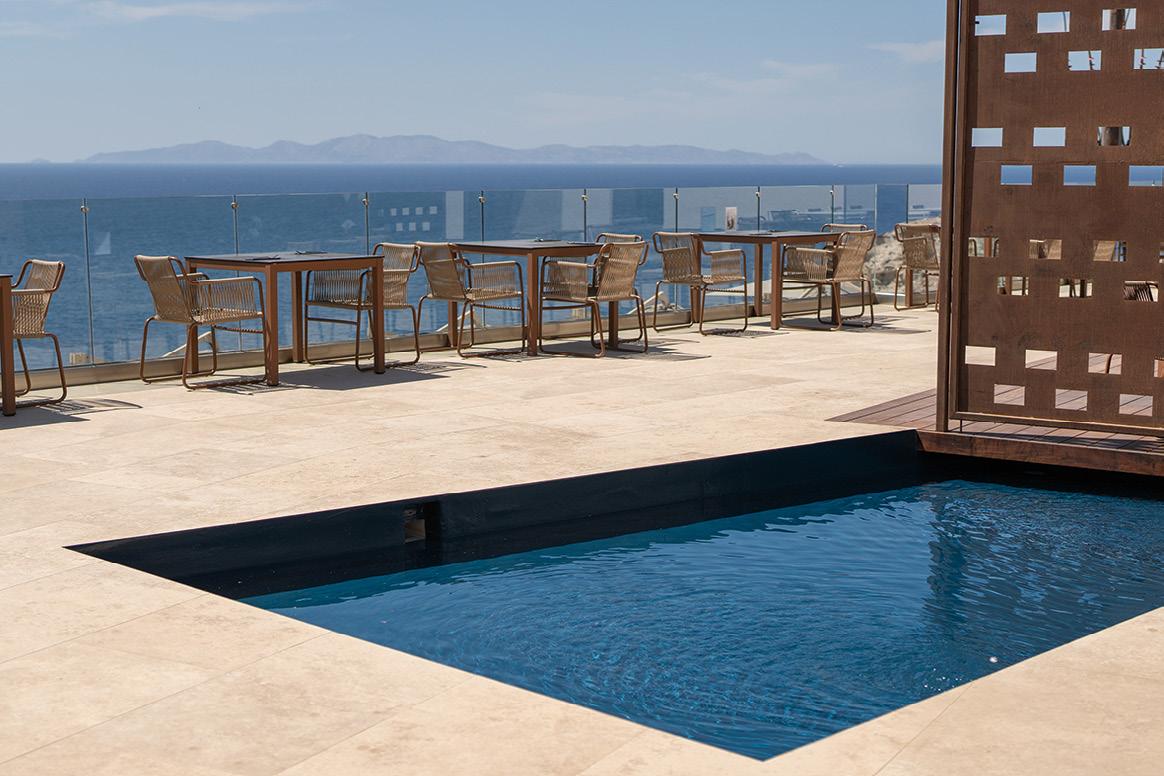
Ionian terrazzo is a calcite marble, one-of-a-kind natural terrazzo quarried by Stonetech.
It has an earthy dark beige colour and brown spots. As a marble it is suitable for all types of applications including pool surrounds and landscapes.
Stonetech says its unique design makes it an ideal surface for pool coping and decking, creating a seamless and natural outcome.
It has an apparent density of 2650 kg/m3 with a water absorption of 1.5 per cent wt. It has a slip resistance value of 66 (Dry rough) and 62 (Wet rough).
It comes in various finishes for pools including sandblasted for floor, walls, coping, drain grates and decks; and honed, famed brushed, bush hammered and polished for walls.
Contact: www.stonetech.gr
Following the NSW launch last year, Reece Irrigation & Pools has now launched the Quantum Spa nationally. Built with the same DNA as the Quantum Range, the award winning Quantum Spa uses advanced photocatalytic oxidation to eliminate bacteria, viruses, organics and chlorine byproducts –leaving behind nothing but crystal-clear water.
Charles Hoyek, category lead at Reece Irrigation & Pools says that the exciting thing about the technology is its ability to eliminate oils, lotions, urine, sweat and even cosmetics from pool and spa water, something he says typical UV, ozone or ioniser systems cannot do.
The Quantum Spa features an amalgam lamp to ensure high performance in water ranging from 0C to 50C, making it perfect for residential spas and small ice baths.
Contact: www.reece.com.au
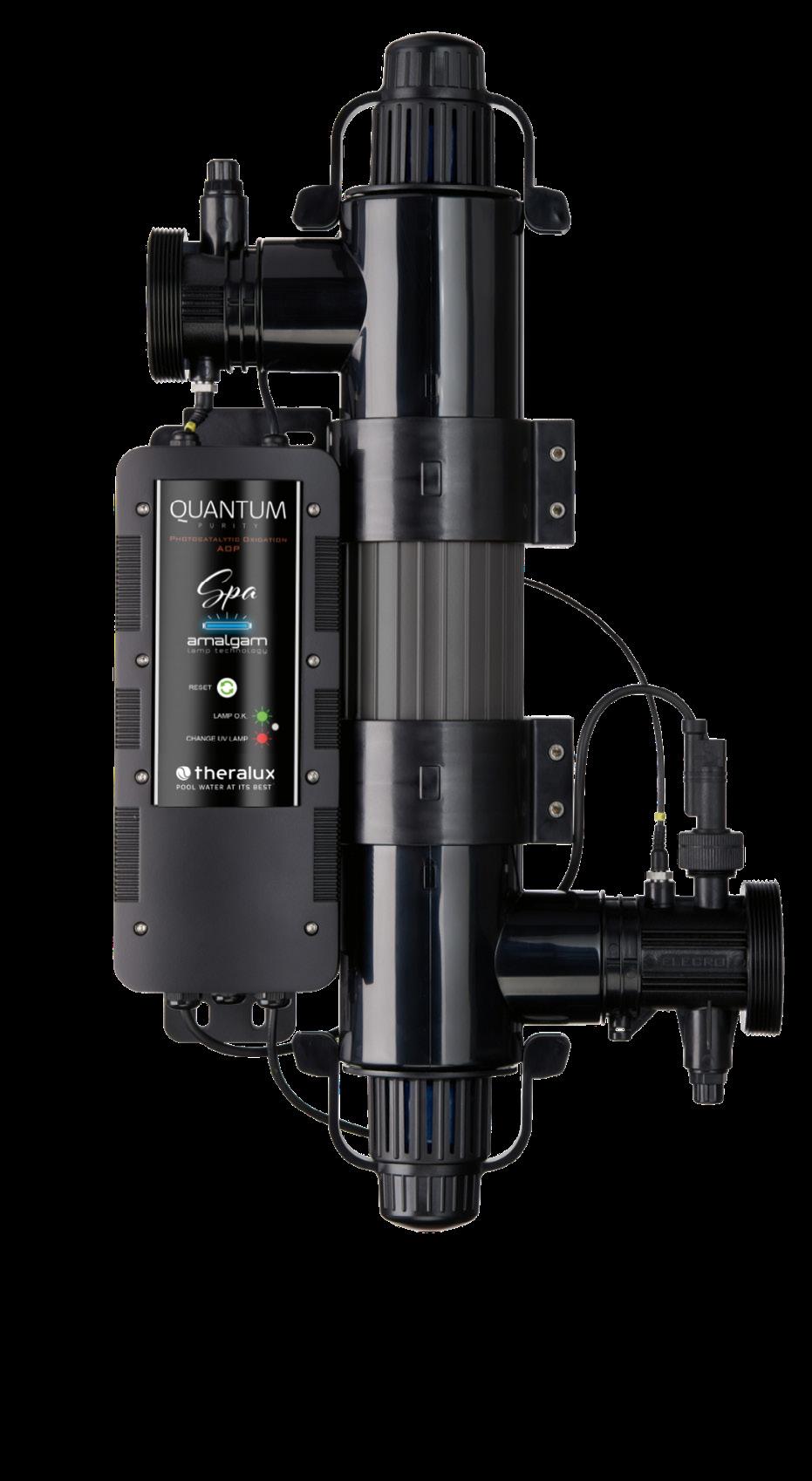
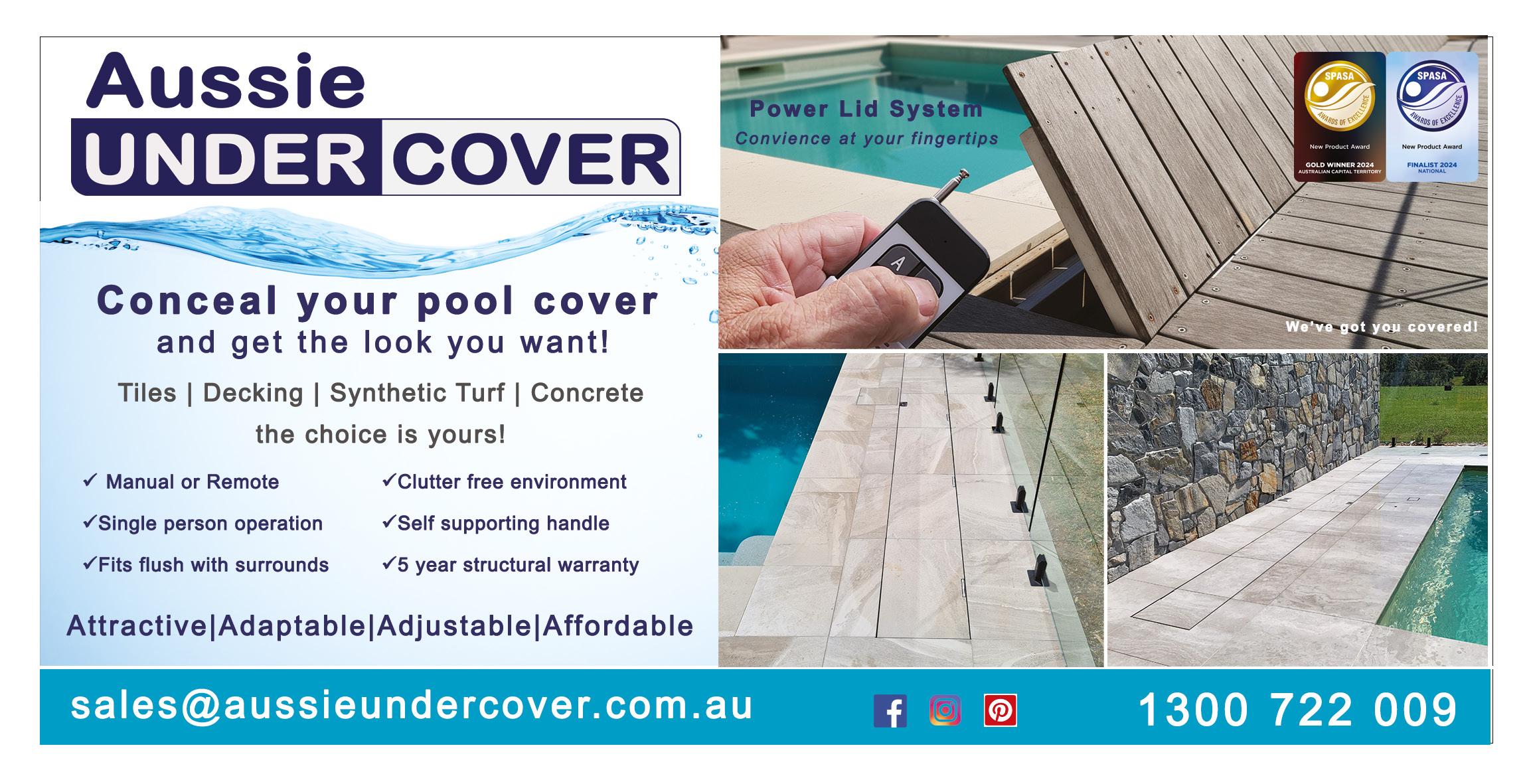
Tax invoice
Please find enclosed my cheque/money order for $_________ payable to The Intermedia Group Pty. Ltd. OR please charge my:
Mastercard Visa Amex
Cardholder Name:
Expiry Date: __ __ / __ __ Signature:
Name:
Job Title:
Company:
Address:
Suburb/Town: Postcode:
Ph: Fax:
Email:
Within Australia *
$AUD65.00 – 1 year, 6 issues
$AUD104.00 – 2 years, 12 issues – Save 20%
$AUD136.50 – 3 years, 18 issues – Save 30% * Prices quoted include GST
$AUD75.00 – 1 year, 6 issues Asia Pacific
$AUD80.00 – 1 year, 6 issues
All Other Countries
$AUD90.00 – 1 year, 6 issues

We are committed to handling your personal information in accordance with the privacy act. Please Select one of the following: Yes No - Please send me information about special offers and or events from SPLASH!
The Intermedia Group Pty Ltd ABN 94002583682 PO Box 161 Hornsby NSW 2163. www.shop.splashmagazine.com.au or call +61 8227 6486