

![]()


The job update tracking from the courier was comprehensive, so I was able to keep the client fully posted on delivery which was great. The programs arrived on Friday and look fab –we’re all so happy with them!
Thanks again for turning it around so quickly.
Dom 12/2/26 1
2
As a small business, we know we’re a very small fish in the industry. However small our orders may be, I truly appreciate more than anything that we’re not made to feel like a low priority in any way.
Our experience in the past with other companies have left us feeling a little helpless and not important due to our size, this is certainly not the case with Hero.
Liv 6/11/25
3
This job was delivered yesterday morning!!!! MIND BLOWING turn around time. Less than 24 hours!!!
You guys have really impressed us.
Gary 26/11/25
4
You’re a legendeverything was brilliantproduct through to service - and a day early in peak season.
I can’t thank you enough!
Steve 17/12/25


New assets for Labelmakers P05
Acquires assets from Perfection Packaging
KBA Durst customer honour P06
Atlantic Packaging Products wins top award
Pact half-year earnings dip P06
Says Linpac buy, Laverton JV dent earnings
Foster Packaging revived P08
Joe Foster relaunches brand with new venture
Nekkorb/MPS renew deal P08
Both businesses renew their cooperation
HP and ePac ink strategic deal P09
The global deal is worth $50 million
Close the Loop biz streamline P09
Identifies several non-core business units
New hub for Pack & Send P10-11
Aims to transform how businesses manage storage and logistics
The science behind Earthodic�s packaging innovation P12-13
Biz creates high-performing packaging barriers
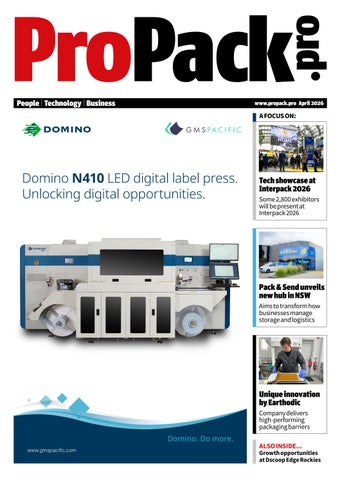
COVER STORY: Unlocking digital opportunities with Domino P14
The Domino N410 LED digital label press provides several benefits to printers
Dscoop Edge Rockies delivers P16
A/NZ attendees unlock growth opportunities
Dscoop event in Melbourne P18-19
Dscoop, HP, Currie Group, Ball & Doggett, and Close the Loop come together for event
BML buys Fengchi GW1700 machine from Graffica P20
Improves business operations with purchase
Frank Brokken: A true gentleman of the print industry P22
The late Frank Brokken is remembered by many in the print and packaging industry
What visitors can expect at Interpack 2026 P24-29
Some 2,800 exhibitors will present processing and packaging technologies and concepts
A/NZ companies shine at WorldStar Packaging Awards P30-32
A/NZ businesses set the standard for excellence in innovation and sustainability
Aquapak: EPR rules favour plastic packaging over paper fibre P33
Aquapak’s Hydropol solution provides a practical solution to industry challenge
Dealing with sacred cows is uncomfortable, but so is running out of money Navigating the food and packaging waste paradox
Global position paper explores the issue LOUPE Americas to power packaging progress
The Rosemont, US event will build on the foundations of Labelexpo
Navigating the regulatory landscape in 2026: FINAT P37
Exploring the EU’s Packaging and Packaging Waste Regulation and how it affects labels
A guide to upcoming events around the world


The global packaging industry continues to evolve at pace. Events such as Interpack set the benchmark for tech developments in processing and packaging, offering a glimpse into what is shaping its future.
Meanwhile, Dscoop brings together print leaders from around the world, fostering knowledge-sharing and new growth opportunities.
In addition, recognition programs like the WorldStar Awards celebrate excellence, highlighting the very best in packaging design and innovation on a global stage.
Together, these platforms reinforce the strength and resilience of the industry, demonstrating how they are pushing the boundaries of what’s possible. This issue highlights the value from these events – we hope you enjoy the read. Editor’s Note
Labelmakers Group has acquired the majority of the flexible packaging assets operated by Perfection Packaging at its site at 19-25 Nathan Road, Dandenong South in Victoria.
In parallel, the company has agreed to lease the Dandenong South site for a 10-year period beginning March.
The announcement comes following news that Perfection Packaging entered voluntary administration, in October 2025, as a division of Pro-Pac Packaging Limited.
The Perfection Packaging business was separately wound down and closed in February, while Pro-Pac Packaging entered into a Business Sale Agreement for the sale of its other Australian business and assets to Consolidated Packaging Australia, a subsidiary of Knoxcorp.
According to the Labelmakers Group, the asset-only deal allows the business to offer its existing customers the “same wide-web state-ofthe-art printing across two sites”, with Dandenong South to be structured to work seamlessly with its main operations in Somerton.
“We are excited at the opportunity this represents not just for business continuity planning but also our expansion into flexible packaging,” the company said.
“The assets are unsurpassed in the Australian market, including advanced gravure capabilities for complex varnishes and cold seal adhesives, as well as solventless lamination.
“This asset-only acquisition encompasses only machinery with no continuation of business, operations, or employees.
“We look forward to discussing the opportunity and benefits over the coming months.”


Atlantic Packaging Products, a Koenig & Bauer Durst customer, won ‘best in class’ at the recent 2026 PAC Global Awards for premium corrugated packaging produced on the Delta SPC 130 single-pass press.
The company took home the award for itsZavida Coffee Roasters Organica coffee solution within the technical category for package innovation design.
As the Ontario division of the Atlantic Packaging group of companies, Atlantic Packaging Products is a North American packaging provider.
The Zavida Organica project brought together Zavida, its design team, and technical experts from Atlantic Packaging Products to leverage digital innovation for sustainable packaging.
Their collaboration resulted in a marketready corrugated packaging solution that boosts brand perception and shelf visibility, with consumers responding positively to its authentic, eco-conscious design.
Atlantic said the new Zavida Coffee Roasters Organica Keurig 72 Pods box “stands as a testament to the power of digital print technology”.
This premium corrugated package aims to demonstrate the exceptional precision and colour depth now achievable

through direct digital print on uncoated white-top corrugate.
“The Koenig & Bauer Durst SPC 130 press enables high-speed, high-quality production that redefines traditional printing methods, offering exceptional flexibility and faster speed to market to meet evolving customer demands,” Atlantic plant manager Larissa Fritzen said.
The project further highlights a significant shift in how corrugated packaging is utilised in the retail space as it moves beyond a simple box to become a canvas for premium branding.
“We’ve been partnering with Atlantic Packaging Products for more than 20 years. This collaboration is a clear example of how innovative internal graphic design at Zavida together with the corrugated expertise and advanced digital print capabilities of Atlantic,
can elevate packaging and make it stand out on the shelf; enabling us to communicate our brand value and positioning effectively without compromising on quality or environmental responsibility,” Zavida Coffee Roasters marketing commercialisation manager Adi Montas said.
Designed to reflect the natural, sustainable essence of the Organica brand, this packaging also showcases vivid, highresolution imagery with remarkable clarity.
“The intricate textures and organic tones reinforce the brand’s environmental commitment through visual storytelling. The use of uncoated white-top corrugate aligns with eco-conscious values, offering atactile experience that complements the design,” Atlantic digital print manager Anthony Memme said.
Pact’s Linpac buy, Laverton JV dent half-year earnings
Pact Group has announced its half-year results for the financial year ending 31 December 2025, reporting shortfalls across the board, which it attributed to losses relating to the Laverton joint venture (JV) and impact of its Linpac Packaging Australia Pty Ltd acquisition.
Its revenue was reported at $866.7 million for the period, down 6.8 per cent compared to the prior corresponding period (pcp). The statutory net loss after tax for the half-year was $33.7 million, compared to a statutory net profit after tax of $14.1 million in the pcp. NPAT was down 78.7 per cent to $3.1 million, compared to $14.8 million in the pcp.
“The Group has recognised $19.9 million in losses relating to the Circular Plastics Australia (PE) Pty Ltd (Laverton) joint venture. Laverton is still establishing scale, continues to generate operating losses, and is reliant on future regulatory reform to support long-term commercial returns,” the company said.

“Shareholder loans of $13.5 million are unlikely to be repaid in the foreseeable future and have been recognised as an impairment expense in the period.
“Following an independent assessment of the fair value less cost of disposal of the Laverton assets the joint venture has recognised an impairment expense and Pact has accounted for its share in joint venture losses by writing off its equity investment of $6.4 million and reported both items in underlying adjustments.”
It also reported a net debt on 31 December 2025 of $530.9 million, up from 30 June 2025 as the company continued its capital asset program. It said property, plant, and equipment costs went up $35.8 million on the
pcp, largely driven by capital additions and the impact of the Linpac acquisition which added $24.1 million – including $17.0 million of right-of-use assets and $7.1 million of plant and equipment.
Pact acquired 100 per cent of the issued capital and voting rights of Linpac Packaging Australia Pty Ltd on 24 October 2025. Linpac is a Victoria-based manufacturer of rigid and flexible packaging products supplying retail, catering, food manufacturing, and packing sector customers. Pact said the acquisition aligns with the group’s strategic objective to expand its thermoformed PET packaging capability and support its leadership in the circular economy.
“On 24 October 2025, the Group acquired 100 per cent of the issued capital and voting rights of Linpac. Net cash consideration paid on acquisition was $8.0 million, with a further payment of $2.0 million payable on 24 October 2026, subject to satisfaction of certain conditions,” the company said.
“At the acquisition date, a provisional purchase price discount of $1.9 million arose, resulting from the provisional fair value of Linpac’s identifiable net assets exceeding the total purchase consideration. This gain is included in underlying adjustments for the period.”


Former Close the Loop CEO and chief operations officer Joe Foster has relaunched his Foster Packaging brand with a new venture.
Foster Packaging Australia was initially created in 2010, supplying specialised high end flexible packaging across Australia and New Zealand. This was built on the success of Foster Packaging Ireland, which he created in 2002, and Foster International Packaging in Cape Town in 1998.
Then, a merger between Foster Packaging Australia and Omniverse Group in November 2016 resulted in the birth of O F Packaging, which then merged with Close the Loop to form an ASX-listed entity in November 2021.
While the main focus of the initial Foster Packaging brand was to add innovation through short-run digital flexible packaging and mock ups, allowing existing and new start-up companies to enter the market from
Nekkorb Solutions has announced its renewed cooperation with MPS Printing, becoming its official partner for Australia and New Zealand.
The announcement comes as MPS Systems completes its management-led buyout (MBO) and relaunch as MPS Printing, entering a new phase that it says is “focused on restoring stability, rebuilding trust, and creating long-term value for customers, employees and partners”.
This follows MPS Systems’ bankruptcy in early November 2025, when the Dutch developer and supplier of printing technologies for labels and flexible packaging temporarily suspended all operational activities including production, deliveries, and services.
The news also comes after reports of Nekkorb managing director Frank Brokken passing on 26 December 2025.
“This renewed partnership carries real significance for us both. In recent months, both organisations have navigated major challenges: from the bankruptcy of MPS Systems to the sudden and heartbreaking passing of Frank Brokken from Nekkorb. Frank’s dedication, vision, and warmth left a lasting mark on all of us, and he will be deeply missed,” Nekkorb Solutions said.

a low investment base, this new Foster Packaging brand will function as a flexible packaging sourcing and consultancy hub, linking brand owners with global manufacturing partners while also facilitating local production, prototyping, and short-run digital packaging solutions.
“Forty years in flexible packaging. Twentyeight of those building and leading my own business. Today marks a significant milestone in my life and career. One chapter
closes, and a new independent one begins,” Foster said.
“In 1998, I founded Foster International Packaging in South Africa from the ground up. What began as a small operation in Cape Town grew into a globally connected business built on trusted relationships, resilience, and a deep understanding of the industry.
“Over four decades, I’ve navigated market shifts, global supply challenges, evolving sustainability demands, and constant innovation in flexible packaging. Every lesson success and setback alike has strengthened my perspective and sharpened my expertise. “Recently, circumstances changed. And as every entrepreneur understands, when things change, you adapt and you build again. To everyone who has been part of this journey and continues to support me, thank you. Your trust, collaboration, and encouragement have meant more than words can express.
“This next chapter is fully independent and self-directed. It draws on four decades of experience, long-standing international relationships, and a continued passion for this industry. I’m returning to my entrepreneurial roots with clarity, resilience, and renewed focus.”

“Through these difficult times, our teams have supported each other, proving that true partnerships endure through thick and thin. This renewed cooperation reflects our shared commitment to resilience, collaboration, and delivering the best printing solutions to our customers across the region.
“Together, we honour Frank’s legacy by continuing to drive innovation, growth, and customer success in Australia and New Zealand. With exciting projects already in the pipeline, we are confident that 2026 will be a successful year for MPS, Nekkorb, and our joint A/NZ customers.”
HP has inked a global deal with digitally printed flexible packaging company ePac, signing a large-scale commercial agreement that deepens their long-standing strategic relationship.
As part of the agreement, ePac, which currently operates a fleet of more than 50 HP Indigo presses, will install more than 10 HP Indigo 200K digital presses, shown at Drupa 2024, expanding and bolstering its global HP Indigo fleet with these new Gen 5 presses.
The immediate value of the press purchase is approximately $20 million, with an expected additional $30 million in revenue from consumables and technical services over the next three years.
The new presses will be installed across ePac’s global operations in North America and Europe. Once installation is complete, nearly a third of ePac’s worldwide press fleet will be based on the HP Indigo 200K platform.
The agreement was signed during a flagship visit of ePac’s executive team to Israel, marking a decade of strategic collaboration between the companies.
HP and ePac said this collaboration has driven a significant transformation in the global flexible packaging industry,
Close the Loop Limited (ASX:CLG) has streamlined its offerings following a strategic review undertaken by management, resulting in Alliance Paper and O F Flexo being identified as non-core business units. The company made the announcement during its 1H26 financial update.
It said in September 2025, its management committed to exiting the thermal paper and rolls business and subsequently accepted an offer to divest the assets as the business was no longer aligned with its core offering. The sale was completed on 27 October 2025.
As for O F Flexo, it was also deemed a noncore business, with management committing to selling the shares of the flexible packaging manufacturing business on 18 November and accepting in offer from the existing management team. The sale was completed on 31 July 2025.
Close the Loop Australia and South Africa CEO Kesh Nair said, “The half under review has been a period of stabilisation and decisive action across the business.

accelerating the shift from traditional analogue production to digital printing, enabling full agility for brands of all sizes, true on-demand manufacturing, and dramatically reducing lead times from weeks to days. These capabilities also minimise excess inventory and waste across the supply chain.
“We are celebrating a decade of partnership with ePac, and we are immensely proud of what they have built during this journey,” HP Industrial Print vice-president and global head of strategic sales Oran Sokol said.
“Together, we aligned early on around the evolving demands of the flexible packaging market where speed, personalisation, and sustainable profitability are essential requirements for success. By responding decisively to those shifts, our joint efforts have helped reshape the industry, and are now delivering tangible results.

Management has focused on resolving several operational and legacy matters while strengthening operational processes and internal controls.
“These initiatives are improving discipline across the group and providing greater visibility over performance and future opportunities.
“During 1H26, the group experienced softer demand, with non-core divisions and discontinued operations generating operating losses that weighed down on operating profit for the period. As a result, management is actively progressing a review of the portfolio and continues to assess
“This new agreement underscores the strength of our partnership and equips ePac with even greater capacity to respond faster, minimise waste, grow profitably, and continue defining the future of digital flexible packaging.”
ePac president of shared services Parag Patel said, “This $50 million investment marks a pivotal moment in ePac’s evolution. By integrating more than 10 HP Indigo 200K digital presses into our global network, we are not just expanding capacity; we are redefining the standard for high-speed, sustainable packaging.
“Whether we are supporting a local startup or a global brand, our hyperfocus remains on delivering a universally superior customer experience. With our upcoming expansion in Phoenix and the launch of our new e-commerce platform, ePac is signaling a future of uninterrupted growth and digitalfirst innovation that our competitors simply cannot match.”
HP Indigo vice-president and general manager Noam Zilbershtain said this strategic investment further empowers ePac to lead the evolution of the digital flexible packaging industry.
“Today’s agreement goes far beyond a commercial transaction – it is a declaration of strength and confidence in HP Indigo’s technology and resilience. A global strategic partner like ePac choosing to expand with us at this scale is a powerful endorsement of Israeli innovation and our global delivery capabilities,” he said.
operations to divest assets that are not aligned with the company’s core strategy.
“A key priority for the group is sharpening its focus on its core capabilities, businesses that are cash-generative and strategically aligned with the company’s long-term direction.
“We are committed to strengthening and investing in these areas, which we believe will enhance financial performance and improve the resilience of the business over time.”
For the half year ending 31 December 2025, the business reported a revenue of $92.3 million, up 2 per cent from the previous corresponding period, but profits on the decline.
Its underlying EBITDA was reported at $9.3 million, down 23 per cent from the previous corresponding period, while its NPATA was $2.5 million, down 61 per cent pcp.
The company attributed growth to its core packaging business, which it said delivered a “strong performance” for the half year, achieving double-digit revenue and EBITDA growth. It said performance in this category was supported by contributions from all four packaging businesses outperforming the prior periods.
“This was due to expansion within existing tier-one customer accounts and the addition of new corporate clients,” it said.
The grand opening offered the local community a chance to view the facility, meet the team, and explore how the new hub will support businesses across the region


Anew Pack & Send logistics hub recently opened in Narellan, NSW, with the aim to transform how local businesses manage storage and logistics.
The company has said the facility is the “largest within a national franchise network”, and will provide logistics solutions designed to meet the requirements of businesses and customers.
Pack & Send is a leading and recognised parcel courier and freight delivery reseller. It consolidates the services of the world’s parcel and freight carriers into a single

access point under its brand – allowing customers to save time, trouble, and money on all their logistics needs.
Pack & Send has been providing services to businesses and consumers since 1993, including providing a whole range of value-add services such as packaging solutions.
Operations of the new Narellan hub will be led by franchise owner Scott Trevena, who comes with more than 20 years of experience in the sector before entering this business venture.

After a long career in the freight and logistics sector, Trevena’s journey to business ownership began.
“I welcomed the challenge of running my own business, but I knew I needed to research my options thoroughly,” Trevena said.
After exploring and studying franchises for over a year, Trevena chose to become one of Pack & Send Australia’s franchise owners, as it aligned with his focus on logistics.
“The support from the nationwide network is incredible. They’ve been there


every step of the way. And for those reasons, I was assured of a stable and established franchise model,” he added.
The new hub in Narellan also demonstrates the sustainability of the system and its capability to meet evolving business requirements, as the company finds technology and globalisation have re-shaped the way both businesses and people buy and send things.
Pack & Send has implemented advanced technology and business systems, physical points-of-presence, and complete packaging and freight solutions to manage the growing demand of customers.
“This is a great milestone for our network,” Pack & Send Australia president Sonia Shwabsky said.
“It demonstrates how franchisees can put together local abilities with national support to deliver reliable solutions for businesses.”
However, the facility’s size was not deliberately considered; it was a coincidental alignment of opportunity and requirements.
“The location chose us,” Trevena said. “It was able to offer the right structure for our operations and room for growth, which is exactly what we needed.”
Trevena envisions servicing e-commerce businesses, manufacturing, and events companies in the near future through third-party logistics [3PL], combining a wealth of experience in storage, processing, and distribution services.
“With e-commerce continuously rising over the past few years, and amplified during the pandemic, logistics has become a necessary industry. People will always need items delivered, so there’s no question that logistics is of high importance, even with AI emerging,” he said.
The grand opening offered the local community a chance to view the facility, meet the team, and explore how the new hub will support businesses across the region.
Trevena added that it marks the beginning of a new chapter for logistics in Narellan. The mayor of Camden, Therese Fedeli, officially opened the newest service centre, attracting business owners and community leaders from across the Macarthur region.
Pack & Send Narellan is located in Smeaton Grange, NSW, and will provide new support for businesses in the region exploring stable logistics and supply chains. It is owned by parent company Fortidia, a third-party provider of shipping, fulfillment, print and marketing solutions.
Earthodic is a unique company that is focussed on delivering high-performing packaging barriers that also create a positive environmental impact

Earthodic is on a mission to advance the global transition to a circular economy. With an approach that is practical and science-led, the US headquartered climate-tech innovator in bio-based coatings for the paper packaging market has a wholly owned Australian subsidiary in QLD. The business aims to create constructive solutions to issues that need solving, especially for the paper industry – and their customers – who want to move to circular models of production.
What Earthodic does is unique to the packaging industry – it creates recyclable, bio-based waterproof coatings for paper packaging, aiming to reduce packaging waste, which currently accounts for about 30 per cent of landfill. These coatings can then be easily applied to paper packaging using existing coating equipment.
“We have a big focus on increasing and having as much bio-based content in our formulation as we possibly can. We strive
to hit better recyclability and compost goals with our coatings. At the end of life – after someone has used one of our paper-coated products – they’re able to home compost it and it will break down into non-toxic, nutrient-rich matter after the set period of time,” Earthodic CEO Anthony Musumeci told ProPack.pro, whiledescribing the process.
Earthodic was first established in Queensland in 2022. The company is currently led by CEO Anthony Musumeci, COO Fiona Donaghey, and CTO Kate Lusvardi. The business now runs with seven staff in Australia and three in the US, across two sites – in Geebung, Brisbane and in the WMed Innovation Center at Western Michigan University, US.
Earthodic expanded its bio-based coating operations into the US following an oversubscribed seed fundraise in 2024. During that capital raise, it secured US$4 million in funds to expand its product and sales teams, and manufacturing and


distribution partnerships across the US and Australia.
The seed fundraise attracted investment from highly regarded funds – led by FTW Ventures, other new investors included Circulate Capital, Queensland Investment Corporation (QIC), UniQuest Fund, Significant Capital Ventures, Branch Venture Group and RedStick Ventures. Earthodic’s former investors, Tenacious Ventures, Investible, and Closed Loop Partners were also active participants in the last funding round.
The idea to start Earthodic was sparked by Albert Tietz (former CTO) whom previously worked at the Queensland University of Technology (QUT), researching ligninbased barrier coatings and ways to reuse and recycle it into an actual product that can be sold in the market. Lignin is a renewable biopolymer that’s considered a waste product in paper making.
“Lignin is removed from pulp in the paper making process – it is typically dissolved and removed as a ‘black liquor’ waste stream. This waste stream is generally burnt for its energy value or is landfilled, creating a negative environmental impact. Earthodic uses lignin which is precipitated from this ‘black liquor’, as a key functional ingredient in its coating,” Musumeci said.
“So, what we’re doing is taking that waste product, we mix it with water and other key ingredients, that we then apply to paper.
“This thin coating can be between five and 40 microns thick. It is applied, then run through the oven to dry. The result is a coating portfolio that offers an enhanced water, oil, and/or grease barrier. It can also provide enhanced water vapour transmission barrier to paper. The paper is then rolled up and sent off to then be converted into the packaging product (i.e. corrugated box, pouches etc.) that the customer is after.”
Earthodic currently sources the lignin product from several countries around the world. Unfortunately, with limited paper production occurring in Australia (relative to major paper produces in the world), commercial lignin production here is sparse.
Biobarc makes its mark
Earthodic’s main product is Biobarc, a patented coating that breaks down naturally.
According to Earthodic, Biobarc coated paper has achieved 97.1 per cent fibre yield for repulpability on a standard 205gsm kraft linerboard. Comparatively, an 85 per cent fibre yield is considered acceptable in the US whilst 95 per cent is required in Europe as part of recyclability standard for paper.
In terms of recyclability, the Biobarc coating protects paper during use and allows for a high level of fibre recovery, making recycling viable. Each tonne of cardboard that’s recycled because it’s coated with Biobarc captures and stores the same amount of CO2 as 3.7 acres of forest in a year, according to Earthodic.
The company’s Biobarc products – Biobarc Grip and Biobarc Slide are certified as 100 per cent bio-based carbon by the USDA BioPreferred program. This tests that the carbon they contain comes from renewable resources and not from petroleum or fossil-derived sources.
In terms of applications for Biobarc, Earthodic expects it to substitute paper packaging that has plastics or other nonrecyclable and non-compostable coatings or barriers applied to it.
“Our products fit a wide range of applications where barrier properties are


needed. Including cold chain packaging and industrial packaging,” Musumeci said.
“The application for it can be anywhere where you’re needing resistance from water, oil, grease or water vapour. So, it offers functional performance barriers for the food industry where you’re looking to replace plastic lining or PPE lining, all the way through to the military, for example, which once reached out to us to use our products as a coating on their buoys, to last in water longer.”
Earthodic is continuing to expand its current portfolio from just an initial focus on water-resistant coatings to ones that can heat seal as well, such as applications like candy wrappers or pet food pouches that require both liquid/vapour barriers and heat sealability.
Powering sustainable impact
According to Musumeci, Earthodic’s coatings have the potential to offer greater circularity to pulp and paper manufacturers in the paper industry, as well as the ability to replace some plastic packaging and cut carbon emissions from landfilling coated paper products.
“We’re excited to be working with some very large paper manufacturers around the world to help them transition to more circular operating norms and using lignin waste streams to further enhance their product offerings,” he said.
When developing its products, Earthodic is focussed on fulfilling several key UN Sustainable Development Goals (SDGs) and its 2030 Agenda for Sustainable Development. These include:
• Responsible consumption and production: Helping to create a circular flow of materials, meaning less virgin fibre needing to be harvested, and giving materials renewed value and extended lifecycles.
• Industry, innovation, and infrastructure: Designing coatings to maximise fibre recovery within existing infrastructure for collecting and recycling paper, as well as using innovation to bridge the gap between current infrastructure and a circular future.
• Life below water: The bio-based coatings naturally decomposing in around six to eight weeks, which means if they end up in a natural body of water, they’ll simply break down instead of polluting it.
• Life on land: Unlike some other coatings like wax and plastic, Biobarc is compostable, so it won’t pollute the land when disposed of – even if it’s littered or landfilled.
Earthodic is continuing to expand its product portfolio as well as work with innovative packaging companies and brands to roll out its products to end-users. Earthodic’s plans include expanding its foot-print and operational capabilities in the US and abroad over the coming years.
“We’re really excited about the packaging waste problem we are helping to solve in a unique way that is creating a win-win for everyone in the supply chain, whilst enabling brands to reach their sustainability targets and allowing consumers to further minimise their environmental impact,” Musumeci said.
One thing is clear: Earthodic is focussed on delivering high-performing products that also create a positive environmental impact.

Domino continues to lead in the digital label printing space with its N410 label press as it enables printers to expand capabilities, reduce setup times, and respond to shorter production runs with confidence and competitiveness

The digital label printing landscape is rapidly expanding, driven by demand for short-run production, faster turnaround times, and greater product customisation. The market is continuing to grow as brands adopt digital technologies for variable data printing and on-demand labels. The latest release in Domino’s N-Series portfolio, the N410 is designed specifically for converters ready to enter new digital markets or expand their existing label offerings as it offers the flexibility required in today’s fast-moving label and packaging sector.
Andrew McNamara, managing director of GMS Pacific, Domino’s Australian distributor, said, “Domino has launched this digital label press to make the transition easier for converters, providing a compact and very cost-effective entry point into digital production while maintaining the quality and reliability associated with Domino technology”.
One of the key objectives behind the development of the N410 is accessibility. Many converters have been interested in digital label printing but have faced barriers including space requirements, capital cost, and operational complexity. The N410 addresses these challenges with a smaller design and simplified installation process. The press incorporates integrated control
cabinets, meaning no additional external cabinets are required. This significantly reduces the overall footprint and allows the system to fit more easily into existing production environments. Installation and setup are also streamlined.
Despite its compact format, the N410 delivers professional-grade label production. The press operates at a native resolution of 600dpi and can produce labels in CMYK plus white, allowing converters to create vibrant, high-impact graphics for a wide range of applications. The ability to print white ink is particularly important in label production, enabling high opacity on clear and metallic substrates and to create standout designs on dark materials. With a five-colour configuration and a wide achievable colour gamut, converters can reproduce a broad spectrum of Pantone shades. The press also uses Domino’s UV71 ink set, a UV LED-curable formulation that delivers strong adhesion across a wide range of label substrates while also complying with the EuPIA Exclusion Policy.
The N410 has an optimum quality print speed of 30m/min and can operate in highspeed mode at up to 50m/min depending on artwork and coverage. This level of
productivity allows converters to efficiently handle shorter runs, versioned labels, and on-demand production, all of which are becoming increasingly common as brands seek more agile packaging solutions. The press can also handle a wide range of materials including coated and uncoated papers, transparent, metalised and white films, aluminium foil, and common label substrates such as PP, PE, PVC, PET, and BOPP. To ensure consistent print quality across these materials, the N410 incorporates media treatment technologies including a corona system, ionisation system, and web cleaning system. These features help prepare substrates for optimal ink adhesion and stable printing.
Sustainability has also been a focus in the design of the N410. It utilises energyefficient UV LED curing technology, which reduces power consumption compared with traditional curing systems while also supporting more sustainable production practices. UV LED curing also offers operational benefits including instant curing, reduced heat generation, and improved media compatibility.
Smarter workflow management
At the heart of the N410’s production workflow is Domino’s Sunrise Digital Front End (DFE), which provides advanced job management and automation tools designed to simplify digital printing operations. The system includes an AI-powered RIP for faster file processing. Additional tools such as the Job Cost Calculator allow converters to generate accurate, real-time pricing estimates, while the Domino Media Manager simplifies substrate management from a centralised interface.
Supporting business growth
Beyond the technology itself, Domino also offers a Digital Solutions Programme and TotalCare support programme, designed to help customers maximise the value of their investment.
Your ENTRY point into digital label production.

✔ 600 x 600 dpi print quality with robust Kyocera printheads
✔ LED – UV inks and curing – reduce your power bill
✔ 4 (CMYK) or 5 (CMYK-W) colour press options
✔ Compact footprint, saving you space
✔ Maximum print speed - 50 m/min
Local converters connect directly with a global community of digital print leaders, see the latest technology developments, and get real operational insights from businesses running digital packaging production at scale

Dscoop Edge Rockies recently took place in Colorado, US, where HP unveiled a major expansion of its industrial print portfolio with its new Indigo 7K+ Digital Press, alongside AI-powered workflow and automation innovations designed to help Print Service Providers (PSPs) unlock profitable growth.
The new HP Indigo 7K+ addresses midrange customers’ needs for higher automation and operational simplicity, along with better economics and flexible print mode options, to support both high margin specialty applications and costefficient everyday jobs.
The HP Indigo 7K+ incorporates on-press automation and AI tools that streamline manual processes and can enable more efficient, data-driven decision-making. Plus, the new ECO Print Mode provides a cost-efficient four-colour option that uses thinner layers of ink, ideal for textheavy or less image-sensitive jobs. Currie Group is the official distributor of HP Indigo in A/NZ.
Several A/NZ customers across commercial, packaging, and labels were in attendance, along with local HP representatives including HP Australia and New Zealand country manager for Indigo and PageWide Industrial Craig Walmsley. According to Walmsley, the focus on automation, AI-driven workflows, and expanded application capabilities will help

converters improve productivity while opening new opportunities in short-run, versioned, and sustainable packaging.
“For A/NZ specifically, it demonstrates that digital is continuing to evolve as a scalable production solution rather than just a niche capability,” he said.
“One of the biggest takeaways was the speed at which digital packaging production is evolving. Converters were particularly interested in how automation, workflow integration, and data-driven production can significantly reduce complexity on the factory floor. There was also strong focus on sustainability, including how digital production can minimise waste, enable smarter inventory models and support brands looking for more flexible packaging strategies.”
Walmsley added that the value of Dscoop for A/NZ converters is also the ability to connect directly with a global community of digital print leaders as it provides access not only to the latest technology developments but also real operational insights from businesses running digital packaging production at scale.
“For converters in our region, that shared knowledge can significantly accelerate innovation and help them stay competitive in a rapidly evolving packaging market,” he said.
Photo Create general manager of sales and marketing Peter Barr was one of the A/NZ representatives in attendance.
Barr said he has attended more than 10 Dscoops in his time, the first in 2010, and that he is an APJ board member to Dscoop. As a specialised print-on-demand printing business in a big global community, Barr said it’s important that the NSWbased company be represented on an international stage to meet with, understand, and seek out opportunities to maintain relevance and growth.
“Attending Dscoop is something we regularly do. We find that it keeps us at the forefront of learning, equipment, and technology. It also provides us with connections to customers, solution partners, and other printers in our network globally. And the combination of all that means there’s benefits for us to realise now and into the future,” he mentioned.
“There are new and emerging customers in print-on-demand that are harnessing AI solutions. There’s a sense of AI’s use and growth in the industry we service, and as an in-country print fulfillment service to e-Commerce businesses around the world, the key takeaway for me from this Dscoop was ensuring that we’re responding to the direction that AI is heading in.”
The A/NZ contingency was also taken on several site visits, one being Hampton Press, a leading commercial printer located in Denver that specialises in e-Commerce.


The event brought together Dscoop, HP, Currie Group, Ball & Doggett, and Close the Loop with HP Indigo print providers to share practical insights on advancing a circular economy

Arecent Dscoop HP Indigo Sustainability Exchange gave more than 30 industry professionals an exclusive, behind-thescenes look at how HP Indigo digital press consumables are collected, recycled, and transformed through circular economy processes at Close the Loop’s advanced recycling facility in Melbourne’s Reservoir.
The event brought together Dscoop, HP, Currie Group, Ball & Doggett, and Close the Loop with leading print service providers who use HP Indigo digital press technology, to provide practical insights into the processes which underpin the achievement of a circular economy.
Close the Loop is an Australian-led initiative, founded in 2001 to ‘turn waste into opportunity’ with a commitment of zero waste to landfill. Today, it is an ASX listed company – the only one with audited, zero waste to landfill certified reporting – with global operations in North America, Europe, and South Africa as well as Australia.
In addition to partnerships with a diverse group of international OEMs, Close the Loop has around 60,000 collection sites in Australia, providing opportunities for consumers to recycle everything from batteries to cartridges.
Close the Loop CEO and executive director Kesh Nair welcomed guests, saying partnerships with brands, retailers, manufacturers, and governments all play a vital role in enabling us Close the Loop to ‘do what they do’.
“We are excited to have all the stakeholders in the room, to talk about strategies to progress towards a circular economy, and to better understand the processes which underpin our promises here at Close the Loop,” he said.
Nair then introduced Steve Morriss, co-founder and head of circularity, who designed most of the patented equipment used at the plant, to run guests through the principles behind Close the Loop’s operations.
“The first pillar of a circular economy is design – to ensure products stay in circulation for as long as possible and, when it cannot be circulated again, to ensure the atoms and molecules in the raw materials can be used again,” Morriss explained.
“The better a product is designed, the more value you get out of those materials. OEMs like HP are committed to circularity, not because it’s easy or cheap, but because it is what customers expect of their brand. We have been working with them for more
than 20 years, recycling both equipment and consumables, and the design of their products represents world’s best practice.”
Close the Loop, he explained, separates and refurbishes equipment components for return to HP’s manufacturing facilities in Israel, and processes consumables like toner canisters, and toner itself, into other products.
Over the past 20 years, the partnership has seen over 17.5 million HP products processed globally, 8.5 million of those in the Melbourne facility. That represents some 76 per cent of all HP spare parts and consumables products, diverting more than 7,800 tonnes of HP product from landfill.
The consumable products are used in a couple of key products, including rFlex recycled plastic resin made from mixed postconsumer soft plastics, printer cartridges and cosmetic packaging, which can be used in injection, rotational or extrusion moulding to create products from pallets, to crates, shopping trolleys, baskets and tubs, and TonerPlas engineered asphalt additive.
“Our biggest challenge has always been recycling toner,” Morriss explained. “It’s actually a co-polymer of either polystyrene or polyester but, because it is engineered

Back row: (l-r) Matt Tangey (Currie Group), Brendan Yee (Close the Loop), Craig Walmsley (HP), Mark Daws (Currie Group), Steve Morriss and Kesh Nair from Close the Loop, Anthony Jackson (Currie Group), and Paul Bartolo (Ball & Doggett)
Front row: (l-r) Zaidee Jackson (Ball & Doggett) and Amy Yu (Dscoop)

to carry a charge, it is notoriously difficult to handle and recycle.
“With TonerPlas, we mix the toner with recovered soft plastics, including HP Indigo toner canisters, to create an additive which, when added to bitumen, results in roads that are stronger, and last longer, than traditional asphalt surfaces. It’s a great example of the ‘holy grail’ of recycling – to create a recycled product that is as good, if not better, than existing solutions.”
Guests were then taken on a tour of the plant, where they had the opportunity to see the TonerPlas process in full swing, with HP canisters delivered to a shredding unit before the output was mixed with toner and other recycled material to deliver strings of TonerPlas pellets.
Following the tour, Nair and Morriss took questions from guests, who were keen to learn more about the operation, and to explore the potential impact of proposed extended producer responsibility (EPR) legislation and C-Flex guidelines.
It was a neat segue into a presentation from Zaidee Jackson, sustainability and compliance manager at Ball & Doggett, who reminded guests that embedding sustainability was not a matter of policy or compliance, but represented a real, competitive advantage for businesses in Australia and around the world.

“Research shows that consumers want the option to choose sustainable products, even if it costs a little more,” she said.
“Sustainability is much more than a ‘box ticking’ exercise; it’s about governance, risk-based decision-making, reputation and procurement requirements, and transparency throughout your supply chain.
“Effective product design considers everything from materiality, to technology, to structures, to outcomes and end-of-life experience. The more you lean into your suppliers for information, the more confident you can be in conversations that have commercial outcomes for your business.”
Choosing the right, trusted partners is vital, she added, echoing what became the theme of the evening.
“Circularity is the North Star we are all trying to work towards, but you don’t need to be experts. Suppliers like those in the room here today, are here to collaborate. That’s the key message,” she said.
Ball & Doggett also took the opportunity to launch a new HP Indigo Swatch Book, featuring 153 different stocks that are certified for use on HP Indigo digital presses – another resource designed to equip customers to meet demands for quality and speed to market.

Showcasing to attendees the consumable products

Dscoop community success manager Amy Yu then introduced the benefits of the global HP Indigo user community and not only provided details of Dscoop Edge Rockies in Denver, Colorado, which happened in March, and Dscoop Edge Slovenia to take place in June, but also gave two lucky guests a complimentary registration for either event.
The value of Dscoop was endorsed by Peter Barr, from Photo Create, who shared his own very positive experiences at previous Dscoop events with guests.
Craig Walmsley from HP and Mark Daws from Currie Group then brought the event to a close, reiterating their companies’ commitment to partnership, thanking guests for attending the Dscoop function, and voicing appreciation to the Close the Loop team once again, on behalf of the group.
By designing recovery, reuse, repurposing, and recycling solutions, Close the Loop aims to drive the shift from a linear model of consumption to a circular economy – but it was clear that it is partnerships which underpin successful circularity.
Print service providers and their customers can sign up to recycle product through Close the Loop by visiting the company’s website closetheloop.com.au and requesting a starter kit to collect everything from mobile phones and batteries, to soft plastics.
BML has enhanced efficiency, quality, and versatility across its long-established print and packaging operations following the install of a Fengchi GW1700 Litho Laminator
Melbourne-based secondgeneration family-run BML Forme Cutting Services recently purchased a Fengchi GW1700 Litho Laminator from Graffica, bringing improved production times, better quality, and versatility to the business.
The company, which has been around for more than five decades, services printing and packaging trades and does litho laminating, forme setting, forme cutting, and hand assembling.
It realised it needed a new litho laminator last year. After several consultations with Graffica director Neil Southerington, it selected the Fengchi machine as it best suited the business’ needs.
The deal was done in October 2025, with installation following in a very short twomonth timeframe in December 2025.
Having had the machine for about four months now, BML owners Scott Lucas and Kim Ballinger said business has improved as it has been able to produce more quality work at a fraction of the time that it used to take.
“We’ve dealt with Neil from Graffica before and have had success with the machines we’ve bought from him previously, which includes a Richly Top Automation routing machine, computer-automated rule bending machine, and a Brausse automatic die-cutting and creasing machine,” Lucas said.
“So, when the need arose for us to get a new litho laminator, we entrusted him with sourcing a machine that best suited our needs – and he delivered.
“The installation process went quickly and smoothly. Everything was organised by Graffica including installation by Allans Graphic Engineers and training on-site with technicians from China. It has only been a few months since the install, but we’ve already noticed several benefits to having it.
“The machine has enabled us to produce more quickly and accurately across the wide range of materials that we use.


This machine futureproofs BML as it keeps us producing high quality work, enabling us to manufacture more efficiently than what we have been able to do before.”
According to Lucas, the auto sheet sizing positioning, bottom water wheel, and compression conveyor are some of the best technical features of the machine.
Some other key technical features of the Fengchi GW1700 are:
• Stable speed: 16,000 sheets/hour (165 m/min); maximum 22,000 sheets/ hour (175 m/min)
• Quick job switching: An average of two to five minutes to change jobs, reducing downtime and increasing efficiency
• Low maintenance: It features dual bearings plus an automatic lubrication system for extended uptime
• Full servo control: Improved accuracy and stability; reduces defects and allows one-key operation
• Material compatibility: The machine
is compatible with a wide range of materials including coated paper, cardboard, greyboard, whiteboard, kraft paper, duplex paper, corrugated board (including multi-flute), and more
• Designed for high volume: Ideal for packaging manufacturers making corrugated packaging, POS displays and laminated cardboard goods.
Lucas said having the latest machinery in its trade will set BML apart from others. The company aims to continue offering customers unparalleled quality in its products with an emphasis on quicker turn around achievements, whilst keeping its family-based values. And key to this is the strong partnership that it has forged with Graffica.
“We have a lot of trust in Neil that he has the capability to source any new machines we will need in our future, based on our requirements. We look forward to a long and well-forged partnership with Graffica,” Lucas said.
Southerington said the machine’s capabilities make the GW1700 well suited to factories facing rapid business growth and stricter output targets.
“This solution is ideal for corrugated packaging producers scaling up capacity, manufacturers needing faster job changeovers and higher automation, companies requiring broad material compatibility, and factories aiming to reduce labour costs via reliable stacking and automated downstream handling,” he mentioned.
“BML has been and continues to be a trusted name behind many of Victoria’s most creative printing and packaging projects. Its business has evolved with every decade, embracing the latest equipment, automation, and finishing techniques while keeping the same hands-on care and reliability it has always been known for.
“We are proud of what BML has achieved over the years with the support of Graffica and will continue to assist and support the business with its production needs well into the future.”
See our range of folding box gluers, board slitters, creasing machines, auto loaders, unloading cutting tables and more.


Fengchi GW Series, 16,000 SPH
• Handles single face, F flute up to 10mm
• Top sheet range: 120 gsm – 700 gsm
• Single-sided, double-sided, and partial laminating 3-minute job changeover
• Available sizes: 1060 / 1450 / 1700 / 2200

Available in 650, 850, and 1100 with auto-set and job recall. Features crash-lock and 4/6 point gluing. Optional pre-feeder/ packer operates at 450 M/min.
The CorrFold range is also available in 1450, 1700, 2100, 2300, 2800, and 3200, also with crash-lock and 4/6 point gluing. Includes auto-set/recall, pre-creasing unit, and pre-feeder/stacking, operating at 300 M/min.

• Available from 52 cm to 300 cm, and everything in between
Messages from across the globe express admiration for his ethics; gratitude for his support; as well as affection for his warmth and humour

The printing community across Australasia has been reflecting with deep sadness on the sudden passing of Frank Brokken, managing director of Nekkorb Solutions, who passed away peacefully in Auckland on Boxing Day.
His loss has been felt widely, not only because of his long career, but because of the character and generosity he brought to the industry.
Frank’s connection to print began early. At just 15, he stepped straight from school into an apprenticeship with E.S. & A. Robinson, later DRG, completing
his training in 1978. It was the start of a lifelong commitment to a trade he would eventually understand more thoroughly than almost anyone around him.
A major turning point arrived in 1982 when he was given the opportunity to join Morrison Printing Inks. Frank then moved through a succession of sales and leadership roles, steadily building a reputation as a trusted expert. His knowledge, calm professionalism and ability to forge strong relationships earned him respect not only in New Zealand and Australia, but among suppliers and partners around the world.
When his role was made redundant in 2008, Frank seized the moment to pursue a long-held ambition of running his own business. With determination and support of his wife Claire he launched Nekkorb Solutions in 2009, right as the global recession was taking hold. What began as a courageous leap soon grew into a respected, values driven company built on integrity, technical expertise and enduring partnerships.
Those who knew Frank often speak less about his achievements and more about the way he treated people. He was known as a mentor who always made time for others, a leader who guided without ego, and a colleague whose integrity set the tone for every interaction. Messages from across the globe have echoed the same sentiments: admiration for his ethics; gratitude for his support; as well as affection for his warmth and humour. The phrase that appears repeatedly is simple but telling – a true gentleman.
Frank’s influence will continue through his daughter, Tash, who has been part of the family business for 15 years. Having been closely mentored by her father, she now carries forward the company’s direction and values. She notes that while Frank’s depth of experience cannot be replicated, the foundations he built Nekkorb’s reputation on remain strong.
Nekkorb will continue representing its long standing international partners and delivering high quality solutions to customers throughout New Zealand and Australia.
Frank leaves behind a legacy woven through the people he guided, the relationships he nurtured, and the standards he set. As Tash steps into a larger leadership role, she does so with the support of her amazing team, trusted partners and those her father helped throughout his career – people who are committed to helping her continue the path Frank and Tash envisioned together.
His principles of integrity, excellence and genuine care remain at the heart of Nekkorb Solutions, ensuring that his impact endures well into the future.


At Interpack 2026 in Düsseldorf, from 7-13 May, some 2,800 exhibitors will be presenting processing and packaging technologies and concepts

Interpack 2026 is set to open its doors in Düsseldorf in just a few weeks’ time. From 7-13 May, the global processing and packaging industry will meet at the event to discuss AI, automation, innovative materials, and new skills.
Preparations for Interpack 2026 are in full swing. Around 2,800 exhibitors from all over the world are expected to present their latest developments and provide impetus for the future of a globally networked industry.
“Interpack 2026 is more important than ever,” Interpack director Thomas Dohse said. “Especially in a challenging market environment, the industry needs a place for dialogue and orientation. Our task now is to view and compare concrete solutions and make well-founded investment decisions.”
With population growth, urbanisation, and changing consumer behaviour increasing the demand for efficient processing and packaging solutions, as well as raw material shortages, regulation, supply chain risks, and a shortfall of skilled labour, pressures are increasing on companies.
Against this backdrop, Interpack 2026 will focus on specific themes with its Hot Topics Smart Manufacturing, Innovative Materials and Future Skills. Smart Manufacturing is synonymous with databased, resource-efficient production –from AI to robotics. Innovative Materials focuses on new packaging materials, functionalities and design-for-recycling concepts. Future Skills examines the changing world of work and the skills required for increasingly digitalised and automated production.
Experience content, take away inspiration from the event
The trade fair will be accompanied by numerous specials. At the Interpack Spotlight Forum by the North Entrance, experts will discuss current developments and strategic issues in the industry. The Start-up Zone will provide a platform for young companies. One special item on the programme is the presentation of the WorldStar Global Packaging Awards on the exhibition grounds.
With its accompanying trade fair components, Interpack also focuses on the expertise of the supplier industry. Here, companies present solutions from the fields of drive technology, control systems, sensor technology, robotics, machine parts and industrial software, thereby visualising
the technological basis of modern processing and packaging solutions.
With the Save Food Expert Talks, the Save Food Highlight Route, the Save Food Awards, and the Save Food Project Competition, the focus will also be on preventing food waste and losses. Women in Packaging on 11 May will focus on the role of women in the industry.
The exhibitors in attendance
Among the approximately 2,800 companies from 67 countries, many market leaders will be showing an impressive presence. Halls 7 to 10 will play a key role for the industry – over 1,000 exhibitors will be presenting materials and end products for packaging. Labelling and marking technology in Halls 8A and 8B will be represented by Bluhm Systeme, Domino Printing Sciences, and Totani, for example.
Interpack also underscores its international significance with numerous national pavilions. Many exhibitors make a joint appearance under one national flag, pooling their expertise in clearly demarcated areas. Among others, joint stands from India, China, Taiwan, Korea, Turkey, Malaysia, and several European countries will be represented.
Here are previews of what some exhibitors will have on show:
ACTEGA – high-impact solutions for modern packaging needs
ACTEGA, manufacturer of specialty coatings, inks, adhesives, and sealing compounds for the print and packaging industry, will be exhibiting at Interpack 2026 in Hall 8A, stand D59.
Under the theme “Packed with Expertise” ACTEGA will be highlighting advanced solutions for paper and board packaging, flexible packaging, and labels applications which are developed to address evolving
market trends, stringent regulatory requirements, and meet the dynamics needs of printers, converters and brands today.
For paper and board applications, ACTEGA will showcase an array of advanced coating solutions that combine aesthetics, feel, and durability without compromising highquality. A key element of this portfolio is the ACTGreen Barrier Coatings which are well-suited for applications such as baking and food trays, soap boxes, fast food packaging and other packaging formats.
Furthermore, ACTEGA will showcase coatings designed for both indirect and direct food contact applications WESSCO FCM UV and FoodSafe water based coatings. Another highlight at Interpack will be TERRAFLEX F, ACTEGA’s coating portfolio designed for both flexographic preprint and post-print applications.
For flexible packaging and labels applications, ACTEGA offers an advanced range of solutions engineered to deliver a high-impact packaging experience that turns into a competitive advantage.
The showcase will include the ACTDigi LEP Primer, an advanced water-based primer expertly developed for HP Indigo 6K, 6K+, and 8K digital presses.
The ACTEGA booth will also highlight a wider portfolio of advanced UV, LED, andwater-based coatings for various applications, including pressure-sensitive, shrink sleeve, and in-mold labels, empowering converters to achieve exceptional aesthetics, such as gloss, matte, and motion effects, whilst overcoming technical challenges like scratch resistance and adhesion.
Show visitors to the ACTEGA stand can also explore the full capabilities of the company’s ECOLEAF technology, a new standard in label metallisation that merges premium embellishments with responsible production.

In addition, ACTEGA will host a series of on-booth Expert Talks addressing key regulatory and technical topics impacting the packaging industry. These concise sessions will offer visitors direct access to ACTEGA specialists and their practical, solutions-focused insights.
Esko – bringing packaging process to life with Videojet

The benefits of a complete end-to-end digital workflow will be brought to life by Esko and Videojet when the two companies present their complete ‘design to production line’ solutions to visitors at Interpack, at Hall 8B, Stand C14.
Attendees will be able to see first-hand how the newest innovations in the Esko ecosystem work alongside coding, marking and traceability solutions from Videojet Technologies to deliver an accelerated packaging development workflow. Together, they will demonstrate how packaging data can move seamlessly from design and prepress through production, coding, labeling, and palletisation –helping manufacturers reduce errors, improve efficiency, and strengthen compliance across the packaging lifecycle.
“From our booth at Messe Düsseldorf, we will be showcasing how our innovations remove silos across the packaging value chain through end-to-end integration, accelerating and improving every step of the packaging development process,” Esko marketing director Jan De Roeck said.
“Enabled by Esko S2, our AI-powered platform that securely brings together the entire value chain, stakeholders collaborate around a single source of artwork data, ensuring speed and accuracy at every stage from initial
concepts and package design, through compliance, production and ultimately shipping to retail.
“By leveraging new technologies such as cloud platform and AI, we are connecting the packaging ecosystem and setting new standards with innovative business models and integrated workflows that enable brands to rapidly boost their packaging development cycles.”
Taking visitors on a journey through the entire packaging development process, the booth will showcase latest Esko innovations including:
Esko S2 – An innovative cloud platform with central data storage, connecting all strategic applications with a single source of truth for secure and efficient data exchange and collaboration from design to shelf.
Comply – A new AI-driven compliance solution that drives efficiency and ensures quality.
WebCenter – A renowned packaging management solution with variants tailored for packaging converters, print service providers, growing or enterprise brands. Interpack visitors will discover how the latest innovations and partner integrations can help manage their packaging needs.
ArtiosCAD – A structural design software that optimises design and virtual prototyping, transitioning between 2D and 3D to create precisely resized, regulationcompliant packaging.
Cape Pack – Devised to optimise palettisation and space utilisation while seamlessly sharing data with LCA to make informed sustainability decisions.
Studio – A design tool that enhances the creative process with specialized 3D packaging design and visualisation software.
Store Visualizer – Bringing new designs to life, on the shelf in a virtual retail environment. Store Visualizer enables brands and their design teams to present a complete product launch in 3D, including retail-ready packaging, displays and other branded items.
At the event, Videojet will showcase how its coding, marking, labelling, and software solutions support traceability, compliance, and efficient packaging operations across primary, secondary, and tertiary packaging. Live demonstrations will highlight the accurate application of variable data, including dates, lot and batch codes, and 2D codes, across a range of packaging materials at production line speeds.
“Together, we’re excited to showcase how these latest technologies augment the digitised ecosystem and take a concept from design to the production line,” De Roeck added.
De Roeck will also be delivering a key presentation across the week-long event. On 10 May, he will take to the main stage for AI-Powered Packaging: Achieving First-Time Right and Compliant Artwork, examining and exploring latest industry pressures and illustrating how agentic AI ensures quality and compliance at the earliest stages, moving seamlessly from regulatory requirements to print-ready artwork.
Heidelberg – A total solution provider
At Interpack 2026, Heidelberg will be presenting itself, in Hall 8B, Stand D18, together with its partners, as a total

solution provider of comprehensive solutions and an end-to-end systems integrator across the entire value chain for efficient packaging and label production.
The global growth in packaging and label printing is a key component of Heidelberg corporate strategy for its core business. It is driven by rising prosperity in emerging regions such as Asia and Latin America, stricter regulatory requirements, and a global trend toward more sustainable packaging solutions made of cardboard or paper. Taken together, these factors make the integration of the entire process increasingly important.
Against this backdrop, the company will showcase examples of integrated system solutions for transparent, automated, efficient, and sustainable packaging production at Interpack 2026 with its partner companies in packaging. These include creative and sustainable applications in the areas of folding cartons and barrier-coated flexible paper packaging.
“Because Heidelberg possesses comprehensive application expertise and knowledge in the digitalisation of processes, we are able to approach the entire packaging manufacturing process from the perspective of the end product,” Heidelberg chief technology and sales officer Dr. David Schmedding said.
“Our exhibition presentation at Interpack 2026, together with partners from the packaging industry, demonstrates to brand owners and private label companies the potential for greater automation, efficiency, and transparency in an integrated manufacturing process.”
Today, Heidelberg solutions – including the Speedmaster technology for highquality folding carton and label production, the Boardmaster web flexo press for high-volume packaging applications, and Gallus’ hybrid inkjet systems for label production – underscore the company’s integration expertise.
This also includes state-of-the-art finishing, robotics, and intralogistics systems. The Prinect workflow software, which is increasingly being supplemented by AI assistants, plays a central role in the comprehensive networking of systems and processes.
With its presentation at Interpack 2026, Heidelberg said it is taking this a step further and specifically opening its integration model to high-performance partner solutions that extend beyond the pure printing process.
The goal is to further automate, network, and make the entire packaging production value chain more sustainable, as


Enterprise workflows
Native PDF editors
Color management
3D prototyping & visualization
High-speed RIPs and DFEs
Printheads electronics


intelligent, integrated process automation creates measurable added value for packaging producers and brand companies, ranging from higher productivity and transparency to maximum process reliability.
Heidelberg’s focus is on dynamic growth segments such as pharmaceuticals, food, beverages, and cosmetics, which place high demands on quality, flexibility, and volume – whether for high-quality folding cartons, flexible packaging, or labels.
“At Heidelberg, we have a vision of turnkey end-to-end packaging production that goes beyond printing,” Schmedding said.
“To achieve this, Heidelberg serves as the expert system integrator across the entire
value chain and beyond company boundaries. That is why we are open to additional partners who want to help usrealise this vision together.”
Hybrid Software – debut at Interpack
Hybrid Software will make its first appearance at Interpack 2026, where it will present its latest AI-driven solutions designed to help packaging teams streamline artwork management, automate production workflows, and improve operational efficiency.
Visitors to Hybrid Software’s booth, in Hall 8A, Stand B54, will see demonstrations of the brand-new version of the PDF editor PACKZ, which leverages AI to offer an improved prepress operator experience and


decision-making tools to improve efficiency, accuracy, and overall productivity.
Recently acquired packaging software consultant Conics will showcase jAImes, an AI-powered solution that automates the processing of customer orders and requests via email. It aims to help organisations meet deadlines, improve operational reliability, and maintain consistency across systems.
Hybrid Brandz will also present the latest release of Artflow, its artwork management platform, featuring enhanced visibility into projects, improved copy management capabilities, and new AI-powered tools designed to simplify compliance and artwork validation.
Koenig & Bauer – holistic workflows and digital transformation
Under the motto “Smart. Connected. Secure. Integrated printing and marking for modern packaging.”, Koenig & Bauer is presenting pioneering solutions for the packaging industry at Interpack in Hall 8B, Stand C02. The focus is on seamless connectivity from prepress to the finished product.
Koenig & Bauer Sheetfed demonstrates integrated packaging expertise: printing, die-cutting, and gluing from a single source. Alongside its market leadership in large format, the company also offers efficient solutions for every order volume in the medium format through the synergy of the digital VariJET 106 and Rapida offset technology. Integrated inline finishing shortens lead times and increases added value.
In the post-press sector, bespoke systems for die-cutting and folding carton gluing aim to impress with their high flexibility in day-to-day production. The offering is rounded off by seamless MIS/MES integration for transparent, real-time data.
For flexible packaging, Koenig & Bauer Digital & Webfed relies on highperformance CI Flexo presses that define sustainability through efficient energy concepts and their suitability for environmentally friendly ink systems. Here, the RotaJET platform acts as a digital enabler for early-stage customisation and variabilisation in the field of high-volume inkjet printing.
The AURAVEO solution from Koenig & Bauer Kyana goes a step further towards consumer engagement: it transforms physical packaging into a digital touchpoint. Through on-package content, marketing material such as videos or AR applications can be updated without changing the print design – a powerful tool for generating valuable first-party data.

In addition, Koenig & Bauer Coding offers a broad portfolio of coding and marking technologies as well as bespoke solutions for primary, secondary, and tertiary packaging to meet the growing need for transparency in the supply chain. Through the integration of GS1 standards and 2D codes, the system enables precise product identification and is already optimally prepared for upcoming statutory requirements such as the Digital Product Passport (DPP).
Ricoh – an Interpack first
Ricoh has confirmed that Interpack 2026 marks its first time having a dedicated stand at the event. It said this is an important step in strengthening its presence within the packaging and industrial printing sectors.
During the show, Ricoh will be showcasing its full printhead portfolio, highlighting the performance, versatility, and integration capabilities of its technology.
Ricoh’s presence will focus on its robust inkjet technology based upon a stainlesssteel construction, which makes them ideal for the challenges of industrial packaging lines, providing uptime, reliability, and longevity in printers. High powered inkjet allows for the ejection of droplets of inks of all types across wide print gaps.
Visitors to the stand will also have the opportunity to see how Ricoh can support businesses in developing and advancing their capabilities across the coding and marking and wider packaging markets.
On display at Interpack will be Ricoh’s wide range of inkjet printheads that are ideal for coding and marking system manufacturers, giving them the ability to address the complete range of primary and secondary packaging needs. The stand will bring this to life through a range of real-world use cases and integration examples.
“We’re looking forward to engaging with industry professionals at Interpack and demonstrating how our solutions can help drive innovation and growth in these sectors,” Ricoh said.
Screen – the digital printing future for packaging
Screen is exhibiting at Interpack 2026 in Hall 8A, Stand E50, joining the global packaging community to explore how digital printing technologies are tackling evolving market demand and production requirements, with new dynamic solutions:
The Screen Truepress PAC 520P integrating innovative new substrates enabling paper packaging using food-safe water-based inks at 80mpm for new applications, following its first global installation at Italian packaging company Sacchital, whose board member Alberto Palaver said, “This first installation not only represents a technological primacy, but also marks a paradigm shift in the way Sacchital engages with brands”.
The Truepress PAC 520P uses waterbased inks and is designed to digitally print onto the new generation of heatsealable, recyclable paper-based
packaging, enabling a short time-tomarket and supporting brands’ transition toward circular, low-impact packaging solutions.
This press is also compact, easily installed, and seamlessly integrates into existing production workflows, enabling converters to transition to digital printing for paper packaging without the complexities of heavy investments into new infrastructure.
As individual job lengths continue to shorten and SKU counts explode, the ability to print on demand what’s needed, when it’s needed, represents a huge strategic advantage to increase sustainability while reducing overproduction waste.
Interpack will also see Screen introduce new insights on digitally printed plastic films, with the Truepress PAC 830F flexible packaging digital press, which recently entered full production at Chiyoda Gravure in Tokyo, Japan. While this huge machine will not physically be at Interpack, many printed samples will be available for visitors to inspect.
Screen’s Truepress LABEL 350 SAI inkjet narrow web press will also feature in a ‘Lights Out’ environment where label printing is automated with end-to-end integration, as seen operating non-stop every day of the recent Labelexpo in Barcelona.
Screen’s EQUIOS Workflow management software with CGS Oris PRESS MATCHER will be driving the presses, streamlining colour matching while reducing ink consumption.
Screen GP Australia managing director Peter Scott said, “While I won’t be at Interpack myself, Interpack 2026 is the ideal place to discuss how digital inkjet can turn today’s packaging challenges into long-term competitive advantages. All visitors from Australia and New Zealand are most welcome to stop by the Stand E50 in the North Hall of 8A”.

Several Australia and New Zealand award recipients set the standard for excellence in innovation and sustainability at the global packaging competition

The Australasian Institute of Packaging (AIP) recently announced that seven A/NZ Australasian Packaging Innovation & Design (PIDA) winners have received 11 WorldStar Packaging Awards across six categories.
AIP executive director Nerida Kelton said, “As only winners from the PIDA awards are eligible to enter the WorldStar Packaging awards, the continued global recognition of Australian and New Zealand packaging designs is a testament to the strict criteria and judging process of our regional awards program. We look forward to celebrating the A/NZ winners in-person on 8 May at a gala awards ceremony which will be held inside of Interpack in Düsseldorf, Germany”.
The 2026 WorldStar Packaging Award winners for Australia and New Zealand are:
Food and Packaging Materials & Components categories: Australian Organic Food Co Mono Material Spout Pouch (Flavour Makers + Cheer Pack Asia Pacific)
Australian Organic Food Co. developed a world-first Vanilla Custard Mono Material Retort Pouch, packaged in spouted pouches to ensure the product can be consumed directly.
The combination of packaging and process has many advantages, not only for consumer convenience, but for efficiency in material usage, low CO2 emissions, water usage, food safety, and food waste prevention. The challenge with spouted formats has always been recyclability; until now. Whilst this looks like a typical spout pouch, the monomaterial structure of the packaging ensures that the entire pack is fully recyclable, making it an environmentally friendly option. To further enhance the design, the new cap shape uses 20 per cent less plastic than the previous version, without compromising functionality or accessibility.
Producing mono-material retort pouches reliably remains a requiring control and precision at every stage of the process. Adding a rigid plastic fitment into the pouch creates a new set of technical challenges, which the combined team overcame in the development of this pack. Bonding soft-plastics to rigid plastics at high speed typically requires temperatures too high for mono-material structures, often leading to material shrinkage or damage to the barrier layer. The pack utilises a state-of-the-art retortgrade barrier PP film, which provides exceptional barrier performance even after undergoing the retort sterilisation process. This cutting-edge material is
complemented by a unique, highly specialised blown polypropylene film for the sealant layer. This film provides an ideal balance of softness for highspeed filling and durability throughout the supply chain. It is a very important, but confidential feature of the design.
Food and Packaging Materials & Components categories: AmPrima recycle-ready packaging for shredded cheese (Amcor Flexibles Asia Pacific A/NZ)
Shredded cheese is one of the most technically demanding food applications to package requiring strong oxygen and moisture barriers, seal integrity, product visibility, and line performance. Traditionally, this has meant using multilayer films with PET or PVDC, which are non-recyclable and difficult to recover.
AmPrima addresses this challenge in the Australasian region with a mono-material polyethylene structure that replicates the barrier and sealing performance of complex laminates while enabling recyclability through approved soft plastic collection systems across A/NZ. The format is classified as “Check Locally” under the Australasian Recycling Label (ARL), aligning with regional packaging recovery guidelines and design targets.
This solution meets all key functional demands for shredded cheese: clarity, stiffness, puncture resistance, and seal strength, while avoiding seal burn during high-speed filling. Importantly, it does so without requiring any significant changes to existing pack shapes, formats, or manufacturing equipment.
AmPrima has been adopted by Fonterra Oceania for use across several of its dairy brands. Designed to meet Australasian soft plastics recycling standards, AmPrima is permitted to have the Check Locally logo on the pack under the Australian Recycling Label classification. The packaging supports food quality and hygiene, protects against spoilage, and maintains shelf life critical for dairy products sold through both chilled retail and food service channels. By removing nonrecyclable barriers and replacing them with recyclable mono-materials, AmPrima helps
Australasian food manufacturers meet rising regulatory and brand-led sustainability targets, without compromising food integrity or shelf presence.
Food category: Katermaster Regen Reusable Food Container (Bunzl Australia & New Zealand)
The Katermaster/Regen reusable food container is the outcome of close collaboration between Bunzl and Genfac Plastics, who have been collaborating on different projects for many years. Each container is designed to last up to 700 commercial dishwashing cycles, which means that one container can replace hundreds of disposable takeaway containers over its lifetime. Manufactured from foodgrade polypropylene, the Katermaster/ Regen container is safe, strong, and reliable for repeated use, while also being fully recyclable through existing kerbside systems at the end of its life. This design prevents waste through reuse and provides a clear end-of-life pathway, making it a true circular solution.
The container is produced with locally sourced polypropylene resin, which shortens production lead times, streamlines the supply chain, and lowers transport emissions compared with imported materials. These factors reduce the overall carbon footprint while supporting local industry. Its stackable and nestable format further optimises storage, back-of-house operations, and transport.
Additionally, the container is locally manufactured, which strengthens domestic supply chains, reduces transportrelated emissions, and builds capability within A/NZ to deliver local sustainable solutions. By replacing 700 single-use containers, each Katermaster/Regen unit avoids over 21kg of plastic packaging waste at a scale of 1,000 units in circulation, which equates to around 20 tonnes of single-use plastic diverted from landfill.
Food and Household categories: Koor refillable system (Koor)
Designed to replace single-use packaging for liquid and semi-liquid products, Koor introduced a compact, refillable, pump-action solution inspired by syringe mechanics.
Koor’s design pillars include:
• Convenience: Koor’s foldable handle and fast-closing cap make it compact, hygienic, and mess-free. It separates into two parts for easy cleaning, fits in a bag pocket, and stands upright.
• Versatility: Koor accommodates a wide range of viscosities.
• Everyday alternatives: Koor encourages homemade and locally-sourced


products, empowering users to buy in bulk and reduce reliance on singleserve industrial packaging.
• Waste reduction: Users refill only the amount they need, reducing product waste.
• Refillability: With its built-in piston, Koor enables fast, seamless, bubblefree refills. Methods include simply pulling the plunger, pouring into the wide opening, inserting a single-use bag, manually pumping from a bag-inbox, or pushing product into the barrel using a pump.
• Circular systems: Koor supports all packaging reuse models – user-owned, deposit-return, in-store refill, refill-athome, prefilled formats, and single-use cartridges as well as the traditional linear model.
• Repairability: Easily replace parts when required. Spare parts are priced to encourage repair over disposal. A full Koor costs the same as its parts – making repair a default choice.
• Accessibility: Feedback from users with motor limitations, swallowing challenges, or sensory disorders confirms Koor improves comfort and independence.
• Safety: Built to last hundreds of uses, Koor uses medical-grade polypropylene and platinum-cured silicone.
Fresh Fruit & Vegetables category: Opal Paper-based fresh produce punnet (Mountain Blue + Opal)
Opal, in collaboration with Mountain Blue and Coles, launched a paper-based punnet for fresh produce, replacing plastic (PET) containers with a window made from renewable cellulose material. Crafted from 100 per cent recycled, FSC-certified paper (FSC-C113466) from Opal’s Botany Paper Mill and a PEFC-certified, non-petrochemical wood-pulp-derived transparent film, this punnet reduces plastic waste while matching plastic’s functionality. With eight plastic punnets used per kilogram of blueberries in Australian supermarkets, Opal’s innovation aims to eliminate over a thousand tonnes of plastic annually for the customer.
Unlike other fresh produce paper punnets with traditional plastic windows or restrictive slitted lids, Opal’s new cellulose window ensures that the punnet is re-closeable, food safe, protects the barrier of the produce and has clear visibility of produce. Opal’s design eliminates the need for plastic soaker pads, boosting recyclability. The punnet meets Australia’s National Packaging Targets for recycled fibre material and is kerbside recyclable, advancing Australia’s circular economy. The new punnet meets pulpability standards for recyclability and the cellulose window is accepted in paper kerbside recycling.
Opal’s punnet integrates seamlessly with Mountain Blue’s high-speed packing lines, thanks to Opal’s innovative de-nester technology that efficiently moves the punnets down the packing line at speeds that match or exceed plastic punnets, with slight, cost-effective line adjustments. Research at the University of NSW is currently exploring whether these punnets extend blueberry freshness, potentially adding further value to the solution.
Labelling & Decoration category: Carman’s Gourmet Snack Mix (Zipform Packaging)
The Carman’s gourmet snack mix packaging is an Australian category-first, utilising a 73mm diameter by 80mm high linear formed recyclable composite pack and PET overcap. Carman’s new pack provides a powerful combination of protecting and preserving the product whilst delivering sustainable outcomes, with excellent brand representation.
The pack graphics, for the three flavours, are all different, and the packs are sealed with a clear film and have a generic clear PET stackable overcap.
The aesthetics and design of the pack also shine on the supermarket shelf as its uniqueness stands out against others that use non-recyclable flexible pouches. The packs are also manufactured locally, in proximity to the contract manufacturer filling the product and have strong sustainability credentials.
The pack utilises the Australasian Recycling Label (ARL), clearly communicating to the consumer the recyclability credentials of the pack, overcap (lid) and sealing membrane (film). With over 90 per cent fibre content and over 60 per cent locally sourced post-consumer recycled content, the pack is a great sustainable packaging choice for the brand owner and positive messaging for the consumer.
In addition, the stackable overcap facilitates packs being able to be stacked in the cupboard/pantry and if needed a positive engagement for reclose.
Packaging Materials & Components category: Advantage 9µm Pallet Wrap (Bunzl Australia & New Zealand)
Bunzl developed a new Advantage 9µm LLDPE pallet wrap that has been lightweighted without compromising performance, meaning less material is required for each roll. Its high stretch capability also reduces the amount of wrap needed per pallet, further cutting single-use plastic consumption.
Unlike many compostable or recycled films that can sacrifice durability, Advantage


delivers sustainability through high performance, providing secure load containment while significantly lowering overall plastic use.
Key features include:
• Thickness: 9µm, delivering plastic reduction without compromising quality
• Stretch: Up to 385 per cent more than alternatives
• Reliability: Zero pallet rejections in 12-month supermarket trial
• Waste reduction: Fewer rolls and cores reduce cardboard and plastic waste
• Recyclability: 100 per cent recyclable mono-material wrap and recyclable packaging
• Logistics: Lighter rolls reduce storage and transport costs
• Cost-effectiveness: Lower product, rewrap, and freight costs.
Its sustainability impact is:
• Plastic reduction: The thinner film allows businesses to use fewer rolls while wrapping the same number of pallets.
• Waste minimisation: Fewer rolls mean less cardboard packaging and fewer cores. The wrap itself is a monomaterial (LLDPE) and recyclable in approved soft plastics recycling programs in A/NZ and industrial facilities.
• Logistics efficiency: Lighter rolls lower transport emissions, storage requirements, and handling costs.
• Recyclability: Advantage 9µm pallet wrap is widely recyclable by waste service providers and via approved soft plastics recycling programs in A/NZ. The recyclable nature ensures the wrap contributes to a closed-loop system, reducing dependency on virgin materials.
Designed for Australian retailer Woolworths, the Viscount Group’s Reusable eCom Tote is manufactured in Australia using approximately 90 per cent recycled plastic, sourced from end-of-life Woolworths totes.
This reusable tote replaces imported, 100 per cent virgin-plastic models with a fully circular system. At end of life, damaged totes are collected, shredded, and remanufactured into new ones. This approach eliminates export waste, supports local industry, and ensures every stage of the product’s life cycle occurs domestically. To date, over 150,000 totes have been produced locally, saving an estimated 270 tonnes of virgin plastic and reducing logistics emissions through onshore production and a 300g weight reduction per tote.
With over 400,000 totes now in rotation, they have been reused 167 million times to deliver 1.7 billion items in more than 40 million orders to Australian households annually. RFID tags embedded in each tote enable full lifecycle traceability, capturing usage data, lifespan, and return rates, to ensure effective reuse management. Beyond environmental benefits, the tote supports domestic manufacturing jobs and reinforces Australia’s commitment to the 2025 National Packaging Targets.
Scan to see the full list of 2026 WorldStar Packaging Awards winners
Aquapak’s Hydropol solution provides a practical solution to industry challenge

Aquapak’s Hydropol solution is dissolvable and biodegradable
Extended Producer Responsibility (EPR), which came into effect in October 2025, is regulation designed to make the producer (or brand owner or importer) financially and operationally responsible for the packaging they put on the market and for the waste and recycling that follows. However, analysis by Aquapak uncovers a complex and potentially confusing picture with plastic packaging often attracting a lower EPR fee than paper fibre composites – a contradictory outcome for a policy that’s meant to drive a shift away from plastic.
Currently, brand owners must report on the packaging materials they use, broken down by type and by tonnage placed on the market each year. Based on this data, they will pay a fee per tonne, which varies depending on the material category. From 2027, this will evolve with the introduction of fee modulation – a red, amber, green (RAG) system defined under the Recyclability Assessment Methodology (RAM). In short, the more recyclable the packaging, the lower the fee. The less recyclable, the higher the fee.
Over the past few years, there’s been a strong trend of plastic packaging being replaced with paper-based alternatives because they are considered more sustainable, biodegradable, and easier to recycle. However, while new paper-based solutions are being developed, the definition of what qualifies as “paper” and what counts as “recyclable” has become inconsistent and, in some cases, contradictory.
Under the current EPR definitions, “paper” is packaging made from at least 95 per cent fibre by weight. If a pack contains more
than five per cent non-fibre material, it’s automatically pushed into a new category called “fibre composites”. This might sound like a fair distinction, separating pure paper from mixed materials, but in practice, it’s a blunt instrument that fails to recognise how modern packaging really works.
Many paper-based packs include thin barrier coatings or functional layers for grease resistance, sealability, or moisture protection. These don’t necessarily make the pack “non-recyclable”. In fact, many can be fully repulped and recovered, yet they are treated as if they were plasticlined cartons destined for landfill.
Aquapak’s analysis of the EPR guidance shows that plastic packaging often attracts a lower EPR fee than fibre composites. This means that the very material EPR was designed to discourage, plastic, is currently cheaper to put on the market than a paper-based pack containing a small amount of coating or barrier layer.
In addition, the actual cost of recycling a fibre composite versus standard paper is almost identical. There may be a small increase in secondary waste from the mill pulping process, but it is negligible in the grand scheme of recycling operations. The infrastructure, energy input, and recovery steps remain largely the same.
So, the inflated cost applied to fibre composites under EPR is not reflective of the true recycling effort involved. In many cases, it unfairly penalises materials that
perform almost identically to paper through the recycling process.
To make matters worse, some packaging that was previously accepted as “widely recycled” under earlier testing standards may now lose that status altogether. In other words, materials that have already proven they can be recycled in practice could suddenly be deemed “non-recyclable” simply because of how new definitions are written.
It isn’t surprising that the EPR is proving so confusing, especially when the policy requires trawling through multiple documents, incomplete guidance, and “illustrative” fees that still aren’t finalised. Our analysis shows that the real risk is that EPR won’t actually deliver the shift away from non-recyclable plastics that it is intended to drive because it doesn’t recognise how modern packaging works.
It’s time for science-based assessment, not arbitrary thresholds. Recyclability should be proven by performance testing and fibre recovery, not by a fixed percentage rule. Only then will we start to see the collaboration, clarity, and confidence needed for packaging innovation to thrive and for EPR to actually deliver on the promise it was designed for.
To help reduce plastic packaging waste and prevent pollution, Aquapak, which specialises in developing high performance, environmentally safe materials that can do the job of conventional flexible plastics, and improve recycling efficiency, has developed Hydropol, a unique new polymer which is water soluble and non-toxic to marine life. Hydropol is dissolvable and biodegradable and breaks down harmlessly in all existing recycling streams. If it does escape into the environment, it biodegrades completely, leaving nothing behind (i.e. no harmful microplastics).
Hydropol can then be processed on existing packaging machinery at scale to produce a versatile barrier film layer that can be combined with paper and other bio-plastics or simply turned into strong, durable, puncture-resistant, antistatic bags.

Mark Lapping is the CEO of Aquapak.
with sacred cows is uncomfortable, but so is running out of money

One theme is consistently showing up across Australian corporates in 2026: cost base transformation is firmly back at the top of the agenda. From capital-intensive manufacturers through to distributors, what was once considered a “nice to have” has become a core survival capability.
The drivers are not hard to find – lingering economic uncertainty, volatile interest rates, and unpredictable currency movements. And FY27 budget pressure is sharpening focus in boardrooms. Cost discipline has become the top topic of discussion at monthly results reviews. If anyone still thinks this is overcautious, the Australian packaging sector offers a timely reality check.
Take Pro-Pac Packaging, for example. Over the past few years, it has faced a combination of declining volumes, margin compression, adverse currency impacts, and rising operating costs. The outcome went from operating losses, increased debt, and the need for strategic review, to administration and wind-up of parts of the business. It’s a lesson for the wider industry that staying in control of the cost base is critical.
When volumes soften and input costs move, an inflated cost base is exposed quickly. And once cash flow dries up, optionality disappears just as fast. That’s the risk business owners and boards need to stay ahead of, not react to.
As FY27 budgets are being finalised, the gap between aspiration and reality is becoming harder to ignore.
Inflation has reset the cost base, interest rates have reset return hurdles, and currency volatility has reset forecasting confidence. But organisational complexity rarely resets itself.
Layers build up over time within the organisational structure, and processes that once made sense remain long after their usefulness has passed. Technology stacks become duplicated (and complicated). Even though none of these costs appear overnight, over time they collectively create cost drag.
In sectors like packaging, where growth is steady but unspectacular, there are no structural tailwinds to mask inefficiency. Margin preservation in a packaging business depends on cost discipline. And importantly, cost-out is not just a finance exercise. Finance can measure costut cost is created (and controlled) in the business – across procurement, labour, operations, supply chain, technology, and corporate functions. Treating it as a finance-led initiative is one of the fastest ways to dilute impact.
Here’s the uncomfortable truth: most cost-out programs don’t fail because of a lack of ideas. They fail because execution becomes a side project.
A program is launched. A name is created. Targets are set. Savings are “assumed”. Then reality sets in – we actually have to deliver change, but the business gets busy and other priorities take over. Then the decisions get deferred, and at best, benefits slip into the next financial year (or never!). Without a delivery engine that enforces accountability and urgency, even well-designed programs stall.
This is where a disciplined Project Management Office (PMO) makes the difference. A well-run PMO does a few things exceptionally well. It creates clarity around accountability – who owns what, and by when. It prioritises initiatives based on real impact and ease of execution, and it tracks when benefits land, in cash terms, not theoretical savings. It also creates rhythm. Weekly visibility, early escalation, and no hiding behind “in progress”.
Perhaps most importantly, it protects the gains. In many organisations, costs have a habit of creeping back in once focus shifts elsewhere. A strong PMO keeps that from happening.
At this point, the obvious question is, if the goal is to reduce cost, why bring in external consultants? It’s a fair challenge, but the answer is practical.
• Objectivity: External advisors see what internal teams have stopped questioning. They are not attached to legacy decisions or “sacred cows”.
• Experience: The right advisors bring pattern recognition – what has worked elsewhere, what hasn’t, and what is changing across the industry, particularly in areas like automation and digital enablement.
• Capacity: Cost transformation requires focus. Trying to deliver it alongside a day job is often the most expensive option of all because it probably won’t work.
• Investment: Done properly, cost base transformation delivers one of the highest-return initiatives available to a business. Allocating the right resources to execute it is no different to investing in a major capital project or acquisition.
Used well, external support shouldn’t be a sunk cost, it should be an investment to accelerate outcomes, reduces execution risk, and bring forward cash impact. And in the current environment, timing matters – every month of inefficient cost base is costing your business money.

Peter Fotiadis is a co-founder and partner at BrightCast Advisory, an industry expert supporting businesses through critical moments of change.
Exploring the complex interactions that exist between sustainability challenges posed by food loss and waste, and the environmental impact of food packaging
Save food packaging is designed to minimise or prevent food waste using innovative and intuitive design features

The United Nations Industrial Development Organisation (UNIDO), the World Packaging Organisation (WPO), and Wageningen University & Research have released a collaborative position paper named Navigating the Food Loss & Waste Paradox: Balancing Food Loss & Waste with Save Food Packaging. The position paper was co-authored by Eelke Westra (Wageningen University & Research), Nerida Kelton (World Packaging Organisation), and Aleksa Mirkovic (UNIDO), exploring the complex interactions that exist between sustainability challenges posed by food loss and waste, and the environmental impact of food packaging.
The role of packaging
First and foremost, the true role of packaging is its functionality. Packaging needs to be designed to ensure that a product is protected, preserved, contained and transported all the way through the value chain from production until it is used in the household. Packaging also plays a vital role in ensuring the health and safety of the products and consumers that product waste is kept to a minimum and the efficiency of the packaging can withstand the rigors of transport.
‘Sustainable Packaging’, in the simplest of terms, is packaging that performs the primary role of functionality, but is also designed with the lowest possible environmental impact when compared to an existing or conventional pack. Finding the balance between functionality, commercial reality, consumer demands, and environmental criteria is the real challenge for packaging technologists across the globe.
Another challenge is being able to design optimum packaging with the lowest environmental impact at the start.
It is about finding the balance between meeting food waste targets, at the same time as achieving packaging waste targets. If the balance is tipped either way, it will create unintended consequences which could see over packing (wasting packaging materials) or under packing (wasting food). Save food packaging is designed to minimise or prevent food waste from paddock to plate using innovative and intuitive design features that can contain and protect, preserve, extend shelf life, easily open and reseal, provide consumer convenience and portion control; all the while meeting global sustainable packaging targets.
The new position paper also touches on a broad range of save food packaging examples from across the globe that have been awarded WorldStar Packaging Awards, coordinated by the World Packaging Organisation (WPO), including two from Australia; ThermoShield Temperature Monitoring System by Caps & Closures and Junee Prime Lamb by Sealed Air.
Sustainable and inclusive industrial development plays a critical role in building food systems that are resilient and resource efficient. These efforts are particularly important for supporting livelihoods and improving food security in developing countries, where communities often face heightened vulnerabilities related to poverty and food scarcity. This approach not only supports food security and economic development but also contributes to broader climate and sustainability goals.
Coinciding with the development of the position paper, UNIDO brought together representatives from across sectors and regions allows for critical dialogue needed to identify concrete priorities, challenges,
and opportunities within global food systems. The global consultation journey reached 147 representatives, from 53 different countries to exchange insights and experiences.
The consultation journey highlighted the need for a comprehensive, systems-based approach addressing the entire food supply chain, with targeted focus on food processing and packaging technologies. This is essential for building effective, resilient and sustainable food supply chains that minimise food loss and waste.
To achieve this, the following areas of action are recommended:
• Strengthening centres of excellence on packaging
• Public awareness and education
• Quantification and a systematic global approach
• Partnerships
• Global outreach and advocacy
• Support in developing realistic national and regional policies
Navigating the food and packaging waste paradox is also a challenging landscape for governments, and therefore requires tailored support to develop actionable, coherent, and context-specific policies. Aligning national regulations with international frameworks, whilst considering local production and waste, recovery and recycling infrastructure, is critical to ensure effective implementation and sustainable industrial development.
Collaboration across the supply chain, from producers to retailers and consumers, is essential to implementing effective and scalable solutions. As the industry struggles with the food and packaging waste paradox, a delicate equilibrium between consumer demands, industry innovations, and environmental sustainability emerges as a crucial imperative.
Nerida Kelton is the executive director of the Australian Institute of Packaging (AIP) and vice-president, sustainability and save food of the WorldPackaging Organisation (WPO).

The last two Labelexpo shows –Labelexpo Europe and Labelexpo Asia 2025 – demonstrated how core label converting technologies have been adapted to open up new opportunities in the flexible packaging and folding carton markets. We can expect LOUPE to build further on these foundations.
Flexible packaging has led the way. We have seen at Labelexpo in the last 12 years the building of a network of suppliers covering all aspects of flexible packaging relevant to label converters. At the last two Labelexpo Europe exhibitions, 40 per cent of visitors registered an interest in flexible packaging as well as labels.
HP Indigo still leads the way on the digital printing of flexible packaging, most recently with its 200k press. Now we are starting to see the evolution of waterbased inkjet, with Screen bringing its TruePress PAC 520P to the show for paperbased flexible packaging and Pulisi launching a water-based inkjet flexible packaging press at Labelexpo Asia. Miyakoshi demonstrated a prototype machine in Barcelona, where Fujifilm was promoting its FP790 technology.
At the same time, we have seen the development of wider, mid-web flexo presses (670-850mm/26-30-inch) optimised for the printing of flexible packaging, often configured with extended IR/hot air flexo or gravure units for waterbased coatings and inline lamination.
We have also seen a growing number of suppliers demonstrating offline laminators tailored to the mid-web format, including ABG company Enprom, while JetFX demonstrated how tactile digital embellishment can be added with an inkjet bar at the laminating stage in a joint project with Karlville.
Pouch manufacturing has also emerged as an area of growing interest, with Galaxy, Karville and Zhoutai all demonstrating machines at Labelexpo shows.
Materials knowledge is a critical part of the learning journey when diversifying from labels, because the pouch, sachet or flow-wrap is now the primary product container. Synthogra pioneered the supply of flexible packaging materials to label converters, and its mission has been to impart in-depth knowledge about the properties of laminated structures. Other materials suppliers have followed.

Newly rebranded LOUPE will build on the success of Labelexpo
Similarly, ink suppliers have tailored their exhibition space to focus on flexible packaging as well as label applications.
LOUPE events, formerly Labelexpo, also host exhibitors who specialise in barrier coating technology, which is helping to make film and paper-based flexible packaging more sustainable by eliminating incompatible lamination layers. These are companies like Actega, Archroma, Tullis Russell, and Sun Chemical.
Why has flexible packaging proved such a perfect match for label converters, once the very steep learning curve has been mastered? Because buyers of flexible packaging usually deal with wide-web converters with long lead times, high minimum orders and long delivery times.
Adapting core narrow and mid-web label technology – digital, flexo, and hybrid – to this market harnesses the skills and agility of the label printer to deliver short lead times, rapid response, value-added inline decoration, personalisation, and mass customisation.
Folding cartons will be the next package printing market to be positively disrupted by core labels technology, and for broadly similar reasons. At the last two Labelexpo Europe shows, 25 per cent of visitors registered an interest in folding cartons.
Industrial-scale folding carton production is overwhelmingly carried out in a multistage operation where offset printed sheets are moved between multiple offline processing stations. This involves long lead times, considerable work in progress and increased cost and work time for each subsequent decoration processes.
Inline technology allows the production of finished folding cartons in a single pass. At Labelexpo Europe in Barcelona, CanonEdale demonstrated a CartonLine press configured with inline technologies well understood by label converters – turnbar, cold foil, UV flexo print and coating stations, cast+cure holographic film application, followed by an inline flatbed die cut/crease module, waste ejection, and delivery of finished pieces on a shingling conveyor.
In principle an inline narrow/mid-web press, flexo, or offset, could include any module common to a label press, including screen or inkjet bar for variable imaging or digital embellishment. For longer runs, rotary cutting and creasing dies can be used for single-pass production, a configuration shown by Hontec at Labelexpo Asia.
‘Near line’ digital printing with off-line finishing is another possible labelsderived workflow. We can expect our existing finishing and embellishment suppliers to develop innovative solutions here, just as they have for narrow web flexible packaging.
Hybrid inline folding carton production systems are another option for future development, again developed on the basis of existing label technology. A system such as the Bobst DM-55 is a good example.
Inline or near-line production changes the landscape for buyers of folding cartons, presenting them with new options in terms of lead times, speed of delivery and cost-effective and innovative single-pass decoration.
There are many possibilities for adapting label technologies to folding carton production. One might be incorporating RFID labels into folding cartons in an automated single pass operation or adding inline multi-sheet booklet labels.
At the first LOUPE show, LOUPE Americas 2026 in Rosemont we can expect to see suppliers of equipment, materials, consumables, and software building on the foundations created by Labelexpo to deliver new and compelling solutions across labels, flexible packaging, and folding cartons.
By Andy Thomas-Emans, strategic director at
LOUPE Global, Informa Markets.
The FINAT European Label Forum 2025 explores the European Union’s Packaging and Packaging Waste Regulation and how it affects the world of labels
An acronym dominating the conversation in the European packaging and label industry today is PPWR – the EU’s Packaging and Packaging Waste Regulation. PPWR is poised to reshape how labels are designed, produced, applied, and recycled. This article – part of a recap of the FINAT European Label Forum 2025 – explores how label businesses must adapt to this new regulatory environment. Insights include:
1. Recyclability is no longer optional
By 2030, packaging that is not designed for recyclability will be banned from the EU market. By 2035, packaging must not only be designed for recyclability but proven to be effectively recycled at scale.
“If packaging, including the label, is not recyclable, it will lose market access. That’s the reality,” warned FINAT regulatory affairs manager Pablo Englebienne, adding that for label printers and suppliers, this means:
• Labels must be compatible with the recycling process of the main body of the packaging unit.
• Materials, inks, adhesives, and other decorations on the labels will need to align with design-for-recycling guidelines currently under rapid development.
• Plastic labels making up more than 5 per cent of a packaging unit must contain post-consumer recycled content.
2. Harmonisation, but not yet clarity
While the PPWR is now in force, much remains undefined:
• Is release liner considered packaging?
• What qualifies as compostable (home or industrial)?
• Who bears what responsibilities; the brand owner, the label converter, or the raw material supplier?
These uncertainties pose significant compliance risks, but EUROPEN executive director Francesca Stevens said, “Despite the uncertainty, it’s still strongly advisable to start this process and put preparation in motion together with your partners across the value chain”.


Labels aren’t just part of circular material streams – they can also become enablers of a more intelligent, circular economy.
Jan ‘t Hart introduced the progress of the Holy Grail 2.0 project, using digital watermarks for smart sorting, saying, “We’ve proven that intelligent sorting delivers high purity rates… over 90 per cent detection accuracy across 2.4 million packages”.
For converters, this presents two opportunities:
• Innovation in print: digital watermarking can be integrated without additional printing steps.
• Customer value: smart labels can support brand traceability, transparency, and compliance.
4. PPWR as a business opportunity
Rather than resisting regulation, some are embracing it as a catalyst for innovation. Marius Tent of Ceflex and 360packmastery, also project manager at CELAB-Europe, summarised the CELAB-Europe 2.0 strategy: a platform aimed at matchmaking to scale circular solutions for release liner and matrix recycling.
“It’s PPWR time. There is nothing bigger than PPWR these days,” Tent said, adding:
• Awareness gaps still plague the industry. Many co-packers and brand owners are unaware recycling solutions for liners exist.
• Scale is key. The more stakeholders join the initiative, the more viable recycling becomes economically.
• Data-driven strategy, with an interactive map of solutions, CELAB offers actionable guidance to label converters and their clients.
5. Beyond 2030: Strategic implications
In a wide-ranging keynote, Thomas Reiner painted the bigger picture: a world of global EPR schemes, material bans, rising carbon accountability, and resource scarcity.
“After the automotive and textile sectors, packaging is next. Others will compete for your recycled content,” he warned, adding:
• Labels must meet criteria for nontoxicity, recyclability, and traceability.
• Brand owners will demand data on carbon, water, and material impact.
• Decoration needs may shift dramatically as secondary packaging is limited, affecting label surface area and visibility.
Businesses must prepare for an environment where compliance, sustainability, and innovation converge, meaning rethinking not just materials, but business models, partnerships, and value propositions. The new regulatory landscape is not a hurdle, but a roadmap to resilience and relevance. As Englebienne put it, “There has to be a flow of information along the supply chain… from raw materials to label printer to brand owner”.
Interpack 2026
May 7-13, 2026
Düsseldorf, Germany interpack.com
Australian Manufacturing Week
May 12-14, 2026
Brisbane, Australia australianmanufacturingweek.com.au
Corrugated (at FESPA Global Print Expo) May 19-22, 2026 Barcelona, Spain europe.fespa.com/corrugated
ProPak Asia
June 10-13, 2026 Bangkok, Thailand propakasia.com

foodpro
July 26-29, 2026
Melbourne, Australia foodproexh.com
FPLMA 2026 Conference August 27-28, 2026
Melbourne, Australia fplma.org.au
Visual Impact Conference & Expo
September 2-4, 2026
Sydney, Australia visualimpact.org.au
LOUPE Americas 2026
September 15-17, 2026
Chicago, US loupe-global.com
ProPack Packaging Forum
October 16, 2026
Sydney, Australia propack.pro
ProPrint Awards
October 16, 2026
Sydney, Australia proprintawards.com.au


