When choosing your options, consider these crucial questions:
When choosing your options, consider these crucial questions:
Do you enjoy the subject?
Do you feel you could succeed in it?
Will this subject be useful in your future?
If you are uncertain about your career goals, it is wise to select a broad range of subjects to keep as many doors open as poss For advice about careers and course options, your parents may find these links helpful: Talking Futures and Unifrog.
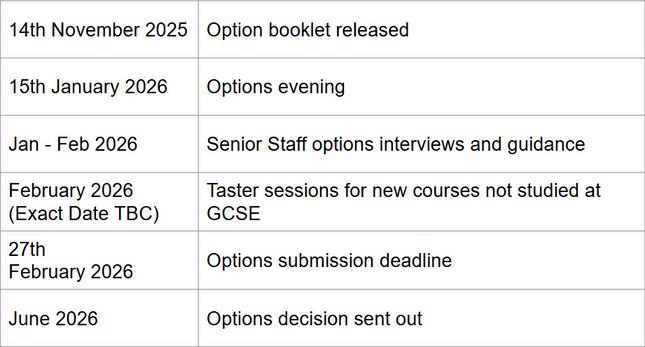
This booklet considers factors such as your target grades and current performance. After your Senior Staff Option Interview, you will complete your final choices on a Google Form, which should be submitted no later than Friday 27th February 2026.
This is an exciting new stage of your education, and I wish you every success
Ms Janse van Rensburg Assistant Head Teacher
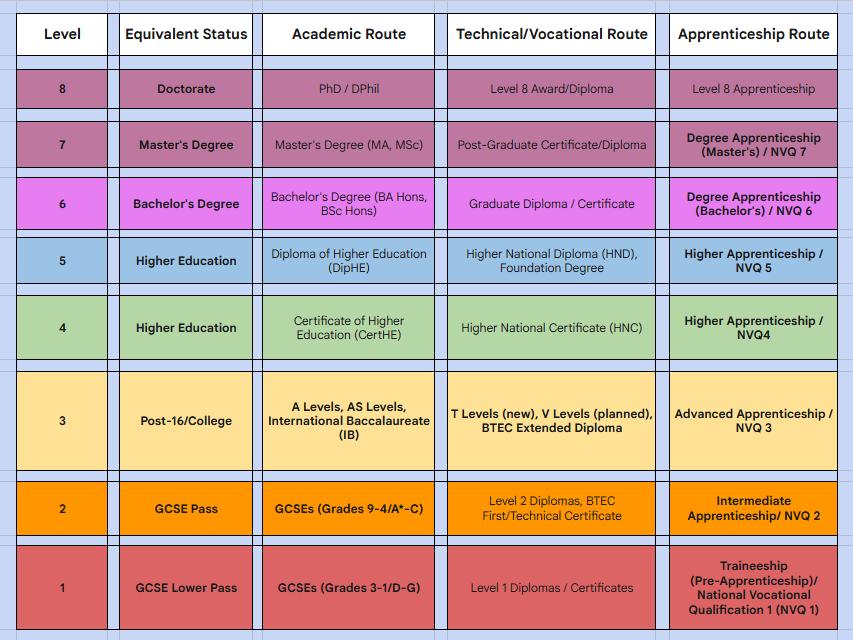
Understanding the UK qualification levels is vital for choosing the right path after your GCSEs Every qualification you achieve has a 'level' that indicates its value and complexity, helping you see where you are and what step to take next.
Here's how your education typically progresses through the levels:
Level 1 (Starting Point): This is where you generally begin your GCSEs in Year 10.
Level 2 (GCSE Completion): Achieving a Grade 4 or above in your GCSEs (or equivalent qualifications) is classed as Level 2
Most students finish Year 11 working at this level
Level 3 (Post-16 Options): After Year 11, most students move on to a Level 3 qualification This can be at a sixth form, college, or through an apprenticeship
Level 4 and Above (Higher Education): Completing Level 3 allows you to move into Higher Education, which starts at Level 4 (e g , the first year of a university degree) and continues upwards
Level 7 and 8 (Postgraduate): These are the highest levels, covering postgraduate studies such as a Master’s Degree (Level 7) or a PhD (Level 8)
Knowing these levels makes it easier to plan your next steps and find the qualification that is right for you.
A-LEVELS (Advanced Levels)
Route: Academic
Description: Academically demanding courses that are predominantly assessed by examinations at the end of two years Students typically study 3 subjects.
Progression: The established pathway for direct entry to University (Bachelor's Degree) or a Higher/Degree Apprenticeship
T LEVELS (Technical Levels)
Route: Technical
Description: New "gold-standard" Level 3 qualifications, equivalent in size and rigor to three A Levels They are developed with employers and foc specific occupational sectors (e g , Digital, Construction, Health)
Structure: They combine 80% classroom theory with a mandatory 45-day industry placement
Progression: Leads to skilled employment, Higher/Degree Apprenticeships, or University
BTEC LEVELS (Vocational Levels)
Route: Vocational
Description: A-Level equivalent assessed mainly through coursework and graded Pass to Distinction*
Structure: Multiple size options (1, 2, or 3 A-Level equivalent) made up of mandatory and optional units
Progression: Accepted by universities (UCAS points), or leads directly to skilled employment/apprenticeships
V LEVELS (Vocational Levels) planned
The Year 9 options process is designed to help you make informed decisions about which subjects you will study from Year 10 onwards. These choices are important because they can influence future study and career opportunities, so it's vital to approach this process thoughtfully.
Here’s an outline of how the process will work:
Options Evening:
This is an evening which is the first step in the options process. During this evening, you and your parents will have the opportunity to speak directly with subject teachers, explore the different courses on offer, and gain a clearer understanding of what each subject involves This is a valuable opportunity to ask questions and gather as much information as possible
Taster Sessions:
There will be an opportunity to have taster lessons for some of the subjects that we offer This will give you a feel for what it would be like to take this subject from Year 10 and beyond Ensure to select the subjects you are serious about taking, as this will support your decision when you have to choose your final options
Options interviews and guidance:
Every student will have a one-to-one meeting with a member of our Senior team to discuss their choices This is an opportunity for you to ask questions, express your interests, and receive tailored advice
Parental Involvement:
We believe that your parents involvement is crucial in supporting you through this process We encourage you to have open conversations with your parents about your interests, strengths, and future goals
Final Decision and Submission:
All students are required to submit their final subject choices by February 27th, 2026, following all guidance and discussions. We always aim to meet every student's preferences, but because of complex timetabling limitations, we cannot guarantee all first choices. For this reason, you will be asked to choose a reserve option. Please treat the reserve choice seriously and ensure it is a subject you are happy to study, as we may need to allocate this reserve if your requested combination cannot be accommodated in the final schedule.
Below you wi
GOOD REASONS FOR CHOOSING A SUBJECT:
You have discussed this with your parents and agree it is a good choice for you
You enjoy the subject
You are good at it
You want to get better at the type of skills used in the subject
You have found out all about the subject by talking to your teachers and to students who have studied this - You think it will suit you
You know you will work hard at this subject
You think it will be useful for future studies / career
POOR REASONS FOR CHOOSING A SUBJECT:
1. Read through this booklet and discuss your options with your parents/carers, teachers and tutor before deciding.
2 If you have any questions, ask them! It is better to ask now than make the wrong choice
3 Talk to Year 10 and Year 11 students, or to those who have left school, about what subjects they did and why they enjoyed them
4 Draft your choices using the form at the back of this booklet – leave it a day and come back to it to see if your choices still stand
5 When you have finally decided on your choices, after your Senior Staff Option Interview, fill in the digital Options Form on Google Classroom Please keep a copy on your Google Drive
Fine Art
Biology
Business
Chemistry
Computer Science
Drama and Theatre
Economics
English Literature
English Language
Extended Project Qualification (EPQ)
Geography
Government and Politics
History
Mathematics and Further Mathematics
Music
MFL (Modern Foreign Languages)
PE
Philosophy
Photography
Physics
Product Design
Psychology
Sociology
Vocational & AS Pathway
Applied Science (L3)
Enterprise and Entrepreneurship (L3)
Core Maths (AS)
Creative Media (L3)
Health & Social Care (L3)
ICT (L3)
Music Technology (L3)
BTEC Sport (L3)
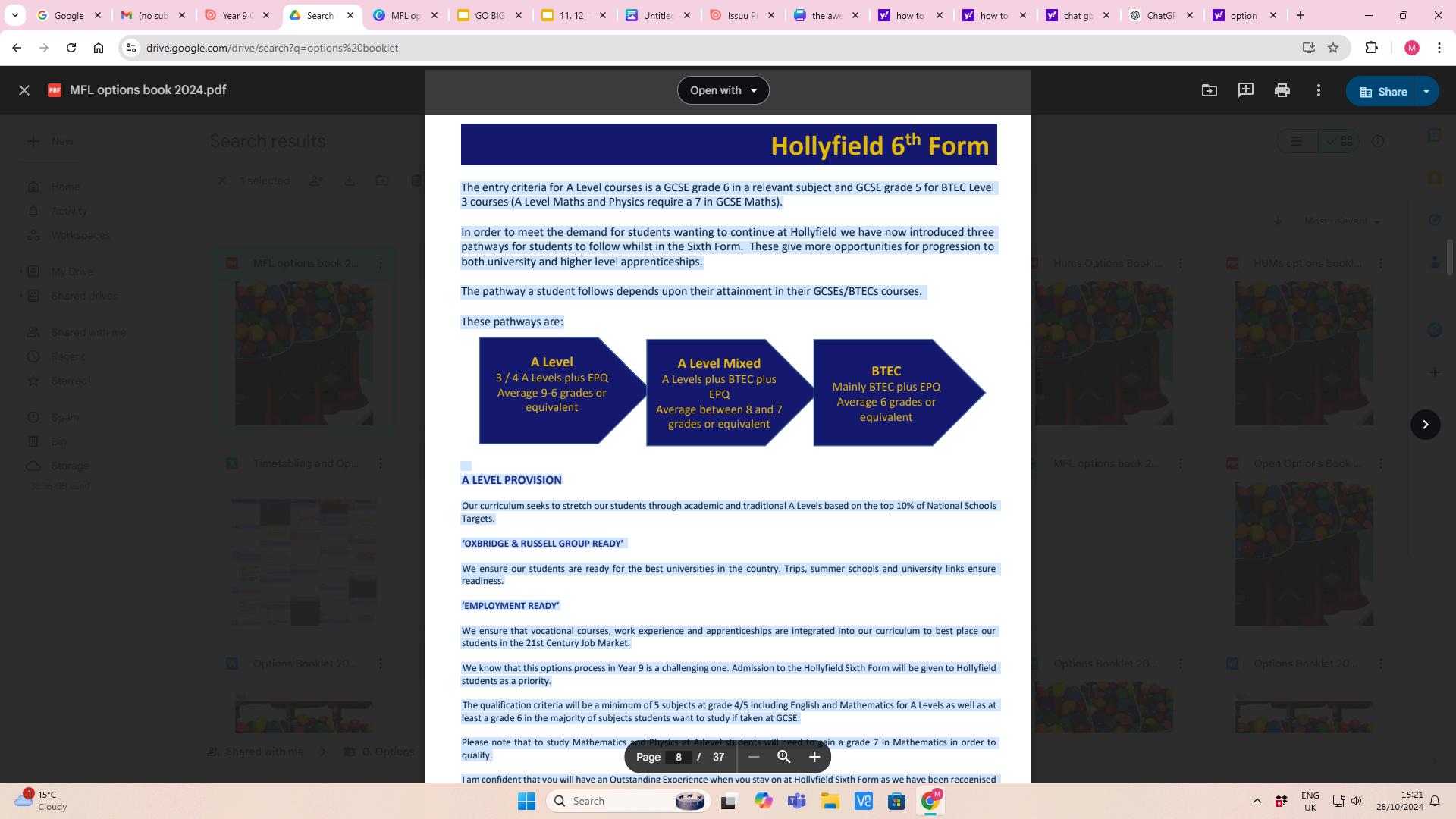
A Level:
3/4 A Levels
Average grades 9 - 5 or equivalent
queries please contact, Mr Warren, directly at:
dwarren@hollyfield kingston sch uk
A Level Mixed:
A Levels plus BTEC
Average grades 9 - 5 or equivalent
BTEC/ V Level:
Mainly BTEC Average grade 5 or equivalent
“In a world of increased applications to Higher Education, universities will be more conservative about the qualifications they will accept and will fall back on what they know We would be looking for a broad range of GCSEs to be taken and passed at 16”
Universities increasingly use GCSE and level 2 qualifications to distinguish between candidates
See below for a guide on entry criteria for post 16 courses Please be aware that this can change on a yearly basis so check websites for more information For more information see the careers section on the school website
Hollyfield and Kingston borough Sixth forms
A Levels entry criteria: 5 GCSEs at grade 5 including English and Maths and grade 6/7 in the subjects that students want to take at A Level For BTEC Level 3 courses: 5 GCSEs including a 4 in English and Maths
Kingston College, Richmond upon Thames College, Brooklands, Nescot & specialist providers e g The BRIT school
Offer a range of A Levels, BTECs and work related courses including apprenticeships
Nescot, Capel Manor & Merrist Wood Colleges
Offer specialist animal care and land based courses as well as apprenticeship opportunities
Esher College
Offers mainly A Levels & some Level 3 BTECs. Entry criteria: grades 4-9 including English & Maths.
Tiffin & Tiffin Girls
Offer A Level courses
Entry criteria: grades 9-7 in the subjects you want to take at A Level.
To search for post 16 courses in the local area: https://nationalcareers.service.gov.uk/find-a-course
Apprenticeships combine practical training in a job with study You learn the skills needed for the job and earn a wage Higher Apprenticeships are also on offer for students after A Levels and are an alternative to university For more information visit: www apprenticeships gov uk
Mr Poole is the Careers Coordinator & Ms Corrighan is a Careers Adviser based at Hollyfield and they oversee the careers education programme from Years 7 to 11 They can see students for one to one careers advice appointments and they deliver careers lessons and activities to help students think about their future options
Parents can contact Mr Poole via email: ipoole@hollyfield kingston sch uk if they would like to ask for information or request an appointment for their child
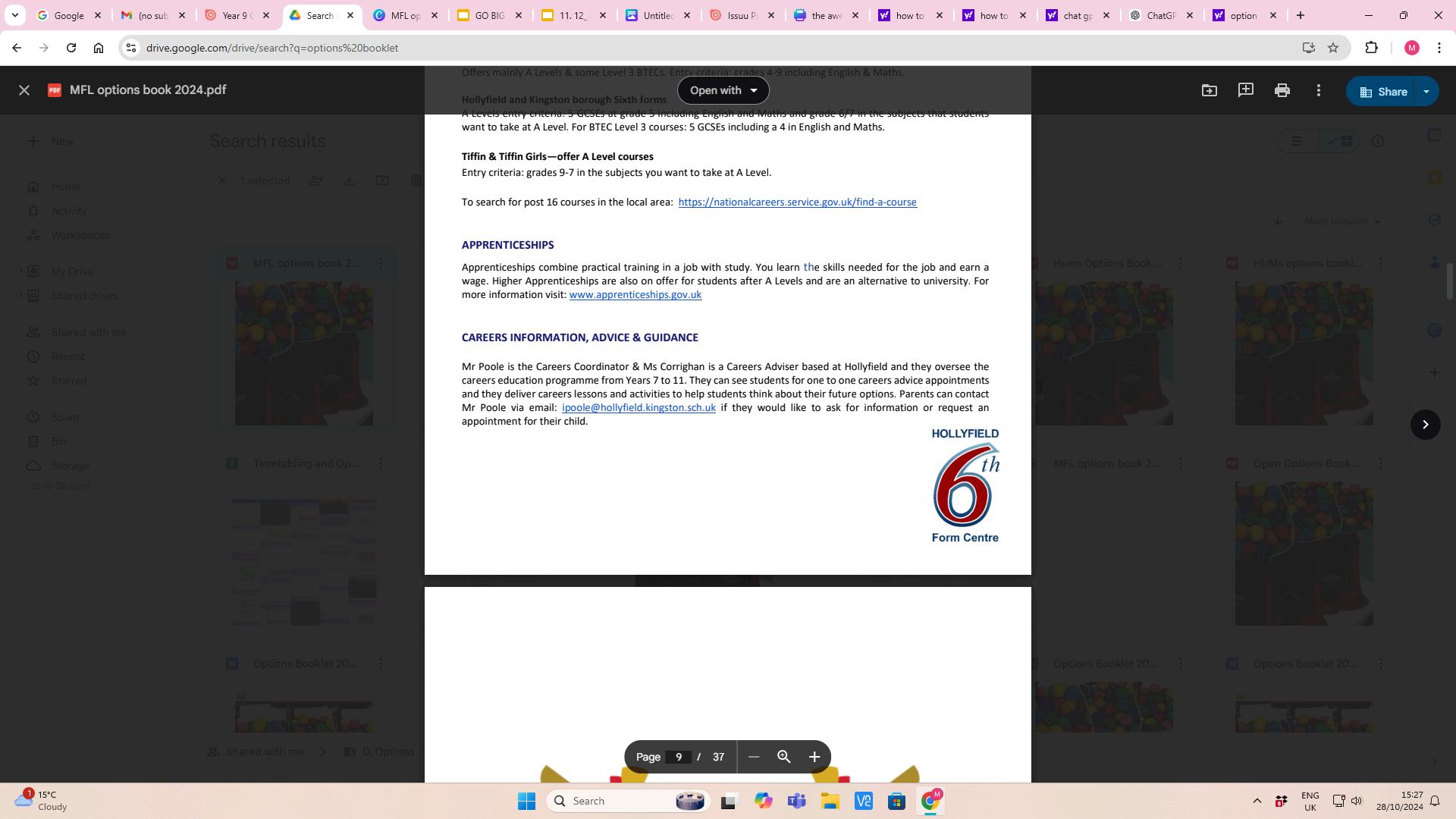
These are the compulsory subjects that everyone will study:
Combined Science
English Language
English Literature
Mathematics
Games
Should you have any questions, please click here to submit them
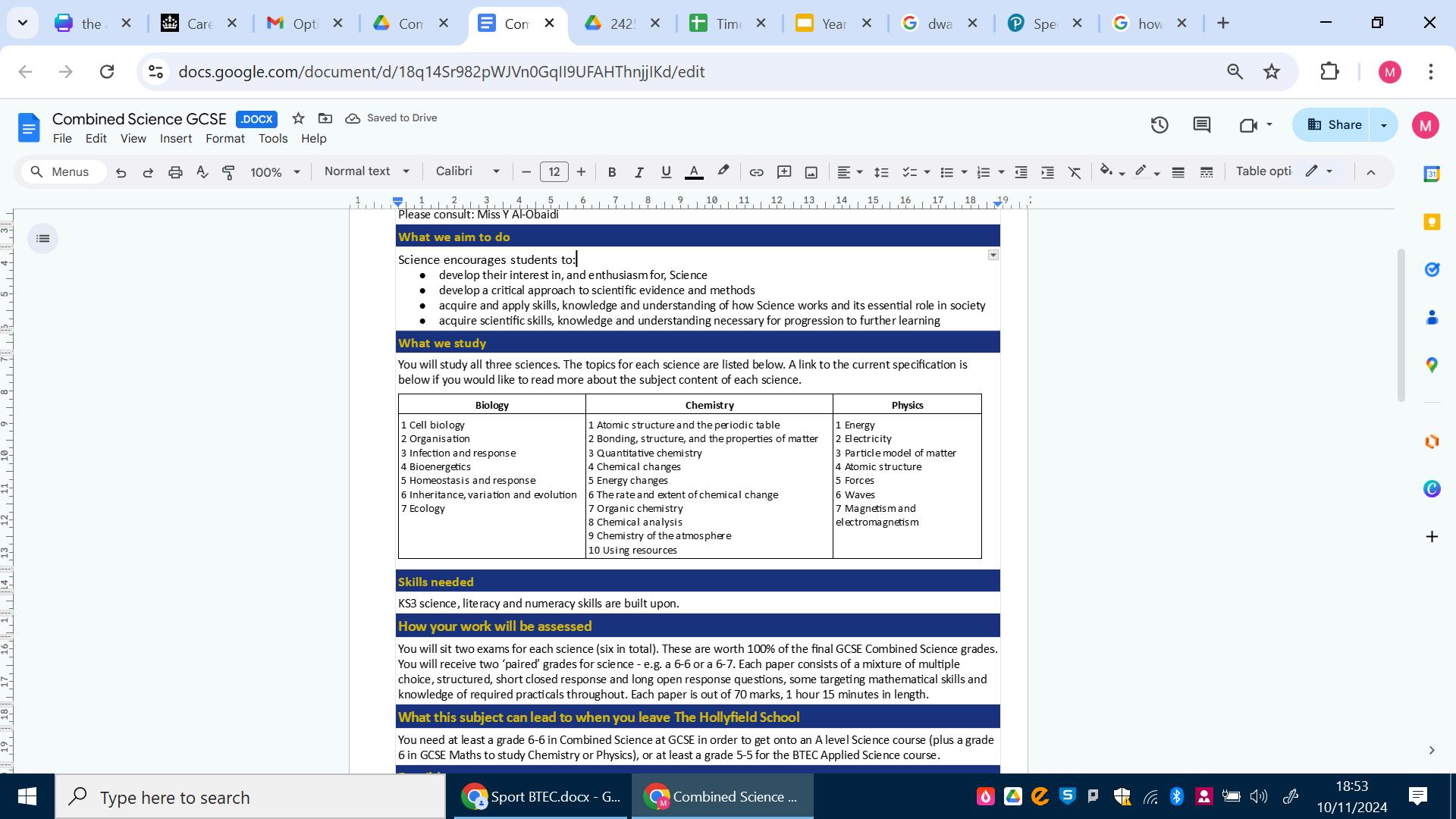
You will study all three sciences. The topics for each science are listed below. A link to the current specification is below if you would like to read more about the subject content of each science.
Forensic Science, Microbiology, Chemical Engineering, Nursing, Biochemistry (the possibilities are endless!)
Additional information/Special requirements:
The majority of students will study Combined Science A small proportion can choose to study Separate Sciences Combined Science opens all doors to further A level and undergraduate study There is no requirement for students to take Separate Sciences in order to study Science subjects at A level or above
Relevant website links for further information on the subject or course:
Specification: https://filestore.aqa.org.uk/resources/science/specifications/AQA-8464-SP-2016.PDF
Careers: https://nationalcareers.service.gov.uk/job-categories/science-and-research
Should you have any questions, please click here to submit them

Syllabus: AQA ENGLISH LANGUAGE 8700
Please consult: Mr A Mirhashem
What we aim to do:
English Language enables all to succeed in all subjects. The specification has been designed to stretch and challenge, providing opportunities to excel and achieve. The two exam papers will test students’ ability to understand a variety of unseen texts, analysing the language from both fiction and non-fiction in the 19th, 20th and 21st centuries as well as being able to write for a specific audience in a designated style.
What we study:
We will read a wide variety of non-fiction and fiction texts, either as a whole class, in small groups or independently You will write notes, practice assignments and respond creatively to the texts we are studying
Skills needed:
KS3 reading, writing, and speaking and listening skills are built on.
How your work will be assessed:
Everyone sits two exams for English Language These are worth 100% of the final GCSE English Language grade In the examination, you will have to read and answer a variety of questions on non-fiction and fiction covering the 19th, 20th and 21st century In addition, there will be two writing tasks to complete, one in each paper
Paper 1: Explorations in Creative Writing and Reading – looks at how writers use narrative and descriptive techniques to engage the interest of the readers.
Paper 2: Writers’ Viewpoints and Perspectives – looks at how different writers present a similar topic over time. How to write in a series of writing forms.
What the subject can lead to when you leave Year 11 at Hollyfield:
You need at least a grade 4 in English Language at GCSE in order to get onto a level three course in the Sixth Form with some courses requiring a minimum grade 6
Possible careers:
A good GCSE grade in English is an essential requirement for almost all courses in higher education and will open the door to many future careers English is used widely in many careers and therefore it is a qualification that is highly valued by employers English is a foundation for many university courses: Literature, Media, Linguistics, Journalism, PR, Marketing, Advertising, Law
Additional information/Special requirements:
Everyone studies English Language and Literature.
Relevant website links for further information on the subject or course:
Specification: https://www aqa org uk/subjects/english/gcse/english-8700/specification Careers: https://www prospects ac uk/careers-advice/what-can-i-do-with-my-degree/english
Should you have any questions, please click here to submit them
Syllabus: AQA - ENGLISH LITERATURE 8702
Please consult: Mr A Mirhashem
What we aim to do:
English Literature will allow all students to experience a wide range of texts (novels, plays, poetry) from different times and cultures. They will come to understand why Shakespeare matters, how language and ideas have changed and remained constant over time and how modern writers are just as influenced by the times they live in.
What we study:
In class you will study poetry, a Shakespeare play, a modern play and 19th Century novel, either as a whole class, in small groups or independently You will write notes in your copies of the text, practice exam-style assessments and respond critically to the texts we are studying
Skills needed:
KS3 reading, writing, and speaking and listening skills are built on.
How your work will be assessed:
Everyone will sit two examinations for English Literature These are closed text examinations where students will be required to remember quotations from all the four texts studied to succeed
Paper 1: Shakespeare and the 19th Century novel Paper 2: Modern texts and poetry
What the subject can lead to when you leave Year 11 at Hollyfield:
You need at least a grade 4 in English Literature at GCSE in order to get onto a level three course in the Sixth Form with some courses requiring a minimum grade 6
Possible careers:
A good GCSE grade in English is an essential requirement for almost all courses in higher education and will open the door to many future careers English is used widely in many careers and therefore it is a qualification that is highly valued by employers English is a foundation for many university courses: Literature, Media, Linguistics, Journalism, PR, Marketing, Advertising, Law
Additional information/Special requirements:
Everyone studies English Literature
Relevant website links for further information on the subject or course:
Specification: https://www aqa org uk/subjects/english/gcse/english-8702/specification Careers: https://www prospects ac uk/careers-advice/what-can-i-do-with-my-degree/english
Should you have any questions, please click here to submit them
Syllabus: PEARSON EDEXCEL GCSE MATHS 1MA1
Please consult: Ms Emerton
What we aim to do:
Within the Mathematics Faculty, we aim to develop every student’s potential mathematical ability. We aim to motivate our students so that they are interested and enthusiastic about their Mathematics lessons.
What we study:
Three themes underpin all work in mathematics:
Using and applying standard techniques
Reasoning, interpreting, and communicating mathematically
Solving problems in context.
In particular students will study:
Number
Algebra
Ratio, proportion and rates of change
Geometry and measures
Probability
Statistics
Skills needed:
There is a progression of materials through all levels at which the subject is studied. This specification builds on Key Stage 3 Mathematics and reflects the Programme of Study for Key Stage 4.
How your work will be assessed:
There is a final terminal exam at the end of Year 11 This exam consists of:
Paper 1 (80 marks), 1 hour 30 minutes, non-calculator
Paper 2 (80 marks), 1 hour 30 minutes, calculator allowed
Paper 3 (80 marks), 1 hour 30 minutes, calculator allowed
Students entered for the Foundation tier can be awarded grades 1, 2, 3, 4 or 5 Students entered for the higher tier can be awarded grades 4, 5, 6, 7, 8 or 9
What the subject can lead to when you leave Year 11 at Hollyfield:
Students wishing to study A - Level Maths will need to get a minimum of a grade 7 at GCSE. In particular, students must have competent algebra skills to take mathematics to a higher level
Possible careers:
A good GCSE grade in Mathematics is an essential requirement for almost all courses in higher education and will open the door to many future careers. Mathematics is used widely in many careers and therefore it is a qualification that is highly valued by employers. Maths is a foundation for many university courses: Mathematics, Computer Science, Engineering, Physics, Economics, Law, Medicine, Geology, Astronomy and many others
Additional information/Special requirements:
All students should have a scientific calculator (Casio FX-83GT CW) and a geometry set for all lessons
Relevant website links for further information on the subject or course:
Specification: https://qualifications.pearson.com/en/qualifications/edexcel-gcses/mathematics-2015.html Careers: https://www.mathscareers.org.uk/careers/
Should you have any questions, please click here to submit them
Syllabus: n/a
Please consult: Mr D Miller
What we aim to do:
Students are introduced to an option programme and study a range of physical activities which they, in most cases, have experienced in Key Stage 3. In addition to games and athletics, the syllabus is gradually extended enabling students to opt for activities which are leisure orientated, such as bowling.
What we study:
Students will also be given the opportunity to gain the Sports Leader Award (SL1) This Award develops leadership abilities through sport Students will gain confidence whilst improving organisation and communication skills
The Key Stage 4 programme aims to enable each student to: show increased knowledge, improved competence and safe performance in their selected activities understand and undertake different roles in their selected activities have a vast array of different experiences that will lead to lifelong participation in sport
Each activity normally lasts a half term period – at least one will be based at the Games field
Activities offered include:
Athletics, Badminton, Basketball, Cricket, Football, Hockey, Netball, Rugby, Gym, Golf, Squash, Trampoline, Ten Pin Bowling, Tennis, International Sport and Volleyball
Skills needed:
Students need to be enthusiastic, willing to work hard and willing to undertake different roles in the lessons, e g : referee, coach, and to improve understanding
How your work will be assessed:
There is no external assessment for this course. However, it is a compulsory lesson. Additional courses such as Sports Leaders will contain a practical assessment.
What the subject can lead to when you leave Year 11 at Hollyfield:
Our students will have the confidence to develop their skills and participate in a range of physical activities in college/leisure time. Additional courses can lead to paid part-time employment or a start in a sport related career. Sport is enjoyable for most people and physical activity is essential for everyone who wishes to lead a healthy and balanced lifestyle.
Possible careers:
Player, referee, official, coach, PE Teacher, Sports administration
Additional information/Special requirements:
Full Hollyfield School PE kit is expected every week, regardless of illness or injury
Relevant website links for further information on the subject or course:
Careers: https://nationalcareers service gov uk/job-categories/sports-and-leisure
GCSE:
Art and Design
Computer Science
Design and Technology - Textiles Design
Drama
Food Preparation and Nutrition
Geography
History
Modern Foreign Languages
Music
Photography
Physical Education
Religious Studies
Separate Sciences
Vocational:
Business and Enterprise
Creative Media Production
Digital Information Technology
Health and Social Care
Music Technology
Sport
Should you have any questions, please click here to submit them
Syllabus: AQA GCSE ART & DESIGN 8201
Please consult: Mrs Cotton
What we aim to do:
Art and Design enables students to develop their creativity and practical skills. The GCSE course encourages learners to investigate a broad range of materials, processes and techniques as they explore and develop ideas to themes set in school or by the examination board. The units studied are an excellent basis for further study at Advanced Level. There are countless job opportunities in Art and Design based industries including advertising, animation, graphic design, museum & gallery curation and education. Architecture and product design are rooted in creative thinking and problem solving. Fashion industries and textiles designers require a creative qualification. The film and television industry has many artistic aspects in its production from set design to photography. This demonstrates the breadth that art and design qualifications span Many of the skills learnt on art and design qualifications are transferable and can be applied in other subject areas
What we study:
There are two key units for the GCSE qualification They are:
Unit 1: Coursework: Personal Portfolio in Art and Design, which is made up of various projects and themes across the two year course, enabling students to create a diverse range of work They develop sketchbooks and larger pieces for their portfolio At least one project will be completed under controlled conditions
Unit 2: Externally Set Assignment: For this component, students are given an examination paper with a theme, which is set by AQA in January They will have a set period of time to prepare for the examination, in which they produce a sketchbook full of research, drawings, ideas and experimentation They will then sit a timed exam, creating a final piece during a period of ten hours
Skills needed:
It is essential that you have the drawing skills needed for the course so please check with your Art teacher if you are not sure There is a strong emphasis on drawing in the marking criteria so we expect students to have some confidence and ability in drawing when they begin the course We also expect you to enjoy the subject and complete homework
How your work will be assessed:
For the examination unit students are given roughly 13 weeks preparation where they complete a sketchbook with their research, drawings and ideas. The 13 weeks preparation culminates in a ten hour exam of sustained focused study in which candidates are expected to develop their own unaided work informed by their preparatory studies – often called a final piece. The period of focused study should take place under the conditions for practical examinations. The work is then marked and moderated internally and externally.
Unit 1: (Internally set projects including the Mock Exam) accounts for 60% of the GCSE qualification
Unit 2: (Externally set exam project) is 40% of the total qualification
What the subject can lead to when you leave Year 11 at Hollyfield:
Students who complete the GCSE qualification and gain a grade 6 or above can progress successfully to the GCE Advanced Level Art and Design course in the Sixth Form.
Possible careers:
Fine Art, Film & Television production, Set Design & Theatre production, Graphic Design, Printmaking, Branding/Advertising: Communication Design, Product and Furniture Design, Vehicle Design, Fashion & Textile Design, Fashion Journalism, Jewellery Making, Accessory design, Shoe Design, Photography & Digital Arts, Interior and Spatial Design, Architecture, Animation, Illustration, Game Design, Website Design, Study of History of Art, Publishing, Marketing, Teaching, Curate Exhibition Design, Practising Artists & Artist in Residency, Contemporary Crafts, Gallery Education
Additional information/Special requirements:
n/a
Relevant website links for further information on the subject or course:
Specification: http://www.aqa.org.uk/subjects/art-and-design/gcse/art-and-design-8201-8206
Careers: https://discovercreative.careers/#/
Should you have any questions, please click here to submit them
Syllabus: OCR GCSE IN COMPUTER SCIENCE IS QN 601/8355/X
Please consult: Mrs S Assam
What we aim to do:
Computing is of enormous importance to the economy, and the role of Computer Science as a discipline itself and as an ‘underpinning’ subject across Science and engineering is growing rapidly. Computer technology continues to advance rapidly and the way that technology is consumed has also been changing at a fast pace over recent years. The growth in the use of mobile devices and web-related technologies has exploded, resulting in new challenges for employers and employees. For example, businesses today require an ever-increasing number of technologically-aware individuals. Our GCSE in Computer Science is engaging and practical, encouraging creativity and problem solving It encourages students to develop their understanding and application of the core concepts in computer science Students also analyse problems in computational terms and devise creative solutions by designing, writing, testing and evaluating programs
What we study:
This specification promotes the integrated study of computer science It will enable learners to develop a broad range of skills in the areas of programming, system development, computer architecture, data & communication:
● the subject content for GCSE Computer Science will be assessed across two components
● understand and apply the fundamental principles and concepts of computer science, including abstraction, decomposition, logic, algorithms, and data representation
● analyse problems in computational terms through practical experience of solving such problems, including designing, writing and debugging programs to do so
● think creatively, innovatively, analytically, logically and critically
● understand the components that make up digital systems, and how they communicate with one another and with other systems
● understand the impacts of digital technology to the individual and to wider society
● apply mathematical skills relevant to computer science
Skills needed:
An enjoyment of IT, Maths and Critical thinking in problem solving
How your work will be assessed:
Component 1: Written examination 1 hour 30 minutes 50% of the qualification
This component Introduces students to the central processing unit (CPU), computer memory and storage, data representation, wired and wireless networks, network topologies, system security and system software It also looks at ethical, legal, cultural and environmental concerns associated with computer science
Component 2: Written examination 1 hour 30 minutes 50% of the qualification
This component students apply knowledge and understanding gained in component 01 They develop skills and understanding in computational thinking: algorithms, programming techniques, producing robust programs, computational logic and translators
What the subject can lead to when you leave Year 11 at Hollyfield:
Students wishing to study Computing at A Level are required to attain a Grade 6 in Computer Science GCSE.
Possible careers:
This course will provide you with a broad set of Computing skills that employers are looking for should you wish to not continue to study beyond year 11 The course offers you skills that you will be able to take advantage of if you study other subjects at A Level, Level 3 Vocational Courses, Level 3 Diplomas, or an International Baccalaureate.
Additional information/Special requirements:
n/a
Relevant website links for further information on the subject or course:
Specification: https://www.ocr.org.uk/qualifications/gcse/computer-science-j277-from-2020/ Careers: http://oedb.org/fast-track-careers-computer-science
https://www.prospects.ac.uk/careers-advice/what-can-i-do-with-my-degree/computer-science
Should you have any questions, please click here to submit them
Syllabus: AQA ART AND DESIGN GCSE: TEXTILES DESIGN 8204
Please consult: Ms L Tunstead
What we aim to do:
Textiles design enables students to develop their creativity and practical skills. The GCSE course encourages learners to investigate a broad range of materials, processes and techniques as they explore and develop ideas to themes set in school or by the examination board. The units studied are an excellent basis for further study at Advanced Level. There are countless job opportunities, Art, Design and Technology based industries including fashion design, fashion buyer, set and costume design which are all rooted in creative thinking and problem solving. Textiles design and fashion related studies offer a good foundation for a broad and exciting range of career opportunities Many of the skills learnt in such creative qualifications are transferable and can be applied in other subject areas
What we study:
There are two key units for the GCSE qualification They are:
Unit 1: Coursework: The development of a Personal Portfolio which is made up of various projects and themes across the two year course, enabling students to create a diverse range of work They develop sketchbooks and larger pieces for their portfolio At least one project will be completed under controlled conditions
Unit 2: Externally Set Assignment: For this component, students are given an examination paper with a theme, which is set by AQA in January They will have a set period of time to prepare for the examination, in which they produce a sketchbook full of research, drawings, ideas and experimentation They will then sit the timed test, creating a final piece during a period of ten hours
Skills needed:
To have a keen interest in fashion and the use of fabrics in the fashion industry
How your work will be assessed:
For the examination unit students are given roughly 13 weeks preparation where they complete a sketchbook with their research, drawings and ideas. The 13 weeks preparation culminates in a ten hour exam of sustained focused study in which candidates are expected to develop their own unaided work informed by their preparatory studies – often called a final piece. The period of focused study should take place under the conditions for practical examinations. The work is then marked and moderated internally and externally.
Unit 1: (Internally set projects including the Mock Exam) accounts for 60% of the GCSE qualification
Unit 2: (Externally set exam project) is 40% of the total qualification
What the subject can lead to when you leave Year 11 at Hollyfield:
This prepares students for progression to Design based A level courses and degree courses or vocational design courses.
Possible careers:
Set design & theatre production, fashion design and or buyer, television and multimedia jobs, interior and spatial design, illustration, curate exhibition design, historical costume design – TV, print designer, fashion shoots and stylists, fabric technologist
Additional information/Special requirements:
n/a
Relevant website links for further information on the subject or course:
Specification: https://www aqa org uk/subjects/art-and-design/gcse/art-and-design-8201-8206/subject-content/textile-design
Careers: https://www careerpilot org uk/job-sectors/subject/textiles
Should you have any questions, please click here to submit them
Syllabus:
PEARSON EDEXCEL GCSE DRAMA 1DR0
Please consult: Miss M O’Shea
What we aim to do:
Drama is a challenging and incredibly rewarding subject. It teaches us about the world around us; it encourages us to work creatively with others; it helps us to develop critical thinking and (in addition to learning practical skills) drama students develop confidence. If you enjoy the challenge of working with other people, sharing ideas and watching and creating original dramas, as a performer, director or designer, you will enjoy Drama!
What we study:
The GCSE Drama course has three key components:
1 A devising drama unit, where you will create and perform an original piece of drama from a stimulus your teacher shares This could be an image, a poem, a piece of music, a topical or historical event, a theme or a story You will carry out research, develop your ideas, collaborate with others, develop and refine your performance You will also analyse and evaluate the process and performance in a portfolio You can choose to be assessed as a performer or a designer
2 A text-based performance unit, where you will perform two key extracts from the same play to an audience, including a visiting examiner You will be given a mark for your acting skills, your interpretation and your artistic intentions You can choose to be assessed as a performer or a designer
3 A written exam, in which you will demonstrate your knowledge and understanding of how drama and theatre is developed and performed, including your responses to a play you will study and a live theatre production you will see For the live theatre evaluation, you can take in 500 words of notes to help you remember key details
Skills needed:
You should have an interest in performance and/or design You need to be able to work with other people - but don’t worry if you don’t yet feel like a ‘natural’ leader or performer, or if you don’t have much experience as an actor or designer The course will help you to develop confidence We just ask you to be willing to give it a go - and to share your ideas with your classmates
How your work will be assessed:
Component 1: Devising (assessed performance and coursework portfolio) 40% of your grade Component 2: Performance from text (performance exam) 20% of your grade Component 3: Theatre makers in practice (written exam) 40% of your grade
What the subject can lead to when you leave Year 11 at Hollyfield:
We offer the A-Level Drama and Theatre course at The Hollyfield 6th Form Centre. It is a more challenging course, in terms of the academic content, written components and practical papers, so we advise students to aim for a GCSE grade 6 or better in order to meet those challenges most comfortably.
Possible careers:
You could go on to study Drama or another Performing Arts related subject at a higher level There are also a number of related careers, from performance to stage management, production, direction and script-writing Other career options include drama therapy and theatre-in-education The transferable skills you gain from doing drama can lead to careers in multiple fields such as performing arts, media, business, law, advertising, sales, hospitality and tourism Many of our former students have successful careers in the performing arts: some appear on the West End Stage, in films or on TV; others work as producers or directors. Several have fulfilling jobs in arts administration or education.
Additional information/Special requirements:
n/a
Relevant website links for further information on the subject or course:
Specification: https://qualifications.pearson.com/en/qualifications/edexcel-gcses/drama-2016.html Careers: www.nyt.org.uk/ https://discovercreative.careers/#/ https://www.opendoor.org.uk/
Should you have any questions, please click here to submit them
Syllabus: AQA GCSE Food Preparation and Nutrition 8585
Please consult: Ms J Sankey
What we aim to do:
GCSE Food Preparation and Nutrition is an exciting and creative course which focuses on practical cooking skills to ensure students develop a thorough understanding of food preparation, food science investigations and nutritional analysis
What we study:
Written Examination 1 hour and 45 minutes 50%
Theoretical knowledge of food preparation and nutrition from subject content: Nutrition and Health, Food Science, Food Safety, Food Choice and Food Provenance
Non-Exam Assessment (NEA)
Task 1: Food Science Investigation Students' understanding of the working characteristics, functional and chemical properties of ingredients such as raising agents, enzymic browning, pH levels, fats, sugars and cooking methods
Task 2: Food Preparation and Nutrition assessment Students' knowledge, skills and understanding in relation to the planning, preparation, cooking, presentation of food and application of nutrition related to the chosen task Students will prepare, cook and present a final menu of three dishes, planning in advance how this will be achieved
Skills needed:
Students will need to be interested in preparing and cooking food Also investigating the relationship between diet, nutrition and health They should be passionate about the different aspects of food, be inquisitive and independent with their learning
How your work will be assessed:
50% Paper 1: Written examination 1hr 45mins
50% Non-Exam Assessment (NEA):
Task 1: Food Science Investigation (15%)
IT processed report (1,500–2,000 words) including practical investigations photographic evidence.
Task 2: Food Preparation Assessment (35%)
IT processed report (2,500-3,000 words) including photographic evidence of demonstrating practical skills
What the subject can lead to when you leave Year 11 at Hollyfield:
Suitable to progress on to A Level/BTEC Diploma/Degree in the following areas: Food Science and Nutrition, Hospitality and Catering, Chef apprenticeships.
Possible careers:
Food Technologist, Chef, Kitchen Manager, Nutritionist, Dietician, Health Inspector, jobs in retail & wholesale, Food Stylist, Buyer, Taster, Product Development, Food Writer, Food Technologist, Teaching, Catering, Butchers, Fishmongers
Additional information/Special requirements:
You will need to bring ingredients for practical lessons Clubs and clinics to extend practical skills, subject knowledge and develop non-exam assessment ideas Visits from chefs/workshops
Relevant website links for further information on the subject or course:
Specification: https://filestore aqa org uk/resources/food/specifications/AQA-8585-SP-2016 PDF Careers: https://docs google com/presentation/d/1bRy93uJyZIxaZyte-BGBSdbXhs4wbmwm/edit#slide=id p6
Should you have any questions, please click here to submit them
Syllabus: AQA GCSE GEOGRAPHY 8035
Please consult: Mr B Jones
What we aim to do:
Geography tackles the big issues: People, places, processes, environmental responsibility and global interdependence. The world in which we live is likely to change more in the next 25 years than it has ever done before. Geography explains why this is and helps to prepare you for those changes. The GCSE covers a diverse range of topics and develops lots of transferable skills.
What we study:
Paper 1 – Living with the Physical Environment
Section A – The Challenge of Natural hazards
Section B – Physical Landscapes of the UK – Rivers & Coasts
Section C – The Living World – Ecosystems, Tropical Rainforests, Hot environments
Paper 2 – Challenges in the Human Environment
Urban Issues & Challenges
Changing Economic World
Resource Management (Food Resources)
Paper 3 – Geographical Applications
Issue Evaluation (pre-release information booklet)
Fieldwork (human & physical)
Geographical Skills
Field Trip
Two days of field work will take place over your two-year course One day for physical geography (e g ecosystem study) and the other day for human geography (e g urban regeneration) These two elements will form the basis of the fieldwork question for Paper 3
Skills needed:
A keen interest in Geography
How your work will be assessed:
You will have a 1 hour 30 minute exam for both Papers 1 and 2. Both are worth 35% of your total marks. Paper 3 will be a 1 hour 15 minute exam and is worth 30% of your total marks
Exam marks are awarded for content plus 12 additional marks for spelling, punctuation and grammar (SPaG) All exams are ‘Linear’ (taken at the end of Year 11)
What the subject can lead to when you leave Year 11 at Hollyfield:
Subject can also be studied at A-Level. Course Requirements: Grade 6 to Study A Level.
Possible careers:
Geography is considered very desirable in employment and further education, as the subject is very current and far reaching In part this is because the subject is a combination of the facts of Science and the understanding of people and patterns in society and nature Transferable skills developed through Geography, such as decision making and data analysis, are an asset in employment and further education
Geography is well respected by universities. It is considered an important academic subject. It is particularly useful for Engineering, Conservation, Journalism, Science, Law, Business, International Development, Environmental Consultancy
Additional information/Special requirements:
n/a
Relevant website links for further information on the subject or course:
Specification: https://www aqa org uk/subjects/geography/gcse/geography-8035/specification
Careers: http://www rgs org/OurWork/Study+Geography/Study/Careers+with+geography htm
Should you have any questions, please click here to submit them
Syllabus: PEARSON EDEXCEL GCSE HISTORY 1HIO
Please consult: Miss R Lowery
What we aim to do:
History is a unique and fascinating subject It helps us to appreciate the world we live in today and to understand the actions and attitudes of people in the past History enables students to develop a wide range of key skills, including communication in a variety of forms Students develop thinking skills, such as the ability to make decisions, solve problems, and think in an analytical way
What we study:
The course comprises four units which are assessed in three examinations at the end of Year 11:
Medicine in Britain: Students investigate the key turning points, discoveries and individuals in medicine and surgery from 1250 to the present day As part of this study we will also look at the Western Front 1914–18 with a specific focus on trench warfare and injuries, and battlefield medicine, treatments and surgery
Elizabethan England 1558 – 88: This British depth study will explore one of the most famous and important monarchs in our history We will examine Elizabeth’s successes and failures, how she defeated crises such as the Armada, and whether she deserves her reputation.
Superpower relations and the Cold War 1941 -1991: This unit forms a complete contrast with a modern world perspective on one of the most significant international disputes of the twentieth century. Students will learn about the increasing tension between the East and West after World War II and the key crises of the Cold War such as the Cuba Missiles Crisis and Berlin Wall. Germany 1919-1939: This is a depth study in which we will focus in detail on the rise of Hitler and the Nazis, the circumstances which allowed Hitler to become a dictator, and the impact of the Nazi regime on different groups in Germany. A visit to Berlin to explore Nazi historical sites and Berlin’s importance in the Cold War may be offered where possible.
Skills needed:
Enthusiasm and an enquiring attitude! Good communication and strong written English is an advantage
How your work will be assessed:
Paper 1: Medicine in Britain c1250 -present This is one hour and 20 minutes, is worth 30% of the final grade and will be sat in the summer of Year 11
Paper 2: There are two parts to this paper Elizabethan England and Superpower relations and the Cold War This is worth 40% of the final grade, is one hour and 50 minutes and will take place in the summer of Year 11 Paper 3: Germany 1919-1939 This is worth 30% of the final grade, is one hour and 30 minutes and will take place in the summer of Year 11
What the subject can lead to when you leave Year 11 at Hollyfield:
History is available at A Level We ask that students get a minimum grade 6 in history GCSE and minimum grade 6 in English
Possible careers:
Apart from careers like teaching, heritage work and archaeology, history is very useful for students who are interested in journalism, the law, politics, the civil service and business. The skills which are developed in history can be transferred to a very wide range of careers and this course is a good choice for students who want to keep their options for the future open. Universities and employers know that history students can analyse information, interpret events, solve problems, argue a point of view and reach a balanced conclusion This is why history is recognised as such a challenging and useful qualification
Additional information/Special requirements:
n/a
Relevant website links for further information on the subject or course:
Specification: https://qualifications pearson com/en/qualifications/edexcel-gcses/history-2016 html
Careers: http://www history org uk/resources/public resource 2914 76 html http://www history org uk/resources/student resources 98 html
Should you have any questions, please click here to submit them
Syllabus: PEARSON EDEXCEL GCSE FRENCH 1FR1 & GCSE SPANISH 1SP1
Please consult: Ms E Belben / Ms A Opie
What we aim to do:
Modern Foreign Languages learning, aims to instil and foster a genuine love for languages while inspiring respect for other cultures and opening up a world of opportunities
Studying a foreign language enhances your travel experiences, allowing you to connect with new places and people in meaningful ways
Additionally, mastering a foreign language will position you as a competitive candidate for higher education at esteemed universities, giving you an impressive CV that stands out Language proficiency is also linked to higher-paying job prospects In today’s interconnected workforce, individuals with language skills are in high demand, making you invaluable to future employers Our program also prepares you for A-Level and advanced studies, equipping you with the essential skills and knowledge you will need for academic and professional success
What we study:
The GCSE course themes are: My personal world, Lifestyle and wellbeing, My neighbourhood, Media and technology, Studying and my future, Travel and tourism.
Skills needed:
An excellent attitude to the subject displayed through Years 7- 9 and a willingness to work hard in the classroom and on home learning Students must be willing to develop interpersonal skills and be ready to develop their collaborative as well as independent learning skills These are essential for the course Students must be keen to experiment with the language, not be afraid to make mistakes and be interested in other cultures
How your work will be assessed:
The exam consists of four parts: Listening, Speaking, Reading and Writing In the Writing section you will need to write 2 extended pieces of writing with one translation of a paragraph or sentences into French/Spanish The speaking exam will be assessed by the exam board but conducted and recorded by your teacher This will consist of 1 reading aloud, 1 role play, 1 picture-based discussion You will have 15 minutes to prepare for the role play and the picture-based discussion but the exam board will encourage spontaneous speech during the exam The reading and listening exams will mirror the assessments that the students have already completed in class
GCSE: - Listening (25%), Reading (25%), Writing (25%), Speaking (25%) Final exams take place in May of Year 11 Speaking assessments will take place in April of Year 11
What the subject can lead to when you leave Year 11 at Hollyfield:
French and Spanish are both taught at A Level with AQA Students must achieve a grade 6 at GCSE to enter the A Level course in French or Spanish
Possible careers:
Many jobs in the world of work today link with many countries across the world and the ability to communicate in another language, both for holiday travel and as a career, will be a great asset to every student Jobs where languages are essential or an asset include the following;
International Law, United Nations, Banking and Finance, Diplomatic Corps, Translator, Travel Agent, Interpreter, Tour guide, Travel writer, Hotel Receptionist, Publishing, Public Relations, Journalism, Actor/Actress, Professional Athlete, Chef, Pilot, Air steward, Languages Teacher, Doctor and so on
Additional information/Special requirements:
Students who speak a Community Language will be offered the opportunity to sit a GCSE in their language in year 10 and year 11
Please note that we do not provide any tuition in Community Languages
Relevant website links for further information on the subject or course:
Specification French: https://qualifications.pearson.com/en/qualifications/edexcel-gcses/french-2024.html
Specification Spanish: https://qualifications.pearson.com/en/qualifications/edexcel-gcses/spanish-2024.html
Careers: http://www.languageswork.org.uk/home.aspx
http://www.kent.ac.uk/careers/modernlanguages.htm
http://www.career-descriptions.co.uk/translator-career-description/ http://www.prospects.ac.uk/translator job description.htm
Should you have any questions, please click here to submit them
Syllabus: PEARSON EDEXCEL GCSE MUSIC 1MU0
Please consult: Miss S Neville
What we aim to do:
GCSE Music is a practical, creative and exciting course You will enjoy performing, composing and listening to a range of music and be introduced to a wide variety of musical styles You will use Logic on the Macs to compose If you don’t play an instrument or sing please look at the Music Technology course that will run alongside the GCSE (you can also do both subjects) Music GCSE is aimed at students who love performing music (this includes vocalists) Your specific skills and interests in music will be included in all your lessons
What we study:
GCSE Music has three engaging components, assessed through practical performances, compositions and one externally examined paper The key content of musical elements, musical contexts and musical language are taught through the areas of study and Set Works to show real examples of how these are used within different types of music GCSE Music contains four areas of study, with two Set Works in each: Instrumental Music (1700-1820); Vocal Music; Music for Stage and Screen and Fusions Examples of Set Works include music from ‘Star Wars’ by John Williams, ‘Defying Gravity’ from Wicked and ‘Killer Queen’ by Queen Skills needed:
An enjoyment of performing, composing and listening to Music. Performance ability on a specific instrument/vocals as this is what you will be assessed on for your Performance coursework.
How your work will be assessed:
There is a 1 hour 45 minute listening exam where extracts of Set Works will be played as short-answer questions There is a dictation question and an unfamiliar piece of music that comes with a skeleton score The last question is an extended writing question where students have to compare two pieces of music, one familiar and one unfamiliar Scores are provided for this question Coursework is worth 60% of the course:
Two performances: one solo and one ensemble piece (the performance can be played on any instrument/voice)
Two compositions: Two pieces of music written in different styles, one set in a choice of briefs by Edexcel.
What the subject can lead to when you leave Year 11 at Hollyfield:
The content allows students to develop their knowledge and skills of music, enabling them to progress onto the A Level qualification in Music Music and Music Technology are both available as A-level subjects
Possible careers:
GCSE Music also offers a wealth of transferable skills relevant to ongoing musical and non-musical study as well as to future career development, including: literacy, critical thinking, social skills, team work, leadership and communication, time management and organisational skills Careers in Music include: Producer (recording musicians and making records), Music Engineer (working in a studio such as Abbey Road), Folio Artist (working with sound effects on the radio), Composer (creating original music for films) and Performer The GCSE in Music leads on to studying A-Level Music and A-Level Music Technology
Additional information/Special requirements:
All students wishing to take GCSE music must play an instrument/sing Funding is available for some students who choose GCSE Music
Relevant website links for further information on the subject or course:
Specification: https://qualifications pearson com/en/qualifications/edexcel-gcses/music-2016 html
Careers: http://www bbc co uk/1xtra/events/get aheadaz shtml
Should you have any questions, please click here to submit them
Syllabus: AQA GCSE ART & DESIGN 8206
Please consult: Ms May
What we aim to do:
GCSE Photography is an art and design course Students will have the opportunity to work with digital photography and a range of mixed media Each student will produce a portfolio of work for their coursework This will include recording of images, an opportunity to look at a range of artists and photographers and then the digital development of these ideas This is a course which will guarantee students a good grade if they work hard, are well-organised, fulfil the course requirements and, most importantly, are creative
What we study:
This course covers a wide range of photography and art appreciation, with emphasis on practical skills to encourage: a) the skills of composition and visual expression; b) an understanding of a wide range of media including photography, mixed media and computer graphics; c) an appreciation and understanding of the work of artists
Skills needed:
To have a keen interest in Photography Students do not need to know how to use a camera, this will be taught However they should enjoy taking photos and have an interest in editing They must be well organised and enjoy producing material within a sketchbook Students will also be required to produce work via Adobe Photoshop This will be taught as part of the course
How your work will be assessed:
There are two key units for the GCSE qualification They are: Unit 1: Coursework: Personal Portfolio in Photography, which is made up of various projects and themes across the two year course, enabling students to create a diverse range of work They develop sketchbooks and larger pieces for their portfolio At least one project will be completed under controlled conditions This accounts for 60% of the qualification Unit 2: Externally Set Assignment: For this component, students are given an examination paper with a theme, which is set by AQA in January They will have a set period of time to prepare for the examination, in which they produce a sketchbook full of research, drawings, ideas and experimentation They will then sit a timed exam, creating a final piece during a period of ten hours This accounts for 40% of the qualification
What the subject can lead to when you leave Year 11 at Hollyfield:
Students who complete the GCSE qualification and gain a grade 4 or 5 or above can progress successfully to the A level Photography course in the Sixth Form
Possible careers:
Photographer, picture researcher, visual merchandiser, theatre lighting technician, film director, television/film makeup artist, special effects, teacher, art gallery manager, website designer, advertising art director, fashion photographer, graphic design, interior design, 3-dimensional design, exhibition and museum design, magazine features editor, press photographer, medical illustrator, television camera operative, digital marketer, media planner, web designer
Additional information/Special requirements:
It would be beneficial for students to have a digital SLR for this course
Relevant website links for further information on the subject or course:
Specification: https://www.aqa.org.uk/subjects/art-and-design/a-level/art-and-design-7206/specification/subjectcontent/photography
Careers: https://discovercreative.careers/#/
Should you have any questions, please click here to submit them
Syllabus: AQA GCSE PHYSICAL EDUCATION 8582
Please consult: Mr D Miller
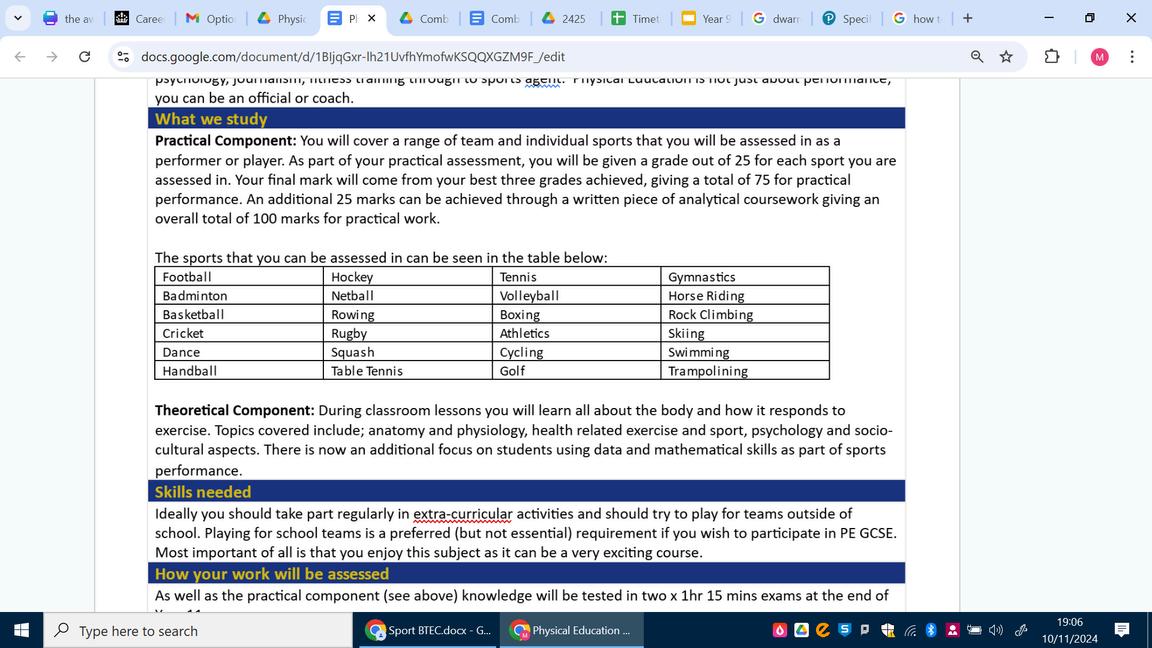
What the subject can lead to when you leave Year 11 at Hollyfield:
There is a natural progression to study Physical Education at Key Stage 5 We require students to achieve a grade 6 at GCSE in PE or Science There is also Sports BTEC Level 3 available
Possible careers:
Sport is big business and the opportunities within the sports industry are now huge. The government is spending huge amounts of money on sport to try and improve the health of the nation. A GCSE in Physical Education will give you the opportunity to continue your studies on to A-Level Sport and PE, or to study courses in leisure, tourism, personal training, sports injuries, sports journalism, etc You could also choose to go straight into work within the fitness industry or simply use the course to give you fitness skills for the rest of your life
Additional information/Special requirements:
It is recommended that to take GCSE PE you are playing sport regularly outside of school to achieve good practical marks Students who are not doing should not consider taking this as an option Students must bring in a full clean GCSE PE kit for practical lessons
Relevant website links for further information on the subject or course:
Specification: https://www.aqa.org.uk/subjects/physical-education/gcse/physical-education-8582 Careers: http://www.careers-in-sport.co.uk/ http://www.prospects.ac.uk/sports coach job description.htm
Should you have any questions, please click here to submit them
Syllabus: AQA GCSE RELIGIOUS STUDIES 8062
Please consult: Mr J Harris
What we aim to do:
RS teaches students how to debate and analyse key issues and provide coherent arguments in discussion In RE students learn how to critically examine abstract ideas, develop scholarism, interpret and solve problems, argue a justified point of view and reach a balanced conclusion. Alongside an investigation into core religious beliefs and practice, we focus on a range of philosophical questions as well contemporary ethical, social and political issues. Students develop an awareness and knowledge of different cultural, religious and non-religious attitudes towards these matters.
What we study:
Component one: The study of religions:
Christianity: Beliefs, teachings, and practices
Islam: Beliefs, teachings, and practices
Component two: Philosophical and ethical themes:
Religion and Life
Crime and Punishment
Relationships and Families
Peace and Conflict
For more information, check out the AQA specification on their website, or speak to Mr Harris
Skills needed:
A good level of literacy and an inquisitive mind into philosophy, ethics, beliefs, religions, cultures. Strong evaluative skills and ability to explain abstract concepts.
How your work will be assessed:
All students will sit two, 1 ¾ hour papers You will have to answer four sets of questions in each paper Both Christian & Muslim beliefs and practices in Paper 1 ; Four philosophical themes in Paper 2)
What the subject can lead to when you leave Year 11 at Hollyfield:
RS naturally leads on to A-Level Philosophy at KS5, as well as developing the skills needed to succeed in humanities subjects like History and Government & Politics, as well as social science subjects like Psychology and Sociology To take A-Level Philosophy you will need at least a grade 5 in English GCSE This course also complements other humanities subjects at GCSE, namely History and Geography
Possible careers:
RS is incredibly useful for students who are interested in journalism, law, politics, civil service, education, and publishing, and many more fields which require critical thinking and the analysis of abstract knowledge The multi-disciplinary skills which are developed in RS can be transferred to a very wide range of careers as students develop the ability to debate and analyse key issues It also serves as an excellent precursor for the philosophy A-Level which develops these skills and more at a much higher level Universities and employers know that RS and philosophy students can analyse and articulate abstract information, evaluate positions, solve problems, argue a point of view, and reach justified conclusions Moreover, within a modern multicultural Britain, an awareness and appreciation of cultural differences and religious literacy is a skill that a wide range employers place value upon, as well as developing the student’s own spiritual, moral, social, and cultural awareness
Additional information/Special requirements:
n/a
Relevant website links for further information on the subject or course:
Specification: https://www.aqa.org.uk/subjects/religious-studies/gcse/religious-studies-a-8062
Careers: https://www.theology.ox.ac.uk/careers-and-graduate-destinations http://www.prospects.ac.uk/options religious studies job options.htm
Should you have any questions, please click here to submit them
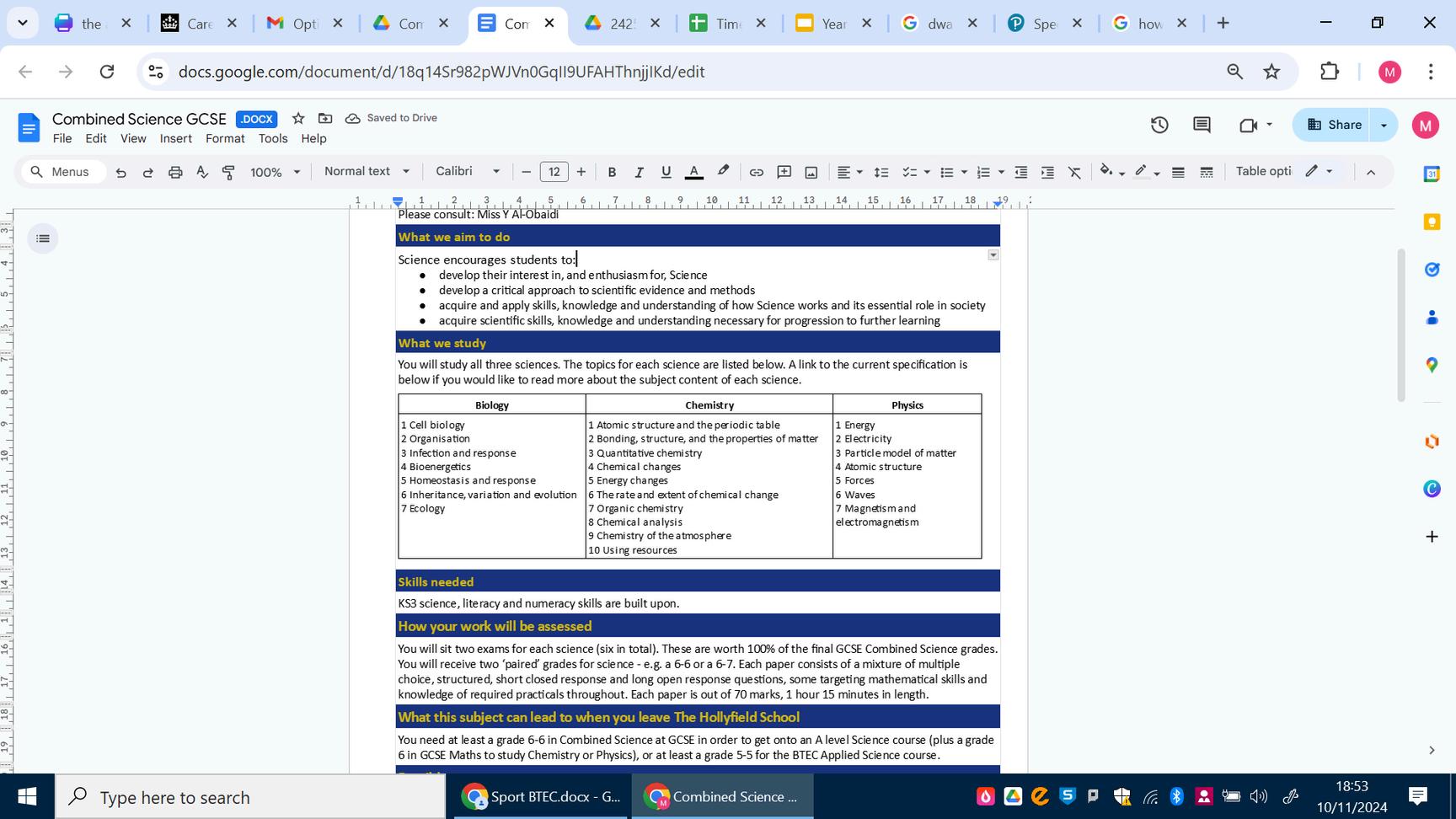
You will study all three sciences The topics for each science are listed below A link to the current specification is below if you would like to read more about the subject content of each science
Possible careers:
Additional information/Special requirements:
We offer Separate Sciences for pupils who have a passion for science, and who are aspiring to study sciences at A level and pursue a career in science There is a lot of content to learn and you will have a total of 9 Science lessons per week (as opposed to 6 with Combined Science) We feel that studying Separate Sciences will give students an advantage when they study A level Science subjects, but studying Combined Sciences instead does not impose a barrier to taking science A levels or science degrees
Relevant website links for further information on the subject or course: Medicine, Pharmacy, Veterinary Science, Dentistry, Astrophysics, Aeronautical Engineering, Genetics, Marine Biology, Bioengineering, Nutrition, Climate Science, Forensic Science, Microbiology, Palaeontology, Chemical Engineering, Physiotherapy, Nursing, Biochemistry (the possibilities are endless!
Specifications: Biology, Chemistry, Physics Careers: https://nationalcareers service gov uk/job-categories/science-and-research
Should you have any questions, please click here to submit them
Syllabus: NCFE AWARD IN BUSINESS AND ENTERPRISE
Please consult: Mr A Humm
What we aim to do:
This course complements the GCSE qualifications It is aimed at 14–16 year olds studying Key Stage 4 curriculum who are interested in the business and enterprise industry sector This qualification is designed to match the rigour and challenge of GCSE study It is designed for learners who want an introduction to business and enterprise that includes a vocational and project element Simply put its aim is to:
Develop a broad understanding of business and enterprise
Develop a significant knowledge core which spans the vocational sector
Provide academic and study skills that will support progression within business and enterprise and more broadly
What we study:
• Unit 01 Introduction to business and enterprise
• Unit 02 Understanding resources for business and enterprise planning
Skills needed:
You will require literacy and numeracy skills for NCFE Business as well as an interest in business
How your work will be assessed:
Unit 1- Externally Assessed- Written Examination 40% of Total qualification
Unit 2- Internally Assessed- Synoptic Project 60% of Total qualification
What the subject can lead to when you leave Year 11 at Hollyfield:
Depending on the grade the learner achieves in this qualification, they could progress to:
• Level 3 Applied General in: Enterprise and Entrepreneurship, Financial Studies, Business and Enterprise, Applied Business, Business
• Level 3 Technical Level in: Coordinating Business Support, Business: Marketing
• An apprenticeship within sectors such as a Finance, Marketing or Human Resources
It may also be suitable to learners studying qualifications in the following areas:
• Economics • Accounting • Maths • English • Business
It’s also a great step preparing you for further and higher education such as A-levels and BTEC courses
Possible careers:
Study at advanced level and beyond, Banking and Finance, Law, Accountancy, Marketing, Sales, Human Resources, Logistics / Resource control and management, Event management, Business start-up, Teaching
Any public sector, private sector or charity organisation will require business awareness and skills
Additional information/Special requirements:
n/a
Relevant website links for further information on the subject or course:
Specification: NCFE Specification
Careers: https://www.ncfe.org.uk/qualification-search/qualification-detail/ncfe-level-12-technical-award-in-business-andenterprise-127
Should you have any questions, please click here to submit them
Syllabus: PEARSON BTEC TECH AWARD Level 1/2 IN CREATIVE MEDIA PRODUCTION 603/1238/5
Please consult: Ms P Mirshahi
What we aim to do:
The qualification is aimed at those who may be interested in pursuing a career in creative media production It enables students to develop skills across a range of media practices using a combination of practical exploration, experimentation and realistic vocational contexts Students will develop personal skills, such as managing their creative projects, documenting progress of skills and work, responding to briefs and presenting work through a practical and skills-based approach to learning and assessment The qualification is the same size and level as one GCSE
What we study:
Component 1 Students investigate media products and explore how media products are created to provide meaning and engage audiences
Component 2 Students develop and apply skills and techniques in media production processes by creating a media product Component 3 students will create their own media product in response to a given client brief
Skills needed:
Good organisational skills A passion for Creative Media English, IT
How your work will be assessed:
The course is assessed through 3 Components:
Component 1- Exploring Media Products:This is a Pearson Set Assignment (PSA)-Coursework (30%)
Component 2-Digital Media Production Skills:This is a Pearson Set Assignment (PSA)- Coursework (30%)
Component 3-Create a Media Product in Response to a Brief: Exam.(40%)
What the subject can lead to when you leave Year 11 at Hollyfield:
Many students move onto our Level 3 Media BTEC Pathway after studying the Level 2 BTEC. In order to be accepted on the course students must obtain a minimum of a Merit in the BTEC and a grade 5 in GCSE English. If students do not study Media at GCSE/BTEC level, then they are required to obtain a grade 5 in GCSE English and a grade B or equivalent in ICT.
Possible careers:
Many students progress to University or into practical media production courses As Britain is one of the major players in the creative media sector there are many opportunities and careers available to students who study media These include: Camera operator, Sound designer, Producer Director, Print Editor, Photography, Cinematography, Post production editor, Digital marketing & advertising, Brand Developer
Additional information/Special requirements:
Students need to be interested in film/TV series, gaming, photography and will be required to purchase their own memory card / USB to use in the computers and a smartphone They are also required to have a subject folder to store information in
Relevant website links for further information on the subject or course:
Specification: https://qualifications pearson com/en/qualifications/btec-tech-awards/creative-media-production2022 coursematerials html#%2FfilterQuery=category:Pearson-UK:Category%2FInternal-assessments
Careers: https://www bbc co uk/bitesize/groups/cljdxvywe6rt https://careers bbc co uk/content/EC Home/?locale=en GB
Should you have any questions, please click here to submit them
Syllabus: PEARSON EDEXCEL BTEC TECH AWARDS DIGITAL INFORMATION TECHNOLOGY 603/2740/6
Please consult: Mrs S Assam
What we aim to do:
Today, our students live in a world of technology and know how to use it This new specification moves them from 'how to use it' to exploring how the process of creating user interfaces and the data involved in it are used
What we study:
Component 1: Exploring User Interface Design Principles and Project Planning Techniques
In this component you will learn the different principles that can be used to design effective user interfaces and apply appropriate project planning techniques to create a user interface that meets user requirements
Component 2: Collecting, Presenting and Interpreting Data
In this component you will discover how data is collected and used to support decision-making and how it can be presented in ways that make it easy to understand Large quantities of data can be very difficult to understand You will also learn how to manipulate data and use it to create dashboards that summarise and present data clearly
Component 3: Effective Digital Working Practices
In this component you will explore how IT professionals work with digital solutions to integrate them into organisations and their activities
Skills needed:
An enjoyment of IT, Creative tasks & Design & Implementation
How your work will be assessed:
Component 1: Exploring User Interface Design Principles and Project Planning Techniques
Pearson Set Assignment in February of Year 10
Component 2: Collecting, Presenting and Interpreting Data
Pearson Set Assignment in October of Year 11
Component 3: Effective Digital Working Practices
Externally assessed exam in April/May of Year 11
What the subject can lead to when you leave Year 11 at Hollyfield:
Students wishing to study IT BTEC at A Level are required to attain a Level 2 Pass in BTEC Tech Award in Digital Information Technology
Possible careers:
This course will provide you with a broad set of ICT skills that employers are looking for should you wish to not continue to study beyond year 11 If you wish to continue your studies, this course will also provide you with the opportunity to study ICT or Computing at AS or A2 If neither of these situations apply, the course still offers you skills that you will be able to take advantage of if you study other subjects at AS or A2 level, Level 3 Vocational Courses, Level 3 Diplomas, or an International Baccalaureate
Additional information/Special requirements:
n/a
Relevant website links for further information on the subject or course:
Specification: https://qualifications pearson com/content/dam/pdf/btec-tec-awards/information-technology/2022/specificationand-sample-assessments/btec-tech-award-digital-information-technology-spec.pdf
Careers: https://www.prospects.ac.uk/jobs-and-work-experience/job-sectors/information-technology
Should you have any questions, please click here to submit them
Syllabus: PEARSON EDEXCEL BTEC TECH AWARD HEALTH AND SOCIAL CARE
Please consult: Ms F Zeba
What we aim to do:
Health & Social Care is an engaging introduction for anyone looking to work with children, adults, or vulnerable individuals within the community. You will use psychological theories to explore how life events, health inequalities, and social factors impact individuals’ physical, intellectual, emotional, and social development. Through real-world case studies, an understanding of government provision, and relevant policies, you will learn not only how to provide person-centred care but also how to identify different services and professional roles to effectively signpost support. This course provides a strong foundation for further study or a career in the health and social care sector.
What we study:
The two coursework components are:
Human lifespan Development (30% internal assessment and external moderation)
Health and Social Care Services and Values (30% internal assessment and external moderation) The one exam component is:
Health and Wellbeing (40% external moderation)
Skills needed:
Students will be expected to have a keen interest in the Health and Social Care sector, and to be able to carry out research for assignments
How your work will be assessed: What the subject can lead to when you leave Year 11 at Hollyfield:
The BTEC course is 60% coursework that is internally assessed To complete the course, students must pass every part of the coursework Students receive a pass, merit or distinction grade for each unit, depending on the standard of work The remaining 40% is an external exam
Students who study this subject can continue studying Health and Social Care at level 3, Childcare level 3, Psychology A level, Sociology A level or other social sciences
Possible careers:
This course is an excellent preparation for further study in the Sixth Form and can lead to employment in the Health and Social Care sector Students can go on to higher courses in the Sixth Form which would prepare them for employment in areas such as social work, nursing, midwifery, physiotherapy, speech & language therapy, criminology Health and Social Care Level 3 is available in the Sixth Form.
Additional information/Special requirements:
desire to work with people
Relevant website links for further information on the subject or course:
Specification: https://qualifications pearson com/content/dam/pdf/btec-tec-awards/health-and-social-care/2022/specification-andsample-assessments/btec-tech-award-health-and-social-care-spec pdf
Careers: http://www prospects ac uk/social worker job description htm
http://www career-descriptions co uk/social-worker-career-description/ http://www career-descriptions co uk/dietician-career-description/ http://www prospects ac uk/counsellor job description htm
https://www.healthcareers.nhs.uk/explore-roles/midwifery
https://nationalcareers.service.gov.uk/job-profiles/speech-and-language-therapist
https://www.healthcareers.nhs.uk/explore-roles/allied-health-professionals/roles-allied-health-professions/occupationaltherapist
Should you have any questions, please click here to submit them
Syllabus: NCFE Level 1/2 Technical Award in Music Technology
Please consult: Miss S Neville or Mr M Cooke
What we aim to do:
The Music Technology course is aimed at students with an interest in music production and recording. It is a vocational qualification equivalent to GCSE at grades A*-C. The qualification provides an introduction to the Music Technology industry and enables learners to acquire, develop and apply the skills and knowledge required for further academic and/or vocational jobs in Music Production. This is a practical, exciting, course that allows you to learn about Music Technology and production through hands-on tasks. This course is suitable for you if you enjoy using computers and software to create your own music and if you are interested in learning how to use a studio to record and mix music. Each student will have access to one new Mac computer each and the most up-to-date version of Logic X.
What we study:
Content area 1: Introduction to music technology and the music business
Content area 2: The digital audio workstation (DAW)
Content area 3: Musical elements, musical style and music technology
Content area 4: Sound creation
Content area 5: Multitrack recording
The combination of these content areas will be applied to the coursework element of the course
Skills needed:
An interest in Music Technology and production.
How your work will be assessed:
Coursework is worth 60% of the course Externally-set exam is worth 40% and externally marked
What the subject can lead to when you leave Year 11 at Hollyfield:
The qualification provides an introduction to the Music Technology industry and enables learners to acquire, develop and apply the skills and knowledge required for further academic and/or vocational jobs in Music Production It is great preparation for the Edexcel A-Level in Music Technology currently run in our 6th form
Possible careers:
The Music Industry is a big business and offers a huge range of opportunities in many different careers The course naturally progresses students on to careers as Music producers, engineers and composers or related jobs in the Music Industry and Media
Additional information/Special requirements:
Relevant website links for further information on the subject or course: An interest in Music and basic keyboard skills.
Specification: NCFE Level 1/2 Technical Award in Music Technology Specification
Careers: https://www.ukmusic.org/education-skills/careers-in-the-music-industry/ http://www.creative-choices.co.uk/industry-insight/inside/music http://www.bbc.co.uk/1xtra/events/get aheadaz.shtml
Should you have any questions, please click here to submit them
Syllabus: PEARSON EDEXCEL SPORTS LEVEL 2 Tech Award in Sport BTEC
Please consult: Mr D Miller
What we aim to do:
BTEC LEVEL 2 Tech Award in Sport BTEC can help you take your first steps towards a career in sport and fitness. You’ll learn essential skills such as training for personal fitness, encouraging sports participation, and organising and leading events and activities.
What we study:
Component 1: Preparing Participants to Take Part in Sport and Physical Activity Learners will explore the different types and provision of sport and physical activity available for different types of participants, barriers to participation and ways to overcome these barriers to increase participation in sport and physical activity They will also research equipment and technological advances in a chosen sport or physical activity and how to prepare our bodies for participation in sport and physical activity
Component 2: Taking Part and Improving Other Participants Sporting Performance Learners will investigate the components of fitness and their effect on performance, take part in practical sport, explore the role of officials in sport and learn to apply methods and sporting drills to improve other participants’ sporting performance
Component 3: Developing Fitness to Improve Other Participants’ Performance in Sport and Physical Activity Learners will be introduced to and develop an understanding of the importance of fitness and the different types of fitness for performance in sport and physical activity They will also develop an understanding of the body and fitness testing
Skills needed:
Ideally you should take part regularly in extracurricular activities and should try to play for teams outside of school as this will support your understanding of sport and the leisure industry Most important of all is that you enjoy this subject as it can be a very exciting course
How your work will be assessed:
Unit 3 is an externally assessed exam . Each of the other Units are internally assessed coursework units based on scenarios set by Pearsons. Theoretical work is directly linked to practical sessions, particularly during Unit 1 and 2 where students will need to lead coaching sessions, warm ups and skill drills.
What the subject can lead to when you leave Year 11 at Hollyfield:
There is a natural progression to study Level 3 BTEC Sport at Key Stage 5. There is also an A Level PE option.
Possible careers:
Sport is big business and the opportunities within the sports industry are now huge The government is spending huge amounts of money on sport to try and improve the health of the nation A BTEC in Sport will give you the opportunity to continue your studies into Key Stage 5, or to study courses in leisure, tourism, personal training, sports injuries, sports journalism, etc You could also choose to go straight into work within the fitness industry or simply use the course to give you fitness skills for the rest of your life
Additional information/Special requirements:
Students must bring in a full clean GCSE PE kit for practical lessons
Relevant website links for further information on the subject or course:
Specification: https://qualifications pearson com/content/dam/pdf/btec-tec-awards/sport/2022/Guide/b0746l-btec-tech-awardssport-mini-guide-a4p-prf2 pdf
Careers: http://www careers-in-sport co uk/ http://www prospects ac uk/sports coach job description htm