HEINZ ENDOWMENTS-SUPPORTED ENVIRONMENTAL GROUPS CELEBRATE MILESTONE ANNIVERSARIES WITH CREATIVITY AND COMMITMENT TO DEVELOPING HEALTHIER COMMUNITIES
Board of Directors
André T. Heinz
Chairman
Teresa Heinz
Chair Emeritus
John Heinz
María Marteinsdóttir
Wendy Mackenzie
Damon Aherne
Judith Davenport
Carolyn Duronio
Sameera Fazili
Patrick Gallagher
Nick Hoffman
Maxwell King
Shirley Malcom
inside
The Heinz Endowments was formed from the Howard Heinz Endowment, established in 1941, and the Vira I. Heinz Endowment, established in 1986. It is the product of a deep family commitment to community and the common good that began with H.J. Heinz, and that continues to this day.
The Endowments is based in Pittsburgh, where we use our region as a laboratory for the development of solutions to challenges that are national in scope. Although the majority of our giving is concentrated within southwestern Pennsylvania, we work wherever necessary, including statewide and nationally, to fulfill our core focus.
That focus is to grow an exemplary, sustainable Pittsburgh region where everyone prospers and belongs. We also seek to advance knowledge and practice in the field of philanthropy through our grantmaking programs of Arts & Culture; Civic Participation; Climate, Environment & Health; Community & Economic Development; Food Systems; Veterans; and Workforce, all of which aim to strengthen a more durable, whole and just community.
In life, Howard Heinz and Vira I. Heinz set high expectations for their philanthropy. Today, the Endowments is committed to doing the same. Our charge is to be diligent, thoughtful and creative in continually working to set new standards of philanthropic excellence. Recognizing that none of our work would be possible without a sound financial base, we also are committed to preserving and enhancing the Endowments’ assets through prudent investment management.
h magazine is a publication of The Heinz Endowments. At the Endowments, we are committed to promoting learning in philanthropy and in the specific fields represented by our grantmaking programs. As an expression of that commitment, this publication is intended to share information about significant lessons and insights we are deriving from our work.
Editor: Carmen Lee
Production Manager: Courtney Tolmer
Editorial Team: Petra Arbutina, Becky Brindle, Chris DeCardy, Scott Roller
Design: Landesberg Design
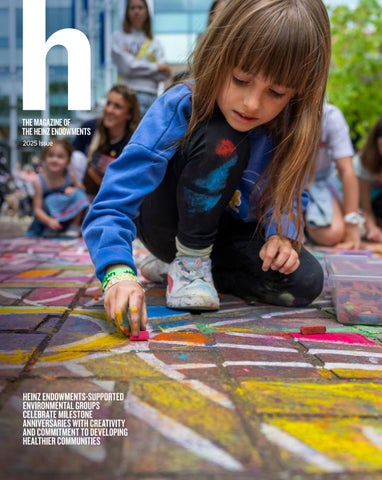
About the cover: Rose Elliott, 8, of Gibsonia, Pennsylvania, colors in a chalk design created by artist Sandy Forseth as part of the annual Chalk Fest organized by the Pittsburgh-based environmental group Riverlife. As a community mandala artist, Forseth of Eden Prairie, Minnesota, guides others in completing artistic geometric designs to encourage community connections and mindfulness.
Photo by Joshua Franzos
4 IN CELEBRATION OF 3
Three environmental groups observe their milestone anniversaries and environmental achievements.
14 LOST IN TRANSLATION
While federal transition services appear to fall short in helping service members obtain fulfilling civilian jobs after leaving the military, veteran-focused nonprofits have been more successful in making those connections.
22 THE MYTHIC SPIRIT IN ART
Marques Redd and Mikael Owunna used their shared interest in African cosmologies to create a multi-faceted body of artwork that is gaining widespread recognition.
2 HOMETOWN SNAPSHOT
32 HERE & THERE
Delaney Greenberg
A fresh voice
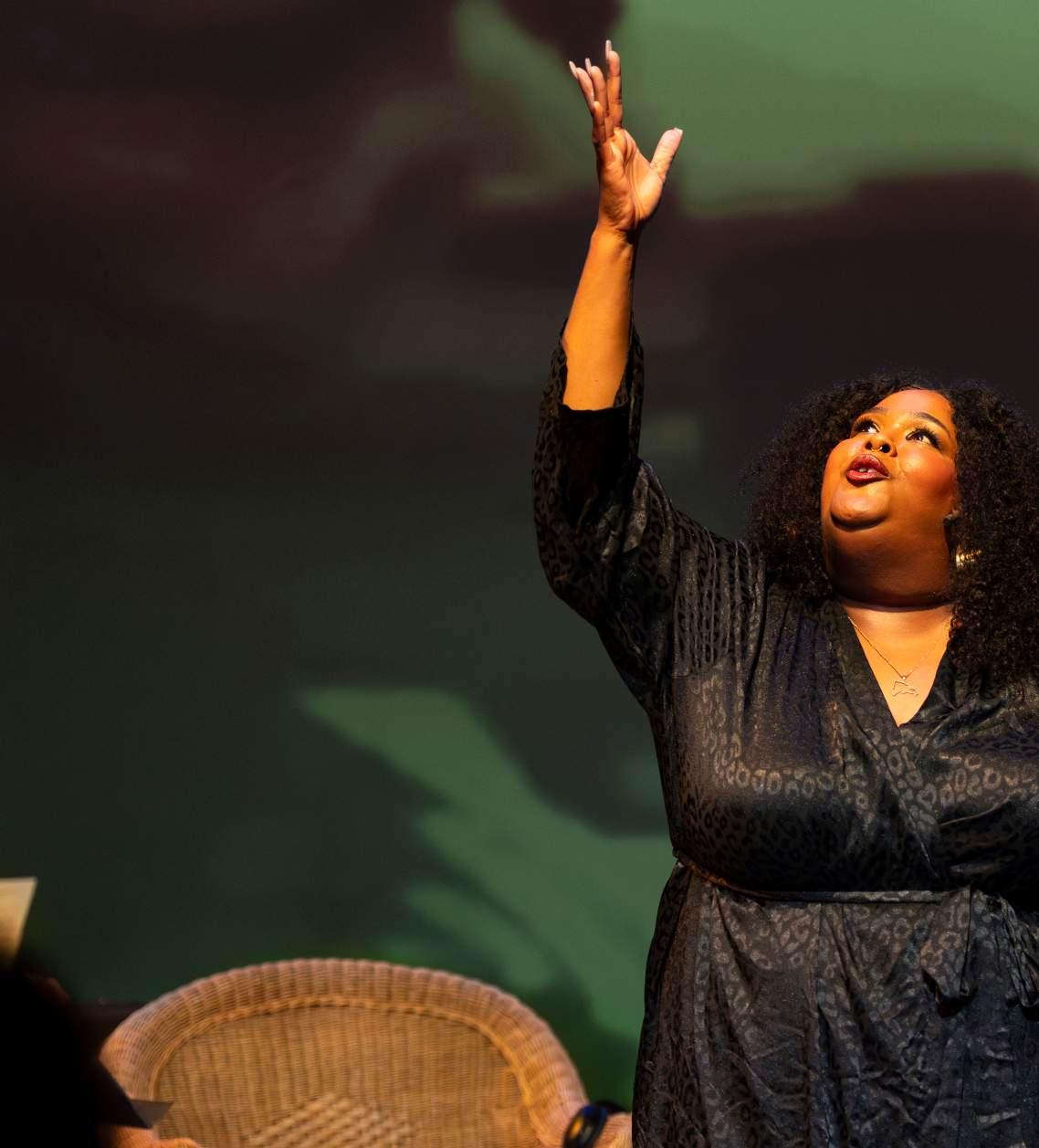
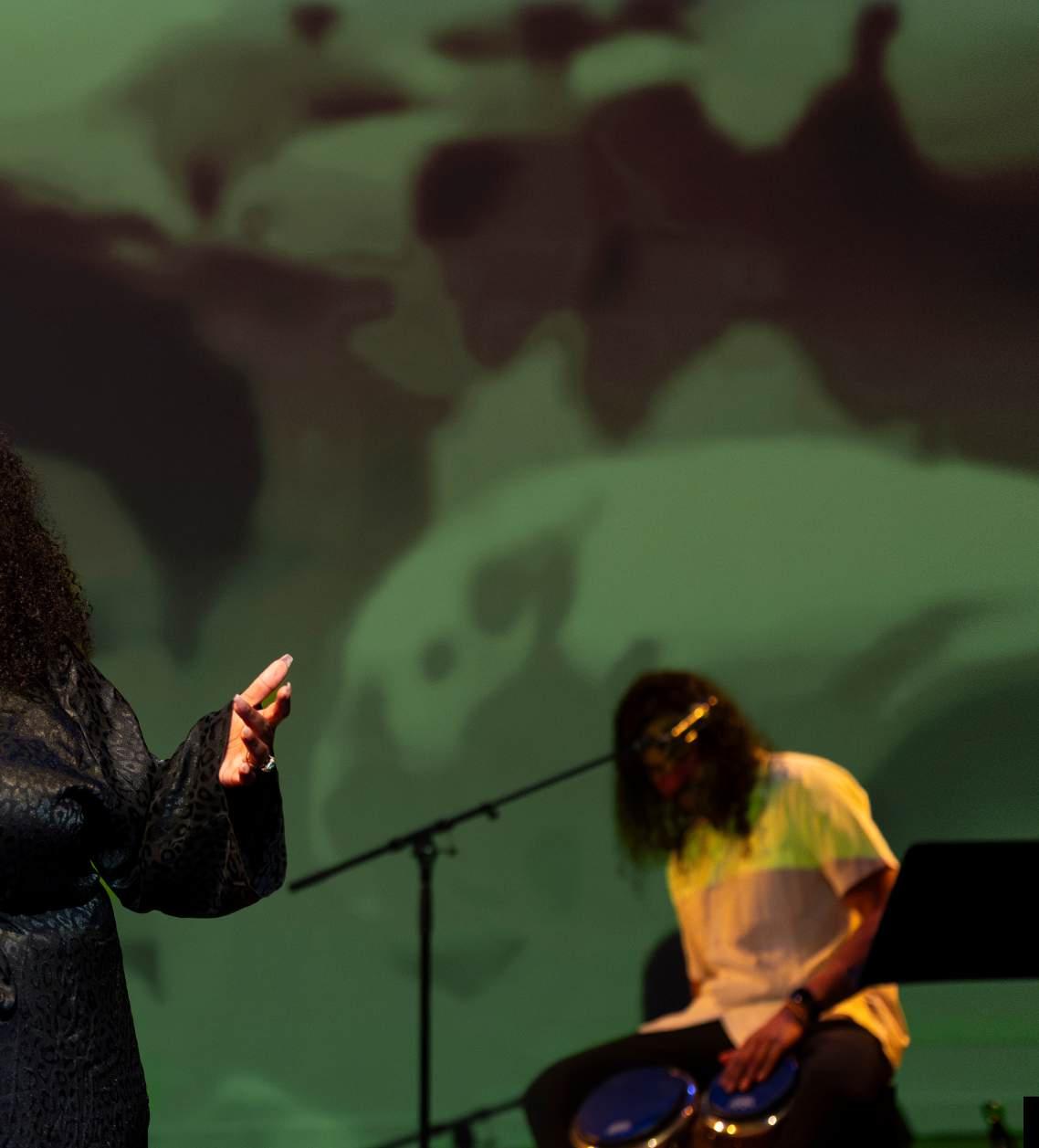
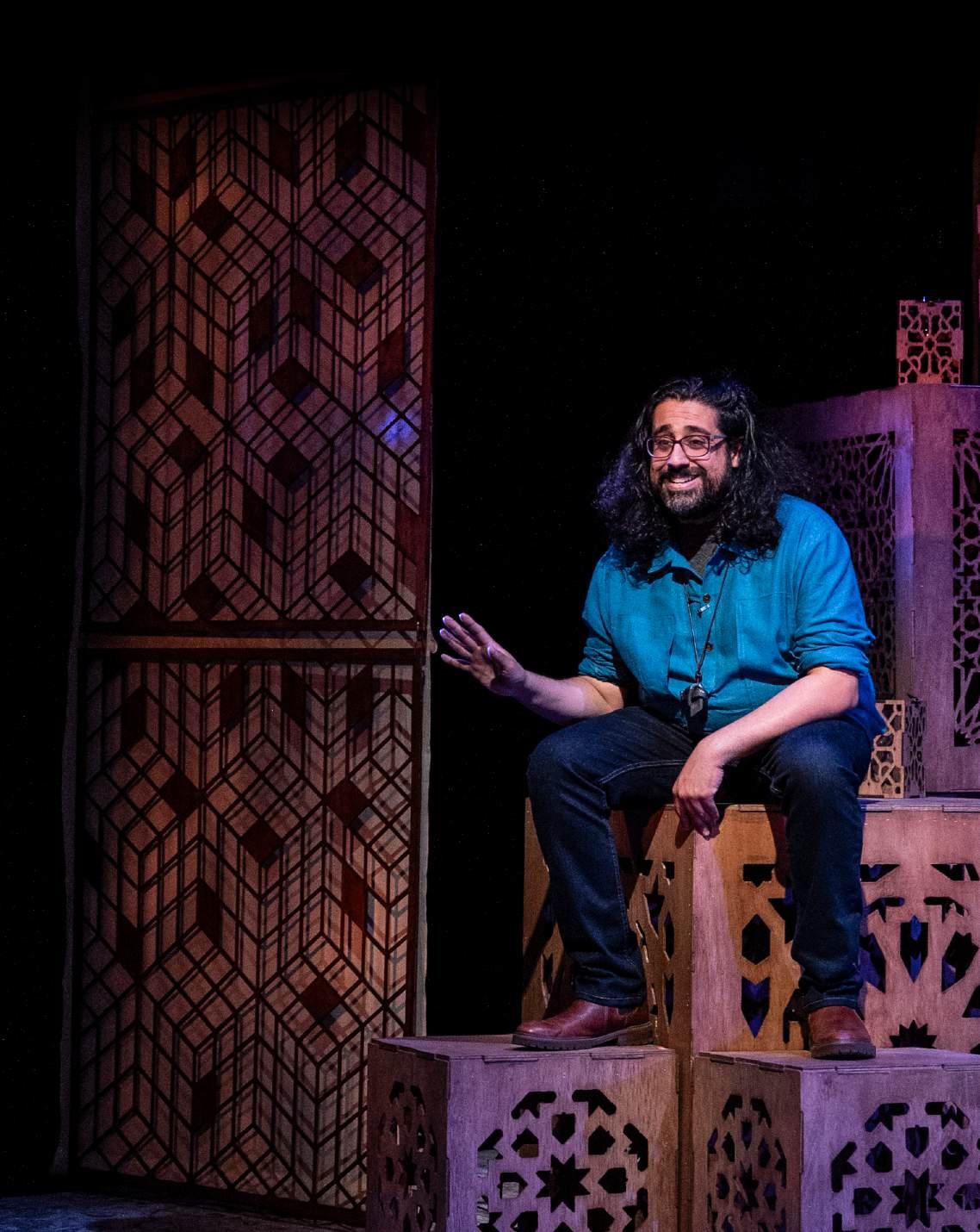
With powerful vocals and a moving narrative, singer Zuly Inirio performed her creation “La Voz que Soy,” or “The Voice I Am,” at the Kelly Strayhorn Theater in April. Inirio is part of the Freshworks residency that the Kelly Strayhorn, an Endowments grantee, established for emerging artists and collaborators in the Pittsburgh region. The program, which also has received Endowments funding, provides artists with a range of support that includes planning guidance, studio space, production staff, lighting and sound design, a stipend, and a resource budget.
With that support, Inirio produced “La Voz que Soy,” which reinterprets the 1958 French opera “La voix humaine” about a woman’s final phone conversation with a departing lover. In Inirio’s performance, she recreates the experience of talking with her mother on the phone while getting ready for an audition, sharing stories from her childhood that shaped her identity and from her present that explore the challenges she faces as an Afro-Latina singer in a predominantly Eurocentric opera world.
IN CELEBRATI N
As they mark milestone anniversaries, three environmental groups that received significant support from The Heinz Endowments consider their history and accomplishments.
By Joyce Gannon
OF
hree environmental organizations whose work has had a major impact in the Pittsburgh region have reached milestone anniversaries recently, and they can trace their beginnings to The Heinz Endowments and its commitment to environmental causes.
These nonprofit groups are Citizens for Pennsylvania’s Future (known as PennFuture), which celebrated 25 years in 2024; Women for a Healthy Environment, commemorating 15 years in 2025; and Riverlife, which wrapped up 25th-anniversary events this year.
Intertwined in the history of each are accounts of the Endowments’ encouragement and support.
Riverlife was formed in 1999 and in 2001 unveiled a plan to transform the city’s riverfronts into thriving areas for recreation and economic development. Since then, it has overseen $150 million in public and private investments in trails, parks and connections within a 15-mile loop along the Monongahela, Allegheny and Ohio rivers. Among its signature projects: the Point State Park fountain renovation, South Shore Riverfront Park on a former steelmaking site, and the Mon Wharf Connector, which links Point State Park to the Great Allegheny Passage.
The Endowments was one of the early supporters of Riverlife as part of the priority it has placed on incorporating high-quality design, arts and culture in regional development.
“Riverlife’s work is a good example of the connections between arts, culture and vibrant public spaces,” said Mac Howison, an Endowments senior Arts & Culture program officer, whose portfolio includes Riverlife grants.
“The Endowments’ vision can be interpreted not only as an effort to clean and green our riverfronts … but it includes a sense that any public space should be welcoming, accessible and possess a lasting beauty,” he said.
As public art, waterfalls and lighting installed along the trails illustrate, “there’s more to Riverlife’s work than just paving,” Howison added.
Women for a Healthy Environment, launched in 2010, and PennFuture, founded in 1998, are supported by the Endowments as part of its focus on ensuring healthy and safe environments and eliminating disparities in environmental health.
Women for a Healthy Environment was inspired by a series of conferences that then-Endowments Chairman Teresa Heinz organized for years in Boston and Pittsburgh to “connect environmental health and women’s health and make women leaders and prime movers in that work,” said Philip Johnson, the Endowments’ senior director for Climate, Environment & Health.
Its programs assess homes, schools and child care centers for radon, lead, and poor air and water quality, and provide training and supplies for remediating those hazards. The organization relies on scientific research to advocate for improved environmental health outcomes, said Michelle Naccarati-Chapkis, executive director since its founding.
“The Endowments has a long history of doing work in the environmental and health space and supporting strategies that promote children’s environmental health, so Women for a Healthy Environment’s work is directly connected to our strategic priorities,” Johnson said.
The Endowments, in partnership with the Pew Charitable Trusts, launched PennFuture to address public policy around the environment. The aim was to create “an organization … that would address various public health and protection issues, particularly in improving the energy sector,” said John Hanger, PennFuture’s founding president and CEO.
“This was especially important … given the state’s long history of tragic events related to coal mining and gas development,” he said.
PennFuture advocates statewide for legislation and policies that protect the environment from air and water pollution and environmental damage caused by fracking and fossil fuel industries. Its legal and civic engagement experts take on pro bono cases in local, state and federal courts and conduct outreach and education, such as its public awareness campaign about pollutants from Shell’s petrochemicals plant in Beaver County.
Among its recent successes in southwestern Pennsylvania was a 2023 order from the U.S. Environmental Protection Agency that found U.S. Steel’s Clairton Coke Works not in compliance with the Clean Air Act and required improved air-quality monitoring at the plant. PennFuture was also a force in preventing energy giant Invenergy from building a gas-fired power plant in Elizabeth Township.
“They’ve stopped bad things from happening by promoting clean energy and environmental compliance and defending against initiatives that would undermine those,” said Andrew McElwaine, senior adviser to the Endowments and the foundation’s former vice president of Sustainability.
When Mrs. Heinz was chairman of the Endowments, she delivered the keynote address at PennFuture’s 10th anniversary gala with former Vice President Al Gore, she “challenged us to do more, be relentless in our efforts for the environment,” Hanger said.
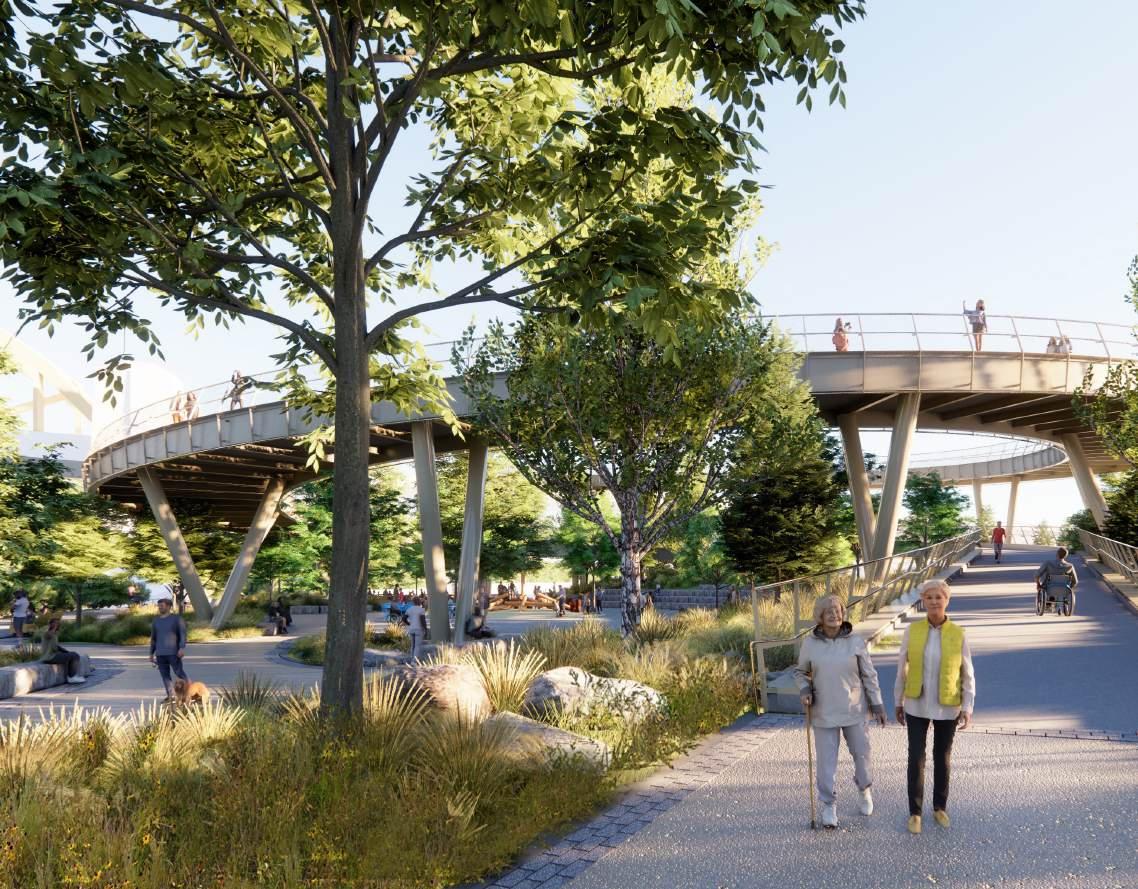
Riverlife’s plan for revitalizing Pittsburgh’s riverfront includes improvements to the West End Bridge over the Ohio River.
As shown in the rendering above, this would involve constructing pedestrian pathways across the bridge and accessible walkways along the city’s North Shore landing, and connecting the bridge to the West End community on one end and North Side neighborhoods on the other.
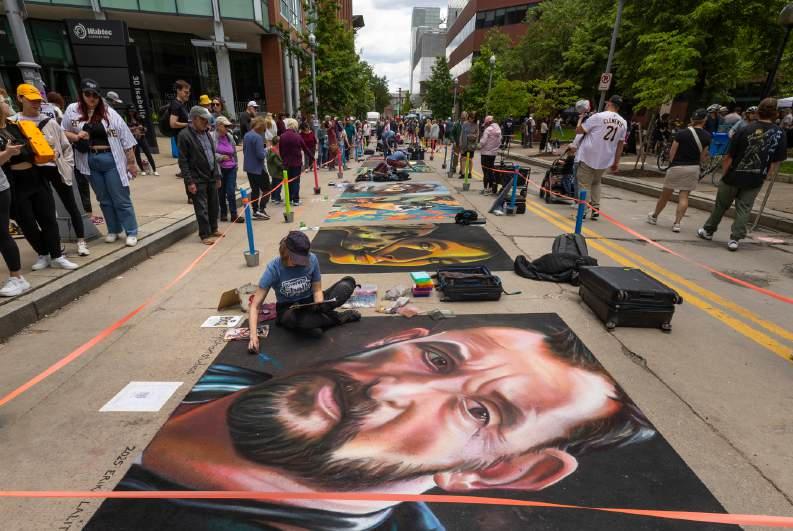
Left, Riverlife’s annual Chalk Fest brings together artists who create temporary chalk murals on streets near the Allegheny River. The event has become a hallmark of the organization as it marks its 25th anniversary. The chalk creations include realistic portraits of well-known personalities such as one by artist Erika Lalita Thurkins of Grove City, Pennsylvania, who drew actor Noah Wyle as Dr. Michael “Robby” Robinavitch, a character in the Emmy award–winning TV show “The Pitt,” which is set in a fictional Pittsburgh hospital.
El Dorado and Merritt Chase
RIVERLIFE
1999
Riverlife was established by people who saw the opportunity to create a plan for the sustainable redevelopment of Pittsburgh’s Downtown riverfronts.
2001
Released a vision plan for Pittsburgh that included a 15-mile, 1.055-acre loop of riverfront parks, trails and public open spaces. Through Riverlife’s leadership, which has included working with land owners, developers, neighborhood groups and elected officials, more than 85% of the 15-mile loop has been established and improved for public use.
2010
Unveiled a joint plan with the Urban Redevelopment Authority, City of Pittsburgh and Department of City Planning for the redevelopment of the banks of the Allegheny River and for the Strip District and Lawrenceville riverfront communities. Goals included increasing economic vitality, improving connections between the river and the city, restoring and enhancing their ecological character and quality, developing complementary uses and amenities, creating beautiful and memorable places, and planning for sustainable development.
2013
Dedicated the renovation of the Point State Park fountain, which also marked the final phase of a complete overhaul of the 36-acre park. The entire work cost $35 million.
2021
Released the Completing the Loop plan on ways to close the remaining gaps and make major improvements to the loop over the next decade.
2025
Launched its Shore Thing, a 4,800-square-foot modular barge platform that is anchored in the Allegheny River along Pittsburgh’s North Shore and provides visitors with space to lounge, enjoy river views and participate in a rotating calendar of free programs.
In a speech delivered during an August 1999 boat ride on Pittsburgh’s rivers, historian David McCullough encouraged city leaders to seize “a once-in-acentury opportunity” to remake the city’s Allegheny, Ohio and Monongahela riverfronts into “a showcase to the whole country.” Among those on that Gateway Clipper cruise were civic, business and philanthropic leaders, including Mrs. Heinz.
The outing served as “a flashpoint” in Riverlife’s launch, said Matt Galluzzo, president and chief executive of the North Shore–based nonprofit since 2019. The Endowments has made grants to Riverlife totaling $12.6 million since its founding.
The riverfront loop the organization targets stretches from the city’s 31st Street Bridge on the Allegheny to the West End Bridge on the Ohio, to the Hot Metal Bridge on the Monongahela. Beyond trails and parks, Riverlife’s mission of “Completing the Loop” includes connections with adjacent city neighborhoods, including Lawrenceville and Hazelwood, “where we’re seeing economic promise,” Galluzzo said.
Along the Ohio River, Riverlife wants to spur activity in the city’s West End communities “that historically never had a connection to the riverfronts and experienced historic disinvestment,” he said. The West End Bridge, in fact, is among “the big plays” Riverlife is currently addressing, he added.
Plans call for pedestrian pathways across the bridge and accessible landings that connect the structure to the West End community on one end and to the North Side neighborhoods, Manchester and Chateau on the other shore. Also in the works is development along both sides of the Allegheny River connected by the Roberto Clemente, Andy Warhol and Rachel Carson bridges, which stretch from Pittsburgh’s Downtown to the city’s North Shore.
“The Sister Bridges Experience,” as Riverlife calls it, includes creating a space from Penn Avenue and the Cultural District, Downtown, “all the way over to the [North Shore] Warhol Museum where families can come and literally wander … and encounter amenities and attractions you can’t find anywhere else in the region,” Galluzzo said.
Key to the “experience,” he said, are planned renovations and restorations to Allegheny Riverfront Park on the Downtown side and Allegheny Landing on the North Shore. In March, Riverlife and its partners the City of Pittsburgh and the Pittsburgh Cultural Trust broke ground on a $5.4 million project to renovate and expand Allegheny Riverfront Park with more space for seating, food and entertainment.
This year, Riverlife will deploy a new clean-up initiative along the riverfronts that includes all-terrain vehicles equipped with power washers to eliminate goose poop and other debris. Funding comes from a $5 million endowment from a foundation that asked to remain anonymous, Galluzzo explained.
Riverlife recently launched a fundraising campaign with a goal of $30 million that included a public appeal, he said. The organization receives government, corporate and individual funding as well as support from a number of local philanthropies in addition to the Endowments, including the Richard King Mellon Foundation, which has provided more than $14 million in grants to Riverlife.
The organization kicked off yearlong 25th anniversary celebrations in May 2024 with its annual Chalk Fest at Allegheny Landing which includes the creation of temporary chalk murals by professional artists from across the country. In August 2024, it featured the anniversary theme at its annual Party at the Pier on the roof of the David L. Lawrence Convention Center and partnered with Flotsam River Circus for free performances on all three rivers.
During Oktoberfest 2024, Riverlife, Pittsburgh Downtown Partnership and Flyspace Productions brought a 60-foot Ferris wheel to the Roberto Clemente Bridge.
“That was a great, crescendo moment,” Galluzzo said.
Events concluded in May of this year with on-the-water programs and the return of Chalk Fest.
WOMEN FOR A HEALTHY ENVIRONMENT
2010
Women for a Healthy Environment (WHE) is founded to advance safe and healthy environments in homes, schools and communities.
Launched its Healthy Homes Program to identify and reduce environmental health hazards where families live.
2014
Began the Healthy Schools Program, supporting safer learning environments for children across Pennsylvania.
2016
Contributed to the passage of the federal Frank R. Lautenberg Chemical Safety for the 21st Century Act, strengthening national chemical safety standards.
2017
Created the Healthy Early Learning Program. Starts the 1000 Hours Program to promote safe learning spaces.
2018
Started the Get the Lead Out and Lead Safe Allegheny initiatives to drive policy change and community education.
2021
Secured a $250,000 settlement from the attorney general’s office for lead prevention education. Successfully advocated for the Pittsburgh Lead Safety Law.
2022
Successfully advocated for passage of the Pennsylvania Whole Homes Repair Act, which calls for providing funding for home repairs, offering coordination and technical assistance, advancing workforce development, and providing loans and grants to homeowners and landlords whose incomes are below 80% of their area’s median income.
2024
Received the Governor’s Award for Environmental Excellence for the Healthy Homes Asthma Program and was recognized as a U.S. EPA Safer Choice Partner of the Year.
Helped to craft the proposal that led to the creation of the Allegheny County Housing Advisory Committee, which addresses emerging health issues in homes across the county.
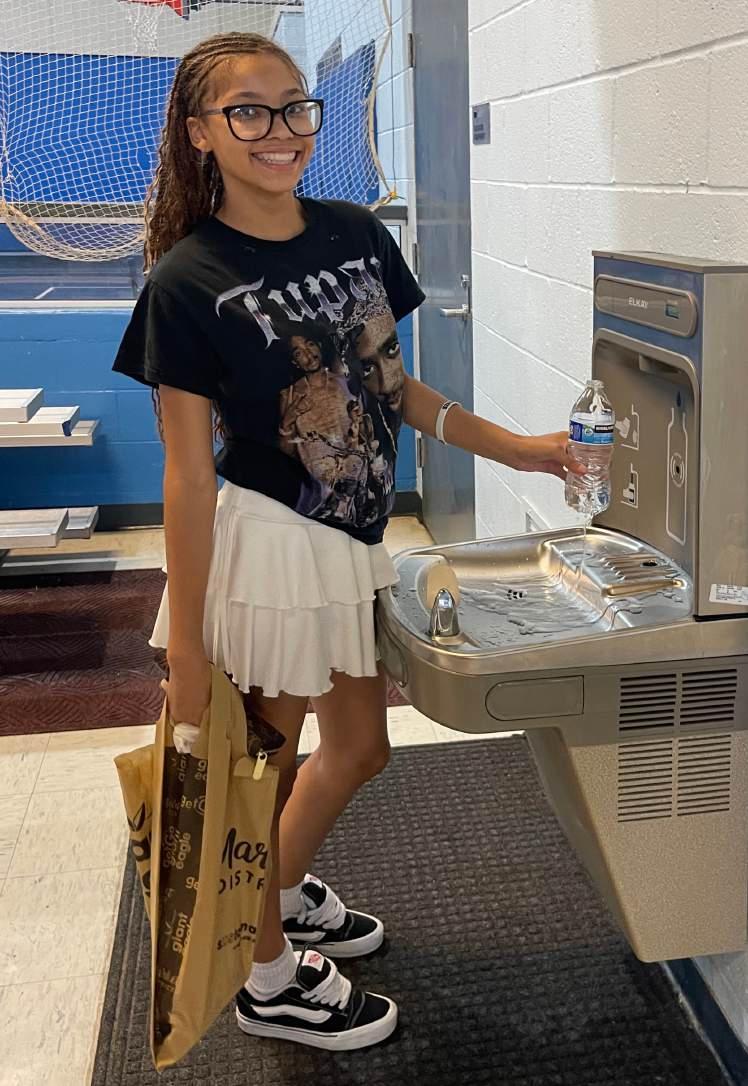
Khai Reason is a member of the Boys & Girls Clubs of Western Pennsylvania’s Teen Influencer Council. While at the Estelle S. Campbell Clubhouse in Pittsburgh’s Lawrenceville neighborhood, she fills a bottle at a water station that uses filtration technology to remove lead, copper and other contaminants from drinking water.
In 2008, Michelle Naccarati-Chapkis attended the Conference on Women’s Health and the Environment that Mrs. Teresa Heinz convened at the David L. Lawrence Convention Center in Downtown Pittsburgh.
Scientists, journalists and medical experts addressed thousands and “really created an opportunity to have Mrs. Heinz’s vision come to life,” she said. “Mrs. Heinz wanted to help women in the community understand the environmental hazards that impact their health.”
Afterward, a group of about 20 women including representatives from businesses, philanthropies and volunteers met to determine “how to continue the conversation … beyond a one-day event,” Naccarati-Chapkis said.
That effort led to a pilot project that became Women for a Healthy Environment, now based in Pittsburgh’s North Point Breeze neighborhood. Among its successful advocacy efforts cited by Naccarati-Chapkis are the Pittsburgh Lead Safety Law; Allegheny County’s first Housing Advisory Committee that gives renters, public health experts and housing providers a voice in developing healthier homes; the state’s Whole Homes Repair Act; and federal legislation to improve regulation of the chemicals and cosmetics industries.
Its programs to eliminate hazards in schools and homes focus on environmental justice communities populated largely by low-income people and other marginalized groups that have a higher risk for health disparities.
“We want to make sure all the spaces where children are spending their days are healthy because that leads to better academic performance and better long-term employment outcomes,” Naccarati-Chapkis said.
The organization’s Healthy Homes program offers free assessments for chipped paint, mold, pests and other hazards and provides cleaning kits, dehumidifiers, air filters and other equipment to mitigate the problem.
At schools and early learning centers, Women for a Healthy Environment tests for toxins, trains staff in awareness and mitigation and promotes environmental programs for students. More than 35,000 individuals and nearly 300 schools and pre-schools have benefited from its efforts, Naccarati-Chapkis said.
The Jefferson Regional Foundation, which has awarded $263,000 to Women for a Healthy Environment since 2016, supports the organization’s work because it targets places that have “disproportionate exposure to environmental harms,” said Kelleigh Boland, director of grantmaking and strategy for the philanthropy whose footprint includes the lower Mon Valley and some South Hills suburbs.
The Endowments has made grants to Women for a Healthy Environment totaling $6.5 million since 2009. It funded the organization’s 2021 State of Environmental Health in Pennsylvania Schools report that found Pennsylvania schools at risk for health and environmental hazards because of aging infrastructure and inconsistent testing and remediation for lead and other toxins.
The organization is working to make radon testing a requirement for schools statewide, said Naccarati-Chapkis. It also wants to beef up regulations for “forever chemicals” known as PFAS (per- and polyfluoroalkyl substances) that can cause miscarriages, preterm births and other health complications particularly for women and children, she said.
To mark its 15th anniversary, Women for a Healthy Environment celebrated with several events this year. They included sponsoring an address and fireside chat on May 1 at Pittsburgh’s Phipps Conservatory and Botanical Gardens with Andrea Vidaurre, winner of the 2024 Goldman Environmental Prize, widely known as the “Green Nobel” prize. Ms. Vidaurre, who co-founded People’s Collective for Environmental Justice and was named one of Time magazine’s 100 Most Influential People of 2025, has led advocacy efforts to limit emissions from trucks and rail carriers and to ban diesel trucks by 2035.
The organization’s major anniversary celebration is scheduled for Nov. 5 at Westin Pittsburgh, Downtown. It will feature keynote speakers Isaias Hernandez, an environmental educator, and Wawa Gatheru, a climate activist. At that event, Women for a Healthy Environment will present its Lumen Award to a local environmental justice leader, and present honorariums to between 20 and 30 women “who helped to launch us early on,” Naccarati-Chapkis said.
legislative remedies such as the Pittsburgh Lead Safety Law,
calls for addressing the ways people, especially children, are exposed to lead hazards.
Peeling lead paint in older buildings, as shown on the radiator above, is among the health hazards Women for a Healthy Environment has been targeting since its inception. Its work has included advocating for
which
Patrick McDonnell had a track record in environmental work, including six years as Secretary of the Pennsylvania Department of Environmental Protection before he became president and chief executive of PennFuture in 2022.
“I knew the organization was rooted in environmental protection, environmental justice and had a focus on getting things done,” he said. Before PennFuture, “nothing really existed to push for the environmental and climate wins we knew we needed and for community members to make sure their voices are heard.”
The Endowments has made grants totaling $18.9 million to the organization since its founding.
“The Heinz Endowments has been important in financial support but also as a thought leader … that brings us good information and asks us good, hard questions,” McDonnell said.
Based in Harrisburg, PennFuture has offices in Pittsburgh, Philadelphia, Erie and Stroudsburg.
The organization played a key role in advocating for passage of the state’s Act 129 in 2008, which requires electric utilities to reduce consumption and demand and provide incentives such as LED lighting, energy efficient appliances and programmable thermostats to homes and businesses.
It also pushed for the state’s Growing Greener program, enacted in 1999, that directs state funds for clean water, parks, recreation, sewer and agricultural projects. Other state legislation it championed included the Solar for Schools Act, which was designed to make $25 million in grants for solar energy projects at schools, and the Clean Streams Fund that now totals $50 million. However, federal tax credit rollbacks approved this year will reduce savings for the Solar for Schools program, though many schools appear to be continuing with their projects, and federal funds were frozen for clean streams initiatives, though the impact on Pennsylvania’s Clean Streams Fund is unclear.
It has challenged the state over its handling of abandoned oil and gas wells and called for
more funding to cap the wells that leak methane and other harmful substances into the air and water.
Another major funder, the William Penn Foundation in Philadelphia, has provided grants totaling $12.8 million to PennFuture since 2001 for projects that are “extremely important to our environmental and clean water goals,” said Jamie Quinn, a foundation spokeswoman.
These initiatives include reducing illegal dumping in the City of Philadelphia and supporting the Green Living Plan, which promotes environmentally focused policies and investments to improve quality of life in Philadelphia communities that have socioeconomic disparities.
To celebrate its 25th anniversary, PennFuture held two events in 2024 where it honored environmental supporters and volunteers one at the National Aviary in Pittsburgh and one at the National Constitution Center in Philadelphia. Honored with Lifetime Achievement Awards were John Dawes, founder and former executive director of Foundation for Pennsylvania Watersheds, and Joseph Otis Minott, former executive director of the Clean Air Council.
Michael Mann, Presidential Distinguished Professor and director of the Center for Science, Sustainability and the Media at the University of Pennsylvania, received the Climate Champion Award.
Champion of the Environment Awards went to Allegheny County Executive Sara Innamorato and state Rep. Napoleon Nelson, D-Glenside. The Volunteer Award winners were environmental advocates Peg Church of Bethlehem, Pennsylvania, and Fred Kraybill of Pittsburgh.
The honorees “helped us get to where we’re at,” McDonnell said. “We wanted to recognize community leaders and people important to the environmental movement.” h
1998
Citizens for Pennsylvania’s Future (PennFuture) was created as a statewide environmental advocacy organization and has since successfully promoted measures to reduce pollution and protect the environment.
1999
Led Pennsylvania’s first Growing Greener campaign, which resulted in then-Gov. Tom Ridge signing bipartisan legislation into law that created the first Growing Greener program — now known as the State Parks and Outdoor Recreation Program — in support of various environmental initiatives, including parks and recreation, clean water, agricultural improvements, and sewer and water projects.
2005
Led the Growing Greener II campaign, which included a $625 million bond initiative that created financial support for programs benefiting watersheds, outdoor recreation and other environmental efforts.
2008
Championed passage of Act 129, which requires utilities to implement robust energy conservation programs, saving electric consumers billions of dollars.
Advocated for the passing of the Alternative Energy Investment Act, which established a $650 million energy fund that included $180 million for solar projects.
2023
Teamed with other environmental groups in a successful legal action against U.S. Steel’s Clairton Coke Works for violations of the Clean Air Act. The Environmental Protection Agency sided with PennFuture and its partners by rejecting the Allegheny County Health Department’s air quality permit since it did not require monitoring and air testing as required by the Clean Air Act.
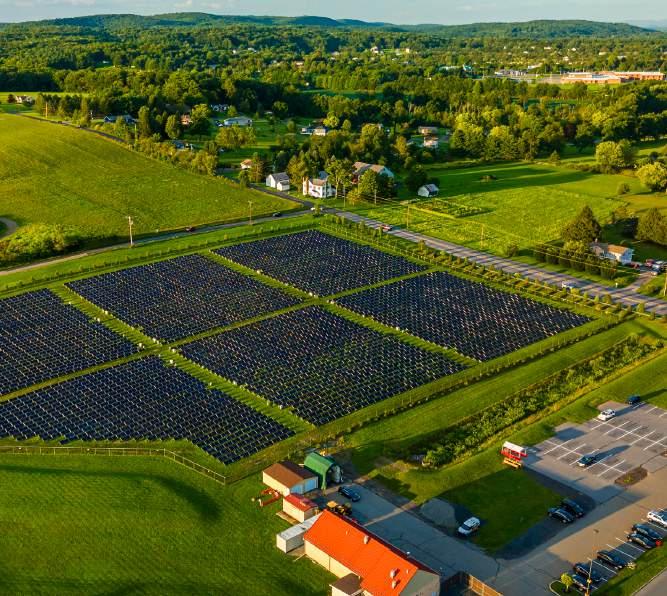
PennFuture’s environmental advocacy has included working to advance efforts to reduce pollution in the Susquehanna River, which also affects other waterways such as the Chesapeake Bay, shown above at Havre de Grace, Maryland, where the Susquehanna flows into it. Among the organization’s other advocacy priorities is promoting clean, renewable energy that does not produce significant greenhouse gases or contribute to climate change. Clean energy sources include wind turbines such as the Casselman Wind Power Project, below, which consists of 23 turbines in Somerset County, Pennsylvania, and solar panels such as the array, right, that is adjacent to agricultural fields and a small commercial area near Brodheadsville, Pennsylvania.
TRANSLATION LOST IN
Despite millions of federal dollars spent on services to prepare service members for civilian life, they still face challenges obtaining civilian jobs that fit the significant skills they gained in the military. Veteran-focused nonprofits are trying to help make the employment connections vets need. By Adia Aidoo
Takoya Schultz has a keen eye for detail.
During her nearly 10 years in the Air Force, she was driven by finding her purpose, learning discipline, seeing the world and making a difference. She was stationed at bases in Iceland and Germany before returning stateside to her station in New Mexico.
“It was hot. It was dry,” said Schultz, who now lives in Magnolia, Arkansas. “And I did not know tumbleweeds were real until I got there.”
As an airman the general term for both male and female Air Force members Schultz worked in roles that required a strong focus on safety and quality control to ensure the smooth operation of the missions she was assigned. She kept up with strict safety protocols, such as the Hazard Analysis and Critical Control Points, to ensure that food service, lodging and personnel support were operational and compliant. Every day, she conducted routine lodging inspections to check that accommodations met standards. She tracked deliveries and managed inventory for supplies essential to keep her fellow
airmen ready for their missions. She also directly affected the success of operations by mitigating potential risks and promoting efficiency.
Managing critical logistics is second nature to Schultz. However, after she left the Air Force, she faced challenges transferring her significant and exceptional skills to her civilian job search.
As she was looking for her new career, Schultz struggled with underemployment, including being underpaid and working jobs that didn’t align with her expertise. Schultz also had to teach herself how to tailor her resume so that her skills translated to the civilian workforce and how to improve her interview skills to land the jobs she wanted.
Schultz’s experience is not unique.
Pittsburgh native Bradley Fogle served 20 years in the Army. From a family of service members and veterans, Fogle felt called to join not long after 9/11. He was stationed around the world, from Iraq to Lithuania to Poland. As a soldier, Fogle worked mostly in logistics
and engineering, including demolition, heavy machinery operation and mission planning.
When Fogle medically retired from the military, he gladly returned to Pittsburgh. He participated in the Department of Defense’s (DoD) Transition Assistance Program (TAP), which is mandatory when leaving the military and provides various services and classes aimed at preparing service members for returning to civilian life. However, he experienced a steep drop-off in resources for veterans. So, he took what he learned during TAP and sought additional support for his civilian career search.
“I’m thankful that I’m proactive, which is another thing that the military gave me,” Fogle said. “Being proactive in looking at organizations in and around Pittsburgh that could help veterans find jobs was successful for me.”
Studies show that despite military service providing veterans with the leadership traits and skills employers seek, veterans like Schultz and Fogle often have difficulty translating their experience to land a quality civilian job. Recent
HONESTLY, ALL I REMEMBER [FROM THE TRANSITION ASSISTANCE PROGRAM] IS VERY MEDIOCRE RESUME HELP. PREPARING ME FOR THE CIVILIAN JOB MARKET OR JOB SEARCH … I DON’T THINK TAP WAS HELPFUL FOR ME AT ALL IN THAT ASPECT.”
Heinz Endowments–supported reports reveal that not only do veterans face obstacles leveraging their military experience to successful civilian roles but federal programs created to help them find employment are fragmented and don’t effectively track outcomes, providing little to no evidence that participants are satisfactorily employed after completion of the programs.
THE VETERAN EMPLOYMENT PARADOX
In March 2025, the U.S. Department of Labor reported comparable unemployment rates between veterans and civilians, but those statistics don’t tell the whole story. Most veterans face challenges obtaining civilian employment that matches their experience and training. A 2023 study supported by the Endowments and other funders and released by Pennsylvania State University’s Clearinghouse for Military Family Readiness provided some eye-opening data about the reality of the military-to-civilian workforce experience. Nearly two-thirds of the nation’s 4.1 million post-9/11 veterans reported
Takoya Schultz
former Air Force airman who now works as a safety project manager for a pellet manufacturing company.
Angela Pieratt
that their civilian jobs didn’t adequately align with their skills and education, even six years after service.
According to the Department of Defense, also known now as the Department of War, an estimated 200,000 service members transition out of the military every year. In a June 2024 Endowments-funded report by the RAND Corporation, findings included that the U.S. government spends more than $13 billion annually to help reintegrate service members into civilian life through programs such as TAP and the GI Bill. Yet most funding goes to educationrelated programs like the GI Bill, which covers the costs for post-secondary schools or training, rather than programs focused squarely on employment. TAP itself receives just $140 million from the federal government.
More research-based policy reform is needed to understand how federal programs and veteran-serving nonprofits can measure their effectiveness and collaborate to offer improved, more individualized services to better bridge the gap between military and civilian life, according to Megan Andros, the Endowments’ director of Veterans and Workforce.
As a supporter of veteran-focused research and programs, the Endowments backs federal
policy and nonprofit solutions to improve veteran transition experiences and outcomes.
“[The U.S. government] invested a lot of money, time and energy in separating people from the service. What have we learned during the 20-year, global ‘war on terror’?” Andros said. “No one had ever asked that question or done a thorough accounting of the transition system’s strengths and weaknesses, or documented the hard lessons learned.”
But the Endowments did just that when it awarded a $2 million grant to RAND in 2022 to research both federal and nonprofit efforts. RAND produced two studies released in June and October 2024 that investigated the effectiveness of federal transition programs and the landscape of veteran-serving nonprofits that help transitioning service members with civilian employment. Each study showed areas for improvement in the administration of employment-focused services and the measurement of outcomes for the veterans who receive support, and provided recommendations for policy reforms to improve military-to-civilian transition outcomes.
Take TAP: Every service member must participate in TAP as part of the transition process for at least a year before they leave the military.
I'M THANKFUL THAT I'M PROACTIVE, WHICH IS ANOTHER THING THAT THE MILITARY GAVE ME, BEING PROACTIVE IN LOOKING AT ORGANIZATIONS IN AND AROUND PITTSBURGH THAT COULD HELP VETERANS FIND JOBS WAS SUCCESSFUL FOR ME.”
Bradley Fogle
Army veteran who now works as a project manager for a commercial/industrial repair and maintenance company.
Each person receives counseling to develop an individualized transition plan and goes through a three-day course meant to prepare service members for civilian life, including gaining civilian employment. TAP then culminates in a capstone to prove a service member’s readiness for civilian life.
However, a U.S. Government Accountability Office (GAO) 2022 study found that 70% of service members failed to enroll in TAP on time. Additionally, a January 2025 report from the DoD highlighted that 55% of service members who were eligible to waive their attendance in supplemental two-day tailored classes on topics like higher education and vocational training got approval from commanding officers to do so, and 17% of service members who needed maximum transition support did not attend any of the specialized courses designed to help them.
“Honestly, all I remember [from TAP] is very mediocre resume help,” Schultz said. “Preparing me for the civilian job market or job search … I don’t think TAP was helpful for me at all in that aspect.”
DETERMINING FEDERAL TRANSITION PROGRAMS’ EFFECTIVENESS
In 2019, the GAO evaluated federal programs created to help veterans gain employment after leaving the service and identified 45 programs across 11 federal agencies. However, the GAO found that, until their report, no existing inventory could give policymakers or participants a complete picture of available benefits from these programs.
The RAND studies revealed that these federal employment transition programs are segmented and sometimes provide redundant services to veterans who utilize them. They are also limited in the individualized support they can provide, with little transparency or accountability, RAND researchers learned.
The RAND study released in June 2024 found that more than 97% of federal funding for transition programs went to transition services focused on education, upskilling, training or certification programs and less than 3% went to help service members get jobs. In fact, in 2024, the Congressional Research Service stated that the Post-9/11 GI Bill alone will cost the federal government over $10 billion in fiscal year 2025.
200,000 service members transition
2 3
Nearly twothirds of the nation’s 4.1 million post9/11 veterans report that their civilian jobs don’t adequately align with their skills and education even six years after service.
,000
of the military every year.
However, according to their June 2024 report, RAND researchers learned that, despite the massive federal investment in these programs, they receive limited oversight and budget scrutiny. Currently, there is no standard to measure their effectiveness, and there is limited evidence that federally funded programs produce positive outcomes.
“What was surprising was that there were so many programs, and no one could really tell us what they were doing, if they were effective or if there were meaningful outcomes as a result,” said Jeff Wenger, senior economist and policy researcher at RAND. “The biggest program for transitioning service members is TAP…We don't know if people who [participate in] TAP have better employment outcomes as a result of it.”
Key recommendations from the June 2024 report urge policymakers to intervene and standardize budget and performance reporting, but not necessarily cut the budget of these services without more research into minimizing disruptions.
In addition, while the GI Bill helps hundreds of thousands of veterans and their families annually pay for higher education or vocational training opportunities, many veterans may not have the option to delay beginning their civilian careers to attend school or training programs, according to Gilly Cantor, director of evaluation and capacity building at the D’Aniello Institute for Veterans and Military Families (IVMF) at Syracuse University.
“Seeing how many transition programs there are across so many agencies illustrates
why this is such a wicked problem and why it will take a whole-of-government approach to solve it,” said Cantor.
She described IVMF’s programs for transitioning service members, veterans and military spouses as proven, evidence-based and offering education and training to help them advance their careers. IVMF’s programs, like Onward to Opportunity (O2O), are independently verified and deliver positive results for their participants, offering a model for federal transition program reforms, she said.
IVMF also conducts research, policy analysis and program evaluation to improve services for veterans and their families. The Endowments is a longtime supporter of IVMF and considers it a key strategic partner in its work to improve transition outcomes, Andros said.
RAND’s research raised the alarm on federal employment transition programs throughout the U.S. capital. Following the release of the initial report, a bipartisan group of senators, many of whom serve on the Senate Armed Services Committee, sent a letter to the DoD urging the agency to explore ways to improve federal veteran employment programs and examine the current transition programs it offers to address crucial shortages in the national workforce.
The RAND report also leads to an important question about the significant connection between national security and the level of support existing military personnel receive as they enter the civilian workforce, Andros said. The American military is only as strong as those who choose to serve; a perception that the U.S.
The U.S. government spends over $13 billion annually on militaryto-civilian transition programs.
abandons veterans after service can discourage talented, service-minded young people from enlisting, according to Andros.
Compounding that, recent data shows that fewer people see value in joining the military as veterans continue to struggle. Ipsos, a multinational market research company with headquarters in Paris, France, published a report in collaboration with the Call of Duty Endowment and the veteran advocacy organization Mission Roll Call that showed more than half of adults (55%) and over two-thirds of parents are unlikely to recommend military careers to teens. Moreover, 80% of teens are uninterested in military service as a viable career path for themselves.
As the armed services continue to face challenges meeting recruitment goals, improving veteran transitions is increasingly urgent, especially as women join the military at higher rates than ever. In 2024, the Army reached its recruiting goals for the first time in years, mostly due to an increase in women joining — a reported 18% jump from 2023, per Military.com. But the Veterans Metrics Initiative (TVMI) from Penn State University Clearinghouse for Military Family Readiness has found that women and people of color are more likely to experience tougher military-tocivilian transitions.
According to U.S. Census Bureau data, in 2023, the median income for veterans was a little over $52,000, placing many veterans in the middle class. As the nation’s middle class shrinks, veterans’ economic outcomes reflect the economic struggles that other middle-class demographics face, Andros said. Cultivating a stronger veteran workforce builds a stronger middle class.
NONPROFITS BRIDGING THE GAP
Meanwhile, veteran-serving nonprofits are playing a significant role in bridging gaps in federal program support. The Endowments-supported RAND study released in October 2024 explored the role and effectiveness of nonprofits that provide employment support to veterans.
Veteran-serving nonprofit organizations often supplement federal transition programs
and initiatives, especially in providing individualized employment services, according to the study. Unlike similar federal programs, these nonprofits frequently monitor and assess their inputs and outputs, yet there is no standard metric across the field to evaluate program effectiveness.
Also, most veteran-serving nonprofits don’t receive funding from the federal government. They rely on philanthropy from individuals, corporations and foundations, but this base of financial support is uncertain. While funding for veteran-serving nonprofits, such as VetJobs, the veteran job placement nonprofit is generally strong, legacy veteran services organizations like Veterans of Foreign Wars and the American Legion have experienced a 12% decrease in funding from 2016 to 2022.
A key observation from the study is that veteran-serving nonprofits and philanthropy provide an opportunity for increased collaboration between the government and the nonprofit sector to improve veteran employment outcomes. Still, research-based policy changes and standardized success metrics are critical to addressing both sectors’ challenges.
Fogle was able to connect with VetJobs through TAP. “That was kind of like the start,” he said. “TAP is very good at outsourcing.”
VetJobs’ free services include one-to-one employment placement assistance, which is unavailable through federal transition programs. In the last two decades, VetJobs has connected more than 109,000 military-affiliated candidates to partner employers and trained over 65,000 registrants through online training courses.
“[Nonprofits] work without red tape. If there’s a problem, we’re going to look for the solutions, and we can make that happen,” said Danielle Trosclair, chief operations officer at VetJobs. “We’re not competitors. We are an addition or a value-added service, and if we all work together, we can maybe fill some of the gaps.”
Cantor agrees that veteran-serving nonprofits in many cases offer a critical model of success. RAND’s research on federal programs “really generated more interest and momentum around the conversation about military-to-civilian
Bradley Fogle, an Army veteran, works as a project manager for Pullman Services, which provides repair and maintenance services for commercial, industrial and transportation companies. As part of his job, Fogle visits clients’ sites to oversee projects and manage the craftsmen working on them.
transition,” she said. “On the nonprofit side, I think it’s given us ammunition to acknowledge how many people we’re collectively serving with private dollars, in some cases more efficiently and effectively than the government.”
EFFECTIVE VETERAN SUPPORT AT WORK
Another organization was pivotal to Schultz and Fogle’s civilian career journeys: Onward to Opportunity (O2O). The career training program has provided professional certification and employee support services to 100,000 veterans and military spouses transitioning into civilian life, including guidance in translating military skills to civilian roles. The Endowments has been a supporter of O2O, the only such program that has undergone a rigorous third-party evaluation demonstrating its effectiveness. Through O2O, Schultz and Fogle earned their project management professional certificates, enabling them to enter their current career fields.
Schultz works as a safety project manager in a manufacturing facility that makes pellets for smoker grills. While the facility she works for is small, it sells its products in big-name stores like Walmart, Lowe’s and Costco.
Her current role allows her to use her military leadership skills to manage cross-functional teams and enforce safety protocols. Similar to the lodging inspections she did in the Air Force, she conducts site walks and audits to identify hazards. She’s responsible for ensuring compliance with regulatory agencies like the Occupational Safety and Health Administration and the National Fire Protection Association, as well as 16 different safety programs. She also oversees fire drills and evacuation plans while collaborating with leadership on managing safety risk trends.
Recently, Schultz’s facility broke a production record without compromising safety, and it celebrated one year without a safety incident.
“My biggest accomplishment is definitely having my co-workers go home the same way
they came, in one piece … and just making sure that they get home to their families,” Schultz said. “Ultimately, that’s why people go to work, to provide for either themselves or their loved ones. So, I take pride in what I do as a safety professional.”
Fogle recently started a new position as a project manager at Pullman Services, which provides repair and maintenance services for commercial and industrial clients, thanks to his extensive Army background in engineering and construction. Fogle connected to Pullman Services through VetJobs, which helped him effectively leverage his military experience.
He said he “got high enough in rank that I had a company at the brigade level, and we would go out and do projects I would be in that project manager role, whether it was building roads in Iraq or barracks in Lithuania. I knew that something like project management was in my future civilian life.”
Fogle said that he’s excited about his new job and appreciates the supportive, pro-veteran
company culture and opportunity for growth at Pullman Services. When he was hired, the company recognized Fogle’s military experience and offered him a mid-level, rather than an entry-level, role.
Schultz’s and Fogle’s stories illustrate how ensuring that veterans have the best chance of securing gainful employment is simply good business and a higher return on investment in their military service. For example, employers like Micron Technology are banking on military experience translating well to several growing industries, including energy and semiconductor manufacturing. Recently, 90 O2O participants received certificates in semiconductors thanks to a $3 million investment by Micron. The firm’s financial support shows that veterans are essential to the strength of the nation’s infrastructure. According to a 2024 employer ranking by the news outlet Miliray Times, some of America’s largest and most influential corporations, like aircraft company Boeing and tech firm Booz Allen Hamilton, have staked their success on hiring veterans.
As data from TVMI released in 2024 suggests, when veterans receive the support they need during their transition from the military, they have a much better chance of thriving and building brighter, more stable futures. Meaningful, family-sustaining jobs boost mental health and financial and personal well-being and can help prevent many challenging or even devastating issues among veterans.
Fogle hopes to work his way up to a senior project manager role and lead a branch until retirement.
“My goal is to get better with every project that I do,” Fogle said. “I want to work hard and to have fun doing it but also enjoy my family at the end of the day.”
Schultz’s long-term goal also is to climb the corporate ladder. She’s looking forward to holding a managerial position and higher leadership roles.
“I’m living my dream. It took me a while to figure out what I wanted to do after the Air Force. So, I finally figured it out, and now I’m just happy,” Schultz said. “I’m super excited, and I’m breaking barriers. I just feel optimistic and empowered about my future.” h
Joshua Franzos
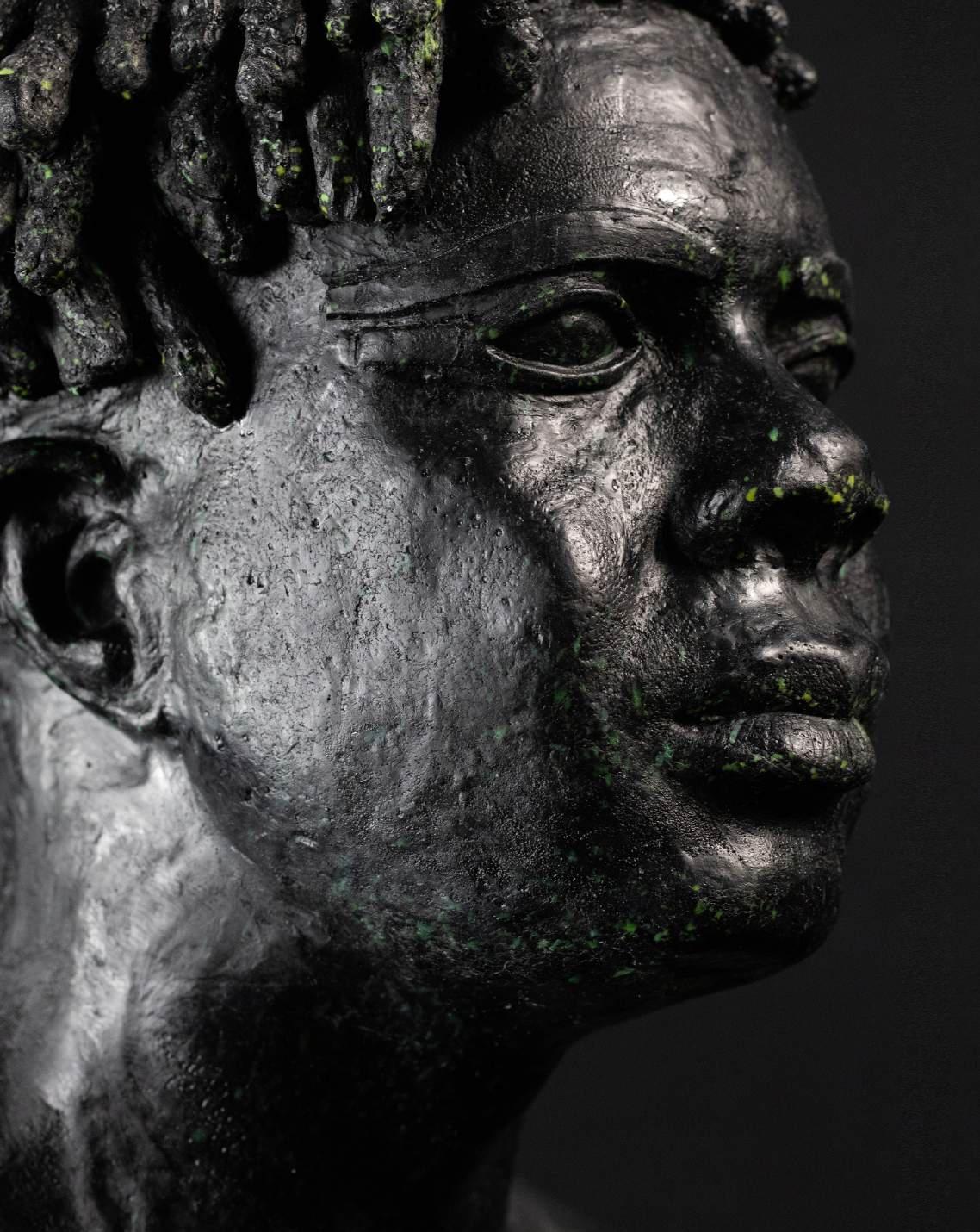
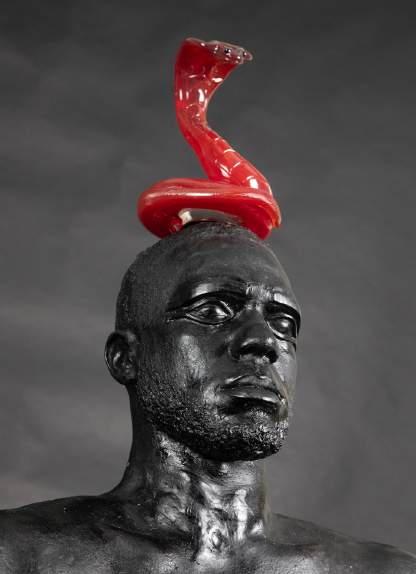
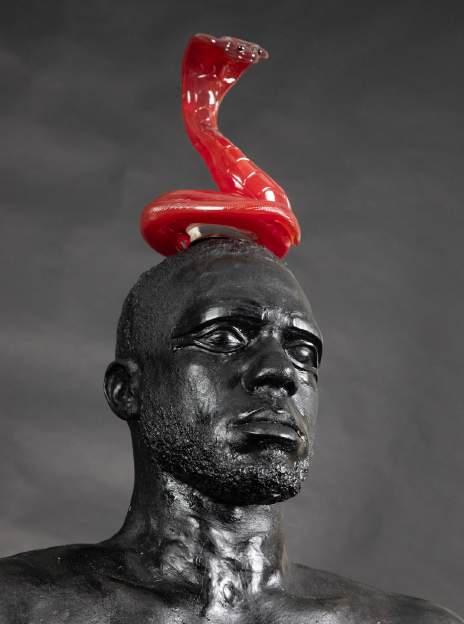
Apuat is part of “Myth-Science of the Gatekeepers,” a collection of life-size glass busts of Black queer Kemetic (ancient Egyptian) deities that premiered at the Pittsburgh Glass Center last year. The art pieces were produced by the Rainbow Serpent arts collective, a nonprofit organization committed to advancing Black LGBTQ culture through African cosmologies, multimedia art and other avenues.
THE MYTHIC SPIRIT IN ART
MARQUES REDD AND MIKAEL OWUNNA’S SHARED INTEREST IN AFRICAN COSMOLOGIES TOOK THEM ON A PATH OF ARTISTIC EXPRESSION THAT HAS LED TO THE CREATION OF A MULTI-FACETED BODY OF WORK THAT IS RECEIVING RECOGNITION ACROSS THE COUNTRY AND GLOBE. BY ELWIN GREEN
Joshua Franzos
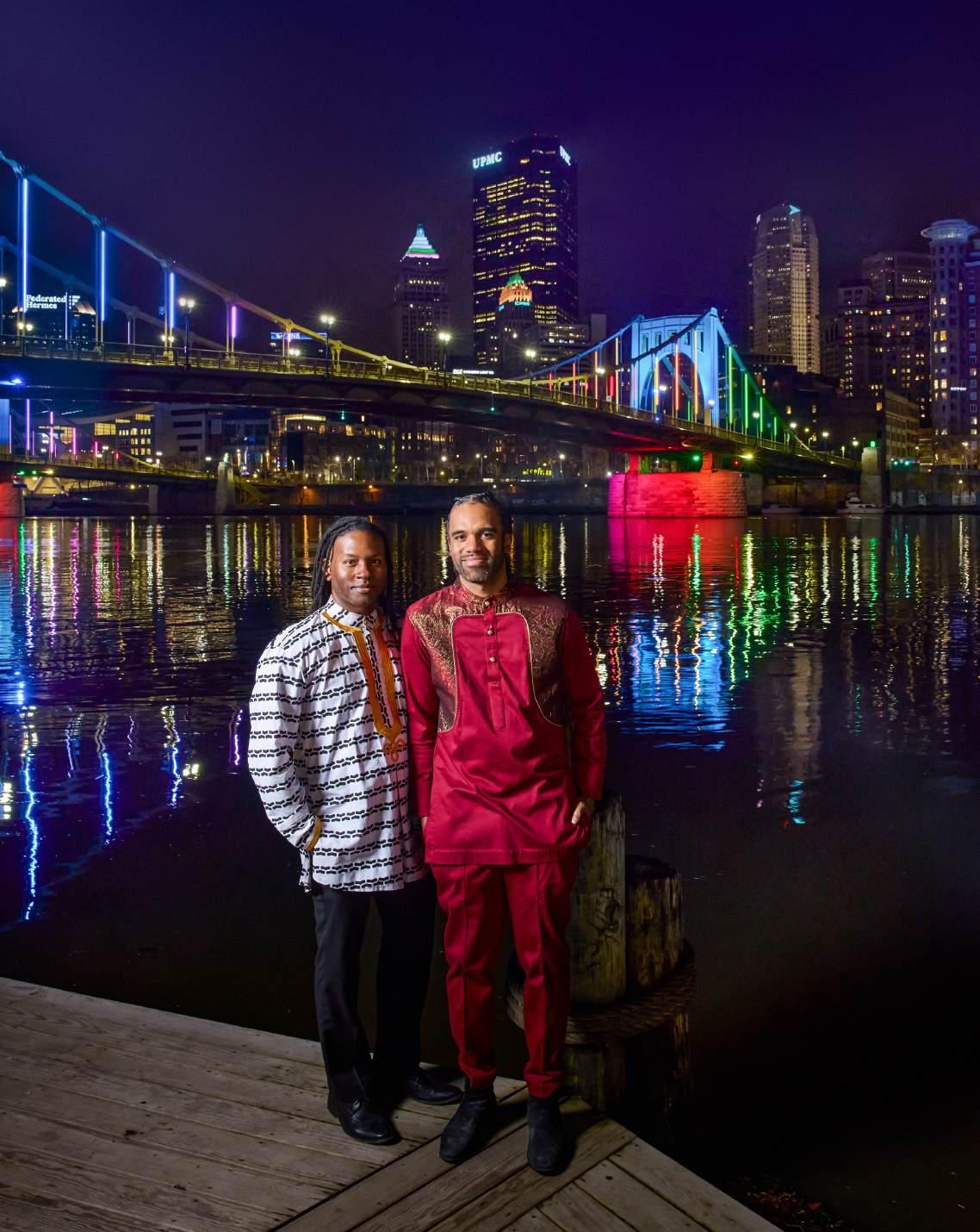
Marques Redd, left, and Mikael Owunna, founders of the Rainbow Serpent arts collective, stand in front of the group’s public art project, “The Three Sisters.”
The architectural light show illuminates the three bridges that span the Allegheny River from Downtown Pittsburgh to the city’s North Shore: the Roberto Clemente Bridge, the Andy Warhol Bridge and the Rachel Carson Bridge.
PERHAPS YOU’VE HAD IT HAPPEN: YOU MEET SOMEONE, BEGIN TALKING, THEN DISCOVER THAT YOU SHARE AN INTEREST —A PASSIONATE INTEREST — IN SOME TOPIC THAT MOST PEOPLE DON’T HAVE A PASSIONATE INTEREST IN. AND SUDDENLY, YOU KNOW THAT YOU HAVE A NEW FRIEND AND THAT YOU MAY WIND UP DOING INTERESTING THINGS TOGETHER.
For Marques Redd and Mikael Owunna, that topic, that shared passionate interest, was African cosmologies. Their first conversation led to forming a book club, then the book club transformed itself into an arts collective. Now the Rainbow Serpent arts collective, which has received support from The Heinz Endowments, has produced a body of work that, among other things, articulates what they call “the first Black queer spiritual system.” Centered on a sculpture exhibit, that body of work has grown to international scope in a single year and is still growing.
All resulting from one conversation.
COMMON PASSION
The two men had come from widely different backgrounds when they met in the spring of 2020. Redd, now 41, grew up in Macon, Georgia. As a child, he was surrounded by African art because his parents operated a gallery dedicated to it, the Miracles Fine Art gallery.
“We had a variety of pieces in our home, in the gallery, from West African masks to fertility statues, South African Nguni shields, works on papyrus,” he said. “And so, seeing those works, I had my imagination sparked with an interest in trying to understand the variety of cultures that they came from, the mythic stories that they encoded, trying to understand how they were used in their specific context.”
In college, Redd majored in African and Afro-American Studies at Harvard before earning a doctorate in English
Literature at University of California, Berkeley. He then made his career as an academic, moving from teaching to administration during stints at Marquette University, Texas State University, the University of Notre Dame and the University of California, Berkeley.
Along the way, he engaged in deep study of ancient Egyptian deities and mythic systems, along with Yoruba culture that had a specific focus.
“I had always been interested in understanding the queerness of some of these ancient Egyptian figures,” he said, such as Hapi, the deity of fertility, who appears as an old man with the extended belly and pendulous breasts of a pregnant woman.
Then Redd moved to Pittsburgh in January 2020 to take a position as senior director of graduate advising at the University of Pittsburgh.
Owunna, 34, grew up in Pittsburgh as the son of Nigerian immigrants and had done a documentary photography series, “Limitless Africans,” in which he photographed 50 LGBTQ African immigrants in 10 countries across North America, Europe and the Caribbean.
Growing up queer, he had been led to believe that being LGBTQ was “un-African,” so he began researching the cultures of Africa.
“I found a rich panoply of identities … that were grounded in African cosmologies and spirituality,” he said. “Within many of these African systems, the primordial Creator God was seen as this primordial Black androgyne that creates the entire universe.”
“Obi
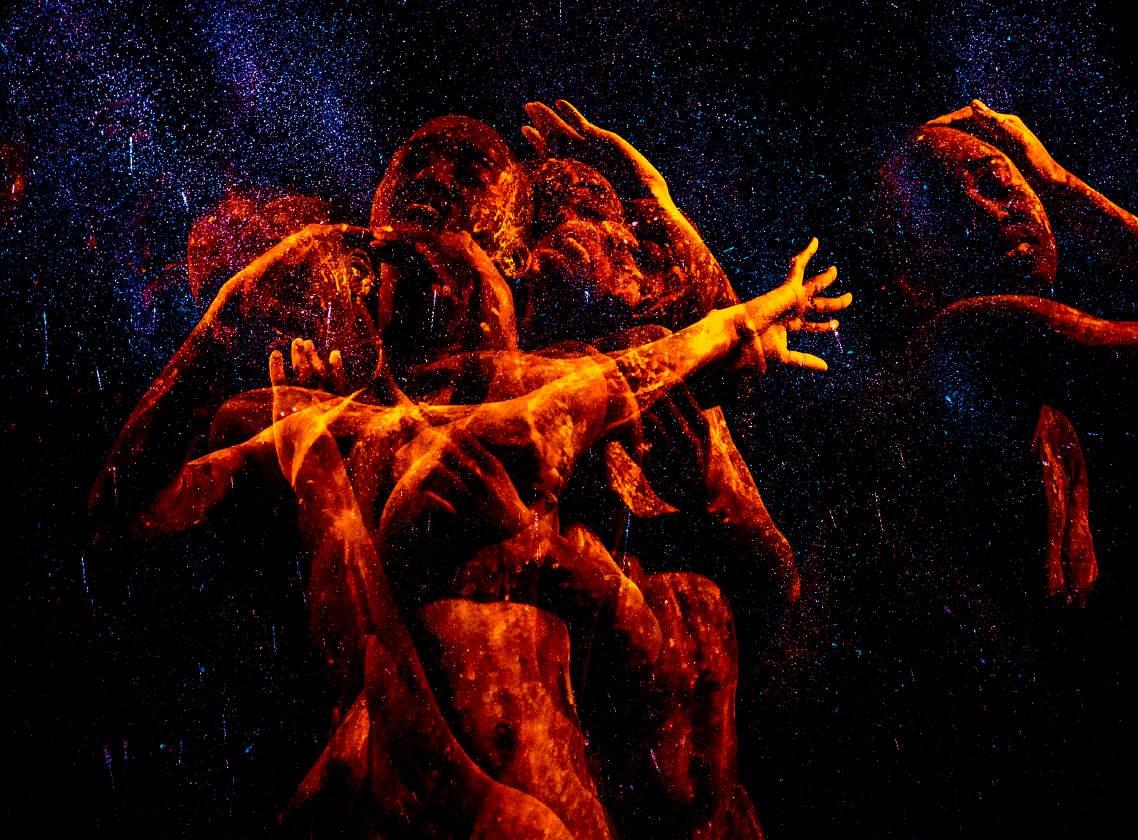
Mbu (The Primordial House): An Igbo Creation Myth” is a 30-minute experimental dance film produced by Marques Redd, Mikael Owunna and their collaborators before the Rainbow Serpent collective was formalized. The project is an enactment of the Igbo-Nigerian creation myth in which the dancers are illuminated with fluorescent paint and ultraviolet light.
Marques Redd & Mikael Owunna
From the writings in spirituality of Malidoma Patrice Somé of Burkina Faso, Owunna learned that “people we would now identify as being LGBTQ were actually seen as having a special vibratory connection to the Creator, because being LGBTQ was not a sexual or gender identity, it was about being able to vibrate both masculine and feminine energies.”
When he and Redd met in Pittsburgh for coffee at the recommendation of a mutual friend in February 2020, cognitive sparks flew not only because both were passionately interested in African cosmologies, but because the research they had done was complementary. While Redd had focused on Egyptian and Yoruba culture, Owunna had done a deep dive into Nigeria’s Igbo cosmological tradition.
“And also, very quickly, in the conversations that we had at the beginning, Malidoma Somé emerged as a common point of interest as well, particularly with his exploration and explication of the sacred role of LGBTQ people within traditional African spiritual systems,” Owunna said. “So, it was very clear that there were a lot of mutual research interests, and those then led to shared artistic passions, also around the rich potential of African cosmologies, particularly for Black LGBTQ people.”
“From that conversation, we decided that we would start a book club,” Redd said. “And so, we started a book club during the pandemic for Black LGBTQ people who are interested in learning about, reading about, African cosmologies and thinking about how these traditions could provide resources for our community. And the collective really started to grow from there.”
VISION EXPANSION
The first shift was from reading and discussion to filmmaking.
“In one of the texts we were reading, we came across this narrative of these androgynous deities who created the world through dance. And we said to ourselves, ‘Oh, this would be great to see as a film.’ And that launched us into an entirely new trajectory.”
As it happened, the pandemic shutdown of the Pittsburgh Ballet Theatre meant that a pair of dancers in the group, Corey Bourbonniere and Victoria Watford, were available.
“We had this narrative, and we had dancers. We had time. It seemed like a logical next step to make this project,” Redd said.
So, they made the project: “Obi Mbu (The Primordial House)”, a 30-minute retelling of the creation myth. They produced it with funding from Advancing Black Arts in Pittsburgh, a collaboration of The Pittsburgh Foundation and The Heinz Endowments (now the program is solely managed by The Pittsburgh Foundation with funding support from The Heinz Endowments).
The film premiered at the CLAMP, an art gallery in New York, in September 2021. By the end of the year, it had been screened at the Esalen Institute in Big Sur, California, the Iris Project Gallery in Los Angeles, and the Contemporary Art Museum in Raleigh, N.C.
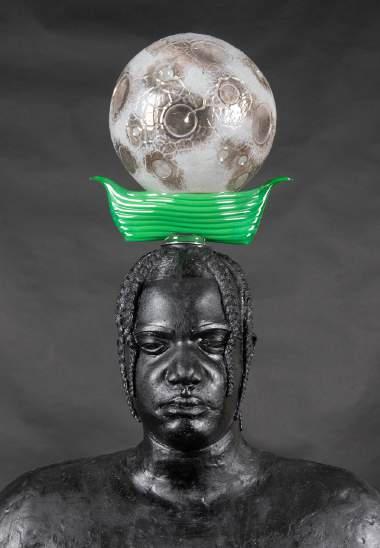
The Rainbow Serpent collective’s “Myth-Science of the Gatekeepers” collection, right, premiered at the Pittsburgh Glass Center last year. The 16 life-size glass busts of Black queer Kemetic (ancient Egyptian) deities— from left to right, “Sobek,” “Khonsu,” “Ptah,” and “Uatcha”—offer a modern take on Kemetic granodiorite statues. The sculptures were made through a wax casting process, and the headpieces were fabricated with glass blowing and hot sculpting techniques.
THE
CONCEPT BEGAN TO FORM WHEN, OF “OBI MBU,” OWUNNA AND REDD CENTER ABOUT BECOMING ARTISTS
Since then, it has received nearly two dozen screenings in venues as scattered as the Chautauqua Institution in Chautauqua, New York, and the Fotografiska Stockholm, a museum in Stockholm, Sweden, and is continuing to tour.
Among other things, it led to a commission from the Pittsburgh Symphony Orchestra and the Pittsburgh Downtown Partnership to produce a giant vinyl billboard to hang on the side of Heinz Hall, the symphony’s home venue, that faces 7th Avenue. Titled “Playing the Cosmic Strings,” the piece was installed in October 2021 and will remain in place for five years. It illustrates the West African Igbo creation myth in which the universe emerges from a primordial androgynous Blackness that evolves into a web of infinite string patterns, the vibrations of which not only produce music, but energize the physical structure of all things. Redd is featured in the mural’s image.
The members of the collective were still reading together, but they had become much more than a book club. After “Cosmic Strings,” Owunna and Redd formalized the group as Rainbow Serpent, a 501(c)(3) nonprofit arts organization. Now the group has some 40 “imagineers” across the U.S. and in Brazil, Nigeria, Romania and England.
Marques
Redd & Mikael
Owunna
AS THEY WERE WRAPPING UP THE FILMING BEGAN CONVERSATIONS WITH THE PITTSBURGH GLASS IN RESIDENCE THERE.
“Opening the Mouth” was a live performance that also premiered at the Pittsburgh Glass Center last year during the opening reception for “Myth-Science of the Gatekeepers.” Dancer Ursula Payne portrayed a blend of the Het-Heru, Kemetic goddess of art and the imagination, and Comfort, a woman enslaved by James O’Hara, the founder of Pittsburgh’s glass industry in 1795. The performance was inspired by the Kemetic opening the mouth ceremony, which was traditionally conducted to breathe life into the deceased, statues and temples.
The range of Rainbow Serpent collective’s modes of artistic expression include the “Anatomy of the Human” photography project, above, which explores representations of four spiritual elements of the human soul according to West African Igbo spiritual science; “The Three Sisters” light show on the Rachel Carson, Andy Warhol, and Roberto Clemente bridges, known as the Sister Bridges, in Downtown Pittsburgh; and the “4 Queer African Women in the Snow,” which is part of Mikael Owunna’s “Limitless Africans” documentary photography series. The latter focuses on the lives and experiences of 50 LGBTQ African immigrants, refugees, and asylum seekers in North America, Europe and the Caribbean and is currently part of the “Love Languages” exhibition at the Museum of Fine Arts Houston that looks at how creating art is a form of love language and includes expressions of intimacy beyond romantic love.
Mikael
Owunna Joshua Franzos
WHAT I SEE IN THE ONGOING RESULTS (WITH RAINBOW SERPENT) IS NOT JUST BRINGING A GLOBAL PERSPECTIVE TO THE LOCAL ARTS COMMUNITY BUT ALSO EXPANDING THE LOCAL COMMUNITY INTO THE WORLD …
The name “Rainbow Serpent” has multilayered meaning: a homage to rainbow serpent creator deities throughout the African diaspora; an evocation of the rainbow as a symbol of the diversity of life; a nod to LGBTQ symbolism; and a reference to the individually colored chakras, or energy systems, that some believe run through the body.
As Rainbow Serpent, they then launched upon their largest project to date, one conceived and executed with the intent of having global impact for years and years to come.
DEITY AND IDENTITY REFLECTIONS
The work is called “Myth-Science of the Gatekeepers,” and can be described most simply as a set of 16 life-size glass busts of Black queer Kemetic deities.
“Myth-science” refers to the African concept of all knowledge being an undifferentiated whole, and “gatekeepers” refers to the deities who act as repositories of wisdom regarding different areas of life such as Maahus, who represents both the character of the warrior and the immune system, which defends one’s physical body; Miau, who represents Black queer sexuality and the mathematics that underlie cosmic order; or Geb, who represents the Earth itself and its ecological systems.
The concept began to form when, as they were wrapping up the filming of “Obi Mbu,” Owunna and Redd began conversations with the Pittsburgh Glass Center about becoming artists in residence there. The conversations led to a joint application for a $35,000 grant from the Endowments, which they secured in 2021.
“I think I knew pretty immediately that I wanted to use that opportunity to, number one, experiment with a new form, with a new medium,” Redd said. “But also, to try to see if we could make this medium of glass responsive to capturing these figures [of African deities], serving as an embodiment for them.
“The project came together rather quickly because it was the outcome of two decades of research that had preceded the opportunity. And working with Mikael, I think we were pretty much on the same page, pretty early, as we were experimenting and trying to think about what direction we wanted to go in … that this would be such a great venue to reintroduce these figures to contemporary audiences.”
“Myth-Science” was a collective effort from the beginning, based on what Redd calls Rainbow Serpent’s “collective ethos.”
One reflection of that ethos was that all of the models for the sculptures were either members of Rainbow Serpent or members of their board of directors. Another was that members not directly involved in making the sculptures were invited to do their own art related to the “Myth-Science” theme.
Consequently, when the installation opened at the Glass Center in May 2024, Dante Micheaux, a London-based member, read three poems from a book of poems about the gatekeepers that he is writing. Some local members presented “Opening
Mac Howison senior program officer, Arts & Culture, The Heinz Endowments
Mikael Owunna
the Mouth,” a site-specific performance honoring the deities with dance. During the event reception, a virtual reality film, “Blackstar Sanctuary,” leading viewers through a temple space housing the deities, was projected onto the walls of the gallery.
Similarly, the creation and distribution of “Myth-Science”–related works has continued since the exhibition ended in July 2024. Visual artist Granville Carroll of Phoenix, Arizona, is assembling a set of digital “Myth-Science” collages. Pittsburgh visual artist Devan Shimoyama has begun a series of paintings. “Blackstar Sanctuary” is on tour in Brazil and Switzerland, and a headset version of it is touring on its own.
But the impact goes even beyond the creation of individual works because “Myth-Science of the Gatekeepers” anchors a larger effort namely, to create “the world’s first Black queer spiritual system.”
The hope is that this system will provide a way for Black queer people to “celebrate their identities, interpret their dreams, understand their lives, and provide a pathway for healing,” Redd said.
But even for folk who are neither Black nor queer, “we encourage any level of engagement, from an occasional attendance at a performance or an event to full-on ritual engagement and ritual practice,” he said.
One example of the latter might be participating in something like the African Wellness Conference that they organized last year, which included meditation sessions and guided visualizations with some of the deity figures.
NEXT STAGES
The closing of the “Myth-Science” exhibit did not mean a slowing down for the collective. Members were quickly on to preparing their next public art project, “The Three Sisters,” a light show on the three bridges that span the Allegheny River from Downtown Pittsburgh to the city’s North Shore: the Roberto Clemente Bridge, the Andy Warhol Bridge and the Rachel Carson Bridge.
For this work, they blended Pittsburgh history with African cosmology by referencing the Yoruba religion’s “Three Sisters,” the goddesses Oshunn (associated with rivers), Yemaya (associated with the moon and considered the mother of all Yoruba deities), and Oya (associated with wind). For good measure, they incorporated the Native American tradition that honors the three sister crops of squash, maize and beans.
Rainbow Serpent members worked all of this into a 15-minute light show with 600,000 LEDs on the three bridges that was viewed by 2 million people during the 2024 year-end holiday season. Some enjoyed it so much that they launched the social media campaign #keepthelights, which was unsuccessful to the disappointment of many.
The collective’s work also is part of the exhibition “Unbound: Art, Blackness & the Universe” at the Museum of the African Diaspora in San Francisco, and Redd and Owunna will take the TED Talk stage in Tallinn, Estonia, in November.
The rapid growth and ascension of Rainbow Serpent into an international collective of artists producing a coherent universe of work aligns with the Endowments’ Arts & Culture Program’s focus on “assuring individual artists [that they] can build careers and lives in the greater Pittsburgh region,” said Senior Program Officer Mac Howison.
WE ENCOURAGE ANY LEVEL OF ENGAGEMENT, FROM AN OCCASIONAL ATTENDANCE AT A PERFORMANCE OR AN EVENT TO FULL-ON RITUAL ENGAGEMENT AND RITUAL PRACTICE.”
The Endowments was already supporting Owunna before the formation of Rainbow Serpent, beginning in 2019 with a grant to support the publication of “Limitless Africans,” in which he “brings a unique view of identity and a relationship to his work that has connections to global identity,” Howison said.
“What I see in the ongoing results [with Rainbow Serpent] is not just bringing a global perspective to the local arts community but also expanding the local community into the world, giving local artists global exposure.”
The Pittsburgh Glass Center residency that led to the production of “Myth-Science” was an especially satisfying project for the Endowments to support, Howison said, because it resulted from two grantees Rainbow Serpent and The Pittsburgh Glass Center coming together to share resources and to produce something that neither could have done alone and from which both could benefit.
“The artists and the organization made that connection,” he said, “and therefore it became a more compelling grant to support.” h
The members of Rainbow Serpent aren’t the only Pittsburgh-based queer artists of color stepping into a national spotlight these days.
Adil Mansoor, of Bloomfield, spent an entire month this spring, from March 13 to April 14, co-directing and starring in an offBroadway production of his solo play, “Amm(i)gone.” The title is a play on “ammi,” which means “mother” in Urdu, Mansoor’s native Pakistani language, and “Antigone,” the tragedy by Sophocles.
IN THE SPOTLIGHT
In “Antigone,” the protagonist, after the death of her father, King Oedipus, goes against the wishes of her newly crowned uncle by burying her brother and is sentenced to death. In “Amm(i)gone,” Mansoor uses personal storytelling to speak about the process of working with his mother, a Quranic scholar, to translate “Antigone” into Urdu.
“I tell you about my family. I tell you about Antigone,” he said. “And I weave it all together to create a work about translation, the afterlife, and loving your family so hard it could break you.”
The “could break you” part arises from the facts that Mansoor is, in his words, “Googleably gay,” and that his mother, who indeed learned that he was gay by Googling him, is highly religious.
Translating “Antigone” and working on “Amm(i)gone” (subtitled “an apology to and from a mother”) “has given us the ability to talk about really hard things,” Mansoor explained. “Technically, we’re talking about Ismene and Antigone and Creon … but we’re unpacking our own lives.”
Commissioned by the Kelly Strayhorn Theater, “Amm(i)gone” was first performed there in April 2022, and its first out-of-town performance was at The Theater Offensive in Boston two months later. In 2024, it traveled to The Woolly Mammoth Theatre Company in Washington, D.C., in April and May, and to the Long Wharf Theatre in New Haven, Connecticut, in May and June.
For this year’s spring run, the Kelly Strayhorn coproduced with the performance venue, The Flea Theater, in New York’s Tribeca neighborhood; The Play Company, also in New York; and Woolly Mammoth.
Raised in Chicago, Mansoor came to Pittsburgh in 2010. In 2012, he co-founded Hatch Arts Collective, which describes itself as a “performing arts incubator centering queer and BIPOC artists, stories, and communities.” He was selected last year as the Emerging Artist honoree of Carol R. Brown Awards, co-sponsored by The Heinz Endowments and The Pittsburgh Foundation to recognize artistic achievement and to provide career advancement opportunities, which include an unrestricted $50,000 prize. This year, he joined the Pittsburgh Public Theater as resident director for the 2025-26 season.
For Mansoor, the net result of national exposure is that … he gets to stay in Pittsburgh.
“I want to make work about queerness and brownness and Islamness,” he said. Without the support of the Kelly Strayhorn, the Endowments, and others in going national, “the easiest way for me to make my work would be to move to a bigger city.”
And he believes that’s true for Pittsburgh’s marginalized artists overall, who are “hungry for a community” beyond what they experience here.
“If Pittsburgh can make that happen for us [by national exposure], that’s big,” he said. “And we stay, and we keep making the city better and better and better.” h
ARTISTIC INTERSECTIONS CONFERENCE
Heinz Endowments Arts & Culture Managing Director
Jasmin DeForrest was among the speakers at the 2025 annual Association of Arts Administration Educators Conference, which was hosted by Carnegie Mellon University in May. The theme of the three-day event was “Confluence of Cultures” in recognition of the three rivers that define Pittsburgh’s landscape — the Allegheny, Monongahela and Ohio — and the intersections within the region of different cultures, artistic expressions and community emphases such as health and innovation. The subthemes explored during the conference were culture of belonging, culture of health and well-being, culture of innovation, and culture of the environment. DeForrest focused her remarks on the Endowments’ history of investing in the arts and in organizations and programs representing the subthemes of the gathering.
DOCUMENTING REGIONAL REBIRTH
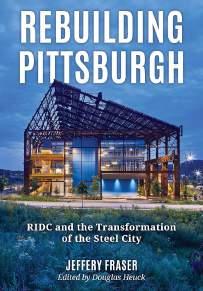
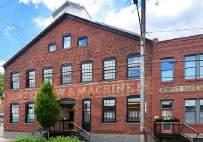
The Regional Industrial Development Corporation (RIDC) of Southwestern Pennsylvania commemorated its 70th anniversary with the release of the book “Rebuilding Pittsburgh: RIDC and the Transformation of the Steel City,” which chronicles the evolution of the Pittsburgh region’s economy over the past seven decades and the important role the nonprofit organization has played in helping to revitalize southwestern Pennsylvania after the collapse of the steel industry. RIDC has been a strategic partner with the Endowments and other foundations on projects such as the development of Hazelwood Green, a former steel mill site on 178 acres of Pittsburgh’s Hazelwood neighborhood along the Mon River, which is featured in the book and on its cover. Its ongoing transition includes the establishment of commercial, light industrial and residential real estate and the creation of different natural and recreational spaces. The book’s author, Jeffery Fraser, is a well-regarded journalist and a frequent writer for h magazine.
SHOWING WHAT “AUGUST TAUGHT US”
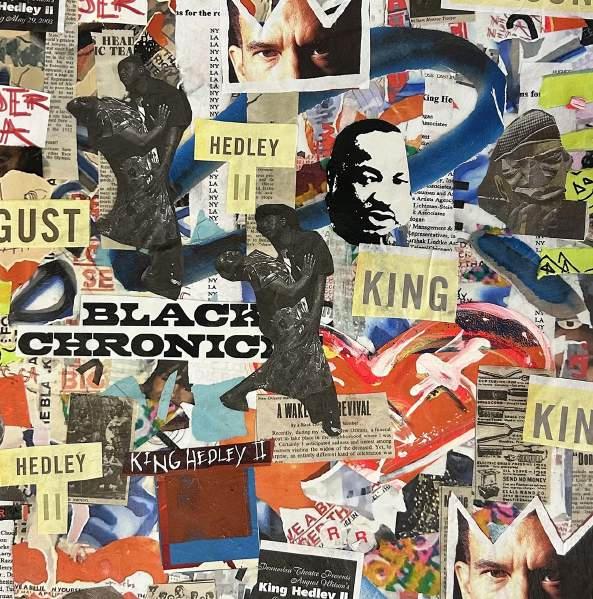
Art interpreted art in “August Taught Us …,” a multimedia exhibit presented this past spring at the August Wilson African American Cultural Center in Downtown Pittsburgh. The artwork was created by DS Kinsel, co-founder of the creative hub BOOM Concepts who served for a couple of years as the August Wilson Archive Community Artist-Scholar, part of an award program sponsored by the University of Pittsburgh’s Hillman Library. As an award recipient, Kinsel explored the August Wilson Archive at the library and was responsible for developing an artistic/creative work in response to it.
In “August Wilson Taught Us …,” Kinsel merged personal archival materials with rare documents, photographs and production materials from the archive, and created paintings and collages that offered an abstract reflection of the late playwright’s life and legacy, including the “American Century Cycle,” 10 plays highlighting Black resilience, creativity and genius in each decade of the 20th century. Both BOOM Concepts and the University of Pittsburgh have received support from The Heinz Endowments.
Courtesy of The August Wilson African American Cultural Center
UPGRADING DOWNTOWN
A major Downtown Pittsburgh facelift is underway with the construction of a new arts destination site and upgrades to two popular visitor locations. All three projects are also part of a $600 million, 10-year revitalization plan for Downtown announced by Pennsylvania Gov. Josh Shapiro last fall.
Scheduled to be completed early next year, Arts Landing will be a public green space on four acres owned by the Pittsburgh Cultural Trust at Eighth Street and Fort Duquesne Boulevard, overlooking the Allegheny River. The site will feature a great lawn, a band shell, public art, playgrounds, pickleball courts, flex recreation space and native plantings, including about 100 new trees.
ART INSTITUTIONS’ EXPANSION
The Heinz Endowments is supporting two arts nonprofits as they expand their physical footprint in Pittsburgh. The Endowments has awarded $1 million to the Children’s Museum to support the design and renovation of the Annex, an exhibit production and programming facility on Pittsburgh’s North Side near the museum’s main campus. The Annex will include exhibition building workshops, offices, tech rooms and studios. Similarly Contemporary Craft has received $700,000 from the Endowments to help support new programming in a building it purchased earlier this year across from its main facility in the city’s Lawrenceville neighborhood. The new activities will include a blacksmithing studio, professional artist symposia and expanded young adult skills development.
Riverlife, a nonprofit dedicated to improving and enhancing the region’s riverfronts, is coordinating the rehabilitation of the upper promenade of Allegheny Riverfront Park between Sixth and Ninth streets, and the work is being done in collaboration with the City of Pittsburgh and the Pittsburgh Cultural Trust. The pedestrian park had deteriorated significantly over the years due to weather conditions and wear and tear. Improvements will include replacing the original pavers with thicker, more durable bluestone; adding more seating; and removing London plane trees and planting others including redbuds. Both projects along the Allegheny River have received funding from The Heinz Endowments and are expected to be completed before the NFL Draft comes to Pittsburgh in April 2026. Another project a few blocks away, closer to the heart of Downtown, and also with a pre-NFL Draft deadline is the renovation of Market Square, which is being managed by Pittsburgh Downtown Partnership, a nonprofit community development organization. The effort will include replacing cobblestone walking areas with smooth pavers; eliminating all parking around the perimeter; limiting vehicular traffic; and constructing a pergola-like, semi-circular pavilion with a glass roof in shades of blue and green.
ACADEMIC TOP 20
Forbes Magazine has placed the University of Pittsburgh and Carnegie Mellon University on a list of 20 “New Ivies,” a designation to indicate that the magazine considers them among the finest schools of higher education in the country. The selection represents the second year that Forbes has identified what the magazine describes as “10 outstanding public universities and 10 top private schools that are attracting the best and the brightest, and graduating students that are outpacing most Ivy Leaguers in the eyes of employers.” The other colleges joining Pitt and Carnegie Mellon, two longstanding Heinz Endowments grantee partners, are the public universities Virginia, North Carolina at Chapel Hill, William & Mary, Michigan, Illinois Urbana-Champaign, Texas at Austin, Purdue, the Georgia Institute of Technology and the United States Military Academy, and the private institutions Emory, Georgetown, Johns Hopkins, Northwestern, Rice, Tufts, Notre Dame, Vanderbilt and Washington University.
WE CAN BE — A WINNER
The Heinz Endowments’ “We Can Be” podcast won the Pittsburgh Black Media Federation’s Robert L. Vann Award for excellence in audio journalism in the health/medicine/ science category for the episode
“Narrowing the maternal and infant health gap with health equity expert Dr. Margaret LarkinsPettigrew.” Winners of the 36th Robert L. Vann Media Awards were announced June 4 at the organization’s “Night of Excellence” dinner, held at the August Wilson African American Cultural Center in Downtown Pittsburgh. Named after the publisher and editor of the original Pittsburgh Courier, Vann awards recognize journalism excellence in coverage of African American and African diaspora communities, individuals and issues.
STAFF RECOGNITION AND ADDITIONS
Heinz Endowments senior adviser and former Sustainability vice president Andrew McElwaine was honored by Stop the Violence Pittsburgh at its seventh annual Black Tie Honors Gala for his many years of support to the Pittsburgh community and Stop the Violence activities, including its Juneteenth celebrations. In 2013, STVP was established in response to violent incidents in Allegheny County to serve as a community network partner supporting nonprofits and other organizations that offer healthy and nurturing experiences to children, youth and young adults.
The Endowments also recently welcomed five new staff members. Diana Avart is the benefits, compensation and human resources associate. Juliet AmeduNwagwe is the grants and program administrator. Sara Masciola serves as a program coordinator for the foundation’s workforce and veterans strategies. Matthew Sarchet is the Endowments’ accountant, and Talia Stol is the foundation’s Learning & Evaluation officer. More about the personnel additions can be found on the Endowments’ staff webpage, https://www.heinz.org/about-us/ board-and-staff
Howard Heinz Endowment
Vira I. Heinz Endowment 625 Liberty Avenue 30th Floor Pittsburgh, PA 15222-3115