The Index
The student voice... since 1888
Ευταξια Σωζειν Δοκει
February 2018
Volume LXXX, No. 5
Haverford, Pennsylvania
www.havindex.com
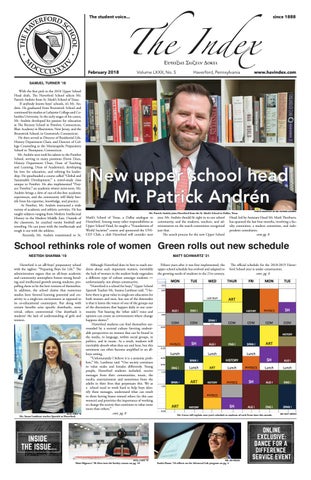
SAMUEL TURNER ’18 With the first pick in the 2018 Upper School Head draft, The Haverford School selects Mr. Patrick Andrén from St. Mark’s School of Texas. If anybody knows boys’ schools, it’s Mr. Andrén. He graduated from Brunswick School and continued his studies at Lafayette College and Columbia University. In the early stages of his career, Mr. Andrén developed his passion for education at The Rectory School in Pomfret, Connecticut, Blair Academy in Blairstown, New Jersey, and the Brunswick School, in Greenwich, Connecticut. He then served as Director of Residential Life, History Department Chair, and Director of College Counseling at the Marianapolis Preparatory School in Thompson, Connecticut. Mr. Andrén next took his talents to the Pomfret School, serving in many positions (Form Dean, History Department Chair, Dean of Teaching and Learning, Dean of Academics), developing his love for education, and refining his leadership. He spearheaded a course called “Global and Sustainable Development,” a travel-study class unique to Pomfret. He also implemented “Project: Pomfret,” an academic winter mini-term. Mr. Andrén brings a slew of out-of-the-box academic experiences, and the community will likely benefit from his expertise, knowledge, and practice. At Pomfret, Mr. Andrén instructed a wide variety of academic and athletic activities. He has taught subjects ranging from Modern Intellectual History to the Modern Middle East. Outside of the classroom, he coached varsity football and wrestling. He can joust with the intellectuals and tough it out with the athletes. Recently, Mr. Andrén transitioned to St.
Mr. Patrick Andrén joins Haverford from the St. Mark’s School in Dallas, Texas.
Mark’s School of Texas, a Dallas analogue to Haverford. Among many other responsibilities as Upper School Head, he taught a “Foundations of World Societies” course and sponsored the UNICEF Club, a club Haverford will consider next
year. Mr. Andrén should fit right in to our school community, and the students, teachers, and administrators on the search committees recognized just that. The search process for the new Upper School
PHOTO COURTESY OF MR. PATRICK ANDRÉN
Head, led by Assistant Head Mr. Mark Thorburn, has spanned the last four months, involving a faculty committee, a student committee, and independent consultants. cont pg. 8
School rethinks role of women Green rolls out new schedule NEETISH SHARMA ’19
MATT SCHWARTZ ’21
Haverford is an alll-boys’ preparatory school with the tagline: “Preparing Boys for Life.” The administration argues that an all-boys academic and community atmosphere fosters strong bonding and intellectual growth among students, propelling them to be the best versions of themselves. In addition, the school claims that numerous studies have favored learning potential and creativity in a single-sex environment as opposed to its co-educational counterpart. But along with certain benefits arise specific drawbacks, some trivial, others controversial. One drawback is students’ the lack of understanding of girls and women.
INTEL CHEN ’19
Ms. Susan Lambour teaches Spanish at Haverford.
Although Haverford does its best to teach students about such important matters, inevitably the lack of women in the student body engenders a different type of culture amongst students — unfortunately, not always constructive. “Haverford is a school for boys,” Upper School Spanish Teacher Ms. Susana Lambour said. “I believe there is great value in single-sex education for both women and men, but one of the downsides is that it leaves the voices of one of the groups out of the discussions that happen daily in our community. Not hearing the ‘other side’s’ voice and opinion can create an environment where change happens slower.” Haverford students can find themselves surrounded by a societal culture favoring undesirable perspectives on women that can be found in the media, in language, within social groups, in politics, and in music. As a result, students will inevitably absorb what they see and hear, but this sentiment can often become amplified in an allboys setting. “Unfortunately I believe it is a systemic problem,” Ms. Lambour said. “Our society continues to value males and females differently. Young people, Haverford students included, receive messages from their communities, music, the media, entertainment and sometimes from the adults in their lives that perpetuate this. We as a school need to work hard to help boys identify these messages, understand what can result in them having biases toward others (in this case women) and prioritize the importance of working to change the society that continues to value some more than others.” cont. pg. 8
INTEL CHEN ’19
Matt Mignucci ’20 dives into the hockey season on pg. 10
Fifteen years after it was first implemented, the upper school schedule has evolved and adapted to the growing needs of students in the 21st century.
The official schedule for the 2018-2019 Haverford School year is under construction. cont. pg. 6
Mr. Green will explain next year’s schedule to students of each Form later this month.
MR. JIM ROESE
Eusha Hasan ’18 reflects on the Advanced Lab program on pg. 4
MR. MATT GREEN
Page 2
The Index - Editorial
February 2018
An open letter to Mr. Patrick Andrén Dear Mr. Andrén, Entering a new school is never easy. At one point or another, every student and faculty member at Haverford was once in the same situation that you are in now. As incoming students, we focused on cultivating the friendships that would last a lifetime. We sought the advice of upperclassmen on how to succeed at Haverford, and we sought out mentors within the community. Scrutiny, judgement, and insecurities fell to the side as friendly and familiar faces filled the halls. A community that fosters respect, honesty, and courage supported us, and it will support you too. We hope to offer some guidance as you acclimate
to our school. Passing on the torch from one great leader to the next takes time and requires trust. A wise person once said, as a leader, “You are responsible for the air in the room.” Head of the Upper School extends far beyond your administrative roles. You are now the voice for every student, actor, athlete, and faculty member at Haverford. You are the heart of the community, the embodiment of a Haverford gentleman, and the benevolent enforcer of its values. We strive for many things at Haverford. We strive for excellence, but we can do better. We want strive for inclusion, but we can do better We want strive for morality, but we can do better.
You will come to learn of our “brotherhood,” an omnipresent relationship that represents the unity flowing through Wilson Hall. We embrace this brotherhood, but amidst tensions of race, politics, seniority, and theft, we can do better. Someone once asked us what the difference is between “amazing” and “unbelievable.” At first sight, the differential seems to be semantics, but the two words are not synonyms. As is, Haverford is amazing: a place where remarkable boys become men. But we want you to help us make Haverford unbelievable. An environment of unconditional love, plentiful opportunity, healthy dialogue, and thriving brotherhood. During the selection process, our classmates
and teachers saw you as someone that could bridge these divisions and continue our pursuit of the perfect brotherhood. Community time abolishes our divisions. For thirty minutes a day, we gather as a unified upper school to share, learn, and experience as one. You will become the leader of this time, of us all. You will be responsible for the air in the room. You will quickly realize from walking down the halls that there is no typical Haverford student. Haverford is at its most diverse stage, and that is something to celebrate. We all bring varying talents, backgrounds, and ambitions to the classrooms, fields, and halls. We are all part of a melting pot, and you must be the one to stir it, the one who break down the boundaries that divide us. As you begin your Haverford journey, we will wholeheartedly support you in your endeavors. Right now, you are the “new kid on the block,” and we want that new kid to be treated with respect and heard with open minds. Though Wilson Hall may seem foreign right now, the truth is that we need you. Engage with us at any given opportunity, and we will do the same. Upperclassmen hang in the library and underclassmen around the ping-pong tables in the community room. Go to a Fords basketball game, read The Index and Pegasus, dig around in the Archives, make some obscure quote your own, reflect on the stories of alumni, and talk with as many students and faculty as possible. Let us help you be the man and mentor we need. Sincerely,
2017-18 Editors-in-Chief (L to R): Samuel Turner ’18, P.J. Rodden ’18, Nick Chimicles ’19
INDEX STAFF
The Editors-in-Chief
Letter from Student Body President Robb Soslow Fellow Fords, This weekend I have been made aware of an issue that touches us all. It is subversive, it is decisive, and it is tearing our brotherhood apart. Now is my time, my opportunity, and my duty to bring this conflict to an end. Let’s talk about noodle bowl.
It is subversive, it is decisive, and it is tearing our brotherhood apart. Now is my time, my opportunity, and my duty to bring this conflict to an end.
This thing is disgusting. Irredeemably so. The worst part isn’t the smell, nor the offensively long line it gathers, nor the mess it makes for the kids that aren’t skipping lunch duty. It’s the noise of a noodle bowl lunch. It’s slurping. It’s grotesque. It’s impolite. Young men, young Haverford men of class and refinement are raising their heads looking like Cthulu or some other Lovecraftian horror of the deep. When I see one of my classmates with long hair eat noodle bowl it’s like watching a cheap CGI revision of Davy Jones from Dead Man’s Chest. I get it. It tastes good. But at what price? At what cost? Look deep within yourself. Is it really worth it? Student Body President Robb Soslow addresses the deeper meaning behind noodle bowls.
INTEL CHEN ’19
The Index’s 2017-2018 Staff
P.J. Rodden ’18, Samuel Turner ’18, Nick Chimicles ’19, Editors-in-Chief Neetish Sharma ’19, News Editor Eusha Hasan ’18, Features Editor Toby Ma ’20, Assistant Features Editor Will Henderson ’18, Opinions Editor John Comai ’18, Opnions Editor Grant Sterman ’18, Politics Editor Robert Esgro ’19, Assistant Politics Editor
Nick Chimicles ’19, Head Web Editor Lleyton Winslow ’20, Head Web Editor Noah Rubien ’20, Web Editor Aditya Sardesai ’20, Web Editor Will Merhige ’18, Social Media Editor
Bobby Stratts ’18, Staff Photographer
Ms. Alicia Evans, Faculty Advisor Mr. Thomas Stambaugh, Faculty Advisor
All opinions and viewpoints expressed herein do not necessarily reflect those of The Index or the school. The Index is designed and produced digitally. Photographs may be retouched. Submissions and letters to the editors regarding any and all articles are welcomed at index@haverford.org. The Index, a member of the Columbia Scholastic Press Association, is composed on Mac OS X, using Adobe InDesign CS 2018. Its surveys are conducted via SurveyMonkey and are advertised on Facebook to current Haverford students. Graphic designs are created by Index staff via Canva. Southern Dutchess News prints 200-400 copies of each issue, and its editorial staff distributes them in the Upper School on the day of release. The Index serves the needs of a total school population of 1091 community members, consisting of 975 students and 116 faculty members.
Gaspard Vadot ’18, Arts Editor Vincent Scauzzo ’20, Assistant Arts Editor Matt LaRocca ’18, Sports Editor Nick Pippis ’19, Assistant Sports Editor
The Index is a student-run publication of the Haverford School that does more than bring news: it provides the diverse perspectives of the Haverford student body. It is an outlet for student writers to take stands on issues they deem important. It chronicles the daily struggles and accomplishments of the Haverford community. The Index also provides a forum for discussion of pertinent issues, such as student culture, academic policy, and Haverford’s place in world affairs. The Index presents new ideas and aspires to influence constructive change.
Contact The Index: 450 Lancaster Ave, Haverford, PA 19041 index@haverford.org Twitter: @Haverford_Index http://www.havindex.com/ (610) 642-3020 x. 1222 Volume LXXX, No. 5 - February 2, 2018
Page 3
The Index - Features
Autonomous vehicles take to the streets
February 2018
INTEL CHEN ’19
VINCENT SCAUZZO ’20 Dr. William Ehrhart drives a stick-shift because he thinks, unless you have a manual transmission in your car, you are not really driving. Well, Doc, pretty soon, you are not going to be driving your car at all. We live in a changing world. A time when advancement in technology happens every minute. People used to think that by this point, 2018, people would have flying cars like in Back to the Future. Those days are still quite a ways out, but what is very real and on the roads today is an autonomous car: the self-driving car is here, sort of. People have experimented with the idea of the self-driving car for decades. What does it look like? How does it work? Who is it for? Some people think it looks like a normal car. Some people think it looks like a rolling box with a couch inside. The truth is, it can look like anything. Assuming everyone is driving one, there is no need for
In level one, the car can accelerate and decelerate on its own and stay in its lane, but needs a driver to do everything else. Level two is the addition of steering the car, but a driver is still necessary as a fall back. Level three is when the system starts to take over. The car can perform all tasks in most circumstances, but requires human intervention if absolutely necessary. At level four, the car can do everything in almost all conditions, and the driver does not ever need to interact. Finally, at level five, the human does not need to be in the car at all because it can do everything in all conditions. Tesla is famous nowadays for developing an autonomous driving system called Autopilot, which is found in all of their “Models.” Tesla’s system learns the roads that the car drives on while in autonomous mode, so that the next time the car takes a tricky turn, it knows how much to steer and when to brake.
Cruise only works on highways and has a theoretical top speed of 85 mph. Cadillac -- GM specifically -- says their system is a major step towards full self-driving vehicles in their line-ups. Mercedes-Benz has implemented autonomy into their E Class and S Class sedans. They perform the similar job of the Cadillac on the highways, but can also drive on back roads. However, according to road tests, the system struggles when another car tries to merge. The new S Class uses a neat feature for switching lanes: all the driver has to do is turn on the turn signal for which way he wants to shift, and the car will go there. The most recent addition to the driverless car industry, General Motors’ Chevrolet Bolt, has no steering wheel or pedals, the first of its kind hopefully to be in production soon. The car was revealed at the Detroit Auto Show this year, leaving the auto industry and enthusiasts eagerly anticipating its performance capabilities. The car is not ready for production, but once it is, it will be a major milestone for the auto industry and the world. Uber has been testing its own autonomous program in Pittsburgh, using radar sensors on top of Volvo XC90s and Ford Fusions. Testing has been going on for the past two years or so, but not much progress has been made. The cars work properly, but political and logistical issues keep arising. Google claims that Uber stole some of its Waymo technology to use in their systems, an issue that will take one or two years to resolve.
One day, things will change forever: cars will not have steering wheels or pedals, and later generations will never know what it will be like to “Get behind the wheel.” At the rate technology is advancing, there could be an entirely new form of transportation within fifteen years that makes traveling on interstate highways and backroads obsolete. Autonomous vehicles are gradually saturating the auto market.
safety features because there is no risk of crashing. You could have it look like a 1955 Cadillac or a piece of cheese — it does not matter. The interior could be anything, too. It could be normal car seats, or couches, or a table, or high chairs with a bar, or even beanbags. Fourth Former Obaida Elamin said that if he had an autonomous car, he would want the seats “like [the ones] in a limo.” However, none of this matters if the car cannot drive itself. For many years now, cars have had cruise control. This was the first step to the selfdriving car. Many years later, cars started to use lane-keep assist, a system that uses cameras and sensors that watch the lines on the road and give off a warning beep if one strays out of the lane. A little while later, cars could see the car in front of them and maintain a set distance from it without driver input on the pedals. If the car in front slowed down or sped up, the car behind would do the same. This is called adaptive cruise control. There are also emergency braking systems that can stop the car if it detects a sudden stop from the car ahead. Eventually, these systems combined to allow the vehicle to stay in its lane and keep a safe following distance without any necessary driver input at all. The driver might still have to put his hand on the the steering wheel because the system is not one-hundred percent reliable, but it takes a lot of the effort out of driving on the highway. This is classed as level one in the autonomy levels. There are six levels of autonomous driving. Level zero is no autonomous capabilities: the driver is in full control.
MARCO VERCH VIA WIKIMEDIA
However, it is far from foolproof. This system is about level three or four, depending on the version of Autopilot the car has. Like an operating system on a smartphone, Tesla updates its cars’ systems wirelessly, and that includes the autonomous system. Also like phones, after a certain point, it will stop upgrading older models. Though famous for it, Tesla is not the only company with their hand in the game. Google’s Project Waymo has teamed up with Fiat Chrysler Automobiles (FCA) in an attempt to make their own autonomous cars. They have their own funny-looking little bubble car for experimental purposes, and they also use Chrysler’s Pacifica minivan with additional radar and sensors to test. Google is aiming for level-five autonomy and hopes to get beta testers by the end of the year. There is a common misconception that autonomous cars are electric, perhaps because of Tesla. However, the Chrysler Pacifica Google modified is not electric, and neither are other entries in the self-driving world. Cadillac has a semi-autonomous system in their semi-flagship CT6 sedan called Super Cruise. It is an advanced form of cruise control because the driver can take his hands off the wheel and pedals and have the car drive itself. The system is a little strange because the driver must always face forward and the system will make him touch the wheel if he does not. However, unlike Tesla’s Autopilot system, which has the driver touch the wheel every minute or so, Super Cruise allows the driver to not have to touch the wheel, as long as he looks straight ahead. Also, unlike Autopilot, Super
Other carmakers and electronics companies are also trying to make an autonomous car, but currently these are the most advanced and relevant examples.
The development of autonomous vehicles raises many questions. If a robot drives a car, do you have to pay insurance? If the car hits a pedestrian, who is at fault? If there are robot taxis, what is there to pay for? These are all logistical questions that the government and car companies must consider when designing an autonomous car. Many of these questions are unanswered, but the National Highway Traffic Safety Administration has written up countless documents about these issues. Humans have judgement and make morality-based decisions frequently. However, robots do not have any opinion, so they must be programmed to know what to do in each situation. If a group of children walk into the street and the car, with passengers inside, must dodge them, but the only way to miss them is to hit a telephone pole and kill the passengers, then what should it do? Kill the people in the car or on the street? Tough questions like these must be answered by car manufacturers and government regulators when they program the autonomous car system. Autonomous systems must be prepared for any situation. It could be the same scene, but with one woman in the car and two grown men in the street. A man and a woman in the car and a old lady in the street. Everytime the type of person changes or the amount of people, the program must have a plan, which is one of the hardest features to make when designing a self-driving program. The days of autonomy are upon us. The technology will soon impact the majority of the driving population. It has already changed the motorsport world with a new robot racing league. One day, things will change forever: cars will not have steering wheels or pedals, and later generations will never know what it will be like to “Get behind the wheel.” At the rate technology is advancing, there could be an entirely new form of transportation within fifteen years that makes traveling on interstate highways and backroads obsolete. Or maybe things will not change. Maybe enough people will say “I like to drive” and that “Driving is fun,” so the physical interaction between man and machine will never completely dissipate. Whatever the case may be, it is still years out; but once we do reach the future, it will be something to behold.
Uber recently released an autonomous truck called OTTO.
STEVE JURVETSON VIA WIKIMEDIA
Page 4
The Index - Features
Locking up the mischief: new locker room policy COLBY KIM ‘21
February 2018
Intellectual curiosity piqued again TOBY MA ‘20
Respect, honesty, courage. These are the three of the core values Haverford is built on. But these virtues are under attack as more cases of stolen items pile up. Theft has not been mentioned enough. But many students report instances of money or personal belongings stolen from students’ bags and lockers in the locker room. During an assembly in November, Athletics Director Mr. John Nostrant announced the new locker rule. Every student was issued a lock to put on top of their original locker to prevent students from forcing lockers open. But this is not a new problem. According to Sixth Former Ed King, “Theft has been an issue for all my years that I have been here.” Micah Sims ’16 said, “[Theft] was mostly a problem when I was younger.” Coming from a different high school, Fourth Former Chris Tsetsekos noted that theft in Haverford locker rooms is worse than his old high school, Conestoga. “People need to be more secure with their belongings and put stuff in their lockers,” Tsetsekos said. “[Theft] is mainly seen in the locker room and rarely in Wilson Hall,” King said, mainly because of no supervision in the locker rooms and the lack of people in attendance when athletes are at sports. The student body needs to be even more responsible in the locker rooms, locking up personal belongings so that people cannot steal valuables. If people are more protective of their belongings, the community can help minimize the amount of things stolen and the temptation for people to rummage through bags left on the ground. These efforts could create a safer environment for many years to come.
This year, Intellectual Curiosity (IC) Day will return, featuring many new activities as well as several that will repeat from last year’s first successful run. The day included a wide range of activities, from real-world Diplomacy to performing a scene from the musical Hamilton. After IC Day last year, co-chairs Ms. Amanda Vos Strache and Mr. Andrew Poolman offered students the chance to provide feedback and propose new activities. With these suggestions, Ms. Vos Strache and Mr. Poolman knew exactly what needed to change for the next IC Day. “Lots of students felt that they didn’t get their choice and felt cheated out of a good experience when they heard about student positive experiences in other programs that day,” said Ms. Vos Strache. In response, Ms. Vos Strache and Mr. Poolman planned “more off campus events [and] a stronger budget to benefit these experiences.” This year’s IC day will also have “more transparency with the sign ups, a ranking of choices, and no half day options.” “We [Mr. Poolman and I] also encouraged
more options outside of the classroom,” said Ms. Vos Strache. “Even just a change in venue can often inspire refreshed learning experiences.” Returning activities to IC Day this year include cooking, analytics in sports, a visit to the Phillies front office, and a visit to the 9/11 museum. Future activities suggested by students included hip-hop production, hip-hop talk, modern music culture, dodgeball, the strategy of reality TV game shows, sailing instruction, and longboarding. Mrs. Vos Strache and Mr. Poolman stand by their mission to provide a day of fun and learning for Haverford students. “We really do invest in what is best for the boys and provide a day that enriches learning while also providing a break from our normal day-to-day routine,” said Ms. Vos Strache. “We are holding true to the philosophy that this day is about providing a positive, fun, and worthwhile experience for the boys.”
COLBY KIM ’21
The locker room after practice.
Daniel Chow ‘20 explores the relationship between math and art on IC Day last year.
MS. DAWN BLAKE
Looking into Advanced Lab Research this year EUSHA HASAN ‘18 This past summer, under Ms. Kara Cleffi’s tutelage, eight brave Sixth Formers put their biology knowledge to the test with an intensive six-to-eight week laboratory internship at the University of Pennsylvania, Drexel University, or the Children’s Hospital of Philadelphia. Once the school year commenced, they spent the first semester writing a literature review and research lab journal, culminating in a presentation and posterboard session with their research doctors, parents, and curious students. The lab group’s first task coming back to school was writing a literature review that summarized the established knowledge within their respective field. The first leg of this journey was most grueling: reading published laboratory reports and translating the information into layman’s terms. Sixth Former Matt Tucker said, “The most
challenging part was understanding some of the scientific aspects of the papers I was reading. It was crucial to understand the information so I could write an accurate paper myself.” The students then wove together all the lab reports into one literature review. Because many students participated in novel, hyper-specific lab work over the summer, their literature reviews required a deep understanding of the science and the necessary writing skills to convey the information logically and concisely. Crafting lab journals, an opportunity for the students to showcase the progress they made in the laboratory, followed their literature reviews. “The most challenging part was distilling my experiences and processes into a concise format,” said Sixth Former James Ives. “I did a lot of work this past summer, and it took serious work to
The Advanced Lab Research posters on display outside the Science Department on the first floor.
NICK CHIMICLES ’19
Matthew Tucker ’18 presenting at the Advanced Lab Research Symposium on January 12.
transfer that data into usable information.” Sixth Former Satch Baker said, “I think that the most challenging part of the post-summer work was probably writing our lab journals, because it was a large undertaking on complicated subjects. That being said, we had researched our topics extensively [when writing our lab journals], and Mrs. Cleffi was extremely helpful, so it didn’t end up being all that hard.” Beyond just understanding the science, Sixth Former Zach Mattiola realized that the biggest challenge was communicating his research. “Before, I had been taught how to write English papers, [but] lab journals are very different,” Mattiola said, “In English, the focus is on the art of the words. In science, we just want to get the information out in the most clear way possible.” All eight students believe that taking the advanced lab research course after their summer internship was an invaluable experience. Mattiola said, “As someone who wishes to do lab work in college, being able to write a journal paper is key. Already knowing how to do this will save me a lot of time down the road.”
MS. DAWN BLAKE
“As I plan to pursue a career in the life sciences,” Ives said, “I bet I’ll be able to use the skills I learned in the lab class. If nothing else, I now know how to manage data.” Mattiola acknowledged that the advanced lab course may not be for everyone. “You have to give up your summer and spend a lot of time on papers, posters, and presentations,” he said. “I think the program is one of the best things I have ever done at Haverford, but it isn’t a short term deal. You need to be committed.” “They should appreciate the time commitment and the responsibility they are undertaking, but they should also appreciate the enormous opportunity to work in such an instructive environment,” Ives said. “Students who thrive in this program are those that don’t shy away from hard work, are willing to work autonomously, and don’t seek instant gratification.”
Page 5
The Index - Features
Fords pursue golden gavel
Mock Trial participated in a Penn Invitational to prepare for Districts.
MR. JAMISON MALEY
system works,” Brodie said. Fifth Former Robert Esgro, another two-year veteran, agreed with Brodie that Mock Trial has improved his public speaking. He has “learned how to argue for [his] opinion in a respectful but powerful way,” Esgro said. This year, Esgro has stepped into a more demanding role as one of the captains of the program. He mentors new members and oversees both the prosecution and defense teams. “Being captain has been great because it gives me the opportunity to give back to the team,” Esgro said. “I enjoy helping the younger members of the group, and it’s really great to see how far their skills progress over the course of the year.” The team had their first competition during the weekend of January 20th and 21th at the University of Pennsylvania, where they gained momentum heading into districts.
Robotics programs plan to win SAFA OBUZ ’21 Since early September, the Haverford Robotics team, The Cavalry, has prepared for competition. The team competes under an annual game challenge sponsored by VEX Robotics, where the students design, build, and program robots to play against each other at tournaments. VEX challenged the Cavalry with a unique game, dubbed “In The Zone.” The objective of the game is to score cones on mobile or stationary goals and place mobile goals into zones. Teams who place the higher stacks in individually labeled zones receive a “highest stack” bonus. The team can either play the game in a twoon-two match or individually drive and program one-minute routines to record a “robot skills” score. “This year’s game is difficult because of the height required from the robot [to take the highest stack bonus from your opponent], the design of the game pieces, and the fast-pace nature of the game,” Fifth Former Scott Shaw said. Fourth Former Aditya Sardesai said, “The challenge will be to play effective defense and counterattack defensive strategies on the fly.” Under separate subteams, 169 and The Cavalry, Haverford Robotics students have built robots to complete the challenge in two tournaments so far. At the New Foundations HS Qualifier on December 9, 2017, 169E (Fifth Formers Intel Chen, Jared Hoefner, and Fourth Formers Alexander Greer and Bennett Twitmyer) won the Robot Skills challenge and ranked first in qualification matches. During alliance selection, where the topeight teams sequentially choose teams in first and second selections to create an alliance, 169E banded with 169Y (Fifth Former Will Vauclain and Fourth Formers Aditya Sardesai and Daniel Chow) and 169B (Third Formers Owen Gormley and Michael Volpi). The Haverford trio marched their way through quarterfinals and semifinals, acquiring one win and two close losses in the finals. On the other end of the bracket, 169C (Sixth Former Michael Feng, and Fourth Formers Lleyton Winslow, Noah Rubien, and Toby Ma) climbed to the semifinals, where they lost to the tournament champions.
February 2018
Debate team affirms resolve YAN GRAF ’20
MATT MIGNUCCI ’20
The Haverford Mock Trial program has been hard at work, developing their cases since early November. Every year a new case is assigned, and it is the job of the competing teams to build cases for the prosecution and the defense in order to participate in district competitions. This year, the case is much different from the previous year, as it is a civil rather than a criminal case. Fourth Former Ethan Brodie, who is participating in his second year of Mock Trial, explained, “This year’s case is a civil case in which someone is suing a company for what they think was a wrongful firing and an alleged bribe occurring, but last year’s case was about an alleged arson that burned down a car factory.” Along with studying law and courtroom functions, Mock Trial “brings together the functional aspect of public speaking with the useful aspect of understanding how the legal
“Getting to finals and then losing has certainly motivated us to win more,” Vauclain said. “The amount of time we dedicate, on top of our practices, has increased.” One month later, Haverford Robotics came back as tournament champions at the Parkland HS Qualifier, with rest of the subteams qualifying. 169A (Fifth Formers Scott Shaw, Will Clark, and Third Former Safa Obuz) ranked first, and 169E right behind ranked second. In the finals, 169A faced off 169E, who allied with 169Y again and 169Z (Third Formers Joey White, Xiaolong Huang, and Nachikethan Srinivasan). After a close loss, 169A won the next two
Xavi Segel ’18 and Luke Egan ’18 after their recent debate win at Princeton.
MR. KYLE TRAYNHAM
This year has been a strong year all around for the debate team. Led by Mr. Javier Lluch, Mr. Kyle Traynham and Sixth Formers Luke Egan, Xavi Segel, and Grant Sterman, the team is excited to finish the season strong in February. With a strong influx of newcomers over the last year, the debate team confidently began a new season. With much practice every week, the team has learned a lot and expectations are high. This year’s highlight was the weekend-long tournament at Princeton University. The team put up a great performance against some of the nation’s best teams, including the infamous Millburn CZ team, ranked second in the nation. Despite such strong competition, one Haverford group managed to get into the round of 16, a huge achievement. Mr. Lluch is especially proud of the strides the team made at Princeton. “We went to Princeton and took a very young team, with a lot of guys who have never competed in a national tournament before, and did very well,” Mr. Lluch said. The rest of the season has progressed well. Egan said, “We’ve done better this year as of this point than we have in a lot of years.” Mr. Lluch said, “I am very confident on their
debating skills and how far the team has come.” The team has high hopes for the next few months. The debaters will be going to a tournament at Pennsbury in early February, where debaters hope to acquire valuable experience for the all-important tournament at the University of Pennsylvania. Both Egan and Mr. Lluch have their expectations set high for Penn. Mr. Lluch hopes that at least one team can qualify for the State Championships. Egan believes the team could possibly even get a bid for the Tournament of Champions, the most prestigious and important debate tournament in the nation, held at the University of Kentucky. Looking into the future, however, the team roster will undergo many changes. A strong Class of 2018 will leave many shoes to fill, with all three captains, along with veteran debaters Sixth Formers John Comai and Mark Gregory, graduating at the end of the year. As for who will replace them, Egan said, “We have a strong group of sophomores and juniors who hopefully will bring in their friends and carry on the torch.”
matches, winning the tournament. 169X (Fifth Former Robert Esgro, Fourth Formers Brandon Windle and Brandon Wolfgang, and Third Former Maxim Kreider) finished as semifinalists. Besides being tournament finalists, 169Y won the Robot Skills challenge. Moving forward, Haverford Robotics has a few tournaments scheduled in January and February before competing at States. Exuding confidence for States in March, Greer said, “[In comparison to past years], this year it is harder to explore a variety of systems and methods of competing in Pennsylvania and beyond, as teams have reached a point of design
convergence.” On Saturday, January 27, the Cavalry competed against over 60 teams from the region, with an alliance of Haverford teams winning their division and the overall tournament trophy. Tournament champions included team 169A, team 169E, and team 169Z. The Cavalry competes next on February 10th at Harriton High School in Bryn Mawr. Under a unified, collaborative experience and similar design approach, “The team chemistry has certainly improved,” said Chow. “We have done well in the past,” Clark said, “and we can expect to do so in the future.”
Joey White ’21 with team 169Z’s robot.
INTEL CHEN ’19
Page 6
The Index - Features
February 2018
Model UN tests diplomacy at ILMUNC JACK BALLENGER ’20 From January 25th to January 28th, Haverford Model UN students will travel to Center City, Philadelphia to attend the Ivy League Model United Nations Conference (ILMUNC), a conference hosted by the University of Pennsylvania. Students will also attend the Johns Hopkins Model UN Conference in February. The captains of the Model UN team are Fifth Formers Neetish Sharma, Dan Calvelli, and Jeff Pendergast, and Sixth Former John Comai. Faculty advisor Mr. Kevin Tryon said, “With ILMUNC we are Saudi Arabia and at Johns Hopkins we are Hungary.” Haverford will go into several committees at ILMUNC, with fifteen people going into seven different committees as Saudi Arabia. The five others will go into special committees representing an individual. The special committees are the 2020 British Parliament, 1986 Vietnamese Communist Party, FIFA, 1917 Russian Revolution, and 2008 Bear Stearns. In crisis committees, some students will be awakened at 2 a.m. to simulate the crisis. “Saudi Arabia is a Sunni Muslim country,” Mr. Tryon said. “It sees itself as the leader of the Sunni
Muslim world in the Middle East. It is home to Mecca and Medina, very important Muslim shrines, Sunni or Shia.”
“I think the benefits are … not necessarily in order but collaboration, you know you’re working within a group, you’re working on a team.” -Mr. Kevin Tryon The nation is also currently at war. Mr. Tryon said, “It is struggling right now with a war on its southern border with Yemen against the Houthi rebels who are supported by Iran.” Model UN challenges students in many ways with complex diplomatic topics. “I think the benefits are … not necessarily in order but collaboration, you know you’re working within a group, you’re working on a team,” Mr. Tryon said.
OPENCLIPART.ORG
Model UN represented Saudi Arabia at ILMUNC this past weekend.
New schedule, cont. Upper School Head Mr. Matt Green shared with The Index the reasoning behind the change as well as what students can expect from the new schedule later this school year. “The current schedule has been in place for about fifteen years, which is ten years overdue for a review,” Mr. Green said. “Our sense was that so such much had changed in the lives of our students that needed to be taken into account. It has been a time of noteworthy and exponential change.” When the current schedule was created in 2002, the year Kelly Clarkson won the first season of American Idol, it had not been designed to predict the rapid change in the lives of high school students. All three divisions will embrace a new schedule next year, which means more people need to be
involved, and more needs have to be met. “Last year, we spent almost the entire year not talking at all about time, about blocks, calendar, and schedule. We spent a lot more time talking about what are our core beliefs on learning, what are the ingredients of an effective class, and what are the time frames that best match up with those ingredients, and again, what is it about our kids lives that have changed,” said Mr. Green. Mr. Green listed a number of examples that, when compared to how students’ lives were in 2002, illustrates a stark difference and provides greater reason for a new schedule: integration of computers into the classroom, a wider variance in the student zipcodes, an increase in the extensiveness of co-curricular programs, and finally, all the brain and sleep research related to learning that has come out recently.
Mr. Green said, “We haven’t 100% made a decision, but the biggest change in the model that’s emerging is probably going to be one more double and fewer singles. Classes will meet probably five times out of seven days instead of six times out of seven days. It stays in the same box, so it’s still 8:30-3:15.” Mr. Green hopes the new format will provide at least one day each cycle where a specific period has its teacher and students available. This should allow for more extra help, help students who have missed class, and encourage more collaborative work between students. Another goal is that a schedule with one fewer class per day is going to reduce the overall amount of homework in the evening, which should, in turn, provide more opportunity for students to sleep. The plan heading forward is for the administra-
tion to introduce the schedule. On February 12th or March 19th, all underformers will meet in small groups with Mr. Green and representatives of the Schedule Review Committee for a Share Out and Feedback Session. Mr. Green hopes that that opportunity will better help students understand the proposed model. The administration is then targeting April 4-12 for a trial run through a full cycle. “I think the longer blocks will facilitate one more opportunity for high-quality instruction,” Mr. Green said, “but, in addition to that, it opens up all sorts of possibilities in terms of student freetime during the school day that’s going to enable to them to get more work done, see teachers, see college counselors, go to the ELC, work with one another, or, when the opportunity avails itself, sleep a little bit later.”
Opinion: media ignores extreme weather YAN GRAF ‘20 Wildfires in California, historic cold on the East Coast, and devastating barrages of powerful hurricanes — late 2017 and early 2018 has been
the year of extreme weather events. And yet, the news is fading into the background of public consciousnesses.
NASA photos of a California wildfire on January 5, 2017.
NASA GODDARD SPACE FLIGHT CENTER VIA WIKIMEDIA
Despite the fact that we are surrounded by weather at all times, and the devastating effects these extreme weather events have had, these events simply aren’t getting enough coverage. At least fourteen people have died from the recent cold front that hit the U.S. East Coast. 1.3 million Puerto Ricans are still without power three months after Hurricane Irma, according to Business Insider. These stories affect millions of Americans, and yet, citizens recieve relatively little coverage on these topics. Meteorologists attribute many of these extreme weather events to global warming. According to The New York Times, wildfires in California will only continue growing larger and more serious as temperature rises with lowering humidity. Many scientists say that floods and droughts will grow increasingly common in the coming years along with hurricane frequency. And the recent record chills here in in the Northeast? Well, evidence shows that those events could become more common in the future due to global warming. We should be paying more attention to dangerous weather more than we ever have, yet it seems like we are paying less attention than ever before. Why? One explanation could be simply how weather is covered. Over the past years, we have been bombarded with crazy, wild news buzzwords. We all know them. Polar Vortex. Snowpocalypse. Superstorm. We see over-enthusiastic meteorologists constantly tell us about new records, massive storms and the dangers these storms bring. The years of hearing such dramatizations may have desensitized many to these terms. One thinks: I hear “Superstorm” all the time, so this hurricane can’t be that bad. This leads to people not caring much when an actual superstorm hits. As news channels
continue to dramatize in order to attract viewers, these extreme weather events hold less meaning. Another key reason why these stories are not reported enough could be summed up in one word: Trump. Trump took up, according to The New York Times, five billion dollars of free media on his run to the White House. And the daily Trump coverage has not taken a break since then. Quite the opposite, in reality, the coverage surrounding Trump has only grown. Trump has become almost something like a lazy excuse for much of the media. He has become a reliable source of content for everybody from newspapers to late night TV to cover. CNN CEO Jeff Zucker admits that the network gives disproportionate coverage to Trump simply because he is “entertaining.” Trump is lowering our attention spans to the point where we simply will not focus or pay attention to boring topics like weather and the effects of global warming. The daily hamster wheel covering Trump tramples other important stories such as the extreme weather events we have been witnessing. Even Trump-related stories, like the mismanagement of the Puerto Rico recovery, fail to stay relevant for long before being swept away by the endless tide of White House gossip. This problem is not partisan. It is not even political. Weather channels, in their attempts to pull in viewers, desensitize us to the seriousness of these issues. There can only be so many “superstorms.” The goldfish-attention span we have acquired suffocates these stories before we can fully process them. Weather stories are serious, and they will grow more serious and more common in the coming years. We need to be paying more attention. But that is a choice that no law or rules can force upon us.
Page 7
WILL HENDERSON ’18
The Index - Opinions
February 2018
ways of studying a poem. Is there really that big of a difference between memorizing a poem and writing about it or discussing it as a class or presenting it to your peers? Studying poetry can be fun and engaging and can instill in students a genuine interest in poetry itself. But forcing students to memorize a poem and recite it for a grade creates nothing but a distaste for poetry — at least for students who do not enjoy this unit, which appears to be almost every student I’ve talked to. I will not deny the fact that there are some students who do enjoy
Poetry Out Loud, so why not make this project optional and try another method of teaching poetry? It would let the students who do enjoy this to show their skills, and it would allow students who do not enjoy this to, perhaps, develop a greater appreciation of poetry because at least for me, I like poetry less solely because of this unit. For all of the interest my teachers have instilled in me about other topics of study, requiring students to arbitrarily (and transactionally) memorize and recite words for a grade does not seem to fit the qualities of an excellent school.
Is Poetry Out Loud neccessary?
One of the unique things about Haverford is its teachers’ ability to engage students. In fact, this is one of the key arguments in the admissions process for independent schools: teachers have enough flexibility to teach topics that interest students, and consequently, students have a better, more enjoyable learning experience. Throughout my own time at school, no unit of study has seemed to be less useful, a greater waste of time, and simply a battle between students and teachers than the annual Poetry Out Loud unit. During this period, students in every form of Upper School must memorize a poem, recite them to their classes, and sometimes, perform them in front of the entire student body. Arguments in favor of this lesson state that students learn memorization skills, public speaking skills, and gain a better understanding of their poem. Let’s start with memorization. Sure, students probably do gain memorization skills, but, when is that ever useful in life? In fact, one of the most significant differences between education today and education of previous generations is that now, teachers emphasize ideas of students understanding topics rather than simply memorizing them. Also, considering the fact that I have been in school for thirteen years, I cannot think of a time where memorizing a topic has ever helped me learn something better than actually
studying and understanding it. Actually, the only time memorization has ever helped me succeed in something has been when I was forced to memorize a poem. Public speaking — if there is one skill somebody gains from Poetry Out Loud, it is the ability to talk in front of a group of people. Nobody can doubt this, but if students were actually going to undergo a realistic simulation of public speaking, they would not be reciting something that they had memorized. No public official or business leader — or anybody else for that matter — memorizes a speech before he/she speaks in front of a large audience — that is simply a fact. The only profession I can think of where somebody would actually have to memorize and recite something is in acting, so maybe Poetry Out Loud should be limited to Drama class, where students would be genuinely interested in tackling this project. Do I gain some public speaking skills when I recite a poem in front of my class? Definitely. Is it comparable to any other situation where I will have to speak in front of people? Not at all. The last argument I have heard in favor of Poetry Out Loud is that students gain a better understanding of their poem. This is definitely true — after all, how can you memorize and perform a poem without gaining a better understanding of it? However, there are other
Nelson Liu ’19 performing at the final competition for Poetry Out Loud.
Is a 50/50 schedule right for Haverford? EVAN BRABSON ’20
MATT WANG ’21
Could we strengthen our clubs? Are clubs taken seriously? Is it really worth your time to go to clubs period on your Friday morning? After some research, I have discovered the true meaning of clubs. Third Former Chase Cohen said, “Clubs are not taken seriously and are just attended for the food. I would rather study by myself than go to clubs.” Why is there this sentiment among students? Most clubs do not meet, and some clubs do not have active participation in the classrooms. Because club leaders and participators are rewarded with a sports credit, most students do not think of it as a worthy time investment. Fifth Former Robert Esgro said, “It is nice to have time in the middle of the day on a Friday, and nice that there is an option to go to something that does not have to do with your normal studies.” Still, he feels that students in his grade do not take club periods seriously and instead, use that dedicated time slot for fun and relaxation. Do teachers value the time allotted for clubs period? Señor Javier Lluch said, “The school does not care that much about [clubs], and they take [clubs] out when there is lack of time. We need more time for clubs periods. All teachers take it seriously; they want to spend more quality time with students. It is great to learn things about students and great for community building.” It is the students’ responsibility to make clubs worth the time. The administration wants to continue the Haverford tradition, but it is really up to us to make clubs what it has been and what it should be.
The Upper School has long had two semesters of different lengths. The first semester ended after midterms, meaning that the first semester was a few weeks shorter than the second semester. And every class had a midterm and a final exam. This year, the administration tried something different. Instead of the second semester starting right after winter break, it started three weeks after winter break on a Wednesday. And now, every class, except for math, has either a midterm or a final; math has both. For students wanting to do less work, two or three fewer exams during the exam times mean students only have to study for three or four exams instead of all five or six. Another benefit of the 50/50 semesters is all one-semester classes are equally long. This works well for electives and other one-semester classes, which can now cover the same amount of material in each semester. Ultimately, though, the new setup creates more questions than answers. Even though teachers
with a midterm have an extra three weeks after midterms to build off of first-semester material, they treat this time as the second semester. Since the teachers just tested students on all material in the fall, they must start with a new unit. While math, language, and history had midterms, English and science did not have a midterm. Teachers for these classes tried to pick up where they left off, but students forgot the material covered before the break. In other words, the extra few weeks in the semester do not feel like part of the first semester. Another confusing aspect of the new arrangement is the material that will be on the exams. With both the midterm and the final exam, only one semester of material was on the test. Now, classes with a midterm can only test on material from the first semester, and classes with a final may or may not cover material from only the second semester. Having a midterm and a final exam for every class forces me to go back through the semester
INDEX STAFF
and review the material. This way, I re-learn the forgotten material. I retain more information when I review. Consequently, without an exam for each class every semester, I do not think that I will get a complete understanding of the material. Even though history and language classes have only a midterm, many teachers are still planning a final project. Instead of an exam, there will likely be a large project that calls upon material from earlier in the semester. On the other hand, English and science, which have only a final, did not have a final project at the end of the first semester. This is likely a result of the long break just before the end of the semester. In an effort to make the semesters equal in length, the school created more inequality between first and second semester classes. The first semester classes are still shorter and less productive than the second semester classes. The extra three weeks on the first semester are spent as review days, and the long break prevents continuous in-class work for projects. The school should go back to the old exam setup. Even though it means studying for more exams, which is a tiresome pain, I think it is better for learning the material throughout the year. At the end of the day, learning is the primary reason for going to school. The new setup is less effective.
For the first time in recent years, the first semester ended in late January, after winter break.
INDEX STAFF
Page 8
The Index - Opinions
February 2018
New upper school head, cont. College football analysis: Tide vs. Bulldogs
QUINTIN CAMPBELL ‘21 The South produces football players as if it is their job, especially Georgia and Alabama. Growing up in Georgia and Alabama brings a certain pressure as well as an extraordinary pride in your state. Children at the age of seven are expected to wear full pads and play full-contact football. As these children transform from juveniles to men, they play in stadiums full of tens of thousands of people and are expected to dedicate a large part of their life to football. Since the age of five, these athletes have been dreaming of playing in front of a home crowd at their respective state schools. Are these expectations and dreams the reason the South produces the cream of the crop when it comes to football recruits? The SEC is the home conference of fourteen teams including Florida, Alabama, Georgia, Arkansas, Mississippi, Florida, Louisiana, Tennessee, South Carolina, Kentucky, Missouri, and Texas. Because of the powerhouse programs like Alabama, Georgia, Auburn, and Florida, the SEC has been able to retain its superior reputation. However, the Big 10, ACC, and PAC 12 are not far behind. In the 2017 National Championship, Clemson, who is a member of the Atlantic Coastal Conference (ACC), defeated Alabama, which raised the question of which conference was the “king” of college football. In the 2018 college football championship, there was talk of the ACC taking over the college football crown until Georgia and Alabama met in the finals creating an “AllSEC Championship.” Georgia and Alabama’s ability to win so often creates a mindset that second place is not an option, especially against a conference rival. Kirby Smart’s Bulldogs have been in a long title drought; however, a heavy senior class this season has carried them to four weeks of a national number-one ranking and bought them a ticket to the college football playoff and a chance to win the institution’s first title in 38 years. Georgia’s resume includes five national titles, 13 SEC titles, and notable alumni like Herschel Walker, Hines Ward, and Matthew Stafford. On the other hand, Nick Saban’s Crimson Tide has been the college football powerhouse and have won four out of the last eight national titles. Alabama’s impressive history is capped off with seven national titles in the long history of the program, 26 SEC titles, and notable alumni of Joe Namath, Julio Jones, and Derrick Thomas. The Bulldogs and Crimson Tide are not foreigners to each other, as they compete for the same conference title each and every year. The SEC, or South Eastern Conference, has certainly earned its title as the “Most dominant conference in college football” and the all-SEC championship game was a great indicator that this statement is indeed true. That being said, the NCAA Championship football faceoff between Georgia and Alabama was not just a football game for a national championship, but a heated rivalry fueled by the desire for dominance. Would Alabama even make the College Football Playoff if it was not for a few biased opinions on the selection committee? Alabama should not have made it and in the future changes need to be made to prevent things like this from happening again. The weekly college football rankings are based off of the opinion of a committee, not by a record or some sort of mathematical equation. Alabama started off the year with the number-one ranking but was bumped down to number two when the committee claimed that Alabama’s schedule was too easy. Guess who bumped them out of first place? That’s right, their rival from the East: Geor-
gia. These rankings were consistent throughout the year as Georgia and Alabama were destroying teams by twenty-five or more points just to prove that they deserved to be number one. A late season loss by the Crimson Tide put them out of the top three rankings and caused the committee to question whether Nick Saban’s team should even be in the national playoff. By the time the playoff season came around, the playoff selection committee selected the semifinal matchups of the number-one seed Clemson Tigers against the number-four seed Alabama Crimson Tide and the number-two seed Georgia Bulldogs against the three-seed Oklahoma Sooners. Both semifinal games were highly anticipated as people wanted to see if the All-SEC national championship game would take place. As both Georgia and Alabama won their games, the phrase “All-SEC” gained negative connotations. Thousands of sports writers and die-hard college football fans argued that the championship game was meant to be a faceoff of Conferences on college football’s biggest stage. Well known SEC football reporter Paul Finebaum stated, “I live with the SEC and love the conference. I live in the South. If I lived in Manhattan I would not be excited.” Other reporters stated, “two teams from one conference playing for a title is a mockery of college football.” To a normal college football fan or a fan anywhere but the South, one may think that these two teams deserve to be in the championship game. The truth behind whether this game was a negative or a positive event for college football lies behind a very simple topic: the strength of schedule during the regular season. The three main aspects that the College Football Playoff committee examines the team’s overall record, whom they suffered their losses to, and finally, the strength of schedule. Many fans would take a quick glance at the four best records and quickly come to the conclusion that those four teams should be in the playoff. However, the strength of schedule of the teams is by far the most important aspect of a teams resume. For example, a team that wins all of their games and suffers no losses, but plays no ranked teams will have no chance of making the playoffs. On the other hand, a team that has a record around the same amount of wins and losses, but plays the top-ten best teams in the NCAA may have a chance of making the playoff. Many argue that an undefeated team should automatically make the playoff no matter their schedule. However, this was not the case this year as the University of Central Florida had a perfect 10-0 record, but still finished number seven in the national rankings. This controversial topic was magnified this year once again as Alabama only suffered a loss but played four ranked teams but made the college football playoff over Ohio State, who suffered two losses but played six ranked teams. When the announcement that the Crimson Tide would be playing for the national championship instead of the Ohio State Buckeyes, writers claimed the committee’s opinion was biased and that the committee thought keeping Alabama out of the playoff would be a cardinal sin. The answer to this problem does not lie in the requirements of the committee, but in the number of teams that make the playoff. The College Football Committee should expand their playoffs from four teams to eight teams. This would enable teams with a great record but a weaker strength of schedule to have a chance of making the playoff along with the big-name powerhouses.
Alabama sets up at the line of scrimmage.
WIKIMEDIA
Both committees spoke with consultants about why Mr. Green is so beloved, what the school needs in his successor, and what values and opportunities lie at the core of the school. Ms. Alicia Evans said, “We lobbied for our values in art integration, student-centered activities, diversity, for our academic and friendly climate, our love of sports, the overall well-being of our students, and meeting the needs of our ever-changing and ever-complicated future.” The committees then met with the three final candidates, representing the community and offering their feedback to the committee. Sixth Former and Signet Society member Tommy Bagnell said, “Faculty, students, and parents all had mixed votes on the three candidates, which is a good sign. It shows that all three of them can fit in at Haverford and do a great job.” While the consensus was unclear, one candidate stood out: Mr. Andrén. “We conducted a national search for a successor to Matt Green, and were delighted that a number of sitting Heads of Upper Schools were interested in leading our Upper School,” Dr. Nagl said. “Among these outstanding men, one stood out as the clear favorite of the boys who met with the candidates.” Students who met Mr. Andrén displayed optimism upon meeting with him to discuss his candidacy. Sixth Former Justin Meyer said, “He showed himself to be very relatable to The Haverford School student. He was raised at an all-boys
school and now has a leadership role at his current all-boys school.” Members of faculty and student committees weighed different factors as they met with the candidates. For Sixth Former Will Henderson, Mr. Andrén’s character sealed the deal: “We are headed in an interesting direction as a school and as a country, so a strong sense of leadership will be essential to continuing to prepare people for life after Haverford. Essential to being a strong leader here is also the ability to balance that sense of leadership with the ability to have fun and especially poke fun at yourself.” Mr. Andrén joins Dr. Greenblatt as an incoming division head. Dr. Nagl said, “In Dr. Pam Greenblatt and Mr. Patrick Andrén, we have found educators and leaders who exemplify The Haverford School’s devotion to preparing boys for lives of meaning. We are confident that they will carry on their responsibilities with the dedication to teaching and learning and the joy that have marked the tenures of Dr. Ron Duska and Mr. Matthew Green.” Dr. Nagl’s enthusiasm is mirrored by our new leader. “From the moment I stepped onto campus,” Mr. Andrén said, “I could feel the positive energy from students, faculty, and parents. It was clear that this is a place that takes seriously its commitment to helping boys become good men.”
Perspectives of women, cont. “I love working here, as I’ve said very clearly. As a historian, I like looking back on the history of why schools were founded, and all-boys schools are founded for different reasons than all-girls schools,” says History Department Chair Ms. Hannah Turlish. “However, I am regularly surprised by the complete and utter lack of understanding or knowledge, for example, of the female burden of being pregnant and the choices that are made around those realities. It seems really astonishing the difficulty that some boys have reflecting on what that means for a woman or a girl. Without girls here in the student body and since I spend my days as the only female in the room, that can be a challenge.” In addition, women and students often find sentiments towards girls at other schools objectifying. Many times, the all-boys atmosphere will continue to feed into these undertones, causing them to transform into a false everyday reality. Ms. Turlish said, “I think that there certainly is talk that I hear or don’t hear that is certainly objectifying towards female peers at other schools. I also commonly hear boys say that girls at allgirl schools such as Spence talked about boys this way, and the answer to that is frankly no. When I
JON KROUSE ’20
was at a girls’ school for seven years, certainly they talked about boys, but it’s a false equivalency. It’s not the same way of talking about the opposite sex, so I’d like to see some improvement there.” Some note progress in regards to the way students perceive women, especially over this past decade. Efforts to integrate women’s perspectives into classroom discussions as well as systems to facilitate discussion about the way we treat women here have certainly helped mitigate the problem. “I admire the strides we’ve made as a school to talk about women’s history and literature, among other things. I’ve talked to people who graduated from this school not too long ago, and that was completely absent,” said Ms. Turlish. “If we’re going to stay single-sex, it would help if there were more male teachers who take a no-tolerance stance towards the ‘locker-room talk’ that we commonly hear about today. There are only 55 female teachers on campus, and although we have a new lower school head coming in who is female, we are going to need more than just women in positions of power. However, the fact that this place has improved so much since I’ve been here is very encouraging.”
Drawing the line between politics and entertainment
Is there a line anymore between politics and entertainment? In recent shows and award ceremonies, there have been speeches about the United States government and the president. While it is a great platform to voice your opinion, people did not tune in to listen to entertainers preach about their political views. For example, the recent 75th Golden Globes took place, and, in many respects, it was more about the politics than the entertainment. Oprah Winfrey delivered a fantastic speech during the award ceremony and many people seemed to agree. Yet, was this the right time and occasion to convey her political opinions? Recently everything seems to be politicized, whether it is a television show or a sporting event. In many cases the criticism is deserved, yet again, is it the right time and place for politics? Personally, when I go to watch a show or game, I do not watch for the politics. Politics are an important part of life, yet there are times where politics are not necessary. Everyday humans deal with politics, and when they have had enough of it, they do not want to think about it any longer. Now, entertainment has been
overfilled with politics, and sometimes it has not been the right moment. NBC’s Saturday Night Live is a well-regarded show, famous for its comedic skits. For years SNL’s writers have continuously made efforts to express their political opinions on the show. Their opinions are valid and deal with current issues, yet it is a comedic show, not a political one. For example, the first skit before every show now seems to open with an impersonation of Donald Trump. The writers then begin to mock Donald Trump, his family, and his advisors. No matter who the president is, is that a way to get a point or opinion across, to make fun of someone publicly on a television show because he has made decisions with which they disagree? There are some people who have disrespected the president because they say he has made a mockery of himself in office, yet is there a need to display it in a film and television award show? It will be interesting to see if people want to see more of a divide between politics and entertainment or if they want them to be intervened. What do you want to see happen?
Page 9
The Index - Sports
Hoopsters closing in on league title MATT LAROCCA ’18 Nineteen years. Haverford’s last Inter-Ac Basketball Championship came in 1999. Halfway through last season, the Haverford Varsity Basketball team thought the title-less streak could be coming to an end. The Fords started off Inter-Ac play atop the standings with a 5-0 record. Everything did not go according to
plan. The team stumbled over the next five games, including a five-overtime heartbreak to eventual co-champion Germantown Academy. “After our first lost to GA,” said Sixth Former Bobby Stratts, “we fell into a slump which no one could explain.” The team finished with a 7-3 record, which
MR. MIKE NANCE
Christian Ray ‘19 dunking on a Plymouth Whitemarsh player.
was good for third place in the Inter-Ac. “Falling short was obviously not what we expected. After winning the first five games, we all thought the second game versus every team would be easy as the first,” said Stratts. The 2018 Haverford Varsity Basketball team is hungry to amend their mistakes from last season and capture the elusive Inter-Ac championship. They believe this is the year to do it. Led by Head Varsity Coach Mr. Bernie Rogers, the Fords return an experienced team. All five starters return, as no players were lost to graduation. The bench is deeper with the addition of talented Third Formers like Christian Clover. “The main difference between the two teams is our will to win,” said Sixth Former and Team Manager Alex Ciardi. “Although last year we had a lot of talent and we were one basket away from a chip, we were much less inexperienced. The losses we had last year has helped mature this team.” Despite Fifth Former Jameer Nelson, Jr.’s injury, the team managed to defeat Malvern Prep 62-59 on January 19th. The Fords came back from a halftime deficit and took revenge on a team that beat them last season. In the win, Fifth Former Christian Ray starred with 26 points. Sixth Former Kharon Randolph and Third Former Christian Clover also played crucial roles with 16 and 13 points respectively. “One of the keys to our victory against Malvern was that in the last 10 minutes the boys went out there and really pushed for a win no matter what,” said Ciardi. Haverford’s win against Malvern Prep moved the Fords to 4-0 in Inter-Ac play. Along with the win over Malvern Prep, the Fords have defeated Germantown Academy, Springside Chestnut Hill, and The Episcopal Academy. Currently, the team leads the Inter-Ac midway through the season. “If we really lock down and play basketball to the extent which we know we can play, I have a strong feeling that we will be able to come out as champs,” said Stratts. “But those are just words. For now, we work, and we practice hard.”
Swimmers stroke to second Interac title RYAN LAROCCA ’20 Last winter, the swimming and diving team finished undefeated, winning the Inter-Ac. Their season climaxed with a third-place finish at Easterns behind Peddie School and Andover. With only one Inter-Ac adversary remaining, Swimming and Diving has won all three of its prior meets. Beating Episcopal Academy on January 25, the swimmers earned the Inter-Ac trophy for the 2018 season. In that emotional meet, Sixth Former Alex Boratto set a new school, pool, and National Independent School Short Course Meter record in the 100m Backstroke with a time of 54:54. Antonio Octaviano set a new school record in the 100m Breaststroke with a time of 1:04:08. Haverford’s success can be contributed to the support, coaching, and guidance from the best coaching staff in the Inter-Ac. Boasting many highly-qualified coaches, these people spend countless hours ensuring the success of the team. Head coach Sean Hansen, who built this coaching staff from scratch, can ultimately be credited for this success. Sixth Former T.J. Brooks said, “Our coaching stuff is really diverse, which allows us to specialize on certain strokes and distances, with coaches who know what they’re talking about and who have experience with that event. Obviously it all starts at the top with Sean who tailors practices to improve everyone, and gets the best out of everyone on the team.” An all-around effort from the swim team and the excellence of Fifth Form divers have propelled the Fords to this tremendous success. Each form has multiple members who contribute to the overall success of this team. Whether it is Third Former Jack Deppen or Sixth Former Alex Boratto, there is talent in all forms. For the divers,
many Fifth Formers have contributed tremendously, such as Mickey Fairoth and Nelson Liu. Fourth Former Connor Brala said, “Mr. Gaudreau is a great coach and has got the divers in great
shape.” The Fords compete at Easterns during Presidents’ Day weekend.
February 2018
Athlete of the issue: Kharon Randolph NICK PIPPIS ’19
MR. PETE BANNON
Kharon Randolph driving towards the basket versus EA.
Rewind four years ago: Kharon Randolph, a young ambitious Third Former, found himself sitting on the bench with a torn meniscus. The doctor told Randolph he needed surgery, and it would be a long road to recovery. It could have been easy for him to give up on his dreams right then and there. Despite all that stood against him, he got back on his feet. Kharon, now as a Sixth Former, sees his torn meniscus as his most difficult obstacle overcome at Haverford. Kharon optimistically stated that his injury “helped my game mentally as I progressed.” Today, Kharon is respected as one of the few in school basketball history to have scored 1,000 career points. He recently celebrated this accomplishment against Episcopal Academy. According to Randolph, this was his most memorable moment at Haverford. As many of us recall, that same night happened to be Randolph’s father’s birthday. In addition to cheering for his accomplishments, the student fan section sang “Happy Birthday” to Mr. Randolph. “That was everything I pictured it being … [I] was able to celebrate with all my family, friends, and classmates. Not to mention when you guys sang ‘Happy Birthday,’ I enjoyed every second of it,” said Randolph. Randolph will continue his basketball career at the University of Sciences where he hopes to bring even more success. “I know God has already ordered my steps. I’m just thankful to be in the position I’m in now and can’t wait to see what else the future holds.”
John Nelligan ‘18 cruising through the pool at the last competition.
MR. JIM ROESE
MS. DAWN BLAKE
Page 10
The Index - Sports
February 2018
beginning to show.” Now that the Fords have a couple of games under their belts, the team is confident they will finish strong. “As we go into the second half of the season, we have already played most teams once, so now we know what to expect and can plan accordingly,” said Hyland.
With this mentality and the team’s growing confidence, the Fords have great potential for the rest of the season. “I think we are going to have a great second half of the season,” said Hyland. “We will finish strong and ride that momentum through the playoffs and into the championship.”
Netting a chance for the championship MATT MIGNUCCI ‘20 “It’s not how you start, it’s how you finish.” This well-known inspirational quotation describes the hockey team’s mentality going into the second half of their season. After having such a successful season last year, there was a need for a reality check for the Fords. After losing three Sixth Formers last year, it took the team some time to regain their flow and dominate like last
year. Fourth Former Chris Hyland said, “We started out the year pretty rough. Losing last year’s seniors showed, but after a few months together, I’m confident we will bounce back. I think that with every game and practice we gain more trust in each other on the ice. After the tough loss to EA, the team has really rallied together, and it’s
Carson Rooney ‘19 watches from the net as his team works up the ice.
INTEL CHEN ‘19
Winter track flies indoors VINCENT SCAUZZO ‘20 Only in Pennsylvania can you have freezing temperatures and snow storms, followed by 60-degree sun in the span of ten days. The beauty of winter track is that you get to run in all these conditions. With runners’ faces actually freezing in the frigid temperatures and shoes getting soaked from the mud and massive puddles on the track, many athletes would question continuing the next day. As Coach Dr. Bill Ehrhart put it, “Winter track is absolutely no fun. Guys have to slop through the snow on the track for workouts. You got to really be a tough guy to get through a season of winter track.
Yo u notice every year we have 40 or 50 guys, and within the first weeks find who
few you out
doesn’t want to be there. The ranks thin out pretty quickly.” This year particularly, more runners quit earlier than usual, which means the team is smaller, “But it’s not a bad thing,” said Head Coach, Mr. Luqman Kolade. “It’s actually been much more
manageable in regards to getting people into meets.” Another unique factor to this year’s winter track team is the lack of runners because of injuries. The coaches do not seem too concerned, but they are disappointed that they will not make it as far as they would like in competition this season. “Not having some of our top sprinters put a damper on some of our larger goals. I thought we could have a couple of the top relays in the state,” said Coach Kolade. Distance Coordinator Mr. Brian Long said, “Injuries are something as coaches we always try to avoid, but we also do a sport that is very physically demanding and being on the edge of that fitness level requires us to be aware of our bodies. With the trainers and various doctors’ inputs, they shouldn’t be very long. I think we’ll bounce back.” Even with all the injuries, some stand-out athletes remain. All the coaches agreed that Sixth Former Will Merhige has been a top performer on the team. Coach Ehrhart put it simply when he said, “Will has been terrific. Last year he set the school record for the 3K (3000-meter race), this year he’s lowered it by 20 seconds which is pretty amazing.” The amount of effort Will has put into this sport over the last few months has shown in his amazing performance. Fifth Former Petey Lemmon has also been successful in the shot put, placing well in many meets so far. As for the upcoming spring track season, coaches are just hoping that the injured runners will heal and be able to come back strong. Coach Kolade also said, “I don’t know where we’ll end up, we’ve got incoming freshmen who are doing basketball who are doing track in the Spring that could help out. They were really good in middle school, so we’ll see how that goes and see how good they are.”
MR. JIM ROESE
Petey Lemmon ’19 hurls a shotput in January 2017 at Glen Mills School.
Jackson Overton-Clark ’19 and Ben Gerber ’19 race at Haverford College on January 6.
INDEX STAFF
Page 11
The Index - Sports
February 2018
felt a little nervous. However, midway through the season, I realized you can get so many different kinds of matches. You can have guys that will be better than you are, or worse. That’s just how the sport is. The best thing you can do is evaluate your performance to improve in the future,” said Third Former Andrew Parente. Parente is another one of the Third Formers who is playing an important role for the team by stepping up. He competes at 106 pounds. This
weight class is filled with high-level competitors, some of whom are older and more experienced at the High School level, yet Parente holds his own and has proved to be amongst some of the top. “My goal by the end of the season,” Coach Sataloff said, “is to have our wrestlers stretch far beyond what they thought they could achieve and improve into better wrestlers, but most importantly become better people.”
Fords on the mat: the journey to success RYAN NGO ’21 Fifth Former Ryan Shepherd slips out of his warm-up suit, tucks in his laces and straps on his headgear. He walks to the center of the mat and stares down his opponent. He is no stranger to this pre-match walk-out, and he knows his strategy. The Fords are already down due to forfeits, therefore his win is necessary. He’s not distracted by this thought, though, as he has put work in the wrestling room. He is ready to compete. “Our biggest challenge is due to the lack of wrestlers we have on the team, and the fact that we are asking less experienced guys to step up. We need to keep everyone healthy in order to prevent as many forfeits as we can,” said Shepherd. “The older, more experienced guys like Sixth Former captains Chase McCollum and Michael Clymer are working to help the younger guys get better.” Since the low number of wrestlers already put the team at a deficit, those competing are under high amounts of pressure to win. Yet many are seemingly not worried by the thought, as they prepare well during practice. The team works hard on a daily basis to improve their techniques and stay in the best physical shape possible. “Wrestling is a hard sport to pick up, as you have nobody else to blame but yourself if things go right and wrong,” said Head Varsity Coach Mr. Jesse Sataloff. “Even though we have to scrap and battle from a deficit, our goals are to place high in the Inter-Ac and the state.” Competing and working hard while being down every match is an uphill battle, yet each wrestler is finding success within themselves. Multiple wrestlers placed high at several tournaments such as the New Hope Solebury Tournament, Beast of The East, and Radnor Holiday Classic, a positive outlook throughout the rest of the season. With multiple Third Formers having to step up and compete on varsity, the veterans like Shepherd, McCollum, and Clymer are looking to transition the incoming freshmen and develop them into well-rounded wrestlers.
“It is a cool experience to be competing with some of the best kids, even if they are a little older than you,” said Third Former Jake Shaifer. “I know that going against those high-level opponents will develop me into a better wrestler.” Shaifer is one of a couple Third Formers on varsity, and he is working hard to find success this season. He is no stranger to the mat and has a previous competitive wrestling background. “Competing as a freshman on varsity, I initially
Ryan Shepherd ‘19 attacking in an 8-2 win over Malvern wrestler Sidney Matheus on January 12.
Squash preps for Nationals JONNY SONNENFELD ’20 The squash program has been a powerhouse for many years. “Haverford Squash has consistently remained one of the top squash programs in the nation,” said Sixth Form Captain Samuel Turner. This year’s team is no exception, but the legacy of last year’s team and other past successes have put much pressure on this year’s players. The team, which trains all year and has a lot to live up to and while they compete internally for spots, also works together well. “The competition for spots on the ladder pushes us to be at our best, and up until Nationals, those matches are a core part of our training,” said Turner. “Competing against each other builds our team camaraderie off the court.” “This year’s squad has the talent and work ethic of teams in years past, but we have really taken our team chemistry up a notch. The team has become a family this year, and we are enjoying our pursuit of the Justi Cup,” Turner said.
MR. JIM ROESE
Eagles soaring to Minnesota TYLER ZIMMER ’21
The Justi Cup is the trophy awarded each year to the team that wins Squash Nationals. For the past year, Haverford has been home to the Justi Cup, however, from February 2nd through the 4th, the Fords will defend their title as National Champions. With Haverford competing at the Philadelphia Country Club in Gladwyne for Nationals, perhaps the pressure is even higher this year. But with the home location also brings advantages, having more fans and family to cheer on the team. “Losing the Inter-Ac title to EA this year was crushing,” said Turner. Still, the Fords still carry a respectable record of 5-2. Turner is clearly optimistic heading into Nationals, as the team is seeded #2. Turner explained that their goal “is to get back in the finals, and once we are there, anything can happen. We are ramping up our training over the next few weeks in preparation.”
PJ Rodden ’18 about to slice a squash ball in half.
We live in a region of the NFL country called Wentzylvania. But Carson Wentz tore his ACL, resulting in a season-ending injury. Nick Foles, his backup quarterback, looked unreliable after his first few showings. Some fans believed that although they were a number-one playoff seed with home field advantage, they would be eliminated and their chances of glory were slim. The Eagles were able to rally behind a strong defense, great playcalling, and the arm of Nick Foles. The Eagles held off the Falcons and slaughtered the Vikings in the comfort of the Lincoln Financial Field. As the NFC champion, the Eagles will next overthrow the five-time champion in Tom Brady and the Patriots, with the Birds’ first Super Bowl victory. The other contestant, crowned champion of the AFC for the third time in four years, are the New
MR. JIM ROESE
England Patriots. For many, it is no surprise to see New England back in the Super Bowl. In fact, their preseason odds to win the Super Bowl were five to two, giving them a forty percent chance. Despite a recent hand injury to the future Hall of Fame quarterback Tom Brady, the Patriots dismantled the Titans and stole the AFC championship out of the grasp of the Jaguars’ hands with a fourthquarter masterpiece. These two number-one seeds will battle during the event with the most U.S. viewers in the world, reaching over one hundred million people in recent years. Super Bowl LII will surely entertain — from red-hot offenses to stingy defenses, these two teams can simply do it all. Offensively, the Eagles rank seventh in yards per game and third in points per game. The Eagles made many moves in the offseason through the playoffs, including the signing of wide receiver Alshon Jeffery; running back Jay Ajayi; and quarterback Nick Foles. Jeffery, coming off an exceptional game including two touchdowns, will surely be looking to make an impact come Super Bowl Sunday. Foles will most likely be the deciding factor in the Eagles’ success. He tallied over three hundred yards and three touchdowns against the Vikings. He has yet to throw an interception in the playoffs. Defensively, the Eagles have allowed the fifth fewest yards in the league, primarily because of their run defense. Allowing under eighty rushing yards per game, the Eagles should be able to limit the Patriots on the ground, forcing them to use their air attack. The Patriots offense will be hard to contain, as they rank second in points per game and first in yards per game. Although there has been much controversy with rumors about the end of the Patriots dynasty, they have done a great job in executing like always, thanks to the leadership of Brady. One of his favorite targets, Rob Gronkowski, was injured with a concussion. His status is questionable, but he is likely to play. After the Patriots started their season poorly on defense, they have been a first in points allowed since week five. Back in 2004, the Eagles played the Patriots in Florida, falling short by a mere three points. Although Tom Brady is the only remaining player from Super Bowl XXXVIII to start this year, the Eagles will look to avenge their loss.
Page 12
The Index - Arts
“A Haverford Boy” and “Blind Eye to Time” by Matthew Baumholtz ’18
February 2018
Matthew Baumholtz: the face of Haverford art
PHOTOS COURTESY OF MATTHEW BAUMHOLTZ ’18
ADITYA SARDESAI ‘18
Sixth Former Matthew Baumholtz has a talent for painting, drawing, and puns. He often spends his free time during school in the art room honing his artistic talent on his latest masterpiece. According to him, painting and drawing were always a part of his life. Art has held a consistent spot in Baumholtz’s life. “I started drawing as a kid. That came naturally,” Baumholtz said. “Painting did not come so easily.” It was not until his Third Form year that Baumholtz began his painting quest. “I fell in love with the methodology that comes with putting paint on a canvas to create a finished product.” Initially Baumholtz created photo realistic artwork — especially of himself. “It is easiest to see when I’m messing up,” Baumholtz said, “I know my own face.” As he matured as an artist, his view broadened. “Now I am focused on incorporating the supernatural world with the natural.” He has explored most of the realm of painting from realistic to abstract. The limited restrictions in art drew him to
“Food for Thought” by Matthew Baumholtz ’18
painting and drawing. Baumholtz said, “It is just you, your choice of medium, and your choice of surface. You just go to work. Art is very therapeutic for obvious reasons.” Currently Baumholtz is working on an “abstract fluid acrylic piece.” Baumholtz recently
finished a collections of food puns and another painting which, “ties together the supernatural and natural world.” Although drawing may have been what got Baumholtz interested in art, painting is his new passion — oil paintings. “Your work is flexible
PHOTO COURTESY OF MATTHEW BAUMHOLTZ ’18
when you work with oil. You can just paint over or wipe away any impurities. Not to mention the layers you can build with the material.”