The Index Eutαxia Swzein Dokei
Volume LXXV, No. 4
December 2013
Haverford, Pennsylvania - haverfordindex.com
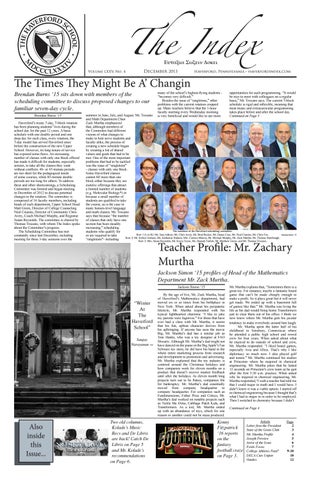
The Times They Might Be A’ Changin Brendan Burns ‘15 sits down with members of the scheduling committee to discuss proposed changes to our familiar seven-day cycle. Brendan Burns ‘15
Haverford’s trusty 7-day, 7-block rotation has been planning students’ lives during the school day for the past 12 years. A basic schedule with one double period and one drop day for each class, every rotation, the 7-day model has served Haverford since before the construction of the new Upper School. However, its long tenure of service has exposed some flaws. An increasing number of classes with only one block offered has made it difficult for students, especially seniors, to take all the classes they want without conflicts. 40- or 45-minute periods are too short for the pedagogical needs of some courses, while 85-minute double periods are too long for others. To address these and other shortcomings, a Scheduling Committee was formed and began meeting in December of 2012 to discuss potential changes to the rotation. The committee is comprised of 16 faculty members, including heads of each department, Upper School Head Matt Green, Director of College Counseling Neal Cousins, Director of Community Chris Avery, Coach Michael Murphy, and Registrar Susan Reynolds. The committee is chaired by Thomas Trocano, with whom The Index spoke about the Committee’s progress. The Scheduling Committee has met constantly since last December, including meeting for three 3-day sessions over the
many of the school’s highest-flying students “becomes very difficult.” Besides the issue of “singletons,” other problems with the current rotation cropped up. Many teachers believe that the 1-hour faculty meeting every Wednesday morning is very beneficial and would like to see more
opportunities for such programming. “It would be nice to meet with colleagues on a regular basis,” Mr. Trocano says. The current 7-block schedule is rigid and inflexible, meaning that most music and extracurricular programming takes place before and after the school day. Continued on Page 5
summer in June, July, and August. Mr. Trocano and Math Department Chair Zack Murtha emphasized that, although members of the Committee had different visions of what changes to make to best serve students and faculty alike, the process of creating a new schedule began by creating a list of shared values and goals that had to be met. One of the most important problems that had to be tackled was the issue of “singletons” - classes with only one block. Some Haverford classes cannot fill more than one block either because they are esoteric offerings that attract a limited number of students (e.g. Molecular Biology*) or because a small number of students are qualified to take the course, as is the case in many honors-level language and math classes. Mr. Trocano says that because “the number of classes that only have one section has been steadily increasing,” scheduling The members of the Haverford scheduling committee. students who qualify for Row 1 (L to R): Ms. Sara Adkins, Mr. Chris Avery, Mr. Brad Becker, Mr. Duane Case, Mr. Neal Cousins, Mr. Chris Fox. or are required to take Row 2: Mr. Kellen Graham, Ms. Katharine Hudson, Mrs. Carmen Mateos, Mr. Michael Murphy, Mr. Zack Murtha, Mr. Thomas Stambaugh. “singletons”- including Row 3: Mrs. Susan Reynolds, Mr. Kevin Tryon, Ms. Hannah Turlish, Mr. Matthew Green, and Mr. Thomas Trocano.
Brendan Burns ‘15
Teacher Profile: Mr. Zachary Murtha
Jackson Simon ‘15 profiles of Head of the Mathematics Department Mr. Zack Murtha. Jackson Simon ‘15
“Winter At The Haverford School” Sanjay Narayanan ‘14
Also inside this Issue...
Two old columns, Kolade’s Music Recs and De Libris are back! Catch De Libris on Page 5 and Mr. Kolade’s recommendations on Page 6.
By the age of five, Mr. Zack Murtha, head of Haverford’s Mathematics department, had moved six or so times from his birthplace in New York. When asked about his peripatetic lifestyle, Mr. Murtha responded with his typical lighthearted charisma: “I like to joke my parents were fugitives.” For those that have ever had a class with Mr. Murtha, it seems that his fun, upbeat character derives from his upbringing. If anyone has seen the movie Big, Mr. Murtha’s dad has a similar job as Tom Hanks, who was a toy designer at FAO Shwartz. Although Mr. Murtha’s dad might not have danced on the piano in the Big Apple’s Fao Schwarz toy store, he did have his hand in the whole entire marketing process from research and development to promotion and advertising. Mr. Murtha explained that the toy industry is centered around the Christmas holidays and how companies work for eleven months on a product that doesn’t receive market feedback until after the holidays. As eleven month long projects turn out to be flukes, companies file for bankruptcy. Mr. Murtha’s dad essentially moved from company headquarter to company headquarter. For companies such as Fundimensions, Fisher Price and Coleco, Mr. Murtha’s dad worked on notable projects such as Tickle Me Elmo, Cabbage Patch Kids, and Transformers. As a kid, Mr. Murtha ended up with an abundance of toys, which for one reason or another could not be mass produced.
Mr. Murtha explains that, “Sometimes there is a great toy. For instance, maybe a fantastic board game that can’t be made cheaply enough to make a profit. So it plays great but it will never get made. We ended up with a basement full of games like that.” Mr. Murtha was living the life as his dad would bring home Transformers just to clear them out of his office. I think we now know where Mr. Murtha gets his jocular tendency to make everybody around him laugh. Mr. Murtha spent the latter half of his childhood in Simsbury, Connecticut where he attended a public high school and rowed crew for four years. When asked about what he enjoyed to do outside of school and crew, Mr. Murtha responded: “I liked board games, especially Axis and Allies. That’s why I like diplomacy so much now. I also played golf and tennis.” Mr. Murtha continued his studies at Princeton where he majored in chemical engineering. Mr. Murtha jokes that he lasted 12 seconds on Princeton’s crew team as he quit after the first 5:30 a.m. practice. When asked why he majored in chemical engineering, Mr. Murtha responded,“I wish a teacher had told me that I could major in math and I would have. I didn’t know it was a viable option. I started off in chemical engineering because I thought that’s what I had to major in in order to be employed. Then I switched to chemistry because I didn’t Continued on Page 4
Kenny Fitzpatrick ‘16 reports on the fantasy football craze on Page 3.
Article Letter fron the President State of the Gents Club Mr. Murtha Profile Joseph Preview Artist of the Issue Fords Focus College Athletes Paid? DECA Cuts Unfair Outdex
Page 2 3 4 5 6 7 9-10 10 12
Page 2
The Index
Editorials
december 2013
Letter from the Editors Dear Reader,
This issue will likely be reaching you just as midterms are starting. Good luck to you on your exams. Whenever a period of intense academic assessments rolls around, it is an often-stated but infinitely relevant point that your integrity matters most. In the end, these are just grades (that can be improved on throughout the second semester, provided you are a non-senior). However, you do have to live with yourself and your actions, so do not damage your integrity among your peers, teachers, and yourself. High school is a time to lay the foundations for the person who you will be in life. If you cheat on exams, you will cheat on life. Now that we are off our soapbox, it is time to look on the bright side. After you tough it out during exam week, there is a beautiful twoweek vacation waiting to reward you. You will have earned it. As you leaf through this paper, take a look at the work of your peers that is not on the first and last page. There are a number of intriguing articles that we have carefully assembled for you. There are the news articles, including Sixth Former Rudy Miller’s piece on the evolution the infamous Gentleman’s Club from its state at the beginning of the season to the powerhouse fan section you know and love today. Whether you know him or not, we suggest reading through the fascinating life of Mr. Murtha, our Teacher of the Issue, which was written by Jackson Simon ‘15. We are so fortunate to have such amazing teachers like Mr. Murtha who have led interesting lives and have many stories to tell, and the Teacher of the Issue every month is a fantastic way to see that. Perhaps our biggest news piece is by Brendan Burns ‘15, who wrote on the recently proposed schedule changes. There have been
proposals to modify the seven-day cycle schedule with which we are all familiar. Burns interviewed several of those teachers and administrators involved with these proposals to find out the details. On the Opinions side of things, we have an opinion piece by Cameron Miller ‘16, who gave us his take on the controversial cuts made by DECA, arguing why they were unfair. The jointopinions piece of this issue takes us to an area many of us are familiar with: college athletics. In this piece, Jack Henderson ‘15’s and Drew Sterman ‘16’s give their takes on financial compensation for college athletes, with Henderson arguing they should be paid and Sterman arguing they are already paid enough. The Index is ecstatic to announce the return of two columns: De Libris and Mr. Kolade’s Music Grayson Sessa ‘13 Editors-in-Chief Manav Khandelwal ‘15 and William Tackett ‘14 with Faculty Advisor Mr. Kellen Graham. Recommendations. Mr. Luqman Kolade recommends the songs cheat. Remember that winter break is just For those unaware, De he’s been listening to, from genres as diverse around the corner. Libris was a column most recently written as hip-hop and indie rock. by Niticon Davis ‘13 that gave a review of a There is much, much more to read this Until next year, new book each month. Fourth Former Ethan issue and we hope you enjoy it. Again, be DeLehman is now writing it and starts off by smart about exams and don’t get yourself in Will Tackett and Manav Khandelwal, Editorsreviewing some Vonnegut. Kolade’s Music a situation where you might be attempted to in-Chief Recommendations is just what it sounds like.
Letter from the President Gents, As the New Year approaches, we are all getting ready for a well-deserved and welcomed long break from school. I have sensed an energized atmosphere at school all year, as everyone is generally willing to accept the daily rigors of academic life and work hard to be the “best self” each of us can be everyday in the classroom. But, of course, we still have midterms to get through before the break. As I hesitantly type that word I just wanted to make sure that everyone needs to take them seriously. I understand that it is difficult with a break looming to focus solely on your final exams and projects of the first semester, but don’t jeopardize the work of the past three months by not preparing thoroughly or taking your midterms seriously. As a student body we started the year off well, but we must remember to finish strong. Waiting until the last minute to study has its perks, but there are serious effects in the grand scheme of things that will not just hurt your grades. From the end of midterms, we will transition into winter break. Don’t let this sudden increase in freedom diminish your judgment or decision-making. Thank you, once again, for allowing me to assume this role as your President. Have a safe and refreshing
break, boys.
Sincerely, Peter Blynn ‘14 Student Body President
The Index
2013-2014 Staff
Manav Khandelwal ‘15, Editor-in-Chief Will Tackett ‘14, Editor-in-Chief Sanjay Narayanan ‘14, Head of Photography Jack Henderson ‘15, News and Features Editor Brendan Burns ‘15, Opinions Editor Jackson Simon ‘15, Sports Editor Gregory Boyek ‘14, Arts Editor Noah Cutler ‘14, Outdex Editor Graham Gaddes ‘14, Senior Web Editor Kenny Fitzpatrick ‘16, Junior Web Editor Grant Yu ‘16, Junior Web Editor Brendan Burns ‘15, Graphics Editor Mr. Kellen Graham, Faculty Advisor
The Index is a student-run publication of the Haverford School that does more than bring news: it provides the diverse perspectives of the Haverford student body. It is an outlet for student writers to take stands on issues they deem important. It chronicles the daily struggles and accomplishments of the Haverford community. The Index also
Student Body President Peter Blynn
Sanjay Narayanan
provides a forum for discussion of pertinent issues, such as student culture, academic policy, and Haverford’s place in world affairs. The Index presents new ideas and aspires to influence constructive change. All opinions and viewpoints expressed herein do not necessarily reflect those of The Index or the school. The Index is designed and produced digitally. Photographs may be retouched. Submissions and letters to the editors regarding any and all articles are welcomed at hsindex@gmail.com. The Index, a member of the Columbia Scholastic Press Association, is composed on Mac OS X, using Adobe InDesign CS5.5. Its surveys are conducted via SurveyMonkey and are advertised on Facebook to current Haverford students. Southern Dutchess News prints 200-400 copies of each issue, and its editorial staff distributes them in the Upper School on the day of release. The Index serves the needs of a total school population of 1091 community members, consisting of 975 students and 116 faculty members. Contact The Index: 450 Lancaster Ave, Haverford, PA 19041 hsindex@gmail.com http://www.haverfordindex.com/ (610) 642-3020 x. 1222 Volume LXXV, No. 1 - September 6, 2013
News
Becoming a Formidable Presence: The State of the Gentleman’s Club Sixth Former Rudy Miller reports on the progression of this year’s Gentleman’s Club, Haverford’s raucous student fan section. Rudy Miller ‘14
One of the things that sets Haverford apart, especially as an all-boys school, is the fervent support that the student body gives to its athletes. The Gentlemen’s Club, Haverford’s student fan section, has been running strong for
of the year was, according to Sixth Former Justin Chermol, a leader of the Gent’s Club, “disappointing, in my opinion,” as “from the start of the West Catholic game” there was a lack of fan support. This led to some posts on the Gent’s Club Facebook page from Cherm, Sixth Former Joseph Raymond, another leader
Fans cheer on the football team at EA Day
the past several years, cheering for practically every sporting event that Haverford participates in, home or away. However, early in the year the club’s leaders were worried about a turnout of fans. The start
of the club, and even Sam Bloch, the Gent’s Club leader last year, urging fans to come out to games. Cherm was quick to point out, though, that he saw “the spark, or the trigger…for all sports at the Germantown Academy [football] game...
that was where I saw guys starting to come together, starting to make noise, starting to get excited about coming to the games.” Raymond concurred, commenting that after “several people voiced their opinions [about the poor attendance] the message got across…when people came out, they saw how fun it was, so they kept coming out.” This excitement carried through all the way to EA Day, on which according to both the Gent’s Club leaders and Assistant Athletic Director Michael Murphy, the atmosphere was “electrifying.” The leaders are not the only ones who believe
Christopher Wong
the Gent’s Club has steadily increased in its performance. Regularly attending members, including Sixth Former Chris Boerner, believe that fan support was “a little lacking initially, but…towards the middle-end, people pulled it
all together and the hypeness became not just hypeness, but actual excitement in wanting to watch the bros succeed.” Even those members who had not attended as consistently as others, such as Third Former Cyrus Rostami, feel that “people are trying to make up for [the beginning of the year]” and that students are now “putting a lot of importance into supporting other teams for the school…I think they outdid themselves at EA Day this year.” Athletes such as Fifth Form football player Devin Wilkins, who believes that this year has been “the best fall season for the Gentlemen’s Club,” have also noticed this increase in support and benefitted from it. According to Wilkins, the cheering “gets me fired up [and] makes me want to play hard for them.” Murphy also believes this, saying that cheering “has a huge effect on how fired up [players] get [since]…it’s tough to get fired up for a big game when you look over in the stands and there’s not a lot of students there, not a lot of the guys you know.” Regardless of who is asked, everyone sees the Gent’s Club how Dr. Nagl would want: as a class act. “We want to be loud and proud, but we want to do it with class,” says Murphy. “It’s very important to do it correctly and appropriately.” Fortunately, the Gent’s Club has delivered there, as Murphy claims that “a ton of people mentioned…what a great job the student section did on EA Day, especially during the football game.” Cherm agrees, commenting that “the student body has been classy…at games, we have not been out of hand, and we have not found ourselves getting in trouble. We have been respecting all players, and that carries, not only in the stands, but also through to the players themselves.” The Gent’s Club is in a good spot right now – engaged, passionate, and classy – and they will only improve from here. Winter, as Murphy states, is “our strongest season, with Friday night basketball games and some later wrestling matches drawing tons of fans.” Cherm believes that “[the winter] is what [students] look forward to,” with activities such as “Friday theme nights for basketball.” Raymond wants to “build excitement for other sports too – wrestling, squash, hockey…It will be a good season.” With the momentum wave that the Gent’s Club is riding from EA Day, there’s no reason to think that student fans will do any less than, as Cherm says, “fill the fan section at every game.”
The School-Wide Obsession That Is Fantasy Football Kenny Fitzpatrick ‘16 explores fantasy football, a past-time of the majority of Haverford students. Kenny Fitzpatrick ‘16
Every year, as the summer begins to wind down students around the nation, especially at Haverford, dread the coming school year. However, the arrival of fall brings what is fast becoming a tradition at Haverford: fantasy football. Whether it is with sites like ESPN, NFL, Yahoo Sports, or even MSN, you can almost always bet your money that a Haverford
student is starting his engine for a draft. As the school year always comes around, so does football season itself as students prime themselves for their weekly fantasy updates and nfl.com’s classic “start em, sit em.” Week in and week out, students meticulously edit their lineups as they plot to beat their friend for bragging rights and perhaps a league championship. However, as entertaining as fantasy football can be, some wonder if this
An example of an nfl.com fantasy lineup
Index Staff
craze distracts students not only outside of school but during school. The reason being that, although Fantasy Football could be classified as an out of school activity, it is common practice for students to compare, strategize, and check their lineups with other students during the school day. This practice may be considered a serious issue because, as of this year, students have been granted access to fantasy football sites at all hours of the school day and with this allowance, students are constantly checking their lineup. When Fourth Former, Luke Green, an avid fantasy football fan was asked about his opinion on the impact the hobby has on students, he said, “I think it’s a distraction, and probably everyone with a computer checks it at least once a class. However, I feel that it shouldn’t be blocked because the students should learn not to look at it during class.” Green’s comment on how students check it at least once a class is bold but quite possibly true. Something else to consider about this craze is that it not only goes on during the school day but also at home, which in a way can have a more severe impact. Why? Simply because it is surprisingly easy to get caught up in the numbers while tweaking a lineup, and this leads to procrastination. While students are surfing the web looking for fantasy football tips and rankings, they fail to notice the time that is slipping through their hands. Before they can even blink it is
Index Staff
11:00 pm. The obvious impact of such procrastination is that students may not complete their homework. In addition, as time progresses and habits form, these students may gradually lose more and more sleep and impact their production during the school day. When Fifth Former, Sam Dyer was asked about his thoughts on its effect on students, he responded, “For some people [fantasy football] begins to take so much time that it actually impacts grades, sports, social life, etc. Once you’re really into it, it’s almost impossible not to talk about it at lunch, change rosters during class, and stare at it all night instead of doing homework. If people get that into it, that is great, but they should realize these potential negative effects. Putting the negatives aside, it is important to remember that fantasy football can and for the most part is a good thing as it provides an opportunity for students to demonstrate their knowledge of football as well as their fierce competitiveness. Just don’t get caught up in it too long, or it will come back to bite you in the long run.
Page 4
The Index
News
Mr. Murtha Profile (Cont.) Jackson Simon ‘15
Continued from the Front Page find chemical engineering very interesting, but I wish I had switched to math.” Mr. Murtha finished his studies at Drexel’s graduate mathematics program. His earliest recollection of enjoying mathematics was way back in first grade when he studied multivariable calculus. Maybe that is a bit of an exaggeration, but Mr. Murtha seems to have a proclivity towards math. In the interim between graduating from Princeton and matriculating to Drexel’s grad school, Mr. Murtha took on a teaching job: “Just because I couldn’t stand the thought of graduate school right away.” Mr. Murtha continued to explain his impetus for starting to teach: “At first I planned to do it for a couple years and then get out but it turned out that I really liked it. So, here I am.” When asked if he had any inspiring teacher, Mr. Murtha simply responded: “Yes. A bunch. Doesn’t everybody?” He continued by saying, “All of my teachers found a way to take what I was good at and help encourage it as well as help me work on the areas I wasn’t good at.” Mr. Murtha goes on to describe how he got connected with Haverford, “They were looking for a math teacher and I sent in an application.” His simple sense of humor is illustrated even better when asked if he has any changes in mind for the math department. Mr. Murtha answered, “I keep trying to fire Patrylak. It is a lot harder than I thought. I thought it would be pretty easy because the reason he needs to go speaks for itself.” On what he enjoys outside of the classroom, Mr. Murtha says, “I make my own beef jerky. I brew my own beer. I make my own sauerkraut. I have made my own vinegar, although that wasn’t very successful. I like those old time crafts. I also like all movies. There is almost no movie I will not watch.” When asked if he had a favorite movie, he responded, “No. I don’t believe in favorite movies that much. I think that once you have a favorite, it diminishes all the ones that come after it. you can see a great movie every day and it could change depending on your mood or the day or the time.” During class, Mr.
Murtha, just as he did in this response, gives interesting insights into life. For instance, in one class he explained to the students his ideas about Daylight Savings’ lack of practicality. In another class, Mr. Murtha explained a Nobel Prize winner’s theory that no fair voting system exists for an election of more than three candidates. If the students are lucky, they might
responded:”Probably Salamanca. I think I am a Spaniard at heart. I think I will retire there with Ms. Mateos.” After recently having a child, Mr. Murtha commented, “It’s been wonderful. I recognize now that I used to have a lot more free time than I thought I did. I will never take free time for granted again.” Mr. Murtha is one of the most popular teachers
Mr. Murtha at his desk
enjoy a conversation with Mr. Murtha about television’s most talked about drama, Breaking Bad. Furthermore, Mr. Murtha is a fan of classic rock artists, especially Bruce Springsteen. He has a younger sister who teaches in New Orleans as well as a younger brother who is an engineer in Germany. Students can see him chatting in Spanish with the language department members as well as some of the custodians. When asked about his favorite place of travel, Mr. Murtha
among Haverford’s faculty both with regards to personality and style of teaching. Sixth Former Jonathan Paras claims that, “His ability to focus the class and channel student energy into something productive is superior.” In agreement, Fifth Former Arjun Dravid comments, “I think Mr. Murtha is a fantastic teacher. He makes the subject of Calculus lively and entertaining. He engages all of his students. Every student I know in that class works hard because of
December 2013
Mr. Murtha’s teaching.” Sixth Former Louie Brown says, “Mr. Murtha has amazing talent in relating with us students and teaching in a way that’s effective, concise, and engaging. He always knows what needs to be done in a class and how to do it, and though he is constantly joking around, his lesson is never hurt.” Harry Bellwoar, also a Fifth Former, said that, “For 40 to 100 minutes a day, I am actually interested in learning a topic that can be very dry otherwise. He also knows how each kid likes to learn. Whether you are someone who talks a lot or someone who sits in the back of the class, as long as you pay attention he will let you learn the way that is best for you. A lot of other teachers won’t let you do that.” With regards to Murtha’s time commitment to each student, Fifth Former Eric Petersen says: “He’s a great teacher Jon Pontecorvo ‘15 and is willing to help his students until they understand the material, whether that be through free periods, lunch, before or after school.” With regards to his popular style of teaching, Mr. Murtha commented, “If people like the way I teach, it is a conglomeration of all the best teachers I have ever had. In that sense these people are still working. They’re still affecting people, I hope.” I think that most students would agree that they certainly are.
Service at Haverford: Fall Semester Recap What’s been going on with service learning at Haverford? Service Board member Eli Wachs ‘16 summarizes the projects and events of the first semester. Eli Wachs ‘16
Upper School students have enjoyed a wide variety of service and volunteer opportunities over the course of the first semester. We had a plethora of walks to help benefit foundations for diseases and disabilities. The disease-related events included raising money to help address issues such as AIDS, juvenile diabetes, suicide prevention, breast cancer, and lung cancer, as well as benefiting institutions like The Children’s Hospital of Pennsylvania (CHOP). In addition, the Buddy Walk for children with Down syndrome and the Special Olympics benefited people with disabilities. Environmental projects included Shiverfest and tree planting, both with the ladies of Agnes Irwin, at the Riverbend. Recurring events include monthly Cynwyd Heritage Trails work days, working with the folks at the St. James School in Philadelphia and their community, and the PB&J Club which makes peanut butter and jelly sandwiches for the homeless in Philadelphia. Also, as most of you hopefully know, our Can Drive brought in nearly 12,000 cans and 111 turkeys to fight hunger. The cans restocked the pantries of our partners while the turkeys gave many families the opportunity to celebrate Thanksgiving with a full plate, a privilege all folks deserve. Over Thanksgiving break, both the FootbALZStars Flag Football Tournament and the Turkey Bowl with the Lower School took place. These events helped to fight Alzheimers and support the Lower School’s Learn Belize global service learning project, respectively. Overall, it is evident that there are many opportunities to support our greater community. Our winter projects strive to bring everyone the warmth of the holiday season that most of
us at Haverford take for granted. Whether it be by sending cards and letters to our troops overseas, giving toys to children through Toys for Tots, donating hats, gloves, and scarves to the homeless, giving cell phones to families who have suffered from domestic violence, or donating books for inner city schools and clothing to shelters, we hope we can bring everyone a great holiday season. Obviously, monetary donations are always appreciated, but Bryan Rodriguez of the Sixth Form says perfectly that hands-on service is that much better, for “changing a person’s life is an everlasting fulfillment that can be accomplished as simply as making a PB&J sandwich or tutoring a child for an hour.” While reflecting on the the fall service season, the board noticed that it was filled with many ups and downs. Events such as Shiverfest and the Special Olympics saw many Haverford students come out to help while walks benefiting Breast Cancer, Lung Cancer Diabetes, AIDs, and Suicide Prevention saw lower turnouts than in previous years. Some people signed up for these events but did not attend. Moving forward, the Service Board would love for the community to try to improve on our participation in events. We know that every student’s schedule is loaded to begin with, but we feel that if events such as the Riverbend cleanup day again see a turnout of just two Haverford boys, then we will have to cancel the school’s participation in certain events. This would be part of a larger effort to focus on getting very large school turnouts to specific events that have been consistent favorites. If you have any recommendations, please reach out to a Service Board member or drop by Mrs. Loos’s office. Though we have no service requirement at
The cans being delivered to Old Pine Church by Fifth Former Tony Dimattia.
Haverford, I think Mrs. Loos sums up perfectly our direct link to service, saying “There are people in need both nearby and far away. We are gifted to be able to engage with others and to work collaboratively to address the issues
Major Tepper ‘15
affecting so many in our world.” Please check our web page and listen for announcements for upcoming events and activities!
Page 5
The Index
Arts
De Libris: Vonnegut’s Breakfast of Champions
De Libris, the literary review column started by Niticon Davis ‘13, has been revived by Ethan DeLehman ‘16. Ethan DeLehman‘16
“Breakfast of Champions” was my introduction to the spectacular array of works by author Kurt Vonnegut, and what an introduction it was. From the opening line of “This is a tale of a meeting of two lonesome, skinny, fairly old white men on a planet which was dying fast,” to the description of the United States’ national anthem as “gibberish sprinkled with question marks.” I was engrossed not only in the witty and observant prose of Vonnegut, which sustained it’s sharpness and honesty throughout the course of the novel, and also in the depth of the characters, flawlessly created and elaborated upon, and the uniqueness of the story that is too excellent to miss. Because the novel was so uniformly extraordinary and as well put-together a novel as I have ever read, the element of the novel most stood out to me was its prose.Vonnegut
is a craftsman who, rather than relying on an extended vocabulary and complexly constructed sentences, instead opts for concise comedic brilliance without sacrificing the intellectual nature of the novel. It is this combination of absurdly simplistic wording that, if put into the wrong hands, could result in a second- rate novel. However, in the hands of Vonnegut, the use of the words “fabulously well-to-do” and “doodley-squat” do not detract but instead manage to enhance his message. Here’s one example: “Everybody in America was supposed to grab onto whatever he could and hold onto it. Some Americans were very good at grabbing and holding, were fabulously well-to-do. Others couldn’t get their hands on doodley-squat. Dwayne Hoover was fabulously well-to-do when he met Kilgore Trout. A man whispered those exact words to a friend one morning as Dwayne walked by: ‘Fabulously well-to-do.’” I believe the way of writing speaks for itself,
highlighting both its oddity and it’s efficiency. Perhaps the most remarkable thing about the book, something that also manages to go handin-hand with the prose, are the themes achieved. “Breakfast of Champions” is a witty, satirical, and cynical look at American culture. From the humorous, albeit in some cases oversimplified, observations regarding human nature and American culture, to the overarching themes of the plot, there is no shortage of thoughtprovoking concepts, all appearing in various form and regarding a variety of topics. From mortality, to human achievements, to legacy, to fate. Each of these topics are explored in such an entertaining and humorous way that the complex ideas are understandable. One theme that left a significant impression on me was the idea explored when one of the primary characters, an aging and unknown sciencefiction writer by the name of Kilgore Trout, has a realization upon seeing the traditional smiling and frowning dramatic masks. The segment goes as follows: “‘They don’t want anything but smilers out there,’ Trout said to his parakeet. ‘Unhappy failures need not
apply.’ But his mind wouldn’t leave it alone at that. He got an idea which he found very tangy: ‘But maybe an unhappy failure is exactly what they need to see.’ He became energetic after that. ‘Bill, Bill-’ he said, ‘listen, I’m leaving the cage, but I’m coming back. I’m going out there to show them what nobody has ever seen at an arts festival before: a representative of all the thousands of artists who devoted their entire lives to a search for truth and beauty--and didn’t find doodly-squat!” The idea of a lonely, unknown, and crazed writer giving a speech to his pet parakeet on the unfairness of the arts is so wonderfully bizarre and yet it works so incredibly well. In case you haven’t noticed, I’ve tried to allow for the writing and the dialogue of Vonnegut to speak for itself here, as opposed to giving long plot summarizations and lauding every specific spectacular element of Vonnegut’s work. Vonnegut’s style is a unique one. A fascinating one. And one that continues to entrance and entertain me with every novel of his that I have read. But throughout all of them, I’ve found this to be the best of the best.
and Latin. Increased flexibility in the rotation could also free up more time for “school initiatives”, which could encompass anything from optional lectures, seminars, writing workshops, or initiatives by the newly created global leadership and innovation programs. With all these objectives in mind, the Committee has been exploring new scheduling models for the past year. Multiple models were brought to the floor, analyzed, and passed over. These include a Trimester model in which a student would take 4 courses per trimester, with four, 90-minute classes each day, which was rejected for multiple reasons, including the possibility of a student neglecting classes that focus on previous mastery (e.g. math, science, English classes) over the course of a trimester, the drawbacks to students of four double periods per day, and the difficulty of scheduling electives. Changes in rotation length, number of blocks, school day length, class period length, and balance of single and double periods were all considered The Committee’s current draft model is a 10-day, 8-block rotation. Adding 3 days to the rotation allows for more scheduling permutations for each course; adding an extra block reduces singleton conflicts by mathematical probability (because classes are spread over eight blocks instead of seven) and could potentially allow select students to take seven classes more easily. The latter is not one of the Committee’s indicated goals, nor will taking seven classes be encouraged, however, the rare student who is permitted to enroll in seven courses would be able to do so without giving up his free period. In this model, each class could utilize a different scheduling permutation: a class could meet for 6 single periods and 2 double periods over 10 days with two drops, or meet for 8 single periods and 1
double with one drop, or meet for ten single periods with no drops. Both single and double periods would generally maintain their current lengths. Adding an eighth block could also create space for more interdisciplinary courses: Mr. Trocano mentions a theoretical ‘Art & Organic Chemistry’ elective as an example. The main limitation of the draft model is that it extends the school day by 25 minutes on 8 of 10 days in the rotation and by 20 minutes on the other two. On ‘normal’ days, classes begin at 8:15 (instead of 8:30) and end at 3:25 (instead of 3:15). Every fifth day is shortened, with an 8:55 start and 3:25 finish, to allow for a 50-minute faculty meeting. The extension of the school day presents a particular challenge because it places more importance on students using their time productively. An extension to the school day means students wake up earlier and return home later. Without a corresponding increase in productivity at school, this could prove disadvantageous. Encouraging responsible use of free time (“flex time”) is one of the largest challenges associated with a more flexible schedule. The amount of free time available to Haverford students will only increase as they graduate and progress in their education; likewise, the importance of managing free time efficiently will also increase. When asked about his personal opinion on the matter, Mr. Stambaugh stressed his belief in the importance of preserving “as much instructional reading and writing ‘contact time’ as possible.” He continued, “It would be a shame if a new schedule offered ‘less than’ the current model…I don’t see starting instructional time ten or fifteen minutes earlier or later as something that should paralyze the committee’s effort to reconsider our allotment of instructional, collaborative, communal,
or individual study time.” Mr. Stambaugh acknowledged, however, that many “wellmeaning colleagues” would “respectfully disagree”. As for the issue of students being able to manage their time effectively with more blocks and a longer day, Mr. Stambaugh stated that the most successful Haverford students generally “use their non-class time productively, and would presumably continue to do so in the proposed schedule.” However, “students who currently spend their free periods playing video games in the Street or in the library would likely have difficulty self-managing flexible time in a new schedule.” This challenge is present regardless of the model adopted. The Index must emphasize to readers that the Scheduling Committee’s current draft of the new schedule is just that: a draft, unlikely to be implemented in the near future. Mr. Trocano emphasized that the student body will be engaged before any changes are made to the rotation. Instead, the current draft model serves a tangible prototype that students should examine, critique, and use as a means to provide feedback to the Committee when given the opportunity. Although the Committee has put in an incredible amount of work over the past year, the current model is only the latest iteration in an ongoing effort. Students should expect an assembly or other announcement in the medium-term future to discuss these potential changes. The current draft model was designed to address as many of the identified scheduling issues as possible. The next step, says Mr. Trocano, is for the Haverford Community as a whole to decide “which changes, if any, it might value and what compromises it is willing to make to implement those changes.”
When asked about the upcoming show, The cast isn’t just limited to students. Playing Solmssen said, “Mr. Cloran has talked about this the role of Joseph’s father, Jacob, is head of being his biggest and best show yet, and we just upper school Mr. Matthew Green. Mr Green got a new sound system in Centennial [Hall], said he is “thrilled to be a part of a production so you can already tell it’s gonna be a fantastic and grateful to Mr Cloran for finding a small show. It’s going to be a lot of long hours but I’ve part for me.” He went on to say, “Musical been looking forward to it since last year.” This also marks Sixth Former, and two time Cappie Award winner (Best Choreography, 2012 & 2013), Toney Goins’ final musical. He will be cochoreographing this production and he is excited as a l w a y s : “Joseph is a Ms. Dawn Blake very different Many of the stars from “A Few Good Men,” including Goins (left) and Solmsenn (right), will be back. show when it comes to specific style and genre, theatre is a passion of mine and I so there aren’t many limits to bound me when am looking forward to spending time with the working on this show. It’s going to be so fun students in the cast.” and I hope everyone comes out to support the The excitement extends beyond Haverford, cast in all of the hard work.” as students from our several sister schools are
participating as well. Paige Davis of Agnes Irwin said, “I’ve heard nothing but enthusiasm about Joseph since auditions, and the excitement seems to be escalating...With Mr. Cloran’s leadership and the eagerness of the cast, I’m sure we’ll do [Joseph] justice… most of the cast seems to be champing at the bit to get started.” One element that stands out among the rest is the variety of music in the show. As Mr Hightower said, “the musical numbers are extremely diverse regarding their style, so constantly the flavor of the music will be changing from Elvis rock and roll to island calypso and everything in between!” It features a French ballad and a 1920’s Charleston - plus what 1970’s musical would be complete without a an upbeat disco number? The show features a cast bursting with talent. Along with Fifth Former Will Solmssen, Senior Paige Davis and the incomparable Mr Green, the brothers consist of Sixth Formers Chet Bickhart, Justin Chermol, Eamon Glavin, Jake Cohen, Toney Goins, Max Gold, Phil Gregory and Troy Trauger; as well as Fifth Formers Louis Brown, Curran Browning, Marc Johnson and Michael Somkuti. Potiphar and Mrs Potiphar will be played by Fourth Former JR Pender and Baldwin Senior Julia Hopkins respectively. The Baker and Butler will be portrayed by Sixth Formers Stephen Boyd and Henry Ortmeyer. The Pharaoh will be played by Fifth Former Ian Riley.
New Schedule Proposals (Cont.)
Continued from Front Page
The rigidity of the current schedule is not ideal for the educational needs of many courses and teachers. Mr. Trocano explains: “everyone conducts their courses in the same box – 5 singles, 1 double, and 1 drop per rotation.” Different courses have different pedagogical needs. Research shows that students learn mathematics most effectively when they are exposed to the material consistently on a daily basis. When asked what the ideal schedule for math classes would look like, Mr. Murtha explained that “A fifty-five minute class every day is ideal, [with] no drops or doubles. No muss, no fuss, just fifty-five minutes of the good stuff.” In contrast, some science classes (especially classes with labs such as Chemistry, Electronics, etc) would function more smoothly with more frequent double periods, balanced out by more frequent drop days. The ideal English classes, according to Department Chair Thomas Stambaugh, may be a mix of the two – “shorter, more consistent meetings for underclass focus on skill development and longer, less consistent meetings that allow older, college-ready students to dig deeper and stretch more broadly.” With these variances in needs across Departments, it becomes clear that the 7-day, 7-block, one-size-fits-all model leaves room for improvement. “How much of a student’s day does school have the right to occupy?” One of the Scheduling Committee’s most important goals is to ensure that the school makes the best use of its students’ time. Mr. Trocano says the Committee explored “possible ways of giving students time within the framework of the school day [for activities] that currently happen before or after” – think Jazz Band or Glee Club in between Chemistry
December 2013
Joseph and the Technicolor Dreamcoat: Musical Preview Ian Riley ‘15
Every winter, The Haverford School Drama Department puts on a musical, and this year is no different. On March 6th, 7th and 8th, we will be performing Tim Rice and Andrew Lloyd Webber’s 1970 musical extravaganza, Joseph and the Amazing Technicolor Dreamcoat. Originally recorded as a concept album in 1969, it was the first musical of Rice and Webber’s to ever be performed, and the second to appear on Broadway (after Jesus Christ Superstar), in 1982. It was nominated for 6 Tony awards in its original run. The students and faculty are equally excited for the production, said musical director Mr Hightower, “Usually musicals strike a balance between singing and acting, but Joseph functions almost more like an opera in that the singing is nearly constant the entire way through the show.” The choice to do a “rockopera” presents a unique challenge, especially one like Joseph. Told by a narrator (Agnes Irwin Senior Paige Davis), the story focuses on Joseph (Fifth former Will Solmssen), who is the youngest of 11 brothers, and the favorite of their father, Jacob (Mr. Matt Green). Jealous of Joseph, the brothers sell him into slavery in Egypt, but Joseph has the gift to determine the future from dreams; using this gift he climbs the ranks until he is freed, all culminating in a happy ending.
Page 6
The Index
December 2013
Arts
The Return: Mr. Kolade’s Music Recs After a hiatus, we are thrilled to bring back Mr. Kolade’s music column. For those new to the column, it entails music connoisseur and English teacher Mr. Luqman Kolade recommending the songs he has been listening to recently. Take a look: “It’s been a long time, I shouldn’t have left you….” – Rakim, “I Know You Got Soul” Taylor Swift – “Trouble (APSPDR+ Remix)”: What do you get when you mix a pop star, a
Project Pat sample, and a producer with a flair for mixing hip-hop, EDM, and R&B? You get the awesomeness that is this song. APSPDR+ (formerly known as APsuperProucer) took the popular Taylor Swift song and added a touch of chillwave, a la The Weeknd, to it. The song,
now much darker and less danceable than the original, makes Swift sound far more disturbed and interesting. Now a feeling of longing and etherealness permeates the tune, which brings down the pop element and makes the listener consider just how much trouble the singer may be in. Danny Brown x Sleigh Bells (Brown Bells) – “Dippin Demons”: Now, this is quite literally a mashup. Brown Bells, the Nick Catchdubs project mixing Danny Brown vocals with Sleigh Bells tracks is as energetic and head-noddingly amazing as one would expect from the parties involved.
The duo of Pusha T and Kendrick Lamar produced another gem in “Nosetalgia”.
Danny Brown’s realistic depictions of his life before rap combined with the angry noise pop of Sleigh Bells hits a sweet spot I did not know existed. This particular song combines Danny Brown’s single “Dip” with the Sleigh Bells’ “Demons” and makes the two seemingly disparate tracks sound like one cohesively terrifying, but exciting, song. The Sleigh Bells track adds an element to “Dip” previously not there, and brings the song into an eerie place where hip-hop, rock, and dance not only meet but get along quite well. Pusha T – “Nosetalgia” ft. Kendrick Lamar: Anyone who has talked to me about music in the past few months has probably heard me mention this song, but I chose to review it here because even though it came out in October, it is just that good. The best song on what I consider to be the hip-hop album of the year (My Name is My Name) is a densely layered juxtaposition of the two rappers’ very different lives before fame. A top-notch verse from everyone’s current favorite, Kendrick Lamar, combined with the sparse and dark drums, highlights the razor sharp lines we have come to expect from Pusha T. The duo work together effortlessly and show why both are considered by many to be two of the best in the game. Produced by Nottz, the track echoes and reverberates in all the right places, and the KRSOne sample warns the listener to take this seriously. Even though the two come from very different backgrounds, neither of them is to be trifled with, and after listening to the song, that message rings out loud and clear. EliteDaily.com
Artist of the Issue: Painter/ Photographer Walter Paiva
Theatre III’s A Christmas Carol: A Recap
The Index recognizes and congratulates Fourth Former Walter Paiva for being this month’s Artist of the Issue. Walter is a gifted artist whose main focus is drawing, painting, and photography. He has attended Haverford since kindergarten, yet he says that he’s been an artist since long before he arrived here. All those who have interacted with Walter know he is a hard-working student he has been an artist since about the age of five. He learned to draw through observation first and foremost, along with continued practice which has allowed him to improve as an artist. There was not one particular incident or action that inspired him to draw when he was younger. As it pertains to now, Walter’s inspiration comes
On Thursday, December 5, and Friday, December 6, the Theatre III put on their production of a Charles Dickens’s classic in Ball Auditorium, entitled A Christmas Carol: Scrooge and Marley. Theatre III, if you do not know, is a class where Sixth Formers and a few Fifth Formers select, produce, and put on an entire show. This year, Theatre III comprised of Sixth Formers Charlie Battersby, Chet Bickhart, Angelo Brutico, Troy Trauger, Justin Chermol, Jake Cohen, Eamon Glavin, Toney Goins, Phil Gregory and Fifth Formers Ian Riley, Will Solmssen, Kory Calicat. A Christmas Carol, for the unfamiliar is a novel by Charles Dickens that chronicles the change of a miser who hates Christmas into a positive and generous person. The miser, Mr. Ebenezer Scrooge (played by Riley), is confronted by the ghost of his late business partner, Jacob Marley (played by Goins). Marley tells Scrooge that he will be visited by three ghosts in the night in an attempt to save Scrooge from the fate that Marley suffers: he must wander the earth, bearing the chains that represent his coldheartedness in life. The first ghost, the Ghost of Christmas Past (played by Trauger) shows Scrooge scenes from his youth, which bring out the more tender side in Scrooge. The second spirit, the Ghost of Christmas Present (played by Calicat) takes Scrooge to see scenes of Christmas from the present time. He sees the family dinner of his
Wayne Hester, Jr. ‘16
from drawing, paintings, or photographs of others that he deems to be “awesome.” When asked about his inspiration, here is how he responded: “From what I remember, no singular thing really inspired me to begin to draw. As for what inspires me today, looking at the paintings, drawings, and photographs of others is something I find awesome. It’s hard to explain, but certain everyday things are just strangely inspiring also.” For example, inspiration can come by walking through the halls and seeing interesting things on the wall, or he could receive a broad idea, and expand on it significantly. He’s also inspired by certain everyday events that are inexplicable. In his freshman year at Haverford, Walter took 2-D Art with Mr. Fox where he created several outstanding drawings and paintings including a lines only pencil drawing of the city of Prague. Now Walter is now taking the Photography course with Mr. Frock. He is sure that he will take art throughout the rest of his time at Haverford and there is a high possibility that he will continue to take courses for it in college as well. Aside from the arts, Walter is also involved with Soccer, DECA, Model UN, and Debate and Speech. Last year, he placed 1st in districts, 2nd in states, and qualified for internationals in DECA. With all of these extracurriculars, it is difficult to see where Walter finds the time to work on all of his art pieces. Walter has shown consistency in all four of these activities, as he has taken them for his first two years of high school, and plans to do them throughout. He was also elected by his peers to be a member of the Honor Council. Once again, congratulations to Walter Paiva!
Walter is multi-talented even in the field of art, a rare thing to see.
Mrs. Paiva
Will Tackett ‘14
The cast of A Christmas Carol posing at their recent show.
clerk, Bob Cratchit (played by Solmssen), including Tiny Tim (Bickhart) who, though crippled, cannot be given treatment due to the low wages Scrooge pays Cratchit. They also observe the dinner party of Scrooge’s nephew Fred (Cohen), whose guests mock Scrooge. The third and final phantom, the Ghost of Christmas Yet to Come (Mr. Cloran) shows scenes having to do with both Tiny Tim’s and Scrooge’s own death. Scrooge desperately asks if these visions of the future may be changed. When he finally wakes up, Scrooge is a new man. He anonymously buys the Cratchits a Christmas feast and raises Cratchit’s salary. He attends Fred’s party, where he both gives and receives much love. The title of Theatre III’s version, A Christmas Carol: Scrooge and Marley, alludes to a twist for this production. In the Theatre III production, Marley is a consistent voice throughout the play, acting as the omniscient narrator as well as the character who confronts Scrooge. This way of doing the play highlights the relationship between Scrooge and Marley and how one , already beyond hope, tries to warn his former friend from travelling the same road he did. On putting on the production, co-director Charlie Battersby, who directed alongside Bickhart, said the week before the play was stressful. He said it was “easy to slip into” the idea that “we could do it later”, until a week before the play was scheduled, when he felt the “looming sensation ‘Oh my god, this might fall through,’” a sensation that continued until the first scene of opening night. However, despite the preplay anxiety, Battersby said that performing the play was ultimately the perfect reward: “Honestly, our first show was the most fun I have ever had on stage.” Battersby described the feeling after Friday night’s performance as “the greatest feeling of...we actually did it… It was awesome to see this thing everyone put such hard work and time in to come together to make such a kick-ass show.” Ms. Dawn Blake
Page 7
The Index
Sports
december 2013
Fords Focus: Mr. Fairfax Taking Basketball Program to New Heights
For this edition of his monthly sports column, Manav Khandelwal ‘15 discusses the revitalization of Haverford’s basketball program. Manav Khandelwal ‘15
Three years ago today, one could have argued that The Haverford School’s basketball program was in a state of disarray. After finishing the 2010-2011 season at 12-13, the Fords were looking in another direction, both in terms of finding players who fit and finding the right head coach to lead them. The athletic department turned to the school’s leading scorer, former Fords guard Henry Fairfax ‘99, now the Director of Admissions at his alma mater. Fast forward to the present, and anyone would give the administration an A+ for the decision. Fairfax, a man who has always believed that “talent loses to hard work almost every time. Talent loses to folks that play together and play smart, play hard most every time,” has turned the program around. As Director of Admissions, his goal is to admit a variety of students with different talents who form as
Coach Fairfax is also Dean of Admissions.
cohesive and diverse a class as possible. He has done the same with the basketball program, giving every player the chance to succeed. The results speak for themselves: the team has improved every single season, starting out 15-11 in 2011-2012, finishing 17-9 in 20122013, and now looking to improve upon that in 2013-2014. After being unranked for several years leading up to Mr. Fairfax’s first season as head coach, the Fords (2-1, 0-0 Inter-Ac) were ranked 104th in Pennsylvania by MaxPreps two years ago and 50th last season. Finishing in the top 25 this season is not out of the question. Just how has Coach Fairfax gone about building such a dominant program, one favored to win the Inter-Ac this season? Obviously, it starts with the players. He’s has attracted players like Sixth Form SF Eric Anderson, who recently signed to play Division I basketball at Yale, and Fourth Form C Lamar Stevens to Haverford. However, a lot of the improvement has been due to an emphasis on player development. Starters like SG Derek Mountain and PG Shawn Alston have been at Haverford even before entering the Upper School, and have grown in all aspects. But even with all this individual talent, Coach Fairfax knows that nothing will come of it unless there is chemistry, something he’s been espousing since Day One of practice this season. He says, “[Developing the team rather than the players] is the most important thing. This isn’t the Shawn Alston Show, the Eric Anderson Show, or the Derek Mountain Show. If you watch us play, you’ll see that. The ball moves, kids care about each other.” Having this much talent and chemistry presents its own set of challenges. Hailed by writers across the county, it is hard for many teams not to get caught up in all the championship chatter. For Coach Fairfax’s team, however, the message is relatively clear: “Championship talk is flattering, at most. But at Mr. Tim Stay
the end of the day, it’s just one of our goals. It Cameron Reddish, who has made both of his was our goal in 2011, it was the goal in 2012, field goals, one of them a three-pointer, in his it’s the goal in 2013, and it’ll be the goal in role as the team’s sixth man. 2014, 2015, 2016, 2017, and 2018 . . . for us “He’s prodigious, in a word,” remarks it’s not paying attention to what people are Fairfax of Reddish. “Here’s a kid who is writing about us.” 6’3”, growing. So he is a prodigious talent, The players have bought in, hook, line, and a great kid, a humble kid, who can handle sinker. Mountain, who has taken advantage big moments. He came in and impressed the of a starting role this season averaging 12.3 coaching staff, and earned a spot on Varsity, points, 4.3 rebounds, and 2.7 assists per game and earned a spot as the 6th man.” thus far, adds, “We’re not going to read into Yes, the Fords have high expectations. Yes, [the favorite talk], it’s not our place. We’re Coach Fairfax has assembled a team loaded just going to work on preparing as well for the with talent from a Yale-bound Sixth Former to league as possible.” a prodigious Second Former. But what really Still, it is hard not to appreciate how good matters to the coaching staff, in addition to of a team Mr. Fairfax has built and coached that final goal of winning a championship, for the upcoming campaign. Even after is helping these players use basketball as an losing small/power forward Sean Lloyd, who avenue to grow as young men, says Fairfax: transferred to Imhotep Charter, a player whose “We want to teach the kids to how to respond motor Coach describes as “irreplaceable,” to diversity, how to respond to adversity, how the team’s rotation looks like the strongest in to persevere. This is not just about yourself, the area. Led by Alston, last year’s Inter-Ac it’s about something bigger, there’s a greater co-MVP, this team loves driving the ball into common goal that we aspire to. And those are the lane and creating shots on the perimeter. life skills at the end of the day.” Not only does he shoot 49% from the field, but Alston also leads the team with 18.7 points and 5.3 assists per game. Sophomore sensation Lamar Stevens, whose monstrous dunk against Shipley had the Gentlemen’s Club roaring last Friday, has more than made up for the loss of big man Sema’j Reed. He is averaging 15.7 points, 6.0 rebounds, and 2.7 blocks per game while making 56% of his field goals. Coach Fairfax has nothing but positive words for the young man, especially regarding his defense down low: “Lamar is big and strong and his feet are pretty quick. Against Roman, he had one play where he was completely out of position defensively and move across the court and block it into what would have been the Gentlemen’s Club.” When you throw in two of the best offensive players in southeastern PA, Mountain and Anderson, and new power forward Lukas Rosenbohm, this team’s starting five is tough to beat. And we have not even gotten to 8thgrade phenom Sixth Former Eric Anderson, Yale-bound in 2014, is a prime example of a Faifax pupil. Ms. Dawn Blake
“State-of-the-Art” Boathouse for Crew Team Under Construction Kyle Bowman ‘15 details Haverford crew’s move to a new boathouse currently being built in Conshohocken. Kyle Bowman ‘15
The Haverford School crew team will soon relocate from the historic Undine Barge Club on Boathouse Row, a place it has called home since its inception, to a new state-of-the-art boathouse in Conshohocken. Haverford crew has had a great partnership with Undine Barge Club, being a member of the club for many years, but there are a variety of reasons that compelled the team to seek a new home. The hope with the boathouse is to decrease the travel time, currently a 45-minute drive to and fro, and also to decrease the operating cost of the team. Each year the team is forced to pay a large fee to rent the boathouse space, and the hope is that the boathouse can lower the cost per athlete or be used to better fund the team. It is funded by the Friends of Haverford School Crew, a nonprofit group of alumni and family who work to raise money for the crew program, and Malvern Preparatory School. The boathouse is to be shared with Malvern Preparatory School along with the Borough of Conshohocken. Each individual section is to be the size of the average boathouse in Philadelphia, allowing the teams enough room for boat storage and meetings. Therefore,
the daily operations of the team will remain uninterrupted by the new boathouse. The problem with dock space has been dealt with by plans to create a huge dock that is to be around the same amount of dock-space as the entirety of boathouse row. This should allow all of the teams to launch and dock without long waits or fights over launching priority. The new boathouse, when completed, should be one of the most advanced boathouses in the country. The boathouse was initially expected to be completed by December 2013, but the permits took longer to get than was initially expected. The permits were approved during the summer, but there were further delays with the construction. Construction finally began in October and has made good progress since then. However, it will not be finished before the
team’s Spring Season. This year’s group of seniors sadly will not be able to spend their last season in the new boathouse in Conshohocken, but instead will spend their final year in
Philadelphia. The Haverford School Crew team will move into their new, state of the art, Boathouse during the summer of 2014, and they hope that the past success of the team will continue in the new home for the team.
The Fall Crew team, along with Headmaster Nagl, listening to Coach Stephanik at the current boathouse, Undine, along bouthouse row.
Mrs. Ann Glavin
Page 8
Swimming Preview
The Index
december 2013
Sports
Sam Dyer ‘15 previews the swimming and diving team’s upcoming season. Sam Dyer ‘15
As the first snowflakes of winter fall, a new season of Haverford Swimming and Diving is underway. After two of the best years in team history (3rd at Easterns in 2012, 5th in 2013), expectations are higher than ever. With a strong core of Sixth Form captains in addition to all the underclassmen, the swim team is poised for Inter-Ac and regional success. The diving team, as well, is formidable as they did not lose any divers from last year’s squad. Much of the Ford’s success this winter will be based off of the performance of their top swimmer, Sixth Form captain Dan McGrath (Individual Medley). McGrath, who has signed a letter of intent to swim at Lehigh University next Fall, will compete for several school records. John Zipf (breaststroke), Alex Heldring (freestyle), Alex Zhang (freestyle), and Chet Bickhart (backstroke) are the other Sixth Form swimmers who should contribute in the team’s success this season. There are many strong swimmers in the lower classes as well. Fifth Formers Ben Nelligan (butterfly) and Luke Ryan (backstroke), Fourth Former Matt Haigh (freestyle), Third Former Charlie Ryan (freestyle), and Second Former Alex Boratto (backstroke) are all capable of posting elite times. Haigh already holds several long-distance freestyle records at Haverford, and looks to build off of last year’s success. The team will be rounded out by Fifth
Alex Sanfilippo and Reed Haabestad, and Third Former Rajat Aiyer. All in all, the 20132014 season figures to be another exciting one for Haverford Swimming and Diving. The Fords should be able to defeat both Penn Charter and Episcopal, as they have in previous seasons. Meets against Malvern and Germantown Academy will be more difficult to win, but there is reason to think the Fords can compete with any team in the Inter-Ac. The first meet was supposed to be at home on December 10th against Penn Charter, but was rescheduled due to a snow day.
Former Sam Dyer (freestyle), Fourth Formers Kenny Fitzpatrick (freestyle) and Harrison White (breaststroke), and Third Formers Joe O’Brien (butterfly), Ross Harryhill (freestyle), Will Russell (butterfly) and Chris Callegari (freestyle), all of whom should provide good depth in both individual events and relays. There are also high expectations for the Diving team this winter. With Sixth Formers Will Pierce and Anthony Cirelli, as well as Fourth Formers Alec Tyminski and Gabe Newton, the Ford’s four most experienced divers should play a large role in the team’s success. Since all four divers have a solid track record, there is no reason to think the diving team cannot exceed last year’s success. Coaches Sean Hansen (head coach swimming), Brendan Jones (swimming), Kevin van Such (swimming), and Justin Gaudreau (head coach - diving) will be leading the team this year. All of them were part of last year’s success and hope to build upon several strong seasons. This year’s team has even added a new wrinkle to the program: water polo swimming. This is for water polo players who want to stay fit during the winter; this group practices four days a week, swimming twice and doing lifting/dryland exercises twice. Headed by van Such, it features Sixth Former Sawyer Warden, Fifth Formers Colin Moran, Manav Khandelwal, Curran Browning, Curran Aiyer, George Hall, and Mason Hall, Fourth Formers
Diving captain, Sixth Former Will Pierce, at practice. George Hall ‘15
Athlete of the Issue: Dan McGrath Ryan Tino ‘16 profiles Lehigh-bound swimming captain Dan McGrath, one of the school’s all-time best. Ryan Tino ‘16
When looking at the long history of Haverford Athletics, there are many sports that have had a popular following throughout the years. Many students have had an interest in the lacrosse program due to the recent success the team has enjoyed, and the football program has long been a staple of Haverford traditions like EA Day. But swimming has never been a particularly popular spectator event, even though few sports at Haverford require the hard work and dedication that swimming demands. And few athletes work as tirelessly as Sixth Former Dan McGrath. Dan began his swimming career nine years ago, and he started “because my mom forced me into it; I had no interest in the sport.” But Dan soon grew to love the sport, because “it requires little hand-eye coordination. I enjoy the sport because it pushes me physically and mentally. I’m an incredibly competitive person and the individuality of the sport makes it so you can’t blame others when you lose.” Dan first attended the Haverford School in freshman year “because the public school I would have attended wouldn’t have given me the opportunity to grow as an athlete.” The stage set by Haverford would also help Dan gain exposure in the swimming world, competing against national powerhouses like Germantown Academy and swimming at major
I like to consider myself a well-rounded swimmer because I don’t really have a weak stroke. Distance events are my weakest.” He currently holds school records in the 50 yard and 50 meter freestyle events. He is also a member
two yards events and two meters events. Dan’s other past accolades include being selected to the First Team All-Delco and First Team All-Inter Ac. He was also chosen as events such as Easterns. Dan swims in multiple a member of the 2012-2013 Scholastic Allevents during meets, but his best event “is the American Team. According to usaswimming. com, this team “recognizes its members who excel both in the classroom and in the pool. The Scholastic All-America Team is made up of high school student-athletes who have a grade point average of 3.5 or higher and who have achieved the required time standard in a single event.” Dan, who will be attending Lehigh University next year and swimming for their varsity team, also participates in other sports at the Haverford School. He competed on the varsity water polo team, acting as the swim-off taker, winning many possessions for the Fords and helping in the team’s overall success. When asked about how he believes the Haverford swim team will fare this season, McGrath responded, “This year’s team has more depth, talent, and dedication than we’ve ever had before. Our goal is a third consecutive top six finish at Easterns and I would be surprised if we did not achieve it.” This confidence and desire to succeed held by all members of the swim team could prove to be an important aspect of its success this year, and no one on the Mr. Jim Roese team has more heart and dedication than McGrath doing what he does best, the 100 breastroke. He will also be the team’s breastroker in the medley relay. Dan McGrath. 50 free[style] followed by the 100 breaststroke. of four different relay teams that hold records in
Big Changes Don’t Faze Winter Track Squad Drew Sterman ‘15 When the weather gets cold and the holidays come near, most teams go inside the comfy confines of the gymnasium where they can stay warm. But only one team constantly battles the elements, day in and day out: that team is the winter track squad. After a successful season last year, there have been major alterations to the team. Head coach Jay Wright left to be the athletic director at Germantown Academy, leaving cross country coach Bryan Skelly in charge of the squad. Coach Skelly has introduced a new regime that intended to benefit each runner. Opposed to last year, when all of the runners did the same long distance workout, Coach Skelly has the runners divide up into three different groups. Divided into sprints, middle-distance and long distance runners, each group does a separate workout geared to improve the times in each runner’s individual race. For example, sprinters, for the most part, do not need to run anaerobically,
so they focus on quickness of feet and dashes ranging anywhere from fifty meters to fourhundred meters. The middle distance guys focus on races varying from six-hundred meters to a mile, and the long distance runners, as might be expected, run long distance. With this format, runners have the best chance of getting in optimal form for their particular race. Each racer’s training is supposed to prepare him for the most favorable outcome when the gun fires. Another challenge for the team is a small Sixth Form class. The Sixth Form class of winter track runners consist of only two runners, one of whom is team captain Steve Scornajenghi. With a lack of Sixth Form leadership, two junior runners, James Greytok and Alex Keszeli, have had to step up and fill a big hole in the team. Greytok commented on being a junior thrust into the captain’s role, “Its not weird for me to be captain because I feel comfortable around the kids and coaches and I have good co-captains.” Greytok goes on to say that the importance of a captain on the winter
track team is to, “Keep the kids in line and make sure everyone is trying their hardest and getting the most out of every practice, every workout, and every sprint.” However, the winter track squad is as strong as ever. The team is bolstered by strong classes of Fourth and Fifth Formers. The Fifth Formers are bolstered by Paul Harryhill, Dan Lyons, Alex McCutcheon, cross-country star Alex Kim, and Seamus O’ Connor, who is coming off of ACL reconstructive surgery. Fourth Formers Max Arias, Nick Biden, Charlie Scales, Dan Kielty, and Matt Chow will also be key members of the team. Arias and Biden each were electric as Third Formers, setting many district records in the process. This group of elite runners has racked up many accolades on the track. There is much to look forward to this winter on the rubber. Fifth Former Alex Kim running last year.
Mr. Jim Roese
Page 9
The Index
Sports
Fords Hockey: 2013-2014 Season Preview Vij Sivalingam ‘16
Haverford Hockey’s 2013-2014 season outlook may not appear to be too promising with first glance at the roster. This season is a rebuilding year to say the least. Coming off of a second-place finish in 2012-2013 that was lead by eight seniors—Tyler Miller, Austin Merrit, Henry Brooks, Sam Bowen, D.J. Connor, Billy Seltzer, Frank Gentile, and Roby Burch)—the Fords are left with an immense void for upperclass strength and leadership. With only two Sixth Form players, one of them being a second year hockey player, Dylan Pond, and the other being a goalie, Noah Cutler, the team needs Fifth Formers and underclassmen to step up and lead the team. With that being said, there is an abundance of freshman entering the ring this year that have the skills to contribute and help win some games.
Young Talent
Two nifty forwards, Teddy Fitzgerald and Bryan Hyland, and standout linesman Parker Henderer highlight the group of Third Form players. Fitzgerald is recovering from a concussion, but when healthy, he will surely deliver with his aptness for playmaking as he did in the preseason games. He and Hyland two move the puck up the ice with swiftness and play well together. Henderer will see a lot of time this year and is one of few freshman defensemen in the league who play like they have already been at this level. Although the Third Form class has the most players, the core of the team is scattered throughout all forms.
Key Players
Aside from the aforementioned names, there are a few people whose skillsets will be essential to this year’s success: Fifth Former Brandon Vattima is at the forefront of the defense providing 10+ years of hockey playing experience. Vatt is a workhorse who constantly displays his strength in front of the net, accurate snap/slap shot, and unrivaled positioning. Fourth Former James Miller, although not relatively big, poses a threat and serves as an intimidator to most of his opponents. He is a two-way forward who takes shifts both in the O and D spots and is not afraid to throw his body at all areas of the ice. Fifth
Form winger Ben Euler is a player that can really skate all over the ice. With only three true defensemen, Coach Clark often moves the offensive players back to man the blue line. During practice, Euler demonstrates that he is more than able to hold his own on the defensive end of the ice. As for goaltendending, Cutler has a nice glove and is strong in front of the net. Otis Baker is another netminder who has remarkable lateral movement, a paramount skill to succeed in between the pipes. The heart of the offense revolves around Cal LeClair, son of former Flyers standout John Leclair. Cal is a sophomore forward with exceptional stickhandling and shooting ability. He will most likely lead the team in points, an area where the team is lacking after graduating last year’s top three scorers (Sam Bowen, Henry Brooks, Austin Merrit). Lastly, at the core of the squad is the team’s captain, Fifth Former Brendan Jacobs. He is a centerman who exemplifies a championship player. While he is most noticeable for his speed and strength on the puck, he forechecks (pressure in the offensive zone) with unprecedented tenacity, something the Fords are in dire need of this year.
december 2013
Why College Athletes Should Get Paid Jack Henderson ‘15
Texas A&M Quarterback Johnny Manziel has been featured on magazine covers and talked about across the United States. Manziel was not a star coming out of high school and most did not predict his standout freshman season. His popularity peaked at some point between his Heisman induction in 2012 and the controversy that surrounded him in the ensuing offseason.
Coach’s Strategies
Unlike most teams in the league, Haverford plays a simple style. Practice after practice, Coach Clark reiterates that, “we need to be non-stop on our forecheck” and that “when we break blueline, you must get it deep and go to work.” Coach Clark, the man behind our bench, is a storied hockey coach who has lead championship travel teams like The Minutemen and The Junior Flyers to national success. He has the know-how to implement the most complex of systems, yet he maintains that at our level of play, the key to our success is to “keep it simple.” He maintains that dumped pucks followed by a 2-1-2 forecheck dualed with a box formation in the defensive zone will allow for success.
However, he has been unable to cash in on his success. Meanwhile, Texas A&M is raking in millions. Despite having achieved stardom early in his college football career, Manziel’s future success as a football player is in question, and there is no telling whether his talent will carry him to the NFL, where he would be compensated for his skills. If Manziel were to suddenly injure himself seriously, he would never see any of the
fame? Players should be allowed to benefit from their popularity as a football player. Players miss out on the endorsements, jersey sales, and other benefits that come with fame. Of course, players with different levels of skill and national exposure would receive varying sums of money. The school can put a portion of the money each individual player made into an account and when the players graduate, they can benefit from their college achievements if they do not succeed in professional leagues. For all of the jerseys and gear sold, the signatures given, the photoshoots and magazine covers, players like Manziel who have success in college get little financial reward for their performance. It is a moral imperative to pay college athletes. Athletes are the only people that cannot financially benefit from their success at the collegiate level unless they reach the “next level”. I refer to college athletes as “people” and not “students” because they already live the life of a professional athlete in every way except for the matter of compensation. Schools encourage players to take certain classes and have no reservations about players missing many classes for games and practices, which run for hours on end. Top programs dictate what the players eat, when they sleep, and even with whom they hang out. Along with a focus on physical therapy, film sessions, time spent in the weight room and nutrition, this all combines to consume an athlete’s life.
Overall, expect to see a lot of good things this year; this team has the focus and tenacity to play with some of the best teams in the area. Developing individual talent and chemistry will be key this year as the team eyes success not only now but next season when the team is older and more experienced.
As you can see, there is a lot of money in college football. None of it goes to the players.
Basketball Preview Wayne Hester, Jr. ‘15
With the season underway, the Fords have a bright year ahead of them. Led by Fifth Form Inter-ac MVP Shawn Alston, and Sixth Form Yale commit Eric Anderson, the 2014 basketball team hopes to make a deep run in this year’s state tournament. Nine months after losing in the semi-finals to Germantown Academy, coach Henry Fairfax said that he’s been waiting for the start of this season ever since. Although the team has lost five Sixth Formers from last year, it will once again be competitive in the Inter-Ac thanks to the additions of Fourth Formers Lukas Rosenbohm and Lamar Stevens. Moreover, Fifth Former Derek Mountain will assume a central role on the team with his prolific shooting. At the core of the Fords’ success last year was the The Gentlemen’s Club. Our student section champions the team each and every game with
entertaining theme nights and unifying chants. The Gentlemen’s Club, under the leadership of Sixth Formers Justin Chermol and Joseph “504” Raymond, looks to return this year stronger than ever. This season, our team is full of lengthy, athletic players, but no one is taller than 6’9. To compensate for our lack of a “true” center, we must be able to run up and down the court efficiently, maximizing each fast break opportunity. Each player on this 2013-14 squad brings something unique to the court. Alston has an overpowering combination of length, athleticism, and a three-point shot. Defenders never know whether to force him to drive, or play off and allow him to shoot. Furthermore, he is a skilled dribbler, which adds to his uniqueness as a player. Stevens is a 6’6 guard who uses his size to his advantage by hauling in rebounds and rejecting shots of opposing players. His court position skills are exceptional
money he could have made during his prime. Many people involved in the college sports world believe that no individual player should make money at the college level because football is a team sport and there should be a level playing field. The players benefit by getting an education and know what they are getting into when they commit to play college sports. Some say the players should receive nothing at all because they are fortunate enough to be given a national stage on which they can showcase their talents. Others call for player stipends, but a situation can develop in which boosters get into bidding wars when they approach high school athletes and pay them hundreds of thousands of dollars to come to a school. But even so, why are college athletes forcibly kept from the benefits that come with as he constantly manages get to the open spot on offense. Rosenbohm is playing his first season in the United States since moving here temporarily from Germany. He is a player who will fit well into our lineup full of tall, long players. With his 6’7 height, he can help spread the floor with his shot. Eric Anderson is a silent assassin on the court. He does not display much emotion, but he puts points on the scoreboard and grabs key rebounds. He has a terrific three-point shot and can slam dunk on the fastbreak. And Mountain is a great shooter and a tremendous athlete. In a year where Germantown Academy is rebuilding and several other powerhouses have to replace numerous seniors, Haverford has the talent to make a lot of noise in southeastern Pennsylvania.With this starting lineup, our team has a terrific opportunity to win the Inter-Ac championship and perhaps even the PAISAA state title.
Turner News Network
College athletes are essentially unpaid school employees. The original arrangement for sports at the college level was that colleges provided student-athletes with an education, and the student athletes provided athletic talent to stock the school’s sports teams. Nowadays, so much money has been infused into the system to make college sports a lucrative business that the financial benefits for the schools have increased dramatically, but the players still get the same deal. Continued on Page 10
Senior Eric Anderson, the “silent assassin.”
Mr. Jim Roese
Page 10
The Index
Opinions
december 2013
Should College Athletes Be Paid? Haverford Debates Yes, IT IS OWED TO THEM (cont.)
because no one wanted the old #12 jerseys. Michigan profited off of Gardner’s name with his new jersey number, and yet Gardner himself will never see any of that money. At the very least, he should be allowed to get the money after he leaves Michigan. The NCAA must put new rules in place that consider the overall health of its players, but also what is most fair. Top programs control virtually every aspect of the players’ lives. The NCAA must recognize that these players already live the lives of professional athletes, with the exception of earning an income. Both parties are so handson with these kids, which is why it is troubling. It’s inherently unfair to those who make the system as special as it is. Although colleges call their players “student-athletes,” there is no balance between their roles as students and athletes. If colleges want their players to be athletes first and everything else second, then the NCAA should allow them to compensate their players.
Continued from Page 9 Something is inherently wrong with the fact that Texas A&M can receive so much while Manziel gets nothing for his achievement. Texas A&M and other programs are exploiting their players, and yet so many people are comfortable with this arrangement. Many of these players’ names are worth a lot and could make a fortune in college alone but the NCAA does not want them to control that. The first step in solving a problem is recognizing that there is one. We have to realize that there is a wrong. These players are getting cheated, but few seem to care. Before Manziel played on September 8th, 2012 in A&M’s home opener against Florida, very few #2 jerseys had been sold. However, Manziel played very well. In fact, Manziel continued a hot streak against SMU, Arkansas, and Louisiana Tech. Manziel was making a name for himself, but only Texas A&M was making money. Up in Michigan, Devin Gardner’s new #98 on his jerseys lit up Michigan’s jersey sales. Michigan fans needed to buy new jerseys
Manziel had an incredible 2012-2013 campaign for the Texas A&M Aggies, but received 0 of the jersey dollars.
Getty Images
NO, THEY’RE COMPENSATED ENOUGH Drew Sterman ‘16
Over the years, there have been many calls for collegiate athletes to be compensated for their athletic performance. They receive scholarships so they can attend a certain university and compete for that university. Last year, the National Collegiate Athletic Association (NCAA) reported $871.6 million in revenue from college football alone. With all of this income, why not pay the college athletes that generate this revenue in the first place? The answer is simple: The athletes are already getting compensation for their performance. They receive scholarships for free education, which in today’s world of rising tuition, is more lucrative than one might think. A New York Times article found that NCAA student-athletes are given an average of $10,409 per year towards their education. Obviously, some sports that rake in more revenue, like football and basketball, give out more monetary scholarships than others. Some students competing in these big-earning sports receive upwards of $50,000 yearly on scholarships, according to the Bleacher Report, which is about the same as the average income of an American family. Athletes receive plenty of compensation for their efforts in the form
of a subsidized education from a prestigious college athletes, how would it do so? This incentive-based? Merit-based? How would the university and a platform to showcase their hypothetical payment system would have to NCAA quantify the value of an athlete without talents to professional teams. Those who claim pay all athletes equally, regardless of sport, a previously negotiated contract? There is college athletes aren’t sufficiently gender, or performance. This would be to avoid no possible way to pay each compensated often ignore the fact athlete accurately and fairly. that a bachelor’s degree itself, on Also, giving a large average, leads to $1.1 million in expendable income to additional income over the course athletes who are mostly of a lifetime. under 21 years of age can On top of the scholarships, be risky. As documented in Universities also cover a significant ESPN’s 30 for 30, broke, amount of student expenses. Forbes young, irresponsible athletes Magazine says, “Some people often waste their earnings on are unable to realize that student jewelry, cars, and other forms athletes on athletic scholarship are of conspicuous consumption. essentially paid already because Fueling the unnecessary they receive free tuition, room, meal expenses of these studentplans, and some money for books athletes will not lead to and miscellaneous expenses.” increased standards of living, Forbes goes on to say that in addition only more wasted money. to the scholarship, the university If one looks carefully, provides for training, medical care/ it is evident that college ESPN Schools would be forced to pay small sports, like field hockey, as much as football. therapy, meals, tutoring and much athletes are already being more. These costs brings the total paid and have been for a long sum of expenses to around $125,000 per annum controversy over favoritism and maintain a time. There is no use in paying them additional for some athletes at major conference schools. measure of fairness among the student-athletes. salaries, as the college or university that each The truth is that these athletes are already If there would be favoritism pertaining to a college athlete attends likely provides him/her compensated thoroughly. certain sport, lawsuits and significant backlash with well more than just the basic necessities And if the NCAA was in fact going to pay would ensue. Would the payment system be of college life.
Miller Calls Into Question DECA Cuts Cameron Miller ‘16 In late October, DECA, one of the most popular clubs at Haverford, cut around 30 of 70 students applying for a position on the team, in the first year that cuts were enforced. Students were cut from DECA based on two factors: previous experience, and their application essay. Students who were judged based on the former criterion - usually upperclassmen who had previously competed in DECA - were judged on pure merit. However, for most underclassmen, applications were evaluated based on the entry essays. This is where the process becomes faulty. One-page essays can only provide a vague basis on which to decide the fate of each applicant. A more thorough method to make cuts would involve short interviews with each of the applicants, instead of a blind judgment. While it could be argued that restricting DECA membership is reasonable, given the fact that the Drama Department and athletic teams routinely make cuts, there are two important differences at play. First, an athletic team can only field a given number of players at a time; likewise, only a certain number of actors are required for a production. Theoretically, however, a greater number of students participating in DECA does not harm any individual participant. Second, cuts made in athletics or drama are made after a
period of tryouts in which each student’s ability is thoroughly assessed. No such effort was made in the DECA enrollment process. Why are cuts necessary? Why does Haverford want to diminish interest in extracurriculars instead of promoting it? Some have suggested that budgetary concerns forced the trimming of club membership. However, when Upper School tuition stands at $34,800, it is alarming that the school is unwilling to pay a relatively small entry fee for 30 more students. When asked about the school’s official position on limiting DECA membership, Upper School Head Matt Green stated many reasons. Among these were that he believed that teachers were being overtaxed as many students who were missing school for DECA were greeted with a lot of work to make up upon their return. Mr. Green also mentioned that students who participated in DECA missed more days of school than those participating in any other extracurricular. Mr. Green also observed that last year, at DECA Nationals in Anaheim, it seemed as
though the school was not getting the full value for the money that was paid to send students to California to compete. Mr. Green witnessed that students were mostly relaxing and, on average,
only did a few hours of work solely on DECA material, compared to other extracurriculars such as Model UN, in which club participants worked many hours in preparation for
competition. In general, Mr. Green said, the club had outgrown its capacity, stating that in his first year at the school fewer than 10 students participated in DECA, however, this past year the student to faculty ratio was 8:1. With more students joining the club, more funds would be needed. At this point, Mr. Green brought up that last year the school had to ask parents to fund part of the trip, which brought up discussion of students whose families pay full tuition paying for those whose families do not. Mr. Green’s observations and thoughts shed some light on the decision to impose cuts. However, the methodology for accepting students is still faulty. When confronted with the proposition that limiting DECA membership served to discourage student interest in extracurricular activities, Mr. Green replied that this was a fair criticism, but he expressed the belief that if an “extracurricular starts to replace school, it is not an extracurricular any more.” However, even considering Mr. Green’s logic, one still does question the efficacy of a $35,000 tuition if the school will not fund participation in clubs. While it seems that the funding for DECA is likely available, the 30 students who have been cut from the club are still left wondering why they were excluded based on a seemingly arbitrary decision.
Page 11
The Index
Opinion
december 2013
Ineffectiveness of the War on Drugs Ethan DeLehman’16 explains why the United States’ current policy with regards to the war on drugs has failed to reduce importation of drugs and drug-related crime. Ethan DeLehman ‘16
The first United States President to state that The United States must launch a “war on drugs” was Richard Nixon. In June of 1971, he declared that the growing use of drugs in The United States - which has only continued to increase in the four decades since this statement, keep in mind - was “public enemy number one.” Today, in 2013, it can clearly be seen that despite years of drug use being hailed as a priority, with new measures to increase our efforts, very little progress has actually been made. In fact, one could go so far as to say that we have, if anything, taken several steps backwards as ineffective measures have hurt the American people, while the actual criminals perpetuating this travesty have gone untouched. The US’s attempts to prevent the production and sale of drugs within the United States have failed, as the incarceration of individuals for possession of Marijuana exceeds 650,000 persons a year, while the “industry” itself takes no damage whatsoever. Why is this the case? While politicians argue amongst themselves about the prosecution and jailing of the victims of the drug trade, those doing the real harm are given little to no consideration. The focus of this ‘War’ has incorrectly and unfortunately been the criminalization of the use of drugs, as opposed to the production and sale of drugs. What this has resulted in is a system that chooses to go after Americans who have fallen prey to drug dealers instead of pursuing the dealers themselves. Why is it that the $51 billion spent annually by the U.S. government on the War on Drugs
this will accomplish anything more than wasting money on expensive prison facilities and maintaining the United States’ world-leading incarceration rate? It can’t. When comparing the benefits of incarcerating a drug user in a prison as opposed to in a potentially governmentfunded rehabilitation facility, there is a clearly superior option. Nonviolent drug offenders have
attempting to improve the quality of life for those who are stuck in the unfortunate situation of drug use. Despite this, we have chosen to act against those priorities and interests. It is here that we find ourselves in an ethical dilemma that must be sorted out. The dilemma resulted in the arrest 1.55 million individuals on is this: how can we effectively seek to abolish non-violent drug charges in 2012, as opposed a multimillion dollar enterprise rather than to a decrease in overall drug production? The go after the clientele whose lives have been damaged by the continuation of this operation? The answer: we cannot. Rather, we should focus on a more progressive future and accept the fact that, from both an economical and cultural perspective, the best move going forward would be to legalize drugs such as marijuana in unison with dedicating a segment of the profits from the taxation of those products to the creation of government-established drug rehabilitation centers to better handle the drug epidemic across the nation. How can one argue against the billions of dollars in potential revenue for the United States government and in favor of apparently endless government spending on an ineffective enforcement policy? How can it be argued that the best way to treat the poor men and women who have found themselves addicted to drugs is to throw them in prison with minimal, if any, opportunities to get clean in an acceptable manner? The idea that a full-on assault Ipinions Journal The government needs to choke off drugs at their source, not try and end the demand. by the United States government argument that proponents of the War will make no place in prisons. The purpose of a prison is against an problem as widespread and is that the best way to curb the drug problem in to keep dangerous individuals away from the complex as drug use must be tackled in our nation is through arrests and prosecutions; public. With that in mind, incarcerating those this thoughtless and harmful way is flawed. that the best way to decrease the amount of convicted solely for possession of drugs should The “War on Drugs” that Americans have American citizens who use illegal drugs is to becomes much harder to support. Second, the sought to wage since Nixon must either be incarcerate them. This argument is flawed in priority of the government should be to prevent altered permanently or ended altogether. two ways. First, how can the expectation be that drug-based crimes from occurring while
Fiscal Year 2014 Budget Proposal: Time to Cut Defense Eric Petersen ‘15
used to “develop and buy weapons systems.” Billions are funneled into various stealth fighter programs to procure aircraft decades ahead of those made in Russia and China, even though most just sit idle and incur maintenance costs. Factories still churn out the M-1 Abrams tank even though the army has a surplus of tanks. For the past few years, tanks that have broken down are left to idle because it is cheaper to let damaged vehicles rust rather than repair them. Because of this obscene waste of money, hundreds of relatively new tanks wither away on military bases while newer ones are made. Furthermore, it seems the US government is wasting billions of dollars just to keep a few hundred factory jobs in the Midwest. The official 2013 budget also included a ridiculous $5.4 billion for the production of Virginiaclass submarines. The US Navy has over 70 submarines in commission, and in the postCold War era, what use do more submarines have? Much of the former Soviet fleet has been scuttled, and no nation, not even China, has half of that number. The United States government, however, is planning to build 20 more in the near future. This recklessness is probably hurting the security of the United States more than helping it. America is literally borrowing money from China to build a fleet to defend against it. Hundreds of millions of dollars are going to the development of a new long range bomber, which makes little sense as the US Air Force’s current top-of-the-line stealth bomber,
the B-2 Spirit, has seldom Clearly, Barack Obama’s Fiscal Year 2014 seen combat budget is flawed. Although an improvement and probably from George Bush’s Iraq War spending never will see bonanza, the United States still retains a much action. Its $630 billion deficit. Although this creates a technology is significant amount of “sticker shock,” the deficit decades ahead has decreased 51% from 2009, when the weak of any foreign economy forced more people than ever onto c o m p e t i t o r ’s unemployment benefits. But the funds from aircraft and one department alone could nearly mitigate each individual the budget crisis. This is about a department aircraft cost seldom talked about and crucial to our nation’s more than $2.1 future: The Department of Defense. The United billion to procure States outspends its allies and foes alike by and maintain. huge sums of capital. That statement can be Many have misleading, however, as it is hard to envision argued that this the huge lead the United States has on its opulent display allies. This figure should startle the American of American military superiority is justified, and public more than cost of food stamps: The that these new weapons systems demonstrate United States accounts for 39% of the world’s national pride. However, this is not enough to defense spending. That’s over four times the justify spending over $100 billion on weapons amount China spends and more than seven systems when NASA continually sees its times as large as Russia’s defense spending. budget shrink. Instead of a talked about manned And what about Iran, arguably America’s most mission to Mars or a return to the Moon, vocal adversary? The United States throws NASA’s long term plans consist of investing a whopping 108 times more money at its in commercial space programs and visiting an military than Iran does. It’s clear that the US asteroid. Because of budget cuts to make room does not need to spend as much on its military. for useless surplus tanks, Americans may never But just where does the defense budget go to? reach Mars. NASA also relies far more heavily Over $166 billion (nearly the exact amount on Russia and Japan to fund the International China spends on its entire military) is being Space Station, one of NASA’s few postCold War accomplishments. Shifting focus to civilian programs, many departments are in need of more funds. Because of tough budget cuts this year, the Drinking Water and Clean Water State Revolving Funds lost $472 million. This means that government oversight of water quality has shifted from the nation as a whole to specific, underserved communities. As a result, the Main Line most likely just lost most of its protection in water safety. We are in a far more compromising position than if the Navy scuttled a few submarines. Another weak spot in the budget was the decrease in funds for the Army Corps of Engineers. The department saw a 5.4% decrease in funding even though it should be given far more. The Corps of Engineers is chiefly responsible for upgrading and maintaining the nation’s ports, and needs to constantly Wikimedia Uploads Spending billions to develop and build far too advanced stealth bombers that will rarely see combat is a misallocation of resources. upgrade heavily used ports.
New commercial centers are being built in Asia that far outpace their deteriorating American counterparts. Centers like Miami and Long Beach need larger harbors, and fast. High levels of trade with other nations demand expanding harbors, and the department responsible for these improvement has been faced with cuts. Another dark spot on the budgetary picture is the Department of Agriculture. Although normal levels of spending have been maintained, some programs are being cut. Enacted near the start of the recession, an addition to the Supplemental Nutrition Assistance Program (SNAP) program increased the availability of food stamps for the unemployed and impoverished. It was allowed to expire last month as a gridlocked Congress was not able to pass support for the program. Large families and the longterm unemployed are most at risk with the failure to renew this vital piece of legislation. Just in time for Thanksgiving, Congress increased food insecurity in the United States. Although there is much to bemoan in the budget, there are a few bright spots. The oftenforgotten National Science Foundation is seeing an increase in funding of nearly $600 million. Much of the money will go to upgrading American cyber- infrastructure and developing new manufacturing processes, which can provide distinct advantages to American producers. Investments in clean energy technologies and support for undergraduate science and engineering programs are also included in the administration’s oversight. The Department of the Interior also saw its budget augmented, so more money can be funneled into the National Park System that was closed for a month this year. Although the FY2014 budget’s deficit is not as wide as it once was, there is clearly far more work to be done.
Page 12
The Index
december 2013
Outdex
Recently at The Haverford School... Noah Cutler ‘14, RJ Meiers ‘14, Sanjay Narayanan ‘14, Ian Riley ‘15, Miller Joyce ‘15, Otis Baker ‘15, Manav Khandelwal ‘15, Paul Harryhill ‘15, James Greytok ‘15
The Haverford School would like to recognize those students who hang out all day, every day in the street for making such productive use of their time. Your video game playing and incessant debating of fantasy football rosters inspires everyone. Way to go, guys! Jimmy Boyle will be hosting Dance Nights every Tuesday in the Big Room. Jay Losty will be catering with his favorite mallard duck sausage. Mr. Graham and Mr. Keefe were dismayed by a recent visit to the Middle School where they noticed that several Middle School boys sport thicker, more manly beards than they do. Viewership of Khandyman.com doubled this year from 1 to 2, half of which is not Manav. Over the past break, students were able to appreciate what they are truly thankful for: the shortest Thanksgiving Assembly speech of all time. Many students were sorry that the “Paint Drying” assembly had to be cancelled to make room for the American History video. Terry Rossi was recently disqualified from the National Forensics League Debate Tournament at Princeton University after breaking into the admissions office and assaulting security guard in an attempt to retrieve his acceptance letter.
Red Toyota Prius has been spotted outside of Wilson Hall. Not sure if...
Brendan Burns ‘15
You gotta give it up for Shizz Alston for his fantastic impression of Eddie Murphy doing an impression of John Hancock. The Haverford tech department has blocked “Sports Head Football Championship.” In related news, Fifth Former Stephen Tornetta was recently hospitalized with acute head soccer withdrawal. Dean of Students Mark “Crazy Legs” Fifer was informed of a Senior skip day by Senior Christian Giubilato; when asked for comment, Giubz replied: “Ok guys, sorry it was me. I find it devastatingly disappointing that any of you would even consider skipping a day of school. We’re a brotherhood, and it’s simply not right for us to humiliate our entire student body by not showing up. I thought you guys we’re much more responsible, but I was wrong. You guys aren’t ready for college. You need to get your heads on straight.” Dr. Ehrhart’s history class has already announced a sequel to their magnum opus, it will consist of all the students standing in front of a brick wall, mumbling on a windy day, and will have approximately 50 jump cuts.
Hipster Ibe could really use a Johnnie-O tweener.
It’s the move.
Sanjay Narayanan ‘14
Ian Riley ‘15