The student voice...
since 1888
Ευταξια Σωζειν Δοκει April 2019
Volume LXXXVI, No. 7
“Why do we travel? We travel, initially, to lose ourselves; and we travel, next, to find ourselves. We travel to open our hearts and eyes and learn more about the world than our newspapers will accommodate. We travel to bring in what little we can, in our ignorance and knowledge, to those parts of the globe whose riches are differently dispersed. And we travel, in essence, to become young fools again—to slow time down and get take in, and fall in love once more,” penned British essayist Pico Iyer. This past spring break, thirteen Haverford students and two faculty members — Modern and Classical Languages Department Chair Mr. Javier Lluch and Spanish teacher Ms. Brooke Kenna — traveled to Guatemala for all that and more. A cohort of mostly Spanish-speaking students partnered with the travel company Where There Be Dragons for an immersive cultural experience. The goal of this trip was to not be tourists in another country and simply visit the most popular attractions, but to immerse students in authentic communities that explore the cultural nuances of the country. “I thought it was a pretty interesting trip. I knew that it would be more focused on learning when I first went in, but I also was looking for fun and freedom on this trip, too. I learned a lot about general things in the country, such as the elections, the structure of who owns and works the land, and other things,” Sixth Former and Spanish V* student Winslow Wanglee said. “I didn’t know that land distribution in Guatemala
www.havindex.com
Haverford, Pennsylvania
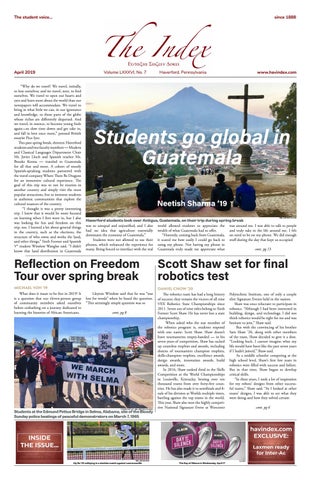
Students go global in Guatemala Neetish Sharma ‘19 MR. JAVIER LLUCH
Haverford students look over Antigua, Guatemala, on their trip during spring break was so unequal and unjustified, and I also world allowed students to appreciate the was around me. I was able to talk to people had no idea that agriculture essentially wealth of what Guatemala had to offer. and truly take in the life around me. I felt dominates the economy of Guatemala.” “Honestly, coming back from Guatemala, no need to be on my phone. We did enough Students were not allowed to use their it scared me how easily I could go back to stuff during the day that kept us occupied phones, which enhanced the experience for using my phone. Not having my phone in many. Being forced to interface with the real Guatemala truly made me appreciate what cont. pg 13
Reflection on Freedom Tour over spring break
Scott Shaw set for final robotics test
MICHAEL YOH ‘19
DANIEL CHOW ‘20
What does it mean to be free in 2019? It is a question that our eleven-person group of community members asked ourselves before embarking on a journey dedicated to learning the histories of African Americans.
Lleyton Winslow said that he was “was lost for words” when he heard the question. “This seemingly simple question was so cont. pg 8
COURTESY OF MR. BRENDON JOBS
Students at the Edmund Pettus Bridge in Selma, Alabama, site of the Bloody Sunday police beatings of peaceful demonstrators on March 7, 1965
MR. JIM ROESE
Aly Ba’ 20 volleying in a doubles match against Lawrenceville
The robotics team has had a long history of success; they remain the victors of all nine VEX Robotics State Championships since 2011. Seven out of nine titles belong to Sixth Former Scott Shaw. He has never lost a state championship. When asked who the star member of the robotics program is, students respond with one name: Scott Shaw. Shaw doesn’t leave tournaments empty-handed — in his seven years of competition, Shaw has racked up countless trophies and awards, including dozens of tournament champion trophies, skills-champion trophies, excellence awards, design awards, innovation awards, build awards, and more. In 2016, Shaw ranked third in the Skills Competition at the World Championships in Louisville, Kentucky, besting over ten thousand teams from over forty-five countries. He has also made it to semifinals and finals of his division at Worlds multiple times, battling against the top teams in the world. This year, Shaw also won the highly competitive National Signature Event at Worcester
The Day of Silence is Wednesday, April 17
Polytechnic Institute, one of only a couple elite Signature Events held in the nation. Shaw was once reluctant to participate in robotics. “Although I had been interested in building, design, and technology, I did not think robotics would be right for me and was hesitant to join,” Shaw said. But with the convincing of his brother Sam Shaw ’20, along with other members of the team, Shaw decided to give it a shot. “Looking back, I cannot imagine what my life would have been like the past seven years if I hadn’t joined,” Shaw said. As a middle schooler competing at the high school level, Shaw’s first few years in robotics were filled with success and failure. But in that time, Shaw began to develop critical skills. “In these years, I took a lot of inspiration for my robots’ designs from other successful teams,” Shaw said. “As I looked at other teams’ designs, I was able to see what they were doing and how they solved certain cont. pg 6
GLSEN
Page 2
The Index’s
The Index
- Editorial
April 2019
2018-2019 Staff
Becoming global citizens Neetish Sharma ’19 Editor-in-Chief Yan Graf ’20 Managing Editor Toby Ma ’20 Managing Editor Obaida Elamin ’20 Design Editor Matthew Schwartz ’20 News Editor Vincent Scauzzo ’20 Features Editor Daniel Chow ’20 Features Editor Robert Esgro ’19 Opinions Editor Yeshwin Sankuratri ’20 Asst. Opinions Editor
F
resh off spring break, The Index is back in action with a wealth of content. We like to think students are wellversed global citizens. But truthfully, what does it mean to be a global citizen? Simply being well traveled? An expert on global politics? Getting one’s hands dirty to make a change abroad? Striving for fluency in multiple languages? All of these encompass the journey to become the global citizen, yet there’s so much more. When we travel, we travel to not only lose ourselves, but find ourselves in the process. We strive to build empathy and love for cultures other than our own. Lack of empathy creates toxic assumptions that impede progress, the same reason individuals from one background seem incompatible with those from another. With empathy, we can understand one another’s stories,
allowing us to develop constructive solutions — together. Haverford’s curriculum strives to further global understanding. From examining world literature to having critical discussions in the classroom, it’s key to understand how those around us function, because we’re going to be working with all types of people from myriad backgrounds in our professional lives. One learns to recognize patterns of institutional systems such as government, social hierarchy, and more, in order to relate across borders and work together as a global force for good. We at The Index encourage each student to push himself. Whether that means being a social impact force in your own local community to disrupting systems of power on the global level, we have faith that everyone has the potential to push past their
limits. From highlighting recent spring break experiences in “Freedom Tour Reflections” by Michael Yoh ’19 to “Sixth Former’s single-sex situation” by John Williams ’19 to “Gay-Straight Alliance emerges” by Nikhil Chakraborty ’19, we have no doubt that there will be an article to pique your interests. The Index has an exciting future in store for you. In this issue and our subsequent issues, you will find provocative opinions, interesting experiences, suggestions for change, and, of course, your traditional stream of news and analysis. Disagree with an opinion? Have a better experience or idea to share? Notice something newsworthy that we missed? We hope to see an article from you in the next issue.
Jon Krouse ’20 Off-Campus Opinions Editor Tyler Zimmer ’21 Arts Editor Augie Aliaga ’21 Arts Editor Ryan LaRocca ’20 Sports Editor Nick Chimicles ’19 Head Web Editor Lleyton Winslow ’20 Head Web Editor Noah Rubien ’20 Web Editor Aditya Sardesai ’20 Web Editor
The Index is a student-run publication of the Haverford School that does more than bring news: it provides the diverse perspectives of the Haverford student body. It is an outlet for student writers to take stands on issues they deem important. It chronicles the daily struggles and accomplishments of the Haverford community. The Index also provides a forum for discussion of pertinent issues, such as student culture, academic policy, and Haverford’s place in world affairs. The Index presents new ideas and aspires to influence constructive change. All opinions and viewpoints expressed herein do not necessarily reflect those of The Index or the school. The Index is designed and produced digitally. Photographs may be retouched. Submissions and letters to the editors regarding any and all articles are welcomed at index@haverford.org. The Index, a member of the Columbia Scholastic Press Association, is composed on Mac OS X, using Adobe InDesign CS 2018. Its surveys are conducted via SurveyMonkey and are advertised on Facebook to current Haverford students. Graphic designs are created by Index staff via Canva. Southern Dutchess News prints 200-400 copies of each issue, and its editorial staff distributes them in the Upper School on the day of release. The Index serves the needs of a total school population of 1156 community members, consisting of 956 students and 200 faculty and staff members. Contact The Index: 450 Lancaster Ave, Haverford, PA 19041 index@haverford.org Twitter: @Haverford_Index http://www.havindex.com/ (610) 642-3020 x. 1222 Volume LXXXVI, No. 7 - April 17, 2019
INDEX STAFF
The Index Editor-in-Chief Neetish Sharma ’19 (center left), Managing Editors Toby Ma ’20 (right) and Yan Graf ’20 (left), and Design Editor Obaida Elamin ‘20 (center right)
Page 3
The Index
- news
april 2019
Students, faculty will miss Mr. Chris Domboski Notables shine on international stage PHOTO BY MR. MARK HIGHTOWER
Cyril Leahy ’21 , Sam Gavula ’19, David Hurly ’19, Luke Follman ’19, and Will Vauclain ’19 (left to right ) with Baldwin students in Copenhagen Tyler Zimmer ’21
T
he Notables have been described as a “premiere upper school vocal ensemble that sings a variety of a capella music from around the world.” From local concerts to Inter-a-capella performances, the Notables outshine the pack. From modern hits to classical music to even pieces in foreign languages, the Notables can tackle challenges, and that is exactly what they did on their spring break trip to Copenhagen, Denmark. Accompanying the Notables was Baldwin’s a capella group, the B-Flats. “We performed four times officially, but there were many more times when both the Notables and the B-Flats displayed their musical talents,” Fourth Former Cyril Leahy said. Fifth Former Ben Hokenson added that they “performed for students at the Ordrup Gymnasium and for people who lived near the churches.” Whether it was an official performance or an impromptu one, such as starting a flash mob in the middle of Copenhagen or singing in a kebab shop, the Notables had the experience to face the challenge. A critical element to the Notables’ ability to adapt to new music and venue are the adjustments each singer can make. Each member could stun the crowd with a solo, but each also has the skill set to perform alongside their peers. Whether at home or abroad, the Notables
“kept much of their routine the same. They kept performances loose, their antics classy, and our tuning on point,” Leahy said. The culmination of the trip the performance at Frederiksborg Castle, a large complex built for the king of Denmark-Norway in the Renaissance. They performed in the church wing of the castle. Not only was it their largest venue, but they also had arguably the best performance. “The audience always loved our group,” Hokenson said. “It is really cool to hear their synchronized clapping, which is a staple of Danish audiences. It is always a lot of fun performing outside of the United States.” The trip was not performance after performance, rather a mixture of the serious and the fun. The Notables were hosted by families who showed them the sights and places to eat. Leahy had the opportunity to explore Copenhagen with his host, taking “boat rides through the canals of the city and even venturing outside of it.” Depending on the host, some Notables traveled along the coast and visited the North Sea. Hokenson said, “We always had adventurous days planned out. We toured different castles and explored different cities. My favorite moments include exploring Copenhagen during the day and then going on to swim in the North Sea at night.”
Mr. Domboski setting up the wrestling pavilion for an event
LUKE KANIA ’19
Luke Kania ’19
T
hursday, March 14, was a sad day for Haverford. It was the last workday for Mr. Chris Domboski. Over the past five years, Mr. Domboski has earned the respect and friendship of many in the community. Most students simply knew him as “Chris.” Mr. Domboski was responsible for setting up and organizing all campus spaces for events taking place during and after school hours. Many felt that he always went above and beyond what he was asked to do. “For me specifically, in the library, he has been really really helpful,” Director of Information Services Ms. Lisa Snyder said. “When chairs get moved around in [the library] all day long, at the end of the day he would come in here and put all the chairs back where they belonged, and that was very helpful.” Ms. Snyder noted Mr. Domboski’s professionalism. “The thing that he is really good at is seeing how to arrange things so it made sense. That way, people can use the space well and enjoy the space better,” Ms. Snyder said. While the skills of Mr. Domboski were
of high value, most will miss his engaging personality. From playing ping pong with students during his breaks to simply having a conversation, he is always trying to put a smile on as many faces as possible. “He always talks to the students,” said Sixth Former Dan Whaley. “Whether it’s casual talk or giving advice, he is always there for somebody.” Mr. Domboski is sad to be leaving the community. “From the talent shows that were hilarious to all the speaker series that I’ve been able to catch glimpses of. When my appreciation award three years ago was handed to me by Mr. Green, that was a big [moment] for me. As well as being in The Index once already, and for [the students] not just calling me by my last name like I’m a professional, but calling me by my first name like I’m one of you, that’s a big thing.” Mr. Domboski will be working for an IT company in Wayne, where he will be in charge of office space, calendar management, and coordination with their staff. “I will be back for graduation this year and for visits down the road,” Mr. Domboski said.
Graduation projects open doors on the way out robert esgro ’19
A
n experiment seeking to achieve global sustainability starting in Villanova. A mural on the wall at the outdoor basketball court. Learning how to change tires, starting a fire in the wilderness, and cooking a meal. In March, Sixth Formers choose a project to tackle during the last three weeks of their high school careers. These projects can consist of anything: a student’s field of interest, an internship at a local company, or a class offered by the Haverford School. Sixth Formers must submit a proposal to the Graduation Project Committee for approval. This May, Sixth Former Michael Yoh will work with the Sustainability Department at Villanova University to conduct experiments to search for methods to reduce the amount of waste that the campus produces. “I’m very interested in the environment and what we can do to help reduce our impact on it,” Yoh said. “I hope to learn from the results we achieve and possibly apply what we discover to Haverford.” Among the Class of 2019, about 80% will engage in projects of their own. However, an often overlooked aspect of the graduation
project experience is a class that Haverford offers called, “25 Things Any Man Should Know.” “I don’t have any good connections that give me easy access to any internships like a lot of other people have,” Sixth Former Ethan Crowther said. “So instead of going through the whole process of trying to find an internship with a random company, I decided to do the class.” “It’s going to be the last chance to hang out with some friends at Haverford,” said Crowther. “I already know that some of my friends are doing it, and there will probably be more joining as their senior projects don’t flesh out. I think that the class is going to be a fun way to wrap up my Haverford career with some friends.” Sixth Former Dan Calvelli will participate in the “25 Things” class because he wants to pick up some of the skills that the instructors of the class taught. “It will have a lot of practical effect on my life in the near future since I’m going to college,” said Calvelli. “I also chose it because of the wide range of skills and experiences it offers, and I hope to learn things that will
SAM TURNER ‘18
A slide from Sam Turner ’18’s graduation project help me in my transition to a more indepen- be on their own,” Corradetti said. “We have to decide on our own project, internship, dent life.” etc. and figure out ways to make it work, get Sixth Former Vincent Corradetti agrees. “I hope to see what it’s like to do something it accepted, and actually doing it. All this is completely out of my comfort zone and see being done by ourselves, so it’s a bridge to start that individuality before college.” how it goes,” Corradetti said. Graduation projects will take place from “I think the goal of the senior projects is to give the seniors a taste of what it’s like to May 14 to June 6.
Page 4
The Index
- Features
April 2019
An inside look on athletic recruitment Agustin Aliaga ’21
C
oming off of a championship basketball season and several Inter-Ac titles, a question arises: Do high schools recruit players to improve their sports teams? Most would respond “certainly.” With the number of star athletes that Haverford attracts, it is easy to look from the outside in and say that athletic recruitment is a truth of all independent schools. Some athletically renowned schools may lower academic standards or other common application factors for a recruit’s athletic prowess. Regardless of other schools and universities, however, Haverford may set a higher standard of admission, yet it still thrives in the independent-school athletic world. Several successful athletes spoke about their admissions process. Results were surprisingly consistent. Haverford’s recruitment efforts come from both its reputation and connections outside of the independent school community. This means that Haverford often attracts star athletes because of the balance between stellar academics and high performing sports teams. Inter-Ac Basketball Player of the Year Sixth Former Christian Ray said, “I only know that my AAU coaches came to me saying that Haverford was interested in me… my recruitment was really driven by my AAU director and AAU coach.” Ray further explained that his recruitment process was largely driven by advice from his coaches in that Haverford was really his best option. It was a similar experience for a soccer team recruit who asked to remain anonymous. He said, “A former club coach of mine
had asked me to check out the school for a few years.” Aside from external connections, Haverford simply attracts a variety of talents because of its reputation, academics, and athletics. While many of these student-athletes say that they were brought to Haverford by their coaches, they stayed because of Haverford’s environment. Fifth Former Pat Toal said, “I considered coming to Haverford the day I stepped on campus. No one did or had to do any convincing for me to choose to come to Haverford.” Ray said, “I don’t think that Haverford has to sell the image that hard.” In fact, looking past athletic success and campus feel, many recruits look for the academic opportunities of the school as well. “I think that the school recruits for itself with how good it is academically,” Ray said. “I think the reputation at Haverford and the people who are associated with Haverford create an environment that sells itself.” “I’d say all of our top athletes come to Haverford because of the opportunity you get in the classroom and on the field. Haverford succeeds in all ways,” said Toal. Athletic Director Mr. Michael Murphy agreed, saying, “I think it is a combination of avenues. The reputation of the school attracts some students. Club or youth coaches who know of the school may direct some to look at Haverford.” While many sources have confirmed that Haverford is quite distant from the skepticisms of heavy high school recruitment processes, many still see not only Haverford, but the Inter-Ac, and even the independent
schools, as a heavy recruiting area—and this is not entirely false. The soccer athlete explained that his recruitment process became very competitive after he got accepted into Haverford. He says that, after his Haverford acceptance, he received consistent calls from another school, both accepting him and even urging him to attend the school. Haverford keeps itself to a high standard, which can often go far past what the public eye can see. Haverford obviously wants to bring the best of the best to learn and compete at Haverford. Mr. Murphy explained his idea of recruitment, saying, “Every student is recruited to The Haverford School.” He said that while coaches do seek talented athletes, they are not over-incentivized to attend nor favored in the admissions process. In fact, recruiting is at times not even necessary considering the amount of talented coaches focused on long-term athletic development. Mr. Murphy said, “I think that the one misconception is that our success is solely based on recruiting. Many of our best athletes have been at Haverford long term, and I believe our coaches do a great job of developing our programs and maximizing the talents of all of the members of the program.” While competitive athletics can often tempt a more-intense recruitment system, Haverford remains undistracted in its number-one goal of educating young minds while providing them with the best opportunities in every field of academics or athletics.
13th Amendment regarding the slavery of charged criminals was something that multiple students were unaware of and shocked to hear of its significance in developing black codes, Jim Crow laws, and systemic racism. “I knew nothing about the convict leasing system, and I didn’t know about the additional lines in the 13th Amendment. That was something new and interesting to me,” Third Former Sam Kohl said. Some younger students felt that the community had been exposed to too many talks about racism. “Everyone has become numb to the topic after so many talks on the same issues,” Kohl said. “I think the next step should be actual involvement.” Another point of debate was Dr. Dunbar’s tone; some members of the community felt as though her presentation was too quiet to have as great of an impact as previous talks. Sixth Former Jackson Overton-Clark wondered if some students were disengaged because they were unprepared and uncomfortable with the subject. This point of view was shared by other members of the community, particularly older students. “Some people have said that she was a little soft spoken and wasn’t as engaging as other speakers, and to an extent, I agree with that,” said Overton-Clark. “I paid attention to her and paid attention to the reactions of my peers, and I could see that some people were zoning out or not engaged. “I definitely like how she bridged the
events from slavery to convict leasing,” Overton-Clark said. “To me, that seems like a clear string of events, but when presented to this community, I think it would have been more helpful if she made it even more relevant to us. And I mean, not every speaker should have to do that, and maybe that’s a fault in our community, but I think if she would have continued to 2019, it would interesting to see how people would react.” Many feel that the school is far from having enough talks on racism and that too many members are still unaware of the history of slavery, segregation, and racial injustice. Ms. Turlish said, “The last few years have been kind of tough for [the community], and I think we just need to continue. . . and work together with students to talk trying to figure out different feelings and reach some
DR. MIKE NANCE
Basketball phenom Christian Ray ’19
Dr. Erica Armstrong Dunbar delivers powerful Parker Lecture Jeffrey Yang ‘22
D
r. Erica Armstrong Dunbar’s speech marked the 29th annual Davis R. Parker Memorial History Lecture. Her presentation on racial injustice in America galvanized a new round of reactions from the Haverford community. When sensitive topics such as racism are exposed, discord and debate often spread. Reactions to Dr. Dunbar’s lecture were generally positive. Several members of the community found that her use of historical evidence, laws, and specific narratives linking to systemic racism was a unique approach to the subject. History Department Chair Ms. Hannah Turlish commented that her biggest takeaway was Dr. Dunbar’s ability to present the information with clarity and support. “One of the things I’m going to strive to do as a teacher is how she was able to calmly just stick with the factual evidence to explain what some people do not believe to be true. The way she was able to calmly lay [systemic racism] out with the historical arc was very effective.” Others also remarked that Dr. Dunbar’s historical evidence avoided condemning anyone. “She presented in a way that was very understandable and not trying to slam anybody,” Third Former Chase Herz said. Students who were previously unaware of these accounts commented that Dr. Dunbar’s stories and evidence were effective. Dr. Dunbar’s elaboration on the exception in the
common dialogue. I like the direction we are going even though sometimes it’s at a slow pace.” Some older students have commented that these talks are vital in building a community that first understands the issues before actual changes and movements can effectively take place. “I know that some people, when they hear about racism, are quick to say ‘Let’s find a solution, let’s find a solution,’ but it’s really not that easy,” Overton-Clark said. “I think the first part is letting people realize that it actually is a problem. “It’s the recognition that there is something wrong. Before we even get in the right direction, the community needs to realize that this is actually a problem.”
Dr. Dunbar delivering her lecture at Centennial Hall
MS. SARAH GARLING
Page 5
The Index
- Features
April 2019
Li and Witmer take on Ecuadorian students US biology competition enjoy change of pace Yeshwin Sankuratri ’20
C
arving through the February chill and wintry crisp, Fourth Former Paul Li and Third Former Charles Witmer set out to blow the competition away at the United States of America Biology Olympiad (USABO). To Witmer, biology has always been an area of great passion, and he especially “enjoy[s] learning about how organisms function at the most basic level through understanding the functions of the myriad molecules and cells of the body.” Having not been through the rigor of Haverford’s biology curriculum, Witmer’s mother, a biology teacher, made sure to foster his enthusiasm. Biology crackles through his veins, and so, it was hardly a decision for Witmer when he heard of the nationwide competition. The USABO test consists of fifty questions, and contestants are given fifty minutes to provide their best answers. After he and Li pushed through hours of grueling practice sessions, they finally felt ready to meet the competition head on. Ul-
timately, Witmer got 22 questions correct. Although disappointed, he was just three correct answers short of the cutoff for a place in the semifinals. Afterward Witmer said, “The test was more difficult than I had expected,” but he was still “encouraged by my performance and looking forward to improving upon his results.” As the remaining contestants move forward, a two-hour semifinal test awaits them. Two hundred of those contestants will advance to the national final, where four would be chosen to compete in the international event. Witmer and Li hope that the experience they gained this year will prove fruitful next year. Witmer hopes that more of his peers become more inclined to participate in the competition next year. In the end, Witmer believes that “the better the preparation, the more likely their knowledge in biology would provide a good platform for research opportunities.”
Paul Li ‘21 (left) and Charles Witmer ‘22 (right)
INDEX STAFF
MR. ANDREW POOLMAN
The exchange students and Fourth Former Liam Harkins climbing a tree Ryan Rodack ’22
E
very April, some students have the opportunity to host an exchange student from Colegio Americano in Guayaquil, Ecuador. This annual exchange program, done in collaboration with the Agnes Irwin School, was established in 2016. Students from Ecuador live with host families from Haverford and Agnes Irwin and participate in classes. In August, a handful of Haverford and Agnes Irwin students will travel to Ecuador and live with an Ecuadorian host family while also participating in bilingual classes. On April 1, Mateo, Juan, Cesar, Adrian, Iker, and Leonardo, who are students at Colegio Americano in Ecuador, prepared to travel to Philadelphia. All of them felt a variety of emotions on, for many of them, their first trip to the United States. Although most students were excited when they first left Ecuador, Leonardo felt differently: “When I was in the airport at Guayaquil, I felt very nervous to meet my host, but when I arrived here in Philadelphia, I was excited.” After a few days of getting to know the school, all of the students came to the same conclusion regarding their favorite feature of the school: the woodworking class. Juan also enjoyed the free periods. “You have a lot of free periods here, so you have a lot of free time to do homework,” Juan said. “We do not have that kind of time in Ecuador. We have all of our classes in a row.”
Outside of participating in classes at school, the exchange students learned about many different communities and studied different cultures in the Greater Philadelphia Area. “We went to Lancaster to visit the Amish people, so we went to a farm to observe their lifestyle. We also ate the food there, which was amazing,” Cesar said. The students also toured Philadelphia and saw places such as the Philadelphia Museum of Art, the Rocky steps, the Liberty Bell, and Reading Terminal Market. Although the exchange students speak English well, Adrian finds it difficult to communicate at times. “It’s usually not that hard to communicate, but we would like to know more words to express ourselves better. Sometimes it is kind of hard to understand some people because they speak really fast or use some slang words that we do not know,” he said. Iker said, “I think that the exchange program should last longer. There are too many places to see with not enough time to see them.” “If we stay more time, we can be part of the class and not just ‘be there,’” Leonardo said. Leonardo had many great experiences on his two-week visit to the Haverford School, but if there was one thing to culminate his experience, it was that “the students, teachers, and families here are so kind and friendly.”
Sixth Formers’ single-sex situation John Williams ’19
M
ost Victorian-era principles don’t work with our 21st-century lifestyle. Colonialism? No longer. Indentured servitude? No. Steamboats? Inefficient. Gender exclusion? Okay? The single-sex nature of our school has been under scrutiny for some time. Some criticize the institution for leaving out the female student perspective, while others champion the academic orientation that a single-sex environment encourages. Whether the student body likes it or not, the halls of the Upper School will continue to brim with adolescent males. But as the Class of 2019 prepares to wrap up its experience in an all-boys environment, they now prepare for the dive into the coeducational college sphere. “It will probably be pretty difficult, but I’ll get used to it,” Sixth Former Winslow Wanglee said. Entering Haverford in fifth grade, Wanglee has never known an immersive educational environment with women. “There’s prom, and Paoli Parties in middle school, but besides that, Haverford doesn’t encourage boys to interact with girls.” And he is not alone. Sixth Former Henry Sun said, “I think Haverford needs to improve on activities or
projects in which boys and girls can work together.” Because of his schooling in China, Sun experienced academics with women. “When I went to summer camp, I did work with them on an academic level. I did in China as well.” The majority of the sister-school engagements Haverford encourages fall under the categories of service, social events, the arts, and travel. “I think Haverford gives a lot of opportunities to the student, especially charity events and school trips such as the Danish exchange trip,” said Sixth Former Nick Parente. “Like every school, we have proms, formals, and we used to have the can-dance, but there wasn’t enough interest.” History department chair Ms. Hannah Turlish notes the lack of academic interactions between the sexes. “It’s pretty hard for a single-sex school to really get you prepared to interact with women in an academic environment,” Ms. Turlish said. “Bringing students who are comfortable with an all-male atmosphere to that environment [can create] a lot of problems.” Many members of the Haverford school community view a single-sex education as separationist.
“It’s hard to imagine working with girls on projects,” Wanglee said. “In my mind, I tend to think of guys as people with whom to do work, but it’s going to be a problem in life because that isn’t the case.” In a twenty-first-century world, women are gaining power in the workforce. Men and women work side by side in virtually every professional career path. According to the article “Female Labor Supply” from Our World in Data, in 1890, six years after the founding of our school, 18.6% of women were economically active. In 2017, women comprise 45% of the labor force. “I think it’s common knowledge in this age that women are always going to be in positions of power, such as those in C-level
positions and the workforce,” Parente said. “You’re going to have to work with women your whole life. I feel like some kids at Haverford may have a stigma that it is difficult to get over women being in the workforce.” Ms. Turlish “plants the seed” of gender equality, hoping that it will influence her students later in life. She said, “Graduates that are seniors in college now emailed me and would say ‘I saw The Index article you wrote, and it really resonated with me because at the time when I was at school, I didn’t really understand what it must be like for you there or what it is like for any of the women there. Now I can really see and appreciate all those things you were trying to teach us.’”
A typical Friday afternoon scene at an all-boys school
INDEX STAFF
Page 6
The Index
- Features
April 2019
Day of Silence to be held on April 17 Quinn Luong ’22
H
averford’s Day of Silence is celebrated on April 17, a day of action to spread awareness about the effects of the bullying and harassment of lesbian, gay, bisexual, transgender, queer, and questioning students. Students nationwide take a day-long vow of silence to symbolically represent the silencing of LGBTQIA+ students. Haverford has become an active participant of the Gay, Lesbian & Straight Education Network’s Day of Silence, in which studentleaders from the GSA, the Gay-Straight Alliance, have come together to communicate and plan Haverford’s Day of Silence. “The Day of Silence is important to me because it is a symbolic representation of how LGBTQ people around the world feel silenced every day,” GSA co-founder Sixth Former Michael Yoh said. “At the moment, the GSA is doing a lot of planning to educate the school community about the Day of Silence. Eventually, we want to inform students about the power their words may have on their peers.” The GSA leadership team planned throughout several meetings to allow Dr. Philip McAdoo, an LGBTQIA+ activist and author, to present a reflection to the Upper
School about his novel, Independent Queers. Dr. McAdoo’s emotional and touching novel reveals an unfiltered, clear look at the everyday lives of LGBTQIA+ educators working in independent schools. Dr. McAdoo plans to talk about “the Joy and Danger Paradox of Silence.” Dr. McAdoo discusses the importance of Gay-Straight Alliances in independent schools, like Haverford, and their impact. “To have these types of conversations, it all matters. And I think we can do, in terms of your day to day, is to really take the time to support one another,” Dr. McAdoo said. “The one piece that we miss is that we don’t have to understand each other, you don’t even have to agree, but just acknowledge someone’s journey is their journey. Those things that you don’t look to expect are their own spaces and their own shared and lived experiences.” Haverford’s GSA is giving out bracelets and pins to commemorate the Day of Silence and to indicate participants. After the end of the school day, students who participated will join in a “party” to break the silence in Mr. Jobs’ room, Wilson 241. Students who participate will also write on speaking cards,
Day of Silence pins which explain the reason for their silence. The GSA will arrange these cards into the gay pride flag. Haverford’s Day of Silence is essential in order to promote awareness and
GLSEN
activism among the community and LGBTQIA+ students.
The emergence of the Gay-Straight Alliance Nikhil Chakraborty ’19
T
he Gay-Straight Alliance (GSA) had its first meeting on February 19, 2019. There was a bit of nervous tension, as people entered a space that had never existed at Haverford. A mix of participants filled the room; not only was the entire Haverford Diversity Alliance leadership team there, leaders from Agnes Irwin and Baldwin filtered in, as well as several faculty and students who were interested to take part in the conversation. Director of Diversity and Inclusion and faculty advisor Mr. Brendon Jobs soon introduced the centerpiece of the discussion, a book called Independent Queers, written by Dr. Philip McAdoo. Independent Queers is a collection of short stories shared by queer educators, focusing on their experiences growing up and living in a world that never quite understood them. Lively discussion ensued about each of the stories. Openly gay members of Haverford were able to link their own experiences to these accounts, and everyone was able to learn more about the strong, growing queer community. It was a truly exciting space, and it got people talking about topics that normally go under the radar. Since their inaugural event, the GSA has been meeting every other week. Founding members Michael Yoh ’19, Connor Wood ’20, and Nick Brill-Edwards ’19 all played important roles in the creation of this organization. “I’d actually been thinking about the idea since my sophomore year, when I attended the national Student Diversity Leadership Conference,” said Michael Yoh ’19. “I was part of the LGBTQ+ discussion group, and it really was a special space. LGBTQ+ mem-
Day of Silence Assembly on April 15
bers and allies could talk about issues facing the community. And I realized, we needed a space like that at Haverford.” A couple years ago, Diversity Alliance handled almost all the different inclusion events. However, as organizations like Black Student Union (BSU) and Haverford Pan Asian Association (HPAA) began forming their own spaces within Diversity Alliance, Yoh figured it was the right time to form the GSA. “Many other schools I saw already had these sorts of affinity groups, and I wanted to make sure we formed the same environment in Haverford,” said Yoh. People have also said that the GSA provides a space where people can find connections in ways they normally can’t. “Sexuality can be such an invisible part of our identities, and I think the GSA allows people to make those non-traditional connections based on how they identify,” Mr. Jobs said. “Haverford has had a history of silence concerning queer identity, and I think this will change because of the GSA.” Mr. Jobs has connected Haverford’s GSA with some of the world’s leading representatives of the queer community, including Dr. Philip McAdoo, who will be speaking at Haverford’s Day of Silence assembly this year, and Ernest Owens, who spoke at the same assembly last year. “I think GSA, in part, has grown out of strengthening Day of Silence and making it into something truly memorable,” Mr. Jobs said. “The boys that revamped that program last year are the same ones that have formed the GSA.”
INDEX STAFF
Scott Shaw ’19 at work in the robotics lab, Friday, April 12
YAN GRAF ’20
Shaw, continued from the front page... problems. This allowed me to understand many concepts and techniques that I later applied when being more independent with my design.” Now, after many years of progression, Shaw can now say that he is independently “able to successfully build and design a full competition robot that can compete at a high level.” His recent designs have served as a testament. But Shaw’s journey has been far from independent. “Some of what I have learned has been a result of the competition itself, but most of what I have learned has come from the many great people involved with the program – both teammates and mentors,” Shaw said. Previous and current mentors Chuck Glick, Dan Troy, and Eli Canavati, as well as his brother Sam, have been pivotal and greatly influential in more than one facet of Shaw’s life. “They are responsible for my continued passion and drive for both robotics and the team itself,” Shaw said. “My mentors not only developed my skills in robotics but also transformed my character and prepared me for my future. My brother has been a continued source of inspiration and role model
in my life, and I have no doubt that he has been integral to my passion and success in robotics.” Shaw often shows up with unique and complex designs that add to the strength of his robots. In addition, Shaw’s “build quality” is undeniably the best. It is a common sentiment held in the robotics shop that
Shaw says the key is simply “practice and experience.” whatever Scott builds is always the most mechanically efficient and structurally clean. In terms of his exceptional driving prowess, Shaw says the key is simply “practice and experience.” This year will be Shaw’s last year competing in high school robotics, and he is hoping to return to the World Championship and perform better than ever before, especially since this season holds so much promise for the team. “In terms of the process of designing and improving our robot, this year has been unlike any other for me,” Shaw said. “This is the first year that I have not rebuilt the robot throughout the season in order to change designs. This year, our team was able to find
Page 7
The Index
- Features
April 2019
Shaw, continued from the previous page... a successful design early in the season and slowly work iteration by iteration on improving it.” With the regular season so successful for the team as a whole, Shaw hopes to carry on the success to Worlds. In the future, Shaw “definitely want[s] to stay involved in robotics in some capacity.” Although uncertain about what he will study in college, Shaw knows he wants to study something related to robotics. With so many new and innovative technologies creating opportunities in the field at the mo-
ment, Shaw is excited to see where the future takes him. “Joining the robotics program has done so much more for me than serve as something to do after school,” Shaw said. “My experience in robotics has been anything but what I thought it would be when I initially joined the team. It has taught me about dedication, commitment, success, failure, teamwork, and passion, and has resulted in me becoming a more driven and passionate person.” Scott Shaw ’19
INDEX STAFF
Page 8
The Index
- Features
April 2019
Freedom Tour reflections Continued from the front page...
Tyler McDonald ‘19 pauses to reflect at the National Memorial for Peace and Justice in Montgomery, Alabama difficult and complex that I could find no their own ancestors. been representing the school, I would have answer, but now that I’ve gone on the tour, It wasn’t just what was on display at confronted them.” and experienced Alabama, I have more the museum that affected us. While in the The statement “make America great thoughts about this question.” museum, we encountered a large number again” provokes many Americans. When We went through two states and five cities of white teenagers wearing red MAGA hats. asking wearers of MAGA hats “when was on a journey to try and answer this question. Obviously, people just don’t go to a museum America previously great,” you are going to This journey was called Freedom Tour, a dedicated to African Americans in MAGA hear times in American history where people five-day trip over Spring Break. We started hats without having some message to send, were systematically oppressed even more by heading to Washington D.C. and visiting and this fired up our whole group. Sixth than they are today. The subtle message that the National Museum of African American Former Anthony Hands said that seeing America has been getting worse as it gets History and Culture on the National Mall. this was the “hardest part” of the whole more equitable to people of color is one that We then spent four days in Alabama, visiting trip. He said that “seeing a bunch of people aggravates many. locations that played essential roles in the wearing MAGA hats [felt] like a complete The next day we traveled to Montgomery, journey that Black Americans are currently mockery. I was really angry and had I not Alabama. By the river was a timeline of taking on to be free and equal citizens. The trip started at 30th Street Station at 6:30 a.m. Though our tired bodies trudged towards the platform, we were all excited for the journey. In D.C., the National Mall is flanked by the U.S. Capitol, the White House, and many of the Smithsonian Museums. Just three years ago, another
COURTESY OF MR. BRENDON JOBS
Alabama’s history. This timeline, spanning hundreds of years, barely mentioned the Civil War and made no mention of slavery. Alabama schools do not teach about slavery or the Civil War in the same way that schools farther North do. Slavery is described almost as if it was indentured servitude and that the Civil War was fought almost entirely over “states rights.” What greeted us next in downtown Montgomery was the Equal Justice Initiative’s National Memorial for Peace and Justice, dedicated to remembering the thousands lynched from 1877-1950. Representing
A museum such as this can make visitors feel numb about their history until they find something that connects them to what they see and know. Smithsonian Museum opened in this historic epicenter. The National Museum of African American History and Culture is the only national museum dedicated exclusively to the documentation of African American life, history, and culture. Within sight of the museum is a monument dedicated in honor of a man who enslaved the ancestors of African Americans. The museum’s location in itself is a powerful statement, one of intent. It shouts: “we’re here!” A museum such as this can make visitors feel numb about their history until they find something that connects them to what they see and know. This parallels how many white people feel a disconnect with the actions of
COURTESY OF MR. BRENDON JOBS
“Nkyinkyim” by Kwame Akoto-Bamfo at the National Memorial for Peace and Justice in Montgomery, Alabama
Page 9 these people are hundreds of hanging steel blocks. “I will probably remember the lynching memorial and how I felt about it. I was angry, yet my anger did not matter. My emotional connection to my ancestors would not and could not make a difference, leaving me with cold facts that freeze over the ocean of flames that was my anger, and all I’m left to do is accept and reflect on how times have changed and what is necessary to keep them changing,” Sixth Former Junius Jones said. But we did not have much time to do that before we moved on to our next location. The following day we drove from Montgomery to Selma, Alabama. Selma was the location of the murder of Jimmie Lee Jackson, an African American activist who was killed by a white Alabama State trooper during a peaceful voting rights march. In Selma, we also visited the Live Oak Cemetery. In this impoverished, majorityblack city, the most well-kept place we saw was this cemetery in the center of town, dedicated as the final resting place of Confederate soldiers and KKK members. In the first second off the bus, I saw more Confederate flags than I had seen in my life. Giant ones, tiny ones, ones placed by the enormous statue of Jefferson Davis in the center of the cemetery; these flags were everywhere. They adorned every gravestone, every flagpole, every monument. This was the Alabama many of us had expected to see, but the sheer volume of flags led to a sense of discomfort. We dealt with this discomfort by laughing at the funny epitaphs of dead Confederates (such as “untutored genius”) and pretending to stomp on some of the smaller Confederate flags sticking up out of the ground. Our next stop was Moton Field in Tuskegee, Alabama, home of the Tuskegee Airman National Historic Site. Moton Field was constructed as a training base for Air Force pilots, including the Tuskegee Airmen, the first African American military aviators to serve in the U.S. Armed Forces. These airmen were educated at nearby Tuskegee University, an HBCU founded by Lewis Adams and Booker T. Washington. As a white person, I felt out of place at Tuskegee. I felt as if I was intruding on a space that did not belong to me, so I could in some way relate to that experience that many people of color go through while at predominantly white institutions. Even with this experience at Tuskegee, I know that I could never truly experience that outof-place feeling. At predominantly white institutions such as our school, black people were excluded for the majority of its history. The first black student at Haverford only graduated around 50 years ago. White people at HBCU’s do not have that history, so my feeling of discomfort was created from my knowledge of these spaces intended for people of color to escape the often subtle torment they can experience at predominantly white institutions. I felt uncomfortable because I did not want to intrude on this necessary safe space, not because my people had a history of being marginalized and oppressed and excluded by these spaces. Tommy White, the only other white student on the trip, said, “I will remember how the power of eyes and eye contact can affect a person to their core. While walking around Tuskegee University as a white man, I felt as if all eyes were on me. Every time I looked at a student, he/she would be looking back at me. As a white man, I have never felt this amount of racial consciousness. At that time, I was more aware of my race than at any other time in my life. I just remember feeling as if I just wanted to fit in with everyone else, but it was out of my control. I wanted that pressure off of my shoulders, but then I began to think; this pressure is the reality of other people in society that do not align with the historic majority that I fall under. I began to feel the weight and power of human eye contact and how just
The Index
by making eye contact with a person can either bolster or belittle one’s spirit. I have never been aware of this because I have never been to any area where I felt like because of my race, I had no power. I was blind to the
“I realized that I as a black person today am still not free,” Bland said. “I would say that my people have moved from having no freedoms to having limited freedoms” power of being in a majority, but now I see that there is responsibility within my role in society.” This experience is definitely not the norm for tours in Alabama. On our last night in Alabama, we met some students who were also there on a school trip. Their experience highlights the importance of social enterprises such as More Than Tours.
- Features
These students told us that, unfortunately, their guide had led them on a tour through a plantation without mentioning slavery, and referred to slaves as indentured servants. Based on the history curricula in much of the South, which often sugarcoat or ignores hundreds of years of slavery, tours like that are going to be what most people experience while in the South. That is why More Than Tours made our trip a success. Through them, we were able to experience Alabama in a way that most people don’t. So, did we find our own answers to the question we initially asked ourselves? What does it mean to be free in 2019? We all found our own answers. Hands said, “Being free means you have the right to go anywhere, do anything, have relationships with anyone, without fear of being rejected or discriminated due to race.” “I realized that I as a black person today am still not free,” Bland said. “I would say
April 2019 that my people have moved from having no freedoms to having limited freedoms. I do not believe that the government has ever tried to support people of color. It has been more like giving your annoying little brother a part of the chocolate bar your mother brought. The chocolate represents freedom, and the tiny piece you gave away is like what the society gave to blacks. We still are trained not to show emotions, and we still are restricted and convicted by laws harshly. If we were truly free, my brothers would be able to have their school funded and their property insured better.” Sixth Former Jamaal Shaw said, “Being free is being able to discuss the past thoroughly and having a right to change the norms of society with your own ideas or opinions. In 2019, we have so many protests, so much hunger for change, and so much grief and anger because of the ideologies that people cont. pg 12
COURTESY OF MR. BRENDON JOBS
Magazine images from the Smithsonian’s National Museum of African American History & Culture
Page 10 & 11
Intel Chen’s photo journey to Iceland
Toby Ma ‘20
W INTEL CHEN ‘19
INTEL CHEN ‘19
INTEL CHEN ‘19
hile many Haverford students spent spring break catching up on lost sleep, touring colleges, or visiting relatives, Sixth Former Intel Chen was in Iceland on a photographic journey. When he was in Tibet last summer, the mountainous scenery reminded Chen of Iceland, which he had seen in pictures by other photographers. Although Chen has always wanted to travel to Iceland, he decided to go this year. “I had gotten into college and [there’s] not much going on in school,” Chen said. For his gear, Chen packed a full-size checked luggage and a forty-liter camera bag. He brought two camera bodies, four lenses, and a tripod. “It was heavy,” Chen said. “Every day I had to carry around that big bag. It’s a good workout. In Iceland, Chen traveled with a photo tour group that consisted of four other people and a guide. “We essentially traveled on… a Mercedes Sprinter, super nice for four people because I could lay down and chill while we were driving,” Chen said. Chen’s fellow travelers were much older. “Two of them are like seventy-plus,” Chen
The In
ndex
- Arts
April 2019
said.
The age gap did not stop Chen from making conversation with them. “We engaged in very deep philosophical and intellectual questions every night,” Chen said. “We would talk two hours after dinner. [It was] super fun; not enough sleep certainly, but it was good.” Chen went to visit many of Iceland’s natural locations, such as the Golden Circle, Glacier Lagoon, Diamond Beach, and Black Sand Beach. At Black Sand Beach, there are many occurrences of sneaker waves — a type of abnormally large wave — caused by a hidden current and an elevation drop in the water. These waves are often dangerous because they can strike the shore without warning and catch unsuspecting people by surprise. “Once you get caught by the waves, you’re gone,” Chen said. “It’s usually just stupid tourists who don’t know how to keep a safe distance from the wave.” “I thought I wasn’t stupid until I almost got caught by the waves. I was literally two seconds away from losing all my gear because I put my backpack down… then the wave came, and I got to grab it real quick. I got caught by the wave a little bit…so, I almost died. That was the first day also. I really got careful after that.” Chen’s favorite location along his trip was Diamond Beach. “I’ve seen glaciers before,” Chen said, “but I have not seen pieces of ice washed up on shore on black sand. It’s challenging to shoot, but it’s fun.” However, Chen was “not impressed” by Icelandic cuisine. Although he didn’t try any especially unique dishes, such as fermented shark meat, whale meat, or fermented herring, he was disappointed by the regional fare. Chen said, “There’s also no good sushi place in Iceland, so I was very sad.”
INTEL CHEN ‘19
INTEL CHEN ‘19
INTEL CHEN ‘19
The Index
Page 12
Freedom, continued from page 9 hold on to. If they can accept the fact that there is a need for change that can only be solved if everyone understands others’ perspectives, then I feel like everyone in this world can be free. In 2019, freedom breeds equality.” In my opinion, true freedom is having the ability to live a productive life in society. In order to live such a life, people need equal treatment in education, employment, the judicial system, and in voting rights. While in 2019 people may not be seen as property by those above them, many people are not truly free. “To be free is to have the bravery to speak, to connect with people, to look others in the eye as equals and PERSIST. (‘Nevertheless, she persisted.’) Freedom means to keep going when others tell you to stop, either with subtle or overt messages,” said U.S. History* teacher Ms. Hannah Turlish. “Freedom is
to not be afraid to take your physical and spiritual self wherever you want. To put your life on the line because you chose it, not because a commanding officer made it so.” All of us left the Freedom Tour with unique answers to the question we began with. But we all shared at least one common point: In 2019, black people in American aren’t truly free. That bitter reality is what people all over the world need to acknowledge before things can change — before everyone can be free — before what our slave-owning founding fathers wrote about the equality of all peoples worldwide rings true everywhere. To help realize this goal, education is needed. The best kind of education is to engage and experience the problems that people have faced, are facing, and will face in the fight towards equity in America. Programs like the Freedom Tour give people in the Haverford community that critical
COURTESY OF MR. BRENDON JOBS
Mr. Brendon Jobs, a Birmingham artist, and tour guide Ms. Michelle Browder
A painting from the Birmingham Civil Rights Museum
- Features
education that they can give back to school. We need more people to have that education. That is why we need to send more students on this trip. We need students to become educated on these topics. Only then can we do our part in making Haverford a more inclusive community. Then we can reach out and make our surrounding community, the whole state, the whole country, the whole world an equitable place for everyone,
April 2019 regardless of a person’s race, gender, sexual orientation, ability, or all of the other unchangeable factors about us that forms society’s opinion on who we are. This is a long process, one that may not reach its conclusion in the lifetimes of anyone currently alive. But we need to do our part. We need to leave the world better than we found it. Incremental improvements lead to solving huge problems.
COURTESY OF MR. BRENDON JOBS
A photograph from the Birmingham Civil Rights Museum
COURTESY OF MR. BRENDON JOBS
Page 13
The Index
- on-campus opinions
Elite sports and the college process Yan Graf ’20
T
he recent college admissions scandal regarding many of the nation’s elite institutions has sent the collegiate world into chaos. Stories of faked SATs, the bribing of college admissions officers, and the lengths celebrities will go to in order to sneak their children into top schools have topped headlines. Yet, many seem to have glanced over one critical aspect during this entire fiasco: the role of elite sports and recruitment in the modern college process. Elite sports have long been part of established college athletics. Sports like crew, lacrosse, squash, and golf have been part of elite college athletics almost since their founding. Yet, the recruiting culture that surrounds these sports has become increasingly problematic as admissions into top schools becomes even more competitive. The simple fact is that top college sports such as crew, lacrosse, squash, and golf represent a backdoor for the wealthy, the top 1%, which includes many at Haverford. These sports are sizably represented at top elite schools such as the Ivy Leagues, and due to their exclusive nature, allow rich, primarily white students to gain exclusive access to recruiting spots at these top schools. Schools not as well funded and supported as Haverford, Malvern, or some of the wealthy public schools on the Main Line are simply not able to grant their students access to these exclusive sports. Sports like crew, where facilities can cost millions of dollars, and top boats can cost as much as eighty thousand dollars a piece, are not available to the vast majority of schools in the country. Thus, the only students competing for recruitment spots at top colleges are students from schools such as Haverford. These programs, and the special attention
April 2019
SAT scandal wake-up call Yeshwin Sankuratri ’20
they receive from top schools is why many, including Saahil Desai of The Atlantic, label them “Affirmative Action for Rich White Students.” And he is not wrong. These sports are fields where students with the necessary means are able to secure admission to exclusive top colleges, while often being held to
Schools not as well funded and supported as Haverford, Malvern, or some of the wealthy public schools on the Main Line are simply not able to grant their students access to these exclusive sports. Thus, the only students competing for recruitment spots at top colleges are students from schools such as Haverford. lower academic and extra-curricular standards than non-athlete applicants. Thus, while we as a school community and a nation continue to grapple with the conversation about Affirmative Action, it is important to realize that Haverford students are one of the few, privileged groups with access to sports such as lacrosse, crew, golf and squash, which means we are able to bypass the high-level admissions standards elite schools have.
A
s the spring warmth sets in, the climate of the upperclassmen is buzzing. One after the other, news of higher education and the next stage in the Sixth Formers’ lives intensifies the buzz. This year’s annual buzz was strengthened further with news of scandal. In March, federal indictments regarding an SAT and college admissions scandal spread throughout the global news outlets. The world was exposed to stories of how celebrities and the wealthy bought their way through the SAT’s and ACT’s and into elite, branded colleges and universities. A widely-cast, twenty-five-million dollar networked scam all led to one man: 58-yearold businessman William Rick Singer. No work. No effort. But admission nonetheless. The buzz of the Haverford community turned suspecting and confused. Whispers filled the halls and the minds of Haverford’s senior classmen: “Is money all that it takes?” “Does all the hard work I put in mean nothing?” “Is standardized testing worth it?” For many, the myth remains that standardized testing equals college admissions and success. That’s why it wasn’t surprising to find out about such a malicious scheme. These families, like most families, were caught up in their children’s future. But, unlike the average family, they reached their hopes through a financial hoax. And so, as we witness the world traversing along the murky line of just versus unjust, let us all rejoice in the fact that we all walk together, however tough it may be, Haverford brothers in arms, along the right side of the line.
But are we really supposed to rejoice in what should be expected of an honest human being? In self-satisfaction? The point here is greater than this cheating scam itself and in what is just or unjust, for the fact remains that wealthier families have more access to the best resources in test-prep centers, standardized testing tutors, athletic coaches, and more. The playing field is not level. So, in this bleak reality, let us dive into the essential question many students righteously whispered through these halls: “Is standardized testing worth it? Is it worth the stress and anxiety that millions of students and parents bear? Simply put, the answer is no. For students with access to the best resources, the SAT and ACT tests have become so coachable that students are often guaranteed an improvement of nearly two-hundred SAT points or four ACT points. And those without access to similar resources are left with a significant disadvantage. Clearly the path to higher education is not an equitable one. Instead, as University of Chicago’s Dean of Admissions James G. Nondorf stated, “We want students to understand the application does not define you—you define the application.” Let us measure merit through our high school transcripts, concentration of extracurricular activities, and passions. As students and honest scholars, let us turn our faces to the other side and try to view this scandal as a positive. Let us all hope that what shakes down are the many deficiencies controlling this rusty system, paving the way to a just tomorrow.
Guatemala, continued... in a positive way,” Sixth Form Spanish IV student Garrett Johnson said. Agriculture played an influential role on this eight-day expedition. Students worked with non-governmental community organizations, most notably IMAP, the Mesoamerican Permaculture Institute. Permaculture, a primary agricultural system in Guatemala, is based on cultivating many plants within one space: biodiversity is essential to maintaining the health of crops through the symbiosis of multiple plants. “I had a whole new appreciation for the role of agriculture in my life. Not necessarily where my food comes from, but the people that make my food,” Johnson said. “It’s interesting to see how people are going back to subsistence farming now that we find capitalism doesn’t work for everyone. If you’re poor but have everything you need because you grow it, you’re good. But you can be richer and have to buy everything, causing you to barely break even, which is the reality for most of the working class in
America.” Monocultures, on the other hand, are used by big industries to cultivate solely one crop from a plot of land. This practice tends to deplete the soil of its nutrients quickly. Guatemala is a country in which these two systems of monocultures and permacultures butt heads, resulting in a system where indigenous peoples and business are at odds. “Coffee is a huge export, and a lot of people are working in monocultures, which bring in the cash. I had no idea that more diversified agriculture, known as permaculture, could help out the land so much and prevent dependency on solely one crop,” Wanglee said. Next, students stayed with host families for two days. Speaking no English and only Spanish as well as some native dialects, this proved to be a refreshing challenge. Staying with locals not only allowed them to practice their Spanish on an entirely new level, but cont pg. 14
MR. ANDREW POOLMAN
A Mayan shaman blessing Jack Ballenger in a prayer room in Santiago
Page 14
The Index-
Off Campus Opinions
April 2019
Violent video games do damage Robert Esgro ’19
P
ick up as many different weapons as possible. Barricade yourself using whatever materials you can find. Survive for as long as possible, either in a group or by yourself, killing those who want to kill you. Then break out the Orange Justice dance. Since its release in mid-2017, Fortnite has swept the world as one of the most popular video games of all time. Similar games have existed for years, ranging from Space Invaders to Halo. These games have become mainstream, but their violent tendencies cannot be ignored. Scientists and economists alike point to the source of this aggression in violent video games. Studies show that playing violent video games can increase aggressive thoughts, behaviors, and feelings in both the short-term and long-term. The American
Psychological Association regards violent video games as major contributors to what they have demarcated as an “aggression epidemic” in children. Video game companies should do more to inform parents of the risks associated with playing these violent games for extended periods of time. Parents are the target of this movement since it is their income spent on these violent games, and it would be to their benefit to better understand the risks associated with buying their children these games. The longer that individuals are exposed to violent video games, the more likely they are to have aggressive behaviors, thoughts, and feelings, claims the American Psychological Association. These effects are not limited to the United States — similar studies have been conducted in both Eastern and Western
WIKIMEDIA COMMONS
The Fortnite “battle bus” at the E3 conference in 2018 countries to find similar results. Although how likely an individual was to subject others males spend more time than females playing to an unpleasant exposure to “hot sauce” or violent video games, violent video game loud noise after playing violent video games. Today, the “aggression epidemic” affects exposure can increase aggressive thoughts, children of all ages, as well as adults. It is behaviors, and feelings in both sexes. Aggressive behavior is measured by time for consumers to take the veil off violent scientists in a number of ways. Some studies video games and understand what their true looked at self-reports of hitting or pushing, purpose is: mindless killing. and some looked at peer or teacher ratings on aggressive behaviors. Other studies looked at
Disney dominating with Fox acquisition Toby Ma ’20
O
n March 20, The Walt Disney Company finalized its acquisition of 21st Century Fox, a multimedia company that includes 20th Century Fox film studio, Fox Searchlight, Fox-produced television shows, and TV networks such as FX and National Geographic. This massive acquisition of Fox properties gives Disney access to lucrative film and TV franchises, such as Avatar, Alien, The Simpsons, and Family Guy. More exciting for fans of the Marvel Cinematic Universe, Disney will also acquire the X-Men and The Fantastic Four — opening the door for characters from these properties to appear in the MCU. Disney’s acquisition also includes movies from Fox’s film library, including Titanic and Slumdog Millionaire. Already the owner of profitable assets such as Star Wars, Marvel, and Pixar, Disney’s acquisition of 21st Century Fox’s properties will make it one of the largest, most powerful media corporations in the world. Now that the two companies have merged, Disney’s hold over the entertainment and film industry grows ever stronger. But does it constitute a monopoly on the film industry? According to The Atlantic, Disney’s
acquisition of Fox will give the company control over 40% of the U.S. movie and television business. Although Universal, Paramount, Warner Bros., and Sony/ Columbia are still major film studios that produce high-grossing blockbusters every year, Disney alone already outpaces these corporations. With the release of three movies that broke one billion dollars at the box office—Incredibles 2, Black Panther, and Avengers: Infinity War (which broke two billion dollars) — Disney was the most profitable film studio, making one billion dollars over second-place. If one also includes the earnings of 20th Century Fox, a studio that has ranked consistently in the top five highestgrossing film studios for the past six years, Disney’s lead over its competitors becomes an insurmountable obstacle for the other studios. New entrants into the filmmaking business and current studios will have a much harder time competing against the Disney juggernaut. The substantial gap in yearly earnings will continue to widen between Disney and its competitors, leading to an anticompetitive market. And with this unprecedented sway
over the entertainment industry, Disney could potentially use its power to stifle new competitors, a defining characteristic of monopolies. While Disney’s newest acquisition makes it far more formidable to its competitors, it is not a monopoly in the strictest sense of the term. Common practices of historical monopolies have included the freedom for a single firm to determine the prices and quantity of the market’s products due to impunity from competition. It’s unlikely that Disney will try to limit the production of new films or distribution of movies once it has acquired Fox, as the entire movie-making business depends on maximizing ticket sales and viewers. Fewer movies would only put a greater chance of risk on each film, while a more varied lineup of films would mitigate financial failure from a box-office bomb. In addition, Disney’s monopoly of the film industry does not extend to the online streaming subscription service industry, which is likely Disney’s primary reason for buying Fox. The inclusion of Fox’s film library and newly-released movies will allow the company to gain a foothold when it enters the online industry, an industry dominated
by Netflix. Competition is high. Disney will also have to contend with Amazon Prime and Hulu as well as new entrants — Apple has recently announced that they are also launching their own entertainment service. Although the Fox acquisition will give Disney a lot of properties and titles to work with, it will have to fight its way to the top, as consumers will have many possible streaming platforms to choose from. In addition, the launch of Disney+, Disney’s new online streaming service, is not a bad thing for consumers. The platform provides a wide variety of classic and popular movies and television shows, as well as exclusive online content. Disney has already announced spin-off shows for several Marvel characters — including Loki, Scarlet Witch, and Vision — as well as shows set in the Star Wars universe. Although Disney’s acquisition of Fox seems to herald the rise of a new colossus in the entertainment industry, consumers will likely see no drastic change in their entertainment experience. Thus, the Walt Disney Company cannot be considered a monopoly, even if it commands a significant share of its industry.
Guatemala, continued from page 13... the real human connection garnered from empathizing with an entirely different culture was priceless to say the least. “I thought it was really interesting to actually stay in someone’s house and get to know them. One of my homestays worked for the agriculture company IMAP that
we partnered with, so we found out she cared a lot about the importance of land in Guatemala,” Wanglee said. “I think the language barrier did prevent us from getting into deeper conversations, but overall, it was a great way to practice my Spanish.” Lastly, students glimpsed systems of
oppression. In the midst of the Guatemalan presidential elections, the country is going through a great deal of economic turmoil. “I feel like Guatemala needs independence. Economic independence. Financial independence,” Johnson said. “If the people are not sustained first, and people
are legitimately wasting their own resources to give resources away outside of the country, then the country should first and foremost focus on giving the people what they need. When they do that, the country will heal. In an ideal world, the government would provide for them.”
Page 15
The Index
- Off-campus opinions
Trump’s election exposes historical ignorance Ben Gerber ’19
Injustice in Jussie Smollett case Jon Krouse ’21
P
resident Trump has created divisiveness in our country. Among other things, hate groups, which Trump said include “good people,” have been given a voice. Our political climate is radical and partisan. In February, the President of the United States continued his attacks on the Native American community for political gain over Senator Elizabeth Warren, a 2020 presidential candidate, whom he calls “Pocahontas.” He tweeted, “See you on the campaign TRAIL, Liz!” This capitalization of the word “TRAIL” is likely a reference to the Trail of Tears, the name for the route traveled by thousands of Native Americans, many of whom died, after the passage of the Indian Relocation Act. While there are many people who are insensitive enough to joke about the Trail of Tears, much of the president’s base does not understand the history behind his words. There will be racists, but there aren’t enough to create an entire base to win a presidential election. Trump’s Presidency has exposed a flaw in our modern American society that we were seemingly unaware of: a lack of education and an unawareness of history. A Pew poll shows that Trump was the most popular candidate amongst people without a college degree, the most popular candidate among voters “whose highest degree was a
high school diploma,” and his large margin of victory for voters with “some college or less,” especially whites. In a Carnegie Mellon University study of the president’s language, Trump scored lowest in vocabulary and second lowest in grammar. During a campaign speech, he exclaimed, “I love the poorly educated!” President Trump ran a campaign appealing to those who felt forgotten and voiceless, many of whom are less educated. He sucked them in with meaningless slogans and gave them a presidential candidate that they felt heard them. President Trump exploited our collective neglect for history to create a voter base that propelled him to the White House. This misperception of history will create problems other than our election of a pretend-patriot as president. Already, our political climate is radical and unprofessional, and we are not unified as a country. This will not change with a new president. We must increase our efforts to educate our citizens, especially children, on American history. I believe America is the greatest country in the history of the world, but we cannot hide our past and pretend that we have an unstained track record. The election of Donald Trump exposed the problem. Now, we must fix it before it results in a bigger problem than a reality-T.V. president.
Political correctness threatens free speech Sam Walker ’19
O
April 2019
ver the past decade, the freethinking culture on American college campuses has been eroded by political correctness. The idea behind political correctness (PC) comes from an empathetic place, wherein people are encouraged to avoid using outdated language or offensive stereotypes in their day to day vernacular. I get that. The application of the PC culture in America, however, diverges from these seemingly considerate origins in a way that threatens free speech and cultivates an environment where many are unjustly persecuted for voicing their opinions. Take, for example, the incident that took place at Yale University in 2015, when a professor was forced to resign after sending an email to the student body that advocated against the censorship of Halloween costumes. The professor was not supporting offensive costumes or encouraging students to wear them, she was simply saying that in an institution of higher learning such as Yale, students shouldn’t have to be babysat by the administration, and they should be able to make their own decisions regarding their personal freedom of expression. This benign email was met with death threats, incoherent shouting matches, and the eventual resignation of a worldrenowned professor, all due to the fact that freedom of speech is no longer protected on
college campuses. The professor in question, Ms. Erika Christakis, believes the danger of this situation lies in “ceding implied control over Halloween costumes to institutional forces,” according to The New York Times. Simply put, Americans do not like to be controlled, and whether that control is implicit or explicit does not matter. A common misconception about political correctness is that it is exclusively a problem for Republicans and old people. However, according to The Atlantic, of the general American populace, 80 percent said they believe that “political correctness is a problem in our country.” Specifically amongst younger Americans, 79 percent of citizens under 24 were “uncomfortable with political correctness.” These figures show that distrust of political correctness spans across many demographics in America, and it is not simply an issue of party or age. Moving forward, I hope America can return to its roots of free speech through the steady deterioration of political correctness in government, institutions of higher learning, and society at large. Not only does PC culture infringe upon our First Amendment right, but it also shelters us from diversity of thought, which is detrimental to the young minds of our country. Before we continue down this rabbit hole of political correctness and censorship, we must look in the mirror and ask ourselves, “Is this really who we are?” I hope the answer is, and always will be, a resounding “no.”
J
ussie Smollett was born in 1983 in Santa Rosa, California. With an early interest in the film industry, he appeared in The Mighty Ducks, North, and costarred with his own siblings in the sitcom On Our Own. Smollett also began a singing career and debuted an album called The Poisoned Hearts Club. As his acting career matured, he received a breakthrough role as Jamal Lyon on the television show Empire. Smollett plays a gay middle child of African-American music mogul Lucious Lyon (Terrence Howard), and his ex-con ex-wife Cookie (Taraji Henson). He has a problematic relationship with his father because Lucious doesn’t accept Jamal’s sexual orientation. Smollett’s character mirrors his identity—Smollett came out as gay in an interview with Ellen DeGeneres on her daytime talk show. Smollett became an inspiration to many gay African-American children who may have had difficulty expressing their sexuality. With Empire, one of the most popular
Smollett became an inspiration to many gay African-American children who may have had difficulty expressing their sexuality. With Empire, one of the most popular television shows, many children were able to learn and grow from watching Smollett. television shows, many children were able to learn and grow from watching Smollett. For example, he told Vanity Fair, “I received a letter from a kid that said Jamal gave him the courage to come out to his parents. It touched me deeply, and it’s an honor to help people.” All of this fame and popularity came with a price. In January of 2019, Smollett claimed that he was attacked by two men
who poured “an unknown chemical substance” on him, put a rope around his neck, made homophobic comments, and yelled the “Make America Great Again” slogan. His family then released a statement saying, “We want to be clear, this was a racial and homophobic hate crime.” Yet it was soon proven in court that this was not the case. Due to many pieces of evidence, such as how the two men who “attacked” Smollett having a relationship with
I am not sure why his charges were dropped. Like the Chicago Police, I believe that this case was handled horribly and that justice was not served.
him, one being his trainer, Smollett was indicted with sixteen felony counts and faced several years in prison. However, recently all of Smollett’s charges were dropped without the prosecutors revealing the reason behind the decision. Since most citizens in this world believe that people who commit crimes should be punished, I am not sure why his charges were dropped. Like the Chicago Police, I believe that this case was handled horribly and that justice was not served. In addition, Chicago Mayor Rahm Emanuel also called the decision to drop the charges “a whitewash of justice,” due to the grand jury’s decision to clear sixteen felony charges after seeing minimal evidence. He accused the prosecutors of treating Smollett differently from other defendants because of his fame. This case is embarrassing. For a man to escape scot-free from felony charges due to his popularity and fame is ridiculous. Without his fame, do you think that this same outcome would happen? The court systems need to change and they need to change fast.
DOMINICK D COURTESY OF WIKIMEDIA COMMONS
Jussie Smollett in 2016, who was recently cleared of all charges for allegedly orchestrating a hate crime against himself
Page 16
The Index
- Off-campus opinions
April 2019
Boeing 737 MAX is safe and ready for takeoff Grady Herbert ’22
W
hen Ethiopian Airlines flight 302 crashed just after takeoff in Nairobi, the once-lauded airplane became a threat to safety. Soon after, every Boeing 737 MAX was grounded, and in response, people questioned various systems as reports came in that Boeing rushed the plane’s production. The Boeing 737 MAX series is an updated version of the older 737 NG, which incorporates various new technologies, including the new and larger CFM LEAP engines. With these new engines, a new navigation system known as MCAS came into play. Since the engines were larger, they were moved forward to create clearance with the ground. The engines now could produce lift at a higher angle of attack. To counter this, Boeing implemented the now controversial MCAS systems to push the aircraft’s nose down automatically if the captain’s AOA sensor read that the airplane was near a critical angle of danger. The MCAS would continue this process until a safe angle of attack was reached. Even with the new technology, all 737 NG pilots are automatically certified to fly the 737 MAX and vice-versa. With the two crashes of Lion Air 610 and Ethiopian Airlines 302, many have questioned how to turn off the MCAS system. In reality, it is simple. Pilots must flip two stabilizer trim switches, which are located behind the throttles. From there, the pilots can control the stabilizer trim manually using the trim wheels situated on both sides of the pedestal. The event of an “MCAS upset,” which took place during the newsworthy crash, is much like a runaway trim scenario on any 737 model plane. To stop it, you would follow the same procedure as
shutting off the MCAS. This runaway trim situation is something all 737 pilots spend time training for in a simulator when going through the certification process. In the case of Ethiopian Airlines 302, where an MCAS upset took place, the captain’s AOA sensor produced incorrect data. While the takeoff angle of attack was standard, at around 10 to 15 degrees nose up, the captains AOA was seen at 74.5 degrees nose up. The severe pitch angle read from the captain’s AOA data in turn then activated the MCAS. Initially, the pilots did follow to the procedure, to turn the turn stabilizer trim switches to cut out. However, after failing to get the aircraft to climb, they reengaged the MCAS by flipping the two switches to “normal,” which caused the airplane to go into its final dive. Based on the information outlined in the preliminary report, the pilots should have continued to fly the airplane using manual trim. However, they decided to turn back on the automatic trim system and MCAS, which they knew was not working and had sent them into previous dives. During this time as well, the pilots had not realized that their trim after the MCAS upset was around 2.3 units, compared to their normal takeoff trim of 5.6 units. To get the aircraft to climb, the pilots would have needed to pull the control column very far back to generate lift. In essence, the AOA sensor was at fault, not the MCAS system. When examining Lion Air 610, the new AOA sensor on the airplane Lion Air was extremely faulty, causing an MCAS upset. During the previous flight, Lion Air 43, the pilots followed Boeing’s procedure to disable automatic trim, continuing the flight from Despensar
to Jakarta. However, mechanics in Jakarta only flushed the sensor, and the airplane was cleared to fly. Then the AOA sensor failed again, causing another MCAS upset. The pilots on Lion 610 during the MCAS upset did not disable the automatic trim system as protocol dictated and tried to override with manual inputs using the control column. During this MCAS upset, the pilots of Lion Air 610 did not adequately respond to the situation. The pilots should have disabled the automatic trim; however, they continued to fight against it with manual inputs. This goes against the checklists put together by Boeing, as even in the event of a runaway trim situation, the downward force from the automatic trim would always overcome the
pilots control column inputs. With the initial grounding of the 737 MAX taking place after the crash of Ethiopian Airlines 302 for safety reasons, it was acceptable to ground the airplane. However, with both preliminary reports out for the two accidents, there is not a design flaw or significant issue with the 737 MAX. The MCAS on the 737 MAX is a straightforward system that can easily be shut off and overridden if it fails. Also, the MCAS system errors can be avoided entirely by having airline maintenance maintain the AOA sensors. At this point, also after Boeing has released their software update to the 737 MAX. It has been proved again to be safe to fly.
WIKIMEDIA COMMONS
A Boeing 737 MAX 8, whose recent crashes called into question the safety of the plane
Page 17
The Index
Crew looks to key races ryan LaRocca ’20
T
he Haverford crew team stayed home during spring break, but the team experienced poor weather, impeding them from practicing on some days. Despite many cancellations, Haverford crew still participated in rigorous practices twice a day, as well as various other practices. Fifth Former Evan Brabson asserted that the team still made the most of their time during the break. “We were supposed to have two regattas, three two-a-days, and five other practices,” Brabson said. “However, one of the regattas was cancelled, and some of the practices were
also cancelled. Despite the cancellations, we had many physically demanding practices.” Despite enduring gruesome workouts and cancellations, spirits remained high. The team’s perpetual high spirits and positive nature can likely be attributed to their love of the sport. “Rowing is a generally tough sport,” Fifth Former Jack Sanfilippo said. “In some of our 2k tests that we have, you can see some of the strongest and most athletic people in the school lying down and gasping for air after just a few minutes,” Sanfilippo said.“You don’t do a sport [crew] because it’s challenging, you do a sport because it’s something
- Sports
you enjoy and something that challenges you competitively and athletically.” As a result of the team’s closeness, Haverford crew has enjoyed years of prosperity. For example, in the summer of 2017, Haverford Crew participated in the prestigious Henley Royal Regatta in England. Additionally, the team has already enjoyed success in some of the smaller regattas they have already participated in. These smaller regattas, or flicks, serve as preparation for some of the team’s more significant regattas. “Every year the crew team participates in the City Championship Regatta and the Stotesbury Cup Regatta, Those regattas are towards the end of the season, but we always participate in five flicks. In those regattas, so
Thomas Russell ‘19, Jeff Pendergast ‘19, Owen Vanderzwan ‘20, and Sebastian Bilash ‘20 on the river last spring
Tennis bounces back after early loss James Wang ’21
T
he Haverford tennis team, which has won nine consecutive Inter-Ac titles, was shut-out against Lawrenceville (0-7) in their first match of the season on April 7. At a glance, it seems as if the team received a harsh blow against a strong tennis program, but Head Coach Mr. Antonio Fink does not think the outcome of the match reflects the team’s performance. “The 0-7 loss doesn’t really reflect what happened on the courts,” Coach Fink said. Game scores only reflect who won, not how hard a player fought during the match. The team had close matches going to three sets. Many of these matches, Coach Fink thought, could have gone either way, had one or two points been won in Haverford’s favor. “Lawrenceville is always good,” Coach Fink said, “and we usually complete very close with them.” The results of the Lawrenceville match were not completely surprising to Coach Fink, the players, or the team’s fans. Last year, the Fords graduated six Sixth Formers, two of which were the team’s top singles players. Other graduates comprised some of
the top doubles teams. Unlike Haverford’s tennis team, Lawrenceville had already played several matches and adjusted to the new season. Because they had not transitioned into the new season,
the Fords lacked the proper mindset to face a team as strong as Lawrenceville.The fresh Haverford team, although knowing how to play the game, lacked a sense of where they stand. “It is good for us to play Lawrenceville first always, because they set our feet on the ground, and they tell us where we need to work on,” Coach Fink said. Since the shutout loss, Haverford tennis has exhibited resilience, notching a 6-1 victory against Hill and a 7-0 victory against Malvern.
Aly Ba’ 20 volleying in a doubles match against Lawrenceville
April 2019
far, we have done pretty well with a couple of first-place finishes in some events,” said Sanfilippo. Despite their seemingly perpetual success, the team does not elicit the same attention as some of their spring counterparts. One reason is the fact that all of its regattas are either on the Schuylkill River in Philadelphia, or somewhere even farther away from school. The team evidently has talented members. These talented members, along with the team’s entire coaching staff, look towards the team’s upcoming larger regattas such as City Championships and the Stotesbury Cup.
MR. JIM ROESE
Coach Fink anticipates that some of the younger players will emerge as top talents in subsequent years. The high school team even has its first eighth grader since Jordan Lieb, who graduated in 2013. Coach Fink said, “There are a ton of players that are finding their games and they’re finding their personalities on the court.” “Team morale, I must say, is very high,” Sixth Former Nikhil Chakraborty, the captain of the tennis team, said. “We’re united behind our goal of winning Inter-Ac.”
MR. JIM ROESE
Page 18
The Index
- Sports
April 2019
Athlete of the issue: Daiyaan Hawkins Daniel Chow ‘20
F
ifth Former Daiyaan Hawkins gained quite a reputation for his speed this winter track season, and he isn’t slowing down for the spring. Recently named the Main Line Athlete of the Week, Hawkins is one of Haverford’s finest athletes. On the national level, Hawkins placed 14th in the country in the 200-meter dash and 12th in the nation in the 60-meter dash at the New Balance Nationals in NYC. In Pennsylvania, Hawkins rocks the charts with the fastest time in the 55-meter dash (6.45 seconds) and the 60-meter dash (6.86 seconds). At the Pennsylvania indoor championships, Hawkins placed 2nd in the state in the 200 meter (21.61 seconds). During the NYRR Millrose Games, an elite invitational competition, Hawkins, along with Third Former Kevin Thomas, Fourth Former Peter Laforest, and Sixth Former Dan Whaley, finished fourth place in the 4x200 with the second-best time in Pennsylvania. In the spring, Daiyaan is running the 100-meter dash, 200-meter dash, 4x100meter relay, and 4x400-meter relay, events
that he and his teammates have some of the fastest times in the state for. There’s more to Hawkins than times and numbers, however. Behind his wide-ranging success is not only an intense drive to improve, but also a team of motivators and supporters behind him. “Coach Kolade, Coach Andrew, and outside of school, my dad, encourage me and push me to the max during all my workouts and help me become a better athlete,” Hawkins said. “My coaches and parents, along with my work ethic, I think are what makes me a successful runner. Without those things, I don’t know where I would be.” Hawkins trains five days a week and works out after practices, often running on weekends to get more training time in. Hawkins trains specifically for the type of events that he runs, currently training with the long sprinters in preparation for the upcoming 100-meter, 200-meter, and 4x400-meter relay races. Competing as a team during the winter track season has helped drive Hawkins passion for track. “The team’s chemistry is great
— the environment is energetic and everyone gets along,” Hawkins said. “I would say we’re a brotherhood. We encourage each other to do better during meets and in practice, we make everything a competition.” Hawkins said, “Relays are the most exciting to run in because you’re running with your friends, and the intensity is so high.” As a result of their camaraderie and work ethic, Hawkins said the “the team during winter track was one of the best, in my opinion, that this school has had in some years.” Although Hawkins excels in track, he states
that his passion lies with football. However, Hawkins still says he “would not mind attending a college to run track; especially with the right school and environment.” As for now, Hawkins continues to pursue his goals for the spring: shaving down his 100-meter and 200-meter times, hitting number one in the state for all his events, and for the relay team to rank first. With the Penn Relays approaching, Hawkins hopes the relay team can beat the school’s previous record time and win out against the competition.
DR. MIKE NANCE
Daiyaan Hawkins, third from left, in Inter-Ac Track Championships in 2018
Students confident in Sixers’ playoff chances Jake LaRocca ‘22
O
n Wednesday, April 10, 2019, the NBA regular season came to a close. The Philadelphia 76ers earned the three-seed in the Eastern Conference, and the team will play the Brooklyn Nets in the first round of the NBA playoffs. As the three-seed, the Sixers will have home-court advantage for Games 1, 2, 5, and 7 in the seven-game series. Students are excited to see what damage the team can make in the first round and any other rounds following. The team’s success and impending playoff series have intensified students’ zeal for the team. “I’m very excited. I definitely think that they can make the finals and compete with the Warriors, but competing with the Bucks,
Raptors, and possibly Celtics will be a challenge,” Third Former Mike Benincasa said. Although the Sixers have a much better record than the Nets, the matchup elicits frantic feelings among Haverford fans. This year, the Sixers posted a 2-2 regular season record against the Nets, despite their 31-21 record in the Eastern Conference. Additionally, Nets All-Star guard D’Angelo Russell is capable of putting up impressive numbers against talented teams. This year, Russell posted averages of 21 points per game (PPG) and 7.3 assists per game (APG) against the Sixers, while only playing an average of 27.3 minutes. Although Russell remains an obvious threat, students remain confident with the
Sixers’ ability to stop him. Third Former Ryan Rodack knows much of Russell’s capabilities. “D’Angelo Russell is an amazing pickand-roll player that uses his teammates to get open looks,” Rodack said. “The Sixers need to quickly close in on Russell to shut him down.” Fortunately for the Sixers, if they move on, they will not play the Boston Celtics in the next round. The Celtics have given the Sixers trouble for the last two years, winning tight contests in both the regular season and the playoffs. Students believe dodging Boston is a definite advantage. “Boston players have a lot of playoff experience,” Third Former Jake Adler said, “and
for some reason, their players have outstanding games against the Sixers.” Instead of Boston, the Sixers would be likely to play the Toronto Raptors in the second round of the playoffs. The big name in Toronto is Kawhi Leonard, arguably the best defender in the league. In the regular season matchups this year, Leonard locked down Sixers’ star point guard Ben Simmons, causing multiple turnovers each game. Even with the presence of Leonard, students still believe the Sixers should be able to take the Raptors out in the second round. The Sixers may have a tough road ahead of them, but Philadelphia fans remain confident with head coach Brett Brown’s game plan.
Diamond Fords improve team chemistry in Florida trip ryan LaRocca ’20
I
n a 2-1 underdog triumph against Malvern Prep on Tuesday, April 9, Fords baseball improved its Inter-Ac record to 2-0 [9-3]. This was a huge victory for the Fords, as Malvern was previously the seventh-ranked high school baseball team in Pennsylvania, according to Maxpreps.com. This victory engendered Malvern’s plummet to 32nd on the same ranking system. As a result, Fords baseball established itself as one of the top teams in the Inter-Ac. Having already defeated another Inter-Ac foe, Springside Chestnut Hill, the team became the only 2-0 team in the league with this victory. Additionally, this victory elicited a wider momentum that carried over into games later in the week. On Friday, April 12, Fords lacrosse also defeated Malvern Prep 5-4. Like Fords lacrosse, Fords baseball vanquished its Inter-Ac opponent on Friday, April 12: Episcopal Academy. In the top of the seventh inning, it was evident that the game would go down as decisive, as the Fords led 9-2. The Fords now possess an undefeated 3-0 Inter-Ac record But how did the Diamond Fords emerge as the top team in the Inter-Ac? An obvious answer might be that the team’s phenomenal pitching core. Whether it be Zak Summy, Chris Clark, Patrick Toal, or left-hander Eric Hoyt on the mound, the Fords have thrived this year on defense. In their first three In-
ter-Ac competitions, the Fords only allowed four runs. Success can be attributed to something more than its pitching staff. One can truly attribute the team’s success to the camaraderie established on their spring training trip. During spring break, Fords Baseball travelled to Orlando, Florida, to participate in a series of spring-training practices and games. Through the practices, the Fords finally adjusted to their roster. The Fords competed against high schools from the Midwest and East Coast. Fourth Former Grayson Walker highlighted the trip’s influence on establishing trust and friendships among teammates. “The spring trip helped bring our team together. The trip allowed me to connect with the older players more, as well as the younger players,” Walker said. “Overall, I think it was amazing experience that really brought the team together,” he added. Fifth Form outfielder Matt Mignucci underscored Walker’s assertion. He deemed it the main source of success. “In addition to playing a lot of good teams to help us get better, we also were able to build our team chemistry,” remarked Mignucci. “This team chemistry is a big reason for why I think we are playing so well together this season,” he added. The Fords finished with a 4-1 record on the trip, with their only loss coming in extra innings.
DR. MIKE NANCE
Calvin Costner ‘19 pitching in a 5–0 victory over Father Judge on April 13, 2019
Page 19
The Index
- Arts
April 2019
Memorable mural in the making Dan Whaley ‘19
T
he school year is slowly coming to an end, and, for Sixth Formers, graduation projects are near. Students have a number of options for their project: internships, independent studies, community studies, or “25 Things Every Man Should Know.” This year, there may be a new addition to the famous mural on the outdoor basketball courts. Sixth Formers Tyler McDonald, Thomas Ward, J.R. Leitz, and Jeffery Bozzi, hope to tackle “the wall” for their project, with art department chair Mr. Chris Fox watching over them. “I’ll offer my suggestions, answer some technical questions and help them with some design considerations,” Mr. Fox said. Mr. Fox will not physically paint on the mural but will offer advice when need be. If the mural can bring the community together, it will have been a success. “Sports generally bring the community together, so that’s what we’re hoping to do with this mural,” McDonald said.
If the mural can bring the community together, it will have been a success. “Sports generally bring the community together, so that’s what we’re hoping to do with this mural,” McDonald said. The four are waiting to see if their mural design will get approved, but everything they are hoping to put up seems to fit the
Jordan Peele’s Us questions reality
Matthew Mignucci ‘20
A poster for Us photographed at the Roxy Theater in Center City
INDEX STAFF
Cameron Hoorfar ‘17, Devin Weichert ‘17, and George Rubin ‘17 applying their mural to the side of the Field House in May 2017
guidelines. Since it will be on the fieldhouse it will need to be sports related. “There’s no final design approved yet, they have a couple of ideas,” Mr. Fox said. “Those ideas need to go through the aesthetics committee that makes decisions about how the campus looks.” Sixth Form tennis captain Thomas Ward said, “I think it’s possible Coach will let us use it and future teams may use it too.” In addition to the tennis courts, a new place to interact during practice would be a nice way to change things up. “I wanted to have a final impact on this school, and it’s a new thing,” Lietz said, “so I wanted to try it out.
T
here was a full house for Jordan Peele’s highly anticipated return to cinema. Us follows Jordan Peele’s debut Get Out, which won an Academy Award for Best Original Screenplay and followed along with the theme of a horror/thriller film with a deeper, symbolic underlying social message. (Warning: spoilers follow.) Us is a solid movie if not taken too literally. The idea of every person in the United States having a clone that lives underground, eats rabbits raw, and mimics their every move is pretty far fetched, but if you put yourself into the universe that Peele has created, you’re able to understand the meaning of this dystopian fantasy. The movie follows the Wilson family on vacation in Santa Barbara. They encounter their doubles — who are referred to as “the tethered.” They are dressed in red leather jumpsuits, which is an allusion to Michael Jackson in his music video “Thriller,” and scissors, which symbolize the symmetry between the “normal” people and their doubles. The Wilsons are able to kill their
INDEX STAFF
doubles except for the mother, Adelaide, which is where the big twist at the end comes in. It turns out that Adelaide was really a tethered all along and that the real Adelaide was kidnapped and replaced when she was just a child. The real Adelaide organized the tethered attack on their real humans as revenge for her replacement. Her goal was for every tethered to kill their real human and then lock hands across America— similar to the 80’s campaign Hands Across America. In the end, tethered Adelaide defeats the human Adelaide. She returns to her family who drive away into the distance, not realizing that she is a tethered. Peele forces us to look into the mirror and see what makes us who we are, challenging our definition of what is normal. He also fills your head with “what if this was real” scenarios and jump scares. I would definitely recommend going out to see it and interpret it for yourself.
Shazam! presents DC’s lighter touch Matthew Schwartz ‘21
B
uilding off the box office success of Aquaman, and hoping to further themselves from the disaster of Justice League, DC could not have hoped for a better time for it’s newest movie, Shazam! In a world with superheroes and supervillains, fourteen-year-old Billy Babson (Asher Angel) feels anything but. As a foster child, Billy ran away from 22 different homes before meeting Victor and Rosa Vazquez (Cooper Andrews and Marta Milans) and his new roommate/superhero aficionado, Freddy Freeman (Jack Dylan Grazer).
Any person dreams of living in a world of superheroes, to one day wake up and become a superhero yourself. Shazam! gives the audience a chance to experience this sensation through the eyes of relatable kids instead of billionaires, street fighters, or people from other planets. While riding the subway one day in Philadelphia, Billy Babson is transported to a magical wizard who gives him all of his
powers just by saying the name “Shazam.” With these new powers and a new body (Zachary Levi), Billy can pretend to be an adult and fight crime whenever he wants to. His call to action comes sooner than expected when Dr. Thaddeus Sivana (Mark Strong), who was rejected by the magical wizard when he was a kid, gains supernatural powers and attempts to kill Billy. Shazam! is different compared to previous movies in the unofficially named DC Extended Universe. It opts for a more light-hearted and self-aware tone than darker stories like Batman vs. Superman. Though Shazam! is meant to be sillier than previous ones, it’s lack of seriousness proves damaging in the character development department. Dr. Sivana is a one-dimensional villain who never really seems to fit into a scene and is often used simply to play off jokes as the only mature person of the group. One of the movie’s strongest points is the plot itself. Any person dreams of living in a world of superheroes, to one day wake up and become a superhero yourself. Shazam! gives the audience a chance to experience this sensation through the eyes of relatable kids instead of billionaires, street fighters, or people from other planets. One of my favorite scenes occurs during the middle part
of the film when Billy and Freddy test out Billy’s new powers and post the results on YouTube. As revealed during the trailers, Shazam! takes place in Philadelphia, but you wouldn’t have known that if not for the occasional “easter egg.” The lack of connection to its setting was a little disappointing, especially for a local.
From cheesy flying special effects to boring final battles, DC has yet to capture that put-together feel that comes with each new Marvel film. DC’s new directions with their films are almost 100% due to the success of their rivals at Marvel who has built one of the largest movie franchises in history while maintaining family-friendly films. While Shazam! is a step in the right direction in terms of tone, it also shows just how far behind DC truly is. From cheesy flying special effects to boring final battles, DC has yet to capture that put-together feel that comes with each new Marvel film. In the end, Shazam! will be a welcomed sight to any comic book or movie fan. It
INDEX STAFF
A Shazam! poster at Narberth Theater. shows that the studios are willing to be experimental to produce more and more movies. Isn’t that what we all want?
Page 20
The Index
- Arts
Noah Rubien’s understated painting skills
April 2019
Vincent Scauzzo ’20
T
wo years ago Fifth Former Noah Rubien picked up a paintbrush for the first time. Now he is one of the most renowned painters in the school. Or is he? Rubien quietly works in the studio after hours, and only sometimes posts things he makes, like funny cartoons, on social media. Over his high school years, Noah has humbly produced some unique and meaningful paintings, while also taking time to acknowledge the humor in his work. Recently, Rubien completed a large-scale painting of him getting ready to ride an old rocking horse at his house. He said he likes painting about his childhood because it is nostalgic — he misses it. He called the painting “Giddy Up.” This understated humor shows itself in his paintings. In another, even larger charcoal drawing, Noah painted himself by an old playset in his backyard. He likes to paint about his “aggressively normal life,” using objects from his house to make a story, often portraying himself returning to his childhood. For the most part, art classes train students on small- and medium-sized canvases. Rubien would rather paint on a size more suitable to his style: big. He says he feels confined by the small canvas and does not have the patience for small, exact brush strokes. The ability to easily correct errors and feel more relaxed on the large canvas allows him to paint with ease. Rubien features people in his paintings, often using himself as a model because “only he knows what he wants.” He also focuses heavily on color, making sure one shade does not make the painting too cliché or “gross.” While there are elements of reason and focus in Rubien’s paintings, a mind open to new ideas makes them his own. In a recent negative-space study, students attempted to bring out the background of a wall of chairs. Rubien ended up just bringing
the chair forward and not the background, but he really liked the colors, so he kept it. If a painting starts to go a different direc-
tion or a misplaced brushstroke brings out a new detail, Rubien rolls with it. Such ease of mind while painting contributed to his re-
Noah Rubien ‘20 with his “best-in-show” painting, “Balancing Act”
cent work, “Balancing Act,” which won “best in show” at the Wayne Art Center.
MR. CHRISTOPHER FOX
Wolf Children anime urges acceptance John Williams ’19
W
hat if you were half wolf? In one way or another you are. As humans, we inherently manage multiple faces, personalities, and identities. Director Mamora Hosoda’s 2012 Japanese animated film Wolf Children expresses this human struggle through the lives of a partwolf family. In the beginning of the film, the student mother falls in love with her werewolf classmate and eventual husband. Detailed animations of the two characters depict an unrelenting love despite obvious anatomical differences. The couple have two children, but the lovestory plot takes a turn when, while hunting and acting on his wolf identity, the husband falls into a Tokyo sewer. The soundtrack of blissful orchestral music halts as he takes his last breath, and her husband’s wolf body is thrown into a garbage truck. Animators from Digital Frontier apply intricate detail to every scene of the film, from the look on the mother’s face after her husband’s death and the clueless-yet-concerned visages of her children, to the posture of animals in the woods. In contrast to a live-action film, each frame was crafted intricately by design--no detail was added by mistake. As the rain falls, the viewer can’t help thinking if only her husband had stayed human that day. Still, the mother embraces this side of her late husband, and vows to not let this aspect of her children’s identity affect their lives. So she flees. Prejudice can be hard to overcome, and the mother hopes to nurture her children
in the accepting environment of the countryside. The film’s farmland is considerably more beautiful than the gloomy city, with vibrant green rice patties glowing at sunset and snow capped mountains in the background. The unfamiliar Japanese countryside captivates the viewer and characters alike in ways that the bland metropolis can not. The mother embraces the farm life, watches her kids mature, and ultimately observes them face their identity conflicts. The film is littered with small interactions. Similar to real life, however, these micro pivots eventually shape the personalities of the three main characters. As it goes, once the children reach adolescence, the mother desperately tries to influence her offsprings’ life path with no avail. As the credits role, viewers reflect on how the three main characters’ conflicting identities lead to their final form. By Hosoda’s design, the two wolf children’s decisions and struggles can be interpreted through the lens of real societal issues everyone experiences. For example, Ame’s fear of embracing his inner wolf resonates with every viewer, “when I act like me, they all run away screaming.” We have all experienced this isolation in our lives. Many of us have conformed to relieve the segregation, while others have done so much as died to maintain their autonomy. Hosoda hides a social commentary behind a simplistic plot line, colorful animation, and half-wolf characters. At Haverford and in life, it is no secret that minority groups feel pressure to con-
form to majority ideals. Like Ame and Yuki, they are faced with the choice to either forget a part of their identity to remain incognito, or express this aspect and be distained. Through abstract means, Wolf Children lays out the benefits and drawbacks of selecting acceptable and unacceptable aspects of one’s existence. When the mother asked her children “If you could only be one thing, would you be people or wolves?” they looked at her with
puzzled faces. Hosoda’s work of art shows that humans and wolves alike must make these life-altering identity decisions. In a world filled with hate, prejudice, and xenophobia, choices like these can be detrimental. Wolf Children is a visually pleasing emotional experience which reminds us to be more accepting of everyone, even if they are part wolf.
A student viewing Wolf Children, a movie that discusses a theme of conflicting identities
INDEX STAFF