In the Face of Post-Election Uncertainties, City DREAM and IIBA Support the Undocumented Student Community With Immigration Legal Services


By Maxime Leonard mapleleonard3@gmail.com
The California election had many propositions on the ballot, one of the most notable being Proposition 3, which changed language in the California state constitution to reaffirm gay marriage.
This comes after the 2024 election, which saw an astounding Republican win in the Senate, House, and presidency. Amid concerns about Project 2025 potentially repealing the right to marry someone of the same sex, the adoption of same-sex marriage into the state constitution provides a bit of hope to those with anxiety around this election’s outcome.
The proposition passed with 5.8 million votes in favor and 3.7 million against, resulting in a 61% to 39% split. The language in the California Constitution specifying that “marriage is between a man and a woman” is relatively recent, as it was added in 2008.
The major opponents to this proposition were Johnathon Keller and Rev. Tanner DiBella from the California Family Council, a religious group with a mission of “Advancing God’s design for life, family, and liberty through California’s church, capitol and culture.”
In opposition to Proposition 3, they wrote, “ A ‘fundamental right’ to marry means it would remove protections against child marriages, incest, and polygamy.”
In a rebuttal to the opposition to Proposition 3, supporters wrote, “Although marriage equality for samesex couples has been the law of the land in the United States for years, California's Constitution still says that same-sex couples are not allowed to marry. Recent threats against fundamental rights have made it clear California must be proactive in protecting the freedom to marry regardless of gender or race.”


Kyra Young kyrajyoung@gmail.com
Millions of undocumented individuals and those belonging to mixed-status families find themselves on uncertain ground as Donald Trump steps into his second presidential term, in which he has promised to carry out the largest domestic mass deportation operation in the nation’s history.
In the face of such tense circumstances, City DREAM has reaffirmed its solidarity with City College’s mission to advocate and uphold the right for undocumented students to pursue higher education without fear of arrest, deportation, or the release of any student information to federal immigration officials. City College and City DREAM’s partnership with the Immigration Institute of the Bay Area (IIBA) provides an array of free legal services to undocumented and immigrant students, staff and faculty as a part of the firm’s collaboration with California Community Colleges.
“City College was one of the pilot schools in which this collaboration was implemented,” said Maria Rodriguez Ramirez, City DREAM’s program manager since January of this year.
The IIBA, founded in 1918, is the largest nonprofit provider of
By Gabrielle Chagniot gchagniot@theguardsman.com
There is a new law going into effect on Jan. 1, 2025, prohibiting drivers from parking within 20 feet of any intersection or stop sign. Crosswalks with curb extensions will require a 15-foot clearance.
“The clearance of a few feet can make a big difference for street safety,” the San Francisco Municipal Transportation Agency (SFMTA) said. The law applies to all crosswalks, whether painted or unmarked.
Starting Nov. 11, 2024, written warnings were issued to drivers. Once the law takes effect, violators will face tickets starting at $40, with fines potentially increasing to $65.
To avoid a warning or ticket, drivers must park at least 20 feet — about one car length — away from any crosswalk, marked or unmarked. Restrictions still apply to areas with red-painted curbs.
The law aims to improve safety by giving pedestrians and drivers better visibility. Removing parked cars near intersections reduces blind spots, making it easier for drivers to see pedestrians before they step off the curb. Known as “daylighting,” this concept is designed to open up intersections and enhance street safety.
Currently, 40 other states have similar parking regulations in place. Assemblymember Alex Lee (D-Milpitas) introduced the daylighting bill, which Gov. Gavin Newsom signed into law on Oct. 10, 2023.
While the daylighting law may enhance pedestrian safety, it will also eliminate 1,400 parking spaces in San Francisco. This could pose challenges for small businesses that rely on nearby parking for customers and reduce overall parking convenience.


Staff
Co-Editor-in-Chief
Gracia Hernandez-Rovelo
Elena Chiaruttini
News Editor
John Adkins
Feature Editor
Julia Chong
Op-Ed Editor
Issac Ortiz Dominguez
Sports Editor
Cooper McDonald
Social Media Editor
Juliana Parente
Photo Editor
Bob Kinoshita
Illustrator Editor
Cindy Chan
Copy Editor
Ellen Yoshitsuga
Gabrielle Chagniot
JT Wildfeuer
Writers
China Young
Rae Daniels-Henderson
Max Leonard
Kyra Young
Photographers
Elias Gutierrez
Tiffany Sainz
Videographer
Rachel Church
Illustrators
Isis Cordova
David Thomas
Production
Linda Liu
Sebastien Thugnet
Xiaoyi Yu
Advisor
Juan Gonzales jagonzal@ccsf.edu
Contact
TheGuardsman.com
info@theguardsman.com (415) 239-3446
Mailing
50 Frida Kahlo Way, Box V-67
San Francisco, CA 94112 Bungalow 615


immigration legal services in Northern California, serving approximately 10,000 immigrants per year across six counties. The IIBA offers citizenship, Deferred Action for Childhood Arrivals (DACA), family reunification, humanitarian and deportation defense services, as well as education and civic engagement opportunities.
“When students hear ‘legal services,’ they’re often afraid it could be expensive,” said Hugo Columbus, City College’s legal advocacy fellow. “IIBA is free for students, it’s very accessible. I want students to know this – we have services for them and they can use these resources at no cost.”
In regards to a noticeable increase in traffic at the City DREAM office, Rodriguez Ramirez acknowledged the team’s intentional efforts toward outreach prior to the election, knowing the results could bring a heightened sense of vulnerability and more people needing their services.

“There’s a difference between people knowing about City DREAM and people coming into City DREAM,” Rodriguez Ramirez stressed. “Students are definitely feeling a lot of different and big emo tions at the same time. That’s one of the challenges in the work that we do –people are experiencing a lot of different things at once.”
According to the Public Policy Institute, California has the highest immigrant population in the country, with over 10 million undocumented individuals finding a home here. An estimated 86,805 of those individuals are undocumented students in higher education.
providing ways that campuses can support noncitizen students and employees.
“This is a time to prepare and not panic,” said Miriam Feldblum, the executive director of the Presidents’ Alliance
In the pursuit of higher education, undocumented college students are faced with a number of societal challenges, such as complex institutional barriers, financial hardships and threats of deportation to themselves and their loved ones. The mere disclosure of their immigration status can put these students at risk of being reported to authorities, and oftentimes this disclosure is necessary in order to access government-funded assistance programs –
tuition exemptions.”
Rodriguez Ramirez added that students come into City DREAM to meet with an academic counselor or schedule an appointment to meet with an attorney.
Aside from outreach efforts at high schools and community events, the amount of visitors to the office is greatly influenced by word-of-mouth. “Because of the specific population that we serve, we really rely on students telling other students about the services they receive here. The fellowship program provides a lot of peer-to-peer support that really allows our students to receive support from one another and build community within each other,” said Rodriguez Ramirez.

On Nov. 6, 2024, the leaders of California’s three public higher education systems released a joint statement reassuring communities and emphasizing their respective institutions’ commitments to diversity and inclusivity.
“Following the presidential election results, we understand that there is a great deal of uncertainty and anxiety within California’s higher education community. We are proud to welcome students, faculty and staff from all backgrounds, experiences and perspectives, and we will continue to support and protect all members of our communities,” the statement reads, which was signed off by California Community Colleges
Chancellor Dr. Sonya Christian, University of California President Michael V. Drake, M.d. and California State University Chancellor Dr. Mildred García.
The Presidents’ Alliance on Higher Education and Immigration also came out with a guide the day after the election,
Simultaneously, undocumented college students and those in mixed-status families must navigate a rapidly changing landscape of immigration policy and enforcement practices, as well as what kind of access these individuals can have to services and opportunities. The Deferred Action for Childhood Arrivals (DACA) program, a federal program implemented during the Obama administration, provides undocumented young adults with access to better-paying jobs, funding for college, the ability to receive healthcare and to obtain a driver’s license. However, the program has remained in limbo since 2017, as the previous Trump administration sought to terminate it.
“One of the reasons students come to see us is because they get charged outof-state fees,” explained Rodriguez Ramirez, who noted that students oftentimes come into the office is to ask a question about financial aid. “Automatically, undocumented students get charged as outof-state students unless they qualify for
Following the election, Columbus sent an email to faculty in an attempt to make his contact available for those who need it, from which he can connect students with the most appropriate resources based on their circumstances. Making himself accessible to those reaching out has been his number one priority – even on the weekends.
“If they reach out to me, they probably need help,” Columbus explained.
“I’m very glad students can communicate with me – for me, it’s just one minute. I can connect them to their next step so they can get more information and feel like they know how to get where they need to be.” Columbus referred to the recent presidential election as a “call to attention” for students.
“Students probably need to start solving all different sorts of questions in their head,” Columbus said. “Every student has a different legal situation and they have a lot of questions to ask – especially right now. They have to be prepared for what’s coming. So if they’ve been procrastinating, now’s the time to figure out what they need and get to the process fast.”
“I think one of the key takeaways for people is understanding that now is the time to really put forth action behind the allyship,” emphasized Rodriguez Ramirez. “Especially in the coming months after inauguration, it’ll be even more important for students to see visible support on campus not only from student support staff and programs, but also from faculty and administrators. Right now is the time to act and really show up and show out for undocumented students.”
To book an appointment with City DREAM, stop by Cloud Hall office 306 or email citydream@ccsf.edu. The office is open for in-person visits Tuesdays through Thursdays from 9 a.m. to 4 p.m..

By Emily Thorsen ethorsen@mail.ccsf.edu
During the Nov. 7 Board of Trustees meeting, a presentation expressed gratitude for the approval of new Native American and Indigenous Studies (NAIS) courses at City College. The first course is scheduled for spring 2025, and the second for fall 2025.
NAIS 38, “Introduction to Native American Studies,” is scheduled to be taught in spring 2025. NAIS 39, “Federal Indian Policy and Native American Culture,” will be offered in fall 2025.
Adolfo Velasquez, former City College Extended Opportunities Programs and Services (EOPS) counselor/ chair, spearheaded the presentation. The presentation was preceded by a prayer song performed by two Native women, Marlena Alva and Samantha (Sam) Duarte.
“Our future is one, just to create this program. We want to see a certificate in Native American Indigenous Studies, an Associate for Transfer Degree in Native American Indigenous Studies, and a Native American Indigenous Studies Department taught by Native American scholars,” Velasquez said.
The program is in memory of Lauren Muller, Professor and Chair of Interdisciplinary Studies. Muller led a team to begin developing an “Introduction to Native American Studies” course with the goal of establishing a program in NAIS.
The fight for Ethnic Studies, including Native American and Indigenous Studies at the college level, was initiated by the 1968 Student Strikes at San Francisco State University (SFSU).
“We're honored to have two of the strikers present here, Anita Martinez (City College Board of Trustees Vice President) and Tomasita Medál. Thank you for your service,” Velasquez said.
As Medál explained, there were no professors of Color at SFSU at the time. The increasing number of People of Color attending SFSU went on strike to emphasize the need for Ethnic Studies classes at the college level.
“When I came to San Francisco State in 1964, there were no teachers of color. There was one Latin American Studies course taught by a retired Standard Oil executive who had been stationed in Brazil,” said Medál.
“There were no students of color; except for wealthy students from Latin America, Africa, and the occasional Central American like myself who came up through the Catholic School System here in San Francisco. There were very, very few of us,” she continued.
Medál is proud to have been part of a nationwide movement leading to the creation of Ethnic Studies Departments at the college level.
“What we did down the street here spread all across the country. We inspired People of Color and non-People of Color who just want to know the truth of what happened,” she said.
“We are in celebration that CCSF is offering courses within the Native American & Indigenous Studies program. We hope for its continued growth and look forward to pathways that could be developed to American Indian Studies and the College of Ethnic Studies at SF State,” said Grace Yoo, SFSU’s
Ethnic Studies Department Dean.
In 2007, the Human Rights Commission wrote a report titled “Discrimination by Omission,” that called upon City College to create a NAIS program.
The Ramaytush Ohlone are the proprietors of the land the college currently sits on. The college begins every public meeting with a land acknowledgment.
This practice was made possible when Museum Studies student Helen Pinto developed a respectful Land Acknowledgement Protocol for the college in 2019.
Velasquez reached out to the American Indian Cultural District, the American Indian Cultural Center, as well as the San Francisco Unified School District American Indian Education Department to partner with City College.
Marlena Alva (Blackfoot/Yaqui) and her supervisor Helen Pettiford (Apache) work for SFUSD’s Indian Education Program. This program allows SFUSD students to dual enroll in classes at City College, now including the newly approved NAIS courses.
Pettiford, who serves on the Education Committee of the American Indian Cultural District’s Leadership Council, began collaborating with Velasquez and Interdisciplinary Studies Chair Dr. David Palaita in 2023 to create dual enrollment opportunities.
In spring 2023, SFUSD and City College launched a new certificate pathway allowing juniors and seniors to earn both high school and college credit through classes like Dr. Palaita’s Oceania courses. This program, currently offered at Balboa High School, aims to expand to other schools, including John O’Connell High School.
Pettiford shares the sentiment of gratitude for the start of the new City College NAIS program, but continues to look at the bigger picture. She remains hopeful about the continued partnership between SFUSD and City College, as education on Native history, culture, and traditions is beneficial at all grade levels.
“As an upcoming professional in this line of work, I feel honored to help sustain the efforts that the elders started and worked for in education, culture, and tradition. Being able to have an identity in this education is powerful,” said Alva.
City College has previously offered classes related to NAIS in the past, such as Anthropology 12, “Indigenous People of North America,” History 15A “History of the American Indian: Eastern Tribes,” and History 15B “History of the American Indian: Western Tribes.”
These courses, now inactive, were hosted by the Anthropology and History Departments. The new NAIS courses, however, will be part of the Interdisciplinary Studies (IDST) Department.
City College follows several California Community Colleges (CCCs) offering programs in Native American and Indigenous Studies, including San Diego City College, Palomar College, Mt. San Jacinto College, Los Angeles Southwest College, Fullerton College, Santa Barbara City College, and Cuyamaca College.
“It's 55 years late but at least it's peaceful. Keep it up and thank you very, very much for approving this,” said Medál.


By Hannah Clark-Nixon hannahclarknixon@gmail.com
The Foundation of City College is an independent organization whose mission is to provide financial support for the students and programs of City College of San Francisco.
Founded in January 2002, The Foundation began with six inaugural members and has since grown to over 130 members. While the Foundation boasts a 50-year legacy, it has not updated its media accounts since 2019. For the latest and most accurate information, the CCSF official website remains the primary resource.
The Foundation is led by President Kat Anderson, an attorney and graduate of Stanford and U.C. Hastings Law School. Anderson is also a commissioner for Recreation and Parks, among other civic commitments. She assumed her role during a seamless transition from former Foundation president, Ed Eschbach, who now serves as treasurer on the Board.
The Foundation’s mission is to provide volunteer services and financial assistance to CCSF, as well as to create outreach into the community to increase public knowledge and support of City College. The only membership requirement is to purchase a ticket to the annual luncheon or to make a comparable
donation to the Basic Skills scholarship fund. The luncheon in 2019 raised close to $300,000 in a single day.
Over $3 million has been raised for scholarships through income from its annual Basic Skills Luncheon. The luncheon brings together over 300 people to support Basic Skills students and listen to inspiring community speakers. A student speaker, usually a Guardian Scholar, is always featured on the program.
In 2019, The Foundation launched the Promise Scholarship Program at CCSF. This program aims to help qualified high school seniors complete their degree in five semesters.
Each matriculated, transfer-bound student receives a $10,000 scholarship over two years, allowing the student to finish and move on to a four-year college or university, especially the CSU and UC systems.
The Foundation Promise Program partners with the very successful Metro Transfer Program, which helps students stay on track at CCSF and finish their transfer requirements. Students receive academic counseling, access to a student resource room, tutoring, peer mentoring, and a grounding in social justice while developing strong academic skills. Metro students also receive priority registration.
The Foundation of CCSF accepts stock donations, Which may offer significant tax benefits, especially if transferred directly
to the Foundation rather than sold first. The easiest way to donate stock is through DTC (Depository Trust Company). The Foundation also offers scholarships for the following opportunities: Annual Fund, Chinatown Initiative, City Dream, Culinary Arts and Hospitality Studies, Diego Rivera Mural Restoration Fund, Friends of the CCSF Library, Guardian Scholars, Veterans Resource Center Fun, and a multitude of sports team programs. If you are interested in applying or donating to any of these opportunities, you can visit The Foundation’s ‘What to Give to’ page for more details.
In a 2019 update, The Foundation President Kat Anderson states “The members of the CCSF Foundation Board are unsung heroes, quietly working to make a difference in the lives of our students with meaningful financial support. They humbly eschew the limelight or praise, yet their commitment to our mission to keep the American Dream alive for our students is inspiring.”

By Diane Ayerdi dayerdi@mail.ccsf.edu
Excitement is building at City College of San Francisco as the $190 million longanticipated Performing Arts and Education Center/Diego Rivera Theater moves closer to becoming a reality.
The future state-of-the-art, 77,000-squarefoot, three-story building, designed by LMN architects and TEF design, will feature three main performance venues: a 600-seat performance hall, a 150-seat studio theater, and a 100-seat recital hall, along with various spaces for performing, practicing, teaching, and studying. These facilities will support CCSF’s Music and Drama departments by offering contemporary classrooms and practice spaces. It will be between the Multi-Use Building and the Steam Center on Frida Kahlo Way.
At the heart of the new Performing Arts and Education Center will be the Diego Rivera Theater, which will house the iconic “Pan-American Unity” mural by Diego Rivera. The mural will be displayed in the lobby with a glass wall, making it visible to both the center’s visitors and the pedestrians outside. “The uniqueness of the building will be the installation and display of the mural,” said Alberto
Vasquez, associate vice chancellor of the CCSF facilities department.
Madeline Mueller, chair of the music and theater arts department, has long been a strong advocate for the PAEC/DRT and feels the project is long overdue. “The PAEC was always in the works and always kind of put off a bit,” she said. “Performing arts students need an auditorium because it’s part of what they have to have to complete their programs.”
Mueller added: “You have to have that kind of facility to train in those disciplines. So in that sense, CCSF has been an incomplete campus all of these years because it hasn’t had that facility for the students.”
The center will also be available for public use. “It is planned for public use, but obviously there will have to be some coordination in events of request. We have to make sure there is adequate staffing to support the services,” Vasquez said.
“All of the funds have been secured for the PAEC,” Vasquez said. The project is completely funded by taxpayer money. “The main source of funding came from the 2020 Proposition A bond and the remaining funds came from bond measures that were previously passed in 2001 and 2005,” he added. The construction plans are currently awaiting the Division of the

State Architecture (DSA) approval. Breaking ground is tentatively scheduled for the Spring 2025.
“I’m excited to be able to see this move forward and am looking forward to breaking ground on it,” said Alan Wong, president of the Board of Trustees at City College. “This will offer the west side of San Francisco and the CCSF community access to the arts and increase the opportunities for people from many different backgrounds to be able to participate, to be able to enjoy the arts.”
“There will be a 30- to 32-month window for construction,” said Vasquez. The goal of the completion date is for the end of 2027.
“The music and theatre arts departments plan a grand ribbon-cutting ceremony as soon as the groundbreaking starts, and an even bigger one for the opening,” said Mueller.
The new center will provide the campus with a place for future musicians to perfect their artistic craft in a professional setting that will better prepare them for careers in the arts. It will offer a creative environment that will inspire many talented students in the arts to grow while allowing the community to enjoy and access many different types of performances.
“I hear the enthusiasm, interest, and
passion for this project from a lot of folks,” said Jasmine Kaw, senior project manager at the CCSF facilities department. “I’m excited to see it break ground. It’s going to be a huge asset for the CCSF community and the larger neighborhood as well. The mural is an internationally known historic landmark and that now is going to be predominantly displayed, and that itself will be a huge attraction.”
With the groundbreaking of the Performing Arts and Education Center/Diego Rivera Theater on the horizon, enthusiasm is growing at City College of San Francisco. This state-of-the-art facility will equip students with the necessary resources to thrive in the performing arts.
“We use the words “state of the art” to describe something at the leading edge of new ideas in all areas of progress,” said Mueller. “The College hired the best Architecture team including the best acousticians to make sure that we have the most 21st Century performing arts complex possible. San Francisco is considered perhaps the most outstanding cities of the arts in the world. City College must have the facilities for its students and community that reflect that high standard and reputation.”

By Henry Crowell henrycrowell5@gmail.com
City College students keep a historical but aging planetarium alive after decades of turmoil. A group of student volunteers, known as the Astronomy Outreach, maintains the planetarium, which is used as a learning and public event space.
The brass dome on top of Science Hall has a turbulent and murky history. It was initially built as an observatory and opened alongside Ocean Campus in 1940. However, due to World War II, a telescope was never installed.
It remains unclear when the observatory was converted into a planetarium. The book City College of San Francisco claims a star projector was installed in 1950, but members of the Astronomy department tell different stories.
The department chair of astronomy, Lancelot Kao, said, “In the 1960s, they decided to get this old sky projector,” referring to the large gray piece of machinery now sitting on the unused telescope base. “This one is here since 1967, only a few years younger than me…This is kind of an antique now.”
The shiny metal telescope base still pierces through the center of the building, relegated to a poster board for student flyers.
Claia Briyja, a professor who leads the Astronomy Outreach, said, “My understanding is that it was all put in in 1971, it was a big huge expensive top-of-the-line thing and I gotta assume it was put to extensive use, I mean, the college asked for something really really good with all kinds of special effects and all kinds of amazing state of the art stuff for the era.”
This account is corroborated by a Guardsman article, dated March 18, 1970, which states that the projector cost $20,000, a mere $165,000 in 2024 dollars.
It has been put to good use, as Professor Briyja said, “ The particular projecting system, only two survive in the entire country…it’s probably been 15 years since I even heard something about that one functioning, so
for all I know we’re down to one, so in that sense, it’s a museum piece.”
This entirely analog projector, along with the planetarium, is looked after by the outreachers mentioned above.
They also hold public events known as “Star Parties,” which are held in this location and a new digital and inflatable planetarium and will occur twice more this semester, on October 30 and November 13.
However, the planetarium is not without its problems. “It’s got a leaky dome, unfortunately, water is leaking in,” said Briyja. “It really worries me that the surrounding dome has rusted through, and every winter, we’re gonna have the issue of water coming in, and we have to be very careful with what’s in there so that nothing is damaged.”
This water damage has also caused stains to appear on the stark white canvas covering the inside of the dome.
The much smaller observatory and the 14-inch telescope within it have fallen into a much worse state of disrepair. Opened in 1978, according to City College of San Francisco, the outside of its dome is now covered in rust, with visible gaps between the dome and the structure's body. Furthermore, the telescope was broken in 2010, which Briyja calls a “series of unfortunate events.”
Another obstacle facing the planetarium is accessibility. It is on Science Hall’s fourth and final floor, which is only reachable by stairs.
According to Professor Kao, this is “why our department pushed to get a portable, miniature one”. Although significantly smaller, this solves the issue of accessibility and digitality.
The Astronomy Outreachers is open for anyone to join and learn about astronomy. Alfonso Galvez, a member of the group, said, “As someone who went into this group knowing nothing about astronomy, I recommend people check this group out and ask questions. They’re really nice and willing to help with anything.”


The renovation of the planetarium, its funding, and the confirmation that it will remain here for years to come are all still up in the air.
Professor Kao, who has held a position at City College since 1997, said, “The Steam building, there’s a

plan, if you ask the faculty of planning, if there’s some money left over [after the steam building is built] to upgrade the science building, but let’s see what happens.”
Professor Briyja said, “I’m trying to keep the old one open. The fact
that we have a new one that’s stateof-the-art, actual 2020 technology makes me worried that the administration will go, “Why do you need both?” and I do want to staunchly defend keeping the unique character of this old thing alive.”
By Gabrielle Chagniot gchagniot@theguardsman.com
San Franciscans voted for Daniel Lurie as their next mayor, defeating incumbent London Breed. He will be taking office on Jan. 8, 2025.
What makes Lurie unique is that he is the first political outsider to win a mayoral race in San Francisco since 1911.
He is also the founder of Tipping Point Community, a non-profit organization dedicated to fighting poverty.
During a recent press conference, Lurie outlined his priorities, which include addressing crime and homelessness, as well as ensuring access to mental health services for those in need. He also pledged to tackle the fentanyl epidemic, declaring it an emergency on his first day in office.
Although he wants to show compassion to those most in need, he is going to “get tough on those dealing drugs.”
Lurie is also committed to collaborating with teachers, police officers, firefighters, and nurses to ensure they, along with the communities they serve, feel safe. Additionally, he plans to work closely with the superintendent of the public school system to improve education in the city.
Lurie has expressed a strong focus on supporting small and neighborhood businesses, ensuring they are attracted to San Francisco, have the opportunity to establish themselves, and thrive. He also plans to take firm action against all forms of discrimination.
As Lurie prepares to take office, he has stated that he and Mayor London Breed will work together closely for the remainder of her term to address unfinished priorities and ensure a smooth transition between administrations.
Hopefully, Lurie’s leadership will bring positive changes to San Francisco and benefit the city and its residents.
By Maxime Leonard mapleleonard3@gmail.com
Have you ever sat down after work, turned on a TV show, and, while letting the laugh track fill the room, found yourself mentally kicking yourself for not being “more productive” with your free time? Have you started up a creative hobby and had relatives suggest you turn it into a side hustle to make a little bit more cash on the side? Maybe you have a side gig because a self-help guru convinced you to become an Uber driver to make a little bit of cash after hours. Do you ever feel guilt over how you could be more productive?
As of late, I look around and see more and more people feeling guilty for not “making something” of the time they use to lounge. I spoke to a friend of mine who kicked herself for resting after struggling to complete all her homework because she wished she had started on her future homework. Most people I speak to tell me of the immense pressure they feel from school or work, and I ask myself and them, why is everyone so stressed?
According to a 2023 survey by the Bureau of Labor Statistics, Americans spend on average 8.34 hours a day working, the only activity surpassing that being leisure time which included sleep at 8.99 hours a day. When so much of our waking time is spent working, why do we feel the need to monetize our free time? Even when we make enough to be comfortable, why do we feel the need to tell our friends to monetize their hobbies? Sure, a little extra cash is nice, but why is it so necessary to monetize every moment of our lives?
Most people have grown up hearing that being lazy is a bad thing, in Christianity, sloth is considered one of the major transgressions
against God. As young people become more atheists (according to a Pew Research Center study done in 2020), surely this would lead to an abandonment of Christian principles as well. However, the ideas of “being a hard worker” are baked into the very soil the US sits upon as we continue to worship the narrative of pulling yourself up by your bootstraps.
Many of us are in desperate need of rest, a disturbing new trend among Gen Z and Millennials being the rise of “sleepcations”—where people take a vacation to get good sleep. We’re taught from a young age that good health is important, and this includes sleep, yet as we grow older we forgo those lessons in favor of working more. A 2013 study found that 85% of the US population consumes at least one caffeinated beverage per day while many Americans consume caffeine to wake up for work. I know I am not alone when I admit to consuming caffeine to stay awake to work more. Office spaces often provide employees with free coffee to encourage productivity.
While we continue on and on striving to work harder for more hours, how many people stop to ask themselves why? As part of my personal journey to better my mental health, I was forced to ask myself these questions. Why do people yearn to work more? Is it to make more money or is it a fear of being lazy? I would wager a guess that it is both. When it comes to raising wages across the board so that many people might not feel so pressured to work more to make ends meet, unions are the best option to raise all employee’s wages. A report by the Economic Policy Institute
found that unionized workers made on average 11.2% more than nonunion workers.
Many people spend their lives afraid of being lazy, I was one such person until health issues in late 2020 and early 2021 took me out of school and forced me to re-evaluate how I live my life and view my work. I was forced to take a break which ultimately helped me live a healthier life, one where I am not torn apart by to-do lists and make more time for myself.
During this time I picked up hobbies, one such being bracelet making. At first, I was tempted to sell the bracelets but I found it to be more meaningful when I made bracelets for and with friends, free of charge. Not every hobby needs to be a side hustle, not every moment of our lives needs to be monetized. Whenever I get down on myself for being “too unproductive” I remind myself of a simple phrase, “we work to live, so why should we live to work?”
Collectively we have learned to center our lives around work, yearning for the rare times we are allowed a break, but what if we evaluated work differently? What if we acknowledged work for the necessity it is, but also held time and space for ourselves outside of the nonstop rush to succeed? What would that world look like? Take the time to stop and evaluate your relationship with work. How much of your selfesteem is tied to your productivity?
Next time you find yourself wanting to kick yourself for being “lazy”, think instead about why you think being lazy is a bad thing, because every single person is worth so much more than their work.
By Isaac Ortiz Dominguez iortizdo@mail.ccsf.edu
Anoverwhelming majority of students who attend City College take advantage of the Free City program. According to the Free City Annual Report, 72% of the credit students were San Francisco Residents, and 90% of those students were eligible and took advantage of the program.
City College has a string of issues, especially following a stern warning from the Accrediting Commission for Community and Junior Colleges in January over long-term fiscal issues.
Since 2017, Free City has been a safety net for residents to further their education without financial burden. With a robust list of degrees and certificate, Free City has given the students the opportunity to indulge in what they want to achieve without worry.
Free City is under fire by the city's government and its future may be uncertain for a while. According to the San Francisco Examiner , Free City’s budget was cut nearly in half from the previous school year. In the 2023-24 fiscal budget, the school was given $18.9 million dollars, but this year it was given $9.3 million for Free City.
The budget will continue to decrease in following years. Free City has been a staple and anchor for the student body and it needs unwavering support from us.
For me, it has given me the opportunity to explore crafts that I have never possibly could have dreamt for myself. I took horticulture classes, creative writing classes, and now journalism. I didn't feel pressured to ride out one major till the very end.
Free City has been forgiving to me. Giving the green light to stake
myself in different places, meet all kinds of people and pick up skills I otherwise wouldn't have.
There are students who have been gifted the opportunity to revisit other career paths, without the financial burden of paying out of pocket.
In the Free CIty Annual report, they found that students who were considered “equity students” have seen an increase in enrollment into the program. Equity students are Native American, Black, Latina/o/x, Pacific Islanders, native Hawaiians, people experiencing homelessness, students with disabilities, foster youth, and people who identify a LGBTQIA+.
These students see lower academic success at City College compared non-equity students. Equity students often participate at lower rates in Free city than their counterparts.
It’s absolutely necessary to give these students a lifeline and to encourage them to participate in Free City more.In our opinion column “Have your say” from last month, our reporter Kyra Young asked students “Would you still attend CCSF if Free City were not offered?”
The majority said that they would go to City College regardless of Free City not being offered for residents. One quote prompted me to reconsider how much of an anchor Free City is. “I am an SF resident benefiting from Free City, and I would not have attended without it,” said student J. Salvador.
City College needs to continue to offer that lifeline to students who may not otherwise continue with their education. I know I’m one of those students.

By Bob Kinoshita rkino@hotmail.com
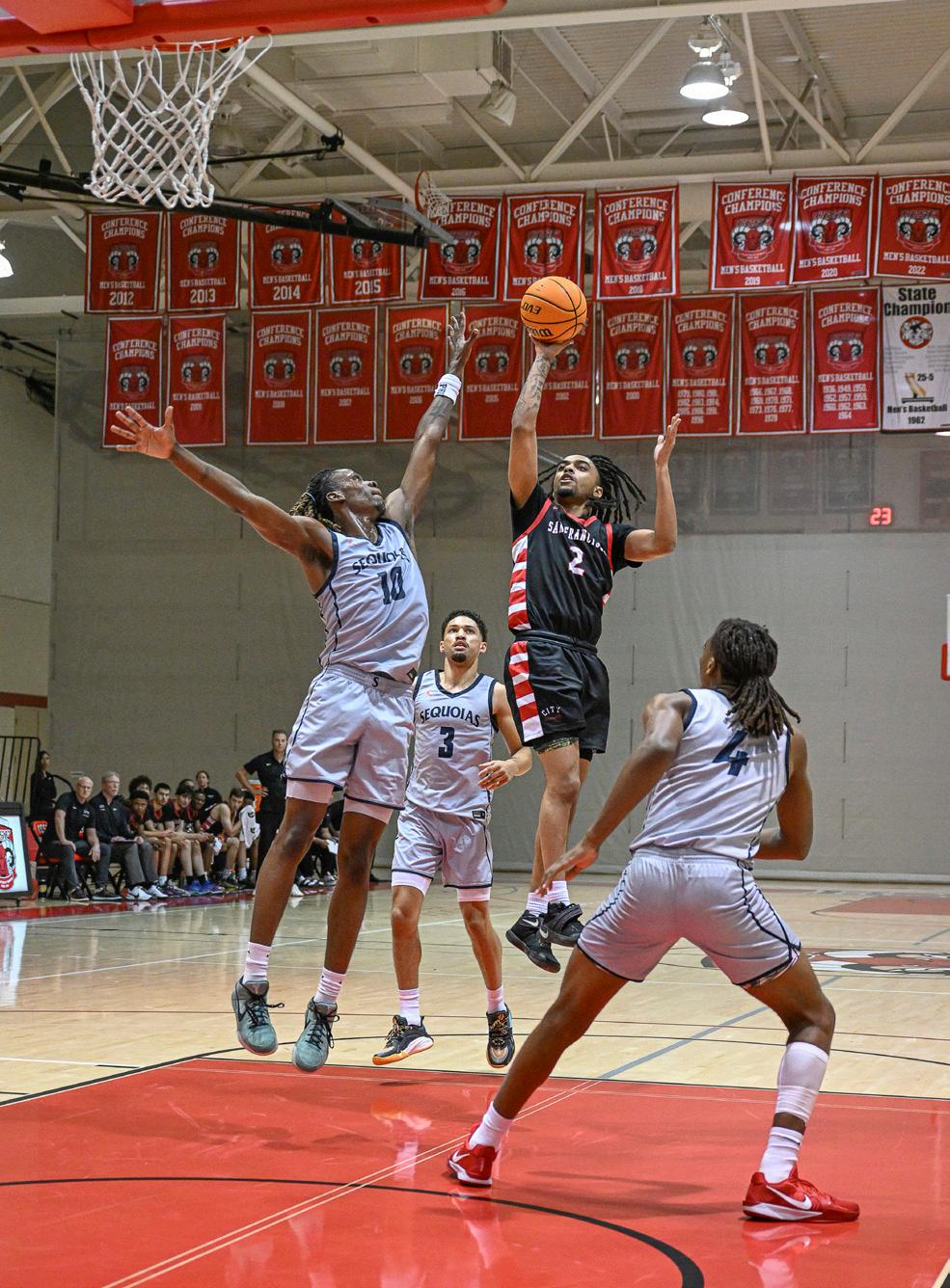
The Rams men’s basketball team held their annual Golden Gate Classic in San Francisco on December 05-06, and hosted Delta College, Feather River College and the College of the Sequoias. Their first game was on Thursday, Dec. 05, 2024, against Feather River College and came away with a 56-94 win. High scorers for the game were King-Njhsanni Wilhite and Rickey Mitchell Jr., both with 17 points each. The next night, they played College of the Sequoias and won 56-78. The high scorer was Rickey Mitchell Jr. with 17 points. The Rams have a record of 10-0 and play 4 more non-conference games before starting conference play on Wednesday, Jan. 08, 2025 at Canada College. Their first conference home game will be on Friday, Jan. 10, 2025 vs Las Positas.


By Brett Abel babel2@mail.ccsf.edu
The players knew there would be no postseason for the City College of San Francisco football team to play in its last game of 2024 — just pride, and perhaps payback.
The Rams were looking for the opportunity to finish its season — which opened 0-5 and was on a two-game losing streak — with one last win this year, hosting Diablo Valley College and its coach Jimmy Collins, who’d been the Rams’ coach for the previous nine years and had won two national championships, before leaving with a few players for DVC this summer.
And they did.
The Rams (3-7 overall, 3-2 in Bay 6 Conference) closed their bittersweet, injury-scarred season on Saturday, Nov. 16, with a 28-24 win over their former coach and teammates.
Collins refused before and after the game to comment about his return to CCSF from DVC (5-5 overall, 2-3 Bay 6).
Rams freshman quarterback Christian Banks said, “It’s sweet to get a win against the former head coach. A lot of players had a close personal relationship (with him).
“The season didn’t go the way we wanted, but we finished strong. It’s all we could’ve asked for,” he said. “It’s a sigh of relief.”
Banks replaced starting quarterback Eric Waugh in the first quarter of the team’s fifth game and started his first game in the conference opener. And he improved each week.
After his best passing performance in the penultimate game of the season, Banks was limited to only eight passing attempts against DVC, but he completed six of them for 122 yards, including an 82-yard touchdown pass down the Viking sideline halfway through the third quarter to freshman wide receiver Bryson Waterman.
The pair connected twice for 91 yards and two touchdowns, including Banks’s only completion in the second half. The two scored five touchdowns on six completions in the last two weeks.
Waterman said it was important to have the passing
game match the team’s “prolific” running game.
Interim coach Eduardo Nuño said, “Credit to the offensive line: the heart and soul of the team. They’ve been the most consistent position group all year.
“We put together a complete game,” he said. “It wasn’t perfect, obviously, but we made plays when we had to.”
The imperfect, but ultimately victorious script to the game for the Rams, included a bad punt snap for a fourthquarter safety and a time-of-possession differential of more than 10 minutes in favor of the Vikings. DVC also outgained the Rams 404 yards on 67 offensive plays versus 286 yards on 46.
But in the end, it didn’t matter.
“That’s City College football,” Banks said. “We’re tough. We grind you.”
The win also sets up an identity and expectation for the team in the 2025 season.
“It’s a matter of growing, developing and installing a process,” Nuño said. The interim coach, who was a late-summer replacement of Collins, noted more than 20 possible recruits were watching the game and he highlighted the view on the hill at the CCSF Ocean Campus and George M. Rush Stadium, the college’s facilities and overall energy and environment during the game.
“We’re gonna be good next year,” freshman running back Richard “Juice” Washington said. “Next year is the natty (national championship) year.”
The Rams' offense against DVC was in the hands of its left-handed quarterback Banks to start the game, both passing and rushing, but eventually returned to the seasontested two-pronged rushing attack between Banks and Washington.
The two have had elevated roles in the offense since sophomore running back Daytuawn Pearson broke his clavicle two weeks earlier.
Banks rushed 13 times for 69 yards and a touchdown. Washington had a game-high 98 yards and a touchdown on 18 carries.
Usually, a short-yardage runner called for on third downs or near the goal line, Washington had a 15-yard run to essentially ensure the Rams’ victory with 1:11 left

in the game.
“We spoke it into existence. We were going to beat them,” Washington said. “Coaches told me at halftime, I’d be the one to ice it — and that’s what I did.” Washington’s and Banks’s time-eating runs helped shorten the second half for the Rams, but it wasn’t without drama.
CCSF didn’t score in the fourth quarter and DVC relied heavily on its own quarterback-running back duo. Sophomore quarterback Isaiah Newton was 24-34 for 309 yards. Newton threw touchdown passes to freshman running back Ferrari Miller and sophomore wide receiver David Pierro, who had six catches for 115 yards and seven for 69, respectively. Miller also ran for 92 yards on 21 carries. But the Rams' defense did just enough.
CCSF sophomore linebacker Jalen Camp had the only interception of the game early in the second quarter and a 15-yard sack of Newton. Freshman Sonny Vitale also had a sack and a tackle for loss. The Rams' defense had seven tackles for loss, totaling 39 yards, including three sacks.

JOUR 19: Contemporary News Media
Recommended Prep: Readiness for college-level English or ESL 188. 31193 831 Onl Asynchronous 01/13-05/21 Online
Instructor: Alex Mullaney
This class is part of CityOnline and is 17.5 weeks. JOUR 19-Sec 831 has no scheduled in-person meetings and requires the use of Canvas. All coursework is completed on Canvas using an internet enabled device. For course details, students must check the instructor’s website (https://sites.google.com/mail.ccsf. edu/mullaney). This course meets the requirement for the AA and AA-T degree in journalism and the Certificate of Achievement in Data Journalism. For more information about CityOnline, please visit the CityOnline website (https:// www.ccsf.edu/academics/online-learning/cityonline). CSU/UC/CAN
JOUR 21: News Reporting and Writing
Recommended Prep: Readiness for college-level English or ESL 188. 35385 001 Lec TR 09:40-10:55AM 01/14-05/21 CLOU 230 Ocean
Instructor: Juan Gonzales
This course meets the requirement for the AA & AA-T degree in journalism. It is also required for the Certificate of Achievement in Data Journalism, Editorial Management & Design, and Entrepreneurship & Innovation in Journalism. CSU/CAN & CSU. The course training also includes an opportunity to produced stories for publications like The Guardsman and neighborhood newspapers.
JOUR 23: Copy Editing
PREREQ: JOUR 21.
35901 501 Lec R 06:10-09:25PM 01/30-05/21 MIC 217 Mission
Instructor: Molly Oleson
This is a late start in-person course at the Mission Center. For more information, please contact the instructor Molly Oleson at moleson@ccsf.edu
JOUR 25: News Production II
PREREQ: JOUR 24.
32474 001 Lec MW 12:10-01:25PM 01/13-05/21 BNGL 615 Ocean
Instructor: Juan Gonzales
This course is responsible for producing the campus newspaper The Guardsman. This course meets on the Ocean campus in Bungalow 615. Contact the instructor at jagonzal@ccsf.edu prior to the start of the semester for added instructions. This course meets the requirement for an AA degree in journalism and the Certificate of Achievement in Editorial Management & Design. CSU
JOUR 31: Internship Experience
PREREQ: Approval of the Journalism Department Recommended Prep: JOUR 24.
33770 W02 Work Hours Arr 01/13-05/21 Ocean
Instructor: Juan Gonzales
This course requires placement in a media setting with the consultation of the instructor. Contact the instructor at jagonzal@ccsf.edu prior to the start of the semester. CSU
JOUR 35: Data and Multimedia Journalism
Recommended Prep: JOUR 21.
33692 501 Lec T 06:10-09:00PM 01/14-05/21 MIC 217 Mission
Instructor: Molly Oleson
This course meets the requirement for an AA degree in journalism. It is also required for the Certificate of Achievement in Data Journalism and Entrepreneurship & Innovation in Journalism. You are advised to contact the instructor at moleson@ccsf.edu prior to the start of the semester for any last minute instructions . CSU
JOUR 37: Introduction to
Recommended Prep: PHOT 51 or demonstration of equivalent knowledge. 34149 501 Lec W 06:10-09:00PM 01/15-05/21 MIC 217 Mission
Instructor: Jessica Lifland
This course meets at the Mission Center in Room 217. You are encouraged to contact the instructor at jlifland@ccsf.edu prior to the start of the semester. This course meets the requirement for an AA & AA-T degree in journalism. It is also required for a Certificate in Data Journalism, Editorial Management & Design, and Entrepreneurship & Innovation in Journalism. CSU
