JANUARY 2026
CELEBRATING 147 YEARS AS CANADA’S PREMIER HORTICULTURAL PUBLICATION
THEGROWER.ORG
RADICAL THINKING
Outside-the-box science delivers inside the spray box
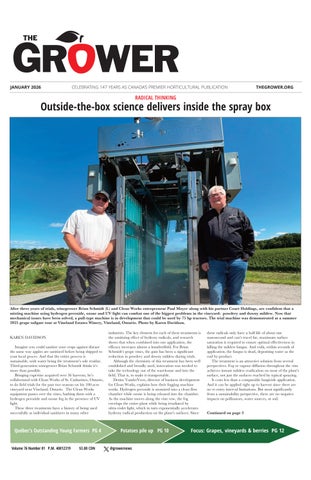
After three years of trials, winegrower Brian Schmidt (L) and Clean Works entrepreneur Paul Moyer along with his partner Court Holdings, are confident that a misting machine using hydrogen peroxide, ozone and UV-light can combat one of the biggest problems in the vineyard: powdery and downy mildew. Now that mechanical issues have been solved, a pull-type machine is in development that could be used by 75 hp tractors. The trial machine was demonstrated at a summer 2025 grape tailgate tour at Vineland Estates Winery, Vineland, Ontario. Photo by Karen Davidson.
KAREN DAVIDSON Imagine you could sanitize your crops against disease the same way apples are sanitized before being shipped to your local grocer. And that the entire process is sustainable, with water being the treatment’s sole residue. Third-generation winegrower Brian Schmidt thinks it’s more than possible. Bringing expertise acquired over 36 harvests, he’s collaborated with Clean Works of St. Catharines, Ontario, to do field trials for the past two seasons on his 100-acre vineyard near Vineland, Ontario. The Clean Works equipment passes over the vines, bathing them with a hydrogen peroxide and ozone fog in the presence of UV light. These three treatments have a history of being used successfully as individual sanitizers in many other
Québec’s Outstanding Young Farmers PG 4 Volume 76 Number 01 P.M. 40012319
$3.00 CDN
industries. The key element for each of these treatments is the sanitizing effect of hydroxy radicals, and research shows that when combined into one application, the efficacy increases almost a hundredfold. For Brian Schmidt’s grape vines, the gain has been a significant reduction in powdery and downy mildew during trials. Although the chemistry of this treatment has been well established and broadly used, innovation was needed to take the technology out of the warehouse and into the field. That is, to make it transportable. Denise VanderVeen, director of business development for Clean Works, explains how their fogging machine works. Hydrogen peroxide is atomized into a clean flow chamber while ozone is being released into the chamber. As the machine moves along the vine row, the fog envelops the entire plant while being irradiated by ultra-violet light, which in turn exponentially accelerates hydroxy radical production on the plant’s surfaces. Since
Potatoes pile up PG 10 @growernews
these radicals only have a half-life of about one nanosecond and can’t travel far, maximum surface saturation is required to ensure optimal effectiveness in killing the mildew fungus. And voilà, within seconds of application, the fungus is dead, depositing water as the end by-product. The treatment is an attractive solution from several perspectives. Fog or vapour diffusion throughout the vine achieves instant mildew eradication on most of the plant’s surface, not just the surfaces reached by typical spraying. It costs less than a comparable fungicide application. And it can be applied right up to harvest since there are no re-entry interval limitations. But most significantly from a sustainability perspective, there are no negative impacts on pollinators, water sources, or soil.
Continued on page 3
Focus: Grapes, vineyards & berries PG 12
PAGE 2 –– JANUARY 2026 THE GROWER
AT PRESS TIME… Trump announces $12B aid package to farmers The U.S. government has announced $12 billion in financial assistance to farmers hurt by trade tariffs with $1 billion set aside for specialty growers. The North American Blueberry Council (NABC), one of the first horticultural commodity groups to comment, wants equitable treatment in the face of rising labour costs. The council stated that from 2021 through 2025, blueberryproducing states experienced an average 25 per cent increase in wage rates due to flawed government policies. Labour alone now accounts for more than 40 per cent of total production costs. Recent research from the University of Michigan shows that many growers are barely breaking even. “NABC appreciates the Trump administration’s Empire Company Limited
continued recognition that American farmers are facing record-high production costs and dangerously tight financial margins,” said Kasey Cronquist, president NABC. “We also appreciate the administration’s commitment to conducting due diligence to ensure that specialty crop producers receive appropriate relief, and we look forward to continued engagement as the department evaluates how best to address the needs of blueberry farmers.” “The initial Farmer Bridge Assistance Program leaves open
key questions about how the $1 billion set-aside will be allocated and whether specialty crop producers, including blueberry growers, will be eligible. We will continue engaging with USDA to ensure blueberry growers are fully considered as the administration refines its approach to implementing this important funding. Source: North American Blueberry Council December 9, 2025 communiqué
Metro, Loblaw, Costco join Grocery Code of Conduct Several major retailers signed onto the Grocery Code of Conduct in December 2025. See list below. The code goes into effect January 1, 2026. Growers who wish to become a member, link here: https://canadacode.org/
Mike Dean Local Grocer
Rabba Fine Foods
Canadian Independent Grocery Buyers Hammy’s Country Grocer Alliance / Distribution Canada Inc J&B Lamantia Ltd. (La Mantia’s Powell’s Supermarket / Atlantic Grocery Safety Mart #7 (2001) Co. Ltd. Country Market Fresh) Distributors Friendly’s Grocery Co-op Inc.
The Village Grocer
Lina’s Italian Markets
Lady York Foods
Colemans
Georgia Main Food Group Limited
Stong’s Markets Ltd.
Freson Market Ltd.
Bonanza Market
NEW MARKET FOODS
Summerhill Market
Magasin CO-OP de Montmagnay
Vince’s Market Group Ltd.
Gestion Gilles Genest Inc. Supermarchés PA & PA Nature
Alimentation Coaticook (1986) Inc.
Kudrinko’s Ltd. La Rose Specialty Foods and Fine Italian Bakery Masstown Market
Costco
Pattison Food Group
Metro Inc.
Sharpe Foods LTD.
Loblaw Companies Limited
NEWSMAKERS Congratulations to two deserving members of Prince Edward Island’s potato industry who have won industry achievement awards: Boyd Rose and Pat Quilty. A new award, Passion for Potatoes, has recognized deserving youth: Isaac MacEwen and Jacob Enman.
Boyd Rose & Katie MacLennan
The Ontario Produce Marketing Association (OPMA) spotlighted the best in produce at its annual gala on November 21 in Niagara Falls. The following recipients were honoured. Women’s Produce Network Awards were won by Fernanda Albuquerque, Mucci Farms and Agnes Boutros, Tom Hughes, president of Mastronardi Produce Ltd. The EarthFresh Farms (left), Fresh Award went to Markus accepts the Lifetime Pfenning, Pfenning’s Organic Achievement Award from Farms. The Cory Clack-Streef Andrew George, Produce Person of the Year Award EarthFresh Farms. Photo was accepted by Adam Donikian, by Grocery Business Sobeys. The Outstanding Magazine. Achievement Award surprised Windmill Farms. The Lifetime Achievement Award delighted Tom Hughes, EarthFresh Farms. Best wishes to Glenna Cairnie, general manager of the Ontario Fruit and Vegetable Convention who is retiring after the 2026 show February 18-19. She has been in the role for more than 18 years, a familiar face to exhibitors and attendees alike. The convention continues to grow in scope with a sold-out trade show floor and scores of in-depth concurrent education sessions. Kroeker Farms, Winkler, Manitoba has announced its planned leadership transition. As of December 1, 2025, CEO Wayne Rempel moved into the role of senior advisor, and COO Harwin Bouwman became CEO. Wayne joined Kroeker Farms in 1988 and became CEO in 2002. Throughout his tenure, he championed strategic investments in sustainability, organic production, and innovative farming practices that strengthened the company’s resilience and market leadership. Under his guidance, Kroeker Farms expanded into one of Canada’s leading producers of premium table potatoes, organic potatoes, hemp, and seed potatoes. The CanadaGAP Program congratulates Cameron Korpan as the 2025 recipient of the Sheri Nielson Auditor Recognition Award. Established in 2022, this prize is presented annually by CanadaGAP to honour an outstanding CanadaGAP auditor who demonstrates exceptional dedication, commitment and heart. This meaningful award is given in memory of Sheri Nielson, a long-time CanadaGAP auditor. CanAgPlus held its annual general meeting on December 3, electing one new and three returning directors. They are: Denis Desjardins, Desjardins Seed Farm Ltd.; Beth Pattillo, Noggins Corner Farm Ltd.; Julian Sarraino, Fresh Taste Produce and Victoria Stamper, United Potato Growers of Canada.
Customer Service order@norseco.com 514 332-2275 | TFN 800 561-9693
450 682-4959
Sales Representatives
FIREJAX A vigorous bush and concentrated pod set for ef昀cient harvest. Strong heat tolerance ensures reliable yields. A top pick for growers seeking consistency, adaptability, and early returns to capture premium market windows.
Ontario Warren Peacock warren.peacock@norseco.com 519 427-7239
North Shore of Montreal Isabelle Dubé, Agr. isabelle.dube@norseco.com 514 295-7202
MB, SK, AB & BC Ben Yurkiw ben.yurkiw@norseco.com 604 354-1830
Central and Eastern Quebec Stéphanie Gosselin, Agr. stephanie.gosselin@norseco.com 418 254-1469
Eastern Montérégie & Maritime Provinces Marie-Pierre Grimard, P. Tech marie-pierre.grimard@norseco.com 450 261-7468
Central & Eastern Québec Yves Thibault, Agr. yves.thibault@norseco.com 418 660-1498
Western Montérégie Marie-Hélène Monchamp marie-helene.monchamp@norseco.com 514 968-2906
Organic & Small-Scale Farms Katherine Jouvet, Agr. katherine.jouvet@norseco.com 514 386-0277
norseco.com
Proud of our roots since 1928 norseco_of昀ciel
The Ontario Potato Board celebrated its 50th anniversary at its December 3, 2025 annual general meeting. Shawn Brenn was re-elected chair as was Jamie Lundy as vice-chair. Directors are: Harry Bradley, Steve Bradley, Jacob Vander Zaag and Justin Gaudet. Condolences to the family and colleagues of Fred Webber, 71, past president and CEO, Fruit & Vegetable Dispute Resolution Corporation (DRC) who passed November 24, 2025. His career was shaped in the USDA PACA Branch as a marketing specialist, at Bluebook Services Inc as chief arbitrator and vice-president of special services, and eventually vice-president of trading assistance in the newly established DRC. In this role, he developed and implemented Trading Standards and Arbitration and Mediation Rules which were created to provide dispute resolution services primarily to the Canadian industry and North America. He spent the last decade of his career in the top leadership role at DRC. After his retirement in 2021, he collaborated on the drafting of Bill C-280 - The Financial Protection for Fresh Fruit and Vegetable Farmers Act a private member’s bill, which provides a mechanism to protect against insolvencies contributing to the stability of the produce supply chain.
JANUARY 2026–– PAGE 3 THE GROWER
COVER STORY
Outside-the-box science delivers inside the spray box Continued from page 1 “Not to sound simplistic, but this reminds me of making bread,” says Paul Moyer, an apple grower and entrepreneur who has partnered with Court Holdings to commercialize the technology. “You need flour, yeast and water in the right ratios under the right conditions.” In 2015, the team at Clean Works perfected the use of applying hydrogen peroxide, ozone, and UV-light in a single treatment out of a need to sanitize his candy apples. Several deaths in the U.S. and Canada were identified by authorities as having been caused by presence of Listeria monocytogenes in candy apples. There was an urgent need to figure out a waterless solution that would work for candy apples. Working with food safety expert Dr. Keith Warriner, University of Guelph, Clean Works went on to commercialize the three- component treatment process under the Clean Works brand. When COVID hit in 2020, the process gained additional credibility when Health Canada approved the equipment to sanitize N95 masks for reuse. Adding to the toolbox Fast forward to 2023 when Schmidt and Clean Works explored the potential of its technology to tackle the scourge of powdery and downy mildew on grape vines. With the loss or reduction in the number of applications of broad-spectrum fungicides, growers are relying more on fungicides with sitespecific activity that are more prone to resistance. The Clean Works technology is non-specific, therefore not prone to resistance. “We’ve been at the tip of the spear in innovation in several regards,” says Schmidt. “We were the first to buy novel optical-sorting harvest systems. We were the first to adopt new wine-making concepts. We’re comfortable pushing the envelope.” Despite field trial successes, he doesn’t see crop protection products being entirely eliminated by Clean Works. In fact, he sees a place for the fogging machine alongside a regular rotation of fungicides, as an aid to reduce resistance to active ingredients. If the machine is commercialized, he predicts fungicide cost savings of 50 per cent in years when disease is prevalent. For his vineyard, that could represent a savings of $75,000 annually. Apart from input cost reduction, there are other longterm sustainability considerations: “I don’t like dragging a sprayer with 2,000 pounds of liquid
product,” says Schmidt. “That’s compacting the soil.” Dr. Wendy McFadden-Smith, tender fruit and grape IPM specialist, for the Ontario Ministry of Agriculture, Food and Agribusiness, has been on the front lines of vineyard management for many years. Since 2024, she and her team have performed weekly assessments for powdery and downy mildew at the Vineland test site. At each date, they examine 50 leaves and 50 clusters and evaluate for disease. In 2025, McFadden-Smith trained the person from Clean Works to do the assessments. Treatment frequency Given the limited number of rows used for the trial, McFadden-Smith designed the assessment to include as much replication as possible. The hot 2025 season reduced disease pressure, which in turn resulted in very low infection levels. One question left unanswered was the issue of treatment frequency. “As for weekly applications, I don’t know that this will be necessary once we get past the period of fruit susceptibility at six weeks post-bloom, although we are looking at this method for botrytis management as well,” says McFadden-Smith. “If you consider organic viticulture, weekly sprays are the norm. The thought is not to rely on the Clean Works technology exclusively but to alternate with conventional fungicides to reduce selection pressure for resistance and also extend the interval between fungicide sprays.” McFadden-Smith is looking forward to more trials in 2026. “My reservations are primarily because we’ve never had the system functional in the vineyard earlier than the end of July and in both years, the trial ended the beginning of September because the harvester had to go back to the original owner. We haven’t had a trial for the full season.” She adds that no tests have been done on black rot. The vineyard block where the team worked in 2024 was severely infected with black rot and the machine wasn’t available to control early-season infections.
Brian Schmidt inspects his vineyard at Vineland Estates, Vineland, Ontario
Wendy McFadden-Smith, tender fruit and grape IPM specialist, Ontario Ministry of Agriculture, Food and Agribusiness is looking forward to 2026 trials and exploring potential for control of black rot.
Future applications Interestingly, Dr. Malkie Spodek, Cool Climate Oenology Viticulture Institute, is determining whether this technology can help manage insect and mite pests. Dr. Justin Renkema has been looking at ultra-violet light and how Clean Works technology could control leafhoppers. In another potential application, Spodek is wondering if Clean Works could repel multicoloured Asian lady beetle, if
applied just before harvest. What was demonstrated in summer 2025 is a prototype system mounted on a harvester. Clean Works is now building a tow-behind unit that would be affordable for anyone with a 75 hp tractor. This will make the unit lighter so there’s less soil compaction and it will be more nimble with a smaller turning
radius. The hope is to have this field-ready for 2027. In the meantime, Clean Works has extended its pathogenkilling technology to other crops including a frozen raspberry plant in Serbia and frozen wild blueberries in Canadian plants. Trials are underway in field crops such as spinach and arugula. Trial results at Vineland
Estates have shown the trifecta of hydrogen peroxide, ozone, and UV-light to be effective in combatting fungi. With other crops poised to become potential beneficiaries of this technology, it seems waiting for the fog to clear isn’t in the forecast.
PAGE 4 –– JANUARY 2026 THE GROWER
CROSS COUNTRY DIGEST QUÉBEC
Canada’s Outstanding Young Farmers Program names Québec vegetable growers and Ontario sheep producers as 2025 winners Vegetable growers Pierre Luc Barré & Virginie Bourque of La Ferme Yves Barré Inc, St. Damase Québec were chosen as National Winners from six regional farms at Canada’s Outstanding Young Farmer (OYF) Program’s national event held in Toronto Nov 27-30, 2025. The other winners were Ryan and Romy Schill of Circle R Livestock Ltd & Revolution Wool Company located at Wallenstein, Ontario. After Pierre-Luc Barré was given the task of inspecting onions and hot peppers, he became interested in the thirdgeneration farm he was raised on at Saint Damase, Québec. After attending Technologie Agroalimentaire du Quebec for horticulture, he joined the La Ferme Yves Barré Inc in 2010. When the hot pepper market
declined, a $100,000 investment in potato equipment was made to plant 30 acres. They are now planting 300 acres of their 1140 cultivated acres, to produce 18 million pounds of pre-peel potatoes. The future goal is to plant 500 acres - the barrier being access to good land. Virginie joined the farm full-time in 2017 and takes care of books, marketing and communications. Today La Ferme Yve Barré Inc is spreading risk by diversifying its products. PierreLuc’s grandfather started with tomatoes, sugar beets, sweet corn. His father introduced grain corn, peppers and onions and they now produce corn, beans, soy and potatoes. Every year this event brings recognition to outstanding farmers in Canada under 40 years of age who have
exemplified excellence in their profession while fostering better urban-rural relations. The winners were chosen from six regional finalists, including the following honourees from the other five regions: BC - Thomas & Catherine Cuthbert- Southcoast Agro Farms- Nanaimo AB - Sarah Weigum- Alect SeedsThree Hills SK – Brady & Lindsay FunkBraylin Farms- Wymark ON - Ryan & Romy Schill Circle C Livestock & Revolution Wool Company- Wallenstein
Pierre Luc Barré and Virginie Bourque, La Ferme Yves Barré Inc., St. Damase, Québec.
QC - Pierre Luc Barré & Virginie Bourque of La Ferme Yves Barré Inc
AT - Katie Campbell & William Spurr- Spurr Brothers Farms, Nova Scotia
Source: Canada’s Outstanding Young Farmers Program December 1, 2025 news release
NEW BRUNSWICK
Defining the practices that lead to diversity in soil life KAREN DAVIDSON Held every December, World Soil Day spotlights the need to steward the land. But for farmers, soil health matters every day, every decade. That’s the spirit in which Dr. Michelle Lynn D’Souza approaches her role as research and innovation manager for McCain Foods. Based in
Florenceville, New Brunswick, she’s already dedicated five years to a project that uses DNA metabarcoding to identify soil life and how it changes with regenerative agriculture practices. “Understanding soil biology and its links to soil health is so challenging because you can’t see most life below ground,” says D’Souza. “We need a better away to measure this life besides
V
EG
ETABL
counting earthworms.” Mentored by Dr. Paul Hebert, the creator of DNA barcoding and the CEO of the Centre for Biodiversity Genomics, University of Guelph, she has taken her inspiration to McCain Foods’ Farm of the Future Canada. The 500-acre farm located in New Brunswick is a testing site for applying practices such as minimizing soil compaction with
E
A GOOD START TO A GREAT HARVEST!
•
SEEDS
•
LANCER Beautiful beefsteak tomato with very smooth shoulders and a clean floral scar. Great plant health, producing 280 to 320 gram fruit on a determinate vine.
BIG STACK
CARRIE
Heavy upfront yield with good production overall. Blocky shaped, 3 and 4 lobed fruit with a strong resistance to Phytophthora.
Your perfect medium size pumpkin weighing between 7 to 9 kg. Fruit is round, smooth, with light ribbing, produced on a semi-bush vine.
!"! #
124373 seminova publ 6x6_v1.indd 1
$ % & '
2024-10-02 11:15 AM
traffic control, integrating livestock and sowing cover crops. This farm is the first of three committed to by the business with the second operating in South Africa and a third soon to be announced. While foundational soil health principles are applicable globally, the practices tested must be adapted locally. That’s why regional innovation hubs are also set up across the globe. There are six hubs in North America of which two reside in Alberta and Manitoba. McCain Foods has processing plants in all three provinces so it makes sense to be working with farmers on how soil management practices affect potatoes through the entire supply chain. McCain’s DNA metabarcoding efforts tap into the world-leading capabilities in biodiversity monitoring built at the University of Guelph with the Centre generating three million DNA barcodes per year. To date, there are 20 million specimen records. Building from this foundation, D’Souza is bringing the technology to soils and finding out exactly what species exist on farms. The goal is to measure a baseline from where shifts in soil life can be measured, relating them with farming practices. To date, three years of baseline data have been consistently collected across all fields at the New Brunswick site. “How confident are we on the ways healthy soils will support more resilient farms in the future?” asks D’Souza, “We are working to build that confidence using these new innovative approaches. What we do know is
that fertilizers are not having the same impact as they once did. And, we are just beginning to measure how practices such as fumigation may actually affect more than just the pests they target. What we understand is that more diversity in the soil relates to more functional capacity in the soil, which should support the production of crops across a broader range of conditions. A future with unknown environmental variability is exactly what we need to buffer against. The question is, how can we better protect this diversity as we farm to capture as much function as possible.” The company’s goal for the supply chain is to foster understanding about regenerative agriculture with consumers so that they are choosing with their dollars to support organizations and farmers who support beneficial soil practices.
JANUARY 2026–– PAGE 5 THE GROWER
CROSS COUNTRY DIGEST NOVA SCOTIA
Dalhousie University launches new institute to drive digital agriculture in Atlantic Canada Dalhousie University has launched the Atlantic Institute for Digital Agriculture (AIDA) on its Agricultural Campus in Truro, creating a regional hub where researchers, farmers, industry and government will work together to advance precision and digital agriculture across Atlantic Canada. AIDA will focus on technologies that reflect the realities of Atlantic farming, with particular emphasis on Nova Scotia’s major commodities, including wild blueberries, potatoes, grapes, tree fruit, dairy, eggs and livestock. The work will draw on the deep research strength of the region’s only Faculty of Agriculture. “Producers in this region are dealing with variable soils, irregular field conditions, unpredictable weather and tight margins,” said Dr. Heather Bruce, dean of the Faculty of Agriculture. “AIDA is about matching Dalhousie’s expertise with the needs of the sector so that digital and precision tools are developed with Atlantic farms in mind. This is key to building resilient food systems and strong
rural communities.” Dalhousie has earned a strong reputation among Nova Scotia farmers by developing practical, research-driven innovations for region-specific crops such as wild blueberries. Working directly with farmers and processors, the university has helped develop everything from AI-enabled weed identification to GPS-guided harvesting tools. These practical, field-ready technologies have become crucial as climate variability, labour shortages and rising input costs place new pressures on the agricultural sector. “Dalhousie’s strengths in sustainable food systems, climate solutions and artificial intelligence align directly with what this sector needs,” said Dr. Graham Gagnon, associate vice president research and innovation. “AIDA creates a single point of entry for partners who want to test new ideas, develop technologies and work with us to grow a more resilient agricultural economy.”
expertise in a wide range of fields, including engineering, agronomy, economics and climate, soil, animal and computer science. Researchers will apply drones, robotics, Internet of Things sensors, artificial intelligence, geographic information systems, machine learning and other advanced technologies to real-world challenges. “Producers across Atlantic Canada are looking for ways to work more efficiently while managing increasing uncertainty,” said AIDA scientific director Dr. Travis Esau, an engineering researcher known for his work introducing precision farming to wild blueberry production. “Our goal is to codevelop technologies with growers, so the tools fit their operations, reduce inputs and help keep farms viable for the next generation.” Strengthening collaboration AIDA will strengthen collaboration across Dalhousie, engaging faculty and students from the Faculties of Agriculture, Science and Computer Science
Driving innovation AIDA will bring together
Wild blueberry farmer Peter Swinkels uses a Dal-developed app to identify weeds and working closely with partners at federal and provincial research centres. The institute will also build on longstanding relationships with producer groups and companies, including McCain Foods, Oxford Frozen Foods, Doug Bragg Enterprises, Perennia Food and Agriculture Corporation and commodity associations across Atlantic Canada. These
CONNECT
EXPLORE
GROW
with fellow farmers and growers
over 3 acres of exhibitors
your knowledge from leading industry experts, all in one place
ONTARIO FRUIT AND VEGETABLE CONVENTION CANADA’S PREMIER HORTICULTURAL EVENT
Take your growing to the next level
Scan & Register today! FEBRUARY 18 –19, 2026 NIAGARA FALLS CONVENTION CENTRE PROUDLY GROWING IN CANADA
@ofvc1 #ofvc2026
partnerships have already led to advances in precision potato production, digital soil mapping and wild blueberry harvesting. Read an in-depth case study on how Dalhousie researchers are supporting the wild blueberry sector – Nova Scotia’s largest agricultural export. Source: Dalhousie University November 25, 2025 news release
PAGE 6 –– JANUARY 2026 THE GROWER
GREENHOUSE GROWER
OGVG appoints sustainability infrastructure development lead Ontario Greenhouse Vegetable Growers (OGVG) has appointed Evan Smith as the organization’s new sustainable infrastructure development lead. He brings a strong academic foundation and diverse policy experience to the role. He holds a Master of International Public Policy from the Balsillie School of International Affairs at Wilfrid Laurier University, where he was in the Global Political Economy and STEM for Global Resilience research clusters. He also earned an Honours Bachelor of Arts in Political Science from the University of New Brunswick. During his graduate fellowship at the Balsillie School, Smith collaborated on research into critical minerals from Canadian government and business perspectives, co-authoring a policy brief submitted to Global Affairs Canada. His work included consultations with federal, provincial, and international governments, underscoring his ability to navigate complex policy environments. His professional experience includes serving as a program an policy assistant with the Ontario Ministry of Transportation, where he contributed to the rollout of the
Automated License Plate Renewal Program and supported the development of new fraud policies and procedures. He has also led a research team at the New Brunswick Research Institute for Research, Data, and Training, focusing on housing policy, and has authored reports on equity and inclusion in Canadian universities for the Green Caucus of New Brunswick. In his new role, Smith will lead OGVG’s sustainable infrastructure initiatives, supporting Ontario’s greenhouse vegetable sector in advancing energy efficiency, environmental stewardship and long-term competitiveness. His expertise in policy development, stakeholder engagement, and research-driven solutions will be instrumental in strengthening the sector’s resilience and sustainability. “Evan’s appointment reflects OGVG’s commitment to building a future-ready sector that balances innovation, sustainability, and competitiveness,” said Richard Lee, executive director. “His background in public policy and infrastructure strategy will help us navigate emerging challenges while advancing our leadership in sustainable
Evan Smith agriculture.” Source: Ontario Greenhouse Vegetable Growers December 10, 2025 news release
Vineland’s Tomato-on-the-Vine (TOV) Shared Research Trial Vineland Research and Innovation Centre’s Tomatoon-the-Vine (TOV) Shared Research Trial offers a unique opportunity for agri-tech companies to validate, refine, and advance their horticultural technologies in a collaborative, real-world environment. The initiative is designed to accelerate agri-tech innovation by combining Agricultural Research and Innovation Ontario’s (ARIO), an agency of the Government of Ontario, and Vineland’s advanced research facilities, Technology Readiness Level (TRL)based evaluation, and the expertise of leaders in greenhouse systems, digital technologies, and biological research. Through this shared model, participants gain access to Vineland’s deep scientific and technical capabilities, at a fraction of the cost of running independent trials. Collaboration is at the heart of the program. Participating
companies work directly with Vineland’s team of experts and a grower advisory panel to ensure new technologies align with grower needs and deliver practical, marketready solutions. This hands-on partnership provides not only scientific validation but also valuable industry exposure through Vineland’s networks, connecting innovators with growers and decision-makers across Canada. By fostering a shared space for research and development, Vineland’s TOV Shared Research Trial bridges the gap between innovation and application, helping agri-tech solutions reach the market faster, stronger, and smarter. The advisors are: Matt Korpan, Biophi; Steve Stasko, Pure Flavor; Chad Brian, DC Farms; Michael Del Ciancio, DC Farms.
$10M Growing Greenhouses program launches in Alberta Ranking fourth in Canada, Alberta’s greenhouse sector is getting a $10 million lift over three years from the provincial and federal governments. It’s called the Growing Greenhouses program. “Everything our ministry does is about ensuring Albertans have secure access to safe, high-quality food,” stated RJ Sigurdson, minister of agriculture and irrigation. “We are continually working to build resilience and sustainability into our food production systems, increase opportunities for producers and processors, create jobs and feed Albertans. This new program will fund technologies that increase food production and improve energy efficiency.” “Through this investment, we’re supporting Alberta’s growers and ensuring Canadians have access to fresh, locally-grown fruits and vegetables on grocery shelves year-round,” added Heath MacDonald, federal minister of agriculture and agri-food. The Growing Greenhouses program supports the controlled environment agriculture sector with new construction or expansion improvements to existing
greenhouses and vertical farms that produce food at a commercial scale. It also aligns with Alberta’s Buy Local initiative launched in 2025 as consumers will be able to purchase more local produce all year-round. “This program is a game-changer for Alberta’s greenhouse sector,” stated Michiel Verheul, president, Alberta Greenhouse Growers’ Association. “By investing in expansion and innovation, we can grow more fresh produce year-round, reduce reliance on imports, and strengthen food security for Albertans. Our growers are ready to meet the demand with sustainable, locally grown vegetables and fruits, and this support ensures we can do so while creating new jobs and opportunities in communities across the province. We are very grateful to the Governments of Canada and Alberta for this investment in our sector and for working collaboratively with us.” Source: Alberta Agriculture December 10, 2025 news release
THE GROWER’S
ONTARIO FRUIT & VEGETABLE CONVENTION FOCUS FEBRUARY 2026 BOOK AD SPACE JANUARY 16, 2026 advertising@thegrower.org
JANUARY 2026–– PAGE 7 THE GROWER
GREENHOUSE GROWER
Indoor strawberry innovation is accelerating at Vineland Research Red Sun Farms, Heritable Agriculture, and Consorzio Italiano Vivaisti (CIV) have announced significant progress in their collaborative effort to develop the leading indoor-grown strawberry at the Vineland Research Station facility. This partnership combines CIV’s deep expertise in strawberry genetics and germplasm, Heritable Agriculture’s advanced AI-driven breeding models, and Red Sun Farm’s indoor growing excellence to revolutionize how premium strawberries are bred and grown. By leveraging AI simulations to predict crop performance, the partnership is streamlining breeding timelines and optimizing key traits for greenhouse efficiency. This approach allows the team to bring highquality, innovative strawberry varieties to market faster— varieties designed with growers, consumers, and the environment in mind. Heritable Agriculture’s predictive AI technology generalizes across species, environments and traits, making it adaptable to nearly any agricultural operation. When paired with Red Sun Farms’ vertically integrated model and CIV’s world-leading breeding capabilities, this collaboration represents a new benchmark in indoor fruit innovation. A key differentiator of this initiative is the early involvement of eight retail partners representing more than 8000 North American store locations. By bringing retailers into the breeding process from the beginning stages, the project aligns real consumer insights and market needs with cutting-edge technology—ensuring the varieties developed are optimized not just for performance, but for taste, texture, and shopper appeal.
Last week, retail partners joined the research team at Vineland for an exclusive first look at more than 110 strawberry breeding lines currently in development. Through guided sensory evaluations, partners provided valuable feedback that will help shape the next phase of selection and innovation. “At Vineland, we’re proud to be at the forefront of horticultural innovation by combining world-class research, advanced technology and industry collaborations to deliver premium, sustainable strawberries to the consumer,” said Ian Potter, president and CEO, Vineland Research. “It’s been incredible to see this research come to life and be validated directly through customer feedback.” “We’re bringing AI solutions to indoor growers, beginning with greenhouse strawberries,” added Davide Soss, CSO at Heritable Agriculture. “This work is setting a new standard for strawberry flavour and quality, which is precisely why retailers were here this week to learn more.” “For CIV, this collaboration represents an important step in turning our genetic research into tangible value for the entire supply chain,” said Federico Stanzani, general manager of CIV. “Providing our germplasm and integrating it with Heritable’s predictive models, Red Suns’ cultivation expertise and the research capabilities of Vineland Research allows us to accelerate indoor breeding, optimize key traits and develop varieties capable of excelling in greenhouses from the earliest stages. This synergy between advanced genetics, artificial intelligence, and precision growing not only demonstrates
technological potential but also delivers concrete results for growers, retailers, and consumers, creating strawberries that are ready to meet market demands.” “We are entering a new era of produce development where we no longer have to choose between yield and flavour. This partnership brings together the four critical pillars of modern agriculture: advanced genetics, predictive AI, precision growing, and direct retail feedback. By aligning these forces from day one, we are creating a feedback loop that has never existed before,” said Paul J Mastronardi, business development and account manager. “We are effectively reverse-engineering the perfect strawberry based on what consumers actually demand, ensuring that when these varieties hit the shelf, they are already proven winners.”
Jack’s Organics opens new greenhouse in Amherstburg South Essex Fabricating (SEF) has completed a 41.34 acre greenhouse expansion at Amherstburg, Ontario. The entire space is dedicated to organic cherry tomatoes. For a video, link here: https://sef.ca/jacks-organicsgreenhouse-expansion/
PAGE 8 –– JANUARY 2026 THE GROWER
CHAIR’S PERSPECTIVE
Pressing growers’ priorities in busy fall of provincial and federal advocacy
SHAWN BRENN Late fall is always a demanding season for growers, and this year it was just as demanding for our advocacy efforts. With government activity in full swing at both Queen’s Park and Parliament Hill this fall, the Ontario Fruit and Vegetable Growers’ Association (OFVGA) has been keeping the sector’s priorities front and centre. In late fall, our board and staff met with provincial and federal policymakers to advance the issues that matter most to growers: issues tied directly to risk management, worker housing, labour, trade, competitiveness, and the long-term sustainability of our sector. Strong momentum at Queen’s Park
Our annual Queen’s Park Day highlighted two major issues in particular: accelerating the rollout of the remaining Risk Management Program/SelfDirected Risk Management (RMP/SDRM) funding and clearing the path for more onfarm worker housing. Both priorities are rooted in the broader economic and regulatory landscape that continues to challenge Ontario growers. The farm business environment remains strained by ongoing market pressures such as suppressed prices and retailerdriven programs as well as unprecedented input cost increases for fertilizer, fuel, and energy. Ontario’s support levels lag behind those enjoyed by growers in other jurisdictions, and municipal hurdles around worker housing further complicate growers’ ability to invest in their businesses. It’s against this backdrop that we continue to ask the province to accelerate the distribution of the remaining two years of the RMP/SDRM commitment to provide meaningful stability, support mental health, unlock access to financing, and help retain the next generation of farmers in the sector. We also focused on clearing the path for modern, codecompliant, on-farm worker
housing. The OFVGA’s municipal survey earlier this year showed widespread and significant challenges – everything from shifting housing classifications to new fees, delayed permits, inconsistent zoning interpretations, and rising development charges. These layered pressures are inconsistent across the province and make it harder for growers to provide the safe, high-quality housing that international workers deserve. Our ask to government was clear: work with municipalities to harmonize standards, modernize policy, and ensure that building codes support, not hinder, grower housing investments. We appreciate the many elected officials and staff members from all parties who took the time to meet with us during our day at Queen’s Park. This includes Trevor Jones, Minister of Agriculture, Food and Agribusiness and Rob Flack, Minister of Municipal Affairs and Housing, but also the support received from the agriculture critics and leaders of opposition parties for issues that matter to growers. We also had 15 focused minutes of meeting time with Premier Doug Ford, which presented an opportunity to raise structural issues that affect
competitiveness across the sector, such as access to energy competitiveness, risk management and worker housing. The Premier’s willingness to engage directly was a strong signal of interest, and we also had a productive and more in-depth meeting with his policy staff on many of the same issues. Delivering our message in Ottawa Although Fruit and Vegetable Growers of Canada (FVGC) lead federal advocacy efforts, the OFVGA is a strong supporter and helps ensure grower needs are represented in our nation’s capital. This year, we once again participated in the Fall Harvest advocacy event that is led by FVGC and the Canadian Produce Marketing Association. OFVGA supported national advocacy on red tape reduction, access to labour including the Seasonal Agricultural Worker Program (SAWP), and trade and investment, and ensured Ontario’s voice remained strong within these national priorities. Alongside Fall Harvest meetings, OFVGA’s labour chair Bill George, senior policy and government relations advisor Gordon Stock and representatives across Canada met with the chief of staff for Patty Hajdu, Minister
of Jobs and Families, to focus specifically on SAWP and the need to preserve this longstanding and well-functioning program. The minister’s team was highly engaged, and the Minister’s Office appreciates OFVGA’s ongoing efforts to publicly promote SAWP, correct misinformation, and even engage political opposition when necessary. We are cautiously optimistic that our message to protect SAWP is being heard, but these efforts will need to continue to ensure the program is protected for the long term. Looking ahead Our advocacy efforts this fall demonstrated once again the strength of collaboration between growers, board members, staff, and our partner organizations. Many of these issues are complex and often slow-moving, but progress is being made. By pushing for practical solutions, predictable programs, and modern regulatory approaches, we are building the foundation growers need to remain competitive and resilient. Shawn Brenn is a potato grower and chair of the Ontario Fruit and Vegetable Growers’ Association.
WEATHER VANE
Setting the stage for ongoing advocacy in 2026, directors and staff of the Ontario Fruit and Vegetable Growers’ Association visited Queen’s Park on November 18, including the office of Premier Rob Ford. L-R: Joann Chechalk, Gordon Stock, Alison Robertson, Steve Peters, Premier Rob Ford, Shawn Brenn, Bill George, Morris Gervais, Jan VanderHout, Tracy Gubbels. Photo courtesy Government of Ontario. STAFF Publisher: Ontario Fruit and Vegetable Growers’ Association Editor: Karen Davidson, 416-557-6413, editor@thegrower.org Advertising: Carlie Melara 519-763-8728, advertising@thegrower.org
The Grower reserves the right to refuse any advertising. Any errors that are the direct result of The Grower will be compensated at our discretion with a correction notice in the next issue. No compensation will be given after the first running of the ad. Client signature is required before insertion. The Ontario Fruit and Vegetable Growers’ Association is the sole owner of The Grower. All editorials and opinions expressed in The Grower are those of the newspaper’s editorial staff and/or contributor, and do not necessarily reflect the view of the association. All rights reserved. The contents of this publication may not be reproduced either whole or in part without the prior written consent of the publisher.
OFFICE 355 Elmira Road North, Unit 105 Guelph, Ontario N1K 1S5 CANADA Tel. 519-763-8728 • Fax 519-763-6604 The Grower is printed 12 times a year and sent to all members of the Ontario Fruit and Vegetable Growers’ Association who have paid $30.00 (plus G.S.T.) per year for the paper through their commodity group or container fees. Others may subscribe as follows by writing to the office:
$30.00 (+ HST) /year in Canada $40.00/year International Subscribers must submit a claim for missing issues within four months. If the issue is claimed within four months, but not available, The Grower will extend the subscription by one month. No refunds on subscriptions. P.M. 40012319
ONTARIO FRUIT AND VEGETABLE GROWERS’ ASSOCIATION BOARD OF DIRECTORS 2025 EXECUTIVE COMMITTEE Chair Vice-chair Grapes Fresh Veg Muck
Shawn Brenn, Waterdown Mike Chromczak, Brownsville Matthias Oppenlaender, NOTL Quinton Woods, Cookstown
BOARD OF DIRECTORS Apples Fresh Veg other Tender Fruit Asparagus Grape Fresh Veg muck Potato Small Fruit/Berries Ginseng Greenhouse Greenhouse Processing Vegetables
Chris Hedges, Vanessa Joann Chechalk, St Anns Dave Enns, Niagara-on-the-Lake Mike Chromczak, Brownsville Matthias Oppenlaender Quinton Woods, Cookstown Shawn Brenn, Waterdown Morris Gervais, Springwater Glen Gilvesy, Tillsonburg Jan VanderHout, Dundas Steve Peters, St. Thomas Tracy Gubbels, Mount Brydges
OFVGA POLICY COMMITTEE CHAIRS Crop Protection Environment and Conservation Labour Safety Nets Property, Infrastructure, Energy and Food Safety
Matt Sheppard Jan VanderHout Bill George Mike Chromczak Brian Gilroy
JANUARY 2026–– PAGE 9 THE GROWER
URBAN COWBOY
U of Guelph research impact wows 300,000 at the Royal
OWEN ROBERTS A highly effective way to address questions such as “so what?” and “who cares?” is to show impact. Just ask the University of Guelph. The institution, which has dubbed itself Canada’s Food University for the past 20 years or so, focused specifically on highlighting the impact of its unique, multi-faceted research enterprise at its 2025 Royal Agricultural Winter Fair exhibit. This year’s theme was “Nourishing Ideas, Cultivating Innovation and Growing Solutions.” Impact has long been a cornerstone of the university’s research communications. But the stars particularly aligned for the Royal exhibit, making it a
standout among the 2,500 exhibitors who greeted 300,000 visitors to the annual event. Reaction to the 2,700-square-foot exhibit, staffed by a dozen student ambassadors, recruitment officers, graduate students and researchers, could be summed up in one word: wow! “What stood out for me was the focus on education and the application of research towards the production of healthful foods within a healthy environment,” says Prof. Brian McBride, a retired University of Guelph dairy researcher who attended the Royal with his family. “The exhibit felt alive. Even my grandchildren were drawn into its positive energy.” So, what was it that gave the 2025 impact message such, er, impact? Claire Alexander, U of G’s assistant director for ceremonies and events, says at least three factors played into it. First, timing was key. Elbowsup Canadian patriotism may have cooled off slightly in some camps since its emergence last year, but it was on full display at the Royal. After all, the event, which organizers dub “the largest indoor agricultural and equestrian event in the world,” has been a
Canadian institution since 1922. That’s when a collective of influential farmers and horse owners gathered to plan an exhibition of Canada’s finest agricultural wares. The Royal has built-in nationalism. “We’re proud Canadians and we had many Canadian flags at our exhibit,” says Alexander. “So did others. The displays made a statement like ‘Canada is OK, and we’ve always been. There’s a lot of brilliance in this country and if something happens at the border and food is a question, we’re here for you.” Another factor was teaming up with government and industry partners, who wanted to highlight their strategic research liaisons with the university. Such partnerships often bring huge applicability and practicality to research activities and outcomes. Impact is front and centre. Alexander also notes the exhibit’s impact was influenced by the real estate mantra: location, location, location. The exhibit consumes what’s called the “swing space” or breezeway between Heritage Court and Hall B. It’s like having a captive audience. “Having the U of G exhibit in a breezeway gave the exhibit
‘flow’,” says attendee McBride. “My grandsons were racing up and down the breezeway . . . then froze, as they spotted the entomology display and circled back to look at the beetles.” The breezeway is indeed a highly travelled thoroughfare and represents a golden opportunity for stopping power, provided you have the right story to tell. And to Alexander, story telling is what resonated the most with the crowd. “It’s all in the story, and this year’s story was impact,” she says. “We showed how research, education and collaboration are shaping the future of food and agriculture in Canada. It was a reminder of what’s possible when ideas connect with purpose and when people work together to improve life.” Research is a working-together affair. Guelph was an early adopter of what’s called One
Health, described by the United Nations as “an integrated, unifying approach to balance and optimize the health of people, animals and the environment.” That approach propelled the Royal exhibit, including horticultural initiatives such as integrated pest management research in vegetable crops by Prof. Mary Ruth McDonald, new apple varieties by Prof. John Cline and an extensive display by the always-popular Guelph Honeybee Research Centre. “People realize this kind of research has real impact on their lives,” Alexander says. As for next year, watch for even more interactive activities, still more stories . . . and still more impact. Owen Roberts is a Guelph-based agricultural journalist and a pastpresident of the International Federation of Agricultural Journalists.
®
Big Stack S10® 72 Day Sweet Bell Pepper Big Stack is a high quality, early maturing hybrid offering concentrated yield of jumbo and XL fruit. This bell pepper has moderate plant vigor with great cover and high level of Pc tolerance. The fruit are smooth, firm, glossy dark green, and mature to red color. HR: Tm: 0, IR: Pc / X spp: 0-10
Borealis 85-90 Day Beet Borealis is our newest beet offering an excellent disease package with intermediate resistance to rhizomania (BNYVV) and rhizoctonia (Rs). This beet has great root uniformity and good internal root quality with high sugar content and deep red color. It’s ideal for many regions, showing consistent performance across climates and soil types. Borealis maintains brix levels during storage and under rhizomania infection.
BOREALIS
BIG STACK S10® For More Information Contact
ANDREW KNOOP ALBERTA, YUKON, PRINCE EDWARD, ONTARIO (905) 806-7372 aknoop@seedway.com
DARREN DELEEBEECK MANITOBA, ONTARIO, SASKATCHEWAN (519) 835-0664 ddeleebeeck@seedway.com
Ceres 90 Day Butternut Sqaush A new early boxing type, Ceres reliably produces fruit that is consistent in size and shape for a clean harvest. Fruit is smooth with no ribbing. Intermediate resistance to Powdery Mildew. 3.5 - 4.5 lbs.
PAGE 10 –– JANUARY 2026 THE GROWER
POTATO PRODUCTION
Plans for 2026 spring planting should take cues from shifting potato demand USDA estimates of potato production USA (‘000cwt)
rates on food are squeezing the consumer’s wallet, including restaurant purchases. What lies on the horizon for growers? • Climate change – hotter summers, more intense rain, longer dry spells and more frequent extremes all translate to irrigation expansion, soil health improvements, variety changes and better climate data • Breeding and genetics – true potato seed, gene editing, yield stability not just improvement, better storage, shortened breeding cycles • Technology – automation,
KAREN DAVIDSON To plan for 2026, take some cues from the 2025 crop in the U.S. Victoria Stamper, general manager, United Potato Growers of Canada, revealed the overall picture to the Ontario Potato Board’s 50th anniversary meeting on December 3. She has also presented to Alberta, Québec and Prince Edward Island growers. “Generally speaking, harvesting conditions were excellent across the board,” reports Stamper. “Some warmer temperatures were observed at harvest time so storage management will be key.” There were lower harvested acres in Manitoba (-4.9%), Saskatchewan (-2.8%) and in New
Brunswick (-1.8%) compared to 2024. “It was a great growing season and an amazing crop for some,” says Stamper. “But there are some market factors that are tempering enthusiasm. Up until the pre-Thanksgiving rush in November, growers on both sides of the border were concerned about the sluggish fresh market. Idaho shipments have been strong but other regions have struggled to compete due to very low russet prices. This, combined with a very large U.S. crop, will likely result in lower Canadian table exports to the U.S. this season.” Changing consumer behavior is affecting demand for potatoes. On the one hand, French fry demand is increasing in emerging
~ Quality Seed Since 1881 ~ Exclusive!
BRILLYANCE
2 35 ' 0 ' A -5 -2 - - # 2 $ B 5 7 27 3 0 - 5 ,$ 7$ 7 # 2
Exclusive!
CONQUEST XR
2 - 77 - 0 - - 0 ) - 7 B - 5" "$ 7 ! 55 !$
markets which is being captured by new players. The U.S. government shutdown, the longest in history at 43 days, affected the ability of many consumers to buy staples. In addition, consumer experts are noting that weight loss medications (GLP-1) are affecting buying habits. According to a Dalhousie University Agri-Food Analytics Lab report, there are approximately 900,000 to 1.4 million Canadians using a GLP-1 drug. “As people eat less, the value of convenience will increase. You’re probably not going to be in the kitchen preparing an elaborate meal just for a few bites.” The Buy Canadian movement is weakening. Overall, inflation
8 9 8 9 : ; 9 < 8 ;= 8 > W NE Exclusive!
NEMBUS
COMING EVENTS 2026 Jan 4-11
Farm and Food Care Ontario Men’s and Women’s Curling Championship, Woolwich Memorial Centre, Elmira, ON
Jan 6-8
Potato Expo, Dallas, Texas
Jan 7-10
North American Strawberry Growers’ Association Annual Meeting and Symposium, Holiday Inn Express, Savannah, Georgia
Jan 22-24
Pacific Agriculture Show Abbotsford Tradex, Abbotsford, BC
Jan 26-28
11th International Cool Climate Wine Symposium, Christchurch, New Zealand
Jan 27
Les Producteurs de Pommes du Québec Annual General Meeting, Plaza Rive-Sud, La Prairie, QC
Jan 27-28
45th Annual Guelph Organic Conference, Guelph Farmers’ Market, Guelph, ON
Jan 27-29
Nova Scotia Fruit Growers’ Association Convention, Old Orchard Inn, Greenwich, NS
Jan 28-30
Manitoba Potato Production Days, Brandon, MB
Feb 4-7
Fruit Logistica, Berlin, Germany
Feb 8-11
International Fruit Tree Association Annual General Meeting, Fresco, CA
Feb 10
Future of Food Conference, Rogers Centre, Ottawa, ON
Feb 11-12
Southern Interior Horticultural Show, Penticton Trade & Convention Centre, Penticton, BC
Feb 17
Ontario Fruit and Vegetable Growers’ Association Annual General Meeting, Hilton Fallsview Hotel & Suites, Niagara Falls, ON
Feb 18-19
Ontario Fruit & Vegetable Convention, Niagara Falls Convention Centre, Niagara Falls, ON
Feb 26
British Columbia Fruit Growers’ Association Annual General Meeting, Ramada Hotel, Kelowna, BC
Feb 26-27
International Potato Technology Expo, Eastlink Centre, Charlottetown, PE
March 5
Ontario Potato Conference, Delta Hotel & Conference Centre, Guelph, ON
Exclusive!
%C $ 0 7 B 5 - # 2 D 0 0' 5 $5 0 0 # 2 5 $5 -6 # ' 0 2 # 2 #
DAWSON GOLD ++ 2 0 # " 5 $5 2 + A -5 7 "$ 2 57 # ! $
SEED EXPERTS FROM COAST TO COAST: ! " # $ ( $ 6 0 %& %&' ()*' & %&' &3 + + + + +
, - . 1 -2 / 5. / " 0 ' , ' 34 / 7 0 + + + +
│ ???@ @
FOLLOW US:
)5 2 ! " %& +
robotics, digital storage controls, drones and robots for real-time mapping of fields, climate modelling and forecast tools, in-field sensing, AI-driven decision tools • Measures of carbon intensity – reduced nitrogen and water use, reduction of HFCs in refrigeration, renewable energy • Potato by-products – potato starch, potato flakes • People – tighter labour market, farm transitions, making farming an attractive career path for next generations
March 8-10 Advancing Women Conference West, Hyatt Regency, Calgary, AB
JANUARY 2026–– PAGE 11 THE GROWER
RETAIL NAVIGATOR
It’s time to be loud and proud
PETER CHAPMAN For a long time, our Canadian food and beverage industry has been in the shadow of the U.S. industry. The U.S. market was 10X bigger and many products developed or produced in the U.S. would make their way to Canadian shelves. When products produced in Canada succeeded, the natural next step was to export to the U.S. The market was relatively easy to access; we had a free trade agreement and logistics were well established. A lot has changed. 2025 was a tumultuous year, when our biggest trading partner decided to change the relationship. Access to the market is more challenging and the volatility in policies has many people perplexed. Oversight of food production and processing is changing in the U.S. and costs are fluctuating with tariffs going up and down. The future of the Canada United States Mexico (CUSMA) free trade agreement is uncertain, even with dozens of U.S. business associations lobbying for the status quo. As we shift to develop domestic and new export markets, we should showcase the benefits of Canadian food and beverage to the world. Recently I have had calls from different parts of the world because people want to do business with dependable producers who will produce excellent, safe products. The first priority is to ensure consumers and customers understand the products are Canadian. Do not assume they know. Packaging and master cases need to be clear about country of origin. Do not just meet the regulatory requirements, be loud and proud. If you are exporting, the Canada Brand is becoming recognized around the world. The more producers and processors use it, the faster the awareness will grow. There are a lot of resources from Agriculture and Agri-Food Canada to help implement this in your business. Reinforce the benefits of buying Canadian products. The benefits to the consumers and customers, not your business. We have access to very good quality raw materials and ingredients. Our oversight for food safety can be a challenge but, in the end, it does reduce a lot of risks for
Sunshine Farms, Thamesville, Ontario produces dill pickles and pickled asparagus. Adrian Jaques and his company have been accepted into Loblaw Companies Small Supplier Program. buyers. CanadaGAP and other food safety initiatives ensure we produce food that is as safe as any in the world. Canada has a lot of regulatory oversight to protect workers – a benefit to be communicated to some buyers. Make sure your business is compliant and reinforce the efforts of your employees in the products you produce. Consumers and customers want to know and it is our job to educate them about what happens in Canada, to ensure food is safe and produced properly. In the calls I have received, I’ve noted that potential clients want to align with values. They believe they will find this with Canadian producers and processors. This is an opportunity that will pay dividends when people do live up to these expectations. One bad experience can lead to people in other markets to assume all businesses are the same. We need to get a fair price for the products we produce. We also need to be good to do business with. With a lot of relationships changing the food industry, Canadian producers and processors must under promise and over deliver. Now is the time to reinforce our reputation for meeting and exceeding expectations. That might take some extra focus with the first few orders until both businesses in the supply chain have confidence in each other. Now is the time to explore new markets. It takes considerable effort to develop relationships, products and logistics. Given our growing season, it might take years to provide sample products and gain the confidence of buyers. There is support for producers trying to develop new export markets in Europe, for example. Fruit Logistica comes to mind. Held in Berlin, Germany from February 4-6, 2026, it will host exhibitors from 90 countries. Look for other people trying to access the same
markets. There could be synergies with logistics and local market knowledge. Canadian consumers continue to look for Canadian products. Work with your domestic customers to ensure you are producing enough to meet demand. It is possible they might have been importing product in your category and would prefer to shift all of the production to Canada. A good example is the Loblaw Small Supplier Program which featured several products at its booth at the Royal Agricultural Winter Fair. Sunshine Farms’ dill pickles are now featured in the program. Producers and others in our industry need to provide input when asked and push to define a great Canadian industry. A brand
The Cider Keg, Vanessa, Ontario produces sparkling ciders that have broad distribution across southern Ontario. Here, Tom Haskett and his assistant showcase their wares at the 2025 Ontario Fruit and Vegetable Convention.
“
Recently I have had calls from different parts of the world because people want to do business with dependable producers who will produce excellent, safe products.
is so much more than a logo. It is reinforced every time a consumer crunches a pickle or sips a sparkling cider. Excellent quality raw materials, rigorous food safety oversight and people who are dependable and fair to do business with could be the foundation for the reputation of Canadian products throughout
the world. Peter Chapman is a retail consultant, professional speaker and the author of A la Cart — a suppliers’ guide to retailer’s priorities. Peter is based in Halifax, N.S. where he is the principal at SKUFood. Peter works with producers and processors to help them get their products on the shelf and into the shopping cart.
PAGE 12 –– JANUARY 2026 THE GROWER
FOCUS: GRAPES, VINEYARDS AND BERRIES
CCOVI uncorks low-alcohol wine opportunities with new grape variety research While consumers may not be reaching for a bottle of Soreli or Cabernet Volos to celebrate the New Year, Brock researchers say these new options are poised to make a splash in Ontario’s wine industry. The University’s Cool Climate Oenology and Viticulture Institute (CCOVI) is exploring how these grape varieties can be used to make distinctive new wines that align with consumer trends and improve growers’ sustainability efforts. “If you look at the demographics, you see the older population is still going for the bold reds, whereas the younger generation is looking for lighter wines,” says Jennifer Kelly, a senior scientist of oenology at CCOVI. “We want to remain aligned with the desires of all consumers and producers — and our research and outreach activities at CCOVI will continue to have that focus — but this new research is really exciting for a new segment of consumers who want environmentally responsible wines with lower sugar and alcohol content,” she says. First grown in Europe in the early 2000s, Soreli and Cabernet Volos carry a significant proportion of genes from Vitis vinifera, the species of grapevine from which wine has historically been made around the world. Because they are more disease- and cold-resistant, these new varieties are well-suited to
cool-climate wine regions and reduce the need for pesticide use, making them more sustainable. They also have a shorter ripening season, which makes them good candidates for producing wines with lower alcohol and thus an attractive option for younger consumers seeking out these qualities. Only a handful of Niagara growers are currently producing Cabernet Volos and Soreli, which were approved for use in Vintners Quality Alliance (VGA) certfified wines in 2025. Kelly says a few industry partners graciously allowed CCOVI to purchase grapes for the project. While making research wines from these grapes, the CCOVI team experimented with alternative yeast strains during the fermentation stage. This meant forgoing commercially available standard strains, often of the Saccharomyces cerevisiae species, for locally isolated strains of Saccharomyces uvarum. Kelly says the results so far have been favourable from both a production and sensory point of view. “These yeasts naturally produce less alcohol because they consume the grape sugars differently,” she says. “Instead of turning as much sugar into alcohol, they create other compounds — some of which contribute to the wine’s overall profile. The result is a loweralcohol wine that still tastes balanced and expressive.”
Cool Climate Oenology and Viticulture Institute (CCOVI) graduate student Holly Eaton (left) and CCOVI senior scientist of oenology Jennifer Kelly (right) have discovered how two new-toNiagara grape varieties can help meet consumer desires for more sustainable grape growing and low-alcohol wines.
For Niagara wineries, this can create a very desirable outcome by giving the wines a distinct flavour. “It is an opportunity to highlight their own microbial terroir, as the yeasts we are utilizing have taken up residency in the winery and may be unique to the vineyard, giving them a regional signature for the winery itself,” Kelly says. The CCOVI team has also been investigating the use of a post-fermentation filtration process that uses reverse osmosis to remove water and ethanol
is hereby given that the 167TH Annual Members and Directors’ Meeting of the Ontario Fruit and Vegetable Growers’ Association will be held in person at Hilton Niagara Falls/Fallsview Hotel & Suites on Tuesday, February 17, 2026
from wine. “We take the wine and reduce its ethanol content by running it through this system, and with that, we have a higher level of control over the overall alcohol content of the wine,” says Kelly. “If we desire to drop the alcohol by one or three per cent, we can calculate that and do that accordingly.” Working with Kelly is Holly Eaton (OEVC ‘25), who completed CCOVI’s Certificate in Grape and Wine Science earlier in 2025 and is now pursuing a master’s in Biological Sciences at Brock. She is the first graduate student in Canada to conduct research in this area. Eaton describes the new varieties as being similar to local varieties, with the Soreli “having characteristics of Sauvignon Blanc.” “You get some of those familiar aromas when smelling it. If people really like Sauvignon Blanc, they will want to try this wine,” she says. Kelly and Eaton are just a few months away from bottling the project’s 2025 test wines. “Once the wines are bottled, we will recruit a panel from within the University to come to
our sensory lab to evaluate and provide feedback on flavour and aroma,” says Kelly. The team also plans to share updates on their findings and engage community and industry members in the process through the Institute’s outreach efforts, such as conferences and the CCOVI Lecture Series. Their work is supported by an Ontario Research Fund Research Excellence grant, which is funded by the Government of Ontario. Niagara-West Member of Provincial Parliament Sam Oosterhoff applauds the research and CCOVI’s ability to identify and meet the needs of the Ontario grape and wine industry. “With more consumers choosing low-alcohol wines in Ontario and across the globe, our local grape and wine sector needs to innovate and be able to pivot to changing market conditions,” says Oosterhoff. “This ongoing work on new grape varieties and alternative yeast strains at the Cool Climate Oenology and Viticulture Institute at Brock University — supported by the Ontario Research Fund — is ensuring local growers and winemakers are staying ahead of the curve.”
Black Currant Plants Developed in Canada for Canadian growers
• Blackcomb • Stikine • Nicola • Whistler • Titania
✔Disease resistant ✔High yielding ✔Great 昀avour
Order today for 2026 planting
Plaid Shirt Farms Ltd
visit PlaidShirtFarms.c PlaidShirtFarms.ca or call 226-321-2525
JANUARY 2026–– PAGE 13 THE GROWER
FOCUS: BERRIES
Global blueberry demand is gaining momentum In November 2025, Rabobank’s senior analyst for horticulture, David Magaña, released an in-depth report that shows how global blueberry supply is expanding and diversifying, with exports exceeding forecasts and new origins reshaping competition. Here are excerpts from his report. Peru leads, but Morocco is quickly gaining ground and could eventually overtake Chile and Canada. U.S. production is holding steady, Canada is stabilizing, and Mexico faces pressure to improve cost efficiency. South America is embracing varietal innovation, while Europe is facing labour and regulatory headwinds. Africa is consolidating around Morocco’s growth. Meanwhile, China will remain the top producer and is starting to export. Together, these shifts point to a more integrated global supply landscape, where scale, genetics, and logistics will drive future competitiveness. In Canada, Magaña expects total supplies to recover in 2026. British Columbia remains a key supplier of highbush blueberries in North America, especially for processing. In 2025, production reached 162.8 million pounds, driven by a 51 per cent surge in processed volumes, while fresh output fell 27 per cent to 49 million pounds. For 2026, total production is forecast to decline 9.6 per cent to 147.1 million pounds, with processed volumes easing and fresh blueberries showing a modest recovery. Despite this pullback, British Columbia continues to play a
strategic role late in the U.S. season. Canada’s lowbush blueberry sector, centered in Québec, New Brunswick, Nova Scotia and Prince Edward Island, faced a challenging 2025, with output falling to 125 million pounds due to droughty growing conditions. A strong rebound is expected in 2026, with production projected to rise 68 per cent to 210 million pounds led by Québec’s 100 million pounds. As most lowbush blueberries go to processing, this recovery will be key for the foodservice and ingredient market, reaffirming Canada’s importance in the North American supply chain. The U.S. blueberry market is set for continued expansion, driven by steady domestic production and strong counterseasonal imports. In 2025, highbush output reached 723.4 million pounds, with a projected 3.6 per cent increase to 749.1 million pounds in 2026. Georgia leads this expansion, adding 21 million pounds year-on-year, while Oregon and Washington maintain stable, high-volume output. The fresh-to-processed ratio continues to evolve slowly. Fresh-market share stood at 55.5
per cent in 2025, with a small increase to 55.9 per cent projected in 2026. The southeast and northeast remain the most fresh-oriented regions while the west focuses more on processing. Mexico’s blueberry outlook is mixed. Export volumes have declined for three consecutive seasons, reflecting structural challenges such as low yields in certain regions, high production costs and pest pressure, particularly in areas such as Sinaloa where acreage is shrinking. Despite these headwinds, Mexico remains relevant with 94.5 per cent of its exports going to the U.S. The path forward hinges on varietal renewal, as proprietary genetics deliver higher yields, stronger post-harvest performance and
fruit quality aligned with market expectation. China has firmly established itself as the world’s largest blueberry producer, with total production rising from just 2,700 metric tons in 2010 to almost 700,000 metric tons in 2024, including fresh and processed volumes. This growth has been driven by rapid expansion in planted area, which more than tripled over the past decade, reaching more than 97,000 hectares according to the International Blueberry
Organization. The country’s domestic industry has benefited from strong government support, rising consumer awareness and significant investment in modern production systems. Looking ahead, China is on track to transition from a net importer to a net exporter by the end of the decade, with shipments expected to increase 150 per cent in 2025. Source: RaboResearch Food & Agribusiness
Access crop protection insights to grow your most marketable crop.
Always read and follow label directions. The Syngenta logo is a trademark of a Syngenta Group Company. © 2026 Syngenta.
PAGE 14 –– JANUARY 2026 THE GROWER
FOCUS: BERRIES
New drip irrigation boosts blueberry plant health and crop quality
Ian Parker, Wilmot Orchards, Newcastle, ON
KAREN DAVIDSON At its most basic, a blueberry is a pocket of water. If it’s not hydrated, the dusky-hued berry will shrivel. In the droughty summer of 2025, irrigation was the key to maintaining yields says Ian Parker, general manager at Wilmot Orchards, Newcastle, Ontario. He couldn’t have imagined how well timed irrigation investment would be. It’s taken three years to research and install the infrastructure for 80 acres of apples and blueberries. “Blueberries need a lot of water to help with cell expansion and to promote plant health to fend off diseases such as botrytis and phomopsis,” says Parker. “For the crop to set buds for the following year, you still need
water in the fall.” Observing weather over a decade, Parker observed that young, shallow-rooted blueberry plants struggled to establish without enough rain. And with apple trees, he noticed premature fruit drop. After research, he was convinced that irrigation infrastructure would make the farm more resilient and profitable. His starting point was the fact that the farm’s Permit to Take Water (PTTW) allowed for 600,000 litres/day from the Wilmot Creek on the property’s perimeter. Thanks to his physics degree, he calculated future water needs were double that amount. To gain the permit through the Ontario Ministry of Natural Resources, he hired engineers to conduct a hydrological survey and an ecological survey. Surprisingly,
Fertigation unit the findings showed a slight chance of endangering the fresh water eel. But in the end, the permit was granted for 1.3 million litres of water per day. The sight of salmon migrating upstream in the fall is a testament to the health of the water course. The grand scheme was to picture and plot irrigation zones that feed both apples and blueberries for a total distance of one kilometre from the water course. During this critical conceptual stage, VandenBussche Irrigation was hired to flesh out the details, including a metre-by-metre map on where to place the water stations. Their staff has expertise in how to set up the pump and filtration system, and in particular, how the water pressure works in the system. One of the considerations was where to place the foot valve in Wilmot Creek. It’s connected to
Vanden Bussche Irrigation provided detailed maps of the infrastructure for the blueberry fields. a diesel-powered pump that’s situated in a secure shipping container a few metres up the creek bank. “We wanted to be sure this equipment was secure and couldn’t be tampered with,” explains Parker. “We are a Upick operation, so securing expensive and dangerous equipment was a top priority.” Inside the shipping container is a system designed to filter sediment out of the creek water and to ensure no damage to the underground pipes. The quality of water is important to reduce any chance of plugged emitters. An electronic controller controls the valve stations remotely. An Amiad app allows Parker to check on the health of the filtration system, making sure there’s proper water pressure. What could possibly go wrong? When the system shut down in mid-summer 2025, Parker investigated and discovered to his surprise that the foot valve was no longer suctioning water from the creek. The drought had reduced the water flow by a foot! He lowered the foot valve and was back in business. A short distance from the shipping container, Parker placed a fertigation unit that was purchased from Lakeside Grain & Feed. This input supplier accessed the farm’s soil maps to determine the appropriate
nutrient balance for plant health and crop load management. Blueberries, for example, are fed different proportions of nutrients for five growth stages: pre-bloom, during bloom, petal fall, fruit ripening and harvest, postharvest. Out in the blueberry zones, there is a water valve for each station. And from that, dual lines are placed on either side of the blueberry row ensuring consistent flow to the plant. In the past, a single irrigation line was placed down the centre of the row, but roots sometimes crushed the line and stopped water flow. Two drip emitters are assigned to every plant that can supply a gallon per hour of water. The system is set up to apply water four hours per day, every other day during drought. “We’ve been tweaking the system so that we can apply water two zones at once,” says Parker. In the future, there is potential to use micro sprinklers to cool the canopy or to offer frost protection. “I’m looking forward to using this system for the next 30 years,” vows Parker. “We have the permit and know that we can irrigate when it’s dry from April to October. From our experience in 2025, it’s clear that increased plant health translates into better crop quality, and that means increased revenue.”
JANUARY 2026–– PAGE 15 THE GROWER
FOCUS: BERRIES
Lontrel XC herbicide registered for labelled weeds in haskap, raspberry and blackberry JOSH MOSIONDZ The Pest Management Regulatory Agency (PMRA) has approved a minor use label expansion registration for Lontrel XC herbicide for control or suppression of labelled weeds in rhodiola, edible honeysuckle (haskap), raspberry, and blackberry in Canada. Lontrel XC herbicide was already labeled for management of weeds on a wide range of crops in Canada. This minor use proposal was from Agriculture and Agri-Food Canada’s Pest Management Centre as a result of minor use priorities established
by growers and extension personnel. For raspberries and blackberries, make one to two applications per year, with a minimum 30-day application interval, to control labeled weeds. Application rate: Apply Lontrel XC as a banded application to the soil extending out a minimum of 0.5 m on either side of the plant row, to actively growing weeds. Not all varieties of raspberry and blackberry have been tested for tolerance to Lontrel XC herbicide; therefore, growers are advised to test a small area first before using the product on an entire field and/or should consult with their seed
supplier about the tolerance of raspberry/blackberry varieties to Lontrel XC herbicide. Avoiding contact of spray on foliage (where possible) will reduce the potential for crop injury. For a copy of the new minor use label contact your local extension specialist, regional supply outlet, or visit the PMRA label site http://www.hcsc.gc.ca/cps-spc/pest/ registrant-titulaire/toolsoutils/label-etiq-eng.php Photo right: Blackberries Josh Mosiondz is minor use coordinator OMAFA, Guelph, Ontario.
Robotic strawberry harvesting race moves toward California launch Israeli agtech startup DailyRobotics is preparing to launch a robotic strawberry harvester in California next April. The Q2 unit is designed for field-grown strawberries and uses two robotic arms with soft grippers to remove fruit and place it directly into clamshells. Cofounder Adham Ghazali told AgFunderNews that current field performance is around 30 kg per hour, with hardware capable of reaching 50 kg per hour as software and cycle time are refined. One operator can oversee up to eight units. The battery-powered harvester is built for plant beds between 2.2 and 4.6 feet wide and performs both harvesting and on-board grading. Each berry is imaged and assessed for size, surface defects, color maturity, and over-ripeness before being placed in the appropriate bin or clamshell. According to Ghazali, this closed-loop process supports consistent pack quality in the field. A dynamic perception system allows the robotic arm to
search for fruit under foliage using an integrated camera. Strawberries remain a labor-intensive crop, and growers continue to face cost and availability pressures. Ghazali noted that in California, picking costs can reach US$43,000 per acre per year, with losses in some locations reaching up to 30 per cent of the crop. DailyRobotics is exploring a robotics-as-a-service model but is also open to selling units. The company aims to determine which approach aligns best with grower needs and operational economics. California’s long harvest window, with regional shifts throughout the year, would allow the units to be moved between production areas as needed. DailyRobotics was founded in 2023 by Ghazali, Majed Jubeh, and Farah Jubran, whose backgrounds span robotics, AI, and engineering. Funding has come from the founders, a non-dilutive grant, and angel investors. The company is one of several entrants developing strawberry harvest automation. Other
groups in the sector include L5, Harvest CROO Robotics, Agrobot, Organifarms, Fieldwork Robotics, Dogtooth Tech, and Tortuga AgTech, now part of Oishii. These companies use varying methods for fruit removal. Some
systems grip berries directly, while others cut stems and collect the fruit. Ghazali noted that stem-cutting systems may be better suited to greenhouse structures than open fields. Most competitors remain in trial phases, with some focused on
greenhouse or tabletop production and others, including DailyRobotics and Harvest CROO Robotics, focused on open-field crops.
PAGE 16 –– JANUARY 2026 THE GROWER
To UV-C or not to UV-C? Adaptation of autonomous UV-C irradiation to table-top strawberries ERICA PATE AND KONRAD KONNERTH Powdery mildew (Podosphaera aphanis) is a challenging disease for strawberry growers, particularly day-neutral, table top, and greenhouse growers. The pathogen prefers warm temperatures (15-27°C) and high humidity, conditions often found in protected environments. Powdery mildew infections cause leaf edges to curl and become discoloured, and a white powdery substance can form on the fruit. Infected berries will become cracked, seedy and unmarketable. Currently, growers rely on regular fungicide applications to control powdery mildew. Although fungicides are effective, there is interest in alternative tools to reduce reliance on pesticides and reduce the risk of developing fungicide resistance. New integrated pest management (IPM) strategies are being tested for powdery mildew control, and one of the most exciting developments comes from research into ultraviolet light (UV-C) technology. UV-C light works by disrupting the DNA of fungal spores and arthropod pests, stopping them from germinating and spreading. UV-C light ranges from 100- 280 nm. UV-C is currently used as a disinfectant in hospitals, water treatment, and laboratories, and use in agriculture is expanding. Ultraviolet (UV-C) light is effective at controlling multiple strawberry pests including powdery mildew, botrytis grey mould, and anthracnose. Sixty seconds of UV-C exposure followed by a four-hour dark period significantly decreased powdery mildew infection on strawberry leaves without damaging plants (Janisiewicz et al. 2016). Recently, in Florida and California, tractor-drawn
implements with UV-C lamp arrays were designed to apply nighttime applications of UV-C for suppression of powdery mildew on strawberry. Applications of UV-C at 200 J/m2 was just as or more effective than weekly fungicide applications, even when applied to cultivars highly susceptible to powdery mildew (Mello et al. 2022). In addition to pathogens, UV-C may be a promising tool for two-spotted spider mite control (Montemayor et al. 2022). Unfortunately, UV-C does not appear to be effective against cyclamen mite (Renkema et al. 2023). UV-C is most effective when applied at night, to allow for a dark period after the irradiation treatment. This dark period prevents DNA in target pests and pathogens from repairing, which occurs when light is present, thus reducing the time and dose required to control the different pests and improving the efficacy of UV-C. A dark period of four hours is required after UV-C application to prevent DNA repair. UV-C light is not currently being used in Ontario table-top strawberry production for pest control. Autonomous, UV-C application is a novel approach that is undergoing proofing and adoption in strawberry production areas in the United States and Europe. This technology couples the pest management efficacy of UV-C light with a robotics platform that can deliver the treatment without an applicator. Strawberry production is labour intensive and requires careful and regular pest monitoring and management to protect this fresh market, perishable fruit that has very little tolerance for damage. Combining the advancements of UV-C technology and automation with the emerging table-top
production systems will improve the viability and sustainability of table-top production. (Fig. 1). Autonomous UV-C applications can also be adapted to field use for day-neutral growers. In 2024 Berry Growers of Ontario along with Konnexio Inc., a London, Ontario based company, began a demonstration project to pilot the use of an autonomous rover to deliver UV-C irradiation to table-top strawberries (Fig. 2). This project is funded in part by the Governments of Canada and Ontario under the Sustainable Canadian Agricultural Partnership, a federal-provincialterritorial initiative. The objectives of this project were to adapt an existing autonomous rover to deliver UV-C irradiation to table top strawberries, validate its use for pest control in commercial strawberry production in Ontario, and demonstrate the technology to Ontario strawberry growers. The technology was tested in a commercial table top strawberry operation and the crop was regularly monitored for pests compared to a conventionally managed crop. UV-C was applied to strawberry cultivars Malling Ace and Florida Beauty. Treatments included 85 J/m2 applied twice weekly, 170 J/m2 applied weekly, and a control where conventional fungicides were applied weekly. Initial results indicate that using UV-C once or twice a week provided better or similar control of powdery mildew infection on fruit compared to weekly fungicide applications. In September 2025, the technology was demonstrated to Ontario berry growers to allow growers to see the rover in use and become familiar with this technology (Fig. 3).
Figure 1. Table top strawberries.
Continued on next page
Figure 2. agroTRAXTM
: ;< = ; : ; ; > ; ? ! " #
FOLLOW US:
. / & ,-0-1
9 & ( & 0,-
$ %& ' ( )
$ %& ' & % ,-
5 + ' 6 / ,-0 780-)
* ( & ( + (
2 ( 3 ( )0 )014
3 5 + & ,-
JANUARY 2026–– PAGE 17 THE GROWER
ONTARIO BERRY NEWS
To UV-C or not to UV-C? Continued from page 16 While progress on the adaptation of an autonomous rover for UV-C application on table tops is promising, the work is ongoing. In 2026 Konnexio will deploy a fully autonomous solution with four times the capacity that can apply the full weekly dose of 200 J/m2 in one pass to two adjacent table top rows simultaneously. Konrad Konnerth (Konnexio) and Kevin Howe (Howe Family Farms) will be speaking on their experiences with the robot in table top strawberries at the Ontario Fruit and Vegetable Convention, in the ‘Grower Experiences with Robotics and Technology’ session the morning of Thursday, February 19. Catch them there to hear more about this work and the future of UV-C and robots in strawberries! References: Janisiewicz, J.W., F. Takeda, B. Nichols, D.M. Glenn., W.M. Jurick II, and M.J. Camp. 2016. Use of low-dose UV-C irradiation to control powdery mildew caused by Podosphaera aphanis on strawberry plants. Can. J. Plant. Pathol:
38, 430-439. Mello, P.P., R.B. Onofre, M. Rea, A. Bierman, D.M. Gadoury, K. Ivors, M. Ganci, J.C. Broome, and N. Peres. 2022. Design, construction and evaluation of equipment for nighttime applications of UV-C for management of strawberry powdery mildew in Florida and California. Plant Health Progress:23, 321-327. Montemayor, J.D., Smith, H.A., Peres, N.A., and Lahiri, S., 2022. Potential of UV-C for management of two-spotted spider mites and thrips in Florida strawberry. Pest Manag Sci:79:891-898. Onofre, R.B., D.M., Gadoury, A. Stensvand, A. Bierman, M. Rea, and N.A. Peres. 2019. Use of Ultraviolet light to suppress powdery mildew in strawberry fruit production fields. Plant Disease. Renkema, J.M., Takeda, F., and Janisiewicz, W. 2023. Ultraviolet-C irradiation has no short-term, direct effects on cyclamen mite (Phytonemus pallidus (Banks)) in strawberry. Canadian Journal of Plant Science: 103, 589-594. Erica Pate is fruit crop specialist, Ontario Ministry of Agriculture, Food and Agribusiness. Konrad Konnerth is owner, Konnexio.
Figure 3. Demonstration of the Konnexio robot at the Berry Growers of Ontario twilight meeting, September 2025.
Berry Growers of Ontario AGM and OFVC berry sessions ERICA PATE Join the Berry Growers of Ontario for the Annual General Meeting in 2026. Returning to the traditional format, we will host a full-day conference and AGM on Tuesday, February 17, followed by berry-focused sessions at the Ontario Fruit and Vegetable Convention (OFVC) on Wednesday, February 18. Tuesday February 17, 2026Embassy Suites by Hilton Niagara Falls Fallsview 10:00 am- 5:00 pm. Sessions include: • Grower profile, Tincap Berry Farm • Climate Analogs, Cheyenne Sloan, MSU
• Neopestalotiopsis species vs Ontario strawberries, Katie Goldenhar, OMAFA • Ontario Farm Products Marketing Association 101, Brendan Byrne, OFPMA • An Intro to CABI BioProtection Portal for Biological Solutions, Emma Jenner, CABI • Round Table discussions For more information and to register, please contact Victoria Buma at research@ ontarioberries.com.
Challenges and Opportunities, Jérémie Pitre and Sébastien Couture, Les Entreprises Pitre • A Review of Plant Growth Regulator Use in Blueberry Production, Dr. Josh Vander Weide, MSU • 2026 Crop Protection Regulatory Update, Chris Duyvelshof, OFVGA • Crop Protection Update, AEF Global, CoHort Wholesale,
Wednesday, February 18, 2026 – OFVC, Niagara Falls Convention Centre, Niagara Falls 9:30 am – 4:00 pm Sessions include: • From the Field to the Tunnel:
Gowan • Viruses of Strawberries, Blackberries, and Raspberries, Jonathan Griffiths, AAFC • Best Approaches for Strawberry Disease Management in the Field and Glasshouse, Kerik Cox, Cornell University • The Dirt on Blueberry Nutrition, Cheyenne Sloan, MSU • Water Wisely: Practical
8 9 8 : W NE
Irrigation Decisions for Berry Growers, Philippe-Michael Caron, Dubois Agrinovation; David Klyn-Hesselink, Fenwick Berry Farm; Dalton Cooper, Strawberry Tyme Farms For more information and to register, visit ofvc.ca.
; < 8 =
W NE
NOW ACCEPTING
ORDERS FOR SPRING 2026 & 2027 AND TAKING PRE-BUD
ORDERS FOR 2028
WAFLER NURSERY
Growing Quality Bareroot Apple Trees We Can Now Ship to Canada!
ORDER TODAY! 877.397.0874 WAFLER NURSERY 10748 SLAGHT ROAD WOLCOTT, NY 14590 INFO@WAFLERNURSERY.COM WAFLERNURSERY.COM Scan for Current Inventory
DASH
2 3$7 27 % @ $ " - ' @ $ 0 0 7 A @ 5 $ 2 - ' 0 ' 2 # 0 0 2
CIDER
35 ' 2 - - 0 "$-6 6 - $ 7 @ 5 # ' B 0 7 - 6 C 7 0 @ 0 0 -
ATREVIDO
$ 2 2 6 # @ $ - @ 5 $ @ 5 7 0 3 # 2 0 7 " 2 0 $5 2 3 0 7 5 $5 @ 0 - #
LASALLE
+ 2 0 2 0' 6' 2 # + + D -5' # " - 2 E -
SEED EXPERTS FROM COAST TO COAST: ! " # $ ( $ 6 0 %& %&' ()*' & %&' &3 + + + + +
, - . 1 -2 / 5. / " 0 ' , ' 34 / 7 0 + + + +
│ >>>? ?
FOLLOW US:
)5 2 ! " %& +
PAGE 18 –– JANUARY 2026 THE GROWER
CROP PROTECTION
Minor use program update – January 2025 to present
JOSH MOSIONDZ Horticulture URMULE registrations ~January 2025 to date – all crops Full registrations: • Altacor Max – Cherries (cherry fruitworm) • Aprovia Top – Table beet (cercospora) • Asperello T34 Biocontrol – Greenhouse berries and small fruits (botrytis, phytophthora) • Bassidor – GH berries GH 1307 (whiteflies, two spotted spider mite) • Bio-Ceres – Greenhouse caneberries CG 13-07A (aphids, thrips, lygus bugs) • Biolink – Celeriac; Haskap (weeds) • BioTitan – Grapes (spotted lanternfly) • Botanigard – Greenhouse CG 13-07A caneberries; Greenhouse CG 13-07G low growing berries (aphids, whiteflies, thrips, spider mites) • Centurion – Rutabaga; Leeks; Green onions (weeds) • Confine Extra – Greenhouse CG 13-07A (Downy mildew, Phytophthora root rot) • Coragen Max – CG 3-07A, Bulb onions*; Quinoa** (* - cutworms, leafminers, leek moth, ** - beet webworm, goosefoot groundling moth) • Cueva – Swiss chard (Cercospora) • Delegate – Conifer seed orchards*; Cherries** (* - European pine shoot moth; ** - Cherry fruitworm) • Dipel – Greenhouse CG 1307A caneberries*; Cranberry** (* - Fruit tree leafroller, European leafroller, obliquebanded leafroller, three-lined leafroller, orange tortrix, light brown apple moth; ** - blackheaded fireworm) • Command 360 – coriander (weeds) • Entrust – Currant; Gooseberry
(currant fruit fly) • Fierce – Haskap (weeds) • Frontier Max – Dry bulb onions on mineral soil (weeds) • Foretryx – Greenhouse Caneberries (13-07A) (phytophthora root rot) • FujiMite – Greenhouse tomato, Greenhouse Pepper, Greenhouse eggplant (broad mite, russet mite) • Gatten – Strawberry; Apple (powdery mildew) • Gesagard – Cilantro (weeds) • Harvanta – Greenhouse Cucumber*; Greenhouse Lettuce** (* - cucumber beetles; ** - cabbage looper, beet armyworm, bertha armyworm) • Intuity – Sweet Potato (blackrot) • Kocide 2000-O – Basil (Bacterial Blight) • Lontrel – Edible Honeysuckle (haskap); Raspberry, Blackberry; Rhodiola (weeds) • Luna Privilege – Greenhouse strawberries (* - botrytis, powdery mildew) • Magister – Strawberry, field (Cyclamen mites) • Mertect – Sweet potato (postharvest) (black rot) • Nealta – CG-9 Cucurbits; Greenhouse strawberry; Greenhouse Tomato; Greenhouse Pepper; Greenhouse Cucumber (various mites) • Oxidate 2.0 - Greenhouse Cucumber; Greenhouse Tomato (powdery mildew) • Phostrol – Greenhouse CG 13-07A caneberries*; Hops** (* - phytophthora; ** - downy mildew) • Prestop WG – Greenhouse CG 13-07 Small fruits and berries (powdery mildew, phytophthora, botrytis,) • Purespray Green – Grapes*; Apple**; Cherries*** (*-scale, mealybugs; ** - aphids; ***-mites including European red mites and spider mites) • Regalia Maxx – Field and Greenhouse grown Herbs (CG 25) and Field Grown Spices (CG 26) (botrytis) • Rhapsody ASO – Greenhouse grown CG 13-07 (botrytis, downy mildew, powdery mildew, phytopthora) • Rootshield HC– Greenhouse CG 13-07A (botrytis) • Rootshield Plus – Greenhouse CG 13-07A (phytophthora) • Scorpio – Grape (climbing cutworm) • Sivanto Prime – CG 13-07F small fruits climbing except fuzzy kiwifruit (cottony grape scale,
There are 515 active minor use submissions (URMULEs) currently in the PMRA minor use system. Of these, 64 per cent are for horticulture: field vegetables (29%), fruit (23%) and greenhouse vegetables (12%). cottony maple scale, European fruit lecanium, grape mealybug) • Tough – Mint (labelled weeds) • Up-Cyde –Brassica Head and Stem Vegetables*; Carrots**, Garden beet, Oriental radish (daikon)*** (*- tarnished plant bug; ** - aster leafhopper; *** - crucifer flea beetle) • Velifer – Greenhouse Caneberries (13-07A), Greenhouse low growing berries (13-07G) (aphids, thrips, whiteflies, twospotted spider mite) • Xentari – Cucurbits CG-9 (squash vine borer) Other registrations to date 2025 via registrants See submissions posted to PMRA Proposed Registration Decisions and Registration Decision documents. Examples include but not limited to Brevis (a.i. metamitron – ADAMA) or Vismax (a.i. Flg22-Bt Peptide – Elemental Enzymes). Emergency Use Registrations 2025 to date – ONTARIO RELATED REQUESTS ONLY • Allegro – Neopestalotiopsis on field and greenhouse grown strawberries (ON, BC, QC, NB,
NS, PEI, NL) – Field Use accepted, Greenhouse use REJECTED* • Captan – Colletotrichum spp. including C. scovellei on field grown peppers (ON) * • Cimegra – Cabbage maggot on Broccoli, Brussels sprouts, Cabbage, Cabbage (Chinese, napa), Cauliflower (ON, SK, AB, MB, QC, NB, NS, PEI, NL) • Cimegra – Cabbage maggot on Rutabaga (ON, QC, NS, MB, AB, NL, PEI, NB) • Command – Weeds in Garden Beets (ON, QC, MB, SK, AB, NL, BC) - REJECTED • Decco – Sprout inhibition on organic and conventionally produced potatoes destined for US markets (ON, PEI, NB, MB, SK) • Fullback – Diaporthe leaf blight on hops (ON, QC, PEI) • Orondis Ultra – Downy Mildew on Quinoa (ON, QC, SK) • Palladium – Powdery Mildew on Greenhouse Strawberries (ON, BC, SK, ND) • Success – Cabbage Maggot on rutabaga (ON, QC, NL, PEI, NS, NB, AB, BC) * - denotes Ontario led EUR request.
Abnormal and unprecedented demand has been seen on the Emergency Use Registration program in the last four years both in Ontario, and nationally. PMUCs and industry continue to try to address this demand through the National Priority Setting workshop, provincial URMULE submissions, and registrant submissions with the goal to reduce demand on this program for the 2025 field season. Several new requests are expected in 2026. 2025 AAFC-PMC / IR-4 Program Joint Project Selections AAFC-PMC has worked with the IR-4 program to finalize the 2025 joint project details. Joint projects are for 2025 are as follows: • Greenhouse lettuce – spidoxamat (aphids)* • Greenhouse strawberry – spidoxamat (aphids)* replaces Neopestalotiopsis project from Spring 2025 – withdrawn due to lack of support for effective solution. Will be reprioritized at later date. • Greenhouse ornamentals – APWS (Thrips parvispinus)*
Continued on next page
JANUARY 2026–– PAGE 19 THE GROWER
CROP PROTECTION
Minor use program update – January 2025 to present
Growers are advocating for three-year terms for agricultural related Emergency Use Registration requests for registration.
Continued from page 18 • Hops – fluoxapiprolin (downy mildew)* • Sunflower – topramezone (labelled weeds)* • Sesame – pyroxasulfone (labelled weeds)* • Asparagus – broflanilide (asparagus beetle)** • Apple – 2,4-D choline (labelled weeds)** * - denotes joint projects ** - Non-IR-4 project; AAFC-PMC reserve-list priority, elevated to ‘A’ priority in March but not chosen in initial capacity analysis AAFC-PMC National Priority Setting Workshop Updates: • Plan to return to an in-person workshop in Gatineau, Quebec from March 24-25, 2026. Invitations to be sent mid to late November to known AAFC-PMC contacts. Contact me if interested in attending. • Two-day workshop is planned as seen in March 2025. Elevations of ALL ‘B’ priorities across disciplines will take place before moving to ‘A’ priorities across all
disciplines. • Capacity analysis evaluation introduced in the 2022 Priority Setting Workshop will continue. • Number of projects to be accepted, and capacity for each priority discipline unknown at this time. • PMC requesting use patterns be provided with potential solutions in advance of workshops – likely to be provided only on lines / solutions expected to be elevated. • APWS lines are expected to be accepted this year. Discretion and potential projects to be screened are advised. • New technology day presentations and networking sessions took place November 18-19, 2025. • Copy of 2025 Workshops report and project selections available upon request. Active URMULE projects underway • Approximately 515 active minor use submissions currently in the system. Many have efficacy, tolerance and residue data requirements. A few have occupational exposure or other data requirements to fulfill. • Approximately 14 % of projects are joint with U.S. IR-4 program.
An ongoing issue is the study of the impact and spread of new invasive species, known (Spotted Wing Drosophila) and those with threat of arrival (Spotted Lanternfly).
• Approximately 12 % are minor uses for field crops. • Approximately 29 % are minor uses for field vegetables. • Approximately 12 % are minor uses for greenhouse vegetables. • Approximately 23 % are minor uses for fruit crops. • Approximately 11 % are minor uses for ornamentals • Approximately 13 % are minor uses for miscellaneous crops (ginseng, hemp, mushrooms, hops, etc.). • 60% are minor use projects submitted by AAFC-PMC. Current and on-going minor use issues: • Impact and spread of new invasive species, both known and established (i.e., Spotted Wing Drosophila), and those with the threat of arrival (i.e., Spotted Lanternfly). • Increased demand on emergency use registration program; Advocation for three-year terms for agricultural related Emergency Use Registration requests • Impact of recent product re-evaluation decisions, especially broad-spectrum chemistries (i.e., neonicotinoids, linuron,
Tank mix labelling policy updated December 20, 2025 In January 2025, the Pest Management Regulatory Agency (PMRA) announced that the implementation timeline for the updated tank mix labelling policy had been delayed until December 20, 2025. Beyond that date, in order for tank mixing to be permitted, there must be text on each product label that specifically allows for tank mixing. This text may be in one of two forms: a specific mention of the tank mix partners or the general label statement that permits tank mixing. For example: This product may be tank mixed with a fertilizer, a supplement, or with registered pest control products, whose labels also allow tank mixing, provided the entirety of both labels, including Directions For Use, Precautions, Restrictions, Environmental Precautions, and Spray Buffer Zones, are followed for
each product. In cases where these requirements differ between the tank mix partner labels, the most restrictive label must be followed. Do not tank mix products containing the same active ingredient unless specifically listed on this label. For more detail, consult: www.canada.ca/content/dam/ hc-sc/documents/services/consumerproduct-safety/reports-publications/ pesticides-pest-management/policies-guidelines/tank-mix-labelling/tank-mixlabelling.pdf Source: Grape Growers of Ontario November 28, 2025 newsletter
EBDCs, pyrethroids, chlorpyrifos, etc.). • Resistance management issues especially for multiple herbicide group resistance weed species, and resistance to numerous single-site fungicide mode of actions for various pathogens (i.e., FRAC groups 3, 7, 11). • Policy development in conjunction with PMRA for pesticide use in vertical farming operations • Pollinator and aquatic habitat protection. • Lack of effective solutions for difficult-to-control pests (i.e. grubs, stink bugs, Delia spp. etc.). • Cost of new products and product development and growing pest control product technology gap • AAFC-PMC project capacity limits and cuts to number of projects selected at the annual National Priority Setting Workshop. Josh Mosiondz is provincial minor use coordinator, Ontario Ministry of Agriculture, Food, and Agribusiness. Link to: www.ontario.ca/page/ minor-use-program
JANUARY 2026–– PAGE 20 THE GROWER
MARKETPLACE
advertising@thegrower.org 866-898-8488 x 221
WORKS SEED & ROOTSTOCK
REFRIGERATION
Providing quality apple trees for 50 years. • Bench graft • 9 month bench • KNIP tree • Call to enquire about the new variety Wild Pink. Call sooner and get what you want with better savings . . . contract work available.
BRIAN VAN BRENK 31760 Erin Line Fingal ON, N0L 1K0 5199026353 www.vanbrenk.ca brian@vanbrenk.ca
GROW TRAYS
TESTED, TRIED & PROVEN PUT THE LATEST INNOVATION IN HORTICULTURE TO WORK FOR YOU.
CLASSIFIED ADS
CONTAINERS & PACKAGING
ROWN
Pear Trees for sale. Bosc, Golden Russet Bosc, Flemish Beauty and others. For availability and pricing write to, bill@stwilliamsnursery.com
The result? Improved plant growth, higher yields and a long service life.
Order online at
Greenhouse/Grower/Retailer For Sale: Grower Retail Garden Center. 10 Acres in Midland, 0125TG_1:8 page print.indd 1 Ontario. Located on major hwy access - zoned agricultural - well water. For full listing information visit www.farms.com/farmreal-estate/ or call 705-526-9610
SEED & ROOTSTOCK
Hortiblock® Trays have Sealed Surface TechnologyTM (SST).
BIN & PALLET INC.
1/15/25 9:13 AM
HAPPY NEW YEARS! LOOKING FORWARD TO SEEING YOU AT THE OFVC IN FEB 2026, BOOTH 1208 Our website has current pricing for bins and bin parts; crownbinandpallet.ca
CLASSIFIED ADS 519-763-6160 X 221 advertising@thegrower.org
Please, do not hesitate to contact us! Office: 519-599-1224 Mike’s cell: 519-270-1145 mike@crownbin.ca