Page 1
Volume CXX, No. 1
Blasts from the past
♦
Thursday, August 24, 2017
Thursday, August 24, 2017
FREE
Welcome, Gettysburg Class of 2021!
This week in 1946, Gettysburg College announced that its enrollment had reached a record high of 1000 students including a freshman class of 300 students. Of those 300 students, 75% were military veterans, while the remaining 25% came directly from high school, a new ratio to ensure that some students would be admitted from high school. Many students were also resuming their studies after military service in World War II; in fact, the class size of 1000 students was more than double the enrollment of the previous fall. The Gettysburgian also noted, “... twelve girls will be in the freshman class next fall and these coeds will commute daily from their homes.”
This week in 1992, the newly-established Center for Public Service introduced the first annual Gettysburg Is Volunteering -- more commonly known as GIV -- day as an effort to connect students to ongoing opportunities for community service. Activities included recording English language tapes to be used to teach migrant workers, participating in a square dance with nursing home residents, and creating a skit for school children on avoiding sexual overtures. The tradition continues to this day. This week in 2007, the opening issue of The Gettysburgian published a special feature on “Eating Out in Gettysburg” that identified The Pub & Restaurant as the best restaurant when parents are paying (followed by the Dobbin House, a close second) and Ernie’s Texas Lunch as the overall best choice for college students. The feature also rated the best Mediterranean, Mexican, pizza, and diner named after the 16th President of the United States. It’s no surprise which establishment won the last one … These archived “blasts from the past” were compiled by managing news editor Benjamin Pontz thanks to Special Collections in Musselman Library.
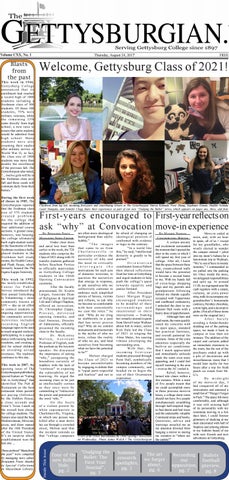
Clockwise from top left, incoming first-years and contributing writers to The Gettysburgian Marisa Balanda, Peter Zhang, Stephanie Osman, Maddie Neiman, Gauri Mangala, and Jennifer Clogg share their experiences as part of our new “Dodging the Bullet” series, which appears on pages one, three, and four.
First-years encouraged to First-year reflects on ask “why” at Convocation move-in experience
B y B enjamin P ontz M anaging N ews E ditor Under clear skies and amid less heat than earlier in the week, the 728 students who comprise the Class of 2021 along with 10 transfer students gathered before Beachem Portico to officially matriculate as Gettysburg College students in the 186th Opening Convocation ceremony. After the faculty processional, Dr. Kristin Largen, Associate Dean of Religious & Spiritual Life and College Chaplain, offered an invocation, Dr. Christopher Zappe, Provost, delivered opening remarks, and Gail Sweezey, Director of Admissions, officially presented the incoming class to the faculty. Dr. McKinley Melton, Assistant Professor of English, took the podium as the keynote speaker. He discussed the importance of asking “why,” juxtaposing the boundless curiosity of toddlers with the lack of “coolness” in exposing the vulnerability of not knowing. He urged the incoming class to be just as intellectually curious as they once were by committing to “rediscover the power and potential of the word ‘why.’” On the heels of a violent protest by white supremacists in Charlottesville, Virginia, in which one person was killed after a man drove his car through a crowded street, Melton said that the incident reminds us that “college campuses
Inside This Issue
During the first week of classes in 1985, The Gettysburgian reported that the freshman class size of 575 students created problems for the college that required the addition of four additional course sections. A greater issue, however, was housing: the college ultimately built eight-student suites in the basements of three freshman residence halls, placed students in the freshman hall study rooms, the Health Center, and Plank House, which formerly housed the Phi Sigma Kappa fraternity.
Tour of the new Bullet Hole, pg. 2
are often more ideological battleground than idyllic bubble.” “The images that came to us from Charlottesville in particular evidence the necessity of why and the need to critically interrogate the motivations for such acts of domestic terrorism, to question the narratives that emerge in response, to ask ourselves why we collectively continue to embrace such simplified stories of heroes, victims and villains, to ask why we become so comfortable with how consistently we cast the roles.” he said. “Why do we cling so stubbornly to a past that has never proven true? Why do we commit monuments and memorials to the myths of who we were, refuse the reality of who we are, and bind ourselves from becoming what we have the potential to be?” Melton charged the Class of 2021 to become uncomfortable by engaging in debate that is “equal parts respectful and fearless” and not to
be afraid of changing an ideological position if confronted with evidence or logic to the contrary. “In a world like this,” he said, “intellectual dexterity is greatly to be praised.” Orientation coordinator Jessica Hubert then shared reflections from her time at Gettysburg and urged students to help push the college’s quest towards equality and justice forward. After President Janet Morgan Riggs encouraged students to be mindful of their surroundings and intentional in their interactions -- framing her remarks around a quote from David Foster Wallace about fish in water, senior Rick Hale led the Class of 2021 in singing the Alma Mater, his soaring vibrato enveloping the surrounding area. With that, the incoming first-year students processed through Penn Hall, symbolically becoming members of the campus community, and headed on to begin the rest of their Orientation experience.
A view of the crowd that attended the 186th Opening Convocation on Wednesday; Photo Jamie Welch / The Gettysburgian
“Dodging the Bullet: The First Year Journal”, pg. 3
Summer research spotlights, pg. 5
B y M addie N eiman C ontributing W riter A certain anxiety and excitement surrounded the moment that I opened the door to the room in which I will spend my first year of college. After all, I knew that the space between these four, cream-colored walls would have the potential to become a second home to me. With my hands full of extra-large shopping bags and my parents and grandparents following behind me (hands equally occupied with Tupperware and cardboard containers), I unlocked the door to my Hanson Hall room with a heavy dose of apprehension. Although bare and a tad warm, the room quickly eased my concerns with its open space, standard but practical furniture, and overall potential for coziness. Some of the extra amenities (especially the built-in air conditioner that I much appreciated and immediately utilized) made the room even more appealing, and I could feel myself warming to the area – even as the AC cooled it. Relief, however, turned into chaos within a few minutes. While a team of five people meant that we could accomplish more in those precious move-in hours, a college dorm room should not have five people simultaneously scrambling through half-emptied bags to find sheets and bed risers and the undeniably valuable Command strips and hooks. Questions, advice and warnings assailed me as my attention diverted from hanging a mirror to storing my sweaters to “where are the outlets?”
The art we forget about, pg. 6
Move-in ended at noon, and, with an hour to spare, all of us – except for my grandfather, who wisely elected to wander the campus instead – piled into my mom’s Subaru for a last-minute trip to Walmart. “We’re out of here in twenty minutes,” I commanded as we pulled into the parking lot. Once inside the store, we delegated responsibilities and split up. At around 11:20, we regrouped near the cash registers with a carpet, curtains, an extra power strip, milk (to accompany my grandmother’s homemade cookies), Hershey chocolate, a mini light, and a decorative globe. (Not all of these items were on the original list.) After barely avoiding a fender-bender skidding out of the parking space, we made it back to campus in less than ten minutes. The addition of the carpet and curtains added an immediate classiness to the room, but the rest of the purchases ended up with a pile of decorations and miscellaneous items that I would later tackle for two hours after a trip for fresh peach ice cream from Mr. G’s. By midnight of my move-in day, I had conquered all of my renovations and amassed a small list of “Things I Forgot to Pack.” The space felt more comfortable, and although it was still missing half of its personality with my roommate moving in a few days later, I could foresee glimmers of studying at my desk (decorated with half of Staples) and pinning photos to my bulletin board of me with new friends and new adventures at Gettysburg.
Recording our opposition, pg. 7
Bullets football preview, pg. 8
THE GETTYSBURGIAN
Page 2
NEWS ♦
Thursday, August 24, 2017
A tour of the new Bullet Hole CPS commissions scholarship for DACA student B y J amie W elch E ditor - in -C hief The new temporary Bullet Hole has opened on campus, and we got an exclusive tour of the new facility. There is a lot that is the same – the friendly service and Chicken Finger Friday have not gone anywhere – but there is a lot that has changed. When I approached the front door of the new space, I was struck by the terrace with trees and other plantings as well as ample seating. When I walked inside, I was immediately impressed with how spacious the new Bullet Hole is. Massive vaulted ceilings and vistas of glass make the space feel much larger than it really is. Furniture from the old Bullet Hole and the Junction makes an appearance in the new space, and even the Bullet Hole sign from the old CUB sits framed on the wall as an homage to the Bullet Hole of the past. That is the motif of this new space – a nod to tradition and a look to the future. You will find venerable favorites like the sub line and the hot line – but you will find some changes. The largest and most noticeable change is
the design of the serving area in the new space. In the old space, the entrance and the exit were the same and it led to confusing lines that snaked all though the cramped space. In the new Bullet Hole the serving area is designed like an upside down U, with the hotline, salad line, and sub line in one long loop with registers located at the other end of the U. Another change is that the hot line’s grill is in the kitchen in the back – meaning that while in this temporary space the hot line will no longer grill items to order. The Bullet Hole is debuting new washable plastic baskets for serving food in a move to increase the sustainability of their operations. Additionally, the to-go containers are now microwaveable, meaning that they can be saved and used again and again. Although Ike’s is out of commission during the CUB renovation, there will be a salad line in the Bullet Hole with a similar offering to Ike’s. This line will run seven days a week from the start of lunch service to 7:00 p.m. Other menu
B y B enjamin P ontz M anaging N ews E ditor In an email to the College Digest, Ron Wiafe, Director of Student Rights & Responsibilities, reported that 29 bias incidents occurred on the Gettysburg College campus during the 2016-17 academic year, an increase of more than 20% from the 2015-16 total of 24. The college defines bias conduct as: “Threatening, degrading, abusive, or hostile acts including conduct, expression, or speech which are motivated, in whole or in part, based on an individual’s or group’s actual or perceived race, ethnicity, color, religion, national origin, disability, veteran status, marital/ familial status, possession of a General Education Development Certificate (GED) as compared to a high school diploma, sexual orientation, gender identity, gender expression, sex, age, or genetic information.” Notably, the largest number increase in incidents from 2015-16 to 2016-17 came in incidents pertaining to race and ethnicity, which increased from 11 to 19. Concurrently, incidents pertaining to gender identity were cut in half, going from 10 to 5.
While a vocal campus population suggested that a more divisive atmosphere existed on campus this year, perhaps in relationship to the results of the 2016 U.S. presidential election, such a relationship was not reflected in reports of bias incidents; Wiafe called the difference in number of incidents before the election versus after the election “not statistically significant,” noting that 14 of the 29 reported incidents occurred prior to the election while the other 15 happened after. On November 17, nine days after the election, dozens of students camped out in front of Penn Hall overnight as they protested what they saw as an atmosphere of hate that pervaded campus. Cait Goodlett ’17, who was one of the protesters, told The Gettysburgian at the time that the protest occurred in response to “increased hate speech all semester.” In a letter on behalf of the protesters, Joey Recupero ’17 promised to “strive and push forward” and “to unite under an understanding that hate is a poison that we will not swallow.” The 2016-17 academic year’s 29 reported bias incidents marks a doubling in reports of such incidents since 2013-14.
changes include a new mac and cheese that early reviewers say is exquisite, a change back to 16 inch pizzas, and bagels instead of English muffins on all hot line breakfast sandwiches. Notably absent from the new space are the televisions students used to gather around on Sundays to eat wings and watch the football games. With the Junction gone this year and the removal of cable from the residence halls this summer, there are no spaces left on campus besides some residence hall common rooms, fraternity chapter houses, and the Jaeger Center to watch the game. Bullet Hole supervisor Graham Larkin says that there may be some delays in service as the staff get used to the new space, and asks students to “bear with us” as they get into the swing of things. Larkin also invites students to talk to him or any other manager if they have suggestions. “We always want to listen to students,” Larkin said.
To view photos of the new Bullet Hole, visit http:// gettysburgian.com/bullet/
College reports 20 percent increase in bias incidents
Wiafe suggests that it is difficult to determine whether the spike reflects an increase in willingness for students to report or an increase in incidents occurring. “It is hard to determine what specific factors caused the increase in incidents,” he said. “I think our community is continuously learning how to respect and appreciate the differences in others. As a result of this inclusive process intentional and unintentional mistakes occur.” The campus has established a Bias Awareness and Resource Committee (BARC), which is working to address issues pertaining to biased conduct as well as educate the campus on the issue. That committee has student representatives from the Black Student Union, Latin American Student Association, Student Senate, Outer Space (which supports queer-identified students) and the Interfraternity Council as well as a Chinese international student representative, members of the faculty, and college administrators. For tables comparing bias incident totals from year to year, visit gettysburgian.com/bias17/
Students work at the Painted Turtle Farm, one of the projects of the Center for Public Service that enables students to interact with immigrant communities; Photo courtesy of Gettysburg College
B y B enjamin P ontz M anaging N ews E ditor Gettysburg College’s Center for Public Service (CPS) has reached a fundraising goal of $100,000 for a new scholarship that will be awarded to a single student each year. Preference will be given to an Adams County or Pennsylvania resident in the United States as part of the Deferred Action for Childhood Arrivals (DACA) program. DACA, an exercise in enforcement discretion by the Department of Homeland Security (DHS) that grants certain individuals who entered the country illegally while minors temporary relief from deportation and eligibility for a work permit, faces an uncertain future in the Trump administration. Trump has said his administration will look at immigration “with great heart.” In June, DHS announced it would continue to process DACA renewal applications and abide by the provisions of the initial parameters outlined in 2012 by the Obama administration. However, DACA presently faces a potential legal challenge from ten state attorneys general, who have said they will pursue legal action if Trump does not begin to phase out the program by September 5. Meanwhile, last month, 20 other state attorneys general sent a letter to Trump urging him to defend the program, and they were followed by 42 Democratic senators with a similar message. Former Secretary of Homeland Security (and current White House Chief of Staff) John Kelly warned, however, that DACA may not survive a legal challenge and would not commit to defending it. On July 21, two senators introduced the Dream Act, legislation that
would provide a pathway to citizenship for those who entered the country illegally while minors. Similar legislation has been proposed numerous times over the past 16 years, and the Trump administration opposes it. In January, Gettysburg College President Janet Morgan Riggs pledged the college’s ongoing support to undocumented students. Although she stopped short of declaring the college a “sanctuary campus,” citing ambiguity surrounding the meaning of that term, she promised undocumented students free legal advice from an immigration attorney, individualized counseling, and weekly gatherings of support. She also committed the college to “meeting all educational expenses of our DACA students if they would lose financial aid due to a change in their immigration status.” J a m i e Yates, Director of Communications & Media Relations, reiterated each of those commitments from the college in an email Tuesday (but noted that Gettysburg has “never deemed ourselves a sanctuary campus”) and said that services including in-person consultations with an immigration attorney, one-on-one counseling, and weekly gatherings of support occurred both late in the fall semester and through the spring semester of the 2016-17 academic year. The fundraising effort from CPS, however, is not related to the college’s commitment to replace educational expenses of DACA students lost due to a change in immigration status. Any money towards that purpose would come from the college’s general financial aid budget. Citing privacy concerns, Yates declined to provide further context regarding a
prior statement from Riggs that there is a “relatively small” number of DACA students at Gettysburg. “[T]his has been a challenging time for our DACA students, and we must continue to provide support and encouragement to them,” said Yates. Ultimately, 111 donors raised $103,769 towards the Pérez-Rico Scholarship. Kim Davidson, Director of the CPS, said that more than $92,000 was raised from individuals and organizations CPS approached individually before a crowdfunding campaign was launched. The scholarship honors the legacy of PérezRico, who “worked hard to create a sustainable link between the immigrant community in Adams County and Gettysburg College through programming as well as the establishment of the organization Casa de la Cultura,” Davidson said. Casa de la Cultura holds English as a Second Language classes and swimming clinics, and these are two of the primary ongoing efforts through CPS to facilitate engagement between Gettysburg College and the immigrant community. Other such efforts include the Painted Turtle Farm, El Centro (an after school program), and a migrant education after school program. “Gettysburg believes that a diverse and inclusive learning environment is essential to academic excellence, student success, and a thriving community,” said Yates. “Inclusion and internationalization are major components of the College’s strategic plan and we are committed to cultivating a diverse, inclusive and welcoming campus community that enables our students to thrive and contribute.”
DPS Crime Log May 8 * A drug abuse violation (possession of drug paraphernalia) was reported in Musselman Hall; the incident was referred to the Office of Student Rights & Responsibilities (SRR).
* A larceny (theft of bicycle) occurred at the Dining Hall Bike Rack; the case was referred to GPD. * A larceny (theft of bicycle) occurred at the Stevens Hall Bike Rack; the case was closed as there were no suspects or witnesses.
June 17 * An incident of harassment stemming from a physical altercation during gameplay by Trilogy Lacrosse occurred at North Athletic Field #8; the case was closed with no further action.
May 9 * An incident of rape and fondling occurred in a college recognized residential facility; the incident is under investigation by DPS and the Title IX Coordinator. * A rape occurred in a college recognized residential facility; the incident was referred to the Title IX Coordinator. * A non-aggravated assault classified as harassment occurred in Paul Hall; the incident was referred to SRR. * A non-aggravated assault classified as harassment occurred in the 300 Block of Carlisle Street; the incident was referred to SRR. * A violation of liquor laws (underage consumption & false identification card) occurred in the 100 Block of Carlisle Street; Gettysburg Police (GPD) cited Brandon Casamassima ‘19 for underage consumption and carrying a false identification card.
May 13 * A larceny (theft from building) occurred at Paul Hall; the case was referred to GPD.
June 18 * An incident of disorderly conduct involving an irate parent yelling profanities occurred at the Intramural Athletic Fields; the case was referred to Conference Services.
May 10 * A burglary occurred at Alpha Tau Omega; the case was closed as there were no suspects or witnesses. May 11 * Three incidents from a Crime Stat Form that occurred in 2016 appear in the DPS Crime Log. May 12 * A larceny (theft from building) occurred at Musselman Library; the case was closed as there were no suspects or witnesses.
May 17 * An incident of defiant trespassing occurred at Colonial Hall; GPD arrested Brian Shelley and Christmas Snow Frgmoyer Shelley. May 21 * An incident of larceny (theft of a black suitcase with items inside) occurred at the Constitution Parking Lot; the case was referred to GPD. May 26 * A non-aggravated assault classified as harassment/stalking occurred at Breidenbaugh Hall; the case was referred to GPD. May 30 * An incident of larceny (theft of bicycle) occurred at the Jaeger Center; the case was closed as there were no suspects or witnesses. June 12 * An incident of disorderly conduct occurred at the Majestic Theater; the case was referred to GPD. * A larceny (theft from buildings -- college furniture left in hallway) occurred at Ice House Building H; the case was closed as there were no suspects or witnesses.
June 24 * An incident of larceny occurred at the Sigma Chi South Exterior; the case was referred to GPD. June 27 * An incident of harassment occurred at the fence area adjacent to Shirk Field; the case was closed. June 29 * An incident of vandalism occurred at the Bream Gym Lot; the case remains open. June 30 * An incident of burglary/larceny (theft from buildings) occurred at 227 Carlisle Street; the case was closed as there were no suspects or witnesses. Note: This report covers incidents that occurred on campus from finals week in the 2016-17 academic year through the end of June. Incidents that occurred from July 1, 2017 through the beginning of classes will appear next week.
THE GETTYSBURGIAN
FEATURES Page 3
♦
Thursday, August 24, 2017
Dodging the Bullet: The First-Year Journal
The Gettysburgian introduces new feature for first-year students to share their experiences Roommate puts fears to rest R e f l e c t i o n s o f a f i r s t generation college student B y J ennifer C logg C ontributing W riter
I am not one to use Facebook Messenger f6or anything more than playing Words with Friends, so when a message request from someone named Jourdynn Cooper popped up, I was surprised. I expected a spam message from someone unknown requesting an instant transfer of money because my husband had been kidnapped in New York City. But, before I clicked the “delete” button, something made me stop and read the message first. What followed was the longest conversation I’ve ever had on Facebook Messenger — it was my roommate! The conversation ended in relief (she’s incredibly kind and normal! What luck!), excitement (we actually like the same things!), and euphoria at having made a friend out of the girl I am going to live with for my first year as a Gettysburgian. Since that day a little earlier this month, we have talked every day, and discover more commonalities each day. We both have a love of Disney, children, and our school. But as we talk, we are also discovering that we have differences, and that’s okay, too. She is strong in physics (I’m really not), she enjoys “The Office” while I’m more into “American Horror Story.” I will be playing intramural softball while she is trying
A screenshot from Jennifer Clogg’s initial dialogue with roommate Jourdynn Cooper (provided by author)
out for the cheer team. What’s important is that, thus far, we have the same core values, and that is what helps us to get along every day, and it is what will carry us through the school year. A l t h o u g h Jourdynn is my first real friend at Gettysburg, she will be far from the last. I know that in the next four years, I will meet people who will become integral parts of the rest of my life. I will meet
future maids of honor, best friends, significant others, and potentially even my future husband. The relationships and connections that I will make will help shape who I am as a person, and hopefully I will shape others’ lives positively, as well. Meeting my roommate and first close friend was a huge relief as I prepare for my first year, but I know much lies ahead before I fully “bite the bullet.”
B y G auri M angala C ontributing W riter For many college students, college is a time of liberation. A time where we finally get to taste that American dream, that sea of opportunities; that time where we finally get to reach out fearlessly and touch their Dream. Not me, though. I’m terrified. It’s not about leaving home or being ready to be an adult. I’m so scared because the America that I loved and was ready to be a part of is slowly crashing down around me. In 1996, my parents left everything they knew in India to embark on a better life here in the Land of the Free. In 1999, they had me. My parents always taught me to be proud of my heritage, but more than that, they taught me to understand that being American is just as much a part of my story as is the color of my skin or my family tree. In 2008, the first black man was elected President of the United States, and I was mesmerized. I saw myself in Obama: someone who had been ridiculed based on ethnicity, someone who was called an immigrant (not understanding why that was such a dirty word in the first place). My mother and father love this country. My father built our home, his business, and his legacy here. My mother found her voice and her dream here. They
are no less American than baseball and apple pie. In 2010, both of my parents became citizens of this country. My father a Republican, my mother a Democrat, I finally got to see them participate in politics beyond debates in the living room. Everything seemed to look up: Obama was finally our President, not our Black President. ‘Finally,’ I thought. People were seeing past the color of his skin, my skin. How naïve I was. In my senior year of high school, Donald Trump running for president went from being a joke to being a serious thing. He said things that made some people angry, but I was just scared. Some of my friends could not understand why I was feeling the way I was. But suddenly, the word ‘immigrant,’ a word that I hold with such high respect, had become an insult once more. People were chanting to block out people just because they are different. After Trump was elected, I had to step back from a lot of people in my life who could not see what was happening to my family. There is a fear that all people of color experience when we go to a new area. We don’t know how we are going to be received by people -with open arms, or flaming pitchforks -- but there is a peace that we feel in our own homes. With this election, however, the
hatred was in our homes, in quiet stares, and on our TVs. It was as if I was six years old again, and the white girl on the playground told kids not to talk to me because of the color of my skin. I still remember being taught at such a young age that my skin color not only made me different, but less than. And now here I’m, 18 years old, about to embark on the rest of my life, and the President of the United States is saying the same damn thing. For families like mine, our citizenship means nothing to this man. To him, my parents still belong to India. That was proved when Nazis and white supremacists stormed Charlottesville last week and were not condemned by the leader of the “free” nation. I was terrified of the thought of going to college. I wanted my sanctuary at home. But after I received the campus-wide email from President Riggs, I started to feel better. She condemned these terrorists and stated that Gettysburg College will never be a place for such a thing. I realized that going to a school whose backyard is a constant reminder of the price Americans had to pay for equality is the best place for me. While I am scared of what’s to come for our country, I have faith in myself, my peers, and my school. Go Bullets!
Traditional or digital textbooks? M e e t i n g m y b e s t friends of the future
Two of the textbooks Peter Zhang purchased; photo provided by author
B y P eter Z hang , C ontributing W riter “Beep, Beep, Beep”, I quickly pressed snooze button without taking my eyes off the computer screen. I knew exactly what the message was — it was my class registration reminder, which I had set about a month before. “Click, Click, Click”, I immediately checked out my shopping cart filled with a biology course, a FYS class, a first-year writing class, a lab session, and an eight a.m. Chemistry class, which was a tough decision to make.. “Your shopping cart is empty” appeared, and I felt slightly relieved, like a real college student. But, that feeling only lasted a night before an email appeared in my inbox the next morning saying I had not registered for any class. Fortunately, it was sent in error. I really wanted to
keep up the momentum of a good start to the semester, which meant no taking chances by waiting to buy books. However, two roads diverged on the bookstore website. Do I go with traditional textbook or buy the digital textbook and read it off my iPad? I quickly checked the price for each version. A used tenth edition Campbell Biology book with good condition is about $50 on Amazon, and a PDF version of the same text costs around $12. I selected the e-book without any second doubt, not because it was cheap, but that is the only way the book could get to me. I was not physically in the U.S.. I flew right back home to China after my high school graduation on June 8th. The e-book arrived around thirty minutes after the payment, and I started
reading it off my 9.4 inches iPad. I was quite liking it at the beginning; however, I found it very difficult to read when I needed to refer back to the early chapters. Also, the bluelight made my eyes dry much quicker than it had before. Meanwhile, I was also reading the Zumdahl Chemistry book, which I had from high school. It was a paper version that was firmly bound, and I liked the texture; also, it was very easy to flip pages back and forth when I needed to. Plus, some blog posts on the internet suggested brain memorizes paper books better than eBooks. Therefore, I changed my mind and put all the traditional textbooks I need for the semester into my Amazon shopping cart, and I bought them as soon as I landed in the United States.
B y S tephanie O sman C ontributing W riter People always say that the best friends you’ll ever make will be made in college, and I must admit, I’ve always been a bit skeptical of that. After all, we’re all practically strangers going in, and it is more than likely that we’ll be living with those same total strangers for at least two semesters. I can barely stand living with my brothers for that long, let alone someone I barely know. That said, social media is a magical thing, and I might not be as much of a stranger to my future classmates as I thought. One of the first things I did after getting accepted early decision was join the Gettysburg Class of 2021 Facebook group. I figured I’d give it a shot, maybe meet a few classmates, and get some updates on what to do at my future home. Later that night, a new message popped up, saying that someone had made a group chat. Any accepted student was welcome to join. So, I texted whoever it was that posted and the next day I was in a group chat with about thirty of my future classmates. And that number only grew as time went on and more students were accepted, jumping from 30 to over 300 in the main group chat, and even branching out into major specific group chats. I even made one for fellow
A screenshot from a group chat of which the author is a member
STEM students. Over time, I got to know my future classmates, and I was surprised by how comfortable I started to feel. I went from feeling afraid to post in the group chat with 30 people to chatting regularly with a group of more than double that in a Social Science group chat. Whether it’s political views, thoughts of what was happening on campus, or just how we plan on decorating our rooms, there’s always something to talk about and someone to talk about it with. People have made plans to get together before we get to campus and have been sharing ideas to start a new club. I’m honestly not sure when it happened, but somewhere along the line, a bunch of near strangers
became closer than anyone expected. When I first got accepted to Gettysburg, I had a lot of concerns, especially about who I’d be spending the next four years of my life with. Would I be able to make friends? What would the first few weeks be like, with me not knowing anyone? How would I adjust? But now, I’m feeling confident in my ability to make friends because I’ve already made some. It might be different when I get to campus, but I can’t worry about that now. For now, I’m going to be happy with the friends I have, and hope for the best once I get onto campus. Only time will tell if these people will become my lifelong friends, but for now, this is a great place to start.
THE GETTYSBURGIAN
FEATURES Page 4
♦
Thursday, August 24, 2017
Becoming a posh fashionista Taking you through five on a college student’s budget m i n u t e s o f m i n d f u l n e s s
Some of the supplies and decorations Marisa Balanda purchased for her room; photo provided by author
B y M arisa B alanda C ontributing W riter When it comes to college dorm shopping, “Bed, Bath & Beyond” is truly an understatement. According to a 2014 study from The Washington Post, the average college student spends approximately $916 on dorm supplies. While this number may seem extravagant to any outsider, I can admit that I have been suckered into the marketing tactics, Pinterest boards, and YouTube videos that revolve around furnishing and decorating first-year dorms. In most cases, I would assume that the logical first step for dorm shopping would be making a list. However, my first step was to pick a theme and color scheme. Yes, it sounds ridiculous. But this superficial step put me on the right path to make sure my cinderblock space will be a stylish and coordinated place to call home for the next year. For my room, I am planning to use grey as a subdued base color with a lot of light pink and sparkly accents.
After I moved past the majority of my items at the “wannabe posh fashionista Target. They had blankets, living on a college student’s shower necessities, storage budget” phase, I became containers, bedding supplies, practical. I went through my and all of the in betweens room at home and inventoried that fit my “pink, grey, and what I would take with me. sparkles” theme without Then, I divided stretching my budget. We up my shopping list into also stopped at Kohl’s and five sections: bedding, Bed, Bath & Beyond for some bath & personal care, desk/ final practical purchases. I school supplies, storage, even explored my crafty side and miscellaneous. I was by trying some DIY decor lucky enough to go shopping projects I found online. I am with my aunt (who is also hoping that these monogrammy Fairy Godmother) and inspired decorations will help grandmother. They were my room feel more personal. much more willing to indulge Ultimately, I am my glamorous whims then counting down the days my parents would be. I guess until I move in and am it’s true that grandmas are extremely grateful for my infamous for spoiling their family, who never fail to grandchildren. With the help support my decorative whims of my list and some coffee, while simultaneously sharing we hit the stores! practical advice about the E v e n t h o u g h I reality of dorm living. After purchased the bulk of my I broke the bank on shopping dorm supplies in one day, I day, I figured it was better to found that it was helpful to be safe than sorry. (I’m still browse and shop at multiple trying to convince myself that stores. TJ Maxx was my ten towels were necessary). personal favorite stop of the Here’s to a great day. They have many trendy start to the school year and (and affordable) options to hoping that all your dorm for decorations and office/ dreams come true! Mine sure organizational supplies. did. However, I found To follow along with our “Dodging the Bullet” series throughout the year, visit our website: gettysburgian.com/tags/dodging-the-bullet/ To submit an idea for this series or to get involved, send an email to editors@gettysburgian.com
Everything you need to know about Musselman Library B y M usselman L ibrary Welcome to Musselman Library at Gettysburg College! We are looking forward to meeting you in person when you come into the library for CYC (Charting Your Course) next week. This fun, interactive, activity can be completed between Monday, August 28 and Friday, September 1 during the hours of 1:00-5:00pm. This is a required CYC activity, and there are no make-up dates, so be sure to stop by and during the dates/ times above to get credit. Plus, you will receive prizes for your participation, in addition to your CYC credit!
In the meantime, here are a few tidbits about the Library you might find helpful your first few days on campus. Hours During orientation week, Musselman Library is open weekdays, 8:00am4:30pm and 12:00-6:00pm on the weekend. Once classes start the library will be open 8:00am-11:00pm during the week (closing at 8pm on Friday nights), 10:00am-8:00pm Saturday, and open 10:00am-11:00pm on Sunday. We begin our round-the-clock hours on Sunday, September 10th. You can also check the library’s hours on our website anytime.
We’re hiring! If you’re thinking about a campus job, Musselman Library will be hiring student employees in many departments for Fall 2017. You can read the job descriptions and information on how to apply through GettysburgWorks. To find out more about GettysburgWorks, visit the College’s website at http:// www.gettysburg.edu/about/ offices/college_life/career/ gettysburgworks/ . If you have already applied before coming to campus, there’s no need to check in with us. We’ll contact you about interviews. See you in the Library!
B y A ri S naevarsson F eatures E ditor I should preface this piece by reminding you all that mindfulness and meditation are not only for ascetic monks and yogis and people who talk about your “chi.” Mindfulness is nothing new or revolutionary; it is not a program designed to get you quick results. It is, however, vital to finding peace in your life and, in my experience, it leads to profound spiritual growth. Mindfulness refers to a deliberate awareness of the present moment, in concert with accepting what thoughts arise without lingering on them. Unlike everything else we do in our busy lives, there is no goal to seek here. While “results” may come, the greatest benefit comes as part of the process, and as such, you are advised to enjoy mindfulness meditation for the sake of mindfulness meditation, not for what is to come after. In that vein, I will be spending the rest of this article taking you through a five minute session of mindfulness. You need not sit in any specific position or do anything else, but you would likely get more from this if you were to read this in an environment void of external stressors. Sit alone, in quietness, and be present for the rest of this piece. How this works Take a brief pause between paragraphs, in which you continue to follow the suggestions of the previous paragraph, before moving onto the next. If you feel rushed or distracted at any point throughout this process, I invite you not to dismiss those feelings (you might recall the warning from my article Mindfully binging: Resisting discomfort begets discomfort) but rather to watch them, as you would a dark cloud, go by and eventually leave your mind. Breathing Begin with a deep in-breath through the nose, to a count of four. Feel the fresh air as it fills your airway and then imagine it collecting in your stomach (these are mental cues, not anatomical truths, so simply use them to guide you). Pause there, to a count of two, before slowly and intentionally initiating the out-breath, to a count of six. Feel that same air travel back out,
your mind’s eye. Look at it and acknowledge its presence, but do not judge it. Remember that happiness does not come when uncomfortable thoughts leave but rather when uncomfortable thoughts are no longer fixated on and judged. Again, we are not actively seeking out any sort of response here. See what makes itself known without asking for it. And then each time you find yourself beginning to fixate on one (and it is very likely, and normal, that you sometimes realize this well after the fixating has begun), simply let it pass and remain grounded. We are essentially saying to these thoughts, regardless of whether they are happy or sad thoughts, “Hi there, what is your name? … Well, it was nice to meet you. Goodbye.” Laugh This is something I use in my own meditations from time to time. If an especially troublesome or stagnant thought is disturbing your mindfulness meditation (realizing it is actually your response to the thought that is the disturbance, rather than the thought itself), allow a little smirk to develop and simply laugh it off. I personally do not laugh out loud, but I respond to the inherent humor in the situation. Rather than viewing this process as serious and spiritual, I find that the best defense against the sticky parts is to not take the situation too seriously and instead find humor in it. Now you can move on. Wrapping up Stretch out a little bit, and thank yourself for allowing yourself this time. You just spent approximately five minutes not obsessing over productivity or engaging in mindless activities (neither are morally inferior decisions, but they can chip away at your inner peace if not kept at bay with an approach like mindfulness meditation). Ask yourself how this was for you, taking some time to breathe deeply and intentionally. Do you feel more relaxed? Was the experience difficult? I, personally, also want to thank you for taking out this time and letting me guide you through some mindfulness practice. See you all on campus soon.
Staff Box The Gettysburgian
Editor-in-Chief, Jamie Welch
Money, Science & Tech Editor, Aphra Murray
Managing News Editor, Benjamin Pontz
Opinions Editor, Alex Romano
Arts & Entertainment Editor, Katherine Lentz
Co-Sports Editors, Claire Healey & Elizabeth Hilfrank
Features Editor, Ari Snaevarsson
through the mouth, and notice how little resistance you encountered in the process. After a short series of intentional breaths, get back to reading this, while simultaneously taking deep in- and outbreaths. Do not try to count them while reading, as it will be too difficult. Likewise, do not worry if you are not taking the most perfect breaths ever. In fact, no breath is perfect. Earlier, you noticed the lack of resistance inherent in the breathing process (that is, when the breath is controlled). Now I want you to pay attention to how different the experience of each breath is from one to the next. No one breath is alike, and yet they work in harmony, almost as if by design. Muscles As you continue to breathe in a relaxed, not forced, manner, allow your focal point to move calmly towards your shoulders. Notice the slight raise during the in-breath and the drop during the out-breath. Consciously relax the shoulders and remain tuned into this movement for a bit. W h e n t h e shoulders raise during the in-breath, you might notice a slight tensing of the muscles in the neck and face. This is okay. As you breathe out, purposefully relax them, in rhythm with the duration of the out-breath. After a few of these, allow a smile to develop, if one is not present already. If this feels awkward, that is alright; embrace the awkwardness, see it pass by without judging it, and proceed to smile anyway. It need not encompass your entire face; just a slight smile is all that is necessary. Contact Now I want you to shift your attention from the shoulders and the muscles of the face to the seat you are sitting on. Notice each point of contact, where your back meets the chair, where your legs meet the chair, where your feet meet the ground, and maybe even where your palms meet your thighs, if that is how you are sitting. Just pay some brief attention to these areas, and then move on. Your thoughts What thoughts are on your mind right now? Do not search for them. See what comes, on its own volition, to
Lead Copyeditor, Morgan Hubbard
Advisors, Jim Duffy & Jack Ryan To get involved with The Gettysburgian, contact a section editor or visit http://tinyurl.com/gettysburgian to complete our interest form. We would love for you to be involved!
THE GETTYSBURGIAN
MONEY, SCIENCE & TECHNOLOGY Page 5
♦
Thursday, August 24, 2017
Summer research spotlight: Emily Harrison B y E mily H arrison C ontributing W riter During my sophomore year at Gettysburg I fell in love with the field of organic chemistry. And this love motivated me to spend last winter break applying to thirteen universities’ summer research programs that would allow me to study a subject most people do their best to avoid. I was accepted to an excellent program that allowed me to do exactly that—Summer Research Opportunities at Harvard (SROH). Through SROH, I conducted research in Dr. Matthew Shair’s lab in the Department of Chemistry & Chemical Biology at Harvard University for ten weeks this past summer. More specifically, The broad goal of Rocco’s research project is to prevent increased expression of an important metabolic regulating enzyme called nicotinamide N-methyltransferase (NNMT). The activity of NNMT is closely related to the processes of energy expenditure and DNA methylation, but overexpression of this enzyme
may promote the onset or worsening of diabetes, diet-induced obesity, and several types of cancer. Thus, Rocco has designed a library of small organic molecules that have two structural motifs, each mimicking the structure of one of NNMT’s two natural substrates, connected by a covalent linker. The inhibitors Rocco has designed and synthesized over the past few years have the potential to be used as novel therapeutics for cancer and obesity. My job this summer was to assist with the optimization of our synthetic strategies towards a few of the NNMT inhibitors. I spent most of my time working on the twelve-step synthesis of NS-1, which is the inhibitor that has exhibited the most selectivity and potency against NNMT thus far. I began each reaction in the synthetic scheme on a very small scale, around 25-50 milligrams, and tried out slightly different reaction conditions until I found an efficient strategy that afforded a high
chemical yield. I then scaled up the reactions in increments to eventually reach a one or two gram scale. Shorter and more effective synthetic strategies are imperative in the lab and in the pharmaceutical industry, in order to efficiently build up stocks of each inhibitor for biological testing and to then produce them in quantities sufficient for commercial marketing. This research was so fascinating to me because I was not only able to do organic chemistry for 10+ hours each day, but I was also able to em p l o y m y w o r k i n a much greater context. Chemistry intrigues me day in and day out, but it becomes most important when it can be applied to solve problems that would otherwise be unapproachable without a fundamental understanding of science. This summer confirmed my plans to hopefully attend graduate school after my four years at Gettysburg are over and devote my career to exploring organic chemistry and its important applications in the real world.
Summer research spotlight: Julia Palmucci Palmucci went on an Amazon Adventure with Dr. Trillo’s Tropical Biology class. By Julia Palmucci Contributing Writer This past May, Dr. Trillo’s Tropical Biology Class set off for what was destined to be an experience of a lifetime to Peru where we would see some of the most incredible natural wonders of the world. The itinerary included a whirlwind tour through numerous biological life zones from the peaks of the Andes, high-elevation cloud forests, and some of the most pristine regions of the Amazon rain forest. As a young woman from suburban New Jersey, I was one of ten participants whose experience in the outdoors ranged from working for several years as a ranger for the National Parks Service to never having slept in a tent prior to this expedition. My class posed a unique challenge for Dr. Trillo to not only teach us a wide range of biological concepts in a hands-on fashion but also to carry our motley crew through the challenging experiences we would surely face. One member of the class, Kyle Kameika, pointed to the all-encompassing and truly hands-on learning we were afforded through this class as one of the most rewarding experiences of his college career. Reflecting on our time in Peru, he writes: As a student specialized in biology most of my nights studying were focused on learning cellular pathways, animal anatomy, and many microscopic bacteria. In Peru studying biology was completely different, my specimens were not under a microscope but instead up in a tree, and instead of being
dead or frozen they were alive…The noises and sights were so abundant I began to feel my mouth slip open in awe. I felt like the idea of biology, the study of life, really started to sink in for me during this trip. Active learning is a true passion of Dr. Trillo’s, and one that she does immensely well. During daily lecture hikes we would often stop to discuss whatever a member of the class found in the thick greenery that surrounded us. The best way to teach students tropical biology is to take them to the tropics and have them (sometimes frantically) identify bird species, mutualisms, and plant adaptations in real time. Beyond the curriculum, though, we also learned how the pressing issue of climate change and deforestation is affecting the areas we visited and the individuals living there. Dr. Trillo prepared us well for the humanistic side of the course as well. Humans are an important part of the ecology of the area, and we studied the positive and negative aspects of human presence in an ecosystem as well as many of the challenges facing native tribes who have lived in the furthest depths of the Amazon for thousands of years. Our class personally felt the effects of climate change during our 11 km day hike from an Incan holy site at the top of the Andes down through multiple life zones over several thousand meters of elevation. During the last week of May, we should have been squarely situated at the start of the dry season, meaning
that although the trail would be challenging, weather would not be a concern. However, after lunch, hours of torrential downpour pushed the morale and physical abilities of our group to their limits. The hike that should have taken ten hours took some of us sixteen; park guards who worked their for years have said that this rain was completely unprecedented, and it has become increasingly difficult to predict the end of the wet season because of the seasonal shifts resulting from climate change. It was a powerful lesson to learn firsthand, especially when we discussed what this meant for the communities entirely dependent on agriculture for their own survival. The effects of deforestation and hunting were omnipresent during our travels through Peru. Cocha Cashu Biological Station, the field station where we stayed for the majority of our trip, was in a highly protected area of Manu National Park accessible to only those conducting scientific research with special permits. The animals were abundant in this area and held little fear of people, most likely because of the lack of poaching. Conversely, entire species like spider monkeys were noticeably absent and the forest considerably quieter in the unprotected areas we traveled through down the Madre de Dios River. The lessons our class learned in Peru will stay with us for a lifetime. It taught us, not only class material, but also enhanced our appreciation for biology and the natural world.
AppTeezr
Byte-size reviews of the latest apps Nuzzel Going back into a hectic class schedule, we can all find it difficult to stay up to date with breaking news. Nuzzel connects with any and all social media accounts that you have, scans them for trending topics or breaking stories shared by people that you follow and alerts you. This app is perfect for those of you looking to keep up with the news without the burden of constantly having to worry about which sites you should be checking first. Free Category: News Updated: Aug 18, 2017 Version: 3.0.3 Size: 26.8 MB Language: English Seller: Nuzzel, Inc. Rated 4+ Compatibility: Requires iOS 9.0 or later. Compatible with iPhone and Android
Total solar eclipse captivates the United States By Aphra Murray MS&T Editor On August 21, crowds gathered across the United States to watch the contiguous total eclipse of the sun, an event that had not been seen since 1979. The event drew out fellow students and staff here at the Gettysburg College Observatory, where parts of the eclipse were viewed in the afternoon of that day. The solar eclipse, specifically the total solar eclipse, is when the moon travels in between
the path of the Sun and the earth. This means that the light of the Sun was partially blocked for a total of about three hours. For those who were fortunate enough to be in what is known as the path of totality, viewers could see the total blocking of the Sun for a total of two m inu tes and f orty s ec onds. The path of totality covered from Oregon to South Carolina. In this path of totality, viewers noted a considerable drop in temperature and watched as the dot of the black moon was visible across
the corona of the sun, visible by the naked eye. In other parts of the country, onlookers were warned not to look at the eclipse directly, for fears of causing irreversible eye damage. The solar eclipse generated large crowds across the country and revealed the nation’s interest in this incredible natural phenomenon. For those who missed this total eclipse, or are already looking forward to the next, will have to wait until 2024 to see the next one.
Senior Maihan Wali enjoys the total solar eclipse at the Gettysburg College observatory
Senior Emily Harrison presents her organic chemistry summer research at Harvard University
THE GETTYSBURGIAN
Page 6
A&E
♦
Thursday, August 24, 2017
F e a t u r e d f i l m s Annabelle: Creation: h a v e in Gettysburg Orphans never had it worse
Majestic Theater
‘Maudie’ 1 hour, 55 minutes – PG-13 Though her life was one of deprivation and ailment, Maud Lewis became one of Canada’s most beloved folk artists. In 1930’s Nova Scotia, she takes a position as a housekeeper for an irascible peddler and the two find acceptance in their small village. Sally Hawkins and Ethan Hawke give superb performances in this story of art and love overcoming adversity. Friday - Saturday (8/25 - 8/26) - 4:00 p.m. and 7:00 p.m. Sunday (8/27) - 2:00 p.m. and 5:00 p.m. Monday - Thursday (8/28 - 8/31) - 4:00 p.m. and 7:00 p.m. ‘An Inconvenient Sequel: Truth to Power’ 1 hour, 40 minutes – PG A decade after An Inconvenient Truth brought climate change into the heart of popular culture comes the riveting and rousing follow-up that shows just how close we are to a real energy revolution. Vice President Al Gore continues his tireless fight, traveling around the world training an army of climate champions and influencing international climate policy. Friday - Saturday (8/25 - 8/26) - 4:15 p.m. and 7:15 p.m. Sunday (8/27) - 2:15 p.m. and 5:15 p.m. Monday - Thursday (8/28 - 8/31) - 4:15 p.m. and 7:15 p.m.
Review of Tracy Lawson’s ‘The Resistance Series’ B y A lex P earson
Contributing Writer Missing the thrill of the Divergent and Hunger Games series? Craving an escape from real life and required reading? Then have I got the perfect series for you! Check out The Resistance Series, by Tracy Lawson. This series, consisting of four books, is an action packed dystopian thriller which will keep you up all night (and not because it has to be read for next day’s class). Tommy and Careen are the protagonists of Counteract and they bring the bright light of relatability to the darkness of their dystopian world. Thrown together by fear of death, the pair struggle to understand the constraints of the government that is supposed to keep them safe while also navigating the scary waters of a relationship in a world that no longer makes sense. Careen’s journey
continues in Resist as she learns that there is more to being an idol than starting an overnight hair trend. Tommy and Careen are joined in Ignite by a diverse group of characters who all have their own agendas and they continue to learn that they have bigger problems than finding a chance for some privacy…It’s the final countdown in Revolt as Resistance members strive to come up with a common solution. Who will win the ultimate battle; reform or revolution? The strength of the series lies in the evolution of the main characters. Tommy and Careen start off in their own microcosm where the only people they have to worry about are themselves. Their circle extends out as they meet people with views similar to their own. As leaders, they realize that their actions affect people beyond their small group. When they finally realize that they are
working to help the greater good, the actualization of these characters is amazing to witness. Even though this is a dystopian series, Lawson incorporates lighter elements to keep the story fresh and unpredictable. Tommy and Careen’s budding romance is fraught with the usual heartaches and pitfalls. Supporting characters come to life as they exchange witty comebacks and engage in verbal sparring matches. Unlikely heroes and quirky venues add intrigue and layers to a thickening plot. Anyone who loves surprise endings, a good oldfashioned duel, complex but real characters, and a little rebellion here and there will love The Resistance Series. This series will go right next to Divergent and the Hunger Games on your bookshelf. So, go read the series now and remember: RESISTANCE FOREVER!
Getting involved in campus theater: a Q&A Want to get involved in theater? We have the Q&A to get you started. How many productions are there in a year? There are three “main” productions every academic year. These productions usually premiere in Kline Theater during the months of October, February and April. However, there are additional productions throughout the year, which may be a part of student projects from classes offered at Gettysburg College, or as part of an independent theater festival, usually held in March. What kind of productions are they? Gettysburg offers a wide variety of productions from a wide variety of writers. Anything from Shakespearean plays to experimental theatre pieces will likely reach the stages of Kline Theater during your four years at Gettysburg.
Productions are selected in a manner that allows a student to participate in a number of unique performances throughout his or her time at Gettysburg.
and usually last three to four days. The first day of auditions is reserved for only first-year students as a way to offer a less intimidating environment.
Who directs the productions? Professionals direct the three main productions of the academic year, while student productions are directed at the discretion of the creator.
What can I expect from an audition? Every director has a slightly different way of holding auditions, although reading from the script is fairly ubiquitous in the audition process. However, some directors will ask students to prepare a monologue or improvise. Musical directors will likely require a prepared song.
Who can audition? Gettysburg College has open auditions, which means anyone, from first-years to seniors, can audition for a part. Experience in theater is not required in order for a student to audition, nor does it necessarily play a role in casting. As such, it is not entirely unusual for firstyears to be cast as leads. When can I audition? Auditions are typically held five to six weeks prior to the premiere,
How do callbacks work? C a l l b a c k s occur after the final day of auditions, but do not necessarily mean that a student has been given a part. Often times, callbacks occur due to a director’s desire to become better acquainted with the student, or to see the student interact with other potential actors.
Photo Credit: David Sandberg
B y K atherine L entz A&E E ditor
A n n a b e l l e : Creation is the fourth installment of the Creation series – a prequel that doesn’t advance the overall story, but fits the bill for people seeking a good fright. Despite its relatively unimaginative plot, Annabelle: Creation has enough frightful elements to ensure horror fans’ spines are curling up like autumn leaves as the protagonists become more and more entrenched within the sinister mysteries of a dead girl’s bedroom -and everything that lurks within. Things a re ble a k from the beginning for a group of orphans who are offered one last chance to
find a home by a former toy-maker, who is lonely and still desperately trying to overcome his daughter’s sudden, violent death in an automobile accident twelve years prior. Although originally enthralled by the beautiful, large home the girls’ quickly realize something is amiss when they find an odd looking and particularly frightful doll named Annabelle tucked away in the little girl’s old bedroom. Annabelle is no ordinary doll – it is a personification of hidden spirits that wander the house and provides the animus for the story. As the plot progresses, the girls continually face new obstacles, not all of which are provided by malignant
supernatural entities. However, their urges to complain about the horrors of their new abode are dulled by the knowledge that this home is the only one they have. The girls are faced with a Cornellian dilemma: the orphans must choose between horrors, each of which can ruin what is already a difficult life. Will it be a life of terror with a home, or will it be a homeless life of drifting and uncertainty? Although the plot was at times predictable, at other times it includes just enough plot twists to keep things interesting. For fans of the genre, Annabelle has proved to be a thriller just terrifying enough to keep them on the edge of their seats throughout the film.
The art we forget about B y N athalia M azza Contributing Writer
What is art? Art is an expression of the world around us. It is an expression of our feelings that words cannot describe and an interpretation of what we see and do. Most art is put in museums or theaters or on technology to be experienced. It is enjoyed because it takes unexpected turns. But what about the art that is taken for granted. The art that seems too expected to enjoy. The art, you can only see by putting your phone down and looking around you. Vincent Van Gogh, looked around him and saw that the world was much more complex. He saw that the colors of the world mixed and melted into each other, that the night sky wasn’t just black but rather a mixture dark blues and lighter blues and yellows and whites from the stars and the moon. Why can’t anyone else see that? I went on a road trip with my family, and I decided to take a stab at trying to see what Van Gogh saw. Van Gogh captured what he saw, felt, and heard in his paintings using swirls and blends of colors. His paintings gave a whole new way of looking at nature. In my opinion, it doesn’t matter how amazing you are at any form of art, it is impossible to capture the complexities of the beauty of nature, however, Van Gogh may have come the closest. A photo may capture the amazing colors of nature but it cannot capture the orchestra of sounds, smells, tastes, and physical feelings that, combined with colors create the beautiful art of nature. I’m going to look at nature in two categories; the sky and the land. The sky is a perfect canvas of colors but also of so much more. During a sunny day, it is a blend of blues, whites, and greys. The colors streak across the sky in straight lines and curved lines and fluff balls and zigzags, the clouds like little islands in the sky. A plane’s trail crossing the sky like an underline of a very important word. The
sun, though only a ball of gas, shines, sometimes bright white, other times bright yellow and still other times bright orange. Stems of light poking out of the sun like petals on flower and yet different. The sounds of birds singing alongside bees buzzing and wind hushing and every so often the wind starts howling with rage, the clouds start singing with the sounds of rain and thunder, the birds and the bees hush, and the trees start dancing wildly to the music of the universe. There is some unknown photographer taking photos, the camera flash, we call lightning, the camera shutter, we call thunder. Rarely, in the middle of the day, the moon’s path crosses the sun’s and for a minute everything goes dark. As the moon crosses over the sun, the lighting of the world becomes eerie, dark and yet not dark as the sun slowly goes out. It looks like the sun is setting in all directions. You can see the stars and instead of a glowing white ball against a dark sky, you have a dark ball with a bright white ring around it, against the dark sky. The song of day turns into the song night. All of the nocturnal animals come out to sing. It’s funny because the birds of day freak out right before the sun goes black. Birds fly back and forth as if they think it’s bed time and they are rushing to get ready. The land is an expansive sculpture of mountains, hills, plants, and water as well buildings, and other man-made structures. Shades of green, red, yellow, white, grey, blue, orange, brown, and purple make up the sculptures that create the landscape. Nothing is a single shade of color. A single tree has many shades of green because of the shadows. In the fall those shades of great turn to shades of oranges and yellows and browns and reds and when winter comes, the leaves fall off. It turns out that trees have much more complex shapes then the bushiness seen when the leaves are on. Every branch twists and turns and sticks out in its
own unique way. No two trees have the same pattern of branches. The water flows through the landscape sometimes siting still but usually not. Ripples form on the surface of the water like wrinkles on an old person, caused by anything that disturbs the still water. Water pours gently down the entrance of a cave echoing into the darkness. Waves roar as they come crashing on to a beach. The smell of salt water fills your body and creates an overwhelming but calming sensation. A river sings as it rushes down from its source. Foam forms in the water, as it moves faster and faster. Animals and insects and humans interact with the sculptures of the world with their senses. Some of these sculptures get eaten, others trampled on, still others are nurtured and cared for. Bees participate in the dance of pollination buzzing from flower to flower, rubbing up in the pollen and then spreading it to other flowers. Deer prance along playing with each other and yet staying alert for predators. Cats hiding in the grass, sometimes chew on it and other times search for mice. When a cat finds a mouse, they participate in this dance of catch and release, catching the mouse and then letting them go. As each animal goes about their dance, each one of them adds their own instrument to the orchestra of nature. I don’t think anyone will ever be able to see the world nearly as complex as Vincent Van Gogh saw it because everyone’s mind is different, but if we stop what we are doing, put everything down, and open our senses to the world, we can all see that the world is much more complex then we think. Nothing is static. People can enjoy the art of nature only when they are willing to give it all of their attention. Next time you are outside, open all of your senses to what nature has to offer. Pretend like you know nothing and ask questions. The more you interact with the world around you, the more you will be surprised by what nature has to offer.
THE GETTYSBURGIAN
OPINIONS Page 7
♦
Thursday, August 24, 2017
Note: The opinions published in this section are those of the individual writers and are in no way representative of the views of The Gettysburgian staff, The Gettysburgian or Gettysburg College.
R e c o r d i n g
By The Gettysburgian Editorial Board Last March, the Gettysburg College Student Life Committee quietly passed a new policy on unauthorized recordings that ostensibly seeks to protect students’ right to privacy when in non-public locations on campus. All would agree that is a laudable goal. However, this policy, which was only announced this week in a campus-wide email more than five months after it was passed, has vast and potentially devastating consequences for the campus community. Accordingly, we strongly oppose it. The policy states that the college “prohibits all unauthorized recording in any context in which a person has a reasonable expectation of privacy,” which seems innocuous enough until you read the next sentence, which declares that “reasonable expectations of privacy exist in classrooms, meeting spaces, office spaces, residential facilities, recreational spaces, restrooms, and locker rooms.” Ron Wiafe, Director of Student Rights & Responsibilities, clarified to The Gettysburgian that a public space -- where one does not have a reasonable expectation of privacy -- is anywhere “exposed to the weather.” In other words, a reasonable expectation of privacy exists in every building on campus.
As such, according to this policy, every photo, video, audio recording, Snapchat, etc. that -- even incidentally -- includes another person or their property is a violation of college policy, and anyone who takes such a recording as well as everyone who transmits it -- and a broad definition of transmission could include “liking” such a photo on social media insofar as doing so furthers the reach of such media -- is subject to college sanctions. That’s ridiculous. Surely, a middle ground between protecting students from having their photo taken while changing in a locker room and this behemoth of untenable overregulation that makes just about everyone who has ever used their phone in a campus building a violator of college policy is possible. Instead, the Student Life Committee painted with lazy, broad strokes in a vain attempt to solve a problem that, instead, has created far more. Wiafe insists that the college doesn’t want to become the “Snapchat police,” but he won’t rule out a Snap as potentially violating this policy. He repeatedly says that the college will exercise discretion in enforcing this policy. Unfortunately for students, they have exactly zero recourse if the college wakes up one morning and decides it is going to crack
o u r
down on, for example, a student taking a photo with their friends in Servo that incidentally captures the back of someone else’s head. There is nothing that would stop the college from citing not only the student who took said photo, but also every other student who liked or shared it on social media. Under this policy, a student Facetiming their friend inside the library could be subject to college judicial action if another student walks into the camera shot and is inadvertently broadcasted to the other end of the video call. If a student is on the phone in the Jaeger Center and someone coughs loudly next to them such that the person on the other end of the line can hear it, that student has just violated college policy. These scenarios may seem ridiculous, but they all could technically be adjudicated as violations of this policy. Furthermore, this policy will cripple The Gettysburgian’s ability to function. We routinely take photos of newsworthy events on campus and are not generally required to get consent to use those photos for news purposes. We will no longer be able to provide photos, videos, or live streams of lectures, panels, and other events held in classrooms on campus under this policy.
o p p o s i t i o n
We will be unable to record an interview in a campus building (we’ve always gotten the interviewee’s consent to record) for fear that we might inadvertently record someone laughing two tables over. This policy reduces transparency on campus. Wiafe told The Gettysburgian that students are prohibited from recording searches of their rooms by college officials (Residence Life staff and DPS) and even the Gettysburg Borough Police under this policy. In its July 2017 decision in Fields v. City of Philadelphia, the Third Circuit Court of Appeals upheld the First Amendment Right of both the party being investigated and bystanders to record law enforcement officials performing their official duties in public. “Simply put, the First Amendment protects the act of photographing, filming, or otherwise recording police officers conducting their official duties in public,” the ruling said in part. No First Amendment right to record police is guaranteed on private property. Those rights are controlled by the property owner. DPS officers and Residence Life staff members are private citizens, so no First Amendment Right to record them would normally exist in private spaces. While the college is within its rights to limit
recording of any type on its private property (including of the Borough police), we contend that this is not the correct direction to take the campus. We need more transparency in campus judicial proceedings, not less. College officials performing searches hold students’ future enrollment at Gettysburg C o lleg e - - an d in d eed students’ future careers -- in their hands and operate with little to no accountability for their actions if the ability to record is denied. Sunshine is the best disinfectant. If the college has nothing to hide, why not let students record searches of their rooms? Another example of the lack of thought in the implementation of this policy is the Office of Communications and Marketing. That office routinely takes pictures and videos without student consent around campus and in residence halls. When we reached out to Ron Wiafe in preparation for this editorial he admitted that the marketing office had not been considered in preparing this policy and that the college is “looking into” having “some conversations” about how to move forward. It’s been five months since this policy was passed, and the college has posted many photos on its public social media accounts since then that violate this policy. Even after this issue
Protecting millennials’ M u s i c a l financial future B y A lex R omano O pinions E ditor
B y L iam F. K err G uest C olumnist
This week marks the six-month point since President Donald Trump took office, and contrary to claims the President has made, very little has been done. This is not the fault of President Trump, however, but rather of the Democrats in Congress who have taken a page out of the Obama-era Republican obstructionist playbook. For this reason, Congress has not been able to effectively reform health care, the tax code, or even pass a budget. This sort of partisan gridlock and inefficiency has been normalized to Americans over the past fifteen years, and unfortunately, millennials like myself hardly know anything else. Growing up in such a gridlocked political system has shaped our outlook on the nation and the world. Part of that outlook is the knowledge that most of us likely will not see Social Security payments once we retire. As a young conservative, I was very concerned about the lack of any serious discussion over the $20 trillion national debt and the issues causing it during the 2016 presidential campaign. I am disappointed in the Republican president over his failure to take a stance on balancing the budget through entitlement reform. Entitlements and interest on the national debt together constitute what is known as ‘mandatory spending’, which makes up about 60% of the federal budget and continues to grow every year. Losing out are discretionary spending
programs, the part of the budget which Congress is able to debate and change annually that constitutes every other job the Federal Government has besides Social Security, Medicare, Medicaid, and interest on the debt. At the current rate, only 18% of the federal budget will be left for discretionary purposes by 2047, ensuring vast cuts to necessary programs such as the State Department and defense spending in the name of entitlements (Peter G. Peterson Foundation). The current constituency of the AARP, Washington’s most powerful lobbying organization, does not need to worry about this coming crisis, but my generation does. While the debt will remain for me and my children to pay off, Social Security, Medicare, and Medicaid will face automatic cuts in the coming decades as their trust funds run out. Simply put, Social Security is not guaranteed to me as it is to my parents’ generation. The annual rate of return for Social Security is, on average, about 1.23% while the average rate of return for private investment is close to 7% (Heritage Foundation). Through partial privatization, specifically the plan put forward by organizations such as the CATO Institute, we can reduce the federal deficit as well as ensure greater returns for retirement savings. Similar reforms, such as block grant spending for Medicaid, can ensure the survival of these needed programs while reducing the national
debt and continuing discretionary programs as they currently exist. It is very important to note that the original purpose of FDR’s ‘New Deal’ programs and LBJ’s ‘Great Society’ programs were meant as safety nets and Social Security was intended to be a supplemental income, not the main income as it is now for many retired persons. So when politicians such as Minority Leader Chuck Schumer describe how cuts to these programs are inhumane because they are increasingly becoming “middle class programs,” my resolve to reform them and return them to their original purpose is strengthened. In other words, entitlements were not intended to be middle class programs because the taxpayer cannot sustain a program which covers the nation’s largest class, particularly because the average taxpayer belongs to the middle class. Central to the above plan, however, is that under the aforementioned reforms, those who have paid throughout their lives will still receive the benefits they have earned, but the system will be made more efficient and yield greater returns to ensure prosperity for both the economy and for my generation.Just as I am concerned about my parents and their generation having a secure retirement, I believe their generation should be concerned about millennials’ financial future. Reforms to the entitlement system can achieve both of these ends, but reforms must be made now before it is too late.
Wow. Just- just wow. What else could there possibly be to say? He has done it. After not even a full year in office, President Donald J. Trump has rearranged the members of his administration so frequently and with such inconsistency that the two long articles I wrote to save for later use over the summer are now hopelessly dated and terribly irrelevant. My article describing Trump’s Russia troubles as being akin to the various “sorta-scandals” of the Clinton years, written some time before the Trump, Jr. meeting with Russian campaign supporters, is a perfect example. The number of the supporters said to be present at the meeting started at one, then was later revealed to be at least two, then eight, and pretty soon will rise to a projected figure equivalent to the entire population of the city of Moscow… with details still emerging. Next, an even longer article unfavorably comparing Trump to Nixon had to be scrapped. Despite making mention of new evidence suggesting that Nixon may have personally helped sabotage the Paris Peace Talks of 1968 to aid in his election to the presidency that year, and a whole paragraph clearing up the controversy surrounding Nixon’s taxes and other minor scandals whose significance has been on occasion exaggerated and do not compare to the Watergate break-in, the sections on Trump are unsalvageable (one part of the op-ed has Sean Spicer still titled as the White House press secretary). Consequently, that article had to be scrapped, too. I mean… wow. God, where does one begin? Perhaps there is no good starting point. Perhaps one should simply start by listing the names of those sacked personalities
was brought to the college’s attention, Communications and Marketing continues to violate the unauthorized recording policy. The Gettysburgian has found several photos taken inside residential facilities at this year’s move-in day that the college did not receive explicit consent to take. The college seems to be carving out exceptions for itself while leaving students in fear of disciplinary action for Snapchatting in the library. That is completely unacceptable. We would like to think that this policy is so vague and ludicrous that it is unenforceable, but, sadly, we do not have that luxury. Accordingly, we urge the Student Life Committee to go back to the drawing board and craft a narrower policy that addresses the goal of protecting students’ right to privacy in spaces that are truly meant to be private -like rooms in a residence hall, restrooms, locker rooms, etc. -- and does not criminalize everyday life. Editors’ Note: This editorial constitutes an official position of The Gettysburgian’s editorial board as reflected by a majority vote. Final responsibility for such opinion pieces rests with the Editor-in-Chief. For more information or to express a concern, please email editors@gettysburgian.com.
chairs
whose new offices are now set up outside of the White House: Sean Spicer, James Comey, Michael Flynn, Sally Yates, Anthony Scaramucci, possibly Rex Tillerson, even more probably Jeff Sessions. This is an incomplete list, of course. It only includes the most public and most important characters to be canned by their businessman boss. Spicer was (was… it still feels weird to write that) the woeful and muchridiculed press secretary who managed to tick off CNN so badly that the channel devoted entire segments of its programs to criticizing the man behind the podium. Comey was the wishy-washy FBI director whose firing frequently enters the minds of Democrats trying to convince the American public that the president obstructed justice. It is interesting to note that when Comey reopened the investigation of Hillary Clinton’s e-mail scandal, I heard on television and in person many Democrats expressing their belief that the continuation of the probe was political, a blatant October surprise, and even suggesting that Comey resign or that Obama fire him. The weasel Mr. Flynn’s ties to Russia became the first Trump scandal early in the winter. Yates, the acting attorney general, received her pink slip in the second-most-controversial instance of Trump’s federal reorganization scheme. Scaramucci, being the shortest-lived and most recently discarded name on the list, and therefore the least consequential but most shocking, deserves the start of a new paragraph. He was a smart-alecky, wisecracking Italian, and in retrospect he stood no chance of lasting long in the Trump White House Circus. There is only room for one loudmouth in the executive office, and his name is Donald.
The changes in White House personnel are becoming tiresome. Spicer’s departure was a long time coming, and it was to the relief of everyone including Spicer himself that the burden of being the most viciously abused member of the president’s inner circle had finally rolled off of the amiable man’s shoulders and onto somebody else’s. Spicer was never fit to take on the slights and bruises that his position requires one to endure, and he fell prey to the reporters and anchors on CNN and MSNBC, who, already bitter due to Trump’s taunts, insults, and harangues, were instantly put off more so by Spicer’s paternalistic treatment of their journalists. However, just when something beneficial seems to have happened, the situation founders. Scaramucci’s tantrum and his subsequent firing after a brief 10 days screwed up what could have been a good maneuver on behalf of Trump. The look that the president is putting on now is one that confirms his opponents’ worst fears, that he is inept, inane, and inexperienced; that he lacks the strength and spine of a true leader; and that he runs the White House as he would run a business on reality TV, keeping the American people on edge to see who will be the next to go, what will be the next revelation to come out of the latest scandal, and when and in which office will the next leak spring. To top it off, Trump still holds rallies and gives speeches as if he were still campaigning, leading some commentators to believe that this lifelong public man cannot do well on his own in any role not done in public. And as he continues to play musical chairs with his staff, President Donald J. Trump must learn that cleaning house that most appeals to a world leader.
THE GETTYSBURGIAN
SPORTS
Page 8
♦
Thursday, August 24, 2017
football picked sixth in preseason poll Bullet Bullets Shot: G e t t y s b u r g l o o k s t o i m p r o v e o n 2 0 1 6 s e a s o n Athlete of the week
Coach Ali Moyer Floresr By Elizabeth Hilfrank Sports Editor Gettysburg College Alumna Ali Moyer Flores returns to Gettysburg this fall as the women’s tennis coach. Coach Flores is a 2008 graduate of the college and was a four-year starter for the tennis team. With 72 career victories under her belt, Flores ranks fifth in program history in the category. Flores was known to succeed in both the singles and doubles categories of play. As captain her senior year, Flores led her team to the best win total of two decades. The lady Bullets finished the 2008 season 11-6. Flores has bounced around the sports world since graduating grom Gettysburg College with a physical education degree. First earning a master’s degree in sport pedagogy from Baylor University in Texas, Flores then served as a junior high school basketball and crosscountry coach down south while teaching health and physical education classes. She then served as head coach for a high school girl’s tennis team back in West York, PA while continuing to teach. Flores has also not been a stranger to the Bullets’ tennis program since graduation. She returned in 2011 and 2015 to serve as a part-time assistant for both the men and women squads. Flores takes the reigns of only the women’s team, as Head Coach Andy Knox will continue to lead the men’s team. Flores will be able to get a taste of her new role during the team’s short fall season before diving in full swing for the spring semester. Because of her recent return to the Gettysburg courts and her previous success on these courts, Coach Flores earns the title for this week’s Athlete of the Week.
Gettysburg College Football begins its season September 1 at Bridgewater College; Photo courtesy of Gettysburg College Athletics
By Claire Healey Sports Editor After finishing3-7 overall, and 3-6 in the Centennial Conference last year, the Bullets are looking to better their record for the 2017 season. While not their strongest finishing record, there were several key strengths that the team will look to continue on this year. S o m e o f Gettysburg’s greatest moments came in games against big conference opponents like McDaniel College. On Homecoming Weekend the Bullets furiously stormed back in the fourth quarter to retake the lead and keep the Green Terror from scoring anymore points. Gettysburg achieved their Homecoming Weekend success with a well oiled offense and strong defensive plays. They carried the ball a
season-high fifty-three times and completed ten third-down conversions. To build off the success of last season, the Bullets will hope to utilize their strong offense again. Running the ball and allowing their strongest runners the space they need to come up with big plays. This will require a strong offensive line that will not collapse under pressure from strong defenses. A unique feature of the Bullets offense has been their two quarterback system, which allows two different players to perform in the playmaking role. Senior co-captain Justin Davidov will hope to gain the lead spot in the two player system after having served as the backup last season. Davidov finished the 2016 season as Gettysburg’s leading rusher with 108 carries for 657 yards and an impressive eight touchdowns. He
also came away with 79 of 159 pass attempts for a total 1,050 yards, eleven touchdowns and only five interceptions. Also competing for the quarterback role will b two returning sophomores, Marcus Josey and Kevin Martinez, and two new first-years, Matt Harris and Patrick McDermott. Martinez is the only other potential quarterback with experience in games for the Bullets. Also dangerous on offense for the Bullets is senior Ty Abdul-Karim. He has been competing as one of Gettysburg’s top receivers since his sophomore campaign and was their top threat in the position. He finished the season with 20 receptions for 521 yards and nine touchdowns. Last season against Moravian he came away with a season-high 214 yards while tying a program record of three touchdowns
on just four receptions. That performance saw him be named the Centennial Conference Co-Offensive Player of the Week and be named to the D3football. com Team of the Week. On the defensive end, the Bullets will look towards a big defensive line and strong secondary line to keep opponents scoring low. Leading the secondary will be senior Kamau Bridges. As defensive back, Bridges finished fourth on the team in tackles, second on interceptions and first in pass break ups with seven and one forced fumble. One of his interceptions came in that fourth quarter against McDaniel. Senior co-captain Brad Walker is hoping to improve on early season success from the first five games of last season. He missed the rest of the season but still finished the season with seven total tackles and a fumble against McDaniel.
Gettysburg has many key and veteran players returning to hopefully produce a strong 2017 season. In the Centennial Conference pre-season poll, the Bullets came sixth, which is where they finished last season. The Bullets will look to build on last years’ record and success for an even stronger conference finish. Gettysburg’s schedule will see them face all conference opponents at least once and face some of their usual nonconference opponents, including Juniata College and Moravian College. Some highlights include defending conference champion Johns Hopkins University on October 20 and conference rival Franklin and Marshall College on November 11. They will begin their campaign at Bridgewater College on Friday, September 1 at 7:30p.m.
Lady Bullets volley for another strong season
Gettysburg College Volleyball Returns for Preseason“WeCamp are excited to “We have a great the team will be assistant coach great impact on the team this B E H y
lizabeth
ilfrank
Sports Editor The Gettysburg College Volleyball team arrived on campus last Friday for its preseason. With five first-years adding to the squad, the team is one of the largest in program history. Sunday, August 19 the Bullets returned to Bream Gym for double sessions of practice every day. Since then, they have been busy touring the new Bullet Hole, watching the Solar Eclipse, doing pool workouts…and a little bit of volleyball on the side. Names to watch for as returning members to the squad include senior Steph Blair. Blair is returning in hopes of keeping her reign as top defensive setter in the Centennial Conference, a title she earned last fall. Blair also reigns sixth in program history for assists with a total of 2,467 thus far. Sophomore Francesca Garison will also make her return this season after a successful first year earning the title of “breakout performer” for the team. Garison reigns as team leader for kills (279), points (307.5) and hitting percentage (.242). The starting libero, senior Katherine Gilbert, will also be returning for one final season. Gilbert hit the 1,000 digs milestone during the 2016 season and finished eighth in the conference for this role. Gilbert also earned the Centennial Conference all-Sportsmanship award for the season.
group of leaders who are dedicated to our culture and making the team the best that we can be this year,” said Head Coach Leah Bernier. “We also have a strong freshmen and sophomore class who are all very talented and will bring a lot of intensity to the program.”
Coach Bernier enters her eighth season with 113 wins under her belt. She crossed the 100 wins milestone last fall in a match against Marywood University. Coach Bernier is a graduate of the University of Maine where she played for its Division I volleyball team. Besides the firstyears, another new addition to
Jenn McMonagle. Graduating from the Pennsylvania State University at Mont Alto, McMonagle stayed there to coach before coming to Gettysburg. With the large new group of team members this season, there is hope for a very successful season with the ability to rotate players. The lady Bullets finished sixth in the Centennial Conference last season, losing to Johns Hopkins 3-1 in the final match-up of the season. Gettysburg was then remiss of a spot on the play-off schedule. The Gettysburg volleyball team lost only one senior to graduation. Now alumna Laura Bergin had a
past fall, earning her third consecutive All-Centennial Conference Second Team honor of her career in addition to exceeding 1000 kills in her career. With two new outside hitters on the team, first years Maddie Buerle and Allie Stranick, in addition to returning sophomores Kate Davis, Kasey Higgins and senior Maddie Weikart, there is confidence in a strong continuation of the program. With a series of injuries battled by the team in previous seasons due to a lighter density of the team, it is the hope that the girls will return healthy with the added members.
have a larger roster this year than we ever have before,” said Coach Bernier. “We look forward to it bringing a lot gym, as well as allowing our players to have much needed breaks during practice so that we can stay healthy all season.” The lady Bullets recently released their full schedule for the season, which includes a balanced amount of home versus away games. The team’s season will officially kick off September 1 with the Battlefield Classic. Hosted by Gettysburg College, the twoday event begins in Bream Gym Friday at 3p.m. with a face-off between Gettysburg and Arcadia University.
Gettysburg College Volleyball takes Bream Gym again September 1. Photo courtesy of Gettysburg College
This Weekend in Gettysburg College Sports Saturday, August 26: Women’s Cross Country Alumni Run- 10:00a.m. Men’s Cross Country Alumni Run-10:30a.m. Women’s Soccer at Wilkes University- 10:00a.m. Field Hockey vs. Goucher College- 12:00p.m. Men’s Soccer vs. Penn State Harrisburg- 1:00p.m.
Get the full Fall 2017 Athletic Calendar Visit gettysburgsports.com