April Issue

Page 1


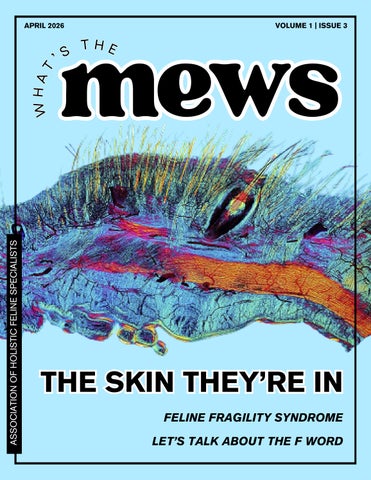
A polarized light micrograph by retired researcher David

shows a section of cat skin, revealing the hairs, whiskers, and blood supply preserved on a Victorian microscope slide.

Linstead
Microscopic photograph taken by microscopy specialist Dennis Kunkel of Dennis Kunkel
Microscopy of cat hair.

MERCEDES SCHENK CFMG

Feline Exclusive Groomer at The Meow Mobile in Phoenix AZ

CHELSEA WADDEL CFMG, CFCG

NCGI Global Educator, CFMG and CFCG Certifier in Canada.

SANDRA GONYEA CFMG

NCGI Certifier and Feline Exclusive Groomer at The Cat Spa, New York

KENDRA MARTINEZ CFMG

Feline Exclusive Groomer at Fluffing’ It Grooming in Georgia

LAUREN BENAVIDES CFMG

Feline Exclusive Groomer at The Cat Concierge in Clinton Twp MI

What’s The Mews is a free-distribution publication created for the benefit of the feline community All contributors generously volunteer their time and expertise without compensation, offering professional insight to support feline-centered care The magazine is funded by the Association of Holistic Feline Professionals and is protected by applicable intellectual property and copyright laws

Mercedes

FELINE SKIN FRAGILITY SYNDROME

(FSFS)

“The smallest changes in a cat’s skin can tell the biggest stories-if we’re paying attention.”

Indicators of this condition are:

Skin like tissue paper

Easy bruising

Skin tears easily especially on the back and head

Poor wound healing

It is a very complex condition that requires immediate veterinarian attention.

This condition is a window into what is going on internally with the cat and it is a crisis and should not be ignored. Addressing the underlying disease matters more than just treating the skin These excessive skin tears also lead to loss of fluids, protein and are open to infection

My first experience with this condition was back in the early 2000’s I had a client with a cute Himalayan who came for a full grooming I started by doing her nails, then I took a comb and combed the top of her head and the skin ripped open and she had a gaping 2 inch wound on top of her head I was shocked It did not bleed and the cat didn’t seem to be in pain. Obviously, I sent the cat to the vet and ended up paying a vet bill even though I wasn’t quite sure what happened I felt the guilt of hurting that cat for quite awhile after The owners even called me back and wanted me to groom the cat again. I declined. After doing a bit of research I concluded it was FSFS

FSFS is caused by altered collagen production causing the skin (epidermis) to become extremely thin and fragile. This usually affects middle aged to senior cats, but younger ones also have been diagnosed with it It is believed to be a symptom of something else such as excessive steroid use, cancer, thyroid, diabetes, cushing's disease, and liver conditions

The skin tears with minimal trauma , like petting or grooming and the wounds are hard to close because of this Infection is a huge concern Large sheets of skin can just slough off. As horrifying as that is to think of, it is also horrifying if you have had it happen while grooming a cat It can be very traumatizing

It is important for cat owners and feline professionals to understand that this condition is not caused by neglect. I, for one, know how distressing this can be Most cats do not recover

My second experience with FSFS came more recently when a cat groomer friend contacted me She was hysterical She was grooming a senior, kind of chunky cat The cat had a little scab ( Figure 2) on its back.

Figure 1:

They put her in the tub and when the water loosened up the scab the large pieces of skin on her back peeled off (Figure 3) It did not bleed and the cat didn’t show any discomfort. The actual pictures were hard to look at . I edited the photos to sketches, so you could have a visual with hopefully not shocking you My prior experience was recalled and I told her what I thought it was. She needed to call

the owner and get her to the vet as soon as possible

My friend is still traumatized by this event The cat indeed had an underlying health issue and because the wounds were so large and hard to treat, she was humanely euthanized

Figure 2:

Figure 3:

Looking at FSFS more closely under a microscope (Figure 4) reveals that the thickness of the epidermis is greatly reduced The dermis is more disintegrated, and the collagen fibres are thin, pale and irregular in shape There is hair follicle atrophy and the

arrector pili muscle was enlarged

Figure 4:

In closing, in the years of working hands-on with cats, I’ve learned that noticing the slightest changes often tell you a lot It is important to be observant Skin that feels almost like tissue paper. A tear that seems to appear without cause. These moments should make us pause

Feline Skin Fragility Syndrome is rare, but it reminds us why being aware matters as much as skill Our training guides our hands gentleness and mindfulness guides our choices on how to proceed Knowing when something isn’t simply a grooming issue, but a medical one, can protect a cat from further harm

Cats trust us in their most vulnerable moments. When we respond with education, attentiveness, and softness, we honor that trust and sometimes, that makes all the difference

DISCLAIMER

I wrote this article for educational purposes only and it should not be used as a substitute for a professional veterinary diagnosis or treatment. Feline Skin Fragility Syndrome is a complex medical condition that requires prompt evaluation by a licensed veterinarian

If a cat in your care shows signs of unusually thin skin, unexplained wounds, or delayed healing,seek veterinary care immediately Groomers and other pet professionals should not attempt to diagnose medical conditions and refer suspected cases to a veterinarian.

WORKS CITED

1 Muller & Kirk’s Small Animal Dermatology

a.Gold-standard reference in veterinary dermatology. Includes discussion of acquired skin fragility

b associated with endocrine disease and corticosteroid exposure

2.Feline Internal Medicine (Edited by Susan Little, DVM)

a Covers endocrine disorders such as hyperadrenocorticism and diabetes mellitus that are commonly

b.associated with acquired skin fragility

3 Small Animal Dermatology Scott, D.W., Miller, W.H., Griffin, C.E.

a.Detailed discussion of collagen disorders and acquired skin fragility in cats

SANDRA PORTER-GONYEA CFMG

ANATOMY OF A MAT

Matting is caused by dirty unbrushed hair tangling together until it felts together into tight dreadlocks Because cat skin is biologically designed to be thin and loose, matting actually lifts the skin into the mat, often folding within itself You can feel like you’re holding the “base of the skin” down, when in actuality there’s another inch or more of skin hidden within the mat. This is why we do not cut off mats with scissors, and why geriatric cats are at higher risk of cutting when matted, even with the most proficient clipper and groomer

The skin becomes thinner with prolonged tension and age, making it harder to detect if skin is enveloped within

TRUST

EASY TO LOSE, HARD TO GAIN

Have you ever heard the statement trust must be earned, it is not just given?

Well let me break it down for you in the world of cat grooming Cats by nature when placed into an unfamiliar setting have a tendency to go into fight or flight mode or some will just shut down. This is due to how their little bodies nervous systems tell them to react With that being said as a professional cat groomer we usually see them for the first time because their coats have become unmanageable at home and their behaviours result in not being tolerant of touch and handling

With a cat trust is never given, it must be earned through confident and safe handling. Through many years and thousands of cats groomed, I best describe it to my clients that generally cats are like toddlers, they need routine, to feel safe and only then will they learn to enjoy the process

Many of my behaviour cats who come in combative are placed onto a regular 8 week bath and deshed schedule… why you ask? Well, because when something becomes a safe, consistent part of life it becomes easy and enjoyable. This transpires over time, and a trusting relationship gets built between cat and groomer

Today I had the pleasure of seeing a cat who started coming to see me 10 months ago, she required strong doses of gabapentin to be handled and even then she was coming in guns blazing!!!

She is a petite little cat who was sure I had met my match, her family and vet warned me of her behaviours and I assured them I would do my best to earn her trust and have her learn to trust the process

Immediately after the first groom (which she was combative the entire time) I asked to start reducing her meds I worked with her owners over the course of a couple grooms to reduce her down to no gabapentin, we went to 5 days of rescue remedy (a natural anti anxiety) and then today her groom on absolutely nothing

This was her 5th groom with me and while she still grumbled at me to remind me of her opinions, she was sweet and enjoyed her bath and blow dry (admittedly she still doesn’t love being combed but she tolerates it all while the blow dryers run on lower speeds helping ease out the extra coat.

Today I took some video to show her wonderful family just how far she has come, she has not given me her trust, I have earned every second of it by allowing her to feel safe by giving her reassurance and confidence in my own skills We no longer have a goal to get her off of meds, but rather now to continue building the trust in our relationship and to have her learn to love me

LET’S TALK ABOUT THE

F WORD

There are many varieties of fungi on our planet but we will be taking a dive into a fungal skin disease called Dermatophytosis, specifically one of the most infectious, zoonotic skin diseases most commonly called "ringworm "

Dermatophytes are complex fungi that grow as hyphae and forming a mycelium. This literally translates to "skin plants"

The usual presentation of ringworm is described as itchy, circular lesions on infected skin with hair loss in those specific areas Although the name makes it sound like it should be a parasite, it has nothing to do with worms.

This microscopic fungus is extremely contagious, adheres to keratin like superglue on the hair shaft where it produces more spores and then spreads like wildfire. It can be quite a challenge to eliminate this fungus if not caught and treated as early as possible

The most common type of fungus affecting cats is Microsporum Canis which accounts for around 90% of the infections diagnosed in cats

This fungus produces arthrospores and is also zoonotic, which means you can also become infected This can become a complicating factor when treating and handling an infected cat, providing appropriate treatment while waiting for the fungus to resolve while waiting for negative tests to be completed

The most susceptible cats for infection are those with weak immune systems, under 2 years old, irritated or broken skin, nutritional deficiencies and long, dense fur

In healthy animals, the infection is commonly self-limiting and resolves on its own, although spores will still be spreading rapidly in the environment even after the infection on the skin has cleared.

Cats housed in the same environment, even not in direct contact with an infected cat, can even be asymptomatic but still carry the spores on their fur. The fungal spores attach to the hair shaft where they feed on the keratin in the skin and surrounding hair, weakening the hair shaft, causing weakened hair shafts, breakage and rapidly multiplying spores enabling the spread as the hair breaks off

The spores can linger on surfaces and reinfect for up to 12 months so thorough cleaning and isolation are key to preventing a widespread infection

Ringworm is typically recognized as an itchy, circular lesion with skin crusting and scabbing, sometimes resembling large pieces of dandruff that come away from the skin with the hair attached.

infrequently cleaned This fungus produces arthrospores and is also zoonotic, which means you can also become infected. This can become a complicating factor when treating and handling an infected cat, providing appropriate treatment while waiting for the fungus to resolve while waiting for negative tests to be completed.

The most susceptible cats for infection are those with weak immune systems, under 2 years old, irritated or broken skin, nutritional deficiencies and long, dense fur.

In healthy animals, the infection is commonly self-limiting and resolves on its own, although spores will still be spreading rapidly in the environment even after the infection on the skin has cleared

With infected cats, the hair shafts become weak and hair fragments containing the spores are easily spread. The arthrospores are so small they can attach themselves to specks of dust, allowing them to easily float from room to room as you walk, enter air

Story time! Back in 2023, I adopted a 1 year old rescue Himalayan. She was isolated in my bathroom for several days while she decompressed and adapted to my home before I introduced her to my other 2 cats. Fast forward 3 weeks… she had been

allowed to roam my house for over a week but still preferred to mostly stay in her "safe zone” (my bathroom).

One day I was combing her and found what looked like a scab the size of my fingernail that lifted off her skin along with her hair… I took her to the vet the next day and they concluded it was ringworm by using a woods lamp followed by a confirmation by fungus culture.

I shaved her into a lion cut and began treating these spots with topical KetoHex wipes. The vet told me this type of ringworm was difficult to completely eliminate using only topical treatments so they also started her on Itraconazole, which is the preferred oral medication for systemic treatment of ringworm infections.

After 5 weeks of living alone in a bathroom, giving medicine daily as well as lots of cleaning, we received a negative fungus test and she was officially deemed cured. This was my first experience dealing with ringworm and with my naiveté at that time, I was extremely lucky nobody else in my house caught it. Since this experience, I have had several rescue cats come in for grooming with suspicious skin issues, so to protect myself and my business, I took the time to educate myself on fungal skin conditions with the goal to prevent myself and anyone else from going through the same ordeal I did I now follow a detailed cleaning regimen that was compiled and tested by a cat disease control organization.

The simplest way to protect yourself and your workspace is by thoroughly inspecting a cat before starting any groom

If anything suspicious becomes visible after the groom has already started, I have a woods lamp handy to do a quick check to see if it glows neon yellow/green.

If florescence is noted, the cat likely has ringworm and at this point, I treat it as if it is infected and place the cat back into the carrier to be sent back to the owner/rescue.

I be sure to take photos and inform them of what I see and recommend a vet do a fungus PCR or skin culture to confirm. Cats with suspected ringworm should never be bathed or blow dried since the spores will remain infectious in dry areas for up to a year and with blow dryers, the spores become airborne, allowing the spores to spread everywhere creating future exposure risks.

Shaving the cat is beneficial, especially if the cat has very long hair and several sites of infection are visible. Every hair shaft that is infected, if left will become fragmented and continue to spread wherever the cat is housed so removing the fur, not only allows monitoring for healing or spreading, it also provides for an accurate application of topical medication as well

Whenever I have handled an infected cat for treatment or medication, I don't leave the room without changing my clothes, I remove my socks and wash my hands and arms (shower if possible) to prevent carrying any spores outside of the room

I wash all potentially contaminated items immediately to limit possible spores just sitting around A 2-step cleaning protocol is required First, the removal of the debris, preferably using a format that will not blow any hair anywhere causing it to fly around the room I wear gloves and collect the hair using paper towels sprayed with a solution like accelerated Hydrogen peroxide, diluted (1:100 ratio) bleach or hypochlorous acid.

Then, I spray down walls and mop my floor

with the same cleaner and allow it to sit for at least 1 minute Many cleaners labeled as “anti-fungal” are only proven to be effective against the mycelial forms of fungus and have not shown effectiveness against arthrospores The recommended method for decontamination of porous items is heating over 140 degrees and holding that temperature for at least 5 minutes which kills the spores without the need for chemical application

Also, it is not recommended to use vacuums with filtration systems that cannot be discarded Do not use your central vac systems or hair collector vacs like your clipper vac to clean up the contaminated hair! A bagged vacuum system or a steam powered cleaning product which disinfects and removes the debris is your best defense

Fungus doesn’t have to be a bad or scary word knowing how to handle it and having the proper items on hand to eliminate it, if it happens to walk into your space, is the key to avoiding a fallout.

To read more in-depth on the scientific studies on dermatophytosis and view all the detailed studies they have done using different environmental factors, various medications and their effects as well as the group case studies completed, including effectiveness of various cleaning procedures and follow-up testing on the cats involved, visit ABCDcatsvets.org (Advisory Board On Cat Diseases)

COLOR ME SURPRISED

One of the first things I learned when grooming cats was to always give the owner a heads up that their color pointed cat might grow back a darker color if they were shaved Over the years I’ve seen Ragdolls and Birmans get shaved with only slight

darkening and coloration after pelt removal

It was a fact that was always communicated but relatively didn’t take much space in my head--until recently

I live in the Sonoran Desert of Arizona where the average temperature during the summer is about 110°F Matting season for us here in the desert, begins in late March and the temperatures usually trigger owners to get full shave-downs in the heat of summer.

The majority of clients would prefer an entire shave down rather than targeted areas to prevent potentially silly looking haircuts I also really try to encourage owners to get all over shaves so that the hair grows back evenly so it doesn’t contribute to further coat issues. However, at the end of the day I defer to what the client wants as long as it doesn’t cause the cat any harm

On December 2, 2025 I had a new client with a 1 year and 8 month old ragdoll name Lychee who had some severe matting on her back. Her mother was beside herself, and desperate to remove the matting and preserve the coat as much as possible. I agreed to take out just the matting.

it actually damages and causes open wounds in the surrounding skin

We discussed the typical after care and things to watch out for and scheduled a follow up appointment I made sure to let her

Upon shaving we discovered that there was some skin damage due to the intensity of the matting, causing circular avulsions.

A hair avulsion is an injury where the matting is so tight that it causes the hair to be torn out from the follicle. A skin avulsion is a more severe case where the pulling is so tight that

know that the coat may grow back a little bit darker but its not a permanent coloration

When I tell you my mouth dropped open when I saw Lychee two months later on February 24, 2026, lookin’ like Appa from Avatar The Last Airbender.

Feline acromelanism is a form of partial albinism where a cat’s pigmentation (known as melanin) only develops in cooler parts of the body.

Well color me surprised

Now I’ve seen some cats grow back a tad bit darker but never in my life had I ever seen coloration that extreme Which of course led me into a deep dive of trying to understand the science behind it.

Cats are not the only animals who can experience acromelanism This color-pointed gene mutation can actually be found in rats, mice, and even rabbits. These animals have a special enzyme called tyrosinase that produces pigmentation, however, it doesn’t work well at warm body temperatures.

This is why color pointed cats like the Himalayan, Ragdoll, and Siamese are born almost completely white Because the womb is warm. As they grow and their extremities cool, the points then begin to appear.

Warm areas such as the torso stay light or cream and cooler areas like the face, ears, paws, and tail turn darker.

Like I said before, the average temperature here in Arizona is 110°F Today is March 18 , 2026 and we are in the peak of mat removal season and it was 100°F today, essentially the same temperature as a cat’s body th

However, between December and our February appointment, there was an average temperature of 37°F (low) and 68°F (high).

On February 2 , 2026, I did another matted Ragdoll lion cut with a follow up appointment of March 18 , 2026. I was beside myself with nd th

excitement to see how his coloration presented, and I had hypothesized that it would be equally extreme given our colder temperatures.

While it certainly has gotten warmer the closer we get to Spring, the average low of February was 50.2°F with an average high of 67.6°F. March so far, as an average low of 56°F with an average high of 76°F

Keep in mind as well, that all of these homes are properly regulated for temperature and humidity.

This is a photo of Tabouli before his mat removal on February 2nd:

This is what Tabouli’s coat looked like today during his follow up appointment on March 18 . th

What’s interesting to notate is that he has this NSYNC frosted tip effect, notably due to the residual fur that was left after he was fully shaved with the 10 blade

His legs, chest, and stomach for the most

part do not seem to be affected by the pigmentation coloration, and my best hypothesis is because he is in a constant ‘loaf’ position which keeps those areas warm

I’m extremely excited to see what their coats look like throughout the year, and I’ll be sure to update as well in case anyone is interested in seeing their pigmentation progression, especially as the Spring begins to heat up

Pussy Talk is a feline focused podcast which blends professional insight with unfiltered conversation Hosted by Certified Feline Master Groomer Mercedes Schenk, the show explores the realities of cat care, grooming, behavior, and the people inside the industry. Expect equal parts education and candid storytelling, with episodes ranging from thoughtful discussion to tea spilling honesty It is where science meets sass, advocacy meets lived experience, and the future of feline care gets talked about out loud

CREATIVE WORK BY CHELSEA WADDELL CFMG AND CFCG

MY JOURNEY INTO RAW FEEDING

My journey into raw feeding began in 2022, when my 15-year-old cat, Stinky Bird, began to decline. She was losing weight rapidly, so I took her to the corporate veterinary office we had visited for years for a full examination and blood panel

When the results came in, I heard the same words I had heard many times before with my older cats cats who had typically lived to 18 or 19: kidney disease. This time, however, it felt different Stinky Bird was only 15

The veterinarian diagnosed her with stage three kidney disease and recommended the standard course of action: transitioning her to a prescription kidney diet one none of my previous cats had ever accepted and administering 100 cc of subcutaneous fluids daily at home.

When I got home, my husband and I were confused and frustrated Why did this keep happening? For years, we had fed our cats Friskies pâté along with a high-protein kibble, Earthborn We believed we were doing the right thing

I began researching alternatives, specifically looking for a feline nutritionist My thinking was simple: in the human world, processed foods are often filled with unnecessary additives, and I try to eat as clean and natural as possible. Maybe the same principle applied to pet food

During my search, one result stood out: a small, local business called The Pet Beastro.

After visiting their website, I immediately felt I had found what I was looking for The owner, Dr. Jill Tack, is a board-certified naturopathic doctor known in the metro Detroit area for her expertise in natural and alternative health, as well as organic and raw pet nutrition She founded The Pet Beastro in 2005 in Madison Heights, Michigan. It is far more than a retail store it is a team of highly trained staff dedicated to pet nutrition, naturopathy, and holistic care

pet better, they feel better and live longer a belief that mirrors how we approach our own health.

When I saw they offered nutrition consultations for just $39, I was amazed. It was exactly what I needed and accessible to almost anyone, so I booked an appointment right away

On the day of the consultation, Dr. Jill welcomed Stinky Bird and me warmly. We discussed her condition in detail, and she explained something that completely changed my perspective: many cats live in a constant state of mild dehydration, especially when fed dry or heavily processed diets

She emphasized the importance of moisture whether through added water, bone broth, raw goat milk, or a properly balanced raw diet designed for obligate carnivores

She recommended several products and guided me through transitioning all nine of my cats to a raw diet. I was determined to feed them all the same food, but I quickly learned that cats can be incredibly particular Taste, smell, and texture all influence acceptance, making the transition challenging.

It took 30 days to find a reputable raw food that all of my cats would eat I transitioned them slowly, mixing small amounts into their existing food and increasing the ratio each day

Their philosophy is simple: when you feed your

Within just two weeks of fully switching to raw, I began to notice changes. The most

dramatic transformation was in Stinky Bird

She stopped vomiting bile a daily occurrence before the diet change Within two months, she had gained weight, and her ribs were no longer visible. Even more remarkable, she began running and playing like a much younger cat

My husband and I were stunned as we watched this transformation unfold

We also incorporated bone broth and raw goat milk into their daily routine. Beyond Stinky Bird’s improvement, we noticed other benefits: litter box odor decreased significantly, stools became smaller and nearly odorless, and all of our cats developed thicker, shinier coats with less shedding.

Six months later, we returned to the veterinarian for follow-up blood work The results were incredible Stinky Bird’s kidney values had improved, and we were told we could stop the daily subcutaneous fluids

Now, four years later, Stinky Bird is still with us. At 19 years old, she is undeniably a senior cat but she is still here, still loved, and still enjoying life

I truly believe that without finding Dr. Jill and transitioning to a properly balanced raw diet, we would not have had these four additional wonderful years with our sweet Stinky Bird

UNDERSTSANDING FELINE NUTRITION

Cats are obligate carnivores, meaning their bodies are designed to thrive on a diet primarily composed of animal-based proteins and fats Unlike omnivores, cats have a limited ability to digest plant matter and rely on nutrients found exclusively in animal tissues. Essential nutrients such as taurine, arachidonic acid, and vitamin A must come from animal sources, as cats cannot synthesize them in sufficient amounts

A balanced feline diet should include:

High-quality animal protein for muscle maintenance and energy

Healthy fats for skin, coat, and brain health

Minimal carbohydrates, as cats have little nutritional need for them

Adequate moisture to support kidney and urinary tract health

At that point, we were fully committed to raw feeding.

THE CONCEPT OF RAW FEEDING

Raw feeding involves providing cats with uncooked, minimally processed animal ingredients that mimic what they would consume in the wild This typically includes raw meat, bones, and organs, properly supplemented with vitamins and minerals to ensure complete nutrition The goal is to replicate a natural, prey-based diet aligned with a cat’s evolutionary needs

Common components of a raw diet include:

Muscle meat (chicken, turkey, rabbit, or beef)

Edible bones (such as chicken necks or wings)

Organ meats (liver, heart, kidney)

Supplements such as taurine, fish oil, and vitamin E

Rotating protein sources during kittenhood can be beneficial, as it helps cats become accustomed to a variety of proteins.

BENEFITS OF RAW FEEDING

Improved Digestive Health

Raw diets are rich in natural enzymes and moisture, which can support digestion and nutrient absorption. Many cats produce smaller, less odorous stools due to the high digestibility of raw food

Healthier Skin and Coat

The natural fats and amino acids in raw meat contribute to a shinier coat and healthier skin Cats on raw

diets often experience reduced shedding and fewer skin irritations.

Enhanced Dental Health

Chewing raw meaty bones may help clean teeth naturally by scraping away plaque and tartar. This mechanical action supports oral hygiene and may reduce the risk of dental disease

Increased Energy and Lean Muscle

High-protein raw diets promote lean muscle development and sustained energy levels. Cats often become more active and alert when fed a biologically appropriate diet

Better Hydration

Raw food contains high moisture levels, which support kidney function and help prevent urinary tract issues. This is especially beneficial for cats that tend to drink little water, as they naturally obtain a significant portion of their hydration from food (often around 70–80%)

CONSIDERATIONS AND SAFETY REPUTABLE COMMERCIAL RAW FOOD BRANDS

While raw feeding offers many potential benefits, it requires careful planning to ensure nutritional balance and food safety Key considerations include:

Proper handling and storage to prevent bacterial contamination

Balanced formulation to avoid nutrient deficiencies or excesses

Veterinary guidance, especially for cats with pre-existing health conditions

Commercially prepared raw diets that meet established nutritional standards can provide a more convenient and safer alternative to homemade recipes

Primal Smalls

Savage Cat

Oma’s Pride

Steve’s Real Food

Northwest Naturals

Lotus Natural Pet Food

Quest

Tucker’s

Small Batch

Raw Dynamic

Feline nutrition is rooted in a carnivorous foundation, and raw feeding aims to honor that biological design When properly balanced and safely prepared, a raw diet can support overall health, vitality, and longevity in domestic cats By understanding their natural dietary needs, caregivers can make informed decisions that support the well-being of their feline companions.

LAUREN FINN CFMG

Turn static files into dynamic content formats.

Create a flipbook
April Issue by What's The Mews Magazine - Issuu