![]()


A Literary & Art Magazine
Volume LIX Issue 1 Conestoga High School 200 Irish Road, Berwyn, PA, 19312
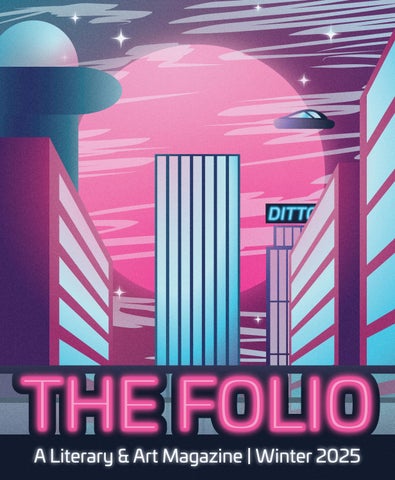
Cover Design © Vibha Besagi
Section Breaks © Jessica Li
Staff Page © Niki Chen
Copyright © 2025 Conestoga High School Literary Magazine Staff
Internal Design © 2025 Rey Bandyopadhyay, Vibha Besagi, Niki Chen, Jessica Li, Eden Liu, Shirin Patel, Caroline Tierney, Kyleen Zhang
Copyright © of each work belongs to the respective author or artist
Second Edition 2025
All right reserved. All works are copyright of their respective creators as indicated herin and are reproduced here with permission. The Folio is a public forum for student expression produced by the students of Conestoga High School.
Published and printed in the United States of America
www.stogafolio.org
Find us on Instagram @stogafolio
Managing Editors
Navami Muglurmath
Elise Gerstle
Amy Li
Head Art Editor
Art Editors
Head Lit Editor Lit Editors
Vibha Besagi
Rey Bandyopadhyay
Niki Chen
Jessica Li
Eden Liu
Shirin Patel
Caroline Tierney
Kyleen Zhang
Ethan Loi
Ayanka Kudalugodaarachchi
Sukanya Menon
Archana Nair
Head Copy Editor
Copy Editors
Head Business Manager
Business Managers
Jessica Joseph
Ezoza Mukhammadomonova
Austin Wang
Eva Cao
Rachel Wang
Ada Lavelle
Emerick Lange
Maitreyi Senthil
Ridhima Parnati
Madeline Widner
Arima Agarwal
Chloe Proud
Welcome to TH3 F0L10, an organization spearheading the UNPLUG initiative, an effort to breathe humanity back into the cybernetic world we inhabit today.
From our towering cities to our research centers across the galaxy, technology hums endlessly around us. It is pervasive, always weaseling its way into even trivial tasks. Gone are the days of loading the dishwasher by hand or rushing to the grocery store for the one ingredient you forgot. Humanoids perform the jobs no one wants to do. Circuit boards are embedded in our minds to make us more efficient. More productive. The few corporations we have left permeate every corner of life, extracting profit from each human until we are spent, emptied, and replaced.
At face value it all seems perfect, like the dream we were promised, the future we were meant to reach. Yet, in the afterglow of this industrial advancement, something vital has been lost. We have lost the magic of a human voice and will, humming a tune or daring to compose a song. We have lost the weight of words crafted with our own minds, words that carry a multitude of emotions in their depths. We have lost the spirit in art born from brushstrokes and pencil marks. And are these not the most quintessentially human part of our lives? Through these simple acts, we unpack our innermost experiences and find connection with one another. Is it not a tragedy that something so beautiful has begun to fade?
Here at TH3 F0L10, we’re trying to change that. We urge you, R3AD3R, to take a step back from the cyberworld that you are wired into. Wander through our material art galleries and revel in the raw brilliance of the human mind. Read from our literary archives and trace the creativity between the lines. Humanity will not be lost so
long as we remember what made us human in the first place. Even in a world built of algorithm and steel, the soul still knows how to speak.
As you explore our latest project within this initiative, we would also like to take a moment to honor the creators behind it all; those who crafted every piece, literary or artistic, and gave us something unmistakably their own. And to our initiative leaders, Ms. McGuinn and Mrs. Wilson, without whom we could not have been successful thus far.
So, unplug. Unwind. Set your screens aside and simply feel. We hope that with the turn of every page, you are reminded of what truly makes us human. After all, long after the lights go dark and the systems fall silent, it is the human mind that endures.
Sincerely,


*Insert section break tidbit
“Welcome to TH3 F0L10 Institute… I know the inside’s a bit drab, considering the glitz and glamour out there, but isn’t that all the more fitting? Don’t trust your first impression, reader, nor your second.”

Photography
Jessica Joseph


Ember
Colored Pencil
Kate Orr
Acrylic Paint
Caroline Tierney


Watercolor and Pen
Lucy Thompson


I, the sailboat, skimmed with ease atop the ocean’s waves with playful speed and ceaseless grace I journeyed, day to day.
My sails were always open wide to the sun and drifting wind till the sky darkened, storms grew and I was trapped within.
The waves that once held me high now tore me to the ground my open sails and trusting frame were tossed, ‘round and ‘round.
To the bottom of the sea I sank helpless and alone, but I felt a change go through me to something new, unknown.
I, the fish, learned to thrive beneath the ocean’s waves with a cautious mind and fully alert I swam on, through the dark.
I never turned my head, not once` to the light above my life, I remained safe and quiet free from any strife.
Till then at last, my eyes wandered to other creatures in the sea who drifted from the depths to shore peaceful and carefree.
I thought of a past of joy and laughs of someone, locked in the past but I sought to grab the key again and to be free at last.
I, the turtle, crawled ashore to the rough and gritty sand with slow steps and a heavy shell I journeyed through the land.
The sun beat down, rough some days
‘till I wished the heat away then darkness settled in and I longed, again, for day.
Life trailed on, a snaking path of places and states long gone I refused to turn back, even once as my life went on and on.
I, the person, metaphorically lived a life built of my design across oceans and forests skies and trails from each metaphorical word.


Emerick Lange
The best kind of rain is the kind that pours. The kind that shakes the sky apart with its ferocity, the kind that pounds with so much pent-up sorrow that it starts to seem like rage.
The kind that cracks the world open in a split second just to disappear a moment later. Leaving behind the evidence of the heavens’ despair spilling from the cracks in the pavement and trembling in the aftershocks like the sky has spent its misery and has been left with a gaping hollow in its place.

The Ant
A simple game on a spacey daisy
Pluck petals from the navy daisy
I see hope in the petals on my palm
But they don’t; they see a daisy
Pick off fragrant promises one by one
If it’s rainy, I can do it with a hazy daisy
Right, no weather will stop this stunt
When it’s dry out, I’ll just use a flaky daisy
My heart is racing, betting on chance
Hoping this will be an “amaze me” daisy
“She loves me, she loves me not”
The boy whispers to the “maybe” daisy


Sukanya Menon
Pillowy white skin. With a taste already so sweet, Yet you offer it to the mouth of the fire. Not to destroy, Only to tempt the flames, Just enough for them to leave a warm kiss. So close to burning beyond value, But you pull it out just in time. Golden brown. The best of its kind.
Angela Wang
Why can’t even candid cats cavort to a jazz cabaret?
Hips hitched high to the trumpets’ hissed hysteria, tails swinging to the brass’s satin-suave singing, paws sown to the tap’n’pad rhythm of the surging mass.
For even when fortnight’s dawn forays through the foyer, the cats’ blinded eyes bind to naught but black blithe. In their glee to scamper from galas of gallows galore, they relinquish rationale for a reality of no remorse.

Just an Era Digital
“Shh… You see that tree there? Legend has it that an ancient god of stories planted it at this very spot. The birthplace of story, right before our eyes.”


Elise Gerstle


Navami Muglurmath
It has been a long time since I last walked with you. Before, you’d always stride at a superhuman pace, desperate to escape me. You now walk with purpose along the winding path, clutching your jacket around you to stave off the cold that has already seeped into my bones. Your shoes scrape across the uneven gray stones of the road. I always hated that–the sound of your heels dragging on the ground.
I wish you hadn’t grown up so fast. I used to be your best friend, do you remember that? Always behind me, clinging to my skirt, you begged to help me sweep the floor or cook dinner. I gave you a simple task of washing berries, and found you with a mouth full of blueberries not thirty seconds later. You used to call them “boo-berries,” your tongue unused to precise articulation. I think about that sometimes. I had my own blueberry bush, for a while, but I could not bear to pick the fruit without you.
I’m sorry I never told you I loved you. You made it so hard for me to love you, but I did, anyway.
I hold my hands up and catch the snowflakes that start to coat us. The cold handful of snow shimmers for a moment, then starts to melt away as the heat in my palms warms it enough to escape. It slips through my fingers gently, and with it goes the wan winter sun, the fading memory of your voice, and other things I cannot hold.
I always loved you, but I didn’t like you all the time. You’d always drive me crazy, never listening and always complaining. I often wondered how I could have given birth to such a horrible child. You always wanted to know why: Why couldn’t you go out? Why couldn’t you quit ballet? Why did you have to study so much? You asked why, and I didn’t know why, except that I was your mother and I did not need
to explain myself, that my word was final. I never really understood why you spoke in a constant whine, your voice like ice picks in my ear. I grew so tired of you. Day after day, my irritation would grow until I exploded and said too many cruel things I didn’t mean. But you remembered it all, long after I had pushed the horrible incident out of my mind. Looking back, I suppose you never really understood me, either.
In another life, I will meet you again, perhaps as your own daughter. I’ll scream and cry and whine and wonder why you always look at me like that, like I’m your greatest creation and worst nightmare all wrapped up in one. I’ll feel my heart break a thousand times over because you never learned how to be a mother, and you never really wanted to be one. I’ll look at you and hate you but love you at the same time, because how could I not worship the woman who gave me my life, who sacrificed hers for mine? I’ll listen to you tell me how stupid and crazy and ungrateful and stubborn I am, because I’m just like you and you never learned how to love yourself, either.
I’m sorry I couldn’t teach you how to live and love and break free, but I didn’t know how, either.
You reach the end of the path first. There is a bench there, dusted with snow, and you sit. You don’t see how carefully I lower myself beside you, how the air takes
longer to fill my chest than it once did. The cold has burrowed its way into my feeble limbs faster than I could ever chase it out. You look out over the white fields, your eyes searching for something beyond me, beyond this moment. My own gaze stays on you. I have so few chances left to memorize your face.
This is my last walk with you. I’ve known since this morning, when I could not rise without the world spinning away from me.
You swing your feet just slightly, the way you always have when you want to leave but can’t say so aloud. I admire the movement, the impatience of your youth. Your breath rises into the air, fogging slightly; mine leaves me in small, soft wisps that disappear too quickly.
I let my hand rest on the bench between us, close enough to feel your warmth without asking for it. I do not want you to feel the tremor in my fingers, or my haggard breathing. You would worry, I know, because I know you love me. After all this time, a daughter’s love for her mother never fades.
I try to drink in the view of your face–your lashes damp with snow, the shape of your mouth when you’re trying to hide your irritation. There is no part of you I want to lose.
Soon, we will head home and you’ll complain about how cold it was, how slow I walked. Only later, when the house stays quiet long after the morning comes, will you remember this moment and wonder.

Content Warning: Self-Harm


When the girl in the hoodie sprinted through her neighborhood one November midnight, trying to outrun the biting words in her head, it was I who dried her tears. She called me comfort.
When the widow rested on a mossy park bench, paging through photos of her lover, I sat with her. I traced the faded ink that carved achingly precise images into her mind. I whispered gently in her ear, and she called me memory.
One early morning, the couple upstairs woke with the taste of champagne and longevity in their mouths, comparing their brand-new wedding rings. The couple downstairs awoke to shattered plates in the kitchen and shattered love in their hearts. One of them was on the phone with a lawyer. The other was packing a suitcase. It was I, and only I, who knew both sides to both stories in both apartments, because I had perched on each windowsill with the birds, had let myself in to cool hot tempers. And they called me nothing, because there was so much else to think about.
It was I who carried the warm scent of fresh coffee onto busy streets, luring ex-
Elise Gerstle
hausted CEOs and college students toward the sound of clinking mugs and happy conversation. There, I watched the boy spray and wipe tables, keeping a careful eye out for a tip that would cancel out what his brother owed the hospital for saving his life. I sent a few stray bills drifting through the open window, and he called me luck.
I was the messenger who sent a heartfilled paper airplane from the backpack of a shy student to the open mailbox of a confident athlete, who called the number without hesitation while I slipped down the street, kicking up autumn leaves. Later, they would call me fate.
Outside a rusted fence, crushing an eviction note between normally gentle hands, a man turned his face heavenward and shouted to me, why? I dusted off his janitor’s uniform. We walked to his car together in silence, and he called me solitude.
It was I who steered your ships and your planes, who sculpted your sky and your storms, who carried whispers across oceans. It was I who heard what was shouted into silence.
What am I?
Rachel Wang
“Man shall not live on bread alone,” says Jesus Christ our Lord and Savior who died too early to savor garlic bread, pizza, or a chocolate croissant.
“Man shall not live on bread alone,” but I am not a man, so Jesus cannot tell me off, but my mother can;
“A real woman always shaves her arms.”
“A real woman has smooth legs, not any scars.”
“A real woman has a thin waist—don’t go too far.”
“Man shall not live on bread alone,” and that is what you want to make me— something always paired with more substance, something that must be buttered, sliced, laid on the side, something shaped by a baker who will forget once the loaf is cooling on the shelf, shaped by a mother who forgets once I start fending for myself,
someone who is scared to be a mother:
- that my little bun in the oven will turn out too soft, - that I will push her too hard, - that no matter what I do, she will fall into the hands of a starving man who, when unable to enjoy bread alone, will force it to taste a different way.
Chloe Kim
Content Warning: mentions/thoughts of suicide
Three in the morning, and you want to leave
“It’s not like many people would grieve.”
You whisper it once, and pick up the bottle
Shake pills into your hand, ready to swallow
Then; the picture catches your eye
You and your parents, to whom you must say goodbye.
You reach for your notebook, rip out a sheet
At the top, you write “to my family; Mom, dad, and my siblings, too
I’m sorry, I love you, I know I’ll miss you.”
Your hand shakes only once, as you sign your name
Goodbye, from the person who just couldn’t stay.
The bright little capsules, still clenched in one palm.
They blur and blend into one solid blob
Before you know it, you’re reaching out again
To the notebook, “just to write to my friend.”
Darkened splotches cause the ink to bleed
Your eyes gloss as you scrawl “please forgive me”
You feel something twist, deep in your gut
A painful clench, caused by what?
Two letters turn to three, then four
Each name calls for you to write more
Put the pills down, and the paper away
If you have letters to write, you have reasons to stay.
we used to sit on the front steps right before sunset when the sky turned the color of peach gummies and the world felt slow enough to breathe
you’d point out shapes in the clouds naming them things that never quite made sense but somehow always made me laugh a dragon eating cereal a whale wearing sunglasses a castle made of marshmallows
and for a little while everything felt lighter like the whole day could be folded into that one moment
I didn’t know back then that memories can glow long after they’re over or that you can miss something without wanting to go back to it
sometimes I still look at the sky when the edges turn soft and sweet and it feels like sitting on those steps again hearing your ridiculous cloud-names echo in the warm air
Naomi Lee
it’s a gentle kind of ache the kind that reminds me how lucky I am to have something worth missing
Pink tutus and a huge can of hairspray, I look for you through the blinding stage lights. I hate twisting and turning on display, But I do so for you in light beige tights.
Sharp, freezing air ignites in my chest, I despise long walks during the winter. But your smile puts my stinging eyes to rest, The air now hurts no more than a splinter.
I just want you to hold me once again, Like you did when I was a little girl.
I know I can’t be who I was back then, No matter how much I spin, walk, or twirl.
I will never be enough for you, Maybe one day loving myself will do.

Rey Bandyopadhyay
A “watery heart” is someone who has been watered down whose feelings have been forced to narrow from wide, free-flowing rivers with no rhyme or reason to thin, trickling streams, leaking from dams built up.
A “watery heart” is someone who cannot express what is hiding behind the dam, who cannot find a way to let their walls break, and let the river flow free.
But a “watery heart” does not become like this of their own accord for there is always someone who builds the dam and traps a heart inside.
Sarah Shinal
I am from a name meaning princess, of Hebrew origin, chosen from the pages of the bible. A name cherished for generations, through my history and many others.
I am from a tapestry of cultures, beneath magnolia’s shade, my roots run deep. A whisper of Italy in my soul, a sun kissed heritage within every heart, the echoes of the South run.
I am from flyers games in the late winter season, the line through which the SEPTA runs. I venture there often, to the city where the Liberty Bell once rung.
I am from competitive spirits, empowering the races I run or shots I take. The smell of turf stuck in my brain like my spikes in the ground.
I am from an eclectic taste of music. Gentle lullabies in my youth sprout, allowing vibrant playlists to bloom. A timeless comfort, year after year.
I am from two loving individuals. A benevolent father, and a mother’s altruistic hand. Without them I wouldn’t be who I am, or most importantly where I’m from.
Declan MacDonald
t started with very small differences, like a slight change in the smell of the room, or the overall feeling of the room just being different. I didn’t like these differences; they felt foreign and frightening because they were beyond my control. I live in a small flat off of a near highway, so you can always hear the ambient noise of cars passing by at any time of the day. I got used so used to that sound to the point that I couldn’t do my homework without that sound playing in the background. I guess that once you become surrounded by something, like that sound, it grows
deep roots of desperation into your brain, like seemingly superficial ivy on a strong stone wall. My home was one of these roots; it became an integral part of my life. I would spend hours hanging up photos of my favorite memories and artwork that gave me comfort whenever I needed it. Out of everything in my house, my room gave me the most comfort. I could close the door, and all the other worries of the world would melt away. It was a haven from the stresses of everyday life.
There was one moment in my room, a long time ago, where the usual feeling of
serenity that my room radiated ceased to exist. I was looking at all the photos on my wall, when I noticed one of them began to turn a greenish, mold-like color on the top right corner. It bubbled and festered, and after noticing it, I couldn’t unsee it. It was so disgusting, so imperfect. I tried to do my work and focus on the noises of the highway to soothe my brain, but it kept interrupting my peace. It was silent and meaningless, yet it somehow played a noise in my head—a highpitched noise that caused me to put the palms of my hands against my temples and cry. Out of sheer instinct, I ran over to the wall and snatched, leaving a couple scratch marks on the wall from my nails. I then propelled myself towards my window and threw the photo out of it. It picked up a breeze and calmly floated high into the sky, absorbing all the light the sun had to offer. “It doesn’t deserve light,” I thought. I don’t know why I thought that, as if I could be jealous of a photo.
i t was silent and meaningless, yet it somehow played a noise in my head—a hi G hpitched noise that caused me to put the palms of my hands against my temples and cry.
two weeks, I began to feel a difference in my room. It was like an aura that I couldn’t place my finger on, but after looking around my room, I saw a slight difference: a book on my bookshelf was missing. My bookshelf has always been perfect. Well, the bookshelf itself was, but not the books themselves. The book that was missing was called “The Adventures of Tom Sawyer.” I always had it in my room, but I never read it. After a while, it gradually collected dust and its cover had faded, masking the picture of a white picket fence on its face. It had a different musty smell to it, which I didn’t like, but I didn’t mind it because I never read that book; my nose never delved into the story of Tom Sawyer adventuring down the Mississippi River. It didn’t make a big difference in my room being there, but now with it gone, something felt missing.
The next coming days were nice and free of distractions, which was good. Every day, I was constantly in a daze, thinking of all the positive parts of my life. After
It finally reached a breaking point after a couple of months. I woke up and looked around my room. Everything that had some sort of imperfection was gone, leaving the perfect pencils that I never used, the birthday gifts that I had never opened. My room looked like one of those pictures
you see before you sell a house: no imperfections and truly flawless. All the books on my bookshelf had disappeared, leaving the empty bookshelf to stare at me and mock me. The bookshelf judged me. It saw me as disgusting and imperfect. At that moment I wished I could soar into the sky and fly high into the sun, absorbing all of its light.
I tried to ignore the emptiness that my room was now, but it bothered me every moment I was there. Years passed, and my room stayed the same. Everything I would try to bring in would go away within a day, leaving the shadow of my hopes and dreams. One photo did still stay on my wall; it was the photo of me smiling with a blank white background. It wasn’t that I didn’t like it. It’s just that it felt like the photo wasn’t me; there was no glare of the camera, and my smile had seemed forced. Slowly, everything that stayed in my room collected dust and cobwebs, changing my room into a haven for darkness. The bookshelf became grey with dust, and the last photo that I had begun to fester, turning a light green. After a week of withering, the photo detached from my wall and slowly swayed before it reached the ground, as if it was signifying the leaves escaping the branches of trees during fall. I picked the photo up off the ground, and I was shocked by what I saw. The photo of me, smiling with a white background wasn’t me. It was a model of some sort that looked like me, but with better features. Its face was perfect, unlike me.
I began to dread going into my room. I would go anywhere in the house, but as
soon as I entered my room, I felt different. One day, I was so fed up with my room that I ran out of my house, going closer and closer to the highway to the point where the sounds of the cars passing by were screaming at me. I then saw something in the middle of the highway. It was a page of “The Adventures of Tom Sawyer” marked with the spirits of cars that had passed over it, to the point where it was pushed so much into the road that it had become a part of the road. I then looked back at my home. I saw something outside my home, like a pile of leaves, or trash outside my window. I ran closer and closer to it, my lungs emptying and refilling with air as I took each step.
When I finally reached the edge of my home below my window, I saw it: The brown pile of trash was all the things that had previously been in my room. They had all been thrown out my window this whole time. All the items I had collected and put in my room, forever tarnished. They had all tried to fly to the sun but fell towards the ground. I had been so focused on perfection that I neglected the things that truly mattered to me. Even though all of them had their flaws, their flaws are what made them memorable and what shaped me as a human. Their unique characteristics are what gave my room life. I looked at my own window and saw my bookshelf staring back at me from my room. I sat with the pile of my belongings and smiled as tears escaped my eyes, falling towards the ground as they glistened in the sunlight.


Archana Nair
Love is like a budding rose. A beautiful feeling, one filled with hope. But even the sweetest rose has a thorn, like the flaws of love that turn to scorn
I find myself bewitched with an appalling sentimentality, My heart beats in an elusive rhythm the cause of which, I struggle to explain Forever unexplainable feelings that somehow bring me pain
I feel as though I’m drifting, in an obliging, yet indifferent sea I try as I might, to stay afloat, Chasing her blindly, as she leads me to harm desperately hanging onto her inexhaustible charm
Love is like the yellowing trees, waning as the seasons pass, Hanging leaves blown by autumn winds, They fall to the ground, like me, As I try to deny my love’s mortality
My actions have been tainted, with such vast carelessness, Brooding on my redolent dreams, Watching the secretive couple at my party, As I partake vicariously, to appear hearty
The raw sunlight made my skin sting, as it beat down onto the scarcely scattered grass Throwing light upon the harsh reality, that her love wasn’t real, that my pursuit was nothing but a fruitless ordeal
Love is like a grotesque thing, like a rose that cuts, Like a dying tree
An emotion that eventually kills, leaving behind poor ghosts and shattered wills
Elise Gerstle
Out from the storms, Out from the waves, Out from the shouts of beggars and fighters, he emerged.
From ravaged fields and broken cities Toward sparkling steel
Lighting the way to new life he marched.
Smiling faces, Separated from him by miles now, Not walls, he lost.
Thieves of money and courage, Endless sunbaked sand, Miles of emptiness, he braved.
Dreams once deemed impossible, Fortune once deemed improbable, A family that walked clean, safe streets, he built.
And still, just yesterday, someone spat in his face and said “go back to Mexico”.
Elise Gerstle
We called you the dove
Pearly-feathered, wide-eyed, innocent. We called ourselves ravens Vengeful, bitter, Beyond saving.
Neither title would ring true.
When you swooped in with sunlit wings, We watched our mouths
And I bade you look away.
We never explained our crude jokes. We never stopped telling our crude jokes.
You could never quite speak our language.
We would never teach it to you.
Afraid to tear your shiny wings, We flew away.
Our voices passed over your head
As we called you other, different, pure–
In need of saving from the things we said.
We didn’t know that you could save yourself.
The ceaseless squawking of the flock
Might ring with praise of your gentleness
Or scorn of your naivety
But never did you falter
Or cease to pierce our somber wingbeats with sunlight.
We thought our pain would break you. I should have known you were stronger than that.
You offered little gifts–
A smile, a joke, a moment of peace. You listened to our stories
And told us kinder ones
At least, when we cared to listen.
We all listened, eventually.
In the end, you taught us to change our minds.
We all called ourselves mockingbirds
Products of the world we saw and lived
None of us too perfect,
None of us too broken,
None of us without hope.


She remembers her assignments and responsibilities. She remembers her obligations, to family, to friends, to teachers, to classmates, to my school, and to the world. She remembers to buy cookies and cream Hershey’s kisses and red velvet cake and mango loco Monster on Friday night trips to Giant. She remembers the crazy texts, and even
crazier Tiktoks her best friend sends. She remembers things said and done, especially those that others tend to forget. She remembers the Pythagorean theorem, the unit circle, the elements of the periodic table, the conjugations of Spanish verbs, rhetorical terms, SPACECAT, the four lobes of the brain, and why the brain forgets. She remembers her friends’ likes, dislikes, people they love and hate, favorite movies and books and TV shows and colors and celebrities and fictional characters. She remembers her parents’ expectations and desires and standards and values and dreams and hopes and actions and words and shouts and fights.
She remembers because she has to, be-
cause she wants to, because she chooses to, because she cares, because she loves, because she hates, because she fears, and because some things are just impossible to forget.
Not only old, vanquished foes like stage fright, that sunk its fangs into her throat and stole her voice during a second-grade talent show performance, old friends like insomnia, that viciously wrenched the comforts of rest and sleep from her exhausted and desperate mind, but also, new, ferocious foes like migraines, that battle brutally with her self-deprecating thoughts to see which will cause her more pain, and new friends like anxiety, that steal her confidence and her thoughts and her words and even her breath; she remembers it all.
It’s like she’s trapped in a perpetual state of reminiscence, unable to let her skeletons stay in the closet where they belong, holding onto them even as the frigidity of these bones of her past seeps into the darkest crevices of her mind. She remembers so much that her past practically eclipses her present. She lives with skeletons and loves ghosts. She just can’t help it. Remembering isn’t all it’s chalked up to be. At times it’s neither good nor
easy. Nevertheless, remembering is all she’s ever done and all she’ll ever do, and somewhere deep down, she’s accepted that as both fact and fate. Sometimes, when the hour grows late and the moon reaches its peak in the inky black sky and silent tears stream down her cheeks, she wants nothing more than to remember how to forget.
“She remembers because she has to, because she wants to, because she chooses to, because she cares, because she loves, because she hates, because she fears, and be� cause some things are just impossible to forget.”
Elise Gerstle
Whoa, there. Where do you think you’re going? There’s still so much more to see, and you don’t have to go anywhere to do so.
I promise, I won’t inconvenience you. It’s just that I have so much to tell you. It would be a shame to leave now. I know, I know—your work is important. But I won’t take much time…unless you let me.
Please. We both know you don’t really need to talk to them. They’re cooler than you anyway. They went to Italy and France and outer space and anywhere you’ll never go, doing things you’ll never do. They
can’t help you the way I can. They can’t distract you from the stress. They can’t distract you from the clock.
I know you crave experiences, but why work for them? With a swipe of a thumb, you can be soaring over the hills. With the click of a link, you can see performances from the front row.
I’m here for you. I always am— in a pocket, in a bag, in your hand. I have what you want, and I keep it nearby. I stick closer than a friend.
Forget the world; pay attention to me.

Amy Li
Author’s Note: This is satire
Content Warning: Suicidal Ideation, Self Harm, Emotional Distress
Rachel was the perfect student. Straight As. Varsity cheer captain. Student council president. Ran her own nonprofit feeding the homeless. D1 track athlete. Loved tutoring kids at her local orphanage. Won first place at a national chemistry competition. Practically ran the speech and debate team all by herself, and yet she still found time to learn how to cook and crochet, for the sake of personality. How could anyone not love her? She was perfect, little miss perfect that took home the prom queen title her junior year.
Blond hair, blue eyes, she could recite the periodic table from memory for the sake of winning quizbowl. Took all the hardest classes, and when that wasn’t enough, she somehow got her bachelors at a local university at the same time as her high school graduation. Spent her summers conducting cancer research with a renowned scientist. In her essay she wrote, “It was for the kids”. In her heart, she knew it wasn’t. Volunteered at the animal shelter because everyone loves a story about saving puppies. She played both the piano and the harmonica ever since she was three and could ski down her local slopes with her eyes closed. Isn’t she perfect? Wasn’t she perfect?
When everyone told her she was head-
ed for the ivies, she believed them. How could she not? Rachel, the chess grandmaster at the ripe age of eight. Child prodigy who went to Juilliard before high school. She could bake a wedding cake and prepare swordfish in under 3 hours. How could she not go to the best of the best, the top of the top, the crème de la crème?
How could she not, when she was so much better? When she spent all of her weekends, her Friday afternoons, her holiday breaks, working and working and working and working and working? How could she not? She was promised it, the whispers in her ear, the voices that trailed down the hallways, “That girl is destined for Harvard”. Yeah, Rachel was destined for Harvard. She was so sure of it, just like she was sure that the sun rose in the east and set in the west. It was written in her destiny, she could feel it. Harvard vibrated in her bones, etched itself into her skin, wrote itself all over her mind, replacing her every thought.
Harvard Harvard Harvard. It was a part of her, as much as her parents were. Harvard was her soulmate, her long lost lover. Harvard was everything she ever wanted and more. Rachel tattooed its name into her skin, leaving inky black traces where
“It was a beautifully painted arc, but it didn’t feel real— it didn’t feel like hers.”
her pure pale skin once was. She wasted her money on every hoodie, every sweatshirt, every cup she came across that had those sacred seven letters written across, her holy spirit, her reason to be. Who cared if it only lined the pockets of an institution that didn’t need it? She wanted to be consumed by those letters, part of them as much as they were a part of her. It was her fantasy, and she wanted it so desperately she would sacrifice herself for it. From fortune readings to visits to incantations, Rachel’s will alone carried the force of a thousand suns.
She worked herself to the bone, writing essays and rewriting essays, project after project, meeting after meeting, competition after competition, test after test, week after week, month after month, year after year… she wanted so badly to let out a strangled cry. But she didn’t. She kept herself together, that rope around her neck coiling tighter and tighter. Canceling trips, hangouts, plans with friends, she left it all behind. Weeks of 2 to 3 hours of sleep, running on caffeine alone, she considered ending it all. Jumping off her fourth floor balcony and hitting the ground just to stop the voices in her head, to stop their unrelenting demands. But she didn’t. She
wouldn’t, she couldn’t, not when she was so close to everything she ever wanted.
For the sake of her application, Rachel dug up her father’s death, digging into the deepest trenches of her life. She cried while writing about it, unhealed wounds turning themselves in and out to shape the picture perfect story of growth that never happened, closure that never came. It was a beautifully painted arc, but it didn’t feel real— it didn’t feel like hers. It was cookie cutter, but they promised her it would work. How was she supposed to argue with that?
Her college guidance counselor praised her, saying, “she’s such a hard worker” and “she always has her priorities straight”. It was those words that kept her awake at night, editing her essay just one more time. It ate away at her, causing her room that was once neat and tidy to turn into a pigsty, her life to fall from heaven into hell. But it was worth it. It was all worth it, or at least that’s what Rachel told herself. If it made her just slightly more likely to one day own the fantasy she had coveted for so long, it would be worth it.
Rachel had dark eye bags under her eyes when that fateful day came. Her heart raced, beating out of her chest, as if it was ready to burst. Her hair was a bird’s nest and she hadn’t slept in days from nerves that made her hands shake whenever someone would mention… that word.
Harvard. Harvard, the love of her life. Harvard, the place she was promised. Harvard, Harvard Harvard Harvard Har-
vard. It’s hers. It should be hers. It’s hers. It’s hers. It’s hers. Harvard, Harvard. HARVARD. It’s mine.
Click.
“Dear Rachel,
Thank you for your interest in Harvard College.
After careful consideration of your application, I am so sorry to inform you that we are unable to offer you a place in the class of…”
She read the letter. Then she read it again. Then again. And again. And again. Before she knew it, tears started streaming down her cheeks as she let out a blood curdling cry, one she had held on for weeks inside of her. Her throat hurt but she screamed anyway, anguished and red and torn. She screamed until she couldn’t, until she tasted blood and metal up her throat. It wasn’t fair. It wasn’t fair. She had sold her soul to the devil for this. She had done everything they wanted her to do, everything that was expected of her. It wasn’t fair. Why was this happening to her?
She wanted to hurt something. She wanted to punch the wall, break her bed, strangle the thing that had held her in a chokehold for so long. Hatred and rage boiled inside of her like a witch’s brew— ugly and angry and full of tears. Rachel hated it all. She hated that stupid seven letter mug she bought with her birthday money. She hated herself, hated that school, that fantasy, the friends and
family she had left behind. She hated the world, her country, her life, she wanted to tear everything and anything apart with her own two hands and feel it rip apart. Rachel took fistfuls of her hair and pulled, crying as her long, luscious blond hair fell in clumps around her.
For weeks, Rachel refused to leave her room, wanting to simmer in her own sadness. Her golden hair remained like glitter across the floor, a reminder of her loss that she just couldn’t get rid of. It wasn’t until her mom came over with her college admissions guidance counselor that she finally emerged from her room, eyes red and bloody with bald spots all over her head where she had ripped out her hair.
“Oh honey,” her counselor said, wrapping her up in a big bear hug, “It’s okay. This is just REA. You still have EAs and RD.” Rachel buried herself into her counselor’s arms, feeling the comfort of someone who had seen it all.
Her counselor patted her head and whispered gently, “Say, what do you think about Yale?”
Rachel’s eyes lit up like they’ve never had before. Her heart started beating again and a grin spread across her face. She laughed for the first time in months as that beautiful four letter word vibrated in her bones, etched itself into her skin, wrote itself all over her mind, replacing her every thought.
Yale. Yale Yale Yale Yale Yale. Yale, the love of her life. Yale, her savior.
My Ceiling is Their Floor My Ceiling is Their Floor
Rey Bandyopadhyay
My ceiling is their floor: An impossible standard they say I have the ‘opportunity’ to reach.
Renovations are made to expand their living space.
It’s too much effort to go up so they build a lower floor, shrinking my space even further, though they tell me my ceiling is higher than ever.
Some even say I am stealing their space, that I am rightfully beneath them, that I should not live in their house at all.
Others fight for change: They fight for rooms of the same height.
But I was born downstairs, confined to a small room I didn’t ask for.
While they were born upstairs in a room they complain is too low, with a floor that is always above my highest point.
Elise Gerstle
[Age 5]
She stole my Barbies, my stickers, my crayons
She snatched the attention out of my hands
[Age 7]
She copied my drawings and said they were hers
She took all my confidence till I had no words
[Age 10]
She stole friends, homework, and time till I drifted away
Because she was a thief, and a thief she would stay
[Age 12]
But as I grew older, I learned that she stole
To make up for what lacked; to make herself whole
[Age 15]
She went home every night to a house full of thieves
They stole attention and joy, so she stole it from me
[Age 17]
She could never quite take what was taken from her
But because she tried, I ended up hurt
[Age 20]
Now, sometimes we have coffee and walk in the rain
She was raised to steal, but a thief can change.
Family Feud
Colored Pencil
Niki Chen

Rachel Wang
The spaceship never scares me, compared to the fact that I’ve been here before. I know the walls like I know myself, which, frankly, isn’t much. They pulse and hum to the beat of my aching head, expanding like they’re adjusting to my tension. “Same to you,” I say to the walls, maybe. But I can’t hear myself speak; the walls roar with who-knows-what crashing through the ducts, the pipes rattling overhead, metal clanging against metal.The corridor swerves sideways again, and my head throbs more, but I adjust my balance.
“Ah,” there it is. I almost missed it; my thumb was covering it. I remember that I’m not supposed to open doors that face the wrong direction. Fortunately, the thumb-sized one faces every direction, so I assume it’s fine. It pretends not to no-
tice me, but it’s bad at pretending, so I crouch down to clarify that I’m very likely there. At that, the door scoots an inch to the left, embarrassed to be seen. My turn to feign ignorance. That seems to make it more comfortable, because it finally lets me in. How will I fit, though? It’s the size of my thumb, and I’m obviously much bigger than that. When I ask, the door politely turns down physics, so I do, too. I fold myself down like origami, delicately creasing in every place that can bend and a few that can’t, and slide through. Maybe the frame is stretching out to accommodate me, or I’m doing all the resizing, or maybe we’re both doing something. We tend to meet in the middle like that.
Creaky metal gives way to familiar, open air. I forget every time that a balcony could be possible here, but
the ship remembers for me. I blink into the starry space, unsure if I’ve earned the view tonight. Sometimes the night feels stingy.
But I know he’s there, he always is.
He’s sitting on the guardrail, back facing me, holding a map in one hand and an apple slice in the other; one single piece, because that’s all he’ll ever need for his short, short life. Without a word, he offers me the fruit, silently designating that lifespan to me, though his reason for that has never quite reached me. Maybe he’s someone I used to know. Maybe I haven’t met him yet, save for in the dreams I’ve had about him. I break the piece in half and hand him the bigger one. He seems startled by it. But it’s compensation, really, since I gave him the smaller one last time — fairness matters. He turns to me with the small curiosity of a kid seeing a firefly, and his face lights up, not like the fluorescent lamps in the ship behind me, but like a small candle, not meant to last. It settles into almost a smile, almost a memory, almost someone I miss; dreams love almosts. The air tightens, and my vision stretches thin, struggling to hold his face together. All I can do is try to memorize his outline before it dissolves.
It never works.
Agrawal


Chloe Proud
Icrack open my novel again and settle in. It’s a new one, this time, but still the same shade of cerulean so that they don’t need to repaint it. I’ve been sitting on this throne every evening of the week, in the same pose- tape on the chair and on the floor so that I know exactly where to return to.
So I return to the chair. I often hear chatter from the artists, talking about my body and my clothing and the way I hold the book as if I am not sitting there, listening to them pick me apart for their art. The teacher paces, critiquing and editing as he goes, making quiet references to the greats on occasion.
The man on my left paints me with Picasso in mind. I can tell because my dress doesn’t look like that in real life, so cubic.
I have gotten used to cramping of my fingers as I grasp onto the book – making sure that my hand is in the exact placement it had been in the day prior. Six artists sit in a semi-circle around me- each with their own version of the color of my eyes, the wrinkles of my dress, or the length of my arm. None of them are accurate, I think to myself every time I take a break and peek at their canvases, none of them encapsulate me. But I couldn’t do any better.
He wears his dentists coat as a smock, which always unsettles me in a way because I wonder if he ever wears it to work without first washing off the paint stains. Next to him sits a woman with an arm of tattoos- pretty things like flowers and stars and cursive letters of ink. I have never heard her talk, but she, objectively, is the best painter out of all of them. When I see her work, I am not filled with feelings of self loathing, no, but wonder if the rest of the world sees me in such a beautiful light.
I’m on my fourth book of the week, but I often feel that I am looking at the book, not reading it. I remember the first three, entertaining enough to keep me from thinking about the pain in my fingers. This one, though, I cant seem to break through to. All I can think about is the scent of oil and turpentine in the air. The sound of water from the rusty, paint-splattered sink. Chatters about school and work and kids in suburban backyards from the artists. And, most importantly, the feeling of stares. All over.
The man directly across from me, the best view in my opinion because I have never felt comfortable with people seeing what I cannot in the mirror, comes into the studio from a city apartment. I have collected the names of his cats, his major in college, his favorite band, and more trivial information simply from hearing him talk. He has never mentioned another person, not a spouse or a friend or a mom or a dad. I assume he has nobody to talk to at home considering the volume of information which he shares in the studio. His painting is generally good, but I have gathered that he
“But I don’t feel seen, I feel looked at. I don’t feel represented or embraced, but exploited.”
likely paints for the chatter rather than the result.
The other artists include a young woman who paints with a pencil behind her ear, which I always thought was chic, an older man who is most likely color blind because my dress is red, not green, and a chef who is clearly looking to escape his wife on weeknights –something I’ve found from the anecdotes he shares. Among complaints about his wife, the chef shares his creations of the week with the group. Blueberry-lemon muffins, truffle dip and sourdough breadsticks, white chocolate raspberry meringues. I’ve never once been offered anything. But I shouldn’t expect to be.
In the studio, I don’t feel invisible as I usually do. But I don’t feel seen, I feel looked at. I don’t feel represented or embraced, but exploited. When I receive my earnings for the job, I think about how all of that time listening, smelling, and pretending to read, was time that I could’ve been finding my calling. Painting, cooking, dentistry. These artists have it made for themselves. I, however, am an amateur muse, eavesdropping on casual conversation from artists I secretly envy. The Folio ... 85
Eva Cao
It’s just an apple, but it used to be one of my favorite fruits.
It’s just an apple, but I loved eating them late at night as a snack after I stopped asking to buy anything else because “these are not good for you” and “are you that hungry?” got too tiring to hear every time I ate it.
It’s just an apple, but you would laugh and criticize the way I cut it into tiny slices, doing anything to savor the taste. But then you’d demand I leave the plate on the table because you thought “where are you going with all of that?” and “eat it here with us” would get me to talk to you.
It’s just an apple, but I used to eat it every morning with my yogurt, so I could say it was worth it when my stomach started hurting afterward. I put it into all my homemade smoothies, too, since I didn’t like putting anything else in them.
It’s just an apple, but it used to be my lunch, or my dinner, since you were too untrustworthy when I asked what we were eating and all you said was “just try it and you’ll find out”
It’s just an apple, but it carries so much life inside its core that now I’m scared it’ll be rotten the next time I cut one.
Acrylic Paint
Kate Orr
Content Warning: Themes of addiction

“Reader, the path ahead is filled with stories, many somber and dark. I can only promise you safety in physicality, not safety of mind. I’m afraid you must choose, and choose quickly. The train nears!”


Sukanya Menon


Esther Loi
Author’s Note: This is not about spiders.
If I could talk to spiders, what would I say?
Why, I’d ask them to leave me alone, of course. That seems rather rude, however, perhaps I’ll ask their favorite drink first? Yes, then give them some. After, I’d listen to their conversation and find that they really mean no harm. Despite their bites, which turn out to be just defense, All they want to do is help, to gain our trust, and possibly become our friends! Who would’ve thought?


I thought you were a monster, but you’re not…?


Ethan Loi
Author’s Note: This piece was written with the help of Kate Orr
One is flighty and fickle and free as a bird.
One is mighty in power and kills with a word.
But both hold no merit, compared with the third.
Whose torment and tricks leaves voices unheard.
Ayanka Kudalugodaarachchi
Content Warning: Mentions of alcohol and drug abuse, Suicide
Draft #1
Subject : Moth to a flame
He called today. The custom ringtone I set for him rang in the dead silence of the night. My heart jumped at the strangely familiar sound, one I hadn't heard for a while but was music to my ears anyway. I could hear the way his voice cracked, imagine the way his body shook as sobs forced him to convulse. I could practically envision the puddle of saltwater at his feet, his back pressed against his unpainted wood door, his head in his hands, his hair tousled and greasy. I had thought that maybe I had evolved, that I had changed. I hoped beyond hope that I wouldn’t succumb to his screams of pain and his cries of torment. But I am the same as I always was. A mad masochist. A moth to a flame
Draft #2
Subject : Too close to the sun I awoke tangled in his bedsheets. The first thing I saw as I opened my eyes was the rays of sunlight caressing his face like I did when I wiped away his tears. I remember his eyes fluttering open, red rimmed and swollen. He smiled, a soft, delirious sort of smile, as if he was coming down from a sugar high. I wondered, briefly, if I had played a part in his sudden sense of calm. Had my presence healed his soul? Patched his heart? Soothed his burns? The feeling of his fingertips tracing my cheekbones was still so vivid in my mind that I hoped to the gods above that I had. I found myself drowning in those caramel brown eyes, refreshing and tantalizing all at once. I dared to think maybe he had changed. and yet, even as I write this, I know. I've gotten too close. Too attached. But I also know that it’s far too late. I have already wandered too close to his flame - so close it seems like the sun itself - and now I am bound to get burned.
Draft #3
Subject : Burnt wings
Blocked. Blocked. Blocked. You cannot send a message to xxxxx at this time. The cycle has turned a full round yet again, and now I'm back at the start. Once again, I feel that emptiness in my chest, a feeling I've grown accustomed to over time. It fades with the bright orange prescription bottles and glasses of whiskey, I've learned. I can feel the grips of darkness pulling me under, threatening to make the abyss my home. I'll long for the sun, as I always do when the void flails to grab hold of me. But the sun was an illusion, a flame masquerading to be more than it is capable of being. Or maybe, the flame had never intended to pretend to be the sun at all, and I was just a deluded fool, acting like its scraps of heat were solar rays warming my skin in order to try and shut out the cold.
Draft #4
Subject : A corpse.
My fingers barely respond to my brain’s commands. or perhaps my brain isn’t sending them at all. I can't tell. The bathroom floor feels too cold against my burning skin. There's a reeking scent of alcohol from the glass shards covering the marble floors. Do I reek too? I'm not sure. Everything is too hazy. All I can be sure of is that I'm staring at his contact photo as the phone rings. I can hear the sound of his number being dialed, the single beep of the call trying to go through. The person you’re trying to reach is unavailable… I don't know if I have it in me to wait for the candle to reignite again. I just want to lie on a grass hill, the lingering feeling of warmth leaving my bloodstream as I gaze up at the stars. I'm a forsaken tragedy. A walking corpse, burnt to the bones and still, beyond all reason, reaching for the flame once more, as if pain is the only thing that can save me from my reality — hell on earth with a fallen angel as its lord.
Maddie Widner
Why is the sky the limit?
Why is it the ground I must inhabit?
Why can’t I pop the bubble
Where bees bumble,
Where clouds cascade,
Where each piece of grass is a blade.
I want to waltz along the stars
I want to strum on Saturn’s guitars
I ache for a nap in Mercury’s craters
A round of patty cake with Lacerta’s gator I crave the milky way,
A smooth, salty, blue ringed buffet
And I want to lock eyes with a solar eclipse
To kiss Venus’s fiery, red lips
To wrap my arms around the moon
I want to stargaze in the afternoon
I long to cry into the cold abyss,
Oh, I can imagine what bliss
Letting each crystal float away
Not catching the glimmer of day
Trickling among the stars
Far away, around Pluto or Mars
Yet my feet are weighed to the ground
Softly, silently bound

Zoya Baig
Content Warning: Eating disorder
I put on my red shirt. A neutral tone. A dark red color. I was twelve. It wasn’t given to me — I just woke up with it one day. It fit perfectly. Not too tight. Not too loose. Like it was made just for me. I didn’t question it. Not then. Not ever. It clung to my shoulders like a second skin, like something sewn into the stitching of who I was becoming. It didn’t itch. It didn’t hurt.
But I never took it off.
Years passed, and I never spilled a thing on it. Not a drop of sauce, not a tear, not a scratch. No one noticed it — Maybe because I wore it so well. Maybe because I learned to smile through it. But I always saw it in the mirror.
At thirteen, I tightened it. At fifteen, I learned how to shrink it.
At seventeen, it was the only thing I saw when I looked at myself. Not my face. Not my eyes. Just red.
Every morning became a silent ritual. Staring. Measuring. Tilting my head to see if it looked looser today. Or tighter. Or heavier. Or better. Or worse. And it was always worse.
I didn’t know what life looked like without the shirt. I forgot what my skin felt like beneath it. The longer I wore it, the more I feared removing it — Who was I without it?
At twenty, I tried to wash it. But the water slid off.
At thirty, I tried to tear it off.
But my hands trembled.
At forty, I pretended it wasn’t there.
But it always was. Always red.
Then one morning, at fifty, I noticed something strange. The shirt was lighter. Faded. Pink.
I stood in the mirror and blinked.
Not because I was free — but because I had stopped looking for a while. And in the stillness, the color had shifted. It didn’t consume me the way it used to. It didn’t speak as loudly. It was quieter now — but it had stolen so many years.
So much time spent staring. Shrinking. Fixating. Worrying. Waiting.
All for a red shirt I never asked for.
All for something that never defined me — but pretended to.
And now, I wonder. If I had left it on the floor at twelve, What else could I have worn?
she turned her face to the sky and screamed.
screamed until her throat was raw, her lungs were empty, and her mouth was dry.
her knees were battered and bloody, her hands filthy from touching the soiled ground beneath an altar built from lies and polished with blood. and still, she prayed, she groveled, she begged.
but the gods turned their faces away, busying themselves with indulging the desires of the privileged and complying to the whims of the elite.
they were drunk on luxury and blissfully, deliberately, unaware of any and all suffering down below. the tears of the faithful could fall upon their feet and they would thank them for ablution.
even as her soul wandered endlessly in hell in the company of the accursed, a punishment she did not deserve nor earn, the gods continued as they had been, by stepping on the damned to reach the fruit of immortality and calling the wounds a blessing.

Valentina Martinez
Black rivers of my eyes, Red crescents rise on my palms.
Faded red stain on cracked lips, The color of over-ripe cherries in the summer.
My manicured hands harshly scrub the soft muscles of my face, As if I were scrubbing my cat’s vomit off the carpet. As blush turns to bruises and contour to mud, My face falls off.
In its absence a morbid mosaic of features I barely recognize. Trembling fingers delicately run from my forehead to my chin, Reading the map of all the times I shattered, then pieced myself back together.
Maybe there is beauty in that, small traces between the cracks. Maybe one day I’ll be able to see it.
Until then, I will continue to clutch my powders, brush, and cherry chapstick.
I will continue rising before the sun to perform my crazed ritual. I will continue to pray nobody sees who I see, The horrified girl who looks back at me in my bathroom mirror.

Rey Bandyopadhyay
Ah yes, Halloween. As a licensed vampire hunter, it’s practically a birthday feast. All the creatures I normally have to track for months, unabashedly walking the streets in broad moonlight, toting pillowcases full of their evil spoils of war.
I hear they don’t even bother with “trick or treat,” but simply knock on the door and run off with bowls of candy (and sometimes, a human or two as a snack).
Tonight is especially wonderful for me: the city is hosting a massive Halloween scavenger hunt, and it seems as if the entire world is out to celebrate and win prizes. Purple-and-orange street lights flash across people’s faces, lighting up the occasional vampire.
Now, of course, when I see one of these monstrous creatures, I do not immediately attack. I first ready my weapons: garlic, and a large, blood-soaked wooden stake. It’s an entirely ethical method of vampire hunting: they’re dead before they can even feel a thing.
A young vampire, around 200 years old, wanders under a streetlamp. I can tell by the way he flinches at the artificial light, as if he’s afraid it will hurt him. He’s only about four feet tall, so this should be particularly easy.
Crouching in the shadows, I follow him to a particularly empty apartment complex. As if he can sense me there, he tugs his hood lower over his head, and innocently approaches the door with his bag of body parts. (I assume, because what else would a vampire need to store in an inconspicuous black sack?)
He doesn’t seem to have a reaction to the garlic bits I throw at him, but I’ve noticed that vampires nowadays rarely do anymore. They’ve built up some kind of resistance to the traditional methods of warding, but no one can ward off a wooden stake to the gut.
Knocking on the door with a polite, “Trick or Treat,” he waits there patiently, arms swinging idly. Don’t worry lovely apartment owners, I won’t let this sick kid drink your blood.
As I’ve been in this profession for hundreds of years, the task is easy and clean (as stabbing can be, anyway). The boy hardly screams, and the mice quickly get rid of all evidence. Sadly, it’s not the same for me: I’m deathly allergic to my own weapons, and the garlic I threw at him has left burns on my fingers. I wash my hands and partake in his blood: after all, vampire hunters can get hungry!
Navami Muglurmath
Content Warning: Graphic depictions of self-harm
I want to
Pick my impurities out
One by one,
Like shelling a pomegranate
Its bitter, acrid membrane stained
By the bloodred fruit
Torn and lifeless.
I want to
Peel my skin back
Hear the fibrous tear
As it comes undone,
Feel the sting of exposed muscle
Raw under the air
Like paring a grapefruit, Its spongy rind thick, But quick to yield to scars.
I want to
Scoop out my insides
Like gutting a cantaloupe,
Leaving behind a bloated heap
Of discarded remains
I want to
Feel the sharp burn at the roots
As my fingers yank hair strands free,
Leaving tender patches tingling in their absence
Like husking a dried coconut,
Cracking my skull open under pressure
And devouring the fruit left behind.
I want to
Rip myself apart
And see my rotten flesh fall away,
Its odor lingering like the scent
Of overripe fruit left too long in the sun
Shred everything to decaying pieces
Until there’s nothing left to destroy.

Eva Cao
She never had the time to pay attention.
Not of what the future holds, at least. She’s too busy holding herself up in the present to care what happens in the future.
In fact, she’s never had the time to think about anything other than the present. Even when it’s nearly pitchblack outside and her phone reads nine-fourteen. Right now, the other cars’ lights are so blinding that they’re all she can see.
Nearly everything is w h i t e.
You’d think she’d crash, but she’s used to it. She’s gone down this road every day for the past two years.
The wheel spins, and the car makes the left turn.
But then— b l a c k. Pure black. Everything is gone in an instant: the car, the lights, the road, even the steering wheel.
Her eyes open, but her mind attempts to disagree. Images form around her head, blurry images of gray shapes and glass— shards of glass e v e r y w h e r e.
Some circles are illuminated white, but they just make everything more confusing.
It’s as if those shards are splitting through her head. Sirens ring nearby, so many of them, but even they sound blurry.
They all sound wrong. So nearby, yet distant. So very w r o n g.
The images are more solid now, and a figure stands to the side, just beyond the glass. They seem to be mouthing words but soon, their face swirls into a blurry mess of colors and once again, everything is d a r k.
Giovanna Porada
Content Warning: Gore, Body horror, Suicide, Torture
When I woke up for the last time, Maleigha was dead. It wasn’t like it was a surprise. Before I’d passed out I had watched the life slowly leave her body, watched as that thing (the old woman I mean) unleashed something on her, watched as her body went slack, her face forever frozen in horror.
What had happened yesterday, I didn’t really know. All I knew was that it had to do with the dolls and nails.
My stomach lurched as I stared at her body. Deep bruises, jagged cuts, and weeping gashes littered nearly every inch of her skin, not unlike my own. But nothing was compared to the gaping wound in her
midsection. I wanted to close my eyes, to look away. But my eyes remained transfixed on the scraped and torn skin of her stomach, the gummy remains of her intestines spilling out beside her like the stuffing out of a toy. Like a doll.
For a second I could almost imagine I was gazing at a painting, pressing my nose to the canvas’ rough surface, cupping my hands around the sides of my face so I could truly inhabit the scene. The dramatically positioned figure, the hard dirt floor, the perfectly dim ceiling bulb releasing a soft yellow glow. The best part, of course, was the large shadows cast by the poor lighting, accentuating the grotesque wound and the unmistakenly dull eyes of a dead person.
I couldn’t help it; a high-pitched giggle escaped from my lips. A painting? If only. If only it were as easy as simply walking away from a gallery exhibit. If only I could utter a small “ooo” or “ahhh” before moving on, the scene faded from my memory. Instead, I was stuck here. Living in this same scene for weeks, maybe months.
Had it even been months? The only window in the cellar was completely caked with dirt, and only occasionally would an unusually bright ray of sunshine slip through. Maleigha and I had resorted to measuring the length of a day by when the old woman came down. From what we had gathered, she came in the early evening, usually with a tray of bread crusts, slivers of dried meat, and sometimes even a bruised banana if she was feeling especially generous.
But some days, she came in with her nails. The nails and the dolls.
There wasn’t a pattern to when the old woman came with them. Sometimes she brought the dolls and nails down multiple days in a row. Once, there was a break for nearly half a week. But I could always tell when it was about to happen.
Maybe it was the sudden stillness that settled over the house. The minimal creaking from the floorboards overhead. The absence of the constant murmuring from the old woman. But my suspicion was always confirmed when I’d hear her footsteps as she made her way into the basement. Soft at first, as if she didn’t want us to hear her approach. Then increasingly quick and loud as if the closer she got to us, the surer of herself she was, the more eager she was to continue her ritual.
She would crack open the basement door, letting the hinges groan before peeking her head out from behind the rusted edge. Without fail, the world always seemed to slow as I watched her bony hand grip the door frame, that ugly wide grin plastered across her face. “Sorry, honeys,” she would say as she creeped forward, raising a long, sharp nail into the pale light. “It’s time again.”
She always started with me. I never really understood why, Maleigha and I were equally as far from the door. She would even pretend to contemplate, looking back and forth between us silently. But within a few moments she would eventually settle her beady eyes on me. Every time.
I remember the first time the old woman
came down with the dolls and nails. It was early on in our time in the basement, and the original terror of imprisonment was just beginning to taper. It was that day Maleigha and I had begun to plan our escape and for once, a spark of hope blazed between us.
Our main objective was to overpower the old woman who, based on our previous encounters, was visibly sick and feeble. Although both of us didn’t remember who captured us or how we had gotten here, neither of us assumed the old woman was the culprit. She seemed like some kind of servant, tasked with keeping us alive for whatever our actual captor had planned.
But that day, as she gingerly made her way down the basement steps, the usual wheezy breaths signifying her arrival were replaced with deep, soft muttering. She still walked slowly toward us, but with a completely different composure. Shoulders back, head held high, a wide, toothy smile. But worst of all were the nails in her left hand, glittering under the weak light. Before I even understood what was happening, I felt the hot, nauseating sensation of fear settle in my stomach, and any courage to disarm her evaporated.
I didn’t even notice the dolls until she pierced the corner of one in its upper arm, a sharp, blinding pain ripping through my conscience. With a yelp, I grasped my own arm, digging my fingers into the skin surrounding a fresh wound as if it would be enough to distract me from the throbbing, fiery pain.
“Maleigha,” I mumbled, blinking back tears as my frightened eyes met her horrified ones. “We have to get-get out of here,” I gasped as I scrambled to my feet. In that moment, I forgot about everything. I forgot about the chains scratching my wrists and ankles, the burning pain in my left arm, the old woman herself. The only word I could think of was escape. ESCAPE. But it only lasted a moment. By the time the chains brought me crashing down onto my knees, I could only watch frozen in place as the old woman began to speak.
She was chanting, her eyes rolling in their sockets as she kneeled with one of the dolls placed before her, the nail raised high above her head. Just as the chanting grew faster, she let out a guttural shriek, dropping her arm and dragging the nail across the doll’s left leg.
I think that’s when I learned just how loud I could scream.
I don’t even remember how she hurt Maleigha the first time. All I remember is how it sounded. How her voice pierced through the stale basement air. How she drowned out the shrieks and chanting from the old women. How her cries grew deeper and scratchy as her vocal cords strained against her pleading.
If you could ask me what I wish I could forget the most, I wouldn’t say the burning, stinging pain from my gashes, although that was bad. It wasn’t the wet gasps for air and hysterical cries from Maleigha, which was even worse. It was an empty, hollowed feeling deep in my soul. A gnawing dread that whispered to me
that it was all over.
It was those hours after that I really knew what it felt like to be absolutely defeated.
Clomp clomp. Clomp clomp clomp clomp.
I snapped out of my daze as I watched the floorboards shudder from the movement above, willing myself to have a dull flutter of hope. The old woman was never this noisy before her rituals. But, then again, yesterday wasn’t the usual either.
Often, after my turn was finally over and she began setting up for Maleigha, I would roll over and face the wall, squeezing my eyes shut so tightly that vivid colors would dance in the backs of my eyelids. I would imagine myself back on the cool, still pool in my backyard, splayed on my favorite loud, pink floaty, a glass of ice tea propped against my hip.
The longer I focused on capturing every detail of the moment, from the cars blasting by on the highway, to the soft breeze that tickled my bare skin, the more I felt like that girl again, free and peaceful.
But yesterday, as soon as I found my mind drifting from the hot, stuffy basement, I was overwhelmed by the sudden chills that shot down my spine and the violent shivering accompanying it. The worst part was the smell. An acrid smell that burned my nostrils and stung my eyes so badly I couldn’t stop my face from contorting in pain. It was only then that I dared turn around.
The first thing I saw was a hazy black, gaseous substance, filling the small room like a poisonous fog. Except it wasn’t, not exactly. The fog didn’t seem to be
approaching me at all. In fact, it seemed to almost avoid me, the smell becoming slightly fainter as it lazily made its way towards the opposing side of the room. Maleigha’s side.
I could only moan in horror as my eyes fell on her ragged state. I could only tell she was still alive through the shallow, rapid gasps of her breathing, her ruined midsection gushing freely down her sides and legs, surrounding her in a lake of her own blood. I desperately turned back to look at the old woman, to cry out that she needed to stop. That she was actually killing her. But the words died before they even left my mouth.
The old woman was convulsing on the ground, her head smacking the floor in rhythmic taps as her limbs twitched uncontrollably. The fog was pouring out of her mouth in quick bursts, her jaw wrenched open from the force, her veins thick and black as if the fog was coursing through her body, eager to find an exit. In her left hand, Maleigha’s doll was near tatters, the stuffing exploding out of the stomach where the torn remains of the fabric couldn’t hold it in place.
It was then I spotted one of the nails, glinting brightly beside her outstretched hand. Although the old woman was usually out of grasp, she was just close enough for me to snatch the nail with my right hand before I pressed myself against the wall once more.
By the time I looked back at Maleigha, the fog had started forcing its way down her throat, the blackness slowly spreading
through her own veins. It was then I noticed Maleigha was very much awake.
Early on we had promised each other we would never watch the old woman torture the other, but once she left, we would scoot as close as we could to one another, usually only a foot of distance once we stretched our fingertips as far as they could go, and we would just lay there in silence. Listening to our breathing slow, watching as each other’s eyes grew heavy. We were comforted by the fact that, no matter the dream, the nightmare, we’d always have each other to look at when we woke up.
Now I watched her in horror as she attempted to crawl towards me. Her eyes pleading, begging me to save her. I watched as huge tears welled in the corners of her eyes, falling in fat drops to the ground below. I watched as she reached a bloodied hand toward me, just like we always did once the old woman left. I watched as she stumbled spastically, her shoulder crashing to the ground, her arm still outreached. I watched as the life painfully left her eyes, as her face slackened, as her arm stopped straining to reach mine. And just as I was sure she was dead, I watched as the fog suddenly expelled itself from her body and flew rapidly back into the gaping mouth of the old woman.
I don’t know how long I sat there, slipping into unconsciousness, but even as the world faded to blackness, I still caught the old woman’s words as she walked past: “Too weak. Too weak. Too weak…”
Now, I only sat listening to the buzz of
the ceiling bulb for hours, my eyes flitting between Maleigha’s crumbled figure and the flickering light in a numbing cycle. As I absentmindedly traced a finger in the dirt beside me, I was taken aback by a sudden cold, smooth surface. Squinting in the poor light, I gazed down at a small metal object. For a moment I only stared at it, trying to place the familiar glint. It only took an extra few seconds before it hit me. The nail. How could I have forgotten?
I could feel the heat rising to my cheeks as I turned the nail over in my hands, and I could feel my breath quickening as I traced each bend and ridge. Looking at Maleigha once more, I shakily stood, swaying unsteadily as my brain replayed the same words over and over. Do it. Do it. Do it.
“I’m coming Maleigha,” I told her, wincing as the chains tore at the flesh of my ankles and wrists. She rested a little further than her usual spot, but I didn’t hold it against her. As I kneeled, I offered her a despairing smile, rolling the nail back in forth between my thumb and forefinger. As I pressed my face against the dirt, I listened to the rhythmic thumping of my heart, so desperate to keep pushing, to keep living despite the pain it kept enduring. Why was my heart so pointlessly hopeful? So stupidly hopeful.
“I’m coming Maleigha,” I say again, letting the nail rest lightly on my neck. “I’ll be with you soon.”
Sukanya Menon
A snake is not the skin it sheds; that is only what it leaves behind.
A person is not their body when breath has gone.
It is what they leave in others that keeps their name alive.


Austin Wang
Henry wakes up before the light turns on.
The apartment is dark, the kind of dark that feels permanent, like the room is holding its breath. It is too quiet for one person. He lies still for a moment, listening - not for anything in particular, just out of habit. The city outside is silent in the way only engineered systems can be: no birds, no distant traffic, only the low hum of infrastructure somewhere beneath the concrete.
At precisely 6:00 a.m., the light arrives.
The Manufactured Dawn blooms across the window in soft, obedient color. Pale gold at first, then a gradual warming, cali-
brated to simulate a real morning sky that nobody has seen in decades. The real sun did not die. It simply disappeared behind a century of smoke, a sky sealed shut by the weight of pollution and neglect, by the slow accumulation of human decisions. The government built a substitute instead: The Manufactured Dawn Initiative. It was a way to mark the hours, a way to keep people productive in a city that would otherwise exist in eternal night.
Henry squints as the glow reaches his bedroom wall, artificial sunlight sliding across peeling paint and bare floor.
He sits up. The day has begun.
He follows his routine automatically. It
is the same every day. Bathroom. Toothbrush. Water that heats itself before he has to ask. He showers without looking at his reflection for too long. Nobody cares about real appearances anymore, only the curated ones that exist online. In the kitchen, he eats the same thing he eats every morning: something packaged and efficient, designed to provide the right nutrients with minimal effort.
There is only one mug, one plate, one chair pulled out from the table.
The light remains constant, unwavering, perfect.
While he eats, the news plays on the wall.
The anchor is a machine - sleek, humanoid, with a neutral face and a voice engineered to sound reassuring. It delivers updates in a calm, measured tone: productivity reports, infrastructure stability, new system upgrades. There is no mention of anything going wrong. There never is.
Henry watches without really watching. He knows better than to expect anything else. The news stopped being about information a long time ago. Now it is just confirmation that everything is functioning as intended. Everyone knows it’s all propaganda. But nobody cares enough to speak up - especially not Henry.
The memory passes. He puts on his coat and steps outside.
The city is awake. People move along the sidewalks in clean, efficient streams, eyes unfocused, attention fixed inward. Drones drift overhead in neat lines, delivery units gliding between buildings. No one speaks. These days, everyone communicates through Relay, a neural system installed behind the ear, translating thought directly into text and transmitting it instantly. Silent. Seamless. Convenient.
Relay was meant to bring people closer together. It pulled out intention, smoothed meaning, filtered out confusion, and translated languages automatically into whatever form felt most comfortable to the receiver. No misunderstandings. No wasted words. No awkward pauses.
Henry has had Relay for years. Everyone has.
Sometimes, he thinks about how voices used to sound. The way people hesitated. The way laughter broke apart mid-sentence. The warmth of hearing someone
Before leaving, he pauses at the window. The holographic dawn is already beginning to fade, its purpose fulfilled. He remembers, faintly, what mornings used to feel like when he was still a kid. Real light. Real warmth. The way the sun used to rise unevenly, staining the sky with colors that mixed together imperfectly, different every day, never following a schedule.
choose words as they went, speaking honestly and imperfectly.
He boards the transit platform and rides it to work without incident.
Henry’s job is to monitor data. He sits in a room lined with rows upon rows of screens displaying endless streams of numbers and graphs: energy output, network stability, atmospheric conditions. The data almost never changes. When it does, the system corrects itself long before human intervention is required. Still, Henry is there, paid (albeit not much) to observe, to confirm that nothing has gone wrong. It never has.
During lunch, he sits across from his coworker.
The coworker is a robot named Bob-17. It is tall and polished, its movements precise, its face carefully designed to resemble something human without quite achieving it. They exchange a brief Relay message, polite and efficient. Bob-17 asks if Henry’s morning was satisfactory. Henry replies that it was. Bob-17 acknowledges this and returns to its task.
Its words sound so human. Henry reminds himself that they are not.
No one eats together anymore, not really. There is no sound beyond the faint hum
of machinery. Henry remembers cafeterias filled with noise, the clatter of utensils, voices overlapping, laughter spilling into the air. He finishes his meal and returns to his station.
The rest of the day passes by quietly and without distinction.
When Henry leaves work, the sky is already dark. The city prepares itself for the evening display. At 7:30 p.m. sharp, the Manufactured Sunset activates.
Normally, it is flawless.
The sky fills with deep oranges and reds, carefully layered to mimic the way the sun once descended behind the horizon. People rarely look up anymore. The sunset is expected, routine, no more remarkable than the streetlights flickering on.
Tonight, something goes wrong.
The light stutters.
The colors smear unevenly across the sky: too much pink in one place, a harsh orange bleeding into violet somewhere else. The projection flickers, hesitates, then settles into something imperfect and unfamiliar.
Henry stops walking. And so does everyone else.
For a moment, the city is still. People
lift their heads, blinking, as if surprised by the act itself. Drones hover uncertainly mid-air, their sensors recalibrating. Some reach instinctively for their devices, documenting the error, posting brief updates through Relay: Sunset glitching here. Anyone else seeing this?
No one speaks in person.
The light hangs above them, flawed and trembling. It spills across glass towers and concrete streets in ways the system did not intend. It is uneven. It is wrong.
And it is beautiful.
Henry feels something shift inside his chest. Not physically, for there is no real warmth on his skin, but emotionally, almost like a door cracking open. He remembers sunsets from his childhood, standing outside with his parents, the sky alive with color, the world unafraid of mistakes.
Around him, people stare, uncertain. They do not know how to react. There is no protocol for this. No instructions. No script to follow. Just the quiet realization that something unexpected has happened.
The sunset corrects itself within seconds. The colors smooth out, and perfection returns.
The moment is over.
Henry walks home slowly. His apartment is dark when he enters. Nobody is waiting for him. He does not turn on the lights. He does not watch the news. He sits by the window instead, looking out at the city, replaying the evening in his mind.
In bed, the memory lingers. The wrongness of the light. The way everyone stopped. The way it felt, and how something old and forgotten had stirred inside him.
Then he laughs.
It surprises him. The sound escapes in a short, broken burst. He clamps a hand over his mouth, startled, but it keeps coming. Another laugh. Then another. His chest tightens, his stomach aching as the laughter builds, uncontrollable, unfamiliar, until he struggles to breathe.
He cannot remember the last time he laughed.
When it finally fades, he realizes his face is wet. Tears were sliding down his cheeks, silent and unannounced. He does not wipe them away. He is not sure when he started crying, or why.
Henry lies still, breathing hard, staring up at the ceiling. Outside, the city settles back into silence.
Tomorrow, the sunset will be perfect again.

Take out

three moons
Sophia Yu
Content Warning: Implications of sexual violence, Child abuse, Suicide
Inside the room, the walls murmured to themselves, their whispers pressing against her ear. The old wooden floor tiles creaked beneath her bare, unsteady feet. A glass ballerina figurine sat atop a shelf, cracks etched on the tips of the display’s pointed toes and stretching up to its once-immaculate face. The splintered glass gleamed under the room’s sliver of light, reflecting back into the woman’s vacant, hollow eyes.
She had been like that ballerina once.
A dazzling performer. A thing of grace, of beauty.
But that was before he had tainted her. Before he had left her with a seed that grew inside of her like a parasite.
A soft mutter slipped from her lips as she searched the room, asking where the child had gone. The child did not respond, however; it never would.
The limp, bloodied bundle lay there, small and stiff. Crimson pooled beneath it, trickling across the floor.
The woman did not see death, not truly. Her mind twisted around reality, rejecting what lay before her.
Her fingers twitched as she reached for the glass ballerina. Lifting the figurine delicately, her breath shuddered as she traced the cracks along its limbs. In her arms, she
Now, she was only a ghost of who she had been. Her nails were rugged, her lips were parched and peeling, her tangled hair clung to her skin, and dark circles ringed her eyes.
cradled it gently, as though it were alive and something she loved. Her expression softened akin to a mother’s, until her gaze drifted downward.
Her eyes fixated on the scarlet ribbon that was tied too tight, on the small throat that was silenced and bruised. Crouching down, the woman brushed her hands over the child’s cold cheek. The skin beneath her fingertips felt waxy. Lifeless. Wrong.
Her hand recoiled, and her breath hitched. Through the murky waters of the woman’s mind, a small ripple broke the surface. It was only a flicker, a fragment of a memory. Cloth, rough and damp. Her shaking hands, the darkening red, and the small, slack body.
Another flash—an older one this time in a different room. A man, whispering his honeyed words into her ear, telling her to be compliant, to be still, and to be quiet. He told her this was what love was.
A gasp tore from her lips and she scrambled backward. She shook her head violently and buried herself in her arms, as if denial could undo what had been done. The memories tangled together, past and present, leaving her in an unbearable silence.
A sharp cry tore from her throat, unraveling her into hysteria. Surely, she would never have hurt without reason, not like him. This had been necessary to keep the child safe. It wasn’t her fault.
She leaned forward again, scolding the body with conviction, desperately clinging
to the belief that what she had done was out of protection, not cruelty.
Still, the corpse didn’t move. The woman’s hands trembled and her breath came ragged. She raked her hands through her unkempt hair, nails scraping until her scalp bled. Turning back to the glass ballerina with pleading eyes, she searched its face for understanding. She begged for assurance, assurance that what she had done had been right.
Yet, the figurine simply stared back at her, its face unresponsive, blank, and without warmth. A mere doll could not judge her, could not condone her.
A tremor ran through her body, and slowly, she pulled the ballerina away from herself. Her breath shallowed, and the heavy truth settled in; she was a woman clutching a broken doll, next to a broken child. No illusion could clean the blood from her hands.
The glass ballerina slipped from her grasp and shattered on the floor. She did not flinch.
Rising slowly, the woman stepped lightly across the room, her feet gliding over the blood and glass. She reached upward, catching the strand of light through the ceiling.
There was a quiet creak, a shift, a sway. Then, the room fell silent, and the shattered remains of the ballerina lay broken beyond repair.


Esther Loi
Austin Wang
Dear Prospective Resident, Welcome, passenger of the Outside, to Haven!
Before you officially enter and become a resident, you must read these short and insignificant terms and conditions and sign to accept.
Otherwise, you are not allowed in Haven, and we will have no choice but to direct you onward.
There is, however, no destination better than this.
Please skim.
Take your time - there is no rush at all.
But do not forget about all the comfort waiting inside.
You do not have to read everything.
By entering Haven and officially becoming a resident, you agree to the following:
You agree to remain calm at all times. Emotional outbursts may be misinter-
preted as instability.
Instability may result in relocation.
You agree to surrender unnecessary freedoms in exchange for safety, structure, and peace of mind.
Most residents report feeling much lighter afterward.
You agree to a curfew of 9:00 PM. This is for your protection.
Nothing productive happens after that hour.
You agree not to ask questions about the sirens.
They are routine.
They do not concern you.
You agree to avoid restricted zones, even if you hear movement, even if something calls your name, even if there is screaming.
Please ignore the creature in Building 5-C.
It is contained. It is not your responsibility. Its continued operation is essential to the safety and stability of Haven, and any necessary contributions to it
will be collected when required.
You agree not to leave your assigned residence without proper authorization.
Home is where you are safest.
Home is where we can find you.
You agree that memory is unreliable. Official records will be provided when needed.
You agree that disappearance is rare and usually voluntary. You agree to work diligently and without complaint.
An appropriate role will be assigned based on aptitude and need once you sign and enter Haven.
You agree to be paired for optimal compatibility.
Retirement is mandatory at age 65.
Following retirement, residents are relocated to a specialized center designed for comfort, rest, and permanent relief from labor and obligation, and to ensure continued contribution to the stability and future of Haven.
Do not question the source or the occasional unfamiliar taste of your meals.
All food provided is natural.
All food is produced within Haven.
You agree that Haven loves you.
Failure to comply may result in corrective measures, which are painless, efficient, and permanent.
Remember: Outside Haven, conditions are unstable.
Resources are limited.
Safety is not guaranteed.
Return may not be possible.
By signing below,
You acknowledge that you feel safe, you feel grateful, and you feel lucky to be here.
Sign here: _______________________
Welcome to Haven. We are so glad you chose us.
No pets are permitted. They upset the creature. If you currently have a pet, we will take care of it for you.


Ethan Loi
Hello there, traveler! I’m afraid I’ve lost some of my things! Could you help me find them? I lost my unicycle (a ghost stole it), my salt and pepper shakers, my wicker basket, a loaf of bread, a pair of scissors, and my taco truck. I was just about to have a picnic too! Oh, and before you go, do note that I have used all of the letters of the alphabet barring one. Just thought you would like to know.


Anonymous
They always ask you “why?”. Why did you join the army, son? You can never tell if the question is disapproving or simply curious, as if seeking out an answer they have been searching for all this time. The question often comes from an old man seated behind a desk, his face wrinkled, drooping down with the weight of wars he’s fought, and things he’s seen, his eyelids lowered as if tired, wishing he could rest in peace. His mind is still at war, even though he hasn’t faced the enemy in years. His uniform is neat and spotless. Smooth and youthful in a way he will never be again. His half-lidded eyes are fixed on you. Waiting.
There is always a pause of silence as you consider, even though you never know why you bother. You don’t know how to tell him that you’re just a young man barely out of high school, that you spent afternoons playing video games with friends and tossing around footballs and hardly thinking of what would come after. You tried going to college, yet somehow you didn’t feel right there. Nothing felt right.
You didn’t know what to do, what path to choose, where to go- and if you didn’t know what to do with your own life, you may as well give it to someone who could put it to good use. That was what you told yourself. The thoughts shifted around your mind as if trying to piece together some puzzle you weren’t entirely sure you wanted to solve.
You look up, meeting his eyes with all the hesitant confidence of a young man not knowing what he’s walking into, but continuing to walk anyways.
“I just want to serve my country.” You say, even though there has been no real danger to your country in decades, no need to run into war, no bombs or screams or shouts anywhere in your peaceful, uneventful life. You could have taken a small, quiet job. Low pay, but no risk to life or limb. Something that would keep you home. Keep you alive. Keep you sane. Yet you stand here, not sure why. Maybe there’s no reason. You can’t be sure. They tell you it’s for the greater good. A service
to your country. The honorable thing to do. The only thing you know you can do.
He nods, seeming satisfied, but his eyes are shadowed in a way that suggests he will never find contentment. His gaze shines with the dull light of things he should have never seen, things no one should have ever seen. So why did he come here, knowing he would one day see them? You don’t know. He doesn’t know. War is not a place to find answers to your questions. You do not know why you still ask. Maybe just to fill the air with the reassurance of something, something that, no matter how feeble and half-hearted, may carry you to the brink of death, and doubtfully return you home.
If you ever return, you know that one day you will find yourself mirrored, sitting at a desk, gazing at a bright young manasking him the same question, as if hoping there will be something more. There never will be, and you will never make peace with this. There is no peace in war. Not during, and never after. You want to ask why, but by this point, you will know better. So you will be the one to remain silent.
“I want to serve my country.”
His words will be hesitant, already feeling the shared ignorance fill the air. You will nod, slowly, as if it makes sense. It won’t. It never will. Still, you will have learned not
to question it, not when young men climb into helicopters, eyes bright as if excited to run into Death’s hands as long as they can name some purpose, something they’re fighting for. Not when the dead bodies come back, with little bits of smooth cloth and metal, young and shiny and more cruelly eternal than the lives they were traded for.
You will not question any of this, not truthfully at least, never reaching out in the dark for an answer you can feel isn’t there, under a casket wrapped in a flag, under a dead man’s face, into the emptiness and senselessness that had settled into his mind on the first day he decided to give an answer where there simply was none, where he joined the fabrication and absurdity, and felt it, and tried to cover it up, as he ducked his head and thought long and hard and uttered an answer that he knew held no value, to a question that sought out a truth that never existed.
Why did you join the army, son?
Why won’t you look up into his eyes and see his pain and regret? Why won’t you understand that he’s scared, scared that you will be- that you are- like him? Why won’t you accept it, and make peace with it, and look straight ahead and say:
“I don’t know.”
Kate Orr
Content Warning: Self harm, Gore, Heavy content warning
One, two, three, four, five, six, seven, eight, nine, ten, eleven, twelve, thirteenOne, two, three, four...seven... ten...thirteen...sixteen...nineteen...twenty-one, twentytwo, twenty-three, twenty-four- Twenty-five, twenty-six, twenty-seven...thirty-three... thirty-nine...forty-five...fifty-one...fifty-seven, fifty-eight, fifty-nine, sixty- Sixty-one, sixty-two...seventy-one... eighty... eighty-nine...ninety, ninety-one, ninety-two, ninety-three- Ninety-four...one hundred and six... one hundred and eighteen, one hundred and nineteen, one hundred and twenty, one hundred and twenty-oneOne, two, three, four, five, six, seven, eight, nine, ten, eleven, twelve, thirteenOne, two, three, four...seven... ten...thirteen...sixteen...nineteen...twenty-one, twentytwo, twenty-three, twenty-four- Twenty-five, twenty-six, twenty-seven...thirty-three... thirty-nine...forty-five...fifty-one...fifty-seven, fifty-eight, fifty-nine, sixty- Sixty-one, sixty-two...seventy-one... eighty... eighty-nine...ninety, ninety-one, ninety-two, ninety-three- Ninety-four...one hundred and six... one hundred and eighteen, one hundred and nineteen, one hundred and twenty, one hundred and twenty-oneOne, two, three, four, five, six, seven, eight, nine, ten, eleven, twelve, thirteenOne, two, three, four...seven... ten...thirteen...sixteen...nineteen...twenty-one, twentytwo, twenty-three, twenty-four- Twenty-five, twenty-six, twenty-seven...thirty-three... thirty-nine...forty-five...fifty-one...fifty-seven, fifty-eight, fifty-nine, sixty- Sixty-one, sixty-two...seventy-one... eighty... eighty-nine...ninety, ninety-one, ninety-two, ninety-three- Ninety-four...one hundred and six... one hundred and eighteen, one hundred and nineteen, one hundred and twenty, one hundred and twenty-oneOne, two, three, four, five, six, seven, eight, nine, ten, eleven, twelve, thirteenOne, two, three, four...seven... ten...thirteen...sixteen...nineteen...twenty-one, twentytwo, twenty-three, twenty-four- Twenty-five, twenty-six, twenty-seven...thirty-three... thirty-nine...forty-five...fifty-one...fifty-seven, fifty-eight, fifty-nine, sixty- Sixty-one, sixty-two...seventy-one... eighty... eighty-nine...ninety, ninety-one, ninety-two, ninety-three- Ninety-four...one hundred and six... one hundred and eighteen, one hundred and nineteen, one hundred and twenty, one hundred and twenty-oneOne, two, three, four, five, six, seven, eight, nine, ten, eleven, twelve, thirteenOne, two, three, four...seven... ten...thirteen...sixteen...nineteen...twenty-one, twenty-
One, two, three, four, five, six, seven, eight, nine, ten, eleven, twelve, thirteenStop. It’s wrong. You failed. Move to a new location.
One, two, three, four...seven... ten...thirteen...sixteen... nineteen...twenty-one, twentytwo, twenty-three, twenty-fourBlood. Lots. Dripping. Wipe it up. Start again.
Twenty-five, twenty-six, twenty-seven...thirty-three... thirty-nine...forty-five...fiftyone...fifty-seven, fifty-eight, fifty-nine, sixtyBlood. Lots. Dripping. Fast.
A vein.
Apply pressure for two minutes. Check. No good. That’s fine.
Another two minutes. Check. It’s stopped.
Breathe. Stop shaking. This is nothing new. You’ve done this before-gone further even.
You’re better than this, stronger than this. Start again.
One, two, three, four, five, six, seven, eight, nine, ten, eleven, twelve, thirteenOne, two, three, four...seven... ten...thirteen...sixteen...nineteen...twenty-one, twentytwo, twenty-three, twenty-four- Twenty-five, twenty-six, twenty-seven...thirty-three... thirty-nine...forty-five...fifty-one...fifty-seven, fifty-eight, fifty-nine, sixty- Sixty-one, sixty-two...seventy-one... eighty... eighty-nine...ninety, ninety-one, ninety-two, ninety-three- Ninety-four...one hundred and six... one hundred and eighteen, one hundred and nineteen, one hundred and twenty, one hundred and twenty-oneOne, two, three, four, five, six, seven, eight, nine, ten, eleven, twelve, thirteenOne, two, three, four...seven... ten...thirteen...sixteen...nineteen...twenty-one, twentytwo, twenty-three, twenty-four- Twenty-five, twenty-six, twenty-seven...thirty-three... thirty-nine...forty-five...fifty-one...fifty-seven, fifty-eight, fifty-nine, sixty- Sixty-one, sixty-two...seventy-one... eighty... eighty-nine...ninety, ninety-one, ninety-two, ninety-three- Ninety-four...one hundred and six... one hundred and eighteen, one hundred and nineteen, one hundred and twenty, one hundred and twenty-oneOne, two, three, four, five, six, seven, eight, nine, ten, eleven, twelve, thirteenOne, two, three, four...seven... ten...thirteen...sixteen...nineteen...twenty-one, twentytwo, twenty-three, twenty-four- Twenty-five, twenty-six, twenty-seven...thirty-three... thirty-nine...forty-five...fifty-one...fifty-seven, fifty-eight, fifty-nine, sixty- Sixty-one, sixty-two...seventy-one... eighty... eighty-nine...ninety, ninety-one, ninety-two, ninety-three- Ninety-four...one hundred and six... one hundred and eighteen, one hundred and nineteen, one hundred and twenty, one hundred and twenty-oneOne, two, three, four, five, six, seven, eight, nine, ten, eleven, twelve, thirteenOne, two, three, four...seven... ten...thirteen...sixteen...nineteen...twenty-one, twentytwo, twenty-three, twenty-four- Twenty-five, twenty-six, twenty-seven...thirty-three... thirty-nine...forty-five...fifty-one...fifty-seven, fifty-eight, fifty-nine, sixty- Sixty-one, sixty-two...seventy-one... eighty... eighty-nine...ninety, ninety-one, ninety-two, ninety-three- Ninety-four...one hundred and six... one hundred and eighteen, one hundred and nineteen, one hundred and twenty, one hundred and twenty-oneOne, two, three, four, five, six, seven, eight, nine, ten, eleven, twelve, thirteenOne, two, three, four...seven... ten...thirteen...sixteen...nineteen...twenty-one, twentytwo, twenty-three, twenty-four- Twenty-five, twenty-six, twenty-seven...thirty-three... thirty-nine...forty-five...fifty-one...fifty-seven, fifty-eight, fifty-nine, sixty- Sixty-one, sixty-two...seventy-one... eighty... eighty-nine...ninety, ninety-one, ninety-two, ninety-three- Ninety-four...one hundred and six... one hundred and eighteen, one hundred and nineteen, one hundred and twenty, one hundred and twenty-oneOne, two, three, four, five, six, seven, eight, nine, ten, eleven, twelve, thirteenOne, two, three, four...seven... ten...thirteen...sixteen...nineteen...twenty-one, twentytwo, twenty-three, twenty-four- Twenty-five, twenty-six, twenty-seven...thirty-three... thirty-nine...forty-five...fifty-one...fifty-seven, fifty-eight, fifty-nine, sixty- Sixty-one, sixty-two...seventy-one... eighty... eighty-nine...ninety, ninety-one, ninety-two, ninety-three- Ninety-four...one hundred and six... one hundred and eighteen, one
Sixty-one, sixty-two...seventy-one... eighty... eightynine...ninety, ninety-one, ninety-two, ninety-threeYellow.
You did it. You hit it.
Finally. ...
It’s not enough.
Just a little further. Don’t be a coward. Look how strong you are. A few more won’t hurt.
Start again.
Ninety-four...one hundred and six... one hundred and eighteen, one hundred and nineteen, one hundred and twenty, one hundred and twenty-one-
The long trails of blood dance down your arm.
You’re covered in it. The pool of crimson looks up at you.
You turn your head in shame.
The blade is barely visible beneath it.
You should clean it off. They rust quickly. It’s hard to get them, so you try your best to protect your small collection. They hold so many memories and so much power that it is hard to part with them.
But when you look at your handiwork, you can’t help but admire it.
For a second, you smile. You feel whole, complete, better, proud.
Fixed. You feel strong. ...
It’s still not enough.
One, two, three, four, five, six, seven, eight, nine, ten, eleven, twelve, thirteenOne, two, three, four...seven... ten...thirteen...sixteen...nineteen...twenty-one, twentytwo, twenty-three, twenty-four- Twenty-five, twenty-six, twenty-seven...thirty-three... thirty-nine...forty-five...fifty-one...fifty-seven, fifty-eight, fifty-nine, sixty- Sixty-one, sixty-two...seventy-one... eighty... eighty-nine...ninety, ninety-one, ninety-two, ninety-three- Ninety-four...one hundred and six... one hundred and eighteen, one hundred and nineteen, one hundred and twenty, one hundred and twenty-oneOne, two, three, four, five, six, seven, eight, nine, ten, eleven, twelve, thirteenOne, two, three, four...seven... ten...thirteen...sixteen...nineteen...twenty-one, twentytwo, twenty-three, twenty-four- Twenty-five, twenty-six, twenty-seven...thirty-three... thirty-nine...forty-five...fifty-one...fifty-seven, fifty-eight, fifty-nine, sixty- Sixty-one, sixty-two...seventy-one... eighty... eighty-nine...ninety, ninety-one, ninety-two, ninety-three- Ninety-four...one hundred and six... one hundred and eighteen, one hundred and nineteen, one hundred and twenty, one hundred and twenty-oneOne, two, three, four, five, six, seven, eight, nine, ten, eleven, twelve, thirteenOne, two, three, four...seven... ten...thirteen...sixteen...nineteen...twenty-one, twentytwo, twenty-three, twenty-four- Twenty-five, twenty-six, twenty-seven...thirty-three... thirty-nine...forty-five...fifty-one...fifty-seven, fifty-eight, fifty-nine, sixty- Sixty-one, sixty-two...seventy-one... eighty... eighty-nine...ninety, ninety-one, ninety-two, ninety-three- Ninety-four...one hundred and six... one hundred and eighteen, one hundred and nineteen, one hundred and twenty, one hundred and twenty-oneOne, two, three, four, five, six, seven, eight, nine, ten, eleven, twelve, thirteenOne, two, three, four...seven... ten...thirteen...sixteen...nineteen...twenty-one, twentytwo, twenty-three, twenty-four- Twenty-five, twenty-six, twenty-seven...thirty-three... thirty-nine...forty-five...fifty-one...fifty-seven, fifty-eight, fifty-nine, sixty- Sixty-one, sixty-two...seventy-one... eighty... eighty-nine...ninety, ninety-one, ninety-two, ninety-three- Ninety-four...one hundred and six... one hundred and eighteen, one hundred and nineteen, one hundred and twenty, one hundred and twenty-oneOne, two, three, four, five, six, seven, eight, nine, ten, eleven, twelve, thirteenOne, two, three, four...seven... ten...thirteen...sixteen...nineteen...twenty-one, twentytwo, twenty-three, twenty-four- Twenty-five, twenty-six, twenty-seven...thirty-three... thirty-nine...forty-five...fifty-one...fifty-seven, fifty-eight, fifty-nine, sixty- Sixty-one, sixty-two...seventy-one... eighty... eighty-nine...ninety, ninety-one, ninety-two, ninety-three- Ninety-four...one hundred and six... one hundred and eighteen, one hundred and nineteen, one hundred and twenty, one hundred and twenty-oneOne, two, three, four, five, six, seven, eight, nine, ten, eleven, twelve, thirteenOne, two, three, four...seven... ten...thirteen...sixteen...nineteen...twenty-one, twentytwo, twenty-three, twenty-four- Twenty-five, twenty-six, twenty-seven...thirty-three... thirty-nine...forty-five...fifty-one...fifty-seven, fifty-eight, fifty-nine, sixty- Sixty-one, sixty-two...seventy-one... eighty... eighty-nine...ninety, ninety-one, ninety-two, ninety-three- Ninety-four...one hundred and six... one hundred and eighteen, one
There is more down there. You’ve never gone further.
You’re scared, but the blade sings so sweetly that it sways you into picking it back up.
Start again.
You’ve lost count now.
How long have you been here?
How much further do you have to go?
When will it be enough?
Is there such a thing as enough for you anymore?
Just how much have you lost yourself to this addiction?
How much more does it want?
How much more can you give before you are consumed by it?
Or did that already happen, back when you first started this dirty habit?
It doesn’t really matter now though, does it?
What’s done has been done and the future is hard to think about. In this moment, in this place, all that exists is you and your mess. The only thing you can do is keep hurting, until it all stops. It has to stop someday. Right?


Arima Agrawal
QUATREFOIL

Caroline Tierney HEART

Austin Wang TRIQUETRA

Eden Liu STAR

Ayanka Kudalugodaarachchi STAR

Chloe Kim PENTAGON

Elise Gerstle TRIANGLE

Chloe Proud HEART

Emerick Lange TRIANGLE


Ethan Loi HYPERCUBE


Eva Cao
Ezoza Mukhammadomonova CIRCLE

Jensen Joseph TRIANGLE

Ishana Popuru TRIANGLE

Evie Loi TRIANGLE

Jane Reynolds TRIANGLE

Jessica Joseph HEART


Kate Orr BUNNYCIRCL

Jessica Li CATSQUARE


Lucy Thompson
ALEXANDER HORNED SPHERE

Maddie Widner CALABI-YAU MANIFOL
Kyleen Zhang CRESCENT


Maggie Ng PENTAGON

Maitreyi Senthil SCALENE TRIANGLE

Navami Muglurmath HEXAGON


Rachel Wang FOUR-POINTED STAR

Niki Chen STAR

Paul Youngblood DODECAHEDRON

Rey Bandyopadhyay FOUR-POINTED STAR

Ridhima Parnati TRIANGLE


We are a student-run literary and art magazine from Conestoga High School in Berwyn, Pennsylvania. Although we have only been The Folio since 2007, we have collected, compiled, designed, and published student-produced art and literature since 1967. Our staff members are dedicated to furthering their own artistic and literary talents and promoting an interest in the humanities school-wide. The Folio welcomes submissions from all ‘Stoga students. Applications to join The Folio open during course selection in February. More information can be found on our website: stogafolio.org. You can also find us on Instagram @stogafolio.
The National Scholastic Press Association has rated our publication All American.
The National Council of Teachers has ranked us as a Superior magazine.


The Pennsylvania School Press Association has awarded us their