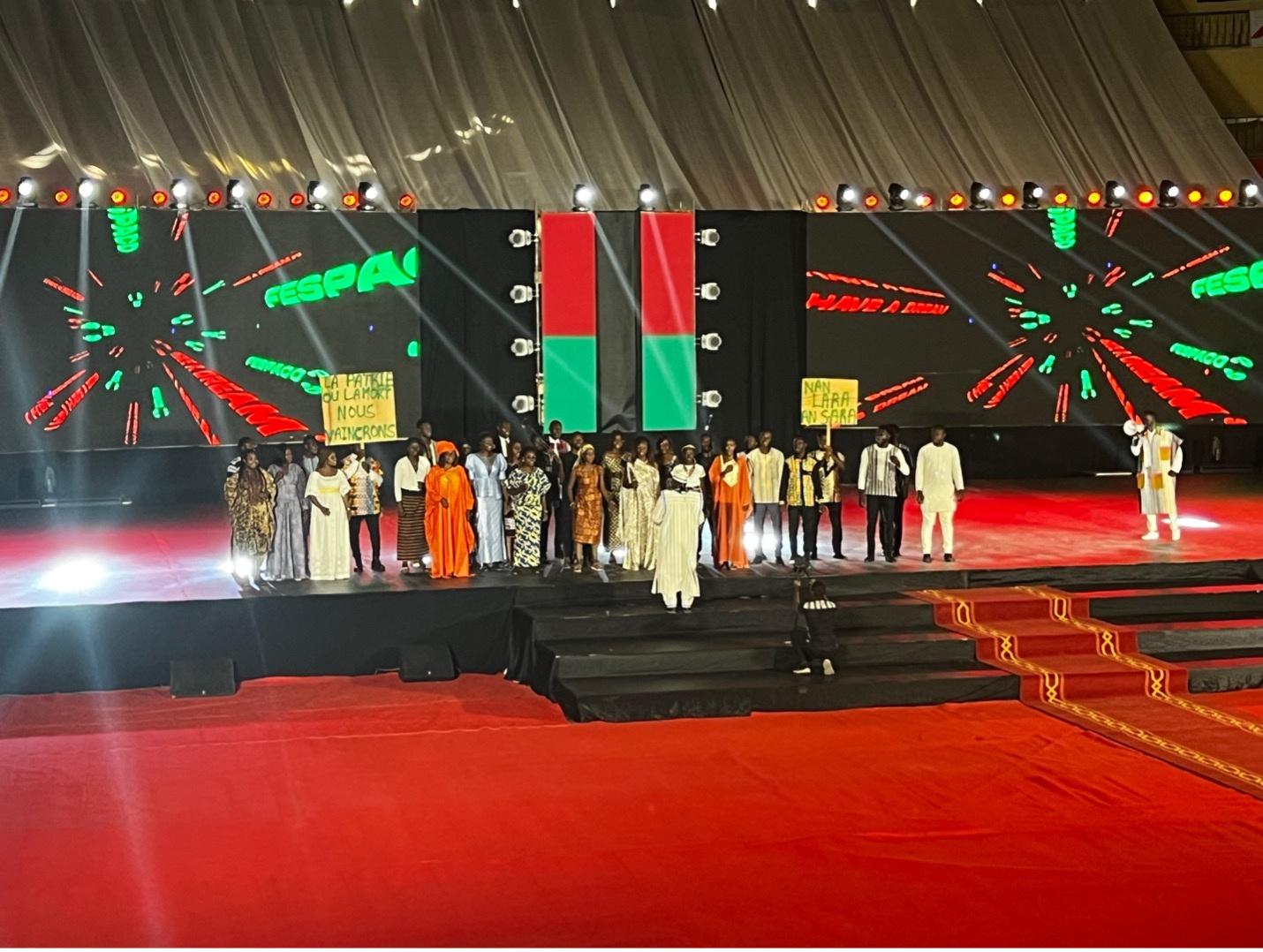
 Photo: Rashid Bahati (TFV)

Photo: Rashid Bahati (TFV)
Opening Night ceremonies at Palais des Sports complex in the Ouaga 2000
The 28th edition of the PanAfrican Film and Television Festival of Ouagadougou (FESPACO) was an excellent success for Burkina Faso’s capital.
Thousands of Burkina Faso residents and international festivalgoers packed the Palais des Sports complex in the Ouaga 2000 district for opening ceremonies of the African continent’s largest and oldest film festival, Fespaco. This year marked the festival and television market’s return to its standard timeframe post-COVID19 pandemic, during late February into the first week of March 2023.
Since 2015 Burkina Faso has been battling insurgencies by jihadist groups in the north and eastern regions. Within the last year it has endured two coups, making this year’s festival a special time for hosting. Security was tight in and around the venue, with the army positioned strategically across Ouagadougou.
“In the face of the unprecedented security crisis, we remain
(Continues page 2)
VERDICT: Six directors from across Africa make shorts for Netflix Oris Aigbokhaevbolo, April 5, 2023


In the second episode of the new season of the popular Emmywinning series Succession, Jeremy Strong, playing Kendall Roy, son of the billionaire media mogul Logan Roy, seriously suggests that a “semi-pitch” for a media company could have a focus on Africa. “Just what is happening in Africa the Maghreb, Sub-Saharan East, SubSaharan West,” he says. He’d watch it.
His siblings object, but he continues. “The point is its global reach. It’s a network that teaches you how to watch it,” he says.
Succession is an HBO show but if the guys at Netflix did put such a pitch in their emails, they would pass on it. Why? Because they were there first.
(Continues page 3)
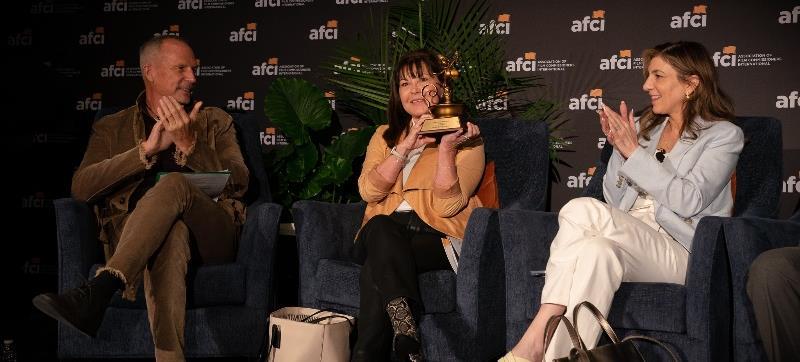
Film commissioners from around the world gathered in Hollywood March 27-30 for AFCI Week 2023 – the premier global conference for film commission professionals. Held at the Sofitel Los Angeles at Beverly Hills, the conference brought together more than 125 AFCI members who spent the
week sharing best practices, meeting with colleagues and forging new relationships with production industry decision makers. The goal is to equip film commissioners from diverse locations with the tools and industry access they need to succeed.
(Continues page 5)
said Burkinabé’s former Fespaco Film Archivist, Patrice Napon.
Fifteen films were in competition for the top prize, the Yennenga Golden Stallion. In total, 70 cinema, television films, and series were selected by Fespaco's general delegate, Alex Moussa Sawadogo, for this year's eleven categories.
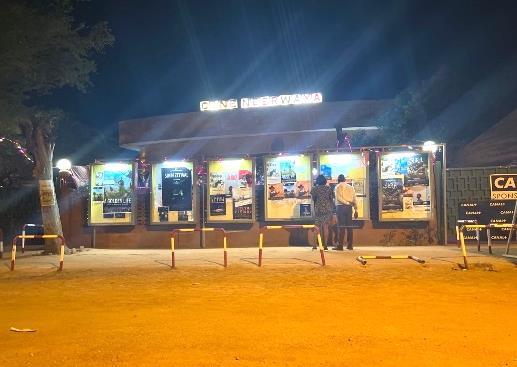
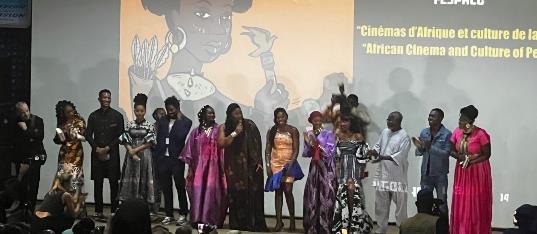
First Place Tennenga Gold Stallion: Ashkal - by Youssef Chebbi (Tunisia)
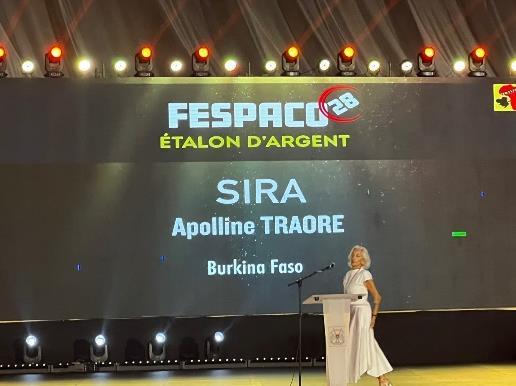
Second Place prize: Sira - by Apolline Traoré (Burkina Faso)
Third Place Prize: Shimoni - by Angela Wamai (Kenya)
This year, the bi-annual showcased the first Filmmaker Accelerator Program, a ProductBased- Learning Initiative designed for Burkina Faso cinema students interested in film and new media career paths. The project is organized by Plan B Agency based in the USA and its alliance partner ARDN Red Card, in collaboration with FESPACO, Gcom productions, and educational partners, ISIS – High Institute of Technological
Information and Communications, and the Swiss UNEF University of Burkina. "We are excited and proud about this progressive educational project and working with Plan B Agency as they engage cinema students from West Africa to create these video campaigns to expand our message," said Richard Tiene, producer/director and owner of Gcom productions, Burkina Faso.
In this episode of Noir360, Rashid Bahati has an exclusive conversation with Valeriya Biyen in Ouagadougou, Burkina Faso. Valeriya is co-owner of Yelhy Technology Africa and owner of the newly opened 22N6 Tech Lounge. Originally from Ukraine and lives currently between Europe and West Africa. Valeriya shares her vision of creating opportunities for the youth of Burkina Faso.

This interview is a must-listen for anyone interested in the intersection of technology, gaming, and youth development in Africa. Tune in to Noir360 to hear Valeriya Biyen inspiring story and her vision for a brighter future in Burkina Faso.
In 2021, Netflix partnered with UNESCO, the U.N. Educational, Scientific and Cultural Organization, and announced a contest involving filmmakers from across Africa producing short films. The results aren’t quite what one expects from news media content, but part of the nature of productions of this sort, whenever it concerns Africa, is to have something newsy, something socially relevant, something clearly political. And where UNESCO is involved, it is reasonable to expect something very native.
That is not a theme superimposed on the results of the competition; it was embedded in the name of the contest itself: African Folktales Reimagined. The idea was for filmmakers is to take an ancient tale, probably told to them as kids, and bring it forward.

At the time of the contest, it sounded as though filmmakers were asked to bring these tales into the present day. But the release of the half-dozen short films saw at least one filmmaker, Korede Azeez, set her story in the future. But in such a way that it is connected to the present. Halima’s Choice, as directed and written by Azeez, takes a popular folktale across Nigerian cultures back in the day, adding some AI and metaverse talk to it. The original story involved a headstrong girl who refuses her parent’s choice of a suitor. Instead, she chooses a goodlooking stranger from a distant village. As she follows her groom to her new home, she is surprised and shocked that at intervals he returns parts of his body which, it seems, he had borrowed to impress her. When the real “man” emerges, lo and behold, he is not
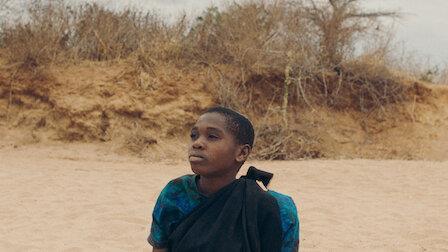
human. The lesson, as far as one can easily tell, is that kids need to obey their parents and maybe that not everything shiny is good for you.
Azeez adds a feminist slant to the tale and rather than have a distant village, we have Napata, a virtual world where everyone but a handful of people have “migrated” to. The people in Gidanpula are displeased with the idea of this migration and are super-wary about admitting people into their community. So when a stranger arrives unconscious at the outskirts of their village, they search his body for any sign he is one of the people from Napata before letting him in. What they don’t bargain on are the ways of a young woman’s heart.
The love affair is never really shown, save for a couple of chaste chats and an exchange of smiles, but some affection is established. It’s too early to say whether Azeez possesses the spark of genius, but her short demonstrates a firm hand and is quite a departure from the predominant aesthetic of mainstream cinema in Nigeria. There is barely a hint of melodrama, the colour palette is muted, and the sound design is subtle but enriching. Her cinematographer, Baba Agba, gets a few beautiful shots, notably as the film closes.(Continues next page)
Azeez belongs to a different cinematic tradition from Loukman Ali, the Ugandan director of Katera of the Punishment Island. Where her world, which in some ways is post-apocalyptic and could borrow from any number of popular films, is decidedly nonHollywood and devoid of pop action, his is very much steeped in the tradition of action films. The story itself is a bit like Kill Bill, if both Bill and the Bride were not exactly lovers and came to the story with a healthy dose of melanin.
Ali begins his tale with a prologue about pregnant women getting dumped on an island because they got pregnant. But after she is rescued, Katera is unable to let go of the trauma of her experience. She decides to revenge herself and goes to face the enemy.
Ali is already one of the more obvious talents in African cinema today. His country, Uganda, is not exactly the first country that comes to mind when one thinks of modern African cinema, but the man has been such demand that he was hired to direct a film in Nigeria, a highly uncommon practice in Nollywood. The final cinematic product of that decision, Brotherhood, became one of Nigeria’s highest grossing films. And yet, Katera is not his strongest short film work. For that, you would have to go to his
YouTube page. The plot isn’t bad, but it’s a familiar story. The story seems woven around a couple of set pieces Ali wanted to bring to life on a Netflix budget. Nothing wrong with that approach if it the story then works spectacularly. In this case, that isn’t the case. But as followers of his work will come to expect, he serves up a visual feast and there is one sequence at the end of the film that will remind his fans of his quality. If there is any African director from the SubSahara with Loukman Ali’s vision and skill for action set pieces, he is yet to emerge.
These two films are the longest films in the anthology. They are also the most narratively substantial. The film from Kenya, Anyango and the Ogre, is a slight picture centred around a family with a violent father. It wears its domestic violence theme
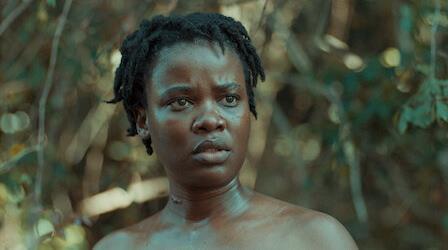
on its head, and its main conceit is a juxtaposition of the horrors of a vicious patriarch with a fictional ogre terrorising kids in a storybook. Director Voline Ogutu cleverly deploys the call-andresponse songs familiar in African songs, but the film itself is unlikely to be remembered long after the credits.
From South Africa comes MaMlambo, a tale that takes place mostly in a single scene. Depending on who you ask, the title refers to a goddess or a monster or both of those things. It lives in the rivers and is similar in some regard to Mami Wata, which itself has received recent cinematic treatment in a film that received its African premiere at FESPACO in Burkina Faso. In MaMlambo, it is portrayed by a woman who takes care of a…
Full Article

“Film commissioners are the unsung heroes who help create production jobs and production-related economic development in their territories,” said new AFCI Executive Director Jaclyn Philpott. “AFCI Week provides them with unique opportunities for learning and collaboration.”
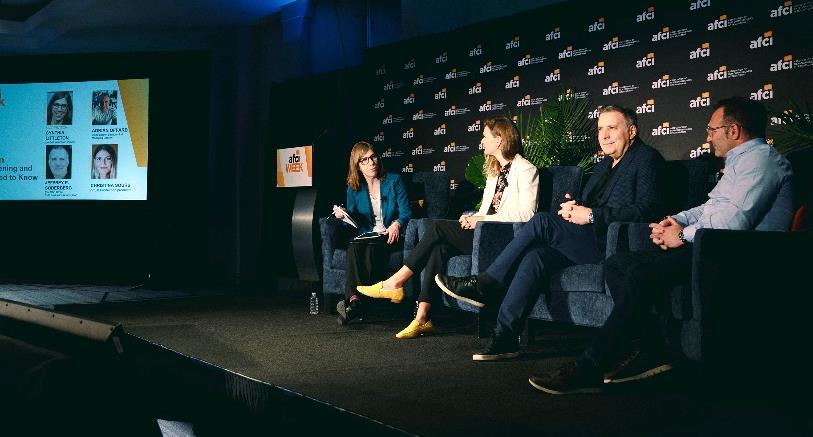
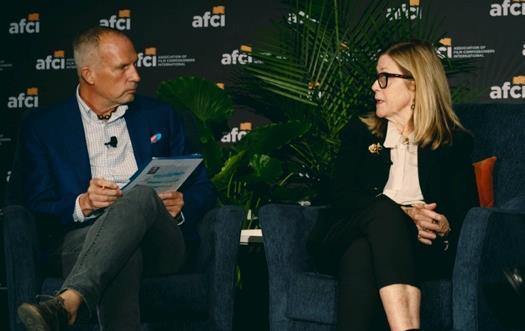
VIRTUALPRODUCTION: WHAT’S HAPPENINGAND WHAT YOU NEED TO KNOW Panel: Cynthia Littleton, Variety, Adrian Offard, Managing Director, Video Screen Services, Ltd., Jeffrey P. Soderberg, Executive Vice President, Production and Innovation, The MBS Group, Christina Sours, VirtualProduction Producer
Philpott added that global spending on film and TV production this year is expected to reach $238 billion and that the industry relies on film commissions to help navigate the highly competitive production landscape.


This year’s conference covered a range of topics, including workforce development, government relations, sustainability, virtual production and AI, diversity and inclusion, incentives, and location management. One of the many highlights was the annual Physical Production Power Brunch co-hosted with The Hollywood Reporter. Attendees also had access to one-on-one consultations with global consulting firm Olsberg SPI, as well as a tour of Orbital Virtual Production Studios in downtown Los Angeles, and a wrap-up celebration at Tom Bergin’s (L.A.’s oldest Irish pub) to launch Cineposium 2023, which will be held in Limerick, Ireland September 26-28.
Networking receptions hosted by Entertainment Partners and Amazon also enabled AFCI members to
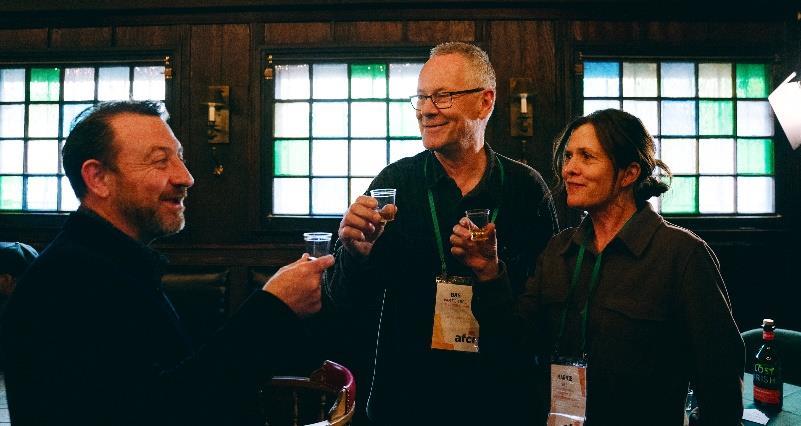
meet industry decision makers. Such direct access is one of the benefits that sets AFCI Week apart from other industry conferences.
AFCI is currently in the midst of an organizational transition, with Jaclyn focused on growing what is already the most geographically and culturally diverse membership roster in AFCI’s nearly 50-year history. She is also focused on helping AFCI members work more effectively with government policymakers to recognize the positive impact a vibrant screen sector has on regional economic and cultural development, job creation and tourism.
After wrapping up AFCI Week, Jaclyn is excited about upcoming meetings at Cannes and is ready to begin planning AFCI’s first Cineposium in Ireland.
As Executive Director of AFCI, Jaclyn Philpott leads the only global organization representing film commission professionals. She oversees advocacy, educational programs and events that empower AFCI members to work more effectively with policymakers and businesses in the screen sector – all with the goal of fostering economic growth in an inclusive and sustainable manner.


Philpott relocated from New Zealand to the U.S. to take on this role, bringing deep yet diversified experience in economic development, strategy, transformation, international marketing and event management. Recent assignments include working with economists, business leaders and policymakers in Auckland and across New Zealand to explore how the private and public sectors can collaborate to build a better future post COVID-19.
Philpott co-created and produced the Auckland’s Future, Now events for Tātaki Auckland Unlimited (New Zealand’s largest economic and cultural development agency) and helped spearhead large scale projects for the Tripartite Economic Alliance (linking Auckland, Los Angeles and Guangzhou, China), the 36th Americas Cup and the World Masters Games. She also worked closely with the New Zealand Film Commission and regional film offices nationwide, including Screen Auckland, where she managed activations at premieres and major events such as the Toronto International Film Festival.
Philpott earned an MBA from the University of Canterbury (New Zealand) with a specialization in management and growth strategies.
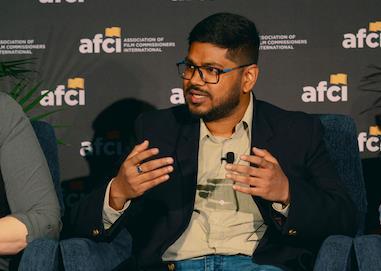
 By: Rashid Bahati, April 5, 2023
As a lover of African and African Diaspora film, attending the Fespaco film and television festival in Burkina Faso for the seventh time since 2005 was an inspiring experience. As one of Africa’s largest and oldest film and television festivals and markets, Fespaco significantly impacts the local economy of Ouagadougou, the capital and most populated city, making it an important cultural and economic event for anyone interested in African cinema and culture. My travel to Ouagadougou is always an adventure in itself, with plenty of exciting sights and experiences along the way. The environment and landscapes are stunning, as the people move around 24 hours a day. It’s almost like being in the New York City of West Africa. Since my first travels to Fespaco, I have been struck by the hospitality of the people in Ouaga (short for Ouagadougou). They are so amazing for their honesty, openness, and in many other ways. Burkina Faso was formerly known before the end of its colonial rule by the French as Upper Volta (Upper River).

The term GMO (Generically Modified Organism) that we are accustomed to here in the US is nonexistent in Burkina Faso. All the food is fresh and locally grown. Foods such as fruits, vegetables, fish, and meat, have no pesticides or additives, which makes them a true delight to eat.
(Continues page 8)
helpful and friendly. One of my favorite traditions during my stay was walking three to four miles to the boulangerie (bakery) every morning to get fresh bread like croissants. It was a great way to start my day and immerse myself in the local way of life.
There are many delicious local dishes, such as chicken and rice with black beans. The chickens are lean as opposed to the overweight chickens we have here in the States. During my stay the last couple of times in Ouagadougou, I have opted for an Airbnb apartment to experience the community setting rather than a hotel. My hostess, Suzanna Toe, is always incredibly accommodating and welcoming. I loved chatting with her about the local culture and customs. My driver, Issouf, knows how to navigate Ouaga cross-town traffic at all hours. He speaks English and is also very
The weather in Ouagadougou is mainly sweltering and humid, with average temperatures ranging from 80 to 90 degrees Fahrenheit. The rainy season occurs from May to October and can be pretty strong. The dry season, which runs from November to April, is the best time to visit for those who prefer milder temperatures. I am usually in Ouaga for Fespaco, held
from the end of February through the first weekend of March, which is the dry season.

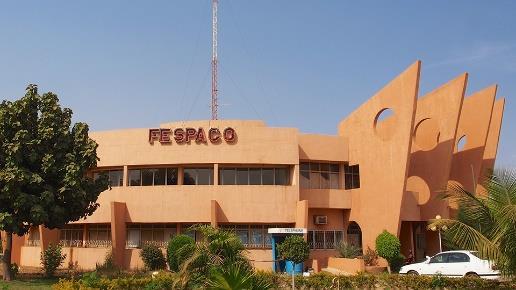
Ouagadougou is a vibrant city rich in history and cultural significance. I am very aware of the history of the Burkina Faso area and its historical importance to what is called the succession states of West Africa, which are Ghana, Mali, and Songhai dating back to the 4th and 13th centuries. Because of its location, between Mali to the north and Ghana to the south, Burkina Faso has many notable landmarks, including the Grand Mosque, the National Museum, and the Palais des Sports, Full Article

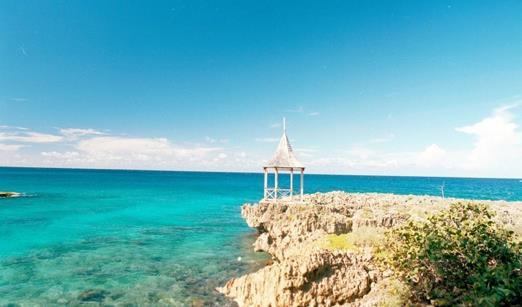
The Government of Jamaica has set up a billion-dollar screen fund to provide financing for the development and production of films and television shows locally. The initial funds will be provided over two years and is to help with stimulating the push of local content by offering creatives greater access to financing in order to properly develop projects.

The fund has been described as a welcome game-changer among members of the local film and creative industry. Noting that significant work has gone into the industry over the last decade, Film Commissioner Renee Robinson said that with music being the traditional primary exportable creative product, "the film and animation sectors are also demonstrating significant economic potential for the future".
Jamaica's film, animation and music (FAM) sector is said to be the third-largest contributor to the island's gross domestic product (GDP), having a significant multiplier effect on the economy through its seamless linkages with other industries such as tourism and services.
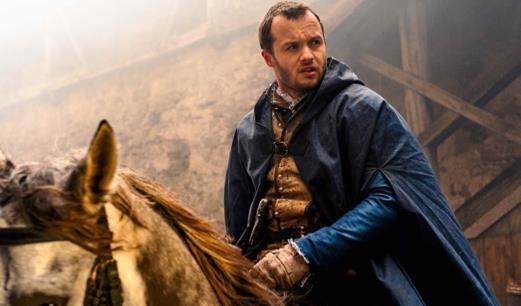
UK production company The Forge has begun filming a hefty new Disney+ drama in Hungary, Austria and Romania. Shardlake is a medieval murder mystery, adapted from the books by CJ Sansom Shardlake is written by Stephen Butchard. The series is executive produced by George Ormond and Mark Pybus for The Forge, Stevie Lee for Runaway Fridge, and Lee Mason for Disney+ EMEA. Justin Chadwick is directing the series with John Griffin as producer.
Studiocanal CEO Anna Marsh and EVP Global Prdouction Ron Halper said in a statement, “We have long been huge admirers of Dougal’s work, his stunning visual creativity, his storytelling, heart, emotion and humour. We are thrilled that Dougal will be directing the third Paddington film. We look forward to bringing Paddington back to Peru for his next big adventure.”
There will also have scenes filming in the UK.

Film Lauderdale has launched a new, additional, and more robust program named the Film Lauderdale Special Projects Incentive. With a $10 million fund, this performance-based program intends to attract high profile feature films and television series that provide longer term job creation. It is now the largest incentive program offered for film and television production in the state of Florida

Paddington 3 is set to commence filming on July 24, 2023. With the title Paddington In Peru, it will see Paddington Bear return to the country of his birth, six years on from Paddington 2. The third film will reunite producer Studiocanal, which is once again fully financing. Dougal Wilson, will be directing as his feature debut.
“High level projects will be approved on a case-by-case basis, by a County Administration committee depending on the best ROI to the County,” says Sandy Lighterman, Film Commissioner of Film Lauderdale. “Criteria will be based on the number of jobs created, small business hired, the spotlight on our beautiful cities in Broward County, impact to the local economy, and other key considerations.”