
March 9, 2023


VERDICT: The outlawing of physical contact creates a cauldron of unexpressed sensuality for the burnished and browbeaten shipyard workers of Evi Kalogiropoulou’s eerie dystopian short.

Ben Nicholson, May 25, 2022
Evi Kalogiropoulou apparently took inspiration for her short film On Xerxes’ Throne from her own childhood habit of watching the workers of the Perama shipyards, near Athens. What she remembers seeing there was a finely calibrated world of masculinity that could come crashing down if rocked by even an insinuation of homoeroticism. From this starting point, she has constructed a significantly more merciless and dystopian vision of the same scenario; one in which touching is entirely forbidden and, Full Review
The virtual curtain has dropped on the inaugural edition of the Alpha Film Festival, the Metaverse’s first shorts festival, taking place in the MILC Metaverse in collaboration with The Film Verdict. In my role as the shorts critic at The Film Verdict, I took on the responsibility of curating the festival’s program of 30 films and three live discussion panel events. With the festival now wrapped, it’s a good time to reflect on the experience and the program.
Shaping this festival offered an interesting challenge. It was due to take place within a virtual environment intended to disrupt, and offer alternative avenues to, traditional exhibition and
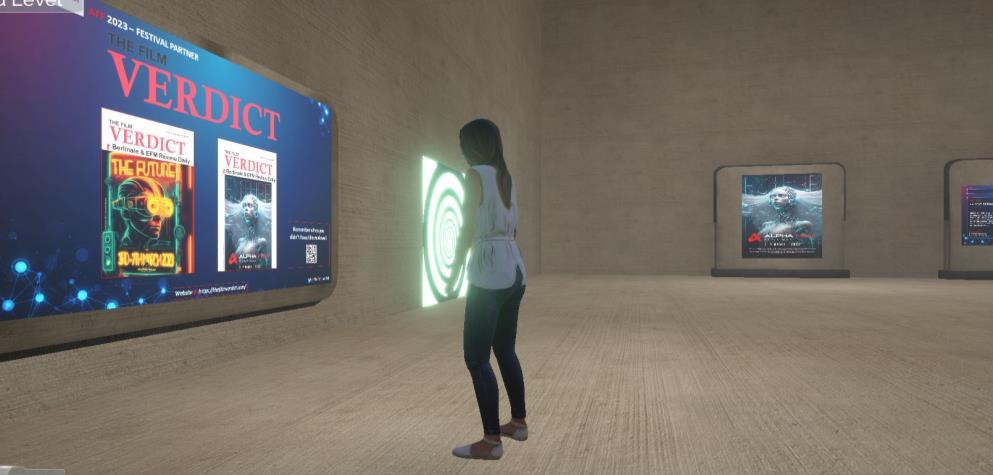
distribution models within the film landscape. While we quickly settled on ‘the future’ as the theme of the first edition, a programming strategy was a little more complicated. In a film festival ecosystem full of territorial rights agreements, screening innovative new films for a global audience in a digital space comes with its own set of challenges. Of course, part of the mission of the MILC Metaverse is to help create new paths for such distribution conundrums, but we had to be creative and broaden our thinking about the types of films we wanted to showcase.
In lieu of a traditional competition, where a jury of experts selects a (Continues next page)

winner, we opted for an Audience Award that would better reflect the foundational values of the Web3 space in which we were operating. As such, we chose 12 films in our Official Selection for the audience to vote for, along with three live programs to accompany three nights of panel discussions.
The films in the Official Selection were designed to cover a wide range of tones, media, genres, places of origin, previous festival exposure, and the way in which they engaged with notions of the future. In some instances, like Mila Zhluktenko and Daniel Asadi Faezi’s Aralkum, and Gerard Ortín Castellví’s Agrilogistics, these were short documentaries that in different ways presented speculative futures. In other cases, we opted for dystopian sci-fi visions like Manolis Mavris’ Brutalia, Days of Labour and Thomas Frank’s The Unborn. The selection incorporated various modes, with Baloji’s fabulous music video Zombies eventually taking home the Audience Award.

Elsewhere there was comedy like Sarah Hafner's SOS, animation in the form of Sujin Moon’s Persona, and even an example of the relatively recent, but vital, new mode machinima in the form of Total Refusal’s How to Disappear. Machinima dominated one of the live programs, which centred on films made using video game technology, and was accompanied by a panel discussion on the boundaries between cinema and gaming. Our other themed events touched upon the intersections of artificial intelligence with art, and we hosted a fascinating panel on Film3 and the future of film production and distribution in the Web3 space.
Our intention was for the line-up to both introduce traditional festival films to an audience more familiar with the Metaverse, and to bring more traditional festival audiences into contact with new forms and conversations. Hopefully, we struck a good balance and took that one small step into a new universe, the Metaverse.
– Ben Nicholson
Hendrik Hey is the founder of MILC (Media Industry Licensing Content), a blockchain-based content licensing company aimed at democratizing the content media buying and distribution industry. MILC is a project of the European media giant Welt der Wunder, which Hey also founded more than 25 years ago. For more information about how MILC empowers content creators in web3, please visit https://www.milc.global.
TFV: Hendrik, although The Film Verdict business team is collaborating with you in the first Metaverse Film Festival, ALPHA, the editorial team wanted to understand more about your vision of the future of film distribution, especially during the European Film Market.
For full interview, click here.

VERDICT: Brazil’s first manned rocket launch provides a catalyst for transformation and a leftfield opportunity for escape in Carlos Segundo’s bittersweet and dryly absurdist short.
Ben Nicholson, July 1, 2022
In an early scene in Carlos Segundo’s 15-minute short, Sideral, the character known only as Mère (Priscilla Vilela) tells her husband that she’s tired. Her performance clearly conveys that she’s trying to explain a weariness of the soul but her husband, Père (Enio Cavalcante), fails to understand and jokes about them only just having arrived. In a vein similar to the recent Brazilian feature Desterro, written and directed by Maria Clara Escobar, a wife trudges through a stifling, quotidian family life and maybe, just maybe, longs for escape. Where Desterro’s examination of this moment leads to a strange and haunting drama, Segundo’s film uses the same scenario as the jumping-off point for something a little more oddball.
The film takes place in Natal, in northern Brazil, on the day of the country’s first manned space rocket launch, and various eyes are scanning the sky on the lookout for aspirational motivation and new horizons. The couple’s two children wait eagerly at home watching the television coverage, while Père works at the local garage and Mère attends the launch in person. Full Review


VERDICT: A family is forced to make an unthinkable sacrifice in this stomach-churning dystopian tragedy about the chilling effects of social control.

Ben Nicholson, September 8, 2022
Giulia Grandinetti’s gripping short drama, Tria, is set in an alternative near present in which the oligarchs of an authoritarian Rome have instituted limits on procreation. In this world, couples – or at least certain couples – are only allowed to have three children; if they fall pregnant again, they must carry the new baby to term and then choose a child to have killed, prioritising the lives of males. It’s a deliciously terrifying scenario to provide the backdrop of a contained and charged short film. Grandinetti drops the audience into this nightmarish setting in media res –en route to a hospital where a fourth child will be born, and three adolescent daughters are confronted by an ominous fate. Once their new bouncing brother has been brought into the world, sisters Zoe (Irene Casagrande), Iris (Anastasia Almo), and Clio (Sofia Almo) can do nothing but await their parents’ impossible choice. The film is split into two discrete scenes – one in which the girls make the most of the time they have left, and then the unnervingly ritual killing. The girls are all very comfortable with one another, they lie half-entangled on the floor Full Review
During the Alpha Film Festival,The community had the chance to vote for their favorite short film from the Official Selection. The community has spoken and the AFF Audience Award goes to

THE MILC COMMUNITY AND THE FILM VERDICT WOULD LIKE TO THANK ALL OF THE FILMS THAT PARTICIPATED IN THE INAUGURAL ALPHA FILM FESTIVAL INCLUDING OUR OFFICAL SELECTION
VERDICT: As we stand on the edge of increasing digital frontiers, Katharina Pethke’s thought-provoking film explores the mechanics and implications of creating a virtual doppelganger. Ben Nicholson, November 22, 2022
In Katharina Pethke’s absorbing new documentary Uncanny Me a young model named Lale contemplates the possibility of generating a full-body scanned avatar of herself. A little bit like the premise of Ari Folman’s The Congress, the notion here is that

this digital rendering of Lale will be able to be deployed to represent her in work rather than her having to physically be involved. The concerns raised, however, are complex; how will she maintain control over her digital self? What are the
repercussions if that self is abused in some way? What if the avatar becomes autonomous? While the film doesn’t attempt to answer these expansive and challenging questions, they constantly linger as we watch the process meticulously unfold.
Early on, Lale is recording a diaristic musing to the camera and wonders aloud how she feels about ageing – a fair and constantly pertinent question in her line of work. She decides that she is happy to be getting older: “I don’t want to look like I do now forever.” The fact that she is changing proves that she is here, she asserts. Nevertheless, Lale is very actively exploring the possibility of having a virtual clone made and, as that undertaking progresses and she begins to come face-to-face with her own computer-generated twin, one wonders what it will mean when she no longer – publicly, at least –changes. Is she still here?
Full Review
Media journalist and writer for The Film Verdict, Daniel Gusinski moderates a discussion on interactive storytelling, examining the intersection between cinema and gaming with guest panelists:
HaZ Dulull
(Director / Producer, Hazimation.com)
Harry Chadwick
(Writer / Director / Co-Founder Interflix Media)
Grace Chadwick
(Producer / Co-Founder Interflix Media)
Sam Barlow
(Writer / Director)
Conversation was originally broadcast as part of the March 5 Alpha Film Festival events.

into the present for Nian (Annabel Yao) as she says goodbye to where she grew up while locals evacuate around her. Despite the high concept premise, the film is less about narrative progression than it is a mood piece about the notion of departure and the ways that our history and our memories are both bound up in, and unleashed, by place.
VERDICT: Story Chen’s Palme D’Or-winning short is a mesmerising journey through memory and melancholia as a woman takes a farewell tour of her hometown.
Ben Nicholson, September 4, 2022
The impact of an asteroid has placed a provincial town in China at immediate risk of destruction in Story Chen’s short film The Water
Murmurs, which took home the top prize in Cannes earlier in the year. In this milieu of impending doom, the past comes flooding

Inspired by a couplet from Charles Baudelaire’s The Jewels, the film follows Nian as she drifts around her hometown in the few remaining moments that it has left. Submerged roads make her scooter voyage meandering, but she persists in visiting an old friend, Tian (Zhang Taiwen) at her former school, and a café she used to frequent owned by Mr. Peng (Li Rongxi).
Full Review

Film Forum has announced Joyland, the first Pakistani film to play at the Cannes Film Festival and to be shortlisted for the Best
International Feature Oscar®.will have its U.S. theatrical premiere on Friday,April 7, 2023.
Saim Sadiq’s debut feature, had its world premiere at the 2022 Cannes Film Festival where it won the Un Certain Regard Jury Prize and the Queer Palm.
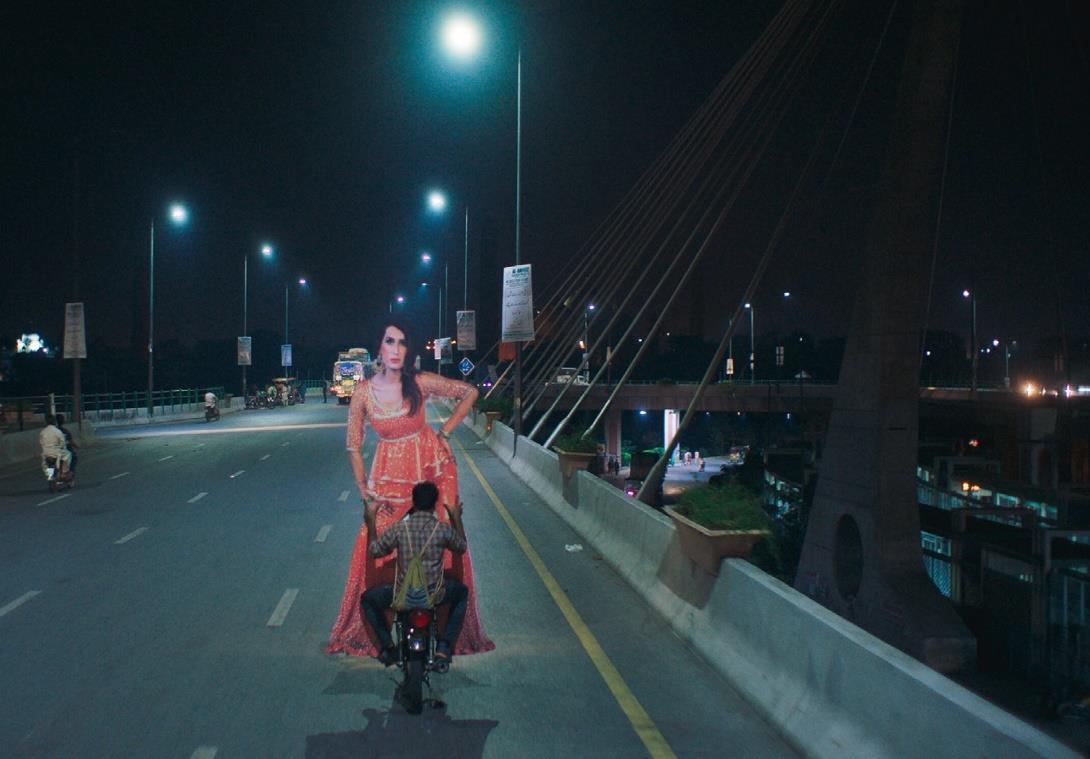
After Pakistan entered Joyland as the country’s candidate for the International Feature Oscar®, and one week before its domestic release in 2022, Joyland was banned by,the Pakistani government due to its “highly objectionable” LGBTQ+ themes.The ban was reversed, except in Punjab (where Joyland is set), the most populous region and biggest market for movies in Pakistan.
Sadiq calls Joyland a “de-romanticization of a coming-of-age tale and a homage to all the women, men, and trans people who pay the human cost of patriarchy… an entirely fictional yet emotionally autobiographical story that became a means of investigating my own place as a young man who was never man enough for patriarchal society.”
Joyland opens in the US April 7.
HBO Documentary Films has acquired worldwide and television streaming rights to How DoYou Measure a Year?
“I am thrilled HBO has acquired How DoYou Measure a Year?,” says director Jay Rosenblatt.“Given that HBO has debuted two previous films I made with my daughter, and much of my other work, they are the perfect home for this film and for me as a filmmaker.”
The documentary film is about a father-daughter relationship.The title comes from lyrics of the track “Seasons of Love” from the iconic 1996 musical Rent. The film has received a nomination for Best Documentary Short Film for the 95th Academy Awards. It was screened at the 2021 Locarno Film Festival.

Jay Rosenblatt is a two-time Oscar® nominee.This is his second consecutive nomination, as he was nominated last year in the same category.
How doYou Measture aYear? to stream this June
The European Film Market (16-22 February 2023) reported record numbers, with high visitor and exhibitor turnouts at the EFM.
612 exhibitors from 78 countries presented themselves at 230 booths and a total of over 11,500 market participants from 132 countries. Of the 773 films and series shown in 1,533 market screenings, approximately 600 had market premieres.

VERDICT: In partnering with Google’s Image Recognition AI, Jeppe Lange has constructed a 100mph frenzy of match-cutting that is strange, rhythmic and at times somewhat profound.

Ben Nicholson, March 29, 2022
Over the past few years, more and more filmmakers have been exploring the potential ways that artificial intelligence can interact with storytelling. In films like Chris Peters’ 24,483 Dreams of Death or Amy Cutler’s All Her Beautiful Green Remains in Tears, algorithms are fed data and charged with conjuring new forms of narrative. In Abyss, the new film from Jeppe Lange made using Google’s Image Recognition AI, the ask is perhaps slightly more straightforward, but the results are no less engrossing or profound. Lange’s film consists of a chain of 10,000 images selected on the basis that each image visually resembles the one preceding it.
This may sound like an optical assault – with the film lasting just over 13 minutes it works out at more than 12 images per second –Full Review
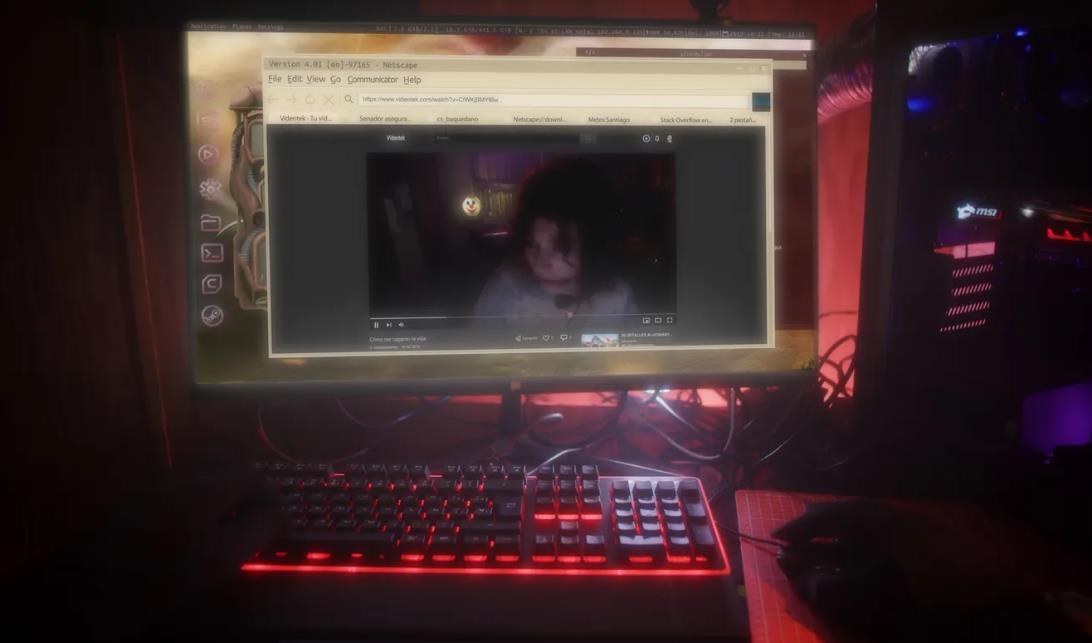
VERDICT: Valeria Hofmann’s uncanny and unsettling film explores the collisions between a video game and the real world, when a young woman attempts to call out online harassment.
Ben Nicholson, January 25, 2023
Valeria Hofmann’s new short film ALiEN0089, which premiered at Sundance earlier this month and screens now in Rotterdam, began with a true story. A school friend of the director recounted her harassment at the hands of online gamers and this scenario forms the basis of a troubling, paranoid thriller that permeates the boundaries between real and virtual worlds. A young woman, Sabina (Mariana Di Girolamo), seeks to draw attention to her harassment by aggressive faceless players of an online war game, little realising that there is an intruder watching her inside her own home.
The distinction between what is game and what is reality –
between what is happening online and what is happening ‘away from keyboard’ – is intentionally complicated right from the beginning of ALiEN0089. Films often begin with diegetic sound or voiceover against a black screen, but in this instance, it is a loading screen. What the audience then sees is all from the first-person perspective of somebody breaking into Sabina’s house. The entire experience is modelled on video game aesthetics, mimicking the visual language of the exact game Sabina plays. As the intruder moves around the house and spies on its occupant, they also collect conspicuous objects exactly as a game protagonist would: a beetle in a petri dish, Full Review
recognisable linear narrative, but, if anything, its experimental edge lends the story it is telling greater sophistication and undeniable power.
VERDICT: Set amidst a landscape of mountainous detritus, Kantarama Gahigiri’s short is an abstract but strikingly powerful rejoinder against the exploitation of Africa.
Ben Nicholson, February 21, 2023
The hulking form of a great landfill dominates the screen for much of Kantarama Gahigiri’s new film Terra Mater – Mother Land, which received its world premiere as part of the Berlinale Shorts competition. It’s a ten-minute marvel that combines sobering
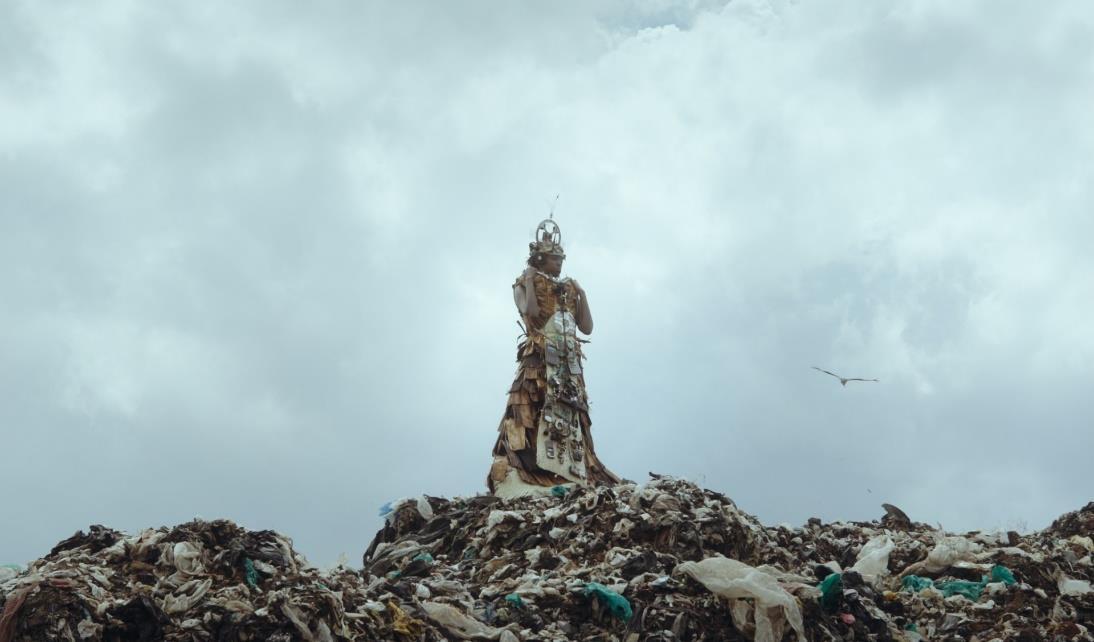
documentary, hypnotic beats, Afrofuturist aesthetics, ornamental tableaux, and a pointed message to a world that has ignored the ecological bearing on the African continent scoured for its resources. Gahigiri’s film may not hang its message on a
In its earliest moments, Terra Mater appears to take the form of a landscape film – static shots capture the undulating shapes of hills, valleys, and paths, but they are those of a colossal junkyard. Gahigiri toys with the way that the grandeur of African landscapes is so familiar to audiences but replaces its very structures with the heaped detritus of the technology industry indifferent to the damage it causes. The vista is populated by scavengers who in some moments chant, whisper, and sing the names of precious minerals that they search for in the wreckage, while at other points they stand in stylishly composed arrangements alongside the marabou storks that have famously colonised such vast African dumps.
Full Review
TFV’S
Ben Nicholson discusses artificial intelligence in the arts with:
AI Artist / Filmmaker
Derrick Schultz
Multi-Disciplinary Creative Sundog.
Conversation was originally broadcast as part of the March 4 Alpha Film Festival events.



Opening Film Earth Mama, courtesy of A24
Lithuania’s capital of Vilnius is 700 years young this year. Next week it celebrates with a fresh wave of homegrown talent at the Vilnius International Film Festival (VIFF). VIFF runs on creative thinking. Struck by a sudden global lockdown, its 2020 edition drew world news headlines when the festival turned the country’s airport into a drive-in theater. A year later, the programming moved into top hotels where locals could check into a room for the full immersive festival experience.
“In a world that’s constantly changing, it’s the ones who manage to adapt that survive,” notes VIFF CEO Algirdas Ramaška. “Our city meets the 700th anniversary full of energy about living in this vibrant period of its long history. It has proved the strength to be reborn after every challenge. In much the same way, VIFF and the Lithuanian film industry overcame the lockdown stronger than ever.”
A small country with three million inhabitants that joined the European Union in 2004, Lithuania has embraced its role as ‘New Europe’ with a vibrant sense of innovation in the arts, culture, food and tech. Ramaška brought that spirit to VIFF aka Kino Pavasaris (“Film Spring” in Lithuanian) by pioneering the ‘festival-as-nationaldistributor’ model, which he talked about recently at the European Film Market duringthe Berlin film festival. For full details, click here
VIFF runs March 16 - 26
The Locarno Film Festival is world renowned for its Retrospectives. Since 2021 the Festival has also played an active role in restoring older films to their former glory. Now in its 76th edition, Locarno will further strengthen this longstanding bond with our shared cinematic heritage. In the context of Locarno Pro’s Heritage Online project, the Festival is launching the Heritage Online Contest, an open call for applications for international classic and library films in need of complete or partial restoration. A jury of three international industry professionals will evaluate the applications and the winning restoration project will be announced during Locarno Pro (3-8 August), on Sunday 6 August during the Locarno Pro Award Ceremony. Thanks to a collaboration with Cinegrell, the winning film of the Heritage Online contest will then be the recipient of a complete, worldclass restoration service. The restoration process will commence in autumn 2023 and will conclude in the first semester of the following year. After that, the restored title will premiere at the 77th Locarno Film Festival in the Histoire(s) du cinéma - Heritage Online section.
The Heritage Online Contest is open to feature films from all over the world that premiered in 2009 or before and applicants must demonstrate that they are the rightful owners of the works in question. Applications are open from March 8 to April 28, 2023
Locarno Film Festival runs Aug 2 - 12
The Museum of Modern Art and Film at Lincoln Center announce the 52nd edition of New Directors/New Films (ND/NF), Opening the festival is Savanah Leaf’s debut feature Earth Mama, a devastating and evocative portrait of motherhood refracted through the prisms of race and class.

ND/NF will close with first-time director Vuk Lungulov-Klotz’s as Mutt, starring Lío Mehielas Feña a twentysomething trans man who must contend with an onslaught of aggravations, surprise encounters, and emotional choices over a 24-hour period.
“We are thrilled to bookend the 2023 ND/NF edition with two remarkable features, directed by up-and-coming artists Savanah Leaf and by Vuk Lungulov-Klorz, portraying tormented yet determined characters with sensitivity, authenticity, and a true inspiring artistic vision,” said Florence Almozini, FLC Director of Programming and 2023 New Directors/New Films Co-Chair. “We strongly believe that the future of cinema is in the hands of these brilliant directors and cannot wait to share their unique creations with our audience.”
For more than half a century, the festival has celebrated filmmakers who speak to the present and anticipate the future of cinema, and whose bold work pushes the envelope in unexpected, striking ways. For line up and details, click here
ND/NF runs March 29 – April 9

Listen to TFV’s Short Film Critic Ben Nicholson, as he introduces the Alpha Film Festival and moderates a discussion exploring Film 3, with guest panelists:
Jordan Bayne (Filmmaker / Founder The Squad)
Stephen Murray (Founder, CEO Binegable.net)
Genevieve Thiers (CEO, Enterainmint.com)
Miguel Faus (Filmmaker)

Andy Salmen (Co-Founder,VP Distribution Enterainmint.com)
Sherry McCracken (Producer / Director / DP)
Conversation was originally broadcast as part of the March 3 Alpha Film Festival Events