
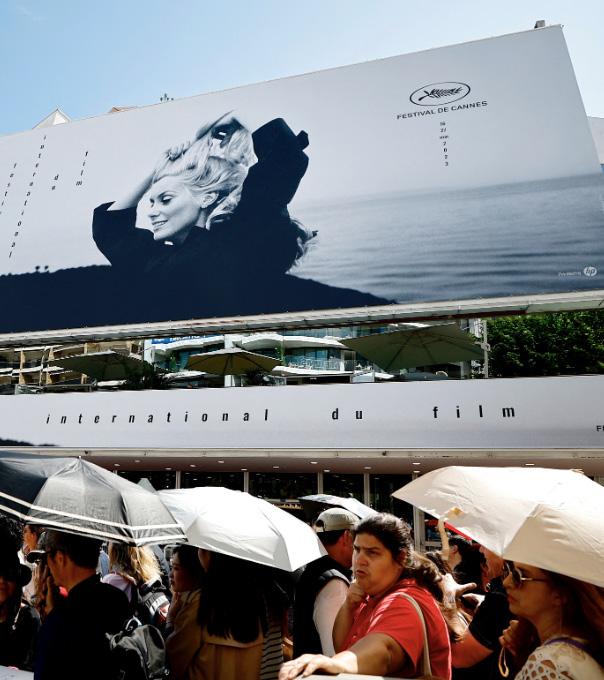
day 8

day 8



VERDICT: Austrian director Jessica Hausner's offbeat thriller about a classroom cult of teenage diet extremists is visually delicious but lacks dramatic bite.

Stephen Dalton, May 22, 2023

VERDICT: Aki Kaurismäki's latest is a largely familiar but lovely new work.
Boyd van Hoeij, May 22, 2023
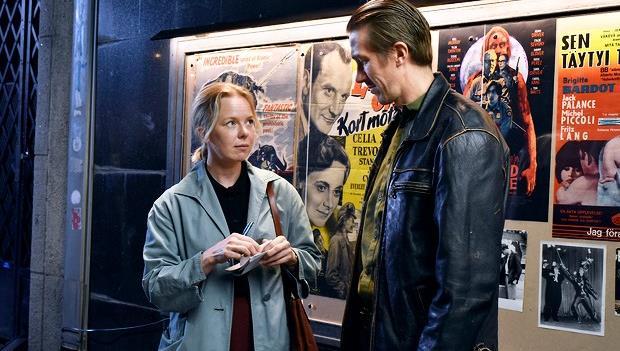
Some world-cinema auteurs are accused of making the same film over and over again as if that were a bad thing. But thankfully, watching Fallen Leaves (Kuolleet lehdet), the latest working-class tale populated with a handful of loveable sad sacks from Finnish auteur Aki Kaurismäki, confirms the idea that not only can it be a good thing, but it is the very familiarity of the filmmaker’s world that can work like a balm. It’s the cinematographic equivalent of that one comfy
sweater. One the one hand, you know what to expect, and on the other, the filmmaker’s minute variations on familiar things add that frisson of freshness that keeps it exciting. Kaurismäki’s first feature in six years and 20th overall premiered in competition in Cannes and should see solid arthouse returns for the Finnish maestro.
The two protagonists are people whose largely uninteresting lives are the stuff of stonefaced comedy. Full Review
A group of impressionable high schoolers fall under the bewitching spell of a charismatic teacher with extreme ideas about food in Club Zero, the latest Cannes competition contender from Austrian writer-director Jessica Hausner. A minor-key semi-thriller with a bright fairy-tale look, this decidedly strange teens-in-trouble movie is Hausner’s second Englishlanguage feature after her quirky botanical sci-fi puzzler Little Joe (2019), which also premiered in Cannes competition. Both films share some stylistic crossover in their impeccably composed visuals, vivid colour schemes, and oddly blank tone. Full Review

VERDICT: Entertaining and impressive – but not enough to justify Disney’s ongoing effort to turn their traditionally animated features into mostly-CG animated features.
Alonso Duralde, May 22, 2023
The Walt Disney Company seemingly won’t stop until it has turned all of its classic library of traditional animation into CG animation (with a few human characters), and if we must continue this rampage through history, The Little Mermaid at least fares better in the translation than many of the studio’s previous efforts. While it’s still an exercise in re-branding and revenue, the results at least provide some dazzle, some romance, and a handful of pretty good new songs with lyrics by Lin-Manuel Miranda. Or perhaps those songs just seem like highlights because they can’t be compared, favorably or not, to the existing material from the 1989 animated feature, the one that kickstarted Disney as an animation powerhouse for a new generation after years in hibernation.
Screenwriter David Magee knows his way around adaptations and remakes his recent work runs the gamut from Mary Poppins
Returns to Life of Pi and Lady Chatterley’s Lover and his script does at least put the romantic leads on, you’ll pardon the expression, more equal footing.
Otherwise, this is a story you already know well, from Hans Christian Andersen via 1989 adapters John Musker and Ron Clements: Ariel (Halle Bailey, Grown-ish) is a mermaid obsessed with the surface world and the people who live there, much to the consternation of her father King Triton (Javier Bardem), who loathes air-breathing humanity and blames them for the death of his wife. Ariel is besotted with Prince Eric (Jonah Hauer-King, Postcards From London); like Ariel, he too wants to achieve détente with the people beneath the sea, only to be blocked by his own royal family, namely his mother, Queen Selena (Noma Dumezweni, The Kid Who Would Be King).
Taking advantage of Ariel’s desire to experience the world above, sorceress Ursula (Melissa McCarthy) — banished sister of Triton gives her the opportunity to grow legs and breathe oxygen, but at a price: She must surrender her siren song (which she previously used to save a drowning Eric) to Ursula.

Full Review


VERDICT: In his feature-length debut, Claude Schmitz aims to simultaneously pay homage to, and blow up, film noir tropes, and while that’s not exactly the result, his film is a handsome, largely enjoyable play on the genre that becomes a bit too shaggy by the end.

Jay Weissberg, May 22, 2023
There’s much to enjoy and admire in Claude Schmitz’s baroque reverie on film noir The Other Laurens, a saturated, at times delirious doppelgänger doublecrosser set on the French-Spanish border. With its convoluted plot, multiple duplicities, scheming step-mother and young (semi) innocent, the film plays with many of the tropes of the genre but is not, pace the director’s statement, “about the dissolution of these very narrative structures and outdated figures that inhabit it.” Instead, it toys with such figures in ways that many noirs and neo-noirs have done since the 1940s, and while its teasing irony and deliberate artificiality have a Lynchian feel at times, the film isn’t really shaking things up. That doesn’t diminish from its positive elements, especially in the first half, though the script becomes too shaggy later on and the most interesting character, the semiinnocent, plays a less interesting
role than her build up would suggest. Apart from francophone territories, it’s hard to imagine The Other Laurens playing outside of festivals and specialty streaming sites.
Scruffy private dick Gabriel Laurens (Olivier Rabourdin, strong as always) barely makes ends meet furnishing proof of infidelity in divorce cases, and his dying mother (Jeannine Arnaldi) only gives him his father’s Rolex because she thinks he’s François, her favored son and Gabriel’s estranged twin. He receives a surprise visit from his niece Jade (Louise Leroy), up from Perpignan in the south of France, asking him to investigate the suspicious death of her father François. Jade is a fascinating character, young, blonde, and more than comfortable showing off a bit of skin to attain a little power; she convinces her uncle to make the journey. Full Review



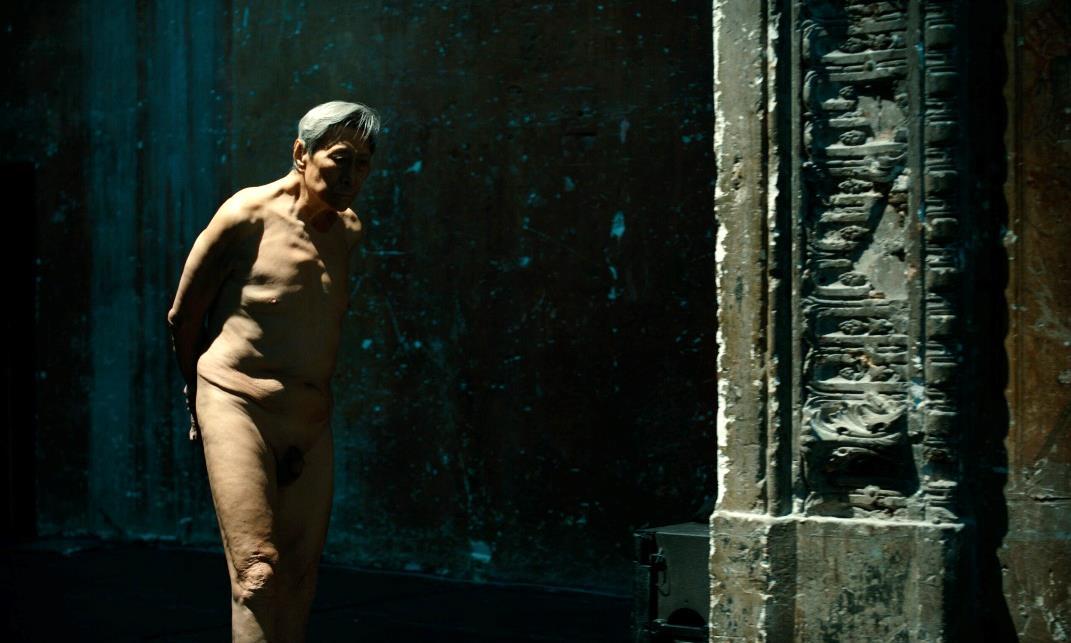
endured as a banished “antirevolutionary” during the Chinese Cultural Revolution. For the 86year-old composer, that short outburst might be a sign of his own self-defence mechanism kicking into gear, as he reminds himself the perils of reliving those traumatic times. For the viewers, however, it could be taken as advice about how to approach Chinese cineaste Wang Bing’s intense and visceral personality portrait of the old man.
VERDICT: Chinese filmmaker Wang Bing’s second entry at Cannes 2023 is an intensely physical portrait of the life and tribulations of Germany-based Chinese composer Wang Xilin.
Clarence Tsui, May 22, 2023
“No, no, stop thinking,” mumbles Wang Xilin at the end of the first part in Man in Black, as he
concludes a series of physical contortions designed to represent the forced labour and torture he
Running to just an hour and shot entirely in the 147-year-old Bouffes du Nord theatre in Paris, Man in Black is steeped in its gothic visual beauty and swirling score. Working for the first time with another cinematographer – in this case, Caroline Champetier –Wang Bing has plunged his tortured protagonist into a setting lit and filmed as if it’s hell on earth. Full Review

During an Ithra-hosted discussion panel on Monday, titled ‘Saudi Arabia: A film destination opportunity’ at the Saudi Pavilion in Cannes, the Head of Performing Arts & Cinema Majed Z. Samman for the King Abdulaziz Center for World Culture (Ithra) announced the cultural organization’s first open call for film proposals.
“Ithra Film Production supports Saudi Arabia’s growing film industry by nurturing home-grown talent and fostering cinematic content creation,” said Samman, during the panel, and continued “we invite international filmmakers to collaborate with filmmakers in the Kingdom and join us on our journey to accelerate talent and sector development in Saudi.”
Under the initiative, Ithra Film Productions aims to commission and fund up to five films annually, inviting international filmmakers to collaborate with their Saudi counterparts under a new open call supported by a funding initiative.

The panel highlighted Saudi opportunities and collaborations within the film industry ecosystem. Samman was joined by Charlene Deleon-Jones, Film AlUla Executive Director, Fatima AlBabtain, Film Financing Manager at Saudi Arabia’s Cultural Development Fund, and Zeinab Abu Alsamh, General Manager of MBC Studios and CEO of MBC Academy.
Samman also said that the fund offers filmmakers from around the world the opportunity to film against backdrop of the Kingdom’s unspoiled landscapes. “By working with local crews, we hope to facilitate an organic process of knowledge transfer and cross-cultural exchange that would elevate the local industry and enrich the global cinematic landscape.”
The open call closes on August 4, 2023 and a panel of distinguished Arab filmmakers will select the final projects to receive funding.

Ithra Film Productions is aligned with the Kingdom’s ambitious Vision 2030 plans to diversify its economy. The initiative has produced more than 23 films, of which 15 have received local, regional and international awards. Ithra productions have been screened at 17 festivals around the world, while five have streamed on Netflix.
Most recently,Valley Road, by award-winning independent director Khalid Fahad, had its worldwide premiere as the closing film at the Red Sea International Film Festival.Valley Road is Fahad’s debut feature film and is slated for a wide release later this summer.
Filming also recently wrapped on another Ithra-commissioned project, Hajjan (pictured in the header above) a feature film which reunites celebrated Egyptian producer Mohamed Hefzy and director by Abu Bakr Shawky -after the success in Cannes of Shawky’sYomeddine in 2018. Featuring emerging Saudi talent embedded in an international crew, the film is expected to join the festival circuit this fall.
Ithra, immediately recognizable as a stunning building structure in Saudi’s Eastern Province, is also a beacon of change in Saudi Arabia, and symbolic of Kingdom’s shift towards human energy based in culture, creativity and innovation. Saudi at heart and multicultural by nature, Ithra is a gateway to the Kingdom and a connection to the world. The Center creates new opportunities while preparing the next generation of original thinkers to lead in the creative and cultural industries. Ithra enriches lives and unlocks talent through a focus on cross-cultural experiences while encouraging the development of original content.
For Full details, click here
Behind the scenes of Abu Bakr Shawky’s ‘Hajjan’, photo courtesy of Ithra